Monday, December 22, 2014

Nation is united to fight terrorism: Former PM Gilani

http://mediacellppp.wordpress.com/


Former prime minister and Pakistan People’s Party leader Syed Yusuf Raza Gilani said Sunday the incumbent government had taken the right decision to resume implementation of the capital punishment in view of the prevailing situation.
He visited the provincial metropolis to express grief over the Army Public School and College tragedy, share sympathies with the families of the martyred students and inquire after the health of the wounded children.
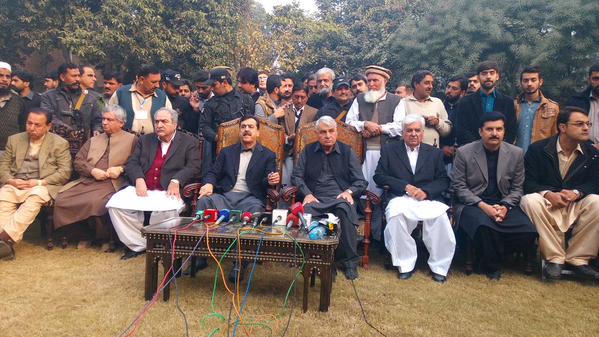
After visiting the Combined Military Hospital (CMH) and Lady Reading Hospital (LRH) and attending a number of functions, the former prime minister addressed media persons at the residence of former federal minister Arbab Mohammad Alamgir.
He said armies alone cannot fight a war. “The nation has to stand behind it. It is a matter of satisfaction that the entire nation is on the same page in the fight against terrorism,” he said.
Gilani opined that the tragic incident of December 16 was a grave shock for the entire nation. He said that convening All Parties Conference (APC) after the tragedy was a good decision and the nation had expectations from the moot.
He assured full support to the government for implementation of the decisions taken at the APC. “The government would find us behind it in case of any reaction and resistance as well,” he remarked.
The PPP leader said that terrorism had become the most serious threat for the country and the countrymen and it was the major impediment to the way of development and investment. He was of the opinion that such tragedies also created numerous problems for the overseas Pakistanis. He urged the government to come up with a concrete strategy to overcome such tragic incidents.
Yusuf Raza Gilani said that better ties with Afghanistan carry immense importance for Pakistan. “If ties with Kabul are not cordial, similar incidents would continue to happen,” he argued.
He added that relations with Afghanistan and India were not good during the PPP government as well. However, they had made efforts to improve ties with the neighbouring countries, he maintained.
The former prime minister demanded the government to announced civil awards for the martyrs of the Army Public School and College and extend financial support to the bereaved families.
He said that implementation of the law should be ensured. Unless and until law is implemented fully, the acts of terror won’t be controlled, he stressed. He said that it was the responsibility of the government to provide security to the witnesses.
Yusuf Raza Gilani pointed out that with the influx of the internally displaced persons, the problems of the people of Peshawar and Khyber Pakhtunkhwa had multiplied. “Therefore, the government should take effective measures for the return of the displaced tribespeople,” he added.

Pakistan - Lal Masjid protesters receive 'threats from Taliban'


Political activist Muhammad Jibran Nasir, who has been spearheading protests against controversial Lal Masjid cleric, Maulana Abdul Aziz, has allegedly been threatened by Tehreek-e-Taliban Pakistan Jamaat Ahrar (TTP-JA) spokesperson Ehsanullah Ehsan.
Talking to The Express Tribune, Jibran Nasir said that he had received a call, allegedly from the spokesperson of TTP faction, Ehsanullah Ehsan. Nasir went on to add that he had recorded the conversation and verified the voice of the caller with the help of media contacts who were familiar with Ehsan’s voice.
Nasir, however, made it clear that he would not back down from their planned protests today (Monday) outside the Lal Masjid. “We are not afraid. We are not backing out,” Nasir told The Express Tribune. 
“We are here to save our mosques. Our mosques should preach love and peace. They must present the right spirit of Islam,” Nasir said, adding that he had a detailed debate with the TTP spokesperson on Islam before the spokesperson made his threats.
You can hear the recording made by Nasir of the conversation below:

Further, Jibran said that the mobile number being used by the caller originated from Afghanistan. An FIR was lodged against Maulana Abdul Aziz at the Aabpara police station on Friday, three hours after protesters had gathered outside it demanding the cleric be arrested for supporting the Tehreek-e-Taliban Pakistan’s Peshawar school massacre. The TTP on December 16 stormed into an army-run school killing 148 people, including 132 children. The Lal Masjid cleric openly sympathises with the TTP and militant group Islamic State and defended the dastardly attack in Peshawar as a reaction to a military offensive launched in North Waziristan. A senior police officer told The Express Tribune, the government can revive quashed cases against Maulana Abdul Aziz by incorporating new evidence in the ‘challan’, as he is still believed to have a soft corner for the outlawed TTP and Islamic State. According to Section 2f (c) of the Protection of Pakistan Act 2014, a case can be registered against the cleric for his support of terrorist groups, the official said. Applying ‘innocent until proven guilty’ adage of the criminal jurisprudence, the previous government of the Pakistan Peoples Party had quashed all cases against Maulana Abdul Aziz.

Disco Mullah Blasphemy Row Highlights Pakistan’s Hypocrisy


Shaheen Pasha            


When Christians and Hindus are accused of insulting Islam in Pakistan, the punishment is harsh. When a popular Sunni televangelist does it, to forgive is divine.
Twenty-five years ago, Pakistani pop star Junaid Jamshed took to the airwaves, singing his love for his country with the declaration that Pakistan was his heart, Pakistan was his life.
Since then, Jamshed, like much of the country he once honored in song, has gone through a religious revival. As a vocal televangelist for the conservative religious group, Tableeghi Jamaat, Pakistan’s “disco mullah,” as he came to be known, used his once boy-band heartthrob status to garner a new following, preaching strict and often misogynistic interpretations of Islam. That very misogyny landed him in hot water after a video of Jamshed ridiculing the Prophet Muhammad’s wife Aisha went viral on the Internet, resulting in blasphemy charges being filed against the popular preacher earlier this month.
In a country, where blasphemy allegations have become commonplace, Jamshed’s case is significant. Long before bearded men swearing allegiance to the Taliban carried guns and bombs to terrorize society, Pakistan has used religion as the institutional weapon of choice to oppress minorities and political opponents by providing the clergy with inordinate power. The controversial blasphemy laws have ensnared hundreds of citizens, yet condemnation from the masses remains muted because the accused are often from marginalized groups. Jamshed’s case, however, turns that scenario on its head given his close ties to the very mullahs that have stood behind criminalization of perceived blasphemy.
“Jamshed's case highlights that the blasphemy law as a weapon of oppression can be indiscriminate and come back to hurt those who have previously been advocates for and proponents of these laws,” said Saroop Ijaz, a lawyer for Human Rights Watch in Pakistan.
It also highlights Pakistan’s contradictory and puzzling stance on religion in general. On one hand, Pakistan has struggled with curbing growing radical extremism as exhibited by Tuesday’s horrific attack on children at a school in Peshawar. On the other hand, the country has draped itself in Islamic nationalism—specifically Sunni Islam—as a means of cultural identity. To be Pakistani, in essence, means to be a Sunni Muslim. Anything that challenges Islam challenges the country’s very identity.
“The concepts of jihad and Islamic nationalism are very much part of public educational instruments from school textbooks to media to research that goes on in Pakistan,” said Raza Rumi, editor of The Friday Times and senior fellow at The United States Institute of Peace. “You have generations of people that are willing to accept the Islamic nationalist identity so any perceived attack on Islam is also considered unpatriotic. Blasphemy has become an instrument of power.”
“The fact that he has been forgiven itself shows the hypocrisy of the proponents of this law. They are not in a forgiving mood when it comes to the weak and marginalized.”
While the draconian blasphemy laws have their roots in British colonial rule, the laws were amended and strengthened under the country’s former military dictator Zia ul-Haq, who sought to gain support from Pakistan’s clerics as a means of strengthening his own power. Since 1987, there have been roughly 1,300 cases filed under the blasphemy laws, according to varied reports.
According to a report by the U.S. Commission on International Religious Freedom (USCIRF), there are currently 17 Pakistanis on death row and 19 individuals serving life sentences for violating the blasphemy law. But many cases do not even make it to trial. In Pakistan, angry mobs and vigilante justice often mete out punishment against accused blasphemers and their perceived supporters with little action taken by the government to punish the offenders, Ijaz said. Earlier this year, a Christian couple was burned to death by a mob after a village mullah declared the couple was guilty of desecrating the Quran. The wife was reportedly pregnant at the time.
And in 2011, Punjab governor Salman Taseer was shot 27 times in the back by a police bodyguard after he called for reforms of the blasphemy law and defended Asia Bibi, a Christian mother of five who was sentenced to death for allegedly insulting the Prophet. At least 60 individuals have been killed since 1990 outside of the Pakistani justice system, according to the Islamabad-based Centre for Research and Security Studies (CRSS).
The USCIRF said the law is particularly problematic because it does not require proof of intent or even any evidence once an allegation has been made. Asia Bibi’s four accusers, for instance, never revealed what exactly she said claiming they would be guilty of blasphemy if they repeat it. There are also no clear guidelines on what constitutes a violation, leaving it wide open for interpretation. In March, a group of lawyers were arrested and charged with blasphemy for insulting a police inspector by name, given that he had the same name as one of the companions of the Prophet.
And the law can easily be used as a political tool to punish any disrespect of the state. Actress Veena Malik—who fled to the United Arab Emirates—wassentenced to 26 years in absentia for acting in a televised mock wedding that featured a scene loosely based on the marriage of the Prophet’s daughter. Her crime, however, may have had more to do with a photo shoot for the men’s magazine FHM, which featured a nude Malik sporting a tattoo of the initials ISI, which stands for Pakistan’s spy agency Inter Services Intelligence.
“While hardliners are vocal about blasphemy, other Pakistanis may feel bad on some level but they are still kind of accepting of the way it is,” said Rumi, adding that many Pakistanis supported Taseer’s killer because the Punjab governor came out in defense of someone who insulted the Prophet. In Malik’s case, he said, “blaspheming against the ISI is akin in Pakistan to blaspheming against the Prophet as Islam and nationalism converge.”
In any case, Pakistan as a nation has been unforgiving of any slights against Islam. That’s why Jamshed’s case is particularly illuminating in its hypocrisy when it comes to the religious conservatives’ views on blasphemy.
In his now infamous video, Jamshed is seen delivering a sermon to his followers in which he preached, “women were made from the ribs so they will always remain crooked,” and cannot be straightened out. To illustrate his point, he relayed a story of the Prophet’s wife feigning a headache to get attention from her husband as an example of the fallibility of women’s innate nature. The subsequent firestorm in criticism resulted in the Tableeghi Jamaat distancing themselves from his comments and Jamshed issuing a tear-filled apology, begging for forgiveness with clasped hands as “only prophets do not make mistakes but everyone else has made mistakes.”
Official charges have been filed against Jamshed by the leader of the religious political party Sunni Tehreek and Jamshed has now fled to the United Kingdom—ironic given his previous anti-Western stance. But his apology has largely been accepted by the religious community in Pakistan and observers doubt the case will be pursued with any real zeal going forward.
“The fact that he has been forgiven itself shows the hypocrisy of the proponents of this law. They are not in a forgiving mood when it comes to the weak and marginalized who are often accused falsely,” said Yasser Latif Hamdani, a Pakistan-based lawyer and author of “Jinnah: Myth and Reality.”
Hamdani said the international community could apply pressure on Pakistan to alter its blasphemy laws and their application with an “economic carrot and stick” policy, but he is not optimistic that the laws will serve everyone equally.
“It seems that the different standard is (based on) the length of the beard and outwardly display of piety,” Hamdani said.

#PeshawarAttack - It’s now or never


By Meena Gabeena


On 16th December, 7 members of the inhuman Tehreek-e-Taliban (TTP) ferociously killed 145 people including 132 children and the number is still rising. This horrible Genocide in Army Public School Peshawar has left the silent Pakistanis shocked and disgusted. It is like when you lose a family member, not anyone outside can completely empathize with your pain. Pakistan as a family has lost its children. Had it been the first time it had happened in Pakistan, we would have been hopeful to get all kinds of terrorists eliminated but that is not the case. Pakistan has a habit of forgetting its wounds. Guns have silenced many of us and a doubtless fact is that many of us are still not able to believe the statements of TTP as we have been forced into confusion by our very own.


It took Pakistan some 30 to 35 years to be changed into a mindset that spreads hatred, radicalization, conspiracy theories and doubts because of how we have been truly brainwashed. The fact of the matter is there are still humans living in this country. We are all in pain, we are tired of burying innocent bodies everyday and we have finally united against terrorism. The silent majority has started to conclusively speak demanding only action. It may take us the same number of years to change back the mindset but the outcome of that mindset is the first thing that has to be completely eradicated.

In Bertrand Russels’s words though written a long time ago but still very current given the scenario in Pakistan, “The world is suffering from intolerance and bigotry, and from the belief that vigorous action is admirable even when misguided; whereas what is needed in our very complex modern society is calm consideration, with Readiness to call dogmas in question and freedom of mind to do justice to the most diverse point of view.”

Recently we saw the manifestation of such a mindset again. A cleric who had been openly responsible for kidnappings and attacking Pakistanis with weapons they had collected in the Laal Masjid, ran away in a burqa after being attacked back by the army, arrested and then released by our very own and given a lot of airtime by our very own. He refused to call the children brutally killed by TTP as Martyrs, he even called the TTP his brothers and immensely hurt our sentiments. When the brave civil society of Pakistan protested against his statements, he threatened to attack them on which the civil society filed an FIR against him.

Pakistan is signatory to the United Nations Convention on the Rights of the Child (UNCRC) that grants all children the right to survival, development, protection and participation. Pakistan is also signatory to The United Nations International Convention on Civil and political Rights (ICCPR) to ensure that no one is denied his or her right to due process of law, freedom of life, freedom of religion, freedom of speech and freedom of assembly. Pakistan’s state can be held accountable in case of failure to safeguard these rights.

The civil society urges the Government to take an action against Mulzim Abdul Aziz. Today Monday 22nd December,2014 we are all gathering outside AabparaPolice Station at 5:00 PM to demand justice. It is an appeal to all Pakistanis to break the silence, never forget more than 50,000 lives taken by the terrorists and join the movement of getting the people who terrorize us behind bars. It really is now or never. We have been silent on killings in the name of religion just thinking that tomorrow our house can be on fire too. Our house is on fire already, put it off and stand united against terrorism and their apologists.

Pakistan: #PeshawarAttack - The blood price of Faustian bargains

Pakistan's political and military elites have been closing their eyes to extremist violence for way too long.


A single and extraordinary image from last year: Hazaras, an ethnic and religious minority in Pakistan, maintaining a night vigil by the coffins of their slain kin in a street in Quetta. The previous evening, at least80 Hazaras had been slaughtered in twin bomb blasts in the capital city of Baluchistan. It remains a dark, disturbing scene, as though the dead seemed scared of being interred or did not want to be buried in protest against the cruelty shown to them when they were alive - and when they died. 
It is unusual for people to keep their dead waiting for that final journey, even more so in Islam where it is required to bury the dead as soon as possible. That a group of Muslims refuses to do so means something basic has been wrenched from their world: The fundamental right to a life of dignity. There were night vigils in many cities across Pakistan, protests and mournful pleas by a besieged and desperate people asking their rulers to at least appear to attempt to protect lives.
The families of the dead remained on the road with coffins for nearly 70 hours before the government of Pakistan acceded to some of their demands and sacked the province's chief minister and imposed direct rule.  
Peshawar attack survivors hang on for life
Nearly two years later, another image that will forever remain etched in our consciousness: Mothers from Peshawar wailing by the coffins of their children who had been slaughtered by the Pakistani Taliban. Some of the children's heads were partially severed, Newsweek Pakistan reported.
As the world watched, the corpses of schoolchildren were lined up in the school auditorium in Peshawar, and Pakistanis once again seethed with anger and a sense of powerlessness in a country with the sixth largest army in the world. More coffins, with passport photos of the children plastered over them, were paraded across media screens, breaking hearts and, more devastatingly, the hope and promise of a new generation.
These two massacres - and there have been more in between - sum up both the extremist onslaught against ordinary Pakistanis and the near-total abdication by the state's primary duty, namely, to protect the lives of its citizens.
The Pakistani Taliban, sworn to revanchist mass murder, claimed it chose to kill 132 students to avenge the killings of its men and their families in the Pakistani army's ongoing offensive in North Waziristan.
If, in some kind of perverted moral frenzy, one were to accept that, one would then also ask the TTP, what did they or their affiliates - many of them birthed and nurtured by sections of the Pakistani security establishment - avenge when they massacred the utterly powerless Hazaras in Quetta?
Or when they blew up a church in Peshawar, killing scores of hapless Christians who as far as I know were neither drone pilots nor spying for the Pentagon; or when they flogged a little school girl in public; or beheaded those who did not understand their interpretation of religion during the time they were allowed to administer Swat; or…? The list is depressingly long and goes back to the time when there were no evil drone assassins on the prowl over the skies of Pakistan.
The answer may lie in the creed of violence the TTP and its splinter or franchise groups have made their motto and gone so far down the route that there seems no turning back possible.
How did Pakistan get here?
Pakistan finds itself in a vicious and endless cycle of violence because, in addition to historical reasons and geo-political fault-lines, the country's main political forces chose to watch from their boardrooms when Salman Taseer, a sitting governor of Pakistan's most powerful province, Punjab, was murdered by his own security guard four years ago. The guard now publishes religious sermons from his prison cell.
In spite of the vast resources of a security state available to it, the country's leaders chose to look the other way as armed groups began to roam freely, looking for innocents to kill. While sectarian and extremist killings are by no means new in Pakistan, one can possibly trace the start of this new open season of killings to the public celebration of the murder of a governor who had merely sought legal redress for a powerless Christian woman accused of blasphemy. Seldom before had the Pakistani political elites so wholeheartedly emboldened the politics of hate.
Political and religious parties in the country seem to be paralysed by an acute moral crisis, which impels them to rise vociferously against a terribly made, devious film denigrating the Prophet of Islam, but not when Pakistanis, their own kin, are butchered in a ritualistic performance of violence week after week.
Taliban loses support over Peshawar attack
Nearly all political formations, whether secular or religious - although there is hardly any left of the former - claim to be capable of organising a million people to march, mostly against something and almost never for the ordinary Pakistani.
Even that relatively adolescent political formation, Pakistan Tehreek-e-Insaaf claims so, and has done so in the past when it organised a well-attended rally against American drones which often kill civilians, including children, in Pakistan's tribal areas. But none of these powerful parties seem to want to risk being in the bad books of the extremists. Even as they condemn the killings they make sure they don't name the perpetrators too often or too loudly.
The many Faustian bargains that the security establishment has over the years signed up to, by nursing various militant franchises, seem to have gradually found favour with the political classes as well. Therefore no one, neither the centre of all power in Pakistan, the military, nor the political parties which want Pakistanis to stand by them in their struggle to keep democracy alive, seems to be in a position to challenge the groups whose primary occupation seems to be the murder of the meek.
The military and political elites of the country have other bargains to honour too, and they do so by relentless bombings of areas controlled by the extremist groups. But we seldom hear or read accounts of what happens in that theatre of war. How many civilians are killed, how many children? All we know is hundreds of thousands of people are displaced from these areas and turned into tent-dwelling refugees in their own country. The steep blood price of these bargains continues to be paid by the people of Pakistan, not by those who script them.
Apologists of violence
It is perhaps another measure of the deep schisms in Pakistan's body-politic that apologists for such openly hostile groups go into conspiracy-theory mode every time the former commit an atrocity. Very soon, the Pakistani Taliban and their affiliates may have to distance themselves from their defenders in TV studios and on social media, because even when the Taliban triumphantly claim responsibility for murderous attacks, the apologists seem to say, "No, you didn't do it, bro." That evergreen excuse, the foreign hand, is invoked even as leaders of extremist groups openly address rallies in Pakistan's cities, threatening more murder. 
There is outrage against these wanton killings - every day. But the thinking, writing and speaking classes of the country are often reduced to expressing outrage on social media, or an exceptionally brave few venture out with candles in solidarity with the victims. It is perfectly understandable, for it is one thing to express outrage and completely another, to face up to people eager to empty their AK-47 clips.
The people of Pakistan are simply trying to live, to survive, in a milieu where many people seem to have decided that the easiest way to deal with difference, with diversity, with the other, with those whose main concern in life is the education of their children, is to announce an instant death sentence.
The time has perhaps already arrived when the country's military and political leaders are fearful of their own security detail. But if the Pakistani state continues to watch this murder of the innocents from the headquarters in Rawalpindi, or the presidential palace in Islamabad, there may come a day when those persecuted or the kin of the slaughtered will declare enough is enough. We are tired of being murdered, they might say.
One hundred and thirty-two children were massacred in Peshawar on what's being termed one of the darkest days in Pakistan's history. These are gruesome and brazen acts of mass murder carried out by men who speak proudly of the death tolls they score. Nothing more shocking has occurred in recent history. We ought to be more shocked, repulsed, than we are, so that those who can do something about it will do so.

Afghan intelligence agency backing TTP chief: Rehman Malik

Former interior minister and Pakistan People’s Party leader, Rehman Malik says Afghan intelligence agency is supporting Tehreek-e-Taliban Pakistan Chief Mullah Fazlullah.
In an interview, he said the fugitive TTP chief found refuge in Afghanistan whenever he wanted. “I have repeatedly been saying a foreign hand is involved in terrorist activities in Pakistan,” said Malik.
He said that he had also briefed the Senate that the Afghan intelligence agency was backing militant commander Faqir Muhammad and TTP chief Mullah Fazlullah.

He said nobody was ready to accept his claim about presence of Punjabi Taliban but it was good to see that the Punjab government was now taking action against terrorists.

Pakistan - The Lal Masjid challenge


Rage having overtaken fear of the murderous extremists in the wake of Peshawar schoolchildren's massacre, civil society members gathered at Islamabad's Lal Masjid on Thursday evening to 'reclaim' the public mosque from a Taliban ally, Maulana Abdul Aziz. They protested in a civilised manner, lighting candles on the roadside, writing the slain students names on a board, and raising slogans against the mosque's chief cleric for his refusal in a TV programme to condemn the massacre and call the children martyrs. He, in fact, had tried to justify the killings in a roundabout fashion, which is unsurprising given his own credentials. What is surprising, indeed sad, about the episode is that a section of the media should have no qualms about giving such elements airtime. Whether unintentional or for gaining Television Rating Points the media needs to avoid dignifying perverted thinking by broadcasting ruthless killers' narrative. It can cause confusion in impressionable minds and drive chinks in the nation's resolve to eliminate terrorists. 

Unfortunately, however, those at the helm also do not seem to have learnt any lessons from the Lal Masjid experience, which ended in a tragic bloodbath back in 2007. It needs to be recalled that a madrassah attached to the mosque, and run by the Maulana's family, to impart religious education to children from disadvantaged backgrounds, flourished under government patronage. What went on inside became known when the madrassah trained morality brigades began raiding what they called immorality centers, abducting people including Chinese citizens from their health clinics. Also, burqa-clad female pupils displayed baton charging skills on the madrassah rooftops to strike fear in the hearts of the capital's residents. Encouraged by governmental inaction, Kalashnikov- brandishing young men too appeared in the mosque-madrassah compound, leading to a standoff with the security forces that culminated in a horrific death toll, and the Maulana's arrest. 

Maulana Aziz and his wife, who headed Lal Masjid madrassah's girls section producing female zealots, are back in business. They have been provided with a new venue where hundreds of young people are enrolled. What they are learning is plain from the Maulana's latest expression of thinking, which clearly remains unaffected by the past event. Without a doubt, a new generation of violent extremists is in the making in his seminary. It is about time the power-that-be took notice and came up with a strategic response to the threat all such extremists poses to this State and society. 

Peshawar massacre: ANP urges speaker to reconvene assembly


The Awami National Party (ANP) has urged Speaker Asad Qaiser to reconvene the Khyber-Pakhtunkhwa (K-P) Assembly as soon as possible to discuss the massacre of nearly 150 students and teachers of Army Public School. The Tehreek-e-Taliban Pakistan accepted responsibility for the attack.
While speaking to The Express Tribune on Sunday, ANP parliamentary leader Sardar Hussain Babak said the attack on the school is a national tragedy and a session of the provincial assembly is imperative so lawmakers can discuss the issue in detail. Following a nearly four-month break, the K-P Assembly reconvened on October 24. At the moment it is on a break which ends on January 1.
“In the aftermath of the Taliban attack, it is necessary that lawmakers get together and give suggestions to end terrorism,” said Babak. The leader asked Qaiser to reconvene the house immediately so lawmakers can play their part in eliminating militancy.  “We want to know what the government is doing to control the blowback of Operation Zarb-e-Azb,” said Babak. “The government should not show weakness, and own this war.”
Bashir Bilour’s anniversary
ANP is set to observe the second death anniversary of slain senior minister Bashir Ahmed Bilour on Monday. Bilour died on December 22, 2012 along with several ANP activists when a suicide bomber blew himself up in Dhaki Nalbandi neighbourhood of the provincial capital.
According to Babak, ANP has arranged a programme to observe Bilour’s death anniversary at Nishtar Hall and senior party leaders will participate.
“ANP has borne the brunt of the Taliban insurgency; it has lost workers and leaders and has faced political losses as well,” said Babak.
He added when ANP was being attacked by the Taliban, the party’s political opponents were attacking its leaders and levelling allegations. “It would have been better if the country’s political leadership had owned this war at that time,” said the ANP leader.

Pakistan - Considered approach


The Peshawar massacre of schoolchildren by the  Tehreek-e-Taliban Pakistan (TTP) monsters has evoked a revengeful frenzy throughout the country bordering on hysteria. Perhaps it is the nature and scale of the atrocity in Peshawar that can be held responsible for this collective outburst. But calls for hanging convicted terrorists en masse, even in public, and demands for blood for blood, an eye for an eye cannot be described as a cool, calm, considered response to the challenge posed by the TTP and other terrorist groups. Since the Peshawar bloodbath, the military and security agencies have sprung into action on an unprecedented scale throughout the country. This intense activity has yielded, according to reports, 62 killed in ground action, 57 in air strikes on Friday, 45 on Saturday through the length and breadth of the country. This increased enemy body count raises the troubling question why this kind of outcome has not been possible before, when the terrorists of all hues have taken the toll of civilian and security forces’ lives to above 50,000. Critics are wont to ascribe this surprising uptick in enemy casualties on the possibility that now that the existential threat from the terrorists has come closer to home in the shape of the massacre of military personnel’s children on such a large and barbaric scale, the military and security forces are going after their former protégés with a vengeance. If this view is correct, it suggests that the terrorist community in all its various shades and hues was known to the security establishment, which was nurturing some for strategic depth objectives and perhaps turning a blind eye to others’ sectarian atrocities. Whatever the truth of the matter, no sensible person having the interests of the country at heart could possibly object to the higher body count amongst the enemy’s ranks, provided the claim that they are all terrorists is correct, a proposition difficult to prove independently.

More executions are now on the cards after the two carried out in Faisalabad the other day. But some have had to be deferred out of security concerns. Those concerns do not stop at the immediate threat of attacks by the terrorists on jails to free their colleagues on death row. They include the possibility of retaliatory further atrocities and terrorist actions, particularly on soft targets, in the days ahead. The country must therefore brace itself for more tragedies and sorrow. We are in a state of war, a fact denied for far too long by too many on the wrong side of the divide in our society. Such elements, whether in the media or elsewhere, are now under scrutiny and even verbal attack. However, what is still missing is a concentrated counter-narrative to challenge not only the terrorists, their sympathisers and defenders’ views, but educate the general public about how the holy name of religion has been misused by the terrorists to justify their bloody trade. For years we have been warning of the blowback from our proclivity to create and nurture proxy forces to project power in the region, east and west. That blowback has been around for some years but it is only now that the Peshawar tragedy has focused minds as never before across the board and negated the naysayers. Wisdom dawning is better late than never, but knee-jerk reactions and revengeful tendencies are no substitute for a considered, holistic approach to the problem of the growth and proliferation of all sorts of terrorist johnnies on our soil.

The self-inflicted affliction of terrorist groups, whether for foreign and strategic policy purposes or because space was allowed sectarian terrorism, now requires the physician to heal himself. No partial or discriminatory approach, along the lines of the thoroughly discredited by now ‘good’ and ‘bad’ Taliban narrative will do. Domestic terrorist groups such as the TTP and its ilk, sectarian groups such as the Lashkar-e-Jhangvi and its tribe, proxy warriors against India like the Jamaat-ud-Dawa and their extremist allies must all be put out to pasture (to put it euphemistically). Pakistan must now also revisit its Afghan Taliban policy and make sincere efforts to bring about a rapprochement between Mulla Omar and company and Kabul if Afghanistan, Pakistan, the region and the world are to finally turn the page on jihadi terrorism. 

Video Report - Mian Manzoor Wattoo on Peshawar attack and counter terrorism strategy in Aaj With Saadia Afzaal


Aaj With Saadia Afzaal - 20th December 2014 by sm_raza1

Mian Manzoor Wattoo asks political parties to exhibit unity and avert Peshawar-like incidents

http://ppppunjab.wordpress.com/


Pakistan People’s Party (PPP) Punjab President Mian Manzoor Ahmad Wattoo – said the government, political leadership, armed forces and civil society were on same page to tackle terrorism. However, he said, it was vital that the sitting government should legislate without any delay to counter terrorism and avert Peshawar-like incidents.
Addressing the peace conference here, he said it was PPP Chairman Bilawal Bhutto Zardari who vociferously condemned any dialogue with terrorists and his views had been seconded by others.
Punjab Governor Chaudhry Muhammad Sarwar,Jamaat-e-Islami (JI) chief Sirajul Haq, Opposition Leader in Punjab Assembly Mian Mehmoodur Rasheed, Salman Ghani, Brig (r) Farooq Ahmad, High Court Bar Association President Shafqat Mahmood Chohan, Gen (r) Javed Mahmood, Hamid Riaz Dogar and others were present on the occasion.
He asked the politicians to exhibit unity exhibited and praised Imran Khan for calling off the sit-in. The Peshawar carnage was a 9/11-like incident for Pakistan, he added.
Punjab Governor Chaudhry Mohammad Sarwar, Sirajul Haq, Mehmoodur Rashid and Salman Ghani also addressed the function and condemned the killing of school children in the Peshawar school attack.

Pakistan - What is govt doing to counter militant supporters, sympathisers within state apparatus?


THE lifting of the moratorium on the death penalty in response to the Peshawar carnage has triggered a serious threat: terrorist attacks to avenge the executions by the state.

Already, intelligence agencies are issuing all manner of warnings to possible targets, especially state institutions and security installations across the country, and many educational institutes, including in the federal capital, have closed their campuses indefinitely ahead of the scheduled winter break.

Pakistan is bracing for a backlash. This is the moment in which the performance and capabilities of the intelligence and law-enforcement apparatus across the country will be assessed. Failure could have catastrophic consequences, not just in terms of lives lost and individuals injured but also in terms of the state’s very ability to fight terrorism and militancy in all its manifestations.

Also read: Sympathisers, supporters of terrorists live among us: Nisar

For, a wave of successful attacks in response to state execution of militants could leave the resolve to fight terrorism in tatters, especially if the forces on the frontline are left exposed and vulnerable.

To be sure, in this long fight against militancy, there will be more suffering inflicted on the country. Given the willingness of the militants to attack virtually any target, hard or soft, and the reality that militants are embedded across the country, the possibility of more terrorist attacks is high.

But there is, or ought to be at least, a difference between the unexpected attack, the one that slipped through the cracks in the system, and attacks in major cities at a time when the country’s security apparatus is in a state of high alert and mobilised essentially on a war footing.

Yesterday, Interior Minister Nisar Ali Khan gave his frankest assessment yet of the scale and size of the militancy problem in the country. But it is not enough to call on the citizenry to act as eyes and ears on the ground against militancy.

What is the government doing about the militant supporters and sympathisers within the state machinery? Time and again, the infiltration by militant groups into law-enforcement agencies and even the intelligence apparatus briefly emerges as a topic of debate at the national level before being quietly pushed into the background again. Beyond that, where is the public investigation into lapses that have made militant attacks possible and where is the accountability of those who are found to have failed in their jobs?

No system anywhere can improve if there is no transparency and accountability. In essence, it is about disrupting the militants’ tactics and plans. Studying past attacks and disseminating knowledge within the security apparatus about how attacks are carried out help prevent future attacks — but only if the state is willing to adapt and learn itself.

PAKISTAN: A SCHOOL BECOMES A KILLING FIELD – OPED


By Sameer Patil
The massacre of 134 children in the early morning attack in Peshawar should prompt Pakistan’s military and political leaders to reconsider their conflicted approach to the insurgency that is threatening the entire region.
Unlike the attack on the Lindt Chocolate Café in Sydney, Australia on 15 December 2014, the attack on the Army Public School in Peshawar, Pakistan on 16 December 2014 was an organised attempt by the Tehreek-e-Taliban Pakistan (TTP) to hit out at the Pakistan Army’s interests.
This attack by Mullah Fazlullah’s TTP is a response to the Pakistan Army’s military operation in North Waziristan launched in June 2014. Although the Pakistan military had claimed success in operation Zarb-e-Azb, the attack on the Army Public School clearly shows that the TTP has been able to maintain its operational network, particularly in Khyber Pakhtunkhwa region which has emerged as a hub of militant activity.
The TTP split into various factions in May 2014 and these divided factions are battling for supremacy and publicity by engaging in terror attacks. The retributive suicide attack on the Pakistani side of the Wagah border in November 2014 which had claimed over 50 lives, is also an example of this strategy.
The killing of school children and teachers in the Peshawar school further substantiates the need for Pakistan to demonstrate resolve in combating all terror-related violence, and not distinguish between the terror groups attacking Pakistan’s interests versus anti-India terrorist outfits.

Massacre in Pakistan

Video Report - Pakistan, Terrorism, and the Peshawar Attack

On December 16, the Tehrik-i-Taliban Pakistan (TTP) attacked a military-run school in Peshawar, Pakistan. 145 people were killed in the attack, including 132 children. Afterward, Pakistani Prime Minister Nawaz Sharif vowed that the government “will not rest until every terrorist is killed,” but there is deep skepticism that he can deliver on that promise. Dr. Christine Fair, Assistant Professor in the Security Studies Program at Georgetown University, talks with The Diplomat about the Peshawar attack and Islamabad’s response.

Video Report - VOA Reporter Tours Devastated Peshawar School