Wednesday, November 26, 2014

Hong Kong protest leaders arrested


Two key student leaders at the heart of the Hong Kong Occupy protests were arrested Wednesday during the second day that authorities moved to clear a major protest site in Mong Kok, as residents and business owners expressed relief over resumed traffic and business operations in the area. 

Hong Kong police and bailiffs met little resistance as they successfully completed the second phase of the operation to clear the most volatile of Hong Kong's three protest sites as ongoing Occupy protests entered their 60th day. 

Crowds nearby cheered and clapped as the last remaining barricades were removed from the site, freeing up space for traffic on Nathan Road, one of Hong Kong's busiest boulevards, to resume at around 3:30 pm. 

The clearance on Wednesday opened a much longer section of Nathan Road in the bustling working-class district of Mong Kok, after a small but crucial intersection was successfully cleared the day before.

A total of 148 people were arrested during the two-day operation and charged with offenses including contempt of court, unlawful assembly and resisting arrest, according to Radio Television Hong Kong. 

Among them were prominent student activists Lester Shum, deputy secretary-general of the Federation of Students, and Joshua Wong, the leader of Scholarism. 

The demonstrators have been calling for wider representation in candidates for the 2017 election of Hong Kong's chief executive.

"The taxi drivers are very pleased with the resumed traffic after the clearance. Some of them have lost one-third or even half of their usual monthly revenue because of the protests," Phyllis Kwong Ka-yin, the lawyer who represents the taxi drivers' group that obtained the court order to clear the site, told the Global Times. 

Hong Kong-based Cable TV said 4,000 police officers participated in Wednesday's clearance. Clashes broke out several times between police and protesters.

Hong Kong leader Leung Chun-ying urged protesters not to return to the protest site, restating his position that the protests are illegal after some protesters vowed to return to the site. 

The injunction remains in effect. Anyone who remains at the site or blocks roads with barricades will be in breach of the law and may face imprisonment, Kwong warned. 

"As the clearance is carried out under a court injunction, there is no more gray area that would allow the protesters to continue their protest," Elizabeth Quat Pui-fan, a lawmaker from the Democratic Alliance for the Betterment and Progress of Hong Kong, told the Global Times. 

As clearance of the Mong Kok protest camp progressed, protesters were still blocking traffic in segments of roads in the city's Admiralty district, nearby the region's government headquarters and major shopping and financial areas. 

"There are still some protesters blocking our access to the legislative council building [in Admiralty] but the number has been greatly reduced. We still have to observe whether the protesters will go on the offensive again in the coming few days," said Quat. 

Speaking at a regular press conference on Wednesday, foreign ministry spokesperson Hua Chunying said the Occupy protests are illegal in every sense, that no country would allow them, and that the central government remains resolute in its support for the Hong Kong authorities' handling of the situation according to law. 

Wall Street Journal in a report on Tuesday, quoting an unidentified source familiar with the discussions, said the Beijing government is considering adjusting the makeup of the nominating committee that will select candidates running for Hong Kong's next chief executive in 2017 as a way to address public concern. 

That possibility, however, was ruled out by Qiang Shigong, executive director of the Center for Hong Kong and Macao Studies. 

The central government's decision on August 21 is final and there is unlikely to be any fundamental change to the committee's composition, Qiang was quoted by Hong Kong China News Agency as saying.

Putin: Russia Will Not Be Drawn Into Geopolitical Conflicts


President Putin said that Russia would defend its sovereignty and integrity, while ensuring security of its allies.Russia will resist any attempts to draw it in geopolitical games or conflicts, but will do everything to ensure its sovereignty and integrity, President Vladimir Putin said Wednesday.
"We are not threatening anyone and we have no intentions to get involved into geopolitical games, intrigue let alone conflicts, no matter who tries to draw us into them and how hard they try," Putin said at a meeting with top military brass in Russia's Black Sea resort of Sochi.
"At the same time, we must safeguard Russia's sovereignty and integrity, while ensuring security of our allies," Putin stressed.

Geopolitical tensions have escalated considerably in the last few months amid the ongoing crisis in Ukraine. Russia has been repeatedly accused of meddling in Ukrainian affairs by Western countries, the claims that Russia denies.
In October, Vladimir Putin stated that the global security system was seriously weakened and the world was going through a very difficult period. The president also accused the United States of taking steps that aggravate the imbalance of power following the Cold War.

Russia - Using terrorists for regime change is unacceptable - Lavrov


Moscow condemns efforts to overthrow Syria's political regime using terrorist groups in the region, Russian Foreign Minister Sergey Lavrov said.

"Russia condemns the use of extremist groups in efforts to change the regime [in Syria]," Lavrov said, at a news conference on Wednesday in Sochi, after meeting his Syrian counterpart Walid Muallem.
The foreign minister called the US refusal to compromise with Syrian authorities "openly ideology-driven," saying that Syria's nuclear disarmament confirms the country's cooperation internationally.
Saying the fight against terrorism should be conducted without "double standards," the minister said strikes on the Islamic State forces without approval from Damascus violated international laws.
"In relation to this, questions to the US-led coalition arise, about who perform strikes on Islamic State without agreement with Damascus," said Lavrov.
Russia will keep advising Syria and other countries under terrorist threat on their military efficiency, Lavrov added, saying the fight against growing extremist forces in the Middle East is the international community's top priority.
Moscow has also asked the EU and UN to address the issue of terrorists selling oil from the occupied regions. Lavrov said that information regarding terrorists stealing oil from territories in Syria and Iraq continues to surface, and Russia is unimpressed with UN investigations into the matter.
The minister also criticized the EU decision to suspend its embargo on buying oil from Libya, saying there is still a region in the oil producing country controlled by terrorists.
Russia will develop its relations and contacts with Syria and its leader Bashar Assad, Syrian Foreign Minister Walid Muallem said after meeting Russia's President Vladimir Putin and Foreign Minister Lavrov.
The Syrian diplomat said that Putin confirmed Russia's intentions to cooperate with the country, particularly in the fight against terrorism.

Video - 'Arrested without any warning': RT Ruptly producer on Ferguson detention

Video - Moment Ferguson police detain Ruptly journalist

Video - #FergusonRiots - Michael Brown’s Father: ‘I'm Just Crushed’

U.S. - The Meaning of the Ferguson Riots

The St. Louis County grand jury’s decision not to indict the white police officer who in August shot and killed Michael Brown, an unarmed black teenager, would have generated widespread anger and disappointment in any case. But the county prosecutor, Robert McCulloch, who is widely viewed in the minority community as being in the pockets of the police, made matters infinitely worse by handling this sensitive investigation in the worst possible way.
First, he refused to step aside in favor of a special prosecutor who could have been appointed by Gov. Jay Nixon of Missouri. He further undermined public confidence by taking a highly unorthodox approach to the grand jury proceeding. Instead of conducting an investigation and then presenting the case and a recommendation of charges to the grand jury, his office shifted its job to the grand jury. It made no recommendation on whether to indict the officer, Darren Wilson, but left it to the jurors to wade through masses of evidence to determine whether there was probable cause to file charges against Officer Wilson for Mr. Brown’s killing.
Under ordinary circumstances, grand jury hearings can be concluded within days. The proceeding in this case lasted an astonishing three months. And since grand jury proceedings are held in secret, the drawn-out process fanned suspicions that Mr. McCulloch was deliberately carrying on a trial out of public view, for the express purpose of exonerating Officer Wilson.
If all this weren’t bad enough, Mr. McCulloch took a reckless approach to announcing the grand jury’s finding. After delaying the announcement all day, he finally made it late in the evening, when darkness had placed law enforcement agencies at a serious disadvantage as they tried to control the angry crowds that had been drawn into the streets by news that the verdict was coming. Mr. McCulloch’s announcement sounded more like a defense of Officer Wilson than a neutral summary of the facts that had led the grand jury to its conclusion.
For the black community of Ferguson, the killing of Michael Brown was the last straw in a long train of abuses that they have suffered daily at the hands of the local police. News accounts have strongly suggested, for example, that the police in St. Louis County’s many municipalities systematically target poor and minority citizens for street and traffic stops — partly to generate fines — which has the effect of both bankrupting and criminalizing whole communities.
In this context, the police are justifiably seen as an alien, occupying force that is synonymous with state-sponsored abuse.
The case resonated across the country — in New York City, Chicago and Oakland — because the killing of young black men by police is a common feature of African-American life and a source of dread for black parents from coast to coast. This point was underscored last month in a grim report by ProPublica, showing that young black males in recent years were at a far greater risk — 21 times greater — of being shot dead by police than young white men. These statistics reflect the fact that many police officers see black men as expendable figures on the urban landscape, not quite human beings.
We get a flavor of this in Officer Wilson’s grand jury testimony, when he describes Michael Brown, as he was being shot, as a soulless behemoth who was “almost bulking up to run through the shots, like it was making him mad that I’m shooting at him.”
President Barack Obama was on the mark last night when he said, “We need to recognize that this is not just an issue for Ferguson, this is an issue for America.” The rioting that scarred the streets of St. Louis County — and the outrage that continues to reverberate across the country — underlines this inescapable point. It shows once again that distrust of law enforcement presents a grave danger to the civic fabric of the United States.

Video - Obama Heckled Over Immigration Policies in Chicago Appearance

President Obama betrayed a little frustration when he got hecklers during an immigation speech and told them they really shouldn’t be yelling at him after he announced action to fix the immigration system.
Several individuals at the Chicago rally shouted at Obama, including one woman who cried, “You have been deporting families!” There was also a brief chant of “not one more!”
The president interjected and told them to stop yelling and be respectful. He acknowledged there’s been a “significant number of deportations” but told them they should be paying more mind to his recent announcement:
“Thought I might understand why you would have yelled at me a month ago, although I disagree with some of my characterizations, it doesn’t make much sense to yell at me right now, when we’re making changes.” Obama tried to move on, but when he heard more shouting, he deadpanned, “It’s good to be back in Chicago.”

Video - President Obama Speaks in Chicago About His Action on Immigration

Pashto Music - Ahmad Zahir: Oh Na Razi Janan Zama

♥ ♫ ♥Pashto Song...Ahmad Zahir...Lar Sha Nangarhar Ta.

Music Video - Shabnam Suraya & Sadriddin - Wafai Delam

Music Video - Shabnam Suraya ft.Farzonai Khushed Illohi Tajik Song

U.S. To Leave More Troops In Afghanistan Than First Planned: Report

By Jessica Donati
The United States is preparing to increase the number of troops it keeps in Afghanistan in 2015 to fill a gap left in the NATO mission by other contributing nations, according to three sources with direct knowledge of the situation.
The final numbers are still being agreed, but there will be at least several hundred more than initially planned, one of the sources said.
"If they hadn't done that, the mission would have lost bases," the source said.
Under the U.S. commitment, described as a "bridging solution" until other nations fulfill their pledges later in the year or the troops are no longer needed, Washington may provide up to 1,000 extra soldiers.
That figure was confirmed by all three sources, who said the final number was still under discussion and depended on when other countries stepped forward with their commitments.
The additional U.S. troops will be assigned to a 12,000-strong NATO force staying in Afghanistan to train, advise and assist Afghan forces through a new mission called Resolute Support, said the sources, who declined to be identified.
The coalition force in Afghanistan did not comment on the figures but said it welcomed all commitments of troops to the new NATO-led mission.
"We are confident that we will have the necessary resources to launch the Resolute Support mission on Jan. 1, 2015. The process to generate the forces required for the mission is ongoing," the International Security Assistance Force said.
The Pentagon acknowledged discussions with NATO partners. But spokesman Rear Admiral John Kirby said, "As we stand here today, there is no change in the 9,800 force level."
The bulk of Western combat troops, who once numbered up to 130,000, are to leave the country at the end of this year when the mission officially winds up after 13 years of war against a stubborn Taliban and its al Qaeda allies.
AFGHAN FORCES SUFFER HEAVY LOSSES
President Barack Obama had announced in May that U.S. troop levels would be cut to 9,800 by the end of the year, by half again in 2015 and to a normal embassy presence with a security assistance office in Kabul by the end of 2016.
"There will be 9,800 troops, plus at least a few hundred above and beyond that," the same source said.
Of the 9,800, some 8,000 had been earmarked for the NATO force and the remainder for a separate anti-terrorism operation.
The move to increase the U.S. presence left in Afghanistan comes shortly after Obama approved plans to give the U.S. military a wider role to fight the hardline Islamist Taliban movement alongside Afghan forces after the current mission expires.
While Afghanistan's military and police remain in control of all 34 provincial capitals, violence has risen in the last year and the rate of casualties suffered by local security forces has been described by the U.S. military as unsustainable.
Around 4,600 members of the Afghan security forces have been killed already in 2014, more than 6 percent higher than the same period of 2013.
The Taliban, ousted in 2001, has become increasingly bold in its attacks and controls several districts across a country where access to many areas is still limited by rugged terrain and poor security.
Despite more than $4 billion in aid to Afghan forces this year, police and soldiers frequently complain that they lack proper resources to fight the Taliban alone.

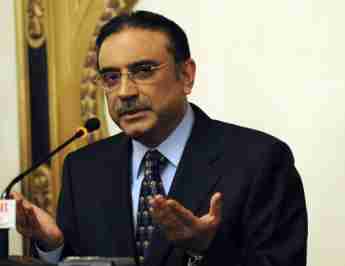
Former President Asif Ali Zardari condemned attack on polio workers in Quetta

http://mediacellppp.wordpress.com/
Co-Chairman Pakistan Peoples Party former President Asif Ali Zardari has condemned attack on polio workers in Quetta. According to media reports four polio workers were killed including three women in Quetta on Wednesday morning in this attack.
Former President in a statement expressed concerns that the Polio Team was not provided security and said that if the security were given to them, the incident would not have happened. He said that the attack proved that terrorists do not want our children to get health facilities. These terrorists were bombing our schools some time back and now attacking polio workers. He asked nation to be united against these terrorists. He said that these polio workers are our heroes and heroines who have sacrificed their lives to save our future generations from this crippling disease.
Asif Ali Zardari demanded that the killers should be arrested, brought to book and should be punished severely.

The Perpetual Headache with a Humongous Nuclear Arsenal named Pakistan

By: Pathikrit Payne


India's diplomatic coup d'état by making the US President agree to become the Guest of Honor for the Republic Day celebrations for 2015 needs applause. However, even as India's growing stature in the global geopolitical and diplomatic arena is commendable, few incidents in the neighborhood continue to remain critical issues of concern. While the rabid disdain and hatred that Pakistan has institutionally built against India is not a new thing, the worsening internal security scenario inside Pakistan, the growing strength of the Jihadist elements and increasing suspicion about the presence of a large number of Jihadi sympathizers with the Pakistani establishment including the Pakistan Army have all contributed towards creating a considerable amount of concern in India.

The Threat from Growing Nuclear Arsenal of Pakistan This has now been more compounded by the recent estimate by US based Council of Foreign Relations that by 2020 Pakistan is slated to have more than 200 nuclear bombs in its arsenal. In nuclear parlance, numbers may not matter much per se since one thermonuclear device may be good enough to wreak havoc. It is not that Pakistan would ever get a chance to use all of the 200 bombs and not that it would continue to exist even if it uses one against India.

 Threat of Falling in the hands of Terrorists But larger the arsenal the higher the chance of some of those falling in wrong hands and that is the real cause of worry for India. With the growing support base of ISIS in Pakistan and with a plethora of radical Islamist terror groups starting from Al Qaeda to Tehreek e Taliban to Jandullah and several others waiting for the US to exit the Afghan theatre to start their renewed offensive in Afghanistan, the possibility of them being steered towards India remains high. It had happened in the same way in late eighties of 20th Century when with the exit of Soviet Forces from Afghanistan and an abrupt end to the Afghan war as a result of US leaving too, Pakistan systematically exploited the situation to channelize the trained, radicalized but unemployed Mujahids towards Kashmir. 

The possibility of that being repeated remains profound and a weaker Pakistan coupled with emboldened Jihadi elements make the matter worse for India. The spate of terror attacks on Pakistan military installations by Jihadi elements vindicate that security of nuclear arsenal would continue to be a cause of concern and a real one. Should Only India be Concerned? The fear of a stolen nuclear bomb from Pakistan should not just be a worry for India but also for several other countries including US. Several radical Islamist terror groups who are not even operating in the region may be highly interested in getting hold of one and there is no easier place today than Pakistan which is perpetually on the verge of being declared a failed state. A Cornered Pakistan May Play the Worst Game with Nuclear Arsenal Pakistan has already been on the back foot but has been cornered further since the advent of Modi at the helm of Indian national affairs. 

In the border regions along the LOC, its intransigence of mindless firing and shelling, which was always tolerated by the erstwhile UPA regime by keeping the Indian Army and BSF on the leash, has now been reciprocated by unprecedented firing from the Indian Armed Forces which has been given a free hand by the Modj administration. Diplomatically as well it has been snubbed time and again and with the rising global acceptance of Modi, the ensuing visit of Obama as India's guest during India's Republic Day next year, Pakistan is feeling more cornered. 

Therefore for Pakistan to repeat another 26/11 with the help of non-state actors possibly with nuclear weapons and then feign ignorance or non involvement of the state in it or the Islamist Jihadi elements getting hold of a stray bomb and repeating a 26/11 with the same, can bring an apocalypse in not just South Asia but elsewhere as well. What India Needs to do... India therefore needs to work more vigorously towards developing a credible anti-ballistic missile system, strengthening of the coastal and border security grid and on more ground level intelligence. In other words, it has to prepare for the worst instead of presuming that good sense would prevail or that divine intervention would take care of eventualities before they strike. Easier said than done with challenges remaining on each front but with a state like Pakistan as a neighbor, peace of mind is perhaps a luxury.

Read more at: http://www.oneindia.com/feature/the-perpetual-headache-with-a-humongous-nuclear-arsenal-named-pakistan-1571611.html

India-Pakistan Sparring Opens Door for China in South Asia

 
 For a senior Afghan diplomat sitting inIndia’s capital, it’s easy to explain how a region with a quarter of the world’s people can account for only five percent of global trade.
“India and Pakistan need to overcome their problems,” M. Ashraf Haidari, deputy chief of mission at Afghanistan’s embassy in New Delhi, said in an interview ahead of this week’s meeting of the South Asian Association for Regional Cooperation, or SAARC. “Summits happen, leaders come, there’s all this consensus and declarations announced. But unfortunately it doesn’t happen in reality.”
As leaders of eight SAARC countries meet in Nepal this week for the first time since 2011, Indian Prime Minister Narendra Modi has more reasons than ever to turn the bloc into a regional force to counter China’s growing influence in South Asia. Doing so will require him to overcome differences with Pakistani leader Nawaz Sharif.
So far, things aren’t looking good. Modi’s government scrapped talks with Pakistan in August, which was followed by the worst border fighting between the countries in a decade. At the same time, China has promised SAARC nations part of a $40 billion Silk Road fund to finance infrastructure investments.
“SAARC won’t be able to counter China’s influence,” said Nishan de Mel, executive director and head of research at Colombo-based Verite Research Pvt., a policy research group. “China tends to have an approach that isn’t too demanding and isn’t politically difficult for the partner country and where the partner country will tend to see benefits quite quickly. India’s approach tends to be more hard-nosed.”

Cross-Border Conflict

Poor connectivity, cross-border conflicts and security concerns have contributed to South Asia being one the least integrated regions in the world, according to the World Bank. Besides the India-Pakistan conflict, Sri Lanka suffered a 26-year civil war that ended in 2009, Nepal was disrupted by a Maoist uprising that lasted for a decade until 2006 and Afghanistan continues to suffer from Taliban attacks.
Commerce between SAARC nations accounts for just 5 percent of total trade, compared with 25 percent in the 10-member Association of Southeast Asian Nations, according to the World Bank. Lack of trade ties within the region is limiting total commerce: India’s exports to its 15 biggest trading partners last year amounted to $188 billion, eight times less than China. That also fails to match Malaysia and Singapore’s overseas sales.

‘Key Priority’

India’s Foreign Minister Sushma Swaraj greeted Pakistani counterpart Sartaj Aziz at a SAARC meeting today even while remaining noncommittal about one-on-one talks with Pakistan.
“Please wait,” Swaraj told reporters when asked about the possibility of a meeting between Modi and Sharif. “My meeting was part of common courtesy. At any international conference when we meet our counterparts, we exchange pleasantries.”
SAARC nations this week will seek to ratify agreements for free movement of cargo and passenger vehicles, as well as railways, across member countries. Cooperation in the power sector is also on the agenda, according to a statement on the website of India’s Press Information Bureau, which didn’t provide details. Foreign ministers of the eight nations, including India and Pakistan, meet today, according to a Nepalese Foreign Ministry statement.
“Development of close relations with our neighbors is a key priority for my government,” Modi said in a statement today before leaving for Kathmandu. “We hope that the summit will lead to concrete outcomes, particularly in regard to various initiatives on enhancing connectivity that have been under discussion for a long time.”

‘Zero-Sum Game’

Modi attempted to reinvigorate the SAARC grouping immediately after his election in May by inviting Pakistan’s Sharif and other regional leaders for his inauguration. The goodwill ended a few months later after India called off foreign secretary-level talks with Pakistan and border skirmishes between the nuclear-armed rivals in October.
“Modi is quite focused on shoring up relations with neighbors to balance China’s attempts at expanding its influence in South Asia,” said Richard M. Rossow, an analyst at the Center for Strategic and International Studies based in Washington. While it’d be best for India and China to collaboratively develop the region, now their actions are “being played out like a zero-sum game.”
Chinese President Xi Jinping toured through South Asia earlier this year to promote the Silk Road initiative. He became the first Chinese head of state to visit the Maldives and also stopped in Sri Lanka, where China is financing a $1.4 billion “Colombo Port City” and sending submarines to dock.

Xi Diplomacy

Xi called Afghan leader Mohammad Ashraf Ghani an “old friend” in welcoming him to Beijing last month, a visit that was followed a week later by Sharif. The Chinese president also met Bangladesh President Abdul Hamid this month to discuss economic cooperation on the sidelines of the APEC meetings.
As of now, Modi has no plans to meet Sharif at this week’s SAARC meetings. The Pakistani leader last week urged India to resume talks over the disputed region of Kashmir, the subject of three wars between the neighbors.

Kashmir Stalemate

“Kashmir remains the core contention between both countries,” Sharif said in comments to an audience of leaders in Muzaffarabad, the capital of Pakistan-administered Kashmir on Nov. 20. “The international community needs to convince India to return to the table.”
Modi will consider how a meeting with Sharif will affect his party’s chances in Jammu and Kashmir state elections, according to Nikita Sud, an associate professor of development studies at the University of Oxford. Voting begins today, with all ballots counted on Dec. 23.
Talks between Sharif and Modi “will depend to a large extent on how such a dialogue will be perceived by their core constituencies back home,” Sud said. “I am pointing to the hard realities of politics and policy here, which are distinct from the pageantry of Mr. Modi’s oath-taking ceremony in New Delhi earlier this year.”
http://www.bloomberg.com/news/2014-11-24/as-india-and-pakistan-spar-china-gains-influence-in-south-asia.html

The West Needs a New Strategy for Pakistan

In Pakistan, A Self-Styled Teacher Holds Class For 150 In A Cowshed


PHILIP REEVES

Every day, shortly after breakfast, more than 150 noisy and eager-eyed kids, coated in dust from top to toe, troop into a mud cowshed in a sun-baked village among the cotton fields of southern Pakistan. The shed is no larger than the average American garage; the boys and girls squeeze together, knee-to-knee, on the dirt floor.
Words scrawled on a wooden plank hanging outside proudly proclaim this hovel to be a "school," although the pupils have no tables, chairs, shelves, maps or wall charts — let alone laptops, water coolers or lunch boxes. Nor are there any teachers, except for one very young woman who is sitting serenely in front of this boisterous throng, occasionally issuing instructions, watched by a cow and a couple of goats tethered a few feet away. Her name is Aansoo Kohli.
Aansoo is a 20-year-old student in the final stages of a bachelor's degree. She is the only person in this village with more than a smattering of education. Her mission is to change that: "I'll make these children doctors," she says. "I'll make them teachers and engineers."
The kids in Aansoo's cattle shed are from Pakistan's Hindu community — a marginalized, sometimes victimized, minority in an overwhelmingly Muslim nation. Their village has for centuries subsisted on the tiny income produced by picking cotton and green chilies for feudal landlords.
The mass exodus of Hindus to India — 50 miles to the east — during the 1947 partition of the Subcontinent seems to have passed by this remote community. The village, Minah Ji Dhani, lies deep in the countryside of Pakistan's Sindh province; you have to drive across fields to reach it. There is no road. Nor is there electricity or running water. Its inhabitants are among the poorest of Pakistan's roughly 200 million population.
A crude wooden crutch lies at Aansoo's side. She needs this because she lost the use of a leg as an infant due to a botched medical procedure. Her father, an illiterate farm worker, realized she would be unable to work in the fields, so he packed her off every day to a government-run school miles away.
As an impoverished and disabled Hindu girl in a highly conservative and patriarchal rural society, Aansoo says her school years were difficult. "People would laugh at me when I went to school," she recalls. "They'd say, 'What's she going to do once she's educated?'" Aansoo's cowshed "school" is her answer to that question. She has no teaching qualifications and works without pay. This hasn't deterred her from pushing ahead with a personal campaign to give her village's children — girls as well as boys — the chance to get educated.
"I love these kids," she says. "I'm urging them to study."
You only have to watch Aansoo at work for a short while to realize that to describe her cattle shed as a school, or her as a teacher, really is a stretch.
Overwhelmed by numbers, she teaches some of the older children, who then squat on the ground and impart what they have just learned to the smaller kids, some as young as three. Somehow the village whipped up enough money to buy some dog-eared government textbooks and hand-held blackboards.
But there is another goal here. Talk to Aansoo, and it soon becomes clear she has assembled these kids in part to draw attention to a chronic problem blighting her country's young, especially the poor.
Over the years, government teaching jobs in Pakistan have routinely been handed out as political favors. Thousands of so-called "teachers" pocket wages but do not go to work. There's a girls' school less than a mile from Aansoo's village that has long been closed because the teachers never showed up.
Aansoo's aim is to generate the kind of publicity that will send a message to people far beyond the confines of her village: "I want to tell Pakistan's teachers that you have a duty to the nation's children. Please come to school and teach!" "Aansoo is posing a question for all of Pakistan," says Janib Dalwani, a Muslim social activist from a nearby village who's playing a central role in Aansoo's seven-month-old campaign, publicizing her efforts and rallying villagers to the cause. "If someone with her disadvantages can teach, then why can't teachers who're sitting at home drawing salaries go out and teach?"
The task of persuading parents to allow their kids to go along to Aansoo's cattle shed fell to Dalwani. He says they were initially reluctant to release their children from working in the fields and doubtful about the benefits of education.
"I told them God's on their side," says Dalwani. "He'll help them."
This seems to have worked. Ram Chand, a farm worker, has allowed three of his daughters to go to the cattle shed: "I am very happy," he says. "We don't want the children to lead the life we've led."
Aansoo's message is being heard beyond her village. Liaquat Ali Mirani, a principal in the Sindhi city of Larkana, runs a website that publishes the names and photos of absentee teachers in the hope this will shame them into doing their jobs. "I fully support Aansoo and have a lot of sympathy for her. May God help her," says Mirani.
He estimates four out of 10 teachers in the province never set foot in a school: "Some of them run shops, some work in the media, some for feudal landlords."
In 2010, Pakistan's federal constitution was amended to make education compulsory and free for all children age 5 to 16. But education is run by provincial governments; they haven't yet turned this amendment into law and it seems unlikely they will. This helps explain why, according to estimates, nearly half of Pakistan's 58 million kids of school age are not in school.
"The state of education is very bad in Pakistan," says Farhatullah Babar, a leading figure in the Pakistan People's Party (PPP), the late Benazir Bhutto's party that governs Sindh. "In fact, we have what we call education emergency."
Babar says that although the PPP bears much responsibility for the education crisis in Sindh, it plans to fire absentee teachers and make government teachers take a proficiency test.
"I think these measures indicate a very strong realization on the part of the PPP that if it was responsible for the mess, it is also determined to clean the mess," says Babar.
For now, though, the kids in the cattle shed are on their own. Their chief hope is Aansoo's determination — and their own enthusiasm.
http://www.npr.org/blogs/goatsandsoda/2014/11/25/364981722/in-pakistan-a-self-styled-teacher-holds-class-for-150-in-a-cowshed

Christian Man Tortured and Killed by Police in Pakistan


BY STOYAN ZAIMOV 

http://www.christianpost.com/

A 35-year-old Christian man was reportedly tortured and killed by police while in custody in Lahore, Pakistan. His family attempted to storm the policy station in protest, while an investigation has been launched into the incident.
Fides News Agency reported that the family of Rakha Shahzad is demanding justice for the slain man, which has prompted an investigation by authorities. The agents involved in the incident have claimed that the Christian, who was allegedly arrested because of selling drugs and alcohol, died because of a "heart attack" during the investigation. The brother of the diseased has claimed, however, that Shahzad "was arrested for no reason."

An autopsy will be carried out on the man's body to determine the cause of death.
Fr. Francis Nadeem, provincial of the Capuchins in Pakistan, said that the Christian community in Pakistan has once again been left bewildered "due to the umpteenth extrajudicial killing."
Christian lawyer Mushtaq Gill, who has been involved in a number of cases defending Christians from Pakistan's strict blaspheme laws, added, "The whole world is still deeply shocked and outraged for the lynching of the Christian couple in Kasur, but violence continues: it is urgent to repeal laws that are routinely used to persecute Christians and ensure justice and legality, starting with the work and the behavior of the police and public officials."
The Christian couple, 28-year-old Shahzad Masih and 25-year-old Shama Bibi, were killed and burned by a mob of Muslims earlier in November, allegedly for desecrating a copy of the Quran.
The grisly murder led to the arrest of at least 44 people, and Pakistani authorities have said that they will bring those responsible to justice.
The murder of the couple was condemned by persecution watchdog groups, including the International Christian Concern.
"The brutal killing of Shahzad and Shama once again highlights the extreme danger of religious fanaticism that Christians in Pakistan face on a regular basis. The accusation of blasphemy can be used for any dispute and can often prove deadly as it did today, inciting a mob to brutally murder this young couple," ICC Regional Manager Todd Daniels said in a statement.
Christians and other religious minorities regularly face hostilities for their faith, and are often targeted by the blasphemy laws.
A report by NGO network Awaz-e-Haq Itehad two weeks ago noted that 182 Christians have faced blasphemy charges in Pakistan between 1987 and October 2014, which often carry life in prison or the death penalty as punishment.

Pakistan govt sleeping; ISIS distributing Jihadi books across the country

After welcoming by pro-ISIS terrorists groups in Pakistan, the terrorists of so-called Islamic State of Iraq and Syria (ISIS) are distributing Jihadi books full of hate speech against the constitution and spreading the hate against armed forces.
The distribution of Jihadi literature including books, poster, banners, video CDs is spreading like a fire.
The terrorists outside and inside Deobandi seminaries and mosques have installed stalls or boosting jihad camps, some of them openly and some are working secretly, where they delivering messages to Madarsa students and common citizen to stand-up against the country and crush the government including armed forces.
Pakistani leading media have aired hundreds of times the existence of ISIS elements within the Pakistan but government has denied all times. The Dawn News also reported about the a book regarding ISIS written by  Usman Abdul Jaleel,  was distributed outside Deobandi mosques in Lahore city.
Interior Minister Chaudhry Nisar categorically denied existence of Syria and Iraq based terrorist organization ‘Islam State of Iraq and Syria’ (Daesh) or ISIS anywhere in Pakistan.
The Interior Minister of Paksitan said the state is not weak and the government could have confiscated the container if it had so wanted.
In past when Taliban terrorists were establishing their feet in Pakistan the then government were denying but latter on Taliban terrorists killed thousands of innocent citizens and armed forces across the country and destabilized the entire system and demolished all institutions.
Now the government of the time also denying the existence of ISIS terrorist group, which can kill thousands of innocent people and  armed forces across the country as the Pro-ISIS  takfiri elements are waiting for orders from their so-called rascal leader Abu Bakar alBaghdadi.
According to some of analysts, the government wants to play with ISIS cards in order to earn the funds from international community, where the international community or world powers have refused to work with Pakistan against ISIS on account of war on terrorism.
Mutahida Quomi Movement (MQM) has Criticized the  recent statement of Interior Minister Chaudhry Nisar Ali Khan in which he denied the presence of the ISIS in Pakistan, Mr Jalil of MQM said that the ISIS graffiti and posters could be seen across the country, including Lahore.
http://en.shiapost.com/2014/11/25/pakistan-govt-sleeping-isis-distributing-jihadi-books-across-the-country/