Friday, November 21, 2014

Pakistan’s Afghan policy: arsonist or fireman?

By Dr Mohammad Taqi
Pakistani officials claim that the Afghan jihadists have gone back to Afghanistan while the information from the ground suggests they have been redistributed over Kurram, Orakzai and Khyber tribal agencies.
Former US Ambassador Peter Tomsen was almost prophetic when he warned in his 2011 book The Wars of Afghanistan, “If Pakistan hews to its fireman and arsonist policy in Afghanistan, the Obama administration will likely make little progress in Afghanistan.” He accurately noted: “The most valuable contribution that America can make to Afghan peace lies not in Afghanistan but in Pakistan”. Sadly, voices like Ambassador Tomsen’s were not heeded in Washington DC in a timely fashion and Pakistan successfully dragged its feet on taking action against the Afghan jihadists of three main varieties, i.e. Mullah Omar’s Quetta Shura Taliban, the Haqqani terrorist network and Gulbuddin Hekmatyar’s Hizb-e-Islami, till the bulk of US and NATO combat troops were out of Afghanistan. The Pentagon’s report, ‘Progress towards security and stability in Afghanistan’, submitted to the US Congress last month, has once again pointed out that Pakistan continues to maintain these jihadist safe havens. Pakistan has since rubbished the report, issued a démarche to US Ambassador Richard Olson and was subsequently able to squeeze kudos out of Lieutenant General Joseph Anderson, a senior US officer in the NATO-led force in Afghanistan, for tackling the Haqqani network.
The fact is that the death of not even one of the 1,200 or so terrorists that Pakistan claims to have killed in Operation Zarb-e-Azb in North Waziristan could be independently confirmed. The Inter-Services Public Relations (ISPR) has issued no names either. Not a single Haqqani network commander has been arrested or killed. Contrarily, the prime minister’s national security advisor, Sartaj Aziz, has raised a furor by telling the BBC Urdu service: “Why should we target those extremists who do not target us...why should we willy-nilly make the US’s enemies our enemies?” He also conceded that the Haqqani network had been operating from Pakistani soil but claimed that now the “infrastructure has been eliminated”. A Pakistani foreign office spokesperson has since stated that Mr Aziz’s comments were reported out of context. Interestingly, Mr Aziz has also said what North Waziristan locals also frequently say, i.e. many terrorists fled way before Zarb-e-Azb started. In fact, locals say a curfew was clamped in many areas of North Waziristan before the operation and then transportation mysteriously appeared and carried away the Haqqani network hordes.
Pakistani officials claim that the Afghan jihadists have gone back to Afghanistan while the information from the ground suggests they have been redistributed over Kurram, Orakzai and Khyber tribal agencies and even Khyber Pakhtunkhwa areas adjoining FATA. Independent media is still not allowed by the military in North Waziristan and it arranged only one escorted tour for journalists since the inception of the Zarb-e-Azb operation about six months ago. Whatever the veracity of the claims in the North Waziristan operation, the bigger picture is that the Quetta Shura of Mullah Omar and Hekmatyar’s men are safely outside the scope of Zarb-e-Azb. The course correction vis-à-vis harbouring the Afghan jihadist rebels that the Chief of Army Staff (COAS) General Raheel Sharif is trying to persuade the Afghans and the US about is at best partial. Quetta remains off limits to any foreign diplomat except perhaps the Houbara Bustard-hunting Arabs. Pakistan does not appear to be taking any serious action whatsoever against any of the three prongs of the Afghan Taliban insurgency that it harbours.
The Pakistani security establishment appears to meticulously be repeating its November 2001 drill when it retracted and preserved its Afghan Taliban proxies only to launch them with a vengeance in 2004-2005 when the US took its eyes off the ball. This time the game plan seems to be to play nice till the US takes both eyes and hands off the ball in Afghanistan before letting the jihadist killers loose again. The line that General Raheel Sharif seems to be taking in the US is that Pakistan has cured the 66-year-old jihadist cancer in less than six months of Operation Zarb-e-Azb. It would be incredibly naïve of US officials to fall for this without due diligence, which must span years, not months. Issuing a clean bill of health prematurely will imperil not just the Afghans but the Pakistanis too, who have suffered tremendously from jihadism’s blowback.
Former Afghan President Hamid Karzai has said in a blistering interview with the Prague-based Mashaal Radio that Pakistan not only sheltered jihadist insurgents but also pressed Afghanistan to accept the Durand Line as the permanent border, make peace with the Taliban (on its/their terms) and tried to dictate Afghan foreign policy by telling it to curtail ties with India. Mr Karzai said that accepting any of this would have meant compromising Afghan sovereignty. He blamed the US for a duplicitous policy where it acknowledged that Pakistan harboured terrorists but did nothing to stop it. Mr Karzai also indicated that the US wanted him to accommodate Pakistan’s perverse demands on how the Afghans should handle their relations with India. Just days before Mr Karzai made these remarks, his successor, Mr Ashraf Ghani, made his maiden visit to Pakistan, including to its military’s general headquarters. The visit ended on the optimistic note that both countries were ready to reset their relations favourably.
While the suave Mr Ghani has to exhaust this diplomatic song and dance, just like his rough and tough predecessor, he too will not be able to concede to a single one of Pakistan’s demands. Pakistani media made a big deal of Mr Ghani coming to Pakistan before going to India but Mr Ghani is not the first Afghan leader to do so. In 1958, Afghan King Mohammed Zahir Shah also visited Pakistan before he went to India. During its 1965 and 1971 wars with India, the Afghan government sided with and helped Pakistan. The India-Afghan relationship is a red herring that Pakistan has consistently deployed to dupe the US. Hegemony over Afghanistan is still the Pakistani security establishment’s goal. It yearns for the days when the Inter-Services Intelligence (ISI) ran at least eight large centres in Afghanistan during the 1990s Taliban regime and its men served as advisors in every single ministry there. Whether or not the US continues to fall for the Pakistani establishment’s dual policy, Afghanistan’s other neighbours, including China, seem to be developing a consensus that a slide back to the 1990s is not an option. The US can leave the region but Afghanistan, its neighbours and India do not have that luxury. The region has no appetite for Pakistan hewing to its fireman and arsonist policy in Afghanistan. Pakistan’s honeymoon period with the new Afghan government will be short; it will have to clean up its act quickly and transparently.

Pakistan: Terrorism rankings

WHEN planning counterterrorism strategies, it always helps to have credible data handy in order to analyse the nature of the threats.
In this regard, the Global Terrorism Index 2014, compiled by the international research group the Institute for Economics and Peace, offers some important insights into the effects of terrorism on the global community.
For Pakistan, there are some crucial indicators in the study that can help shape policy and create a more robust counterterrorism response.
Of course, the most sobering finding is that Pakistan stands third in the table of countries that have suffered from terrorism, behind Iraq and Afghanistan. The report says that in 2013, there were a total of 1,933 incidents of terrorism in this country taking a bloody toll: there were 2,345 fatalities while 5,035 people were injured.
This is a 37pc jump in the number of deaths and 28pc increase in the number of injured compared to 2012. Last year, the banned TTP was by far the single most lethal militant group, responsible for nearly half of all claimed attacks.
However, as worrying as these figures are, there has been one development this year that has changed the scenario considerably: the launching of the Zarb-i-Azb military operation in North Waziristan in June.
Militant attacks had begun to decline even before the operation was initiated, especially when the government was seeking a negotiated settlement with the TTP. Yet the operation itself has had a significant impact in bringing down attacks and destroying militant infrastructure in North Waziristan.
Though concrete figures are not yet available, some counterterrorism experts estimate that attacks have come down by around 30pc this year compared to 2013. However, as important as uprooting the TTP from its base is, terrorism in Pakistan will not be eliminated by focusing on North Waziristan alone.
For while the TTP may be in disarray — with internal splits and leaders on the run — the group is not the only significant militant threat in Pakistan. As per the report on global terrorism, after the TTP, Lashkar-i-Jhangvi is the most lethal militant group of those that claim attacks inside the country. And there is little evidence that the LJ’s infrastructure is being dismantled in Balochistan or Karachi.
As this paper has often argued, there needs to be a holistic counterterrorism effort. While the TTP is in the state’s cross hairs, all other groups that share its violent ideology and tactics must also be tackled.
While action on the battlefield is important, intelligence-led policing is required to disrupt militant activity in cities and towns where targeted killings and other forms of violence continues.
On this front, the government response has been largely lacklustre. For example, the National Counter Terrorism Authority has so far appeared inert and has not been used to its true potential. Unless battlefield successes are complemented by urban counterterrorism efforts, a lasting peace in Pakistan is hard to imagine.

Peshawar blast: Two officers died, six injured

At least two security officers martyred while six others sustained injuries in a bomb blast in Peshawar today (Friday), Dunya News reported.
According to details, blast took place when a mobile of security forces reached at Ghari Mustajaab. The mobile was enroute to Warsak from Peshawar. As a result of explosion, two personnel died and six others including two security officers got injuired.
According to Superintendent of Police Rural (SP) Shakir Ullah Bangash, four to five kilograms of explosive was planted in motorcycle, however, rescue activities have been carried out by police and rescue teams.
Moreover, injured have been shifted to Lady Reading Hospital for further medical assistance.

Thursday, November 20, 2014

Video - Views from an epic snowstorm

Video - Turkish riot police teargas protesting health workers

Video Report - Washington Braces for Obama's Immigration Plans

Are Mass Killings by IS Group Genocide?

Sharon Behn
The extremist Islamic group known as the Islamic State - also called ISIS or ISIL - and groups connected with it - are believed to have killed thousands of civilians in Iraq and Syria, as well as having executed hundreds of Syrian and Iraqi security forces. To a lay person, this would seem like a clear-cut case of genocide. But is it genocide under international law? And if so, what can or should be done about it?
In 2014 alone, the United Nations says Islamic State militants systematically killed and injured more than 24,000 civilians, enslaved women, recruited children, and conducted a brutal campaign of violence across Syria and Iraq.
Horrific on-line images of beheadings, crucifixions and mass executions of soldiers - as well as reports of torture - are testimony to the group's code of terror.
Earlier this year, the Sunni extremist group targeted ethnic Iraqi Yazidis, killing the men and publicly defending the enslavement of the women. But they have also targeted other Muslims, especially Shia.
U.N. Human Rights Commissioner Zeid Ra’ad al-Hussein says the Islamic State is out to destroy anyone who does not agree with them.
"Alternative view-points - indeed, any form of individual thought outside of their closed, unyielding logic - is rejected by them. Those dissenting humans must be murdered, their memory, culture, every shred of their existence, destroyed," said al-Hussein.
The U.N. says the actions of the Islamic State have met three out of the five criteria that define genocide under the international Genocide Convention.
U.S. Undersecretary of State Richard Stengel says the group is "ruthless."
“They are a genocidal organization, I would say, in a sense that they are determined to wipe out whole groups of people indiscriminately, innocent people; so, their ideology I believe is genocidal and what they are doing is just despicable in every way,” he said.
The Genocide Convention says anyone guilty of the crime "shall be punished" -- but it speaks primarily of legal action. Where the Islamic State is concerned, an international coalition has been conducting air strikes against the group since August, and is supporting Iraqi and Kurdish forces battling the extremists on the ground.
The question now is whether that will be enough, says Daniel Serwer of the Johns Hopkins School of Advanced International Studies.
“What we are doing now, seems to me, has had a certain effectiveness in blocking the expansion of the Islamic State, it’s protected some populations that would otherwise have been at risk, but it’s doing nothing yet to really collapse the Islamic State. We’re not. We may be degrading it, but we’re not defeating it as yet,” he said.
Meanwhile, Islamic State militants have captured large areas of Syria and Iraq, declaring the region a caliphate that all other Muslims should follow.

Video - Pakistan Peoples Party Song - "Dilan Teer Bijan"

Pakistan: Zulfikar Ali Bhutto faced dictator with courage

http://mediacellppp.wordpress.com/
Pakistan Peoples’ Party (PPP’s) member Raza Rabbani on Wednesday has said that PPP founding father Zulfikar Ali Bhutto did not bow down to a dictator but faced former President Ziaul Haq with courage.
He expressed these views at United Nations Development Programme’s (UNDP’s) seminar about the 18 amendment in Karachi.He said that he is not in the favour of a new administrative unit.
He also said that the quota system has ended since August 1 2013.Rabbani said that nobody must criticise the 1973 Constitution of Pakistan.

Pakistan: US drone strike in North Waziristan kills five

Zahir Shah Sherazi
At least five suspected militants have been killed in a US drone strike on Thursday in North Waziristan.
Official sources say that the US drone fired two missiles on a compound in Datakhel tehsil of North Waziristan Agency.
Sources said that they have confirmation of five dead and also some injured. They said that the dead also includes a high value target.
North Waziristan is among Pakistan’s seven tribal districts near the Afghan border which are rife with homegrown insurgents and are alleged to be strongholds of Taliban and Al Qaeda operatives, among others.
Pakistan's military in mid-June had launched an all-out operation, named 'Zarb-i-Azb', against Taliban militants in the region which is still under way.
Drone attacks are widely unpopular across Pakistan and according to survey conducted in June this year, 66 per cent of the country's citizens oppose these strikes..

Afghanistan: Analysts Say President, CEO Divided On Major Policy Issues

President Mohammad Ashraf Ghani and Chief Executive Officer Abdullah Abdullah are in disagreement on how best to approach some of the most pressing policy issues facing Afghanistan, such as corruption and insurgency, according to a number of political analysts.
The newly established national unity government has early on focused public attention on its highly publicized re-prosecution of the infamous Kabul Bank corruption case. President Ghani has touted the initiative as evidence of his government's strong stance against the endemic corruption that has over the years undermined the legitimacy of the central government, stunted economic development and scared away foreign investors.
But his partner in the unity government, Abdullah, has separately begun to raise attention around the issue of holding corrupt individuals in the current government accountable. Abdullah has claimed no war on corruption can be successful unless those who have laid the foundation of administrative malfeasance and remained in power are brought to justice.
Last week in a meeting with elders of Samangan province, Abdullah suggested at his reservations about the government's recent anti-corruption push. "When it comes to Kabul Bank, when we all say that the investigation must be legal and right, we do not accept political treatment," Abdullah said. "Anyone who is responsible must act in accordance with the law, any reform in the administration must be based on the needs of the people of Afghanistan and their priorities."
He went on to say that there remain corrupt individuals in government, whose presence subverts any push against corruption. "If it is a war against corruption, the leaders of corruption must be fired from the job on the first day, particularly those who laid the foundation of corruption in the country," Abdullah said. "The war on corruption will not succeed if we put all the authority and power into the hands of infamous, corrupt elements and then say that we fight corruption..."
Abdullah has also spoke out vocally about conspiring among certain powerful figures in the country to overthrow the national unity government and usher in a new government that acquiesces to the Taliban militants.
"The Chief Executive has also noted efforts indicating conspiracy against the government," political analyst Ahmad Saeedi told TOLOnews.
"There are conspiracies, and those who resort to such attacks want to come into power," Abdullah said. "We, and the entire nation, will never allow the conspiracies being made to overthrow the government and bring criminals into power."
Some experts fear the divisions within the national unity government and within the country's broader leadership class could lead to civil war. "If disagreements increase among our political elites about important national issues, Afghanistan will face more problems and it could even lead to civil war," political analyst Jawed Kohistani said.
The national unity government was formed on shaky grown, but many were encouraged by the fact that the troubled election was brought to end without bloodshed. A couple months into their rule, however, questions are being raised around whether the tenuous coalition can last.

IG: Corruption in Afghanistan Getting 'Significantly Worse'

BY JORDAIN CARNEY
A top watchdog said it "seems like nobody is responsible for anything."
The United States is drawing down its presence in Afghanistan, but a top watchdog said Tuesday that corruption there is on the rise.
"It's getting worse.… Significantly worse," John Sopko, the special inspector general for Afghanistan reconstruction, told reporters at a breakfast roundtable. "Corruption is not only feeding insurgency, it's feeding a number of corrupt officials."
Sopko leads the office responsible for tracking down waste, fraud, and abuse in U.S.-backed projects and helping to reclaim misused taxpayer dollars.The United States has allocated more than $104 billion for reconstruction efforts in Afghanistan, and President Obama's fiscal 2015 budget would add an additional $5.8 billion.
Despite the best intentions of the U.S. government, Sopko said that it has helped increase corruption. He pointed to large, rapid investments from the United States and a lack of planning about how Afghanistan would sustain U.S.-led projects.
"They can't afford the government we've given them," he said. "If you go over there, it's like Disneyland, what we bought for them.... It isn't working if you approach reconstruction that way."
The Afghan government—and the country's economy—relies heavily on foreign investments. But Sopko said there's been no point person for overseeing the building of a self-reliant economy. That is indicative, he says, of the larger problems facing the country.
"I can not find anybody who's lost their job for screwing up, and there have been a lot of screwups in Afghanistan, and that's a problem," Sopko said. "It seems like nobody is responsible for anything in Afghanistan.… It's almost like a toddler's sports game—everybody's a winner."
Sopko was appointed to his post in 2012, and since then he's had a turbulent public relationship with those he audits—including the State Department, the Defense Department, and the U.S. Agency for International Development. His office frequently releases reports detailing millions of dollars in potentially misused funds.
For example, a report released last month found that the United States spent $3.6 million on TV trucks that aren't used. Another released earlier this year found that the U.S. spent roughly $3 million on boats for an Afghan navy in 2010 to help patrol a river it shares with Uzbekistan. The ships, according to the report, are sitting in storage in Virginia after the order was canceled.
Sopko pointed to both instances as examples of U.S. money that could have been better spent.
"Just think of it: To buy a prosthetic in Afghanistan—and there are a lot of kids, there are a lot of adults, who have lost limbs—I think a prosthetic, what, is it $50 to $75?.… I think that kids would have loved to have legs, rather than having balloons and kites and TV trucks that are still sitting under wraps." I
n response to Sopko's reports, the military set up a plan of action, detailing how it can get ahead of him and defend its programs against his reports. But the outspoken inspector general is well aware that his office has ruffled feathers within the U.S. government.
"We speak the truth, and sometimes people don't like it," he said. "Every time we issue a report, we gore somebody's ox."
Central Command, which oversees U.S. military operations in the Middle East, North Africa, and Central Asia, was unable to immediately respond to comment.

‘Pakistan has failed to protect its children’

www.southasianmedia.net
“There is no child protection system in Islamabad Capital Territory and a number of bills related to children’s right are pending at the National Assembly (NA) level,” Habiba Salman, Child Rights Movement (CRM) National Coordinator, said while speaking to participants of a conference titled ‘25 years of the UNCRC and the State of Child Rights in Pakistan’ at Quaid-i-Azam University.
The conference was jointly organised by CRM and Quaid-i-Azam University. Speakers urged the government to legislate for the protection of children’s rights. Pakistan signed and rectified United Nations’ Convention on the Rights of the Child in 1990, but is yet to make any progress towards providing protection, health and education to its children.
Ms Salman said the government needs to play a role in ensuring enactment of the national commission on Rights of Children Bill, prohibition of corporal punishment bill and child marriage restraint amendment bill. Malnutrition has become a key concern for the country, she said.
“According to Unicef, 352,000 children die every year in this country, and an estimated 35 per cent of these deaths are attributed to malnutrition,” she said.
She added that one sees no urgency, or commitment at the federal and provincial levels to respond to this situation by implementing strategies and increasing budgetary allocations.
Speaking on the occasion, Dr Muhammad Zaman, QAU Department of Sociology chairman, said Pakistan’s future is linked to its children and Quaid-i-Azam University is going to include the issue of child right in its curriculum.
“At the Department of Sociology, we have designed a course on Sociology of Child Rights, currently awaiting approval, this will sensitise students to children’s rights,” he said.
QAU Acting Vice Chancellor Dr Eatzaz Ahmad highlighted academia’s role in the promotion of child rights in Pakistan. “Pakistan being party to the UN Convention on the Rights of the Child is responsible to formulate strategies for future course for academia, society, national and international institutions and the federal and provincial governments to promote child rights in the country,” he said.
“The academicians, scholars, researchers, students and NGO activists must develop theoretical, conceptual and empirical work to analyse and understand the current state of child rights in the country,” said Prof. Dr. Aliya H. Khan, QAU Faculty of Social Sciences Dean.
Stefano Gatto, European Union Delegation Deputy Head, said the European Union welcomed Pakistan’s ratification of the most core international human rights conventions.
Barrister Zafarullah Khan, Special Assistant to the Prime Minister of Pakistan and the chief guest, apprised participants on the steps taken by the government for the implementation of the UNCRC. Arshad Mahmood, Save the Children, Director Advocacy and Child Rights Governance also spoke on the occasion.
http://www.southasianmedia.net/stories/south-asia/pakistan-has-failed-to-protect-its-children-story

Pakistan - SHIA GENOCIDE - A Shia Police constable martyred in Peshawar

A Shia police constable was shot dead by unidentified gunmen in Wadpaga village of Khyber-Pukhtoonkhwa province on Wednesday. Police said the deceased, Syed Arshad Ali Shah, was a police constable who had been assigned to guard the local Shia mosque and imambargah. A police official said initial reports suggest the attack was a target killing incident with sectarian motives. Shia parties and leaders have condemned the murder of Shia policeman. They said that genocide against Shia Muslims could not be stopped without the government’s action to eliminate the takfiri terrorists. They demanded capital punishment to the terrorists.
http://en.shiapost.com/2014/11/20/a-shia-police-constable-martyred-in-peshawar/

Pakistan: Islamists want dead body of Ahmadi man exhumed from 'Muslim' graveyard near Narowal

Ahmadiyya Times
The clerics claim that Ahmadis violated the Pakistani constitution when they buried their deceased in the public graveyard – because it is used predominately by the area Muslims.
Burial of an Ahmadi man in a public graveyard has resulted in protests organized by local Islamist activists in Rao Ke Ratian, a village in Narowal district in the Punjab province of Pakistan.
Incited by local madrasa leaders, the villagers have demanded that the dead body of the Ahmadī man, Muhammad Boota, should be exhumed from the ‘Muslim graveyard’ and sent elsewhere.
The clerics claim that Ahmadis violated the Pakistani constitution when they buried their deceased in the public graveyard – because it is used predominately by the area Muslims.
At the time of burial, the local administration had installed police guards to ward off any altercations.
According to a local Urdu language newspaper, Daily Ausaf, two area leaders of Ahle-Sunnat wal-Jamā’at, an Islamist group, have now filed their demands with the town administration seeking immediate redress of their complaints.
Ahle-Sunnat wal-Jamā’at (ASWJ) is doctrinally aligned with several banned terrorists organization, including, Jamā'at-ud Dawa (JuD), and Lashkar-e Tayyaba (LeT).
Mohammad Yaqoob, patron, and Qari Arshad Rabbani, general secretary, of the organization have threatened street action and road blockages on Friday, November 21, if their demands are not met and Mr Boota’s remains are not removed by then.
A “Protestive" Khatma-eNubuwwat Conference has been planned for Friday where many leaders of ASWJ are slated to rile up the villagers.
The Punjab province is plagued with madrasas producing Islamist extremists used in inciting anti-minority sentiments and violence.
Last week a Christian couple was burned to death for the allegations of blasphemy leveled by an Islamist leader from a local mosque.
http://ahmadiyyatimes.blogspot.co.uk/2014/11/pakistan-islamists-want-dead-body-of.html

India and Pakistan 'battle' for Afghanistan

Experts say the impending departure of NATO combat forces from Afghanistan could push India and Pakistan toward a proxy war in the conflict-ridden state, as New Delhi and Islamabad fight for influence in the country.
"The danger for Pakistan is [...] the Indian influence in Afghanistan," former Pakistani President and Army Chief Pervez Musharraf recently told the AFP news agency in an interview in the southern Pakistani city of Karachi. "They (India) want to create an anti-Pakistan Afghanistan." "If Indians are using some ethnic groups in Afghanistan, then Pakistan will use its own support, and our ethnic allies are certainly Pashtuns," Musharraf continued.
Musharraf, a former military dictator who ruled the Islamic country from 1999 to 2007, has been under house arrest on treason charges, but his words still carry weight. Some Pakistani observers believe that the former general is still close to the current military leadership of the nuclear-armed state, and that he is probably only echoing his former institution's views on India and Afghanistan.
The South Asian country's civilian leadership, too, has similar views on Afghanistan, terrorism and Islamist militants. On November 17, Sartaj Aziz, national security adviser to Prime Minister Nawaz Sharif, told the BBC that there was no need for Pakistan to target militants who did not threaten the country's security.
"Why should enemies of the US unnecessarily become our foes," Aziz said. "Some of them were dangerous for us and some are not. Why must we make enemies out of them all?" he said, referring to the militant Haqqani network.
These are two different statements by two Pakistani leaders but they carry a single narrative: Islamabad feels threatened by New Delhi's close ties with Kabul; hence it will likely continue to use some factions of the Taliban as counter-balancing forces in its western neighborhood.
Same old policies
There is nothing new about Pakistan's Afghanistan policy though. The country's military and civil establishment, analysts say, still consider the Taliban an important strategic ally, who they think should be part of the Afghan government after the NATO pullout. Observers say that the Pakistani military hopes to regain the influence in Kabul it once enjoyed before the United States and its allies toppled the pro-Pakistan Taliban government in 2001.
"Kabul is friendlier towards New Delhi now, whereas Islamabad continues to back the Taliban, as now officially admitted by Sartaj Aziz. Pakistan wishes to change this scenario and turn Afghanistan into its political backyard once again," London-based journalist and researcher Farooq Sulehria told DW.
Matt Waldman, a researcher on the Afghanistan conflict at Harvard University, believes that Pakistan won't relinquish its support for the Taliban until the regional dynamics undergo a transformation. "The evidence indicates that the Pakistan hasn't fundamentally changed its Afghanistan policy," Waldman told DW.
Siegfried O. Wolf, a political science expert at Heidelberg University, is of the same view. He told DW that he was convinced that several elements within the Pakistan security apparatus still believe that the Taliban could be used as a strategic tool to counter Indian presence in Afghanistan.
A lost cause
Earlier this year, New Delhi announced a two billion USD aid package for Afghanistan - the biggest India has ever given to another country. While India has been active in rebuilding Afghanistan since 2001, Pakistan's role has been negligible in this regard, says Sulehria. "By backing the Taliban, Islamabad has contributed to the country's destruction. I frequently visit Kabul and I can say that Pakistan is very unpopular in Afghanistan. Sadly, Islamabad is not ready to change course," the expert added. Vivek Kumar, a New Delhi-based journalist, says that the Indian and Pakistani interests have always clashed in Afghanistan, and that he does not foresee a major change in these dynamics. "The Indian government would want the new Afghan President Ashraf Ghani to follow his predecessor Hamid Karzai's path. India has invested a lot in Afghanistan, and all this investment is strategically aimed at minimizing Pakistan's influence," he said, adding that Indian PM Narendra Modi would also like to enhance his country's partnership with Kabul in the security sector. Sulehria says that Afghanistan has changed a lot over the past years, and that objective realities and subjective factors are not in Pakistan's favor anymore. "Pakistan will not be able to dictate terms to the Afghan administration and the rest of the world now. I think Pakistan has already lost the proxy war."
Long term vs short term goals
But with a bilateral security agreement (BSA) between Kabul and Washington in place, it will be difficult for either Pakistan or India to destabilize Afghanistan. The pact, which was approved by President Ghani in September, is aimed at strengthening Afghan security forces while they work to stave off the Taliban. Under the deal, international forces will provide training and support to Afghanistan's security forces.
Commenting on the BSA and the future of Afghanistan, Owais Tohid, a Karachi-based senior journalist, said that the security pact was a "wake-up call" for Pakistani rulers, who should not hope for a Taliban comeback in Afghanistan.
The journalist is of the view that instead of focusing on short-term benefits, Islamabad should forge a long-term alliance with Afghanistan based on commercial and economic interests. "In the long run, it will be a blessing in disguise for Pakistan. These short-term strategic gains only reflect the myopic mindset of Pakistani policymakers," Tohid said.

US and Pakistan: Will the relationship endure?

By Brajesh Upadhyay
Days after a Pentagon report accused Pakistan of harbouring militants who wage war against Afghanistan and India, its army chief is in the US meeting top military officials and Congressmen.
Raheel Sharif's visit, the first by any Pakistani army chief in four years, comes at a time when the US is in the final stages of its withdrawal from Afghanistan.
Officials say the US may not need Pakistan's ports and roads as before to sustain its Afghanistan operations, but the engagement between the two nations will continue.
The relationship took a heavy blow following the US raid in Abbottabad to kill Osama Bin Laden, but efforts have been made over the past year to rebuild the military ties.
Mr Sharif, after taking over the post last year, has overseen a major military operation against Islamists in the tribal areas of Pakistan, a long-pending US demand.
Experts say Islamabad is using this as a way to extract a commitment from the US regarding enhanced engagement and continuation of military aid to Pakistan post-2014.
Signs of thawing relations between Afghanistan and Pakistan have helped create some positive vibes in the US towards its uncertain ally.
But there still remains a huge trust deficit.
Many officials and members of Congress have openly expressed frustration at Pakistan's efforts to combat militant groups like the Haqqani Network, who pose a direct threat to US interests.
Earlier this year the US had to free five top Taliban fighters from the Guantanamo Bay prison to secure the release of one of its soldiers, Pvt Sgt Bowe Bergdahl, who was allegedly in the captivity of the Haqqani Network.
The deal left many Pentagon officials cringing. They believed Sgt Bergdahl could have been snatched from the Haqqanis if the Pakistani Army had extended its cooperation.
"They placed a higher value on their relationship with the Haqqanis than they did on their relationship with the United States, " said former Deputy Assistant Secretary of Defense David Sedney.
Incidents like these have led many in Congress to question the effectiveness of this strategic partnership.
With the ongoing military operation against militants in North Waziristan, the army chief has tried to convey that Pakistan no longer discriminates between terrorists and it has no favourites.
But Congress, which approves the budget for any sort of military or non-military funding, will need a lot more convincing.
A statement this week from Sartaj Aziz, Pakistan's national security advisor to the BBC saying : "Why should America's enemies unnecessarily become our enemies?" may have further added to this mistrust.
The US State Department has said it will reiterate its message to Mr Sharif that it is: "vital that every effort is made to deny safe haven to any and all violent extremists".
Shamila Chaudhary, former Pakistan director at the US National Security Council, says the US is now in a much better position to mount pressure on Pakistan.
"Moving forward we will see the United States pushing Pakistan more on what it's going to do not just with Haqqani Network militants but some of the sectarian groups that are in Pakistan that are anti-India, and that are also focused on Pakistan," Ms Chaudhary said.
One of the biggest concerns for the Pakistani army is to ensure the continuation of the Coalition Support Fund (CSF), a kind of reimbursement from the US for the costs it incurs in military operations.
As per Congressional Research Service reports, Pakistan has received close to $28.4bn (£12bn) in military and non-military aid from the US post 9/11. Of that, $11bn came from the CSF.
Experts say convincing Congress to continue the CSF will be a tough ask for Mr Sharif. Many of the senators who control the purse strings have put conditions on the release of funds to Pakistan.
Pakistan also gets close to $300m worth of military aid per year from the US to buy conventional weapons.
"This was offered more as a 'feel good' for the Pakistani Army for its cooperation, and they have used it to acquire conventional weapons that can be used against arch-rival India," said a US official who did not want to be named. "If this funding gets discontinued, it will reflect a real trouble in the relationship."
The overall interest towards Pakistan has ebbed in Congress. Experts say it will need some real serious and honest effort to inject vitality in the relationship.

Pakistan - The Return Of The Container - #PTI

The government’s August strategy didn’t work and now it is turning gears again to try to squash PTI’s 30th November rally. What is to be achieved by trying to keep protesters away from D chowk again? This will just frustrate the protests, cause a scene and make the chanting of “Go Nawaz go” even louder. Some people never learn.
It seems the government is in no mood to talk to the PTI. There are reports that the PM has now begun meeting with leaders from other parties to formulate a strategy to deal with the PTI’s November 30th event. This time the government might not allow protesters to march freely down Constitution Avenue as PAT and PTI activists did in August. Things feel different. The PMLN seems more confident now; thick-skinned. It is time the government came back to the negotiation table and gave Imran Khan an honorable exit. There is no benefit from squeezing him, and it is ridiculous that with such experienced politicians, the PMLN has not been able to play politics with him. Imran is weak right now. Why not throw him a bone and reel him in? After Imran has shown flexibility on the PM resignations, negotiations over the agreed 5 demands can be a step forward.
Of course there is also the question of whether or not the people still care as much. There were rumours and reposts abound that people had been paid to sit in Islamabad, and that many supporters were there by force. Qadir’s PAT is gone, and the PTI now wants to show that it can run a show on its own. How long is Imrans tedious war going to last with this government? What is he going to do now that he hasn’t done before? Some people never learn.
We would all like to see an end to this disorder. Imran loves to climb the high horse, but his house is in disarray. PTI, PPP, PMLN are important parties and need to compete for votes though their service delivery and performance. PTI’s KPK is outlaw country, PMLN’s Punjab is corrupt and extortionist, and PPP’s Sindh is full of violence, famine and insecurity. The Sharif rule has been a joke, and they must not be allowed to run amok with power in the future. But for now, they legally rule, and they are not going anywhere. The PTI needs a drastic change in strategy.

Pakistan: Permits to Gulf royals to hunt houbara bustard: PPP submits Calling Attention Notice in NA

Pakistan People’s Party (PPP) on Tuesday submitted Calling Attention Notice in the National Assembly over issuance of 29 special permits to royal family members of Gulf States for hunting of internationally-protected houbara bustard, saying that the issuance of special permit by the federal government in Sindh, Khyber Pakhtunkhwa and Balochistan was illegal.
The notice said that Pakistan was a signatory to various international nature conservation agreements and conventions and hence bound to protect the rare and endangered species.
The notice sought the Advisor to Prime Minister on Foreign Affairs to brief the house over the issue.
It is to be mentioned here that the federal government has issued at least 29 special permits to royal family members of Saudi Arabia, the United Arab Emirates, Qatar and Bahrain for hunting the internationally protected houbara bustard .
The special permits have been issued despite the fact that Pakistan is a signatory to various international nature conservation conventions and agreements and in violation of local laws and international commitments.
The permit holders had even been informed about it. But after the approval of Prime Minister Nawaz Sharif, deputy chief of protocol of the foreign office Muazzam Ali issued the permits for the year 2014-15 on November 1, 2014.
The sources said that at least one president, one king, one Emir and one ruler besides two crown princes, the father and an uncle of country heads concerned are among those allowed to hunt the internationally protected houbara bustard, meat of which is considered to have aphrodisiac qualities.
The dignitary who has been given the largest area in the three provinces — Sindh, Punjab and Balochistan — is UAE president and Abu Dhabi ruler Sheikh Khalifa bin Zayed Al-Nahyan. As many as 11 permits — the largest number of permits issued to a Gulf state — have been given to members of Qatar’s royal family.
This is the first time that an area in Khyber Pakhtunkhwa has been allocated for houbara hunting.

Pakistan's Houbara Bustard & Arab Beduin Royals - Rampant poaching

The government has once again issued several Gulf royal families dozens of permits to come and hunt (read poach) the threatened Houbara Bustard, alias Tiloor in the local language, in different areas of Pakistan. It is not the first time a Pakistani government has done so. The violation of a written law carries no value for our rulers when it comes to please their patrons inside or outside the country. The Houbara Bustard, a migratory bird that nests in Pakistan during winter before flying back to Siberia in spring, has been listed in the International Union of Conservation of Nature (IUCN) as an endangered species. Estimates say a decrease of 30 percent of this specie has occurred in Pakistan alone. According to a report, almost 25,000 Houbara Bustards arrive in the arid areas of Pakistan every year and approximately 6,000 of them are killed just to serve the Arab Sheikhs’ blood sport. Pakistan has its own laws that prohibit these hunting safaris and in fact favour the preservation of this specie. But in an antinomian country such as Pakistan, where no law can restrict the powerful, such licences are mere formalities and the poachers, mostly from wealthy Gulf States, exceed the permissible bag-limit by a ridiculously high number.
Earlier this year, a Saudi royal gunned down 2,100 Tiloors in a fortnight, including areas that were out-of-bounds. Clearly, nothing can stop ‘their highnesses’ and ‘their majesties’ once they are out on their hunting sprees, irrespective of the ecological and environmental damage.
Thankfully, not everyone in this country is wedded to lawlessness and insensitivity. Some institutions did move to seek an answer on this illegal activity. The Lahore High Court sought a reply from the foreign secretary on a contempt petition as the court had already issued a stay order on the earlier issuance of permits that violated the Punjab Wildlife Act, 2007. Under that Act, the federal government is not allowed to issue permits without consulting the respective provincial wildlife departments. Similarly, the Sindh High Court too has served notices to the concerned authorities to justify their position and the legality of the permits. It remains to be seen what ensues as a result of these court actions, but in order to prevent these poaching sprees that completely violate national and international laws, stringent action must be taken if we wish to provide a hospitable environment to endangered species.

Pakistan: FO, foreign missions involved in billions of rupees corruption: report

By Sardar Sikander Shaheen
Audit report cites serious misappropriation of funds, embezzlements, unauthorised expenditures, excess payments, illegal award of contracts and other malpractices
The Foreign Office and its diplomatic missions working abroad have been found involved in serious misappropriation of funds amounting to billions of rupees, including corruption, unauthorised expenditures, excess payments, illegal award of contracts, financial embezzlements and other malpractices, an audit report reveals.
The recently released audit report on the accounts of the Ministry of Foreign Affairs/ Foreign Office prepared by the Auditor General of Pakistan (AGP) reveals that Pakistan’s Embassy in Bahrain awarded an illegal and unauthorised contract valuing Rs 240 million for the construction of a chancery in violation of the Public Procurement Regulatory Authority (PPRA) rules. The contract was awarded to Yathreb Contracting Company without advertising in any national daily – a mandatory requirement under PPRA rules.
The audit observed that the bidding process was conducted in a highly dubious and questionable manner and a single bidder was awarded the contract without even fulfilling the basic PPRA requirements. “Audit requires a detailed inquiry as to why PPRA rules were not applied and a single bidder was awarded contract,” the audit report reads. In another instance, more than Rs 82 million were spent by the Pakistani missions in Baghdad, Hong Kong and Sydney as rent for the buildings that were vacant and not in the use of the diplomatic missions concerned. The data shared by the audit suggests that from 2006-12 Pakistan’s Embassy in Baghdad paid Rs 78 million for the building that was vacant. Pakistan’s High Commission in Sydney paid Rs 33 million as rent for the building that was not in use from 2009-12, whereas Pakistani mission in Hong Kong paid Rs 724,185 as rent for the building it had long vacated. According to the AGP report, the FO informed the audit that the matter was being inquired into and the outcome will be reported to the AGP, but no progress was reported in this regard.
The audit also reveals that national exchequer suffered a mega loss of Rs 491.08 million on account of delay on part of MOFA headquarters in completing a High Security Block at the HQ’s premises. The contract for the construction of the High Security Block was awarded to Recent Construction in 2005 at an estimated original cost of Rs 234 million, but it was escalated to Rs 725.502 million in a questionable manner. The project was required to be completed by December 2006, but its due date was extended to June 30, 2013. The AGP has asked the FO to explain its position to the Public Accounts Committee (PAC) regarding the alleged irregularities committed by the FO administration, but no progress has been made in this regard.
In yet another instance, the audit noted that six Pakistani diplomatic foreign missions were found having spent Rs 262 million in the form of unauthorised cash payments to different payees instead of cross-cheques, a mandatory requirement under the rules. These missions are Yangon (Rs 172 million), New Delhi (Rs 25 million), Belgrade (Rs 26 million), Colombo (Rs 15 million), Kathmandu (Rs 17 million) and Maldives (Rs 5 million). In a major case of funds misappropriation, an ex-ambassador received a sum of $5,000 or Rs 527,750 from a Pakistani school run by Pakistan’s Embassy in Sanaa, Yemen, as a loan on refundable basis, but later the said officer, in misuse of his capacity as chairman of the said school, waived off the loan. “Thus misappropriation of government money cannot be ruled out,” the audit report reads. The MOFA headquarters is said to have unduly paid Rs 407,533 as airfare for the members of Pakistan Foreign Office Women Association (PFOWA’s) visit to China. Presently, PFOWA is headed by Najia Aizaz, the wife of Foreign Secretary Aizaz Chaudhry.
Pakistan’s High Commission in London paid Rs 37,439,938 to Hayat Regency as accommodation charges for the members of presidential and prime ministerial delegations from 2011 to 2012 without provision of hotel invoices or detailed bills to the audit authorities, the AGP report reveals. Moreover, the deputy chief of protocol (DCP) Lahore spent Rs 2.7 million on the repair of vehicles in violation of PPRA rules, according to the report.

Pakistan: Sartaj Aziz’s statement on selective targeting of militants questioned in Senate

http://mediacellppp.wordpress.com/
Advisor Foreign Affairs Sartaj Aziz’s interview to the BBC on Monday in which he questioned the wisdom of targeting all militant groups without discrimination has been questioned in the Senate through a calling attention today.
In reply to a question Sartaj Aziz had told the BBC ‘why should we antagonize all groups (of militants)”.
Attention is drawn to a matter of sufficient public importance namely the Advisor’s interview to the BBC on Nov 17, 2014 admitting the selective nature of operation against militant groups, taking on some while leaving others.
The statement by the Advisor Foreign Affairs is a reversal of the stated policy of across the board action against all militants reiterated recently also by the security establishment, the calling attention notice says.
It says that in the interview a disturbing distinction has been made between militants challenging the state of Pakistan and those, using Pakistan’s soil, launch violent operations against other states in the region. “It exposes Pakistan to the charge that it is running with the hare and hunting with the hound in the fight against militants”.
This highly disturbing admission at the highest level of policy formulation of turning a blind eye to non-state actors bent upon destabilizing foreign states through violent means is a matter of sufficient public importance and calls for urgent attention, says the calling attention notice moved by PPP Senator Farhatullah Babar.

Wednesday, November 19, 2014

Clinton says Obama on firm ground on immigration

By KEN THOMAS
Former President Bill Clinton on Wednesday noted that previous U.S. presidents have issued some type of executive order on immigration, suggesting his Democratic successor was on "pretty firm legal ground." The former president spoke on the eve of President Barack Obama's scheduled announcement of executive actions to spare as many as 5 million immigrants from being deported from the U.S. Clinton said during an event honoring the magazine The New Republic that it was part of a larger debate about the nation's role around the globe. "As far as I can tell every president in the modern era has issued some executive action on immigration, so I imagine he'll be on pretty firm legal ground," Clinton said at a gala celebrating the publication's centennial. Presidents Ronald Reagan and George H.W. Bush extended amnesty to family members who were not covered by the last major overhaul of immigration law in 1986. Clinton sought to frame the debate in a larger context, saying Americans should be optimistic about the nation's future. He said the next two decades could be positive for the country if the U.S. can develop inclusive economics and inclusive politics. "In a world where borders look more like nets than walls, we are becoming more interdependent whether we like it or not, so the only thing that remains is to define the terms of our interdependence," he said. Clinton joked that nobody cares what an ex-president says unless his wife might run for office. Former Secretary of State Hillary Rodham Clinton is considering a White House campaign in 2016.

Video Report: Miss Honduras Maria Jose Alvarado found dead - BBC News

Video Report : Russian foreign minister Lavrov calls for cooperation with EU

Video - Your outdated Internet browser is a gateway for hackers

Putin Calls for Closer Ties Between Russia and North Korea

http://www.themoscowtimes.com/
Russian President Vladimir Putin called Wednesday for deeper ties with North Korea to improve regional security, a day after holding talks with a personal envoy of North Korean leader Kim Jong Un.
Senior North Korean officials visit Moscow infrequently but the isolated country is trying to counter a UN resolution urging Pyongyang's referral to the International Criminal Court for alleged crimes against humanity.
Russia is also one of five countries involved in talks with North Korea on its nuclear program. The others are South Korea, China, the U.S. and Japan.
The Kremlin gave no details of Putin's meeting on Tuesday with Choe Ryong Hae, a close aide to Kim and a senior official from the ruling Workers' Party who is a seven-day trip to Russia.
But receiving the credentials of North Korea's new ambassador to Russia, Putin said during a televised Kremlin ceremony: "We maintain friendly relations with one of our neighbors, the Democratic People's Republic of Korea.
"A further deepening of political ties and trade and economic cooperation is definitely in the interests of the peoples of both countries and ensuring regional stability and security," he said.
A Russian Foreign Ministry source told the Interfax news agency this week that the visit would include discussion of bilateral ties, economic developments and North Korea's nuclear program but made no mention of the UN resolution.
"The subject of the denuclearization of the Korean Peninsula is constantly present on the agenda of our dialogue with North Korea," the source said. "Moreover, progress in this field is a mandatory condition of lifting the sanctions against the country which naturally impose big limits on our bilateral relations."
On Tuesday, a UN Assembly committee dealing with human rights passed a resolution calling for the UN Security Council to consider referring North Korea to the International Criminal Court for alleged crimes against humanity.
The vote followed a UN Commission of Inquiry report published in February detailing wide-ranging abuses in North Korea, including prison camps, systematic torture, starvation and killings comparable to Nazi-era atrocities.
North Korea has dismissed the UN move as part of a U.S.-led plot to destroy its political system.
Diplomats say North Korea ally China would be likely to use its Security Council veto to knock down an ICC referral and that Russia would probably support Beijing's stance.

3 in 4 UK students will be repaying loans into their 50s – study

Three out of four of today’s UK university graduates will be paying back their student loans well into their 50s, owing an average amount of £44,000 ($74,000), a study published Thursday reveals.
A report conducted by the Institute of Fiscal Studies (IFS) for the education charity the Sutton Trust found that today’s students are leaving university crippled with huge debts averaging £44,000 ($74,000). This is double the amount before the new £9,000 ($15,100) tuition fees cap came into force after 2010.
The hike in tuition fees, which were already unpopular, led to mass protests across the country, which in London turned into rioting and saw two policemen seriously injured.
The study found that 73 percent of students will be unable to clear their debts, and many will only have managed to write them off 30 years after graduation.
An individual student will have had to repay an average of £35,446 ($59,400) by the time they’ve cleared their debts, when many by that time have to fund their own children’s education. Only a tiny 5 percent of the highest earners will manage to pay back their debts by the time they are 40.
The report comes just after the Department for Business Innovation and Skills admitted that 45 percent of student debts will never be repaid.
Last week Sir David Bell, Vice-Chancellor of Reading University and a former permanent secretary at the Department for Education, said that a second government inquiry was needed into student finance in the UK and may be set up after the 2015 general election.
It was the Browne inquiry of 2010 which convinced the government to remove a cap on tuition fees at £3,200 ($5,360) per year and hiked to almost triple the amount at £9,000 ($15,100). Browne cited poor funding for universities as the motive for recommending the increase.
The Sutton Trust study found that under the new post Browne system it was middle and higher earners that would be hardest hit. Students do not have to start repaying their loans until they earn more than £21,000 ($35,200) a year, compared to £15,000 ($25,149) under the old system.
Whereas a typical teacher would still owe around £37,000 ($62,000) at the age of 40 and would be repaying £1,700 ($2,849) to £2,500 ($4,190) through their 40s and 50s, when they are struggling to support their own kids and to pay off a mortgage.
“The new HE finance system will leave graduates with much more debt than before. Yet even with this extra charge on middle earners, there is an increasing likelihood that the government will end up failing to recoup most of its loans,” Claire Crawford, of the IFS and the University of Warwick who was co-author of the report, told the Independent.
The idea of hammering middle income earners is as unlikely to yield substantial repayments as it is unfair, explained Conor Ryan, director of research at the Sutton Trust.
“It seems middle income earners pay back a lot more but the Exchequer gains little in return. We believe that the government needs to look again at fees, loans and teaching grants to get a fairer balance,” he said.
Toni Pearce, from the National Union of Students, said that making students fork over huge amounts for their education was not the answer.
“Forcing debt on to students as a way of funding universities is an experiment that has failed our country,” she told the Independent.
The report also notes that the gap in applications between advantaged and disadvantaged young people attending university has fallen, but that it is still students from richer families who are more likely to gain places at the best universities.
Meanwhile the study found that the number of language students in the UK is continuing to drop, with a 22 percent decline in places awarded between the 2010-11 and 2012-13 academic years. The business community in the UK says they are in significant need of more young professionals who can speak foreign languages.
However, the devolved Scottish parliament, which controls all issues concerning education north of the border, has abolished all tuition fees, resulting in a large benefit for Scottish students compared to their English counterparts.

UK: Watch students and police clash during London demo against tuition fees

Video - UK: Student tuition fee protesters hit London streets

U.S. - The Constitutional Authority for Executive Orders on Immigration Is Clear

Eric Posner
Critics of the plan the president is reported to be considering argue that the Constitution obliges him to “take care that the laws be faithfully executed,” an obligation that seems to give the lawmaker, Congress, the primary authority to set policy. They say that refusing to enforce immigration law against millions of illegal immigrants violates that constitutional duty.
Executive power has always included the power to allocate resources among enforcement efforts. The power has grown over the years. Yet the Constitution also gives the president “executive power,” which has always been understood to include the discretionary power to allocate resources among enforcement efforts. The significance of this power has grown over the last century, as Congress has created vast regulatory agencies and given the president control over them.
Congress typically appropriates money for regulators, gives the president some vague guidelines and enacts far more laws than he could possibly enforce, and then allows him to set enforcement priorities as he sees fit. That’s why different administrations can pursue such different policies from each other without getting Congress’s permission first. The Reagan administration came to power promising to deregulate the economy, which often meant not enforcing the law, whether it was antitrust, environmental or financial.
If, under the Constitution, the president must enforce much of the law but need not enforce all of it, where should the line be drawn? It might be surprising that after two centuries of constitutional experience, we don’t know the answer. Probably the reason is that most of the time, the president’s nonenforcement decisions are not controversial. Every day, an executive branch official decides to drop an investigation, or not to prosecute a case, because resources are scarce and the harm caused by a particular legal violation does not seem serious. We don’t object because that’s a sensible thing to do.
And the sensible thing to do in the area of immigration law is to bring removal proceedings against the most serious violators — typically, criminals — while leaving otherwise law-abiding noncitizens alone. Given that Congress has not appropriated nearly enough money to deport 10 million or more people, this type of priority-setting is unavoidable, and not merely wise. Indeed, the president is just following in the footsteps of his predecessors, who also focused removal efforts on dangerous aliens. Congress has acquiesced in this practice for years. The president’s discretion over immigration is deeply interwoven in our law. As the Supreme Court recognized just two years ago, in the course of summarizing the statutory scheme: “A principal feature of the removal system is the broad discretion exercised by immigration officials.”
The only difference between the president and his predecessors is that the president has openly declared the de facto policy of his predecessors. We might disagree about whether this move is wise, but it’s not a constitutional violation.

Obama to unveil immigration plan Friday, visit Las Vegas -reports

U.S. President Barack Obama will unveil his executive order aimed at making changes to the country's immigration system on Friday during a trip to Las Vegas, according to media reports.
The Las Vegas Review-Journal reported the president was traveling to Nevada on Friday but gave no details about the trip.
Under the executive action plan, Obama would ease immigration rules on millions of undocumented immigrants, a source familiar with White House deliberations, has told Reuters.
The order, which will set up a showdown between the White House and Republicans in Congress, would give relief from deportation to millions of undocumented immigrants who are parents of U.S. citizens or of permanent legal residents, according to the source, who asked not to be identified.
It was not yet clear which parents of citizens or permanent residents would be included, the source said, and the Obama administration had been looking at options including those parents who have been living in the United States for five years or 10 years.
The reported trip would come after a top Obama aide is scheduled to meet with Senate Democrats on Thursday. White House chief of staff Denis McDonough, who is likely to be pressed on the immigration issue in the closed-door luncheon.
Democrats, including Senate Majority Leader Harry Reid, have been urging Obama to move quickly on immigration. Some have pointed to his failure to take executive action on the issue as costing Democrats votes in this month's congressional elections and setting up a Republicans sweep of congressional election earlier this month.
Obama has warned Republicans in Congress that he would act unilaterally if they continue to block comprehensive immigration legislation.
Sources have said Obama is expected to take actions to allow some undocumented people to live here at least temporarily without the threat of deportation and to hold jobs in the United States. Obama's executive order could also include further border security steps, they said.
Obama also is expected to stress that he wants to focus efforts on deportations of illegal residents with serious criminal backgrounds.

U.S. - ‘Extreme’ Snowstorm Pummels Western New York

By MARC SANTORA
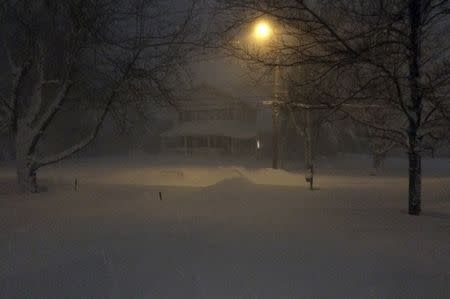
A powerful snowstorm swept across Western New York overnight, creating snow drifts as high as houses, trapping people in their homes and forcing hundreds of motorists to abandon their cars on roadways that were quickly buried in the blizzard-like conditions.
As much of the nation was plunged into a deep freeze, the sudden rush of cold air from the north set the perfect conditions for the moisture coming off the Great Lakes to create sprawling snow bands, the most ferocious of which settled over the towns and communities just south of Buffalo on Tuesday.
At least four people in that region died as a result of the weather, according to The Associated Press. Gov. Andrew Cuomo declared a state of emergency and deployed the National Guard to help find and rescue anyone stranded in the storm.
The heavy snowfall and local travel bans forced Amtrak to suspend service in the region until at least Wednesday afternoon.
As of late Tuesday night, more than five feet had fallen in towns like Lancaster and Gardenville and, since snow kept falling overnight, it was likely that there could be more than six feet of snow in some places.
“This is a very extreme event,” said Shawn Smith, a meteorologist at the National Weather Service in Buffalo. “It basically crippled all the towns south of Buffalo.”
But unlike a typical winter storm, the snow caused by the “lake effect” was not felt equally across the region. The divide was so stark that someone on a tall building in downtown Buffalo had clear skies overheard but could see a menacing gray wall of moisture and snow being swept up off the lake and driven south.
On Wednesday, there was only a dusting of snow in the city.
But a few miles away, in the town of Evans, they were comparing the storm to the infamous Blizzard of ’77, one of the deadliest snowfalls ever recorded in the region.
Keith Dash, the town supervisor, said it began snowing around 10 p.m. Monday. By 5:30 a.m., it was clear that school needed to be canceled.
“We are at anywhere from 30 to 45 inches, depending on what side of town you’re in,” Mr. Dash said Tuesday night, as the snow continued to pile up. “Plus, there’s been blowing and drifting all day long.”
He said the roads were a major concern.
“We have a lot of stuck vehicles,” he said. “We have over 100 people who are still stuck. I have never, ever seen this much snow at one time.”
Nicole Tubiolo, 35, a web project manager at First Niagara Bank who lives in a condominium in Amherst, said she had not had much snow.
But she said that her mother, in nearby Lancaster, had never seen the snow come so fast and was stuck in her home.
“She said, ‘There’s no way I’m getting out in this,'  ” Ms. Tubiolo said.
The snow forced the closing of a 132-mile stretch of the New York State Thruway on Tuesday but highway officials said that much of the road had been reopened on Wednesday, even as they worked to remove cars abandoned on the side of the road.
Residents are expected to get a brief respite from the snow on Wednesday but the forecast calls for another 12 to 24 inches of snow to fall on Thursday.
As residents upstate started to dig out, the cold temperatures across the country were causing people to hunker down.
In New York City, record low temperatures were recorded at the area airports and it was not expected to warm up until the weekend.

Music Video - NOOR JAHAN - ZINDAGI KAY SAFAR MEIN AKELAY- ZEBA - MUHAMMAD ALI

Music Video - Faiza Mujahid _ Meri Zindagi -

Music Video - Humsafar - AXIS

Pakistan: PTI responsible for mishandling of IDP issue

http://mediacellppp.wordpress.com/
Senator Farhatullah Babar at the PPP Secretariat in Islamabad on Tuesday said that since the IDPs are in K-P, the provincial government cannot run away from its duty to work for the people who were making sacrifices to end terrorism and militancy in the country.
Flanked by party leaders before dispatching winter items including clothes, blankets and other necessary goods for IDPs camped in Bannu, the PPP senator condemned the recent police raid during ration distribution.
“We admire the IDPs heroic role. They are playing a frontline role in the war against militancy,” Senator Babar said.
Former information minister and ambassador to the US Sherry Rehman said that and they should work together for the rehabilitation of IDPs. “We will make effort so they do not end up as refugees.” P
PP leaders further demanded that all cases against IDPs should be dismissed, and the policemen responsible held accountable.
Former chairman Pakistan Baitul Mal, Zamurad Khan offered to adopt all those children who have become orphans during the ongoing military conflict in the tribal belt.
“I request the media and Pakistan Army to help me find such children,” he said.

Pakistan: Five point plan for Journalists’ protection

http://mediacellppp.wordpress.com/
Senator Farhatullah Babar at the PPP Secretariat in Islamabad on Tuesday said that since the IDPs are in K-P, the provincial government cannot run away from its duty to work for the people who were making sacrifices to end terrorism and militancy in the country.
Flanked by party leaders before dispatching winter items including clothes, blankets and other necessary goods for IDPs camped in Bannu, the PPP senator condemned the recent police raid during ration distribution.
“We admire the IDPs heroic role. They are playing a frontline role in the war against militancy,” Senator Babar said.
Former information minister and ambassador to the US Sherry Rehman said that and they should work together for the rehabilitation of IDPs. “We will make effort so they do not end up as refugees.”
PPP leaders further demanded that all cases against IDPs should be dismissed, and the policemen responsible held accountable.
Former chairman Pakistan Baitul Mal, Zamurad Khan offered to adopt all those children who have become orphans during the ongoing military conflict in the tribal belt.
“I request the media and Pakistan Army to help me find such children,” he said.

Pakistan's Afghan refugees

Four decades of war have displaced millionss of Afghans to neighbouring countries, especially Pakistan. The number of refugees has since grown owing to constant conflict, political instability and uncertainty in Afghanistan. The economic condition of the country does not allow these displaced people to return. According to a report prepared by Feinstein International Centre, one in three Afghan children is malnourished. Malnourishment is higher in conflict-ridden regions such as those in the country’s south. Afghanistan has the highest rate of stunted growth in the world among children less than five years old. In areas where fighting continues, militants do not allow residents access to healthcare services. Though militancy has been the major reason behind the large scale movement of people both within and outside Afghanistan, poverty and natural disasters have also contributed to this situation. In Pakistan, 36 percent of the Afghan refugee population lives in refugee camps — known locally as ‘refugee villages’ — and 63 percent in urban settings. In addition to the 1.7 million refugees registered with the government, it is estimated that a further one million or more undocumented Afghans live in the country. 85.1 percent of the Afghans in Pakistan are Pashtun, and the remainder are Tajiks, Uzbeks, and others. One of the most vulnerable Afghan refugee groups is the ethnic Hazara, who face targeted killings and persecution by the Taliban and anti-Shia factions in Afghanistan. For the Hazara, and for other Afghan refugee groups, voluntary repatriation is therefore not a viable solution.
Pakistan is not a signatory to the 1951 Convention or the 1967 Protocol on refugees. The temporary stay of registered Afghan refugees is regularised by means of Proof of Registration cards, all of which expired on December 31, 2012. The Pakistan government extended their right to stay for an additional six months until the end of June 2013, and in July 2013 announced a further extension. Things however, have started to change with the arrival of the new government in Afghanistan. During his recent two-day visit to Pakistan, Afghan President Ashraf Ghani has announced that Afghanistan would be ready to receive the refugees sheltering in Pakistan by end 2015. Pakistan will be relieved of this economic burden if this deadline is met. Life for the Afghans has been a hell whether they live in their own country or as refugees in any part of the world. Living as a refugee can never compare with one’s home and one’s own country. The Afghan people have had more than their share of suffering. It is high time that the country’s wounds are attended to, including the safe return of its displaced sons and daughters to their hearths and homes.

Afghanistan: Smuggled medicine floods Afghan market, says report

http://www.southasianmedia.net/
A new report says that half of all medicine available on the Afghan market has either been smuggled into the country or made under sub-standard conditions in neighboring Pakistan.
The Independent Joint Anti-Corruption Monitoring and Evaluation Committee says in a report released on Wednesday that up to 300 companies in Pakistan are producing poor quality drugs exclusively for Afghanistan because their products do not meet Pakistani government standards.
The report says that since there is no Afghan government regulation of pharmaceuticals, the medicine can be sold in Afghanistan.
Afghanistan's pharmaceuticals market is worth up to $800 million a year. But the quality of drugs available in the country is so poor that many Afghan people are forced to travel abroad for medical treatment.

Pakistan: PTI and the mantra of education reform

Usman Malik
While discussing reforms liberal progressive folks, who support the PTI, are utmost fond of mentioning the party’s progressive stance on education. This, now passé, statement could not be further from the truth.
If actions speak louder than words and if intentions can, however faintly, be assessed from actions, then, in regards to policies, studying actions can be an enlightening exercise.
Take a look at the PTI’s 18-month track record regarding education in KPK.
The province’s last government, the ANP – widely regarded to be a liberal progressive party – instituted reforms regarding the exclusion of material bearing tinges of religious hatred and intolerance. Coming from a province most ravaged by the very real demon of terrorism, the reforms were a welcome step.
However, one of the first ‘changes’ that took place under the PTI-JI coalition were targeted exclusion of previous reforms under the garb of ‘objectionable material’.
Since then systematic exclusion and a return to pre-ANP curriculum has been ongoing. The PTI did take a cursory stand against what is now thought to be an entirely JI venture.
Nevertheless, in the recent months, the PTI has caved in on essentially every agenda point. Not only this but also the PTI education minister has said he is ready to “induct material to be proposed by Jamaat”. The question that arises here is:
Is PTI really the party with an uncompromising stance on education reform?
The ANP government not only removed retrogressive content, but also added contemporary, regional (more relatable) material in Social Studies. Removal of such content, as numerous statements from party spokespersons indicate, was fronted, not just acquiesced to, by the PTI.
So I want to ask: Does the PTI truly have a progressive stance on education? Or is it pushing ahead in the wrong direction?
The most interesting of all the nip-tucks by the PTI-JI coalition is the inclusion of religious references to the grade nine Chemistry book – Chemistry book!
Yes, folks. Zia’s Pakistan is alive and thriving.
A point of significance here is to note the level of intellectual and ethical bankruptcy that one would have to stoop to, were one to even suggest such a ‘change’.
In a province with a sizable share of Christian, Sikh, and Hindu minorities, this step is cringingly unscrupulous.
Try and imagine a human endeavour which is even infinitesimally more secular than science. Think of a subject with lesser schisms than science.
Have you ever heard of Hindu Physics or Japanese Biology?
There is a reason, why you have not.
Science does not work that way. It does not care from which authoritative tradition a particular insight is coming. Science does not consider to what language, national, cultural, or racial identity one belongs.
Learning in science is not predicated upon who did it first i.e. its history. Reading about Al-Beruni would be very little help in understanding chemical reactions. A Social Studies textbook is more suited for talking about historical contributions of scientists and these books contain plenty of such references.
Any progressive, educated person would recognise that a muddling of the two (science and history) is a disservice to both. The last KPK government removed names and contributions of ‘Famous Muslim Scientists’ from Science textbooks. One would, therefore, commend ANP on such a rectification.
The level of bankruptcy of scientific-literacy that one would have to plumb to even think of reforming back to old is phenomenal. Yet, the ‘visionary leaders’ did just that. So again, is PTI really the emblem of a party with an enlightened view on education?
As is evident from the antics of Imran Khan and the PTI’s ill-advised criticism of financial and infrastructural reform, the party does not really seem to understand economics either.
If a pattern can be descried here, it is this: The PTI ranks seem to be devoid of the academic depth required for scientific, rational and secular reforms. It is much too intellectually nascent to be expected to bring better educational reforms and not bungle them like other parties so often do.
About the party’s progressive policy regarding education reform, I am still open-minded but all the evidence of their own doing – not just their ‘strategic’, real-politik, ends-justify-means moves – says otherwise.
At best, the PTI is too weak in its resolve to put up a fight against retrogression. At worst, the party is too intellectually exhausted to handle reforms.
In any case, this mantra of ‘change’, at least in education, is an Obama-like rhetoric which has run its course.

DAESH IN PAKISTAN: MQM SUBMITS CALL ATTENTION NOTICE IN SINDH ASSEMBLY

Altaf-led MQM on Wednesday submitted a call attention notice in the Sindh Assembly to discuss the presence of notorious takfiri nasbi terrorist outfit DAESH (ISIS or ISIL) in the country.
The notice was submitted by MQM’s MPA Kamran Akhtar in today’s session, requesting the provincial and federal governments to take action against any DAESH activities in the country.
Last week, a leaked government memo warned that DAESH had recruited 10,000-12,000 takfiri fighters inside Pakistan, but government insisted that the group had no presence there.
Several takfiri militants said that hundreds of Pakistanis have gone to fight in Syria, but had done so through the Taliban or on their own.
MQM Chief Altaf Hussain has already alerted the government to crush DAESH instead of denying their presence in Pakistan.
http://www.shiitenews.org/index.php/pakistan/item/11927-daesh-in-pakistan-mqm-submits-call-attention-notice-in-sindh-assembly

Pakistan: Neither Imran Khan nor Ali Mohammad MNA of PTI apologize calling Christian to be Infidels

Dr. Nazir S Bhatti, President of Pakistan Christian Congress PCC has expressed grave concern on remarks of a leader of Pakistan Tehreek Insaf PTI in a live TV Show about Christian calling them infidels (Kafir) commenting on incident of burning a Christian couple alive in Kot RadaKishan on November 4, 2014, in Punjab province of Pakistan.
There was uproar and anger among millions of Pakistani Christians on remarks of Ali Mohammad MNA of Pakistan Tehreek Insaf PTI and an open apology was demanded by them for Ali Mohammad and PTI Chief Imran Khan.
But neither Imran Khan nor Ali Mohammad apologized which have forced Christians to decide to quit their memberships of PTI socially boycott those Christians who still work to promote cause of Tehreek Insaf in Pakistan.
Dr. Nazir Bhatti said “The remarks of Ali Mohammad in electronic media have exposed Pakistan Tehreek Insaf PTI that it is not a political party of moderate Muslims but carrying hidden agenda to impose extremist Islam in Pakistan where Muslims will treat Christians as Infidels and impose Islamic taxes on them or force them to convert to Islam or get to for beheading as ISIS is practicing Islam in new Islamic state unless PTI leader might have apologized on remarks of his party leader”
Imran Khan is one Muslim political leader who marched to Talban strong hold North Waziristan to express Pakistan Tehreek Insaf PTI support towards their stance.
It is on record that when Talban were bombing public gathering of other political parties during election campaign of national general elections of 2013, the public gathering of Pakistan Tehreek Insaf PTI and Pakistan Muslim League PML (N) were freely happening with total protection.
Dr. Nazir Bhatti said “Imran Khan is clean shaved moderate Muslim demanding New Pakistan but bearded in stomach as radical Muslim to promote Islamic Extremism in Pakistan”
“It sham for those Christians who still claim to be members of Pakistan Tehreek Insaf PTI after calling Christians to be Infidels (Kafir) live on electronic media and no apology afterwards” added Nazir Bhatti