Tuesday, November 4, 2014

SAUDI ARABIA OUTLAWS FEMALE 'TEMPTING EYES'

Saudi Arabia has developed an international reputation for regularly violating women's rights, one the nation continues to feed with a new law issued by the country’s religious police, the Committee for the Promotion of Virtue and the Prevention of Vice, outlawing “tempting eyes.”
What are "tempting" eyes? One Saudi journalist mused on condition of anonymity that they are "uncovered eyes with a nice shape and makeup. Or even without makeup, if they are beautiful, the woman will be in trouble." The Orwellian-named committee did not provide a definition of tempting, but if they happen to rely on Merriam-Webster, then it means "having an appeal." What is an appeal? According to the dictionary, it is "arousing a sympathetic response." And what is sympathetic? "Showing empathy," according to Merriam-Webster.
An unnamed journalist told AINA the law is “so stupid” and “people will oppose” the new law. But the religious police are very powerful in Saudi Arabia. King Abdullah provided the organization $53 million in March. Prince Neif, heir to the throne, supports the police.
"The committee is supported by all sides,” he said. “It should be supported because it is a pillar from Islam. If you are a Muslim, you should support the committee."
The police monitor public behavior according to the Wahhabi School of Sunni Islam. A few “crimes” include homosexuality, fornication, attempts to convert anyone away from Islam, and socializing with unrelated males and females. The police make sure stores abide by the Muslim dietary laws and close at prayer times.
Sheik Abdulatif al-Sheik replaced Shaikh Aziz Al Humain as head of the Commission for the Promotion of Virtue and Prevention of Vice in January 2012. He promised to help improve the woman’s place in society.
"I cannot deny that there were several violations committed by members of the force, some of which happened because of the lack of clear guidelines or understanding," he said. "So we are planning, God willing, to introduce clear guidelines and mechanisms for the field work of the members of the force."
Yet, women are still oppressed in Saudi Arabia. A court sentenced a businesswoman to 50 lashes because she cursed at the religious police. The officers checked her café for breaches of morality, and the men claim a few of her employees ran away because they were illegal.
In February, Saudi women rebelled when the CPVPV passed a law that forbids a woman to attend a doctor's appointment without a male guardian. "Islamic law does not permit women to visit their doctors without male guardians. Women are prohibited from exposing body parts to male doctors in Islamic law, especially during childbirth,” said Council of Senior Scholars member Qais al-Mubarek. In October 2013, Saudi women took to the streets to protest the Saudi law against women drivers. Sheikh Saleh Al-Loheidan added more international outrage when he said driving harms a woman’s ovaries.
"If a woman drives a car it could have a negative physiological impact,” he said. “Medical studies show that it would automatically affect a woman's ovaries and that it pushes the pelvis upward. We find that for women who continuously drive cars, their children are born with varying degrees of clinical problems."
http://www.breitbart.com/Big-Peace/2014/11/02/Saudi-Arabia-Outlaws-Female-s-Tempting-Eyes

Saudi Arabia Shia-linked gun battles 'leave nine dead'

At least nine people have died in two separate gun battles in Saudi Arabia.
In the first incident on Monday, masked gunmen killed at least five people in the town of Dalwah, a Shia Muslim area in eastern Saudi Arabia. On Tuesday in a shootout believed to be linked to that attack, two suspected militants and two Saudi policemen were killed in Buraida, north of Riyadh.
Shias, who make up less than 15% of the Sunni-majority nation, are currently marking the festival of Ashura. It commemorates the death of a grandson of the Prophet Muhammad.
'Shocked'
Monday's attack was in Dalwah in Ahsa district, one of the centres for Shia Muslims. At least three attackers fired machineguns and pistols at a crowd that was leaving a building where ceremonies had been taking place, police said. At least 15 people have been arrested in connection with the shooting.
One resident of Eastern Province, Nasima al-Sada, told Agence France-Presse: "It's very surprising because it's the first time. We are shocked."
Saudi Arabia's supreme council of Sunni clerics condemned the attack, saying: "The enemies of our religion and our homeland aim to attack our unity and stability."
There were few details of the second gun battle.
The Saudi Press Agency said that in addition to the dead, two security officers were wounded.
The interior ministry said the gun battle began when officers tried to arrest suspects believed to be involved in Monday's incident.
Shia Muslims have long complained of marginalisation by the Sunni royal family, with the Eastern Province, where most of the country's Shia live, seeing a spate of protests in the wake of the Arab Spring.
The Saudi government denies allegations of discrimination and blames Iran for stirring up discontent.

What will be discussed at the upcoming Presidential Meeting between Xi and Obama?

People's Daily
At the invitation of Chinese President Xi Jinping, U.S. President Barack Obama will attend the APEC Informal Leadership Meeting and pay a state visit to China from 10 to 12 November. The two leaders will have an in-depth exchange of views on China-US relations and on major international and regional issues of common concern.
Experts say that topics including China-US trade, energy, anti-terrorism, and the DPRK nuclear issue will be covered at the meeting. APEC Senior official Wang Xiaomin said in August that the two leaders would have discussions on China-US trade, counter-terrorism, the DPRK nuclear issue, network security, bilateral cooperation, and disagreements.
Wang Fan, vice president of China Foreign Affairs University, remarked that this Presidential Meeting will cover China-US relations, as well as regional and global hot issues.
From the bilateral perspective, Wang Fan believes that China's advocacy of jointly building a new type of great power relationship will be reaffirmed and emphasized at the meeting.
In terms of China-US cooperation, climate change and energy issues may be the focus. "US think tanks also think that these are key issues," said Wang. "It will be easier for both sides to reach an agreement on such relatively soft issues".
As to foreign affairs, Wang believes that measures against terrorism is one of the issues to be discussed. "Overall, China and the U.S. share the same view on counter-terrorism. The two countries can engage in greater cooperation. However, we hope the U.S. will stop applying double standards in the fight against terrorism".
According to Wang Fan, hot issues surrounding China cannot be avoided. China-Japan relations and the DPRK nuclear issue will be discussed. "Such hot issues touch upon China's core interests. China wishes that the U.S. would play a constructive role instead of exacerbating the situation", said Wang.
On the global level, the two sides will have communication and exchanges over serious current security issues including the Ebola epidemic, the Islamic State, and Ukraine.
Sun Zhe, director of China-US Relations Research Center at Tsinghua University, also said that the topics of the Presidential Meeting will begin with China-US relations, and that Asia-Pacific stability will be the focus when they talk about regional and global situations.
Wang Fan believes the Presidential Meeting is of positive significance to keep the surrounding hot issues under control. In addition, "Two leaders might have a long talk, like the meeting held at the Annenberg Estate last year. This meeting will deepen their trust and understanding, and the trust between the two leaders can further strengthen the trust between the two countries".

Video - Ron Paul: US elections are a one party monopoly

Video - Republicans may win big in mid-term elections

U.S. governors seeking re-election face dissatisfied voters

BY ELLEN WULFHORST
More than 30 U.S. governors' races will be decided on Tuesday, with more than a dozen considered too close to call and a large number of incumbents struggling to defend their economic policies as they seek to remain in office.
Hot-button issues from gun control to abortion restrictions and healthcare figure in some races.
For many voters, however, the economy has remained the central issue. An uneven recovery could prove the undoing of several incumbents, including the governors of Kansas and Pennsylvania, who are being held accountable for their states' fiscal woes.
"We've had a very difficult economy for years and anyone in office is going to be held partly accountable, especially governors," said Larry Sabato, director of the University of Virginia's Center for Politics. "They're not called 'little presidents' for nothing."
Fiscal issues in Kansas, for example, have pushed Republican Governor Sam Brownback into a tough struggle against Democrat Paul Davis.
Brownback slashed taxes in an effort to boost the economy, prompting a downgrading of the state's credit rating, and his policies coincided with a sharp decline in state revenue and mounting fears about funding shortfalls for schools.
Davis, a state representative, has promised to end Brownback's "experiment," while tailoring a campaign to lure Republicans in a state normally reliable for that party, while not losing Democrats.
Fourteen governors' races are seen as toss-ups, according to the Cook Political Report, a nonpartisan newsletter that analyzes campaigns and elections. At least 10 incumbent governors are battling to save their jobs, experts project.
"There's a strong anti-incumbent mode," said John Green, professor of political science at the University of Akron and director of the Ray C. Bliss Institute of Applied Politics.
In Florida, where Republican Governor Rick Scott faced off against Charlie Crist, a former Republican governor turned Democrat, some voters at the polls on Tuesday said their ballots were meant to punish the incumbent.
"It's really a vote against Rick Scott," said Diane Darby, 45, a Miami Beach accountant who said she voted for Crist.
At an election center in Tallahassee where turnout was higher than in previous midterm elections, Charles Boyd was among disgruntled state workers who do not like Scott's 3 percent payroll fee for the Florida Retirement System, which was previously all employer-paid.
"The Democrats could have run a ferret and I would have voted for the ferret," said Boyd, 70, who works for the Florida Department of Transportation and who voted for Crist.
GOVERNORS IN A 'REAL HOT SPOT'
Another Republican governor facing voters' anti-incumbent feelings is Pennsylvania's Tom Corbett. He has trailed badly in polls against Democrat Tom Wolf, a businessman who has poured his personal fortune into the race.
If Corbett, who has been criticized for cuts in education funding and escalating pension liabilities during his tenure, fails to win his second term, he would become the first incumbent governor to do so in the state's history.
"Although the economy is definitely better than it was a year ago, it's not up to anybody's expectations, and governors are in a real hot spot," Green said. "They're the ones who have to cut programs or raise taxes."
An early rush to the polls in Pennsylvania drew better than expected turnout in Harrisburg, where registered Republican Rod Kautz, a retired executive, said he was disappointed by Corbett and would vote for Wolf. In Philadelphia, Democrat Elizabeth Stegner said Corbett's education cuts were driving a steady stream of voters to the polls.
"Corbett really bit himself in the butt on that one. At one point principals didn't have someone to answer the phones for them," said Stegner, who serves on the Democratic Committee representing West Philadelphia.
Among governors looking to keep their jobs are potential 2016 presidential hopeful Scott Walker, the Wisconsin Republican who became a champion of conservatives when the state cut back the powers of public-sector unions.
Recent polls have him running neck and neck with Democrat Mary Burke, a former business executive.
Party control of governorships is considered important in the 2016 White House contest, when candidates use governors to help build state-by-state support toward a possible nomination. Going into Tuesday, Republicans hold 29 governorships compared with the Democrats' 21.
Nathan Gonzalez, deputy editor of the Rothenberg Political Report, said having so many competitive governors' races was "extraordinary."
"Many of them are extremely close in the final hours," he said.

U. S. - Math is forbidding for Democrats in struggle for Senate

By David A. Fahrenthold, Katie Zezima and Paul Kane
On the last day of the 2014 campaign, Democrats knew they were in trouble.
Long ago, the party had given up hope of winning back the House in Tuesday’s midterm elections. By Monday, it had skipped ahead to winning the post-election blame game. “House Democrats have succeeded on every measure within our control,” the party’s House campaign committee announced preemptively in the early afternoon.
And at the end of a bitter and massively expensive campaign, it appeared the Senate might be slipping from Democrats’ grasp as well.
In all, there are 13 states where Senate seats might change from one party to the other. Republicans need to win nine of them to attain a 51-seat majority in the Senate for the first time since 2007. On Monday, Republicans seemed to be leading, by a lot or by a little, in eight of those races.
If the GOP wins all eight, they will need just one more win — one of the tossup races in Alaska and Kansas, or perhaps the runoff race that’s expected in Louisiana.
“Victory is in the air,” declared Mitch McConnell (R-Ky.), the Senate minority leader, who is set to become majority leader if the Republicans take over. McConnell was beginning the last swing of his own reelection campaign against Democrat Alison Lundergan Grimes.
Like other contests around the country, that race seemed to be tilting toward Republicans in the last days. “Let’s go out there and sock it to them!” the usually subdued McConnell said in closing, as a loudspeaker started blasting out “Eye of the Tiger.”
There also will be gubernatorial elections Tuesday in 36 states, including Florida, Massachusetts, Kansas, Maine and Wisconsin, where potential presidential candidate Scott Walker (R) is in a close race to keep his position. Republicans, who already control a majority of the country’s state legislative chambers, seem likely to win several more.
The campaign to control it began last spring, and it became a monster that has dominated television commercial breaks for months. At last count, an estimated $423 million had been spent to air 878,000 TV spots about Senate races, according to Kantar Media data analyzed by the Wesleyan Media Project.
Republicans largely campaigned against President Obama, casting their opponents as rubber stamps for an unpopular chief executive. Most Democrats didn’t seem to like Obama much, either, and many ran as centrists skeptical of the president. In Alaska, Sen. Mark Begich (D) proudly declared himself “a thorn” in Obama’s posterior.
In the past week, campaign volunteers from both parties have knocked on thousands of doors, trying to gin up the traditionally low midterm turnout. The Begich campaign claims to have knocked on 50,000 doors in the past week, equivalent to about one in six likely Alaska voters.
Even the candidates seemed to be tired of hearing about the candidates.
“I’m looking forward to turning on the TV on Wednesday morning and seeing a car commercial and not my face,” said Thom Tillis, the Republican challenger to Sen. Kay Hagan (D) in North Carolina. That is one of two competitive Senate races, along with New Hampshire, where the Democrat holds a small lead in polling averages.
Tillis’s mother, Margie, came from Tennessee to Cornelius, N.C., to make phone calls for her son, who is speaker of the state’s House of Representatives. She said Election Day would be a relief for her, as well.
“I’m tired of hearing these horrible things about someone who I know is a great person,” Margie Tillis said.
By tradition, the last Monday of any campaign reflects poorly on America’s great experiment with democracy — a time for calculated outrage, last-minute trickery and overtired people saying impolitic things into microphones. This Monday was no different.
In Kansas, Republicans continued to make hay of a comment made by independent Senate candidate Greg Orman. Deriding former senator Robert J. Dole (Kan.) and other GOP veterans who had campaigned for incumbent Sen. Pat Roberts (R), Orman compared the strategy to “a Washington establishment clown car. . . . Every day a new person comes out of that car.”
Republicans were “outraged.”
“Greg Orman is shameful for calling Bob Dole a clown,” Roberts’s campaign tweeted Monday. Dole later released an e-mail from Orman himself, in which the candidate sought to explain the difference between a clown and a clown car. “I certainly wasn’t calling you — or any of the others supporting Senator Roberts — a ‘clown,’ ” Orman wrote.
Elsewhere, it came out that some last-minute campaigners had said dumb things on video. In Iowa, retiring Sen. Tom Harkin (D) attacked Republican candidate Joni Ernst by talking about her looks — and by comparing her to pop star Taylor Swift. In New Hampshire, a GOP official compared the last hours of the Senate campaign to committing homicide by drowning.
“We need to crush it. We need to grab it, run with it, push their heads under over and over again until they cannot breathe anymore,” said Jennifer Horn, the state Republican Party chair.
Harkin later apologized. Horn did not.
For Democrats, the Senate race has become a bleak math problem. Three of 13 key Senate races were deemed definitely lost: West Virginia, South Dakota and Montana. Two more states were almost as far gone: McConnell was ahead in Kentucky, and Sen. Mark Pryor (D) was trailing his Republican opponent in Arkansas.
Three more also seemed to be turning against the Democrats in recent days. In Iowa, a weekend Des Moines Register poll showed Rep. Bruce Braley (D) trailing Ernst by seven points, though other polls have shown the race much closer. In Georgia, Democrat Michelle Nunn, who led for weeks, was slightly behind.
And in Colorado, polls show Rep. Cory Gardner (R) leading incumbent Sen. Mark Udall (D). Republicans held a distinct advantage in the early voting statistics: Registered Republicans accounted for 40.5 percent of the 1.3 million people who had cast a ballot, compared with 32.5 percent who were registered Democrats, according to state records.
That left Colorado Democrats hoping for a last-minute rescue by a voter base that tends to procrastinate. On Monday, Sen. Michael F. Bennet (D) addressed students gathered at Metropolitan State University of Denver as part of a series of rallies dubbed ­“#MarkYourBallot.”
“If you haven’t cast that vote, if you haven’t pulled your roommate out of their dorm room or out of their bed and got them to the polls, you’ve got to do it,” Bennet said.
Fahrenthold reported from Washington, Kane from Louisville and Zezima from Denver. Also contributing to this report were Wesley Lowery in Cornelius, N.C.; Ed O’Keefe in Atlanta; Jose DelReal in New London, N.H.; Elahe Izadi in Wichita; Hunter Schwartz in Little Rock; Sebastian Payne in Anchorage; Karen Heller in St. Amant, La.; Ben Terris in Newton, Iowa; and Robert Costa and Reid Wilson in Washington.

President Obama and Control of the Senate on the Line

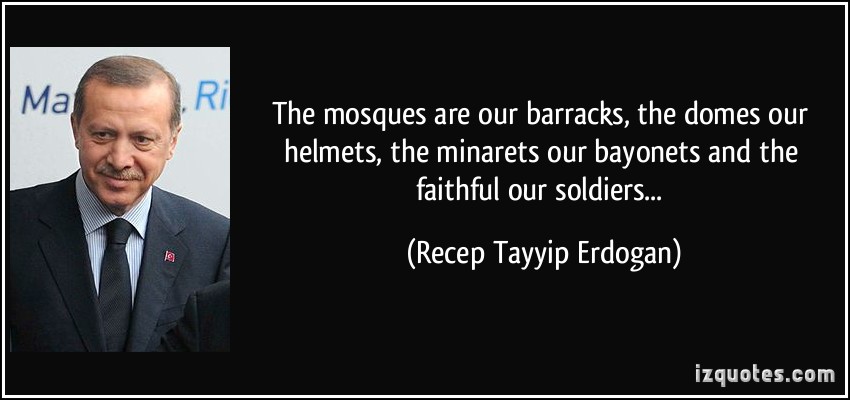
The rise of political Islam in Turkey: how the West got it wrong

Political Islamism has undermined the Turkish Republic's secular social order, education and legal systems and Western pundits manifestly failed to see this coming, argues Turkish opposition MP, Safak Pavey.
The end of the Cold War did not free the world of polarised ideologies. Once the Berlin Wall fell, we hoped a new world would finally move beyond the conflict ridden past. Yet, not only did we face continuous conflicts but with the revival of religious traditions, God's role in politics was rekindled. We thought that the time for belief systems and politics which derive their legitimacy from God was over. But we were wrong. The current administration of Turkey, which was lauded as an example of a modern Islamic democracy, derives a considerable part of its mandate from the belief that they are carrying out God's mission of revenge against the godless secular system.
Islamism has hijacked my country, the Middle East and the 'Arab Spring', not only politically, but culturally as well.
Let us take the case of ISIS. It gave the Christians of Rakka three options: convert to Islam, remain Christian and pay the protection tax of the non-Muslim believers and submit to strict rules, or be prepared to die. The protection tax amounts to 14 grams of pure gold per capita. Some of the rules include prohibitions on making repairs to churches, wearing the cross or other religious symbols outside church and ringing the church bell.
Turkey's Islamists have not implemented these restrictive practices and rules formally because this would still require a major overhaul of the legal system, and they see ISIS as "uncivilized". But in everyday life social pressure is exercised in more subtle ways and people are intimidated through quiet repression on the street.
Our current situation is explained away by Western intellectuals who had nothing but praise for Erdogan ten years ago, and now claim he has transformed into a tyrant. The latest conclusion of these international commentators who sing the praises of Islamic democracy is that democracy befits our culture, but that the problem is with Erdogan's personality.
It would be a mistake to underestimate Erdogan. Ever since he entered politics at a young age, he aimed to become head of state because he believed only he could abolish the 'infidel / heretic' social system; that is how the secular state is perceived by political Islamists. But attributing the Islamic transformation of Turkey only to him, would be paying him too generous a compliment.
It would also be wrong to explain this turn of events with reference to differences between right and left, since these distinctions are far more complex in Turkey. The biggest chasm between left and right in our politics now is religion; it all hinges on whether "you are pious or not." The cosmetic reforms that have been attributed to Erdogan and his Government, bringing him high repute, turned out to be window dressing to impress the West. Indeed, they all melted away swiftly within the repressive structure of emerging political Islam. Law came at the top the list of casualties. Government supporters are granted privileges and are above the law, while opponents are meted out the harshest sentences. Formal law is no longer implemented with the purpose of delivering justice but rather as a tool to deliver punishments to detractors.
It was only his Western counterparts and pundits who were hoping that someone with strong loyalties to Sharia would abide by secular law. By now, they must be amazed at how wrong they got it.
AKP has transformed Sunni identity into the dominant one in Turkey through religious references. Addressing the West, the AKP claimed that it was waging war on deeply rooted nationalism, but all the while it was spreading a far more insidious ideology. In fact, any scholar who works on Turkey knows that Middle Eastern style nationalism has always relied on religious pillars to survive.
In the course of Turkey's republican history we had the best attempts at democracy that could have come out of Islamic countries, despite stumbling, interruptions and the tests of perseverance we had to endure. AKP has been calling this political system the regime of secular elites who think it is their right to govern the republic. Yet political Islamists have been involved in various centre-right organizations and parties, and have been the recipients of many privileges - strengthening their presence progressively. For example, some of the staff who have served Erdogan include ministers and high level bureaucrats who have held these positions ever since they became civil servants decades ago.
However, Turkey's political Islamists were not content with the symbiotic relations they had created with the centre-right parties. They worked diligently to take over the host organization and reached managerial positions with a perseverance that is praised and advised in Islam through the act of taqiyya (a form of religious dissimulation that permits believers to conceal the truth in pursuit of their goals).
So we have come to this situation. The system that protected social rights and liberties, and was supported by a considerable number of citizens, has been destroyed by an invisible bulldozer, and the political Islamists now claim absolute victory. In their eyes, 'the infidel, heretic' secular republic has been defeated.
The most significant fallout of political Islam is its destruction of secular education.
This issue is so important to Erdogan that he did not trust even his most loyal advisors, and instead put his own son in charge of the Islamization of education. In 2002, the number of pupils studying and graduating from the imam-hatip schools set up to train clerics was seventy thousand, now their number is one million. This number does not include the pupils who attend schools known as "hidden" cleric schools that are functioning under the guise of being regular public schools.
According to legal judicial investigation tapes, Bilal Erdoğan has himself stated that the handful of "the remaining pupils in the secular secondary education" have been integrated into the hidden imam-hatip cleric schools in order for them not to pose a threat to the Islamic regime in the future.
This aim has been achieved by assigning eleven hours of the forty hour week of lessons to Sunni religious education in state schools and prep schools. This is because the future generation cannot be left to the guidance of science; it must be conditioned to collective obedience through religion as the political Islamists demand.
Yet another policy devised by Erdogan's son has been the creation of a fraudulent demand for imam-hatip cleric schools through mosques and the media.
Women's behaviour, the laughter of a young woman, how much beer a young man drinks, who shares a house with whom and what kind of toilet they use (whether traditional or modern), all have to be under their surveillance. Living arrangements outside the prescriptions of the Holy Book are not crimes, but are considered to be sins to be eradicated. For instance, AKP politicians have destroyed as many modern toilets as modern sculptures. Tradition dismisses the comforts of modern life far too easily and readily.
Islamists define the morality of society in terms of woman's virtue and her relations with the opposite sex. This is why, in their eyes, girls and boys have to be segregated. Boys and girls cannot be on the same school grounds, and this includes university dorms. Students of different gender cannot be taught in the same building prior to university. Most school grounds have been gender-segregated in the past ten years. My cousin has been a physics teacher for twenty years. During the last five years she was made to hand over her physics classes to a member of an Islamic tariqat (order). She was told to remain at the teacher's common room during her class periods, so that it looked as if physics was being taught at that hour as stated in the curriculum. For five years those pupils learned nothing about physics - and all about jihad. She felt incapable of changing the situation and therefore she resigned.
Unfortunately this hidden policy has been implemented surreptitiously and frequently over the past ten years, and is now being implemented openly. Boys are pushed to attend boarding schools, and thus kept away from their families, and girls are being encouraged to marry young and become housewives.
Now that Turkey has gone off the rails from its journey towards modernity, where does that leave us?
The Islamists in Turkey are at the zenith of their power. They can be a difficult partner and even threaten to become an enemy to the West. Indeed, hostility towards the West is part of the conspiracy discourse that is widespread all over the Middle East.
Nonetheless there are significant numbers of people in Turkey who are resisting, and who struggle for the survival of civility and modern life. And the outcome of our struggle for survival will have much broader global repercussions than Western policy makers would like to think. Can you imagine a Turkey without its secularists? It would lead to a Europe that is confined to its continent, and it would turn it into a prison for us. "No one can leave this woeful story with their head held high" said Dani Rodrik, an academic at the Institute of Advanced Study in Princeton. Not the so-called secular-military elite that governed the country harshly for years, that scorned and yet used the Islamists and thus almost single-handedly guaranteed their reactionary attitudes; not Turkey's Western friends who pretended not to see the colossal infringements of social liberty; and certainly not the pseudo-intellectuals with their egregious interpretations of the events that legitimised the butchering of secular law in the hope that political Islam will produce democracy.
Those who ten years ago expected an Islamic reform from Turkey that would serve as a model for the world are, at this point, striving to prevent Turkey from turning into a hostile country model.
To conclude with a sentence from Turkey's political Islamists: "Those who expect Islam to reform want us to give up our religion. We will not rise to the bait of the infidel." If this is a clear statement of intent, so too is the resolve of those of us who intend to resist and struggle in defence of our freedoms and our Human Rights.
http://www.secularism.org.uk/

Video : Message of Bilawal Bhutto on Yaum e Ashura

Pakistani Christian Couple burnt alive in Kasur Punjab

A couple was burnt alive in a brick kiln in the outskirts of Kasure, Geo News reported. Sources said the incident took place in Kot Radha Kishan. Police sources said Shahzad and her wife Shama Bibi came to Chak 59 for their livelihood where the owner of the Kiln Yousuf Gujjar put them in a room.
He put different allegation on them over non-payment of advance money and gathered villagers. Later, the infuriated villagers through them in the brick kiln and set them alive.
- See more at: http://www.christiansinpakistan.com/pakistani-christian-couple-burnt-alive-in-kasur-punjab/#sthash.7SNUovBR.dpuf
قصورکےعلاقےکوٹ رادھا کشن میں مشتعل دیہاتیوں نے میاں بیوی کو بھٹے میں پھینک کر زندہ جلا دیا ۔پولیس ذرائع کےمطابق24سالہ شمع بی بی اوراس کاشوہرشہزاداینٹیں بنانے والے بھٹےپرمزدوری کےلئے دوسرےعلاقےسے کوٹ رادھا کشن کے چک 59 آئے ہوئےتھے جہاں بھٹے کے مالک یوسف گجر نے ایڈوانس دی ہوئی رقم نہ ملنے پر میاں بیوی پر مختلف الزامات لگا کر ایک کمرے میں بند کرکے لوگوں کو اکھٹا کرلیا اور دونوں کوبھٹے میں پھینک کر زندہ جلا دیاگیا۔عینی شاہدین کےمطابق پولیس چوکی فیکٹری ایریا کے5پولیس اہلکارموقع پر پہنچےبھی تھےمگر مشتعل لوگوں نےانہیں قریب نہ آنے دیا۔ - See more at: http://www.christiansinpakistan.com/pakistani-christian-couple-burnt-alive-in-kasur-punjab/#sthash.7SNUovBR.dpuf

Pakistan: Law-enforcers arrest five pro-ISIS terrorists of ASWJ in Karachi

shiapost.com
Law-enforcing agencies on Tuesday arrested five suspected pro-ISISI takfiri terrorists belonging Ahl-e-Sunnat-Wal-Jamaat (ASWJ) known as banned Sipah-e-Sahaba outfit in Karachi, The Shia Post reports.
Sources said the suspects were arrested during a raid conducted on a house in Karachi’s Gulshan-e-Buner locality. The alleged ISIS takfiri terrorists were shifted to undisclosed location for interrogation, officials said.
According to officials, the terrorists were planing to attack on Shia mourners after they were returning from the central Ashura procession.
A huge cache of weapons and explosive material have been recovered from the possession terrorists.

Balochistan: 15,000 People Have Migrated From Makran And Kharan: HRCP

Shezad Baloch
Losing hope against the tide of lawlessness, at least 15,000 people have migrated from the districts of Makran, Kharan and Awaran, the Human Rights Commission of Pakistan (HRCP) has said.
“It is a rough estimate because there has been a huge migration of local Baloch from Turbat, Panjgur, Gwadar, Awaran and Kharan districts,” the head of HRCP’s Balochistan chapter Tahir Hussain Khan told The Express Tribune.
He said many schools in Turbat are closed due to the volatile situation there.
“Families have relocated as the schools are closed in these areas due to poor law and order conditions,” Tahir said. Most of the families have moved to Karachi, Islamabad and Quetta.
He said the people of Makran prefer Karachi as they have many relatives there.
Recently, The Express Tribune interviewed in Quetta a family that has migrated from Turbat. Members of the family said frequent search operations and clashes between armed groups in Dasht Guran area of Kech forced them to migrate.
“We were caught up in a war. I could not send my children to school,” said the head of the family on condition of anonymity.
Balochistan’s Home Secretary Akbar Hussain Durrani dismissed the findings of the HRCP report, saying it was “baseless and unreliable”. “It is not an authentic report because law and order has improved in Makran, Kalat, Khuzdar and other areas in recent years,” he said.

Interview: Pakistan must not allow extremists to act as a 'Sunni Wall' against Iran

By Shamil Shams
Pakistani-Iranian ties are gradually turning into a hostile affair as the two neighbors continue to engage in border clashes. Analyst Siegfried O. Wolf tells DW why Islamabad needs to re-evaluate its regional policies.
Border tensions between Pakistan and Iran have flared over the past few months, with Teheran accusing Islamabad of allowing Sunni militant groups to infiltrate its eastern border. Pakistan denies backing the armed outfits.
Last month, the Iranian security forces entered Pakistan to engage in a battle with these militants, resulting in a skirmish with the Pakistani border guards. This comes at a time when Pakistan is also engaged in a gun battle on its eastern border with India, and its relations with Afghanistan are also not very cordial.
Siegfried O. Wolf, a senior research fellow and lecturer in International and Comparative Politics at the University of Heidelberg's South Asia Institute, says in a DW interview that it is likely that the Pakistani extremist groups are operating without the support of the South Asian country's government and the military. But he adds that Islamabad must go after Islamists wholeheartedly if it seeks to improve ties with its neighbors.
DW: The border clashes between Iran and Pakistan have increased, with Teheran accusing Islamabad of allowing Sunni militants to enter its Sistan and Baluchistan provinces. How credible are Iran's claims?
iegfried O. Wolf: Looking at the history of Iranian-Pakistani border tensions, Teheran's claims could well be true. However, the only force in Pakistan that can allow such border conflict to occur, is the country's powerful military. But it is unlikely that the Pakistani army or its intelligence organization, the Inter-Services Intelligence (ISI), would be interested in confrontation with Iran.
Pakistan is tied up fighting militant groups as well as keeping major urban areas and the country's troubled northwestern border with Afghanistan under control. In addition, the army is also trading fire with India at the Kashmir border. Therefore, opening a third front in the southwest would not be wise.
In my opinion, Iran's claims are credible, but it seems that these groups are not working on Islamabad's directives.
Is it possible that these armed groups can infiltrate Iran unilaterally without Islamabad's support?
There is no doubt that Pakistan in the past didn't do much to stop international terrorist groups from using its territory. There have been accusations that Pakistan was getting financial and logistical support from Saudi Arabia to nurture anti-Iranian organizations. But I doubt Pakistan's security forces are still able to control terrorist groups like the radical Jaish al-Adl outfit, which carried out the recent attacks against Iranian border guards.
Is Pakistan being used as a proxy in the ongoing Saudi Arabia-Iran regional rivalry?
It will be hard to prove that Pakistan functions as Saudi Arabia's proxy. Prime Minister Nawaz Sharif spent many years in Saudi Arabia during his exile period, and subsequently developed close links to the Saudi monarchs. Pakistani officials will avoid upsetting Riyadh as the country's energy security is one of Sharif's major concerns. Therefore, I don't think that his government will be interested in provoking Tehran too much and, hence, putting bilateral gas pipeline projects at risk.
Having said that, I think that Pakistan's international relations and its regional position are getting more complicated by the day. The likelihood of a US-Iranian convergence, the ongoing China-Russia rapprochement, an increased cooperation between Teheran and New Delhi, and the situation in Afghanistan are signs of changing regional dynamics. The Pakistani establishment is unhappy with these developments. These new security paradigms might force Islamabad to forge even closer ties with Saudi Arabia.
With reports coming in about an increased cooperation between the Pakistani and Afghan Taliban and the Middle Eastern Sunni jihadist group "Islamic State" (IS), do you see these groups causing trouble for Iran in the coming months or years?
For Pakistan's Islamic fundamentalists, the country is already a "Sunni Wall" against Shiite Iran. The policy of containing the Shiite influence in the region was seriously affected after the collapse of the Sunni-Taliban regime in Afghanistan and the overthrow of Saddam Hussein's government in Iraq. These events created a power vacuum which is now being increasingly filled by Tehran. Saudi Arabia does not want to see the rise of Iran and will continue to do anything to ensure Sunni dominance.
In this context, one has to emphasize that most of the Sunni militant groups operating in the Afghanistan-Pakistan region believe in the Saudi Arabian ultraconservative and puritanical Wahhabism and the Takfiri ideology, which commits it followers to fight the enemy from within – for instance, the Shiite people.
Here we find a common ideological bond between IS and the Taliban. But it seems that neither the civilian government nor the military is willing to identify IS as a threat. This will have serious implications not only for religious minorities in Pakistan but also for the country's ties with Iran.
What should Pakistan do to stay out of the Shiite-Sunni war in the Middle East which is apparently spilling over into its borders?
Pakistan should stop differentiating between the "good" and "bad" Taliban. In other words, the country should give up the notion that one can negotiate and cooperate with Islamic extremists. Also, Pakistan should finally launch a comprehensive military campaign against the whole Taliban movement and other affiliated militant organizations.
This must include ending financial and logistical support for militant groups which are perceived by Pakistan's neighbors as a security threat. It should also include a serious re-assessment of Islamabad's relationship with Saudi Arabia.

Pakistan - #Wagah - The silliness can wait

Ayaz Amir
When something like the Wagah suicide bombing happens the immediate focus, to the exclusion of everything else, should be on the victims. Are they being taken care of? How are the hospitals responding? Are there enough medicines? Is there a need for blood donations?
Silly statements like that of the interior minister that a warning had been issued about such an incident are meaningless, and grating to boot. If they have any relevance at all, the immediate aftermath of such an event is not the time for point-scoring and spreading the blame.
Obviously, when such a disaster occurs there is a security breach, a loophole somewhere…otherwise the incident would not have happened. But the time to look into these aspects comes a bit later. Responsible officials don’t get into the blame game immediately. There is always enough time for such exercises when the dust settles down a bit.
There’s another silliness to avoid: statements such as those from the prime minister’s office that the PM has asked for a report on the incident. God in heaven, a report, with its attendant obfuscations, will be prepared in due course. Is this the level of our confidence that we must hammer the obvious at such moments?
The Edhi Foundation does not issue statements when something untoward like this happens. It goes about its business quietly, without fuss and without any banging of drums, helping the victims and bringing them medical attention. Is this too much for governments to learn, that it is more useful to move first and put the statements on hold?
The state of Lahore’s hospitals is not very good. The health department remains under-funded and healthcare, sadly, is not one of the provincial government’s leading priorities. In fact public healthcare is neglected nation-wide but this is not the time to go into this discussion. Many of the victims will be requiring complicated medical procedures, perhaps expensive medicines. This should be everyone’s focus, not just the government’s but of all those in a position to help. Would it be too great a sacrifice to ask of leading surgeons in hospitals such as Mayo, Services, etc, to forego their private practices for some time and concentrate on their hospitals where the blast victims may be admitted?
At the time of the 2005 earthquake doctors from across the world came to help us. Pakistani doctors also rose to the occasion, teams of leading doctors from Karachi – Jinnah Hospital, etc – rushing to Muzaffarabad and Hazara. In Abbottabad I came across a team of British-Pakistani doctors who had come from the UK, an old man, his eyes wet, telling me that they had saved the hand of his young son after a seven-hour operation when doctors at the district hospital had told him earlier that it might be best to have it amputated. There were countless stories of the same sort.
At PIMs in Islamabad I was informed that a team of leading doctors from Russia had come straight from the airport to the operation theatre, refusing to first check in at their hotel. Cuba made a huge contribution with doctors and nurses. So did the US, the UAE, Saudi Arabia…the list is long.
At the height of this medical emergency I called the office of the then head of the Rawalpindi Medical College, a competent surgeon, and asked for a private appointment. Come anytime, I was told. But given the earthquake and doctors from all over the world arriving to help, wouldn’t the professor be busy? Oh no, his clinic was open. I called up the surgeon general of the army. He too, Allah be praised, was available for private appointments. That’s why the hesitant plea: can Lahore government doctors give their private clinics a miss for a few days?
The terrorists are not winning. Although this can hardly be any consolation for the victims, the Wagah incident is almost an admission of failure, that this was the only vulnerable spot they could target. The victims are all ordinary Pakistanis plus a few Rangers’ personnel. And the terrorists are fighting for the greater glory of Islam. Their victims for the most part turn out to be the less-privileged. This is their understanding of Islam. The Islamic State in Iraq and Syria is also fighting for the greater glory of the faith. One tactic for which it has earned notoriety is the beheading of real or imagined enemies. Again, all this is being done in the name of Islam.
In the aftermath of this incident can we give thought to another thing? Isn’t it time we thought about curbing some of the histrionic excesses which have become part of the flag-lowering ceremony at Wagah? Both the Indian Border Security Force and our Rangers seek to outdo each other in exaggerated parade gestures, doubtless their way of displaying their resoluteness. Crowds on both sides gather to see this spectacle and are in turn swept by a tide of patriotic fervour.
Is this uplifting? To a certain extent perhaps. But on the whole it is in questionable taste and gives the impression that Pakistan and India for all their claims of representing ancient civilisations are caught up in some juvenile game. The stamping of feet is far too pronounced. It’s not even impressive in any athletic sense because, if you take a closer look, when the guards raise their legs they can’t keep their backs straight…they slightly bend at the knees.
Watch the marching in Tiananmen Square on Revolution Day: even as soldiers of all the services, including women, raise their legs in a goosestep, waists are held tight and backs are absolutely straight. At the time of the changing of the guard in Red Square in front of the Kremlin, soldiers of the presidential guard (if I am not mistaken, from the Preobrazhensky Regiment, founded by Peter the Great) raise their legs high as they march, almost impossibly high as it seems to me, but their backs are straight.
We have been cursed with the British style of marching, legs moving just a bit while the arms are swung shoulder-high. When you fling about the arms too much the poise and balance of the body are affected. In ballet, in synchronised gymnastics, in ice skating, the movement of the arms is an embellishment but the elegance of the whole comes from the movement of the legs. In the British style of marching the backside is compressed – a natural effect when you swing the arms too much – which doesn’t make for elegant movement. The British army now marches in a slightly more relaxed manner. Our drill could do with some improvement.
But bent backs apart, the lowering of the flag is a tribute to the setting sun, an affirmation that the day is done. It is a solemn moment marked by the playing of poignant and sombre music. Vulgar exhibitionism doesn’t fit the bill. Thus the way the retreat is sounded at Wagah doesn’t redound to the credit of either country. Quite apart from the whipping up of false emotion, for which there should be no need, as I have said it is not in good taste.
On a related subject, at some of our military ceremonies such as the shuhada commemoration at General Headquarters or on parades such as on August 14 this year in Islamabad some of the accompanying commentary is so gushing and over-the-top that it is embarrassing. Is there no one to notice this? A military parade is not a second-rate mushaira and should not be conducted like one. Armies look good when they enhance their firepower not when they exaggerate their dramatic skills.
But after the Lahore blast, first the care and rehabilitation of the victims…let there be no fakery and grandstanding about that. There will be time enough for the usual reports later.

Pakistan: Carnage at Wagah

The suicide attack near the border at Wagah which killed 60 people, during the daily flag-lowering ceremony, is the most devastating attack in the country since the military operation in North Waziristan was launched. The loss of life, which includes Rangers officials and civilians who were there only to watch the daily parade, shows once again the inhumanity of militants who strive only to cause the most damage possible without caring that they overwhelmingly kill non-combatants. True to this inhumanity, the militants struck in the month of Muharram, so near Ashura, when the qualities of self-sacrifice and courage are stressed and observed. In a moving tribute to the lives lost, the ceremony at the border went on as usual the day after the attack. That the attack was so close to the Wagah border will also serve the already-hawkish Narendra Modi in India, who may surely claim that Pakistan doesn’t make enough effort to prevent the infiltration of militants. The issue of who is responsible for the attack also raises questions about our approach to tackling the scourge of militancy. So far three different groups – Jundallah, Jamaatul Ahrar and the breakaway TTP group led by Mahar Mehsud – have all claimed responsibility. If even one of these groups ultimately turns out to be responsible it casts doubt on our strategy of solely pursuing a military option and that too only against the main TTP. Militant groups in the country have become so diffused and splintered that even destroying one organisation will not end terrorist violence in the country.
It is also worth examining in detail the various groups that have stepped forward to own the attack. Jundallah is mainly based in Balochistan and Karachi and has never before attacked in Punjab. Few believe that it even has the capability to do so and it has, in the past, falsely taken credit for attacks. Jamaatul Ahrar – a local offshoot of the Islamic State – was formed by seven defecting commanders of the TTP and so should, in theory, have the capacity to launch an attack of this nature, with the same being true of the Mahar Mehsud faction of the TTP. None of these groups, however, have had a large presence in Punjab, which has been the domain of Asmatullah Muawiya’s Punjabi Taliban and local groups like the Lashkar-e-Jhangvi. There is a large possibility that whoever planned this attack had help from local elements. The Punjabi Taliban had sworn off attacks in Pakistan in favour of concentrating on Afghanistan and it will be a major development if they have gone back on their word. The other militant groups in Punjab have thrived with patronage from mainstream political groups so their involvement would also be an indictment of our state. No matter who is responsible, the Wagah attack shows that our strategies for destroying militancy need to see a lot of improvement if they are not to end up as a conspicuous failure.

Pakistan: 5 killed in Landikotal landmine explosions

The Express Tribune News
Five people were killed in twin landmine explosions in Landikotal on Tuesday, four of whom were security personnel, Express News reported.
The explosives went off in Painda Cheena village, Khyber Agency.
The landmine in the first explosion was placed on a road in a marketplace and killed two security officials and a civilian, while the second blast claimed lives of two more officials.
The mines are usually planted by militants to target security forces’ convoys, however, security forces also plant these explosive devices near their check-posts to avoid terrorist attacks.

Message from Wagah: Suicide bombing demonstrates Pakistan’s real challenge is from within, not from India

Strapping border guards lowering flags and closing gates at the Attari-Wagah border every day with a carefully constructed choreography of contempt, martial music and macho-comic aggression have long symbolised the India-Pakistan face-off. The tragic suicide bombing on the Pakistani side of the check-post, which killed 50 people and injured another 110, is yet another wake-up call that the real danger is not across borders but the cancer of terror growing within.
Wagah hosts probably the most ritualistic border confrontation drama in the world but ironically, Pakistani guards and innocent tourists — many of them women and children — who had gathered to watch the daily ceremony were killed from behind their own lines. The Pakistani Rangers have announced a three-day halt to the border ceremony after this senseless tragedy. Perhaps the time has come to end it altogether and to refocus energies on fighting real issues that confront both countries.
For Pakistan, the Wagah bombing illustrates once again the scale of the challenge facing its army. It also shows how out of control terror outfits on its soil are as they seek to destroy the very edifice of the country. Jundallah, also behind a church bombing in Peshawar last year, and Jamaat-ul-Ahrar, a splinter offshoot of Tehreek-e-Taliban Pakistan, have both taken responsibility. The Jamaat claims it was avenging the Pakistan army’s Operation Zarb-i-Azb — tackling militants in North Waziristan while militants elsewhere are nurtured under Pakistan’s Janus-faced ‘good terrorists, bad terrorists’ doctrine.
From Imran Khan to Bilawal Bhutto, the default crisis impulse among Pakistan’s politicians is to ratchet up temperatures with India. Yet, snakes in its own backyard are threatening to devour Pakistan from within. Since 2008, Pakistan had deployed more than 1,50,000 soldiers in northwestern areas and suffered many casualties. As the Americans draw down in Afghanistan, the regional arc of instability will only intensify. With al-Qaida opening a new South Asia chapter while Islamic State shows interest, Pakistan needs to brace for it. So does India. At a time when new hardline Islamist groups make their predecessors seem like friendly neighbourhood uncles, the spectre of mindless terror calls for a new understanding across borders and a new approach. The central security problem of our time is not India versus Pakistan but Pakistan versus Pakistan.

Pakistan: Tragedy At Wagah

Up to five kilogrammes of explosive material was used in the blast at Wagah, and included the use of ball bearings to inflict maximum damage. The suicide bomber was trying to make it to the Wagah parade but was stopped at a security checkpoint. There are three checkpoints on the way to the parade ground. It would seem he passed through the first and the second without incident. How did this happen? Law-enforcement agencies had been alerted about the possibility of an attack at Wagah amongst other locations in Lahore a day earlier. They were informed about a missing young boy who might be used as a suicide bomber. Even with this intelligence at hand, they were unable to prevent an attack and the significant loss of civilian life. At the time of the writing of this editorial, at least 60 people have died.
Two groups have separately claimed responsibility for the Wagah border attack. Jamaatul Ahrar, a splinter group from the TTP claimed that the single-bomber attack was a response to the army operation Zarb-e-Azb in North Waziristan. They refuted an earlier claim made by Jundullah, another outlawed outfit quick to claim responsibility. It is relevant to understand the significance of the attack, and where it came. This has been the biggest retaliatory attack by militants since the beginning of Zarb-e-Azb, and the choice of venue is not random. The incident occurred at Wagah Border which is symbolic for what it means for law enforcement agencies, and the state of Pakistan. It is a message: if such an audacious attack can be carried out at a heavily guarded border checkpoint, then no place is safe. The series now includes attacks on Military Headquarters in Rawalpindi, on the Police Training Academy in Lahore and Karachi Airport.
The fourth suicide attack this year in the Punjab has rightly set into motion an important debate about the need for a comprehensive strategy and narrative that tackles militancy. While the army fights militancy in the north, the problem continues to thrive in the centre. If the fight against militants does not focus on the need for a counter-narrative, ready recruits for suicide bombings will always exist. The IG Punjab Police said it was difficult to check suicide bombers in time; yes, by the time the police gets involved it is too late. But it is possible to get them when they are still children taken off the streets into madrassas that feed them twice a day. It is still possible when, failed by the state, they fall victim to narratives of hate and revenge. Then, it is still possible to give them something else to hold on to. And that is the only way, the only time, to stop them.

Pakistan - #Wagah - Criminal negligence

The Punjab government and the Rangers officials had been forewarned about the suicide attack that killed over 60 people at Wagah. The bomber succeeded because of a highly deplorable security lapse on the part of the civilian and military authorities. They simply failed to conduct the required recce and did not put plain-clothes men in an around the high security zone. This is borne out by the discovery next day of a suicide jacket and an IED in the parking area. The bomber was supposedly wearing a suicide jacket weighing 10-15 kilos. Had intelligence sleuths been around the eateries and shops where he blew himself up, they could have recognised and overpowered him before the crowds left the parade venue.
It is difficult in view of contradictory statements by the relevant authorities to determine whether the bomber acted outside the security barriers or well inside them. A thorough inquiry is therefore needed to determine the facts. The incident however is too serious to be treated like a dispute between two police stations over jurisdiction. All the more so when both the civil and military authorities knew about the date and the precise target of the bomber. Unless those responsible for the negligence at the highest level are taken to task and heads roll, negligence of the sort will continue to characterise the working of the law enforcement agencies.
This is precisely what Pakistan cannot afford. The TTP has been defeated and several groups of terrorists killed or made to leave North Waziristan. The terrorist network has been demoralised and has broken up into groups which level accusations on one another. The incident shows that while the snake is scorched it is still alive and impatient to strike back. The government cannot afford to have chinks in its armour. There are disturbing reports about the ISIS trying to create a foothold. Extraordinary vigilance is therefore required on the part of all stakeholders, civilian as well as military. The suicide attack at Wagah shows it is lacking.

Pakistan's IDPs - The Forgotten War

The number of Internally Displaced People (IDP) in Pakistan has crept beyond the one million mark, and the number keeps swelling. The operation in North Waziristan has still not been concluded and Operation Khyber 1 has been launched, sparking another exodus. While the military races ahead at a blistering pace, the debris in its wake needs to be looked after. This is an insurgency – an ideology – that is being fought, not a concrete state or a defined enemy. When one head is cut off, two more grow to take its place.
The state has forgotten the IDPs, or at least put them on the back burner. With juicy political shenanigans, natural disasters, and border skirmishes, the government has its hands full. The IDPs have silently slipped from public discourse; no media channel picks it up, no politician raises a hue and cry. The system established to deal with the issue is wholly inadequate; squalid camps consisting of tents pitched in open air, bereft of necessities like running water and insulation, and crippled by mismanagement. There are constant protests against lack of food items and promised cash awards, the latest in Latamber, on Sunday. There are thousands more who forsake the dreary camps and try their luck in Peshawar or Bannu. Here they occupy abandoned shops and schools, run pillar to post for federal assistance and mill around without reprieve. All the while, thinking, reflecting and fuming.
Terrorists survive off the inhabitants of the land, who are either sympathetic to the cause or coerced into cooperating. The IDPs are these inhabitants; they have lived in the tribal belt, and have had little interaction with the state. The impression they take away from the state effort will colour their actions in coming times. The state needs to be pro-active and welcoming. They need to see the state as an efficient, empathetic, and egalitarian organization. Someone that cares, that can be respected and followed. Otherwise what is to separate the state from a tribal chieftain, or the Taliban? The state needs to be sold to these people who have lived without the writ of the state, to truly bring them into the fold of Pakistan and shake off other loyalties. Instead they are met with apathy and hardship; which hardens their hearts and makes the tales of the Taliban easier to believe. Furthermore, it is in these hellish camps that people resort to crime and partisanship to ward off hunger and gain security, which then evolves into other problems. The Afghan refugee problem should have taught us that.

Pakistan: A thorn for the JI

The Jamaat-e-Islami (JI) is up in arms, this time against the decision by the Bangladesh courts to sentence the Bangladesh JI chief, Motiur Rahman for war crimes and atrocities committed in 1971. Staging a protest demonstration in Karachi on Friday to express its displeasure at this verdict, JI members demanded that the Pakistani government and army take immediate notice of this “unjustified act” by the Bangladesh government. Motiur Rahman faced 16 charges of murder, genocide, torture and rape for which he is now facing the death sentence. These charges have been proved without a shadow of a doubt by a war crimes tribunal in Bangladesh and it has been established that Motiur Rahman is a war criminal. To protest this judgment is something one can expect from the JI seeing that it is one of their own who is now on death row, but what one cannot discount is the fact that at the end of the day, finally some sort of justice is being served for crimes that occurred when Pakistan broke into two in 1971.
We in Pakistan seem to only want the other side to “forgive and forget” everything that happened in 1971 and not “open old wounds,” or so Chaudhry Nisar, our interior minister, would have us believe. Until quite recently, Pakistan’s Foreign Office (FO) and federal government have been quite restrained in their comments about this verdict by the Bangladesh tribunal but Chaudhry Nisar’s statement seems to be the result of the government’s kowtowing before the JI’s protests. Since the atrocities committed in 1971, Pakistan has been in denial about everything that took place. We have omitted any mention of the crimes perpetrated by the likes of Motiur Rahman by blacking them out of our textbooks and revising our history. We have denied that there were ever any victims in 1971. Now that Bangladesh is doing something about it, we are accusing them of digging up old graves. Well, we never did, and now that there is a democratic government in Bangladesh after that country’s long sojourn with military rule, we are not happy that they are doing so as well.
Justice has to start somewhere and the first strike has been played by Bangladesh with Motiur Rahman’s death sentence. It is hoped Pakistan’s FO will keep its good graces and, if it does not have anything conducive to say, should not say anything at all.

Pakistan: Militancy: is the state prepared?

In the aftermath of Sunday’s devastating bombing near the Wagah border crossing, many questions have to be asked as dozens of families bury their dead and several more begin the long task of looking after the injured.
Worryingly, few of the questions have any clear answers. To begin with, with the blowback from the North Waziristan military operation now seemingly gathering pace, how well is the country’s intelligence and law-enforcement apparatus positioned to deal with the threat?
The army-led security apparatus took a great deal of credit for so-called intelligence-led targeted operations in the cities and towns around the time Operation Zarb-i-Azb was launched in the summer, and they did seem to blunt the urban terrorist threat for a while at least. But the militant threat ebbs and flow and without sustained, focused and relentless pursuit, the state will always find that a period of calm is followed by a period of intense attacks. Militant groups regenerate and, more problematically, tend to splinter over time, leading to ever-more virulent offshoots.
Has the security apparatus of the state really kept up the pressure on urban militant groups, in the same way it did in the early days of Zarb-i-Azb?
Next, both the site of the attack and the duelling claims of responsibility for Sunday’s carnage present a fresh challenge. It does appear that the border Rangers at Wagah were the target and perhaps the suicide bomber exploded himself among civilians because he was unable to get closer to a bigger security target or larger group of security personnel. But the bomber did blow himself up among a large number of civilians, which means it cannot be ruled out that the so-called soft option — civilian victims — was the original plan.
If soft targets and civilian-centric attacks are once again becoming the principal focus of militants, then the country may have to brace itself for another wave of terror that will be fiendishly difficult to prevent. The only effective way of stopping a militant attack on a civilian target — necessarily open and accessible to the public — is to find the militant cells and dismantle them.
How far though have the state’s resources, especially on the civilian-led law-enforcement side, really been developed to make that possible?
Lahore, possibly the richest, best resourced and fawned over of all the provincial capitals, has suffered some serious attacks in recent years and yet further attacks continue to be a very real possibility — as the Wagah episode has proved.
Finally, with two separate groups claiming the Wagah attack, how much is really known about which groups are active in Pakistan and which militant ideologies are proliferating? Perhaps, as some politicians have called for, the government needs to give parliament a detailed briefing on the state of militancy in Pakistan today. To fight the militancy threat, knowing its contours is a prerequisite.

Pakistan: Why Wagah?

In the wake of the huge attack at Wagah that killed 57 people and injured 120, several questions require immediate attention. The first is why terrorists chose to strike at the busy crossing that marks the border between India and Pakistan. There are several explanations. One hesitates to imagine what might have happened had the bomber penetrated further into the security cordon and struck at Indian troops or citizens. With tensions along the Line of Control (LoC) already high, an incident of this magnitude could have easily pushed the situation into spiralling out of control. The attack was claimed initially by the Tehreek-e-Taliban Pakistan (TTP) but that claim was quickly rubbished by the Jamaatul Ahrar and Jundullah, TTP splinter groups that claimed the attack for themselves. This by itself shows the importance that terrorists place on creating further confusion, instability and conflict between Pakistan and India. Thankfully Indian Prime Minister (PM) Narendra Modi quickly condemned the “dastardly act of terrorism” and sent his condolences to the bereaved families though security forces on the border have been put on high alert. Second, with the attention of law enforcement agencies focused on security for Ashura processions — the expected target of Wahabi extremist terrorists — no one expected this attack, which highlights the fundamental problem while fighting terrorists waging asymmetrical war. Their strategy requires hitting us where we are weak and retreating where we are strong. They retreated en masse in the face of Operation Zarb-e-Azb’s firepower and ignored tightly secured Muharram activities, instead choosing a relatively soft, symbolic target. Presumably if the attack had gone as planned, Pakistan and India would have been at daggers drawn and the terrorists would have gained more space and time to reorganise. A spate of attacks on civilian and military targets in Khyber Pakhtunkhwa (KP) in the months since the operation began show that the militants retain the ability to strike. The operation may have disrupted militant networks but it has not completely dismantled them. Things will become more difficult as NATO transitions out of Afghanistan over the next two months. This is a result of not treating the phenomenon of terrorism as a whole and focusing on partial surgical operations against select terrorist groups.
Clearly the time for triumphalism and complacency in the fight against terrorism is over and civilians are again in the line of fire. Director General (DG) Pakistan Rangers Tahir Javed Khan confirmed that the bomber passed the first security cordon while wearing a suicide vest packed with between 10 to 15 kilograms of “high quality” explosives that were wrapped around with nails and ball bearings, indicating that this was an anti-personnel device designed to inflict mass casualties. Indeed, the death toll may rise as some patients remain in critical condition at Ghurki Hospital where most of the injured were taken. How the bomber evaded the first security cordon is a question that must be asked though the obvious answer is that security arrangements are being made without a full understanding of the fact that terrorists can strike anywhere and prefer soft targets. Despite the government banning citizens from going to Wagah for three days, some people went to the border in an act of defiance against terrorism. If anything this tells us that the government is ignoring its largest resource in the fight against terrorism — the citizenry. Most Pakistanis vehemently oppose terrorism but turning this inchoate opposition into real public action requires the government to spread awareness of what we are fighting and why. A public narrative that includes messaging on broadcast and print media listing public safety measures and details on how to identify and report suspected terrorists is essential to activate the citizenry. While security agencies are trying their level best, the simple fact is not all spaces can be guarded and unguarded spaces are more attractive to terrorists. Every successful attack must be a learning experience for the security agencies and the government. Ritual condemnations and announcements of compensation are simply not enough. The strategy against terrorists must treat the phenomenon as a whole, including the root causes of terrorism such as poverty and illiteracy, and responses must be coordinated, fluid, and based on intelligence sharing.

Wagah attack: Ahrar claim of responsibility appears more credible

There were times when there was just one main militant group, the Tehreek-i-Taliban Pakistan which used to have one spokesman. Any major militant attack and a statement by the spokesman would be taken at face value.
But all that changed when the TTP opened its franchises and branches all over Fata and in districts where it had its influence, with their own spokesmen who often issued conflicting statements.
Things became murkier when many shadow groups emerged, some of them serving as front organisations for the existing ones to deflect responsibility as peace talks were held.
The September 22, 2013, suicide bombing at the All Saints Church in Peshawar is a classic example.
Having taken place in the wake of peace overtures made by the government of Prime Minister Nawaz Sharif, the (then) TTP spokesman Shahidullah Shahid quickly denied involvement of his outfit.
A shadowy Jandullah, led by a Marwat, claimed responsibility for the suicide bombing that had killed 127 people. But Mufti Hassan, a TTP commander, held a news conference immediately afterwards to claim responsibility for the attack.
Today, Mufti Hassan is one of the five former TTP commanders who have openly pledged their allegiance to the Islamic State of Iraq and Syria (ISIS).
It turns out that Mufti Hassan and Shahidullah Shahid are close friends and associates.
The bottom line is — the militancy scene in Pakistan is so spread and complex that at times one militant group would not know which of the other groups carried out an action.
Repudiating and rebuking each other is common and the wrangling over the Wagah border attack that left 60 people dead was not the only case. There is plenty of intelligence to corroborate this.
Consider Ehsanullah Ehsan’s statement. He sent an email to claim responsibility for the attack.
Ehsan was the chief spokesman for the TTP before he was stripped off the responsibility in July last year for speaking out against the Islamic Emirate of Afghanistan. He has denied the charge.
The now spokesman for the Tehreek-i-Taliban Pakistan Jamaatul Ahrar said in his email to media: “TTPJA claims responsibility for the Wagah border attack. Our friend Hanifullah operated this attack.
“This is the start of attacks of TTPJA and Inshaallah we will continue such attacks in the future,” he wrote.
And as in the past, he repudiated Jandullah’s claim of responsibility for the attack.
“Some other groups claim the responsibility for this attack but these claims are baseless,” he said. “We will soon release the video of the attack.” Ehsan’s claim, as of now, seems more credible.
The Punjabi Taliban led by Asmatullah Muawiya is now out of action, having declared to end its “jihad” in Pakistan and revert to Da’wat and Tableegh.
Khan Said alias Sajna who led largely the Mehsud fighting force is now back in peace talks with the government, having made it clear he had no intention of carrying out attacks inside Pakistan.
This has considerably reduced the ability of the Fazlullah-led TTP (or whatever remains of it) to carry out attacks of such a scale and nature.
The short and stocky Mullah of FM radio fame has been reduced to what he essentially was – the leader of the TTP, Swat.
A look at the growing number of targeted assassinations of peace volunteers in recent times is an indication of his renewed focus on his native valley.
This leaves Ahrar, with its resources and network, as the only likely credible suspect in the Wagah border attack.
Where does that leave Jandullah and its shadowy leader Ahmad Marwat? There are few takers within the security establishment for this group, many of whom consider it as one of TTP’s deflection groups. At best Jandullah was never known to operate in faraway areas, including Punjab. Many mistake it for Jandullah al-Alami, which is a different outfit operating in Balochistan and the urban jungle of Karachi. As the TTP now stands divided into groups, some of them having been neutralised, others weakened and reduced, TTP Jamaatul Ahrar emerges as the only major group with the potential to carry out attacks inside Pakistan. And it does not make any bones about it.

Pakistan using militants as proxies to counter superior Indian Army: Pentagon

In a blunt assessment of terrorist safe havens in Pakistan, the Pentagon has told the US Congress that the country is using militant groups as proxies to counter the superior Indian military.
"Afghan - and India - focused militants continue to operate from Pakistan territory to the detriment of Afghan and regional stability. Pakistan uses these proxy forces to hedge against the loss of influence in Afghanistan and to counter India's superior military," the Pentagon told the Congress in its latest six-monthly report on the current situation in Afghanistan.
"These relationships run counter to Pakistan's public commitment to support Afghan-led reconciliation. Such groups continue to act as the primary irritant in Afghan-Pakistan bilateral relations," the Pentagon said in the report running into more than 100 pages.
Referring to the attack on the Indian consulate in Herat, the Pentagon said this was done just ahead of the swearing-in ceremony of Narendra Modi as the Prime Minister of India.
"In May of this reporting period, the Indian consulate in Herat Province was attacked by a group of four heavily armed militants. The attack came three days prior to the swearing-in of the new Indian Prime Minister, Narendra Modi. Prime Minister Modi is perceived as being close to Hindu nationalist groups, a fact that may have played into the timing of the attack," it said.
"In June, the US department of state announced that the terrorist group Lashkar-e-Taiba was responsible for the attack. Following the attack, former Afghan President Karzai denounced the attack and made strong statements supporting relations with India," the report said.

Wagah border - The real enemy at the gates

The suicide bombing at the Wagah border in Pakistan is a tragic, and sadly ironic, reminder that it is not India that is the enemy at its gates. Forces within Pakistan are actively tearing down the country. More than 60 people were killed in Sunday’s attack, and at least three sets of militants have rushed to own responsibility for the carnage — a group called Jundullah that was responsible for the Peshawar church bombing in September 2013, and two rival factions of the Tehreek-e-Taliban Pakistan (TTP). Jundullah, which is also a part of the TTP, claimed it carried out the bombing in retaliation for the Pakistan military’s ongoing operation Zarb-e-Azb in parts of North Waziristan.
The country has been on high alert for the last few days, as the month of Muharram has annually seen a spurt in suicide and other terrorist attacks targeting Pakistani Shia. But clearly, Pakistani intelligence agencies were also not ruling out non-sectarian attacks at this time. Wagah, an important base for the paramilitary Rangers who guard the India-Pakistan border, was listed in recent Pakistani security alerts as vulnerable. Stopped by guards at the entrance to the large area that comprises the border check post, the suicide bomber blew himself up in the midst of civilians, most of them visitors streaming out after the flag-lowering ceremony at the border gates. Three Rangers were also killed.
The Pakistani Police have quickly arrested 21 people in connection with the incident, and investigations will no doubt continue. What confronts Pakistan, though, is the absence of a coherent policy or clear narrative on Islamist extremism and militancy. The military operation in the northwest seems aimed more at ensuring that by the time U.S. troops pull out of Afghanistan at the end of this year, Pakistan would have subdued the TTP enough not to be bogged down in firefighting the blowback within, and is freer to pursue larger strategic ambitions in the region. Many militant organisations continue to thrive, particularly those with a marked anti-India agenda.
The explosion was close enough for it to be heard and felt on the Indian side. No Indian was hurt in the bombing. On Monday, the two sides held a low-key flag-lowering ceremony, and the Pakistani side even allowed visitors. But the limited overland trade between the two sides has been halted temporarily. The Samjhauta Express train service between Delhi and Lahore has also not been interrupted. The attack a few metres from the border should be a reminder to India that a stable Pakistan is in India’s interests. The incident also underlines that in order to convey Indian concerns about terrorism emanating from Pakistan, there is no option but for Delhi and Islamabad to talk.

India - For our soldiers' sake, stop parading them at Wagah

Hindustan Times
KumKum Dasgupta
A day after a suicide bomb attack killed at least 55 people on the Pakistani side of the border, Pakistani Rangers (PR) went ahead with the Beating Retreat ceremony on their side. This surprised ---- and angered ---- India’s Border Security Force (BSF) brass because the Pakistani Rangers had requested to suspend the “ceremony” for three days. So when the flag lowering ceremony took place on Monday, a tradition both countries have followed since 1959, the Pakistani side had thousands of flag-waving and slogan-shouting tourists (were they?) to cheer their boys at the border but the Indian side did not have a single one to match their enthusiasm and lung power.
I have never been to the Wagah border to watch this military spectacle. But many of my friends have and the views are sharply divided. Some have enjoyed the “show of strength” while others think it’s just a pompous show and there is nothing, absolutely nothing, to gloat about.
So before writing this piece, I decided to check out the “world-famous” parade on YouTube. The first video that popped up was a year-old one by someone called Neeraj Pareta. Pareta’s description of it ---- ‘Parade at Wagah (The true feeling for the Nation comes from here’ ---- sums up his views on the parade. While watching the 12.30 minute-long video, I remembered how British director Michael Palin, who filmed and broadcast the ceremony for one of his television around-the-world travel programmes, had described the parade: a display of "carefully choreographed contempt." His assessment, I think, was spot on.
But this "carefully choreographed contempt” has left me cold ---- and angry.
Before my Twitter “friends” brand me as “unpatriotic” etc, let me clarify that I love military parades, especially the one on January 26. I just love the way the servicemen parade in perfect coordination with confidence and pride that’s so missing in the civilian way of life. So here’s why I didn’t like the Wagah parade: The BSF jawans are professional soldiers who are trained to keep our borders secure and I think its utterly disgusting on our part to ask these professional and proud soldiers to take part in this drama every single day in front of thousands of tourists.
Those goose steps, aggressive body language, eye-ball-to eyeball contact with the Rangers, double quick marching steps and a weird handshake with the opposing party is so very infantile and doesn’t behove of a 67-year-old proud democracy.
I wonder if anyone has ever asked the BSF soldiers how they feel to put up this act day after day, knowing well that one misstep in front of a ‘nationalistic” crowd could well mean a huge blot on their service record.
I am sure that many think that by cheering the soldiers at Wagah they do their bit for the country. This is a wrong. If you really want to do something for the nation, then why not try and join the Territorial Army or ensure the success of the Clean Indian Campaign? And if you want to say ‘thank you’ to our soldiers, there are plenty of other ways of doing so: Speak up for their rights or thank a jawan when you meet one.
But for heaven’s sake, please don’t disrespect our brave soldiers and belittle their professional duties by asking them to take part in such a Bollywood-style obnoxious drama at Wagah so that you can have your five-minute fix of nationalism.
- See more at: http://www.hindustantimes.com/comment/analysis/for-our-soldiers-sake-stop-parading-them-at-wagah/article1-1282282.aspx#sthash.3zcXFCgW.dpuf

A warning for Pakistan at Wagah: fight all forms of terror

It was a revisiting of the scenes of gruesome death and disconsolate weeping that we were beginning to forget. A young suicide bomber wreaked havoc in Pakistan again detonating 25 kg of explosives among a crowd who had come to see the India-Pakistan flag ceremony on a Sunday evening at the Wagah border.
The blast left 61 people dead and injured more than 200 others, providing another grim reminder of extremism’s heartless ways and its twisted understanding of life and politics.
The attack, claimed by three splinter groups of the Tehreek-e-Taliban Pakistan (TTP), was supposedly a reaction to the Pakistan army’s operation Zarb-i-Azb, which has been pursuing militants in North Waziristan in recent months. Militant groups have targeted the Pakistan military for years but the fact that they would choose the site of a nationalist ceremony underscores the disconnect between the Pakistani state and extremist groups within its borders.
The suicide bomber was intercepted around 350 metres from the international border, some distance away from Indian visitors witnessing the ceremony. But it is not inconceivable that the bomber wanted to inflict damage on the Indian side too and potentially set off a fresh India-Pakistan crisis. A wave of successive suicide bombers could have certainly created more carnage.
This is the reality that the Pakistani political and military leaderships have to contend with. Terrorists are an existential threat to Pakistan and they continually sap the nation’s confidence. And seeing war as an instrument to achieve their apocalyptic fantasies, they are capable of creating conflict between India and Pakistan.
The Pakistani establishment must, as their liberals have been imploring for years, have a more coordinated stratergy to deal with this problem. Extremism and terrorism grew in Pakistan as a by-product of the geopolitics dating back to the Soviet invasion of Afghanistan and their ambitions have grown internally and externally over the years. They have struck deep root in Pakistani society, developing powerful networks and allies, and are thus politically difficult to eviscerate.
Pakistan’s leaders must, however, reckon that their country faces no greater danger. A piecemeal strategy to suppress extremism’s violent manifestations will simply not be enough. Tough political decisions have to be taken now to secure the country’s future and there has to be a concerted effort to counter the conditioning that generates and recruits radicals.
Islamabad must see all jihadis as enemies of the state; it must be willing to sacrifice the short-term strategic utility of some militant groups for the sake of investing in the country’s future. Prime Minister Narendra Modi has rightly expressed his shock and condemnation of the attack. Empathy must not be a casualty of candour.
- See more at: http://www.hindustantimes.com/comment/a-warning-for-pak-at-wagah-fight-all-forms-of-terror/article1-1282155.aspx#sthash.DAjpiiNO.2jADwuef.dpuf