Poppy cultivation in Afghanistan hit a record high in 2013 despite years of American efforts to curb its production and trade, according to a new report from the Office of the Special Inspector General for Afghanistan Reconstruction, or SIGAR. As of June 2014, the United States has spent nearly $7.6 billion to combat Afghan poppy cultivation, the report said.By Avaneesh Pandey
M WAQAR..... "A man's ethical behavior should be based effectually on sympathy, education, and social ties; no religious basis is necessary.Man would indeed be in a poor way if he had to be restrained by fear of punishment and hope of reward after death." --Albert Einstein !!! NEWS,ARTICLES,EDITORIALS,MUSIC... Ze chi pe mayeen yum da agha pukhtunistan de.....(Liberal,Progressive,Secular World.)''Secularism is not against religion; it is the message of humanity.'' تل ده وی پثتونستآن
Tuesday, October 21, 2014
Billions Of American Dollars Fail To Halt Thriving Poppy Production In Afghanistan
The West Made Lots of Promises to Afghan Girls, Now It’s Breaking Them
Heather Barr
One reason given for the 2001 invasion of Afghanistan was to educate girls. But as the Western military shrinks there, so does the funding for those schools.The girls of Afghanistan have been betrayed. When Taliban rule ended almost 13 years ago, international donors rushed in to promise that young women would no longer be denied an education. Western governments spent a decade patting themselves on the back for what they touted as exceptional work supporting schools for the beleaguered girls of Afghanistan. They talked about bringing women out of purdah, literally as well as figuratively, so they could help their families and their country to prosper. But the closing of one school after another exposes the hollowness of those promises. In fact, the state of education in Afghanistan is still so shaky that only about half of Afghan girls manage to go to school, and those numbers are set to decline. In the volatile southern province of Kandahar, for instance, an innovative school for teenage girls will soon close its doors. The Kandahar Institute for Modern Studies, established in 2006 with funding and encouragement from the Canadian government, has run out of donors. And it is only one of a number of Afghan schools to face the budget axe swung by distant governments and cost-cutting politicians. Other schools have been shuttered because of attacks and threats stemming from the war that continues to engulf the country. In July, girls’ schools closed in one entire district, depriving 40,000 girls of education. The website of the U.S. development agency proudly proclaims, “In 2013, one million Afghan learners are enrolled in schools with USAID assistance, and over 5 million primary grade students benefitted from USAID assistance.” But in January 2014, the U.S. Congress cut the U.S. government’s allocation of development aid for Afghanistan by half. Then there’s the United Kingdom. “We agree that expanded access to good quality secondary education that produces skills for employment is essential for Afghanistan’s future prosperity,” the British government wrote in 2013. Yet in a 2012 report the U.K. government had already decided that it had “built too much” in terms of schools and health clinics in Afghanistan and that only “critical” facilities would remain open. Getting Afghan girls into school wasn’t just a benign-but-unintended by-product of the international military intervention in Afghanistan. Soon after the September 11, 2001, attacks on the U.S. and the invasion of Afghanistan, world leaders explicitly cited the extreme oppression suffered by women and girls under the Taliban as a justification for the operation. “The fight against terrorism is also a fight for the rights and dignity of women,” said Laura Bush, wife of then-U.S. President George W. Bush, in November 2001, giving the weekly presidential radio address in place of her husband. “The women of Afghanistan still have a spirit that belies their unfair, downtrodden image,” said Cherie Blair, wife of then-U.K. Prime Minister Tony Blair, also in November 2001. “We need to help them free that spirit and give them their voice back, so they can create the better Afghanistan we all want to see.” But today, as crises in Iraq, Syria, Ukraine, Central African Republic, South Sudan, and West Africa compete for attention, Afghanistan is not even yesterday’s news—it’s last year’s news. Journalists are leaving Kabul, embassies are downsizing, and donors are quietly and drastically scaling back. “How’s it going?” I asked a friend who runs aid programs at the U.S. embassy in Kabul not long ago. “Oh, you know,” he said. “Just shutting things down.” Military disengagement from Afghanistan is advancing; the newly signed Bilateral Security Agreement with the U.S. and Status of Forces Agreement with NATO pave the way for a continued, but very limited, international military involvement in Afghanistan. Donor involvement is more important than ever, however. President Hamid Karzai handed over to Afghanistan’s new president, Ashraf Ghani, not just the reins of power but also a badly overdrawn checking account. Ghani’s government has been forced to seek a $537 million bailout from donors just to continue paying civil servant salaries. There are hopes that this new government, fronted by Ghani, a technocrat who was formerly Afghanistan’s finance minister and spent several decades with the World Bank, will bring much-needed fiscal stability to the Afghan economy. But that won’t happen tomorrow. Afghanistan will have to pay for its own schools one day, and one hopes it is moving in that direction. But it can’t possibly do so right now. The ones who will pay first and worst are the country’s girls as they slide back toward the devastation of illiteracy. A November donor conference in London will bring together all of Afghanistan’s donors to take stock of commitments made at the 2012 Tokyo Conference and to craft a new partnership going forward. Donors should come to the conference mindful not just of commitments they have made to the Afghan government, but also the solemn pledges they first made to support Afghan women and girls in 2001, and have made over and over since then. Earlier this month, after the Nobel Peace Prize was awarded to two children’s rights activists, Malala Yousafzai and Kailash Satyarthi, Canadian Prime Minister Stephen Harper announced that Yousafzai, a 17-year old from Pakistan, would be travelling to Canada to accept honorary Canadian citizenship, an honor only five others, including Nelson Mandela and the Dalai Lama, have ever received. U.S. President Barack Obama was quick to congratulate the Nobel winners as well, saying, “As we celebrate their achievements, we must recommit ourselves to the world that they seek—one in which our daughters have the right and opportunity to get an education; and in which all children are treated equally.” That’s what Afghan girls want. And that’s what the countries that marched into Afghanistan 13 years ago promised them. This is no time to break that promise.
Pakistan isn’t losing any sleep over ISIS
There’s at least one nation that’s not sweating ISIS.Pakistan officials seemed cool as a cucumber on Friday after reports surfaced this week of a potentially deadly merger between the bloodthirsty jihadis and the equally barbaric Pakistan Taliban in their country. “It shows a desperate effort by a decimated [Pakistan Taliban] to find external support for survival,” an Embassy of Pakistan spokesman said. “They are a weak and broken group because of the successful operations of the Pakistani forces.” In a dramatic announcement Tuesday, six prominent members of the Pakistan Taliban turned their allegiance away from Afghan Taliban spiritual leader Mullah Omar to the head of ISIS, Abu Bakr al-Baghdadi. “I pledge allegiance to the Caliph of Muslims, Abu Bakr al-Baghdadi,” Pakistan Taliban spokesman, Shahidullah Shahid, said. “I will listen to and obey his every order, even if the situation is difficult, whether I like the order or not.” Five regional commanders also declared their unbridled support for al-Baghdadi, who, in June, declared himself the Caliph of the Muslim world and ordered all Muslims pledge their allegiance to him. The proposed merger of the two terror groups was seen as a serious threat to the security of Pakistan, which has nuclear weapons. But the Pakistan Embassy spokesman stressed that they’re laser focused on dismantling every terror group in their country. “Our security forces are successfully moving forward with ground operations in [Federally Administered Tribal Areas] as well as intelligence driven operations in the urban areas of Pakistan to eliminate any potential terrorist cells,” the spokesman said.
Even Beloved Figure Is Prey to Robbers in Pakistani City
Street crime in Karachi, Pakistan’s biggest metropolis, has long been so bad that a kind of resigned pessimism has set in among residents. Ghazi Salahuddin, a columnist and human rights activist here, has made a parlor game out of it: He asks party guests how many of them have been mugged, and usually at least a third raise their hands, he says. But even in Karachi, there are sacrosanct lines, and armed robbers crossed a huge one early Sunday morning when they held up Abdul Sattar Edhi, an 86-year-old philanthropist whose name has become synonymous with humanitarian causes in Pakistan. Mr. Edhi was asleep in the building that serves as his residence and headquarters in the chaotic Mithadar neighborhood of Karachi when robbers entered the office, where they held him and others at gunpoint. Half an hour later, the gunmen had cleaned out the premises of over $1 million and more than 10 pounds of gold jewelry that had been donated to the Edhi Foundation, which runs the largest private ambulance service in the country, as well as orphanages and retirement homes. The Karachi police said that they were investigating the robbery and that a suspect had been identified, but gave no further details. For decades, Mr. Edhi and his foundation have taken on the burden of a wide range of charitable causes, from picking up and burying the bodies of those killed in gang warfare to leading relief work in disaster zones across the country. And though his foundation channels millions of dollars for needy Pakistanis, Mr. Edhi himself is famous for his humble way of living. He thinks sugar is an unnecessary expense, and he is usually seen wearing an often-mended tunic. After the robbery was reported, social media websites bubbled over with outrage from Pakistanis, and government and police officials made a beeline to Mr. Edhi’s office. “I had never imagined that this could happen to me,” Mr. Edhi said in an interview. Increasingly, though, it has become clear that almost no one is off limits to Karachi’s criminals. In September, a young woman was shot dead in the upscale neighborhood of Defence after she tried to resist a mugger. In recent years, victims of muggings and robberies have included a former Olympian hockey player and lawmakers with the Muttahida Qaumi Movement political party, which has long run the city. The Karachi police have recently claimed success in controlling crime, mostly focusing on rampant political and gang violence. But a spokesman, Atiq Shaikh, said, “Street crime is where the numbers go against us.” Cellphone theft, for instance, has become epidemic. More than 13,000 muggings focused on phone theft have been reported in Karachi since January, an increase of over 6,000 from the same period last year. There has also been an increase in the theft of motorcycles. Mr. Shaikh blamed wealthy traders running the associations that govern electronic goods markets for reselling phones that had clearly been stolen. “They’re not ashamed of selling them, and we’re not ashamed of buying them,” he said. “Civil society and the media need to work together on this.” Street crime in Karachi is prevalent enough that at least one newspaper, Dawn, runs a regular guide on personal security. It has also inspired satirists: A stand-up comic, Danish Ali, produced a sketch last year spoofing a popular crime show host hunting for a mugger. A new Pakistani film, “Unidentified People,” has its protagonists hatching a plot while using street violence as a cover Mr. Edhi’s son Faisal, who helps run the foundation, said his father was incredibly hurt by the robbery. “He had always believed that no one could touch the center, that it was a safe refuge. He has really taken it to heart,” he said. “He had always thought no one would enter the office, but clearly criminals have fallen to such a low.”By SABA IMTIAZ
Tensions between India and Pakistan in Kashmir lead to 'worst violence in a decade'
http://www.pri.org/Tensions are spiking again along Kashmir's Line of Control between Indian and Pakistan. Over the past few days, the two neighbors have exchanged gunfire at the border, killing 17 civilians and causing thousands more to flee the area. The new hostilities began roughly two weeks ago, on October 7, when Indian and Pakistani soldiers killed nine bystanders, while shooting at each other. Following the confrontation, both sides blamed each other for inciting the violence. Calm has proven elusive in the days days since, with the two countries trading mortar and machine gun fire, killing another six locals, including three children. In an effort to relieve tensions, military commanders in India and Pakistan established a telephone hotline to keep each nation's armed forces in regular contact. So far, the effort hasn't accomplished much. India and Pakistan created the LOC in 1972, following violent clashes over Kashmir. The geographical invention failed to bring peace, but the two countries did sign a formal ceasefire in 2003, after a particularly long 14-year stretch of gun battles along the border. The latest unrest along the LOC has been called the region's “worst in a decade,” and many fear it could destroy the 2003 ceasefire altogether. Efforts to repair ties have fared poorly. India refused to join Pakistan in meetings with Kashmir's separatists, and Indian Prime Minister Narendra Modi ominously cancelled plans in August to speak with his counterpart in Pakistan earlier this year. According to Pakistani officials, Islamabad did nothing to provoke Indian attacks. “We fail to understand why the Indians are targeting Pakistani civilian populations,” a Pakistani major general told the press on October 8. Indian forces tell a similar tale, with the roles reversed. Mass media coverage about the skirmishes has been polarized. The Times of India, for example, has published articles like “Pakistan May Continue Border Firing Until Diwali,” where the newspaper accuses Islamabad of “violating the ceasefire once again.” The Express Tribune, on the other hand, has proven to be more pro-Pakistani, publishing work like “Escalating Tensions: As India Resumes Shelling, Pakistan Warns of Payback,” implying that India instigated the recent violence. The strongly liberal newspaper Karachi Post has also blamed Indian troops for shooting first. Since the beginning of October, the ceasefire has been violated 11 times, and neither India nor Pakistan formally acknowledges responsibility for initiating the conflict.
Pakistan Pulls Anti-Government TV Channel off Air
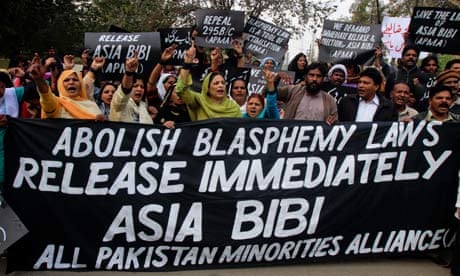
Pakistan - Will Aasia Bibi ever see justice?
Nasir Saeed
It is a growing trend among extremists to kill anyone accused of blasphemy and to become heroes in this world to secure a place in ‘paradise’ after death.Pakistan’s controversial blasphemy law is once again in the headlines. The world’s media is talking about Aasia Bibi’s sorrowful story. She was accused of blasphemy in 2009 and, since 2010, has been on death row. On October 16, 2014 the Lahore High Court (LHC) rejected her appeal; her suffering will continue for many more years because of the country’s blasphemy laws. A further appeal is due to be submitted in the Supreme Court (SC) and, although there is hope that she will be freed, there is no guarantee that after an acquittal she will be safe and able to lead a normal life. Aasia’s blasphemy case will be the second in Pakistan’s history to be heard by the SC. The majority of cases are decided in the high courts with convictions being quashed but this time, unfortunately and unexpectedly, the LHC upheld her death sentence. Aasia has been facing great threats to her life as a bounty had been announced and attempts were even made to attack her in prison. It is being said the judges were swayed because of pressure from the dozens of Islamists who were present in court. Unfortunately, extremists have become so powerful that sometimes judges and the police become helpless, as seen in the case of Rashid Rehman, a lawyer who was openly threatened in court and then killed in his office for defending university lecturer Junaid Hafeez. It is terrifying to think what kind of society we have developed into and how religiously intolerant we have become. How can we forget the Governor of Punjab, Salmaan Taseer, who was killed by his own police guard, Malik Mumtaz Qadri, for supporting Aasia Bibi and talking to then president Zardari about her pardon. Another Christian minister, Shahbaz Bhatti, was also killed for supporting Aasia and demanding changes in the blasphemy law, increasingly being misused against Christians who consider it a root cause of their persecution. Qadri has proudly admitted his crime, telling the court, “I acted against a blasphemer as per the guidelines of the Quran and the teachings of the Prophet Muhammed (PBUH).” He is treated like a hero and, therefore, when he was sentenced to death by Judge Syed Pervez Ali Shah, the lawyers and Islamists surrounded his court and threatened to kill him, forcing him to flee Pakistan. It is a growing trend among extremists to kill anyone accused of blasphemy and to become heroes in this world to secure a place in ‘paradise’ after death. The government’s silence encourages this mindset, despite it being its responsibility to protect all its citizens, even those who are in prison. It is unlikely that Aasia will be executed but still it is difficult to predict whether she will get justice as today’s judiciary is very different to that which set aside the high court’s decision on August 15, 2002 and set free Ayub Masih. His was the first case to reach the SC and one of the country’s most famous lawyers, Abid Hasan Minto, agreed to represent him. His previous lawyer, Asma Jahangir, is said to have refused to represent Ayub any further after receiving death threats. She had also successfully represented Salamat and Rehmat, two teens charged with blasphemy, in the LHC but the judge who freed them was murdered by extremists. This sent a ripple of fear through the legal fraternity. The refusal of lawyers to take up blasphemy cases greatly upset Bishop Dr John Joseph and, therefore, when Ayub Masih was sentenced to death, he shot himself dead in front of the same court in Sahiwal in protest at the injustice being done to Christians in the name of religion. Although many politicians, including the then Prime Minister Nawaz Sharif, were saddened by the tragic death of the bishop and promises were made to look into the matter, the changing situation of the country because of the Indian nuclear explosions saw a change in priorities and the whole matter was put aside. The suffering caused by the blasphemy law is severe and its impact is palpable as several churches, temples and Christian towns have been reduced to ashes and several innocent people have lost their lives in vigilante killings. Mob justice is becoming more popular because no one is ever questioned and victims are not even given a chance to prove themselves innocent. Very often, due process is denied to the victims of the blasphemy law. Aasia’s case is another chance for Nawaz Sharif to look into this matter. He owes this to Bishop John Joseph. It is also a chance for him to stop the law from making a mockery of Pakistan and to promote a positive image of the country. It is also the responsibility of the present government to prevent this law from further misuse so people like Aasia Bibi do not have to suffer in prison for years, and nobody is killed for a crime they have never committed. Aasia vehemently denies the charges against her but still she has been denied justice. Now, after the court’s decision, she will have to spend several more years in prison. She and many other people falsely charged under the blasphemy law are suffering needlessly. It is the government’s duty to bring this matter to parliament, to debate and amend it appropriately. Recently, we have seen the news that Ireland is going to announce a referendum to remove the blasphemy law from its constitution. Why should the Pakistani parliament not learn from this? Since Aasia’s appeal is going to be submitted to the SC, I remain hopeful that the judges will decide her case diligently and without any fear and pressure, and that she will finally get justice.
Pakistan - Polio workers refuse to vaccinate Khyber kids
http://www.dailytimes.com.pk/Polio workers in some parts of Khyber Agency on Monday refused to vaccinate children at the start of a three-day drive with at least 116,000 children likely to be vaccinated in the tribal region. The workers in some parts of Khyber refused to carry on with the drive over non-payment of stipends from the previous three campaigns, sources said. Workers in some areas of Landi Kotal and Jamrud have also refused to conduct the vaccination drive, citing non-payment of their previous dues. On the other hand, authorities said that the released funds had been embezzled at the local level, adding that the matter was being investigated. Dr Sarfaraz Afridi, coordinator for the polio vaccination drive in Khyber Agency, said that the funds had been released but fraudulently withdrawn at the local level. He added that the political administration and authorities concerned have been asked to probe into the matter. Two days earlier, another polio case had been reported in Khyber in 18-month-old girl from the Akakhel area of Bara. The government’s failure to reach out to unvaccinated children has already taken up the total number of polio cases in Khyber to 46. Khyber also has the highest number of reported polio cases after the restive North Waziristan Agency. Moreover, a recent World Health Organisation (WHO) report said Pakistan was responsible for nearly 80 percent of polio cases reported globally.
Pakistan: Nawaz regime spends Rs 11m per month on legal team: report
Pakistan - Targeting the Edhi Foundation’s - A national shame
OUTRAGE, disbelief and despondency are some of the emotions triggered by news of the armed robbery targeting the Edhi Foundation’s headquarters on Sunday morning.While hold-ups and robberies in the chaotic environs of Karachi are very common, as armed thugs loot citizens on a daily basis in this unfortunate city, it is the audacity of the criminals to target the country’s most outstanding social workers that is particularly unnerving. As per reports, a number of armed men barged into the Edhi Foundation’s premises in the old city area and fled with gold and cash worth around Rs30m. The marauders held the staff at gunpoint and also threatened Mr Edhi, who was asleep when the criminals struck. Clearly not in a hurry, the armed robbers spent around 30 minutes in the office. There are indications that they may have had inside information as they knew the location of the cash and valuables. Speaking after the incident, Mr Edhi told a foreign media organisation that he felt “heartbroken” and “violated”. Most people in Pakistan have a good idea of the role Abdul Sattar Edhi and his foundation play in this country. The iconic social worker cares for those whom state and society have forgotten or choose not to remember. For decades, his organisation has been a shelter for the dispossessed, the abandoned and the weak. His fleet of ambulances and other social services are literally life-saving endeavours filling in the vast space the state — due to its negligence and disinterest — has left vacant. That is why the shock over this crime is so great. It seems that in Pakistan, crime and militancy have devolved to such unenviable depths that even a saviour like Mr Edhi is not safe from the depredations of marauders. The incident shows that everything is fair game in this country, that all targets are kosher. Indeed, the question swirling in many minds is that if a personality such as Abdul Sattar Edhi can be robbed, what else is left? But then, we as a nation have been falling through a bottomless pit for some time now. Criminals and terrorists have no qualms about attacking funerals and hospitals, even killing women and children if they happen to get in the way. In this country, flawed ideologies have led to the murder of doctors, teachers and polio vaccinators, all doing the work of messiahs. But where is society’s condemnation? Or have we become numb? The robbery has been condemned by the high and mighty of this land, including the prime minister. However, while we are hopeful that Mr Edhi will recover and continue his mission to serve humanity, we are not so sure if the authorities will be moved by this latest outrage to act decisively and crack down on urban crime so that citizens’ lives and properties are made safe.
PPP KPK delegation calls on PPP Co-Chairman and Chairperson
A delegation of PPP KPK led by its President Khanzada Khan called on PPP Co-Chairman former President Asif Ali Zardari and Chairperson Bilawal Bhutto Zardari here at Bilawal House Monday evening.
http://mediacellppp.wordpress.com/2014/10/20/ppp-kpk-delgation-calls-on-ppp-co-chairman-and-chairperson/
Pakistan - Steady rise of Militants’ narrative greatest fault line of Pakistan’s body politic
The steady rise of the militants’ narrative, supported by the far right and Islamists, is a new and far more dangerous fault line of Pakistan’s body politic and this rise of the one-sided narrative of the extremists is a failure of the state and society. There is a dire need to correct the narrative to win this war. However, we will not be able to correct the narrative until we address the perception that militants have been encouraged by state policies and addressed the perception that some militant outfits for advancing our foreign and security policy objectives. This was started by Senator Farhatullah Babar speaking at a seminar on the ideological dimensions of militancy organized by the Pakistan Institute for Conflict and Security studies at a local hotel in Islamabad. We must admit that a course correction is needed. When the chief of a religo political party says that the soldiers killed in the war are not martyrs, when the head of another religo politcal party says that even a dog killed by the US is a martyr and when quite a few argue that the west has awarded Malala the Nobel Prize only to use her as a ‘pawn’ in their new crusade against Islam, clearly the militants’ narrative seems to be winning. The existing narrative on war against militancy is based on four pillars namely that it is jehad, is directed against the US and foreign troops in the region, is against the drone strikes and that this is US war and not the war of Pakistan. There is an element of intellectual confusion and both the state of Pakistan and international community has contributed to this ideological confusion. The state of Pakistan contributed to it when Zia embraced the jehad ideology and formally decreed ‘Iman, Taqwa, jehad fee sabillillah’ as the battle cry of the troops. The international community contributed to it when President Reagan described the eights mujahideen leaders who were invited to the White House “the moral equivalents of George Washington”. It is less difficult to fight militants but more difficult to fight the mindset. We are also not serious in addressing the issue, he said. The National Security Policy announced several months ago admitted ‘large number of terrorists either are or have been students of madaris where they were brainwashed to take up arms against the state’ and promised to mainstream 23,000 madaris in the national and provincial educational establishment in just one year. Yet not a single rupee was allocated to NCTA in the 2014 budget. We will not win the war of narrative until we candidly answer the question whether the state is still patronizing some groups and why? Questions do arise when Asmatullah Muawiya, the Punjabi Taliban leader, publicly declares ceasefire against Pakistan and directs his guns towards Afghanistan and the state remains silenthttp://mediacellppp.wordpress.com/
Monday, October 20, 2014
U.S. Ebola czar seeks to reverse government mistakes, step up response
U.S. Ebola czar Ron Klain faces a hefty to-do list when he begins his new role: soothe Americans' jitters about the virus, fix federal coordination with states, and restore a sense of control over the crisis that the White House had lost. Klain, a former senior aide in two Democratic administrations who is known for his keen political antenna, also must smooth over tensions with lawmakers who are angry about the government's missteps and mixed messages. Klain has been dismissed as a political operative by Republicans because he lacks a medical background. But administration officials and his associates describe him as a problem solver who understands the levers of government and can ensure smoother coordination among an array of agencies such as the Centers for Disease Control and Prevention, the National Institutes of Health and the Food and Drug Administration. “Many times in these complex responses you have to combine resources across agencies, work across boundaries,” said Thad Allen, the former Coast Guard chief who served in a similar role leading the administration's response to the 2010 Gulf oil spill. "There are ... policy issues that kind of swirl around all of this that are more the subject of folks that work in Congress and the administration. But the person who is working the problem needs to be focused purely on carrying out the operation that solves the problem on behalf of the American people." Klain met on Saturday with White House chief of staff Denis McDonough, though he does not start his job officially until this week. Klain, who has a reputation as a "fixer" for top Democrats, has served as chief of staff to both Vice President Joe Biden and former Vice President Al Gore. He oversaw Gore's Florida recount operation in the disputed 2000 election and helped President Barack Obama recover from his disastrous first debate against Republican Mitt Romney in the 2012 presidential race. Klain has remained a familiar presence at the White House, making roughly 75 visits there between January 2011, when he stepped down as Biden's top aide, and June 2014, according to visitor logs. Stephen Morrison, an expert in global health policy at the Center for Strategic and International Studies, said Klain could take some heat off public health professionals so they can focus on their jobs while he navigates the politics. “This is somebody who knows how to use the bully pulpit that he’s been given. I think that’s probably half of the game,” Morrison said. BEHIND THE SCENES At least initially, though, Klain seems likely to focus on the behind-the-scenes aspects of his job. An NIH official, Dr. Anthony Fauci, represented the administration on the Sunday TV news programs this week, not Klain. Restoring public trust will be key. The CDC has come in for sharp criticism for its handling of the cases of two nurses who were infected with Ebola after treating a Liberian man, Thomas Eric Duncan, at a Dallas hospital before he died. Critics say missteps by the CDC may have put nurses Nina Pham and Amber Vinson, as well as their contacts, at risk. "(Klain) can have eyes over CDC to make sure they are aggressive," said Neera Tanden, a former White House official who now leads the Center for American Progress. "They now have swat teams going to all locations with Ebola patients, but clearly that is something they should have been doing earlier," she said. But Scott Gottlieb, a scholar at the American Enterprise Institute think tank, said Klain was ill-suited to the role and, echoing other critics, said Obama should have chosen someone with experience in handling public health emergencies. "It befuddles me what they want" for the Ebola czar job, Gottlieb said. "You want someone who can help coordinate across NIH, CDC, FDA; someone who understands the issues, the optics and knows what to ask for and knows who to go to," Gottlieb said, adding, "There is a very steep learning curve."BY JEFF MASON AND ROBERTA RAMPTON
Cuba's Fidel Castro On Ebola - Duty calls
Cuba’s Impressive Role on Ebola
Doctors in West Africa desperately need support to establish isolation facilities and mechanisms to detect cases early. More than 400 medical personnel have been infected and about 4,500 patients have died. The virus has shown up in the United States and Europe, raising fears that the epidemic could soon become a global menace.It is a shame that Washington, the chief donor in the fight against Ebola, is diplomatically estranged from Havana, the boldest contributor. In this case the schism has life-or-death consequences, because American and Cuban officials are not equipped to coordinate global efforts at a high level. This should serve as an urgent reminder to the Obama administration that the benefits of moving swiftly to restore diplomatic relations with Cuba far outweigh the drawbacks. The Cuban health care workers will be among the most exposed foreigners, and some could very well contract the virus. The World Health Organization is directing the team of Cuban doctors, but it remains unclear how it would treat and evacuate Cubans who become sick. Transporting quarantined patients requires sophisticated teams and specially configured aircraft. Most insurance companies that provide medical evacuation services have said they will not be flying Ebola patients. Secretary of State John Kerry on Friday praised “the courage of any health care worker who is undertaking this challenge,” and made a brief acknowledgment of Cuba’s response. As a matter of good sense and compassion, the American military, which now has about 550 troops in West Africa, should commit to giving any sick Cuban access to the treatment center the Pentagon built in Monrovia and to assisting with evacuation.
The work of these Cuban medics benefits the entire global effort and should be recognized for that. But Obama administration officials have callously declined to say what, if any, support they would give them.The Cuban health sector is aware of the risks of taking on dangerous missions. Cuban doctors assumed the lead role in treating cholera patients in the aftermath of Haiti’s earthquake in 2010. Some returned home sick, and then the island had its first outbreak of cholera in a century. An outbreak of Ebola on the island could pose a far more dangerous risk and increase the odds of a rapid spread in the Western Hemisphere.
Cuba has a long tradition of dispatching doctors and nurses to disaster areas abroad. In the aftermath of Hurricane Katrina in 2005, the Cuban government created a quick-reaction medical corps and offered to send doctors to New Orleans. The United States, unsurprisingly, didn’t take Havana up on that offer. Yet officials in Washington seemed thrilled to learn in recent weeks that Cuba had activated the medical teams for missions in Sierra Leone, Liberia and Guinea.With technical support from the World Health Organization, the Cuban government trained 460 doctors and nurses on the stringent precautions that must be taken to treat people with the highly contagious virus. The first group of 165 professionals arrived in Sierra Leone in recent days. José Luis Di Fabio, the World Health Organization’s representative in Havana, said Cuban medics were uniquely suited for the mission because many had already worked in Africa. “Cuba has very competent medical professionals,” said Mr. Di Fabio, who is Uruguayan. Mr. Di Fabio said Cuba’s efforts to aid in health emergencies abroad are stymied by the embargo the United States imposes on the island, which struggles to acquire modern equipment and keep medical shelves adequately stocked. In a column published over the weekend in Cuba’s state-run newspaper, Granma, Fidel Castro argued that the United States and Cuba must put aside their differences, if only temporarily, to combat a deadly scourge. He’s absolutely right.
Progressive women driving change in conservative Afghanistan
www.dailytimes.com“Although my husband and sons don’t allow me to drive, I prefer to drive and enjoy the practice,” a 42-year-old lady told Xinhua. Requesting anonymity but revealing her age, the lady said she sees no difference between herself and her husband and sons in supporting the family. In conservative Afghanistan, women, traditionally, are reluctant to reveal their names. Of course, the working ladies and female students have little objection to disclosing their identities. Driving on a congested road and striving to take the edge from male drivers to reach her destination, the ambitious lady whispered “Male drivers, especially youngsters often disturb females sitting behind the wheel.” In Afghanistan where tribal tradition is deep-rooted, particularly in rural areas, women prefer to stay at home although they like to receive education. Availing traditions, the extremist Taliban outfit during its iron reign, toppled by the US-led military invasion in late 2001, had outlawed education for girls and forced women to stay at home. Before plunging into strife in the 1980s, women in Afghanistan had the right to drive. Even some women used to drive the government-owned electric buses in Kabul city. Since the collapse of the Taliban regime, the status of women has changed in Afghanistan. These days in Afghanistan women are involved in politics, business and economic development as well as art and music. However, driving vehicles is gradually becoming more popular among women in Afghanistan. A couple of years ago, women were rarely seen to drive in Kabul or other cities, but nowadays, woman drivers attract male attention everywhere in Kabul cities. Women are increasingly often seen sitting next to a driver and learning the skills necessary for driving. Driving schools also provide training to females intending to learn how to drive in the capital city Kabul and in the western Herat city. “My objective of driving is to break up the old tradition and demonstrate the ability that women like men can drive and can work outside home,” the 42-year-old lady told Xinhua. There are no legal obstructions for women to drive in Afghanistan and the traffic police issue licenses to women after examination. “Whenever my husband and my sons are out of home, I am driving, taking my girls to shopping and to the health clinic,” the progressive lady went on to say in her discussion with Xinhua while stuck in a traffic jam on a recent drive. She also admitted that she doesn’t have a driving license but has planned to obtain one if her husband agrees. A lady trainee, Sediqa, also told Xinhua she wants to learn to drive and drive to her university after getting her license.
News Analysis: Capture of Taliban leaders strikes major blow
Iran and India’s Road to Afghanistan
Delhi’s decision, annonunced over the weekend, to participate in the development of the Chabahar port in Southeastern Iran has not come a day too soon. The idea was first mooted more than a decade ago during the visit of the Iran’s president, Mohammed Khatami, as the chief guest at India’s Republic Day celebrations in January 2003. That it has taken so long to move on this important project underlines the fact that the UPA government failed to get its act together on critical projects involving India’s national security. If the finance ministry refused to fund strategic projects within and beyond borders during the UPA rule, the government of Narendra Modi is eager to press ahead by resolving the inter-ministerial disputes. With Arun Jaitley in charge of both the finance and defence ministries, it has become a lot easier to ‘convince’ the bureaucrats of the finance ministry. Both Delhi and Tehran value the Chabahar port as a means to improve their geopolitical leverage vis a vis Pakistan and pursue their common interest in providing Afghanistan and Central Asia alternative routes to the Indian Ocean. The NDA government has sanctioned nearly $85 million the construction of two berths at Chabahar and the development of a container terminal. The proposal for Chabahar port came up in the context of Pakistan’s plans to develop a greenfield port at Gwadar on Pakistan’s Makran coast with substantive financial assistance from China at the turn of the last decade. Tehran saw the Gwadar project as undermining Iran’s position as the gateway to Central Asia and decided to develop Chabahar, which is located not too far to the West from Gwadar. Delhi, which long chafed at Pakistan’s refusal to provide overland access to Afghanistan, viewed the Chabahar port as a credible alternative to gaining physical access to Afghanistan. Land-locked Kabul, whose only route to the sea is through Pakistan, welcomed the project as a way to ease its strategic dependence on Islamabad. Even the United States, which was determined to isolate Iran, chose to support the efforts by Delhi, Tehran and Kabul to develop transport corridors that improve international connectivity with Afghanistan. The importance of Chabahar project has only gone up over the last decade. Afghanistan’s strategic vulnerabilities are increasing amidst the U.S. plans to substantially reduce its military presence in Afghanistan. Meanwhile India-Pakistan relations have entered a tense phase. The hopes for normalisation of trade relations between the two countries have begun to evaporate. There is little prospect that Islamabad will agree to trilateral economic integration with India and Afghanistan. Delhi and Tehran must now sit down with the new government in Kabul to negotiate trilateral trade and transit agreements that will ensure an early realisation of all economic and strategic benefits that the Chabahar project promises. - See more at: http://indianexpress.com/article/opinion/columns/iran-and-indias-road-to-afghanistan/#sthash.m0jjXdAJ.dpufby C Raja Mohan
Pakistan: ‘Spreading hatred’: Blasphemy case registered against ASWJ leaders
Supreme Court Of Pakistan Urged To Speed Up Appeal Case Proceedings Of Asia Bibi
Pakistan's complex relationship with Malala
by Maham Javaid
Ambiguous views of the Nobel laureate say more about Pakistanis than about her.In 2009, when she was 11 years old, Malala Yousafzai took up the cause of the right to education for girls in Pakistan’s Swat Valley. Over the next two years as Malala grew into a teenager, her ideas also gained influence. From championing girl’s education in Swat, she took upon the bigger challenge of advocating education for all children across Pakistan — and in later years even on a global scale. Today, however, most people who consider Malala, the winner of the 2014 Nobel Peace Prize, think of an anti-terrorism icon. On October 9, 2012, Tehreek-e-Taliban Pakistan (TTP) militants shot Malala in the face for demanding the universal human right to education. Threats and violence have silenced even the most vocal rights activists, but Malala was unfazed. Her courage is extraordinary, but this violent act by the TTP should not have transformed her into a champion for anti-extremism. The truth is that Malala’s fight has always stood for education. But this is just one of the many confusions regarding Malala, the youngest Nobel laureate in history. Another puzzling claim about her public role is that Pakistanis allegedly despise her. If Malala stands for the betterment of Pakistan by promoting education, the worry goes, why is she hated in her native country, as so many Pakistani and international news reports are claiming? The truth is far more complex and has more to say about Pakistan than about Malala. First of all, the claim that she is widely hated in Pakistan is incorrect. When Malala was first nominated for the Nobel Peace Prize in 2013, more than 2,000 people were asked their opinion about the nomination: 44 percent of respondents said they were pleased, while 44 percent were on the fence and only 11 percent were displeased. Similarly, at the end of 2012, Pakistan’s Herald magazine, in partnership with DAWN, the country’s most widely circulated English newspaper, conducted a poll to determine its “Person of the Year.” Malala received the highest number of votes, 30 percent of the total, and won the award. By this point Malala had also been awarded two national awards, including the Sitara-e-Shujaat, Pakistan's third-highest civilian bravery honor. Surveys often fail to encapsulate the sentiments of the “average Pakistani,” but they provide better evidence than the rants of Pakistan’s conservative middle class that proliferate on social media and of right-wing news anchors that crowd the airwaves on Pakistan’s national television. This is not to say that everyone in Pakistan reveres her either. There are segments in our society that regard her as worthless, there are even those who are ashamed of and angered by her. But this does not negate the large swathes of Pakistanis who stand behind her; there are many that are thankful that a young girl had the courage to live out her unselfish dream. So what is responsible for the conflicted feelings that Malala generates in Pakistanis? To be sure, Pakistani perceptions of her changed after the TTP attack. Through no fault of her own, she was blamed for revealing to the world how powerful TTP was in certain areas of Pakistan. While some Pakistanis considered this revelation valuable and necessary, others viewed it as a national affront. Pakistani commentators accused her of shaming the country by washing its dirty linen in public. It is extraordinary that Pakistan’s urban middle class, which is so proud of its free media, objected to that same free media revealing the problems of Pakistani society. Public outrage against Malala began to grow from there. Right-wing commentators and conservatives in the urban middle class claimed she is an agent of the West. To some degree the situation worsened after the release of her 2013 autobiography “I Am Malala.” Critics claimed that her book, which was banned by private schools across the country, proved that she was against Islamic laws and wrote like a “westerner.” In Herald’s subsequent Person of the Year poll, Malala came in third. It must be noted, however, that in the PEW research poll of 2014, 30 percent of the nation still held a favorable opinion of her activism for girls’ education, 51 percent had no opinion and only 20 percent held a negative view. As she became more prominent and had contact with world leaders, including President Barack Obama, some Pakistanis asked why she fraternized with those responsible for drone attacks. They, of course, overlooked the fact that when Malala met Obama in the White House last year, she challenged U.S. drone policy. “Drones fuel terrorism”, she told the president face to face. This was a public statement even the most seasoned Pakistani politicians have not had the courage to make when they visit the White House. The ultimate problem, it appears, is the inability of Pakistanis to distinguish between Malala’s brave resolve to fight for what she believes in and the Western accolades she has received for displaying this courage. The segments of Pakistani society that hate her are the ones that are willing to divorce themselves from her because their anti-West sentiments disallow them to trust her. Their base logic is that the enemy’s friend is my enemy. In a 2013 interview with The Atlantic, Malala said that she will continue to love Pakistan even if its people hate her. If Pakistan distances itself from Malala, however, we Pakistanis will be the ones who lose yet another hero. The fact that U.S. leaders and other perceived agents of imperialism are attempting to co-opt her should not diminish her worth. In these times when heroes and heroines are few and far between, Malala is a true champion and Pakistan should hold on to her.
Pakistan charity boss Abdul Sattar Edhi 'heartbroken' after robbery
One of Pakistan's top charity leaders has told the BBC he is heartbroken after being robbed at gunpoint.Abdul Sattar Edhi, 86, was asleep when a gang of armed men raided the Karachi slum building that serves as his residence and charity headquarters. They made off with gold, silver and cash worth hundreds of thousands of dollars in the raid early on Sunday. Prime Minister Nawaz Sharif and opposition leader Bilawal Bhutto Zardari both condemned the robbery. Mr Edhi is one of Pakistan's most revered figures and has spent a lifetime building up its largest health charity. The Edhi Foundation provides a broad range of free social services, including ambulances, orphanages and support for the elderly and disabled. "I am heartbroken. After everything I have done, I never thought I'd be violated like this inside my own home," Mr Edhi told the BBC. His son Faisal Edhi said: "My father is fine, but deeply saddened by this incident. He was tearful yesterday. It's not about the money or the valuables they took away. But his pride has been violated." Many people took to social media to voice their anger at the robbery, which correspondents say is shocking despite the notoriously high crime rates in Karachi. Mubashar Lucman, a leading presenter on the ARY News channel, said: "If a person of his stature is not safe in this country then what system are we talking about." "It is heart breaking then what happened with our asset, our saviour, our angel.... Abdul Sattar Edhi saab," tweeted journalist Fereeha Idrees. "Imagine what would have happened if Edhi got the Nobel Peace Prize and lost it in the robbery in his center," said another message. Many messages urged people to donate to Edhi because of the robbery, but some others questioned why so much money and valuables had been kept in his residence. Mr Edhi said as well as some cash kept for emergencies, the money and valuables included deposits entrusted to the foundation for safekeeping. He said the robbers had walked straight to the locker where the money and gold was kept and demanded the key. "I thought they came to ask me about the Edhi centre but they started asking me about money. I don't understand how they knew that everything was kept in the cupboard," Mr Edhi told the Express Tribune newspaper. "Please protect my Pakistan where VIPs are guarded & Philanthropist are looted & abused on gun point," he said in a tweet. Police are hunting for the robbers but have yet to make any arrests.
Bilawal’s launch
http://www.dailytimes.com.pk/When Benazir Bhutto was pushed into the limelight after her father’s death, many people derided her as too young to handle the complexities of Pakistani politics or resist the brute force of military dictatorship. She proved them wrong, first leading alongside her mother in the 1983 Movement for the Restoration of Democracy and then assuming the mantle of prime minister, though her two terms were marked by political wrangling and her governments’ dismissals. Despite living in exile for nearly a decade following the 1999 military coup, Benazir remained committed to Pakistan and she returned in 2007 having learnt from her experience in exile. At the time many people thought the PPP was a dead party, but defying expectations she was welcomed by thousands of adoring supporters, 139 of whom were killed in an attempt on her life by a suicide bomber in Karsaaz, Karachi, where on Saturday — the seventh anniversary of the attack — her son Bilawal Bhutto led a massive rally organised by the PPP to launch his political career. It was a strong showing by a party that has suffered innumerable setbacks over the last decade, not least from its own mismanagement and political short-sightedness. Benazir was a national leader of conspicuous standing not only in Pakistan but the world, with the ability to energise her party’s ranks and gather disparate elements to her cause. That enthusiasm among the rank and file of PPP workers and supporters was missing at Bilawal’s rally, but the mass attendance showed that despite its failures and troubles, the party still has the machinery and support to mobilise people when it needs to. Bilawal’s 90-minute speech began and ended with a call for people to again embrace ‘Bhuttoism’, the political philosophy of Zulfiqar Ali Bhutto that transformed the country’s politics by energising and mobilising the peasantry and working classes. In Benazir’s words, Bhuttoism meant “expenditures for health and education, labour laws that protect workers, and no corruption, nepotism or drug smuggling”. In the 1960s and 1970s Bhuttoism was a socialist philosophy focused on welfare, but after the 1980s return to democratic government, the PPP embraced the ideals of the neo-liberal economic paradigm. Its last five years in power were marked with accusations of massive corruption and incompetence and many of its social programmes remained confined to paper. The party’s leaders are wealthy feudals and businessmen and corruption and nepotism have become synonymous with its name. For many people today this is Bhuttoism’s mixed legacy and Bilawal failed to clarify whether he meant a return to the socialist Bhuttoism of his grandfather or whether he would redefine it himself. Indeed the main point of clarity in his speech was condemnation of religious and sectarian terrorism, a secular vision that currently sets the PPP apart. That alone will not be enough to overcome the shadows of the PPP’s past. While the party showed it can bring people to rallies this does not necessarily translate into electoral support. In order to win elections the party must prove that it can perform, deliver and impress the youth and a rising professional and middle class that are increasingly immune to political slogans and dynasties. Bilawal spoke extensively about his party’s development programme in Sindh and before him Aitzaz Ahsan spoke about re-energising the party with new blood, but on the ground both facts remain conspicuously absent. Which projects and what they have achieved needs to be shown, otherwise their words remain empty. Nawaz Sharif for example can point to literally concrete accomplishments, but the PPP cannot. It was even unable to contain a famine in Sindh earlier this year. Bilawal Bhutto is young but he and his party must realise that they can no longer rely on slogans and his family name. In order to remain a force in national politics, the PPP must invigorate its workers with a clear ideological direction, prove its claims with facts on the ground and reform its cadres to represent more of Pakistan’s young and competent professional class. As Aitzaz Ahsan said, this is not a time for victory slogans but of introspection.
Pakistan’s polio eradication farce
FOLLOWING the World Health Organisation’s Internal Monitoring Board (IMB) meeting some time ago, the government of Pakistan is understandably embarrassed about the review of its polio eradication efforts. Condemnation has been quick. An editorial in this paper called polio eradication the country’s “badge of shame”, blaming the government for its “stubborn, almost criminal refusal to undertake the task at hand”. The abject failure of the government’s efforts is undeniable, but this criticism, at least, is unfair. The task at hand was undertaken, certainly — the problem lies in how, precisely, it was undertaken. Essentially, the government and the other participants in this exercise have been performing a play, in which things look more or less right but have little actual meaning. One could call it the farce of polio eradication. Every government for the past three decades, military or civilian of whichever party, has voiced the political will to eradicate communicable diseases including polio. Donors have consistently supported Pakistan’s efforts, providing close to $9.5 billion over the past 25 years to the vaccination programme. In the beginning, there were some gains in controlling polio. There were over 2,000 polio cases in 1988, when the programme began — but for the past two decades vaccination coverage rates have been less than 60pc nationally, which is nowhere near enough to create the needed herd immunity for protection. When the WHO announced its Endgame Strategy, the government made a corresponding series of correct-seeming moves. This includes following specific recommendations from the IMB itself. A National Emergency Action Plan 2014 for Polio Eradication was prepared and, fully funded until 2018, approved by the Executive Committee of the National Economic Council. Special task forces were put in place at the national and provincial levels, led by the prime minister in the centre and the chief ministers or chief secretaries in the provinces. The prime minister appointed a dedicated point person — in addition to the minister of health services — to lead the overall effort. Monitoring committees of senior managers exist at the federal, provincial, district, tehsil and union council levels. Every province has a special polio control room. In addition, the emergency operation cells started in two provinces will now be expanded to cover all four. Anti-polio drives are being conducted according to schedule. All the pieces, therefore, are in place, following precise recommendations from the highest authorities and the IMB. But none of them work. None of them are functional. No single government department has the overall responsibility of coordinating the actions of all these task forces and committees. The many management committees themselves are unclear about their tasks — the National Task Force, for example, has not met since September 2013 — and no one is present to hold them accountable. The 18th Amendment further confused the various actors about their tasks — the provincial and federal responsibilities remain unresolved. Under the current strategy, the district and tehsil-level actors have neither the resources nor the authority to actually make any decisions, so their involvement is largely superficial. Information sharing among the various levels of government is virtually impossible, let alone with the implementing partners. The IMB has also fallen short in the review process it has been tasked with. In the recent meeting, the board should have asked the obvious questions raised by the government’s presentation, which described the overall objectives, general management plan and the challenges facing Pakistan. But it gave no immediate details or indications of how it would address the challenges and improve or amend its strategy though it plans to release a report by the end of this month. Since this is a farce, part of the process is finger-pointing, a long-running blame game that can distract us from the failures. The provinces point at the centre. The centre points at the provinces. Everyone blames Dr Bosan, who, it seems, was heading the government’s technical unit for polio eradication while not actually being a government employee. Some pieces get shuttled around the board — Dr Bosan out, Dr Baloch in — and, why not, a new inter-ministerial committee is proposed. This looks like much more activity than improving the administrative processes that would bring together the work of different government departments, or coordinating the efforts of the many different committees already on the ground. It is much more dramatic than addressing the nitty-gritty issue of dealing with procedures that, for example, delay payments to polio staff. Unfortunately, it accomplishes almost nothing. And so it should be no surprise that the number of polio cases continues to climb, reaching over 200, from 54 when the IMB last met, in May. Environmental surveillance shows that the frequency of detection has increased to 33pc from 20pc in 2013, and wild polio virus type 1 has been isolated from all four provinces. As polio spreads, it becomes a humanitarian issue, so the donors feel compelled to increase their funds — in a very real sense rewarding the government for its failures. Giving more money is immediately reassuring, it looks better — and is less controversial than asking the government for specific actions to make programme structures functional and sustainable. After all — you cannot give visibility to a procedural request. Neither the donors nor the IMB make it a point to insist on a country-specific, contextual programme design and implementation strategy. The IMB will meet again; it will offer some more suggestions; the government will likely follow them; and the cycle continues. The best we can call this process is a farce, one that would be mildly entertaining if you could ignore the fact that it is costing not just money and time but lives and futures. Once you acknowledge that — perhaps then all we can call it is total madness.By Samia Altaf
India-Pakistan Head for Nuke War
Bruce Riedel
A crisis is brewing between nuclear armed India and Pakistan that could be their most dangerous ever.India and Pakistan have fought four wars since 1947 and had several crises that went to the brink of war. Both tested nuclear weapons in 1998. Now tensions are escalating between the two again. It began in May, when a heavily armed squad of Pakistani terrorists from Lashkar e Tayyiba (Army of the Pure) attacked India’s consulate in Herat, in western Afghanistan. They planned to massacre Indian diplomats on the eve of the inauguration of India’s new Hindu nationalist prime minister, Narendra Modi. The consulate’s security forces killed the LeT terrorists first, preventing a crisis. Since LeT is a proxy of Pakistan's military intelligence service known as the ISI, Indian intelligence officials assume the Herat attack was coordinated with higher-ups in Pakistan. They assume another LeT attack is only a matter of time. They are probably right on both counts. This summer, clashes between Indian and Pakistani troops have escalated along the ceasefire line in Kashmir. Called “the Line of Control,” the Kashmiri front line has witnessed the worst exchanges of artillery and small arms fire in a decade this year, displacing hundreds of civilians on both sides. Over 20 have died in the crossfire already this month. Modi has ordered his army commanders to strike back hard at the Line of Control to demonstrate Indian resolve. Although Modi made a big gesture in May when he invited his Pakistani counterpart, Nawaz Sharif, to his inauguration, since then Modi has cancelled routine diplomatic talks with Pakistan on Kashmir and signaled a tough line toward terrorism. He also appointed a very experienced intelligence chief, Ajit Doval as his National Security Adviser. Doval is known as a hard liner on terrorism—and on Pakistan. Modi's Bharatiya Janata Party strongly criticized his predecessor, Manmohan Singh, for what it saw as a weak response to the LeT 's attack on Mumbai in 2008. No military action was taken after 10 LeT terrorists, armed and trained by the ISI, killed and wounded hundreds of innocents, including six American dead. In 2001 a previous BJP government mobilized the Indian military for months after a Pakistan-based terror attack on the Indian parliament. The two countries were eyeball to eyeball in a tense standoff for almost a year. Two years before that, the two countries fought a war in Kashmir around the town of Kargil. In the 1999 Kargil War the Pakistani army crossed the LOC to seize mountain heights controlling a key highway in Kashmir. BJP Prime Minister Atal Vajpayee responded with air strikes and ground forces. The Indian navy prepared to blockade Karachi, Pakistan's major port and it's critical choke point for importing oil. A blockade would have rapidly cut off Pakistan from oil supplies. The Indian navy was so eager to strike it had to be restrained by the high command. The Pakistanis began losing the fight at Kargil. Then they put their nuclear forces on high alert. President Bill Clinton pressured Nawaz Sharif (the prime minister then and now) into backing down at a crucial summit at Blair House on July 4, 1999. If Clinton had not persuaded Sharif to withdraw behind the LOC the war would have escalated further, perhaps to a nuclear exchange. Kargil is a good paradigm for what a future crisis might look like. A BJP government is not likely to turn the other cheek. It cannot afford to let terror attacks go unpunished. That would encourage more. The difference between the Kargil War and today is that both India and Pakistan now have far more nuclear weapons and delivery systems than 15 years ago. Pakistan is developing tactical nuclear weapons and has the fastest growing nuclear arsenal in the world. China provides Pakistan with its nuclear reactors. India has missiles that can reach all of Pakistan and even to Beijing. The escalatory ladder is far more terrifying than it was on the even of the millennium. For retreating in 1999 Sharif was overthrown in a coup by the army commander, Pervez Musharraf, who had planned the Kargil War. Now Musharraf is calling for Sharif to stand up to Modi and not be pushed around by India. The main opposition party leader. Bilawal Bhutto, has called for a tough line defending Kashmiri Muslim rights, promising to take "every inch" of Kashmir for Pakistan if he is elected prime minister in the future. Sharif is under pressure from another party leader, Imran Khan, to resign. The politics on both sides in South Asia leave little room for compromise or dialogue. America is seen in South Asia as a power in decline, a perception fueled by the Afghan war. U.S. influence in New Delhi and Islamabad is low. A Clinton-like intervention to halt an escalation will be a tough act to follow. But the consequences of a nuclear exchange are almost too horrible to contemplate.
Sunday, October 19, 2014
Chinese state councilor urges non-interference in Hong Kong affairs
President Obama’s credit card got rejected last month. Here’s what happened next.
http://www.washingtonpost.com/
By Katie ZezimaPresidents, they're just like us -- their credit cards get declined. President Obama's credit card was rejected last month at a restaurant in New York. "I went to a restaurant up in New York when I was -- during the U.N. General Assembly, and my credit card was rejected," Obama said Friday while signing an executive order to protect consumers from identity theft. "It turned out I guess I don’t use it enough. They were -- they thought there was some fraud going on. Fortunately, Michelle had hers." And, yes, Obama had to defend himself. "I was trying to explain to the waitress, you know, I really think that I’ve been paying my bills," Obama said. "Even I’m affected by this." Obama has been concerned about the state of his credit before. In Austin in July, he ordered more than $300 worth of barbecue and realized he didn't have enough cash. So he pulled out his credit card but asked trip director Marvin Nicholson if it was good before handing it over to the cashier. Nicholson assured Obama that the card - photos show it as a black JP Morgan card - would work, and apparently it did. Despite this, when Obama went to a boutique grocery store in Minneapolis in June he paid for $82.55 in groceries with cash. At the time, he said he only carried cash and his driver's license in his wallet. Obama isn't the only high-profile government figure to run into financial rejection. Former Federal Reserve chairman Ben Bernanke said in Chicago this month that the market is so tight he couldn't refinance his home. "I recently tried to refinance my mortgage an I was unsuccessful in doing so," he said, according to Bloomberg. "I’m not making that up.”
Subscribe to:
Posts (Atom)