Sunday, October 19, 2014

Obama: ‘We can’t give in to hysteria or fear’ of Ebola

http://www.washingtonpost.com/
By Greg Jaffe and Amy Brittain
President Obama on Saturday sought to tamp down fears of an Ebola outbreak and defend his administration from Republican critics who have called for a more aggressive response to the disease, including sealing off U.S. borders to visitors from countries battling widespread outbreaks.
“We can’t just cut ourselves off from West Africa, where this disease is raging,” Obama said in his weekly radio address. “Trying to seal off an entire region of the world — if that were even possible — could actually make the situation worse.”
Such actions would make it harder for American health-care workers, soldiers and supplies to reach stricken areas and could prompt residents of countries in West Africa where Ebola is still spreading to try to evade screening on their way to the United States or Europe, Obama said.
The president’s main message was one of calm, coming at a time of growing worry in communities throughout the country. “We can’t give in to hysteria or fear, because that only makes it harder to get people the accurate information they need,” Obama said. “If we’re guided by science — the facts, not fear — then I am absolutely confident we can prevent a serious outbreak here in the United States.”
Later on Saturday, Obama received updates on the process to identify and monitor individuals who may have come into contact with Ebola patients in Dallas. The president also was informed about measures to ensure that the city had all the resources it needed to diagnose new cases, the White House said.
As Ebola fears have spread, some urgent-care clinics have taken steps to identify red flags, such as recent travel to West Africa, before patients ever set foot in the clinic. AFC/Doctors Express, a national chain of more than 130 urgent-care clinics, with facilities in Alexandria, Va., Woodbridge, Va., Edgewater, Md., and Towson, Md., fields some of its patient calls through a national call center that’s designed to screen symptoms before patients show up to see a doctor. On Friday, the call center developed a new Ebola fact sheet and script to ask patients about their travel history, said Glenn Harnett, the chief medical officer for AFC/Doctors Express.
More Often, the clinics have seen cases of irrational fear. Some patients have requested Ebola tests even though they aren’t ill, Harnett said. He told the story of one patient who had recently traveled to Mobile, Ala., and requested that he be screened for Ebola, despite having no symptoms nor any interaction with someone who was sick. The patient had grown concerned because of Mobile’s position as a port city and felt that he might be vulnerable to exposure.
“We’d probably have lines down the street if we had an Ebola vaccine, but so many more Americans will die of influenza,” Harnett said. “I find that somewhat frustrating as a clinician, but people are people, and they’re going to have the fears that they have.”
Some of those fears have even reached the White House, where a petition calling for the Federal Aviation Administration to ban flights to and from Ebola-stricken regions had more than 45,000 signatures by Saturday evening. In the heat of election season, politicians have begun weighing in on the issue. And citizens have swarmed social media to share stories of local hysteria.At the Pentagon, workers donned hazmat suits to clean up after someone got sick in the bathroom.
In the Washington area, Howard J. Bennett, a pediatrician and author, said he was asked by one concerned patient about the chances of contracting Ebola by using a bathroom at a mall where someone with the disease had visited. Bennett said he reassured the patient that it was safe.
Obama on Saturday stressed that an outbreak of the disease in the United States was, at best, a remote possibility. He noted that Ebola is much harder to contract than the flu and can be spread only through contact with the bodily fluids of someone who is showing symptoms of the disease. He also emphasized that U.S. health-care officials had established protocols to fight the disease and prevent its spread.
In Dallas, two nurses did contract the deadly virus from a Liberian man, Thomas Eric Duncan, who later died of the disease. One of those nurses, Nina Pham, was being treated at the National Institutes of Health outside Washington, where she was in fair condition and “resting comfortably,” a spokesman said.
On Saturday, Duncan was remembered by family and friends at a memorial service in a small Southern Baptist church in Salisbury, N.C.

Military preps team for Ebola response in US

By Ben Brumfield
The U.S. military is forming a 30-person "quick strike team" equipped to provide direct treatment to Ebola patients inside the United States, a Defense Department official told CNN's Barbara Starr on Sunday. The team -- made up of doctors, nurses and specialized trainers -- will be under orders to deploy within 72 hours at any time over the next month, the official said.
A cruise ship plowed through the waters of a Texas port on Sunday with precious cargo on board -- the end of a small Ebola scare. A passenger had been loosely linked to the only patient to die from the disease in the United States, but health authorities cleared her after an odyssey at sea. After voluntarily isolating herself in her cabin, she remained symptom-free, and her lab tests looked good, the Galveston County Health Authority said. She and a travel partner were allowed to disembark.
The news came as the monitoring period neared its end for 48 of the 123 people being monitored after coming into contact with the first person to die of Ebola in the U.S.
The cruise ship drama goes back to the woman's work as a lab supervisor at Texas Health Presbyterian Hospital in Dallas, the center of a maelstrom of Ebola fears in the United States.
It's where Liberian patient Thomas Eric Duncan was misdiagnosed and later died, and where two nurses became the first people to contract Ebola in America.
Seventy-five health workers and 48 people in the community are under monitoring after coming into contact with Duncan. The monitoring period for the 48 community members ends at midnight Sunday night, said Dallas County Judge Clay Jenkins, who is overseeing response efforts in Dallas.
"Thankfully they are all asymptomatic and it looks like none of them will get Ebola," Jenkins said, expressing hope that they would be welcomed home with no issues. "The community needs to reach out and envelop them in compassion and acceptance because we cannot have the community stigmatizing people. ... They have been through a terrible ordeal."
As for the other 75 people, they are in Day 11 since Duncan's death and Jenkins said, "Today is a crucial day for them because is one of the last high-likelihood days that we will see more cases."
Hospital apologizes
On Sunday, the hospital took out a full-page newspaper ad, once again offering an apology. We slipped up; we're deeply sorry; we'll do better.
That could serve as a summary of the open letter from Texas Health Resources CEO Barclay Berdan in the Sunday editions of the Dallas Morning News and Fort Worth Star-Telegram.
The turmoil started in September, when Duncan went to the hospital with Ebola symptoms, and health care workers initially sent him home with antibiotics.
They recorded his travel history to West Africa, where a raging Ebola outbreak has killed more than 4,500 people. But they didn't give that detail the necessary attention, the hospital said. "As an institution, we made mistakes in handling this very difficult challenge," Berdan wrote. The hospital is analyzing the errors and will make changes, he said.
Hopefully others will also learn from those mistakes and the first cases of Ebola contagion in the country, and its first death, will also be its last, Berdan wrote.
White House eyes Dallas
At the White House late Saturday, President Barack Obama and Vice President Joe Biden pursued the same goal, together with a roster of top security and health leaders -- including Secretary of Defense Chuck Hagel, Secretary of Homeland Security Jeh Johnson, national security adviser Susan Rice and director of the Centers for Disease Control and Prevention Thomas Frieden.
They zeroed in on Dallas and the process of tracing anyone who may have come into contact with any of the infected people, a White House statement said.
And after Duncan's misdiagnosis, the administration said it intends to "ensure that Dallas has all of the appropriate and necessary resources to diagnose any additional cases safely and effectively." WHO to review Ebola response amid criticism
Employee travel scares
The cruise ship incident and a second travel scare came about in a bureaucratic loophole. In an abundance of caution to avoid any possible spread of the Ebola virus, about 50 people associated with Texas Health Presbyterian have signed a document legally restricting where they can go until they are cleared of Ebola. But before the voluntary travel ban existed, the lab supervisor and a nurse, who later came down with Ebola, went on trips and triggered hefty responses.
The cruise ship carrying the lab supervisor headed to the Central American country of Belize. She had had no direct contact with Duncan but may have handled one of his lab specimens. A doctor on board the ship observed her to make sure she was symptom-free as the incubation period within which the disease would manifest itself approached its end. She appeared to be home free.
But in an abundance of caution, the State Department planned to fly the lab supervisor back to the United States from Belize City's airport. Then the country's government declined to let her onto land and, in the same week, imposed strict travel bans on anyone who has had contact with Ebola-affected areas.
Chopper fetches blood samples
The ship hauled the lab worker back toward Texas and on Saturday, a day before its set arrival time, the U.S. Coast Guard sent down a chopper to collect blood samples for lab testing. It lowered a hoist basket to pick them up. "The samples, which are in a container, so the USCG members are not exposed, were taken by Carnival's onboard doctor," said Petty Officer Andy Kendrick, U.S. Coast Guard spokesman.
The other travel scare was set off by one of the nurses who contracted Ebola after treating Duncan. Before her illness was apparent, Amber Vinson took a Frontier Airlines flight to Cleveland, then a flight back to Dallas. After her contagion became known, the air carrier reached out to some 800 passengers, advising them to contact the CDC. Frontier Airlines also took the plane out of service temporarily.
In Ohio, 29 people who came into contact with Vinson between October 10 and 13 are being monitored. The nurse has been transferred to Emory University Hospital's isolation unit in Atlanta for treatment.
Anthony Fauci, head of the National Institute of Allergy and Infectious Diseases, told CNN on Sunday that he didn't know much about Vinson's condition, but he said Nina Pham, the other Dallas nurse who contracted the illness, was in fair condition and doing "fine."
Tears shed for Duncan
On Saturday, loved ones honored Duncan's memory in North Carolina, where his mother lives. In a memorial service at Rowan International Church in Salisbury, his nephew Josephus Weeks and others eulogized Duncan as a kind, compassionate man.
Weeks said he wished Duncan would be remembered for his acts of kindness "as opposed to the person who brought this disease to America, because he didn't know he was sick."
Duncan's willingness to help others may have led to his death at age 42. Former neighbors in Monrovia, Liberia, have said he may have contracted Ebola while rushing to the aid of a woman who collapsed under duress from the disease. She was pregnant, and Duncan did not know she was sick, they said.
There is good news
There are hopeful signs that some of the Ebola contagion scare in the United States could be winding down. Of the four patients currently being treated, at least two appear to be making a recovery. And the monitoring of 48 people who came into contact with Duncan should draw to a close soon. Duncan was admitted to Texas Health Presbyterian on September 28, when he went there the second time. That was the last day the monitored people could have had contact with him.
The maximum incubation period for Ebola is 21 days. That period runs out on Monday.
Contrast that with West Africa, where the disease continues to spread exponentially, as the international response remains anemic.
With predictions that Ebola could infect an additional 5,000 to 10,000 people there per week by December, and given the mobility of world travel, the whirlwind of angst surrounding Duncan's case might not be the last.

President Obama's Weekly Address: What You Need To Know About Ebola

Pashto Music Video - " Za Laila Yama " -

Security forces give 36-hour deadline to Khyber Agency extremists

Security forces have dropped pamphlets through helicopters asking militants to surrender or else be ready to face a full fledged military action in Bara Tehseel of Khyber tribal region on Sunday. Official sources said that the Operation Khyber One is underway against militants in Khyber Agency and a 36-hour deadline has been given to militants to renounce arms.

UK to Stage Choir Performance for Malala Yousafzai

http://www.ndtv.com/
Nobel Peace Prize-winner Malala Yousafzai will be at the heart of a choir performance here next week which will acclaim her extraordinary story.
'Malala/ A Child of Our Time', composed by James McCarthy and written by Pakistani novelist Bina Shah will be performed here on October 28, Barbican Centre said in a statement.
"As a child of our own time, she is celebrated in McCarthy's 'Malala'.
Yousafzai shot by the Taliban for her stance on girls' education continues her campaign undaunted.
"Her story has inspired the creation of this evocative and profoundly moving work for youth choir, symphony orchestra and chorus," the statement said.
Choirs of girls from City of London, Hornsey and St Michael's Catholic schools will deliver the words of the performance, commissioned by the Crouch End Festival Chorus.
The 17-year-old Pakistani teenager who was shot in the head by the Taliban in 2012 was airlifted for a life-saving surgery to Birmingham where she lives with her family now.
The young crusader has since become one of the most prominent campaigners for girls' education.
Malala emerged as the youngest winner of the Nobel Peace Prize earlier this month. Indian child rights campaigner Kailash Satyarthi was the other recipient of the award.

Afghanistan: Capture of senior leaders to 'further weaken' Haqqani network

Two senior leaders of the Haqqani network have been arrested by Afghan security forces; a further blow to the Pakistan-based militant group blamed for some of the deadliest attacks in Afghanistan, says expert Omar Hamid.
Anas Haqqani (left), the son of the network's founder, and Hafiz Rashid (right), who was in charge of selecting targets and providing equipment for suicide bombers, were detained on October 14 in a special operation, according to the Afghanistan's National Directorate of Security (NDS). "It is one of the biggest and most important arrests by NDS, and has strategic impact on this network and can cause disorder in its operations and weaken its fighting capabilities," the statement said.
The NDS added that Anas Haqqani was an expert in computers and the use of propaganda through social networks and was responsible for collecting and preparing funds from Arabic countries to carry out operations. He was reportedly also a special adviser to his brother and network leader Sirajuddin Haqqani.
The al Qaeda linked network, which mainly operates out of Pakistan's border areas, has been blamed several deadly attacks in the region including assaults on hotels popular with foreigners in Kabul, a bloody bombing of the Indian embassy and a 2011 attack on the US embassy.
Omar Hamid, Head of Asia Pacific Country Risk at IHS, says that while the capture of the two leaders as a laudable act for the Afghan security forces, it remains to be seen whether they will be able to resist against sustained attacks by the Taliban.
DW: What impact is the capture of the two senior leaders likely to have on the militant network?
Omar Hamid: In the past couple of years, the Haqqanis suffered the losses of key leadership figures as a result of unmanned aerial vehicle strikes and assassinations within Afghanistan and Pakistan, which have immeasurably weakened the group.
The capture of two more key members by the Afghan security forces will only further weaken the group.
What does the capture of these militants say about the ability of the Afghan security forces?
While the work of the Afghan security forces in arresting these militants has been laudable, there remains a major question of their ability to resist against sustained attacks by the Taliban, as their performance in this regard has been undoubtedly mixed.
Who is the Haqqani network?
The Haqqani Network is a group affiliated with, but not directly under, the Afghan Taliban. The Haqqanis area of operations is a cluster of eastern provinces, like Khost, Paktia, Paktika and Kunar. The Afghan government has long alleged that the Haqqani network has often carried out operations in Afghanistan, and especially in Kabul, at the behest of Pakistan's intelligence agencies, with whom they are alleged to have a long standing relationship.
In which areas is the organization mainly active and what kind of support does it enjoy among the local population?
Due to their position, the Haqqanis have often acted as go betweens and mediators between different militant groups, including the Pakistani and Afghan Taliban, and core Al Qaeda.But the Haqqanis primary interest has always been personal, and limited to control over narcotics, smuggling and cargo moving within the provinces controlled by them.
What measures should the governments of Afghanistan and Pakistan take to eliminate the group from their territories?
It won't be easy to eliminate the group for two main reasons: first, the Afghan government has a very low degree of control over the areas occupied by the militants. Second, given the fundamental misunderstandings and misgivings between Islamabad and Kabul, cooperation between the two governments on this issue is unlikely. However, a concerted effort is essential if the militant network is to be eliminated anytime soon.

Bilawal Bhutto takes notice of heinous robbery from Abdul Sattar Edhi’s charity

http://mediacellppp.wordpress.com/
I have taken notice of the heinous robbery from Abdul Sattar Edhi’s charity. I am shocked, saddened and above all disappointed that any Pakistani could sink so low as to steal the money meant for the poor people of Pakistan. Edhi is a selfless Pakistani hero, a philanthropist who has spent his entire life serving the people of his country and in particular its children. In 1994 “Katputlyion” of the day tried to force Edhi to join their attempted coup against the Pakistan Peoples Party government. An honest, brave and principled man, Edhi refused. Today “na maloon afraad” have stolen from his charity in Karachi. This is a moment of shame for my city and my country. However, as I said in my speech yesterday, if we all work together we can protect and build a prosperous Karachi. I appeal to the government to leave no stone unturned in the pursuit of these thieves. I appeal to the people of Karachi to be brave and come forward to share any information that they might have about this unfortunate incident. Together our efforts can build a peaceful, prosperous and progressive Pakistan. Together we will forge peace. InshAllah

Iran Says Militants Entering From Pakistan

An Iranian military official says Tehran has proof that militants are entering Iran from Pakistan to carry out attacks.
Abdollah Araghi, a senior commander of Iran's Islamic Revolutionary Guards Corps, said on state television on October 18 that the issue will be pursued through "diplomatic channels."
He added that his forces have given documents to Iranian officials that show militants crossing into Iran from Pakistan.
Araghi's claim comes one day after Pakistan's Frontier Corps said Iranian border guards opened fire at a patrol van, killing a member of the Frontier Corps and wounding three others.
On October 16, Iranian Brigadier General Hussein Salami warned Pakistan that Iranian forces could enter Pakistani territory to "prevent terrorists" from coming into Iran.
Four Iranian guards were killed by unknown attackers in the eastern Iranian Province of Sistan-Baluchistan, which borders Pakistan.

Pakistan: Love for Benazir pulls women from all corners of Sindh towards Bilawal

The Express Tribune
Inayat Khatoon came to Karachi with one thing in mind. All she wants to do is hold Bilawal Bhutto Zardari in her arms and tell him that she will be there for him the same way she was there for his mother and his grandfather before him.
With a Pakistan Peoples Party flag wrapped around her head, Inayat said that it felt nice to see brave young men as the party chairperson taking lead. “He reminds me of his grandfather so much,” said the resident of Larkana. “I have been to all of the party’s rallies in Sindh from the time of Zulfikar Ali Bhutto. I was also there seven years ago when the twin blasts happened at Karsaz.”
She added that she could not miss Bilawal’s first jalsa at all. “He is like our son. We need to be here for him to show him that we care. He is the son of Sindh.”
Inayat did not seem to mind waiting for the young leader to come up on stage. “We have been here since 11am,” she said. “Waiting a few more hours to see him won’t do any harm to us.” If she ever gets to meet Bilawal in person, Inayat said, she will tell him that they are there for him.
Sitting next to Inayat was Ghulam Zohra, who is also from Larkana, “I am glad I could come here to see him,” said Zohra. “All of us took the bus the day before and wanted to be here in time to see Bilawal on stage. Even if the party doesn’t do anything for us, it is enough to know that there is someone there.”
Ma Bibi says she has been supporting the PPP since she was in her mother’s womb. “My father was a big supporter of Zulfikar Ali Bhutto and all of us grew up loving him and his children,” she said. “We are hoping to see Bilawal here today. I saw his mother when she was very young and unmarried. It is amazing to see Bilawal all grown up.”
Shama, a resident of Orangi Town, said there was no question of not attending the October 18 jalsa. “Benazir helped me get a job when I needed it most,” she said. “How could I miss her son’s jalsa? I am thankful to her for helping me out. It is a debt I can never repay.”
Rani was very emotional at the rally. She said that her love for the party and the Bhutto family could not be measured. “We have always supported them and will continue to do so till the moment we die,” she said. Hina, 25, was rushing to get a good seat. “I have come here with people from my office,” she said. “We are here to support Bilawal as he represents the youth.”
Decked in ajrak from head to toe, Qirtas, a university student from Karachi, said there was no way she was going to miss the rally. “I was very upset when I missed the Sindh Festival,” she said. “I will stay here till Bilawal speaks.”

Pakistan: Bhuttoism can save country from civil war: Bilawal

Pakistan People’s Party Chairman Bilawal Bhutto Zardari on Saturday said that only Bhuttoism could save the country from civil war as it’s the only political philosophy that calls for unity of the people and the state.
He said there are in fact only two political forces in Pakistan, one is Bhuttoism and the other comprises followers of dictators like Ziaul Haq and Pervez Musharraf. Bilawal said the script of certain forces would continue to be played until the installation of a stooge prime minister. Tens of thousands of people gathered to hear Bilawal, the son of slain ex-premier Benazir Bhutto, address a massive rally billed as his formal political debut. Ultra-tight security measures were in place for the rally in Karachi, where huge crowd of supporters sang and danced, waving the flag of PPP.
Speaking at Jinnah Bagh, the young PPP chairman said, “It is only Bhuttoism that calls for unity of federation and do not perform politics on linguistic, ethnic and religious basis.” He bitterly criticised media saying that it has been giving too much coverage to sit-ins of PTI and PAT but ignored Baloch people. He during his speech repeatedly raised slogan of ‘I am a rebel, I am a Bhutto!’
Bilawal said those trying to frighten them must know that a Bhutto never gets scared. He said they would use the force of democracy and not let their opponents force in their anti-democratic agenda. He said PPP is targeted because it is only they who talk of whole Pakistan. Bilawal, 26, is being groomed to lead the party by his father Asif Ali Zardari. The rally marked the seventh anniversary of the devastating bomb attack that hit Benazir Bhutto’s homecoming parade in Karachi on October 18, 2007, killing 139 people in the deadliest single terror attack on Pakistani soil.
“First elected representative prime minister of the Muslim Ummah was killed while suicide attacks were carried out on our leaders, our governor Punjab and minority minister were killed and they think that they could make us afraid from hangings,” he said. He said an innocent boy was sent to kill Benazir Bhutto and several PPP activists while several others were also killed on Karachi roads. “Are suicide attacks and capital punishments only for us?” he asked. The word afraid was not in the dictionary of the Bhuttos and they are not afraid of anyone, he added.
He said that conspiracy is being hatched to make Pakistan like Iraq and Syria, to arrange for emergence of another Osama Bin Laden and give space to forces like ISIS to kill Pakistani citizens. “We will allow this to happen and enemies of Pakistan will be destroyed and only Bhuttoism will succeed,” he said.
The PPP chairman said that the same stooges that are staging sit-ins today tried their luck in PPP era also while Hazara community victims in Quetta also staged a sit-in but PPP amicably resolved it. “Killings of Hazaras were a genuine issue and we even dissolved our government on it,” he said, adding that 14 innocent people were killed and several others were injured in police firing in Lahore but what Punjab chief minister did was registering FIR against the victims.
He said that Kashmir would become Pakistan but they would not let anyone make India-Pakistan negotiations hostage in the name of Kashmir issue. “Whenever I raise Kashmir issue, entire Hindustan screams,” he said, adding he was also seeking peace in Kashmir and his statements should not be misunderstood when he talks about Kashmir.
Bilawal said that Sindh government was doing better for the province as it had announced to give 0.4 milion scholarships to students, land to 20,000 farmers and carried out massive development work. “Those who criticize Sindh, should first come and see the development work in the province,” he said, adding they do not market their service to people as it was done in Punjab where normal buses were run in the name of metro buses, spending a budget three times of Indian budget on sending satellite.
Speaking about Karachi, Bilawal said he belongs to this city as he and his mother was born in it but today when he saw it seems that everyone was complaining about injustices being done to them. He said MQM was representing the city for last 20 years but it failed to serve its people. “Elections in 2018 will be free and fair and PPP will free Karachi residents in it,” he said.
“PPP government has done its best to tackle law and order situation in the city but it is fact that the city faces extreme shortage of law enforcement personnel,” he said, adding that the PM should announce emergency package for the city to overcome problems. He also invited party leaders on November 30 to join him at Bilawal House to discuss restructuring of the party and said that he would listen to the office bearers in that meeting and would devise a strategy to fight against the lion-symbol of PML-N.
Speaking on the occasion, Asif Zardari applauded courage of people who came despite of baseless security propaganda and said that PPP was serving people without taking any credit but people like Imran Khan wanted to take political credit from his hospital. “On one side there is confrontation at LoC and war on mountains in Waziristan while on other side the country is facing a political turmoil in Islamabad,” he said, adding that political leadership should hold a constructive talk over the future of the country.
He said when he implemented reconciliation policy, some of his friends opposed it but it proved that the policy helped in strengthening democracy in the country.
Analysts say Karachi has not seen such a huge PPP rally for years. The party is trying to show that it still has mass appeal, and can compete with other opposition politicians such as Imran Khan. It is, after all, a party that has fought military dictatorships in Pakistan time and again over the last four decades.

Pakistan: Bilawal Bhutto spells out bold agenda for PPP

Pakistan Peoples Party Chairman Bilawal Bhutto-Zardari on Saturday outlined a bold and ambitious agenda for his party and vowed to foil “conspiracies hatched” to derail democracy.
Speaking at a mammoth rally at Bagh-i-Jinnah, near the mausoleum of the Quaid-i-Azam, he said some external and internal forces wanted to push the country into the kind of civil war raging in Syria and Iraq, claiming that only Bhuttoism could save the nation.
Mr Bhutto-Zardari’s speech lasted about 90 minutes and was punctuated by almost all well-known slogans of the PPP. He touched on most issues confronting the country and inveighed against the `puppets’ staging dharnas in Islamabad, the Nawaz government, perceived involvement of the Shahbaz government in the Model Town killings, the judiciary and even the Muttahida Qaumi Movement chief`Uncle Altaf’.
He dwelt at length on what he described as sacrifices rendered by leaders of the PPP, especially former prime ministers Zulfikar Ali Bhutto and Benazir Bhutto.
He underlined the need for free and fair elections in 2018 and transparency in governance.
Referring to Karachi, the PPP’s 26-year-old chief said it was not only the country’s economic hub and mini-Pakistan, but also the “chain that holds the federation together”. Indeed, he added, Karachi was the `Koh-i-Noor’ in the crown of Sindh where besides old Sindhis, new Sindhis, Urdu-speaking people, Punjabis, Pathans, Seraikis, the Baloch, Bengalis and Kashmiris lived. “If all of us join hands, we can make it a cradle of peace and a great city.”
Addressing the prime minister, he asked him to give Karachi its due as it was not just a Sindh city, but the only megalopolis of the country. As such, he added, the centre should contribute to the provincial government’s fight against “all sorts of mafias” by coming up with a generous package.
In a vaguely worded warning, Mr Bhutto-Zardari cautioned unidentified forces against attempts to subvert the Sindh government.
The PPP leader said it was high time that “we unite to banish terrorism, dictatorship and poverty”.
He called for resolution of Kashmir issue, saying it was a part of PPP manifesto. He did not mince his words while talking about the Muttahida Qaumi Movement. “The MQM has been in power in Karachi for the past 20 years and everyone knows what has gone on over the two decades.
“But we will not give up Karachi. Let us join hands to build our city and turn it into a cradle of peace.”
The youthful leader was highly derisive of the Tehrik-i-Insaf, terming its sit-in a drama and alleging that it wanted to become the “MQM of Lahore”.
“The PTI should realise that it is enjoying freedom only because of Bhuttoism. Had there still been dictatorship in the country, your fate would have been no different from Akbar Bugti.”
The PPP chief invited the prime minister and the Muttahida to “work with me to serve the people. Pakistan can make progress if all come together”.
He called upon the people to “wake up” as the country was facing grave threats. The country had to be saved from “political orphans” by defeating them in the next elections, he added.
He invited PPP members across the country to attend the party’s anniversary convention on Nov 30 at Bilawal House, Lahore. Decisions would be taken on their suggestion for reorganisation of the party and for thrashing out its new programme.
The PPP chief asked Prime Minister Nawaz Sharif to correct the direction of the federal government “We have not forgotten episodes like imprisonment of Asif Zardari and the memogate scandal, but are only supporting the government for the sake of democracy.”
Referring to “the outcry against rigging” in last year’s elections, Mr Bilawal- Zardari said his party had been cheated in every elections. He expressed a hope that if the 2018 elections were held in a transparent manner, Karachi “will win its freedom”.
He Paying tributes to the enthusiasm of and spirit of people present at the Bagh-i-Jinnah he said he was standing before the tomb of Quaid-i-Azam, Father of the Nation who gave Pakistan, but the life did not gave him time to give the nation gift of the democracy but this dream was fulfilled by Quaid-i-Awam by giving 1973 constitution. The mission of Zulfikar Ali Bhutto was taken up by Benazir Bhutto to give back rights to people and peoples power should be used in the interest of the people.
He said in Pakistan there had always been two forces in Pakistan one is Bhuttoism and the other are follower of dictatorship.
He recalled the sacrifices of the PPP in the struggle for democracy in the country against dictatorship including bomb explosion in the mammoth rally of Benazir Bhutto on Oct 18, 2007, in Karachi and martyrdom on Dec 27 in Rawalpindi. He said Bhuttoism is against extremism, and dictatorship an did not indulge in politics of religion, ethnicity and region but only of Pakistan because PPP is the symbol of Federation and Bhuttoism the chain of the country. He said if there would be no PPP, the caravans of light would lost their way.
He said Nawaz Sharif is the prime minister of Pakistan but he had spent all resources to check sit-ins. He said the sit-ins were also staged against the PPP government but we rolled back our government in Balochistan after the sit-ins by Hazara community while in the government of Chief Minister of Punjab Shahbaz Sharif 14 people were killed ad an FIR was also registered against him but he is product of Ziaul Haq.

Video - Bilawal Bhutto Zardari Speech In PPP Jalsa - 18th October 2014


Bilawal Bhutto Zardari Speech In PPP Jalsa... by zemtv

Saturday, October 18, 2014

Pakistan - The PPP’s strong stance

http://www.dailytimes.com.pk/
By Riaz Ali Toori
Leaders from all political parties, including the PPP, have expressed their dissatisfaction over the election results yet the PPP is supporting the government for the principal reason of endurance of democracy.
October 18 is seen as another gloomy day in the blood-ridden history of the Pakistan People’s Party (PPP). On this day, in 2007, after the return to her motherland filled with hope in her heart after a long exile, Mohtarma Benazir Bhutto Shaheed was targeted in a huge bomb attack near Karsaz in Karachi. Benazir Bhutto survived but 177 of her workers lost their lives while 600 received serious injuries. This attack on her life could not deter her highest resolve of serving the people of Pakistan. She continued her struggle unabated, eventually concluding in her martyrdom on December 27, 2007.
October 18, 2007 was, in reality, a manifestation of the condemnation by the people of Pakistan, who declined to bow down to repression, dictatorship and radicalism. It was a referendum and protest against a dictator and the mindset that had been nurtured and developed by dictators in different eras, especially during Ziaul Haq’s period. October 18, in fact, was a day for disapproving radicalism, fanaticism and terrorism, all of which have resulted in the killings of thousands of Pakistanis in earlier decades, from Parachinar to Karachi.
On that day, Benazir Bhutto was leading a caravan of millions of democracy enthusiasts who wanted to see a Pakistan with equivalent rights for everyone. “I am returning to Pakistan on October 18 to bring change to my country. Pakistan’s future viability, stability and security lie in empowering its people and building political institutions,” said Mohtarma before leaving for her much-loved motherland, Pakistan. The bloody tragedy of Karsaz was nothing but a continuation of that particular mindset in which there is the belief in curbing and killing the voices that want to raise the flag of a progressive, democratic and peaceful Pakistan. In the October 18 bomb blast, Benazir Bhutto came out alive but suffered the wounds of her workers’ martyrdom in her heart. She did not surrender her struggle but sacrificed her life. The cold-blooded forces that attacked her caravan in Karsaz attacked her again in Liaqaut Bagh, Rawalpindi, where she breathed her last.
The Bhuttos gave up their lives but never looked for a middle ground on national uprightness and the people’s rights. Aware of all the threats to her life, Benazir Bhutto chose to return to Pakistan. As a matter of fact, Benazir Bhutto was the only politician who presented a real threat to the mindset that wishes for Pakistan to be the breeding ground of extremists where they can freely carry out all their nefarious activities to achieve their ends. The mindset of Ziaul Haq is horrified by the ideology of Bhuttoism and finds all others around them to be either best associates or kind apologists.
The PPP has always remained on the hit list of extremists, both national as well as international extremist organisations that have never desired to see the PPP in power in Pakistan. Likewise, in elections in the past, when international terrorist organisations abetted parties against the PPP — like in the elections of 2013 as well — the PPP came under immense threats that led to all political parties enjoying a free hand for their canvassing. The PPP could not campaign for elections nor could it hold any big public rally.
The PPP’s leadership carries the characteristics of bravery and courage that are transferred from generation to generation. After the fearless leadership of Zulfikar Ali Bhutto, the PPP was led by his progressive daughter, Benazir Bhutto, who, despite being an eastern woman, typically where a female is always suppressed, she challenged the most treacherous of forces, from the heartless dictator Zia till her martyrdom on December 27, 2007.
Today, Pakistan is passing through a political impasse, deadlock and turmoil. A section of the public is on the roads, having rejected the PML-N’s mandate, alleging it to be forged and orchestrated. Leaders from all political parties, including the PPP, have expressed their dissatisfaction over the election results yet the PPP is supporting the government for the principal reason of endurance of democracy because, over and over again, democracy has been derailed and the country pushed into darkness. The only democratic government that has completed its constitutional tenure has been the PPP’s last government under the leadership of Asif Ali Zardari.
The fact is that the PML-N left no stone unturned in incapacitating the nascent democratic process during the PPP’s era. It devised a cunning plot like ‘Memogate’ to slander the PPP’s leadership and overthrow its government. However, Asif Ali Zardari, following the reconciliation policy of Benazir Bhutto, forgot what had been done to him by Nawaz Sharif in the past, travelled all the way to Raiwind, met him and extended his party’s full support for democracy. It is clear that if the PPP had not supported Prime Minister (PM) Nawaz Sharif, he would have gone home two months back in the wake of these sit-ins by Imran Khan and Dr Tahirul Qadri.
In the same way, a jirga, named the siaisi (political) jirga, convened by PPP leader Senator Rehman Malik, was given the task to defuse the current political uncertainty created after the PTI and PAT protests. Senator Rehman Malik has been playing an important role and providing full opportunity to the protesting parties and government to resolve their differences on the table rather than on the roads. It was Senator Rehman Malik’s effective role that led to all roads to and from parliament being cleared and the siege was brought to an end. This shows that the politics of principles is still alive and the PPP co-chairman, Asif Ali Zardari, is delivering and will continue to deliver into the future carrying on his policy of reconciliation. In such a complicated situation, surely Pakistan cannot afford further volatility and a continuous deadlock when the world around is progressing fast technologically, socially, diplomatically, economically and politically. Engulfed in huge problems, Pakistan cannot afford that its future leaders be of limited ideology that fuel only domestic political gimmicks to remain in power. In order to integrate ourselves with the modern, developed world, we need leaders of international standard like Zulfikar Ali Bhutto and Shaheed Benazir Bhutto.
Among today’s politicians we find none other than Bilawal Bhutto Zardari characterised by all international standards as an emerging, strong political leader. Bilawal has always vehemently condemned human rights violations and has minced no words in speaking against atrocities committed by the Taliban, something that the present political stalwarts openly refrain from. He has challenged the malicious forces that killed his mother and has put himself in danger but has not given up the trait of bravery in condemning oppression.
Today, when he is practically in politics, let us give a chance to the heir of thousands of martyrs of democracy.

Video - Benazir Bhutto's Emotional Words In Speech At Larkana

Video - PPP Song Dilan Teer Bijan

Video - Pashto Song - A Tribute To Benazir Bhutto

Khyber-Pakhtunkhwa's PTI govt removes secretary for unmasking Rs2 billion corruption

Umar Cheema
Pakistan Tehreek-e-Insaf’s government in the Khyber-Pakhtunkhwa has removed a provincial secretary (making him an OSD) a day after he sent a case to the National Accountability Bureau (NAB) of massive corruption that he unmasked in a $20 million (Rs2.052 billion) donor-funded project for the crisis-hit areas.
Muhammad Ali Shahzada, who was the secretary of industries, commerce and technical education, wrote that “disasters in fact brought bounties for the corrupt... and favoritism, nepotism and non-professional approach has defeated the purpose of grant.”
He demanded sacking of the officials under whose watch “money was sanctioned and disbursed for reasons other thanmerit” but faced removal instead.
Inspection reports that Shahzada prepared after field visits found out that no procedure was followed in sanctioning monetary assistance and the beneficiaries were not even remotely affected either by terrorism or the 2010 flood.
‘The News’ rang and sent text messages to KP Information Minister Mushtaq Ghani for recording his version but he neither returned call nor responded to the messages. Shahzada, however, confirmed that he was made OSD a day after the letter sent to NAB. He was reluctant to go into detail.
Economic Revitalisation of KP and Fata (ERKF) is a multi-donor trust fund project being administered by the World Bank. It was started for economic revitalisation of crisis-affected private business and public sector institutions with a grant assistance of 20 million dollars. The project has three components and the biggest among them having a financial allocation of 9.1 million dollars is aimed at rehabilitating affected private businesses, which was hit by irregularities.
Over a period of time, Shahzada’s notes in his letter, there have been public and institutional complaints about violation of legal parameters by provincial office of SMEDA in the process of handling and disbursing financial assistance. This provincial office is headed by Javed Khattak.
“It transpires that while administering the grant component, parameters of transparency have been violated and decisions to facilitate private business enterprises have remained absolutely subjective and without a logical base,” the letter said.
Financial assistance was granted to some businesses cited as affected by terrorism but as a matter of fact they were not among the victims. The report quoted such examples of assistance to the businesses in Kissa Khwani Bazaar, Peshawar, which include Mushtaq Printing Press, Royal Photo Studio, and Shama Photo Studio. “Physical inspection to the sites on July 4, 2014 does not support even a remote link between them and the site where bomb explosion occurred on September 29, 2013.... Even the indirect effect of crisis on these businesses is not established satisfactorily,” notes the report.
In most of the cases under reference, the report indicates, there is hardly any official report which may justify adverse effect of terrorism or natural calamity on a business. Grant Review and Management Committee (GRMC) relied more on personal wish of members and subjective criteria instead of developing and following an objective and impartial mechanism to disburse financial assistance, according to the him. He also names various mills in Swat granted financial assistance that were found closed during physical inspection. They are: Javaid Silk Mills in Barra Banda, Iqbal Brothers Silk Mills and Dagai Silk Mills. “All these mills were found closed on the day of physical inspection. Spiders have spun webs on the machinery installed in these mills,” reads the report.
In most of the mentioned cases, explains the report, the money sanctioned to buy new machines has been consumed for purchase of old stuff.
Applications accepted for issuing grants don’t bear the date of their respective submissions which makes it rather difficult to understand if the principle of ‘first come-first served’ was adhered to. It appears that intentionally a space has been created in the existing mechanism to dispose of application on the basis of personal wish than any objective mechanism, according to the report.
“Complete silence and inaction of the project management over obvious irregularities in disbursement of financial assistance is unexplainable. There hardly appears any effort to verify if disbursement is being made to the deserving and if guide lines are being followed while doing so,” according to the report.

Zulfiqar Ali Bhutto - Song By Syed Yasir Sanaullah

Video - Zulfiqar Ali Bhutto's Speech (Power for downtrodden people)

Former President Asif Zardari’s Message on the 7th anniversary of Karsaz tragedy

mediacellppp.wordpress.com
The 18th day of October is an occasion to pay homage to the memories of those brave sons and daughters of the nation who laid down their lives and suffered immeasurably in the cause of democracy and fighting against extremism. It is also an occasion to reiterate the pledge to fulfil the mission of Shaheed Mohtarma Benazir Bhutto. The jalsa organized by the Party today in Karachi is aimed at reiterating the pledge loudly and clearly
Seven years ago on this day Shaheed Mohtarma Benazir Bhutto returned to Pakistan from exile defying all odds and warnings. She decided to return because she sensed that Pakistan was faced with existential threat from the militants on the one hand and dictatorship on the other. She wanted to lead from the front the fight against dictatorship and militancy. Once she made up her mind nothing could stop her. The enemies of democracy and Pakistan and the cowards were waiting. They brutally attacked her caravan resulting in the martyrdom of nearly two hundred Party workers and democrats. But nothing could deter the party workers; indeed nothing will.
Within a year the dictator was sent home packing on August 18, 2008. The democratic journey continued resulting in the restoration, to a large extent, of the 1973 Constitution, grant of unprecedented provincial autonomy, a new NFC Award on the basis of a revised formula and the strengthening of the Parliament as the President voluntarily returned powers to the Parliament.
However, the struggle has not ended. A great threat today is from those who are seeking to assault democracy in the name of democracy itself. The fight against this dictatorial and anarchical mindset must also continue; it will. Let there be no doubt or mistake about it.
The extremists and militants and their political backers who could not stand the power of her call are continuing their attacks on the progressive and democratic forces behind the façade of religion. The battle lines draw on this day Shaheed Mohtarma Benazir Bhutto have only sharpened. We will continue this battle till final victory inshaAllah.
On this day we salute the courage, devotion and loyalty of martyrs and fans of democracy who laid down their lives or were wounded while protecting Shaheed Mohtarma Benazir Bhutto. They have raised our hopes and steeled our determination. They are the strength of the nation. While honouring the martyrs today let us also rededicate ourselves to fighting extremism as well as the new forms and manifestations of dictatorship. Parliament is our shield against dictatorship. Let us reiterate our resolve to strengthen the Parliament.
On this day, I call upon all political workers and the nation to remember martyrs of democracy in their prayers. Let us also remember in our prayers the personnel of the armed forces, civil law enforcing agencies and the people who have made untold sacrifices in the fight against extremism.

Pakistan: ‘Baghi’ may be new Punjab governor

http://www.dailytimes.com.pk/
By Asim Qadeer Rana
The government is mulling over the option of replacing Governor Punjab Chaudhry Muhammad Sarwar with Makhdoom Javed Hashmi as the matter was discussed in a meeting chaired by Prime Minister Nawaz Sharif on Friday.
In the said meeting, the PM reviewed the country’s political and security situation and exchanged notes with his “kitchen cabinet”. The meeting discussed the country’s overall political situation in the light of the protests and rallies being held by the Pakistan Tehreek-e-Insaf (PTI) as well as the recent by-election in Multan, which saw the defeat of Makhdoom Javed Hashmi.
Sources said the PM also considered the option of having Javed Hashmi appointed as next Punjab governor. The premier reportedly said he has great respect for Javed Hashmi who “did great job to save the democracy in the country”.

Video - BENAZIR BHUTTO, A TRIBUTE TO OUR GREAT LEADER

Bilawal vows to continue mission of his mother

As workers of the Pakistan Peoples Party (PPP) streamed into the city from across the country for Saturday’s show of political strength, Chairman Bilawal Bhutto Zardari said that he has come to “continue the mission of his mother and grandfather”.
Arrangements were finalised for the PPP’s rally at Mazar-e-Quaid which will commemorate the deadly bombing on the homecoming rally of Benazir Bhutto, on October 18, 2007. Bilawal will address the gathering which is being described as ‘historic’ by PPP leaders, and kick off his political career. According to sources, Co-Chairperson Asif Ali Zardari will also make an important announcement at the rally about his party’s future strategy.
Before shifting to his container on Friday, Bilawal addressed PPP workers and supporters from the roof of Bilawal House. It is the same but refurbished bulletproof container in which Benazir had travelled on October 18, 2007 when her massive rally was targeted with a huge bomb.
In an emotional speech, Bilawal called himself the successor of the Bhutto family and the protector of the country. “I’ve come to continue the mission of my mother and grandfather [ZA Bhutto]… It is my priority to resolve people’s issues and make this country prosperous,” he added. The PPP chairman called himself a true patriotic Pakistani and said his party was the only true democratic party in the country. “Today, as I stand on this container, I want to continue the journey to protect democratic values and strengthen the country. This journey was started by my mother on October 18, 2007,” he said.
Earlier in the day, Bilawal visited the grave of a 19th century Sindhi freedom fighter in Hyderabad district before coming to Karachi. In the sleepy village of Budho Siyal, Bilawal paid his respect to Hosh Muhammad Sheedi – the Talpur army general who had fought to the death against the British colonial power.
A large number of PPP workers and supporters have already reached Karachi from across the country. The party has arranged their accommodation at the KMC Sports Complex and other places.
“We can’t give you an exact figure, but hundreds of thousands of people from all over Pakistan, Azad Kashmir and Gilgit-Baltistan will participate in the rally which will start at 3pm,” said the secretary general of PPP’s Sindh chapter, Taj Haider. “It will be PPP’s biggest event since Shaheed Benazir Bhutto’s homecoming rally in 2007, which was attacked while passing through the Karsaz area.” Special trains from Punjab, other cities of Sindh and the rest of the country carrying PPP supporters are set to arrive in Karachi today (Saturday). Over 22,000 vehicles carrying party activists will be coming from just rural Sindh, sources said.
“Around 4,000 vehicles have already reached Thatta district,” PPP MPA Owais Muzaffar told The Express Tribune on Friday. “Karachi has always been PPP’s fort and the Mazar-e-Quaid rally will prove which party is the biggest in Pakistan,” he said.
Muzaffar added that despite the attacks carried out on the PPP in the past, more than 2,000 of the party’s ‘janisars’ (diehard activists) will be providing security for the Mazar-e-Quaid gathering. “Every PPP leader is ready to sacrifice his life,” he added. A total of 150,000 chairs have been placed inside and outside Bagh-e-Quaid, and a two-kilometre area around the venue has been sealed off with the help of shipping containers.
A spokesperson for the central police office said some 22,500 policemen will be deployed for the rally’s security. Around 200 sharpshooters would also be deployed on rooftops of buildings in the vicinity, he said. “The venue of the rally and all routes leading to it will be monitored by the police through CCTV cameras,” the spokesman added.

Pakistan: Jiyalas head to Mazar-e-Quaid for PPP's grand show

As the day of Pakistan People’s Party (PPP) rally dawns upon Karachi, crowds from different parts of the country make their way to Mazar-e-Quaid where party patron-in-chief Bilawal Bhutto is due to speak to his supporters, Express News reported Saturday.
All preparations for the rally – which will mark the anniversary of Benazir Bhutto’s homecoming in 2007 - have been finalised.With thousands of supporters travelling to Karachi to attend the rally, strict security measures have been taken to avoid any untoward incident in the city.
Over 150 walk-through gates have been installed on the way leading to the venue while a check post has also been set up at the mausoleum.
With Bilawal scheduled to speak at 3pm, the PPP rally is expected to be the biggest party gathering since the one in 2007.

Pakistan: Oct 18 occasion to pay homage to martyrs of democracy

http://www.dailytimes.com.pk/
Former president Asif Ali Zardari said on Friday that October 18 (today) is an occasion to pay homage to the memories of those brave sons and daughters of the nation who laid down their lives and suffered immeasurably in the cause of democracy and fighting against extremism.
Zardari said it is also an occasion to reiterate the pledge to fulfil the mission of Benazir Bhutto. He said the sit-in being organised by the party today (Saturday) in Karachi is aimed at reiterating the pledge loudly and clearly. “Seven years ago on this day Shaheed Mohtarma Benazir Bhutto returned to Pakistan from exile defying all odds and warnings. She decided to return because she sensed that Pakistan was faced with existential threat from the militants on the one hand and dictatorship on the other.”
Zardari said BB wanted to lead from the front the fight against dictatorship and militancy.
“Once she made up her mind nothing could stop her. The enemies of democracy and Pakistan and the cowards were waiting. They brutally attacked her caravan resulting in the martyrdom of nearly two hundred party workers and democrats. But nothing could deter the party workers; indeed nothing will.”
The PPP leader said within a year the dictator (Pervez Musharraf) was sent home packing on August 18, 2008. The democratic journey continued resulting in the restoration, to a large extent, of the 1973 Constitution, grant of unprecedented provincial autonomy, a new NFC Award on the basis of a revised formula and the strengthening of parliament as the president voluntarily returned powers to parliament.
“However, the struggle has not ended. A great threat today is from those who are seeking to assault democracy in the name of democracy itself. The fight against this dictatorial and anarchical mindset must also continue; it will. Let there be no doubt or mistake about it.
The extremists and militants and their political backers who could not stand the power of her call are continuing their attacks on the progressive and democratic forces behind the façade of religion,” Zardari said. He added that the battle lines drawn on this day by Benazir Bhutto have only sharpened. “We will continue this battle till final victory, inshaAllah.”
The PPP co-chairman said that on this day “we salute the courage, devotion and loyalty of martyrs and fans of democracy who laid down their lives or were wounded while protecting Shaheed Mohtarma Benazir Bhutto”. He said “they have raised our hopes and steeled our determination. They are the strength of the nation. While honouring the martyrs today let us also rededicate ourselves to fighting extremism as well as the new forms and manifestations of dictatorship. Parliament is our shield against dictatorship. Let us reiterate our resolve to strengthen the Parliament”.
“On this day, I call upon all political workers and the nation to remember martyrs of democracy in their prayers. Let us also remember in our prayers the personnel of the armed forces, civil law enforcing agencies and the people who have made untold sacrifices in the fight against extremism.”

Pakistan : Bilawal to address supporters: Stage set to launch Bhutto scion into practical politics

The stage has been set to launch the young chairman of the Pakistan Peoples Party, Bilawal Bhutto-Zardari, into practical politics when he establishes his first direct contact with the masses by addressing a public meeting at Bagh-i-Jinnah adjacent to the mausoleum of the Quaid-i-Azam on Saturday.
The meeting would be a show of strength of liberal and progressive forces and break all previous records of political rallies held so far in the metropolis, said Sindh PPP president and Chief Minister Syed Qaim Ali Shah.
Syed Ali Nawaz Shah, a founding member of the PPP, who reached Karachi from Mirpurkhas at the head of a big procession, said the public meeting would on the one hand reaffirm the PPP’s commitment to the federation and on the other energise the party’s rank and file.
PPP senator Saeed Ghani said the enthusiasm shown by people in the rally proved that they had complete trust in Mr Bhutto-Zardari’s ability to accomplish the mission left incomplete because of his mother’s assassination — the mission of strengthening democracy and creating a society based on social justice.
He said the number of people to attend the public meeting could be easily gauged from the reports that people from the interior of Sindh alone were coming in 25,000 four-wheelers while 3,000 buses had been arranged in Karachi to help people to reach the meeting venue from different parts of the city.
He said that they expected a million people would come who would fill the ground to capacity and necessary arrangements had also been made on adjacent roads for the spillover.
The over 35-acre ground, according to Sindh PPP Information Secretary Syed Waqar Mehdi, could easily hold an estimated number of 350,000 people. Six standby generators had been arranged to ensure lighting in case of a power breakdown, he said.
Twelve multimedia screens and over a thousand speakers had been installed so that people did not face any difficulty in viewing proceedings and speeches, he said.
He said that all vehicles would be parked two kilometres away from the meeting venue and people would have to walk to it while a special enclosure had been made for journalists and their vehicles would be parked at Nishtar Park.
All participants would have to pass through walk-through gates after undergoing thorough body search. The outer security had been given to police and Rangers and the movement of people would be monitored through closed-circuit television cameras, he said.
Five entry points have been designated at the venue — three for men, one for women and one for VIPs’ movement — while the entire area has been closed by containers. Bomb disposal teams and fire brigades will be available until the conclusion of the meeting, according to Mehdi.
The party has tried to infuse enthusiasm among people with regard to the public meeting by setting up reception camps across the city where party workers were seen dancing to the tunes of party songs and anthems.
Besides, rallies were taken out over the past two days by PPP activists from all parts of the city on motorcycles holding party banners, portraits of Zulfikar Ali Bhutto, Benazir Bhutto, Mr Bhutto-Zardari and co-chairman Asif Ali Zardari.
Party flags, hoardings and banners have been put up along the main arteries of the city, at the roundabouts and at vintage points. The party secretariat and the nearby roundabout have also been illuminated profusely.
‘Mmother’s mission’
PPP chairman Bilawal Bhutto-Zardari has said that he is an heir of martyrs and is ready to finish the incomplete mission of his mother.
“The PPP is people’s power and symbol of the federation and by ascending this truck we are starting the caravan of democracy for the protection of democracy,” said Mr Bhutto-Zardari while inaugurating the “Karwan-i-Jamhooriyat Truck” on Friday at Bilawal House which would take him to the venue of the public meeting at Bagh-i-Jinnah.
When he climbed the truck the party workers cheered him by raising slogans of “Ya Allah Ya Rasool, Benazir Bequsoor; Charon Soobon kee Zanjeer, Benazir and Jiye Bhutto, Jiye Benazir”.
He said the journey was started by her mother on Oct 18, 2007, on returning from a long exile and “… now we’ll accomplish her mission”.
He said: “All those who live in Pakistan are our people, people of Khyber Pukhtunkhwa are my shoulders, Balochistan is my dignity and those in Punjab are my life while people who live in Sindh are my power.”

Friday, October 17, 2014

Bilawal Bhutto Set for First Public Rally in Karachi

https://mediacellppp.wordpress.com
Pakistan People’s Party chief Bilawal Bhutto Zardari is set to launch his political career in a big way by holding his first public rally here on Saturday as security arrangements were in place anticipating a massive turnout.
The rally is being held on October 18, the day Bilawal’s mother and slain Prime Minister Benazir Bhutto returned to Pakistan after eight years in exile in 2007 and was attacked in twin blasts at Shahrah-i-Faisal.
Militant groups had attacked Benazir’s rally, killing about 140 people and injuring over 400 others.
Political analysts say that Bilawal has made a calculated decision to hold the rally on October 18 to launch his political career in a big way and present himself as the true successor to the Bhutto’s political dynasty.
Security arrangements have been made for the first public rally of the 26-year-old Pakistan Peoples Party (PPP) chairperson.
The PPP, which is the ruling party in the southern Sindh province, is optimistic about a massive turnout for the rally which will be held at the Bagh-e-Jinnah, a public park adjacent to Muhammad Ali Jinnah’s mausoleum.
Seating arrangements have been made for about 150,000 people.
“It is a huge occasion for the party as this will be Bilawal’s first public rally in Karachi and also the first big rally by the PPP in the city after a long time,” Sindh information minister Sharjeel Memon said.
“Around 20,000 vehicles will come from interior parts of Sindh and party supporters are also coming by trains from other parts of the country for the rally,” Memon added.
Bilawal and the PPP have promised a historic turnout on Saturday.
Security for the rally was already being put in place from today with roads and even by-lanes leading to the Bagh-e-Jinnah being closed with containers.
“There should be around 3000 policemen and paramilitary rangers as part of the security plan for the rally,” a government official said. Bilawal, Bhutto visited the rally site today with other party leaders to review the arrangements.

PPP Chairperson Bilawal Bhutto visited Bagh-e-Jinnah, reviews arrangements

https://mediacellppp.wordpress.com/
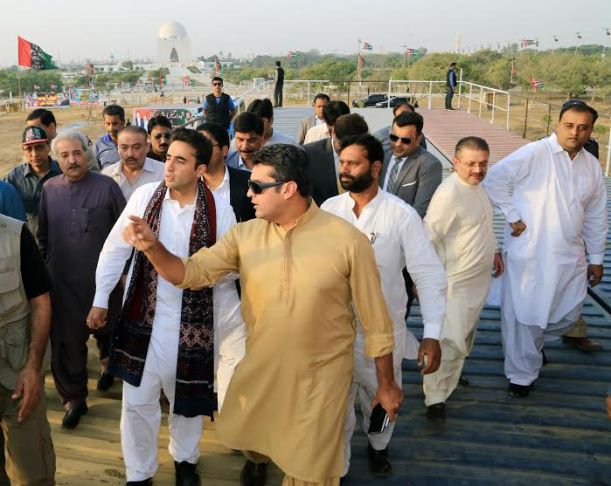
Pakistan Peoples Party chairman Bilawal Bhutto visited Bagh-e-Jinnah and reviewed the arrangements for October 18 public rally.
Bilawal, accompanied by party leaders, inspected the venue and was briefed on security arrangements.
Strict security arrangements have been put in the place for the rally with a state of the art control room stationed at the venue. The control room will be used to track all the cameras placed at the rally.
The use of drone cameras has also been prohibited during the rally.
Preparations for PPP rally scheduled for October 18 in Bagh-e-Jinnah near the mausoleum of Quaid-e-Azam have begun. More than three thousand members of PPP will perform duties to ensure security during the rally.

Christians are fleeing from Pakistan where Gul Sher will flee?

By Nazir S Bhatti
Today in a meeting with a friend, when I told him that Dr. Paul Bhatti, former Religious Harmony Minister and brother of Martyr Shahbaz Bhatti has fled from Pakistan after life threats from Punjabi Talban on pursuing case of Shahbaz Bhatti murder in anti-terrorist court.
My friend was not surprised on Dr. Paul Bhatti’s re-settlement in Italy but he raised very important question: Where Gul Sher will flee, who was driver of Shahbaz Bhatti and eye witness of killing incident of his boss Shahbaz Bhatti?
It was morning of March 2, 2011, in capital city of Pakistan; Gul Sher was waiting alongside car on door of house of mother of Martyr Shahbaz Bhatti which was not his official residence as Federal Minister for Minorities Affair; It is 11: 15 AM, Shahbaz Bhatti, Federal Minister of government of Pakistan, appears from house of his mother and directs his driver Gul Sher to head for Prime Minister House where he had to participate in Cabinet meeting; but before reaching PM House, he have to go to his official residence where Police was waiting for him to escort on daily schedule. It is 11:20 AM, before reaching to official residence where police escort was waiting, the vehicle of Federal Minister Shahbaz Bhatti slows down on a road speed breaker, then suddenly, gunmen stop car of Shahbaz Bhatti and order Gul Sher to get out of car and run to save his life. The gunmen spray bullet on Shahbaz Bhatti and wait to ensure that he is dead; the killers, then, put pamphlets written by Punjabi Talban on dead body of Shahbaz Bhatti which warn others to not speak against blasphemy law. It is on record that Gul Sher, driver of Shahbaz Bhatti, saw faces of killers and became a credible witness of the killing incident.
After murder of Shahbaz Bhatti, a joint investigating team of Islamabad police was constituted by government of Pakistan which instead of arresting terrorists of Punjabi Talban started harassing activists of All Pakistan Minorities Alliance APMA which was led by Martyr Shahbaz Bhatti; the police picked up Gul Sher also and tortured him for weeks to record a statement or confession that killers were Christians; later, Gul Sher was released from police torture cell on instructions to keep silent.
The government of Pakistan and Joint Investigation Team of Shahbaz Bhatti murder case was fully aware that Punjabi Talban are involved in killing of Shahbaz Bhatti and knew their hide outs in Punjab but stretched their investigation towards Christian activists of APML and Gul Sher who was driver of slain Christian leader.
The mother of Shahbaz Bhatti and family servant were awarded asylum by Canadian government who migrated to Canada but Gul Sher who was eye witness of killing incident and next target of Punjabi Talban was ignored.
When I talked last with khalid Gill who was Chief Organizer of All Pakistan Minorities Alliance APMA led by Shahbaz Bhatti and harassed by joint investigation team of Islamabad in murder inquiry of Shahbaz Bhatti. Mr. khalid Gill is one who invested millions of his family funds to organize APMA to strength leadership of Martyr Shahbaz Bhatti reached Canada in year 2013 and applied for asylum to save his life but he is facing difficulties which is causing depression on him when Mr. Gill is patient of high blood pressure and feeling unsafe in Canada even where some elements are propagating against him that he may not get asylum.
The very important question still stands very big; where Gul Sher will go to save his life who is eyewitness of killing spree of Shahbaz Bhatti but in hiding in Pakistan? While Paul Bhatti settles back in Italy and family of Shahbaz Bhatti along with family servants is settled in Canada.
There are thousands of Christians who are fleeing from Pakistan after persecution and life threats who are waiting for their case approvals from UNO offices in Sri-Lanka, Thailand, Hong Kong and Malaysia in very desperate situation which require attention of UNHRC but what’s future of Pakistani Christians: its big question mark like question of Gul Sher?

Pakistan: Ahmadiyya spokesperson says Ahmadis will not be intimidated, demands govt action

Saleem ud Din, the Ahmadiyya spokesperson in Pakistan, issued a press release yesterday expressing great grief and sadness at the latest murder of a well-known Ahmadi in Kamra, dist. Attock in Punjab.
Victim, Mr Latif Aalam Butt, 62, was killed outside his house in the evening hours on October 15 by unknown assailants who repeatedly fired at him.
Saleem ud Din said the incident represented a continuation of religiously motivated violence against Ahmadis. "Ahmadis are constantly on the receiving end of vicious threats and edicts of death."
"They [Ahmadis] are told that unless they turn away from their beliefs they will face persecution," he added.
Saleem ud Din declared Ahmadis would not be intimidated "by such cowardly attacks." He further added that in order to stop these sorts of incidents, the government should ban hate material against Ahmadis and take measures against those who distribute it.
Saleem ud Din demanded the arrest of those responsible for this crime so that they could swiftly be brought to justice. "Hundreds of Ahmadis are killed for their faith yet no one is ever charged for their murder which suggests a grievous degree of negligence on the part of the authorities."
Victim, Mr Latif Aalam Butt is survived by a wife, four sons and a daughter.
"He was an extremely kind, loving and pious man who harboured no enmity against anyone," said Saleem ud Din in the press release.
Remains of Latif Aalam Butt were brought to Rabwah where they were laid to rest yesterday.

White Cane Day: Balochistan doing little for visually impaired

The government of Balochistan is denying the right to education and employment to visually impaired persons, the Pakistan Association of the Blind (PAB) said on Wednesday as it observed White Cane Day. The provincial government is not implementing the quota of jobs allocated for blind people in Balochistan, PAB said.
Addressing a news conference at Quetta Press Club on Wednesday, President of PAB’s Balochistan chapter Qari Saki Mohammed said it is regrettable that blind people in Balochistan are denied the opportunity to show their talents in any profession. “There is merely a quota of two per cent for blind people in Balochistan and even this is not being implemented,” he said.
He cited the example of the Sindh police, where more than 800 blind people are included in the institution. In comparison, only four visually impaired people from Balochistan have been recruited to the police – less than one per cent.
He pointed out that there is only one education center catering to special needs individuals in Balochistan. “There should be schools at a district level across Balochistan to provide such students with equal opportunities for education,” he said.
He demanded that the government provide employment to educated blind people within the education department so the education system could be improved.

Pakistan: 10 militants killed in Khyber Agency

Ten terrorists were killed and several others injured during an operation carried out by security forces in Khyber Agency. According to sources, the security forces continued their operation against militants in Tirah Valley of Khyber Agency where clashes continued in Aka Khel area until the last report was filed. During clashes, ten terrorists were killed while several others were injured. Security forces also gained control of the border check post. Security forces continued operation to gain control of the Shah Kot check post.

Pakistan: Asia Bibi - Presumed Guilt

Asia Bibi’s appeal to the Lahore High Court was denied on Thursday, and the death penalty accorded to her still stands despite her lawyers citing lack of evidence to convict her of blasphemy. An appeal to the Supreme Court is the next step her lawyers will take, and might lead to charges being dropped as for Ayub Masih in 2002. But the fact remains that Asia Bibi has been in jail since 2010, and it may take years for the case to be cleared.
Courts in Pakistan must start recognising the fallibility of sworn testimonies. Asia Bibi was convicted on the basis of the testimony of a cleric and other women in the village, even though charges should also be leveled against her accusers for first marginalizing her and then using courts to settle their personal scores against a mother of five. The lack of proper investigative techniques means that evidence is often doctored, and witnesses coerced for personal or ideological reasons in order to spin the case one way or another.
The flaws in the blasphemy law, the repercussions they have against anyone who has been accused of blasphemy and the amount of cases that have little or no evidence proving that blasphemy was committed, mean that a revision of the laws is due. The law is based on the principal of innocent until proven guilty, yet in the case of blasphemy charges, the guilt of those that have been charged is accepted as fact, long before the case even goes to court, with the public often stepping in to execute their own brand of vigilante justice. The nation lost two giants- Punjab Governor Salmaan Taseer and minorities minister Shahbaz Bhatti- for vocalising the injustice accorded to Asia Bibi. Thus the case is both high pressure and high profile. Historically, when this is the case, politics and religiosity contaminate the judicial process. The LHC upholding the death penalty for Asia Bibi is an instance of that contamination, and a grave disrespect to those who have already given up their lives for the path of justice and equal humanity.

Pakistan is sliding toward extremism

By Farahnaz Ispahani and Nina Shea
The decision to award Malala Yousafzai the Nobel Peace Prize last week was a good one. After all, the 17 year-old, who was named a joint winner with along with Kailash Satyarthi, personifies the struggle for modernity, women’s equality and individual rights to religious freedom against the threat of Islamic extremism. But while Malala’s award is a triumph for her determination, it is far from clear that the cause she champions will meet as much success.
The reality is that Pakistan is facing a serious problem, with the mushrooming of Islamist appeal within Pakistani society reminding us that we risk seeing the Talibanization not simply of a small minority of ordinary citizens, but large swathes of the populace of the world’s second largest – and only nuclear-armed – Muslim country.
Pakistan abounds with violent sectarian and Islamist groups headquartered in semiautonomous tribal areas. Foreign jihadists, including Westerners like American David Headley, flock to areas such as North Waziristan. Yet although Islamabad devotes a full third of its armed forces to the northwest of the country, it is also pursuing policies that encourage a mainstream slide toward extremism.
State laws and practices relating to Islamic blasphemy, in particular, are increasingly suppressing moderate voices, while allowing extremists to dominate cultural discourse and learning. As a result, extremism is making ideological inroads into wider and wider segments of the population.
A shocking example came last month with the drive-by shooting of Muhammad Shakeel Auj, dean of Islamic Studies at the venerable Karachi University. Auj had earned a PhD after writing a comparison of eight Urdu translations of the Quran. But some found offense in his “liberal” religious views as he passionately denounced terrorism and suggested that Muslim women could pray wearing lipstick and could marry non-Muslims. Over the past two years, Auj has been subject to a barrage of blasphemy accusations, fatwas, and death threats, including that he will be beheaded. Particularly troubling is that four of his own faculty members were allegedly behind some of the threats. They were arrested, but soon released on bail. As one obituary writer commented, Auj’s murder shows that now “even the most mainstream Sunni voices will not be tolerated.” Junaid Hafeez, another university professor, may soon be sentenced to death by the state. Charged with insulting the Prophet Mohammed on Facebook, he is now on trial for the capital crime of blasphemy. Yet the charge is based entirely on oral testimony of students linked to the hardline Jamaat-i-Islami party.
Hafeez has reportedly found it difficult to find a lawyer willing to defend him, not least because those who manage to secure an acquittal for accused blasphemers run the risk of being seen as blasphemers themselves. And while the state doesn’t penalize such defense lawyers, it also does little to protect them or punish their extrajudicial killers either. For example, while after his first two lawyers quit following death threats, Hafeez was able to hire Rashid Rehman, a senior lawyer with Pakistan’s Human Rights Commission. But on May 7, Rehman was shot dead in his office. His killers remain at large.
Liberal Muslim educators, lawyers, and human rights activists aren’t the only victims of the country’s anti-blasphemy codes. Often targeted are the Ahmadis, an as many as 5 million strong, well-educated community that professes faith in Islam, but which is not deemed Muslim under Pakistan’s constitution. The sect’s tenets renounce violent jihad and embrace the separation of mosque and state, as well as religious pluralism. They now account for 40 percent of blasphemy prosecutions, which also disproportionately target Christians, Shia, and Hindus. Such extremism has touched us personally. Our friends Shahbaz Bhatti, the former Minority Affairs Minister, and Salman Taseer, Punjab’s former governor, were both outspoken critics of the blasphemy conviction of Christian mother Asia Bibi, and both were gunned down in 2011. The Lahore High Court on Thursday upheld the death sentence against Asia Bibi.
The blasphemy law was originally introduced to appease extremists, but has instead stimulated an appetite for more. As Bhatti noted: “This law is creating disharmony and intolerance in our society.” He is right – it legitimizes and enflames religious passions over speech, while providing extremists a platform within the very heart of Pakistani society.
American drones are now aiming at Pakistan’s northwest terrorist snake pit. But there is no military solution to the blasphemy law. And while it is only right that we celebrate Malala’s Nobel award, we also cannot forget the growing numbers of Pakistanis that take no pride in such an achievement.

Pakistani Christian Woman’s Appeal of Death Sentence Is Rejected

By WAQAR GILLANI and SALMAN MASOOD
The Lahore High Court of Appeals on Thursday upheld the death sentence of a Pakistani Christian woman in a high-profile blasphemy case and dismissed her appeal for acquittal.
The defendant, Asia Bibi, 47, a farmworker, was sentenced to death in 2010 after being convicted of blasphemy. She has denied the accusations, which she said stemmed from a dispute with Muslim co-workers.
Ms. Bibi now plans to appeal the decision in the country’s Supreme Court, said her lawyer, Naeem Shakir. But given huge backlogs at the court, analysts said it would probably be at least three years before the appeal would be taken up.
The ruling was the latest chapter in a long ordeal for Ms. Bibi, whose case has focused international attention on how Pakistan’s blasphemy laws have become a weapon against religious minorities.
It was also a factor in the 2011 assassination of Salman Taseer, the governor of Punjab Province who vociferously campaigned for Ms. Bibi’s release and for overhaul of the blasphemy codes. Religious conservatives were outraged by Mr. Taseer’s advocacy, and he was shot dead by his police security guard in Islamabad. Months later, his son Shahbaz Ali Taseer was kidnapped by Taliban militants and his whereabouts is still unknown.
Meanwhile, Ms. Bibi has languished in prison, and successive governments have been reluctant to touch the issue.
Death sentences have rarely been carried out in blasphemy cases, but that is in part because such allegations have frequently led to deadly vigilante attacks on the accused or their lawyers.
The Lahore courtroom was packed with clerics and members of extremist groups who supported the prosecution, and they erupted in celebration upon hearing the two-judge panel’s decision to dismiss Ms. Bibi’s appeal. “Let us celebrate by distributing sweets!” said one cleric who was reciting verses from the Quran throughout the almost two-and-a-half-hour court proceeding.
“I am very happy,” said Qari Salaam, a co-worker of Ms. Bibi’s and the main complainant in the case. “The judges have given a verdict on merit, and Asia deserved it.”
He and other farmworkers accused Ms. Bibi of shouting insults against the Prophet Muhammad. But she and her family deny that, saying the workers decided to lash out at her because a manager had ordered her to bring water out to the workers, and they refused to drink from bowls she had touched.
Joseph Francis from the Center for Legal Aid Assistance and Settlement, an group that works for minority rights, called the ruling a bad decision that had been forced by religious extremists.
“The court had already made its mind to dismiss the appeal, and the presence of Muslim extremist groups in the court further undermined justice,” Mr. Francis said.
Ms. Bibi’s husband, Ashiq Masih, expressed disappointment after the verdict.
“We were hoping for some relief, but alas,” Mr. Masih said as he left the court.

Pakistan: PPP to raise in NA issue of migration from Balochistan

https://mediacellppp.wordpress.com
The Pakistan Peoples Party has decided to raise in the National Assembly the issue of unprecedented migration of people of different communities from Balochistan.
The PPP’s legislators Dr Nafisa Shah, Shahida Rehmani, Dr Azra Fazal, Imran Zafar Leghari and Ejaz Hussain Jakhrani have submitted a call attention notice to the National Assembly Secretariat about the reported migration of over 300,000 people from Balochistan. They said lack of response from the government over the serious matter was a cause for concern. “We want to know why such a huge number of people have migrated from Balochistan and what steps are being taken by the government to deal with the situation,” Mr Leghari told Dawn.
He agreed that people had begun to migrate from the province during the tenure of the PPP-led government, but said the problem grew worse in the last 18 months.
The MNA said the PPP wanted to know about the government’s point of view on the crisis.He said it was the general impression that people were leaving Balochistan because of the poor security situation there.
“If this is true then why the government does not hold negotiations with the elements involved in killing innocent people. If negotiations can be held with the Taliban then why not with Baloch separatists and tribal people,” he added.
Mr Leghari said there were intelligence reports that India was involved in the unrest and patronising extremists and terrorists there. He said the government of Prime Minister Nawaz Sharif had failed to raise the issue at the national and international forums. According to the Human Rights Commission of Pakistan (HRCP), more than 300,000 people, including Shias and Hindus, have fled Balochistan over the past 10 years due to the growing unrest there.
Media reports quoted an office-bearer of the HRCP as saying that Hazaras were hit particularly badly by the unrest, with over 200,000 of the community’s members relocating to the country’s other areas or going abroad.
At least 24 Hazara pilgrims were killed in June when their bus was targeted by suicide bombers. Two devastating bombings in Quetta targeting Shias killed nearly 200 people last year. The responsibility for the attacks was claimed by Lashkar-i-Jhangvi.
Around 10,000 Hindus have reportedly migrated from areas of Balochistan after incidents of extortion, kidnapping for ransom and killing.
About 300 Parsi families and 400 members of the Zikri sect have also left the province. Another 90,000 people who fled from the province are from Punjabi or Urdu speaking families.