Terror group official in Turkey boasted about June kidnapping, killing of teens, one of whom was US citizenIsraeli legal NGO Shurat Hadin has asked US Attorney General Eric Holder to request the extradition of Turkey-based Hamas official Sheikh Saleh al-Arouri, who is believed to be responsible for the kidnapping and murder of three Israeli teens in June, one of whom was an American citizen. “Turkish authorities cannot allow a statement by a senior Hamas terrorist condoning and taking responsibility for the kidnapping and murder of innocent teenage boys announced on Turkish soil, and at the same time claim that Turkey is a humane country,” wrote Shurat HaDin founder Nitsana Darshan-Leitner. “Turkey is giving shelter to a terrorist who was released from prison for committing other terrorist acts, and who now brazenly announces his personal involvement in the abduction and murder of more Israeli civilians while comfortably residing in Turkey.” Turkey and the United States have an extradition agreement between them. Al-Arouri, a senior Hamas religious figure, was in Qatar on Thursday for the meeting held between exiled political bureau chief Khaled Mashaal, Palestinian Authority President Mahmou Abbas and the Qatari emir, Channel 2 reported. Al-Arouri is heard on a video that surfaced Wednesday saying that he “blessed the heroic action” which was “carried out by the al-Qassam Brigades” — the armed wing of Hamas. This action, “the kidnapping to Hebron of the three settlers,” was an “operation spoken of far and wide,” al-Arouri added. The sheikh was speaking at a conference of Muslim scholars in Turkey. “There are those who say that it was your brothers in the al-Qassam Brigades, who carried it out for the sake of al-Qassam members who are in jails and who sit in a hunger strike,” al-Arouri continued, according to a Hebrew translation provided by Channel 2. Hamas has denied involvement in the plot, but has long called for the kidnapping of Israelis, in order to exchange them for members held in Israeli jails. Israel has accused Hamas of being behind the June 12 abduction and killing of Naftali Fraenkel, 16, Gil-ad Shaar, 16, and Eyal Yifrach, 19. The three were last seen at a hitchhiking post outside the settlement of Alon Shvut in the Etzion Bloc south of Jerusalem. The abduction sparked a massive search operation and crackdown on Hamas in the West Bank, with hundreds of members arrested. Israeli officials said earlier this month that they arrested Hussam Kawasme, suspected of being the ringleader of the cell that carried out the attack. Kawasme reportedly admitted to interrogators that the group received funding from Hamas operatives in order to carry out the operation. The other two members of the cell, Marwan Kawasme and Amer Abu Aysha, who are thought to have carried out the killing, are still at large. The bodies of the three teens were found near Hebron on June 30, sparking anti-Arab protests. Tensions further ratcheted up after an East Jerusalem teen was killed by a Jewish Israeli in an apparent revenge attack, sparking days of unrest throughout the country and in the West Bank and heavy rocket fire on Israel. On July 8, Israel launched the ongoing Operation Protective Edge to stymie the rocket fire with airstrikes and carried out a limited ground incursion into Gaza to destroy a network of cross-border attack tunnels. Read more: Israeli NGO asks US to extradite Hamas man behind 3 teens’ murder | The Times of Israel http://www.timesofisrael.com/israeli-ngo-asks-us-to-extradite-hamas-man-behind-3-teens-murder/#ixzz3B6zmHtC8 Follow us: @timesofisrael on Twitter | timesofisrael on Facebook
M WAQAR..... "A man's ethical behavior should be based effectually on sympathy, education, and social ties; no religious basis is necessary.Man would indeed be in a poor way if he had to be restrained by fear of punishment and hope of reward after death." --Albert Einstein !!! NEWS,ARTICLES,EDITORIALS,MUSIC... Ze chi pe mayeen yum da agha pukhtunistan de.....(Liberal,Progressive,Secular World.)''Secularism is not against religion; it is the message of humanity.'' تل ده وی پثتونستآن
Friday, August 22, 2014
Israeli NGO asks US to extradite Hamas man behind 3 teens’ murder
Hamas official admits kidnapping Israeli teens
A senior Hamas leader has said the group carried out the kidnapping and killing of three Israeli teens in the West Bank in June - the first time anyone from the Islamic militant group has said it was behind an attack that helped spark the current war in the Gaza Strip.
Saleh Arouri told a conference in Turkey on Aug. 21 that Hamas’s military wing, the al-Qassam Brigades, carried out what he described as a "heroic operation" with the broader goal of sparking a new Palestinian uprising.
"It was an operation by your brothers from the al-Qassam Brigades," he said, saying Hamas hoped to exchange the youths for Palestinian prisoners held by Israel.
Hamas has repeatedly praised the kidnappings, but Arouri, the group’s exiled West Bank leader, is the first member to claim responsibility. Israel has accused Hamas of orchestrating the kidnappings and identified two operatives as the chief suspects. The two men remain on the loose.
Arouri’s admission shows "Hamas has no qualms whatsoever about targeting innocent civilians," said Israeli government spokesman Mark Regev.
The kidnappings of the three teens while they were hitchhiking on June 12, along with the discovery of their bodies two weeks later, sparked a broad Israeli crackdown on Hamas members throughout the West Bank. Hamas responded with heavy rocket fire out of the Gaza Strip, leading Israel to launch an aerial and ground invasion of the territory.
More than 2,000 Palestinians, most of them civilians, have been killed in the fighting, according to Palestinian and U.N. officials, while 67 Israelis have also been killed, all but three of them soldiers. An Egyptian effort to mediate a cease-fire collapsed this week, leading to a resumption of heavy fighting.
Arouri told the conference that Hamas "did not have the intention at this time to ignite a large battle." He said his group did not believe Israel wanted a war either. "But Allah has chosen and willed that a large battle would be ignited," he said.
Arouri is one of Hamas’ most senior figures. He founded Hamas’ military wing in the West Bank two decades ago and now commands the group’s operations in the area from exile in Turkey. He was deported several years ago in a deal that freed him from Israeli prison.
Earlier this week, Israel identified Arouri as the mastermind of an alleged plot to launch an uprising in the West Bank aimed at toppling Palestinian President Mahmoud Abbas.
Rights group says surge in Saudi beheadings
Human Rights Watch says 19 people have been executed in the kingdom since August 4, including one for sorcery.At least 19 people have been beheaded in Saudi Arabia this month for offences including drug smuggling and sorcery, according to Human Rights Watch (HRW). The dead include four Saudi men executed in Najran province on Monday for smuggling hashish, and two foreigners - a Syrian and a Pakistani, accused of the same crime. Authorities beheaded Saudi national, Mohammed bin Bakr al-Alawi, on August 5 for allegedly practicing sorcery, the Saudi Gazette reported. The family of another man, Hajras bin Saleh al-Qurey, who suffers from a mental disability, fear his execution for drug smuggling is imminent. Doctors who examined him confirmed he had symptoms of mental illness, but concluded that he should be held criminally liable. Qurey said investigators had pressured him in to confess by placing him in solitary confinement, according to the statement by HRW, which relied on local news reports, court documents and interviews with relatives. 'Disturbing surge' On Wednesday, Saudi authorities executed a Pakistani national for the murder of an Afghan man, the AFP news agency reported. At least 34 people have been put to death in the country in 2014, including the 19 people killed in August. Amnesty International denounced what it called a "disturbing surge" and called on the Saudi government to immediately halt all executions. "Any execution is appalling, but executions for crimes such as drug smuggling or sorcery that result in no loss of life are particularly egregious," said HRW's Sarah Leah Watson. "The current surge in executions in Saudi Arabia is yet another dark stain on the kingdom’s human rights record." The kingdom reserves the death penalty for crimes including murder, robbery, drug smuggling, blasphemy and drug smuggling.
Why Is Britain a Breeding Ground For ISIS Terrorists?
BY ALASTAIR JAMIESON
http://www.nbcnews.com/The voice of an apparent British militant narrating the video showing the beheading of American journalist James Foley has triggered renewed questions about why the U.K. is a breeding ground for jihadis. At least 400 Britons are among the estimated 2,000 Europeans who are fighting for the Islamic State of Iraq and al-Sham (ISIS), according to Prime Minister David Cameron. And the ease with which Europeans can travel into Syria through Turkey has alarmed intelligence officials in the West. On Thursday, NBC News reported that three militants with British accents had been dubbed "The Beatles" by hostages taken in Syria. A person close to several recent hostage negotiations said "The Beatles" were harsher than other guards. "Whenever the Beatles showed up, there was some kind of physical beating or torture," the source added. Britain has a “deeply entrenched problem,” according to the Quillam Foundation, an anti-extremist think tank. “London historically has had Islamist ideology being taught openly without being challenged and there are many people who have grown up knowing and believing that the only way to be Muslims is to create this Islamic state," said Harris Rafiq, Quilliam's head of outreach. "It's not surprising that jihadis have been able to cherry-pick these people." The true number of British jihadis could be even higher. Khalid Mahmood, a U.K. parliament lawmaker from Birmingham, England, estimates that at least 1,500 Brits have been recruited by extremists fighting in Iraq and Syria over the last three years — more than double the number of Muslims currently serving in the U.K. military. However, the numbers are inevitably higher in European nations with large Muslim populations. “When you look at the raw numbers, it’s not the best way to get a sense of how deep the problem is,” said Shiraz Maher, senior research fellow at the International Centre for the Study of Radicalization at London’s King’s College. “What we’ve done is to wade through the numbers of foreign fighters in relations to the Muslim population of those countries. When you do it like that, Belgium is actually way off the chart. But the Scandinavian countries feature very highly, and Britain as well.” Britain’s problem with radicalized Muslims — described by Foreign Secretary Philip Hammond as “a poison, a cancer” - is made acute chiefly because of its role as the biggest global ally of the United States in the tarnished invasions of Iraq and Afghanistan. As the same time, English is gaining traction as the language of choice for recruitment videos and other online propaganda because it has greater viral potential on social media. “It’s no coincidence that the [Foley beheading] video was in English,” said Ghaffar Hussain, managing director of Quillam. "If the West, particularly America, is where you are trying to get your message heard, it makes sense.” Social media is a powerful tool, especially for recruiting young male Muslims, according to Hussain. “The violent messages appeal to the macho element and the sense of going to join a fight,” he said, citing the recent case of Muhammad Hamidur Rahman, a 25-year-old killed while fighting in Syria after quitting his job at a British branch of fashion chain Primark. “One minute you’re working as a shop assistant, next minute you’re on the front line with a gun. It’s an attractive idea for many.” YouTube, Twitter and Facebook have partly replaced Britain’s previous funnel for extremism — radical preachers invited to speak at hardline mosques and Islamic schools. A recent ICSR report also noted that social media had become essential in spreading the extremist message from the fighting fronts of wars that are so dangerous that Western journalists struggle to cover them. “Social media is no longer virtual: it has become an essential facet of what happens on the ground,” the report said. Since the 2005 bombings on London's transport network, tackling fanatical messages has become an obsession in Britain - a mostly secular country despite Queen Elizabeth’s formal position as “defender of the faith” and head of the Church of England. Such has been the country’s multicultural ethos that the heir to the throne, Prince Charles, once stated that, as king, he wanted to be “defender of all the faiths,” including Islam. Wearing the Islamic veil, or burqa, is banned in public places in France, Belgium and parts of Switzerland. In contrast, England’s professional body for family attorneys recently began offering training courses in drafting wills that are compliant with Islamic Shariah law. Some commentators argue that this tolerance has left Britain more exposed to the threat posed to its Muslim communities by radical Islam. “In the U.K., with our proud tradition of freedom and not wanting to get involved in religious disputes, we have been bending over backwards to regard murderous ideologies as expressions of free speech,” said Anthony Glees, director of the University of Buckingham’s Centre for Security and Intelligence Studies. “Islamist extremist ideologies have spread with relative ease under the cover of ‘free speech’ and ‘multiculturalism’.” Glees added that Britain’s predominantly Sunni Muslim population was also particularly vulnerable to the allure of the jihadi message from Sunni ISIS. “Across Europe, Muslim populations come from different parts of the Islamic world. British Muslims come primarily from Pakistan, Bangladesh and the Horn of Africa — in other words, places where the political culture is virulent,” he said. “I think it is a particular problem in the U.K. in as much as most of our Muslims are from Sunni background. It is not that that you are more likely to be a violent extremist if you’re from a Sunni background but it is much easier to call yourself a preacher. There is no hierarchy in the Sunni religion. Anyone can say they’re a preacher, and this gives them an opening into mosques, the college lecture circuit and other places where young people congregate.” The problem has continued despite a series of multi-million dollar government campaigns to prevent young British Muslims from becoming radicalized. It is easy to find Muslims in London who publicly defend the establishment of the Islamic State and who favor Shariah law over the law of the land. Quilliam's Harris fears the problem could come home to roost, saying he would be horrified if an attack on London occurred — "but I would not be surprised." ISIS leader Abu Bakr al-Baghdadi "wants to make a statement he is a bigger terrorist, a bigger jihadi, a bigger figure than Osama Bin Laden was, and he has got to try to undertake an attack on the West. And London is a prime target for that display," Harris added. http://www.nbcnews.com/storyline/james-foley/why-britain-breeding-ground-isis-terrorists-n185951
IS threat 'beyond anything we've seen': Pentagon
The sophistication, wealth and military might of Islamic State militants represent a major threat to the United States that may surpass that once posed by al Qaeda, U.S. military leaders said on Thursday.
"They are an imminent threat to every interest we have, whether it's in Iraq or anywhere else," Defense Secretary Chuck Hagel told reporters at the Pentagon.
Hagel's assessment of Islamic State, which gained strength during Syria's civil war and swept into northern Iraq earlier this summer, sounded a note of alarm several days after the group posted a video on social media showing one of its fighters beheading an American hostage kidnapped in Syria.
Asked if the hardline Sunni Muslim organization posed a threat to the United States comparable to that of the attacks of Sept. 11, 2001, Hagel said it was "as sophisticated and well-funded as any group we have seen."
"They are beyond just a terrorist group. They marry ideology, a sophistication of ... military prowess. They are tremendously well-funded. This is beyond anything we've seen."
Hagel spoke as the United States continued attacking Islamic State targets in Iraq. In the past two weeks, U.S. drones and fighter jets have conducted 89 airstrikes against militant targets in northern Iraq.
So far, President Barack Obama has sought to limit his renewed military campaign in Iraq to protecting American diplomats and civilians under direct threat. Obama ended the war in Iraq that killed thousands of American soldiers and consumed U.S. foreign policy for nearly a decade,
Even after the gruesome killing of U.S. journalist James Foley, Obama is seen as unlikely to deepen his near-term military involvement in either Iraq or Syria as he seeks to avoid becoming embroiled in another messy Middle Eastern conflict.
But U.S. officials say they have not ruled out escalating military action against Islamic State, which has increased its overt threats against the United States since the air campaign in Iraq began.
'APOCALYPTIC, END-OF-DAYS VISION'
"We haven't made a decision to take additional actions at this time, but we truly don't rule out additional action against ISIL if it becomes warranted," Ben Rhodes, a senior Obama aide, told National Public Radio earlier on Thursday, using another name for Islamic State.
General Martin Dempsey, chairman of the U.S. Joint Chiefs of Staff, said officials were worried about the possibility that European or U.S. nationals, radicalized after fighting in Iraq or Syria, would return to their home countries.
Dempsey suggested Islamic State would remain a danger until it could no longer count on safe havens in areas of Syria under militant control.
"This is an organization that has an apocalyptic, end-of- days strategic vision and which will eventually have to be defeated," Dempsey said.
"To your question, can they be defeated without addressing that part of their organization which resides in Syria? The answer is no. That will have to be addressed on both sides of what is essentially at this point a non-existent border."
Thursday, August 21, 2014
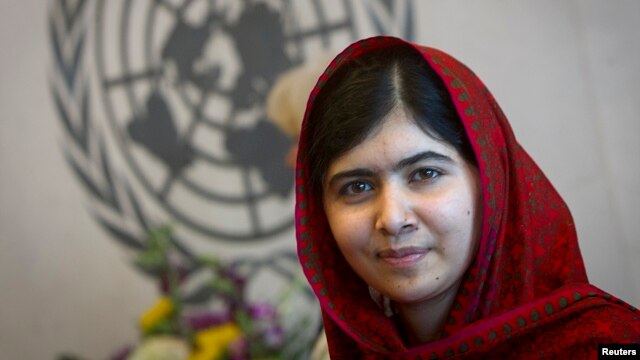
Malala Promotes Universal Education at UN
Global education advocate Malala Yousafzai joined the U.N. secretary-general Monday to mark the 500 Days countdown until the deadline for the Millennium Development Goals. The teen activist has inspired other young people with her commitment to making education available to children everywhere.
Five-hundred young people gathered at the U.N. Monday to encourage political leaders to keep up the momentum as the clock counts down to the deadline for achieving the Millennium Development Goals of eradicating extreme poverty, hunger and other obstacles to development and healthy lives.
Their focus was the second of the eight goals - achieving universal primary education. And their motivational speaker was Malala Yousafzai, the courageous young Pakistani girl who survived a Taliban assassination attempt for wanting to go to school.
Malala said her dream is still to see every child go to school and she encouraged other young people to get involved in making it happen.
“We should believe in the power of our voice and we should believe that yes, it can really bring a change,” she said.
The young advocate has had a busy year. She has visited Syrian refugees in Jordan and met the parents of school girls abducted in Nigeria, all while promoting her Malala Fund which empowers girls through education.
Secretary-General Ban Ki-moon welcomed Malala on Monday, saying she is a “daughter of the U.N.’ He encouraged other young people to follow her example and raise their voices too.
“One may think, I’m just a young girl or a young boy, I don’t have any power, but each and every one of you can make a difference,” he said.
Ban said that the world is experiencing so many “fires burning” at once, and the U.N. is working to extinguish them. He said there is a “flame of hope” as well, which are the Millennium Development Goals.
While all eight will likely not reach their targets in time for the 2015 deadline, the U.N. is looking beyond that timeframe to carry on a post-2015 sustainable development agenda.
What does the escalation of the Russia- Ukraine dispute mean?
GoPro Moscow base jump: Int Min releases 'Stalin star-painter' escape footage
Moscow police made public Go-Pro footage shot by the possible painters of a star on the iconic Stalin skyscraper in downtown Moscow. Police detained a group of four daredevils, who parachuted off the building, and charged them with vandalism for painting the spire in the yellow-blue colors of the Ukrainian flag.
Afghanistan: Mission Impossible or Mission Accomplished?
Since August 2003, the NATO-led International Security Assistance Force (ISAF) has been engaged in Afghanistan to conduct security operations, train and develop the Afghan National Security Forces (ANSF). Since then seven NATO summits have been held, the eighth and last NATO summit in the format of ISAF will be held at Newport, Wales on 5 September 2014. The ISAF mission is a first of its kind; both in terms of numbers of troop contributing nations and geographical location. This decade was a historic one for NATO and the organisation has grown unprecedentedly. Since its engagement in Afghanistan the organisation has grown from 19 to 28 member countries. For the first time NATO allies had to take action under the Article Five of the treaty, which is the collective self-defence act. During this decade of war against terror more than 21,000 Afghan civilians, 13,000 ANSF, 3,500 international forces dead. There is not an exact figure of the allies’ expenditure in Afghanistan, but it runs into billions of US dollars. Over all this was the biggest ever mission of the organisation and a test for the allies. The primary objective of the Alliance has been to enable the Afghan authorities to provide effective security and ensure that the country can never again be a safe haven for terrorists. Today Afghanistan has 352,000 strong Afghan National Security Forces (ANSF). Their determination and dedication can’t be questioned. But for long-term sustainment of those forces they are in need of equipment and training. Launched in 2011, the transition of full security responsibility is due to be completed at the end of 2014 and ISAF’s mission will end. To avoid any gap and for the sustainment of the ANSF the Afghan government and NATO allies agreed at the Chicago Summit for a follow-on mission to train, advise and assist the ANSF after 2014. In the Chicago Summit Afghan government and the International Community agreed on an estimated annual budget of US$4.1billion for the ANSF. The model for the total ANSF size was envisaged a 228,500. The recent assessment of the Afghan government shows that the size is not enough, so they will urge for US6 billion in the upcoming summit. However it was mutually agreed in the Chicago Summit that the funding for the ANSF will be reviewed regularly against the developing security environment. But these pledges are condition based. The condition is clear and that is a legal framework for the presence of the US and NATO forces in Afghanistan after 2014. On the political side, NATO has contributed a huge amount in Afghanistan. It secured the constitutional Loya Jirga or grand council and support Afghan forces to secure all the elections since 2004. NATO has significantly contributed to the reconstruction and development efforts by the Afghan government and the international community. The large footprint of NATO across the country has enabled humanitarian and aid organisations to contribute in very remote areas of the country. And this was an opportunity for millions of Afghans in these very remote areas to raise their voice and to be heard in the country and around the world. NATO diplomats have served alongside the military and the NATO Senior Civilian Representative in Afghanistan has played a significant role to connect NATO capitals with the Afghan government as well as to reach the neighbouring and regional countries. Afghanistan is located in a region between four imbalanced nuclear powers. And it’s been in a vulnerable position throughout history because of the importance of its geopolitical and strategic location. So in order to strengthen peace, security and stability in Afghanistan, it is a wise decision to have a partnership with the world’s most powerful military and political organisation. Regional counties should also acknowledge that the presence of NATO in the region has significantly contributed to their own security and stability. Of course there are still terrorist threats and there is violence in some of the neighbouring countries, but that could have been worst if NATO was not in the region during the last decade. So the presence of NATO in Afghanistan is not only in the interests of Afghanistan, but also in the interests of all the regional countries. In addition, it will not be a wise decision for NATO to turn its back on Afghanistan. The investments made in the last decade should not be in vain. NATO should also acknowledge and define its mutual interest in Afghanistan with its partner. The NATO-Afghanistan Enduring Partnership, signed in 2010 at the Lisbon Summit, has opened a wider platform. But because of the security transition process, the enduring partnership was not expanded. Meanwhile NATO has been negotiating with the Afghan government on the Status of Forces’ Agreement (SOFA) for its new mission. The Resolute Support Mission (RSM) will be a vital mission for the support of the emerging ANSF and for NATO’s goal, which is to ensure that the country can never again be a safe haven for terrorists. It’s for the current and new Afghan administration to consider the relationship and co-operation with NATO and the US a vital and urgent one. Such a partnership can be an assurance of the ANSF sustainability and security in the country and wider region. Any strong relationship with NATO is an access gate for Afghanistan to all 28-member allies as well as an assurance of a sovereign state free from any possible interferences of any country. Likewise NATO will also mutually benefit from having a relationship with a country, where billions have been invested and a country that has an important role for the security of the Alliance’s citizens. Many legitimate concerns of the Afghan government, including the controversial issue of civilian casualties during NATO operations, independent operations and other matters has been increasingly addressed and there will be no room for such a concerns after completion of the current ISAF mission. So the Afghan government and NATO should be able to enter a new, comprehensive, closer, stronger and mutual relationship. It should be based on mutual commitment and long-term cooperation with full respect to the sovereignty of Afghanistan. The relation which can possibly make Afghanistan a NATO member country in the future. This is a desire of Afghans to continue their relationship with the US and NATO allies. The endorsement of the Strategic Partnership and Bilateral Security Agreements with the US by more than 2,500 representatives of the Afghan people from across the country at the consultative Loya Jirgas last year and in 2011, are clear examples. There is no doubt that there is a mutual need for long-lasting and stronger relationships between Afghanistan and its partners, and these are needed sooner rather than later. Hence it’s up to the current and new Afghan administration to immediately finalise the Bilateral Security Agreement with the US and an agreement with NATO in order to allow the continuation of this historic relationship. That needs to be done urgently, before or during the NATO Summit in Wales. Then this Summit can be another historic milestone for the Afghanistan-US and NATO relationship.Mohammad Shafiq Hamdam
Afghanistan: We Will Protect People's Votes: Abdullah
Pakistan: Asif Zardari arrives in Karachi

Former President Asif Ali Zardari has arrived in Islamabad today (Thursday) and is likely to call Pakistan People’s Party’s (PPP) meeting in Karachi. According to details, the former president of Pakistan Asif Ali Zardari has reached Karachi from Dubai in context of the current political rift between the government and the opposition parties. Previously, National Assembly’s Opposition Leader and PPP’s senior leader Khursheed Shah and Senator Aitezaz Ahsan were called to Dubai yesterday (Wednesday). Moreover, other leaders were supposed to reach there to discuss the current socio-political crisis in the country; however, as Asif Ali Zardari has arrived Karachi, all the political leaders are expected to reach there to meet the party’s co- chairperson to discuss the current socio-political situation and announce PPP’s stance over it. Previously, Zardari conducted an Executive Committee meeting in Dubai as well. As per sources, many leaders requested former President to reach Pakistan to discuss the current political situation.
Pakistan: Violence and democracy can never co-exist
http://www.ppp.org.pk/
By: Senator Taj Haider Secretary General PPP SindhThe present crisis of the Right wing extremist politics of Pakistan is the direct result of manipulations made for rigging the last general elections. Those shouting themselves hoarse over rigging in the last elections were themselves the biggest beneficiaries of such rigging. They choose to ignore the fact that 3 political parties that were against religious extremism were not allowed to run an election campaign. The son of Prime Minister Gillani was kidnapped on gunpoint for holding a small election corner meeting in Multan (he has not been recovered till date) while PML(N) and PTI were campaigning in the legnth and breadth of the country unhindered and unharmed. What difference militancy made in the results of the Elections can be gauged from the results of NA-1 Peshawar where the PTI chief Mr. Imran Khan had won by a lead of 70,000 votes in the general elections and had vacated the seat later. In the bye-elections held just 2 months later when the militants allowed ANP to campaign not only the PTI lead of 70,000 votes vanished but the seat itself was lot by the PTI. The holy agitators also choose to ignore the findings of the Election Tribunal on the rigging committed by the PTI on PS-93, Karachi West. The Tribunal in its judgment on 7th August found that the sitting MPA, who is PTIs General Secretary Sindh Province, had changed the results of 7 polling stations, increased votes in his favour by more than 5,000 and reduced the votes of the JI candidate who was declared the ultimate winner by the Tribunal. The same Secretary General PTI took hundreds of PTI workers to Islamabad Dharnas and stood next to his Chief demanding “resignations and fair elections”. Stones are being pelted all around on others by PTI without realizing that they are themselves sitting in a glass house. These were not elections. This was an arrangement worked out by the agencies (whom the PPP President Mr. Makhdoom Amin Faheem rightly congratulated on PML(N) election victory) and supported on ground by militants. This was an artificial arrangement, whose time was long past. This arrangement had to crumble down. The time for worn out ideas and their imposition at gun point is long gone. Pakistan People Party had opted for continuation of the spirit of the Charter of Democracy. The spirit is that of reconciliation. It excludes dictation of the establishment. We had made PML(N) a part of the Federal Government. We were ourselves part of the Punjab Government. Unfortunately Mian Nawaz Sharif Sahib thought it better to part way and started using Judiciary and State Institutions to destabilize our elected government. While we were acting boldly to oust militants from Swat and other areas, these elements were provided safe heavens in Southern Punjab. Their camps were not dismantled and these very extremists provided militant support in Southern Punjab to deliver a solid PPP area to PML (N). In the interest of continuation of democracy PPP decided not to protest on the streets. The highly abusive language used against us and our leadership by PML(N) hurt us. But at the present crucial juncture the language being used against PML(N) leadership is hurting us more. Continuation of the democratic system remains as ever our top priority. Democracy presupposes a civilized political culture, which is being ruined by these elements who have no stakes in the democratic system. Can the commission appointed by the Honourable Supreme Court investigate all of more than 1300 seats of the Provincial and National Assemblies? The record has been so badly messed up as a result of arrangements made before the polls that it has become impossible to correctly identify the bogus votes. The fact that 3 parties who were against the extremist militants were not allowed to campaign while PTI and PML(N) enjoyed their full support is reason enough to call the election unfair. PPP has been saying that from the first day. The most important question is, where do we go from here? PPP, the biggest sufferer of rigging believes in “politics of reconciliation”. Major successes for Democracy, the Charter of Democracy, the NFC Award, the 18th Amendment, the completion of the term of previous assemblies and the governments were all results of “politics of reconciliation”. “Politics of Confrontation” which does make headlines in the Media has always resulted in setbacks and loosing of all the democratic gains and ultimately in dictatorship. We have seen enough of it in 1999. We do not understand why the PTI and PML(N) who were the biggest beneficiaries of poll rigging are pushing the country to the same abyss through confrontation. Everyone stands to loose. There are no winners in this confrontation or in any confrontation for that matter. Emotionalism has to make way for Rationalism. Violence and democracy can never co-exist. We shall have to jointly find way to exclude militancy and the role of agencies from the electoral system. The time for such a system has arrived. Attempts to postpone it will always result in one crisis after the other.
Source : Office of the Senator Taj Haider Secretary General PPP Sindh.
PAKISTAN: UNDER THE SHADOW OF THE MILITARY JACKBOOT – ANALYSIS
Pakistan: IG Islamabad replaced for avoiding torture on marchers: sources
Inspector General of Police (Islamabad) Aftab Ahmad Cheema has been removed from post for not accepting government’s order to crackdown on protestors in the federal capital, sources told Dunya News.
According to the Ministry of Interior, acting charge of IG has been given to DIG Headquarters Khalid Khattak.
According to sources, the government had ordered police to arrest Imran Khan and Tahirul Qadri. Afterwards, IG Islamabad Aftab Cheema had directed police to avoid torture on the long march participants.
Police officials are confused over government’s contradictory orders against the protestors, sources told.
As the news regarding IG Islamabad’s replacement surfaced, Pakistan Tehreek-e-Insaf (PTI) Vice Chairman Shah Mehmood Qureshi claimed police have launched crackdown on PTI workers.
Pakistan: Azadi march: PTI suspends talks with govt
The Pakistan Tehreek-e-Insaaf (PTI) has suspended the dialogue process with the government.
PTI leader Shah Mahmood Qureshi said the Punjab Governor was informed about the suspension of talks with the government negotiating team. Qureshi held a telephonic conversation with Chaudhry Sarwar and told him that the PTI team will not come to the hotel for the negotiation.
The official page of Pakistan Tehreek-e-Insaaf also tweeted about the decision.
Explaining the reason, the PTI said the statements of federal ministers were deteriorating the environment for talks.The PTI committee is currently present at the residence of Jahangir Tareen. The second round of talks between Pakistan Tehreek-e-Insaf (PTI) and the government were scheduled for 2pm today. Earlier, member of the negotiation committee, Ahsan Iqbal said that both the parties have a consensus over not being a laughing stock. PTI has presented 6 demands before the government which shall be reviewed within the party and we’re hopeful for the dialogues to bear positive outcome, he added. Vice Chairman PTI Shah Mahmood Qureshi said that PTI is a democratic party and they are not negotiating upon anybody else’s indication. The PTI and the government have both formulated their respective teams for negotiations. The team representing the government constituted governor Punjab Chaudhry Sarwar and federal ministers viz Pervez Rashid, Zahid Hamid, Ahsan Iqbal and Abdul Qadir Baloch whereas the negotiating team representing PTI constituted Shah Mahmood Qureshi, Javed Hashmi, Asad Umer, Jahangir Tareen and Arif Alvi. The negotiations took place in a hotel in Islamabad after which Shah Mahmood Qureshi said that they had presented their demands before the government and would be awaiting for their response after consultation.
US offers $30mn in search for Haqqani leaders
Pakistan: Déjà vu
Former President Asif Ali Zardari and Chariman PPP Bilawal Bhutto Zardari met senior party colleagues
Former President Asif Ali Zardari and Chariman PPP Bilawal Bhutto Zardari met senior party colleagues to discuss current political situation. Current political crisis be addressed through dialogue and within the framework of the Constitution: Former President Zardari PPP leaders expressed concern at the short-sighted and high-handed tactics of the government and urged all parties in this conflict to resolve the issues at hand without recourse to further violence and the disruption of public life in the capital and country. PPP leaders condemned the brutal murders in Model Town, Lahore, on June 17th 2014. The leaders demanded that an FIR be expeditiously registered in accordance with the law. PPP observed that any unconstitutional path taken to resolve current stalemate will be detrimental to the future of democracy. Former President Zardari lauded the services and sacrifices of the brave soldiers who were fighting on the front lines of terrorism. Former President Zardari hoped that the country would soon be rid of menace of terrorism.http://www.ppp.org.pk/
Zardari : PPP supports State, Constitution and Democracy
http://abbtakk.tv/Former President Asif Ali Zardari has said that PPP is not with the Government, it is with the democracy and state. He said that PPP workers will come forward, if someone tries to capture parliament. According to the details, CEC meeting of PPP was held in Dubai today. Co Chairman Asif Ali Zardari chaired the meeting. Khursheed Shah and Raza Rabbani couldn’t join the meeting due to unavailability of visa. Meeting discusses the current political situation in detail. Talking to meeting, Co-Chairman Asif Ali Zardari said that PPP will defend democracy and state at all costs. He said that PPP has always been in the front row, when it comes sacrifice. PPP has always been giving blood to democracy and state of Pakistan, whenever it required, he added. He said that it was PPP, which gave 1973 constitution to the Nation. He said that PPP knows how to defend constitution and Democracy.
Pakistan: Zardari, Bilawal reiterate their support for democracy
abbtakk.tvA very important Pakistan Peoples Party meeting ended in Dubai, which showed concern over the current political situation of the country. According the details, A very important meeting of PPP leadership has concluded in Dubai. The meeting was presided by both Asif Ali Zardari and Bilawal Bhutto Zardari Meeting decided that PPP would continue its support to parliament and democracy and defend them from any danger. Talking to meeting, Asif Ali Zardari said that PPP will not allow to ambush on democracy. Chairman PPP, Bilawal Bhutto Zardari said that democracy is the future of Pakistan. Meeting was also attended by Makhdoom Amin Fahim, Yousif Reza Gilani, CM Sindh Syed Qaim Ali Shah,Rehman Malik, Mian Manzoor Watoo and Imtiaz Safdar Warriach. Asif Ali Zardari will also meet the party leadership on Friday to discuss the situation in detail.
The Fate of Feminism in Pakistan
On Feb. 12, 1983, 200 women — activists and lawyers — marched to the Lahore High Court to petition against a law that would have made a man’s testimony in court worth that of two women. The Pakistani dictator Gen. Muhammad Zia ul-Haq had already promulgated the infamous Hudood Ordinance, which reflected his extremist vision of Islam and Islamic law. Now, it was clear to many Pakistani women that the military regime was manipulating Islam to rob them of their rights. General Zia’s days are over, and parts of the Hudood laws pertaining to rape and adultery have been superseded by less objectionable clauses in Pakistan’s Protection of Women Act of 2006. But Pakistani women have yet to achieve what Madihah Akhter, writing in The Feminist Wire, an online magazine, identifies as “political, cultural and economic equality for women and a place in the constant struggle to define their nation.” The reality of Pakistan’s women continues to confound easy categorization. They have been going to school and university, holding down jobs and earning money for several generations now. Yet they still live with widespread gender-based violence, society’s acceptance of women as property, and a widespread belief that they don’t deserve education, jobs or an existence outside the domestic sphere. Neither Pakistan’s laws nor its social codes nor its religious mores truly guarantee women a secure place as citizens equal to men; such attitudes are preserved by patriarchal tribal and cultural traditions, as well as the continued twisting of Islamic injunctions to suit the needs of misogynists. Could feminism be the best antidote to this male chauvinism ingrained in modern Pakistani society? Feminism has been alive in Pakistan since the country was born. During partition of the British Indian Empire in 1947, a Women’s Relief Committee, which oversaw refugee transfers between India and Pakistan, was founded by Fatima Jinnah, the sister of Muhammad Ali Jinnah, Pakistan’s founding father. Then Begum Ra’ana Liaqat Ali, the wife of Pakistan’s first prime minister, founded the All-Pakistan Women’s Association in 1949; that organization worked for the moral, social and economic welfare of Pakistani women. Ms. Jinnah ran in the presidential elections in 1965 and was even supported by orthodox religious parties, but lost to the dictator then holding the office, Gen. Ayub Khan. In the 1980s, the Women’s Action Forum used activism to oppose General Zia’s myopic vision of Islam; today, Pakistani feminist collectives continue to protest violence against women, raise awareness about women’s education and political and legal rights, and lobby policy makers to enact women-friendly laws. The groundbreaking Repeal of Hudood Ordinance, the women’s empowerment bill and anti-honor-killings bill were all moved in Parliament when Sherry Rehman, a former ambassador to the United States and a renowned feminist, held the portfolio of minister for women’s development in the last decade. These and the anti-sexual-harassment bill were all eventually codified in Pakistani law over the next several years. But many Pakistanis cling to the idea that feminism is not relevant to Pakistan — that it’s the preserve of the rich and idle or, worse, that it’s a Western imposition meant to wreak havoc on Pakistani society. Many Pakistani men and women believe that women’s rights need go no further than improvements Islam brought to the status of women in tribal Arabia in the seventh century. Men in Pakistan are not yet ready to give up their male privilege, and many Pakistani women, not wanting to rock the boat, agree with them. The Pakistani historian Ayesha Jalal calls it the “convenience of subservience” when elite and upper-class women marginalize women’s movements in order to maintain their own privilege. The scholar Margot Badran has identified two threads of feminism in the Muslim world: 19th-century “secular feminism” and 20th-century “Islamic feminism.” Islamic feminism, pioneered by scholars like Riffat Hassan, Amina Wadud, Asma Barlas and Fatema Mernissi, seeks to reclaim Islam from male interpretations by using passages in the Quran to combat institutional misogyny. Islamic feminism as practiced in Pakistan is accessible to the middle and upper middle classes, who enthusiastically attend Quran classes held in Urdu, where they analyze verses and learn about the rights that the religion affords them. It also inculcates solidarity with Muslim women around the world. But with its emphasis on academic learning, it can limit empowerment to educated women, marginalizing the unschooled and the poor. Pakistani feminists like Shahnaz Rouse, a Sarah Lawrence College professor, and Farida Shaheed, a sociologist who heads the Shirkat Gah women’s resource center in Pakistan, have done vital work in the field of Pakistani gender identity and class analysis, while Fouzia Saeed has been instrumental in raising the issue of sexual harassment. But their work, and that of other theorists and activists whose primary basis for feminism is not Islam, is often dismissed as favored only by an English-speaking elite with little relevance to greater Pakistani society. Yet secular feminism has a more democratic scope; its proponents agitate for the rights of all women in Pakistan, non-Muslim as well as Muslim. It links to other feminist movements worldwide, not just Islamic ones, and is more pluralistic. By appealing to secular nationalism as well as Islamic modernism, it is not restrained by the need to base all thought in Islamic scripture, although secular feminists also use this powerful tool when necessary. A feminist movement can succeed only when it mirrors the makeup of the women and the society for whom it operates. Pakistan needs a feminism that elegantly marries both strands of feminism — secular and Islamic — because that’s how Pakistan was formed: on both Islamic and secular principles. The clinical psychologist Rubeena Kidwai said this about the status of women in Pakistan today: “Pakistani women are like bonsai trees, clipped and pruned and weighed down by the expectations of Pakistani society.” And Pakistan’s feminists are the only ones who can undo that destructive process, so that Pakistani women can flourish and grow to the heights of their human potential.Bina Shah
Wednesday, August 20, 2014
Watch President Obama Sing Ariana Grande’s “Problem” (Sort Of)
http://time.com/He already sang “Fancy,” so really, it was only a matter of time until Obama took on “Problem” — you know, the other song of the summer. Behold, the latest work from the genius known as baracksdubs, who splices together snippets from Obama’s speeches to make it sound like he’s singing pop songs. Barry O. does all the singing, of course, but watch out for special appearances from Vice President Joe Biden and House Speaker John Boehner, both of whom really add an extra something special here.
New Threats to Democracy in Turkey
Obama Denounces James Foley's Execution: 'Today The Entire World Is Appalled'
The Real Middle East Crisis Is Economic
President Obama surprised many recently when he diagnosed the crisis gripping Iraq as partly an economic one, noting that Iraqi Sunnis were “detached from the global economy” and thus frustrated in achieving their aspirations. While Iraq’s chaos has many sources, the president is nevertheless on to something; and it’s not just Iraqi Sunnis, but the entire Middle East that is detached from the global economy. The region accounts for just over 4 percent of global imports, less than it did in 1983; Germany alone accounts for 6.4 percent. Its economic stagnation is vividly illustrated by a comparison to Asian economies. According to the World Bank, in 1965, Egypt’s per-capita gross domestic product was $406, while China’s was merely $110. Today (using constant dollars), Egypt’s G.D.P. has increased four-fold to $1,566, whereas China’s has increased thirty-fold to $3,583. Similarly, Iran and South Korea had roughly the same per-capita G.D.P. in 1965; now South Korea’s is $24,000, whereas Iran’s is only $3,000. The economies of the Middle East are not only detached from the world’s, but from one another. Most exports in North America, Europe and Asia remain within those regions. Two-thirds of exports to Europe are also from Europe. In the Middle East, only 16 percent of exports to the region as a whole are from other Middle Eastern states. While Western observers focus on political issues in the Middle East, people in the region are themselves preoccupied with economic matters. According to a recent poll, residents of the Gaza Strip overwhelmingly desire calm with Israel and the chance to seek jobs there. In another poll, Iranians listed “expanding employment opportunities” as their top political priority, far higher than “continuing our nuclear enrichment program.” But while Gazans hope for an end to their blockade, and Iranians for an end to sanctions, neither step would provide a silver bullet. Economic malaise is endemic to the region, even in places not suffering from blockades or sanctions. This should concern Western policy makers. The distinction between economic and political problems is false. Like anywhere, economics and politics are inextricably linked. And economic progress is the key to easing the chronic instability that threatens American interests in the region. Among oil importers, bloated public sectors are at the heart of socioeconomic woes. In places like Egypt, where the public sector employs around 30 percent of workers, post-revolution governments in search of quick economic fixes have further increased the public work force and salaries. Generous government subsidies, particularly on fuel, encourage overconsumption and favor inefficient, energy-intensive industries. Together with the large public-sector wage bills, these subsidies strain government finances, resulting in deficits, which increase the cost of credit. These policies, together with obstacles to doing business, inhibit the sort of private-sector activity that would boost growth and employment. Across the region, unemployment — especially among youth — is in many cases higher than it was at the outbreak of the Arab uprisings, and economic growth is too slow to reverse the trend. These problems aren’t limited to the oil importers. The International Monetary Fund has warned that oil exporters’ years of massive surpluses are nearing an end, as a result of heavy spending and growing populations. This makes them increasingly vulnerable to a decrease in oil prices, which looks increasingly likely as new sources come online internationally. These economic problems can be fixed, however. In contrast to the region’s political dilemmas — which often seem intractable — the West is not only able to help, but regional leaders are open to receiving help. Jordan offers an example: Amid the chaos of the Arab uprisings, Amman quietly implemented tough reforms with the assistance of the United States and the I.M.F. Oil importers need to replace costly fuel subsidies with targeted assistance to the poor and the creation of social safety nets. They also need to ease their dependency on external aid, reduce corruption, and make regulatory changes to encourage private-sector growth. Exporters need to reduce spending and diversify their economies. And both need to shrink their public sectors and modernize their educational systems. The United States and its allies should not only provide advice in overcoming these challenges but also incentivize regional governments to take it. That means working with regional allies that are seeking to diversify and modernize their economies, and coordinating economic aid and tying it to progress on reform, including the political steps necessary to make reforms successful. America should also promote greater economic integration by cooperating with wealthy oil producers to invest in the prosperity of their poorer neighbors, and by offering Middle Eastern states better access to Western markets, especially the European Union. Exhortations for the United States to “do more” overseas are often criticized as veiled calls for the use of military force. But integrating economic statecraft into diplomacy would help broaden America’s international role beyond the security sphere in a way that promotes long-term peace and stability. It would be naïve to think that economic growth will solve all of the Middle East’s thorny dilemmas; but it would be equally naïve to believe that they can be solved without it.By MICHAEL SINGH
CPJ condemns killing of American journalist James Foley
Pakistan cleric's supporters blockade parliament, but Nawaz Sharif escapes
Protesters Demand the Resignation of Pakistan’s Prime Minister
http://time.com/
Political opponents claim that Prime Minister Nawaz Sharif was fraudulently elected.Thousands of antigovernment protesters in Islamabad marched to the Parliament on Tuesday to demand the resignation of Pakistan’s Prime Minister Nawaz Sharif, Reuters reports. Opposition leaders claim that Sharif was unfairly elected to power last year. The protests are being led by former international cricketer Imran Khan — head of the Pakistan Tehreek-e-Insaf (PTI) party — and prominent politician-cleric Tahir ul-Qadri. Khan, who is demanding that Sharif’s government make way for fresh elections, alleges that Sharif’s party won last year’s poll through fraudulent means. On Monday, he also claimed that 34 members of his PTI party would resign from their seats in the National Assembly in protest against the current regime. Qadri is accusing Sharif of corruption and wants the current administration replaced by a unity government of technocrats. The two leaders have held separate protests in the past, but announced earlier this week that they would join forces to march on Parliament. An estimated 50,000 protesters have been holding demonstrations in Islamabad for five days. Reuters says that some are equipped with cranes and bolt cutters to dismantle and remove the shipping containers that are being used to barricade the government “red zone,” where Parliament and other state buildings are located. Sharif originally called on the country’s powerful military — which deposed him in a 1999 coup — to secure the red zone, but Khan issued him a warning. “If police try to stop us and there is violence, Nawaz, I will not spare you, I will come after you and put you in jail,” Reuters reported him as saying to a crowd of supporters. As marchers approached the capital, Sharif relented and announced that protesters could enter the area. Sharif’s daughter Maryam Sharif said on Tuesday through her Twitter account that this was because there were families among the demonstrators.
The Guardian reported that protesters, including women throwing rose petals on the ground, were not stopped by police officers as they marched into the red zone. The protests have put pressure on the weakened government that already has poor relations with the military. It also threatens to further shake the stability of Pakistan, which is battling against a bloody Taliban insurgency and a high unemployment rate.
Afghanistan gives NYT reporter 24 hours to leave country
Subscribe to:
Posts (Atom)