 The Rs13 million scam at the Institute of Chemical Sciences, University of Peshawar, was tactfully hushed up by holding one senior clerk responsible for the entire mess, who managed to get bail before arrest (BBA), while the high-ups of the institute were given a clean chit.
The financial embezzlement had been made about one year ago, when Prof Dr Imdadullah was the director of the institute. The matter hit the headlines in various newspapers about a month ago, prompting the university administration to conduct an inquiry into the matter and fix responsibilities.
Sources said the funds had been withdrawn from the account of the institute for the purchase of chemicals and other equipment in violation of the set procedure. All the cheques were properly signed by the former director Imdadullah. Also, no purchase was made and the fund – Rs13 million – was embezzled, said the sources.
“Actually two inquiries were ordered into the matter, i.e. one fact-finding and the other procedural inquiry. The fact-finding inquiry has submitted its report and given recommendations, while the procedural inquiry is still investigating the matter,” said an official at the university administration.
He said the matter had also been reported to the Anti-Corruption Establishment and National Accountability Bureau (NAB), which would conduct separate inquiries. The university administration also lodged an FIR against a clerk of the institute, Arif Ismail, who confessed to misappropriating the funds and deceiving the former director.
The fact-finding committee headed by Prof Dr Gulzar held the clerk responsible for the entire scam. The committee also charged the former director with negligence and suggested halting his pension, the slightest punishment that can be made in such cases.
According to the committee report, the director did not know the procedure of fund withdrawal and the clerk deceived him, which is why they recommended the minimum punishment for him.
The committee also recommended stern action against the clerk and recovery of all the funds. The committee also suggested to put his name on the exit control list. The anti-corruption and NAB authorities are yet to probe the matter and take action, sources told The News.
The sources said the university administration dealt with the matter very tactfully and saved the skin of the former director. They said the clerk should be punished for misappropriation of the funds, but the matter was not that simple that only one clerk was involved in embezzling such a large amount.
“Currently, the clerk has confessed to have withdrawn the entire amount alone. But he can take back his statement at any stage. All this seems to be properly planned,” an official of the institute told The News on the condition of anonymity.
The sources said that every chairman or director was authorised to withdraw only Rs25,000 for the purchase or other needs from the account of his department, institute or centre. “If the fund exceeds Rs25,000, the vice-chancellor will give approval and even the vice-chancellor can approve fund up to Rs75,000 only.”
Even after the approval by the vice-chancellor, the funds can be withdrawn after thoroughly checking all the receipts, which should be signed by all members of purchase committee of each department, the sources added. Any amount exceeding Rs75,000 for purchase or other work would be advertised in newspapers and quotations would be sought from at least three companies, they said.
“In the case of the Institute of Chemical Sciences, funds amounting to Rs1,300,000 have been withdrawn on the signature of the former director without following any procedure and the committee finds him innocent, it is ridiculous,” said an official.
Prof Imdadullah, who retired from the university recently, is currently serving at the National Testing Service (NTS) in Islamabad. He could not be reached on his phone for comments despite numerous attempts.
Saturday, August 16, 2014
Pakistan: Rs13m scam at University of Peshawar being hushed up
The Rs13 million scam at the Institute of Chemical Sciences, University of Peshawar, was tactfully hushed up by holding one senior clerk responsible for the entire mess, who managed to get bail before arrest (BBA), while the high-ups of the institute were given a clean chit.
The financial embezzlement had been made about one year ago, when Prof Dr Imdadullah was the director of the institute. The matter hit the headlines in various newspapers about a month ago, prompting the university administration to conduct an inquiry into the matter and fix responsibilities.
Sources said the funds had been withdrawn from the account of the institute for the purchase of chemicals and other equipment in violation of the set procedure. All the cheques were properly signed by the former director Imdadullah. Also, no purchase was made and the fund – Rs13 million – was embezzled, said the sources.
“Actually two inquiries were ordered into the matter, i.e. one fact-finding and the other procedural inquiry. The fact-finding inquiry has submitted its report and given recommendations, while the procedural inquiry is still investigating the matter,” said an official at the university administration.
He said the matter had also been reported to the Anti-Corruption Establishment and National Accountability Bureau (NAB), which would conduct separate inquiries. The university administration also lodged an FIR against a clerk of the institute, Arif Ismail, who confessed to misappropriating the funds and deceiving the former director.
The fact-finding committee headed by Prof Dr Gulzar held the clerk responsible for the entire scam. The committee also charged the former director with negligence and suggested halting his pension, the slightest punishment that can be made in such cases.
According to the committee report, the director did not know the procedure of fund withdrawal and the clerk deceived him, which is why they recommended the minimum punishment for him.
The committee also recommended stern action against the clerk and recovery of all the funds. The committee also suggested to put his name on the exit control list. The anti-corruption and NAB authorities are yet to probe the matter and take action, sources told The News.
The sources said the university administration dealt with the matter very tactfully and saved the skin of the former director. They said the clerk should be punished for misappropriation of the funds, but the matter was not that simple that only one clerk was involved in embezzling such a large amount.
“Currently, the clerk has confessed to have withdrawn the entire amount alone. But he can take back his statement at any stage. All this seems to be properly planned,” an official of the institute told The News on the condition of anonymity.
The sources said that every chairman or director was authorised to withdraw only Rs25,000 for the purchase or other needs from the account of his department, institute or centre. “If the fund exceeds Rs25,000, the vice-chancellor will give approval and even the vice-chancellor can approve fund up to Rs75,000 only.”
Even after the approval by the vice-chancellor, the funds can be withdrawn after thoroughly checking all the receipts, which should be signed by all members of purchase committee of each department, the sources added. Any amount exceeding Rs75,000 for purchase or other work would be advertised in newspapers and quotations would be sought from at least three companies, they said.
“In the case of the Institute of Chemical Sciences, funds amounting to Rs1,300,000 have been withdrawn on the signature of the former director without following any procedure and the committee finds him innocent, it is ridiculous,” said an official.
Prof Imdadullah, who retired from the university recently, is currently serving at the National Testing Service (NTS) in Islamabad. He could not be reached on his phone for comments despite numerous attempts.
Pakistan- Misplaced priorities: $23 million Kerry-Lugar funds going to waste
Pakistan: The courts and politics
 The Lahore High Court (LHC) issued an order that no “unconstitutional” march or sit-in could be held by Imran Khan and Tahirul Qadri on the eve of Independence Day. That wording left room for Imran Khan and Qadri to argue that they would proceed with their respective marches while adhering to the constitution and remaining peaceful. The order also seemed to have a salutary effect on the government, persuading it to adopt a ‘softly, softly’ approach to the marchers. Unfortunately, the LHC forgot the well known jurisprudential principle that courts should not issue orders that cannot be implemented. The marches took off on August 14 regardless. Now some people are trying to hold Imran and Qadri in contempt of court, after the horse has bolted. The LHC also held that asking for the resignation of the Prime Minister (PM) was unconstitutional. With due respect, that does not hold water. Asking for resignations is the very stuff of democratic politics. Whether those asked to go comply or not is a separate matter. What is not constitutional however, is holding the country, government and the democratic system hostage through street power to force him to resign when the PM enjoys a clear majority in parliament. This development once again highlights the perils of the courts adjudicating political issues. This is the consequence of seeing the courts as the final arbiters of everything, a trend that set in after the judiciary was restored in 2009 as a result of Nawaz Sharif’s long march for the purpose. It was given further traction by the hyper activism of the Supreme Court under former Chief Justice Iftikhar Mohammad Chaudhry. Unfortunately, the hangover of that mistaken belief in the power of the courts to fix everything under the sun still persists. In defence of the LHC’s order, what could at best be said was that it acted as a restraining influence on the government and the marchers.
The two marches set off peacefully, albeit at a snail’s pace, from Lahore on August 14. The relief that brought did not last. An unfortunate clash between PML-N and PTI workers in Gujranwala queered the pitch again. In the wake of the clash, Imran Khan abandoned his slow moving container and decided to dash ahead to Islamabad in a bulletproof car. Some analysts were inclined to ascribe this change of travelling mode to the alarm in PTI circles that Qadri and his contingent had dashed ahead and would arrive in Islamabad ahead of Imran Khan’s cavalcade. By now it is hardly a secret that the PTI is concerned its agenda may be overtaken or trumped by Qadri’s in Islamabad. What are these respective agendas? Going by their repeated statements, Imran Khan is insisting on the resignation of the PM, the setting up of a non-political interim government, and fresh elections, thereby ostensibly rejecting all the olive branches proffered by Nawaz Sharif in recent days. Qadri, on the other hand, has just issued a radical sounding 10-point agenda that he calls the foundations of his ‘revolution’. Theoretically, Imran Khan can still be seen as having stakes in the parliamentary democratic system despite his scathing criticisms of the present setup. Qadri, on the other hand, cannot be accused of any such consideration. He wants to upset the apple cart and bring in a government leaning towards theocracy and headed by himself, presumably through the back door as he does not have any presence in parliament. It is therefore in the interests of Qadri to escalate the confrontation to a point where the establishment intervenes in the name of saving the country and paves the way for Qadri’s hoped for success.
The intriguing question now is what the stance of the establishment is to the current crisis. The military has, according to reports and as expected, conveyed to the government that it will not physically intervene in the confrontation brewing in Islamabad. That understandable hands off approach to a purely political situation notwithstanding, Pakistan’s history of military intervention, overt and covert, has persuaded some conspiracy theorists that behind the scenes the establishment is preparing a new version of the ‘Kakar solution’. This refers to the manner in which General Kakar, the then COAS, intervened in the conflict between then PM Nawaz Sharif and then President Ghulam Ishaq Khan in 1993 to send both packing. Were such a scenario to be played out, it would be terribly disappointing to those who saw the 2013 elections as a watershed moment for Pakistan in terms of a peaceful transition from one elected government to the next, thereby raising hope that democracy, fragile and uncertain as it may be, was on its way to consolidation in the country. If any extra-constitutional outcome follows the marches and sit-ins in Islamabad, it would be a grave setback to the forward march of democracy and a case of back to square one: establishment-driven imposed solutions on a country by now weary of such anti-democratic manipulation.
Pakistan: Imran Leaves Long March to Sleep in Bani Gala
http://www.pkhope.com/
Imran gone to Bani Gala Palace, CM KPK to Frontier House, and rest of PTI leader to Serena Hotel and Marriat Hotel. Another u-turn from Imran Khan. He had promised with his followers of PTI that he won’t be leaving the long march until his demands would met. He said that he would sleep on road with the workers. But after reaching Islamabad, the playboy-cum-politician bolted from the march to his palatial mansion of Bani Gala, leaving his workers suffer in stormy rain.Imran Khan left the long march by saying that he will come back at 3pm to rejoin the long march. Nobody even in PTI was expecting that. They thought that their leader will stay with them throughout. They are asking from each other as where should we go? Not everybody has palace in Bani Gala. All the demands of Imran Khan are unconstitutional and bizarre. Why Nawaz Sharif should resign? Even the opposition leader Khurshid Shah has said that they don’t support the resignation of the Imran Khan. Other parties including ANP, MQM, JUI-F, PML-F, NP, and various other parties in parliament are not with Imran. All the independent sources are saying that Imran has failed to gather 1 million people. People have rejected the Imran’s claims and his agitation which is without any cause. After disturbing Lahore, and all the cities on G.T. Road, now Imran is pricking the people of Rawalpindi and Islamabad. That is what Pindi and Islamabad get voting in for Imran. Or was it rigged too?
Pakistan: Quetta attacks

As the military operation in North Waziristan continues, it appears the much-dreaded blowback has made a beginning. Militants targeted two military facilities in Quetta late on Thursday — the PAF’s Samungli base as well as the Khalid base — in what appeared to be a coordinated operation.Luckily, security forces acted in time and a major disaster was averted; at least 10 assailants were killed and the destruction witnessed during similar past episodes was not repeated. On Friday, the Ghalib Mehsud faction of the banned Tehreek-i-Taliban Pakistan claimed responsibility for the assault while the Balochistan home minister told the media that most of the assailants appeared to be Uzbek. Both of these developments — the TTP’s involvement and the use of Uzbek fighters — are cause for concern. They would signify that Islamist militants are making their presence felt in Balochistan and that the security forces have failed to prevent the flight of terrorists from North Waziristan. As it is, Balochistan faces militancy of different hues, including the Baloch separatist insurgency and the activities of sectarian terrorist outfits. It would only worsen matters if the TTP and Uzbek militants decided to focus on the province which has largely remained free of Taliban-related terrorism, although the TTP does wield some influence in Balochistan. The banned group has a presence in the province’s Pakhtun areas while Uzbek militants have reportedly been operating in Quetta’s outskirts and Mastung. The militants also have the support of local sectarian groups. The Quetta attacks show that while TTP fighters may now be scattered and much of their infrastructure in North Waziristan may be reduced to rubble, they are far from a spent force. Their operational capability to cause widespread havoc remains very much intact. If we add the Uzbek dimension, matters get even more complex as militants from this background have participated in some of the country’s most high-profile terrorist attacks — including the storming of the Karachi airport in June — and have a well-earned reputation for ferocity. The situation demands two major responses from the state: firstly, the military must ensure that the operation in the tribal belt is thorough and that militants are not able to escape, regroup and then re-launch themselves. Secondly, the intelligence agencies need to remain alert about more possible blowback attacks in the cities. The state — preoccupied as it is with political manoeuvring these days — must not forget about the threat terrorism continues to pose to Pakistan.
Bilawal Bhutto expresses sorrow over Peshawar rain incidents
http://mediacellppp.wordpress.com/
Friday, August 15, 2014
A Painfully Slow Ebola Response
 The outbreak of the Ebola virus in West Africa appears more out of control than ever. By Friday, the virus had infected more than 2,000 people in four countries and had killed more than half of them. The World Health Organization, which snoozed on the sidelines for months after the outbreak was first identified in March, has issued increasingly frantic warnings in recent days. On Aug. 8, it declared the spread of the virus “a public health emergency of international concern.” On Thursday, it warned that the reported numbers of people killed or sickened by the virus may “vastly underestimate the magnitude of the outbreak” because many sick people escape detection. The next day, it said that patients flooding into newly opened treatment centers were filling beds faster than they could be provided.
The current cases, like other Ebola outbreaks in past decades, are a regional problem that must be fought primarily by local African governments, which understand the cultural practices that foster the spread of the virus and inhibit patients from seeking help. This outbreak poses little or no danger to the United States or Europe. Unfortunately, the three countries most affected — Guinea, Liberia and Sierra Leone — are among the poorest and most war-racked in the world and have very weak health care systems. They desperately need help in organizing their responses.
The W.H.O. should be filling that role, but it has been shamefully slow. Its regional office for Africa, which should have acted first, is ineffective, politicized, and poorly managed, with staff members who are often incompetent, according to international health experts familiar with its operations. The central office of the W.H.O. in Geneva has belatedly tried to pick up the slack but is hampered by large self-imposed budget cuts, accompanied by a loss of talented professionals in its programs to control such outbreaks. These shortsighted cuts will need to be restored, perhaps by sacrificing less important items, to ensure that the next time there is an Ebola outbreak the agency can jump into action. The World Bank has said it plans to contribute up to $200 million to the fight.
There is still no drug or vaccine that has been proved safe and effective in human clinical trials, but progress is being made in pushing promising candidates forward. Two Ebola vaccines could begin initial safety testing in people as early as next month, and a drug has been judged safe enough to test in humans who are already infected. Even if these or other medicines prove effective, which is by no means a certainty, no one expects them to curb this outbreak. The goal is to find weapons to use when the next epidemic breaks out.
The battle against the Ebola virus in West Africa has been waged primarily by two nongovernmental health organizations with great experience in dealing with international health crises, namely Médecins Sans Frontières (a.k.a., Doctors Without Borders) and Samaritan’s Purse. Both have warned that their resources are stretched to the limit, their people are tiring and they can’t do much more. Samaritan’s Purse suspended its clinical care activities after an American doctor and a missionary from North Carolina were infected, given an untested drug, and brought back to this country for treatment.
The United States government has belatedly stepped in to provide help. The Centers for Disease Control and Prevention has sent 55 experts, backed by more than 300 at its Atlanta headquarters, to help the afflicted countries strengthen their systems to detect outbreaks and to trace, isolate and treat infected people. That is an unusually large effort by the agency, but its staff in the field will be spread thinly. The Agency for International Development is contributing more than $27 million to coordinate planning and logistics and pay for equipment and public awareness campaigns. The Defense Department has a small group of military and civilian personnel in Liberia and has set up diagnostic laboratories in that country and Sierra Leone. It could presumably do a lot more if it is not too distracted by its operations in Iraq and Syria.
The big unanswered question is who will be available to provide hands-on care as the number of cases continues to mount. Even without an effective drug, prompt supportive care — such as keeping patients hydrated, maintaining their blood pressure and treating any complicating infections — can keep patients alive who would otherwise die. The bulk of the health care workers will presumably have to come from the afflicted countries, but they will probably need to be helped by doctors and nurses from abroad. All must be provided with personal protective equipment and trained to recognize and treat a disease that could kill them if they are not careful.
Saudi Arabia: Outrageous sentence against Shi’a cleric shows disturbing pattern of harassment
Saudi Arabia: Imprisoned Activist Dragged, Beaten
 Saudi authorities on August 11, 2014, forcibly moved an imprisoned rights activist to another prison almost 1,000 kilometers away from his family. Since the arrest of Waleed Abu al-Khair in April, authorities have moved him five times, shuffling him in and out of several facilities, sometimes without explanation. In the latest move, the authorities initially refused to tell his family where he was. He was allowed to call only 24 hours later.
Abu al-Khair’s wife, Samar Badawi, told Human Rights Watch that during the phone call, Abu al-Khair said that officials at Jeddah’s Bureiman prison beat him on his back and dragged him from the prison with chains, injuring his feet, after he refused to cooperate in his transfer to another prison the previous day. Abu al-Khair was moved to al-Malaz prison in Riyadh, over 960 kilometers from his family in Jeddah.
“Abu al-Khair shouldn’t be in prison at all, much less hustled from one prison to another almost a thousand kilometers away from his family,” said Sarah Leah Whitson, Middle East and North Africa director. “Saudi authorities should stop tormenting Abu al-Khair and free him immediately and unconditionally.”
Abu al-Khair has been one of Saudi Arabia’s leading human rights advocates for years, and so a thorn in the side of the government. In July, the Specialized Criminal Court, Saudi Arabia’s terrorism tribunal, convicted him on a number of broad and vaguely worded charges that stemmed solely from his peaceful activism, including comments to news outlets and on Twitter criticizing Saudi human rights violations. The court sentenced him to 15 years in prison, a 15-year ban on travel abroad, and a fine of 200,000 Saudi Riyals (US$53,000).
Abu al-Khair played no active part in his trial. He refused to recognize the legitimacy of the court or defend himself against the charges. He also refused to sign a copy of the trial judgment or to appeal the conviction or his sentence. Abu al-Khair’s organization, the Monitor of Human Rights in Saudi Arabia, stated on August 12 that it believes his prison transfers are a punitive measure for Abu al-Khair’s refusal to recognize the court.
Following Abu al-Khair’s transfer to Riyadh on August 11, police and prison authorities refused to tell his wife where they had taken him, she said. Abu al-Khair was finally allowed to call her in the afternoon on August 12.
The 1988 UN Body of Principles for the Protection of All Persons Under Any Form of Detention or Imprisonment, states, “If a detained or imprisoned person so requests, he shall if possible be kept in a place of detention or imprisonment reasonably near his usual place of residence.” Prisoners should not be moved arbitrarily, and not as a punitive measure for their political positions.
The 1955 UN Standard Minimum Rules for the Treatment of Prisoners further direct authorities to pay “special attention” to the maintenance of a prisoner’s relations with his family. Both legal instruments also direct authorities to provide prisoners’ families prompt notice of their transfer between locations. The Standard Minimum Rules state, “Every prisoner shall have the right to inform at once his family of his imprisonment or his transfer to another institution.”
Syria envoy welcomes UN anti-ISIL move

The Syrian envoy to the United Nations has welcomed an anti-ISIL resolution, saying if the Takfiri militants’ assaults were not ignored, they would not be wreaking havoc in the region now.Bashar al-Ja’afari reiterated Damascus’ stance on terrorism, saying the Syrian government is a "necessary partner in the fight against terrorism." “For more than three years Syria has been engaged in a very difficult war on behalf of all humankind against terrorist organizations,” during which “the government of Syria has tried to do its utmost to attract the attention of the member states of this organization to the threats facing the region and the world.” “I would like to know why the member states of the Security Council have not responded to our repeated complaints for more than three years,” he said. The Syrian ambassador’s remarks came after the UN Security Council unanimously adopted a resolution against the ISIL Takfiri militants in Syria and Iraq. The 15-member world body called for action against the terrorists, who, it said must "disarm and disband with immediate effect." ISIL terrorists are currently in control of several oil fields in Iraq and Syria. Iraq, which has the world’s fifth-biggest crude reserves, came under a massive blitz by the ISIL Takfiri militants in June. Syria has also been gripped by deadly violence since 2011. More than 170,000 people have been killed and millions displaced due to the violence fueled by the Western-backed militants. The Western powers and their regional allies -- especially Qatar, Saudi Arabia and, Turkey -- are reportedly supporting the militants operating inside Syria.
Iraq crisis: Yazidi villagers 'massacred' by IS

Militants in northern Iraq have massacred at least 80 men from the Yazidi faith in a village and abducted women and children, reports say.Islamic State (IS) fighters entered Kocho, 45km (30 miles) from Sinjar, on Friday afternoon, reportedly telling men to convert to Islam or die.
 The group's atrocities against non-Sunni Muslims have shocked the international community into action.
In New York, the UN Security Council imposed sanctions on IS members.
In another development, the US military said two of its drones had attacked and destroyed two vehicles identified as belonging to IS near Sinjar on Friday morning, after receiving reports from Kurdish forces that the militants were attacking civilians in the village of Kawju.
'Convert or die'
Kurdish officials confirmed the attack on Kocho after it was reported by Yazidi activists based in Washington.
"They arrived in vehicles and they started their killing this afternoon," senior Kurdish official Hoshiyar Zebari told Reuters news agency.
The killings took place over the space of an hour, said a Yazidi MP, Mahama Khalil, who reportedly spoke to survivors.
A resident of a nearby village said an IS fighter from the same area had given him details of the bloodshed.
"He told me that the Islamic State had spent five days trying to persuade villagers to convert to Islam and that a long lecture was delivered about the subject today," said the villager.
"He then said the men were gathered and shot dead. The women and girls were probably taken to [the city of] Tal Afar because that is where the foreign fighters are."
Hadi Pir, a Yazidi activist and member of the Yazidi Crisis Management Team in the US, also said a deadline to convert had been given to the villagers.
The villagers were assembled at Kocho's only school, after which the men were shot, the activists said. Remaining villagers were then put on buses for an unknown destination.
IS-led violence has driven an estimated 1.2 million Iraqis from their homes. Whole communities of Yazidis and Christians have been forced to flee in the north, along with Shia Iraqis, whom IS do not regard as true Muslims.
Separately, fighting flared up on Friday in the mainly Sunni Anbar province, west of Baghdad, parts of which have been under IS control.
Sanctions
Some leaders of Iraq's Sunni Muslim minority have said they may work against the militants in cooperation with Iraq's new Prime Minister, Minister Haider al-Abadi, who is tasked with restoring order.
The mainly Shia Muslim government is locked in a fight with IS since the group led an insurrection in the north this summer, making the city of Mosul the capital of a self-declared state which extends into Syria.
Yazidi and Christian people in northern Iraq have faced persecution by the jihadists, prompting US-led air strikes and aid drops and calls for other Western states to arm opponents of IS.
Meeting in New York, the UN Security Council made six people associated with IS or the Syria-based Nusra Front subject to an international travel ban, asset freeze and arms embargo.
Backers of the two groups may also face sanctions, they said.
At an emergency EU meeting in Brussels on Friday, the 28 member-states were left to decide individually whether they would arm Iraq's Kurds, the main opponent of IS in the north.
The UK said it would "consider favourably" any request to send arms to the Kurds, while the Czech government said it would be in a position to start deliveries of munitions by the end of the month.
Germany is legally prevented from arming countries involved in conflict, but Foreign Minister Frank-Walter Steinmeier said he would go to the limit of "what is legally and politically possible" to help the Kurds and he will travel to Iraq shortly.
UN to vote on resolution to weaken Islamic State

UN measure demands IS fighters in Iraq and Syria disband immediately, threatens to slap sanctions on governments that trade with militants.The UN Security Council is set to vote on Friday on a resolution aimed at weakening Islamic State militants by choking off funding and the flow of foreign fighters. The measure, proposed by Britain, would be the council's toughest response yet to the group that captured significant swathes of territory in Syria and Iraq in recent months. The UN vote comes as Britain, following on emergency meeting, became the third country to commit to arming Kurdish Peshmerga fighters on Friday, The Guardian reported. The US and France both pledged earlier this week to provide the Kurds with weaponry. The European Union will also meet on Friday to vote on whether to arm the Kurdish fighters. A unanimous vote is required. Votes around increased foreign intervention and assistance to battle the Islamic State-led offensive in Iraq follow Iraqi Prime Minister Nuri al-Maliki's resignation late Thursday. Over the past week, Maliki faced increasing pressure from international powers, including the US and Iran, to step aside in order for a new inclusive government to be formed. Some analysts have raised questions about how helpful European military support for the Kurds will be in the battle against IS. "Clearly limited European military support to the Kurds will not fundamentally shift the dynamics of the wider battle against IS, whose primary target remains the Shia community and the march on Baghdad, not the Kurds and Erbil," wrote Julien Barnes-Dacey, a senior policy fellow at the European Council on Foreign Relations. "In the end, despite fears and pledges to the contrary, the provision of military support to the Kurds may be the beginning of a far deeper and longer military campaign," he added. UN resolution vote at 1900 GMT Diplomats told AFP that the UN text up for a vote on Friday had been agreed by all 15 members of the council after nearly a week of negotiations and that the resolution would come up for a vote at 1900 GMT Friday. The final text, seen by AFP, demands that IS fighters in Iraq and Syria, rebels from the al-Nusra front in Syria and other al-Qaeda-linked groups "disarm and disband with immediate effect." It "calls on all member states to take national measures to suppress the flow of foreign terrorist fighters" to the groups and threatens to slap sanctions on those involved in recruitment. It also warns governments and entities that trade with the militants, who now control oilfields and other potentially cash-generating infrastructure, "could constitute financial support" that may lead to sanctions. In the agreed text, the council accuses the militants of a series of atrocities and warns that such attacks may constitute a crime against humanity. The text states that the council is acting under chapter VII of the UN charter, which means the measures could be enforced by military force or economic sanctions. The council last week adopted a unanimous statement calling on governments to help Iraq cope with the humanitarian crisis. It was the third condemnation of the IS offensive. Sajad Jiyad, an Iraq analyst, said on Friday that the only way Iraq would be able to get rid of ISIS, in addition to working on political inclusiveness with the new government, is foreign intervention. "We have to be quite honest about that," Jiyad told the BBC World Service. "Iraq does not want foreign boots on the ground, but what is required is the ability to strike at ISIS wherever they are. So one part of it is we are calling for extended air strikes and preferably something that is UN sanctioned, not just legal authorisation, but UN-based as in UN forces assisting with this military action." Other analysts say the militant group cannot be defeated using air power. "ISIS can only be defeated when you drive a wedge between it and local communities," said Fawaz Gerges, professor of international relations at the London School of Economics. Unlike al-Qaeda which has taken almost a decade to dismantle, said Gerges, Islamic State has embedded itself within disaffected local Sunni communities in Iraq and Syria, ties which will take years to break. "It will take time because [IS] has inserted itself," he said. "We're talking about years." - See more at: http://www.middleeasteye.net/news/un-vote-resolution-weaken-islamic-state-1763943561#sthash.xCKbFc9u.dpuf
ISIL Takfiri terrorists sells Izadi women between US$ 500 to 43000
Reports coming from the militancy-riddled northern Iraq suggest that the ISIL Takfiri terrorists are selling captured female Izadi Kurds as sex slaves.Local Kurdish intelligence sources say the women are being sold to traffickers to work in bordellos across the Middle East. The sources also say they have received information that the captured women are sold between USD 500 and USD 43,000. Local residents and witnesses say several women have been forced to marry the ISIL militants. This comes as al-Qaeda-linked militants have captured thousands of women, including at least 1,200 females from the city of Sinjar. Thousands of members of the Kurdish minority group have fled their homes after ISIL Takfiri militants attacked them in remote areas of northern Iraq. The notorious ISIL terrorists have already killed hundreds of the Izadi Kurds and captured their women. The ISIL and its associated militant groups consider them as apostates. Meanwhile, the UN High Commissioner for Refugees (UNHCR) is stepping up aid for thousands of Izadi Kurds taking refuge in the neighboring Syria. Some 15,000 Izadis are staying in the Newroz camp near the al-Qamishli district of the al-Hasakah Governorate in Syria. The UNHCR is working with local NGOs to supply the refugees with basic humanitarian aid. The UN High Commissioner for Refugees, Antonio Guterres, has described the situation of the refugees as very dynamic and challenging. Several local communities in Syria have warmly welcomed the refugees, providing them with food and clothes. The ISIL terrorists have been committing heinous crimes in the captured areas, including the mass execution of civilians and Iraqi security forces.
Commentary: It is dangerous for Japan to sow seed of war
 To mark the 69th anniversary of its defeat in the World War II, the Japanese government has, as usual, duly advised its citizens to observe one minute of silence in honor of the deceased.
Prime Minister Shinzo Abe, however, has a separate agenda. Despite the cancellation of a planned visit, he sent an offering Friday to the notorious Yasukuni Shrine, which honors top war criminals, through his aide Kouichi Hagiuda.
Such a show of "compromise and sincerity," as some put it, is hardly acceptable, particularly given the recent barrage of remarks and moves by Japan's rightist politicians which lay bare their unrepentant attitude toward the WWII.
One who forgets and denies history does not deserve a future. It has become a matter of urgency for the current Japanese leaders to truly reflect upon the lessons of history so as to avert a risky future.
During the WWII, a militaristic Japan ruthlessly trampled over its Asian neighbors and slaughtered tens of millions of people there. Yet, Japan was also considered a victim of the war as countless innocent civilians in the country were killed by U.S. nuclear retaliation.
The unconditional surrender of Japan in 1945 put an end to the bloody war in the Asia-Pacific and ushered in a new era of peace and development for the whole region, including Japan, which has since kept its extreme right-wing forces in check and tugged itself out of the quagmire of war.
Remarkably, Japan has created an enduring economic miracle which saw it once grow into the world's second largest economy.
It is reasonable to say that Japan's post-war success has testified the fact that peace, not war, is the cornerstone for development.
Sadly, a new generation of rightists in the country have chosen to ignore that. With Prime Minister Abe at the helm, Japan, bent on shaking off its war-renouncing pacifist reins, has once again embarked on a precarious path and blatantly challenged the post-war international order of peace.
By doing this, Japan is sowing the seed of another war.
Notably, the Abe administration has sugarcoated its military ambitions with rhetoric touting "peace" and "security," while former Japanese militaristic rulers had used similar tactic to disguise their unquenchable thirst for aggression.
What has also sounded the alarm is that Japan has been deliberately flexing its muscles against China. From the purchase and naming farce of China's islands, to the constant hyping up of China's "military buildup," Japan's increasingly provocative actions are not only tearing the two nations further apart, but also putting the hard-won peace and security in the whole region at stake.
Some might say history always repeats itself, yet it is unwise for Japan to reckon that China, along with other WWII victims as well as those peace-loving people on its own land, would stand idle in face of the brewing threats of war.
It is highly advisable for those who did wrong in the past to stop playing with fire and avoid leading their country further down the dangerous road.
History speaks loudly, does Japan listen?
 Aug. 13 in 1945 was the last moment of a long dark night in China. Although Prime Minister Shinzo Abe may not agree, it was the darkest before dawn for Japan as well.
In fact the whole Pacific was hanging on a cliff, waiting to see if Japan would continue fighting on its own land to the bitter end while prolonging the most devastating war in human history.
The surrender of Japan two days later should have never been a national humiliation as Japanese right-wing politicians have long pictured it.
Surely Japan was forced to make the decision by the surrender of Germany in Europe, the military victory of the Allied in Southeast Asia and the Pacific island, the nuclear bombing of Hiroshima and Nagasaki and years of resistance by the people in the lands Japan invaded.
But it was still a righteous call.
War ended and peace began in Asia where billions of people had the chance to breathe, heal and rebuild their life. This included about 70 million Japanese.
The international order forged after the World War II contributed to the general peace in Asia for almost seven decades, during which Japan has risen to be one of the most important global economies.
Now the Japanese government has moved to write it off. Prime Minister Abe considers the country's pacifist Constitution, adopted after the end of WWII, a barrier for Japan to be a "normal country".
In July, his cabinet endorsed a reinterpretation of the pacifist Constitution for the right of collective self-defense, which paves the way for sending soldiers into battle overseas to defend Japan and "countries with close ties".
Earlier this month, in its white paper for 2014 defending the decision,the Japanese government attributed its own military buildup to the so-called "China threat".
It was interesting that Japan launched the war against China in 1937 because of China's weakness. The politicians at the time considered Japan a bigger country trapped in small remote island and wanted to extend its power to the poor but geographically large and resource-rich neighbor to safeguard its ultimate state interests.
Strong or weak, China is always the excuse of Japan's military attempts. This is clearly not the problem of China.
As less developed and militarily weak as China was 69 years ago, the Chinese never ceased to resist Japan's invasion and with a bloody price it managed to hold back the several-million-strong Japanese army. It was not because Chinese wanted to win the war but because they wanted to win peace.
As prosperous and vigorous as it is today, China has never attempted to threaten Japan with military might let alone to invade Japan. What we want is a trustworthy and peaceful neighbor.
The surrender of Japan is not the defeat of the Japanese army or victory of the Allies. It is the victory of peace.
The sooner Japanese government and its politicians come to terms with this part of history, the more clearly they can see through the current predicament of Sino-Japanese relations and the bigger the chance for the two countries to pull through it.
China's first Anti-Japanese War post office opens
The Chinese government will hold commemorative activities as the 69th anniversary of winning the war against Japanese aggression approaches, the Foreign Ministry said on Friday.
"Relevant preparation is underway," said ministry spokeswoman Hua Chunying. The anniversary of the victory of the Chinese people's war of resistance against Japanese aggression falls on Sept. 3.
To memorize the hardship and the dauntless struggles waged by the Chinese people in the anti-Japanese war, and to demonstrate China's will to safeguard peace and oppose aggression, the standing committee of the National People's Congress in February designated Sept. 3 as the victory day of the anti-Japanese war and Dec. 13 as the memorial day to commemorate over 300,000 Chinese killed by Japanese aggressors during the 1937 Nanjing Massacre, according to Hua.
Japan officially surrendered on Sept. 2, 1945, after the eight-year resistance by the Chinese people. China's anti-Japanese war was an important part of the World Anti-Fascist War.
India: Modi Urges Society to Raise Sons Better

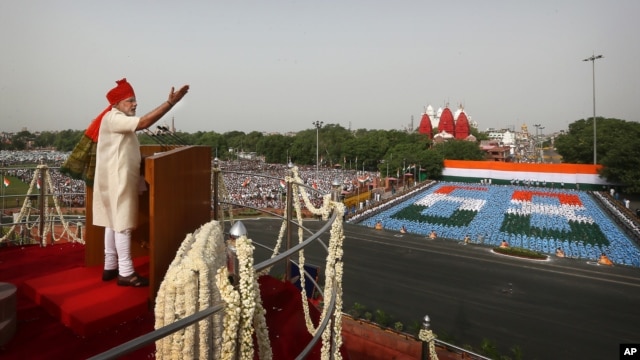 Amid the recent spotlight on sexual violence in India, the Indian prime minister has called on the country to pay more attention to how its raises its sons. In an Independence Day address to the nation, he also urged an end to communal violence as he vowed to defeat poverty.
Addressing the nation from the ramparts of the historic Red Fort in the Indian capital Friday, Prime Minister Narendra Modi said the country had been shamed by a series of rape cases.
He said while the law will take its course, it was also the social responsibility of parents to teach boys the difference between right and wrong.
Modi said parents ask daughters many questions when they go out, but never question sons about their actions. Pointing out that the rapist is someone’s son, he said parents should take care to stop boys from going down the wrong path.
Expressing dismay at the country’s skewed sex ratio, Modi said there should be greater recognition of women’s contribution to society. India has fewer girls than boys, a situation blamed on the practice of aborting girl fetuses by parents who prefer to have sons. It was Prime Minister Modi’s first Independence Day address to the nation since his Hindu nationalist Bharatiya Janata Party won power.
Some critics had voiced fears that a BJP government could fan a communal divide, citing the 2002 religious riots that wracked Gujarat state, which Modi governed before becoming prime minister.
In his speech, Modi appealed to people to end caste and communal violence in India, saying only unity and peace will make it possible for India to move ahead.
He said that if people look back, they will realize that such divisions have achieved nothing. He appealed to the country to leave behind all divisions based on caste, class, or community because they are stalling the country's growth.
The Indian leader also pledged to defeat poverty in a country where millions of people live on less than $2 a day. To help low-income people who have no access to banks, he announced a scheme for financial and insurance services for the poorest.
The Indian prime minister reiterated his vision for working with his neighbors, saying he needs cooperation from neighboring South Asian countries to jointly tackle poverty.
Modi also spoke of his surprise at encountering discord and infighting in government departments in the federal government, saying these were barriers to good governance, which he is trying to break.
Modi was swept into power on promises of bringing development and improving governance at a time when the previous government was wracked by corruption allegations and economic growth had stalled.
In an address on the eve of Independence Day, Indian President Pranab Mukherjee said there are signs of economic recovery.
Afghanistan seen running out of funds as poll deadlock drags on
The Afghan government is running out of funds despite an influx of millions of dollars in aid as a deadlock over who won the election drives a sharp decline in revenues, already suffering from the drawdown of thousands of foreign troops. The government faces difficulty paying salaries next month and has once more gone cap in hand to donors for help, a senior finance ministry official said on condition of anonymity, because of the sensitivity of the topic. Foreign powers have poured billions of dollars of aid into Afghanistan since the fall of the Taliban in 2001, but the country's next leader is unlikely to receive the same levels of financial support. The size of the gap to date is unclear, but the most recent data on the finance ministry's website shows domestic revenue in the first six months of 2014 fell 27.5 percent short of a target of 60.2 billion Afghanis ($1.1 billion). The ministry said current figures were not yet ready, although the senior official indicated the budget shortfall stands between $500 and $600 million. "If the election goes wrong we’ll not be able to manage, we will face huge problems beyond our control," said finance ministry spokesman Abdul Qadir Jaillani. Presidential candidates Abdullah Abdullah and Ashraf Ghani have been locked in a bitter struggle for power for months, over accusations of mass fraud and rivalry between their camps that has pushed the country to the brink of a civil war. "Our humble request from the finance ministry is for both candidates to reach an agreement to avoid a further decrease in revenue and the economy," Jaillani added. Jaillani denied salaries were at immediate risk, although a host of projects to build and maintain roads, schools and clinics had been suspended for lack of cash, although he warned that resources were running low. U.S. Secretary of State John Kerry has twice flown to Kabul in the past month to defuse the electoral crisis, but cracks are already showing in the framework agreement signed during his last visit a week ago. Abdullah was the clear winner in the first round held in April, while a preliminary count showed Ghani won the run-off vote in June. An audit of all eight million votes cast as part of an earlier deal is underway, but proceeding slowly. Outgoing President Hamid Karzai has set a deadline at the end of August to inaugurate his successor, but electoral officials fear the audit could drag on into September. A month into the process, only about a third of the votes have been audited and it is unclear what fraction marked for recount will be excluded from the final tally. NATO will discuss Afghanistan at a summit in Wales on Sept 4 and 5, and who, if anyone, will represent the country has become an increasingly pressing and awkward question as NATO seeks to bring the 13-year war to an end. On Monday it warned it would be forced to withdraw completely unless a new leader emerged soon. A second conference to decide on aid for other government and civilian needs is set for November. "These are vital conferences for our country," Jaillani said. "If the election is not resolved by then it will affect the outcome of the conferences and have a negative impact overall on the economy."BY JESSICA DONATI
Pakistan: PTI to call off protest after PM’s resignation
 Khyber Pakhtunkhwa Chief Minister Pervez Khattak has said that PTI will call off its planned sit-in only after Prime Minister Nawaz Sharif steps down.
Speaking to SAMAA, Chief Minister Khattak said ball is now in government’s court, adding protest will be over as soon as government accepts PTI’s demand.
To a question, he said that PTI has full confidence in the Supreme Court of Pakistan, but he questioned who could implement its recommendations.
He was confident that PTI’s target of gathering one million would be met.
Pakistan: Shah condemns stone pelting on Imran container
 Leader of the Opposition in the National Assembly Syed Khursheed Ahmed Shah said that the granting of permission to the Pakistan Tehreek-i-Insaf’s (PTI) Azadi march was a good step by the government which had averted the danger of confrontation.
The senior Pakistan Peoples Party (PPP) said that in his view Prime Minister Nawaz Sharif would not tender his resignation and added that his party could not support the demand for the premier’s resignation.
Shah also condemned the stone pelting on Imran Khan’s container and said that there should be no precedence of stone-pelting during political gatherings and rallies.
He further said there were reports that CCTV footage of those engaged in stone-pelting had been collected and added that action should be taken against any found guilty of hurling stones.
Clashes in Pakistan as stones thrown at opposition leader Khan
Clashes have broken out in Pakistan as two large protest rallies converge on the capital. Stones and shoes were thrown at the car of opposition leader Imran Khan, but he is reported to be uninjured.Clashes broke out in the Pakistani city of Gujranwala on Friday, as tens of thousands of protesters continue their march on the capital, Islamabad.
Stones and shoes hit the car of cricket-star-turned-politician Imran Khan as he led his supporters through the eastern city, but he remained uninjured, according to his aides. His spokeswoman, Aneela Khan, said the convoy he was heading was attacked by a mob, but that police had not intervened. She also said shots had been fired at Khan's car, but this has not been confirmed. Khan and firebrand cleric Tahir ul-Qadri are both leading protest processions toward Islamabad, where they plan to stage a sit-in until Prime Minister Nawaz Sharif resigns. The protesters set off on their march on Thursday from the eastern city of Lahore, and it is still unclear when they will reach Islamabad. High security Security in the capital is tight, and several main roads have been blocked by shipping containers and barbed wire in a bid to hinder the marchers. The protests are being fueled by dissatisfaction with the government's handling of the economy, amid high unemployment, spiralling crime rates and frequent power shortages. Some members of Sharif's ruling party have also suggested the protests may be backed by elements in the military, where many are angry at the prosecution of former army chief and president Pervez Musharraf for treason. The military is also at odds with the government about how to deal with a Taliban insurgency, with the army favoring military action while the government prefers peace talks. Electoral irregularities Khan, who leads the third largest legislative bloc in the country, is also protesting against alleged electoral irregularities in last year's polls. The polls saw Sharif elected in the first democratic transfer of power the country has known. Supporters of Qadri have been additionally angered by the police killing of several of his followers in Lahore in June and this month. Qadri puts the death toll at 22, while police have confirmed 11 deaths. Police say 2,000 of Qadri's supporters have also been arrested this month.Clashes broke out in the Pakistani city of Gujranwala on Friday, as tens of thousands of protesters continue their march on the capital, Islamabad. Stones and shoes hit the car of cricket-star-turned-politician Imran Khan as he led his supporters through the eastern city, but he remained uninjured, according to his aides. His spokeswoman, Aneela Khan, said the convoy he was heading was attacked by a mob, but that police had not intervened. She also said shots had been fired at Khan's car, but this has not been confirmed. Khan and firebrand cleric Tahir ul-Qadri are both leading protest processions toward Islamabad, where they plan to stage a sit-in until Prime Minister Nawaz Sharif resigns. The protesters set off on their march on Thursday from the eastern city of Lahore, and it is still unclear when they will reach Islamabad. High security Security in the capital is tight, and several main roads have been blocked by shipping containers and barbed wire in a bid to hinder the marchers. The protests are being fueled by dissatisfaction with the government's handling of the economy, amid high unemployment, spiralling crime rates and frequent power shortages. Some members of Sharif's ruling party have also suggested the protests may be backed by elements in the military, where many are angry at the prosecution of former army chief and president Pervez Musharraf for treason. The military is also at odds with the government about how to deal with a Taliban insurgency, with the army favoring military action while the government prefers peace talks. Electoral irregularities Khan, who leads the third largest legislative bloc in the country, is also protesting against alleged electoral irregularities in last year's polls. The polls saw Sharif elected in the first democratic transfer of power the country has known. Supporters of Qadri have been additionally angered by the police killing of several of his followers in Lahore in June and this month. Qadri puts the death toll at 22, while police have confirmed 11 deaths. Police say 2,000 of Qadri's supporters have also been arrested this month.
Clashes Erupt During Pakistan Anti Government March
Pakistan: Pomi Butt central character of 'PML-N led mob attack'
 Pakistan Tehreek-e-Insaf (PTI) Secretary General Jahangir Tareen said on Friday that Pomi Butt is the central character who led the attack on PTI convoy in Gujranwala earlier today, Dunya News reported.
Addressing a press conference along with Chief Minister Khyber Pakhtunkhwa Pervaiz Khattak among other PTI leaders, he said that PTI will lodge an FIR against Pomi Butt.
He demanded immediate opening of all the roads and pathways of Islamabad, adding that participants of the protest march should be given full opportunity to exercise democratic right.
PTI leader said that the government is panicking seeing the response in the protest march. He said he himself saw mob attacking PTI workers through stones from within the police vehicle.
Tareen said that PTI knows how to respond but he wouldn’t become part of a conspiracy. He said the authorities should not test their patience.
He said people from across the country are participating in the long march.
Jahangir Tareen warned the government not to play with fire.
Pakistan: IDPs to return once Zarb-e-Azb is over
http://www.pakistantoday.com.pk/Corps Commander Peshawar Lt. General Khalid Rabbani on Friday said that the return of IDPs of North Waziristan Agency to their homes will start soon after the completion of on-going operation against terrorists. Talking to the media in Bannu, he said most of areas of the agency have been cleared while operation is in progress to clear the rest. To a question, he said 31 troops have been martyred and 117 injured in Zarb-e-Azb operation against terrorists in North Waziristan Agency.
Pakistan Economy Suffers Because Of Ongoing Political Chaos In The Country
The political brawl in the country has severely dented country’s economy. The business community whines loss of: Rs1 billion already owing to the political crisis. It has been more than a week now, the rising political temperature has activated serious economic losses and steps taken by the Punjab government have added fuel to the fire. The Punjab government’s decision to limit the protests through roadblocks by placing containers has slowed down trading activities across the country. According to the Heavy Transport Association, around 1,200 containers were seized by the police during these days. The daily rent of each container has been estimated to Rs10, 000; consequently, the transporters are bearing losses of Rs12 million daily. - See more at: http://www.christiansinpakistan.com/pakistan-economy-suffers-because-of-ongoing-political-chaos-in-the-country/#sthash.OxJGL1oz.dpufThe current political upheaval causes great economic loss to Pakistan.

PPP leaders spend Aug 14 with IDPs in Bannu


Pakistan People Party Peshawar Leaders Syed Zahir Ali Shah, Zulfiqar Afghani and Salman orakzai spend 14th august Independence Day with IDPS in BannuThe Pakistan People’s Party on Thursday sent its leaders to Bannu to celebrate the Independence Day with the internally displaced people from North Waziristan Agency.
 Former PPP provincial president Zahir Ali Shah, who is the party’s focal person in the province to oversee relief and charity work for IDPs, visited field hospitals in Bannu and distributed sweets among displaced persons.
In a statement issued here, Zahir Ali Shah said on the instructions of the party leadership, he had visited displaced persons in schools in Bannu and got installed pressure pumps there at their request to ensure water supply to them.
He said he had tasked party activist Zahir Shah Toru with overseeing relief activities for IDPs in Bannu.
Currently, PPP MNA Khursheed Shah heads the party’s committee overseeing for relief work.
Zulfiqar said the committee had ordered the provision of 600 pedestal fans to a supplier.
He said fans would be distributed among IDPs during a function where Khursheed Shah and Zamarud Khan would be the chief guests.
The PPP leader said the committee had arranged the Benazir Dastarkhwan on the first Eid day and provided food to 2,000 IDPs at Mashar Daud Shah Masjid, the main mosque of Bannu.
He said the party had set up six-bed field hospitals, which were fully equipped and manned by doctors and paramedics.
Zulfiqar said the field hospitals provided free medicines to all IDPs, including women and children.
“Each filed hospital has a full-time ambulance. These field hospitals will be working there till the end of the military operation in North Waziristan and will be relocated to the tribal region after repatriation of tribesmen,” he said.
He said the committee had so far spent Rs8 million on relief work.
The PPP leader said the Bannu commissioner had sought Rs30 million to repair 25 tubewells for IDPs but the party managed to do the repairs for a small amount of money.
The minority Pakistani
A fellow citizen and a friend, a Christian by faith, had to leave Pakistan and seek asylum as he and his family were threatened by a militant organisation. The departments and agencies responsible for the safety of citizens and for maintaining law and order across Pakistan had acknowledged their inability and lack of willingness to protect this friend and his family. He has now settled in another country. And he feels more of a citizen there. Another Pakistani friend, an Ahmadi, having lost his job because of religious bigots in his office, finally moved his family to Canada. I was talking to him recently and he mentioned that he lived with discrimination almost throughout his life in Pakistan and this was not only in the form of the two beatings he received at the hands of religiously-inspired mobs. In fact, he was referring to the more corrosive effects of the everyday discrimination that he had to face. Finally, when he could not see any future for himself and especially for his children, he migrated. Over the last couple of decades I have seen many friends from minority groups of one hue or another (Christian, Shia, Ahmadi, Baloch, Hindu) leave Pakistan and not come back. Some went for education and never returned, others migrated by applying via the ‘skilled people’ class, while some even had to seek asylum due to one issue or another at ‘home’. When I talk to them now, few seem to have gone willingly and all of them have one thing in common: they were forced to leave due to either direct or indirect persecution by dominant religious and/or nationalist groups. Some have harrowing tales to tell. But all of them have plenty of stories about how they faced discrimination while even interacting with ordinary citizens or institutions of the state in their everyday lives. The latter, in many cases, more than the former, has left deeper scars. We did a few Google searches on incidents involving minorities and reported in mainstream English-language newspapers in Pakistan over the last couple of years. Even though these searches were not very rigorous as they did not constitute all the incidents reported in all the papers, the results tell a very sad story. And here we are not talking of the incidents that are not reported in the papers at all or instances of everyday discrimination. We came up with hundreds of reports of incidents where an individual or a group of people was involved and their being a member of a minority group was at least a partial reason for their involvement. There were more than 80 incidents involving Shias (targeted attacks were the most common cause in their death) and more than 70 incidents involving Christians (a number of cases pertained to blasphemy charges). Many of the incidents involved not just one person but a family or group belonging to a certain community as exemplified by the violence perpetrated on Hazara pilgrims), leading to multiple fatalities in one incident. Christian Pakistanis constitute only 1pc to 2pc of the country’s population; however, the 70-plus incidents in which they feature tell the tragic story of how some Pakistanis are being treated here and how the state is failing to protect its citizens. There have been reports on these issues by various NGOs and rights groups, while civil society raises the issue and protests after every incident. Even the courts have taken notice of some of the larger issues. But, on the ground, little seems to have changed or is changing. In fact, the social, political and economic space for these Pakistani citizens seems to be narrowing all the time. Ahmadis have been hounded out of jobs; they have been booked for ‘preaching’ their religion; they have been asked to remove Quranic verses from their places of worship; some have been denied burial space in graveyards. And many Christians and Hindus continue to be converted by force to Islam; and threats not only to the members of these communities but to any who raise their voice in support of their rights as citizens, have become a lot more common. We clearly need to do more to arrest and reverse the trend. There is a more corrosive element that does not get as much attention as larger incidents. Slowly, but surely, extreme views that started from the fringes of our society have become the mainstream mode of thinking. This has been less noticed and has been less commented on. And there is less momentum to counter this as well. People mention that wearing black kurtas is not a good idea anymore, and wearing Naad-i-Ali bracelet is a sure way of inviting trouble. A goatee is associated with being Ahmadi, and going to graves or mazars with Barelvis. All of these, and many similar signs, are ‘deviations’ from the mainstream and are not tolerated well. I remember a time in Pakistan when the frontier on social space was a lot wider. The debate was on sleeves or no sleeves, dupatta or no dupatta, beard or no beard rather than on the colour and size of the hijab, or the shape and length of the beard. Narrowing of any space hits the ‘deviants’ the hardest. Should we just ask all minorities to leave Pakistan? If not, it is not enough to just allow them to exist on the fringes of society and deny them the rights due to citizens. But this, given the entrenched nature of discrimination in our society, cannot be the responsibility of state institutions alone. All citizens have to stand up to ensure rights for all and have to take the risk of countering the dominant, narrow and bigoted narrative currently prevalent in our society.By Faisal Bari
Pakistan: Operation concluded at Quetta Airbase, 10 militants killed
 At least 10 militants were killed and 11 security personnel were injured during the operation early on Friday at Samungli and Khalid airbases in Quetta.
The militants had attacked the Samungli and Khalid airbases in Quetta. The security personal have also arrested one injured militant and shifted him to an unknown place for interrogation.
The exchange of fire continued between security forces and militants for four houses, where attackers had also fired seven rockets that landed in the premises of the two airbases.
Describing the incident , Station House Officer Airport Police Athar Rasheed said, “The militants were hiding in a Nalla Known as airport Nalla and wanted to precede either Quetta International Airport or Samungli Airbase for a deadly attack.” Security forces from airbase opened fire after they spotted the armed men and their suspicious movement which were around half kilometer from the base.
The armed men opened fire on Anti-Terrorism Force (ATF) and Frontier Corps (FC) when they tried to get closer to the attackers.
Quetta Police said they were informed by Pakistan Air force about the presence of terrorists calming heading towards airport and airbase which are locked outskirts Quetta. Frontier Corps (FC) and Anti-Terrorism Force (ATF) cordoned off the area and began operation against terrorists.
According to the Balochistan police Chief Muhammad Umlaish the forces had concluded the operation in Quetta. In the operation 10 militants were killed and 11 security personnel were injured which lasted for more than four hours. All injured shifted to the Civil Military Hospital in Quetta cantonment.
Muhammad Umlaish said that 11 rocket launchers were recovered from the Khalid airbase while a huge quantity of arms and ammunition was recovered from the Samungli airbase. “All entry and exit points leading to the airport and airbases are being strictly guarded,” He added
“All dead terrorists seem to be Uzbeks,” said Home Minister Balochistan Sarfaraz Bugti
Dawn, a leading English newspaper in Pkistan has reported that the Ghalib Mehsud faction of the outlawed Tehrik-i-Taliban Pakistan (TTP) claimed responsibility for the attack on the Samungli and Khalid airbases in Quetta in which 10 militants were killed by security forces. Ghalib Mehsud is the leader of Fidayeen Islam which is the suicide wing of the proscribed TTP.
North Waziristan IDPs stage protest in Peshawar
Dozens of internally displaced persons (IDPs) from North Waziristan staged protest rally outside the Peshawar Press Club on Thursday, saying they were observing the Independence Day of Pakistan as ‘black day’ and demanded end to military operation and early repatriation to their hometowns.
Having association with Faqir Ipi Tanzeem (organisation), the protesters chanted ‘Waziristan Zindabad’ (Long live Waziristan) and said they were homeless within their homeland. “How we can celebrate the Independence Day when we are away from our homes and living a refugee life in our own country,” said Malik Mohammad Noor, who was leading the protest rally.
He said that the security forces had claimed to have cleared most of their areas from the militants, but still they were not allowed to go back to their homes in Mirali, Miranshah and other tehsils of North Waziristan.
He said majority of the IDPs from North Waziristan had taken shelter in schools and other government buildings in Bannu district but now they were told to leave these buildings within 10 days. “Where will we go now? We want to go back to our own homes in Waziristan,” Malik Mohammad Noor added.
Another IDP from North Waziristan, Nasir Jamal, told this scribe that they were observing August 14 as black day to compel the government to let them go home.“We have left all our belongings there and God knows what happened to our grains, standing crops and other belongings,” he said, questioned how they could celebrate Independence Day while being homeless.
He said they were not against the security forces or military operations but added that if their areas had been cleared from militants, why the government was reluctant to send them back. Another displaced person from Miranshah, Ali, said that instead of announcing ration and cash amount, the government should allow the displaced people to return to their homes in North Waziristan.
“We have learnt that our homes and shops have been either damaged or destroyed during the military operation,” he said, adding that the government should compensate the affected people, rebuild infrastructure and rehabilitate the victims.
The protestors peacefully dispersed after chanting slogans in favour of Waziristan. However, none of them raised slogans against the military operation or Pakistan on the Independence Day.
Video & Report-- Punjab's Law minister Rana Mashood’s ‘corruption scandal’ surfaces

Chief Minister Punjab Getting bribes through... by arynews In a shocking revelation that rocked the political atmosphere of the country, Law Minister Punjab Rana Mashood was seen demanding a bribe from a fraudulent immigration official via telephone, in a video footage aired on ARY News program ‘Khara Sach’ hosted by Mubashir Lucman. The minister was caught in a CCTV footage demanding bribe from Asim Malik, an immigration consultant. Lucman told that Malik was already charged with Rs 13 billion fraud. He deceived several people on pretext of sending them abroad and plundered their money, Lucman added. In a video, Mashood is seen seeking bribe from Malik purportedly on behalf of the chief minister Punjab. Lucman disclosed that Malik had already 180 cases registered against him with FIA, while Interpol had also issued red warrant against him. Complete conversation can be heard in a video below.
Pakistan: Shame On Punjab Judiciary: Court Order
 The Lahore High Court’s decision dubbing the Inqilab and Azadi marches unconstitutional undermines the judiciary and everything that the courts and the principles of justice are supposed to uphold. After Gullu Butt’s untimely bail two days before the march was to begin, the high court order has further reduced the credibility of the legal system. If anything, it reflects evermore, the panic that has defined government policy in the last week and it is difficult to separate government pressure from the court order. The real question to ask is: What has the court got to do with an entirely political situation? The people’s right to protest a sitting government is one of the central tenants of democracy. Democratic protests anywhere in the world call for PM and government resignations when situations demand it. David Cameron faced the brunt of the UK public’s wrath over education policy, and Tony Blair was repeatedly asked to resign after the Iraq debacle. There are few coherent things coming to the fore of this situation, but let us be clear that demanding the departure of a sitting government is a constitutional and democratic right. The premise that the PML-N stalwarts are basing their entire counter-narrative on, is misleading and purely speaking, wrong. The protest, up till the writing of this editorial, has remained well within the ambit of the law.
There is no denying that both marches have many real and ideological flaws, but that factor becomes irrelevant when the actions of the government and judiciary are this circumspect. To top it off, Chaudary Nisar’s recent explanation claimed that the government’s heightened concern over the protests was because the PTI did not file an application with the Islamabad district administration for its march. The country is now honestly expected to believe that the government unleashed a madness of unheard-of proportions upon the public for a bit of paperwork. The greater burden of responsibility lies, as always, with the sitting government. Of that burden, with or without bringing the judiciary into it, there can be no absolving itself.
Pakistan: Shots fired at PTI chief’s container, Imran not injured:
Imran Khan's spokeswoman Aneela Khan said the PTI chief was not injured but his vehicle was hit by gun shots. The convoy was also attacked in Gujranwala by a stone-throwing mob and police did not intervene, she said. Television pictures showed local people tearing up posters featuring Imran’s party and clashing with his supporters.— Reuters
Pakistan: ‘Revolution’ knocking at Capital gates!
Thousands of protesters led by cricketer-turned- politician Imran Khan and preacher Allama Dr Tahirul Qadri are likely to enter Islamabad today (Friday), aiming to bring down the government they accuse of stealing last year’s election and for being involved in corrupt and undemocratic practices. The looming confrontation has renewed the political role of the military, casting some doubt on the strength of democratic institutions in a nuclear-armed nation that has seen several coups and has been ruled by the army for half its history. Khan’s ‘Azadi’ March began on Thursday evening from Lahore, the provincial capital of Punjab and the power base for Prime Minister Nawaz Sharif. The march is being carried out in cars and buses. Khan’s following was bolstered by Qadri, who is leading thousands of followers in a separate such march, named Inqilab March on the road from Lahore to Islamabad. Leaderships of both the parties have assured the government that the protests will be peaceful. The 185-mile journey normally takes about five hours by vehicle, but with the demonstrators inching along, they aren’t likely to reach the capital before Friday morning. ‘NOTHING BUT PM’S RESIGNATION: “You have to fight for freedom, you have to snatch freedom,” Khan, the chief of opposition Pakistan Tehreek-e-Insaf (PTI), told a massive gathering of his supporters as his rally made an hour-long stop at Faisal Chowk, in front of the Punjab Provincial Assembly. “Mian Sahib, I’m coming to Islamabad and I won’t be leaving until you step down from office,” Khan said, addressing Prime Minister Sharif. The PTI chief told his charged supporters that he won’t settle for anything less than the PM’s resignation, installation of an interim non-political government to hold fresh elections in the country, and dissolution of the incumbent Election Commission of Pakistan. Khan said that he was setting out to throw Sharif out of power “to pave the way for true democracy as the current system was nothing less than a monarchy”. The PTI chief told his supporters from Sindh and Balochistan that he had hadn’t been able to make frequent visits their provinces because he was “busy fighting a battle in Punjab”. However, he assured them that he would be spending more time with them “after coming into power once his party sweeps elections across the country”. The PTI chief also said that his children and relatives won’t be imposed on the people. “I’ve won several fetes for Pakistani cricket and now I’m going to lead this nation to a historic victory over a corrupt system,” he said. QADRI RESOLVED TO REACH CAPITAL: Meanwhile, talking to a private news channel, Pakistan Awami Tehreek (PAT) Chairman Dr Tahirul Qadri said that his followers will march to Islamabad without creating any law and order situation. “Our demands are clear and the participants of my Inqilab March will not return until the fall of the Sharif govt,” Qadri said from his bullet-proof SUV.
Pakistan: PTI, PAT allowed to march on GHQ’s message
MIAN ABRAR
The Pakistan Muslim League-Nawaz (PML-N) government Thursday allowed the Pakistan Tehreek-e-Insaf (PTI) and Pakistan Awami Tehreek (PAT) to take out their long marches from Lahore towards Islamabad after a “subtle message” from the General Headquarters (GHQ), supported by the political leadership led by Mutahidda Qaumi Movement (MQM), Pakistan Today has learnt reliably.However, the PML-N government has devised a strategy to counter mass mobilisation of political workers by both the parties, sources said. Under the planned strategy, though the GT Road would be kept opened for the main procession of the long march but all link roads would be blocked and hurdles would be created in way of the protesters to ensure that PTI and PAT are not in a position to mobilise the people on a large scale and the government can prove to the media that both parties have failed to muster desirable political support in the federal capital. “The Punjab Police will be blocking the protesters in small cities and towns and top workers of both the parties would be arrested. There are many who have been arrested and sent on judicial remand, who could have motivated the workers to ensure mass mobilisation,” a source told Pakistan Today. “Now we will be able to prove to the nation that the PTI and PAT have failed to gather two million supporters in the federal capital which both the parties had claimed.”
GEN SHARIF PLAYED A ROLE:An informed source, seeking anonymity, told Pakistan Today that Chief of Army Staff (COAS) General Raheel Sharif had proposed the government to avoid any step which could incite violence. “During his meeting with Interior Minister Chaudhry Nisar Ali Khan and Punjab Chief Minister Shahbaz Sharif, Gen Raheel advised the government to avoid confrontation with any of the opposition party supporters which may end up in massive bloodshed,” the source said. The source added that during the meeting, Gen Raheel also shared intelligence reports which suggested that both the protesting parties had made “elaborate preparations” for the march and blocking any of the two parties could create a major law and order situation. The source said that following the meeting, both the ministers reported back to the prime minister and informed him about the suggestions of the army chief, following which the government decided to allow long marches. “Resultantly, Nisar during his press conference on Tuesday night, tried to dodge the media and said that the government would implement the Lahore High Court verdict by disallowing protestors for the march,” the source added.
POINTS HAD TO BE SCORED:Later on, political players also jumped into the fray to defuse the tiff between the marching parties and government and the reconciliation process was led by Mutahidda Qaumi Movement (MQM) leader Altaf Hussain while the process was facilitated by Punjab Governor Chaudhry Mohammad Sarwar who has better relationship with Dr Tahirul Qadri, while Nisar contacted Khan and persuaded him to guarantee a peaceful march, the source said. “Imran Khan informed the interior minister that his march would be peaceful and he would guarantee if his workers are not attacked or blocked.” The source added that after Khan’s assurance, it was decided that PTI would be given a free hand to carry forward the long march but the PTI would not be allowed to gather so much strength which could put the government in a tight corner.
Subscribe to:
Posts (Atom)