 The main opposition, Pakistan Peoples Party (PPP) on Friday strongly opposed the government’s decision of handing over the federal capital to the army under Article 245 of the Constitution to handle the law and order situation.
The reaction came hours after Interior Minister Chaudhry Nisar Ali Khan told the media that his ministry under Article 245 of the Constitution has sought the Army's services for maintaining law and order in Islamabad for a period of three months.
“The decision is pregnant with serious consequences for the people and the country as it means not only failure of the civil administration but also total suspension of the jurisdiction of the high courts. Worst still, in practical terms it also means setting up of military courts which cannot be permitted,” PPP spokesperson Senator Farhatullah Babar said in a statement.
He said the PPP has always opposed invoking Article 245 for calling Army in aid of civil power whether it was in Karachi or other parts of the country.
“The situation in Islamabad is not any worse than that in any other part of the country to warrant inviting security establishment to fix it by vesting in them powers beyond judicial oversight,” he said.
The PPP spokesman said, “The government fails to recognise that if today it is Islamabad tomorrow Karachi, Peshawar, Quetta, Lahore, indeed the whole country, may have to be handed over to the army under Article 245 and practically dispense with the high courts.”
“Bad as it already is the human rights situation in the country will get even worse if the doors of high courts are shut on the citizens,” he added.
He said that the decision to hand over the federal capital to the Army will also send disturbing signals to the world about the prevailing security situation in Pakistan.
“The decision reflects the penchant of PML-N government to lean on the security establishment for everything, be it meter reading or tracing of ghost schools or appointing monitors and is most unfortunate.”
“And let us not forget the security apparatus once called in aid of civil power under this Article might want to linger on even after it is no longer needed. No one wants to relinquish power or abdicate a position of authority and influence in which their actions are not called into question in the courts.”
Farhatullah Babar said it will further distort the already distorted civil-military equation. He reminded the PML-N government of the Charter of Democracy (CoD).
“Four articles of the CoD (articles 32 to 36) call for concerted actions to address distortions in civil-military relations. The decision to hand over Islamabad to the army will, instead of correcting the existing huge imbalance, further tilt the balance against the civilian, political and judicial structures of the country,” he said.
The government will do well to take a leaf from the past before venturing into this adventurism, he said.
Earlier, sources had said that the government was mulling over invoking Article 245 of the Constitution to summon the Army in all major cities of the country.
Sources had added that the ongoing Zarb-i-Azb military operation in North Waziristan was also being carried out under the same constitutional article.
Given below are details of Article 245 of the Constitution which pertains to the functions Pakistan's Armed forces, taken from the National Assembly website:
(1) The Armed Forces shall, under the directions of the Federal Government, defend Pakistan against external aggression or threat of war, and, subject to law, act in aid of civil power when called upon to do so.
(2) The validity of any direction issued by the Federal Government under clause (1) shall not be called in question in any court.
(3) A High Court shall not exercise any jurisdiction under Article 199 in relation to any area in which the Armed Forces of Pakistan are, for the time being, acting in aid of civil power in pursuance of Article 245: Provided that this clause shall not be deemed to affect the jurisdiction of the High Court in respect of any proceeding pending immediately before the day on which the Armed Forces start acting in aid of civil power.
(4) Any proceeding in relation to an area referred to in clause (3) instituted on or after the day the Armed Forces start acting in aid of civil power and pending in any High Court shall remain suspended for the period during which the Armed Forces are so acting.
The main opposition, Pakistan Peoples Party (PPP) on Friday strongly opposed the government’s decision of handing over the federal capital to the army under Article 245 of the Constitution to handle the law and order situation.
The reaction came hours after Interior Minister Chaudhry Nisar Ali Khan told the media that his ministry under Article 245 of the Constitution has sought the Army's services for maintaining law and order in Islamabad for a period of three months.
“The decision is pregnant with serious consequences for the people and the country as it means not only failure of the civil administration but also total suspension of the jurisdiction of the high courts. Worst still, in practical terms it also means setting up of military courts which cannot be permitted,” PPP spokesperson Senator Farhatullah Babar said in a statement.
He said the PPP has always opposed invoking Article 245 for calling Army in aid of civil power whether it was in Karachi or other parts of the country.
“The situation in Islamabad is not any worse than that in any other part of the country to warrant inviting security establishment to fix it by vesting in them powers beyond judicial oversight,” he said.
The PPP spokesman said, “The government fails to recognise that if today it is Islamabad tomorrow Karachi, Peshawar, Quetta, Lahore, indeed the whole country, may have to be handed over to the army under Article 245 and practically dispense with the high courts.”
“Bad as it already is the human rights situation in the country will get even worse if the doors of high courts are shut on the citizens,” he added.
He said that the decision to hand over the federal capital to the Army will also send disturbing signals to the world about the prevailing security situation in Pakistan.
“The decision reflects the penchant of PML-N government to lean on the security establishment for everything, be it meter reading or tracing of ghost schools or appointing monitors and is most unfortunate.”
“And let us not forget the security apparatus once called in aid of civil power under this Article might want to linger on even after it is no longer needed. No one wants to relinquish power or abdicate a position of authority and influence in which their actions are not called into question in the courts.”
Farhatullah Babar said it will further distort the already distorted civil-military equation. He reminded the PML-N government of the Charter of Democracy (CoD).
“Four articles of the CoD (articles 32 to 36) call for concerted actions to address distortions in civil-military relations. The decision to hand over Islamabad to the army will, instead of correcting the existing huge imbalance, further tilt the balance against the civilian, political and judicial structures of the country,” he said.
The government will do well to take a leaf from the past before venturing into this adventurism, he said.
Earlier, sources had said that the government was mulling over invoking Article 245 of the Constitution to summon the Army in all major cities of the country.
Sources had added that the ongoing Zarb-i-Azb military operation in North Waziristan was also being carried out under the same constitutional article.
Given below are details of Article 245 of the Constitution which pertains to the functions Pakistan's Armed forces, taken from the National Assembly website:
(1) The Armed Forces shall, under the directions of the Federal Government, defend Pakistan against external aggression or threat of war, and, subject to law, act in aid of civil power when called upon to do so.
(2) The validity of any direction issued by the Federal Government under clause (1) shall not be called in question in any court.
(3) A High Court shall not exercise any jurisdiction under Article 199 in relation to any area in which the Armed Forces of Pakistan are, for the time being, acting in aid of civil power in pursuance of Article 245: Provided that this clause shall not be deemed to affect the jurisdiction of the High Court in respect of any proceeding pending immediately before the day on which the Armed Forces start acting in aid of civil power.
(4) Any proceeding in relation to an area referred to in clause (3) instituted on or after the day the Armed Forces start acting in aid of civil power and pending in any High Court shall remain suspended for the period during which the Armed Forces are so acting.
Saturday, July 26, 2014
Pakistan: PPP lashes out at govt for invoking Article 245
The main opposition, Pakistan Peoples Party (PPP) on Friday strongly opposed the government’s decision of handing over the federal capital to the army under Article 245 of the Constitution to handle the law and order situation.
The reaction came hours after Interior Minister Chaudhry Nisar Ali Khan told the media that his ministry under Article 245 of the Constitution has sought the Army's services for maintaining law and order in Islamabad for a period of three months.
“The decision is pregnant with serious consequences for the people and the country as it means not only failure of the civil administration but also total suspension of the jurisdiction of the high courts. Worst still, in practical terms it also means setting up of military courts which cannot be permitted,” PPP spokesperson Senator Farhatullah Babar said in a statement.
He said the PPP has always opposed invoking Article 245 for calling Army in aid of civil power whether it was in Karachi or other parts of the country.
“The situation in Islamabad is not any worse than that in any other part of the country to warrant inviting security establishment to fix it by vesting in them powers beyond judicial oversight,” he said.
The PPP spokesman said, “The government fails to recognise that if today it is Islamabad tomorrow Karachi, Peshawar, Quetta, Lahore, indeed the whole country, may have to be handed over to the army under Article 245 and practically dispense with the high courts.”
“Bad as it already is the human rights situation in the country will get even worse if the doors of high courts are shut on the citizens,” he added.
He said that the decision to hand over the federal capital to the Army will also send disturbing signals to the world about the prevailing security situation in Pakistan.
“The decision reflects the penchant of PML-N government to lean on the security establishment for everything, be it meter reading or tracing of ghost schools or appointing monitors and is most unfortunate.”
“And let us not forget the security apparatus once called in aid of civil power under this Article might want to linger on even after it is no longer needed. No one wants to relinquish power or abdicate a position of authority and influence in which their actions are not called into question in the courts.”
Farhatullah Babar said it will further distort the already distorted civil-military equation. He reminded the PML-N government of the Charter of Democracy (CoD).
“Four articles of the CoD (articles 32 to 36) call for concerted actions to address distortions in civil-military relations. The decision to hand over Islamabad to the army will, instead of correcting the existing huge imbalance, further tilt the balance against the civilian, political and judicial structures of the country,” he said.
The government will do well to take a leaf from the past before venturing into this adventurism, he said.
Earlier, sources had said that the government was mulling over invoking Article 245 of the Constitution to summon the Army in all major cities of the country.
Sources had added that the ongoing Zarb-i-Azb military operation in North Waziristan was also being carried out under the same constitutional article.
Given below are details of Article 245 of the Constitution which pertains to the functions Pakistan's Armed forces, taken from the National Assembly website:
(1) The Armed Forces shall, under the directions of the Federal Government, defend Pakistan against external aggression or threat of war, and, subject to law, act in aid of civil power when called upon to do so.
(2) The validity of any direction issued by the Federal Government under clause (1) shall not be called in question in any court.
(3) A High Court shall not exercise any jurisdiction under Article 199 in relation to any area in which the Armed Forces of Pakistan are, for the time being, acting in aid of civil power in pursuance of Article 245: Provided that this clause shall not be deemed to affect the jurisdiction of the High Court in respect of any proceeding pending immediately before the day on which the Armed Forces start acting in aid of civil power.
(4) Any proceeding in relation to an area referred to in clause (3) instituted on or after the day the Armed Forces start acting in aid of civil power and pending in any High Court shall remain suspended for the period during which the Armed Forces are so acting.
Friday, July 25, 2014
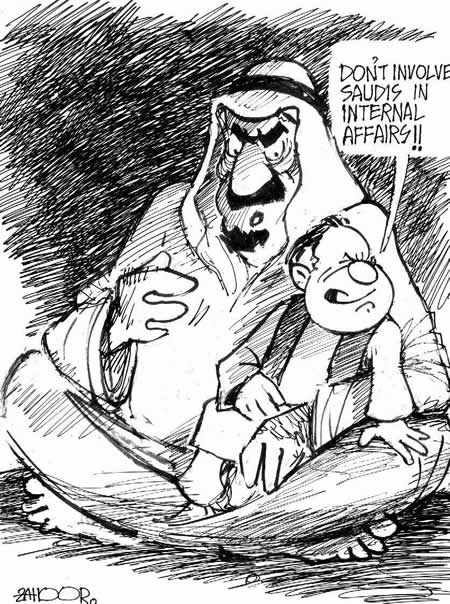
Bahrain Regime Targets Opposition -- and the United States
After nearly three years in the job, the much-vilified U.S. Ambassador to Bahrain, Thomas Krajeski, will be replaced - if the U.S. Senate agrees to his confirmation - by William Roebuck, a middle east specialist at the State Department. After stints in embassies in Libya, Iraq, Syria and Israel, a spell with close U.S. ally Bahrain might seem like a relatively cushy number, but being American ambassador to Bahrain has become a nightmare job. Krajeski and his staff have been regularly attacked in media loyal to the Bahrain government. Last year the cabinet, which includes the Prime Minister and the Crown Prince, approved a proposal to "put an end to the interference of U.S. Ambassador Thomas Krajeski in Bahrain's internal affairs." One of the typical components of a U.S. Ambassador's job is meeting with the country's civil society and opposition groups. In Bahrain it's not that straightforward. Earlier this month Tom Malinowski, U.S. Assistant Secretary of State for Democracy, Human Rights and Labor, was expelled from the country after meeting leading figures of al Wefaq, a prominent opposition group. The Bahrain state news agency said Malinowski was unwelcome and had to immediately leave the country, due to "his interference in its internal affairs." In June last year the Bahrain government passed a bizarre law--not enforced until the Malinowski incident--requiring political groups to secure government permission in advance of meetings with foreign diplomats in Bahrain and abroad, and for a Foreign Ministry representative to be present. This would be Roebuck's first ambassadorial post, and how he will engage with a broad spectrum of Bahraini society without "interfering in internal affairs" or violating this law is hard to fathom. Members of Congress are beginning to wonder if it is time to reexamine the U.S.-Bahrain relationship. On July 18, a bipartisan group of 18 members wrote to the King of Bahrain pointing out that "Malinowski was in the country doing exactly what high-level diplomats are called on to do; meet with members of the government, opposition parties and members of the public to gain a deeper understanding." Bahrain is behaving more like a volatile adversary than a reliable ally to the United States. This week Rep. Hank Johnson (D-GA), who serves on the influential Armed Services Committee, suggested that "the Government of Bahrain is increasingly proving itself to be undependable and erratic - putting the long-term viability of our [Naval Base] presence in the country at risk." The government's treatment of opposition group al Wefaq in recent weeks is an important feature of this "undependable and erratic" behavior. Although other opposition leaders remain in prison, al Wefaq has been the government's main negotiating partner in a series of cosmetic political talks since widespread unrest broke out three years ago during street protests for democracy in the kingdom. But now the two leaders of al Wefaq who met Malinowski have been charged with "violating the 2005 Law for Political Societies," and this week the Bahrain authorities went to court to seek the suspension of the al Wefaq group for three months "until it rectifies its illegal status following the annulment of four general assemblies for lack of a quorum and the non-commitment to the public and transparency requirements for holding them." According to the local press, more opposition groups are to be similarly targeted. Every day seems to bring more news of the Bahrain regime moving against the opposition or against the United States. Washington needs to take a hard look at why it continues to arm and train Bahrain's military, and whether it's finally time to fundamentally change its relationship with the country's ruling family.Brian Dooley
HRW blames Kiev army for indiscriminately killing civilians with missiles
 The Ukrainian army is using indiscriminate Grad missiles to attack densely populated areas in Donetsk, which violates international humanitarian law, Human Rights Watch alleged. It also blamed militia for taking cover in those areas.
The rights organization confirmed four rocket attacks by the Ukrainian military, or Kiev-allied paramilitary, on residential areas in or near Donetsk, which resulted in at least 16 civilian deaths and many more wounded. The attacks were carried out with Grad multiple rocket weapon systems, highly indiscriminate weapons that cannot be used against populated areas.
“Although Ukrainian government officials and the press service of the National Guard have denied using Grad rockets in Donetsk, a Human Rights Watch investigation on the ground strongly indicates that Ukrainian government forces were responsible for the attacks that occurred between July 12 and 21,” the group said on Friday.
The Ukrainian army is using indiscriminate Grad missiles to attack densely populated areas in Donetsk, which violates international humanitarian law, Human Rights Watch alleged. It also blamed militia for taking cover in those areas.
The rights organization confirmed four rocket attacks by the Ukrainian military, or Kiev-allied paramilitary, on residential areas in or near Donetsk, which resulted in at least 16 civilian deaths and many more wounded. The attacks were carried out with Grad multiple rocket weapon systems, highly indiscriminate weapons that cannot be used against populated areas.
“Although Ukrainian government officials and the press service of the National Guard have denied using Grad rockets in Donetsk, a Human Rights Watch investigation on the ground strongly indicates that Ukrainian government forces were responsible for the attacks that occurred between July 12 and 21,” the group said on Friday.
Kiev routinely denies causing civilian deaths in its conflict with armed militias in the east of the country and put the blames for such deaths on the militias themselves. But the attack sites investigated by HRW clearly point to the Ukrainian military. “The attacks’ proximity to the front line also makes it unlikely, and in some cases impossible, that insurgent forces were responsible for the attacks. In two of the attacks, rockets hit on or near insurgent bases and checkpoints at the same time as they hit residential areas, indicating government forces were responsible,” the report said.
HRW didn’t report any evidence that militias were responsible for any Grad attacks on civilian-populated areas, but warned that they should avoid operating in those areas. The group also blamed them for failing to keep civilians out of harm’s way. “Insurgent forces have failed to take all feasible precautions to avoid deploying in densely populated areas, thereby endangering civilians in violation of the laws of war,” it said. “In one case, separatist forces moved their base closer to the center of the town when Grad rockets struck their base and a nearby residential area. Violations of the laws of war by one side to the conflict do not justify violations by the other side.”
Belligerent parties in Ukraine must keep in mind that they are responsible for keeping their hostilities within international humanitarian law, HRW warned. “Ukrainian authorities should order all their forces, including volunteer forces, to immediately stop using Grads in or near populated areas, and insurgent forces should avoid deploying in densely populated areas,” said Ole Solvang, senior emergencies researcher at Human Rights Watch. “Commanding officers on all sides should recognize that one day they could face legal consequences for their actions.” Earlier the International Red Cross officially declared the hostilities in eastern Ukraine a civil war, which opened the way for prosecuting atrocities committed there in international courts.Grad is a Russian-made rocket launcher used by the Ukrainian military, which fires volleys of unguided missiles from multiple tubes mounted on a rack. The weapon is meant to cause massive damage to enemy positions, with individual rocket capable of killing unprotected soldiers in a radius of up to 28 meters from impact. Kiev troops are continuing their attacks on cities held by militia forces, using their aviation and heavy artillery to barrage defense forces. The outgunned militias try to compensate by maneuvering and taking cover among city buildings. The army is hesitant to advance into hostile urban areas, where their superiority in armor and heavy weapons would be irrelevant.
Taliban Kill 14 Shiites in Afghanistan Road Attack

Taliban insurgents halted minibuses in western Afghanistan, identified 14 Shiite passengers and shot them dead by the side of the road overnight Friday, an official said. The busses were traveling from Kabul and carrying around 30 passengers, many of whom had gone to the capital to shop ahead of the holiday marking the end of the Muslim holy month of Ramadan, said Sayed Anwar Rahmati, the governor of the western Ghor province, where the attack took place. After questioning the passengers, the Islamic militants identified 14, including three women, as Hazara Shiites. The insurgents then bound the passengers' hands, led them away and shot them, Rahmati said, adding that the other passengers were released. The dead included a couple who were engaged and two relatives travelling with them, he said. The Taliban, like other Sunni extremist groups, view the country's minority Shiite community as apostates, and have targeted Hazaras in the past with suicide bombings and other attacks.
'Mini-Marshal Law': Pakistan Hands Army Raft of Powers

Pakistan's mighty military has been handed a raft of powers that critics say will deprive citizens of their freedom to challenge authority. The move "empowers the army to implement a mini martial law and suspends the fundamental rights of citizens," lawyer and talk show host Fawad Chaudhry told NBC News on Friday. "It doesn't let the courts, or anyone else for that matter, challenge anything the soldiers do," added the former adviser to the ex-military dictator Pervez Musharraf. An official from Prime Minister Nawaz Sharif's office countered that enforcing the "Aid to Civil Power" clause from the constitution will allow the army to better help the government keep order. "This may include sensitive and strategic government buildings and installations," said the official who spoke on the condition of anonymity. A senior military official told NBC News that the deployment was broader. "This is to preempt retaliation and blowback from our ongoing operation in Waziristan... This [law] just gives us legal cover for that duty," he said, referring to an ongoing operation aimed at routing militants on the Afghan border.
Pakistan: Asif Ali Zardari pays glowing tributes to youngest pilot Haris Suleman
Former President Asif Ali Zardari has expressed profound grief and shock over the death in air crash of the 17 year old American- Pakistani pilot Haris Suleman along with his father Babar Suleman the other day. Both Haris and his father were killed when their plane crashed in the sea from Hawai to California as the young pilot was seeking to set a world record in circling the world in a single engine aircraft in thirty days to raise money for the education of disadvantaged youth in Pakistan. Young Haris has died along with his father in the pursuit of a noble cause namely, to equip the underprivileged youth of the country with the steel armor of education, the former President said in a condolence message. ‘In dying for the cause of education Haris innocently made a dramatic political statement that change and revolution in the country of his origin will come about not through slogans but by making education a national priority, massively investing in it and even dying for it”. Asif Ali Zardari said that Haris daring flight in the cause of education came close on the heels of a nationwide survey that showed that 47 percent of the children numbering over 25 million are out of school. Nearly two third of these left out children have never entered a school gate while one third who entered it soon dropped out due to poverty and other reasons. The survey also revealed that tribal areas were at the lowest rung of the ladder of education and some other areas were fast slipping down the ladder despite tall claims to usher in change. The heart rendering statements in the cause of education made first by young Malala and now by teen ager Haris shows the penchant of our youth for books and their determination to bring change through education without waiting for others, he said. Asif Ali Zardari also prayed for eternal rest to the souls of Haris Suleman and his father Babar Suleman and for patience to members of the bereaved family to bear the loss with equanimity.http://mediacellppp.wordpress.com/
Pakistan: Shah criticizes Govt decision to hand over Islamabad to Army
 Opposition leader Khurshid Shah has criticized Chaudhary Nisar’s statement of handing over Islamabad to army and termed it sad.
Talking to Media in Sukkur, the opposition leader Khurshid Shah said that the government, which is unable to handle a 1.5 million population city will certainly not be able to handle the country, hence he added that if the objective of handing over Islamabad to army is just to stop Imran Khan march, then the step is against democratic values.
Talking about Dr. Tahir-ul-Qadri, he said that Qadri’s revolution has already reached to the conclusion after meeting with Governor Punjab on his day of arrival.
Talking about Musharaf, he said that he will go abroad in a day or two.
Opposition leader Khurshid Shah has criticized Chaudhary Nisar’s statement of handing over Islamabad to army and termed it sad.
Talking to Media in Sukkur, the opposition leader Khurshid Shah said that the government, which is unable to handle a 1.5 million population city will certainly not be able to handle the country, hence he added that if the objective of handing over Islamabad to army is just to stop Imran Khan march, then the step is against democratic values.
Talking about Dr. Tahir-ul-Qadri, he said that Qadri’s revolution has already reached to the conclusion after meeting with Governor Punjab on his day of arrival.
Talking about Musharaf, he said that he will go abroad in a day or two.
Pakistan: Article 245 imposed: Army to take control of Islamabad's security
http://dunyanews.tv/
Interior Ministry has invoked Article 245 of the constitution in Islamabad for next three months. Under this article, the army has been given powers to maintain law and order in the federal capital. Addressing the media outside parliament’s house, the interior minister confirmed that the security of Islamabad will be handed over to the armed forces from August 1. The army has been called in to maintain law and order from August till October, he explained. Regarding Imran Khan s long march, Chaudhry Nisar said that the PTI hasn t submitted any application to Islamabad’s deputy commissioner in this regard. The decision to allow PTI will be taken after the party formally requests to hold long march, he added.
United States could do more to intercept militants, Pakistan says
U.S. forces in Afghanistan and their Afghan allies, have failed to intercept Taliban and other militants fleeing across the border from an ongoing Pakistani military offensive, a senior Pakistani official said Thursday. “Please do not permit these people to disappear,” said the official, in Washington for talks with the Obama administration. “Take them out. Eliminate them. . . . There should be a hammer and anvil,” the official said, but the “Pakistan hammer saw no evidence of the anvil on the other side.” The complaint came as U.S. forces have been withdrawn from positions near the border in eastern Afghanistan and Afghan troops in eastern Afghanistan are still solidifying their positions there. Administration officials and skeptical lawmakers, while supporting the offensive in the tribal region of North Waziristan, have questioned whether Pakistan’s campaign to rout militants in the region includes members of the Haqqani network, the Afghan Taliban-allied group that has been responsible for numerous cross-border attacks on U.S. forces. The United States has long charged Pakistani intelligence with supporting and maintaining ties with the Haqqanis. Lawmakers have included a restriction on funds to Pakistan in the fiscal 2015 defense budget unless Defense Secretary Chuck Hagel certifies that Pakistani military operations “have significantly disrupted the safe haven and freedom of movement of the Haqqani network.” The Pakistani official said that no militant group will be immune from the offensive, which began a month ago with extensive airstrikes and is continuing with about 150,000 ground troops. The government has evacuated hundreds of thousands of civilians from the region.By Karen DeYoung
“How can you carry out a military operation that is costing the lives of hundreds of soldiers and officers, and costing us hundreds of millions of dollars, and for us to let any one particular group . . . escape?” he said. “Everyone has to be taken out. “If there are any militants that are found fleeing into Afghanistan, we would love to see them taken out by the U.S., ISAF [the U.S.-led international force] and Afghan forces,” said the official, who spoke on the condition of anonymity to discuss diplomatic conversations with the United States.
The Pakistan-headquartered Afghan Taliban maintains close ties with the Pakistani Taliban, whose objective is to overthrow Pakistan’s elected government and impose strict Islamic law. The U.S. defense budget includes nearly $1 billion in aid to Pakistan, most of it designated for development and economic assistance. Restrictions proposed by Senate Armed Services Committee Chairman Carl Levin (D-Mich.) would apply to hundreds of millions of dollars the United States is due to reimburse Pakistan for counterterrorism operations. While Pakistan seeks no additional funds for its military operations, the official said, it would like more intelligence sharing to aid in the counterterrorism operations.
Pakistan: Twin blasts rock Jamrud


Twin blasts in a short span of time create fear among the residents of Jamrud however no causality was reported. Basts occurred outside houses in Tehsil Bara and Jamrud of Khyber Agency while two persons were injured when a rocket was fired in Charsadda. According to security forces, a blast occurred outside a house in Achani area of Tehsil Bara that partially damaged the house. Another blast occurred outside a house in Wazirdand area of Tehsil Jamrud. Fortunately, no loss of life was reported in both the blasts. On the other hand, a rocket was fired from an unknown location that descended in the Shab Qadar area of Chasadda and injured two persons who were shifted to a hospital for treatment. Security forces cordoned off the area and started search operation after the incident.
Pakistan: Serfdom
 Two days ago, a ten year-old boy’s arms were severed by the son of an influential landowner in Gujarat. Although one suspect has been arrested by the police over the incident, any hope of justice being upheld is slim. Pakistan’s agro-based economy is dependent on landlords that own huge swathes of land and workers that do the brunt of the work in exchange for just enough to survive on, but never enough to break free from the system. Tenants tend to the lands, but do not reap any profit from the crops themselves. Entire generations of families have been oppressed by this modern version of serfdom, with children and parents equally enslaved by the overlord for his/her benefit. Bonded labour is yet another form of slavery in which the landowners grant loans to workers who cannot pay them back, thereby ensuring that the worker swears his unswerving loyalty to the landowner.
To most feudal lords, the people that work for them are objects of fancy and amusement, to be punished at will. The dismemberment of this child and other heinous crimes such as the rapes and murders for which landlords walk free, reflect that mindset, and is repeatedly fuelled by Pakistan’s socio-political structures. Child labour laws are non-existent, and the survival of children depends on them working from an early age. This culture has been allowed to thrive for various social and political motivations; the landowner is the master, the provider, the judge, jury, and in many cases the spiritual leader. Entire villages are willing to lay down their lives for these wealthy, exploitative feudals, who then use this support for political clout. These people comprise much of parliament, and hence ensure that the feudal system and power stays intact. In January, JUI-F’s Sardar Ahmed Kethran was charged with torturing five policeman in his own private prison. On the 21st of this month, over a 100 people were freed from a private prison of a landlord in Hafizabad after information was received from an escaped inmate over four years ago. How many more of these barbaric acts have to surface, before reforms become necessary, before the government stops being complicit and actively works to end this oppression occurring in plain sight?
Two days ago, a ten year-old boy’s arms were severed by the son of an influential landowner in Gujarat. Although one suspect has been arrested by the police over the incident, any hope of justice being upheld is slim. Pakistan’s agro-based economy is dependent on landlords that own huge swathes of land and workers that do the brunt of the work in exchange for just enough to survive on, but never enough to break free from the system. Tenants tend to the lands, but do not reap any profit from the crops themselves. Entire generations of families have been oppressed by this modern version of serfdom, with children and parents equally enslaved by the overlord for his/her benefit. Bonded labour is yet another form of slavery in which the landowners grant loans to workers who cannot pay them back, thereby ensuring that the worker swears his unswerving loyalty to the landowner.
To most feudal lords, the people that work for them are objects of fancy and amusement, to be punished at will. The dismemberment of this child and other heinous crimes such as the rapes and murders for which landlords walk free, reflect that mindset, and is repeatedly fuelled by Pakistan’s socio-political structures. Child labour laws are non-existent, and the survival of children depends on them working from an early age. This culture has been allowed to thrive for various social and political motivations; the landowner is the master, the provider, the judge, jury, and in many cases the spiritual leader. Entire villages are willing to lay down their lives for these wealthy, exploitative feudals, who then use this support for political clout. These people comprise much of parliament, and hence ensure that the feudal system and power stays intact. In January, JUI-F’s Sardar Ahmed Kethran was charged with torturing five policeman in his own private prison. On the 21st of this month, over a 100 people were freed from a private prison of a landlord in Hafizabad after information was received from an escaped inmate over four years ago. How many more of these barbaric acts have to surface, before reforms become necessary, before the government stops being complicit and actively works to end this oppression occurring in plain sight?
Pakistan: Protests over load shedding
 Just as we had predicted in this space, the people have started raging and expressing their anger openly on the streets against the crippling load shedding and power outages that have brought life and productivity to a grinding halt. Punjab was the scene of violent protests on Wednesday when residents of Lahore and Multan decided they had had enough of the government’s false claims and empty rhetoric as far as the energy crisis is concerned. Angry protesters in Batapur area of Lahore burnt tyres, pelted passing cars with stones and ransacked a nearby office of the Lahore Electric Supply Company (LESCO). They were miserable because of the massive power outages, reaching as much as 18 unbearable hours in rural and far-flung urban areas. Add to this the statement by Federal Minister for Water and Power Abid Sher Ali that the government could not promise zero load shedding on Eid and we have a recipe for disaster on our hands.
The sad fact remains that there is an enormous gap between supply and demand, with the demand for electricity exceeding a hefty 21,000 MW. It is also unfortunate that we have a government that has laid all its hope in promises it had no means of keeping. While there are some new power generation projects being inaugurated, none of them will generate actual energy for quite a few years to come. The immediate solution for all our energy woes, as stated by Khwaja Asif, the federal minister for defence, water and power, seems to be offering prayers to the Almighty and beseeching Him for rain. Prayers are as close to realism as the PML-N government has come so far in relation to the power crisis. Since its election campaign, when it loudly boomed that it would rid the nation of the electricity problem within days to promising that Ramzan would see lesser outages than usual, we have been betrayed by its failure to deliver. These protests are the result of the self-inflicted wounds over the past one year that the government has failed to address. The PML-N has not duped the people but itself also by putting political advantage before the truth. It is time to own up to the fact that the government has been found wanting in fulfilling the most crucial demand of the nation. We have a national grid that cannot handle more than 15,000 MW of electricity and the summer months have caused it more strain than it can handle. The government must tell the people the truth: it has done nothing to amend the current situation so far as this will inevitably take time. If it does not come clean, these protests will become angrier and more violent.
Just as we had predicted in this space, the people have started raging and expressing their anger openly on the streets against the crippling load shedding and power outages that have brought life and productivity to a grinding halt. Punjab was the scene of violent protests on Wednesday when residents of Lahore and Multan decided they had had enough of the government’s false claims and empty rhetoric as far as the energy crisis is concerned. Angry protesters in Batapur area of Lahore burnt tyres, pelted passing cars with stones and ransacked a nearby office of the Lahore Electric Supply Company (LESCO). They were miserable because of the massive power outages, reaching as much as 18 unbearable hours in rural and far-flung urban areas. Add to this the statement by Federal Minister for Water and Power Abid Sher Ali that the government could not promise zero load shedding on Eid and we have a recipe for disaster on our hands.
The sad fact remains that there is an enormous gap between supply and demand, with the demand for electricity exceeding a hefty 21,000 MW. It is also unfortunate that we have a government that has laid all its hope in promises it had no means of keeping. While there are some new power generation projects being inaugurated, none of them will generate actual energy for quite a few years to come. The immediate solution for all our energy woes, as stated by Khwaja Asif, the federal minister for defence, water and power, seems to be offering prayers to the Almighty and beseeching Him for rain. Prayers are as close to realism as the PML-N government has come so far in relation to the power crisis. Since its election campaign, when it loudly boomed that it would rid the nation of the electricity problem within days to promising that Ramzan would see lesser outages than usual, we have been betrayed by its failure to deliver. These protests are the result of the self-inflicted wounds over the past one year that the government has failed to address. The PML-N has not duped the people but itself also by putting political advantage before the truth. It is time to own up to the fact that the government has been found wanting in fulfilling the most crucial demand of the nation. We have a national grid that cannot handle more than 15,000 MW of electricity and the summer months have caused it more strain than it can handle. The government must tell the people the truth: it has done nothing to amend the current situation so far as this will inevitably take time. If it does not come clean, these protests will become angrier and more violent.
Pakistan: Parliament Watch: As threats loom, Sharif charms his way back into GHQ
Ramazan is also known as the month of peace; perhaps that is why Prime Minister Nawaz Sharif’s close aides and colleagues are claiming that the party leadership has mended its relationship with the military establishment.
According to them, the prime minister has turned on the charm to woo the irked military leadership.
In other words, Sharif senior and his knights are no longer in favour of sticking to any issue that will anger the Pindi-wallahs. At least, this is what the Pakistan Muslim League-Nawaz is at pains to tell everyone who is willing to listen.
In the past few months, it had become apparent that some government policies had made the military leadership deeply uncomfortable; such as Sharif’s insistence on talking peace with the Taliban.
However, other issues simply added to the problems: such as the government’s intransigence on Musharraf (continuing with his trial for treason as well as opposing his efforts to leave the country); its support for Geo TV (which had accused the Inter-Services Intelligence of trying to assassinate anchor Hamid Mir). Another issue was said to be some of Khawaja Asif’s fiery statements against the military around the time that Musharraf was indicted.
“The government has fallen into line; in the future, confrontation will be avoided,” an office bearer of the ruling party who is close to the top leadership told Dawn.
He argued that the party hawks who had been in favour of sending out “the message of civilian supremacy” to the military too have realised that it is better to tread cautiously in the face of increasing pressure.
Some television anchor-soothsayers agree. “As Imran Khan continues to breathe down the government’s neck with his demands of recounts and electoral reforms and Tahirul Qadri rages on, the PML-N must have thought it appropriate to mend its fences with the military,” remarked one of them.
The fog that surrounds civil-military relations makes it difficult to confirm such issues publicly.
However, military officials are willing to concede that some efforts have been made to mend fences.
For one, the launch of the operation in North Waziristan and the manner in which the military is controlling the narrative on it indicates that the government has conceded on matters of terrorism and national security.
A serving senior military official, who has been engaged with the meetings between the two sides, referred to the July 17 visit of the prime minister to GHQ. Sharif visited the headquarters for four hours – the official said that the extended visit would not have been possible unless the ice had been broken.
Defence Minister Khawaja Asif, Interior Minister Chaudhry Nisar Ali Khan, Adviser to the PM on National Security Sartaj Aziz and Special Assistant to the PM Tariq Fatemi accompanied the prime minister.
Chief of Army Staff General Raheel Sharif met the prime minister at the latter’s office twice - on July 9 and 16 – before the military extended the formal invitation to the prime minister to visit the GHQ.
“Though the primary focus of these meetings was Zarb-i-Azb, the ongoing military offences in North Waziristan, the two must have discussed other issues as well,” added the military official.
On General Musharraf, the PML-N source said, his case was already in the Supreme Court and if the Court provided relief to the former dictator by removing his name from the ECL, the government would not contest it.
In mid-June, the Sindh High Court had accepted retired general Pervez Musharraf’s petition and ordered that he be allowed to travel abroad but the government appealed against this order in the SC.
Another PML-N official claims that this appeal was one reason for the rift between Interior Minister Chaudhry Nisar Ali Khan and Sharif.
Whether or not Khawaja Mohammad Asif will continue with the additional portfolio of minister of defence, those within the PML-N argue that in recent weeks Mr Asif has emerged as a staunch defender of the armed forces; he has given multiple interviews in which he praised the forces and was duly critical of Geo.
However, some still say that if there is a hint from the right quarters, he might be replaced to clear the air further.
What remains a little unclear is whether or not the government and the military are on the same page as far as Geo is concerned. Ruling party sources say that the issue seems to have been settled as the news channel was fined Rs10 million and forced to close down for 15 days. Time will tell if this will satisfy the military.
Even if the two sides agree on this matter, this is not to say that the political government and the military will now live happily ever after. The relationship is inherently tense. What is to be seen is how the government handles the relationship and any possible points of friction that will crop up in the future.
Bilawal Bhutto asks PPP leaders & workers to celebrate Eid with families of Soldiers
Thursday, July 24, 2014
Pro-Saudi ISIL militants demolish Prophet Yunus shrine
ISIL Takfiri militants have demolished the holy shrine of Prophet Yunus in a gruesome act of terrorism in the Iraqi city of Mosul.The ISIL militants “completely destroyed the shrine of Nabi Yunus after telling local families to stay away and closing the roads to a distance of 500 meters from the shrine," AFP quoted an official at the Sunni endowment, which manages Sunni religious affairs in Iraq, as saying on Thursday. The shrine of Prophet Yunus is one of the most well-known shrines in Iraq’s northern city. The prophet is known as Yunus in the holy Quran and as Jonah in the Bible.
The endowment official further noted that the Takfiri militants have already destroyed or damaged 30 shrines, as well as 15 Shia religious sites and mosques in and around the Iraqi city. He listed the shrines of Yahya Ibn al-Qassem, Aoun al-Din and Prophet Daniel as the most important Muslim shrines destroyed or damaged by the ISIL. "But the worst destruction was of Nabi Yunus, which has been turned to dust," the official said. "They first stopped people from praying in it, then fixed explosive charges around and inside it and then blew it up in front of a large gathering of people," AFP quoted a witness who spoke on condition of anonymity. The Takfiri militants have demolished several holy shrines and mosques belonging to Shia and Sunni Muslims in the militancy-riddled regions of Nineveh Province. The ISIL and its associated militant groups are blamed for numerous sacrilegious acts. The terrorist groups have links with Saudi intelligence and are believed to be indirectly supported by the Israeli regime.
The crisis in Iraq escalated after the ISIL terrorists took control of Mosul in a lightning advance on June 10, which was followed by the fall of Tikrit, located 140 kilometers (87 miles) northwest of the capital.
The Iraqi army, backed by tribal forces and volunteers, has been engaged in heavy fighting with the militants on different fronts and has so far been able to push back militants in several areas, including in Tikrit.
PPP would be with Pakistan on August 14
http://abbtakk.tv/
Former Interior Minister and Pakistan People’s Party (PPP) leader Rehman Malik said on Thursday that Asif Zardari visit to US was already planned and it should not be seen in negative terms. Talking to media, Malik said that Asif Zardari’s US visit was already planned and it should not be seen in negative terms. He said that few people are afraid with the reception his party leader has got in US. Talking about the current political situation, Malik said that PPP would not be a part of any conspiracy against democracy. “PPP has always been against martial law and supported democracy in the country”, he said. Replying to a question about PAT leader Tahir Ul Qadri, PPP senator said that Pakistan Army is not with Dr. Tahir ul Qadri. Replying to another question, he said that his party would be with Pakistan on August 14th.
Human Development Index: Pakistan remains stagnant at 146
The Express Tribune
Pakistan continued its dismal performance in the field of human development as it failed to improve its position on the Human Development Index (HDI) over the past five years. According to the 2014 Human Development Report “Sustaining Human Progress: Reducing Vulnerabilities and Building Resilience,” published on Thursday by the United Nations Development Program (UNDP) Pakistan remained among the group countries with low human development as it remained on same position as of last year, showing little sign of improvement. Pakistan, which was ranked at 146 out of a total 187 countries on the index, scored 0.537 points on HDI, showed improvement of mere 0.002 points from last year’s score of 0.535. The country showed some improvement in life expectancy at birth as it improved by 0.9 in 2013 to 66.6 from 65.7 in 2012. On the gender inequality index, Pakistan slipped four spots to 127 from last year’s ranking of 123 as it scored 0.563 on the index as opposed to 0.567. The report added that 52 per cent of Pakistanis live in poverty. The HDI’s Multidimensional Poverty Index — an alternative to income-based poverty estimates — shows that the proportion of population living under the multidimensional poverty in Pakistan has increased by almost three per cent in one year.
Meanwhile, people living under multidimensional poverty rate in neighbouring Bangladesh and India has reduced to 47.8 and 51.1 per cent from last year’s count of 57.8 and 53.7 respectively.
Syrian Army Kills Dozens of ISIL Terrorists in Raqqa
http://www.almanar.com.lb/
The Syrian army Wednesday encountered an offensive launched by the Islamic State in Iraq and the Levant (ISIL) against the headquarters of division 17 in Raqqa province, according to Al-Manar reporter. A Saudi suicide bomber started the offensive, yet the army soldiers detonated his car at a far distance from its target. The Syrian warplanes then began targeting ISIL terrorist gatherings in the city, killing dozens of the group's terrorists. The Syrian army also continued its operations against the militant groups in Damascus, Aleppo, Latakia, Deir Ezzor and Homs, inflicting heavy losses upon them.
ISIS orders female genital mutilation in Iraq
ALARABIYA.NETThe al-Qaeda-Inspired Islamic State of Iraq and Syria (ISIS) has ordered all girls and women in and around Iraq's northern city of Mosul to undergo female genital mutilation, the United Nations said on Thursday. The "fatwa" issued by the Sunni Muslim fighters would potentially affect 4 million women and girls, U.N. resident and humanitarian coordinator in Iraq Jacqueline Badcock told reporters in Geneva by videolink from Arbil. "This is something very new for Iraq, particularly in this area, and is of grave concern and does need to be addressed," she said. "This is not the will of Iraqi people, or the women of Iraq in these vulnerable areas covered by the terrorists," she added. No one was immediately available for comment from Islamic State which has led an offensive through northern and western Iraq.
Iraq’s Imperiled Minorities
Afghanistan resumes audit process of presidential vote
 The audit process of Afghanistan presidential vote resumed on Thursday morning, almost two days after it was halted to resolve disagreements between the two electoral teams and take further steps to accelerate the audit process.
Noor Mohammad Noor, spokesman for the Independent Election Commission of Afghanistan (IEC) said the audit process resumed on Thursday and 80 teams will work in two shifts to audit the votes.
Noor further added that further improvements have been made in the audit process. However, he said there are still some disagreements between the observers of Dr. Abdullah Abdullah and Dr. Ashraf Ghani Ahmadzai’s teams.
He said the IEC has called on United Nations and the electoral teams to immediate steps to resolve the disagreements regarding the audit procedure and invalidation of votes.
According to Noor around 19,619 ballot boxes have been transported in capital Kabul from 19 different provinces.
The audit process of presidential vote started a week ago and 1,037 ballot boxes have been audited so far.
The audit process of Afghanistan presidential vote resumed on Thursday morning, almost two days after it was halted to resolve disagreements between the two electoral teams and take further steps to accelerate the audit process.
Noor Mohammad Noor, spokesman for the Independent Election Commission of Afghanistan (IEC) said the audit process resumed on Thursday and 80 teams will work in two shifts to audit the votes.
Noor further added that further improvements have been made in the audit process. However, he said there are still some disagreements between the observers of Dr. Abdullah Abdullah and Dr. Ashraf Ghani Ahmadzai’s teams.
He said the IEC has called on United Nations and the electoral teams to immediate steps to resolve the disagreements regarding the audit procedure and invalidation of votes.
According to Noor around 19,619 ballot boxes have been transported in capital Kabul from 19 different provinces.
The audit process of presidential vote started a week ago and 1,037 ballot boxes have been audited so far.
Pakistan: PPP RELIEF PACKAGE: Eid Gifts for IDPs on Bilawal Bhutto directives

Pakistan: Zarb-e-Azb updates: 20 militants killed in fresh airstrikes in Shawal
http://pakobserver.net/The Pakistan Air Force planes after a relative pause of couple of days, resumed strikes on the militant’s positions in Shawal Tehsil of North Waziristan agency killing at least 20 insurgents including fugitives on Wednesday as the operation Zarb-e-Azb progressed on the 39th day. The security forces also sized an ammunition manufacturing factory bedsides recovering huge cache of arms and ammo, scores of IEDs and foreign currency. The security forces led by the Pakistan Army, it may be recalled had initiated grand operation Zerb-e-Azb, named after the sword of Prophet Mohammad (SAW) on June 15 in Degan area in Tehsil Datta Khel of NWA killing over hundred militants. The PAF air machines have since then been pounding the militant’s hideouts in the agency killing more than 500 alleged terrorists till date besides destroying over 100 militant’s hide outs though the independent sources apprehend some civilians have also fallen prey to the incessant bombings as the incidents of collateral damages have started surfacing. “At least 20 terrorists were killed as Pakistan Air Force fighter jets on Wednesday again pounded 4 suspected hideouts of militants in Tehsil Shawal of North Waziristan Agency” Military sources said adding in continuation of security forces operation Zarb-e-Azb, terrorists’ sanctuaries located near the Pak-Afghan border in Tehsil Shawal were targeted by jet fighters and 4 of them were completely destroyed. While the killed terrorists could not be identified immediately, as operation in the area was still underway, the independent sources apprehended that collateral damage may be on the rise amid reports of killing of at least 30 women and children in last week’s blitz in the same Shawal area. “As many as 4 isolated terrorist hideouts were destroyed early morning Wednesday through aerial strikes in Shawal valley , killing 20 local and foreign terrorists”. The Inter Service Public Relations communiqué to media said adding clearance of Mir Ali was progressing smoothly. It said a local ammo manufacturing factory has been recovered. Huge cache of arms and ammo, scores of IEDs and foreign currency were also recovered from Mir Ali Bazar. Meanwhile technical disposal and clearance of recovered IEDs and explosive in Miranshah is in progress. The ISPR release said 142866 ration packs and 20000 special Eid gift packages including clothes for ladies, toys and sports items for children have been distributed among IDPs so far as distribution of more Eid gift packages was also in progress.
N. Waziristan operation silences militant propaganda
http://centralasiaonline.com/
By Zahir Shah
Militants used Miranshah internet cafés to spread propaganda and to co-ordinate terror attacks, but troops have shut down many of the outlets as they work to eradicate the militancy in North Waziristan, officials say. The on-going military operation in North Waziristan has dealt militant propaganda efforts a serious blow. Militants have long taken advantage of email and social media sites to claim responsibility for their terror attacks and to spread other propaganda messages, but such conversation has come to an abrupt halt in the wake of Operation Zarb-e-Azb, which was launched in June.
Troops have shut down scores of public call offices (PCOs) and internet cafés that were once part of the militants' communications network and have confiscated a slew of communications devices that the Taliban used in their efforts. Pakistani Army Chief Gen. Raheel Sharif visited Miranshah, the front line of the operation, July 8 and saw the militants' former operation centres. He toured shuttered internet cafés that militants had used to post propaganda on social media sites like Facebook, Twitter and blogs. They also served as production houses for jihadist audio-visual materials and as a communications network. The Sherinzada Jihadyar PCO and internet café in Miranshah's main bazaar was one of the main communications points for militants and it has been shuttered, officials said, adding that the Taliban also used the café to communicate with their families and to extort money. Foreign militants among those using the sites Uzbek visitors sat for hours in the local internet cafés, Khan Wazir, a local shopkeeper, said. "I don't know what they were doing there, but they were regular visitors," he said. "They had huge phones with large screens, laptops and some strange boxes and tapes when they used to come here in the bazaar." An array of militants from different ethnic backgrounds – speaking Punjabi, various Pashtun dialects and foreign tongues like Uzbek, Tajik and Arabic – frequented the cafés, one PCO operator in Miranshah said, speaking on condition of anonymity for safety reasons. "I can't say to which group they might have been linked, but all of them called themselves mujahideen, and we never questioned them," he said. Miranshah: headquarters for violence Miranshah, more than just an outlet for spreading propaganda, has been called the epicentre for local and foreign operators who were doing everything from planning to carrying out attacks, Maj. Gen. Zafarullah Khan, General Officer Commanding of North Waziristan Agency and commander in charge of the operation, said. Miranshah's main bazaar had an "al-Qaeda shop" run by al-Qaeda militants that sold information on how to build improvised explosive devices (IEDs), as well as technology to enhance the effectiveness of IEDs and the range of communications devices. Troops have seized a large quantity of printed materials, walkie-talkies, computers and colour printers, he said.
Pakistani Christians moving to foreign countries out of fear

"Apart from personal attacks and threats, the Badami Bagh incident in Lahore and the church bombing in Peshawar have led to an increase in migration of Christians. Unemployment and lack of security are making them leave," former parliamentarian Michael Javed said. The report said 40-year-old Aslam Masih, a sweeper at the Karachi Metropolitan Corporation is another Christian who has moved to Thailand. "Last December, when a PMT crashed down near his house in Taiser Town, plunging the Christian colony into darkness, his decision was made. "We had no light, no gas, no water. We had no better jobs. We were living like animals," he said speaking from Thailand over the phone. A pastor, Moazzam, who had helped several Christians move to Thailand, was contacted and paid Rs 100,000 to arrange for the travel of six family members of Aslam, for their visas, their tickets and their documentations, the report said. Human Rights Commission of Pakistan chairperson Zohra Yusuf said that the state has failed to stand up for minorities. "It is unfortunate and sad that the minorities are leaving the country as they are being persecuted." On the other hand, former parliamentarian and minority representative Michael Javed feels that incidents of Christians leaving the country are not being given importance. "When Hindu families were leaving Pakistan, everyone was raising the issue. But why are they silent over our migration? Are we not also citizens of the country?", he said.
Pakistan's Shia Genocide: ASWJ Terrorists Kill Five More Shias In Pakistan
http://en.shiapost.com/
Takfiri terrorists of ASWJ-SSP shot martyred a Shia lawyer Mubarak Raza Kazmi in Karachi, who was son-in-law of renowned Shia Scholar Allama Talib Johari. Mubarak Raza Kazmi, a Shia lawyer was on his way to house from office when Yazidi takfiri nasbi terrorists of outlawed Sipah-e-Sahaba made him target in Gulshan-e-Iqbal Block 13-D. He was martyred on the spot. Marty’s body was first taken to Jinnah Hospital for postmortem and then shifted to Imam Bargah Shohda-e-Karbala.Pro-Taliban takfiri terrorists of Ahl-e-Sunnat-Wal-Jamaat (ASWJ) famous as banned outfit Sipah-e-Sahaba (SSP) have killed five more Shia Muslims including a woman on deadly Wednesday during the holy month of Ramdan.

A Shia security guard was martyred and two persons were injured on Wednesday during an armed attack on a cash van in Karachi. According to police, the incident took place in Jahangirabad near Rizvia Society where four armed robbers on two motorbikes intercepted cash van of a private security company. They were believed to be notorious takfiri terrorists. Officials said the gunmen fired shots on the van in an attempt to stop it. However, they failed to loot the cash after the security guards returned fire. One of the guards received bullets in his abdomen and died on the spot whereas a brief crossfire between guards and bandits left two passersby injured. The martyr was identified as Hasnain Abbas.
Takfiri terrorists of outlawed Sipah-e-Sahaba shot martyred a Shia woman and injured his husband in another incident of ongoing Shia genocide in Karachi Huma Hussain, aged-37, embraced martyrdom and Bilal Hussain was seriously injured after takfiri terrorists of banned SSP opened fire upon them in Karimabad. Reports had it that their son Zeeshan and daughter were also injured.
A Shia tailor master Ghulam Sakhi was shot martyred in Manghopir area of Karachi, after the terrorists of banned Sipah-e-Sahaba attacked in his shop.
A Shia Muslim Syed Akhtar Abbas Kazmi Shah was shot martyred by pro-Taliban terrorists of Sipah-e-Sahaba in Dera Ismail Khan Martyr Akhtar Hussain was attacked at Darban Road area. Martyr belongs to Syed family of Kotla Syedan area, who have already 26 martyrs in a family relatives.
Pakistan: Load Shedding issue is critical for PML N Government
Former premier Yousuf Raza Gillani has said that loadshedding crisis has damaged our government and now it would drown Pakistan Muslim League N government as well. Talking to media in Multan on death anniversary of former governor Punjab Sajjad Hussain Qureshi, he said that Imran Khan has democratic right to protest. However it would not be milestone to bring people on the road that are already engulfed in many problems. Yousuf Raza Gillani said that the party participation in PTI’s Independence March will be decided by Pakistan People Party PPP Co Chairman Asif Ali Zardari . Former premier further added that we have to win the hearts of the Internally Displaced People, adding that his government had resettled IDP’s in their homes in just 90 days.http://abbtakk.tv/
He urged Federal Government to help Kyber Pakhtunkhwa KPK provincial government for the rehabilitation of IDPs.
He condemned Israeli aggression on Palestinians and stressed Muslim World should be united to help Palestinians and end the Israelis atrocities.
Pakistan's Prime Minister 10-day long vacation in Saudi Arabia - 'Critically Absent'
Pakistan Load Shedding: Outages-stricken consumers ransack LESCO office
Mob blocks GT Road in Daroghawala, burns tyres, damages equipment*Helpless staffers take to their heels to save lives

Stricken by unannounced and prolonged outages of electricity, consumers blocked GT Road in Daroghawala and threw traffic out of gear for quite some time by burning used tyres besides attacking a complaint office of the Lahore Electric Supply Company (LESCO) on Wednesday. Chanting anti-government slogans, a large number of Batapur residents formed a mob that stormed LESCO complaint office and wrecked computers and other devices as helpless LESCO officials took to their heels in order to save their lives. The protestors blocked the road completely by burning used tyres, disrupting vehicular traffic for quite some time. A police contingent called out by the administration tried to pacify the protesters but in vain. Later, police reinforcements were sent in to control the situation. Citizens are already enduring massive electricity outages in the holy month of Ramazan. With increase in use of air-conditioners in humid and muggy weather, complaints of overloading and tripping of transformers have also increased. Last week, a transformer of 220 KV Bund Road Grid Station was damaged due to overloading that landed the residents in huge trouble. Electricity was though supplied to the area through alternative transformer, the installation of new transformer of 250 MVA capacity took nine days to complete. With the installation of new transformer by NTDC engineers, electricity supply to 132/11 KV grid stations of Gulshan Ravi, Qartaba, Saidpur, Alama Iqbal Town and Johar Town started with full capacity. The capacity of 220 Kv grid station will also meet the future needs of the said area. It will reduce line losses, improve voltage profile and help in un-interrupted supply of electricity to the consumers. Separately, Water and Power Development Authority (WAPDA) delivered 31.084 billion units of hydel electricity to the National Grid during 2013-14 fiscal as compared to 29.560 billion units in 2012-13, registering an increase of 1.524 billion units. The increased hydel contribution was made possible due to efficient operation and maintenance of hydel power stations, availability of more water in reservoirs and generation from recently completed projects, including the raised Mangla Dam in particular. Wapda spokesman Rana Abid said in a statement that this additional contribution of cheap hydel electricity by WAPDA helped the government save Rs 24.38 billion of the national exchequer, which otherwise would have been incurred on generating equivalent quantum of electricity from expensive imported oil. He said that WAPDA billed Central Power Purchasing Agency (CCPA) for its hydel generation during 2013-14 at an average cost of Rs 1.50 per unit whereas per unit average generation cost from imported furnace oil was Rs 16. The government charges consumers at Rs 11.50 per unit on average. According to generation data for 2013-14, Tarbela Dam, the largest hydel power station in the country, generated 15.138 billion units during 2013-14 as compared to 14.755 billion units in 2012-13 and Mangla, after completion of raised component, generated 5.725 billion units against 4.576 billion units produced in 2012-13. The remaining quantum of electricity was generated by other hydel power stations during 2013-14. It is pertinent to mention that hydel power generation capacity of WAPDA stands at about 7,000 MW of electricity – about one-thirds of the total installed capacity in the country. Hydel is the cheapest, cleanest and environment-friendly source of power generation. Pakistan’s energy mix is heavily tilted in favour of expensive sources of power generation. The phased induction of low-cost hydel electricity will not only improve its ratio in the energy mix but would also lower tariff and provide relief to the consumers.
Pakistan: The state’s inertia
Fundamentalist vigilantes have once again taken to their old practice of forcing women to stay at home and remind them that if they ever have to venture out, it should not be without a male relative. This group of psychopaths typically hibernates throughout the year and suddenly becomes active when Eid arrives, using it as a convenient occasion. It is horrific that a religious decree, if one exists, that women cannot step out of their homes without a male relative, could be enforced through the use of criminal force. Four masked men at Sariab Road, Quetta threw acid on four women who were shopping on Monday. In another such incident on Tuesday, another group (or the same?) threw acid on two more women in Mastung. The apparent lack of security in the markets on the occasion of Eid shopping made the task of these criminal misogynists easy, as was their escape. The message is loud and clear: The authorities are not even awake to the need for handling a phenomenon that is not new and has a recurring pattern. Fortunately the targeted women’s injuries seem minor, but such incidents leave a lasting effect on the victims and society at large. We have by now thousands of women in this country whose lives have been made hell by this heinous crime of acid throwing. Parliament in 2011 unanimously passed The Acid Control and Acid Crime Prevention Bill 2010, which recommends 14 years to life imprisonment and fines of up to Rs one million for such crimes. Though we do find the odd case where the perpetrators have been caught and incarcerated, this does not by any stretch of the imagination make for a dedicated effort to bring such crimes to an end, especially when they are perpetrated by the extremists or religious fanatics. Balochistan, inflicted by a nationalist insurgency on the one hand, is increasingly in the throes of extremist and sectarian violence too. Incidents of throwing acid on women have been happening for the last three years and not even a single person responsible has been caught. This reduces the law referred to above to not even worth the paper it is written on. There is a dire need to overcome our myriad security lapses. Allowing opportunities to the culprits to carry on their nefarious activities with impunity is sending the wrong message about the state being in deep inertia when it comes to protecting citizens in general from terrorism, and women in particular from these fanatical misogynist forces dedicated to reducing them to faceless (literally) non-entities.
Baloch National Voice Condemns acid attacks on women in Balochistan

The Baloch National Voice (BNV) in a statement on Wednesday strongly condemned the ‘cowardice act of’ acid attacks on women in Quetta and Mastung areas of Balochistan. The BNV said that Baloch are a tolerant nation but their enemy [Pakistan] is uncivilised and it is breaking all international war convents and laws. “Pakistan is using the name of Islam to counter Baloch freedom struggle through its criminal death squads. These military death squads and Pakistani intelligence agencies are involved in abduction and kill & dump of innocent Baloch civilian,” the BNV said. The BNV said that Pakistan used similar tactics to counter the independence movement of Bangladeshi people in 70s; they brutally killed thousands of Bengali women and children. The BNV said: “Today Pakistan is using similar mediums to counter Baloch independence movement because due to growing popularity of Baloch freedom movement Pakistan has realised its defeat.” According to the BNV statement, the participation of Baloch women in struggle for independence of Balochistan has psychologically defeated Pakistan that is why the state has now started acid attacks on Baloch women in an effort to stop them from taking active part in freedom struggle. The BNV made to make it clear to Pakistani army and state that after its defeat against Bangladesh in 70s; today pro-Pakistani religious fanatics are being punished for collaborating with Pakistan. “In an independent Balochistan also the Pakistani military criminals and their death squads will be brought in justice for their crimes against humanity in Balochistan,” BNV said. The Baloch national Voice demanded from the international community to morally and legally support the Baloch freedom struggle because today Baloch are facing Pakistan’s religious extremists. They said in future Pakistan will use its religious assets to destroy world peace. The BNV said: “Pakistan extremist radical groups are threatening and attacking educated Baloch women and girls and if the international community ignored such crimes of state and did not support Baloch, tomorrow they will regret on their silence because Pakistan plans to expand its fanatical intentions in every country of world.”
Acid attacks on women in Balochistan

No organization has claimed responsibility so far for the acid attacks but it’s obvious that who is behind them. The same forces of darkness that forced the closure of girl’s schools in Panjgur are behind acid throwing attacks. The sinister minds behind these attacks want to terrify Baloch women so that they don’t dare coming out of their homes for education, protests and for anything that threatens the status quo in Balochistan. Since the inception of Pakistan, Religious extremism has been used to oppress the people of smaller provinces and this acid throwing episode is mere extension of that policy. It must be noted that attacking women is a concept alien to Baloch society. Even in the most violent tribal feuds women are untouched. It means that those behind the acid attacks on women in Balochistan are indoctrinated by an ideology that has found its way from another region. In 2010, two women were attacked with acid in Dalbandin town of Balochistan. No headway was made in that case and the culprits are at large. If any meaningful action had been taken against them than at least there could have been some hope that the perpetrators of recent acid attacks would also be apprehended. Human rights organizations and liberal society at large is indifferent to the plight of women in Balochistan, in the wake of acid attacks. Human rights organization justifiably supported the cause of Malala and vehemently condemned the flogging of innocent women at the hands of Taliban of Swat in 2009. However the issue of acid throwing on women in Balochistan is equally important if not more than the two aforementioned issues. Still no significant voice has been raised by any human rights organization so far. Tehmina Durrani has been vocal against Acid attacks on women in Balochistan in recent years. Similarly, Sharmeen Obaid Chinoy made an Academy award winning documentary on acid attack victims. Sadly nothing is heard from them on serial acid attacks in Balochistan so far. When it comes to Balochistan even the biggest champions of human rights, democracy and social welfare go into hibernation. It’s futile to hope anything from such people and organization their human rights activism is for their vested interests only. Balochistan government is synonymous with failure these days. Dr. Malik Baloch, the chief Minister of Balochistan, is the epitome of a failed political leader. Notwithstanding his several claims that schools will be opened in Panjgur, nothing changed on the ground. Dr. Malik has issued a customary statement of condemnation against acid attacks and that’s it. One should not hope anything more than that from him and his incompetent cabinet. The women in Balochistan are thus at the mercy of savages who will stoop low to any depths to pursue their sinister agenda. There is no light at the end of the tunnel and Balochistan as a society is gradually being plunged into an abyss by the some people who are supposed to protect it.The restive province of Balochistan is always in the news for the wrong reasons. This time it’s the acid attacks on women by masked savages. Last Monday, miscreants sprayed acid on the faces of four women outside a shopping center in outskirts of Quetta. Less than 24 hours had passed and two more girls were attacked with Acid in Mastung district of Balochistan. Both the incidents of barbarity took place outside shopping centers. These brutal acts are condemnable in strongest possible words and the perpetrators can’t be called humans.

Pakistan:BNP demonstrates against acid attacks
 Workers and supporters of the Balochistan National Party staged a demonstration in the Bolan Medical College Hospital on Wednesday to protest against recent incidents of acid attacks on women in Quetta and Mastung.
Six victims of the incidents, two teenage sisters among them, are under treatment in the burns ward of the hospital.
A large number of BNP activists gathered in the hospital and staged a demonstration outside the burns ward, raising slogans against religious extremists believed to be responsible for the attacks.
The party’s Information Secretary, Agha Hasan, said such incidents had never happened in Balochistan in the past and that the “barbarian” act was against Baloch traditions and norms.
He said that extremist groups were free to implement their agenda (in the province) and no action had ever been taken against them.
The BNP leader criticised the government for its failure to protect the life and dignity of people, and urged it to ensure arrest of the perpetrators of the “inhuman” crime.
Workers and supporters of the Balochistan National Party staged a demonstration in the Bolan Medical College Hospital on Wednesday to protest against recent incidents of acid attacks on women in Quetta and Mastung.
Six victims of the incidents, two teenage sisters among them, are under treatment in the burns ward of the hospital.
A large number of BNP activists gathered in the hospital and staged a demonstration outside the burns ward, raising slogans against religious extremists believed to be responsible for the attacks.
The party’s Information Secretary, Agha Hasan, said such incidents had never happened in Balochistan in the past and that the “barbarian” act was against Baloch traditions and norms.
He said that extremist groups were free to implement their agenda (in the province) and no action had ever been taken against them.
The BNP leader criticised the government for its failure to protect the life and dignity of people, and urged it to ensure arrest of the perpetrators of the “inhuman” crime.
Pakistan: Acid attacks on Baloch women
The right to public space for women in many parts of Pakistan is a tenuous one, fraught with insecurity, and constantly under pressure from conservative elements.
On Monday and Tuesday, two incidents in Balochistan have served to once again underscore this reality. In the first one, masked men entered a jewellery shop in Quetta and sprayed acid from syringes on four women patrons.
In the second incident, two teenage sisters shopping at a bazaar in Mastung were attacked in an identical manner. Although mercifully it appears that the injuries sustained by those targeted are not of a very severe nature, the message that has been sent out is loud, clear and terrifying: women, if they choose to venture independently into the public domain, are fair game.
Cases of acid attack
There have been three earlier attacks employing the same modus operandi in the province in the last few years, in Dalbandin, Kalat and Quetta.
The targets in all of them were women — sometimes no more than girls — out in public, without a male chaperone. Those attacked in Kalat, significantly, were a group of teachers and students.The perpetrators are not difficult to gauge; in fact, after the Dalbandin attack an obscure religious group had claimed responsibility, warning women to stay away from public places if they were not accompanied by male members of the family. However, no one has been held to account, a fact that has undoubtedly emboldened regressive elements who feel no fear in carrying out brazen attacks on women in broad daylight even in a small town like Mastung where, if the state did its duty by its citizens, it would be difficult for the assailants to slip away. Balochistan has been steadily radicalised over the years, and a plethora of shadowy, extremist religious groups increasingly exercise their malign influence over society, diligently seeking to restrict women’s agency, and deprive them of their rights. By turning a blind eye to their activities, the state imperils the hard-won rights of women elsewhere in Pakistan as well.
Wednesday, July 23, 2014
Kerry wraps up Israel visit, no sign of breakthrough
 U.S. Secretary of State John Kerry left Israel late Wednesday after a day-long visit in the country in which he tried to broker a ceasefire agreement to end the ongoing fighting between Israel and Hamas.
There have been no official reports regarding a possible breakthrough in the ceasefire efforts as Kerry left Wednesday night and no comments were made by Israeli officials regarding the status of the talks.
Kerry met with Israeli Prime Minister Benjamin Netanyahu, Palestinian President Mahmoud Abbas and U.N. Secretary General Ban Ki-moon, who arrived in Israel the preceding day, trying to bring an end to Israel's 16-day campaign in Gaza.
Kerry said earlier on Wednesday, prior to his meeting with the UN chief and following his meeting with Palestinian President Abbas, that some progress was made, but that there's still work that needs to be done to reach an agreement.
"We have certainly made some steps forward and there is still work to be done," Kerry told the UN chief in Jerusalem Wednesday morning. Kerry thanked Ban for his efforts to advance "not just a ceasefire but a sustainable process going forward."
The secretary of state did not give any details regarding the so-called progress and made no further statements to the press throughout the visit.
Senior Israeli officials were quoted by the Ha'aretz daily as saying that at this point, the conditions are not ripe for a ceasefire.
Following Kerry's meeting with Netanyahu Wednesday evening, the Israeli prime minister convened his security cabinet in Tel Aviv in order to discuss the Gaza Operation and the ongoing mediation efforts.
The cabinet is scheduled to conduct an unusual session in the Knesset (parliament) on Thursday, the Ha'aretz daily reported, to discuss Operation Protective Edge, which Israel commenced on July 8. Netanyahu is expected to give a statement during the session.
Kerry arrived in Tel Aviv on Wednesday morning, after making an earlier stop in Cairo where he met with Egyptian officials. His arrival comes amid a ban announced by the United States Federal Aviation Authority on flights to Tel Aviv's Ben Gurion airport, due to the rockets threat from the Gaza Strip.
Kerry arrived in Ramallah in the afternoon, where he met with Palestinian President Mahmoud Abbas, who has also been shuttling back and forth between Arab nations in order to get a ceasefire agreement.
U.S. Secretary of State John Kerry left Israel late Wednesday after a day-long visit in the country in which he tried to broker a ceasefire agreement to end the ongoing fighting between Israel and Hamas.
There have been no official reports regarding a possible breakthrough in the ceasefire efforts as Kerry left Wednesday night and no comments were made by Israeli officials regarding the status of the talks.
Kerry met with Israeli Prime Minister Benjamin Netanyahu, Palestinian President Mahmoud Abbas and U.N. Secretary General Ban Ki-moon, who arrived in Israel the preceding day, trying to bring an end to Israel's 16-day campaign in Gaza.
Kerry said earlier on Wednesday, prior to his meeting with the UN chief and following his meeting with Palestinian President Abbas, that some progress was made, but that there's still work that needs to be done to reach an agreement.
"We have certainly made some steps forward and there is still work to be done," Kerry told the UN chief in Jerusalem Wednesday morning. Kerry thanked Ban for his efforts to advance "not just a ceasefire but a sustainable process going forward."
The secretary of state did not give any details regarding the so-called progress and made no further statements to the press throughout the visit.
Senior Israeli officials were quoted by the Ha'aretz daily as saying that at this point, the conditions are not ripe for a ceasefire.
Following Kerry's meeting with Netanyahu Wednesday evening, the Israeli prime minister convened his security cabinet in Tel Aviv in order to discuss the Gaza Operation and the ongoing mediation efforts.
The cabinet is scheduled to conduct an unusual session in the Knesset (parliament) on Thursday, the Ha'aretz daily reported, to discuss Operation Protective Edge, which Israel commenced on July 8. Netanyahu is expected to give a statement during the session.
Kerry arrived in Tel Aviv on Wednesday morning, after making an earlier stop in Cairo where he met with Egyptian officials. His arrival comes amid a ban announced by the United States Federal Aviation Authority on flights to Tel Aviv's Ben Gurion airport, due to the rockets threat from the Gaza Strip.
Kerry arrived in Ramallah in the afternoon, where he met with Palestinian President Mahmoud Abbas, who has also been shuttling back and forth between Arab nations in order to get a ceasefire agreement.
Russia Offers Help to Negotiate Gaza Truce
 Russian President Vladimir Putin on Wednesday offered help to mediate a truce between the armed Palestinian group Hamas and Israel, which has expanded its military campaign in the Gaza Strip by launching a ground offensive.
Putin and Israeli Prime Minister Benjamin Netanyahu discussed in a phone call the ongoing Israeli offensive against Hamas militants in the Gaza Strip that so far has killed more than 600 Palestinians, including at least 152 children and 82 women.
“The Russian president stressed that continued military action in the Gaza Strip is leading to a dramatic deterioration of the humanitarian situation, to deaths and suffering of civilians,” the Kremlin said in a statement.
“He reaffirmed Russia’s readiness to assist in mediation efforts and the implementation of peaceful initiatives, including in the framework of the United Nations,” the statement said.
Putin said Russia is ready to assist in mediation of the escalating crisis in the Middle East as the continuing violent clashes between the Israeli army and Palestinians in the Gaza Strip could lead to a dramatic deterioration of the humanitarian situation in the enclave.
The phone conversation was held on the initiative of the Israeli leader. Earlier, a local Red Cross spokesman said the relief agency was preparing to pull the dead and wounded from two devastated towns and the al-Shijaya area in eastern Gaza Strip.
Israel launched its Operation Protective Edge on July 8, with the alleged objective to prevent Hamas militants from firing rockets from Gaza. At least 31 Israelis have been killed in the past 15 days of the Israeli ground offensive.
On Tuesday, a number of major Russian, US and European airlines said they suspended flights to Israel after a missile landed close to Ben Gurion airport outside Tel Aviv.
Russian President Vladimir Putin on Wednesday offered help to mediate a truce between the armed Palestinian group Hamas and Israel, which has expanded its military campaign in the Gaza Strip by launching a ground offensive.
Putin and Israeli Prime Minister Benjamin Netanyahu discussed in a phone call the ongoing Israeli offensive against Hamas militants in the Gaza Strip that so far has killed more than 600 Palestinians, including at least 152 children and 82 women.
“The Russian president stressed that continued military action in the Gaza Strip is leading to a dramatic deterioration of the humanitarian situation, to deaths and suffering of civilians,” the Kremlin said in a statement.
“He reaffirmed Russia’s readiness to assist in mediation efforts and the implementation of peaceful initiatives, including in the framework of the United Nations,” the statement said.
Putin said Russia is ready to assist in mediation of the escalating crisis in the Middle East as the continuing violent clashes between the Israeli army and Palestinians in the Gaza Strip could lead to a dramatic deterioration of the humanitarian situation in the enclave.
The phone conversation was held on the initiative of the Israeli leader. Earlier, a local Red Cross spokesman said the relief agency was preparing to pull the dead and wounded from two devastated towns and the al-Shijaya area in eastern Gaza Strip.
Israel launched its Operation Protective Edge on July 8, with the alleged objective to prevent Hamas militants from firing rockets from Gaza. At least 31 Israelis have been killed in the past 15 days of the Israeli ground offensive.
On Tuesday, a number of major Russian, US and European airlines said they suspended flights to Israel after a missile landed close to Ben Gurion airport outside Tel Aviv.
Has Britain become Bahrain’s lapdog?
Alastair Sloan

Bahraini human rights activists are speaking out about increasing persecution at the hands of the British authoritiesCould it be possible that the British government is now acting as Bahrain's political policeman? Yes, according to Bahraini exiles living in London - most of whom have fled persecution in their homeland and now claim the British government is giving them a hard time for it. Suspicions were first raised to me earlier this year, when two fleeing activists were detained and nearly deported back by suspiciously over-zealous UKBA officials at Heathrow airport. Both had strong asylum cases, but the seeming prejudice against them may well point to a wider pattern of discrimination.
Mohammed Ahmed, a prominent blogger and media fixer had been arrested and tortured in August 2013. He had previously been arrested and beaten in April 2012, whilst working with a journalist from the Sunday Telegraph, and because of his pro-democracy activism had a history of nasty run-ins with Bahraini security services. In February of this year, he decided he’d had enough and ran for London.
His travelling companion, Hussain Jawad was chairman of the prominent rights group the European-Bahraini Organisation for Human Rights. He too was arrest by Bahraini security agents in November 2013, shortly after he lodged a formal complaint against the government, claiming that they were harassing human rights defenders. Over 50 bloggers across the world demanded Hassan’s release during his arbitrary detention in Bahrain where he spent 46 days in prison before being bailed. Upon his release, Jawad too decided he’d been left no other option but to flee.
Amnesty International declared Jawad a prisoner of conscience, even setting up a publically available website to detail his case, as did Frontline Defenders, an international charity which supports the work of the UN Special Rapporteur on the situation of human rights defenders across the globe. Yet, on arriving at Heathrow in February, both men were taken aside by UKBA officials. They were taken to separate detention centres outside London and found themselves in a medium security prisons, operated by UKBA for detaining and deporting illegal immigrants. It quickly emerged that the pair had been placed on a special programme called DFT (Detained Fast Track), a process designed for uncomplicated cases where the applicant clearly has no right to asylum and needs to be returned as soon as possible. They were denied legal aid and had their case labelled all but hopeless, despite the fact they knew they had strong grounds for asylum and would face likely persecution, incarceration and the threat of torture upon their return. Were it not for an 11th hour intervention by specialist solicitors, Jawad and Ahmed would have faced almost certain deportation. As it is, they were released a few days later and are currently proceeding forward with their applications. Speaking to Bahraini leaders and activists living in London (there are perhaps five hundred exiles who have fled here), they clearly believe that the UKBA detention was politically motivated, and that the Bahraini community is being “systematically targeted,” by, they suspect, the British government acting on behalf of the Bahrainis. The detention of Ahmed and Jawad, one exile told me, was a display by the UK and Bahraini governments to show the democracy movement who was in charge. These are strong allegations, but when asked, the spin doctors in the Home Office dismissed the allegations, explaining that they couldn't comment on individual cases. This is odd as the Home Office is often very vocal about terrorists like Abu Hamza or Abu Qatada, or indeed hunger-striking Isa Muazu last year, leading one to conclude that they only respond when it suits them. When you highlight this little discrepancy though, the Home Office does have an answer. It seems that they merely don’t comment routinely on cases – so a case of one rule for terrorists and another for human rights defenders. In May, more evidence emerged that the British could be doing the bidding of the Bahrainis, and that what had happened to Ahmed and Jawad may well be routine. On 30 April, two Bahraini exiles living in London were raided by a counter-terrorism unit from the Metropolitan Police. It was 6:00 am. Their families were also detained. Both were charged with terrorism-related offences, which, according to the human rights activists, were most likely fabricated by the Bahraini authorities. Given the sensitive nature of the raid, it is suspicious that a Twitter account in Bahrain tweeted about the men's arrest at 4:00 am, two full hours before Metropolitan Police kicked down their doors in London. "Urgent: British authorities arrest Iranian agents (Safawi) and Karim Almahroos and Abdul Rauf Alshayeb is now being handed over to Bahrain," tweeted @mnarfezhom. The @mnarfezhom account is, according to the research and advocacy group, Bahrain Watch, most likely operated by a member of the ruling al-Khalifa family, and functions as a cyber-vigilante, mobilising die-hard royalists. There have also been other signs that the relationship between Bahraini human rights defenders and the UK Foreign and Commonwealth office have in their words become “hostile”. Desk officers in the FCO are regularly briefed by global human rights defenders. Nearly all of these meetings invite a participatory mood in which organisations large and small can air their concerns in a receptive environment. This vital lobbying opportunity has increasingly been choked off to Bahrainis. In a conversation with an official in May, an activist swears that UK authorities parroted Bahraini regime propaganda. When asked why the regime was tear-gassing so excessively each night, the UK officials allegedly said that “the attacks by the Bahraini police are just self-defence against the Molotov cocktail throwing youth.” This line is all too familiar to those reading the Bahraini state press. When the activist retorted by saying that the youth throw Molotov cocktails because of the harsh police tactics that on occasion prove fatal, the officer allegedly replied: “Well, it's always someone else's fault isn't it?” But could it really be true that the British government is aiding and abetting the ruling al-Khalifa monarchy to perpetuate its oppression? This is incredibly hard to prove but it would not be the first time that British officials have got their hands dirty to keep the al-Khalifas in power. Colonel Ian Henderson, a colonial era British policeman who worked for the al-Khalifa family for nearly thirty years, was investigated in 2000 by the Home Office for his alleged complicity in torture while in Manama. Eventually, no charges were filed, but UK journalist Robert Fisk wrote a scathing expose that unearthed widespread instances of abuse. If this kind of behaviour has and is happening, it is likely a case of “I scratch yours, you scratch mine.” Bahrain itself is small and not that energy-rich, but it is a key part of the GCC which all but controls OPEC. Saudi Arabia and the UAE, and to a lesser extent Kuwait, have sunk vast resources – from money and fuel to soldier and weapons - to prop up the al-Khalifas who they see as a bulwark against Iranian and Shia expansion in the region. There are also large geo-political gains to be made by keeping the Khalifas on the throne. Bahrain is conveniently positioned in the Gulf and is seen as a vital base for protecting key shipping lanes. The British and American presence in the Middle East is generally based in and coordinated out of Manama harbour, and billions in expensive defence equipment is stationed there. While these are underlying factors for the possible collusion between the British and the Bahrainis, a new large-scale defence contract was thrown into the mix at the start of the year, which could explain why we have seen this more hostile attitude. Negotiations about the highly-prized British BAE Systems £4bn deal to supply Saudi Arabia with 72 Eurofighter Typhoons, had been unusually tense. There have already been suggestions that this tension may have led to unusual and secretive government “favours” being introduced to buttress the deal. Defence sales by British companies are assisted by UK government operatives from the highest levels. Speculation on what these “sweeteners” could have been, has so far centred on the Muslim Brotherhood investigation announced by No.10 shortly after the Saudi arms deal went through. The timing played nicely into the political aims of Saudi Arabia's rulers, and there was subsequent outrage from ambassadors, newspaper columnists and MPs, who all denounced this as and shameful “favour” for the Saudis. But the Muslim Brotherhood investigation might not have been the only unusual favour discussed and the timing of the first reports of Bahrain persecution would also help to explain the growing mistrust, bad blood, and of host of allegations that have started flying around. - See more at: http://www.middleeasteye.net/columns/has-britain-become-bahrain-s-lapdog-495593691#sthash.U7NKlBVT.dpuf
Subscribe to:
Posts (Atom)