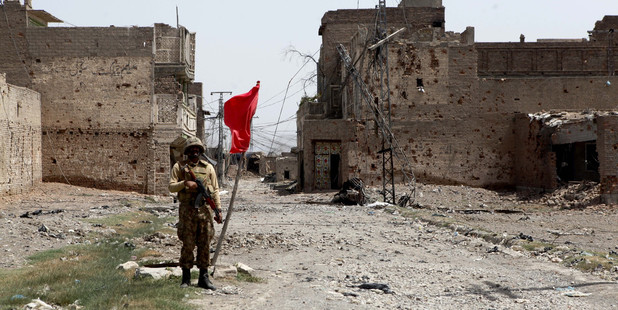
IT IS impossible to defeat an insurgency, an American commander of NATO’s forces in Afghanistan once said between clenched teeth, when the insurgents enjoy an inviolable sanctuary in a neighbouring country. The problem has plagued the 13-year military effort in Afghanistan. Foreign and Afghan forces have been unable to deal a knockout blow to the Taliban when so much of their infrastructure remains intact just across the border, in the badlands of north-western Pakistan.
Now, it is Pakistan’s turn to feel the frustration. Its army is in the thick of long-awaited operations to clear Pakistani militants from North Waziristan, one of the tribal agencies bordering Afghanistan. This week it appears to have regained control of the remote region’s capital, Miranshah. But the government in Islamabad is crying foul over the presence of militant safe havens on Afghan soil. The Pakistani army has renewed calls for Afghanistan to catch Mullah Fazlullah, leader of the Tehreek-e-Taliban (TTP). Known also as the Pakistani Taliban, the TTP is an umbrella grouping of violent Islamists and is Pakistan’s gravest threat (it is reckoned to have few formal links to its Afghan namesake). Mr Fazlullah could be hiding in Kunar or Nuristan, two of Afghanistan’s eastern provinces.
Many Afghans regard the call as exceptional cheek from a country that for years has done little to clear its vast swathe of north-western territory of workshops making bombs destined for Afghanistan and radical madrassas indoctrinating Afghan fighters. The senior leadership of the Afghan Taliban, the Quetta Shura, is even named after the Pakistani city in which most of its members live.
Indeed, many in the Pakistani establishment have actively assisted a movement regarded as useful in Pakistan’s obsessive struggle to lessen Indian influence in Afghanistan. Pakistan has other reasons to resent Afghanistan, which voted against Pakistan’s membership of the UN in 1947. It thinks Afghanistan vies for the affections of ethnic Pashtuns living in Pakistan. Many of them live in a part of Pakistan that Afghanistan claims the British Raj took unfairly. For all these reasons, since the mid-1970s Pakistan has backed Islamist militants as proxies in Afghanistan.
Many Pakistanis think Afghanistan is now getting its own back. In cahoots with India, they say, Afghanistan is both helping the TTP and stoking rebellion in the restive Pakistani province of Balochistan. Western diplomats say this view is overblown. In both instances Afghan assistance is marginal at best. It is also unclear what Afghanistan’s hard-pressed security forces could do about Nuristan, a place so tough that NATO abandoned it in 2010 after failing to subdue it.
But perhaps Afghanistan has tried playing its own double game. In late 2013 American soldiers arrested a senior TTP commander after he was tracked to a secret meeting with Afghan intelligence officers. A diplomat likens the situation to a devilish game-theory puzzle. Mutual co-operation would produce the best outcome for all. But players seem unable to resist striking each other.
An optimistic view is that Pakistan’s decision to launch Operation Zarb-e-Azb (loosely translated: “strike of the Prophet’s sword”) on June 15th in a bid to clear North Waziristan of militants suggests it has at last understood that a shocking increase in domestic terrorism far outweighs any possible advantages from the long-standing policy of backing militants. And though army officers have been notably reluctant to identify Afghan insurgent groups by name—and the deadly Haqqani network in particular—they insist the operation will make no distinction between foreign and domestic terrorists. Many analysts remain sceptical, however. After all, Afghan insurgents in North Waziristan seem to have had ample time to make themselves scarce before the operation began.

Militants killed a Pakistan army captain and two soldiers in an attack early Saturday in a tribal region near its border with Afghanistan, authorities said, as an airstrike killed 13 suspected extremist fighters.
A group of some 60 militants who crossed over from Afghanistan attacked an army post in the Ghakhi area of the Bajur tribal region, said Shah Nasim, a senior government administrator in Bajur.
He said another soldier and a civilian cook were injured in the attack, which took place when troops had a pre-dawn Ramadan meal before fasting. A later statement from the Pakistani army, however, said the militants attacked a vehicle killing the two, not an army post. The conflicting accounts could not be immediately reconciled.
Khan said the attackers later escaped to Afghanistan's Kunar province but a retaliatory attack injured some of them.
Pakistan's army largely has cleared the Bajur tribal region of militants but its posts often come under cross-border attacks. In June, militants killed 20 soldiers in three attacks. Pakistani troops killed some 50 attackers in retaliatory attacks.
Pakistan has asked Afghanistan's government to take action against the Pakistani militants who escaped a recent military offensive in the Swat Valley and elsewhere for safe havens in eastern Afghanistan.
In a separate statement, the military said it killed 13 suspected militants Saturday in latest airstrikes targeting Mir Ali, a town in the North Waziristan tribal region, where the military last month launched a major operation against militants there. It said the strikes also destroyed seven militant hideouts. The military's claim could not be independently verified as reporters are not allowed to work due to the offensive.
Pakistan army launched its operation against Pakistani Taliban and foreign militants in North Waziristan on June 15.
The military says so far it has killed more than 400 terrorists, though activists and locals say civilians also have been killed.
Since the start of the operation, more than 800,000 people have fled the region, raising fears of a humanitarian crisis.
 By Colin Freeman
Exclusive: Malala Yousafzai, the Pakistani girls' education campaigner, will seek a meeting with President Goodluck Jonathan
Malala Yousafzai, the girls' education campaigner who was shot by the Taliban, is on her way to Nigeria to campaign on behalf of the schoolgirls abducted by Boko Haram.
Ms Yousafzai, 17 who was an early backer of the #BringBackOurGirls social media campaign, is due in the Nigerian capital, Abuja, on Sunday. As well as meeting relatives of the kidnapped girls, she is expected to seek an audience with President Goodluck Jonathan.
Her visit to Nigeria takes place almost three months to the day since the abduction of the girls, who were taken by Boko Haram militants from a boarding school in Chibok, in north-east Borno State, on April 14.
The presence of such a high-profile women's rights campaigner will add to the pressure on the Nigerian government, which was accused in the early days of the kidnapping of not doing enough to resolve it.
In recent weeks there has been claims that the trail has effectively gone cold in the hunt for the girls, despite help from Britain, America and France.
Officials believe the hostages have been split up into different groups and hidden in the vast Sambisa forest region, an area roughly twice the size of Belgium. Some may also have been taken over the border into neighbouring Cameroon and Chad. Around 223 girls are believed to be missing in total.
It was in early May that Ms Yousafzai first joined the #BringBackOurGirls campaign, which successfully focused international attention on the girls' plight. She posed with a picture on her Twitter feed and described the girls as "sisters".
Ms Yousafzai was shot by the Taliban as she boarded her school bus in the valley of Swat, northwest Pakistan after she spoke publicly about girls' rights to education.
She was transferred to Britain for hospital treatment, and currently lives in the West Midlands along with her family.

Russian President Vladimir Putin has changed the schedule of his Latin American tour and arrived in Nicaragua for a brief working visit. On his way from Cuba to Argentina on Saturday, the Russian leader decided to make a stopover in Managua, where he had been officially invited earlier. At the Managua airport, he was welcomed by Nicaraguan President Daniel Ortega.
"Much is yet to be done to develop our relations, especially in the area of economy, but we have good base for that," Putin said, adding that Russia and Nicaragua had long-standing good relations. "We admire out personal courage and the courage of your people," he told Ortega. The Russian leader reminded that the year 2014 is a jubilee one for Russia and Nicaragua, which established diplomatic relations 70 years ago.
The Nicaraguan leader called Putin’s visit to his country a historic event. "This is the first-ever visit by the Russian president to Nicaragua, and we are very happy to welcome you here," he said.
Ortega reassured Putin that Nicaragua supported Russia's peace efforts. "We are ready to take part in Russia’s initiatives in maintaining peace in the entire planet and in its regions," he said. "Conflict settlement lies not in bombing but in reasonable approaches. The most vital thing is to lend an ear to the will of the people."
The Russian delegation to the talks included Russian Foreign Minister Sergei Lavrov, Russian president’s aide Yuri Ushakov, and CEO of Russia’s oil major Rosneft, Igor Sechin.
Nicaragua's delegation included Nicaraguan president's envoy for trade-and economic and investment cooperation with Russia Laureano Ortega, Deputy Foreign Minister Valdrak Jaentschek, who is a co-chairman of the Russian-Nicaraguan intergovernmental commission on economic and research-technical cooperation, Commander-in-Cgief of the Nicaraguan Army Julio Cesar Aviles, and President of the energy company Enatrel Salvador Mansell.
Read more: http://voiceofrussia.com/news/2014_07_12/Putin-makes-unplanned-visit-to-Nicaragua-2461/

Bahrain would seem an unlikely country to expel a senior American diplomat on a trumped-up complaint, since the Persian Gulf state is home to the United States Navy’s Fifth Fleet and depends on America for its defense, especially against Iran. Yet the government did just that, forcing Tom Malinowski, the State Department’s assistant secretary for human rights, to cut short an official visit on Tuesday because he met with members of an opposition party. Then on Thursday, it compounded the error by charging the leader of Bahrain’s biggest opposition group with holding an illegal meeting with Mr. Malinowski.
These outrageous moves call into question Bahrain’s commitment to its alliance with the United States. They also raise doubts about the willingness of the ruling al-Khalifa family, members of the Sunni minority, to find a compromise with the Shiite majority, which is demanding democratic reforms and a bigger role in governing. (Remember that three years ago, Bahrain authorities, backed by Saudi troops, squashed a wave of Arab Spring protests.)
Failing to resolve those differences could have disastrous consequences for Bahrain, its neighbors and the United States since the last thing the volatile region needs is more sectarian divisions and instability. So far, the Obama administration, which has worked to maintain ties with the monarchy despite human rights concerns, has responded weakly. It must go further to show that such behavior is unacceptable.
Mr. Malinowski was on a visit that was coordinated with the Bahrain government and involved a routine series of meetings, including with al-Wefaq, the largest Shiite opposition party, and with Crown Prince Salman bin Hamad bin Isa al-Khalifa. He went to a Ramadan reception at the headquarters of al-Wefaq on Sunday, and met the next day with the minister of interior and the police chief and was to have a private meeting with al-Wefaq’s leaders at the embassy. When the Bahrain government insisted on being represented at that meeting, and Mr. Malinowski’s meetings with other civic groups, the Americans objected. A Bahrain law passed last year bars meetings between local politicians and foreign officials without government approval. It was not enforced during previous visits by United States officials; and in any case, the Americans could never accept the law since it would cripple diplomacy.
On Wednesday, the government brought al-Wefaq’s leader in for questioning and later leveled formal charges.
In ordering Mr. Malinowski to leave, Bahrain said he had “intervened flagrantly” in the country’s internal affairs by “holding meetings with one party.” That is absurd. His predecessor visited the country seven times and met al-Wefaq each time without a similar result.
Some Bahrainis are trying to make this all about Mr. Malinowski. The Gulf Daily News pointed to what it called his “murky past” because, as a top official for Human Rights Watch in 2012, he spoke out about human rights abuses in Bahrain. But the real problem is the hard-liners who are determined to crush the Shiites and any hope of reform. Diplomats say reformers within the government and the opposition have made progress on a political deal and Mr. Malinowski’s visit was intended to support that.
The State Department has protested the expulsion, saying it is “deeply concerned,” but that has had no effect. Secretary of State John Kerry and the White House should also speak out and make clear they are considering expelling Bahrain’s ambassador, denying visas to officials and toughening limits on military sales if Bahrain does not acknowledge its error with Mr. Malinowski and ensure it won’t happen again.
Most of all, the administration needs to press Bahrain more firmly to get serious about negotiating with the Shiites. The ruling family need only look to Iraq to see what can happen when authoritarian governments inflame sectarian tensions and do not embrace political transition when they still have time.
UN High Commissioner for Human Rights Navy Pillay [official profile] on Thursday expressed deep concern [press release] over the harsh sentences and detention of peaceful human rights advocates in Saudi Arabia in recent months. In particular, Pillay expressed concern over the sentence imposed upon Saudi human rights activist and lawyer, Waleed Abu al-Khair [AI report], who is the founder and chief of the human rights group Saudi Arabia Monitor of Human Rights. Abu al-Khair was taken into custody [JURIST report] in April on charges that include inciting public opinion. Abu al-Khair was sentenced to 15 years in prison on Sunday by the Specialized Penal Court [HRW backgrounder] for a litany of non-violent terrorism related charges. Additionally, Pillay's statement referenced harsh sentences of four other human rights defenders who were convicted by the Specialized Penal Court in the past two years. Pillay called for an investigation into alleged procedural irregularities in the Saudi courts. Saudi Arabia is a member country of the UN Human Rights Council [official website], but there have been reports of ill-treatment against prisoners while in detention, such as lashings, solitary confinement, sleep deprivation and denial of access to legal counsel and family. Pillay called on Saudi Arabia to abide by its commitment to the Human Rights Council and ensure that judicial and law enforcement systems are not used to prosecute individuals for expressing their political or religious views.
Saudi Arabia's human rights record has drawn heavy criticism from international rights groups following the ratification [JURIST report] of new counterterrorism laws by King Abdullah bin Abdulaziz [official profile] in early February 2014. JURIST Guest Columnist Adam Coogle of Human Rights Watch (HRW) [official website] argued [JURIST op-ed] that Saudi Arabia's new terrorism law is a vague, catch-all document that can—and probably will—be used to prosecute or jail anyone who criticizes the Saudi government and to violate their due process rights along the way. In February Amnesty International (AI) [advocacy website] criticized [JURIST report] the Saudi Arabian counterterrorism law because the law will deepen existing patterns of human rights violations and will be used to crack down on peaceful dissent. In December HRW urged [JURIST report] Abdullah bin Abdulaziz to reject the counterterrorism bill before it became law, arguing that many fundamental human rights would be threatened.
http://jurist.org/paperchase/2014/07/un-rights-chief-concerned-over-arrests-of-saudi-arabia-activists.php
 By CATHLEEN DECKER
For a few political cycles now, Republican leaders have strained to distance themselves from some in their midst and focus on the basics to secure and extend their power in Washington: The less-than-sweeping economic recovery and President Obama’s foundering, as they see it, at home and abroad.
And those in their midst have continued to define the party in ways that drew an injurious response from key voter groups. There was the dust-up in 2012 when Todd Akin, the Republican U.S. Senate candidate in Missouri, defended his opposition to abortion by positing that women’s bodies blocked conception resulting from rape. There were the myriad laws aimed at immigrants in the country illegally that insulted many Latino voters. There was the fight against gay marriage, which distanced the party from younger voters.
And now, with a takeover of the Senate achingly close to Republicans’ grasp this year and a presidential campaign on the horizon, those in their midst are threatening to define the party with yet another tangent.
Impeaching President Obama.
The loudest voice for invoking the historically high bar of removing a president from office was Sarah Palin’s. The former Alaska governor and 2008 vice presidential nominee called for Obama’s impeachment in a column on the Breitbart.com website this week.
"Enough is enough of the years of abuse from this president,” she declared. “His unsecured border crisis is the last straw that makes the battered wife say, 'no mas.'"
She impugned Obama with perhaps the harshest indictment that can be made of a president, that he did not care about the troops under his command.
“Discrediting the price paid for America’s exceptionalism over our history, he’s given false hope and taxpayer’s change to millions of foreign nationals who want to sneak into our country illegally,” Palin wrote.
And for good measure, her racially-fraught missive impugned those seeking to enter the country, many of them children fleeing violence and danger in their home nations.
“Because of Obama’s purposeful dereliction of duty an untold number of illegal immigrants will kick off their shoes and come on in,” she said, later adding that many Americans “now feel like strangers in their own land.”
Though she insisted that “the many impeachable offenses of Barack Obama can no longer be ignored,” she didn’t exactly say what they were other than to make a vague reference to changes he has wrought in the healthcare law and his plans to “meddle in the U.S. court system” by appointing judges (a president’s prerogative).
House Speaker John A. Boehner, asked about Palin’s proposal, eviscerated it with two icy words.
“I disagree,” he said.
While Palin and a small number of Republicans were jumping aboard the impeachment bandwagon, Boehner and his supporters were trying to cast themselves as the sane alternative by vowing to sue the president over his healthcare plan, in effect going to DEFCON 1 but not nuclear.
The message: We will hold the president accountable, but we’re not going off the deep end to do it.
The impeachment mini-movement poses some threat to individual Republicans in areas where anti-Obama sentiment is strongest, since candidates could now be called on to join up or risk primary challenges in 2016. In close contests this year, Republicans could be caught between the sentiment of the base and the broader general electorate: Democrats are already using Iowa Senate candidate Joni Ernst’s January suggestion that Obama could be impeached to try to cast her as an extremist candidate aligned with Palin.
Were it to gain steam, however, the effort poses a larger definitional risk to the Republican Party, as the Akin statement and the anti-illegal immigration and anti-gay rights efforts did before, by alienating the broad political middle from the party’s impeachment believers and non-believers alike.
Those at the political extremes tend to get the attention but not much love from voters, who don’t like the sort of political messiness and rancor that an impeachment effort entails. That fact is well known by Boehner and those backing the less pointed alternative. Even at the height of the 1990s effort to throw him from office, President Clinton maintained popularity ratings that Obama would drool over.
Republicans then had an easier argument to make — Clinton’s actions during the investigation into his personal affairs — but saw voters who liked him swarm to his side.
If elements of the party push for Obama’s impeachment, the likeliest to fly to his defense would be women, Latinos and the young, majorities of which have felt the strongest affinity for Obama. The very people, that is, that the Republican Party has worked to win back since they were previously alienated by those in their midst.

Pakistan Peoples Party Parliamentarians president Makhdoom Amin Fahim said on Friday that the law and order situation was unsatisfactory throughput the country but his party would continue to work for the stabilisation of democracy.
Talking to reporters, he wondered what he could suggest to rulers to wriggle out of the current crisis while “the PML-N government is registering cases against us”.
When asked about a perception that despite the PPP being the main opposition party, the role was being played by Pakistan Tehreek-i-Insaf chief Imran Khan and Tahirul Qadri, he said his party would not like to take any step that could harm democracy.
Replying to a question, Mr Fahim said it appeared that the federal government was victimising him.
When asked why former president Asif Zardari was not taking up the matter of registration of cases against him with Prime Minister Nawaz Sharif, he said both of them were chiefs of their own parties who took their own decisions, “while we will pursue the law to take its course”.
PPP leader Syed Owais Muzaffar, who was visiting Mr Fahim to offer condolences over the death of his younger brother, recalled the attitude of the Punjab chief minister during PPP’s government at the centre and said the Sindh CM was according full protocol to the president and the prime minister. “This proves that the PPP believes in democracy.”
In reply to a question, he said development packages for Karachi had been announced in the past also but the important matter was their implementation.
http://www.nzherald.co.nz/
 The streets of the one-time militant haven of Miran Shah were all but deserted, with only a few donkeys wandering around and soldiers standing guard in the alleys and roads. The destroyed buildings were testament to the ferocity of a government operation to clear this area in northwestern Pakistan of extremists.
Inside some of the run-down brick houses, the Pakistani military found evidence of the ruthlessness of the militants who have long made their homes here.
Large factories where they fit explosives into gas cylinders to hide in vehicles. Areas where they trained suicide bombers in the do's and don'ts of their operations - don't make personal phone calls that might tip off authorities, for example. Places where they stored ammunition and ran extortion rings. A wall scrawled with the words "Jihad, Jihad."
"It was no doubt the epicentre of terrorism," said Maj. Gen. Zafarullah Khan, who is overseeing the operation.
The streets of the one-time militant haven of Miran Shah were all but deserted, with only a few donkeys wandering around and soldiers standing guard in the alleys and roads. The destroyed buildings were testament to the ferocity of a government operation to clear this area in northwestern Pakistan of extremists.
Inside some of the run-down brick houses, the Pakistani military found evidence of the ruthlessness of the militants who have long made their homes here.
Large factories where they fit explosives into gas cylinders to hide in vehicles. Areas where they trained suicide bombers in the do's and don'ts of their operations - don't make personal phone calls that might tip off authorities, for example. Places where they stored ammunition and ran extortion rings. A wall scrawled with the words "Jihad, Jihad."
"It was no doubt the epicentre of terrorism," said Maj. Gen. Zafarullah Khan, who is overseeing the operation.
The Pakistani military took a group of journalists to Miran Shah for a one-day visit of the war zone, the first by the news media since the operation began on June 15. It was a rare look inside the isolated city in the country's rugged northwest, closer to the border with Afghanistan than to the capital, Islamabad.
The operation against the Pakistani Taliban and other militants in the region was a long time coming.
The US, frustrated at seeing its troops in Afghanistan attacked by forces coming from North Waziristan, has been pushing for years for a crackdown there. Unable to send in troops itself, the US relied on CIA drone strikes, many of which hit Miran Shah.
Pakistan resisted, saying its troops were too spread out across the tribal regions. The military was also believed to have wanted political support before going in.
Prime Minister Nawaz Sharif's election a year ago delayed military action further. He pushed for negotiations with the extremists. It wasn't until a shocking attack on the Karachi airport on June 8 that the government approved the operation.
Khan said that some of the extremists used that time to flee, while others managed to escape as government forces were encircling the city. So far, government troops have not found any of the top militant leadership in the city, according to Khan.
"They had smelled it that the operation is about to be launched," he said. "The buildup for the operation had already begun, and they could see that."
Khan said 400 militants were killed and 130 wounded. Those figures could not be independently verified.
One Pakistani Taliban commander, Gilaman Mehsood, in a telephone interview from an undisclosed location, disputed the military's casualty figures and said most of the Pakistani Taliban fighters are now living in border areas of Afghanistan.
Miran Shah had become a hub for Pakistani Taliban militants fighting to overthrow the government and establish a hard-line Islamic state across Pakistan. Other groups, such as the Islamic Movement of Uzbekistan, also had a presence in the city.
Khan cautioned that militants are still in parts of the city and troops are still in the early days of the ground operation, with other areas of North Waziristan still to be tackled.
About 80 percent of the city has been cleared of militants, but it is still heavily booby-trapped, Khan said. Many buildings in the city of mostly one-story brick houses were destroyed by artillery shells, tank fire or airstrikes, or by homemade explosives left behind by the militants. Cars were buried in the rubble.
The military found an extensive network of tunnels - one roughly two kilometres long - that the militants used to move around. There were large caches of ammunition and weapons, along with pain medicine, antibiotics, computers and training literature.
No civilians were seen across the entire city. The government says roughly 800,000 people have fled North Waziristan, raising fears of a humanitarian crisis.
The military is also concerned that extremists could hide amid the refugees and then re-emerge elsewhere in the country - something that happened during previous crackdowns.
The military says it has tried to guard against that by questioning refugees when they leave. Those efforts have sparked anger among those fleeing.
"I had to cross five checkpoints, and at all posts soldiers checked our luggage and asked questions about my family. They wanted to make sure that we are not members of the Taliban," said Gohar Wazir, of Mir Ali, the other major city in North Waziristan.
Rob Crilly
Ask any Nato commander in Afghanistan what is the biggest hurdle to defeating the Taliban insurgency, and there is only ever one answer: the safe havens in Pakistan from where militants can launch strikes in safety.
For years the US has noisily put pressure on Pakistan to clean up its act. All to no effect.
Then, realising that public rebukes were getting it nowhere, Washington went quiet, preferring to put its message across quietly in private.
Last month Pakistan acted, launching hundreds of airstrikes on targets in North Waziristan, home to the Haqqani network – considered the most deadly of Afghanistan's insurgent groups – as well as Pakistani terrorists intent on bringing down the government in Islamabad, sectarian outfits and groups with an eye on Kashmir. Ground troops have followed, sweeping through the area.
The question is: will it work?
American diplomats are not getting carried away. They will wait to see what names turn up on the death roll and whether the offensive stems the flow of fighters and big vehicle-borne bombs from Pakistan. (Incidentally, I now know that a Haqqani truck bomb was the target of the CIA's first drone strike this year, in June, as it trundled towards the border.)
Already, the Pakistani military has got itself in a muddle over whether they are even targeting the Haqqanis – a long-standing proxy – awkwardly talking around the subject when quizzed.
And, this week, in North Waziristan's main town of Miranshah, they gave the clearest sign yet that the big fish escaped before the operation started. Maj Gen Zafarullah Khan, who is responsible for the town, said:
It’s not possible to create water-tight or airtight compartment where an individual cannot escape. Given the context of the terrain, the context of who they are, it will be wrong on my part to say that they did not escape, yes they did.
They had smelled that the operation is about to be launched. The talks had failed, the build-up for the operation had already begun and they could see that, they could sense and smell and, therefore, the leadership was not here, the leadership abandoned place.
Was it an unguarded moment? Or is the military lining up its excuses and blaming the government for weeks of peace talks that never went anywhere?

The police generally use 12-bore rifles to fire for the dispersal of a mob, whose cartridge shot from a distance only injures, not kills. In this case, the police used lethal automatic weapons
The brutal killing of some 11 protesters at the Idara Minhajul Quran in Lahore on June 17 at the hands of the police reflects the breakdown of the police’s chain of command and violation of the rules of government business in Punjab. For the last six years, Chief Minister (CM) Punjab Shahbaz Sharif has been running the province through informal channels of authority, bypassing formal government offices and using his surrogates to enforce his orders. Although the Punjab police is notorious for committing excesses against the people, the shooting of people in Lahore was an unprecedented incident even by their own standards. Hardly ever before has the police opened fire directly at a mob with lethal weapons like G-3 rifles and Kalashnikovs for such a small cause as the removal of encroachments from a side road in a residential area.
CM Shahbaz Sharif has been administering the province through pliable junior civil servants elevated to senior positions for the implementation of his orders. A coterie of malleable bureaucrats has been created to bypass formal channels of authority, which amounts to a de facto parallel system of administration. The CM’s son, Hamza Shahbaz, has been vested with informal powers to oversee the provincial administration while his father remains busy in Islamabad. Rana Sanaullah, the senior minister, used to direct the police on behalf of the CM while the outgoing Inspector General (IG) Police Punjab was a ceremonial figure.
Not only the district police officers but also deputy superintendents of police used to be posted on the instructions of Rana Sanaullah and Dr Tauqir Shah, the secretary to the CM. The words of these two people were considered orders from the CM himself. No officer dared defy them for risk of humiliation and transfer. Following the bloody Lahore incident, while removing his secretary, Shahbaz Sharif publicly declared Dr Tauqir Shah — a civil servant who is supposed to be politically neutral — his younger brother. Shah was a powerful man in the province around whom executive powers revolved during the last six years. The secretaries of the provincial departments, who ought to run the government as per the rules of business, have been sidelined. Their offices have been reduced to post offices. The postings of senior police officers were not made by the IG Punjab but the CM secretariat.
At present, more than 30 senior positions in the police department are lying vacant in search of pliable officers.
In Punjab, the most important decisions are taken on verbal orders conveyed to the officers by the secretary to the CM without written notes on file. This modus operandi has been invented so as to avoid legal responsibility for these acts. Those officers who do not fall in line are removed from their positions or get a scolding in official meetings. The CM secretariat, which has no role in administration under the rules of business, has replaced the authority of the civil secretariat. Several self-respecting senior officers have opted out from Punjab. Others have refused postings in the province. Neutrality of the officers is considered a crime. Thus, those who wish to save their honour stay silent in meetings over controversial policy decisions.
When orders reportedly came from Islamabad that the Punjab administration should strictly deal with Tahirul Qadri’s workers, several meetings were held in Lahore to ponder over the issue. In one such meeting, the provincial chief secretary told the political bigwigs not to go ahead with the proposed action as it might have grave consequences. The Commissioner of Lahore and the police chiefs of the province and the city also advised the same. This advice fell on deaf ears. Rana Sanaullah presided over the meeting on June 15 in Lahore and insisted on the operation for the removal of barriers. Dr Tauqir Shah was one of the participants. This was a clear message to the police that the CM had ordered this operation. The CM himself may not have said this in so many words. The government went ahead with its police operation through Rana Sanaullah and Dr Tauqir Shah at the top, and junior pliable police officers at the operational level.
The action took place in the absence of the police chief in the province. The IG Punjab, Khan Baig, had sought his transfer. The new IG, Mushtaq Sukhera, transferred from Balochistan, was yet to take charge. His plane landed in Lahore when the operation was over. Why was the Punjab administration in such a hurry? The result was disastrous because no senior officer was there to ensure observation of standard operating procedures made for such occasions. The Lahore police chief opposed the operation in the meeting but did not bow out. At least he could have gone on leave before the action was launched. He did not want to leave the plush posting and yet wished to stay clear of the responsibility.
The city police did not assess the situation and has no plan of action before storming the Idara Minhajul Quran. In a normal scenario, such an action is taken under the supervision of a senior police officer of the rank of grade-21 at the top but it started after midnight under the supervision of a Station House Officer (SHO) accompanying an assistant commissioner. Only when the police faced stiff resistance from the workers of the Idara Minhajul Quran, a number of Deputy Superintendents (DSPs) and SPs arrived on the spot piecemeal. Policemen from different police stations started gathering and they lacked the unity of command, acting in a haphazard manner. No senior officer had briefed them as to what they were supposed to do and what limits they needed to observe. The Deputy Inspector General (DIG) Operations, Lahore and Deputy Commissioner, Lahore rushed to the scene during the final phase of the operation when much of the damage had already been done.
The police did not follow the standard operating procedures for such occasions. No policeman was seen in riot gear. Normally, the SPs supervising such an action make armed policemen stay back and call them only when there is dire emergency. The police generally use 12-bore rifles to fire for the dispersal of a mob, whose cartridge shot from a distance only injures, not kills. In this case, the police used lethal automatic weapons.
Although no politician or senior police officer had ordered the policemen to open fire on the mob, the officials at the scene resorted to firing because they had firm orders to ‘teach a lesson’ to Qadri’s workers. They intended to please their political masters by demonstrating that they had acted firmly. One reason the police officials unabashedly used excessive force was that they were politically connected to the PML-N leaders. They take orders directly from their political masters, not their supervising officers. The posting of the SHOs in the police stations has become a prerogative of the PML-N leaders. The police stand politicised and have lost their professionalism and neutrality.
The killings took place for two reasons: one, the police action was politically motivated. It was aimed at terrorising the workers of Tahirul Qadri, not the enforcement of law. Two, senior police officers stayed away in the beginning and left the operation to junior officials who lacked the capacity to handle such a grave situation. The Lahore incident should serve as a wake-up call for the rulers. Police work has plummeted to this level because of a breakdown in the chain of command and massive political interference in their affairs. If the present way of governance continues, we should expect many more horrible incidents.
Hardly a month after the audacious attack by militants at Karachi airport on the night between June 8 and 9, the security at the airport remains surprisingly lax. Accounts of survivors Dawn spoke to on Thursday revealed that the Custom Gate, one of the entrances used by the militants to enter the premises of the airport and subsequently attack the Gerry’s Dnata office situated right opposite it, has almost no security.
When this reporter visited the site in the afternoon, an agent was seen sitting at a security guard’s post asking people for commission to get their customs cleared from the authorities. On moving ahead towards the main entrance, a private security guard meekly asked for a card and before waiting for it to be shown, asked us to drive our car ahead.
Once inside, four security guards were seen sitting outside a blackened wall of the Gerry’s Dnata office, who didn’t take much notice of the stream of motorcycles going inside. Those wanting to enter the premises were not being questioned at all and being let go in after small talk.
Speaking on condition of anonymity, a survivor of the attack and a staffer at one of the custom clearance departments said the security had been like that for the last month. Speaking to Dawn on telephone, he said: “Most security guards assigned to question the visitors can’t read what’s written on their cards. Also, they don’t know about the location of various departments. So, in case someone lies to them, they are more likely to let them go since they have no idea where that department is situated anyway.”
He says a day after the attack a heavy contingent of Airport Security Force (ASF) personnel was sent across the airport to guard the main entrances to the airport. “But since that day, I have only seen these security guards manning the gates and at times even they are not in their seats. I can’t say for sure if the weapons they have will work in case something happens again.”
The person is among the few survivors of the attack which began on the June 8 night. Speaking about the incident, he said he was early for his 11pm shift. “One of my friends asked me to fix his internet so I got busy with that. A few minutes had passed when we both heard gunshots. My friend told me that he could see five Chinese-looking men with ammunition bags hanging from their shoulders entering through the Custom Gate.” Heavy gunfire followed and soon the men inside realised that the approaching men were militants. “We hid behind the cashier counter. Though we sat hunched behind the table for a minute, the firing continued nonstop. Just then, I received a phone call from a dear friend from work, Farid Khan, he told me to stay behind the counter, and if needed, come towards the cold room storage, which he said was safe.”
Though both friends tried to make a dash towards the corridor, they had to rush back in as they saw two militants standing in the middle providing cover to the other three militants running towards the cold room storage.
The men were caught in the middle in an office which had the Fokker Gate on its left and the Air-Freight Unit (a cargo area) in the middle. “It takes five minutes to get there if one runs towards it. But considering the situation around us, with hand-grenades being lobbed and firing going on for over an hour, we chose to stay inside.”
By 1.30am, they heard a knock on the door. It was an ASF official asking them to come out. “I quickly raised my hands to show my employee card. It was a quick procedure from there onwards. The ASF commandos searched us, and asked us to run towards the gates.” The two friends ran out and one of the first people they met were the reporters who wanted to know what had happened inside. By the time he reached home, it was already 3am. “My only concern was for Farid Bhai who had been calling me from time to time. A suicide bomber blew himself up inside a warehouse where the cold room storage is located.”
From then till 5am, he says he called up every upper management person he knew. “Their reassurances sounded hollow. There were people stuck inside the cold room storage which was quickly catching fire. The least they could have done was to make those people a priority.”
He further said that a post-mortem report of those killed in the cold room showed that the last surviving person died around 9am. “Was it too difficult to save them? Farid Bhai’s wife told me that she received a phone call from him at 3.30pm. He told her that he won’t be able to make it home. I only know that if those killed inside the cold room storage were related to a higher-up at the airport, they would have been alive today.”
The trauma of witnessing an armed attack and subsequent deaths of those close to him lingers in his mind, he says. “I didn’t show up at work for two days. But when I did, because I was getting anxiety attacks at home, I was asked to give an explanation for my absence,” he adds quietly.
Though he has not taken a day off since that day, he says it is annoying to see that things are still the same at the custom gate. “It seems the attack happened somewhere else,” he remarks. “Farid Bhai’s brother was given Rs700,000 after the incident. He refused to take the money because he says they could have saved him and others.” At the same time, there is the security issue which, he says, won’t be resolved until the management takes proper responsibility. “Otherwise, those who were lucky this time around might not survive the next time.”
As the ASF is not authorised to speak to the media, a spokesperson for the Civil Aviation Authority, Abid Qaimkhani, said he “is surprised to know that there’s no security. Our employee cards are constantly checked. I don’t know what you saw, but I can assure you the security inside the airport has been strengthened since the attack.”


Laws do not work in Ukraine and the authorities are killing people instead of protecting them, Crimea’s Prosecutor Natalya Poklonskaya said on Thursday while visiting a refugee camp for Ukrainians in the village of Opushki near Crimea's capital Simferopol, as ITAR-TASS reports.
Asked about a possibility of forced migrants to assert their rights in Ukraine, the prosecutor replied with emotion: "Look what is going on in Ukraine! What is the law there and who are the authorities protecting? A bunch of people who gathered together and dictate their conditions to the others and God knows what they are about?"
"Which law regulates murder of ordinary citizens?” the Crimea Inform quoted Poklonskaya as saying. "Who has given them a right to murder? The law does not work in Ukraine, there is none there."
"The people who came here and are now enjoying protection of Russian law and Russia testify to this fact," she said.
Read more: http://voiceofrussia.com/news/2014_07_11/Crimeas-prosecutor-says-Kiev-kills-Ukrainian-people-instead-of-protecting-3719/
http://www.euronews.com/
The EU’s immigration policies are turning the continent into ‘Fortress Europe’ and putting lives at risk, Amnesty International has warned.
Migrants from Africa or the Middle East often make the journey by boat; many of them die at sea.
In the past 14 years 23,000 have perished in the Mediterranean, according to the human rights group.
The 28-member bloc spent almost two billion euros protecting its external borders between 2007 and 2013.
That compares with 700 million euros to help refugees and asylum seekers over the same five period.
Nearly half of those trying to enter the EU come from war-torn Syria, Afghanistan, Eritrea, and Somalia.
Many of those leaving Africa try to enter Europe via the Italian island of Lampedusa.
Italy’s search and rescue operation, Mare Nostrum, picked up more than 50,000 people last year.
Amnesty says, however, in countries such as Bulgaria and Greece, refugees and migrants risk being pushed back.
Italy has asked for help in sharing the burden, but member states have so far been unwilling to agree to an EU-wide asylum policy.

President Barack Obama expressed concern to Israeli Prime Minister Benjamin Netanyahu on Thursday about the risk of an escalation of hostilities in the region and said the United States was ready to help bring them to an end, the White House said.
"The United States remains prepared to facilitate a cessation of hostilities, including a return to the November 2012 ceasefire agreement," the White House said Obama told Netanyahu in a phone call.
Obama reiterated U.S. condemnation of rocket fire into Israel by Hamas and reaffirmed Israel's right to defend itself against the attacks, the White House said.
Secretary of State John Kerry spoke to his Egyptian counterpart in an attempt to get Egypt to use its influence to calm the situation, State Department spokeswoman Jen Psaki said.
"Part of the secretary's effort has been reaching out to countries in the region, including Qatar, including Egypt," Psaki said at a briefing earlier in the day.
"Any country in the region that can play a role in bringing an end to the rocket fire from Hamas, we're certainly going to be engaged with."
The U.S. government refuses to negotiate directly with Hamas, which Washington considers a terrorist organization.
Egypt played a crucial role in mediating an Israel-Hamas ceasefire in 2012.
A senior U.S. official said Kerry's phone call with Egypt's foreign minister was a discussion about how to reduce tensions between Israel and Hamas and "how to influence Hamas if that's possible."
The Israelis "know we have been in touch with Egypt and Qatar" to seek help in calming the situation in Gaza, the official said.
 By Ben Brumfield
http://i.cdn.turner.com/cnn/.element/img/3.0/global/header/intl/hdr-globe-central.gif
The dark curtain rises again on the tragedy of Israel and Gaza, and the next act begins much like its forerunners.
Rockets hunt humans. Bombs crush buildings. Blood spills. The dead ride in caskets through streets, and mothers wail their grief to the heavens.
As Israeli reserves gather like a storm over Gaza's horizon, the added bloodshed of an incursion appears imminent, and millions watching around the world ask:
What could they hope to achieve?
There is no dramatic endgame in this, but there are concrete objectives, says Israeli military analyst and columnist Ron Ben-Yishai.
There are official ones and unofficial ones, short-term and long-term, that make sense for Israel, he argues.
Many of them will work, concedes critical Israeli columnist Gideon Levy. But he disagrees about their wisdom.
They won't cure the disease but instead feed it, he argues.
Military operation is job No. 1
First, the conservative government led by Prime Minister Benjamin Netanyahu wants to stop the rocket fire by force.
And weaken the Hamas militants and other groups behind it, Ben-Yishai says.
"Erode the political clout and the ability of Hamas to act both as a political and military-terrorist movement."
Those are the official goals given by the Cabinet for the military operation named Protective Edge, he says. And they'll probably be achieved, Ben-Yishai says.
"For the short-run, no doubt," Levy concurs. But he also thinks Hamas will come back stronger militarily and politically.
That's what happened over two years ago in operation Pillar of Defense and over five years ago in Operation Cast Lead, he says.
In the latter, 1,300 Palestinians and more than a dozen Israelis died.
Rockets' roots
Levy sees the rocket fire from Gaza as the boiling over of cumulative tensions.
He points to the peace process initiated by U.S. Secretary of State John Kerry between Israel and Palestinians. The one that broke down weeks ago.
The whole time, a piece was missing from the negotiating table, he says. "Gaza was ignored totally."
Then a litany of youth killings ignited passions on both sides.
Three Jewish teens were murdered, and Israeli forces swept the West Bank for suspects, making arrests that had nothing to do with the case, Levy says. Palestinians were killed.
The murder of a Palestinian teen quickly followed; his body was torched. Suspicions arose that it was revenge for the Israelis' deaths.
Add to that the desperation in Gaza. The narrow strip of land is locked in on all sides, and people there live in dire poverty and deprivation. "Gaza is today the biggest cage in the world," Levy says.
The rocket fire is just a part of it all, he says. It's a way of Hamas pounding the table, pointing out Gaza's misery.
Levy's solution to the rocket fire: Pay more attention to Gazans. Don't marginalize them. Open borders, so they can move freely.
Ben-Yishai, on the other hand, believes that the peaceful approach -- that calm will be met with calm -- hasn't worked out.
"This formula is out of the game. It's not in the cards now," he says. The military option has become inevitable.
Operation drill-down
Hamas militants have come back stronger after the last military operation in at least one sense, Ben-Yishai says.
They have more long-range rockets. Previously, militants had to import them all from the outside. Now they can also construct them themselves.
They've also buried a network of launch sites below the ground's surface. Hitting them "is quite a job," Ben-Yishai says.
The Israel Defense Forces will have to strike deep into those systems. But the IDF has also adapted. Its bombs have become more accurate.
That also reduces collateral damage in Gaza, he says. Most who die were shooting rockets, he says. "Those who deserve it."
It's all a vicious cycle he's seen before, Levy says. The IDF destroys the militants' capabilities; they come back stronger.
"By the next operation, they will be even better equipped," he says. So will the Israelis.
Ground incursion
Israel has discussed the possibility of calling up 40,000 reserve troops, a signal that there may be a ground incursion into Gaza.
Levy firmly believes it will happen, that the IDF otherwise will not be able to root out militants' rocket systems.
Ben-Yishai is less certain. "I think it is in the cards. They've not made the decision yet," he says of the government.
Netanyahu may use aggressive rhetoric but is cautious about military decisions, he says. And so far, the government is satisfied with how the operations as they have been -- only from the air thus far.
The endgame
The government hopes that Protective Edge will give Israel a few years of relative peace, restore normality for a time, Ben-Yishai says.
"After every round of hostility ... there is a sort of lull that Israel enjoys very much," he says. People can think about other things and tackle other issues, like the economy.
But it's not worth the cost, in Levy's mind. Many Palestinians will be killed. But even from a purely selfish standpoint, it's at best an empty victory, in his mind.
"We will see horrible scenes," he says. "The world will condemn Israel. And what comes out of it? One year of peace."
Ben-Yishai believes there is a permanent gain to be made, that repeated operations in Gaza will wear the enemy down.
He hopes that the lulls between battles will get longer and longer, "until our neighbor realizes that they cannot make us disappear. They cannot erase us from the map."
Levy thinks Gaza militants won't quit until the misery there ends.
He predicts that military intervention will set the stage for the next bloodcurdling act -- and then the next.
The last few months have been critically important for the future of Internet freedom and access.
The concept of “network neutrality” has been so central to our experience of the Internet, and such a driving force for innovation and expression, that most of us have taken it for granted. This Op-Doc explains the basic idea: when you visit a website, the phone or cable company that provides Internet access shouldn’t get in the way. Information should be delivered to you quickly and without discriminating about the content.
Yet now the principle is under direct attack. On May 15, the Federal Communications Commission (whose chairman, Tom Wheeler, was formerly a leading lobbyist for the telecommunications industry) proposed troubling new rules: Internet service providers could split the flow of traffic into tiers, by offering priority treatment to big corporations who would pay higher fees. That would mean a fast lane for the rich and a dirt road for others, harming small businesses and users.
Meanwhile, telecom behemoths turn huge profits that increase their leverage. Through aggressive lobbying, they have managed to limit competition in 20 states.
In the meantime, the F.C.C. has asked the public to give their thoughts on the proposed new rules. More than 200,000 people have already done so (and comments are still being accepted).
While the concept of net neutrality seems complex, the solution is simple: We should classify broadband access as a utility. Internet providers should be considered common carriers, just as cellphone companies are for voice access, which they are not allowed to block or degrade. The Internet should be a level playing field.
now.mmedia.me
Russian President Vladimir Putin on Thursday called for an end to spiraling violence in Gaza during telephone talks with Israeli Prime Minster Benjamin Netanyahu.
"The Russian side stressed the necessity to as soon as possible stop armed confrontation, which leads to multiple victims among civilians," the Kremlin said after the call between the two leaders.
Putin and Netanyahu also discussed bilateral ties and "some other issues that are of mutual interest," the Kremlin said, without elaborating. The call took place at the initiative of the Israeli side, Putin's office added.
On Tuesday, Israel launched Operation Protective Edge, with the strikes killing more than 80 Gazans to date. There have been no Israeli deaths so far.
Rockets fired from Gaza since the flare-up began Tuesday have reached major cities including Jerusalem and Tel Aviv.
There are growing international calls for a ceasefire to stop the worst confrontation in and around Gaza since 2012.
BY NIDAL AL-MUGHRABI AND NOAH BROWNING
The latest mini-war between Israel and the Islamist group Hamas began with the Gaza-based militants eager to strike a blow, but the escalation that followed has left them physically and diplomatically exposed, with no ready way out.
 Hamas has sent its rockets streaking into Israel after a month of army raids in the occupied West Bank - in search of three missing Israeli teenagers - that landed more than 900 Palestinians in jail, many of them Hamas members.
The self-styled Islamic Resistance Movement was further prompted to action by widespread anger at the burning alive of a Palestinian youth by suspected Jewish extremists last week, an apparent revenge attack after the missing teens were found shot dead in the West Bank - murders Israel blames on Hamas.
Hamas said it hadn't sought a war, but now hundreds of Israeli bombs continue to pound the coastal strip, killing scores of Gazans - almost all of them civilians, according to Palestinian medical officials.
It says the onus for ending the hostilities is on Israel, where the rocket attacks have caused no fatalities and whose missile defense system has intercepted many of the Hamas projectiles.
"Yes, we want calm. We don't like escalation, and we didn't make an escalation. (Israeli Prime Minister Benjamin) Netanyahu imposed this aggression upon us," Hamas leader Khaled Meshaal said in a speech broadcast on Wednesday.
"To end his aggression, first end his policy of occupation, settlement, Judaisation, detentions, killings and demolitions. End that first. Our people deserve to live free," he added.
HAMAS ORPHANED
Previous lopsided battles between Palestinian militants and Israel's powerful military - most recently an eight-day conflict in 2012 and a month-long tussle that began in late 2008 and included a ground invasion of the Gaza Strip - have left Hamas's position mostly intact.
The group would claim victory, buoyed by some international sympathy, speedily replenish their cache of rockets through Gaza's porous border with Egypt and maintain its broad presence in the West Bank.
But much has changed since.
In Egypt, the military has ousted the ruling Muslim Brotherhood, a key ally to the Gaza government, which helped mediate a truce in 2012.
And it will be harder to restock when hostilities end now that Egypt's new government has stepped up efforts to demolish the cross-border tunnels that fed not only the blockaded coastal strip's weapons caches but its entire economy.
Gaza was once the favored cause of regional powers, but with Egypt now openly hostile and stalwart backers Turkey and Qatar distracted by the lightning rise of Islamist extremists in Iraq, Hamas has found itself orphaned.
"Turkey and Qatar may play a role in trying to restore calm, but they have no direct influence on the occupation, which makes their position weak," said Hamza Abu Shanab, a Gaza political analyst.
In the West Bank, too, where it is always under the jealous eye of secular Palestinian rivals, Hamas's fortunes have hit a new low with Israel's arrests.
"Israel is holding all Palestinians responsible for the killing of the three Israelis, and that's what it's doing with the campaign of arrests everywhere in the West Bank, and it's extended this policy of collective punishment now to Gaza," Hamas MP Fathi Qarawi told Reuters.
"Hamas was forced to make a response, and events have developed. We want a truce ... Egypt can still play a role and a good role in pressuring Israel to stop its attacks," he said.
BLEAK BARGAIN
Securing a truce, however, is not simple when a determined military showing is considered a matter of pride and honor.
Hamas chief Meshaal expressed glee at the group's ability to lob its long-range rockets at Israel's commercial capital Tel Aviv and for unprecedented distances deep into its north.
Despite the death and pain wrought on Gaza's citizens, Hamas says it has the means to carry on a long campaign if it must.
"Whoever thinks Hamas's ammunition will run out in days, weeks or months is delusional. We have lots in our pocket," senior Hamas official Mushir Al-Masri said on Wednesday.
"We want to bring you to your knees and achieve victory," Masri told Aqsa TV.
The tough rhetoric, however, is in part a cloak for weakness at home, where deepening poverty and hardship in Gaza helped push the group into a troubled unity government with the Fatah party headed by Palestinian president Mahmoud Abbas.
"Hamas is extremely weak now. Weaker than ever before. It capitulated entirely to Abbas's demands in forming a reconciliation government. Gaza is in economic crisis. Hamas is bankrupt and doesn't have a friend left in the world," said Gershon Baskin, an Israeli peace activist and analyst.
Baskin ran back-channel negotiations that led to the release in 2010 of an Israeli soldier abducted by Hamas in exchange for over a thousand Palestinian prisoners. He says fractures within the group may hinder a quick ceasefire.
"There are power struggles within (Hamas) ... and it lacks an authoritative command. It's a mess inside. But if there's one thing all parts of its organization agree on, it's that an Israeli attack on Gaza builds up sympathy for it there, the West Bank and the Arab world," he told Reuters.
If so - and Israel has hinted it could launch a ground offensive into the Strip to decisively pare back Hamas's capability - it is a bleak bargain.
An infantry and tank drive may give Hamas more opportunities to impose casualties and even abduct Israeli soldiers and trade them for Palestinian prisoners, said Firas Abi Ali, an analyst at IHS Country Risk in London.
"Our backs are to the wall and we have nothing to lose," Hamas spokesman Sami Abu Zuhri said on Thursday.
"We are ready to undergo the battle up to the end, and we are determined to confront the occupation," he added.
Hamas has sent its rockets streaking into Israel after a month of army raids in the occupied West Bank - in search of three missing Israeli teenagers - that landed more than 900 Palestinians in jail, many of them Hamas members.
The self-styled Islamic Resistance Movement was further prompted to action by widespread anger at the burning alive of a Palestinian youth by suspected Jewish extremists last week, an apparent revenge attack after the missing teens were found shot dead in the West Bank - murders Israel blames on Hamas.
Hamas said it hadn't sought a war, but now hundreds of Israeli bombs continue to pound the coastal strip, killing scores of Gazans - almost all of them civilians, according to Palestinian medical officials.
It says the onus for ending the hostilities is on Israel, where the rocket attacks have caused no fatalities and whose missile defense system has intercepted many of the Hamas projectiles.
"Yes, we want calm. We don't like escalation, and we didn't make an escalation. (Israeli Prime Minister Benjamin) Netanyahu imposed this aggression upon us," Hamas leader Khaled Meshaal said in a speech broadcast on Wednesday.
"To end his aggression, first end his policy of occupation, settlement, Judaisation, detentions, killings and demolitions. End that first. Our people deserve to live free," he added.
HAMAS ORPHANED
Previous lopsided battles between Palestinian militants and Israel's powerful military - most recently an eight-day conflict in 2012 and a month-long tussle that began in late 2008 and included a ground invasion of the Gaza Strip - have left Hamas's position mostly intact.
The group would claim victory, buoyed by some international sympathy, speedily replenish their cache of rockets through Gaza's porous border with Egypt and maintain its broad presence in the West Bank.
But much has changed since.
In Egypt, the military has ousted the ruling Muslim Brotherhood, a key ally to the Gaza government, which helped mediate a truce in 2012.
And it will be harder to restock when hostilities end now that Egypt's new government has stepped up efforts to demolish the cross-border tunnels that fed not only the blockaded coastal strip's weapons caches but its entire economy.
Gaza was once the favored cause of regional powers, but with Egypt now openly hostile and stalwart backers Turkey and Qatar distracted by the lightning rise of Islamist extremists in Iraq, Hamas has found itself orphaned.
"Turkey and Qatar may play a role in trying to restore calm, but they have no direct influence on the occupation, which makes their position weak," said Hamza Abu Shanab, a Gaza political analyst.
In the West Bank, too, where it is always under the jealous eye of secular Palestinian rivals, Hamas's fortunes have hit a new low with Israel's arrests.
"Israel is holding all Palestinians responsible for the killing of the three Israelis, and that's what it's doing with the campaign of arrests everywhere in the West Bank, and it's extended this policy of collective punishment now to Gaza," Hamas MP Fathi Qarawi told Reuters.
"Hamas was forced to make a response, and events have developed. We want a truce ... Egypt can still play a role and a good role in pressuring Israel to stop its attacks," he said.
BLEAK BARGAIN
Securing a truce, however, is not simple when a determined military showing is considered a matter of pride and honor.
Hamas chief Meshaal expressed glee at the group's ability to lob its long-range rockets at Israel's commercial capital Tel Aviv and for unprecedented distances deep into its north.
Despite the death and pain wrought on Gaza's citizens, Hamas says it has the means to carry on a long campaign if it must.
"Whoever thinks Hamas's ammunition will run out in days, weeks or months is delusional. We have lots in our pocket," senior Hamas official Mushir Al-Masri said on Wednesday.
"We want to bring you to your knees and achieve victory," Masri told Aqsa TV.
The tough rhetoric, however, is in part a cloak for weakness at home, where deepening poverty and hardship in Gaza helped push the group into a troubled unity government with the Fatah party headed by Palestinian president Mahmoud Abbas.
"Hamas is extremely weak now. Weaker than ever before. It capitulated entirely to Abbas's demands in forming a reconciliation government. Gaza is in economic crisis. Hamas is bankrupt and doesn't have a friend left in the world," said Gershon Baskin, an Israeli peace activist and analyst.
Baskin ran back-channel negotiations that led to the release in 2010 of an Israeli soldier abducted by Hamas in exchange for over a thousand Palestinian prisoners. He says fractures within the group may hinder a quick ceasefire.
"There are power struggles within (Hamas) ... and it lacks an authoritative command. It's a mess inside. But if there's one thing all parts of its organization agree on, it's that an Israeli attack on Gaza builds up sympathy for it there, the West Bank and the Arab world," he told Reuters.
If so - and Israel has hinted it could launch a ground offensive into the Strip to decisively pare back Hamas's capability - it is a bleak bargain.
An infantry and tank drive may give Hamas more opportunities to impose casualties and even abduct Israeli soldiers and trade them for Palestinian prisoners, said Firas Abi Ali, an analyst at IHS Country Risk in London.
"Our backs are to the wall and we have nothing to lose," Hamas spokesman Sami Abu Zuhri said on Thursday.
"We are ready to undergo the battle up to the end, and we are determined to confront the occupation," he added.
By Sanjay Kumar
Will the failure to resolve the issue of fraudulent ballots lead to instability?
“We are the winner of this round of elections without any doubt. We will not allow the fraudulent government to rule this country for even one day without any doubt,” declared Afghanistan’s presidential candidate Abdullah Abdullah this Tuesday, in front of thousands of agitated supporters in Kabul. Abdullah’s announcement followed the release of the preliminary results of the second round of Afghanistan’s presidential elections, which projected Abdullah’s rival, Dr. Ashraf Ghani, as the winner. Abdullah, who claims that there were millions of fraudulent votes in the election, threatened to set up a parallel government if his concerns were not addressed by Afghanistan’s Independent Election Commission (IEC).
Yet again, Afghanistan is on the brink of a political crisis that could potentially plunge it back into civil war. This would negate the achievements of the past 13 years and hurt Afghanistan’s nascent democracy.
According to Abdullah and several independent observers, the second round of elections featured major ballot rigging in southern and eastern Afghanistan, regions dominated by ethnic Pashtuns, the ethnic group that Ghani belongs to. Abdullah is an ethnic Tajik, with his power base in the north and east of the country. No candidate won a majority of votes in the first round of elections, necessitating the second round. However, Abdullah won the plurality of votes in the first round. His failure to beat Ghani again no doubt fueled his suspicions of vote rigging. In the first round of voting, Abdullah beat Ghani’s tally by more than ten percent while in the second round he lost out to Ghani by over 13 percent. According to official results, Ghani won 56.4 percent of the 8.1 million votes cast.
How did this reversal in fortunes come to pass?
It is likely that there was indeed large scale rigging in parts of Afghanistan. Both the IEC and independent observers concur with this. Furthermore, Abdullah’s camp claims there is proof in the form of recordings of conversations between electoral officials discussing the rigging of ballots. It is still possible though that Ghani won the election due to the fact that all Pashtun voters coalesced behind his candidacy after the other candidates, mostly Pashtun, were eliminated after the first round.
No matter who won, an election deemed fraudulent has negative implications for Afghanistan. According to Waliullah Rahmani of the Kabul Center for Strategic Studies, a think tank, “if the issue of fraudulent votes is not addressed, people will lose trust in the democratic process.” Rahmani added that “the Taliban would be the real beneficiary of this chaos and people’s disenchantment with the system.”
The election began with high hopes. People lined up in large numbers to participate in the electoral process, giving it a much needed vote of confidence. However, the failure of the democratic process could lead to cynicism for it among the population and usher in a new era of violence and division.
A fear is spreading in Afghanistan due to the fact that the electoral crisis has not yet been resolved. According to Bilal Sarwary, a senior BBC journalist based in Kabul, “a climate of concern has gripped Afghanistan,” dividing people and causing businesses to come to a standstill. The greatest concern is that Abdullah will form his own parallel government, meaning Afghanistan would have two separate governments. However, Abdullah has resisted demands by his supporters that he do so and has announced that he would wait for the outcome of talks with United States Secretary of State John Kerry this Friday before announcing his next move. Kerry has expressed concern at the suggestion of a parallel government, warning that “any action to take power by extra-legal means will cost Afghanistan the financial and security support of the United States and the international community.”
The only way out of the crisis is a political solution that addresses and corrects the issue of the fraudulent votes in the recent election. According to several observers and journalists familiar with the country, only an inclusive government can move Afghanistan forward.
What is at stake in Afghanistan today is not only democracy but the unity and integrity of the nation. There is a risk that the country could be polarized on ethnic and regional lines, with the mainly Tajik north pitted against the Pashtun south. No doubt this would play to the Taliban’s advantage and demoralize Afghanistan’s security forces. Hence it is important that a solution be found that avoids violence and the division of the country.
Final results will be announced on July 24. There is still time for a peaceful solution that will address many of the issues raised by Abdullah. However, if no solution is found by then, Afghanistan faces the prospect of instability. If this is the case, future generations of Afghans will not kindly judge the politicians who created this crisis.

U.S. Ambassador James Cunningham met with both presidential candidates in Kabul on Thursday, a day before U.S. Secretary of State John Kerry is set to arrive in the capital to try to help resolve the disputes still troubling the election process.
The campaign teams of Abdullah Abdullah and Ashraf Ghani Ahmadzai have maintained that the United States will only have an advisory and facilitating role in ending the current deadlock.
The top American diplomat is planning to meet with both candidates separately in their residences after arriving in Kabul on Friday.
"Mr. Kerry is coming to Afghanistan to become fully aware of the current condition in Afghanistan and the election's condition; He will only play an advisory role and it will be Afghans who will find a solution," Abdullah campaign staffer Said Fazil Agha Sancharaki said.
Abdullah's team emphasized the importance of President Hamid Karzai in resolving the impasse of the election, which was brought on by Abdullah's decision to pull out of the process because of fraud claims against the election commissions and Presidential Palace.
"We must say that Hamid Karzai is the main reason behind the election crisis and he must be talked to as well about not interfering in the elections," Sancharaki said.
For their part, the Ashraf Ghani Ahmadzai campaign emphasized stability and a peaceful resolution. "The U.S. will play an effective role as a supporting country to Afghanistan, and we hope that Mr. Kerry will be able to simplify the current conditions, and gain satisfaction of both candidates," Ghani team member Hamidullah Farooqi said. "We hope that these talks and consultations will prevent violence in the country and will prevent the creation of a parallel government."
In quiet contradiction, however, Ashraf Ghani Ahmadzai's campaign affirmed that President Hamid Karzai would not be part of the talks with Mr. Kerry.
"President Karzai will not be part of these talks, but supports the talks," Farooqi said.
It remains to be seen whether U.S. diplomatic intervention will help end the current election standoff, as well as whether a decision in agreement with both candidates will be made.

By Mahendra Ved
Posterity may record this as the best and the worst of times for the Pakistan Army. Not wielding absolute power like it has done several times before, the army has under orders from the civilian leadership launched one its fiercest operations – not against a neighbour – but its own people in the restive North Waziristan Agency (NWA).
This is also the time when one of its chiefs and a former president of the country, Pervez Musharraf, is imprisoned and being tried for serious charges, including treason. This is unprecedented.
The army’s widely perceived efforts to get Musharraf out of jail and out of the country on some pretext have failed so far.
And this is also the time when another former chief, Ashfaque Pervez Kayani, is being attacked by a fellow senior retired military man for failing to launch a drive in these areas, for allowing the situation to go out of hand and causing serious security damage to the country. This too is unprecedented.
Taking Musharraf first; He has been in and out of jail since he returned home from a four-year self-imposed exile in March last year to participate in the general election, hoping to ‘save’ Pakistan. He was disqualified from contesting, his farmhouse declared a sub-jail (placed under house arrest) and he has been made to appear in trial courts despite explosions taking place more than once on the route between his home/jail and the court.
Deals brokered to get Musharraf out, purportedly by the Saudi royal family – that had earlier done the same to get Nawaz Sharif out of Pakistan after Musharraf had deposed him – have not worked. Some reports say that he has refused to leave to be with his ill mother in Dubai, while others have at different times said that the Sharif government has refused to take him off the “Exit List” that prevents select people from leaving the country.
The military has not liked this one bit. Questions have been asked why his hand-picked successor Kayani did not exert pressure either on then president Asif Ali Zardari’s regime or the Nawaz Sharif government to save Musharraf from the prospect of prolonged imprisonment, trial and a possible death sentence. There is no conclusive word on this.
The military, speaking vocally through ex-servicemen’s bodies, has been so outraged at the thought of an ex-chief being tried for treason by the civilians that it has acted to thwart the proceedings every step of the way, especially since the Special Court summoned Musharraf to face indictment.
There is a view that the issue has been complicated by Musharraf’s aggressive defence by his lawyers who have sought to bring in a large number of officers, both military and civilian, as ‘abettors’ of the acts like dismissal and jailing of judges and declaration of Emergency that have been termed as violation of the constitution and hence treason.
A swift indictment could have paved the way for bail and freedom. But the drama at the trial court, combined with concocted medical and security reports and Musharraf’s hospitalization have rebounded on the military. Musharraf’s defence team has done its best to drum up media headlines in the likely hope that it would build further pressure on the government. That has not happened.
It is not clear if, and how, the Nawaz Sharif government wants to push ahead with Musharraf’s trial. This has affected the civil-military relationship that has never been clear and comfortable. The government-military-judiciary stalemate has not changed even with the military operations underway in NWA.
Kayani was a powerful army chief for six years. He was given a three year extension by the Zardari regime. The military under him did not attempt to take power, something speculated on numerous occasions. This was despite grave circumstances and political attacks on the military, like when Al-Qaida leader Osama bin Laden was found to have been located and killed by the United States in the garrison town where he was sheltered.
Kayani did not take power even after the “Memo Gate” incident when Zardari was accused of approaching the Americans to save his seat in the event of the army chief staging a coup.
All through this period, the militants were getting stronger across Pakistan, especially in the Federally Administered Tribal Areas (FATA) under the umbrella of the Tehrik-e-Taliban Pakistan (TTP). Foreign militants, among them Arabs of various nationalities and Uzbeks from Central Asia, had taken shelter (right from the Musharraf era). There were clear signs that under the US pressure and for its own domestic compulsions, the Pakistan military would launch an offensive. Everyone, including the militants, was expecting a military operation in North Waziristan in 2010-11. But that did not happen.
Now, retired Major General Athar Abbas, a former spokesperson for the Pakistan Army, says that as army chief Kayani baulked at launching a military operation in 2010 for fear of a backlash from the religious right. The indecision, he told BBC in a recent interview, has caused untold losses.
This assessment has turned out to be correct. Pakistan has suffered more than 50,000 civilian causalities owing to this. Although not everything happened in, and because of rising militancy, in North Waziristan, but it was the main source. Over 5,000 soldiers were killed and 10,000 more lost their limbs.
Abbas has opened up a new chapter, a new controversy that was simmering for long, but was overtaken by events. None of this is good news for the military that has finally, after the June 8 terror attack on Jinnah International Airport at Karachi, launched Zarb-e-Azb, the military offensive.
According to Abbas, Kayani did not act despite the formation commanders under him generally agreeing upon the necessity of urgent action in order to control the spread of militancy and terrorism. In interviews to BBC and then to Dawn, he has listed the reasons that led Kayani to stay his hand.
First, Kayani feared that such an operation would propel the militant groups and tribes allied to the military for long (ostensibly funded and armed) to turn against the army and join the militants. Second, he worried about how to target the foreign militant-assets belonging to the Haqqani network which the Pakistan Army has all along considered “strategic assets” to be used against India in Jammu and Kashmir and against Afghanistan.
As could be foreseen, and has happened, he feared a huge number of people being displaced from the battle zone. He had doubts about the reliability and efficacy of the civilian intelligence and law enforcement agencies. Coping with the expected terrorist backlash in the rest of the country was another factor that held him back.
There was a clear lack of a national consensus on a military response to militancy – which eludes Pakistan even today. Kayani was afraid about a militant reaction from the religious right wing.
Finally, according to Abbas, Kayani could not ignore the probability of being personally targeted by the militants, like Musharaf before him.
In his editorial in The Friday Times, Najam Sethi claims: “There is absolutely no doubt that General Abbas is speaking the truth.” Among the many indications, he points out that “Admiral Mike Mullen, the US Chairman Joint Chiefs of Staff, who boasted of his friendship with Gen Kayani, confirmed that an operation was on the cards. Later, on the eve of his retirement, Admiral Mullen spoke bitterly of being misled by General Kayani and breaching his “trust” by going back on his word to launch the operation.”
“For six years General Kayani kept vacillating over the issue and in six months, this leader (General Raheel Sharif) decided this is the crux of the problem. It’s a matter of how decisive you are, how much you have the ability to sift essentials from non-essentials.”
He contends that “Gen Abbas has obtained “clearance” for his interview from the “top”, meaning General Raheel Sharif, the current Army Chief, who ostensibly wants to go public on the role of various stake holders as he storms the tribal areas.
“It is important to send a strong signal abroad to the international community that this time the army leadership is not playing a “double game” and can be trusted to keep its word,” says Sethi.
This explains why the army authorities have repeatedly announced that they are targeting everyone, “including the Haqqani network”, high on the US target and one that has relentlessly targeted Indian establishments and personnel in Afghanistan.
Like the US, India should take note of this positive turn of events whose outcome, of course, remains uncertain.

Dr. Nazir S Bhatti, President of Pakistan Christian Congress PCC has condemned Nawaz government on pressing upon Sri Lanka to revoke “Entry on Arrival for Pakistani Citizen” to stop persecuted and oppressed communities to flee from injustices of Pakistan and to take refuge in Sri Lanka.
Sri Lanka government announced that Pakistani citizen will have to get visa to enter in Sri Lanka instead of previously privilege of ‘Entry on Arrival” as SAARC country.
According to The Nation Lahore Newspaper “Sri Lanka has always been a close friend of Pakistan and both the countries had enjoyed close bilateral cooperation in defence and trade and Pakistan had also helped Sri Lanka in eliminating LTTE (separatist group in Sri Lanka) which resulted in peace in the country”
As per UNHCR statistical data, weather “Sri Lanka is not signatories to the 1951 Refugee Convention, but offer asylum to a considerable number of refugees. There are 145 Refugees, 1607 asylum seekers, 920 are returned refugees, 42,191 IDPS, 40, 691 are returned IDPS and total 85,554 people of concern”
According to Daily Ceylon of Sri Lanka, 15, 00 Pakistani asylum seekers were arrested in second week of June 2014, while 140 were ready to be deported, whom Pakistan government denied to accept.
Nazir Bhatti said “When Pakistani Christians started fleeing from Pakistan from Punjab province of Pakistan after rising violence and threats to their lives and properties against them from extremist Muslim groups whom government of PML (N) was protecting then Sri Lanka was only place for them of refugee where they might reach without seeking visa with cheap airfare”
“Sri Lanka arrests of Christian asylum seekers and refugees is against Reservations and declarations to the 1951 Refugee Convention of United Nation and it responsibility of UNHCR to negotiate with Sri Lanka government for release for all asylum seekers who have been detained and particularly 140 asylum seekers who Sri Lanka wants to hand over to Pakistan on its demand’ said PCC Chief
According to Pakistan Christian Post, Intelligence Bureau of Pakistan IB which is headed by Prime Minister of Pakistan, engaged some Pakistani Christians whom ruling Pakistan Muslim League PML (N) have selected in Senate of Pakistan, National Assembly of Pakistan and Punjab provincial assembly to send different delegation on government funds to Sri Lanka, Thailand and Malaysia to collect data of Pakistani Christian asylum seekers.
Some members of Christian clergy, non-governmental organizations and Christian selected members in parliament by PML (N) were funded by Intelligence Bureau of Pakistan IB to meet Christian asylum seekers in South Asian and South East Asian countries and to send few Christian families from Pakistan on government expenditures where Pakistani Christian asylum seekers are waiting for their interviews to provide information of cases to Pakistani Missions in Colombo, Bangkok and Kaul Lumpur.
Dr. Nazir Bhatti said “It was surprising for me to note when spokesperson of Pakistan Foreign office admitted on June 26, 2014, press briefing in Islamabad that government of Pakistan was in contact with Sri Lankan government on Pakistani asylum seekers issue from long time and she admitted more over that some asylum seekers were in contact with Pakistani Missions which reflects a joint conspiracy of Pakistan-Sri Lankan governments”
Here are contents of one answer to media person question during briefing by Pakistan Foreign Office spokesperson on June 26, 2014, “Normally, when they seek asylum they would be in contact with the host government and UNHCR. As I said UNHCR and the host government would not provide any information because UNHCR has confidentiality clause. I may share with you that most of these asylum seekers privately come to the Embassies and they are given whatever assistance is possible”
According to data collected by Pakistan Christian Post, there are more than 12,000 Pakistani asylum seekers in South Asia and South East Asia. Most of these Pakistani Christian asylum seekers faced victimization in Pakistan and fled from Pakistan after selling their properties for safety of their lives only and approached UNHCR.
World Vision in Progress WVIP led by Mr. Farrukh Saif was only Civil Society organization in Pakistan which provided legal assistance to Christian victims of blasphemy, enforced conversion and rape, free of cost and then relocated them in South Asia and South East Asian countries with its funds unless all Christian NGO,s which are collecting funds from EU and NA in mane of blasphemy laws never rescued a single victim.
Chief of Pakistan Christian Congress PCC invited immediate attention of Commissioner of UNHCR on deportation of 140 asylum seekers from Sri Lanka to Pakistan because it will endanger their lives in Pakistan and they will face torture and death in hands of Pakistani government agencies.
Nazir Bhatti also appealed to Sri Lankan government to not deport 140 detained Pakistani Christian asylum seekers to Pakistan because it might be threat to their lives.
Pakistan Christian Congress PCC filed a Petition with UN to award Refugee Status to Pakistani Christians in 2009, in New York, which was widely opposed by Catholic Church of Pakistan on intimation of Establishment of Pakistan and their other Christian tools.
Nazir Bhatti said “Pakistani Christians refugees in South and South East Asia are not economic asylum seekers but they are persecuted and their lives are not safe in Pakistan”
Nazir Bhatti also appealed to US administration, EU, Amnesty International and UNHRC to take note of Sri Lanka government to deport 140 Christian asylum seekers to Pakistan and to immediately stop such deportations which deny UNHCR norms.