Wednesday, May 14, 2014

European jihadists use Turkey as transit country

For years now, European fighters traveling to Syria have been a concern for the EU. Turkey has become the preferred transit route for jihadists heading to the Middle East, a circumstance the EU hopes to change.
Since the beginning of the civil war in Syria, neighboring Turkey has been a shelter for but also an important transit country for young Islamists on their way to fight “Holy War”. It is estimated that between 2,000 and 5,500 European jihadists are fighting in Syria and Turkey has been criticized for not doing enough to prevent them from traveling to Syria. In a report from October 2013 the human rights organization Human Rights Watch accused Turkish authorities of allowing fighters to enter northern Syria to join the fight against Syrian President Bashar al-Assad. In addition, the report stated that fighters had received medical care in Turkey and that Turkey had delivered money and weapons to the fighters.
'The EU has to prevent them from departing'
The Turkish government has rejected these accusations. The Turkish Minister for Customs and Trade, Hayati Yazici, said in an interview with the “Hürriyet” newspaper that “European countries let jihadists depart to Turkey and then they demand from Turkey that it should hinder them on entering Syria.” That was not acceptable, he said, adding that EU countries should prevent them from departing in the first place. According to Turkish media reports, more than 4,000 people have been refused entry into Turkey because they were considered to be radical Islamists. And according to a Turkish government report, 1,100 Europeans have been arrested in Turkey and then deported as alleged Islamists to the home countries. The Turkish newspaper “Habertürk” wrote that they are mainly from Germany, Belgium, France and the Netherlands.
Foreign jihadists use human traffickers
“European jihadists with a British passport don't need a visa and when they are at the Turkish border they can easily enter Turkey. A regular Turkish border official can't find out if someone is a terrorist or not,” said Osman Bahadir Dincer, a political scientist with the International Strategic Research Organization, USAK, in Ankara. “The EU has to take action to hold suspects before their departure. That is not Turkey's job,” said Dincer.
Within the research project “Limits of Hospitality” he frequently travels to the Syrian-Turkish border to observe the stream of Syrian refugees. “The border is 900 kilometers long [558 miles] and it is difficult for Turkey to examine every single centimeter,” Dincer said, pointing out that foreign jihadists frequently use human traffickers to illegally cross the border. “There are many human traffickers at the Turkish-Syrian border. They bring people in and out of Syria,” he said.
Furthermore, a few hundred to few thousands Syrian refugees cross the border to Turkey every day. “Some of them have no passport or other official papers and illegally enter Turkey with the help of human traffickers. There, we also don't know if they are members of a radical group, or if they are just normal refugees. They are always entitled to return to Syria,” said the political scientist. It is not known if they get radical battle training in Syria and then return to Turkey as refugees. “Security at the border is a huge problem for Turkey,” he noted.
Deportation not the solution
Secil Pacaci Elitok, migration expert at Sabanci University in Istanbul, says that no country can be blamed for the entering and leaving of jihadists. “Turkey has a no-visa policy with Syria. Therefore, the border is open. Turkey has the same policy with many other countries in the Middle-East,” she said in interview with DW.
Turkey can't close its borders with Syria because of the many refugees who cross the border from Syria. “But the EU has left Turkey alone with the Syrian refugee problem and therefore it is inappropriate to complain that Turkey is not careful enough. We need a division of labor,” said the expert.
The deportation of jihadists will also not solve the problem, according to Elitok, because it is not a classic migration problem which can be resolved by deportation and immigration regulations.
“You have to tackle the main cause of the jihadist movement,” she said and that is not in Turkey. “The foreign jihadists are a problem for Turkey and for the whole world,” said political researcher Osman Bahadir Dincer. Jihadists from the West who travel to Syria to fight there become ideologically radicalized and receive fight training, he emphasized. They will return to their home countries when the war in Syria is over, he said, and then they will become a huge problem for the rest of us.

Turks express anger and anguish after mining disaster

Protesters are venting their anguish as the death toll from the mining disaster in Turkey soars beyond 200 lives lost. Hope is fading that workers still trapped in the mine will be rescued alive.
A group of protesters in the western Turkish city of Soma, yelled "murderer" and "thief" at Prime Minister Recep Tayyip Erdogen on Wednesday when he visited the site of Tuesday's mining disaster. There were also calls for his government to step down.
Large crowds had gathered outside the mine, which collapsed following an explosion Tuesday with 787 workers inside. While 363 managed to escape the mine alive, at least 238 people had been killed, Erdogan said during his visit to Soma. Around 120 miners remain trapped inside.
"Our hope is that, God willing, they will be brought out," Erdogan said. "That is what we are waiting for." Energy Minister Taner Yildiz was less optimistic in comments given earlier on Wednesday, saying that "our hopes are diminishing" for the rescue operation.
Carbon monoxide
It is suspected that many of the workers were killed quickly after the explosion due to carbon monoxide poisoning. Continuing fires and the further risk of carbon monoxide hampered rescuers' efforts to reach the trapped miners. In the Turkish capital Ankara, a group of mostly students was pushed back by police using tear gas and water cannons as they planned to march on the energy ministry to protest what they called negligence by the government and the mining industry.
Lack of oversight?
Mining accidents are not unheard of in Turkey, which has been critisised in the past for its lack of oversight of worker safety. A report from March by Turkey's statistics agency cited by the news agency AP indicated that around 10 percent of all work accidents in Turkey relate to mining.
A deadly mining accident in 1992 near the Black Sea claimed 263 lives, and poor safety regulations have contributed to several more deadly incidents.
Turkey has not ratified the International Labor Organization's convention concerning safety and health in mines, which was drafted in 1998.

Turkey:Clashes in Ankara as police use tear gas to prevent students’ protest march to ministry

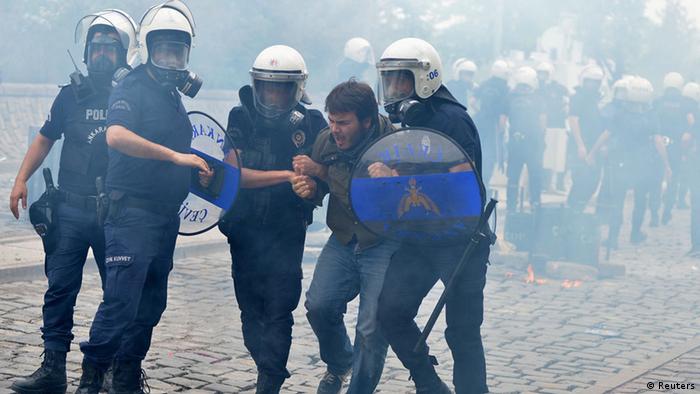
Police fired tear gas and used water cannons to prevent a group of students from marching to the Energy Ministry in Ankara to protest the Soma mine disaster May 14, which killed at least 238 people.
Around 800 students had gathered inside the campus of the Middle Eastern Technical University (ODTÜ) to denounce the disaster. But the police did not allow them to march outside of the campus, blocking the exit after the intervention.
According to reports, police taunted the protesters from megaphones during the intervention. “You should feel proud of what you are doing when a national mourning has been declared,” police officers reportedly said. Three days of mourning had been announced earlier on May 14 in memory of the victims.
Meanwhile, a number of unions and organizations have made several calls for protests for the coming days. Unions, including the Confederation of Progressive Trade Unions (DİSK), the Confederation of Public Sector Trade Unions (KESK) and the Chamber of Architects and Engineers’ (TMMOB) have called for a work stoppage with three minutes of silence at 9 am on May 15. In joint statements, the groups also asked their members to wear black clothes in memory of the victims.
In Istanbul, a group of youths held a protest in front of the operator company’s headquarters, writing “Murderers” on its wall.
The group also staged a sit-in protest in the garden of the Soma Coal Mining Company, holding placards that read “This building rises out of the blood of the workers” and “They didn’t die beautifully. This is murder, not fate.” Separately, some 10-15 people lay on the floor of the Istanbul metro at Taksim station to represent the deaths at the mine.
Other protests have been planned around the country during the day and into the evening.

Protests Break Out in Turkey as Death Toll from Mine Explosion Rises

http://www.thewire.com/
Turkish Prime Minister Recep Tayyip Erdogan has visited the coal mine where a horrific explosion and fire killed and injured hundreds of worker yesterday, announcing that the death toll from the accident is now at 232. A total of 190 workers are still unaccounted for, and Turkish Energy Minister Taner Yildiz said that hopes of their rescue "are diminishing."
The Associated Press reports that the explosion occurred during a shift change, meaning that more workers were in the mine than usual. Last night, Reuters noted that the explosion was likely caused by an electrical fault. The blast triggered a power outage that prevented elevators from running, leaving the workers trapped in the carbon-monoxide filled mine. It wasn't clear at the time whether the fire was caused by an unrelated incident. Altogether, there were 787 people in the mine at the time of the explosion. So far, 363 have been rescued. Erdogan declared three days of mourning for the dead today. But the gesture is a small one in a country where mining accidents are not uncommon, and the public is responding to the event with anger towards the government, planning protests and strikes to mark the event:
Turkey has seen a number of protests against the government since last year, when people demonstrated against the razing of a symbolic park in Istanbul. Those rallies soon became broader, taking issue with Erdogan's often oppressive policies. Now, it seems, the mining tragedy could spark a resurgence of such protests:
Meanwhile, relatives of those still trapped inside the mine are waiting anxiously for news, per Agence-France Presse:
Outside the hospital in the Turkish town of Soma, relatives waited through the night behind a double police cordon as the death toll of a blast at the nearby coal pit soared above 200 and bereaved the entire town... "I'm waiting," said Zulfer Yildirim... "Gunduz left for work this morning as he always does. We heard at about 5:00 pm and now it's 3:00 am, still no news," she said. The country's most fatal mining accident happened in 1992, when an explosion killed 263 workers.

Turkey: Analysis: Gov’t ignored warnings, miners paid the bill with their lives

The death toll from the coal mine blast in Soma, western Turkey, is now at least 201, according to Energy Minister Taner Yıldız as this piece was being written in the morning hours of May 14.
Turkey is in deep grief.
Yıldız is “afraid” that there will be more causalities, as there were nearly 800 “estimated” miners trapped in the pit after the May 13 afternoon explosion.
No, the minister has not resigned yet.
Yes, he was the one who visited the Soma mine nine months ago, praising the quality of safety measures and levels of technology, produced in Turkey, in the pits of Soma Mining, which is owned by Ali Gürkan. In a 2012 interview, Gürkan said the company had managed to drop the cost of coal to $24 per ton from $130 before privatization by simply manufacturing the electric transformers themselves instead of importing them, among other measures such as hiring subcontractors for hard work with lower salaries than workers organized by the trade union, Maden-İş.
And yes, it was with Prime Minister Tayyip Erdoğan’s ruling Justice and Development Party (AK Parti) that rejected a demand for a parliamentary investigation regarding safety in the Soma mines just two weeks ago, on April 29.
It was the social democratic main opposition Republican People’s Party (CHP) that had submitted the proposal. Its deputy for Manisa (the province where the town of Soma is located), Özgür Özel, said on the parliamentary floor that there were reports of frequent mine accidents with death tolls that might be a concern and serve as warning. Parliament should have a look at the matter in order to implement additional measures, he added.
The answer came from an AK Parti MP, again from Manisa, Muzaffer Yurttaş, who said the mines were safer than the mines in many countries around the world (despite the fact that Turkey is one of the worst when it comes to coal mine accidents). The people had trust in the AK Parti as the votes in the last elections showed and “God willing” nothing would happen, “not even a nose bleed.”
(Speaking of votes, bags of coal – and macaroni – distributed to poor people has become a symbol of how the AK Parti campaigns during elections.)
In the afternoon hours the death toll had increased to 238.
After this speech, the CHP motion was rejected with the AK Parti's votes. Has anyone thought of resigning? Has anyone assumed responsibility for the at least 238 miners’ lives lost so far? Not in sight.
The government and the ruling party in Parliament ignored the warnings about the Soma mines, but the miners paid the price with their lives.
The rescue work was still ongoing as I concluded this piece, but hopes are diminishing.

Death toll rises in Turkey mine explosion

Bodies removed from mine as death toll reaches 150.

Sepideh - Nazanin -VIDEO

MEDIA IN PAKISTAN: DIVIDED THEY FALL – ANALYSIS

By Rajeshwari Krishnamurthy
The recent unsuccessful attempt to assassinate Pakistani journalist Hamid Mir in Karachi opened a can of worms vis-à-vis the complexities in the relationship the Pakistani media shares with State and non-State actors.
That Pakistani media-persons have long held strong associations with both the military and the militants of the country is no secret; neither is the fact that the Pakistani establishment often used the media at its will to further its propaganda – and the journalists let that happen.
The Military-Media Relationship
Pakistan is among the most dangerous countries in the world for journalists. In the past, when the freedom and independence of the media was stifled by the might of military dictatorship, only those media houses and journalists that had connections with the military and the intelligence managed to survive. Information inflow is tightly controlled in the country, and throughout the years, especially during the US’ operations in Afghanistan and Pakistan’s own domestic operations, the only sources of information were the military and/or the militants. Siding with the civilian leadership was not even an option until recently.
Those who remained close to the military sources carved out careers for themselves using this association. They managed to get exclusive news, interviews, and first-hand experience in areas otherwise cordoned off for journalists.
Although there was a chance for the media to reinvent itself when the military’s grip loosened a little, it failed to do so due to the rot that has set in within the institution of the fourth estate as a whole.
Journalists and media houses who owe their existence and/or growth in prominence to the military have become comfortable with the arrangement. The media in Pakistan was never entirely independent. Theoretically speaking, they have either been in military embeds or militia embeds. Although this is not the only cause, it is among the biggest causes of the rot.
Here too, the choice of allies within the establishment and/or the militias plays a critical role. If one is in Lashkar-e-Taiba embeds, she/he has a shot at some level of safety, whereas if one enjoys a Tehrik-i-Taliban Pakistan (TTP) association, the prospects are always uncertain. The most ill-fated ones are, unsurprisingly, the ones who work in close coordination with the civilian government.
The Hamid Mir episode highlights the likelihood of the Jang Group – the parent company of Geo TV where Mir is a journalist – teaming up with the Prime Minister’s Office to challenge the military’s dominance in Pakistan. They had already started becoming belligerent, especially given their shows with politically bold themes. Mir’s statements about a ‘deep ISI’ and the possibility of differences between the Army and the Inter-Services Intelligence (ISI) also point towards murkier issues.
Although the attack on Mir, just weeks after one on Raza Rumi, another prominent journalist, garnered condemnations from all, the incident brought into the open the entrenched divide in the Pakistani media. For the first time in the country’s history a private media group openly blamed and challenged the ISI. In retaliation, cronies of the military in the media houses openly lambasted Geo TV for blaming the ISI for the attack and many rallied in support of the establishment.
Essentially, as it has historically been, this comes across as a proxy war for influence between the establishment and the civilian government. Prime Minister Nawaz Sharif is treading carefully here. Many believe that Mir was attacked by the ISI primarily due to their displeasure over the subjects of his recent shows; especially since the Army is doing all it can to improve its image. More the miscalculations the Army makes, the higher the civilian leadership’s acceptability goes.
Where Does This Lead?
Today, the media in Pakistan is essentially a business. Revenue and survival are greater motivations than truth and objectivity of content. Unbiased reportage does exist, but such institutions and journalists are few in number and are being weeded out – either by the military or the militants, or by both.
What is more damaging is the divide among the media houses. The corporatisation of Pakistani media, where more often than not there is little or no regard for journalistic ethics, has brought about a situation where media houses and journalists scramble for business and relevance. In this commotion, they have turned against each other, using unfortunate incidents like attacks on journalists to further their agenda.
Gone are the days when people like Mir Murtaza Bhutto could run politically charged magazines like his Venceremos, however small in scale, editions of which derided the Shah of Iran who was then an ally of Zulfikar Ali Bhutto. In fact, some of the most charged protests against press censorship and/or military control of the media took place as far back as former dictator Zia-ul-Haq’s regime.
This does not bode well for a country where the military wields the whip. Infighting will only make it easier for the establishment to gain and assert more control on the flow of information – defeating the purpose of the existence of the press in the first place. In a country that is only slowly transitioning into democracy, it is crucial that the press corps remains united and objective.

Will Dr Abdullah be president in Afghanistan?

The Express Tribune
By Najmuddin A Shaikh
The final results of the Afghan presidential elections will not be announced before May 14 and may, in my view, be delayed further but two things seem certain. There will be no first-round winner and the run-off election will be held around the middle of June.
Political circles in Kabul are paying close attention to the talks that Ashraf Ghani and Abdullah Abdullah are having with the eliminated contenders. All the eliminated contenders are Pashtuns. A detailed examination of the first round results showed that ethnicity had largely, if not wholly, determined the voting pattern. It seemed almost certain that those who had voted for these defeated candidates would now vote for Ashraf Ghani and render futile Abdullah Abdullah’s thirteen percentage point lead in the preliminary count.
Two developments seem to suggest that this expectation may not be borne out. First, one of the Pashtun candidates, Gul Agha Sherzai, has announced his support for Abdullah, and his 106,000 votes, if they remain intact, would bring Abdullah closer to the approximately half a million extra votes he needs to secure a majority if the voter turnout remains at seven million or so. One can discount, perhaps, unless Karzai is playing his own game, the rumours that Zalmai Rasoul, President Karzai’s favoured candidate, who secured 11.5 per cent of the vote, is being successfully wooed by Abdulllah and may throw his support behind Abdullah. Zalmai garnered his votes largely from the South —Kandahar, Helmand and Uruzgan— and here Pashtun sentiment is strong. On the other hand, one can also recall that in 2009, Karzai’s local rivals had wanted to vote for Abdullah but their votes were somehow voided.
The second and perhaps more important factor is the announcement by the Taliban that their military campaign would start on May 12 at 5am. The resignation of Mullah Zakir, a known hardliner on the issue of reconciliation, from his post as head of the Military Council of the Taliban Movement had suggested that the moderates were gaining ascendancy in the councils of the ‘Quetta Shura’. This has been vigorously denied and the new campaign will be waged strongly. Perhaps the ANSF will, as the Afghans maintain, be able to handle any Taliban attacks just as successfully as they did on April 6. But the fact is that in many Pashtun dominated provinces — Ghazni, Wardak, Logar, Kandahar, Uruzgan, Helmand, Paktia, Paktika, Khost and even Kunduz — the current threat of a Taliban offensive will keep voters away from the polls and the principal loser from the reduced Pashtun turnout will be Ashraf Ghani. In the eastern provinces, Kunar, Nuristan, Paktia, Paktika and Khost the CIA financed militias are being disbanded as the CIA plans its own withdrawal. This will give the Taliban an even freer hand in these provinces.
The next few weeks will see a lot of political manoeuvring in Kabul but to my mind the odds seem, because of the factors mentioned above, to favour Abdullah Abdullah. Many in Pakistan will view this as an ominous development since for a long time the Pakistan establishment had perceived the Northern Alliance as inimical towards Pakistan. In the last few years, however, there has been a consistent and seemingly sincere effort on the part of Islamabad to reach out to erstwhile Northern Alliance leaders and to offer assurances that Pakistan would deal with whatever leadership the Afghan electorate brought to power.
Abdullah Abdullah is a skilled politician who has built a support base despite formidable odds. In a number of meetings one was impressed by his growing maturity and above all, by his realistic and pragmatic understanding of the regional situation and the pivotal role in this context of Afghanistan-Pakistan relations. If he is the leader Pakistan has to deal with, we should be prepared to do so casting our misgivings aside and help in whatever way we can to get the new president to negotiate reconciliation with Mullah Omar.

Karzai to maintain political influence after stepping down: Dobbins

The US special representative for Afghanistan and Pakistan James Dobbins has said that President Hamid Karzai would continue to wield influence after stepping down. While speaking to reporters in Tokyo, Dobbins predicted that Karzai will maintain political influence event after he steps down. “He will be an influential figure after the elections and I don’t think that’s necessarily a bad thing,” Dobbins quoted by AFP said. He said, “He will be an influential figure after the elections and I don’t think that’s necessarily a bad thing.” “I think that the new president will respect him,” the envoy said, adding that, “We believe he views a peaceful transfer as a part of his legacy.” In regards to the Afghan president election, Dobbins said the elections are crucial for the country’s survival in the post-Karzai era. He refrained from predicting the results of the ongoing elections to pick a successor to Karzai and said whoever wins Afghanistan’s election will lead the country into a new era after Karzai’s 13 years in power and as US-led troops end their war against Taliban insurgents.

Ex-G.I. Gets Medal of Honor for Lifesaving Acts in Afghanistan

President Obama on Tuesday awarded the Medal of Honor to Sgt. Kyle J. White, an Army radiotelephone operator who struggled for hours through enemy fire in Afghanistan to try to save the lives of wounded soldiers during a surprise attack by Taliban fighters.
“Today, we pay tribute to a soldier who embodies the courage of his generation, a young man who was a freshman in high school when the Twin Towers fell,” Mr. Obama said at a ceremony in the East Room of the White House.
“His journey from that day to this speaks to the story of his generation,” Mr. Obama added. The Medal of Honor is the nation’s highest military decoration.

PAKISTAN: The practice of fake police encounters exposed through a live video recording by the media

The citizens of Pakistan watched a video recording of a police encounter on all the television channels where a man who had been pronounced dead started crying and screaming that he was alive. The police ignored his cries for help and dragged him by the hair into a police van. He was taken to a mortuary and thrown in the morgue along with three other accomplices. The 'dead man' continued to cry out for some time, begging for someone, anyone, to save him inside the morgue, but no one came to his assistance. In fact, his life could have been saved if the police had admitted him to a hospital which was just ten minutes away from the location where the fake encounter occurred.
On May 12, the police claimed that they had raided a house in Badami Bagh, Lahore, the capital of Punjab province where some robbers were hiding. The police used one suspect, Sarfaraz Ahmed Jhangvi, as an informer to show them the hide out. The police claim that at the time of the raid the robbers opened fire at the police and in retaliation the officers returned fire. As a result of the shootout all three robbers along with the informer, Sarfaraz Jhangvi, were killed. However, the family members of the victims claim that the accused persons had already been in the custody of the police and that the officers brought them to the location of the encounter in the late hours of Monday evening and killed them. The residents of the community stated to the media that they had heard the shots and had been instructed by the police to remain in their houses. After some time they watched as the police started moving the bodies to their van.
Anyone watching one of the videos (as seen here)

Lahore Police Encounter -13 May 2014

can plainly see that Sarfaraz Jhangvi was still very much alive when he was being taken to the morgue. The same video also reveals that another of the victims was in handcuffs at the time of the shooting. The cuffs were later removed at the morgue. Sarfaraz Jhangvi can be seen raising his head as he calls for help, a policeman forces his head down. The police party drove directly to a mortuary and dumped Sarfaraz Jhangvi in the morgue along with the others. The official police version is that he died inside the police van while it was on the way to the morgue. Despite the fact that he was obviously alive they police never stated in their media interviews that they were taking him to a hospital.
To back up the claim by the relatives that they had already been in custody prior to the shooting, one of the robbers was in hand cuffs on arrival at the morgue and it was only then they were removed. The police claimed that the four persons were involved in over 300 cases of robberies, rapes and kidnapping for ransom.
Please see the following videos and news links of various media reports in which he can clearly be seen that the 'dead man' was begging for help:

Lahore Police Encounter -13 May 2014

http://video.dunyanews.tv/index.php/en/mustwatch/1155/Police-Encounter-in-Lahore#.U3L_qIGSw6U
http://videos.geo.tv/VideoGallery.aspx?ID=19116
http://www.thenews.com.pk/article-147503-Lahore:-four-dacoits-killed-in-alleged-police-encounter
The Human Rights Commission of Pakistan (HRCP) has reported that during 2013, 217 cases of extrajudicial killings were reported from Punjab province. This is still the continued practice of instant justice by the Punjab government.
Due to the absence of a proper criminal justice system and the existence of the weak rule of law, the law enforcement agencies, particularly the police, enjoy impunity for not respecting the right to life. The government does not focus on the rule of law but rather the maintenance of what they consider to be law and order. This has created the problem of continuous fake encounters which result in the killings of innocent people.
The police and law enforcement agencies (LEA) have been given authority to violate the dignity and respect for the right to life of the citizens. Through the impunity the LEA have been given full protection for the illegal acts and supra constitutional methods. In Pakistan there is no longer any obligation for anyone with a criminal charge to be entitled to a fair trial and due process. Extrajudicial executions manifest rooted problems within the law enforcement and criminal justice machineries of these states. Statutory impunity provided to state agencies to undertake extrajudicial executions, under the guise of the maintenance of law and order. This has resulted in an alarming increase in the number of extrajudicial executions throughout the country.
The government, instead of reforming its criminal justice system to enable speedy trial, fair investigation, and proper prosecution, has given inordinate power to police, military, and other law enforcement agencies to restrict fundamental rights of the people in the name of fighting crime.
The Asian Human Rights Commission (AHRC) wishes to remind the government of Pakistan that international human rights law requires that police killings are thoroughly investigated, and that the police officials responsible for unlawful actions are prosecuted and convicted. The AHRC also urges the government to form a high judicial powered commission to probe the instances of fake police encounters, particularly in Punjab province, where this has reached epidemic proportions. The government of Punjab finds it easy to resort to encounters and terrorising the whole society in order to keep them under control.
The AHRC praises the courageous cameraman who took this video.

Fuelling the insurgency in Balochistan

By Jeeyand Kashif Sajidi
The fifth insurgency of Balochistan which started in 2006 in the ground of Dera Bugti has now spread in every nook and corner of the province. For eight long years, security forces have failed to crush Baloch militants. The question is why writ of government is declining and power of these insurgents is rising and more importantly who is fuelling these insurgents?
From the narrative of Pakistani Government, foreign countries especially India has been given the bulk of criticism. Apart from India, Afghanistan, Israel and occasionally America have also been blamed for creating unrest in Balochistan. Allegations are merely allegations unless they are proved. Yet Pakistani state hasn’t brought any substantial evidence against any of these countries. A common man is unable to comprehend why these foreign powers will support this insurgency.
The ground reality suggests that people inside Pakistan are spreading insurgency in Balochistan. However, it is questioned who neglected Balochistan and created sense of deprivation in the heart of Baloch people. Was it America India or Israel who has treated Balochistan as their colony and exploited its resources? It is negligence of Islamabad government which has deprived Baloch of their rights and few leaders accepted this and saying sorry to Baloch masses for their negligence.
The ongoing insurgency, which started in the wake of demise of Akbar Bugti and everyone, knows who assassinated him. He was not killed by any foreign troops, but by security forces of Pakistan. The assassination of a 80 years old Baloch leader aggravated the situation and fuelled the insurgency. The decision of murder of Akbar Bugti didn’t take place in New Delhi, Kabul or Washington rather it was made in Islamabad. Veteran anchorperson, Kamran Khan was right when he said that “slain Akbar Bugti will be more dangerous than alive Akbar Bugti”.
The stupid Kill and dump has added oil to the fire. Owing to this high handedness policy, the hatred against Islamabad has increased among the general masses. This imprudent policy has convinced Baloch that they have no future in Pakistan and ideology of Baloch separatists’ fighters has gained strength. This unwise strategy has convinced the hoi polloi that Sarmachars are fighting a just war with the occupying forces.
Policy makers are repeating the same mistakes and they are still fuelling the insurgency. On 18 April, 2014 Chairman of Baloch Student Organization (Azad) Zahid Baloch was abducted from Quetta and he is still missing. Those who are involved in his abduction should fathom that killing of Akbar Bugti, Balach Marri and Ghulam Muhammad Baloch have not suppressed the movement, so, will the picking and killing of Zahid Baloch will end their struggle. It will again fuel the insurgency. In reaction of this incident, Latif Johar, a member of central committee of BSO(Azad) and who is just 23 years old is sitting on Hunger Strike till death since 22 April, 2014 demanding the release of his leader. The valor of the young boy should be extolled, but there are few chances that his demand will be fulfill. It seems the fate of Latif Johar will be same as that of Bobby Sandes , who was the member of Irish Republican Army and died of a Hunger strike in a country which is considered the mother of democracy United Kingdom.
The response of the government and so called national media to the peaceful protest of Latif Johar is the same. No minister neither from national nor provincial assembly has visited the hunger strike camp of Johar and mainstream media has given very little coverage. The health of Johar is deteriorating and it seems that he will die soon and with his demise the insurgency will be further fuelled.
Before Latif Johar, Mama Qadeer walked 2500 Km as a protest to release missing persons, but not even a single person was released. Same will happen again with Johar’s protest. After his death Baloch people will contemplate that peaceful and democratic protest is futile in this undemocratic country. As a result more people will be influenced by the ideology of Baloch separatists that armed struggle is the only option in this state.
The elected PM Nawaz Sharif is powerless to do anything on this issue, but those who have power they could hear the voice of young Latif Johar, who said” I can’t kill or torture any one because my organization has taught me humanity but it is my right to do whatever I want to do with myself. I am torturing myself for the release of my leader”. But they will never hear him because humanity is a extinct word in their dictionary.

BALOCHISTAN: Playing a Dangerous Game in Kech

By Naziha Syed Ali
TURBAT: Five women, all clad in mourning black, are seated on the floor of a two-room mud brick home in a hardscrabble part of town. They have come to condole with Mah Khatoon, the widowed mother of a militant who was killed in an encounter recently. Her only surviving son lounges in the doorway of the room.
“There’s no man left at home, so he had to return from Muscat where he was working,” says an aunt. Until he finds a job in Turbat, the family must depend on handouts from relatives.
The insurgency in Balochistan claims a price in much more than blood alone. Women are particularly poignant victims. Although there is a tradition of educating girls in the Makran belt where Turbat is located, Balochistan is very much a patriarchal society and women are left deeply vulnerable without male relatives.
For many people in Turbat, the headquarters of Kech district, the conflict is taking an unacceptable toll on the Baloch youth. The enforced disappearances common in the area inflict unimaginable agony on the families, which spills out in anger not only against the state but against the insurgents as well.
Impact on Education
“For the ordinary Baloch, life in Turbat is hell,” says a human rights activist. “Young boys are either led astray by the separatists or the FC targets them. Why don’t the militants let these lads study, make something of their lives? Why don’t they find older men to fight their battle?”
Driving out Punjabis and other settlers from Makran — which comprises Kech, Mand, Gwadar and Pasni districts — has also adversely impacted education in the area, as these non-Baloch were prominently represented in the teaching and technical professions. Then there are incidents of blatant high-handedness by the Frontier Corps (FC), the security force deployed in the area, that further compromise the future of the younger generation, such as the takeover two months ago of the Technical Training Centre in Turbat where nearly 300 students were enrolled. According to an eyewitness, “The FC stormed into the premises in a convoy and took it over by force, throwing out the students and teachers on the spot. They’ve since turned the place into another camp for themselves.”
A private girls’ college located in a building owned by Balochistan National Movement leader Kachkol Ali has met with a similar fate. “It was forcibly occupied by Rashid Pathan on June 5, 2013 with assistance from the FC,” claims Mr Ali from Norway, where he is in self-exile after threats, he says, from intelligence agencies. (Rashid Pathan is actually a Baloch who is widely alleged to be heading the local ‘death squad’, so called because such groups are said to be complicit in the abduction of Baloch men suspected of separatist sympathies.)
Meanwhile, ethnic tensions have fractured society. Pakhtuns and Punjabis living in the area left in droves after non-Baloch settlers began to be targeted by the insurgents who saw them as collaborators with the state.
“Those who took over the businesses that were left behind, mostly belonging to the Pakhtun, were non-local Baloch, in particular Marris and Zehris who are coming to settle here,” says Nasir Gichki, a Turbat resident. “They’re very business-minded unlike the Makran Baloch who prefer to work overseas and come home to indulge their expensive tastes.”
“With very few exceptions, there are now no local Baloch who are tailors or barbers here. They’re all non-local Baloch,” explains another resident.
There are also other threats that bode ill for society.
About a month ago, a convoy of FC vehicles descended upon a Turbat hospital and cordoned off the building. According to witnesses, the FC took over the medical treatment of the head of a local madressah, Mufti Shahmeer Gichki, who was admitted there after suffering bullet injuries a day earlier. Many locals allege the mufti is closely affiliated with the security force.
A fiery orator, Mufti Shahmeer was attacked near Darmakol village, Turbat, by Baloch militants who claimed he had been fuelling sectarian hatred in the name of tableegh (preaching). Three among the party were killed and two others, including the mufti, were injured. Observers in Turbat contend that to counter the insurgency in the province — which is secular in nature — the state is making cynical use of religion by promoting an ultra-conservative strand of Islam in the region. Small madressahs have mushroomed in Turbat. Many appear newly constructed, with paintwork that still looks fresh in the dry desert air. Significantly, they appear to have scarcely any students.
“This is a secular society and if they can afford it, people send their children to school rather than to madressahs,” explains a social activist. “In fact, in many educational institutions girls outnumber boys.”
The madressahs, say residents, are a front for state-sponsored groups from within Baloch society itself who have been given licence to use religion to intimidate and divide people. By virtue of their powerful connections, these individuals can get away with all manner of crimes, including drugs and fuel smuggling, land-grabbing, and worse.
Some residents point to the attack on a polio team on Jan 22, 2014 in Shahi Tump locality that, they allege, was carried out by the occupants of a nearby seminary. Although the madressah head was handed over to the local administration, a call from intelligence was enough to set him free, claims a local official.
According to Captain Usman Ahmed, second-in-command of the FC in Turbat, “The FC is deployed in the province to counter the Baloch insurgency, and yes, we will take help from anyone who will assist us in this but we evaluate their information very carefully.” Sectarian Tensions
The emboldened right-wing elements in the region have begun flexing their muscles over the local population. In Pidarak, some 15kms from Turbat, an English language centre was visited by a group of clerics led by Mufti Shahmeer, who allegedly ordered the faculty, on pain of death, to stop teaching girls at the institute. Religion is a particularly potent weapon in Turbat, which is home to a sizeable minority of Zikris, a sect considered ‘heretical’ by many conservatives. One of their holiest sites, Koh-i-Murad, is situated in the vicinity and frequented by Zikris from all over the country.
“Thankfully there is as yet no religious conflict among the Baloch, not least because many Zikris and Sunnis are related through marriage,” says Yasir Dashti, a local.
People believe that sectarian tensions are deliberately being stoked in order to further divide the Baloch. “All the pro-state actors that exist here do so within a religious garb,” says a human rights activist. “There are many groups here in the name of religion — in madressahs, masjids, even mullahs’ homes.”
It seems that Turbat, like much of Balochistan, is on the verge of a war with itself.

Pakistan’s regional isolation

Thanks a military dictated foreign policy Pakistan has got itself badly isolated in the region. The country’s relations with India, Afghanistan and Iran are, to varying degrees, in bad shape. Besides tensions on the Eastern and Western frontiers, Pakistan’s border with Iran is also becoming a source of anxiety. In February Iranian interior minister threatened to send troops inside Pakistan if steps were not taken by Islamabad against terrorist groups launching attacks inside Iran from Pakistan’s territory. Last month, President Hassan Rouhani underlined the need for the removal of security concerns at the two countries’ common border. Early this month Iran’s police chief hinted that his country could seal its border with Pakistan any time. Any attempt to improve the relations is therefore welcome. During Prime Minister Nawaz Sharif’s visit he was told by highest Iranian authorities what hurt Tehran the most i.e., sectarian violence in the Pakistan-Iran border region and cross border attacks by anti-Iran sectarian groups. Iran is dissatisfied with the level of cooperation so far provided by Pakistan and wants Islamabad to do more to put an end to the attacks.
Pakistan needs to enhance economic relations and expand trade with Iran. Iran is a potential market for Pakistan’s exports. The latter also needs Iranian gas and is keen to import power from Iran. Most of all Pakistan needs a friendly neighbour and a secure border.
There are two hurdles in the improvement of relations. American sanctions stand in the way of import of gas from Iran. As nuclear talks with Iran have gone surprisingly well, the withdrawal of US sanctions in days to come cannot be ruled out. One expects Islamabad to continue to press Washington that it needs the Iranian gas badly. The Gulf countries, particularly Saudi Arabia, look at the regional politics from a narrow sectarian perspective. What is more they continue to finance and encouraged anti-Shia terrorist groups in Pakistan, some of which attack Iran. Unless Nawaz Sharif is able to persuade the Saudis or is able to come out of their influence, the anti-Shia terrorist groups would continue attacks inside Iran and play havoc in Pakistan.
It all depends on whether the PML-N government is able to resist the overtures on the part of certain Gulf countries or any other power that might want to use Pakistan’s territory to destabilise Iran. Unless it does so the desire expressed in Tehran for increased bilateral trade and strengthening relationship and cooperation between the two countries will remain a pipedream. Nawaz Sharif has to realise that Pakistan badly needs to improve ties with neighbours.

Pakistan: Wrong labelling on children’s drugs: Pharmacists call for lifting entire stock of Phenergan, Flagyl

http://www.dailytimes.com.pk/
Flagyl suspension (meteronidazole) for children was supplied to market in bottles, which actually contained Phenergan (promethazine). The manufacturers, Messrs Sanofi Aventis, and the DRAP remained silent on the issue for a long time. A patient did file a complaint with the Pakistan office of Sanofi and also with its Europe office. The Europe office, however, ordered its officials in Pakistan to take action within 24 hours.
Outer cartons of Phenergan 120ml, the primary label is of Flagyl Suspension 90ml. However, the bottle actually contains Phenergan – a drug which has been declared spurious under Section 3 of the Drugs Act, 1976. Since, it is a gross failure; rather worst failure than Efroze tragedy in which hundreds of patients died in the Punjab Institute of Cardiology due to supply of adulterated/contaminated medicines in 2012. The mix-up of material requires laboratory testing while in this case, naked eye could have caught the wrong labelling.
In outer cartons of Phenergan 120ml, the primary label is of Flagyl Suspension 90ml. However, the bottle actually contains Phenergan – a drug which has been declared spurious under Section 3 of the Drugs Act, 1976. Since, it is a gross failure; rather worst failure than Efroze tragedy in which hundreds of patients died in the Punjab Institute of Cardiology due to supply of adulterated/contaminated medicines in 2012. The mix-up of material requires laboratory testing while in this case, naked eye could have caught the wrong labelling.
The Pakistan Pharmacists Association President Dr Nabeela Latif said said that medicine manufactured by Efroze was not spurious but a case under Section 302 of the Pakistan Penal Code (PPC) was registered and factory was sealed. Then came the case of Tyno syrup, where medicine was not spurious or adulterated but not only a criminal case was made against the company, Messrs Reko Pharmaceuticals, its factory was also closed down. Another case of Messrs Orient Laboratories, which was not of any mistake in medicine manufacturing but of negligence in factory, was also prosecuted under Section 302 of the PPC. She added that the common man could not understand how labels of Flagyl 90 ml bottle were pasted on bottle of Phenergan 120ml syrup. This fiasco has the potential to create medical emergencies, especially if a child required meteronidazole but was treated with promethazine, she said.
She said that the company gave an advertisement in national newspapers for recall of a certain batch number whereas our common patient is not very well aware of batch numbers and that it is also not necessary that every patient had read the advertisement. So, she said, it was essential that company must lift entire stock of Phenergan and Flagyl from market and supply fresh stocks without delay. Moreover, she said, the company started Flagyl’s promotional advertisements on radio without obtaining approval from any regulatory agency; while the regulator is in a deep slumber especially when Flagyl is not over-the-counter drug and is sold only upon furnishing a prescription.
She said that the company had delivered over 200,000 bottles of these syrups across the country in December 2013 but that only 6,000 bottles of one batch were recalled. She said that nobody knows that how many children have lost their lives or suffered different medical complications after using these wrongly labelled and spurious drugs.
She said that law-enforcement agencies have dealt local companies with an iron fist but that they are silent when a multinational had produced spurious drug, which was sheer discrimination.

Pakistan: Doctor was killed by extremists over liberal views

A senior doctor, who was killed at his clinic in Jalalpur Jattan city on August 7 last year, was not a victim of extortionists but of the alleged militants belonging to banned outfits for his liberal views.
A reliable source in a law enforcement agency told Dawn that three militants, recently arrested in connection with the target killing incidents in Gujrat, had revealed during interrogation that Dr Attaur Rehman, a known medical practitioner of Jalalpur Jattan, had also been a victim of their target killing besides many others last year.
The law enforcement agency had arrested the suspects in a kidnap-for-ransom case. During investigation, they revealed their involvement in target killing of seven people, including Professor Shabbir Shah of the University of Gujrat (UoG), a religious figure Fazeelat Shah alias Phul Shah in Jassoki area of Kunjah police and a policeman Sarfraz. They had also attacked a Sara-i-Alamgir-based businessman belonging to Ahmadi community who sustained bullet injuries but survived two attacks on him.
Though officials are terming the arrests as a major breakthrough in the investigation of target killing cases, the revelation of Dr Attaur Rehman being targeted by the banned outfit had really shocked them as they had earlier considered involvement of extortionists in the incident.
The militants told investigators that they had killed the doctor due to his liberal views he used to express publicly at his clinic and it was a medical representative of a pharmaceutical company who had connived with the suspects, telling them that the doctor often gave, what they termed, provocative remarks about religion and the information had been the sole reason for targeting him.
The revelations came as the investigators were probing the suspects in a kidnap-for-ransom case. All the three arrested suspects, including two real brothers Abrarul Haq and Anwarul Haq, residents of Dedhar village of Gujrat Sadar police precincts and Asif Maqsood of Jhandewal village, Gujrat, were arrested by a joint raiding team of Jhelum and Gujrat police a few weeks back in a case of kidnap-for-ransom of Haji Iqbal, a British national. They also confessed to being involved in four other major incidents of target killing in Gujrat district during the later half of 2013.
Earlier, the then Gujrat DPO Ali Nasir Rizvi had claimed the arrest of seven extortionists of a gang of Jalapur Jattan during a news conference on August 28, three weeks after the killing of the doctor, saying the extortionists had killed the doctor for extortion. Police had framed charges against seven suspects for anti-terrorism court of Gujranwala where the trial of alleged gangsters continued despite repeated statements of the complainants in their favour.
A police official said the heirs to Dr Rehman had formally asked the court in writing that the seven alleged extortionists were not his killers. The suspects’ release was likely after the legal formalities.
Police sources said DPO Rizvi, under pressure from the agitating medical fraternity of Gujrat chapter of the Pakistan Medical Association, had declared the seven alleged gangsters as killers of Dr Rehman just to pacify the concerned voices in Gujrat over the rise in extortion incidents.
It was also revealed that DPO Rizvi himself had also been a prime target of the arrested terrorists for belonging to the Shia community. The security of Mr Rizvi had been higher than routine security of a DPO and two Elite Force vehicles used to move with him instead of one mobile van while a concrete security wall had also been constructed outside his house.
The three alleged killers of Dr Attaur Rehman had been in Jhelum police custody for their involvement in abduction of Haji Iqbal who was released by them after payment of Rs3.5 million ransom.
DPO Jhelum Afzal Mehmood Butt confirmed to Dawn that the arrested suspects had confessed to killing of Dr Rehman and they had been on physical remand of six days until May 15 in a kidnapping case of Haji Iqbal. Efforts were being made to bring Iqbal back to Pakistan to pursue the legal formalities of the case, he added.
DPO Gujrat Rai Ijaz said three arrested militants were yet to be brought to Gujrat from Jhelum for legal proceedings in target killing cases. Two more suspects, Qari Afzal and Zakriya Khalid, of the same network are already in custody of Gujrat police on physical remand whereas the law enforcing agencies had been making efforts to arrest the remaining members of the gang.

Pakistan among countries where torture is rife: Amnesty

The report, Torture in 2014: 30 Years of Broken Promises, was released on Tuesday. It provides an overview of the use of torture in the world today. The report says that torture is used to force confessions or to silence activists in countries such as China, India, Indonesia, Malaysia Pakistan, Sri Lanka and Vietnam.
In Indonesia, Pakistan and South Korea the majority of respondents feared they could be tortured if taken into custody.
The report says that torture in Pakistan is frequently practiced by police, intelligence services and the army, particularly in conflict-ridden tribal areas and Balochistan. Amnesty has received reports of torture used on human rights defenders, lawyers and journalists among others.

Pakistan: A fruitless visit

BESIDES the reiteration of fraternal sentiments and an expression of wishes for closer ties, the prime minister’s two-day visit to Iran produced little of substance. The greatest disappointment was over the gas pipeline project. No joint statement was issued, and all that we have is the signing of eight memoranda of understanding on subjects such as the extradition of prisoners. The only reference to the gas pipeline was spiritual leader Ali Khamenei’s emphasis on going ahead with bilateral projects, including the pipeline. As was expected, the ayatollah minced no words, and blamed America and “other countries” for trying to create a rift between his country and Pakistan. That the ayatollah thought Pakistan had succumbed to US pressure was discernible when he asked Mr Nawaz Sharif not to wait for “permission” from other governments to encourage relations between Iran and Pakistan.
Conceived more than two decades ago, the gas pipeline has yet to see the light of day. Initially, the pipeline was to carry gas across Pakistan to India, but New Delhi pulled out of the project in 2009, delivering a blow from which the project has not yet recovered, even though energy-starved Pakistan needs gas desperately. In March 2013, the project aroused optimism when then presidents Asif Ali Zardari and Mahmoud Ahmadinejad inaugurated the construction of the Pakistani part of the pipeline. But again the project ran into difficulties, largely because Islamabad gave in to pressure. A new chapter appeared to be beginning in relations between the two neighbours when Mr Sharif declared after becoming prime minister in June 2013 that the project was on and was likely to be completed by the end of 2014. That has not happened, and as the outcome of his Iran visit shows, we should perhaps sing a requiem for the project.
Nevertheless, it would be a mistake to think of Iran-Pakistan relations solely in terms of the pipeline. As neighbours, the two countries have common concerns and need to deepen understanding on such issues as post-America Afghanistan, the change in the Middle East’s power equilibrium in the wake of the Tehran-Washington thaw, the strategic relations developing between Pakistan and Saudi Arabia, the Syrian civil war, terrorist groups’ activities on the borders, and bilateral trade, which has plummeted to $1bn because of US-led sanctions against Iran. Islamabad must assure Tehran that relations with no state will be at Iran’s expense, and that it will pursue a policy of non-interference in other countries’ affairs — a point emphasised by Mr Sharif when he recently addressed Pakistani envoys in the Middle East. This policy must be pursued in earnest and in a manner that satisfies Iran without jeopardising Pakistan’s ties with the Gulf monarchies, especially Saudi Arabia. The two governments must also think deeply about the kind of measures needed to increase bilateral trade.

Pakistan: Opposition in Senate rejects adviser’s ‘sketchy’ policy statement

http://mediacellppp.wordpress.com/
Ill-prepared cabinet members brought embarrassment to the government in the Senate on Tuesday, with Adviser on Foreign Affairs Sartaj Aziz bearing the brunt of criticism over what the opposition termed sketchy statement on foreign policy.
Rejecting the adviser’s eight-minute policy statement after a debate on the country’s foreign policy with particular reference to the situation likely to emerge after elections in India and Afghanistan, the opposition members staged a walkout to register their protest over the speech which they said was “an insult to the house”.
“We receive more information from the Foreign Office spokesperson at her weekly briefings than the adviser has provided to this house today,” said Raza Rabbani of the PPP as Mr Aziz took his seat after the speech. Mr Rabbani regretted that the adviser did not make any mention about Pakistan-India relations, the ongoing dialogue with the banned Tehreek-i-Taliban Pakistan (TTP) and the recent visit of the US deputy secretary of state to Pakistan. “We don’t accept this as a policy statement,” Mr Rabbani said, urging the ruling party not to “make the parliament redundant”. “Look at the seriousness of the government members,” Mr Rabbani said while pointing towards Leader of the House Raja Zafarul Haq, who was the lone member sitting on the treasury benches.
Describing Mr Aziz as “ignorant and innocent”, Opposition Leader Chaudhry Aitzaz Ahsan coined a new word, “ignocent”, for the adviser. “We feel sorry. This is an insult to the house. The ministers do not give replies to our questions and we stage walkout against it,” Mr Ahsan declared before walking out of the house, forcing Deputy Chairman Sabir Baloch to adjourn the sitting till Wednesday afternoon. Mr Ahsan had already put the adviser on the defensive, when during the debate earlier he had asked the prime minister to appoint a fully fledged foreign minister. The PPP leader said Narendra Modi in India and Abdullah Abdullah in Afghanistan were being tipped as new rulers there and their views about Pakistan were well-known. “Both the countries will have strong governments and both of them do not have cordial relations with Pakistan,” he remarked.
“You have not been able to even put pressure on the Afghan government for handing over of (TTP chief) Fazlullah, who is openly patronising the groups in Pakistan which do not recognise our Constitution,” he said.
Mr Ahsan also criticised Prime Minister Nawaz Sharif for inviting foreign investment in the country while keeping his own money overseas. He claimed that Mr Sharif was “the third biggest investor” in the UK after Hinduja Group and Lakshmi Mittal of India. Senator Farhatullah Babar of the PPP also took the Ministry of Foreign Affairs to task for, what he called, thoughtless endorsement of a questionable narrative that Osama bin Laden was tracked down in Abbottabad through a fake polio campaign. He said the statement from the FO spokesperson had come at a time when it was yet to be established exactly how Osama bin Laden was tracked down. In his winding up speech, Mr Aziz said the prime minister had stressed the need for pursuing “economic diplomacy” and was following the policy of “trade not aid”. He said the government had decided to adopt a “policy of non-interference” due to which the relationships between Pakistan and Afghanistan were improving. Mr Aziz said the government was cognizant of the changing situation in the region in the wake of elections in different countries.

Pakistan: ANP leader gunned down in Peshawar

www.dailytimes.com
Unidentified gunmen on Tuesday shot dead an Awami National Party (ANP) leader in Peshawar’s Kohati area, police said. Anwarul Haq was shot dead at his shop, the police told media. He was a member of the ANP’s district organising committee in Peshawar. Senior ANP leaders, including Mian Iftikhar Hussain, participated in a protest demonstration with workers blocking the GT Road for traffic to protest Haq’s assassination. Police was unable to say what might be the reason behind the attack. However, the ANP leaders were unanimous in terming it a target killing. The protesters carried black flags and shouted slogans against the provincial government while demanding the immediate arrest of Haq’s murderers. Meanwhile, police recovered two bodies, packed in gunny bags, from a drain in Hayatabad area of Peshawar, while two teachers were murdered in Hangu District. The bodies of a man and a woman were found from a drain after the Bomb Disposal Squad checked the suspicious bags. “It appears the victims were tortured before being shot dead,” police said. Also, gunmen on Tuesday killed two schoolteachers in Hangu District, police said. “Gunmen on motorcycles opened fire at two teachers of government high school. One died on the spot, while the other died in hospital,” DPO Iftikhar Ahmed told AFP.

Pakistan's Polio problem

By Altamash Hashmi
In 1955, Jonas Salk developed a vaccine for polio followed by Sabin oral vaccine. Subsequently, the number of cases of polio was reduced from 28,985 Americans in the year 1955 to nil in 1979.
Similarly, India reported half of the global polio cases until the year 2009. But thanks to the aggressive polio campaign in the country, India has now become one of the polio-free countries in the world. Even globally, more than 2.5 million children have been immunized reducing the overall number of polio cases by 99 percent.
But the threat is definitely not over. The World Health Organisation issued a statement earlier this week highlighting the trouble of international spread of polio virus, calling it an 'extraordinary event' and a public health risk to other States for which a coordinated international response is essential. WHO has noted that Pakistan, Cameroon and Syria pose the greatest risk to countries who have managed to get rid of the virus but have severely compromised routine immunization services since then. Estimates show that by the end of 2013, 60 percent of polio cases worldwide were a result international spread of polio virus. According to WHO, the need of the hour is a coordinated international response to stop the international spread of the wild poliovirus especially with the onset of the high transmission season in May and June. In a statement, WHO says 'if unchecked, this situation could result in failure to eradicate globally one of the world's most serious vaccine preventable diseases.'
In an immediate response, Pakistan's Health Ministry Spokesperson Sajid Ali Shah said polio immunization posts would be established at the country's international airports and other travel hubs. But the problem with Pakistan is not the will of the government sitting in Islamabad. The trouble lies with the implementation of government initiated programmes. Vaccination campaigns have been obstructed by extremist at various levels including lethal attacks on health workers. Pakistan National Polio Plus Committee Chairman Aziz Memon said in an interview last year "what hinders Pakistan in containing the dreaded virus is insurgency, violence and illiteracy."
The main problem area for the Pakistani government is the country's northwest where the Tehrik-e-Taliban exercises authority. Their leadership changes after almost after every 30 kilometers. Unlike the Afghanistan Taliban, Tehrik-e-Taliban has announced its disapproval of the polio vaccine in the past. In fact many local clergymen have also disapproved of vaccination leading to a perception amongst parents that polio vaccines lead to impotency. Just last year, as many as 47,099 children were missed out in polio vaccination drive due to parents' refusal.
However, there is still hope for Pakistan that can learn a lot from India which was also bombarded with false information on polio vaccines. In India's case, the clergymen who once strongly criticized vaccines became an important tool in clearing the doubt over its side effects. Experts always predicted India would be the last to stop polio as parts of Uttar Pradesh and Bihar were among the most difficult places in the world for polio eradication. Luckily, they were proven wrong.

Pakistan: Departing Travelers Must Get Polio Vaccine

http://www.nytimes.com/
As of June 1, Pakistan will require everyone leaving the country to get a polio vaccination, the Health Ministry said Tuesday. The World Health Organization declared the spread of polio an international public health emergency this month and identified Pakistan, Syria and Cameroon as having allowed the virus to spread beyond their borders. Pakistani officials said all provinces had been given the necessary guidance and materials to set up special counters at hospitals and airports for polio vaccination and certification.

How to resolve Pakistan's polio crisis

By Malik Ayub Sumbal
Misconceptions, service provision failure, insecurity and foreign involvement are to blame for Pakistan's polio crisis.
As the number of polio cases reached 74, the inevitable finally happened: The World Health Organization (WHO) imposed a six-month international travel restriction on Pakistanis to prevent the possible spread of the polio virus from Pakistan to other countries. Of the 74 cases registered worldwide, 59 occurred in Pakistan.
The government is now left with no other option except to ensure that all people residing in Pakistan and long-term visitors receive a dose of oral polio vaccine (OPV) or inactivated poliovirus vaccine (IPV) between four weeks and 12 months prior to travelling overseas.
The WHO slapped travel restrictions on Pakistanis after identifying Pakistan as one of three countries at risk of further spreading poliovirus to the rest of the world.
For the past few years, Pakistan's government has failed to reduce the numbers of polio cases to acceptable levels, despite WHO warnings. A number of campaigns for vaccinations across the country were not successful in eliminating the disease. The question is why?
Failure on many levels
Pakistan reached this embarrassing point for a number of reasons. F
irst, rumours and misconceptions about the polio vaccine have run free across the country. Some say that this vaccine is being used to control the birth rate and decrease women's fertility; others claim that it weakens children. Whatever the misconception, little has been done by the state to change people's minds about the vaccine. The high polio rates have been a failure of education, in a way.
Second, failed services and negligence have also contributed to the problem. In a number of regions like Federally Administrated Tribal Areas (FATA) and remote regions of the Khyber Pakhtoonkhaw Province, anti-polio campaigns have used the expired vaccines scandal to discourage people from getting the vaccine. At the same time, in some areas suffering regular blackouts refrigeration and storage of the vaccines has been a challenge. Because of the systematic service provision failure of the government, some village leaders have taken to boycotting polio campaigns to pressure the authorities to take care of their electricity needs.
Third, it is also clear that the international community shares part of the blame. The fact that these organisations have focused only on polio, when babies need a set of nine vaccines has not been well received in Pakistan. Furthermore, revelations that Dr Shakil Afridi, who led a fake polio drive to help the CIA capture Osama bin Laden, worked for some UN agencies, has not helped the situation either. In fact, because of the continuous use of drones by the US in the northern parts of the country, the Taliban decided to ban all polio vaccination campaigns.
Fourth, the government has failed to protect anti-polio medical workers. Recent years have seen more than 100 attacks on polio teams and workers in which at least 50 polio workers lost their lives. Despite the frequency of the attacks, none of the perpetrators have been identified or arrested by the security agencies. If the government was to show true commitment to eradicating polio from the country, it would put much more effort into protecting vaccination teams.
What needs to be done?
After the WHO imposed travel restrictions on Pakistan, the Khyber Pakthoonkhaw Province under the leadership of Imran Khan, a former cricketer, launched a health programme called "Sehat Ka Insaaf" (Justice for Health). I travelled to Peshawar with the Sehat Ka Insaaf organisers to observe their work, but in the two days of my stay there I did not see even a single polio team in the city. Campaigns such as Sehat Ka Insaaf cannot end polio. All they can do is provide their leaders with the publicity and political gains they are hoping for.
A senior official at WHO's Pakistan office told me that the polio cases are concentrated in Peshawar, FATA and Karachi, while the rest of the country is polio free for now. With this in mind, it is time to revamp the polio vaccination drive and focus it on the areas experiencing high incidences.
The government should develop better security services for polio workers as well as better plans to cope with the reach and penetration of vaccination campaigns. Government officials should also try to engage regional and tribal leaders in this initiative to minimise security concerns and encourage local communities to trust the vaccination teams. An education campaign should focus on dispelling negative misconceptions about the vaccine and explain what exactly it does. Finally, the international community and organisations need to back the Pakistani government's efforts by providing funding and effective support on the ground that reflects the real needs of the population.
Only a sincere effort on the part of all stakeholders could help to eradicate polio from Pakistan.

Teaching Liberation to Pakistan’s Girls

By Bina Shah
You can’t go a day on the streets of Pakistan without hearing some spectacularly rude words and colorful insults taken in stride, whether thrown in anger at an errant motorist or in banter among friends at a tea shop. But the words “sex education” are different; they release a tirade of moral righteousness from many Pakistanis, who find this the dirtiest phrase of all. These people fear that it means “teaching children how to have sex,” rather than educating them about their health and reproductive rights.
At least in some parts of Pakistan, though, that is beginning to change.
Most Pakistanis still profess conservatism and modesty about sexual relations and matters of the body. But Dr. Nafis Sadik, a United Nations population expert who led Pakistan’s successful Family Planning Program in the 1960s, describes a deeper feeling of fear: that if girls are given access to information about sexual health and reproduction, they will become promiscuous. “Boys’ and men’s sexual behavior is condoned and appreciated,” she has said, “but girls’ and women’s sexual behavior is seen as something that needs to be controlled.”
Nevertheless, attitudes are evolving — not least because this prudishness has proved dangerous for the nation.
Today, Pakistanis face a major health care crisis of deadly communicable diseases like hepatitis C, which is rampant in rural areas, as well as a flood of health problems that women and girls experience because Pakistan has also retained the practice of early marriage. Many girls are married off by their families as soon as — or even shortly before — they have reached puberty in their early teens. A result: Pakistan ranks near the bottom among countries in maternal and child health care.
One anecdote captures the absurdity of the problem. Early this year, a village in rural Sindh summoned the boldness to instruct 700 girls from eight local schools on topics like menstruation, how to protect themselves from sexual assault, and even marital rape. The villagers had demanded the classes, and the students reacted enthusiastically to the revolutionary idea that they had the right to control their own bodies. But Mirza Kashif Ali, president of the All Pakistan Private Schools Federation, reacted angrily, reportedly saying: “What’s the point of knowing about a thing you’re not supposed to do? It should not be allowed at school level.”
That “thing you’re not supposed to do” is actually being done to young women and girls in child marriages all across Pakistan. Of Pakistan’s 90 million women, 37 percent have married before the age of 18. And one of every 70 dies each year because of early pregnancy, not enough time between pregnancies, and other risks of teenage pregnancy. In 2002, a year assumed to be typical, some 900,000 abortions were performed, the great majority of them unsafe. Abortion is illegal, although rarely if ever prosecuted, and most women who need one must go to an underground doctor or, worse, untrained abortion providers.
Recognizing those facts, a groundbreaking “Sexual and Reproductive Health and Rights” education program (the euphemism and its abbreviation — S.R.H.R. — were deemed necessary to avoid the label “sex education”) was conducted in rural parts of two Pakistani provinces from 2010 to 2012.
The program was run by Rutgers WPF, a Netherlands-based organization, with two Pakistani partners, Bargad and Saifco; they went into 21 schools in the Sanghar district of Sindh and the Gujranwala district of Punjab to teach 220 female teachers how to speak to their female students about S.R.H.R. The sensitivities that had to be navigated were obvious: The curriculum guide’s title was changed — from Comprehensive Sexuality Education to Life Skills Based Education — and the program avoided discussing contraception and sexual activity in the same context. It also included references to sexual and reproductive health and rights in the context of Islam.
The program reached 19,000 girls directly (and through them, an estimated 150,000 more), allowing them for the first time to talk openly to teachers about their health issues. The teachers also made connections with tens of thousands of parents, particularly mothers who had never spoken to their daughters about sexuality or what was expected of them in the marital relationship.
Child marriages are another question. Among Pakistan’s rural poor, when girls are married off before full adulthood, the reasoning is usually about economics rather than sexual morality. Many families think they cannot afford to keep their daughters in school; by tradition, the precious little money they have is spent on educating boys. And when parents take a daughter out of school, the next logical step is to get her married.
One theory among reformers is that giving girls the ability to make decisions about their sexual health and reproductive rights can teach them how to say no to child marriage, and no to unwanted pregnancies. But Dr. Sadik says parents have more power to make any education program a success: They are the ones with — or without — the economic wherewithal that determines whether their daughters will begin marriage and childbearing in their early teens.
To address this, girls in the Sanghar and Gujranwala program were taught negotiating skills to influence family financial decisions, like budgeting. According to the sponsoring organization, the girls were urged to prove themselves valuable contributors to the household’s economic health, so that parents would not consider them a burden, and in the end, most of the parents appeared to have left their daughters in school rather than force them into child marriages.
Innovative programs like these need to be accompanied by stricter laws against child marriage, like the recently enacted Sindh Child Marriage Restraint Act of 2013, which makes marriage under the age of 18 illegal, and punishable with jail or fines for bride, groom or parents. Such measures can help transform the idea of “sex education” from something dirty into a vital tool of economic empowerment and progress.
We need to show our people that a young girl’s body broken by pregnancy after pregnancy is the real obscenity — and that a few more precious years of freedom can make the difference between health and illness or death for Pakistan’s girls. If we can do that, we’ll have achieved a real revolution.

Pakistan: Drone kills ten suspected militants on Pak-Afghan border

At least ten suspected militants were reportedly killed and 14 others were injured on Wednesday during a US drone strike at the Pak-Afghan border, official sources claimed. According to sources, some vehicles of the militants have also been destroyed in the attack. Sources further said, US drones fired three missiles on a militant’s compound and on some vehicles of the militant group. Media persons and journalists, having been barred, have no access to the area and the death-toll could not be independently verified. Government sources could not ascertain the exact location of the attack. The last drone attack occurred in the last week of December, 2013, killing three suspected insurgents. Reports in the US media have suggested the drone strikes had been temporarily halted since then to provide the Pakistani government a chance to have talks with Taliban aimed at ending their seven-year insurgency.

Tuesday, May 13, 2014

Music: Leja Leja Re - Ustad Sultan Khan & Shreya Ghoshal

India: Modi eyes decisive majority after Indian exit polls

http://www.channelnewsasia.com/
India's triumphant right-wing opposition said on Tuesday it was headed for a decisive majority in the world's biggest election after exit polls showed its hardline leader Narendra Modi closing in on victory.
Stock markets surged to record highs on hopes of a business-friendly government under Modi after a decade of rule by a left-leaning coalition, while US President Barack Obama said he looked forward to working with the new administration in New Delhi.
"Modi at Delhi Gate" said a headline in the Mail Today, while the Hindustan Times read simply "Exit Polls: Enter Modi" after a flurry of surveys released after voting ended on Monday pointed to a big win.
All forecasts showed Modi's Bharatiya Janata Party (BJP) and its allies trouncing the Congress party which has been in power for a decade, and most indicated they would seal a narrow majority.
Results are due on Friday, with some still cautioning against over-confidence in a BJP victory given notorious forecasting errors at the last two general elections.
Modi was keeping a low profile, but senior BJP figures struck a bullish note by predicting the opposition would win more than 300 of the 543 seats in parliament although it was willing to work with additional partners.
"These elections have been fought on a hope that the country will get a good, stable government," V K Singh, a former army chief of staff who is now a senior BJP leader, told reporters at party headquarters.
"After May 16, we will be open to working with any, all entities that wish to work with us for the country's well being and development."
Asked about the exit polls predicting a majority for the BJP-led alliance, Singh replied: "We may perform even better than this."
Party spokesman Prakash Javadekar predicted that the BJP-led alliance would get more than 300, echoing Modi's chief lieutenant Amit Shah.
"My personal view is that we will get around 300 seats," Shah said.
"We will still be open to support and collaboration from any party that wants to work with a government that is committed to work for the nation," he told the Headlines Today network.
Reacting to the end of five weeks of voting that saw a record turnout of 551 million people, Obama said India had "set an example for the world".
"We look forward to the formation of a new government once election results are announced and to working closely with India's next administration to make the coming years equally transformative," he added.
Modi's election would present a headache for the US, which refused to deal with him for years in the aftermath of religious riots in the state of Gujarat in 2002 shortly after he became its chief minister.
More than 1,000 people, mostly Muslims, were killed in the violence, which critics say Modi did little to stop, even though a court-appointed investigation team cleared him of any wrongdoing.
Washington only ended its boycott of Modi in February when Nancy Powell, the outgoing US ambassador to India, met him for talks in Gujarat.
European countries also refused to deal with him for years in the wake of the 2002 riots, for which Modi has refused to apologise.
Foreign and domestic investors have few misgivings about his past, however, and appeared in no mood to heed the warnings about unreliable pollsters.
"The expectation is that (the BJP alliance) will get to form the government comfortably and even if they need more allies they will not present a stumbling block for reforms," Harendra Kumar, head of Mumbai-based brokerage Elara capital, told AFP.
The Bombay Stock Exchange index, also known as the Sensex, showed gains of nearly two per cent at one stage, hitting a new record high before dipping slightly in early afternoon trade.
The Sensex has now gained around 22 per cent since the BJP chose Modi as its prime ministerial candidate in September. New data on Monday showed that industrial production shrank in March for the fifth time in sixth months, underlining the scale of the challenge for the next government in reviving growth.
Modi has largely steered clear of Hindu nationalist rhetoric on the campaign trail, promising to concentrate on development by rolling out the red carpet to companies and restore badly battered business confidence.
While a sweep by the BJP had been expected, the predicted scale of defeat for Congress was still striking, with exit polls showing support for the party, which has ruled India for most of the post-independence era, at an historic low.
Party leaders have dismissed the surveys and remain defiant in public, insisting that Friday's results will surprise the pollsters and hand the Congress-led alliance a third term in power.
They have begun rallying around Rahul Gandhi, the latest generation of the Nehru-Gandhi political dynasty, who has led his first national election campaign -- widely panned as lacklustre and uninspiring. Congress spokesman Shakeel Ahmed said party president Sonia Gandhi, Rahul's mother, as well as local Congress leaders had fought the election together and shared the responsibility for the outcome.
"It is all collective," he said.

Bahraini prince accused of torture may lose immunity in UK

A Bahraini royal family member might be stripped of his diplomatic immunity in the UK after an opposition protester, who accuses him of involvement in torture, has been given permission to challenge his immunity from prosecution.
The judicial review proceedings were brought by a Bahraini citizen in Britain after Bahrain's pro-democracy uprising in 2011, which was violently crushed by the al-Khalifa regime.
In 2012, the UK's Crown Prosecution Service (CPS) gave Prince Nasser immunity, a decision now challenged as “erroneous in law.”
Earlier the CPS said that the prince, who is now 27 years old, did not enjoy immunity from his royal status as his household was separate from that of the king, but he still had functional immunity as commander of Bahrain's Royal Guard, a post he has held since 2011.
Up until last week, the prince's identity hadn’t been revealed. Now, in the case that is due to be heard later this year, if found guilty he could be arrested in the UK, a country he regularly travels to.
The claimant, who has been granted asylum in the UK, remains anonymous. He is known only as FF and claims he was badly beaten and given a prison sentence after participating in protests in the Gulf state.
The arrest and prosecution of the prince was sought by FF's lawyers, based on section 134 of the UK’s Criminal Justice Act of 1988, under which torture carried out by a public official is an offence.
With confidentiality restrictions now set aside by a court order, there are still no comments from Bahraini officials.
When contacted by the Financial Times, the Bahrain embassy in London said that as the case questions legal grounds of an English prosecutorial decision, "Bahrain is not a party to the case and therefore it would be inappropriate for it to comment," adding that the underlying factual allegations are considered by Bahrain to be "both false and politically motivated.”
The 2011 protests in the island country of Bahrain were crushed by the government, but violence hasn't stopped in the kingdom. Protests led by the Shia-majority continue against the minority Sunni al-Khalifa monarchy.
In November 2012, Amnesty International criticized the US and UK for refusing to condemn human rights violations committed by Bahrain. The Gulf Arab state is an ally of both nations.
A report from the human rights watchdog accused Washington and London of criticizing the country’s monarchy without actually withdrawing support. It called on the US and Britain to “match their condemnation with action, instead of satisfying themselves with the narrative of reform while ignoring the reality of repression.”
Meanwhile, Prince Nasser's father, King Hamad bin Issa Al Khalifa, will be visiting the UK this week to take part in the Royal Windsor Horse Show. A London conference celebrating Bahrain is also planned, with The Duke of York Prince Andrew as the keynote speaker.