Friday, May 2, 2014

The war correspondents' view from Afghanistan

Laura King
Two war correspondents let the facts — and the people — speak eloquently of the conflict's devastating effects in Carlotta Gall's 'Wrong Enemy' and Anand Gopal's 'No Good Men Among the Living.'
Wars are often at their most dangerous as they are winding down, fraught with unpredictability and chaos. But that is also the time when the conflict's true trajectory becomes clear, and the perspective of thoughtful and seasoned observers takes on greater urgency.
A pair of new books on the war in Afghanistan — "The Wrong Enemy: America in Afghanistan 2001-2014" by Carlotta Gall and "No Good Men Among the Living: America, the Taliban and the War Through Afghan Eyes" by Anand Gopal — both by journalists who spent years in the Afghan theater, provide a window not only into what went wrong but why.
A highly respected New York Times correspondent, Gall spent a dozen years covering the war in Afghanistan and, in tandem, the tumultuous events in neighboring Pakistan. In this important work, she makes a compelling case that Pakistan — an ostensible ally of the United States — was a driving force of the Afghan conflict, with its powerful intelligence service as a fateful instrument. (The book's title comes from a quote from the late Richard Holbrooke, the American statesman who was an architect of peace in the Balkans but was confounded by the Afghan war.)
Tracing the arc of the conflict from the days after the 9/11 attacks until the recent past, Gall's narrative unfolds on both sides of the Afghanistan-Pakistan border, employing both sweep and dexterity as she weaves seemingly disparate events into a coherent whole. Telling details accrue like a mosaic of coming calamity: mounting Afghan civilian casualties, maltreated Afghan prisoners, disrespected tribal elders, profound cultural misunderstandings that contributed to everything from a plague of "insider" killings to the unraveling of the American relationship with President Hamid Karzai. "I saw it time and time again in Afghanistan: foreign troops taking actions for their own protection, alienating the local population, and thus undermining their security," Gall writes.
The authoritative tone that pervades "The Wrong Enemy" falters somewhat at what may be the book's most crucial juncture: the circumstances underpinning Osama bin Laden's long sojourn in Pakistan, which came to an abrupt and violent end when U.S. Navy SEALs raided his Abbottabad compound in 2011, killing him. While Gall does unearth previously unreported revelations pointing to official Pakistani complicity at the highest levels in the sheltering of the Al Qaeda chief, she is also forced to rely on an unaccustomed degree of conjecture and intuition on the part of her sources — "I got a feeling he knew," one former associate says of former President Pervez Musharraf.
Perhaps mindful of the pitfall of journalistic memoirs in which the reporter's inner life takes center stage, Gall only rarely lets slip an observation colored by her own feelings. She alludes briefly to being deeply moved by the patience and stoicism of bewildered Afghan villagers in the horrific aftermath of an errant U.S. strike. She tersely describes her reaction when, on patrol with troops in an IED-ridden slice of Kandahar province, she hears a blast a short distance away and realizes from soldiers' shouts that the powerful antipersonnel mine was triggered by João Silva, the New York Times photographer traveling with her. "I cursed," she writes. (Silva lost both legs, one above the knee and one below, but eventually returned to work after being fitted with prostheses and undergoing dozens of surgeries.)
One might wish for a more emotionally resonant portrait of the remarkable events the author witnessed at perilously close range over more than a decade. When I met Gall at the end of 2006 in Quetta, Pakistan, where we had traveled separately on assignment for our respective newspapers, a fresh bruise was blooming near her temple, inflicted hours earlier when men she believed were military intelligence agents burst into her hotel room. What I most vividly recall is her utterly uncowed demeanor: furious, really, but not scared.
Recognizing, perhaps, that reticence can be a strength, Gall here lets the facts she lays out for us speak eloquently for themselves.
From three angles
With a plethora of policy-oriented works on Afghanistan having appeared in recent years, Anand Gopal wisely chooses to tell the war's story from the personal perspective of three characters: a Taliban commander, a U.S.-allied Afghan official, and an Afghan housewife who claws her way out of a suffocating village existence and eventually becomes a lawmaker. While a younger and less experienced correspondent than Gall, Gopal nonetheless displays a keen understanding of the levers of power in Afghan society and their sometimes devastating effect on individuals trying to make their way in the world. Gopal's literary method —- switching from one character's life story to another, adding in a wartime chronology and blending in sometimes unwieldy chunks of explanatory prose —- can create something of a whipsaw effect. But he anchors his narrative with small, beautifully rendered Afghan scenes: houses "built right into the mountainside — hundreds of them, lit up like candles, like some votive offering from the earth itself."
The portraits come alive to varying degrees. The Taliban commander, despite a wealth of detail about his activities, remains an opaque presence. The Afghan warlord, enriched and relied on by credulous-seeming Americans, is almost cartoonishly repellent; he is unrepentantly corrupt and keeps a young boy close at hand, praising his "beautiful eyes." (In Afghanistan, many powerful men regard pedophilia as a perquisite of authority.) The most conflicted but triumphant story is that of the educated but long-thwarted Heela, offering a nuanced view of a loving marriage that was nonetheless marred by domestic violence and the wrenching choices she must make at times to protect herself and her children.
Like "Behind the Beautiful Forevers," Katherine Boo's luminous account of the travails of Mumbai slum dwellers, this volume presents precisely rendered dialogue and detailed accounts of events that would in many cases have taken place years earlier. For some readers, that might raise the question of whether such a reconstruction, presented as nonfiction, can be considered entirely faithful. Gopal addresses that in a postscript, telling of interviews with multiple witnesses, retracing subjects' steps and careful use of existing documentation. The reader is left to judge the likely degree of veracity. Many of the areas where both Gall and Gopal traveled over their years of reportage were extremely dangerous at the time, and for the most part remain so. In both books, much of the action takes place outside the capital, which is always a virtue in reporting about Afghanistan. Swaths of countryside grow ever more violent, as exemplified by the shooting death last month of Associated Press photographer Anja Niedringhaus in remote Khost province, near the Pakistan border. Her AP colleague, Kathy Gannon, who had written about Afghanistan for decades, was seriously wounded.
Gopal's book, like Gall's, contributes to our understanding of a conflict that seemed at its outset to hold such moral clarity but devolved into what Gopal calls "the ultimate self-fulfilling prophecy" of violence becoming its own end. Much to their credit, neither writer loses sight of the real lives caught up in war's machinery.
http://www.latimes.com/books/jacketcopy/la-ca-jc-carlotta-gall-anand-gopal-20140504,0,4954234.story#ixzz30YoPZg45

Ending Afghanistan’s Drug Addiction Is Looking Like ‘Mission Implausible’

Mark Thompson
The Pentagon watchdog overseeing American efforts in Afghanistan says that the country’s booming opium industry is enjoying unprecedented growth that will fuel Taliban insurgents and challenge the government in Kabul.
As U.S. troops continue to pull out of Afghanistan, the country’s booming poppy crops and the opium they yield have reached unprecedented levels that will fuel Taliban insurgents and challenge the government in Kabul, the Pentagon watchdog overseeing Afghanistan says.
“We don’t really have an effective strategy” to counter Afghanistan’s expanding narcotics industry, John Sopko, the Special Inspector General for Afghanistan Reconstruction, said in an interview Thursday. “Cultivation is up, drug usage is up, production is up, seizures are down, eradication is down, corruption is up—if you look at all those indices, it’s a failure.” And the U.S. is running out of time to change course.
The U.S. has spent $7.5 billion trying to eradicate Afghanistan’s poppy crop since invading the country on Oct. 7, 2001, shortly after Osama bin Laden oversaw the 9/11 attacks from his sanctuary inside the country. But since 2008, the U.S. and its allies have succeeded in eliminating less than 4% of it, according to satellite imagery. Seizures of opium are even less, accounting for about 1% of production.
The bottom line is bleak: if the U.S., with all of its military might and money, couldn’t tame Afghanistan’s drug problem in 13 years, what chance does a weak central Afghan government have after most of those American troops leave? The Afghan drug trade is like a colony of termites eating away at the framing of an Afghan society the U.S. hoped to build.
“If our policy was to assure we had a stable government in Afghanistan, so it would not be open to be a terrorist sanctuary to attack us—and that’s our stated goal for why we’ve lost 2,300 GIs and spent billions and billions of dollars—we’ve got a grave problem,” Sopko says.
Afghanistan is the source of about 90% of the world’s opium. Its farmers dedicated more than 500,000 acres to the opium poppy’s cultivation in 2013, up 36% from 2012. Much of that crop is sold to the Taliban, who pocket an estimated $100 million annually to fund anti-government forces. “The drug trade undermines the Afghan government because it funds the insurgency, fuels corruption, and distorts the economy,” the IG said in his latest quarterly report. “Moreover, the number of domestic addicts is growing.” The report is crammed with grim statistics: an estimated 7.5% of Afghan adults use illegal drugs. And while Kabul has established 50 drug-treatment centers across the country, their patients represent only 1% of the nation’s addicts. In some sections of the country, half the parents provide opium to their children, the UN has reported.
Whatever gains the U.S. and its allies may have achieved in Afghanistan are in jeopardy so long as drug money flows freely, distorts Afghanistan’s economy and encourages corruption. (Last year, 50 of the 700 Afghans arrested by special anti-drug units and convicted in Afghan courts were government employees). Sopko, whose assignment is limited to scrubbing the existing efforts—not proposing new ones—concedes the challenge. “It’s extremely difficult, and the people are trying their darndest, and many have died,” he adds. “But the bottom line is, it hasn’t worked.”
Sopko is a veteran government investigator whose blunt assessments often anger those he’s investigating, at least in public. “Off the record, [the U.S. officials responsible for the counter-narcotics efforts in Afghanistan] say ‘it’s a disaster,’” he says. “On the record, they say `this is a long-term project that’s going to take many years.’”
The inspector general isn’t telling the Pentagon anything it doesn’t know. “Narcotics continued to play an integral role in financing the insurgency, creating instability and enabling corruption,” the Defense Department said in a report to Congress last month assessing recent progress.
The root of the problem is economics, not narcotics. The subsistence farmers growing poppies will grow whatever puts the most food on their tables. “They are not inherently criminals, they are not even politically motivated in what they are trying to do,” William Brownfield, who heads the State Department’s counter-narcotics efforts, told a congressional panel in February. “They conclude that they can make $500 a year if they grow wheat, but they can make $2,000 a year if they grow opium poppy, so they grow opium poppies.”
From 2011 to 2013, as the U.S. troop presence dropped from nearly 100,000 to less than 70,000, the number of drug raids fell 17%. The seizures of opium dropped by 57%, and heroin dropped by 77%. There are now about 33,000 U.S. troops in Afghanistan and most, if not all, of them are set to pull out by the end of the year.

US Gen: Corruption Is Top Threat in Afghanistan

By DEB RIECHMANN
A former commander of U.S. and NATO forces in Afghanistan said Wednesday that corruption, not the Taliban, is the worst threat to the future of the war-torn country.
"For too long we focused our attention solely on the Taliban as the existential threat to Afghanistan," Ret. Gen. John Allen told a Senate subcommittee. "They are an annoyance" compared to the scope and the magnitude of corruption.
Allen framed his opening remarks to the lawmakers in the form of a letter to the winner, who has not yet been determined, of the recent Afghan presidential election.
"While the Afghan National Army will battle your nation's foes and, in that context, battle the Taliban, the battle for Afghanistan — the real fight — will be won by righteous law enforcement, a functioning judiciary and an unambiguous commitment to the rule of law," Allen said.
"Wresting back the institutions of governance from corruption must be one of your highest priorities. ... Corruption is the dry rot of democracy."
Allen reiterated his recommendation that 13,600 U.S. troops and about 6,000 other international forces stay in Afghanistan after the NATO combat mission ends in December. The Afghan forces need the help to improve their leadership skills and technical know-how, which will allow them to mitigate the threat from the Taliban going forward, he said.
The Pentagon made a similar point in a report to Congress Wednesday that said continued international military support for Afghanistan after 2014 "will be critical" to sustaining Afghan forces.
The Pentagon report, which described developments from Oct. 1, 2013 through the end of March, said that despite battlefield successes against the Taliban, the Afghan forces face what the Pentagon called four "critical high-end capability gaps." The four are air power, intelligence operations, commando operations and the ability of Afghan government ministries to sustain security forces.
The report also said that while al-Qaida is unable to use Afghanistan as a platform from which to launch transnational terrorist attacks, the group's relationship with Afghan Taliban leaders remains intact and "remains an area of concern."
Allen also urged the next Afghan president to repair relations with the United States, which have been badly damaged by Afghan President Hamid Karzai's unwillingness to sign a bilateral security agreement with the U.S. And he called on the new president to make Afghanistan business-friendly, reach out to Pakistan and protect the rights of women and civil society.
Allen's testimony echoed a 260-page report issued Wednesday by the special inspector general for Afghanistan reconstruction. The report said that more than a decade of work financed with American tax dollars is at stake if bribery and theft are left unabated in Afghanistan.
Widespread corruption hampers the government's ability to collect revenue and hinders economic development and the effort to promote accountability, the quarterly report said.
"The costs in Afghanistan — both in lives lost and money spent — have been enormous,'" Special Inspector General John Sopko said in the report. "If we don't take advantage of this opportunity and get serious about corruption right now, we are putting all of the fragile gains that we have achieved in this — our longest war — at risk of failure."
SIGAR says corruption is affecting all levels of customs collection, a revenue stream that could help Afghanistan become less dependent on international assistance. The report said U.S. agencies estimate that tens of millions of dollars are lost to smuggling each year and that stemming corruption "could potentially double the customs revenues remitted to the central government."
Between December 2012 and December 2013, Afghanistan missed its $2.4 billion revenue collection target by nearly 12 percent and reportedly could miss this year's target of $2.5 billion by as much as 20 percent, the SIGAR report said.
"This would mean that the Afghan government will only be able to pay for about a third of its $7.5 billion budget. It will depend on the international community to cover the shortfall," according to the report.
The U.S. has allocated at least $198 million to help Afghanistan collect customs revenue. Efficiency and collections have been improved at various sites, including the Kabul International Airport, but corruption still permeates all levels of the process, the report said.
"Criminal networks use intimidation to smuggle commodities, resulting in the estimated loss of approximately $25 million annually for wheat and rice imports at a single customs location," the report said. Trade officials told SIGAR that about $60 million is lost each year to commercial smuggling and that Afghan employees listening to U.S. advisers are being kidnapped and intimated.
Progress has been slow in setting up an electronic payment system, and customs fees in Afghanistan continue to be collected in cash. This requires customs brokers to travel long distances with large quantities of cash to pay the fees, leaving brokers vulnerable to theft and increases opportunities for corruption.

Afghanistan: Corruption Saps Government Revenues: SIGAR

The U.S. Special Inspector For Afghanistan Reconstruction (SIGAR) released a report warning that pervasive administrative corruption drained Afghan government revenues this past year, and if gone unchecked, the problem could become even worse in the future.
SIGAR's report listed bribery, embezzlement and other forms of corruption as persistent threats to effective administrative functioning at all levels of the Afghan government. It said current Afghan budget expenditures would be impossible to sustain if graft is not addressed and revenues are not increased.
According to SIGAR, the Afghan government set a target of $2.4 billion from the overall 2012-2013 budget to come from domestic sources, but that was undershot by 12 percent. This year, the Afghan government has set a target of $2.5 billion from the total $7.5 billion it has been allocated, but SIGAR predicts it will fall 20 percent short.
The U.S. watchdog has said that if corruption trends are not addressed soon, then the Afghan government would likely only be able to fund one third of its national budget, with the rest being propped-up by international donors. As the NATO coalition prepares to withdraw at the end of the year, and much of the international aid that has flooded over the years begins to dry up, this inability to meet budgetary needs has become a matter of grave concern.
While the SIGAR report focused largely on what the malfeasance and revenue shortfalls meant in relation to U.S. taxpayers and governemnt aid, it also gave extensive focus to how Afghan revenues could be increased through better customs regulation.
According to SIGAR, $60 million per annum is used by organized crime syndicates in Afghanistan for smuggling commodities that would otherwise be taxed by the Afghan government. The report says customs officials that seek help from foreign advisors are sometimes threatened and even kidnapped.
"I talked about customs several times in the media, and there was even a tussle between me and Minister of Finance; we sent a joint delegation consisting of four important representatives, including the Ministry of Finance, to customs houses," said Azizullah Ludin, the former chief of Chief Office of Oversight and Anti-Corruption. "During one year, 839 million AFG were lost at Nangarhar customs and another 3.5 billion AFG was lost at Hairatan customs - the minister of finance must assess these issues, but he says 'Ludin is against me'."
Some experts have said that insufficient oversight has caused corruption to increase, and blame Parliament for failing to act more effectively to stem the tide of graft that has been rising for a number of years.
"The lack of proper monitoring of revenue collections has increased corruption, while our expectations of the National Assembly was that it would closely oversee the process," the Chairman of the Joint Anti-Corruption Monitoring and Evaluation Committee, Mohammad Yassin Osmani, said. "For instance, the Minister of Finance has gotten the authority to certify tariffs, but on the basis of a law that is now against the Constitution."
Corruption has become a major issue that has received greater scrutiny as the U.S. takes stock of the investments it has made in Afghanistan before withdrawing in December. According to SIGAR, corruption is one of, if not the, greatest challenge facing the country, having weakened the Afghan government, undermined its credibility and disrupted real economic growth.

Pakistani Spies, Mir and the Missing People of Balochistan

Sahar Habib Ghazi
A man was shot six times. Bullets went through his ribs, pierced his stomach, his thighs, and his hand.
I can’t say for sure that Hamid Mir, Pakistan’s most prominent TV newsman, was shot by the Pakistan military’s intelligence wing, Inter-Service Intelligence (ISI) or proxies acting on their behalf.
And neither can Mir’s employer of the last 12 years: Pakistan’s leading news channel Geo. Yet they broadcast Mir’s brother Amir Mir making an emotional, bitter and strongly-worded accusation against the military and ISI. The New York Times reported the story with the headline “Critic of Pakistan Military wounded in Karachi attack”.
The many people in Pakistan who are sharing memes that vilify Mir, calling him an Indian spy or puppet and tweeting their unconditional support for the country’s armed forces and spies, also cannot know with certainty who shot Mir.
But there is a good reason for suspicion. Mir has been receiving threats from individuals whom he calls the ISI within the ISI. For the past few weeks he has been very vocal about a topic on his popular news show that the Pakistan military and the ISI don't want anyone to discuss: their ugly role in the war in Balochistan.
According to the Human Rights Commision of Pakistan (HRCP), since 2010 the bodies of hundreds of Balochistan’s “missing people” have turned up bearing torture marks. In 2013 alone, 116 bodies were found across the province, 87 of which were identified by families who accused Pakistan’s security agencies of abducting their loved ones.
Fight the frame
The international media explains Mir's attack in the context of a larger story about Pakistani journalists at risk and the big bad Pakistani military. This angle explores the conflict between Mir's TV station Geo and most of the country's media, nationalists and the military.
It seems to me that the frame of media one-upmanship misses the real story, and a likely motive for the attack: the missing people of Balochistan.
Mir knew the risks of speaking out on Balochistan. Pakistan’s media avoided the subject for years. So did Mir.
The Pakistani media’s silence on Balochistan stems partly from self-censorship due to fear of the military, partly from a nationalist stance that treats silence as patriotism, and partly because few really understand what is going on in the southwestern province.
Balochistan’s foggy war
Pakistan's national media organizations such as Mir’s Geo employ only a few people in Balochistan. It is the country's largest and most resource-rich province, and also least populated and poorest. Insurgencies have been brewing and cooling here for decades. The government restricts media access for international journalists. These factors help explain why covering Balochistan is complicated and dangerous, and why reporting about the province is rare.
When did this insurgency become a war? I can’t say for sure, but some very smart people think it happened when the Pakistani state bombed and killed the most prominent face of the insurgency, 79-year old Nawab Akbar Bugti, in 2006.
Facts about the Balochistan war are hard to verify. Armed Baloch nationalists are seeking independence from Pakistan, and Pakistan's armed intelligence operatives are trying to suppress them, sometimes through extrajudicial means. The government maintains that separatists are funded by “outside forces,” which is a euphemism for India.
Various sectarian and Islamist militias also use the area for recruitment and training to fight wars in Iran and Afghanistan, which border Balochistan, and within Pakistan itself.
Sometimes these groups join forces in pursuit of money and resources. The result is the people living in Balochistan have to protect themselves from several different dangerous ideologies.
Some Baloch nationalists are trying to drive all non-Baloch and the Pakistan military out of the province. Military convoys are often bombed. Punjabi families who have lived in Balochistan for decades are now unwanted “settlers”; hundreds have been killed and thousands forced to flee the violence.
Organized sectarian militants are also killing the ethnic Hazara, who are Shia Muslims, and probably the largest casualty in this war. They are one of the largest non-Baloch groups in the province. Thousands have been killed since 2009 in attacks which have a level of sophistication that is outside the capability of Baloch insurgents.
The most under-reported element of this war is that Baloch men are being picked up by intelligence operatives. Respected journalist Mohammed Hanif detailed the plight of the families in a pamphlet published by the HRCP in 2012. Excerpts appeared in a few English dailies in Pakistan, but a larger discussion never ensued. These families hope their missing sons and husbands will return. Too often, instead, tortured, lifeless bodies are dumped outside their homes. Unmarked graves appear years later; evidence of their deaths offers closure but not justice.
Mir, spies and the Baloch
Mir has recently become a vocal and persistent advocate for the missing and their families on his TV show. This might have gotten him into lethal trouble with the ISI.
Fifteen years ago, Mir had strong ties with the ISI and trusted relationships with the Taliban. His links to both groups allowed him to swing the last known interview with Osama bin Laden after 9/11. Those relationships evidently went sour. In 2010 he accused his former friends at the ISI of framing him for incitement to murder. In 2012 he blamed the Taliban for an attempt on his life.
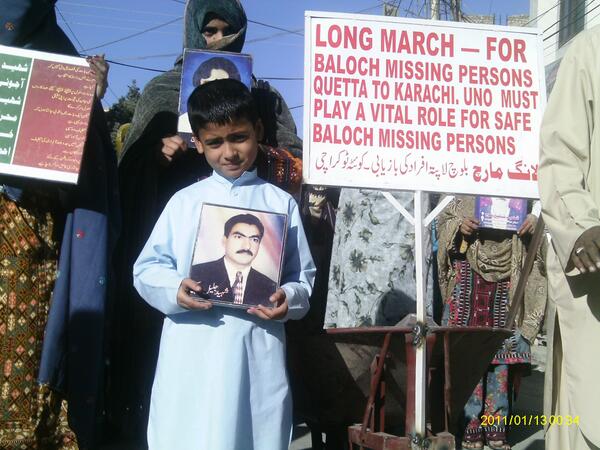
What made Mir speak out now? Maybe he was moved by Mama Qadeer, a 72-year-old man who organized the families of other missing Baloch in a five-month, 2000-kilometer march from Balochistan’s capital city Quetta through the rest of Pakistan.
Qadeer organized this unprecedented protest in an attempt to focus attention on his cause. He claims his son Jaleel was killed while in custody of intelligence agents in 2009. His advocacy now aims to help others whose sons have vanished get closure or justice.
On February 25, in a leading English-language daily, Mir urged the government to help recover Balochistan's missing people. The story, titled 72 year-old Mama Qadeer Baloch breaks record of Gandhi after 84 years, focused on the length and duration of the protest march, with the hope that the comparison would bring attention to an issue that has been systematically downplayed in the media.
Maybe Mir feels an affinity with the people of Balochistan because like him, they are now threatened from all sides. Like most Pakistani journalists who have been covering the not-so secret war in Pakistan’s northwest between the Taliban and the military, Mir was feeling increasing hostility and threats from his sources in the Taliban and the ISI.
Spies and intimidation
Pakistan's Ministry of Defence has petitioned the country’s broadcast regulation authority to cancel Geo's broadcast license. As I write this, Geo has voluntarily been made ‘less accessible’ by cable providers in most areas under army control or influence. Since Pakistan’s military owns or runs the largest property development companies in the country, Geo now risks being extensively censored across Pakistan.
The ISI has been increasingly aggressive and sloppy when dealing with journalists whose reporting assails its reputation. In 2011, journalist Saleem Shahzad's tortured body was found a week after he wrote a sensational story claiming links between Islamist militants and the armed forces. Before he disappeared he had received threats from the ISI.
Mir’s vocal stance in support of the rights of individuals being targeted by the state, by Islamist militants, and by others who resort to violence to further their political goals in Pakistan has nearly lost him his life.
It has also definitively placed him in opposition to those forces. We may not know who shot Hamid Mir, but we do know that the list of people willing to pick up a gun to get what they want in Pakistan is long. Mir was fortunate to escape with his life. But the battle for the rights of the missing in Balochistan is just beginning.

Pakistan: Hamid Mir appears before panel probing attack on him

THE TIMES OF INDIA
Senior Pakistani TV journalist Hamid Mir, confined to a wheelchair after surviving an assassination attempt, on Friday recorded his statement before a judicial commission probing the attack on him.
The three-member probe panel, constituted by the Supreme Court to investigate the attack, held its proceedings at the Supreme Court's Karachi registry.
The inquiry commission headed by Justice Anwar Zaheer Jamali and comprising Justice Ejaz Afzal Khan and Justice Iqbal Hameed ur Rehman conducted the judicial proceeding in a closed room where Hamid Mir appeared on a wheelchair and recorded his statement.
The commission comprising three Supreme Court judges was formed last week to probe the attack on Mir. The commission has three weeks to submit its report. A reward of Rs 1 crore has been announced for those who help identify the attackers.
Mir, 47, came to the court under heavy security arrangements. He has already been shifted out of the hospital to an undisclosed location due to "security threats".
"Yes, I had to be taken out of hospital after some serious security threats, and I am right now bleeding from the stitches covered by bandages at the slightest movement," he told the News daily, which is part of the Jang group that Mir works for.
One bullet hit Mir's urinary bladder damaging it as was part of his intestine that was hit by another bullet, a part of which the surgeons removed after the April 19 gun attack.
Though there have been suggestions to move Mir abroad for further treatment, he is not medically fit for air travel as of now.
Mir has blamed the "ISI within the ISI" for orchestrating the attack on him alleging that he is receiving threats which "advise" him to leave the country.
"Yes, advice keeps coming in that I should leave the country but the reason I refuse it is because I and my brother have taken a certain position saying that rogue elements tried to take me out, and I will not bow my head in front of them by leaving the country.
"Repeatedly, I have said I am not against any institution. I have been made an example but this will not deter me in any manner," he was quoted as saying by the daily.
Mir's brother has already recorded his statement before the judicial commission.
His brother has also accused "elements in the ISI" of orchestrating the attack on Mir, a charge denied by the military.

Early Warning Signs of Shia Genocide in Pakistan

By Waris Husain
The international community can no longer ignore the alarming rise in violence directed at Pakistan’s Shia minority.
Last month the world commemorated the 20th anniversary of the Rwandan Genocide. Dignitaries from around the world delivered speeches to mark the occasion, but UN Secretary General Ban Ki Moon’s statement was perhaps the most remarkable, as he admitted that the United Nations was “ashamed” of its failure to prevent the mass killing. At the same time Ban was making this statement, a Shia doctor was gunned down in Karachi, Pakistan by sectarian terrorists, as part of a self-avowed campaign to “make Pakistan a graveyard” for all Shias.
Despite the escalation of targeted killings of Shia leaders and large-scale bombings of Shia neighborhoods, the Pakistani government and international community have failed to apply the lessons from cases like Rwanda in recognizing the early warning signs of an impending genocide perpetrated by sectarian terrorist groups. While the murder rates of Shias in Pakistan is nowhere close to the 800,000 Tutsis killed in Rwanda, members of the international community are duty-bound to prevent mass killing events before they occur.
The Shia’s plight must be understood in the context of Pakistan’s position within the larger sectarian struggle between Sunnis, largely supported by Saudi Arabia and other Gulf states, and Shias, supported by Iran and its close allies. Pakistan walks a tightrope in this conflict as it shares a border with Iran, but relies on Saudi Arabia for aid and political patronage. This international tension has domestic implications with 20 percent of Pakistan’s population belonging to the Shia faith, amounting to nearly 25 million people who are being threatened with extermination by sectarian outfits.
To understand the threat that Pakistan’s Shias face, one must look to the Convention on the Punishment and Prevention of Genocide, to which Pakistan is a signatory. Under the Convention, a genocide occurs when a party has the intent to destroy a religious, ethnic, or racial group “in whole, or in part” and acts on that intent by killing, injuring, or deliberately causing conditions leading to the physical destruction of that group.
The Convention applies to all people, including private groups that are perpetrating genocidal acts in a country without direct assistance from the state. Under the Responsibility to Protect (R2P), all countries are obliged to recognize if such acts are taking place and take steps to punish past transgressions while preventing future acts.
In the context of Pakistan, the two elements to prove genocide are clearly satisfied: terrorist groups like Lashkar-e-Jhangvi (LeJ) have openly committed brutal murders of Shias with the self-avowed purpose of “cleansing Pakistan” of their presence. The attacks against Shias have basically taken three forms. First, high profile community members like doctors, lawyers and judges have been targeted in drive-by shootings in Karachi. Second, Shia religious processions and pilgrims have repeatedly been targeted in mass-shooting attacks. Third, Hazara Shias have been attacked en-masse in the city of Quetta, with several car bombings that have left hundreds dead in the last three years.
This has led to a mass exodus of Hazaras from Balochistan, with as many as 30,000 leaving the province over the last five years, according to some estimates. Many have left because they believe the government refuses to acknowledge the concerted campaign against them, and is therefore not taking steps to protect them.
Sectarian groups like Laskar-i-Islam (LI) and LeJ use various methods to terrorize Shias and force them to leave their homes, including the distributing threatening pamphlets, as occurred in Peshawar on April 16, 2014. Further, these groups often accept responsibility for vicious attacks on Shias, and express their genocidal intent in promising future attacks. This was certainly the case when the “Principal of Lashkar-e-Jhangvi” issued an open letter declaring that all Shias were “wajib-ul-katl” or “worthy of killing” in the aftermath of an attack that left eight Hazaras dead.
Despite these openly violent assertions, the government of Pakistan continues to deny the existence of genocide against Shias. As such, there are no official statistics on the number of victims, which would be a key component in understanding the level and frequency of violence perpetrated by sectarian militants. It is difficult to assess the level of political or military support these sectarian groups enjoy; however, there are a few issues that have raised concern in the past. First, the Pakistani judiciary has been woefully ineffective at punishing acts of terrorism, especially when the victims were religious minorities. One need only look to the case of Malik Ishaq, a co-founder and leader LeJ, who has been arrested and released from jail several times, despite being implicated in the murder of hundreds of Shias. Sectarian groups often target judges and prosecutors in order to intimidate the court and its officers.
Second, many blame Islamist dictator General Zia Ul-Haq for creating these sectarian militant groups to use as proxies in Kashmir and Afghanistan in the 1980s. The groups have long since turned their violence inward toward Pakistan’s religious and ethnic minorities. Many fear the pattern from the 1980s may now be repeating itself as Syria witnesses an influx of Pakistanis entering the country to fight alongside anti-Shia militant groups aligned with Bashar al-Assad. This could wreak havoc on Pakistan when these battle-hardened operatives return home and turn their guns on the nation’s minorities, especially Shias.
Additionally, Prime Minister Nawaz Sharif, a Zia protégé, has been accused of being soft on these groups while leading his socially-conservative political party, the Pakistan Muslim League Nawaz (PMLN). This claim was given credence by the fact that the PMLN was distributing a monthly stipend to Malik Ishaq’s family while Ishaq was in jail for one of his forty-four different criminal charges relating to 70 murders, many of them Shias.
Further, some also believe that anti-Shia rhetoric is seeping into the mainstream of politics. For example, Maulana Ludhanvi, the leader of the Ahle Sunnat Wal Jamaat (ASWJ) recently won a national assembly seat. In campaigning for the seat, Ludhanvi promised, “At the moment I can raise a voice for my anti-Shia mission only at a local level and from my local mosque. But when I get the microphone in the [National] Assembly, the whole nation and the whole world will listen…”
All of these examples are consistent with the early warning signs of genocide identified by international legal scholars like Barbara Harff, who created an analytical rubric that examines “trigger events” for genocide, such as assassinations of community leaders, impunity for genocidal actors, or political instability. Accordingly, in her annual Global Watch List, Harff has repeatedly identified Pakistan as a high-risk country for mass killings targeting religious minorities, including the Shia community.
Even though the administration has not openly acknowledged the potential for genocide against Shias, there are indications that the government, or parts of it, is taking note of the growing problem. For example, the Ministry of Interior recently admitted to the Senate that more than 2,000 Shias have been killed in sectarian attacks over the last five years. Similarly, Punjab provincial police have recently begun targeting “sectarian outfits,” which has already resulted in the arrest of suspects believed to be involved in eighteen attacks that left 16 Shias dead. Furthermore, the government is in the process of passing anti-terror legislation like the Pakistan Protection Ordinance and the Fair Trial Act, which could be used to effectively prosecute sectarian militants in the future.
Pakistan and the international community at large have a responsibility to protect populations vulnerable to genocidal acts, and the first step towards this protection is realizing the scope of the problem. If the government of Pakistan were to recognize that anti-Shia attacks are early warnings of a campaign that has the potential to endanger the lives of more than 20 million Shia citizens, it could begin collecting official statistics on Shia murder rates. It could also use already existing legislation criminalizing hate-crimes to prosecute members of these groups. In addition, the government could utilize the powers that were recently granted to it under the anti-terror laws to tackle the sectarian violence.
At the same time, the international community could assist with resources and scholarly advice while applying diplomatic pressure to force Pakistan’s government to more vigilantly punish and prevent anti-Shia campaigns by terror groups. If the UN is truly “ashamed” of its failure to prevent the genocide in Rwanda, it must use early warning signs and diplomatic pressure to abide by the mantra of genocide prevention: “Never again.”

Pakistan: Extortion in Peshawar

The rising rate of violence related to extortion in the provincial capital of Khyber-Pakhtunkhwa (K-P) has triggered an exodus of businessmen and industrialists who have fled Peshawar to safer grounds and left thousands of people unemployed. Peshawar had 22 reported extortion cases in 2013 and this year’s incidents have more than doubled in the first three months. The actual figure may be much higher because most victims don’t contact police out of fear.
A recent report in this paper quoted a senior official of the K-P Chamber of Commerce and Industry (KPCCI) as saying that, at least, 150 business professionals have shifted their factories to other parts of the country or moved abroad. The largest industrial zone in the province, Hayatabad Industrial Estate (HIE), which houses up to 440 units and employs over 120,000 people, has been attacked several times. The drain of much needed capital in a city that serves as an employment hub for people from other parts of K-P as well as Fata, and subsequent unemployment is, unfortunately, likely to only worsen the security situation in the city as well as the region.
So far, the chief minister and police officials have made unfulfilled promises regarding ‘special committees to address the issue’ or separate police stations within industrial zones reducing the faith of the community in them for protection. When citizens don’t trust those mandated to protect them and criminals act with impunity because they don’t expect to get caught, then therein lays the real problem.
The state needs a two-prong approach to catch the extortionists and re-establish the writ of the state. Firstly, law enforcement agencies need to come up with more effective means of protecting businessman and their enterprises. Secondly, the police and judiciary need to accelerate investigations and convictions of extortion cases. Until extortionists start fearing punishment and industrialists start trusting law enforcement, people will continue buying one-way tickets out of Peshawar.

Britain 'should cut aid to Pakistan'

By Steven Swinford,
Pakistan is a middle income country, does not do enough to help its own poor and should receive less aid from Britain, MPs suggest
Britain should consider cutting aid to Pakistan because its own leaders do not pay their taxes and other countries are more in need. The International Development select committee Pakistan is now classed as a middle-income country and is not doing enough to help its own poor. The committee also questioned aid spending in Nigeria, which is benefiting significantly from British taxpayers despite a booming energy industry and rapidly growing economy. In 2014/15, Britain is set to give £446 million of assistance to Pakistan, making it the largest recipient of UK bilateral aid in the world. "It is unlikely that expenditure would be so high if the country were not having to confront Islamic extremism," the committee concluded.
"If this is the case, the budget can only be justified if there is clear evidence that DfID (Department for International Development) support is effective in reducing the extremist threat. "If not, we recommend that DfID consider reducing spending in Pakistan and increasing it in low income countries." The committee previously said aid increases should be held back unless Pakistan's leaders improved tax collection and paid their "fair and proportionate" share.
In their report, the MPs welcomed the UK becoming the first to meet the UN target but said spending the money effectively at a time of reductions in operating costs was a "major challenge". Keeping costs much lower than comparable donor countries was "not in itself a virtue" if it meant staff that should be deployed in the field were stuck behind desks, it suggested.
A review of all £5 million-plus projects ordered by International Development Secretary Justine Greening might also have backfired by encouraging staff to "gold plate" them.
They should "spend less time writing the perfect business case and more in thoroughly assessing which areas to allocate funds to and in monitoring the implementation of programmes, including by spending more time in the field", the MPs said. There was also criticism of the share of funding devoted to reacting to humanitarian disasters in relatively wealthy countries. Britain could not afford to continue leading the world in dealing with situations such as the Syria crisis and needed to do more to persuade other high-income nations -such as France – to contribute more, committee chair, Liberal Democrat Sir Malcolm Bruce, said.
"The UK has met the target of spending 0.7% of national income on aid; others should do the same.
"UK spending on humanitarian assistance has risen substantially due partly to a very large increase in the aid budget for 2012-13. This will not, however, be repeated in future years as DfID's budget will be linked to GDP. "It will simply not be possible for DfID to continue taking the lead in future; other countries must do more. "DfID must not provide funds to support disasters in middle-income countries by raiding bilateral development programmes in low income countries. Rather, we argue for the percentage of income spent in low income countries to rise over time provided they are capable of absorbing it and of using aid effectively."
Staff should "spend less time in their offices and more time out in the field building local knowledge and monitoring whether UK aid money is being used effectively", he said. A Dfid spokesman said: "Our investment in overseas development, including in Pakistan, creates a safer and more prosperous world for the UK.
"Tackling poverty in the world's poorest places can mean tackling the root causes of global problems such as terrorism, which matter to us here in Britain. Education is vital to transforming Pakistan’s future and is where a significant proportion of our funds are directed. This is firmly in the UK’s own national interest.”

Pakistan not doing much to root out terrorism: Dobbins

US Special Representative for Afghanistan and Pakistan James Dobbins has said that Pakistan is not taking appropriate measures to curb terrorism in the country as the religious seminaries (Madaris) in Fata and Balochistan were the cause of attacks inside Afghanistan and India.
He said that the relations between Pakistan and the US had become “abysmally low and gravely worst”. He said that Pakistan’s role in solution to the Afghan crisis was very vital.During the hearing into the Afghan crisis in the US Congress, Dobbins said that mutual confidence was lacking in the relationship between Pakistan and the US and so the ties of the two countries were facing a grave crisis. He said that both the countries had shared trade, economic, social and security interests.
Meanwhile, the US has ruled out any mediation on the Kashmir issue as long as India rejects such a proposal and asked Pakistan to avoid employing militancy as an instrument of state policy.
“As long as India rejects any actual mediation, there’s not much we can do in that regard specifically,” James Dobbins told Pakistan’s state-run television.“India has consistently rejected any third party mediation and argued that it is an issue that needs to be negotiated directly and without the participation of any third party. So they’ve rejected mediation,” said Dobbins, who was recently on a visit to Pakistan.
“I think as long as they reject mediation, there is only a limited amount that the US or any other party can do. We, certainly in our dialogue with Pakistan and India, encourage improved relations, improved trade relations, improved dialogue on strategy and military issues and we certainly encourage dialogue and negotiation on the territorial issues that separate the two countries,” he said.
Echoing India’s apprehensions about cross border terrorism, he said India was concerned about cross border militancy and terrorist attacks that had been conducted in India which they believed had their origin in Pakistani territory.
“I think as is the case with Afghanistan, this is something that is in everybody’s interest. I think all of the states of the region need to avoid employing militancy as an instrument of policy,” he said.
“This has been a long-term strategy which has created a cancer in societies and particularly in Pakistani society which is now threatening the actual existence of the state and its democratic institutions,” he said.“So it’s in the interest not just of Pakistan, but of all of its neighbours to move away from that approach to diplomacy and to geopolitical strategy, and to avoid employing these kinds of instruments and, as I’ve said, move towards the elimination of violent extremism in Pakistan and around Pakistan and all of the neighbouring societies,” Dobbins said.
Referring to the ongoing Lok Sabha elections, Dobbins said India would have a new government soon.“It will be a new opportunity. Pakistan now has a government that still has a long life in it with a clear political mandate,” he said.
“I think two governments with clear political mandates and a long future in each case offer an opportunity for both governments to take some of the risks and the political costs that are always inherent in any real opportunity to overcome differences. The US will certainly use its influence to encourage both the sides to take those risks,” he said.

Press freedom in Pakistan has deadly consequences

The Kansas City Star
BY ZAHID GISHKORI
Just four months into the new year, six Pakistani journalists have been killed, putting 2014 on track to become one of the most deadly years for reporters in Pakistan.
Two reporters who have survived recent attacks have chilling stories to tell. Raza Rumi, a senior television anchor, was attacked while in his car; the assailants killed his driver. He fled from Pakistan and is now in Washington, D.C. “It has been three weeks of surreal moments,” Rumi said by email last week. “I did not know that I would turn into a subject of all that I have been writing against: using violence to suppress dissent, terrorizing the media workers and muzzling free speech.” Hamid Mir, a news anchor and political talk show host, was also attacked while in his car and is recovering after being hit by multiple bullets. According to data compiled by the Committee to Protect Journalists and Reporters without Borders — both nonprofit organizations aim to protect and support global press freedom — more than 1,530 journalists have been killed around the world since 1992. Iraq topped the list with 218 journalists killed; the Philippines was second with 112, followed by Pakistan with 87. As a Pakistani journalist, on a fellowship this year in the United States, I am concerned about the effects of this news on press freedom in my home country. “Pakistani journalists are under attack from all sides — militant insurgents, the military and intelligence services, drug lords, local criminal gangs, just to name a few,” Robert Dietz, Asia Program Coordinator for CPJ, told me by email. Gibran Peshimam, political editor for my newspaper, The Express Tribune, a publishing partner of International New York Times, also observed: “The current violence and omnipresent threat to their lives is unprecedented. It is clichéd to say that journalists are not safe in Pakistan. It is, however, important to note that it is getting more unsafe by the day. And that’s the troubling part.” Peshimam is right to worry about how the violence will affect Pakistan media, because journalists are facing a double-edged sword. On the one hand, there is the government. After Mir was shot, the government tried to revoke the license of his station, Geo TV, because it questioned the role of the military in the attack. Meanwhile, militants tell journalists “a bullet has been chosen for you.” Critics have accused Pakistan’s top spy agency — Inter Services Intelligence — of harassing and even killing at least one journalist, though ISI and the military have denied the accusations. Journalists also have been the target of TehreekeTaliban Pakistan and other extremists groups. TTP has publicly taken responsibility for the deaths of several journalists in Pakistan. These recent attacks signal that the government has not been able to reverse the country’s dreadful record of anti-press violence, despite promises to do so, said Sumit Galhotra, CPJ Asia Program researcher. One issue that needs to be addressed is regulation of content. Mohsin Leghari, an independent lawmaker from the Pakistan Senate, said that freedom of the press is a great thing, but it has to be exercised with responsibility. He says the electronic media in Pakistan have grown at a phenomenal pace: “The rating war and breaking news phenomena have compromised the content in Pakistan.” The Pakistan Electronic Media Regulatory Authority must be empowered and equipped to monitor the more than 100 private television channels now operating at the moment, far more than it’s able to do, according to estimates. The government and media owners must work together to find a balance in legislation that would ensure freedom of the press while also supporting the state’s interests. But Rumi, who recently talked about his experience on National Public Radio, said he is “appalled at the way media is divided and state is unable to enforce its writ.” If the government can amend existing press laws by setting new and reasonable standards for all public and private broadcasters and publishers, it could help prevent the loss of more journalists’ lives.
Journalists who have been killed in Pakistan since 1994
Journalist News Outlet Where they died Year
Shahzad Iqbal Samma TV Mianwali, Pakistan 2014
Muhammad Khalid Express TV Karachi, Pakistan 2014
Muhammad Ashraf Express TV Karachi, Pakistan 2014
Waqas Aziz Express TV Karachi, Pakistan 2014
Haroon Ahmed Express TV Rawalpindi, Pakistan 2014
Shah Dar Aab Tak TV Larkana, Pakistan 2014
Aslam Durrani Daily Pakistan Peshawar, Pakistan 2013
Ayub Khattak Karak Times Karak, Pakistan 2013
Mehmood Ahmed Afridi Daily Intikhab Kalat, Pakistan 2013
Malik Mumtaz Geo TV Miramshah, Pakistan 2013
Mohammad Iqbal News Network International Quetta, Pakistan 2013
Saifur Rehma Samma TV Quetta, Pakistan 2013
Imran Shaikh Samma TV Quetta, Pakistan 2013
Razaq Baloch Daily Tawar Karachi, Pakistan 2013
Saqib Khan Daily Ummat Karachi, Pakistan 2012
Rehmatullah Abid Dunya TV Pangur, Pakistan 2012
Mushtaq Khand Dharti TV Khairpur, Pakistan 2012
Haq Baloch ARY TV Khuzdar, Pakistan 2012
Qadir Hajizai Vash TV Quetta, Pakistan 2012
Razaq Gul Express TV Turbat, Pakistan 2012
Aurangzaib Tunio Kawish TV Lalu Ranwak, Pakistan 2012
Tariq Kamal Freelancer Karachi, Pakistan 2012
Mukkaram Khan Dunya TV/Freelancer Shabqadar, Pakistan 2012
Mohammad Amir ARY TV Peshawar, Pakistan 2012
Murtaza Razvi Daily Dawn Karachi, Pakistan 2012
Javed Naseer Rind Daily Tawar Khuzdar, Pakistan 2011
Faisal Qureshi The London Post Lahore, Pakistan 2011
Shafiullah Khan The News International Rawalpindi, Pakistan 2011
Abid Naveed Akbar-e-Khyber Peshawar, Pakistan 2011
Syed Saleem Shahzad Asia Times Mandi Bahauddin, Pakistan 2011
Nasrullah Afridi Daily Mashriq Peshawar, Pakistan 2011
Zaman Ali Extra News Karachi, Pakistan 2011
Wali Babar Geo TV Karachi, Pakistan 2011
Salman Taseer Business Plus Islamabad, Pakistan 2011
Munir Shakir Online News Network Khuzdar, Pakistan 2011
Abdoost Rind Freelancer Turbat, Pakistan 2011
Ilyas Nizzar Darwanth Pidark Pakistan 2011
Abdul Wahab Express TV Ghalania, Pakistan 2010
Pervez Khan Waqat TV Mohmand Agency, Pakistan 2010
Abdul Hameed Hayatan Daily Tawar Karachi, Pakistan 2010
Misri Khan Daily Mashriq Hangu, Pakistan 2010
Ejaz Raisini Samma TV Quetta, Pakistan 2010
Muhammad Sarwar Aaj TV Quetta, Pakistan 2010
Faiz Muhammad Sasoli Independent News Pakistan Khuzdar, Pakistan 2010
Ghulam Rasool Birhamani Daily Sindhu Newspaper Hyederabad, Pakistan 2010
Azmat Ali Bangash Samma TV Orakzai, Pakistan 2010
Malik Arif Samma TV Quetta, Pakistan 2010
Ashiq Ali Mangi Mehran TV Khairpur, Pakistan 2010
Ejazul Haq City 42 TV Lahore Lahore, Pakistan 2010
Mehood Chandio Daily Awaz Mirpur Khas, Pakistan 2010
Lala Hameed Baloch Daily Intikhab Turbat, Pakistan 2010
Janullah Hashimzada Freelancer Jamrud, Pakistan 2009
Wasi Ahmed Daily Azadi Turbat, Pakistan 2009
Musa Khankhel Geo TV Swat, Pakistan 2009
Muhammad Imran Express TV Dera Ismail Khan, Pakistan 2009
Tahir Imran Freelancer Dera Ismail Khan, Pakistan 2009
Mian Iqbal Shah Freelancer Peshawar, Pakistan 2009
Siddiq Bacha Khan Aaj TV Mardan Pakistan 2009
Raja Asad Hameed The Nation Rawalpindi, Pakistan 2009
Abdul Razaq Johra Royal TV Punjab, Pakistan 2008
Abdul Aziz Daily Azadi Swat, Pakistan 2008
Muhammad Ibrahim Express TV Khar, Pakistan 2008
Sirajuddin The Nation Mingora, Pakistan 2008
Chishti Mujahid Akhbar-e-Jehan Quetta, Pakistan 2008
Khadim Sheikh Sindh TV Hub, Pakistan 2008
Zubair Ahmed Mujahid Daily Jang Mirpur Khas, Pakistan 2007
Muhammad Arif ARY TV Karachi, Pakistan 2007
Javed Khan Daily Markaz Islamabad, Pakistan 2007
Noor Hakim Daily Pakistan Bajur, Pakistan 2007
Mehboob Khan Freelancer Charsada, Pakistan 2007
Nisar Solangi Daily Khabroon Karachi, Pakistan 2007
Hayatullah Khan Daily Ausaf Miramshah, Pakistan 2006
Munir Sangi Kawish TV Larkana, Pakistan 2006
Muhammad Ismail Press Pakistan International Islamabad, Pakistan 2006
Allah Noor Khyber TV Wana, Pakistan 2005
Amir Nawab Frontier Post Wana, Pakistan 2005
Sajjad Tanoli Daily Shumal Mansehra, Pakistan 2004
Fazl Wahab Freelancer Mingora, Pakistan 2003
Shahid Somorrow Daily Kawish Kandhkot, Pakistan 2002
Daniel Pearl The Wall Street Journal Karachi, Pakistan 2002
Asadullah Freelancer Karachi, Pakistan 2001
Sufi Muhamad Daily Ummat Badin, Pakistan 2000
Zulfiqar Memon The Nation Islamabad, Pakistan 1999
Carlos Mavroleon Freelancer Peshawar, Pakistan 1998
Z.A Shahid Daily Khabrain Lahore, Pakistan 1997
Muhammad Samdani Warsi Daily Parcham Karachi, Pakistan 1994 Muhammad Salahuddin Daily Takbeer Karachi, Pakistan 1994
Read more here: http://www.kansascity.com/2014/05/01/4996005/press-freedom-in-pakistan-has.html#storylink=cpy

Pakistan: Govt on its feet due to PPP support

The PPP’s central Punjab President, Mian Manzoor Wattoo on Friday said that the present government was on its feet largely due to the unequivocal support of former President Asif Ali Zardari.
“Otherwise, they have not spared any effort to create the situation that may lead to the derailment of democracy”, the PPP leader said in a statement.
He was of the view that the meeting of former President with the Prime Minister Nawaz Sharif recently was an expression of total solidarity to democracy at a time when anti-democratic forces were ganging up to disrupt the system to pave the way for its rolling up. “But their meeting put the cold water on their designs”, he observed. He argued that the present government’s leadership had proved their ironic inability to manage the crisis, no matter how small it might be. “It seems they have not learnt from the past mistakes and are determined to repeat it by rocking the boat again”, the PPP leader remarked.
Wattoo recalled that the former President accepted the election results of May 2013 only for the sake of the continuity of the democratic process in the country. It was an unprecedented support for the system by any measure, he added. He said that PPP had disassociated itself from the forthcoming protest on May 11, 2014, by a few political parties only to eliminate the dangers to the political system that might be lurking in the shadow. He, however, made it clear that the PPP ‘s unwavering support for democracy was in line with Charter of Democracy and it would not lag behind in this regard come what may. He viewed that it was the prime responsibility of the government to exercise restraint. “Egoism is alien to politics and must not be allowed to influence political thinking”, he added.
He reiterated his party’s resolve to continue working for the down- trodden people. Manzoor mentioned that he had announced Workers Welfare Fund in a convention on April 30, 2014 in Lahore with his own contribution amounting to Rs one million dedicated to the betterment of the workers. “It will undoubtedly grow with the passage of time because a journey of thousand miles begins with first step. It is a first step”, he added.

British Pakistani Christians protest against blasphemy law during Nawaz- Cameron meeting

On April 30 Pakistani Christians in the UK protested at 10 Downing Street when the Pakistani Prime Minister was meeting with British Prime Minster, David Cameron.
The demonstration was organised by the Pakistan Christian Alliance. Head of the Alliance, Mr. Edgar Money, a renowned businessman, said the protest had been arranged for a number of reasons, but primarily to remind Mr Cameron to raise the issue of the misuse of the blasphemy laws with Mr Sharif, as he promised in parliament.
He added that another reason was to bring to the attention of the Pakistani Prime Minister their concern about the ongoing misuse of blasphemy laws which are being used to intimidate, harass, attack churches, burn Christian towns and villages, falsely imprison and kill innocent Christians in Pakistan.
Finally he said they were protesting to show solidarity with their brothers and sisters in Pakistan, to tell them that they are not forgotten or alone in their suffering, and that their plight was being raised at an international level, whenever possible.
Director of CLAAS-UK, Nasir Saeed said: “I support this protest because it was very timely and I hope that today Mr Cameron will have raised the issue of the misuse of blasphemy laws with the Pakistani Prime Minister - as he assured Parliamentarians during PMQs.
“I also hope that Mr Sharif takes this matter seriously and has given some assurance to Mr. Cameron that he will look into the matter, as Pakistani Christians believe that blasphemy laws are the root cause of their persecution.
“Pakistani Christians demand the repeal of the discriminatory law which is increasingly being used within Pakistan to persecute religious minorities.
“It is used to create false charges against innocent Christians, burn their homes and churches, carry out vigilante killings and exact revenge for personal disputes. “Christians in Pakistan feel unsafe and are being forced to flee the country that they helped build.”
He added: “We hope that the protest today will help highlight the issue of the misuse of the blasphemy laws and force the Pakistani government into taking action and repealing the law, or at the very least amending it so that it can no longer be used as a tool to kill, persecute and threaten innocent Christians.”
Mr Saeed continued and said it was very unfortunate that even after 67 year Christians are still considered aliens and not granted equal rights and equal citizenship status.
“It is very sad that the British Prime Minister is having to advocate on behalf of the Pakistani Christians. The very clear message has gone to the world that Christians are not safe in Pakistan and also it is shameful that these matters, which should have been discussed in the Pakistani parliament, are being discussed in the British parliament and at 10 Downing Street,” he said.
“I hope that Mr Sharif will look into this long standing issue and will make all possible efforts to stop the ongoing misuse of the blasphemy laws and persecution of Christians, as it is important to improve the image of the country and image of Islam as people are being killed in the name of the religion,” he concluded.

Pakistan's Ahmadi Muslims: Prisoners of Conscience

Ahmadiyya Times
Even in the predominantly Ahmadi Muslim town of Rabwah, the Ahmadi Muslims cannot vote for the local representatives.
“No society can truly succeed unless it guarantees the rights of all its peoples, including religious minorities, whether they are Ahmadiyya Muslims in Pakistan or Bahais in Iran, or Coptic Christians in Egypt,” said President Barack Obama of the USA in his speech at the National Prayer Breakfast on February 6, 2014. Obama’s words served to highlight the severe state-sponsored persecution Ahmadi Muslims are facing in Pakistan.
Innocent, law-abiding Ahmadis are regularly killed in attacks provoked because of the victim’s faith. Orangi Town, a neighbourhood in Pakistan’s most populous city, Karchi, has proven to be an extremely dangerous place for Ahmadi Muslims to live. Five members of the Ahmadiyya Muslim Community have been killed in seperate attacks in recent months. Raziud Din, 27, was murdered in front of his wife and nephew outside his home. He leaves behind a two-year-old daughter.
Not only do Pakistan’s authorities refuse to protect or help Ahmadi Muslims, they actively participate in the persecution. For three decades, Ahmadis have suffered under specific anti-Ahmad laws (Ordinance XX) which result in Ahmadis being jailed or fined for practicing their faith. In February, Muhammad Qasim was sent to prison for two years. He had been accused of preaching, but even local police felt there was a lack of evidence but the case still made it to court due to pressure by local extremists.
In a similar case, well known anti-Ahmadi extremist Mulla Mohammad Ihsan visited a local Ahmadi doctor last November. Ihsan asked the doctor, Masood Ahmad, 72, a question about his faith. Ihsan secretly recorded Ahmad’s answer and used the video to make a complaint to local police. Ahmad was jailed for over two months.
Meanwhile, across the country police participate in the desecration of Ahmadi Muslim mosques. Complaints are made to the police about the existance of Ahmadi Muslim places of worship. Often the police respond by forcibly demolishing minarets. In other cases, Ahmadi Muslims are prevented from properly renovating historical mosques or are prevented from building them in the first place.
Even once dead, Ahmadi Muslims are not allowed to rest in peace. Gravestones are desecrated by police for the crime of being engraved with religious terminology. Meanwhile, grieving Ahmadi families are regularly denied the use of public graveyards. Families mourning the loss of babies as young as two months have been forcibly prevented from burying their dead.
The exclusion of Ahmadi Muslims from public life has been completed with their disenfranchisement from all elections. Most recently, Ahmadis were barred from voting in local elections in the city of Lahore. Even in the predominantly Ahmadi Muslim town of Rabwah, the Ahmadi Muslims cannot vote for the local representatives. To participate, they must sign a form either declaring themselves non-Muslim or declaring the founder of the Ahmadiyya Muslim Community to be a liar in the most pejorative terms. Of course, Ahamdi Muslims are unwilling to do either.
Obama had it right about Pakistan, but perhaps even he underestimates how this flourishing hate campaign is being exported to other countries. In this issue, we will give just one of many examples, by highlighting an appalling case from Malaysia.

Pakistan tops new list of religious freedom abusers, panel says

By Mark A. Kellner
Pakistan is a world leader in oppressing religious minorities, the U.S. Commission on International Religious Freedom declared in a report released Wednesday, with Iran closing in on the top spot and Russia becoming a cause for concern with its recent restrictions against Muslims and Jehovah's Witnesses. The 209-page report is the 15th by the USCIRF, and the commission's chairman said in a teleconference with journalists that the global religious liberty situation is not improving as much as it should, and is in fact getting worse in some nations.
"There's no shortage of places where abuses occur," said Robert P. George, a Princeton University legal scholar. "And the news on (the religious liberty) front is very bad: … 76 percent of the world's people live in countries where significant religious freedom violations are tolerated or committed with impunity," George added, citing January 2014 data from the Pew Research Center.
Religious liberty is a global concern for the United States, George said, not only "for humanitarian reasons, but also because nations that trample on religious freedom provide ample ground for war, poverty and violations of human rights. It's a practical necessity in the world today."
He called on the Obama administration to put more teeth into its pronouncements that nations should respect citizens' rights to believe as they wish, to change their faith, and to share their faith publicly, tenets of Article 18 of the United Nation's Universal Declaration of Human Rights.
"We feel Republican and Democratic administrations, burdened as they are … we're concerned that with the burden of all those other concerns, the focus on religious freedom has been lost," George said.
Blasphemy death sentences
Draconian blasphemy laws have put 36 people on death row or serving life sentences in Pakistan. George said that dissenting from the majority Sunni Islam faith — as is the case with Shia'a and Ahmadi Muslims — is grounds for blasphemy charges, which have also been leveled at Christians in that country.
The Ahmadi situation, both George and the USCIRF report note, is particularly perilous. "The constitution declares members of the Ahmadi religious community to be 'non-Muslims,' and the penal code makes basic acts of Ahmadi worship and interaction criminal offenses. They also are prevented from voting," the report stated.
The USCIRF report recommends that Secretary of State John F. Kerry continue to list Burma, China, Eritrea, Iran, North Korea, Saudi Arabia, Sudan and Uzbekistan as "countries of particular concern," or CPCs.
The USCIRF commissioners — who operate independently of the State Department — also recommend adding Egypt, Iraq, Nigeria, Pakistan, Syria, Tajikistan, Turkmenistan and Vietnam to the CPC list.
"Syria was added for the abuses against religious freedom being committed not just by the Assad regime but by all sides in the terrible civil war those people are suffering through,” George said. The conflict in Syria is now in its fourth year.
Ten "Tier Two" designations for countries whose actions, though serious, didn't fulfill all the criteria for a higher censure, were also suggested: Afghanistan, Azerbaijan, Cuba, India, Indonesia, Kazakhstan, Laos, Malaysia, Russia and Turkey.
George asserted that religious liberty in Russia has "suffered a serious setback" with new blasphemy laws and restrictions on the activities of Muslims and Jehovah's Witnesses in the country. "There are hundreds of Muslims jailed (in Russia), reportedly on false charges; many are denied due process and mistreated in detention," the report stated. "Rising xenophobia and intolerance, including anti-Semitism, are linked to violent and lethal hate crimes that occur with impunity. A blasphemy law, which went into effect in July 2013, further curtailed the freedoms of religion, belief, and expression." George said it was not yet necessary to designate Russia as a CPC, but the situation requires attention.
Religious liberty retrospective
The document also provides a 15-year retrospective on the International Religious Freedom Act of 1998, the U.S. law that created the commission and required its annual reports. George said the report "identifies some strengths" in the IRFA, but also points out areas where improvements can be made.
"Concerns about religious freedom should be included across U.S. engagements, including in diplomatic exchanges and strategic dialogues with other countries, and during country visits," and, "vacancies in relevant positions, including the Ambassador-at-Large for International Religious Freedom and USCIRF Commissioners, should be quickly filled," the report stated.
The Ambassador-at-Large position has been vacant since Suzan Johnson Cook, a pastor from the Bronx, New York, resigned in October 2013. At the Feb. 6, 2014, National Prayer Breakfast, Obama suggested, a nomination was pending, but three months later he has yet to put forward a name.
"We all loved what President Obama said about international religious freedom in his National Prayer Breakfast speech," George said. However, "presidents need to be making annual (country) designations, and need to be updating the CPC list. I hope this report will prompt a refocusing, a rededication … to this human right."
'Some" administration recognition
USCIRF Commissioner Katrina Lantos Swett, daughter of the late human rights champion Rep. Tom Lantos, D-Calif., told the Deseret News that she sees "some recognition" by administration officials that expanding religious freedom is important.
"One of my repeated soap box speeches that I give at the National Security Council staff, Congress or State Department, is that getting religious freedom right … will have an enormous positive impact on our national security interests," she said.
"I do see the glass as half-full, and I do see the commitment," Swett added, saying she has seen "in off-the-record conversations that I've had with top-level people in the administration, that they get it, they're committed to this."
One outside global religious freedom advocate also lauded the USCIRF report, particularly for the effect such attention gives to the underlying issue.
"The annual report is an important document for all those who are promoting or defending religious freedom, and also for the persecuted, it attracts public and media attention," said John R. Graz, a Seventh-day Adventist pastor and secretary-general of the International Religious Liberty Association in Silver Spring, Maryland.

The Human Rights Commission of Pakistan (HRCP) report

The Human Rights Commission of Pakistan (HRCP) report 'State of Human Rights 2013' launched on Thursday makes a shocking reading. We do know, through media and sometimes from personal experience, that as a people and a polity we are confronted with the challenge of abuse of rights. That we are so deeply contaminated with this curse, with not much of hope of early deliverance as the report tends to suggest, it's all the more disturbing, and therefore absolutely unacceptable. It's indeed a sad commentary on the working of the elected governments, both incumbent and its predecessor, in that during their tenures the rights situation in Pakistan worsened instead of registering any improvement. What had happened in Pakistan in 2013 is simply apocalyptic: on an average day 38 persons were murdered, two died in suicide bombing, nine die in violence in Karachi, two killed in police encounters, a mutilated body would be found every second day, and eight rape cases in Punjab alone. And also during the year under review, 687 persons were killed in 200 sectarian attacks, over 100 were killed in an attack on a church in Peshawar, 869 women were killed in the name of honour, more than 800 women committed suicide and 11 journalists were killed and many injured in the line of duty. And here were talking of figures which were either reported by the media or collected by the HRCP monitors. And reality on ground is far more grim and tragic given the inherent proneness of the underprivileged and vulnerable sections of our society to put up with injustice - the weak and unprotected won't go to police assuming it's of no avail and the rape victims would keep silent in deference to family prestige.
Broadly, there are two sets of human rights violations: the talking incidents that attract notice of the media and civil society and the silent saga of massive, unreported HR abuses, quite often put up with as the destiny. Millions of children cannot afford to go to schools; tens of thousands of cases remain undecided by courts, clean drinking water is not available to more than half of 185 million Pakistanis. There is this case of colossal failure on the part of the governments that are under constitutional obligation to make up for the deficiencies that tend to promote regression in the situation of human rights. The HRCP Secretary General I A Rehman is absolutely right in asserting that successive governments have worked on case-to-case basis to deal with human rights violations, eschewing an overall policy. Even the commission that was to be formed following the adoption of National Human Rights Commission Act 2012, has not come into existence yet. In fact, the government seems to be moving in the opposite direction - a case in point is the Protection of Pakistan Ordinance bill, already passed by the National Assembly without debate. The problem is not inadequacy of existing legal wherewithal to curb and control violence, the problem is with failure to implement the relevant law with required will and vigour for whatever reasons. The report indulges in serious discussion on various aspects of human rights situation in Pakistan, and makes some important suggestions the government need to look into and implement. The report has six sections: Rule of law; enforcement of law; fundamental freedoms; democratic development; rights of the disadvantaged; and social and economic rights. Not that the HRCP report on the ongoing year is unreserved condemnation of the existing narrative; it gives credit where it is due. For instance, it takes due notice of the fact that substantial backlog of passports was cleared by issuing 450,000 passports in 2013.
But one sparrow doesn't make a summer; there got to be tangible progress at least in some of the most areas like sectarian violence, mistreatment of minorities, honour killings and abysmal state of women rights. If the government can issue Economic Survey every year spelling out national economy-centred minuses and pluses of the outgoing year why not an annual socio-cultural survey detailing challenges and opportunities that were exploited, or lost, during the same period. The bitter truth is that while not much can be expected of a military government in the field of human rights our elected governments also relegate this vital input to a decent life to its political positions. That should change - the matters of human rights should top its agenda and rule of law should be its passion. Pakistan needs to improve upon its position in the World Freedom Index where it is now 159 out of 179 countries.

Pakistan: The state of blasphemy in 2013

Sarmad Ali
It is not out of place to mention that the doctrine of secularism should also be explained and discussed publicly so that the general public realise that atheism and secularism are two different doctrines and have no connection whatsoever
The Human Rights Commission of Pakistan recently published its ‘State of Human Rights in 2013’, which covers various legal and social issues in Pakistan. It has five chapters and all of them are worth reading. For the purpose of this article, I shall be looking into chapter three, which articulates information regarding fundamental freedoms while the last half of the chapter sheds light on the state of blasphemy in 2013. After reading chapter three, I came to know that 41 persons in Pakistan were charged under the Pakistan Penal Code (PPC) chapter on offences relating to religion. The chapter includes sections 295 to 298 C of the PPC. The 41 persons included 14 Christians, 17 Ahmedis and nine Muslims while the religion[s] of two of the accused is unknown. Eight of these people were charged under 298 C of the PPC, which covers desecration of the Quran and of these eight, three were women. The eight included three Muslims, four Christians and one Ahmedi.The State of Human Rights states that in December 2013, three people were sentenced to die after their convictions in two blasphemy cases. In one case, Riaz Ahmed, aged 34, and Ijaz Ahmed, aged 38, residents of Haroonabad in Punjab’s Bahawalpur district, were sentenced to die. They were accused of claiming in 2011 that they had seen God. The judge also fined each of them Rs 100,000. Two Christian men who were arrested for committing blasphemy were acquitted this year by the court. The allegation was that Barkat Masih, aged 56, refused to hand over the duplicate keys of a shrine where he worked as a sweeper. Barkat’s lawyer said that the local lawyer community had been vocal against him and had threatened to kill him for defending Barkat Masih.
Another Christian man, Younis Masih, who was arrested by the police in September 2005 in Lahore on charges of blasphemy and sentenced to death in May 2007, was acquitted on appeal by the Lahore High Court due to lack of evidence. His lawyer successfully argued that there was no direct evidence available on record, which made Younis liable for committing blasphemy. The case was made on hearsay, which is not admissible under criminal law. Another interesting incident occurred in 2013 where a cleric, Khalid Jadoon, accused a 14-year-old girl of committing blasphemy by burning pages of Quranic verses. However, it soon came to light that Khalid Jadoon tampered with the evidence and was himself charged with the same offence by the police The court acquitted him due to lack of direct evidence against him. In February 2013, south Punjab police registered a case against Sherry Rehman, former ambassador to the US. The petitioner from Multan asked the sessions court of Multan under Section 22-A and 22-B of the CrPC to register a First Information Report (FIR) against Sherry Rehman for speaking against the blasphemy laws while on a live television channel. The petitioner unsuccessfully sought a direction from the sessions court and then the Lahore High Court (LHC) to direct the police to register a case against Sherry Rehman.
Most blasphemy cases in Pakistan have been politically motivated and have also directly undermined the minorities. It is further observable that clerics and radicals were among those who brought cases of blasphemy forward after fabricating evidence and facts. For instance, in the case of the 14-year-old girl Rimsha Masih, it was Khalid Jadoon, the cleric, who actually fabricated the evidence and concocted facts just to implicate Rimsha in a blasphemy case. Such tactics have always been used in Pakistan to threaten minorities, especially Ahmedis and Christians. Those accused of blasphemy who were acquitted by the courts, usually fled Pakistan or were assassinated on their release from jail. For instance, Rimsha fled Pakistan and settled in Canada after threats from radicals and clerics. In Pakistan, a person accused of blasphemy is assumed to be guilty. This is unacceptable and alarming since mere allegations do not represent an offence in criminal law. In late December 2013, a senior pilot of state airline PIA went on leave after being accused of blasphemy for allegedly disrespecting the Prophet Mohammad (PBUH). The president of the employees association complained that the pilot had used derogatory words about the kalma or Islamic declaration of faith and the Prophet (PBUH). A committee set up to probe the matter submitted its findings to the PIA chairman. The finding of the committee was made public but it submitted that the pilot was guilty of blasphemy. The pilot went on leave for his safety and his friends suggested he leave Pakistan.
In light of the submissions above, one may conclude that blasphemy laws require reforms to prevent abuse by opportunists and clerics. The need to reform the blasphemy laws should be explained to the people of Pakistan by engaging religious scholars and the general public. I further contend that codification of personal laws for Hindus and Sikhs should be a priority and this must be done after consulting the communities. It is not out of place to mention that the doctrine of secularism should also be explained and discussed publicly so that the general public realise that atheism and secularism are two different doctrines and have no connection whatsoever. Religion in Pakistan is being misused to gain political power. Blasphemy laws are faulty, due to which many innocent people languish in violent and dirty jails. I agree with the Senate Standing Committee on National Harmony which, in April 2013, met to discuss stern punishments for people making false blasphemy accusations. The committee suggested that the punishment for falsely accusing someone of blasphemy should be the same as that for committing blasphemy. Last year, a meeting of the National Harmony Committee and the Council of Islamic Ideology (CII) declared that section 194 of the PPC defines a punishment for lodging false cases with the police and hence there was no need to amend the blasphemy laws; this seems to some extent correct. The need is to discourage people from bringing forward blasphemy cases without evidence. Finally, I connect blasphemy cases with a lack of tolerance in Pakistani society due to which blasphemy cases frequently appear in Pakistan. Pakistan can only get rid of its religious extremism and fundamentalism if it embraces secularism, otherwise I am afraid the state of Pakistan will not survive and will be torn by violence and fundamentalism.

Pakistan: 73 UCs alerted amid polio threat

The Punjab Health Department declared on Wednesday 73 union councils in the provincial capital high-risk areas for wild poliovirus after a report issued by the National Institute of Health (NIH), Islamabad, confirmed virus in Lahore. The sewer samples were collected from a drain on Outfall Road and sent to the NIH, Islamabad, for testing. Earlier, the environmental samples drawn during last three consecutive months from various parts of the city were found negative. “We have declared 73 union councils of Lahore high risk for wild poliovirus in the wake of the NIH report,” Punjab Health Director General Dr Zahid Pervaiz told Dawn. He said though Punjab did not report even a single case of polio this year, his department had declared 10 districts high risk for this disease to curtail it in a better way. “The department is going to launch a two-day anti-polio vaccine drive from May 5 in these districts including Lahore, Dera Ghazi Khan, Mianwali, Multan and Toba Tek Singh,” he said. He said investigation was under way by experts of the health department to find out link of the genetic sequence of the virus strain in the wake of the report which confirmed presence of virus in Lahore.
http://www.dawn.com/news/1103388/73-ucs-alerted-amid-polio-threat

Ambassador for Polio Eradication in Pakistan Aseefa Bhutto seeks immediate anti-polio measures

http://mediacellppp.wordpress.com/
Miss Aseefa Bhutto Zardari, Ambassador for Polio Eradication in Pakistan, and daughter of Shaheed former Prime Minister Benazir Bhutto, has said the Federal & Khyber Pakhtunkhuwa government should take immediate measures to prevent polio spread. Aseefa said Pakistan might face ban if immediate steps were not taken to contain the polio spread. Aseefa wrote on social networking website, Twitter, \”5 more #polio cases detected in Pakistan the gov needs to start taking action as a travel ban is becoming inevitable\” Pakistan is facing immense external pressure after surfacing of five new polio cases in the country. A travel ban is also looming large over Pakistan due to new polio cases.