 How does the government expect to curb rising sectarianism when it allows sectarian elements to operate with impunity? Does it really expect to be deemed credible when it expresses its resolve to counter sectarian violence simply for public consumption and simultaneously forms alliances and accommodates those who pose the greatest threat? This co-operation takes many forms; from sending monthly stipends to the family of an infamous sectarian leader as he faces a murder trial to securing a seat in the Parliament for an equally infamous individual. All this is done for a few votes from cities like Jhang where sectarianism sells while jeopardizing the security of the increasingly vulnerable minority communities of Pakistan. The entire state machinery appears to be complicit in the exercise. The Election Tribunal, which declared the runner-up Mr Ahmad Ludhianvi as a member of the Parliament after the disqualification of the winner, did so by following rules unknown to anyone. Usually under similar circumstances, a by-election is announced and the people vote once again. But this was not the case here. Why is everyone, including the government, the judiciary and the media, silent on the issue?
The system is so incredibly flawed that even a child could well exploit it. Take Sipah-e-Sahaba’s (SSP) story for example. The sectarian organisation was banned and thus barred from carrying out any activities, both political and apolitical. How did the SSP beat the ‘system’? It changed its name to Ahl-e-Sunnat Wal Jamaat (ASWJ). That’s it. The same easily identifiable people with the same extremist and divisive agenda are working under a new name. And somehow, that is acceptable. SSP wasn’t banned because of its name, but due to its ideology and its willingness to resort to violence in order to enforce it. So why then, is the ASWJ allowed to operate freely and even contest general elections (as they did last year)? The media’s role with regards to the issue is no less shameful. Rather than calling a spade a spade, it has looked to circumvent critical issues and goes a step further by giving airtime to hate-mongers. Members of the ASWJ, full of malice, sit before talk show hosts on national television in obscene displays of hypocrisy, all the while chanting slogans against minorities before their supporters. Of course, it is difficult and risky to be blunt and just here. But if this means the difference between the life and death for a member of the minority community, it must be said.
How does the government expect to curb rising sectarianism when it allows sectarian elements to operate with impunity? Does it really expect to be deemed credible when it expresses its resolve to counter sectarian violence simply for public consumption and simultaneously forms alliances and accommodates those who pose the greatest threat? This co-operation takes many forms; from sending monthly stipends to the family of an infamous sectarian leader as he faces a murder trial to securing a seat in the Parliament for an equally infamous individual. All this is done for a few votes from cities like Jhang where sectarianism sells while jeopardizing the security of the increasingly vulnerable minority communities of Pakistan. The entire state machinery appears to be complicit in the exercise. The Election Tribunal, which declared the runner-up Mr Ahmad Ludhianvi as a member of the Parliament after the disqualification of the winner, did so by following rules unknown to anyone. Usually under similar circumstances, a by-election is announced and the people vote once again. But this was not the case here. Why is everyone, including the government, the judiciary and the media, silent on the issue?
The system is so incredibly flawed that even a child could well exploit it. Take Sipah-e-Sahaba’s (SSP) story for example. The sectarian organisation was banned and thus barred from carrying out any activities, both political and apolitical. How did the SSP beat the ‘system’? It changed its name to Ahl-e-Sunnat Wal Jamaat (ASWJ). That’s it. The same easily identifiable people with the same extremist and divisive agenda are working under a new name. And somehow, that is acceptable. SSP wasn’t banned because of its name, but due to its ideology and its willingness to resort to violence in order to enforce it. So why then, is the ASWJ allowed to operate freely and even contest general elections (as they did last year)? The media’s role with regards to the issue is no less shameful. Rather than calling a spade a spade, it has looked to circumvent critical issues and goes a step further by giving airtime to hate-mongers. Members of the ASWJ, full of malice, sit before talk show hosts on national television in obscene displays of hypocrisy, all the while chanting slogans against minorities before their supporters. Of course, it is difficult and risky to be blunt and just here. But if this means the difference between the life and death for a member of the minority community, it must be said.
Thursday, April 17, 2014
Pakistan's Terrorist Groups: ''Banned On Paper''
How does the government expect to curb rising sectarianism when it allows sectarian elements to operate with impunity? Does it really expect to be deemed credible when it expresses its resolve to counter sectarian violence simply for public consumption and simultaneously forms alliances and accommodates those who pose the greatest threat? This co-operation takes many forms; from sending monthly stipends to the family of an infamous sectarian leader as he faces a murder trial to securing a seat in the Parliament for an equally infamous individual. All this is done for a few votes from cities like Jhang where sectarianism sells while jeopardizing the security of the increasingly vulnerable minority communities of Pakistan. The entire state machinery appears to be complicit in the exercise. The Election Tribunal, which declared the runner-up Mr Ahmad Ludhianvi as a member of the Parliament after the disqualification of the winner, did so by following rules unknown to anyone. Usually under similar circumstances, a by-election is announced and the people vote once again. But this was not the case here. Why is everyone, including the government, the judiciary and the media, silent on the issue?
The system is so incredibly flawed that even a child could well exploit it. Take Sipah-e-Sahaba’s (SSP) story for example. The sectarian organisation was banned and thus barred from carrying out any activities, both political and apolitical. How did the SSP beat the ‘system’? It changed its name to Ahl-e-Sunnat Wal Jamaat (ASWJ). That’s it. The same easily identifiable people with the same extremist and divisive agenda are working under a new name. And somehow, that is acceptable. SSP wasn’t banned because of its name, but due to its ideology and its willingness to resort to violence in order to enforce it. So why then, is the ASWJ allowed to operate freely and even contest general elections (as they did last year)? The media’s role with regards to the issue is no less shameful. Rather than calling a spade a spade, it has looked to circumvent critical issues and goes a step further by giving airtime to hate-mongers. Members of the ASWJ, full of malice, sit before talk show hosts on national television in obscene displays of hypocrisy, all the while chanting slogans against minorities before their supporters. Of course, it is difficult and risky to be blunt and just here. But if this means the difference between the life and death for a member of the minority community, it must be said.
Pakistan: Parliamentary summons for the Prime Minister
 One terrible lesson the West Pakistanis learnt from the break-up of the country in 1971 was that single-house parliament was antithetical to federalism which Pakistan was as it then existed in two units set apart by a thousand of miles. Both the 1956 and 1962 constitutions established single-chamber National Assembly parliament that did cater for representational parity between the two wings. However, these constitutions did not provide for the Upper House with equal representation of federating units that acts as a check to take a more realistic view of the situation and implications of the bills passed by the Lower House in the 'heat of emotions' or haste. Rightly then, the 1973 constitution catered for two houses of parliament, the second being the Senate where the provinces enjoyed parity irrespective of the size of their populations. The Senate is also expected to act as repository of talent, experience and specialisation by inducting talented and well-known personalities of national stature who otherwise would like to stay out of electoral fray. Nonetheless the Senate of Pakistan has not been made as powerful as the Senate in the United States. Its legislative powers are limited - more importantly in respect of money bills - and can be overruled only by passage in a joint session of the parliament. Should the government decide to override the Senate it can call joint sitting of parliament under Article 70 of the constitution and have the bill enacted in just one day provided it has the requisite strength in parliament to have it passed.
But the government should not do that. Parliamentary democracy keeps evolving ever needing constitutional amendments to keep pace with emerging realities; so we need to take care that the letter of the constitution doesn't come into conflict with the spirit of time and space. Given the fact there are simmering insurgent movements in some areas, drawing sustenance as they do from calls of discriminatory treatment by the Centre, the central government needs to be watchful that its moves and acts don't undermine the constitutional ethos of federalism. Is there any explanation to Prime Minister Nawaz Sharif's practice to take only the chief minister of Punjab on his visits abroad, ignoring other three chief ministers. As prime minister, his constituency is not only Punjab but the whole of Pakistan, and other provinces too need foreign investments. Even more astonishing if not disturbing is the fact that ever since his election he has stayed away from the Senate, which is an elected institution and under the present conditions of looming threats to federalism has a critical role and responsibility. That an alliance of his political rivals is in majority in that chamber is hardly a reason that he should boycott the Senate proceedings. The Senate is a product of the constitution and a prime minister of Pakistan is under oath to defend and protect the constitution. Isn't it unusual and extraordinary that the Senate of Pakistan had to legislate to seek attendance of the prime minister? The world over it is pride of parliamentary democracies that the elected prime ministers see to it that they come to the house to answer questions posed by the members. In democratic ambience, power and accountability go hand in hand; there is no such thing as unlimited power of an elected prime minister. It sounds patently ridiculous that a government Senator should justify Prime Minister Nawaz Sharif's absence on the grounds that 'Pakistan was faced with many challenges and crises therefore he is unable to come to the Senate'. The prime minister must come to the Senate regularly - though the opposition's ruling to force his attendance is quite lukewarm and bereft of obligatory compliance. Once a week, only for an hour or so, in the Senate whenever he is in the country is that we believe Nawaz Sharif can always make time to do. In functioning democracies it is quite possible that the government is not in majority in both the houses but legislation still takes place, for both sides of the political divide owe it to the country and people to do whatever it takes to ensure that their rivalries don't stand in the way of keeping the laws adequately updated and relevant.
One terrible lesson the West Pakistanis learnt from the break-up of the country in 1971 was that single-house parliament was antithetical to federalism which Pakistan was as it then existed in two units set apart by a thousand of miles. Both the 1956 and 1962 constitutions established single-chamber National Assembly parliament that did cater for representational parity between the two wings. However, these constitutions did not provide for the Upper House with equal representation of federating units that acts as a check to take a more realistic view of the situation and implications of the bills passed by the Lower House in the 'heat of emotions' or haste. Rightly then, the 1973 constitution catered for two houses of parliament, the second being the Senate where the provinces enjoyed parity irrespective of the size of their populations. The Senate is also expected to act as repository of talent, experience and specialisation by inducting talented and well-known personalities of national stature who otherwise would like to stay out of electoral fray. Nonetheless the Senate of Pakistan has not been made as powerful as the Senate in the United States. Its legislative powers are limited - more importantly in respect of money bills - and can be overruled only by passage in a joint session of the parliament. Should the government decide to override the Senate it can call joint sitting of parliament under Article 70 of the constitution and have the bill enacted in just one day provided it has the requisite strength in parliament to have it passed.
But the government should not do that. Parliamentary democracy keeps evolving ever needing constitutional amendments to keep pace with emerging realities; so we need to take care that the letter of the constitution doesn't come into conflict with the spirit of time and space. Given the fact there are simmering insurgent movements in some areas, drawing sustenance as they do from calls of discriminatory treatment by the Centre, the central government needs to be watchful that its moves and acts don't undermine the constitutional ethos of federalism. Is there any explanation to Prime Minister Nawaz Sharif's practice to take only the chief minister of Punjab on his visits abroad, ignoring other three chief ministers. As prime minister, his constituency is not only Punjab but the whole of Pakistan, and other provinces too need foreign investments. Even more astonishing if not disturbing is the fact that ever since his election he has stayed away from the Senate, which is an elected institution and under the present conditions of looming threats to federalism has a critical role and responsibility. That an alliance of his political rivals is in majority in that chamber is hardly a reason that he should boycott the Senate proceedings. The Senate is a product of the constitution and a prime minister of Pakistan is under oath to defend and protect the constitution. Isn't it unusual and extraordinary that the Senate of Pakistan had to legislate to seek attendance of the prime minister? The world over it is pride of parliamentary democracies that the elected prime ministers see to it that they come to the house to answer questions posed by the members. In democratic ambience, power and accountability go hand in hand; there is no such thing as unlimited power of an elected prime minister. It sounds patently ridiculous that a government Senator should justify Prime Minister Nawaz Sharif's absence on the grounds that 'Pakistan was faced with many challenges and crises therefore he is unable to come to the Senate'. The prime minister must come to the Senate regularly - though the opposition's ruling to force his attendance is quite lukewarm and bereft of obligatory compliance. Once a week, only for an hour or so, in the Senate whenever he is in the country is that we believe Nawaz Sharif can always make time to do. In functioning democracies it is quite possible that the government is not in majority in both the houses but legislation still takes place, for both sides of the political divide owe it to the country and people to do whatever it takes to ensure that their rivalries don't stand in the way of keeping the laws adequately updated and relevant.
Terrorist Ludhianvi,Pakistan's National Assembly Member: 'Election follies'
 The general elections in May 2013 were the first to transfer power from one elected government to another in Pakistan. In a country where the struggle for democracy has been long, hard and bloody, this was no mean achievement. The usual allegations of rigging in the 2013 elections were largely ignored this time. The Election Commission of Pakistan may have senselessly used Article 62 and 63 of the constitution to reject many candidates, but even this did not detract from the historic import of this election. Articles 62 and 63 allow only an honest person of good character to become a member of parliament and reject dual nationals or those dangerous to the security, public order or integrity of Pakistan. Ironically, those who camouflaged their true face by using fake identities, such as Maulana Ahmed Ludhianvi of the erstwhile Sipah-e-Sahaba did, were allowed to contest. Today Maulana Ahmed Ludhianvi, who camouflaged himself as a candidate of a spurious Pakistan Rah-i-Haq Party, has become a member of the National Assembly thanks to an election tribunal unseating the winning candidate of the PML-N for being a loan defaulter.
The question arises, how had a person heading a banned organization, the Ahle Sunnat Wal Jamaat, the reinvented banner of the Sipahe-Sahaba after it was banned, been allowed to contest elections in the first place? It is public knowledge who he is and which party he leads. How then had the leader of a banned party well known for sectarian violence on more than one occasion slipped through the electoral scrutiny net? Maulana Ahmed Ludhianvi had been arrested in March 2012 from Islamabad on an FIR registered against him for violating Section 144. This Section allows the government to act immediately to halt any activity that poses a threat to health, safety or public order. Soon after his arrest, his friends amongst the Defence of Pakistan Council’s leaders succeeded in getting him released.
Did the Election Commission of Pakistan deliberately overlook the component parties of the Muttahida Deeni Mahaz, an alliance of five politico-religious parties, being used as a cover by banned organizations such as Ahle Sunnat Wal Jamaat? Or was it merely an error of judgment? Either way it is the Election Commission of Pakistan and the election tribunal in question that stand in the dock for allowing people like Maulana Ahmed Ludhianvi to enter parliament without proper scrutiny or even a murmur of protest.
The general elections in May 2013 were the first to transfer power from one elected government to another in Pakistan. In a country where the struggle for democracy has been long, hard and bloody, this was no mean achievement. The usual allegations of rigging in the 2013 elections were largely ignored this time. The Election Commission of Pakistan may have senselessly used Article 62 and 63 of the constitution to reject many candidates, but even this did not detract from the historic import of this election. Articles 62 and 63 allow only an honest person of good character to become a member of parliament and reject dual nationals or those dangerous to the security, public order or integrity of Pakistan. Ironically, those who camouflaged their true face by using fake identities, such as Maulana Ahmed Ludhianvi of the erstwhile Sipah-e-Sahaba did, were allowed to contest. Today Maulana Ahmed Ludhianvi, who camouflaged himself as a candidate of a spurious Pakistan Rah-i-Haq Party, has become a member of the National Assembly thanks to an election tribunal unseating the winning candidate of the PML-N for being a loan defaulter.
The question arises, how had a person heading a banned organization, the Ahle Sunnat Wal Jamaat, the reinvented banner of the Sipahe-Sahaba after it was banned, been allowed to contest elections in the first place? It is public knowledge who he is and which party he leads. How then had the leader of a banned party well known for sectarian violence on more than one occasion slipped through the electoral scrutiny net? Maulana Ahmed Ludhianvi had been arrested in March 2012 from Islamabad on an FIR registered against him for violating Section 144. This Section allows the government to act immediately to halt any activity that poses a threat to health, safety or public order. Soon after his arrest, his friends amongst the Defence of Pakistan Council’s leaders succeeded in getting him released.
Did the Election Commission of Pakistan deliberately overlook the component parties of the Muttahida Deeni Mahaz, an alliance of five politico-religious parties, being used as a cover by banned organizations such as Ahle Sunnat Wal Jamaat? Or was it merely an error of judgment? Either way it is the Election Commission of Pakistan and the election tribunal in question that stand in the dock for allowing people like Maulana Ahmed Ludhianvi to enter parliament without proper scrutiny or even a murmur of protest.
Pakistan: PTI dissidents form pressure group in Khyber Pakhtunkhwa Assembly
 The Pakistan Tehreek-i-Insaf on Wednesday split into two groups in the Khyber Pakhtunkhwa Assembly after 14 dissident MPAs of the ruling party formed what they called a pressure group.
When the session began, the disgruntled lawmakers entered the house in a queue amid thumping of desks by the opposition members.
Deputy Speaker Imtiaz Shahid led the group.
The combined opposition had requisitioned the session to hold discussion on a nine-point agenda, including the worsening law and order situation in the province.
Speaker Asad Qaisar chaired the proceedings.
Hours before the session, Chief Minister Pervez Khattak met members of the pressure group at the Civil Officers’ Mess, according to their leader Javed Nasim.
Mr Nasim told Dawn that Mr Khattak had assured his group that their grievances would be adequately addressed.
He said the pressure group would stay intact until its demands were met.
The leader of the group said PTI chairman Imran Khan was slated to reach Peshawar on Saturday to make announcements on the dissenters’ demands.
He said the party chairman had assured the group that he would look into their demands on merit.
He said MPAs of the pressure group did not attend parliamentary party meeting, which was presided over by the chief minister before the session began.
He claimed that the chief minister had withheld notification of the portfolios’ allocation to ministers.
However, Chief Minister Pervez Khattak played down differences in the party.
Talking to journalists at the assembly secretariat, he said some people had made a hue and cry about minor issues, which would be resolved very soon.
MPAs of the pressure group complained that incapable and incompetent people had been inducted in the provincial cabinet.
They also demanded expulsion of corrupt ministers and advisers from the cabinet.
Earlier, Speaker Asad Qaisar took serious note of the absence of the relevant administrative secretaries and senior officers from the house and directed the government to ensure their presence during the ongoing session.
He said lethargy on part of the government officers would not be tolerated and that the relevant officials should attend proceedings regularly.
The speaker warned that if senior officers of the relevant departments did not change their attitude, then the assembly secretariat would issue passes to the head of the department only.
Parliamentary leaders of the opposition parties, including Maulana Lutfur Rehman of JUI-F, Sardar Aurangzeb Nalotha of PML-N, Sikandar Khan Sherpao of QWP, Sardar Hussain Babak of ANP and Mohammad Ali Shah Bacha of PPP, expressed concern over the growing militancy, extortion, targeted killings, kidnappings for ransom and other crimes in the province.
The opposition members said though the Tehreek-i-Taliban Pakistan (TTP) had declared ceasefire, the crimes, especially the cases of extortion and kidnapping for ransom in Peshawar and other parts of the province, had increased.
Sikandar Sherpao said being member of the assembly, he did not know about the parameters of the government’s peace talks with the Taliban.
He said the people of Fata and Khyber Pakhtunkhwa were stakeholders in the peace process but the government didn’t consult them.
The QWP leader said militancy was a political issue and therefore, the government should not engage bureaucrats in talks with TTP.
Mohammad Ali Shah Bacha of PPP said militants were being freed but the federal government didn’t ask the Taliban to free vice chancellor Ajmal Khan along with Shahbaz Taseer and Haider Gilani.
Sardar Hussain Babak of ANP said Pakhtuns had long been suffering from security crisis in the region.
He said the coalition government was insensitive and the people had been left at the mercy of murderers.
He claimed that 65 per cent of the Khyber Pakhtunkhwa and Fata population had been forced to migrate to Punjab.
MPA Syed Jafar Shah said peace could not be restored in Khyber Pakhtunkhwa unless the government’s writ was established in Fata.
He suggested that the all parties conference be held at the provincial level to find out a quick solution to militancy.
Information Minister Shah Farman, who is also the spokesman for the government, was totally unaware of the growing incidence of extortion and other crimes in the province.
He said the provincial police chief should explain the situation to lawmakers.
The minister voiced ignorance about the arrests made in extortion and kidnapping cases but expressed satisfaction over peace process.
He said the country had reported a significant decline in the number of terrorist activities, including bomb blasts, since peace talks between the government and the Taliban began.
The Pakistan Tehreek-i-Insaf on Wednesday split into two groups in the Khyber Pakhtunkhwa Assembly after 14 dissident MPAs of the ruling party formed what they called a pressure group.
When the session began, the disgruntled lawmakers entered the house in a queue amid thumping of desks by the opposition members.
Deputy Speaker Imtiaz Shahid led the group.
The combined opposition had requisitioned the session to hold discussion on a nine-point agenda, including the worsening law and order situation in the province.
Speaker Asad Qaisar chaired the proceedings.
Hours before the session, Chief Minister Pervez Khattak met members of the pressure group at the Civil Officers’ Mess, according to their leader Javed Nasim.
Mr Nasim told Dawn that Mr Khattak had assured his group that their grievances would be adequately addressed.
He said the pressure group would stay intact until its demands were met.
The leader of the group said PTI chairman Imran Khan was slated to reach Peshawar on Saturday to make announcements on the dissenters’ demands.
He said the party chairman had assured the group that he would look into their demands on merit.
He said MPAs of the pressure group did not attend parliamentary party meeting, which was presided over by the chief minister before the session began.
He claimed that the chief minister had withheld notification of the portfolios’ allocation to ministers.
However, Chief Minister Pervez Khattak played down differences in the party.
Talking to journalists at the assembly secretariat, he said some people had made a hue and cry about minor issues, which would be resolved very soon.
MPAs of the pressure group complained that incapable and incompetent people had been inducted in the provincial cabinet.
They also demanded expulsion of corrupt ministers and advisers from the cabinet.
Earlier, Speaker Asad Qaisar took serious note of the absence of the relevant administrative secretaries and senior officers from the house and directed the government to ensure their presence during the ongoing session.
He said lethargy on part of the government officers would not be tolerated and that the relevant officials should attend proceedings regularly.
The speaker warned that if senior officers of the relevant departments did not change their attitude, then the assembly secretariat would issue passes to the head of the department only.
Parliamentary leaders of the opposition parties, including Maulana Lutfur Rehman of JUI-F, Sardar Aurangzeb Nalotha of PML-N, Sikandar Khan Sherpao of QWP, Sardar Hussain Babak of ANP and Mohammad Ali Shah Bacha of PPP, expressed concern over the growing militancy, extortion, targeted killings, kidnappings for ransom and other crimes in the province.
The opposition members said though the Tehreek-i-Taliban Pakistan (TTP) had declared ceasefire, the crimes, especially the cases of extortion and kidnapping for ransom in Peshawar and other parts of the province, had increased.
Sikandar Sherpao said being member of the assembly, he did not know about the parameters of the government’s peace talks with the Taliban.
He said the people of Fata and Khyber Pakhtunkhwa were stakeholders in the peace process but the government didn’t consult them.
The QWP leader said militancy was a political issue and therefore, the government should not engage bureaucrats in talks with TTP.
Mohammad Ali Shah Bacha of PPP said militants were being freed but the federal government didn’t ask the Taliban to free vice chancellor Ajmal Khan along with Shahbaz Taseer and Haider Gilani.
Sardar Hussain Babak of ANP said Pakhtuns had long been suffering from security crisis in the region.
He said the coalition government was insensitive and the people had been left at the mercy of murderers.
He claimed that 65 per cent of the Khyber Pakhtunkhwa and Fata population had been forced to migrate to Punjab.
MPA Syed Jafar Shah said peace could not be restored in Khyber Pakhtunkhwa unless the government’s writ was established in Fata.
He suggested that the all parties conference be held at the provincial level to find out a quick solution to militancy.
Information Minister Shah Farman, who is also the spokesman for the government, was totally unaware of the growing incidence of extortion and other crimes in the province.
He said the provincial police chief should explain the situation to lawmakers.
The minister voiced ignorance about the arrests made in extortion and kidnapping cases but expressed satisfaction over peace process.
He said the country had reported a significant decline in the number of terrorist activities, including bomb blasts, since peace talks between the government and the Taliban began.
Pakistan's Taliban: ''Too much for too little''
THERE is no deadlock, Interior Minister Nisar Ali Khan had told the country regarding talks with the outlawed TTP.
There is a deadlock, the TTP emissaries and a member of its negotiating committee had claimed.Now, the TTP leadership has cancelled its month-old ceasefire and the future of the government-TTP dialogue has been plunged into chaos and uncertainty. Immediately, the TTP negotiating committee has talked of trying to keep the talks alive and restoring the ceasefire, but it appears difficult that the two can be attempted at the same time because talks amidst violence had previously been ruled out by the government, and rightly so. The government has already conceded far too much in return for far too little, the latest case in point being the statement made by new KP governor Sardar Mehtab Ahmad Khan on Tuesday. Swearing-in ceremonies and initial comments to the media are supposed to be fairly innocuous affairs. But KP’s newest governor, Mehtab Khan, chose to wade straight into controversy by mooting the idea of a general amnesty for the Taliban. According to Governor Khan, many militants would apparently prefer to return to mainstream society and lead peaceful lives, but could not do so because the path to their return is blocked. Quite how Mr Khan arrived at that conclusion is problematic enough. But it is what the KP governor went on to recommend that is truly extraordinary: a general amnesty for militants. The questions that Mr Khan’s suggestion raise are many, and grave. For one, as the senior-most representative of the federation in KP, was the governor speaking in his personal capacity or inadvertently stating the government’s eventual policy? Surely, it could not have been uttered in his personal capacity, but then ought the federal government not to distance itself from the governor’s recommendation or censure the governor or clarify the government’s position on the matter? The troubling part of an amnesty is that it flows logically from the prisoner releases — not even swaps, just unilateral releases — that the government has engineered in recent weeks. If militancy suspects in state custody can be handed back to the TTP, then why not an amnesty for the individuals who are already roaming free? It also works in the other direction: if those already free can get an amnesty, then even the most hardline of militants convicted by the court and serving their sentences in prison could also be set free. Follow through the logic of Mr Khan’s amnesty suggestion and it would appear that there is no one really whose capture the state ought to seek for perpetrating or planning violence against state and society. Is that really what the PML-N had in mind when it opted to give dialogue one last chance? Is the TTP ceasefire withdrawal a way to put yet more pressure on a wilting government?
Pakistan and the Sunni Gulf
 Recent months have brought Islamabad a flurry of visits from leaders of Sunni gulf nations, prompting many observers to question just what Prime Minister Nawaz Sharif might be getting the already embattled country into.
Pakistan’s 190 million inhabitants include around 26 million Shiites, giving it the largest population of the minority Muslim sect’s adherents after Iran. While Pakistan has officially tried to remain on the sidelines of the regular Shiite-Sunni flare-ups in the Middle East over the last few decades, backroom deals with Sunni monarchies like those being signed recently have not gone unnoticed domestically.
Pakistan is already witnessing unprecedented levels of sectarian violence, with more than 1,700 killed since 2008. The armed groups responsible for the bloodshed were born out of the global sectarian tensions that followed the Iranian Revolution of 1979, which produced the first modern Shiite theocracy.
Now, as the three-year-old civil war in Syria is encouraging Muslim nations to form Shiite and Sunni blocs, there is concern that if Pakistan were to join the fray globally, things could go from bad to worse domestically.
Bahrain’s king, Hamad bin Isa Al Khalifa, smiles down on traffic in Pakistan’s capitol Islamabad from hundreds of banners lining the streets, a reminder of the ruler’s visit last month, the first by a Bahraini ruler in 40 years.
The words “Pakistan welcomes you!” are emblazoned across the top, although that is more an aspiration than reality.
The details of Khalifa’s visit were kept deliberately vague, with the Pakistani Foreign Office describing discussions between the “brotherly countries” centering around “bilateral, regional and international matters of mutual interest.” What little information that did emerge was worrying to some Pakistanis, like the pledge to increase the “export of Pakistani manpower to Bahrain.” That’s something that has ended badly in the past.
In 2011, when largely Shiite protesters began demanding that Bahrain move towards a constitutional monarchy, thousands of ex-soldiers and police officers were recruited from Pakistan with the promise of Bahraini citizenship. The Pakistani security personnel shouted orders at Bahrainis in English and Urdu, becoming the face of a brutal crackdown by the state that engulfed Shiite villages in perpetual clouds of tear gas.
But Bahrain’s domestic troubles pale in comparison to the explosive war in Syria, which has drawn thousands of Sunni jihadists, including Al-Qaeda’s leadership, into a conflict Islamist extremists see as an apocalyptic confrontation with Shiite Islam, in this case the forces of Bashar al-Assad and neighboring Iran.
With prospects for a negotiated settlement fading, the rebels are in need of weapons and expertise to get them out of a stalemate. Saudi Arabia, Jordan and Qatar have set up camps to coordinate the training of Syrian rebels, but are in need of instructors and equipment.
That likely prompted a rare February visit to Pakistan by Saudi Arabia’s crown prince Salman bin Abdulaziz al-Saud, who doubles as the defense minister. Over three days in Islamabad, al-Saud met the Prime Minister Nawaz Sharif, the President Mamnoon Hussain, and the country’s top military leadership.
His prize: a 180-degree shift in Pakistan’s policy towards the war in Syria, which had previously been one of neutrality. A joint statement called for “the formation of a transnational governing body with full executive powers enabling it to take charge of the affairs of the country.” In other words, Pakistan now stands with Saudi Arabia in demanding the departure of Bashar al-Assad.
A few weeks later, $1.5 billion was transferred to Pakistan’s state bank by an unnamed “brotherly country,” giving the rupee is largest boost in years. When word leaked the funds had come from Saudi Arabia, many in Pakistan began to connect the dots with other rumors about Pakistan’s shift in policy.
A long-delayed pipeline meant to carry natural gas from Iran to energy-starved Pakistan has effectively been killed by Nawaz Sharif’s government. Pakistan has not built any of the 781 km pipeline on its side that it’s contractually obligated to complete by December 2014, and stands to incur a daily fine of $3 million next year.
Meanwhile, there are rumors Pakistan is planning to provide Saudi Arabia with expert trainers and equipment for the Syrian rebels.
Officials have been coy on the details, but responding to inquiries in February, a Foreign Ministry spokesperson admitted it was looking to sell the Gulf kingdom the JF-17 Thunder, a fighter jet developed jointly with China, and other unspecified equipment.
That equipment is thought to include the Anza, a heat-seeking, shoulder-fired anti-aircraft missile designed with China and manufactured locally. It’s the equivalent of the American Stinger missile, which was used to equip jihadist fighters during the Soviet invasion of Afghanistan three decades ago. The U.S., which is also supplying the Syrian rebels with light arms and communication equipment, is reportedly reluctant to hand over its own shoulder-fired anti-aircraft missiles for fear of where they might end up.
Thousands of Pakistani troops, who now have more than a decade of experience fighting insurgents in the country’s war against the Taliban, may also make their way to Saudi Arabia to train the rebels.
All of that prompted criticism by Pakistani lawmakers, who grilled the foreign minister last month about what their military could play in the Syrian war. “We are afraid this amount has a link with the Syrian situation,” Syed Khursheed Shah, who leads the opposition in the National Assembly, told reporters. The prime minister himself weighed in, categorically denying that any troops would be sent to Saudi Arabia or Bahrain.
But the rumors have persisted, including one story that Pakistan might deploy nuclear weapons to Saudi Arabia if Iran goes nuclear itself. While Pakistan has vehemently denied that story – which does indeed seem far-fetched – the fact is, Pakistan owes Saudi Arabia a favor.
Pakistan’s decades-long nuclear weapons program finally yielded a weapon in 1998, prompting severe sanctions by the United States, which were only lifted when the country’s cooperation was needed following the September 11, 2001 attacks. Beginning in 1998, Saudi Arabia began supplying Pakistan with 50,000 barrels a day of free crude oil, worth nearly $2 billion.
In fact, Pakistan’s military-to-military cooperation with Saudi Arabia goes back five decades. Between the 1960s and 1980s, tens of thousands of Pakistani troops were stationed in Saudi Arabia, working under Saudi command. Pakistani fighter pilots trained their first Saudi counterparts, and in 1969 flew jets that successfully repulsed incursions by Yemeni forces. Pakistani engineers built Saudi fortifications along its border with Yemen, meant to keep out Shiite Houthi fighters to the south.
During the first Gulf War, Pakistan toned down the presence of 15,000 troops in Saudi Arabia, ordering them away from the frontlines, fearing a backlash from Saddam Hussein, and sectarian groups at home.
It was during those decades that the sectarian groups now plaguing Pakistan first emerged.
In 1980, military ruler Zia ul Haq instituted the Zakaat Ordinance, which forced Shiites and Sunnis alike to turn over 2.5 percent of their income, as was required under Islamic law, to the state to be spent on charity. Pakistan was engulfed in protests by Shiites, who objected to the state’s interference in their religious practices. Ayatollah Khomeini, Iran’s leader, convinced Zia ul Haq to exempt Shiites from the law.
That movement spawned the Tehrik-e-Jafria, a Shiite group sworn to protect the minority’s rights. Sunnis saw the group as a front for the Iranian regime, and by 1985, hardliners had formed their own group, called Sipah-e-Sahaba. In 1990, one of that group’s founders, Haq Nawaz Jhangvi, was killed, and in return, Sunni militants killed the Iranian Consul General.
In 1997, a bomb killed the head of the Sunni Sipah-e-Sahaba group; in return, Sunni militants killed an Iranian diplomat in the city of Multan. Later that year, the Iranian cultural center in Lahore was also bombed, and five Iranian soldiers training in Pakistan were killed.
Today, Lashkar-e-Jhangvi, a splinter group of the Sunni Sipah-e-Sahaba, has claimed responsibility for the deaths of hundreds of Shiites in the city of Quetta, killed in bombings and brazen attacks on buses carrying pilgrims to Iran, Iraq and Syria. Dozens of Shiite and Sunni clerics have been gunned down in Pakistan this year alone, in tit-for-tat assassinations each blames on “foreign interference.”
“There is no doubt the differences are being instigated,” said Muhammad Amin Shaheedi, the head of Pakistan’s largest Shia political party. “It’s terrorism being fanned by others, outsiders who are taking advantage of the situation.”
Ahmed Ludhianvi, head of a Sunni group that formed after Sipah-e-Sahaba was banned in 2002, has exactly the same view. “Some foreign powers are trying to bring Pakistan to the brink of civil war,” he says. “This bloodshed began after 1979.”
To be sure, Pakistan’s sectarian militants are now operating on auto-pilot, and the idea that Iran and the Sunni Gulf monarchies are to blame seems farfetched. But if Pakistan’s pivot away from Iran continues and it finds itself mired in a sectarian war in Syria, those domestic militants could become proxy warriors in a conflict that has already killed hundreds of thousands in the Middle East.
Recent months have brought Islamabad a flurry of visits from leaders of Sunni gulf nations, prompting many observers to question just what Prime Minister Nawaz Sharif might be getting the already embattled country into.
Pakistan’s 190 million inhabitants include around 26 million Shiites, giving it the largest population of the minority Muslim sect’s adherents after Iran. While Pakistan has officially tried to remain on the sidelines of the regular Shiite-Sunni flare-ups in the Middle East over the last few decades, backroom deals with Sunni monarchies like those being signed recently have not gone unnoticed domestically.
Pakistan is already witnessing unprecedented levels of sectarian violence, with more than 1,700 killed since 2008. The armed groups responsible for the bloodshed were born out of the global sectarian tensions that followed the Iranian Revolution of 1979, which produced the first modern Shiite theocracy.
Now, as the three-year-old civil war in Syria is encouraging Muslim nations to form Shiite and Sunni blocs, there is concern that if Pakistan were to join the fray globally, things could go from bad to worse domestically.
Bahrain’s king, Hamad bin Isa Al Khalifa, smiles down on traffic in Pakistan’s capitol Islamabad from hundreds of banners lining the streets, a reminder of the ruler’s visit last month, the first by a Bahraini ruler in 40 years.
The words “Pakistan welcomes you!” are emblazoned across the top, although that is more an aspiration than reality.
The details of Khalifa’s visit were kept deliberately vague, with the Pakistani Foreign Office describing discussions between the “brotherly countries” centering around “bilateral, regional and international matters of mutual interest.” What little information that did emerge was worrying to some Pakistanis, like the pledge to increase the “export of Pakistani manpower to Bahrain.” That’s something that has ended badly in the past.
In 2011, when largely Shiite protesters began demanding that Bahrain move towards a constitutional monarchy, thousands of ex-soldiers and police officers were recruited from Pakistan with the promise of Bahraini citizenship. The Pakistani security personnel shouted orders at Bahrainis in English and Urdu, becoming the face of a brutal crackdown by the state that engulfed Shiite villages in perpetual clouds of tear gas.
But Bahrain’s domestic troubles pale in comparison to the explosive war in Syria, which has drawn thousands of Sunni jihadists, including Al-Qaeda’s leadership, into a conflict Islamist extremists see as an apocalyptic confrontation with Shiite Islam, in this case the forces of Bashar al-Assad and neighboring Iran.
With prospects for a negotiated settlement fading, the rebels are in need of weapons and expertise to get them out of a stalemate. Saudi Arabia, Jordan and Qatar have set up camps to coordinate the training of Syrian rebels, but are in need of instructors and equipment.
That likely prompted a rare February visit to Pakistan by Saudi Arabia’s crown prince Salman bin Abdulaziz al-Saud, who doubles as the defense minister. Over three days in Islamabad, al-Saud met the Prime Minister Nawaz Sharif, the President Mamnoon Hussain, and the country’s top military leadership.
His prize: a 180-degree shift in Pakistan’s policy towards the war in Syria, which had previously been one of neutrality. A joint statement called for “the formation of a transnational governing body with full executive powers enabling it to take charge of the affairs of the country.” In other words, Pakistan now stands with Saudi Arabia in demanding the departure of Bashar al-Assad.
A few weeks later, $1.5 billion was transferred to Pakistan’s state bank by an unnamed “brotherly country,” giving the rupee is largest boost in years. When word leaked the funds had come from Saudi Arabia, many in Pakistan began to connect the dots with other rumors about Pakistan’s shift in policy.
A long-delayed pipeline meant to carry natural gas from Iran to energy-starved Pakistan has effectively been killed by Nawaz Sharif’s government. Pakistan has not built any of the 781 km pipeline on its side that it’s contractually obligated to complete by December 2014, and stands to incur a daily fine of $3 million next year.
Meanwhile, there are rumors Pakistan is planning to provide Saudi Arabia with expert trainers and equipment for the Syrian rebels.
Officials have been coy on the details, but responding to inquiries in February, a Foreign Ministry spokesperson admitted it was looking to sell the Gulf kingdom the JF-17 Thunder, a fighter jet developed jointly with China, and other unspecified equipment.
That equipment is thought to include the Anza, a heat-seeking, shoulder-fired anti-aircraft missile designed with China and manufactured locally. It’s the equivalent of the American Stinger missile, which was used to equip jihadist fighters during the Soviet invasion of Afghanistan three decades ago. The U.S., which is also supplying the Syrian rebels with light arms and communication equipment, is reportedly reluctant to hand over its own shoulder-fired anti-aircraft missiles for fear of where they might end up.
Thousands of Pakistani troops, who now have more than a decade of experience fighting insurgents in the country’s war against the Taliban, may also make their way to Saudi Arabia to train the rebels.
All of that prompted criticism by Pakistani lawmakers, who grilled the foreign minister last month about what their military could play in the Syrian war. “We are afraid this amount has a link with the Syrian situation,” Syed Khursheed Shah, who leads the opposition in the National Assembly, told reporters. The prime minister himself weighed in, categorically denying that any troops would be sent to Saudi Arabia or Bahrain.
But the rumors have persisted, including one story that Pakistan might deploy nuclear weapons to Saudi Arabia if Iran goes nuclear itself. While Pakistan has vehemently denied that story – which does indeed seem far-fetched – the fact is, Pakistan owes Saudi Arabia a favor.
Pakistan’s decades-long nuclear weapons program finally yielded a weapon in 1998, prompting severe sanctions by the United States, which were only lifted when the country’s cooperation was needed following the September 11, 2001 attacks. Beginning in 1998, Saudi Arabia began supplying Pakistan with 50,000 barrels a day of free crude oil, worth nearly $2 billion.
In fact, Pakistan’s military-to-military cooperation with Saudi Arabia goes back five decades. Between the 1960s and 1980s, tens of thousands of Pakistani troops were stationed in Saudi Arabia, working under Saudi command. Pakistani fighter pilots trained their first Saudi counterparts, and in 1969 flew jets that successfully repulsed incursions by Yemeni forces. Pakistani engineers built Saudi fortifications along its border with Yemen, meant to keep out Shiite Houthi fighters to the south.
During the first Gulf War, Pakistan toned down the presence of 15,000 troops in Saudi Arabia, ordering them away from the frontlines, fearing a backlash from Saddam Hussein, and sectarian groups at home.
It was during those decades that the sectarian groups now plaguing Pakistan first emerged.
In 1980, military ruler Zia ul Haq instituted the Zakaat Ordinance, which forced Shiites and Sunnis alike to turn over 2.5 percent of their income, as was required under Islamic law, to the state to be spent on charity. Pakistan was engulfed in protests by Shiites, who objected to the state’s interference in their religious practices. Ayatollah Khomeini, Iran’s leader, convinced Zia ul Haq to exempt Shiites from the law.
That movement spawned the Tehrik-e-Jafria, a Shiite group sworn to protect the minority’s rights. Sunnis saw the group as a front for the Iranian regime, and by 1985, hardliners had formed their own group, called Sipah-e-Sahaba. In 1990, one of that group’s founders, Haq Nawaz Jhangvi, was killed, and in return, Sunni militants killed the Iranian Consul General.
In 1997, a bomb killed the head of the Sunni Sipah-e-Sahaba group; in return, Sunni militants killed an Iranian diplomat in the city of Multan. Later that year, the Iranian cultural center in Lahore was also bombed, and five Iranian soldiers training in Pakistan were killed.
Today, Lashkar-e-Jhangvi, a splinter group of the Sunni Sipah-e-Sahaba, has claimed responsibility for the deaths of hundreds of Shiites in the city of Quetta, killed in bombings and brazen attacks on buses carrying pilgrims to Iran, Iraq and Syria. Dozens of Shiite and Sunni clerics have been gunned down in Pakistan this year alone, in tit-for-tat assassinations each blames on “foreign interference.”
“There is no doubt the differences are being instigated,” said Muhammad Amin Shaheedi, the head of Pakistan’s largest Shia political party. “It’s terrorism being fanned by others, outsiders who are taking advantage of the situation.”
Ahmed Ludhianvi, head of a Sunni group that formed after Sipah-e-Sahaba was banned in 2002, has exactly the same view. “Some foreign powers are trying to bring Pakistan to the brink of civil war,” he says. “This bloodshed began after 1979.”
To be sure, Pakistan’s sectarian militants are now operating on auto-pilot, and the idea that Iran and the Sunni Gulf monarchies are to blame seems farfetched. But if Pakistan’s pivot away from Iran continues and it finds itself mired in a sectarian war in Syria, those domestic militants could become proxy warriors in a conflict that has already killed hundreds of thousands in the Middle East.
World Heritage Day : Bilawal Bhutto Zardari wants more Pak sites as World Heritage
Bilawal Bhutto Zardari, Patron-In-Chief Pakistan Peoples Party has urged the World Heritage Committee of UNESCO to speed up work for declaring 18 more heritage sites in tentative list of Pakistan as World Heritage Sites to preserve the rich cultural and natural common heritage of humanity. On the eve of World Heritage Day being observed by UNESCO on April 18, the PPP Patron-In-Chief pointed out that dry-core drilling has started early this month at the site of Moen Jo Daro to reveal the whole magnanimous city, which thrived 5000 years ago. It may be recalled that UNESCO Committee has so far declared six sites in Pakistan as World Heritage Sites. Earlier, Pakistan ratified the Convention Concerning the Protection of World Cultural and Natural Heritage in 1976 under the leadership of Prime Minister Shaheed Zulfikar Ali Bhutto paving the way of marking Moen Jo Daro, Taxila, Buddhist Ruins of Takht-i-Bahi and neighbouring city remains at Sahr-i-Bahlol, Fort and Shalamar Gardens in Lahore, Historical Monuments at Makli, Thatta, and Rohtas Fort as World Heritage Sites on the globe. Pakistan is maintaining another list of 18 more heritage sites to be considered and declared as World Heritage Sites by the UNESCO Committee. Bilawal Bhutto Zardari said he is personally monitoring the preservation of Moen Jo Daro as preserving our heritage remains a national duty of all of us as inheritors of our rich culture and ancient civilization. PPP Patron-In-Chief appreciated the UNESCO and its World Heritage Committee for their research and hard-work to protect and preserve the heritage sites as shared wealth of humankind.http://mediacellppp.wordpress.com/
Wednesday, April 16, 2014
Video: A show of support for Assad in Damascus
Hundreds rally in the Syrian capital ahead of the country's Independence Day to show solidarity with embattled President Bashar al-Assad.
Leaky Borders: ''Millions collected on goods coming into Afghanistan isn’t making it to state coffers.''
BY JAMILA TRINDLE

 Coruption at border crossings in Afghanistan is so rampant that it threatens the customs revenue on which the government depends, raising questions about whether the country will be able to fund itself after U.S. troops withdraw.
Even though the United States spent $120 million to improve the Afghan customs system over the past three years, a new report by the watchdog overseeing U.S. reconstruction efforts in Afghanistan says corruption is still the biggest threat to the import system, and it could grow.
Fees and taxes on goods crossing the Afghan border make up nearly half of all the revenues (44 to 48 percent) that the Afghan government brings in. But the government could be making twice as much if fraud were eliminated, according a report released Tuesday by the Special Inspector General for Afghanistan Reconstruction (SIGAR).
"Afghanistan remains poorly positioned to develop a self-sustaining economy because of corruption, mismanagement, and continuing instability along its borders," the report said.
The watchdog has long pressed the U.S. government to make cleaning up fraud and abuse in the Afghan government a higher priority in Afghanistan. "Allowing corruption to continue unabated will likely jeopardize every gain we have made over the last 12 years," Inspector General John Sopko said in a speech last month.
The report highlights graft as one of the key problems facing Afghanistan's new leadership, as the country faces a post-war future with a lot less international money flowing into state coffers. Import duties that could contribute more to the state budget are being syphoned off by corrupt officials. One Afghan governor made as much as $4 million a month collecting unauthorized taxes at a major border crossing in 2012, the Wall Street Journal reported. That money could go a long way toward helping the Afghan government stand on its own. Kabul has at times over the past 10 years generated as little as 10 percent of its own budget, while the rest has been made up from outside donors, principally the United States. Those contributions are expected to dwindle as international forces leave the country.
President Hamid Karzai didn't build a track record for rooting out corruption, and it's unclear whether his successor, who is expected to be in place by this summer, will make it a priority, either. Many U.S. officials see the election as an opportunity to redefine Washington's relationship with Kabul, but that could be difficult considering many of the experienced diplomats in Afghanistan are packing it in and heading home.
It's difficult to know exactly how much revenue is lost through goods smuggled into the country without paying official taxes and fees at the border; customs data is so unreliable that it's hard to tell what goods are coming in and out of the country, according to the report's authors. Goods smuggled into the country illegally through one checkpoint alone cost the government about $25 million a year, according to the report.
A mentorship program administered by U.S. Customs and Border Protection made some progress teaching Afghan customs agents how to properly collect fees, the report found. But that didn't stop some agents who followed the U.S. advice from being kidnapped or threatened by smugglers.
U.S. efforts to automate customs payments hit a snag when an Afghan official wanted to allow only one bank to process electronic transactions, creating further opportunity for abuse, the report found. Attempts to streamline the customs system by requiring fewer steps in the process "met with resistance because each step allows for the associated official to demand payment from an importer."
The report said that U.S. programs run by Customs and Border Protection, as well as the U.S. Agency for International Development, could be further stymied by the deteriorating security situation after the U.S. leaves. It's already made it harder for auditors to measure the extent of graft and corruption. In the course of collecting information for their report, SIGAR inspectors were unable to visit some customs sites because of bombings or the threat of violence.
In response to the report, USAID acknowledged that reforming the Afghan customs system still faced "major challenges." The agency said it would direct the contractor charged with improving the system, Chemonics Inc., to "put forth its best effort" to combat corruption. After past reports, the State Department and Pentagon have complained that SIGAR's criticism is unwarranted.
Coruption at border crossings in Afghanistan is so rampant that it threatens the customs revenue on which the government depends, raising questions about whether the country will be able to fund itself after U.S. troops withdraw.
Even though the United States spent $120 million to improve the Afghan customs system over the past three years, a new report by the watchdog overseeing U.S. reconstruction efforts in Afghanistan says corruption is still the biggest threat to the import system, and it could grow.
Fees and taxes on goods crossing the Afghan border make up nearly half of all the revenues (44 to 48 percent) that the Afghan government brings in. But the government could be making twice as much if fraud were eliminated, according a report released Tuesday by the Special Inspector General for Afghanistan Reconstruction (SIGAR).
"Afghanistan remains poorly positioned to develop a self-sustaining economy because of corruption, mismanagement, and continuing instability along its borders," the report said.
The watchdog has long pressed the U.S. government to make cleaning up fraud and abuse in the Afghan government a higher priority in Afghanistan. "Allowing corruption to continue unabated will likely jeopardize every gain we have made over the last 12 years," Inspector General John Sopko said in a speech last month.
The report highlights graft as one of the key problems facing Afghanistan's new leadership, as the country faces a post-war future with a lot less international money flowing into state coffers. Import duties that could contribute more to the state budget are being syphoned off by corrupt officials. One Afghan governor made as much as $4 million a month collecting unauthorized taxes at a major border crossing in 2012, the Wall Street Journal reported. That money could go a long way toward helping the Afghan government stand on its own. Kabul has at times over the past 10 years generated as little as 10 percent of its own budget, while the rest has been made up from outside donors, principally the United States. Those contributions are expected to dwindle as international forces leave the country.
President Hamid Karzai didn't build a track record for rooting out corruption, and it's unclear whether his successor, who is expected to be in place by this summer, will make it a priority, either. Many U.S. officials see the election as an opportunity to redefine Washington's relationship with Kabul, but that could be difficult considering many of the experienced diplomats in Afghanistan are packing it in and heading home.
It's difficult to know exactly how much revenue is lost through goods smuggled into the country without paying official taxes and fees at the border; customs data is so unreliable that it's hard to tell what goods are coming in and out of the country, according to the report's authors. Goods smuggled into the country illegally through one checkpoint alone cost the government about $25 million a year, according to the report.
A mentorship program administered by U.S. Customs and Border Protection made some progress teaching Afghan customs agents how to properly collect fees, the report found. But that didn't stop some agents who followed the U.S. advice from being kidnapped or threatened by smugglers.
U.S. efforts to automate customs payments hit a snag when an Afghan official wanted to allow only one bank to process electronic transactions, creating further opportunity for abuse, the report found. Attempts to streamline the customs system by requiring fewer steps in the process "met with resistance because each step allows for the associated official to demand payment from an importer."
The report said that U.S. programs run by Customs and Border Protection, as well as the U.S. Agency for International Development, could be further stymied by the deteriorating security situation after the U.S. leaves. It's already made it harder for auditors to measure the extent of graft and corruption. In the course of collecting information for their report, SIGAR inspectors were unable to visit some customs sites because of bombings or the threat of violence.
In response to the report, USAID acknowledged that reforming the Afghan customs system still faced "major challenges." The agency said it would direct the contractor charged with improving the system, Chemonics Inc., to "put forth its best effort" to combat corruption. After past reports, the State Department and Pentagon have complained that SIGAR's criticism is unwarranted.
http://www.foreignpolicy.com/articles/2014/04/14/leaky_borders
Blunders by British generals allowed Taliban to carry out attack on Camp Bastion
 Blunders by British commanders were ‘devastatingly exploited’ by the Taliban to carry out an attack on Camp Bastion while Prince Harry was deployed in Afghanistan, a damning report says today.
Complacency by senior officers meant security was inadequate, allowing heavily-armed insurgents to storm the supposedly impregnable UK base in 2012.
The defence select committee was also scathing about the Ministry of Defence, accusing officials of being ‘obstructive and unhelpful’ in the face of the committee’s inquiries to establish what had happened.
Two US Marines were killed and 16 troops – eight US and eight British – injured when gunmen swarmed through the perimeter fence to assault the airfield, setting off explosions which destroyed six Harrier jump jets and three vehicles.
Prince Harry was stationed at Bastion to fly Apache attack helicopters.
The committee found more than half of the guard towers were regularly unmanned despite at least 20 breaches of the perimeter fence in two years.
Troops were exposed to ‘unnecessary risk’ because UK commanders, who were responsible for security, had not put in place sufficient safeguards to ensure a Taliban attack was foiled.
Following a US investigation into the incident, two generals were ordered to quit. Incredibly, no-one from Britain has paid the price for the fiasco. The Mail understands at least four officers involved have been promoted.
Blunders by British commanders were ‘devastatingly exploited’ by the Taliban to carry out an attack on Camp Bastion while Prince Harry was deployed in Afghanistan, a damning report says today.
Complacency by senior officers meant security was inadequate, allowing heavily-armed insurgents to storm the supposedly impregnable UK base in 2012.
The defence select committee was also scathing about the Ministry of Defence, accusing officials of being ‘obstructive and unhelpful’ in the face of the committee’s inquiries to establish what had happened.
Two US Marines were killed and 16 troops – eight US and eight British – injured when gunmen swarmed through the perimeter fence to assault the airfield, setting off explosions which destroyed six Harrier jump jets and three vehicles.
Prince Harry was stationed at Bastion to fly Apache attack helicopters.
The committee found more than half of the guard towers were regularly unmanned despite at least 20 breaches of the perimeter fence in two years.
Troops were exposed to ‘unnecessary risk’ because UK commanders, who were responsible for security, had not put in place sufficient safeguards to ensure a Taliban attack was foiled.
Following a US investigation into the incident, two generals were ordered to quit. Incredibly, no-one from Britain has paid the price for the fiasco. The Mail understands at least four officers involved have been promoted.
In a highly critical conclusion, the cross-party committee said: ‘We are concerned that the perimeter security and force protection measures in place at the time of the attack were inadequate. ‘Insufficient attention was given to the fundamental requirement of defending Camp Bastion from external assault. 'We believe this was complacent. Given that the attack took place in the British sector of the camp, British commanders must bear a degree of responsibility for these systemic failures.’ The attack on Camp Bastion, which sprawls over 20 sq miles of Helmand, southern Afghanistan, took place on September 14, 2012. At 10pm, 15 Taliban fighters wearing stolen US military uniforms crept towards the base which was ringed by a 30ft wire fence. They cut through the wire and destroyed planes, vehicles and equipment. A three-hour gun battle raged involving 50 British troops, some of whom won medals for bravery. As well as the coalition casualties, 14 Taliban were killed. The surviving gunman was captured. Defence Secretary Philip Hammond said: ‘The MoD is not complacent and always seeks to capture and learn lessons from current operations. UK commanders have identified and acted upon all lessons following the attack on Camp Bastion in 2012.’ Read more: http://www.dailymail.co.uk/news/article-2605532/Blunders-British-generals-allowed-Taliban-carry-attack-Camp-Bastion-Prince-Harry-Afghanistan.html#ixzz2z4cqqJD4 Follow us: @MailOnline on Twitter | DailyMail on Facebook
Supply of modern arms to Syrian militants destabilizes situation
The supply of modern arms to fragmented anti-government groups in Syria to fight armored vehicles seriously destabilizes the situation in the country and does not facilitate a political and diplomatic settlement there, the Russian Foreign Ministry said on Wednesday, April 16, following media reports on the delivery of American anti-tank systems to Syrian rebels. “A new dangerous turn has occurred in the armed confrontation between the government troops and the armed opposition in Syria. Numerous media reports and videos show that Syrian rebels have obtained American BGM-71 Tow portable anti-tank missiles,” the ministry said. Agence France-Presse said that the Harakat Hazm opposition group, which some prefer to regard as ‘moderate’, has received more than 200 such systems from ‘Western sources’. It noted that the militants underwent special training on how to use these weapons,” the ministry said. “If the US administration has authorized the transfer of these anti-tank systems to Syrian opposition groups, this runs counter to its statements of commitment to a political settlement in Syria and deescalation of the conflict. At any rate, such a serious supply ‘from other sources’ (more than 40 countries have these systems) could not have been made without the US consent, considering the relevant export control requirements in American legislation,” the ministry said.If the US administration has authorized the transfer of anti-tank systems to Syrian opposition groups, this runs counter to its statements of commitment to a political settlement in Syria, the Russian Foreign Ministry says

It stressed that “the transfer of sensitive weapons to fragmented anti-government groups seriously destabilises the situation in Syria and does not facilitate a political and diplomatic settlement of the conflict”. “Particularly worrying is the fact that the anti-tank systems will fall into the hands of terrorists who can use them against civilians,” the ministry said and urged “everyone who is supplying the Syrian opposition with weapons to show circumspection in order to prevent an escalation of violence and mass casualties among civilians.”
Dozens of Ukrainian troops surrender APCs, withdraw from Slavyansk
Reports from Slavyansk say that the army troops sent to the eastern Ukrainian city for an “anti-terrorist operation” are leaving en masse. Some troops are openly voicing support for the eastern Ukrainians, while others are speaking out against a war.
 According to Interfax, citing local self-defense activists, some 300 Ukrainian troops agreed to lay down their weapons and “go home” following negotiations in Slavyansk.
 According to Interfax, citing local self-defense activists, some 300 Ukrainian troops agreed to lay down their weapons and “go home” following negotiations in Slavyansk.
We managed to negotiate with them. About 300 military – only some of those who closed around the city – decided to lay down their arms and go home,” a self-defense activist was quoted as saying.
Video streaming by Ustream Conflicting reports are emerging about whether the activists would or would not allow the troops to keep their weapons and APCs. According to Western media journalists present at the scene, the locals would not allow them to take back the APCs surrendered earlier, but the soldiers were allowed to march away with their rifles. The people cheered the troops as they started leaving Slavyansk.
Meanwhile, the anti-government activists guarding the armored vehicles have said that they did not “seize” them as the media claimed, and that the troops “switched sides” peacefully. “They were not seized by the self-defense forces. In fact, the Ukrainian troops arrived here flying a Russian flag. In this way, they have taken the side of the people,” a Slavyansk activist told Russia-24 TV. Photos from the scene now show women and children climbing onto the APCs and taking photos with the armed men in camouflage with St. George ribbons.Similar developments were also seen in another Donetsk region city, Kromatorsk, where Ukrainian troops began entering Tuesday after taking a nearby airfield by force, captured a day earlier by armed self-defense activists. As Ukrainian armored vehicles rolled into the city’s center Wednesday, they were surrounded by locals and surrendered. Some of the APCs were filmed flying Russian flags in support of the locals. Kiev eventually confirmed that six APCs were taken away in Kromatorsk but claimed that they were “captured by the extremists.” Earlier, coup-imposed Kiev officials dismissed the news as “fake” and even claimed that by raising Russian flags the troops “infiltrated” the areas “controlled by Russian Army units and separatists.” In the village of Pchyolkino, south of Kromatorsk, locals blocked part of a large convoy of armored vehicles. The people are demanding that the troops turn back their vehicles and leave for Dnepropetrovsk, where they are stationed. Pchyolkino residents negotiated with the blocked troops peacefully and also brought drinks and food to the “exhausted” soldiers, vp.donetsk.ua reported from the scene. “They’ve had us running around for about two months now. We’re being sent to one city, then to the next. We cannot even wash, or eat normally or rest,” one of the troops was quoted as saying. RT’s Ruptly agency also spoke with Ukrainian soldiers in Kramatorsk. According to Ruptly’s Monika Kalinowska, the soldiers blamed the media for giving “fake information” and “creating unnecessary tension.” One of the soldiers told Kalinowska that he found “no aggression” coming from the eastern Ukrainians, except for cases of few “drunks” approaching them with questions.

However, not all the Ukrainian troops were ready to surrender and side with the locals blocking their way. A video by Ustream user Russian_Donetsk_2 shows a Ukrainian soldier threatening civilians who attempted to step in the way of a convoy of APCs near Kramatorsk by holding a grenade. The people surrounding the vehicles can be heard jeering the soldier. Meanwhile, the Ukrainian media has been quoting some of the troops sent to eastern Ukraine as saying they will “never surrender” to pro-Russian activists.
Obama to Reassure Asian Allies
Malala portrait up for auction in New York
 A portrait of Malala Yousafzai, the Pakistani schoolgirl shot in the head by the Taliban, is expected to fetch up to $80,000 for her charity when it is auctioned in New York next month.
By Jonathan Yeo, one of Britain's leading portrait painters, the oil on canvas has been on display at the National Portrait Gallery in London since September.
A portrait of Malala Yousafzai, the Pakistani schoolgirl shot in the head by the Taliban, is expected to fetch up to $80,000 for her charity when it is auctioned in New York next month.
By Jonathan Yeo, one of Britain's leading portrait painters, the oil on canvas has been on display at the National Portrait Gallery in London since September.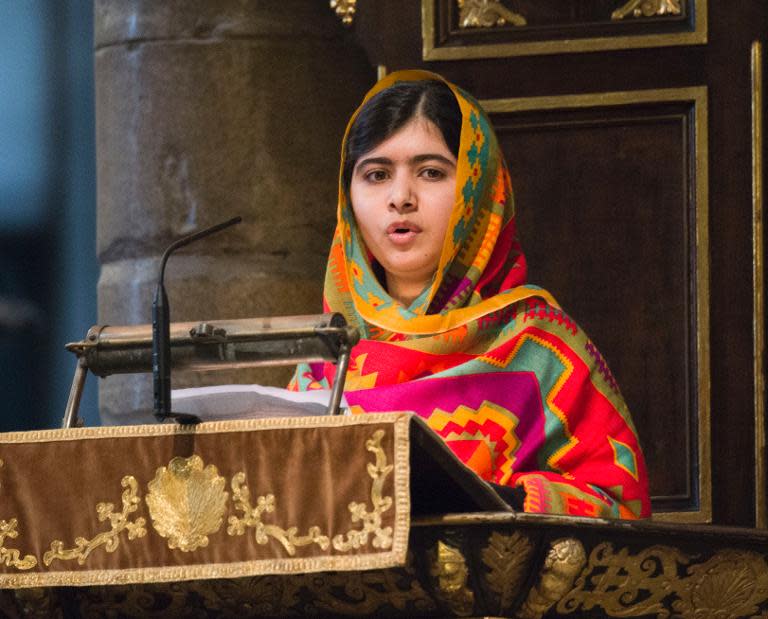
EXCLUSIVE: Confidential U.S. assessments show Afghanistan not ready to govern on own
Confidential U.S. assessments, which the State Department tried to hide from the public, show nearly all Afghan Cabinet ministries are woefully ill-prepared to govern after the U.S. withdraws its troops, often describing the gaps in knowledge, capability and safeguards as “critical” and describing an infrastructure in danger of collapsing if left to its own accord. The State Department USAID reports, obtained by The Washington Times, paint a sobering portrait about the impact of the billions of dollars the U.S. has spent on nation-building over the past decade. Treated as a whole, the reports suggest that the U.S. spending has yet to create a sustainable civilian government in Afghanistan and, in some cases, has been diverted to corrupt politicians or extremists looking to destabilize the country. USAID officials told The Times on Tuesday that the risks of corruption and waste associated with trying to develop a government in Afghanistan have long been known and that U.S. taxpayers must be patient before they see further returns on their aid investments. Americans need to appreciate that the Afghan government ministries hardly existed a dozen years ago, said the officials, who argued that the government has progressed dramatically over the years — giving all the more reason for Washington now to ensure that the gains are not lost and U.S. national security hurt during the years ahead. Further, USAID spokesman Matt Herrick told The Times that “we strongly reject all claims that we have improperly withheld information.” “USAID takes very seriously its obligation to share information about its operations with Congress, auditors and the public,” Mr. Herrick said. But questions remain about precisely why the secret assessments, which were conducted by USAID officials in 2012 and 2013 and are known in foreign aid circles as “Stage II Risk Assessment Reports,” are just coming to light. The documents focus specifically on seven Afghan government ministries overseeing the nation’s finance, mining, electric utilities, communications, education, health and agriculture. USAID concluded outright that six of those ministries simply cannot be trusted to manage aid from U.S. taxpayers without a dangerous risk that the money will fall victim to fraud, waste, abuse or outright theft. Only in one of the seven cases — the Afghan Ministry of Finance in March 2013 — did auditors conclude that the ministry’s systems were “adequate to properly manage and account for” money being channeled in from Washington. But even with that conclusion, USAID auditors identified 26 risks for fraud and waste at the finance ministry. Three of the risks were deemed to be “high” and the rest were rated “critical,” including the overarching danger of the Finance Ministry simply “not being able to fulfill its mandate and carry out its operation.” The reports, which also contain specific recommendations for each ministry to root out mismanagement, are being made public against a backdrop of mounting debate in Washington over America’s nation-building project in Afghanistan over the past 12 years. The Times obtained the assessments under a Freedom of Information Act request filed with the Special Inspector General for Afghanistan Reconstruction, the chief U.S. watchdog over the State Department’s nation-building efforts. The State Department provided the documents earlier to private groups and congressional lawmakers, but in redacted, edited and compressed formats, leading to complaints that the department hid essential information about the poor state of Afghanistan’s governing ability. The Times’ copies were mostly free of edits, laying bare the stark assessments USAID gave about each Afghan ministry. ‘Should not be released’ At the center of that debate sits serious questions about the impact — or lack thereof — of the more than $100 billion that Congress says has been channeled toward Afghanistan reconstruction. Although the amount is far less than the $600 billion estimated to have been spent on U.S. military operations in Afghanistan, it represents the core of America’s attempt to build a government that would not crumble quickly should President Obama come through on his promise to pull all U.S. forces out of the nation by the end of this year. USAID alone has channeled $20 billion toward the effort, according to SIGAR officials. SIGAR and USAID have fought bitterly in public in recent weeks over whether the U.S. exerted enough safeguards over its spending and whether the State Department has tried to hide the blemishes inside each Afghan ministry. The Stage II Risk Assessment Reports, along with a series of other Afghan ministry audits that USAID contracted out to the high-level Washington accounting firms KPMG and Ernst & Young, have sat at the center of the dispute. SIGAR used the assessments as the basis for its scathing report in January highlighting rampant claims of fraud and abuse across the ministries. But what came next was even more eye-opening: The watchdog group wrote a letter to USAID accusing the agency of seeking at “virtually every turn” to block the information from becoming public. “When SIGAR first requested copies of the ministry assessments at issue here, USAID stamped them ‘Sensitive But Unclassified’ (SBU), with a legend on the front covers stating that they should not be released ‘outside the Executive Branch,’ i.e., should not be released to Congress or the public,” SIGAR General Counsel John G. Arlington wrote in a March 26 letter to USAID’s legal branch. The letter triggered speculation inside government circles in Washington that USAID might be guarding the material because of a reference that the ministry assessments had made to terrorism. A version of the assessment, which was conducted by KPMG, appeared this month on the website of the Project on Government Oversight and highlighted how the Afghan Ministry of Rural Rehabilitation and Development had never developed a mechanism “for screening of beneficiaries for their possible links with terrorist organizations before signing contracts or providing funds to the suppliers.” Lack of accountability That particular assessment, along with others that USAID contracted KPMG and Ernst & Young to conduct, were not included in the FOIA response that SIGAR provided Tuesday to The Times. In the response, SIGAR provided The Times with more than 100 pages of the assessments that USAID officials conducted to gauge the capabilities of Afghan ministries. The documents paint a sobering picture. In one, USAID auditors assessed a shocking lack of management over the financial dealings at the ministry overseeing all mining activities in Afghanistan. “There is no financial management and accounting system in place to record transactions for both operational and development budget,” states the September 2012 assessment of the Afghan Ministry of Mines. “There is no evidence of reconciliation of monthly payroll records,” auditors wrote. “In fact, staff are receiving bonuses in cash which are not declared on their bank transfer.” What’s worse, USAID concluded, is that the “same staff is recording and reconciling transactions.” An examination of Afghanistan’s main power and electricity generating utility, Da Afghanistan Breshna Sherkat — known as DABS — paints an equally bleak picture. The assessment, dated October 2012, found “significant weaknesses in DABS’ financial management and accounting system.” “These weaknesses create opportunities for fraud, including off-balance sheet financing,” USAID auditors wrote. “Evidently DABS does not have sufficient financial management capacity to manage donors’ funds, without strong mitigation measures and/or substantial involvement from donors.” Six of 12 risks that auditors identified for fraud and waste at DABS were assessed as “critical.” Six others, including the risk of DABS’ management “not being committed to sound organizational structure and competence,” were rated as “high.” Documents prove oversight Each of the assessments contains a section outlining the Obama administration’s 2010 policy to channel “at least 50 percent” of all U.S. government development aid to Afghanistan directly into the budget of the Afghan government. Under the policy, USAID officials wrote, the agency is committed to evaluating the government capability of whatever nation is receiving aid — in this case Afghanistan. The point, the officials wrote, is to “understand the fiduciary risk environment in targeted countries” in order to decide whether a given nation’s agencies can be trusted with U.S. taxpayer money. “If the assessment reveals clear evidence of vulnerabilities to corruption, and the partner country government fails to respond, the use of partner country systems must not be authorized,” USAID officials wrote. Although the assessments go on to highlight such vulnerabilities across the Afghan ministries, USAID agreed as of August to channel roughly $695 million in “direct assistance” to those ministries. USAID officials defended their actions Tuesday by pointing out that the agency has disbursed only about $200 million, specifically because of concerns about widespread fraud and corruption. Mr. Herrick said suggestions that USAID has tried to hide the risk of such problems only “distract from the larger story that is often overlooked here — that USAID is protecting U.S. taxpayer money while providing critical development assistance and putting in place strict safeguards and oversight measures.” “These documents, the Stage II assessments, very clearly demonstrate those oversight measures,” he said. Another USAID official told The Times that Congress and U.S. government auditors have access to USAID documents in unredacted form either in their offices or at USAID. The official, who spoke on the condition of anonymity, asserted that it “is a common practice to redact information from the general public about vulnerabilities and other information that could be exploited by unscrupulous actors if exposed.” Other officials said the USAID goes to lengths to work with Afghan officials in an attempt to help them develop the capability to effectively manage their ministries on their own, rather than simply throw money at the situation. As a result, one official said, the process takes significant time and care. Ghost employees Officials writing the documents pulled few punches. The one conducted on the Ministry of Mines, for instance, described a landscape ripe for corruption. Operational problems, USAID auditors wrote, have created a “critical” risk of “kickbacks and bribery.” Similarly strong language was used in a “Conclusion & Results” section of an October 2012 assessment of the Ministry of Agriculture, Irrigation and Livestock, commonly referred to as “MAIL.” “MAIL’s financial management/accounting system is not adequate to properly manage and account for donors’ funds,” auditors wrote. “MAIL does not have the financial management capacity to manage proposed activities.” USAID auditors also pointed to damaging personnel problems within the Ministry of Public Health, whose “payroll database is vulnerable to unauthorized access and modification.” The ministry “runs the risk of paying A “lack of transparency” within the ministry’s procurement and purchasing system “creates an opportune environment for fraud, waste and abuse,” USAID auditors wrote, adding that ministry was in violation of existing Afghan government procurement laws, operating with “no effective control over public expenditures.” Thirteen of 14 risks USAID identified in the assessment were rated as “critical,” including the risks that the ministry’s officials are diverting “government resources for unintended purposes” and manipulating accounting information to “hide illegal actions.” While a January 2013 assessment of the Ministry of Education painted a relatively optimistic view of the ministry’s future, auditors cited a “high” risk of government resources being diverted to “unintended purposes.” USAID auditors also found a host of accountability issues associated with the manner in which not just money — but actual cash — flows through the Ministry of Communications and Information Technology to the ministry’s employees. “The Ministry permits salary advances in the form of cash to staff, however, there are no internal controls to monitor and track the cash advances and [a] separate ledger to record the cash advances is not maintained,” auditors wrote in a January 2013 assessment. Read more: http://www.washingtontimes.com/news/2014/apr/15/secret-us-assessments-show-afghanistan-not-ready-g/#ixzz2z3a9fKJr Follow us: @washtimes on Twitter
American journalists call on Bilawal Bhutto

Pakistani policewoman offers protection and understanding

http://www.dw.de/
A police station run by women in Pakistan is filling an important role in a society dominated by men. Chief Bushra Batool says it's become a place of last resort for the desperate.
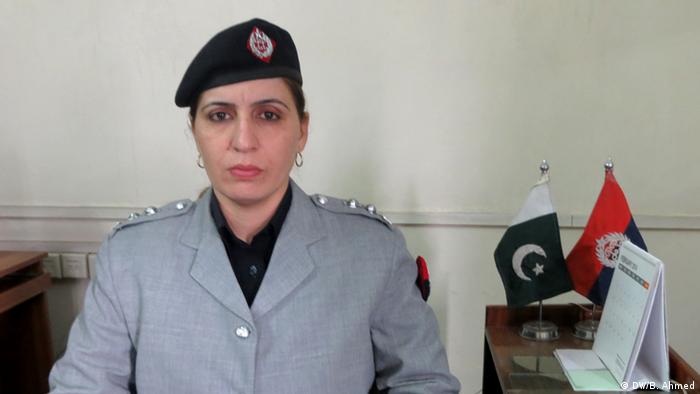
"When I was a maid, the men of the houses I worked in would harass me," she says. "Eventually, I figured, if they're violating me, then I might as well take up sex work myself. It was very difficult at first. I cried a lot and became depressed, but now, I've accepted prostitution as a part of my fate." Naheed has had to fend for herself and her small family since she left her husband several years ago. He had wanted to take a second wife - which is legal to in Pakistan but was unbearable to her at the time. Instead of accepting another woman into her husband's life, she got a divorce.In a safe place Bushra Batool hears these sorts of stories on a daily basis. She takes seriously her task to provide all women with protection while the law works its course. "I can understand that [Naheed] is doing what she does because of some real need - one that my [female] officers will also understand and believe," she says. "Maybe if a male police officer were to speak to her, he would just degrade her." Batool struggles with negative stereotypes about working women in a place where, she says, male chauvinism sometimes forces women to struggle or even starve instead of allowing them to work outside of their homes. Her own engagement was broken off because her fiancé wanted her to leave her job. But, Batool says, being a policewoman has gave her financial stability and a sense of her self-worth, neither of which she's willing to compromise for any man. "This station has taught me how to handle the ups and downs of my life," she says. "I can't leave it now."
Pakistan publishes list to embarrass tax cheats into paying up

Pakistan: Taliban can target Central Jail Bannu to free inmates: RPO Bannu
Regional Police Officer (RPO) Bannu wrote to Khyber Pakhtunkhwa (KP) government on Tuesday informing about the threat that Tehrik-e-Taliban Pakistan (TTP) can possibly target Bannu Central Jail to free accomplices, Dunya News reported. Dunya News has obtained the copy of the letter that was written to the KP government. The letter warns that there’s credible intelligence that militants are planning to target the jail. The letter reveals that Taliban have prepared to attack the prison in order to free their accomplices, many of whom are named in terrorism related cases. Owing to the threat, the letter requests the KP government authorities to transfer the militant prisoners to a safer facility. A copy of the letter has also been sent to Commander 325 Brigade. As per the letter, Commander 325 Brigade has been requested to prepare a quick response force. The letter also informs that strict security has been arranged to monitor the facility. The security arrangements include deployment of over 100 security personnel and 24-hour surveillance of the facility. This is not the first threat of its kind. Only last year, heavily armed Taliban militants stormed into Dera Ismail Khan central jail and freed at least 175 inmates including dozens of high profiled suspects. At least nine people, including four policemen and five militants, were killed in the attack and the following shootout.As per the letter, Commander 325 Brigade has been requested to prepare a quick response force.

Prior to that, almost 400 prisoners including militants had escaped on April 15, 2012 from Bannu Jail after an attack by insurgents armed with guns, grenades and rockets.
More than 150 heavily-armed militants had stormed the central prison outside the restive northwestern town of Bannu bordering the lawless tribal regions. TTP commander Adnan Rashid, who was serving a jail term for attacking former president Gen (retd) Pervez Musharraf, and famed for writing letter to Malala Yousafzai, was among the freed detainees.
Pakistan: Tall tales and load shedding

Manzoor Watto calls on PPP Patron-in-Chief
http://mediacellppp.wordpress.com/

Only visionary & young leadership of Bilawal Bhutto could steer the country out of crisis: Sardar Latif Khosa
PPPP Secretary General and former Punjab Governor Latif Khosa has declared that PPPP Chairman Bilawal Bhutto Zardari will visit Punjab by the end of current month. Addressing party ticket-holders, lawyers and office bearers of different wings of the party here at South Punjab secretariat, he said that only visionary and young leadership of Bilawal Bhutto could steer the country out of crisis. He lashed out at the government and said that despite the fact that all political parties mandated the government to hold talks with Taliban, it completely failed to deliver. He added that the government was highly confused on this topic as a result of which masses faced chaos. He said that the masses desperately looked for peace but the rulers failed to discharge their obligations successfully. “The government has not introduced any visible or successful foreign, internal or financial policy so far which shows that the rulers are focused on just accomplishing their tenure,” he maintained. He said that the government failed to tackle energy crisis as no relief was so far offered to the public. He accused the rulers of filling their own bank accounts by selling out national institutions on throw-away prices. He warned that the PPPP would not let the rulers ruin national institutions.
Former PPP govt took the total collection upto Rs1980 billion from the previous figures 1020 billion & that too without any hike in tax rate
Leader of the opposition in the National Assembly Khursheed Shah on Tuesday criticised the government’s decision to increase the tax rate in order to enhance tax collection. Shah said that move would burden the masses furthers. Finance Minister Ishaq Dar announced to raise the tax rate in the country on Monday. “The tax defaulters should be apprehended to make the increase in the tax collection rather than putting more burden on the general public”, Shah advised the government while talking to media. He recalled that former PPP government took the total collection up to Rs.1980 billion from the previous figures 1020 billion and that too without any hike in tax rate. “The present government fixed Rs.2435 billion tax collection for the current fiscal but appears unable to achieve the target”, Opposition Leader noted. For its failure to collect more taxes, Shah felt that government wants to punish the people by charging them the tax at higher rate. Shah also talked about the increased reliance of government on loans and showed its grave concern over this policy that would be leading towards more trouble in future.
TTP Linked Wahabi Terrorists Threaten Shia Residents To Vacate Peshawar Neighbourhood
shiapost.comTehreek-e-Taliban linked takfiri Deobandi Wahabi terrorists of banned Lashkar-e-Islami (LI) has distributed a pamphlet in a neighborhood of the Khyber Pakhtunhwa capital threatening residents, mostly Shia Muslims, to vacate the area in the next ten days, The Shia Post reported. Residents of Pahari Pura’s Manzoor Colony were warned of serious consequences failing to follow the militants warning. The threatening pamphlet, with letter head of LI chief Lutfullah, said that the militant outfit’s shura (council) has decided to act against the colony, without elaborating what caused to offend it. Lashkar-i-Islam – a Bara-based militant organisation in Khyber tribal region led by Mangal Bagh – was banned in 2008. Police said they have launched an investigation to ascertain the pamphlet’s authenticity. They said police contingent has been increased with more patrolling in the area.
Pakistani.Shia Muslims Under Attack: Militants threaten residents to vacate Peshawar neighbourhood
A pamphlet, attributed to the banned Lashkar-i-Islam (LI), was distributed in a neighbourhood of the Khyber Pakhtunhwa capital threatening residents, mostly Shia Muslims, to vacate the area in the next ten days, police said on Tuesday.
Residents of Pahari Pura’s Manzoor Colony were warned of serious consequences failing to follow the militants warning.
The threatening pamphlet, with letter head of LI chief Lutfullah, said that the militant outfit’s shura (council) has decided to act against the colony, without elaborating what caused to offend it.
Lashkar-i-Islam – a Bara-based militant organisation in Khyber tribal region led by Mangal Bagh – was banned in 2008.
Police said they have launched an investigation to ascertain the pamphlet’s authenticity. They said police contingent has been increased with more patrolling in the area.
A local cleric in Bara, Mufti Munir Shakir formed the Lashkar-i-Islam in December 2004 after Sipah and Malikdinkhel tribesmen announced their full allegiance to him. However, the cleric was expelled from Bar Qambarkhel area after only six months owing to his extremist views and differences with Haji Namdar, another militant commander of the area.
Both Mufti Munir Shakir and Pir Saifur Rehman were forced to leave Bara after a jirga of local elders gave a consensus verdict following bloody clashes between the supporters of the two in early 2005. Mangal Bagh, a bus driver-turned-militant was elevated to the position of amir (chief) of Lashkar-i-Islam in May 2005.
Pakistani security forces demolished the house of Haji Rabat and destroyed the FM radio station set up in a mosque after they started the first military operation against Lashkar-i-Islam in mid-2005.
Tuesday, April 15, 2014
French foreign minister makes historic visit to Havana
http://www.france24.com/A French foreign minister visited Cuba for the first time in 31 years on Saturday, amid efforts by the communist-run nation to improve trade relations with the European Union. French Foreign Minister Laurent Fabius met with Cuban President Raul Castro to discuss politics, human rights, market-oriented reforms and bilateral relations between the two countries. “We want to push forward our relations in the areas of culture, education, economics and politics,” Fabius, told reporters at the end of a one-day visit to the communist-run Caribbean country. He arrived in Havana from Mexico, where he took part in an official visit by President François Hollande. Cuban lawmakers recently approved a law aimed at making the country more attractive to foreign investors, a measure authorities hope can help turn around the island’s struggling economy. Since Fabius took office in 2012, he has tried to shift more of France’s diplomatic focus towards commerce, namely, claiming contracts in markets where French firms are traditionally weak, like Latin America. Construction and telecom firm Bouygues, beverage maker Pernod-Ricard, the Accor tourism corporation and energy company Total all have investments in Cuba, and are among 60 French firms operating in the country. The EU agreed in February to begin negotiations with Cuba to increase trade, investment and dialogue on human rights in its most significant diplomatic shift since it lifted sanctions on the country in 2008. The talks are scheduled to begin on April 29 in Havana, according to European diplomats, who said the French foreign minister’s visit would test the waters. Cuba has been subject to a US embargo for five decades. It is eager to eliminate the EU’s “common position,” enacted in December 1996, which links human rights and democratic conditions to improved economic relations.
Subscribe to:
Posts (Atom)