 Russian President Vladimir Putin during a telephone conversation with Chancellor Angela Merkel said that the sharp escalation of the conflict in Ukraine puts the country on the brink of civil war, states the press service of the Kremlin.
The leaders of the two countries accentuated the importance of talks in a quadripartite format (Russia, the European Union, the United States, and Ukraine), planned for April 17. "Hope has been expressed that the sides at the meeting in Geneva will manage to convey a clear message contributing to directing the situation into a peaceful channel," a Kremlin press service official added.
Russian President also recalled the importance of stabilizing the economy of Ukraine and of ensuring deliveries and transit of Russian natural gas to Europe. This had been reiterated in his message, dated April 10, 2014, to the leaders of a number of European countries.
The telephone conversation was held on the initiative of the German side, Itar-Tass reports.
Read more: http://voiceofrussia.com/news/2014_04_16/Escalation-of-conflict-in-Ukraine-puts-country-on-brink-of-war-Putin-2796/
Russian President Vladimir Putin during a telephone conversation with Chancellor Angela Merkel said that the sharp escalation of the conflict in Ukraine puts the country on the brink of civil war, states the press service of the Kremlin.
The leaders of the two countries accentuated the importance of talks in a quadripartite format (Russia, the European Union, the United States, and Ukraine), planned for April 17. "Hope has been expressed that the sides at the meeting in Geneva will manage to convey a clear message contributing to directing the situation into a peaceful channel," a Kremlin press service official added.
Russian President also recalled the importance of stabilizing the economy of Ukraine and of ensuring deliveries and transit of Russian natural gas to Europe. This had been reiterated in his message, dated April 10, 2014, to the leaders of a number of European countries.
The telephone conversation was held on the initiative of the German side, Itar-Tass reports.
Read more: http://voiceofrussia.com/news/2014_04_16/Escalation-of-conflict-in-Ukraine-puts-country-on-brink-of-war-Putin-2796/
Tuesday, April 15, 2014
Escalation of conflict in Ukraine puts country on brink of civil war - Putin
Russian President Vladimir Putin during a telephone conversation with Chancellor Angela Merkel said that the sharp escalation of the conflict in Ukraine puts the country on the brink of civil war, states the press service of the Kremlin.
The leaders of the two countries accentuated the importance of talks in a quadripartite format (Russia, the European Union, the United States, and Ukraine), planned for April 17. "Hope has been expressed that the sides at the meeting in Geneva will manage to convey a clear message contributing to directing the situation into a peaceful channel," a Kremlin press service official added.
Russian President also recalled the importance of stabilizing the economy of Ukraine and of ensuring deliveries and transit of Russian natural gas to Europe. This had been reiterated in his message, dated April 10, 2014, to the leaders of a number of European countries.
The telephone conversation was held on the initiative of the German side, Itar-Tass reports.
Read more: http://voiceofrussia.com/news/2014_04_16/Escalation-of-conflict-in-Ukraine-puts-country-on-brink-of-war-Putin-2796/
President Xi calls for enhanced relations with Russia


Ukraine: Up to 11 people killed in Kramatorsk airfield battle - media
Moon glows orange during eclipse
Australians catch a celestial show during a lunar eclipse. Katie Sargent reports.
Afghanistan’s elections & the illusion of progress

By Ulson GunnarElections held last week in Afghanistan, while highly publicized as a showpiece in NATO’s lengthy intervention, will most likely achieve very little. They may also be the first in a series of steps the nation undergoes as it slips back into regression and darkness. NATO’s inability to establish security even in Afghanistan’s urban centers bodes ill for whatever government takes over in Kabul, particularly as Western troops prepare to permanently withdraw. Promises of a ‘democratic tomorrow’ are more likely to be replaced at best with an uncomfortable, and perhaps only temporary, accommodation between rural tribesmen (including the Taliban) and the new government in Kabul. In time, as rural tribesmen redirect resources from their fight with NATO’s departing troops, and against whichever government presides in Kabul, that accommodation may inevitably lead to a ‘Taliban’ government once again ruling Afghanistan. When superficiality becomes ‘progress’ The elections were praised by the UN and United States. The Washington Post in particular claimed it was a “milestone”, particularly for Afghan women who were able to both vote and appear on the ballot. However, the Post’s piece, ‘Afghan women make election strides’, is suspiciously short for such a supposedly historical breakthrough. Its brevity is due to the fact that any historical examination of women’s social progress in Afghanistan, or any social progress for that matter, would reveal Afghanistan not as a nation finally emerging for the first time into the light of modernization, but instead a nation mired in decades of darkness as the direct result of Western interference during the 1980s. One need not dig deep to discover the truth of Afghanistan’s once promising past, the US-backed armed conflict that destroyed it, and the resulting Dark Age it suffered through as a direct result. PBS provides a timeline of women’s rights in Afghanistan that begins in 1907 and ends in 2011. The highpoint was in the 1960s and ’70s when Afghanistan was the benefactor of Soviet influence. The rollback of these achievements occurred with the rise of the Taliban, an alliance that was bolstered militarily by the United States in its bid to challenge the Soviet Union via a costly proxy war. According to ‘Citizenship: Reflections on the Middle East and North Africa’ under a chapter titled, ‘The Saur Revolution and Women’s Rights in the Democratic Republic of Afghanistan’, the shift from women as property, to women as human beings is described, with a particular focus being placed on improving women’s literacy, education, and their inclusion into the national workforce. It states, “The DRA [Democratic Republic of Afghanistan] was attempting to implement what reformers and revolutionaries had done in Turkey, Soviet Central Asia (see Massell, 1974), and South Yemen, as well as to carry out what earlier Afghan reformers and modernizers had tried to do in the early 20th century but had failed (see Gregorian, 1969).” These reforms included changes to marriage laws, the expansion of literacy, and the education of rural girls and were resisted by rural tribesmen, the very tribesmen the United States and its allies would use to counter Soviet influence in Afghanistan through a destructive, protracted armed conflict. When Western news articles today occasionally hint to Afghanistan’s promising past, with comments such as “…the first time women have voted in decades,” it is this period of Soviet influence they are referring to. US-armed tribesmen: Custodians of Afghanistan’s dark past, present & future Ironically, NATO troops, led by the United States, have been fighting the very tribesmen they had funded, armed, and trained for a decade in a proxy war with the Soviet Union. The common saying, ‘the enemy of my enemy is my friend’, is often the crutch proponents of US aid to these tribesmen cite, but in reality, the Soviets were attempting then to implement many national reforms generally considered ‘Western’ and ‘progressive’ in nature. The decision by the West to intervene by association with tribesmen who diametrically opposed these reforms was based not on principles, but on a desire solely for geopolitical power. And after their ‘enemy’ was defeated in the late 1980s and early 1990s, the West’s ‘friend’ rolled back hard-fought reforms, plunging Afghanistan into a dark age it is still struggling to reemerge from. Just as the Soviets struggled against rural resistance to reforms including the advancement of human rights, urban Afghans seeking to revisit these reforms today face a similar struggle, but with international partners far less dedicated to their cause. They are burdened with a corrupt, ineffectual government mired in scandal and tangled with foreign interests genuinely disinterested in principles and progress, and instead, only Afghanistan’s role among their greater geopolitical ambitions. With the West withdrawing from Afghanistan, and the tribesmen they were fighting poised to quickly fill in the vacuum they leave, it appears that Afghanistan’s future is its past, with the superficiality of elections, women voting, and what US President Barack Obama calls the “democratic transfer of power,” all a temporary, fleeting present. What might Afghanistan have looked like without billions of dollars in funds and weapons poured into rural tribesmen, eager to overturn reforms implemented by a Soviet-backed government in Kabul? Decades later would Afghanistan still be teetering between progress and regression, on the razor’s edge between a dark age and a renaissance? For those around the world, particularly those who have followed the conflict in Afghanistan or have in fact, participated in it, suffered and sacrificed for it, eyes must begin to open and see that power, not principles, drive the West’s ambitions globally. They traded promising reforms being made in Afghanistan during the mid-20th century for regressive custodians who would oversee decades of darkness. They did so simply because they disliked under whom these reforms were being made, for economical and geopolitical reasons, and determined no reforms at all would be far more preferable. The spite of Western foreign policy has and will continue to take its toll in Afghanistan and elsewhere their influence cannot be successfully thwarted. For the Afghan people, it may be decades more before they see even the level of freedom and progress they enjoyed briefly before the 1979-1989 war. For their Western occupiers, when true progress is not being sought, it will not be truly made. Afghanistan is a showcase of just this, not the success or failure of ‘Western democratization’, but the truth that ultimately lies behind disingenuous ‘democratization’ in the first place.
What Will Karzai's Legacy Be In Afghanistan?
Interview: Afghanistan's Abdullah Vows To Make 'Meritocratic Appointments'
 Afghan presidential candidate Abdullah Abdullah says he will not exclude anyone, including his fiercest rivals, from government if he wins Afghanistan's presidential election.
Abdullah is among the front-runners to win the April 5 presidential election. Preliminary results are not expected until April 24, but partial results released on April 13 give him the lead. He spoke to RFE/RL's Frud Bezhan about contesting the possible second round and his plans should he win.
Afghan presidential candidate Abdullah Abdullah says he will not exclude anyone, including his fiercest rivals, from government if he wins Afghanistan's presidential election.
Abdullah is among the front-runners to win the April 5 presidential election. Preliminary results are not expected until April 24, but partial results released on April 13 give him the lead. He spoke to RFE/RL's Frud Bezhan about contesting the possible second round and his plans should he win.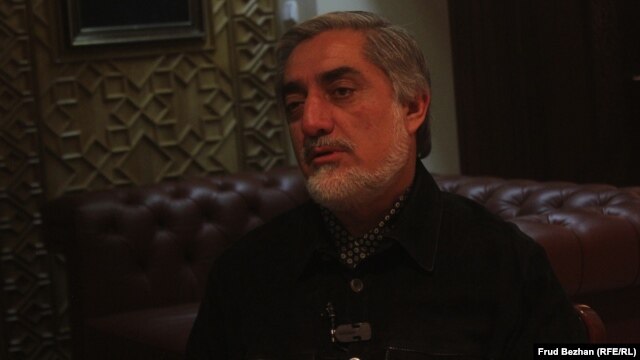
Gunmen Abduct Afghan Deputy Minister in Kabul
 Gunmen abducted the Afghan deputy public works minister in Kabul on Tuesday, officials said, a grim reminder of the insecurity plaguing Afghanistan as most foreign troops prepare to withdraw from the country at the end of the year.
Ahmad Shah Wahid was on his way to work when five gunmen ran his car off the road in northern Kabul, dragged him into their 4-wheel-drive vehicle and sped away, said Gul Agha Hashim, the city's police chief of investigations.
The armed men shot and wounded Wahid's driver when he tried to drive away to safety, said public works ministry spokesman Soheil Kakar.
It was not immediately clear who was behind the abduction. Kakar said there has so far been no ransom demand.
Wahid, who is in his mid-50s, studied engineering and road construction in Italy and has been deputy minister for four years. Before that, he worked in the ministry overseeing road reconstruction, Kakar said.
"He is a very professional man and had no disputes with anyone," Kakar added.
Kidnappings for ransom and abductions by Taliban insurgents are relatively common in Afghanistan, but Wahid is the highest-ranking government official abducted in years.
A Taliban spokesman said by telephone that he was not aware of Tuesday's abduction but would check to see if the insurgents were involved.
Criminal gangs also target wealthy Afghans in the capital to collect ransoms, though it's impossible to know how common abductions are because most go unreported to police.
"Last year, there were more and more kidnappings in Kabul," said businessman Shoib Nawabi, who was abducted in 2008 and held for nine days before his family paid a ransom. Two months ago, he says, a friend of his was also abducted.
NATO troops have trained up a 340,000-strong national police and army force in Afghanistan to fight against the Taliban and secure the country, but day-to-day security remains a struggle.
Gunmen abducted the Afghan deputy public works minister in Kabul on Tuesday, officials said, a grim reminder of the insecurity plaguing Afghanistan as most foreign troops prepare to withdraw from the country at the end of the year.
Ahmad Shah Wahid was on his way to work when five gunmen ran his car off the road in northern Kabul, dragged him into their 4-wheel-drive vehicle and sped away, said Gul Agha Hashim, the city's police chief of investigations.
The armed men shot and wounded Wahid's driver when he tried to drive away to safety, said public works ministry spokesman Soheil Kakar.
It was not immediately clear who was behind the abduction. Kakar said there has so far been no ransom demand.
Wahid, who is in his mid-50s, studied engineering and road construction in Italy and has been deputy minister for four years. Before that, he worked in the ministry overseeing road reconstruction, Kakar said.
"He is a very professional man and had no disputes with anyone," Kakar added.
Kidnappings for ransom and abductions by Taliban insurgents are relatively common in Afghanistan, but Wahid is the highest-ranking government official abducted in years.
A Taliban spokesman said by telephone that he was not aware of Tuesday's abduction but would check to see if the insurgents were involved.
Criminal gangs also target wealthy Afghans in the capital to collect ransoms, though it's impossible to know how common abductions are because most go unreported to police.
"Last year, there were more and more kidnappings in Kabul," said businessman Shoib Nawabi, who was abducted in 2008 and held for nine days before his family paid a ransom. Two months ago, he says, a friend of his was also abducted.
NATO troops have trained up a 340,000-strong national police and army force in Afghanistan to fight against the Taliban and secure the country, but day-to-day security remains a struggle.
'Double dealing': How Pakistan hid Osama Bin Laden from the U.S. and fueled the war in Afghanistan
http://news.yahoo.com/
By Martha Raddatz, Richard Coolidge & Jordyn PhelpsWhat if the United States has been waging the wrong war against the wrong enemy for the last 13 years in Afghanistan? Pulitzer Prize-winning New York Times journalist Carlotta Gall, who spent more than a decade covering Afghanistan since 2001, concludes just that in her new book, “The Wrong Enemy: America in Afghanistan, 2001-2014.” Gall told “On the Radar” that Pakistan – not Afghanistan – has been the United States’ real enemy. “Instead of fighting a very grim and tough war which was very high in casualties on Afghans, as well as NATO and American soldiers, the problem wasn't in the Afghan villages,” Gall said. “The source of the problem, the radicalization, the sponsoring of the insurgency, was all happening in Pakistan.” Gall said she first had the realization that Pakistan was fueling the insurgency in Afghanistan “very soon” after the Sept. 11 attacks. “I went to Quetta and found Taliban resting up there and regrouping,” she said. “They had assistance, some of them talked about being forced and threatened and told to go in and fight the Americans … and when you're there, on the ground, seeing every bombing, the suicide bombing had started, the insurgency that grew, and you investigate where it's coming from, it kept leading back to Pakistan.” Gall said that Pakistan’s leaders, and especially former President Pervez Musharraf, were “very clever” and tricked the United States into believing that Pakistan was an ally. “I think the politicians, not all of them, but the diplomats … it took ages for them to understand that actually the persuasion wasn't working; the engagement wasn't bringing them on board; they were actually double dealing,” she said. “And now diplomats will tell you very plainly, ‘Yes, Musharraf was double dealing.’” Perhaps the biggest betrayal of all in the U.S.-Pakistani relationship, and one that came as no surprise to Gall, was the fact that bin Laden found shelter in Abbottabad, Pakistan, for six years before he was killed in a Navy SEAL raid in 2011. And, according to Gall, Pakistan’s government was orchestrating his protection. “Pakistan did know,” Gall said, speaking about bin Laden’s location. “They were hiding him, they were handling him. Someone on the inside told me this. They had a special desk that knew where bin Laden was. “Not only that, but put him there, protected him, oversaw him, handled him in the terms of the secret intelligence services,” she added. “And it's all deniable, but I’m told the top bosses knew.” Despite the awareness of Pakistan’s “double dealing” today, Gall said that relations with Pakistan are no better now than in the past. “Our relations with Pakistan have gone back to the same thing, and the thing that concerns me is that Zawahiri is still out there, in Pakistan, I believe,” she said. “He is also probably being hidden the same way and protected.”
Pakistan: Government-army tensions
 In a press conference on Sunday, Interior Minister Chaudhry Nisar admitted that some tensions had arisen in recent days between the government and the army, but these were more in the nature of ‘misunderstandings’ and would soon be resolved. He argued that civil-military coordination and harmony in the 10 months since the present government took office have been better than ever before in our history. The government and the army are on the same page as far as the policy towards terrorism is concerned, he emphasized. If there are differences, they are more differences of opinion, not differences on the policy per se. The talks process is supported by the army, the minister clarified.
Referring to the remarks of a couple of federal ministers on the Musharraf case that evoked a statement by the COAS regarding maintaining the dignity and interests of the military, Chaudhry Nisar said this was an ‘irritant’ that too would soon be smoothed over. On the controversy that has arisen of late regarding the freeing of non-combatant Taliban prisoners, Chaudhry Nisar asked the pertinent question that if the prisoners were released from internment centres under the control of the army, how was it possible that they were released without the consent of the army? The release of 19 prisoners so far would be followed by another 13, after the talks with the Tehreek-e-Taliban Pakistan (TTP) resume. Although the minister did not specify a date for the resumption of the talks, delay in which he ascribed to one of the members of the government’s negotiating committee being unavailable, sources spoke of the talks resuming very soon. There was no deadlock in the talks, Chaudhry Nisar argued.The minister’s remarks were at odds with the Taliban side’s intermediary Professor Ibrahim of the Jamaat-i-Islami.
The professor’s view in an interview with foreign media on Sunday was that there are many odds against the talks/peace process, largely because of the trust deficit between the two sides. He also asserted that the government and the army were not on the same page as the military had serious reservations about the government’s approach. He also revealed that the released prisoners list had not been shared by the government. Were the government to share the list, it would assist in the release of the Taliban’s non-combatant hostages, prominent amongst whom are Shahbaz Taseer, Ali Haider Gilani and Professor Ajmal. An interesting aside regarding these three innocent hostages is the statement by Chaudhry Nisar that their release had not yet been taken up with the Taliban but would follow a resumption of the talks. That throws the release of Taliban prisoners in an even worse light: the government conceding the incremental release of prisoners without extracting at the very least the reciprocal release of hostages. Professor Ibrahim’s suggestion in this regard merits attention. The good professor also underlined the role of the infighting between TTP factions in creating a stalemate in the peace process, although the TTP spokesman Shahidullah Shahid stated that the infighting had nothing to do with his organisation.
He said it was ‘merely’ a misunderstanding between the two factions and was on the way to being settled. It merits attention that the ‘misunderstanding’ between the Sajna group and followers of the Hakeemullah Mehsud faction has led to several dozen deaths and according to latest reports, is still continuing. Not only is factional fighting producing deaths amongst the militants, the age-old tactic of kidnappings in and around the tribal areas has seen a splurge of late. Along with this development, a militant group reportedly opposed to the peace process has had several members killed in Darra Adam Khel by the security forces.The lay of terror land shows contradictory features that are feeding into further confusion about where the process is headed. The ‘ceasefire’, which the TTP has so far adhered to (or so it claims), has yielded continuing attacks, not the least of which are the two attacks in Islamabad. Some Taliban factions have resorted to settling their rivalries through the barrel of a gun. There may not be a ‘deadlock’ in the talks because it is unclear whether, when and where the talks will resume. Despite numerous statements, clarifications, etc, by the government’s concerned ministers, confusion tends to be deepening and getting worse confounded.
In a press conference on Sunday, Interior Minister Chaudhry Nisar admitted that some tensions had arisen in recent days between the government and the army, but these were more in the nature of ‘misunderstandings’ and would soon be resolved. He argued that civil-military coordination and harmony in the 10 months since the present government took office have been better than ever before in our history. The government and the army are on the same page as far as the policy towards terrorism is concerned, he emphasized. If there are differences, they are more differences of opinion, not differences on the policy per se. The talks process is supported by the army, the minister clarified.
Referring to the remarks of a couple of federal ministers on the Musharraf case that evoked a statement by the COAS regarding maintaining the dignity and interests of the military, Chaudhry Nisar said this was an ‘irritant’ that too would soon be smoothed over. On the controversy that has arisen of late regarding the freeing of non-combatant Taliban prisoners, Chaudhry Nisar asked the pertinent question that if the prisoners were released from internment centres under the control of the army, how was it possible that they were released without the consent of the army? The release of 19 prisoners so far would be followed by another 13, after the talks with the Tehreek-e-Taliban Pakistan (TTP) resume. Although the minister did not specify a date for the resumption of the talks, delay in which he ascribed to one of the members of the government’s negotiating committee being unavailable, sources spoke of the talks resuming very soon. There was no deadlock in the talks, Chaudhry Nisar argued.The minister’s remarks were at odds with the Taliban side’s intermediary Professor Ibrahim of the Jamaat-i-Islami.
The professor’s view in an interview with foreign media on Sunday was that there are many odds against the talks/peace process, largely because of the trust deficit between the two sides. He also asserted that the government and the army were not on the same page as the military had serious reservations about the government’s approach. He also revealed that the released prisoners list had not been shared by the government. Were the government to share the list, it would assist in the release of the Taliban’s non-combatant hostages, prominent amongst whom are Shahbaz Taseer, Ali Haider Gilani and Professor Ajmal. An interesting aside regarding these three innocent hostages is the statement by Chaudhry Nisar that their release had not yet been taken up with the Taliban but would follow a resumption of the talks. That throws the release of Taliban prisoners in an even worse light: the government conceding the incremental release of prisoners without extracting at the very least the reciprocal release of hostages. Professor Ibrahim’s suggestion in this regard merits attention. The good professor also underlined the role of the infighting between TTP factions in creating a stalemate in the peace process, although the TTP spokesman Shahidullah Shahid stated that the infighting had nothing to do with his organisation.
He said it was ‘merely’ a misunderstanding between the two factions and was on the way to being settled. It merits attention that the ‘misunderstanding’ between the Sajna group and followers of the Hakeemullah Mehsud faction has led to several dozen deaths and according to latest reports, is still continuing. Not only is factional fighting producing deaths amongst the militants, the age-old tactic of kidnappings in and around the tribal areas has seen a splurge of late. Along with this development, a militant group reportedly opposed to the peace process has had several members killed in Darra Adam Khel by the security forces.The lay of terror land shows contradictory features that are feeding into further confusion about where the process is headed. The ‘ceasefire’, which the TTP has so far adhered to (or so it claims), has yielded continuing attacks, not the least of which are the two attacks in Islamabad. Some Taliban factions have resorted to settling their rivalries through the barrel of a gun. There may not be a ‘deadlock’ in the talks because it is unclear whether, when and where the talks will resume. Despite numerous statements, clarifications, etc, by the government’s concerned ministers, confusion tends to be deepening and getting worse confounded.
Pakistan's Slum demolition: Charity school among structures torn down
A lone mosque stands tall, jeering at the sprawl of flattened straw, thatch and steel that once gave shelter to hundreds of families.
The slum, which runs the length of the railway track and cuts through Islamabad’s industrial hub in Sector I-10, was bulldozed on Monday afternoon amid hushed claims of residents that stay orders against their eviction were being violated.
In the wake of the unscheduled operation, a branch of the Pehli Kiran School — which caters to low-income, migrant communities that inhabit slum areas and otherwise remain outside the scope of affordable education — was also demolished, despite a plea for time to remove the tin roofs that make up the modest structure.
“The school was not given enough time to take down the structure,” said a distraught Zainab Qureshi, the academic director for Pehli Kiran Schools’ eight branches.
“The mosque remains unharmed though,” she added.
According to the Capital Development Authority (CDA), all of the structures in the area are illegal and liable to be removed.
No time given
According to Qureshi, the schools move with their pupils and the removal of the slum would have resulted in a shift of premises, provided PK-6 was allowed to remove its nut-and-bolt structure.
“I was on the roof removing the screws when a bulldozer came,” shared Ghazanfar Ali, who is a head teacher at the school. “Without students, we are not a school. Our plan was to move with the community.”
He explained that the average cost of a school — a tin roof propped over poles set in concrete — was Rs200,000, in addition to books, straw mats, audio-visual aids and sporting equipment. The loss will have to be absorbed by the donation-fueled school due to lack of cooperation from the CDA, who demolished the slum this afternoon as part of their mandate to remove all illegal slums in Islamabad.
The operation was led by CDA Enforcement Deputy Director Mohammad Iqbal on orders from Chairman Maroof Afzal to recover 1,200 kanals on CDA-owned land in sectors I-10 and H-10.
An estimated 1,300 individuals live in the slum, also known as the Afghan Basti due to its large migrant population. While the occupied land belongs to the CDA, the authority’s indifference to the illegal occupants for over three decades has left a stain on its sleeve, with mounting pressure from activists to regularise the slums.
Earlier this month, the red-flagged Awami Workers Party and former federal minister for minorities J Salik rallied together to challenge the IHC’s orders, though little was achieved beyond lip service from local politicians.
Legality
“The case of katchi abadi demolition is sub-judice and the CDA is carrying out this action illegally,” said Tahira Abdullah, social activist and a volunteer trustee of the JAQ Trust, which runs the Pehli Kiran schools.
“We deserve to be relocated,” expressed Suhbat Khan, “But our livelihoods are here, at the Sabzi Mandi,” Khan explained that relocation to Rawat and its tributaries would make it economically unfeasible to travel to Islamabad to work in the market, pushing their families further into the cusp of uncertainty.
On the other hand, Deputy Director Iqbal said the CDA had “made several announcements in the katchi abadi and resumed an operation that started a month ago so that the community would have time to move willingly”.
He said the government does not have enough space to relocate everyone, “But I can assure you that most of them can afford to live in rented spaces. They just choose not to.” He then recounted an interaction with a resident who said he preferred the open skies to closed quarters.
According to Iqbal, no stay orders were violated. He added that “the mosque is unscathed”.
PTI Govt in Khyber Pakhtunkhwa asked to allow admissions in Benevolent Fund School
 Contrary to its claim about increasing literacy rate in Khyber Pakhtunkhwa, the provincial government directed the management of Benevolent Fund School, Kohat Road, to avoid new admissions as the school might be shut.
The students, their parents and teachers of Benevolent Fund School held a demonstration outside Peshawar Press Club on Monday to protest the decision of the government.
Carrying banners and placards, the protesters chanted slogans against the government and asked it to fulfil its promise about promotion of education in the province.
They said that new admissions in the school had been stopped since 2010 and its college portion had also been closed while its girls section was shut in 2011. Several employees, they said, were sacked and now new admissions had also been stopped in the boys section of the school.
The teachers of the school said that government didn’t award them proper service structure and salaries were also not paid to them timely. During the last few years, they said, teachers and other employees suffered badly owing to usual delay in payment of their salaries.
They demanded reinstatement of sacked employees, restoration of transport facility, lifting of ban on the new admissions and payment of the additional salaries to them that had been pending since 2009.
The protesters threatened to start attending classes on the main road outside the press club and then set themselves on fire outside provincial assembly building if government did not accept their demands.
The principal of the school, Syed Abu Zaffar, when contacted, confirmed that Benevolent Fund secretary directed him to avoid new admissions. The three vans meant for transportation of staff and students were parked in the Benevolent Fund Building and the drivers were terminated.
He said that at least 400 students would be deprived of education if the school was closed.
The building, Mr Zaffar said, had 50 rooms and local people wanted to admit their children there but some officials were bent upon closing the institution to use the spacious building for some other purposes.
Baz Mohammad Khan, a representative of the parents, said that the school was close to a vast population and the enrolment could increase manifold if new admissions were allowed. He demanded of Imran Khan to take notice of the issue.
“We will continue protest if our demands are not met,” he said.
Contrary to its claim about increasing literacy rate in Khyber Pakhtunkhwa, the provincial government directed the management of Benevolent Fund School, Kohat Road, to avoid new admissions as the school might be shut.
The students, their parents and teachers of Benevolent Fund School held a demonstration outside Peshawar Press Club on Monday to protest the decision of the government.
Carrying banners and placards, the protesters chanted slogans against the government and asked it to fulfil its promise about promotion of education in the province.
They said that new admissions in the school had been stopped since 2010 and its college portion had also been closed while its girls section was shut in 2011. Several employees, they said, were sacked and now new admissions had also been stopped in the boys section of the school.
The teachers of the school said that government didn’t award them proper service structure and salaries were also not paid to them timely. During the last few years, they said, teachers and other employees suffered badly owing to usual delay in payment of their salaries.
They demanded reinstatement of sacked employees, restoration of transport facility, lifting of ban on the new admissions and payment of the additional salaries to them that had been pending since 2009.
The protesters threatened to start attending classes on the main road outside the press club and then set themselves on fire outside provincial assembly building if government did not accept their demands.
The principal of the school, Syed Abu Zaffar, when contacted, confirmed that Benevolent Fund secretary directed him to avoid new admissions. The three vans meant for transportation of staff and students were parked in the Benevolent Fund Building and the drivers were terminated.
He said that at least 400 students would be deprived of education if the school was closed.
The building, Mr Zaffar said, had 50 rooms and local people wanted to admit their children there but some officials were bent upon closing the institution to use the spacious building for some other purposes.
Baz Mohammad Khan, a representative of the parents, said that the school was close to a vast population and the enrolment could increase manifold if new admissions were allowed. He demanded of Imran Khan to take notice of the issue.
“We will continue protest if our demands are not met,” he said.
Shah censures govt for not demanding release of Taseer, Gilani

Leader of the Opposition in National Assembly Syed Khursheed Shah on Monday deplored the federal government for not formally taking up the issue of release of Ali Hyder Gilani and Shahbaz Taseer in talks with Taliban. In an informal chat with media, Shah said that Taliban’s statement clearly suggests that government has not yet demanded the release of abducted sons of former prime minister Yousuf Raza Gilani and former Punjab governor Salman Taseer. “What kinds of talks are being held with the Taliban? Opposition doesn’t accept such negotiations,” he said. It seems government wants to deceive the PPP, he said. “We had supported the peace process. But the government was giving an impression as if PPP was opposing peace talks,” the opposition leader noted.
Monday, April 14, 2014
Syrian army seizes town near Lebanese border
Syrian soldiers backed by Hezbollah fighters recapture the ancient Christian the town of Maaloula, north of Damascus, further squeezing rebels' supply routes through the Qalamoun mountains into Lebanon.
Scottish Independence 2014 - LIBERTY DENIED - referendum song
Original song for the referendum on the 18th September 2014 --
Scottish independence, Neo-eisimeileachd na h-Alba, is a political aim of some political parties, advocacy groups, and individuals in Scotland , for the country to become an independent sovereign state once again. Scotland was an independent country from its foundation in the Early Middle Ages (traditionally 843) until 1707, with the Treaty of Union and subsequent Acts of Union.
Scottish home rule, Scottish Assembly,
The visit of King George IV to Scotland in 1822 and the subsequent rise in tartanry has been credited with reinforcing a specific sense of Scottish national identity. This 'identity' had been regarded by many as being split between the Episcopalian and Roman Catholic-dominated Highlands and the Presbyterian-dominated Lowlands[dubious -- discuss], following the Glorious Revolution in 1688, and continuing into the 18th century, through the Jacobite risings, the Act of Proscription and subsequent process of Highland Clearances by landlords.
From the mid-19th century, there was a growing feeling that there should be devolution of control over Scottish affairs, but support for restoration of full independence was limited. The "home rule" movement for a Scottish Assembly was first taken up in 1853 by the National Association for the Vindication of Scottish Rights a body close to the Conservative Party. A key element in this movement was the comparison with Ireland, which, it was noted, received more support from the British Government than Scotland. The original movement broadened its political appeal and soon began to receive Liberal Party backing In 1885, the Post of Secretary for Scotland and the Scottish Office were re-established to promote Scotland's interests and express its concerns to the British Parliament. In 1886, however, William Ewart Gladstone introduced the Irish Home Rule Bill. When many Scots compared what they had to the Irish offer of Home Rule, the status quo was considered inadequate. It was not regarded as an immediate constitutional priority however, particularly when the Irish Home Rule Bill was defeated in the House of Commons.
The Twentieth Century By the time a Scottish Home Rule bill was first presented to parliament in 1913, its progress, along with that of the Irish Home Rule Act 1914, was interrupted by World War I and subsequently became overshadowed by the Easter Rising and Irish War of Independence. However, the Scottish Office was relocated to St. Andrew's House in Edinburgh during the 1930s
In 1921, influenced by Sinn Féin, the Scots National League formed as a body, primarily based in London, seeking Scottish independence. The League established the Scots Independent newspaper in 1926 and in 1928 it helped the Glasgow University Scottish Nationalist Association to form the National Party of Scotland (NPS), the aim of which was a separate Scottish state. One of the National Party of Scotland's founders was Hugh MacDiarmid, a poet who had begun promoting a Scottish literature. Other literary supporters included Eric Linklater and Neil Gunn while others, like John MacCormick and Robert Bontine Cunninghame Graham had Labour Party links. The NPS co-operated with the Scottish Party, a home rule organisation formed in 1932 by former members of the Conservative Party, and these merged in 1934 to form the Scottish National Party (SNP).
At first, the SNP supported home rule through the establishment of a devolved Scottish Assembly within the United Kingdom, rather than all-out independence for Scotland . This became the party's initial position on the constitutional status of Scotland, as a result of a compromise between the NPS, which did support independence, and the Scottish Party which was devolutionist. However, the SNP quickly reverted to the original NPS stance of supporting full independence for Scotland. The interwar period proved to be difficult years for the SNP, with the rise of undemocratic nationalist forces in Europe in the shape of Fascism in Italy and Spain and national socialism in Germany. The alleged similarity between SNP and foreign nationalists, combined with other factors, such as a relatively low profile in mainstream media, made it difficult for the SNP to grow its support. Unlike the pseudo-ethnic or ultra-nationalist groups on mainland Europe, however, the nationalism of the SNP was based more on civic nationalism
Scottish independence: Labour official backing Yes
 A LABOUR Party chairman has declared his support for Scottish independence.
Mike Dyer, constituency chairman of Anniesland, in Glasgow, revealed his backing for a “Yes” vote at the STUC conference in Dundee.
He cited the “relentless negativity” of the No campaign as one of the key motivating factors in his decision.
SNP deputy leader Nicola Sturgeon made a special appeal to Labour voters to back independence in her conference speech on Friday, amid a concerted push to make pro-independence group Yes Scotland more appealing to supporters of the unionist party.
Mr Dyer, a member of Unite, and who is on the union’s finance sector committee, said he believes independence will lead to a “fairer Scotland”.
He said: “With a Yes vote industrial relations will no longer be shackled by the same anti-strike regulations or restrictions on employees’ rights that stem from Westminster.
“In an independent Scotland, workers can expect greater legal protection where we’ll all have collective bargaining rights and the right not to be victimised. Trade unionists want a Scotland where workers are looked after and a Yes vote is the best way to achieve that.
“The No campaign has so far been a tide of relentless negativity.
“Take ship yards, for example. If we have the skills and people power to build advanced naval ships, then surely we can build wind turbines and other forms of renewables?
“For me, the No campaign is a group of UK government ministers telling us how bad things will be, whereas the Yes campaign is a grassroots campaign with a strong message highlighting Scotland’s potential.
“When you speak to Labour Party members at constituency level they have radical ideas that are more associated with Labour’s traditions. So why is the party leadership not as radical as the ordinary members?”
A LABOUR Party chairman has declared his support for Scottish independence.
Mike Dyer, constituency chairman of Anniesland, in Glasgow, revealed his backing for a “Yes” vote at the STUC conference in Dundee.
He cited the “relentless negativity” of the No campaign as one of the key motivating factors in his decision.
SNP deputy leader Nicola Sturgeon made a special appeal to Labour voters to back independence in her conference speech on Friday, amid a concerted push to make pro-independence group Yes Scotland more appealing to supporters of the unionist party.
Mr Dyer, a member of Unite, and who is on the union’s finance sector committee, said he believes independence will lead to a “fairer Scotland”.
He said: “With a Yes vote industrial relations will no longer be shackled by the same anti-strike regulations or restrictions on employees’ rights that stem from Westminster.
“In an independent Scotland, workers can expect greater legal protection where we’ll all have collective bargaining rights and the right not to be victimised. Trade unionists want a Scotland where workers are looked after and a Yes vote is the best way to achieve that.
“The No campaign has so far been a tide of relentless negativity.
“Take ship yards, for example. If we have the skills and people power to build advanced naval ships, then surely we can build wind turbines and other forms of renewables?
“For me, the No campaign is a group of UK government ministers telling us how bad things will be, whereas the Yes campaign is a grassroots campaign with a strong message highlighting Scotland’s potential.
“When you speak to Labour Party members at constituency level they have radical ideas that are more associated with Labour’s traditions. So why is the party leadership not as radical as the ordinary members?”
‘Afghanization’ of Syria and the choice between the lesser of evils
“We are at war with Syria,” said Turkey’s Prime Minister Recep Tayyip Erdoğan speaking on the night of March 30, which marked his victory in the local elections. He was complaining about the leaked audio recording of Turkey’s top branch’s meeting about responding to an imminent threat stemming from Syria. He was rightly complaining that Turkey’s national security was jeopardized in order to harm him. While Turkey is not officially at war with Syria, the prime minister’s description cannot to be taken lightly. The question is which Syria are we at war with? And there comes the challenge: there is no longer one Syria. But as of now, we can clearly say the two most hostile actors against Turkey is Bashar al-Assad’s regime and the Islamic State in Iraq and Levant (ISIS). It seems that it is no confidence that these two never fought against each other. While Turkish authorities lack clear evidence and therefore conviction that there is an organic link between the two, the fact that the two have never fought against each other points to an unnamed holy alliance. Along the 911 km Turkish-Syrian border, Turkey confronts al-Assad’s war planes in the air and ISIS on the land. Four critical border gates are under the control of ISIS. What’s more, ISIS has gained the control of the territory surrounding the tomb of Süleyman Shah, a very important historic figure for Turkey. This tiny stretch of land is Turkey’s only territory outside of its borders that belongs to Turkey. When ISIS took hold of the territory on March 12; the meeting in which its audio recording was leaked took place the next day; resulting in Foreign Minister Ahmet Davutoğlu’s warning that the slightest attempt to target the tomb, protected by a small Turkish contingency of two dozen soldiers, will meet Turkey’s unequivocal reaction. As a response, ISIS threatened to pull out its soldiers and bring down its flag; and as Turkey has not bowed down, ISIS so far has not taken a step to substantiate its threat. Yet, the fact remains that Turkey is at war with a non-state actor at its border. What makes ISIS more dangerous is 90 percent of its recruits are made up of non-Syrians, it is believed to be open to all kinds of manipulation; so at the end of the day you don’t even know which manipulator you are fighting against. Let’s put aside the reasonability of the Turkish government in ending up in such a mess at the border; one thing is for sure that while Ankara was wrong in its assessment about al-Assad’s quick departure, it was right about its assessment as to the possible scenarios in the absence of a departure. Ankara told Washington from the early days on that Syria would become the land of radical Islamist groups and that if the regime was let to survive, each day would bring us closer to the “Afghanization” of Syria. While as of today Turkey seems to be paying the consequences of “Afghanization,” we should not forget that “Afghanization” ended with the 9-11 attacks in the U.S. According to a high level Turkish official, the “Afghanization” risk started to resonate much more in Washington’s corridors. “The U.S. is more open to talk about options it used to not talk about,” said the official. The Turkish authorities seem to be convinced that the regime will never ever be able to establish its authority throughout Syria and in the absence of a political solution in the near future, the challenge appears to be finding the ways to empower the opposition. So the choice is going to be between the lesser of the two (or multiple) evils. This is no easy endeavor. The fact remains that just as we were thinking of getting rid of the terrorism of the PKK, we are now facing another dangerous terrorist organization in asymmetrical warfare.BARÇIN YİNANÇ

Spaniards hold anti-monarchy rally in Madrid
 Hundreds of Spaniards have taken to the streets of the capital Madrid to protest against the scandal-stricken monarchy.
Spaniards staged a large protest rally in Madrid on Monday, demanding a democratically elected head of state.
Waving the Republican flags, the demonstrators blocked traffic as they made their way to a central square in the capital known as Puerta Del Sol.
The monarchy is "a corrupt system that leads us to poverty", Pedro Riquelme, one of the protesters, said.
"It is like a property that they pass from father to son. With a republic everything would be more transparent," Riquelme added.
The Spanish monarchy has lost popularity over the past years, partly because of a luxury trip king Juan Carlos made to Africa in 2012 during the peak of Spain's financial crisis.
The Spanish royal family has also been caught up in a corruption scandal involving King’s youngest daughter Cristina.
The 48-year-old princess was the first member of Spain's royal family that attested in a court as the subject of criminal proceedings since King Carlos came to power in 1975.
Cristina was summoned by Palma de Mallorca judge, Jose Castro, in February as a suspect for questioning over involvement in a charitable organization called Noos Foundation, which is run by her husband Inaki Urdangarin.
Urdangarin was also accused of fraud, tax evasion, fabricating documents and embezzlement of six million euros ($8.2 million) in public funds.
The high-level corruption scandal has severely damaged the royal family’s standing in Spain and has diminished people’s trust in public institutions at a time the country is struggling with a deep recession and tough cuts in public spending.
A poll published by the Spanish newspaper El Mundo on January 5 showed that fewer than half of Spaniards, or 41 percent, support the monarchy in general and nearly two-thirds of them want Carlos to abdicate.
Hundreds of Spaniards have taken to the streets of the capital Madrid to protest against the scandal-stricken monarchy.
Spaniards staged a large protest rally in Madrid on Monday, demanding a democratically elected head of state.
Waving the Republican flags, the demonstrators blocked traffic as they made their way to a central square in the capital known as Puerta Del Sol.
The monarchy is "a corrupt system that leads us to poverty", Pedro Riquelme, one of the protesters, said.
"It is like a property that they pass from father to son. With a republic everything would be more transparent," Riquelme added.
The Spanish monarchy has lost popularity over the past years, partly because of a luxury trip king Juan Carlos made to Africa in 2012 during the peak of Spain's financial crisis.
The Spanish royal family has also been caught up in a corruption scandal involving King’s youngest daughter Cristina.
The 48-year-old princess was the first member of Spain's royal family that attested in a court as the subject of criminal proceedings since King Carlos came to power in 1975.
Cristina was summoned by Palma de Mallorca judge, Jose Castro, in February as a suspect for questioning over involvement in a charitable organization called Noos Foundation, which is run by her husband Inaki Urdangarin.
Urdangarin was also accused of fraud, tax evasion, fabricating documents and embezzlement of six million euros ($8.2 million) in public funds.
The high-level corruption scandal has severely damaged the royal family’s standing in Spain and has diminished people’s trust in public institutions at a time the country is struggling with a deep recession and tough cuts in public spending.
A poll published by the Spanish newspaper El Mundo on January 5 showed that fewer than half of Spaniards, or 41 percent, support the monarchy in general and nearly two-thirds of them want Carlos to abdicate.
Putin to Obama: Use your influence to prevent bloodshed in Ukraine
Russian President Vladimir Putin urged his American counterpart on Monday to use the White House’s influence on the Ukrainian government to prevent further “bloodshed” from occurring in the country.
United States President Barack Obama placed a phone call to Mr. Putin on Monday afternoon (EST) to discuss the ongoing and increasingly tense situation in eastern Ukraine amid growing concerns surrounding the country’s future stability following the recent ousting of Pres. Viktor Yanukovych earlier this year, and the turmoil that has gripped the region ever since.
According to a statement released after the phone conversation by the Kremlin, Putin dismissed recent reports that peg Russia as being responsible for heated protests that have erupted in eastern Ukraine, where pro-Russian activists have successfully managed to seize a number of local government buildings and police stations.
"In response to the president of the United States' expressed concern about Russia's supposed meddling in southeastern Ukraine, the president of Russia noted that such speculations are based on inaccurate information," the press statement read.
Putin stressed that protests in several south-east regions of Ukraine are a result of “the Kiev authorities’ unwillingness and inability to take into account the interests of the Russian and Russian-speaking population,” read a Kremlin press service statement.
The Russian president called upon Obama to use all of the capabilities at his disposal, “to prevent the use of force and bloodshed,” and also reportedly denied that his government has had any involvement in the recent unrest during the call, according to the official statement.
“The president noted that such speculation is based on unreliable information,” the Kremlin said.
At the same time, Obama called on Putin to use his influence over pro-Russian groups in eastern Ukraine to “depart the buildings they have seized,” the White House said in a statement. “The president reiterated the importance of Russia withdrawing its troops from Ukraine’s border in order to defuse tensions.”
Representatives for Russia, the US and Ukraine are expected to meet with colleagues from the EU later this week in Geneva to discuss the recent series of events and what could come next, but the Kremlin said that both Putin and Obama agreed during Monday’s phone call that diplomatic cooperation must continue ahead of that meeting, currently scheduled for April 17.
In the meantime, the Kremlin said that Putin suggested during Monday’s phone call that Ukraine begin focusing on a new constitution that “involves all political forces in the country, creating a federalized state and guaranteeing Ukraine's non-aligned status.”
Putin’s press secretary, Dmitry Peskov, told the Russian media earlier that day that the Kremlin has been receiving pleas for help from Ukrainians as a result of the events unfolding in the eastern part of the country.
“He is getting a lot of appeals addressed personally to him, asking him to intervene in one way or another. He is monitoring the situation in Ukraine with great concern,” Peskov stated.
On Sunday evening, Kiev threatened "full-scale" military force if protesters and paramilitaries refused to vacate the occupied government buildings by Monday morning, but that deadline came and went without action. Later, though, the US State Dept. and White House both weighed in on the matter and made conflicting statements about possibly supplying arms to Ukrainian forces.
China neutrality valuable for Ukraine crisis
 Russian Foreign Minister Sergei Lavrov arrives in China on Tuesday.
Foreign media have speculated that apart from paving the way for Russia President Vladimir Putin's visit to China next month and promoting Sino-Russian economic and trade cooperation, Lavrov will be sure to discuss the escalating tension in Ukraine's eastern region with the Chinese side.
How should China discuss this thorny issue with Russia and make a public statement?
It's a test of China's diplomatic wisdom and power.
Ukraine's eastern region is different from the Crimea. Secession of the region from Ukraine strikes a direct blow to territorial integrity guaranteed by international law.
But the eastern region crisis is not isolated. It can be traced back to "revolutions" and turbulence that repeatedly haunted Ukraine in recent years.
Moscow led the joining of Crimea into Russia with resolution, while the uprising in Ukraine's eastern region is more spontaneous. But the attitude of Moscow and Kiev could affect the process of the crisis.
Moscow so far made no further actions except for deploying troops along the border region and warning Kiev not to take military actions. There is no further clear-cut position being stated. Putin is seemingly hesitant. Although Kremlin has a great influence on the public in the eastern region, it cannot give direct orders.
There aren't legitimate Russian troops stationed in Ukraine's eastern region. It's difficult to come up with an internationally recognized independence procedure.
China should avoid a hasty position over the issue. It needs to take the following principles and considerations into account.
To begin with, we should advocate the safeguarding of territorial integrity in the post-Crimea era.
As long as the possibility exists, we'd like to urge it so.
We also believe the solution to the Ukraine crisis should represent the interests of all parties including Kiev, Russians in the eastern region and Moscow, as well as the West.
The Sino-Russian relationship should be given top priority when Beijing dwells on its stance over the Ukraine situation. Beijing and Moscow should make concerted efforts to avoid divergence underscored through the Ukraine crisis.
Major powers except China have been embroiled in the Ukraine crisis, highlighting the significance of China's neutrality. Beijing needs to play a more active role in propelling peace.
China needs to secure a balance between not supporting the independence of Ukraine's eastern region and avoiding isolating Moscow with the West. Such a stance is not an indication of ambiguity but a unique distinction.
China has never served as an influential mediator in major international conflicts so far. We may be closest to that role in the Ukraine crisis.
Russian Foreign Minister Sergei Lavrov arrives in China on Tuesday.
Foreign media have speculated that apart from paving the way for Russia President Vladimir Putin's visit to China next month and promoting Sino-Russian economic and trade cooperation, Lavrov will be sure to discuss the escalating tension in Ukraine's eastern region with the Chinese side.
How should China discuss this thorny issue with Russia and make a public statement?
It's a test of China's diplomatic wisdom and power.
Ukraine's eastern region is different from the Crimea. Secession of the region from Ukraine strikes a direct blow to territorial integrity guaranteed by international law.
But the eastern region crisis is not isolated. It can be traced back to "revolutions" and turbulence that repeatedly haunted Ukraine in recent years.
Moscow led the joining of Crimea into Russia with resolution, while the uprising in Ukraine's eastern region is more spontaneous. But the attitude of Moscow and Kiev could affect the process of the crisis.
Moscow so far made no further actions except for deploying troops along the border region and warning Kiev not to take military actions. There is no further clear-cut position being stated. Putin is seemingly hesitant. Although Kremlin has a great influence on the public in the eastern region, it cannot give direct orders.
There aren't legitimate Russian troops stationed in Ukraine's eastern region. It's difficult to come up with an internationally recognized independence procedure.
China should avoid a hasty position over the issue. It needs to take the following principles and considerations into account.
To begin with, we should advocate the safeguarding of territorial integrity in the post-Crimea era.
As long as the possibility exists, we'd like to urge it so.
We also believe the solution to the Ukraine crisis should represent the interests of all parties including Kiev, Russians in the eastern region and Moscow, as well as the West.
The Sino-Russian relationship should be given top priority when Beijing dwells on its stance over the Ukraine situation. Beijing and Moscow should make concerted efforts to avoid divergence underscored through the Ukraine crisis.
Major powers except China have been embroiled in the Ukraine crisis, highlighting the significance of China's neutrality. Beijing needs to play a more active role in propelling peace.
China needs to secure a balance between not supporting the independence of Ukraine's eastern region and avoiding isolating Moscow with the West. Such a stance is not an indication of ambiguity but a unique distinction.
China has never served as an influential mediator in major international conflicts so far. We may be closest to that role in the Ukraine crisis.
If Kiev uses force, Russian cooperation over Ukraine will be undermined – Lavrov
http://voiceofrussia.com/
"If the authorities in Kiev will use force, our entire cooperation on the Ukrainian issue will be undermined," Russian Foreign Minister Sergei Lavrov said at a meeting of the World Coordinating Council of Russian Compatriots. "We are now discussing the possibility of holding a meeting of Russia, the United States, the European Union and Ukraine," Lavrov said.
"We shall be prepared to discuss ways of promoting a solution of the Ukrainian issue. But if the authorities in Kiev dare use force, our entire cooperation on the Ukrainian issue, on Ukrainian settlement will be undermined. We have let this known to our Western partners," he said, TASS reports. Read more: http://voiceofrussia.com/news/2014_04_14/If-Kiev-uses-force-Russian-cooperation-over-Ukraine-will-be-undermined-Lavrov-1454/
Canada to be first G20 country to abolish door-to-door postal service

Pakistan's Shia Genocide: NED University Students Condemn Murder Of Shia Teacher
shiapost.comThe students of NED University of Engineering and Technology staged a rally on Monday to protest against the brutal assassination of their Shia lecturer Engineer Muntazir Mehdi alias Mohammad Yousuf. “Down with terrorism,” Stop murders of teachers,” Killing of teacher is tantamount to killing of knowledge and education,” and “Arrest the killers of Sir Muntazir Mehdi,” were the slogans raised by the students who marched from their departments to the main gate of their university.

Pakistan: Government slanting the dialogue process: Khurshid Shah
Opposition Leader in the National Assembly Syed Khurhsid Shah said the government is twisting the dialogue process with the Taliban. Speaking to journalists in Islamabad, he said the government is portraying wrong image of the opposition regarding peace talks. He stated that according to TTP spokesperson Shahidullah Shaid the names of sons of Syed Yousaf Raza Gillani and Salman Taseer were not in the exchange list of prisoners. He said they are supporting the government but such type of dialogue process is not acceptable, urging the prime minister to take notice of the matter. Replying to a query, he stated that one representative of Muttahida Qaumi Movement was included in the party formed for the National Finance Commission. He also expressed concerns over the tensions between the military and civilian sides. Replying to another query, the opposition leader stated many people are losing their lives in the capital, the so-called safe city by the Interior Minister.http://mediacellppp.wordpress.com/
From Kabul to Cairo, the Killing and Jailing of Journalists Continues
Anxious China emerges as diplomatic player in Afghanistan
 China is quietly preparing for a more robust role in the future of Afghanistan, concerned that the withdrawal of NATO troops will leave a hotbed of militancy on its doorstep.
The two countries are connected by a narrow mountainous corridor that is almost impassable, which meant Beijing could focus on mining and mineral deals in Afghanistan as Western forces battled Taliban insurgents. But officials say that China is emerging as a key strategic player.
In August it will host a "Heart of Asia" conference on Afghanistan, which may have a newly elected president by then, inviting leaders from regional nations including India and Pakistan. A Western diplomat said China has already held discreet trilateral talks with Afghanistan and other countries.
One of its chief worries is that Uighur militants who want a separate state in western China's Xinjiang region will exploit the security vacuum left after the bulk of NATO forces withdraw by the end of the year to step up their fight.
Hundreds of Uighur fighters are believed to be holed up in rugged, lawless tribal areas straddling Afghanistan and Pakistan.
In a rare interview from an undisclosed location last month, their leader told Reuters that China would be made to pay for its crackdown on separatists in Xinjiang.
"In the past we said: 'The Americans are there, and the Americans don't want anyone else, especially not another great power, taking their place'," said Hu Shisheng, a South Asia expert at a government-backed think tank, the China Institute of International Relations in Beijing.
"Now with the U.S. strategic focus shifting, neighboring countries cannot just let Afghanistan descend into chaos.
"The Pakistan and the Afghanistan Taliban are sympathetic towards the Uighurs. So we absolutely have to pay attention to this, in a way that perhaps we did not before," he said.
FOCUSED ON ECONOMICS
So far, China's commitment to Afghan reconstruction since the ouster of a hardline Islamist Taliban regime in 2001 has been around $250 million and its security support has been mostly limited to counter-narcotics training.
China has a $700 million agreement to drill for oil in the Amu Darya Basin and a $3 billion deal to develop the Aynak copper mining project. But insiders say security concerns, not investment, are the primary driver of China's new focus.
"They were focused on economics, not reconciliation or peace. But recently they have expressed their willingness to get more involved in the peace process," said a member of the High Peace Council, an Afghan government body overseeing negotiations with the Taliban.
The Chinese and U.S. embassies in Kabul declined to comment.
It is highly unlikely that China will follow the U.S. lead and send soldiers into Afghanistan.
Officials believe, however, that, with the West's attention on the region set to fade, Beijing has an opportunity to flex its diplomatic muscle, using warm relations with Afghanistan and Pakistan to ease suspicion between the two neighbors.
Kabul has long accused Islamabad of providing havens for militants and sponsoring attacks inside Afghanistan, and now Pakistan believes Afghanistan is doing the same. A decade of U.S. diplomacy has failed to reconcile the two sides.
Afghan Deputy Foreign Minister Ershad Ahmadi said China had given assurances that it would encourage Pakistan to cooperate with Kabul's efforts to make peace with the Taliban.
"We trust them. We are working on a plan," he told Reuters.
"DUMPED ON THEIR LAP"
China's push for a bigger role in Afghanistan is seen by some diplomats as an attempt to show it is a responsible global actor after rattling its own neighbors by asserting claims in the South China Sea.
But Andrew Small, a fellow at the German Marshall Fund and author of an upcoming book on Chinese-Pakistan relations, said it is driven by a realization that its own security is at stake.
Four years ago, Washington proposed several joint projects, including the construction of schools by China in Aynak - near its proposed copper mines - and teacher training by the U.S. side. It took China almost two years to respond, Small said.
Now the two countries work together training Afghan diplomats.
"At the end of 2011, the Chinese realized America was leaving and they were getting this dumped on their lap," he said. "Until then, China had sat completely on the sidelines. They just used to send people to read out statements in meetings."
A Beijing-based Asian diplomat cautioned, however, that Beijing's new enthusiasm for engagement with Kabul might run into trouble, especially as its officially atheist Communist leaders have limited experience dealing with Muslim countries.
"Afghanistan is highly factional, and it's not like any other Islamic country," he said. "China is going to have a very difficult time."
China is quietly preparing for a more robust role in the future of Afghanistan, concerned that the withdrawal of NATO troops will leave a hotbed of militancy on its doorstep.
The two countries are connected by a narrow mountainous corridor that is almost impassable, which meant Beijing could focus on mining and mineral deals in Afghanistan as Western forces battled Taliban insurgents. But officials say that China is emerging as a key strategic player.
In August it will host a "Heart of Asia" conference on Afghanistan, which may have a newly elected president by then, inviting leaders from regional nations including India and Pakistan. A Western diplomat said China has already held discreet trilateral talks with Afghanistan and other countries.
One of its chief worries is that Uighur militants who want a separate state in western China's Xinjiang region will exploit the security vacuum left after the bulk of NATO forces withdraw by the end of the year to step up their fight.
Hundreds of Uighur fighters are believed to be holed up in rugged, lawless tribal areas straddling Afghanistan and Pakistan.
In a rare interview from an undisclosed location last month, their leader told Reuters that China would be made to pay for its crackdown on separatists in Xinjiang.
"In the past we said: 'The Americans are there, and the Americans don't want anyone else, especially not another great power, taking their place'," said Hu Shisheng, a South Asia expert at a government-backed think tank, the China Institute of International Relations in Beijing.
"Now with the U.S. strategic focus shifting, neighboring countries cannot just let Afghanistan descend into chaos.
"The Pakistan and the Afghanistan Taliban are sympathetic towards the Uighurs. So we absolutely have to pay attention to this, in a way that perhaps we did not before," he said.
FOCUSED ON ECONOMICS
So far, China's commitment to Afghan reconstruction since the ouster of a hardline Islamist Taliban regime in 2001 has been around $250 million and its security support has been mostly limited to counter-narcotics training.
China has a $700 million agreement to drill for oil in the Amu Darya Basin and a $3 billion deal to develop the Aynak copper mining project. But insiders say security concerns, not investment, are the primary driver of China's new focus.
"They were focused on economics, not reconciliation or peace. But recently they have expressed their willingness to get more involved in the peace process," said a member of the High Peace Council, an Afghan government body overseeing negotiations with the Taliban.
The Chinese and U.S. embassies in Kabul declined to comment.
It is highly unlikely that China will follow the U.S. lead and send soldiers into Afghanistan.
Officials believe, however, that, with the West's attention on the region set to fade, Beijing has an opportunity to flex its diplomatic muscle, using warm relations with Afghanistan and Pakistan to ease suspicion between the two neighbors.
Kabul has long accused Islamabad of providing havens for militants and sponsoring attacks inside Afghanistan, and now Pakistan believes Afghanistan is doing the same. A decade of U.S. diplomacy has failed to reconcile the two sides.
Afghan Deputy Foreign Minister Ershad Ahmadi said China had given assurances that it would encourage Pakistan to cooperate with Kabul's efforts to make peace with the Taliban.
"We trust them. We are working on a plan," he told Reuters.
"DUMPED ON THEIR LAP"
China's push for a bigger role in Afghanistan is seen by some diplomats as an attempt to show it is a responsible global actor after rattling its own neighbors by asserting claims in the South China Sea.
But Andrew Small, a fellow at the German Marshall Fund and author of an upcoming book on Chinese-Pakistan relations, said it is driven by a realization that its own security is at stake.
Four years ago, Washington proposed several joint projects, including the construction of schools by China in Aynak - near its proposed copper mines - and teacher training by the U.S. side. It took China almost two years to respond, Small said.
Now the two countries work together training Afghan diplomats.
"At the end of 2011, the Chinese realized America was leaving and they were getting this dumped on their lap," he said. "Until then, China had sat completely on the sidelines. They just used to send people to read out statements in meetings."
A Beijing-based Asian diplomat cautioned, however, that Beijing's new enthusiasm for engagement with Kabul might run into trouble, especially as its officially atheist Communist leaders have limited experience dealing with Muslim countries.
"Afghanistan is highly factional, and it's not like any other Islamic country," he said. "China is going to have a very difficult time."
Pakistan: Taliban-Seminary Nexus
 If recent reports by an international news agency are to be believed, religious seminaries or Madrassas, are plotting with the Taliban to execute terror attacks in the capital, in the event that talks with the government fail. The peace talks which kicked off in February this year, have proved to be largely ineffective. There have been few, if any victories for the PML-N government and at least 90 people have died in violent attacks since the declaration of the TTP ceasefire in March. Once viewed through the prism of probability, it seems likely, that the peace talks will indeed fail. When that happens, a deadly coalition will be waiting to strike the capital. This alliance is not outside the realm of possibility; not only have seminaries been under the microscope recently for the dispensation and cultivation of hate material under the pretext of an Islamic education, but the Red Mosque incident of 2007 serves as a reminder of the capacities of seminaries to execute violent Taliban-style movements in urban centres. The seminary suspects are already intellectually primed and motivated to act in accordance with TTP narratives on war with the government. There can be no better-placed partner for the Taliban to launch practical city-wide attacks from, than a network of Madrassas providing both cover and manpower. Hiding under the guise of religious seminaries, protected by powerful, radical clerics in government, the TTP could begin a new surge of brutal attacks and propaganda; both equally dangerous tools in the fight for peaceful narratives, and security for all. The government must act now; the country needs complete institutional cohesion to fight this war. Security forces must be mobilised and the judiciary must be empowered and protected to convict those responsible for the violence.
Unpaid dues: Ration supply cut off to jails in Balochistan
The Express Tribune
Ration supply to nine prison facilities and judicial lockups in Balochistan has been suspended by contractors over nonpayment of bills, which have soared to Rs21million. According to All Contractors Association Central Jails spokesperson, Sikandar Zehri, the prison department owes an amount of Rs21 million to the contractors, which accumulated over a period of three years.
“We reminded the department about the outstanding amount but it did not pay any attention which prompted us to suspend the ration supply to nine prisons and judicial lockups in Naushki, Gwadar, Jaffarabad, Kohlu, Duki, Barkhan and Qila Saifullah districts,” Zehri claimed while talking to The Express Tribune. Issuing a stern warning, Zehri said that the suspension of ration supply to prison facilities will continue “until our dues are cleared”. Taking a swipe at prison officials, Zehri said, “The Inspector General (IG) Prison Department Balochistan makes us wait for several hours and refuses to meet us.” According to sources in the jail department, a payment of Rs7 hundred thousand was made to contractors of Quetta and Mastung jails. However, the department does not have the funds to clear the outstanding bill of Rs21million. The contractors association cautioned that they will suspend the supply to all jails in Balochistan, if their dues were not cleared within a few days. Meanwhile, despite several calls, IG Prison Department was not available for comment.
Pakistan: Islamabad under siege
The relentless terror strikes in the last few weeks presage the fact that peace is unlikely in Pakistan even with a ‘successful’ ceasefire between the government of Pakistan and Tehreek-e-Taliban Pakistan (TTP). Islamabad, the capital of Pakistan, has been bathed with blood twice after the so-called ceasefire. The first attack was a suicide-cum-firing inside a district sessions court in Islamabad last month, causing the deaths of a judge and nine other people. A terror group, Ahrarul Hind, claimed responsibility. However, the TTP disowned the attack, and its like-minded political and religious supporters lauded the TTP statement and instantly conceded its truth. The Ahrarul Hind claim of the attack cannot be taken seriously even with a pinch of salt, considering the group’s limited capability for strikes within the country. It is an established truth that suicide attack capability, in broad daylight inside Pakistan, belongs only to the TTP. It is altogether another matter that the TTP is being disingenuous by claiming that groups outside its control are involved in or responsible for that attack.By Inayatullah RustamaniThe carnage among common citizens in Islamabad may not be disturbing our government at this point because it does not affect them indirectly or directly, but the complete ignorance to them will one day have lasting and uncontrollable implications on our elected representatives and the political elite too
The latest bomb blast in a fruit market in Islamabad on April 9 has taken the lives of more than two dozen people and maimed over 50. The attacked was claimed by the banned United Baloch Army (UBA), though this claim was dismissed by the interior ministry and the Islamabad police. Islamabad is the capital of Pakistan and its population is less than 1.8 million people. It is strange that law enforcement agencies are unable to protect the citizenry of this city that has a population less than that of Hyderabad, Sindh. The brazen broad daylight attacks in Islamabad raise concerns among many in political and other circles with regard to the security of the Prime Minister’s and President’s Houses, the Supreme Court (SC), and the parliament house that are located in the city. The carnage among common citizens in Islamabad may not be disturbing our government at this point because it does not affect them indirectly or directly, but the complete ignoring of them will one day have lasting and uncontrollable implications for our elected representatives and the political elite. The outbreak of the Karachi unrest and lawlessness in the 1990s was not taken seriously at the time. It was ignored first because it had sweeping effects only on the common man and the workers of certain specific political parties. The long ignored violence in Karachi has eventually now started affecting lawmakers, law enforcement agency personnel, the business community, doctors and other ‘important’ segments of society. No one is secure in Karachi now. The latest Karachi operation has completely failed to bring peace to the city. This is because acts of violence have become a flourishing business in the city. Many law enforcement agencies have started investing in that lucrative business by involving their men in the criminal groups to make money by committing murders and looting banks and the affluent people of the city.
The incumbent federal government is apparently bereft of an anti-terrorism plan. It banks on a Tehreek-e-Taliban Pakistan (TTP) appeasement policy. There has been no respite from terror strikes during a month long ceasefire. Despite that, the PML-N government has reportedly freed 19 TTP prisoners. This was never a wise move because the government could not even secure the freedom of prominent non-combatants like Professor Ajmal, Ali Haider Gilani and Shahbaz Taseer from captivity by the TTP. Media reports also say that friction has developed between the federal government and the Pakistan army over the government’s release of the TTP prisoners and two federal ministers’ criticism of the Pakistan army. The civil-military imbalance in relations has never proved in the interest of the country, which is already plagued by multiple crises. The PML-N measures are incomprehensible. It has unilaterally approved the Pakistan Protection Ordinance (PPO) as a bill in the National Assembly. This bill authorises law enforcement agencies to pick up, detain, or even shoot on sight a suspect. This will further provoke human rights groups in the country against human rights abuses. The Pakistan People’s Party (PPP), Pakistan Tehreek-e-Insaaf (PTI), Awami National Party (ANP) and Muttahida Qaumi Movement (MQM) have lambasted the ordinance. Some among their ranks have designated it a “black law” and others as a draconian law. Some parties have threatened to oppose it in the Senate and others have vowed to force the matter into the courts. Given the track record of enforced disappearances, allegedly by law enforcement agencies, suggests that the PPO or another similar law will further worsen human rights abuses in the country. Islamabad is the capital of the country. It must not be left at the mercy of a bunch of terrorists. The capital city must be guarded at every cost before it becomes another Karachi. It should not be forgotten that the uncontrolled and unchallenged bunch of terrorists can plant their roots in Islamabad like they have Karachi. The terror strikes are in full swing so as to bring the country’s economy and its social life to a complete standstill. Pakistan is a nuclear country and its capital being frequently attacked does not bode well for the national and international image of the country, not to mention its security. If the attacks continue on Islamabad, the day is not far when the international media will dub Islamabad as a city under siege.
Pakistan: Prime minister’s absence
THE prime minister must have taken note of the moves to amend the Senate’s rules of procedure to make the chief executive’s presence in the upper house compulsory at least once a week. The need for such a move would not have arisen if Nawaz Sharif had attended parliamentary sessions regularly. As of now, Mr Sharif is upholding a rather unsavoury tradition: most Pakistani prime ministers have never been habitués of parliament. Obviously, they failed to realise that one of their duties is to strengthen democratic traditions by being a regular participant of parliamentary sessions. Mr Sharif’s record is among the worst of any Pakistani prime minister — he didn’t attend a single session of the upper house during the parliamentary year ending last month. And unlike Yousuf Raza Gilani, who regularly participated in debates, Mr Sharif’s record of presence in the lower house is even worse. He attended a National Assembly session on Jan 29 after a gap of seven months, and then was last seen in the people’s house on Feb 26. Since then, he has not been visible in parliament. No one should be surprised if his ministers take their cue from him, for his interior minister has been accused by senators of having resorted to an undeclared boycott of the upper house since those November days when opposition members in the Senate held sessions outside the parliament building, and the senators wanted Chaudhry Nisar Ali Khan to apologise for allegedly giving faulty information.
Granted, Mr Sharif is a busy person but then so are prime ministers of other parliamentary democracies. In Britain, the prime minister himself answers MPs’ questions and stands the booing and heckling that is an intrinsic part of a parliamentarian’s life. That Mr Sharif should absent himself from a house where his party has a majority is astonishing and demands an explanation. By appearing in parliament only rarely Mr Sharif is doing no service to himself or to democracy in a country that needs strong parliamentary traditions. ‘A clash of institutions’ is often talked about and feared in Pakistan. The best way to pre-empt such a malignant event is to strengthen parliament and make it a truly sovereign body that commands the respect of unelected institutions.
Pakistan:Khursheed writes to PM about closure of PIA offices
Opposition Leader in National Assembly, Khursheed Shah, on Sunday wrote to Prime Minister Nawaz Sharif about the closure of four PIA offices in Sindh and Balochistan and sought his intervention in this anti-people act. “I would like to draw your attention to the closure of four PIA offices in four districts of Sindh, ie, Hyderabad, Jacobabad, Shikarpur and Nawabshah, and one in Pasni district of Balochistan,” Shah said in his letter, and termed it a matter of grave concern for the local community. It would result not only in loss of many jobs, but also a convenient transportation facility for local populace, he added. Shah also said that the deserving officers had been completely ignored for promotions that not only raised questions on impartiality of the merit system, but also resulted in demoralisation of employees on the whole. “I believe that decisions should be made in an unbiased and appropriate manner. Closing the offices and ignoring the deserving employees for promotions will not result in improvement in efficiency of the airline,” he said. “If the government is seriously interested in the revival of PIA, Shah said, it should take such productive steps that could make it a profitable organisation and refrain from those that could deepen the sense of deprivation and exploitation.” Shah said, “The government’s responsibility is to facilitate the public rather than deprive them of the already available facilities,” and requested the prime minister to look into the matter and guide the authorities concerned to take rational and popular decisions.
Subscribe to:
Posts (Atom)