M WAQAR.....
"A man's ethical behavior should be based effectually on sympathy, education, and social ties; no religious basis is necessary.Man would indeed be in a poor way if he had to be restrained by fear of punishment and hope of reward after death."
--Albert Einstein !!!
NEWS,ARTICLES,EDITORIALS,MUSIC... Ze chi pe mayeen yum da agha pukhtunistan de.....(Liberal,Progressive,Secular World.)''Secularism is not against religion; it is the message of humanity.''
تل ده وی پثتونستآن
Braving cold, rain and Taliban attacks, Afghans gathered in such long lines at polling places that voting hours were extended nationwide so they could cast their ballots to choose the successor to President Hamid Karzai on Saturday.
Rather than the widespread disruption that the Taliban had promised in recent months, the thing most on display was determination, as Afghans turned out in higher numbers than expected, including in some places where votes were scarce in the 2009 election. There was no heavy barrage of attacks, though fears of potential violence did keep roughly one in eight polling centers closed nationwide.
For the first time, Afghans were voting on what appeared to be an open field of candidates, after Mr. Karzai's dozen years in power. Accordingly, no one expected a quick result from the vote on Saturday: the top three candidates were expected to closely divide up the vote, and a runoff election seemed certain. That election would likely be held no sooner than May 28, continuing Mr. Karzai’s time in office for another two months at least. Even partial official results were not expected for a week.
With eight candidates in the race, the five minor candidates’ shares of the vote made it even more difficult for any one candidate to reach the 50 percent threshold that would allow them to win outright.
The leading candidates going into the vote were Ashraf Ghani, 64, a technocrat and former official in Mr. Karzai’s government; Abdullah Abdullah, 53, a former foreign minister who was the second biggest vote-getter against Mr. Karzai in the 2009 election; and Zalmay Rassoul, 70, another former foreign minister, who is the only major candidate with a woman on his ticket as vice-presidential candidate, Habiba Sarobi. Informal polls in recent weeks showed Mr. Abdullah and Mr. Ghani in the lead, but polling in Afghanistan is notoriously unreliable.
Early in the day, in a high school near the presidential palace, an emotional Mr. Karzai cast his own vote for his successor. “I, as a citizen of Afghanistan, did this with happiness and pride,” he said afterward.
The streets of the capital, swamped by a heavy rain, were almost entirely devoid of vehicle traffic, except for members of the police force and the military, who were on duty at checkpoints every few hundred feet and searched nearly everyone passing by.
Most people walked to vote. Long lines had already formed when polls opened at 7 a.m. in Kabul and other major cities.
“People have realized that electing the president is far more important than standing in the rain,” said a voter, Abdullah Abdullah, 24, who had the same name as the candidate he said he was planning to vote for at a Kabul high school polling place.
“Whenever there has been a new king or president, it has been accompanied by death and violence,” said Abdul Wakil Amiri, an attorney who turned out early to vote at a Kabul mosque. “For the first time, we are experiencing democracy.”
To provide security for the voting, the Afghan government mobilized its entire military and police forces, some 350,000 in all, backed up by 53,000 NATO coalition troops – although the Americans and their allies planned no direct involvement except in case of an extreme emergency.
Authorities did not expect that, however, as the overall level of violence in the months leading to the voting was much lower than before the vote in the summer of 2009, when Mr. Karzai was re-elected in 2009. This time, the Afghan security forces are nearly twice as numerous, and the election is taking place before the traditional start of the fighting season, both factors that have reduced violence by anywhere from 9 to 25 percent compared to the pre-election period in 2009, according to United Nations officials.
A series of high-profile attacks on foreigners, including the murder on Friday of an Associated Press photographer and the wounding of her colleague, created an impression of greater violence, but were also indications that insurgents did not have as much capacity to strike forcefully during this campaign. They did not manage a single major attack on any campaign event, for instance, and two attacks on the Independent Election Commission had little direct effect on the voting.
In the days before the voting, only one police officer was killed in attacks on convoys of election officials delivering materials, in Logar Province, according to the Afghan police. Halfway through election day, four voters were reported killed in a smattering of incidents, including two in insurgent attacks in the east — one in Kunar Province, the other in Paktia province.
A bomb set off at a polling place in the Mohammad Agha district of Logar killed two voters and wounded two others, but the polling place reopened half an hour later, according to the district governor, Abdul Hamid. An election observer there, Qazi Nasim Modaser, said, “Now people are going back to the polling station.”
Even before voting began, the authorities had already closed 750 polling centers, just over 10 percent of the total, because of security concerns, and there were fears more would be closed on election day. Just how many would likely be a key issue in the aftermath of the voting, especially if closures were seen as disenfranchising one ethnic group over another.
Along with the threat of violence, the legacy of fraud from past elections cast a long shadow over Saturday’s voting. The authorities have gone to unusual extremes to try to guarantee an election at least credible enough to satisfy international donors, who have pledged to continue supporting Afghanistan with billions of dollars in aid, but want to be assured of an election free of the sort of widespread fraud that discredited the 2009 voting.
Underwritten by $100 million from the United Nations and foreign donors, this year’s election is a huge enterprise, especially given Afghanistan’s forbidding terrain. Some 3,200 donkeys were pressed into service to deliver ballots to remote mountain villages, which along with battalions of trucks and minibuses, reached 6,500 polling places in all. The American military pitched in with air transport of ballots to regional distribution centers and to difficult-to-reach provinces.
While many international election observers fled the country in the wake of attacks on foreigners, or found themselves confined to quarters in Kabul, years of expensive preparations and the training of an army of some 70,000 Afghan election observers were expected to compensate, according to Western diplomats and Afghan election officials.
“We have so many controls now, it’s going to be much safer this time,” said Noor Ahmad Noor, the spokesman for the Independent Election Commission.
The American ambassador, James Cunningham, called the election a “really historic opportunity for the people of Afghanistan to move forward with something we’ve been trying to create together with them for several years now.”
Despite an increasingly troubled relationship between the Americans and Mr. Karzai, who refused to sign a long-term security agreement with the United States, Mr. Cunningham said he had assurances from all the candidates that whoever won would sign the agreement upon taking office.
Many of the worst fears about this year’s election — that Mr. Karzai would cancel them on security grounds or try to amend the constitution to prolong his tenure in power — did not materialize.
Mr. Karzai pledged to stay out of the election campaign and not support any candidate, although there was no legal requirement for him to do so, and he forced his brother Qayum out of the race so that he would not be accused of trying to start a family dynasty.
While there were persistent reports that Mr. Karzai’s government was quietly shoring up Mr. Rassoul as a preferred candidate, there was also evidence of government support in various parts of the country for all three leading candidates.
The Taliban for their part vowed to derail the elections and punish anyone who voted — easily identifiable by the ink their fingers would be dipped in to confirm they had cast their votes. This time, election officials used two types of ink: invisible ultraviolet ink on one finger, and blue silver-nitrate ink on another. During the last election, it was discovered that nail polish remover could be used to remove the ink; this year, the solution is far more impermeable, meaning voters in troubled areas could be identified by insurgents for some three days.
That made the turnout in conflict areas all the more impressive. While in some provinces, such as Helmand, 72 of the 219 polling centers were closed because of security concerns, in others where there had been relatively little voting in 2009 many were opened.
In Kandahar Province, for instance, the police chief, Abdul Raziq, said 234 of 244 polling centers would be open on election day. That did not assure people would vote at all of them, however, as some open polling places were in such dangerous areas that participation seemed unlikely. And many places officially opened before the election might be closed on election day itself, officials conceded. How often that happened will be a closely watched bellwether of the validity of the results.
“Voting on this day will be a slap to the faces of the terrorists,” said Rahmatullah Nabil, the acting head of the National Directorate of Security, the Afghan domestic intelligence agency. But some were still too concerned to vote.
“I won’t cast my vote because last night the Taliban came to us and warned us that we will be killed if we choose to vote,” said Parwiz, a 30-year-old villager from Bati Kot district in Nangarhar province, where at least 23 percent of the polling centers were closed, and many others were in dangerous areas.
Others were defiant.
“Threats exist always and we are used to it,” said Jahanzaib, 28, a farmer from Mohmand Dara district in Nangarhar. “I will use my vote. That is my right and the only way to transfer power from President Karzai to someone else.”
Hajji Noor Mohammad, a farmer in Panjwai District, in Kandahar Province, was unable to vote in 2009 because there were so many Taliban around. He plans to vote this time, he said.
“Today most people realize the importance of the election because the tribal elders were now telling us to use our vote and come out,” he said.
Noting the Taliban threat to disrupt the election, Nicholas Haysom, the United Nations’ top election official here, said, “The failure to disrupt the elections will mean that they will have egg on their face after the elections.”
More women than ever are on provincial ballots, and two are running for vice-president, marking the first time a woman has ever run for national office here.
At the women’s polling station in the Nadaria High School, in Kabul’s Qala-e-Fatullah neighborhood, among those lining up to vote was Parwash Naseri, 21. Although wearing the blue burqa that is traditional here, she was still willing to speak out through the privacy mesh covering her face.
She was voting for the first time for her children, and for women’s rights, she said, speaking in a whisper.
“I believe in the right of women to take part just as men do, to get themselves educated and to work.”
Pakistan's main opposition party is demanding a transparent discussion in parliament over the origins of $1.5 billion paid into the country's coffers in March, and what the government agreed to in exchange for the funds.
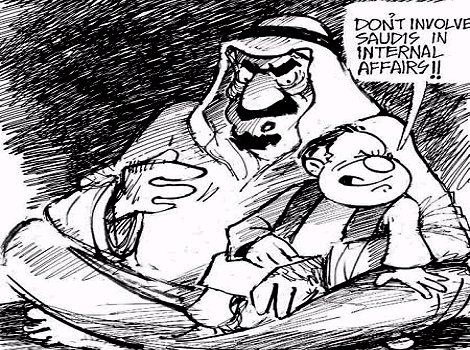
The money is widely believed to have come from Saudi Arabia -- a donation aimed at cementing a new and potentially controversial security deal with the nuclear armed south Asian country.
Pakistan's liquid foreign currency reserves unexpectedly swelled to about $9.5 billion dollars in early March. Prime Minister Nawaz Sharif's government has refused to name the country which provided the funds, saying only that it came from a "friendly Islamic country" to support Pakistan's weak economy.
Officials at Pakistan's central bank confirmed that the money came from Saudi Arabia, and the government's opponents want a full explanation.
Sharif's refusal to be more transparent on the terms of the Saudi cash infusion has only fueled skepticism over the motives behind it.
Defense experts note Pakistan's long security relationship with Saudi Arabia, which in the past has seen Islamabad deploy troops to the kingdom.
"In the 1980s, Pakistani troops served in places like Tabuk (in Saudi Arabia) and the (Pakistani) troops served in Saudi uniforms. That deployment was part of Pakistan's defense agreement with Saudi Arabia," explains defense analyst Farooq Hameed Khan, a retired Brigadier in the Pakistani army. "There is nothing new about Pakistan having a defense agreement with Saudi Arabia which involves Pakistani troops serving there."
Khan says the current scandal springs from reports which circulated last month suggesting a new agreement between the two countries is focused on Pakistan helping the Saudis bolster the opposition fighting forces in Syria, and -- either in tandem or by default -- shoring up Sunni Muslim ally Saudi Arabia in its regional standoff with Shiite-majority Iran. The problem is that Iran is Pakistan's neighbor, and also a nation with which Islamabad has enjoyed relatively cordial relations.
"The danger now is of Pakistan getting caught in a Saudi-Iranian turf war," one opposition lawmaker, who didn't want to be named, told CBS News.
Khursheed Shah, leader of the opposition Pakistan People's Party (PPP) in the lower house of parliament, known as the National Assembly, says it is an issue he and his fellow lawmakers "need to discuss," adding that in his party's view, "Pakistan should not provide weapons or troops (to Saudi Arabia)."
Though Shah gave the Prime Minister the benefit of the doubt, accepting a statement from Sharif insisting the money is not tied to any commitment to send troops to oil-rich Saudi, other PPP members and some diplomats in the region remain unconvinced.
The concerns are driven by more than three decades of uncomfortable relations between Saudi Arabia, where the ruling family and vast majority of residents are Sunni, and Iran, where the ruling clerics and vast majority of residents are of the Shiite sect of Islam.
The two powerful countries have sought to increase their influence in the region, including in Pakistan and Afghanistan, in part by pouring huge sums of money into all levels of society, from government right down to local Islamic organizations of the same sectarian leaning.
And while the money from Saudi "may help boost Pakistan's finances in the short term," respected Pakistani security and political analyst Hasan Askari Rizvi says it "carries the risk of dividing Pakistan internally."
An estimated 20 to 30 percent of Pakistan's total population (of about 200 million) is Shiite Muslim. Almost all other Pakistanis belong to the Sunni sect -- only one or two percent of the population is non-Muslim.
"This is a very, very delicate situation for Pakistan," said the Western diplomat in Islamabad. "It would be very difficult for the Pakistani government to remain friends with Saudi Arabia and Iran at the same time."
The famine-like situation in Thar is disturbing enough; now a report coming out of Balochistan speaks of a very high incidence of acute malnutrition. Ten of the total 20 high food insecure districts of the country are in that province, the report points out. And further that after Sindh, Balochistan has the highest level of food insecurity. About 63 percent of households face a dire situation, with 18 percent of them classified as "food insecure with hunger" and 11.5 percent as "food insecure with severe hunger." Overall, 90 percent districts of the province are classified as "extremely high" to "high" food insecure. As a result, the number of under-five children having stunted growth runs as high as 52.2 percent while 39.6 percent are underweight. Nearly half of them are anaemic and vitamin A deficient. The province has the highest number of infant and mother mortality rate. And the surviving babies of undernourished mothers are usually underweight.
These depressing details highlight the fact that it is not enough to satiate hunger, food must include micronutrients ie, vitamins and minerals, that help in the physical growth and mental development of children. And for children and adults alike, proper nourishment is essential to build immunity against disease. At present, the government's Nutrition Cell together with WHO and UNICEF is helping people in the nine most malnutrition-prone districts of the province. It is a commendable effort, but does not offer a complete or lasting solution which must deal with the basic cause of malnutrition. As it is, most of the land in Balochistan is arid and water scarce and hence unsuitable for agriculture. Consequently a very small fraction of the population grows its own food. Besides, the population centres are separated by long, difficult to traverse distances, making access that much difficult. But the key factor, as in the case of Thar, is the problem of pervasive poverty. These people can eat better if they have cultivable land or jobs to earn enough money to be able to buy foodstuffs.
Poverty of course is not peculiar to Balochistan, but that is where it exists in its extreme forms because of the province's relative economic backwardness, which for long has been the main issue in a litany of Baloch complaints. The previous government did give a lot of money to the province but almost all of it went into the pockets of the ruling alliance members' pockets instead of job creation and social uplift development projects. Under the recently revised multiple criteria of National Finance Commission resource distribution formula, there has been a substantial increase in Balochistan's share. It needs to be utilised for the wellbeing of the common man. The present Chief Minister, Abdul Malik Baloch of the National Party, boasts reputation of an honest and progressive thinking politician. Hopefully, he is cognisant of the hardships ordinary people face in his province, and can be expected to come up with a well thought-out longer term strategy to address extreme poverty and the attendant scourge of hunger and malnutrition.
Government leaders have for a long time danced to the tune set by the TTP. For every murderous attack by the network, none blamed the organisation by name. The terrorists may be against the government, claimed Ch Nisar, but they are not against the state. He forgot that the TTP killed 50,000 innocent Pakistanis and thousands of soldiers. It attacked military installations and destroyed highly valuable assets. The militants deepened the sectarian divide by targeting people belonging to sects other than their own. They denied the people playing fields and forced the country to host cricket teams from other countries abroad. Ch Nisar maintained all along that terrorist acts were a reaction to drone attacks, thus putting all the blame on the US. No drone attack has taken place since December yet scores of terrorist attacks have been conducted on polio workers, security personnel and tribesmen loyal to the state. The TTP decapitated 23 FC personnel held in captivity, desecrated their bodies and put up the video on the net. In another attack inside Islamabad court premises terrorists killed 11 including a judge.
The TTP is ordering the government about, changing directions of the game every now and then. When it announced a ceasefire, the apologists applauded, forgetting that there was little respite to their attacks. These were being conducted by groups who are opposed to talks, they maintained. KP information minister was all in praise for the ‘generosity’ shown by the TTP. When the TTP offered talks, the apologists fell for them castigating the critics for their negative thinking.
The TTP has now delivered a snub to all those who had pinned hopes on peace through talks. A report in the media regarding the talks hitting deadlock were pooh-poohed by the talks lobby. Samiul Haq dismissed the speculation that peace talks were deadlocked, saying negotiations had made steady progress. Even when the TTP demanded the release of its prisoners and withdrawal of the army from parts of South Waziristan as preconditions for the extension of ceasefire, the lobby insisted TTP had attached no conditions. Samiul Haq maintained firmly that the ceasefire would hold beyond March 31.
The announcement by the TTP exposes the hollowness of claims by its apologists. The TTP has also maintained that it was a monolith with none daring to challenge the amir. Now one section in the network wants talks to continue while the other has threatened that attacks would begin again in Pakistan in which common people would suffer. Instead of holding talks while the TTP is pointing a gun, government should prepare to take on the terrorists. Any terrorist attack irrespective of whether it is on the civilians or law enforcement personnel must be reciprocated by exemplary punishment inflicted on terrorist pockets and strongholds.
Reports on Thursday that the government has released 19 non-combatant prisoners produced some unnecessary confusion. The confusion owed more to lack of coordination and communication between branches of the government than anything else. Eventually the confusion was sorted out, but it left a strange taste in the mouth. Initial media reports presented the release as having been ordered by the prime minister (PM) as part of efforts to keep the peace process going. Since the PM’s Secretariat knew nothing about any such release, it initially denied the PM had issued any such orders. It would have been better if the Secretariat had first checked with the interior ministry, whose purview the peace talks and the security situation is, before rushing to the media with a denial. The interior ministry then responded to the denial by issuing a statement clarifying that 19 non-combatants in custody belonging to the Mehsud tribe had indeed been released by it since they were cleared of any involvement in militancy or terrorism. The detainees, according to the ministry’s statement, had been released in three batches, three on March 21, five on March 25, and 11 more on March 28. In addition, reports spoke of the impending release of another 100 such detainees. It took a meeting between the PM and Interior Minister Chaudhry Nisar Ali, if reports are to be believed, to clarify the fog. The whole brouhaha can be rightly ascribed to the right hand of the government not knowing what the left hand was up to. Given the sensitivity of the talks process, and how delicately it is poised after the month long ceasefire by the Tehreek-e-Taliban Pakistan (TTP) has ended, it would serve the purposes of the government better if such pronouncements were carefully handled to avoid this kind of unnecessary controversy. One of the compelling reasons also for being careful in this regard is that parts of the media cast the affair in the hues of the PM overruling the advice of the military that prisoners should not be released, especially those responsible for the deaths of military officers and soldiers. Such reports unnecessarily put the government on the back foot, from where it has then to try and manage the fallout of a perception gained that the military still calls the shots on the matter of dealing with the militants. The facts belie such speculation. From all accounts, the military is fully on board as far as the government’s moves are concerned, and is willing to see if the government’s strategy of peace through talks can succeed, while at the same time keeping its powder dry in case it does not. The military may have offered firm advice against the ‘free zone’ in South Waziristan demanded by the TTP and rejected the release of combatants, but this hardly constitutes a difference of opinion or a civil-military divide on the issue. The gesture of releasing some non-combatants and contemplating the release of more is a move to generate goodwill and reciprocity from the TTP. So far, of course, despite lip service to the reciprocal release of non-combatants such as Shahbaz Taseer, Ali Haider Gillani and Professor Ajmal, in the custody of the TTP or affiliated groups, no such conciliatory gesture has been forthcoming from the TTP. Perhaps patience is the watchword for what is intrinsically a most sensitive affair and rush to judgment should be avoided. A protracted process rather than sudden gains is what we are perhaps undergoing.
If the resolutions of the Central Executive Committee of the PPP, meeting on the eve of Zulfikar Ali Bhutto’s death anniversary in Garhi Khuda Buksh are taken note of, they assert, inter alia, that no extra-constitutional solution to the problem of terrorism would be acceptable. They also demand that the government take all the political parties into confidence on the peace process. This is a justified demand and would also help the government if its moves enjoy the support and confidence of the political class as a whole. Ironically, the PPP wants the government to ensure the release of the three non-combatant prisoners mentioned above, now that the shoe is on the other foot. It should be recalled that the PPP could not make much headway in this regard while it was in power. Nevertheless, the best approach to the talks/peace process is to wish it well without putting all one’s eggs in that basket.
As polls opened amid threats of violence and lingering memories of fraud, Afghan voters turned out on Saturday morning to choose a president who will lead them into the post-American era in Afghanistan.
Election day dawned cold and drizzly in Kabul. Residents made their way to ballot boxes in schools and mosques, navigating desolate streets guarded by thousands of police and soldiers across the city. In some locations, the polls opened as much as an hour late, but throughout the morning there were few reports of violence or disruptions. Voters assembled in long and orderly lines at the city’s major high schools and elsewhere to cast their ballots for their first new leader after a dozen years of President Hamid Karzai.
Afghan voters who have lived through decades of war spoke of their hopes for peace, better schools, more jobs. Using a side entrance reserved for female voters, Zakia Raoufi, a 45-year-old housewife, voted at the same school where her son graduated three years ago, and Karzai years before that. After she had woken up, washed and prayed, she said goodbye to her children and left the house for the first time in three days, where she had been worrying about the near daily bombings in Kabul ahead of the election. “I was wondering whether I will come back home alive or not,” she said.
Her son had studied computers and learned English at Habibia High School but the family had no connections among the government elite, and no money to pay bribes for employment, so he moved to Iran and is now working as a tailor.
“So this election means a lot to me. What I’m hoping for from the next president is someone to stop the bloodshed in this country, to provide us peace and stability and education and opportunities for our children,” she said.
“We are not afraid of our enemies anymore,” said Anahita Amadyar, 41, who had voted with Raoufi.
Before the vote, polling suggested a tight race. The palace and Karzai’s inner circle has pushed Zalmay Rassoul, a French-educated physician and former national security advisor and foreign minister. But Abdullah Abdullah, another former foreign minister, and Ashraf Ghani, the former finance minister and World Bank official, have been attracting large crowds at their rallies.
In the last election in 2009, Abdullah ultimately dropped out instead of facing a run-off against Karzai. The vote caused weeks of political crisis and more than a million votes were tossed out because of fraud.
“I hope that the Afghan people can go to the polls and cast their votes in a peaceful environment and use their vote for bringing peace, welfare and stability to the country,” Abdullah said after voting at Lycee Esteqlal high school in Kabul.
There were some reports of violence in some parts of the country. Afghan officials said there had been rocket attacks and IED blasts that have forced some voters to flee. At least four people who were waiting to vote were injured in a blast in Logar province, authorities said. In the volatile Wardak province outside of Kabul, some polling stations were largely deserted and soldiers were engaged in sporadic gunfights with Taliban insurgents. Over the past two presidential elections here, voter turnout has fallen as the insurgency has gained strength.
Early on election morning, Rahmatullah, one of the bodyguards for Kabul’s mayor, received a call from his brother-in-law in the central province of Sar-e-Pul.
“He said, ‘We have been threated by the Taliban not to go out and vote.’ I said, ‘Don’t worry about the Taliban, just go vote,’” Rahmatullah said after he had voted at Lycee Isteqlal, a high-school in downtown Kabul. He dipped his index finger in blue ink and had his voting card punched with a crescent moon.
“Our hope is for peace and stability, for job opportunities, and to provide shelter for the homeless people,” he said. “We are here to decide about the future of Afghanistan.”
Ahmad Shah Hakimi, a 43-year-old official in the commerce ministry, who also works as a currency trader, said he is tired of working for a corrupt government.
“We just want change and we want to elect our own president,” he said. “I voted in the last election, but the government turned out to be corrupted, and people are really tired of that.”
Qureshia Sirat Ahmadi, an 18-year-old high school student voting in her first election, said that she was reciting verses from the Koran in her head as she drove to the polling station, to calm her worries.
“The enemies of Afghanistan always wants to disturb these national days, but that doesn’t mean we shouldn’t come and vote,” she said.
FIRST, the good news. A third consecutive presidential election in Afghanistan is a historic achievement — Pakistan has only recently managed to hold consecutive on-schedule parliamentary elections.
There is genuine competition, in the sense that the winner of the Afghan presidential election is far from clear. And, after the disastrous and disputed election of 2009, there is a possibility that the 2014 Afghan presidential election may be politically more credible than the last one. To be sure, much hinges on an acceptable electoral process.
This is the year of transition for Afghanistan on the political and security fronts and the country needs a capable and credible leader in the presidency to steer it through arguably the most difficult time in its modern history since the Bonn Agreement of 2001. Now, to the less welcome news. Much as Afghanistan needs a strong and credible leadership via an acceptable presidential electoral process, there are many, many hurdles in the way.
The most obvious hurdle is the credibility of the electoral process. Because international coverage of Afghanistan is shaped by and large by the Western press, there has been much focus on the evacuating of foreign election monitors after several attacks against foreigners in recent weeks. While fewer monitors and observers is certainly an issue, there are other problems elsewhere that have received attention.
A major one is the decision by the Afghan election authorities to not make provision for Afghan refugees in Pakistan, overwhelmingly of Pakhtun origin, to cast their votes as they were allowed to do in 2004.
With turnout already predicted to be a significant problem in the Pakhtun-dominated south and east of Afghanistan, the absence once again of the refugee vote could dramatically impact results — an outcome that myopic politicians inside Afghanistan do not appear too concerned about.
Given that legitimacy in the eyes of the Pakhtuns of the next president could shape much of what happens in the year or two ahead in Afghanistan, the large-scale disenfranchisement of those displaced by war appears to be a short-sighted idea.
Beyond that, there is uncertainty, and fear, shrouding every aspect of Afghanistan over the course of the next presidency.
The year 2018 appears to be a lifetime away over the course of which the option, at least as far as conventional wisdom goes, is between an Afghanistan that limps on or descends into chaos.
Yet, there is another possibility, however unlikely or remote it may appear at the moment: Afghanistan, with the help of its neighbours and regional and international powers, could stabilise and move towards a growing economy, internal security and institutional stability. While much has been made about the intentions and old agendas of the outside powers, it is also true that no side has forcefully vetoed the decisions Afghans have made for themselves.
U.S. Secretary of State John Kerry says it's time for a ''reality check'' in the Middle East peace talks and that the U.S. will be evaluating what the next steps will be.
Chief of Army Staff (COAS) General Raheel Sharif has expressed the army’s reservations to Prime Minister Nawaz Sharif on the “unilateral release” of Tehreek-e-Taliban Pakistan (TTP) prisoners, Pakistan Today has learnt.
Reportedly, the army chief has claimed that the army was “kept in the dark” over the issue and has expressed displeasure over the release of Taliban prisoners without ensuring the release of the civilians in Taliban captivity.
The government released 19 combatant and non-combatant inmates of TTP since March 21 while another 100 prisoners are to be released in the next few days. Reportedly, this move has not gone well with the military top brass. There is no word either from the government or the TTP whether or not the civilians and the security personnel kept by the militants in captivity would also be released in the prisoner swap.
Sources privy to the details of the meeting at the Prime Minister’s House confided that this was perhaps the first expression of serious differences between the army leadership and the government since the dialogue process had commenced. The sources added that if not handled prudently, this move may affect the relationship between the civil and military leadership despite the fact that Gen Raheel was handpicked by the prime minister and both had to develop a good working relationship.
Interior Minister Chaudhry Nisar Ali Khan, Inter-Services Intelligence (ISI) Director General Lt Gen Zaheerul Islam and PM’s Special Assistant on Foreign Affairs Syed Tariq Fatemi also attended the meeting.
IT WAS AN APPEASEMENT MOVE:
The army’s top brass also conveyed to the premier its concerns that apparently the move by the government without consulting the khakis or winning anything in a bargain was a bid to ‘appease’ the militants who had used pressure tactics to make the civilian leadership succumb to their pressure.
The sources said that the army leadership also conveyed to the civilian leadership that classifying the TTP militants as combatants and non-combatants was also childish as approximately all the militants were hardened criminals and getting evidence against them in tribal areas was next to impossible given their might and fear in the area.
“Combatants or non-combatants – they all are criminals and murderers. A division can’t be drawn. They are two faces of the same coin,” an insider said.
GOVT SURRENDERED WRIT OF STATE:
The source said that such a step by the government without input and feedback from the military leadership reflected that it was a bid to appease the militants and was tantamount to surrendering the writ of the state which had been challenged.
“Thousands of soldiers have laid down their lives to arrest these killers. Now releasing these militant inmates without seeking advice from the security forces leadership is just like serving the objective of the Taliban. This would destroy all the gains made by the army in South Waziristan operation while the Taliban would now have an upper hand in the dialogue process. They have achieved a lot without surrendering even a single inmate and without firing a single shot,” the insider added.
WHAT DID THE GOVT GAIN?
The insider privy to the developments of the meeting told Pakistan Today that there was not a single word mentioned by either side pertaining to the gains the government had made in lieu of release of these 19 militants.
“We have not been told what the government got in return of this release. Actually it was a unilateral move under pressure of a threat given by the TTP. It’s like surrender without ensuring the release of the detained civilians or the security personnel in the bargain.”
It is pertinent to mention here that following the meeting at the Prime Minister’s House, a meeting scheduled on Friday between the government and Taliban dialogue committees with the interior minister was postponed for today (Saturday).
Former president Asif Ali Zardrai has stressed the need to protect Pakistan from sectarianism.
Speaking on the occasion of Zulfiqar Ali Bhutto’s death anniversary, he said on Friday that everybody needed to adopt the thought to save Pakistan.
He said he would also talk to other ‘friends’ in this regard . the former president also asked intellectuals to guide as to how Pakistan should move forward.
Zardri also spoke of “difficult situation” which he said Muslim world was facing.
The 35th death anniversary of former prime minister and founder of Pakistan People Party (PPP), Zulfiqar Ali Bhutto was observed today.
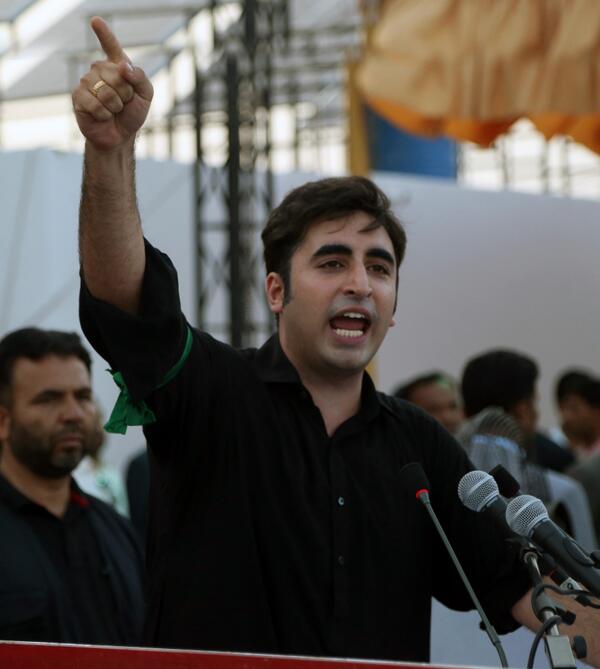
Addressing a public gathering in Garhi Khuda Bakhsh on the occasion of 35th death anniversary of party’s founder Zulfiqar Ali Bhutto, Chairman Pakistan People’s Party (PPP) Bilawal Bhutto Zardari has said that Taliban are deceiving in the name of negotiations, adding that his party won’t bow before savages. Bilawal said that those who termed Quaid-e-Azam as ‘Kaafir-e-Azam’ are being negotiated with today. He said that those who level allegations against PPP are politicking over children’s dead bodies.
He alleged that Prime Minister Nawaz Sharif only issued statements and made promises when he came to Tharparkar, claiming that Prime Minister’s team stopped aid of drought affectees. He said the nation is at a point of history right now where uncertainty prevails and every heart is filled with fear. “Terrorists want to take away our identities and existence,” he said, adding that people are asking for way from blind in the name of negotiations. “What did we do that history is not willing to forgive us?” he asked the audience. He said that the country is facing the crises today because the nation buried the man thirty five years ago that was akin to light for nation. “Zulfiqar Ali Bhutto was a philosophy and ideology; he was the man upon whom the poor relied,” he said.
Bilawal said that it was his grandfather who transformed the country into an atomic power. He said that he is worried seeing Punjab as held hostage in the hands of terrorists, adding that this wouldn’t be the case if Z.A. Bhutto was alive. Pakistan needs a Bhutto once again today, he said. Lamenting at the privatization scheme of government, Bilawal said that nation’s house is being auctioned in the name of privatization, adding that no one even thought of taking the nation into confidence. Pakistan’s assets are capital of nation’s poor people, he said, adding that the nation will not be thrown in unemployment. Our nation has built these assets after making several sacrifices, he added. “If government cannot run the country, does this mean we should sell it?” He asked. Bilawal asked what price Pakistan has to pay for friendly money paid by friendly country. He said those who want to rob the country in the name of privatization are not friends.
He said the government has left the nation as professional beggars. Bilawal said that his party is descendant of martyrs, adding that dictatorship of Taliban will not be tolerated. Several Jiyalas- party workeers are confronting terrorists even today, he added. He said that his party’s government will not remain silent on demolishing of temples unlike Punjab government. Harming and burning minorities’ worship places is not Islam, he said, adding that the army is honourable and not anyone’s private property. He said that it is not wise to muddle in others’ war. Bilawal kept chanting “Khappay khappay Bhutto Khappay” slogan which literally means “Bhutto needed.”
According to details, a large number of workers of Pakistan Peoples party were present at a gathering at Garhi Khuda Baksh town in Larkana. Tight security arrangements were made on the occasion. Special functions were held to pay tribute to late Zulfikar Ali Bhutto. Born on January 5‚ 1928 Zulfikar Ali Bhutto laid the basis for the democratic process in the country with the formation of Pakistan People’s Party on November 30‚ 1967. Bhutto made country’s defence impregnable by starting nuclear programme. He made possible the consensus enactment of constitution of 1973.
Former president Asif Ali Zardari has said that treading in the footsteps of former prime minister Zulfikar Ali Bhutto, who rejected appeasement to save his life, Pakistan People’s Party (PPP) workers will reject the policy of appeasement and “vow to fight the forces of regression, bigotry and intolerance and not permit them foist their regressing political agenda through force.”
He said this in a message on the eve of the 35th death anniversary of the PPP founding chairman Bhutto.
“We must confront and not fear the bigots, the militants and the zealots. Only then we will be able to rebuild our lives; only then we will be able to live in dignity and honour and in peace and make progress.”
Rejecting extremism, he called for fighting discrimination against women, minorities and the marginalised behind the facade of religion.
Paying tributes to Bhutto for giving the unanimous constitution “that refuses to be extinguished”, Zardari said that the self-sustaining power of the constitution was demonstrated a few years ago when it was purged of the changes made by successive dictators.
Today the power and resilience of the constitution is at play yet again as a dictator, who sought to subvert it, has been chased and made accountable, he said.
Bhutto’s life was curtailed in the prime of his life by those, who feared him the most through a macabre conspiracy hatched by some generals and judges of the time, he said.
But those very cowards, pygmies, dictators and political orphans, who conspired to eliminate Bhutto, are afraid of him even more while he is in grave, he said and recalled the words of former prime minister Benazir Bhutto that “by signing the death sentence, the conspirators hanged themselves and were forever condemned at the bar of history”.
Zardari paid glowing tributes to the vision of Bhutto and recalled that retrieving the territory lost in the 1971 war, bringing back over 90,000 prisoners, holding of the OIC summit that recognized the Palestinian Liberation Organisation as the sole voice of the Palestinians and signing the Simla Agreement which together with scientific and technological capability gave Pakistan the longest spell of peace despite adventurism by dictators as some of the achievements.
It was Bhutto’s vision to build, along with Chairman Mao, strategic relationship with China at a time when it was shunned and isolated. Pakistan today is reaping the dividends of Bhutto’s vision, he said.
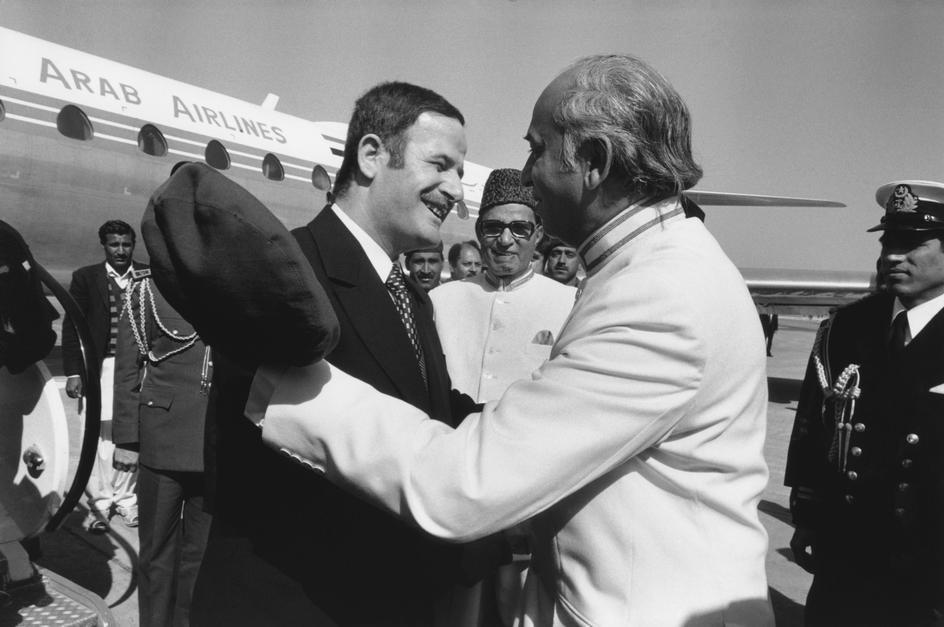
The former president said that Bhutto publicly lent moral and material support to Syria when it was a victim of external aggression. At the same time, he also possessed the wisdom and the vision to avoid being sucked into internal civil strife of other countries, Zardari said.
He said that Bhutto was a conqueror of hearts and minds of the people and most ordinary people, who came in direct contact with him, became extraordinary.
Bhutto lifted the spirits of the people; gave them a dream and a hope; and led and illuminated the path of modernity and enlightenment, Zardari said. The former president also paid tributes to those, who suffered for the cause of democracy, saying that democracy, federalism and constitutionalism hold the key to our survival.
ON this spring day, when flowers bloom and sparrows sing, all of nature joins in celebrating creation. For the multitudes of this stricken nation, though, April 4 is a sad reminder of the day when the shadows lengthened and darkness set in forever. Z.A Bhutto was hanged by a military dictator General Zia-Ul Haq by orchestrating a judicial trial to get rid of a popular leader. When the light was put off in one of the most brilliant shining stars in the galaxy in that dark night of April 4, 1979 Bhutto had already made indelible imprints on the sand of time, which no dictator could erase. When Zulfikar Ali Bhutto took the reins of a truncated Pakistan in December 1971, a new state was taking shape, not through gaining liberty , it had come into being because it had been decapitated and dismembered. Unlike 1947, there was no hope, no anticipation, no dreams, only distress and dejection. In 1947, Pakistan had to be built from the physical building blocks. In 1971, it had to be rebuilt psychologically. If Jinnah got a moth-eaten Pakistan, Bhutto got a truncated and traumatized Pakistan. He had to carry his charge forward through its first steps in a mocking world. He bore the pain and the passion of a new Pakistan. It was like the first chapter of Genesis. Myriad problems and challenges confronted Pakistan, both at home and abroad. Over 5,000 square miles of territory lay under enemy occupation and 90,000 prisoners of war, 20,000 of them civilians, were languishing in Indian jails. Not a day passed without the anguished cry of thousands of sisters, mothers and relatives reverberating across the country. The humiliating vision of Pakistani soldiers surrendering to General Aurora at the Dhaka Race Course haunted our people. An empty treasury, a tottering economy, an all-pervading sense of gloom - it seemed we were set to collapse in a slow dance of death. Globally, Pakistan had become a pariah. Indira Ghandi threatened and taunted us from across the border while Mujibur Rehman ranted and raved about war trials and demanded a share from our empty coffers. There was a mountain to climb and soon the mountain would become an Everest. But ZAB moved with amazing alacrity in all directions. "We have to pick up the pieces, very small pieces," he declared in his opening address to the nation.
Brick by brick, the edifice of a shattered Pakistan was rebuilt from the debris of defeat and dismemberment. An ailing economy was nursed back to health. In line with the PPP manifesto, agricultural reforms were introduced and land distributed amongst the landless peasants. Labour unions were allowed and the minimum wage for labour was fixed. He gave Pakistan its first constitution, nuclear programme, held peace talks with India and brought 90,000 POW who were in Indian prison and were going to face war crimes.
ZAB opened the doors for Pakistani labour to work in the Arab Gulf states, thus alleviating unemployment and providing the base for foreign remittances. The honor and morale of the demoralized armed forces was restored and they were equipped with some of the most sophisticated weapons the world had to offer. From the ashes of defeat was emerging a new Pakistan. In no time at all, the engines of government were rolling. "If you think FDR had an amazing first 100 days, watch us," he prophetically declared. ZAB possessed a vital magnetism which he transmitted to the people. He could touch the raw nerve of their emotion. He could tap the emotional wellsprings of the nation. He knew the pulse of the people, their heartbeat. They would laugh with him and cry with him. There was a compelling chemistry, an electrical charge that has not dulled with time. It was, in is own words, his greatest romance. He gave to the poor a future and he gave them a voice. He gave them consciousness and dignity which no tank, no dictator can take away. That bond has been frozen into doctrine. He liberated the small farmers and peasants from the repression and cruelty of big landlords and banished the jagirdari and sardari system declaring that all citizens are born equal and must live with equal rights.
Z.A Bhutto was a Legend,
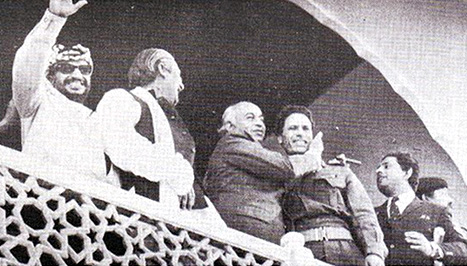
who lived and died like a hero with courage, determination and devotion to his principles, when cruel dictator Zia was going to kill him, Z.A Bhutto could sign few papers and could live in exile but he was a real man, he was not a coward. He too could have made a deal and lived to fight another day; but only great men with principles sacrifice their life for their cause. Zulfikar Ali Bhutto earned everlasting fame in the pantheon of leaders from the Third World in the struggle against colonialism and imperialism. He had the privilege of interacting with many of those leaders who played a great role in the epic struggle for national independence in the 20th Century including Mao Tse Tung, Soekarno, Chou-en Lai, and Gamal Abdel Nasser. He belonged to a category of anti-imperialist leaders who included Jamal Nasir of Egypt and Jawahir Lal Nehru of India. Life in Pakistan has never been the same again following the judicial murder of Zulfikar Ali Bhutto by General Ziaul Haq in April 1979. Bhutto had crash-landed in Pakistan’s politics in 1958 as the youngest minister in the government of Ayub Khan. He was all together a different person in a cabinet that had generals and senior bureaucrats who had been in cahoots with each other to put their claim to power as the legal heirs to the British Raj. As opposed to them Bhutto was driven by his romance with democracy and freedom for the people as envisaged by his leader Quaid-i-Azam Mohammad Ali Jinnah. Having found a place for himself on a platform that was not favorable to politicians, Bhutto chartered himself on a course that would give a new sense of direction to the country and a fresh meaning to politics.
In no time Bhutto had made a tremendous impact all around. As Minister for Fuel and Power, he had diverse explorers tapping into Pakistan’s underground hidden energy resources. For the first time Russians were involved in oil and gas exploration. His time as Minister for Science and Technology was well spent. He could measure the advancements made by India in the atomic field. He gave a proper sense of direction to the Pakistan Atomic Energy Commission, set it on the mission to have a sound infrastructure and to educate and train a whole army of nuclear scientists and engineers. It was he who had convinced Ayub to seek enriched uranium course for acquiring nuclear wherewithal. From his death cell he wrote to his "dearest daughter" Benazir Bhutto, "There is personal bitterness no doubt [against Zia regime] but the impersonal hurt predominates over my personal feelings. These [ruling] individuals have taken Pakistan back to 1947. In the process they have robbed the nation of the high ideals and spirit of fraternity the people shared and demonstrated in 1947". He reflects further in the letter: "It is worst than saying we are back to square one or that we are right back to where we started from. Nations do not fall back to square one, nations progress or they deteriorate explosively or decompose silently". Bhutto had believed that the country's sound defense was dependent on a solid industrial base. Pakistan owes not only its nuclear arsenal - now inching towards a fold up - to Bhutto but to him goes the credit of establishing Pakistan Steel Mills, aeronautical and heavy machine tool complexes, shipyard, Karachi Nuclear Power Plant and its automobile industry. His daughter Benazir Bhutto picked up from where her father had left and the combined efforts of the two made Pakistan cover a long way in becoming self-sufficient in missile technology and arms manufacturing including exports.
For Pakistan Bhutto was the harbinger of colossal changes. He harnessed socio-economic forces for challenging the status quo, unshackling the masses and their empowerment. His sense of direction not only gave him the strength but also a popular support to consolidate the edifice of the state on an egalitarian program seeking for his people roti, kapra and makkan. Besides, he awakened the masses, making them realized they were the legitimate fountainhead of political power. He deeply cherished democracy and viewed military rule as a negation of the very genesis of the country that came into being as a result of a democratic process and a vote. Zulfikar Ali Bhutto had the courage of his conviction to decide to lay down his life rather than compromise or seek appeasement. The last chapter of his life is a glorious example of martyrdom for the cause of resurrection of democracy. At the time of his over throw, Bhutto was emerging as a spokesman of the World of Islam and the leader of the Third World. The age of Bhutto was an Age of Revolution. Although his life and career were cruelly terminated, Zulfikar Ali Bhutto will forever shine in history as one of the Great leaders who took part in the liberation of the Third World from the yoke of Imperialism and Neo Colonialism during the Twentieth Century. Zulfikar Ali Bhutto used to say that, "courage is in our blood, we are the children of a rich heritage. We shall succeed in our dream of an Islamic association since destiny demands it, political reality justifies it, posterity awaits it".
>He laid the foundation for his dream fortress of Islam in Lahore's Islamic Summit in 1974. The rest is then a chapter of blood in history--the blood shed of the Quaid and of his young followers. He was hanged by his own general who once said that the amount of attention Pakistan army received from Prime Minister Bhutto had "no parallel in the history of Pakistan army prior to 1971."
Bhutto pushed politics out of the posh drawing rooms into real Pakistan-into the muddy lanes and villages of the poor. ZAB was a principled friend to the poor, downtrodden and oppressed. He was fearless in his beliefs and refused to bow before any man or power other than the Almighty. ZAB’S contributions to an impregnable Pakistan are seen in the Kamra Aeronautical factory, Heavy Mechanical Complex at Taxila, modernisation of Karachi Shipyard, creation of precision engineering works, Pakistan Steel Mills, Port Qasim, Pakistan Automobile Corporation to name a few. By signing the Simla Accord of 1972 he negotiated longest peace between India and Pakistan. His social reforms laid the foundation of an egalitarian society, his non-aligned foreign policy earned Pakistan respect in the comity of nations. He lifted the nation drowning in a sea of despair to Himalayan heights.
Bhutto's inspiring leadership filled Pakistanis with hope, energy and strength. There was a sense of purpose and direction in the country in pursuit of peace and prosperity. The economic growth rate increased and money poured in from expatriates who got the universal right to passport. The Muslim countries donated roughly $500 million annually to Pakistan, freeing it of international financial institutions. The people got jobs and opportunities. Women of the country were emancipated entering the police force, Foreign, Civil Service and subordinate judiciary for the first time in the country's history. He was a modernizer and saw nationalism as the key to unity. He rejected fanaticism. He gave pride to the poor. As leader of the Third World he spoke boldly against racism, colonialism and imperialism. He fearlessly defended the right of nations to independence. He was true to his values. When the time came he sacrificed his life but refused to compromise on his lofty ideals. He was fond of saying; "It is better to live like a lion for one day than to live like a jackal for a thousand." He lived with the courage of a lion, defying death in embracing martyrdom. He said he would show "how a leader of the people lives and dies," and he did. The world pleaded for his life wanting to save a man whose intellect and contribution to peace and progress was vital to the world community.
But a frightened dictator, ignoring the unanimous call of the Supreme Court of Pakistan to spare the Quaid's life, ordered the execution in the middle of the night. He was true to his values. Prime Minister Bhutto went bravely to the gallows as the world learnt in shock that it had lost its most beloved son. There was widespread national and international condemnation. Bhutto left his world to enter the pantheon of history where he stands today with other towering personalities who shaped the course of history. His martyrdom sparked freedom movements in many countries as people gathered in capitals across the world to condemn his murder. As a student of history, he knew that eternal life remains in sacrificing oneself for a cause that is larger than an individual. And the noblest of all causes is the cause of the liberation of humanity from tyranny and oppression..
Z A BHUTTO was indeed a great leader, a leader we must salute today. Education was nationalized and made available to every child. Scores of Universities were built to turn the children of the discriminated and downtrodden into lawyers, doctors and engineers liberating them from a destiny of backwardness. Quaid-i-Awam was born in 1928. He was martyred in 1979. Yet he lives in the hearts and minds of the people still shining like a star that brightens the sky motivating those caught in the prisons of oppression. He was the one who converted that static and decayed dictatorial polity into a vibrant and dynamic democratic society; the cost of which he paid with his own life. He who gave his blood, and the blood of his sons and daughter, Shaheed Mohtarma Benazir Bhutto, knew that there can be no sacrifice greater than the sacrifice for the people whose respect, honor and dignity is the respect and dignity of the Nation. Quaid e Awam made the people proud of themselves and of their Nation. The 20th century has seen many great leaders, Zulfikar Ali Bhutto is one of them. Due to his glorious achievements, Mr. Bhutto rules the hearts of the Pakistani people from his grave. He was not only the leader of Pakistan, he was the leader of an Islamic world, the leader of Third World. He will forever be remembered by his countrymen as Quaid-e-Awam. ZAB's detractors have distorted history and tampered with the written word. They killed Plato's philosopher-king and filled the space with charlatans. But he has written his own history in blood and the legend has been nourished by the tears and the sweat of those who work in the fields and the factories. Bhutto belonged to the sweat and sorrow of this soil. His soul has mingled with the soul of the multitudes who cry out in their sorrow and in their pain, ZAB gave the people of Pakistan the foundation on which to build an inspired dream palace of their national thoughts. Today, we have surrendered ourselves to the momentum of mediocrity. In Plato's words, "what is honored in a country will be cultivated there." But we are not a nation given to honoring our heroes. Today, let us rise above narrow considerations and interests and acknowledge a man who was a brilliant beacon on the highway of history. As his followers say, "Zinda Hai Bhutto, Zinda Hai"--Bhutto lives, he lives. Indeed he does, in the hearts of all those who dream of a better tomorrow. Long Live Bhuttoism….
On the morning of April 4, 1979, the military dictatorship of General Ziaul Haq hanged to death Pakistan’s first elected Prime Minister, Zulfikar Ali Bhutto.
Today is the 35th anniversary of that judicial crime.
If you are as much of a maniacal reader on the political and social history histories of Pakistan as I am, then I’m sure you’ve already noticed that after Muhammad Ali Jinnah, the second most discussed Pakistani leader in such books is Zulfikar Ali Bhutto.
So much has been written about the man. His achievements and follies; his charisma and eccentricities; his accomplishments and blunders. I can’t really add more to what is already out there in the shape of whole books, papers and articles written on the man.
I was barely 6 years old when Bhutto rose to become Pakistan’s head of state (in January 1972) soon after the secession of what was once called East Pakistan.
Bhutto’s populist Pakistan Peoples Party (PPP) had swept the 1970 general election in West Pakistan's two largest provinces, Punjab and Sindh, and it became the country’s majority party once East Pakistan broke away (after a violent and tragic civil war there).
I do have some memory (rather random images) of the 1971 Pakistan-India war (that followed the civil war) and of Bhutto’s first address to the nation on PTV when in early 1972 he took over the reins of a defeated and demoralised nation.
What I remember about the war are the blanket blackouts, loud sirens and terrifying sounds of artillery fire and jets zooming over our house near the coastal areas of Karachi in Clifton; and how one evening there was a huge explosion that shattered the window panes of almost every house in the vicinity after which (in the morning), the war was over (December 1971).
We trickled out of our basements and make-shift bunkers only to see a number of oil refineries visible from our house, and a series of war ships on the horizon on fire.
The flames rose so high it seemed (at least to a 6-year-old kid) that their thick black smoke was about to darken the fluffy white winter clouds hovering over Karachi.
Then Radio Pakistan announced that the Pakistan armed forces have surrendered. But we kids were too busy collecting the smothering splinters of the bombs that had been dropped by Indian jets only miles away from our area of residence, not knowing that the country had acutely been split into two.
Bhutto was no stranger in our house. In the early 1960s my father was a Psychology major at the University of Karachi (KU) and a member of the left-wing National Students Federation (NSF).
He was also a bosom buddy of famous student radical (and future PPP minister and politician), Miraj Muhammad Khan.
Though my father came from a large, conservative business family from North Punjab, he was a rebel. He was the first in the large family to bypass studying for a business degree; the first to marry outside the family (to a ‘mohajir’ - an Economics major at KU, my mother); and the first to join journalism (instead of the widespread family business) after he graduated from the university in 1964.
Like many passionate young men and women in the late 1960s, he too became a Bhutto enthusiast and remained to be one until his death from respiratory failure in October, 2009.
When Miraj Saheb, these days himself facing health issues, called and spoke to me at length soon after my father passed away, it reminded me how in January 1972 my father returned home from the Karachi Press Club and told my mother that Miraj had told him that Bhutto would be speaking to the nation on TV.
Being just 6 years old then, today I only vaguely remember my parents, cousins, younger sister, grandparents and paternal uncles gathered in front of our Russian-made ‘Mercury’ TV set listening to that address.
In those days we were one of the few homes in the country that actually owned a TV set, so the address was largely heard by Pakistanis on the radio, in spite of the fact that Bhutto spoke in English.
It is said that the speech remains to be one of the most widely heard addresses from a head of state and government in Pakistan.
In February 1972, my father moved our family to Kabul in Afghanistan where he agreed to heed my paternal grandfather’s advice to set up offices of the family business in that city.
Instead my father became the Afghanistan correspondent of the PPP’s newspaper, Musawat. It was a Kabul that today would seem like a totally different planet compared to what happened to this city at the end of the Soviet-Mujahideen war in the 1980s and beyond.
I remember Kabul to be a pleasant and clean city, with hordes of western tourists (mostly hippies) roaming its streets and markets.
My father became a regular visitor to a popular coffee house in central Kabul where the city’s most animated leftist intellectuals met for coffee, tea, beer and most importantly, to strike passionate discussions on the state of affairs in Afghanistan.
One day my father brought home an intense looking and stocky Afghan Pushtun for dinner. The Afghan was bald, had thick spectacles on him, chain-smoked and spoke both English and an accented Urdu. The gentleman was Sardar Daoud - the former Prime Minister of Afghanistan (1953-63) and the future President of that country.
Daoud, who was a cousin of Afghanistan’s monarch, Zahir Shah, had resigned as PM in 1963. He was also a passionate advocate of ‘Pushtunistan’ – a movement that wanted to merge Afghanistan with the Pushtun majority areas of Pakistan.
My father later told me that Daoud – who’d been banished by the monarchy and had become a radical pro-Soviet republican – befriended my father at the coffee house and told him about a ‘coming revolution in Afghanistan.’
‘Bhutto was not very happy with my friendship with Daoud,’ my father told me many years later. Bhutto as well as Pakistan’s military establishment were extremely anti-Daoud, especially due to his views on ‘Pushtunistan.’
Though we returned to Pakistan in mid-1973, Daoud would go on to topple the Zahir Shah monarchy in a military-backed coup and declare Afghanistan to be a republic (in 1974).
He was himself toppled in a communist coup in 1978.
In Pakistan, my father began publishing a radical pro-PPP Urdu weekly called Al-Fatha with another journalist colleague of his, Mehmood Sham. Al-Fatha's name was inspired by Yasser Arafat’s militant left-wing Palestinian outfit.
Now back in school in Karachi I fondly remember how small kids (especially boys) loved to imitate Bhutto’s antics as a public speaker. At first I just couldn’t understand, until I rediscovered Bhutto on TV.
Afghanistan didn’t have any TV in those days, even though I remember accompanying my parents to a host of Rajesh Khanna films at Kabul cinemas.
back in Karachi, I particularly remember one Bhutto speech on PTV that he made in late 1973 that finally made the now 7-year-old me understand what all those boys at school were up to.
Zulfikar Ali Bhuttoby dm_50e74c2e900c7
It was during a public gathering in Lahore. It set the nation on fire! Drunk on passion, patriotism (and his favourite brand of whisky), Bhutto was canvassing to ask his supporters to help him regenerate Pakistan’s lost pride. To my delight, a small section of this speech can now be found in cyberspace.
Another memory I have of the period is watching my father discussing the passing of Pakistan’s first genuine constitution (the 1973 constitution) with his cousins and brothers.
Later on when I entered my teens in the early 1980s, I asked my father why the Bhutto regime declared the Ahmadis as non-Muslim.
His explanation was that since Bhutto wanted to bag the support of Islamic outfits like Jamat-i-Islami and others before the historic 1974 International Islamic Summit in Lahore, ‘he threw them a bone they could get busy with and get distracted by.’
I continued disagreeing with him on this issue, and he continued defending Bhutto’s action even many years later.
I remember the Islamic Summit very well. PTV ran a marathon transmission of the event and I also remember watching speeches by a number of leaders from various Muslim countries.
The Summit was explained as a global expression of Bhutto’s ‘Islamic Socialism’ and ‘vision’ of turning the Muslim world into a ‘third progressive force’ between western capitalism and Soviet communism.
My childhood unfolded in a very different Karachi. TV was a joy to watch (even though it was entirely one-sided); men and women were crazy about cinema as the Pakistan film industry churned out an average of 60 to 70 films a year; and people loved staying outdoors without any fear and at all hours.
Bars, nightclubs, cinemas and other recreational sites were always illuminated with bright, shimmering lights. I remember accompanying my elder cousins and their friends to the edges of the Clifton area on weekends (on bicycles) where people would gather to drink, chat, take long walks on the Clifton beach and especially eat chaat and ‘gola-gupas’.
Some would order ‘special gola-gupas’ whose liquidy chatni was laced with a heavy dose of tamarind but mixed with beer.
At this edge of Clifton was a house called ‘70 Clifton.’ This was the spacious residence of Z A. Bhutto and his family.
From 1975 onwards, when I turned 9, my father began to often take me with him to this house whenever he had to meet Bhutto.
By now he had also joined the Soviet Embassy (on Bhutto’s suggestion). Bhutto had wanted him to use his position to strengthen the media and cultural ties between the Soviet Union and Pakistan.
It was, I think, in the summer of 1975 when I first met Bhutto in real life. I saw a very young Benazir Bhutto as well, lurking in the background; and I also remember a tall, lanky guy shaking my hand as my father stood talking to the lad in the garden of 70 Clifton. He was Murtaza Bhutto, then just 21 years old.
I found Bhutto’s wife, Begum Nusrat Bhutto, to be the warmest and closest towards my father. I would last meet this amazing woman in 1993 when (as a journalist) I made my last trip to 70 Clifton on the evening Murtaza returned from exile.
As a former member of the PPP's student-wing (PSF), I had sided with Benazir in her little tussle with Murtaza. And I continued siding with her. She was to my generation of young ‘radicals’ in the 1980s, what her father had been to the generations before us.
But the fondest ever memory of those visits with my father to 70 Clifton was of one evening in early 1976 (I was now 10) when, as my father and I entered a spacious hall, Bhutto, smartly dressed in a suit and a tie and with a cigar in hand, approached my father and with a mischievous smile loudly asked: ‘Aur Paracha! (So, Paracha); how are the Soviets treating you?’
My father smiled back and answered something to this affect: ‘Sab sahi hai, Bhutto Sahib (All’s well, Mr. Bhutto); the Soviets are fine as long as one keeps appreciating their Vodka!’
Bhutto burst into laughter.
My saddest childhood memories of the time were not exactly the shutting down of schools and the curfews that were imposed during the right-wing Pakistan National Alliance’s protest movement against Bhutto in April 1977.
Nor do I remember what I felt when I saw this weird looking military man with a strange handlebar moustache talking on PTV (in July 1977) - A man against whom I would eventually spend all of my college years fighting as a student activist in the mid and late 1980s.
A tyrant who would retard the political and social evolution of Pakistan for years to come. A man called Ziaul Haq.
My saddest memory regarding Bhutto is, of course, of April 4, 1979. I was 12 years old and now smart enough to understand what was going on.
My father had been blacklisted by the Zia regime (in 1977) and was out of a job. He still refused to join the family business.
I’d had a terrible morning at school two days before Bhutto’s hanging. My mother was summoned by my teachers and told that I would be suspended for giving a fellow student a big fat black eye! Thankfully I wasn’t.
The bugger had been waving a picture (cut out from Jang newspaper) of a cop flogging a man in public. He was mocking the flogged man, saying that all PPP supporters would be getting flogged this way.
Suddenly, bam! I smashed my fist in his face, knocking him out in 5 seconds flat. My anger was purely the result of the depression I was feeling from the economic pressures and uncertainty my family had been facing ever since the Zia regime blacklisted my father, making it impossible for him to get a job in any newspaper or magazine.
Saddest was when on the night of 4th April, some 12 hours after Bhutto’s hanging, I entered my parent’s bedroom and found my father sitting on his bed, his palms cupping his face, his head hung low, as he listened to a special programme on Bhutto on BBC Radio’s Urdu service.
I quietly sat on a chair opposite him, my knuckles still sour from punching my classmate. Then it happened. A sight I shall never forget.
My father removed his palms from his face to light a cigarette. And for the first time ever, I saw this cool, calm and stoic fellow, wiping tears from his cheeks. His eyes were swollen and red, as if he’d actually been weeping for hours.
I was stunned. I had no clue what to do. It was only then that I realised that Bhutto really was dead.
Scene after scene was related over the years in articles and books by so many people of how Bhutto’s death had actually made grown-up men and women cry.
I saw one such person do that right in front of my eyes. That evening I wanted to hug my father. But I somehow couldn’t. I just got up and left. The age of apathy had arrived in Pakistan.
Zulfiqar Ali Bhutto has been the most loved and most maligned person for the last 50 years. He is loved by the people in general, by the mob and by those who fell in love with him because of his oratorial skills and personality.
Our historians have not paid any attention to the period of 150 years which illustrated the great distance between the Hindus and the Muslims. Ultimately, Muslim rulers violently resisted British occupation everywhere in India. In the process, hundreds of thousands of Muslim families lost all they had, millions of refugees moved from one place to another, and there was destruction, most of all, of the cultural values the Muslims held dear.
After taking over, the British favoured the Hindus and rightly considered the Muslims their enemies. During the period of resistance between 1858 and 1947, it was the Muslims who opposed the British with violence, while the Hindus cooperated.
For 250 years, generation after generation of the Muslims carried a grudge against the Hindus and the Hindus carried similar grudges against the Muslims. This was a big reason why Muslims all over India rallied round Muhammad Ali Jinnah, a man who spoke neither Urdu, Punjabi, Bengali, Sindhi, Pushto, Balochi, or in fact, any other language except perhaps Gujarati. Jinnah ignited a flame in the hearts of Muslims by the 1940 resolutions, and his leadership gave us Pakistan.
From 1947 to 1965, substantial forces existed in India who wanted to undo Pakistan. For 18 years from 1947- 1965, Pakistani newspapers were full of stories of India being unjust to Pakistan. Mostly these were true, though some were exaggerated. And then, in 1965, in burst the prince, declaring he would fight the Hindus for a thousand years if need be. Lo and behold! Almost everybody in the Punjab and in the border areas where the 1965 war took place, became ‘Bhutto-ites;’ allow me to say, quite unknown to Bhutto himself. It took Mr. Bhutto one and a half years to make up his mind about founding a new political party. He won a landslide victory in the 1970 elections, and his ultimate judicial execution gave him the status of a great Shaheed.
Mr. Bhutto is mostly maligned by a small group of people of wealth and high ups in the civil and military officer’s class. The capitalists and zamindars hate him for his socialist policies; nationalising banks, insurance companies, big industry, means of energy etc. They do so, not merely because of his economic policies, but Mr. Bhutto’s clear declarations of his support for third world countries and his opposition to imperialism- praising China, Cuba, Ho Chi Minh, Achmed Sukarno, Gamal Abdul Nasser, Muammar Gaddafi and so on.
Most of the allegations against Mr. Bhutto are false; there was never corruption, loot or the plunder of public money. His nationalisation policies, in fact, cannot be opposed by any lover of democracy. All of them are enshrined in the 1973 constitution which was passed unanimously. And so it was the verdict of the people (unacceptable, of course to the United States, to Zia ul Haq and some of his generals). Another much touted and serious allegation levelled against Mr. Bhutto is that he was party to the secession of East Pakistan, which is completely untrue. It is not in the interests of the Pakistan army, the Bangladesh army and the past and present Bangladesh governments to address the fact that President Yahya Khan had told Sheikh Mujib-ur-Rehman to wait for a few months until after the 1970 elections following which Yahya Khan would be President and Sheikh Mujib-ur-Rehman Prime Minister of Pakistan. It was a case of deception. After three months, the agreement was ready to be signed. The T’s had been crossed and I’s had been dotted. 23rd March 1971 was the date set. On that day, Mujib’s party kept telephoning Yahya Khan’s Government House in Dhaka asking “When shall we come?” There was no answer. Mujib-ur-Rehman realised that evening that he had been cheated. Yahya Khan flew out of Dhaka and on the night of the 24th, action to crush Mujib-ur-Rehman’s party began. So badly deceived were Mujib ur Rehman and his friends, that they spurned all of Bhutto’s offers from January to March 1971, to work something out together and save the democratic government of Pakistan. But it was not to be. Despite our party proclaiming in writing that Pakistan had an internal colonial order, during the last 24 years, East Pakistan had drifted away from the rulers of West Pakistan.
And then, there are those who oppose Mr. Bhutto on their perception of his personal character. Do these accusers not know that the head of state is never judged on the basis of his personal character? Mr. Bhutto was, on a personal level, a kind man. It was difficult to be in his presence and not be overwhelmed by his arguments and his charm. He would argue with you, and almost always convince you that he was right. He was ready to make friends with his worst political enemies. He loved literature, he loved music, and most of all he loved the people. Once we were going from Kharian to Islamabad by car, and as labourers broke stones along the way he wept and said, “When will my people not have to go through this?” Another time near Essa Khel in the month of June, he saw farmers, their bare backs bent in the great heat cutting their crop. Then too, I saw him cry.
And here is the story, that perhaps best illustrates his gentle humanity, and the love inside him for the country: when we had just been elected, a Canadian writer, who we were having dinner with at the time, asked Mr. Bhutto, “You were born with a silver spoon in your mouth. Where did you pick up all this love for the poor?” Tears welled up in Mr. Bhutto’s eyes, and quietly he said, “From my mother.”
The 35th Death anniversary of former prime minister and founding chairman of Pakistan People s Party (PPP) Zulfikar Ali Bhutto is being observed today (Friday).
Arrangements have been finalized for the huge gathering to be held at Garhi Khuda Baksh in Larkana. People from different parts of the country have started reaching Garhi Khuda Baksh.
Tight security arrangements have been made on the occasion. Special functions will be held to pay tribute to late Zulfikar Ali Bhutto.
Sindh government has announced public holiday throughout the province on the occasion of 35th death anniversary of the former prime minister.
The 35th death anniversary of Zulfiqar Ali Bhutto founding father of Pakistan Peoples Party (PPP) will be observed on 4th April.
All the arrangements of the event has been completed, PPP supporters from Punjab will reach Larkana by buses and trains.
Spokes person of Pakistan Peoples Party told that on the direction of central leadership all ticket holders will bring at least one bus of workers with them. All the convoys from Punjab will reach at Chechawatni Bypass for participating in the ceremony from where Provincial President of Peoples Party will lead all the convoys of Punjab and depart for Larkana.
For participating in the death anniversary of Zulfiqar Ali Bhutto one convoy of Peoples Party Women wing departed under the leadership of Former MPA and Divisional Co-ordinator Women Wing Noor-ul-nisa from Faisalabad by train.
The former MPA said that Martyred Zulfiqar Ali Bhutto and Martyred Benazir Bhutto played a central role in defense, economic and democratic progress of Pakistan.
Turkey seemed set to finally unblock Twitter on April 3, a full 24 hours after the Constitutional Court ruled that the ban was a violation of free speech.
An official from the Prime Ministry has confirmed to daily Hürriyet that the decision to block access to Twitter has been rescinded.
The Constitutional Court unanimously ruled April 2 that the ban was a violation of free speech guaranteed by Article 26 of the Constitution, following individual complaints filed separately by Professor Dr. Kerem Altıparmak, Professor Yaman Akdeniz and Sezgin Tanrıkulu, deputy chair of the main opposition Republican People’s Party (CHP).
Tanrıkulu applied to Turkey’s Telecommunications Directorate (TİB) for the opening of the website on April 2, but the government only began to move to open the micro-blogging site on the evening of April 3.
TİB blocked access to Twitter March 20, just 10 days before the local elections. Hours before the ban, Prime Minister Recep Tayyip Erdoğan vowed to close down the social media platform.
Before the elections, dozens of leaked phone conversations depicting state officials engaged in alleged graft were loaded onto the video-sharing website YouTube and shared on Twitter.
The Turkish government subsequently blocked YouTube, widened the ban and started to practice a controversial DNS policy. After an initial spike, Twitter usage in Turkey decreased almost 50 percent.
The government had justified the ban by publishing three court rulings and one prosecutor’s order on the TİB’s official website as the ban took effect.
The TİB has removed all the references to the legal decisions April 3, one day after the Constitutional Court ordered the authorities to lift the ban.
The ruling Justice and Development Party (AKP) deputy chair Mustafa Şentop spoke to CNNTürk earlier in the day and said the Constitutional Court ruling was “full of contradictions” as Twitter could only be opened for the three complainants; Altıparmak, Akdeniz and Tanrıkulu.
However, all Turkish citizens are expected to regain access to Twitter after the TİB’s final decision to unblock the social media platform will be conveyed to and practiced by each Internet service provider in Turkey.
"We are encouraged by the news from Turkey today and welcome our Turkish users back to Twitter," the social media platform's official account @policy has said.
The U.S. Department of State had earlier welcomed the Constitutional Court ruling, urging Turkey to implement it without the shortest delay. Twitter also won a court case against the Turkish government March 29.