Saturday, March 29, 2014

In Afghanistan election, three plausible presidents

By Ronald Neumann and Michael O'Hanlon
A reasonably fair election could put any of the top contenders into power.
Negative early headlines about Afghanistan's April 5 presidential election are easy to imagine. Some candidates are already trying to foster a simplified view among Westerners that they can fail to make the likely second-round runoff only if there is fraud. This is a deliberate attempt to provoke U.S. interference, whatever the facts.
A peaceful transition of power to a new president broadly accepted as legitimate by the Afghan people is essential for several reasons: to secure future Afghan stability; to maintain support for Afghanistan in the U.S. Congress; and, above all, to achieve a key strategic goal — that the nation does not again become a base for terrorism against the United States. Extensive fraud could undermine the goal of an acceptable transfer of power. But it will be important not to discredit the legitimacy of the Afghan election simply because it falls short of perfection. The international community should concentrate on a practical standard that recognizes the challenges that young democracies inevitably face in holding elections, and not let preconceptions write the story in advance.
In fact, this election is too close to call. There are entirely plausible reasons that any of the three main candidates — former Foreign Ministers Abdullah Abdullah and Zalmai Rassoul and former Finance Minister Ashraf Ghani — could win. Ghani and Rassoul are, like President Hamid Karzai, ethnic Pashtuns (the largest ethnic group). Abdullah is considered primarily Tajik (the second-largest ethnic group and provider of many of the military leaders).
Consider each:
Abdullah Abdullah
The runner-up to Karzai in the 2009 presidential race, Abdullah has many strengths. Of the three, he has spent the most time in and near Afghanistan during its troubles in the 1980s and '90s, working for a time as a close political advisor to the Northern Alliance and the famous mujahedin leader Ahmed Shah Massoud. He has a platform committed to political reform, beginning with a proposal for the direct election of governors (now presidential appointees), and reform of the Senate. His ticket is multi-ethnic, with a Pashtun and a Hazara. He appears to have considerable support not only in Tajik-dominated parts of the country, where security is fairly good and therefore voter turnout likely to be relatively high, but also in segments of the country's Pashtun belts.
Abdullah's possible liabilities include his ethnicity. Although Afghans are not as sectarian as Iraqis or Syrians have proved in recent times, there is a strong tradition and expectation of Pashtun leadership. He is still seen as a Tajik candidate despite being half-Pashtun by virtue of his father's ethnicity. Because he fought with the Tajik-led Northern Alliance, Pakistan may find his leadership troubling and escalate its support for the Taliban should he win. Because of his past rivalry with Karzai, his election could also raise concerns about major tension between them.
Ashraf Ghani
Ghani is a brilliant man who spent many years in the West. He moved back to Afghanistan after the Taliban's overthrow and has been a crucial figure in the government. He is probably its best economist and is well equipped to attack problems of economic management, which will worsen because of the withdrawal of NATO combat forces. He has built a broad national base over the recent past, when he led the Afghan side of the transition process, and has attracted significant enthusiasm in his recent rallies. But Ghani also has significant negatives. Many fear his temper would hinder his working with key power centers. The main challenge is that he selected Gen. Abdul Rashid Dostum, the brutal Uzbek leader, as his first vice president (undoubtedly to gain much of the Uzbek vote). Dostum is considered a war criminal and reviled by many, especially Pashtuns. In addition, Ghani lacks a Tajik on his ticket and is viewed by some as an anti-Tajik Pashtun chauvinist. Some also characterize him as a crypto-communist; this charge, even if unfair, would cost him votes.
Zalmai Rassoul
A gentle man who spent much of his life in Italy as the personal physician to Afghanistan's exiled king, Rassoul was until last year the nation's foreign minister (a position Abdullah held earlier in the Karzai presidency). His greatest strength is that he is seen as the candidate least likely to provoke radical change. In this sense he is reassuring (non-threatening) to power brokers and perhaps some entrenched criminal elements, but also to ordinary Afghans who feel buffeted and threatened by constant change. His running mates are reputable individuals who provide good ethnic balance on his ticket.
As for liabilities, Rassoul is often viewed as too weak to confront the country's problems. He is a latecomer to the race whom many view as Karzai's preferred candidate, especially since Karzai's brother Abdul Qayum recently dropped out of the race and endorsed Rassoul. This means that Karzai might greatly influence a Rassoul presidency, and that Rassoul might not attack the corruption and bad governance that have implicated many in Karzai's inner circle. It also raises worries, shared and sometimes stoked by the Ghani and Abdullah camps, that any Rassoul victory would be the result of government-led fraud. In fact, our soundings on a recent trip to Afghanistan suggest that there is growing support for Rassoul in several parts of the country, although we cannot gauge its depth.
Each of the three candidates would be a plausible president of Afghanistan — or a plausible first-round loser. Each would be more comfortable for the West than Karzai. So when complaints about fraud are voiced by the camps of whoever falls short in the first round, we should not jump to conclusions or declare the Afghan project a failure.
It is important that fraud be less than it was in 2009, and that the independent bodies holding the elections and vouching for their integrity be willing and able to do their jobs effectively. It is important that whoever wins work hard to create inclusiveness and stability in his government, and to take governance responsibilities seriously. But it is also important in coming weeks to keep perspective, check the facts and quietly press the Afghan contenders to reach agreements they can all live with. There is much about this process that is hopeful. We should not rush to judgment.

Afghan Militants Target Election Headquarters

http://www.voanews.com/
Afghan officials say militants have attacked the Independent Election Commission in Kabul. A deputy spokesman for the interior ministry told VOA the insurgents launched their attack Saturday morning on the election headquarters from a nearby house. Witnesses say they heard several explosions and gunfire at the election site. There was no immediate information about casualties. The assault is the latest in a series of attacks that the Taliban has promised to deliver in a campaign of violence to disrupt the presidential election next week.

Iran to Enhance Security of Borders with Pakistan

Secretary of Iran’s Supreme National Security Council Ali Shamkhani underlined that the SNSC is working hard to enhance security at the country's borders with neighboring Pakistan.
"We have serious plans for protection of Iran's Eastern borders," Shamkhani told FNA on Friday.
He underlined that the Iranian security forces will soon give a crushing response to Jeish Al-Adl terrorist group which has recently staged a set of attacks on Iran, including abduction of five Iranian border guards. On Thursday, Iranian Interior Minister Abdolreza Rahmani Fazli cautioned Islamabad to adopt a more responsible approach towards the safety of the five abducted Iranian border guards, one of whom was killed by Jeish Al-Adl terrorist group this week. "Iran will draw on all of its capabilities along its borders with Pakistan if Islamabad does not adopt a responsible approach regarding the five Iranian border guards recently abducted by a Pakistan-based terrorist group," Rahmani Fazli told reporters.
He reiterated that Iran will consider it as its right to use all its might to release the Iranian border guards.
The Iranian interior minister called on Pakistan to take more “measured and principled” action with respect to such issues and observe its legal obligations regarding its neighbors under international law.
On Monday night, the Iranian Interior Ministry confirmed the reports that Jeish al-Adl terrorist group has killed one of the five Iranian border guards.
"The local officials (in Pakistan) have confirmed the report on the martyrdom of one of the abducted Iranian border guards by Jeish al-Adl terrorist group," Interior Ministry Spokesman Hossein Ali Amiri told FNA on Monday night. He made the remarks after Jeish al-Adl claimed on its tweeter page that it has killed Jamshid Danayeefar, one of the kidnapped border guards.
The execution of the border guard came as an Iranian official said on Sunday that efforts and consultations with the Pakistani officials still continue to secure the release of the border guards.
"Talks with national and local Pakistani officials have been held at different levels and they have made some promises," Governor-General of Iran's Southeastern Sistan and Balouchestan province Ali Awsat Hashemi told FNA. He expressed the hope that the young border guards would be released to return to their families soon. The five Iranian border guards were abducted in Jakigour region of Iran’s Sistan and Balouchestan Province on February 6 and taken to Pakistan.

Minor girl killed, 15 injured in blast near FC vehicle in Quetta

http://dunyanews.tv/
A five-year-old girl was killed and 18 people were injured when a bomb went off near a vehicle of paramilitary troops in Pakistan's southwest Quetta city on Saturday afternoon, local media reported. The explosion happened in the commercial Sohrab area of Quetta, the capital city of southwestern Balochistan province, when people including women were shopping there. Police said the blast was triggered off by a remote controlled device and the explosive materials were fixed in a roadside rickshaw parked, and the apparent target was a vehicle of local paramilitary troops Frontier Corps (FC), which was passing. Though police said that no FC man had been injured in the blast, local media quoted eyewitnesses as saying that at least four FC members were among the injured people, who have been shifted to Civil Hospital of Quetta. Hospital sources said that most of the injured include women, kids and laborers who were working near the site of the blast, which also destroyed several shops and a restaurant. No group has claimed responsibility for the attack yet.

Saudis woo Pakistan with $1.5 billion grant -- Why now?

By Taha Siddiqui
As US president Barack Obama looks to mend ties with Saudi Arabia in Riyadh today, the Saudis hope to shore up regional support. Their $1.5 billion gift has raised suspicions among Pakistanis.
Pakistan announced last week that it received a $1.5 billion grant from Saudi Arabia, which it termed a “friendly gift” and an “unconditional grant.”
Pakistan and Saudi Arabia have long had warm ties, but the no-strings-attached gift sparked immediate concern from Pakistani journalists, security experts, and opposition politicians, who question whether the grant is part of a behind-the-scenes deal for Pakistan to provide weapons for Syrian rebels.
“There are no free lunches in foreign diplomacy,” says Baqir Sajjad, a journalist at Pakistan’s Dawn newspaper, which has published articles questioning the deal. The grant was confirmed at a briefing by Pakistan Prime Minister Nawaz Sharif’s advisor on national security and foreign affairs, who also said that Saudi Arabia had agreed to purchase weapons from Pakistan.
The Pakistan government declined to specify what kind of weapons the Kingdom was looking for and denied that any arms purchased by Saudi Arabia will be sent to Syria. Pakistan, which has the sixth-largest army in the world, is known as a major arms importer, but it also sells fighter jets, anti-tank missiles, armored personal carriers, and small arms to Sri Lanka, Iraq, and Malaysia. Ayesha Siddiqa, a defense expert based in Islamabad, says that Saudi Arabia – who is desperate to counter arch-rival Iran’s support for the Syrian regime and has publicly called for arming Syrian rebels – may want to buy weapons from Pakistan rather than other countries because Pakistan cannot enforce an agreement about where the arms end up.
“If the arms bought from the West were supplied to Syrian rebels and the sellers like the United States or other such countries found out, they would be able impose sanctions on the Saudis,” she says. “But Pakistan has no such leverage over the Saudis if they violate the agreement” because the government is cash-strapped and worried that US foreign aid will diminish once American troops withdraw from Afghanistan.
The disclosure of the grant and weapons agreement follows a series of high-level talks between Pakistan and Saudi Arabian officials over the past three months and Pakistan's break last month from its neutral stance on the Syrian civil war. It said for the first time that the Assad regime should step down.
There is no proof that Pakistan’s decisions are the direct result of Saudi Arabia’s actions – or that its arms will reach Syria. Even if they did, “there are so many arms coming from so many different places,” says Michael Kugelman, a Pakistan scholar at the Woodrow Wilson International Center for Scholars in Washington in an e-mail. “Unless the level of Pakistani arms shipments reaches some sort of critical mass, I don’t see them being any kind of game-changer for the conflict.”
The consequences of Pakistani arms sent to Syria “could be destabilizing for sure,” Mr. Kugelman says, though more so for Pakistan than for the Middle East. The risk is that “Pakistan's already-raging sectarian violence would worsen. And its battlefield role in the ongoing Iran-Saudi Arabia sectarian proxy war would grow ever more strong,” he says.
At home, Pakistan is struggling with its Sunni-Shiite violence and ongoing strife from the Pakistan Taliban’s insurgency. There were 687 sectarian killings in Pakistan last year, an increase of 22 percent from 2012, according to the Pakistan Institute for Peace Studies. Violence between Sunni Muslims (about 75 percent of the population) and Shiites (15 to 20 percent) has never reached massive levels, but there’s concern that it’s on the rise.

Sunni days for Saudi's hired gun Pakistan, as Obama visits Riyadh

US President Barack Obama headed into Riyadh on Friday evening on a brief visit to Saudi Arabia, a long-time ally with which ties are fraying amid rapid changes in the region through events that also touches the Indian sub-continent.
Things have soured quite dramatically between Washington and Riyadh, which have long enjoyed an oil-for-security equation from the time President Roosevelt sealed an alliance with Saudi's Founding King Abdul Aziz. But several developments in the region, topped with America's own discovery of a vast trove of energy at home through shale gas exploitation, had disrupted the cozy arrangement. Meanwhile, pressure is growing on the White House to call the Saudi kingdom to account for its human rights excesses and funding of Sunni extremism through the region.
Just ahead of his departure, Amnesty International challenged Obama to take a female Secret Service driver with him to Riyadh to show his displeasure over the medieval Saudi Kingdom's ban on women driving — the only country in the world with such an absurd rule. Some 70 US lawmakers also wrote to the US President urging him to raise critical human rights issue with the Saudis. Earlier this week, Washington feebly complained about the Saudis denying a visa to the Washington-based bureau chief of the Jerusalem Post who planned to cover the Obama visit.
But these will be trifles as Obama deals with what White House sees as larger issues. He will also likely hear a laundry list of complaints from Saudis - the perceived US betrayal of Saudi interests arising from Washington's recent overtures towards Iran, to letting Riyadh down in Syria. In both countries, Saudis are fighting for Sunni influence in the region again Shia-dominated regimes. In neighboring Bahrain, it is backing a minority Sunni regime against a majority Shia uprising.
In fact, the Sunni axis that Saudi Arabia has forged comes close to India's borders, since Pakistan is the hired gun Riyadh has chosen to act as an enforcer. According to reports in the Pakistani media, Saudi Arabia transferred a whopping $1.5 billion to Islamabad earlier this month, ostensibly to shore up Pakistan's economy.
While the Nawaz Sharief government confirmed the transfer as "no-strings-attached" grant from a "friendly" government, the scuttlebutt in strategic circles is that it is payoff for Pakistani foot-soldiers waging Saudi bankrolled jihad in Bahrain and Syria, among other places.
In fact, Washington's biggest fear is that the Saudis are also making sure they have access to the Pakistani nuclear arsenal just in case the US easing of pressure on Teheran results in Shiite Iran going nuclear. The Saudis have said as much, that they will be forced to go nuclear if Iran does. The Saudis are also ticked off with Washington over events in Egypt, where Riyadh is opposed to the Muslim Brotherhood, whose deposed ruler Mohammed Morsi, was backed by Qatar, home to the satellite channel Al Jazeera, which is also seen as being inimical to the Saudi Kingdom.
President Obama enters this snakepit at a time the sentiment in the US is increasingly to withdraw from regions where Washington has no strategic interest. Indeed, the rapid decline in US dependence on middle-east oil, affords this.
But the flip side is Washington's withdrawal will enable the spread of both toxic Sunni fundamentalism and Shiite resurgence that will come with an invigorated Iran. Both developments will bring trouble to the India-Pakistan region.
On its part, the Obama administration has ignored every report pointing to Pakistani malfeasance - from the sheltering of Osama bin Laden by its military-intelligence, to its secret nuclear deal with the Saudis, to its export of mercenary foot-soldiers to Bahrain and Syria. With Secretary of State John Kerry seemingly well disposed to it, Islamabad is easing its way back into American favor.
As a first stem, the US is reported to be considering channeling some of the huge surplus of military equipment in Afghanistan, worth some $7 billion, to Pakistan, even as it exits from the region. None of this augurs well for a new government that will come into place in New Delhi in May, particularly given India's own bilateral problems with Washington over trade and administrative issues that has put the strategic dialogue on the backburner.

Pakistan: Peace at what cost!

Though both the Taliban peace committee members and the government ministers are making hopeful noise regarding the prospects of a final peace settlement, the fact is that insiders tell of a very different story.
It is more than tat for tat from the TTP side. Firstly, it has agreed to release non-militant Pakistanis like VC Ajmal Khan only in exchange for the freedom of three Taliban fighters. Secondly, they say Shahbaz Taseer son of slain governor Sulman Taseer and Ali Haider Gilani son of former prime minister Yusuf Raza Gilani are are in the custody of foreign fighters, as such, the TTP cannot effect their release since the foreign militants are not under their control. It means the Pakistan has to make separate agreements with foreign militants to get the two freed.
Thirdly, the Taliban by applying some twisted logic, have declared the teenagers trained and sent by them to kill as non-combatant and are demanding their release from Pakistani jails. Fourthly, there are some women on the Taliban list which they want to be freed from Pak prisons while the government officials claim there are no Taliban women in custody. It would be not possible for us to prove such negative like that. Fifthly, they want a safe-zone in Shaktoi area in South Waziristan where they can come and go without the fear of being arrested or attacked by the Pak Army. Here again the logic is twisted, for large territories are not needed for negotiations, as the talks are not to be held by all the fighters whole armies but a few individuals from Taliban side.
It is more likely that once the Pak Army recedes from that mountainous area and the dialogue breakdown, the TTP fighters can take the area swiftly and more so because summer, the faviourite fighting weather of the Taliban fighters, is just around the corner. That is of course if the talks between the government and Taliban breakdown but talks can linger on indefinitely while the Taliban use the peace zone in South Waziristan for attacks in Afghanistan. No one should think because that part of Waziristan doesn't have borders with Afghanistan it cannot be used for war activities.
Once the Taliban regain control of a part of the South Waziristan, they can extend their influence and integrate it with the north and gain a strategic depth in their fight against any legitimate government in Kabul. However, the suspicion is becoming strong that the TTP eagerness for peace with Pakistan is a prelude to further negotiations to exactly that. It maybe that the TTP's whole exercise of talks for peace may be for that one purpose: to have an understanding with PML-N government it will not carry out terrorists acts in Pakistan in exchange for ceasing terrorism for to carry out attacks from here into Afghan territory.
Our Armed forces victory in South Waziristan was hard earned and should not be thrown away at a vague hope of peace. Peace or no peace with Taliban, Pakistan should not make a deal which allows militants to carry out armed assaults in the neighboring country. The Afghans have been complaining that we have been interfering in their country's internal affairs. One of the reasons the Afghan government puts forward for not handing over the TTP chief Molvi Fazlullah to us is that we harbour Taliban inside Pakistan who crossover for attacks in Afghanistan.
While the chances of success of peace talks with the Tehrik-i-Taliban Pakistan are slim to none, unless the militants accept the condition that crossing over to Afghanistan for waging war will not be allowed, we will never know of their true intentions.
Islamabad also must be careful to not give more concessions to the TTP as the militants would than seem to be at par with Pakistan government.
Prime Minister Nawaz Sharif and Interior Minister Chaudhry Nisar has many times said that the sovereignty of the country will not be curtailed for peace with Taliban. The nation is hoping that it would be so.
If, however, Islamabad makes an underhand deal and accepts unreasonable demands for the sake of peace, the people will not accept it. Also that such deal will make the Taliban even stronger than they are; meaning that they will be able to make harsher demands in the future. It should be clear to the government that Taliban will not accept defeat in their hearts, unless their forces and hopes are completely crushed. We should not pin our hopes high on the prospects of peace as a result of talks.

Pakistan: Arson attack on Hindu temple in Hyderabad

A Hindu deity statue was broken and a small temple was partially damaged in early Friday morning arson attack near Fateh Chowk on Tando Mohammad Khan Road, sowing the feeling of insecurity among the religious minority community and triggering street protests.
Only a couple of weeks ago, a Dharamshala was set ablaze and some statues of Hindu deities in an adjacent temple in Larkana were damaged in protest against alleged desecration of the Quran.
The recent arson attacks on worship places are seen as an attempt to fan flames of communal violence in Sindh.
There are one big and two small temples — Kalimata Mandir, Shiv Bhulai Nath and Hanuman — on Tando Mohammad Khan Road near Fateh Chowk where around 3,000 people from the religious minority community lived, mostly in small houses in the vicinity of the large Kalimata Mandir.
According to residents, it was around five o’clock in the morning when four persons travelling in a car arrived at Hanuman Mandir. Three of them got out of the car and entered the temple. They broke the deity of Hanuman and sprinkled petrol all over the place before setting it on fire. A child, Darshan Kumar, who resisted the move, was pushed away at gunpoint, said Laxman Kumar, Mohan Lal Rathore and other residents.
While the arsonists fled, a hue and cry by the child drew the attention of the residents who rushed out of their homes and extinguished the fire. However, by then they said the temple was partially damaged.
Soon after the incident, the residents converged on the main road where they staged a sit-in in protest against the attack on the temple.
They also burnt tyres and junk on the main road leading to Tando Mohammad Khan blocking traffic for some hours. The law-enforcement agencies reached the area and convinced the protesters to call off their sit-in. The protesters, who were also joined by representatives of the Sindh National Party, condemned the attack on the place of worship. They also raised slogans against the authorities concerned which failed to ensure protection of the religious places of the minority community.
Speaking to Dawn outside the temple, Kalimata Mandar Committee chairman Mohan Lal Rathore and SNP chief Ashraf Noonari demanded that the government ensure protection of the lives and properties of Hindus who felt insecure. They condemned the incident and said that some people wanted to fan flames of communal violence in Sindh by carrying out such arson attacks on religious places.
FIR registered
An FIR (36/2104) was lodged on a complaint of Kirshan Kumar Meghwar, chairman of the Kali Mata Sheva Mandli Committee, under Sections 6/7 of the Anti-Terrorism Act and 295-A (Deliberate and malicious acts intended to outrage religious feelings of any class by insulting Its religion or religious beliefs), 436 (Mischief by fire or explosive substance with intent to destroy house, etc) and 34 (common intention) of the Pakistan Penal Code against three unidentified persons at the SITE police station.
Hyderabad DIG Dr Sanaullah Abbasi suspended Site SHO Abdullah Bhutto and transferred him to Sujawal district. He also recommended the suspension of Site DSP Sikandar Ali Korai to the police chief.
Dr Abbasi said that he beefed up security around 154 temples in the Hyderabad police range, including 34 Hindu temples in Hyderabad district only.
The DIG said he met a delegation of Hindu people and assured them of security and protection of their properties and lives. He suggested to the delegation to install closed-circuit television (CCTV) cameras on temples.
He said that police were investigating various aspects including minority, internally displaces persons (IDPs), local, national and economic interest of people.
Meanwhile, Hyderabad Deputy Commissioner Mohammad Nawaz Soho assured a delegation of Hindu people, who called on him in the evening, that every possible effort would be made to avert such incidents in the future and ensure protection of the holy places of all religious minorities.
Human Rights Commission of Pakistan representative in Hyderabad Dr Ashothama said that Hindu religious places and properties were being attacked one after another. He said that there was unrest and a feeling of insecurity prevailing in the community. He suspected that both religious fanatics and land grabbers could be involved in such crimes. Religious extremists were destroying peace and harmony and the secular status which Sindh was famous for across the world, said rights activist and writer Zulfiqar Halepoto.He appealed to the government to check an influx of internally displaced persons from Khyber Pakhtunkhwa into Sindh.

PPP demands thorough investigation regarding threatening letter to Bilawal Bhutto

Former interior minister and leader of Pakistan People Party (PPP) Rehman Malik on Saturday has demanded the government of thorough investigation regarding threatening letter to PPP Chairperson Bilawal Bhutto Zardari.
Talking to media at Karachi airport, he said that the PPP seeing the threat seriously, it must be thoroughly investigated.
He said that Zaliman (Taliban) used to giving threats and everybody must be cleared that Laskar-e-Jhangvi and Taliban were the two names of same entity. Commenting on the government talks with Taliban, he said the terrorists has come to level of the state for fulfilling their conditions and it looked that they were seeking of NRO.
Malik said actually no one has right to forgive killer even the government.
Regarding the latest news about the coalition of PPP and Muttahida Qaumi Movement (MQM), he said the present situation of the country needed politics of reconciliation and if both the parties would joins hand it would be greater news.. Earlier Provincial Law Minister Punjab Rana Sana Ullah demanded the PPP to provide the threatening letter to the government of Punjab which was received by Bilawal Bhutto.
He said it will help the government to initiate investigate who were behind this crime and whether it was Rehman Malik or the terrorists behind this.

Losing a generation: 111 of every 1,000 children in Balochistan die before age 5

the express tribune
Child mortality rates in Balochistan are the highest in the country, with 111 children of every 1,000 births dying before they reach their fifth birthday. Ninety-seven of these children do not make it to the age of 1 year.
At a meeting on Friday, members of the Balochistan Assembly were provided with these statistics by Provincial Health Minister Rehmat Saleh Baloch, who was briefed by Unicef regarding its latest report, ‘Pakistan Demographic Health Survey’. The speaker, deputy speaker and 40 MPAs, including provincial ministers, were present at the meeting.
The health minister said that 60 per cent of these child deaths occur due to communicable and vaccine-preventable diseases. Additionally, while 39 per cent of union councils in the province do not have vaccination centres, the existing Extended Programme on Immunisation centres are understaffed; 600 additional vaccinators are required at the current EPI centres here.
In comparison with Punjab, where one EPI centre caters to residents within a radius of 62 kilometres, a centre in Balochistan accounts for residents within a 735kms. The Unicef report found that 52.2 per cent of children in the province are chronically malnourished.
The provincial lawmakers were informed that poor oversight, a lack of accountability and political interference had contributed to the current state of children’s health in the province. “The health department has launched an emergency plan for routine immunisations and an accelerated plan for polio vaccinations,” the provincial health minister said, adding that the department’s Health Intervention Plan is based on the idea of ‘Sehatmand Baloch’.

Pakistan: Blast in Quetta kills child, injures 14 others

The Express Tribune
A blast in Quetta killed a child and injured 14 other people including three security officials, Express News reported on Saturday.
The blast took place near the Saryab police station as a vehicle of security officials was passing by. Police and security officials have cordoned off the area and a search operation is underway. The Bomb Disposal Squad has been called as well.
It was reported that women and children were among the injured. The injured were taken to a local hospital for medical assistance of which five are in critical condition.
A rickshaw was destroyed in the explosion and further investigation is underway.

Pakistan's Taliban Talks to Taliban : A tricky beginning

THE first face-to-face session between the government negotiation team and the TTP leadership was tense and difficult, but, if the various insider accounts are parsed carefully, it does appear that both sides were laying down markers for future rounds.
Predictably, the TTP rolled out its two key initial demands: the release of prisoners and a zone in which the TTP can move around unimpeded during the dialogue process.
On the prisoner front, at least this much has now been admitted by the TTP: they are in a position to dictate the release of Shahbaz Taseer, Haider Gilani and Ajmal Khan, a former vice chancellor of Peshawar University.
While the TTP was allegedly unwilling to release the men tied to the PPP, a twist in incentives could nudge the government to keep up the pressure on the militants: securing the release of the two PPP scions could blunt some of the strongest criticism of the dialogue process by the political left in the country.
Yet, there may be more disturbing twists ahead, especially with the TTP now providing a list of the so-called non-combatant prisoners held by the state. While the TTP can and does lie to manipulate public opinion, if it were to turn out that the state has in fact held in detention even a few women, children or elderly people as leverage, it could turn public sympathy in the TTP’s favour.
So, instead of going back to the TTP in secret and updating them on the government’s search for the alleged prisoners, the government should go public with the list and clarify that none of the people named are in the custody of any state agency. Beyond that, the government will have to think hard about making further concessions to the TTP. Already a concession has been made by essentially sending the government negotiating team to meet the group on its own turf.
Is negotiating on the TTP’s own turf more of an embarrassment or less so than giving the TTP its own enclave for free movement in or near the tribal area, as it has demanded? It is a tricky question and the TTP has been clever in making where and how negotiations are to be held a part of the pre-negotiation process.
Yet, whatever the modalities, ultimately what matters is what long-term concessions are made. So far, the government has at least insisted on the need for talks to take place within the parameters of the Constitution and the democratic nature of the polity.
But what long-term shape would a deal with any part or even the whole of the TTP take? What kind of role does the TTP see for itself in a post-deal Pakistan? It is one thing to talk to absolutely anyone. It is quite another to find acceptable compromises.

Pakistan's Draconian blasphemy law: Death sentence under a black law

In a sad reminder of just how unjust and ugly the blasphemy law is in Pakistan, a trial court has sentenced a member of the country’s Christian community, Sawan Masih, to death on charges of blasphemy related to the Joseph Colony incident in Lahore. The accused had a very flimsy case against him with conflicting statements given by the ‘witnesses’. That the court deemed it fit to hand out a death sentence is baffling to say the least. Blasphemy cases in Pakistan tend to be decided on hearsay because the alleged blasphemy can never be repeated for that in itself would be blasphemy. How on earth does one then punish a blasphemy offence when the evidence cannot be cited? When one considers that capital punishment is meted out on such grounds, the injustice and absurdity of it all really hit home.
What smacks of complete discrimination is that the 3,000 rioters who torched Joseph Colony to the ground are still free with only about 133 standing trial, of which there has been no outcome so far. How can it be that those who in their rage ran rampant on an entire colony have still not been dealt with with the firm hand of the law when the lone man who stands accused — most say falsely — of committing the blasphemy that led to the rioting, has been given the worst possible punishment? Is this how the legal system in the land works when it comes to the thorny issue of blasphemy? We have not seen this level of wrong judgements by our courts as usually blasphemy accused are let off because most such cases are not about religion at all — they are about vested interests and settling vendettas. The truth is that the political will needed to take on the mullahs when it comes to this matter is sadly lacking. We are so nervous about curbing the rising extremism that the blasphemy laws have become a poster child for and all that is wrong and all that we cannot change. If repealing these laws, which would be the only sane thing to do, is impossible in the face of ‘mullah might’, then we must do all we can to amend the laws so as to safeguard people from being wrongly accused of this ‘crime’. Those who falsely accuse others of blasphemy must be punished as harshly as the alleged blasphemer. Religion does not need protection but God knows, we do.

Pakistan: Threat to Bilawal Bhutto

Must not be taken lightly
While the TTP has declared a ceasefire, Lashkar-e-Jhangvi (LeJ), one of the umbrella organisation’s components, has issued threat to PPP Chairman Bilawal Bhutto-Zardari. This is just one example of the duplicity that characterises the militant network. The organisation has now given a long list of the relatives of the militants who they want to be freed for being noncombatants. The TTP demands the release of two terrorists in return for Prof Ajmal Khan, the aged Vice Chancellor of Peshawar University. It has refused to hand over Salmaan Taseer and Ali Haider Gilani on the plea that they are relatives of the leaders of a party the TTP is at war with. Taseer and Gilani are not to be set free despite being noncombatants, how can the Taliban demand the release of their own relatives?
What Bilawal Bhutto said in his tweet about the LeJ and the shelter provided to its leadership in Punjab is widely known. The leaders of the anti-Shia terrorist group have long used Punjab as a launching pad for attacks all over the country. It is time the network is not allowed to use the province as safe haven.
The demand for action on Bilawal’s tweet by Sindh government and the Sindh Assembly Speaker indicates the sensitivity of the issue. Seven years back Benazir Bhutto died in a terrorist attack. Any attempt at Bilawal’s life would cause an unprecedented wave of resentment in Sindh with serious consequences for the federation. Routine instructions to the IGP to investigate the complaint are insufficient. The threat against the head of a mainstream political party must not be taken lightly. What is needed is action against the terrorist network. One expects Prime Minister Nawaz Sharif to take serious note of the threat to the young and upcoming politician who stands committed to the unity and integrity of the country.
The first face to face meeting between the government peacemakers and the five-member militants’ committee has failed to make any headway. The Taliban wanted written assurances that their demands would be accepted and refused to extend the ceasefire in case this was not done within the next few days. This amounts to dictation with a pointed gun in hand. It is unthinkable for a responsible state to yield to blackmail. The committee which was not in a position to make the commitment has returned to report back to the government. It appears that those who painted the Taliban as being keen for peace and aroused hopes about the prospects of talks were leading the nation up the garden path. The government has now to prepare itself to meet the situation after the termination of ceasefire.

Bilawal Bhutto strongly condemns terror attack on senior journalist Raza Rumi

http://mediacellppp.wordpress.com/
Patron-in-Chief of Pakistan Peoples Party (PPP), Bilawal Bhutto Zardari has strongly condemned the terror attack on senior Journalist Raza Rumi in Lahore. PPP Patron-in-Chief called upon all citizens to come together against such terrorism in all its forms, so as to put an end to all plots targeting innocent people including journalists, civil society and institutions. Bilawal Bhutto expressed his sincere condolences to the family of the martyr driver Mustafa, while wishing speedy recovery of Raza Rumi and his guard.

Friday, March 28, 2014

Pakistan: TTP had ordered attack on Islamabad court, say findings

Investigations into the March 3 Islamabad Judicial Complex attack that killed ten people and the March 21 twin bombings in Peshawar that killed 20 people have concluded that these assaults were ordered by the TTP top brass which were then planned and executed by four Taliban commanders - Qari Mansoor and Mufti Hasan from the Mohmand Agency, Hafiz Daulat from the Orakzai Agency and Abdullah from the Khyber Agency.
According to well-informed sources in security agencies, those investigating the three terrorist attacks (claimed by the little known Ahrarul Hind) have been able to collect credible evidence which shows that these assaults had been ordered by none other than the fugitive TTP ameer Mullah Fazlullah in a bid to further erode the authority of the government especially at a time when it was holding talks with the Taliban.
While the TTP spokesman Shahidullah Shahid had refuted involvement in these attacks, an Ahrar spokesman had claimed responsibility for all these attacks including the one targeting the Judicial Complex, saying the prevailing judicial system including the courts was un-Islamic and their struggle would continue till the implementation of the Shariah law in Pakistan.
The Islamabad court attack took place just 24 hours after TTP’s ceasefire announcement which clearly stated that the TTP leadership had advised all the subgroups to respect their ameer’s call for a ceasefire and completely refrain from all jehadi activities during the set time period. The TTP spokesman had claimed after the attack that all the groups operating under the umbrella of the Tehrik-e-Taliban were obliged to follow the orders of their ameer and a stern action would be taken if some TTP-linked militant faction is found involved.
However, those investigating the post-ceasefire terrorist attacks have been able to get hold of the telephonic conversation of some close aides of Fazlullah and four TTP commanders who had planned and executed the Islamabad court attack and the twin bombings in Peshawar under specific instructions not to claim responsibility for them.
Information Minister Pervaiz Rasheed had announced on March 22 that the Taliban had assured the government side to trace out the Ahrarul Hind-linked militants who were involved in the post-ceasefire attacks. However, it seems that these attacks, which had claimed 30 lives, have been forgotten by the government as well as the Taliban sides in a bid to make the talks process a success. Claiming responsibility for the post-ceasefire attacks, Ahrarul Hind had claimed that it has already parted ways with the Pakistani Taliban because it was opposed to holding peace talks with the government. However, it seems that the so-called Ahrarul Hind is now toeing the TTP line by not conducting any more terror attacks especially when the government is seriously considering to release the ‘non-combatant Taliban prisoners’. However, well-informed officials in the security establishment still believe that the TTP leadership was not at all sincere in a permanent peace deal with the state of Pakistan and that it was using the peace dialogue as a ploy to buy time and avert a likely military action in North Waziristan. These officials regretted that the government is negotiating with a violent terrorist group which has known Afghan and Indian links and which has the explicit agenda of overthrowing the state of Pakistan and to replace it with a Taliban Emirate. They pointed out that all the known demands of the TTP are in conflict with a constitutional and democratic polity where fundamental rights and the rule of law are meant to be paramount. Informed quarters in the security establishment regretted that the ruling political elite is literally pressuring the khaki leadership to concede to even those demands of the TTP which tantamount to surrendering the authority of the state to a bunch of the non-state actors whose are being string-pulled by the Indian and Afghan security establishments. Besides demanding the release of 156 ‘non-combatant prisoners’, the TTP also wants the military to accept its domination over sections of the North Waziristan by withdrawing troops. But the khakis are resisting the civilians’ pressure on these key demands by reminding that Mullah Fazlullah had himself declared on October 3, 2013 that the talks with the government were a component of war which is still continuing. He had stated this while claiming responsibility for killing the General Officer Commanding of Swat, Major General Sanaullah Khan Niazi. The khakis further point out the pertinent fact that every time a peace deal was struck in the past, the Taliban had used it to their advantage by reinforcing their falling jehadi infrastructure, solidifying their bases and taking over large areas of the KPK and Fata, besides ensuring the release of their jehadi prisoners and receiving handsome monetary compensations, before unilaterally scrapping the deal. The khaki circles believe, even if a peace deal is struck with the Taliban on their terms, it would not last longer as had been the case in the past. According to them, the Taliban only wanted to avert a military action in Waziristan and they have effectively averted it by trapping the government in peace talks. To a question, a senior security official said, despite all the hullabaloo of peace talks, the army was still ready for a possible military action in Waziristan.
“After the martyrdom of 23 Frontier Corps jawans by the Taliban last month, 48 army units were dispatched to North Waziristan for a possible military action and aerial strikes were launched against the hideouts and the ammunition deports of the TTP by the fighter jets of the Air Force. Had the security forces been allowed to carry out a massive action against the Taliban at that time, the situation would have been much different in North Waziristan today.
The army would have uprooted the TTP’s jehadi infrastructure besides setting up its own basis there”, the security official said.To a question, however, he added that a military action in future would be less effective because of the fact that the TTP has already shifted much of its ammunition and 40 percent of its fighters from North Waziristan to the Mohmand Agency, Orakzai Agency, Khyber Agency and the Balochistan Province.

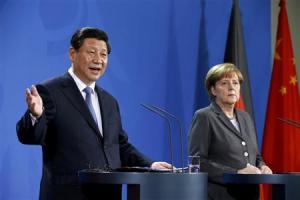
China takes no sides on Ukraine crisis, Xi tells Europe

President Xi Jinping said on Friday China would not take sides with the West or Russia over Ukraine, disappointing any hopes Beijing might add its weight to international pressure on Moscow for annexing Crimea.
"China does not have any private interests in the Ukraine question," Xi told a news conference with German Chancellor Angela Merkel. "All parties involved should work for a political and diplomatic solution to the conflict."
China has adopted a cautious response to the Ukraine crisis, not wanting to alienate its ally Russia or make comment directly on a referendum in which Crimea voted to join Russia, lest it set a precedent for restive regions of its own such as Tibet.
In an U.N. Security Council vote earlier this month on a draft resolution to condemn the Moscow-backed referendum in Crimea, China's abstention effectively isolated Russia. "If I were Russia, I would not be satisfied with the number of votes in favor of Russia," said Merkel, who despite her country's close trade ties with Moscow and heavy reliance on Russia gas exports has backed European Union and U.S. sanctions.
The chancellor, who has tried to use her influence on Russia President Vladimir Putin to de-escalate the crisis, called the U.N. vote a clear sign "that the international community is not very happy with what Russia has done".
China has signaled understanding for Russia's position, saying what is happening "has historical reasons". Chinese state media has also expressed sympathy for Moscow.
DELICATE DIPLOMACY
But China has also said it wants to develop "friendly cooperation" with Ukraine. Its foreign ministry said this week Beijing would play a "constructive role" on international financial aid for Ukraine, though it stopped short of saying whether Beijing would participate directly.
"We support the constructive efforts the international community has made to de-escalate the situation and are open to any concepts which serve to calm the situation and to bring about a political solution," Xi said in Berlin.
"The Chinese side always respects the principles of international relations and non-intervention in the internal business of other states," he said. The Chinese leader's first visit to Germany since becoming president last year saw the signature of business deals that will add to bilateral trade that was worth about 140 billion euros last year. But business considerations did not prevent Merkel from publicly raising China's patchy record on human rights and free speech with the visiting president.
"Broad and free expression of opinion is of course a very important element to promote the creativity of a society, be it in research, culture or civil society," said the chancellor.
There was no official comment on reports that Xi might visit a monument to the Holocaust in Berlin during his visit. China likes to contrast Germany's profound atonement for its World War Two atrocities with what it sees as Japan's reluctance to do so. Ties between the Asian rivals took a turn for the worse in December last year when Prime Minister Shinzo Abe visited a Tokyo shrine China sees as a symbol of Japan's militaristic past because it honors wartime leaders and millions of war dead.
But Xi did use a speech in Berlin on Friday evening to recall Japan's wartime invasion of the Chinese city of Nanjing and say that such atrocities "are still fresh in our memory".

Amnesty urges Obama to criticize Saudi human rights record

Amnesty International has urged US president Barack Obama to break Washington’s silence on human rights violations in Saudi Arabia during his visit to the country on Friday. The London-based rights group called on Obama to take a firm stance against discrimination and systematic violations in the Persian Gulf kingdom. Obama was also asked to express dismay at restrictions on women’s driving as his brief visit to Riyadh coincides with a campaign against the driving ban in the country. Saudi Arabia is the only country in the world that forbids women to drive. “It is crucial that President Obama sends a strong message to the government of Saudi Arabia that its gross human rights violations and systematic discrimination are unacceptable. A failure to do so would undermine the human rights principles the USA purports to stand for,” said Hassiba Hadj Sahraoui, Deputy Director for the Middle East and North Africa at Amnesty International. “For too long, the USA has shied away from publicly confronting Saudi Arabia over its human rights record, largely turning a blind eye to a mounting catalogue of abuses. This is an opportunity for the President to demonstrate that he will stop sacrificing respect for basic human rights, including equality and non-discrimination, for the sake of economic interests and political expedience,” Sahraoui said. “The government of Saudi Arabia has no qualms about crushing anyone who dares to criticize its methods. It has repeatedly and ruthlessly used repressive tactics to quash all forms of dissent.” President Obama’s visit also comes as Saudi Arabia has stepped up its crackdown on human rights activists and introduced an anti-terror law that virtually criminalizes all forms of peaceful dissent, Amnesty noted. Migrant workers and the country’s Shia Muslim community also face widespread and systematic discrimination. Saudi Arabia is a key US ally in the Middle East.

Germany defends Crimea stance as Russia touts new "reality"

Barack Obama: Russia must pull back troops from Ukraine border

President says Putin should begin negotiations directly with Ukrainian government and international community
Barack Obama has called on Russia to withdraw its troops from the Ukraine border and start negotiating.
Obama told CBS News that the decision by the Russian president, Vladimir Putin, to assemble forces on the border may "simply be an effort to intimidate Ukraine, or it may be that they've got additional plans". Although estimates of troop numbers vary, Obama said that "to de-escalate the situation" Russia should "move back those troops and begin negotiations directly with the Ukrainian government as well as the international community".
He also said Putin had been "willing to show a deeply held grievance about what he considers to be the loss of the Soviet Union", and the Russian leader should not "revert back to the kinds of practices that … were so prevalent during the cold war".
"There's a strong sense of Russian nationalism and a sense that somehow the west has taken advantage of Russia in the past and that he [Putin] wants to in some fashion … reverse that or make up for that," Obama said.
"What I have repeatedly said is that he may be entirely misreading the west. He's certainly misreading American foreign policy. We have no interest in circling Russia and we have no interest in Ukraine beyond letting Ukrainian people make their own decisions about their own lives."

President Vladimir Putin: Professional actions by Russian military saved Crimea from bloodshed

http://voiceofrussia.com/
Russian President Vladimir Putin has said that the events in Crimea have demonstrated a high level of readiness of the Russian Armed Forces and he thanked the military service members stationed in the peninsula for their stamina and professionalism. "The recent events in Crimea were a serious test. They demonstrated both the completely new capabilities of our Armed Forces and the high morale of the personnel," the president said at a ceremony introducing the top officers on the occasion of new appointments and rank awarding.
The president thanked "the command and service members of the Black Sea Fleet, other units and formations based in Crimea, for their stamina and personal courage."
The supreme commander-in-chief praised "the clear and professional actions" of the Russian servicemen which "allowed [them] to avoid provocations and prevent bloodshed and ensure conditions for a peaceful and free referendum." "Serious work must be done to modernize the military structure in Crimea," Putin said.
"We need to complete the formation of police, emergency and penitentiary, as well as security, investigative and drug-control agencies in the new constituent regions of the Federation," Putin said.
There is also a need to swiftly implement the decisions to re-open the Black Sea Higher Naval School named after Nakhimov and to create a presidential cadet school in Sevastopol, he said.
Read more: http://voiceofrussia.com/news/2014_03_28/Accurate-actions-by-Russian-military-allowed-avoidance-of-bloodshed-in-Criema-Putin-2671/

Zeenat Karzai : ''Afghanistan's First Lady''

By Malali Bashir
Have you ever seen Afghanistan's current first lady? Has anybody?
Throughout the time her husband has been in office, Zeenat Karzai has remained unengaged and hidden inside Arg -- the Afghan presidential palace. But in many ways, this might not have been expected. Even if she had no interest in politics, or no option to be active on behalf of other Afghan women, her training as a medical doctor might have motivated her to press the international community for help in developing medical technology and facilities inside the country, where hundreds of women still die during childbirth each year. Undoubtedly, Afghanistan has seen a lot of progress in women's rights under Karzai's government; women even have their own ministry now. Nonetheless, it would have had a far greater impact if the first lady had also taken part in rebuilding her country. (The rare photo above was taken during a meeting with Laura Bush inside the Presidential Palace in Kabul in 2006).
Zeenat Karzai could also have taken part in her husband's presidential election campaigns. Her participation may not necessarily have won more votes, but it would have sent a message to Afghan women that their first lady was not only aware of their problems, but also interested in working towards solving them. It would have assured them that she would work for their rights inside the presidential palace. But Mrs. Karzai did not, and with her husband's term ending in the next few months, her chance has passed.
In April, Afghans will elect a new president, and with him will come a new first lady. But even while the faces inside Arg will change, the hopes of Afghans, especially Afghan women, for a new reality may remain unrealized. The role of most Afghan women today does not extend beyond the walls of their own homes, and females working outside are not accepted easily. This is probably the biggest reason that after King Mohammad Zahir Shah's reign none of Afghanistan's first ladies have been seen in public or active in society.
Nine candidates have registered for the Afghan presidential elections of 2014. Some of them do not have good records of allowing women their basic human rights, but if they win, they will be sworn to honor the Afghan constitution that safeguards them. And some information is known about the wives of several prominent candidates, such as Ashraf Ghani Ahmadzai and Abdullah Abdullah, giving voters a sense of what kinds of first ladies they would be.
Ghani, the former finance minister who was listed among the Top 100 Global Thinkers by Foreign Policy magazine in 2010 and was voted the No. 2 world thinker in 2013 by readers of Prospect magazine, is married to Rula Ghani, who he met in Lebanon, where he attended the American University of Beirut. On Saturday, March 8, Rula accompanied her husband to an event in support of Afghan women on International Women's Day and to a campaign event in Kabul where she delivered a short speech. According to Ghani's electoral campaign team, , during the event, women's rights activists applauded her presence as a positive gesture and called upon other potential first ladies to "follow her lead."
As for Abdullah, his wife was not seen during his 2009 presidential campaign, though she stood next to him on election day to cast her vote. While it is unclear if the couple remains together or has separated, if the former is true, the women's rights activists who appreciated Mrs. Abdullah's public appearance in previous elections would have high expectations of her, should her husband win.
Another one of the frontrunners is Zalmai Rasoul, known as "Arg's candidate" and "Karzai's favorite." Yet, if he gets elected, Afghanistan will officially be deprived of a first lady because the 71-year-old former foreign minister is reportedly unmarried.
During the Tokyo conference in 2012, apart from holding "inclusive, transparent and credible" elections, fighting corruption and improving good governance and enforcing the rule of law, Afghanistan made a commitment to defending human rights. The presidential candidates have slightly touched on the women's rights issue during the campaign, but have not addressed it as one of their priority topics. Last month, women's rights activists called upon the presidential candidates to come up with more comprehensive plans regarding women's rights in Afghanistan. In order to keep the commitments made in Tokyo, Afghanistan's next first lady could do a lot in helping the next president of the country.
In Afghanistan's deeply traditional society, laws are still passed today that further diminish the basic human rights of women. Even though Karzai did not sign the law that would have prohibited family members from testifying as witnesses to crimes committed against women by male relatives, the law did pass through the parliament. Yet there are other examples of laws that are part of an effort of legally stripping women of their human rights, including: the Shia family law, which legalizes marital rape and bans wives from going out of their houses without their husbands' permission -- it was approved by lower house of parliament and signed by Karzai in 2009, though he later decided to review it after facing international criticism; the law that lowered the proportion of provincial council seats reserved for women from 25 percent to 20 percent; and the backlash by conservative members of parliament against the Elimination of Violence Against Women law. Ironically enough, the news of a possible approval of a law that legalizes the stoning of adulterers in Afghanistan came out on the Day for Elimination of Violence Against Women.
Given the current situation in Afghanistan, it is hard to believe that any of the previously mentioned women or the other candidates' wives would come forward more often to take part in their husbands' presidential campaign. But at least one woman -- the woman who will become the first lady as a result of the 2014 elections -- will have the chance to play a prominent role in working for women's rights in Afghanistan. Even though there are no official duties assigned by the constitution to the first ladies of the country, it's time that the trend changes and the next first lady does not restrict herself to remaining obscure. It's time for the next first lady to start, not only actively hosting social events, but also actively participating in the development of the country and play the role of a good adviser to the president on pressing issues. She could advise the president on implementing programs for women's rights, furthering their economic independence and access to education, and enabling them with a greater voice in the law-making process.
http://southasia.foreignpolicy.com/posts/2014/03/27/afghanistans_first_lady_0

Iran bent on release of kidnapped border guards:FM

www.shiitenews.com
Iran's Foreign Minister Mohammad Javad Zarif said on Friday that Iran does its best to secure safe and sound release of the kidnapped Iranian border guards in Pakistan.
The foreign minister posted the remark on his facebook on Friday.
Our round-the-clock effort is ensuring safe and sound return of the dear ones to their families and not the publicity or slogans for mere false hopes which not only afford the least help to freedom of the dear ones but also make the issue further complicated,ˈ said Zarif.
On March 26, Zarif wrote a letter to the UN Secretary-General Ban Ki-moon to clarify fate of kidnapped Iranian diplomat in Yemen and five Iranian border guards abducted by a terrorist group in Pakistan.
The Iranian foreign minister in his letter has asked the UN secretary-general to urge the concerned countries to expedite probing into the fate of the abducted diplomat and border guards.
ˈOn this ground and to avoid likely consequences of writing a letter to the UN chief and of its publication, hours long exchange of view and consultations were made to prevent God forbids not adverse impact on release of our dear ones,ˈ Zarif further wrote in his Facebook.
He referred to intensive efforts launched by all Iranian officials, including President Hassan Rouhani and foreign ministry officials, for the purpose and said any consideration observed up to so far in that connection by the officials is ˈtimes more sensitive and more seriousˈ.
To the end of his Facebook anecdote, Zarif hoped for success in release of the Iranian border guards.

Is Pakistan aiding Syrian rebels?

Deutsche Welle
Pakistan denies claims it is arming Syrian rebels at Saudi Arabia's behest. Experts, however, say Islamabad is not only providing military equipment to anti-Assad groups, it's also helping jihadists to go fight in Syria.
Pakistani and international media have reported about Pakistan-based Wahhabi militant groups, including al Qaeda and the Taliban, sending their members to Syria to fight against President Bashar Assad's forces. Some observers claim these fighters are also getting some kind of state support. Despite the Pakistani government's categorical denial of any involvement in the Syrian conflict, the Islamic Republic's opposition parties, including the main opposition Pakistan People's Party (PPP) led by former President Asif Ali Zardari, have challenged Islamabad's claims. A number of political experts in Pakistan also disagree with the government's stance that it did not get itself involved in the violent Syrian conflict on Saudi Arabia's request. "We strongly reject the media speculation that Pakistan has changed its position on Syria or is supplying arms to Syrian rebels directly or indirectly. These impressions are totally baseless and misleading," Sartaj Aziz, an advisor to Pakistani Prime Minister Nawaz Sharif on national security and foreign affairs, recently told the country's parliament. The discussion about whether or not the Pakistani government armed the Syrian rebels commenced after the Saudi Crown Prince, Salman bin Abdulaziz, travelled to Pakistan last month.
"I would like to clarify that during the Saudi Crown Prince's visit, the two sides only mentioned the need to enhance bilateral cooperation in the field of defense with an aim to have a mutually beneficial defense and security cooperation," said Aziz. According to news agency AFP, which quoted a source close to Saudi decision-makers, Riyadh was interested in getting Pakistan-made shoulder-launched anti-aircraft missiles, known as Anza, and anti-tank rockets, to aid the rebels. "The United States could allow their to allies provide the rebels with anti-aircraft and anti-tank weapons following the failure of Geneva talks and the renewed tension with Russia," AFP quoted the head of the Gulf Research Centre, Abdel Aziz al-Sager. Ghaffar Husain, a London-based researcher and counter-terrorism expert, told DW that Saudi-Pakistani alliance is decades-long, and that it is highly likely that Riyadh could have asked for Islamabad's assistance in turning the tide in Syria.
Claims 'not exaggerated'
Ali K. Chishti, a security expert in Karachi, told DW that Pakistan's assistance to Syrian rebels was of covert nature, and that it was obvious why Pakistan did not officially admit it. "I don't think that the claims that Pakistan is helping Syrian opposition are incorrect or exaggerated. Islamabad believes that since Iran is openly supporting the Assad regime, which is responsible for killing hundreds of thousands of people in his own country, it is justified to aid the rebels," said Chishti.
Sharif's personal involvement
Some experts argue that the alleged Saudi-Pakistani deal on Syria was a result of Sharif's personal connections with the Saudi rulers. Earlier this month, Pakistan received a 1.5 billion USD loan from Riyadh, which Pakistani opposition parties claimed was a "gift' from Saudis to Sharif for his "services" to the kingdom. Husain says Pakistan has "the expertise, weapons and fighters for the Syrian war, and Saudi Arabia has the cash that Pakistan desperately needs right now."
Naqvi, however, says that any other head of the government in Islamabad would have complied with the Saudi demands. "We must not forget that Sharif has no say in defense related matters. It is the Pakistani army which calls the shots. Former President Zardari would not have acted differently in this scenario."
For Chishti, accepting the Saudi demands was a sensible decision: "Iran is openly supporting Assad whereas Saudi Arabia is aiding the rebels - both for their sectarian interests. Why would then the Pakistani state, which follows the Saudi Wahhabi Islamic ideology, side with the Shiite Tehran on this?"
Pakistani militants migrating to Syria
"A large number of foreign fighters are based in Pakistan's northern Waziristan area, which shares border with Afghanistan. Some of them are now migrating to Syria. The Pakistani Taliban have actually established a cell to monitor the Syrian situation. Al Qaeda's head, Aymen al-Zawahiri sent out a message to Pakistani militants to move to Syria," told Chishti, adding that Muslim al Shishani, a Chechen commander from North Waziristan, was one such Islamist who migrated to Syria on March 27.
The expert, however, is not sure whether it's a good thing for the Pakistani state. "We need to see how certain non-state actors are being used in this conflict. It can be a double edged sword," he said. For his part, Naqvi says there is "structural linkage" between the Pakistani military apparatus and the jihadists. "These militants have been doing what the army thinks is in Pakistan's geo-strategic interests," said Naqvi. The expert is of the view that Pakistan finds itself in a quagmire for not keeping itself non-aligned in regional and international conflicts and will ultimately have to pay a big price for its actions.

Pakistan: Hamza Shahbaz should listen to the families affected by terrorism

http://mediacellppp.wordpress.com/
Sindh Information Minister and Pakistan People’s Party (PPP) leader Sharjeel Memon said on Friday, while responding to Hamza Shahbaz’s statements that it would be better if Hamza made the suggestions to federal government and not to Bilawal, Dunya News reported.
Reacting to Hamza Shahbaz’s statements, Sindh Information Minister Sharjeel Memon said that it is better if Hamza Shahbaz makes suggestions to federal government and convince them not to bow before terrorists.
Reiterating that he should keep his suggestions to himself, Memon said instead of making childish statements, Hamza Shahbaz should listen to the families affected by terrorism.
He said people of Pakistan have serious reservations over government and Taliban’s reconciliation policy, adding that federal government is insulting Pakistan’s constitution by negotiating with terrorists.
Memon said Punjab government should stop sheltering terrorists, claiming that federal government deems no difference among an ordinary Pakistani, Taliban and Lashkar-e-Jhangvi (LeJ).
He said that 2 different standards of laws were made while violating the constitution. Meanwhile, National Assembly’s opposition leader Khurshid Shah said that Pakistan People’s Party (PPP) bore sizeable loss in the past and that party cannot afford more risks.
He said that Punjab government should inform about the investigations over threats received by Bilawal. Shah also wrote a letter to Chief Minister (CM) Punjab Shahbaz Sharif reiterating a complete investigation should be carried out over the matter of death threats received by Bilawal.
He said that PPP is taking the matter rather very seriously, adding that he hopes Punjab government will complete the investigation soon and inform about the results.

Pakistan: Minorities in the Islamic Republic

Ahmadiyya Times
By Adnan Falak
For the Ahmadiyya community perhaps, the situation is most undesirable as it is considered a black mark just to declare their religious identity.
The Lahore resolution laid out the blue print for Pakistan. It envisioned an independent homeland for Muslims, consisting of “independent states” of geographical contiguous areas with a Muslim majority. It also called for the provision of “adequate, effective and mandatory safeguards for minorities in these units [independent states for Muslims] for the protection of their religious, cultural, economic, political, administrative and other rights and interests.”
If Pakistan was meant to be a country where Muslims could live according to their aspirations, then it was also supposed to offer equal status to minorities; a thought that the great Quaid expressed in a press conference at New Delhi on July 14,1947. According to Quaid -e- Azam, “Minorities, to whichever community they may belong, will be safeguarded. Their religion, faith or belief will be secure. There will be no interference of any kind with their freedoms of worship. They will have protection with regard to their religion, faith, their life, their culture. They will be, in all respects, the citizens of Pakistan.”
Far from being “in all respects the citizens of Pakistan,” and enjoying “political and administrative rights,” minorities in Pakistan today face a Pakistan that is dangerous for them to live in, a fact highlighted by our ranking as the fifth most unsafe country in the world for minorities. The State of Minorities Report 2013 explains this situation: “Pakistan has become one of the deadliest countries in the world for ethnic and religious minorities. In 2012, targeted attacks against the country’s minority communities rose significantly, with little or no action taken by the government to protect them.”
Militant organisations are indiscriminately targeting Shias across Pakistan, assassinating their leaders and attacking their religious processions. According to Human Rights Watch, “The Pakistani Taliban and its affiliates have conducted unprecedented attacks in 2013 on the country’s Muslim and non-Muslim religious minorities, claiming responsibility for most major bombings and vowing further violence.
Human Rights Watch has recorded dozens of attacks on Shias in 2013, including some of the worst attacks on the community in Pakistan’s history. Amongst Shiites, Quetta’s Hazara community is bearing the brunt of the sectarian attacks. According to some estimates, nearly a quarter of those who are killed in sectarian violence since 2012 are Hazaras. This campaign of sectarian cleansing has severely disrupted the daily life of Hazaras. Human Rights Watch’s Ali Dayan Hasan said in an interview, “Hazara religious pilgrims, students, shopkeepers, vegetable sellers, doctors and other professionals have been targeted leading to not just widespread fear but increasingly restricted movement and a ghettoisation of community members, increasing economic hardship and curtailed access to education.”
Hindus and Christians are also living in onerous conditions. The story of Rinkle Kumari of Mirpur Mathelo highlights the misery of Hindus in Sindh. The girl was abducted, forcibly converted and was later married to a Muslim man. Many other Hindu girls met a similar fate, and in each case, perpetrators coerced the family of the aggrieved to stay silent or accept the consequences. Last year the case of Rimsha Masih exposed the plight of Christians in Pakistan. Rimsha, a juvenile with a learning disability was framed by a local Muslim cleric. The girl was taken into custody and locked in prison under blasphemy laws, and the accused was denied the right of bail. However, an uproar in the media forced the government to investigate the incident, leading to the acquittal of the girl.
For the Ahmadiyya community perhaps, the situation is most undesirable as it is considered a black mark just to declare their religious identity. They are ostracized, harassed, threatened, targeted, and their places of worship and graveyards are desecrated. Ethnic minorities in Pakistan are also getting similar treatment. In their case however, the accused are not sectarian and extremist groups but state institutions. In Balochistan, locals are abducted, only to end up later as mutilated corpses dumped by roadsides. According to Reuters, “The bodies of hundreds of pro-independence rebels have been found across the Balochistan province and many more have gone missing in the past several years.” The Baloch activists have accused state agencies of undertaking a “kill and dump policy” to crush dissent, but the government has denied such accusations.
Unfortunately, in all of this, the state is acting as a hapless bystander, failing miserably to discourage intolerance and to reign in sectarian groups who target minorities whenever and wherever they desire with impunity. Facing such circumstances, many members of minorities are fleeing Pakistan and seeking asylum abroad.
The purpose of Pakistan was to create a welfare state for Muslims and non- Muslims, where they could lead their lives with the complete rights and obligations of citizenship and with their religious identities protected. Nearly seventy four years since the adoption of the Lahore resolution, we have created a country where minorities are terrorised and persecuted, a place where sectarianism runs amok and where Muslim clerics openly promote hatred and violence against minorities. If we don’t check our zeal of Islamization, and do not assure that all citizens of Pakistan are protected, treated equally and given the freedom of association and worship, we stand to fail the test of history.
http://ahmadiyyatimes.blogspot.com/2014/03/pakistan-minorities-in-islamic-republic.html

Pakistan: Nothing for families of victims of terrorism in the talks

As the Tehreek-i-Taliban Pakistan and the federal government walk the treacherous path to discuss peaceful coexistence, the bereaved families of thousands of people fallen victims to terrorism are expected to remain neglected.
Political scientists and teachers of international relations, in their separate interviews with Dawn, opine the victims’ families could at best draw solace if peace is achieved, forgetting about more than 50,000 innocent lives lost to insanity.
“If peace is achieved in the longer run as a result of the ongoing peace deliberations, we will have to forget many bitter things for the national cause and move forward though it would be immensely difficult particularly for the families of terrorists’ victims,” said Dr Hussain Shaheed Soherwardi, a lecturer at University of Peshawar’s international relations department.
He said Jews went through the same situation when they unhappily saw their prime minister shaking hands with their terrorist, Yasir Arafat, searching for peace.
“It is always difficult to grant amnesty to the terrorists of the previous days, but this bitter pill has to be swallowed for durable peace,” he said.
Like Mr Soherwardi, Dr Hassan Askari Rizvi, an academician and a noted defence analyst, also feels the families of the victims of terrorism will be the ultimate losers as they lost their dear ones to militancy and, at the same time, they won’t get justice.
Usually, it has been seen (the world over) that in crisis situations, according to Dr Rizvi, the government keeps interacting with the affected families and remains in touch with the military throughout the crisis time.
“While the government is in touch with the military because of its compulsion, it has neglected the victims’ families,” he said. Dr Rizvi sees a reason behind the official neglect. “The federal government does not want to talk about them (families of the victims of terrorism) as it says it (their predicament) is history, so let’s move forward.”
The victims’ families do not appear to be on the priority list of either of the negotiating sides. There is no official word on what the government is thinking about the sacrifices rendered by thousands of civilian and military victims, who lost lives to the TTP brutalities.While the terrorists’ victims stand neglected, the two negotiating teams have been mulling over the exchange of non-combatant abductees held by the TTP and the state.
TTP negotiator Professor Mohammad Ibrahim, a senior Jamaat-i-Islami leader, has also indicated that the possible release of Ajmal Khan, vice chancellor of the Islamia College University, has figured out in the talks so far.
Similarly, from the TTP side demands have surfaced about the release of the non-combatant members of the families of TTP leaders allegedly held by the military.
However, there is a complete mum about the thousands of people, who have been sent to graves by the TTP suicide bombers and its agents of death and destruction. “The only solace that the victims’ families could draw from this situation would rest in their ability to feel proud about their personal sacrifices,” said Dr Soherwardi. “The public at large should remind them (families) that their losses have not been ignored and the whole citizenry stand by them in their difficult times.” He, however, acknowledges it will be difficult to practice. Dr AZ Hilali, chairman of the University of Peshawar’s political science department, doesn’t appear optimistic about the outcome of the talks. “The State will remain at the mercy of guns forever even if the current process leads to establish peace,” he said. Dr Rizvi also holds an identical opinion.
The likely extension in the ongoing ceasefire might will be acceptable to the government but the army “will never let the coming summer past” as TTP, he added, wanted to avoid armed confrontation this summer, waiting for the post-US drawdown from Afghanistan.
“The Army will not give them that much time; it would see this process a couple of more weeks but won’t let the coming summer pass,” said Dr Rizvi.
He said the nation was also divided over peace talks.
Even the religious scholars belonging to Shia and Barelvi schools of thoughts, too, had expressed reservations about the peace talks.
For Dr Hilali, TTP already has achieved more than it deserved from the negotiation process: it has managed to emerge as ‘innocent’.
“Certain religio-political parties conducted a vicious campaign to portray TTP as ignorant guys and those opposed to them were dubbed as warmongers,” he said. Dr Hilali said no one was opposed to talks since dialogue was the only way to resolve contentious issues, but the way the government had pursued the process, it had isolated commoners, making them question the whole exercise.
“Isolating people makes part of the psychological warfare in which everything is ignored to achieve specific results,” he said.
In such a situation, the families of terrorism’s victims shouldn’t expect dispensation of justice as the perpetrators of terrorist activities can’t be brought to the courts for trial.

PPP demands probe into LeJ’s threat to Bilawal

Leader of the Opposition in National Assembly Syed Khursheed Shah Friday wrote a letter to Punjab Chief Minister Shahbaz Sharif, seeking to launch a probe into threats made by the banned Lashkar-e-Jhangvi (LeJ) to PPP Chairman Bilawal Bhutto.
“It is a very sensitive issue for the Pakistan People’s Party (PPP),” the letter said, saying that party leadership had been targeted in the past also.
“PPP has already lost its leadership. No more human loss would be tolerated,” Shah added.

Punjab police in action after Bilawal receives a threatening letter from LeJ

Inspector-General Chief (IGP) Punjab said that he and his team is finding any leading suspects in regard to the threatening letter received by Pakistan People’s Party’s Patron-in-Chief, Bilawal Bhutto Zardari, Aaj News reported.
According to IG Punjab, Bilawal Bhutto received a threat oriented letter from Lashkar-e-Jhangvi (LeJ), in regard to which IG Punjab and his team has started a detailed investigation to find the leads of this letter. IG Punjab, carrying a detailed investigation regarding the issue, telephoned Chief of Staff for Bilawal Bhutto, Hasham Sheikh and discussed all possible details mentioned in the letter to follow a specific lead, whereas IG Punjab also informed Shahbaz Sharif’s concerns regarding the issue.
IG Punjab has taken Hasham Sheikh and Bilawal Bhutto into confidence, whereas he assured to provide his complete assistance and cooperation in this case.

Pakistan: SA passes resolution against threats to Bilawal

Sindh Assembly (SA) on Friday unanimously passes a resolution against threats to Pakistan People’s Party (PPP) Patron-in-Chief Bilawal Bhutto Zardari.
The resolution was presented in the SA by Abdul Sattar Rajpar.
Yesterday, Bilawal Bhutto said on Twitter that he had received life threats from Lashkar-e-Jhangvi, an outlawed militant outfit.
Bilawal tweeted,” received threat letter from LEJ. Will hold Punjab government responsible 4 LEJ attacks if Sharif cont 2 give them protection & refuse2 take action.”

Salma Farooqi, Female Polio Vaccinator, Brutally Killed In Pakistan

http://www.huffingtonpost.com/
Salma Farooqi worked on the frontline of Pakistan's battle with polio, helping to vaccinate children in one of the world's last havens for the crippling disease. On Monday, her bullet-riddled body was found, bearing marks of torture, after unidentified gunmen attacked her home near the Pakistani city of Peshawar.
Farooqi disappeared when a group of armed men raided her family home in Gulozai village overnight Sunday, relatives told Pakistan's DAWN newspaper.
"Salma was fast asleep next to me when the men came in, beat me and tied me and the children up," Farooqi's husband Mohammad Karim Khan described to The Guardian. "It took us an hour to free ourselves and then we saw that Salma had disappeared."
The next day, her mutilated body was found about 2.5 miles away. “The armed men cut her lips and broke her hands and dumped the body in the fields outside Peshawar,” a police official told NBC News.
Police are still investigating whether Farooqi was killed because of her work, but the brutal murder sends a chilling message to health workers who are frequently targeted by militants in Pakistan, The Guardian notes.
Many of those working for the vaccination program currently work under the cover of armed Pakistani police after a series of militant attacks on vaccinators has left at least 30 polio health workers dead since 2012. Some Islamic militants in the country accuse the polio program of being a cover for Western espionage, or a conspiracy to sterilize Muslim children, according to The Guardian.
Pakistan is one of three countries in the world that remain polio-endemic, along with Nigeria and Afghanistan. The Pakistani strain of polio was recently discovered in Syria, highlighting the World Health Organization's warning that the disease's steady decline of the past decades could be reversed.
Farooqi's home province of Khyber Pakhtunkhwa in north-west Pakistan, as well as neighboring tribal districts, are some of the world's worst hotspots for the disease, according to Agence France Presse.

Bilawal Bhutto receiving threats from banned Lashkar-e-Jhangvi

Bilawal Bhutto, the chairperson of the Pakistan Peoples Party,has received threats from the banned Lashkar-e-Jhangvi.
"Received threat letter from LEJ. Will hold Punjab govt responsible 4 LEJ attacks if Sharif cont 2 give them protection & refuse2 take action," Bilawal, son of late Prime Minister, Benazir Bhutto and former President, Asif Zardari tweeted on Thursday night.
The PPP which rules the southern Sindh Province, has in the past accused the Punjab government of sheltering the LeJ, which is also reported to have sent threat letters to the provincial government, warning them to stop "atrocities", otherwise they would resort to targeting law enforcing agents and government officials.
A spokesman for Bilawal House, the official residence of the Zardari family, said steps have been taken to increase security for Bilawal and his sisters after the LEJ threats.
Bilawal's mother was assassinated shortly after addressing a public rally in Rawalpindi and before that she had survived a suicide bomb attack after returning to Pakistan from an exile.