Friday, March 21, 2014
Saudi Arabia cracks down on Twitter
Turkey: We tech-savvy Turks are more than a match for Erdogan's Twitter ban

Ancient censorship mechanisms are no longer a problem for the young Turks who co-ordinate anti-government dissent
 Thursday was Twitter's eighth birthday. Turkish prime minister Recep Tayyip Erdoğan's birthday present to the social media giant, and to millions of Turks who use it daily, was to block the site. At about 11.20pm last night, those who wanted to use Twitter were greeted by a message from the Telecommunications Presidency referencing a court order that blocked access to it.
Within minutes, detailed methods of bypassing the block by changing DNS numbers and using VPNs were shared via Facebook, WhatsApp and text message. Hashtags using the Turkish for "Twitter Is Blocked in Turkey", "Turkey Blocked Twitter" and "Dictator Erdoğan" began trending worldwide almost immediately. When the official Turkish account of Twitter tweeted, "Turkish users can send Tweets using SMS" and gave detailed instructions, Turks were already ahead of the game.
Actually, there were no shortage of tweets sent from Turkey at all. TwitTurk, a website that records statistics of Turkish Twitter users, reported that more than 500,000 tweets were sent in the first two hours of the ban. Ironically enough, star names of Erdoğan's Justice and Development party (AKP), such as deputy prime minister Bülent Arınç and mayor of Ankara Melih Gökçek, continued tweeting well into today.
What's more, the AKP also continued to create promoted tweets and trends – services Twitter provides for a hefty amount of money. The hashtag "Gökçek Kuzey Yıldızı" (Gökçek North Star), a campaign sponsored by AKP's Ankara branch to promote Gökçek's controversial project to build a giant mosque in the capital, became the number one trending topic in Turkey in the first couple of hours of the ban. Another pro-AKP account promoted the ruling party's recent television broadcast, depicting hundreds running towards a Turkish flagpole – in the fashion of zombies from World War Z – after hearing Erdoğan's voice reading the national anthem.
As they did during the Occupy Gezi days, Turkish citizens created memes mocking the Twitter ban. However, neither the jokes nor the fact that tech-savvy Turks bypassed the ban without batting an eyelid are enough to shield us from the grim reality behind recent censorship. Twitter has become pivotal in organising anti-government dissent in the past year: the Occupy Gezi movement, which marches against the recently passed internet censorship bill that allows the government to block any content within four hours without a court order, and the massive street protest and the funeral attended by hundreds of thousands after the death of 15-year-old Berkin Elvan, were initiated via social media.
Twitter has also become the main channel for talking about corruption allegations implicating Erdoğan and his family. Anonymous accounts leak alleged phone recordings of Erdoğan. Waiting for new recordings to surface around 9pm each night has become the most popular pastime of millions of Turks, who then spread the news like wildfire. These accounts have been announcing that the mother of all recordings will come out on 25 March, a mere five days before the upcoming local elections. Erdoğan, aware of this, said yesterday in an election rally hours before the block took effect: "We will eradicate Twitter. I do not care what the international community says."
It looks like the Turkish public does not care what Erdoğan says either. Recent history around the world and in Turkey shows that social media is a serious threat to autocrats. Ancient censorship mechanisms, archaic politics and Orwellian threats do not work in the face of technological dissent and the voice of the streets.
When your old uncle gets you something out-of-touch for your birthday, what do yo do? You say thank you and then return it. Well, thank you Erdoğan, but we do not want your gift of censorship. Here is the receipt.
Thursday was Twitter's eighth birthday. Turkish prime minister Recep Tayyip Erdoğan's birthday present to the social media giant, and to millions of Turks who use it daily, was to block the site. At about 11.20pm last night, those who wanted to use Twitter were greeted by a message from the Telecommunications Presidency referencing a court order that blocked access to it.
Within minutes, detailed methods of bypassing the block by changing DNS numbers and using VPNs were shared via Facebook, WhatsApp and text message. Hashtags using the Turkish for "Twitter Is Blocked in Turkey", "Turkey Blocked Twitter" and "Dictator Erdoğan" began trending worldwide almost immediately. When the official Turkish account of Twitter tweeted, "Turkish users can send Tweets using SMS" and gave detailed instructions, Turks were already ahead of the game.
Actually, there were no shortage of tweets sent from Turkey at all. TwitTurk, a website that records statistics of Turkish Twitter users, reported that more than 500,000 tweets were sent in the first two hours of the ban. Ironically enough, star names of Erdoğan's Justice and Development party (AKP), such as deputy prime minister Bülent Arınç and mayor of Ankara Melih Gökçek, continued tweeting well into today.
What's more, the AKP also continued to create promoted tweets and trends – services Twitter provides for a hefty amount of money. The hashtag "Gökçek Kuzey Yıldızı" (Gökçek North Star), a campaign sponsored by AKP's Ankara branch to promote Gökçek's controversial project to build a giant mosque in the capital, became the number one trending topic in Turkey in the first couple of hours of the ban. Another pro-AKP account promoted the ruling party's recent television broadcast, depicting hundreds running towards a Turkish flagpole – in the fashion of zombies from World War Z – after hearing Erdoğan's voice reading the national anthem.
As they did during the Occupy Gezi days, Turkish citizens created memes mocking the Twitter ban. However, neither the jokes nor the fact that tech-savvy Turks bypassed the ban without batting an eyelid are enough to shield us from the grim reality behind recent censorship. Twitter has become pivotal in organising anti-government dissent in the past year: the Occupy Gezi movement, which marches against the recently passed internet censorship bill that allows the government to block any content within four hours without a court order, and the massive street protest and the funeral attended by hundreds of thousands after the death of 15-year-old Berkin Elvan, were initiated via social media.
Twitter has also become the main channel for talking about corruption allegations implicating Erdoğan and his family. Anonymous accounts leak alleged phone recordings of Erdoğan. Waiting for new recordings to surface around 9pm each night has become the most popular pastime of millions of Turks, who then spread the news like wildfire. These accounts have been announcing that the mother of all recordings will come out on 25 March, a mere five days before the upcoming local elections. Erdoğan, aware of this, said yesterday in an election rally hours before the block took effect: "We will eradicate Twitter. I do not care what the international community says."
It looks like the Turkish public does not care what Erdoğan says either. Recent history around the world and in Turkey shows that social media is a serious threat to autocrats. Ancient censorship mechanisms, archaic politics and Orwellian threats do not work in the face of technological dissent and the voice of the streets.
When your old uncle gets you something out-of-touch for your birthday, what do yo do? You say thank you and then return it. Well, thank you Erdoğan, but we do not want your gift of censorship. Here is the receipt.
Indian Ocean search for missing Malaysia airliner comes up empty again
Despite better weather conditions Friday and the use of some of the world's most advanced surveillance aircraft, an Australian-led search operation came up empty on its second day of scouring the south Indian Ocean for possible debris from Malaysia Airlines Flight 370. Several military aircraft, a commercial jet and two merchant ships combed a large area about 1,500 miles off the coast of Perth, Australia, where two objects had been spotted on satellite imagery. Australian officials reported the images Thursday and said they could be related to the missing jetliner. The weather was fair Friday, making for much better visibility than on Thursday, said the Australian Maritime Safety Authority. Though the search efforts in the area are intensifying, with a number of aircraft, ships and helicopters from China, Japan and other countries heading toward the vicinity, the absence of early success provided a kind of reality check after hopes rose Thursday of a possible breakthrough in the mystery of the Boeing 777 that vanished after departing Kuala Lumpur en route to Beijing on March 8. "This is going to be a long haul," said Malaysia's acting transport minister, Hishammuddin Hussein, at a news conference. Among other things, he said, he would ask U.S. Secretary of Defense Chuck Hagel on Friday for additional help, including deep-sea salvage vehicles. Thus far, the aircraft search operations in the area have included four Australian air force P3 Orions, one U.S. Navy P8 Poseidon and a New Zealand P3 Orion. On Thursday, rain and clouds largely limited the search to radar, but aircraft crews Friday were able to make visual inspections flying over the area. Still, it is "a big area when you're looking out the window trying to see something by eye," said John Young, general manager of the Emergency Response Division at the Australian maritime agency. The search area is about 8,900 square miles, slightly smaller than the size of New Hampshire. What's more, because of the long distance to fly to that section of the ocean, the aircraft have only about two hours of actual search time before needing to return for refueling. "Tomorrow's plan is to do the same thing," Young said Friday. "The plan is we want to find these objects because they are the best lead to where we might find people to be rescued." There was some speculation, however, that the objects spotted on satellite could have submerged since the pictures were captured Sunday. Australian officials said it wasn't until Thursday that the images were reported to authorities because of a large volume of films and time needed for analysis. Australian Prime Minister Tony Abbott on Friday defended his decision to announce the satellite imagery. He said he had a duty to pass on the information to families of the missing passengers. At the same time, Abbott reiterated that the two objects detected on the film, one of them about 79 feet long, may have nothing to do with the missing jetliner. "It could just be a container that has fallen off a ship, we just don't know," he said. With the investigation of the missing airliner entering its third week this weekend, there were still many unanswered questions. Malaysian officials Friday said they had no update on the log data that were deleted from the flight simulator made by Flight 370 pilot Zaharie Ahmad Shah. Asked about reports that Shah made a phone call before takeoff, Malaysia Airlines' chief executive, Ahmad Jauhari Yahya, who has been a regular at the daily news conference by Malaysian officials, said Friday without elaborating that the information was being passed on to authorities. But now more than anything else, the big question is whether the floating objects captured on satellite are from the missing plane -- and if so, how long it will take to find them. Cho Byungjae, South Korea's ambassador to Malaysia, is one of a number of foreign diplomats staying on top of the search efforts. South Korea is sending two aircraft to the south Indian Ocean. After coming out of a meeting with Malaysian officials Friday afternoon, Cho spoke in somewhat sobering terms. "It could take some time," he said. http://www.latimes.com/world/worldnow/la-fg-wn-indian-ocean-search-for-missing-malaysia-airliner-comes-up-empty-again-20140321,0,6870824.story#ixzz2wcLjMihtBy Don Lee
World T20: India avenge Asia Cup humiliation, maul Pakistan in Mirpur
http://timesofindia.indiatimes.com/
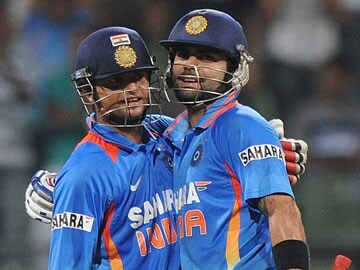 India thrashed Pakistan by seven wickets in the World T20 opener to keep their unbeaten records against the arch rivals in World Cups intact.
The men in blue avenged their Asia cup humiliation in style as they chased down the 131-run target with 9 balls to spare at the Sher-e-Bangla National Cricket Stadium on Friday.
Virat Kohli remained the top scorer for India as he stayed unbeaten after scoring 36 while Suresh Raina scored 35 not out.
Earlier, Dhawan (30) and Rohit Sharma (24) got India off to a fiery start after spinners performed admirably to restrict Pakistan to a modest 130 for seven.
The duo shared 54-run stand for the first wicket.
India captain Mahendra Singh Dhoni's decision to field three specialist spinners -- Amit Mishra, Ravindra Jadeja and Ravichandran Ashwin -- and bowl first on a slowish track was vindicated as the trio gave away only 63 runs between them in the 12 overs and also removed three Pakistan batsmen, thereby putting brakes on their scoring rate.
Mishra (2/22), Jadeja (1/18) and Ashwin (0/23) all got a bit of help from the track which had a bit of bite and turn on offer.
While Ashwin bowled round the wicket to deny the batsmen any room to chance their arms, Jadeja bowled wicket to wicket with the odd delivery turning away from the right-hander. Mishra too was bang on target with his flighted leg breaks and varied the length of his deliveries and pace through the air.
Dhoni rotated his bowlers brilliantly not letting the opposition batsmen to get away easily, frequently changing the ends.
For Pakistan, only Umar Akmal looked good during his 30-ball 33-run knock but couldn't go on to get a big score.
Kamran Akmal hit a couple boundaries --- one each off Ashwin and medium pacer Bhuvneshwar Kumar (1/21) before his partner Ahmed Shehzad's indiscretion brought about his downfall.
The call was Shehzad's, who came halfway down the track only to retreat back as Akmal couldn't make it back to his crease. Bhuvneshwar did well to pick up and throw down the stumps on his follow-through.
Skipper Mohammad Hafeez (15) never looked comfortable during his 22-ball stay at the wicket. He should have been gone for five had his mistimed pull off Mohammed Shami been taken by a diving Yuvraj Singh at deep square leg boundary.
But it did not cost India dearly as Hafeez gave Jadeja the charge only to mistime the shot and give a skier that was pounced well by Bhuvneshwar.
Shehzad (22 off 17 balls) did the initial hard work but Mishra out-thought him with a flighted delivery that turned away after pitching. It was a classical leg-break that drew the batsman forward and beat by flight as Dhoni gleefully whipped off the bails.
Umar Akmal played himself while Shoaib Malik (18) announced his arrival with a huge straight six off Mishra. The duo added 50 runs in seven overs but that certainly wasn't enough.
Malik could have been out on 14 when he pulled an Ashwin carrom ball which Bhuvneshwar diving in-front failed to catch as the ball went past the boundary ropes.
But Mishra had his revenge when Malik was holed out at long-off boundary by Raina.
Umar also followed suit lofting Shami to Raina at long-off. Shahid Afridi's (8) hit and miss game didn't work today as he tried to sweep Bhuvneshwar but gave Raina, his third catch of the day in the deep.
While Sohaib Maqsood hit Shami for a six and four to score a quickfire 21 off 11 balls, it wasn't enough for Pakistan to get to a decent score.
India thrashed Pakistan by seven wickets in the World T20 opener to keep their unbeaten records against the arch rivals in World Cups intact.
The men in blue avenged their Asia cup humiliation in style as they chased down the 131-run target with 9 balls to spare at the Sher-e-Bangla National Cricket Stadium on Friday.
Virat Kohli remained the top scorer for India as he stayed unbeaten after scoring 36 while Suresh Raina scored 35 not out.
Earlier, Dhawan (30) and Rohit Sharma (24) got India off to a fiery start after spinners performed admirably to restrict Pakistan to a modest 130 for seven.
The duo shared 54-run stand for the first wicket.
India captain Mahendra Singh Dhoni's decision to field three specialist spinners -- Amit Mishra, Ravindra Jadeja and Ravichandran Ashwin -- and bowl first on a slowish track was vindicated as the trio gave away only 63 runs between them in the 12 overs and also removed three Pakistan batsmen, thereby putting brakes on their scoring rate.
Mishra (2/22), Jadeja (1/18) and Ashwin (0/23) all got a bit of help from the track which had a bit of bite and turn on offer.
While Ashwin bowled round the wicket to deny the batsmen any room to chance their arms, Jadeja bowled wicket to wicket with the odd delivery turning away from the right-hander. Mishra too was bang on target with his flighted leg breaks and varied the length of his deliveries and pace through the air.
Dhoni rotated his bowlers brilliantly not letting the opposition batsmen to get away easily, frequently changing the ends.
For Pakistan, only Umar Akmal looked good during his 30-ball 33-run knock but couldn't go on to get a big score.
Kamran Akmal hit a couple boundaries --- one each off Ashwin and medium pacer Bhuvneshwar Kumar (1/21) before his partner Ahmed Shehzad's indiscretion brought about his downfall.
The call was Shehzad's, who came halfway down the track only to retreat back as Akmal couldn't make it back to his crease. Bhuvneshwar did well to pick up and throw down the stumps on his follow-through.
Skipper Mohammad Hafeez (15) never looked comfortable during his 22-ball stay at the wicket. He should have been gone for five had his mistimed pull off Mohammed Shami been taken by a diving Yuvraj Singh at deep square leg boundary.
But it did not cost India dearly as Hafeez gave Jadeja the charge only to mistime the shot and give a skier that was pounced well by Bhuvneshwar.
Shehzad (22 off 17 balls) did the initial hard work but Mishra out-thought him with a flighted delivery that turned away after pitching. It was a classical leg-break that drew the batsman forward and beat by flight as Dhoni gleefully whipped off the bails.
Umar Akmal played himself while Shoaib Malik (18) announced his arrival with a huge straight six off Mishra. The duo added 50 runs in seven overs but that certainly wasn't enough.
Malik could have been out on 14 when he pulled an Ashwin carrom ball which Bhuvneshwar diving in-front failed to catch as the ball went past the boundary ropes.
But Mishra had his revenge when Malik was holed out at long-off boundary by Raina.
Umar also followed suit lofting Shami to Raina at long-off. Shahid Afridi's (8) hit and miss game didn't work today as he tried to sweep Bhuvneshwar but gave Raina, his third catch of the day in the deep.
While Sohaib Maqsood hit Shami for a six and four to score a quickfire 21 off 11 balls, it wasn't enough for Pakistan to get to a decent score.
Ukraine’s political failure stems from selfish elite
 The fast-fermenting crisis across Ukraine is still unfolding with the bid for independence in the contested Crimea. Though Ukraine has undergone numerous periods of turbulence during the past 20-odd years and especially since the 2004 "Orange Revolution," the present upheaval lasting for several months has again plunged the geopolitically important country on the edge of collapse.
The Ukraine crisis broke out abruptly and unexpectedly, but was actually ignited by a wide spectrum of thorny conundrums both home and abroad.
From a domestic perspective, the government has been used to neglecting the willingness of a certain number of constituencies when formulating major state policies, thus incurring a political participation crisis. When the ignored voters were strongly discontented with the government and the system, they resorted to violence, inevitably leading to bleeding scenarios.
However, we should tap into the underlying causes behind the current riots. On the one hand, because of its history scarred by wars and split over nationhood, the western region of Ukraine boasts a culture, ideology and religion similar to Europe, in particular Poland and the Republic of Lithuania, while the east has been Russianized to a certain degree. For instance, Ukraine's upper classes traditionally wrote in Russian instead of Ukrainian.
It should be noted, nevertheless, that cultural differences do not necessarily give rise to social conflicts and confrontations. The turmoil that has never died down throughout Ukraine's society can be called "Ukraine's crisis of European integration," which means social controversies are triggered by suspensions in the process of being integrated into Europe.
Plus, there has long existed an institutional deficiency in Ukraine. Its president, parliament and the opposition failed to cultivate an institutional culture, leaving political parties entangled in a zero-sum game with no room for compromise.
Last but not least, the political elite, as the major body of the constitutional democracy, exerts a significant role in the society as well as immense influence upon every single crisis. Although the Ukrainian government has set up the framework of checks and balances, outdated institutions are pervading across the whole society, and there are many legal grey areas. Political parties and elites selectively utilize laws and regulations to obtain maximum benefits.
Against a lackluster judicial institution and democratic system, the elite in the opposition party are keen on engaging in street politics that brings about immeasurable losses to the people.
Ukraine's elite is also unstable. They cooperate based on personal interest instead of political views and ideologies. Furthermore, they tend to amplify cultural differences and use them as a tool to mobilize voters, who end up in becoming a social force jeopardizing the stability of the whole society and the destiny of the nation at large.
On the other hand, Ukraine's special geographical position also plays a decisive role in its wretched fate. After the end of the Cold War, the West is still led by the US and the EU, while Russia has not blended itself into the so-called Western geopolitical system despite a series of changes in social system. And it is exactly in this geopolitical crevice that Ukraine has had to survive, whether actively or passively, by figuring a way out. That could explain why every time a political crisis struck Kiev, various competing actors, the US, the EU and Russia, began to squabble over which direction Ukraine should take.
We cannot afford to ignore the role of external powers in the Ukraine crisis. The EU and the US are solely preoccupied in supporting the opposition party, disregarding violent terrorist activities by extreme nationalist and neo-Nazi groups. Consequently the situation across the country has spiraled out of control.
The crisis will wield an irrevocably devastating impact on Ukraine's democratic transformation. However, it could serve as a harsh test for the political elite as well as a profound lesson for the public.
The fast-fermenting crisis across Ukraine is still unfolding with the bid for independence in the contested Crimea. Though Ukraine has undergone numerous periods of turbulence during the past 20-odd years and especially since the 2004 "Orange Revolution," the present upheaval lasting for several months has again plunged the geopolitically important country on the edge of collapse.
The Ukraine crisis broke out abruptly and unexpectedly, but was actually ignited by a wide spectrum of thorny conundrums both home and abroad.
From a domestic perspective, the government has been used to neglecting the willingness of a certain number of constituencies when formulating major state policies, thus incurring a political participation crisis. When the ignored voters were strongly discontented with the government and the system, they resorted to violence, inevitably leading to bleeding scenarios.
However, we should tap into the underlying causes behind the current riots. On the one hand, because of its history scarred by wars and split over nationhood, the western region of Ukraine boasts a culture, ideology and religion similar to Europe, in particular Poland and the Republic of Lithuania, while the east has been Russianized to a certain degree. For instance, Ukraine's upper classes traditionally wrote in Russian instead of Ukrainian.
It should be noted, nevertheless, that cultural differences do not necessarily give rise to social conflicts and confrontations. The turmoil that has never died down throughout Ukraine's society can be called "Ukraine's crisis of European integration," which means social controversies are triggered by suspensions in the process of being integrated into Europe.
Plus, there has long existed an institutional deficiency in Ukraine. Its president, parliament and the opposition failed to cultivate an institutional culture, leaving political parties entangled in a zero-sum game with no room for compromise.
Last but not least, the political elite, as the major body of the constitutional democracy, exerts a significant role in the society as well as immense influence upon every single crisis. Although the Ukrainian government has set up the framework of checks and balances, outdated institutions are pervading across the whole society, and there are many legal grey areas. Political parties and elites selectively utilize laws and regulations to obtain maximum benefits.
Against a lackluster judicial institution and democratic system, the elite in the opposition party are keen on engaging in street politics that brings about immeasurable losses to the people.
Ukraine's elite is also unstable. They cooperate based on personal interest instead of political views and ideologies. Furthermore, they tend to amplify cultural differences and use them as a tool to mobilize voters, who end up in becoming a social force jeopardizing the stability of the whole society and the destiny of the nation at large.
On the other hand, Ukraine's special geographical position also plays a decisive role in its wretched fate. After the end of the Cold War, the West is still led by the US and the EU, while Russia has not blended itself into the so-called Western geopolitical system despite a series of changes in social system. And it is exactly in this geopolitical crevice that Ukraine has had to survive, whether actively or passively, by figuring a way out. That could explain why every time a political crisis struck Kiev, various competing actors, the US, the EU and Russia, began to squabble over which direction Ukraine should take.
We cannot afford to ignore the role of external powers in the Ukraine crisis. The EU and the US are solely preoccupied in supporting the opposition party, disregarding violent terrorist activities by extreme nationalist and neo-Nazi groups. Consequently the situation across the country has spiraled out of control.
The crisis will wield an irrevocably devastating impact on Ukraine's democratic transformation. However, it could serve as a harsh test for the political elite as well as a profound lesson for the public.
Putin Signs Final Crimea Reunification Decree
 Russian President Vladimir Putin signed a decree Friday on the ratification of the treaty providing for the reunification of the Crimean Peninsula with Russia.
The treaty had been already ratified by both houses of the Russian parliament.
Russian President Vladimir Putin signed a decree Friday on the ratification of the treaty providing for the reunification of the Crimean Peninsula with Russia.
The treaty had been already ratified by both houses of the Russian parliament.
 Under the decree, the Russian Federation will have 85 regions, up from the previous 83. The Republic of Crimea and the city of Sevastopol, which has a special status within the region, were added as subjects of the Russian Federation following a referendum Sunday in the Black Sea region, which saw over 96 percent of voters in the region back the motion to leave Ukraine and rejoin Russia.
Putin also signed a decree making Simferopol the capital of Russia’s new federal district of Crimea, the Kremlin said.
Oleg Belaventsev, who previously headed a Defense Ministry affiliate, Slavyanka, was appointed presidential envoy in the district.
Russian President Vladimir Putin along with Crimean Prime Minister Sergei Aksyonov and other leaders of the region signed an agreement Tuesday in the Kremlin stating the Republic of Crimea was now to be considered Russian territory.
Leaders in the predominantly Russian-ethnic republic refused to recognize the legitimacy of the government in Kiev that came to power amid often violent protests last month, instead seeking reunification with Russia.
Under the decree, the Russian Federation will have 85 regions, up from the previous 83. The Republic of Crimea and the city of Sevastopol, which has a special status within the region, were added as subjects of the Russian Federation following a referendum Sunday in the Black Sea region, which saw over 96 percent of voters in the region back the motion to leave Ukraine and rejoin Russia.
Putin also signed a decree making Simferopol the capital of Russia’s new federal district of Crimea, the Kremlin said.
Oleg Belaventsev, who previously headed a Defense Ministry affiliate, Slavyanka, was appointed presidential envoy in the district.
Russian President Vladimir Putin along with Crimean Prime Minister Sergei Aksyonov and other leaders of the region signed an agreement Tuesday in the Kremlin stating the Republic of Crimea was now to be considered Russian territory.
Leaders in the predominantly Russian-ethnic republic refused to recognize the legitimacy of the government in Kiev that came to power amid often violent protests last month, instead seeking reunification with Russia.
Michelle Obama meets Chinese president Xi Jinping on Beijing visit
 Michelle Obama met Chinese president Xi Jinping on the first day of a week-long China visit, in a sign the leaders of the world's two largest economies are seeking to build stronger bonds.
The formal meeting between Xi and the first lady took place in the company of Xi's wife Peng Liyuan and the first lady's daughters and mother.
The visit is being seen as a prelude to an upcoming meeting between Xi and President Obama at a nuclear security summit in The Hague.
Obama, the first US president's wife to visit China independently, was earlier hosted by Peng on a tour of a Beijing high school and the former Imperial Palace.
She thanked Xi for the warm reception, telling him: "We have had a wonderful first day here in China."
He said: "I cherish my sound working relationship and personal friendship I have already established with your husband. We stay in close touch."
The meeting was not on the first lady's official itinerary, but had been expected.
Teng Jianqun, director of the American studies department at the China Institute of International Studies, said: "It is only logical for President Xi to meet her, because it is a matter of etiquette for the head of the household to meet the guest of his wife."
US aides have said the first lady is staying away from contentious issues, but will promote education and people-to-people exchanges during the seven-day visit to three cities.
Earlier in the day, Obama played table tennis at Beijing's elite Second High School and met students who were building robots. The school has 33 American exchange students, and some of its Chinese students aspire to study in the US.
In a calligraphy class arranged for her, the first lady, on her first visit to China, practised writing the Chinese character for "eternal" under the guidance of 16-year-old student Lu Yuhong.
"I'm nervous," Obama said. "Don't be nervous," Peng replied in English.
Lu said: "The first lady was so amicable. She was very approachable."
Later in the morning, Peng escorted Obama to the former Imperial Palace in central Beijing. That was to be followed by a private dinner and a performance.
The first lady is also preparing to deliver a speech at Peking University. An aide said: "She will talk about the value of the free exchange of ideas and the internet, and how that, in her view, has made our country stronger. How even when you can be the object of criticism, as she and her husband have been, that that's not a system she would change."
The White House hopes by travelling with her daughters, Malia and Sasha, and mother Marian, Obama's trip will resonate with Chinese families, who value multi-generational activities.
"China views Mrs Obama's trip most positively," said Shen Dingli, professor of international relations at Fudan University in Shanghai. "If she is humble and respectful, she will win the support from the Chinese public for building good relationships with the United States under the leadership of her husband."
The Obama delegation is also due to visit the Great Wall, the Terra Cotta Warriors Museum, and a panda-breeding facility.
Michelle Obama met Chinese president Xi Jinping on the first day of a week-long China visit, in a sign the leaders of the world's two largest economies are seeking to build stronger bonds.
The formal meeting between Xi and the first lady took place in the company of Xi's wife Peng Liyuan and the first lady's daughters and mother.
The visit is being seen as a prelude to an upcoming meeting between Xi and President Obama at a nuclear security summit in The Hague.
Obama, the first US president's wife to visit China independently, was earlier hosted by Peng on a tour of a Beijing high school and the former Imperial Palace.
She thanked Xi for the warm reception, telling him: "We have had a wonderful first day here in China."
He said: "I cherish my sound working relationship and personal friendship I have already established with your husband. We stay in close touch."
The meeting was not on the first lady's official itinerary, but had been expected.
Teng Jianqun, director of the American studies department at the China Institute of International Studies, said: "It is only logical for President Xi to meet her, because it is a matter of etiquette for the head of the household to meet the guest of his wife."
US aides have said the first lady is staying away from contentious issues, but will promote education and people-to-people exchanges during the seven-day visit to three cities.
Earlier in the day, Obama played table tennis at Beijing's elite Second High School and met students who were building robots. The school has 33 American exchange students, and some of its Chinese students aspire to study in the US.
In a calligraphy class arranged for her, the first lady, on her first visit to China, practised writing the Chinese character for "eternal" under the guidance of 16-year-old student Lu Yuhong.
"I'm nervous," Obama said. "Don't be nervous," Peng replied in English.
Lu said: "The first lady was so amicable. She was very approachable."
Later in the morning, Peng escorted Obama to the former Imperial Palace in central Beijing. That was to be followed by a private dinner and a performance.
The first lady is also preparing to deliver a speech at Peking University. An aide said: "She will talk about the value of the free exchange of ideas and the internet, and how that, in her view, has made our country stronger. How even when you can be the object of criticism, as she and her husband have been, that that's not a system she would change."
The White House hopes by travelling with her daughters, Malia and Sasha, and mother Marian, Obama's trip will resonate with Chinese families, who value multi-generational activities.
"China views Mrs Obama's trip most positively," said Shen Dingli, professor of international relations at Fudan University in Shanghai. "If she is humble and respectful, she will win the support from the Chinese public for building good relationships with the United States under the leadership of her husband."
The Obama delegation is also due to visit the Great Wall, the Terra Cotta Warriors Museum, and a panda-breeding facility.
Afghanistan: Nine Killed in Taliban Attack on Kabul Serena Hotel
 Four Taliban gunmen opened fire inside a luxury hotel in Kabul Thursday evening, killing nine civilians, including four foreigners, before being gunned down by Afghan forces, officials said.
There are four women, two of them foreigners, and a child who have been killed in the shooting on the Afghan New Year's Eve, said the Afghan Ministry of Interior.
The four foreigners killed in the attack were citizens of New Zealand, Canada, Pakistan and India, said the spokesman for the Ministry of Interior, Sediq Siddiqi, in a press conference on Friday.
The four Taliban attackers who were in traditional Afghan dress hid six small pistols in their socks and penetrated several layers of security at the Serena hotel, in the heart of the Afghan capital.
"The four young attackers entered the hotel at about 6pm pretending to be guests and started to attack at 9pm," Sediq Siddiqi, the interior ministry spokesman, told reporters, adding the gunmen were all under 20 years old.
All the militants were gunned down after a three-hour operation by Afghan elite police force.
"Two of the attackers were gunned down in the restaurant inside Serena, third in a nearby corridor and the forth inside a bathroom," Mr Siddiqi told reporters.
At least two guards have been wounded in the shooting.
The Ministry of Interior blamed Serena security for the failure, saying they had asked the hotel to allow the police to provide security, a request Mr Siddiqi said, was rejected by the management of Serena.
The police questions Serena security personnel as it remains a key question that how the men managed to carry guns inside the heavily guarded hotel.
The Taliban have claimed responsibility for the attack.
Taliban had first attacked the Kabul Serena hotel in 2008 and had killed eight people.
The Serena attack on Thursday came on the same day that seven Taliban suicide attackers stormed a police station in the eastern city of Jalalabad killing 10 policemen.
The Taliban have vowed to disrupt the upcoming presidential elections early next month.
Four Taliban gunmen opened fire inside a luxury hotel in Kabul Thursday evening, killing nine civilians, including four foreigners, before being gunned down by Afghan forces, officials said.
There are four women, two of them foreigners, and a child who have been killed in the shooting on the Afghan New Year's Eve, said the Afghan Ministry of Interior.
The four foreigners killed in the attack were citizens of New Zealand, Canada, Pakistan and India, said the spokesman for the Ministry of Interior, Sediq Siddiqi, in a press conference on Friday.
The four Taliban attackers who were in traditional Afghan dress hid six small pistols in their socks and penetrated several layers of security at the Serena hotel, in the heart of the Afghan capital.
"The four young attackers entered the hotel at about 6pm pretending to be guests and started to attack at 9pm," Sediq Siddiqi, the interior ministry spokesman, told reporters, adding the gunmen were all under 20 years old.
All the militants were gunned down after a three-hour operation by Afghan elite police force.
"Two of the attackers were gunned down in the restaurant inside Serena, third in a nearby corridor and the forth inside a bathroom," Mr Siddiqi told reporters.
At least two guards have been wounded in the shooting.
The Ministry of Interior blamed Serena security for the failure, saying they had asked the hotel to allow the police to provide security, a request Mr Siddiqi said, was rejected by the management of Serena.
The police questions Serena security personnel as it remains a key question that how the men managed to carry guns inside the heavily guarded hotel.
The Taliban have claimed responsibility for the attack.
Taliban had first attacked the Kabul Serena hotel in 2008 and had killed eight people.
The Serena attack on Thursday came on the same day that seven Taliban suicide attackers stormed a police station in the eastern city of Jalalabad killing 10 policemen.
The Taliban have vowed to disrupt the upcoming presidential elections early next month.
PPP Consider Minorities As Equal Citizen Of Pakistan

Carlotta Gall's Interview : A New Book's Explosive Claims About Pakistan and Osama Bin Laden
http://www.newrepublic.com/
BY ISAAC CHOTINERCarlotta Gall's blockbuster story in The New York Times Magazine this week claims that the Pakistani intelligence service (ISI) had knowledge of Osama Bin Laden's hiding place in Abbottabad. According to Gall, the ISI and Pakistan's military establishment also supported the assassination of former prime minister Benazir Bhutto. The piece is an excerpt from her new book, The Wrong Enemy: American in Afghanistan, 2001- 2014, which argues that the failing American mission in Afghanistan is largely the result of Pakistani duplicity, which has consisted of the country taking American aid dollars while still covertly supporting the Taliban and other extremist groups. Gall has reported extensively from Pakistan and Afghanistan for The New York Times, and is currently the newspaper's North Africa correspondent. We spoke by phone this week about the details of Pakistan's relationship to Bin Laden, the war in Afghanistan, and the long, depressing history of U.S.-Pakistan relations. Isaac Chotiner: What is the newest or biggest revelation about Bin Laden and his relationship with the ISI? Carlotta Gall: The ISI was actually running a special desk within the organization to handle Bin Laden, which meant hide him and talk to him. They knew he was there and protected him. That has never been said before by anyone. I only have one source but it’s very convincing source and it had to be said and put out there. IC: You took some criticism for the single source but there were two other interesting revelations. The first is that when you brought the issue of Pakistani knowledge up with American of icials, who don’t want to criticize a nominal ally, they were sympathetic to what you had heard. CG: Yes. IC: And the second point, which I found the most convincing, was that Bin Laden was communicating with ISI assets, such as Hafiz Saeed, who is the head of a Pakistani extremist group. The point, I think, is that he wouldn’t be communicating with these people if he was concerned about the ISI finding him. CG: Yes, he was communicating with people that the ISI talks to and is in close touch with. IC: Do you have any sense of the substance of those communications, for example how much Bin Laden was revealing about where he was or what he was up to? CG: There was a cell phone in the compound that revealed numbers to other connections in Pakistan. There were letters between him and Mullah Omar and him and Hafiz Saeed, and those are two people very close the ISI. It is inconceivable to anyone who follows all this that the ISI did not know he was corresponding with them. IC: But do you think he was communicating where he was? CG: We know from the Americans that his courier was going to Peshawar and talking to people and bringing black flash drives with news and email for Bin Laden. IC: When, in the past, you brought up the idea of Pakistani knowledge of Bin Laden, you got similar, stone-faced responses. CG: Yes there was a moment after the raid where they were talking quite a lot and we had some complaints about the Pakistanis. And then everything went quiet because I think Pakistan must have complained. One official said they were all walking on eggshells to mend the relationship and try to repair things and bring them back to normal. I don’t agree with this idea. I think it is a huge mistake. It should be openness. That can change Pakistan, and I don’t have any qualms revealing what I have got. More recently, when I took all this information about ISI knowledge and an ISI desk to American officials, there was this feeling that this is what they always suspected and knew and that it makes complete sense. But no one would say precisely what they knew. IC: For over 40 years we have been paying part of Pakistan’s military bill, and thus in a way we were paying for them to hide Osama Bin Laden, or at the very least to aid groups sympathetic to him. CG: Yeah, it is like the relationship with Saudi Arabia. IC: The devil’s bargain hasn’t worked out. CG: It really doesn’t work. And it deceives the people of both countries, even Congressmen. It is angering. But there is a real division between the military in America who would say that we were on the right track in investigating these things, and the diplomats who don’t want to admit what is going on or don't know what is going on. There is a big divide here between the departments. That is where everything goes wrong IC: Your colleague Mark Mazzetti has written about that divide well. A colleague of mine said something interesting today, which is that in a way it is shocking that no one has been protesting this today at the Pakistani embassy or wherever. People are so used to this. And Congressmen are not shouting about this. CG: Yes, yes. IC: The broader argument of your book is that the war in Afghanistan has largely been sabotaged by Pakistan. If this hadn’t been the case, do you think things would be much better in Afghanistan? CG: 100%. Without Pakistan or with a cooperative Pakistan that strove to demobilize the Taliban, it would have been all over. It was all over in 2002. They were defeated, the people had turned against them. Without Pakistan it wouldn’t have happened. I really do think they did a callous and misguided thing to support the Taliban and bring them back. It is a military-led policy which is not in the interest of Pakistan either. IC: Yes, Pakistani civil society and even the military have been completely degraded by this choice. Tens of thousands of Pakistani are dead. CG: They are in a cycle and can’t stop. They need the civilians to get ahold of the military. IC: I thought the most shocking part of your story concerned Benazir Bhutto, the former prime minister who was assassinated in 2007. It has always been assumed that it was the Pakistani Taliban and Al Qaeda who did this, and you note that Al Qaeda ordered the attack, but you also put more blame on the military government. They didn’t just provide inadequate security. You argue that they willed her death as well as covered it up. CG: That is a good choice of words, “willed.” The subject is a difficult one to read. But there was a meeting where the military heads discussed it and there was some suggestion that they wanted it to happen. Many people who know this stuff believe the Pakistani Taliban and the ISI and Al Qaeda are all one thing. They all work together. Whichever way you look at it, I think they have a great deal of guilt. IC: You seem to be saying that we have made too many excuses for Pakistan, but what would full-on confrontation look like? That is very scary. CG: I hope I am not suggesting that. Some people think I have it in for Pakistan. I don’t. I think the right course is diplomacy and pulling out of Afghanistan but still supporting both those countries and trying to move them to a better place. More openness with their people is required. You have to run a better government with more democracy and more openness. You have to discuss this. They need civilians to come in and get a grip on the country. Source URL: http://www.newrepublic.com//article/117074/osama-bin-ladens-hideout-and-pakistan-and-american-knowledge
Pak-Saudi-Bahraini Affair : Behind closed doors


http://www.nation.com.pk/editorials/21-Mar-2014/behind-closed-doors
Pakistan: Rehman Malik criticizes Taliban

Pakistan: Damaging NYT report
Carlotta Gall covered Afghanistan and Pakistan for The New York Times (NYT) from 2001 to 2013. Amongst her other accomplishments, she was deported from Pakistan for being ‘undesirable’. Now Ms Gall has written a book, The Wrong Enemy: America in Afghanistan, 2001-2014. Excerpts from the book have been published by the NYT, some of which make sensational reading. For example, the article alleges that ex-president Pervez Musharraf and ISI chief Lt-General Ahmed Shuja Pasha knew of the presence in Pakistan of Osama bin Laden (OBL) at his sprawling compound in Abbottabad. Further, that the ISI had established a special desk to handle OBL, manned by an officer who was empowered to make his own decisions and did not report to a superior. He allegedly handled only one person: OBL. The report cites an unnamed Pakistani official alleging that the US had direct evidence implicating Pasha. The report goes on to allege that evidence found in OBL’s residence in Abbottabad showed he was in correspondence with Hafiz Saeed of Jamaat-ud-Dawa and Mullah Omar of the Afghan Taliban, amongst other extremist leaders. Further allegations paint a picture of cells in the ISI working against and fighting the Taliban, while others were supporting them. OBL, the report suggests, travelled to the tribal areas for a meeting with Qari Saifullah Akhtar, the latter blamed by a Pakistani intelligence source of planning to assassinate Benazir Bhutto on her return to Pakistan in 2007 and that General Musharraf was aware of the plan. Sensational as some of these allegations and accusations are, it comes as no surprise that top intelligence officials, ISPR and the Foreign Office, not to mention sources in Pakistan’s Washington embassy, have flatly rejected the report as ‘fabricated, baseless’ and even a ‘pack of lies’. These institutions reassert that no one in Pakistan knew of OBL’s presence in Abbottabad. Ms Gall stands accused in turn by these spokespeople as interested in maligning Pakistan and its secret agencies, especially the ISI. Hafiz Saeed for his part has flatly denied ever knowing or corresponding with OBL. Mullah Omar, it seems, has left the building and is not available for comment. It may be recalled that after the 2011 Abbottabad raid by US SEALS that ended with the killing of OBL, the military and ISI were hugely embarrassed by the debacle. General Pasha attempted to take responsibility for the intelligence failure and offered to resign, but parliament granted him and all the top brass a reprieve and a clean chit of at best incompetence rather than being complicit in harbouring OBL. The resurrection of allegations of complicity in the NYT, and perhaps even more embarrassingly in the detailed account in the forthcoming book, has put everyone in authority at the time in an uncomfortable place. Perhaps only when the book is available and can be perused for any evidence the author can muster for her serious allegations will objective observers be in a position to judge the veracity of the bombshell accusations. However, irrespective of that outcome, what may be triggered even further by such accusations is the strengthening of an increasingly vocal caucus in the US Congress that refuses to accept Pakistan as a US ally, arguing for a cut off of aid to Pakistan. That argument is unlikely to be settled only on the basis of Ms Gall’s ‘revelations’. Washington has many concerns about maintaining the relationship with Islamabad going into a future that has several critical markers. One is the withdrawal of western forces from Afghanistan by the end of the year and the subsequent fallout in Afghanistan, handling which will require the cooperation of Pakistan. Pakistan’s own internal terrorism problem too is on the US’s radar, recognising as it does the risks of a nuclear-armed state under terrorist siege. US aid is an investment in the stability, prosperity and peaceful development of Pakistan, a goal considered very important given the experience of Washington taking its eye off the regional ball after 1989, which opened the door to 9/11. So, while looking forward to a good read of a book that promises thrills and spills but whose truth will only be judged on whatever evidence is produced, the US and Pakistan have already turned a corner from 2011 and the estrangement that followed to forge a relationship that hopefully looks forward, not back.http://www.dailytimes.com.pk/

Pakistan:No breakthrough in unblocking YouTube


Turkish Twitter users defy Erdoğan’s ban


Turkey Shuts Down Twitter
By Emma Sinclair-Webb

Thursday, March 20, 2014
Sanction tit-for-tat: Moscow strikes back against US officials

Russia’s Foreign Ministry has published a reciprocal sanctions list of US citizens, consisting of 10 names, including: House of Representatives Speaker John Boehner, Senator J. McCain; and advisers to President Obama D. Pfeiffer and C. Atkinson.These officials, along with another five named by the Foreign Ministry, are banned from entering the country. The move comes in response to US sanctions imposed against Russian officials after the March-16 referendum in Crimea, which Washington considered “illegitimate.” “In response to sanctions imposed by the US Administration on 17 March against a number of Russian officials and deputies of the Federal Assembly as a “punishment” for support of the referendum in Crimea, the Russian foreign Ministry announces the introduction of reciprocal sanctions against a similar number of US officials and lawmakers,” reads the statement published on the Foreign Ministry’s website. The Ministry reiterates that Russia has “repeatedly” stressed using sanctions is a “double-edged thing” and it will have a “boomerang” effect against the US itself. “Treating our country in such way, as Washington could have already ascertained, is inappropriate and counterproductive,” the statement said.
Obama expands sanctions on Russians over Crimea annexation
President Barack Obama imposes further sanctions against prominent Russians and clears the way for possible sanctions on key sectors of the Russian economy in response to Moscow's seizure of the Crimea region from Ukraine.
Bilawal Bhutto declares Racial Discrimination Intolerable in Pakistan
Bilawal Bhutto Zardari, Patron-In-Chief, Pakistan Peoples Party has said any kind of racial discrimination in Pakistan won’t be tolerated as we are pursuing the struggle for a Pakistan where all are equal as per vision of the founding fathers of the country and Pakistan Peoples Party. In his message on the International Day for the Elimination of Racial Discrimination being observed on Friday, March 21 under the aegis of the United Nations, PPP Patron-in-Chief responded to the call of UN Secretary General Ban Ki-moon and pledged that PPP will continue to strongly condemn messages and ideas based on racism, racial superiority or hatred as well as those that incite racism, racial discrimination, xenophobia and related intolerance. It may be recalled that The Durban Declaration and Programme of Action adopted at the World Conference against Racism, Racial Discrimination, Xenophobia and Related Intolerance on 8 September 2001, underlined the key role that political leaders and political parties can and ought to play in combating racism, racial discrimination, xenophobia and related intolerance. Bilawal Bhutto Zardari pointed out that PPP had itself been a target of racial discrimination sometimes in its history but it always stood for unity and harmony. “It is the continuity of democracy, which can ensure elimination of all forms of discrimination including the racial bias,” he said adding PPP and its leadership is following the foot-steps of Quaid-e-Azam Mohammad Ali Jinnah, Shaheed Zulfikar Ali Bhutto and Shaheed Mohtarma Benazir Bhutto to make Pakistan free from every kind of social evils, including racial discrimination.http://mediacellppp.wordpress.com/
Protesters blast Bahraini King visit to Pakistan
 Thousands of angry Pakistani protesters have strongly criticized an ongoing visit by Bahraini King Hamad Al Khalifa to their country.
The protest was organized by the Majlis Wahdat ul-Muslimeen, which is the country’s largest Islamic organization.
The demonstrators chanted slogans against the Al Khalifa regime, and urged Islamabad to remember the Bahraini King’s role in the killing of many Shia Muslims during the uprising there.
The protesters also called on the government not to expand its ties with the Persian Gulf monarchy.
Manama has been recruiting former soldiers and policemen from Pakistan at a steady rate to strengthen the government's forces.
Pakistani and Saudi forces have played a major rule in suppressing anti-government protests in Bahrain since the beginning of unrest in the Persian Gulf country.
The Bahrain Center for Human Rights (BCHR) has repeatedly said that the Pakistani recruits have behaved with a heavy hand toward demonstrators.
Since mid-February 2011, thousands of pro-democracy protesters have held numerous demonstrations in the streets of Bahrain, calling for the Al Khalifa royal family to relinquish power.
On March 14, 2011, troops from Saudi Arabia and the United Arab Emirates invaded the country to assist the Bahraini government in its crackdown on peaceful protesters.
According to local sources, scores of people have been killed and hundreds arrested.
Thousands of angry Pakistani protesters have strongly criticized an ongoing visit by Bahraini King Hamad Al Khalifa to their country.
The protest was organized by the Majlis Wahdat ul-Muslimeen, which is the country’s largest Islamic organization.
The demonstrators chanted slogans against the Al Khalifa regime, and urged Islamabad to remember the Bahraini King’s role in the killing of many Shia Muslims during the uprising there.
The protesters also called on the government not to expand its ties with the Persian Gulf monarchy.
Manama has been recruiting former soldiers and policemen from Pakistan at a steady rate to strengthen the government's forces.
Pakistani and Saudi forces have played a major rule in suppressing anti-government protests in Bahrain since the beginning of unrest in the Persian Gulf country.
The Bahrain Center for Human Rights (BCHR) has repeatedly said that the Pakistani recruits have behaved with a heavy hand toward demonstrators.
Since mid-February 2011, thousands of pro-democracy protesters have held numerous demonstrations in the streets of Bahrain, calling for the Al Khalifa royal family to relinquish power.
On March 14, 2011, troops from Saudi Arabia and the United Arab Emirates invaded the country to assist the Bahraini government in its crackdown on peaceful protesters.
According to local sources, scores of people have been killed and hundreds arrested.
Video :Michelle Obama arrives in China on hotly anticipated trip
U.S. first lady Michelle Obama arrives in Beijing on her week-long maiden visit to China, along with her mother and two daughters

Iran-Pakistan: ''In the pipeline''
http://www.nation.com.pk/editorials/20-Mar-2014/in-the-pipeline
'Not much hope' for Afghan women's rights
Waslat Hasrat-Nazimi
Women’s rights in Afghanistan are under threat, especially as foreign troops prepare to leave. Expert Humaira Rasuli demands the improvement of the situation be a precondition for future aid to Kabul.NATO troops are set to withdraw from Afghanistan by the end of this year. One of the main reasons given for the US-led invasion in 2001 was the protection of Afghan women's rights. How have these rights developed so far? Since the fall of the Taliban regime, Afghan women's rights have expanded significantly. Under the constitution, gender equality is protected and women are free to seek education and work. Today we have women serving in different positions in the government, ranging from ministers to police officers. There are also many women running their own businesses and millions of girls are back in school. Moreover, rape has been criminalized for the first time under the Elimination of Violence against Women Decree (EVAW). There are a lot of achievements that we are proud of, but unfortunately these gains are not sustainable and they are still contested every day. What are the main issues faced by Afghan women today? There is no clear idea of what will happen to women's rights after 2014, as it is still unclear who will form the next government and whether the national security forces will be able to protect the country. Everyday women become more and more scared and concerned because not only are the troops withdrawing, but also the funds are diminishing, leading to a lack of jobs. The situation is very complicated and we are not only concerned over a possible return of the Taliban and the growth of conservatism in society. We are also worried about the lack of rule of law, good governance and economic opportunities in the country. We are not that hopeful of continuing our achievements. How do you feel about these developments? Nobody can predict what will happen. It depends on the new government and on the responsibility of the international community. Germany is expected to reduce its troops, but it will also expand its civil development support, which is something we welcome. Our achievements have only been possible with the support from international community. We now want it to intervene and pressurize the Afghan government to ensure Kabul's commitment to international law and conventions. If the international community sets conditions and continues to explicitly defend the equal rights of women, it will be like a dream coming true for Afghan civil society. Germany's new development strategy for Afghanistan contains conditions for financial help. However, no separate condition was set for women's rights. The issue is only mentioned as a factor of good governance, but is this enough? We were expecting gender equality and women's rights to be cross-cutting issues in the strategy and a separate thematic area. It is a part of good governance and therefore highlights democratization and the improvement of women's rights. However, we expected more. Another concern is that most of the international donors are planning to spend 80 percent of their funds through the Afghan government. This is worrisome, because the Afghan national priority program is not covering all of the issues the civil society is working on, especially women's rights. 2014 is set to be a crucial year for the Afghan people, as the presidential elections are set to be held on April 5. What do you expect from the new government? It will not be an easy year, but we are optimistic. Many think that the presidential elections will be a fundamental step towards the future, but we have so far not seen any specific strategies by the candidates. There is not much trust, that a new president will bring change. We as a civil society organization do not focus on who will run the government, but our priority is human rights, which have to be respected in the legal framework and also in the society. Regarding the withdrawal of the troops, we hope that the Bilateral Security Agreement with the United States will be signed soon, because it gives us reassurance that the international community will extend their support.
Pakistan's Shia Genocide: Shia notable shot martyred by Yazidi terrorists in Khairpur
https://www.shiitenews.comA Shia notable embraced martyrdom due to firing of Yazidi nasbi takfiri terrorists of banned Sipah-e-Sahaba in Khairpur. Shiite News Correspondent reported here that notorious Yazidi takfiri terrorists of ASWJ, renamed version of banned Sipah-e-Sahaba, opened fire upon Mir Manzoor Talpur at Asgharia Chowk Panj Hatti area of Khairpur. He embraced martyrdom on the spot. It is relevant to add here that scores of Shia supporters and members of Majlis-e-Wahdat-e-Muslimeen were injured in Yazidi terrorist attack on same spot when they were writing slogans for Labbaik Ya Rasoolullah (PBUH) Conference. Khairpur was a princely state of Shia Muslims and Shia dynasty of “Mirs” ruled this state. Now, it is part of Pakistan under an agreement by Mirs and Khairpur’s official name is Khairpur Mirs. Shia parties and leaders have condemned the targeted murder of Mir Maznoor Talpur and demanded stern action to eliminate the terrorists.
Bilawal Bhutto Zardari Talked About Attack On Hindu Temple.
http://www.christiansinpakistan.com/Chairman of Pakistan People’s Party Bilawal Bhutto Zardari has assured the minorities of Pakistan that nobody will be allowed to spoil them and the PPP will guard every citizen of the country. The PPP head, in a statement issued from Bilawal House said that his party had been struggling for an equal Pakistan where any kind of mistreatment and prejudice would have no space.”
CHRE Expressed Concerns Over The Attacks And Panic Against Hindu Community In Sindh

Centre for Human Rights Education (CHRE), a human rights NGO working for religious tolerance and social harmony in Pakistan has condemned the attack on the temple and properties of the Hindu Community on in Larkana, Sindh.In a statement issued by Mr. Samson Salamat, CHRE’s Director expressed deep apprehension s over the attacks and shared unity with the Hindu Community. He also participated in the ceremony of Holi in Lahore to unit with the Hindu Community Pakistan. On the occasion he said that there have been attacks on the religious minorities’ very oftenlly across the Pakistan, but the government has not make any efforts for safeguard of the religious minorities of the country. If the government has taken some strict action against the extreme incidents and extremists responsible of these attacks on the minorities in the past, the Larkana incident would have never happened. Mr. Samson Salamat demanded that the latest happening against the Hindu Community should be treated as a wake-up call by the Federal and the provincial governments. He emphasized that an unbiased investigation should be conducted to reveal that why this situation was created brought to justice - See more at: http://www.christiansinpakistan.com/chre-expressed-concerns-over-the-attacks-and-panic-against-hindu-community-in-sindh/#sthash.gPoEESa6.dpuf
US report criticises Pakistan’s abuse of blasphemy laws
 Pakistan’s record of abuse of its dubious blasphemy law has been criticised by a report from the US Commission on International Religious Freedom. The country currently has 14 individuals known to be on death row while 19 others are serving life sentences on charges of committing blasphemy.
Take for example the case of Aasia Bibi, accused of insulting the prophet Muhammad. The 45-year old Christian and mother of five says she was “falsely accused to settle an old score”. In jail since June 19, 2009, she has yet to have her appeal heard. Sameena Imtiaz, founder of Islamabad-based Peace Education Development Foundation (PEAD) says the commission’s findings are another “reminder of the religious intolerance that has permeated the society at large”. The hearing on March 17, before the Lahore High Court was “cancelled by order” yet again, informed her lawyer Mohammad Yasin Badar, who does not know the reason. “I got a text message from the court,” he said but surmises: “This is a very sensitive case.”
Pakistan’s record of abuse of its dubious blasphemy law has been criticised by a report from the US Commission on International Religious Freedom. The country currently has 14 individuals known to be on death row while 19 others are serving life sentences on charges of committing blasphemy.
Take for example the case of Aasia Bibi, accused of insulting the prophet Muhammad. The 45-year old Christian and mother of five says she was “falsely accused to settle an old score”. In jail since June 19, 2009, she has yet to have her appeal heard. Sameena Imtiaz, founder of Islamabad-based Peace Education Development Foundation (PEAD) says the commission’s findings are another “reminder of the religious intolerance that has permeated the society at large”. The hearing on March 17, before the Lahore High Court was “cancelled by order” yet again, informed her lawyer Mohammad Yasin Badar, who does not know the reason. “I got a text message from the court,” he said but surmises: “This is a very sensitive case.”
 But while Bibi may be only Pakistani woman to have been sentenced to death for blasphemy, she is not alone. In November 2013, a 72-year old homeopath doctor Masood Ahmed, a British national of the minority Ahmadi sect, which has been declared non-Muslim by the constitution, was jailed for discussing Islam — a criminal offence punishable with death under Section 295-C of the Pakistan Penal Code (PPC). His conversation was filmed using a mobile phone in which he is seen reciting verses from the Quran. He has been released on bail. Then there is a mentally ill, 69-year-old British citizen, Mohammad Asghar, convicted in January this year, for sending letters proclaiming he was Prophet Mohammad. He remains in prison today.
The original blasphemy law, drawn up by the British and amended in 1986 by then-dictator General Zia-ul-Haq, puts in place a mandatory death sentence under section 295-C. Imtiaz says since the amendment more than a 1,000 cases have been registered against Ahmadis, Christians, Hindus and even Muslims.
The National Commission for Justice and Peace has also been keeping a close watch on the numbers. According to them, from 1987 to 2013, as many as 1,281 people have been charged, of which 616 are Muslims, 474 Ahmadis, 171 Christians and 20 Hindus.
Pakistan has never executed anyone under the offence but the between 1990 to 2012, several of the accused have been killed in associated vigilante violence outside the courts or in prisons.
According to a report by the Islamabad-based Center for Research and Security Studies, since 1990, extra judicial murders of 52 accused have taken place.
In its State of Human Rights in 2012 report, the independent Human Rights Commission of Pakistan states: “Abuse of the blasphemy law continues to take a heavy toll in terms of human lives and harassment of citizens.”
“The sheer number of cases registered in the past 25 years suggests the law has been widely abused,” concedes Imtiaz, adding that investigations have revealed that often the reasons for the abuse stem from personal enmity, property disputes, religious hatred.
“Decades have passed but none of the governments that followed, found the courage to repeal the discriminatory laws that have contributed significantly to intolerance, violence, bigotry, hate and injustice in the country,” says Bushra Gohar, a senior member of the Awami National Party. A legislator in the last assembly, she had submitted a bill in the assembly for the repeal of the blasphemy clauses inserted by Zia ul Haq, but it was never tabled in the assembly.
But while Bibi may be only Pakistani woman to have been sentenced to death for blasphemy, she is not alone. In November 2013, a 72-year old homeopath doctor Masood Ahmed, a British national of the minority Ahmadi sect, which has been declared non-Muslim by the constitution, was jailed for discussing Islam — a criminal offence punishable with death under Section 295-C of the Pakistan Penal Code (PPC). His conversation was filmed using a mobile phone in which he is seen reciting verses from the Quran. He has been released on bail. Then there is a mentally ill, 69-year-old British citizen, Mohammad Asghar, convicted in January this year, for sending letters proclaiming he was Prophet Mohammad. He remains in prison today.
The original blasphemy law, drawn up by the British and amended in 1986 by then-dictator General Zia-ul-Haq, puts in place a mandatory death sentence under section 295-C. Imtiaz says since the amendment more than a 1,000 cases have been registered against Ahmadis, Christians, Hindus and even Muslims.
The National Commission for Justice and Peace has also been keeping a close watch on the numbers. According to them, from 1987 to 2013, as many as 1,281 people have been charged, of which 616 are Muslims, 474 Ahmadis, 171 Christians and 20 Hindus.
Pakistan has never executed anyone under the offence but the between 1990 to 2012, several of the accused have been killed in associated vigilante violence outside the courts or in prisons.
According to a report by the Islamabad-based Center for Research and Security Studies, since 1990, extra judicial murders of 52 accused have taken place.
In its State of Human Rights in 2012 report, the independent Human Rights Commission of Pakistan states: “Abuse of the blasphemy law continues to take a heavy toll in terms of human lives and harassment of citizens.”
“The sheer number of cases registered in the past 25 years suggests the law has been widely abused,” concedes Imtiaz, adding that investigations have revealed that often the reasons for the abuse stem from personal enmity, property disputes, religious hatred.
“Decades have passed but none of the governments that followed, found the courage to repeal the discriminatory laws that have contributed significantly to intolerance, violence, bigotry, hate and injustice in the country,” says Bushra Gohar, a senior member of the Awami National Party. A legislator in the last assembly, she had submitted a bill in the assembly for the repeal of the blasphemy clauses inserted by Zia ul Haq, but it was never tabled in the assembly.

Pakistan :$ 1.5 billion Saudi gift: No strings attached?
Pakistan: Government should take opposition in confidence on foreign policy: Khurshid Shah
Opposition leader Khurshid Shah said today that they would demand the government during upcoming meeting of National Assembly to take opposition into confidence on government-Taliban peace talks and foreign policy. While talking to journalists outside the parliament house, Khurshid Shah said that Pakistan People’s Party (PPP) has finalized its strategy for the next meeting of National Assembly and would ask the government to clarify their stance on foreign policy especially Syria, adding they will not object if the government calls for in camera briefings while clarifying their stance. Opposition leader said that questions have risen with the co-existence of bomb blasts amid ongoing peace talks between the government and Taliban. “Pakistan People’s Party has clear stance that peace must be prevailed in the country whether it be through dialogue or any other means.” Khurshid Shah said, “We welcome dollars but the masses must also be benefited with the aid as well.” He added that Chaudhry Nisar should clarify his statement regarding F-8 district court incident.http://mediacellppp.wordpress.com/
Pakistan's Film Actor Muhammad Ali’s 8th death anniversary

Explosion and gun battle rocks Jalalabad city in eastern Afghanistan
Subscribe to:
Posts (Atom)