Thursday, February 6, 2014
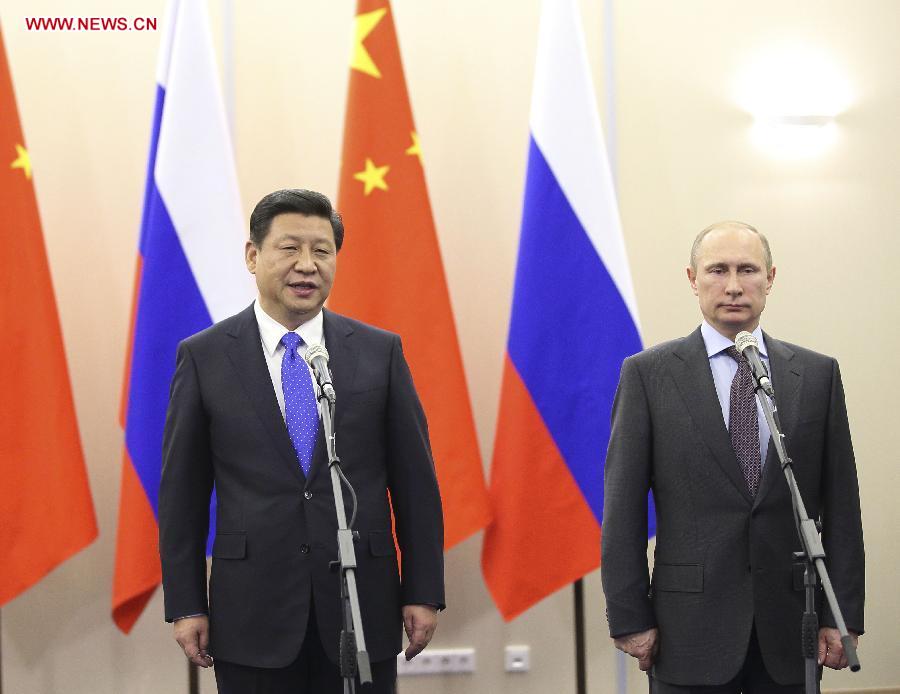
Xi, Putin hail Chinese, Russian sailors escorting Syrian chemical weapons shipments
Sochi 2014 Winter Olympics kick off with slopestyle debut
http://themoscownews.com/The first competition got under way at the Sochi Winter Games on Thursday as the sport of slopestyle made its much-anticipated Olympic debut.

Putin to visit China twice this year
itar-tass.comPresident Vladimir Putin will make two trips to China this year, presidential spokesman Dmitry Peskov said. “Putin will travel to Shanghai this spring, and then he will visit Beijing,” he said after a meeting between the leaders of the two countriesin Sochi on Thursday, February 6. Beijing is to host a G20 summit this year. Putin and Chinese President Xi Jinping discussed different issues, including economic and military-technical cooperation, international issues, and the situation on the Korean Peninsula, with a special focus on Syria. “Both leaders reaffirmed their commitment to close coordination in the international arena,” Peskov said, referring to the situation in Syria, among others. “We will continue to coordinate our actions,” he added. In his opinion, cooperation with China develops positively. He admitted that “there is the commercial side where each country defends its own interests.” “But this does not run counter to cooperation,” he said and named joint work to build a wide-bodied aircraft as an example. “We are at the very beginning of the road but we have agreed to step up our work,” Peskov said.
Interference in Ukraine is unacceptable - Russian and Chinese leaders

Moscow and Beijing condemn any attempts at external interference in the situation in Ukraine, the Russian president's spokesman Dmitry Peskov said. "Both parties have emphasized the unacceptability of any interference from the outside in what is happening and a very serious condemnation of such interference has been voiced," Peskov told reporters following the talks between Russian President Vladimir Putin and Chinese leader Xi Jinping."The sides aired much criticism of outside interference," Peskov said.

Russian President Vladimir Putin and his Chinese counterpart Xi Jinping wished victory to Russian and Chinese athletes at the Winter Olympics in the southern Russian city of Sochi on Thursday. "Over these days all Chinese residents celebrate the Lunar New Year. This is a family holiday with visits to relatives and close friends. Let's believe that we are close friends," Putin told Xi. The Russian leader greeted his Chinese counterpart on the Lunar New Year and wished a "successful performance to the Chinese olympic team."
"You have come precisely when the whole of China is celebrating the New Year, it is purely a family event, so let us think that such is the case: you have come to your closest friends," Putin said, wishing the Chinese team success at the Olympic Games. The Chinese president believes that he is celebrating "a double holiday"; the holiday of spring and the Olympics during his visit to Sochi. "The Winter Olympics is one of most important events on a global scale," he believes. In the view of the Chinese leader, the Sochi Olympics symbolises Russia's movement forward. "I am deeply convinced that the Olympics will be held at the highest level thanks to Russia's thorough organisation of the Games," Xi Jinping said. He hopes that "Chinese and Russian athletes will lead at upcoming competitions.
Bilateral relations between Russia and China are developing "incrementally," said Russian President Vladimir Putin. "Our political contacts are growing, with five high-level meetings scheduled for this year," Putin said after holding talks with Chinese leader Xi Jinping on Thursday. Cooperation also includes that between our security and military agencies, "including the military who are now ensuring the removal of chemical weapons from Syria," the Russian president said. Russia and China "are making a significant contribution to global development and security," Putin said. "As regards our bilateral ties, these are developing incrementally, despite everything seemingly being good anyway. We can feel the development, it is very noticeable and substantial," Putin said. Trade between the two countries has already reached $87 billion, with both nataions nearing the planned target of $100 billion, he said. I am very glad to see Xi Jinping, Putin added.
Saudi Arabia behind terrorism in Pakistan
 A prominent Pakistani cleric says Saudi Arabia is behind increasing terrorist attacks in the South Asian country, Press TV reports.
Sayyed Shafaqat Hussein Shirazi, the deputy secretary general of Majlis Wahdat-e-Muslimeen, which is the largest Shia political organization in Pakistan, made the remarks during a interview with Press TV on Thursday.
“Not one day passes without a martyr falling in Karachi, in Peshawar, in all Pakistani cities. If we have thirty days in a month, we have more than 100 martyrs every month. And they are being killed by the Saudi support. Saudi Arabia is supporting those who are behind these attacks,” Shirazi stated.
The cleric went on to say that some Pakistani officials have been practicing policies favored by Riyadh for their own personal gains.
Thousands of Pakistanis have lost their lives in terrorist attacks in recent years across the country. Terrorists target Muslim communities, especially Shia population.
About 400 Shia Muslims, including many professors, doctors and schoolchildren, were slain in 2013 in Pakistan, and dozens have been killed since the beginning of 2014, Human Rights Watch says.
According to former Pakistani Interior Minister Rehman Malik, the anti-Shia terrorist group Lashkar-e-Jhangvi, which is reportedly sponsored by Saudi Arabia, has been involved in 80 percent of terrorist incidents in the country.
Last month, a top Malaysian Sunni cleric said a plot involving the United States, Israel and Saudi Arabia had been hatched to cause sectarian conflict among Muslims.
“Saudi Arabia has been influenced by a US and European political game,” Abdul Hadi Awang told Press TV on January 18.
“The Saudis and other Arab countries have turned their lands into Western bases. They do this not to support Islam but to gain power,” added Awang, who is the president of the Parti Islam SeMalaysia, an Islamic political party in Malaysia.
“This makes us (feel) sorry that the Saudi government has been made to serve Israeli and Western interests,” he stated.
A prominent Pakistani cleric says Saudi Arabia is behind increasing terrorist attacks in the South Asian country, Press TV reports.
Sayyed Shafaqat Hussein Shirazi, the deputy secretary general of Majlis Wahdat-e-Muslimeen, which is the largest Shia political organization in Pakistan, made the remarks during a interview with Press TV on Thursday.
“Not one day passes without a martyr falling in Karachi, in Peshawar, in all Pakistani cities. If we have thirty days in a month, we have more than 100 martyrs every month. And they are being killed by the Saudi support. Saudi Arabia is supporting those who are behind these attacks,” Shirazi stated.
The cleric went on to say that some Pakistani officials have been practicing policies favored by Riyadh for their own personal gains.
Thousands of Pakistanis have lost their lives in terrorist attacks in recent years across the country. Terrorists target Muslim communities, especially Shia population.
About 400 Shia Muslims, including many professors, doctors and schoolchildren, were slain in 2013 in Pakistan, and dozens have been killed since the beginning of 2014, Human Rights Watch says.
According to former Pakistani Interior Minister Rehman Malik, the anti-Shia terrorist group Lashkar-e-Jhangvi, which is reportedly sponsored by Saudi Arabia, has been involved in 80 percent of terrorist incidents in the country.
Last month, a top Malaysian Sunni cleric said a plot involving the United States, Israel and Saudi Arabia had been hatched to cause sectarian conflict among Muslims.
“Saudi Arabia has been influenced by a US and European political game,” Abdul Hadi Awang told Press TV on January 18.
“The Saudis and other Arab countries have turned their lands into Western bases. They do this not to support Islam but to gain power,” added Awang, who is the president of the Parti Islam SeMalaysia, an Islamic political party in Malaysia.
“This makes us (feel) sorry that the Saudi government has been made to serve Israeli and Western interests,” he stated.
Pakistan's Taliban TV: How a triple murder in Karachi left the Taliban not just making headlines, but writing them, too.
 http://www.foreignpolicy.com/
How the Pakistani media caved on live TV to terrorists' demands.
How a triple murder in Karachi left the Taliban not just making headlines, but writing them, too.On Jan. 17, gunmen on motorbikes fired 17 shots into the back of a TV van in Karachi, killing three employees of the Express News, one of Pakistan's most popular media outlets. At first glance, the event might seem unremarkable in Pakistan's increasingly violent political environment. Viewed against the backdrop of the Pakistani Taliban's (TTP) reinvigorated campaign against the media, however, it could mark a watershed moment for independent journalism in the country. Those who were killed -- a guard, a driver, and a technician -- were caught in a clash of public opinion, one that's pitted Pakistan's burgeoning independent media against extremist militants vying for control of the country. Pakistan has long been one of the most dangerous countries for journalists, and the sixth most dangerous in the world, according to the Committee to Protect Journalists. But attacks on the media have generally been aimed at silencing particular individuals -- like leading investigative journalist Saleem Shahzad, whose brutalized body was found in a canal in 2011 after he reported on connections between Pakistan's infamous Inter-Services Intelligence agency (ISI), the country's navy, and al Qaeda militants. But the attacks on the Express, which preceded a detailed fatwa spelling out what kind of reportage the TTP would tolerate, could mark the beginning of something else entirely: a wholesale targeting of the press as part of the organization's propaganda war against the Pakistani state. "The way that Express News is being picked out and targeted, makes absolutely clear that we are being given some sort of message," Fahd Husain, director of news at Express TV, said as the network shifted into live coverage of its murdered employees. Not long after, while the bodies of the slain still lay under white sheets, TTP spokesman Ehsanullah Ehsan called in to the channel to take responsibility for the shooting: "Express TV, like a lot of other Pakistani media outlets, is acting as propagandists against the Pakistani Taliban," he said in an attempt to justify the attack on live TV. What happened next was even more astonishing: Express anchor Javed Chaudhry began to negotiate a sort of informal peace settlement with the TTP, offering coverage on demand in exchange for security. "I will guarantee to you that in the future, if there are any instances of terrorism, or instances that the state considers to be 'terrorism' or an attack, and the Taliban accepts responsibility for it, we'll give you proper space to give your point of view that will be broadcast on TV or detailed in newspapers without any slant," Chaudhry said on air. "But for this, I'd like a guarantee from you that you won't attack anyone in the media." Ehsan, the TTP spokesman seemed amenable to the offer: "Of course, God willing," he replied before adding a critical caveat. "I'll promise you that if the Pakistani media gets out of the war and holds to its practice of journalism and doesn't promote propaganda then we won't have to attack them." Chaudhry then proceeded to sweeten the deal, telling Ehsan that the TTP should feel free to call him or the newsroom at any time to share their perspective through Express TV or the Express Tribune. The network issued no formal statement after this bizarre interaction, and executives have refused to comment on whether or not the network has endorsed the on-air deal. The attempt to trade professionalism for safety predictably infuriated many Pakistani journalists. "It's an insult not only to the idea of an independent media, but to those of his colleagues who were just killed not even an hour ago," said Shehryar Rizwan, an editor at Dawn, Pakistan's largest English-language newspaper. Others, like journalist Gharidah Farooqi and Meheen Usmani, a blogger, took to Twitter to air their disdain for the Pakistani network. Even beyond ethical concerns, some pointed out, it would be virtually impossible for reporters to fully meet the TTP's demands and still do anything resembling journalism. Militant organizations in Pakistan have been known to threaten media outlets that don't carry their statements word-for-word. According to Malik Siraj Akbar, the founder and editor-in-chief of the English-language newspaper Baloch Hal, this might require referring to Shiites as "kafirs or non-Muslims or people who deserve to be killed." Publishing such statements, of course, would only incite continued violence, but by refusing to do so, journalists risk incurring the wrath of the militants themselves. Such trepidation has already compromised the caliber of journalism in Pakistan. Akbar, who fled Pakistan for the United States in 2010 but still edits Baloch Hal, said that it has been years since his newspaper printed bylines for fear of reprisals against individual journalists. He also refuses to assign stories that present too grave a risk for reporters. "[A]t times we take a step back where we tell people to stay away," he said in a telephone interview. "There have been a lot of times when we've had to restrict ourselves from covering those stories." Umar Cheema, a former investigative reporter for The News, a Pakistani daily, who in 2010 was abducted and beaten by militants allegedly connected to the ISI, sees a similar decline in the quality of reportage on extremism. "There is no in-depth coverage of militancy in Pakistan -- neither media houses are interested nor journalists and this is out of fear," said Cheema, who recently launched the Center for Investigative Reporting in Pakistan in order to support what he sees as an industry under threat. "When [the] state is unable to protect its citizens and rather faces allegations of double games, [the] media feels having become sandwiched between the two." Days after the attack on the Express News, on Jan. 23, the TTP released a 29-page fatwa detailing the sort of reportage that it would consider "propaganda" against its goal of establishing an Islamic emirate in the country -- along with a hit-list of nearly two dozen journalists which has been delivered to media outlets but not released to the general public. The fatwa states that the TTP will not tolerate being characterized as a "terrorist" group, despite the fact that it's a "banned organization" upon which the government has formally declared war. Referencing official policies or framing events in terms of Pakistani laws is also prohibited: The fatwa declares that the media should accept Islamic law, or sharia, as the ultimate authority in Pakistan. "The media give too much importance to secular policies," the fatwa reads, "when the Quran and ways of the Prophet Mohammed should be accepted as the law of the land." Husain, the director of news at the Express, said he doesn't know why his organization has been singled out by the TTP. "We don't believe that we are being biased or unjust in our coverage. We do not believe that we have violated any basic norms of journalism," he said in a telephone interview from Lahore. "We are ... therefore very surprised and concerned that Express News is being targeted." Other journalists see the attack on the Express and subsequent fatwa as the opening volleys in a broader campaign to silence the media. According to Akbar, of Baloch Hal, the TPP is "targeting one organization and making an example out of it." He added, "There are reporters who have not been personally and directly threatened, but everybody sees it coming. ... If they are targeting Express, we are sure they are also observing our organization to see what we are reporting, so everyone has voluntarily begun to take precautionary measures to stay safe." This is not the first time the TTP has issued a fatwa against journalists, but it is the first time it has addressed one to media outlets in general. Following the attack on education activist Malala Yousafzai in 2012, for example, the TTP attempted to silence several regional outlets, as well as the BBC and two leading Pakistani journalists. According to Daud Khattak, who heads Radio Mashaal, a U.S.-funded news radio program that operates in the Pakistani tribal areas, reporters who covered the TTP attack on Yousafzai received specific threats by phone. In his view, the latest fatwa can be read as a more detailed version of the militant group's 2012 pronouncement. Reporters have long faced security concerns when reporting from cities like Karachi or Quetta, where targeted killings and sectarian violence are rife, or in the country's north, where bombings have become an almost daily phenomenon in recent months. So far in 2014, there have been more than 30 terrorist attacks across the country, including one on a military compound in the northwestern city of Bannu that left at least 20 members of a government-led paramilitary unit dead, and just days later, a suicide bombing near Pakistani Army headquarters in Rawalpindi, the capital's so-called "twin city," that left 13 dead. Both were claimed by the TTP. But as the TTP has intensified its campaign against the state in recent years, the security situation for journalists has deteriorated appreciably with no real increase in security from the government. According to Akbar, who joked that he once thought being stopped at airports or having hotel rooms raided was simply "a part of journalism," Pakistani journalists are now working in a considerably more hostile environment. "Now things have changed," he said, referring to the heightened threat posed by the TTP. "People will get killed before they even receive a threat." In the past, individual journalists would often receive threats if they veered too close to information intelligence agencies wanted to keep private or vexed militant organizations. The Committee to Protect Journalists reports that 29 journalists have been murdered in the country since 1992, and in all but one case, the killers never faced trial. (The lone case in which justice was served was that of Daniel Pearl, the Wall Street Journal reporter who was beheaded outside of Karachi almost exactly 12 years ago.) "Whoever wants to kill a journalist in Pakistan -- be it the Taliban, be it the government intelligence agencies, be it an irate businessman, or warlord of some sort -- I'm pretty sure that they can operate with complete impunity, and that's long been the case," said Bob Dietz, director of the Asia Program at the Committee to Protect Journalists. "I don't think that there's enough political will or enough political strength on the government to make Karachi safe for journalists, or for anyone else." In the wake of the Express attacks, the chief minister of Sindh, the province in which Karachi is located, promised to increase security for journalists and to conduct a full investigation into the attack -- something that is routinely promised but rarely delivers justice. "Police is investigating all criminal cases alike and this is one of them," Atiq Ahmad Shaikh, a spokesman for the Karachi police told Foreign Policy by email. "We cannot decrease or increase the importance of any case. However [with the victims] being from media they are closer to us as we both work for the same cause which is to restore our forgotten norms in society." Paradoxically, the intensification of the TTP's campaign against journalists may not be all bad news. Disconcerting as the latest fatwa is, Khattak of Radio Mashaal sees it as an indication that the Taliban are worried about declining public support. "In cities on an individual level they are inflicting terror, but on a public opinion level, people can tell that the Taliban are losing or beginning to lose," he said. "If you look from about 2009 on, public opinion has started to turn away from them to some extent." Talat Masood, a former three-star general in the Pakistani Army who now works as an independent security analyst, sees a similar motivation for targeting the press: "Whenever there is public outrage against [the TTP], they look to shut down the media in some way, because they think that whatever they are doing is for their country and their people and their idea of religion." "The Taliban are much more media savvy than our rulers," he said in a telephone interview from Islamabad. "The government and the state is already paralyzed ... so they are taking full advantage of that." At least in the short-term, unfortunately, the TTP's strategy appears to be paying off, whether because networks like Express are willing to negotiate under duress or because reporters are simply shying away from sensitive topics. Masood said he has seen fewer and fewer stories that deal at any length with the Taliban in recent years. Now that the TTP has formalized its campaign against the media in a fatwa, he expects even more self-censorship -- what he tellingly terms "self-preservation" -- in the future.
Report: Iranian President Donates $400,000 to Jewish Hospital
VOA NewsIranian news agencies report that President Hassan Rouhani has donated $400,000 to a Jewish hospital in Tehran. Rouhani was quoted as saying his government will pay more attention to Iran's minorities. The Dr. Sapir charity hospital was founded by and is operated by Jews, but treats all patients and has a large Muslim staff. At least 25,000 Jews live in Iran. It is the largest Jewish population in the Middle East outside Israel. President Rouhani's promise to attend to the needs of Iranian Jews is a sharp contrast to his predecessor Mahmoud Ahmadinejad, who denied the Holocaust and called for Israel's destruction.
India offers visa on arrival
http://www.thedailystar.net/
Bangladesh among 180 countries; existing system to continue for sometimeIn an effort to boost tourism, India has decided to extend visa-on-arrival facility to tourists from Bangladesh and 179 other countries with effect from October. The decision will hugely benefit Bangladeshi travellers who often face difficulties and have to spend a considerable amount of time for getting Indian visa. Around 5 lakh Bangladeshis, a large number of who are tourists, visit India every year. The Indian High Commission in Dhaka yesterday said there were no changes in the current visa procedures, and it advised Bangladeshi nationals to follow the procedures for visiting India. Eight countries have been kept out of the single-entry visa-on-arrival facility, meant for purposes other than paid employment and education with a one-month time limit. Those are Pakistan, Sudan, Afghanistan, Iran, Iraq, Nigeria, Sri Lanka and Somalia. "We have decided to extend visa-on-arrival to tourists from 180 nations. It will take five to six months to put the infrastructure in place,” India's Junior Minister for Planning and Parliamentary Affairs Rajiv Shukla told reporters after a Planning Commission meeting in New Delhi on Wednesday. "It is a major move and we hope it will boost tourism in a big way. We hope to implement this from the next tourist season starting October,” said the minister. The facility could later be extended to business visa seekers, Shukla said. The Indian minister said the proposal was cleared at the meeting attended by Deputy Chairman of the Commission Montek Singh Ahluwalia, Foreign Secretary Sujatha Singh and other senior officials. India currently provides the facility to 11 countries, including New Zealand, Singapore, Luxembourg, Japan, Vietnam and Finland. Foreign tourist arrivals in India stood at 6.84 million in 2013, and the latest decision to extend visa-on-arrival is expected to provide a major boost to the number of tourists. To begin with, necessary infrastructure will be put in place around 26 airports, including those in Kolkata, Delhi, Mumbai and Chennai, to provide the facility. A website will be launched for extending the facility to foreigners intending to visit India as tourists. They will need to fill a simple form, pay the required fee with a bank card and apply for visa on the designated website. And they will be issued with electronic travel authorisation within three days. On arrival in India, a simple biometric identification will be done at the airport. If anyone wants to extend his stay beyond 30 days, he will have to get another visa from the authorities. The Indian High Commission in Dhaka issued a press release yesterday to clarify the reports in the Indian media on the future changes in visa procedures. A spokesperson for the High Commission said the current visa procedures remained unchanged as far as Bangladesh was concerned. The present online system for all visa applications continues, and if any change is made to the existing system, it will be made public through announcements, added the spokesperson.
New Film, Protests Highlight Disappearances In Pakistan

The families of suspected Baloch separatists, dubbed "missing persons," claim their loved ones are being abducted by Pakistani security agencies without charges. These family members, as well as human-rights watchdogs, claim that the suspected Baloch separatists are frequently killed and their bodies dumped. Others remain missing years after having been picked up. A new short film, "The Line of Freedom," hopes to shed light on this largely forgotten crisis. It depicts the story of a Baloch activist who was abducted and tortured and then dumped after being shot. The movie is based on the "true" story of a young Baloch activist, Nasir Baloch. Activists in the region claim Baloch was abducted twice in 2011. He reportedly survived the first abduction after he was shot and left for dead. He was later killed after being kidnapped for a second time while on his way to the doctor to treat his wounds. The thriller was produced by Baloch political activist Noordin Mengal, his brother Bhawal Mengal, and British filmmaker David Whitney. Mengal says his aim was to spread awareness about the problems in the province.The issue is also kept alive by family members of some of the victims of the disappearances in Balochistan. They are now holding a 700-kilometer-long march from Balochistan's provincial capital, Quetta, to Pakistan's largest city, Karachi. The protest, which began in late October, is being led by Mama Qadeer Baloch, whose son, Jalil Reiki, was abducted in 2009. His bullet-riddled body was found dumped in a remote corner of Balochistan in 2011. Global human-rights watchdogs have criticized Islamabad for its "kill and dump" operations in Balochistan. A February 2012 briefing by Amnesty International noted that at least 249 Baloch activists, teachers, journalists, and lawyers disappeared or were abducted from October 2010 to September 2011. The briefing called on Islamabad to "immediately put an end to the practice of enforced disappearance, arbitrary detention, torture, and extra-judicial and other unlawful killings carried out with total impunity by state forces in Balochistan." In a July 2011 report titled "We Can Torture, Kill, or Keep You for Years," Human Rights Watch (HRW) documented the "detailed descriptions of 45 cases of alleged enforced disappearances reported in Balochistan in 2009 and 2010." It called on Islamabad to "investigate all allegations of enforced disappearances until the fate of each victim is clearly and publicly established." For years, the Pakistani Supreme Court has heard cases about the abductions but failed to push the authorities to either release the victims or hold transparent investigations into the issue. Elected civilian leaders in Balochistan have publicly admitted their failure in resolving the problem. Military officials, however, have largely been ambiguous about the practice. Authorities in Balochistan now confirm some 2,500 people in the province remain "missing" since their arrest. Balochistan authorities say more than 590 mutilated bodies have been found in the province since 2010. Baloch activists allege that more than 10,000 people, most of them sympathetic to separatists, have disappeared under unclear circumstances.
Pakistan: Taliban talks to Taliban in the name of govt-TTP dialogue
www.shiitenews.comAfter Government and Taliban (TTP)’s Committees held first meeting in Islamabad’s Khyber Pakhtunkhwa House, Government committee’s coordinator Irfan Siddiqui heaved a sigh of relief that there was no difference between the two committees.

US freezes assets of Pakistan-based Haqqani militants
 The Obama administration, under pressure from Congress to act against Pakistan-based militants blamed for fueling violence in Afghanistan, moved on Wednesday to freeze the assets of three suspected militants linked to the hard-line Haqqani network.
The treasury department said that Saidullah Jan, Yahya Haqqani and Muhammad Omar Zadran had been named "specially designated global terrorists," meaning that assets belonging to the men within US jurisdiction would be frozen.
US citizens are also barred from doing business with the three men.
The Obama administration has been struggling to contain the Haqqani network, which it blamed for involvement in a number of bold, high-profile attacks on US and Western interests in Afghanistan, for years.
The group is believed to be based in tribal regions of Pakistan, near the border with Afghanistan.
"Today's action underscores our resolve to continue targeting any potential means of support for the Haqqanis," David Cohen, a senior Treasury official, said in the statement.
Muhammad Omar Zadran was also named for having links to the Afghan Taliban.
In 2011, the United States' former top military official, Mike Mullen, made waves by calling the group a "veritable arm" of Pakistan's powerful intelligence service, ISI. In September 2012, the state department officially designated the group as a "foreign terrorist organization."
Some in Congress have pushed the administration in recent months to go after the network more aggressively. In November, six members of Congress, including Mike Rogers, chairman of the House intelligence committee, and Ed Royce, chairman of the House foreign affairs committee, sent Obama a letter asking him to document US steps against the group and calling efforts to date "woefully insufficient."
"We know the Haqqani network continues to plan potentially catastrophic attacks against US interests and personnel in Afghanistan," the lawmakers said in the letter.
Since then, Obama administration officials have briefed Congress on the issue, but some lawmakers appear to remain dissatisfied. In December, as part of an annual defense spending bill, lawmakers required the administration to report back on its efforts to disrupt the Haqqani group.
Some US officials have been reluctant to take steps against the Haqqani network that might jeopardize the administration's ability to initiate peace talks between the Afghan government and its militant opponents.
The decision to freeze suspected Haqqani militants' assets came as the Obama administration moves to wind down its 12-year-long war in Afghanistan.
This week, President Barack Obama met with senior military commanders to discuss the US military presence in Afghanistan. Officials have planned to keep a modest US force there after this year, if the Afghan government will agree to sign a bilateral security deal that authorizes a foreign military presence after 2014.
Lawmakers also expressed concerns on Wednesday about how well Afghanistan would be able to combat a thriving drug trade as foreign troops withdraw. Poppy cultivation in Afghanistan, the world's largest producer of the crop used to make heroin and opium, hit an all-time high last year.
"All of our counter-narcotics efforts in Afghanistan to this point have relied heavily on a robust US military presence," Ileana Ros-Lehtinen, a Republican on the House foreign affairs committee, said during a House hearing.
William Brownfield, a senior state department official, said there had been "encouraging progress" in the ability of Afghanistan's fragile government to fight the drug trade, but added there was "no silver bullet" for dealing with the issue.
The Obama administration, under pressure from Congress to act against Pakistan-based militants blamed for fueling violence in Afghanistan, moved on Wednesday to freeze the assets of three suspected militants linked to the hard-line Haqqani network.
The treasury department said that Saidullah Jan, Yahya Haqqani and Muhammad Omar Zadran had been named "specially designated global terrorists," meaning that assets belonging to the men within US jurisdiction would be frozen.
US citizens are also barred from doing business with the three men.
The Obama administration has been struggling to contain the Haqqani network, which it blamed for involvement in a number of bold, high-profile attacks on US and Western interests in Afghanistan, for years.
The group is believed to be based in tribal regions of Pakistan, near the border with Afghanistan.
"Today's action underscores our resolve to continue targeting any potential means of support for the Haqqanis," David Cohen, a senior Treasury official, said in the statement.
Muhammad Omar Zadran was also named for having links to the Afghan Taliban.
In 2011, the United States' former top military official, Mike Mullen, made waves by calling the group a "veritable arm" of Pakistan's powerful intelligence service, ISI. In September 2012, the state department officially designated the group as a "foreign terrorist organization."
Some in Congress have pushed the administration in recent months to go after the network more aggressively. In November, six members of Congress, including Mike Rogers, chairman of the House intelligence committee, and Ed Royce, chairman of the House foreign affairs committee, sent Obama a letter asking him to document US steps against the group and calling efforts to date "woefully insufficient."
"We know the Haqqani network continues to plan potentially catastrophic attacks against US interests and personnel in Afghanistan," the lawmakers said in the letter.
Since then, Obama administration officials have briefed Congress on the issue, but some lawmakers appear to remain dissatisfied. In December, as part of an annual defense spending bill, lawmakers required the administration to report back on its efforts to disrupt the Haqqani group.
Some US officials have been reluctant to take steps against the Haqqani network that might jeopardize the administration's ability to initiate peace talks between the Afghan government and its militant opponents.
The decision to freeze suspected Haqqani militants' assets came as the Obama administration moves to wind down its 12-year-long war in Afghanistan.
This week, President Barack Obama met with senior military commanders to discuss the US military presence in Afghanistan. Officials have planned to keep a modest US force there after this year, if the Afghan government will agree to sign a bilateral security deal that authorizes a foreign military presence after 2014.
Lawmakers also expressed concerns on Wednesday about how well Afghanistan would be able to combat a thriving drug trade as foreign troops withdraw. Poppy cultivation in Afghanistan, the world's largest producer of the crop used to make heroin and opium, hit an all-time high last year.
"All of our counter-narcotics efforts in Afghanistan to this point have relied heavily on a robust US military presence," Ileana Ros-Lehtinen, a Republican on the House foreign affairs committee, said during a House hearing.
William Brownfield, a senior state department official, said there had been "encouraging progress" in the ability of Afghanistan's fragile government to fight the drug trade, but added there was "no silver bullet" for dealing with the issue.
In Pakistan, outlawed terrorists back in limelight
 Mast Gul, who escaped after Charar-e-Sharif gunfight in 1995, was seen with TTP militant at a press conference in North Waziristan
Not long after Jaish-e-Mohammed (JeM) founder Maulana Masood Azhar addressed a rally in Muzaffarabad by telephone, another terrorist, Mast Gul, who escaped after a massive gun battle at Charar-e-Sharif, near Srinagar in 1995, surfaced on Wednesday and was photographed at a press conference in North Waziristan.
While the government has offered the Tehreek-e-Taliban Pakistan (TTP) another chance of a dialogue, the bombings have not stopped.
Yesterday, Dawn reported from Miramshah that the TTP Peshawar chief Mufti Hasan Swati claimed responsibility for the bombing of a hotel frequented by Shia travelers in Qissa Khawani bazaar in Peshawar.
A photograph with Swati flanked by Haroon Khan alias Mast Gul, the Hizbul Mujahideen commander was also carried. Swati said Mast Gul was the militant commander who was responsible for the Peshawar attacks.
The report said Gul had escaped an ambush near Peshawar in 2003 and his whereabouts were unknown since then. Swati also said the Peshawar attacks were carried out at the behest of TTP second in command Sheikh Khalid Haqqani, even as the TTP has denied that it had anything to do with the bombings in Peshawar. The suicide bombing of the hotel was to avenge the death of madrassa students in Rawalpindi during Moharram, it was stated.
Earlier on January 26, 2014, JeM addressed a huge rally and its founder Maulana Masood Azhar spoke over the telephone. News reports said the rally was held to launch a book by Azfal Guru who was convicted and hung in 2013 for his role in the 2001 attack on the Indian Parliament.
Maulana Azhar was one of the militants freed by India in exchange for the release of passengers and crew of the hijacked Indian Airlines plane which was taken to Kandahar. He formed the JeM in 2000, after
he returned to Pakistan. JeM was banned along with the Lashkar-e-Toiba and others by former president General (retd) Pervez Musharraf.
Among other things, Azhar vowed revenge for the execution of Afzal Guru in his speech. United Jihad Council head Syed Salahuddin and Azhar's younger brother Mufti Abdul Rauf Asghar also addressed
the rally. Azhar was never in custody and continued his activities as a militant, news reports said.
Mast Gul, who escaped after Charar-e-Sharif gunfight in 1995, was seen with TTP militant at a press conference in North Waziristan
Not long after Jaish-e-Mohammed (JeM) founder Maulana Masood Azhar addressed a rally in Muzaffarabad by telephone, another terrorist, Mast Gul, who escaped after a massive gun battle at Charar-e-Sharif, near Srinagar in 1995, surfaced on Wednesday and was photographed at a press conference in North Waziristan.
While the government has offered the Tehreek-e-Taliban Pakistan (TTP) another chance of a dialogue, the bombings have not stopped.
Yesterday, Dawn reported from Miramshah that the TTP Peshawar chief Mufti Hasan Swati claimed responsibility for the bombing of a hotel frequented by Shia travelers in Qissa Khawani bazaar in Peshawar.
A photograph with Swati flanked by Haroon Khan alias Mast Gul, the Hizbul Mujahideen commander was also carried. Swati said Mast Gul was the militant commander who was responsible for the Peshawar attacks.
The report said Gul had escaped an ambush near Peshawar in 2003 and his whereabouts were unknown since then. Swati also said the Peshawar attacks were carried out at the behest of TTP second in command Sheikh Khalid Haqqani, even as the TTP has denied that it had anything to do with the bombings in Peshawar. The suicide bombing of the hotel was to avenge the death of madrassa students in Rawalpindi during Moharram, it was stated.
Earlier on January 26, 2014, JeM addressed a huge rally and its founder Maulana Masood Azhar spoke over the telephone. News reports said the rally was held to launch a book by Azfal Guru who was convicted and hung in 2013 for his role in the 2001 attack on the Indian Parliament.
Maulana Azhar was one of the militants freed by India in exchange for the release of passengers and crew of the hijacked Indian Airlines plane which was taken to Kandahar. He formed the JeM in 2000, after
he returned to Pakistan. JeM was banned along with the Lashkar-e-Toiba and others by former president General (retd) Pervez Musharraf.
Among other things, Azhar vowed revenge for the execution of Afzal Guru in his speech. United Jihad Council head Syed Salahuddin and Azhar's younger brother Mufti Abdul Rauf Asghar also addressed
the rally. Azhar was never in custody and continued his activities as a militant, news reports said.
Hizbul commander Mast Gul resurfaces in Peshawar
 Hizbul Mujahideen leader Mast Gul, involved in the 1995 siege of Charar-e-Sharief shrine in Jammu and Kashmir, was behind a suicide attack on Shias in Peshawar that killed nine persons, a Pakistani Taliban commander has said.
Mufti Hasaan Swati, who claims to be the Tehrik-e-Taliban Pakistan (TTP) commander for Peshawar area, told reporters he had tasked Mast Gul alias Haroon Khan to carry out attacks on the Shia minority, including the suicide bombing of a hotel on Tuesday.
Swati described Mast Gul as a “militant commander for Peshawar”, the Dawn daily reported today.
He spoke to reporters along with Mast Gul at Miranshah in the restive North Waziristan tribal region yesterday.
The daily carried a photo of Swati and Mast Gul sitting together before a Taliban banner, AK-47 assault rifles in their hands.
This is the first time in over a decade that 47-year-old Mast Gul has been seen in public. Little was known of his whereabouts since he was injured in an ambush near Peshawar in August 2003.
Hizbul Mujahideen leader Mast Gul, involved in the 1995 siege of Charar-e-Sharief shrine in Jammu and Kashmir, was behind a suicide attack on Shias in Peshawar that killed nine persons, a Pakistani Taliban commander has said.
Mufti Hasaan Swati, who claims to be the Tehrik-e-Taliban Pakistan (TTP) commander for Peshawar area, told reporters he had tasked Mast Gul alias Haroon Khan to carry out attacks on the Shia minority, including the suicide bombing of a hotel on Tuesday.
Swati described Mast Gul as a “militant commander for Peshawar”, the Dawn daily reported today.
He spoke to reporters along with Mast Gul at Miranshah in the restive North Waziristan tribal region yesterday.
The daily carried a photo of Swati and Mast Gul sitting together before a Taliban banner, AK-47 assault rifles in their hands.
This is the first time in over a decade that 47-year-old Mast Gul has been seen in public. Little was known of his whereabouts since he was injured in an ambush near Peshawar in August 2003.
Pakistan: Demanding justice: Shia leaders cite govt’s failure over attacks
The Express TribuneExpressing frustration and anger over relentless incidents of sectarian attacks, Shias have demanded the government and security agencies carry out a crackdown against the perpetrators to ensure protection of lives and property of the masses. Speaking at a news conference at the Peshawar Press Club on Wednesday, Majlis-e-Wahdat-ul-Muslimeen leader Jawad Hadi said the government and security agencies have failed to take action against terrorist organisations which are allegedly involved in the massacre of innocent people in Peshawar and other parts of the province. The Shia community, he said, has been under constant attack over the past few days in the provincial capital. “The recent suicide attack on Anjuman-e-Momineen Pak Hotel was a cowardly act, in which innocent people, including women and children belonging to the Shia sect, were killed,” said Hadi while referring to Tuesday’s suicide blast outside a hotel in Qissa Khwani. At least nine people were killed while over 60 others were injured. Shia Ulema and leaders Khurshid Anwar Jawadi, Asghar Rahjani, Abid Ali Shakari, Arif Hussain Hassaini, Pak-Hotel President Askar Ali, Imamia Student Organisation Peshawar Senior Vice President Bilal and members of the Shia community were present at the conference. Hadi claimed terrorist groups were also reportedly involved in killing two Shia leaders Allama Musvi and Sardar Ali Asghar a few days back. He said terrorists have not spared mosques, imambargahs, bazaars and residential areas as people have been targeted everywhere. “We demand appropriate steps for security and protection of lives and property of everyone,” he said, warning they will not tolerate any more bloodshed of innocent lives. “The government and security agencies need to take stern and sustainable action against terrorists to prevent the massacre of innocents,” he demanded. Hadi said such incidents are done to create rifts among different sects but the nefarious mission will not bear fruit. “These terrorist groups are posing a serious security threat to the solidarity of the country and need to be eliminated.” He also urged the judiciary to pass orders against these organisations by following the constitution and law. Earlier, Shia leaders along with activists of Imamia Students Organization protested on Sher Shah Suri Road against Tuesday’s suicide blast. The protesters held placards and shouted slogans demanding the government arrest those behind the attack. They also asked for a special Shuhada package for families of the deceased and injured, and compensation for the damaged infrastructure of the building.
Pakistan: humiliation of the state
By Dr Mohammad Taqi
Mr Sharif has started an open-ended process without defining the brief he has given his committee, and what it means for those already affected by terrorism. Neither Mr Sharif nor his team apparently knows what their bottom line isThe history of talks between the Pakistani state and the Tehreek-e-Taliban Pakistan (TTP), and its antecedents, is long and has repeated itself a good 14 times as a grave tragedy. This time around it is playing out as a farce. No nuclear-armed state has been humiliated quite so thoroughly at the hands of some armed thugs as is happening in Pakistan. Whatever the outcome of this dialogue melee, the state has disgraced itself monumentally, perhaps even irreparably, along the way. By comparison, Corps Commander Peshawar Lieutenant General Safdar Hussain garlanding the Taliban thug Nek Muhammad Wazir after signing the 2004 Shakai peace deal, may look majestic today. If Prime Minister (PM) Nawaz Sharif’s idea of privatising the negotiations was to have some sort of a plausible deniability or keep his government’s involvement low key, the TTP checkmated him in one shrewd move. The TTP took everyone, including its most allied allies, by surprise when it pulled the emissary/arbitration committee rabbit out of the negotiations hat. If Mr Sharif’s idea was to merely exhaust the dialogue option and ultimately put the onus of any failed parleys on the TTP, the latter has put that hot potato back in his hands. A committee announced by the PM in parliament, in full media glare, simply cannot be considered an informal body and expected to have a low profile. The PM has to own his committee’s success and/or failure. Once the PM decided to carry out a dialogue it would have been better to appoint government officials for formal discussions. The Awami National Party (ANP) had conducted talks with the TTP in Malakand through its party and government officials in perhaps the most sober manner done in Pakistan thus far. As repulsive as the idea of negotiating with the terrorists is, the ANP’s methodology was a template that could have served Mr Sharif well and saved the political dispensation from becoming the laughing stock that it has now become. On the other hand, if the PM’s four-member committee was supposed to be an exploratory team for establishing proximity with the terrorists via a track two, the open announcement may have defeated that purpose. Historically, several journalists, spies and bureaucrats have served as emissaries and even ambassadors. There is nothing wrong as such in picking non-politicians for negotiations. The late Mr Zulfikar Ali Bhutto had sent the former editor of The Pakistan Times, Mr Mazhar Ali Khan, as an informal envoy to meet Sheikh Mujibur Rehman. Mr Bhutto later took Mazhar sahib along to Simla to help as an additional conduit to Mrs Indira Gandhi. However, then again, the quality of the leadership, the stature of the emissary and the political finesse involved then made it a dignified affair, compared to the circus we are witnessing today. To his credit, a member of Mr Sharif’s committee, the veteran journalist Mr Rahimullah Yousufzai, is perhaps the most reasonable voice in a matter that increasingly looks like the dialogue of the Taliban, by the Taliban and for the Taliban. In an interview with Mr Rahman Bunairee of the Voice of America’s Pashto service, Deewa Radio, Mr Yousafzai hoped to persuade the TTP towards a ceasefire. He also spoke about getting, apparently, through to the PM, the Pakistan army and the US drones to stop hitting TTP targets but quite ominous was his expectation that the TTP would demand hundreds of hardened terrorists released. Equally worrying was his complete silence over any obligation for reparations on the TTP for the atrocities it has committed against thousands of civilians all over Pakistan, especially in FATA and Khyber Pakhtunkhwa. And therein lies the rub: Mr Sharif has started an open-ended process without defining the brief he has given his committee, and what it means for those already affected by terrorism and those who will be in future. Neither Mr Sharif nor his team apparently knows what their bottom line is. The public’s opinion had gradually been shifting towards a decisive action against the TTP until Mr Nawaz Sharif’s speech in the National Assembly pulled the rug from even under his own feet. He may have bought some time to buttress his Punjab fortress against the expected counterattack from the TTP-allied jihadists there but that reprieve will not be long lasting. The TTP pounced on the opportunity Mr Sharif provided them by backing down from what they perceived was an imminent action. The terrorists have been playing the Sharif government like a fiddle while bombing innocents to smithereens, like Tuesday’s attack in Peshawar’s Shia-populated Risaldar Street. The intensely focused TTP seems like the only ones out there who know exactly what they want, including from their dialogue ruse, and how to accomplish it. The terrorists virtually control the narrative through violence against the media and via their highly visible partisans within its ranks. Mr Sharif has not just ceded time to the TTP to reorganise but also precious political space, which he may find difficult to recapture in the near future. The sly TTP is not leaving much to chance. It did not hesitate to test the allegiance even of its ideological granddaddy Maulana Samiul Haq and its most vociferous advocate, Chairman of the Pakistan Tehreek-e-Insaf (PTI) Mr Imran Khan. The PTI chief has since tried to weasel out of his well-earned nomination as the TTP’s confidant. His party turned down the TTP nomination via a statement that “appreciates the trust reposed in its chairman”. I suspect this might not be the last time the TTP will hold Mr Imran Khan’s feet to the fire. The TTP had, after all, neutralised the PTI’s electoral opponents, the ANP. It will exact its pound of flesh and will not be satiated by the PTI reiterating pledges like a political office for the terrorists. The TTP’s fellow travellers will not be able to backtrack this late in the game; they will have to pay up. The Pakistani state, under Mr Nawaz Sharif, seems to be on all fours now. The fear of a backlash in Punjab appears to have kept Mr Sharif from doing anything to stem the bleeding in the three other provinces, and FATA. However, more disconcerting is how he has gone about doing it. If the PM had been fumbling before, his delegating responsibility to people outside parliament in a speech made in that august house, suggests he has dropped the ball completely. Mr Nawaz Sharif might muddle through this tragic-comic round of talks but the humiliation the Pakistani state has suffered on his watch will not wash off easily.
لشکرجھنگوی کا مرکز پنجاب ہے ان کے خلاف آپریشن کیا جائے: رحمان ملک
http://ur.smnetwork.com.pk/?p=13639سابق وفاقی وزیرداخلہ رحمان ملک نے کہاہے کہ طالبان مذاکرات میں سنجیدہ ہیں توسیز فائر کااعلان کریں۔ دہشتگردوں کے ساتھ آئین کے مطابق مذاکرات نہیں ہوسکتے۔ نجی ٹی وی کوانٹرویودیتے ہوئے انہوں نے کہاکہ طالبان اور دہشت گرد پاکستان کوکمزورکررہے ہیں۔ پاکستان کا دہشتگردی بے انتہاء جانی ومالی قربانیاں دے چکاہے ۔ امن کے قیام کیلئے حکومت اورطالبان کوسنجیدہ اقدامات کرنے چاہئیں ۔انہوں نے کہاکہ طالبان حکومت سے مذاکرات کیلئے سنجیدہ ہیں تو سیز فائر کا اعلان کریں اورحکومت طالبان کوکالعدم لسٹ سے نکال دے ۔طالبان حکومت سے مذاکرات کیلئے رہنماقائدین کی لسٹ دیں اورسنجیدگی کامظاہرہ کریں ۔ انہوں نے کہاکہ طالبان کوافغانستان سے کنٹرول کیاجارہاہے اوربیرونی قوتیں ان کوفنڈزدیتی ہیں ،پاکستان مخالف قوتیں مذاکرات ناکام بنانے کیلئے ہرطریقہ استعمال کریں گی ۔رحمان ملک نے کہاکہ حکومت پاکستان ملافضل اللہ کی حوالگی کیلئے افغانستان حکومت پردباؤاستعمال کرے تاکہ امن قائم ہوسکے ۔انہوں نے کہاکہ کراچی میں طالبان اور غیرملکی تنظیمیں دہشتگردی میں ملوث ہیں اورمرکزی کردارلشکرجھنگوی کاہے ۔انہوں نے حکومت سے مطالبہ کیاکہ وفاقی حکومت جنوبی پنجاب ،جھنگ،وزیرستان اورکراچی کے علاقوں میں دہشتگروں - See more at: http://ur.smnetwork.com.pk/?p=13639#sthash.6pGkBLxQ.dpuf
Pakistan: PPP wants debate in parliament on Karachi N-reactors
The Pakistan People’s Party (PPP) wants the government to take parliament and the nation into confidence on the issue of building of two nuclear reactors in Karachi reportedly with untested designs that can cause a fatal mishap. The government is expected to come out with a policy statement on Thursday when the Senate will take up a “Call Attention Notice” moved by PPP’s Saeed Ghani on the subject, Dawn has learnt. Through the notice, Senator Ghani has drawn attention of the government “to a matter of sufficient public importance regarding building of two new nuclear reactors in Karachi with a new and untested design, which can prove a safety threat” to millions of people living in the city. Nuclear, environment and health experts have been voicing serious concerns in public over the government’s decision to invite Chinese firms to build two nuclear plants of untested design near Karachi. The plants are projected to generate 1,200MW of electricity after completion. Talking to Dawn, Mr Ghani said that people of Karachi were perturbed after watching debates on TV shows and different seminars and conferences about a possible threat to the city because of the proposed setting up of two nuclear plants with the help of China. He said that though the officials of the Pakistan Atomic Energy Commission (PAEC) had declared these projects safe, nuclear experts had reportedly pointed out some serious flaws even in reports of the Pakistan Nuclear Regulatory Authority that included the site evaluation report, reactor safety report and the environmental impact assessment. Mr Ghani said that there were serious concerns among the public over such reports due to the fact that Pakistan did not have the capacity and plan for mass evacuation in case of an accident. The experts, including Dr Pervez Hoodbhoy and Dr A.H. Nayyar, in a recent seminar held in Islamabad said that the (model ACP-1000) plants were even not operational in China. They warned that since fuel in the reactors would be in tons compared to only a few kilograms in a bomb, any accident could spread radiation on a disastrous scale. According to them, any terrorist attack, equipment failure, earthquake or a tsunami could lead to a large-scale radioactive release. They said that due to international sanctions on Pakistan, components needed from France and Germany could not be sold to Islamabad directly. So China will first have to replicate these and then test them in reactors in Pakistan. The experts say that most reactors need to be run for a considerable period of time before being used for power generation and the proposed ACP-1000 model is yet to be built and tested.http://mediacellppp.wordpress.com/

Pakistan: Why keep talking?
 PESHAWAR has been struck twice this week already — clearly by terrorists and clearly after the government has pressed ahead urgently with the dialogue option. Without quite condemning the attacks, the TTP has sought to distance itself from them — a stance designed to communicate what the TTP really thinks about the targets without drawing the ire of the public and the state. The unavoidable question for the government though: what are talks meant to achieve if violence continues even in the immediate run-up to the first real, known attempt at talks?
There are three possibilities here. One, a sub-group of the TTP is in fact responsible for the continuing attacks and the TTP is not in control of its franchises and affiliates. In that case, what is the point in talking to the TTP at all? Two, a group or groups outside the TTP umbrella are determined to continue their campaign of violence and there is nothing the TTP can do about that. In which case, if the very purpose of talks is to try and end violence peacefully, would it not make more sense to talk to those other groups first? Three, elements on the periphery of or outside the TTP are continuing their attacks and the TTP is not willing to use whatever influence it does have to bring those elements in line with the TTP’s preference for dialogue. That would suggest the TTP is hardly the kind of peace partner the state should be doing business with or even trust. Whichever option you pick, the talks option amidst continuing violence can achieve little to nothing of whatever the government seems to hope it will get from dialogue.
Neither is the recent violence a new phenomenon. The All-Party Conference that endorsed the dialogue option as the first move of the government last September was followed by several devastating attacks and then too the same mystery and confusion surrounded the attacks. Thus far, the fundamental government assumption has been that if there are militant and terrorist groups that want to talk to the state, the state is willing to talk to them in the name of a greater good, i.e. peace and stability inside Pakistan. But the government has done virtually nothing to verify the bona fides of the TTP or its intentions; instead, it has seemingly just taken the TTP at its word that it is interested in some kind of negotiated settlement. If dialogue is not meant to be a charade the country will be dragged through at great cost to the people and the state, then why doesn’t the government explain settling for speaking to just one segment of the militancy spectrum?
PESHAWAR has been struck twice this week already — clearly by terrorists and clearly after the government has pressed ahead urgently with the dialogue option. Without quite condemning the attacks, the TTP has sought to distance itself from them — a stance designed to communicate what the TTP really thinks about the targets without drawing the ire of the public and the state. The unavoidable question for the government though: what are talks meant to achieve if violence continues even in the immediate run-up to the first real, known attempt at talks?
There are three possibilities here. One, a sub-group of the TTP is in fact responsible for the continuing attacks and the TTP is not in control of its franchises and affiliates. In that case, what is the point in talking to the TTP at all? Two, a group or groups outside the TTP umbrella are determined to continue their campaign of violence and there is nothing the TTP can do about that. In which case, if the very purpose of talks is to try and end violence peacefully, would it not make more sense to talk to those other groups first? Three, elements on the periphery of or outside the TTP are continuing their attacks and the TTP is not willing to use whatever influence it does have to bring those elements in line with the TTP’s preference for dialogue. That would suggest the TTP is hardly the kind of peace partner the state should be doing business with or even trust. Whichever option you pick, the talks option amidst continuing violence can achieve little to nothing of whatever the government seems to hope it will get from dialogue.
Neither is the recent violence a new phenomenon. The All-Party Conference that endorsed the dialogue option as the first move of the government last September was followed by several devastating attacks and then too the same mystery and confusion surrounded the attacks. Thus far, the fundamental government assumption has been that if there are militant and terrorist groups that want to talk to the state, the state is willing to talk to them in the name of a greater good, i.e. peace and stability inside Pakistan. But the government has done virtually nothing to verify the bona fides of the TTP or its intentions; instead, it has seemingly just taken the TTP at its word that it is interested in some kind of negotiated settlement. If dialogue is not meant to be a charade the country will be dragged through at great cost to the people and the state, then why doesn’t the government explain settling for speaking to just one segment of the militancy spectrum?
Wednesday, February 5, 2014
Pakistan: ‘TTP Peshawar chief’ owns up to Tuesday’s sectarian attack
A TTP militant claiming to be the Peshawar district chief of the banned group has accepted responsibility for Tuesday evening’s suicide attack on a hotel that left nine people dead.
Although the Tehreek-i-Taliban Pakistan had denied its involvement in the explosion at Pak Hotel in Koocha Risaldar locality of the old city area, Mufti Hasaan Swati told reporters on Wednesday that the bombing had been carried out to avenge an attack on a seminary in Rawalpindi in November.
“It was carried out to avenge the death of innocent students of Madressah Taleemul Quran.”
He said the attack on the hotel, mostly used by visitors from Parachinar, was part of revenge attacks that included the killing of Tehreek Nifaz Fiqah-i-Jafria Pakistan leader Ali Asghar and a bank manager from a particular sect in different parts of Peshawar district.
“The attacks were carried out to fulfil the wish of our central deputy emir Shaikh Khalid Haqqani to avenge the death of innocent students in Rawalpindi,” Hasaan said.
Hasaan is a member of the TTP’s supreme shura but it is not clear when he was appointed the Peshawar chief of the group.
The TTP’s central spokesman Shahidullah Shahid who had earlier stated that his group had nothing to do with the attack was not available for his reaction to the claim made by Hasaan.
Security sources acknowledged that Hasaan’s name had figured in communication intercepts some time ago.
How this development would impact the nascent peace process between the government and the militants was not clear but a member of the negotiating committee appointed by the Taliban said he would check with the TTP before making any comment.
“As far as we know the TTP has denied its involvement in the bombing. We shall contact them and ask them about this new claim,” the Jamaat-i-Islami’s Prof Mohammad Ibrahim Khan, one of the three members of the committee, told Dawn.
Irfan Siddiqui, coordinator of the government committee, said he would wait for a formal reaction from the TTP spokesman.
Mr Siddiqui said efforts to reach out to the TTP committee to schedule a meeting had failed. “We are waiting to hear from them.”
Hasaan said the attacks would not undermine peace talks with the government but as long as there was no ceasefire as a result of the talks, militants would continue their activities.
With a TTP banner in the background, Hasaan was accompanied by Haroon Khan, alias Mast Gul, a leader of the Hezbul Mujahideen who had risen to fame following a gun battle with Indian security forces and his dramatic escape from Charrar-i-Sharif in India-held Kashmir in 1995. He hails from Sadda in Kurram tribal region.
He was given a hero’s welcome by the Jamaat-i-Islami which showcased him at public meetings but later distanced itself from him after finding him to be violating the organisation’s discipline.
The 47-year-old militant survived an ambush near Peshawar in August 2003 and little was known about his whereabouts since then.
Hasaan said he had tasked Mast Gul, whom he described as a militant “commander” for Peshawar, to carry out the attacks.
US expresses ‘deep concern’ regarding restrictions on free speech in Egypt
 US Press Secretary Jay Carney said Tuesday that the “targeting of Egyptian and foreign journalists and academics simply for expressing their views” is of “deep concern to the [US] administration.”
Carney stressed that the US government has been “making [such concerns] clear” to the interim authorities in Egypt, although he made no comment on how they have been received by Egyptian authorities.
“Egypt’s transition can only move forward if all Egyptians are able to express themselves freely, without fear of intimidation or violence,” Carney said.
Carney also referenced the protections afforded to journalists, activists and academics in the newly ratified Egyptian constitution, passed with a 98.1% approval rate mid-January. “Egypt’s newly approved constitution upholds basic rights and freedoms, and Egypt’s interim government has a responsibility to ensure that they are protected,” he said.
Article 39 of the Egyptian constitution, to which Carney was referring, states: “The freedom of thought and opinion is guaranteed and every person has the right to express his/her thought and opinion verbally, in writing, photography or any other means of publication and expression.”
Carney added: “We have strongly urged the government to drop these charges and release those journalists and academics that have been detained.”
The three journalists for Qatari-based Al Jazeera, whom Carney mentioned in his remarks, are Canadian-Egyptian bureau chief Mohamed Fadel Fahmy, Australian correspondent Peter Greste, and producer Baher Mohamed, an Egyptian national. They were arrested from the Zamalek Marriott Hotel on 29 December.
Their charges include “broadcasting false news to support a terrorist group; harming the national interest of the country; disturbing public security; instilling fear among the people; causing damage to the public interest; and possession of communication, filming, broadcast, and video transmission equipment without a permit from the concerned authorities”. They will be tried alongside 17 other Al Jazeera journalists.
If convicted, they face could face 15-25 years in prison with the possibility of a death penalty.
Dubbed the “Marriott Cell” by Egyptian media, the arrests caused outrage throughout the international community, from journalists and news organisations to the European Union.
Tuesday, a march took place outside the Egyptian embassy in Nairobi, demanding the release of the imprisoned journalists. Signs read “Being a journalist is not a crime” and “We are all Peter Greste,” in reference to one of the men arrested from the Marriott Hotel.
A web campaign in support of the arrested journalists also gained momentum Tuesday. Journalists and activists used Twitter to share photographs of themselves, mouths taped shut, with signs that read “#FreeAJStaff”.
The campaign came on the heels of the broadcast of a video filmed by security forces as they entered the hotel room of three Al Jazeera journalists. The twenty-minute clip, shown on independent Al-Tahrir television channel, shows the equipment used by the journalists, gas masks, cameras, and editing equipment, before showing an initial interrogation by security forces.
Al Jazeera condemned the airing of the footage of the arrest. A statement released by Al Jazeera described the “dramatisation” of the footage as an attempt to demonise its journalists, saying that “if this video was deliberately leaked, it violates basic standards of justice. If it came out by mistake, the professionalism of the prosecution process is called into question.”
The United Nations also condemned the arrests and charges, demanding the “release all journalists imprisoned for carrying out legitimate news reporting activities in exercise of their fundamental human rights.”
Peter Greste, one of the imprisoned Al Jazeera correspondents, has been able to release two letters from prison, detailing his conditions in Cairo’s infamous Tora Prison.
- See more at: http://www.dailynewsegypt.com/2014/02/05/us-expresses-deep-concern-regarding-restrictions-free-speech-egypt/#sthash.ezVddYuC.dpuf
US Press Secretary Jay Carney said Tuesday that the “targeting of Egyptian and foreign journalists and academics simply for expressing their views” is of “deep concern to the [US] administration.”
Carney stressed that the US government has been “making [such concerns] clear” to the interim authorities in Egypt, although he made no comment on how they have been received by Egyptian authorities.
“Egypt’s transition can only move forward if all Egyptians are able to express themselves freely, without fear of intimidation or violence,” Carney said.
Carney also referenced the protections afforded to journalists, activists and academics in the newly ratified Egyptian constitution, passed with a 98.1% approval rate mid-January. “Egypt’s newly approved constitution upholds basic rights and freedoms, and Egypt’s interim government has a responsibility to ensure that they are protected,” he said.
Article 39 of the Egyptian constitution, to which Carney was referring, states: “The freedom of thought and opinion is guaranteed and every person has the right to express his/her thought and opinion verbally, in writing, photography or any other means of publication and expression.”
Carney added: “We have strongly urged the government to drop these charges and release those journalists and academics that have been detained.”
The three journalists for Qatari-based Al Jazeera, whom Carney mentioned in his remarks, are Canadian-Egyptian bureau chief Mohamed Fadel Fahmy, Australian correspondent Peter Greste, and producer Baher Mohamed, an Egyptian national. They were arrested from the Zamalek Marriott Hotel on 29 December.
Their charges include “broadcasting false news to support a terrorist group; harming the national interest of the country; disturbing public security; instilling fear among the people; causing damage to the public interest; and possession of communication, filming, broadcast, and video transmission equipment without a permit from the concerned authorities”. They will be tried alongside 17 other Al Jazeera journalists.
If convicted, they face could face 15-25 years in prison with the possibility of a death penalty.
Dubbed the “Marriott Cell” by Egyptian media, the arrests caused outrage throughout the international community, from journalists and news organisations to the European Union.
Tuesday, a march took place outside the Egyptian embassy in Nairobi, demanding the release of the imprisoned journalists. Signs read “Being a journalist is not a crime” and “We are all Peter Greste,” in reference to one of the men arrested from the Marriott Hotel.
A web campaign in support of the arrested journalists also gained momentum Tuesday. Journalists and activists used Twitter to share photographs of themselves, mouths taped shut, with signs that read “#FreeAJStaff”.
The campaign came on the heels of the broadcast of a video filmed by security forces as they entered the hotel room of three Al Jazeera journalists. The twenty-minute clip, shown on independent Al-Tahrir television channel, shows the equipment used by the journalists, gas masks, cameras, and editing equipment, before showing an initial interrogation by security forces.
Al Jazeera condemned the airing of the footage of the arrest. A statement released by Al Jazeera described the “dramatisation” of the footage as an attempt to demonise its journalists, saying that “if this video was deliberately leaked, it violates basic standards of justice. If it came out by mistake, the professionalism of the prosecution process is called into question.”
The United Nations also condemned the arrests and charges, demanding the “release all journalists imprisoned for carrying out legitimate news reporting activities in exercise of their fundamental human rights.”
Peter Greste, one of the imprisoned Al Jazeera correspondents, has been able to release two letters from prison, detailing his conditions in Cairo’s infamous Tora Prison.
- See more at: http://www.dailynewsegypt.com/2014/02/05/us-expresses-deep-concern-regarding-restrictions-free-speech-egypt/#sthash.ezVddYuC.dpuf
Japan's history education tricks 'false and dangerous'
 Japan's revision of teaching manuals was a false and dangerous move that not only risks generations of confrontation but also threatens regional development and will eventually harm Japan itself, experts said on Thursday.
Japanese Education Minister Hakubun Shimomura on Tuesday announced that the ministry has revised the country's teaching manuals for junior and senior high schools to claim areas disputed between Japan and China and between Japan and South Korea.
The new manuals describe the disputed territories as "Japan's integral parts," including the Diaoyu Islands, which are inherent territories of China.
Tokyo and Seoul are also at odds over a pair of islets in the Sea of Japan. They are known as "Dokdo" in South Korea and "Takeshima" in Japan.
Zhu Yan, a professor of political science and economics at Takushoku University in Tokyo, said that the revision of Japan's teaching manuals this time was to show current Japanese Prime Minister Abe Shinzo's right-leaning, tough attitude toward territorial issues.
"Japan now has many textbooks and schools may choose by themselves. But once the guidelines for writing textbooks are revised and Abe's provocative act becomes social consensus, it will be dangerous for the situation," said Zhu.
So far, there are still a number of scholars and politicians in Japan who believe that Japan should admit the existence of territorial disputes and reflect on past aggression. Murata Tadayoshi, honorary professor at Japan's Yokohama National University, has said that the disputed islands between Japan and China are not Japanese inherent territories.
Banri Kaieda, head of Japan's main opposition party, the Democratic Party of Japan (DPJ), also blasted Abe's foreign policies in a Diet session on Tuesday, saying the current government has taken provocative actions that have further escalated tensions between Japan and neighboring countries.
Wang Taiping, former Chinese ambassador to Japan and now researcher at the China Institute of International Studies, said the status quo is "serious." Wang rebuked Japan for teaching the next generation false claims to the island.
Diaoyu Island and surrounding islands have been Chinese territory since ancient times, a fact that should be properly dealt with by Japan, according to Wang.
"What's more, beneath the Diaoyu Island textbook dispute is Abe's deeper-rooted dream of achieving his ultimate goal through rewriting history," he said.
Abe has been walking a path that aims to challenge post-war order, rewrite Japan's peaceful constitution, re-militarize Japan and regain the so-called "greatness" of the island nation, without the burden of history, Wang said.
But those attempts to manipulate public opinion are doomed to fail, as "lies can't cover up the facts, and there will be no future for those who do not face up to history," said Wang.
Just three days ago, during the 70th anniversary of the liberation of Auschwitz and the end of the siege of Leningrad, German President Joachim Gauck wrote a letter to his Russian counterpart, Vladimir Putin, to apologize for the suffering inflicted by German troops.
"Whereas Japan's behavior was just the contrary. It reflects the militarism of the country. A nation that cannot face up to history is hopeless," said Fu Qiang, a lawyer and president of a group providing legal support for those who were captured or enslaved by the Japanese during World War II in east China's Shandong Province.
Business leaders also expressed concerns over Abe's move to revise the teaching manuals.
Bao Shuping, CEO of Shanghai Hyron Software Co., Ltd., whose major shareholders are Japan's Omron Corporation and Shanghai Jiaotong University, said that the most desirable thing for enterprises is stability in Sino-Japanese trade and business exchanges.
"We disagree with Mr. Abe's wayward act in turning 'right,' which has added fuel to the already tense relations," Bao said.
"Peaceful relations and sustainable non-governmental exchange should be cherished and sustained," said Bao.
Another Japan-related businessman in China who preferred not to disclose his name or company said strained political ties between the two countries will have varying effects on different industries.
"Japan's electronic devices and cars have certain advantages, but if their sales fall in China, their loss will be huge," he said.
Japan's revision of teaching manuals was a false and dangerous move that not only risks generations of confrontation but also threatens regional development and will eventually harm Japan itself, experts said on Thursday.
Japanese Education Minister Hakubun Shimomura on Tuesday announced that the ministry has revised the country's teaching manuals for junior and senior high schools to claim areas disputed between Japan and China and between Japan and South Korea.
The new manuals describe the disputed territories as "Japan's integral parts," including the Diaoyu Islands, which are inherent territories of China.
Tokyo and Seoul are also at odds over a pair of islets in the Sea of Japan. They are known as "Dokdo" in South Korea and "Takeshima" in Japan.
Zhu Yan, a professor of political science and economics at Takushoku University in Tokyo, said that the revision of Japan's teaching manuals this time was to show current Japanese Prime Minister Abe Shinzo's right-leaning, tough attitude toward territorial issues.
"Japan now has many textbooks and schools may choose by themselves. But once the guidelines for writing textbooks are revised and Abe's provocative act becomes social consensus, it will be dangerous for the situation," said Zhu.
So far, there are still a number of scholars and politicians in Japan who believe that Japan should admit the existence of territorial disputes and reflect on past aggression. Murata Tadayoshi, honorary professor at Japan's Yokohama National University, has said that the disputed islands between Japan and China are not Japanese inherent territories.
Banri Kaieda, head of Japan's main opposition party, the Democratic Party of Japan (DPJ), also blasted Abe's foreign policies in a Diet session on Tuesday, saying the current government has taken provocative actions that have further escalated tensions between Japan and neighboring countries.
Wang Taiping, former Chinese ambassador to Japan and now researcher at the China Institute of International Studies, said the status quo is "serious." Wang rebuked Japan for teaching the next generation false claims to the island.
Diaoyu Island and surrounding islands have been Chinese territory since ancient times, a fact that should be properly dealt with by Japan, according to Wang.
"What's more, beneath the Diaoyu Island textbook dispute is Abe's deeper-rooted dream of achieving his ultimate goal through rewriting history," he said.
Abe has been walking a path that aims to challenge post-war order, rewrite Japan's peaceful constitution, re-militarize Japan and regain the so-called "greatness" of the island nation, without the burden of history, Wang said.
But those attempts to manipulate public opinion are doomed to fail, as "lies can't cover up the facts, and there will be no future for those who do not face up to history," said Wang.
Just three days ago, during the 70th anniversary of the liberation of Auschwitz and the end of the siege of Leningrad, German President Joachim Gauck wrote a letter to his Russian counterpart, Vladimir Putin, to apologize for the suffering inflicted by German troops.
"Whereas Japan's behavior was just the contrary. It reflects the militarism of the country. A nation that cannot face up to history is hopeless," said Fu Qiang, a lawyer and president of a group providing legal support for those who were captured or enslaved by the Japanese during World War II in east China's Shandong Province.
Business leaders also expressed concerns over Abe's move to revise the teaching manuals.
Bao Shuping, CEO of Shanghai Hyron Software Co., Ltd., whose major shareholders are Japan's Omron Corporation and Shanghai Jiaotong University, said that the most desirable thing for enterprises is stability in Sino-Japanese trade and business exchanges.
"We disagree with Mr. Abe's wayward act in turning 'right,' which has added fuel to the already tense relations," Bao said.
"Peaceful relations and sustainable non-governmental exchange should be cherished and sustained," said Bao.
Another Japan-related businessman in China who preferred not to disclose his name or company said strained political ties between the two countries will have varying effects on different industries.
"Japan's electronic devices and cars have certain advantages, but if their sales fall in China, their loss will be huge," he said.
Putin named No. 1 politician in World Ranking 2013
 Russian President Vladimir Putin has become number one politician in the "World Ranking 2013." As many as 175 news agencies and news media took part in the work on the ranking.
Vladimir Putin received 133 votes out of 175.
The top of the ranking also includes Pope Francis and German Chancellor Angela Merkel.
Among other 53 candidates, U.S. President Barack Obama, Chinese Vice President Xi Jinping and first black president of South Africa Nelson Mandela, who died in December last year, also received many voted, ITAR-TASS reports.
According to the agency, the survey was conducted with the participation of members of all existing international and regional associations of news agencies, including the European Alliance of News Agencies (EANA), the Organization of News Agencies in Asia and the Pacific (OANA), the Federation of Arab News Agencies (FANA) and the Association of National News Agencies of the Black Sea region (BSANNA).
Russian President Vladimir Putin has become number one politician in the "World Ranking 2013." As many as 175 news agencies and news media took part in the work on the ranking.
Vladimir Putin received 133 votes out of 175.
The top of the ranking also includes Pope Francis and German Chancellor Angela Merkel.
Among other 53 candidates, U.S. President Barack Obama, Chinese Vice President Xi Jinping and first black president of South Africa Nelson Mandela, who died in December last year, also received many voted, ITAR-TASS reports.
According to the agency, the survey was conducted with the participation of members of all existing international and regional associations of news agencies, including the European Alliance of News Agencies (EANA), the Organization of News Agencies in Asia and the Pacific (OANA), the Federation of Arab News Agencies (FANA) and the Association of National News Agencies of the Black Sea region (BSANNA).
Putin welcomes Russian team in Sochi


Kerry to quit politics: ‘This is my last stop’ Read more: Kerry to quit politics
 US secretary of state tells CNN that he won’t seek the presidency in 2016
 US Secretary of State John Kerry dropped a bombshell Wednesday saying that he has “no plans whatsoever” to run for the presidency in 2016.
In an interview with CNN, Kerry, the 2004 Democratic presidential candidate, said he intends to retire from politics following his term as America’s top diplomat.
“I’m out of politics. I have no plans whatsoever. This is my last stop,” Kerry told CNN’s Jake Tapper.
Kerry has placed the Israeli-Palestinian conflict front and center on the State Department’s agenda, making 11 trips to the region since taking the reigns from his predecessor, Hillary Clinton.
The secretary has come under heavy criticism recently in Israel for warning that Israel faces the serious threat of a widespread boycott and delegitimization campaign if current talks with the Palestinians don’t yield results. Those talks began in July and are scheduled to end in April, with no concrete results in sight thus far.
Some in Israel cynically posited that Kerry was hoping to use success with the peace process as a springboard to launching another presidential bid, or at the very least, that he would be happy to come away with a Nobel peace prize.
The secretary put those suggestions to rest, for now. ”I’m going to serve the country in the extraordinarily privileged position the president has given me, the great challenges that I have, and move on,” he said.
Read more: Kerry to quit politics: 'This is my last stop' | The Times of Israel http://www.timesofisrael.com/kerry-to-quit-politics-this-is-my-last-stop/#ixzz2sUaC3JNT
Follow us: @timesofisrael on Twitter | timesofisrael on Facebook
US Secretary of State John Kerry dropped a bombshell Wednesday saying that he has “no plans whatsoever” to run for the presidency in 2016.
In an interview with CNN, Kerry, the 2004 Democratic presidential candidate, said he intends to retire from politics following his term as America’s top diplomat.
“I’m out of politics. I have no plans whatsoever. This is my last stop,” Kerry told CNN’s Jake Tapper.
Kerry has placed the Israeli-Palestinian conflict front and center on the State Department’s agenda, making 11 trips to the region since taking the reigns from his predecessor, Hillary Clinton.
The secretary has come under heavy criticism recently in Israel for warning that Israel faces the serious threat of a widespread boycott and delegitimization campaign if current talks with the Palestinians don’t yield results. Those talks began in July and are scheduled to end in April, with no concrete results in sight thus far.
Some in Israel cynically posited that Kerry was hoping to use success with the peace process as a springboard to launching another presidential bid, or at the very least, that he would be happy to come away with a Nobel peace prize.
The secretary put those suggestions to rest, for now. ”I’m going to serve the country in the extraordinarily privileged position the president has given me, the great challenges that I have, and move on,” he said.
Read more: Kerry to quit politics: 'This is my last stop' | The Times of Israel http://www.timesofisrael.com/kerry-to-quit-politics-this-is-my-last-stop/#ixzz2sUaC3JNT
Follow us: @timesofisrael on Twitter | timesofisrael on Facebook
US warns France over its trade mission to sanctioned Iran
By Henry Samuel

John Kerry has warned France that sending a business delegation to Tehran could undermine sanctions, strengthening Iran's hand on nuclear issue
America warned France on Wednesday that allowing over 100 business leaders to visit Iran on a trade mission risked undermining sanctions by giving the impression that Tehran was “open for business”. The 116-strong French delegation - with representatives from companies including Peugeot, Renault, Total and Airbus - was the largest of its kind from Europe since Iran signed an interim agreement limiting its nuclear programme last November. In return, America eased sanctions in what the Obama administration insisted was a “limited and reversible” way. But Benjamin Netanyahu, the Israeli prime minister, predicted that any relaxation of sanctions would cause the entire embargo on Iran to crumble. By sending a trade delegation to Iran so quickly, the US fears that France might be vindicating Mr Netanyahu’s criticism. John Kerry, the US secretary of state, told Laurent Fabius, his French counterpart, that the timing of the business mission was “not helpful”. Wendy Sherman, the US under secretary for political affairs, told the Senate foreign relations committee on Tuesday that “Tehran is not open for business” because “our sanctions relief is quite temporary, quite limited and quite targeted”.In response to Mr Kerry, the French foreign ministry insisted that Medef, France’s business organisation, had organised the visit to Iran on its own initiative “in an exploratory capacity and in compliance with France’s international engagements”. Pierre Gattaz, the head of Medef, said the delegation had not violated the limited sanctions relief offered by the nuclear agreement signed in Geneva. “We faultlessly respected the Geneva Convention of last November - we’re familiar with this framework,” he said. “There are other European country delegations who were in Iran.” But French business leaders were “summoned” to the US embassy in Paris before leaving for Tehran to receive a warning about the partial nature of the relaxation of sanctions. According to Le Canard Enchainé, the investigative weekly, Peter Harrell, a US deputy assistant secretary, warned that Iranian banks were still embargoed. But one anonymous Medef leader was quoted as saying that America had its own commercial ambitions in Iran and Washington’s real aim was to disadvantage the competition. “The Americans only started rigorously applying sanctions against future competitors when they intended to come back to Iran,” he said. The spectacle of European business delegations visiting Tehran barely two months after the Geneva agreement supports Israel’s view that any easing of sanctions will end up reducing the pressure on Iran’s economy by more than America wants. This could reduce America’s bargaining power over Iran, making a final settlement of the nuclear issue harder to achieve. In theory, a final agreement should succeed the Geneva accord by July 20. In reality, experts believe that any such settlement would be exceptionally difficult to achieve, even if the pressure on Iran’s economy is sustained. ”I think it’s doubtful that the parties will be able to achieve a comprehensive deal given the deep differences between them,” said Mark Fitzpatrick, a non-proliferation specialist at the International Institute for Strategic Studies. In order to ensure that Iran would need at least six months to “breakout” and build a nuclear weapon, the number of functioning centrifuges inside its enrichment plants would need to be reduced to “about 4,000,” added Mr Fitzpatrick. At present, Iran’s scientists are operating over 10,000 centrifuges with another 9,500 standing idle. Ensuring that Iran dismantles most of these machines, which have been installed at huge cost, would be a stretching task for diplomacy at the best of times. If sanctions now crumble, critics fear that Iran would be even less likely to make this concession.
Malala Yousafzai nominated for 'Children's Nobel'

Pakistani schoolgirl Malala Yousafzai, who survived being shot in the head by the Taliban, was nominated for the World Children's Prize in Sweden on Wednesday for championing education rights for girls.The 16-year-old, who now lives in Britain following extensive medical treatment, was shot by a Taliban gunman in 2012 over her outspoken views on education in her home region in northwest Pakistan. The World Children's Prize -- also known as the "Children's Nobel Prize" -- was founded in 2000 and aims to raise awareness of children's rights in 60,000 schools in 110 countries through educational programs which include studying champions of human rights and voting for the prize winners. The two other nominees for this year's award are John Wood, founder of the US-based education charity Room to Read, and Indira Ramanagar, a Nepali activist who helps prisoners' children. All three nominees will receive a share of the USD 100,000 (74,000-euro) prize money -- intended to go towards further activism -- at an award ceremony outside Stockholm in October 2014."She is a child herself and she stands up for girls' rights to education in Pakistan, but also in the world as a whole," Liv Kjellberg, 15, a member of the international prize jury told AFP. Malala was nominated last year for the Nobel Peace Prize and won the European Union's Sakharov human rights prize for her crusade for the right of all children to an education.

BALOCHISTAN: The Pakistani dumping technology has been discovered—mass graves
New Afghanistan law to silence victims of violence against women

Small change to criminal code has huge consequences in country where 'honour' killings and forced marriage are rifeA new Afghan law will allow men to attack their wives, children and sisters without fear of judicial punishment, undoing years of slow progress in tackling violence in a country blighted by so-called "honour" killings, forced marriage and vicious domestic abuse. The small but significant change to Afghanistan's criminal prosecution code bans relatives of an accused person from testifying against them. Most violence against women in Afghanistan is within the family, so the law – passed by parliament but awaiting the signature of the president, Hamid Karzai – will effectively silence victims as well as most potential witnesses to their suffering. "It is a travesty this is happening," said Manizha Naderi, director of the charity and campaign group Women for Afghan Women. "It will make it impossible to prosecute cases of violence against women … The most vulnerable people won't get justice now." Under the new law, prosecutors could never come to court with cases like that of Sahar Gul, a child bride whose in-laws chained her in a basement and starved, burned and whipped her when she refused to work as a prostitute for them. Women like 31-year-old Sitara, whose nose and lips were sliced off by her husband at the end of last year, could never take the stand against their attackers. "Honour" killings by fathers and brothers who disapprove of a woman's behaviour would be almost impossible to punish. Forced marriage and the sale or trading of daughters to end feuds or settle debt would also be largely beyond the control of the law in a country where the prosecution of abuse is already rare.
It is common in western legal systems to excuse people from testimony that might incriminate their spouse. But it is a very narrow exception, with little resemblance to the blanket ban planned in Afghanistan. Human Rights Watch said it would "let batterers of women and girls off the hook". The change is in a section of the criminal code titled "Prohibition of Questioning an Individual as a Witness". Others covered by the ban are children, doctors and defence lawyers for the accused. Senators originally wanted a milder version of the law that would prevent relatives from being legally obliged to take the stand in a case in which they did not want to testify. But both houses of parliament eventually passed a draft banning all testimony. As most Afghans live in walled compounds, shared only with their extended families, this covers most witnesses to violence in the home.The bill has been sent to Karzai, who must decide whether to sign it into force. After failing to block the change in parliament, campaigners plan to throw their weight behind shaming the president into suspending the new law. "We will ask the president not to sign until the article is changed, we will put a lot of pressure on him," said Selay Ghaffar, director of the shelter and advocacy group Humanitarian Assistance for the Women and Children of Afghanistan. She said activists hoped to repeat the success of a campaign in 2009 that forced Karzai to soften a family law enshrining marital rape as a husband's right. But that was five years ago, and since then Karzai has presided over a strengthening of conservative forces. In the last year alone parliament has blocked a law to curb violence against women and cut the quota for women on provincial councils, while the justice ministry floated a proposal to bring back stoning as a punishment for adultery. "In the beginning they were a little scared with the new government and media," Ghaffar said, referring to the period soon after the Taliban's fall when women's rights were a focus of international attention. "Now they do whatever they want as they have seen the government is not very democratic or strongly in favour of women's rights." Foreign troops are heading home in large numbers and will all be gone by the end of the year. A long-term deal to keep US forces on in small numbers to train Afghan soldiers and chase international militants along the Pakistani border is failing as a result of opposition from Karzai. Ties with Washington, which have been bad for years, have worsened amid tensions over the deal, the release of dozens of prisoners who the US says are dangerous Taliban members, and feuding over insurgent attacks and civilian casualties. Countries that spent billions trying to improve justice and human rights are now focused largely on security, and are retreating from Afghan politics. Heather Barr, Afghanistan researcher with Human Rights Watch, said: "Opponents of women's rights have been emboldened in the last year. They can see an opportunity right now to begin reversing women's rights – no need to wait for 2015. The lack of response from donors has energised them further. Everyone has known since May that this law could be passed but we didn't hear any donors speaking out about it publicly."
Subscribe to:
Posts (Atom)