

Jon Boone
Special licences given to high-rolling dignitaries to kill houbara bustard, which is considered to be at risk of extinctionPakistan is witnessing a mounting backlash against Arab sheikhs who spend part of their winters hunting a rare bird that conservationists warn is at risk of extinction. Activists in the country say they are determined to end the annual killing of houbara bustards, an elusive bird that migrates each winter from central Asia to Pakistan's warmer climes. Although the birds are officially protected, VIP visitors from the Gulf enjoy their traditional hunts with falcons and believe the houbara's meat has aphrodisiac properties. "Is there any more ridiculous reason to kill an animal?" said Naeem Sadiq, a Karachi-based activist who petitioned the Lahore high court to ban the practice. "If it's illegal for Pakistanis to kill these birds why should the Arab sheikhs be allowed to do it?" On Friday, the court slapped an interim ban on hunting in Punjab province, where the government has issued special hunting permits to royalty from across the Arab world. Numbers of houbara, which are considered to be at risk of extinction by the Convention on International Trade in Endangered Species, have fallen dramatically in recent decades. They have been almost wiped out on the Arabian peninsula and various countries in the region, including the United Arab Emirates (UAE) and Saudi Arabia, have set up breeding programmes to try to revive numbers. While houbara hunting has been banned in India for decades, Pakistan continues to give special licences to Arab rulers and senior officials. This year Pakistan issued 33 permits allowing dignitaries to kill up to 100 birds each. The list of licence holders is a who's who of Gulf potentates, including the emirs of Kuwait and Qatar, the crown prince of Saudi Arabia and the president of the UAE. The Arab kingdoms are home to huge numbers of Pakistani expatriate workers and the government is loth to jeopardise its relationship with such important regional allies. "Arab dignitaries have been coming for hunting for decades and decades – it's a longstanding tradition," said Tasneem Aslam, from Pakistan's ministry of foreign affairs. "Ten years ago there wasn't so much public awareness about the issue but now we see more voices raising their concern." It's not just environmental activists and the country's boisterous media that increasingly focuses on the comings and goings of Arab dignitaries but also politicians determined to stop the sport. Sindh, one of Pakistan's four provinces where a large number of licences were issued for the hunting season, is attempting to challenge the foreign affairs ministry's right to issue permits. "We believe the constitution gives the right to give licences to the provinces," said Sikandar Ali Mandhro, a Sindh provincial government minister leading the fight. "If we succeed we will immediately introduce a five- or 10-year ban because the bird numbers have become so low." Few outsiders have witnessed one of the bustard-hunting expeditions, but stories about the high-rolling Arab falconers are legendary in Pakistan. Tons of equipment is flown in by private transport planes, including the falcons used to hunt the rare quarry. Luxuriously appointed camps are set up for the sheikh and his guests, who often stay for weeks. Local communities value the money spent by their annual visitors, who have paid for improvements to roads and airstrips, as well as paying for the means to build mosques and schools. An official from the Houbara Foundation Pakistan, which rescues birds captured for illegal shipment to the Gulf, said there was a desperate need for a proper national survey of houbara numbers in order to decide whether limited hunting should be allowed to continue. "The real problem arises once a hunting camp is set up and other people come and take advantage," said the official, who did not wish to be named. "We have informal information about locals shooting the birds."
The Sindh chief minister said on Monday 55,000 youths would be provided training with stipends under the Benazir Bhutto Shaheed Youth Development Programme (BSYDP) this year to enable them to get jobs in public and private sectors. Presiding over a meeting with the programme’s management here, Qaim Ali Shah said some 198,000 youths had been trained in different trades during the last government of his ruling Pakistan People’s Party. More than 60,000 of the youths got themselves absorbed in private and public sectors, while many thousands were earning a living through self-employment, he added. The chief minister said the success of the programme could be gauged from the fact that 84,000 youths had filed applications seeking job training, whereas the institutions working with the programme had an enrolment capacity for 53,000 candidates. He said the programme had been appreciated by the World Bank and other International donor agencies, especially for providing qualitative skill development training to reduce poverty and unemployment from society. An international donor agency has offered 1,606.88 million in soft loans to provide training to additional 45,000 youths within three years. Besides, Unicef has offered financial assistance to provide alternate job training to 8,000 children of farmers in cotton growing areas in Ghotki and Khairpur districts to help them get rid of labour entailing health hazards (such as cotton-picking). Similarly, the World Bank had offered 100 million dollars for youth development schemes in Sindh, the chief minister said, adding that hopefully these initiatives would reduce unemployment and provide income opportunities to millions of youths in the near future. Appreciating the efforts made by the BBSYDP management for running the programme in an efficient manner, he directed the officers to enhance the institutional network of this programme in such a way that all applicants were able to enroll for training and get jobs in public and private sectors. He also directed the management to establish a youth employment facilitating centre in all districts to guide the young people on getting training, jobs and self-employment. BBSYDP Chairman Riazuddin Shaikh and MD Karim Siddique briefed the meeting about the achievements and plans of the institution. They said the programme had been addressing the twin issues of poverty and unemployment through human resources development in the province since 2008. They said it had completed its four phases with success, trained about 200,000 youths and was endeavoring to enhance its capacity and provide training to more youths in more market-oriented trades, including information technology. Chief Secretary Sajjad Saleem Hotiyana, Special Secretary to the CM Abbas Baloch, Finance Secretary Sohail Rajput, Consultant to the CM on Youth Development Engineer Taimoor Siyaal, Suleman Dasti and other officers attended the meeting.http://mediacellppp.wordpress.com/
 The Sochi Winter Olympics will show the world an innovative face of modern Russia, President of the Sochi Steering Committee Dmitry Chernyshenko told Xinhua in a recent interview.
"Our main task has been to hold the Olympic and Paralympic Games in the way which would bring about positive changes and inspire the world," Chernyshenko said.
According to the sports official, the Sochi Games will provide rich heritage for city residents and the Russian citizens as a whole. He mentioned transportation, hospitality and communal infrastructure, "exemplary" barrier-free environment and better ecological situation among the improvements the Games will leave behind.
"A regional summer resort in the past, Sochi has been transformed into a multi-functional -- sports, business, cultural, tourism -- destination of the world class," Chernyshenko said, noting that the investment attraction of the city has also been improved.
The Games will improve Russia's global image and it has been a huge leap to integration of the country into the world-level sporting life, he said.
"Now we regularly host the top competitions," the official noted, mentioning Russia's segment of the Formula One, World Soccer Cup in 2018, World Bobsleigh and Skeleton Championship in 2017 among the events Russia would host in the near future.
Besides, Chernyshenko noted, the Games have given a boost to the volunteer movement in Russia with 26 training centers for the volunteers have been created across the country and the International Olympic University (RMOU) established.
"Russia for the first time ever has entered the Top 10 of the countries by the number of volunteers. That would not happen if it were not for the Games," he stressed.
Chernyshenko pointed out that the Olympic torch relay has been the longest one in the Winter Games history with its 65,000-km travel, including a space leg. The flame of the Games will be lit from the same torch that has travelled to the orbit, he said.
"Every citizen of Russia could feel immersiveness to that event," he said, adding that 22nd Winter Olympic Games' heritage also includes unique experience and skills, national pride and sense of patriotism.
Noting that Beijing and Zhangjiakou have placed their bid to host Winter Olympics in 2022, Chernyshenko wished the Chinese colleagues positive approach and desire to do all best to win the bid.
"Hard work is ahead, which requires real professionals in sports management having experience in Olympic campaigns as well as athletes who know that sphere as no one else," he said.
The Winter Olympics in Sochi are due on Feb. 7-23 with 98 sets of medals up for grab.
The upcoming Sochi Winter Olympics is inspiring Chinese tourists to look for sporting fun in the Russian city despite the traditional winter low season for tourism to Russia.
The Sochi Games are the 22nd Winter Olympics and will run from Feb. 7 to 23. With Chinese President Xi Jinping due to attend the opening ceremony, the hype has boosted Chinese people's interest in the city.
Beijing U-Tour International Travel Service Co. Ltd and a consultant company under China Sports Industry Group Co. Ltd partnered in June 2013 to form the only authorized ticket seller for Chinese tourists to the Games.
U-Tour has introduced a series of Sochi programs including a seven-day package that allows tourists to enjoy both the Games and local sites. All group tickets had sold out by Jan. 21, said Yu Hui, a manager of the agency.
Inquires about Russia services are soaring, in sharp contrast with the same period in previous years, Yu said, without giving specific figures due to concerns about commercial sensitivity.
Aged between 35 and 50, most of those booked to visit Sochi are fans of winter tourism, company employees and the retired, according to the travel agent.
"As market feedback on our programs to Sochi matches our expectation, we are introducing more services to Russia during the Spring Festival," she said.
Sochi has become a hot topic in Chinese cyberspace too, with many netizens sharing their experiences of traveling, shopping and eating in the city.
A netizen with the screen name "Fanzhoupiaoliu" posted more than 60 photos from her sightseeing around Sochi's mountains and coastline, the beauty of which inspired admiration in other web users.
"I plan to visit all the museums in Sochi and meet local people and volunteers from all over the world," wrote "fzkhello," who identified himself as a student at Sun Yat-Sen University. "I will also watch the Games. The curling competition is my favorite."
Other agencies are also promoting travel to Sochi and wider Russia, focusing on sports events, skiing, angling as well as the opportunity to take photos of the icy world.
China has become Russia's second-biggest source of tourists, while Russia is China's third-largest source. Some 343,000 Chinese traveled to Russia in 2012, almost triple the 127,000 that did so in 2008, according to official Russian statistics.
The two countries held the "Tourism Year of China" in Russia in 2013 and the "Tourism Year of Russia" in China in 2012, initiatives aimed at fostering tourist ties and people-to-people exchanges between the two countries.
The Sochi Winter Olympics will show the world an innovative face of modern Russia, President of the Sochi Steering Committee Dmitry Chernyshenko told Xinhua in a recent interview.
"Our main task has been to hold the Olympic and Paralympic Games in the way which would bring about positive changes and inspire the world," Chernyshenko said.
According to the sports official, the Sochi Games will provide rich heritage for city residents and the Russian citizens as a whole. He mentioned transportation, hospitality and communal infrastructure, "exemplary" barrier-free environment and better ecological situation among the improvements the Games will leave behind.
"A regional summer resort in the past, Sochi has been transformed into a multi-functional -- sports, business, cultural, tourism -- destination of the world class," Chernyshenko said, noting that the investment attraction of the city has also been improved.
The Games will improve Russia's global image and it has been a huge leap to integration of the country into the world-level sporting life, he said.
"Now we regularly host the top competitions," the official noted, mentioning Russia's segment of the Formula One, World Soccer Cup in 2018, World Bobsleigh and Skeleton Championship in 2017 among the events Russia would host in the near future.
Besides, Chernyshenko noted, the Games have given a boost to the volunteer movement in Russia with 26 training centers for the volunteers have been created across the country and the International Olympic University (RMOU) established.
"Russia for the first time ever has entered the Top 10 of the countries by the number of volunteers. That would not happen if it were not for the Games," he stressed.
Chernyshenko pointed out that the Olympic torch relay has been the longest one in the Winter Games history with its 65,000-km travel, including a space leg. The flame of the Games will be lit from the same torch that has travelled to the orbit, he said.
"Every citizen of Russia could feel immersiveness to that event," he said, adding that 22nd Winter Olympic Games' heritage also includes unique experience and skills, national pride and sense of patriotism.
Noting that Beijing and Zhangjiakou have placed their bid to host Winter Olympics in 2022, Chernyshenko wished the Chinese colleagues positive approach and desire to do all best to win the bid.
"Hard work is ahead, which requires real professionals in sports management having experience in Olympic campaigns as well as athletes who know that sphere as no one else," he said.
The Winter Olympics in Sochi are due on Feb. 7-23 with 98 sets of medals up for grab.
The upcoming Sochi Winter Olympics is inspiring Chinese tourists to look for sporting fun in the Russian city despite the traditional winter low season for tourism to Russia.
The Sochi Games are the 22nd Winter Olympics and will run from Feb. 7 to 23. With Chinese President Xi Jinping due to attend the opening ceremony, the hype has boosted Chinese people's interest in the city.
Beijing U-Tour International Travel Service Co. Ltd and a consultant company under China Sports Industry Group Co. Ltd partnered in June 2013 to form the only authorized ticket seller for Chinese tourists to the Games.
U-Tour has introduced a series of Sochi programs including a seven-day package that allows tourists to enjoy both the Games and local sites. All group tickets had sold out by Jan. 21, said Yu Hui, a manager of the agency.
Inquires about Russia services are soaring, in sharp contrast with the same period in previous years, Yu said, without giving specific figures due to concerns about commercial sensitivity.
Aged between 35 and 50, most of those booked to visit Sochi are fans of winter tourism, company employees and the retired, according to the travel agent.
"As market feedback on our programs to Sochi matches our expectation, we are introducing more services to Russia during the Spring Festival," she said.
Sochi has become a hot topic in Chinese cyberspace too, with many netizens sharing their experiences of traveling, shopping and eating in the city.
A netizen with the screen name "Fanzhoupiaoliu" posted more than 60 photos from her sightseeing around Sochi's mountains and coastline, the beauty of which inspired admiration in other web users.
"I plan to visit all the museums in Sochi and meet local people and volunteers from all over the world," wrote "fzkhello," who identified himself as a student at Sun Yat-Sen University. "I will also watch the Games. The curling competition is my favorite."
Other agencies are also promoting travel to Sochi and wider Russia, focusing on sports events, skiing, angling as well as the opportunity to take photos of the icy world.
China has become Russia's second-biggest source of tourists, while Russia is China's third-largest source. Some 343,000 Chinese traveled to Russia in 2012, almost triple the 127,000 that did so in 2008, according to official Russian statistics.
The two countries held the "Tourism Year of China" in Russia in 2013 and the "Tourism Year of Russia" in China in 2012, initiatives aimed at fostering tourist ties and people-to-people exchanges between the two countries.
 Russia stayed committed to its stance on Syria in a dispute with the West over delays in the elimination of Syria's chemical arsenal, saying that a June deadline could still be met. In an interview with Reuters, Deputy Foreign Minister Sergei Ryabkov said there was no need to put "political pressure" on Damascus because the delays were the result of a difficult security situation and logistical issues.
The operation to dispose of Syria's stockpile under a deal brokered by Russia and the United States is up to two months behind schedule and a deadline for sending all toxic agents out of Syria this week will be missed.
Earleir in the week US officials accused Damascus of dragging its feet and US Secretary of State John Kerry asked Russian Foreign Minister Sergei Lavrov last Friday to put pressure on Assad's government to accelerate the operation.
"We have heard a lot of public statements from representatives of Western countries and international organisations who have cast this issue in a somewhat alarming light," Ryabkov said. "We think there are no grounds for this."
"It was clear from the very beginning that overly tight schedules established last year for the removal of chemicals from Syria would shift," he said, while offering assurances the June 30 deadline for completing the operation can still be met.
"This was linked to the drawn-out process of delivering the materials and equipment needed for this absolutely unprecedented operation," Ryabkov said. "It is also linked, of course, to the very difficult security situation."
Despite sharp differences, Russia and the United States have joined forces to initiate peace talks and to pressSyria to eliminate its chemical arsenal after a poison gas attack that killed hundreds near Damascus in August.
Ryabkov also asserted that "Damascus is approaching this process in an extremely responsible way."
"I see complete commitment on the part of the country's leadership ... to fulfilling these agreements," Ryabkov said. "The pace is another thing, and after all we are only at the very beginning of February, and there is certainly enough time to do everything that is planned."
Russia hopes shipments out of Syria will continue soon, he said, adding that Damascus was concerned about security and suggesting Moscow thought its requests for more equipment legitimate.
"These are reasonable, serious considerations, so it would probably be wrong to apply political pressure on the Syrians, heating up the situation and politicising this whole process," said Ryabkov.
Russia is helping escort shipments out and has supplied 75 trucks and armoured vehicles to transport toxic agents to the port of Latakia for removal for destruction abroad, but Ryabkov said Russian personnel were not involved in the convoys.
"One of the reasons why the volume of toxic materials that has been sent out is not as substantial as many would have hoped is that the security situation does not allow the Syrians to intensify this process," he said.
He gave no specific details but said Russia and all those who were in contact with groups that influence forces opposing the government must work with them to avoid attacks or other efforts to undermine the process.
Russia stayed committed to its stance on Syria in a dispute with the West over delays in the elimination of Syria's chemical arsenal, saying that a June deadline could still be met. In an interview with Reuters, Deputy Foreign Minister Sergei Ryabkov said there was no need to put "political pressure" on Damascus because the delays were the result of a difficult security situation and logistical issues.
The operation to dispose of Syria's stockpile under a deal brokered by Russia and the United States is up to two months behind schedule and a deadline for sending all toxic agents out of Syria this week will be missed.
Earleir in the week US officials accused Damascus of dragging its feet and US Secretary of State John Kerry asked Russian Foreign Minister Sergei Lavrov last Friday to put pressure on Assad's government to accelerate the operation.
"We have heard a lot of public statements from representatives of Western countries and international organisations who have cast this issue in a somewhat alarming light," Ryabkov said. "We think there are no grounds for this."
"It was clear from the very beginning that overly tight schedules established last year for the removal of chemicals from Syria would shift," he said, while offering assurances the June 30 deadline for completing the operation can still be met.
"This was linked to the drawn-out process of delivering the materials and equipment needed for this absolutely unprecedented operation," Ryabkov said. "It is also linked, of course, to the very difficult security situation."
Despite sharp differences, Russia and the United States have joined forces to initiate peace talks and to pressSyria to eliminate its chemical arsenal after a poison gas attack that killed hundreds near Damascus in August.
Ryabkov also asserted that "Damascus is approaching this process in an extremely responsible way."
"I see complete commitment on the part of the country's leadership ... to fulfilling these agreements," Ryabkov said. "The pace is another thing, and after all we are only at the very beginning of February, and there is certainly enough time to do everything that is planned."
Russia hopes shipments out of Syria will continue soon, he said, adding that Damascus was concerned about security and suggesting Moscow thought its requests for more equipment legitimate.
"These are reasonable, serious considerations, so it would probably be wrong to apply political pressure on the Syrians, heating up the situation and politicising this whole process," said Ryabkov.
Russia is helping escort shipments out and has supplied 75 trucks and armoured vehicles to transport toxic agents to the port of Latakia for removal for destruction abroad, but Ryabkov said Russian personnel were not involved in the convoys.
"One of the reasons why the volume of toxic materials that has been sent out is not as substantial as many would have hoped is that the security situation does not allow the Syrians to intensify this process," he said.
He gave no specific details but said Russia and all those who were in contact with groups that influence forces opposing the government must work with them to avoid attacks or other efforts to undermine the process.
 Corruption in the EU costs the economy 120 billion euro per year - equivalent to the EU’s annual budget, EU Home Affairs Commissioner Cecilia Malmstroem said when presenting a new report, adding that “there are no corruption-free zones in Europe.”
The first of its kind report examines all 28 member states and looks into existing measures, problems and successful policies to provide further recommendations.
The extent of EU corruption is “breathtaking,” Malmstroem told Sweden's Göteborgs-Posten newspaper following the report’s release on Monday.
Just over three quarters of those surveyed for the EU Anti-Corruption Report at the EU level said that they believe corruption is widespread in their own country, with more than half adding that the levels of corruption increased.
In terms of perception of corruption, the top countries included Greece, with 99 percent of respondents stating that corruption is widespread in their country, followed by Italy with 97 percent, and Lithuania, Spain and the Czech Republic all at 95 percent.
The report highlighted Croatia, the Czech Republic, Lithuania, Bulgaria, Romania and Greece as countries behind in their scores of “perceptions and actual experience of corruption.”
“In these countries, between 6 and 29 percent of respondents indicated that they were asked or expected to pay a bribe in the past 12 months, while 84 percent up to 99 percent think that corruption is widespread in their country,” the report said.
By contrast, the lowest levels of corruption witnessed were reported Finland and Denmark, at 3 percent each, followed by Malta and the UK with 4 percent.
In terms of doing business in the EU, more than four out of 10 companies said corruption is a problem for operating in Europe.
Corruption destroys the trust in public institutions and democracy, Malmstroem said during a press-conference. “It undermines our internal market, it hampers foreign investment, it costs taxpayers millions, and in many cases it helps organized crime groups do their dirty work,” she said.
Following the release, the EU Commission will begin a dialogue with all member-states, European Parliament and national parliaments to discuss and work on the report’s recommendations.
In two years the EU is planning a follow-up report to measure progress achieved.
Some of the suggestions listed in the report include: more accountability standards, control mechanisms in public authorities, improve the effectiveness of courts and police, protection for whistleblowers, more transparent lobbying practices, creating e-tools to increase transparency.
“The price of not acting is simply too high,” Malmstroem said in conclusion to her speech, hoping to start a political dialogue within the EU.
Corruption in the EU costs the economy 120 billion euro per year - equivalent to the EU’s annual budget, EU Home Affairs Commissioner Cecilia Malmstroem said when presenting a new report, adding that “there are no corruption-free zones in Europe.”
The first of its kind report examines all 28 member states and looks into existing measures, problems and successful policies to provide further recommendations.
The extent of EU corruption is “breathtaking,” Malmstroem told Sweden's Göteborgs-Posten newspaper following the report’s release on Monday.
Just over three quarters of those surveyed for the EU Anti-Corruption Report at the EU level said that they believe corruption is widespread in their own country, with more than half adding that the levels of corruption increased.
In terms of perception of corruption, the top countries included Greece, with 99 percent of respondents stating that corruption is widespread in their country, followed by Italy with 97 percent, and Lithuania, Spain and the Czech Republic all at 95 percent.
The report highlighted Croatia, the Czech Republic, Lithuania, Bulgaria, Romania and Greece as countries behind in their scores of “perceptions and actual experience of corruption.”
“In these countries, between 6 and 29 percent of respondents indicated that they were asked or expected to pay a bribe in the past 12 months, while 84 percent up to 99 percent think that corruption is widespread in their country,” the report said.
By contrast, the lowest levels of corruption witnessed were reported Finland and Denmark, at 3 percent each, followed by Malta and the UK with 4 percent.
In terms of doing business in the EU, more than four out of 10 companies said corruption is a problem for operating in Europe.
Corruption destroys the trust in public institutions and democracy, Malmstroem said during a press-conference. “It undermines our internal market, it hampers foreign investment, it costs taxpayers millions, and in many cases it helps organized crime groups do their dirty work,” she said.
Following the release, the EU Commission will begin a dialogue with all member-states, European Parliament and national parliaments to discuss and work on the report’s recommendations.
In two years the EU is planning a follow-up report to measure progress achieved.
Some of the suggestions listed in the report include: more accountability standards, control mechanisms in public authorities, improve the effectiveness of courts and police, protection for whistleblowers, more transparent lobbying practices, creating e-tools to increase transparency.
“The price of not acting is simply too high,” Malmstroem said in conclusion to her speech, hoping to start a political dialogue within the EU.
 A Bahraini court shuttered a Shia Muslim clerics’ council on Wednesday, after the authorities in the Wahabi-ruled kingdom accused it of politicization and illegal operations.
The court ordered the closure of the Olamaa Islamic Council and the liquidation of its assets in response to a lawsuit by the Ministry of Justice, Islamic Affairs and Endowment, a judicial source said.
The ministry said in September that the office had been “functioning outside the law.”
The verdict came as the authorities continue the crackdown on opposition protests by the Shias, who make up the majority of the population in the Persian Gulf archipelago.
The council, led by prominent cleric Issa Qassem, “violates the constitution and the laws of the kingdom,” the ministry said and accused its members of “using it to practice politics under a confessional cover.”
The council also “adopted the call for the so-called revolution,” it charged, referring to protests against the government that began in February 2011.
Meanwhile, Amnesty International has called on the Bahraini regime to investigate the death of 19-year-old Fadel Abbas Musalem in police custody.
According to Press TV, the London-based group said in a statement issued on Tuesday that Musalem was shot in the head when police tried to arrest him as he was visiting a recently freed prisoner in Markh, a village near the capital Manama.
The statement said that besides a wound to his head, Musalem’s body had signs of “bruises on his back, around the neck and on his face,” adding that the teenager also had a “deep wound to the right shoulder.”
In Bahrain, which is home to the U.S. Fifth Fleet, there are still almost daily demonstrations, mostly outside the capital Manama.
At least 89 people have been killed in Bahrain since the protests began, according to the International Federation for Human Rights.
A Bahraini court shuttered a Shia Muslim clerics’ council on Wednesday, after the authorities in the Wahabi-ruled kingdom accused it of politicization and illegal operations.
The court ordered the closure of the Olamaa Islamic Council and the liquidation of its assets in response to a lawsuit by the Ministry of Justice, Islamic Affairs and Endowment, a judicial source said.
The ministry said in September that the office had been “functioning outside the law.”
The verdict came as the authorities continue the crackdown on opposition protests by the Shias, who make up the majority of the population in the Persian Gulf archipelago.
The council, led by prominent cleric Issa Qassem, “violates the constitution and the laws of the kingdom,” the ministry said and accused its members of “using it to practice politics under a confessional cover.”
The council also “adopted the call for the so-called revolution,” it charged, referring to protests against the government that began in February 2011.
Meanwhile, Amnesty International has called on the Bahraini regime to investigate the death of 19-year-old Fadel Abbas Musalem in police custody.
According to Press TV, the London-based group said in a statement issued on Tuesday that Musalem was shot in the head when police tried to arrest him as he was visiting a recently freed prisoner in Markh, a village near the capital Manama.
The statement said that besides a wound to his head, Musalem’s body had signs of “bruises on his back, around the neck and on his face,” adding that the teenager also had a “deep wound to the right shoulder.”
In Bahrain, which is home to the U.S. Fifth Fleet, there are still almost daily demonstrations, mostly outside the capital Manama.
At least 89 people have been killed in Bahrain since the protests began, according to the International Federation for Human Rights.

Former interior minister and PPP leader Rehman Malik disclosed that he held four secret meetings with Taliban. Interacting with reporters outside the Parliament House, Malik said that Taliban should also have included their own representative in the committee. Taliban have divided the country into two parts by naming the negotiation committee, he added.
In the world’s first bookless public library in the US state of Texas, the rows-upon-rows of books that fill traditional libraries have been replaced with high-tech gadgets that cater to both adults and children.Instead of taking home books, registered residents of the south Texas county of Bexar - which has never had a public library or a bookstore - will be able to access over tens of thousands of titles from e-readers for free. Since September, the county's 1.7 million residents have been able to check out and take home the machines, as well as use their own devices to access the library’s catalogue. According to its website, the $1.5 million (£920,000) BiblioTech currently has 600 e-readers, 200 pre-loaded enhanced e-readers for children, and 48 computer stations, 10 laptops and 40 tablets to use on-site. It claims its mission is to give the county’s residents with “necessary tools to thrive as citizens of the 21st century” for the “purposes of enhancing education and literacy” and “promoting reading as recreation”. Laura Cole, special project coordinator at BiblioTech, told the Metro: “We wanted to create the best, most cost-effective way of providing library services to a population that is geographically distanced from existing services and a digital library was an obvious choice. “Geography doesn’t matter if your library is in the cloud,” she said, referring to the ‘cloud’ system where the library’s books are stored online. Addressing concerns that library users may be put off by technology, she said: “The thing that excites me most is that our staff can dedicate their time to helping visitors. “They aren’t tied up re-shelving, filing and categorising. They spend most of their time providing one-on-one instruction with visitors, teaching people how to use devices and how to source materials. It’s a more interactive library experience,” she told the newspaper. Replacement costs have also been factored in to the project. To prevent thefts, devices cannot access the internet once they leave the library. “For the taxpayer, it’s far more economical to build and maintain an elibrary,” Dr Robert Schwarzwalder, an associate university librarian for the science and engineering department at Stanford University. “Traditional libraries require much larger load-tolerances in construction due to the weight of materials, so are more costly to build. Book collections also require environmental controls that are costly to maintain,” he added. Bexar County Judge Nelson Wolff who instigated the scheme is an avid reader and a keen collector of first edition texts, but told ABC News: “the world is changing and this is the best, most effective way to bring services to our community.”
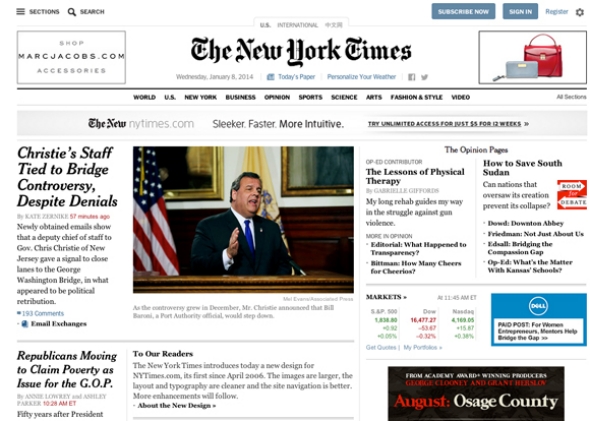 The investigations into Gov, Chris Christie’s traffic scandal are finally getting serious. The documents subpoenaed by New Jersey legislators are scheduled to start arriving at committee offices this week.
And the big questions are still out there: Who really ordered the massive traffic jam on the George Washington Bridge last September? Why did the governor’s people want to make life so miserable for residents of Fort Lee trying to cross the world’s busiest bridge? Were they trying to retaliate against Fort Lee’s mayor for not supporting Mr. Christie in last year’s election? Did Mr. Christie know about the scheme before or while it was happening?
In the meantime, the press is focusing on what was happening over 30 years ago at a large public high school in northern New Jersey.
The Port Authority official who OK’d the lane closures, David Wildstein, went to the same high school as Mr. Christie, in Essex County in the late 1970’s. Until very recently, the two men were described as old friends.
But now the governor claims he barely knew his classmate.
In his marathon press conference and apology on January 9, Mr. Christie said, ”David and I were not friends in high school. We were not even acquaintances in high school.” He added. ”We didn’t travel in the same circles in high school. You know, I was the class president and athlete. I don’t know what David was doing during that period of time, and then we reacquainted years later in, I think, 2000.”
Even after all these decades, the class president is still kicking sand at a high school nobody.
But the nobody is still trying to defend himself..
In a letter to the Port Authority, Mr. Wildstein’s lawyer wrote that his client was obeying “the Christie administration’s order” and that “evidence exists as well tying Mr. Christie to having knowledge of the lane closures, during the period when the lanes were closed, contrary to what the governor stated publicly in a two-hour press conference” three weeks ago.
Governor Christie’s people shot back, denying everything and unloading almost every negative comment about Mr. Wildstein they could Google. As an example of Mr. Wildstein’s “tumultuous” behavior, they noted in a memo to supporters that “as a 16 year old kid, [Mr. Wildstein] sued over a local school board election. He was publicly accused by his high school social studies teacher of deceptive behavior.”
So, here’s what’s missing in Mr. Christie’s attack on his former traffic wizard. If Mr. Wildstein was such a disaster, why did Mr. Christie hire him? And when Mr. Wildstein resigned late last year, why did the governor praise him as “a tireless advocate for New jersey’s interests at the Port Authority” and for his “commitment and dedication”?
The investigations into Gov, Chris Christie’s traffic scandal are finally getting serious. The documents subpoenaed by New Jersey legislators are scheduled to start arriving at committee offices this week.
And the big questions are still out there: Who really ordered the massive traffic jam on the George Washington Bridge last September? Why did the governor’s people want to make life so miserable for residents of Fort Lee trying to cross the world’s busiest bridge? Were they trying to retaliate against Fort Lee’s mayor for not supporting Mr. Christie in last year’s election? Did Mr. Christie know about the scheme before or while it was happening?
In the meantime, the press is focusing on what was happening over 30 years ago at a large public high school in northern New Jersey.
The Port Authority official who OK’d the lane closures, David Wildstein, went to the same high school as Mr. Christie, in Essex County in the late 1970’s. Until very recently, the two men were described as old friends.
But now the governor claims he barely knew his classmate.
In his marathon press conference and apology on January 9, Mr. Christie said, ”David and I were not friends in high school. We were not even acquaintances in high school.” He added. ”We didn’t travel in the same circles in high school. You know, I was the class president and athlete. I don’t know what David was doing during that period of time, and then we reacquainted years later in, I think, 2000.”
Even after all these decades, the class president is still kicking sand at a high school nobody.
But the nobody is still trying to defend himself..
In a letter to the Port Authority, Mr. Wildstein’s lawyer wrote that his client was obeying “the Christie administration’s order” and that “evidence exists as well tying Mr. Christie to having knowledge of the lane closures, during the period when the lanes were closed, contrary to what the governor stated publicly in a two-hour press conference” three weeks ago.
Governor Christie’s people shot back, denying everything and unloading almost every negative comment about Mr. Wildstein they could Google. As an example of Mr. Wildstein’s “tumultuous” behavior, they noted in a memo to supporters that “as a 16 year old kid, [Mr. Wildstein] sued over a local school board election. He was publicly accused by his high school social studies teacher of deceptive behavior.”
So, here’s what’s missing in Mr. Christie’s attack on his former traffic wizard. If Mr. Wildstein was such a disaster, why did Mr. Christie hire him? And when Mr. Wildstein resigned late last year, why did the governor praise him as “a tireless advocate for New jersey’s interests at the Port Authority” and for his “commitment and dedication”?
Pajhwok Report
.JPG) The United States on Monday said the world would not abandon Afghanistan and Pakistan after the drawdown of NATO troops by the end of the current year.
US Ambassador to Pakistan Richard Olson said in an interview: “The United States and the international community have learnt from the period from 1989 to 1992 and are determined not to repeat the mistake.”
In an interview with Radio Pakistan, monitored here, the ambassador said the Bilateral Security Agreement (BSA) had to be concluded to enable the stay of a residual US force in Afghanistan beyond 2014.
About the situation in Afghanistan after the pullout of international soldiers, he said it was hard to predict what the future held in store. But he added Taliban had been weakened and the Afghan National Army was trained to handle any situation.
Olson acknowledged Pakistan had rendered great sacrifices in the war against terrorism.“We favour the Pakistan government’s efforts to establish its writ through its territories and in areas where there are non-state actors.”
The United States on Monday said the world would not abandon Afghanistan and Pakistan after the drawdown of NATO troops by the end of the current year.
US Ambassador to Pakistan Richard Olson said in an interview: “The United States and the international community have learnt from the period from 1989 to 1992 and are determined not to repeat the mistake.”
In an interview with Radio Pakistan, monitored here, the ambassador said the Bilateral Security Agreement (BSA) had to be concluded to enable the stay of a residual US force in Afghanistan beyond 2014.
About the situation in Afghanistan after the pullout of international soldiers, he said it was hard to predict what the future held in store. But he added Taliban had been weakened and the Afghan National Army was trained to handle any situation.
Olson acknowledged Pakistan had rendered great sacrifices in the war against terrorism.“We favour the Pakistan government’s efforts to establish its writ through its territories and in areas where there are non-state actors.”
The Senate today unanimously adopted Resolution moved by Senator Farhatullah Babar calling upon the government to drastically amend the Official Secrets Act of 1923 and to make it consistent with the constitutionally guaranteed right to information, fair trial and fundamental rights. Speaking on the resolution the Senator said that information is withheld even from the Parliament on the ground of it being secret or confidential without laying down any guidelines as to who classifies a document as secret and how. Pointing out its out dated nature he said that Section 4 dealing with communication with foreign agents to be evidence of certain offences says that “a person may be presumed to have been in communication with a foreign agent if he has, either within or without Pakistan visited the address of a foreign agent or consorted or associated with a foreign agent, or either within or without Pakistan, the name or address of or any other information regarding a foreign has been found in his possession, or has been obtained by him from any other person”. The expression ‘foreign agent’ he said includes “any person who is or has been or in respect of whom it appears that there are reasonable grounds for suspecting him of being or having been employed by a foreign power either directly or indirectly”. Thus if a visiting card of a foreign diplomat or businessman is found in the possession of anyone and about whom the government may allege that the diplomat or businessman had sometime in the past been ‘an agent’ of a foreign power the person from whose possession the visiting card has been found would be liable to be prosecuted and declared guilty of associating with an enemy agent. He said that in India recently a review of the Secrets Act has been undertaken and the government of Pakistan must also review the outdated Act and bring amendments to it before the Parliament. The House unanimously adopted the resolution. Earlier speaking on a motion moved by Dr Karim Khwaja for a Constitution court Farhatullah Babar said that for the past few years a new doctrine was being propounded according to which the Constitution, and not the Parliament, was supreme and that the Constitution was what the SC said. This formulation of the constitutional doctrine can have profound implications for other state institutions in the event of a disagreement between the courts and the other institutions. He said that in such an event there is a possibility of a constitutional interpretation that might seem to favor courts in relation to other state institutions and thereby tilt the balance in a way not envisaged in the constitutional chem of things. In such a situation he said it is imperative that we have a separate constitution court to address and resolve constitutional matters only and is not mandated to perform other functions of the SC. In some other countries he said the constitution courts existed and Pakistan should also consider setting it up in line with the provisions of charter of democracy signed in 2006 between Shaheed Benazir Bhutto and Mian Nawaz Sharif. He said that at the time of the 18th amendment it was the PML-N which suggested that its consideration be postponed till a later date. Now is the time for the government to take it up with other parties as well and give the proposal a serious thought, he said. The House today also unanimously adopted the resolution moved by Senator Farhatullah Babar calling upon the government to publish the names of those judges of the superior judiciary who have dual nationality. The resolution has been on the agenda of the house for the past several months as the names of judges with dual nationality were not provided to the Senate even when questions were repeatedly asked in the House in this regard.
shiapost.comLashkaray Jhangvee, a Terror outfit of Deobandi Sect of Islam that was established in 1990s by Haqq Nawaz Jhangvee in District Jhang Punjab, with an aim of eradicating Shiites(another sect of Islam) from Pakistan. What then, they started their activities by targeted killings of key Shia Clergies in and around Punjab that slowly and steadily reached the port city of Karachi till late 90s. LeJ was also used in Afghanistan and Kashmir, and by USE I mean that the Pakistani military establishment took them to both the areas mentioned. Where they killed scores of people and served as free mercenaries for forwarding the agendas set. And all this did not happen in haste, LeJ is a gift for the Shias of Pakistan who in 1985 defied the radical steps of the then military dictator Zia ul Haq, Zia introduced a must payment of Zakat for all Pakistanis to which the Shias reacted and started demonstrations, followed by the exemption to their name. But none knew how military establishment would answer to this, and it was the very time when an artificial voice was raised for imposition of Caliphate in the country, and for this matter Anjumanay Sipahey Sahaba( Army of Prophet’s Companions) was brought forth that started political and militant activities to harass and threaten especially the Shias who had resisted imposition of Zakat on them.


Baloch in their very nature are secular, but the game that establishment played this time (starting in Gen. Musharraf regime in 2000s) was the most difficult to cope with for the Baloch separatists. Lashkaray Jhangvee (establishment’s child) again came to the help of the Ideological Homeland, and this time its task was to change Baloch separatism notorious. And Hazaras’ role was that of the scapegoat, LeJ by design started targeting Hazaras in Baloch dominant areas of Quetta. Not only that but also the key players of LeJ came up to the screen with the names of their tribes following them, obfuscating the true aim of targeting Hazaras, as Punjabis were targeted by Balochistan Liberation Army, it became difficult earlier on as to what could be the true excuse for the execution of Hazaras. But time and the events that followed made it clear for those who could read between the lines, that LeJ once again served the “Land of the Pures” voluntarily, that helped it quench its thirst for blood too. Lashkaray Jhangvee is almost a Brigade or for that matter a Special Unit, just like US Navy Seals, that knows no laws or ethics while operating. Every big act of BLA is followed by a brutal terror attack of LeJ on Hazaras. And Pakistan forwards a memo to the United Nations naming unrest in Balochistan nothing more than a religious or sectarian conflict. That is the reason why after all Pakistan protests against LeJ could not make the govt take action against LeJ, last year on Jan 10, 2013, Hazaras were guaranteed of an action against LeJ but later on Baloch separatists were hunted and killed. Why would government go against it baby, or right hand, that fulfillsCovert Objectives with such boldness? It was the only reason in consideration that I tried to convey to my people when again on 22nd Jan 2014 they decided for a sit-in following a deadly suicide attack on a bus carrying pilgrims from Iran, I told them it is useless to demonstrate as Establishment will not allow government to act against LeJ hideouts in and around Quetta city. State terrorism everywhere in the world is the result of running a State as an End, either comply by what is being said or ordered or be ready for getting killed. LeJ has proved itself to be an asset for the establishment, and anyone asking for an action is be-fooling himself.
http://balochwarna.com/xnews


With all these agents of chaos let loose there is little chance for peaceThe selection of the TTP’s committee for talks once again indicates that the terrorist network is as crafty as it is lethal. Well aware of the dynamics of Pakistan’s politics it has nominated three leaders belonging to religious parties, one from a mainstream party and a cleric known for his extremist views. They all have a soft corner for the militants. Despite their bitter mutual rivalries the JI, JUI-F and JUI-S are united on the issue of Sharia along with Maulana Abdul Aziz of Lal Majid fame. The three religious parties which were sidelined by the electorate would now be suddenly in the limelight after the TTP move. During the talks with the government’s team they would compete with one another to gain the maximum space for the terrorist network in return for allowing them to operate peacefully. The government had wanted its committee to focus on ending the terrorist attacks. It is instead being invited to play on Taliban’s turf. With the government accepting the offer, the focus of the two committees would be on fixing the timetable for the enforcement of Sharia. The TTP would meanwhile gain time to overcome its weaknesses and to concentrate on the implementation of its strategy of terror. Imran Khan has declined to accept the offer by the TTP. It would however suit him to make use of any opportunity he finds to expose the government rather the TTP. Meanwhile, 15 prominent clerics of a particular school of thought have urged the government and Taliban to announce a ceasefire to end the bloodshed in the country. Instead of holding the TTP responsible for bomb blasts and suicide attacks that have killed thousands of innocent citizens, and telling it to stop the gruesome game, they have put the lawbreakers and law enforcers in the same category thus helping the terrorist network. This shows the TTP is a step ahead of the government. What the government should have done was to rally the support of those religious leaders who have always called a terrorist a terrorist in spite of attacks and threats of further violence. At a time when the entire parliament, with the exception of a mini minority, was willing to support action against the terrorists, Sharif agreed to treat them as a party, providing the proscribed network a measure of respectability. Thanks the PML-N government a number of terrorist leaders who had gone into hibernation are coming out into the open to continue their activities. Leader of JeM Masood Azhar has already delivered a telephonic address at a gathering of his followers in Muzaffarabad while Fazlur Rehman Khalil of Harkatul Mujideen is now appearing on TV talk shows. With all these agents of chaos let loose there is little chance for peace.
 Nawaz Sharif must be scratching his head, wondering what his next move should be. On the other hand, the militant leadership is probably enjoying cups of green tea in a mud-house somewhere in the tribal region. The beardos can afford to relax – after all they have just checkmated a confused and clueless political leadership while also putting to the test the political rhetoric of those who have gone hoarse lobbying for peace talks with the Pakistani Taliban.
The nomination of the five-member committee to represent the Tehreek-i-Taliban in talks with a four-member government-nominated team appears to be a smart political move by the TTP.
Nawaz Sharif must be scratching his head, wondering what his next move should be. On the other hand, the militant leadership is probably enjoying cups of green tea in a mud-house somewhere in the tribal region. The beardos can afford to relax – after all they have just checkmated a confused and clueless political leadership while also putting to the test the political rhetoric of those who have gone hoarse lobbying for peace talks with the Pakistani Taliban.
The nomination of the five-member committee to represent the Tehreek-i-Taliban in talks with a four-member government-nominated team appears to be a smart political move by the TTP.
 The TTP-nominated committee is representative of the school of thought which vociferously advocated peace negotiations with the Pakistani militants.
The militants have nominated PTI chief Imran Khan; Maulvi Kifayatullah, the burly, former JUI-F MPA from Mansehra; JUI-S leader Maulana Samiul Haq, who until recently claimed to have been tasked by the government to engage the militants; the Jamaat-i-Islami leader from Bannu, Professor Mohammad Ibrahim; and the famous Lal Masjid cleric, Maulana Abdul Aziz.
The TTP spokesman said that the banned organisation had spoken to the individuals and had obtained their consent.
Among the bearded crowd, the clean-shaven Khan seems like the odd man out but then, perhaps more than the others, he articulated and forcefully pushed for a dialogue with the militants. Not just that, he ordered his party men to forcibly stop supplies for foreign forces moving through Khyber Pakhtunkhwa before entering Afghanistan. His party also staged a sit-in to protest drone strikes in our tribal regions.
So, tactically and politically speaking, the militants have chosen an ideal team. The ones, who believed that peace was possible, have been given the task to make it possible.
Let militants not be blamed for lack of seriousness or resolve; let their chosen few speak for them and vouch for them by engaging the official handpicked team, the majority of whose ideological bent of mind may not be different from their supposed interlocutors.
It’s a win-win situation – tail, I win, head, you lose! Like-minded people on both sides. As one commentator put it, it was a case of Liverpool playing against Liverpool.But this is not all what it is all about. The TTP has put the political parties’ own rhetoric to test. Will Khan now come forward and be part of a team representing the militants and risk being permanently called a Taliban Khan by his political detractors?
Even more interesting is the fact that his party’s government in Khyber Pakhtunkhwa has endorsed and supported the official team by nominating Rustam Shah Mohmand to it. How will Mohmand – a government interlocutor – confront his own party leader sitting on the other side of the table?
However, Khan has made it clear he wouldn’t be part of the Taliban-nominated committee. “This is beneath his stature,” a party leader said.
JI’s Prof Ibrahim was smart. He acknowledged having been approached. However, he added that while he had consented to be part of the effort he would do so only as a mediator between the government and the Taliban.
Samiul Haq, who opted out, is simply miffed that Prime Minister Sharif did not return his calls. Hence, he has adopted the wait-and-see approach – in other words he will not commit either way till the situation clears up.
Maulana Abdul Aziz too has been a bit ambivalent. He said he was willing to help as much as he can but added that till the government imposed the Sharia or appeared sincere in doing so, he would not become part of the team.
This leaves behind Maulvi Kifayatullah, who was once JUI-F’s contact person with the late TTP leader, Waliur Rehman, to respond to the nomination.
But where does this leave the government’s initiative? What will the prime minister do to achieve political consensus for his peace initiative? Or will he now swallow the bitter pill and do the seemingly unthinkable – order a military operation – now that at least four of the political parties which supported his move, have now been chosen by the militants to sit on the opposite end of the table?
The PM Nawaz Shariff led PML – N Government which is Head over Heals in giving concessions to the Taliban Terrorists Under the Cover of Peace Negotiations with them , is Totally against the Constitution of Pakistan.
As the Constituation Does not allow to Negotiate with the Terrorists / Proclaimed offenders of Banned Organisations Like Tehrik e Taliban Pakistan , who are Not only the Killers of More than 55,000 Innocent Pakistani Men , Women and Children , which Includes the Armed forces Personnel and LEA’s Personnel.
The PML – N government faces a Legal cum Moral dilemma as it gets ready for talks with the Tehreek-i-Taliban Pakistan, one of the 60 outfits officially banned and declared as terrorist organisations.
The government keeps on saying that negotiations with the TTP would be held within the framework of the Constitution, but Legal experts believe that there is no room in the Constitution to enter into a dialogue with terrorist groups.
Asked if the government was considering lifting a ban on TTP before the start of talks, Information Minister Pervez Rasheed told Dawn there was no such possibility and the status quo would be maintained.
The TTP, with Baitullah Mehsud as its head, came into being in Dec 2007 – five months after the Lal Masjid operation, which was considered to be the Origination Point of the Terrorist Organisation , banned on Aug 25, 2008.
The TTP has Officially claimed responsibility for a number of terrorist attacks, including suicide bombings on military convoys, and it is accused of killing a thousands of Innocent Civilians.
TTP was never shown its willingness to Hold Negotiations ,and since its Inception is continuously busy in its terrorism and Anti State Activities , but Since the Recent Change in the Army Top Brass , and its stance against the terrorism and the Anti State / Anti Armed Forces Stance , of which the Armed Forces have taken a severe Notice and had even taken a Action ,with which the TTP Leadership has come to its sense that the Political Leadership , now could not Safe Guard them , while the Pakistani Army , also Looks ready to teach them the Lesson of their Life.
While the final attack of the TTP which killed a number of Frontier Corps personnel in Bannu it was a Nail in the Coffin , and after which as the Pak Armed Forces Launched Two Serious Raids on the Terrorist Hide Outs in Mir Ali ,the Terrorist of Tehrik e Taliban Pakistan have come to their senses and have offered to come to the Negotiation Table , with the Pakistani Government .
While the Political Leadership who is Bound to serve the Interest of their Saudi Masters , as they have come to Power in Pakistani Politics Once again , Due to the Support of the Saudi Monarchy, So still is trying to give Protection to these terrorist Organisations , as it is quite evident from the fact that at least three out of 5 Of the Persons Nominated from the TTP side , are the same Persons , who were also Contacted and Nominated from the Pakistani Government side, which Includes the Names of Maulana Sami Ul Haq , JUI – S , The Chief of the Madressa e Haqania , Okara Khattak , Maulana Abdul Aziz , the Pesh Imam of the Lal Masjid , Which was the Origination Point of the TTP , who refused to sit on the Pakistani Government side of the Negotiation Table , but accepted His Nomination from the TTP to Negotiate with the Govt on their Behalf, And Last But not the least , who is a well known advocate of Negotiation and No Punitive Action against the Traitors of Pakistan and Terrorist of TTP , Mr. Imran Khan PTI,
As it is quite evident in the first Phase of the Negotiation and the selection of the Nominees for Negotiations , that if the People who are tilted towards the TTP’s stance and are their favourite on both side of the Negotiation Table , then what will be the Negotiation , As then all will not be negotiating while they will be finding ways to give more concessions to the Terrrorists of TTP , and their accommodation in the Future Political Set up of Pakistan , who are the Proven Traitors of Pakistan .
Now It is test of time that On One side the PML – N Led Nawaz Shariff’s Govt is So Much Keen and Bound to Plead the Case of High Treason against the Ex Army General and President of Pakistan , who had taken action against the Terrorist of Lal Masjid , and on the Other Hand the same PML – N Govt is Ready to go against the Constitution of Pakistan , which does not allow to Negotiate with the Proclaimed Offenders of Banned Organistion . But they are ready to Negotiate and give concessions to the Traitors of Pakistan , and Killers of thousands of Innocent Pakistani Men , Women and children , including Murders of Personnel of Armed Forces.
When a government official was asked to comment on the idea of holding talks with an outlawed organisation, he said it was a decision taken by all political parties represented at the all-party conference in September.
While the Forum to make amendments in the Present Constitution of Pakistan is the Parliament and not any All Parties Conference .As even there is a vast Majority in Pakistan who have even reservations on the All Parties Conference , As even the Most Aggrieved and the worst victims of this terrorism were not given due representation in the so called All Parties Conference .
The government has banned 60 terrorist organisations so far.
Al Qaeda, Tehreek-i-Nifaz-i-Shariat-i-Muhammadi, Lashkar-e-Taiba, Sipah e Sahaba Pakistan , Lashkar e Jhangvi , Tehreek-i-Jafria Pakistan, Tehreek-i-Islami, Ansarul Islam and Balochistan Liberation Army are among the groups that were banned from 2001 to 2010.
People’s Amn Committee, Lyari, Karachi, Markazi Sabeel Organisation, Gilgit, and Tanzeem Naujawanan-i-Sunnat, Gilgit were outlawed in 2011.
Anjuman-i-Imania Gilgit-Baltistan and Muslim Students Organisation, Gilgit-Baltistan, Al-Harmain Foundation, Rabita Trust and Tanzeem Ahle Sunnat Wal Jamaat were among the outfits that were outlawed in 2012.
Khana-i-Hikmat, Tehrik-i-Taliban, Bajaur, Tehrik-i-Taliban Mohmand, Tehrik-i-Taliban Swat, 313 Brigade, Abdullah Azam Brigade and Baloch Students Organisation Azad were banned in 2013.
In an interesting turn of events, the Tehreek-e-Taliban Pakistan (TTP) has announced its team of negotiators to talk peace with the government. The interesting part though has been the inclusion of Imran Khan’s name in the list. Imran has distanced himself from the offer, adding however that he has full confidence in the team announced by the government. The team appointed by the Prime Minister (PM) has been given an open mandate to find the best solution to end militancy. The government’s team had been demanding of the militants to form their team of mediators. The team had three meetings on Friday, one with the PM, another with the interior minister and the third one an internal one of the members of the team to develop the modalities of the talks. The team members have made it clear that no preconditions for the talks will be acceptable and that the outcome of the dialogue largely depends on the TTP. Both these contentions are important because these have amongst the reasons behind the failed peace deals the state and the militants entered into the past.
The TTP is the largest militant group in Pakistan and was formed in December 2007. The aims behind the formation of the TTP were to wage war against the Pakistani state after the Lal Masjid affair, impose their version of sharia, and attack the US and UK for being the architects of the Afghan war. The group has been successfully mounting attacks on the Pakistani government, its army and the secular parties, not to mention ordinary citizens. Their devastating reach into the urban areas of the country has virtually left the state in a limbo. The state in the past reached a number of peace deals with the TTP to bring them into the mainstream. In April 2004 the Shakai agreement was signed with Nek Muhammad. In February 2005 the Srarogha peace deal was inked with Baitullah Mehsud, and in April 2008, the two sides reached a peace deal to end violence in the Swat valley. Interestingly, the trend has been that the TTP would sabotage the peace deals within hours of their signing. In fact the deals actually provided a boost to the otherwise unknown militant group, evoking a sense of importance and stature in nonentities like Nek Muhammad and Baitullah.
That the newly formed peace group and its agenda would face the same fate is not an unavoidable consequence. It cannot be possible that the TTP would not bargain for anything that at least resembles their original demands. If these terms prove unacceptable and the talks break down, the government should have a Plan-B waiting.
The TTP-nominated committee is representative of the school of thought which vociferously advocated peace negotiations with the Pakistani militants.
The militants have nominated PTI chief Imran Khan; Maulvi Kifayatullah, the burly, former JUI-F MPA from Mansehra; JUI-S leader Maulana Samiul Haq, who until recently claimed to have been tasked by the government to engage the militants; the Jamaat-i-Islami leader from Bannu, Professor Mohammad Ibrahim; and the famous Lal Masjid cleric, Maulana Abdul Aziz.
The TTP spokesman said that the banned organisation had spoken to the individuals and had obtained their consent.
Among the bearded crowd, the clean-shaven Khan seems like the odd man out but then, perhaps more than the others, he articulated and forcefully pushed for a dialogue with the militants. Not just that, he ordered his party men to forcibly stop supplies for foreign forces moving through Khyber Pakhtunkhwa before entering Afghanistan. His party also staged a sit-in to protest drone strikes in our tribal regions.
So, tactically and politically speaking, the militants have chosen an ideal team. The ones, who believed that peace was possible, have been given the task to make it possible.
Let militants not be blamed for lack of seriousness or resolve; let their chosen few speak for them and vouch for them by engaging the official handpicked team, the majority of whose ideological bent of mind may not be different from their supposed interlocutors.
It’s a win-win situation – tail, I win, head, you lose! Like-minded people on both sides. As one commentator put it, it was a case of Liverpool playing against Liverpool.But this is not all what it is all about. The TTP has put the political parties’ own rhetoric to test. Will Khan now come forward and be part of a team representing the militants and risk being permanently called a Taliban Khan by his political detractors?
Even more interesting is the fact that his party’s government in Khyber Pakhtunkhwa has endorsed and supported the official team by nominating Rustam Shah Mohmand to it. How will Mohmand – a government interlocutor – confront his own party leader sitting on the other side of the table?
However, Khan has made it clear he wouldn’t be part of the Taliban-nominated committee. “This is beneath his stature,” a party leader said.
JI’s Prof Ibrahim was smart. He acknowledged having been approached. However, he added that while he had consented to be part of the effort he would do so only as a mediator between the government and the Taliban.
Samiul Haq, who opted out, is simply miffed that Prime Minister Sharif did not return his calls. Hence, he has adopted the wait-and-see approach – in other words he will not commit either way till the situation clears up.
Maulana Abdul Aziz too has been a bit ambivalent. He said he was willing to help as much as he can but added that till the government imposed the Sharia or appeared sincere in doing so, he would not become part of the team.
This leaves behind Maulvi Kifayatullah, who was once JUI-F’s contact person with the late TTP leader, Waliur Rehman, to respond to the nomination.
But where does this leave the government’s initiative? What will the prime minister do to achieve political consensus for his peace initiative? Or will he now swallow the bitter pill and do the seemingly unthinkable – order a military operation – now that at least four of the political parties which supported his move, have now been chosen by the militants to sit on the opposite end of the table?
The PM Nawaz Shariff led PML – N Government which is Head over Heals in giving concessions to the Taliban Terrorists Under the Cover of Peace Negotiations with them , is Totally against the Constitution of Pakistan.
As the Constituation Does not allow to Negotiate with the Terrorists / Proclaimed offenders of Banned Organisations Like Tehrik e Taliban Pakistan , who are Not only the Killers of More than 55,000 Innocent Pakistani Men , Women and Children , which Includes the Armed forces Personnel and LEA’s Personnel.
The PML – N government faces a Legal cum Moral dilemma as it gets ready for talks with the Tehreek-i-Taliban Pakistan, one of the 60 outfits officially banned and declared as terrorist organisations.
The government keeps on saying that negotiations with the TTP would be held within the framework of the Constitution, but Legal experts believe that there is no room in the Constitution to enter into a dialogue with terrorist groups.
Asked if the government was considering lifting a ban on TTP before the start of talks, Information Minister Pervez Rasheed told Dawn there was no such possibility and the status quo would be maintained.
The TTP, with Baitullah Mehsud as its head, came into being in Dec 2007 – five months after the Lal Masjid operation, which was considered to be the Origination Point of the Terrorist Organisation , banned on Aug 25, 2008.
The TTP has Officially claimed responsibility for a number of terrorist attacks, including suicide bombings on military convoys, and it is accused of killing a thousands of Innocent Civilians.
TTP was never shown its willingness to Hold Negotiations ,and since its Inception is continuously busy in its terrorism and Anti State Activities , but Since the Recent Change in the Army Top Brass , and its stance against the terrorism and the Anti State / Anti Armed Forces Stance , of which the Armed Forces have taken a severe Notice and had even taken a Action ,with which the TTP Leadership has come to its sense that the Political Leadership , now could not Safe Guard them , while the Pakistani Army , also Looks ready to teach them the Lesson of their Life.
While the final attack of the TTP which killed a number of Frontier Corps personnel in Bannu it was a Nail in the Coffin , and after which as the Pak Armed Forces Launched Two Serious Raids on the Terrorist Hide Outs in Mir Ali ,the Terrorist of Tehrik e Taliban Pakistan have come to their senses and have offered to come to the Negotiation Table , with the Pakistani Government .
While the Political Leadership who is Bound to serve the Interest of their Saudi Masters , as they have come to Power in Pakistani Politics Once again , Due to the Support of the Saudi Monarchy, So still is trying to give Protection to these terrorist Organisations , as it is quite evident from the fact that at least three out of 5 Of the Persons Nominated from the TTP side , are the same Persons , who were also Contacted and Nominated from the Pakistani Government side, which Includes the Names of Maulana Sami Ul Haq , JUI – S , The Chief of the Madressa e Haqania , Okara Khattak , Maulana Abdul Aziz , the Pesh Imam of the Lal Masjid , Which was the Origination Point of the TTP , who refused to sit on the Pakistani Government side of the Negotiation Table , but accepted His Nomination from the TTP to Negotiate with the Govt on their Behalf, And Last But not the least , who is a well known advocate of Negotiation and No Punitive Action against the Traitors of Pakistan and Terrorist of TTP , Mr. Imran Khan PTI,
As it is quite evident in the first Phase of the Negotiation and the selection of the Nominees for Negotiations , that if the People who are tilted towards the TTP’s stance and are their favourite on both side of the Negotiation Table , then what will be the Negotiation , As then all will not be negotiating while they will be finding ways to give more concessions to the Terrrorists of TTP , and their accommodation in the Future Political Set up of Pakistan , who are the Proven Traitors of Pakistan .
Now It is test of time that On One side the PML – N Led Nawaz Shariff’s Govt is So Much Keen and Bound to Plead the Case of High Treason against the Ex Army General and President of Pakistan , who had taken action against the Terrorist of Lal Masjid , and on the Other Hand the same PML – N Govt is Ready to go against the Constitution of Pakistan , which does not allow to Negotiate with the Proclaimed Offenders of Banned Organistion . But they are ready to Negotiate and give concessions to the Traitors of Pakistan , and Killers of thousands of Innocent Pakistani Men , Women and children , including Murders of Personnel of Armed Forces.
When a government official was asked to comment on the idea of holding talks with an outlawed organisation, he said it was a decision taken by all political parties represented at the all-party conference in September.
While the Forum to make amendments in the Present Constitution of Pakistan is the Parliament and not any All Parties Conference .As even there is a vast Majority in Pakistan who have even reservations on the All Parties Conference , As even the Most Aggrieved and the worst victims of this terrorism were not given due representation in the so called All Parties Conference .
The government has banned 60 terrorist organisations so far.
Al Qaeda, Tehreek-i-Nifaz-i-Shariat-i-Muhammadi, Lashkar-e-Taiba, Sipah e Sahaba Pakistan , Lashkar e Jhangvi , Tehreek-i-Jafria Pakistan, Tehreek-i-Islami, Ansarul Islam and Balochistan Liberation Army are among the groups that were banned from 2001 to 2010.
People’s Amn Committee, Lyari, Karachi, Markazi Sabeel Organisation, Gilgit, and Tanzeem Naujawanan-i-Sunnat, Gilgit were outlawed in 2011.
Anjuman-i-Imania Gilgit-Baltistan and Muslim Students Organisation, Gilgit-Baltistan, Al-Harmain Foundation, Rabita Trust and Tanzeem Ahle Sunnat Wal Jamaat were among the outfits that were outlawed in 2012.
Khana-i-Hikmat, Tehrik-i-Taliban, Bajaur, Tehrik-i-Taliban Mohmand, Tehrik-i-Taliban Swat, 313 Brigade, Abdullah Azam Brigade and Baloch Students Organisation Azad were banned in 2013.
In an interesting turn of events, the Tehreek-e-Taliban Pakistan (TTP) has announced its team of negotiators to talk peace with the government. The interesting part though has been the inclusion of Imran Khan’s name in the list. Imran has distanced himself from the offer, adding however that he has full confidence in the team announced by the government. The team appointed by the Prime Minister (PM) has been given an open mandate to find the best solution to end militancy. The government’s team had been demanding of the militants to form their team of mediators. The team had three meetings on Friday, one with the PM, another with the interior minister and the third one an internal one of the members of the team to develop the modalities of the talks. The team members have made it clear that no preconditions for the talks will be acceptable and that the outcome of the dialogue largely depends on the TTP. Both these contentions are important because these have amongst the reasons behind the failed peace deals the state and the militants entered into the past.
The TTP is the largest militant group in Pakistan and was formed in December 2007. The aims behind the formation of the TTP were to wage war against the Pakistani state after the Lal Masjid affair, impose their version of sharia, and attack the US and UK for being the architects of the Afghan war. The group has been successfully mounting attacks on the Pakistani government, its army and the secular parties, not to mention ordinary citizens. Their devastating reach into the urban areas of the country has virtually left the state in a limbo. The state in the past reached a number of peace deals with the TTP to bring them into the mainstream. In April 2004 the Shakai agreement was signed with Nek Muhammad. In February 2005 the Srarogha peace deal was inked with Baitullah Mehsud, and in April 2008, the two sides reached a peace deal to end violence in the Swat valley. Interestingly, the trend has been that the TTP would sabotage the peace deals within hours of their signing. In fact the deals actually provided a boost to the otherwise unknown militant group, evoking a sense of importance and stature in nonentities like Nek Muhammad and Baitullah.
That the newly formed peace group and its agenda would face the same fate is not an unavoidable consequence. It cannot be possible that the TTP would not bargain for anything that at least resembles their original demands. If these terms prove unacceptable and the talks break down, the government should have a Plan-B waiting.
In 1878, the US passed the Ku Klux Klan Act, also known as the Third Force Act, to authorise President Ulysses S Grant to declare martial law, impose penalties against terrorist organisations and use military force to suppress the Ku Klux Klan (KKK). The name of the Ku Klux Klan was derived from the Greek word ‘kyklos’, meaning ‘circle’. The KKK believed in racial superiority of the whites and in violence to further their plans to disenfranchise blacks. The Klan evolved into a terrorist organisation that brought mayhem, fear and chaos. They were responsible for thousands of deaths: they lynched mobbed blacks, burned down black churches, raped women, murdered civil rights workers, murdered children and terrorised communities for over a century. They whipped freedmen’s schools’ teachers and burnt their schools. Their signature trait would be to form a circle around their target before they would destroy it. Many spiritualists believe that to kill something you form a circle around it. The worst thing that you can do to societies is to form them in closed circles, surround them with people who have the same beliefs and to congregate them around the same reinforcing ideas — week after week — because eventually those societies will wither away. Circles are very powerful. Even more powerful can be those who want to break the destructive powers using the state’s will. Ulysses S Grant won office with the slogan, ‘let us have peace’ and categorically named the enemy, the KKK, and eventually brought it down. When it comes to our version of sociopaths, the Taliban, the government is waiting for the century to turn it seems, waiting for the blood to spill red perhaps. It seems to not be enough that in the Mastung blast a week ago, a bus full of pilgrims was blown up. The Shia Hazara victims — men, women and children — were easily identifiable and defenceless. It seems to not be enough that a young boy named Aitzaz Hasan gave up his life trying to protect his schoolmates from a suicide bomber in Khyber Pakhtnkhwa. And how do we react? We choose to focus, instead, on preventing young minds from being ‘corrupted’ by the book I am Malala. We are fearful instead of ideas in that book. We are rewarding the mind that survived the Taliban’s bullet by closing our doors on it. While we misplace our fears and priorities, the Taliban’s recent attack is on the Pakistani media. In an attempt to muzzle it, they have released a list of names of journalists they will target. To begin with, the media was already controlled by the Taliban. Knowing that the Taliban were watching, the tone, agenda-setting and the representation was largely something that sought their acceptance. The media even went ahead to air appeals from the Taliban itself. However, there were exceptions to this grovelling. There was an elite group of news reporters, anchors, opinion makers and thought leaders who cared to distribute information based on what the person in the voting booth needs to know; to inform people that their country is not the chosen one, but far from it if the indicators were to be believed and to hold elected officials accountable to their actions and comments. These veterans were not dictated by advertisements that push for infotainment — they truly cared about serving as the fifth pillar of the state no matter how nascent the media industry is. It is these people who are mostly on the list. These people strengthened democracy at a time when we are just learning to stand up, our knees weary. It is the bolstering of democracy that the Taliban are deathly afraid of. It is the very instrument that can be used to exorcise the demons of bigotry, supremacy and the perversely destructive power that comes from it. The narrative of Islam as a peaceful religion has been hijacked, tragically, in an irreversible manner because we have let the barbarians claim it instead of the Sufis. Probably also because those with the will to die to promote savagery outnumber those that want peace, 1,000 to one. When Salmaan Taseer was murdered, the state showed new depths of weakness and, as a result, thousands more embraced cynicism. The circle grew. The state needs to protect itself. Self-interest is the greatest morality. Rather than play to the narrative the Taliban furnish — of fairy tales — the state needs to stand up for its children. There can be no waiting when our posterity is attacked. In Hangu, on January 26, 2014, six children were killed while they played in their playground. If those in power — politicians and military generals (who have spent most of their lives serving blue prints of housing societies) — think that their own children will be spared if they wait, buy time and do not act, they are wrong. More dangerous than their children under threat would be their children hated by thousands of country people who themselves get tossed onto madmen’s whims to save those who are considered more supreme. The mothers of the children who have been killed by the Taliban will form a more powerful circle around the necks of those who did this to them, and those who watched and did not act when they could.The media was already controlled by the Taliban. Knowing that the Taliban were watching, the tone, agenda-setting and the representation was largely something that sought their acceptance. The media even went ahead to air appeals from the Taliban itself
 By Adnan Aamir
In the land of Pure, Balochistan is generally considered as a remote turbulent province. People don’t know much about it and about what’s happening there. They know that Pakistan conducted its nuclear tests in Chagai, which is situated somewhere in Balochistan. There is a general apathy towards Balochistan by Mainstream media and most of people outside this restive province.
On 25th January, a shepherd found some parts of human bodies buried in Totak area near Khuzdar, second largest city of Balochistan. Upon his information the district administration dug the site and a mass grave was discovered. Couple of other mass graves were also discovered from the same site. Total number of bodies recovered from the grave is disputed, Asian Human Rights gave the figure of hundred plus, Baloch nationalists are quoting the figure between 155 to 300, Balochistan government has quoted the figure of 13 bodies. It’s normal for a government to quote the lowest possible figure for casualties in any tragic situation. Even if one accepts the government figure of 13 still this is grave case of human rights violation irrespective of whom the buried people were and who killed them. However due to apathy towards Balochistan there was complete silence over this matter in mainstream media, except some sporadic mentions, and in social circles of society.
This issue would have been the biggest news scope of the year if this grave was discovered in Lahore or Karachi. Pakistani media chose to ignore this issue and instead started highlighting normal attention diverting issues. Molana Fazal-ur-Rehman’s statement against Jeans wearing women engulfed most of media spotlight the following day. Although Molana’s statement was absurd but it didn’t deserve the attention that it got. Then there was the issue of Veena Malik’s retirement from Show Biz. People were fed with all possible things about Veena and jeans wearing women but kept in dark about the mass grave discovered in Balochistan.
Media is not the only one which ignored the Mass grave issue. There are also human rights organizations that observed complete silence over this matter. Amnesty international which released a detailed report about victim of drone attacks, few months back, was also silent about this matter. This apathy towards this gruesome act proves selective application of human rights by human right organizations and pressure groups. There is also a vibrant civil society which organizes sit-ins and arranges walks for different issues. When it comes to Balochistan civil society also shows its apathy. Only the Awami Workers Party, a left wing working class party, protested in Lahore against the discovery of Mass graves. There is common realization in Balochistan that their Pakistani brethren are not bothered by what transpires here and this has been reiterated by apathy of civil society on the mass grave issue.
Why is Balochistan ignored by media, civil society and liberals? Media ignores Balochistan mainly due to pure commercial reasons, not to mention the government’s pressure of ignoring Balochistan. News channels get their revenue from ads which depend on TV ratings. People Meters determine these ratings and there is not a single People Meter installed in Balochistan. There are 675 People Meters out of which 365 are installed in Karachi only. So by covering Balochistan, news channels can’t afford to reduce their ratings and lose precious revenue. No one should expect media to be socially or ethically responsible and cover the Mass grave like issues regardless of commercial stakes. Media operates for pure commercial reasons and prioritizes its economic interests.
Most of the left wing liberals of Pakistan also ignore Balochistan. They are vocal about Shia Genocide, Taliban terrorism etc. Although these issues also merit attention and it’s really good that they are vocal about them but Balochistan’s problem is much bigger in magnitude. I would call it selective liberalism, which such people practice and ignore Balochistan. They turn their eyes away from Balochistan like ostrich and completely ignore the Issue. Their indifference to Balochistan has no impact on their liberal credentials because their liberalism is not subject to certificates of liberalism from people of Balochistan.
Discovery of mass grave in Balochistan is human rights violation of mythical proportions. This issue must have stirred the inner most fibers of soul of every Pakistani but unfortunately that’s not the case. Only people of Balochistan and few others are raising voice for this issue. An independent and impartial inquiry should be conducted in this matter. We should not make any early conclusions about perpetrators of this mass crime before an inquiry although it’s obvious that who is behind it. A full-fledged inquiry in this matter only will bring some legitimacy to the Balochistan government which has failed to react appropriately to this matter and let down people of Balochistan once again.
By Adnan Aamir
In the land of Pure, Balochistan is generally considered as a remote turbulent province. People don’t know much about it and about what’s happening there. They know that Pakistan conducted its nuclear tests in Chagai, which is situated somewhere in Balochistan. There is a general apathy towards Balochistan by Mainstream media and most of people outside this restive province.
On 25th January, a shepherd found some parts of human bodies buried in Totak area near Khuzdar, second largest city of Balochistan. Upon his information the district administration dug the site and a mass grave was discovered. Couple of other mass graves were also discovered from the same site. Total number of bodies recovered from the grave is disputed, Asian Human Rights gave the figure of hundred plus, Baloch nationalists are quoting the figure between 155 to 300, Balochistan government has quoted the figure of 13 bodies. It’s normal for a government to quote the lowest possible figure for casualties in any tragic situation. Even if one accepts the government figure of 13 still this is grave case of human rights violation irrespective of whom the buried people were and who killed them. However due to apathy towards Balochistan there was complete silence over this matter in mainstream media, except some sporadic mentions, and in social circles of society.
This issue would have been the biggest news scope of the year if this grave was discovered in Lahore or Karachi. Pakistani media chose to ignore this issue and instead started highlighting normal attention diverting issues. Molana Fazal-ur-Rehman’s statement against Jeans wearing women engulfed most of media spotlight the following day. Although Molana’s statement was absurd but it didn’t deserve the attention that it got. Then there was the issue of Veena Malik’s retirement from Show Biz. People were fed with all possible things about Veena and jeans wearing women but kept in dark about the mass grave discovered in Balochistan.
Media is not the only one which ignored the Mass grave issue. There are also human rights organizations that observed complete silence over this matter. Amnesty international which released a detailed report about victim of drone attacks, few months back, was also silent about this matter. This apathy towards this gruesome act proves selective application of human rights by human right organizations and pressure groups. There is also a vibrant civil society which organizes sit-ins and arranges walks for different issues. When it comes to Balochistan civil society also shows its apathy. Only the Awami Workers Party, a left wing working class party, protested in Lahore against the discovery of Mass graves. There is common realization in Balochistan that their Pakistani brethren are not bothered by what transpires here and this has been reiterated by apathy of civil society on the mass grave issue.
Why is Balochistan ignored by media, civil society and liberals? Media ignores Balochistan mainly due to pure commercial reasons, not to mention the government’s pressure of ignoring Balochistan. News channels get their revenue from ads which depend on TV ratings. People Meters determine these ratings and there is not a single People Meter installed in Balochistan. There are 675 People Meters out of which 365 are installed in Karachi only. So by covering Balochistan, news channels can’t afford to reduce their ratings and lose precious revenue. No one should expect media to be socially or ethically responsible and cover the Mass grave like issues regardless of commercial stakes. Media operates for pure commercial reasons and prioritizes its economic interests.
Most of the left wing liberals of Pakistan also ignore Balochistan. They are vocal about Shia Genocide, Taliban terrorism etc. Although these issues also merit attention and it’s really good that they are vocal about them but Balochistan’s problem is much bigger in magnitude. I would call it selective liberalism, which such people practice and ignore Balochistan. They turn their eyes away from Balochistan like ostrich and completely ignore the Issue. Their indifference to Balochistan has no impact on their liberal credentials because their liberalism is not subject to certificates of liberalism from people of Balochistan.
Discovery of mass grave in Balochistan is human rights violation of mythical proportions. This issue must have stirred the inner most fibers of soul of every Pakistani but unfortunately that’s not the case. Only people of Balochistan and few others are raising voice for this issue. An independent and impartial inquiry should be conducted in this matter. We should not make any early conclusions about perpetrators of this mass crime before an inquiry although it’s obvious that who is behind it. A full-fledged inquiry in this matter only will bring some legitimacy to the Balochistan government which has failed to react appropriately to this matter and let down people of Balochistan once again.
chicagotribune.comPresident Barack Obama barely touched on the Afghanistan war in his State of the Union address last week. He didn't even mention Pakistan, where Taliban terrorists are on the attack again. We don't blame him: •Last November, a U.S. drone strike killed Hakimullah Mehsud, the brutal Pakistani Taliban leader who led a network blamed for the deaths of thousands of Pakistani civilians in suicide bombings. That devastating blow offered Pakistan's leaders a prime opportunity to roll up even more Taliban commanders, to take the offensive in a fight that has raged for years. Instead, Pakistan Prime Minister Nawaz Sharif suspended counterterrorist operations against Taliban militants and sought to negotiate a deal to end the insurgency. Sharif agreed to allow the new Taliban leader, Maulana Fazlullah, time to consolidate his leadership over several Taliban factions, in hopes that Fazlullah would come to the negotiation table with greater political clout. Never mind that such truces have failed over and over in the past decade. What happened? Exactly what you'd expect. Fazlullah exploited the government lull to regroup and rearm. In recent weeks he has launched a major new offensive in three major cities, killing scores of people. The Taliban have attacked the major southern port city of Karachi, a hub of Pakistan's economy. Among those killed: Karachi's top counterterrorism police officer. Sharif took office last May. He ran a campaign "that deliberately ignored the Pakistani Taliban, and tacitly has sent the message that cooperation with the U.S. should be limited," Anthony Cordesman, an expert at the Center for Strategic and International Studies in Washington, told The Wall Street Journal. The results are depressingly familiar. Sharif has learned the same lesson as previous Pakistan leaders: The Taliban have no interest in negotiating or sharing power. They're terrorists who target civilians. They must be defeated. •The Taliban resurgence in Pakistan also looms as a threat to neighboring Afghanistan. Most U.S. troops are set to leave Afghanistan by the end of the year. In last week's speech, Obama repeated his pledge to deploy a robust residual U.S. force to mount counterterrorism operations and train Afghan security forces. All of that hinges on a security agreement negotiated last year by the U.S. and Afghanistan, but still unsigned by Afghan President Hamid Karzai. Karzai says he won't sign unless he gets more concessions from the U.S. Obama says the deal's done, take it or leave it. The U.S. has recently raised again the prospect of a "zero option," yanking all troops. The prospects of breaking this stalemate before Karzai leaves office after elections, slated for April: Nil. There's plenty of speculation about Karzai's mental state and motivation. Maybe he wants to cut a better deal. Maybe he just wants to leave office with a flourish, bragging to his fellow countrymen that he stood up to the U.S. Either way, Karzai "has really gone from maddeningly unpredictable to dangerously erratic," White House adviser John Podesta told NPR late last year. The latest outrage: An Afghan-led prisoner review board recently ordered the release from detention of 37 insurgents, some of whom are accused of attacking U.S. troops. That was a direct thumb in the eye to Washington. Astonishingly, Karzai now blames the U.S. for insurgent-style attacks to undermine his government, The Washington Post reports. He has compiled "a list of dozens of attacks that he believes the U.S. government may have been involved in," a palace official told the Post. Whew. Dangerously erratic and a delusional conspiracy theorist. The best U.S. option is, as much as possible, to ignore Karzai's ranting. He's a lame duck. There will be a new Afghan president soon. The major presidential candidates have indicated they would sign the agreement. There's still plenty of time to sign a deal and keep a robust force of Americans in Afghanistan. That's still vital for anti-terrorism operations. If the U.S pulled all its forces from Afghanistan, drone bases in that country would likely have to be closed. That would cripple efforts to strike al-Qaida and Taliban targets across a wide swath of mountainous territory on the Afghanistan-Pakistan border. It would let terrorists regroup and rearm with impunity. That's why American forces must continue to target terror leaders and demolish safe havens in those countries. It's frustrating that the U.S. still can't depend on Pakistan or Afghanistan to be reliable partners.
By M Ilyas Khan
 Water dripping from the top of the crumbling, cave-like opening of an unfinished tunnel in northern Pakistan forms into icicles, accentuating the bite of a freezing January morning.
About a kilometre down the valley behind, a large huddle of passenger vans, trucks and cars waits for the tunnel to open. They have been here for many endless hours.
In one rented vehicle is the coffin and body of an old woman on way to her own funeral, but she is running late.
On the other side of the mountain, in her home village, people have already gathered for the burial.
Anxiety is writ large on the face of her son, Wali Ahmad, a soldier in the Pakistani army and a resident of Chitral district, located on the far side of the 8.6km (5.2-mile) Lowari tunnel.
"My mother died in Peshawar. Now we have to take her home for burial. We don't know if they will open the tunnel in time for us to make it there in daylight," he says.
It's at least three hours' drive to his village of Golen from where he's standing. It's already approaching midday, and the towering mountains of the Hindu Kush range shut off the winter sunlight from most of Chitral's 34 branch valleys after 4pm.
At a little over 7,000 feet (2,500m) above sea level, the tunnel is the only exit route in winter for the 500,000 population of Chitral.
Dozens of loaded trucks are parked every few kilometres along the rocky, broken mountain road that winds up from the town of Dir to the tunnel.
Some drivers have lit gas cylinders beneath the engines to keep them warm and prevent the pipes from bursting due to freezing temperatures.
Mohammad Qasim Khan, a resident of Drosh area in Chitral, is the head of another party waiting for the tunnel to open.
"My daughter's just been operated for appendicitis, and my cousin got a rod fixed in his left leg which suffered a fracture," he says.
"They can't stand the cold and the wait, but we are told the tunnel is closed. We drove some eight hours from a hospital in Peshawar, and now we've been stuck in this wilderness for more than six hours. There's no food or heating here, and there are no toilets."
It is the same story on the Chitral side of the tunnel - residents taking sick relatives to hospitals in Peshawar, students and job seekers trying to make it to their appointed interviews, and workers with jobs in the Gulf fretting over whether they'll be able to catch their flights from Peshawar and Islamabad.
All these people are caught in a gridlock that started when the government suddenly decided to reschedule work on the tunnel ahead of this winter.
The fortunes of the people of Chitral have fluctuated with the fortunes of the Lowari tunnel project.
In summers, a road built by the British over the 10,230ft (3,140m) Lowari Pass links them to Khyber Pakhtunkhwa province, of which Chitral is a part. But the pass closes in mid-December due to snow.
Two other passes - one connecting Chitral to the Afghan province of Badakhshan, and the other linking it to Pakistan's north-eastern Gilgit-Baltistan region - are more than 12,000 feet high and also remain snowbound in winters.
The region's only natural all-weather route passes through its south-western town of Arandu into Afghanistan, and follows a southward route via the Afghan provinces of Kunar and Ningarhar into Pakistan's Peshawar valley.
But that is no longer an option.
"The Arandu route closed when a Pakistani military operation in the Swat region in 2009 pushed Islamist militants into the Kunar region," says Shahzada Iftikharuddin, Chitral's representative in Pakistan's national parliament.
"This happened when the Americans wound up their bases in the Kunar region, making it possible for these militants to set up sanctuaries there. A number of Chitrali travellers were held and beheaded by them in 2010."
The tunnel was commissioned in late 2005, and by 2008 the construction contractor, Sambu JV of South Korea, had dug the 8.6km tunnel all the way through. But funding for the project stopped when a new government took over.
Over the next few years, this unfinished tunnel remained open for winter traffic.
In 2011, when some funds became available and work commenced, public use of the tunnel was restricted to three alternate days in a week. This catered to the needs of the locals and there was no crisis.
But after the first snow in late November this year, the commuters were shocked to discover that a new standard operating procedure (SOP) permitted three days of transit through the tunnel only every two weeks instead of one.
Hundreds of people were stranded in the snow. Those with money had to spend weeks in Dir town's hotel rooms. Others slept in their vehicles or turned back.
In Chitral, food supplies became scarce, sparking protests that finally forced the authorities to revise the SOP and open the tunnel twice a week - on Saturdays and Sundays - for six hours a day.
The authorities defend the new arrangement as the only viable balance between human suffering and project completion.
"The project cost has escalated from 5bn rupees to 18bn, and we have to pay penalties to the contractor for idle hours," says Hameed Hussain, the project director of Lowari tunnel.
Besides, six hours of public traffic pushes carbon levels inside the tunnel beyond human tolerance.
"We need an extra four to five hours to ventilate the tunnel before the workers can get to work safely," he says.
And there is still a lot of work to do.
At the moment, there is no proper lighting in the tunnel, no exhaust system and no emergency services.
Most of the tunnel is still without the shotcrete lining, retaining walls or a metalled road. Water seepage from the ceiling and walls forms into puddles on the floor.
In addition, the widening process leaves the tunnel floor strewn with debris, causing traffic jams inside the tunnel and endangering those travelling in open vehicles.
Mr Hussain says he recovered four persons from a truck that had broken down inside the tunnel last week. All of them had fainted.
But bound by towering mountains on all sides, the people of Chitral are just too desperate not to take a chance with this drive through hell.
And those who can't make it, rue it.
Naila Shahid is one of them.
A graduate in environmental sciences, she had to miss an interview for an assistant professor's job at a university in Dir district because that would mean living in a hotel room for a whole week - a social and financial impropriety.
"I was on top of the merit list. I received a call to appear for the interview. I knew I couldn't make it because the tunnel would have closed by the time I was finished and would next open only on the following Saturday," she says.
"There is no male member of the family available to accompany me for a week in a strange land. I cried last night. This job would have helped me enroll for a doctorate."
The new deadline for the tunnel's completion is 2017. Until then, every time the snows block the passes, many funerals are likely to be missed, many careers suffer setbacks and many tears are shed in Chitral.
Water dripping from the top of the crumbling, cave-like opening of an unfinished tunnel in northern Pakistan forms into icicles, accentuating the bite of a freezing January morning.
About a kilometre down the valley behind, a large huddle of passenger vans, trucks and cars waits for the tunnel to open. They have been here for many endless hours.
In one rented vehicle is the coffin and body of an old woman on way to her own funeral, but she is running late.
On the other side of the mountain, in her home village, people have already gathered for the burial.
Anxiety is writ large on the face of her son, Wali Ahmad, a soldier in the Pakistani army and a resident of Chitral district, located on the far side of the 8.6km (5.2-mile) Lowari tunnel.
"My mother died in Peshawar. Now we have to take her home for burial. We don't know if they will open the tunnel in time for us to make it there in daylight," he says.
It's at least three hours' drive to his village of Golen from where he's standing. It's already approaching midday, and the towering mountains of the Hindu Kush range shut off the winter sunlight from most of Chitral's 34 branch valleys after 4pm.
At a little over 7,000 feet (2,500m) above sea level, the tunnel is the only exit route in winter for the 500,000 population of Chitral.
Dozens of loaded trucks are parked every few kilometres along the rocky, broken mountain road that winds up from the town of Dir to the tunnel.
Some drivers have lit gas cylinders beneath the engines to keep them warm and prevent the pipes from bursting due to freezing temperatures.
Mohammad Qasim Khan, a resident of Drosh area in Chitral, is the head of another party waiting for the tunnel to open.
"My daughter's just been operated for appendicitis, and my cousin got a rod fixed in his left leg which suffered a fracture," he says.
"They can't stand the cold and the wait, but we are told the tunnel is closed. We drove some eight hours from a hospital in Peshawar, and now we've been stuck in this wilderness for more than six hours. There's no food or heating here, and there are no toilets."
It is the same story on the Chitral side of the tunnel - residents taking sick relatives to hospitals in Peshawar, students and job seekers trying to make it to their appointed interviews, and workers with jobs in the Gulf fretting over whether they'll be able to catch their flights from Peshawar and Islamabad.
All these people are caught in a gridlock that started when the government suddenly decided to reschedule work on the tunnel ahead of this winter.
The fortunes of the people of Chitral have fluctuated with the fortunes of the Lowari tunnel project.
In summers, a road built by the British over the 10,230ft (3,140m) Lowari Pass links them to Khyber Pakhtunkhwa province, of which Chitral is a part. But the pass closes in mid-December due to snow.
Two other passes - one connecting Chitral to the Afghan province of Badakhshan, and the other linking it to Pakistan's north-eastern Gilgit-Baltistan region - are more than 12,000 feet high and also remain snowbound in winters.
The region's only natural all-weather route passes through its south-western town of Arandu into Afghanistan, and follows a southward route via the Afghan provinces of Kunar and Ningarhar into Pakistan's Peshawar valley.
But that is no longer an option.
"The Arandu route closed when a Pakistani military operation in the Swat region in 2009 pushed Islamist militants into the Kunar region," says Shahzada Iftikharuddin, Chitral's representative in Pakistan's national parliament.
"This happened when the Americans wound up their bases in the Kunar region, making it possible for these militants to set up sanctuaries there. A number of Chitrali travellers were held and beheaded by them in 2010."
The tunnel was commissioned in late 2005, and by 2008 the construction contractor, Sambu JV of South Korea, had dug the 8.6km tunnel all the way through. But funding for the project stopped when a new government took over.
Over the next few years, this unfinished tunnel remained open for winter traffic.
In 2011, when some funds became available and work commenced, public use of the tunnel was restricted to three alternate days in a week. This catered to the needs of the locals and there was no crisis.
But after the first snow in late November this year, the commuters were shocked to discover that a new standard operating procedure (SOP) permitted three days of transit through the tunnel only every two weeks instead of one.
Hundreds of people were stranded in the snow. Those with money had to spend weeks in Dir town's hotel rooms. Others slept in their vehicles or turned back.
In Chitral, food supplies became scarce, sparking protests that finally forced the authorities to revise the SOP and open the tunnel twice a week - on Saturdays and Sundays - for six hours a day.
The authorities defend the new arrangement as the only viable balance between human suffering and project completion.
"The project cost has escalated from 5bn rupees to 18bn, and we have to pay penalties to the contractor for idle hours," says Hameed Hussain, the project director of Lowari tunnel.
Besides, six hours of public traffic pushes carbon levels inside the tunnel beyond human tolerance.
"We need an extra four to five hours to ventilate the tunnel before the workers can get to work safely," he says.
And there is still a lot of work to do.
At the moment, there is no proper lighting in the tunnel, no exhaust system and no emergency services.
Most of the tunnel is still without the shotcrete lining, retaining walls or a metalled road. Water seepage from the ceiling and walls forms into puddles on the floor.
In addition, the widening process leaves the tunnel floor strewn with debris, causing traffic jams inside the tunnel and endangering those travelling in open vehicles.
Mr Hussain says he recovered four persons from a truck that had broken down inside the tunnel last week. All of them had fainted.
But bound by towering mountains on all sides, the people of Chitral are just too desperate not to take a chance with this drive through hell.
And those who can't make it, rue it.
Naila Shahid is one of them.
A graduate in environmental sciences, she had to miss an interview for an assistant professor's job at a university in Dir district because that would mean living in a hotel room for a whole week - a social and financial impropriety.
"I was on top of the merit list. I received a call to appear for the interview. I knew I couldn't make it because the tunnel would have closed by the time I was finished and would next open only on the following Saturday," she says.
"There is no male member of the family available to accompany me for a week in a strange land. I cried last night. This job would have helped me enroll for a doctorate."
The new deadline for the tunnel's completion is 2017. Until then, every time the snows block the passes, many funerals are likely to be missed, many careers suffer setbacks and many tears are shed in Chitral.



