By Dr Adil NajamThe writer has taught international relations and public policy at Boston University and the Fletcher School of Law and Diplomacy and was the vice chancellor of LUMS. On Monday, a child died in Hangu. He died a hero’s death. He died for a cause greater than himself, showing great courage and immense conviction. In a society where even the government sometimes seems to be not fighting back, this child fought back. He stood up. That is the stuff heroes are made of. Let us not forget, however, that he was but a child. Yes, he gave his life to save the lives of others. But let us remember that his life was taken away from him. Snatched brutally. Needlessly. Ruthlessly. Barbarically. Yes, he was a hero. But he was also a victim. Let us also remember that he was a Pakistani. He is dead precisely because he was a Pakistani. Martyred, yes. But, before that, murdered by those who make a sport of killing Pakistanis. Let us not forget who he was: Aitizaz Hasan, resident of village Ibrahimzai, a Pakistani, a hero, a victim, a student, a child. Fifteen-year olds should not be in the business of dying in ghastly encounters with self-righteous lunatics in suicide jackets. Fifteen-year olds should not be in the business of saving their school and their class-mates from horrendous death by themselves dying horrendously. As we salute Aitizaz Hasan’s courage and bravery let us also remember that 15-year olds should not be in the business of dying a hero’s death. The only business a 15-year old should be in is to live a child’s life: a little mischief, a lot of innocence, maybe some frolic on the side. It was the action of a suicide bomber that took Aitizaz Hasan’s life on that frigid morning in Ibrahimzai, Hangu. But it was the inaction of an entire society, an entire a polity, that robbed him of his childhood. This is not just a story about what Aitizaz Hasan did that morning. It is also a story about all that we as a society have not been doing: on providing security to our citizens, on fighting terrorism, on combating extremism, and indeed on education itself. Aitizaz’s death is a reflection of our failures. Shame on us! All of us! * * * * * Three days later, on the Lyari Expressway in Karachi, Pakistan’s most feared and, maybe, most respected policeman was killed. He had led a ruthless life. He met a ruthless death. The central character of so many ‘encounters’ was himself ‘encountered.’ His death should not have surprised anyone. Yet it left the entire metropolis and the entire country shocked. Quite literally, stunned: “If the ‘iron man’ of Pakistan police was not safe, then who was?” we all asked ourselves. In life he had been called many things; most often ‘controversial.’ In death, there was just one word that everyone has used: Hero. And a hero he is. He is a hero, not for the way he died. But for the way he lived: by standing up. No one seems to have any doubts about his flaws; his rough edges. But the outpouring of admiration has bordered on the reverential. In a society whose biggest sin is inaction, it should not be a surprise that a ‘man of action’ emerges a saint. Chaudhry Aslam is a hero like no other in Pakistan today because he did something that no one else seems willing or able to do: to do something. He stood up. Just as that child in Hangu would later do, Chaudhry Aslam had lived having decided that he had to do something, even if it was something reckless. There is a message in the ‘herodom’ of Chaudhry Aslam that is greater even than Chaudhry Aslam. It is that Pakistan and Pakistanis crave action against terrorism. One only hopes that the message gets across to policymakers. Yes, Chaudhry Aslam’s story is a story of sacrifice, but it is also a story of murder. His story is not simply about yet another gruesome attack on a Pakistani. It is the story of yet another gruesome attack on a symbol of the Pakistani state. If the attack on Aitizaz Hasan and his school was another attack on Pakistan’s future, the attack on Chaudhry Aslam was an attack on a central apparatus of Pakistan’s statehood. The question you and I confront is one we have confronted before: If this is not war, then what is? If you are not on the side of Pakistan in this war, then whose side are you on? * * * * * There is so much – way too much – to reflect on in the angst of this week. Let me offer just three thoughts. First, a thought about ‘herodom’: Pity the people whose heroes die young. Pity the nation where one has to die to become a hero. In a society at peace with itself neither Aitizaz Hasan nor Chaudhry Aslam should have had to die to become a hero. There is so much more that they could have done had they lived. Herodom has robbed one of his childhood and another of his parenthood. There can be no greater tragedy than that. Second, a thought on what Aitizaz Hasan was defending, and what his killers sought to attack: schools. Terrorists clearly see schools – and education – as one of the biggest threats to their agenda of extremist hatred. Such a great threat that a child, Malala Yousafzai, had to risk death and another, Aitizaz Hasan, had to embrace it. Yet, in a strangely perverse way they may understand the power of education much more than we do. What they seek to destroy so violently, we have done very little to build. I wonder what the school in Ibrahimzai that Aitizaz gave his life defending actually looks and feels like? If it is like so many other government schools in so much of the rest of Pakistan, it is likely to be a picture of neglect. It is not just ironic but disgusting to realise that what our enemies choose not to ignore, we continue to neglect. Finally, a thought on the Chaudhry Aslam’s we choose to ignore; indeed, we often lampoon: Pakistani policemen everywhere. Most policemen are not as fascinating and charismatic as Chaudhry Aslam was. Indeed, some may be individually incompetent, corrupt or have succumbed to an inept system. But the fact is that most Pakistani policemen are chronically under-resourced, over-stressed and under-appreciated; stuck in one hell of a tough job; which the generally do with amazing grace, obvious courage and often with bravery. The Pakistani policeman is, really, the frontline in Pakistan’s war against terror. Very often they are the only thing standing between a suicide bomber and his would-be victim. On chowki after chowki, check post after check post, Pakistani policemen are putting their lives on the line for your safety, and mine. The mayhem of this week should remind us that the Pakistani policeman deserves a little more respect than he gets. Maybe an occasional gesture of appreciation instead of the scorn and sarcasm we usually reserve for them. Here is one small act that will not take much but could go a long way: next time you see a Pakistani policeman doing his duty, stop, smile, and simply say: ‘Thank You.’
M WAQAR..... "A man's ethical behavior should be based effectually on sympathy, education, and social ties; no religious basis is necessary.Man would indeed be in a poor way if he had to be restrained by fear of punishment and hope of reward after death." --Albert Einstein !!! NEWS,ARTICLES,EDITORIALS,MUSIC... Ze chi pe mayeen yum da agha pukhtunistan de.....(Liberal,Progressive,Secular World.)''Secularism is not against religion; it is the message of humanity.'' تل ده وی پثتونستآن
Saturday, January 11, 2014
Aitizaz Hasan, Chaudhry Aslam, me and you
Activist Malala Hails Pakistani Teen Hero
Pakistani teen activist Malala Yousufzai said Friday that she is donating a half million Pakistani rupees, worth close to $5,000, to the family of a 15-year-old boy who died trying to stop a suicide bomber from targeting his school.
Yousufzai also called on the Pakistani government to bestow its highest civilian award on Aitzaz Hassan, who was killed Monday in a remote village in Khyber Pakhtunkhwa province's Hangu district.
Malala survived an attack by Pakistani Taliban gunmen in Swat in 2012, when she was just 12 years old. She has gained worldwide attention for her vocal opposition to militants and her support for the rights of women and girls.
“I feel saddened that violence took another child’s life in my country," Malala said in Britain, where she now lives. "I feel proud that I belong to a country where many brave and courageous people like Aitzaz Hasan are born.”
Local police said Aitzaz, a ninth grader, saw the attacker getting off a bus and heading toward the gate of the school. The man was wearing a school uniform but he looked suspicious, and that is when Aitzaz tried to stop him, prompting the attacker to detonate the explosives-filled vest he was wearing.
Aitzaz's elder brother, Mujtaba, told VOA's Deewa the teenager's act "made his mother cry but saved 500 other mothers from crying," referring to the number of students in the school at the time of the blast.
Mujtaba said his brother often said he would fight if he came face to face with a suicide bomber. “He actually did what he had said he would,” Mujtaba said.
Instead of grieving and mourning, the brother said the family is celebrating Aitzaz's bravery and martyrdom.
Lashkar-e-Jhangvi, an outlawed Sunni militant group, has claimed responsibility for the attack. The group is blamed for attacks on Shi'ites, who are a minority in Pakistan.
Friday, January 10, 2014
President Obama: “A child’s course in life should be determined not by the zip code she’s born in”
Netanyahu, Rouhani Due at Davos Forum
Syria: Mrs. Asma al-Assad visits martyr daughters’ schools
Touring the class halls, Mrs. Asma assured the situation of the students as she has been following their social, educational conditions since many years.Based on the fact that the homeland is built by education and knowledge, Mrs. Al-Assad asked the general supervisor of the Martyrs’ daughters’ schools Shahira Fallouh about the performance of the educational, exam situation in general, and the students of the basic education stage, particularly in the first semester exam. She wished the students success and excellence for the prosperity of the homeland. For her part, Supervisor of the schools thanked Mrs. Asma for her continuous interest in the martyrs and their sons as this represents a continuation of President Bashar al-Assad’s care about the martyrs and their sons.
Japan: Abe’s militarism defies history
ZHANG JUNSAI
Seventy-two years ago, nearly 2,000 Canadian soldiers fought side by side with the Chinese people and Allied forces to defend Hong Kong from Japanese invasion. More than 500 Canadian soldiers lost their lives in the battle or died later in captivity. Last month, the Canadian consulate in Hong Kong held a commemorative ceremony that was joined by hundreds of people, including survivors of the battle, local residents and official representatives from China. Together, they paid tribute to those who fell and cherished friendship and peace.That hard-won peace should be treasured by all. However, as 2013 drew to a close, Japanese Prime Minister Shinzo Abe blatantly paid homage at the Yasukuni Shrine, where 14 war criminals from the Second World War are among those honoured. This act, which goes against historical justice, triggered strong condemnation from neighbouring China and South Korea, plus other members of the international community. More and more people fear Mr. Abe is opening a Pandora’s box of militarism, leading Japan down a path that gravely undermines regional peace and stability. This is not alarmism. After the Second World War, Japan accepted the verdict of the International Military Tribunal for the Far East, also known as the Tokyo Trials, and enacted a pacifist constitution that renounces war as a sovereign right. But since taking office a year ago, Mr. Abe has taken a series of calculated moves to deny the war’s outcome and challenge the postwar international order in the name of building a “normal country.” These moves include questioning the legitimacy of the Tokyo Trials, claiming that the “definition of aggression” has yet to be established, strengthening Japan’s military and loosening self-imposed bans on weapons exports. Mr. Abe has even advocated revising the postwar constitution to allow Japan to regain the right to wage war and officially maintain a standing army. By choosing to visit the war-linked Yasukuni Shrine on the first anniversary of his inauguration, Mr. Abe displayed the depth of this determination to implement this extremist agenda. He is steering his country in a very dangerous direction – Japan’s neighbours and the rest of the international community have every reason to show their concern. The roots of Mr. Abe’s challenge to the postwar international order go deep. Many of his hawkish positions, such as those on aggression and rearmament, are surprisingly similar to those espoused by his maternal grandfather, Nobusuke Kishi, who was held as a Class-A war crimes suspect after the war and later became prime minister. It’s widely known that Mr. Abe sees his grandfather as a political role model. His provocative positions play well to his right-wing base. The fact that Japan’s economy picked up pace last year also played a part in the ballooning of Mr. Abe’s ambition. In this context, it is not surprising to see Mr. Abe declare last week that “the struggle to restore a strong Japan has just begun.” Unlike Germany, which undertook a deep reflection on its wartime crimes, Japan has failed to take action to heal the deep wounds it inflicted on millions of Asian people. What’s worse, it keeps adding salt to those wounds. So how can such a country win the trust of its neighbours and the international community? How can it inspire confidence that it will play a constructive role in promoting regional peace and stability? The wars of the 20th century testify that peace is never a low-hanging fruit. To prevent history from repeating itself, all peace-loving people must remain vigilant about Mr. Abe’s government’s attitude toward history and its increasingly frequent actions counter to the trend of peace and development. China and Canada were both on the winning side of the Second World War, sacrificing tremendously in the fight against fascism. We share a common responsibility to oppose efforts to nullify its outcome. Zhang Junsai is China’s ambassador to Canada.
Iran says differences over implementing nuclear deal solved
Video: Russian Cossacks patrol Sochi prior to Olympics
Russian Cossacks join forces with Russian police to patrol the streets of Sochi, where the Olympic games will kick off in less than a month.
Russia suspects Saudi Arabia of sponsoring Volvograd attacks
http://www.voltairenet.org/
President Putin’s cabinet seems to be pointing the finger at Saudi Arabia for the Volvograd attacks. On December 29th, a kamikaze Muslim woman, identified as Oksana Aslanova, blew herself up in the Volvograd train station, killing 18 people. The following day, another kamikaze blew himself up in a trolleybus, killing 17 people.President Putin called on the victims’ families to offer his condolences, and visit the wounded at the hospital. He emphasized that foreign sponsors may have been behind this action. Over 700 people have been questioned by the police, mainly illegal immigrants, during the security checks that followed the attacks. On 31 July 2013, the chief of Saudi secret services, Prince Bandar, had been received in Moscow by president Vladimir Putin. During the meeting, he purportedly declared himself unable to restrain any terrorist attacks by Caucus Islamists if Russia does not stop supporting Syria. A second meeting took place on December 3rd. Shortly before the first meeting, the Caucus emirate, Dokou Oumarov, had publicly called for attacks to be staged during the Sochi Olympics. Furthermore, in June, Oumarov—who had kept away from the international jihad scene for some time—called for battle in Syria (at the side of Prince Bandar’s men) in order to acquire the necessary expertise to ’’liberate the Caucus’’.
U.S: 'The War Over Poverty'
Paul Krugman
Fifty years have passed since Lyndon Johnson declared war on poverty. And a funny thing happened on the way to this anniversary. Suddenly, or so it seems, progressives have stopped apologizing for their efforts on behalf of the poor, and have started trumpeting them instead. And conservatives find themselves on the defensive. It wasn’t supposed to be this way. For a long time, everyone knew — or, more accurately, “knew” — that the war on poverty had been an abject failure. And they knew why: It was the fault of the poor themselves. But what everyone knew wasn’t true, and the public seems to have caught on.The narrative went like this: Antipoverty programs hadn’t actually reduced poverty, because poverty in America was basically a social problem — a problem of broken families, crime and a culture of dependence that was only reinforced by government aid. And because this narrative was so widely accepted, bashing the poor was good politics, enthusiastically embraced by Republicans and some Democrats, too. Yet this view of poverty, which may have had some truth to it in the 1970s, bears no resemblance to anything that has happened since. For one thing, the war on poverty has, in fact, achieved quite a lot. It’s true that the standard measure of poverty hasn’t fallen much. But this measure doesn’t include the value of crucial public programs like food stamps and the earned-income tax credit. Once these programs are taken into account, the data show a significant decline in poverty, and a much larger decline in extreme poverty. Other evidence also points to a big improvement in the lives of America’s poor: lower-income Americans are much healthier and better-nourished than they were in the 1960s. Furthermore, there is strong evidence that antipoverty programs have long-term benefits, both to their recipients and to the nation as a whole. For example, children who had access to food stamps were healthier and had higher incomes in later life than people who didn’t. And if progress against poverty has nonetheless been disappointingly slow — which it has — blame rests not with the poor but with a changing labor market, one that no longer offers good wages to ordinary workers. Wages used to rise along with worker productivity, but that linkage ended around 1980. The bottom third of the American work force has seen little or no rise in inflation-adjusted wages since the early 1970s; the bottom third of male workers has experienced a sharp wage decline. This wage stagnation, not social decay, is the reason poverty has proved so hard to eradicate. Or to put it a different way, the problem of poverty has become part of the broader problem of rising income inequality, of an economy in which all the fruits of growth seem to go to a small elite, leaving everyone else behind. So how should we respond to this reality? The conservative position, essentially, is that we shouldn’t respond. Conservatives are committed to the view that government is always the problem, never the solution; they treat every beneficiary of a safety-net program as if he or she were “a Cadillac-driving welfare queen.” And why not? After all, for decades their position was a political winner, because middle-class Americans saw “welfare” as something that Those People got but they didn’t. But that was then. At this point, the rise of the 1 percent at the expense of everyone else is so obvious that it’s no longer possible to shut down any discussion of rising inequality with cries of “class warfare.” Meanwhile, hard times have forced many more Americans to turn to safety-net programs. And as conservatives have responded by defining an ever-growing fraction of the population as morally unworthy “takers” — a quarter, a third, 47 percent, whatever — they have made themselves look callous and meanspirited. You can see the new political dynamics at work in the fight over aid to the unemployed. Republicans are still opposed to extended benefits, despite high long-term unemployment. But they have, revealingly, changed their arguments. Suddenly, it’s not about forcing those lazy bums to find jobs; it’s about fiscal responsibility. And nobody believes a word of it. Meanwhile, progressives are on offense. They have decided that inequality is a winning political issue. They see war-on-poverty programs like food stamps, Medicaid, and the earned-income tax credit as success stories, initiatives that have helped Americans in need — especially during the slump since 2007 — and should be expanded. And if these programs enroll a growing number of Americans, rather than being narrowly targeted on the poor, so what? So guess what: On its 50th birthday, the war on poverty no longer looks like a failure. It looks, instead, like a template for a rising, increasingly confident progressive movement.
BSA: President Karzai unlikely to meet US deadline
Pakistan: Vaccinators refuse to join polio campaign in Jamrud
Health workers in Jamrud Friday refused to participate in a polio vaccination campaign because of security threats, officials said. The three-day campaign in the Khyber tribal district is due to start on Saturday, almost three weeks after gunmen shot dead a worker while he was administering polio drops and vaccines to children in the town of Jamrud. Efforts to stamp out the crippling disease in Pakistan have been seriously hampered by militant attacks on health workers inoculating children. The Tehreek-e-Taliban Pakistan (TTP) banned polio vaccinations in the tribal region of Waziristan in 2012, alleging the campaign was a cover for espionage. “The employees at the civil hospital in Jamrud swore on oath that they will not join the campaign owing to serious security threats,” a senior health official in the region told AFP on condition of anonymity. He said these employees recently held talks with the local administration and demanded better security and higher wages for health workers. He said the campaign would be launched according to schedule in Bara and Landi Kotal towns of Khyber from Saturday. “If the health workers do not participate in the campaign in Jamrud, we will hire the local tribal police for the purpose,” the official added. One health worker in Jamrud told AFP he and his colleagues had received threats from militants on Thursday night warning them of serious consequences if they joined the campaign. “Our lives are dear to us and we have decided not to join the campaign,” he said, asking not to be named. Pakistan is one of three countries in the world where polio remains endemic, along with Afghanistan and Nigeria. Eradication efforts have also suffered due to long-standing rumours that the vaccine was part of a Western plot to sterilise Muslims. According to the World Health Organization, Pakistan recorded 85 cases of polio last year compared with 58 in 2012.The Express Tribune News.
Aitizaz Hasan to be honoured with Sitara-e-Shujaat
The Express Tribune NewsAitizaz Hasan to be honoured with Sitara-e-Shujaat,a high civilian award for bravery – upon Aitizaz Hasan, Express News reported on Friday. The recommendation will go to President Mamnoon Hussain for approval. Hasan – a student from Hangu – tackled a suicide bomber on January 6 who had come to attack his school at a time when hundreds of students were inside. The brave boy died while protecting others. The school is the only one in Ibrahimzai, a Shia-dominated area in Hangu. There were nearly 2,000 students in the school at the time the attack occurred. Later in the day, the bombing, which was the first suicide attack at a school, was claimed by Lashkar-e-Jhangvi. Earlier today, teenage activist Malala Yousufzai announced she would give Rs0.5 million to Aitizaz Hasan’s family and called on the government to bestow the highest civilian award on him.
Balochistan: Revisiting the Alamdar Road Tragedy
Dawood in Pakistan, joint efforts with US to nab him: Shinde
Pakistan's Ahmadiyya Muslims: Family of Masood Ahmad want help after Pakistan arrest
Chaudhry Aslam : Death of a policeman
Chaudhry Aslam seemed to be the man with nine lives – no matter how often the Taliban targeted him he would manage to get away. His luck finally ran out on Thursday as an explosion near Hassan Square in Karachi killed Aslam and two other policemen. It is believed that the TTP was behind the attack, which also left seven people injured. In fact, just earlier that day, Aslam had been leading an operation in Manghopir against the militant outfit. Aslam had made plenty of enemies in a city where taking on anyone with power and influence can be fatal. The government is yet to confirm that the TTP was behind the attack, although the group itself claimed responsibility and suicide attacks aren’t a tactic used by other violent entities in the city. The specific nature of this attack is what makes it so chilling. The TTP had only one man in their sight – a man they had previously tried to kill in a brazen attack in his own home – and they did not give up till they got him. This will have a chilling effect throughout the ranks of the police, both in Karachi and the rest of the country. If you dare take on the militants they will not rest till they have exacted revenge.
His past has its fair share of controversies. He was an integral part of the infamous police operations in the 1990s and he was one of the few who managed to survive them with his job and life intact. Now, at a time when the police, prosecutors and judges are all fearful of taking on the TTP because of the possible repercussions, Aslam will be held up as an ideal security official who had confronted the militants and was seen by the TTP as a prime enemy because of his persistence. Matters of security will also come up in the wake of the killing. How were those carrying a heavy volume of explosives able to enter and roam through the streets of Karachi – a city where the Rangers and the police are deployed in large numbers? Why was it that the crossing on the Lyari Expressway, where attacks have also been carried out previously, not made safer? Have such questions become an inevitability after every incident of terrorism that claims common citizens or those whose job it is to guard our cities against the militants? The militant threat now grows stronger and its perpetrators certainly bolder having pulled of an attack and killing of this kind. So the most vital question will remain the one asked most often: what progress have the state and the government made in efforts to end militancy?
Pakistan: Are we worthy of Aitezaz Hussain?
The words do not flow now, there are no cutting comments or quotes, no wit, and even less wisdom. There is only a deep sorrow, and an even deeper rage. It flows like fire through dull veins to a heart thought to have been numbed, a heart that desperately wants to be numbed.
So the words that follow will not be tempered and measured. They will not be weighed and balanced. And this is because we live in a land where a young child, Aitezaz Hussain, had to give his life fighting a scourge that our own leaders bend over backwards in an attempt to appease. There is sorrow and rage because a nation that can produce such lions does not deserve to be led by such lambs.
For those just now attending this bitter wake, Aitezaz was a 13-year-old-boy who stopped a suicide bomber from entering his classroom. Arriving late for school, he was punished by not being allowed to attend the morning assembly. Standing outside the gate, he saw a man trying to enter. He saw the detonator of his suicide vest; he saw a split second chance and saved countless lives with a courage few of us can match. Had he not been there, had he not done what he did, dozens, maybe hundreds of children would have lost their lives in a flash of fire, their bodies torn apart by cruel, blind shrapnel.
And as their hearts would stop beating, the souls of those who loved them would also dim and die. It would remain unanswered, the question of what may have been. It would be deafening, the absent echo of laughter through a house. It would be unbearable, the waiting for a child who would never return, would never grow up, never live and never love.
Instead, there is only one family that will have to bear this burden; only one mother who will never welcome her son home. It’s still one too many. And there are many such homes across the length and breadth of this blighted land. Homes where despair lives in empty rooms, where the silence is of the grave.
From what the family says, they stand tall. In this moment of darkness, they hold onto the belief that their child did not die in vain, that he made the greatest sacrifice possible, that his blood bought life by stopping a beast who walked with and worshipped nothing but death. But for how long? The world will move on, the focus – what little there is of it – will shift and they will be left alone in empty rooms, waiting for a voice that will never be heard again.
We don’t need more Aitzazs’. Not one or one million. What we need is to be worthy of the one we lost. What we need is for those who claim to lead us to show the courage that this boy did. Perhaps, that is too much to ask from those who roll out apologies and obfuscations with such unerring regularity, but stammer and shake when it comes to naming those responsible for mass murder.
Those who can pray for and praise killers before the blood of their victims has even dried. We need those men and women who can look Aitzaz’s family in the eye, hold them in their arms and tell them – in all honesty – that their son did not die in vain.
And until you can do that, dear leaders, keep your hollow words to yourselves. Leave us to our silence.
Pakistan: Polio challenge intensifies
IT was a great opportunity. Here was a public health issue that posed grave risk to the basic freedoms of citizens, indeed, was crucial to the very future of the country. Other than those intent on causing harm, everybody else could agree that the polio intervention was necessary. Best of all, there already existed a full-fledged, decades-old, countrywide government initiative to implement the anti-polio drive which employs thousands of workers. In fact, what better evidence could politicians and leaders present to the electorate about their commitment to the welfare of the people than by putting their weight behind the polio vaccination campaign? The crippling disease is on the resurgence in the country, after all, and is even being exported. The level of worry in other countries, most of which are either polio-free or successfully controlling the crippling infectious disease, is such that it has been over two years since the global Independent Monitoring Board for Polio Eradication recommended a travel restriction on Pakistanis who could not produce proof of recent vaccination.
It speaks volumes for the country’s leaders, though, that hardly any voice was raised. And even when it was, it seems that the politicians saw involvement in the vaccination campaign as merely a wonderful photo op. It has been just weeks since PTI chief Imran Khan said that he would be getting involved in the anti-polio effort and that his party would be making it a priority. Around the same time, JUI-S leader and head of the Darul Uloom Haqqania Maulana Samiul Haq expressed his approval of the vaccination, despite his links with the Taliban who have banned the vaccine in the Waziristan region. Both wield influence that could have helped turn the tide. Yet, after the cameras were switched off and the time came to get down to real business, both turned their attention to matters they no doubt considered more pressing. Meanwhile, Aseefa Bhutto Zardari was recently photographed in Karachi administering polio drops to a child, but the special citywide campaign that was due to be initiated in the city has been postponed because of insufficient security for polio teams.
Pakistan’s problems on this front are only worsening. It had earlier been thought that the resurgence of the virus, and the resistance against vaccination, were more of an issue in KP, the tribal areas, and in certain low-income areas of Karachi. But as a report published by our paper yesterday shows, the situation is far graver: the WHO and Unicef consider Punjab the greatest challenge since it has the highest number of children who missed being vaccinated. A report sent by them to the government recently warned that an epidemic is set to explode. The country’s leadership needs reminding that if the situation deteriorates — and all indications are that it will — all their politicking would have come to naught.
Malala to give Rs0.5m to Aitizaz Hasan's family
Teenage activist Malala Yousufzai announced she will give Rs0.5 million to Aitizaz Hasan’s family and called on the government to bestow the highest civilian award on him. Hasan – a student from Hangu – tackled a bomber on January 6 who had come to attack his school at a time when hundreds of students were inside. The brave boy died while protecting others. “I feel saddened that violence took another child’s life in my country; I feel proud that I belong to a country where many brave and courageous people like Aitizaz Hasan are born,” Malala said. Malala herself was attacked by Tehreek-e-Taliban Pakistan (TTP) gunmen in Swat in 2012 for her vocal opposition of the militant group. “Sacrificing his own life, Hasan saved hundreds of innocent young students from getting killed; I feel proud of his pious and courageous act. I wish his sacrifice brings peace to my people and my country,” she said.
Pakistan: C.M.Sindh announces compensation for the heirs of Shaheed Ch. Aslam SP CID Police.
http://mediacellppp.wordpress.com/
The Chief Minister Sindh Syed Qaim Ali Shah under the instructions of Ex- President of Pakistan and Co-Chairman PPP Mr. Asif Ali Zardari has announced the compensation of Rs 2 Crores for the heirs of Shaheed Choudhri Aslam SP CID Police, who along with other police officials was Martyred by terrorists in a blast on his vehicle today in Karachi. The Chief Minister also announced the compensation of Rs 20 lacs for the heirs of other Martyrs of this incident and Rs one Lac for each injured crop. Besides one government service one plot would also be given to the heirs of each martyr of this incident in addition to financial aid to them the announcement revealed. The Chief Minister further said that this compensation is being given to the heirs of Shaheed Choudhry Aslam on account of his achievements in the fight against terrorists and his bravery services that he rendered to protect the lives and properties of the people
Thursday, January 9, 2014
Deaths, blast in Russia's South trigger terrorism sweep
چوہدری اسلم بہادر افسر تھے،سابق صدرآصف زرداری
سابق صدرآصف علی زرداری نے کہا ہے کہ چوہدری اسلم بہادر افسر تھے،چوہدری اسلم اور ان کے ساتھیوں نے ایک مقصد کے لیے اپنی جان دی۔ سابق صدر کا کہنا تھا کہ چوہدری اسلم اور ان کے ساتھیوں کوقوم سلام پیش کرتی ہے۔آصف زرداری نے سندھ حکومت کوہدایت کی کہ واقعے میں شہید ہونے والے اہل کاروں کے اہل خانہ کا خیال رکھیں۔
Aitzaz Hasan: Tributes to Pakistan teenager killed when he stopped a bomber
Tributes have been pouring in for a Pakistani teenager who was killed on Monday when he tackled a suicide bomber targeting his school in the Hangu area.
Aitzaz Hasan, 15, was with friends outside school when they spotted a man wearing a suicide vest.
Despite the pleas of his fellow students, he decided to confront and capture the bomber who then detonated his vest, his cousin told the BBC
Aitzaz is being hailed as a hero in an outpouring of praise on social media.
There have even been calls for him to receive the army's highest honour awarded to those who have sacrificed their life for their country, though it is unclear if he would be qualified to receive it as a civilian.
"We the citizens believe that State of Pk must award Nishan-i-Haider to Pk's brave son Shaheed Aitezaz," journalist Nasim Zehra tweeted on Thursday.
Confrontation
The incident took place on Monday in Ibrahimzai, a Shia-dominated region of Hangu, in north-western Pakistan. There were almost 2,000 students in attendance at the time of the attack, media reports say.
"My cousin sacrificed his life saving his school and hundreds of students and school fellows," his cousin Mudassar Hassan Bangish told the BBC's Aleem Maqbool.
"The suicide bomber wanted to destroy the school and school students. It was my cousin who stopped him from this...destruction."
He then described the sequence of events as related to him by witnesses at the school.
Aitzaz's friends had urged him not to confront the suicide bomber but he ignored their pleas and decided to confront the man with the intention of halting him.
"So he told them 'I'm going to stop him. He is going to school to kill my friends'. He wanted to capture this suicide bomber. He wanted to stop [him]. Meanwhile the suicide bomber blasted himself which resulted in the death of my cousin," Mr Bangish said.
He described Aitzaz as "brave" and a good student. "He always used to say 'I am always ready for my country'."
His family insist that rather than focus on the sorrow brought about by his death, they want to focus on their pride in his actions.
"He is a shahid [martyr]. A shahid of his whole nation," he said.
His family have also spoken of Aitzaz's actions in Pakistan's Express Tribune newspaper.
"My son made his mother cry, but saved hundreds of mothers from crying for their children," Mujahid Ali, Aitzaz's father is quoted as saying.
Sectarian violence According to Mr Bangish, people in the area would like to see the government give Aitzaz an award to recognise his bravery, and compared him with celebrated Pakistani education campaigner Malala Yousafzai - a comparison being echoed across social media. On Twitter, users are paying tribute to Aitzaz using the hashtags #onemillionaitzaz and #AitzazBraveheart echoing the language used online around figures such as Malala and the Delhi rape victim, whose death galvanised Indian public opinion and prompted changes in rape laws there. Former Pakistani ambassador to the US Sherry Rehman tweeted: "Hangu's shaheed Aitzaz Hasan is #Pakistan's pride. Give him a medal at least. Another young one with heartstopping courage #AitzazBraveheart." Hangu is close to Pakistan's semi-autonomous tribal regions, which have a strong Taliban and al-Qaeda presence and the area is also known for sectarian violence against Shia Muslims. Mr Bangish said the region's residents are "patriotic people" but have to contend with difficult conditions. He he added that in order to cope with such conditions and tackle the "fights and blast ... needs courage like Aitzaz has. We salute his bravery".
Pakistan: Suicide blast kills Karachi 'super cop'
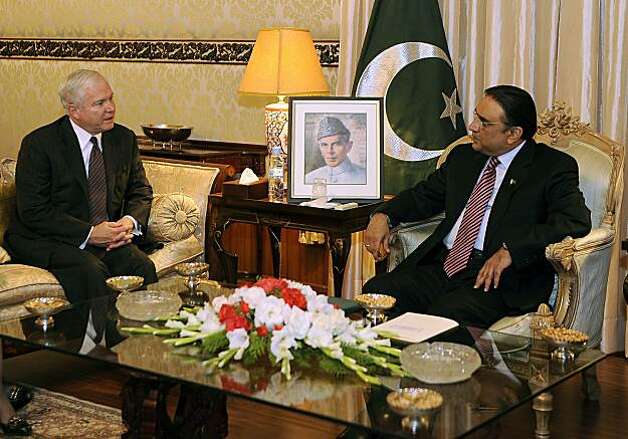
Pakistan not an ally of US: Robert Gates
http://www.thehindu.com/
Robert Gates, the former U.S. Defence Secretary who was the strongest supporter of Pakistan, believes that Islamabad is not an ally of America and it will not give up its policy of supporting terrorists.“Although I would defend them in front of Congress and to the press to keep the relationship from getting worse -- and endangering our supply line from Karachi -- I knew they were really no ally at all,” Mr. Gates writes in his forthcoming book titled ‘Duty: Memoirs of a Secretary at War’. Referring to his visit in January 2010 -- his second and the last one to Pakistan -- wherein he met the then President Asif Ali Zardari, Prime Minister Yousuf Raza Gilani and Army Chief Gen Ashfaq Pervez Kayani, Mr. Gates writes that he returned convinced that Islamabad would not give up its policy of supporting terrorists.
“No administration in my entire career devoted more time and energy to working the Pakistanis than did President (Barack) Obama and all his senior team,” Mr. Gates, who was the defence secretary from December 2006 to July 2011, writes. “My message was consistent: we were committed to a long-term strategic partnership; we needed to work together against the ‘syndicate of terror’ placing Afghanistan, Pakistan and India at risk; we needed to remove safe havens on both side of the border; Pakistan needed to better control anti-Americanism and harassment of Americans; and the Pakistani army’s ‘extra-judicial killings’ (executions) were putting our relationship at risk,” Mr. Gates writes in his memoir. The book is scheduled to be released next week. “The visit was for naught,” Mr. Gates writes referring to his meetings with the Pakistani leaders on January 21-22, 2010. “I returned convinced that Pakistan would work with the U.S. in some ways -- such as providing supply lines through Pakistan, which were also highly profitable -- while at the same time providing sanctuary for the Taliban and other extremists, so that no matter who came out on top in Afghanistan, Pakistan would have influence. If there was to be any reconciliation, the Pakistanis intended to control it,” Mr. Gates said. In his memoir running into more than 600 pages, Mr. Gates says weeks before his inauguration, Mr. Obama asked him to travel to Chicago to attend a meeting of his transition’s national security team, which among others was attended by Ms. Hillary Clinton and Mr. Joe Biden. The meeting, held in December, spent nearly an hour discussing on Afghanistan, Pakistan and India, Mr. Gates writes. “Pakistan was described as the biggest, most dangerous situation,” he writes. In Mach 2009, Mr. Gates writes, Mr. Obama held a series of meetings on his Af-Pak to discuss report of Bruce Riedel, who was appointed by the President. One of those Friday, he writes, they reviewed the final Riedel report.
This “recommended disrupting the terrorist networks in Afghanistan and especially Pakistan, promoting a more effective government in Afghanistan, developing the Afghan security forces, ending Pakistan’s support for terrorist and insurgent groups, enhancing civilian control in Pakistan, and using US diplomatic, military, and intelligence channels to reduce enmity and distrust between Pakistan and India. It was breathtaking in its ambition,” Mr. Gates writes. When Obama announced his Af-Pak strategy, Mr. Gates said he had reservations on Pakistan’s co-operation. “I also doubted we could persuade the Pakistanis to change their ‘calculus’ and go after the Afghan and other extremists on their side of the border. When a Pakistani Taliban offensive that spring reached within sixty miles of Islamabad the Pakistani army went after them in the border provinces of Swat and South Waziristan for their own protection. “Their continuing toleration of the Afghan Taliban, including harbouring their leaders in Quetta was a hedging strategy based on their lack of trust in us, given unwillingness to stay engaged in Afghanistan in the early 1990s,” he writes. Such was his distrust of Pakistan that, he writes, when they were planning for Osama bin Laden raid, he was worried that the ISI was aware of the al-Qaeda chief’s whereabouts. “I worried that Pakistani Inter-Services Intelligence was aware of where Bin Laden was and that there might be rings of security around the compound that we knew nothing about or, at minimum, that 1ST might have more eyes on the compound than we could know,” he wrote. The worst-case scenario was that the Pakistanis could get a number of troops to the compound quickly, prevent extraction of our team and take them prisoner, he writes. When he asked his Vice Admiral William McRaven what he planned to do if the Pakistani military showed up during the operation, he said the team would just hunker down and wait for a “diplomatic extraction.” “They would wait inside the compound and not shoot any Pakistanis. I then asked what they would do if the Pakistanis breached the walls: ‘Do you shoot or surrender?’ Our team couldn’t surrender, I said. If the Pakistani military showed up, our team needed to be prepared to do whatever was necessary to escape,” Mr. Gates writes. “After considerable discussion, there was broad agreement to this, and as a result, additional MH-47 helicopters and forces were assigned to the mission,” he says. Mr. Gates writes that ahead of the Abbottabad raid no one inside the administration talked about seeking Pakistani help in killing bin Laden. “No one thought we should ask the Pakistanis for help or permission. In every instance when we had provided a heads-up to the Pakistan military or intelligence services, the target was forewarned and fled, or the Pakistanis went after the target unilaterally, prematurely and unsuccessfully,” he says. The successful bin Laden raid, he writes, was humiliating for the Pakistan Army.
Obama, Gates and the trouble with the Afghanistan blame game
Spencer AckermanIn new memoir, former US defense secretary Robert Gates reportedly faults Obama for lacking faith, but reality is more grey Robert Gates’ new memoir is the first entry in the “Who lost Afghanistan?” sweepstakes. It will not be the last. This coming Tuesday marks the publication of Duty: Memoirs of a Secretary of War, the former US defense secretary’s long-awaited book detailing his time in the Pentagon at the helm of two unpopular and failing wars. Leaks of the book’s content to the New York Times and Washington Post, as well as an essay adapted from the memoir published by the Wall Street Journal, show Gates sharply criticizing President Barack Obama for losing faith in his own Afghanistan strategy during the critical year of 2009. It amounts to a retrospective narrative in which avaricious civilian politicians trample the advice of military professionals better attuned to the harsh truths on the ground. Gates writes, according to the early reports, that Obama distrusted senior military leaders, who urged the president towards the “surge” strategy that had previously been employed in Iraq – recasting the war as a counterinsurgency campaign, implemented by tens of thousands of additional troops and an intensified air campaign. Not only was Obama skeptical of their predictions of what military power could accomplish, Gates believes, but he was more committed to ending the war than to waging it. “Obama was respectful of senior officers and always heard them out, but he often disagreed with them and was deeply suspicious of their actions and recommendations,” writes Gates, the only person to serve as defense secretary for presidents from different political parties. “Bush seemed to enjoy the company of the senior military; I think Obama considered time spent with generals and admirals an obligation.” The trouble for Gates’ memoir – which, for full disclosure, I haven’t yet read – is that from the vantage point of 2014, it is hard to see how Obama wasn’t correct, on the merits, and how Gates and the Pentagon aren’t guilty of overpromising what the military could accomplish in Afghanistan. It may be lost in the media din about Gates’ criticism, but Obama gave the generals almost everything they asked for. General Stanley McChrystal, then the commander of US forces in Afghanistan, wanted 40,000 “surge” troops; Obama gave him 30,000 in 2010, and got commitments from Nato to make up almost all of the difference, on top of over 20,000 that Obama had already ordered into Afghanistan during 2009. The strategy implemented in Afghanistan was the counterinsurgency campaign the generals desired, largely a duplicate of the strategy in Iraq. That strategy considered weakening the Taliban in southern Afghanistan the key to a virtuous circle of events that would not only stabilize Afghanistan, but weaken al-Qaida leadership across the border in tribal Pakistan. But Obama would not commit to keeping the surge troops in Afghanistan beyond 2011. In his book Obama’s Wars, Bob Woodward detailed a dramatic scene in which the president extracted a commitment from the military leadership that they would not request additional forces after the 18-month lifespan of the troop surge. “I don’t want to be in a situation here where we’re back here in six months talking about another 40,000,” Obama told the brass, according to Woodward. Gates evidently considers that and other White House-Pentagon interactions on Afghanistan an indication of Obama’s lack of faith. Another way of looking at it is that Obama demanded that the military actually produce the results in Afghanistan it promised. As Woodward recounts, Admiral Mike Mullen, the chairman of the Joint Chiefs of Staff, pledged in November 2009, “We won’t come back and ask for more troops again.” Petraeus agreed, “You’ve got one bite at this apple … It ought to be a decisive one.” Once Obama turned the war over to McChrystal, and later to his successor, David Petraeus, fierce fighting took place, particularly in southern Afghanistan – fighting that combined not only conventional soldiers and marines, but, under Petraeus especially, a sharp escalation in airstrikes and special operations raids. But never did the generals convert their faith that intensified military pressure would convince the Taliban to sue for peace into a viable strategy. Nor could they articulate how escalation in Afghanistan would ultimately weaken al-Qaida in Pakistan. Looking just at Afghanistan, military historians are likely to question the generals’ decision to flood southern Afghanistan with US troops, rather than focusing on the porous eastern Afghanistan border region. The results that have come in thus far do not look good for Gates and the generals. The Taliban doesn’t just remain a potent force in Afghanistan; it has snubbed both US and Afghan government peace overtures, evidently waiting out the US troop drawdown slated for the end of this year. The longest war the US has ever fought is also its least popular, which clashes against the assumption Gates implicitly makes that the public would have accepted an open-ended troop commitment. A recent US intelligence assessment reportedly concluded that any gains made in the war will fade after 2017. And the US’s installed pick for the Afghan presidency, Hamid Karzai, continues to be an unreliable partner, undercutting a cornerstone principle of counterinsurgency strategy – something the military chose to ignore in 2009. Whatever setbacks occurred for the al-Qaida leadership in Pakistan resulted from a massive, controversial escalation in drone strikes there, and the May 2011 raid that killed Osama bin Laden, which points to a deep cleavage between the Afghanistan war and the destruction of al-Qaida that was once its purpose. But Obama certainly deserves massive amounts of blame for Afghanistan. Whatever the flaws of the military strategy of 2009-2010, Obama embraced it, and now it is his responsibility. Obama turned the ambivalence Gates identified into geopolitical reality by vocalizing mixed and irreconcilable messages about the war to different audiences: to the American public, he is ending the war; to foreign audiences, the US will remain in Afghanistan via a still-uncompleted pact to station a residual troop presence there after this year. The net result is that few of the relevant actors in the Afghanistan war can easily plan for what the war will look like after 2014. The strongest indictment of Obama on Afghanistan comes from an implication that Gates’ memoir raises. If Obama indeed lacked confidence in the troop surge and counterinsurgency strategy, then implementing it was a cynical calculation that gambled with the lives of US troops and Afghan civilians. There is plenty of blame to go around for the US’s minimal achievements in Afghanistan as the war, never a political priority for anyone in Washington, fades from attention. That blame, and the recriminations that go with it, is likely to spur many an account like the one Gates provided, especially if former secretary of state Hillary Rodham Clinton, a surge advocate, runs for president. But the tragedy of the Afghanistan war is that the realities on the ground in Afghanistan eluded both White House civilians and senior military officers, whether they were stationed in Kandahar, Kabul or back at the Pentagon. Avoiding future military tragedies will depend on both civilian politicians and a post-Afghanistan officer corps rejecting an enthusiasm for faddish martial ideologies that promise, but do not deliver. Far more than any inevitable conflicts between civilians and the military, that is the enduring lesson of the Iraq and Afghanistan wars Gates worked hard to rescue.
Salute To Aitizaz Hasan:Saving lives: A teenager’s sacrifice for hundreds of mothers
Perhaps the only way a parent can deal with the loss of a child is to believe that it was for a cause. This is how Aitizaz Hasan’s parents console themselves: reminding each other, their family and friends that their child is a martyr and he died saving hundreds of lives. Aitizaz reached school late on Monday morning and was not allowed to attend the morning assembly as punishment. He was standing outside the gate with two other schoolmates when a man aged 20-25 years approached the Government High School Ibrahimzai in Hangu and said he was there to take admission, said Aitizaz’s elder brother, Mujtaba.
It was during this conversation that one of the students spotted a detonator and Aitizaz’s schoolmates ran inside. But Aitizaz stood his ground and got hold of the bomber who then detonated his vest. “I had never thought that my brother would die such a great death. He sacrificed his life to save humanity,” Mujtaba said in an interview with The Express Tribune on Wednesday. The school is the only one in Ibrahimzai, a Shia-dominated area in Hangu. There were nearly 2,000 students in the school at the time the attack occurred. Later in the day, the bombing, which was the first suicide attack at a school, was claimed by Lashkar-e-Jhangvi. Aitizaz was the second of his siblings and had two sisters. He was a friend to many, respected and loved in his village, where the news of his death spread rapidly. His father Mujahid Ali works in the UAE. He says he has not come back home to mourn his son’s death, but to celebrate his life. “My son made his mother cry, but saved hundreds of mothers from crying for their children.”
“I am ready to sacrifice my second son for Pakistan as well,” Ali added. “There are a handful of people in the world who are martyrs; I am now one of those proud fathers whose son is amongst them.” The government should announce a civilian award, Tamgha-i-Shujaat or Nishan-e-Haider, for his bravery, Mujtaba added. Government officials had not visited the family until Wednesday night and neither had officials made their typical announcements of ‘compensation’. Teachers and students say they are still in shock. The principal of the school, Lal Baz, said he is at a loss for words to express Aitizaz’s bravery. “The attack targeted education and I am surprised neither the federal nor the provincial government functionary has visited the family. Their silence is condemnable.” A student, Atif Hussain, said the vacuum left by his death may never be filled. “Aitizaz died for education and no one can snatch this right from us.”
Pakistan: Shrines attacked again
Six people have been killed ruthlessly in Karachi at the shrine of Ayub Shah Bukhari. Three of the victims were employed at the shrine while the others were frequent visitors. Tehreek-e-Taliban Pakistan (TTP) has taken responsibility for the gruesome act in which they slit the throats of the victims. The killers left a message for other shrine visitors, warning them to shun visiting shrines otherwise they too would meet the same fate. Though shrines have been attacked previously by TTP, the brutality with which these people have been killed is certainly new and speaks volumes of the inhumanity and barbaric nature of these groups. That they think their mantle of religiosity permits them to brutalize people in order to ‘cleanse’ Islam is enough to suggest that they cannot be negotiatiated with and deserve to be put down down with force.
Sufi Islam through its message of humanism and love has been historically instrumental in connecting people from diverse religious and ethnic backgrounds into a single entity. In the history of the subcontinent, saints, shrines and the Sufi ideology has played a significant role in not only spreading Islam but in galvanizing Muslims divided into different denominations and sects towards the centrality of Islamic teaching: respect for human rights and tolerance for others. However, the Taliban and their Salafi brothers are bent upon disfiguring this positive message with their own narrow, literalist, rigid and fanatical interpretation of Islam. Their modus operandi is not to win hearts and minds, it is to terrorise people into acquiescence. Shrines are part of Pakistan’s culture. Their religious symbolism is enshrined in the lives of those buried there. Desecrating their places of burial is disrespecting their efforts to spread Islam’s true message. It is no service to Islam to go around brutally killing people who disagree with you and desecrate the tombs of saints, especially in the name of Islam, inherently a religion of peace and harmony. This is a crisis of religious values that would decimate the basic texture of ‘religion’, a theology that teaches violence and intolerance towards others.
It is time the government gets hold of these fanatics and punishes them for their misdeeds. A large segment of people in Pakistan connect themselves to shrines and those buried there. Frankly speaking, these saplings of hatred are of our own making. Their terrorism is the payback for the jihadist movement that we nourished so fondly. Therefore it is for us only to reverse this wrong path taken.
Christian Sanitary Workers Forcefully Expelled From Their Houses In Karachi
Asian Human Rights Commission (AHRC), stated in a report that sanitary workers from Christian and Hindu communities in the economic hub of Pakistan-Karachi were forcefully driven out of their quarters, as drug vendors attacked their homes and abducted their children. A copy of the Asian Human Rights Commission’s statement is presented below: Dear friends, The Asian Human Rights Commission (AHRC) has received information that a century old settlement of sanitary workers from the Christian and Hindu communities were forced to vacate after the rape, abduction and attacks on the houses by drug peddlers with the connivance of police and Pakistan Rangers. The community known as ‘Slaughter House Quarter’ in an old area of Karachi has been occupied by the police informers and gangs who are fighting to control the area. To force the Christians to leave their homes three Christians were killed and many women including a young girl were gang raped. Frequently and without warning the criminals broke through the compound walls and opened fire on the inhabitants which resulted in injuries to several children. The victims of rape and assault complained to the police and Rangers but their reply was to leave the place and settle elsewhere. The families have left the place of their ancestors and as a result lost their jobs. They were even not able to collect items of daily usage. CASE NARRATIVE: The information has been collected from the victims and activists, Human Rights Commission of Pakistan, the Daily Dawn and the Daily Express Tribune. The ‘Slaughter House Quarters’ was established in 1916 by the colonial rulers for the sanitary workers of the Karachi Metropolitan Corporation (KMC). Around 90 percent of the inhabitants were Christians and 10 percent were Hindus. The habitants were paying a rent of Rs. 450/= per month for their individual houses to the KMC. The current inhabitants are the fifth generation of people to settle in the slaughter house quarters but are being forced to vacate their homes and are compelled to leave the city or their community to settle elsewhere. Hardly five to seven houses are left there but only elder male persons can go in the night to live. The Lyari area was considered a place of secular and democratic thought and the democratic movements originated from there. During the military government of General Musharraf, the Lyari area was systematically changed into drug dens of different peddlers and criminal groups with the assistance of state intelligence agencies and the police with the patronage of local politicians. The previous civilian government has also continued with the policies of military rulers to change the democratic colour of the area by patronizing some militant groups. The residents have suffered from threats and extortion since 2008. The situation became worse when on October 26, 2013, a group of armed men entered the compound and started indiscriminate firing after locking the exit gates which resulted the killing of three children and two activists from the Christian community, Yousuf Iqbal alias Joja and Younis Inayat; many men and women were injured. The attackers demanded that the inhabitants join their fight otherwise they will burn the whole area. The Pakistan Rangers were stationed outside the compound walls but refused to interfere as they did not have the permission from their higher authorities. Before this incident, on August 13, a Christian activist, Victor William Bhutta, was killed near to the Slaughter House Quarters for raising the voice against hooliganism. The local police refused to file the FIR against the leaders of gangs but instead filed an FIR against unknown assailants. On November 4, the armed men again attacked the Christian houses and forced 500 persons to vacate their houses. A former elected councilor and prominent social worker, Mr. Bernard Peter, and a Hindu social worker, Mr. Mohan Das, were harassed and threatened with death for collecting data about the losses and uniting the community to remain in the locality. Mr. Bernard Peter filed an application on December 10 to the Director General of the Pakistan Rangers about the attacks on minority people and incidents of rape of young women, threats, intimidation, extortion and the cordoning off of the quarters. On December 12, Peter’s 26 year old sister was abducted by the gangsters, Shahid Rehman and Shakeel Commando groups and beaten to inform the whereabouts of her brother. When she refused she was gang raped. There are reports of half a dozen young women being raped by the members of the gang. When Peter’s family members tried to file an FIR of gang rape the police asked to produce Miss “R” who was living out of the city. She was called but police again refused to file FIR and asked her to get verification from the hospital. When it was provided the police said they could not file case against the nominated persons but only against unknown persons. The 720 families left the quarters and are living in different localities of Karachi and other parts of the Sindh province. They have lost their jobs and their houses and the Sindh government is not taking any action to provide them with relief. Rather the high police officials have only suggested that they comply with the gangsters so that they can earn a living. The Senior Superintendent of Police (SSP) Lyari, Mr. Shah Nawaz, told Daily Express that police were giving the gang rape victim, ‘R’, and her family protection and also looking in to the allegations. He further said “we will even conduct a raid if we have to”. But still police have not made any progress to rehabilitate the displaced person to their original place which is in total control of the gangsters. SUGGESTED ACTION: Please write the letters to the given authorities calling them to stop the victimization of religious minority groups and restore their right to be Pakistani citizens. Please urge them to rehabilitate the 720 families to their houses at ‘Slaughter House Quarters’ Lyari, Karachi, arrest the rapists and killers who are well known to police and Rangers, the police and Rangers high officials must be prosecuted for abetting the gangsters to occupy the century old settlement of sanitary workers, gang rape and killings. The AHRC is writing separate letters to the UN Independent Expert on Minority Issues calling for her intervention into this matter of forced displacement. - See more at: http://www.christiansinpakistan.com/christian-sanitary-workers-forcefully-expelled-from-their-homes-in-karachi/#sthash.qTffrtks.dpufKARACHI: Sanitary workers from Christian and Hindu communities forced to vacate their houses – the Asian Human Rights Commission states.
Pakistan's Ahmadi Muslims:The case of Masood Ahmad reveals how blasphemy laws in Pakistan are used to persecute minorities
http://rationalist.org.uk/
Asif Zardari not indicted in Polo Ground reference case
Subscribe to:
Posts (Atom)