
Wednesday, December 25, 2013
Pakistan: North Waziristan cauldron
Jailed British Ahmadi Masood Ahmad in Pakistan blasphemy appeal

Pakistan: Ahmadi man barred from burying child in public graveyard
A man from the minority Ahmadi community was barred from burying his two-year-old daughter in a graveyard in Pakistan's Punjab province by a group of a Muslims. The daughter of Waheed Ahmad, a resident of Toba Tek Singh district, died yesterday.
When Ahmad, his relatives and members of the Ahmadi community took the body for burial, a group of extremists stopped them from entering the graveyard in Kathowali, saying "only Muslims" could be interred there.
A police contingent reached the area and held negotiation with both groups, leaders of the minority community said.
As the group of extremists refused to show any laxity, senior police officers requested the Ahmadis to bury the child at some other place. Finally, the Ahmadis agreed to bury the girl in a piece of land located some distance away from the graveyard.
It was also decided that Ahmadis would bury their dead at this place in future, the community leaders said.
Pakistan's Ahmadis consider themselves Muslim but were declared non-Muslims through a constitutional amendment in 1974.
A decade later, they were barred from proselytising or identifying themselves as Muslims. Some 1.5 million Ahmadis live across the country.

Veena Malik ties the knot


Pakistan: Our struggle against polio
Pakistan: Fraught venture
 It is indefensibly a fraught venture that the political class is embarked upon, which could potentially explode and end up into unforeseen unpleasant consequences. After the PTI had launched into its campaign of street protest against uncontrolled price hike, its archrival in Khyber-Pakhtunkhwa JUI (F) has announced to follow suit. And while the PTI, after staging the Lahore show, has declared to carry the campaign on to Karachi and Rawalpindi, the JUI (F) wants to confront the PTI on the issue of law and order in the latter's KP fort.
Then is the nation going to be a hapless spectator of a risk-fraught competition of dharnas in the days ahead? For, predictably, sooner than later, other political players in the field would also hop on to this venture. This is the way the things have been going on in this country. And no change is going to be there this time round too. Are the issues, then, now on to be settled on the streets, and the people's problems are to be sorted out in sit-ins and street marches, not the legislative halls and official corridors?
A political class wedded to trite clichés can chant as cheekily that protests are democracy's integral part, as it does that no problem has a military solution. And just as it overlooks too many realities that cannot be ignored at all for that phenomenon's rational understanding, so does it in the instant case. Yes, a war has ultimately to end up in a political solution. But the solution is in reality the victor's-dictated surrender document for the defeated to sign up to. And peace between the state and warring militants comes about only when the state has pulverised them with a robust security action into such emasculation that they find it more expedient to talk peace than continuing fighting.
And so goes with the political class's shallow pretence about street protest. Yes, protests, marches and sit-ins are very much part of a democratic order, practised no lesser in entrenched democracies. But while street urchins could take to this "democratic" option blithely, the political class has to distinguish itself from that riff-raff by taking to this course after considering all the pros and cons thoroughly. The critical question for street campaigners is to consider if the problem in question can be wiped out simply with a street show.
If the present street campaigners are any true to their professions and intents, they indeed would conclude that the issues they are raising so much of hue and cry about are no soluble so easily. Price control is dependent on a host of administrative, economic and multifarious other factors, which until tackled effectively would retard and obstruct any reduction in prices. And no street slogans, no matter how volubly and voluminously raised, can inflict even a slight slowdown in lawlessness nor can it impart even a marginal uplift in governance.
Fighting crime is a serious matter that requires hardboiled thinking, meticulous planning, robust strategies and extremely toned-up security apparatus. None of that can be done on the street. It is the official precincts and security quarters from where all the requisites could come forth. And that holds good for refurbishing the governance as well. It is not the street but the brains and the wills that produce the means for propping up the governance to the shape to deliver to the masses to their greater gratification.
Indeed, it could only be the height of political adventurism, arrogance and opportunism that instead of employing the governmental and legislative forums the street is being resorted to when most of the street campaigners have their exalted presences in the governments and also in the legislatures. It is those forums that they should use, and would indeed profitably if they do. The political class, as a whole, needs to know, which it certainly knows not, notwithstanding its pretences of keeping its hand on the people's pulse, that it is well on its way of losing the public's all trust, which already it has lost irreversibly considerably.
And what is all the more alarming is that the people are losing worrisomely fast the trust in the very democratic order. A public feeling is getting currency in a whirlwind that this system has failed to deliver and deliver it would not at all so long as the entrenched political class holds the ground and calls the shots. Of course, this should alarm not just the current campaigners on the street, though. The entire political class must shudder at it.
But the street campaigners must tell if it is now the street protest, not the ballot box, that henceforth has to decide who will rule in the land and how. If that is it, they have only look to some South East Asian nations to know the horror of this phenomenon. The street protests oust one government and install a new one to be in turn toppled by the street agitators of the ousted regime and make for it to stage a comeback. Just a short glimpse at present-day Thailand should suffice for the street agitators to know of this phenomenon's vagaries.
Certainly, this country cannot afford such upheavals and would do well without them.
Pakistan: TTP Darra Adamkhel 2 commanders arrested in Nowshera
Police have arrested two commanders of Darra Adamkhel Tehrik-e-Taliban Pakistan (TTP) on Wednesday morning here, Geo News reported.
Police said that an operation was launched on a tip-off at Fazil Korona here and arrested two key-commanders of TTP Darra Adamkhel, namely, Saleem and Tariq during the operation. Three hand grenades and two pistols were recovered from the accused, police said.
The accused during initial investigation have confessed their involvement in destroying public property and target-killing incidents. They have been shifted to some unknown place for further grilling, police said.
Pakistan: Chehlum procession Rawalpindi
In a blood-soaked Ashura this year, the mourners in Rawalpindi reacted worthily to make sure that blaring Yazid’s eulogies in the ears of Imam Hussain’s mourning processions does not become an acceptable practice in Pakistan. Our hats are off to them. Following that, Takfiri Deobandis gave vociferous calls to their cohorts to rally and thwart the Chehlum Procession in Rawalpindi. In this backdrop, Ralwapindi’s Chehlum procession this year epitomized all that is inspiring, touching, and motivating about “Azaa e Hussain”. When several hundred thousand gathered in a congregation that usually numbers less than ten thousand, it was not an act of defiance. It was way beyond that. It was an act of HONOUR. An act to honour the martyrs of Karbala and an act of honour for a beleaguered minority in a country which it, more than anyone in proportion, helped shape and create. It was a determined act to show that we can sacrifice everything but will not give up the right to commemorate the martyrdom of Imam in a manner any lesser than we did in the same towns and neighbourhoods before we helped make this country. Chehlum of the martyrs of Karbala marks an extremely important occasion for us. Chehlum has profound philosophy and history. While Ashura is the day for mourning for Imam Hussain, Chehlum is the day for reaffirming our pledge to our only leader Imam Hussain. Chehlum marks the culmination of the greatest episode in the history. Chehlum marks the end of a journey of Hussainiyat that began in the twilight of the day of Ashura. When the family of the Prophet were released from the prison in Damascus and they left for Karbala, Lady Zainab decided that litters on camel backs should be covered in black so that people would know the travelers were in mourning. This was the first Chehlum procession taken out by the mourners of Imam Hussain. That’s why we, when we can, walk hundreds of kilometers to pay homage to our Imam on the day of chehlum. It must be acknowledged that the law enforcement agencies and the Government of Punjab did a good job on this occasion. - See more at: http://lubpak.com/archives/299613#sthash.wvW8yxvL.dpufby Asif Zaidi
137th birth anniversary of the Quaid: Former President Zardari calls for banishing militancy
http://mediacellppp.wordpress.com/


Tuesday, December 24, 2013
85% say Mao's merits outweigh his faults: poll
 A Global Times poll has revealed that more than 85 percent of respondents see the merits of Mao Zedong as greatly outweighing his mistakes, with more than 90 percent of respondents showing reverence or respect to Mao.
 The survey, conducted by the Global Times Global Poll Center through telephone interviews and online polls on Monday and Tuesday, interviewed 1,045 respondents aged over 18 in Beijing, Shanghai, Guangzhou, Chengdu, Xi'an, Changsha and Shenyang.
The findings showed respondents aged above 50 and those with a high school or vocational school education are more likely to revere Mao, while respondents who have a bachelor's degree or above are more likely to be critical of him.
In a multiple choice poll, nearly 90 percent of respondents believe the greatest merit of Mao, who was born 120 years ago on Thursday, is founding an independent nation through revolution, while nearly 60 percent admire him for advocating the idea of serving the people and spreading the notion of fairness.
"Fairness being the second most popular of Mao's merits makes sense as it's part of the reason that people miss the Mao era, because the wealth gap was not as big as now," said Zhao Zhikui, a research fellow at the Academy of Marxism under the Chinese Academy of Social Sciences, noting that it should be an alert to the authorities.
The poll also shows nearly half of respondents value Mao making China a nuclear power by making its own atomic and hydrogen bombs, as well as his promoting the liberation of women.
About 48 percent of respondents praised his deeds in paving the way for opening up the country through building Sino-US relations, nearly 55 percent voted for him promoting China's international position, and nearly 46 percent acknowledged his advancing the industrial and economic systems.
Nearly 80 percent of respondents believe Mao's main fault was launching the Cultural Revolution (1966-76), around 60 percent of them voted for his pushing the Great Leap Forward (1958-61) out of not respecting economic rules, and 46 percent mentioned Mao's main fault as launching a personality cult.
"The concern of those who hold a negative point of view toward Mao currently is that the acute social contradictions in today's China may lead to people rationalizing the Cultural Revolution and hoping to solve the problems through repeating the pattern," Huang Weiping, director of the Contemporary Chinese Politics Research Institute at Shenzhen University, told the Global Times.
"The authorities avoid deep discussions of the mistakes Mao made in launching the Cultural Revolution," he noted.
More than 90 percent of respondents believe that Mao's era still influences today's China. Those respondents aged from 18 to 29 were most likely to believe Mao's era still has an influence today, with figures of 96 percent.
Xie Chuntao, a professor with the Party School of the Communist Party of China Central Committee, told the Global Times that the survey shows Chinese society has a more rational attitude toward Mao and consider him as a politician from the perspective of his influence on the whole nation.
Zhao said the influence Mao had on China is obvious, as its political system, economic basis and international position is all rooted in the Mao era.
Activities such as galas, exhibitions and seminars are being held nationwide to commemorate the anniversary of his birth.
Local authorities in Mao Zedong's hometown in Shaoshan, Hunan Province, have spent billions of yuan on celebrations and public projects to mark the anniversary.
U.S: Demand for food stamps soars as cuts sink in and shelves empty
 For Denise Acosta, it was being laid off for the first time. For Diana Martinez, it was the death of her mother, leaving her as the sole carer for her severely disabled younger brother. For Johnny Hill, it was having to take responsibility, a year away from retirement, for her two young granddaughters.
Each of these hard-working women from San Antonio, Texas, have fallen victim to circumstances that turned their lives upside down, robbing them of their full-time jobs, the paychecks they once enjoyed and, in Acosta's case, her home. Their stories vary, but they all belong to a growing group, America's working poor, for whom the journey from getting by to hunger can be brutally short.
Deep cuts to the US food stamps programme, designed to keep low-income Americans out of hunger in the aftermath of the economic recession, have forced increasing numbers of families such as theirs to rely on food banks and community organisations to stave off hunger.
An expansion of the programme, put in place when the recession was biting deepest, was allowed to expire in November, cutting benefits for an estimated 48 million people, including 22 million children, by an average of 7%.
As these cuts begin to bite, even harsher reductions are in prospect. Republicans in the House of Representatives have proposed $38bn cuts over 10 years, in their latest version of a long-delayed farm bill that would also require new work requirements and drug tests for food stamp recipients.
The cuts have forced poor families to make tough choices. The Guardian spoke to beneficiaries of the food stamps scheme, known as the Supplemental Nutrition Assistance Programme (Snap), in San Antonio, Texas. As the second most populous US state after California, Texas suffered the second-biggest cut to its Snap programme, affecting 4 million recipients.
At the San Antonio Food Bank, where she comes for help with her resume and to register for its work force program, Acosta, 36, a mother of four children aged 14 and under, described how being laid off from her job as a healthcare administrator seven months ago had caused an immediate family crisis.
An $800 medical bill, no longer covered by insurance, meant Acosta quickly fell behind on the $1,200 monthly payments on her house, then the car. She lost both, and was forced to move in with her sister in Edinburg, Texas, 200 miles south, until her unemployment benefit came through. The strain of having her income slashed has taken its toll.
“For a while I had trouble sleeping. I would go to bed at three and four in the morning and I went through a depression. But I tell myself the children depend on me. I think 'Mind over matter'. People are worse off than me.”
In October, the family's Snap benefits were $113 a month, a sum that lasts them about a week and a half. A letter Acosta received warned her of a Snap cut of $11 for each family member in November. Acosta has learned to be creative: with the children's meals, with juggling bills, with trying to keep the kids from noticing the dwindling food on the table and in their schoolbags as her job search drags on.
“They are always starving, the boys have a very high metabolism – I don't know where the food goes. I used to buy Lunchables [lunch packs] for snacks, now I get a big pack of ham and cheese and we make our own. They say: 'Why can't we have Lunchables?' I tell them, 'This way they get more.' I buy larger packs of cheaper meat and stretch it out. We buy the cheaper brands of cereal now.
If I don't have enough food, the older ones are harder to please. The younger ones will have a tuna sandwich or Roma noodles, around 19 cents a pack. The older ones say 'This isn't even a meal.' I do my best to make sure they don't see a difference. I don't want it to affect them as much as it's affecting me.”
The soaring participation in Snap, which has almost doubled in seven years – from 25 million people in 2006 to almost 48 million today – has made it a prime target for large cuts by Republican lawmakers anxious to save money.
The House bill would deny Snap to 3.8 million low-income people in 2014, according to estimates by the Congressional Budget Office, and to an average of 3 million people a year for 10 years. Those who would find themselves no longer eligible include some of the nation's neediest individuals, working families, children and senior citizens. In addition, 200,000 families would lose access to subsidised school meals.
“That would make it really difficult for people who struggle to find work like me to get back on their feet,” Acosta said.
Even since the November cuts took effect, those involved in emergency food distribution reported higher demand and longer lines, with new clients they had not seen before. The San Antonio Food Bank says donations are up 16% But because of the cuts to Snap the supplies disappear faster.
Eric Cooper, the CEO, said: “For me, October, November and December is harvest season. Our community is at [its] best. There's a great spirit of the holidays and giving is at its peak. But when I go into the warehouse, there are a lot of empty shelves. It used to last longer. Demand is outpacing supply.”
The food bank’s 535 partner agencies, food pantries and kitchens across 16 counties in southwest Texas, are ordering more food, Cooper said. “They are reporting longer lines and they are seeing people sooner in the month.”
Of the 58,000 clients fed by the SAFB every week, Cooper said, half are working families, many are underemployed, the rest are seniors and people who, through mental or physical disability, cannot work. There are a lot of veterans in Texas, some of whom have been disabled through military service. But on the whole, he said “Hunger is biased towards women and kids. A divorce, a separation can put a lot of women in poverty.”
From the San Antonio Food Bank it is a short drive to the Baptist Temple Church food pantry, one of its partners. It usually feeds between 220 and 240 needy families a day, representing around 900 individuals. When the Guardian visited, on an unseasonably cold night in December, scores of people stood shivering in line in the crowded car park across the road from the church, while others took refuge in cars.
Johnny Hill, 64, a divorced great-grandmother, is raising her daughter's children, aged five and three, and looks after another grandchild part time.
A former school cafeteria manager for 25 years, Hill now works in administration six days a month for the church, which pays her $600. Her Snap benefits fell rom $550 to $494 last month. She comes to the food pantry three times a month and shares what she has with her 85-year-old neighbour. “It doesn't matter about me,” she said. “I just need to look out for the kids. We eat a lot of salads. We manage. I'm dealing with it.”
She has a lot of “good church friends”, who help out, but admitted: “We'd be in trouble if we didn't have the food bank.”
Like Hill, Diana Martinez, 46, inherited the responsibility for another family member. Her mother's death, left her in sole charge of “baby brother” Michael, 41, who is severely mentally disabled, forcing her to give up her 18-year job as a head custodian for the school district.
“Michael has the mind of a two-year-old,” Martinez said. “He goes to day care, but when he's not feeling good, he acts up and he won't go for weeks. Who would give me a job and time off when he acts up?”
Now she earns minimum wage of $7.25 an hour from an agency for 24 hours a week of caring for him, a total of $754 a month. The rest of the time she does it for free. Martinez and her son, Sean, six, live with her brother in a handicapped apartment paid for by Michael's disability benefits and they get $288 in Snap, reduced from $308. It has meant less meat and a trip to the food bank once a month, usually to the Salvation Army site downtown.
“I got a chicken here today, so we'll have that and mashed potatoes and macaroni. Sean will like that. If it wasn't for the food bank, I would be hungry. It helps me a lot.”
Last month, the need for emergency food in this community soared to its highest level yet, according to Joe Guinn, a minister at the church. He shakes his head in disbelief as he recalls last month. “There were 260 families, that's almost 1,500 people,” said Guinn. “Our absolute highest ever.”
Egypt arrests Morsi's prime minister
 Egyptian police have arrested the prime minister who served under the deposed President Mohamed Morsi.
Interior ministry confirmed on Tuesday that Hisham Qandil has been arrested for not carrying out a court ruling to nationalise a private company.
Last April, Kandil was sentenced after he refused to implement a court ruling to renationalise a textile company sold off by the administration of former president Hosni Mubarak.
Judge Khaled Hassan said the prison sentence must be carried out and ordered Kandil's arrest.
Officials in the Kandil government said renationalising state enterprises was not straightforward and the company had been broken up since it was sold to the foreign investor.
Morsi appointed Kandil in July 2012, after the Muslim Brotherhood politician won Egypt's first freely contested presidential election.
Morsi was deposed by the army on July 3 after mass protests against his rule. He is in detention charged with crimes including inciting the killing of protesters and escaping from jail.
The sentence against Kandil related to a 2011 court ruling demanding the government repurchase textile company Tanta Flax and Oils from a Saudi Arabian investor who bought it in 2005.
Egyptian courts have issued at least 11 rulings since the revolution that toppled Mubarak ordering the state to reverse deals signed by the former president's administration.
The lawsuits have been brought by activists and lawyers who say companies were sold off too cheaply and were representative of corrupt business practices during the Mubarak era.
The subsequent rulings have plunged a number of foreign companies operating in Egypt into legal limbo, exposing the government to the risk of costly international arbitration that could scare off much-needed investment from abroad.
Aseefa Bhutto Zardari felicitates Christian Community on eve of Christmas
Aseefa Bhutto Zardari has warmly greeted the Christian Community on the eve of Christmas falling on Wednesday December 25. She further said that the teachings of Jesus Christ (May Allah be pleased with him) who always spread the message of love remind us of peace, tolerance and brotherhood.http://mediacellppp.wordpress.com/

Bilawal Bhutto's Message on Quaid-e-Azam’s Birthday
Bilawal Bhutto Zardari, Patron-In-Chief, Pakistan Peoples Party (PPP) said the best way to pay homage to Quaid-e-Azam Mohammad Ali Jinnah is to protect Pakistan from the followers of extremist elements who vehemently opposed his struggle for independence and mounted attacks on his personality, during and after the independence.http://mediacellppp.wordpress.com/
Policeman killed, several others injured in Mansehra blast
http://dunyanews.tv/A policeman was killed and several others including two police officials were injured when in a blast near police vehicle at Chakrali Road. According to police, the bomb was planted by roadside that killed police official Aurangzeb and injured others. The injured were shifted to Abdullah Hospital for treatment. The police vehicle and windowpanes of nearby building of an educational institution ware also damaged in the explosion. Police and Bomb Disposal Squad were busy in search operation when the blast occurred. According to Bomb Disposal Squad, the bomb weighed five kilograms and it was locally made. Police cordoned off Chakrali Road and put security on high alert.
Shia Under Attack : Seven dead from blasts as Chehlum observed across Pakistan
The Express Tribune
Clash between Police and the Protester in... by TheExpressNews As Pakistanis observed the Chehlum of Hazrat Imam Hussain (RA) on Tuesday, a total of seven people were killed and at least 25 injured in multiple bomb explosions in Karachi and Mansehra, Express News reported. The Chehlum is an observance that occurs 40 days after Ashura and is marked by processions. The government suspended mobile services in 56 cities to ensure tightened security, but that did not stop two explosions going off in Mansehra. The first one injured four people while the next one on Chakrali Road killed three near a school. Earlier, in Karachi, blasts in Orangi Town took four lives and injuring 21. In Rawalpindi, a clash broke out between between a group of protesters and security personnel the Pirwadhai area, which borders Islamabad. Five people were injured in a firing incident in Raja Bazaar area of Rawalpindi, too. A heavy contingent of security officers was present in the area when unidentified armed men opened fire. It was reported that processionists in Rawalpindi tried to enter Islamabad but the police stopped them, which led to clashes.
Shia Under Attack: Five wounded in Rawalpindi firing
At least five persons were injured in an incident of firing at Raja bazar area of Rawalpindi, here on Tuesday. Rescue teams reached at the incident site and injured people were shifted to nearby hospital. The attackers managed to escape from the scene. The reason of attack could not be ascertained.

Afghanistan: we treat women like animals
According to Oxfam International, some 87 percent of Afghan women have experienced violence in the form of forced marriages, physical, sexual or psychological abuse Last year, a former Afghan warlord told me that women were treated like dogs in his province. Being an Afghan journalist, I have authored two books about the mistreatment of women in my country. Violence against women and teenaged girls in Afghanistan is growing. A UN report recently claimed that there was a 20 percent increase in violence and mistreatment. The annual report on the Protection of Civilians in Armed Conflict says more than 300 women and girls were brutally killed and 560 injured by their husbands and parents in 2012. On December 14, 2013, the BBC reported that an Afghan official confirmed that a man had incised the nose and lips of his 30-year-old wife, Setara, in Herat province. According to preliminary reports, Setara had been stabbed several times in her face as well. On November 28, 2013, two innocent women were hanged from a tree in Logar province. On December 13, 2013, a group of unidentified gunmen raped a 12-year-old girl in Baghlan province of northern Afghanistan. In another incident, a 15-year-old girl from Herat province told a human rights reporter that her husband and father-in-law beat her three or four times a day. In recent months, Afghan women have experienced horrific cases of abuse and violence but Afghan authorities support criminals instead of protecting young girls. Last month, a government official in northern Afghanistan admitted that a man had strangled his wife after she gave birth to a girl. She was dragged outside her room and brutally killed. In 2012, the international community ranked Afghanistan as the most dangerous country for women. Human Rights Watch, in its 15-page report, highlighted the health and economic consequences of marriage for those under 18 years and violence against young girls. Recently, the police arrested two men in northern Afghanistan for slitting the throat of a 15-year-old girl after her parents refused a marriage proposal. The Independent Commission on Human Rights in Afghanistan has compiled numerous cases of the sexual abuse of boys and girls in various parts of the country. On October 24, 2013, Khaama Press reported the heartbreaking story of a teenage girl sexually abused by her father. A local security official in Nimroz province said that the man accused of sexually abusing his teenage daughter for the past eight years had been arrested. Fourteen-year-old Moniza admitted that her father had sexually abused her. Violence against women, girls and teenage boys remains one of the most under-reported abuses. Bacha bazi (sodomy) and sexual abuse are old traditions in the country. According to the Afghan NGO RAWA, 90 percent of Afghan women are abused by their parents, relatives and husbands. In northern Afghanistan and in parts of the southern provinces, the same story is repeated. In various districts in the northern provinces, poor and poverty stricken girls and children are being kidnapped and sold into prostitution. Unemployed and poor young boys have also been subjected to trafficking for male prostitution, forced labour and the ‘playboy’ business. The tradition of child marriage has long been practiced in Afghanistan. Afghanistan’s civil war has left thousands of women widowed and young girls orphaned. Matrimonial ceremonies are expensive in the country, specifically in Paktika and Paktia provinces; the price for a young girl has been fixed at more than three million in Afghan currency. Education for girls in these provinces is considered to be a great sin while sports and other hobbies are not allowed. The majority of Afghan girls became pregnant before they reach physical maturity because they do not know about the law of the country. The Afghan civil law sets the minimum age for marriage at 16 for girls and 18 for boys. According to Oxfam International, some 87 percent of Afghan women have experienced violence in the form of forced marriages, physical, sexual or psychological abuse. Of the 42 married women interviewed by the NGO, 22 had been arrested as a direct result of running away from abusive husbands or family members. However, in interviews with prosecutors, the report could find just one instance where a man had been arrested for perpetrating such abuse. In 2012, the Taliban forced the closure of 600 schools in the eastern provinces. Recently, in Takhar province, 125 girls from the Bibi Hajra School were admitted into hospital after being poisoned by terrorists. A week later, another 40 girls from the same school were poisoned again and from Ahan Dara, a girl’s school in Taloqan, 160 girls were admitted to hospital after being poisoned by unknown terrorists. The illegal market of selling and buying of women and young girls in some districts of Jalalabad province is an age-old practice. Women are treated like animals in the Shinwari Pashtun tribe where they are sold like goats or sheep. Director Women Rights Sabrina Hamidi confirmed to news reporters that women are sold like animals in different districts of the Shinwari area of Jalalabad. Sabrina revealed that the price depends on the beauty of the girl and can range from around 80,000 in Afghan currency to 2,000 US $. NGOs and rights groups have registered numerous complaints with government authorities about the mistreatment of women by the police force. In 2009, Karzai’s government passed a Shia family law under which women must not refuse the sexual demands of their husbands; they must comply with demands for intercourse every four days unless they are sick. Most controversially, Article 132 specifies that women are required to sexually satisfy their husbands. The UN, US, NATO, Canada and Germany asked the Afghan government to review this controversial law as it will harm women physically. Article 132 says that a refusal to do the above would be against the law and husbands are allowed to stop feeding them: “If women say no, the husband has the right not to feed her.” Legal experts termed the law as a brutal way of treating women and say that this law has brought shame to the country. The future of women, according to Afghan human rights groups, is bleak in Afghanistan.Musa Khan Jalalzai
Pakistan: Polio: 400 volunteers turn back on vaccination drives
The Express TribuneChances that the polio vaccination campaign will take place in Khyber Agency as per schedule are looking slimmer after each development – 400 volunteers have now refused to take part in the drive. And, if earlier most of the hesitation came from daily wage volunteers, this time health department employees are also threatening to throw in the towel, The Express Tribune learnt on Monday. Eight polio paramedics have decided to quit. They have informed health department officials about their resignation. The rest are threatening to stay away till their demands are met. One of employees requesting not to be named, said all eight have handed in their notice to the relevant department. Khyber Agency Paramedics Association (KAPA) President Abdul Haleem confirmed the development and said they will not back down. Agency Surgeon Sameen Jan told The Express Tribune things have become difficult for them as far as conducting anti-polio drives is concerned. He also corroborated reports of volunteers pulling out and employees quitting. Volunteers have shared their apprehensions with him, said Jan. “We cannot force them to work; eight paramedics have submitted their premature resignation letters.” Jan went on to share field supervisor medical officer (FSMO) Dr Usman Afridi was also taking steps to get transferred from Khyber Agency. According to the agency surgeon, the anti-polio drive planned for January included 328 teams, which, by the looks of it, will be missing 400 workers and a FSMO. More security, compensation The agency’s paramedics held a meeting on Monday in which they decided to refrain from participating in the vaccination drive until their demands are fulfilled. These include better security and a financial compensation package for families of slain polio workers. The meeting was chaired by KAPA President Abdul Haleem. Two polio workers have been killed in the past 10 days, emphasised Haleem. “Vaccinating children against polio in Jamrud tehsil has become an uphill task,” he said. The government should provide a financial package to heirs of the martyred workers, insisted the KAPA president. “It is shocking that the government is yet to take solid steps to provide security to polio workers in the face of growing threats to vaccinators, even when they know the next drive is right round the corner in January. The government should also announce employment for family members of those killed, and an amount for compensation.” Security to paramedics and volunteers is only provided during polio inoculation campaigns. They are left in the lurch once the drive ends, leaving them exposed to threats, explained Haleem. Polio workers have formed a negotiation committee for talks with the administration, he added. An official of the health department confirmed these developments came to the fore after recent killings of polio workers in Khyber Agency.
Pakistan: Tide of hate surges ahead
THE extremist mindset that has come to increasingly dominate the religious discourse in Pakistan has in large part been attributed to the hold of the madressah system of ‘education’ in the country. Even in areas considered ‘secular’, such as large parts of Balochistan, madressahs have made significant inroads as our story on Sunday indicates.
The madressahs that proliferated in the 1980s during the Afghan war were different from the traditional seminaries in the subcontinent that taught subjects other than just religion.
Merry Christmas: Is that Santa at the door? No, its the Shia community of Multan
 Christmas for 700 Christian families in Multan was made extra special this year, as the Shia community showered them with gifts the day before the Chehlum of Imam Hussain.
The goodwill step was taken by Chairman Markazi Azdari Imam Hussain Council (MAIHC) Hasan Mashadi in collaboration with religious leaders from other religious sects. The gifts were sponsored by Multan’s civil society.

Pakistan: Countrywide load shedding to increase from today
The government announced on Monday revival of electricity loadshedding for ‘about two hours’ per day throughout the country because of an increased gap between power generation and demand arising out of annual canal closure and diversion of gas to textile industry.
“The Indus River System Authority has reduced indents for annual canal closure due to which loadshedding of about two hours will start on Tuesday,” a statement issued by the ministry of water and power said. “Inconvenience to be caused to the people due to loadshedding is regretted,” it added.
An official, however, told Dawn that loadshedding could go up to four hours on an average, but it would be kept at two hours in big cities and maximum loadshedding would be done in the rural sector and areas with lower recovery of bills. As a result, some consumers may complain of more than 10 hours of loadshedding.
He said the government was engaging with Irsa to persuade it to make higher water discharges from Tarbela dam to enable Wapda reduce electricity supply gap. At the same time, consumers have been advised to adopt energy conservation measures to minimise electricity shortage.
But Irsa had not accepted the water and power ministry’s demand because of the absence of its chairman, an official said. He said Irsa had been asked to ensure at least 15,000 to 20,000 cusecs of water releases from Tarbela dam against usual discharges of about 8,000 cusecs for drinking purposes during annual canal closure. Discharges from Tarbela dam stood at 35,000 cusecs on Monday.
The official said the Irsa chief would be back in town on Dec 26 and preside over a meeting to consider the government’s demand. He said the government had not asked for higher discharges from Mangla dam because Punjab had availed higher discharges from them and further depletion of storage could create operational difficulties.
An Irsa official said members of the authority appeared to be inclined to accept the government demand for higher water releases for more power generation, but for genuinely different reasons. He said the industrial sector was mostly releasing its waste into the river system and causing higher contamination. “Even though the drinking water was properly treated before use, there should be higher flows in rivers to enable filtration and treatment.”
A power ministry official said the electricity shortage had been caused not only because of canal closure but a sudden drop in temperatures beyond freezing point in many parts of the country. On top of that, the diversion of 100 million cubic feet of natural gas per day from the power sector to textile sector had generated an additional shortfall of about 450MW.
The official said Sindh would close down Kotri canal on Dec 26, followed by Sukkur on Jan 6 while canals in Punjab would remain closed for annual maintenance between Dec 25 and Jan 31. As a result, the hydropower generation would fall drastically to 1,000MW for about 35 days.
Coupled with the canal closure, the production from Wapda’s thermal stations will remain static at 1,500-2,000MW because of the ongoing rehabilitation programme.
Maximum reliance will, therefore, shift to IPPs. As a result, the cost of electricity will go up in view of more reliance on furnace oil and diesel for power generation.
Karachi: Blast hits route of Chehlum procession
 A big explosion rocked the area near Capri Cinema here on the route of the central mourning procession of Chehlum at M.A. Jinnah Road, ARY News reported on Tuesday.
The explosives were kept in a pipe. A destroyed mobile phone was also found from the place, officials said.
The participants of the Chehlum mourning procession had to offer Zohrain prayers at Imambargah Ali Raza near the bombing spot. The device went off when the procession was away from the place of bombing, so as remained unharmed in the explosion.
According to the law enforcement agencies the explosives were kept in a pipe of a billboard.
The bomb disposal squad reached to the spot of the blast near Sea Breeze at M.A. Jinnah Road.
Karachi: Blast near Numaish Chowrangi
http://www.thefrontierpost.com/
A blast occurred near Numaish Chowrangi Tuesday morning when the city is already on high alert on the occasion of chehlum of Hazrat Imam Hussain (RA) and his companions, Local TV reported.
According to initial reports, no casualty occurred in the explosion while security forces have cordoned off the area to ascertain details about the nature of the blast.
Bomb disposal squad also reached the spot immediately after the blast was reported.
Miscellaneous reports suggested that it was a tyre blast but on the contrary, police told that the bomb was triggered remotely.
However, further details are yet be ascertained.
With cell phones off the grid and pillion riding on motorcycles banned, the government has put in place strict security measures for the chehlum today.
Under the comprehensive security plan, 10,000 police and Rangers personnel have been deployed for security of the main mourning procession in Karachi. The procession route would be monitored through aerial surveillance and through a network of 150 closed-circuit television cameras.
Cellular phone services in major cities of the province, including Karachi, Hyderabad, Sukkur and Khairpur was suspended from 7am till 10pm. The government has also barred pillion riding for a day across the province.
The ban would remain in place from Monday midnight till Tuesday midnight. All weapon carrying permits have also been suspended for 10 days.
Fourteen mourning processions scheduled in Karachi have been declared highly sensitive. Additional Chief Secretary Home Mumtaz Ali Shah said troops would be deployed at all sensitive positions to avoid any untoward incidents.
Most parts of Rawalpindi have been sealed for fear of untoward incidents. Cellular services will be suspended in various cities, with the government taking strict measures to ensure security for the mourners.
Thousands of police personnel and Rangers have also been deployed in the city, with entry and exit point of the troubled Raja Bazar sealed.
Similarly, strict security arrangements have been made in other major cities including Lahore, Peshawar Multan and tribal agencies.
Imran Khan the ‘economist’
Sindh: Public holiday on Dec 27 to pay homage to late Benazir Bhutto
The government of Sindh has announced a public holiday on December 27 to pay homage to former prime minister Shaheed Benazir Bhutto on her sixth martyrdom anniversary.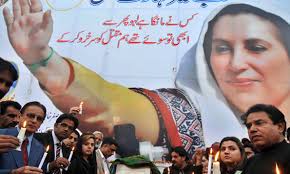 The provincial government Monday night issued a notification to this effect.
According to details, Chief Minister Sindh, Qaim Ali Shah, issued directives in this regard.
All office, ministries, departments including schools, colleges and other educational institutes will remained closed on Friday, December 27th, 2013.
In Pakistan discussing religion is a punishable offense for Ahmadis
 “It was staged and pre-planned,” said Shahid Attaullah, referring to the arrest of a homeopath Dr Masood Ahmed on charges of blasphemy.
Narrating the details of the events preceding the arrest of a 72-year old doctor, who is also a British national, Attaullah, the spokesperson for the Ahmaddiya Jamaat, said: “Two men posing as patients, came to his clinic in the Anarkali, an older part of Lahore, on November 25. After a few minutes they started discussing religion. Supposedly the doctor responded to their questions about Islam and then they left. Within minutes, a mob gathered around the clinic. A complaint was lodged and the police arrested him for preaching. He is in lock-up and his bail denied.”
According to news reports, the doctor was arrested for ‘posing’ as a Muslim.
Ahmadis consider themselves Muslims but in 1984, the government promulgated an ordinance, declaring them non-Muslims. According to Pakistan’s constitution, this community cannot call themselves Muslims; are banned from referring to their places of worship as mosques and cannot recite the Kalima, which is the first tenet of Islam, whereby a Muslim proclaims that he is a Muslim. The Ahmadis are banned from even singing hymns in praise of Prophet Muhammad. Of late there have been incidents where they have been harassed for keeping Muslim names.
Attaullah sees this to be a long-drawn case now that a first information report (FIR) has been lodged. “It is now gone into the court.” Last year 20 trumped up charges were registered, while this year as many as 33 people have so far been booked including the doctor.
According to Attaullah while there are some judges who are themselves prejudiced towards the community, those who are not are pressured by religious hardliners.
“There was a case where the judge of the Lahore High Court refused to take decision and sent the application back to the lower court. This is quite unprecedented. Two months ago in another case, after the judge granted bail to the accused, a group of clerics went to the judge’s chamber. I don’t know what transpired inside, but a little later, the judge changed the written order stating ‘no bail’”.
This does not surprise Zohra Yusuf, the chairperson of the independent Human Rights Commission of Pakistan. “I can understand the judge’s predicament because a lot of power has been ceded to the clerics and most people buckle under their threats,” she said.
Since 1984, 299 people belonging to the community have been charged under the blasphemy law, 764 booked for displaying the Kalima; 38 for the Azan (calling to prayer); 447 ‘posing’ as Muslims; 93 for offering prayers, 770 for preaching and hundreds others for many such offences.
Little wonder then that Attaullah says: “There is always the sword of Damocles hanging over all of us and the mental anguish is permanent”.
“Many of our youngsters are migrating to other countries,” he said. “They do not see a future in Pakistan and the elderly members don’t want to leave the country they think is theirs,” he pointed out the social quandary they find themselves in.
The religious apartheid has become overt with the oppressors having declared an all out war. “In the last few years, I find the persecution has escalated and the attacks on us are pre-meditated and carried out in a planned manner,” said Attaullah. He further added: “And they always pick on the weaker elements of our community.”
In addition, said Yusuf: “The persecution of Ahmadis knows no bounds and, regrettably, there’s not enough condemnation from society or the media.”
According to Attaullah, the space for Ahmadis in Pakistan is getting narrower by the day.
Talking about the doctor’s arrest, he said: “The complainants had filmed the unsuspecting man reading aloud the translation of a verse from the Quran through the hidden camera.”
A Lahore-based journalist, requesting his name be withheld, (as he has received threats by an Islamic group for covering faith-based issues) has seen the video clip: “It was clear the doctor was trapped into saying what he said, but he was not preaching,” he said.
Further, said the journalist: “Ahmadis don’t talk about religion publicly and never to strangers; these people must be known to him and from the video it seemed they were asking him questions and he was responding to them.”
Attaullah, said they regularly circulate directives telling their people not to participate in any religious discussions with anyone and if the opposite sides wants to pull them in, they should simply disclose they are Ahmadis and the law does not allow them to speak on Islam.
Pakistan: Not much to celebrate this Christmas
On September 22, two suicide bombers blew themselves up in the courtyard of Peshawar's All Saints church, killing 82 people and leaving as many injured. The attack on the church in the northwestern Pakistani city is believed to be the deadliest ever against the Christian community, which makes up about two percent of the 180 million people in Pakistan. For decades, Peshawar's All Saints church symbolized religious harmony in the Islamic Republic, and was revered by Christians and Muslims alike. But in the past four or five years, Pakistan has witnessed an unprecedented surge in Islamic extremism and religious fanaticism. Islamist groups, including the Taliban, have repeatedly targeted religious minorities in the country to impose their strict shariah law on people. Not only that, many a time, Christians and other minorities have been attacked and mistreated by common Pakistanis for allegedly insulting Islam or the prophet Muhammad. According to the independent Human Rights Commission of Pakistan (HRCP), 2013 was one of the worst years for religious minorities in the country: Several people were charged with blasphemy, many places of worship were burnt down and houses were looted all over the country. 'How can we celebrate Christmas?' Pakistani Christians say there is not much to celebrate this Christmas. Fifty-three-year-old Anwar Khokhar, who lost six members of his family in the All Saints church attack, told AFP that as Christmas got nearer, he missed his deceased family members more and more. Nasreen Anwar, a housewife, told the media that most Christian families in Peshawar were affected by September's carnage. "In every family, one or two people were killed, so how can we celebrate Christmas? There will be no happiness," she said. Living in fear But more than attacks on their places of worship and houses, Pakistani Christians fear the controversial blasphemy laws. Blasphemy is a highly sensitive topic for the majority of Pakistanis. The blasphemy laws were introduced by the Islamist military dictator General Zia-ul-Haq in the 1980s, making it a crime punishable by death to speak ill of Islam and Muhammad. Although hundreds have been convicted of blasphemy, nobody in Pakistan has ever been executed for the offence. Most convictions are retracted after the accused makes an appeal. However, angry mobs have killed people accused of blasphemy. Activists say the laws have little to do with blasphemy and are often used to settle petty disputes and personal vendettas; they say the Christians are thereby often victimized. Farzana Bari, director of Center for Women's Studies at Islamabad's Quaid-i-Azam University, believes discrimination will persist unless there is radical change. "It is high time that the government reform these blasphemy laws," she told DW. "These laws are against the spirit of Islam and are a cause of notoriety for the country." Mohsin Sayeed, a journalist in Karachi, however, does not only blame the government. He told DW that what used to be comprised of a small section of society had now become mainstream. "The days are gone when we said it was a small group of religious extremists, xenophobes, hate-mongers and bigots who commit such crimes," he said. "Now the venom has spread to the whole of Pakistani society." He added that those who condemned such "barbaric crimes" had become a minority. He also criticized the Pakistani judiciary for its "sympathetic" behavior toward the right-wing. "Don't forget that Asia Bibi is still in jail," he reminds. A forgotten case Asia Bibi, an impoverished 48-year-old farmer, was sentenced to death in 2010 after her neighbors accused her of insulting the prophet Muhammad. According to Bibi, she was involved in a dispute after some women laborers she was in the fields with said they would not drink water from the same bowl because she was not a Muslim. She said they slapped her and pulled her hair. They apparently later went to the police and accused her of making derogatory remarks about Islam's prophet. Bibi's sentencing triggered an outcry among human rights groups and the international community. Pakistani rights organizations took up her case and campaigned for her release. Several Pakistani politicians also criticized Bibi's sentencing and imprisonment under the blasphemy laws. But now Bibi's case seems all but forgotten. The media has stopped mentioning it, and the rights groups have ceased to follow it proactively. "The attention of rights organizations got diverted to other cases of minorities' persecution," Zohra Yusuf, chairperson of the Human Rights Commission of Pakistan, told DW. "There have been several cases similar to Bibi's in the past two or three years." The veteran human rights activist expressed her dissatisfaction over the human rights situation of religious minorities in Pakistan. "Prime Minister Sharif hosted a Christmas reception at the prime minister's house but it was part of the tokenism," Yusuf said, adding that the government needed to take steps to change the situation on ground.2013 was not much different for Pakistani Christians than previous years. This year too, they celebrate Christmas amid growing fear of persecution and widespread discrimination in Muslim-majority Pakistan.
Pakistan’s Persecuted Christians
 By AKBAR AHMED
If ever there was a target for the Pakistan Taliban, I thought to myself, this would be it.
Besides the 750 graduating students and more than 2,000 guests gathered on the campus of Forman Christian College on Nov. 30 were the university’s American rector and two of Pakistan’s five provincial governors. Senior officials in Lahore had already warned the public to be vigilant. The police had information that the Taliban had dispatched suicide bombers to the city to take revenge for the recent killing of their leader, Hakimullah Mehsud, in a United States drone strike. Their targets would be senior government officials and foreigners, especially Americans.
Forman is Pakistan’s leading Christian educational institution, now celebrating its 150th anniversary. Only 600 of its 6,000 students are Christian; what’s remarkable is how fully integrated into campus life they are.
Like many non-Christian Pakistanis, I owed my education to Christian teachers, both at Forman and at my previous school, Burn Hall in Abbottabad, which was run by Roman Catholic priests. We loved and respected our Christian teachers, and they us. We never doubted that harmony and cooperation between faith groups were not only possible, but also completely normal. It was the reality of our lives.
I had returned after half a century to my old college (now a chartered university) to receive an honorary doctorate. Once there, I found myself transported back to one of the happiest periods of my life. It was a different Pakistan and it was a time of hope. Christians were very much part of the fabric of the nation.
Times have changed. Today, Forman is an island of tranquillity for Christians in a troubled sea. With increasing frequency, Christians have been attacked and their churches vandalized.
No one was taking lightly the seriousness of the threat at the commencement. I was told there were snipers on all the vantage points and security officers in plain clothes all over the campus. Yet, as if to insist on the normalcy of university life, the rector announced a new center with the express purpose of bridge building between different cultures and faiths.
Many Pakistanis are unaware of the role Christians have played in the nation’s history. Although the Christian population is barely three million, or 1.6 percent of the population — as compared with 180 million Muslims (more than 95 percent) — Christians have had a considerable impact, especially in education. Many of Pakistan’s most prominent leaders — including the current prime minister, Nawaz Sharif, the assassinated prime minister, Benazir Bhutto, and former President Pervez Musharraf — went to Christian schools. Christians also educated Muhammad Ali Jinnah, who founded Pakistan in 1947. Under Pakistan’s Constitution, Christians were guaranteed equal rights.
The targeting of Christians comes amid a widespread breakdown of public order. The ordinary citizen — hearing stories of gangs breaking into homes and kidnapping people — thinks only of survival. Groups like the Pakistani Taliban have challenged government authority to the point where the rule of law barely exists in parts of the country like the tribal areas of the Northwest.
While militant groups are frequently the culprits in attacks on Christians, a general anger against the United States has caused large numbers of people to target Christians, whom they associate with America, as scapegoats.
Christians have been especially vulnerable in cases concerning the blasphemy laws, which easily convert into a tool of oppression against them. Cases like that of the 11-year-old Christian girl arrested last year after being accused of burning pages of the Quran in Islamabad gain nationwide publicity — easy causes célèbres for those who are opposed to United States foreign policy in Pakistan or who believe that Islam is under siege from the West.
This, in turn, makes it very difficult for public officials to intervene, even if they are inclined to do so. Government promises to reconstruct the homes of Christians destroyed by mobs and distribute aid are rarely carried out.
Those Pakistanis who do speak up for Christians have themselves become targets of violence. In 2011, a governor of Punjab Province who criticized the blasphemy laws was killed by his own bodyguard, who was then hailed as a hero. Senior politicians and the Pakistani elite have been complicit in the sectarian hostility because they fear that any of them could meet the same fate.
Perhaps the worst blow to date was the deadly assault on a historic church in Peshawar earlier this year, in which 78 people were killed and 130 wounded. Little wonder, then, that there is widespread fear and uncertainty among Christians. There are rumors of entire families fleeing the country, many stranded in halfway stations like Thailand, awaiting official papers to emigrate.
The situation of the Christians will improve only if the causes of Pakistan’s instability are addressed. These include the breakdown of law and order, the dangerous gap between rich and poor, the ever rising prices of wheat and sugar, the lack of jobs, and the conduct of the American war on terror in the region.
Pakistanis also need to be reminded of their own history of religious tolerance. What they perhaps do not realize is that the protection and rights of the Christian community are more than a constitutional obligation: The situation of Pakistani Christians is a barometer of the health of the nation. Today, the signs are not good.
Subscribe to:
Posts (Atom)