Sunday, December 15, 2013

Bahrain: The high price of telling hard truths

Soon after the popular uprising began in Bahrain in 2011, 13 opposition leaders were arrested. Their ‘crime’ was expressing their opinions peacefully: calling for democracy, an end to corruption, opposing the monarchy.
After an unfair trial the men were sentenced to between five years and life in prison. Some say they were tortured, and all are prisoners of conscience. Farida Ghulam, wife of imprisoned opposition leader Ebrahim Sharif, told Amnesty International their story.
Please tell us a little about yourself, Ebrahim and his connection with the other prisoners
Ebrahim is a prominent political figure – he’s been the Secretary General of Bahrain’s secular National Democratic Action Society (NDAS) – the Wa’ad party – since 2007. I’ve been married to him for 28 years. I’ve been a women’s rights activist since I was 17 and have been president of Bahrain’s first women’s rights organization. I’m currently the head of the NDAS’ Women’s Bureau and work as an evaluation specialist in Bahrain’s Ministry of Education.
Ebrahim (pictured on the “stamp” image right, with ‘Abdulhadi Al-Khawaja
) is an outspoken person who became a threat to the government. If you are in the opposition and telling hard truths that people are afraid to speak about – like stolen lands and secret budgets – you become a target. He and the others come from different schools of thought, but are all part of the opposition. After 14 February 2011 [when Bahrain’s popular uprising began], people gathered at the Pearl Roundabout [in the capital, Manama], where Ebrahim and the others were giving speeches every night. The government wanted to put them all in one basket and accused them of trying to topple the regime.
What happened when they were detained?
Ebrahim was arrested on 17 March 2011 [all 13 men were arrested between that day and 9 April 2011]. Around 30-40 guards came at 2am and kept ringing the bell. One pointed his gun at Ebrahim’s head. Ebrahim was very calm – saying he didn’t have to use the gun, and that he would go with them voluntarily. They took him, and when I asked where I could contact him they laughed at me. It was a very tough moment. That night, Ebrahim and others were stripped naked and put in solitary confinement. A teamof torturers beat them for around an hour, three times a day. They threw cold water on Ebrahim’s mattress and turned the air conditioning up high so he couldn’t sleep. After two months the torture stopped because of international attention. The men now suffer from pain, illnesses and the aftermath of torture, and most have not been given any medical treatment. What happened during and after their trials? They went through trials for 21 months with no means of defending themselves. Some were sentenced to life [Hassan Mshaima’, ‘Abdelwahab Hussain, ‘Abdulhadi Al-Khawaja, Dr ‘Abdel-Jalil al-Singace, Mohammad Habib al-Miqdad, Abdel-Jalil al-Miqdad and Sa’eed Mirza al-Nuri], others to 15 years [Mohammad Hassan Jawwad, Mohammad ‘Ali Ridha Isma’il, Abdullah al-Mahroos and ‘Abdul-Hadi ‘Abdullah Hassan al-Mukhodher]. My husband and another man [Salah ‘Abdullah Hubail Al-Khawaja] got five years. It was astonishing and strange when a civilian appeal court said in April 2012 that what happened in the military court was wrong, that they should be free. But the public prosecutor said nothing would change. It was devastating, especially for those who were sentenced to life. But because this is a political situation and the government is taking revenge against masses of people, it makes your problem seem a little bit smaller. You have to be strong for your family and other people.
How has their imprisonment affected you and the other families?
I have become more outspoken – all the families take any opportunity to speak on the men’s behalf. I’ve had many hate letters and messages on Twitter – people sending me a picture of a hang rope, saying that I am a traitor. I was dismissed from my job for three months and interrogated. But it’s worth it, because this is a just case. The regime here is trying to control every outlet for the opposition, including on national TV, and most magazines. But now everyone uses Twitter very successfully to convey their messages. If your account is big, the Ministries of the Interior or Justice sometimes reply, using degrading language, saying that we are lying. But we are simply telling the truth.
What does it mean to the 13 men to be featured in Write for Rights 2013?
I have to thank Amnesty for all its efforts – it really affects the men’s spirit by reminding them that they are not forgotten. All these people writing for their cause – it’s a big thing! International activism has a tremendous effect on Bahraini activists, knowing that somebody is telling their story. In our country there has been a total plan to block the opposition, spread lies and distort the story. It’s very important for us– it gives us more confidence and strength to continue. It makes us happy that there are people who appreciate basic rights, stand by their principles and use their time and effort to help us. It’s a beautiful solidarity feeling.
What are your hopes for Bahrain’s future?
We have a road map for a better future called the Manama Document. We want a society with equality for all, where all Bahrainis can get a job if they are competent, instead of having discrimination against Shi'a and opposition party members. We continue to hope that international pressure will make the Bahraini government admit that the uprising resulted from long unresolved political issues that continue to be ignored and silenced, instead of trying to control everything. You can’t lie all the time.

Saudi activist sentenced to 300 lashes, 4 yrs in jail after calling for constitutional monarchy

A Saudi Arabian political activist was sentenced to four years in prison, 300 lashes, and a travel ban after calling for a constitutional monarchy. He is the fourth member of the Saudi Civil and Political Rights Association (ACPRA) to be jailed this year.
ACPRA’s Omar al-Saed, 24, was jailed after the organization called for democracy and made statements criticizing the country’s ruling family over its human rights record, Reuters reported.
Al-Saed berated the motivations behind his imprisonment via the ACPRA website in a statement released by the group on Friday: “I am the proud prisoner Omar Mohammed al-Saed. I read out to you the motives and causes of my imprisonment: my hatred of injustice, the fabrication of pain and misery, taking advantage of passive attitudes, treating them as if they were fools, and denying them their livelihoods for brutal personal ambition,” he said.
Al-Saed was not allowed legal representation at the secret hearing in which he received his sentence, according to an ACPRA statement. The judge denied that the session had been kept secret, but al-Saed rebutted that for a session to be public, it must be announced prior to its taking place so that proper representatives are able to attend and people can bear witness to its proceedings.
“This unjust sentence is an honor and pride to Omar al-Saed and a disgrace and shame to Judge Issa al-Matrudi,” the activist’s brother, Abdullah al-Saed, tweeted after learning of the sentence late on Thursday.
“It's just another troubling instance of Saudi authorities' absolute refusal to countenance any activism or criticism of Saudi policies or human rights abuses,” Adam Coogle, a Middle East researcher at Human Rights Watch told Reuters on Sunday.
A spokesman for the country’s Justice Ministry would not confirm the accuracy of the report to the agency.
Media in the country is strictly self-censored. Political dissent or criticism of the dominant Wahhabi (Sunni) royal family is not tolerated, and protests are outlawed.
At the end of November, two Saudi men were arrested for offering ‘free hugs’ to passersby, on the grounds that they were “indulging in exotic practices” and offending public order. Amnesty International has spoken out against the regime’s oppressive practices, releasing a report titled “Saudi Arabia: Unfulfilled Promises” in October. The report slammed the country for failing to implement any of the main recommendations they accepted under a previous review by the Human Rights Council (UNHRC) which took place in 2009.
Saudi Arabia remains one of the top five executioners in the world. The death penalty is still applied to a wide range of non-lethal crimes such as adultery, armed robbery, apostasy, drug smuggling, kidnapping, rape, “witchcraft,” and “sorcery.” Since 2009, appeals by the growing human rights movement in the country have been met with harsh measures such as arbitrary arrests, detention without charge or trial, unfair trials, and travel bans, Amnesty stated.

Mandela buried in ancestral homeland

After a funeral service attended by 4,500 guests and watched by millions worldwide, Nelson Mandela's body was laid to rest in his boyhood home in Qunu.

Sameera Nasiry - Yaar Jaani New Afghan Song

Karzai stresses India’s role in Afghan uplift

http://www.pajhwok.com/
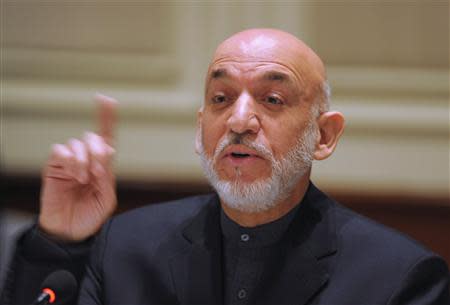
President Hamid Karzai on Sunday said India was among the countries supporting Afghan youth in the education sector, acknowledging New Delhi’s crucial role in enhancing his country’s capacity.
Currently on a four-day state visit to India, Karzai is accompanied by a high-level delegation that also participated in the conference “India and development partnerships in Asia and Africa: Towards a new paradigm”.
A statement from the Presidential Palace in Kabul said Karzai made the remarks in his key note address at the two-day conference organised by Symbiosis International University and the Ministry of External Affairs. Welcomed by two Afghan students holding their country’s flag, Karzai called India one of the most important countries in supporting and developing Afghanistan, particularly its education sector.
Extension of electricity lines from the northern zone to Kabul, construction of the parliament building, a power dam, Indira Gandhi Child Hospital in Kabul and providing thousands of scholarships to Afghan students illustrated New Delhi’s support for Kabul, Karzai added.
“We have witnessed India’s active support in facilitating Afghan students. The students returning from India are better serving their motherland,” the president said.
Karzai delivered the address on the second day on the topic 'Afghanistan-India partnership for development.' He also interacted with international students of the university at a special session on the future of education.

Afghanistan: HRW Concerned With Increasing Child Abuse

The Afghan Independent Human Rights Commission (AIHRC) has expressed heightened interests in combating child abuse, exclusion from education and lack of access to health services. Child abuse has reportedly increased by 28 percent since the last year.
In a recent report, AIHRC details discussions that were held with 4,160 kids from 27 provinces. From those interviews, the following data was collected:
1- Over 300,000 kids and teenagers are addicted to drugs
2- On average, over one hundred cases of child molestation occurred in Kabul.
3- 51 percent of the respondents worked in a way.
4- 25 percent of the respondents worked on the borders of the country.
5- 76 percent of the respondents don't have access to healthy water.
6- Close to 2,000 kids all over the country are disabled.
7- Millions of kids are excluded from education.
8- 46 percent of the girls marry before the age of 18 and 15 percent before turning 15.
9- 12 percent of the respondents have reported being discriminated due to being female.
"No parent likes their kid doing harsh works, but due to large family sizes or drug addiction of some of the fathers, kids have to work. This is while these children need to play and have fun, but they have to work from morning to evening," said Seema Samar, AIHRC Director.
"The Commission is seriously concerned with those who get away with child molestation," Child Rights Coordinator Najeebullah Babrakzai said. "Bacha Bazi or boy-molestation is an alarming issue that we have researched and we consider this notion of Bacha Bazi to be the reason for child molestation."
This AIHRC said corruption was one of the main forces that perpetuated child abuse by protecting abusers. This Commission called on the government to take initiative and curtail the trend.

British Ahmadi doctor jailed in Pakistan for 'posing as Muslim'

A 72-year-old British doctor is in prison in Pakistan for “posing as a Muslim”, charges that reveal an escalating ideological fight that often spills over into violence.
Masood Ahmad is a quiet, reserved widower who returned to Pakistan to open a pharmacy in 1982 after decades of working in London to pay his children's school fees, his family said. He is also an Ahmadi. A 1984 Pakistani law declared them non-Muslims, and Ahmadis can be jailed for three years for posing as a Muslim or outraging Muslims' feelings.
Some clerics promise that killing Ahmadis earns a place in heaven. Leaflets list their home addresses.
Three years ago, 86 Ahmadis were killed in two simultaneous attacks on Friday prayers in Lahore. There have been no mass attacks since then, but targeted killings are rising: last year 20 Ahmadis were killed, up from 11 in 2009. And legal prosecutions are on the rise, say Ahmadis, some of which they say are linked to property grabs.
Ahmad was arrested in Pakistan's eastern city of Lahore last month when two men posing as patients questioned him about his faith and used mobile phones to secretly record him reading a verse from the Holy Quran.
“He (the patient) said you are like a father to me, please help me with some questions,” said the doctor's older brother, Nasir Ahmad. “When (my brother) answered, they began beating him and dragged him outside by his neck.”
One of his accusers, religious teacher Muhammad Ihsan, told Reuters that Ahmad had preached to them illegally. Last year 20 cases against Ahmadis were registered, up from 10 cases in 2009. A bank clerk was arrested for wearing a ring with a Quranic verse and an entire family was charged for writing a Muslim greeting on a wedding invitation. Clerics have twice sought the arrest of an entire town of Ahmadis, 60,000 people, for holding religious celebrations.Residents were serving food, giving out sweets and displaying bunting, the complaints said.
“We would not have a problem with them if they did not use the name of Islam and the symbols of Islam,” said Tahir Ashrafi, head of the powerful Ulema Council of clerics. “We are against the killing of any innocent... Such attacks are not acceptable or allowed, but if they break the law, we have a right to go to the police,” he said.
“His children watched him die”
There are about half a million Ahmadis in Pakistan, their leaders say. Many only feel safe in Rabwa, a town they bought when Pakistan was created in 1947. On its main streets, banks of security cameras monitor fruit vendors and dozing dogs. Near the playing fields, blocks of flats house families that fled other parts of Pakistan after loved ones were murdered. Rafiatta, who asked her last name not be used, moved to Rabwa after gunmen killed her husband in 2010 in front of their young children. “He was just a hard-working man who loved his family,” she said. The family fled after two Ahmadi neighbours were also killed and men tried to kidnap Raffiata's young son. The Ahmadi are also targets outside Pakistan. In Indonesia,a gruesome YouTube video recorded a mass lynching in 2011 as police looked on. Ahmadi publications are banned in Bangladesh, where a festival site was torched earlier this year. In Britain, Ahmadi buildings have been vandalised and leaflets have appeared forbidding them to enter shops and urging Muslims to kill them, British media have reported. But Pakistan is the epicentre of persecution.
Jailed with no bail
Last April, a 25-year-old hospital clerk and his father were at home in Lahore reading an Ahmadi newspaper when a crowd broke down their door, the clerk said. They beat the two and looted their home. Then a gunman forced the pair into a car without license plates, the clerk said. He asked not to be named for fear of retribution. Their kidnappers went free but the two were eventually charged with impersonating Muslims in special anti-terrorist courts designed to combat the Taliban. The clerk was released after a month, but his father, who has not yet been convicted, has been in prison for nine months.The family has since fled their home and the man now occupying it is refusing to pay them for it.
“Nobody has the courage to give him bail or dismiss the case,” the clerk said.
And that's what Masood Ahmad's family fears. He has had three bail hearings. One was picketed by scores chanting anti-Ahmadi slogans and his frightened lawyer skipped the next two. British authorities are giving him consular assistance. His son, one of seven children in Britain and Australia, said the family suspected someone was trying to steal his father's dispensary. “I feel so angry because I can't do anything from here,”said 39-year-old Abbas Ahmad, a cab driver in Glasgow. “It's awful to know that people were plotting against someone you love.”

Pakistan’s Deobandis’ insane arrogance over a Bengali rapist-mass murderer’s hanging

http://lubpak.com/archives/296433
by Taj
Judging by the reaction of Pakistan’s Deobandi politicians and journalists over Abdul Quader Molla’s hanging, one should not be blamed if one thought that in Bangladesh an innocent man of God has been lynched by a mob.
On 13 December 2013, Abdul Quader Molla, a top leader of Jamaat-e-Islami was hanged for raping Bengali women and mass killing Bengali men and children. The unspeakable horror Abdul Quader Molla wreaked on his innocent victims was that they wanted to live as free human beings in their own homeland. But Abdul Quader Molla wanted them to continue to be slaves of the corrupt generals of then West Pakistan. We will not go into the details of what Jamaat-e-Islami did to the people of East Pakistan, now Bangladesh, because it is all available on the Internet. What we would like to note is the sheer insane and arrogant reaction by the Deobandis and Takfiri-Deobandis in Pakistan to the hanging of a super terrorist who was also a third-rate human being.
Led by Pakistan’s pro-Taliban Interior Minister Chaudhry Nisar Khan, the Takfiri-Deobandis not only condemned the hanging, but also justified the rape of thousands of Bengali women and mass killing of Bengali men, women and children. Chaudhry Nisar Khan spoke for his government when he termed the hanging unfortunate and a tragic step. “There was no doubt that Molla was hanged because of his loyalty and solidarity with Pakistan in 1971. . . . Every Pakistani is saddened and grieved over his death. . . . It would have been better if the Bangladeshi government had shown farsightedness‚ large heartedness and magnanimity instead of opening old wounds. (Read: http://tribune.com.pk/story/645071/nisar-expresses-grief-concern-over-bangladesh-jamaat-leaders-execution/)
Chief of Jamaat-e-Islami Pakistan and pro-Deobandi cleric, Munawar Hassan, decried his Bangladeshi comrade’s execution as deplorable. In a stement published in Pakistani newspapers, Munawar Hasan said: “Molla embraced martyrdom with a smile on his face. His unflinching spirit is commendable. His execution at the hands of a “slanted” war tribunal is nothing but a mockery of justice”. Going forward, JI Ameer also picked apart the government of Pakistan for being ‘criminally silent’ over Molla’s unjust hanging. He added that Molla indeed became a victim of patriotism. (Read: http://www.thenews.com.pk/article-130104-Mollas-execution:-JI-to-stage-Pakistan-wide-protests-today)
Similar statements were issued by leaders of banned Deobandi outfit Sipah-e-Sahaba Pakistan (SSP, currently operating as ASWJ) and other Deobandi clerics, politicians and media persons of Pakistan. 11
Just for record, here is a brief snapshot of crimes of the rapist-murderer who is being eulogized by Deobandi clerics and politicians in Pakistan:
“They banged her two-year-old brother against the floor until he died, her two sisters were slaughtered, another was raped, and her pregnant mother was shot dead. She lay hidden beneath a cot, transfixed, numb with fear, watching these ghastly scenes being enacted before her eyes. She struggled in vain to not shout but gave in to the horrific incident and let her pain come out loud. Then, it was her turn, to be brutally raped. In the evening of Mar 26, 1971, Jamaat-e Islami leader Abdul Quader Molla and several other Biharis forced into the residence of Hajrat Ali Laskar in Mirpur. Ali was shot at, his pregnant wife and her two daughters aged 7 and 9 years were slaughtered.” (Read: http://bdnews24.com/bangladesh/2013/09/19/momena-seals-mollas-fate)
The Jang Media Group’s daily The News titled its report on the hanging as “BD JI leader buried amid violence”. The “violence” in Bengadesh it reported was this: “In Dhaka, Jamaat-e-Islami activists torched at least four cars and a motorcycle near the country’s main railway station, said Shahzadi Sultana, a fire main railway station, said Shahzadi Sultana, a fire official. Several homemade bombs were detonated during the attack, Somoy TV reported.” (Read: http://www.thenews.com.pk/Todays-News-13-27263-BD-JI-leader-buried-amid-violence)
In Dhaka, a city of 20 million people, “at least four car and a motorcycle” is violence for a pro-Taliban publication like The News! But The News was not alone in sensationalizing the non-event of the pro-Jamaat-e-Islami ‘violence’. Urdu daily Jang, a sister publication of The News, did the same. It reported that protest rallies were staged all over Pakistan, as if a Pakistani had been killed! Jang informed its readers that the entire country of Bangladesh was rocked by protests resulting in a number of killings. The ‘high’ number of protesters killed, by Jang’s own admission, is six! (Read: http://jang.com.pk/jang/dec2013-daily/14-12-2013/main.htm) Similarly, the far-right Nawa-e-Waqt came up with front-page coverage of the death of the Jamaat-e-Islami rapist-mass murderer. Like The News and Jang, it cited that all over Pakistan, people protested the killing and offered funeral prayers for the man (Read: http://www.nawaiwaqt.com.pk/E-Paper/Lahore/2013-12-14/page-1/detail-20). In its editorial Nawa-e-Waqt wrote, “This is not what happens in civilized societies” (Read: http://www.nawaiwaqt.com.pk/editorials/14-Dec-2013/265362). What about the rape and murder of hundreds of thousands of Bengali men and women? Certainly that was a hallmark of a civilized army and its Deobandi-Salafi supporters. But it were the Deobandis columnists who truly cried foul in support of the rapist-mass murderer. For instance, Ajmal Niazi, a right-wing columnist and conspiracy theorist, claimed an Indian conspiracy behind the hanging. Holding Hasina Wajid responsible for the hanging and calling her a stupid woman, he dubbed the hanging “a shameless affair”. He went on raving and demanding, “Pakistan must not sit silent over the hanging and act. Otherwise it will cowardice on our part” (Read: http://www.nawaiwaqt.com.pk/columns/14-Dec-2013/265545) Another columnist, Nawaz Raza, said, “The death of Abdul Quader saddened Pakistani politicians. In the National Assembly and the Senate, legislators were a picture of gloom and sadness over the cruel act of the Bangladesh government’s hanging of the man who fought for the existence of Pakistan” (Read: http://www.nawaiwaqt.com.pk/columns/14-Dec-2013/265396).
But it was two infamous Takfiri-Deobandi journalists who shed tons of crocodile’s tears. Oraya Maqbool Jan, the most infamous Takfiri-Deobandi journalist, wrote a column on Abdul Qader Mulla’s hanging which can be considered a landmark in the history of journalistic absurdity. It is a must-read column which is comprised of voodoo history, alchemy, and necromancy. Only a separate editorial, indeed a research paper, can deal with. But we would cite just one claim he makes, “On account of Pakistan’s having been hijacked by certain elements, not many eyes in the country have shed tears on the hanging. Those eyes which are not shedding tears on the death of those who sided with the Pakistan army, will not shed tears for those who have supported the Pakistan army in Baluchistan and Swat” (Read: http://dunya.com.pk/index.php/author/orya-maqbool-jaan/2013-12-14/5342/26526939#.UqxJi_QW1Wl).
Another Deobandi columnist, Khalid Masood Khan, used extremely flowery Urdu to mourn the hanging of Abdul Quader calling it “a heart-rending death of the man who was hanged by a kangaroo court for being a support of the Pakistan army and the Two Nation Theory” (Read: http://dunya.com.pk/index.php/author/khalid-masood-khan/2013-12-14/5346/77423249#.UqxOr_QW1Wl)
Scores of examples can be given showing how Pakistan’s Deobandis have reacted to the hanging of a mass murderer. The point is: No Takfiri-Deobandi has said a word about the hundreds of thousands of innocent Bengalis killed for their ‘crime’ which was their just and legitimate demand to live as free people. Pakistan’s National Assembly led by Nawaz Sharif’s Pakistan Muslim League, an ally of Sipa-e-Sahaba (ASWJ) and the Taliban (TTP), offered prayers for the rapist-mass murderer. It is the same Takfiri-Deobandi mindset which has allowed the massacres of Shias, Sunni Barelvis, Ahmadis and Christians in Pakistan. This mindset has no respect for human rights and people’s right to self-determination. The only evil the Takfiri-Deobandis see is the opponent who happens to have a different view than theirs.
- See more at: http://lubpak.com/archives/296433#sthash.DE5dXUP8.dpuf

Imran keeps silent on shooting prices in KPK, as PTI picks Lahore for protest against inflation

APP
Pakistan Tehrik-e-Insaf chose Lahore for its protest meeting against inflation on December 22, but its chairman does not utter a single word when it comes to price hike in Peshawar and Khyber Pakhtunkhwa. In a press conference on Saturday, Imran Khan held Pakistan Muslim League Nawaz (PML-N) responsible for increasing inflation in the country, but he did not take responsibility for surging prices in Khyber Pakhtunkhwa. According to independent observers and analysts, the question is simple whether PTI government has reduced prices in Khyber Pakhtunkhwa.
The price situation in KPK is not all that rosy as prices of 23 essential items including flour, sugar, pulses, meat, milk, rice, bread (roti), cooking oil and tea have shot up in the last six months. In Khyber Pakhtunkhwa, price of 20 kg flour bag has risen by Rs. 180, tea per kg by Rs. 170 while prices of pulses Rs. 25 per kg, milk Rs.20 per liter and roti by Rs. 4. These items are in daily use of people and increase in their prices miserably affects their lives. One can hope that PTI invites other parties to hold a similar protest in Peshawar against rising prices. It is logical that if prices have increased in Punjab then these have also risen in other provinces.Despite making tall claims, the PTI government in Khyber Pakhtunkhwa has failed to deliver on its promises made to the people during the election campaign. PTI could not control incidents of bomb attacks and law and order problem is a big question mark on its performance. PTI is threatening to launch a campaign against price hike, but there is a complete silence from PTI when it comes to price hike, law and order situation and lack of infrastructure in the KPK province.

PPP, ANP seek clarification on Nato blockade

Opposition senators from the PPP and Awami National Party questioned on Thursday the government’s ‘silence’ over the blockade of Nato supply routes by Pakistan Tehreek-i-Insaf and its allies in Khyber Pakhtunkhwa and asked the government to clarify its position on the issue.
“Why has the federal government abdicated its constitutional role and allowed political parties to block Nato supplies,” PPP parliamentary leader Raza Rabbani said while initiating a debate on the government’s foreign policy.
“Can this be taken as a tacit approval of the federal government?” he asked.
Mr Rabbani put 52 questions before the house and asked the government to clarify its stance on issues such as talks with the Taliban, Afghan policy, drone attacks, ties with India, and Pak-Iran gas pipeline project. He asked the government to brief the house about the gist of visits the prime minister recently paid to the US and Afghanistan and the US officials’ trip to Pakistan. Haji Adeel of ANP claimed that by blocking roads in Khyber Pakhtunkhwa people of that province were being deprived of their sources of income because protesters were also stopping containers and trucks that were carrying goods under the Afghan Transit Trade.
He said the federal government was watching this as a spectator.
He regretted that no one stopped Nato supplies when weapons were being transported to Afghanistan through these routes but the same were being blocked now when foreign troops were about to leave the region. The ANP leader said Afghanistan is a sovereign country and his party would strongly resist interference in its affairs. He asked the government to grant citizenship to those Afghans who were born in Pakistan. During the question hour, the Senate was informed that by Nov 27 a total of 1,082 cases of missing persons had been registered. In a written reply, Minister of State for Interior Balighur Rehman informed the house that the number of missing persons in the Commission of Inquiry of Enforced Disappearances stood at 813 and the number of cases pending before the Supreme Court was 304. He said 14 cases were pending before the Lahore High Court, 174 before the Sindh High Court, 101 before the Peshawar High Court and 22 before the Balochistan High Court. Forty cases were registered in Federally Administered Tribal Areas. Senate Chairman Nayyar Bokhari deferred the question when members from Balochistan expressed dissatisfaction over the reply, saying that the number of cases belonging to their province was not correct. Meanwhile, responding to a call-attention notice moved by Moula Bux Chandio of PPP, Minister for Railways Khawaja Saad Rafiq said there was no proposal under consideration to close 450 small railway stations. He, however, said Railways was not in a position to open those stations that had already been closed, particularly the ones between Hyderabad and Badin. Mr Rafiq said that in line with the Supreme Court’s decision, they were writing letters to all chief ministers to seek possession of Railways’ land. He said the issue was being taken to the Council of Common Interests.
“If the issue is not resolved, we reserve the right to go to the court,” he added.

Bangladesh's Molla’s hanging & Pakistan's Interior Minister Chaudhry Nisar's statement

Abdul Quader Molla of Bangladesh’s Jamaat-e-Islami (JI) became the first person accused of atrocities during the country’s independence war to be hanged. Whereas a number of senior leaders of the JI in that country are behind bars awaiting trials on similar charges, it fell to the lot of Molla to be the first to have his trial completed and be sentenced to death. A last minute hoped for reprieve when the Supreme Court took notice proved infructuous when the court refused to reverse the death sentence. There has been concern internationally that the tribunals trying the accused for their role in massacres carried out by the JI’s militias, Al Badr and Al Shams against intellectuals and ordinary citizens in what was then East Pakistan do not meet the highest international standards of fair trial.
There also does not appear to be in place a proper appeals process to ensure justice is not only done, but is seen to be done. The surprising fact is that these trials and the hanging of Molla come 42 years after the events that finally led to the emergence of Bangladesh as an independent country following an army crackdown, an indigenous insurgency led by the Mukti Bahini and a relatively short war with India that saw the Pakistan garrison in the eastern wing cut off and finally forced to surrender on December 16, 1971. The shame and ignominy attached to the whole Bangladesh episode was so embarrassing that the political and military establishment that followed the Yahya military junta responsible for the crackdown and atrocities in East Pakistan thought discretion the better part of valour. Even Mr Bhutto’s Hamood-ur-Rehman Commission report was suppressed. This was in line with the mood that gripped the remaining Pakistan’s elite: brush the whole tragic episode under the carpet and pretend it never happened. As a result, not only did we fail to learn any lessons from the tragedy, we have continued to repeat the same mistakes again and again and been responsible for subsequent generations being kept ignorant of this bloody chapter in our history, so much so that millions of young people today in Pakistan may not even know that Bangladesh was once part of Pakistan or the reasons why it separated. Not only this, we have never formally apologized for the atrocities visited on our Bengali brothers and sisters.
It should not surprise us therefore that whereas the government and the foreign office have acted with restraint so as not to appear to be interfering in the internal affairs of a sovereign country with which we enjoy good relations bilaterally and as a member of SAARC, the Interior Minister Chaudhry Nisar Ali has once more tooted a tune at variance with that restraint. Sounding like an ultranationalist JI spokesman, the feisty minister’s statement painted Molla as a hero of Pakistan, whereas Molla and his ilk helped ensure because of their bloodletting that East Pakistan would definitely break away, sooner or later. How does that make him a hero? This is like saying General Yahya, responsible squarely for the breakup of the country, should be considered a hero of Pakistan. Or, if the argument is stretched further, like our JI declaring an enemy terrorist like Hakeemullah Mehsud a shaheed (martyr). The JI, however, is not in power. Chaudhry Nisar’s party, the PML-N, is. How can the prime minister allow one of his ministers to shoot off at the mouth from time to time without even a nod at the government’s policy stance? Pakistan still has much to answer for vis-à-vis Bangladesh. Had we shown even a modicum of the large heartedness Chaudhry Nisar would have liked Bangladeshi Prime Minister Hasina Wajid to show in Molla’s case, we would have formally apologised to our brethren and sisters in Bangladesh soon after the tragedy, or at the very least at some point in the last 42 years. Sadly, we did not, and have now convinced ourselves it is so much water under the bridge and there is no need now to even contemplate such a possibility.
We should not attempt to wax indignant in matters concerning our erstwhile eastern wing, given the above sad facts. While our moral standing in these matters is weak, to say the least, there are nevertheless issues with Molla’s hanging that do not sit easily with rational minds. First, the length of time that has transpired since the crimes for which he was convicted, the advanced age of the accused, reservations about the trial and appeals process all militated against the death penalty in a world increasingly moving away from the ultimate and irreversible punishment. Under the circumstances, perhaps deprivation of liberty for life of the accused may have proved more appropriate, avoided the taint of either revenge (versus reconciliation a la the late lamented Mandela) or political partisan motivation. This last suspicion is rooted in the domestic divide in Bangladesh in the approach to upcoming elections, which have pitted the ruling Awami League against the main opposition Bangladesh National Party and its close ally, the JI. The violent reaction to the hanging strengthens this argument. Avoiding hanging would also have avoided offering the ultra-nationalists like Chaudhry Nisar and our JI the opportunity to make political capital out of this turn of events and causing diplomatic embarrassment in our relations with Bangladesh.

Pakistan has estimated one million heroin users

http://www.thenews.com.pk/
Between two trucks on an abandoned, garbage-strewn railway, teenagers openly shoot up drugs as children pass by on their way to school -- a daily scene in Karachi, where heroin is undermining Pakistan´s efforts to combat the spread of HIV.
"You can find any drug you want in Karachi," said Shahzad Ali, his left hand swollen by repeated injections, one of tens of thousands in the city of 20 million lured to cheap Afghan heroin. Like others, he stumbles around on the old railway line in the district of Musa Colony, where young people shoot up near mounds of smouldering garbage into which scavengers dig for anything that might be consumed or resold.
Pakistan has an estimated one million heroin users, half of whom use needles. There are fears that the country´s addiction is set to deepen, with neighbouring Afghanistan´s opium production hitting a record of 5,500 tonnes this year -- even before the withdrawal of NATO forces in 2014.
A former male prostitute and heroin addict, NGO worker Mohammad Imran knows all too well the ravages of the drug. "Because I belonged to this environment not so long ago, I can feel their feelings, their problems and everything else very clearly," he said. He witnessed first-hand the rise of heroin in disadvantaged neighbourhoods, where a shot can be bought for as little as a few European cents -- a fraction of the cost in the West. He distributes new needles to addicts from his mobile clinic. "I can understand exactly what someone needs and I can provide them a good service at the right moment. "Despite using for twenty years as a sex worker, Imran escaped HIV infection and AIDS.
Tarak Abbas was not so lucky. Diagnosed two years ago, his cheeks hollowed by years of drug abuse, he is now trapped, homeless on the streets of Karachi. "Whenever young kids come to me I tell them: ´Look at me, no one cares about me now´," he said. "The people who used to think I was a good man, they don´t even want to sit with me now, just because of AIDS. "He blames heroin for his problems. "There are many diseases you can catch and you are cut off from your loved ones. Your life is destroyed and you will lose respect. "Tarek is not alone. In Pakistan -- known as "The Land of the Pure" -- almost 30 percent of those who inject heroin are HIV positive, one of the highest rates in the world and up from 11 percent in 2005. NGOs are attempting to stem a HIV crisis by distributing clean needles in the slums of Karachi."At first people said we were promoting drugs, but they have since realised that heroin addicts always find a way to get a fix," said Dr. Maria Atif.
"It´s booming. You know it is increasing every day because there are a number of social factors that are propelling people toward this menace. And despite all the efforts claimed by government, it is easily available here."´
Pakistan has become a consumer´Afghanistan produces 90 per cent of the world´s heroin, with almost half of its production channelled through Pakistan on its way to Europe or Asia, hidden in containers shipped from Karachi, a sprawling port on the Arabian Sea. But the drug doesn´t just pass cleanly through Pakistan. It picks up addicts along the way. "Pakistan is a transit hub, but has also become a consumer," said Cesar Guedes, head of the United Nations Office on Drugs and Crime (UNODC) in Pakistan."Part of this drug stays in the country not because it is a profitable market... but because traffickers pay in cash and in kind, creating a local market.
"Karachi has in recent years seen a new crossover between the Afghan heroin destined for Europe and Asia and imported South American cocaine, fuelling speculation of collaborations between Latin American cartels and Pakistani drug lords or the Taliban, who are partly funded by the traffic.
"There are no boundaries, there is no nation, there is no religion, it is about money. They have joined hands to get more money," said Akbar Khan Hoti, chief of the drug unit at the Ministry of Interior. Local customs at the port of Karachi have only one sniffer dog, according to internal sources, and lack the ability to scrutinise the contents of the 3,000 containers that are scanned daily. With one gram costing the equivalent of one month´s minimum wage, cocaine -- unlike heroin -- is inaccessible to the poor majority of Pakistan. It is becoming more trendy among those who can afford it, however. Since the beginning of the year, "more than a ton of cocaine" has been seized at the port, said Hoti. "Cocaine is definitely fashionable, especially among young people seeking to escape," said Hussain, a young executive who returned to live in Pakistan after studying overseas. "There is nothing else to do.

Karachi-like situation being created in Peshawar

Peshawar High Court (PHC) Chief Justice Dost Muhammad Khan observed on Friday that judiciary would not allow anyone to create Karachi-like situation in Peshawar come what may.
“The anti-state elements and criminals are also active in Peshawar to create Karachi-like situation as doctors and businessmen are being kidnapped in daylight and people’ houses are being bombed to harass and compel them to pay extortion money,” the PHC chief justice said during hearing of bail petition of a retired police officer who was charged with demanding extortion from a local businessman.
Taking notice of the surge in extortion demands by unknown persons from respectable citizens, a single bench headed by the chief justice issued notice to Inspector General of Police (IGP), Khyber Pakhtunkhwa, asking him to constitute a team of senior investigators to unmask and punish those involved in this heinous crime. He said that it was the responsibility of the law-enforcing agencies to protect citizens and their property.
“The heads of the law-enforcing agencies and police force would have no justification to work on their posts if they fail to curb extortion, target killings and kidnappings for ransom,” he said. The bench also asked the provincial and federal governments to take the issue seriously and bring the cases of the people involved in these crimes before the courts for trial.
Shahidullah, counsel for the accused retired police officer, Ashiqur Rehman, submitted that his client was arrested on the charges of demanding Rs5 million through phone calls from Mujeebur Rehman, the owner of private car bargain centre. He submitted that his client was falsely charged in the case as there was a money dispute between the two. On the other hand, Mujeebur Rehman’s lawyer submitted that he had received 150 phone calls from various SIMs demanding the extortion money. He said there was also a videotape on record about the identification of the accused in the case. However, the court granted bail to the accused person with the observation that the evidence against him was not sufficient to keep him behind bars.

Saturday, December 14, 2013

Nelson Mandela to be buried in Qunu ancestral home

Nelson Mandela is to be buried in his ancestral home in Qunu in the Eastern Cape, ending a week of commemorations for South Africa's first black leader.
Some 4,500 people - including foreign dignitaries - will be attending the funeral, which will blend state ceremonial with traditional rituals. Members of his family are attending an overnight vigil, with a traditional praise singer believed to be chanting details of his long journey and life.
He died on 5 December aged 95.
Tutu to attend
The state funeral is expected to start at 06:00 GMT, when the coffin will be taken from Mr Mandela's house to a giant white marquee that has been specially erected. Mr Mandela's Thembu community will conduct a traditional Xhosa ceremony - including songs and poems about Mr Mandela's life and his achievements. An ox will be slaughtered. A family elder will stay near the coffin, which has been draped with a lion's skin, to talk "to the body's spirit". Presidents from Africa, several prime ministers, the Iranian vice-president and the Prince of Wales are expected to attend the funeral. Archbishop Desmond Tutu - a long-time friend of Nelson Mandela - has confirmed he will be present, having earlier said he had cancelled his flight as he had not received an invitation. The South African government had earlier said the archbishop was accredited, but that no formal invitations had been sent out.
'Sad but happy'
On Saturday, Mr Mandela's coffin was flown from Waterkloof airbase in Pretoria on a C130 military aircraft, escorted by two fighter jets. It later landed at Mthatha airport, some 700km (450 miles) away. In line with tribal custom, Nelson Mandela's grandson Mandla accompanied him on the journey, speaking to his coffin to tell him he was on his way home to rest. To solemn music, the coffin draped in a South African flag was moved by a military guard of honour and placed in a hearse to begin the 32km journey to Qunu, where Mr Mandela had wanted to spend his final days. People waving flags and cheering and singing - in places 10 to 12 deep - lined the route taken by the cortege through Mthatha town to pay their last respects. Tears as well as smiles could be seen on the faces of onlookers. "He is finally coming home to rest, I can't even begin to describe the feeling I have inside," 31-year-old Bongani Zibi told AFP news agency. "Part of me is sad but I'm also happy that he has found peace." However, some people expressed their frustration that the convoy did not stop, so they had no chance to view the coffin as people in Pretoria had. The cortege then drove through the gates of the Mandela homestead in Qunu. Ahead of the flight to the Eastern Cape, members of the African National Congress paid final tributes to Nelson Mandela at a ceremony in Pretoria. President Jacob Zuma, other ANC leaders and more than 1,000 members of the organisation which Mr Mandela once led, attended the event at the Waterkloof air base. It included a multi-faith service and a musical tribute. Mourners heard President Zuma pay his own tribute to Nelson Mandela, calling him a "towering figure", "a man of action" and a "democrat who understood the world." "Yes, we will miss him... He was our father, he was our guardian. He was something special." "We'll always keep you in our hearts," Mr Zuma said. At least 100,000 people saw the former president's body lying in state during the week in Pretoria, but some had to be turned away.

China becomes third country to land on moon

China landed an unmanned spacecraft on the moon on Saturday, according to state media. The event marks the first soft-landing on the moon in three decades, joining the USA and former USSR in achieving the feat.
China’s official Xinhua news agency reported that the spacecraft touched down in the Sinus Iridum, known as the Bay of Rainbows, at 9:11 p.m. after hovering over the moon’s surface for an unspecified few minutes, scouting out a suitable place to land. The subsequent soft-landing did not damage the craft, unlike a previous mission in 2007 when China sent a lunar probe to conduct a controlled crash into the moon’s surface.A telescope is on board the landing craft, known as the Chang'e-3 probe, which will likely stay in place and operate for a year. The telescope is designed to survey space from the moon’s surface. The landing craft also houses an ultraviolet camera which will study the Earth and its plasmasphere. A solar-powered rover, known as Yutu, is also on board. It will traverse the area for three months, analyzing topsoil and collecting information on the moon at a depth of 100 yards.The Bay of Rainbows has yet to be studied, but Xinhua stated that it was chosen because of its ample sunlight and convenience for long-distance communications. The Chang'e-3 probe was launched on December 2. It carried the solar-powered Yutu, which will dig and survey both the moon’s geological structure and surface substances, as well as look for natural resources. China Central Television (CCTV) broadcast images from the probe on Saturday and announced that the lunar probe and the rover will snap photographs of one another on Sunday.
This is the first time that China has sent a spacecraft to the surface of an extraterrestrial body, and the first time one has landed on such a surface since 1976. “It's still a significant technological challenge to land on another world,” Peter Bond, consultant editor for Jane's Space Systems and Industry, told AP. “Especially somewhere like the moon, which doesn't have an atmosphere so you can't use parachutes or anything like that. You have to use rocket motors for the descent and you have to make sure you go down at the right angle and the right rate of descent and you don't end up in a crater on top of a large rock.” The probe comes after Chang'e-1’s lunar orbit mission in 2007 and Chang'e-2 ‘s Chang'e-1 made a complete picture of the moon – China’s first – by orbiting for 494 days and then intentionally crashing onto the lunar surface. Chang'e-2’s mission tested new technologies being used in the current lunar exploration and researched the landing area. China plans to launch another lunar probe in 2017, with the intention to land the probe on the moon, release the rover, and return the probe back to Earth. Beijing also has plans to build a working space station by 2020. China sees its space program as a symbol of national pride, rising global influence, and growing technical expertise. Beijing began its manned space program in 1992. In 2003, China successfully sent Yang Liwei, the country's first taikonaut, into orbit aboard the Shenzhou-5 spacecraft.mission in 2010. Both missions helped prepare for Monday’s launch. The crafts are named after Chang’e, goddess of the moon.

Bahrain Trouble ahead: The government is poisoning the well

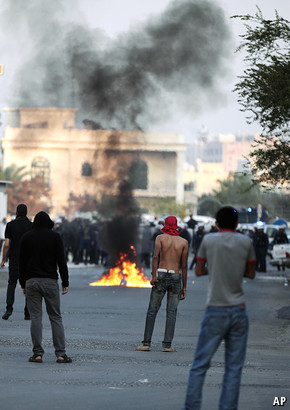
SOON there will be no empty walls in the villages west of Manama, capital of the tiny island kingdom of Bahrain. Graffiti calling for the king’s overthrow are crossed out by the authorities every day, only to reappear somewhere else, until the walls are entirely covered by black splodges. Police vehicles sit at the entrance to every village. Even in the shiny, built-up areas of Manama many residents grumble. “There is no freedom, no justice and no democracy,” complains one man.
Bahrain, where a Sunni monarchy has long ruled over a Shia majority, saw a brief flickering of Arab spring protests in February 2011. The biggest were brutally put down with the help of troops from neighbouring Saudi Arabia. Yet smaller protests have continued. Violent clashes erupted on December 6th when the government hosted a jamboree of security and military officials from the region (Bahrain’s 40-person delegation included people close to the Shia opposition). Youths in several villages threw stones and Molotov cocktails; security forces lobbed back tear gas and sound bombs.
Human-rights organisations warn that the situation is deteriorating. Two years after an even-handed report by the Bahrain Independent Commission of Inquiry—a laudable effort by King Hamad bin Isa al-Khalifa—few of its recommendations have been implemented. Opposition activists are harassed and imprisoned; many want to leave the country. Foreign journalists are rarely granted visas.
The trial of Khalil al-Marzooq, a former parliamentarian and prominent figure in al-Wefaq, the leading opposition block, has caused much upset. Mr Marzooq may have been foolish in posing with a flag of the February 14th Coalition, an opposition group that has some violent members, but that hardly warrants charges for inciting “terrorist crimes”. The opposition has suspended its involvement in a national dialogue in response, and political reconciliation has stalled. Both sides say they are keen to make progress, but trust is in short supply.
The government has pushed the protest movement into a more radical direction by depicting its uprising as a sectarian struggle rather than a call for democracy. Bashar Assad, the Syrian president fighting a Sunni-majority population, follows a similarly divisive strategy. By calling the opposition an Iranian proxy, Bahrain’s rulers have managed to rally fellow Sunnis around them, overcoming grumbles on all sides about the rising cost of living and a lack of say in the country’s politics.
Shia opinion is far from united. Al-Wefaq says it is not seeking the government’s overthrow, and indeed recommends a constitutional monarchy. But it struggles to convince parts of the opposition. Some are locked in a stand-off with the police.
Even moderates are angry that 38 mosques were destroyed during raids and few have been rebuilt, says Maytham al-Salman, a Shia cleric, though the government had agreed to do this last year. “Politics is one thing but to attack religion is another”, says a rights activist.
Protesters are especially resentful that the government employs many non-Bahrainis in the police. The ranks of the well-paid security forces include many Yemenis and Pakistanis; Shia applicants for police jobs are usually turned away. The extensive use of tear gas has become another bone of contention; a document leaked in October exposed plans by the interior ministry to buy 1.6m additional rounds of the stuff.
So far the Khalifas have been able to keep the protests under control, helped by the Saudis and reassured by the presence of America’s Fifth Fleet, permanently based here. The economy has not gone under, as some feared in 2011. Growth next year is expected to be 3.3%. Despite jitters, few firms have left Bahrain, a regional financial centre, partly to avoid offending Saudi Arabia, the islands’ godfather.
Moderate protesters pin their hopes for reform on Salman bin Hamad al-Khalifa, the 44-year-old crown prince. However, the untested ruler-in-waiting must contend with hardliners in his own family. For the foreseeable future, Bahrain’s Shias can expect more tear gas.

Qatar seeks Wahhabization of world: Academic

Qatar is using the war on Syria in order to pursue the systematic and gradual Wahhabization of the world, an academic tells Press TV. In an article published by Press TV, Iranian author and Middle East expert Dr. Ismail Salami said Qatar is sowing a “bad seed in the fertile soil of the world--a systematic and gradual Wahhabization of the world.” Raising the question about why Qatar is spending money and resources on fueling the crisis in Syria by providing financial and military support for groups affiliated to al-Qaeda, Salami said Doha encourages a corrupt ideology known as Wahhabism “which may gradually inflame and subdue the entire world.” “Informed sources have recently exposed that in the heart of Doha stand centers for training assassins of different nationalities who are dispatched to Syria to fight against the government of Bashar al-Assad,” the Iranian academic wrote. Salami added that Qatar is conducting an extensive and intensive recruitment program in improvised countries including Afghanistan, Pakistan, Yemen and Chechnya. The author said Al Thani is a ruler who ascended to the throne through staging a bloodless coup against his own father in 1995 and apparently encourages a corrupt ideology known as Wahhabism which is being promoted through a political mouthpiece known as Al Jazeera. Salami added that militants trained by Qatar, which has been fighting a proxy war in Syria, are dispatched to Libya, Turkey and Jordan and infiltrated Syria through these countries. “The tiny, oil- and gas-rich emirate has been shipping arms to the Syrian militants fighting the government of President Bashar al-Assad since 2011,” Salami noted, adding that the Qatari government has so far spent over USD 3 billion on war with Syria. Syria has been gripped by deadly unrest since 2011. According to reports, the Western powers and their regional allies - namely Qatar, Saudi Arabia and Turkey - are supporting militants operating inside Syria. More than 100,000 people have been killed since the beginning of the conflict in Syria in March 2011.

Women arrested for driving in Saudi Arabia

http://www.eturbonews.com/
Recent news reported about the relaxation about women not allowed to drive in the Kingdom of Saudi Arabia. This seems to have changed.
Yesterday two Saudi Arabian ladies were detained at a police station for driving a car in the capital Riyadh and refusing afterwards to call their male custodians to take them home. Azza Al Shamsi and Baria Al Zubaidi were caught by the police as they were driving the car near a shopping complex. Azza was behind the steering wheel and Baria was filming her. When they were taken to the police station, they refused to call their male relatives as is customary in the kingdom, arguing that they were legally responsible for their acts and did not need custodianship, Saudi news site Khabar 24 reported. The security sources cited by the site said that the two women seemed to have deliberately sought to be detained to prove their right to drive. Although no legal text or rule bans women from driving in Saudi Arabia, the practice is not allowed. Women drivers are detained for driving without a Saudi licence and they are invariably allowed to go home after they sign a pledge not to drive again. News of the decision by Azza and Baria to drive in Riyadh sparked a new heated online debate that indicated the widening chasm between those who supported and opposed women driving in the kingdom. Both sides have been using social, economic and religious arguments to prove their points and undermine the claims made by the others.

Saudi Arabia migrant expulsions: 'They beat us. I want to warn others not to go'

Elissa Jobson
More than 100,000 Ethiopian men, women and children have been expelled from the kingdom as labour rules tighten
Abdulla Shahmola trudges up the road leading from Addis Ababa airport to the outskirts of the city, his battered black suitcase balanced precariously on his head. Weariness and relief are etched into his delicate features as he heaves his heavy bag to the floor. "I have so many possessions that I had to leave behind in Saudi Arabia – a television, a bed, a fridge," he laments, adding that he is thankful to be back in Ethiopia.
Abdulla is one of hundreds of men, women and children steadily streaming from the airport cargo terminal, where up to 20 flights have been arriving daily from Jeddah and Riyadh since 13 November. A kilometre's walk from the hastily erected transit centre, which has been processing some 7,000 returning migrants each day, a small crowd, held back by federal police officers in blue military fatigues, waits anxiously for a glimpse of a loved one.
As of 8 December, 115,465 Ethiopians – 72,780 men, 37,092 women and 5,593 children, 202 of whom were unaccompanied – had returned from Saudi Arabia, according to government figures. The migrants, most of whom were in Saudi Arabia without work permits, were expelled after a tightening of labour regulations in March and the expiration of an amnesty for illegal workers on 4 November.
More than a million migrant workers from across Asia have been expelled from the kingdom as part of the crackdown, which is designed to get more Saudis into jobs and reduce the high unemployment rate. The crackdown has triggered clashes in the capital, Riyadh, in which three Ethiopians were reportedly killed, sparking outrage in Ethiopia.
"They beat us," alleges Abdulla. He reaches into his pocket, pulls out his mobile phone and opens images of badly beaten Ethiopians, singling out one man whose throat appears to have been slit. His friends do the same, thrusting forward their mobiles. "I saw people killed. They are murderers," he hisses.
He says he has spent the past month in an overcrowded Saudi prison. "There were 900 people in one place. After 24 hours they gave us small things – water, a little food. They called the embassy." He claims the detainees had to buy their own food and water at great expense. Hawa Gizawi, 20, who worked as a domestic servant in Oman and Saudi Arabia for the past four years, also maintains that she was mistreated while in custody awaiting repatriation. "I spent 15 days in prison in Jeddah – no food, no toilet, no hospital. They don't respect our human rights," she says, adding that her employers withheld her wages for a year. "I don't want to go back to Saudi Arabia and I want to warn others not to go." The International Organisation for Migration (IOM), which is supporting the Ethiopian government in dealing with the unexpected influx of returnees, has expressed concern about the physical and mental condition of the returnees, describing them as being "traumatised, anxious and seriously sick". Merenasch Selfu, a nurse at one of the seven transit centres in Addis Ababa receiving repatriates, says many of her patients have upper respiratory tract infections. "The women say there were held in places with no latrines, poor sanitation and no air conditioning, and that is why they developed a cough," she explains.
She has also treated women with newborn babies as well as those in the late stages of pregnancy. "The day before yesterday one women arrived at the centre showing the early signs of labour," Merenasch says. She estimates that some 2%-3% of those treated at the centre show symptoms of depression or psychosis and confirms she has examined women who claim to have suffered sexual abuse.
The Ethiopian government is providing additional medical and psychological support for the migrants who need it. However, officials admit to being ill-prepared for the massive influx of returnees. "Frankly speaking, we organised ourselves for very few people – up to 25,000," says Tadesse Bekele, deputy director of the ministry of agriculture's disaster risk management and food security directorate. "Reception and transit centres may not have facilities equal to the number of people being accommodated so for that we are organising alternatives. For example, we are deploying mobile latrines in places where we may have only two or three [toilets] to serve a thousand people." That said, the government – with assistance from UN agencies and NGOs, as well as contributions from the private sector – seems to be managing the emergency efficiently. Negussie Kefeni, co-ordinator of a transit centre in the heart of Addis Ababa, says the previous night the facility housed 1,399 women and 80 children – more than double the number it was intended to serve. All traces of that inundation have vanished, however. Clean mattresses and blankets have been neatly laid out, the floors swept and washed, the bathrooms disinfected and the water tanks replenished.
"This kind of operation is not the first exercise of its kind in Ethiopia. We have been working with refugees from Asmara [capital of Eritrea] in three cities in Afar," says Negussie.
Rows of chairs are set up under the trees, injera and wot are ready to be served, and hundreds of dignity kits – containing basic hygiene necessities – have been assembled, and a 900birr ($47) travel allowance awaits the new arrivals. As the first bus pulls up outside the transit centre, and the burka-clad women disembark, volunteers and staff from the Red Cross, International Rescue, IOM and various government departments welcome the disoriented returnees to the penultimate stop on their traumatic journey home.

Why Is Saudi Arabia Buying 15,000 U.S. Anti-Tank Missiles for a War It Will Never Fight?

No one is expecting a tank invasion of Saudi Arabia anytime soon, but the kingdom just put in a huge order for U.S.-made anti-tank missiles that has Saudi-watchers scratching their heads and wondering whether the deal is related to Riyadh's support for the Syrian rebels.
The proposed weapons deal, which the Pentagon notified Congress of in early December, would provide Riyadh with more than 15,000 Raytheon anti-tank missiles at a cost of over $1 billion. According to the International Institute for Strategic Studies' Military Balance report, Saudi Arabia's total stockpile this year amounted to slightly more than 4,000 anti-tank missiles. In the past decade, the Pentagon has notified Congress of only one other sale of anti-tank missiles to Saudi Arabia -- a 2009 deal that shipped roughly 5,000 missiles to the kingdom.
It's a very large number of missiles, including the most advanced version of the TOWs [tube-launched, optically tracked, wire-guided missiles]," said Jeffrey White, a fellow at the Washington Institute for Near East Policy and a former intelligence analyst at the Defense Intelligence Agency. "The problem is: What's the threat?" That's a tough question to answer. A military engagement with Iran, the most immediate potential threat faced by Riyadh, would be largely a naval and air engagement over the Persian Gulf. Saudi Arabia has fought a series of deadly skirmishes with insurgents in northern Yemen over the years, but those groups have no more than a handful of military vehicles. And Iraq, which posed a real threat during Saddam Hussein's day, is far too consumed by its internal demons and the fallout from the war in Syria to ponder such foreign adventurism.
But one Saudi ally could desperately use anti-tank weapons -- the Syrian rebels. In the past, Riyadh has been happy to oblige: It previously purchased anti-tank weapons from Croatia and funneled them to anti-Assad fighters, and it is now training and arming Syrian rebels in Jordan. Charles Lister, a London-based terrorism and insurgency analyst, said that rebels have also received as many as 100 Chinese HJ-8 anti-tank missiles from across the border with Jordan -- and indeed, many videos show Syrian rebels using this weapon against Bashar al-Assad's tanks. While most of the rebels' anti-tank weapons were seized from Assad's armories, Lister also believes that several dozen 9M113 Konkurs missiles, an old Soviet weapon, were provided to Islamist rebels in northern Syria this summer. And when these missiles have found their way to the battlefield, they've helped the rebels break through the belts of armor Assad uses to protect strategic areas: "Neutralizing these external defenses has proven key to opening the gates for ground assaults," Lister said. The Saudis can't send U.S. anti-tank missiles directly to the rebels -- Washington has strict laws against that. Recipients of U.S. arms are not allowed to transfer weapons to a third party without the explicit approval of the U.S. government, which in the case of Saudi Arabia has not been granted. Given Washington's heightened concern over radical Islamist forces seizing control over the conflict -- which resulted in the suspension of nonlethal aid to Syrian rebels on Dec. 12 -- that approval will almost certainly never be given. If Riyadh went ahead and transferred the weapons anyway, it "would be a serious breach of U.S. law," said Aram Nerguizian, a senior fellow at the Center for Strategic and International Studies, that would "all but certainly lead to a suspension of existing arms sales agreements." So far, only one American anti-tank missile has been identified in Syria -- an older model that Lister speculates may have been sold to Shah-era Iran, transferred to the Assad regime, and then captured by the rebels.
But while the latest American anti-tank weapons might not be showing up in Aleppo anytime soon, that doesn't mean the deal is totally disconnected from Saudi efforts to arm the Syrian rebels. What may be happening, analysts say, is that the Saudis are sending their stockpiles of anti-tank weapons bought from elsewhere to Syria and are purchasing U.S. missiles to replenish their own stockpiles. "I would speculate that with an order of this size, the Saudis were flushing their current stocks in the direction of the opposition and replacing them with new munitions," said Charles Freeman, a former U.S. ambassador to Saudi Arabia.
Regardless of how this purchase of anti-tank missiles relates to Syria, it's undoubtedly part of a larger Saudi arms buildup that has been going on for nearly a decade. From 2004 to 2011, according to a 2012 report by the Congressional Research Service, Riyadh signed $75.7 billion worth of arms transfer agreements -- by far the most of any developing nation. The United States was the major benefactor of this Saudi largesse, as the deals bumped up U.S. arms sales to a record $66 billion in 2011 alone. How the Saudis plan to use many of these weapons is a mystery. And it's not just the anti-tank missiles whose purpose remains unclear. Riyadh recently bought advanced fighter jets from the United States for a whopping $30 billion -- but the Saudis' lack of pilots and ability to maintain them means that it's an open question how long they can keep them airborne, said William Hartung, the director of the Arms and Security Project at the Center for International Policy. But purchasing the weapons, rather than any intent to use them, may be the point for the Saudis. At a time when they are at odds with Washington over the Obama administration's diplomacy with Iran and nonintervention in Syria, the kingdom's deep pockets can at least make sure their ties to the Pentagon remain as strong as ever. "There was a [Washington] lobbyist who used to say, 'When you buy U.S. weapons, you're not just buying the weapon -- you're buying a relationship with the United States,'" said Hartung. "I think that's kind of the concept."
- See more at: http://www.foreignpolicy.com/articles/2013/12/12/why_is_saudi_arabia_buying_15000_us_anti_tank_missiles_for_a_land_war_it_will_ne#sthash.w2G1wWv3.dpuf

Iran cancels Pakistan gas pipeline loan

http://www.theaustralian.com.au/
IRAN has cancelled a planned $US500 million ($A562.49 million) loan to Pakistan to build part of a pipeline to bring natural gas from the Islamic Republic.
Deputy Oil Minister Ali Majedi said Iran has no obligation to finance the Pakistani side of the project and also doesn't have the money. Iran has already invested more than $US2 billion to construct the Iranian side of the pipeline but there are serious doubts about how Pakistan could finance the $US2 billion needed to construct the pipeline on its territory. Iran's former president Mahmoud Ahmadinejad had pledged the loan. Pakistan has welcomed an Iranian offer to approach third parties, including European companies, to finance the project. "Pakistani officials were told in recent talks that, given the sanctions, Iran is not able to finance construction of the pipeline (in Pakistan) and has no obligation to do so," he said. His comments were posted on the oil ministry's website, shana.ir, Saturday. Majedi complained that Pakistan has done little to construct its own section of the project. Under a valid contract, Pakistan is required to finish construction of the pipeline on its territory by the end of 2014. "If a contractor is chosen today and pipeline construction begins today, it will take four years to complete it. Should Pakistan fail to take gas by the end of next year, Iran will demand compensation under the terms of the contract," he said. The Iran-Pakistan pipeline is designed to help Pakistan overcome its mushrooming energy needs. Pakistanis experience frequent blackouts. The US has opposed the project but leaders of both Iran and Pakistan have vowed to implement what they refer to as the "peace pipeline."

Obamas mark Newtown anniversary with moment of silence

President Obama and the First Lady lit 26 candles in a moment of silence to honor the 26 victims of the Newtown shootings.

President Obama's Weekly Address: Marking the One-Year Anniversary of the Tragic Shooting in Newtown, Connecticut

Probe launched over $500M spent on Afghanistan planes now sitting idle

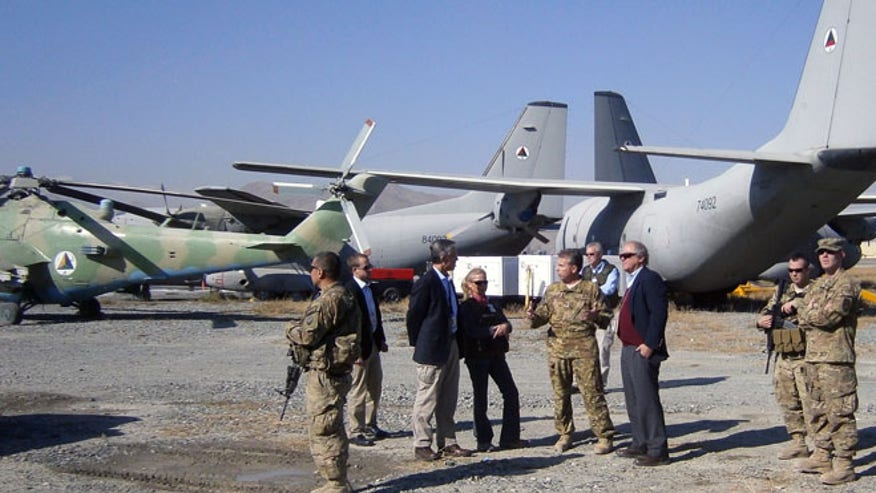
The U.S. military spent nearly a half-billion dollars on providing refurbished aircraft to the Afghan Air Force, only to abandon the contract and leave the planes collecting dust on airfields in Kabul and Germany.
With the planes potentially heading for the trash heap of the Afghanistan war, the chief military watchdog overseeing Afghanistan spending is launching a review into the terminated program.
"I'm very troubled with the fact we may have wasted a half-billion dollars on planes that don't work, will never be flown and will probably be scrapped," Special Inspector General John F. Sopko told FoxNews.com in a statement. "We intend to get to the bottom of this and hold people accountable."
Sopko wrote to Defense Secretary Chuck Hagel and other military officials on Dec. 5 informing them of his office's review. Sopko said the planes are "currently sitting unused" at the Kabul International Airport and Ramstein Air Base in Germany. He stressed the need to "ensure that the U.S. government does not repeat the mistakes made throughout this nearly half billion dollar program." Sopko has been on the warpath over military resources wasted in Afghanistan, as the U.S. prepares to withdraw most its troops from the country. He recently reopened an investigation into a $34 million military facility in southwestern Afghanistan that he's described as entirely unnecessary.
The story of the G222 aircraft program bares similar themes.
According to the inspector general's office, the Defense Department in 2008 launched a program to give 20 G222s (C-27A) -- military transport aircraft built in Italy -- to the Afghans. The department contracted with Alenia Aermacchi North America. But despite spending at least $486 million on the program, officials determined that those in charge did a poor job getting the spare parts needed to keep the planes working.
Further, a Pentagon watchdog reported that the planes flew only 234 of the 4,500 "required hours" between January and September of last year, and another $200 million potentially would be needed to buy the outstanding spare parts. Some of those parts were described as "unavailable."
In December 2012, the Air Force ended the contract. Several months later, officials ended the program altogether and opted to go with an "alternate aircraft" in the long term. The IG's latest investigation will examine the decision to provide the aircraft to the Afghans as well as what might happen to the 20 planes idling in airfields, including the possibility of "disposal." Lt. Gen. Charles Davis, top acquisition official in the U.S. Air Force, recently told Bloomberg that the planes themselves just weren't right for the environment, and probably will be "destroyed and moved out of the country." Air Force spokesman Ed Gulick, though, said the fate of the planes is contingent on a pending 2014 defense bill which would allow the Pentagon to effectively take over the aircraft from the Afghan security forces.
"With this authority, DoD could undertake final disposition of the equipment, including reuse, sale, transfer, or disposal," he told FoxNews.com in an email.
As for the contract, he said the military did not renew the program because Alenia "struggled to consistently meet contractual obligations." But the contractor claimed to Bloomberg that the company was "proud of its work." According to the contractor's website, the aircraft were meant to be the "backbone" of the Afghan Air Force, expanding their ability to provide aid and security. The planes are able to carry up to 10 tons of cargo.

Afghanistan: Reserved seat for minorities: MPs reject decree

http://www.pajhwok.com/
The Wolesi Jirga on Saturday rejected a presidential decree, reserving a seat for the Hindu and Sikh minority in the lower house of parliament. On September 4, President Hamid Karzai signed the legislative decree in accordance with Article 79 of the constitution and the electoral law.
The article says: “During the recess of the House of Representatives, the government shall, in case of an immediate need, issue legislative decrees, except in matters related to budget and financial affairs…” Legislative decrees, after their endorsement by the president, have to be presented to the National Assembly within 30 days of its first session. If rejected by the National Assembly, they become void. On Saturday, the Wolesi Jirga Legislative Commission placed the decree before the house for endorsement after it was thoroughly debated by different parliamentary panels.
Nazir Ahmad Hanafi, the commission head, said 13 of the 18 permanent house panels had opposed the decree. He claimed the orders were in conflict with Articles 22 and 83 of the constitution. Article 22 prohibits any kind of discrimination and privilege between the citizens of Afghanistan. All citizens -- whether man or woman -- have equal rights and duties before the law. Similarly, Article 83 says members of the Wolesi Jirga are elected by the people through free, general, secret and direct elections. The election shall be held within 30 to 60 days before the expiry of the term of the Wolesi Jirga. Hanafi said the Commission for Supervision of the Implementation of Constitution had also found the decree in violation of the basic law.
Several members suggested that Sikhs and Hindus, just like other citizens, should try to find their way to the parliament by contesting elections. They voiced aversion to constitutional exceptions in this regard. But Health Commission chief, Naqibullah Faiq, favoured a reserved seat for the Hindu and Sikh minority. “If we don’t give them this constitutional privilege, the minorities will never reach the parliament.”
Faiq’s view was supported by lawmaker from Kabul Ramazan Bashardost, who believed that there was nothing wrong in setting aside a parliamentary seat for the minorities. Of the 130 legislators present, 73 raised their red cards in rejection of the presidential decree. On July 31, the Council of Hindus and Sikhs in Afghanistan had warned of leaving the country if they were not given proper representation in the lower house of the parliament. Flanked by civil society representatives, Rail Singh, the council’s deputy head, asked the government to take effective measures to address the problems being faced by the minorities.
In the original draft election law, a seat had been reserved for the Hindus and Sikh, he told a news conference. But the parliament deleted the clause, he regretted.
“We are very much concerned about the abolition of the reserved seat,” remarked Singh, whose community has no representation in parliament. No parliamentarian bothered to discuss the problems being faced by the minority, he deplored.

Afghan president says U.S. indulging in brinkmanship over security deal

Afghan President Hamid Karzai on Saturday shrugged off U.S. talk of a total military withdrawal from Afghanistan if he didn't sign a security agreement as brinkmanship and said he wouldn't back down on his conditions for the deal. Karzai was in New Delhi in a burst of regional diplomacy as his ties with Washington have come under renewed strain over his refusal to sign the Bilateral Security Agreement (BSA) that will shape U.S. military presence in Afghanistan beyond 2014 when most international troops will leave.
He told reporters that the United States would have to stop the practice of raiding Afghan homes and help restart a peace process with the Taliban as necessary conditions for the security pact.
"We do believe that the BSA is in the interest of Afghanistan and the Afghan people have given their approval. But we also believe that protection of Afghan homes and the launch of a peace process are absolute pre-requisites," he said.
If Karzai doesn't sign the deal, Washington says it will have to withdraw its entire force of some 44,500 troops by the end of 2014. Other NATO nations could follow suit leaving Afghan forces to fight the Taliban insurgency on their own. The complete withdrawal, called the "zero option", would be similar to the pull-out of U.S. troops from Iraq two years ago. Violence there is now at its highest level in at least five years, and more than 8,000 people have been killed this year, the United Nations says.
"I don't think America is thinking of the zero option , its brinkmanship they play with us, and even if they did, then come what may," the Afghan leader said.
U.S. officials have appeared exasperated by Karzai's stance on the security agreement, which they say is needed to help them plan a future mission that will assist Afghan forces fight militants and that will allow for future aid crucial for the impoverished nation. U.S. Special Representative for Afghanistan and Pakistan, James Dobbins told the Senate Foreign Relations Committee this week that the delay in finalizing the deal - which U.S. officials had hoped Karzai would sign weeks ago - would impose "damages and costs" on Afghans. But he added that the Obama administration was not on the verge of abandoning its effort to extend its troop presence in the country. The security agreement would allow for the presence of nearly 15,000 U.S. and other NATO troops at nine locations around the country, Karzai said. The agreement includes a provision allowing military raids on Afghan homes in exceptional circumstances - when an American life is directly under threat - but it would not take effect until 2015. The issue is particularly sensitive among Afghans after a dozen years of war between Afghan and foreign forces and Taliban militants. Karzai said he also wanted the United States to help him start an open and public peace process with the Taliban, rather than the secret diplomacy it had engaged in the past.
"Secret talks won't help. U.S. and Pakistan have enough influence over the Taliban to relaunch the peace process."
Karzai, who discussed the U.S. security deal with Indian Prime Minister Manmohan Singh, has also held talks with the leaders of Iran and Pakistan this month.

Pakistan's Shia under attack: Anti-Shia witch-hunt of Pindi police, scores held, sanctity of privacy violated

www.shiitenews.com
Biased Rawalpindi police have raided several houses of Shiites violating the sanctity of chadar and char divari and rounded up several innocent Shia Muslims to implicate them in false case.
Shiite News Correspondent reported that Pindi police raided several houses in Chor Harpal area and misbehaved with the women during search and raid operation. Finally, they took with them several innocent Shiites.
Some of those taken into custody by the police were: Syed Saghir Hussain Shah, Azad Hussain Shah, Imran son of Qurban Hussain Shah, his brother Aun Hussain Shah. Syed Ammaar Ali Shah and Syed Nisar Ali Shah son of Safdar Shah who were held and released earlier, were retaken into custody.
Tahir Hussain son of Muhammad Hussain, Syed Qamar Ali Shah son of Syed Shah Kazmi offered themselves for arrest.
Shia parties and leaders and relatives of the rounded up innocent Shiites complained that the Punjab government sided with the outlawed Sipah-e-Sahaba (renamed as Ahl-e-Sunnat wal Jamaat) and is trying to implicate innocent Shiites who fell victims of terrorist attacks on the day of Ashura in Pindi. They demanded Supreme Court to take suo motu notice against the biased Punjab government and Rawalpindi police.

Pakistan: Suspected US drone strike; casualties feared

A suspected US drone targeted a boat in the waters of the Kabul river on Saturday, DawnNews reported. Sources said five people may have died in the attack. Pakistan condemns drone attacks and says the attacks violate Pakistan’s “sovereignty and territorial integrity”. Pakistan moreover maintains that drone strikes are counter-productive, entail loss of innocent civilian lives and have human rights and humanitarian implications apart from setting dangerous precedents in inter-state relations. The attack comes days after the US warned Pakistan that coalition support reimbursements and security assistance could be held up if land routes remained closed for movement of US and Nato cargo to and from Afghanistan.
The warning came in US Secretary of Defence Chuck Hagel’s Monday visit to Pakistan during which he met Prime Minister Nawaz Sharif and Chief of Army Staff Raheel Sharif. Hagel’s trip, which is also the first by an American defence secretary to Pakistan in four years, followed US decision to suspend the use of land routes through Pakistani territory in the wake of Pakistan Tehrik-i-Insaaf’s protests against drone attacks.

Workers refuse to participate in polio campaign in Khyber Agency

The workers have refused to discharge their duties as polio vaccinators in Khyber Agency following the fresh killing of a polio worker in Jamrud on Friday, Geo News reported Saturday.
According to the health department sources, the polio workers have denied to continue the vaccination process throughout the Agency until adequate security is provided to them.
The announcement came after a polio worker was shot dead in Jamrud on Friday.
It may be mentioned that gunmen riding a motorcycle shot dead the anti-polio worker, identified as Yousuf, outside his home in Jamrud. The armed men called out his name and opened fire on him, killing him on the spot. The killers fled after committing the murder, the sources told.
Assistant Political Agent of Jamrud Jahangir Azam Wazir claimed the killing of the anti-polio worker was not an act of terrorism, rather it was the result of personal rivalry.
Meanwhile, the political administration arrested 27 suspected persons, including 12 motorcyclists, during a search operation after the killing. The detainees were taken to the Jamrud lock-up for questioning.
It may be mentioned that the anti-polio campaign in the Khyber Agency was launched 10 days behind schedule.
Also in another incident, the armed men killed two cops near the district headquarters in Swabi when they were on their way to escort the anti-polio vaccinators. The policemen were deputed to escort the anti-polio team in Topi Tehsil, but they came under attack in the Ghaziabad area on the Swabi-Topi Road.
It was planned that the campaign would not be carried out in the entire district on the same day, rather it would be launched in the four tehsils, including Swabi, Chota Lahor, Razaar and Topi, on alternate days in order to provide adequate security to polio vaccinators.

The State Bank of Pakistan is on the brink of bankruptcy

The State Bank of Pakistan is on the brink of bankruptcy, as the country’s foreign debt has increased to Rs 403 billion ($3.63 billion) due to depreciation of the rupee in the last few months. “Yesterday the foreign reserves figure published by SBP stood at $2.963 billion. SBP’s net forward book number is $2.925 billion, which is basically dollars that are sold to banks to help intervene/stabilise cashflows. So essentially SBP reserves are at $38 million,” informed sources told Pakistan Today. By end of the last fiscal year, the federal government’s total debt was Rs 14 trillion, which increased to Rs 15 trillion by September — an increase of Rs 1 trillion, according to the State Bank of Pakistan figures. A Finance Ministry official informed the National Assembly on Friday that the public and publicly-guaranteed foreign debt, including the money owed to the International Monetary Fund has increased to $3.63 billion as a result of depreciation of rupee during the present government.” Pakistan People’s Party (PPP) lawmaker Nafisa Shah had raised the issue in parliament. To her question, Parliamentary Secretary for Finance Rana Afzal Khan raised points on the devaluation of rupee, saying that initiatives like building up of reserves and enhancing exports were required to strengthen the rupee. “We have planned substantial foreign exchange inflows, loans from multi-lateral and bilateral sources,” he said. Foreign exchange reserves held by the SBP have declined to a 12-year low of $2.9 billion, hitting its lowest level since November 2001, according to fresh data. DAR COMES UP WITH OWN FIGURES: Meanwhile, Finance Minister Ishaq Dar said the foreign exchange reserves have risen to $3.4 billion dollars, witnessing an increase of $500 million this week. He said Pakistan was also hoping for a $550 million tranche from IMF after the December 19 meeting. “The country is also expected to get $350 million of Coalition Support Funds (CSF) and about $600 million from Etisalat, for which a meeting will be held next week. We want to take our reserves to $20 billion in future as Pakistani economy is moving in the right direction," said Dar, the prime minister’s finance guru. Dar said Pakistan is also planning to make its 3G auction in February and it was expecting to receive $1.2 billion and even more from it. The minister hoped that the government would be able to bring the dollar rupee rate close to Rs 100.
- See more at: http://www.pakistantoday.com.pk/2013/12/14/news/profit/central-bank-reserves-hit-record-low/#sthash.IfxuNYfr.dpuf