http://www.thehindu.com/
Wednesday, December 11, 2013
INDIA: Homosexuality illegal: SC
INDIA: Visitors from Pakistan have to be vaccinated for polio
 India on Wednesday announced it would be mandatory for all persons adults or children travelling to the country from Pakistan to furnish proof of vaccination against polio from January 30 next year.
"The step is being taken to safeguard India's polio-free status attained after sustained efforts and investment," said a statement from the Indian High Commission here.
"It is applicable to all travellers from all countries where polio disease is endemic or where cases of polio are reported," it said.
Travellers from Pakistan will be required to carry their vaccination record because evidence of polio vaccination will be requested for entry into India.
Pakistan, Afghanistan and Nigeria are the only three countries where polio remains endemic. The new measure will also apply to Indian nationals travelling to and from countries where polio is endemic.
Travellers should take Oral Polio Vaccine (OPV) at least six weeks before their departure to India but not more than a year before the trip, the statement said.
Record of taking OPV should be obtained from an authorised medical centre in the format laid out in the International Certificate of Vaccination?of the World Health Organisation's International Health Regulations of 2005.
Once administered, the vaccine remains effective for a year, after which it should be taken again.
The number of polio cases in Pakistan has touched 63 this year, up five from the whole of last year. Militants and gunmen frequently attack vaccination teams, accusing them of being Western spies and part of a plot to "sterilise" Muslims.
The WHO recently said polio that crippled 13 children in Syria was caused by a strain of the virus that originated in Pakistan and is spreading across the Middle East. Genetic sequencing showed the strain found in Syrian children was linked to a strain of Pakistani origin found in sewage in Egypt, Israel and Palestinian territories.In June last year, the Pakistani Taliban banned polio vaccinations in parts of the lawless tribal belt, saying the restriction would last till US drone strikes cease.
Since then, at least 260,000 children in North and South Waziristan regions have not been vaccinated against polio.
India on Wednesday announced it would be mandatory for all persons adults or children travelling to the country from Pakistan to furnish proof of vaccination against polio from January 30 next year.
"The step is being taken to safeguard India's polio-free status attained after sustained efforts and investment," said a statement from the Indian High Commission here.
"It is applicable to all travellers from all countries where polio disease is endemic or where cases of polio are reported," it said.
Travellers from Pakistan will be required to carry their vaccination record because evidence of polio vaccination will be requested for entry into India.
Pakistan, Afghanistan and Nigeria are the only three countries where polio remains endemic. The new measure will also apply to Indian nationals travelling to and from countries where polio is endemic.
Travellers should take Oral Polio Vaccine (OPV) at least six weeks before their departure to India but not more than a year before the trip, the statement said.
Record of taking OPV should be obtained from an authorised medical centre in the format laid out in the International Certificate of Vaccination?of the World Health Organisation's International Health Regulations of 2005.
Once administered, the vaccine remains effective for a year, after which it should be taken again.
The number of polio cases in Pakistan has touched 63 this year, up five from the whole of last year. Militants and gunmen frequently attack vaccination teams, accusing them of being Western spies and part of a plot to "sterilise" Muslims.
The WHO recently said polio that crippled 13 children in Syria was caused by a strain of the virus that originated in Pakistan and is spreading across the Middle East. Genetic sequencing showed the strain found in Syrian children was linked to a strain of Pakistani origin found in sewage in Egypt, Israel and Palestinian territories.In June last year, the Pakistani Taliban banned polio vaccinations in parts of the lawless tribal belt, saying the restriction would last till US drone strikes cease.
Since then, at least 260,000 children in North and South Waziristan regions have not been vaccinated against polio.
US 'Nowhere Near' Decision to Pull All Troops Out of Afghanistan
The Obama administration is “nowhere near” deciding to pull out all troops from Afghanistan at the end of 2014, a top U.S. official said on Tuesday, despite mounting frustration that President Hamid Karzai has not signed a security deal allowing the military to remain there after next year. “I have no doubt that the [bilateral security agreement with Afghanistan] ultimately will be concluded,” Ambassador James Dobbins, U.S. Special Representative for Afghanistan and Pakistan, told the U.S. Senate Foreign Relations Committee. While Dobbins said that an ongoing delay in finalizing the deal - which U.S. officials had hoped Karzai would sign weeks ago - would impose “damages and costs” on Afghans, he said the Obama administration was not on the verge of abandoning its effort to extend its troop presence. “We're nowhere near a decision that would involve our departing Afghanistan altogether,” he said. The administration has been urging Karzai to sign the bilateral security agreement (BSA) it negotiated with Karzai's government. The deal would permit the U.S. to keep troops in Afghanistan beyond the end of 2014 to support Afghan forces and conduct limited counterterrorism activities. After Afghan elders and politicians endorsed the pact last month, Karzai surprised Washington by introducing new conditions for his signature. If no deal can be finalized, Washington has said it will withdraw its entire force of 47,000 troops in a little over a year. Other NATO nations are likely to follow suit. The absence of foreign troops would likely dampen donor nations' willingness to fund Afghan troops and provide civilian aid. “My judgment is no troops, no aid, or almost no aid,” Dobbins said. If security conditions were to worsen sharply, he said, United States could conceivably even close its embassy in Kabul. There are fears that the Taliban and other militants ultimately could regain strength, the central government could founder, and Afghanistan be plunged anew into civil war. The possibility of a full withdrawal of foreign forces is already having a dangerous impact on Afghanistan, Dobbins said, as people pull money out of the country, property prices fall and the Afghan currency slips in value. Larry Sampler, a senior official at the U.S. Agency for International Development, told senators that it would be more difficult to find ways to carry out promised civilian assistance for impoverished Afghanistan without a security deal and a foreign troop presence. ‘Colonial’ Pressure As U.S. frustrations with Karzai become increasingly public, U.S. Defense Secretary Chuck Hagel made a surprise visit to Kabul last weekend. However, in an unusual move, he opted not to meet with Karzai. In an interview with French newspaper Le Monde, Karzai accused the United States of applying 'colonial' pressure on him to sign the pact and said Dobbins suggested during a recent visit to Kabul that without a security agreement there would be no peace. The Obama administration has not yet said precisely how many troops it would leave in Afghanistan after 2014 if a deal is finalized that would fight a Taliban that remains a potent, if diminished, force, Senator John McCain, a Republican, pressed Dobbins for clarity on how many soldiers would be left in Afghanistan post-2014, and said announcing future troops levels might persuade Karzai to sign. “By not doing so you're making a very, very serious mistake,” McCain said. He said the Obama administration risked repeating the course of events in Iraq, where U.S. officials halted efforts to seal a security deal with Iraq in late 2011, prompting the full withdrawal of U.S. troops at the end of that year. Violence in Iraq is now at its highest level in at least five years; more than 8,000 people have been killed so far in 2013, according to the U.N.http://www.voanews.com/
Afghanistan: Kabul Airport Targeted, No Casualties
http://www.tolonews.com/A car full of explosives detonated north of Kabul Airport on Qasaba Road Wednesday morning, according to the Ministry of Interior (MoI). The blast took place around 8:00am near the military entrance entrance to Kabul airport, the Ministry's statement said. Deputy Interior Minister Gen. Mohammad Ayub Salangi said there were no casualties reported and the area has been blocked off by security forces with investigations underway. The incident took place while Afghan President Hamid Karzai was due to arrive from South Africa. Taliban spokesman Zabiullah Mujaheed claimed responsibility for the attack and said in a statement that a dozen German soldiers were killed and wounded in the attack. The Afghan Interior Ministry rejected the Taliban spokesman's claim. ISAF said on Twitter that it is aware of the explosion near Kabul Airport, but that more information would not be released until later.
Pakistan: Karakoram University’s Shia students rusticated for holding Youm e Hussain (AS)
Biased administration of Karakorum International University rusticated 3 Shia students for life and another 2 for 3 years for their only “sin” that they played leading role to hold Youm-e-Hussain (AS) in the University on Tuesday. Shiite News Correspondent reported here that biased administration of Karakoram International University did not allow the students to hold Youm-e-Hussain (AS) that was to be held to highlight the sacrifices of Imam Hussain (AS) and his comrades in Karbala. After having been disappointed by repeated refusal to their request, the students held Youm-e-Hussain (AS) on Wednesday. The Yazidi nasbi takfiri elements of outlawed fanatic terrorist outfit Sipah-e-Sahaba staged demonstration outside of the university against the Youm-e-Hussain (AS). It appeared that Yazidi elements got supporters inside the university who rusticated Jamal Haider, President ISO, KIU chapter, Syed Waqar Hussain, President, JSO, KIU Chapter and Sherullah, vice president of the ISO KIU chapter for life. Ex divisional president of the ISO namely Ayub Ansari and Imtiaz Hussain were rusticated for two years. The rustication evoked countrywide opposition and condemnation from Sunni and Shia parties and leaders who demanded of the university administration to rescind their decision.
Pakistan's Shia Genocide: Yazidi terrorists flee after Shiites of Quetta came out to retaliate
Yazidi nasbi takfiri terrorists of outlawed Sipah-e-Sahaba attacked Shia Muslims, ransacked and torched some shops but they had to take to their heels after Shiites of Alamdar Road came out to retaliate on Wednesday. Shiite News Correspondent reported that outlawed Sipah-e-Sahaba’s terrorists attacked Shiites shops, ransacked and torched some shops but Shiites instantly came out of their shops and houses and retaliated. The terrorists fled the scene. Police reached there but took no action against the terrorists. The residents of Alamdar Road said that the terrorists enjoyed provincial government and police’s patronage. Shia parties and leaders have condemned the attack on Shia population in Quetta and demanded that the U.S.-backed Zionists-Wahhabi Deobandi terrorists must be reined in.
Pakistan: Personalisation under the guise of privatisation – by Bilawal Bhutto Zardari
http://mediacellppp.wordpress.com/
by Bilawal Bhutto

یوم نجات 12 دسمبر: پاکستانی قوم چیف جسٹس افتخار چودھری کی ریٹائرمنٹ پر خوش کیوں؟
posted by Sarah Khanنیوز رپورٹ: بارہ دسمبر پاکستان کی سپریم کورٹ کے چیف جسٹس افتخار چودھری کی ریٹائرمنٹ کا دن ہے اس دن جہاں چیف جسٹس کے کچھ حامی جن


- See more at: http://lubpak.com/archives/295795#sthash.CsACsnt5.dpuf
Pakistan: The wages of Imran’s ‘sins’
Bilawal Bhutto vows to repeal ‘black laws’
http://mediacellppp.wordpress.com/


‘Zardari cooperated with UN in BB murder probe’

Tuesday, December 10, 2013
Organic milk may be more heart healthy, study suggests

President Obama poses for a funeral selfie and gets chummy with Danish Prime Minister Helle Thorning-Schmidt but Michelle does not look impressed
http://www.nydailynews.com/
 President Obama was caught committing a funeral faux pas — snapping a selfie during Nelson Mandela’s memorial service with Danish Prime Minister Helle Thorning-Schmidt and British PM David Cameron.
The threesome smiled as the Scandinavian beauty held her smartphone out to capture the moment but Michelle Obama sat at a distance, as if in disapproval of the digital display.Thorning-Schmidt, 46, was animated as she took her place among the dignitaries in the stands at the FNB stadium in Johannesburg for the somber occasion, chatting with other leaders and unabashedly typing away on her device.The Danish politician, who is married to British executive Stephen Kinnock, appeared particularly
President Obama was caught committing a funeral faux pas — snapping a selfie during Nelson Mandela’s memorial service with Danish Prime Minister Helle Thorning-Schmidt and British PM David Cameron.
The threesome smiled as the Scandinavian beauty held her smartphone out to capture the moment but Michelle Obama sat at a distance, as if in disapproval of the digital display.Thorning-Schmidt, 46, was animated as she took her place among the dignitaries in the stands at the FNB stadium in Johannesburg for the somber occasion, chatting with other leaders and unabashedly typing away on her device.The Danish politician, who is married to British executive Stephen Kinnock, appeared particularly  chummy with President Obama but Michelle Obama, 49, seemed annoyed at the mingling, looking solemn as she stared intently in the opposite direction and paid attention to the proceedings. As the President laughed away with the Danish leader, at least one photograph shows the First Lady flash a disapproving glare in their direction.
Thorning-Schmidt, who has two daughters with Kinnock, is the first female prime minister of Denmark. She assumed office in October 2011. She has met Obama on numerous occasions, including a White House visit in February 2012 and the NATO Summit in Chicago in May 2012. In September, Obama visited with Thorning-Schmidt during his visit to Stockholm, when he also met with Finnish President Sauli Niinisto and Swedish Prime Minister Fredrik Reinfeldt.The Danish leader's selfie went viral on Twitter, with scores of comments on the total lack of propriety shown by the three leaders.
chummy with President Obama but Michelle Obama, 49, seemed annoyed at the mingling, looking solemn as she stared intently in the opposite direction and paid attention to the proceedings. As the President laughed away with the Danish leader, at least one photograph shows the First Lady flash a disapproving glare in their direction.
Thorning-Schmidt, who has two daughters with Kinnock, is the first female prime minister of Denmark. She assumed office in October 2011. She has met Obama on numerous occasions, including a White House visit in February 2012 and the NATO Summit in Chicago in May 2012. In September, Obama visited with Thorning-Schmidt during his visit to Stockholm, when he also met with Finnish President Sauli Niinisto and Swedish Prime Minister Fredrik Reinfeldt.The Danish leader's selfie went viral on Twitter, with scores of comments on the total lack of propriety shown by the three leaders.


Saudi delegation visits Israel over Iran: Reports
 A senior military delegation from Saudi Arabia has visited Israel to discuss a deal recently reached between Iran and the six world powers over Tehran’s nuclear energy program, media reports say.
Saudi Deputy Defense Minister Salman bin-Sultan Al Saud and two other officers secretly visited Israel, according to reports by the Palestinian news portal al-Manar and Israeli radio.
Bin-Sultan, who is the brother of Saudi Arabia’s spy chief Prince Bandar bin Sultan bin Abdulaziz Al Saud, “met Israeli security leaders” and one of the “Israeli military bases accompanied by a senior member of the Israeli staff board”, the al-Manar report said, quoting "confidential sources".
On November 24, Iran and the six world powers -- the United States, Britain, France, Russia, China and Germany -- reached an interim deal to pave the way for the full resolution of the West’s decade-old dispute with Iran over its nuclear energy program.
In exchange for Tehran’s confidence-building measure to limit certain aspects of its nuclear activities, the six countries agreed to lift some of the existing sanctions against the Islamic Republic.
Israeli Prime Minister Benjamin Netanyahu had previously clashed with US President Barack Obama and other Western countries over last month’s deal with Iran, describing it as a "historic mistake” that is bad for Israel. He added that Tel Aviv would not be bound by it.
On November 17, the British newspaper The Sunday Times reported that Riyadh has given the go-ahead for Israeli planes to use its airspace for possible attacks on Iran over Tehran’s nuclear energy program.
Riyadh denied the Saudi-Israeli cooperation in preparation for an attack on Iran's nuclear program.
Iran has repeatedly warned that it will retaliate with its utmost power against any attack on its soil.
A senior military delegation from Saudi Arabia has visited Israel to discuss a deal recently reached between Iran and the six world powers over Tehran’s nuclear energy program, media reports say.
Saudi Deputy Defense Minister Salman bin-Sultan Al Saud and two other officers secretly visited Israel, according to reports by the Palestinian news portal al-Manar and Israeli radio.
Bin-Sultan, who is the brother of Saudi Arabia’s spy chief Prince Bandar bin Sultan bin Abdulaziz Al Saud, “met Israeli security leaders” and one of the “Israeli military bases accompanied by a senior member of the Israeli staff board”, the al-Manar report said, quoting "confidential sources".
On November 24, Iran and the six world powers -- the United States, Britain, France, Russia, China and Germany -- reached an interim deal to pave the way for the full resolution of the West’s decade-old dispute with Iran over its nuclear energy program.
In exchange for Tehran’s confidence-building measure to limit certain aspects of its nuclear activities, the six countries agreed to lift some of the existing sanctions against the Islamic Republic.
Israeli Prime Minister Benjamin Netanyahu had previously clashed with US President Barack Obama and other Western countries over last month’s deal with Iran, describing it as a "historic mistake” that is bad for Israel. He added that Tel Aviv would not be bound by it.
On November 17, the British newspaper The Sunday Times reported that Riyadh has given the go-ahead for Israeli planes to use its airspace for possible attacks on Iran over Tehran’s nuclear energy program.
Riyadh denied the Saudi-Israeli cooperation in preparation for an attack on Iran's nuclear program.
Iran has repeatedly warned that it will retaliate with its utmost power against any attack on its soil.
Kerry Asks Congress to Hold Off on Any New Sanctions on Iran
http://www.voanews.com/U.S. Secretary of State John Kerry has strongly defended the Obama administration's interim deal with Iran on its nuclear program, and asked Congress to hold off on passing any new sanctions on Iran to give ongoing negotiations a chance to succeed. The Senate is sending mixed signals as to whether it will take up a measure to impose new sanctions on Iran before it leaves for recess this year. For the first time since the agreement on Iran was reached in Geneva last month, Secretary of State John Kerry came to Capitol Hill to address concerns that have been voiced by skeptical lawmakers. Kerry heard plenty of those from both Democratic and Republican members of the House of Representatives' Foreign Affairs Committee. The committee's chairman, Ed Royce, a Republican, said Iran has a history of deceiving the international community about its nuclear program. "Iran is not just another country. It simply cannot be trusted with enrichment technology, because verification efforts can never be foolproof," said Royce. Kerry argued that the agreement is a big boost to both U.S. national security and the security of close U.S. allies in the Middle East, including Israel. "Once implemented, this agreement halts the progress of Iran's nuclear program, halts the progress and rolls it back for the first time in nearly 10 years," said Kerry. Kerry appealed to members of the House and the Senate to hold off any efforts to impose new, tougher sanctions against Iran during the six month period specified in the deal, saying this could derail the process. "Let me be very clear: this is a very delicate diplomatic moment and we have a chance to address peacefully one of the most pressing national security concerns that the world faces today,” said Kerry. The House already passed tougher sanctions on Iran in July, but the Senate has not. There are mixed signals coming from the Senate. Republican Senator John McCain, a member of the Senate Foreign Relations Committee, indicated to VOA that the panel is considering a new sanctions bill. "[We are] still negotiating, we should have an agreement soon," said McCain. The Senate Banking Committee is not planning to pursue new sanctions against Iran. For this year, the Senate only has a little more than one week to act before a planned recess.
World bids farewell to Mandela at huge memorial
 Around 100 heads of state and thousands of South Africans gathered to honour Nelson Mandela at a memorial service in a Johannesburg sports stadium Tuesday.
• Family, friends, world leaders and religious figures from various faiths all spoke to pay homage to Nelson Mandela in front of the thousands of South Africans who turned out to celebrate the life of the anti-apartheid hero despite pouring rain at the World Cup stadium in Soweto.
• Barack Obama was greeted by wild cheers as he addressed the crowd. The US President said that Mandela was “the last great liberator of the 20th century” and that "we will never see the likes of Nelson Mandela again”.
• There was embarrassment for Jacob Zuma when he was booed and jeered by the crowd as he arrived in the stadium and again as he prepared to speak. The South African president has been battling criticism over his government’s handling of various issues, including persisting poverty, crime and unemployment.
• The booing ceased for Zuma's speech, however, during which he underlined Mandela's role as "a fearless freedom fighter" who “laid the foundation for a better life for all”.
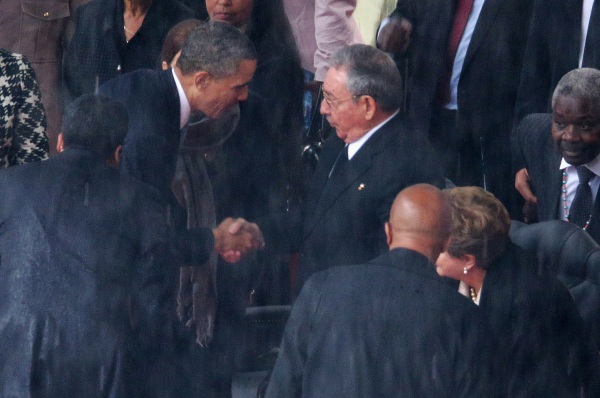
• And there was an historic moment as Obama shook hands with Cuban leader Raul Castro, who also spoke at the ceremony. Havana and Washington have not had diplomatic relations since 1961, two years after Raul’s brother Fidel came to power in the Cuban revolution.
Around 100 heads of state and thousands of South Africans gathered to honour Nelson Mandela at a memorial service in a Johannesburg sports stadium Tuesday.
• Family, friends, world leaders and religious figures from various faiths all spoke to pay homage to Nelson Mandela in front of the thousands of South Africans who turned out to celebrate the life of the anti-apartheid hero despite pouring rain at the World Cup stadium in Soweto.
• Barack Obama was greeted by wild cheers as he addressed the crowd. The US President said that Mandela was “the last great liberator of the 20th century” and that "we will never see the likes of Nelson Mandela again”.
• There was embarrassment for Jacob Zuma when he was booed and jeered by the crowd as he arrived in the stadium and again as he prepared to speak. The South African president has been battling criticism over his government’s handling of various issues, including persisting poverty, crime and unemployment.
• The booing ceased for Zuma's speech, however, during which he underlined Mandela's role as "a fearless freedom fighter" who “laid the foundation for a better life for all”.
• And there was an historic moment as Obama shook hands with Cuban leader Raul Castro, who also spoke at the ceremony. Havana and Washington have not had diplomatic relations since 1961, two years after Raul’s brother Fidel came to power in the Cuban revolution.
President Barack Obama shakes Raul Castro's hand at Mandela memorial service
The US president, Barack Obama, shook hands with his Cuban opposite number, Raul Castro, at the memorial service for Nelson Mandela.
In Afghanistan, Women Betrayed
 By HEATHER BARR
When, in late November, I read a draft law prepared by Afghan government officials that reintroduced execution by stoning as the punishment for the “crime” of adultery, I was horrified but not that surprised. The draft, leaked to me by someone desperate to prevent reinstatement of this Taliban-era punishment, is just the latest in a pattern of increasingly determined attacks on women’s rights in Afghanistan.
The last 12 years have been a time of significant achievements here, hard-fought by Afghan activists. Millions of girls have gone to school, women have joined the police and the army and the civil service. Twenty-eight percent of the members of Afghanistan’s Parliament are women, and a 2009 law made violence against women a crime.
But signs are everywhere that a rollback of women’s rights has begun in anticipation of next year’s deadline for the withdrawal of international combat forces. Opponents of women’s rights are already taking advantage of growing international fatigue with Afghanistan.
On Monday, the United Nations issued a new report showing that while reported cases of violence against women went up by 28 percent in the last year, prosecutions increased by only 2 percent. A parliamentary debate last May on the Law on the Elimination of Violence Against Women was derailed by conservatives calling for the abolition of a minimum marriage age for girls and arguing against making rape a crime. One of President Hamid Karzai’s new handpicked commissioners at the government’s previously well-respected Independent Human Rights Commission is an ex-member of the Taliban government who wasted no time after his appointment before calling for the repeal of the EVAW Law, which he said “violates Islam.”
These setbacks have occurred against a backdrop of continuing day-to-day abuses against women that are so commonplace that some extreme practices go almost unnoticed.
About half the women in prison in Afghanistan and about 95 percent of girls in juvenile detention — a total of about 600 people — are imprisoned on accusations of “moral crimes,” like sex outside of marriage or running away from home. In reality, most have fled forced marriages or domestic violence. Some are survivors of rape who are blamed by the courts for “immorality,” sometimes alongside their attackers.
Their stories are a call to the Afghan government to do much more to track down and punish abusers of women, and to crack down on police officers, prosecutors and judges who treat women fleeing abuse as criminals rather than victims. Above all, the government needs to end the barbaric practice of virginity tests. Whenever a woman or girl is arrested on “morality” charges — and sometimes even when she is accused of non-moral crimes such as theft or assault — she is whisked away for a vaginal examination at a government clinic in the province in which she was arrested. There is no opportunity for her to refuse.
Because of frequent mix-ups and general inefficiency, some women are sent for the examination two or three times. The examination, carried out by government doctors, results in a report on whether or not the woman or girl is a “virgin.”
These reports are often used as the sole evidence to support “moral crimes” charges in court, aside from a “confession” taken down by a police officer immediately after the arrest, which is usually signed with a thumbprint by a woman or girl who has no idea what it says. I have seen cases where a judge used the report as evidence against a girl even when its findings were inconclusive. For many of the 600 women and girls imprisoned for “moral crimes,” the doctor’s observations are a key factor in her receiving a stiff prison sentence.
Forcing these women and girls to undergo invasive vaginal examinations, sometimes repeatedly, to ascertain “virginity” as evidence likely to be used against them in criminal proceedings is not only a form of degrading and inhuman treatment strictly prohibited by international law but also a violation of their basic fair trial rights.
All of this would be horrific enough if it weren’t bad science, but it is. “Virginity” tests have no medical validity. A medical examination cannot determine, with any level of accuracy useful to a court, a woman’s sexual history.
And despite progress in other countries in banning such examinations, there are no signs of this practice ending in Afghanistan. For vulnerable Afghan women, things are only getting worse. One recently proposed law revision would ban victims of crime from testifying against family members — effectively preventing all prosecutions for domestic violence and forced or underage marriage. Female activists in Afghanistan, who have accomplished so much in the past 12 years, are doing all they can now to prevent that progress from unraveling. Countries, including the United States, have pledged continued funding for services for Afghan women, but in addition to aid they need political support. International support for the Afghan government and its security must depend on continued progress for Afghan women. Anything less would be a betrayal.
By HEATHER BARR
When, in late November, I read a draft law prepared by Afghan government officials that reintroduced execution by stoning as the punishment for the “crime” of adultery, I was horrified but not that surprised. The draft, leaked to me by someone desperate to prevent reinstatement of this Taliban-era punishment, is just the latest in a pattern of increasingly determined attacks on women’s rights in Afghanistan.
The last 12 years have been a time of significant achievements here, hard-fought by Afghan activists. Millions of girls have gone to school, women have joined the police and the army and the civil service. Twenty-eight percent of the members of Afghanistan’s Parliament are women, and a 2009 law made violence against women a crime.
But signs are everywhere that a rollback of women’s rights has begun in anticipation of next year’s deadline for the withdrawal of international combat forces. Opponents of women’s rights are already taking advantage of growing international fatigue with Afghanistan.
On Monday, the United Nations issued a new report showing that while reported cases of violence against women went up by 28 percent in the last year, prosecutions increased by only 2 percent. A parliamentary debate last May on the Law on the Elimination of Violence Against Women was derailed by conservatives calling for the abolition of a minimum marriage age for girls and arguing against making rape a crime. One of President Hamid Karzai’s new handpicked commissioners at the government’s previously well-respected Independent Human Rights Commission is an ex-member of the Taliban government who wasted no time after his appointment before calling for the repeal of the EVAW Law, which he said “violates Islam.”
These setbacks have occurred against a backdrop of continuing day-to-day abuses against women that are so commonplace that some extreme practices go almost unnoticed.
About half the women in prison in Afghanistan and about 95 percent of girls in juvenile detention — a total of about 600 people — are imprisoned on accusations of “moral crimes,” like sex outside of marriage or running away from home. In reality, most have fled forced marriages or domestic violence. Some are survivors of rape who are blamed by the courts for “immorality,” sometimes alongside their attackers.
Their stories are a call to the Afghan government to do much more to track down and punish abusers of women, and to crack down on police officers, prosecutors and judges who treat women fleeing abuse as criminals rather than victims. Above all, the government needs to end the barbaric practice of virginity tests. Whenever a woman or girl is arrested on “morality” charges — and sometimes even when she is accused of non-moral crimes such as theft or assault — she is whisked away for a vaginal examination at a government clinic in the province in which she was arrested. There is no opportunity for her to refuse.
Because of frequent mix-ups and general inefficiency, some women are sent for the examination two or three times. The examination, carried out by government doctors, results in a report on whether or not the woman or girl is a “virgin.”
These reports are often used as the sole evidence to support “moral crimes” charges in court, aside from a “confession” taken down by a police officer immediately after the arrest, which is usually signed with a thumbprint by a woman or girl who has no idea what it says. I have seen cases where a judge used the report as evidence against a girl even when its findings were inconclusive. For many of the 600 women and girls imprisoned for “moral crimes,” the doctor’s observations are a key factor in her receiving a stiff prison sentence.
Forcing these women and girls to undergo invasive vaginal examinations, sometimes repeatedly, to ascertain “virginity” as evidence likely to be used against them in criminal proceedings is not only a form of degrading and inhuman treatment strictly prohibited by international law but also a violation of their basic fair trial rights.
All of this would be horrific enough if it weren’t bad science, but it is. “Virginity” tests have no medical validity. A medical examination cannot determine, with any level of accuracy useful to a court, a woman’s sexual history.
And despite progress in other countries in banning such examinations, there are no signs of this practice ending in Afghanistan. For vulnerable Afghan women, things are only getting worse. One recently proposed law revision would ban victims of crime from testifying against family members — effectively preventing all prosecutions for domestic violence and forced or underage marriage. Female activists in Afghanistan, who have accomplished so much in the past 12 years, are doing all they can now to prevent that progress from unraveling. Countries, including the United States, have pledged continued funding for services for Afghan women, but in addition to aid they need political support. International support for the Afghan government and its security must depend on continued progress for Afghan women. Anything less would be a betrayal.
Shanti Dynamite beats Sunny Leone, Veena Malik, Poonam Pandey as Asia's sexiest woman!
http://wonderwoman.intoday.in/



Can Shahbaz Sharif curb sectarianism?
PML-N’s politics is its bane on the communal issue What happened in Rawalpindi was not altogether unexpected. There had been enough rumblings in Punjab during the last few months that suggested that sectarian differences were gradually mutating into unrest which had the potential to boil over and engulf the country. The Punjab government dealt with one sectarian clash after another with a characteristic air of nonchalance. It generally reacted after incidents had taken place only to treat them as minor law and order issue unrelated to the grim security situation in Pakistan. Once there was calm, the PML-N administration forgot about it. The second successive coming of the PML-N in Punjab promises to be no better than the first which was marked by mega incidents of attacks on Christians, the Ahmadis and Shias. The ignominious markers during this last tenure were: the infamous attack on a Christian locality in Gojra in 2009 and the killings of the Ahmadis in Lahore in 2010. During the last four years, Punjab by and large remained immune from indiscriminate terrorist attacks that rocked the other provinces. This was widely ascribed to the appeal by Shabaz Sharif to the TTP to spare Punjab as its government was not pro-US. There was however no let-up in killings of Shias, the Ahmadis and Christians. The last two years in fact saw minorities in Punjab subjected to increased violence. This was on account of organisations like the ASWJ, which is banned, the LeJ working under a new name, having been given a free hand to spread nefarious propaganda against the minorities. The sectarian networks added to the extremist sentiment in the province through sermons, hate literature and using social network for inciting it against the religious minorities. In March about a hundred Christian houses were burnt by a mob in Joseph Colony in the provincial capital. The Ahmadis were disallowed to publish their literature, their graveyards were frequently vandalized and their places of worship disfigured. In Faisalabad, there were cases of intimidation and abduction of the members of Ahmadi community. In Punjab, sectarian violence claimed 64 lives in 2011 and 43 in 2012. In 2013, the Shia community was to become the principal target of attacks. In February, a Shia surgeon and his son were sprayed with bullets in Lahore, in August a Shia leader was shot along with his son in Rahimyar Khan and five Shia were killed in a targeted attack in Gujrat. In all these cases unknown sectarian killers disappeared after completing their mission while people in the neighbourhood irrespective of their sectarian identity came to condole with the bereaved families. The anger continued to accumulate but there was no clear cut target to vent the sentiment. The ASWJ provided one in Bhakkar in August when its armed activists took to streets in the city. This led to a bloody confrontation with the Shia community, leading to 10 dead. The government had to impose curfew to bring the situation under control in towns Panj Garain, Kotla Jam and Darya Khan. There were minor aftershocks in the province in days to come but the complacent Punjab administration took no notice. The chief minister remained focused on issues altogether outside his purview. He continued running the federal ministry of Water and Power under an inter-party arrangement and having long trips abroad with the prime minister or on his own. During his five months in office, he has visited Turkey, the UK and Germany. With several irons in the fire, he had scant time to focus on any issue, least of all the sectarian question. Days before the Rawalpindi mayhem, clashes took place between the Shia and Sunni communities in the provincial capital and Muzaffargarh. In Sanda area of Lahore, a dispute arose over the Aza’daars taking out a procession on 7th Moharram in a non-designated area close to an Imambargah. There was stone pelting and firing between the two sides causing multiple injuries to three, including the local police SHO. At Khanqah Doma in Muzaffargarh, six people were injured when miscreants opened fire at a Muharram procession. The District Coordinator Moharram Committee alleged that there was no police official on duty. He said, he met the DPO and the DCO and told them about the situation but they did not arrange adequate security. As usual police was ordered to apprehend the culprits after the violence had taken place. A well thought out policy for the Ashura days should have been formulated well ahead of Moharram. Mian Nawaz Sharif’s frothing at the mouth at the local administration and police amounts to crying over spilt milk. Why didn’t the idea strike him or the younger Sharif soon after they took office in June? Many factors stood in the way of proper planning. The Punjab CM was too busy helping the federal government or frequently traveling abroad. Whatever energy was left in him was consumed in dealing with dengue mosquitos, which taking benefit of his absence had spread the virus all over the province. Bad governance that included putting several blue eyed boys in key police positions in violation of rules constituted another cause. Sectarian clashes create more social complications than terrorist attacks. In the latter case people across the sectarian divide tend to sympathise with the community which is targeted again and again. Sectarian clashes on the other hand divide society further as members in each community start accusing the other of being the real instigator responsible for death and destruction of property. Political needs of the PML-N stand in the way of taking radical measures against those who spread communal hatred. Mainstream parties, particularly the PML-N, have frequently joined hands with sectarian outfits like the ASWJ, thus helping the sectarian party gain respectability and carve out further space for itself. On Wednesday, Nawaz Sharif hit out at the “criminal silence” on the part of local administration and police on the propagation of sectarian hatred through loudspeakers and wall-chalking, the prime minister said such acts would not be tolerated. But can the Punjab administration take action against organization like ASWJ, which are its potential election allies but are also responsible for spreading communal violence and sectarian hatred in the province? - See more at: http://www.pakistantoday.com.pk/2013/11/22/comment/can-shahbaz-sharif-curb-sectarianism/#sthash.kH5opwt1.dpufBy Aziz-ud-Din Ahmad

Pakistan's Shia Genocide: Another Shia notable shot martyred in Yazidi terrorist attack in Karachi
www.shiitenews.comAnother Shia notable was shot martyred in a targeted attack of Yazidi nasbi takfiri terrorists of outlawed Sipah-e-Sahaba in Karachi late on Monday night. Shiite News Correspondent reported here that Qamar Hasnain was going to somewhere in his car when notorious Yazidi terrorists ambushed him near Kulsoom Hotel Stop Godhra area New Karachi. He embraced martyrdom on the spot and body was taken to a government hospital for treatment. Martyr Qamar Hasnain was a member of Matami Anjuman Zulfiqar Haideri and owner of two Pakwan shops in Federal B Area Block 17 and Gulshan-e-Maymar. Shia parties and leaders have condemned the targeted murder and surge in genocide against Shiites. They demanded immediate military operation to eliminate terrorists.
Human Rights Day: Asian Human Rights Commission Outlines 2013 For Pakistan

All the way through 2013, the Asian Human Rights Commission (AHRC) has been documenting how too many lives, and the solemnity of those living, have been snatched by a cold state and brutal cruelty in Pakistan. The AHRC’s State of Human Rights Report in Pakistan, 2013, released to mark Human Rights Day observed on 10th of December picking up on the year in Pakistan, inspecting the largely decisive factors that influence the lives of all its citizens. An extract from the statement by the Asian Human Rights Commission on Human Rights Day is presented below:''Appeasement for hardliners means religious minorities are harassed and killed daily. Leaders and spokesmen from banned organisations, some internationally wanted, are allowed to make hate fuelled speeches in public. The government has arrested thousands of alleged extremists over the past four years, but there have been no successful prosecutions due to lack of proper witness protection and half-hearted attempts by the prosecutors. These criminal elements now utilize the weaknesses of the law to their own benefit and collect public donations but are not arrested for fear of upsetting extremist groups. In spite of the constitutional guarantee of freedom of religion, minority groups are not protected. Targeted attacks of the Shiites take place in daylight and on public roads in the presence of uniformed personnel; every year, around 200 Shiites are killed in this manner. The groups that claim responsibility for these killings move freely and even have offices in major cities. The Ahmadis are also frequently targeted for their belief, their places of worship are attacked and they are not allowed to carry out their religious observances. Religious fanatics who rape and abuse Christians and Hindus with no fear of consequence or reprisal consider the women of these communities free game. Harassment, forced marriage, and forced conversions of both Christian and Hindu women to Islam is common. When victims do manage to reach the courts, judges rule in favour of their abductors, who are equally supported by religious fundamentalists. This Religious discrimination is forcing native Pakistani Hindus to flee their homeland.''
Killing by Numbers: Data compiled by AHRC (from January to November 28, 2013): Sectarian Violence & Target Killings: Total Attacks: 491 Killed: 2350 Injured: 3786 Terrorist Attacks: Total Attacks: 250 Killed: 2286 Injured: 1609 Suicide Attacks: Total Attacks: 38 Killed: 820 Injured: 1445 Drone Attacks: Total Attacks: 25 Killed: 188 Injured: 160 Total Attack Incidents & Killings: Total incidents: 804 Total killings: 7170 Total injuries: 8746 - See more at: http://www.christiansinpakistan.com/human-rights-day-asian-human-rights-commission-outlines-2013-in-pakistan/#sthash.hR4jRhGr.dpuf
Khyber-Pakhtunkhwa: Supply disrupted: Hundreds stranded as residents protest against power outages
The Express TribuneHundreds of commuters remained stranded in traffic for over three hours on Monday as disgruntled residents of Rajar, Charsadda blocked the Tangi-Peshawar Road in protest against prolonged power and gas outages. Nearly 300 protesters led by Qaumi Watan Party MPA Sultan Muhammad Khan blocked the road near Rajar by burning tyres and pelting stones at vehicles heading to Peshawar. They chanted slogans against the Water and Power Development Authority and natural gas supply companies for not providing them basic facilities.

PPP condemns PM’s remarks about SZAB
http://mediacellppp.wordpress.com/

Bilawal pledges to protect Human Rights
Daily TimesPakistan People’s Party (PPP) Patron-in-Chief Bilawal Bhutto Zardari has strongly condemned the murder of Dalit girl Kaku Kolhi in Shadi Pali on the even of World Human Rights Day to be observed on Tuesday.

Punjab University hostel admin raid, 15 illegal occupants handed over to police
 The Punjab University hostel administration in an operation against the illegal residents caught 15 outsiders and later handed them over to Muslim Town police station, Geo News reported Tuesday morning.
Pakistan should heed Husain Haqqani's urgent message of reform

By: Stephen Kinzer
Cutting military spending and focusing on domestic issues could keep Pakistan from becoming a 'nuclear-armed Somalia'Just four months after taking power, new leaders in Iran have begun a highly promising effort to pull their country out of its isolation and, perhaps, transform it into a stabilizing rather than a destabilizing force. There is little prospect that Saudi Arabia or Israel, which also feed regional tensions, will follow suit. Yet some dare to hope that Pakistan might. The Middle East and surrounding regions are in a period of historic flux. Iran's new policies, upheaval in Egypt, horrific warfare in Syria, state collapse in Libya, and intensifying terror in Iraq reflect the collapse of old structures. One of those structures, in place for more than half a century, has been a Pakistan that falls steadily deeper into poverty while spending huge amounts on weaponry, fomenting terror in neighboring countries, and deepening its self-destructive obsession with imagined security threats. Pakistan stands at an intriguing crossroads. A new prime minister, Nawaz Sharif, took office in June. General Pervez Ashfaq Kayani, the army chief of staff who nourished Pakistan's ties with Islamic militants, has just retired. The mercurial chief justice, Iftikhar Muhammad Chaudhry, will retire this week. Meanwhile, Pakistanis are expressing increasing disgust with their political system. In several parts of the country they have taken to the streets to protest murderous attacks by militants who count on clandestine support from within the government. Pakistan is not about to crack down on terror groups or cut its military budget in order to build roads, schools and hospitals. Yet one prominent Pakistani, in a new book and a series of speeches, is urging it to do just that. He is offering a stark alternative to policies that threaten to turn Pakistan into what he calls "a nuclear-armed Somalia". Most Pakistani politics is conducted within a narrow spectrum. Politicians spend much time debating the best ways to fight India, or take Kashmir, or dominate Afghanistan, or punish the United States for its real and imagined sins. Now comes a voice arguing that these debates are meaningless in a country that cannot care for its own citizens and is fast becoming a pariah state. It is the voice of Husain Haqqani, a wily veteran of Pakistani politics who served as his country's ambassador to the United States from 2008 to 2011. During those years, Pakistani-American relations were fraught with tension and mistrust. Haqqani had to deal with fallout from the American raid that killed Osama bin Laden, and with the arrest of a CIA contractor, Raymond Davis, for the murder of two Pakistanis. His diplomatic skill and dense web of contacts in Washington helped contain these crises and maintain a semblance of partnership in the increasingly poisoned US-Pakistan relationship. Now Haqqani has published a book exploring the roots of this relationship and explaining how it became so toxic. Its arresting title is Magnificent Delusions: Pakistan, the United States, and an Epic History of Misunderstanding. As a trenchant and unsparing account of how these two countries came to mistrust each other so deeply, despite pretending to be friends, this book is unmatched. Its implicit message – the need to remake Pakistan – is even more provocative. Haqqani has been travelling around the United States, where he now lives, preaching this message. Officially he is on a book tour, but it feels like something more. Haqqani is laying out a radically different path for his homeland. His campaign is important not only to Pakistanis, but to all who are terrified by threats to global security posed by what Liam Fox, a former United Kingdom defense secretary, recently called "the most dangerous country in the world". In his speeches, Haqqani begins by rattling off statistics – 43% of Pakistani children do not attend school – and recounting episodes that reflect the barbarism into which his country has fallen, like the murder of health workers giving polio vaccines. Then he describes Pakistan's role in training Islamic militants who have wreaked havoc in Afghanistan, India, and within Pakistan itself. His critique of obtuse and delusional American policies toward Pakistan – he blames the US for helping to undermine Pakistani democracy – is devastating. He told students at Brown University's Watson Institute for International Studies on Tuesday: The United States has to find some other way to deal with Muslims besides either killing them or taking them out to lunch. Haqqani concludes with his prescription for Pakistan: it sounds like common sense to many outsiders, but in Pakistan it is nothing short of revolutionary. To begin with, Haqqani wants his country to stop supporting militant armies and terror groups. He urges a reversal of attitudes toward India, which he sees not as a threatening enemy but as a potential partner. Domestically, he wants the government to redefine the meaning of security away from military prowess and toward the development of a modern society. He said in his Watson Institute speech: We are a warrior state, and we need to become a trading state. This message finds applause in the United States, and "Magnificent Delusions" has been well received in India. Remarkably, reviews in Pakistan have also been favorable. Haqqani has succeeded in widening the bounds of political discourse in his homeland. No Pakistani politician, however, is yet ready to campaign for high office on such a radical platform. In his book and speeches, Haqqani does not mention the possibility that he might do so himself. He is well known in Pakistan; may have as many friends there as enemies; is a Sunni married to a Shia woman from a prominent family; and has both a communal and regional base. Whether such an erudite cosmopolitan would be comfortable crisscrossing his country in an armored car, or campaigning while wearing a bulletproof vest, is far from clear. Even if Haqqani is not ready to return and preach his urgent message in Pakistan, however, Pakistanis need to hear it. If they do not, worse times lie ahead for them and their neighbors.
Subscribe to:
Posts (Atom)