Monday, December 9, 2013

Turkey’s Erdogan on shaky ground as elections loom

http://www.timesofisrael.com/
Increasingly autocratic leader losing key supporters ahead of municipal vote, damaging his chances of becoming president After dominating Turkish politics for a decade, Prime Minister Recep Tayyip Erdogan is entering election season on uncertain footing — without the support of key groups that had powered his previous electoral wins and facing divisions within his own party.
Erdogan, whom critics accuse of cutting an increasingly autocratic figure, faces municipal elections in March that are largely seen as a vote of confidence in his Islamic-based government. A poor result could weaken Erdogan just as he seeks to shift into the presidency in an August vote while still maintaining enough influence in his party to choose his successor as prime minister in parliamentary elections expected next year.
A big setback could end his long pre-eminence over Turkish politics.
Turkey, a largely Muslim nation that straddles Europe and Asia, is a key US and NATO ally with a flourishing economy and stable democracy. Under Erdogan’s leadership, the country has increasingly been looking East, cultivating new relations in the Middle East and Asia and casting doubts on its long-standing aim of joining the European Union.
Erdogan’s Justice or Development Party, better known by its Turkish acronym AKP, has dominated parliament for the past decade and retains the support of a core religious and conservative base. It could see its majority shrink in elections as unhappy liberals and former allies look elsewhere, although none of the three opposition parties in parliament is likely to overturn that majority. Erdogan has fallen out with a moderate Islamic movement led by US-based cleric Fethullah Gulen, who is believed to have millions of followers in Turkey and had backed Erdogan’s party since it was formed in 2001.
The prime minister, who came to power in 2003, has also lost the support of many liberals, who once saw him as a reformist leader edging Turkey closer to EU membership. His international image also suffered a blow following a violent police crackdown on protests in May and June over government plans to build in a central Istanbul park.
Adding to Erdogan’s woes, divisions have even emerged inside the usually tight-knit AKP. Deputy Prime Minister Bulent Arinc, who founded AKP with Erdogan, grumbled on state-run television this month about his treatment by Erdogan and announced he was not running again. Another legislator resigned from the party rather than face ouster for insubordination after he criticized Erdogan on Twitter. “Erdogan had lost the support of a majority of the liberal circles a long while ago, and now we are seeing political Islam breaking away too,” said Cengiz Aktar, a professor of political science with the Istanbul Policy Center. “The local elections will deliver a clear message to the government.” A simmering rift with Gulen’s movement came to a head recently after Erdogan’s government announced plans to close the private “cram schools” that prepare high school students for Turkey’s highly competitive university entrance exam. Erdogan insists the measure is part of the government’s educational reforms. But since about a quarter of the schools are run by the Gulen movement, many see the decision as a way to strip the group of a major source of income and influence. The AKP-Gulen alliance began to crumble after the movement criticized the government’s foreign policy over the past few years, including its deteriorating relations with Israel, as well as Erdogan’s uncompromising stance toward the domestic protests. Analysts say Erdogan has grown weary of the influence of the Gulen movement, whose followers are believed to have a strong foothold within Turkey’s judiciary and police. Gulen supporters are thought to have instigated a series of trials against the country’s military leaders that helped end the generals’ hold on power.
Gulen’s movement is a spiritual one and it is not expected to run its own candidates in the elections. However, many of its followers are likely to shift away from the AKP.
“The movement does not tell (followers) who to vote for,” said Mustafa Yesil, who heads the Gulen-funded Writers and Journalists’ Association. “But we could witness an emotional break (away from the AKP).” Istanbul will be a major test for the ruling AKP in the March local election. The pro-secular, main opposition Republican People’s Party, CHP, appears to have a strong mayoral candidate for Turkey’s largest city. If AKP were to lose Istanbul, it could erode Erdogan’s political standing as he faces the presidential election. Internal party rules bar him from a fourth term as prime minister.

Four US Presidents to Attend Mandela Memorial

South Africa is preparing to host scores of world leaders who are planning to attend Tuesday's memorial service for Nelson Mandela, the anti-apartheid leader who died last week at the age of 95.
U.S. President Barack Obama, along with former presidents George W. Bush, Bill Clinton and Jimmy Carter are making the trek to Johannesburg where the service will be held in the Soccer City stadium, the site of the 2010 World Cup. George H.W. Bush is the only living former U.S. president who will not attend the event. His spokesman said the 89-year-old Mr. Bush is no longer able to travel long distances.
South Africa's foreign minister says there has been "unprecedented interest" from world leaders who want to attend the event, which will be held under heavy security. British Prime Minister David Cameron, Iranian President Hassan Rouhani, Cuban President Raul Castro and U.N. Secretary-General Ban Ki-moon are among others also expected to attend the service for Mr. Mandela, who emerged from 27 years in prison to become South Africa's first black president.
American talk show host Oprah Winfrey and Irish singer-activist Bono, as well as British billionaire Richard Branson are also expected to attend.
The global leaders and celebrities will join tens of thousands of mourners at the stadium. Mr. Mandela's remains will lie in state at the Union Buildings in Pretoria - the official seat of the South African government - on Wednesday, Thursday and Friday. The memorials and events will culminate in Mr. Mandela's burial on December 15 in his boyhood home of Qunu.

Pakistan: Unfair remarks: PM’s grouse

THE prime minister is upset that the media has not treated his government fairly or justly in its coverage of the government’s performance so far and he specifically complained over the weekend that the great vegetable price inflation was highlighted far more than the recent downward trend in prices. Governments complaining about the role of the media in undermining them and treating them unfairly and unjustly is as old a complaint as the media itself. In reality, it is often the media that has been treated unjustly, unfairly and worse by governments throughout history, and that history certainly includes PML-N governments. To be sure, there are sections of the media here that often project themselves as participants in, instead of observers of, the political and governance process, but even that is not something a vibrant and thriving democracy cannot absorb.
The problem with the PML-N government, which has led to growing, though far from historically fierce, criticism of its performance, is twofold: it does not appear to have a coherent plan nor does it appear to know how to communicate well the plans it does have. Have a look at the economic front. The management of the economy is nearing shambolic and yet the chief stewards of the economy appear unwilling to factor in reality in their public assessments, as detailed further down in these columns today. On other fronts, even when the prime minister does act and makes some reasonable choices in appointing officials, controversy follows. For example, if a foreign secretary was chosen and his name all but officially announced, why embarrass all concerned, including the prime minister, by a last-minute change? These instances are only a tiny sample of the political paralysis and indecision that seems to have afflicted the PML-N government.
What is troubling about the prime minister’s comments is that he has chosen to criticise the media at precisely the moment the country is looking to him to get on with the business of governance and policy now that a new army chief has been installed and a new chief justice of the Supreme Court will be sworn in this week. Is the prime minister once again simply looking for scapegoats?
It surely cannot bode well for the prospects of an improvement on the governance front.

Pakistan: Sectarian war spreading

Since Friday, the air has hung heavy with the stench of sectarian ire in Lahore and across the country. The provincial president of the Ahle Sunnat Wal Jamaat (ASWJ), Maulana Shamsur Rehman Muaviya, was gunned down by unidentified gunmen in what can only be called a targeted killing, the latest in a horrifying series of sectarian attacks since the incident that occurred in Rawalpindi on the 10th of Muharram. Just last Tuesday, prominent Shia community leader Allama Deedar Ali Jalbani was assassinated in Karachi, leading to a 1,200 strong Shia protest in the city. Now we have the murder of the ASWJ Punjab president, and who is to say what will come next?
Since the tragedy that occurred in Rawalpindi, we are seeing a pattern emerge of tit-for-tat killings, with Shias and Sunnis both being targeted in equal measure. We are now seeing Shias take up arms and resort to violence, which, while in no way condonable, is sadly understandable — decades of being abandoned by the state and its law enforcement agencies has seen this community pushed against the wall with no other choice but to fight back. Anti-Shia extremist organisations like the Sipah-e-Sahaba Pakistan (SSP) and Lashkar-e-Jhangvi (LeJ) have been conducting a slow genocide against the Shias in this country for years now, thinking and preaching that the Shia minority in the country resides outside the fold of Islam and, as such, should be extinguished. It should be noted that the ASWJ is the new face of the SSP. The SSP is a banned organisation and so has reinvented itself as the ASWJ to continue with its dastardly mission under a different guise. And herein lies the problem. Sectarian bloodshed is alive and well in this country, with only the slightest provocation required to stir it in violent ways. The fact that only lip service has been paid by the authorities to actually do something about the situation is at the root of the situation: if these ‘banned’ organisations still continue to fester and propagate their hateful ideologies with tragic consequences, what was the point of banning them in the first place? Why has the government failed to follow up and crack down on these bodies, no matter what the name they operate under? Each and every sectarian killing that is taking place — not just in an individual province because the fire has spread throughout the country — must be sorted out by the provincial and federal governments together. There is no question of working in isolation as the sectarian war looks ready to write another bloodied chapter in our history.

PTI IN KP province: ''Brain drain from KP''

Recently, some prominent doctors were kidnapped from Peshawar and the only action from the provincial government was the provincial health minister's advice that the doctors hire guards or themselves carry weapons for protection against abductors. Before that it was the industrialists and businessmen's turn to be kidnapped most of whom have now left the province along with their factories and trade facilities.
It is not hard to judge why doctors are now the target of kidnappers: in the absence the rich industrialists and businessmen, successful professionals are the only ones left who can pay huge ransoms. The PTI government in Khyber Pakhtunkhwa (KP) instead of working hard to make the province safe and bring the few investors, we had, back to KP and stop the brain drain as doctors are also threatening to leave the province, is busy in halting the Nato supplies in its effort to stop drone attacks and save the terrorists from getting killed. After the doctors leave, it could be the turn of lawyers and engineers.
The PTI and its coalition partners should accept that they have only the mandate to govern KP and not the whole country. There could have been some political justification for the PTI's provincial government to stop Nato supplies and meddle in the central government's jurisdiction if it had solved all the problems of the KP province. Many might not have objected were the situation in the province peaceful: terrorism eliminated; murders, robberies and other crimes brought under control; system of education had been revamped and reforms promised by PTI were implemented successfully; patients in government hospitals were getting free medicines and not buying these from chemist shops; the vice of corruption had been wiped out; price hike arrested and development work were in full swing everywhere in the province.
The very opposite, however, is true: The PTI government cannot control crimes even in the provincial capital Peshawar yet it wants to deal with foreign policy issues.
Chief Minister Pervez Khattak should ask himself the questions: What is he doing to woo back the scared investors and industrialists. Is it not his duty to provide new jobs to the people which can only happen if new industries and businesses are established in the province!
Home Minister Siraj ul Haq should ask himself the question: What is he doing to curb lawlessness in the province! As the home minister, it is not his job to arrange and direct JI party workers to the PTI-led sit-ins; rather, it is for him to direct the provincial forces against crime and terrorism.
The Frontier Post appeals to PTI and the JI who are major partners in the KP coalition government to stop raising emotional issues to garner mass support against the central government; instead, they should accept their mandate which is to work for the welfare of the people of Khyber Pakhtunkhwa.

PPP Patron-in-Chief Bilawal Bhutto felicitates people on Sindh Culture Day

http://mediacellppp.wordpress.com/
Pakistan People’s Party (PPP) Patron-in-Chief Bilawal Bhutto Zardari has congratulated the people of Sindh on the festivities being observed across the province to celebrate the rich Sindhi culture, inherited from the Indus valley civilisation. The PPP leader, in a statement on Sunday, emphasised that it was about time to protect Sindh's heritage and urged the government to take measures to protect Sindh's historical sites. - See more at: http://www.pakistantoday.com.pk/2013/12/08/city/karachi/bilawal-felicitates-people-on-sindh-culture-day/#sthash.TH2eyRJx.dpuf

Imran Khan and illusion of a Messiah

by M Ali
Up till now I always thought very harshly of Imran Khan, my opinion of him was that of a simpleton who lacked any political acumen. His public appearances are usually crass and full of vulgarities in which he often threatens his opponents with a metaphorical cricket bat; one would expect that an Oxford Graduate would be more measured and civil in his rhetoric but alas. This Juvenile behavior is part of the reason why many remaining sane Pakistanis detest him.
Interestingly “Mard-e-Momin” Imran Khan started out as a favorite of lifestyle liberals but never enjoyed electoral success. With repeated failures at the polls, Imran Khan finally decided to spurn his lifestyle liberal fan base and hitched his fledgling political wagon to the issue of North Waziristan and Drones. For past 9 years he has steadfastly stuck to the talking point of having dialogue with the Deobandi Taliban. Many sober analysts saw this as murmurings of a crazed man desperate for electoral success, whose political career never took off. However the time has come that Imran Khan’s political calculation is looked at from a different perspective.
Imran Khan’s views become ever more clear when you piece together the past 10 years in which Pakistani minorities have suffered brutally at the hands of Deobandi Taliban and their myriad allies. The first 7 years of Imran Khan’s political career were forgettable to say the least, notwithstanding an alleged offer by Musharraf to be his PM, Imran Khan’s floundering political career seemed headed to the dustbin of history. And with this one issue he has managed to propel himself to political relevancy.
Imran Khan started gaining traction 3 years after the Afghan invasion by Allied forces when he first started decrying Pakistan Army’s involvement in North Waziristan. His supporters still harken back to his famous sit-down with Hamid Mir and point to his political wisdom in denouncing the so called military operation in North Waziristan. His shrewd political strategy paid off and with the auspices of former ISI chief Ahmed Shuja Pasha, Imran Khan’s political star started to shine brighter than ever.
Imran Khan was the right man for the establishment who with Musharraf’s departure and election of establishment’s hated PPP, wanted an alternate other than usual DPC clowns. With every TV channel running to Imran Khan for a “exclusive” suddenly the youth and non-resident Pakistanis started coalescing around this great leader who was supposedly standing up to the tyrannical, anti Muslim USA. Forget the fact that Imran Khan has his own kids growing up in a western country with their mother, who I doubt practices one iota of the very religion all the PTI faithful’s swear by.
What is ironic is that the very issue with which Imran Khan has gained notoriety is based on a false notion. Fact that Pakistan Military has its soldiers positioned in FATA does not mean that they are actively operating in the region. The Army only begrudgingly entered into North Waziristan because of immense pressure from US. It’s a known fact that Pakistan’s Military establishment is deeply wedded to the infamous “Strategic Depth” policy and the sad truth is that it’s willing to use its own soldiers and minorities as fodder to keep the strategy going.
Coming back to Imran Khan who has steadfastly stuck to his guns, its time that his critics realize that its not a senile 60 year old talking nonsense but a savvy politician with a carefully crafted message for a Deobandized populace. Its not a coincidence that PTI’s political machine is run by western educated professionals who have carefully calibrated his message for the urban masses. To be specific the urban middle class is by many measures more Deobandi than Barelvi and is in absolute lockstep with Imran Khan’s radical agenda.
The sad part is that Imran Khan similarly to Pakistan’s Military Establishment has decided that minorities especially Shias are dispensable. With each atrocity committed by Deobandi Mafia comes a boilerplate condemnatory statement by PTI but no one ever asks Imran Khan about his plan to counter radicalization caused by Deobandi mafia.
It is increasingly evident that Imran Khan considers Deobandi Taliban as his allies. And this is exactly why he never answers the question; what exactly can state of Pakistan offer to the Deobandi Taliban in exchange for peace? The only logical explanation one can extrapolate from the wishy-washy stance Imran Khan has taken, that he is willing to completely surrender FATA to his Deobandi Taliban allies.
Imran Khan in all his statements has never shown willingness to normalize the status of FATA. Its increasingly looking like Shias and Barelvis will be the losers along with other minorities in Imran Khan’s “Naya Pakistan”.
- See more at: http://lubpak.com/archives/295545#sthash.4h3HxGdm.dpuf

Peshawar Church Blasts: Mercy Mission To Pakistan

An extensive aid plan named the Mercy Mission to Pakistan: dispensing funds among the sufferers of the suicide blasts. The expedition was to distribute funds to families caught up in the bombing outside All Saints Church, Peshawar, which saw more than 100 people killed and many more injured, in September. The money had been collected from Churches crosswise the dioceses of Wakefield and Carlisle. The fund raising was boosted by Yaqub Masih’s personal fund-raising proposal through friends and colleagues in the West Yorkshire area.
Yaqub Masih, of Wakefield Cathedral at Salendine Nook, was able to raise funds around 12,000 pounds and arrived in Pakistan: aiding 130 affected families troubled by the attack. Yaqub Masih handed 15,000 rupees each. During his Mercy Mission he also took part in a Church service in All Saints while he was there. While expounding about his mission, Yaqub said: “A lot of things saddened me there – many families are suffering and all we can do is our little bit to help them. This is just a small token of love to show that we care for them and we love them and they are not alone.” In past times Yaqub Masih has been instrumental in providing aid to the people in Pakistan since 2001, unidentified gunmen opened fire in a Church in eastern Pakistan claiming 17 lives including children who were at prayer.
The doleful congregation was hit by twin suicide bombings as they filed out of Church on a Sunday morning on September 22, right into the blast zone of one of two suicide bombers. The attack was the worst against Christians in Pakistan as the country’s history records.
- See more at: http://www.christiansinpakistan.com/peshawar-church-blasts-mercy-mission-to-pakistan/#sthash.UpcOYg6R.dpuf

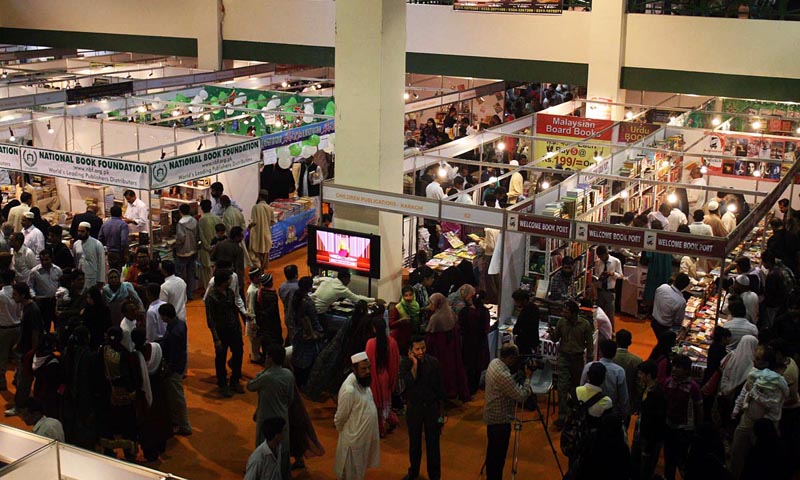
Pakistan: No to Shia bookstall, yes to terrorists bookstalls at International Book Fair

www.shiitenews.com
Biased administrator of Expo Centre Karachi has not allowed even a single Shia bookstall at International Book Fair while many bookstalls of outlawed terrorist groups are allowed to preach their ideology of hate and violence.
Shiite News Correspondent reported that outlawed Taliban/Sipah-e-Sahaba and allied self-claimed jihadi groups are selling their hate-materials and ideology of violence.
It is learnt that a Shia bookstall was removed on the pretext that outlawed Sipah-e-Sahaba (presently Ahl-e-Sunnat wal Jamaat) lodged complaint with the police against the Shia books. Therefore, they were not allowed at the Book Fair being held at Expo Centre.
Khalid Aziz, administrator of Expo Centre, is son in law of Jamaat-e-Islami leader and former city nazim of Karachi Naimatullah Khan. Jamaat claims to be a non-sectarian Islamic party but some of its officials or their close relatives always follow pro-Yazidi and pro-takfiri line against Shiites.
Shia parties and leaders have condemned the biased administrator for toeing the line of outlawed terrorist groups against Shia Muslims. They demanded of the federal government to take notice of anti-Shia decision of the administrator. They demanded of Sindh Government to rein in the biased police who follow the instructions of outlawed terrorist group.

Eight Pakistani soldiers killed in an ambush by Baloch fighters

http://balochwarna.com/
Eight Pakistani security personnel have been reportedly killed in an ambush by Baloch freedom fighters in Katrenz area of Mand, Balochistan on Sunday. According to details the social media sources and local sources reported that Baloch freedom fighter, also known as the Sarmachars, have ambushed a convoy of Pakistani security forces when it was when passing through Katrenz mountainous area of Mand town. At least two vehicles have been completely destroyed in the attack and more than 8 personnel have reportedly died and several others have been wounded. Meanwhile the Baloch Liberation Front (BLF) claimed in a statement to media that it has carried out the attacks on occupying forces. The BLF spokesperson Gwahram Baloch vowed to continue such attack against Pakistani forces until their complete withdraws from Balochistan. The spokesperson of Pakistan army confirmed the rocket attacks on a convoy of security forces in a statement to Pakistani media but denied any casualties. Separately, local sources reported a barrage of rocket attacks on Mashkel town by Iranian Army on the arbitrary border between Pakistan and Iran. No fatalities have been reported until the filing of this report. However, People living on the border areas are highly apprehensive of the tense situation and lamented that both Pakistan and Iran have closed the border entrance points for local traders. Last month an armed resistance organization Jash al Adal (Army of Justice) carried out a fatal attack on Iranian forces killing at least 16 personnel of Iranian revolutionary guards and abducting 4 others. In response to the attack the Iranian guards hanged 16 Baloch political prisoners in ‘revenge execution’ in central prison of Zahedan. The Jash al Adal on 4 December carried out another attack in ‘Kuhag Askan’ region of Saravan Iranian occupied Balochistan and claimed to have killed 30 Iranian soldiers. Three members of the Jash namely Ziayee, Abdul Malik Mollazada and Neyamatullah Tohidi also died in the gun battle between Iranian forces and Sunni Baloch rebels. The Jash claimed the attack was on response to the killing of ‘innocent Baloch prisoners’ by Iran in Zahedan. Since then Iranian forces have carried out several attacks on towns and villages situated along the arbitrary borders between Iran and Pakistan occupied Balochistan, a social media activist Banuk Noori Baloch told this scribe. She said that people living on the bordering areas are suffering from economic hardship as theirs only source of income is the import and export of good from both sides of the border. Given the tense situation and insecurity, she said the unemployment is on rise.

Balochistan: Why The Balochs Have Stopped Voting

The Baloch Hal
By MALIK SIRAJ AKBAR
Chief Minister Balochistan Dr. Malik Baloch has asked the Baloch separatists and everyone else to “enjoy” the 21st century by giving up arms and joining the “democratic process”. He was speaking in the backdrop of the recent local government elections in which the National Party, of which Dr. Baloch is the president, has done relatively well. Balochistan was the first among the four provinces to hold local government elections. As compared to the general elections of May 2013, the local bodies elections witnessed less violence and confrontation. Pakistani newspaper Dawn instantly jumped into a conclusion to appreciate the provincial government because the “polls went ahead and citizens participated.”
When 2,776 polling stations are declared “highly sensitive” and another 1,581 “sensitive” out of 5,718 polling stations in Balochistan, that simply means we, contrary to the Chief Minister’s recommendation, do not live in perfect times to “enjoy” the 21st century. When we have 50,000 policemen, F.C. personnel and 5,325 army soldiers guard us on an election day, that means we are not strengthening democracy but voting on gunpoint. When nine districts, including the provincial capital, are declared “sensitive”, we should safely assume that our problems are not “local”. There is the entire province that has descended into chaos where the public trust in Pakistani democracy has significantly declined. People no longer feel enthusiastic about voting because they see no benefits from Pakistan’s failed democratic system where military remains superior to civilian institutions.
Baloch separatists have virtually become so powerful in the province that each appeal they make to the public to boycott Pakistani initiatives, such as the elections, the masses respond positively to those calls. (The reason for positive public response is both because of their support for the armed Baloch groups as well as because of their widespread fear).
Discontent among the people has increased to such an alarming extent that not a single candidate contested elections in the entire district of Awaran. This is the same place where the Frontier Corps (F.C.) has been conducting military operations after operations. When a catastrophic earthquake hit the district in October, the Pakistani government did not even allow international relief workers to help the Baloch victims. In an op-ed published in Dawn, Chris Lockyear, the Pakistan operations manager for Médecins sans Frontières or Doctors Without Borders, publicly complained about Islamabad’s denial of access to the earthquake-hit area. Ultimately, the people of Awaran gave their verdict in the form of complete boycott of the local government polls last week.
Public participation in the polls was so lackluster that 3000 candidates were elected unopposed on different seats because there were not enough people willing to participate in the elections.
Islamabad is too desperate to convince the world that things are hunky-dory in Balochistan. The state-controlled and private news channels, for example, magnify and project isolated events on the eve of Pakistan’s Independence Day to tell everyone how Balochistan also celebrated the nation’s independence. The State routinely finances and stages fake events in which people are paid to say how much they love Pakistan. Citizens do not have to be paid or tortured to say they love their country. You can’t purchase or impose patriotism on people. Balochistan is in fact not the ideal land to exercise such bizarre ideas. Hence, it is understandable while newspapers like Dawn get so excited about even minor things such as the arrangement of elections in Balochistan. That shows that we have kept the bar too low to assess progress in Balochistan. Even after the elections, we are left with the same question: are these polls a panacea to Balochistan’s ills.
There is always a dark side of such state-sponsored political dramas like these elections. The Baloch society is utterly polarized where nationalists like Dr. Malik Baloch, the chief minister, symbolize Islamabad’s policy of divide and rule. It is good that elections remained largely peaceful but the writ of the State has shrunk to such a level that we are uncertain if the new local governments will ever be able to function smoothly. Local government elections should not have been organized until the state of affairs improved in the province. Now, this is what is likely to happen: Once the security contingent departs, the elected local government officials and separatists end up in a new battle against each other.
For example, the Baloch Liberation Front (B.L.F.) was blamed by Dr. Baloch’s National Party for killing the former Nazim (mayor) of Kech district, Maula Baksh Dashti. Although the B.L.F. denied the charges, it did not condemn the killing. So, the question now is how much can the State protect all those school teachers who performed duty on the election day and the candidates who risked their lives and participated in the elections. After all, they were already warned by the armed groups not to be a part of the election process.Arranging elections should not be the benchmark to decide how smoothly Balochistan is heading toward normalization. The actual question is whether or not the local governments enjoy the confidence of the Baloch people. It is also pertinent to know whether or not the local governments will enjoy sufficient administrative and financial authority to perform well to win the trust of the common man. Consider: If a district mayor fails to protect a citizen from being unlawfully arrested by the Frontier Corps, such a head of the local government should prepare for public backlash. It is good to elect people to democratic institutions but it is too dangerous to send them to institutions whose stability and performance is starkly shaky and uncertain.

Pakistan: Peace by capitulation

Strategy to deal with extremists by giving them political space will backfire
Conflicts of every sort are simmering in Pakistan’s underbelly, and it won’t take much for them to bubble to the surface. The latest examples of unrest were the sectarian clashes that erupted in Rawalpindi on the eve of Ashura. At least nine people were killed and 80 were wounded when armed clashes broke out between Sunni and Shiite groups. Each side has accused the other of provocation, and now there are fears of a violent blow-back.
In subsequent analyses, the use of loudspeakers has come under particular scrutiny, and many have called on the government to ban their use. This approach is somewhat reminiscent of the calls made by some Muslims in the Subcontinent during British rule, who decried the use of bicycles, deeming them an invention of the devil. Of course, it is true that loudspeakers are used to propagate and spew sectarian and religious hatred, but this is merely a symptom of a much more serious disease gnawing at the foundations of Pakistani society. The real issue is the people behind the loudspeakers. Clerics, especially those who belong to or are sympathetic to extremist organisations, need to be reigned in. Similarly, the sale of propagandist materials across the country needs to be addressed, but this is easier said than done. The state is under pressure from all sides, the economy is a shambles and all the while terrorism remains unabated. Above all, the political will to tackle the most contentious and combustible issues is missing. Against such a grim backdrop, any task would seem daunting – but the government must stop dithering. There is, however, an unfortunate trend in Pakistan, where each successive government has capitulated to extremists. In order to placate them, each government has acceded more ground to those with guns. Instead of a bare-knuckle fight, governments have time and again chosen to fight with the gloves on. This time around, the situation is no different. The government’s knee-jerk reaction was primarily to divert public attention by initiating a treason case against former military ruler, General Pervez Musharraf. While this may seem like the right thing to do in principle, the timing of the move reeked of political expediency. Behind the scenes, the government negotiated with extremist Sunni groups, who have predictably used the threat of violent reprisals to their advantage. The price of ensuring peace has been paid by capitulation and bowing before militant pressure. Leaders of banned outfits have clawed their way back into the limelight, appearing on TV to claim credit for keeping a lid on potential violence. The payback has been taken in the form of more political space and undeserved concessions. For the good of the country, such a Faustian bargain may prove to be its death knell.

Hagel visits Pakistan today to push for Afghan peace

With Afghanistan's stalled peace process high on the agenda, US Defense Secretary Chuck Hagel, who has been in Kabul since Saturday, will visit Pakistan on Monday, officials said.

Hagel: US withdrawal from Afghanistan ‘a very real possibility’

Defense Secretary Chuck Hagel on Sunday said the pullout of all U.S. forces from Afghanistan due to the lack of a security agreement was a “real possibility.” “It’s a very real possibility because if we don’t have a bilateral security agreement, which I’ve noted, that means we can’t protect our forces that would be here after 2014,” Hagel said on CBS’s “Face the Nation.”“No international partners will come. Afghanistan essentially will be alone, but we have no other options,” he added. “We can’t plan for it, the president can’t commit American forces or the United States of America. No other country can, unless we are protected with an agreement.” “You can use any term you want,” Hagel said. “’Retreat’ or ‘not renewing our efforts here, post 2014,’ you can say it any way you want but what I'm saying is unless we have the security of an agreement to protect our forces. Then we'll have no choice. We will not be able to stay.” Hagel said the administration was “surprised” that Afghan President Hamid Karzai refused to sign the security agreement after it was approved by a council of elders. “The Loya Jirga, which represented thousands of citizens and leaders in Afghanistan, met a couple weeks ago as you know. Overwhelmingly, over 90 percent of those people strongly supported a U.S. partnership past 2014, along with our partners,” Hagel said. “Yes, it was surprising. But we are dealing with the realities that we have before us,” he added. Hagel held out hope that Karzai would sign the agreement before presidential elections in the spring. “I think the more he involves himself … and listens to his people, which leaders must do, I hope he'll come to the right decision on this,” Hagel said. “Is it worth it or not worth it? It needs to be asked, especially in a representative government, a democracy,” Hagel added. “Those questions must be asked. So it is now up to President Karzai to make a decision.” Hagel will travel from Afghanistan to Pakistan on Monday, making the first visit by a United States Secretary of Defense in nearly four years. Defense Department spokesman Carl Woog said Hagel “looks forward to discussing with Prime Minister Sharif and other senior Pakistani officials the United States and Pakistan's common interest in a stable Afghanistan."

U.N.: Afghanistan slow to enforce law protecting women

The United Nations complained Sunday that Afghan authorities have been slow in enforcing a law protecting women against forced marriages, domestic violence and rape.
A report issued by the U.N. mission in Afghanistan found that although Afghan authorities registered more reports of violence against women under the 4-year-old law, prosecutions and convictions remained low. In a statement, Navi Pillay, the U.N. high commissioner for human rights, described the law as a “landmark” and said it “was a huge achievement for all Afghans.”
“But implementation has been slow and uneven, with police still reluctant to enforce the legal prohibition against violence and harmful practices, and prosecutors and courts slow to enforce the legal protections in the law,” she said. Afghanistan enacted its Elimination of Violence Against Women law in August 2009. It criminalizes child marriage, selling and buying women to settle disputes, assault, and more than a dozen other acts of violence and abuse against women. Women have won back many of the rights they lost during Taliban rule from 1996 to 2001, when the Islamic movement was ousted by an American invasion following the Sept. 11 attacks against the United States. Under the Taliban, girls were barred from attending school and women were forced to stay indoors and cover their heads and faces with burqas. There are fears that many of those freedoms may shrink as foreign forces depart by the end of next year and much of the international aid and assistance they brought to Afghanistan goes with them. “The law, when applied, has provided protection to Afghan women facing violence,” said Georgette Gagnon, the mission’s director of human rights. But she added that “most of the women victims remain largely unprotected due to a lack of investigation into most incidents and continued underreporting of pervasive violence against women and girls resulting from discrimination, existing social norms and cultural practices, and fear of reprisals and threat to life.” The 49-page report found that incidents of violence against women remain largely underreported because of cultural restraints, social norms and religious beliefs. The United Nations collected information from 18 of Afghanistan’s 34 provinces during a 12-month period ending in September to find out how well the law was being implemented.
Read more: http://www.washingtontimes.com/news/2013/dec/8/un-afghanistan-slow-enforce-law-protecting-women/#ixzz2mxJCKE75

Pakistan Beat Afghanistan in Twenty20

http://www.tolonews.com/
Pakistan overcame stiff resistance by Afghanistan to win the first-ever Twenty20 international between the two countries by six wickets at Sharjah on Sunday. Afghanistan put up a brave fight in posting a challenging 137-8 in their 20 overs which Pakistan managed to overhaul for the loss of four wickets off the penultimate ball of the match. Pakistan skipper Mohammad Hafeez kept his nerve to finish with 42 not out as Pakistan needed six off the last over. Umar Akmal made a six 22-ball 28 with two sixes. For Afghanistan, Najibullah Zadran (38) and Mirwais Ashraf (28 not out) led their team's batting to guide them to 137-8 in 20 overs. Junaid Khan (3-24) and Sohail Tanvir (2-11) shared the bowling spoils for Pakistan.

Afghanistan agrees to pact with Iran, while resisting US accord

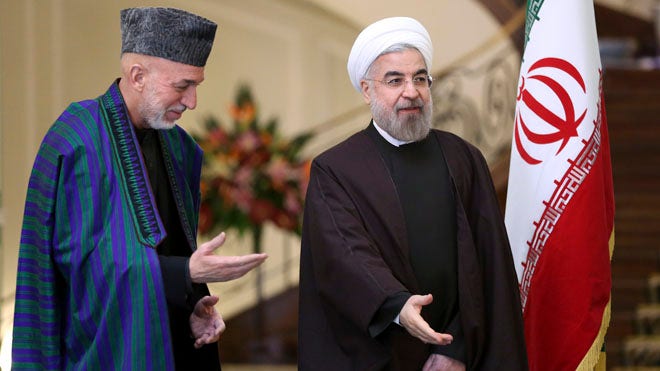
Afghan President Hamid Karzai agreed on a cooperation pact with Iran, despite continuing to resist signing a security agreement with the U.S., Reuters reported.
Karzai made the deal with Iranian President Hassan Rouhani in Tehran Sunday.
"Afghanistan agreed on a long-term friendship and cooperation pact with Iran," Karzai's spokesman Aimal Faizi said, according to Reuters. "The pact will be for long-term political, security, economic and cultural cooperation, regional peace and security."
Afghanistan signed a cooperation pact with Iran in August covering mainly security issues, but Faizi said the proposed new agreement would have a broader scope. Rouhani said Sunday his country opposes the presence of foreign forces in Afghanistan and the region, saying their presence generates tension, the official IRNA news agency reported.
IRNA quoted Rouhani as telling Karzai: "We believe that all foreign forces should leave the region and that the security of Afghanistan should be handed over to people of the country."
"We are concerned about tensions caused by foreign forces' presence in the region," Rouhani was quoted as saying. He also called for more cooperation between Tehran and Kabul. Iran has long opposed a planned agreement to allow U.S. forces to remain stationed on its doorstep in neighboring Afghanistan. The two countries have about 580 miles of common borders. Rouhani also said Iran opposes any foreign forces in the region, the Middle East and the Persian Gulf, where the U.S. Navy's Fifth Fleet has a base in the tiny kingdom of Bahrain.
On Saturday, U.S. Defense Secretary Chuck Hagel laid out steps to beef up defense cooperation between states within the Gulf region, while at the same time insisting that America's military commitment to the Middle East will continue.
In a speech Saturday to Gulf leaders he also made it clear that the emerging global agreement that would limit Iran's nuclear program doesn't mean the security threat from the Islamic republic is over. Iran's Defense Minister Gen. Hosein Dehghan called the remarks by his American counterpart "threatening" on Sunday, adding that they pave the ground for mistrust toward the U.S. while revealing the influence of Israel -- Iran's arch enemy -- on Washington.
Iran believes that countries of the Gulf are capable of managing security through regional security pacts.
Iran signed an interim agreement over its nuclear plan with world powers last month. Rouhani has been trying to convince skeptics and hard-liners at home that the move was not compromising on key issues of national sovereignty. Israel has repeatedly criticized the deal and called it a "historic mistake," saying economic sanctions must be toughened, not eased.

Sunday, December 8, 2013

Quarter of Europeans face poverty – Eurostat

Over 124 million people in the European Union – or almost a quarter of its entire population - live under the threat of poverty or social exclusion, a report by EU’s statistical office has revealed. Last year, 124.5 million people, or 24.8 percent of Europe’s population were at risk of poverty or social exclusion, compared to 24.3 percent in 2011 and 23.7 percent in 2008, the Eurostat said in a document published earlier in the week. The data included people who were falling within at least one of the three categories: at-risk-of-poverty, severely materially deprived or living in households with very low work intensity. Bulgaria (49 percent), Romania (42 percent) and Latvia (37 percent) top the list, followed by Greece, Lithuania and Hungary. In comparison, the Netherlands and the Czech Republic (both 15 percent), Finland (17 percent), Sweden and Luxemburg (both 18 percent) can boast the lowest number of people at risk of poverty. However, even founding EU countries like Italy are struggling more than ever. Some 18.2 million -Italians are facing poverty – that is the highest number in the EU, even though proportionally (29.2 % of the population) the country seems to be doing not too bad. With the Italian economy going through its longest recession since the World War II, over 12 percent of adults are unemployed, while four out of ten young people don't have a job. There are no official figures on the homeless, RT’s Egor Piskunov reports. Marco, 46, used to work as a pizzaiolo (pizza maker) - many Italians used to call it ‘the golden skill’ which would always get you work in Rome. However, it did not hold true for Marco, who was sacked one day and has not been hired since. He has been living on the street for about four years now and says he sees little chance of fixing his life. “When you live on the street, survival is what takes up most of your time. Simply getting a shower is a challenge. It takes so much time to take care of yourself as a normal person. You reach the end of the day and you’re exhausted and depressed,” he told RT. With the number of those in need increasing, more Italians are beginning to turn to charity and humanitarian aid for help. Pietro Zezza is a volunteer at Caritas Food Emporium in Rome – a place where people can get food for free. “Two years ago we had about 55 percent of foreigners and 45 percent of Italians coming here,” he said. “Today we have about 65 percent of Italians and 35 percent of foreigners. So the figures are reversing.” Groceries from the shelves of this “shop” are given in exchange for points allocated to low income families by the global charity network Caritas. Most of the food is near its expiration date, except for food specially labeled aid. Caritas is raising the alarm, stressing that around one third of all Italian children are now at risk of poverty and are lacking basic essentials such as protein-rich foods, heating and clothes.

In Soweto and Beyond, Mandela Still Serves as a Beacon of Hope

By JOHN ELIGON and NICHOLAS KULISH
The walls of the Regina Mundi Catholic Church here are riddled with bullet holes from the days when it was a center of the struggle against apartheid. But on Sunday, parishioners instead focused on the traces of Nelson Mandela. Mr. Mandela’s image is etched in a stained-glass window at the back of the church. A page from a guest book with his signature hangs in the office. And older worshipers still recall his visits to the church, not far from his former home in the township. “I thought of the old man, when he used to say, ‘We blacks will go and will fight for our freedom,’ ” Tom Nakene, 55, a lifelong member of the parish, said after a three-hour Mass on Sunday. “I remembered him, and I prayed for him,” Mr. Nakene said, “wherever he is.” South Africans across the country began a week of commemorations of Mr. Mandela’s life on Sunday with what officials called a day of prayer and reflection. People gathered in houses of worship, private homes and even open fields to pay homage to the man who embodied the struggle against apartheid. For the country’s politicians, Sunday was a day to urge unity and continuity after the death of Mr. Mandela at 95 on Thursday, and national and provincial officials, including President Jacob Zuma, appeared at churches and other places of worship across the country. In Bryanston, near Johannesburg, Mr. Zuma attended a Methodist service, sitting alongside members of Mr. Mandela’s family and his former wife, Winnie Madikizela-Mandela. Mr. Mandela received his early education in Methodist schools. “We should not forget the values that Madiba stood for and sacrificed his life for,” Mr. Zuma said, referring to Mr. Mandela by his clan name, as he urged South Africans to be guided by Mr. Mandela’s example as an opponent of oppression, a fighter for freedom and a model of forgiveness. For others, the eulogies were freighted with concern about the future, adding a sharper edge to their prayers for peace in the post-Mandela era. In the vast squatter camp of Diepsloot, north of central Johannesburg, where thousands of South Africans and immigrants live in tin shacks with no plumbing and often no electricity, people gathered in tin-walled churches, under trees and in fields to offer prayers for Mr. Mandela. “Thank you, Madiba,” a group of women from Zimbabwe sang plaintively in a meadow of wildflowers. “Nelson Mandela was a leader chosen by God, and now God has called him home,” said Virginia Sibanda, a 40-year-old housekeeper from Harare, Zimbabwe’s capital, who has lived in Diepsloot for nearly two decades. “He was a leader not just for South Africa but for all Africans, and the world.” Many migrants living in Diepsloot worried that Mr. Mandela’s death would leave them more vulnerable to the xenophobic attacks they have suffered in recent years. With rising crime, joblessness and deteriorating living conditions, South Africans have frequently turned on those from other countries. Mr. Mandela and his foundation had sought to reduce such violence. “Rumors have been passing through the town that once Mandela dies, we immigrants will be attacked,” said Nkosi Nkomo, the pastor of a small church with a largely Zimbabwean congregation. He spent the weekend outdoors with a small group of followers, praying by a campfire shaded by trees. “Lord, bring us peace in this land,” Mr. Nkomo said. “Let Mandela’s spirit live with us.” The unease about a future without Mr. Mandela was only an undercurrent in a broader celebration of a leader whose life has become a parable for the struggle for freedom. In other parts of the world, people also congregated to remember Mr. Mandela, whose long incarceration and subsequent election as South Africa’s first black president inspired a following far beyond the frontiers of his land. At a service in London, the Most Rev. Justin Welby, the archbishop of Canterbury, called Mr. Mandela South Africa’s “saving grace.” At another church, this one in New York, Mayor-elect Bill de Blasio promised to bring the spirit of Mr. Mandela to his mayoralty. At the Christian Cultural Center in Brooklyn, Mr. de Blasio told about 3,000 people: “Tomorrow, we start living out the lessons of Nelson Mandela.” On Tuesday, tens of thousands of South Africans and many foreign dignitaries are expected to gather for a national memorial in a World Cup soccer stadium just outside Soweto. Mr. Mandela’s body will then lie in state for three days in Pretoria at the Union Buildings — once the emblem of the white establishment he helped to overthrow. Many world leaders, including President Obama, are expected to travel to South Africa this week for the formal commemorations. Ban Ki-moon, the United Nations secretary general, said through a spokesman late Saturday that he would attend Tuesday’s commemoration at the soccer stadium. The South African government said Sunday that at least 53 heads of state planned to attend. The week of memorials will end Sunday with a state funeral in Mr. Mandela’s remote childhood village of Qunu in the Eastern Cape region. The emphasis on spirituality on Sunday recalled the role that religion played on both sides of South Africa’s epic racial and political battle. Among the dominant white Afrikaner minority of that era, the Dutch Reformed Church was often depicted as offering scriptural justification for the policies of racial separation that became the code of power after the Afrikaner-dominated National Party was elected in 1948. Those who dissented, including Beyers Naude, a prominent Afrikaner cleric, were shunned. Mr. Naude was eventually declared a barred person. During years of protest, South African clerics like the Anglican archbishop Desmond M. Tutu often were embroiled in the turmoil of the country’s segregated black townships. They led calls for the end of apartheid even as they sought to temper the anger of nonwhite South Africans toward compatriots they viewed as stooges of white rule. Some churches, most notably Regina Mundi in Soweto, became crucibles of dissent. On Sunday, the pastor, the Rev. Sebastian J. Rossouw tried to temper concerns over the future by saying Mr. Mandela could inspire others with his vision for the country. Some people have noted, Father Rossouw told hundreds of congregants, that “we will not see another person of his caliber for ages to come.” “I beg to differ,” he said. There can be another Madiba, he later added, saying, “One of us sitting here can be like him.”

‘Saudi intelligence chief met with Israeli officials in Geneva’

According to Iranian media report, Prince Bandar Bin Sultan held talks with Israeli counterpart and others on sidelines of Iran nuclear negotiations
The director general of the Saudi Intelligence Agency, Prince Bandar Bin Sultan, met with the head of Mossad and several senior Israeli intelligence officials last month on the sidelines of the Geneva nuclear talks between the P5+1 world powers and Iran, according to the semi-official Iranian news agency Fars.Citing the Twitter account of a source “who is well connected with the inner circles of the Saudi secret service,” Fars reported that the meeting took place on November 27 and focused on “containing Iran by any possible means, exercising stronger control over Syria’s jihadist forces, sidelining Muslim Brotherhood and stopping the waves of the Arab Spring.”The report could not be independently confirmed by the Times of Israel.
According to the news agency, reportedly affiliated with the Iranian Revolutionary Guard Corps, the Saudis have also been using their contacts with J Street and its director Jeremy Ben Ami to “explore ways of enticing the world powers into war on Syria.” Last month, the Sunday Times reported that Israel was working with Saudi Arabia on coordinating plans for a possible military strike on Iran, with Riyadh prepared to provide tactical support to Jerusalem. According to the paper, Riyadh had agreed to let Israel use its airspace in a military strike on Iran and cooperate over the use of rescue helicopters, tanker planes and drones.

Bahraini court jails 12 anti-regime protesters

A court in Bahrain has sentenced 12 anti-regime protesters, including three minors, to prison terms of up to five years as the Al Khalifa regime steps up its crackdown on dissent. On Sunday, the court sentenced the nine adults to five years in jail each. The three minors were also given three-year prison terms each. Manama has accused the defendants of attacking a police patrol with petrol bombs. On December 2, a Bahraini court sentenced 16 anti-regime activists to seven years in prison each for allegedly attacking a police vehicle during an anti-government demonstration. According to Bahrain’s main opposition party, al-Wefaq, the Manama regime's harsh clampdown on pro-democracy activists has intensified over the past months. In October, Philip Luther, Amnesty International’s director for the Middle East and North Africa, said, “The [Bahraini] authorities simply slap the label 'terrorist' on defendants and then subject them to all manner of violations to end up with a 'confession'.” Bahrainis have been staging demonstrations since mid-February 2011, calling for political reforms and a constitutional monarchy, a demand that later changed to an outright call for the ouster of the ruling Al Khalifa family following its brutal crackdown on popular protests. Scores have been killed, many of them under torture while in custody, and thousands more detained since the popular uprising started in the kingdom. Physicians for Human Rights says doctors and nurses have been detained, tortured, or disappeared because they have "evidence of atrocities committed by the authorities, security forces, and riot police" in the crackdown on anti-government protesters. Protesters say they will continue to hold anti-regime demonstrations until their demands for the establishment of a democratically-elected government and an end to rights violations are met.

Afghan Music: Farzana Naz - Shamal

Musharaf Bangash !! Da Zamong Watan Afghanistan De

Time to Leave Afghanistan: Hamid Karzai Gives Washington a Welcome Shove

Doug Bandow Doug BandowSenior Fellow, the Cato Institute
The longest war in American history drags on, with Washington a captive of purposeless inertia. The Obama administration should bring all U.S. forces home from Afghanistan and turn the conflict over to the Afghans. After Afghan-based terrorists orchestrated the 9/11 terrorist attacks, Washington invaded the Central Asian nation. The Bush administration had little choice but to make an example of the Taliban regime as well as target al Qaeda. Members of any government giving sanctuary to those who attack Americans need to understand that they will no longer be members of any government.
But that lesson was delivered 12 long years ago when U.S. forces aided indigenous opponents of the Taliban to capture Kabul. If nation-building in Central Asia ever was a realistic objective, the moment soon passed. The Bush administration shifted its gaze to Iraq and careened to disaster along the Euphrates.
Yet President Bush continued to pursue a resource-starved counter-insurgency campaign in Afghanistan. The conflict wasn't as costly -- in lives or money -- as Iraq, but the war lacked serious strategic rationale. As 9/11 receded into the past, fewer Americans had any idea what the fighting was about. President Barack Obama took office having opposed the Iraq invasion, but twice increased the number of troops in Afghanistan. Still, he promised that U.S. forces would return home
. Last year Vice President Joe Biden stated simply: "We are leaving. We are leaving in 2014. Period." But now the administration wants American troops to stick around, for years, if not forever. The newly negotiated Bilateral Security Agreement would take effect on January 15, 2015 and run until "the end of 2024 and beyond." The administration apparently hopes to keep between 8,000 and 15,000 troops on station.
The president has made Afghanistan his war.
Why? Back when even some Republicans began turning against the conflict, the Heritage Foundation's Baker Spring said the Afghan war was necessary to "defend the vital interests of the United States." These days "vital interests" have taken over the role of "patriotism," which Samuel Johnson famously called "the last refuge of a scoundrel." Almost any issue any where in the world is routinely elevated to "vital" status to justify extensive and expensive U.S. intervention. Afghanistan never was vital to America. Not even during the Cold War. After the Soviet invasion in December 1979 the conflict offered a convenient and inexpensive (for Washington, not the Afghan people) opportunity to bleed Moscow dry. Less then a decade later Soviet forces withdrew. The U.S. government has been criticized for then losing interest in the struggle, but there was little Washington could have done. The civil war continued. There was no peace to keep and only direct military intervention could have imposed one. America had neither cause nor ability to do so. Osama Bin Laden again focused U.S. attention on Afghanistan, but only the transitory terrorist connection made control of Kabul critical to America. With the displacement of al Qaeda and punishment of the Taliban, Afghanistan quickly receded in importance. Observed Biden: "we went there for one reason: to get those people who killed Americans, al Qaeda. We've decimated al Qaeda central. We have eliminated Osama bin Laden. That was our purpose." So what is Washington doing there today? A mix of nation-building, democracy-promotion, and humanitarian intervention. The State Department's special envoy to Afghanistan and Pakistan, James F. Dobbins, warned that if the U.S. fails to maintain its presence "you project into the upcoming electoral period a degree of instability caused by growing alarm at Afghanistan returning to the 1990s." The election could turn into "winner takes all" and "every man for himself, where losers in the election don't just go into the opposition but get killed or go into exile."
However, if the Afghan political system is as fragile as Dobbins suggests despite years of allied military and financial support, the few thousand personnel the Obama administration hopes to keep in country won't make much difference. In fact, social engineering in Afghanistan has failed. Coincident with the negotiation over the BSA was the announcement that the Afghan Justice Ministry was drafting a new penal code which would punish adulterers by stoning--the same penalty imposed by the previous Taliban government.
Moreover, war is a dubious humanitarian tool. Afghan civilian deaths are in the thousands. The Taliban are the greater killers, but the conflict is their occasion for doing so. Moreover, the U.S. bears responsibility for misdirected air strikes, violent home raids, and substantial other "collateral damage." Before his recall even Gen. Stanley McChrystal complained about checkpoint killings: "We've shot an amazing number of people and killed a number and, to my knowledge, none has proven to have been a real threat to the force." Hundreds of thousands of Afghans have been displaced, many fleeing into Pakistan. Why else should Washington stay in Afghanistan? The country's travails are destabilizing its neighbors, most obviously Pakistan, but the conflict is the most harmful factor. Unfortunately, American involvement exacerbates the problem. There is near-constant confrontation with Islamabad over cross-border incidents, drone strikes, supply convoys, and more. The Economist magazine worried about "a civil war that might suck in the local powers, including Iran, Pakistan, India and Russia," which would eventually "end up harming America." Yet the price of conflict without America is likely to remain far less than with America. Neither history, with three decades of war, or geography, with porous borders, gives much hope for eliminating the Taliban and stabilizing the region. Some U.S. officials want to keep troops in Afghanistan for embassy security. However, most of the projected personnel would be scattered about the country, not available to protect diplomatic posts. Washington better would reduce its vulnerability by staying out of the fighting and reducing the size of its facility alongside its ambitions. The last stand for U.S. officials is counterterrorism. When I visited Afghanistan in 2010 and 2011 I received a plethora of briefings. Allied commanders and officials routinely justified the Western presence as being necessary to prevent an al Qaeda revival. Back in America John Bolton similarly contended that the Taliban and al Qaeda had to be defeated lest they "reconquer Afghanistan and make it a base for international terrorism." Yet this scenario is highly unlikely. Global al-Qaeda is weak if not moribund, more a symbolic franchise than an ongoing operation. Three years ago CIA Director Leon Panetta concluded: "At most, we're looking at 50 to 100, maybe less" al Qaeda fighters in Afghanistan. Terrorists don't need to locate in Afghanistan when they can operate in Pakistan and many other nations. Indeed, al Qaeda affiliates seem to be far more active in Yemen, Syria, and increasingly Iraq than in Afghanistan. Moreover, even a triumphant Taliban wouldn't likely welcome back the group which brought down the wrath of America. There is evidence that top Taliban leaders were not pleased by their guest's behavior in 2001. Indeed, Washington should point out that the lesson of 9/11 still applies: aid terrorists against America and suffer the consequences. For the most part, the largely Pashtun Taliban isn't interested much in larger struggles. Its members simply don't want foreign occupation of their land. Concluded a Washington Post story on administration deliberations on a full withdrawal: "Many of the groups that U.S. forces target in Afghanistan -- most notably the Afghan Taliban -- do not appear eager to attack Americans or U.S. interests outside the country."
The strongest argument against the "zero option" of no troops is that it would limit Washington's capability to strike elsewhere, most notably in Pakistan. One unnamed administration official told the Post: "The footprint of the intelligence community depends to some extent on the footprint of the military." No doubt, fewer troops would mean less reach. However, the projected 8,000 to 15,000 military personnel, servicing a complex of bases, communications facilities, airfields, and out-size embassy, look more configured to act in the civil war that is likely to continue. The draft BSA allows U.S. forces to engage in combat if "mutually agreed" and notes that "U.S. military operations to defeat al Qaeda and its affiliates may be appropriate in the common fight against terrorism." The Post cited Pentagon officials as affirming that widely dispersed bases "would allow U.S. intelligence personnel and Special Operations forces to remain within easy striking distance of insurgent groups in the tribal area that straddles the border with Pakistan." Yet insurgents against the Pakistan government are even less likely than the Afghan Taliban to attack America.
Further, the larger the projected presence, even if focused on counterterrorism, the greater the target for terrorists, insurgents, and malcontents of any variety. Better a much smaller counterterrorist operation, perhaps embedded within an Afghan base to lower its profile. Better still would be moving any operations off-shore, as with Yemen. Action "would get longer, slower and harder," said Linda Robinson of RAND. Nevertheless, that would be a cost worth paying to restrain dubious American military involvement.
Moreover, Washington should scale back its drone operations in Pakistan and elsewhere. It's not easy to assess the current program's costs and benefits, and especially the number of non-combatants killed -- with a consequent rise in hostility toward America. But so-called "signature" strikes, in which most anyone in proximity to suspected terrorists is viewed as a likely terrorist, undoubtedly kill locals who threaten no one. Further, the U.S. began targeting the Pakistan Taliban apparently on the rationalization that Pakistani militants might threaten Americans in Pakistan. Unfortunately, blowback was inevitable: the would-be Times Square bomber, Faisal Shahzad, was motivated by U.S. drone strikes and trained by the PT, after it found itself under attack.
Nevertheless, the administration remains committed to preserving a sizeable military presence in Afghanistan. However, President Karzai unexpectedly declared that he did not want to sign the BSA until after April's presidential election. He convened a Loya Jirga, or grand council, to debate the accord, but told the meeting that "This pact should be signed when the election has already taken place, properly and with dignity." The Obama administration is insisting on immediate approval. Said National Security Adviser Susan Rice: "Without a prompt signature, the U.S would have no choice but to initiate planning for a post-2014 future in which there would be no U.S. or NATO troop presence in Afghanistan."
The dispute has turned into an international game of chicken. Karzai admitted: "My trust with America is not good. I don't trust them and they don't trust me. During the past ten years I have fought with them and they have made propaganda against me." Some suspect that Karzai hopes to enhance his nationalist credentials and administration's reputation, as well as wring more benefits out of Washington. Four years ago U.S. ambassador Karl Eikenberry opined: "He and much of his circle do not want the U.S. to leave and are only too happy to see us invest further. They assume we covet their territory for a never-ending war on terror and for military bases to use against surrounding powers." Former and future Afghan presidential candidate Abdullah Abdullah said that Karzai "thinks the Americans are keen to stay in Afghanistan at any price and at any cost." In fact, Karzai told the Loya Jirga: "We want the Americans to respect our sovereignty and be an honest partner. And bring a lot of money."
While Afghan support is necessary for any continued American presence, it is not enough. The U.S. presence should serve U.S. interests. American security guarantees are popular around the globe: The Europeans, Australians, Japanese, and South Koreans have subcontracted their defense to Washington since the 1950s. And none of them has tired of the subsidy. Afghanistan likely would be no different. In putting off implementation of the BSA President Karzai actually is doing America a favor. U.S. troops actually might leave Central Asia -- as they should.
What would follow? It almost certainly would not be the sort of liberal, democratic society which the West favors. However, Taliban misrule and brutality have left most Afghans with little enthusiasm for a repeat of the past. In fact, the existing regime might prove to be more resilient than expected: contra expectations, Soviet client Mohammed Najibullah survived for three years on his own before the Mujahedeen triumphed. Most likely may be a fractured nation -- a tragedy, to be sure, but one beyond U.S. remedy, at least at satisfactory cost.
Americans have been fighting in Afghanistan for longer than the Civil War, World War I, and World War II combined. America has overstayed its welcome. It's time to go home.

Hagel Lands In Afghanistan To Press For Security Agreement

Karzai in Iran amid security deal row with US

http://www.pajhwok.com/
At the head of a high-level delegation, President Hamid Karzai on Sunday landed in Tehran for a one-day state visit to hold talks with Iranian leadership on issues of mutual interest amid a row with the US over a security accord. Iran’s official news agency, IRNA reported the visiting Afghan president was warmly welcomed by Vice President Mohammad Shariatmadari upon arrival at Mehrabad airport. During his one-day stay, the Afghan president is to hold talks with his Iranian counterpart Hassan Rouhani and a number of senior Iranian officials on issues of mutual interest.
Karzai will meet Rouhani for the second time in four months in Tehran, and Foreign Minister Mohammad Javad Zarif. The Presidential Palace in Kabul issued a statement saying the president left Kabul for Tehran for a one-day visit to discuss with his Iranian counterpart measures pertaining to bilateral relations in various fields. The statement, received by Pajhwok Afghan News, said the Iranian president had invited President Karzai to visit Tehran when he last travelled to the neighbouring country four months ago.
Tehran strongly backs Karzai's stance in refusing to sign the security deal with the US, allowing NATO troops to operate in Afghanistan after 2014. IRNA reported the deal will be discussed during the talks. Karzai’s visit to Iran is taking place a day after US Defence Secretary Chuck Hagel arrived in Kabul for an unannounced visit and held talks with his Afghan counterpart Bismillah Khan Mohammadi, Chief of Army Staff Sher Mohammad Karimi and deputy interior minister.
After the meeting, Hagel said he received assurances from Mohammadi that the deal would be signed soon. Hagel did not meet Karzai, saying that Kabul was already aware of the US position. Washington and its allies have appealed to Karzai to sign the Bilateral Security Agreement (BSA). Iran's position on the BSA is that it would not serve the interests of its eastern neighbour. "Iran does not see the signing and ratifying of this security pact to be beneficial for the long-term interests of the people and government of Afghanistan," foreign ministry spokeswoman Marzieh Afkham said Tuesday.

‘Pakistan’s strongest weapon is the weapon of denial’

Why do you think Pakistan Prime Minister Nawaz Sharif picked Gen. Raheel Sharif to succeed Gen. Kayani as Army Chief over more senior officers?
Gen. Sharif is the younger brother of an iconic deceased military figure who happened to be a batchmate of Pervez Musharraf. When Raheel Sharif was commissioned in 1976, we learn that Mr Musharraf took him under his wing. As such, it’s a surprise actually that PM Sharif selected an Army Chief who is a protégé of Mr Musharraf. However, Gen. Sharif was a commander of the 11 Infantry Division in Lahore and 30 Corps in Gujranwala, which is the heart of (Pakistani) Punjab. So he must have come into very close contact with the (Nawaz) Sharif family. That is probably how he developed that comfort level with the current political dispensation in Pakistan. Besides, Gen Sharif has neither served with the Inter-Services Intelligence nor with the Operations/ Intelligence Directorate. In his last assignment, he dealt with training and doctrinal aspects. The doctrinal study on counter-insurgency has probably been authored by him. There is a Pakistani writer who recently mentioned that Gen. Sharif does not have the personality of an Army Chief who would lead the nation into a war. I feel that Gen. Sharif in his time will mature, and find his own place among equals. I discount theories that he is not aggressive and not capable. He is an infantry officer with a good operational orientation and cerebral capability and has the right political backing.
Under Gen. Sharif do you think there can be a reversal of Gen. Kayani’s confrontationist policy on the Line of Control?
This year there have been several infringements of the ceasefire. It is very important for Pakistan to try and keep the fire of disgruntlement burning in Kashmir. There are fewer than 250 terrorists in the Kashmir Valley now. Pakistan probably thought if it does not act now, its ability to calibrate turbulence in the valley will be severely compromised. In late 2012, Pakistan probably decided that the LoC has to be re-activated because the Indian Army had its focus on the Jammu and Kashmir hinterland and was succeeding in moulding public opinion towards itself in a positive way. Many militant leaders were eliminated in focused counter-terrorist operations. This is what was worrying the Pakistan Army. Given this, I don’t think there can be a drastic change towards J&K and towards India (as a whole). I don’t think anyone heading the Pakistan Army can take an overnight decision to suddenly switch off Kashmir. In the next six months, I don’t expect any change in policy. The Pakistan Army has been brought up on a diet of anti-Indianism. This basic orientation of the Pakistan Army will not change. Pakistan’s modified military doctrine warns of a disproportionate response vis-à-vis India. India’s doctrine of Cold Start (now called Proactive Strategy) — to address the problem of our slow mobilisation — has never really been enunciated. It, of course, worried Pakistan and they permanently moved some of their formations to more appropriate locations closer to the border. Earlier, Pakistan was able to mobilise forces much faster compared to India. Pakistan then decided to bring some offensive formations south of the Chenab. It also decided to adopt a policy of “react first and mobilise later”.
This is a very major change in the doctrine of Pakistan whereby Pakistan will rely on swift and potent reaction with what is available and then supplement it with mobilisation.
Should this not succeed, as a last act of desperation, Pakistan could well resort to the use of tactical nuclear weapons, a capability it is keenly developing. And there is an assumption that in any fallout with India, the Afghan border will be downplayed. One-third of their brigades are on the Afghan border. These will be brought back. They appear to have some kind of understanding with the Taliban that in case of any conflict with India, the Taliban will switch off and allow the Pakistan Army to react to the Indian Army.
How would you react to Prime Minister Manmohan Singh’s statement — that Pakistan cannot win a war against India — which was made in response to a comment from the Pakistan Prime Minister which has since been denied?
Pakistan’s strongest weapon is the weapon of denial. We should not be naive. PM Sharif’s purported statement — that Kashmir is a flashpoint and can trigger a fourth war with India — was part of political gamesmanship. Such aggressive verbal posturing is usual when a Pakistani Prime Minister visits Pakistan-occupied Kashmir. However, it is very significant that our Prime Minister has reacted to it. His message was unambiguous — that Pakistan cannot meddle militarily with India and ever hope to succeed. I think it was required and has effectively conveyed our stance. Mr Sharif may have been testing the waters.
How do you see the current civil-military relations in Pakistan.?
The Pakistan Army’s relationship with the civilian government should pan out positively. The Pakistan Army does not want to take up governance of the country. It has too much on its hands already.
What will be the Pakistan Army’s strategy on its western border and Afghanistan ahead of the pullout of foreign troops next year?
Pakistan is looking at stability. The Pakistan Army’s strategy is to weaken the Pakistani Taliban. It is not easy to defeat such an insurgency. The strategy would be to stabilise and to prevent further radicalisation. For Pakistan, it is important to engage with Afghanistan and to ensure that no factor perceived to be hostile is allowed to germinate in its backyard.
Some say the situation in Afghanistan has to be closely monitored in the context of infiltration into Kashmir.?
I don’t think there will be any sudden and sharp influx into J&K after the pullout of foreign troops from Afghanistan. The Indian Army is alert on the LoC. However, Pakistan will continue moral and material support to separatism in J&K with the possibility of keeping the LoC active to facilitate infiltration, as it has done in the past.

Pakistan: Muslim landlords rape two Hindu women, murder one for reporting

http://www.humanrights.asia/
Two scheduled caste Hindu women were raped by their Muslim landlords in front of their family members. Kakoo Kohli, 24, and her elder sister, Nallan, 26, who belong to the Jane sect of the Hindu religion, were both raped by one Mohammad Khadim Shar and his brother Sirajuddin Shar, it has been alleged. The suspects are the sons of the landlord and the owner of the village, Mr. Lalu Ilyas Shar, it has been further reported. According to a report issued by the Asian Human Rights Commission (AHRC), one of them was girl was later murdered in revenge for making a police report. The murder victim and her mother, the report said, were abducted in broad daylight by one of the landlords from outside the clinic of a doctor and the daughter was shot dead in front of her mother. AHRC report said the Shadi Pali Police Station of Umer Kot district, Sindh, took time to register the First Information Report (FIR) allowing the rapists time to flee the area. The family members of the victims are displaced from their village and are living on the roadside in the cold nights but the police and authorities have refused to help them. "In providing protection to the rapists, the police and notables of the area forced the victims to reach to a settlement and give amnesty to the rapists," AHRC report recorded. "Once again the police have shown their efficiency to get approval from judicial magistrate so that perpetrators are freed."
read more about this horrible incident at: http://www.humanrights.asia/news/urgent-appeals/AHRC-UAC-150-2013

Pakistan's Islami Jamiat-e-Tulaba - a sardonic joke

By Kunwar Khuldune Shahid
When some of the most wanted terrorists are seen 'hanging out' in some of the biggest universities in the country, the vulnerability of the security situation is self-explanatory
The Islami Jamiat-e-Tulaba (IJT), the student wing of the Jamaat-e-Islami (JI), has metamorphosed into a bit of a joke in recent times — one that is more sardonic than funny. The IJT resorts to violence ostensibly to safeguard their much touted ideology of peace; vie to safeguard women’s integrity by harassing them into conforming to their version of modesty; declare a man responsible for the killing of thousands of fellow citizens a ‘martyr’; earn their proverbial bread and butter courtesy anti-US chants despite supporting the US being a part of their raison d’etre, and sometimes they set buses ablaze merely days after complaining about the lack of buses on their campus.
Last week, IJT activists clashed with policemen, the Punjab University (PU) administration and, for all practical purposes, most of Lahore, after being ordered to clear hostel number 16 for the accommodation of girls, which resulted in chaos and a traffic blockade on University Road. Hostel number 16 and hostel number one are renowned hubs of the IJT but that was not the only reason the PU administration took the decision to convert it to a girls’ hostel. It was also a manoeuvre to balance skewed accommodations since, despite formulating virtually half of the student strength in the university, the girls still do not have sufficient rooms.
For the university administration, it was an act of hitting two birds with one stone but, for the IJT, the stone struck the spot where it hurts them the most since it pinched the organisation’s nerve centre with booze, bhang and bullets being dug out of rooms in hostel number 16. While the former is one of the many aspects that add scorn to the sardonic joke, it is the latter that makes it not quite so funny, especially after a member of al Qaeda’s ‘suicide squad’ was arrested from the hostel in September this year after being sheltered by the IJT.
When the mastermind of 9/11, Khalid Sheikh Mohammad, was arrested from a JI women’s wing leader’s house in Rawalpindi almost a decade ago, the JI’s links with al Qaeda were — or should have been — established. However, handlers of the terrorist organisation’s suicide squad staying in university hostels is a different kettle of fish altogether.
The newly surfacing alliance between the IJT and al Qaeda is more menacing than the many linkages that exist of the establishment and political parties, going all the way down to the grassroots. The IJT have their stranglehold in most top universities and colleges in Pakistan while the JI has a massive financial influx solely dedicated to bolstering the aforementioned alliance under the shroud of running schools, madrassas and charities. The killing of Abdur Rehman, an IJT activist in a drone strike in North Waziristan on November 29, 2013, has further thrown some extremely deadly cats among very vulnerable pigeons. Abdur Rehman, who was involved in the Mehran Naval Base attack, was an NED student, expelled from the university owing to severe shortage of attendance. The fact that he was killed in a drone strike adds credence to the security agencies’ claim that members of the IJT are now well and truly an active part of al Qaeda. And have been for over a decade now. While the security agencies have unravelled how IJT activists have been recruited to be trained by al Qaeda (a process started by the Islamic Medical Association’s president, Dr Arshad Waheed) over the past decade, echoes of the JI and IJT being banned are reverberating from various quarters as well since the ‘Shaheedgate’ episode starring JI chief Munawar Hassan, which saw the establishment turn against its historic chum. Even so, a more pertinent question than the potential banning of the JI is ensuring the security of campuses all over Pakistan where the IJT is providing ‘guest rooms’ for al Qaeda terrorists to stay in. When some of the most wanted terrorists are seen ‘hanging out’ in some of the biggest universities in the country, the vulnerability of the security situation is self-explanatory.
The JI and the IJT are proving themselves to be a political smokescreen for terrorist organisations, and their reaction following Hakeemullah Mehsud’s killing showcases where their allegiance lies quite unambiguously. Maybe taking a leaf out of Bangladesh’s book would be a great idea for Pakistan but, before that, some serious security measures need to be taken to make sure the sardonic joke of student politics is purged out of university campuses. For, the worst of worst fears could come true if al Qaeda has the last laugh.

Former President Zardari : Nelson Mandela to be remembered for great cause

http://mediacellppp.wordpress.com/
Former President Asif Ali Zardari said that in the death of Nelson Mandela the world has lost a great son whose passing away will be mourned not only in South Africa but also throughout the world.
Even in a distant age, he will be remembered as an icon of peace and reconciliation in a world torn by strife and conflict, this has been stated by the former president in a condolence message on the death of Nelson Mandela. “Personally, Mandela suffered hugely for the cause and for the unification of his country but bore ill will towards none,” he said adding that he forgave his worst enemies but did not forget. That trait of his enabled him to achieve the most elusive of things namely, truth and reconciliation. Many medals have been conferred on Mandela in recognition of his humanism and ceaseless political struggle that brought enemies together without violence. But no medal on his chest will shine as brightly as the scars he bore on his soul in the course of this epic struggle, he added.
Nelson Mandela brought together the forces of humanity and his death will be mourned by humanity, not just the people of South Africa. May Allah rest the soul of this great man in eternal peace, prayed the former President.

Karachi: Iranian stall at book fair closed after ASWJ protest

A stall set up by the Iranian consulate at the Karachi International Book Fair in the Expo Centre has been closed after a religious organisation held a protest against the display of what it alleged controversial books.
The Iranian consulate rejected the allegation.
Activists of Ahle Sunnat Wal Jamaat staged the demonstration outside the Expo Centre in protest against the display of “sectarian” books at the stall. The protest continued for a considerable time and ended only after police removed those books from the stall, police and ASWJ officials said. An ASWJ spokesman accused the Iranian consulate of selling controversial books at the fair and said they had submitted an application to the Aziz Bhatti police station for action into the matter. Rejecting the ASWJ’s allegation, the consulate said in a statement that Iran had always raised voice for the unity of Muslims and “wrong statements of those organisations which are themselves illegal and involved in fuelling sectarianism and sectarian strife among Muslims can never be the standard of measurement of a reality”. It said that noble people of Pakistan had rich Islamic culture and negative statements of “followers of a deviant ideology” could not affect friendship between Iran and Pakistan.

The smuggled Shakespeare book that inspired Nelson Mandela

Nelson Mandela spent almost three decades in jail, but he wasn't alone -- he had two Indian goddesses and a 17th century playwright for company.
Locked in solitary confinement on Robben Island, newspapers were banned and letters from loved ones a rare treat. Where did he find the inspiration to continue his long struggle for freedom? As the twittersphere explodes with quotes from the legendary leader, it's perhaps easy to forget there was a time when Mandela was in need of a few words of wisdom himself. He found them in the musings of another great thinker -- one born centuries before and on the other side of the world. A tattered book covered in luminous Hindu deities might have seemed like a strange choice for the South African political activist languishing in his cell.
But the beatifically smiling women on the cover knew something the prison wardens didn't.
Inside was the "Complete Works of Shakespeare," and the historic text became a source of strength for Mandela and his fellow inmates during their darkest days.
A bible by any other name
It became known as the "Robben Island Bible," and today is one of the most remarkable artifacts from Mandela's 27 years in jail. "What resonance does a white guy from England 400 years ago have to a group of South African political prisoners in the latter half of the 20th century?" said Matthew Hahn, who wrote a play based on the "Robben Island Bible," and interviewed many of the inmates who read it. "There's this universality to Shakespeare -- including many lessons on good and bad leadership -- and I think Mandela found resonance in his words. He once said that 'To be taken seriously as a politician, one must always quote from Shakespeare,' and a lot of his speeches when he was president did just that."
The valiant
The book was smuggled into the jail by political prisoner Sonny Venkatrathnam, who disguised it in colorful Diwali cards celebrating the Hindu festival of lights, convincing the warden it was his bible. Between 1975 and 1978, the volume was passed between 33 of Venkatrathnam's fellow prisoners -- including Mandela.
Many of the inmates signed and dated their names beside particularly poignant passages -- words of hardship, political unrest, or injustice.
Mandela chose a passage from Julius Caesar -- just before the Roman statesman leaves for the senate on the Ides of March -- and his sweeping handwriting on the now-yellowing page is a haunting reminder of the activist's dedication to his cause.
It includes the lines: "Cowards die many times before their deaths/The valiant never taste of death but once."
"I believe when Nelson Mandela signed this passage, he recognized this book would get out and be circulated in the liberation movement -- his would be the quote people looked to," said Hahn.
"It was an incredibly powerful quote -- he lived his entire life according to these two lines." Lasting impression
The quote is all the more poignant considering Mandela's speech during the 1960s Rivonia Trial, where he said: "If need be, it is an ideal for which I am prepared to die."
Mandela signed the passage December 16, 1977. He never could have imagined that December 16 would later be known as
"Reconciliation Day" in South Africa -- a public holiday which only came into effect after the fall of apartheid. While Hahn believes the "Robben Island Bible" began as an attempt by Venkatrathnam to gain the autographs of the most famous political activists at the time, it has now become a powerful memento of their many years -- and sources of inspiration -- behind bars.
"It was amazing to see visitors from all over the world drawn to this book like a magnet," said Jonathan Bate, Professor of English Literature at Oxford University, who helped curate the British Museum's Shakespeare exhibition last year.
"It was a coming together of one of the greatest writers of humanity, and one of the greatest humans of the 20th century. With Mandela's death comes a particular poignancy in a passage referring to the death of the valiant."