The new assault of privatisation will further aggravate the already excruciating curse of unemployment and price hike The incumbent Pakistan Muslim League-Nawaz regime has announced the biggest ever privatisation of state assets in the history of Pakistan. Sixty-eight State Owned Enterprises (SOEs) are to be sacrificed at the altar of aggressive neo-liberal capitalism. In direct contrast to the perception being peddled by the corporate media, most of these SOEs, like the Oil and Gas Development Corporation Limited, several large banks, oil refineries, are those that have yielded large profits, with future prospects of higher profitability and growth. Hence the notion that privatisation is to end the haemorrhage of the loss-incurring enterprises is a deception and a lie. According to an Asian Development Bank 1998 report, a total of 166 state-owned enterprises have been privatised since 1990 for a cumulative sum of Rs 476.5 billion. Most of this sum has gone to finance budget deficits. Over 78 percent of these enterprises have either shown no improvement or have actually performed worse. This privatisation resulted in accumulation of wealth in a few select families, who have controlled the economy since the establishment of Pakistan. These new owners, rather than investing, ended up stripping these assets, downsizing and carrying out unprecedented attacks on the terms and condition of workers’ employment, mass redundancies and an attack on trade union activity. This privatisation has been carried out at a very heavy social and economic cost. Pakistan’s first privatisation started in the 1950s, which resulted in concentrating wealth in the hands of the ‘notorious’ 22 families. The Sharif government is itself composed of mainly the capitalists who have huge stakes in this privatisation, and will be the main beneficiaries from this plunder of state assets. Banking and finance, oil and gas, energy, fertilisers, engineering, minerals and natural resources, infrastructure entities such as the Civil Aviation Authority, Karachi Port Trust, Port Qasim Authority, Pakistan Railways, National Highway Authority are all up for grabs. Other sectors include Tourism, Telephone Industries of Pakistan, Printing Corporation of Pakistan, National Book Foundation, Pakistan Industrial Development Corporation, Utility Stores Corporation and stores, Export corporations, Shalimar Recording Company, and even the Convention Centre Islamabad; all will be put up for bidding and sold at throwaway prices. The only exceptions are various institutions of state coercion, such as the police, prisons, judiciary, armed forces and commercial and real estate enterprises of the armed forces. This mass selloff is more akin to the privatisation carried out after the collapse of the Soviet Union, where the sellers, bidders and buyers were the same class and cartels. In the process we will see artificial, fake, concocted identities, names and corporations. The question of transparency in a society and state drenched in corruption and malpractices is a utopia, to say the least. With the unprecedented crisis of capitalism, investment dropped by more than 14 percent on a world scale. With the present security situation, energy crisis, hikes in production costs and the rotten state of the infrastructural facilities in today’s Pakistan, no serious investment can be expected. This means that bidding will be low and rigged, and with the party of the mafia bourgeoisie in power. In the 1980s when Margaret Thatcher embarked upon a vicious privatisation policy, it even shocked some of the Tory veterans. Harold Macmillan, the Tory prime minister of Britain from 1957 to 1963, dubbed that privatisation as “selling off the family silver”. Ever since the Second World War, till the mid-1970s, the rapid growth and development in the advanced capitalist counties was mainly due to the massive intervention of the state in the economy. In India, under the so-called Nehruvian ‘socialism’, 74 percent of its economy was nationalised. In the 1960s, the high growth rates in Pakistan were also due to the greater intervention of the state in the economy and the huge infrastructural projects. However, in both the countries, these growth rates failed to raise the living standards of the masses. Under the government of the Pakistan People’s Party (PPP) led by Zulfiqar Ali Bhutto of the first half of the 1970s, the reforms in health, education and other sectors were only possible due to large scale nationalisations. But they could not be sustained in a redundant capitalist system that had failed to carry out the tasks of the national democratic revolution. During the world recession in 1974, even in the advanced capitalist world, Keynesian policies failed to sustain high rates of profits. It was precisely because of this that they embarked on the old trickle-down economics being peddled by Milton Friedman, a new guru revered by the likes of Reagan, Thatcher and General Pinochet of Chile. This policy relegated Britain from an industrial engine of the world to the hub of finance capital and casino capitalism. The biggest economy of the world, the USA, became the largest debtor in the world. In countries like Pakistan, with the uneven and combined patterns of weak capitalist growth, these policies have only brought misery and destitution to the teeming millions. Health and education and other essential services have been deeply penetrated by private capital as the state failed to provide these basic services that are not a privilege but a fundamental right in any civilised society. The masses are being deprived of these essential needs as they cannot afford decent health services and education so expensive in the private sector. And it is these sectors where most of the private investment has flowed due to their indispensability and larger rates of profit. The new assault of privatisation will further aggravate the already excruciating curse of unemployment and price hike. Deprivation in society will only worsen. It is true that corruption and mismanagement were terrible in some of the SOEs, but in a crisis-ridden capitalism under the dictatorship of the financial oligarchy, it was inevitable. A system where the formal economy has contracted to less than one-third of the total economy, corruption and malpractices flourish in black economies, and have become social and ethical norms. The trade unions are weak and fragmented. The leadership of the trade unions has since long capitulated to capitalism. The main party of the masses, the PPP, had embraced capitalism since the early 1980s, and the leadership had abandoned the party’s socialist origins. In 1988, Benazir Bhutto hired the services of N M Rothschild to carry out a feasibility study for privatisation in Pakistan. The previous regime of the Public Private Partnership only gave the masses price hikes and poverty. But the present capitalist regime now wants to go the whole hog and sell off all assets. In their sheer ignorance they think that the class struggle is finished and the masses will never revolt. The tolerance of the masses is in its last phases. How much and for how long can the toiling masses endure this exploitation and coercion? Keynesianism and Monetarism, all models of capitalism, failed to develop society. Nationalisations and half-measures under the rule of capitalism are no solution. Once the class struggle erupts, it will have to fight to the finish. The whole system has to be transformed from the economics of greed and profit to the economic system of the fulfilment of human needs, i.e. a planned socialist economy.Daily TimesBy Lal Khan
Sunday, October 27, 2013
Pakistan: ''Privatisation'' : ‘Selling off the family silver’
Pakistan’s Internal Security Policy- Stop Playing Favorites When it comes to Terrorist groups
Pakistan’s internal security policy should be based on only one criterion. A particular group or organization should be classified as militants or terrorists if the basic objectives of the group are not compatible with our national interest. Please note that the job at hand is not to develop an understanding of the morality of the objectives of the various militant groups or to make abstract value judgments as to whether they are good or bad in an absolute sense. For example, while discussing the case of the Sri Lankan Tamil tigers the international media always debated whether the movement and its tactics were justified on moral- political grounds and from time to time they either supported these elements and insisted that Sri Lanka negotiate with them, or described them as terrorists depending on their own preferences. This was not helpful to the Sri Lankan government and in fact confused Sri Lankan policy and hindered Sri Lanka from taking decisive action against these elements which had become a cancer to its own people. Perhaps a more interesting example, is that of the case of how Jordan under King Hussain the First, got rid of elements within it which had started becoming a threat to Jordan’s own existence. It may surprise the readers to learn that here our own Gen. Zia ul Haq, then a brigadier, helped them fight and destroy the Palestinian formations in Jordan in the 1970 Black September events there. The point I am trying to make is that while developing a strategy to safeguard its own interests Jordan did not have to de-legitimize the Palestinian movement. It only had to establish whether Palestinian formations within its borders were a threat to its own existence. Likewise in our case we need not establish whether the Taliban movement or the activities of the Jihadi outfits are justified on political or moral grounds or whether or not the outfits that want to promulgate a Salafi brand of Islam in Pakistan are propagating the “correct” version of Islam. We only need to establish whether the activities of these groups are good or bad for the State of Pakistan. In fact the militant groups active here use this very logic and behave very rationally and completely without regard to any altruistic religious or national affiliation, when it comes to the achievement of their own objectives and act accordingly. We observe for example, the Kashmiri Jihadi groups are friends of Pakistan only until such time that they feel that our policy is supportive of their goals. As recent times have shown, they can turn on the State at a moment’s notice or commit acts, such as the attack on the Indian Parliament in Delhi and the Taj Hotel in Bombay that can seriously endanger the very existence of Pakistan. It will be recalled that the second attack took place at a time when Pakistan’s Foreign Minister was in Delhi, trying to negotiate a settlement of issues with India. The most recent example of this behavior was seen four months ago or so. We will recall that at this time the Army Chief, Gen. Pervez Kayani, made a very important speech where-in he stated that perhaps the time has come for Pakistan to start viewing the internal threat from the militant groups within the country as the more crucial one than that on the eastern borders with India. This was the first time that any Army Chief, in my memory, has made such a threat assessment. It also needs to be noted that he had done this in the continuum of improving relations with India over the previous few months. However, within two weeks of this statement incidents started re-occurring at the LOC in Kashmir. One, in which Kashmiri Jihadi groups were suspected, was particularly serious where the heads of two captured Indian soldiers were decapitated and their bodies mutilated. This caused an immediate cessation of all friendly overtures and the two sides quickly retreated to their previous hard-line postures closing all avenues of rapprochement, at least for the near term. It is therefore clear that these groups will try to make sure that Pakistan does not have peace on its eastern borders until such time that their own interests are met in accordance with their wishes. The Taliban and their affiliates too have behaved similarly. In the wake of the Pakistan Army operations against them in the Tribal areas, they have carried out several attacks on Pakistan Army and ISI establishments where they have tried to kill officers and soldiers. However, what is more important to note is that in addition to these attacks, they have also attacked some of Pakistan’s key strategic military assets. Examples are their attacks on the 11 French engineers in front of the Sheraton, Karachi, several years ago. These engineers were engaged in building an Augusta class submarine at the Pak Navy Dockyard in Karachi – a submarine which is equipped with Exocet missiles which are nuclear capable. This wa s followed by the more recent attacks on the Pak Navy- Mehran and Air Force- Kamrah bases where they destroyed PC3 Orion aircraft which are used by the Navy to detect and combat a submarine threat and AWAC like aircrafts which are used by the Air Force to detect an airborne threat at a distance of a several hundred miles. It needs to be noted that none of these assets could be used against the Taliban in the Pakistan Army’s move against them in the tribal areas and KPK. This shows clearly that the Taliban’s interest in these attacks was to weaken the very State of Pakistan and not merely extract revenge against the army for moving against their compatriots. Most likely, they had help from outside interests who would like to see the military capacity of Pakistan downgraded and who would directly benefit from such an act. I think our armed forces are capable of taking on these two groups who have caused a similar situation in our country. There is an increasing opinion in Pakistan that they in fact want to do so having suffered seriously at their hands, but are just waiting for a consensus to develop within our own people and political leadership. This is so since it would be impossible to move decisively against these groups without the full support of the majority of our people. In closing, I would like to say that the new political establishment will need to step up to the plate and take difficult decisions to ensure that the country can prosper and be rid of terrorism. I say this since: (A) : Pakistanis, as of today at least, have not moved sufficiently to the right to tolerate a regime that was witnessed in Afghanistan under the Taliban or an environment that was witnessed in Swat, in their own country. This is evidenced by the public outrage against the shooting of Malala Yusuf Zai, the bombings of the mazaars in Lahore and other places and the sectarian killings in Quetta and Karachi. (B) : Despite what is said across the border in India, most Pakistanis were horrified at the Mumbai attacks and would like to see the killers brought to justice; (C) : The main political parties, be they right or left of center in their politics, have a very significant following from educated people who genuinely want a change and would like to see Pakistan get rid of this morass and concentrate on its key domestic development agenda. These people will feel completely let down in case the new political leadership, either does not tackle this issue head on or takes a step backwards and follows the path of the Taliban. Since in view of past experience, it is highly unlikely that these groups will change their current behavior, the Government will need to take them head on at one point or another, if it would like to establish the writ of the State across the whole country. The longer we wait the more difficult the task will become. - See more at: http://lubpak.com/archives/287523#sthash.tk7x6Ona.dpufby Shahram Ali

Saturday, October 26, 2013
Protesters march in Washington against NSA spying
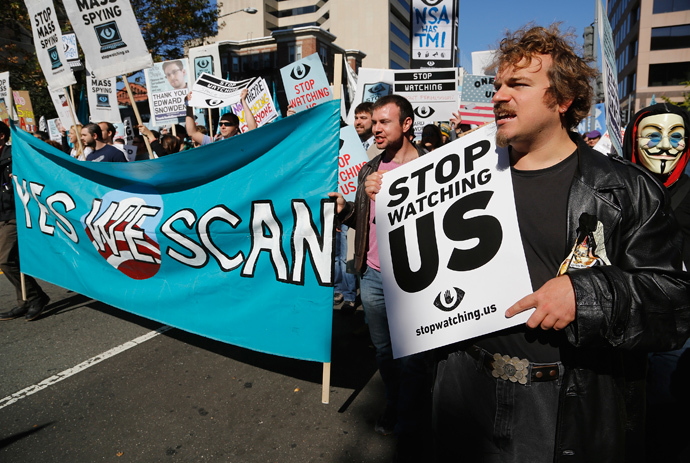 Estimates varied on the size of the march, with organizers saying more than 2,000 attended. U.S. Capitol Police said they do not typically provide estimates on the size of demonstrations.The march attracted protesters from both ends of the political spectrum as liberal privacy advocates walked alongside members of the conservative Tea Party movement in opposition to what they say is unlawful government spying on Americans.
"I consider myself a conservative and no conservative wants their government collecting information on them and storing it and using it," said Michael Greene, one of the protesters.
"Over the past several months, we have learned so much about the abuses (of privacy) that are going on and the complete lack of oversight and the mass surveillance into every detail of our lives. And we need to tell Congress that they have to act," said another protester, Jennifer Wynne.
The event was organized by a coalition known as "Stop Watching Us" that consists of some 100 public advocacy groups and companies, including the American Civil Liberties Union, privacy group Electronic Frontier Foundation, Occupy Wall Street NYC and the Libertarian Party.
The groups have been urging Congress to reform the legal framework supporting the NSA's secretive online data gathering since Snowden's disclosure of classified information about the programs that are designed to gather intelligence about potential foreign threats.
The Obama administration and many lawmakers have defended the NSA programs as crucial in protecting U.S. national security and helping thwart past militant plots. They have also said the programs are carefully overseen by Congress and the courts.
Snowden's disclosures have raised concerns that NSA surveillance may span not just foreign, but domestic online and phone communication.
"We are calling on Congress to take immediate action to halt this surveillance and provide a full public accounting of the NSA's and the FBI's data collection programs," Stop Watching Us said in a letter addressed to members of Congress posted online, calling for a reform of the law known as the Patriot Act.
That law marked its 12th anniversary on Saturday. It was passed in 2001 to improve anti-terrorism efforts and is now under scrutiny by privacy advocates who say it allows "dragnet" data gathering.
"Our representatives in Congress tell us this is not surveillance. They're wrong," Snowden said in a statement before Saturday's rally. Wanted in the United States on espionage charges, he is now in temporary asylum in Russia.
His latest disclosures showed that the United States may have tapped the phone of German Chancellor Angela Merkel, adding to the growing outrage against U.S. data-gathering practices abroad and prompting a phone call between Merkel and President Barack Obama.
Estimates varied on the size of the march, with organizers saying more than 2,000 attended. U.S. Capitol Police said they do not typically provide estimates on the size of demonstrations.The march attracted protesters from both ends of the political spectrum as liberal privacy advocates walked alongside members of the conservative Tea Party movement in opposition to what they say is unlawful government spying on Americans.
"I consider myself a conservative and no conservative wants their government collecting information on them and storing it and using it," said Michael Greene, one of the protesters.
"Over the past several months, we have learned so much about the abuses (of privacy) that are going on and the complete lack of oversight and the mass surveillance into every detail of our lives. And we need to tell Congress that they have to act," said another protester, Jennifer Wynne.
The event was organized by a coalition known as "Stop Watching Us" that consists of some 100 public advocacy groups and companies, including the American Civil Liberties Union, privacy group Electronic Frontier Foundation, Occupy Wall Street NYC and the Libertarian Party.
The groups have been urging Congress to reform the legal framework supporting the NSA's secretive online data gathering since Snowden's disclosure of classified information about the programs that are designed to gather intelligence about potential foreign threats.
The Obama administration and many lawmakers have defended the NSA programs as crucial in protecting U.S. national security and helping thwart past militant plots. They have also said the programs are carefully overseen by Congress and the courts.
Snowden's disclosures have raised concerns that NSA surveillance may span not just foreign, but domestic online and phone communication.
"We are calling on Congress to take immediate action to halt this surveillance and provide a full public accounting of the NSA's and the FBI's data collection programs," Stop Watching Us said in a letter addressed to members of Congress posted online, calling for a reform of the law known as the Patriot Act.
That law marked its 12th anniversary on Saturday. It was passed in 2001 to improve anti-terrorism efforts and is now under scrutiny by privacy advocates who say it allows "dragnet" data gathering.
"Our representatives in Congress tell us this is not surveillance. They're wrong," Snowden said in a statement before Saturday's rally. Wanted in the United States on espionage charges, he is now in temporary asylum in Russia.
His latest disclosures showed that the United States may have tapped the phone of German Chancellor Angela Merkel, adding to the growing outrage against U.S. data-gathering practices abroad and prompting a phone call between Merkel and President Barack Obama.
Bahraini regime defends use of tear gas
 The Bahraini regime has defended the use of tear gas against anti-regime protesters despite criticism by human rights organizations.
"Tear gas is non-lethal and it is used appropriately by the police, in compliance with the law and in full adherence with the internationally accepted standards contained in the Bahrain police code of conduct," a government spokesman's office said in a statement quoted by Reuters on Saturday.
"Bahrain's police forces are using less force than is legally permitted," the statement added.
On October 16, the Bahrain Watch group leaked documents showing that the Al Khalifa regime was planning to buy 1.6 million canisters of the material along with some stun grenades.
Many activists and rights groups have censured the excessive use of tear gas by the Saudi-backed forces, which fire canisters directly at protesters or within confined spaces such as houses and cars.
“CS gas as misused in Bahrain is most certainly lethal. And it is lethal because of the intensity of its use [and] the concentration within a confined room, and it is not supposed to be used in a confined space, “said Irish Orthopedic Surgeon Professor Damian McCormack , who is also a member of a Bahraini NGO, at a press conference in Switzerland in June.
In March 2012, the UN High Commissioner for Human Rights said a number of Bahraini protesters and bystanders died due to the use of tear gas in the tiny Persian Gulf island.
In August 2012, Physicians for Human Rights said that the regime uses tear gas indiscriminately, which has caused severe injuries to some civilians.
Meanwhile, on Saturday, anti-regime protests were held in several regions including the northwestern village of Bani Jamra and the western village of Karzakan with the protesters calling for the downfall of regime.
In Bani Jamra, people took to streets to protest against killing of a teenager by Bahrain’s forces.
Since mid-February 2011, thousands of pro-democracy protesters have held numerous demonstrations in the streets of Bahrain, calling for the Al Khalifa royal family to relinquish power.
On March 14, 2011, troops from Saudi Arabia and the United Arab Emirates invaded the country to assist the Bahraini regime in its crackdown on peaceful protesters.
According to local sources, scores of people have been killed and hundreds arrested.
Physicians for Human Rights says doctors and nurses have been detained, tortured, or disappeared because they have "evidence of atrocities committed by the authorities, security forces, and riot police" in the crackdown on anti-government protesters.
The Bahraini regime has defended the use of tear gas against anti-regime protesters despite criticism by human rights organizations.
"Tear gas is non-lethal and it is used appropriately by the police, in compliance with the law and in full adherence with the internationally accepted standards contained in the Bahrain police code of conduct," a government spokesman's office said in a statement quoted by Reuters on Saturday.
"Bahrain's police forces are using less force than is legally permitted," the statement added.
On October 16, the Bahrain Watch group leaked documents showing that the Al Khalifa regime was planning to buy 1.6 million canisters of the material along with some stun grenades.
Many activists and rights groups have censured the excessive use of tear gas by the Saudi-backed forces, which fire canisters directly at protesters or within confined spaces such as houses and cars.
“CS gas as misused in Bahrain is most certainly lethal. And it is lethal because of the intensity of its use [and] the concentration within a confined room, and it is not supposed to be used in a confined space, “said Irish Orthopedic Surgeon Professor Damian McCormack , who is also a member of a Bahraini NGO, at a press conference in Switzerland in June.
In March 2012, the UN High Commissioner for Human Rights said a number of Bahraini protesters and bystanders died due to the use of tear gas in the tiny Persian Gulf island.
In August 2012, Physicians for Human Rights said that the regime uses tear gas indiscriminately, which has caused severe injuries to some civilians.
Meanwhile, on Saturday, anti-regime protests were held in several regions including the northwestern village of Bani Jamra and the western village of Karzakan with the protesters calling for the downfall of regime.
In Bani Jamra, people took to streets to protest against killing of a teenager by Bahrain’s forces.
Since mid-February 2011, thousands of pro-democracy protesters have held numerous demonstrations in the streets of Bahrain, calling for the Al Khalifa royal family to relinquish power.
On March 14, 2011, troops from Saudi Arabia and the United Arab Emirates invaded the country to assist the Bahraini regime in its crackdown on peaceful protesters.
According to local sources, scores of people have been killed and hundreds arrested.
Physicians for Human Rights says doctors and nurses have been detained, tortured, or disappeared because they have "evidence of atrocities committed by the authorities, security forces, and riot police" in the crackdown on anti-government protesters.
Saudi women defy driving ban across country
More than 60 women claimed to have answered their call to get behind the wheel in a rare show of defiance against a ban on female driving in the ultraconservative kingdom, Saudi activists said. Saudi professor and campaigner Aziza Youssef said that the group received 13 videos and another 50 phone messages from women showing or claiming they had driven on Saturday. She said they had no way to verify the messages. If the numbers are accurate, this year's campaign is the most successful effort yet by Saudi women demanding the right to drive. Youssef said they had not received any reports of arrests or women being ticketed by police. A security official said that authorities did not arrest or fine any female drivers on Saturday. He spoke on condition of anonymity because he was not authorised to speak to the media. A website set up by the campaigners, Oct26driving.com, in the hope of getting more women on the roads, appeared to have been hacked. It read in Arabic, "This site has been hacked because I am against women driving in this holy country." The Interior Ministry on its website said: "While Saudi regulations ban any offence to social peace that opens the door to sedition, the Ministry of Interior emphasises to all that authorities will follow the law decisively against violators." "At the same time, the government appreciates calls by citizens to respect security and to stay away from any attempt to divide society." 'Suspicious cars' The campaign happened despite several roadblocks along the way during the past few days. Youssef said she and four other prominent women activists received phone calls this week from a top official with close links to Interior Minister Prince Mohammed bin Nayef, warning them not to drive on Saturday. She also said that "two suspicious cars" were following her all day. "I don't know from which party they are from. They are not in a government car," she said. The activists changed the original plan to drive only on Saturday to make the campaign open-ended, in response to the threats. Though no specific Saudi law bans women from driving, women are not issued licenses. They mostly rely on drivers or male relatives to move around. Clerics who hold far-reaching influence over the monarchy enforce the driving ban, warning that breaking it will spread "licentiousness".Dozens of women across country participate in "drive-in" campaign, despite threats and warnings from government.

Malala Yousafzai: '' A Courageous Young Girl''

BY NADIA KABIR BARB


Afghanistan to ask Pakistan about Taliban chief's whereabouts
 Afghanistan will demand an explanation from Pakistan on the whereabouts of a former Taliban second-in-command when the leaders of both countries meet next week to discuss how to end years of insurgency, an Afghan official said on Saturday.
The whereabouts of Mullah Baradar has been the source of intense speculation since Pakistan announced his release on September 20. Pakistani sources say he is still kept in a safe house and is closely watched by his Pakistani handlers.
Afghanistan believes Baradar, who was once a close friend of the reclusive Taliban leader Mullah Mohammad Omar, has enough clout to persuade the Taliban to make peace, but his prolonged stay in Pakistan may have marred his reputation among fighters.
"Mullah Baradar is still under strict supervision," said Aimal Faizi, a spokesman for Afghan President Hamid Karzai.
"We will be seeking an explanation from Pakistan on the whereabouts of Mullah Baradar and how Pakistan can facilitate direct talks between him and the High Peace Council."
Karzai formed the High Peace Council in 2010 to seek a negotiated end to the insurgency the Taliban have waged since being forced from power in 2001 by a U.S.-led invasion.
Faizi said Karzai would raise the issue when he meets Pakistani Prime Minister Nawaz Sharif in London next week for a summit hosted by Britain's Prime Minister David Cameron.
"The High Peace Council is in touch with Mullah Baradar's family, not himself, unfortunately," Faizi said. "This is what we are seeking. All we know is that his family members were able to contact him, but the High Peace Council itself hasn't yet reached Mullah Baradar."
Afghanistan is trying to inject life into attempts to negotiate peace as most U.S.-led NATO combat troops prepare to pull out by the end of 2014.
Baradar, who was captured in Karachi in 2010, is seen as a pragmatic negotiator who reached out to Kabul with a peace initiative before his detention.
The Afghan Taliban say Baradar effectively remains under arrest and that his health has deteriorated.
Some analysts say that Pakistan sees Baradar as a tool who could help it have a say in any future peace deal and limit rival India's influence over Afghanistan after 2014.
Afghanistan will demand an explanation from Pakistan on the whereabouts of a former Taliban second-in-command when the leaders of both countries meet next week to discuss how to end years of insurgency, an Afghan official said on Saturday.
The whereabouts of Mullah Baradar has been the source of intense speculation since Pakistan announced his release on September 20. Pakistani sources say he is still kept in a safe house and is closely watched by his Pakistani handlers.
Afghanistan believes Baradar, who was once a close friend of the reclusive Taliban leader Mullah Mohammad Omar, has enough clout to persuade the Taliban to make peace, but his prolonged stay in Pakistan may have marred his reputation among fighters.
"Mullah Baradar is still under strict supervision," said Aimal Faizi, a spokesman for Afghan President Hamid Karzai.
"We will be seeking an explanation from Pakistan on the whereabouts of Mullah Baradar and how Pakistan can facilitate direct talks between him and the High Peace Council."
Karzai formed the High Peace Council in 2010 to seek a negotiated end to the insurgency the Taliban have waged since being forced from power in 2001 by a U.S.-led invasion.
Faizi said Karzai would raise the issue when he meets Pakistani Prime Minister Nawaz Sharif in London next week for a summit hosted by Britain's Prime Minister David Cameron.
"The High Peace Council is in touch with Mullah Baradar's family, not himself, unfortunately," Faizi said. "This is what we are seeking. All we know is that his family members were able to contact him, but the High Peace Council itself hasn't yet reached Mullah Baradar."
Afghanistan is trying to inject life into attempts to negotiate peace as most U.S.-led NATO combat troops prepare to pull out by the end of 2014.
Baradar, who was captured in Karachi in 2010, is seen as a pragmatic negotiator who reached out to Kabul with a peace initiative before his detention.
The Afghan Taliban say Baradar effectively remains under arrest and that his health has deteriorated.
Some analysts say that Pakistan sees Baradar as a tool who could help it have a say in any future peace deal and limit rival India's influence over Afghanistan after 2014.
Manmohan Singh To Nawaz: 'Didn't become PM to redraw boundaries'
 Minister of External Affairs Salman Khurshid said today that Prime Minister Manmohan Singh gave a very stern message to Pakistani counterpart Nawaz Sharif when the two leaders met in New York last month on the sidelines of the UN General Assembly. Dr Singh had told Mr Sharif that he did not become the Indian PM 'to re-draw the boundaries,' according to Mr Khurshid.
"I think that is the most fantastic answer I have ever heard from an Indian leader given to somebody in Pakistan," Mr Khurshid said.
A series of ceasefire violations by the Pakistani troops along the Line of Control in Jammu and Kashmir has escalated the tension between the two countries. A jawan from the Border Security Force was killed earlier this week in one of the several attacks on Indian posts by the Pakistani troops. A few civilians from the Indian side of the border have also been injured.
The Defence Ministry says there have been over 200 ceasefire violations this year, more than all such incidents in the last decade.
Dr Singh, on his way back from his tour of Russia and China, said on Thursday evening that he was disappointed with the Pakistani PM and asked him to recognise that what was happening on the border is not good for the two nations.
"Let me say I am disappointed because in the New York meeting (between Dr Singh and Nawaz Sharif last month) there was a general agreement on both the sides that peace and tranquility should be maintained on the border, the Line of Control as well as the International Border and it has not happened. It has come to me as a big disappointment," the Prime Minister said.
Minister of External Affairs Salman Khurshid said today that Prime Minister Manmohan Singh gave a very stern message to Pakistani counterpart Nawaz Sharif when the two leaders met in New York last month on the sidelines of the UN General Assembly. Dr Singh had told Mr Sharif that he did not become the Indian PM 'to re-draw the boundaries,' according to Mr Khurshid.
"I think that is the most fantastic answer I have ever heard from an Indian leader given to somebody in Pakistan," Mr Khurshid said.
A series of ceasefire violations by the Pakistani troops along the Line of Control in Jammu and Kashmir has escalated the tension between the two countries. A jawan from the Border Security Force was killed earlier this week in one of the several attacks on Indian posts by the Pakistani troops. A few civilians from the Indian side of the border have also been injured.
The Defence Ministry says there have been over 200 ceasefire violations this year, more than all such incidents in the last decade.
Dr Singh, on his way back from his tour of Russia and China, said on Thursday evening that he was disappointed with the Pakistani PM and asked him to recognise that what was happening on the border is not good for the two nations.
"Let me say I am disappointed because in the New York meeting (between Dr Singh and Nawaz Sharif last month) there was a general agreement on both the sides that peace and tranquility should be maintained on the border, the Line of Control as well as the International Border and it has not happened. It has come to me as a big disappointment," the Prime Minister said.
Bilawal Bhutto Zardari to raise funds to save Mohenjodaro
By Dean Nelson
The son of Benazir Bhutto, Bilawal, is to raise funds to save Mohenjodaro, the 5,000-year-old centre of the Indus CivilisationBilawal Bhutto Zardari, the young Pakistan Peoples Party leader and Bhutto dynasty scion, is to lead an international campaign to save Mohenjodaro, the crumbling ruins of the world's last surviving Bronze Age city. The son of Benazir Bhutto, the late Pakistan prime minister, and former president Asif Zardari inspected the site earlier this month after The Telegraph reported its 5,000-year-old brick walls could turn to dust within 20 years. Mohenjodaro was discovered by colonial officials from the Archelogical Survey of India in 1924 when they excavated a hill on the banks of the Indus River. They uncovered an intact, well-planned urban landscape of large houses on grid-system roads, with their own bathrooms and drainage and sewage systems which would still put many towns in India and Pakistan to shame today. They also recovered a ceremonial public bath, a civic centre, grain stores, a debating hall and artefacts which indicated a system of taxation, weights and measures as well as jewellery, toys and chess-like pieces which highlighted its regard for beauty and recreation. But the site's clay brick walls have now been long-neglected and conservation officials in charge of the site have been starved of the funds needed to preserve it. They need 350 labourers to constantly cover the walls with a protective layer of mud to stop salt crystals from rain and river water destroying the bricks. But on some days there are only 16. The damage is so extensive that officials are considering reburying part of the site until adequate resources are available.Mr Bhutto Zardari told The Telegraph of his "shock and disappointment" after visiting the site and said urgent action was needed to reverse the "neglect, inadequate funding, government and public indifference," responsible for its deterioration. "We must seize the opportunity to stop all this now," he said. The Bhutto family has strong links with Mohenjodaro – they are the largest landlords in the area. Zulfikar Ali Bhutto, the former prime minister and president, staged an international conference at the site in 1973 to raise global support for its conservation, while Bilawal's mother, the late two-time prime minister Benazir Bhutto, spoke of her pride at being raised in its shadow. Mr Bhutto Zardari called for a "preventive emergency intervention" and pledged to raise international awareness and funds to support it. "The Sindh government will be holding an international conference on Mohenjodaro in the coming months," he said. "I shall be working closely with the Sindh government, private sector as well as international experts to raise funds as well as perhaps restarting excavation of the site."
Fooled again by Pakistan?
When Pakistani Prime Minister Nawaz Sharif came to Washington, D.C., this week, I couldn’t help thinking of the adage: “Fool me once, shame on you. Fool me twice, shame on me.” Sure enough, despite a long history of U.S. presidents being duped by Pakistani leaders, President Obama plans to restore more than $1.5 billion in blocked assistance for Islamabad. The aid was blocked because Pakistan never came clean about who helped Osama bin Laden hide for years in Abbottabad. And U.S.-Pakistani relations are stressed because Pakistan hosts Afghan Taliban who kill U.S. soldiers, as well as jihadis who kill Western and Indian civilians. Never mind. When it comes to Pakistan, hope seems to spring eternal. If the United States eases tension with Islamabad, administration thinking goes, the Pakistanis may finally press the Taliban to endorse an Afghan peace accord before the U.S. withdrawal in 2014. But why expect different results now from a country whose leaders have deceived Washington for decades about their links to terrorism — and who regard anti-Western jihadis as a useful tool in fighting India? “The United States may have to be more upfront about the relationship between Pakistan and terrorism,” says Husain Haqqani, a former Pakistani ambassador to Washington and author of “Magnificent Delusions: Pakistan, the United States, and an Epic History of Misunderstanding.” “This would bring to an end the ability of Pakistani leaders to deny what is happening. The days of going along with pretense should end.” Haqqani’s book lays out the sad tale of America’s self-deceptive relationship with Pakistan — he has long argued that Pakistan’s double game on terrorism undermines its ability to develop its full potential, which may be why he was forced out of his post. “Since 1947, dependence, deception and defiance have characterized Pakistan’s relations with Washington,” he says. “Pakistan has sought U.S. aid in return for promises we did not keep.” Early on, Pakistan enticed U.S. presidents to supply arms so it could counter the Soviets, while intending to use the weapons against India. In the 1980s, Pakistan persuaded Washington to provide mountains of cash to train the Afghan mujahedeen who drove the Soviets out of Afghanistan. However, the Pakistani ISI intelligence agency funneled that cash to the most militant jihadis and, later, helped the Taliban seize power in Kabul — setting the stage for the rise of al-Qaida. Deception followed deception. Pakistan repeatedly lied to Washington about its nuclear weapons program in the 1980s, and has still not come fully clean about the passing of Pakistan’s nuclear technology to North Korea and Iran. After 9/11, Pakistan finally agreed to help Washington combat al-Qaida, but permitted Taliban militants to maintain safe havens in their country. The Pakistanis continue to deny ISI links to the militants, who have attacked the U.S. embassy in Kabul and killed many U.S. troops. Pakistan also tried to deny responsibility when ISI-trained Pakistanis killed 166 people in Mumbai, India, in 2008; it has never jailed the mastermind of the attack, who still openly preaches jihad. Pakistani leaders also gloss over that the failed Times Square bomber, Faisal Shahzad, trained in Pakistan, as did other would-be bombers nabbed in Europe. As a senior U.S. diplomat once complained, the United States and Pakistan operate in “parallel universes” in which Pakistanis speak about everything but terrorism, which they pretend isn’t happening. So it wasn’t surprising to hear the prime minister deny any Pakistani connection to terrorism in a Tuesday speech to the U.S. Institute of Peace in Washington. In a move guaranteed to divert attention from Pakistan’s links to terrorists, Sharif complained about America’s use of drones. He never mentioned that, for many years, Pakistani leaders privately gave the green light to drone attacks while condemning them in public — or that the attacks would not be necessary if Pakistani leaders weren’t supporting jihadis. “Pakistan wants to be able to act like Assad’s Syria while demanding that the United States treat it like Israel,” says Haqqani. He suggests “lowering expectations of cooperation while increasing honesty about what each side thinks of each other.” What a good idea. The more the United States indicates it needs Pakistan, “the more Pakistan jacks up the cost,” says Haqqani. He adds that aid will not change Pakistani behavior, nor will Pakistan deliver the Taliban. So why not insist that U.S. aid and cooperation with Pakistan will go nowhere until both sides can talk honestly to each other (and their publics) about terrorism and drones? Previous administrations have demanded that Pakistan come clean, then backed down, and I know such a display of U.S. backbone is unlikely this time, but it would certainly be a refreshing change.By Trudy Rubin

Pakistan’s Gilani acknowledges the possibility of contact with U.S. over planned drone strikes
 By Tim Craig
A former Pakistani prime minister strongly denied Thursday that he had quietly authorized U.S. drone strikes inside his country, but he didn’t rule out secret deals made without his knowledge.
A day earlier, a Washington Post report detailed how the United States and Pakistan communicated about, and in some cases coordinated, dozens of drone strikes in Pakistan from late 2007 to late 2011. But Yousuf Raza Gilani, who was the country’s prime minister from 2008 to 2012, said it was “totally absurd” to suggest that his government had condoned the attacks.
“During my government, there was no such support given to drone strikes whatsoever,” Gilani said in an interview, adding that he had discussed with President Obama in 2010 “how this strategy with drones was counterproductive and undermining our anti-terror efforts.”
He said he could not rule out that the two nations had communicated about planned drone strikes during his tenure. But if they did, he said, the parties involved would have been the CIA and Pakistan’s Inter-
Services Intelligence agency, under conditions set by Pervez Musharraf, the former military ruler.
“The permission must have been given earlier,” said Gilani, who was also cited in a 2010 WikiLeaks report as being privately supportive of some strikes. “After 9/11, the U.S. rang up Musharraf and said, ‘You are either with us or you are not with us,’ and he said, ‘We are with you.’ ”
In an interview with CNN last year, Musharraf admitted to authorizing “a few” U.S. drone strikes before he stepped down in 2008. Pakistan’s Express Tribune newspaper reported Thursday that a former top-ranking military commander who had served under Musharraf, retired Lt. Gen. Shahid Aziz, is calling for Musharraf to be charged with extrajudicial murder for his role in the drone campaign.
Musharraf is under house arrest in Islamabad on several charges stemming from his autocratic tenure.
But The Post’s report details coordination as recently as 2011, causing some analysts to suspect that Musharraf’s successors also were aware of some U.S. strike targets.
“This puts cold water on the hype,” said Talat Masood, a retired Pakistani general and a military analyst, referring to the public anger in Pakistan over U.S. attacks. “I think people knew it already, but this makes it much more obvious, and the [Pakistani] media and others will have to cool off.”
Pakistan’s current prime minister, Nawaz Sharif, who took office in June, has made stopping the drone campaign a top priority. He raised the issue during a meeting with Obama at the White House on Wednesday. Aizaz Ahmad Chaudhry, a spokesman for the Foreign Ministry, said Thursday that the government remains united in seeking an end to the strikes.
“Whatever understandings there may or may not have been in the past, the present government has been very clear regarding its policy on the issue,” Chaudhry said. “We regard such strikes as a violation of our sovereignty as well as international law.”
Saeed Ghani, a Pakistani lawmaker, said he suspects that some U.S. drone strikes did have the tacit approval of government or military leaders here. But he said Sharif and other politicians are under tremendous pressure from the public to stop them.
“There probably was some understanding,” Ghani said. “But it’s now very difficult for political governments to carry on those understandings.”
By Tim Craig
A former Pakistani prime minister strongly denied Thursday that he had quietly authorized U.S. drone strikes inside his country, but he didn’t rule out secret deals made without his knowledge.
A day earlier, a Washington Post report detailed how the United States and Pakistan communicated about, and in some cases coordinated, dozens of drone strikes in Pakistan from late 2007 to late 2011. But Yousuf Raza Gilani, who was the country’s prime minister from 2008 to 2012, said it was “totally absurd” to suggest that his government had condoned the attacks.
“During my government, there was no such support given to drone strikes whatsoever,” Gilani said in an interview, adding that he had discussed with President Obama in 2010 “how this strategy with drones was counterproductive and undermining our anti-terror efforts.”
He said he could not rule out that the two nations had communicated about planned drone strikes during his tenure. But if they did, he said, the parties involved would have been the CIA and Pakistan’s Inter-
Services Intelligence agency, under conditions set by Pervez Musharraf, the former military ruler.
“The permission must have been given earlier,” said Gilani, who was also cited in a 2010 WikiLeaks report as being privately supportive of some strikes. “After 9/11, the U.S. rang up Musharraf and said, ‘You are either with us or you are not with us,’ and he said, ‘We are with you.’ ”
In an interview with CNN last year, Musharraf admitted to authorizing “a few” U.S. drone strikes before he stepped down in 2008. Pakistan’s Express Tribune newspaper reported Thursday that a former top-ranking military commander who had served under Musharraf, retired Lt. Gen. Shahid Aziz, is calling for Musharraf to be charged with extrajudicial murder for his role in the drone campaign.
Musharraf is under house arrest in Islamabad on several charges stemming from his autocratic tenure.
But The Post’s report details coordination as recently as 2011, causing some analysts to suspect that Musharraf’s successors also were aware of some U.S. strike targets.
“This puts cold water on the hype,” said Talat Masood, a retired Pakistani general and a military analyst, referring to the public anger in Pakistan over U.S. attacks. “I think people knew it already, but this makes it much more obvious, and the [Pakistani] media and others will have to cool off.”
Pakistan’s current prime minister, Nawaz Sharif, who took office in June, has made stopping the drone campaign a top priority. He raised the issue during a meeting with Obama at the White House on Wednesday. Aizaz Ahmad Chaudhry, a spokesman for the Foreign Ministry, said Thursday that the government remains united in seeking an end to the strikes.
“Whatever understandings there may or may not have been in the past, the present government has been very clear regarding its policy on the issue,” Chaudhry said. “We regard such strikes as a violation of our sovereignty as well as international law.”
Saeed Ghani, a Pakistani lawmaker, said he suspects that some U.S. drone strikes did have the tacit approval of government or military leaders here. But he said Sharif and other politicians are under tremendous pressure from the public to stop them.
“There probably was some understanding,” Ghani said. “But it’s now very difficult for political governments to carry on those understandings.”
Pakistan: Ex-Envoy Says Misunderstanding Runs on Both Sides of U.S.-Pakistan Ties
 By MARK LANDLER
The meeting between President Obama and Prime Minister Nawaz Sharif at the White House on Wednesday is the most recent attempt by American and Pakistani leaders to reset a fraught relationship.
Husain Haqqani, Pakistan’s former ambassador to Washington, has documented that legacy of mistrust in a new book, “Magnificent Delusions” (Public Affairs, Nov. 5). Mr. Haqqani, a former adviser to Mr. Sharif who now teaches at Boston University, was a victim of those toxic ties, forced out in 2011 amid allegations, which he denies, that he sought American help to rein in the Pakistani military.
We caught up with him here recently, and what follows is an edited transcript of the conversation.
Q. You trace the star-crossed relationship between Pakistan and the United States back to the founding of the Pakistani state in 1947. In what way do the mutual suspicions go back that far?
The mutual misunderstandings start in 1947; the suspicions come later. The misunderstanding was Pakistan’s expectation that the United States would help build it up in its quest for containing Communism. And when the United States built it up, that Pakistan would be able to seek parity with India, which was its primary rival. The Americans had no such intention. The suspicions, in my opinion, are very much contrived as a means of generating public opposition to the United States in Pakistan, and thereby giving the Pakistanis leverage in the relationship.
Q. What is the biggest misconception Pakistanis have about the United States?
The suspicion in Pakistan is that the United States wants to defang Pakistan’s nuclear program, that the United States cannot accept a Muslim country having a strong military, and that America wants Pakistan to be subservient to India, just as it wants the Arabs to be subservient to Israel. It is ironic that a lot of this is based on conspiracy theories that are rampant in Pakistan. Recently, the vice chancellor of Pakistan’s largest university came out with a book that says that the British and American governments are controlled by a high cabal, which manipulates each one of us by putting microchips in our brains.
Q. What is the biggest misconception Americans have about Pakistan?
The biggest misconception the Americans have had is that they can somehow bend Pakistan to their will simply with the leverage of aid. Aid has never given the Americans the leverage they thought they would have. As far as the American public is concerned, it has never really seriously engaged with Pakistan, and the understanding of most Americans about Pakistan is through single-issue prisms: nuclear program one day, terrorism the other. There has never been an effort to understand 180 million people and their aspirations.
Q. Critics of the United States say that Pakistanis feel the United States cultivates Pakistan when it needs it, and abandons it when it no longer needs it. Is that valid?
It is partially valid. Each time, Pakistan also has failed to fulfill promises it made to the United States. However, Pakistanis complain louder than Americans, so therefore, the sequence of who abandoned who is not always fully understood. One of the things I speak of in my book is how Pakistan’s elites almost always misled their people about what they had promised the Americans in private.
Q. The late [special envoy] Richard Holbrooke was among those who tried to broaden the U.S.-Pakistan relationship beyond counterterrorism and military aid. Yet those efforts did not outlive him. Is that a valid model for putting the relationship on a firmer footing?
Richard Holbrooke envisaged a “grand bargain,” in which Pakistan’s insecurities about India were addressed, Pakistan’s ambitions in Afghanistan were dealt with, and Pakistan was assured that America will be there for the long haul. But a “grand bargain” is only possible under very strong leadership in Pakistan and very strong leadership in the United States. Ambassador Holbrooke was not able to convince President Obama to put the full weight of his presidency behind his initiative. On the other hand, President [Asif Ali] Zardari in Pakistan was also handicapped by complex domestic politics.
Q. How did the Obama administration’s expansion of the drone program affect the relationship?
The [Gen. Pervez] Musharraf government had accepted the drone program primarily because they intended to keep it secret. An occasional strike was easy to keep secret. The Obama administration’s escalation of the drones as a means of dealing with terrorist safe havens in Northwest Pakistan complicated the ability of the Pakistani military and intelligence services to keep the program secret. This was a program whose escalation made secrecy impossible, and Pakistan’s leaders were unwilling to have a program that was a little more open. The viable option would have been a joint program, and that was not acceptable to the American side because of their persistent suspicions about Pakistan’s intelligence services being deeply penetrated by terrorist sympathizers.
Q. In your last book, “Pakistan: Between Mosque and Military,” you wrote about the ties between Islamist movements and Pakistan’s U.S.-backed military and intelligence. To what extent is religious extremism in Pakistan an American creation?
The Americans inadvertently expanded religious extremism in Pakistan. But if you go back in history, Pakistan was already involved in supporting religious extremism in Afghanistan when the Americans launched their massive aid program for Afghan mujahedeen after the Soviet invasion in 1979. Religious extremist groups have been in Pakistan since 1947. And some of them have been embraced by the state as a means of nation-building. The United States did not understand those social forces, and on many occasions, ended up inadvertently helping groups that eventually helped the extremists.
Q. You describe a memo on Pakistan’s strategic threats, written by General Kayani [Gen. Ashfaq Parvez Kayani, Pakistan’s army chief of staff], which reads remarkably like a document written in 1959 by President [Mohammad] Ayub Khan. Is Pakistan’s view of its interests really that outdated?
It is. Pakistan has become a uni-focal state. The only focus is, “how do we wrest Kashmir from India?” Even the Chinese president, Jiang Zemin, when he came to Pakistan, said to the Pakistanis, “You should contemplate the model we have for Taiwan,” which is that China claims Taiwan but does not do anything physically to try and take it back. Instead, it is focusing in its economic development and its modernization.
Q. You’ve had your ups and downs in Pakistan, most recently with the accusation that you asked the Obama administration to help thwart a military coup after the killing of Osama bin Laden. What do your own ordeals illustrate about the hazards of the U.S.-Pakistan relationship?
My ordeals reveal that when people believe somebody is an enemy, that anybody who is trying to serve as a bridge with them will be seen as the enemy as well. There was no coup attempt in 2011 after the Osama bin Laden raid, and therefore, there was no need to thwart it. As ambassador, I had access to almost everybody in Washington, D.C. Why would I need a businessman of dubious credentials to deliver a memo for me? But the fact that such a fantasy-based story found so much traction in Pakistan – that I was forced not only to resign, but that my life was put in jeopardy – shows the pathology of the relationship.
By MARK LANDLER
The meeting between President Obama and Prime Minister Nawaz Sharif at the White House on Wednesday is the most recent attempt by American and Pakistani leaders to reset a fraught relationship.
Husain Haqqani, Pakistan’s former ambassador to Washington, has documented that legacy of mistrust in a new book, “Magnificent Delusions” (Public Affairs, Nov. 5). Mr. Haqqani, a former adviser to Mr. Sharif who now teaches at Boston University, was a victim of those toxic ties, forced out in 2011 amid allegations, which he denies, that he sought American help to rein in the Pakistani military.
We caught up with him here recently, and what follows is an edited transcript of the conversation.
Q. You trace the star-crossed relationship between Pakistan and the United States back to the founding of the Pakistani state in 1947. In what way do the mutual suspicions go back that far?
The mutual misunderstandings start in 1947; the suspicions come later. The misunderstanding was Pakistan’s expectation that the United States would help build it up in its quest for containing Communism. And when the United States built it up, that Pakistan would be able to seek parity with India, which was its primary rival. The Americans had no such intention. The suspicions, in my opinion, are very much contrived as a means of generating public opposition to the United States in Pakistan, and thereby giving the Pakistanis leverage in the relationship.
Q. What is the biggest misconception Pakistanis have about the United States?
The suspicion in Pakistan is that the United States wants to defang Pakistan’s nuclear program, that the United States cannot accept a Muslim country having a strong military, and that America wants Pakistan to be subservient to India, just as it wants the Arabs to be subservient to Israel. It is ironic that a lot of this is based on conspiracy theories that are rampant in Pakistan. Recently, the vice chancellor of Pakistan’s largest university came out with a book that says that the British and American governments are controlled by a high cabal, which manipulates each one of us by putting microchips in our brains.
Q. What is the biggest misconception Americans have about Pakistan?
The biggest misconception the Americans have had is that they can somehow bend Pakistan to their will simply with the leverage of aid. Aid has never given the Americans the leverage they thought they would have. As far as the American public is concerned, it has never really seriously engaged with Pakistan, and the understanding of most Americans about Pakistan is through single-issue prisms: nuclear program one day, terrorism the other. There has never been an effort to understand 180 million people and their aspirations.
Q. Critics of the United States say that Pakistanis feel the United States cultivates Pakistan when it needs it, and abandons it when it no longer needs it. Is that valid?
It is partially valid. Each time, Pakistan also has failed to fulfill promises it made to the United States. However, Pakistanis complain louder than Americans, so therefore, the sequence of who abandoned who is not always fully understood. One of the things I speak of in my book is how Pakistan’s elites almost always misled their people about what they had promised the Americans in private.
Q. The late [special envoy] Richard Holbrooke was among those who tried to broaden the U.S.-Pakistan relationship beyond counterterrorism and military aid. Yet those efforts did not outlive him. Is that a valid model for putting the relationship on a firmer footing?
Richard Holbrooke envisaged a “grand bargain,” in which Pakistan’s insecurities about India were addressed, Pakistan’s ambitions in Afghanistan were dealt with, and Pakistan was assured that America will be there for the long haul. But a “grand bargain” is only possible under very strong leadership in Pakistan and very strong leadership in the United States. Ambassador Holbrooke was not able to convince President Obama to put the full weight of his presidency behind his initiative. On the other hand, President [Asif Ali] Zardari in Pakistan was also handicapped by complex domestic politics.
Q. How did the Obama administration’s expansion of the drone program affect the relationship?
The [Gen. Pervez] Musharraf government had accepted the drone program primarily because they intended to keep it secret. An occasional strike was easy to keep secret. The Obama administration’s escalation of the drones as a means of dealing with terrorist safe havens in Northwest Pakistan complicated the ability of the Pakistani military and intelligence services to keep the program secret. This was a program whose escalation made secrecy impossible, and Pakistan’s leaders were unwilling to have a program that was a little more open. The viable option would have been a joint program, and that was not acceptable to the American side because of their persistent suspicions about Pakistan’s intelligence services being deeply penetrated by terrorist sympathizers.
Q. In your last book, “Pakistan: Between Mosque and Military,” you wrote about the ties between Islamist movements and Pakistan’s U.S.-backed military and intelligence. To what extent is religious extremism in Pakistan an American creation?
The Americans inadvertently expanded religious extremism in Pakistan. But if you go back in history, Pakistan was already involved in supporting religious extremism in Afghanistan when the Americans launched their massive aid program for Afghan mujahedeen after the Soviet invasion in 1979. Religious extremist groups have been in Pakistan since 1947. And some of them have been embraced by the state as a means of nation-building. The United States did not understand those social forces, and on many occasions, ended up inadvertently helping groups that eventually helped the extremists.
Q. You describe a memo on Pakistan’s strategic threats, written by General Kayani [Gen. Ashfaq Parvez Kayani, Pakistan’s army chief of staff], which reads remarkably like a document written in 1959 by President [Mohammad] Ayub Khan. Is Pakistan’s view of its interests really that outdated?
It is. Pakistan has become a uni-focal state. The only focus is, “how do we wrest Kashmir from India?” Even the Chinese president, Jiang Zemin, when he came to Pakistan, said to the Pakistanis, “You should contemplate the model we have for Taiwan,” which is that China claims Taiwan but does not do anything physically to try and take it back. Instead, it is focusing in its economic development and its modernization.
Q. You’ve had your ups and downs in Pakistan, most recently with the accusation that you asked the Obama administration to help thwart a military coup after the killing of Osama bin Laden. What do your own ordeals illustrate about the hazards of the U.S.-Pakistan relationship?
My ordeals reveal that when people believe somebody is an enemy, that anybody who is trying to serve as a bridge with them will be seen as the enemy as well. There was no coup attempt in 2011 after the Osama bin Laden raid, and therefore, there was no need to thwart it. As ambassador, I had access to almost everybody in Washington, D.C. Why would I need a businessman of dubious credentials to deliver a memo for me? But the fact that such a fantasy-based story found so much traction in Pakistan – that I was forced not only to resign, but that my life was put in jeopardy – shows the pathology of the relationship.
Pakistan: Shia pilgrims' bus blast: 2 FC personnel killed in Mastung
The Express Tribune NewsA car bomb hit a Frontier Corps (FC) van escorting a bus of Shia pilgrims in Dringarh, Mastung on Saturday, killing two soldiers, officials said. The incident took place on the main Quetta-Taftan Highway in Mastung district, some 50 kilometres southwest of Quetta. “The bomb exploded after an FC vehicle stopped to check a parked car,” Sayed Mehrab Shah, a senior government official in Mastung told AFP. All the pilgrims on the bus, who were on their way to Iran, were safe but several security personnel were wounded by the remotely triggered bomb, Shah said. There was no immediate claim of responsibility for the blast but most attacks in the province bordering Afghanistan and Iran have been linked to militant insurgency or sectarian violence. Spokesperson for FC Abdul Wasay confirmed the attack and told AFP that rescue teams had been despatched to the area. Previous attacks On December 30, 2012, a car bomb attack on buses carrying Shia pilgrims to Iran had killed 19 people and injured 25 in Mastung officials had said. The remotely-triggered bomb hit a convoy of three buses in Mastung district and set one of them ablaze, Tufail Baluch a senior government official in the district had said. “The bomb was planted in a car. The condition of some of the injured is critical,” Baluch had said. On September 18, 2012, three people were killed when a blast took place near a bus carrying pilgrims in the Mastung district. Nine people, including three Levies personnel who were escorting the pilgrims, were injured in the incident.
New blockbuster movie shows why Pakistan loves to hate India

Friday, October 25, 2013
In Saudi Arabia, a drive for women's rights
Los Angeles TimesGive women the vote and what outrageous thing happens next? In Saudi Arabia, they start demanding the keys to the car. Thus a relative handful of brave Saudi women will slip behind the wheel Saturday for a "Day of Female Driving." Saudi Arabia is the only nation that bars women from driving. Not that there's an actual law against them doing so. But the government won't issue them licenses. There are, however, women with licenses obtained in other countries; they will be the driving force, if you will, of the Saturday demonstration. They haven't been driving up to now because of overwhelming traditional and cultural pressure. It simply hasn't been done. It is unknown how the government will react to Saturday's protest. King Abdullah, who in 2011 granted women the right to vote (it takes effect in time for the 2015 voting cycle) has said that he expected that women would one day drive in Saudi Arabia. Saudi authorities warned that police would be cracking down on anyone making trouble Saturday, but it was unclear whether that referred to the women drivers or the conservatives who oppose their efforts and intend to launch counter-protests. Make no mistake, this is an act of courage, even if it's one that doesn't get women past first gear in their efforts to gain basic rights that are taken for granted almost everywhere in the developed world. People in the West tend to bemoan the face veils and body-hiding robes that most Saudi women must wear in public, but many of the goals at the top of the women's agenda are more basic. What they want are jobs and a measure of self-determination. Their ability to work is limited, and because of rules about keeping unrelated men and women separate, they usually must work for companies that provide women-only work spaces. They wait on different lines at fast-food restaurants and must be served in separate, often less desirable, quarters in restaurants, banks and other public settings. In order to have certain medical procedures or to leave the country, they need the permission of their husbands or a male guardian. Of all the rights denied to Saudi women, the right to drive might not be the most socially or economically important — although the ability to work in Saudi Arabia, where public transit is notoriously poor, is related to the ability to get to one's job. But there is potent symbolism in women steering their own drive toward a possibly less restrictive future.
Saudi security forces arrest several women, kids
Saudi security forces have arrested a number of women and children in the central province of Qassim.
According to reports on Friday, the arrests have been made in the provincial capital Buraidah since protests started there on October 19.
The protests were sparked by Saudi authorities’ refusal to allow the families of political prisoners to visit their loved ones on the occasion of Eid al-Adha.
At least eight women and 20 children, including a two-year-old and a five-month-old baby, were arrested.
Although some of the prisoners were released later, reports said that at least 13 children under the age of 14 remain in custody.
Local activists said they were organizing a march to the residence of Qassim’s governor, Prince Faisal bin Bandar al-Saud.
Anti-government protests have intensified since November 2011, when security forces opened fire on protesters in Qatif in Eastern Province, killing five people and leaving scores more injured.
Activists say there are over 30,000 political prisoners in Saudi Arabia.
On Monday, rights group Amnesty International censured Saudi authorities for not addressing the “dire human rights situation” in the kingdom.
The group also handed in a paper to the United Nations, which included information regarding a “new wave of repression against civil society, which has taken place over the last two years.”
Jamaatud Dawa: The Pakistan Army’s New Frankenstein?

By Mohammad Shehzad Every year, on Pakistan’s Defence Day on September 6, the Pakistan army, ostensibly the only organised institution in the country, would demonstrate its might by holding a parade for the public. But it’s been over a decade now that they have abandoned this ritual, following terrorist threats. Interestingly, this tradition is being kept alive by our jihadi outfits! For the last five years, Pakistan’s militant outfits have been holding a parade every September 6. They demonstrate their might (and their firepower) by brandishing Kalashnikovs and making fiery speeches challenging their three perceived enemies: India, the US/West and Israel. These jihadi outfits block the main highways, crippling citizens’ lives, as they hold rallies from one end of the city to the other. And what’s more, they are fully facilitated in this by the local administration. In fact, September 6 is declared a public holiday by the government. This year too, the men in khaki were replaced by militants in black – the self-proclaimed mujahideen of Islam belonging to the Jamaatud Dawa, which has been branded a terrorist outfit by the international community for masterminding the Mumbai carnage in 2008. Their head honcho, Hafiz Saeed, carries a bounty of $10 million. His followers had come in thousands for the rally. Many of them had arrived in Pindi from Azad Kashmir the night before. Hundreds of Dawa’s own guards were deployed to body search the participants. The rally was held in the name of ‘Defence of Pakistan.’ It started from Liaquat Bagh and culminated at D-Chowk, in front of the parliament. Dawa’s caravan consisted of more than 10,000 vehicles, according to its spokes person, Asif Khurshid. Hundreds of policemen from the twin city provided security to it. As usual, Saeed delivered a fiery speech at D-Chowk, spitting venom against India, and cursing the US/West and Israel. His followers listened to him with rapt attention. Nobody countered his usual provocative gibberish: we will crush India; we will hoist the flag of Islam in Delhi; the US has disintegrated; the mujahideen will soon rule India, etc.Shockingly enough, this absurd spectacle was given unprecedented coverage by the electronic media. More than a hundred video cameras of assorted private TV channels were in attendance. Ostensibly, neither the owners nor the management have any issue with airing such provocative hate speeches. And interestingly, neither does Hafiz Saeed have any hesitation about being on camera. Just eight years back, Saeed had declared that he would not allow the media to photograph him because it was haram in Islam. So what was haram until yesterday has become halal today! Now Saeed is so in love with his voice and face that he never loses an opportunity to be on camera. Journalists like me now know the content of his speeches by heart. It never changes. Whether he is addressing his audiences on the occasion of a flood, an earthquake, Kashmir Day or a jihadi rally, Hafiz Saeed harps on the same old themes: curse India/US/West and Israel and tell the audiences that all of them are close to disintegration. Really? Rallies like these do no service to Islam or this country, except for causing chaos. If anything, they lead to more Pakistan-bashing by the international community. And yet, it is also a fact that such rallies of such magnitude cannot be organised without state patronage. Has the state gone insane? What message does it want to send across the world? That the job of the country’s defence has been outsourced to some militant outfits. Chief Justice Chaudhary has taken suo moto action on every issue under the sun. Why can’t he take action on one more issue and declare that such rallies be banned? The country’s policymakers are quite naïve if they think they can intimidate India, Israel, US and the West by sponsoring such rallies. The army’s bleed-India policy, that was authored by shortsighted generals like Hamid Gul and Aslam Beg, has boomeranged. The fact is, Pakistan itself is bleeding now – and it is bleeding badly. Its obsession to conquer Kashmir and to seek strategic depth in Afghanistan has resulted in the creation of hydra-headed monsters like the Taliban who have killed more than 40,000 innocent citizens including 7,000 security personnel. On September 15, the Taliban killed a major general, a lieutenant colonel and a lance naik in a roadside bomb blast in Swat. The three were killed at a time when the government was discussing the modalities of conducting peace talks with the Taliban. The Taliban defended their action by saying that they had killed the major general because the talks had not yet begun and that they would continue to target security personnel. Unfortunately, there are certain elements within the Pakistan Army who still view the Taliban as assets. The army has not learnt any lessons. And there is a clear and present danger that an outfit like Jamaatud Dawa, which has followers in hundreds of thousands, may prove to be yet another Frankenstein like the Taliban. They have the case of the Lashkar-e-Jhangvi (LeJ) before them. LeJ came into being under the patronage of the military dictator, Zia-ul-Haq, to counter Iran’s influence in the country. Today, LeJ is the number one ally of the Al-Qaeda. It is openly claiming responsibility for carrying out blasts, suicide attacks and target killings against the country’s Shia Muslims. By giving a freehand to a deadly outfit like the Jamaatud Dawa, the policymakers are simply just repeating their old mistakes and the results won’t be any different this time round!
Pakistan second-worst country in gender equality: WEF

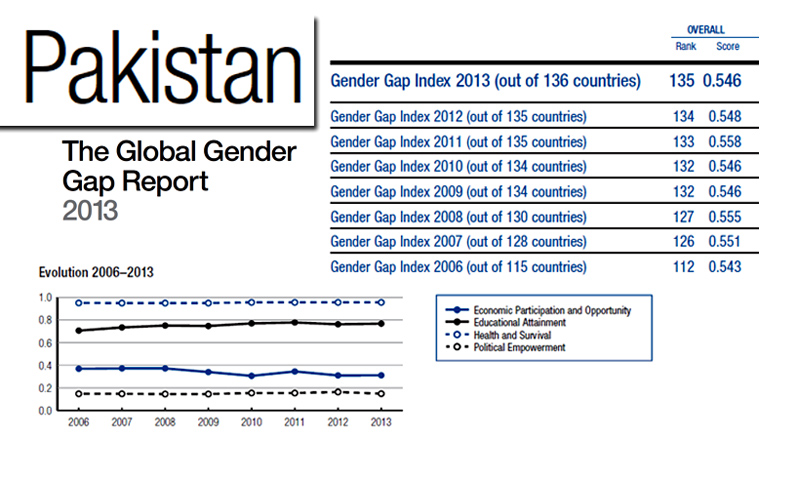 Pakistan ranks as the world’s second-worst country in terms of gender equality and equitable division of resources and opportunities among men and women, says a report published Friday.
The Global Gender Gap Report 2013, published by the World Economic Forum in collaboration with faculty at Harvard University and the University of California, Berkeley, assesses 136 countries, representing more than 93 per cent of the world’s population, on how well resources and opportunities are divided among male and female populations.
According to the index, Iceland tops the list with the most equitable sharing of resources among the sexes, followed closely by north European countries such as Finland, Norway and Sweden.
Pakistan comes down at 135, followed only by Yemen, and its score has fallen three spots since the study was conducted last year.
The comprehensive annual report measures the size of the gender inequality gap in four areas, including economic participation and opportunity (salaries, participation and highly skilled employment), educational attainment (access to basic and higher levels of education), political empowerment (representation in decision-making structures), health and survival (life expectancy and sex ratio).
According to the index, Pakistan ranks second-worst in economic participation and opportunity, eighth-worst in terms of equal access to education, 13th from the bottom in terms of health and survival.
Surprisingly, the magnitude of disparities is much smaller in Pakistan when it comes to political empowerment and representation in decision-making structures among the two sexes, with a rank of 64 among 136 countries.
Among neighbouring countries, China ranked at 69, Bangladesh at 75, India at 101 and Iran at 130. Afghanistan was not included in the study.
Global gender gap narrows slightly in 2013
According to the report, gender disparity narrowed slightly in the current year on the back of definite if not universal improvements in economic equality and political participation between the sexes.
Overall, the report found Iceland the most advanced country in the world in terms of gender equality for the fifth year running. It, along with Finland (2nd), Norway (3rd) and Sweden (4th), has now closed over 80 per cent of its gender gap. These countries were joined in the top 10 by the Philippines, which enters the top five for the first time, Ireland (6th), New Zealand (7th), Denmark (8th), Switzerland (9th) and Nicaragua (10th).
At the global level, the report found that in 2013, 96 per cent of the health and survival gender gap has now been closed. “It is the only one of the four pillars that has widened since the report was first compiled in 2006.”
The global gender gap stands at 93 per cent in terms of education, with 25 countries having closed their gaps completely.
The report says gender gaps for economic equality and political participation are only 60 per cent and 21 per cent closed respectively, although progress is being made in these areas, with political participation narrowing by almost 2 per cent over the last year.
In both developing and developed countries alike, relative to the numbers of women in tertiary education and in the workforce overall, women’s presence in economic leadership positions is limited, it adds.
Pakistan ranks as the world’s second-worst country in terms of gender equality and equitable division of resources and opportunities among men and women, says a report published Friday.
The Global Gender Gap Report 2013, published by the World Economic Forum in collaboration with faculty at Harvard University and the University of California, Berkeley, assesses 136 countries, representing more than 93 per cent of the world’s population, on how well resources and opportunities are divided among male and female populations.
According to the index, Iceland tops the list with the most equitable sharing of resources among the sexes, followed closely by north European countries such as Finland, Norway and Sweden.
Pakistan comes down at 135, followed only by Yemen, and its score has fallen three spots since the study was conducted last year.
The comprehensive annual report measures the size of the gender inequality gap in four areas, including economic participation and opportunity (salaries, participation and highly skilled employment), educational attainment (access to basic and higher levels of education), political empowerment (representation in decision-making structures), health and survival (life expectancy and sex ratio).
According to the index, Pakistan ranks second-worst in economic participation and opportunity, eighth-worst in terms of equal access to education, 13th from the bottom in terms of health and survival.
Surprisingly, the magnitude of disparities is much smaller in Pakistan when it comes to political empowerment and representation in decision-making structures among the two sexes, with a rank of 64 among 136 countries.
Among neighbouring countries, China ranked at 69, Bangladesh at 75, India at 101 and Iran at 130. Afghanistan was not included in the study.
Global gender gap narrows slightly in 2013
According to the report, gender disparity narrowed slightly in the current year on the back of definite if not universal improvements in economic equality and political participation between the sexes.
Overall, the report found Iceland the most advanced country in the world in terms of gender equality for the fifth year running. It, along with Finland (2nd), Norway (3rd) and Sweden (4th), has now closed over 80 per cent of its gender gap. These countries were joined in the top 10 by the Philippines, which enters the top five for the first time, Ireland (6th), New Zealand (7th), Denmark (8th), Switzerland (9th) and Nicaragua (10th).
At the global level, the report found that in 2013, 96 per cent of the health and survival gender gap has now been closed. “It is the only one of the four pillars that has widened since the report was first compiled in 2006.”
The global gender gap stands at 93 per cent in terms of education, with 25 countries having closed their gaps completely.
The report says gender gaps for economic equality and political participation are only 60 per cent and 21 per cent closed respectively, although progress is being made in these areas, with political participation narrowing by almost 2 per cent over the last year.
In both developing and developed countries alike, relative to the numbers of women in tertiary education and in the workforce overall, women’s presence in economic leadership positions is limited, it adds.
Why Saudi Arabia can't ban women from driving forever
There's something extraordinary happening in Saudi Arabia right now. I should know -- you see, I was born there, lived there half my life, speak the language and understand the customs. Lately, I'm both amazed at and humbled by what I'm seeing: Extremely brave Saudi women, more driven than ever to change their society, despite the sad fact that they still aren't allowed to drive.
And while it's true there's no formal law that bans females from getting behind the wheel in the ultra-conservative kingdom, it is also by no means a stretch to say they are, indeed, prohibited from doing so. Unfortunately, that's just the way it's always been in a society where religious edicts are often interpreted to mean it is illegal for women to drive.
I've reported on this subject for years and must admit, it's a personal one for me. Some of my earliest memories entail trying to figure out why my American mother would always drive me around Oklahoma City, where we spent our summers, but could never take me around Jeddah, where we lived the rest of the year.
To be honest, I only began pondering that mystery at the age of four on the days when my Saudi father was out of town on business, our driver was off, and I wanted ice cream. In the U.S., it was easy for my mom and I to hop in her car and go grab a banana split. What I wanted to know was why it was such a big deal in Saudi Arabia. Now, as a new online campaign urging Saudi women to defy their country's driving ban kicks into high gear, I find myself reflecting on how much the issue has impacted my life.
Much of it goes back to one brutally hot afternoon when I was 6 years old, living in Jeddah, playing in the front yard -- completely startled seeing my 15-year-old neighbor sneaking out of her house dressed like her Saudi father. She wasn't just wearing his clothes, she'd drawn a moustache on her face and was hoisting his car keys too.
Her mission was simple but dangerous: Take her dad's car for a spin around the neighborhood as he napped. In any other country, a simple act of rebellion. In Saudi Arabia, one that can, and has, gotten women arrested.
A few days ago, as we were filming our latest report on the women's driving campaign, I asked prominent Saudi journalist Buthaina Al-Nasr if she'd ever done anything similar.
Laughing at the memory, she admitted how, once, at the age of 14, she'd borrowed her older brother's car and taken it for a spin around the farm, far from the traffic of the city and any of its police.
Buthaina went on, describing how much she and her female friends longed to drive cars. She explained how they also wanted to ride bikes, or even just simply walk around "freely" - other activities for which Saudi women can face severe disapproval. There was really only one solution.
"We'd dress up like men," explained Buthaina, "like boys, and we'd go around and it felt fun."
Her anecdote made me smile even as it struck me as terribly sad. You see, "fun" is something that many of my female Saudi relatives told me over and over again they needed a lot more of.
It was the main reason my neighbor took her dad's car for that joyride -- which she'd been able to do without getting caught. To me, seeing how absolutely exhilarating the experience had been for her, she'd become a hero. A couple of days later, I asked her when she'd do it again. A funny look appeared on her face.
"I don't know. I'm not sure what the point is," she told me. "It'll just make me want to keep driving more and more. I shouldn't want that."
It took me a long time to finally understand. She'd had a small but wonderful taste of fun and freedom, one she felt most Saudi women would never get. That made it hard to deal with, harder still for her to do it again. For her, it ended up being more bitter than sweet.
In Saudi Arabia, women aren't simply kept from obtaining drivers' licenses. No, they must contend with many more restrictions. The country's mandatory guardianship system means women cannot legally be responsible for their own affairs. As such, a growing number of voices, both male and female, are calling for those laws to be repealed.
Author Abdullah Al-Alami, one of the most prominent Saudi men supporting the women's new driving campaign, is among them.
"There is a group of ultraconservatives here who will try to do anything and everything to prevent women from exercising their rights," Al-Alami told me. "Be it driving, going to school, working, traveling for that matter, receiving medical care. Many men that I know, we feel that it is crucial for us to support women who do this."
During my formative years, I was lucky -- I got to spend lots of time with very strong, independent, assertive women. My American mother, Saudi aunts and female cousins - they discussed women's rights all the time. I listened to countless conversations where it was decided how it would be impossible for Saudi Arabia to forever bar women from driving.
They said the reasons were numerous: that it didn't make sense economically; that it was too much of a burden on families to hire drivers; that Saudi society was advancing.
And then there was the horror story recounted by my aunt about the woman who lived down the street from her -- the woman whose husband was at work, whose driver was running an errand, whose child had been injured. There was no way for her to get him to the hospital in time.
The laws will have to change, they'd say. In five to 10 years, they insisted, women would, no doubt, be allowed to drive. I first heard that refrain 33 years ago, in 1980, before my parents and I moved to Riyadh, Saudi Arabia's capital.
I've been hearing it ever since. It wasn't until 1991 that I thought the time might have finally come. That's when 47 women protested the prohibition by driving through the streets of Riyadh. It was scandalous -- dozens of the women were detained, banned from travel and suspended from their workplaces.
A second ray of hope appeared in May 2011, when prominent women's rights activist Manal Al-Sharif uploaded to YouTube a video of herself driving in Saudi Arabia. As a result, she spent nine days in jail. But on June 17, dozens of women across Saudi Arabia, emboldened and inspired by her ordeal, went ahead, risked punishment and participated in the "Women2Drive" campaign -- they didn't just drive around, they also filmed and uploaded videos of themselves doing so. Still the laws did not change.
And now, the latest iteration is at hand. The October 26 Women's Driving Campaign has so far garnered more than 16,000 signatures on its online petition, but as it turns out, women aren't waiting until October 26. Many have already gone out, taken videos, posted them online. It's incredible to see.
Buthaina Al-Nasr is an active supporter of the campaign. She lives in Lebanon now but talked to me at length about why the Saudi government needs to finally lift the ban -- after all, it is the last country in the world that does not allow women to drive.
After driving her eight-year-old son Hisham to school, she told me a bit more about how much she'd love to be able to do the same in Saudi Arabia. She then shared a recurring daydream she has about being able to drive a car in her home country while wearing a dress -- not while dressed up like her father or brother.
"It's a silly daydream," she told me, "but that's a fact. It's the reality of my society."
Then she added, "I mean the daydream of a young girl should be how to get to the moon ... Not driving a car."
Saudi Arabia's women plan day of action to change driving laws
 Saudi women are gearing up for a day of action to challenge the kingdom's ban on female driving, amid signs of slowly growing readiness by the authorities to consider reform despite strong opposition by the clerical establishment.
Twitter, Facebook and other social media have been used to get women drivers on the roads on Saturday in a marathon push against this unique restriction.
Activists say they have 16,600 signatures on an online petition calling for change. Efforts to publicise the issue by the "October 26 driving for women" group have been described as the best-organised social campaign ever seen in Saudi Arabia, where Twitter has millions of users and is used to circulate anonymous information and gossip about the monarchy and official corruption.
Now the mainstream press is getting involved too, a telling indication of a thaw on this issue. "It's time to end this absurd debate about women driving," wrote Dr Thuraya al-Arid in the al-Jazirah newspaper. In another paper, al-Sharq al-Awsat, Mshari Al-Zaydi said: "The time has come to turn the page on the past and discuss this issue openly."
Previous attempts to promote change fizzled out in arrests for public order offences and demoralisation. In 2011, activist Manal al-Sharif made a YouTube video urging women to join her in driving their own cars, and was imprisoned for over a week. But the signs are far more positive now.
Three female members of the shura (advisory) council – among 30 who were appointed in January by the 90-year-old King Abdullah – recommended this month that the ban be rescinded, though no debate has yet taken place. Latifa al-Shaalan, Haya al-Mani and Muna al-Mashit urged the council to "recognise the rights of women to drive a car in accordance with the principles of sharia [Islamic law] and traffic laws".
The three – praised by supporters for "stirring the stagnant water" – framed their argument with careful references to fatwas (religious edicts) banning women from being in the company of an unrelated male (such as a driver). Other suggestions designed to reassure critics are appointing female traffic police and driving instructors. Cost is another big factor with families having to employ chauffeurs, as is convenience.
Signs of powerful opposition, however, are still easy to detect. This week 150 clerics and religious scholars held a rare public protest outside King Abdullah's palace in Jeddah to object to "westernisation" and "the conspiracy of women driving," blaming the US – a byword in traditionalist circles for anything distasteful or immoral – for being behind the campaign.
Until then, the government had conspicuously refrained from cracking down. But on Wednesday the interior ministry issued a stern pre-emptive warning that unlawful assemblies and marches would not be tolerated, and invoked the danger of sedition. But on a closer reading, activists noted, the ministry did not actually attack the idea of dropping the ban. "They are not saying clearly that women shouldn't drive," the writer Maha al-Aqeel told the Guardian. "The government wants to stay on the middle ground."
Neither sharia law nor national traffic regulations explicitly ban women from driving, but they are not issued licenses.
Campaigners have been emboldened by the low-key official response, with some emulating Sharif and uploading films on social media of themselves driving. In a video posted by the well-known blogger Eman al-Najfan, a female driver is seen cruising down a relatively busy road while passing motorists give enthusiastic thumbs-up signs in support. The campaign has its own YouTube channels and an Instagram account.
As expectations mount, many Saudi fathers are teaching their daughters to drive. "People are positive that things are going to change," said the journalist Abeer al-Mishkhas. "They just hope it will come soon. The government says it is waiting to see if society is becoming more tolerant."
Arguments aimed at keeping women off the roads can be shocking and nonsensical. "If a woman drives a car … not out of pure necessity … that could have negative physiological impacts as functional and physiological medical studies show that it automatically affects the ovaries and pushes the pelvis upwards," warned Sheikh Saleh bin Saad al-Lohaidan, adviser to an association of Gulf psychologists. Women who were aiming to overturn the driving ban should put "reason ahead of their hearts, emotions and passions," he suggested.
Najfan argued in a commentary for Amnesty International that the fundamental issue was challenging patriarchy. "If there was one word to describe what it is like to be a Saudi woman, it would be the word patronising.. No matter how long you live, you remain a minor in the eyes of the government."
Maha al-Aqeel sees driving as the thin end of a wedge of gradual reform in Saudi Arabia. "Driving is such a visible and symbolic thing," she said. "It's not like women on the shura council – you cannot see that and you cannot see advances for women in the workplace. Many conservatives feel that if women get the right to drive then that's it, the last bastion of male control will fall.
"I think it should lead to other changes. That's why those who oppose it are so vehement. And that's why the government is treading so carefully. It does not want to cause a big uproar."
Saudi women are gearing up for a day of action to challenge the kingdom's ban on female driving, amid signs of slowly growing readiness by the authorities to consider reform despite strong opposition by the clerical establishment.
Twitter, Facebook and other social media have been used to get women drivers on the roads on Saturday in a marathon push against this unique restriction.
Activists say they have 16,600 signatures on an online petition calling for change. Efforts to publicise the issue by the "October 26 driving for women" group have been described as the best-organised social campaign ever seen in Saudi Arabia, where Twitter has millions of users and is used to circulate anonymous information and gossip about the monarchy and official corruption.
Now the mainstream press is getting involved too, a telling indication of a thaw on this issue. "It's time to end this absurd debate about women driving," wrote Dr Thuraya al-Arid in the al-Jazirah newspaper. In another paper, al-Sharq al-Awsat, Mshari Al-Zaydi said: "The time has come to turn the page on the past and discuss this issue openly."
Previous attempts to promote change fizzled out in arrests for public order offences and demoralisation. In 2011, activist Manal al-Sharif made a YouTube video urging women to join her in driving their own cars, and was imprisoned for over a week. But the signs are far more positive now.
Three female members of the shura (advisory) council – among 30 who were appointed in January by the 90-year-old King Abdullah – recommended this month that the ban be rescinded, though no debate has yet taken place. Latifa al-Shaalan, Haya al-Mani and Muna al-Mashit urged the council to "recognise the rights of women to drive a car in accordance with the principles of sharia [Islamic law] and traffic laws".
The three – praised by supporters for "stirring the stagnant water" – framed their argument with careful references to fatwas (religious edicts) banning women from being in the company of an unrelated male (such as a driver). Other suggestions designed to reassure critics are appointing female traffic police and driving instructors. Cost is another big factor with families having to employ chauffeurs, as is convenience.
Signs of powerful opposition, however, are still easy to detect. This week 150 clerics and religious scholars held a rare public protest outside King Abdullah's palace in Jeddah to object to "westernisation" and "the conspiracy of women driving," blaming the US – a byword in traditionalist circles for anything distasteful or immoral – for being behind the campaign.
Until then, the government had conspicuously refrained from cracking down. But on Wednesday the interior ministry issued a stern pre-emptive warning that unlawful assemblies and marches would not be tolerated, and invoked the danger of sedition. But on a closer reading, activists noted, the ministry did not actually attack the idea of dropping the ban. "They are not saying clearly that women shouldn't drive," the writer Maha al-Aqeel told the Guardian. "The government wants to stay on the middle ground."
Neither sharia law nor national traffic regulations explicitly ban women from driving, but they are not issued licenses.
Campaigners have been emboldened by the low-key official response, with some emulating Sharif and uploading films on social media of themselves driving. In a video posted by the well-known blogger Eman al-Najfan, a female driver is seen cruising down a relatively busy road while passing motorists give enthusiastic thumbs-up signs in support. The campaign has its own YouTube channels and an Instagram account.
As expectations mount, many Saudi fathers are teaching their daughters to drive. "People are positive that things are going to change," said the journalist Abeer al-Mishkhas. "They just hope it will come soon. The government says it is waiting to see if society is becoming more tolerant."
Arguments aimed at keeping women off the roads can be shocking and nonsensical. "If a woman drives a car … not out of pure necessity … that could have negative physiological impacts as functional and physiological medical studies show that it automatically affects the ovaries and pushes the pelvis upwards," warned Sheikh Saleh bin Saad al-Lohaidan, adviser to an association of Gulf psychologists. Women who were aiming to overturn the driving ban should put "reason ahead of their hearts, emotions and passions," he suggested.
Najfan argued in a commentary for Amnesty International that the fundamental issue was challenging patriarchy. "If there was one word to describe what it is like to be a Saudi woman, it would be the word patronising.. No matter how long you live, you remain a minor in the eyes of the government."
Maha al-Aqeel sees driving as the thin end of a wedge of gradual reform in Saudi Arabia. "Driving is such a visible and symbolic thing," she said. "It's not like women on the shura council – you cannot see that and you cannot see advances for women in the workplace. Many conservatives feel that if women get the right to drive then that's it, the last bastion of male control will fall.
"I think it should lead to other changes. That's why those who oppose it are so vehement. And that's why the government is treading so carefully. It does not want to cause a big uproar."
Pakistan: Law ministry submits new order...under Zardari's name
The Express TribuneThe law ministry issued a new official government order under the name of former president Asif Ali Zardari, Express News reported Thursday. Three presidential orders pertaining to the salaries of judges were issued on October 7 and were printed in the official gazette on October 9. Two of the documents bore President Mamnoon Hussain’s name on them while the third had the former president’s name on it. All three were issued and printed on the same dates creating the illusion that two presidents were in power at the same time. This comes a month after Zardari stepped down as president on September 8 and was replaced by Mamnoon Hussain on September 9.
India, Pakistan Exchange Gunfire Over Border
 At least a dozen people have been wounded as Indian and Pakistani troops exchanged gunfire over the border in the disputed Himalayan region of Kashmir, officials said Friday.
An Indian official said at least 10 civilians were wounded as Pakistani troops fired guns and mortar shells at more than a dozen Indian border posts overnight in the disputed Himalayan region of Kashmir,
A paramilitary officer said on the customary condition of anonymity that Indian guards retaliated and an exchange of gunfire lasted several hours. He said the fighting continued till Friday morning at some places in southern Jammu region.
The wounded included four children in three villages, said local civil administrator Shantmanu, who uses only one name.
In Islamabad, Pakistani military officials said Indian troops resorted to unprovoked firing and mortar shelling in a village near Sialkot early Friday, wounding two civilians. The officials spoke on condition of anonymity in line with military policy.
Pakistani Foreign Ministry spokesman Aizaz Ahmad Chaudhry called the cease-fire violations "a matter of great concern," and reiterated Prime Minister Nawaz Sharif's commitment to improving relations with India.
Chaudhary told reporters that Pakistani troops do not fire indiscriminately and emphasized that Pakistan has no interest in creating problems along the border.
"Our troops have a policy. We will not indulge in firing first. But if we are fired upon we will give a responsible and effective response," he said.
India on Wednesday accused Pakistani troops of firing on at least 50 Indian border posts, calling it the most serious violation of a 2003 cease-fire accord.
However, Pakistan said Indian troops targeted 27 Pakistani posts near Sialkot with machine guns and mortar shells.
The gunfire resumed Thursday night after a lull during the day.
Vivek Katju, a retired Indian diplomat, on Friday accused Pakistan of seeking to raise the temperature over Kashmir to get international attention, but added that approach has not worked as the United States and other countries have declined to mediate in the dispute.
While the cease-fire has largely held for the past decade, sporadic violations are not uncommon. Since January this year the two nuclear-armed neighbors have regularly accused each other of initiating the fighting by firing mortar shells or gunshots across the frontier.
The latest incidents come even though the Pakistani and Indian prime ministers meet last month in New York and agreed on the need to reduce tensions.
India has accused Pakistan of nearly 200 violations of the 2003 cease-fire agreement this year.
The countries have fought two wars over control of Kashmir, which is divided between them and claimed by both.
India regularly accuses Pakistan of supporting Kashmiri rebels who have been fighting on the Indian side since 1989 for independence or a merger with Pakistan.
An estimated 68,000 people have been killed in the conflict, though most resistance is now shown through street protests. Pakistan denies giving any backing to the rebels beyond moral support.
At least a dozen people have been wounded as Indian and Pakistani troops exchanged gunfire over the border in the disputed Himalayan region of Kashmir, officials said Friday.
An Indian official said at least 10 civilians were wounded as Pakistani troops fired guns and mortar shells at more than a dozen Indian border posts overnight in the disputed Himalayan region of Kashmir,
A paramilitary officer said on the customary condition of anonymity that Indian guards retaliated and an exchange of gunfire lasted several hours. He said the fighting continued till Friday morning at some places in southern Jammu region.
The wounded included four children in three villages, said local civil administrator Shantmanu, who uses only one name.
In Islamabad, Pakistani military officials said Indian troops resorted to unprovoked firing and mortar shelling in a village near Sialkot early Friday, wounding two civilians. The officials spoke on condition of anonymity in line with military policy.
Pakistani Foreign Ministry spokesman Aizaz Ahmad Chaudhry called the cease-fire violations "a matter of great concern," and reiterated Prime Minister Nawaz Sharif's commitment to improving relations with India.
Chaudhary told reporters that Pakistani troops do not fire indiscriminately and emphasized that Pakistan has no interest in creating problems along the border.
"Our troops have a policy. We will not indulge in firing first. But if we are fired upon we will give a responsible and effective response," he said.
India on Wednesday accused Pakistani troops of firing on at least 50 Indian border posts, calling it the most serious violation of a 2003 cease-fire accord.
However, Pakistan said Indian troops targeted 27 Pakistani posts near Sialkot with machine guns and mortar shells.
The gunfire resumed Thursday night after a lull during the day.
Vivek Katju, a retired Indian diplomat, on Friday accused Pakistan of seeking to raise the temperature over Kashmir to get international attention, but added that approach has not worked as the United States and other countries have declined to mediate in the dispute.
While the cease-fire has largely held for the past decade, sporadic violations are not uncommon. Since January this year the two nuclear-armed neighbors have regularly accused each other of initiating the fighting by firing mortar shells or gunshots across the frontier.
The latest incidents come even though the Pakistani and Indian prime ministers meet last month in New York and agreed on the need to reduce tensions.
India has accused Pakistan of nearly 200 violations of the 2003 cease-fire agreement this year.
The countries have fought two wars over control of Kashmir, which is divided between them and claimed by both.
India regularly accuses Pakistan of supporting Kashmiri rebels who have been fighting on the Indian side since 1989 for independence or a merger with Pakistan.
An estimated 68,000 people have been killed in the conflict, though most resistance is now shown through street protests. Pakistan denies giving any backing to the rebels beyond moral support.
Balochs Protest Outside White House As Sharif Meets Obama
The Baloch Hal
 Members of the Baloch community protested outside the White House on Wednesday morning as Pakistan’s Prime Minister Nawaz Sharif met with U.S. President Barrack Obama as a part of his three-day long trip to Washington, D.C.
The protesters, who came from different U.S. cities, condemned Islamabad’s fresh military operations against Baloch political activists, including the kill and dump activities and forced disappearances attributed to Pakistani intelligence agencies. Native Balochs from Irani and Pakistani Balochistan attended the protest while several American citizens also participated in the march outside the U.S. president’s residence.
The protest was led by Dr. M. Hossein Bor, a prominent Baloch lawyer who had also testified at the U.S. Congressional hearing on Balochistan in February 2012 and the participants included Laurie Deamer, the U.S. representative of the Baloch Human Rights Council.
Members of the Baloch community protested outside the White House on Wednesday morning as Pakistan’s Prime Minister Nawaz Sharif met with U.S. President Barrack Obama as a part of his three-day long trip to Washington, D.C.
The protesters, who came from different U.S. cities, condemned Islamabad’s fresh military operations against Baloch political activists, including the kill and dump activities and forced disappearances attributed to Pakistani intelligence agencies. Native Balochs from Irani and Pakistani Balochistan attended the protest while several American citizens also participated in the march outside the U.S. president’s residence.
The protest was led by Dr. M. Hossein Bor, a prominent Baloch lawyer who had also testified at the U.S. Congressional hearing on Balochistan in February 2012 and the participants included Laurie Deamer, the U.S. representative of the Baloch Human Rights Council.
Pakistan's list of grouses grow, US unmoved
http://timesofindia.indiatimes.com/Pakistan’s Prime Minister Nawaz Sharif trooped into the White House on Wednesday for a meeting with President Obama in the face of multiple repudiations from the United States over Islamabad’s pet peeves: Drone strikes on Pakistan, its gripes against India over the Kashmir issue, and pleas that Washington treat it on par with New Delhi by accepting it as a nuclear equal. The meeting with the U.S President was going on at the time of writing and there was no read-out yet, but the Obama administration made it clear on Tuesday that it did not particularly share Pakistan’s perception on any of these issues, starting with its handwringing over drone attacks on its lawless territory, accentuated by a well-timed Amnesty report highlighting some civilian casualties. White House spokesman Jay Carney set the stage for a rejection of Pakistan’s plea to stop drone strikes, saying U.S counterterrorism operations are precise, lawful, and effective, and they in fact minimize civilian casualties that would be greater if other conventional means were adopted to eliminate terrorists. "The United States does not take lethal strikes when we or our partners have the ability to capture individual terrorists. Our preference is always to detain, interrogate, and prosecute. We take extraordinary care to make sure that our counterterrorism actions are in accordance with all applicable domestic and international law and that they are consistent with US values and US policy," Carney said, adding, "Before we take any counterterrorism strike outside areas of active hostilities, there must be near certainty that no civilians will be killed or injured, and that is the highest standard we can set," he said. However, both sides are expected to project language that will minimize differences on this subject, with Washington promising to ease off the strikes as more and more suspected terrorists are eliminated, and praising Pakistan’s fight against terrorism despite its dubious credentials on this count. The U.S media was already predicting the pitch would be taking spin, with a headline in one newspaper reading, ''drones? What drones? Obama and Pakistan's Sharif to accentuate the positive.'' Various agreements, including one on science and technology cooperation, are being wheeled out to cover the tracks of disagreements, including over India’s role in Afghanistan, and more broadly the growing regional and global heft that Washington is helping New Delhi develop. Earlier this week, the Obama administration snubbed Sharif over his plea that Washington should mediate between India and Pakistan over the Kashmir issue, saying it was for the two sides to take care of this issue. In fact, despite the controversy over Sharif’s reported putdown of Prime Minister Manmohan Singh (that he brings his complaints against Pakistan to Washington), it is Pakistan that has kept up an incessant reference to India, making it very much part of its gripe list. The Obama administration has entertained this only in the sense of trying to wean Pakistan out of its New Delhi complex of constantly seeking parity with it. Washington, US officials indicated ahead of the meeting, wants to have strong ties with Pakistan on its own without sharing its prejudice against India. The White House has not scheduled a media interaction at the Obama-Sharif meeting, much less an extended news conference, fearful of awkward questions. Even at a think-tank event on Tuesday, where Sharif made a speech, only the host former National Security Advisor Stephen Hadley posed three softball question before closing the meeting, keeping audience out of it. But it is not hard to discern that Sharif has had a torrid visit so far. There have been protocol putdowns, including him being entertained by Secretary of State John Kerry for dinner after he arrived on Sunday (while Obama was out playing golf with White House staffers), cooling his heels on Monday and Tuesday while the Obama dealt with other issues, and on Wednesday, having to breakfast with vice-president Joe Biden (who, according to the White House schedule, then proceeded to have lunch with Obama) before the U.S President deigned to see him in the afternoon. The charitable explanation for all this is the Sharif is Pakistan's Prime Minister, not President, but that brings to attention the extraordinary deference Obama has shown to Prime Minister Manmohan Singh. Sharif also faced a rough time on the Hill on Tuesday when he was questioned closely by the House Foreign Relations Committee over the continued incarceration of Dr Shakil Afridi, who helped the U.S nail Osama bin Laden, and Pakistan’s continued patronage of Lashkar-e-taiba. “I specifically pressed the Prime Minister to release Dr. Shakil Afridi and encouraged him to ensure that his nation is in fact a responsible and effective partner in countering terrorism, proliferation and violent extremism in the region,” Committee chairman Ed Royce said later. His ranking colleague Eliot Engel was equally unsparing. “While I appreciate the magnitude of the challenges faced by the Prime Minister, and consider Pakistan an important partner of the United States, I also made clear to him that many in Congress remain frustrated by Islamabad’s schizophrenic approach to countering violent extremist groups, including those that continue to attack US troops in Afghanistan,” Engel said.
PCC Terms PM Sharif’s Visit To US As “Unsuccessful”

Pakistan Christian Congress terms PM Sharif’s visit to the US as unsuccessful.In line with details, the Central Executive Council of Pakistan Christian Congress PCC gathered in a meeting; thus terming “visit of Pakistan Prime Minister Mian Nawaz Sharif to United States as unsuccessful on failure to secure end to Drone attacks and guarantees to resolve Kashmir issue according to UN Resolutions.” Additionally the Executive Council of Pakistan Christian Congress has also released a press note including an official statement from the President of Pakistan Christian Congress Dr. Nazir S Bhatti who is in Philadelphia these days. Dr. Bhatti said, “It seems that Mian Nawaz Sharif government has decided to totally ignore Christians in Pakistan as well as Pakistani Christian Diaspora in Western countries when he denied to meet EU and NA delegation of Christians of Pakistani origin in Washington DC and on his directions Pakistani Embassy in USA ignored to invite Christians in Pakistani Community gathering of 500 Muslims whom Pak Premier addressed.” Pakistan Christian Congress Head said in his statement that “Government of Pakistan Muslim League decision to apartheid Christian was duly displayed by Pakistan Embassy in Washington DC when it considered only Muslims to be Pakistani Community and invited them to participate and to witness Mian Nawaz Sharif speech on foreign and interior policies of PML (N) in Pakistan.” Dr. Bhatti added, “The time has come that Pakistani Christian Diaspora to act like Azad Kashmir Muslim Diaspora to raise voice for persecuted Pakistani Christians and to struggle like Israel Diaspora which secured land for Jews for a homeland in Promised Land in Middle East.” Dr. Nazir Bhatti said “All India Christian League supported All India Muslim League in Pakistan Movement during British colonial rule in sub-continent of India, voted in favour of formation of Pakistan in London Round Table Conferences of 1930-32 and made possible to fall Punjab in lot of Pakistan with presentation before Boundary Commission but it seems that Muslims in Pakistan have decided to push Christians from mainstream of society.” “Our voting right is snatched by Muslim majority and imposes selected tools from Christian in parliament, our Churches are attacked, our women are forcibly converted to Islam and our Christian youth is deprived of their right in employment and education in Pakistan” said Dr. Bhatti PCC President asserted that,” Christians are treated like second class citizen and we are pushed to invite UNO and International community to rescue Pakistani Christian.” “Pakistan Government decision to push Pakistani Christian out of mainstream and initiated from Pakistan Embassy in Washington DC will unite Christians to expedite their struggle for due share in resources of Pakistan,” he continued. - See more at: http://www.christiansinpakistan.com/pcc-terms-pm-sharifs-visit-to-us-as-unsuccessful/#sthash.HxGRfLC8.dpuf
Subscribe to:
Posts (Atom)