 By Tim Craig
A former Pakistani prime minister strongly denied Thursday that he had quietly authorized U.S. drone strikes inside his country, but he didn’t rule out secret deals made without his knowledge.
A day earlier, a Washington Post report detailed how the United States and Pakistan communicated about, and in some cases coordinated, dozens of drone strikes in Pakistan from late 2007 to late 2011. But Yousuf Raza Gilani, who was the country’s prime minister from 2008 to 2012, said it was “totally absurd” to suggest that his government had condoned the attacks.
“During my government, there was no such support given to drone strikes whatsoever,” Gilani said in an interview, adding that he had discussed with President Obama in 2010 “how this strategy with drones was counterproductive and undermining our anti-terror efforts.”
He said he could not rule out that the two nations had communicated about planned drone strikes during his tenure. But if they did, he said, the parties involved would have been the CIA and Pakistan’s Inter-
Services Intelligence agency, under conditions set by Pervez Musharraf, the former military ruler.
“The permission must have been given earlier,” said Gilani, who was also cited in a 2010 WikiLeaks report as being privately supportive of some strikes. “After 9/11, the U.S. rang up Musharraf and said, ‘You are either with us or you are not with us,’ and he said, ‘We are with you.’ ”
In an interview with CNN last year, Musharraf admitted to authorizing “a few” U.S. drone strikes before he stepped down in 2008. Pakistan’s Express Tribune newspaper reported Thursday that a former top-ranking military commander who had served under Musharraf, retired Lt. Gen. Shahid Aziz, is calling for Musharraf to be charged with extrajudicial murder for his role in the drone campaign.
Musharraf is under house arrest in Islamabad on several charges stemming from his autocratic tenure.
But The Post’s report details coordination as recently as 2011, causing some analysts to suspect that Musharraf’s successors also were aware of some U.S. strike targets.
“This puts cold water on the hype,” said Talat Masood, a retired Pakistani general and a military analyst, referring to the public anger in Pakistan over U.S. attacks. “I think people knew it already, but this makes it much more obvious, and the [Pakistani] media and others will have to cool off.”
Pakistan’s current prime minister, Nawaz Sharif, who took office in June, has made stopping the drone campaign a top priority. He raised the issue during a meeting with Obama at the White House on Wednesday. Aizaz Ahmad Chaudhry, a spokesman for the Foreign Ministry, said Thursday that the government remains united in seeking an end to the strikes.
“Whatever understandings there may or may not have been in the past, the present government has been very clear regarding its policy on the issue,” Chaudhry said. “We regard such strikes as a violation of our sovereignty as well as international law.”
Saeed Ghani, a Pakistani lawmaker, said he suspects that some U.S. drone strikes did have the tacit approval of government or military leaders here. But he said Sharif and other politicians are under tremendous pressure from the public to stop them.
“There probably was some understanding,” Ghani said. “But it’s now very difficult for political governments to carry on those understandings.”
By Tim Craig
A former Pakistani prime minister strongly denied Thursday that he had quietly authorized U.S. drone strikes inside his country, but he didn’t rule out secret deals made without his knowledge.
A day earlier, a Washington Post report detailed how the United States and Pakistan communicated about, and in some cases coordinated, dozens of drone strikes in Pakistan from late 2007 to late 2011. But Yousuf Raza Gilani, who was the country’s prime minister from 2008 to 2012, said it was “totally absurd” to suggest that his government had condoned the attacks.
“During my government, there was no such support given to drone strikes whatsoever,” Gilani said in an interview, adding that he had discussed with President Obama in 2010 “how this strategy with drones was counterproductive and undermining our anti-terror efforts.”
He said he could not rule out that the two nations had communicated about planned drone strikes during his tenure. But if they did, he said, the parties involved would have been the CIA and Pakistan’s Inter-
Services Intelligence agency, under conditions set by Pervez Musharraf, the former military ruler.
“The permission must have been given earlier,” said Gilani, who was also cited in a 2010 WikiLeaks report as being privately supportive of some strikes. “After 9/11, the U.S. rang up Musharraf and said, ‘You are either with us or you are not with us,’ and he said, ‘We are with you.’ ”
In an interview with CNN last year, Musharraf admitted to authorizing “a few” U.S. drone strikes before he stepped down in 2008. Pakistan’s Express Tribune newspaper reported Thursday that a former top-ranking military commander who had served under Musharraf, retired Lt. Gen. Shahid Aziz, is calling for Musharraf to be charged with extrajudicial murder for his role in the drone campaign.
Musharraf is under house arrest in Islamabad on several charges stemming from his autocratic tenure.
But The Post’s report details coordination as recently as 2011, causing some analysts to suspect that Musharraf’s successors also were aware of some U.S. strike targets.
“This puts cold water on the hype,” said Talat Masood, a retired Pakistani general and a military analyst, referring to the public anger in Pakistan over U.S. attacks. “I think people knew it already, but this makes it much more obvious, and the [Pakistani] media and others will have to cool off.”
Pakistan’s current prime minister, Nawaz Sharif, who took office in June, has made stopping the drone campaign a top priority. He raised the issue during a meeting with Obama at the White House on Wednesday. Aizaz Ahmad Chaudhry, a spokesman for the Foreign Ministry, said Thursday that the government remains united in seeking an end to the strikes.
“Whatever understandings there may or may not have been in the past, the present government has been very clear regarding its policy on the issue,” Chaudhry said. “We regard such strikes as a violation of our sovereignty as well as international law.”
Saeed Ghani, a Pakistani lawmaker, said he suspects that some U.S. drone strikes did have the tacit approval of government or military leaders here. But he said Sharif and other politicians are under tremendous pressure from the public to stop them.
“There probably was some understanding,” Ghani said. “But it’s now very difficult for political governments to carry on those understandings.”
Saturday, October 26, 2013
Pakistan’s Gilani acknowledges the possibility of contact with U.S. over planned drone strikes
By Tim Craig
A former Pakistani prime minister strongly denied Thursday that he had quietly authorized U.S. drone strikes inside his country, but he didn’t rule out secret deals made without his knowledge.
A day earlier, a Washington Post report detailed how the United States and Pakistan communicated about, and in some cases coordinated, dozens of drone strikes in Pakistan from late 2007 to late 2011. But Yousuf Raza Gilani, who was the country’s prime minister from 2008 to 2012, said it was “totally absurd” to suggest that his government had condoned the attacks.
“During my government, there was no such support given to drone strikes whatsoever,” Gilani said in an interview, adding that he had discussed with President Obama in 2010 “how this strategy with drones was counterproductive and undermining our anti-terror efforts.”
He said he could not rule out that the two nations had communicated about planned drone strikes during his tenure. But if they did, he said, the parties involved would have been the CIA and Pakistan’s Inter-
Services Intelligence agency, under conditions set by Pervez Musharraf, the former military ruler.
“The permission must have been given earlier,” said Gilani, who was also cited in a 2010 WikiLeaks report as being privately supportive of some strikes. “After 9/11, the U.S. rang up Musharraf and said, ‘You are either with us or you are not with us,’ and he said, ‘We are with you.’ ”
In an interview with CNN last year, Musharraf admitted to authorizing “a few” U.S. drone strikes before he stepped down in 2008. Pakistan’s Express Tribune newspaper reported Thursday that a former top-ranking military commander who had served under Musharraf, retired Lt. Gen. Shahid Aziz, is calling for Musharraf to be charged with extrajudicial murder for his role in the drone campaign.
Musharraf is under house arrest in Islamabad on several charges stemming from his autocratic tenure.
But The Post’s report details coordination as recently as 2011, causing some analysts to suspect that Musharraf’s successors also were aware of some U.S. strike targets.
“This puts cold water on the hype,” said Talat Masood, a retired Pakistani general and a military analyst, referring to the public anger in Pakistan over U.S. attacks. “I think people knew it already, but this makes it much more obvious, and the [Pakistani] media and others will have to cool off.”
Pakistan’s current prime minister, Nawaz Sharif, who took office in June, has made stopping the drone campaign a top priority. He raised the issue during a meeting with Obama at the White House on Wednesday. Aizaz Ahmad Chaudhry, a spokesman for the Foreign Ministry, said Thursday that the government remains united in seeking an end to the strikes.
“Whatever understandings there may or may not have been in the past, the present government has been very clear regarding its policy on the issue,” Chaudhry said. “We regard such strikes as a violation of our sovereignty as well as international law.”
Saeed Ghani, a Pakistani lawmaker, said he suspects that some U.S. drone strikes did have the tacit approval of government or military leaders here. But he said Sharif and other politicians are under tremendous pressure from the public to stop them.
“There probably was some understanding,” Ghani said. “But it’s now very difficult for political governments to carry on those understandings.”
Pakistan: Ex-Envoy Says Misunderstanding Runs on Both Sides of U.S.-Pakistan Ties
 By MARK LANDLER
The meeting between President Obama and Prime Minister Nawaz Sharif at the White House on Wednesday is the most recent attempt by American and Pakistani leaders to reset a fraught relationship.
Husain Haqqani, Pakistan’s former ambassador to Washington, has documented that legacy of mistrust in a new book, “Magnificent Delusions” (Public Affairs, Nov. 5). Mr. Haqqani, a former adviser to Mr. Sharif who now teaches at Boston University, was a victim of those toxic ties, forced out in 2011 amid allegations, which he denies, that he sought American help to rein in the Pakistani military.
We caught up with him here recently, and what follows is an edited transcript of the conversation.
Q. You trace the star-crossed relationship between Pakistan and the United States back to the founding of the Pakistani state in 1947. In what way do the mutual suspicions go back that far?
The mutual misunderstandings start in 1947; the suspicions come later. The misunderstanding was Pakistan’s expectation that the United States would help build it up in its quest for containing Communism. And when the United States built it up, that Pakistan would be able to seek parity with India, which was its primary rival. The Americans had no such intention. The suspicions, in my opinion, are very much contrived as a means of generating public opposition to the United States in Pakistan, and thereby giving the Pakistanis leverage in the relationship.
Q. What is the biggest misconception Pakistanis have about the United States?
The suspicion in Pakistan is that the United States wants to defang Pakistan’s nuclear program, that the United States cannot accept a Muslim country having a strong military, and that America wants Pakistan to be subservient to India, just as it wants the Arabs to be subservient to Israel. It is ironic that a lot of this is based on conspiracy theories that are rampant in Pakistan. Recently, the vice chancellor of Pakistan’s largest university came out with a book that says that the British and American governments are controlled by a high cabal, which manipulates each one of us by putting microchips in our brains.
Q. What is the biggest misconception Americans have about Pakistan?
The biggest misconception the Americans have had is that they can somehow bend Pakistan to their will simply with the leverage of aid. Aid has never given the Americans the leverage they thought they would have. As far as the American public is concerned, it has never really seriously engaged with Pakistan, and the understanding of most Americans about Pakistan is through single-issue prisms: nuclear program one day, terrorism the other. There has never been an effort to understand 180 million people and their aspirations.
Q. Critics of the United States say that Pakistanis feel the United States cultivates Pakistan when it needs it, and abandons it when it no longer needs it. Is that valid?
It is partially valid. Each time, Pakistan also has failed to fulfill promises it made to the United States. However, Pakistanis complain louder than Americans, so therefore, the sequence of who abandoned who is not always fully understood. One of the things I speak of in my book is how Pakistan’s elites almost always misled their people about what they had promised the Americans in private.
Q. The late [special envoy] Richard Holbrooke was among those who tried to broaden the U.S.-Pakistan relationship beyond counterterrorism and military aid. Yet those efforts did not outlive him. Is that a valid model for putting the relationship on a firmer footing?
Richard Holbrooke envisaged a “grand bargain,” in which Pakistan’s insecurities about India were addressed, Pakistan’s ambitions in Afghanistan were dealt with, and Pakistan was assured that America will be there for the long haul. But a “grand bargain” is only possible under very strong leadership in Pakistan and very strong leadership in the United States. Ambassador Holbrooke was not able to convince President Obama to put the full weight of his presidency behind his initiative. On the other hand, President [Asif Ali] Zardari in Pakistan was also handicapped by complex domestic politics.
Q. How did the Obama administration’s expansion of the drone program affect the relationship?
The [Gen. Pervez] Musharraf government had accepted the drone program primarily because they intended to keep it secret. An occasional strike was easy to keep secret. The Obama administration’s escalation of the drones as a means of dealing with terrorist safe havens in Northwest Pakistan complicated the ability of the Pakistani military and intelligence services to keep the program secret. This was a program whose escalation made secrecy impossible, and Pakistan’s leaders were unwilling to have a program that was a little more open. The viable option would have been a joint program, and that was not acceptable to the American side because of their persistent suspicions about Pakistan’s intelligence services being deeply penetrated by terrorist sympathizers.
Q. In your last book, “Pakistan: Between Mosque and Military,” you wrote about the ties between Islamist movements and Pakistan’s U.S.-backed military and intelligence. To what extent is religious extremism in Pakistan an American creation?
The Americans inadvertently expanded religious extremism in Pakistan. But if you go back in history, Pakistan was already involved in supporting religious extremism in Afghanistan when the Americans launched their massive aid program for Afghan mujahedeen after the Soviet invasion in 1979. Religious extremist groups have been in Pakistan since 1947. And some of them have been embraced by the state as a means of nation-building. The United States did not understand those social forces, and on many occasions, ended up inadvertently helping groups that eventually helped the extremists.
Q. You describe a memo on Pakistan’s strategic threats, written by General Kayani [Gen. Ashfaq Parvez Kayani, Pakistan’s army chief of staff], which reads remarkably like a document written in 1959 by President [Mohammad] Ayub Khan. Is Pakistan’s view of its interests really that outdated?
It is. Pakistan has become a uni-focal state. The only focus is, “how do we wrest Kashmir from India?” Even the Chinese president, Jiang Zemin, when he came to Pakistan, said to the Pakistanis, “You should contemplate the model we have for Taiwan,” which is that China claims Taiwan but does not do anything physically to try and take it back. Instead, it is focusing in its economic development and its modernization.
Q. You’ve had your ups and downs in Pakistan, most recently with the accusation that you asked the Obama administration to help thwart a military coup after the killing of Osama bin Laden. What do your own ordeals illustrate about the hazards of the U.S.-Pakistan relationship?
My ordeals reveal that when people believe somebody is an enemy, that anybody who is trying to serve as a bridge with them will be seen as the enemy as well. There was no coup attempt in 2011 after the Osama bin Laden raid, and therefore, there was no need to thwart it. As ambassador, I had access to almost everybody in Washington, D.C. Why would I need a businessman of dubious credentials to deliver a memo for me? But the fact that such a fantasy-based story found so much traction in Pakistan – that I was forced not only to resign, but that my life was put in jeopardy – shows the pathology of the relationship.
By MARK LANDLER
The meeting between President Obama and Prime Minister Nawaz Sharif at the White House on Wednesday is the most recent attempt by American and Pakistani leaders to reset a fraught relationship.
Husain Haqqani, Pakistan’s former ambassador to Washington, has documented that legacy of mistrust in a new book, “Magnificent Delusions” (Public Affairs, Nov. 5). Mr. Haqqani, a former adviser to Mr. Sharif who now teaches at Boston University, was a victim of those toxic ties, forced out in 2011 amid allegations, which he denies, that he sought American help to rein in the Pakistani military.
We caught up with him here recently, and what follows is an edited transcript of the conversation.
Q. You trace the star-crossed relationship between Pakistan and the United States back to the founding of the Pakistani state in 1947. In what way do the mutual suspicions go back that far?
The mutual misunderstandings start in 1947; the suspicions come later. The misunderstanding was Pakistan’s expectation that the United States would help build it up in its quest for containing Communism. And when the United States built it up, that Pakistan would be able to seek parity with India, which was its primary rival. The Americans had no such intention. The suspicions, in my opinion, are very much contrived as a means of generating public opposition to the United States in Pakistan, and thereby giving the Pakistanis leverage in the relationship.
Q. What is the biggest misconception Pakistanis have about the United States?
The suspicion in Pakistan is that the United States wants to defang Pakistan’s nuclear program, that the United States cannot accept a Muslim country having a strong military, and that America wants Pakistan to be subservient to India, just as it wants the Arabs to be subservient to Israel. It is ironic that a lot of this is based on conspiracy theories that are rampant in Pakistan. Recently, the vice chancellor of Pakistan’s largest university came out with a book that says that the British and American governments are controlled by a high cabal, which manipulates each one of us by putting microchips in our brains.
Q. What is the biggest misconception Americans have about Pakistan?
The biggest misconception the Americans have had is that they can somehow bend Pakistan to their will simply with the leverage of aid. Aid has never given the Americans the leverage they thought they would have. As far as the American public is concerned, it has never really seriously engaged with Pakistan, and the understanding of most Americans about Pakistan is through single-issue prisms: nuclear program one day, terrorism the other. There has never been an effort to understand 180 million people and their aspirations.
Q. Critics of the United States say that Pakistanis feel the United States cultivates Pakistan when it needs it, and abandons it when it no longer needs it. Is that valid?
It is partially valid. Each time, Pakistan also has failed to fulfill promises it made to the United States. However, Pakistanis complain louder than Americans, so therefore, the sequence of who abandoned who is not always fully understood. One of the things I speak of in my book is how Pakistan’s elites almost always misled their people about what they had promised the Americans in private.
Q. The late [special envoy] Richard Holbrooke was among those who tried to broaden the U.S.-Pakistan relationship beyond counterterrorism and military aid. Yet those efforts did not outlive him. Is that a valid model for putting the relationship on a firmer footing?
Richard Holbrooke envisaged a “grand bargain,” in which Pakistan’s insecurities about India were addressed, Pakistan’s ambitions in Afghanistan were dealt with, and Pakistan was assured that America will be there for the long haul. But a “grand bargain” is only possible under very strong leadership in Pakistan and very strong leadership in the United States. Ambassador Holbrooke was not able to convince President Obama to put the full weight of his presidency behind his initiative. On the other hand, President [Asif Ali] Zardari in Pakistan was also handicapped by complex domestic politics.
Q. How did the Obama administration’s expansion of the drone program affect the relationship?
The [Gen. Pervez] Musharraf government had accepted the drone program primarily because they intended to keep it secret. An occasional strike was easy to keep secret. The Obama administration’s escalation of the drones as a means of dealing with terrorist safe havens in Northwest Pakistan complicated the ability of the Pakistani military and intelligence services to keep the program secret. This was a program whose escalation made secrecy impossible, and Pakistan’s leaders were unwilling to have a program that was a little more open. The viable option would have been a joint program, and that was not acceptable to the American side because of their persistent suspicions about Pakistan’s intelligence services being deeply penetrated by terrorist sympathizers.
Q. In your last book, “Pakistan: Between Mosque and Military,” you wrote about the ties between Islamist movements and Pakistan’s U.S.-backed military and intelligence. To what extent is religious extremism in Pakistan an American creation?
The Americans inadvertently expanded religious extremism in Pakistan. But if you go back in history, Pakistan was already involved in supporting religious extremism in Afghanistan when the Americans launched their massive aid program for Afghan mujahedeen after the Soviet invasion in 1979. Religious extremist groups have been in Pakistan since 1947. And some of them have been embraced by the state as a means of nation-building. The United States did not understand those social forces, and on many occasions, ended up inadvertently helping groups that eventually helped the extremists.
Q. You describe a memo on Pakistan’s strategic threats, written by General Kayani [Gen. Ashfaq Parvez Kayani, Pakistan’s army chief of staff], which reads remarkably like a document written in 1959 by President [Mohammad] Ayub Khan. Is Pakistan’s view of its interests really that outdated?
It is. Pakistan has become a uni-focal state. The only focus is, “how do we wrest Kashmir from India?” Even the Chinese president, Jiang Zemin, when he came to Pakistan, said to the Pakistanis, “You should contemplate the model we have for Taiwan,” which is that China claims Taiwan but does not do anything physically to try and take it back. Instead, it is focusing in its economic development and its modernization.
Q. You’ve had your ups and downs in Pakistan, most recently with the accusation that you asked the Obama administration to help thwart a military coup after the killing of Osama bin Laden. What do your own ordeals illustrate about the hazards of the U.S.-Pakistan relationship?
My ordeals reveal that when people believe somebody is an enemy, that anybody who is trying to serve as a bridge with them will be seen as the enemy as well. There was no coup attempt in 2011 after the Osama bin Laden raid, and therefore, there was no need to thwart it. As ambassador, I had access to almost everybody in Washington, D.C. Why would I need a businessman of dubious credentials to deliver a memo for me? But the fact that such a fantasy-based story found so much traction in Pakistan – that I was forced not only to resign, but that my life was put in jeopardy – shows the pathology of the relationship.
Pakistan: Shia pilgrims' bus blast: 2 FC personnel killed in Mastung
The Express Tribune NewsA car bomb hit a Frontier Corps (FC) van escorting a bus of Shia pilgrims in Dringarh, Mastung on Saturday, killing two soldiers, officials said. The incident took place on the main Quetta-Taftan Highway in Mastung district, some 50 kilometres southwest of Quetta. “The bomb exploded after an FC vehicle stopped to check a parked car,” Sayed Mehrab Shah, a senior government official in Mastung told AFP. All the pilgrims on the bus, who were on their way to Iran, were safe but several security personnel were wounded by the remotely triggered bomb, Shah said. There was no immediate claim of responsibility for the blast but most attacks in the province bordering Afghanistan and Iran have been linked to militant insurgency or sectarian violence. Spokesperson for FC Abdul Wasay confirmed the attack and told AFP that rescue teams had been despatched to the area. Previous attacks On December 30, 2012, a car bomb attack on buses carrying Shia pilgrims to Iran had killed 19 people and injured 25 in Mastung officials had said. The remotely-triggered bomb hit a convoy of three buses in Mastung district and set one of them ablaze, Tufail Baluch a senior government official in the district had said. “The bomb was planted in a car. The condition of some of the injured is critical,” Baluch had said. On September 18, 2012, three people were killed when a blast took place near a bus carrying pilgrims in the Mastung district. Nine people, including three Levies personnel who were escorting the pilgrims, were injured in the incident.
New blockbuster movie shows why Pakistan loves to hate India

Friday, October 25, 2013
In Saudi Arabia, a drive for women's rights
Los Angeles TimesGive women the vote and what outrageous thing happens next? In Saudi Arabia, they start demanding the keys to the car. Thus a relative handful of brave Saudi women will slip behind the wheel Saturday for a "Day of Female Driving." Saudi Arabia is the only nation that bars women from driving. Not that there's an actual law against them doing so. But the government won't issue them licenses. There are, however, women with licenses obtained in other countries; they will be the driving force, if you will, of the Saturday demonstration. They haven't been driving up to now because of overwhelming traditional and cultural pressure. It simply hasn't been done. It is unknown how the government will react to Saturday's protest. King Abdullah, who in 2011 granted women the right to vote (it takes effect in time for the 2015 voting cycle) has said that he expected that women would one day drive in Saudi Arabia. Saudi authorities warned that police would be cracking down on anyone making trouble Saturday, but it was unclear whether that referred to the women drivers or the conservatives who oppose their efforts and intend to launch counter-protests. Make no mistake, this is an act of courage, even if it's one that doesn't get women past first gear in their efforts to gain basic rights that are taken for granted almost everywhere in the developed world. People in the West tend to bemoan the face veils and body-hiding robes that most Saudi women must wear in public, but many of the goals at the top of the women's agenda are more basic. What they want are jobs and a measure of self-determination. Their ability to work is limited, and because of rules about keeping unrelated men and women separate, they usually must work for companies that provide women-only work spaces. They wait on different lines at fast-food restaurants and must be served in separate, often less desirable, quarters in restaurants, banks and other public settings. In order to have certain medical procedures or to leave the country, they need the permission of their husbands or a male guardian. Of all the rights denied to Saudi women, the right to drive might not be the most socially or economically important — although the ability to work in Saudi Arabia, where public transit is notoriously poor, is related to the ability to get to one's job. But there is potent symbolism in women steering their own drive toward a possibly less restrictive future.
Saudi security forces arrest several women, kids
 Saudi security forces have arrested a number of women and children in the central province of Qassim.
According to reports on Friday, the arrests have been made in the provincial capital Buraidah since protests started there on October 19.
The protests were sparked by Saudi authorities’ refusal to allow the families of political prisoners to visit their loved ones on the occasion of Eid al-Adha.
At least eight women and 20 children, including a two-year-old and a five-month-old baby, were arrested.
Although some of the prisoners were released later, reports said that at least 13 children under the age of 14 remain in custody.
Local activists said they were organizing a march to the residence of Qassim’s governor, Prince Faisal bin Bandar al-Saud.
Anti-government protests have intensified since November 2011, when security forces opened fire on protesters in Qatif in Eastern Province, killing five people and leaving scores more injured.
Activists say there are over 30,000 political prisoners in Saudi Arabia.
On Monday, rights group Amnesty International censured Saudi authorities for not addressing the “dire human rights situation” in the kingdom.
The group also handed in a paper to the United Nations, which included information regarding a “new wave of repression against civil society, which has taken place over the last two years.”
Saudi security forces have arrested a number of women and children in the central province of Qassim.
According to reports on Friday, the arrests have been made in the provincial capital Buraidah since protests started there on October 19.
The protests were sparked by Saudi authorities’ refusal to allow the families of political prisoners to visit their loved ones on the occasion of Eid al-Adha.
At least eight women and 20 children, including a two-year-old and a five-month-old baby, were arrested.
Although some of the prisoners were released later, reports said that at least 13 children under the age of 14 remain in custody.
Local activists said they were organizing a march to the residence of Qassim’s governor, Prince Faisal bin Bandar al-Saud.
Anti-government protests have intensified since November 2011, when security forces opened fire on protesters in Qatif in Eastern Province, killing five people and leaving scores more injured.
Activists say there are over 30,000 political prisoners in Saudi Arabia.
On Monday, rights group Amnesty International censured Saudi authorities for not addressing the “dire human rights situation” in the kingdom.
The group also handed in a paper to the United Nations, which included information regarding a “new wave of repression against civil society, which has taken place over the last two years.”
Jamaatud Dawa: The Pakistan Army’s New Frankenstein?

By Mohammad Shehzad Every year, on Pakistan’s Defence Day on September 6, the Pakistan army, ostensibly the only organised institution in the country, would demonstrate its might by holding a parade for the public. But it’s been over a decade now that they have abandoned this ritual, following terrorist threats. Interestingly, this tradition is being kept alive by our jihadi outfits! For the last five years, Pakistan’s militant outfits have been holding a parade every September 6. They demonstrate their might (and their firepower) by brandishing Kalashnikovs and making fiery speeches challenging their three perceived enemies: India, the US/West and Israel. These jihadi outfits block the main highways, crippling citizens’ lives, as they hold rallies from one end of the city to the other. And what’s more, they are fully facilitated in this by the local administration. In fact, September 6 is declared a public holiday by the government. This year too, the men in khaki were replaced by militants in black – the self-proclaimed mujahideen of Islam belonging to the Jamaatud Dawa, which has been branded a terrorist outfit by the international community for masterminding the Mumbai carnage in 2008. Their head honcho, Hafiz Saeed, carries a bounty of $10 million. His followers had come in thousands for the rally. Many of them had arrived in Pindi from Azad Kashmir the night before. Hundreds of Dawa’s own guards were deployed to body search the participants. The rally was held in the name of ‘Defence of Pakistan.’ It started from Liaquat Bagh and culminated at D-Chowk, in front of the parliament. Dawa’s caravan consisted of more than 10,000 vehicles, according to its spokes person, Asif Khurshid. Hundreds of policemen from the twin city provided security to it. As usual, Saeed delivered a fiery speech at D-Chowk, spitting venom against India, and cursing the US/West and Israel. His followers listened to him with rapt attention. Nobody countered his usual provocative gibberish: we will crush India; we will hoist the flag of Islam in Delhi; the US has disintegrated; the mujahideen will soon rule India, etc.Shockingly enough, this absurd spectacle was given unprecedented coverage by the electronic media. More than a hundred video cameras of assorted private TV channels were in attendance. Ostensibly, neither the owners nor the management have any issue with airing such provocative hate speeches. And interestingly, neither does Hafiz Saeed have any hesitation about being on camera. Just eight years back, Saeed had declared that he would not allow the media to photograph him because it was haram in Islam. So what was haram until yesterday has become halal today! Now Saeed is so in love with his voice and face that he never loses an opportunity to be on camera. Journalists like me now know the content of his speeches by heart. It never changes. Whether he is addressing his audiences on the occasion of a flood, an earthquake, Kashmir Day or a jihadi rally, Hafiz Saeed harps on the same old themes: curse India/US/West and Israel and tell the audiences that all of them are close to disintegration. Really? Rallies like these do no service to Islam or this country, except for causing chaos. If anything, they lead to more Pakistan-bashing by the international community. And yet, it is also a fact that such rallies of such magnitude cannot be organised without state patronage. Has the state gone insane? What message does it want to send across the world? That the job of the country’s defence has been outsourced to some militant outfits. Chief Justice Chaudhary has taken suo moto action on every issue under the sun. Why can’t he take action on one more issue and declare that such rallies be banned? The country’s policymakers are quite naïve if they think they can intimidate India, Israel, US and the West by sponsoring such rallies. The army’s bleed-India policy, that was authored by shortsighted generals like Hamid Gul and Aslam Beg, has boomeranged. The fact is, Pakistan itself is bleeding now – and it is bleeding badly. Its obsession to conquer Kashmir and to seek strategic depth in Afghanistan has resulted in the creation of hydra-headed monsters like the Taliban who have killed more than 40,000 innocent citizens including 7,000 security personnel. On September 15, the Taliban killed a major general, a lieutenant colonel and a lance naik in a roadside bomb blast in Swat. The three were killed at a time when the government was discussing the modalities of conducting peace talks with the Taliban. The Taliban defended their action by saying that they had killed the major general because the talks had not yet begun and that they would continue to target security personnel. Unfortunately, there are certain elements within the Pakistan Army who still view the Taliban as assets. The army has not learnt any lessons. And there is a clear and present danger that an outfit like Jamaatud Dawa, which has followers in hundreds of thousands, may prove to be yet another Frankenstein like the Taliban. They have the case of the Lashkar-e-Jhangvi (LeJ) before them. LeJ came into being under the patronage of the military dictator, Zia-ul-Haq, to counter Iran’s influence in the country. Today, LeJ is the number one ally of the Al-Qaeda. It is openly claiming responsibility for carrying out blasts, suicide attacks and target killings against the country’s Shia Muslims. By giving a freehand to a deadly outfit like the Jamaatud Dawa, the policymakers are simply just repeating their old mistakes and the results won’t be any different this time round!
Pakistan second-worst country in gender equality: WEF

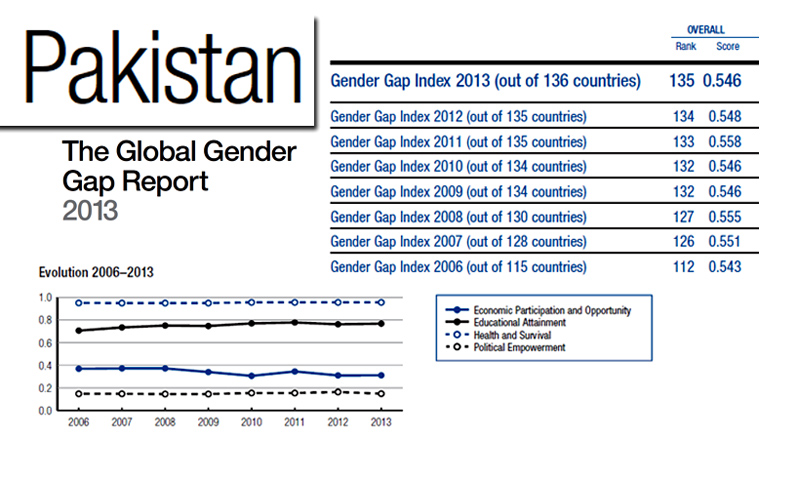 Pakistan ranks as the world’s second-worst country in terms of gender equality and equitable division of resources and opportunities among men and women, says a report published Friday.
The Global Gender Gap Report 2013, published by the World Economic Forum in collaboration with faculty at Harvard University and the University of California, Berkeley, assesses 136 countries, representing more than 93 per cent of the world’s population, on how well resources and opportunities are divided among male and female populations.
According to the index, Iceland tops the list with the most equitable sharing of resources among the sexes, followed closely by north European countries such as Finland, Norway and Sweden.
Pakistan comes down at 135, followed only by Yemen, and its score has fallen three spots since the study was conducted last year.
The comprehensive annual report measures the size of the gender inequality gap in four areas, including economic participation and opportunity (salaries, participation and highly skilled employment), educational attainment (access to basic and higher levels of education), political empowerment (representation in decision-making structures), health and survival (life expectancy and sex ratio).
According to the index, Pakistan ranks second-worst in economic participation and opportunity, eighth-worst in terms of equal access to education, 13th from the bottom in terms of health and survival.
Surprisingly, the magnitude of disparities is much smaller in Pakistan when it comes to political empowerment and representation in decision-making structures among the two sexes, with a rank of 64 among 136 countries.
Among neighbouring countries, China ranked at 69, Bangladesh at 75, India at 101 and Iran at 130. Afghanistan was not included in the study.
Global gender gap narrows slightly in 2013
According to the report, gender disparity narrowed slightly in the current year on the back of definite if not universal improvements in economic equality and political participation between the sexes.
Overall, the report found Iceland the most advanced country in the world in terms of gender equality for the fifth year running. It, along with Finland (2nd), Norway (3rd) and Sweden (4th), has now closed over 80 per cent of its gender gap. These countries were joined in the top 10 by the Philippines, which enters the top five for the first time, Ireland (6th), New Zealand (7th), Denmark (8th), Switzerland (9th) and Nicaragua (10th).
At the global level, the report found that in 2013, 96 per cent of the health and survival gender gap has now been closed. “It is the only one of the four pillars that has widened since the report was first compiled in 2006.”
The global gender gap stands at 93 per cent in terms of education, with 25 countries having closed their gaps completely.
The report says gender gaps for economic equality and political participation are only 60 per cent and 21 per cent closed respectively, although progress is being made in these areas, with political participation narrowing by almost 2 per cent over the last year.
In both developing and developed countries alike, relative to the numbers of women in tertiary education and in the workforce overall, women’s presence in economic leadership positions is limited, it adds.
Pakistan ranks as the world’s second-worst country in terms of gender equality and equitable division of resources and opportunities among men and women, says a report published Friday.
The Global Gender Gap Report 2013, published by the World Economic Forum in collaboration with faculty at Harvard University and the University of California, Berkeley, assesses 136 countries, representing more than 93 per cent of the world’s population, on how well resources and opportunities are divided among male and female populations.
According to the index, Iceland tops the list with the most equitable sharing of resources among the sexes, followed closely by north European countries such as Finland, Norway and Sweden.
Pakistan comes down at 135, followed only by Yemen, and its score has fallen three spots since the study was conducted last year.
The comprehensive annual report measures the size of the gender inequality gap in four areas, including economic participation and opportunity (salaries, participation and highly skilled employment), educational attainment (access to basic and higher levels of education), political empowerment (representation in decision-making structures), health and survival (life expectancy and sex ratio).
According to the index, Pakistan ranks second-worst in economic participation and opportunity, eighth-worst in terms of equal access to education, 13th from the bottom in terms of health and survival.
Surprisingly, the magnitude of disparities is much smaller in Pakistan when it comes to political empowerment and representation in decision-making structures among the two sexes, with a rank of 64 among 136 countries.
Among neighbouring countries, China ranked at 69, Bangladesh at 75, India at 101 and Iran at 130. Afghanistan was not included in the study.
Global gender gap narrows slightly in 2013
According to the report, gender disparity narrowed slightly in the current year on the back of definite if not universal improvements in economic equality and political participation between the sexes.
Overall, the report found Iceland the most advanced country in the world in terms of gender equality for the fifth year running. It, along with Finland (2nd), Norway (3rd) and Sweden (4th), has now closed over 80 per cent of its gender gap. These countries were joined in the top 10 by the Philippines, which enters the top five for the first time, Ireland (6th), New Zealand (7th), Denmark (8th), Switzerland (9th) and Nicaragua (10th).
At the global level, the report found that in 2013, 96 per cent of the health and survival gender gap has now been closed. “It is the only one of the four pillars that has widened since the report was first compiled in 2006.”
The global gender gap stands at 93 per cent in terms of education, with 25 countries having closed their gaps completely.
The report says gender gaps for economic equality and political participation are only 60 per cent and 21 per cent closed respectively, although progress is being made in these areas, with political participation narrowing by almost 2 per cent over the last year.
In both developing and developed countries alike, relative to the numbers of women in tertiary education and in the workforce overall, women’s presence in economic leadership positions is limited, it adds.
Why Saudi Arabia can't ban women from driving forever
There's something extraordinary happening in Saudi Arabia right now. I should know -- you see, I was born there, lived there half my life, speak the language and understand the customs. Lately, I'm both amazed at and humbled by what I'm seeing: Extremely brave Saudi women, more driven than ever to change their society, despite the sad fact that they still aren't allowed to drive.
And while it's true there's no formal law that bans females from getting behind the wheel in the ultra-conservative kingdom, it is also by no means a stretch to say they are, indeed, prohibited from doing so. Unfortunately, that's just the way it's always been in a society where religious edicts are often interpreted to mean it is illegal for women to drive.
I've reported on this subject for years and must admit, it's a personal one for me. Some of my earliest memories entail trying to figure out why my American mother would always drive me around Oklahoma City, where we spent our summers, but could never take me around Jeddah, where we lived the rest of the year.
To be honest, I only began pondering that mystery at the age of four on the days when my Saudi father was out of town on business, our driver was off, and I wanted ice cream. In the U.S., it was easy for my mom and I to hop in her car and go grab a banana split. What I wanted to know was why it was such a big deal in Saudi Arabia. Now, as a new online campaign urging Saudi women to defy their country's driving ban kicks into high gear, I find myself reflecting on how much the issue has impacted my life.
Much of it goes back to one brutally hot afternoon when I was 6 years old, living in Jeddah, playing in the front yard -- completely startled seeing my 15-year-old neighbor sneaking out of her house dressed like her Saudi father. She wasn't just wearing his clothes, she'd drawn a moustache on her face and was hoisting his car keys too.
Her mission was simple but dangerous: Take her dad's car for a spin around the neighborhood as he napped. In any other country, a simple act of rebellion. In Saudi Arabia, one that can, and has, gotten women arrested.
A few days ago, as we were filming our latest report on the women's driving campaign, I asked prominent Saudi journalist Buthaina Al-Nasr if she'd ever done anything similar.
Laughing at the memory, she admitted how, once, at the age of 14, she'd borrowed her older brother's car and taken it for a spin around the farm, far from the traffic of the city and any of its police.
Buthaina went on, describing how much she and her female friends longed to drive cars. She explained how they also wanted to ride bikes, or even just simply walk around "freely" - other activities for which Saudi women can face severe disapproval. There was really only one solution.
"We'd dress up like men," explained Buthaina, "like boys, and we'd go around and it felt fun."
Her anecdote made me smile even as it struck me as terribly sad. You see, "fun" is something that many of my female Saudi relatives told me over and over again they needed a lot more of.
It was the main reason my neighbor took her dad's car for that joyride -- which she'd been able to do without getting caught. To me, seeing how absolutely exhilarating the experience had been for her, she'd become a hero. A couple of days later, I asked her when she'd do it again. A funny look appeared on her face.
"I don't know. I'm not sure what the point is," she told me. "It'll just make me want to keep driving more and more. I shouldn't want that."
It took me a long time to finally understand. She'd had a small but wonderful taste of fun and freedom, one she felt most Saudi women would never get. That made it hard to deal with, harder still for her to do it again. For her, it ended up being more bitter than sweet.
In Saudi Arabia, women aren't simply kept from obtaining drivers' licenses. No, they must contend with many more restrictions. The country's mandatory guardianship system means women cannot legally be responsible for their own affairs. As such, a growing number of voices, both male and female, are calling for those laws to be repealed.
Author Abdullah Al-Alami, one of the most prominent Saudi men supporting the women's new driving campaign, is among them.
"There is a group of ultraconservatives here who will try to do anything and everything to prevent women from exercising their rights," Al-Alami told me. "Be it driving, going to school, working, traveling for that matter, receiving medical care. Many men that I know, we feel that it is crucial for us to support women who do this."
During my formative years, I was lucky -- I got to spend lots of time with very strong, independent, assertive women. My American mother, Saudi aunts and female cousins - they discussed women's rights all the time. I listened to countless conversations where it was decided how it would be impossible for Saudi Arabia to forever bar women from driving.
They said the reasons were numerous: that it didn't make sense economically; that it was too much of a burden on families to hire drivers; that Saudi society was advancing.
And then there was the horror story recounted by my aunt about the woman who lived down the street from her -- the woman whose husband was at work, whose driver was running an errand, whose child had been injured. There was no way for her to get him to the hospital in time.
The laws will have to change, they'd say. In five to 10 years, they insisted, women would, no doubt, be allowed to drive. I first heard that refrain 33 years ago, in 1980, before my parents and I moved to Riyadh, Saudi Arabia's capital.
I've been hearing it ever since. It wasn't until 1991 that I thought the time might have finally come. That's when 47 women protested the prohibition by driving through the streets of Riyadh. It was scandalous -- dozens of the women were detained, banned from travel and suspended from their workplaces.
A second ray of hope appeared in May 2011, when prominent women's rights activist Manal Al-Sharif uploaded to YouTube a video of herself driving in Saudi Arabia. As a result, she spent nine days in jail. But on June 17, dozens of women across Saudi Arabia, emboldened and inspired by her ordeal, went ahead, risked punishment and participated in the "Women2Drive" campaign -- they didn't just drive around, they also filmed and uploaded videos of themselves doing so. Still the laws did not change.
And now, the latest iteration is at hand. The October 26 Women's Driving Campaign has so far garnered more than 16,000 signatures on its online petition, but as it turns out, women aren't waiting until October 26. Many have already gone out, taken videos, posted them online. It's incredible to see.
Buthaina Al-Nasr is an active supporter of the campaign. She lives in Lebanon now but talked to me at length about why the Saudi government needs to finally lift the ban -- after all, it is the last country in the world that does not allow women to drive.
After driving her eight-year-old son Hisham to school, she told me a bit more about how much she'd love to be able to do the same in Saudi Arabia. She then shared a recurring daydream she has about being able to drive a car in her home country while wearing a dress -- not while dressed up like her father or brother.
"It's a silly daydream," she told me, "but that's a fact. It's the reality of my society."
Then she added, "I mean the daydream of a young girl should be how to get to the moon ... Not driving a car."
Saudi Arabia's women plan day of action to change driving laws
 Saudi women are gearing up for a day of action to challenge the kingdom's ban on female driving, amid signs of slowly growing readiness by the authorities to consider reform despite strong opposition by the clerical establishment.
Twitter, Facebook and other social media have been used to get women drivers on the roads on Saturday in a marathon push against this unique restriction.
Activists say they have 16,600 signatures on an online petition calling for change. Efforts to publicise the issue by the "October 26 driving for women" group have been described as the best-organised social campaign ever seen in Saudi Arabia, where Twitter has millions of users and is used to circulate anonymous information and gossip about the monarchy and official corruption.
Now the mainstream press is getting involved too, a telling indication of a thaw on this issue. "It's time to end this absurd debate about women driving," wrote Dr Thuraya al-Arid in the al-Jazirah newspaper. In another paper, al-Sharq al-Awsat, Mshari Al-Zaydi said: "The time has come to turn the page on the past and discuss this issue openly."
Previous attempts to promote change fizzled out in arrests for public order offences and demoralisation. In 2011, activist Manal al-Sharif made a YouTube video urging women to join her in driving their own cars, and was imprisoned for over a week. But the signs are far more positive now.
Three female members of the shura (advisory) council – among 30 who were appointed in January by the 90-year-old King Abdullah – recommended this month that the ban be rescinded, though no debate has yet taken place. Latifa al-Shaalan, Haya al-Mani and Muna al-Mashit urged the council to "recognise the rights of women to drive a car in accordance with the principles of sharia [Islamic law] and traffic laws".
The three – praised by supporters for "stirring the stagnant water" – framed their argument with careful references to fatwas (religious edicts) banning women from being in the company of an unrelated male (such as a driver). Other suggestions designed to reassure critics are appointing female traffic police and driving instructors. Cost is another big factor with families having to employ chauffeurs, as is convenience.
Signs of powerful opposition, however, are still easy to detect. This week 150 clerics and religious scholars held a rare public protest outside King Abdullah's palace in Jeddah to object to "westernisation" and "the conspiracy of women driving," blaming the US – a byword in traditionalist circles for anything distasteful or immoral – for being behind the campaign.
Until then, the government had conspicuously refrained from cracking down. But on Wednesday the interior ministry issued a stern pre-emptive warning that unlawful assemblies and marches would not be tolerated, and invoked the danger of sedition. But on a closer reading, activists noted, the ministry did not actually attack the idea of dropping the ban. "They are not saying clearly that women shouldn't drive," the writer Maha al-Aqeel told the Guardian. "The government wants to stay on the middle ground."
Neither sharia law nor national traffic regulations explicitly ban women from driving, but they are not issued licenses.
Campaigners have been emboldened by the low-key official response, with some emulating Sharif and uploading films on social media of themselves driving. In a video posted by the well-known blogger Eman al-Najfan, a female driver is seen cruising down a relatively busy road while passing motorists give enthusiastic thumbs-up signs in support. The campaign has its own YouTube channels and an Instagram account.
As expectations mount, many Saudi fathers are teaching their daughters to drive. "People are positive that things are going to change," said the journalist Abeer al-Mishkhas. "They just hope it will come soon. The government says it is waiting to see if society is becoming more tolerant."
Arguments aimed at keeping women off the roads can be shocking and nonsensical. "If a woman drives a car … not out of pure necessity … that could have negative physiological impacts as functional and physiological medical studies show that it automatically affects the ovaries and pushes the pelvis upwards," warned Sheikh Saleh bin Saad al-Lohaidan, adviser to an association of Gulf psychologists. Women who were aiming to overturn the driving ban should put "reason ahead of their hearts, emotions and passions," he suggested.
Najfan argued in a commentary for Amnesty International that the fundamental issue was challenging patriarchy. "If there was one word to describe what it is like to be a Saudi woman, it would be the word patronising.. No matter how long you live, you remain a minor in the eyes of the government."
Maha al-Aqeel sees driving as the thin end of a wedge of gradual reform in Saudi Arabia. "Driving is such a visible and symbolic thing," she said. "It's not like women on the shura council – you cannot see that and you cannot see advances for women in the workplace. Many conservatives feel that if women get the right to drive then that's it, the last bastion of male control will fall.
"I think it should lead to other changes. That's why those who oppose it are so vehement. And that's why the government is treading so carefully. It does not want to cause a big uproar."
Saudi women are gearing up for a day of action to challenge the kingdom's ban on female driving, amid signs of slowly growing readiness by the authorities to consider reform despite strong opposition by the clerical establishment.
Twitter, Facebook and other social media have been used to get women drivers on the roads on Saturday in a marathon push against this unique restriction.
Activists say they have 16,600 signatures on an online petition calling for change. Efforts to publicise the issue by the "October 26 driving for women" group have been described as the best-organised social campaign ever seen in Saudi Arabia, where Twitter has millions of users and is used to circulate anonymous information and gossip about the monarchy and official corruption.
Now the mainstream press is getting involved too, a telling indication of a thaw on this issue. "It's time to end this absurd debate about women driving," wrote Dr Thuraya al-Arid in the al-Jazirah newspaper. In another paper, al-Sharq al-Awsat, Mshari Al-Zaydi said: "The time has come to turn the page on the past and discuss this issue openly."
Previous attempts to promote change fizzled out in arrests for public order offences and demoralisation. In 2011, activist Manal al-Sharif made a YouTube video urging women to join her in driving their own cars, and was imprisoned for over a week. But the signs are far more positive now.
Three female members of the shura (advisory) council – among 30 who were appointed in January by the 90-year-old King Abdullah – recommended this month that the ban be rescinded, though no debate has yet taken place. Latifa al-Shaalan, Haya al-Mani and Muna al-Mashit urged the council to "recognise the rights of women to drive a car in accordance with the principles of sharia [Islamic law] and traffic laws".
The three – praised by supporters for "stirring the stagnant water" – framed their argument with careful references to fatwas (religious edicts) banning women from being in the company of an unrelated male (such as a driver). Other suggestions designed to reassure critics are appointing female traffic police and driving instructors. Cost is another big factor with families having to employ chauffeurs, as is convenience.
Signs of powerful opposition, however, are still easy to detect. This week 150 clerics and religious scholars held a rare public protest outside King Abdullah's palace in Jeddah to object to "westernisation" and "the conspiracy of women driving," blaming the US – a byword in traditionalist circles for anything distasteful or immoral – for being behind the campaign.
Until then, the government had conspicuously refrained from cracking down. But on Wednesday the interior ministry issued a stern pre-emptive warning that unlawful assemblies and marches would not be tolerated, and invoked the danger of sedition. But on a closer reading, activists noted, the ministry did not actually attack the idea of dropping the ban. "They are not saying clearly that women shouldn't drive," the writer Maha al-Aqeel told the Guardian. "The government wants to stay on the middle ground."
Neither sharia law nor national traffic regulations explicitly ban women from driving, but they are not issued licenses.
Campaigners have been emboldened by the low-key official response, with some emulating Sharif and uploading films on social media of themselves driving. In a video posted by the well-known blogger Eman al-Najfan, a female driver is seen cruising down a relatively busy road while passing motorists give enthusiastic thumbs-up signs in support. The campaign has its own YouTube channels and an Instagram account.
As expectations mount, many Saudi fathers are teaching their daughters to drive. "People are positive that things are going to change," said the journalist Abeer al-Mishkhas. "They just hope it will come soon. The government says it is waiting to see if society is becoming more tolerant."
Arguments aimed at keeping women off the roads can be shocking and nonsensical. "If a woman drives a car … not out of pure necessity … that could have negative physiological impacts as functional and physiological medical studies show that it automatically affects the ovaries and pushes the pelvis upwards," warned Sheikh Saleh bin Saad al-Lohaidan, adviser to an association of Gulf psychologists. Women who were aiming to overturn the driving ban should put "reason ahead of their hearts, emotions and passions," he suggested.
Najfan argued in a commentary for Amnesty International that the fundamental issue was challenging patriarchy. "If there was one word to describe what it is like to be a Saudi woman, it would be the word patronising.. No matter how long you live, you remain a minor in the eyes of the government."
Maha al-Aqeel sees driving as the thin end of a wedge of gradual reform in Saudi Arabia. "Driving is such a visible and symbolic thing," she said. "It's not like women on the shura council – you cannot see that and you cannot see advances for women in the workplace. Many conservatives feel that if women get the right to drive then that's it, the last bastion of male control will fall.
"I think it should lead to other changes. That's why those who oppose it are so vehement. And that's why the government is treading so carefully. It does not want to cause a big uproar."
Pakistan: Law ministry submits new order...under Zardari's name
The Express TribuneThe law ministry issued a new official government order under the name of former president Asif Ali Zardari, Express News reported Thursday. Three presidential orders pertaining to the salaries of judges were issued on October 7 and were printed in the official gazette on October 9. Two of the documents bore President Mamnoon Hussain’s name on them while the third had the former president’s name on it. All three were issued and printed on the same dates creating the illusion that two presidents were in power at the same time. This comes a month after Zardari stepped down as president on September 8 and was replaced by Mamnoon Hussain on September 9.
India, Pakistan Exchange Gunfire Over Border
 At least a dozen people have been wounded as Indian and Pakistani troops exchanged gunfire over the border in the disputed Himalayan region of Kashmir, officials said Friday.
An Indian official said at least 10 civilians were wounded as Pakistani troops fired guns and mortar shells at more than a dozen Indian border posts overnight in the disputed Himalayan region of Kashmir,
A paramilitary officer said on the customary condition of anonymity that Indian guards retaliated and an exchange of gunfire lasted several hours. He said the fighting continued till Friday morning at some places in southern Jammu region.
The wounded included four children in three villages, said local civil administrator Shantmanu, who uses only one name.
In Islamabad, Pakistani military officials said Indian troops resorted to unprovoked firing and mortar shelling in a village near Sialkot early Friday, wounding two civilians. The officials spoke on condition of anonymity in line with military policy.
Pakistani Foreign Ministry spokesman Aizaz Ahmad Chaudhry called the cease-fire violations "a matter of great concern," and reiterated Prime Minister Nawaz Sharif's commitment to improving relations with India.
Chaudhary told reporters that Pakistani troops do not fire indiscriminately and emphasized that Pakistan has no interest in creating problems along the border.
"Our troops have a policy. We will not indulge in firing first. But if we are fired upon we will give a responsible and effective response," he said.
India on Wednesday accused Pakistani troops of firing on at least 50 Indian border posts, calling it the most serious violation of a 2003 cease-fire accord.
However, Pakistan said Indian troops targeted 27 Pakistani posts near Sialkot with machine guns and mortar shells.
The gunfire resumed Thursday night after a lull during the day.
Vivek Katju, a retired Indian diplomat, on Friday accused Pakistan of seeking to raise the temperature over Kashmir to get international attention, but added that approach has not worked as the United States and other countries have declined to mediate in the dispute.
While the cease-fire has largely held for the past decade, sporadic violations are not uncommon. Since January this year the two nuclear-armed neighbors have regularly accused each other of initiating the fighting by firing mortar shells or gunshots across the frontier.
The latest incidents come even though the Pakistani and Indian prime ministers meet last month in New York and agreed on the need to reduce tensions.
India has accused Pakistan of nearly 200 violations of the 2003 cease-fire agreement this year.
The countries have fought two wars over control of Kashmir, which is divided between them and claimed by both.
India regularly accuses Pakistan of supporting Kashmiri rebels who have been fighting on the Indian side since 1989 for independence or a merger with Pakistan.
An estimated 68,000 people have been killed in the conflict, though most resistance is now shown through street protests. Pakistan denies giving any backing to the rebels beyond moral support.
At least a dozen people have been wounded as Indian and Pakistani troops exchanged gunfire over the border in the disputed Himalayan region of Kashmir, officials said Friday.
An Indian official said at least 10 civilians were wounded as Pakistani troops fired guns and mortar shells at more than a dozen Indian border posts overnight in the disputed Himalayan region of Kashmir,
A paramilitary officer said on the customary condition of anonymity that Indian guards retaliated and an exchange of gunfire lasted several hours. He said the fighting continued till Friday morning at some places in southern Jammu region.
The wounded included four children in three villages, said local civil administrator Shantmanu, who uses only one name.
In Islamabad, Pakistani military officials said Indian troops resorted to unprovoked firing and mortar shelling in a village near Sialkot early Friday, wounding two civilians. The officials spoke on condition of anonymity in line with military policy.
Pakistani Foreign Ministry spokesman Aizaz Ahmad Chaudhry called the cease-fire violations "a matter of great concern," and reiterated Prime Minister Nawaz Sharif's commitment to improving relations with India.
Chaudhary told reporters that Pakistani troops do not fire indiscriminately and emphasized that Pakistan has no interest in creating problems along the border.
"Our troops have a policy. We will not indulge in firing first. But if we are fired upon we will give a responsible and effective response," he said.
India on Wednesday accused Pakistani troops of firing on at least 50 Indian border posts, calling it the most serious violation of a 2003 cease-fire accord.
However, Pakistan said Indian troops targeted 27 Pakistani posts near Sialkot with machine guns and mortar shells.
The gunfire resumed Thursday night after a lull during the day.
Vivek Katju, a retired Indian diplomat, on Friday accused Pakistan of seeking to raise the temperature over Kashmir to get international attention, but added that approach has not worked as the United States and other countries have declined to mediate in the dispute.
While the cease-fire has largely held for the past decade, sporadic violations are not uncommon. Since January this year the two nuclear-armed neighbors have regularly accused each other of initiating the fighting by firing mortar shells or gunshots across the frontier.
The latest incidents come even though the Pakistani and Indian prime ministers meet last month in New York and agreed on the need to reduce tensions.
India has accused Pakistan of nearly 200 violations of the 2003 cease-fire agreement this year.
The countries have fought two wars over control of Kashmir, which is divided between them and claimed by both.
India regularly accuses Pakistan of supporting Kashmiri rebels who have been fighting on the Indian side since 1989 for independence or a merger with Pakistan.
An estimated 68,000 people have been killed in the conflict, though most resistance is now shown through street protests. Pakistan denies giving any backing to the rebels beyond moral support.
Balochs Protest Outside White House As Sharif Meets Obama
The Baloch Hal
 Members of the Baloch community protested outside the White House on Wednesday morning as Pakistan’s Prime Minister Nawaz Sharif met with U.S. President Barrack Obama as a part of his three-day long trip to Washington, D.C.
The protesters, who came from different U.S. cities, condemned Islamabad’s fresh military operations against Baloch political activists, including the kill and dump activities and forced disappearances attributed to Pakistani intelligence agencies. Native Balochs from Irani and Pakistani Balochistan attended the protest while several American citizens also participated in the march outside the U.S. president’s residence.
The protest was led by Dr. M. Hossein Bor, a prominent Baloch lawyer who had also testified at the U.S. Congressional hearing on Balochistan in February 2012 and the participants included Laurie Deamer, the U.S. representative of the Baloch Human Rights Council.
Members of the Baloch community protested outside the White House on Wednesday morning as Pakistan’s Prime Minister Nawaz Sharif met with U.S. President Barrack Obama as a part of his three-day long trip to Washington, D.C.
The protesters, who came from different U.S. cities, condemned Islamabad’s fresh military operations against Baloch political activists, including the kill and dump activities and forced disappearances attributed to Pakistani intelligence agencies. Native Balochs from Irani and Pakistani Balochistan attended the protest while several American citizens also participated in the march outside the U.S. president’s residence.
The protest was led by Dr. M. Hossein Bor, a prominent Baloch lawyer who had also testified at the U.S. Congressional hearing on Balochistan in February 2012 and the participants included Laurie Deamer, the U.S. representative of the Baloch Human Rights Council.
Pakistan's list of grouses grow, US unmoved
http://timesofindia.indiatimes.com/Pakistan’s Prime Minister Nawaz Sharif trooped into the White House on Wednesday for a meeting with President Obama in the face of multiple repudiations from the United States over Islamabad’s pet peeves: Drone strikes on Pakistan, its gripes against India over the Kashmir issue, and pleas that Washington treat it on par with New Delhi by accepting it as a nuclear equal. The meeting with the U.S President was going on at the time of writing and there was no read-out yet, but the Obama administration made it clear on Tuesday that it did not particularly share Pakistan’s perception on any of these issues, starting with its handwringing over drone attacks on its lawless territory, accentuated by a well-timed Amnesty report highlighting some civilian casualties. White House spokesman Jay Carney set the stage for a rejection of Pakistan’s plea to stop drone strikes, saying U.S counterterrorism operations are precise, lawful, and effective, and they in fact minimize civilian casualties that would be greater if other conventional means were adopted to eliminate terrorists. "The United States does not take lethal strikes when we or our partners have the ability to capture individual terrorists. Our preference is always to detain, interrogate, and prosecute. We take extraordinary care to make sure that our counterterrorism actions are in accordance with all applicable domestic and international law and that they are consistent with US values and US policy," Carney said, adding, "Before we take any counterterrorism strike outside areas of active hostilities, there must be near certainty that no civilians will be killed or injured, and that is the highest standard we can set," he said. However, both sides are expected to project language that will minimize differences on this subject, with Washington promising to ease off the strikes as more and more suspected terrorists are eliminated, and praising Pakistan’s fight against terrorism despite its dubious credentials on this count. The U.S media was already predicting the pitch would be taking spin, with a headline in one newspaper reading, ''drones? What drones? Obama and Pakistan's Sharif to accentuate the positive.'' Various agreements, including one on science and technology cooperation, are being wheeled out to cover the tracks of disagreements, including over India’s role in Afghanistan, and more broadly the growing regional and global heft that Washington is helping New Delhi develop. Earlier this week, the Obama administration snubbed Sharif over his plea that Washington should mediate between India and Pakistan over the Kashmir issue, saying it was for the two sides to take care of this issue. In fact, despite the controversy over Sharif’s reported putdown of Prime Minister Manmohan Singh (that he brings his complaints against Pakistan to Washington), it is Pakistan that has kept up an incessant reference to India, making it very much part of its gripe list. The Obama administration has entertained this only in the sense of trying to wean Pakistan out of its New Delhi complex of constantly seeking parity with it. Washington, US officials indicated ahead of the meeting, wants to have strong ties with Pakistan on its own without sharing its prejudice against India. The White House has not scheduled a media interaction at the Obama-Sharif meeting, much less an extended news conference, fearful of awkward questions. Even at a think-tank event on Tuesday, where Sharif made a speech, only the host former National Security Advisor Stephen Hadley posed three softball question before closing the meeting, keeping audience out of it. But it is not hard to discern that Sharif has had a torrid visit so far. There have been protocol putdowns, including him being entertained by Secretary of State John Kerry for dinner after he arrived on Sunday (while Obama was out playing golf with White House staffers), cooling his heels on Monday and Tuesday while the Obama dealt with other issues, and on Wednesday, having to breakfast with vice-president Joe Biden (who, according to the White House schedule, then proceeded to have lunch with Obama) before the U.S President deigned to see him in the afternoon. The charitable explanation for all this is the Sharif is Pakistan's Prime Minister, not President, but that brings to attention the extraordinary deference Obama has shown to Prime Minister Manmohan Singh. Sharif also faced a rough time on the Hill on Tuesday when he was questioned closely by the House Foreign Relations Committee over the continued incarceration of Dr Shakil Afridi, who helped the U.S nail Osama bin Laden, and Pakistan’s continued patronage of Lashkar-e-taiba. “I specifically pressed the Prime Minister to release Dr. Shakil Afridi and encouraged him to ensure that his nation is in fact a responsible and effective partner in countering terrorism, proliferation and violent extremism in the region,” Committee chairman Ed Royce said later. His ranking colleague Eliot Engel was equally unsparing. “While I appreciate the magnitude of the challenges faced by the Prime Minister, and consider Pakistan an important partner of the United States, I also made clear to him that many in Congress remain frustrated by Islamabad’s schizophrenic approach to countering violent extremist groups, including those that continue to attack US troops in Afghanistan,” Engel said.
PCC Terms PM Sharif’s Visit To US As “Unsuccessful”

Pakistan Christian Congress terms PM Sharif’s visit to the US as unsuccessful.In line with details, the Central Executive Council of Pakistan Christian Congress PCC gathered in a meeting; thus terming “visit of Pakistan Prime Minister Mian Nawaz Sharif to United States as unsuccessful on failure to secure end to Drone attacks and guarantees to resolve Kashmir issue according to UN Resolutions.” Additionally the Executive Council of Pakistan Christian Congress has also released a press note including an official statement from the President of Pakistan Christian Congress Dr. Nazir S Bhatti who is in Philadelphia these days. Dr. Bhatti said, “It seems that Mian Nawaz Sharif government has decided to totally ignore Christians in Pakistan as well as Pakistani Christian Diaspora in Western countries when he denied to meet EU and NA delegation of Christians of Pakistani origin in Washington DC and on his directions Pakistani Embassy in USA ignored to invite Christians in Pakistani Community gathering of 500 Muslims whom Pak Premier addressed.” Pakistan Christian Congress Head said in his statement that “Government of Pakistan Muslim League decision to apartheid Christian was duly displayed by Pakistan Embassy in Washington DC when it considered only Muslims to be Pakistani Community and invited them to participate and to witness Mian Nawaz Sharif speech on foreign and interior policies of PML (N) in Pakistan.” Dr. Bhatti added, “The time has come that Pakistani Christian Diaspora to act like Azad Kashmir Muslim Diaspora to raise voice for persecuted Pakistani Christians and to struggle like Israel Diaspora which secured land for Jews for a homeland in Promised Land in Middle East.” Dr. Nazir Bhatti said “All India Christian League supported All India Muslim League in Pakistan Movement during British colonial rule in sub-continent of India, voted in favour of formation of Pakistan in London Round Table Conferences of 1930-32 and made possible to fall Punjab in lot of Pakistan with presentation before Boundary Commission but it seems that Muslims in Pakistan have decided to push Christians from mainstream of society.” “Our voting right is snatched by Muslim majority and imposes selected tools from Christian in parliament, our Churches are attacked, our women are forcibly converted to Islam and our Christian youth is deprived of their right in employment and education in Pakistan” said Dr. Bhatti PCC President asserted that,” Christians are treated like second class citizen and we are pushed to invite UNO and International community to rescue Pakistani Christian.” “Pakistan Government decision to push Pakistani Christian out of mainstream and initiated from Pakistan Embassy in Washington DC will unite Christians to expedite their struggle for due share in resources of Pakistan,” he continued. - See more at: http://www.christiansinpakistan.com/pcc-terms-pm-sharifs-visit-to-us-as-unsuccessful/#sthash.HxGRfLC8.dpuf
Thursday, October 24, 2013
Aseefa Bhutto: My mother left a great vision and I will give my best to carry her legacy to make Pakistan a polio-free country
PPP Social Media Cell /FAA


Aseefa Bhutto Zardari Pakistan Ambassador for Polio Eradication.
India, Pakistan border guards clash on Kashmir border
 The border guards of India and Pakistan Thursday again targeted each other's posts on international border in Kashmir, officials said.
The border guards on both sides targeted each other using automatic weapons early Thursday in frontier districts of Jammu and Samba.
"Pakistani Rangers last night started firing mortar shells and rockets on our outposts in Nikki Tawi area of Jammu and Ramgarh area of Samba. The firing continued until early today," said an official of Indian border guards Border Security Force (BSF). " Our side also retaliated to the firing from Pakistani Rangers."
Officials said no loss of life was reported from Indian side.
Border guards of the two nuclear neighbors on Tuesday exchanged fire along 50 locations on the international border, triggering panic among the residents. Reports said many villagers in the frontier areas have started constructing underground bunkers for their safety.
According to India's official broadcaster All India Radio ( AIR), Pakistani Rangers targeted civilian areas in Ramgarh sector which caused extensive damage to some residential houses. "The inmates of one house in Nanga Gao of Ramgarh sector had a narrow escape as the mortar fired by Rangers fell on the rooftop of a house," said AIR. "BSF personnel also had a miraculous escape as the mortar fired by Pak Rangers fell close to border outpost."
On Tuesday India's Home Minister Shushilkumar Shinde visited the restive region to review security along line-of-control (LoC) and international border (IB). Skirmishes between troops posted on LoC have been going on almost at daily basis since Aug 6. Majority of exchanges took place on LoC in Poonch. However for the past several days similar skirmishes are going on along IB in the region.
Both sides have suffered troop as well as civilian casualties during the standoff on 720 km long LoC and 198 km IB. LoC is a de facto border that divides Kashmir into India and Pakistan controlled parts. New Delhi and Islamabad in 2003 agreed to observe cease-fire along the IB and LoC in Kashmir. Though some violations have been reported on both sides, the cease-fire remains in effect.
Both New Delhi and Islamabad blame each other of resorting to unprovoked firing on LoC and IB. Kashmir, the Himalayan region divided between India and Pakistan is claimed by both in full. Since their Independence from British, the two countries have fought three wars, two exclusively over Kashmir.
The border guards of India and Pakistan Thursday again targeted each other's posts on international border in Kashmir, officials said.
The border guards on both sides targeted each other using automatic weapons early Thursday in frontier districts of Jammu and Samba.
"Pakistani Rangers last night started firing mortar shells and rockets on our outposts in Nikki Tawi area of Jammu and Ramgarh area of Samba. The firing continued until early today," said an official of Indian border guards Border Security Force (BSF). " Our side also retaliated to the firing from Pakistani Rangers."
Officials said no loss of life was reported from Indian side.
Border guards of the two nuclear neighbors on Tuesday exchanged fire along 50 locations on the international border, triggering panic among the residents. Reports said many villagers in the frontier areas have started constructing underground bunkers for their safety.
According to India's official broadcaster All India Radio ( AIR), Pakistani Rangers targeted civilian areas in Ramgarh sector which caused extensive damage to some residential houses. "The inmates of one house in Nanga Gao of Ramgarh sector had a narrow escape as the mortar fired by Rangers fell on the rooftop of a house," said AIR. "BSF personnel also had a miraculous escape as the mortar fired by Pak Rangers fell close to border outpost."
On Tuesday India's Home Minister Shushilkumar Shinde visited the restive region to review security along line-of-control (LoC) and international border (IB). Skirmishes between troops posted on LoC have been going on almost at daily basis since Aug 6. Majority of exchanges took place on LoC in Poonch. However for the past several days similar skirmishes are going on along IB in the region.
Both sides have suffered troop as well as civilian casualties during the standoff on 720 km long LoC and 198 km IB. LoC is a de facto border that divides Kashmir into India and Pakistan controlled parts. New Delhi and Islamabad in 2003 agreed to observe cease-fire along the IB and LoC in Kashmir. Though some violations have been reported on both sides, the cease-fire remains in effect.
Both New Delhi and Islamabad blame each other of resorting to unprovoked firing on LoC and IB. Kashmir, the Himalayan region divided between India and Pakistan is claimed by both in full. Since their Independence from British, the two countries have fought three wars, two exclusively over Kashmir.
Bahrain’s enormous tear gas tender exposed amid ongoing unrest

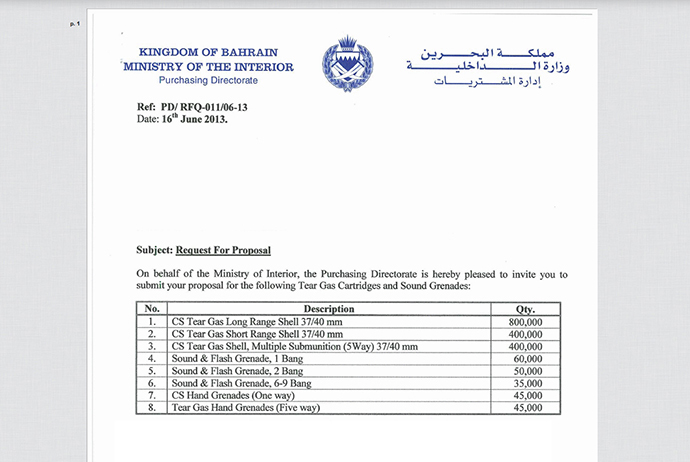
Don't abandon the women of Afghanistan
 Afghanistan's presidential election season is underway. In a sign of genuine political progress, the government has begun accepting nominations for candidates to succeed President Hamid Karzai. This process started just weeks after the nation's Assembly passed legislation providing a legal framework for the presidential, provincial council and parliamentary elections.
Nothing is more important for Afghanistan than building on the liberalizing achievements of the past decade and preventing a slide back toward repression.
This is why it is crucial to retain and expand the hard-won rights of Afghan women. Gender equality isn't just a matter of moral fairness -- it's essential to the country's economic and political health and to ensuring that the nation has a secure, peaceful and stable future.Since the fall of the Taliban, Afghan women's rights have expanded significantly. The country's current constitution affords equal protection to men and women, guaranteeing women the right to education, political participation and economic opportunity. Afghan women are now employed at jobs ranging from doctor to police officer -- unthinkable under the Taliban. An Oxfam report found that school enrollment among girls has increased from roughly 5,000 to 2.4 million.
These are encouraging developments. But there is so much more progress to be made. Afghan women are still the targets of institutional discrimination and gender-based violence.
Here in the last half of 2013, two consecutive Ministry of Women's Affairs chiefs were assassinated. In August, female parliamentarian Fariba Ahmadi Kakar was kidnapped by Taliban militants. A few days later, the vehicle envoy of female Sen. Roh Gul Khairzad was ambushed, leading to the death of her 8-year-old daughter.
And in mid-September, Afghanistan's top female police officer was shot as she left her home.
This violence is organized. Sima Samar, head of the Independent Human Rights Commission of Afghanistan, has noted that by targeting high-profile women, the Taliban seeks to "limit the active presence and activities of women in their society."Indeed, a new United Nations report finds that in the first six months of 2013, the deaths of women and children jumped 38 compared to the same period last year.
American forces will be drawn down next year. It's absolutely imperative that their exit not bring on a backslide. The country's government must be expected to keep its commitments to women and girls.
Gender equality is about affirming human dignity, and it starts with improving access to education.
The statistics tell the story. Mortality rates for children younger than 5 are 50% lower for mothers who have attended primary school. Educated women are less likely to die during childbirth and more likely to send their own children to school. These children then grow up to be the educated young citizens essential to sustained economic growth.
These facts shouldn't be surprising. Education is a basic human right and its impact is transformative in any society. Educated women are major contributors to Afghanistan's economy. Each additional year of primary school improves a woman's earning potential by 10% to 20%.
Women also provide an indispensable voice in political institutions. Here in the United States, after gaining the right to vote, women drew attention to underappreciated issues such as maternal health and child care, resulting in policy shifts that significantly reduced child mortality rates.
Given the enormous challenges that Afghanistan faces, the country cannot afford to regress back to a system in which some of its brightest minds are left out of the political process or any part of society.
Afghanistan's elections and the impending drawdown of American troops mark a new era in the country's development.
The international community must work to ensure that women's gains in recent years are protected and that Afghan women continue to make political and economic progress. Any future support for the country's government must be explicitly tied to continued defense of equal rights and continued progress of female citizens.
For peace and prosperity, we must not abandon the women of Afghanistan.
Afghanistan's presidential election season is underway. In a sign of genuine political progress, the government has begun accepting nominations for candidates to succeed President Hamid Karzai. This process started just weeks after the nation's Assembly passed legislation providing a legal framework for the presidential, provincial council and parliamentary elections.
Nothing is more important for Afghanistan than building on the liberalizing achievements of the past decade and preventing a slide back toward repression.
This is why it is crucial to retain and expand the hard-won rights of Afghan women. Gender equality isn't just a matter of moral fairness -- it's essential to the country's economic and political health and to ensuring that the nation has a secure, peaceful and stable future.Since the fall of the Taliban, Afghan women's rights have expanded significantly. The country's current constitution affords equal protection to men and women, guaranteeing women the right to education, political participation and economic opportunity. Afghan women are now employed at jobs ranging from doctor to police officer -- unthinkable under the Taliban. An Oxfam report found that school enrollment among girls has increased from roughly 5,000 to 2.4 million.
These are encouraging developments. But there is so much more progress to be made. Afghan women are still the targets of institutional discrimination and gender-based violence.
Here in the last half of 2013, two consecutive Ministry of Women's Affairs chiefs were assassinated. In August, female parliamentarian Fariba Ahmadi Kakar was kidnapped by Taliban militants. A few days later, the vehicle envoy of female Sen. Roh Gul Khairzad was ambushed, leading to the death of her 8-year-old daughter.
And in mid-September, Afghanistan's top female police officer was shot as she left her home.
This violence is organized. Sima Samar, head of the Independent Human Rights Commission of Afghanistan, has noted that by targeting high-profile women, the Taliban seeks to "limit the active presence and activities of women in their society."Indeed, a new United Nations report finds that in the first six months of 2013, the deaths of women and children jumped 38 compared to the same period last year.
American forces will be drawn down next year. It's absolutely imperative that their exit not bring on a backslide. The country's government must be expected to keep its commitments to women and girls.
Gender equality is about affirming human dignity, and it starts with improving access to education.
The statistics tell the story. Mortality rates for children younger than 5 are 50% lower for mothers who have attended primary school. Educated women are less likely to die during childbirth and more likely to send their own children to school. These children then grow up to be the educated young citizens essential to sustained economic growth.
These facts shouldn't be surprising. Education is a basic human right and its impact is transformative in any society. Educated women are major contributors to Afghanistan's economy. Each additional year of primary school improves a woman's earning potential by 10% to 20%.
Women also provide an indispensable voice in political institutions. Here in the United States, after gaining the right to vote, women drew attention to underappreciated issues such as maternal health and child care, resulting in policy shifts that significantly reduced child mortality rates.
Given the enormous challenges that Afghanistan faces, the country cannot afford to regress back to a system in which some of its brightest minds are left out of the political process or any part of society.
Afghanistan's elections and the impending drawdown of American troops mark a new era in the country's development.
The international community must work to ensure that women's gains in recent years are protected and that Afghan women continue to make political and economic progress. Any future support for the country's government must be explicitly tied to continued defense of equal rights and continued progress of female citizens.
For peace and prosperity, we must not abandon the women of Afghanistan.
Afghanistan: Intelligence agents detain ‘future child bombers’
http://www.pajhwok.com/Intelligence operatives in eastern Laghman province have detained 21 children, some as young as 7, being taken to Pakistan for receiving suicide attack training, an official said on Thursday. The children, aged between 7 and 12 years, were detained a day earlier after they entered Laghman from Nuristan province, the provincial National Directorate of Security spokesman Nasrullah Nasrat told a press conference. He said the children had been picked from various areas in Nuristan and were being taken to Pakistan through Laghman by Qari Usman when they were arrested as a result of an intelligence report. He said Usman had been arrested and was being interrogated and the children were officially released to the Nuristan peace committee. A member of Nuristan peace committee, who did not want to be named, said abject poverty and lack of schools were some of the major reasons forcing youth and children into joining terrorists. He said armed groups were taking advantage of lack of schools and use children in suicide attacks and other terrorist activities. The Ministry of Education says religious schools have been established in all provinces in order to prevent children from going to Pakistan for religious studies.
د ګوزڼ جهاني ورځ خو وزیرستان او خېبر کې یې ناروغان
د ورستیو راپورونو له مخه په قبایلي سیمو، په ځانګړي ډول، په شمالي وزیرستان او خیبر کې پولیو مخ په زیاتېدو ده.

نن په نړۍ کې د ګوزڼ ناروغۍ ضد ورځ په داسې حال کې لمانځل کېږي چې ډاکتران اندېښنه ښيي چې دا ناروغي له شمالي وزیرستانه نورو سیمو ته هم خپرېدای شي. یوازې د اکتوبر په میاشت کې په شمالي وزیرستان کې ۱۰ کسان دې ناروغۍ ځپلي دي. د روغتیا نړیوالې ادارې له وینا سره سم، ګوزڼ ناروغي، پرته له درو هیوادونو، نوره له ټولې نړۍ پاکه شوې ده. په دې هیوادونو کې افغانستان، پاکستان او نایجېریا شامل دي. د ورستیو راپورونو له مخه په قبایلي سیمو، په ځانګړي ډول، په شمالي وزیرستان او خیبر کې پولیو مخ په زیاتېدو ده. د شمالي وزیرستان روغتیايي ادارې مشر ډاکتر جان میر خان مشال راډیو ته وویل، په روانې اوونۍ کې په دې سیمه کې د پولیو ناروغۍ درې نوي کېسونه مالوم شوي دي. د ده په وینا، یوازې د اکتوبر په میاشت کې ۱۰ کسان ګوزڼ وهلي دي. ډاکتر میر وايي، له شمالي وزیرستانه یې د ۹۰ داسې ماشومانو وینې نمونې اسلام اباد ته استولې دي چې عمرونه یې له پینځو کالونو کم دي. د ده په خبره، ناروغي په ټول وزیرستان کې موجوده ده. د شمالي وزیرستان روغتیايي ادارې مشر ډاکتر جان میر خان وویل، په وزیرستان کې خو د ګوزڼ ناروغي خپره شوې ده خو اوس خطر دا دی چې دا ناروغي به جنوبي وزیرستان، کورمې او د بنو نیمه قبایلي سیمو ته هم ورسېږي. د ده په خبره، د پولیو ناروغۍ واکسیني څاڅکو پر ورکولو د وسله والو بندیز ختمولو له پاره پوره هڅې کوي. ډاکتر میر د وزیرستان پر ولس غږ (ږغ) وکړ چې د پینځو کالونو له عمره کم، ټولو ماشومانو ته د ګوزڼ ناروغۍ مخنیوي څاڅکي ورکړي او دوی روغتون ته د واکسین ورکولو لپاره بوځي. په روان (۲۰۱۳ز) کال کې په قبایلي سیمې خیبر کې ۱۰، شمالي وزیرستان کې ۱۵ او په ټول پاکستان کې ۴۶ کسان ګوزڼ وهلي دي. له دې علاوه د پاکستان په مختلفو برخو کې د واکسیني څاڅکو پر ورکوونکو ډلو هم وخت په وخت حملې شوې دي.
Pakistan: World Polio Day 2013: Stop the outbreak, in the name of our children
On a number of occasions, I have argued Pakistan is on the verge of eradicating polio but that failure to do so would have serious global consequences. There is no need for me to repeat these arguments. Having said this, on World Polio Day 2013, I will not shy away from re-emphasizing some salient truths about the current and urgent dangers that polio poses to our children. In a nutshell, although I do not intend to become part of any controversial debate like so many others, as a father I am disheartened to know hundreds of thousands of innocent children are now being deliberately exposed to a crippling future. Let’s be honest with ourselves, polio affected children are less likely to grow up to be future doctors, nurses, teachers or lawyers. Most of them and their families will be convicted to a life of poverty and deprivation. What is troubling for me as a father is how we have come to be in a situation where so many children are being denied or deprived of a highly effective public health intervention. Polio eradication is not rocket science. If we vaccinate our children, they will be protected, if we don’t, polio will keep on following them. The poliovirus is smart; it looks for children with poor immunity levels and attacks them, cripples them. The vaccine, however, is smarter than the virus; it brings the immunity of the children to optimum levels, leaving the virus no room to attack. This is the reason why it is so important to ensure children are immunised during each and every polio round, so their bodies are prepared any time the virus attacks. Polio travels largely undetected across borders and continents. A Pakistani citizen who leaves Karachi with a bad cold may never know that a few hours later, he has infected a cab driver in Dubai, Doha, or Cairo with polio. Easy and cheap air travel has increased the mobility of the virus and has made it more dangerous for the rest of the world. Now no country in the world is absolutely safe from poliovirus. This is the main reason why the world is so interested in eradicating polio from Pakistan and other polio endemic countries. Every polio-free country has a right to be nervous that all the financial resources and tireless efforts which were put in place for their children and their country to stand in the row of polio-free nations may be jeopardized if all countries, including Pakistan, are not declared polio-free in the near future. At the end of 2011, Pakistan was facing one of the worst and largest polio outbreaks in over a decade, with 198 confirmed polio cases and almost all sewage samples confirming the presence of the virus in the environment. The virus was everywhere and every child in this country was at risk. Transmission was particularly intense in three zones, including the Federally Administered Tribal Areas (Fata) and parts of central Khyber-Pakhtunkhwa, Quetta and its neighbouring districts of Killa Abdullah and Pishin, as well as Karachi. With so many paralysed children and asymptomatic children silently spreading the virus, we had reached an all-time low. So, what was done following this low-point? To cut a long story short, all the so-called “failing polio programme of 2011” needed were some key game-changing decisions. Intensification of activities, accountability and oversight were key to the change we saw in 2012. The children of Pakistan remain grateful to all the deputy commissioners, commissioners and the higher bureaucracy for their efforts to ensure a healthy future. Thanks in large part to their efforts, Pakistan recorded a 70% decrease in cases in 2012, with only 58 polio cases. Moreover, one of the three types of poliovirus was completely eradicated during that year. Without exaggeration and in frankness, by the end of 2012 Pakistan had made such big strides towards eradication that life without polio seemed a very real possibility for the children of the country. Then horrific things happened. The dreadful attacks on polio teams that started in December 2012 continued into 2013. It goes without saying such events, and the accompanying intimidation and fear, cause serious damage to the morale of polio workers who work tirelessly for the future generations of the country. Ironically, rather than attacking a virus that cripples and kills, our health workers were being attacked and killed. Preceding the targeted attacks on polio teams, a ban on all polio immunisation was introduced by the Taliban in North and South Waziristan in June 2012. With very limited vaccination activity in the area since that date, we have a huge ‘vaccination-gap’. The ban remains in place. In other parts of the country, in spite of their fear, vaccinators heroically continued their battle against the disease and carried on from house to house to offer the vital polio drops. In my view, their humanitarian spirit and courage is truly worthy of a Nobel Prize. The success of polio eradication efforts continued in 2013. We currently have 46 polio cases this year – a further reduction on the 2012 figure. The noticeable exception to this success is the areas in which inaccessibility and fear have prevented vaccinators from reaching children. In fact, close to 90% of the children paralysed by polio this year come from the areas in which there are problems of inaccessibility due to the ban on vaccination, or a fear of violence against polio teams and where good quality vaccination has therefore not been possible. In these areas, approximately 1.3 million children have little chance of immunisation as compared to the rest of the children in Pakistan. Without a doubt, the outbreak in these areas clearly threatens the children in the rest of Pakistan. In North and South Waziristan combined, an estimated 260,000 children have remained deprived of the polio vaccine since the ban on immunisation. As a result, 14 innocent children have been unjustifiably paralysed and the outbreak threatens the future of so many more. A large number of these children (74%) have never received a single dose of polio vaccine. In 2012, this number was very small – only 13% of polio afflicted children were unvaccinated. An estimated 91% of children paralysed by the poliovirus in Waziristan were below the age of two years. This shows these affected children were born around or after the month of June last year, when the ban on immunisation was imposed. This makes it very clear children who remain unvaccinated during polio campaigns are and will remain vulnerable to the poliovirus. Denying a child’s right to vaccination is a great injustice. Laboratory results have now confirmed the current number of children infected and paralysed by the poliovirus in North Waziristan and Bara of Khyber Agency this year is only the tip of the iceberg. A historic poliovirus ‘tsunami’ is unfolding in Pakistan. With such large numbers of un-immunised children, we will soon be hit with a large wave of polio across this country. The children of Pakistan and around the world are at risk. Concrete steps have to be taken by all stakeholders to stop this outbreak.By Elias Durry
 The onset of paralysis cases in 2013 (up to October 19) occurred in children aged between three months and 8 years. According to the WHO, polio mainly affects children under the age of five but can strike at any age
On this World Polio Day, I would like to make a personal plea to everyone holding a stake in polio eradication.
These stakeholders include, of course, the parents whose responsibility it is to ensure their children are protected against polio. But in order to stop the explosive ongoing polio outbreak in Fata, all parts of government, civil society, communities throughout the country, as well as the Taliban, must now be actively involved in addressing the sizable challenges we face. All that is needed are a few good campaigns reaching every child through negotiated access - based on the core humanitarian principles of humanity, neutrality, impartiality and independence. The polio eradication effort in Pakistan will continue, whether it takes us one year or longer than that. But at this very moment, we have to save our children from this crippling disease and stop this major outbreak.
The author is the head of Polio Eradication at the World Health Organization.
Fact box
Wild polio refers to a poliovirus which is encountered in nature and not communicated by a strain of the virus used to produce polio vaccines
The source of the virus in a patient matters; less than 5% of those infected with wild
poliovirus show symptoms, the rest show none but can transmit the virus to others
198 was the number of confirmed polio cases in 2011
One of the three types of poliovirus was completely eradicated during 2012
5,994 children could not be administered OPV in an anti-polio campaign in October in Peshawar district due to ’parental refusal’
The onset of paralysis cases in 2013 (up to October 19) occurred in children aged between three months and 8 years. According to the WHO, polio mainly affects children under the age of five but can strike at any age
On this World Polio Day, I would like to make a personal plea to everyone holding a stake in polio eradication.
These stakeholders include, of course, the parents whose responsibility it is to ensure their children are protected against polio. But in order to stop the explosive ongoing polio outbreak in Fata, all parts of government, civil society, communities throughout the country, as well as the Taliban, must now be actively involved in addressing the sizable challenges we face. All that is needed are a few good campaigns reaching every child through negotiated access - based on the core humanitarian principles of humanity, neutrality, impartiality and independence. The polio eradication effort in Pakistan will continue, whether it takes us one year or longer than that. But at this very moment, we have to save our children from this crippling disease and stop this major outbreak.
The author is the head of Polio Eradication at the World Health Organization.
Fact box
Wild polio refers to a poliovirus which is encountered in nature and not communicated by a strain of the virus used to produce polio vaccines
The source of the virus in a patient matters; less than 5% of those infected with wild
poliovirus show symptoms, the rest show none but can transmit the virus to others
198 was the number of confirmed polio cases in 2011
One of the three types of poliovirus was completely eradicated during 2012
5,994 children could not be administered OPV in an anti-polio campaign in October in Peshawar district due to ’parental refusal’
Pakistan: PTI and PML-N: the sheep in sheep’s clothing
The PTI and the PML-N sheep must not forget that the jihadist crocodiles are aplenty in the political waters of Punjab The so-called stakeholders struck again last week. A suicide bomber killed the law minister of Khyber Pakhtunkhwa province, Mr Israrullah Khan Gandapur. The minister, a decent young man from all accounts, was exchanging Eid greetings with the visitors at his house in his native Kulachi. The official response of the provincial ruling party, the Pakistan Tehreek-e-Insaaf (PTI), to which Mr Gandapur belonged, and the Pakistan Muslim League-Nawaz (PML-N), which rules at the Centre, was nothing more than muffled bleating. Forget an unequivocal condemnation of the act and its perpetrators, if not a befitting response to such an atrocity, the federal interior minister ‘expressed sorrow’ and the provincial government begged the terrorists to stop killing on humanitarian grounds! The current leadership clearly lacks a plan and the resolve to fight terrorism. The PTI and the PML-N may just be what Winston Churchill would have called sheep in sheep’s clothing. The PTI and its leader, Mr Imran Khan, lead the herd that continues to dream of a dialogue with those who continue to kill and maim without pause. Never being willing to name the jihadists for the barbarity they have unleashed over a decade, Mr Khan and his lieutenants are now actively muddying the waters by blaming the elusive ‘foreign hand’ and ‘enemies of peace’ even for the violence that the terrorists directly claim. The PTI leader seems to suggest that the Tehreek-e-Taliban Pakistan (TTP) wants a negotiated settlement but there are spoilers, handled presumably by the Afghan-Indo-US-Zionist combine, which are thwarting the process through bombings. He had the gall to say that if the Taliban had been given an office, according to his whims, they could be asked directly if they had killed Mr Israrullah Gandapur. The irony in insisting on negotiating with and accommodating these ‘foreign agents’ is lost on Mr Khan. Mr Khan’s naiveté about the terrorists and their motives is now downright dangerous as his party runs the government in Khyber Pakhtunkhwa, the province worst affected by jihadist terrorism. If it were just an individual losing the plot it might be different, but Mr Khan has a large following, and a strong presence in the National Assembly, where he reportedly is jostling to become the opposition leader. Mr Khan’s relatively new theory that there are bad Taliban within the bad Taliban of the TTP does not hold water. The jihadists have never been one cohesive force even when their antecedents ravaged Afghanistan in the 1980s. Hundreds of Mujahideen groups fighting then made it difficult for even their ISI handlers to keep track, and they mandated that the insurgents join one of the Peshawar-based seven Afghan groupings to be eligible for the Pak-Saudi-US largesse and weapons. Similarly, the TTP has been a coalition of assorted groups and thugs operating in different areas, pledging nominal allegiance to Mullah Omar and Hakeemullah Mehsud, and cooperate to extend and multiply force, but, at times, also fight among themselves. But it is not all naiveté on Mr Khan’s part. He disingenuously ignores not just the TTP’s own claims for perpetrating hundreds of attacks across Pakistan but its stated objectives too. When asked by the BBC recently if the US withdrawal from Afghanistan will have an impact on his movement, Hakeemullah Mehsud had said: “There will be no impact of the American withdrawal on the TTP, because friendship with America is only one of the two reasons we have to conduct jihad against Pakistan. The other reason is that Pakistan’s system is un-Islamic, and we want that it should be replaced with the Islamic system. This demand and this desire will continue even after the American withdrawal.” Contrary to Mr Khan’s portrayal of the TTP as wayward boys fighting to avenge the harm done to their tribal home and honour by the US drones, the TTP’s head honcho is clearly vying to impose a sharia-based emirate in Pakistan, regardless of the US presence in the neighbourhood. Whether TTP can succeed or not is a different story but it surely seems hell-bent on endless bloodshed along the way. While building a strong narrative for no action against the relentless jihadist enterprise, Mr Khan also conveniently passes on all the responsibility for talks to the federal government. Although the PTI chief is merely playing politics, the buck does stop with the PML-N and its Prime Minister Nawaz Sharif. As Khyber Pakhtunkhwa reels under terrorism, Mr Sharif’s gingerly attitude towards that hapless region remains deeply disappointing. The Cabinet Committee on National Security has met perhaps once, and the PML-N’s much-touted national counterterrorism policy and force remain elusive as ever. But Mr Sharif did order fast-tracking the planned special counterterrorism force in Punjab. The prime minister has had several days’ sojourns in Saudi Arabia and London but spent barely an hour in Peshawar — the city that has lost hundreds of innocent lives within days. Mr Sharif appears as clueless as Mr Khan about both the negotiations and the dialogue. When on foreign tours Mr Sharif makes some noises about dealing forcefully with those (terrorists) who flout the state’s writ, but when at home, he settles for calling the terrorist attacks in Khyber Pukhtunkhwa, such as the one that killed Mr Gandapur, as “not acceptable”. It seems that for all practical purposes Mr Sharif is concerned only with saving his home province of Punjab, and considers the Pashtun lands a sandbag to achieve that goal. Some argue that better policing and law enforcement has kept the terrorist menace to a minimum in Punjab. But there are clear signs that the PML-N’s appeasement of the jihadists and sectarian terrorists over the past several years has bought it some reprieve in the Punjab. The TTP’s Omar Media has released the video of their IED attack that had martyred General Sanaullah Niazi last month. Watching the gruesome clip one is reminded of its marked resemblance to the videos the Afghan Mujahideen used to release after killing Afghan and Soviet soldiers in the 1980s. According to its planners, the Pakistan-sponsored jihad was supposed to remain confined to consuming Afghans only, but it did not. And the terrorism consuming the men, women and children in the Pashtun lands won’t remain confined to across the Attock Bridge either. Churchill had said that an appeaser is one who feeds a crocodile, hoping it will eat him last. The PTI and the PML-N sheep must not forget that the jihadist crocodiles are aplenty in the political waters of Punjab.Dr Mohammad Taqi

Begum Nusrat Bhutto: The savior of democracy
http://mediacellppp.wordpress.com/

by Maleeha Manzoor

Pakistan: PPP demands replacement of Punjab Assembly opposition leader
http://www.thefrontierpost.com/Pakistan Peoples Party (PPP) has demanded that Opposition Leader of the Punjab Assembly, Pakistan Tehreek-e-Insaf’s (PTI) Mian Mahmoodur Rasheed be changed The two leaders of PPP Raja Riaz and Shaukat Basra at a press conference in Press Club demanded Imran Khan, Chairman, Pakistan Tehreek-e-Insaf (PTI) to remove Mian Mehmood-ul-Rasheed since he has been negligent towards discussing inflation and other issues in the assembly. “Mian Mahmoodur Rasheed is not addressing the issues of the public,” PPP Spokesperson Raja Riaz argued. He also stated that PPP will lead a protest if the opposition leader is not changed. The brother to the leader of opposition has been appointed at an important designation by the Punjab Assembly , claimed the two leaders of PPP. Riaz further pointed out the Tsunami being nothing but a bad reputation. Imran Khan has led Khyber Pakhtunkhwa (KPK) government to its own funeral and now a bargain settling game has also begun in Punjab, claimed Raja Riaz. Imran Khan would be considered as an ally to the leader of opposition if he fails in replacing him, said Raja Riaz.
Subscribe to:
Posts (Atom)