Tuesday, October 1, 2013
Pakistan: Leadership inertia
Imran Khan's Yet another fake measure

Clarity needed: Blasts in Khyber-Pakhtunkhwa

PESHAWAR: Of anger and despair: Political, civil rights leaders demand operation against militants

Pakistan: Govt drops petrol, electricity bombs on masses

 In a move that is feared to unleash a new wave of massive inflation across the country, the government has enormously increased the prices of petroleum products and electricity tariff effective from Tuesday (October 1), Geo News reported Monday.
According to sources at the Ministry of Petroleum, the petrol price has been raised by Rs4.12 and that of diesel by Rs4.69 per litre. Now a litre of petrol and diesel will be available to the consumers at Rs113.25 and Rs116.95 respectively.
The price of light diesel has been jacked up by Rs2.81 per litre to Rs101.24.
Earlier today, the government had notified a staggering rise in electricity tariff of up to Rs5.89 per unit with effect from October 1.
The above steps are expected to let loose a huge storm of price hike, as rates of all the essential items including edibles will sharply go up in the coming days. The worst-hit will once again be the masses including the people belonging to low and fixed income brackets.
In a move that is feared to unleash a new wave of massive inflation across the country, the government has enormously increased the prices of petroleum products and electricity tariff effective from Tuesday (October 1), Geo News reported Monday.
According to sources at the Ministry of Petroleum, the petrol price has been raised by Rs4.12 and that of diesel by Rs4.69 per litre. Now a litre of petrol and diesel will be available to the consumers at Rs113.25 and Rs116.95 respectively.
The price of light diesel has been jacked up by Rs2.81 per litre to Rs101.24.
Earlier today, the government had notified a staggering rise in electricity tariff of up to Rs5.89 per unit with effect from October 1.
The above steps are expected to let loose a huge storm of price hike, as rates of all the essential items including edibles will sharply go up in the coming days. The worst-hit will once again be the masses including the people belonging to low and fixed income brackets.
U.S. government shutdown to start after budget negotiations fail
Monday, September 30, 2013
Russia Gets Poor Marks for Wellbeing of its Elderly – Report
 Russia earns low marks on a global index that rates countries by the quality of life and wellbeing of their old folk, ranking 78th out of 91 countries in the first-ever Global AgeWatch Index released Monday.
The index, which lists Sweden at number one and Afghanistan at rock bottom, ranks countries’ performances in the domains of income security; health status, including psychological wellbeing and life expectancy; employment and education; and what’s called the “enabling environment,” which measures how socially connected older people feel, whether they have easy access to transportation, how safe they feel, and their level of civic freedoms.
It was on the enabling environment that Russia stumbled badly, ranking 90th out of 91 countries, with only Pakistan scoring worse, Silvia Stefanoni, chief executive of senior citizens’ advocacy group HelpAge International, which put together the index with support from the United Nations Fund for Population and Development (UNFPA), told RIA Novosti.
In particular, social connections – whether older people felt they could rely on a friend or relative, for example, if they had a problem – “scored very low in Russia,” Stefanoni said, adding that Russia also received below-average marks for health status, ranking 78th out of 91.
The poor health ranking was due largely to the fact that life expectancy in Russia is only 69, or 15 years less than what the index calls “the current norm,” and healthy life expectancy, or the number of years a person can expect to live without disability or severe illness, is only 58 years in Russia.
Even though Russia’s economy is growing, older Russians are also “poor compared to other members of the population,” Stefanoni said as she explained why Russia ranked only 69th in income security.
But all was not doom and gloom for Russia’s elderly, she said.
“There have been very encouraging signs recently, like an increase in the value of the pension” paid to older Russians by the state, she said.
And in the employment and education criterion, Russia ranked 21st “because many older people in Russia are highly educated,” Stefanoni said.
HelpAge International used internationally comparable data gathered by organizations including the World Bank and Gallup polling agency to compile the Global AgeWatch Index, which the advocacy group hopes will spur debate about the needs of the world’s ageing population and give countries benchmarks to compare themselves to as they devise policies for their seniors.
Russia needs to pay attention to its old folk, Stefanoni said, noting that the proportion of older people in the Russian population is expected to jump from 19 percent today to nearly 31 percent by 2050.
Countries for Russia to emulate include Sweden, which sits at the top of the index because of “its social policy across life, which means older people get into later life with health and other social policies, like a universal pension, that help them to age better,” Stefanoni said.
The United States, which ranked eighth overall, was also a good model, ranking second behind Norway for education and employment, and 16th for its enabling environment (the Netherlands was top of the list in that category).
But Americans did not do so well on income security, where they ranked a comparatively poor 36th, “which for a very wealth country is not that high,” Stefanoni said.
Russia earns low marks on a global index that rates countries by the quality of life and wellbeing of their old folk, ranking 78th out of 91 countries in the first-ever Global AgeWatch Index released Monday.
The index, which lists Sweden at number one and Afghanistan at rock bottom, ranks countries’ performances in the domains of income security; health status, including psychological wellbeing and life expectancy; employment and education; and what’s called the “enabling environment,” which measures how socially connected older people feel, whether they have easy access to transportation, how safe they feel, and their level of civic freedoms.
It was on the enabling environment that Russia stumbled badly, ranking 90th out of 91 countries, with only Pakistan scoring worse, Silvia Stefanoni, chief executive of senior citizens’ advocacy group HelpAge International, which put together the index with support from the United Nations Fund for Population and Development (UNFPA), told RIA Novosti.
In particular, social connections – whether older people felt they could rely on a friend or relative, for example, if they had a problem – “scored very low in Russia,” Stefanoni said, adding that Russia also received below-average marks for health status, ranking 78th out of 91.
The poor health ranking was due largely to the fact that life expectancy in Russia is only 69, or 15 years less than what the index calls “the current norm,” and healthy life expectancy, or the number of years a person can expect to live without disability or severe illness, is only 58 years in Russia.
Even though Russia’s economy is growing, older Russians are also “poor compared to other members of the population,” Stefanoni said as she explained why Russia ranked only 69th in income security.
But all was not doom and gloom for Russia’s elderly, she said.
“There have been very encouraging signs recently, like an increase in the value of the pension” paid to older Russians by the state, she said.
And in the employment and education criterion, Russia ranked 21st “because many older people in Russia are highly educated,” Stefanoni said.
HelpAge International used internationally comparable data gathered by organizations including the World Bank and Gallup polling agency to compile the Global AgeWatch Index, which the advocacy group hopes will spur debate about the needs of the world’s ageing population and give countries benchmarks to compare themselves to as they devise policies for their seniors.
Russia needs to pay attention to its old folk, Stefanoni said, noting that the proportion of older people in the Russian population is expected to jump from 19 percent today to nearly 31 percent by 2050.
Countries for Russia to emulate include Sweden, which sits at the top of the index because of “its social policy across life, which means older people get into later life with health and other social policies, like a universal pension, that help them to age better,” Stefanoni said.
The United States, which ranked eighth overall, was also a good model, ranking second behind Norway for education and employment, and 16th for its enabling environment (the Netherlands was top of the list in that category).
But Americans did not do so well on income security, where they ranked a comparatively poor 36th, “which for a very wealth country is not that high,” Stefanoni said.
Israel: Netanyahu's positive ties with Obama worry Israel’s far Right over Iran, Palestinians
Deputy defense minister Danon says Right was surprised by Oslo and Gaza withdrawal and another surprise must be prevented; Feiglin says PM's idea that world would take action to prevent a nuclear Iran has collapsed.

U.S. Government shutdown likely as midnight deadline looms
 Democratic Rep. Chris Van Hollen said the reason there isn't a budget is because Republicans refused to negotiate months ago. "They want to go to conference with 45 minutes left. That is a recipe for a government shutdown," Van Hollen said.It's been 17 years since the last government shutdown. The next one looks likely to be less than an hour away.
A shutdown appeared certain Monday night as House Republicans acknowledged they can't overcome Senate objections to a proposal that includes provisions aimed at derailing Obamacare.
The plan now is to have another vote that would request a conference with the Senate to work out their differences. The move, which would not avert a shutdown, was slammed by Senate Majority Leader Harry Reid.
He rejected the House's proposal to meet, saying "we will not go to conference with a gun to our head."
For the second time Monday, the Senate rejected a House Republican effort to derail Obamacare tied to a proposal that would avert the shutdown.
The Senate voted to table amendments that would have delayed the individual mandate in the health care law and eliminated health insurance premium subsidies for members of Congress, their staffs and the president.
In the latest volley of legislative ping pong over a short-term spending plan needed to avoid the shutdown, House Republicans were expected to meet to discuss their next steps.
"The government is going to shut down ... I don't know for how long," GOP Rep. Devin Nunes of California told CNN while leaving Speaker John Boehner's office.
Earlier, Senate Democrats had rejected a House proposal by a 54-46 vote on strict party lines.
President Barack Obama made a previously unscheduled statement to reporters on Monday afternoon, blasting the attempts by House Republicans to undermine Obamacare that he said threaten to harm the economy with a shutdown.
"You don't get to extract a ransom for doing your job, for doing what you're supposed to be doing anyway, where just because there's a law there that you don't like," the president said.
Obama later called Boehner and other party leaders in the House and Senate, the White House said, but a Boehner spokesman indicated there was no breakthrough.
Moderate GOP revolt against Boehner?
GOP sources told CNN that moderate House Republicans were trying to galvanize what would amount to a rebellion against Boehner and their tea party colleagues by defeating the latest proposed spending plan with attached anti-Obamacare provisions.
However, a procedural vote on the measure passed with only six Republicans voting "no."
Without congressional approval of new spending legislation, parts of the federal government will begin shutting down when the current fiscal year ends at midnight, forcing agencies to furlough thousands of workers and curtail some services until there is a resolution.
"I feel sad about it. We expect more from our Congress," said Vick Temple, a worker for the Federal Aviation Administration who told CNN he faced being furloughed in a shutdown.
Polls show public opposition to a shutdown, and stocks ended lower Monday on Wall Street due to concerns over the economic impact.Republican Rep. Renee Ellmers of North Carolina said on CNN's "New Day" that her party continues to be deeply concerned about Tuesday's scheduled opening of Obamacare health insurance exchanges and "keeping the checkbook out of Barack Obama's hands and the damage can be done there."
Get up to speed on the showdown
Rep. Debbie Wasserman Shultz, D-Florida, appearing alongside Ellmers, characterized the Republican strategy of tying overall government operations to at least a delay in health care changes as "irrational."
"It jeopardizes the economy and it makes no sense," she said.
On Monday morning, Obama told reporters he wasn't resigned to a shutdown, but he signaled its likelihood even as he indicated possible talks with congressional leaders.
"I suspect that I will be speaking to the leaders today, tomorrow and the next day," Obama said at a joint appearance with visiting Israeli Prime Minister Benjamin Netanyahu, who acknowledged the Washington brouhaha by thanking the president for meeting with him "on what I know is a very busy day for you."
Legislative ping pong
Last week, the Senate voted down a House GOP plan to eliminate funding for Obamacare in a short-term spending plan to keep the government running in the new fiscal year that begins Tuesday.
Democrats have pressured Boehner to give up a losing fight over Obamacare forced by tea party conservatives and instead hold a vote on a "clean" spending plan that includes no provisions seeking to undermine the health care reforms.
On CNN, Wasserman Schultz predicted that such a measure would pass easily with support from all Democrats and more moderate Republicans.
Some Republicans expressed frustration Monday with the tactics of their congressional colleagues. Veteran GOP Sen. John McCain of Arizona noted that any attempt to repeal Obamacare would fail because of Obama's veto, which would require a two-thirds majority in the Senate to overcome.
"There's not 67 votes in the United States Senate, therefore, ergo, we're not going to repeal Obamacare," McCain said. "OK? That's it. We may do this for a day. We may do it for a week. We may do it for a month. It's going to end up the same way. "
GOP Rep. Charlie Dent of Pennsylvania told CNN Chief Congressional Correspondent Dana Bash that whichever party was to blame, a shutdown will make everyone look bad.
"At this point, the hourglass is nearly empty," Dent said. "Now that we've sent over two volleys to the U.S. Senate and they rejected both."
Trying again would only yield the same result, he continued, adding that "sooner or later, we have to pass a clean resolution to fund the government before the end of the day."
"I believe the votes are there to do it," Dent said.
10 ways the shutdown would affect you
Obamacare a GOP focus
Obama and Democrats reject what they call Republican efforts to use the threat of a government shutdown to force negotiations on the president's signature health care reforms.
Noting that the 2010 Affordable Care Act has been upheld by the Supreme Court, they say it is settled law that voters endorsed last year by re-electing Obama over GOP candidate Mitt Romney, who campaigned on repealing it.
A new CNN/ORC poll shows that Americans are not happy about the prospect of a shutdown, which is happening because Congress has been unable to pass a budget for the new fiscal year that begins Tuesday.
A game of chicken between Dems, GOP
According to the poll, 68% of Americans think shutting down the government for even a few days is a bad idea, while 27% think it's a good idea.
And it appears most Americans would blame congressional Republicans for a shutdown: Sixty-nine percent said they agreed with the statement that the party's elected officials were acting like "spoiled children."
Democrats, however, weren't far behind: Fifty-eight percent of respondents said they too were acting like spoiled kids.
A poll later showed public support for Congress at record low levels.
Stock traders also seemed solidly against a shutdown. The Dow Jones Industrial Average fell by more than 120 points, or nearly 1 percent, and the other two major indexes also closed lower.
Among major economic issues that could result from a shutdown: delays in processing FHA housing loan applications -- a potential drag on the housing recovery -- and the potential loss of government spending that's helping prop up the economy, said Christine Romans, host of CNN's "Your Money."
"You've got an economy right now that's very tied to government spending and government contracts, so that could have a ripple effect all across Main Street," she said on CNN's "New Day."
If the government does shut down, it would be the first time it has happened in more than 17 years. That previous shutdown, sparked by a budget battle between Democratic President Bill Clinton and a Republican Congress, lasted for 21 days.
While the military will remain on duty, as will many essential public safety, health and welfare operations, many government offices will close. About a quarter of the federal government's 3.3 million employees -- those frequently referred to as "nonessential" -- will be told to stay home from work until the shutdown is over.
Late Monday, Obama signed a bill to guarantee pay for active duty military if the government shuts down.
Attorney General Eric Holder and Defense Secretary Chuck Hagel said essential crime prevention and military services would continue, but some workers would be furloughed. Holder said he would cut his pay by the same amount as the most severely affected Justice Department employees because "we are all in this together."
Meanwhile, the two parties persisted in blaming the other side as the shutdown deadline neared.
Democratic Rep. Chris Van Hollen said the reason there isn't a budget is because Republicans refused to negotiate months ago. "They want to go to conference with 45 minutes left. That is a recipe for a government shutdown," Van Hollen said.It's been 17 years since the last government shutdown. The next one looks likely to be less than an hour away.
A shutdown appeared certain Monday night as House Republicans acknowledged they can't overcome Senate objections to a proposal that includes provisions aimed at derailing Obamacare.
The plan now is to have another vote that would request a conference with the Senate to work out their differences. The move, which would not avert a shutdown, was slammed by Senate Majority Leader Harry Reid.
He rejected the House's proposal to meet, saying "we will not go to conference with a gun to our head."
For the second time Monday, the Senate rejected a House Republican effort to derail Obamacare tied to a proposal that would avert the shutdown.
The Senate voted to table amendments that would have delayed the individual mandate in the health care law and eliminated health insurance premium subsidies for members of Congress, their staffs and the president.
In the latest volley of legislative ping pong over a short-term spending plan needed to avoid the shutdown, House Republicans were expected to meet to discuss their next steps.
"The government is going to shut down ... I don't know for how long," GOP Rep. Devin Nunes of California told CNN while leaving Speaker John Boehner's office.
Earlier, Senate Democrats had rejected a House proposal by a 54-46 vote on strict party lines.
President Barack Obama made a previously unscheduled statement to reporters on Monday afternoon, blasting the attempts by House Republicans to undermine Obamacare that he said threaten to harm the economy with a shutdown.
"You don't get to extract a ransom for doing your job, for doing what you're supposed to be doing anyway, where just because there's a law there that you don't like," the president said.
Obama later called Boehner and other party leaders in the House and Senate, the White House said, but a Boehner spokesman indicated there was no breakthrough.
Moderate GOP revolt against Boehner?
GOP sources told CNN that moderate House Republicans were trying to galvanize what would amount to a rebellion against Boehner and their tea party colleagues by defeating the latest proposed spending plan with attached anti-Obamacare provisions.
However, a procedural vote on the measure passed with only six Republicans voting "no."
Without congressional approval of new spending legislation, parts of the federal government will begin shutting down when the current fiscal year ends at midnight, forcing agencies to furlough thousands of workers and curtail some services until there is a resolution.
"I feel sad about it. We expect more from our Congress," said Vick Temple, a worker for the Federal Aviation Administration who told CNN he faced being furloughed in a shutdown.
Polls show public opposition to a shutdown, and stocks ended lower Monday on Wall Street due to concerns over the economic impact.Republican Rep. Renee Ellmers of North Carolina said on CNN's "New Day" that her party continues to be deeply concerned about Tuesday's scheduled opening of Obamacare health insurance exchanges and "keeping the checkbook out of Barack Obama's hands and the damage can be done there."
Get up to speed on the showdown
Rep. Debbie Wasserman Shultz, D-Florida, appearing alongside Ellmers, characterized the Republican strategy of tying overall government operations to at least a delay in health care changes as "irrational."
"It jeopardizes the economy and it makes no sense," she said.
On Monday morning, Obama told reporters he wasn't resigned to a shutdown, but he signaled its likelihood even as he indicated possible talks with congressional leaders.
"I suspect that I will be speaking to the leaders today, tomorrow and the next day," Obama said at a joint appearance with visiting Israeli Prime Minister Benjamin Netanyahu, who acknowledged the Washington brouhaha by thanking the president for meeting with him "on what I know is a very busy day for you."
Legislative ping pong
Last week, the Senate voted down a House GOP plan to eliminate funding for Obamacare in a short-term spending plan to keep the government running in the new fiscal year that begins Tuesday.
Democrats have pressured Boehner to give up a losing fight over Obamacare forced by tea party conservatives and instead hold a vote on a "clean" spending plan that includes no provisions seeking to undermine the health care reforms.
On CNN, Wasserman Schultz predicted that such a measure would pass easily with support from all Democrats and more moderate Republicans.
Some Republicans expressed frustration Monday with the tactics of their congressional colleagues. Veteran GOP Sen. John McCain of Arizona noted that any attempt to repeal Obamacare would fail because of Obama's veto, which would require a two-thirds majority in the Senate to overcome.
"There's not 67 votes in the United States Senate, therefore, ergo, we're not going to repeal Obamacare," McCain said. "OK? That's it. We may do this for a day. We may do it for a week. We may do it for a month. It's going to end up the same way. "
GOP Rep. Charlie Dent of Pennsylvania told CNN Chief Congressional Correspondent Dana Bash that whichever party was to blame, a shutdown will make everyone look bad.
"At this point, the hourglass is nearly empty," Dent said. "Now that we've sent over two volleys to the U.S. Senate and they rejected both."
Trying again would only yield the same result, he continued, adding that "sooner or later, we have to pass a clean resolution to fund the government before the end of the day."
"I believe the votes are there to do it," Dent said.
10 ways the shutdown would affect you
Obamacare a GOP focus
Obama and Democrats reject what they call Republican efforts to use the threat of a government shutdown to force negotiations on the president's signature health care reforms.
Noting that the 2010 Affordable Care Act has been upheld by the Supreme Court, they say it is settled law that voters endorsed last year by re-electing Obama over GOP candidate Mitt Romney, who campaigned on repealing it.
A new CNN/ORC poll shows that Americans are not happy about the prospect of a shutdown, which is happening because Congress has been unable to pass a budget for the new fiscal year that begins Tuesday.
A game of chicken between Dems, GOP
According to the poll, 68% of Americans think shutting down the government for even a few days is a bad idea, while 27% think it's a good idea.
And it appears most Americans would blame congressional Republicans for a shutdown: Sixty-nine percent said they agreed with the statement that the party's elected officials were acting like "spoiled children."
Democrats, however, weren't far behind: Fifty-eight percent of respondents said they too were acting like spoiled kids.
A poll later showed public support for Congress at record low levels.
Stock traders also seemed solidly against a shutdown. The Dow Jones Industrial Average fell by more than 120 points, or nearly 1 percent, and the other two major indexes also closed lower.
Among major economic issues that could result from a shutdown: delays in processing FHA housing loan applications -- a potential drag on the housing recovery -- and the potential loss of government spending that's helping prop up the economy, said Christine Romans, host of CNN's "Your Money."
"You've got an economy right now that's very tied to government spending and government contracts, so that could have a ripple effect all across Main Street," she said on CNN's "New Day."
If the government does shut down, it would be the first time it has happened in more than 17 years. That previous shutdown, sparked by a budget battle between Democratic President Bill Clinton and a Republican Congress, lasted for 21 days.
While the military will remain on duty, as will many essential public safety, health and welfare operations, many government offices will close. About a quarter of the federal government's 3.3 million employees -- those frequently referred to as "nonessential" -- will be told to stay home from work until the shutdown is over.
Late Monday, Obama signed a bill to guarantee pay for active duty military if the government shuts down.
Attorney General Eric Holder and Defense Secretary Chuck Hagel said essential crime prevention and military services would continue, but some workers would be furloughed. Holder said he would cut his pay by the same amount as the most severely affected Justice Department employees because "we are all in this together."
Meanwhile, the two parties persisted in blaming the other side as the shutdown deadline neared.
Pakistan: Govt increases power tariff by Rs 5.89 per unit
 The government on Monday announced to increase electricity price by Rs 5.89 per unit for domestic consumers effective from October 1.
Domestic consumers using more than 200 units would be exempted from the increase however, those consuming up to 300 units would pay Rs 3, 022 along with 10 paisa per unit as Nelum Jhelum surcharge, 1.5 % as tarrif, Rs 35 as TV fee and 17% as GST.
Rs 5, 551 would be charged on consumption of 400 units while Rs 7, 457 would be charged on consumption of 500 units.
The tariff for consumption of 600 units would be Rs 9, 364 and Rs 11, 270 for 700 units.
Meanwhile, a bill of Rs 13, 413 would be charged on consumption of 800 units, Rs 15, 556 on 900 units and Rs 17, 699 on consumption of 1000 units.
Moreover, the consumers would separately pay the fuel adjustment charges imposed by NEPRA.
The government on Monday announced to increase electricity price by Rs 5.89 per unit for domestic consumers effective from October 1.
Domestic consumers using more than 200 units would be exempted from the increase however, those consuming up to 300 units would pay Rs 3, 022 along with 10 paisa per unit as Nelum Jhelum surcharge, 1.5 % as tarrif, Rs 35 as TV fee and 17% as GST.
Rs 5, 551 would be charged on consumption of 400 units while Rs 7, 457 would be charged on consumption of 500 units.
The tariff for consumption of 600 units would be Rs 9, 364 and Rs 11, 270 for 700 units.
Meanwhile, a bill of Rs 13, 413 would be charged on consumption of 800 units, Rs 15, 556 on 900 units and Rs 17, 699 on consumption of 1000 units.
Moreover, the consumers would separately pay the fuel adjustment charges imposed by NEPRA.
USA should push regime change in Saudi Arabia
 According to Dave Ottoway, writing for the Foreign Policy Research Institute, "There is practically no civil society in Saudi Arabia. The country is run by the al-Saud royal family in partnership with a highly conservative religious establishment espousing a fundamentalist theology known as Wahhabism. The alliance goes back to the mid-eighteenth century. Both the House of al-Saud and the Wahhabi religious leadership are against freedom of religion, democracy, a free press, and the public mixing of unmarried men and women. Wahhabi clerics are also against movie houses; public dancing; drinking, women's sports centers; girls exercising in schools, and women driving. We could not have a conference like this in Saudi Arabia. The women would be in another room listening on a TV monitor or, if it was an international meeting, there might be a barrier down the center. Neither the royal family nor the Wahhabi religious establishment is interested in elections. Only the chambers of commerce are allowed to have elections-businessmen who are absolutely no threat to the establishment."
In short, Saudi Arabia's rulers are more ruthless than those in North Korea or anywhere else on the planet. Why aren't members of the US Congress championing sanctions against Saudi Arabia instead of Russia, Cuba and Iran? Why does the world's most powerful nation bow down before the House of Saud even as it becomes less dependent on Persian Gulf and Saudi oil? Where and when did the special relationship with Saudi Arabia begin?
The Saudi Kingdom's leaders were not concerned with communism but reprisals by other tribes in the region. According to Ottoway "the primary concern...was an imminent attack by the forces of the Hashemite royal families ruling in Jordan and, at the time, also in Iraq. They had a grudge to settle after being driven out of the holy cities of Mecca and Medina by the al-Sauds in the 1920s. To deal with the Hashemite threat, the king wanted to enter a formal military alliance with the U.S. and obtain arms urgently on a grant basis... Roosevelt's Secretary of the Navy, William Knox, told Congress in March 1944 that the war had made the U.S. government extremely anxious about oil. He pronounced what was to become America's postwar oil policy, namely 'to provide for acquisition of oil resources outside the limits of the United States for the safety and security of the country.' That was the rationale for our becoming more and more involved with Saudi Arabia....In February 1945, Roosevelt met Abdulaziz [the Saudi King] in person aboard the USS Quincy in Egypt's Great Bitter Lake. The two countries date their special relationship to this meeting. As far as anybody knows, they did not talk about oil, but about Palestine. The king was concerned about what the U.S. was going to do regarding the establishment of a Jewish state and whether the Palestinians would have a state. This issue goes right back to the beginning of our relationship, and it continues right up until today."
So nearly 70 years later, American leadership feels the need to maintain what should be called a "monstrous relationship" with the world's preeminent totalitarian regime. Then again, the US intelligence community knows exactly what the Saudi's are up to, even supporting their funding of cannibals fighting in Syria.
Saudi's Fund Hannibal Lector Insurgent Group: USA Thrilled
Saudi Arabia is the primary sponsor of the cannibalistic insurgent groups in Syria led by Abdul Samad Issa and Abu Sakkar. These groups are linked to Al Qaida groups that the US supports: Nusra Front and Islamic State in Iraq/Syria. Issa and Sakkar were seen in video footage executing Syrian soldiers, beheading a Catholic priest, and eating a human liver after hacking it out of a dead Syrian soldier. According to the Telegraph UK during a meeting between Prince Bandar and Russian President Vladimir Putin-in which Prince Bandar bin Sultan, Saudi intelligence chief, said he spoke for the USA--the Bandar tried to bribe the Russian President into letting go of his support for the President of Syria, Bashir Assad (or what remains of Syria) in exchange for Saudi manipulation of regional oil and gas markets to bolster Russian prices for energy resources. In the meeting the Saudi's claimed that they control the Chechen insurgents whether they are fighting against Russia or Syrian troops. The Saudi's told Putin that they would make sure the Winter Olympic Games at Sochi in 2014 would not be attacked by the Saudi-backed Chechens if he accepted the Saudi offer.
The Telegraph UK reported that Putin was quite blunt in his response. American leaders should take note: "'Our stance on Assad will never change. We believe that the Syrian regime is the best speaker on behalf of the Syrian people, and not those liver eaters,'" he said, referring to footage showing a Jihadist rebel eating the heart and liver of a Syrian soldier."
Over at the Economist (owned, in part by Pearson PLC), there is news of great rejoicing over the results of Saudi Arabia's anti-Arab Spring/Democracy projects. To wit: "Yet things may be tilting nicely back in the Saudis' favour. Post-uprising messes in Bahrain, Egypt, Libya, Syria, Tunisia and Yemen have all served to dampen the general enthusiasm for revolution. The toppling of the Muslim Brotherhood's Muhammad Morsi as Egypt's president in July was especially gratifying. Egypt's generals, many with close ties to the Saudis, are back at the helm. Qatar, the small but punchy Gulf emirate that had annoyingly backed the Brothers, has been put back in its box. And for now at least, Mr Mubarak is out of prison. Small wonder the kingdom is showering Egypt with aid, and loudly voices diplomatic support in the face of criticism for the new regime's ruthless suppression of its opponents...The turnaround has been particularly satisfying for Prince Bandar bin Sultan, who served for two decades as ambassador to America but now runs Saudi intelligence. Back in the old days, he played a quiet but crucial role in America's covert cold-war forays, providing funds, when the CIA could not, to Afghan mujahideen, Nicaraguan Contras and the Iraqi army then fighting Iran."
Saudi and US Intelligence: Making the World Safe for Dictatorships
The pattern is mercenary and capitalist. Those base values allow the two countries to find common ground. Since 1945 US and Saudi Arabian government/intelligence organizations have worked together to skirt oversight in the USA and subsequently engage in bloodthirsty operations to maintain the status quo.
The status quo, in this instance, means the purchase of enormous amount of armaments from US defense contractors that are not needed for the internal defense of the Kingdom. At one point in the late 1990's the Saudi's did not have enough qualified pilots to operate all the aircraft they were sold. It is a jobs agreement between the US and Saudi's to keep US weapons manufacturing lines open. Such an arrangement was likely reached long ago. With the US providing a security umbrella for Saudi Arabia since 1945, such large weapons purchases are hardly necessary.
It means the USA keeping its mouth shut and not commenting too loudly on the wicked internal matters of Saudi Arabian life and the lives of foreign laborers there. It is turning a blind eye to suppression in Bahrain, the millions displaced in Iraq, Afghanistan and Syria (thanks to US policies/interventions), and the destruction of Christian communities. This makes a mockery of the USA as a beacon of human rights.
It means the Cold War has not ended and the long term goal remains: weaken and destabilize Russia, Iran and China.
The status quo also means that democracy/socialist movements of today are viewed as the communism of yesteryear.
Iran is looking pretty good these days.
According to Dave Ottoway, writing for the Foreign Policy Research Institute, "There is practically no civil society in Saudi Arabia. The country is run by the al-Saud royal family in partnership with a highly conservative religious establishment espousing a fundamentalist theology known as Wahhabism. The alliance goes back to the mid-eighteenth century. Both the House of al-Saud and the Wahhabi religious leadership are against freedom of religion, democracy, a free press, and the public mixing of unmarried men and women. Wahhabi clerics are also against movie houses; public dancing; drinking, women's sports centers; girls exercising in schools, and women driving. We could not have a conference like this in Saudi Arabia. The women would be in another room listening on a TV monitor or, if it was an international meeting, there might be a barrier down the center. Neither the royal family nor the Wahhabi religious establishment is interested in elections. Only the chambers of commerce are allowed to have elections-businessmen who are absolutely no threat to the establishment."
In short, Saudi Arabia's rulers are more ruthless than those in North Korea or anywhere else on the planet. Why aren't members of the US Congress championing sanctions against Saudi Arabia instead of Russia, Cuba and Iran? Why does the world's most powerful nation bow down before the House of Saud even as it becomes less dependent on Persian Gulf and Saudi oil? Where and when did the special relationship with Saudi Arabia begin?
The Saudi Kingdom's leaders were not concerned with communism but reprisals by other tribes in the region. According to Ottoway "the primary concern...was an imminent attack by the forces of the Hashemite royal families ruling in Jordan and, at the time, also in Iraq. They had a grudge to settle after being driven out of the holy cities of Mecca and Medina by the al-Sauds in the 1920s. To deal with the Hashemite threat, the king wanted to enter a formal military alliance with the U.S. and obtain arms urgently on a grant basis... Roosevelt's Secretary of the Navy, William Knox, told Congress in March 1944 that the war had made the U.S. government extremely anxious about oil. He pronounced what was to become America's postwar oil policy, namely 'to provide for acquisition of oil resources outside the limits of the United States for the safety and security of the country.' That was the rationale for our becoming more and more involved with Saudi Arabia....In February 1945, Roosevelt met Abdulaziz [the Saudi King] in person aboard the USS Quincy in Egypt's Great Bitter Lake. The two countries date their special relationship to this meeting. As far as anybody knows, they did not talk about oil, but about Palestine. The king was concerned about what the U.S. was going to do regarding the establishment of a Jewish state and whether the Palestinians would have a state. This issue goes right back to the beginning of our relationship, and it continues right up until today."
So nearly 70 years later, American leadership feels the need to maintain what should be called a "monstrous relationship" with the world's preeminent totalitarian regime. Then again, the US intelligence community knows exactly what the Saudi's are up to, even supporting their funding of cannibals fighting in Syria.
Saudi's Fund Hannibal Lector Insurgent Group: USA Thrilled
Saudi Arabia is the primary sponsor of the cannibalistic insurgent groups in Syria led by Abdul Samad Issa and Abu Sakkar. These groups are linked to Al Qaida groups that the US supports: Nusra Front and Islamic State in Iraq/Syria. Issa and Sakkar were seen in video footage executing Syrian soldiers, beheading a Catholic priest, and eating a human liver after hacking it out of a dead Syrian soldier. According to the Telegraph UK during a meeting between Prince Bandar and Russian President Vladimir Putin-in which Prince Bandar bin Sultan, Saudi intelligence chief, said he spoke for the USA--the Bandar tried to bribe the Russian President into letting go of his support for the President of Syria, Bashir Assad (or what remains of Syria) in exchange for Saudi manipulation of regional oil and gas markets to bolster Russian prices for energy resources. In the meeting the Saudi's claimed that they control the Chechen insurgents whether they are fighting against Russia or Syrian troops. The Saudi's told Putin that they would make sure the Winter Olympic Games at Sochi in 2014 would not be attacked by the Saudi-backed Chechens if he accepted the Saudi offer.
The Telegraph UK reported that Putin was quite blunt in his response. American leaders should take note: "'Our stance on Assad will never change. We believe that the Syrian regime is the best speaker on behalf of the Syrian people, and not those liver eaters,'" he said, referring to footage showing a Jihadist rebel eating the heart and liver of a Syrian soldier."
Over at the Economist (owned, in part by Pearson PLC), there is news of great rejoicing over the results of Saudi Arabia's anti-Arab Spring/Democracy projects. To wit: "Yet things may be tilting nicely back in the Saudis' favour. Post-uprising messes in Bahrain, Egypt, Libya, Syria, Tunisia and Yemen have all served to dampen the general enthusiasm for revolution. The toppling of the Muslim Brotherhood's Muhammad Morsi as Egypt's president in July was especially gratifying. Egypt's generals, many with close ties to the Saudis, are back at the helm. Qatar, the small but punchy Gulf emirate that had annoyingly backed the Brothers, has been put back in its box. And for now at least, Mr Mubarak is out of prison. Small wonder the kingdom is showering Egypt with aid, and loudly voices diplomatic support in the face of criticism for the new regime's ruthless suppression of its opponents...The turnaround has been particularly satisfying for Prince Bandar bin Sultan, who served for two decades as ambassador to America but now runs Saudi intelligence. Back in the old days, he played a quiet but crucial role in America's covert cold-war forays, providing funds, when the CIA could not, to Afghan mujahideen, Nicaraguan Contras and the Iraqi army then fighting Iran."
Saudi and US Intelligence: Making the World Safe for Dictatorships
The pattern is mercenary and capitalist. Those base values allow the two countries to find common ground. Since 1945 US and Saudi Arabian government/intelligence organizations have worked together to skirt oversight in the USA and subsequently engage in bloodthirsty operations to maintain the status quo.
The status quo, in this instance, means the purchase of enormous amount of armaments from US defense contractors that are not needed for the internal defense of the Kingdom. At one point in the late 1990's the Saudi's did not have enough qualified pilots to operate all the aircraft they were sold. It is a jobs agreement between the US and Saudi's to keep US weapons manufacturing lines open. Such an arrangement was likely reached long ago. With the US providing a security umbrella for Saudi Arabia since 1945, such large weapons purchases are hardly necessary.
It means the USA keeping its mouth shut and not commenting too loudly on the wicked internal matters of Saudi Arabian life and the lives of foreign laborers there. It is turning a blind eye to suppression in Bahrain, the millions displaced in Iraq, Afghanistan and Syria (thanks to US policies/interventions), and the destruction of Christian communities. This makes a mockery of the USA as a beacon of human rights.
It means the Cold War has not ended and the long term goal remains: weaken and destabilize Russia, Iran and China.
The status quo also means that democracy/socialist movements of today are viewed as the communism of yesteryear.
Iran is looking pretty good these days.
U.S: With Shutdown Near, Talk Is of Who’s at Fault, Not of a Deal
 By ASHLEY PARKER
House Republicans showed no sign of backing down in the escalating budget fight on Monday, signaling a readiness to shut down the federal government unless Democrats agreed to delay or undo parts of the 2010 health care overhaul.
Republican members of the House will gather at 2 p.m. Monday to plot their next move. The Senate is scheduled to convene at that hour as well, and Democrats plan to quickly kill the House’s latest proposal, which would delay implementation of the health care law for a year and repeal a tax on medical devices that helps pay for the law’s expansion of coverage to the uninsured.
The confrontation — which threatens to close federal offices and facilities, idling thousands of workers around the country — stems from an unusual push by Republicans to undo a law that has been on the books for three years, through a presidential election, and that the Supreme Court largely upheld in 2012. A major part of the law is set to take effect Tuesday: the opening of insurance exchanges, where people without health insurance will be able to obtain coverage.
Absent a last-minute agreement by the two parties, parts of the federal government that President Obama does not deem essential will shut down at 12:01 a.m. on Tuesday.
Republicans argue that the Obama administration has itself delayed elements of the law. They say that at a minimum it should be postponed for a year to eliminate what they see as bureaucratic problems and harmful consequences for businesses and individuals. Republicans also say they have compromised by retreating from their insistence that all money be stripped from the health law.
Democrats say that Republicans are being driven by the most extreme elements of their party to use the federal budget to extract concessions on health care that they could not win through the traditional legislative process. They say that the push to halt the health care law just as Americans will be able to sign up for coverage is outrageous, and that a governmentwide shutdown will threaten the nation’s slow economic recovery and cause widespread and unnecessary disruptions for the public. Democrats have won support from some Senate Republicans, who see a shutdown as damaging to their party.
“I still hold up a small hope that the Republicans will come to their senses, that the mainstream Republicans will say ‘enough already,'” Senator Charles E. Schumer, Democrat of New York, said on “Morning Joe” on MSNBC on Monday, urging the House Republican leadership to put a spending bill without policy prescriptions to a vote on the floor. “The question is, does Speaker Boehner need to engage in something like the ancient practice of sacrifice, this time to the right-wing gods? Do we have to sacrifice the economy, help for millions of middle-class people?”
On the House floor Monday morning, Speaker John A. Boehner of Ohio showed no signs of relenting, arguing that the health care law “is not ready for prime time.”
“The House has done its work,” he said. “We passed a bill on Saturday night — sent it to the United States Senate — that would delay Obamacare for one year, and would eliminate permanently the medical device tax that is costing us tens of thousands of jobs that are being shipped overseas.”
Mr. Boehner criticized the Senate for not working over the weekend, a move by Senator Harry Reid of Nevada, the Democratic majority leader, to run down the clock and leave House Republicans with undesirable options before the government shuts down after midnight: to either pass a spending bill without policy prescriptions to keep the government financed and open, or to double down on their hard-line stance and possibly be blamed for a shutdown.
“Senate decided not to work yesterday,” Mr. Boehner continued. “Well, my goodness, if there’s such an emergency, where are they? It’s time for the Senate to listen to the American people, just like the House has listened to the American people, and to pass a one-year delay of Obamacare and a permanent repeal of the medical device tax.”
Mr. Reid has repeatedly said that Senate Democrats plan to table portions of the House spending bill, including provisions to delay the health care law by one year, repeal a medical device tax and allow businesses to opt out of contraception coverage for their employees. The Senate is set to send back to the House a stripped-down spending bill, giving Republicans just hours to offer an alternate plan before the government would shut down and hundreds of thousands of workers would be furloughed.
Mr. Boehner had hoped to persuade the unruly conservative members of his conference to save the fight to defund the health care law until a debate on the debt ceiling, in which he believes Republicans hold more leverage and Mr. Obama would be forced to negotiate. But House Republicans were ecstatic Saturday when Mr. Boehner and his leadership team in a closed-door meeting presented their plan to allow Republicans to use the stopgap spending measure to delay the full effect of the Affordable Care Act.
On Sunday, House Republicans had already started trying to assign blame, with more than a dozen members holding a news conference on the steps of the Capitol to complain that the Senate had refused to work over the weekend.
“Now today, we see the Senate doors are shut. They’re locked,” said Representative Cathy McMorris Rodgers of Washington, the chairwoman of the House Republican Conference. “Senator Harry Reid says it is ‘inevitable’ that the government is going to shut down. Well, if the Senate doesn’t act, it may be inevitable. But we’re here to say that the Senate needs to act. Why are they waiting? Why aren’t those doors open?”
Speaking on CNBC on Monday morning, Representative Marsha Blackburn, Republican of Tennessee, echoed her party’s view that it is Senate Democrats and Mr. Obama, not House Republicans, who are forcing a possible government shutdown.
“What we want to do is solve the problem, and we’ve been trying to do it, and we’re disappointed that the Senate decided that they didn’t want to stay here and work,” Ms. Blackburn said. “We’ve been trying to solve the problem. We’re not the ones that want a shutdown.”
As legislators try to stave off a shutdown, a few options — albeit unlikely ones — have emerged. House Republicans could pass a short-term measure to finance the government that does not include any of their health care delays, in order to buy more time to come up with another plan. Or House Republicans could try to force Mr. Reid to accept a repeal of the tax on medical devices — a step that many Democrats also support — in exchange for the House’s not sending over a bill with new language that would require members of Congress and their staffs, as well as White House staff members, to buy their health insurance on the new exchanges, without any government subsidies.
By ASHLEY PARKER
House Republicans showed no sign of backing down in the escalating budget fight on Monday, signaling a readiness to shut down the federal government unless Democrats agreed to delay or undo parts of the 2010 health care overhaul.
Republican members of the House will gather at 2 p.m. Monday to plot their next move. The Senate is scheduled to convene at that hour as well, and Democrats plan to quickly kill the House’s latest proposal, which would delay implementation of the health care law for a year and repeal a tax on medical devices that helps pay for the law’s expansion of coverage to the uninsured.
The confrontation — which threatens to close federal offices and facilities, idling thousands of workers around the country — stems from an unusual push by Republicans to undo a law that has been on the books for three years, through a presidential election, and that the Supreme Court largely upheld in 2012. A major part of the law is set to take effect Tuesday: the opening of insurance exchanges, where people without health insurance will be able to obtain coverage.
Absent a last-minute agreement by the two parties, parts of the federal government that President Obama does not deem essential will shut down at 12:01 a.m. on Tuesday.
Republicans argue that the Obama administration has itself delayed elements of the law. They say that at a minimum it should be postponed for a year to eliminate what they see as bureaucratic problems and harmful consequences for businesses and individuals. Republicans also say they have compromised by retreating from their insistence that all money be stripped from the health law.
Democrats say that Republicans are being driven by the most extreme elements of their party to use the federal budget to extract concessions on health care that they could not win through the traditional legislative process. They say that the push to halt the health care law just as Americans will be able to sign up for coverage is outrageous, and that a governmentwide shutdown will threaten the nation’s slow economic recovery and cause widespread and unnecessary disruptions for the public. Democrats have won support from some Senate Republicans, who see a shutdown as damaging to their party.
“I still hold up a small hope that the Republicans will come to their senses, that the mainstream Republicans will say ‘enough already,'” Senator Charles E. Schumer, Democrat of New York, said on “Morning Joe” on MSNBC on Monday, urging the House Republican leadership to put a spending bill without policy prescriptions to a vote on the floor. “The question is, does Speaker Boehner need to engage in something like the ancient practice of sacrifice, this time to the right-wing gods? Do we have to sacrifice the economy, help for millions of middle-class people?”
On the House floor Monday morning, Speaker John A. Boehner of Ohio showed no signs of relenting, arguing that the health care law “is not ready for prime time.”
“The House has done its work,” he said. “We passed a bill on Saturday night — sent it to the United States Senate — that would delay Obamacare for one year, and would eliminate permanently the medical device tax that is costing us tens of thousands of jobs that are being shipped overseas.”
Mr. Boehner criticized the Senate for not working over the weekend, a move by Senator Harry Reid of Nevada, the Democratic majority leader, to run down the clock and leave House Republicans with undesirable options before the government shuts down after midnight: to either pass a spending bill without policy prescriptions to keep the government financed and open, or to double down on their hard-line stance and possibly be blamed for a shutdown.
“Senate decided not to work yesterday,” Mr. Boehner continued. “Well, my goodness, if there’s such an emergency, where are they? It’s time for the Senate to listen to the American people, just like the House has listened to the American people, and to pass a one-year delay of Obamacare and a permanent repeal of the medical device tax.”
Mr. Reid has repeatedly said that Senate Democrats plan to table portions of the House spending bill, including provisions to delay the health care law by one year, repeal a medical device tax and allow businesses to opt out of contraception coverage for their employees. The Senate is set to send back to the House a stripped-down spending bill, giving Republicans just hours to offer an alternate plan before the government would shut down and hundreds of thousands of workers would be furloughed.
Mr. Boehner had hoped to persuade the unruly conservative members of his conference to save the fight to defund the health care law until a debate on the debt ceiling, in which he believes Republicans hold more leverage and Mr. Obama would be forced to negotiate. But House Republicans were ecstatic Saturday when Mr. Boehner and his leadership team in a closed-door meeting presented their plan to allow Republicans to use the stopgap spending measure to delay the full effect of the Affordable Care Act.
On Sunday, House Republicans had already started trying to assign blame, with more than a dozen members holding a news conference on the steps of the Capitol to complain that the Senate had refused to work over the weekend.
“Now today, we see the Senate doors are shut. They’re locked,” said Representative Cathy McMorris Rodgers of Washington, the chairwoman of the House Republican Conference. “Senator Harry Reid says it is ‘inevitable’ that the government is going to shut down. Well, if the Senate doesn’t act, it may be inevitable. But we’re here to say that the Senate needs to act. Why are they waiting? Why aren’t those doors open?”
Speaking on CNBC on Monday morning, Representative Marsha Blackburn, Republican of Tennessee, echoed her party’s view that it is Senate Democrats and Mr. Obama, not House Republicans, who are forcing a possible government shutdown.
“What we want to do is solve the problem, and we’ve been trying to do it, and we’re disappointed that the Senate decided that they didn’t want to stay here and work,” Ms. Blackburn said. “We’ve been trying to solve the problem. We’re not the ones that want a shutdown.”
As legislators try to stave off a shutdown, a few options — albeit unlikely ones — have emerged. House Republicans could pass a short-term measure to finance the government that does not include any of their health care delays, in order to buy more time to come up with another plan. Or House Republicans could try to force Mr. Reid to accept a repeal of the tax on medical devices — a step that many Democrats also support — in exchange for the House’s not sending over a bill with new language that would require members of Congress and their staffs, as well as White House staff members, to buy their health insurance on the new exchanges, without any government subsidies.
U.S: Government shutdown Q&A: How long? What's the impact?
U.S: Senate set to defeat Obamacare delay
At American University of Afghanistan, anxiety about the future as U.S. pullout nears
 By Ernesto Londoño
It is easy to drive past the American University of Afghanistan, barricaded by blast walls and guard towers. There is no sign, no American flag, no emblem.
But those who slip through its nondescript door enter a tiny corner of this country that is unique, wondrous and heavily subsidized by U.S. taxpayers. Young men and women mingle freely, in contravention of the country’s conservative social norms. Some female students walk around unveiled, a break with custom that is unthinkable elsewhere in the country. Inside classrooms, American professors stoke lively debates and use cutting-edge technology.
In many ways, the university embodies the type of country that the United States set out to build a decade ago; some still hope that the school will endure as a pillar of the legacy of America’s longest war. Yet, as U.S. troops prepare to end their combat mission in Afghanistan by the end of next year, there is a foreboding about the future on this campus, and a sense that the school may not survive as the incubator of talent and entrepreneurship that Washington sought to create.
Long-term funding for the university is uncertain, and many students have come to see their degrees as a ticket out of Afghanistan.
The country could be headed toward another civil war, said Sayed Mansoor Afzali, the vice president of the university’s student government association, who crammed a four-year degree program into three — determined to graduate before the end of 2014.
The majority of students are making plans to leave the country, Afzali said, adding: “It’s a minor group, those who believe they can stay here and build a career for themselves.”
Like just about everything else that the West has built in Afghanistan over the past decade, the American University of Kabul remains half-complete, heavily reliant on foreign aid for the foreseeable future and seized by a paralyzing question: How much will endure after the U.S. military leaves by the end of next year?
What has been built, though far from perfect, is nonetheless remarkable, said Leslie Schweitzer, who heads the Friends of the American University of Afghanistan, a Washington-based fundraising group. She said graduates have been snatched up by government ministries and the Afghan private sector.
“Keeping them in the country is very, very important,” Schweitzer said. “You can see these leaders develop, and you see in them a desire for a transparent government. These are the people who will make it happen.”
Around campus these days, students talk about the end of 2014 with anxiety and resignation.
“It’s a big fear for everyone,” said Mubareka Sahar Fetrat, 17, one of the hundreds of Afghan women attending college on State Department scholarships. “When I talk to people, no one is optimistic for the future.”
The war economy that turned Kabul into a boomtown and gave this battle-scarred capital a flare of modernity is flattening. As American officials insist that Afghans are now in the lead — a talking point widely interpreted as an unmistakable sign of disengagement — students who have tied their fate to the U.S. project here are struggling to understand where that leaves them. Female students, in particular, appear eager to parlay their American degrees into a way out of the country.
Khatera Amine, 20, a political science major, says she might want to lay down roots in Kabul at some point. But not before getting a master’s degree abroad and dodging what she sees as a looming period of chaotic transition.
“Most of the girls here are really afraid that after 2014 the Taliban regime might come back and we won’t be able to be educated or leave home,” said Amine, a vivacious, wide-eyed student who worries that the political elite will cut a deal with the Taliban once the Americans leave. Her top choice would be a U.S. graduate program, but she would settle for pretty much anywhere else, given the difficulty of obtaining an American visa. “The big effect will be on women — so, of course, we worry,” she added.
That sense of gloom is hard to reconcile with the high hopes for the university and Afghanistan in 2005, when the war in Iraq was turning into a quagmire and America’s other, less visible war, appeared to be going comparatively well. Laura Bush, the first lady at the time, traveled to Kabul that spring to announce that the United States would fund an American university in Kabul to “aggressively reach out” to Afghan women.
“We are only a few years removed from the rule of the terrorists, when women were denied education and every basic human right,” she proclaimed in a speech in Kabul. “That tyranny has been replaced by a young democracy, and the power of freedom is on display across Afghanistan.”
After the commitment was announced, the Afghan government provided an 85-acre lot for the campus. The small, decaying property was itself a sobering reminder of how suddenly and dramatically this country has been transformed when power has changed hands over the years. It had been the site of an American school in the 1960s and 1970s before it became an intelligence hub during the Soviet occupation in the 1980s.
The United States made its first big investment in the university in 2008, awarding a $42 million U.S. Agency for International Development grant. By the end of the year, more than 350 students had enrolled, gradually turning the run-down compound into a lively campus.
The following year, C. Michael Smith, a veteran college administrator, was startled to get a call inquiring whether he would consider running the school. Smith was exhausted after four years at the helm of the American University of Nigeria, which he was hired to launch after a Nigerian entrepreneur provided the funding.
“We were at a point where we thought we’d take a break and recuperate our strength,” he said in a phone interview, chuckling. “I was a bit reticent.”
After a trip to Kabul, Smith took the job. During subsequent years, as security deteriorated in much of the country, the university grew steadily. Its first graduates walked away with diplomas in 2011. This year, the school launched a law department, enrollment rose to nearly 1,000, and school leaders broke ground on a sleekly designed $5 million building — funded by the Pentagon — to run a business incubator for women.
“For the long-term viability of a vibrant, pluralistic state, this is probably the most important investment we can make,” said Ryan C. Crocker, a former U.S. ambassador to Afghanistan, who traveled to Kabul in the spring to deliver a commencement speech.
The university gets about 60 percent of its funding from USAID and the rest from tuition, much of which is subsidized by State Department grants.
This year, USAID approved a new $42 million grant to keep the school afloat for the next five years. Smith said his goal is to find the revenue to wean the school from foreign funding by at least an additional 20 percent within that time frame. But he acknowledges that will be an uphill battle as the Afghan economy contracts because of a slowdown of Western aid.
Smith, aided by the fundraising group in Washington, has stepped up efforts this year, hoping to find a major donor willing to sink significant capital into the venture. The torrent of bad news about Afghanistan is the biggest challenge, he said.
“You have to break through an initial impression that everything here is nothing but violence and chaos, a disbelief that there could possibly be a university here worth supporting,” Smith said.
By Ernesto Londoño
It is easy to drive past the American University of Afghanistan, barricaded by blast walls and guard towers. There is no sign, no American flag, no emblem.
But those who slip through its nondescript door enter a tiny corner of this country that is unique, wondrous and heavily subsidized by U.S. taxpayers. Young men and women mingle freely, in contravention of the country’s conservative social norms. Some female students walk around unveiled, a break with custom that is unthinkable elsewhere in the country. Inside classrooms, American professors stoke lively debates and use cutting-edge technology.
In many ways, the university embodies the type of country that the United States set out to build a decade ago; some still hope that the school will endure as a pillar of the legacy of America’s longest war. Yet, as U.S. troops prepare to end their combat mission in Afghanistan by the end of next year, there is a foreboding about the future on this campus, and a sense that the school may not survive as the incubator of talent and entrepreneurship that Washington sought to create.
Long-term funding for the university is uncertain, and many students have come to see their degrees as a ticket out of Afghanistan.
The country could be headed toward another civil war, said Sayed Mansoor Afzali, the vice president of the university’s student government association, who crammed a four-year degree program into three — determined to graduate before the end of 2014.
The majority of students are making plans to leave the country, Afzali said, adding: “It’s a minor group, those who believe they can stay here and build a career for themselves.”
Like just about everything else that the West has built in Afghanistan over the past decade, the American University of Kabul remains half-complete, heavily reliant on foreign aid for the foreseeable future and seized by a paralyzing question: How much will endure after the U.S. military leaves by the end of next year?
What has been built, though far from perfect, is nonetheless remarkable, said Leslie Schweitzer, who heads the Friends of the American University of Afghanistan, a Washington-based fundraising group. She said graduates have been snatched up by government ministries and the Afghan private sector.
“Keeping them in the country is very, very important,” Schweitzer said. “You can see these leaders develop, and you see in them a desire for a transparent government. These are the people who will make it happen.”
Around campus these days, students talk about the end of 2014 with anxiety and resignation.
“It’s a big fear for everyone,” said Mubareka Sahar Fetrat, 17, one of the hundreds of Afghan women attending college on State Department scholarships. “When I talk to people, no one is optimistic for the future.”
The war economy that turned Kabul into a boomtown and gave this battle-scarred capital a flare of modernity is flattening. As American officials insist that Afghans are now in the lead — a talking point widely interpreted as an unmistakable sign of disengagement — students who have tied their fate to the U.S. project here are struggling to understand where that leaves them. Female students, in particular, appear eager to parlay their American degrees into a way out of the country.
Khatera Amine, 20, a political science major, says she might want to lay down roots in Kabul at some point. But not before getting a master’s degree abroad and dodging what she sees as a looming period of chaotic transition.
“Most of the girls here are really afraid that after 2014 the Taliban regime might come back and we won’t be able to be educated or leave home,” said Amine, a vivacious, wide-eyed student who worries that the political elite will cut a deal with the Taliban once the Americans leave. Her top choice would be a U.S. graduate program, but she would settle for pretty much anywhere else, given the difficulty of obtaining an American visa. “The big effect will be on women — so, of course, we worry,” she added.
That sense of gloom is hard to reconcile with the high hopes for the university and Afghanistan in 2005, when the war in Iraq was turning into a quagmire and America’s other, less visible war, appeared to be going comparatively well. Laura Bush, the first lady at the time, traveled to Kabul that spring to announce that the United States would fund an American university in Kabul to “aggressively reach out” to Afghan women.
“We are only a few years removed from the rule of the terrorists, when women were denied education and every basic human right,” she proclaimed in a speech in Kabul. “That tyranny has been replaced by a young democracy, and the power of freedom is on display across Afghanistan.”
After the commitment was announced, the Afghan government provided an 85-acre lot for the campus. The small, decaying property was itself a sobering reminder of how suddenly and dramatically this country has been transformed when power has changed hands over the years. It had been the site of an American school in the 1960s and 1970s before it became an intelligence hub during the Soviet occupation in the 1980s.
The United States made its first big investment in the university in 2008, awarding a $42 million U.S. Agency for International Development grant. By the end of the year, more than 350 students had enrolled, gradually turning the run-down compound into a lively campus.
The following year, C. Michael Smith, a veteran college administrator, was startled to get a call inquiring whether he would consider running the school. Smith was exhausted after four years at the helm of the American University of Nigeria, which he was hired to launch after a Nigerian entrepreneur provided the funding.
“We were at a point where we thought we’d take a break and recuperate our strength,” he said in a phone interview, chuckling. “I was a bit reticent.”
After a trip to Kabul, Smith took the job. During subsequent years, as security deteriorated in much of the country, the university grew steadily. Its first graduates walked away with diplomas in 2011. This year, the school launched a law department, enrollment rose to nearly 1,000, and school leaders broke ground on a sleekly designed $5 million building — funded by the Pentagon — to run a business incubator for women.
“For the long-term viability of a vibrant, pluralistic state, this is probably the most important investment we can make,” said Ryan C. Crocker, a former U.S. ambassador to Afghanistan, who traveled to Kabul in the spring to deliver a commencement speech.
The university gets about 60 percent of its funding from USAID and the rest from tuition, much of which is subsidized by State Department grants.
This year, USAID approved a new $42 million grant to keep the school afloat for the next five years. Smith said his goal is to find the revenue to wean the school from foreign funding by at least an additional 20 percent within that time frame. But he acknowledges that will be an uphill battle as the Afghan economy contracts because of a slowdown of Western aid.
Smith, aided by the fundraising group in Washington, has stepped up efforts this year, hoping to find a major donor willing to sink significant capital into the venture. The torrent of bad news about Afghanistan is the biggest challenge, he said.
“You have to break through an initial impression that everything here is nothing but violence and chaos, a disbelief that there could possibly be a university here worth supporting,” Smith said.
Imran Khan responsible for blasts: ANP
http://paktribune.com/news/Senior leader of the Awami National Party (ANP) Ghulam Ahmed Bilour said on Sunday that the Pakistan Tehreek-e-Insaf (PTI) chairman Imran Khan was responsible for the bomb blasts and should be questioned in this regard. The ANP leader visited the site of bomb blast in Qissa Khawani Bazaar outside Khan Raziq police station, and talking to the media strongly condemned the incident. Bilour said all the political parties of the country gave a mandate to the government for a dialogue with the Taliban, adding that people are dying but the government is not starting negotiations. Bilour said he is not demanding the resignation of the PTI from the government but it is a fact that the government has failed to provide security to the public, adding that now it is difficult to afford the burden of dead bodies. He said attacks are happening on a daily basis. "We are receiving the bodies of our beloved ones. What kind of change is this," Bilour questioned. Meanwhile, ANP Senator Zahid Khan said terrorist attacks are happening in the province while the rulers are enjoying power. "If they cannot bring peace to the city then they should hand over the city to the culprits," Zahid Khan said.
PAKISTAN: The state apparatus has gone to the dogs
A day after, Khyber Pakhtunkhwa wears deserted look
A day of mourning was observed in Peshawar following car bomb blast in Qissa Khawani Bazaar that claimed 41 lives on Sunday.
The trade unions announced to hold three day-mourning to express solidarity with the families of the blast victims after which shops and markets were seen closed today while thin traffic was reported on even main roads.
Qissa Khawani Bazaar-- heart of Peshawar—has been on target of militants and more than 13 suicide blasts have been carried out during the last seven years in this area.
Eighteen members of a family were among the 41 people killed in yesterday’s blast. The funeral prayers of the members will be held in Charsadda today.
Meanwhile, 59 people out of 100 injured are undergoing treatment at Lady Reading Hospital while remaining were discharged from the hospital after receiving medical aid.
A car bomb exploded on a crowded street in northwestern Pakistan Sunday, killing 41 people in the third blast to hit the troubled city of Peshawar in a week, officials said.
The latest explosion appeared to have been a bomb planted in a parked car and detonated by remote control, said police officer Zahid Khan. It went off in a crowded market that is the city’s oldest bazaar near a mosque and a police station, officials said.
The blast damaged the mosque and nearby shops and caused many vehicles to go up in flames, said police officer Nawaz Khan.
Such attacks in the city, which is the provincial capital of Khyber Pakhtunkhwa province, have claimed over 140 lives since last Sunday when two suicide bombers blew themselves up in a crowd of worshippers at a church, killing 85 people.
Then on Friday 19 people died when a bomb planted on a bus carrying government employees’ home for the weekend exploded in the Peshawar outskirts.
The bomb that went off Sunday was some 300 meters (yards) from the All Saints Church, which was the scene of last Sunday's carnage.
Pakistan: Energy bomb ready to be dropped on 1st

The government is all set to drop an energy bomb on the people from October 1. Sources said the government had decided to scale up power tariff for domestic consumers by between Rs 1.60 and Rs 3 per unit from October 1. Power tariff will be enhanced to deliver the pledge made by the government with International Monetary Fund (IMF) to acquire loan. As per the Ministry of Water and Power, tariff will be increased at the rate of Rs 1.60 per unit in respect of the domestic consumers using electricity from 200 to 500 units per month, Rs 2 per unit for the consumers using electricity from 500 to 800 units per month, Rs 2.50 per unit for the consumers falling within the electricity consumption slab from 800 to 1,000 units per month. The consumers using electricity from 1,000 to 1500 units will have to bear the burden of enhancement of cost of unit by Rs 3 per unit. Notification on this count will be issued on September 30 and revised tariff will be effective from October 1. The government already jacked up the power tariff at the rate of Rs 6.58 per unit in respect of commercial and industrial consumers on August 1. - See more at: http://www.pakistantoday.com.pk/2013/09/27/news/national/energy-bomb-ready-to-be-dropped-on-1st/#sthash.5ksAtyhp.dpuf

Peshawar Bomb Blasts: Time to retaliate with full force

Pakistan: Over 8,500 human rights violations reported in 20 months
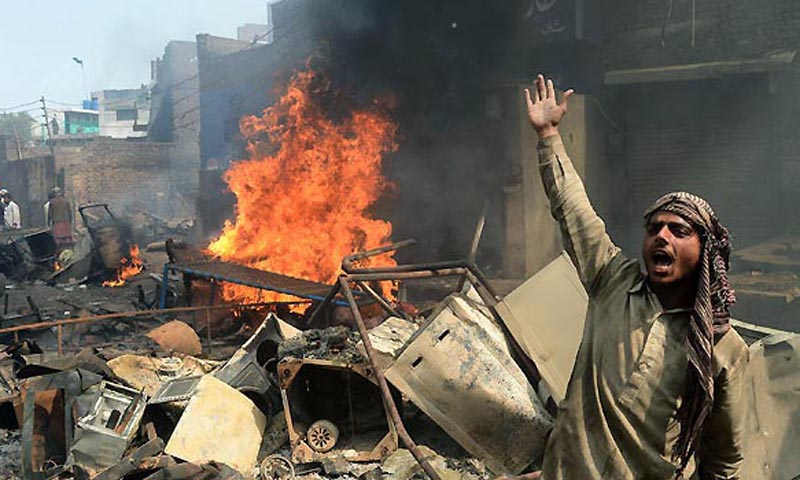
Peshawar:Taliban on the loose, another blast kills 41
Daily TimesA car bomb by Taliban killed at least 41 people and injured 100 on Sunday in Peshawar, officials said, the third deadly strike to hit the city in a week. A splinter group of the Pakistani Taliban claimed responsibility for the bombing, saying the attack was in response to US drone strikes in tribal areas; however, Taliban spokesman Shahidullah Shahid condemned the attack. The bomb caused carnage in the busy Kissa Khawani Bazaar. “The blast killed at least 41 people,” top local administration official Sahebzada Muhammad Anis told AFP. A senior official at Peshawar’s Lady Reading Hospital, Dr Arshad Javaid, confirmed the death toll and said 91 people were still in hospital after several of the injured were treated and sent home. The dead included eight women and six children aged five to nine. The bomb went off near a police station but officials said it did not appear to have been the target. “It looks like the market was the target,” said bomb disposal chief Shafqat Malik. He told AFP a car parked by the roadside had apparently been converted into a remote-controlled bomb. Prime Minister Nawaz Sharif, who is in New York for the UN General Assembly, strongly condemned the blast. “Those involved in the killing of innocent people are devoid of humanity and all religions,” he said in comments released by his office. The blast caused major destruction, toppling a two-storey building and gutting several shops, an AFP reporter at the scene saw. Thick grey clouds engulfed the entire area after several shops caught fire. At least 50 shops were either damaged or completely destroyed. Human limbs, blood, broken glass, stationery, blood-soaked clothes and sandals littered the road. Rescuers pulled several bodies from a passenger minivan which was passing the explosives-laden vehicle when it exploded. Officials said the 13 minivan passengers were members of the same family. “They had come to Peshawar from Shabqadar town for shopping ahead of my daughter’s wedding,” a family elder Sartaj Khan told AFP. Nearby buildings caught fire after the blast, which also damaged six vehicles, one tri-wheeler and four motorcycles. A crater was also formed on the site of the blast. The traders community said that a total of 85 shops were hit, of which 30 were destroyed completely. Officials and rescue workers were collecting body parts and bodies and putting them in ambulances for over an hour after the blast. “I was standing in front of a shop to buy ice cream for my ailing nephew who was with me when a deafening explosion rocked the entire area,” Muhammad Sajjad, 26, who works in Saudi Arabia as a labourer, told AFP in the hospital. “The explosion was so intense that it threw me and my nephew a few metres, injuring both of us,” said Khan, who escaped with a minor head injury. Weeping relatives of the dead and injured gathered at the hospital as rescuers brought in bodies or small bundles of human remains. Muhammad Wajih, 40, told AFP he was repairing a customer’s watch at his shop when there was a huge blast. “Half of the face of my customer, who was standing just in front of my shop, blew up while several stray splinters hit his back,” said Wajih, who was himself unhurt. On Sunday last week a twin suicide attack at a Peshawar church killed 82 people, triggering nationwide protests by the Christian community and others demanding better protection for minorities. On Friday a bomb tore through a bus carrying government employees on the edge of Peshawar, killing 18 people. Peshawar is the gateway of the tribal belt that US officials consider a safe haven for al Qaeda and other insurgents fighting both in Pakistan and across the border in Afghanistan. Khyber Pakhtunkhwa Governor Engineer Shaukatullah strongly condemned the bomb blast and expressed his deep shock and sorrow over the loss of lives. Describing it the worst act of inhumanity, the governor said that the elements involved in this crime would be brought to justice soon.
Pakistan: War unavoidable against terrorists
The terrorists struck in Peshawar\\\'s busy Qissakhwani Bazar and killed 40 innocent Pakistanis in one blast on Sunday; on the other hand, US drone attack killed six Pakistanis in North Waziristan on the very day: Taliban and the US, like a pair of blades of the same set of scissors, come from the opposite directions but meet for the purpose of shredding Pakistan into pieces. India, of course, is playing the fulcrum in the process.
Both claim to be struggling to save us from the other. Pakistan\\\'s government may not have the will to stop the harmful activities of the two but the nexus between the two is crystal clear to all in the nation.
In the strange and twisted logic of our politics, Taliban can do no wrong: their endless killing of our civilians and troops; illogical argument of avenging US drones related deaths by killing innocent Pakistanis; insistence on keeping Shahbaz Taseer as hostage but at the same time demanding the release of the murderer of his father the late governor of Punjab Salman Taseer; keeping the VC of Peshawar Islamia College University Ajmal Khan, a scholarly person with not a violent bone in his body, as their prisoner for the last three years; kidnapping foreigners and demanding tens of millions of dollars for freeing them; killing some members of the armed forces who were in Balochistan to provide humanitarian help to the quake victims and other many such shameful acts of violence and let us not forget the terrorists violence against our troops and civilians while talking of peace. What has the peaceful religion of Islam to do with the acts of these \\\'Islamic fighters? PM Nawaz and PTI chief Imran should explain these atrocities before making excuses for them!
All the above and the thousands of acts of cruelty and meanness which cannot be mentioned here due to shortage of space, seem to spur our political leadership to renew with greater vigour the offer for peace talks to the Taliban; to provide them facilities and to pamper them in any way possible.
Prime Minister Nawaz Sharif has condemned the many atrocities of Taliban, including the cold blooded murders of Major General Sanalluh and his colleagues, the twin blasts at a church in Peshawar and the Sunday\\\' bombing in Qissakhwani Bazar. His condemnations, however sound hollow and insincere when he refuses to withdraw his talk offer for peace in the face of such blatant acts of violence. Similarly, the PTI chief Imran Khan seems to be very insincere in his denunciations of the above mentioned acts when after each violent act committed by the Taliban, he comes more strongly for an office for them; If a Taliban office in Pakistan is not formal recognition of terrorism as a legitimate way of promoting one\\\'s point of view what else is!
No cruelty by the terrorists seems to convince Nawaz Sharif and Imran Khan of the inhumanity of the Taliban. Nor are these leaders fazed by the Taliban\\\'s refusal to recognise the Constitution of Pakistan.
The offer of peace talks has encouraged the terrorists in their violent ways. They will not be wrong in thinking that the more violence they do, the more concessions and recognition they will get.
Under the circumstances, will it be wrong for them to imagine taking control of the country if they can manage bigger blasts, bigger attacks on sensitive installations, kill more high officers of the armed forces, and murder greater number of civilians. With Nawaz Sharif refusing to withdraw offer for talks and Imran Khan urging for more facilities and recognition for them, it seems things are going the Taliban way.
But the situation cannot be maintained for much longer. The nation is fighting for its survival against ruthless forces; it cannot afford the senseless brinkmanship of its political leaders.
The argument given by the PTI that the Taliban do need an office for peace talk is the result of ignorance. There have been thousands of sessions of talks held by governments of all nations with unruly anti-state elements during the course of their nations\\\' histories: All such talks were held through neutral emissaries between rival parties who did not or could not give formal recognition to the other side. Even top individuals from both sides met on rare occasions but such meetings were in secret and never recognised. Formal actions resulting in recognition, if needed, were taken only after acceptable terms had been reached but not before that.
In the real world only the losing side agrees to talk and only to salvage some of its gains, The Taliban have to be defeated decisively and rooted out of their strongholds in the tribal areas with military action. Instead of waiting for them to strike our troops have to take the fight to them. We have to subdue the Taliban by force and deprive them of any hope of victory through violence before talks with them can be fruitful but not before that.
Balochistan: Sacred or Profane?
THE BALOCH HALBy Aasim Sajjad Akhtar THE wretched of the earth are given the name because their lot never seems to improve. So it is for the hapless communities of Awaran and Kech districts in southern Balochistan, whose already hard lives were devastated by a massive earthquake this past Tuesday. That nature chose to bare its most destructive face in the same region that has for the last few years been the epicentre of a low-intensity war between separatists and the state surely makes the horrific experience even more difficult to bear. The army chief went on record for the second or third time some time ago as saying there is no military operation ongoing in Balochistan. In a country where most ‘restive’ regions are effectively designated no-go areas by the state, a large majority of ordinary people tend to take such statements made by our rulers at face value. Baloch nationalists, along with other segments of Baloch society, are part of the minority that disputes the official narrative. In principle, a democratic political dispensation allows even those who challenge the ‘majority’ opinion to openly air their dissenting view. In this country, formal democracy has provided little respite to those who want to tell the ‘other’ side of the story in Balochistan. To the extent that there is acknowledgement in mainstream political and media circles of the ongoing conflict in Pakistan’s biggest — and crucially, most mineral-rich — province, the major protagonists of the militancy are caricatured as ‘sardars’. In recent times, the names of Bramdagh Bugti and Harbyar Marri have been bandied about regularly. Both Bramdagh and Harbyar do indeed have political struggle in their blood. The former is the grandson of the late Nawab Akbar Bugti while the latter is a son of the reclusive and still influential Nawab Khair Bakhsh Marri. They are undoubtedly central figures in the current phase of the Baloch national movement. But some might argue that they have already been upstaged. While the two heirs to the Bugti and Marri political dynasties predictably generate most of their support from the central regions of the province that are home to their respective tribes, there is increasing evidence that the insurgency’s heartland has shifted south and into an eco-social zone that is far less ‘tribal’ than the prototype to which most of us have been exposed. Kech district — also known as Turbat — was part of the ‘Makkuran’ princely state throughout the British colonial period, whereas Awaran was separated from Khuzdar district approximately two decades ago. While hereditary landlords and ‘sardars’ have remained a feature of the social and political landscape of Awaran, a landholding elite is conspicuous by its absence in Kech. It is in this decidedly ‘non-tribal’ context that the Baloch national movement has thrived in recent years. Much has been made of the ascension of a ‘middle-class’ chief minister to the provincial throne over the past few months. Dr Abdul Malik Baloch’s history and politics are indeed a welcome change from the elite merry-go-round that has been patronised by the security establishment in Balochistan for most of the post-colonial period. It is not only in the electoral realm, however, that the ‘middle class’ has come to the fore. Fate would have it that the new chief minister’s political trajectory is remarkably similar to the man who is arguably at the top of the ‘most wanted’ list in Balochistan at the present time. While Bramdagh Bugti and Harbyar Marri might have the more historically compelling political credentials, Dr Allah Nazar Baloch now has claims to being the symbolic leader of the separatist movement. A medical doctor by training — as is the chief minister — Allah Nazar hails from the Mashkay tehsil of Awaran district. The chief minister and Allah Nazar were in the Baloch Students Organisation as well as for a time in the Balochistan National Movement before they eventually parted ways. Both proudly celebrate their non-elite backgrounds, and, as it turns out, both are now competing for the loyalties of the people of southern Balochistan. Prior to the general elections in May, Baloch nationalists claimed that targeted bombings had taken place in and around Mashkay and other parts of Awaran. As I have already pointed out, the security establishment continues to deny that any military action has taken place in Balochistan in recent times. These contradictory claims notwithstanding, there is no doubting that Allah Nazar and his comrades are considered serious ‘national security’ threats. The men in khaki who continue to dominate major decisions in Balochistan would gladly avail any opportunity presented to them to get their hands on Awaran’s most famous (notorious?) personality. A natural calamity may just be that opportunity. The earthquake has left no structure standing in Awaran and large parts of Kech. The Frontier Corps along with regular military personnel have been empowered to spearhead the relief operation. Of course, the military has been at the forefront of numerous such efforts in the past, so there is nothing extraordinary about the fact that it will again be leading the line. Yet it would be naive to say that a great deal more is not at stake than just who is coordinating the relief effort. For the moment we do not even know the extent of the death and destruction that has taken place. It remains to be seen whether our holy guardians provide media persons access to the area so that news about both the damage and relief efforts enters the public domain. Whatever happens, the people of Awaran and Kech have been dealt a bitter blow. Perhaps it is true after all that there is a divine plan for Pakistan. Those who believe themselves to be ordained to defend this fortress of divinity should bear in mind, however, that the Baloch jury has yet to be convinced of the sacredness of the cause.
US drone strike kills three in Pakistan


Subscribe to:
Posts (Atom)