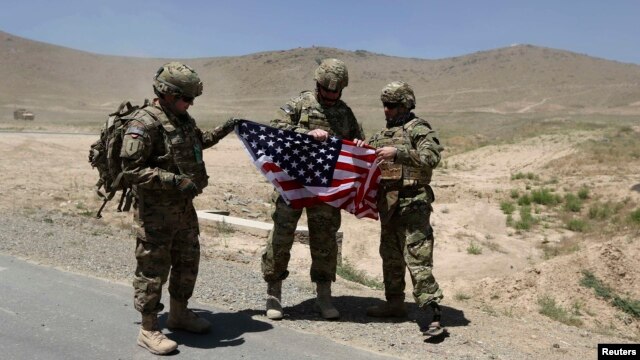
 The Afghan government says protracted negotiations over a crucial security agreement with the United States have advanced to a new stage, raising hopes that a deal can be struck before the fast-approaching October deadline set by Washington.
Afghan and American negotiators have tried in vain for more than a year to hammer out the details of a bilateral security agreement that would provide a framework for U.S. forces to remain in Afghanistan after NATO's combat mission ends in late 2014.
To break the deadlock, Afghan President Hamid Karzai has lined up a new team of high-profile negotiators. On August 20, the Afghan Foreign Ministry announced that Karzai had tasked his national security adviser, Rangin Dadfar Spanta, former Finance Minister Ashraf Ghani Ahmadizai, and Foreign Minister Zalmay Rasul to accelerate talks and finalize a deal.
U.S. Ambassador to Afghanistan James Cunningham and U.S. General Joseph Dunford, the commander of U.S. and NATO forces in Afghanistan, have taken up their positions on the other side of the negotiating table.
A working draft has already been hashed out by the two sides. But negotiations are now expected to move up a gear.
The bilateral security agreement and accompanying Status of Forces Agreement (SOFA) will define the role and shape of a U.S. military presence in Afghanistan, as well as the legal status of U.S. special forces and civilian trainers.
Major Sticking Points
Aimal Faizi, Karzai's spokesman, told RFE/RL's Radio Free Afghanistan that technical issues the United States needs resolved to operate militarily in Afghanistan have been resolved. These include taxation, visas, what bases and facilities in Afghanistan the United States will use, transit routes, and rights over Afghan airspace.
He says Afghan and American negotiators will now look to agree on larger and more contentious issues where major sticking points remain.
"Defending Afghanistan from foreign aggression is one of our key demands," Faizi says. "There are also other issues where disagreement remains. When talks resume again, these two negotiating teams will discuss these issues until there is agreement."
Negotiations have taken place against a backdrop of mutual suspicion and worsening bilateral relations. Both sides entered the talks with a competing set of military priorities and legal concerns.
The long-term security deal is essential for Washington and Kabul because it would allow the United States to train and assist Afghan security forces so the latter can hold off the Taliban and maintain their own security after 2014. It would also allow the United States to pursue remnants of Al-Qaeda operating along Afghanistan's porous border with Pakistan.
'Zero Option' Possible
Without a deal, American officials and their NATO allies have said the "zero option" of leaving no troops behind is a very real possibility. Billions of dollars in promised aid to sustain Afghanistan's security forces and develop its fragile economy could be at risk.
Karzai suspended talks with the United States after the Taliban opened a diplomatic office in the Qatari capital, Doha, in June. Karzai protested the presence of the Taliban's flag and banner at the office, saying the move violated Washington's promises about how the office would work.
Karzai has said negotiations over a security agreement with the United States would only resume when the reconciliation process with the Taliban is led by the Afghan government. Faizi did not say when he expected talks over the security document to formally resume, although informal negotiations have continued.
Faizi also said that the president would convene a Loya Jirga -- a grand assembly of tribal, ethnic, and religious leaders -- within two months, raising hopes of fast progress. Karzai has pledged to consult a Loya Jirga before ratifying any deal.
"If the two governments reach agreement, that's fine. But if they don't, then a Loya Jirga will be convened on why a deal wasn't struck," Faizi says. "If everything goes well, then we will have a Loya Jirga in a month and a half or two months."
Until then, American and Afghan negotiators will have to navigate through tricky waters, as both sides have shown little willingness to make concessions.
The United States wants immunity from Afghan justice for U.S. service members serving in Afghanistan. Karzai has demanded that American troops answer to Afghan law.
Afghanistan wants Washington to guarantee its security. Kabul wants the U.S. military to intervene and defend the country from "foreign aggression," including cross-border incursions or artillery attacks on its territory from Pakistan. That guarantee, seen as a nonstarter by many, could compel the United States to retaliate against Taliban safe havens in Pakistan in the event of such attacks.
The Afghan government has also demanded assurances from Washington that it will pledge a multiyear financial commitment to sustain the country's security forces. But as with military assistance, Washington promises to seek funds on a yearly basis from the U.S. Congress for assistance to Afghanistan.
The Afghan government says protracted negotiations over a crucial security agreement with the United States have advanced to a new stage, raising hopes that a deal can be struck before the fast-approaching October deadline set by Washington.
Afghan and American negotiators have tried in vain for more than a year to hammer out the details of a bilateral security agreement that would provide a framework for U.S. forces to remain in Afghanistan after NATO's combat mission ends in late 2014.
To break the deadlock, Afghan President Hamid Karzai has lined up a new team of high-profile negotiators. On August 20, the Afghan Foreign Ministry announced that Karzai had tasked his national security adviser, Rangin Dadfar Spanta, former Finance Minister Ashraf Ghani Ahmadizai, and Foreign Minister Zalmay Rasul to accelerate talks and finalize a deal.
U.S. Ambassador to Afghanistan James Cunningham and U.S. General Joseph Dunford, the commander of U.S. and NATO forces in Afghanistan, have taken up their positions on the other side of the negotiating table.
A working draft has already been hashed out by the two sides. But negotiations are now expected to move up a gear.
The bilateral security agreement and accompanying Status of Forces Agreement (SOFA) will define the role and shape of a U.S. military presence in Afghanistan, as well as the legal status of U.S. special forces and civilian trainers.
Major Sticking Points
Aimal Faizi, Karzai's spokesman, told RFE/RL's Radio Free Afghanistan that technical issues the United States needs resolved to operate militarily in Afghanistan have been resolved. These include taxation, visas, what bases and facilities in Afghanistan the United States will use, transit routes, and rights over Afghan airspace.
He says Afghan and American negotiators will now look to agree on larger and more contentious issues where major sticking points remain.
"Defending Afghanistan from foreign aggression is one of our key demands," Faizi says. "There are also other issues where disagreement remains. When talks resume again, these two negotiating teams will discuss these issues until there is agreement."
Negotiations have taken place against a backdrop of mutual suspicion and worsening bilateral relations. Both sides entered the talks with a competing set of military priorities and legal concerns.
The long-term security deal is essential for Washington and Kabul because it would allow the United States to train and assist Afghan security forces so the latter can hold off the Taliban and maintain their own security after 2014. It would also allow the United States to pursue remnants of Al-Qaeda operating along Afghanistan's porous border with Pakistan.
'Zero Option' Possible
Without a deal, American officials and their NATO allies have said the "zero option" of leaving no troops behind is a very real possibility. Billions of dollars in promised aid to sustain Afghanistan's security forces and develop its fragile economy could be at risk.
Karzai suspended talks with the United States after the Taliban opened a diplomatic office in the Qatari capital, Doha, in June. Karzai protested the presence of the Taliban's flag and banner at the office, saying the move violated Washington's promises about how the office would work.
Karzai has said negotiations over a security agreement with the United States would only resume when the reconciliation process with the Taliban is led by the Afghan government. Faizi did not say when he expected talks over the security document to formally resume, although informal negotiations have continued.
Faizi also said that the president would convene a Loya Jirga -- a grand assembly of tribal, ethnic, and religious leaders -- within two months, raising hopes of fast progress. Karzai has pledged to consult a Loya Jirga before ratifying any deal.
"If the two governments reach agreement, that's fine. But if they don't, then a Loya Jirga will be convened on why a deal wasn't struck," Faizi says. "If everything goes well, then we will have a Loya Jirga in a month and a half or two months."
Until then, American and Afghan negotiators will have to navigate through tricky waters, as both sides have shown little willingness to make concessions.
The United States wants immunity from Afghan justice for U.S. service members serving in Afghanistan. Karzai has demanded that American troops answer to Afghan law.
Afghanistan wants Washington to guarantee its security. Kabul wants the U.S. military to intervene and defend the country from "foreign aggression," including cross-border incursions or artillery attacks on its territory from Pakistan. That guarantee, seen as a nonstarter by many, could compel the United States to retaliate against Taliban safe havens in Pakistan in the event of such attacks.
The Afghan government has also demanded assurances from Washington that it will pledge a multiyear financial commitment to sustain the country's security forces. But as with military assistance, Washington promises to seek funds on a yearly basis from the U.S. Congress for assistance to Afghanistan.
Friday, August 23, 2013
Negotiations Advance On Crucial U.S.-Afghan Security Agreement
The Afghan government says protracted negotiations over a crucial security agreement with the United States have advanced to a new stage, raising hopes that a deal can be struck before the fast-approaching October deadline set by Washington.
Afghan and American negotiators have tried in vain for more than a year to hammer out the details of a bilateral security agreement that would provide a framework for U.S. forces to remain in Afghanistan after NATO's combat mission ends in late 2014.
To break the deadlock, Afghan President Hamid Karzai has lined up a new team of high-profile negotiators. On August 20, the Afghan Foreign Ministry announced that Karzai had tasked his national security adviser, Rangin Dadfar Spanta, former Finance Minister Ashraf Ghani Ahmadizai, and Foreign Minister Zalmay Rasul to accelerate talks and finalize a deal.
U.S. Ambassador to Afghanistan James Cunningham and U.S. General Joseph Dunford, the commander of U.S. and NATO forces in Afghanistan, have taken up their positions on the other side of the negotiating table.
A working draft has already been hashed out by the two sides. But negotiations are now expected to move up a gear.
The bilateral security agreement and accompanying Status of Forces Agreement (SOFA) will define the role and shape of a U.S. military presence in Afghanistan, as well as the legal status of U.S. special forces and civilian trainers.
Major Sticking Points
Aimal Faizi, Karzai's spokesman, told RFE/RL's Radio Free Afghanistan that technical issues the United States needs resolved to operate militarily in Afghanistan have been resolved. These include taxation, visas, what bases and facilities in Afghanistan the United States will use, transit routes, and rights over Afghan airspace.
He says Afghan and American negotiators will now look to agree on larger and more contentious issues where major sticking points remain.
"Defending Afghanistan from foreign aggression is one of our key demands," Faizi says. "There are also other issues where disagreement remains. When talks resume again, these two negotiating teams will discuss these issues until there is agreement."
Negotiations have taken place against a backdrop of mutual suspicion and worsening bilateral relations. Both sides entered the talks with a competing set of military priorities and legal concerns.
The long-term security deal is essential for Washington and Kabul because it would allow the United States to train and assist Afghan security forces so the latter can hold off the Taliban and maintain their own security after 2014. It would also allow the United States to pursue remnants of Al-Qaeda operating along Afghanistan's porous border with Pakistan.
'Zero Option' Possible
Without a deal, American officials and their NATO allies have said the "zero option" of leaving no troops behind is a very real possibility. Billions of dollars in promised aid to sustain Afghanistan's security forces and develop its fragile economy could be at risk.
Karzai suspended talks with the United States after the Taliban opened a diplomatic office in the Qatari capital, Doha, in June. Karzai protested the presence of the Taliban's flag and banner at the office, saying the move violated Washington's promises about how the office would work.
Karzai has said negotiations over a security agreement with the United States would only resume when the reconciliation process with the Taliban is led by the Afghan government. Faizi did not say when he expected talks over the security document to formally resume, although informal negotiations have continued.
Faizi also said that the president would convene a Loya Jirga -- a grand assembly of tribal, ethnic, and religious leaders -- within two months, raising hopes of fast progress. Karzai has pledged to consult a Loya Jirga before ratifying any deal.
"If the two governments reach agreement, that's fine. But if they don't, then a Loya Jirga will be convened on why a deal wasn't struck," Faizi says. "If everything goes well, then we will have a Loya Jirga in a month and a half or two months."
Until then, American and Afghan negotiators will have to navigate through tricky waters, as both sides have shown little willingness to make concessions.
The United States wants immunity from Afghan justice for U.S. service members serving in Afghanistan. Karzai has demanded that American troops answer to Afghan law.
Afghanistan wants Washington to guarantee its security. Kabul wants the U.S. military to intervene and defend the country from "foreign aggression," including cross-border incursions or artillery attacks on its territory from Pakistan. That guarantee, seen as a nonstarter by many, could compel the United States to retaliate against Taliban safe havens in Pakistan in the event of such attacks.
The Afghan government has also demanded assurances from Washington that it will pledge a multiyear financial commitment to sustain the country's security forces. But as with military assistance, Washington promises to seek funds on a yearly basis from the U.S. Congress for assistance to Afghanistan.
Karzai Heads to Pakistan for Talks on Afghan Peace Process
Peshawar seminary on US terrorist list: Wanted man a frequent international traveller
Sheikh Aminullah, who triggered the US economic sanctions on a small seminary in Peshawar on Tuesday, has been frequently travelling abroad despite having been declared a terrorist by the US government and the United Nations in 2009.
“Sheikh Aminullah travelled to Saudi Arabia in last Ramazan for performing Umra and then came back to Rawalpindi where he was teaching the Holy Quran at a mosque in Raja Bazaar,” said one source affiliated with Jamia Taleemul Quran wal Sunnah, which was declared a terrorist outfit by the US government.
He said he knew that Amanullah, who had taught here from 20 years, had been declared terrorist by the UN and the US.The US State Department said the seminary was being abused by terrorist organisations and today’s action appeared to be the first time, a seminary had been declared a terrorist outfit in Pakistan.Jamia Taleemul Quran wal Sunnah is situated in a narrow street outside Gunj Gate of Peshawar, where, according the administration, some 120 students are enrolled.
The seminary was established in 1990,receiving donations from Saudi Arabia,spreeading hate,brainwashing kids,on behalf of saudi arabia spreads hate against Shia,Ahmadi Muslims and other non-muslim groups in Pakistan.
The ground floor is used as a mosque while first floor is used as a classroom and dormitory. Three to four small rooms on the top floor are also used for teaching purposes.
President Zardari: Democracy taking root in Pakistan
 President Asif Ali Zardari on Thursday said democracy was taking root in Pakistan, as for the first time in the country's history one elected civilian president would be handing over charge to another elected civilian president in a smooth and orderly manner.
Pakistan and Israel hit by polio setback
By Jon Boone, Harriet Sherwood and Sarah Boseley

North Waziristan cases follow militants' vaccination ban, while Israel starts mass inoculation after virus detected in sewageThe battle to eliminate polio has hit apparent setbacks in northern Pakistan, where new cases are being reported, and in Israel, where the discovery of the virus in the sewage system has led to a mass immunisation campaign. Fourteen suspected cases of polio have been discovered in Pakistan's insurgency-racked north-west, where Taliban militants have banned vaccination workers. Although the country is awaiting the result of tests on stool samples from the affected children, a surge in cases could strike a major blow to the government's intense efforts to exit the small group of nations that has failed to eradicate the disease. All but two of the children were from North Waziristan, the most troubled of the seven tribal "agencies" that comprise the Federally Administered Tribal Areas, a semi-autonomous region of Pakistan that borders Afghanistan and is a hotbed for militancy. The majority of strikes by the CIA's unmanned drone campaign occur in North Waziristan, a situation that last year prompted Taliban commander Hafiz Gul Bahadur to block the anti-polio campaign in the agency. Militants in other areas have enacted similar bans, saying they will lift them only when drone strikes end. In North and South Waziristan, more than 260,000 under fives have not been immunised since June 2012. In tribal, highly conservative parts of the country health workers are regarded with intense suspicion. Popular fears are often stoked by local religious leaders who claim the vaccines are part of a western plot to sterilise Muslims. Elsewhere in the country, monsoon floods, insecurity and a string of byelections have forced authorities to postpone a vaccination drive originally scheduled to begin on Monday. According to the global polio eradication initiative, 181 cases had been recorded worldwide this year between January and 13 August. A total of 71 were in Afghanistan, Nigeria and Pakistan, countries where the disease is endemic. Bruce Aylward, who leads the World Health Organisation's global polio eradication campaign, pointed out that the actions of Gul Bahadur were not in line with the expressed views of the Afghan Taliban, which published a statement on its website two months ago about the importance of vaccinating children against polio (with the rider that it should be done in a manner appropriate for Muslims). Aylward said some of the reported cases were false alarms, with tests showing that children's symptoms were not caused by the polio virus. But, he added, cases were inevitable. "This is one of the very few areas in the world that is affected by polio where there is no vaccination ongoing," he said. "The endgame in stopping transmission is getting vaccination into every affected area. If we are not vaccinating, we are not eradicating." Experts are hopeful that vaccination may resume. A year has passed since it was suspended, making it probable that the political impact will have diminished. And while a ban can continue indefinitely while there are no polio cases, local sensitivities may change if children become sick or are harmed by the disease. Aylward pointed to conflict-hit areas such as the Democratic Republic of the Congo and northern Nigeria, where vaccination has resumed. "In each case, with time and understanding for the consequences of their own children, it has been possible to get a dialogue," he said. Meanwhile, Israel has launched a mass inoculation programme, aimed at reaching more than a million under-10s over the next three months, after one of the three strains of polio was detected in the country's sewage system. No one in Israel has developed the virus since the discovery of type one in the south of the country earlier this year. It has since spread to sewage systems in the centre and the north. Type one was identified in neighbouring Egypt in December. Drops containing vaccine against types one and three of the virus are being administered orally at health clinics. Israel routinely immunises children against polio, but this campaign aims to boost the level of protection. About 182,000 children were inoculated in the first three days. A legal petition against the move, on the grounds that it was unnecessary and could be harmful, was dismissed by the high court. The last outbreak of polio in Israel was 25 years ago, and Aylward said the situation there is different to that in Pakistan. Like most countries that have eliminated polio, Israel has switched from oral drops to the inactivated poliovirus vaccine (IPV), which is injected. The IPV prevents the virus causing illness but, if children or adults contract it, it will still travel through the gut. Israel, which has excellent surveillance systems, discovered the virus in the sewage system in February, said Aylward, but that happens in many countries using IPV. What is unusual is that it did not disappear and has since been detected in other parts of the country. The virus in the sewage is not a threat to children who have been immunised, but it is to the estimated 6% who have not been. "So far, they have been lucky – there are no cases," said Aylward. Without the vaccination campaign, however, it would be surprising if cases did not occur.
Africa and Pakistan Face Polio Outbreaks, in Blow to Global Fight
 By DONALD G. McNEIL Jr.
The global effort to eradicate polio, a disease that has been on the brink of extinction for years, is facing serious setbacks on two continents. The virus is surging in Somalia and the Horn of Africa, which had been largely free of cases for several years. And a new outbreak has begun in a part of Pakistan that a warlord declared off limits to vaccinators 14 months ago.
The African outbreak began in May with just two cases of polio paralysis: one in Mogadishu, Somalia’s capital, and another in the huge Dadaab refugee camp in Kenya, where thousands of Somalis have fled fighting between Islamic militants, clan militias, government troops and African peacekeepers.
Now there are 121 cases in the region; last year, there were only 223 in the world.
The new Pakistan outbreak is in North Waziristan, near the frontier with Afghanistan. It is in an area where a warlord banned polio vaccinations after it was disclosed that the C.I.A. had staged a hepatitis vaccination campaign in its hunt for Osama bin Laden. The warlord, Hafiz Gul Bahadur, banned all efforts until American drone strikes ended.
Although only three North Waziristan children have suffered polio paralysis since then, even one case shows that the virus is in the area and could spread.
The new outbreaks may delay a recently announced $5.5 billion plan to eradicate polio by 2018. Nonetheless, public health officials still believe that, with enough local political will and donor money, they can prevail by using techniques that have worked before.
To prevent the disease from reaching Mecca during next month’s hajj, Saudi Arabia has tightened its rules. Pilgrims from any country with polio cases must be vaccinated at home and again on arrival. Last year, nearly 500,000 pilgrims were vaccinated on arrival, Dr. Ziad A. Memish, the Saudi deputy health minister, said recently.
The Pakistan outbreak is particularly frustrating because eradication had been going steadily forward despite the killings in December of nine vaccinators for which some blamed the Taliban.
Public health officials had counted themselves lucky that despite simultaneous vaccination bans in North and South Waziristan, no polio virus was known to be circulating in the 250,000 children in those areas. Vaccination posts were set up on nearby highways and on buses and trains. Urban hospitals packed the vaccine on ice for families willing to smuggle it back to neighbors. But it was not enough.
“The equation is simple,” said Dr. Elias Durry, emergency coordinator for polio eradication in Pakistan for the World Health Organization. “Where you can immunize, the virus goes away. Where you can’t, the virus gets in, and it will paralyze these poor kids.”
Dr. Durry said he hoped that parents whose children were paralyzed would speak up at local decision-making councils, called shuras, that are common in tribal areas, and possibly put pressure on warlords to rescind the ban.
The Taliban warlord in South Waziristan, Maulvi Nazir, was killed by a drone strike in January.
Before the Waziristan outbreak, Pakistan had seen only 24 cases this year, about as many as it had at the same point in 2012. Most were around Karachi and Peshawar, where last year’s killings of the vaccinators took place and where resistance to vaccines is highest.
The Somali outbreak is different. There is little opposition to the vaccine itself, said Dr. Bruce Aylward, the W.H.O. assistant director general for polio. In several Muslim countries, including Pakistan, the drive has been hurt by rumors that the vaccine sterilizes girls or contains the virus that causes AIDS or pork products.
But, he said, many cases are in areas south of Mogadishu where the Shabab, a militant group, operate. The group opposes mass campaigns because it believes the sight of thousands of vaccinators going house to house would undercut its claim to rule those areas.
“It’s all about control,” Dr. Aylward said.
Instead, the campaign negotiates with local chiefs and midlevel Shabab members to hold small drives.
Other tactics have changed, too: children of any age, and sometimes adults, get the drops, and drives are held twice a month instead of every three months.
Refugee camps face other obstacles. Large ones often have lawless areas on their fringes where vaccinators may fear to work because of predatory criminals.
“When this started, I said, ‘Brace yourself for hundreds of cases,’ ” Dr. Aylward said, because he knew that few children born in the last five years had been immunized.
Still, he said he believed this outbreak could be beaten because it echoed the one that plagued the region from 2005 to 2007. It also began in Mogadishu, and it spread as far as Yemen and Eritrea and paralyzed about 700 children before multiple mass vaccination rounds snuffed it out. Kenya, Yemen and Ethiopia are already planning those with help from Geneva.
Somalia is so dangerous for health workers that Doctors Without Borders pulled out of the country this month after 22 years there. But polio officials hope their campaign will not be targeted, largely because it creates thousands of temporary paying jobs for “volunteer” vaccinators.
In Mogadishu in July, President Hassan Sheik Mohamud publicly took polio drops at an event encouraging parents to vaccinate.
Asha Ali, 38, a mother of four, changed her attitude. “I was thinking the vaccine might sicken our children,” she said. “I realized later that it was good.”
Hamdi Hashi, 26, said she accepted it “because I don’t want this serious disease to cripple my children.”
But Habow Madey, in a different Mogadishu neighborhood, said her husband had forbidden vaccination, believing it causes “a mysterious disease.”
By DONALD G. McNEIL Jr.
The global effort to eradicate polio, a disease that has been on the brink of extinction for years, is facing serious setbacks on two continents. The virus is surging in Somalia and the Horn of Africa, which had been largely free of cases for several years. And a new outbreak has begun in a part of Pakistan that a warlord declared off limits to vaccinators 14 months ago.
The African outbreak began in May with just two cases of polio paralysis: one in Mogadishu, Somalia’s capital, and another in the huge Dadaab refugee camp in Kenya, where thousands of Somalis have fled fighting between Islamic militants, clan militias, government troops and African peacekeepers.
Now there are 121 cases in the region; last year, there were only 223 in the world.
The new Pakistan outbreak is in North Waziristan, near the frontier with Afghanistan. It is in an area where a warlord banned polio vaccinations after it was disclosed that the C.I.A. had staged a hepatitis vaccination campaign in its hunt for Osama bin Laden. The warlord, Hafiz Gul Bahadur, banned all efforts until American drone strikes ended.
Although only three North Waziristan children have suffered polio paralysis since then, even one case shows that the virus is in the area and could spread.
The new outbreaks may delay a recently announced $5.5 billion plan to eradicate polio by 2018. Nonetheless, public health officials still believe that, with enough local political will and donor money, they can prevail by using techniques that have worked before.
To prevent the disease from reaching Mecca during next month’s hajj, Saudi Arabia has tightened its rules. Pilgrims from any country with polio cases must be vaccinated at home and again on arrival. Last year, nearly 500,000 pilgrims were vaccinated on arrival, Dr. Ziad A. Memish, the Saudi deputy health minister, said recently.
The Pakistan outbreak is particularly frustrating because eradication had been going steadily forward despite the killings in December of nine vaccinators for which some blamed the Taliban.
Public health officials had counted themselves lucky that despite simultaneous vaccination bans in North and South Waziristan, no polio virus was known to be circulating in the 250,000 children in those areas. Vaccination posts were set up on nearby highways and on buses and trains. Urban hospitals packed the vaccine on ice for families willing to smuggle it back to neighbors. But it was not enough.
“The equation is simple,” said Dr. Elias Durry, emergency coordinator for polio eradication in Pakistan for the World Health Organization. “Where you can immunize, the virus goes away. Where you can’t, the virus gets in, and it will paralyze these poor kids.”
Dr. Durry said he hoped that parents whose children were paralyzed would speak up at local decision-making councils, called shuras, that are common in tribal areas, and possibly put pressure on warlords to rescind the ban.
The Taliban warlord in South Waziristan, Maulvi Nazir, was killed by a drone strike in January.
Before the Waziristan outbreak, Pakistan had seen only 24 cases this year, about as many as it had at the same point in 2012. Most were around Karachi and Peshawar, where last year’s killings of the vaccinators took place and where resistance to vaccines is highest.
The Somali outbreak is different. There is little opposition to the vaccine itself, said Dr. Bruce Aylward, the W.H.O. assistant director general for polio. In several Muslim countries, including Pakistan, the drive has been hurt by rumors that the vaccine sterilizes girls or contains the virus that causes AIDS or pork products.
But, he said, many cases are in areas south of Mogadishu where the Shabab, a militant group, operate. The group opposes mass campaigns because it believes the sight of thousands of vaccinators going house to house would undercut its claim to rule those areas.
“It’s all about control,” Dr. Aylward said.
Instead, the campaign negotiates with local chiefs and midlevel Shabab members to hold small drives.
Other tactics have changed, too: children of any age, and sometimes adults, get the drops, and drives are held twice a month instead of every three months.
Refugee camps face other obstacles. Large ones often have lawless areas on their fringes where vaccinators may fear to work because of predatory criminals.
“When this started, I said, ‘Brace yourself for hundreds of cases,’ ” Dr. Aylward said, because he knew that few children born in the last five years had been immunized.
Still, he said he believed this outbreak could be beaten because it echoed the one that plagued the region from 2005 to 2007. It also began in Mogadishu, and it spread as far as Yemen and Eritrea and paralyzed about 700 children before multiple mass vaccination rounds snuffed it out. Kenya, Yemen and Ethiopia are already planning those with help from Geneva.
Somalia is so dangerous for health workers that Doctors Without Borders pulled out of the country this month after 22 years there. But polio officials hope their campaign will not be targeted, largely because it creates thousands of temporary paying jobs for “volunteer” vaccinators.
In Mogadishu in July, President Hassan Sheik Mohamud publicly took polio drops at an event encouraging parents to vaccinate.
Asha Ali, 38, a mother of four, changed her attitude. “I was thinking the vaccine might sicken our children,” she said. “I realized later that it was good.”
Hamdi Hashi, 26, said she accepted it “because I don’t want this serious disease to cripple my children.”
But Habow Madey, in a different Mogadishu neighborhood, said her husband had forbidden vaccination, believing it causes “a mysterious disease.”
Pakistan: ‘Ahmadis not allowed to do business in Muslim areas’
The Express Tribune
 A man was forced to abandon his woodworking business and flee Gujranwala with his family after his erstwhile friends and neighbours discovered that he was an Ahmadi, The Express Tribune has learnt.
Imran Ahmed, 35, started out as a daily wager at a woodwork shop in Gujranwala. He saved up money for three years, then invested Rs100,000 in machinery and setting up his own workshop. As his business grew, he hired two carpenters to work for him. “Things were going really well, but nobody knew I was an Ahmadi,” he said.
Ahmed said that his was the only Ahmadi family in Rana Colony in Gujranwala and he kept this a secret as he feared being victimised. He got along well with his neighbours and one day, when he was injured in a motorcycle accident, they came to ask after him. Inside his house, they saw pictures of Ahmadi personalities. “Their mood totally changed and they left without even having tea,” he said.
Things changed dramatically for Ahmed. He said some other workshop owners who were his business rivals began a hate campaign against him. One by one, his ‘friends’ began socially boycotting him. Shopkeepers would refuse to sell him groceries, and his employees resigned, saying it was prohibited to work with him. “Boys on the street started passing comments about me and things got worse day by day,” he said.
Then one day during Ramazan, Ahmed said, three neighbouring shopkeepers and two clerics barged into his workshop and began beating him. They told him to leave at once if he wanted to protect his life and his family, he said. He asked to be allowed to remove his machinery from the shop, but they refused, he said. He rushed home, just a few hundred yards away, gathered his wife and three young children, and left Gujranwala. He now lives with relatives in another city and works as a daily wager at a furniture shop.
Ahmed said that he had not filed a complaint with the police, but he intended to do so soon. He would also ask the police to recover his machinery and household items. He said that he would nominate Maulvi Abdul Rehman, Abid Ali and Mubashar in his application to the police. He said that Ali and Mubashar had been close friends up until they had found out that he was an Ahmadi.
When contacted, Abdul Rehman told The Express Tribune that he had no regrets about what had happened to Imran Ahmed. He said Ahmadis were apostates who deserved death. They don’t have a right to do business in Muslim areas, he said.
Asked why Ahmed had not been allowed to take his belongings with him, he said: “It is enough that he spent five years here and fed his family using money from Muslims. We are ready to deal with him if he returns. It is better for him to forget the belongings he left in his shop and his house.”
Munawar Ali Shahid, a human rights activist, said that this was just the latest manifestation of an anti-Ahmadi campaign being run by various hardline groups across the province, particularly in Lahore, where “baseless” cases had been registered against several Ahmadis in recent months. He said that the state had utterly failed to protect the lives and properties of minorities, particularly Ahmadis. He said he too had been threatened for seeking to protect the rights of Ahmadi citizens.
A man was forced to abandon his woodworking business and flee Gujranwala with his family after his erstwhile friends and neighbours discovered that he was an Ahmadi, The Express Tribune has learnt.
Imran Ahmed, 35, started out as a daily wager at a woodwork shop in Gujranwala. He saved up money for three years, then invested Rs100,000 in machinery and setting up his own workshop. As his business grew, he hired two carpenters to work for him. “Things were going really well, but nobody knew I was an Ahmadi,” he said.
Ahmed said that his was the only Ahmadi family in Rana Colony in Gujranwala and he kept this a secret as he feared being victimised. He got along well with his neighbours and one day, when he was injured in a motorcycle accident, they came to ask after him. Inside his house, they saw pictures of Ahmadi personalities. “Their mood totally changed and they left without even having tea,” he said.
Things changed dramatically for Ahmed. He said some other workshop owners who were his business rivals began a hate campaign against him. One by one, his ‘friends’ began socially boycotting him. Shopkeepers would refuse to sell him groceries, and his employees resigned, saying it was prohibited to work with him. “Boys on the street started passing comments about me and things got worse day by day,” he said.
Then one day during Ramazan, Ahmed said, three neighbouring shopkeepers and two clerics barged into his workshop and began beating him. They told him to leave at once if he wanted to protect his life and his family, he said. He asked to be allowed to remove his machinery from the shop, but they refused, he said. He rushed home, just a few hundred yards away, gathered his wife and three young children, and left Gujranwala. He now lives with relatives in another city and works as a daily wager at a furniture shop.
Ahmed said that he had not filed a complaint with the police, but he intended to do so soon. He would also ask the police to recover his machinery and household items. He said that he would nominate Maulvi Abdul Rehman, Abid Ali and Mubashar in his application to the police. He said that Ali and Mubashar had been close friends up until they had found out that he was an Ahmadi.
When contacted, Abdul Rehman told The Express Tribune that he had no regrets about what had happened to Imran Ahmed. He said Ahmadis were apostates who deserved death. They don’t have a right to do business in Muslim areas, he said.
Asked why Ahmed had not been allowed to take his belongings with him, he said: “It is enough that he spent five years here and fed his family using money from Muslims. We are ready to deal with him if he returns. It is better for him to forget the belongings he left in his shop and his house.”
Munawar Ali Shahid, a human rights activist, said that this was just the latest manifestation of an anti-Ahmadi campaign being run by various hardline groups across the province, particularly in Lahore, where “baseless” cases had been registered against several Ahmadis in recent months. He said that the state had utterly failed to protect the lives and properties of minorities, particularly Ahmadis. He said he too had been threatened for seeking to protect the rights of Ahmadi citizens.
Pakistan: Upsets define country’s biggest by-polls
 There was a massive turnout witnessed in the country’s biggest by-polls held on Thursday, with voters rejecting candidates from leading political parties in favour of unknown rivals.
Major upsets were witnessed in by-elections held across country on Thursday as Pakistan Tehreek-e-Insaf, ruling PML-N and PML-Functional failed to retain some of their previously-won seats vacated by the parties’ top leaders.
The PPP, which tasted its worst defeat in May 11 general elections, made a decent come back by clinching three NA seats.
Those who lost seats included the PTI, that lost both seats won by party chief Imran Khan in NA-1 Peshawar and NA-71 Mianwali, losing to ANP and PML-N candidates, respectively.
In Mianwali, the home constituency of PTI chief Imran Khan, his candidate Malik Amjad lost to PML-N candidate ShadiKhel, who won with 95,091 votes.
In NA-1 Peshawar, PTI candidate Gul Badshah faced a massive defeat at the hand of senior politician of ANP, Ghulam Ahmed Bilour. Per unofficial results, Bilour got over 37,000 votes while PTI Gul Badhsa bagged around 25,000 votes.
Political pundits believe that bad decision-making by the PTI chief in awarding tickets cost PTI both seats.
However, the PTI snatched two provincial assembly seats from DG khan, won and vacated earlier by Punjab CM Shahbaz Sharif and Zulfikar Khosa.
This is a rare achievement for the PTI as the party makes its mark in south Punjab. However, the PML-N won 10 provincial assembly seats from Punjab province on the whole.
According to unofficial results, the PML-N was leading the race with five NA seats followed by PPP with three seats, PTI with two, PkMAP and MQM with one NA seat each.
The MQM also won both provincial assembly seats from Karachi.
The ECP withheld results for NA-5 and NA-27 and ordered re-election on nine polling stations of each constituency.
The NA-5 seat was vacated by KP Chief Minister Pervez Khattak and NA-27 by JI chief Maulana Fazulur Rehman.
Per unofficial results, the PTI was leading the race for both seats.
The PTI managed to retain its NA-13 Swabi seat, which was vacated by KPK speaker Asad Qaisar. His brother managed to win the election for the PTI again.
The PTI also retained its vacated NA-48 Islamabad seat with Asad Umar’s victory.
Umar won the elections by getting 48,073 votes, while his rival, PML-N’s Ashraf Gujjar, got 44,186 votes.
The PPP’s Shazia Mari snatched NA-235 Sanghar from the PML-F. She defeated JUI-F’s Khuda Bakhs Dar. PPP candidate Mehrunnisa won the elections from Thatta, while in Punjab, former foreign minister, Hina Rabbani Khar’s father, Noor Rabbani, won the NA-177 seat against the Dastis.
This seat was won and vacated by Jamshad Dasti. His brother Javid Dasti, bagged only 49,547 votes against PPP’s Noor Khar, who won with 53,049 votes.
- See more at: http://www.pakistantoday.com.pk/2013/08/23/news/national/upsets-define-countrys-biggest-by-polls/#sthash.p7NjjpoB.dpuf
There was a massive turnout witnessed in the country’s biggest by-polls held on Thursday, with voters rejecting candidates from leading political parties in favour of unknown rivals.
Major upsets were witnessed in by-elections held across country on Thursday as Pakistan Tehreek-e-Insaf, ruling PML-N and PML-Functional failed to retain some of their previously-won seats vacated by the parties’ top leaders.
The PPP, which tasted its worst defeat in May 11 general elections, made a decent come back by clinching three NA seats.
Those who lost seats included the PTI, that lost both seats won by party chief Imran Khan in NA-1 Peshawar and NA-71 Mianwali, losing to ANP and PML-N candidates, respectively.
In Mianwali, the home constituency of PTI chief Imran Khan, his candidate Malik Amjad lost to PML-N candidate ShadiKhel, who won with 95,091 votes.
In NA-1 Peshawar, PTI candidate Gul Badshah faced a massive defeat at the hand of senior politician of ANP, Ghulam Ahmed Bilour. Per unofficial results, Bilour got over 37,000 votes while PTI Gul Badhsa bagged around 25,000 votes.
Political pundits believe that bad decision-making by the PTI chief in awarding tickets cost PTI both seats.
However, the PTI snatched two provincial assembly seats from DG khan, won and vacated earlier by Punjab CM Shahbaz Sharif and Zulfikar Khosa.
This is a rare achievement for the PTI as the party makes its mark in south Punjab. However, the PML-N won 10 provincial assembly seats from Punjab province on the whole.
According to unofficial results, the PML-N was leading the race with five NA seats followed by PPP with three seats, PTI with two, PkMAP and MQM with one NA seat each.
The MQM also won both provincial assembly seats from Karachi.
The ECP withheld results for NA-5 and NA-27 and ordered re-election on nine polling stations of each constituency.
The NA-5 seat was vacated by KP Chief Minister Pervez Khattak and NA-27 by JI chief Maulana Fazulur Rehman.
Per unofficial results, the PTI was leading the race for both seats.
The PTI managed to retain its NA-13 Swabi seat, which was vacated by KPK speaker Asad Qaisar. His brother managed to win the election for the PTI again.
The PTI also retained its vacated NA-48 Islamabad seat with Asad Umar’s victory.
Umar won the elections by getting 48,073 votes, while his rival, PML-N’s Ashraf Gujjar, got 44,186 votes.
The PPP’s Shazia Mari snatched NA-235 Sanghar from the PML-F. She defeated JUI-F’s Khuda Bakhs Dar. PPP candidate Mehrunnisa won the elections from Thatta, while in Punjab, former foreign minister, Hina Rabbani Khar’s father, Noor Rabbani, won the NA-177 seat against the Dastis.
This seat was won and vacated by Jamshad Dasti. His brother Javid Dasti, bagged only 49,547 votes against PPP’s Noor Khar, who won with 53,049 votes.
- See more at: http://www.pakistantoday.com.pk/2013/08/23/news/national/upsets-define-countrys-biggest-by-polls/#sthash.p7NjjpoB.dpuf
Punjab Assembly : ''Undemocratic practice
Blast targets security convoy in Peshawar
THE FRONTIER POSTA remote controlled blast occurred at Kohat Road in Peshawar when the convoy of security forces was passing through the Bazid Khel area Friday, Local tv reported. According to police, the security personnel were on their way when a bomb fixed in the motorcycle went off near the convoy at Kohat Road, causing a huge blast. As a result, one of the vehicles was partially damaged due to the impact, however, no casualty or injury was reported. Police and rescue teams reached the blast site and cordoned off the area.
Thursday, August 22, 2013
Obama’s Plan Aims to Lower Cost of College
 By TAMAR LEWIN
President Obama announced a set of ambitious proposals on Thursday aimed at making colleges more accountable and affordable by rating them and ultimately linking those ratings to financial aid.
By TAMAR LEWIN
President Obama announced a set of ambitious proposals on Thursday aimed at making colleges more accountable and affordable by rating them and ultimately linking those ratings to financial aid.
Gilani: Pakistan People’s Party's defeat was a ‘conspiracy’

http://mediacellppp.wordpress.com/
Former Prime Minister Yusuf Raza Gilani

Mubarak leaves prison
http://www.dailynewsegypt.com/
 Egypt’s ousted president Hosni Mubarak was flown from prison by helicopter to a military hospital Thursday after he was cleared for conditional release while standing trial, an interior ministry general told AFP.
Mubarak will be held under house arrest at the Cairo hospital on the orders of the prime minister, who has been granted the power to order arrests during the current state of emergency.
Live television footage showed the medical helicopter that took Mubarak from Cairo’s Tora prison arrive at a nearby military hospital.
Mubarak, 85, is believed to be suffering from a heart condition.
Mubarak was cleared for conditional release after his lawyer argued his detention had exceeded the limit of pre-verdict imprisonment, and Mubarak had paid back the money involved in one of his corruption cases.
His next hearing is set for Sunday, on charges of corruption and complicity in the deaths of protesters during the 18-day uprising that overthrew him in early 2011.
Egypt’s ousted president Hosni Mubarak was flown from prison by helicopter to a military hospital Thursday after he was cleared for conditional release while standing trial, an interior ministry general told AFP.
Mubarak will be held under house arrest at the Cairo hospital on the orders of the prime minister, who has been granted the power to order arrests during the current state of emergency.
Live television footage showed the medical helicopter that took Mubarak from Cairo’s Tora prison arrive at a nearby military hospital.
Mubarak, 85, is believed to be suffering from a heart condition.
Mubarak was cleared for conditional release after his lawyer argued his detention had exceeded the limit of pre-verdict imprisonment, and Mubarak had paid back the money involved in one of his corruption cases.
His next hearing is set for Sunday, on charges of corruption and complicity in the deaths of protesters during the 18-day uprising that overthrew him in early 2011.
News Analysis: Release of Mubarak unlikely to change Egypt's political scene
 Former Egyptian President Hosni Mubarak will be freed on Thursday, as his lawyer said, but he will be placed under house arrest to avoid more perplexity in the country hit by turmoil since the ouster of his successor Mohamed Morsi on July 3.
Mubarak will leave the jail after settling his last corruption case of Ahram institution, in which he was charged along with his two sons with misusing power and accepting gifts from governmental institutions via his information minister.
Mubarak, 86 years old, governed Egypt for 30 years until he was overthrown during the uprisings that swept the Arab country in early 2011. He will still be banned from traveling abroad as he faces a retrial on charges of involvement in the killing of protesters during the 2011 unrest that eventually toppled him. The next hearing is slated for Saturday.
For his old age and the judicial procedures, Mubarak's release won't change the political situation in Egypt, said Gamal Zahran, chief of the political science department at Port Said University.
His release won't complicate the political scene which gives the priority for handling stalemate in relations with the Muslim Brotherhood (MB) and the religious parties after toppling their president and detained their leaders, Zahran told Xinhua.
The people don't care currently about Mubarak's news, Zahran said, "his release will add to the sarcastic situation in Egypt."
The old man's release will send "negative messages for the society," as Mubarak was involved in misusing his powers in his last corruption case, Zahran said.
He called for activating the transitional justice and the revolutionary courts, to hold Mubarak and his remnants accountable for corruption, as incomplete information over their charges helped in acquitting most of them.
Though Mubarak has no political future, people are confused over the release of the man charged of killing the protesters, among others.
While Mubarak may leave Tora prison soon, leading MB members are detained in the same prison complex.
Egyptian authorities on Wednesday arrested hardliner Islamist preacher Safwat Hegazi and MB spokesman Morad Mohamed Ali, while they were trying to flee to Libya and Rome, respectively. Two days ago, the MB's top leader Mohamed Badie was arrested, and was on Tuesday ordered 15 days in custody over charges of killing protesters.Nabil Zaki, a political analyst, upheld that the "Mubarak's regime was a page in Egypt's history, and its influence went long."
He expected that Mubarak will be paroled in all cases due to his old age, and it won't take a long time for the people to accept it.
Anger against Mubarak decreased obviously after the citizens compared his bad rule with the MB's worse regime, Zaki told Xinhua.
The Islamists' poor performance in one year equals what Mubarak's regime did in 30 years of his rule, he noted.
Members of Mubarak's ruling party stayed at home, and didn't burn the country when their party dissolved, like what the Islamists did after the army ousted their leader, he added.
The Egyptians have to learn respecting the law and the judicial verdicts if they want to live in a democratic country governed by the law, Zaki said.
By contrast, Samir Ghatas, chief of Cairo-based Maqdes Center for Political Studies, said the release of Mubarak would stir more political unrest in the country.
Though his release is legal but the time is very critical as the Egyptian authorities in which most of them belonged to Mubarak regime, are detaining the MB members, he pointed out.
The MB will take to the street against Defense Minister Abdel Fattah Sisi, who ousted their legitimate president and released Mubarak, to pave the way for Mubarak remnants to hold power again, and to eradicate any chance before the Islamists to take power.
The situation in Egypt is very complicated and Mubrak's release,although not acquitted, will add perplexity to the scene, Ghatas added.
Former Egyptian President Hosni Mubarak will be freed on Thursday, as his lawyer said, but he will be placed under house arrest to avoid more perplexity in the country hit by turmoil since the ouster of his successor Mohamed Morsi on July 3.
Mubarak will leave the jail after settling his last corruption case of Ahram institution, in which he was charged along with his two sons with misusing power and accepting gifts from governmental institutions via his information minister.
Mubarak, 86 years old, governed Egypt for 30 years until he was overthrown during the uprisings that swept the Arab country in early 2011. He will still be banned from traveling abroad as he faces a retrial on charges of involvement in the killing of protesters during the 2011 unrest that eventually toppled him. The next hearing is slated for Saturday.
For his old age and the judicial procedures, Mubarak's release won't change the political situation in Egypt, said Gamal Zahran, chief of the political science department at Port Said University.
His release won't complicate the political scene which gives the priority for handling stalemate in relations with the Muslim Brotherhood (MB) and the religious parties after toppling their president and detained their leaders, Zahran told Xinhua.
The people don't care currently about Mubarak's news, Zahran said, "his release will add to the sarcastic situation in Egypt."
The old man's release will send "negative messages for the society," as Mubarak was involved in misusing his powers in his last corruption case, Zahran said.
He called for activating the transitional justice and the revolutionary courts, to hold Mubarak and his remnants accountable for corruption, as incomplete information over their charges helped in acquitting most of them.
Though Mubarak has no political future, people are confused over the release of the man charged of killing the protesters, among others.
While Mubarak may leave Tora prison soon, leading MB members are detained in the same prison complex.
Egyptian authorities on Wednesday arrested hardliner Islamist preacher Safwat Hegazi and MB spokesman Morad Mohamed Ali, while they were trying to flee to Libya and Rome, respectively. Two days ago, the MB's top leader Mohamed Badie was arrested, and was on Tuesday ordered 15 days in custody over charges of killing protesters.Nabil Zaki, a political analyst, upheld that the "Mubarak's regime was a page in Egypt's history, and its influence went long."
He expected that Mubarak will be paroled in all cases due to his old age, and it won't take a long time for the people to accept it.
Anger against Mubarak decreased obviously after the citizens compared his bad rule with the MB's worse regime, Zaki told Xinhua.
The Islamists' poor performance in one year equals what Mubarak's regime did in 30 years of his rule, he noted.
Members of Mubarak's ruling party stayed at home, and didn't burn the country when their party dissolved, like what the Islamists did after the army ousted their leader, he added.
The Egyptians have to learn respecting the law and the judicial verdicts if they want to live in a democratic country governed by the law, Zaki said.
By contrast, Samir Ghatas, chief of Cairo-based Maqdes Center for Political Studies, said the release of Mubarak would stir more political unrest in the country.
Though his release is legal but the time is very critical as the Egyptian authorities in which most of them belonged to Mubarak regime, are detaining the MB members, he pointed out.
The MB will take to the street against Defense Minister Abdel Fattah Sisi, who ousted their legitimate president and released Mubarak, to pave the way for Mubarak remnants to hold power again, and to eradicate any chance before the Islamists to take power.
The situation in Egypt is very complicated and Mubrak's release,although not acquitted, will add perplexity to the scene, Ghatas added.
China slams McCain's remarks on Diaoyu Islands
 The Chinese Foreign Ministry on Thursday urged a "relevant U.S. lawmaker" to stop making irresponsible remarks on the Diaoyu Islands.
The response follows comments by U.S. Senator John McCain on Wednesday, in which he claimed that the China is violating Japan's fundamental right to the islands.
The ministry's spokesman, Hong Lei, said in a press release that "relevant U.S. lawmakers" should avoid making regional situations more complicated.
According to a Kyodo report, McCain described the Diaoyu islands as "Japanese territory" at a news conference in Tokyo and said that nations feeling increasingly threatened by China's maritime presence "need to act in closer coordination with each other."
It is futile for anyone to deny the fact that the Diaoyu Islands are Chinese territory, Hong said.
The Chinese Foreign Ministry on Thursday urged a "relevant U.S. lawmaker" to stop making irresponsible remarks on the Diaoyu Islands.
The response follows comments by U.S. Senator John McCain on Wednesday, in which he claimed that the China is violating Japan's fundamental right to the islands.
The ministry's spokesman, Hong Lei, said in a press release that "relevant U.S. lawmakers" should avoid making regional situations more complicated.
According to a Kyodo report, McCain described the Diaoyu islands as "Japanese territory" at a news conference in Tokyo and said that nations feeling increasingly threatened by China's maritime presence "need to act in closer coordination with each other."
It is futile for anyone to deny the fact that the Diaoyu Islands are Chinese territory, Hong said.
Syrian govt ready to cooperate with UN experts in chemical attack probe
 The Syrian government is ready for “maximum” cooperation with UN experts working to clarify the alleged use of chemical weapon in attacks, Russia’s Foreign Ministry says. Syria will provide all materials related to the investigation.
Speaking on Thursday, Russian Foreign Ministry spokesman Aleksandr Lukashevich said Moscow hopes that UN experts will conduct “objective investigation of all possible cases of use of chemical weapons on Syrian territory.”
"We hope that the results will clarify the issue and will help to dispel numerous speculations around the alleged use of the Syrian chemical weapons that simultaneously create a positive background for the moves towards the start of the political process of settlement of the Syrian crisis", he said.
The statement comes the day after a gas attack was reported by opposition activists in the capital, Damascus, killing according to various reports from dozens up to 1,300. However, according to Lukashevich no one has a confirmed data on the number of killed.
While rebel groups blamed the incident on President Bashar Assad's forces, the government suspects it was carried out by opposition to draw international attention to their cause.
The attack coincided with the visit of UN observers, coming to the country to investigate previous cases of chemical attacks in the war-torn country.
France has called on the international community to respond with force if it is proved true that the Syrian government was behind Wednesday’s chemical attack on civilians. Echoing the French statement, Britain said its priority is to verify cases of chemical weapon use and added it cannot rule out any option to end bloodshed in Syria.
Germany earlier the day also demanded Syrian authorities to “immediately” grant full access to UN chemicals weapons experts investigating the attack.
Russian officials at the same time remain skeptical of the claims that the Syrian government was behind the gas attack.
Reports by “biased regional media” about alleged chemical weapons use near Damascus might be “a provocation planned in advance,” Lukashevich said on Wednesday. He added that there were previous reports by local media about chemical attacks that proved to be false.
“It draws attention to the fact that biased regional media have immediately, as if on command, begun an aggressive information attack, laying all the responsibility on the government,” he said.
The Syrian government is ready for “maximum” cooperation with UN experts working to clarify the alleged use of chemical weapon in attacks, Russia’s Foreign Ministry says. Syria will provide all materials related to the investigation.
Speaking on Thursday, Russian Foreign Ministry spokesman Aleksandr Lukashevich said Moscow hopes that UN experts will conduct “objective investigation of all possible cases of use of chemical weapons on Syrian territory.”
"We hope that the results will clarify the issue and will help to dispel numerous speculations around the alleged use of the Syrian chemical weapons that simultaneously create a positive background for the moves towards the start of the political process of settlement of the Syrian crisis", he said.
The statement comes the day after a gas attack was reported by opposition activists in the capital, Damascus, killing according to various reports from dozens up to 1,300. However, according to Lukashevich no one has a confirmed data on the number of killed.
While rebel groups blamed the incident on President Bashar Assad's forces, the government suspects it was carried out by opposition to draw international attention to their cause.
The attack coincided with the visit of UN observers, coming to the country to investigate previous cases of chemical attacks in the war-torn country.
France has called on the international community to respond with force if it is proved true that the Syrian government was behind Wednesday’s chemical attack on civilians. Echoing the French statement, Britain said its priority is to verify cases of chemical weapon use and added it cannot rule out any option to end bloodshed in Syria.
Germany earlier the day also demanded Syrian authorities to “immediately” grant full access to UN chemicals weapons experts investigating the attack.
Russian officials at the same time remain skeptical of the claims that the Syrian government was behind the gas attack.
Reports by “biased regional media” about alleged chemical weapons use near Damascus might be “a provocation planned in advance,” Lukashevich said on Wednesday. He added that there were previous reports by local media about chemical attacks that proved to be false.
“It draws attention to the fact that biased regional media have immediately, as if on command, begun an aggressive information attack, laying all the responsibility on the government,” he said.
Sexual harassment in India: 'The story you never wanted to hear'
By Daphne Sashin and Katie Hawkins-Gaar, CNN

 Michaela Cross, an American student at the University of Chicago, has written a powerful account of her study abroad trip to India last year, during which she says she experienced relentless sexual harassment, groping and worse.
Upon her return, she says she was diagnosed with post-traumatic stress disorder and is now on a mental leave of absence from the school after a public breakdown in the spring.
Cross, a fair-skinned, red-haired South Asian studies major, titled her story "India: The Story You Never Wanted to Hear." She posted her account on CNN iReport under the username RoseChasm.Her story has struck a chord around the world, racking up more than 800,000 page views as of Wednesday morning. It quickly found its way to India, where many readers sympathized with the story and men felt compelled to apologize for the experience she endured. Others called for greater perspective and warned against making generalizations about India or its people.
India's deadly gang rape of a 23-year-old woman in New Delhi happened a few days after Cross left India in December, and she said that helped others understand what she and her classmates went through. The country has continued to see several high-profile cases of rape and sexual violence cases since then, and the government has introduced tougher laws and punishment for sexual crimes.On her return, Cross struggled to find a way to talk about a cultural experience that was both beautiful and traumatizing, she said in her essay.
She writes:
"Do I tell them about our first night in the city of Pune, when we danced in the Ganesha festival, and leave it at that? Or do I go on and tell them how the festival actually stopped when the American women started dancing, so that we looked around to see a circle of men filming our every move?
"Do I tell them about bargaining at the bazaar for beautiful saris costing a few dollars a piece, and not mention the men who stood watching us, who would push by us, clawing at our breasts and groins?
"When people compliment me on my Indian sandals, do I talk about the man who stalked me for 45 minutes after I purchased them, until I yelled in his face in a busy crowd?"Later, she writes: "For three months I lived this way, in a traveler's heaven and a woman's hell. I was stalked, groped, masturbated at; and yet I had adventures beyond my imagination. I hoped that my nightmare would end at the tarmac, but that was just the beginning."
A university spokesman confirmed Cross is a student at the school and would not comment on her mental leave. He said the school is committed to students' safety at home and abroad.
Cross said she didn't say anything to the professors on the trip until things reached "a boiling point" -- what she called two rape attempts in 48 hours.Dipesh Chakrabarty, a University of Chicago professor who was in India for the first three weeks of the session, told CNN that he was unaware of Cross' situation. He noted, though, that the university tries to prepare students for what they might encounter while abroad. The Civilizations Abroad in India program was based in the city of Pune, but the students traveled to other areas during the semester.
"Both faculty and staff in Chicago and our local Indian staff counsel students before and during the trip about precautions they need to take in a place like India," Chakrabarty said in an e-mail. "Ensuring student safety and well-being is the top priority of both the College and staff and faculty associated with the program."
The university provided this statement to CNN:
"Nothing is more important to us at the University of Chicago than caring for the safety and well-being of our students, here in Chicago and wherever they go around the world in the course of their studies. The University offers extensive support and advice to students before, during and after their trips abroad, and we are constantly assessing and updating that preparation in light of events and our students' experiences. We also place extremely high value on the knowledge our students seek by traveling and studying other civilizations and cultures, and we are committed to ensuring they can do so in safety while enriching their intellectual lives."Her story sparked a wave of reaction online, with scores of Indians responding, many with sympathy to her plight and pointing out that Indian women also experience high levels of harassment and abuse.
Arvind Rao, a media professional in Mumbai, was moved to post this comment on her story: "It thoroughly disgusts me to be known as an Indian male ... An apology is extremely meager for all the trauma you've gone through." He expressed hope that politicians would "wake up and implement stricter laws against crime and sexual harassment on women."
"Every time my girlfriend goes out alone, I pray that she comes back home safely," wrote a commenter using the name Jajabar. "Being an Indian male, I apologize."
Others, however, observed that sexual harassment was by no means confined to India, and Indian commenter Sam1967 warned against condemning his home country when so many others failed to protect the women living within their borders.
"I accept what happened was definitely an embarrassment and a cause of trauma for her that might haunt her for the rest of her life. But this has happened in many other countries or places and therefore it may not be the right thing to single out India."Another woman who said she was on the same University of Chicago sponsored trip to India, posted a response on CNN iReport calling on people to resist stereotyping Indian men and recognize that sexual assault happens all over the world.
The student, Katherine Stewart, said she dealt with her own share of harassment on the trip, but "in my experiences in India, I have met a solid handful of warm and honest Indian men -- men who are also college students, men who also love the thrill of riding on a motorcycle in the busy streets, men who defended me at necessary times, and men who took the time to get to know me and my culture. And that should not at all be surprising."
Stewart said she believed Cross "had every right to tell her story" and in no way wanted to lessen the significance of her experience. But Stewart, who is black, cautioned that "when we do not make the distinction that only some men of a population commit a crime, we develop a stereotype for an entire population. And when we develop a negative stereotype for a population, what arises? Racism."
One thing is certain: Cross sparked a huge discussion with a story that she thought no one wanted to hear. She said she is thankful for her experiences in India, and wants to see more international exposure about what women travelers and residents endure.
"Truth is a gift, a burden, and a responsibility. And I mean to share it," she writes. "This is the story you don't want to hear when you ask me about India. But this is the story you need."
Michaela Cross, an American student at the University of Chicago, has written a powerful account of her study abroad trip to India last year, during which she says she experienced relentless sexual harassment, groping and worse.
Upon her return, she says she was diagnosed with post-traumatic stress disorder and is now on a mental leave of absence from the school after a public breakdown in the spring.
Cross, a fair-skinned, red-haired South Asian studies major, titled her story "India: The Story You Never Wanted to Hear." She posted her account on CNN iReport under the username RoseChasm.Her story has struck a chord around the world, racking up more than 800,000 page views as of Wednesday morning. It quickly found its way to India, where many readers sympathized with the story and men felt compelled to apologize for the experience she endured. Others called for greater perspective and warned against making generalizations about India or its people.
India's deadly gang rape of a 23-year-old woman in New Delhi happened a few days after Cross left India in December, and she said that helped others understand what she and her classmates went through. The country has continued to see several high-profile cases of rape and sexual violence cases since then, and the government has introduced tougher laws and punishment for sexual crimes.On her return, Cross struggled to find a way to talk about a cultural experience that was both beautiful and traumatizing, she said in her essay.
She writes:
"Do I tell them about our first night in the city of Pune, when we danced in the Ganesha festival, and leave it at that? Or do I go on and tell them how the festival actually stopped when the American women started dancing, so that we looked around to see a circle of men filming our every move?
"Do I tell them about bargaining at the bazaar for beautiful saris costing a few dollars a piece, and not mention the men who stood watching us, who would push by us, clawing at our breasts and groins?
"When people compliment me on my Indian sandals, do I talk about the man who stalked me for 45 minutes after I purchased them, until I yelled in his face in a busy crowd?"Later, she writes: "For three months I lived this way, in a traveler's heaven and a woman's hell. I was stalked, groped, masturbated at; and yet I had adventures beyond my imagination. I hoped that my nightmare would end at the tarmac, but that was just the beginning."
A university spokesman confirmed Cross is a student at the school and would not comment on her mental leave. He said the school is committed to students' safety at home and abroad.
Cross said she didn't say anything to the professors on the trip until things reached "a boiling point" -- what she called two rape attempts in 48 hours.Dipesh Chakrabarty, a University of Chicago professor who was in India for the first three weeks of the session, told CNN that he was unaware of Cross' situation. He noted, though, that the university tries to prepare students for what they might encounter while abroad. The Civilizations Abroad in India program was based in the city of Pune, but the students traveled to other areas during the semester.
"Both faculty and staff in Chicago and our local Indian staff counsel students before and during the trip about precautions they need to take in a place like India," Chakrabarty said in an e-mail. "Ensuring student safety and well-being is the top priority of both the College and staff and faculty associated with the program."
The university provided this statement to CNN:
"Nothing is more important to us at the University of Chicago than caring for the safety and well-being of our students, here in Chicago and wherever they go around the world in the course of their studies. The University offers extensive support and advice to students before, during and after their trips abroad, and we are constantly assessing and updating that preparation in light of events and our students' experiences. We also place extremely high value on the knowledge our students seek by traveling and studying other civilizations and cultures, and we are committed to ensuring they can do so in safety while enriching their intellectual lives."Her story sparked a wave of reaction online, with scores of Indians responding, many with sympathy to her plight and pointing out that Indian women also experience high levels of harassment and abuse.
Arvind Rao, a media professional in Mumbai, was moved to post this comment on her story: "It thoroughly disgusts me to be known as an Indian male ... An apology is extremely meager for all the trauma you've gone through." He expressed hope that politicians would "wake up and implement stricter laws against crime and sexual harassment on women."
"Every time my girlfriend goes out alone, I pray that she comes back home safely," wrote a commenter using the name Jajabar. "Being an Indian male, I apologize."
Others, however, observed that sexual harassment was by no means confined to India, and Indian commenter Sam1967 warned against condemning his home country when so many others failed to protect the women living within their borders.
"I accept what happened was definitely an embarrassment and a cause of trauma for her that might haunt her for the rest of her life. But this has happened in many other countries or places and therefore it may not be the right thing to single out India."Another woman who said she was on the same University of Chicago sponsored trip to India, posted a response on CNN iReport calling on people to resist stereotyping Indian men and recognize that sexual assault happens all over the world.
The student, Katherine Stewart, said she dealt with her own share of harassment on the trip, but "in my experiences in India, I have met a solid handful of warm and honest Indian men -- men who are also college students, men who also love the thrill of riding on a motorcycle in the busy streets, men who defended me at necessary times, and men who took the time to get to know me and my culture. And that should not at all be surprising."
Stewart said she believed Cross "had every right to tell her story" and in no way wanted to lessen the significance of her experience. But Stewart, who is black, cautioned that "when we do not make the distinction that only some men of a population commit a crime, we develop a stereotype for an entire population. And when we develop a negative stereotype for a population, what arises? Racism."
One thing is certain: Cross sparked a huge discussion with a story that she thought no one wanted to hear. She said she is thankful for her experiences in India, and wants to see more international exposure about what women travelers and residents endure.
"Truth is a gift, a burden, and a responsibility. And I mean to share it," she writes. "This is the story you don't want to hear when you ask me about India. But this is the story you need."
An Afghan poet shapes metal and hard words with same passion
 The poet guided a strip of sheet metal into the ancient steel clippers, cutting shimmering triangles that fell with a dull clang on the shop floor. In the background, a workman’s chorus filled the yard: a handsaw planing a log beam; a generator humming and catching; the groan of a giant
diesel truck idling.
The harsh music of the workday welled up around Matiullah Turab, one of Afghanistan’s most famous Pashtun poets, in the garage where he earns a living repairing the colorful Pakistani caravan trucks that transport goods around the countryside.
The cadence of his nights, though, is his own: shaping poetry as hard and piercing as the tools he uses by day. Nature and romance carry no interest for him.
“A poet’s job is not to write about love,” he growled, his booming voice blending with the ambient noise of the workshop. “A poet’s job is not to write about flowers. A poet must write about the plight and pain of the people.”
With his unflinching words, Turab, 44, offers a voice for Afghans grown cynical about the war and its perpetrators: the Americans, the Taliban, the Afghan government, Pakistan.
War has turned into a trade
Heads have been sold
as if they weigh like cotton,
and at the scale sit such judges
who taste the blood, then decide the price
Taped versions of Turab’s poems spread virally, especially among his fellow ethnic Pashtuns, whom he unabashedly champions - a tribal affinity that alienates some Tajik and Hazara listeners. His close affiliation with Hezb-i-Islami - part Islamist political party, part militant group - has put off others.
But even as his social affiliations are narrow and divisive, his poetry has mass appeal. Turab reserves his charity for ordinary Afghans, weighed down by the grinding corruption and disappointment that have come to define the last decade of their lives. Many see his poems, some of which were translated from Pashto for The New York Times, as a counter to the daily spin showered on Afghans by the government, diplomats, religious leaders and the media.
O flag-bearers of the world,
you have pained us a lot in the name of security
You cry of peace and security,
and you dispatch guns and ammunition
“There is no genuine politician in Afghanistan,” he said, briefly cracking a rare smile. “As far as I know, politicians need the support of the people, and none of these politicians have that. For me, they are like the shareholders of a business. They only think of themselves and their profit.”
He continued: “The Taliban are not the solution, either. Gone are those old days when the Taliban way of governing worked.”
He has no patience for preciousness in his own work or in others’, and he is particularly merciless with government officials. He ridicules them, saying they should stitch three pockets into their jackets: one to collect afghanis, one for dollars and a third for Pakistani rupees.
For all that disdain, however, Turab has remained popular in influential corners of the government. And President Hamid Karzai recently invited him to the presidential palace in Kabul.
“The president liked my poetry and told me I had an excellent voice, but I don’t know why,” he said. “I criticized him.”
He is quite widely in demand. Though he prefers to be home in Khost, Turab’s travel schedule still far outpaces the average metalsmith’s. People flock to his rare personal readings, and new poems posted on YouTube quickly become among the most-watched by Afghans. He is planning a trip to Moscow soon to receive an award from members of the Afghan diaspora there. And he visits the governor of Paktia, a friend, to perform on occasions.
Turab is the latest in a long roll call of cherished Afghan poets, among the most famous of them Rumi, the Sufi mystic whose works of love and faith remain popular across the world.
Though poetry is loved, it seldom pays. Some writers have taken government jobs, finding the steady paycheck and modest responsibilities conducive to their work.
Turab, for his part, has stuck to his dingy garage on the outskirts of Khost City.
“This is my life, what you see here: banging iron, cutting it short, making it long,” he said. “I still don’t call myself a poet.”
There is something else, which even the plain-spoken Turab seemed reluctant to confess: He is nearly illiterate. Though he can, with difficulty, read printed copy, he can neither write nor read the handwriting of others, he said. He constructs his poetry in his head, relying on memory to retain it and others to record it.
Turab grew up in a small village of Nangarhar province, poor even by Afghan standards. His father was a farmer, and grew just enough to feed the family. Though they had little, he fondly remembers his youth - particularly the days spent learning from the village poet, a man he grew to love for his sharp words and honesty.
After the Soviet invasion in 1979, Turab, a teenager at the time, moved with his family to Pakistan.
He came of age there, returning to Afghanistan two decades later, with a trade, a wife and a modest following as a poet.
He kept refining his craft after his return, cultivating a broader audience. Under Taliban rule, he dared to publish a book of his work - a grave mistake.
“The Taliban beat me very badly,” he said, shaking his head, then proffering a smile. “After that, I decided publishing wasn’t such a good idea.”
Though he is an unabashed Pashtun loyalist, he has no love for the Taliban, who are closely identified with Pashtun tribes. He says he loathes the terror they cultivate and the way they have destabilized Afghanistan. And he excoriates them for being as inept and out of touch as the Western-backed government.
O graveyard of skulls and oppression
Rip this earth open and come out
They taunt me with your blood,
and you lie intoxicated with thoughts of virgins.
“Sometimes I’m amazed that things aren’t falling apart,” he said, clasping his hands together as he reflected on years of war and foreign presence here. “But then I realize there is a social law here that holds the country together, even if there is no governmental law.”
The poet guided a strip of sheet metal into the ancient steel clippers, cutting shimmering triangles that fell with a dull clang on the shop floor. In the background, a workman’s chorus filled the yard: a handsaw planing a log beam; a generator humming and catching; the groan of a giant
diesel truck idling.
The harsh music of the workday welled up around Matiullah Turab, one of Afghanistan’s most famous Pashtun poets, in the garage where he earns a living repairing the colorful Pakistani caravan trucks that transport goods around the countryside.
The cadence of his nights, though, is his own: shaping poetry as hard and piercing as the tools he uses by day. Nature and romance carry no interest for him.
“A poet’s job is not to write about love,” he growled, his booming voice blending with the ambient noise of the workshop. “A poet’s job is not to write about flowers. A poet must write about the plight and pain of the people.”
With his unflinching words, Turab, 44, offers a voice for Afghans grown cynical about the war and its perpetrators: the Americans, the Taliban, the Afghan government, Pakistan.
War has turned into a trade
Heads have been sold
as if they weigh like cotton,
and at the scale sit such judges
who taste the blood, then decide the price
Taped versions of Turab’s poems spread virally, especially among his fellow ethnic Pashtuns, whom he unabashedly champions - a tribal affinity that alienates some Tajik and Hazara listeners. His close affiliation with Hezb-i-Islami - part Islamist political party, part militant group - has put off others.
But even as his social affiliations are narrow and divisive, his poetry has mass appeal. Turab reserves his charity for ordinary Afghans, weighed down by the grinding corruption and disappointment that have come to define the last decade of their lives. Many see his poems, some of which were translated from Pashto for The New York Times, as a counter to the daily spin showered on Afghans by the government, diplomats, religious leaders and the media.
O flag-bearers of the world,
you have pained us a lot in the name of security
You cry of peace and security,
and you dispatch guns and ammunition
“There is no genuine politician in Afghanistan,” he said, briefly cracking a rare smile. “As far as I know, politicians need the support of the people, and none of these politicians have that. For me, they are like the shareholders of a business. They only think of themselves and their profit.”
He continued: “The Taliban are not the solution, either. Gone are those old days when the Taliban way of governing worked.”
He has no patience for preciousness in his own work or in others’, and he is particularly merciless with government officials. He ridicules them, saying they should stitch three pockets into their jackets: one to collect afghanis, one for dollars and a third for Pakistani rupees.
For all that disdain, however, Turab has remained popular in influential corners of the government. And President Hamid Karzai recently invited him to the presidential palace in Kabul.
“The president liked my poetry and told me I had an excellent voice, but I don’t know why,” he said. “I criticized him.”
He is quite widely in demand. Though he prefers to be home in Khost, Turab’s travel schedule still far outpaces the average metalsmith’s. People flock to his rare personal readings, and new poems posted on YouTube quickly become among the most-watched by Afghans. He is planning a trip to Moscow soon to receive an award from members of the Afghan diaspora there. And he visits the governor of Paktia, a friend, to perform on occasions.
Turab is the latest in a long roll call of cherished Afghan poets, among the most famous of them Rumi, the Sufi mystic whose works of love and faith remain popular across the world.
Though poetry is loved, it seldom pays. Some writers have taken government jobs, finding the steady paycheck and modest responsibilities conducive to their work.
Turab, for his part, has stuck to his dingy garage on the outskirts of Khost City.
“This is my life, what you see here: banging iron, cutting it short, making it long,” he said. “I still don’t call myself a poet.”
There is something else, which even the plain-spoken Turab seemed reluctant to confess: He is nearly illiterate. Though he can, with difficulty, read printed copy, he can neither write nor read the handwriting of others, he said. He constructs his poetry in his head, relying on memory to retain it and others to record it.
Turab grew up in a small village of Nangarhar province, poor even by Afghan standards. His father was a farmer, and grew just enough to feed the family. Though they had little, he fondly remembers his youth - particularly the days spent learning from the village poet, a man he grew to love for his sharp words and honesty.
After the Soviet invasion in 1979, Turab, a teenager at the time, moved with his family to Pakistan.
He came of age there, returning to Afghanistan two decades later, with a trade, a wife and a modest following as a poet.
He kept refining his craft after his return, cultivating a broader audience. Under Taliban rule, he dared to publish a book of his work - a grave mistake.
“The Taliban beat me very badly,” he said, shaking his head, then proffering a smile. “After that, I decided publishing wasn’t such a good idea.”
Though he is an unabashed Pashtun loyalist, he has no love for the Taliban, who are closely identified with Pashtun tribes. He says he loathes the terror they cultivate and the way they have destabilized Afghanistan. And he excoriates them for being as inept and out of touch as the Western-backed government.
O graveyard of skulls and oppression
Rip this earth open and come out
They taunt me with your blood,
and you lie intoxicated with thoughts of virgins.
“Sometimes I’m amazed that things aren’t falling apart,” he said, clasping his hands together as he reflected on years of war and foreign presence here. “But then I realize there is a social law here that holds the country together, even if there is no governmental law.”
Afghanistan: Karzai's Jirga to be Held Within Two Months
http://tolonews.com/In an interview with Associated Press, Emal Faizi, spokesman of President Karzai, said that the proposed Loya Jirga would be convened within the next two months. According to the President's office, the Jirga aims to collect input from the public on the Afghan-U.S. Bilateral Security Agreement (BSA) prior to any final decision on the agreement being made. A number of political parties have strongly criticized Karzai's Jirga, labeling it unconstitutional. Their claim is that the Afghan government has already agreed to the security agreement with the U.S. and now, by organizing a Jirga, President Karzai is only trying to delay the final signing of it in order to negotiate benefits for himself. "The Jirga is illegal. By holding the Jirga, President Karzai is striving to legitimize his own agenda. At the Jirga they will try to make personal gains as the Jirga is going to be conducted by those who are supporting and working for personal benefits," said Syed Fazel Aqa Sancharaki, spokesman of the National Coalition of Afghanistan. Members of the National Front Party (NFP) were of the opinion that the Jirga would be used by President Karzai as a means to influence campaigns in the upcoming elections. "People already agreed on the security agreement at the previous Jirga, there is no need for another one," said Sardar Muhammad Rahimi, spokesman of the NFP. "It seems that the government aims to meet other objectives. Soon the Presidential candidates will be announced and by holding the Jirga the government wants to promote a particular nominee for the elections," he said. According to President Karzai's office, the Loya Jirga is simply intended to provide feedback for a final decision to be made on the security agreement, an accord meant to provide the roadmap for U.S. security assistance in Afghanistan after the bulk of troops are withdrawn when the official NATO combat mission ends in 2014. U.S. officials gave the Afghan government until October to sign the BSA, which is one slice of the broader Strategic Cooperation Partnership Agreement (SCPA) signed by President Karzai and President Obama in May, 2012. According to the 3rd Chapter, Section B and Article 2 of the BSA, both countries pledged to sign-off on the finalized details of the agreement within a year of the SCPA's ratification. The 3rd Chapter of the BSA states: "Both sides will hold negotiations over the security agreement. The negotiations on the security agreement must be completed within a period of one year immediately after the Strategic Cooperation Partnership Agreement is signed. The security agreement will provide clarity on the presence of US military and civilian employees in Afghanistan to support the country in combating insurgency, providing assistance, military training of the Afghan Security Forces and other activities which both countries had agreed upon in 2003." However, as this one-year deadline has already come and gone, the October timetable submitted by the U.S. and the two-month Jirga window proposed by President Karzai's office provide the only indicators of when a final signing might be expected. The Ministry of Foreign Affairs (MoFA) announced on Tuesday that the BSA talks had entered a new stage, lending hope to the potentiality of a ratification before October. MoFA officials said that Dr. Rangeen Dadfar Spanta, the National Security Advisor; Dr. Ashraf Ghani Ahmadzai, the head of the Security Transition Commission (STC); and Dr. Zalmai Rasoul, the Foreign Minister, had been assigned the task of accelerating the process. But with simultaneous news of President Karzai's intent to go ahead with the Jirga, the exact decision making method of the Afghan government when it comes to its expectations and conditions for an acceptable BSA is increasingly unclear. If negotiations are in fact entering a final phase, as the MoFA implied this week, it seems somewhat of a mystery as to just how influential public feedback from the Jirga would be as the U.S.' October deadline draws near. The Afghan government has already announced a number of broad preconditions for finalizing the BSA, including the U.S. assisting in the restoration of peace and security, supporting Afghanistan against external threats and equipping the Afghan National Security Forces (ANSF). The issue of "diplomatic immunity" for U.S. forces in Afghanistan post-2014, which would free them from the potential of prosecution in Afghan courts, has remained as one of the sticking points in negotiations between Kabul in Washington that have prolonged the process. The Afghan government initially postponed talks on the security agreement back in June after tensions between the two countries flared during the "Islamic Emirates" controversy surrounding the opening of the Taliban's political office in Qatar. If the agreement is not signed, it is unlikely that any U.S. troops will remain in Afghanistan following the official end of the NATO mission in 2014. "There is a lot of hope that the BSA would be finalized soon." Said Dr. Dawood Muradyan, an international affairs analyst. "The enemies of Afghanistan are closely monitoring the situation and they are waiting to see what is going to happen. The signing of the BSA will remove all misconceptions and send a clear message to neighboring countries that Afghanistan and the U.S. are enjoying longstanding relations."
Pakistan's PM's Useless speech to the Nation

 from Lashker e jhangvi gang who are openly killing innocent people.
Roadside Bomb In Pakistan Kills Taliban Commander, Guards
Musharraf in the dock
EDITORIAL:For the first time in this country’s 66-year history, the walls seem to be closing in on the culture of impunity that has dominated its political direction. Former army general and president of Pakistan Pervez Musharraf has been indicted by an Anti-Terrorism Court (ATC) for the murder of Benazir Bhutto, one of Pakistan’s most important political leaders. This charge comes almost six years after the PPP leader’s death — a reality that seems set to erode some of the power the hitherto untouchable military has enjoyed after ruling this nation for more than half its life. Even when it has not been running the show, the powerful army has been pulling the strings from behind the scenes. Hence, to see a former military dictator being hauled up and brought to book is a precedent that one could not have imagined in the past. Musharraf has been in trouble ever since he made the stupid decision to return to the country on a quixotic mission to present himself as a saviour once again. Instead a rash of setbacks and court cases have haunted him since set foot on home soil. The killing of Nawab Akbar Bugti has in particular repeatedly come back to haunt him with the finger of accusation being pointed his way and now the murder of Benazir Bhutto has been placed squarely on his shoulders. Whilst the ex-general is in the dock for the most high profile assassination in Pakistan’s recent history, it is the party Benazir gave her life for that should be ashamed of the role it failed to play in bringing the perpetrators of her murder to justice. It was the PPP that gave Musharraf safe passage out of the country in 2008, even though fingers had already started pointing his way. It was the PPP that in its five years in power did little except go through the motions of trying to track down its martyred leader’s killers. Whilst the UN and Scotland Yard may have been brought in, little to no effort was made to initiate a full blown internal investigation into her murder. The PPP beats its chest and rides on a wave of sympathy for its martyred leaders but also leaves them high and dry when it is most needed. The party and all those who have been at its helm after the assassination should be ashamed of themselves. Musharraf miscalculated every step in the run up to his indictment. Fooled by the many ‘likes’ he received on Facebook while in exile, the ex-dictator rode in on a high horse before the elections of May 2013, expecting a hero’s welcome. He was sorely mistaken as only a handful of people arrived to greet him. He was then disqualified from participating in the elections for which he had travelled to Pakistan and then placed under house arrest — definitely more comfortable than biding time in a prison cell. Now that he has been indicted by the ATC, it seems any outcome is possible, including one in which he is found guilty of murder and conspiracy to murder. The case against him was initiated by the caretaker government before the elections and has now come to this. However, too many questions still remain unanswered. Benazir’s e-mails before her death speak of a woman under constant threat, given the ultimatum by Musharraf himself that her security was contingent on ‘cooperation’ with him. The fact that she did not have adequate security and the numerous attempts on her life before that last fatal blow in 2007 show that without the general’s tacit approval, none of the tragic events of 2007 could have happened. All allegations of militant involvement seem futile when one considers all the circumstantial evidence: a lone gunman in the midst of a thronging crowd when the injury suffered by Benazir could only have been inflicted by a high velocity weapon such as a sniper rifle, a suicide blast and a suspected second body, and, most damning of all, the hosing down of the crime scene immediately after the murder. It seems impossible that all of this happened without the powerful military knowing about it. There are nagging questions that still need to be answered but, it seems, the first step has already been taken: making answerable the man who was ‘king’ when it all transpired.
Pakistan: By-polls: Women voters absent in Nowshera and Lakki Marwat,Punjab's Mianwali area
Several polling stations in Punjab's Mianwali area have prevented women from casting votes. Women have been 'barred' from voting in several polling stations of Lakki Marwat's NA-27 constituency.Women voters were absent from the polling stations in some parts of the Khyber Pakhtunkhwa, as in the May 2013 elections, because they were barred from polling either as a result of a ban imposed or an understanding between the contesting candidates that women voters should not be allowed to come out for voting on the pretext of social or cultural norms. The reports of women being barred from the polling process were received from various polling stations in Nowshera, Lakki Marwat and Mianwali areas. During a visit to various polling stations in Nowshera's NA-5, not even a single woman voter had turned out to cast her vote till the filing of this report and some locals suspected that there might have been an agreement between the contestants to bar female voters from casting their votes. KP Chief Minister Pervaiz Khattak’s son-in-law Dr Imran Khattak is contesting the by-polls in Nowshera's NA-5 constituency on a Pakistan Tehrik-i-Insaf (PTI) ticket with the support of Jamaat-i-Islami and Qaumi Watan Party in NA-5 against Daud Khattak who is contesting elections on an Awami National Party (ANP) toicket supported by Jamiat Ulema-i-Islam - Fazl (JUI-F) and Pakistan Peoples Party (PPP). No women vote was polled at polling stations situated in NA-5 constituency's Wazir Gari, Dag Behsud, Kadni Tazadin, Ali Baig, Jalozai and Jalozai Mera areas. When asked about the reason for zero turn-out of female voters, Naina Amin, a presiding officer at a women polling station established at Government Girls High School Dag Behsud said that everything was in order and the polling staff had been waiting for the voters, but women are not coming out to cast votes. She said that it is customary in the area for rural women to be barred by their male family-members from casting votes and that the political parties often strike an agreement barring women voters. The presiding officer added that the polling staff was not aware of the exact reason behind the absence of women from the polling process. Sources in Lakki Marwat also said that a local jirga had entered into an agreement which barred women from polling in various polling stations in NA-27 consituency but so far no written agreement regarding any such agreement came into light, similar to those which had surfaced during 2013 general elections in Dir and Buner. Similar reports of absence of women voters were also received from polling stations in Mianwali's NA-71 constituency. During 2013 general elections women voters were not allowed to cast votes in Buner, Lakki Marwat, Dir and some other areas of Khyber Pakhtunkhwa and some written agreement has also surfaced but despite no action had been taken. A local PTI leader Israr Nabi told Dawn.Com that the political parties had not barred the women from voting but local elders of Dag Behsud had decided that as per local traditions and customs women voters should not head out of their homes to cast their votes. A resident of the area claimed that women were themselves not interested to come out and vote because of the local customs and traditions. A local elder Shehzada Khan said that 15 women voters had come out during the last general election in their village and they had voted. He rejected the notion that the women had been barred by the elders of the village, adding “if they are not interested to cast their votes, what can the local elders do.” “It might be security, fear or customs, but if last time 15 women had come out to vote, they can do it this time, but if they are not coming, its not our fault,” he remarked.
Islambad's Sikkandar Drama: ''Facing the music''
President Zardari calls for closer economic ties with Thailand
Daily TimesPresident Asif Ali Zardari on Wednesday stressed the need for translating the cordial relationship between Pakistan and Thailand into a substantive partnership in areas of trade, defence, education, science and technology and tourism. In a meeting with Thai Prime Minister Yingluck Shinawatra at the presidency, Zardari said that Pakistan and Thailand had been longstanding friends and allies, as ties and cultural connection between the two societies goes back to more than two millennia to the Gandhara period.

Missing Baloch Journalist Murdered in Karachi
The Baloch Hal
 Police recovered bodies of two Baloch men from the Surjani Town area in Karachi on Wednesday, DawnNews reported.
The area police said 35-year-old Haji Razzak and 40-year-old Pathan were strangled and their bodies were found near Hamad Nawaz Farm on Hub Road within the remit of the Northern Bypass neighbouring Surjani Town police station.
The victims were identified with the help of slips found from their bodies, which had their names written on it.
Sources said the deceased persons hailed from the Balochistan province and their names were included in the missing persons’ list.
Moreover, Haji Razak, son of Rasool Baksh, was the sub-editor of a Mastung-based publication from the province of Balochistan. He was the resident of Karachi’s Lyari area and was said to be missing since March 24, 2013.
Earlier, two missing Baloch youngsters allegedly picked up by personnel of some security agency in Turbat were found dead in Surjani Town.
It is pertinent to mention that in the past six months, a total of 16 bodies have been recovered from the Surjani Town area, all hailing from Balochistan.
After cities of Balochistan, it is believed that Karachi is fast becoming a dumping ground for bodies of missing Baloch men.
Police recovered bodies of two Baloch men from the Surjani Town area in Karachi on Wednesday, DawnNews reported.
The area police said 35-year-old Haji Razzak and 40-year-old Pathan were strangled and their bodies were found near Hamad Nawaz Farm on Hub Road within the remit of the Northern Bypass neighbouring Surjani Town police station.
The victims were identified with the help of slips found from their bodies, which had their names written on it.
Sources said the deceased persons hailed from the Balochistan province and their names were included in the missing persons’ list.
Moreover, Haji Razak, son of Rasool Baksh, was the sub-editor of a Mastung-based publication from the province of Balochistan. He was the resident of Karachi’s Lyari area and was said to be missing since March 24, 2013.
Earlier, two missing Baloch youngsters allegedly picked up by personnel of some security agency in Turbat were found dead in Surjani Town.
It is pertinent to mention that in the past six months, a total of 16 bodies have been recovered from the Surjani Town area, all hailing from Balochistan.
After cities of Balochistan, it is believed that Karachi is fast becoming a dumping ground for bodies of missing Baloch men.
Pakistan: Ahmadi man and a neighbour killed in a hail of bullets
Ahmadiyya Times
 At least eight people were shot dead in separate incidents of violence across the city, while four dead bodies were found here on Wednesday.
In one incident, a man belonging to the Ahmadiyya community along with his neighbour was shot dead in Mujahid Colony within the jurisdiction of Orangi Town police station.
Police officials said the deceased, Zahoor Ahmed Kiyani, 46, an officer in Anti Narcotics Force (ANF), was sitting outside his residence with neighbour Noorul Wahid, when two armed riders targeted Kiyani, killing him on the spot. When Wahid showed resistance and tried to get hold of the culprits, he was also gunned down.
Both the bodies were taken to ASH for autopsy, and later handed over to their families.
Ahmadiyya community spokesperson Saleemuddin condemned the incident, and demanded law enforcers to arrest the criminals involved. He said that Kiyani had no enmity with anyone, and that he was killed on sectarian basis. Police has registered FIR against unidentified persons, and investigation is underway.
At least eight people were shot dead in separate incidents of violence across the city, while four dead bodies were found here on Wednesday.
In one incident, a man belonging to the Ahmadiyya community along with his neighbour was shot dead in Mujahid Colony within the jurisdiction of Orangi Town police station.
Police officials said the deceased, Zahoor Ahmed Kiyani, 46, an officer in Anti Narcotics Force (ANF), was sitting outside his residence with neighbour Noorul Wahid, when two armed riders targeted Kiyani, killing him on the spot. When Wahid showed resistance and tried to get hold of the culprits, he was also gunned down.
Both the bodies were taken to ASH for autopsy, and later handed over to their families.
Ahmadiyya community spokesperson Saleemuddin condemned the incident, and demanded law enforcers to arrest the criminals involved. He said that Kiyani had no enmity with anyone, and that he was killed on sectarian basis. Police has registered FIR against unidentified persons, and investigation is underway.
Subscribe to:
Posts (Atom)