Thursday, August 22, 2013
Islambad's Sikkandar Drama: ''Facing the music''
President Zardari calls for closer economic ties with Thailand
Daily TimesPresident Asif Ali Zardari on Wednesday stressed the need for translating the cordial relationship between Pakistan and Thailand into a substantive partnership in areas of trade, defence, education, science and technology and tourism. In a meeting with Thai Prime Minister Yingluck Shinawatra at the presidency, Zardari said that Pakistan and Thailand had been longstanding friends and allies, as ties and cultural connection between the two societies goes back to more than two millennia to the Gandhara period.

Missing Baloch Journalist Murdered in Karachi
The Baloch Hal
 Police recovered bodies of two Baloch men from the Surjani Town area in Karachi on Wednesday, DawnNews reported.
The area police said 35-year-old Haji Razzak and 40-year-old Pathan were strangled and their bodies were found near Hamad Nawaz Farm on Hub Road within the remit of the Northern Bypass neighbouring Surjani Town police station.
The victims were identified with the help of slips found from their bodies, which had their names written on it.
Sources said the deceased persons hailed from the Balochistan province and their names were included in the missing persons’ list.
Moreover, Haji Razak, son of Rasool Baksh, was the sub-editor of a Mastung-based publication from the province of Balochistan. He was the resident of Karachi’s Lyari area and was said to be missing since March 24, 2013.
Earlier, two missing Baloch youngsters allegedly picked up by personnel of some security agency in Turbat were found dead in Surjani Town.
It is pertinent to mention that in the past six months, a total of 16 bodies have been recovered from the Surjani Town area, all hailing from Balochistan.
After cities of Balochistan, it is believed that Karachi is fast becoming a dumping ground for bodies of missing Baloch men.
Police recovered bodies of two Baloch men from the Surjani Town area in Karachi on Wednesday, DawnNews reported.
The area police said 35-year-old Haji Razzak and 40-year-old Pathan were strangled and their bodies were found near Hamad Nawaz Farm on Hub Road within the remit of the Northern Bypass neighbouring Surjani Town police station.
The victims were identified with the help of slips found from their bodies, which had their names written on it.
Sources said the deceased persons hailed from the Balochistan province and their names were included in the missing persons’ list.
Moreover, Haji Razak, son of Rasool Baksh, was the sub-editor of a Mastung-based publication from the province of Balochistan. He was the resident of Karachi’s Lyari area and was said to be missing since March 24, 2013.
Earlier, two missing Baloch youngsters allegedly picked up by personnel of some security agency in Turbat were found dead in Surjani Town.
It is pertinent to mention that in the past six months, a total of 16 bodies have been recovered from the Surjani Town area, all hailing from Balochistan.
After cities of Balochistan, it is believed that Karachi is fast becoming a dumping ground for bodies of missing Baloch men.
Pakistan: Ahmadi man and a neighbour killed in a hail of bullets
Ahmadiyya Times
 At least eight people were shot dead in separate incidents of violence across the city, while four dead bodies were found here on Wednesday.
In one incident, a man belonging to the Ahmadiyya community along with his neighbour was shot dead in Mujahid Colony within the jurisdiction of Orangi Town police station.
Police officials said the deceased, Zahoor Ahmed Kiyani, 46, an officer in Anti Narcotics Force (ANF), was sitting outside his residence with neighbour Noorul Wahid, when two armed riders targeted Kiyani, killing him on the spot. When Wahid showed resistance and tried to get hold of the culprits, he was also gunned down.
Both the bodies were taken to ASH for autopsy, and later handed over to their families.
Ahmadiyya community spokesperson Saleemuddin condemned the incident, and demanded law enforcers to arrest the criminals involved. He said that Kiyani had no enmity with anyone, and that he was killed on sectarian basis. Police has registered FIR against unidentified persons, and investigation is underway.
At least eight people were shot dead in separate incidents of violence across the city, while four dead bodies were found here on Wednesday.
In one incident, a man belonging to the Ahmadiyya community along with his neighbour was shot dead in Mujahid Colony within the jurisdiction of Orangi Town police station.
Police officials said the deceased, Zahoor Ahmed Kiyani, 46, an officer in Anti Narcotics Force (ANF), was sitting outside his residence with neighbour Noorul Wahid, when two armed riders targeted Kiyani, killing him on the spot. When Wahid showed resistance and tried to get hold of the culprits, he was also gunned down.
Both the bodies were taken to ASH for autopsy, and later handed over to their families.
Ahmadiyya community spokesperson Saleemuddin condemned the incident, and demanded law enforcers to arrest the criminals involved. He said that Kiyani had no enmity with anyone, and that he was killed on sectarian basis. Police has registered FIR against unidentified persons, and investigation is underway.
Wednesday, August 21, 2013
PM stance of terrorism is vague: Aitzaz

Malala Yousafzai: Violence will never triumph over human rights, vows brave Malala as she gets the Tipperary International Peace Award

THE Pakistani teenager who survived a Taliban assassination bid has accepted Ireland's most prestigious peace award -- and vowed that violence will never triumph over human rights.


Egypt: Mubarak to be released Wednesday night

 Former Egyptian president Hosni Mubarak could leave prison as early as Wednesday night, government officials and legal experts said, after a Cairo court ordered the release of the deposed autocrat.
By doing so, there would be no legal ground for former ruler’s detention, though he is being retried on charges of complicity in the killing of protesters in 2011.
Mubarak’s release was order by an Egyptian court on Wednesday, after the 85-year-old agreed to return or pay the value of gifts he received from state news organizations while in office, a spokesman for Egypt’s Foreign Ministry said.
“The prosecution has no legal ground to appeal the decision of his release, as Mubarak paid the money he took, and has no legal ground for his detention,” said Yassir Mohammad Sayyid Ahmad, an attorney representing families of Egyptians killed by Mubarak’s security forces during the 18-day uprising in 2011, in which more than 800 people died.
Egypt’s prosecutor said Mubarak would remain on the country’s no-fly list and that his assets would remain frozen.
Anyway, Mubarak has no political future, but the release raises the question whether the country is heading to a new military government.
No more than two month ago, freely elected president Mohamed Morsi was deposed by Egypt’s military, once commanded by Hosni Mubarak. And there are no doubts the country has entered into one of the bloodiest internal conflicts in its modern history.
As The Guardian reports, Egypt's army-backed authorities on Tuesday arrested Mohamed Badie, the Brotherhood's leader and his arrest was part of a wave of detentions among the upper echelons of the organisation. Egyptian state media reported on Wednesday that Murad Ali, a media adviser to the Brotherhood's political party, and Safwat Hegazy, an incendiary preacher, were both arrested while trying to flee the country.
The turmoil has alarmed the US and European Union, but Israel and some Gulf states led by Saudi Arabia have pressed the west not to punish Cairo's new rulers.A Cairo criminal court accepted on Wednesday an appeal by former president Hosni Mubarak against a recent detention order he received, setting him free. However, the court said Mubarak will be held for 48 hours to give the prosecution a chance to consider whether it will appeal the decision to release him or not.
A judicial source told Ahram Online that the proscution will probably not appeal the release order.
A team of judges from the Northern Cairo misdemeanour court arrived earlier on Wednesday to Tora Prison, where Mubarak is detained in hospital, to look into the appeal.
Mubarak, who has been on trial since August 2011, has now received release orders in all the cases in which he is investigated, for spending the maximum time in jail for a defendant pending trial. However, all trials are still ongoing.
On Wednesday, he was released pending investigations in a corruption case in which he is accused of illegally receiving millions of pounds worth of gifts from state-run publisher Al-Ahram.
Mubarak has recently reimbursed money equivalent to the value of the gifts to the state, which raised the possibility of him being released.
On Monday, he was released pending trial in one of the corruption charges he faces, drawing him closer to release as the number of charges decreases.
Mubarak is currently retried in a case for charges of complicity in the killing of over 800 protesters in the January 2011 uprising, after his appeal on a life sentence was accepted.
Former Egyptian President Hosni Mubarak could be freed from prison on Thursday, his lawyer told Reuters, after a court ordered his release in a corruption case that was the last remaining legal grounds for his detention.
Leaving the Cairo prison where the court convened, Fareed El-Deeb said: "The court decided to release him." Asked when, he said: "Maybe tomorrow".
Mubarak, 85, is being retried on charges of ordering the killing of protesters during the 2011 uprising that led to his downfall. However, he has served out the maximum amount of pre-trial detention permitted in that case.
Mubarak was sentenced to life in prison last year for failing to prevent the killing of demonstrators. But a court accepted his appeal earlier this year and ordered a retrial.
An Egyptian court ordered the release of former President Hosni Mubarak on Wednesday, a judicial and a security source said, meaning he could leave prison later in the day as there is no longer any legal grounds for his detention.
Mubarak, 85, is being retried on charges of ordering the killing of protesters during the 2011 uprising that led to his downfall. However, he has already served out the maximum amount of pretrial detention permitted in that case.
Mubarak was sentenced to life in prison last year for failing to prevent the killing of demonstrators. But a court accepted his appeal earlier this year and ordered a retrial.
Read more: http://voiceofrussia.com/news/2013_08_21/Is-pharaon-to-be-released-New-future-for-Egypt-5821/
Read more: http://voiceofrussia.com/news/2013_08_21/Is-pharaon-to-be-released-New-future-for-Egypt-5821/
Former Egyptian president Hosni Mubarak could leave prison as early as Wednesday night, government officials and legal experts said, after a Cairo court ordered the release of the deposed autocrat.
By doing so, there would be no legal ground for former ruler’s detention, though he is being retried on charges of complicity in the killing of protesters in 2011.
Mubarak’s release was order by an Egyptian court on Wednesday, after the 85-year-old agreed to return or pay the value of gifts he received from state news organizations while in office, a spokesman for Egypt’s Foreign Ministry said.
“The prosecution has no legal ground to appeal the decision of his release, as Mubarak paid the money he took, and has no legal ground for his detention,” said Yassir Mohammad Sayyid Ahmad, an attorney representing families of Egyptians killed by Mubarak’s security forces during the 18-day uprising in 2011, in which more than 800 people died.
Egypt’s prosecutor said Mubarak would remain on the country’s no-fly list and that his assets would remain frozen.
Anyway, Mubarak has no political future, but the release raises the question whether the country is heading to a new military government.
No more than two month ago, freely elected president Mohamed Morsi was deposed by Egypt’s military, once commanded by Hosni Mubarak. And there are no doubts the country has entered into one of the bloodiest internal conflicts in its modern history.
As The Guardian reports, Egypt's army-backed authorities on Tuesday arrested Mohamed Badie, the Brotherhood's leader and his arrest was part of a wave of detentions among the upper echelons of the organisation. Egyptian state media reported on Wednesday that Murad Ali, a media adviser to the Brotherhood's political party, and Safwat Hegazy, an incendiary preacher, were both arrested while trying to flee the country.
The turmoil has alarmed the US and European Union, but Israel and some Gulf states led by Saudi Arabia have pressed the west not to punish Cairo's new rulers.A Cairo criminal court accepted on Wednesday an appeal by former president Hosni Mubarak against a recent detention order he received, setting him free. However, the court said Mubarak will be held for 48 hours to give the prosecution a chance to consider whether it will appeal the decision to release him or not.
A judicial source told Ahram Online that the proscution will probably not appeal the release order.
A team of judges from the Northern Cairo misdemeanour court arrived earlier on Wednesday to Tora Prison, where Mubarak is detained in hospital, to look into the appeal.
Mubarak, who has been on trial since August 2011, has now received release orders in all the cases in which he is investigated, for spending the maximum time in jail for a defendant pending trial. However, all trials are still ongoing.
On Wednesday, he was released pending investigations in a corruption case in which he is accused of illegally receiving millions of pounds worth of gifts from state-run publisher Al-Ahram.
Mubarak has recently reimbursed money equivalent to the value of the gifts to the state, which raised the possibility of him being released.
On Monday, he was released pending trial in one of the corruption charges he faces, drawing him closer to release as the number of charges decreases.
Mubarak is currently retried in a case for charges of complicity in the killing of over 800 protesters in the January 2011 uprising, after his appeal on a life sentence was accepted.
Former Egyptian President Hosni Mubarak could be freed from prison on Thursday, his lawyer told Reuters, after a court ordered his release in a corruption case that was the last remaining legal grounds for his detention.
Leaving the Cairo prison where the court convened, Fareed El-Deeb said: "The court decided to release him." Asked when, he said: "Maybe tomorrow".
Mubarak, 85, is being retried on charges of ordering the killing of protesters during the 2011 uprising that led to his downfall. However, he has served out the maximum amount of pre-trial detention permitted in that case.
Mubarak was sentenced to life in prison last year for failing to prevent the killing of demonstrators. But a court accepted his appeal earlier this year and ordered a retrial.
An Egyptian court ordered the release of former President Hosni Mubarak on Wednesday, a judicial and a security source said, meaning he could leave prison later in the day as there is no longer any legal grounds for his detention.
Mubarak, 85, is being retried on charges of ordering the killing of protesters during the 2011 uprising that led to his downfall. However, he has already served out the maximum amount of pretrial detention permitted in that case.
Mubarak was sentenced to life in prison last year for failing to prevent the killing of demonstrators. But a court accepted his appeal earlier this year and ordered a retrial.
Read more: http://voiceofrussia.com/news/2013_08_21/Is-pharaon-to-be-released-New-future-for-Egypt-5821/
Read more: http://voiceofrussia.com/news/2013_08_21/Is-pharaon-to-be-released-New-future-for-Egypt-5821/
بلاول ہاؤس کے ترجمان اعجاز درانی نے مسلم لیگ ن کے حکمرانوں کی جانب سے بجلی کی قیمتوں میں ہفتہ وار اور ماہانہ اضافے کو ملک و قوم کے لیے زہر قاتل قرار دیا ہے
http://mediacellppp.wordpress.com/
بلاول ہاؤس کے ترجمان اعجاز درانی نے مسلم لیگ ن کے حکمرانوں کی جانب سے بجلی کی قیمتوں میں ہفتہ وار اور ماہانہ اضافے کو ملک و قوم کے لیے زہر قاتل قرار دیا ہے۔ ن لیگ کے قائدین اپنے کاروباری مفادات کے لیے پاکستان کو “نیلام گھر” بنانے کی سازشوں میں مصروف عمل ہیں۔ جس کی خاطر انہوں نے پاکستان کو منی بجٹوں کا جمعہ بازار بنادیا ہے۔ شریف برادران نے پہلے اپنے کاروباری مقاصد کے حصول کے لیے بدنام زمانہ سیف الرحمان کو فرنٹ مین بنایا اور اب وہ ایک اور بدنام زمانہ “ٹرپل ایم” (Triple M) کے ذریعے “پاکستان برائے فروخت” کے راستے پر گامزن ہیں۔ اعجاز درانی نے کہا کہ ن لیگ کی حکومت عوام کی توجہ اصل مسائل سے ہٹانے کے لیے بجلی کا بحران پیدا کر کے ملک کو اندھیروں میں غرق کرنے کی سازشوں میں مصروف ہے۔ جس کی حقیقت وزیر اعظم نواز شریف نے خود قوم سے اپنے پہلے خطاب میں واضح کردی جس میں انہوں نے سرکاری ٹی وی پر قوم سے نہیں بلکہ ہیلی کاپٹر میں بیٹھ کر سیلاب زدگان سے خطاب کر کے خود اپنی حقیقت عوام کے سامنے عیاں کردی۔ ترجمان نے کہا کہ تین ماہ کے دوران شریف برادران نے کبھی ڈیرہ غازی خان میں سینکڑوں قیدیوں کو بھگوا کر مگر مچھ کے آنسو بہائے اور کبھی شاہراہ دستور پر کبھی سکندر کو مقدر اور کبھی مقدر کو سکندر بنا کر پاکستان کے حساس اداروں کی تذلیل کی۔ اعجاز درانی نے واضح کیا کہ موجودہ حکومت کے قیام کے بعد در حقیقت تین مرتبہ بجلی نرخوں میں کمر توڑ اضافہ کیا گیا۔ پیپلز پارٹی کی جمہوری حکوت میں گھریلو صارفین کو بجلی کی مد میں 6 روپے فی یونٹ جبکہ نواز حکومت کے فیصلوں کے مطابق اب گھریلو صارفین کو 12 روپے فی یونٹ ادا کرہے ہیں۔ جمہوری حکومت میں تجارتی صارفین 11 روپے فی یونٹ ادا کررہے تھے لیکن اب وہ 20 روپے فی یونٹ ادا کررہے ہیں۔ دوسری جانب صنعتی صارفین پہلے 6 روپے فی یونٹ ادا کررہے تھے لیکن اب وہ 11 روپے فی یونٹ ادا کررہے ہیں۔ اعجاز درانی نے قوم اور بالخصوص تاجر برادری کو پیشگی آگاہ کیا کہ موجودہ حکومت کے عوام دشمن ایجنڈے کی روشنی میں اکتوبر کے مہینےسے گھریلو صارفین کو 14 روپے فی یونٹ، تجارتی صارفین کو 23 روپے فی یونٹ جبکہ صنعتی صارفین کو 14 روپے فی یونٹ ادا کرے پڑیں گے
What people think vital to China's future

By Fu ShuangqiHigh-level publicity officials from across China gathered at an important conference earlier this week in Beijing about publicity and ideological work.
.svg)
India's democracy threatened from within
Afghanistan: Villagers Tell of Slaughter by a Soldier in Kandahar
 By JACK HEALY
One by one, the Afghan men and boys took the witness stand inside a military courtroom on Tuesday to tell of a night of gunfire, bloodshed and horror a world away.
They had been flown here on tourist visas by the American military, the first witnesses to testify at a sentencing hearing for Staff Sgt. Robert Bales, who has pleaded guilty to killing 16 Afghan civilians — most of them women and children — as he stalked through their mud-walled compounds in Kandahar Province in March 2012.
It was a striking sight: for the first time, seven men and boys from homes with no electricity or running water, wearing traditional, flowing shalwar kameez, turbans and skullcaps and speaking through interpreters, came face to face with the crew-cut sergeant in dress blues who has admitted to storming his victims’ homes and opening fire as they screamed for mercy.
“That bastard stood right in front of me,” said Haji Mohammed Naim, 60, his voice rising as he gestured toward Sergeant Bales. “I wanted to ask him: ‘What did I do? What have I done to you?’ ”
Pressed by military prosecutors to delve further into that night, Mr. Naim, who was shot in the attack and lost several family members, began to weep and stood up.
“I’m leaving,” he said. “For God’s sake, do not ask me any more questions.”
Over the next several days, a six-person military jury will decide whether Sergeant Bales, 39, deserves to spend the rest of his life behind bars for carrying out one of the worst American atrocities in years, or whether he could one day be eligible for parole. By pleading guilty in June, he avoided any possibility of the death penalty.
The hearings are expected to offer sharply contrasting portraits of Sergeant Bales, a man who still remains mysterious despite months of hearings and testimony that have illuminated each gunshot, blood spatter and tearful plea in wrenching detail.
Prosecutors have painted Sergeant Bales as someone who felt “inadequate as a soldier and a man”: drowning in debt, behind on his home payments, bitterly unhappy with his family and frustrated with a stalled military career. He had been taking steroids in the weeks before the rampage, and the night of the shooting he drank whiskey with other soldiers and snorted Valium before slipping away from his combat post.
His lawyers have said he suffered from post-traumatic stress and a brain injury, and had been strained by four deployments in a decade — three to Iraq, and the last to Afghanistan. But even now, there is little to fully explain his mind-set on the night of the killings.
When Sergeant Bales pleaded guilty in June, he took responsibility for his crimes. But when questioned about those bloody hours, he said he had no memory of lighting fire to a pile of his victims’ bodies, and struggled to explain why he had done what he did.
“I’ve asked that question a million times since then,” he said. “There’s not a good reason in this world for why I did the horrible things I did.”
On Tuesday, Lt. Col. Jay Morse, a member of the prosecution team, read jurors a narrative of Sergeant Bales’s life and his crimes. In grisly detail, accompanied by photographs of dead and wounded women and children, it described how Sergeant Bales armed himself and walked out of Camp Belambay after midnight on March 11, 2012.
The account — which the defense does not dispute — said the sergeant walked to one village, gunned down several families and returned to the American base when he ran low on ammunition. He woke a fellow soldier, admitted what he had done, and then gathered more ammunition and headed off toward a second village.
Sergeant Bales sat impassively through the hearing, sometimes looking away when images of dead children were projected onto the wall. He listened quietly as his victims described houses “full of blood and bodies” and how they had to load their trucks with their wounded brothers, sons, daughters and wives.
One of the youngest to testify was Khan Hekmatullah, a skinny 12-year-old who concluded his testimony with an unanswered question: “What did I do wrong against Sergeant Bales that he shot my father?”
By JACK HEALY
One by one, the Afghan men and boys took the witness stand inside a military courtroom on Tuesday to tell of a night of gunfire, bloodshed and horror a world away.
They had been flown here on tourist visas by the American military, the first witnesses to testify at a sentencing hearing for Staff Sgt. Robert Bales, who has pleaded guilty to killing 16 Afghan civilians — most of them women and children — as he stalked through their mud-walled compounds in Kandahar Province in March 2012.
It was a striking sight: for the first time, seven men and boys from homes with no electricity or running water, wearing traditional, flowing shalwar kameez, turbans and skullcaps and speaking through interpreters, came face to face with the crew-cut sergeant in dress blues who has admitted to storming his victims’ homes and opening fire as they screamed for mercy.
“That bastard stood right in front of me,” said Haji Mohammed Naim, 60, his voice rising as he gestured toward Sergeant Bales. “I wanted to ask him: ‘What did I do? What have I done to you?’ ”
Pressed by military prosecutors to delve further into that night, Mr. Naim, who was shot in the attack and lost several family members, began to weep and stood up.
“I’m leaving,” he said. “For God’s sake, do not ask me any more questions.”
Over the next several days, a six-person military jury will decide whether Sergeant Bales, 39, deserves to spend the rest of his life behind bars for carrying out one of the worst American atrocities in years, or whether he could one day be eligible for parole. By pleading guilty in June, he avoided any possibility of the death penalty.
The hearings are expected to offer sharply contrasting portraits of Sergeant Bales, a man who still remains mysterious despite months of hearings and testimony that have illuminated each gunshot, blood spatter and tearful plea in wrenching detail.
Prosecutors have painted Sergeant Bales as someone who felt “inadequate as a soldier and a man”: drowning in debt, behind on his home payments, bitterly unhappy with his family and frustrated with a stalled military career. He had been taking steroids in the weeks before the rampage, and the night of the shooting he drank whiskey with other soldiers and snorted Valium before slipping away from his combat post.
His lawyers have said he suffered from post-traumatic stress and a brain injury, and had been strained by four deployments in a decade — three to Iraq, and the last to Afghanistan. But even now, there is little to fully explain his mind-set on the night of the killings.
When Sergeant Bales pleaded guilty in June, he took responsibility for his crimes. But when questioned about those bloody hours, he said he had no memory of lighting fire to a pile of his victims’ bodies, and struggled to explain why he had done what he did.
“I’ve asked that question a million times since then,” he said. “There’s not a good reason in this world for why I did the horrible things I did.”
On Tuesday, Lt. Col. Jay Morse, a member of the prosecution team, read jurors a narrative of Sergeant Bales’s life and his crimes. In grisly detail, accompanied by photographs of dead and wounded women and children, it described how Sergeant Bales armed himself and walked out of Camp Belambay after midnight on March 11, 2012.
The account — which the defense does not dispute — said the sergeant walked to one village, gunned down several families and returned to the American base when he ran low on ammunition. He woke a fellow soldier, admitted what he had done, and then gathered more ammunition and headed off toward a second village.
Sergeant Bales sat impassively through the hearing, sometimes looking away when images of dead children were projected onto the wall. He listened quietly as his victims described houses “full of blood and bodies” and how they had to load their trucks with their wounded brothers, sons, daughters and wives.
One of the youngest to testify was Khan Hekmatullah, a skinny 12-year-old who concluded his testimony with an unanswered question: “What did I do wrong against Sergeant Bales that he shot my father?”
Afghan Victims Testify At U.S. Soldier's Sentencing Trial
Afghanistan: Unemployment, Domestic Violence Fueling Emigration: MoLSAMD
http://www.tolonews.com/The Afghan Ministry of Labour, Social Affairs, Martyrs and Disabled (MoLSAMD) said on Tuesday that a lack of employment opportunities and increasing rates of domestic violence are both compelling growing numbers of Afghans to leave the country in search of a better life abroad. And many of the emigrants are resettling in countries illegally. "Domestic violence, social and economic problems have forced many Afghans to emigrate. They have to live in harsh conditions as illegal immigrants, and many of them turn into drug addicts," said Wasel Noor Mohmand, Deputy Minister of MoLSAMD. Mr. Mohmand cited high unemployment amongst young Afghans as one of the key issues driving many to seek opportunities abroad, even without proper documentation or set plans for their future in destination countries. Afghanistan has one of the largest youngest demographics in the world, with 60% of its overall population under the age of 20. According to MoLSAMD officials, the other major cause of the flight of Afghans abroad is the rise in violence against women. Fleeing abuse at home, many Afghan women seek safety and a new life abroad. Last month the Afghanistan Independent Human Rights Commission (AIHRC) reported a rise in violence against women in 2013, saying that it registered over 2,500 cases in the first four months of the year alone. Yet because many of the young Afghan men and women who are migrating to other countries in search of a better life are doing so illegally, they are unable to live well when they reach their destinations. MoLSAMD officials said that many of the Afghan emigrants have to live in harsh conditions, often resulting in homelessness, panhandling and drug addiction. Officials from the Ministry of Emigration and Repatriation (MoER) also expressed their concerns over the sudden increase in emigration, saying that currently one out of four Afghans chooses to emigrate. "Three million Afghan women and children have migrated to 75 countries, and 70 percent of Afghans who live in Pakistan are below 18 years of age," said Abdul Samad Hami, Deputy Minister of MoER. In an effort to reduce the number of emigrants, several non-profit organizations dealing with emigration and the dangers of illegal immigration have started conducting awareness programmes in several provinces across the country. During the 1980s and 1990s, roughly six million Afghans fled the country for Pakistan and Iran. However, estimates put around five million returning to Afghanistan since the fall of the Taliban government.
LoC firing: Pakistan Army captain killed
 A Pakistani army officer was killed and a soldier wounded after an exchange of fire across the de facto border with India, the Pakistani military said.
According to the military sources, a captain was killed and another soldier was seriously injured when Indian forces opened “unprovoked fire” at Shakma sector near the town of Skardu on Tuesday night at 11:15pm local time.
Pakistani troops responded to the firing and exchange of fire continued for several hours after midnight, said the sources.
Recent weeks have seen an escalation in tensions between the two South Asian neighbours, with several soldiers killed on both sides of the border, which either side declares to be unilateral violations of a 2003 ceasefire by the other country.
A Pakistani army officer was killed and a soldier wounded after an exchange of fire across the de facto border with India, the Pakistani military said.
According to the military sources, a captain was killed and another soldier was seriously injured when Indian forces opened “unprovoked fire” at Shakma sector near the town of Skardu on Tuesday night at 11:15pm local time.
Pakistani troops responded to the firing and exchange of fire continued for several hours after midnight, said the sources.
Recent weeks have seen an escalation in tensions between the two South Asian neighbours, with several soldiers killed on both sides of the border, which either side declares to be unilateral violations of a 2003 ceasefire by the other country.
'Friendship' or grudge match? Rare soccer clash unites Afghanistan, Pakistan

Saudi Arabia Sponsoring Terrorists Who Kill Muslims

Senate:Rabbani tables adjournment motion on Islamabad drama

Kayani doubted Taliban killed Benazir, recounts UN investigator

Ban on Pashto films sparks controversy
The recent ban on the screening of five Pashto films in the provincial capital has caused a controversy due to the government’s failure to legislate on matters related to motion pictures in the province.
US names Peshawar madrassa as 'terror training center'
 The US Treasury on Tuesday set economic sanctions on a Pakistani madrassa (Islamic school) it branded a “terrorist training center” supporting Al Qaeda and the Taliban.
The Treasury said the Ganj madrassa in Peshawar was being used as a training and recruiting base by the two militant groups, as well as the Lashkar-e-Taiba blamed for the November 2008 Mumbai attacks that killed 166 people.
The head of the madrassa, Fazeel-A-Tul Shaykh Abu Mohammed Ameen Al-Peshawari, known as Shaykh Aminullah, has been a US and UN-designated terrorist since 2009, for his support for Al Qaeda and the Taliban.
But it was the first time a madrassa – generally, schools managed under Islamic principles – has been the target of sanctions, which forbid any Americans from having any business interaction with it, and freeze any of its assets that come under US jurisdiction.
“Today’s action is the first designation of a madrassa that is being abused by terrorist organisations,” the Treasury said in a statement.
“This action does not generally target madrassas, which often play an essential role in improving literacy and providing humanitarian and developmental aid in many areas of the world, including Pakistan.”
It said the Ganj school is a place “where students, under the guise of religious studies, have been radicalised to conduct terrorist and insurgent activities.”
In addition, the Treasury set sanctions on Umar Siddique Kathio Azmarai, who it said has served as a facilitator and courier in the Al Qaeda organisation since the late 1990s, including providing support for the family of the now-dead Osama bin Laden.
The US Treasury on Tuesday set economic sanctions on a Pakistani madrassa (Islamic school) it branded a “terrorist training center” supporting Al Qaeda and the Taliban.
The Treasury said the Ganj madrassa in Peshawar was being used as a training and recruiting base by the two militant groups, as well as the Lashkar-e-Taiba blamed for the November 2008 Mumbai attacks that killed 166 people.
The head of the madrassa, Fazeel-A-Tul Shaykh Abu Mohammed Ameen Al-Peshawari, known as Shaykh Aminullah, has been a US and UN-designated terrorist since 2009, for his support for Al Qaeda and the Taliban.
But it was the first time a madrassa – generally, schools managed under Islamic principles – has been the target of sanctions, which forbid any Americans from having any business interaction with it, and freeze any of its assets that come under US jurisdiction.
“Today’s action is the first designation of a madrassa that is being abused by terrorist organisations,” the Treasury said in a statement.
“This action does not generally target madrassas, which often play an essential role in improving literacy and providing humanitarian and developmental aid in many areas of the world, including Pakistan.”
It said the Ganj school is a place “where students, under the guise of religious studies, have been radicalised to conduct terrorist and insurgent activities.”
In addition, the Treasury set sanctions on Umar Siddique Kathio Azmarai, who it said has served as a facilitator and courier in the Al Qaeda organisation since the late 1990s, including providing support for the family of the now-dead Osama bin Laden.
Tuesday, August 20, 2013
LOL! Veena Malik calls 26th January a 'Black Day' for India!
http://www.indiatvnews.com/The self-proclaimed hottest actress of Bollywood Veena Malik has surely got herself invited into yet another controversy. This time the actress has proven herself to be dumb enough to not knowing about the basics of the country, where she is working. Veena Malik has been driving to every nook and corner of the Hindi film industry to prove her mettle and one thing that she has no idea of is the 'Republic Day' of the country now where she resides.

India in uproar over rupee's fall
 By Rama Lakshmi
The Indian rupee is in a free fall, and the nation is aflutter.
Almost every day, Indians are waking up to alarming headlines about their currency hitting a “historic low” or a “lifetime low.” Last week, on what was dubbed “Black Friday,” the currency sank to a record level, and Indian media carried pictures of workers in Mumbai’s financial district clutching their heads in dismay.
With the country’s stock market tumbling, the rupee fell further Tuesday. It is down about 15 percent against the U.S. dollar since May — from more than 53 rupees to the dollar to more than 63.
The currency has become a powerful metaphor for India’s rapidly sliding economy. The rupee has triggered countless jokes and political mudslinging, and, like everything in India, it
has generated astrological speculation, too.
Some superstitious Indians have blamed the slump on the new symbol for the rupee, unveiled last year. Experts on vastu shastra, an ancient Indian design practice similar to feng shui, say that the symbol debuted on a day inauspicious for the stars and that the horizontal line across the symbol appears to “slit the throat” of the currency.
Some economists, meanwhile, blame the rupee’s recent misfortune on plans by the U.S. Federal Reserve to begin scaling back its massive effort to stimulate the U.S. economy, which has tended to keep the dollar weak compared with other currencies.
And some blame the Indian government’s mismanagement of the economy.
India is grappling with a huge budget deficit, and the country has foreign exchange reserves to pay for only seven months of imports. Economic growth slowed to a dismal 5 percent last year, the lowest in a decade. Prices are spiraling. Foreign investors are no longer lining up; some are even packing up.
To stem the decline in the rupee, the government raised short-term interest rates, capped overseas investment by Indian companies and announced a weekly auction of government bonds, worth about $3.6 billion.
But the government, which is nearing the end of its term, appears to have woken up only after about two years of what critics have called “policy paralysis.” Even the appointment of a high-profile economist from the University of Chicago, Raghuram Rajan, as the chief of the Reserve Bank of India this month did not help calm the rupee.
Powerless so far to rein in the wayward rupee, the government even pleaded with gold-obsessed Indians to stop buying the metal, because it drains foreign exchange reserves.
“If I have one wish which the people of India can fulfill, it is ‘Don’t buy gold,’ ” Finance Minister P. Chidambaram told reporters in June. “Every ounce of gold is imported. You pay in rupees. We have to provide dollars.”
Five years ago, the rupee’s value was rising as never before, propelled by a soaring economy. What was described in the media here as the “roaring rupee” became a symbol of a nation’s proud march toward its economic ambition of becoming a global powerhouse.
The rupee’s fall might be harming the country’s collective psyche, but the greatest impact has been felt at the street level, with the country’s poor and middle class struggling with the inflation in food and fuel prices as imports become more expensive.
Shankkar Aiyar, an economic commentator, said the government’s pursuit of policies that are politically popular but fiscally irresponsible has “wrecked the script of the India story and crippled the potential of what was once touted at Davos [the World Economic Forum] as the ‘fastest-growing free market democracy.’ ”
In the run-up to national elections, scheduled for next year, the rupee has also become a campaign issue. “When India got independence, the rupee was at par with the dollar, one for one,” opposition politician Narendra Modi said at a public meeting last week, launching an attack on the government. “Sixty-seven years down the line, where is the rupee now? . . . Today, India’s finance minister’s age is equal to one dollar.”
Rajdeep Sardesai, the host of a prime-time news debate on CNN-IBN, was equally gloomy Friday. “It is increasingly apparent that the falling rupee now mirrors the state of our republic, graying before its time,” he said.
By Rama Lakshmi
The Indian rupee is in a free fall, and the nation is aflutter.
Almost every day, Indians are waking up to alarming headlines about their currency hitting a “historic low” or a “lifetime low.” Last week, on what was dubbed “Black Friday,” the currency sank to a record level, and Indian media carried pictures of workers in Mumbai’s financial district clutching their heads in dismay.
With the country’s stock market tumbling, the rupee fell further Tuesday. It is down about 15 percent against the U.S. dollar since May — from more than 53 rupees to the dollar to more than 63.
The currency has become a powerful metaphor for India’s rapidly sliding economy. The rupee has triggered countless jokes and political mudslinging, and, like everything in India, it
has generated astrological speculation, too.
Some superstitious Indians have blamed the slump on the new symbol for the rupee, unveiled last year. Experts on vastu shastra, an ancient Indian design practice similar to feng shui, say that the symbol debuted on a day inauspicious for the stars and that the horizontal line across the symbol appears to “slit the throat” of the currency.
Some economists, meanwhile, blame the rupee’s recent misfortune on plans by the U.S. Federal Reserve to begin scaling back its massive effort to stimulate the U.S. economy, which has tended to keep the dollar weak compared with other currencies.
And some blame the Indian government’s mismanagement of the economy.
India is grappling with a huge budget deficit, and the country has foreign exchange reserves to pay for only seven months of imports. Economic growth slowed to a dismal 5 percent last year, the lowest in a decade. Prices are spiraling. Foreign investors are no longer lining up; some are even packing up.
To stem the decline in the rupee, the government raised short-term interest rates, capped overseas investment by Indian companies and announced a weekly auction of government bonds, worth about $3.6 billion.
But the government, which is nearing the end of its term, appears to have woken up only after about two years of what critics have called “policy paralysis.” Even the appointment of a high-profile economist from the University of Chicago, Raghuram Rajan, as the chief of the Reserve Bank of India this month did not help calm the rupee.
Powerless so far to rein in the wayward rupee, the government even pleaded with gold-obsessed Indians to stop buying the metal, because it drains foreign exchange reserves.
“If I have one wish which the people of India can fulfill, it is ‘Don’t buy gold,’ ” Finance Minister P. Chidambaram told reporters in June. “Every ounce of gold is imported. You pay in rupees. We have to provide dollars.”
Five years ago, the rupee’s value was rising as never before, propelled by a soaring economy. What was described in the media here as the “roaring rupee” became a symbol of a nation’s proud march toward its economic ambition of becoming a global powerhouse.
The rupee’s fall might be harming the country’s collective psyche, but the greatest impact has been felt at the street level, with the country’s poor and middle class struggling with the inflation in food and fuel prices as imports become more expensive.
Shankkar Aiyar, an economic commentator, said the government’s pursuit of policies that are politically popular but fiscally irresponsible has “wrecked the script of the India story and crippled the potential of what was once touted at Davos [the World Economic Forum] as the ‘fastest-growing free market democracy.’ ”
In the run-up to national elections, scheduled for next year, the rupee has also become a campaign issue. “When India got independence, the rupee was at par with the dollar, one for one,” opposition politician Narendra Modi said at a public meeting last week, launching an attack on the government. “Sixty-seven years down the line, where is the rupee now? . . . Today, India’s finance minister’s age is equal to one dollar.”
Rajdeep Sardesai, the host of a prime-time news debate on CNN-IBN, was equally gloomy Friday. “It is increasingly apparent that the falling rupee now mirrors the state of our republic, graying before its time,” he said.
U.S: Low-Wage Workers Call For National Strike
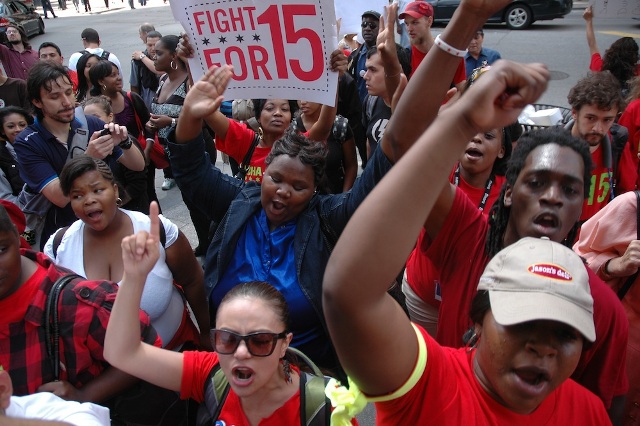 Retail and fast food workers called out for a nationwide strike today to take place Aug. 29. The workers and their supporters have been staging strikes in Chicago, New York, Kansas City, Detroit and other cities across the country for months demanding a hike in the minimum wage to $15 an hour and the right to unionize. Hundreds of workers and several labor organizations in Chicago recently participated in two days of walkouts and protests earlier this month.
Nancy Salgado, a single mother who has worked at a Chicago McDonald’s for the past 10 years said in a press release:
“We are united in our belief that every job should pay workers enough to meet basic needs such as food and housing. Our families, communities, and economy all depend on workers earning a living wage.”
Organizers say the strikes will hit fast food chains like McDonald’s, Wendy’s and Burger King, as well as retail outlets such as Sears, Macy’s and Dollar Tree Stores. Chicago’s protests at the beginning of the month saw walkouts at some of those locations along with Whole Foods, Sally Beauty Supply, Walgreen's and others. Supporters of the strikes say that large corporations can afford pay increases for rank and file employees when the industry sees $200 billion a year in revenue.
"It’s time for these big fast-food and retail companies to pay up. They can afford to pay us more and have a responsibility to ensure the workers who keep their businesses booming don’t live in poverty," said Latrice Arnold, a Wendy’s employee from Detroit. Recent data has suggested low wages from big box retailers and fast food chains hurt American taxpayer’s—regardless of whether or not they’re a low wage worker—because thousands of employees are also on government aid. CNN Money reported in June that one study showed 3,216 Walmart employees, America’s largest private employer, were enrolled in public health care programs in Wisconsin.
Additionally, demographics of low wage workers has changed over the years. While the assumption might be fast food chains are staffed with younger people looking for some extra cash, the Economic Policy Institute released a study that showed 8 out of 10 workers making $7.25 an hour are older than 20, and half those work 40 hours a week. Researchers from the EPI told the Washington Post “It is clear that the bulk of minimum wage workers are mid- or full-time adult employees, not teenagers or part-times.”
Retail and fast food workers called out for a nationwide strike today to take place Aug. 29. The workers and their supporters have been staging strikes in Chicago, New York, Kansas City, Detroit and other cities across the country for months demanding a hike in the minimum wage to $15 an hour and the right to unionize. Hundreds of workers and several labor organizations in Chicago recently participated in two days of walkouts and protests earlier this month.
Nancy Salgado, a single mother who has worked at a Chicago McDonald’s for the past 10 years said in a press release:
“We are united in our belief that every job should pay workers enough to meet basic needs such as food and housing. Our families, communities, and economy all depend on workers earning a living wage.”
Organizers say the strikes will hit fast food chains like McDonald’s, Wendy’s and Burger King, as well as retail outlets such as Sears, Macy’s and Dollar Tree Stores. Chicago’s protests at the beginning of the month saw walkouts at some of those locations along with Whole Foods, Sally Beauty Supply, Walgreen's and others. Supporters of the strikes say that large corporations can afford pay increases for rank and file employees when the industry sees $200 billion a year in revenue.
"It’s time for these big fast-food and retail companies to pay up. They can afford to pay us more and have a responsibility to ensure the workers who keep their businesses booming don’t live in poverty," said Latrice Arnold, a Wendy’s employee from Detroit. Recent data has suggested low wages from big box retailers and fast food chains hurt American taxpayer’s—regardless of whether or not they’re a low wage worker—because thousands of employees are also on government aid. CNN Money reported in June that one study showed 3,216 Walmart employees, America’s largest private employer, were enrolled in public health care programs in Wisconsin.
Additionally, demographics of low wage workers has changed over the years. While the assumption might be fast food chains are staffed with younger people looking for some extra cash, the Economic Policy Institute released a study that showed 8 out of 10 workers making $7.25 an hour are older than 20, and half those work 40 hours a week. Researchers from the EPI told the Washington Post “It is clear that the bulk of minimum wage workers are mid- or full-time adult employees, not teenagers or part-times.”
Afghanistan beat Pakistan 3-0 in 'symbolic' football clash
 Afghanistan's footballers have triumphed over Pakistan 3-0 in a friendly match, the first international game played in Kabul in a decade.
It was the first game between the two countries in the Afghan capital for 30 years and hopes were high it might also help ease political tensions.
The match was billed as an indication of Afghanistan's return to normality after decades of war.
It ignited fierce patriotic passions on both sides and was broadcast live.
The BBC's Karen Allen in Kabul says the friendly was being seen as a deeply symbolic moment.Afghan and Pakistani political leaders are due to meet for critical peace talks next week.
"It shows that after a very difficult period we are returning to normality," Afghanistan Football Federation (AFF) Secretary General Sayed Aghazada told FIFA.com.
"Afghan football has improved in terms of organisation and infrastructure, and we now believe that football can play an even bigger role in our country."
Pakistan Football Federation Secretary General Ahmad Yar Khan Lodhi said he expected the game would help deepen the relationship between the two countries.
Pakistan head coach Zavisa Milosavljev told the BBC that his aim was to get international exposure for youth players and players "who don't play continually".
"Pakistan also has problems," he said. "We haven't played a single match in Pakistan."
Football was not banned during the Taliban's rule in Afghanistan from 1996 until 2001, but during their time in power they used the old Ghazi stadium in Kabul as a venue for executions, stonings and mutilations.
Ranked 139th in the world, Afghanistan had last played at home in 2003 against Turkmenistan.
Pakistan's team is ranked 28 places below Afghanistan and has not played in Kabul since 1977.
"The main goal of this game is to build good relations between Afghanistan and Pakistan," said Afghan coach Yousuf Kargar, AFP news agency reports.
Afghanistan's footballers have triumphed over Pakistan 3-0 in a friendly match, the first international game played in Kabul in a decade.
It was the first game between the two countries in the Afghan capital for 30 years and hopes were high it might also help ease political tensions.
The match was billed as an indication of Afghanistan's return to normality after decades of war.
It ignited fierce patriotic passions on both sides and was broadcast live.
The BBC's Karen Allen in Kabul says the friendly was being seen as a deeply symbolic moment.Afghan and Pakistani political leaders are due to meet for critical peace talks next week.
"It shows that after a very difficult period we are returning to normality," Afghanistan Football Federation (AFF) Secretary General Sayed Aghazada told FIFA.com.
"Afghan football has improved in terms of organisation and infrastructure, and we now believe that football can play an even bigger role in our country."
Pakistan Football Federation Secretary General Ahmad Yar Khan Lodhi said he expected the game would help deepen the relationship between the two countries.
Pakistan head coach Zavisa Milosavljev told the BBC that his aim was to get international exposure for youth players and players "who don't play continually".
"Pakistan also has problems," he said. "We haven't played a single match in Pakistan."
Football was not banned during the Taliban's rule in Afghanistan from 1996 until 2001, but during their time in power they used the old Ghazi stadium in Kabul as a venue for executions, stonings and mutilations.
Ranked 139th in the world, Afghanistan had last played at home in 2003 against Turkmenistan.
Pakistan's team is ranked 28 places below Afghanistan and has not played in Kabul since 1977.
"The main goal of this game is to build good relations between Afghanistan and Pakistan," said Afghan coach Yousuf Kargar, AFP news agency reports.
Pakistan: Student transportation: More than 100 girls’ colleges in Punjab lack buses
Al-Qaeda's technical hub busted in Lahore
 Intelligence agencies have busted Al-Qaeda’s international technical hub in Lahore on Tuesday.
Two alleged terrorists linked with the group were also arrested during the raid.
As per details, the suspects are allegedly involved in the kidnapping of former premier Yousaf Raza Gilani’s son Ali Haider Gilani. Former Punjab governor Salman Taseer’s son Shahbaz Taseer was also abducted with the communication assistance of the network.
The communication centre was being run through sophisticated digital devices and was serving communication needs of the extremists.
The group was also engaged in maligning the Pakistan Telecommunication Limited Company (PTCL) and other private mobile phone operators of the country by using their SIM cards.
The suspects had been engaged in mobile phone tracing of their victims and were planning to kidnap son of a key political figure, sources said.
Bilal Latif, Shahid Jabbar, Umair Nadeem, Tariq and Imran ae also mentioned in their target list.
Sources revealed that the suspects belong to Hasan Gull and Daud Shah Group, the sub groups of Al-Qaeda.
Intelligence agencies have busted Al-Qaeda’s international technical hub in Lahore on Tuesday.
Two alleged terrorists linked with the group were also arrested during the raid.
As per details, the suspects are allegedly involved in the kidnapping of former premier Yousaf Raza Gilani’s son Ali Haider Gilani. Former Punjab governor Salman Taseer’s son Shahbaz Taseer was also abducted with the communication assistance of the network.
The communication centre was being run through sophisticated digital devices and was serving communication needs of the extremists.
The group was also engaged in maligning the Pakistan Telecommunication Limited Company (PTCL) and other private mobile phone operators of the country by using their SIM cards.
The suspects had been engaged in mobile phone tracing of their victims and were planning to kidnap son of a key political figure, sources said.
Bilal Latif, Shahid Jabbar, Umair Nadeem, Tariq and Imran ae also mentioned in their target list.
Sources revealed that the suspects belong to Hasan Gull and Daud Shah Group, the sub groups of Al-Qaeda.
New anti-regime demo held in Bahrain
People in Bahrain have held another anti-regime demonstration, calling for an end to dictatorship and authoritarianism in the country.
Protesters took to the streets across the tiny Persian Gulf kingdom including Dair, Tubli, Kawarah and Ma'ameer villages.
The protests were largely peaceful with demonstrators also demanding equality and justice.
In the village of Buri, however, demonstrators set fire to tires and clashed with regime forces who used tear gas canisters to disperse them.
Meanwhile, a US-based pro-democracy advocacy group, Freedom House, has slammed Bahrain over the detention of an award-winning photographer, Ahmed al-Fardan.
Fardan was detained on August 8 and beaten by security forces to prevent him from covering the recent demonstration in the country, the group wrote on its website.
On August 14, protesters held anti-regime demonstrations across the country including the capital, Manama, chanting slogans against the ruling al-Khalifa regime.
Clashes erupted in several areas between regime forces and protesters. Reports said that the security forces fired tear gas and birdshot to disperse protesters.
The demonstrations came while Prime Minister Sheikh Khalifa bin Salman Al Khalifa issued a warning saying that regime would “forcefully confront” and punish anti-regime protesters if they went ahead with their planned protests.
The uprising in Bahrain began in mid-February 2011.
The Al Khalifa regime launched a brutal crackdown on the peaceful protests and called in Saudi-led Arab forces from neighboring states.
Meanwhile, Bahrain’s main opposition group, al-Wefaq, says that more than 200 people, including a woman and 19 children, were detained during the regime crackdown on protesters in July.
America Has No Leverage in Egypt
By STEVEN SIMON
EGYPT has entered a dark tunnel, and it is difficult to say when, and in what condition, it will emerge.
Many Americans, in the meantime, are outraged that the Obama administration has not exerted its supposed leverage, in the form of military aid, to pressure the Egyptian army to restore a democratic form of government.
But it is time for some realism about that leverage. A yearly sum of $1.3 billion may seem persuasive, but this money has always been intended to secure foreign policy outcomes, not domestic political arrangements that the United States favors. (The State Department has announced that it will put “on hold” $250 million in civilian economic aid to Egypt; the annual military aid expenditure will remain untouched.)
For $1.3 billion per year, America has ensured peace with Israel, priority access to the Suez Canal and, more recently, counterterrorism cooperation. This worked under the authoritarian regime of Hosni Mubarak and under the Muslim Brotherhood government of Mohamed Morsi, with whom President Obama had an effective enough working relationship to broker a deal to end the latest outbreak of fighting between Israel and Hamas in Gaza.
Despite the fact that American military aid to Egypt has always been intended as an inducement to strategic cooperation, successive presidents have been tempted to use it in other ways.
But this aid has never succeeded in persuading Egypt’s rulers to govern the way Washington wants. Shortly after he took office in 1993, President Bill Clinton issued a not-so-veiled warning to Mr. Mubarak to reform the electoral process or face a cut in aid. Mr. Mubarak was unresponsive, and as violent resistance against him mounted, the White House backed off.
The administration of George W. Bush fared no better. When Secretary of State Condoleezza Rice demanded that Mr. Mubarak liberalize the country’s political system to allow opposition parties greater representation, he responded by arresting the only liberal candidate with any name recognition in Egypt — Ayman Nour — for electoral fraud. (No one should doubt authoritarian rulers’ capacity for irony.)
In response, Ms. Rice canceled an impending trip to Egypt, which led to Potemkinesque changes to the country’s election rules. These reforms faded quickly, paving the way, in conjunction with an economic downturn, to the mass protests that eventually resulted in Mr. Mubarak’s fall in February 2011.
Just as pressure from Presidents Clinton and Bush didn’t succeed in bringing about domestic change, the alleged leverage supplied by American assistance failed to compel Mr. Morsi to heed Mr. Obama’s repeated warnings to adopt a more inclusive approach to governing a deeply divided Egypt in the past year.
As far as Mr. Morsi was concerned, the need for his party to dominate Egyptian politics and escape the charge that he was collaborating with the West trumped not just the $1.3 billion on offer from Washington but also the $4.8 billion the International Monetary Fund was urging him to accept. When in history has a country the size of Egypt, with its proud history and self-conscious greatness, rearranged its domestic politics for the equivalent of just a billion dollars?
A decade ago, Turkey began making bold constitutional changes, institutionalizing civilian control over the military and reforming the judiciary, but these steps were taken to meet the membership requirements imposed by the European Union — a status to which Turkey still aspires. Compared with the $1.3 billion America provides Egypt, E.U. membership promised incalculably greater rewards to Turkey. Indeed, if the E.U. had offered Turkey only what Egypt receives from Washington, the Turkish Army might still be running the country.
However great its hegemony may have once been in the Middle East, America no longer enjoys a strategic monopsony. Today, there are other buyers of Egyptian cooperation who can outbid the United States. Kuwait, the United Arab Emirates and Saudi Arabia together have pledged $12 billion to Egypt’s junta, and they have done so without the conditions that Congress places on American-appropriated funds.
Of course, the White House could still do something symbolic, cutting off aid to assuage America’s moral critics. But presumably Mr. Obama hasn’t done this for two reasons.
The first is to avoid making the United States the center of the story. If America cut all aid tomorrow, the Obama administration would be accused by all sides of undermining the country’s security and meddling in its affairs. Egypt’s current political crisis dates back to the 1930s, and it is one that Egyptians need to resolve themselves, without the distraction of American involvement. And since cutting aid is unlikely to work in any case, staking American prestige on such a doubtful outcome would be imprudent.
The second is that as violence and repression in Egypt deepen, the White House will ultimately be compelled to respond, even if its options are at best symbolic and, at worst, counterproductive.
Proponents of punitive action are correct to argue that the biggest threat America can wield is a cutoff of military aid. But this must be held in reserve for when things inevitably get worse.
In the interim, canceling a joint military exercise with Egypt was the tactically sensible thing to do. Having fired this warning shot, the administration still has at least one round of ammunition remaining. Egypt’s nightmare will not disappear overnight; Washington needs to keep dry what little powder it has left.
Russian Sprinters Deny Podium Kiss was an Act of Protest


U.S: 'Raising minimum wage will not fuel inflation'
New York lawmakers adopted a draft law aimed at increasing the minimum wage up to $ 9 an hour earlier this year. But experts estimate family of four needs at least $11 to live above the poverty line. In Congress, 92% of Democrats and 62% of Republicans support the wage increase. However the increase of minimum payment would also have some very negative side effects. A higher minimum wage would mean higher prices at retail stores and restaurants. It would also prompt corporations to continue replacing American workers with foreign employees or with technology. The VoR spoke with Bill Schmick - an investment adviser representative with Berkshire Money Management - an asset management and advisory company in Massachusetts.
Is it true that raising the minimum legal wage would somehow fuel inflation? Is there such a risk?
No, I don’t really think that raising the minimum wage will fuel inflation. Inflation right now in the US is low, it is so low in fact that the Federal Reserve Bank continues to monitor it and worries somewhat that it would decline further. So, no. And raising the minimum wage wouldn’t affect that many Americans. I would estimate 3-5% of Americans are receiving the minimum wage now. So, I don’t think that raising it would have any problem with inflation.
As far as I know many argue higher minimum wage would undercut America’s competitiveness and kill jobs. Others object that arguing that the current minimum wage is already undercut America’s competitiveness by reducing the quality of the country’s labor force. So, where do you stand in this dispute?
Let’s face it, minimum wages are basically domestic service jobs in the US. You cannot export those jobs because those jobs are at McDonalds and places like that. So, those jobs are here to stay, and either Americans are going to have those jobs or other immigrants will take those jobs but it won’t threaten America by exporting jobs anywhere, if you can understand what I am saying. You can’t buy a Burger King from China, it won’t work. So, a lot of the arguments on what a minimum wage will do in the US, the negatives of it are misplaced at best. The argument that corporations will hire less people if we raise the minimum wage, it really does apply especially if the economy starts to grow. Corporations say that now if the economy begins to grow, you are going to need more and more service jobs, it won’t matter if the minimum wage goes from 7 to 10 dollars, they are still going to hire those people because you have to remember who has those minimum wage jobs. Over 50% of people that have those minimum wage jobs are teenagers or spouses who are already employed. And that is increasing further. Yes, there is a significant minority of people who definitely do need those minimum wage jobs just to take care of their families, a lot of them would be single mothers that are forced to work but need more flexible hours. So, my belief is this – that the minimum wage should be raised because the income inequality issue in the US has become so severe between the haves and the have-nots, corporations aren’t going to voluntarily raise the income level of Americans, in fact they will continue to keep it down. So, if it takes the federal rule of the state government to raise the minimum wage, even though it won’t have a large impact, it will narrow the income inequality gap in America which continues to expand.
Read more: http://voiceofrussia.com/2013_08_20/Raising-minimum-wage-will-not-fuel-inflation-expert-7944/
Afghan Independence Day marked in Islamabad
http://www.pajhwok.com/Afghanistan's Independence Day was celebrated at a hotel in Islamabad, with senior Pakistani officials attending the function, a spokesman for the Afghan embassy said on Tuesday. Former King Ghazi Amanullah achieved independence from Great Britain 94 years ago, though Afghanistan has never been a British colony. Zardasht Shams, a spokesman for the Afghan embassy, told Pajhwok Afghan News Ambassador Omar Daudzai, Pakistan's States and Frontier Regions Minister Abdul Qadir Baloch, parliamentarians and diplomats attended the event. National anthems of the two countries were played and a cake cut to mark the day, Shams said, adding a number of Pakhtun nationalist leaders and Pakistani politicians participated in the function. Prominent among the participants were Mahmood Khan Achakzai, Abdur Rahim Mandokhel, Afzal Khan Lala, ex-interior minister Aftab Sherpao, Chaudhry Shujaat Hussain, Mushahid Hussain and Shahzada Adnan Aurangzeb. Apart from Afghan students, Qutbuddin Hilal, a member of the Gulbadin Hekmatyar-led Hezb-i-Islami Afghanistan also took part in the function, arranged by the Afghan embassy.
Afghanistan, Pakistan To Play Historic Soccer Game

India: Fresh ceasefire violations by Pakistan
Subscribe to:
Posts (Atom)