Thursday, August 1, 2013
Afghan mining deal with China facing failure
Hindus, Sikhs warn of leaving Afghanistan
http://www.afghanistantimes.af/The Council of Hindus and Sikhs in Afghanistan on Wednesday warned of leaving the country if they were not given proper representation in the lower house of parliament. Flanked by civil society representatives, Rail Singh, the council’s deputy head, asked the government to take effective measures to address the problems being faced by the minorities. In the original draft election law, a seat had been reserved for the Hindus and Sikh, he told a news conference. But the parliament deleted the clause, he regretted. “We are very much concerned about the abolition of the reserved seat,” remarked Singh, whose community has no representation in parliament. No parliamentarian bothered to discuss the problems being faced by the minority, he deplored. Sikhs and Hindus could not win a single Wolesi Jirga because their numbers were very small, he said, adding most of their families had left Afghanistan as a result of infighting in the country. Singh explained 800 of his community families still lived in Kabul, Kandahar, Ghazni, Helmand, Nangarhar, Kunduz and Balkh provinces. Over the last couple of years, Hindus and Sikhs had been deprived of their properties and homes by powerful individuals, he alleged. Their kids could neither play on streets nor go to school because of harassment by other children, he complained. He said both Hindus and Sikhs had approached various departments and officials to have their problems resolved but no one addressed their concerns. “If our demands are not accepted, we will be forced to write to the United Nations to provide us asylum in a foreign country,” Singh announced. Ajmal Baloch, a member of civil society, asked the state to take steps to set aside a seat for the minorities in the Wolesi Jirga. He said Hindus and Sikhs had equally contributed to the strength of Afghanistan.
Malala’s struggle critics are blinded by anti-westernism
By Babar Ayaz


.jpg)


Imran Khan’s reaction to Bannu jailbreak vs his reaction to D.I.Khan jailbreak
http://lubpak.com/archives/279551


Jailbreak in Dera Ismail Khan: ''Pakistan's Intelligence test''
PPP wants CJP to step down
 The Pakistan Peoples Party has demanded Chief Justice Iftikhar Chaudhry should step down ‘to save the sanctity of the judiciary’, seeking fresh presidential election.
Pakistan: SC in the eye of the storm
 In the latest chain of events in which the Supreme Court has featured promiently, the Court has issued a notice of contempt to PTI chief Imran Khan and summoned him on 2nd August. The contempt is on the remarks of Imran Khan in which he had hurled accusations not just at the apex court but the Election Commission as well. The Chief Election has sent his resignation today, but the Supreme Court has reacted differently. It has decided to take the bull by the horn. The Supreme Court which was restored after long and valiant struggle by lawyers, political leaders, workers and other sections of civil society, is currently in the eye of the storm.
Those who had once cherished it for its independence and undiluted stance on justice and law are now its most ardent critics. And with the passage of time, the number of its distracters is increasing and their rhetoric against is hardening.
The cause of the recent spat of criticism is the Supreme Courts order to shift the date of presidential polls from August 6, to July 30. However, more than the decision to change the date has been the manner in which the SC reached it. PML-N's Raja Zafar ul Haq filed a plea in the apex court for the change of date, as the Election Commission after once announcing the date refused to change it and said it will change the date only on orders from the Supreme Court.
While hearing the plea, the Supreme Court ignored the other stakeholders in the presidential race and did not summon either the other presidential candidates or their parties and get their point of view. Basically, everybody agrees that the omission of the due process of law was not just unexpected from this the court but grave as well. They argue that when such omissions take place in the lower judiciary, the decisions are overturned by the higher courts. However this is not the only gripe that the critics have: There is a list of cases in which it has been complained that justice was either delayed or denied, which to some, amounts to the same thing. There also is the complaint regarding the preference of the order of hearing of cases by the Court. Some cases are, it is said, are heard on day to day bases; in other cases, hearings are in fits and starts. The initial hearings of certain cases are in quick succession, and then these cases are put on the back burner.
There also have been objections to the way the Court has reacted to reports of corruption in certain newspapers by converting the reports into pleas and foundations for suo motto actions. The PPP government was involved in a four-year tussle with the apex court and has been accusing it of interfering in the jurisdiction of the Parliament and the executive branch of the government. Also the way, this Court made the highest-level bureaucrats run around to bring relevant papers or to take orders from their political bosses within hours, in some instances even an hour, has been considered as very inappropriate by many. The PPP complains that the Court has been targeting its leaders and government. Imran Khan, who for long had supported the justices of the highest court of the land, has a gripe of his own. He complained that the High judiciary and the Election Commission had joined to hold the most rigged elections in the country's history. He had also complained that the court was dragging its feet on giving decision on his party's petition to hold a recount of four constituency by checking the thumbprints of the voters.
Top lawyers and leaders in the movement for restoration of the original judiciary like Aitzaz Ahsan and Ali Ahmed Kurd and retired Justice ® Mahmud have been critical from time to time. Of course, Aitzaz lost his cool when he appeared as lawyer for the then prime minister Yusuf Raza Gilani but couldn't convince the judges; Kurd had called the justice, to put it lightly, arrogant; Justice Tariq's criticism has been mostly critical on technical grounds but more often than not.
But the most potent of all the accusation is the one in which most accusers join in unison and say that the Court is partial in favour of PML-N. What is worrisome is that while most of the above maybe accused of have an axe to grind, there are lawyers, intellectuals and leaders of civil society who have voiced similar views. Without going into the merits and demerits of the accusations it would be appropriate to say that in the interest of judiciary, justice and the country, the Supreme Court has to turn around the negative impressions. It has to ponder and find ways to make sure that justice is not only done but seen to be done.
In the latest chain of events in which the Supreme Court has featured promiently, the Court has issued a notice of contempt to PTI chief Imran Khan and summoned him on 2nd August. The contempt is on the remarks of Imran Khan in which he had hurled accusations not just at the apex court but the Election Commission as well. The Chief Election has sent his resignation today, but the Supreme Court has reacted differently. It has decided to take the bull by the horn. The Supreme Court which was restored after long and valiant struggle by lawyers, political leaders, workers and other sections of civil society, is currently in the eye of the storm.
Those who had once cherished it for its independence and undiluted stance on justice and law are now its most ardent critics. And with the passage of time, the number of its distracters is increasing and their rhetoric against is hardening.
The cause of the recent spat of criticism is the Supreme Courts order to shift the date of presidential polls from August 6, to July 30. However, more than the decision to change the date has been the manner in which the SC reached it. PML-N's Raja Zafar ul Haq filed a plea in the apex court for the change of date, as the Election Commission after once announcing the date refused to change it and said it will change the date only on orders from the Supreme Court.
While hearing the plea, the Supreme Court ignored the other stakeholders in the presidential race and did not summon either the other presidential candidates or their parties and get their point of view. Basically, everybody agrees that the omission of the due process of law was not just unexpected from this the court but grave as well. They argue that when such omissions take place in the lower judiciary, the decisions are overturned by the higher courts. However this is not the only gripe that the critics have: There is a list of cases in which it has been complained that justice was either delayed or denied, which to some, amounts to the same thing. There also is the complaint regarding the preference of the order of hearing of cases by the Court. Some cases are, it is said, are heard on day to day bases; in other cases, hearings are in fits and starts. The initial hearings of certain cases are in quick succession, and then these cases are put on the back burner.
There also have been objections to the way the Court has reacted to reports of corruption in certain newspapers by converting the reports into pleas and foundations for suo motto actions. The PPP government was involved in a four-year tussle with the apex court and has been accusing it of interfering in the jurisdiction of the Parliament and the executive branch of the government. Also the way, this Court made the highest-level bureaucrats run around to bring relevant papers or to take orders from their political bosses within hours, in some instances even an hour, has been considered as very inappropriate by many. The PPP complains that the Court has been targeting its leaders and government. Imran Khan, who for long had supported the justices of the highest court of the land, has a gripe of his own. He complained that the High judiciary and the Election Commission had joined to hold the most rigged elections in the country's history. He had also complained that the court was dragging its feet on giving decision on his party's petition to hold a recount of four constituency by checking the thumbprints of the voters.
Top lawyers and leaders in the movement for restoration of the original judiciary like Aitzaz Ahsan and Ali Ahmed Kurd and retired Justice ® Mahmud have been critical from time to time. Of course, Aitzaz lost his cool when he appeared as lawyer for the then prime minister Yusuf Raza Gilani but couldn't convince the judges; Kurd had called the justice, to put it lightly, arrogant; Justice Tariq's criticism has been mostly critical on technical grounds but more often than not.
But the most potent of all the accusation is the one in which most accusers join in unison and say that the Court is partial in favour of PML-N. What is worrisome is that while most of the above maybe accused of have an axe to grind, there are lawyers, intellectuals and leaders of civil society who have voiced similar views. Without going into the merits and demerits of the accusations it would be appropriate to say that in the interest of judiciary, justice and the country, the Supreme Court has to turn around the negative impressions. It has to ponder and find ways to make sure that justice is not only done but seen to be done.
Pakistan: POL prices increased by up to Rs4.99/litre
THE FRONTIER POSTThe prices of petroleum products have been raised by up to Rs4.99 per litre from August 1. According to Ministry of Finance, with an increase of Rs2.73 the retail price of petrol has now reached Rs104.50 per litre. Analysts say it will adversely impact the poor masses as transport, which are unable to get CNG because of gas shortage in the country will charge more in the wake of this mammoth raise. The ministry also increased per litre prices of diesel, kerosene oil, and light diesel oil (LD) by Rs3, Rs4.99, and Rs3.95 respectively. The new per litre price of diesel has jumped to Rs109.76 from a previous Rs106.76, kerosene oil Rs101.28 from Rs96.29, and petrol Rs104.50 from Rs101.77. Ministry of Finance also said that Oil and Gas Regulatory Authority had suggested a raise of at least Rs4 in the price of diesel.
Wednesday, July 31, 2013
Turkey police fire tear gas to disperse protesters
 Turkish riot police on Wednesday fired tear gas and water cannon to disperse hundreds of anti-government protesters at Istanbul's Taksim square, the epicentre of violent demonstrations which rocked the country in June.
At least four people were injured, eye witnesses said, after police stepped in to break up a crowd of around 500 protesters clustered at the square.
Turkish riot police on Wednesday fired tear gas and water cannon to disperse hundreds of anti-government protesters at Istanbul's Taksim square, the epicentre of violent demonstrations which rocked the country in June.
At least four people were injured, eye witnesses said, after police stepped in to break up a crowd of around 500 protesters clustered at the square.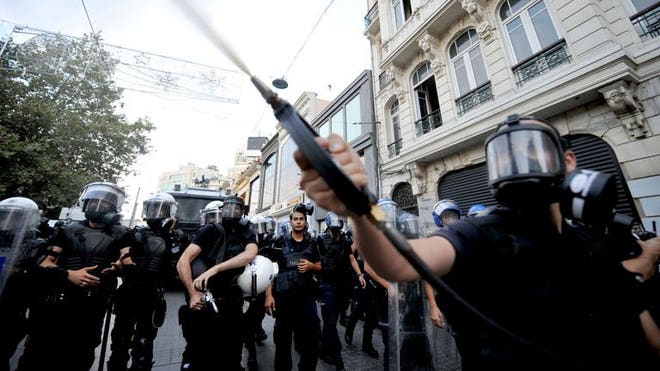 "We'll resist until we win!" the protesters shouted. "This is only a beginning, we'll continue to fight!"
Cat-and-mouse games between police forces and protesters ensued in the streets around the square.
Turkey's Islamic-rooted government was shaken in June by a wave of protests that presented it with the biggest public challenge since coming to power more than a decade ago.
The unrest was sparked by plans to redevelop Gezi Park, which is adjacent to Taksim square, but soon evolved into a broader movement against the government, seen as increasingly authoritarian.
According to police estimates, some 2.5 million people took to the streets in nearly 80 cities for three weeks to demand Prime Minister Recep Tayyip Erdogan's resignation.
Five people were killed and more than 8,000 injured in the civil unrest.
The authorities had closed the park to the public after police evicted protesters on June 15. It was reopened earlier this month but demonstrators remain banned.
"We'll resist until we win!" the protesters shouted. "This is only a beginning, we'll continue to fight!"
Cat-and-mouse games between police forces and protesters ensued in the streets around the square.
Turkey's Islamic-rooted government was shaken in June by a wave of protests that presented it with the biggest public challenge since coming to power more than a decade ago.
The unrest was sparked by plans to redevelop Gezi Park, which is adjacent to Taksim square, but soon evolved into a broader movement against the government, seen as increasingly authoritarian.
According to police estimates, some 2.5 million people took to the streets in nearly 80 cities for three weeks to demand Prime Minister Recep Tayyip Erdogan's resignation.
Five people were killed and more than 8,000 injured in the civil unrest.
The authorities had closed the park to the public after police evicted protesters on June 15. It was reopened earlier this month but demonstrators remain banned.
Prominent Bahrain Blogger Arrested
 A rights activist in Bahrain says authorities have arrested a prominent blogger just days after warning of harsher measures against anti-government protesters in the violence-wracked Gulf kingdom.
Bahrain's king earlier this week endorsed parliamentary calls to ban demonstrations in the capital Manama and impose tough punishments such as stripping citizenship for those convicted of violence. Security forces also have warned of a strong response to plans for major protest marches Aug. 14.
Yousef al-Muhafedha, acting president of the Bahrain Human Rights Center, says blogger Mohamed Hassan was arrested early Wednesday. Hassan also worked as an assistant to various foreign journalists visiting Bahrain.
Bahrain has been gripped by near nonstop unrest since February 2011 when majority Shiites began an uprising for a greater political voice in the Sunni-rule nation.
A rights activist in Bahrain says authorities have arrested a prominent blogger just days after warning of harsher measures against anti-government protesters in the violence-wracked Gulf kingdom.
Bahrain's king earlier this week endorsed parliamentary calls to ban demonstrations in the capital Manama and impose tough punishments such as stripping citizenship for those convicted of violence. Security forces also have warned of a strong response to plans for major protest marches Aug. 14.
Yousef al-Muhafedha, acting president of the Bahrain Human Rights Center, says blogger Mohamed Hassan was arrested early Wednesday. Hassan also worked as an assistant to various foreign journalists visiting Bahrain.
Bahrain has been gripped by near nonstop unrest since February 2011 when majority Shiites began an uprising for a greater political voice in the Sunni-rule nation.
Saudi Arabia accused of giving Egypt $1B to oust Morsi
Washington TimesPolitical activist Mujtahid bin Hareth bin Hammaam, who operates an active Twitter campaign aimed at exposing corruption in the Saudi government, said Gen. Abdel Fattah el-Sisi received the money on July 3, United Press International reported. The reason for the payoff, he alleged, was so Egypt's transfer of power would flow smoothly. But now the Saudi government isn't sure it spent its money wisely, he said. "King Abdullah knows well that failure of the coup in Egypt will be a disaster for al-Saud because any new government will be stronger and will adopt anti-Saudi Arabia policies," Mr. Mujtahid tweeted, according to UPI. "That is why King Abdullah is one of the supporters of unlimited use of force in cracking down protesters. … King Abdullah not only supported the coup and tried to convince others to accept new changes, he also helped el-Sisi." The Saudi king is trying to influence the West from taking action — including the issuance of strong criticisms — against Egypt, the activist said. Read more: http://www.washingtontimes.com/news/2013/jul/30/saudi-arabia-accused-giving-egypt-1b-oust-morsi/#ixzz2aeAFkV6E Follow us: @washtimes on Twitter
Saudi Arabia responsible for Syria bloodshed: Political Analyst
 Damascus has recently lashed out at the Saudi regime, accusing the kingdom of backing “terrorists” after Riyadh condemned Syria for accepting fighters from Hezbollah in its struggle againtst foreign-backed terrorists.
Syria has denounced that Saudi Arabia and Qatar, which work closely with the United States and its European allies, are responsible for the conflict and the ongoing bloodshed in its territory.
The remarks by Syrian Information Minister Omran al-Zoubi came after Saudi Foreign Minister Prince Saud al-Faisal met with US Secretary of State John Kerry in Jeddah. Prince Saud al-Faisal spoke of “a foreign invasion” in Syria forgetting that his country has been financing and arming thousands of al-Qaeda-linked terrorists from all over the world and encouraging them to go to fight in Syria.
Damascus has recently lashed out at the Saudi regime, accusing the kingdom of backing “terrorists” after Riyadh condemned Syria for accepting fighters from Hezbollah in its struggle againtst foreign-backed terrorists.
Syria has denounced that Saudi Arabia and Qatar, which work closely with the United States and its European allies, are responsible for the conflict and the ongoing bloodshed in its territory.
The remarks by Syrian Information Minister Omran al-Zoubi came after Saudi Foreign Minister Prince Saud al-Faisal met with US Secretary of State John Kerry in Jeddah. Prince Saud al-Faisal spoke of “a foreign invasion” in Syria forgetting that his country has been financing and arming thousands of al-Qaeda-linked terrorists from all over the world and encouraging them to go to fight in Syria. 
Pakistan Supreme Court issues contempt notice to Imran Khan
Pakistan’s top court on Wednesday issued a contempt of court notice to cricket legend-turned-politician Imran Khan and summoned him to appear before the court on August 2, DawnNews reported.
The Supreme Court, in the notice issued to the Pakistan Tehrik-i-Insaf (PTI) chief, has said that Mr Khan apparently had tried to incite hatred against the apex court in one of his interactions with the media.
A three-judge bench of the Supreme Court, headed by Chief Justice Iftikhar Muhammad Chaudhry, will hear the case on Friday.
On July 26, while speaking with media representatives outside the Parliament House in Islamabad, Khan had said that his party had taken an active part in the movement to restore deposed judges of the higher judiciary during former military ruler Gen (retd) Pervez Musharraf’s regime.
However, he alleged that the May 11 polls were badly rigged despite being supervised by the judiciary and the Election Commission.
Pakistan’s Attorney General Munir A. Malik has also been summoned to appear before the bench with related records on Friday.
Meanwhile, PTI’s senior leader Shafqat Mehmood has said the party will not seek a pardon and defend their case lawfully.
FASCIST SAUDI REGIME: Saudi activist receives 7-year sentence, 600 lashes
 A Saudi court has sentenced a activist to seven years in prison and 600 lashes for violating the nation's anti-cybercrime law, Human Rights Watch reported Wednesday.
A Jeddah Criminal Court found Raif Badawi, who has been in prison since June 2012, guilty this week of insulting Islam through his website and in television comments.
"This incredibly harsh sentence for a peaceful blogger makes a mockery of Saudi Arabia's claims that it supports reform and religious dialogue," said Nadim Houry, the deputy Middle East director at Human Rights Watch. "A man who wanted to discuss religion has already been locked up for a year and now faces 600 lashes and seven years in prison."His lawyer, Waleed Abu al-Khair, told Human Rights Watch that Judge al-Harbi read the verdict Monday. The court is expected to send him a written notification by August 6. They'll have 30 days to appeal.Ensaf Haidar, Badawi's wife, said she's devastated by the news.
"I don't know what to do," Haidar said Wednesday. "Raif did nothing wrong."
Haidar and the couple's three children now live in Lebanon.
Estranged from her family, Haidar said it would be impossible to take her children back to Saudi Arabia. The stigma is too strong there.
"You feel like everybody's accusing you," she said, close to tears, in an April interview. "Like everybody's against you, at war with you."
CNN has made several attempts to reach the Saudi Arabia government for comment but received no response.Badawi's legal troubles started shortly after he started the Free Saudi Liberals website in 2008. He was detained for one day and questioned about the site. Some clerics even branded him an unbeliever and apostate.Last summer, Human Rights Watch released a statement urging Saudi authorities to free Badawi.
"Saudi authorities should drop charges and release the editor of the Free Saudi Liberals website for violating his right to freedom of expression on matters of religion and religious figures," a statement from the group said at the time.
Rights groups accuse Saudi authorities of targeting activists through the courts and travel bans. Many were outraged when two of the country's most prominent reform advocates, Mohammed Al-Qahtani and Abdullah Al-Hamid, were sentenced in March to 10 years in prison apiece.
Amnesty International called that trial "just one of a troubling string of court cases aimed at silencing the kingdom's human-rights activists."
Asked in January about accusations that Saudi Arabia is cracking down on dissent, Maj. Gen. Mansour Al-Turki, spokesman for the Saudi Interior Ministry, told CNN, "At the Interior Ministry, our area of responsibility is security."
He added, "My understanding is that these cases are being looked at by the courts now. Nobody will comment on cases being looked at by the courts."
A Saudi court has sentenced a activist to seven years in prison and 600 lashes for violating the nation's anti-cybercrime law, Human Rights Watch reported Wednesday.
A Jeddah Criminal Court found Raif Badawi, who has been in prison since June 2012, guilty this week of insulting Islam through his website and in television comments.
"This incredibly harsh sentence for a peaceful blogger makes a mockery of Saudi Arabia's claims that it supports reform and religious dialogue," said Nadim Houry, the deputy Middle East director at Human Rights Watch. "A man who wanted to discuss religion has already been locked up for a year and now faces 600 lashes and seven years in prison."His lawyer, Waleed Abu al-Khair, told Human Rights Watch that Judge al-Harbi read the verdict Monday. The court is expected to send him a written notification by August 6. They'll have 30 days to appeal.Ensaf Haidar, Badawi's wife, said she's devastated by the news.
"I don't know what to do," Haidar said Wednesday. "Raif did nothing wrong."
Haidar and the couple's three children now live in Lebanon.
Estranged from her family, Haidar said it would be impossible to take her children back to Saudi Arabia. The stigma is too strong there.
"You feel like everybody's accusing you," she said, close to tears, in an April interview. "Like everybody's against you, at war with you."
CNN has made several attempts to reach the Saudi Arabia government for comment but received no response.Badawi's legal troubles started shortly after he started the Free Saudi Liberals website in 2008. He was detained for one day and questioned about the site. Some clerics even branded him an unbeliever and apostate.Last summer, Human Rights Watch released a statement urging Saudi authorities to free Badawi.
"Saudi authorities should drop charges and release the editor of the Free Saudi Liberals website for violating his right to freedom of expression on matters of religion and religious figures," a statement from the group said at the time.
Rights groups accuse Saudi authorities of targeting activists through the courts and travel bans. Many were outraged when two of the country's most prominent reform advocates, Mohammed Al-Qahtani and Abdullah Al-Hamid, were sentenced in March to 10 years in prison apiece.
Amnesty International called that trial "just one of a troubling string of court cases aimed at silencing the kingdom's human-rights activists."
Asked in January about accusations that Saudi Arabia is cracking down on dissent, Maj. Gen. Mansour Al-Turki, spokesman for the Saudi Interior Ministry, told CNN, "At the Interior Ministry, our area of responsibility is security."
He added, "My understanding is that these cases are being looked at by the courts now. Nobody will comment on cases being looked at by the courts."
UN: Civilian Casualties Up 23 Percent in Afghanistan
Pakistan Election Commission chief resigns
http://economictimes.indiatimes.com/Fakhruddin G Ebrahim, Chief Election Commissioner of Pakistan, resigned today a day after overseeing the election of the new President. In his resignation letter addressed to President Asif Ali Zardari, Ebrahim said that he has done his job to hold elections and it was time for the new Parliament to appoint his successor, so that the new chief can get ample time to prepare for next election in 2018. "In my humble opinion, the newly elected members of Parliament should have the opportunity to forge new consensus and choose a new Chief Election Commissioner," he said. "Therefore, in accordance with Article 215(3) of the Constitution, I hereby resign from the office of the Chief Election Commissioner of Pakistan". The outgoing election chief said that he tried to perform to the best of his abilities despite personal threats. "Despite personal threats and even brazen gun attack on my family - I quietly stood firm against those forces who first tried to derail and then delay the 2013 Elections," he said. He regretted the violence in run up to the May 11 election in which dozens of people were killed. Ebrahim also expressed satisfaction over successful first ever political transition under a civilian government. Pressure has been mounting on Ebrahim from the opposition parties due to alleged irregularities in the May elections. He was also criticised for failure to stand up against the Supreme Court when it unilaterally changed date of presidential elections. Ebrahim was appointed in July 2012 after then ruling Pakistan Peoples Party and opposition PML-N agreed on his name, as part of constitutional obligation that government and opposition should jointly nominate the election chief.
Militant jailbreak in Pakistan prompts fears of similar attacks

Prison in Dera Ismail Khan was attacked by waves of gunmen wearing police uniforms who freed hundreds of IslamistsA massive jailbreak in Pakistan in which up to 300 Islamic militants escaped could lead to a wave of similar attempts to free detained extremists, security experts and officials have warned. The prison, in the western city of Dera Ismail Khan, was attacked on Monday night with suicide bombs, mortars, rocket-propelled grenades and waves of gunmen wearing police uniforms. Authorities said 24 wanted terrorists were among those freed. Six policemen were killed in the two-hour firefight. The attack, which was claimed by the Pakistani Taliban (TTP), underlines the continuing weakness of agencies charged with maintaining security and countering violent extremism in the troubled south Asian state. There are scores of similar detention facilities across the region where poorly trained, badly equipped police and prison personnel oversee thousands of militant prisoners. Last week around 500 militants, including many convicted senior members of al-Qaida waiting to be executed, were freed in a similarly brazen attack in Iraq. Waves of militants attacked the infamous Abu Ghraib prison west of Baghdad, using tactics almost identical to those employed in Dera Ismail Khan. A statement of responsibility issued in the name of the Islamic State of Iraq and the Levant was later posted on a jihadist forum. "There is no evidence of any co-ordination as such but one could reasonably assume there is a contagion effect. It's a bit like hijacking in the 1970s and 1980s," said Magnus Ranstorp, a respected expert at the Swedish National Defence College. Imtiaz Gul, a security analyst and author in Islamabad, said the Pakistani Taliban, a coalition of different groups largely based in the restive semi-autonomous zones along the border with Afghanistan, would have been aware of the operation in Iraq last week. "All these groups watch one another. They pick up knowledge, learn lessons, replicate tactics … This will keep happening," Gul said. One western security official in Pakistan, speaking on condition of anonymity, described the prisons as "low-hanging fruit" for militants and said intelligence services across the region were "well aware" of the problem. There have been many breakouts in Pakistan, Afghanistan, Iraq and elsewhere. Some have significant strategic consequences: a mass escape in Yemen in 2006 saw almost the entire leadership of the al-Qaida affiliate in that country (AQAP) gain freedom – a key factor in the surge of violence there. AQAP now poses the most significant threat to the west, officials say. Nearly 500 militants were also freed from a jail in the southern Afghan city of Kandahar in 2011, fuelling the local insurgency. "There is no strategy, no competence, no vision. So it's easy for these groups," said Gul. One strike in Pakistan last week targeted an office of the main spy agency, the ISI, while another killed more than 50 Shia Muslims. The jail in Dera Ismail Khan was supposed to be heavily guarded. Officials received a letter threatening an attack, but they did not expect it so soon, said Khalid Abbas, head of the prison department in Pakistan's Khyber Pakhtunkhwa province. A curfew has been imposed and army units deployed. Six Shia Muslim prisoners – the vast majority of Pakistanis are Sunni – were killed. Many of the high-profile prisoners who escaped belong to the violent sectarian group Lashkar-e-Jangvi, further evidence of increasing collaboration between groups. The Pakistani Taliban have also claimed responsibility for the two attacks earlier this week and for the shootings of 10 mountaineers at base camp on a famous peak, Nanga Parbat, last month. Hopes that the election of a new government in Pakistan, led by third-time prime minister Nawaz Sharif, might lead to less violence, have been dashed. Some analysts have suggested the ambivalent position taken towards the Taliban by some high-profile Pakistani politicians might have emboldened militants. Imran Khan, the former cricketer turned conservative prime ministerial candidate, said negotiating with the extremists was the only way to end violence in the restive western border zones. In April 2012, Taliban militants armed with automatic weapons and rocket-propelled grenades battled their way into a prison in the city of Bannu in north-west Pakistan, freeing close to 400 prisoners, including at least 20 described by police as very dangerous insurgents. After that attack, militants said they had been helped by insiders in the security services. An inquiry later found there were far fewer guards on duty than there should have been and those who were there lacked sufficient ammunition. One of the militants freed in that attack, Adnan Rasheed, recently gained attention by writing a letter to the teenage education activist Malala Yousafzai, who was shot in the head by the Taliban last year in an attempt to kill her. Rasheed said he wished the attack had not happened, but told Malala that she was targeted for speaking ill of the Taliban. Reuters new agency has reported that Rasheed was the mastermind behind this latest attack. Top jihadi jailbreaks and escapees The most high-profile: Abu Yahya, a senior al-Qaida propagandist and organiser, won global renown among militants for escaping from the high-security US-run detention centre at Bagram, in Afghanistan in 2005. He was killed by a drone strike last year. The most damaging: In February 2006, Naseer Abdul Karim Wuhayshi and 22 other suspected al-Qaida members broke out of a jail in Sanaa, the capital of Yemen. They went on to build the affiliate of the group which now is seen as posing the biggest threat to the west. The most numerous: More than 900 prisoners escaped from Sarposa prison in Kandahar after a suicide attacker crashed a huge carbomb into its gates in 2008. The most unlikely: Rashid Rauf, a British militant detained by Pakistani security agencies escaped when allowed to go to the toilet by policemen accompanying him to a court in 2007. He was later killed. The most like a film: In 2011, 35 prisoners facing terrorism charges escaped through a sewage pipe from a temporary jail in the Iraqi city of Mosul – as a convict does in the 1994 film The Shawshank Redemption.
Khyber Pakhtunkhwa polio staff holds demonstration over salaries
 Demanding for immediate disbursement of salaries to polio staff, members of Paramedical Association Khyber Pakhtunkhwa Chapter, staged a protest demonstration outside the press club on Tuesday. The protest was leading by Para Medical Staff Association, President Anwar Khan, General Secretary Mohammad Zakir, and Vice President Mubarak Shah along with scores of polio staffs.
They were carrying placards and banners, noted voice in favour of their demands. Addressing on the occasion, the Association president, Anwar Khan said that the polio staff had performed duties despite the security threats, but the authorities concerned were withhold their salaries for several months, without any specified reason.
They said that it was totally unjust with poor employees. He said that the importance of polio staff can not be ignored in the present situation, saying that KP is being confronted with insurgency and terrorism, so it was challenging job for the polio staff. The association president said that the salaries of polio staff was also very nominal, which need to raise as per increasing inflation in the country. He demanded of the health authorities to immediate disburse salaries otherwise, they would compel to launch a protest campaign against it.
Demanding for immediate disbursement of salaries to polio staff, members of Paramedical Association Khyber Pakhtunkhwa Chapter, staged a protest demonstration outside the press club on Tuesday. The protest was leading by Para Medical Staff Association, President Anwar Khan, General Secretary Mohammad Zakir, and Vice President Mubarak Shah along with scores of polio staffs.
They were carrying placards and banners, noted voice in favour of their demands. Addressing on the occasion, the Association president, Anwar Khan said that the polio staff had performed duties despite the security threats, but the authorities concerned were withhold their salaries for several months, without any specified reason.
They said that it was totally unjust with poor employees. He said that the importance of polio staff can not be ignored in the present situation, saying that KP is being confronted with insurgency and terrorism, so it was challenging job for the polio staff. The association president said that the salaries of polio staff was also very nominal, which need to raise as per increasing inflation in the country. He demanded of the health authorities to immediate disburse salaries otherwise, they would compel to launch a protest campaign against it.
Load shedding protest: Furious crowd attack grid station in Kohat
GEO TV
 The angry mob stormed a grid station and broke the main door while protesting against relentless load shedding in Kohat on Wednesday, Geo News reported.
According to sources, the local residents were protesting against the incessant load shedding and attacked a grid station on Pindi Road and damaged the main door of the station.
The demonstrators, while expressing their agony, told that 20 hours of power failure during the holy month of Ramazan is unjust with the people, and demanded to end the unannounced load shedding on priority basis.
The angry mob stormed a grid station and broke the main door while protesting against relentless load shedding in Kohat on Wednesday, Geo News reported.
According to sources, the local residents were protesting against the incessant load shedding and attacked a grid station on Pindi Road and damaged the main door of the station.
The demonstrators, while expressing their agony, told that 20 hours of power failure during the holy month of Ramazan is unjust with the people, and demanded to end the unannounced load shedding on priority basis.
ڈی آئی خان جیل حملہ: ستائیس پولیس اہلکار معطل
حملے کے بعد ٹانک میں لگائی گئی کرفیو بدستور نافذ ہے اور ڈی آئی خان میں کچھ دیر کے لیے کرفیوں میں نرمی کر دی گئی ہے پاکستان کے صوبہ خیبر پختونخوا کے ضلع ڈیرہ اسماعیل خان میں سینٹرل جیل پر حملے کے بعد فوراً کارروائی نہ کرنے پر ایلیٹ فورس کے افسران سمیت ستائیس دوسرے پولیس اہلکاروں کو معطل کر دیا گیا ہے۔ ہمارے نامہ نگار عزیزاللہ خان کے مطابق یہ اقدام صوبائی آئی جی پولیس خیبر پختونخوا نے متعلقہ پولیس افسران اور ہلکاروں کی طرف سے جیل پر حملے کے بعد فوراً ردِ عمل ظاہر نہ کرنے کی وجہ سے اٹھایا ہے۔ ان کا کہنا ہے کہ واقعے کے تیسرے دن بھی حکومت یہ صحیح طور پرواضح نہیں کر سکی کہ حملہ آور کتنی تعداد میں کس طرف سے آئے، حملہ کرکے قیدیوں کو کیسے آذاد کیا اور کس راستے سے جائے وقوعہ سے فرار ہونے میں کامیاب ہو گئے۔ ایک سرکاری ذرائع نے بی بی سی کو بتایا کہ حملہ آور جیل کے مرکزی دروازے کو تھوڑ کر اندر داخل ہوئے اور انھیں جیل کے اندر نقل و حرکت کرنے میں کوئی مشکلات پیش نہیں آئیں۔ یاد رہے کہ مسلح پسندوں نے ڈیرہ اسماعیل خان میں سینٹرل جیل پر پیر کی رات کو حملہ کرکے 243 قیدیوں کو رہا کروا لیا تھا جن میں تیس انتہائی خطرناک قیدی بھی شامل تھے۔ اس واقعے کی ابتدائی تفتیشی رپورٹ تھانہ چھاؤنی ڈیرہ اسماعیل خان میں درج کر دی گئی ہے۔ حملے کے بعد ٹانک میں لگائی گئی کرفیو بدستور نافذ ہے اور ڈی آئی خان میں کچھ دیر کے لیے کرفیوں میں نرمی کر دی گئی ہے جبکہ ڈی آئی خان کی طرف جانی والی چار اہم شاہراہیں بدستور بند ہیں۔ ایک ذرائع نے بی بی سی کو بتایا کہ حملہ آور جیل کے مرکزی دروازے کو تھوڑ کر اندر داخل ہوئے اور انھیں جیل کے اندر نقل و حرکت کرنے میں کوئی مشکلات پیش نہیں آئیں ان شاہرہوں میں ڈیرہ بنوں روڈ، ڈیرہ ٹانک روڈ، ڈیرہ چشمہ روڈ ا ور دربن روڈ شامل ہیں۔ پاکستان کے سرکاری ذرائع ابلاغ کے مطابق اس حملے میں چھ اہلکاروں سمیت بارہ افراد ہلاک اور 13 زخمی ہوئے تھے۔ ڈیرہ اسماعیل خان ڈویژن کے کمشنر مشتاق جدون نے بی بی سی سے بات کرتے ہوئے بتایا تھا’شدت پسندوں کے حملوں کے باعث کُل 243 قیدی جیل سے فرار ہونے میں کامیاب ہوئے تاہم سکیورٹی فورسز نے سرچ آپریشن کے دوران چودہ قیدیوں کو دوبارہ حراست میں لے لیا ہے۔‘ کمشنر مشتاق جدون نے بتایا تھا کہ حملے کے باعث جیل سے فرار ہونے والوں قیدیوں میں سے تیس قیدی انتہائی خطرناک قیدی تھے۔ انہوں نے کہا تھا ان تیس قیدیوں میں سے کوئی بھی قیدی دوبارہ گرفتار نہیں کیا جاسکا۔http://www.bbc.co.uk/urdu

کالعدم شدت پسند تنظم تحریک طالبان پاکستان نے سینٹرل جیل پر حملے کی ذمہ داری قبول کرتے ہوئے دعویٰ کیا تھا کہ انھوں نے اس حملے میں دو سو کے قریب ساتھیوں کو رہا کرا لیا تھا۔ اس سے قبل سرکاری میڈیا پی ٹی وی کے مطابق ڈی آئی خان کے سینٹرل جیل کے سپرنٹنڈنٹ نے بتایا کہ جیل میں کُل 483 قیدی تھے جن میں سے 243 قیدی فرار ہو گئے ہیں۔ کمشنر مشتاق جدون کا کہنا تھا کہ حملہ آوروں نے لاؤڈ سپیکرز پر اپنے ساتھیوں کے نام پکارے۔ مقامی افراد کے مطابق طالبان لاؤڈ سپیکرز پر ’اللہ اکبر‘ اور ’طالبان زندہ باد‘ کے نعرے لگاتے آئے تھے۔ گزشتہ سال اپریل میں خیبر پختونخوا کے ضلع بنوں کی سینٹرل جیل پر طالبان نے حملہ کر کے تین سو چوراسی قیدیوں کو رہا کروا لیاتھا، فرار ہونے والے قیدیوں میں زیادہ تر طالبان شدت پسند تھے۔ پاکستان میں 89 جیلیں ہیں جن میں سے 65 جیلوں کو انتہائی حساس قرار دیا گیا ہے۔ سب سے زیادہ حساس قرار دی جانے والی جیلیں صوبہ پنجاب اور خیبر پختونخوا میں واقع ہیں
گزشتہ سال شدت پسندوں کی جانب سے ممکنہ حملوں سے متعلق کلِک بی بی سی کو موصول ہونے والی اس رپورٹ کے مطابق کالعدم تنظیموں سے تعلق رکھنے والے افراد نے خودکش حملوں، بم دھماکوں اور شدت پسندی کے مختلف مقدمات میں گرفتار ہونے اپنے ساتھیوں کی رہائی کے لیے جیلوں پر حملہ کرنے کی منصوبہ بندی کی۔ ان اطلاعات کے بعد پاکستان فوج نے جیلوں پر شدت پسندوں کے ممکنہ حملوں کو روکنے کے لیے جیل کے عملے کو کمانڈو تربیت دینے کا فیصلہ کیا تھا۔
Jamshed Dasti: You have no idea who I am!

http://lubpak.com/archives/279207Just as people in glass houses should not hurl stones, people in parliament houses should not hurl threats. Member of the National Assembly Jamshed Dasti, who based his election campaign on slogans of representing the “non-elites” and the middle-class of the country, recently demonstrated the same typical elitist behaviour associated with those walking the corridors of power.

Pakistan's Dangerous labour: The little-known 'e-waste' phenomenon
Akash Ali is a nine-year-old labourer who works at a warehouse on Rawalpindi’s College Road. He suffers from asthma, but he seems unaware of the health and environmental hazards attached to his job.
Akash works for a warehouse of electronic waste (e-waste). “My father has died and now I’m the only breadwinner of my family,” he told Dawn.com, adding that he has a mother, two younger brothers and a sister to support. E-waste includes old computers, television sets, mobile phones, printers, fax machines and electronic games.Most of the material contains toxic material which poses a serious risk to health, especially for the labourers involved in physically handling the material.
He earns 90 rupees daily by cleaning old computers and their accessories, including key boards and printed circuit boards. “Sometimes I am also assigned to burn the old and discarded electronic material from where I think I contracted the asthma,” he explains.
The owner of the warehouse, meanwhile, declined to talk on the health hazards his employees faced. What is certain, however, is that the relevant authorities have been unable to devise a cogent policy to handle the menace of e-waste.
Pakistan has virtually become a dumping ground for such toxic material. It receives thousands of tons every year from developed countries like the United States and United Kingdom.
A report titled “Recycling – From E-waste to Resources” prepared by the United Nations Environment Programme and released in July 2009 says that e-waste has become a huge and growing problem in the modern world. In the US alone, over 112,000 laptops and desktop computers are discarded every day.
The report says around 40 million metric tons of e-waste are produced globally each year, and about 13 percent of that weight is recycled mostly in developing countries including Pakistan, Bangladesh, India and Sri Lanka. About 9 million tons of this waste is produced by the European Union.
China and India have strengthened their laws about the import of e-waste from developed countries; so it is likely the illegal waste will increase manifold in Pakistan in the coming months.
Shershah in Karachi remains one of the major markets for e-waste in Pakistan where all sorts of electronic and electrical goods, spare parts, computers and smuggled goods arrive by sea and land for sale or further distribution to other cities.
An International Labour Organisation (ILO) report titled, “The global impact of e-waste: Addressing the challenge,” says the demand for e-waste began to grow when scrap yards found a way of extracting valuable substances such as copper, iron, silicon, nickel and gold during the recycling process.
The report says that even a low level of exposure of children and pregnant women to lead, mercury, cadmium and other heavy metals can cause serious neurological damage. Child scavengers who pick up things from e-waste sites are the most likely victims of different diseases.
The main risks to human health and the environment arise from the presence in e-waste of heavy metals, Persistent Organic Pollutants (POPs), flame retardants and other potentially hazardous substances. If improperly managed, such substances may pose significant human and environmental health risks.
Asif Shuja Khan, Director General Pakistan Environmental Protection Agency, says the informal e-waste activities are posing a serious threat to environment and human health as agricultural lands and livestock are getting contaminated by the waste in some parts of the country.
He says the risks can be lowered if proper measures are adopted and the recycling industry is legalised through proper legislation. “Proper ventilation and light should be ensured at the recycling and dumping sites to minimise the health risks.”
Khan says workers in the e-waste sites should also wear appropriate safety equipment such as goggles, gloves and arm protection. “Smoking, eating and drinking should be prohibited in the work areas and workers should also be advised to wash their hands with proper detergents before meals.”
He says that a number of foreign companies have contacted the Pakistan EPA to start work in the recycling industry and reuse e-waste in the country, if the business is given legal cover through proper legislation.
“We will take up the issue with the relevant authorities both in the centre and provinces to legislate on import, handling and management of the e-waste,” he says, adding Pakistan can earn millions of rupees, thousands of people can get jobs and health and environmental risks can also be minimised if the business is legalised through proper legislation.
So far, the business of importing e-waste and its subsequent recycling at different places in the country remains illegal under the Basel Convention, to which Pakistan is a party, but it is going on without any check. The convention on the Control of Trans-boundary Movements of Hazardous Wastes and Their Disposal bans the exchange of hazardous waste, including e-waste, between developed and developing countries.
As Pakistan has not framed any particular rules and regulations to regulate the e-waste; so the importers keep benefiting from the loopholes. The e-waste is imported from developed countries under the disguise of “second-hand goods” and then recycled here for reuse.
Under Articles 4 and 5 of the convention Pakistan is bound to take “appropriate and legal” measures and to establish a competent authority to manage and regulate the e-waste. The relevant ministries including the commerce and information technology departments have so far done nothing in this regard.
The commerce ministry’s deputy secretary (foreign trade), Muhammad Ashraf, admits that no specific rules and regulations are framed to regulate and manage the e-waste. However, he was quick to clarify that the ministry itself doesn’t initiate any policy on any issue – rather it is the responsibility of the stakeholders to highlight a problem and submit their proposals with the ministry for the formulation of a formal policy.
“Under the Basel convention, the ministry is so far only looking into environmental and health risks of plastic waste being imported from different countries,” he says. Ashraf says a formal strategy on the import of e-waste may be formulated if certain health and environmental hazards linked to the waste are brought into notice of the ministry.
Officials in the IT ministry also remain oblivious to health and environmental hazards of e-waste; so nothing is being planned to regulate the waste or take up the issue with relevant authorities for redress.
Pakistan : Time to act ( DIK Central Jail )
EDITORIALNot that we are not accustomed to it, but what surprises the most is that in spite of repeated attempts of a similar nature by the terrorists, the government and its law enforcement agencies have learnt little or nothing about security and its parameters. It would not be wrong to say that in the process we have allowed the terrorists to hone their skills in challenging the writ of the state without much resistance. Those who had broken out of Bannu Jail last year in April are still at large, and the chances are that the criminals who had fled from Dera Ismail Khan’s (DIK) Central Jail the other day would vanish as well. One is at a loss at the tactics successfully used by the terrorists when they attacked DIK’s Central Jail. Armed with rockets and heavy weapons, the group of about 250 militants parked their vehicles just outside the main gate of the Jail and began their assault that lasted several hours. They had come to rescue their accomplices imprisoned there. They did that and left the scene with their 175 friends, after letting off at least 40 explosions and killing 10 people. Tehreek-e-Taliban Pakistan has become emboldened with the increasing show of weaknesses of the government. The incapacity of the present incumbents, in office for two months now, to build a coordinated and all-encompassing counter-terrorism strategy is feeding into the strength of the militants. Ever since the PML-N has assumed office, many high profile attacks have occurred across the country. However, the response did not go beyond condemning the incident or a verbal statement to deal with the culprits with an iron hand. Are we confronting a new situation? How many times do we have to create a consensus through All Parties Conferences? There are parliamentary resolutions on the identity of our enemies and the mechanisms to combat them. With so much brainstorming already done, it is just a matter of getting our act together and calling a spade a spade. The present government did not even have the luxury to enjoy the traditional 100-day honeymoon period! The DIK Central Jail had 35 hardcore criminals yet the security of the jail was wholly inadequate. Surrounded by mud walls and protected by ramshackle gates, it was an open invitation to the militants. Only a day before this incident, 10 militants fled after overwhelming the jail staff, although the authorities claim they were subsequently apprehended. There are also reports that there was prior intelligence about the impending attack. Still, the doors of the jail were symbolically kept open. According to TV reports, the police showed no resistance as they lacked training and equipment to confront heavily armed terrorists. It is time to wake up, and to act.
Pakistan: Opposition demands removal of ECP officials
 Awami National Party (ANP) Information Secretary Senator Zahid on Tuesday demanded he removal of Election Commission of Pakistan officials who failed to perform their duties regarding holding free and fair presidential poll. Talking exclusively to Pakistan Today, Zahid said his party’s boycott was not against the presidential election, but the system under which hurdles were created to restrict parliamentarians in using their right to vote. He said the ECP violated the code of conduct for elections earlier and later the Supreme Court interfered by giving a faulty judgment on the initial hearing, without listening to the other parties, adding that the procedure was neither constitutional nor democratic. “On the other hand, the government did not adopt a flexible approach, which was a big mistake on their part,” he added. “The PML-N had majority in parliament, what would have happened if they had held the presidential polls by August 6?” Khan questioned, saying the reality was that the government was up to sabotage the process. To a question, he was of the view that in Senate, only 40 of 103 members cast their ballots, and Senate was a platform that united provinces and played an important role in legislation. “We consider the presidential poll controversial,” he added, saying the circumstances under which the polls took place were disputed. He said Tuesday’s major incident was the terror strike on DI Khan jail and government was quite over the issue, despite claiming that it would introduce change. “Is this the promised change?” the ANP leader said. “Even the media is biased over the issue and kept its eyes closed over jailbreak, proving to be a ‘Punjabi media’.” If the particular incident had taken place in Punjab, the media’s reaction would have been different, Zahid said. Wasim Sajjad of the Pakistan Muslim League-Quaid was of the view that it would have been better for the government not to indulge in any controversies over the presidential election. “The situation would have been different, because the president is a symbol of federation.” “Whatever happened is done, the president should now stay away from becoming disputed and should put aside party affiliations.” The PML-Q leader said the new president should create an environment in which no lawmaker felt hesitation in visiting the presidency and should take on board all political parties in the larger interest of the country. Commenting on the PPP boycott of polls, he said it was a political decision and every party enjoyed its right to boycott if it had reservations. Jamat-e-Islami leader Fareed Ahmed Paracha termed the presidential poll unpleasant, saying the election had stained the beauty of the democratic system. Talking to Pakistan Today, Paracha maintained that it was true that the PML-N held majority in parliament and would be able to bring their president. “However, several things happened in this election that caused disgrace to the presidential poll, including the change in the schedule of the presidential poll, PML-N’s contact with the Supreme Court and Supreme Court’s decision on the initial hearing of the trial,” he said. Paracha noted that on part of the opposition, the division was the most unpleasant situation faced and the opposition should not have been divided. - See more at: http://www.pakistantoday.com.pk/2013/07/31/news/national/opposition-demands-removal-of-ecp-officials-skeptic-over-presidential-poll-result/#sthash.oSykw6M5.dpuf
PTI fails to fulfill its promises in KP:?
The Frontier Post
 Formal Provincial Information Minister and Awami National Party Central Leader Mian Iftikhar Hussain said that Imran Khan and Chief Minister Pervaiz Khattak failed to fulfill the promises which they made in their manifesto.
While addressing a gathering at NA-5 on Tuesday, Mian Iftikhar Hussain said that 40day has passed and PTI led provincial government was unable to stop Nato supply and drone attacks.
He said that the provincial government had leave the masses and had not provide them any relief and on the other hand security forces were facing a blood pool and the provincial government doesn't even gives a statement over it.
Former Information Minister said ANP is ready to cooperate with PTI led provincial government to deal terrorism because it is our province and we want peace here but the PTI is divided into two halves and they were unable to deal with such situation. He said PTI who claimed to bring changed even violated its own manifesto and had totally failed.
ANP Provincial General Secretary Arbab Tahir Khan, District President Malik Juma Khan, Ijaz Hussain, Ahmed Gul, Engr Hamid Ali Khan, Alam Zeb Advocate, Zir Ali Khan and JUI-F, ANP and PPP contestant for NA-5 Daud Khan Khattak also addressed the gathering and criticized PTI led provincial government.
Arbab Tahir Khan and Daud Khan Khattak said that in the by-elections ANP would succeed because the people have seen that PTI government had done nothing up till now and they do not stand with the masses who voted for them whereas ANP always believed on working for the betterment of the people and they would continue to work for the betterment of the masses in the future.
Formal Provincial Information Minister and Awami National Party Central Leader Mian Iftikhar Hussain said that Imran Khan and Chief Minister Pervaiz Khattak failed to fulfill the promises which they made in their manifesto.
While addressing a gathering at NA-5 on Tuesday, Mian Iftikhar Hussain said that 40day has passed and PTI led provincial government was unable to stop Nato supply and drone attacks.
He said that the provincial government had leave the masses and had not provide them any relief and on the other hand security forces were facing a blood pool and the provincial government doesn't even gives a statement over it.
Former Information Minister said ANP is ready to cooperate with PTI led provincial government to deal terrorism because it is our province and we want peace here but the PTI is divided into two halves and they were unable to deal with such situation. He said PTI who claimed to bring changed even violated its own manifesto and had totally failed.
ANP Provincial General Secretary Arbab Tahir Khan, District President Malik Juma Khan, Ijaz Hussain, Ahmed Gul, Engr Hamid Ali Khan, Alam Zeb Advocate, Zir Ali Khan and JUI-F, ANP and PPP contestant for NA-5 Daud Khan Khattak also addressed the gathering and criticized PTI led provincial government.
Arbab Tahir Khan and Daud Khan Khattak said that in the by-elections ANP would succeed because the people have seen that PTI government had done nothing up till now and they do not stand with the masses who voted for them whereas ANP always believed on working for the betterment of the people and they would continue to work for the betterment of the masses in the future.
Balochistan: '' A ‘Made-in-China’ Solution?''
The Baloch HalBy Sanaullah Baloch Balochistan’s dormant conflict was triggered by the exploitative nature of the multi-billion mega projects introduced by Musharraf. The general signed off on the Gwadar Port project and gave away the world’s best copper-gold project, Saindak, to the Chinese without a fair and transparent bidding process. To ensure the smooth and uninterrupted expropriation of Balochistan’s natural wealth he announced the construction of three military cantonments – furthering Baloch anger. The PPP regime, which came after Musharraf, put on hold the construction of garrisons but the multibillion dollar Saindak copper-gold deposit is being mined by the Chinese without any national or international monitoring. Against national and international rules, the Chinese company didn’t spend a single penny on human resource development, education, health and infrastructure in the concerned district, Chaghi. Musharraf’s glitzy mega-projects didn’t envisage any local participation and had no trickle-down effect. Instead of development, his defective policies led to the wholesale destruction of Baloch society, with political unrest and violence that resulted in a significant decline in social and development indicators. Regrettably, Pakistan’s newly-elected government is following the path taken by the former dictator, who unilaterally and insensitively took mega decisions concerning Balochistan’s sensitive projects. During his recent visit to China, Prime Minister Nawaz Sharif signed several MoUs and agreements with the country. The majority of them strategically significant and profitable for the Chinese, these projects are in the conflict-stricken Balochistan region which has faced extreme violence and injustices particularly in the past few years. Apart from increased attacks by Baloch armed groups on fuel tankers bound to the Chinese-controlled Saindak copper-gold project, there hasn’t been any strong political response to PM Nawaz Sharif’s unilateral agreement with China on rails, roads, the Gwadar Port and natural resources. However, Baloch nationalists are cautiously observing the prime minister’s moves. No doubt, any miscalculation about Baloch grievances and their sensitivity towards mega projects will backfire. Energy-hungry China is not blamed for any of the miseries and dreadful social conditions in Balochistan. And the Chinese have not offered any political solution to nor discussed Balochistan’s appalling poverty, malnutrition, unemployment and many other social problems – simply because they are interested in Balochistan and the Baloch. China is a huge country with a massive population and is justified in looking for options and opportunities to sustain its economic growth and maintain political ‘stability’. The country is a risk-taker, and the Chinese are massively investing in very tricky projects in Africa. But one thing that our Pakistani politicians need to understand is that China’s investment and money are no guarantee for growth and political stability. In fact, these roads, rails and ports will be of little benefit to Pakistan and Balochistan. Simply, these rail and road links along with the Gwadar Port are there to accelerate growth and speedy access of Chinese products to west bound destinations – towards the Middle East, Africa and Europe. Apart from finished goods, these infrastructures would be of more use to China to transport Balochistan’s raw mineral resources, which include copper-gold and other rare-earth minerals. Thousands of kilometres of rails and roads were built during the British rule in Balochistan but these purpose-built roads and rails didn’t help bring education, social change and economic development. Such developments simply aimed to serve the interests of the colonial power – to facilitate colonisation, military deployments and economic exploitation. Before taking on such ambitious challenges, the prime minister and his team have to look for an out-of-the-box solution for Balochistan – nationally debated, consulted and implemented. China’s overwhelming presence, gigantic mining machines, crisscrossing railways and roads will have very little impact, if completed, on the lives of the Baloch people. Balochistan is going through an appalling human rights crisis – insecurity, law and order coupled with a surge of religious extremism which many believe is used as a tool to counter the Baloch national struggle. China has nothing to offer on these issues. It may have a solution for the country’s energy crisis, its crumbling railway and expropriation of resources. However, for peace, political stability and conflict resolution, PM Nawaz has to develop his own road map and demonstrate willingness to overhaul faulty and colonially-structured political, security and economic institutions that are unacceptable to the politically-conscious Baloch society. In an environment of mistrust, Prime Minister Nawaz Sharif needs to address Balochistan’s chronic human rights crisis on a fast track. His government must powerfully unmask the real elements of the powerful security establishment that are benefiting from self-created chaos and disorder and are unwilling for any political settlement to be reached. Putting it in very simple terms: there is no ‘made in China’ solution for Balochistan.
Pakistan: Move by Supreme Court and ECP was a first step towards reintroduction of “one unit”

http://mediacellppp.wordpress.com/Speaking on a point of order in upper house of parliament, Raza Rabbani, who was PPP’s presidential nominee, categorically said the move by Supreme Court and ECP was a first step towards reintroduction of “one unit”, which would certainly widen the gap between centre and provinces. The PPP fully backed by Awami National Party (ANP), Pakistan Muslim League-Quaid (PML-Q) and Balochistan National Party-Awami (BNP-A), clayed ECP for its failure to exercise its constitutional powers, and said it always sought refuge in the lap of apex court in matters of national importance. “The ECP earlier rejected the PML-N request for rescheduling the presidential election, but at the same it also said that if the apex court directs it, there is no harm in following the directives [and] this is what it [ECP] did after the court announced its verdict without issuing notices to other presidential candidates,” he added. Rabbani said the decision to boycott the presidential election against SC was made in protest “meddling” into the jurisdiction of ECP at the behest of ruling party, adding the commission had fixed August 6 for the presidential poll by exercising its powers under Article 41 of the constitution, but it abruptly agreed to change the schedule without any objection. He said the PPP participated in the election campaign with all seriousness and contacted all opposition parties, adding that his party also made efforts for fielding a joint candidate. “But we were left with no option but to boycott the election,” said Rabbani, adding that Supreme Court did not issue any notice, nor did they hear the PPP or provide it an opportunity to present its point of view, “rather a unilateral decision was made. We see it as part of moves to strengthen the centre’ once again,” he maintained. Rabbani said the Supreme Court decision made it difficult for him and other opposition candidates to carry out campaigns in four provincial capitals and the federal capital in just two days. He said they hoped the Election Commission would function independently after the 18th Amendment as it was the ECP’s responsibility to announce the election schedule and hold the poll. The PPP leader said the party’s decision to boycott the presidential election was a part of struggle against military and civilian dictatorships.
Subscribe to:
Posts (Atom)