Friday, July 26, 2013
Pakistan: Nothing is safe
PPP announces boycott of presidential election
 The Pakistan Peoples Party (PPP) on Friday announced its decision to boycott the upcoming presidential election, DawnNews reported.
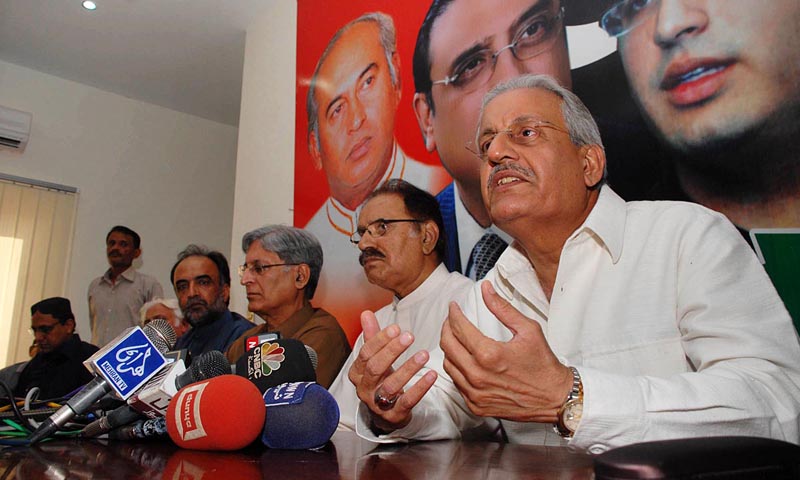 PPP's former Law Minister of Sindh, Ayaz Soomro, informed the Chief Election Commissioner in writing about the party's decision to boycott the presidential election.
Addressing a press conference in the federal capital city PPP's presidential candidate and senior leader Senator Raza Rabbani said that his party was left with no other option but to boycott the poll.
Rabbani thanked other opposition partners for their support and said their favours could never be repaid.
The Awami National Party (ANP) and the Balochistan National Party (BNP) also announced a boycott of the presidential poll.
Senator Haji Adeel, belonging to the Awami National Party, said that his party had already announced that it would support any decision taken by the PPP.
He further said that the court had taken a 'one-sided decision' which was 'unjust.'
DawnNews reported sources as saying that the Pakistan Muslim League - Quaid (PML-Q) had also decided to boycott the election for president.
The main opposition party's decision came as it said that enough time was not given to campaign for the presidential election.
The Election Commission of Pakistan had originally announced Aug 6 as the date for the presidential poll. The ruling Pakistan Muslim Legue - Nawaz (PML-N) had then written to the election commission requesting to delay the polls as the announced presidential elections were falling in the last 10 days of Ramazan, when most of the lawmakers were to be busy performing Umrah or sitting in Aitekaf.
The ECP rejected the government's request following which the PML-N filed a request in the Supreme Court of Pakistan seeking to hold the presidential elections before the last 10 days of Ramazan.
The apex court later decided in favour of the PML-N and agreed to the July 30 sought by the government.
Pakistan's largely ceremonial president is not elected by popular vote, but by the lawmakers in the Senate, National Assembly and the assemblies of the four provinces.
PPP's former Law Minister of Sindh, Ayaz Soomro, informed the Chief Election Commissioner in writing about the party's decision to boycott the presidential election.
Addressing a press conference in the federal capital city PPP's presidential candidate and senior leader Senator Raza Rabbani said that his party was left with no other option but to boycott the poll.
Rabbani thanked other opposition partners for their support and said their favours could never be repaid.
The Awami National Party (ANP) and the Balochistan National Party (BNP) also announced a boycott of the presidential poll.
Senator Haji Adeel, belonging to the Awami National Party, said that his party had already announced that it would support any decision taken by the PPP.
He further said that the court had taken a 'one-sided decision' which was 'unjust.'
DawnNews reported sources as saying that the Pakistan Muslim League - Quaid (PML-Q) had also decided to boycott the election for president.
The main opposition party's decision came as it said that enough time was not given to campaign for the presidential election.
The Election Commission of Pakistan had originally announced Aug 6 as the date for the presidential poll. The ruling Pakistan Muslim Legue - Nawaz (PML-N) had then written to the election commission requesting to delay the polls as the announced presidential elections were falling in the last 10 days of Ramazan, when most of the lawmakers were to be busy performing Umrah or sitting in Aitekaf.
The ECP rejected the government's request following which the PML-N filed a request in the Supreme Court of Pakistan seeking to hold the presidential elections before the last 10 days of Ramazan.
The apex court later decided in favour of the PML-N and agreed to the July 30 sought by the government.
Pakistan's largely ceremonial president is not elected by popular vote, but by the lawmakers in the Senate, National Assembly and the assemblies of the four provinces.
Thursday, July 25, 2013
Pakistan: Illegal post: Court-martialled army officer grabs NAB post
The Express TribuneAfter revelations that Adviser to Prime Minister on Aviation Shujaat Azeem was court-martialled by Pakistan Air Force, a similar case of a high-ranking National Accountability Bureau officer being court-martialled by Pakistan Army has come to light. Sources familiar with the development revealed to The Express Tribune that Husnain Ahmed, currently serving as Director General NAB Punjab was court-martialled by the army during training of Pakistan Military Academy Long Course-69. According to the Army Act, a person who is court-martialled cannot hold any public office or government post. Ahmed and three others were also appointed as directors-general on BPS-21 post in NAB by ex-chief Admiral (retd) Fasih Bokhari when the caretaker government was in power. After the Supreme Court passed an order suspending appointments and transfers made by the caretaker government, these four newly appointed DGs – DG Human Resources and Finance Altaf Bahawani, DG Operations NAB headquarters Zahir Shah, DG NAB Headquarters Brigadier (retd) Farooq Nasir Awan and Ahmed – are still occupying these positions illegally . Bokhari appointed them despite the fact that the Election Commission of Pakistan, in response to the accountability body’s letter, barred it from making new appointments. But NAB concealed these facts from the apex court as well as the implementation cell of the federal government that was established regarding careful review of all decisions and directives of the caretaker government in compliance of Supreme Court’s orders. The contents of the letter of the Cabinet Division vide No1/2/2013-IMP-II available with The Express Tribune reads, “The Prime Minister has desired that the Cabinet Division may undertake a holistic review of all directives issued/decisions taken during the incumbency of the caretaker government and re-submit them for orders of the Prime Minister whenever appropriate. “It is therefore requested that all directives issued/decisions taken by the caretaker government may please be conveyed to this division for desired action.” Despite receiving this letter, NAB has concealed facts from the Cabinet Division in its reply that no appointments and transfers were made during the interim setup. Sources also revealed that Ahmed is occupying two official residences at the same time in Islamabad and Lahore despite the fact that a public servant is entitled to only one official residence.
PPP delegation meets Imran Khan

Pakistan Peoples Party’s delegation consisting of Raza Rabbani‚ Khurshid Shah‚ Qamar Zaman Kaira and Rehman Malik held a meeting with PTI chief Chairman Imran Khan at his residence. Talikng to media, PPP leader Senator Aitzaz Ahsan said that the meeting with PTI Chairman was positive and constructive. He said people should wait till Friday for final decision regarding fielding a joint candidate for presidential election or boycotting it.
Pakistan: SC decision on presidential poll date attack on federation: Rabbani
 The Pakistan People’s Party’s (PPP) presidential candidate, Raza Rabbani, has said the Supreme Court’s decision to change the schedule of the presidential polls was “an attack on the federation”. PPP leaders remained busy on Thursday as they approached various political parties asking for their support for the party’s presidential candidate. A delegation of the party, headed by Leader of the Opposition in the National Assembly Khurshid Shah, held separate meetings with leaders of the PML-Q, the ANP, the Qaumi Watan Party (QWP) and the Jamiat Ulema-e-Islam-Fazl (JUI-F). Talking to reporters after meeting ANP leader Asfandyar Wali Khan, Rabbani said the SC’s verdict was an attack on the federation as the court had ignored the provincial assemblies. Rabbani told the reporters that he had been meeting leaders of various political parties to chalk out a strategy on whether to go along with the elections or boycott them. He said an impression had been given that the electoral college for the presidential poll was only present in Islamabad while “the fact of the matter is that all four provincial assemblies are included in the electoral college”. Rabbani said the new schedule did not provide enough time for him to carry out a proper campaign, adding that it would be impossible for him to visit all the provincial headquarters and meet the members of parliament. “I am a presidential candidate but I was not served any notice pertaining to hearing the plea seeking a change in the poll date,” he said. Rabbani said the SC, on the petition by the PML-N, gave a one-sided decision without hearing the other parties. “The Supreme Court even gave the schedule of the presidential elections,” he added. Addressing the reporters, Asfandyar said the ANP would support the PPP’s decision if it boycotted the presidential elections. He asked was it the Supreme Court’s constitutional domain to announce the schedule of the presidential elections? “If the answer is yes then there is no need to have an election commission.” Meanwhile, after his meeting with Khurshid Shah, Shujaat told reporters that if the opposition parties failed to reach a consensus on the issue, the PML-Q lawmakers would abstain from voting on July 30. According to a source, the PML-Q leadership urged the opposition leader to set aside their differences and agree on a joint candidate for the presidential elections. When contacted, PML-Q Information Secretary Kamil Ali Agha said his party had decided to support only a joint candidate of the opposition parties. "We want a joint candidate of the opposition parties. We had made such an effort in 2008 election and we want that a joint candidate should be fielded this time as well," he said. Agha confirmed that in case the opposition parties failed to field a joint candidate, his party's lawmakers would not take part in the election.
PPP to make decision on contesting presidential election today
http://www.geo.tv/The Pakistan Peoples Party’s (PPP) candidate for the presidential election, Raza Rabbani said Thursday that the party would make a decision regarding contesting the polls later today (Thursday).
 Rabbani during a news conference held on Wednesday said that the Supreme Court decision on holding the election on July 30 would affect campaigning. During the same news conference PPP leader, Aitzaz Ahsan said the party would evaluate its options regarding contesting the presidential election. “We will make a final decision after consulting with other political parties.”
Meanwhile, Awami National Party (ANP) chief Asfandyar Wali Khan said that his party would support whatever decision was taken by the PPP. The ANP had earlier announced that it would be supporting Rabbani in the presidential election.
“You cannot find a better candidate that Raza Rabbani,” Wali told reporters following his meeting with the PPP presidential candidate.
Rabbani during a news conference held on Wednesday said that the Supreme Court decision on holding the election on July 30 would affect campaigning. During the same news conference PPP leader, Aitzaz Ahsan said the party would evaluate its options regarding contesting the presidential election. “We will make a final decision after consulting with other political parties.”
Meanwhile, Awami National Party (ANP) chief Asfandyar Wali Khan said that his party would support whatever decision was taken by the PPP. The ANP had earlier announced that it would be supporting Rabbani in the presidential election.
“You cannot find a better candidate that Raza Rabbani,” Wali told reporters following his meeting with the PPP presidential candidate.
Watchdog critical of State Department contracting in Afghanistan
 By Jamie Crawford
A U.S. government watchdog found "serious deficiencies" in how the State Department awarded a contract job in Afghanistan, according to a letter from the organization to Secretary of State John Kerry released Thursday.
In the letter dated Monday, the special inspector general for Afghanistan reconstruction, John Sopko, raised a number of concerns on the oversight practices of the Bureau of International Narcotics and Law Enforcement Affairs (INL) at the State Department and how they awarded a contract for the training of Afghan justice workers.
Sopko said the International Development Law Organization (IDLO), the nongovernmental organization awarded the contract, is "ill-prepared to manage and account for how U.S.-taxpayer funds will be spent," while also criticizing the State Department's role in awarding the contract.
The United States has maintained that programs such as training and rule-of-law programs are central to ending the international presence in the country and allowing Afghans to take control of their own security.
Those programs involve "millions of dollars" of U.S. taxpayer money the letter said.
"The State Department - for some inexplicable reason - gave IDLO $50 million in U.S. taxpayer dollars, then gave away any oversight of this foreign entity," Sopko said in a written statement to CNN about the report. "The irony here is that State violated its own written policy and gave them a huge check to teach the Afghans about the 'rule of law.' As the saying goes, you can't make this up. We're going to get to the bottom of this and hold people accountable."
Sopko said his office - Special Inspector General for Afghanistan Reconstruction, or SIGAR - was disturbed to learn the agreement for IDLO to take over the contract contained "even fewer oversight requirements" than the agreement for the previous contractor. The letter also cited testimony by a State Department official to SIGAR auditors that IDLO is unable to validate its own spending since it lacks proper international financial certifications.
"It seems ill-considered for INL to have awarded almost $50 million to an organization that may not have the ability to account for the use of those funds," Sopko wrote, "under an agreement in which INL failed to require proper provisions for oversight."
In a harshly worded section of the letter, Sopko referred to INL's assertion that it does not "have authority to compel IDLO to produce information" in the awarding of the contract as "disingenuous."
INL, the letter says, could have made the awarding of the contract contingent on a certain level of oversight. "This omission is particularly disturbing given that INL chose IDLO as the sole project implementer."
The lack of insight on the part of the Bureau of International Narcotics and Law Enforcement Affairs led Sopko's office to request information from the International Development Law Organization about its financial situation and relationships, of which Sopko said IDLO "has refused to fully comply with."
"IDLO's failure to comply with these requests raises serious concerns regarding its commitment to transparency and willingness to acknowledge the authority of the U.S. government to oversee how U.S. taxpayer funds are spent," Sopko wrote.
Subpoenas may also be issued to IDLO to "compel the production of any and all records IDLO possesses related to its operations in Afghanistan," the letter said.
Sopko recommended the State Department address the "deficiencies" in the agreement with IDLO, as well as the review of similar contracts and grants related to Afghan reconstruction to ensure they included proper oversight mechanisms.
The letter comes at a time when contracting fraud and waste in Afghanistan is receiving heightened attention in Washington.
On Wednesday, SIGAR released two separate reports highlighting problems with contractors in Afghanistan.
In one instance, SIGAR found a company contracted by the U.S. military in Afghanistan to build a school "freely substituted building materials without U.S. approval using a concrete ceiling that raises safety concerns due to the school's location in an earthquake zone."
A second audit found the State Department and the United States Agency for International Development lack the same authority the Pentagon has to terminate contracts with an entity later found to be affiliated with insurgent groups in Afghanistan or those deemed to be an enemy of the United States.
Earlier this month it was revealed that a new $34 million U.S. military compound built in Afghanistan - paid for by U.S. tax dollars - likely never would be used.
By Jamie Crawford
A U.S. government watchdog found "serious deficiencies" in how the State Department awarded a contract job in Afghanistan, according to a letter from the organization to Secretary of State John Kerry released Thursday.
In the letter dated Monday, the special inspector general for Afghanistan reconstruction, John Sopko, raised a number of concerns on the oversight practices of the Bureau of International Narcotics and Law Enforcement Affairs (INL) at the State Department and how they awarded a contract for the training of Afghan justice workers.
Sopko said the International Development Law Organization (IDLO), the nongovernmental organization awarded the contract, is "ill-prepared to manage and account for how U.S.-taxpayer funds will be spent," while also criticizing the State Department's role in awarding the contract.
The United States has maintained that programs such as training and rule-of-law programs are central to ending the international presence in the country and allowing Afghans to take control of their own security.
Those programs involve "millions of dollars" of U.S. taxpayer money the letter said.
"The State Department - for some inexplicable reason - gave IDLO $50 million in U.S. taxpayer dollars, then gave away any oversight of this foreign entity," Sopko said in a written statement to CNN about the report. "The irony here is that State violated its own written policy and gave them a huge check to teach the Afghans about the 'rule of law.' As the saying goes, you can't make this up. We're going to get to the bottom of this and hold people accountable."
Sopko said his office - Special Inspector General for Afghanistan Reconstruction, or SIGAR - was disturbed to learn the agreement for IDLO to take over the contract contained "even fewer oversight requirements" than the agreement for the previous contractor. The letter also cited testimony by a State Department official to SIGAR auditors that IDLO is unable to validate its own spending since it lacks proper international financial certifications.
"It seems ill-considered for INL to have awarded almost $50 million to an organization that may not have the ability to account for the use of those funds," Sopko wrote, "under an agreement in which INL failed to require proper provisions for oversight."
In a harshly worded section of the letter, Sopko referred to INL's assertion that it does not "have authority to compel IDLO to produce information" in the awarding of the contract as "disingenuous."
INL, the letter says, could have made the awarding of the contract contingent on a certain level of oversight. "This omission is particularly disturbing given that INL chose IDLO as the sole project implementer."
The lack of insight on the part of the Bureau of International Narcotics and Law Enforcement Affairs led Sopko's office to request information from the International Development Law Organization about its financial situation and relationships, of which Sopko said IDLO "has refused to fully comply with."
"IDLO's failure to comply with these requests raises serious concerns regarding its commitment to transparency and willingness to acknowledge the authority of the U.S. government to oversee how U.S. taxpayer funds are spent," Sopko wrote.
Subpoenas may also be issued to IDLO to "compel the production of any and all records IDLO possesses related to its operations in Afghanistan," the letter said.
Sopko recommended the State Department address the "deficiencies" in the agreement with IDLO, as well as the review of similar contracts and grants related to Afghan reconstruction to ensure they included proper oversight mechanisms.
The letter comes at a time when contracting fraud and waste in Afghanistan is receiving heightened attention in Washington.
On Wednesday, SIGAR released two separate reports highlighting problems with contractors in Afghanistan.
In one instance, SIGAR found a company contracted by the U.S. military in Afghanistan to build a school "freely substituted building materials without U.S. approval using a concrete ceiling that raises safety concerns due to the school's location in an earthquake zone."
A second audit found the State Department and the United States Agency for International Development lack the same authority the Pentagon has to terminate contracts with an entity later found to be affiliated with insurgent groups in Afghanistan or those deemed to be an enemy of the United States.
Earlier this month it was revealed that a new $34 million U.S. military compound built in Afghanistan - paid for by U.S. tax dollars - likely never would be used.
Did India ignore warnings in free meals scheme?
U.S. Award For Afghan Justice 'Deficient'
http://www.rferl.org/Federal inspectors say a U.S. government award to an organization that promotes the rule of law in Afghanistan does not appear to contain basic oversight provisions from the State Department. In a letter to Secretary of State John Kerry on July 24, the Office of the Special Inspector General for Afghanistan Reconstruction said there were "serious deficiencies" in the award to the Rome-based International Development Law Organization. The award, meant to benefit the Afghanistan Justice Training Transition Program, is expected to cost U.S. taxpayers about $50 million. Special Inspector General John Sopko said lack of oversight requirements could indicate that the U.S. State Department's Bureau of International Narcotics and Law Enforcement Affairs is scaling back on its oversight of a program that is considered central to U.S. efforts to promote the rule of law in Afghanistan. There was no immediate comment from the U.S. State Department.
Pakistan: Democratic Delusions
By Joseph Loconte, Ph.D.The contrast between political rhetoric and everyday reality is often stark, even in democracies, where politicians are free to speak the truth about the ills facing their societies. But the discontinuity seems greatest in the Islamic world, where religious dogmas and delusions thrive, and nowhere greater than in Pakistan. Just consider President Asif Ali Zardari's address to a joint session of parliament last month, following national elections that returned Nawaz Sharif to power as prime minister. After noting his role as the nation's first elected civilian to oversee a "democratic" transfer of power, Zardari praised the establishment of democratic government in Pakistan. He extolled the "grace and glory of democracy" that had taken root in his country. He announced the "success of a prolonged struggle" toward democracy, insisting that "a dream has come true; a promise has been redeemed." He claimed that parliament had "purged the Constitution of undemocratic articles." He explained that voter participation in the parliamentary elections "shows that the ethos of our people is democratic." Thanks to the sacrifice of the nation's political leaders, he said, "democracy has arrived." The great, historic test of democracies, however, is not their capacity to hold elections. It is whether they deliver justice to the least powerful members of their societies, especially their ethnic, racial, and religious minorities. Put another way, democracies differ from tyrannies by their ability to make peace with modern pluralism. And by this test, Pakistan -- a self-declared Muslim state devoted to upholding Sunni Islam -- represents a loathsome retreat into sectarian terror. "This is not an economic battle any longer, this is a battle of ideologies," Shuja Nawaz, director of the South Asia Center of the Atlantic Council told a Washington, DC gathering last week. "Pakistan is what I would call a failing society." That dark assessment was echoed at a panel discussion, hosted by the U.S. Commission on International Religious Freedom (USCIRF), about the growing threat of religiously motivated violence against Muslim and non-Muslim minorities. The panel included Rahat Husain, legal affairs director of the Universal Muslim Association of America, which advocates for Shi'a Muslims; Peter Bhatti, chairman of International Christian Voice; Qasim Rashid, spokesperson for Ahmadiyya Muslim Community USA; and Jay Kansara, associate director of the Hindu American Foundation. USCIRF's report, "Pakistan: A History of Violence," documents 18 months of publicly-reported attacks against religious communities. The findings make the bloodletting in Iraq and Afghanistan almost seem like child's play. Over the course of the study, there were 203 separate acts of sectarian violence, injuring more than 1,800 people and claiming the lives over 700 men, women, and children. The largest number of attacks was against Shi'a Muslims, followed by Ahmadis, Christians, Hindus and Sikhs. The methods include suicide bombs, bombs in markets and mosques, drive-by shootings, attacks on religious sites, torture, beheadings, and mob violence. The victims, overwhelmingly civilians, included: An opthamologist and his son, shot and killed. A doctor gunned down in his clinic. Four shopkeepers fatally shot while at work. A 14-year-old girl killed at a religious meeting. A 12-year-old girl gang-raped and murdered. An 11-year-old boy, burned, tortured, mutilated and murdered. A 44-year-old school teacher fatally shot on his way home. A 43-year-old school teacher tortured to death while in police custody. A prayer leader killed in a mosque. A disabled man burned alive by a mob. And the list goes on. It is true that "private citizens" and militant groups officially banned by the government committed most of these atrocities. But the real atrocity is that Pakistan sustains what USCIRF calls a "climate of impunity" for this violence. Perpetrators are rarely apprehended or prosecuted. The overall response of the Pakistani government, according to USCIRF, has been "grossly inadequate." The problem is not just a failure of political will, but rather a deep conflict between the doctrines of political Islam and the tenets of liberal democracy. A government that uses blasphemy laws to criminalize speech deemed "offensive" to Sunni Islam does not have a democratic ethos. A law enforcement regime that refuses to ensure the security of an entire community because of theological differences -- the Shi'a Muslims, who have endured scores of lethal attacks as police looked the other way -- does not have a democratic ethos. A constitution that politically disenfranchises people because of religion -- the Ahmadis, who cannot vote without publicly renouncing their faith -- does not have a democratic ethos. A state education system that vilifies people because of their beliefs -- the Hindus, portrayed in textbooks as extremists and "the enemy of Islam" -- does not have a democratic ethos. No, the ethos that appears to be overwhelming the state of Pakistan is not inspired by democratic ideals. It is, instead, nurtured by the visions and hatreds and paranoia of a perverted faith. This is the cultural crisis of Pakistan. It was on tragic display earlier this month, when Malala Yousafzai, a Pakistani teenager campaigning for girls' education, visited the United Nations in New York. The 16-year-old Yousafzai barely survived an assassination attempt by the Pakistani Taliban last October, when she was shot in the face at point-blank range. As she told an appreciative audience in New York: "Extremists are afraid of books and pens." Back home in Pakistan, however, Taliban leaders lashed out at her in an open letter to the Pakistani people, calling her efforts "satanic" and part of a larger Western plot to enslave the world. The extremists seem to be winning the argument. "Many people hate Malala," Zubair Torwali, a newspaper columnists from the Swat Valley, told The New York Times. "Anything here in Pakistan related to the West or America becomes a thing of conspiracy. The Taliban's ideology is flourishing in Pakistan. It is victorious." This ideology of exclusion and hate may not be triumphant in Pakistan, but it does seem to be gaining ground. A turning point came with the assassinations in 2011 of two prominent government leaders critical of the nation's blasphemy laws and systematic repression of minorities. One was Salmaan Taseer, a Muslim, and governor of Punjab, and another was Shahbaz Bhatti, a Christian, and the federal minister for Minorities Affairs. Their deaths were openly applauded by leading politicians and clerics. The great tragedy of this lurch toward extremism is that it alienates large segments of the population from Pakistani society -- individuals and groups that could help to moderate and reform its political culture. The founding fathers of Pakistan "had a broad vision of inclusion" and recognized that "Christians have played an important role" in the history of the country, said Peter Bhatti, brother of Shahbaz Bhatti, who has taken up his brother's cause. Despite the spike in violence against Christians, he said, "we will remain loyal citizens of Pakistan." What religious minorities in Pakistan appear to share, in fact, is a commitment to a democratic state worthy of the name: a nation that ensures equal justice under the law for all its citizens, regardless of race, gender, or creed. This is what constitutes a democratic ethos, in law and in custom. Political philosopher John Locke, in his Letter Concerning Toleraton (1689), explained the core moral obligation of a just state in this way: "It is the duty of the civil magistrate, by the impartial execution of equal laws, to secure unto all the people in general, and to every one of his subjects in particular, the just possession of these things to this life." Pakistan's political leadership gives lip service to this principle, as if prompted by a guilty conscience. "Let everyone be judged by the same yardstick," President Zardari told the parliament. But until Pakistan takes significant steps toward this goal -- in its politics as well as its broader culture -- its descent into a violent, sectarian quagmire is assured. Joseph Loconte, PhD, is an associate professor of history at the King's College in New York City and the author of Gospel of Liberty: John Locke and the Struggle for Religious Freedom (Lexington Books, forthcoming).
PPP mulls quitting the race over ‘biased’ decision by SC
PPP evaluating decision to contest presidential election: Aitzaz Ahsan
 PPP leader Aitzaz Ahsan said Wednesday that his party was evaluating if they should contest the presidential election following the Supreme Court decision to hold polls on July 30.
Addressing a news conference alongside PPP leaders including the party’s presidential candidate Raza Rabbani, Ahsan added that PPP had also lost the May 11 general elections due to a conspiracy.
Ahsan echoed Rabbani’s statement that the presidential campaign had been affected due to a change in schedule.
PPP leader Aitzaz Ahsan said Wednesday that his party was evaluating if they should contest the presidential election following the Supreme Court decision to hold polls on July 30.
Addressing a news conference alongside PPP leaders including the party’s presidential candidate Raza Rabbani, Ahsan added that PPP had also lost the May 11 general elections due to a conspiracy.
Ahsan echoed Rabbani’s statement that the presidential campaign had been affected due to a change in schedule.
PPP to consult PTI, others over election boycott today
 The Pakistan People’s Party (PPP) leadership on Wednesday night deferred its decision to boycott the presidential election for today (Thursday) and decided that consultation process would be expanded to all opposition parties, including the Pakistan Tehreek-e-Insaf. A source said the consultative meeting of the PPP was held at the residence of Opposition Leader Syed Khurshid Shah and was attended by top PPP leaders, including Aitzaz Ahsan. The source said the PPP had made up its mind for boycotting the election but it wanted to convince the PTI, who had fielded Justice (r) Wajihuddin Ahmed for the slot. The source added that the consultation would also be made with PML-Q chief Shujaat, Jamat-e-Islami chief Syed Munawar Hassan, Qaumi Watan Party chief Aftab Sherpao and others. A consultative committee comprising Aitzaz Ahsan, Khurshid Shah and Rehman Malik has been formed to reach out to other political parties. “Those leaders who are available in capital would be approached by the PPP leaders personally while those out of city or country would be consulted through phone,” the source added. He said PPP Co-chairman President Asif Zardari was also contacted by phone during the meeting who advised the party leadership not to make a hasty decision and rather take all opposition parties along, including the MQM, PTI and others. The source said Khurshid Shah had been tasked with completing consultation by Thursday evening and the party and its allies would have a follow-up meeting in the evening to take a final decision. The source said Barrister Aitzaz Ahsan had proposed that all opposition parties who were affected due to certain decisions of the superior judiciary should be united on one platform so that a pressure wave could be created against the top judges. The source said that the meeting rejected a proposal to file a review petition with the Supreme Court against the court verdict over holding election on July 30, with Barrister Aitzaz Ahsan saying there was no hope of justice for the PPP from the bench. Following the meeting, Shah told reporters that the PPP leaders would visit Imran Khan for consultation, who was likely to arrive in the capital today. He said the consultation process was on with opposition parties and any decision would be taken with consensus. Shah added that the court had given no time to the opposition for campaigning in four provincial capitals, adding that contact had been made with Aftab Sherpao and Asfandyar Wali Khan. He alleged that there was a secret understanding between the election commission and PML-N for presidential election.
Senior Frontier Reserve Police official injured in Peshawar attack
Unknown gunmen on motorbikes Thursday ambushed the Deputy Commandant (DC) of Frontier Reserve Police (FRP) Gul Wali in Peshawar's Gulbahar area, injuring him and killing his bodyguard and driver.
“The deputy commander of Frontier Reserve Police Gul Wali Khan was going to his office from home when four people on two motorbikes lay in wait on both sides of the road,” police official Imran Shahid said.
“They opened fire on his vehicle. His bodyguard and his driver have been killed,” Shahid told AFP.
Wali was shifted to Lady Reading Hospital in an injured state where doctors declared him out of danger, according to DawnNews sources.
Meanwhile, security forces reached the site of incident and investigations went underway to apprehend those responsible for the attack.
Peshawar is the gateway to Pakistan's troubled northwestern tribal region where troops have for years been locked in deadly battles with insurgents.
There was no immediate claim of responsibility after today’s attack, but outlawed militant organisation Tehrik-i-Taliban Pakistan has frequently targeted police and security forces with bomb and gun attacks during the five-year insurgency.
Wednesday, July 24, 2013
11 year old Yemeni girl's speech against child marriage goes viral
A video of an 11-year-old Yemeni girl's account of escaping her arranged marriage has gone viral. In the 3-minute clip, Nada al-Ahdal says she would rather die than get married at her age and calls the potential marriage "criminal."
According to a report in NOW Lebanon, Nada fled to her uncle when her parents agreed to marry her to a Yemeni expatriate living in Saudi Arabia.
A version of the video with English captions received more than 5.6 million views in two days.
Opinion poll: 71% of Egyptians do not sympathize with pro-Morsy protesters
http://www.egyptindependent.com/An opinion poll conducted by the Egyptian Center for Public Opinion Research “Baseera” on the extent to which Egyptians sympathise with protests staged in support of ousted President Mohamed Morsy showed that 71 percent do not sympathise with the protesters, while 20 percent sympathise with them. 9 percent said they did not have a specific position with regards to the protests. The head of the center, Maged Othman, said that the opinions of 2,214 citizens aged 18 and above were collected by telephone. The opinions of Egyptians from around Egypt were solicited on Saturday, 20 July and Sunday, 21 July. 21 percent of residents of rural areas sympathised with the protesters while 67 percent did not. In urban areas, 17 percent sympathised with the protesters while 77 percent did not. Residents of Upper Egypt accounted for the largest percentage of sympathisers with 27 percent of residents sympathising with them compared to 15 percent in Lower Egypt and 16 percent in urban governorates. Men showed less sympathy for the protests, with 78 percent not sympathising with the protesters compared to 65 percent of women. A larger percentage of women failed to state a position on the protests, with 15 percent giving a neutral opinion compared to 3 percent of males having a similar position. Sympathy for protests seemed inversely proportional to age, as 24 percent of the youth aged 18 to 29 sympathised with the protests compared to 14 percent for those aged 50 or above. Sympathy increased among people with a higher educational level. 18 percent of those with below intermediate education degrees sympathised with the protesters while 26 percent of those with a university degree or higher sympathised with them. 14 percent of those with below intermediate education stayed neutral compared to three percent of those who possess a university degree or higher.
Syria is a terrorist hotbed, IDF intel chief warns
Extremists are not just trying to overthrow Assad but to set up an Islamic state on Israel’s doorstep, general warnsAn extensive global jihad center is developing right on Israel’s doorstep, the IDF’s head of military research Aviv Kochavi said Tuesday evening, warning about throngs of Islamist fighters streaming into Syria.“In front of our eyes, right in our backyard, a global center for jihad is developing, which can affect not only Syria and Israel but also Lebanon, Jordan, and the Sinai Peninsula, and can radiate to the entire region,” the major general said at a graduation ceremony for intelligence officers.“Syria is one of our biggest enemies,” Kochavi said, “and it’s becoming a regional center for jihadis — who are also enemies of Israel.” For example, Jabhat al-Nusra, or the Nusra Front, a radical group fighting Assad in Syria, announced that it had merged with al-Qaeda’s branch in Iraq in April. Kochavi also warned that some of the groups aligned with the Syrian rebels are not fighting for the same goal as the rest of the opposition. “The extremist Muslims and jihad fighters being drawn there are no longer merely trying to overthrow [Syrian President Bashar] Assad but to set up a religious Islamic state,” he explained. He acknowledged that, in the long run, the “winds of change” in the region could bring opportunity and growth, but said that, for the time being, Syria was the “most disturbing example” of a growing risk. Kochavi’s comments came as officials in Washington are debating greater involvement in the Syrian conflict, and specifically whether to arm the Syrian rebels, and as the United Nations Security Council is gearing up for an informal meeting with the Syrian opposition to explore ways to end the war. Chairman of the Joint Chiefs of Staff, Gen. Martin Dempsey, wrote in a letter to two top Senators Monday that establishing a no-fly zone to protect Syrian rebels would require hundreds of US aircraft at a cost of more than $1 billion per month, with no assurance that it would change the momentum in the civil war there. IDF officials have previously stated that the Syrian conflict doesn’t appear to be ending any time soon, particularly as foreign jihadi fighters are flocking to the country. Meanwhile, Israel’s new fence along the Syrian border is expected to be completed next month.
Bilawal Bhutto strongly condemns terrorist attack in Sukkur
http://mediacellppp.wordpress.com/

 Patron-in-Chief of Pakistan People’s Party, Bilawal Bhutto Zardari, has strongly condemned the terrorist attack in Barrage Colony of Sukkur, which resulted into loss of precious human lives while injuring many others.
Bilawal Bhutto Zardari said that elements involved in such flagitious act were the enemies of Pakistan. “It was not just an act of terrorism, but an act of war,” he said, “and people of Pakistan will continue to fight miscreants till their logical end.”
While expressing profound grief and sorrow over the loss of several innocent lives, Bilawal Bhutto Zardari sympathized with the bereaved families. He also prayed the Almighty to grant eternal peace to the departed souls and courage, patience and strength to the members of affected families to bear the irreparable loss.
Patron-in-Chief of Pakistan People’s Party, Bilawal Bhutto Zardari, has strongly condemned the terrorist attack in Barrage Colony of Sukkur, which resulted into loss of precious human lives while injuring many others.
Bilawal Bhutto Zardari said that elements involved in such flagitious act were the enemies of Pakistan. “It was not just an act of terrorism, but an act of war,” he said, “and people of Pakistan will continue to fight miscreants till their logical end.”
While expressing profound grief and sorrow over the loss of several innocent lives, Bilawal Bhutto Zardari sympathized with the bereaved families. He also prayed the Almighty to grant eternal peace to the departed souls and courage, patience and strength to the members of affected families to bear the irreparable loss.
Gun and bomb attack hits Pakistani spy agency's offices, killing 1 and wounding 20
http://www.montrealgazette.com/A police official in Pakistan says gunmen using explosives have attacked a compound housing the offices of the country's top spy agency, killing one person and wounding others. Deputy inspector general Javed Odho said Wednesday that the gunmen exchanged fire with security officials into the night at the compound in the Sukkur district. Odho said there were multiple blasts before gunmen attacked the offices. Odho said at least one person was dead and about 20 others wounded. Odho said it seems the regional office of Pakistan's top intelligence agency, Inter-Services Intelligence, was the target of the attack on the compound, which houses other government offices as well. Agency officials could not be immediately reached for comment, though they typically don't speak publicly with journalists.
PPP evaluating decision to contest presidential election: Ahsan
 PPP leader Aitzaz Ahsan said Wednesday that his party was evaluating if they should contest the presidential election following the Supreme Court decision to hold polls on July 30.
Addressing a news conference alongside PPP leaders including the party’s presidential candidate Raza Rabbani, Ahsan added that PPP had also lost the May 11 general elections due to a conspiracy.
Ahsan echoed Rabbani’s statement that the presidential campaign had been affected due to a change in schedule.
PPP leader Aitzaz Ahsan said Wednesday that his party was evaluating if they should contest the presidential election following the Supreme Court decision to hold polls on July 30.
Addressing a news conference alongside PPP leaders including the party’s presidential candidate Raza Rabbani, Ahsan added that PPP had also lost the May 11 general elections due to a conspiracy.
Ahsan echoed Rabbani’s statement that the presidential campaign had been affected due to a change in schedule.
Pakistan: Women in journalism: Harassed at work
 “My eyes are up here,” she snaps at the reporter as, mid-conversation, his attention drifts away from her face towards her chest. He giggles; she shrugs it off as just another display of myopic male mentality.
Sadly, these incidents are not uncommon; female broadcast and print journalists share that discrimination and harassment shadow work – in the newsroom, or out in the field.
Of sticks and stones
“My eyes are up here,” she snaps at the reporter as, mid-conversation, his attention drifts away from her face towards her chest. He giggles; she shrugs it off as just another display of myopic male mentality.
Sadly, these incidents are not uncommon; female broadcast and print journalists share that discrimination and harassment shadow work – in the newsroom, or out in the field.
Of sticks and stones
Magsaysay award for only female Afghan governor
 Afghanistan’s first and only female governor and a humanitarian worker from the Kachin minority in Myanmar are among this year’s recipients of the prestigious Ramon Magsaysay award. Habiba Sarabi was honoured for helping build a functioning local government and pushing for education and women's rights in Afghanistan's Bamyan province despite discrimination and poverty.
The organisation she founded, Lahpai Seng Raw, helps rehabilitate damaged communities amid armed conflict.orgisation
The Ramon Magsaysay Awards announced Wednesday honour three individuals and two organisations for changing their societies for the better.
They are named after a popular Philippine president who died in a plane crash in 1957.
Afghanistan’s first and only female governor and a humanitarian worker from the Kachin minority in Myanmar are among this year’s recipients of the prestigious Ramon Magsaysay award. Habiba Sarabi was honoured for helping build a functioning local government and pushing for education and women's rights in Afghanistan's Bamyan province despite discrimination and poverty.
The organisation she founded, Lahpai Seng Raw, helps rehabilitate damaged communities amid armed conflict.orgisation
The Ramon Magsaysay Awards announced Wednesday honour three individuals and two organisations for changing their societies for the better.
They are named after a popular Philippine president who died in a plane crash in 1957.
CIA closing bases in Afghanistan as it shifts focus amid military drawdown
By Greg Miller The CIA has begun closing clandestine bases in Afghanistan, marking the start of a drawdown from a region that transformed the agency from an intelligence service struggling to emerge from the Cold War to a counterterrorism force with its own prisons, paramilitary teams and armed Predator drones. The pullback represents a turning point for the CIA as it shifts resources to other trouble spots. The closures were described by U.S officials as preliminary steps in a plan to reduce the number of CIA installations in Afghanistan from a dozen to as few as six over the next two years — a consolidation to coincide with the withdrawal of most U.S. military forces from the country by the end of 2014. Senior U.S. intelligence and administration officials said the reductions are overdue in a region where U.S. espionage efforts are now seen as out of proportion to the threat posed by al-Qaeda’s diminished core leadership in Pakistan. The CIA faces an array of new challenges beyond al-Qaeda, such as monitoring developments in the Middle East and delivering weapons to rebels in Syria. John O. Brennan, the recently installed CIA director, has also signaled a desire to restore the agency’s focus on traditional espionage. “When we look at post-2014, how does the threat in Afghanistan and Pakistan measure against the threat in North Africa and Yemen?” said a senior administration official who spoke on the condition of anonymity to discuss government deliberations. “Shouldn’t our resources reflect that?” U.S. officials stressed that the CIA is expected to maintain a significant footprint even after the pullback, with a station in Kabul that will remain among the agency’s largest in the world, as well as a fleet of armed drones that will continue to patrol Pakistan’s tribal belt. The timing and scope of the CIA’s pullback are still being determined and depend to some extent on how many U.S. troops President Obama decides to keep in the country after 2014. The administration is expected to reduce the number from 63,000 now to about 10,000 after next year but recently signaled that it is also considering a “zero option,” in part because of mounting frustration with Afghan President Hamid Karzai. The CIA may be in a unique position to negotiate with Karzai, who has publicly acknowledged accepting bags of money from the agency for years. The CIA also has provided much of the budget and training for the Afghan intelligence service. The agency wants to maintain the strength of those ties. Even so, a full withdrawal of U.S. troops would probably trigger a deeper retrenchment by the CIA, which has relied on U.S. and allied military installations across the country to serve as bases for agency operatives and cover for their spying operations. The CIA’s armed drones are flown from a heavily fortified airstrip near the Pakistan border in Jalalabad. The CIA’s presence in the country has already dropped well below the peak levels of several years ago, when more than 1,000 case officers, analysts and other employees had been deployed to support the war effort and hunt al-Qaeda leaders, including Osama bin Laden. The CIA declined to comment on the withdrawal plans. “Afghanistan fundamentally changed the way the agency conducts business,” said Richard Blee, who served as the CIA’s senior officer in Afghanistan and Pakistan before he retired in 2007. “We went from a purely espionage organization to more of an offensive weapon, a paramilitary organization where classic spying was less important.” Some of the bases being closed served as important intelligence-gathering nodes during the escalation of the agency’s drone campaign, raising the risk that U.S. counterterrorism capabilities could deteriorate and perhaps allow remnants of al-Qaeda to regenerate. U.S. officials played down that danger. “There’s an inherent imbalance,” the administration official said. “The effectiveness of our operations has reduced the threat to the point that it’s entirely appropriate that we have a smaller counterterrorism footprint.” White House officials have been weighing a shift of some of those resources to other regions, including Yemen and North Africa, where al-Qaeda affiliates are now seen as more dangerous than the network’s base. The White House discussions have been part of the overall deliberations over U.S. troop levels in Afghanistan. The CIA drawdown coincides with Afghanistan-related personnel moves. The agency recently appointed a new station chief in Kabul, a selection that raised eyebrows among some because the veteran officer is known mainly for his tours in Latin America and had not previously served in Afghanistan. The top military post at CIA headquarters is also changing hands. U.S. Army Maj. Gen. Tony Thomas, who was in charge of Special Operations units in Afghanistan, is set to begin serving as associate CIA director for military support in September, replacing an Air Force general with drone expertise. Current and former U.S. officials familiar with the agency’s plans said they call for pulling most agency personnel back to the CIA’s main station in Kabul, plus a group of large regional bases — known as the “big five” — in Bagram, Kandahar, Mazar-e Sharif, Jalalabad and Herat. “The footprint being designed involves six bases and some satellite [locations] out of those,” said a former senior CIA officer who also spoke on the condition of anonymity. The agency may also rely on “mobile stations” in which a small number of operatives move temporarily into remote locations “where they trust the tribal network,” the former officer said. “Protection issues are going to be critical.” The base closures involve compounds along the Pakistan border, part of a constellation used by CIA operatives and analysts to identify drone targets in Pakistan. The bases, including locations in the provinces of Zabul, Paktika and Khost, have relied heavily on U.S. military and medical evacuation capabilities and were often near larger military outposts. Among them is Forward Operating Base Chapman, in Khost, where seven CIA employees were killed by a suicide bomber posing as a potential informant in 2009. It is unclear whether the CIA will pull its personnel out of Chapman, which remained active even after that attack. Administration deliberations over troop levels could also determine where the agency operates its drones. During the early years of the campaign, the aircraft were flown from Shamsi Air Base in Pakistan, but the agency moved most of its fleet to Jalalabad as public opposition to strikes mounted in Pakistan and relations with the government broke down. The tempo of the CIA’s drone campaign has already tapered off. The 17 strikes this year in Pakistan are far off the peak pace of 2010, when there were 117 strikes, according to the Long War Journal, a Web site that tracks drone attacks. Over the past decade, the campaign has killed as many as 3,000 militants and dozens if not hundreds of civilians, according to independent estimates. U.S. officials said that preferred troop-level options would allow U.S. forces to remain at Jalalabad, in part so that the CIA’s flights could continue. But officials said the drones could also be shifted to airstrips at Bagram or Kandahar. The latter has already served as a base for stealth drones used to conduct secret surveillance flights during the bin Laden raid and over Iran. This year, President Obama approved new counterterrorism guidelines that call for the military to take on a larger role in targeted killing operations, reducing the involvement of the CIA. But the guidelines included carve-outs that gave the agency wide latitude to continue armed Predator flights across the border and did not ban a controversial practice known as “signature strikes,” in which the agency can launch missiles at targets based on patterns of suspicious behavior without knowing the identities of those who would be killed. The senior Obama administration official said the United States may propose a shift to military drone flights inside Pakistan as part of the discussions with Afghanistan and Islamabad over U.S. troop levels. The negotiations are seen as the “one shot you have” to raise the issue, the official said, adding that it was doubtful but “not impossible” that Pakistan would consent. Islamabad has never formally acknowledged its cooperation on the drone program and is seen as unlikely to allow a covert — if not exactly secret — CIA operation to give way to an overt campaign involving U.S. military flights. Despite the pullout of U.S. troops and CIA operatives, officials said the drone campaign in Pakistan and elsewhere is expected to continue for years. Mike Sheehan, the assistant defense secretary for Special Operations, testified recently that such counterterrorism operations will probably last an additional 10 years or more. The administration official said others believe the end is closer. The strikes will probably last “some period of years,” the official said. “But I don’t think you can project out five or 10.”
Pakistanis react to militant's letter to Malala
http://centralasiaonline.com/

Targeting the innocent for ideological differences is a negation of Islamic teachings and a crime against humanity, observers say.Pakistanis were quick to reject Tehreek-e-Taliban (TTP) commander Adnan Rasheed's message to teen education activist and peace advocate Malala Yousafzai.Malala is a proud symbol of the Pashtun code of life, Acid Survivors Foundation chief Valerie Khan Yousafzai told Central Asia Online, adding that "extremists' allegations [against] her … are just rubbish" and that "Malala is an agent of change – and good change, for which we are all proud of her." Rasheed July 15 wrote a letter to Malala, now 16, in which he said that the October 9 TTP attack on her in Mingora was fully justified.


US says a 'secure' Pakistan critical for a 'stable' Afghanistan
The US Department of State has said that Pakistan is an important partner in supporting a secure and stable Afghanistan, which is vital to the security of the region.
"Pakistan’s own security and stability is tied to a successful outcome in Afghanistan and any steps that continue to build the relationship between Afghanistan and Pakistan, in our view, are very important", the State Department’s spokesperson Jen Psaki said during a daily media briefing here.
To a question she said that the US was aware, of course, that Pakistan’s Advisor to the Prime Minister on National Security and Foreign Affairs, Mr Sartaj Aziz visited Afghanistan this past weekend.
According to Geo News, without disclosing any specifics in terms of a date, she further said that the US Secretary of State John Kerry was likely to visit Pakistan shortly.
Pakistan: Rights of the disabled?: Private airlines fail to offer wheelchair access
The Express TribuneIt was not the usual mad rush of passengers or the onslaught of porters that made Naveeduddin Khan anxious when he was about to board a train to Multan earlier this year. He was worried of how he was going to make it to his seat. As the situation unfolded, some men lifted him off the platform and put him on the train. Once inside, he crawled on his elbows, bruising his arms and gathering dirt and greasy lubricant, while making his way to the seat. Getting on-board this way was humiliating – the story of all handicapped passengers travelling via trains. But this episode was nothing compared to the embarrassment he endured while trying to book a flight on a private airline. “They don’t sell tickets to physically-challenged people,” he said angrily. “I had to cancel my family vacations to Islamabad as the airlines would not assist me.” Khan has a leg deformity due to polio disease. For within city commute, he drives his especially modified three-wheeler automatic car but when it comes to travelling to other cities, he finds himself with limited options as two private airlines in the country – Shaheen Air and Airblue – do not entertain people requiring wheelchair access. “Sorry, we don’t provide attendants and don’t allow wheelchairs inside the planes,” claimed a ticket-reservation operator at Shaheen Air. “Only those who can walk are permitted to travel.” The attitude is no different at Airblue. “Handicapped persons would have to get their own attendants to carry them and climb up the stairs to the plane,” said an Airblue official. Wheelchairs cannot be taken to the plane as “there is no space for it,” he added. Aviation rules Shaheen Air has no provisions for disabled persons under the conditions of carriage. However, the conditions do state that the carrier has the right to refuse passengers requiring special assistance. “We will have to load bridges to transport people requiring wheelchair access to planes,” a spokesperson for Airblue, Raheel Ahmed, said. “We don’t have them in Islamabad or Peshawar, and the ones in Karachi are always booked.” Ahmed explains the risk involved in transporting such passengers. “Even if we provide a porter to carry the disabled persons through stairs, a slip from the porter could cost the airline a lot of money.” Airblue’s spokesperson says that only the Pakistan International Airlines (PIA) has an ambulift – a crane to lift wheelchairs. “If we rent it from them, we will be charged in dollars.” Expressing regret over such a problem, he said that the airline did take special children for the Paralympics last year but they have limitations. “Airblue has an all-female crew. Even if we take such passengers, who would help them use the bathroom?” Meanwhile, Civil Aviation Authority’s spokesperson Mehmood Hussain said that it depended on the policy of the airlines of whether or not to assist such travellers. PIA complies with the rules of the US Department of Transportation on the travel of disabled persons. Under 14 CFR part-382 of the Air Carrier Access Act, airlines may not refuse transportation to people with disabilities. PIA’s spokesperson Mashood Tajwar confirmed that their attendants made sure that the handicapped persons were allowed on-board. Violation of human rights? Khan, who also runs the Disabled Welfare Association, has taken the matter to the Human Rights Commission (HRCP) of Pakistan. “Action should be taken against these airlines. Why are we being discriminated against? They should shutdown their operations if they cannot facilitate us.” HRCP coordinator in Sindh, Syed Shamsuddin, has written letters to both airlines, urging them to rectify their unfair policies.
Gilani says ready for arrest
Former prime minister Yousuf Raza Gilani has said he is ready to get arrested and sent to jail if he has done anything illegal.
Talking to reporters outside the Parliament House on Tuesday, Mr Gilani said a perception was being created that he was being protected by the Punjab police. “Today I have come to Islamabad and ready for the arrest if anyone wants to do so,” he said.
 Mr Gilani said there was nothing wrong in appointing Tauqir Sadiq as chairman of the Oil and Gas Regulatory Authority (Ogra), adding that decisions taken by him as prime minister were legal and constitutional and he was not afraid of consequences.
He said as prime minister he appointed not only Sadiq but several other top-ranking officials as well, including the chief justice, army chief, air force chief and chief of the joint staff committee. It would be unfair to regard Sadiq’s appointment illegal and other appointments legal, he added.
Answering a question about the role of the judiciary, the former prime minister said the judiciary should allow the government to function and, at the same time, the government should not interfere in the affairs of courts.
Sources in NAB told Dawn that officials of the bureau were considering to seek accountability court’s help in responding to what Mr Gilani said on Tuesday about his arrest. They said that the former prime minister might be summoned by an accountability court for not cooperating with NAB in the case related to Sadiq’s controversial appointment.
Media reports indicate that during interrogation Sadiq had unveiled names of several people who had played some role in his appointment, including former prime ministers Yousuf Raza Gilani and Raja Pervez Ashraf and former adviser to prime minister for petroleum Dr Asim Hussain.
A senior NAB official who did not want to be named said that under the NAB ordinance the bureau could arrest a person if he or she refused to respond to its three notices but the action would require approval from its chairman. Because the position of NAB chairman was now vacant, he said, the bureau could not issue warrants for the arrest of former prime minister.
On July 16 Mr Gilani defied the forth notice of NAB by saying that being a former prime minister he enjoyed immunity and could not be summoned by any investigation agency.
Mr Gilani said there was nothing wrong in appointing Tauqir Sadiq as chairman of the Oil and Gas Regulatory Authority (Ogra), adding that decisions taken by him as prime minister were legal and constitutional and he was not afraid of consequences.
He said as prime minister he appointed not only Sadiq but several other top-ranking officials as well, including the chief justice, army chief, air force chief and chief of the joint staff committee. It would be unfair to regard Sadiq’s appointment illegal and other appointments legal, he added.
Answering a question about the role of the judiciary, the former prime minister said the judiciary should allow the government to function and, at the same time, the government should not interfere in the affairs of courts.
Sources in NAB told Dawn that officials of the bureau were considering to seek accountability court’s help in responding to what Mr Gilani said on Tuesday about his arrest. They said that the former prime minister might be summoned by an accountability court for not cooperating with NAB in the case related to Sadiq’s controversial appointment.
Media reports indicate that during interrogation Sadiq had unveiled names of several people who had played some role in his appointment, including former prime ministers Yousuf Raza Gilani and Raja Pervez Ashraf and former adviser to prime minister for petroleum Dr Asim Hussain.
A senior NAB official who did not want to be named said that under the NAB ordinance the bureau could arrest a person if he or she refused to respond to its three notices but the action would require approval from its chairman. Because the position of NAB chairman was now vacant, he said, the bureau could not issue warrants for the arrest of former prime minister.
On July 16 Mr Gilani defied the forth notice of NAB by saying that being a former prime minister he enjoyed immunity and could not be summoned by any investigation agency.
FIA arrest close relative of PML-N MNA in human smuggling case
THE FRONTIER POSTThe Federal Investigation Agency (FIA) police arrested the close relative of PML-N’s MNA in a human smuggling case in Sargodha. According to details, the FIA police in a raid at Madina Town in Sargodha arrested the accused, Rashida Bano involved in human smuggling. Bano said to be a close relative of PML-N’s MNA, had taken Rs 700,000 along with GBP4500 from father of Noman Saleem in exchange for sending his son to England and giving him job there. After finding no job in England, the hopeless Nowman had to return back to Pakistan Meanwhile, the accused failed to send other applicants abroad as per promise, upon which Zubaida Begum, mother of the applicants, approached the FIA in Faisalabad against her for not returning the amount taken for visas. Faisalabad FIA registers a case after investigation and arrested the accused on the complaint of Zubeida Begum.
Tuesday, July 23, 2013
Turkey's main opposition leader lambastes PM over media freedom
Cricket court order threatens more Pakistan turmoil
 Pakistani cricket faced fresh turmoil Tuesday as a court cancelled all decisions made by the interim board chairman and demanded a member of the public be included on the national selection committee.
The ruling by the Islamabad High Court severely curtails the powers of Najam Sethi, appointed as temporary Pakistan Cricket Board (PCB) chairman after Zaka Ashraf was thrown out over his controversial election.
The court cancelled the appointment of former captain Moin Khan as chief selector and ordered the PCB to draft a "keen follower of the game" from the public onto the panel that chooses the national side.
The 30-page judgement seen by AFP nullified the appointment of a new selection committee by Sethi -- which means Pakistan cannot presently select a side to play Zimbabwe next month.
PCB legal adviser Taffazul Rizvi said Tuesday's judgement limited the interim chairman to a caretaker role with little authority to make decisions and the board was considering an appeal.
"We are reviewing the judgement and will decide the legal course of action soon," Rizvi said.
The court issued guidelines on the process to elect a new PCB chairman, which is to take place within 90 days, and demanded a shakeup of the selection committee.
"The scope of the selection committee is required to be enhanced by including one sports journalist, cricket commentator and one keen follower of the game of cricket having sufficient knowledge from the general public," the court ruled.
Cricket selectors are customarily drawn from the ranks of former players and coaches with personal knowledge of current cricketers and direct experience of the game at the highest level.
The court upheld an earlier court ruling suspending Ashraf from the chairman's job following complaints about the process to elect him.
Ashraf was appointed chairman by PCB patron and the president of Pakistan, Asif Ali Zardari, in October 2011 under a previous PCB constitution.
But the board was forced to introduce a new constitution earlier this year after the International Cricket Council (ICC) ordered an end to government interference.
Former Pakistan captain Rashid Latif, who has also challenged Ashraf's re-appointment in the Sindh High Court, welcomed the judgement.
"I see this as a positive judgement but it will take some time to bring all the reforms in Pakistan cricket," Latif said. "We must improve our cricket set-up."
Read more: http://www.foxnews.com/world/2013/07/23/cricket-court-order-threatens-more-pakistan-turmoil/#ixzz2ZtHKEhYk
Pakistani cricket faced fresh turmoil Tuesday as a court cancelled all decisions made by the interim board chairman and demanded a member of the public be included on the national selection committee.
The ruling by the Islamabad High Court severely curtails the powers of Najam Sethi, appointed as temporary Pakistan Cricket Board (PCB) chairman after Zaka Ashraf was thrown out over his controversial election.
The court cancelled the appointment of former captain Moin Khan as chief selector and ordered the PCB to draft a "keen follower of the game" from the public onto the panel that chooses the national side.
The 30-page judgement seen by AFP nullified the appointment of a new selection committee by Sethi -- which means Pakistan cannot presently select a side to play Zimbabwe next month.
PCB legal adviser Taffazul Rizvi said Tuesday's judgement limited the interim chairman to a caretaker role with little authority to make decisions and the board was considering an appeal.
"We are reviewing the judgement and will decide the legal course of action soon," Rizvi said.
The court issued guidelines on the process to elect a new PCB chairman, which is to take place within 90 days, and demanded a shakeup of the selection committee.
"The scope of the selection committee is required to be enhanced by including one sports journalist, cricket commentator and one keen follower of the game of cricket having sufficient knowledge from the general public," the court ruled.
Cricket selectors are customarily drawn from the ranks of former players and coaches with personal knowledge of current cricketers and direct experience of the game at the highest level.
The court upheld an earlier court ruling suspending Ashraf from the chairman's job following complaints about the process to elect him.
Ashraf was appointed chairman by PCB patron and the president of Pakistan, Asif Ali Zardari, in October 2011 under a previous PCB constitution.
But the board was forced to introduce a new constitution earlier this year after the International Cricket Council (ICC) ordered an end to government interference.
Former Pakistan captain Rashid Latif, who has also challenged Ashraf's re-appointment in the Sindh High Court, welcomed the judgement.
"I see this as a positive judgement but it will take some time to bring all the reforms in Pakistan cricket," Latif said. "We must improve our cricket set-up."
Read more: http://www.foxnews.com/world/2013/07/23/cricket-court-order-threatens-more-pakistan-turmoil/#ixzz2ZtHKEhYk
PPP, ANP agree to field Raza Rabbani as presidential candidate
http://dunyanews.tv/
 The Pakistan People s Party (PPP) and Awami National Party (ANP) have agreed to field Senator Raza Rabbani as joint candidate for presidential slot.
A consultative meeting between ANP and PPP was organized in Islamabad today (Tuesday) to finalize the strategy for upcoming presidential election.
ANP leader Haji Adeel announced that his party will support PPP candidate Raza Rabbani for the presidential slot.
“My party has made the decision because PPP candidate Raza Rabbani supports provincial autonomy,” Adeel further said.
Opposition leader in the National Assembly Khurshid Shah also briefed the meeting regarding his contacts with different political forces on the issue.
He said consultations have been made with MQM and other political parties to garner their support for Raza Rabbani.
Nomination papers of Raza Rabbani will be filed tomorrow.
The Election Commission of Pakistan has stipulated July 24 as the last date to submit presidential nomination papers.
ECP had announced to hold Presidential election on August 6 to replace incumbent Asif Ali Zardari, who is not seeking a second term.
The Pakistan People s Party (PPP) and Awami National Party (ANP) have agreed to field Senator Raza Rabbani as joint candidate for presidential slot.
A consultative meeting between ANP and PPP was organized in Islamabad today (Tuesday) to finalize the strategy for upcoming presidential election.
ANP leader Haji Adeel announced that his party will support PPP candidate Raza Rabbani for the presidential slot.
“My party has made the decision because PPP candidate Raza Rabbani supports provincial autonomy,” Adeel further said.
Opposition leader in the National Assembly Khurshid Shah also briefed the meeting regarding his contacts with different political forces on the issue.
He said consultations have been made with MQM and other political parties to garner their support for Raza Rabbani.
Nomination papers of Raza Rabbani will be filed tomorrow.
The Election Commission of Pakistan has stipulated July 24 as the last date to submit presidential nomination papers.
ECP had announced to hold Presidential election on August 6 to replace incumbent Asif Ali Zardari, who is not seeking a second term.
Pakistan: PPP asks govt to come clean about IPP payments

http://www.ppp.org.pk/The Pakistan People’s Party (PPP) has asked the finance minister to come clean about Rs 322 billion paid to IPPs in order to clear the circular debt and make public the website on which this information is claimed to have been uploaded. The finance minister, in an interview published in a local newspaper, claimed that payments to IPPs had been made “transparently and details have been placed on the web”. PPP Senator Farhatullah Babar said in a statement on Monday that a search of the websites of Ministries of Finance and Water and Power, WAPDA and OGRA revealed that no such details had been uploaded. “If the information is not placed on the website of the related ministries and departments, then where has it been placed?” he asked, adding, “This has raised legitimate questions of transparency and accountability”. He said that the information available on the website of Finance Ministry about a July 2 meeting simply says that the ECC was informed that a sum of Rs 322 billion has been paid to the IPPs. “It is a bare statement of fact known to everyone. What was needed to be disclosed but has not been made public are the details about the power produced by each IPP, the time during which it was produced, the rate at which it was paid and the total amount paid to each power producer,” the senator said. A detailed technical audit of the IPPs was an essential pre-requisite but no such audit was actually carried out before doling out billions of rupees to power producers, he said. “Who knows if a game of favourites has been played in the week during which hundreds of billions of rupees were paid,” Farhatullah Babar said. He said that in order to create an impression of transparency and accountability, the website of the Finance Ministry claims that the IPPs signed an MOU pledging to fulfil certain conditions before payments were made to them. However, he added, on closer scrutiny it becomes obvious that it is no more than a false impression. The first condition which the IPPs are said to have agreed to, he said, is that all the thermal power plants exceeding 2,000MW capacity would be converted into coal fired plants. “It amounts to hoodwinking people as there is hardly any thermal IPP of more than 2,000 MW capacity. What is flaunted as a great achievement is in fact a ruse to create and sustain false hopes that plants using more expensive fuel are being remodelled so as to run on a widely available cheap fuel of coal,” he said. “The second condition claimed to have been agreed by the private power producers, according to the website, is that they will optimally utilise the available plant capacities. However, in the absence of technical audit giving complete information about a plant’s available capacity, the optimal capacity that is desired to be achieved and the time frame within which it is to be achieved is no more that a vague promise and a false hope,” he said. A third condition claimed to have been agreed by the private producers is a one-month extension allowed by them to PEPCO to make payments. This measure will only give a breather of one more month but will not address the issue of spiralling debt itself which will resurface again as long as the huge difference between the cost of power production and the price at which is sold persists, he said. Senator Farhatullah Babar said that there is total absence of transparency and a veil of secrecy seems to have been woven around the payments of Rs 322 billion made to the private producers. “Doubts will linger and questions will continue to be asked until the shroud of secrecy is shredded and all relevant information is uploaded on the web and the nation is informed about where it is available.”
NEW VICTIM OF SO CALLED BLASPHEMEY LAW:Christian couple arrested in Gojra in blasphemy case
http://www.pakistanchristianpost.com/
(Shamim Masih) Sajjad Masih accused of blasphemy case reportedly sent to jail for life imprisonment, hardly a week back. Yet another blasphemy case is registered against a Christian couple in Gojra city of a Punjab province. According to the sources, Shafaqat Masih 35, and his wife Shagufta Bibi were arrested so far under alleged of blasphemy case but the First Investigation Report (FIR) No. 407/13 is registered under 295-B, C PPC against anonymous today in Gojra City.Gojra is religiously sensitive, having witnessed massive attacks on Christians triggered by reports of desecration of Holy Quraan. Eight family members were burnt alive and about forty houses and a Church were set ablaze by a mob in August, 2009. Now again it seems that it is under threat.The petitioner Rana Mohammad Fiaz said that blasphemous text was sent to him from a mobile number. Police found the SIM card and arrested the couple. Ms. Shagufta is lady worker at the local school and taking care of her two teens and her husband is crippled. As soon as I heard the incident, I requested World Vision in Progress – WVIP to reach there at once to take care of the kids. On my humble request, WVIP management has sent its official to look into the matter. Basharat Khokhar, activist in Rimsha case has condemned the incident and urged the administration to take the preventive measures accordingly. The local administration has taken a sensitive issue seriously, the administrative told.

Two Hazara youth slain in Quetta
The Express TribuneIn what appears to be another targeted killing, two members of the Hazara community were gunned down in the Shahra-e-Iqbal area of Balochistan’s provincial capital on Monday. The two victims were travelling in a taxi cab when unidentified assailants opened fire on their vehicle. Both victims succumbed to injuries sustained during the attack, while two other passers-by also suffered wounds. “The driver of the taxi cab and his passenger belonged to the Shia Hazara community. They died after gunmen fired at their car,” said DIG Operations Fayyaz Ahmed Sumbal. The deceased were identified as 19-year-old Shukarullah, son of Qurban Ali Hazara, and 18-year-old Ramzan Ali, son of Abdul Khaliq Gul Hazara. The injured passersby were identified as Sherzaman, a resident of Mastung and Aslam Jan, a resident of Quetta. No group has so far claimed responsibility for the targeted killing.
President Zardari slams desecration of holy shrine in Syria
President Asif Ali Zardari Monday condemned the attack on the shrine of Sayyeda Hazrat Zainab Bibi the other day in Damascus as most “hurtful and despicable” that could have been perpetrated only by the lowest and the meanest. Spokesperson quoted the president as saying that desecrating the holy shrine and places of worship not only hurt the sentiments of the Muslims in Pakistan and the world over but also threatened to widen the sectarian divide.
Fanning sectarianism and further widening the sectarian divide is the last thing the Muslims can afford, the president said. He said that it was incumbent upon all parties in the conflict in Syria to ensure that the sanctity of holy shrines and places of worship was maintained and these were not desecrated.
Spokesperson quoted the president as saying that desecrating the holy shrine and places of worship not only hurt the sentiments of the Muslims in Pakistan and the world over but also threatened to widen the sectarian divide.
Fanning sectarianism and further widening the sectarian divide is the last thing the Muslims can afford, the president said. He said that it was incumbent upon all parties in the conflict in Syria to ensure that the sanctity of holy shrines and places of worship was maintained and these were not desecrated.

We all must hear Malala Yousafzai's brave voice
 The BBC and Sky News carried an inspiring speech by Malala Yousafzai, the 16-year-old Pakistani girl shot in the head last October by the Taliban for advocating the education of girls.
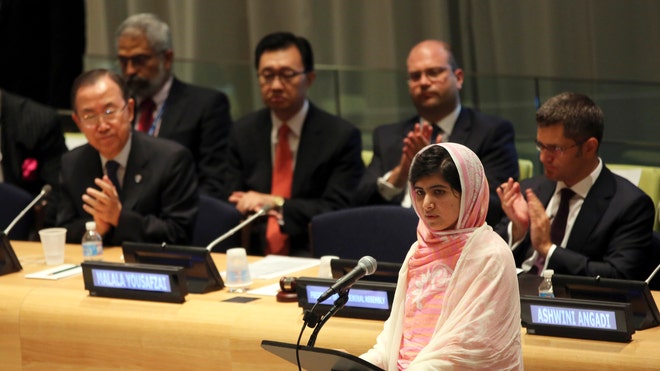 On her birthday, Malala addressed in barely accented English a special youth gathering at the United Nations in New York. She wore a shawl that had belonged to the late Pakistani President Benazir Bhutto, who was assassinated by Islamic extremists in 2007.
Only occasionally referring to notes, Malala, who now lives in Birmingham, England, where she received medical treatment following the attack, delivered a speech more compelling than those given by most diplomats and presidents who have spoken at the UN. "Thousands of people have been killed by the terrorists and millions have been injured," she noted, "I am just one of them." She said her injury and the killing and wounding of her friends had launched "thousands of voices."Sounding more mature than her years, Malala said, "The terrorists thought that they would change our aims and stop our ambitions but nothing changed in my life except this: Weakness, fear and hopelessness died. Strength, power and courage was born."
Invoking the nonviolent teachings of Rev. Martin Luther King Jr., Mahatma Gandhi, Jesus, Buddha, Mother Teresa and Nelson Mandela, Malala said she is not against anyone, rather she is for education for girls and boys, especially the children of the Taliban. She said, "I do not even hate the Talib who shot me. Even if there is a gun in my hand and he stands in front of me, I would not shoot him."
On her birthday, Malala addressed in barely accented English a special youth gathering at the United Nations in New York. She wore a shawl that had belonged to the late Pakistani President Benazir Bhutto, who was assassinated by Islamic extremists in 2007.
Only occasionally referring to notes, Malala, who now lives in Birmingham, England, where she received medical treatment following the attack, delivered a speech more compelling than those given by most diplomats and presidents who have spoken at the UN. "Thousands of people have been killed by the terrorists and millions have been injured," she noted, "I am just one of them." She said her injury and the killing and wounding of her friends had launched "thousands of voices."Sounding more mature than her years, Malala said, "The terrorists thought that they would change our aims and stop our ambitions but nothing changed in my life except this: Weakness, fear and hopelessness died. Strength, power and courage was born."
Invoking the nonviolent teachings of Rev. Martin Luther King Jr., Mahatma Gandhi, Jesus, Buddha, Mother Teresa and Nelson Mandela, Malala said she is not against anyone, rather she is for education for girls and boys, especially the children of the Taliban. She said, "I do not even hate the Talib who shot me. Even if there is a gun in my hand and he stands in front of me, I would not shoot him."
 In a powerful indictment of extremism, Malala said, "The extremists are afraid of books and pens. The power of education frightens them. They are afraid of women. The power of the voice of women frightens them."
She accused terrorists of "misusing the name of Islam and Pashtun society for their own personal benefits." While her claim "Islam is a religion of peace" is debatable, given how it is often practiced by many radicals who assert they are the true disciples of Mohammed, Malala's voice needs to be multiplied by thousands, even millions if the Taliban and their terrorist brothers are to be isolated and defeated. The voices (and most importantly behavior) must come from within Islam, not outside of it.
Here are three recent examples of what Malala and her applauding UN audience face. Last week, Islamic extremists kidnapped and murdered a Coptic Christian in Egypt as part of a protest against the military coup that ousted President Mohammed Morsi. It is the latest example of the growing persecution against Egyptian Christians.
The Middle East Media Research Institute reported that in a Friday sermon in Damascus, a Syrian preacher blamed Jews for the civil unrest throughout the Middle East.
In London, a funeral was held last week for Lee Rigby, a British soldier stabbed to death in May by a pair of alleged Islamic fanatics.
Malala, though courageous, faces a seemingly impossible task, but if one person can spark a revolution, perhaps one can spark a counter revolution with words like these: "Let us wage a global struggle against illiteracy, poverty and terrorism and let us pick up our books and pens. They are our most powerful weapons. One child, one teacher, one pen and one book can change the world."
Good luck, brave heart.
Read more: http://www.foxnews.com/opinion/2013/07/19/all-must-hear-malala-yousafzai-voice/#ixzz2ZrIchRk3
In a powerful indictment of extremism, Malala said, "The extremists are afraid of books and pens. The power of education frightens them. They are afraid of women. The power of the voice of women frightens them."
She accused terrorists of "misusing the name of Islam and Pashtun society for their own personal benefits." While her claim "Islam is a religion of peace" is debatable, given how it is often practiced by many radicals who assert they are the true disciples of Mohammed, Malala's voice needs to be multiplied by thousands, even millions if the Taliban and their terrorist brothers are to be isolated and defeated. The voices (and most importantly behavior) must come from within Islam, not outside of it.
Here are three recent examples of what Malala and her applauding UN audience face. Last week, Islamic extremists kidnapped and murdered a Coptic Christian in Egypt as part of a protest against the military coup that ousted President Mohammed Morsi. It is the latest example of the growing persecution against Egyptian Christians.
The Middle East Media Research Institute reported that in a Friday sermon in Damascus, a Syrian preacher blamed Jews for the civil unrest throughout the Middle East.
In London, a funeral was held last week for Lee Rigby, a British soldier stabbed to death in May by a pair of alleged Islamic fanatics.
Malala, though courageous, faces a seemingly impossible task, but if one person can spark a revolution, perhaps one can spark a counter revolution with words like these: "Let us wage a global struggle against illiteracy, poverty and terrorism and let us pick up our books and pens. They are our most powerful weapons. One child, one teacher, one pen and one book can change the world."
Good luck, brave heart.
Read more: http://www.foxnews.com/opinion/2013/07/19/all-must-hear-malala-yousafzai-voice/#ixzz2ZrIchRk3
Afghan Religious Leader Approves Of Restrictive Edict On Women
Subscribe to:
Posts (Atom)