http://www.washingtontimes.com/
M WAQAR..... "A man's ethical behavior should be based effectually on sympathy, education, and social ties; no religious basis is necessary.Man would indeed be in a poor way if he had to be restrained by fear of punishment and hope of reward after death." --Albert Einstein !!! NEWS,ARTICLES,EDITORIALS,MUSIC... Ze chi pe mayeen yum da agha pukhtunistan de.....(Liberal,Progressive,Secular World.)''Secularism is not against religion; it is the message of humanity.'' تل ده وی پثتونستآن
Friday, July 19, 2013
Afghanistan’s thanks for U.S. generosity: Karzai’s regime issues harsh exit levies
Rifts Over Fees and Taliban Sour Afghanistan Exit
Malala's victory symbolizes the worldwide struggle of Muslim women
By: SHEEMA KHAN
She described her return to school as “the happiest moment,” exuding sheer joy at the prospect of once again having her “books and bags.” In an interview in Britain five months after a failed assassination attempt by Taliban gunmen in Pakistan, 15-year-old Malala Yousafzai spoke of her desire to study politics and law so she can “learn how to change the world” and help girls pursue an education. Learn? This remarkable young woman can teach the world.As she spoke, her sparkle testified to the power of human resiliency. And let’s not forget her two courageous schoolmates, Kainat Riaz and Shazia Ramzan, who were also shot that fateful day. They remain in Pakistan, threatened with violence, yet determined to go to school.
Malala’s return sends a powerful message to those who destroy schools (in Afghanistan and Pakistan) and books (in Mali): Your brutish ignorance will never extinguish our desire to know more about humanity and the world around us. No doubt, these religious extremists can’t fathom the irony of destroying symbols of literacy, ostensibly in the name of a faith whose very first command was “read” and whose holy text (the Koran) means “The Reading.”
Malala’s actions send an even greater message to girls and women everywhere: Your innate desire to learn is noble, and it should be prized and nurtured and, where barriers arise, you should fight to pursue your dream.
This message has been resonating with Muslim women throughout the world, percolating through social media, as they collectively organize, inspire and act. As 2011 Nobel Peace Prize winner Tawakkul Karman told an Ottawa audience last fall, women in the Middle East have taken part in three revolutions during the Arab spring: revolution against oppressive governments, revolution against oppressive cultural traditions and revolution against unjust fatwas – all aimed at freeing women to pursue their legitimate aspirations.
This is evident in Egypt, where women played a prominent role during the Arab Spring. They took authorities to task for humiliating “virginity tests.” And many oppose the Muslim Brotherhood’s scathing critique of a United Nations draft declaration calling for an end to violence against women, in which they condemned the “full sharing of roles within the family between men and women such as: spending, child care and home chores” or “giving wives full rights to file legal complaints against husbands accusing them of rape or sexual harassment.” They also are courageously fighting against sexual violence in the public sphere and regressive attitudes that blame women for rape.
For 30 years, Syrian preacher Houda al-Habash has been advocating the idea of education as a form of worship, and documentary filmmakers Julia Meltzer and Laura Nix have captured her efforts in The Light in Her Eyes. Female students attending her Koran school in Damascus are encouraged to develop a love for reading, since “anyone who reads expands her mind.” Ms. al-Habash’s efforts have given rise to a movement in which women are reclaiming space within the mosque, and reclaiming their faith while challenging tradition.
The dynamic struggle against the status quo by Muslim women overseas provides a model for Muslim women living in the West. Far too many Muslim institutions in Europe and North America marginalize women by refusing to treat them as equal partners. Their input is rarely sought, their perspectives rarely solicited at conferences. Muslim student groups at some universities forbid women from running for leadership.
As Sally Armstrong writes in Ascent of Women, education is key to female empowerment. Muslim women need not discard their faith nor passively accept male-centric interpretations, but rather use education to learn for themselves, think critically and challenge the status quo. Anne Sofie Roald, a Norwegian convert fluent in classical Arabic, has done so in her eye-opening book Women in Islam: The Western Experience.
Let’s take a cue from Malala Yousafzai and learn how to change the world.
Norwegian woman who reported being raped in Dubai is jailed for 16 months
Restoration Of Death Penalty Could Be Dire For Pakistan's Musharraf
Thursday, July 18, 2013
Dear Taliban leader, thank you for your letter to Malala Yousafzai
By: Mohammed Hanif
You were big enough to admit that your comrades tried to kill a young girl, but I would advise against picking a fight with womenDear Adnan Rasheed, I am writing to you in my personal capacity. This may not be the opinion of the people of Pakistan or the policy of the government, but I write to thank you in response to the generous letter you have written to Malala Yousafzai. Thanks for owning up that your comrades tried to kill her by shooting her in the head. Many of your well-wishers in Pakistan had been claiming the Taliban wouldn't attack a minor girl. They were of the opinion that Malala had shot herself in order to become a celebrity and get a UK visa. Women, as we know, will go to any lengths to get what they want. So thanks for saying that a 14-year-old girl was the Taliban's foe. And if she rolls out the old cliche that the pen is mightier than sword, she must face the sword and find it for herself. Like you, there are others who are still not sure whether it was "Islamically correct or wrong", or whether she deserved to be "killed or not", but then you go on to suggest that we leave it to Allah. There are a lot of people in Pakistan, some of them not even Muslims, who, when faced with difficult choices or everyday hardships, say let's leave it to Allah. Sometimes it's the only solace for the helpless. But most people don't say leave it to Allah after shooting a kid in the face. The whole point of leaving it to Allah is that He is a better judge than any human being, and there are matters that are beyond our comprehension – maybe even beyond your favourite writer Bertrand Russell's comprehension. Allow me to make another small theological point – again about girls. Before the advent of Islam, before the prophet gave us the holy book that you want Malala to learn again, in the times we call jahilia, people used to bury their newborn daughters. They probably found them annoying and thought it better to get rid of them before they learned to speak. We are told Islam came to put an end to such horrendous practices. If 1,400 years later, we have to shoot girls in the head in an attempt to shut them up, someone like Russell might say we haven't made much progress. Like you, I did a bit of research in Malala's hometown in Swat valley, and I remember a wise journalist warning your commanders that the Taliban might get away with slitting people's throats in public squares but not to try shutting down the girls' school. The government practically handed over the valley to your comrades, but their rule didn't even last for a few weeks because they ordered all women to stay home. There was only one lesson to be learned: you can fight the Pakistani army; you can try and almost kill Pakistan's commander-in-chief, as you so heroically did; you might wage a glorious jihad against brutal imperial forces. But you can't pick a fight with the working women in your neighbourhood and hope to win. Those women may never get an audience at the UN but everyone – from cotton picker to bank teller – cannot be asked to shut up and stay home, for the simple reason that they won't. It has also been suggested that your letter represents the mainstream opinion in Pakistan. But don't fall for this praise. You might think that a lot of people support your just fight, but there is a part of them that worries whether their girl will get the grades to get into a good university. And if you tell them there is a contradiction there, they might tell you to leave it to Allah. I'm not sure if such frank language is appreciated in the Taliban's shura, but I'm sure, with your linguistic skills, you can phrase it better. I have a feeling that, like it or not, our women will kick arse. Yes, we have heard all your arguments about how they are a weaker sex, they can't be in the workplace because they are impure five days a month, and if they are good wives they are pregnant nine months a year; but whenever I look around I have this sinking feeling that they are going to kick arse. Mine and yours. Don't believe me? You may have seen the propaganda pictures of female pilots released by your former employer, Pakistan's air force. Some of them have started to fly fighter aircraft. Like you, I'm of the firm belief no good has ever come out of the Pakistani army's misadventures. But just think of the day when one of those female pilots decides to not leave it to Allah.![]()
U.S. STILL SEEN AS TOP ECONOMIC POWER
India: EDITORIAL: The poisoned plate: ''Tainted School Lunch Kills at Least 23 Indian Children''
The HinduThe fatal consequences of having a routine midday meal for at least 22 children in Bihar’s Saran district expose the chronic neglect of school education in a large part of India. That governments cannot find a small piece of land for a school and are unable to store food materials without the risk of contamination is a telling commentary on their commitment to universal primary education. The Bihar horror clearly points to the absence of strong normative procedures for the provision of infrastructure, even for a new school. Such inefficiency and indifference is deplorable, considering that the Centre has been levying a cess on taxes, part of which is given to States to strengthen the Mid Day Meal Scheme; the collection stood at Rs. 27,461 crore during 2011-12. If the preliminary evidence pointing to food poisoning and ingestion of yellow phosphorous — which is used in fertilizers and as rat poison — is confirmed as the cause of the tragedy, it points to a colossal failure to observe minimum food safety standards. It is a matter of concern that man-made tragedies such as these can shake the faith of the citizen in a crucial welfare programme, rightly lauded as the biggest school meal programme in the world covering 10.54 crore children. The scheme has the vital objective of providing specified levels of calories and protein to pre-primary and primary school students. It achieves a lot more, by involving the entire community, providing employment to women, and breaking caste barriers by ensuring that all children have a meal together. It must also be pointed out that public provision of meals has been working well in the better-administered States, while partnerships with NGOs have sometimes miserably failed. The Ministry of Human Resource Development has confirmed that a staggering 95 per cent of meal samples prepared by NGOs in Delhi did not meet nutritional standards last year. The lesson here is that an accountable public system can perform well, arguably better than other arrangements, if there is strong commitment among policymakers and the bureaucracy. Evidently, even the vaunted ‘Bihar model’ of the Nitish Kumar government has a lot of distance to cover. It would be doubly tragic if the death of so many children is turned into a political arm-wrestling event, with little attention paid to systemic changes that can prevent a recurrence. State governments often show great concern for provision of infrastructure for economic growth but fail to see where it all begins — in a school system that produces the workforce of the future. Without even being able to guarantee children a safe meal, their assertions are meaningless.
Bangladesh: JAMAAT-E-ISLAMI’S Mojaheed gets his due
The wheels of justice move onJAMAAT-E-ISLAMI’S secretary general, Ali Ahsan Mohammad Mojaheed, has got his comeuppance. Given the magnitude of the crime he committed as the head of the al-Badr, a death squad with the mission to decimate Bengali intellectuals at the fag end of Liberation War in 1971, the capital punishment handed to Mojaheed by ICT-2 is fully justified. This is the sixth verdict in a series of convictions against persons tried for crimes against humanity in 1971. In the preceding verdicts, three got capital punishment, while two received jail terms. It’s a hallowed moment in the Bengali nation’s 42nd year of statehood that it has been able to extricate itself of yet another moral thorn in its side through this verdict. But we are dismayed at the unabashed arrogance with which Jamaat-e-Islami and its student front Shibir have been reacting through violence and mayhem to the ICT’s verdicts pronounced against these bitterest enemies of our war of independence and Bengali nationhood. The acts of vandalism and destruction perpetrated by Jamaat activists in the holy month of Ramadan during hartals since Monday have taken their huge toll on life and property. Until Tuesday, nine people died in hartal-related violence along with its attendant collateral damage. This is extremely reprehensible. They must feel remorse, behave and respect the people’s sentiment.
Pakistan: 'Blasphemous' texts land Christian in prison for life
Ahmadiyya Times
A Christian man in Pakistan has been given a life sentence for sending “blasphemous” text messages to Muslim clerics.
Addition District and Sessions Judge Mian Shazad Raza sentenced 28-year-old Sajjad Masih to life in prison and a fine of 200,000 rupees (about $2,000) Saturday in Pakistan’s Punjab province.
Masih was arrested in December 2011 for allegedly sending blasphemous text messages to Muslim clerics of Gojra in Toba Tek Singh, about 125 miles from Lahore.
According to Christian Today Austraila, attorney Javed Sahotra told Morning Star News that prosecutors at the court in the Toba Tek Singh District did not produce any evidence that Masih had committed blasphemy.
Sahotra said Masih had repeatedly avoided arrest but went to the Gojra city police station to record a statement on Dec. 18, 2011.
“The police refused to let him leave and put him behind bars,” Sahotra said, adding that Masih’s case was registered under Section 295-C of Pakistan’s widely condemned blasphemy laws, which call for death or life in prison of anyone found guilty of blaspheming Islam’s Prophet Muhammad.
Christian leaders had accompanied Masih to the police station, but Sahotra said officers removed Masih from his cell after they left and started beating him.
“They hung Masih upside down in a room and tried to force him to confess that he had indeed sent those text messages,” Sahotra said. “A naked electric wire was tied around his feet, and he was threatened with electrocution if he did not do what the police wanted.”
Officers did not carry out the threat against Masih but instead sent him to Toba Tek Singh Prison.
The attorney blames the situation on young Muslim men who had plotted against Masih to “punish him for being friends with a local Christian girl.” Prosecutors argued that the woman, Roma Masih, had broken off a marriage engagement with Sajjad Masih and that he had used a mobile phone SIM card bought under her name to send blasphemous messages in revenge.
Tariq Saleem, the complainant in the case, lives near Roma Masih’s former neighborhood. Under cross examination, he admitted he had not received any blasphemous text messages as he had originally claimed, Sahotra said.
“The complainant backtracked from his statement during cross examination—Saleem told the court he had been forced by the police to file the case,” Sahotra explained.
Still, Raza convicted the young Christian. Sahotra pointed to further lack of evidence, including the fact that Masih was in his office in Pakpattan during the time he was accused of purchasing the SIM card.
“We even submitted affidavits of Masih’s co-workers in court in support of our claim,” Sahotra said.
In addition, police did not produce the SIM card or the mobile phone from which the text messages were sent, and officers failed to retrieve the service provider’s call data records.
Masih is one of many Christians who have been falsely accused of blasphemy in Pakistan, which is nearly 96 percent Muslim. Christians make up just 2.45 percent of the population.
Pakistan: Some Churches and NGO,s lavishly spent millions on Muslim leaders in Election 2013
http://www.pakistanchristianpost.com/Dr. Nazir S Bhatti, President of Pakistan Christian Congress PCC has urged Election Commissioner of Pakistan to publish data of expenditures born by all political parties during election 2013 campaign in Pakistan, according to press note issued by PCC Headquarters here today. PCC Chief said that billions of Rupees were spent by PML (N), PPP, PTI and other political parties on advertisements in newspapers and electronic media, rallies, use of helicopters, banners and pamphlets but people of Pakistan are not told about such heavy amount by Election Commission of Pakistan nor Supreme Court of Pakistan has taken any notice that which country or organization funded such costly election campaign in Pakistan. Nazir Bhatti said “Muslim political party’s leaders took millions of Rupees from Hindus, Christians and Sikhs who sought Selection in National assembly of Pakistan and Provincial Assemblies as bribes for election campaigns” There are some Churches which are involved in illegally selling Church properties, Evangelical Bishops who receive billions of aid from their sister Churches in Western countries for promotion and preaching of Gospel and Non-Governmental Organizations NGO funded for charitable programs lavishly spent and hosted receptions during election campaign of 2013, in honor of Muslim political leaders in different cities of Pakistan. Pakistan Christian Post PCP sources revealed that one evangelical group based in Islamabad spent forty millions of rupees in election campaign of one Muslim political party in hope of Selection as Member of National Assembly of Pakistan seat. PCP sources were further told that some Church in Punjab gave millions to PML (N), PTI and PPP for election campaign that their relatives shall be selected in National Assembly or Provincial Assembly seats from quota of these parties. The Hindus and Sikhs were also not in payments to Muslim political parties during election of 2013, it cost them 100 million per seat. Nazir Bhatti urged Chief Justice of Pakistan Supreme Court of Pakistan to take note if Election Commission fails to publish parties’ election expenditures data because corruption cannot be capped in Pakistan, unless facts not surface that which organization or country paid heavily funded election campaign of election 2013, of Pakistani political parties. Dr. Nazir Bhatti said that PCC warn Church leaders and NGO heads to not to involve in politics of Pakistan and drain evangelical and charity funds for which they are trustees to use for uplift of life standard of poor and oppressed Christians in Pakistan. PCC Chief said if these NGO which have one political arm not announced to leave any one of Social or political wing will be brought in notice of their funding agencies and government of Pakistan for immediate action.
Being a journalist in Balochistan
The Baloch HalBy Muhammad Akbar Notezai Day by day, Balochistan is becoming a battleground for journalists who barely and rarely dare write and report independently. They regularly receive threats from security forces, underground organizations, sectarian organizations, political parties, student associations, etc. These warnings come as a price the journalists have to pay while endeavoring to perform their journalistic duties with honesty in the restive province. Due to these reasons, in Balochistan, independent journalism has become a far-fetched idea. There is no journalistic activity in the following districts of Balochistan: Khuzdar, Dera Bugti, Kohlu, Kalat, Panjgur, Kech, Awaran, Gwadar, Kharan and even in Quetta. By no journalism means the local reporters and journalists are bound due to various pressure groups. They cannot report indifferently about any happenings due to the threats, because nearly 33 journalists belonging to these districts have been cruelly killed. And surprisingly, so far slain journalists’ killers are not apprehended. Nor are the problems journalists face resolved. The names of slain journalists who have been killed: Mohammad Iqbal, Khalil Ullah Sumalani, Dr. Chisti Mujahid, Khadim Hussain Sheikh, Wasi Ahmed Qureshi, Faiz Sasoli, Lala Hamid Baloch, Mohammad Khan Sasoli, Malik Mohammad Arif, Mohammad Sarwar, Ijaz Raisani, Ilyas Nazar, Wali Khan Babar, Abdost Rind, Rehmat Ullah Shaheen, Zarif Faraz, Siddique Eido, Munir Ahmed Shakir, Akhter Mirza, Javed Naseer Rind, Razak Gul Baloch, Haji Mohammad Rafique Achakzai, Abdul Qadir Hajizai, Dilshad Deyani, Abdul Haq Baloch, Khalid Musa, Abdul Ahad Baloch, Rehmat Ullah Abdi, Jamshaid Ali Karl, Saif-ur-Rehman Baloch, Muhammad Imran Sheikh, Mohammad Iqbal and Mehmood Ahmed Afridi. Moreover, those districts of Balochistan which were previously considered to be safe for journalists are now turning into dangerous places for them to write and report. Also, due to engagement of the security forces and the armed struggle the journalists are dangerously reporting, or sometimes they avoid reporting so that they may not be threatened. If those journalists who have dared report bravely have been blind folded, tortured and taken to prison. One of its examples is the Haji Arif (Reporter at Vash TV) from Kharan District of Balochistan who was picked up and released soon by security forces as they would not have evidence against him. In rural areas of Balochistan, journalists’ problems further compound due to lack of resources and tense situation. As one of Balochistan’s renowned and senior journalists, Shehzada Zulfiqar, told this writer: “Journalists are working just like clerks and conductors in the rural parts of Balochistan. They are bound to issuing or writing about press releases, etc, not more than that. Whenever they try to write or report something independently and indifferently, they get warned of dire consequences.” This is the reason the journalists’ journalistic duties seem impossible to be performed in the rural parts of Balochistan. Shehzada Zulfiqar further added about the security of Balochistan’s journalists: “There are no ways to be followed for the security of Balochistan’s journalists. Balochistan has become a most ‘dangerous place’ for journalists. One of my journalist friends, Malik Siraj Akbar, had to seek political asylum due to the same worst circumstances. He felt the pulse. He knew he would have a no space in Balochistan. That is why he had to stay there, not to come back. But, unfortunately, all journalists cannot do so.” Shehzada Zulfiqar further said that he being a Baloch journalist went through the case of Mehmood Ahmed Afridi, who was shot to death by the Baloch Liberation Front (BLF) in Kalat town, did not have any links with intelligence agencies. He was guiltless. In recent months, private TV reporter Jahangir Aslam and Directorate of Public Relation Balochistan Sector Incharge Abdul Wahid Baloch were heading towards their residence from Press Club in Turbat when gunmen opened indiscriminate firing on them, injuring them critically. Moreover, the number of Daily Tawar’s, the well known Baloch nationalist Urdu language newspaper, staffers, contributors and sub-editors have allegedly been killed or abducted by the security forces. Also, its office was recently raided, and the newspaper allegedly said that the security forces surrounded, burnt all the furniture of the office and took away the electric equipments, including fax machine, computers and electric generator. Haji Abdul Razzaq, who is a staffer at the same newspaper, was kidnapped by the security forces on March 24 and he is still missing. In July 2009, Daily Azadi and the Daily Balochistan Express, Quetta, while on August 18, 2009, the Daily Asaap Quetta newspaper offices were forced to close their publications. And unfortunately, the attack on the Daily Asaap Quetta newspaper’s editor-in-chief, Jan Muhammad Dashti, the newspaper had to close its publication to save its rest of the staffers. It is also pathetic to know that in Balochistan, especially in its rural parts, journalists do not have any facilities available. They are hardly paid salaries in few districts, not all 30 districts of Balochistan. Despite having these economic problems, they go to intelligence agencies, separatist leaders, Sardars/ Nawabs and landlords to report. So, in these circumstances, their minor mistakes while reporting create countless hardships for them, and sometimes these minor mistakes get them threatened or killed. There are several more multi-dimensional challenges being faced by journalists in Balochistan. Journalists, economically, are living a deplorable life. There are a few newspapers and TV channels in Quetta, the provincial capital of Balochistan, that pay their reporters. But even these reporters’ salaries are not equivalent to their counterparts that are getting in Lahore, Karachi, Islamabad and Peshawer. Due to these reasons, Balochistan’s journalists have either quit the journalism or they have kept silence. The government has failed to ensure them their safety. On the contrary, its own institutions threaten the journalists whenever they endeavor to reach the truth.
Punjab govt agrees to release most dangerous Lashjar-i-Jhangvi terrorists - More Shia genocide on the way?
http://lubpak.com/archives/275053The government has agreed to release three members of the Lashjar-i-Jhangvi in exchange for eight policemen held hostage by a gang led by notorious bandit Chotu Mazari and the handover is expected to take place on Monday night, The Express Tribune has learnt. On Sunday night, the bandits released three civilians kidnapped months earlier for a reduced ransom of Rs2 million, after talks between MPA Sardar Atif Mazari – representing the government – and Ataullah, aka Patt Umrani, an ally of Chotu Mazari. The gang of some 50 to 60 bandits had taken the police hostages a week ago when they stormed pickets on islands in the riverine region in Rajanpur. Earlier negotiations with Chotu Mazari for the release of the hostages had failed because the police had refused to give up all three LJ men arrested a few months ago. The bandits then fled the area with the eight police and three civilian hostages in tow. Sources told The Express Tribune that Chotu Mazari had handed over the 11 hostages to Umrani and asked him to negotiate on his behalf. After negotiations with the MPA on Sunday night, Dr Wazir Khan, his 18-year-old son Shahzeb Khan, and a dispenser – all of them from Rahim Yar Khan – had been released in exchange for Rs2 million. Chotu Mazari had earlier demanded a ransom of Rs10 million. The hostages had been kept in the tribal area of DG Khan and in Rakni, Barkhan district, Balochistan province. Tahir Khan, the doctor’s son, said he did not want to comment on how the release had been arranged, but added that he and the rest of the family were very pleased to see his father and brother again. Atif Mazari told The Express Tribune that he would ask the police to give the family a vehicle belonging to Chotu Mazari as compensation. The vehicle had been confiscated by the police a few months ago. Regional Police Officer Umar Akhtar Hayat Laleka said Dr Wazir Khan had been recovered from one of the islands in the Rajanpur kacha area. He said that the police had cordoned off an area of 50 square kilometres from Rojhan to Kashmore and Chotu Mazari was on the run. Police hostages According to sources privy to the negotiations, Atif Mazari and Umrani are to hold talks on Monday night for the release of the police hostages in exchange for Chotu Mazari’s companions. The sources said that the three LJ men had been released by the Basti Malok SHO into the custody of RY Khan District Police Officer Sohail Zafar Chattha, who in turn had handed the men over to Atif Mazari. They said that Mazari and Umrani were expected to finalise an exchange deal on Monday night. The bandits had sought a similar deal a week ago, but the negotiations were thwarted when the police declined. Atif Mazari said that Chief Minister Shahbaz Sharif had directed him to facilitate negotiations between the bandits and the police. He said he was confident that the eight police hostages would be recovered. According to police sources, Chotu Mazari is a member of Lashkar-i-Jhangvi and has also donated money to Jaish-i-Muhammad. He had received training in Afghanistan. His three allies are also active LJ members, they said - See more at: http://lubpak.com/archives/275053#sthash.6tJPdYoI.dpuf
Urgent action in Balochistan
The Taliban wanted Malala’s silence, but gave her a megaphone
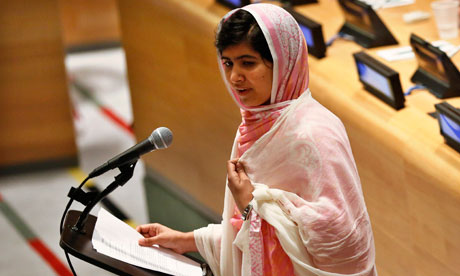
ELIZABETH RENZETTIFour years ago, rushing home from a school that the Taliban didn’t want open, Malala Yousafzai heard a man say, “I will kill you.” Terrified, she hurried on, only to realize that the man was on his cellphone and was, in fact, threatening to murder someone else. Last year, the Taliban did try to murder her: The teenaged Pakistani activist was shot in the head because she refused to stop going to school. Worse, she refused to stop arguing that all girls should have the same right.They wanted her silence, but instead they gave her a megaphone. “Here I stand, one girl, among many,” Malala said, addressing the United Nations Friday on her 16th birthday. “I speak not for myself, but so those without a voice can be heard.” A tiny figure wrapped in a pink shawl that once belonged to Benazir Bhutto, she needed to stand on a platform to reach the microphone. You would have forgiven her for speaking slowly or tentatively, or if her eyes had darted nervously around the room. It’s been less than a year since a bullet ripped across the left side of her skull. Instead, she was remarkably poised. Some people just have a gift for refusing to shut up when they’re told. “We realize the importance of our voice when we are silenced,” she said. “In the same way, when we were in Swat, the north of Pakistan, we realized the importance of pens and books when we saw the guns.” She was speaking at the UN’s Youth Assembly in support of education, particularly for girls, on the heels of a UNESCO report that shows 57 million children are denied schooling around the world (a figure that is dropping, but not rapidly enough). The Taliban, she said, are afraid of books and the change and equality they would bring. “They think that God is a tiny, little conservative being who would point guns at people’s heads just for going to school.” Whether she likes it or not, Malala has become a celebrity, the global face of a struggle to get girls into school and keep them there. Her memoir, I Am Malala, will be released in the fall. As she spoke, delegates took her picture. Her mother and father, who guided her activism, beamed. Only her little brother looked bored. The audience was filled with teenagers from around the world whose stories might have been less dramatic than Malala’s but hardly less stirring. A boy from Gambia talked about how he had to beg on the streets every morning to earn the $1 daily classroom fee. A young woman from Kenya said she became an activist after falling out of her wheelchair at school and realizing that, as a disabled girl, she was doubly damned. An Egyptian girl stood up to talk about how she’d been discouraged from going to school by everyone but her mother, who said: You don’t want to be dependent on your brothers. This was a refreshing change from the narrative we’re used to in North America: These kids were desperate to get into the classroom instead of out of it. And, in a week dominated by the sight of Justin Bieber peeing in a bucket while being filmed by his cackling hench-elves, it was like watching an alternative universe unfold – a universe filled with nerdy, earnest teenagers bent on getting stuff done. Everyone in the room was familiar with Malala’s story. In 2009, as a seventh grader, she began writing an anonymous online blog for BBC Urdu about life as a student in Swat, where girls’ schools were under fire and their lives threatened. Her family eventually left, but she never stopped speaking out. In October of last year, a Taliban fighter burst onto the truck carrying her to school, shouting, “Where is Malala? Who is Malala?” He shot her in the face, then wounded two of her friends. She was treated by surgeons in Britain, where she now lives with her family. At home in northern Pakistan, as The New York Times reported this week, “the war on girls’ education continues unabated.” When one teacher’s school was destroyed, she relocated the classroom to her backyard; only a quarter of her pupils showed up. In Quetta last month, a bus carrying students to the region’s only women’s university was blown up, killing 14. The device was detonated by a female suicide bomber. One of the survivors, a biology student, swore she would go back to school: “No matter what happens,” Sana Bashir told the BBC, “I am determined to continue with my education.” Halfway around the world, another survivor remembered the dead of Quetta. Malala talked about the power that knowledge gave women – and how that frightened some men. Like all great speeches, hers had a rhetorical flourish: The pen was once mightier than the sword, and now it needed to be mightier than the gun. “One child, one teacher, one book and one pen can change the world,” she said. “Education is the only solution.” And then she was finished, but it sounded like a beginning.
Wednesday, July 17, 2013
Malala spoke. Muslims, please listen
SHEEMA KHANIt was fitting indeed that Malala Yousafzai addressed the United Nations during the first third of Ramadan. The month’s first 10 days are regarded as the days of God’s mercy. While her powerful speech left an indelible mark on the world, her words served as a powerful reminder to Muslims worldwide about mercy, the fundamental tenet of their religion. She began her speech with the invocation of God the most Merciful, and it was masterfully woven throughout her brief but eloquent discussion of five important themes: inclusiveness, non-violence, forgiveness, education and female self-reliance.Malala reminded us that mercy is at the heart of the message preached by the Prophet Mohammed, Jesus and the Buddha. This serves as a powerful rejoinder against those who preach violence between faiths. It should provide impetus to the silent majority to take an assertive stand against the hatred that threatens to tear apart society’s very fabric. She invoked the names of Nelson Mandela, Martin Luther King and Muhammad Ali Jinnah, reminding Muslims to look beyond their own sphere to the vast expanse of universal principles embodied by the many rich strands of humanity. That she acknowledged Jinnah, the founding father of Pakistan and a Shiite, should give special pause considering the dangerous Sunni-Shia schism that threatens to inflame tensions in Pakistan and elsewhere in the Muslim world. And she reminded us that the most profound changes have occurred not through armed jihad, but principled non-violence, as embodied by Gandhi, Bacha Khan (an ethnic Pashtun who mounted non-violent opposition to the British Raj in India) and Mother Teresa. History will add Malala’s name to this illustrious list of individuals who see beyond the immediacy of revenge, reaching deep into the recesses of the heart to forgive one’s enemies. She told the world that she learned compassion from Mohammed (the Prophet of Mercy) and forgiveness from her parents. This, too, serves as a stark reminder to Muslims about the importance of forgiveness and compassion, considering the tumult in so many Muslim societies. She then reminded us of the supreme importance of knowledge. During Ramadan, as Muslims spend more time with the Koran (literally, “The Reading”), we are reminded about the importance of knowledge and literacy in building individuals, societies and civilizations. Malala reiterated the call of another courageous Pakistani woman, Mukhtar Mai, who was gang-raped as part of a twisted tribal custom. Like Malala, Ms. Mai called for more education (including for the children of those who attacked her), emphatically stating: “I want to kill illiteracy.” It’s high time for Muslim societies to realize that their most vital asset isn’t oil or arms, but people. Investment in education pays off. It also threatens those who seek to control others. Knowledge is power, and the powerful know it. Finally, Malala said what so many women have felt instinctively: “We will do it for ourselves” – an echo of the classic Aretha Franklin/Annie Lennox anthem. This is a challenge to those who wish to control women, who see women as mere children in need of male guardianship. It is also a challenge to Muslim women to take stock of their potential, take charge of their own agency and loosen the reins of dependency. Malala has provided the world with inspiration through her example. Let us follow in her footsteps, and replace weakness with strength, fear with courage, and hopelessness with power in our own lives. Imagine the difference we can make.
Clinton says future of voting law in jeopardy
The Egyptian coup is a warning to Turkey – but will Erdoğan listen?
Like the Muslim Brotherhood, Erdoğan's AK party has alienated opponents. Ennahda in Tunisia shows a way forward for democratic IslamistsEgypt's coup was not just a major shock for Mohamed Morsi, but also for the Middle East's most successful Islamist party: Turkey's AK party. When news of the Egyptian army's deposing of Morsi broke, Turkey's prime minister, Recep Tayyip Erdoğan, cut short his holiday on the Aegean coast and convened a crisis meeting of senior ministers. Over the following days Erdoğan strongly condemned the coup, calling it the "killer of democracy and the future" and referring to Egypt's "so-called administration". Why does the coup matter so much to Erdoğan's AK party? One problem is that the Egyptian coup upsets the AKP's vision of exporting its brand of populist democratic Islamism throughout the Middle East. The AKP saw the Islamist parties that were elected after the revolutions in Tunisia and Egypt as following its lead, and cemented this connection with aid – including training and equipment for Tunisia's police and a $1bn loan to Egypt. Erdogan has cultivated an impressive profile in the Middle East, and now tweets in Arabic more often than in Turkish. Meanwhile, Morsi held up the AK party as the model for a democratising Arab world in his address to the party's congress last autumn. Erdogan's role as self-appointed mentor chimed with the AK party's "neo-Ottoman" approach to foreign policy that positioned Turkey as a regional power. The AKP also downplayed the scale of popular opposition to Morsi, and presented the coup as a plot hatched by the Egyptian generals. And it used the coup as a metaphor to discredit Turkey's Gezi Park protest movement. Some drew a direct connection: Hatam Ete of the pro-AKP thinktank SETA tweeted that "what was attempted in Turkey has succeeded in Egypt". Such conspiracy theories are the legacy of years of oppression of Turkish and Egyptian Islamists by the military-backed secular establishments. But the problem for the AKP and the Muslim Brotherhood is that their paranoid style is now losing its resonance outside their bases. The narrative of victimhood stopped attracting broad sympathy once they moved from persecuted opposition to power. The uncomfortable truth the AKP does not want to accept is that the massive protests that preceded the coup represented a broad-based rejection of Morsi's policies. It should acknowledge this fact, and recognise that it was not political Islam the protesters rejected. Although many of the individual protesters are hostile to political Islam, others are Islamists. Neither do the Gezi Park protesters want to exclude Islamism from Turkish politics. What both movements reject is an aggressive majoritarian understanding of democracy, according to which the election winner takes all and imposes his agenda on the rest of society. The protest movements, by contrast, insist that vibrant opposition is as important a part of democracy as an elected government. The protesters' key demand was to be taken seriously and listened to. The demonisation of opposition as the work of mysterious foreign forces, by both the AK party and the Muslim Brotherhood is therefore not just a misdiagnosis of the problem, it is the problem. Tunisia shows a different way forward for democratic Islamists. The Islamist Ennahda party, elected in Tunisia after the first revolution of the Arab spring, has also publicly opposed the Egyptian coup. But despite the similarity between Tunisia and Egypt, the coup is less threatening in Tunis than in Ankara. Some of Ennahda's opponents have formed a tamarod (rebel) campaign in imitation of Egypt's, but have had limited success. Unlike Morsi, Ennahda has not attempted to use a narrow poll victory to implement an aggressively partisan agenda, instead governing in coalition with two centre-left secular parties, Ettakatol and the Congress for the Republic. The relative success of Ennahda, despite potentially divisive disagreements over the place of Islam in the constitution, shows the value of this inclusive approach. The dismissal of opposition as unpatriotic, and the presentation of political struggle as a zero-sum conflict between Islamism and secularism, adopts the narratives of the old regimes in both Turkey and Egypt, but with the roles reversed. Political Islam remains a powerful political force with a large constituency. However, the large, legacy Islamist parties face trouble if they attempt to use their plurality of votes to steamroller opposition. A common thread running through not just the Arab revolutions but recent protest movements worldwide is the demand for a plural political sphere. If democratic-Islamist parties are to avoid alienating their opponents, they must respond to this.
Bangladesh: Nation’s expectations fulfilled
Law Minister Shafique Ahmed on Wednesday said the nation’s desire and expectations have been fulfilled through the convictions of war criminals.
The international crimes tribunals have delivered the verdicts after examining relevant documents and evidence in a transparent manner, he said adding there is no scope to raise any questions over the transparency and acceptability of the trials.
He came up with the remarks while speaking to reporters at his secretariat office after the ICT-2 sentenced Jamaat-e Islami’s Secretary General Ali Ahsan Muhammad Mojaheed to death for his crimes against humanity during the country’s Liberation War in 1971.
The law minister said the tribunals have tried the accused maintaining international standard.
Replying to a question whether the president’s clemency power would be applicable to war crimes convicts, Shafique Ahmed said there is no scope for the president to pardon war criminals as per international conventions.
“Although the president of our country has power to pardon any convict, I feel that the president will not exercise the power to give clemency to the war crimes convicts considering all the relevant aspects,” he added.
Replying to another question, the minister said the chief prosecutor will decide about filing an appeal with the Supreme Court against a tribunal verdict that sentenced former Jamaat-e-Islami ameer Ghulam Azam to 90 years’ imprisonment for his crimes against humanity in 1971.
Bangladesh: Jamaat-e-Islami's crimes against humanity. The verdict on Ghulam Azam
The International Crimes Tribunal (ICT)-1 finally delivered the much awaited verdict against Ghulam Azam (91), the main accused in the sensational trial who was the chief of the East Pakistan Jamaat-e-Islami in 1971, for committing crimes against humanity during the Liberation War that year. The court, following a strenuous legal procedure, sentenced him to 90 years of prison terms. The court awarded him the prison terms on consideration of his advanced age and physical condition. Earlier, the tribunal indicted Ghulam Azam on five charges on 61 counts of crimes including incitement for genocide, torture and plots to thwart the independence of Bangladesh. ICT found him guilty beyond reasonable doubt of all the crimes and awarded the punishment. He will serve the prison terms one after another until his death.
Not surprisingly, both prosecution and defence lawyers expressed dissatisfaction with the verdict – the prosecution felt dismayed as he was not awarded capital punishment though found guilty on all charges; the defence lawyers rejected it immediately saying they would challenge it in an appeal to the higher court for his acquittal.
Centering the verdict, the country once again plunged into sporadic violence. Islamic Chhatra Shibir, the student wing of Jamaat-e-Islami had called for total shut-down of the country on Monday which led to unfortunate deaths of some people in clashes between Jamaat supporters and the police. Unhappy with the verdict they called for a shut-down on Tuesday as well. Meanwhile, various student fronts of the country expressed their dissatisfaction over the ICT verdict as it did not award Ghulam Azam the death sentence, and called for a total shut-down of the country on Tuesday, which again led to deaths and destruction across the country.
The atrocities committed by Jamaat-e-Islami and its cohorts in 1971 constitute the most tragic chapter in the history of the nation. The scale of the genocide, and the loss in terms of human life and property had overwhelmed the entire world. The trial and punishment of those found guilty of taking part in the atrocities were therefore legitimate demands of the nation. With the verdict of Ghulam Azam delivered, one phase of the process has come to an end. It now remains to be seen that the pending cases of crimes against humanity are rounded off so that the dark and ominous shadow hovering over the nation for the last 43 years is dispelled for ever.
Bangladesh: ''Jamaat-e-Islami's Terrorist Mojahid gets death penalty''
The International Crimes Tribunal-2 (ICT-2) on Wednesday sentenced death penalty to Jamaat-e-Islami secretary general Ali Ahsan Muhammad Mojahid for his involvement in crimes against humanity during the 1971 Liberation War.
Five out of seven charges, including genocide, murder and complicity in atrocities committed during the war of independence, have been proved against the Jamaat leader Mojahid, the tribunal said.
The three-member tribunal, led by Justice Obaidul Hassan, delivered the verdict at 12:45pm on the war crimes charges after reading out the 37-page summary verdict.
Immediately after the verdict, prosecution lawyers expressed their satisfaction at the death penalty awarded to Mojahid. But the defense said they are dissatisfied at the conviction and indicated that they will appeal to the Supreme Court for justice.
ICT-2 started reading out the 209-page verdict on Jamaat-e-Islami top leader Mojahid after he was taken to tribunal around 10:00am.
This is the sixth verdict of the two tribunals on the war crimes committed during the liberation war in 1971. And it is the fourth judgment for International Crimes Tribunal-2, since it was set on March 22, 2012.
Earlier on June 5, the tribunal kept the Mojahid case as CAV (Curia Advisari Vult, a Latin legal term meaning verdict would be delivered anytime).
Earlier, the ICT-2 sentenced former Jamaat member Abul Kalam Azad, also known as Bachchu Razakar, who is still in hiding, to death on January 21, Jamaat assistant secretary general Abdul Quader Molla to imprisonment for life term on February 5 and Jamaat leader Mohammad Kamaruzzaman to death on May 9.
The other tribunal, the ICT-1, on Monday awarded 90 years imprisonment to the former Jamaat chief Ghulam Azam and on February 28 awarded death sentence for Jamaat-e-Islami Nayeb-e-Ameer Delwar Hossain Sayedee.
The prosecution brought 17 witnesses to prove the charges against Mojahid. Although the tribunal on April 22 allowed three defence witnesses to defend Mojahid, the defence produced only Mojahid’s son Ali Ahmad Mabrur to defend his father.
According to the prosecution, born in Paschim Khabaspur in Faridpur town in 1948, Mojahid acted as the Faridpur district Islami Chattra Sangha president from 1968 to 1970. After being enrolled at Dhaka University in 1970, he was made Dhaka district Chhatra Sangha president. In the same year, he was assigned the responsibility of East Pakistan Chhatra Sangha and finally elected provincial president of the organisation in October 1971, and also became the chief of Al-Badr Bahini during the liberation war.
Women's rights face new obstacles in Afghanistan
http://www.globalpost.com/Setbacks to Afghanistan’s women’s rights are escalating, according to a Human Rights Watch statement released earlier today. The statement called for the country’s lower house of parliament to “reject a proposed criminal law revision that would effectively deny women legal protection from domestic violence.” A revised draft of the criminal procedure code is currently under consideration by Afghanistan’s parliament, the statement said, and the proposed language would ban relatives of the victim from testifying as a witness against the accused. If the draft law passes, article 26, entitled “Forbiddance of Questioning an Individual as a Witness,” would damage the ability to successfully prosecute cases of domestic violence, among other offenses. “Afghanistan’s lower house is proposing to protect the batterers of women and girls from criminal punishment,” said Brad Adams, Asia director for HRW. “Legislative approval of this criminal law revision would effectively stop prosecutions of people who beat, forcibly marry, and even sell their female relatives.” The amended procedure code, HRW said, would pose a serious threat to critical protections for women and girls embodied in Afghanistan’s 2009 Law on Elimination of Violence Against Women (EVAW). The EVAW law “provides criminal penalties for various abuses including rape, child marriage, forced marriage, domestic violence, sale of women and girls, and baad, the giving of girls to resolve disputes between families.” HRW calls the ban just “another effort to further weaken the inadequate legal protections for women’s rights,” adding that members of parliament who are opposed to women’s rights have “increasingly sought to repeal or weaken the EVAW Law.” A RIGHTS report last month presented a discussion with Heather Barr, the Afghanistan researcher for Human Rights Watch, that expressed concern over the “slowly and unevenly” enforced law, which has nonetheless been an essential tool for combating violence against women. The interruptions in the implementation and development of the EVAW law, Barr said in June, are “ominous signs that women’s rights in Afghanistan face a dark future.” “The debate over the Law on the Elimination of Violence Against Women was last month,” Barr said of a May deliberation. “And not only could they not get the law passed but they could not even have a debate about it because conservatives in the parliament were standing up and saying things like, ‘there shouldn’t be minimum age for girls to get married,’ and ‘rape shouldn’t be a crime because adultery is already a crime and rape is the same as adultery.’ So, people were making statements like this in the parliament, which is alarming enough, but there were also several cities throughout the country that were actually calling for the repeal of this law that criminalizes violence against women. So that was something that was really shocking.” The HRW report said that the new “legislative threat” is simply another indicator of a larger scale attack on women’s rights—an attack the Afghan government has contributed to—in which President Karzai has appointed a former Taliban government official, Abdul Rahman Hotak, to the Afghanistan Independent Human Rights Commission. Hotak has publicly denounced the EVAW law, saying that it “violates Islam.” “It’s perverse that Afghanistan’s parliament is devoting its time and energies to attacking women’s hard-fought legal protections,” Adams said. “The international donors who bankroll the Afghan government should serve notice that they will not underwrite legislative initiatives to victimize women.” Afghanistan’s recent assurance to the UN that it is complying with the Convention on the Elimination of All Forms of Discrimination Against Women, Adams added, is just lip service intended to conceal the undermining of women’s rights by parliament and the courts.
PAKISTAN AMONG 27 COUNTRIES WITH POTENTIALLY AUTHORITARIAN REGIMES THAT WERE GRANTED EXPORTS LICENSES.
Britain has issued export licenses worth £12 billion for the sale of military equipment to states deemed possible rights violators including Syria, Iran, China, and Pakistan, lawmakers said Wednesday.
A report by a group of parliamentary committees said that 3,000 licenses for arms and other equipment had been issued to countries on the Foreign Office’s list of 27 countries of human rights concerns.
The countries for which licenses have been issued include Sri Lanka, Saudi Arabia, Russia, Belarus and Zimbawe, the Committees on Arms Export Controls of parliament’s lower House of Commons said.
John Stanley, the chairman of the committees, said the report “puts into stark relief the inherent conflict between the government’s arms exports and human rights policies.”
The committee said that while many of the licenses were for dual military or civilian use items, which could not easily be used for internal repression, the numbers were still “surprisingly large.”
The countries with the largest numbers of licenses include China with 1,163 licenses worth £1.4 billion, Saudi Arabia with 417 licenses worth £1.8 billion, and Israel and the Palestinian Territories with 381 licenses worth £7.8 billion.
Iran, at the center of international concerns about its nuclear program, had 62 licenses worth £803 million and Syria, where a civil war has left up to 100,000 people dead according to the United Nations, had three licenses worth £143,000.
The only two countries without any valid licenses out of the 27 on the list were North Korea and South Sudan.
The list comprises Afghanistan, Belarus, Myanmar, China, Colombia, Cuba, North Korea, the Democratic Republic of Congo, Eritrea, Fiji, Iran, Iraq, Israel and the Palestinian Territories, Libya, Pakistan, Russia, Saudi Arabia, Somalia, South Sudan, Sri Lanka, Sudan, Syria, Turkmenistan, Uzbekistan, Vietnam, Yemen and Zimbabwe.
But the report also raised concerns about a further five countries for which licenses were issued: Argentina, Bahrain, Egypt, Madagascar and Tunisia.
Argentina was included on the list because of renewed tensions over the British-held Falkland Islands.
Rights group Amnesty International called for more transparency over what kind of equipment Britain was exporting.
“It would be hard not to conclude that the U.K. government’s arms sales practices are at odds with its stated policy not to send weapons to anywhere that poses a clear risk that they could be used for human rights violations,” Amnesty’s arms control expert Oliver Sprague said.
Heroin in Pakistan more affordable than food
Subscribe to:
Posts (Atom)