Friday, July 5, 2013

Made in Bangladesh: Greed, Globalization and the Dhaka Tragedy

By Hauke Goos and Ralf Hoppe
On April 24, a textile factory collapsed in Dhaka, Bangladesh, killing over 1,100. A government investigator has presented his results to SPIEGEL. They tell a harrowing story of a disaster caused by greed and the pressures of globalization. On the morning of April 24, 2013, at about 8:45 a.m., the Rana Plaza, a nine-story building housing factories and offices, collapsed in the Bangladeshi capital Dhaka. More than 3,500 people were in the building at the time, and 1,129 died in the wreckage. Mainuddin Khandaker, a senior official at the Ministry of Home Affairs, began his investigation that evening. Six weeks later, Khandaker is sitting in a carved wooden armchair in his living room. A soft-spoken man in his early 60s who wears gold-rimmed glasses, he lives in Dhaka's government district. It's been dark outside for a while, and a single fluorescent tube, surrounded by fluttering moths, is the only light in the room. Khandaker is balancing a bowl of dark berries on his knees. In the last few years, he has investigated more than 40 cases of factories that either collapsed or burnt down. But none of those accidents approached the scale of Rana Plaza, the biggest industrial accident in the country's history. The 493-page report Khandaker wrote contains witness statements, photos and structural engineering calculations. It will probably remain under lock and key. An investigative report on the textile industry has never been published in Bangladesh, he says. Khandaker goes into the next room and returns with a stack of paper, the summary. He eats a berry from the bowl and carefully spits the seed onto the saucer. "Time pressure, lots of money, a lack of scruples and greed -- everything came together on that day," he says.
Dhaka, Basti Madjipur, April 24, 5:30 a.m.
The day began early in Basti Madjipur, a neighborhood in Dhaka's northwestern district of Savar. A "basti" is a sprawling collection of simple concrete houses with sheet and corrugated metal roofs, separated by labyrinthine paths, where half-naked children play between puddles and ponds. There are chicken sheds everywhere, and the neighborhood is also home to a drove of small pigs. About 100,000 people live there. Everyone works in the nearby textile factories, and at the time, many were employed at the Rana Plaza building. Mohammed Badul and his wife Shali got up at 5:30 a.m. that morning. Badul worked in the packaging department of a company called Phantom Apparels Ltd., in the Rana Plaza. His wife was a seamstress in another factory. They live in a 12-square-meter (130-square-foot) room with a concrete floor, together with their nine-year-old son Sabbir. They own a bed, a dresser and dishes, some clothing and a TV set. A faucet and a shower are outside. Like most mornings, Shali cooked rice with a little oil and a small amount of vegetables to bring to work as lunch for her and her husband. They didn't eat breakfast. At about 7 a.m., they left on foot for their respective factories. Shali had given her husband his lunch in a tin can. The one-hour lunch break began at 1 p.m. The normal shift usually lasted until 8 p.m., but workers were often kept later for overtime, until 10 p.m. Shali went shopping on the way home, arriving at the house by around 11 p.m. Her son was already sleeping. In 11 years, the couple has saved 20,000 taka, or €200 ($260). Mohammed Badul dreams of opening a barber shop one day. Another couple, Fahima and her husband Abu Said also live in Basti Madjipur. Both are from the village of Bodergond in northern Bangladesh. They came to Dhaka six years ago, forced to leave their village and look for work so that they could repay their debts. Abu Said had borrowed 50,000 taka because he wanted to start his own company. Together, they earn about 12,000 taka a month, of which they are able to save about 500 taka, or €5. They don't have a bed, or even a mattress. Abu Said indulges in only one luxury item: He occasionally buys a tin of chewing tobacco, which he always carries in his back pocket. Fahima and Abu Said also have a son, five-year-old Shahin. A neighbor takes care of the boy when Fahima and her husband are at the factory. Their plan is to persevere. After a few years, they hope to return to their village with a little money in their pockets. Their goal in life is to create a future for Shahin. Two sisters, Shefali and Shirin Akter, 20 and 18, live in a house on the same street. They came to Dhaka as children, left to their own devices, with nothing but two pairs of trousers and two shirts. Their little brother Nawshad joined them later. He is their hope, and they are working and saving money to pay for his education. They own four cups, a double bed, a TV set and two pieces of soap. They also own a basket with some clothing, three pairs of flip-flops, a pot, cutlery and some dishes. Like most of the people who have come to this neighborhood, Shefali, Shirin and Nawshad live in one room, for which they pay a monthly rent of 2,000 taka. Many of these houses were built by the same man who responsible for the construction of Rana Plaza: Sohel Rana, the godfather of Madjipur. Rana is a short, puffy man in his mid-30s. He lives on Bazar Road, in a five-story house at the end of a path, with a metal gate to keep out intruders. Rana takes bodyguards with him when he leaves the house. He is a member of the youth organization of the ruling Awami Party, and recently had posters of himself hung up on walls in his basti. Some in the neighborhood already see Rana as a member of parliament. But he had a problem on that morning. Cracks had appeared in the walls and load-bearing columns of the Rana Plaza building. The tenants, especially those pesky factory owners, were concerned.
Dhaka, Madjipur Bazar Road, Rana Plaza, 7:30 a.m.
A few hundred people had gathered in front of Rana Plaza. Mohammed Badul, the man who was saving for a barber shop, was there, and so were Fahima and Abu Said, the couple that doesn't even own a mattress. They were afraid. Their shift was to begin in half an hour -- that is, if it began at all. Rana Plaza was taller than the surrounding buildings, with lower floors that were sided with a reflective blue glass material. Eight floors were already occupied, and construction had recently begun on a ninth. The words "Rana Plaza" were written in decorative letters above the entrance. A branch of Brac Bank was on the second floor, and a sign indicating that the bank was closed had been hanging on the door since the day before. Not a good sign, Fahima thought to herself. There were 10 million taka in the bank vault. The bank employees were in such a hurry to get to a safe place that they had left the money behind. Sohel Rana was standing at the entrance, talking insistently to the factory owners. He told them that a few cracks were nothing to fear, and that someone would take care of the problem. On the previous day, managers had shut down all five textile factories and sent home some 3,500 people -- including Fahima, Mohammed Badul and the two sisters, Shefali and Shirin -- in the middle of the day. Then experts came and inspected the cracks. Could the shift begin? Or was the building beyond repair? Many people were sent to their deaths because Rana was the person who ended up making that decision. Born in Dhaka after his father moved there in the early 1980s, Rana grew up in the city, where he attended the Adhar Chandra High School. "Making money was the most important thing to him," says Khandaker, the investigator. To achieve his goal, Rana bought some land. When he was mapping out his career, Dhaka was already a sprawling city. Hundreds of thousands migrated there from the countryside each year, and new factories were constantly being built. These workers needed housing, and the manufacturers needed production facilities. Rana's father had property early on, and his son bought more. It was swampy land, which meant that it was cheap. Rana had the swamp filled with sand and garbage, and in 2007, he began the construction of a multistory building there. Rana Plaza was to be the beginning of a great career. Normally, the approval of six government agencies is required to build a factory in Bangladesh: the Ministry of Industries, the Ministry of Labor, the Ministry of Home Affairs, the office of fire safety and civil protection, the office of the environment, the Board of Investment, and the Bangladesh Garment Manufacturers and Exporters Association (BGMEA). Rana circumvented these requirements by declaring the plaza as an office and retail building. He used his father's contacts and donated money to the campaign of a member of parliament to get it approved. That's how the Bangladeshi system works. A country growing as quickly as Bangladesh can't spend too much time on regulations. Once a building has been erected and is filled with machines and people working to bring money into the country, no one asks about permits. Rana opened the building in 2008. It had been built hastily with thin subfloors, and the bricklayers had apparently never built such a tall building before. Too much sand was added to the concrete, and the ground was too soft -- all problems that investigator Khandaker would later discover.
Dhaka, Rana Plaza, 7:55 a.m.
The factory managers were still arguing with Rana. On the one hand, they feared for their safety. On the other hand, they had their delivery deadlines to consider. Garment makers who do not complete an order properly risk losing business in the future. In the Bangladeshi system, delays are not an option. Rana had almost prevailed. He called in two experts from the district administration with whom he had consulted with on the previous day. One of them was a structural engineer, and together they concluded that the building was good for at least another 100 years. According to Khandaker's report, Rana bribed the officials. In the years after opening the building, Rana added two more stories, but this time he didn't even bother to obtain building permits. He leased the upper floors, each with about 3,500 square meters (37,700 square feet) of floor space, to garment manufacturers. The Rana Plaza also had a basement floor, which contained an underground parking garage and Rana's office. The first and second floors were rented to the bank and small shops. Five textile factories were housed in the floors above that: New Wave Bottoms Ltd., Ether Tex Ltd., Phantom Apparels Ltd., Phantom Tac Ltd. and New Wave Style Ltd. The factories, which supplied discount clothing to stores and department store chains in Europe, the United States and Canada, employed about 3,500 workers. There were hundreds of electric sewing machines, arranged in long rows, on each floor. Rana was probably able to amortize the building in only a few years. After that, it generated an estimated €1.5 million in annual rent revenues. Rana built new housing for workers in his basti, entered the drug business and allegedly ordered four contract killings. Investigator Khandaker says that Rana himself was a drug addict. He was also reportedly a drinker and, most of all, consumed phensedyl, a popular cough syrup known as "purple drank." "Don't make my life miserable," Rana told the factory owners who were worried about safety in the building. Then he demonstratively disappeared into his basement office, which may have convinced others that it was safe to enter the building.
Dhaka, Rana Plaza, 8:00 a.m.
The shift began on time. Fahima and her husband Abu Said had stamped their punch cards and were now on the third floor, which was occupied by New Wave Bottoms, and where cracks were clearly visible in the walls and columns. Fahima was sewing belt loops, while Abu Said worked in the packaging department. A men's shirt goes through the following production steps: After cutting, the front and back side are sewn, followed by the collar, button facing, breast pocket, buttonholes and buttons, and finally the sleeves. Then the shirt is sewn together and goes into final production, where it is ironed, labeled, wrapped around a piece of cardboard and then packaged. At Phantom Apparels on the fourth floor, Mohammed Badul, who wanted to become a barber, was stacking jeans into cardboard boxes. Dhaka, with a population of 16 million, is a city of immigrants, a hated and yet coveted place. Some, like Fahima and Abu Said, go there with the aim of saving money and eventually returning to their villages. Others, like Badul, want to stay and build a new life in Dhaka. For them, the garment factory is merely a station, something that has to be endured, a place that offers at least some hope and keeps them from starving. Rana was different, at least judging by the stories that were told about him. While others endured their fate, he was all business, a man who gambled with the lives of 3,500 people. Thousands of industrial sewing machines were used in the Rana Plaza. But because the power supply in Dhaka is notoriously unreliable, with days on which the grid shuts down up to 50 times, there were four diesel generators on the upper factory floors, each weighing several metric tons. Generators of that size trigger strong vibrations when they start running. On this morning, three floors about Badul, on the seventh floor, the sisters Shefali and Shirin were working at New Wave Style, sewing men's shirts. About 800 people, 80 percent of them women, were crowded together on this floor. They worked in five rows, with 70 industrial sewing machines per row. There were no fans and there was no air-conditioning. Workers were discouraged from leaving their stations. Nevertheless, Shefali went to the bathroom occasionally to spray a little water into her face. Shirin was sewing collars. "Helpers," or people who pass material to the workers and switch back and forth between departments, are at the bottom of the hierarchy on a sewing floor. Next up the ladder are the "sewing operators," women like Shefali and Shirin. Each group of sewing operators has a supervisor, who makes sure that they keep up the pace. Above the supervisor is a "line chief," who is in charge of one of the five rows. All five line chiefs at New Wave Style were men. The person responsible for the entire floor was called the "floor in charge." There were 10 levels in the hierarchy. Shefali and Shirin were at the second level. Shefali hoped to be promoted to line chief one day, which would mean a pay increase to 14,000 taka. It would also help secure the future of her brother Nawshad.
Dhaka, Rana Plaza, about 8:30 a.m.
On the third floor, Fahima was having trouble concentrating. She kept looking over at the cracks, which had now spread to the fourth floor, where Badul was packaging jeans. On this morning, about 3,500 people had gone to work in the Rana Plaza, despite the obvious risk of collapse. Why? Part of the answer can't be found in Bangladesh, but in our cities, at clothing retailers like H&M, Zara, Next and Primark, stores where T-shirts are sold at rock-bottom prices of €4.99 or €3.99, almost nothing for Westerners. These kinds of prices require that buyers and producers know as little about each other as possible. Customers in London or Munich don't really want to hear about the conditions under which a T-shirt was made. They just want the T-shirt. Fahima and her fellow workers, for their part, have no idea that the work on which their survival depends has almost no value in Western countries, and that a T-shirt is practically a disposable item. In stores like H&M and Zara, the story of a product disappears behind loud music and flashy branding, screens behind which agents, intermediaries and middlemen ensure that the global barter system works. These agents also exist in Dhaka. They receive orders from the large chains, which they then pass on to local manufacturers. This is how it works: The client, such as H&M, sends a design sample to Dhaka. The middleman, or agent, is familiar with manufacturers and factories and selects the right one for the job. In years gone by, most factory owners in Bangladesh have accepted more orders than they could process. They were under pressure to pay wages, pay off loans and pay rent to people like Rana. To avoid the risk of losing an order, they accepted the fact that they would probably have to send some of the work to a subcontractor. This led to constant time pressure. This also puts employees under pressure, who have almost no room to object. Their monthly income is so marginal that, on that morning, Fahima and her fellow garment workers didn't dare contradict the factory owner when he ordered them to get to work. If they had refused, Fahima, Shirin, Shefali and Badul risked losing one or two months' wages, which would have depleted their savings. At about 8:30 a.m., the power went out in the Rana Plaza, and the heavy generators began running automatically. Dhaka, Rana Plaza, about 8:45 a.m. It took between 6 to 10 minutes for the first column to collapse in the southwest corner of the building. Everything happened very quickly after that. Shefali felt the floor giving way beneath her feet. She looked over at the collar department to see if she could find her sister, but Shirin wasn't there. Suddenly the floor was gone and Shefali began falling. Four floors down, on the third floor, Fahima, who was sewing belt loops, felt a powerful blow. Everything descended into dust and darkness. She ran toward the packaging department to join her husband, Abu Said. She heard the supervisor shouting: Everyone out! Then they were near the stairwell. There were people everywhere, screaming, crying and whimpering, pushing their way to the exit in a panic. Wait, Fahima's husband shouted, or we'll be trampled. Then they were separated. When the building collapsed, Mohammed Badul was in the middle of the fourth floor. The stairwell was too far away, but he managed to save himself by taking shelter under a heavy wooden table. Rana was in his office when the building collapsed. The former underground garage proved to be relatively safe, almost like an air raid shelter. He was covered in rubble, but uninjured. The collapse lasted hardly more than 90 seconds. "The building was pressed together like a sandwich," says Khandaker, the investigator. The Rana Plaza was a building that should never have existed. It was built on swampy ground, with poor materials, a lack of know-how and inadequate inspections, and yet it is not an isolated case. Experts estimate that about a third of the 240,000 buildings used for industrial purposes in and around Dhaka are in a similarly dangerous state. These factories ought to be shut down immediately, but that won't happen. The Bangladeshi system cannot survive without this extremely dangerous way of building, or without people who break the rules, like Rana. In fact, the system produces people like Rana. The Bangladeshi economy has only one trump card: the world's lowest wages. It also has 160 million people who patiently allow themselves to be exploited, because doing backbreaking work in Dhaka for 12 hours a day is still better than being landless and hungry in a half-flooded village. The garment industry accounts for about 80 percent of export revenues. A country in Bangladesh's position, constantly in danger of losing orders to Cambodia, Vietnam and Indonesia instead, cannot use the excess demand generated by the West's insatiable consumption habits to its advantage. That's why production remains cheaper than anywhere else in the world. It's also why Bangladesh is safeguarding its role as the world's sewing machine, a garment factory in the form of a country, a giant sewing room with its own national anthem and a seat at the United Nations. Bangladesh's economy, controlled by garment makers, is in a permanently overheated state, achieving a growth rate of 7 percent, one of the highest in the world. While the Western consumer may feel a sense of outrage and pity upon seeing images of the collapse, he is also quick to forget, and before long he is reaching for the cheapest products once again at stores like H&M and Walmart.
Dhaka, Rana Plaza, Late Afternoon
Khandaker learned of the collapse on the afternoon of April 24. He had been in meetings since early morning, and was only able to drive to the site of the disaster that evening. But first he put together a team. Shefali, the older of the two sisters, was already in a hospital bed at Enam Medical College. She had been pulled from the wreckage at about 10 a.m. She could no longer feel her legs, and her hip was fractured. There was no news of her sister. It was 14 days after the accident before she finally learned that Shirin had not survived. Mohammed Badul, the man who wanted to become a barber, was trapped under the heavy wooden table that he had hoped would protect him. A fellow worker who was crouching nearby would later find Badul's wife Shali and tell her about her husband. "If I don't get out of here, tell my wife and my son that I was thinking of them," he'd said. Badul couldn't see his coworker, because they were separated by a broken column, but they were able to speak with each other. The woman had a bottle of water, but Badul had no water. Perhaps it was that small ration of water that kept the woman alive until rescue workers found her. At some point in between, Badul died in his refuge, probably of thirst. Fahima, the woman who was working so that her son could go to school, survived by crouching in a hollow space between two floors, a space only half a meter wide. She was rescued on the evening of the disaster with severe head injuries. Her husband Abu Said died in the wreckage. Fahima would identify him 16 days later, using the number on his punch card and the tin of chewing tobacco in the pocket of his trousers. Sohel Rana quickly fled the scene of the accident. He was one of the first to be saved, when his bodyguards located him by calling his mobile phone and pulled him out of the wreckage. He was arrested at the Indian border four days after the accident and taken to the central prison in Dhaka by helicopter. Khandaker questioned Rana several times, and the broken, weeping man he encountered was a far cry from the image he had projected in the past. "Don't make my life miserable." Those were the words with which Rana had convinced the factory owners to drive their workers into the building. Perhaps those words are a reflection of modern-day Bangladesh, with its recklessness, impatience and knowledge that there is no alternative. Khandaker, the investigator, has eaten the berries he picked, and the summary of his investigative report is sitting on his knees. Officially, Khandaker says that the Rana Plaza disaster was an isolated incident, not a system failure. This verdict allows Bangladesh to continue as everything as it was before. The system has been saved, and that was Khandaker's job. Unofficially, at the end of a long conversation, he says: "That day, that April 24, was the inevitable result of the global market." Shefali, Fahima and Shali still live in Basti Madjipur. Shefali spends the entire day lying in the bed she once shared with her sister. She can only sit upright for a few minutes a day. She hopes that the pain in her hip will eventually go away, and that she will be able to work again. Shefali, Fahima and many other survivors told their stories to SPIEGEL. There are still rolls of thread, shoes, zippers and quality reports lying in the wreckage where the Rana Plaza once stood. It's even possible to make out some of the entries in the reports, like "broken stitch" or "top stitch uneven." There are also hundreds of labels for brands like Joe Fresh, Mascot, Benetton, Walmart, Primark, Bonmarché, The Children's Place and German discounter KiK.

Egypt clashes after army fire kills Morsi supporters

Twelve people have died in Alexandria and three in Cairo in clashes between supporters and opponents of the ousted President Mohammed Morsi, reports say. The violence came after three pro-Morsi demonstrators were killed by security forces in another part of the capital. Troops later restored calm in Cairo, but nationwide violence left some 26 dead and 318 injured, officials said. The army removed Mr Morsi from power on Wednesday after millions of people protested over his leadership. Mr Morsi, Egypt's first freely elected leader, is in detention, as are some senior figures in the Brotherhood: early on Saturday, state media reported the Brotherhood's deputy leader Khairat el-Shater had been arrested at his Cairo home on suspicion of incitement to violence. The Tamarod [Rebel] movement - which organised recent anti-Morsi protests - accused the ousted president of pursuing an Islamist agenda against the wishes most Egyptians, and of failing to tackle economic problems. Anger and passion Most of those killed during fighting in the Mediterranean city of Alexandria, died from gunshot wounds, said Amr Nasr, head of emergency services in the city. He told the official Mena news agency that 200 people were injured during clashes in Egypt's second-largest city. Earlier, after midday Prayers, Islamist supporters of Mr Morsi staged a series of marches across Cairo - including outside Rabaa al-Adawiya Mosque where tens of thousands massed. Tensions escalated when a crowd advanced on the nearby headquarters of the Republican Guard, where Mr Morsi is believed to be held. Troops then opened fire on crowds. Three people were killed and dozens wounded, including the BBC's Jeremy Bowen whose head was grazed by shotgun pellets. In the evening, tens of thousands of supporters of the Muslim Brotherhood - to whom Mr Morsi belongs - filled the square near the mosque, as well as nearby streets. The Brotherhood's supreme leader, Mohammed Badie, told the crowd: "We shall stay in the squares until we bring President Morsi back to power." He said their protests would remain peaceful and called on the army not to "direct your arms against us". Shortly afterwards, Brotherhood supporters surged across the 6th October Bridge over the Nile river, towards Tahrir Square where anti-Morsi protesters were gathered. The rival groups hurled fireworks and stones at each other. A car was set on fire and stones and fireworks were thrown. The BBC's Kevin Connolly in Cairo says there is anger and passion on both sides - as well as a determination to win a battle for the streets which is making the capital a dangerous and volatile place. Late on Friday, tanks arrived at the bridge to separate the clashing protesters and the violence died down. 'Glorious revolution' There were clashes in other parts of Egypt on Friday. In Qina in the south, troops opened fire on pro-Morsi activists trying to storm a security building. At least two people were injured. Firing was also reported in the canal city of Ismailiya. Ahead of Friday's protests, the army command said it would not take "arbitrary measures against any faction or political current" and would guarantee the right to protest, as long as demonstrations did not threaten national security. "Peaceful protest and freedom of expression are rights guaranteed to everyone, which Egyptians have earned as one of the most important gains of their glorious revolution," it said. On Thursday the head of Egypt's constitutional court, Adly Mahmud Mansour, was sworn in as interim head of state, and he promised to hold elections soon. On Friday Mr Mansour dissolved the upper house - or Shura Council - which had been dominated by Morsi supporters and had served as sole legislative body after the lower house was dissolved last year. Mr Mansour also appointed a new intelligence chief, Mohamed Ahmed Farid.

President Zardari terms July 5 black day

Terming July 5 a black day, President Asif Zardari urged the nation to strive for preservation and promotion of democracy and the rule of law. In a message, the president denounced the abrogation of the constitution by a dictator 36 years ago and asked the people to strengthen democracy so that the country continues to progress and prosper. He said July 5, 1977 was the day when a dictator usurped political power through brute force, exploited religion, destroyed the constitution and state institutions and pushed the country to the abyss of social and political destruction. He said the aftermath of the day starkly reminds us how one dictator spawned extremists for his political survival and how another exploited the same extremists for promoting his political agenda. "Indeed the nation is still reeling under the impact of the dictatorial takeover on this dark day," he said. President Zardari said sectarianism, religious extremism and private jihad were deliberately promoted by the usurper to create an artificial constituency for perpetuating his rule as a reign of terror was let loose. He said the legacy of the dictatorship has unfortunately struck this land repeatedly. "We need to clearly understand this mechanics of dictatorship in the country to be better able to contain forces of militancy and terrorism." He said the democratic ethos of the people cannot be suppressed through brute force and said it was owing to the ethos of the people that the constitution has largely been restored and a historic democratic transition taken place in Pakistan. The president termed it a manifestation of the democratic yearning of the people that strident calls were made for holding accountable those who abrogated or suspended the constitution, and their collaborators. "In the fullness of time the wheels of justice grind exceeding small. Indeed with the naming and shaming in public of those who abrogated the Constitution and their collaborators, the grinding has already begun," the president said. The president said history bears witness that while "tin-pot dictators may strut along the stage pretending to be the saviors they are eventually punished by the people and history with a vengeance". The president also paid homage to the martyrs of democracy and lauded those who suffered and sacrificed during that black period of national history and said, "They suffered so that the future generations may live in peace and honour." “The democracy loving people salute Quaid-e-Awam Zulfikar Ali Bhutto, Nusrat Bhutto and Benazir Bhutto and all those who gave their lives during the period of tyranny and kept alive the flame of democracy despite use of state force for repression.” "On the anniversary of this dark day let us determine to strive for the preservation and promotion of democracy and the rule of law so that our people continue to march onto the road of progress and prosperity with hope and opportunity for everyone," the president said. - See more at: http://www.pakistantoday.com.pk/2013/07/04/news/national/president-terms-july-5-black-day/#sthash.WpLmwpey.dpuf

Long Live Bhuttoism:Tribute Song !!!

LONG LIVE BHUTTOISM............GREAT PAKISTANI GREAT LEADER GREAT PATRIOT....Z A BHUTTO

A Tribute To Benazir Bhutto Pushto Song

PASHTUN NATION WILL NEVER FORGET YOU,WE WERE , WE ARE,AND WE WILL BE WITH YOU, JEYE BHUTTO

Pakistan: Abrogators of constitution should be tried

THE FRONTIER POST
Former premier Syed Yousuf Raza Gilani today questioned Mian Nawaz Sharif’s move to try Pervez Musharraf for Nov 2007 emergency while ignoring the 1999 military take over, FP News Desk report. Speaking at a ceremony hosted by lawyers to commemorate the 1979 hanging of PPP founder Zulfikar Ali Bhutto here, Gilani said Mian Nawaz Sharif has forgotten Oct 12 coup. He said that July 5 would be remembered as a Black Day in the country’s history over ZAB’s hanging. The whole nation was humiliated on July 5, he said, adding that abrogators of the constitution should be made to face trial. He praised lawyers for the sacrifices they rendered for the cause of democracy. “We cannot forget the unconstitutional actions of October 12, 1999,” he said.

PPPP to return to its roots

Daily Times
Pakistan People’s Party Parliamentarians (PPPP) on Thursday announced to rejuvenate its credentials as anti-establishment, anti-status quo and anti-imperialist party.
“The PPPP was founded asan anti-establishment, anti-status quo and anti-imperialist party and now has to be rejuvenated on these basic principles,” PPPP Additional Secretary General Senator Raza Rabbani stated while referring to the July 5, 1977 incident when the first PPPP government was toppled by military dictator Gen Ziaul Haq. The PPPP which would celebrate July 5 as ‘Struggle Day’ came up with a scheme to rejuvenate its credential as anti-establishment party. Being founded as an anti-establishment and anti-imperialist party, it went totally against its basic founding principles when during its last tenure it was transformed into a pro-establishment party and received criticism on tilt towards the establishment. Rabbani said the party brought about a people’s revolution under the guidance of ZA Bhutto and broke the status quo when the working class were given their rights. “The establishment never accepted the party and it struggled against four military dictators, Ghulam Ishaq Khan, lackeys of establishment like Farooq Laghari and the international imperialists,” he added.

Court in Pakistan orders YouTube block to continue

http://www.pcworld.com/
A court in Pakistan has ordered a continuation of the block on YouTube in the country, after the government argued that a removal of the ban would have implications on law and order in the country. YouTube was banned in Pakistan in September over a controversial video clip, called "Innocence of Muslims," which mocked Prophet Muhammad. The country's telecom regulator said it was blocking the entire site as it was not able to separately block individual URLs (uniform resource locators) linking to copies of the video. The plaintiff, Bytes For All, Pakistan, has argued that the PTA has Internet filtering technology that is already used to selectively filter Internet content, said Shahzad Ahmad, country director, of the civil rights group on Friday. A report released in June by Citizen Lab, based at the Munk School of Global Affairs at the University of Toronto, claimed, for example, that Pakistan is actively filtering content, with Netsweeper filtering devices actively used to censor content on an ISP-wide level in Pakistan. Bytes for All had asked the court for an interim order unblocking YouTube. "We wanted the government to go ahead and block the 700 to 800 URLs with the blasphemous content, and remove the block on the rest of the site," Ahmad said. He alleged that the government is intent on continuing to block YouTube as part of its overall plan to control Internet access in the country. The YouTube issue is part of a broader petition by Bytes For All against Internet censorship in the country. Justice Mansoor Ali Shah of the Lahore High Court noted Thursday that the ban on YouTube is negatively impacting citizens, specially students, and asked the government to resolve the issue with information technology experts, and submit a report by July 25 on how to deal with the blasphemous URLs and make the rest of the platform available, Ahmad said. Google last year blocked the controversial video in some countries like India and Saudi Arabia where it was illegal, but not in Pakistan where it did not have a local site. The company said at the time that where it had "launched YouTube locally and we are notified that a video is illegal in that country, we will restrict access to it after a thorough review." The Internet company did not immediately respond to a request for comment.

Concern rises over Pakistan's plan to combat extremism after deadly month

Suspected Islamic militants killed at least 160 people during the new Pakistani government's first month in office, fueling concern that the country's leaders lack a coherent strategy to fight the pervasive problem of violent extremism. The ruling Pakistan Muslim League-N party scored a resounding victory in national elections in May with a platform that promoted peace talks as the best way to quell a domestic Taliban insurgency that has killed thousands of people. The plan quickly fell apart after the Taliban withdrew their offer to talk in response to a U.S. drone strike that killed the group's deputy leader at the end of May. The government has yet to articulate an alternate strategy, and in the meantime, the attacks keep coming. "The government is completely confused over the terrorism problem," said Zahid Hussain, whose books plot the rise of militancy in Pakistan. "The government's indecisiveness and dithering has emboldened the militants." At least 160 people were killed in suspected militant attacks in June, according to an Associated Press count. It was the second most deaths in a month this year, following April, when there were many attacks related to the election, said Mohammed Amir Rana, head of the Islamabad-based Pakistan Institute for Peace Studies. Hussain and other analysts said the government failed to respond aggressively enough to the attacks over the last month. The government mostly relied on routine press releases that criticized the violence and expressed sorrow for the dead, but made no mention of who carried them out or how they would respond. The government has taken a few public steps to show it is dealing with the attacks, which included the killing of international tourists at a scenic mountain, a suicide bombing of women university students and an attack on a funeral that killed a lawmaker. On Tuesday, Prime Minister Nawaz Sharif flew to Quetta, the capital of southwest Baluchistan province, an area where minority Shiite Muslims have been repeatedly killed by radical Sunni extremists. He brought senior security officials with him, including the head of the powerful Inter-Services Intelligence agency. "We will give full our attention to bring an end to the lawlessness, whether it is in Quetta and Baluchistan or other parts of the country," Sharif told reporters during his trip. Last month, Interior Minister Chaudhry Nisar Ali Khan also traveled to Quetta following an attack there that left 24 people dead. Khan reiterated the country's support for talks with militants, although he did say that those who refuse to renounce violence will be dealt with "through other means." Sharif has announced that he plans to hold a high-level meeting with political party leaders on July 12 to discuss a national strategy to curb militancy. Analysts said Sharif's trip to Quetta was a good step, but it's the follow-through that matters. They warned that the government's attempts to form a consensus will likely founder. Islamist parties will likely blame the problem of militancy on CIA drone strikes and the U.S.-led war in neighboring Afghanistan, and no action will be taken, said Talat Masood, a retired Pakistani army general and defense analyst. "There's no point in them repeating the same thing that has been said that 'We will get everyone together and then formulate a policy.' The people have voted," he said. "That's fine if you want to take along as many political parties, but essentially the responsibility is yours." Interior Ministry spokesman Omar Hameed Khan defended the government, saying officials were committed to coming up with a national security strategy within three or four months in consultation with all stakeholders, including the military. To be fair, the government has had its hands full dealing with an issue that is arguably more important than militancy for most Pakistanis — fixing the country's crippling electricity shortages. That was the issue that propelled the new government to victory, even more so than its promise to negotiate an end to militant attacks, and failure to quickly turn the lights back on could translate into a short term for the new government. The government has also negotiated a bailout from the International Monetary Fund and presented a new budget to parliament. Critics say even with those other concerns, the government should take a stronger line on militancy. "Even if they are devoted to other issues, terrorism is still the most serious issue because it undermines the credibility of the state and shatters the confidence of ordinary people in the capacity of the state to protect them," said Hasan Askari Rizvi, a Pakistani political analyst. Neither Sharif nor the interior minister has gone to the troubled city of Peshawar in northwest Khyber Pakhtunkhwa province on a similar security-related trip, although it, too, has been hard hit by bombings and shootings. Analysts say that is partly because the killing of Shiite Muslims in Baluchistan has become such a high-profile issue that it can't be ignored. But visiting Khyber Pakhtunkhwa is also fraught with more political risks since it's controlled by Sharif's rival, cricket star-turned-politician, Imran Khan. Khan's party, Pakistan Tehreek-e-Insaf, is even more vocal in its support for negotiations instead of military operations as a way to end terror attacks. While the federal government's stance over the last month has been defined mostly by silence on the militancy issue, PTI officials have consistently pushed their negotiations agenda in the face of repeated bombings in the province. "There is no other way," said Shaukat Ali Yousafzai, a member of Khan's party who serves as provincial spokesman. "We have been fighting for the last 10 years against these people, and terrorism activities are increasing day by day." Critics say promoting peace talks ignores the Pakistani Taliban's history of using such negotiations as a way to gain time to consolidate their strength. And they question whether the government should negotiate with a group of militants dedicated to overthrowing the Pakistani state and enforcing hard-line Islamic law. Analysts say the Sharif government may be wary about launching a broad crackdown on militancy because it could trigger blowback in the ruling party's home province of Punjab, which has suffered relatively few attacks. It could also alienate Islamists among the party's supporters. At the end of the day, the new government is likely finding that solving Pakistan's militancy problem is one of the most complicated challenges it faces. "There is a hell of difference between being in government and sitting out and criticizing," said Mian Iftikhar Hussain. He should know. He's a member of the Awami National Party, which supported military operations against the militants and was voted out of office in May. He also lost his only son to Taliban gunmen. Read more: http://www.foxnews.com/world/2013/07/05/concern-rises-over-pakistan-plan-to-combat-extremism-after-deadly-month/#ixzz2YAicZp45

Thursday, July 4, 2013

Pakistan: 12-hour loadshedding irks people in Punjab

People across Punjab continue to suffer due to prolonged power outages amid scorching heat in the province. Major cities have been facing up to 12-hour loadshedding with no letup in the hot weather. LESCO Chief has said for the first time a modern computerized centre has been established to monitor loadshedding. He said that they had been receiving 2300 megawatt electricity quota. The LESCO chief said that they had been resorting to 10 hour loadshedding in all sectors to ensure equitable power outages. He, however, conceded that sometimes the duration of power outages could increase due to technical faults in some areas.

Pakistan: July 5 will always be a Black Day: Bilawal

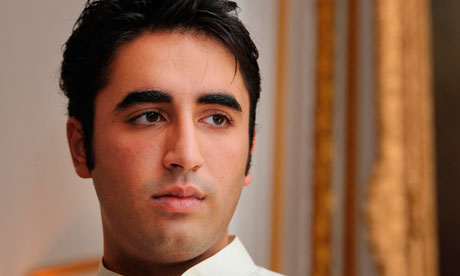
Patron-in-Chief of Pakistan Peoples Party Bilawal Bhutto Zardari said that 5th July 1977 will always be remembered as Black Day in the history of Pakistan when first democratically elected Prime Minister Shaheed Zulfikar Ali Bhutto was overthrown by a tin-pot military dictator General Zia occupying the country and holding the people hostage. In a statement on the eve of 5th July, PPP chief said that grains of all evils including Kalashnikov culture, heroin and extremism were planted by the dictator into the society plunging the whole country into a mess. Terrorism of today is rooted in July 5th coup and all those responsible for it are directly or indirectly involved in the horrible conditions our nation is thrown into, he said. Paying rich tributes to Zulfikar Ali Bhutto, PPP leader said the visionary leadership of Bhutto Shaheed laid sound foundation of the state of Pakistan and gifted it with the first-ever Constitution of consensus. Meanwhile in a message, President Asif Ali Zardari denounced the abrogation of the Constitution and taking over by dictatorship 36 years ago and called upon the people to strive for protection and preservation of democracy. The aftermath of July 5, 1977 starkly remind us how one dictator spawned extremists for his political survival and how another dictatorship exploited the same extremists for promoting his political agenda. Indeed the nation is still reeling under the impact of the dictatorial take over on this dark day, he said. Sectarianism, religious extremism and private jehad were deliberately promoted by the usurper to create an artificial constituency for perpetuating his rule as a reign of terror was let loose, he said. Such is the legacy of the dictatorship that has unfortunately struck this land repeatedly.

Americans celebrate Independence Day

http://www.iol.co.za/
The United States will pause for a highlight of the summer on Thursday: the independence day holiday marking the 237th birthday of one of the world's longest-standing democracies. Americans celebrate with parades, barbecues, concerts, festivals - and fireworks. Pyrotechnic displays on independence day go back to the country's birth.
It was the second president, John Adams, who first called for “illuminations from one end of this continent to the other from this time forward forever more” in a letter he wrote to his wife the day after the Declaration of Independence was signed in Philadelphia in 1776. This year, New York paid tribute to the Declaration of Independence by putting it on display for three days in the New York Public Library - a rare exhibition honouring independence day. The document, handwritten by the nation's third president, Thomas Jefferson, was displayed from Monday to Wednesday along with an original copy of the Bill of Rights - the first 10 amendments to the constitution, written in 1789. It was the first time that the historic documents, which are rarely on display for preservation reasons, were shown together. “As a prime source of free information and education, libraries are the true foundation of our democracy of informed citizens,” said Tony Marx, president of the library.
“We celebrate that tradition with a display of both the Declaration of Independence in Thomas Jefferson's hand, and one of the remaining original copies of the Bill of Rights.” In New York's harbour, the Statue of Liberty was set to welcome back visitors beginning on Thursday. The statue had been closed since 2011 and reopened last year on its 126th birthday, but that was one day before Hurricane Sandy made landfall in the city, flooding most of the five hectares the statue stands on. The statue and Ellis Island were shut down again for repairs. The statue itself suffered no damage from Sandy, but several structures on the two islands, including landing docks, were ruined. The National Park Service decided last month to reopen the statue to visitors after repairs were completed and ferry services from Lower Manhattan and New Jersey to Liberty and Ellis Islands were restored. In Washington, the holiday will be marked with a huge fireworks display preceded by a concert on the National Mall featuring singer Barry Manilow. Other events, including parades and festivals, will celebrate the country's birth in nearly every community throughout the 50 states.

WITH LOVE FROM MOSCOW: ''Sexy Russian Spy to Snowden: Will You Marry Me?''

CIA leaker Edward Snowden may have found a soul mate in Russia. Anna Chapman, the red-haired Russian secret agent expelled from the United States in 2010, seized the moment and proposed marriage to the 30-year-old former NSA contractor, who is on the run after disclosing details of a top-secret surveillance program that allegedly targeted millions of Americans. “Snowden, will you marry me?” the 31-year-old former sleeper agent, dubbed a “femme fatale” by international media, wrote in a tweet posted Wednesday. “NSA, will you look after our children?” Chapman wrote in another tweet, referring to Snowden’s former employer, the US National Security Agency. Snowden, who faces the death penalty on espionage charges in the United States, and is believed to have been holed up at Moscow’s Sheremetyevo Airport since June 23, has yet to reply. The American has sent asylum requests to almost two dozen countries. Several have rejected his application outright, while many others have said he must be on the territory of their country to complete his request.

Moscow Slams 'Unfriendly' Bolivian Presidential Plane Incident

Moscow on Thursday criticized the closure of airspace by several European states to a Bolivian presidential aircraft en route from Russia on Tuesday, forcing it to land in Vienna. The aircraft carrying Bolivian President Evo Morales had been in the air for over three hours after taking off from Moscow on
Tuesday, when France, Spain and Portugal announced the closure of their airspace to it. The plane landed in the Austrian capital Vienna, but was later allowed to fly on to Bolivia. “The steps undertaken by France, Spain and Portugal can be hardly described as friendly in regard to Bolivia as well as to Russia, from where Morales was flying after visiting Moscow,” the Russian Foreign Ministry said in a statement. “Moreover, the refusal to grant airspace passage rights for the aircraft could have created a threat to passengers on board the plane, including the head of a sovereign state,” the ministry added. The aircraft was reportedly searched in a “voluntary inspection” while in Vienna, Deputy Chancellor Michael Spindelegger said on Wednesday, apparently on suspicion it might have fugitive US intelligence contractor Edward Snowden on board. The Bolivian Defense Minister later denied reports that the plane was searched. Snowden, a former contractor for the US National Security Agency, is wanted by the United States for disclosing a top-secret surveillance program. He is now reportedly in the transit section of Moscow’s Sheremetyevo airport. Bolivia accused France, Italy, Spain and Portugal of violating international law by closing their airspace to the presidential aircraft, and said the United States instigated the action by the nations involved. The United States has not commented on the accusation.

Edward Snowden saga: Bolivia accuses Europe of 'kidnapping' Bolivian president in forcing Evo Morales' plane to land in Vienna

French officials deny refusing to let Bolivian president's plane cross its airspace as fugitive is not found on board
Bolivia has accused Austria of “kidnapping” their president after refusing to allow a plane carrying Evo Morales into their airspace amid suggestions NSA whistleblower Edward Snowden was on board.
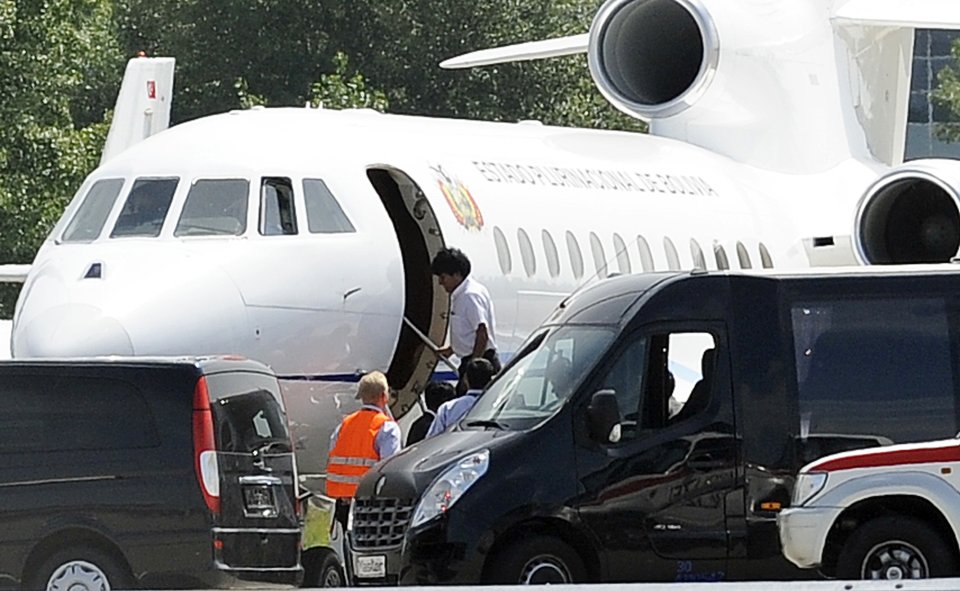
“We're talking about the president on an official trip after an official summit being kidnapped,” Bolivia's ambassador to the United Nations in New York, Sacha Llorenti Soliz, told reporters in Geneva on Wednesday. “We have no doubt that it was an order from the White House,” ambassador Llorenti said. “By no means should a diplomatic plane with the president be diverted from its route and forced to land in another country.” Bolivia has also accused European states of an “act of aggression” and “an offence against the whole Latin region” over the affair and has asked for a crisis meeting of South American leaders after officials expressed outrage at Mr Morales' treatment. Bolivian Foreign Minister David Choquehuanca blamed the forced stopover in Vienna on “unfounded suspicions that Mr Snowden was on the plane”. “We don't know who invented this lie,” Mr Choquehuanca said in La Paz. “We want to express our displeasure because this has put the president's life at risk.” However, Deputy Chancellor Michael Spindelegger said that President Evo Morales had agreed to the inspection. He confirmed Edward Snowden was not on board when Mr Morales' plane was diverted on a flight from Russia and forced to land in Austria over suspicions that Snowden could have been inside. Speaking to reporters at the airport, Mr Spindelegger said: “Our colleagues from the airport had a look and can give assurances that no one is on board who is not a Bolivian citizen.” The plane carrying the Bolivian president finally took off from Vienna's airport to continue it's journey shortly before noon on Wednesday. Bolivia claimed that France, Portugal, Spain and Italy blocked the plane from flying over their territories, forcing the unscheduled stopover in Vienna. There was no evidence that Mr Snowden, wanted by Washington for espionage after divulging classified details of US phone and Internet surveillance, had left the transit area of Moscow's Sheremetyevo airport. French officials denied on Wednesday that France refused to let the Bolivian president's plane cross over its airspace amid suspicions that Mr Snowden was aboard. Spain, too, said the plane was free to cross its territory. According to the anti-secrecy organisation WikiLeaks, Mr Snowden applied for asylum in 21 countries, with letters passed to Russian officials who met him at his secret location in the Moscow airport, where he has stayed since fleeing Hong Kong, where the US attempted to launch an extradition bid. The US has charged the former intelligence contractor with violating espionage laws for leaking classified information about US surveillance operations. As Mr Snowden, 30, prepared to spend his 10th night at the airport, he was dealing with outright rejections from Brazil and India. Finland, Ireland, Austria, Norway and Spain said requests for asylum have to be made in person on their territories to be considered. The Polish Foreign Minister Radoslaw Sikorski wrote on Twitter that he would “not give a positive recommendation” to the request. Mr Snowden’s most likely destination had initially appeared to be Ecuador, but President Rafael Correa has sharply backtracked in recent days, describing the issue of the temporary travel pass that allowed Mr Snowden to depart Hong Kong for Moscow by Ecuador’s London Consul as a “mistake”. He has not completely ruled out asylum for Mr Snowden, but has said the American would need to reach Ecuadorian territory before any request could be considered, which currently does not seem possible. Venezuelan President Nicolas Maduro has said that he would consider an asylum request from Mr Snowden, but suggestions that the Latin American leader, who is in Moscow for an international gas forum, might spirit Mr Snowden away on his presidential jet appeared unfounded. He did speak out in favour of the whistleblower. “He deserves the world’s protection,” Mr Maduro said. “What has he done? Did he launch a missile and kill someone? Did he rig a bomb and kill someone? No. He is preventing war.” There have been no confirmed sightings of Mr Snowden since he landed in Moscow on 30 June, leading many to believe he is being guarded by Russian security agents, although President Vladimir Putin has denied this. It had seemed that Russia might be preparing to offer shelter after Mr Snowden handed an asylum application to the duty consul at Sheremetyevo on Sunday. President Vladimir Putin said Russia could offer Mr Snowden asylum on the condition that the whistleblower stopped leaking information “harmful” to the US. Mr Putin’s spokesman Dmitry Peskov said that this condition had been too much for the stranded American, who had then withdrawn his application.

President Obama to hold crisis talks with Germany to settle claims that US spied of EU allies

President Barack Obama is to hold high level meetings with the German government in an attempt to assuage concerns about reported US surveillance of their European allies. The European Union has previously demanded an explanation as to the claims by NSA whistleblower Edward Snowden that the United States' intelligence service spied on the offices of foreign allies in New York. Responding to the deepening dissatisfaction voiced by French and German officials, a White House statement said yesterday that the President had spoken by phone with German Chancellor Angela Merkel, where it was agreed the two governments would meet to discuss the allegations. "The president assured the chancellor that the United States takes seriously the concerns of our European allies and partners," the White House said, noting U.S. and EU officials would discuss intelligence and privacy issues as soon as Monday. Germany’s Interior Minister, Hans-Peter Friedrich, confirmed the county would send ministerial officials to investigate the claims in Das Spiegel that the US bugged EU offices and embassies. The concession comes after President Obama promised earlier this week to supply all the information requested by European allies regarding the accusations, which he said Washington was still evaluating. Speaking after Snowden’s claims were made public, Chancellor Merkel delivered her strongest rebuke of the US to date. "We are no longer in the cold war," her spokesman, Steffen Seibert, said. "If it is confirmed that diplomatic representations of the European Union and individual European countries have been spied upon, we will clearly say that bugging friends is unacceptable."

America Celebrates Independence Day

http://www.voanews.com/
The United States celebrates Independence Day Thursday.
July 4 marks the 237th anniversary of the American Declaration of Independence from British rule. U.S. citizens traditionally celebrate with parades, picnics, fireworks, ball games and concerts. Fourth of July decorations feature the colors of the American flag -- red, white, and blue. Thursday the Statue of Liberty, a universal symbol of freedom and democracy, welcomes visitors for the first time since Hurricane Sandy slammed into New York last year. The 93-meter statue was not damaged in the storm, but the tiny island it sits on was devastated. Hundreds of construction workers have been working on the repairs. Washington holds an annual Fourth of July celebration on The National Mall. This year, singer/composer Barry Manilow is the headline entertainer. Fireworks will light up the capital's sky after the concert. Drafted by Thomas Jefferson in June 1776, the Declaration of Independence is America's most cherished symbol of freedom. The Continental Congress formally approved the document weeks later on July 4.

President Obama's Weekly Address: Celebrating Independence Day

U.S: Joblessness still hangs over an improving economy

Unemployment under President Barack Obama has remained high for the longest period since the Great Depression. Despite a slowly improving job market, the millions of Americans without jobs underscore weakness in the recovery, drag down consumer spending and still roil the nation's politics. Wall Street has had its jitters but the stock market remains high, consumer confidence has improved and the housing market is making a solid comeback. Yet, while economic conditions change, much remains the same. On Friday, the government will release its monthly jobs report, and economists predict that U.S. employers added 165,000 jobs in June. That's fewer than in May and far short of the number of new jobs needed to push the unemployment rate down significantly from its current perch at 7.6 percent. Unemployment has dropped from a high of 10 percent in October 2009. It also is the last consequence of a recession to show improvement in a recovery. But the jobless rate has remained at or above 7.5 percent for 53 months, a period that has left an unusually large number of people out of the work force for so long that some of them will likely never work again. Nearly 12 million people are searching for work and millions more are underemployed in involuntary part-time jobs. The rate will take time to bring down, adding pressure on the economy and creating political problems for Obama and his Democratic allies in Congress. Moreover, experts say the rate could plateau at a higher level than the 4.7 percent unemployment in place before the recession hit in 2008. The Federal Reserve last month issued an optimistic forecast that the jobless rate would drop to between 6.5 and 6.8 percent by the fourth quarter of next year. But the Fed has been overly optimistic before; in 2009 it projected unemployment would hit between 6.7 and 7.5 at the end of 2011. Instead, it remained at 9 percent for most of the year before dropping to 8.5 percent. It has also had to revise other subsequent projections upward. Likewise, some forecasts have been too pessimistic. The non-partisan Congressional budget Office projected in February of 2012 that unemployment would remain above 8 percent until 2014. "I think the forecast that makes most sense to me right now is the unemployment rate ticking down very slowly, something like a tenth of a percent every few months for the next year or so," said Jared Bernstein, a senior fellow at the Center on Budget and Policy Priorities and former economic adviser to Vice President Joe Biden. Jack Kleinhenz, chief economist at the National Retail Federation, said he finds it hard to imagine unemployment getting as low as the Fed predicts because incomes are not growing, thus constraining consumer spending. Bernstein believes the Obama administration and Congress should embrace a policy of full employment, which means anyone who wants to work should be able to find a job and that the government should step in if the private sector can meet the demand. That doesn't mean zero unemployment. Even a humming economy has a level of joblessness — there are always workers leaving or quitting jobs without lining up new ones, and the mismatch between jobs and skills means many workers inevitably are displaced by technology. From 1999 through 2007, the Congressional Budget Office defined full employment as a jobless rate of 5 percent. Citing the difficulty the long-term unemployed face finding jobs due to the recession, the CBO now defines full-employment as 5.5 percent. At the White House, officials are continuing to press proposals that have found little support in Congress, particularly among Republicans who control the House of Representatives. Administration officials also point out that there have been 37 straight months of job growth, with nearly 7 million jobs created and argue that the budget pinch created by this year's automatic spending cuts are hurting job creation. Jason Furman, a veteran White House economist nominated to be chairman of Obama's Council of Economic Advisers, told a Senate committee that government could accelerate job growth by increasing spending in public works projects and tax credits to help small business expand payrolls — both proposals that Obama has been making for two years. Furman also said that over the medium and long term the federal government should also make social programs for the poor and the elderly more efficient and change the nation's tax code. But each of those would require a massive — and unlikely — effort in Congress. Republicans, unwilling to increase deficits in the short term, say Obama's health care law and a slew of proposed and existing regulations have increased uncertainty in the private sector and contributed to low job growth. They have pushed Obama to liberalize oil and gas exploration and to build an oil pipeline from Canada to the Gulf of Mexico as ways of increasing employment. A Pew Research Center poll conducted last month found 44 percent approve of his handling of the economy, 50 percent disapprove. The public is divided on whether his administration's policies have improved economic conditions, with 35 percent saying they made things better, 35 percent worse and 27 percent saying they've had no effect on the economy. "All this leads people to hold two opinions simultaneously: 'It looks like things are getting a little better, but it still sucks for me,'" said Wes Anderson, a Republican pollster who has advised the House and Senate wings of the Republican Party. "Obama owns the economy," Anderson said. "He owns it; he wears it."

Obama treads cautiously on Egypt leader's ouster

The Obama administration is treading carefully after Egypt's military overthrew its president, wary of taking sides in a conflict that pits a democratically elected leader against a people's aspirations for prosperity and inclusive government. Denounce the ouster of President Mohammed Morsi outright, and the U.S. could be accused of propping up a ruler who's lost the public's support — a prospect with eerie echoes of autocrat Hosni Mubarak, whom the U.S. supported for decades before the 2011 revolution that cleared the path to power for Morsi and his Muslim Brotherhood. But look the other way, and the U.S. could be accused of fomenting dissent or lose credibility on its commitment to the democratic process. So President Barack Obama, in his first, cautiously crafted comments after Morsi was forcibly removed from office, said the U.S. would "not support particular individuals or political parties," acknowledging the "legitimate grievances of the Egyptian people" while also observing that Morsi, an Islamist, won his office in a legitimate election. "We believe that ultimately the future of Egypt can only be determined by the Egyptian people," Obama said in a statement late Wednesday. "Nevertheless, we are deeply concerned by the decision of the Egyptian armed forces to remove President Morsi and suspend the Egyptian constitution." He notably stopped short of labeling Morsi's ouster a coup, leaving himself some wiggle room to navigate a U.S. law that says the government must suspend foreign aid to any nation whose elected leader is ousted in a coup d'etat. But Obama did say he was ordering the government to assess what the developments portended for aid to Cairo. The U.S. considers the $1.5 billion a year it sends Egypt to be a critical U.S. national security priority. "I now call on the Egyptian military to move quickly and responsibly to return full authority back to a democratically elected civilian government as soon as possible through an inclusive and transparent process, and to avoid any arbitrary arrests of President Morsi and his supporters," Obama said after huddling in the White House Situation Room with Defense Secretary Chuck Hagel and other top aides. Egyptian military leaders have assured the Obama administration that they were not interested in long-term rule following their toppling of Morsi. On Thursday, the supreme justice of Egypt's Supreme Constitutional Court, Adly Mansour, was sworn in as interim president. On his other request, Obama appeared to have less success. Shortly after Obama issued his statement, a Muslim Brotherhood spokesman said Morsi and 12 presidential aides had been placed under house arrest. Morsi, meanwhile, denounced his ouster as a "full coup." As American cities were making final preparations for Fourth of July celebrations, fireworks erupted Wednesday night over Cairo's Tahrir square upon news the military had suspended the Islamist-drafted constitution and called for new elections. The mood was less jubilant at the State Department, where officials concerned about the threat of further unrest ordered all nonessential U.S. diplomats and the families of all American embassy personnel to leave Egypt. Although initially encouraged by Morsi's promise to abide by Egypt's 1979 peace treaty with Israel and his role in a truce brokered between Israel and Gaza's Hamas rulers in November, the U.S. grew more skeptical about Morsi as opponents complained in louder and louder voices that his promises to enact democratic reforms were going unmet. Secretary of State John Kerry warned in April that Egypt might be backsliding in its transition to democracy, citing arrests, street violence and the government's inability to embrace its opposition. Despite the odd optics that supporting an expulsion-by-force of a democratically elected leader would entail, the State Department appeared Wednesday to be laying the groundwork for a tacit acceptance of the military's move. The State Department spokeswoman Jen Psaki refused to criticize Egypt's military over the ultimatum it gave Morsi. But she did say the U.S. was disappointed with a speech Morsi gave the previous night after Obama urged him to present plans to address the opposition's concerns. "Last night was an opportunity for him to propose new steps, which he ... did not," Psaki said. There were early signs that if Obama accepts the military's actions, he won't be without support on Capitol Hill. House Majority Leader Eric Cantor, a Republican, said Egyptians had made clear they believe Morsi threatens the type of democracy they aspired to in their 2011 revolution. "As President Obama has said, democracy is about more than elections," Cantor said. "The Egyptian military has long been a key partner of the United States and a stabilizing force in the region, and is perhaps the only trusted national institution in Egypt today." But other lawmakers were already asserting that Egypt's military had triggered a provision in U.S. law that requires aid to be suspended if a military deposes a democratically elected government. Sen. Patrick Leahy, who heads the Appropriations panel that oversees foreign aid, said he hoped Egypt's military would make good on its vow to return power to the people, but that in the meantime, U.S. law was clear about what should happen. "My committee also will review future aid to the Egyptian government as we wait for a clearer picture," said Leahy, D-Vt. In an apparent bid to forestall potential U.S. sanctions, senior Egyptian army officers have told Hagel and Gen. Martin Dempsey, chairman of the Joint Chiefs of Staff, that they would put a civilian government in place quickly — if not immediately — after removing Morsi from power, U.S. officials said. In the interim, they appointed a government of civilian technocrats to temporarily run the country. The Egyptian military also pledged to take steps to ensure the safety of Americans in Egypt, including the embassy in Cairo and the consulate in Alexandria, said the officials, who spoke on condition of anonymity because they were not authorized to speak by name about private conversations that occurred over the past week. Stephen McInerney, who runs the Washington-based Project on Middle East Democracy, said that while American leverage in Egypt's political conflict has diminished as a result of mistakes since the 2011 revolution, having the military back in charge could actually give the U.S. more influence over the outcome of the current turmoil. "The actor we have the most leverage with — the military — is now the most important actor in Egypt," McInerney said.

In New York's 'Little Egypt,' Egyptian-Americans cheer Mursi's ouster

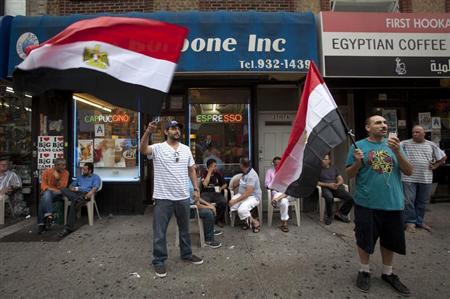
Members of New York's Egyptian community descended on the coffee shops, delis and Hookah bars of "Little Egypt" on Wednesday to celebrate the overthrowing of Islamist President Mohamed Mursi after one year in office. Some people gathered on the sidewalks of the neighborhood in Astoria, Queens, but most congregated inside the public places and their homes, eyes glued to Arabic-language news programs and TV images of demonstrators in Cairo's Tahrir Square. "We gave him a chance for one year and he didn't do anything," said Abdilmoniem Mohamed, 55, a Bronx resident who was at the Arab Community Center in Astoria watching coverage of the events. Mohamed, who moved to New York in 1979, said he had considered the toppling of former president Hosni Mubarak in 2011 the happiest day of his life, until Wednesday, and would now be comfortable allowing his girls, both in their 20s, to visit Egypt. As word spread up and down the streets of Little Egypt, friends and neighbors greeted each other with effusive congratulations. Egyptian flags were displayed on sidewalks and in store fronts. Outside one cafe, a group of men sang "lift your head high, you're an Egyptian." Egypt has been in turmoil since Mubarak's fall, arousing concern among allies in the West and in Israel, with which Egypt has a 1979 peace treaty. On Wednesday, hundreds of thousands of anti-Mursi protesters in Tahrir Square erupted into cheers, set off fireworks and waved flags after Egypt's top army commander announced the suspension of the Islamist-tinged constitution. The reaction was more subdued in Little Egypt, where the fall the first freely elected president for the Arab world's most populous country, raised some concerns for the safety of friends and family in Egypt and for military rule. "I'm not happy. I'm not sad. I'm confused," said Ehab Mohamed, owner of Zaitoun, a small store a couple of doors from the community center, who added, "He came in the legal way. They should have made a new election." Ehab Mohamed said he had voted for Mursi, but was not pleased with his presidency. He also said he did not trust the armed forces to not try to assert a more permanent position. Heba Khalifa, 35, a medical interpreter who lives in Queens, said she believed Mursi supporters were mostly "in hiding" in the neighborhood. "Believe me they are around, but today they are playing the victim," she said. Khalifa said she was optimistic about Egypt's future and saw Mursi's ouster as a "curve" in the road to democracy. "Is this the last curve? No. There are more curves ahead," she said. Her husband, Amr Khalifa, said he was of two minds: "The Egyptian in me is elated," he said, while the intellectual was "aware of the complexities" of the military takeover. Amr Khalifa said he also was deeply concerned about the safety of his family, most of whom live in Cairo and Alexandria. "Whether the Islamists strike tonight, tomorrow, next week, believe you me, it will happen," he said.
Kabul-Islamabad talks to go on, hopes UN

http://www.pajhwok.com/
Afghanistan and Pakistan should have coinciding interests in reducing the role of the Taliban in both countries and reducing the level of violence, a top UN official said on Wednesday, hoping political leaders in Kabul and Islamabad would soon start a political dialogue. “Political logic tells me that Pakistan and Afghanistan should have coinciding interests in reducing the role of the Taliban in both countries and reducing the level of violence, which we have seen so drastically and so tragically,” UN Deputy Secretary-General, Jan Eliasson told a news conference in New York. Having just returned from a five-day trip to Afghanistan, where he met top Afghan leaders including President Hamid Karzai, Eliasson hoped talks between Kabul and Islamabad would continue. “There is hope that there could be a new start with the new government of Nawaz Sharif in Pakistan. There have been invitations in both directions. They have not agreed on the sequence of visits. But there is a dialogue on several levels, and I would very much hope that one would have an open and very, very honest discussion about future interests here,” he said. “It is an historically very complicated relationship, and you have also difficulties with both sides having indications that the border is not fully respected, and that is also related to the movements of the Taliban. So it is a very complicated issue,” he said in response to a question. He believed the future of Afghanistan would, to a great degree, be determined by Afghans themselves. But it was important that regional actors also played a positive and constructive role, and that there should be cooperative ties Afghan and Pakistani governments. Reflecting on his interactions with people in Afghanistan, he heard one theme that came back in practically all his meetings was the importance of protecting the achievements of the past decade. “You have progress in health, education, human rights and women, as compared to the previous period and several other countries in the region,” Eliasson said. “It is, of course, extremely important for the people of Afghanistan, but also for the United Nations and the many nations that have contributed to this transition, that the country does not fall back into the nightmares of war and the extreme poverty and violations of human rights that we saw earlier,” he said. The official said he had conveyed that the intention of the United Nations was to continue its partnership with Afghanistan based on the wishes of the government and people. The UN would provide support where and when needed, following modalities that respected Afghan leadership and sovereignty," he concluded.

New Pakistani Government Ends Moratorium On Executions

http://www.rferl.org/
Pakistan's new administration has ended a moratorium on executions. Interior Ministry spokesman Umer Hameed said on July 4 that the new government "has decided to deal with all cases of execution on merit." He added that "there will be no general amnesty for the convicts waiting for execution." Under the previous government led by President Asif Ali Zardari's Pakistan Peoples Party, a 2008 presidential order imposed a moratorium on the death penalty. The freeze expired on 30 June. Amnesty International, which opposes capital punishmen in any instance, has called the development a "shocking and retrograde step." It called for an immediate restoration of the moratorium on the use of the death penalty. The organization estimates that Pakistan has more than 8,000 prisoners on death row. Most of them have exhausted the appeals process and could now be executed.

PPP not go back on Seraiki province promise: Gilani

Showing Pakistan People’s Party (PPP) resolve for creating Seraiki province, former prime minister Yusuf Raza Gilani said on Wednesday that his party will not inch back from its stated position on the province. Gilani said this while talking to a delegation of Seraikistan National Council (SNC) that called on him at Gilani house. On the occasion, he said that the PPP had given identification to Khyber Pakhtunkhwa and now it would give Seraiki people their identity. He said that it was an important issue for them, adding that they would never surrender their geographical and cultural identity. He thanked the delegation for showing concern on the abduction of his son Ali Haider Gilani on 9th May from Farrukh Town of Matital area. SNC delegation demanded prompt arrest of the accused involved in Haider's abduction. SNC also invited the former prime minister to attend a solidarity conference to be held on 6th July at Multan Press Club in this connection. The delegation comprised of Prof Shaukat Mughal, Zahoor Dhareja, Haji Hameed-u-Din Ansari and Shahid Hameed Ansari.

Pakistan lodges IMF bailout request

Pakistan has requested a new bailout loan package from the International Monetary Fund following weeks of talks with an IMF delegation, a finance ministry source said on Thursday,it also highlights a sense of urgency for Pakistan at a time when its central bank has only about $6.25 billion left in reserves, enough to cover less than six weeks of imports. Lodging a request is the first step in a potentially long process which involves holding more talks on the size of a loan as well as a set of reform commitments from Pakistan's side. “Talks are still ongoing but we will have to wait for results after the IMF team returns to Washington and reviews Pakistan's terms,” a senior finance ministry official told Reuters. “For the IMF, broadening the tax net and decreasing subsidies on the energy sector will be the make-or-break steps it wants Pakistan to commit to.” Anxiety over the nation's struggling economy is one of the many challenges facing its new government. With reserves shrinking by around $500 million a month and with many Pakistanis already angry over unemployment, high food prices and crippling power cuts,any IMF reform package, which usually comes with conditions attached, could also prove unpopular, adding to concerns over instability at a time when Pakistan is already under pressure to contain a growing insurgency.

Rape laws in Pakistan: travesty of justice

DAILY TIMES
By Sara Ali
The Federal Shariat Court has reaffirmed that nowhere do the Quran and Sunnah prohibit the use of DNA tests and instead strongly encourage recourse to such scientific methods It is not Islam, it is the self-proclaimed custodians of Islam who are insensitive to women. The controversial recommendation by the Council of Islamic Ideology (CII) declaring DNA as an insubstantial proof for conviction in rape cases has triggered an intense debate among lawyers, politicians and civil society representatives. Rape is not addressed in the Quran, it only mentions zina. Zina in the Quran is generally equated with fornication and adultery and it is believed that it entails within its meaning non-consensual sex in the Quran and fiqh as well. When interpreting the status of rape in Islam, Pakistan closely aligned rape with fornication and adultery, with the result that rape victims are frequently punished for committing zina while the rapists get away scot-free. The Offence of Zina (Enforcement of Hudood) Ordinance, VII of 1979, also called the Zina Ordinance, criminalised zina and included adultery, fornication, rape and prostitution in it. It proposed similar Islamic conditions for evidence needed to prove rape as in zina, which further endorsed the belief that the ordinance is a dangerous play of misogyny. The juxtaposition of rape with fornication and adultery is widely criticised as it undermines the uniqueness of ‘rape’ as a heinous crime distinct from zina. Rape victims have been exposed to brutal injustices primarily due to the requirement of producing four male witnesses. In Islam, the wisdom behind four male witnesses was to protect chaste women from false accusations of zina, certainly not to exploit victims of sexual assault. But its custodians have used the verses of the book in a way to circumvent rape convictions, therefore further aggravating the plight of the sufferer. A woman in Pakistan from birth till her marriage is expected to be a symbol of pride and honour for her family. This entails maintaining her virginity till the time she is given to a man in nikah (marriage) and during these years if she is raped she is left to suffer in silence. A victim who stands up for her rights or registers an FIR in a police station is censured, and in some cases even disowned by her family and society. The attitude of many in Pakistan towards a rape victim is not only atrocious but in certain instances quite agonising. We must inculcate empathy and understanding for those who have been through such a traumatising event in their lives as no one chooses to get raped. The circumstances for a rape victim are exacerbated with the CII’s recent statement declaring DNA evidence as supporting evidence and not the primary proof in a rape case. The alternative offered by the CII of producing four male witnesses against the rapist has generated a ruckus in civil society. The CII recommendation has also challenged a recent ruling of the Supreme Court (2013 SCMR 203). Mr Salman Akram Raja in the Supreme Court (2013 SCMR 203) has submitted that the administration of a DNA test should be made mandatory in rape cases. Mr Raja in his submission has placed reliance on the case of Muhammad Shahid Sahil v The State (PLD 2010 FSC 215) where the DNA test’s admissibility was accepted to determine the paternity of the child born to a rape victim in the Federal Shariat Court. The Federal Shariat Court in that case has reaffirmed that nowhere do the Quran and Sunnah prohibit the use of DNA tests and instead strongly encourage recourse to such scientific methods. Moreover, it is believed that allowing the DNA test and making it mandatory does not violate Article 13 of the Constitution, which guarantees protection against self-incrimination. From the Supreme Court case it can be maintained that DNA is the only authentic source that can assist in deciding a rape case. A widely acknowledged belief is that when rape is committed, the offender’s DNA is left on the survivor’s body, and it can be easily obtained from the victim’s saliva, hair, semen, sweat or blood. Hence, DNA in all circumstances is critical to bringing rapists to justice. DNA administration is only feasible and viable if the victim has not showered, combed her hair or cleaned up the crime scene. It is an important tool in deciding rape cases as it can be stored for years and has the capacity to last long without degradation at room temperature. An immense friction exists between the laws of Pakistan and the CII resolution on rape. Even under the Women’s Protection Act, it has been stated that rape cases should be tried under the Pakistan Penal Code and not under the Hudood Ordinance. At this point it is vital to note that resolutions of the CII are not binding in nature; the Council has more of an advisory role to play. The Constitution of Pakistan while explaining the role of the CII said that it will guide the government in respect of Islamic teachings, their implementation and propagation. Its chairman and members are appointed by the president. The constitution reiterates its role, saying that although its advice is not binding, yet it is not easy for any government to ignore or overrule its recommendation regarding any idea. With regards to the rape laws, Pakistan is now at a crossroads. Rape is indeed a harrowing phenomenon that continues to haunt Pakistan and is likely to generations to come. If we are really concerned about giving redress to rape victims, it is imperative to resolve the rift between the CII and other segments of society. The need is to bridge the gap between the CII and civil society organisations, and for once sit down and see where both the CII and civil society are coming from. A serious effort is required to remove any misunderstanding of Islam. The focus should be on engaging erudite and serious Islamic scholars. At the end of the day it is not about the CII, or a lawyer, or a civil society representative, it’s about Pakistan and its people. It is about justice and the rule of law. It’s about a society where tranquillity should prevail and where Islam is followed in its true sense.
The writer is a lawyer and a researcher at the Research Society of International Law

5 security personnel killed in suicide attack in NW Pakistan

At least five security personnel were killed and eight others injured when a checkpost was attacked by a suicide blast in Pakistan's northwest tribal area of North Waziristan on Thursday afternoon, reported local Urdu TV channel Geo. Firing started following the blast, said the report. The attack reportedly took place at about 2:00 p.m. local time when an explosive-laden car rammed into a checkpost in the Datta Khel area, some 14 kilometers away from North Waziristan's capital town of Miransha. Other details about the attack are not immediately available as the checkpost is located in a remote area near Afghan border. Early Wednesday morning, US drones fired four missiles at a house and a vehicle near Miranshah, killing at least 17 suspected militants including a Haqqani network commander, reports said. Thursday's suicide attack in the nearby area of Miransha could be a retaliation for Wednesday's US drone strike, it added.

Morsi’s fall is a blow to Mideast Islamists

http://www.timesofisrael.com/
By HAMZA HENDAWI and LEE KEATH
Disillusioned by democracy, other groups may chose bullets over ballots in future standoffs
Egypt was the centerpiece of the Islamist movement’s vault to power in the Arab world’s sweeping wave of uprisings. Winning election after election here, the Islamists vowed to prove they could govern effectively and implement their vision of political Islam, all while embracing the rules of democracy. Mohammed Morsi was their pillar: the veteran of the Muslim Brotherhood, the region’s oldest and most prestigious political Islamist group, who became Egypt’s first freely elected president.That is what makes his ouster after barely a year in office, with a gigantic cross-section of Egypt’s population demanding he go, such a devastating blow to Islamists on multiple levels, not only in Egypt but across a tumultuous region. Morsi, his Brotherhood and their harder-line allies say they played by the rules of democracy, only to be forced out by opponents who could not play it as well as them at the ballot box and so turned to the military for help. The lesson that the Islamists’ extreme fringe may draw: Democracy, which many of them viewed as “kufr” or heresy to begin with, is rigged and violence is the only way to bring their dream of an Islamic state. But to the millions of Egyptians who marched in the street against Morsi, the Islamists failed at democracy: They overreached. The protesters became convinced the Islamists were using wins at the polls to centralize power in the hands of the Muslim Brotherhood far beyond their mandate and treat the country as if it accepted the “Islamist project.” Even worse, for many of the protesters, the Islamists simply were not fixing Egypt’s multiple and worsening woes. That is a serious setback for their dreams, calling into doubt the argument by Islamists across the region that political Islam is the remedy to their society’s ills. The damage to their prestige echoes widely, from Gaza where the Hamas rulers who saw in Morsi a strong ally, to Tunisia where a Brotherhood branch holds power, to Libya and Syria where Islamists push for power. “The Brotherhood in Egypt is now a cautionary tale,” said Michael W. Hanna of the Century Foundation in New York. “Morsi’s abysmal performance during their short tenure is a tale of how not to guide and rule.” The irony is, the Brotherhood knew the risks going in. After the 2011 fall of autocrat Hosni Mubarak, the group vowed not to try to dominate parliament and not to run a candidate for president, knowing the backlash if it seemed to be grabbing power or if it led a government that failed to fix a broken Egypt. It went back on each of those promises, every time saying its hand was forced into doing so. Morsi himself recognized the power of the street as he vowed to be a president for all the people. The day before his formal inauguration on June 30, 2012, he first delivered a symbolic oath of office in Cairo’s Tahrir Square, the epicenter of the revolt that overthrew his autocratic predecessor. “You are the source of power and legitimacy,” he told the crowd. Nothing stands above “the will of the people. The nation is the source of all power. It grants and withdraws power.” In the broad range of the political Islam movement — from moderates to militants — the Brotherhood eventually emerged as the central force arguing that Islamists can be democrats. Their influence drew in harder-line groups to participate at the ballot box. Ultraconservatives who once refused elections that could potentially bring any law but God’s law took their chance at the polls. In an impassioned Facebook post just before the army pushed Morsi out Wednesday, one of his top advisers Essam el-Haddad argued that what was happening was irrevocably damaging democracy itself, saying the Brotherhood had been unfairly treated. He insisted history would show the Brotherhood tried to include others in its administration but was shunned. “Increasingly, the so-called liberals of Egypt escalated a rhetoric inviting the military to become the custodians of government in Egypt,” he wrote. “The opposition has steadfastly declined every option that entails a return to the ballot box.” But amid multiple complaints, opponents point to a key factor that turned many against the Brotherhood: the post-Mubarak constitution. Morsi had vowed a consensus on the landmark document, but Islamists dominated the panel writing it. Liberals, leftists, secular politicians and Christians steadily dropped out, complaining Morsi’s allies were forcing their vision. In the end, Morsi unilaterally decreed himself and the assembly untouchable by the courts to ensure judges did not dissolve the panel, while Islamists hastily finished writing the charter in an all-night marathon session. It was rushed to a referendum, where it passed with a hearty 63 percent of the vote — but only just over 32 percent of the electorate casting ballots. Meanwhile, Brotherhood members and other Islamists were steadily were given more posts across the government, fueling a perception that they were taking over institutions — though they constantly faced resistance on many fronts from the entrenched bureaucracy. Islamist rhetoric from officials and clerics on TV rang in the ears of many as divisive and harsh. Morsi’s ouster could now send the Brotherhood into disarray for years to come, just as a major crackdown on the group did in 1954. Morsi and many of his advisers have been put under house arrest, and he could face trial for escaping prison during the 2011 uprising. Two top leaders of the group, including the head of its political party Saad el-Katatni, were arrested and at least 30 more were expected to meet the same fate. The danger now could be that a heavy crackdown will turn into forcibly excluding them from politics once more. The Brotherhood was banned for much of its 83-year existence. But it still maintains a powerful, organized and disciplined network of members nationwide. “The forceful removal of the nation’s first democratically-elected civilian president risks sending a message to Islamists that they have no place in the political order; sowing fears among them that they will suffer yet another bloody crackdown; and thus potentially prompting violent, even desperate resistance by Morsi’s followers,” the Brussels based International Crisis group warned in a statement

Analysis: Mubarak’s redemption

By ARIEL BEN SOLOMON
Two years ago the world was ecstatic over Mubarak's fall, and now the same has happened Islamist leader Mohamed Morsi. Time is up – the Muslim Brotherhood is being removed from power. Does this mean the “Arab Spring” is over? Are we witnessing the comeback of the nationalist military dictatorship model that former president Hosni Mubarak represented? Two years ago, the world was ecstatic over his fall, now there is praise for the return of military rule. The constitution has been suspended and the army is to announce a road map and oversee a transitional period and elections. Muslim Brotherhood leaders remained defiant. Gehad El-Haddad, a senior political adviser for the Brotherhood’s Freedom and Justice Party, asked on Twitter late Wednesday night: “Egypt enters another military coup cycle. Will the [people] of Egypt take it. Again!!” The question for the US and Europe is how to react. Will they support the coup or will they condemn it because it overran a democratic government? If the army does not remain steadfast, it could leave enough room for the Muslim Brotherhood to wage a violent uprising or protests. If this happens, the country will move toward economic ruin, and become paralyzed in some kind of civil war. What if, after the coup, the economy crashes, and then the Muslim Brotherhood brings its supporters to the streets and fills Tahrir Square again? David P. Goldman reports at PJ Media that we have now reached the worst-case scenario: “chaos in politics, violence in the streets, complete cessation of tourism, and economic breakdown.” Goldman quotes statistics from the World Health Organization in 2011 stating that around 20 percent of Egyptians suffer malnutrition. He goes on to predict that a military regime would probably do a better job of dealing with the economic issue because it would be more likely to receive aid from the Gulf states, besides Qatar, which “might decide to provide funding for a military regime that suppressed the Muslim Brotherhood.” The Gulf states are status quo powers for the most part (except Qatar) and strongly fear any revolutionary movements, and for that reason the Muslim Brotherhood, al-Qaida, and Shi’ite Iran should be controlled and resisted. However, it is interesting that the Gulf states have no problem with supporting the Sunni Islamists fighting far away or against Shi’ites. For example, in Syria they are funding the Islamist-dominated opposition. The spiraling economic disaster combined with what may be a Muslim Brotherhood struggle against the military – possibly including terrorism, urban warfare, assassinations and mass protests – may be difficult to manage even with billions of aid money. Qatar already gave Morsi’s regime $5 billion and it only served to postpone a much worse situation. Max Singer of the Begin-Sadat Center for Strategic Studies (BESA) and a co-founder of the Hudson Institute told The Jerusalem Post, “I never believed in the Arab Spring,” so he does not see it as being reversed. The Brotherhood, he said, rejects democracy, as it does not believe in free speech or freedom to organize, for example. Democracy is not just about holding an election, he said. Israel and Egypt “are better off with the army and democrats than with the Islamists,” said Singer, warning that there still will remain problems with the army and the opposition, “but the Islamists are a more dangerous enemy.” Asked about what the coup could mean for US policy, he responded that President Barack Obama has taken the position that the Brotherhood is not the enemy. This is a big mistake, Singer said. Zvi Mazel, who served as Israel’s sixth ambassador to Egypt and who is a contributor to the Post, told the Post that the army worked with the protesters to fix the revolution. Dialogue between the Brotherhood and the opposition became impossible because Morsi refused to cooperate, wishing to push his party’s agenda. “The Muslim Brotherood are in shock – they cannot believe it,” said Mazel adding that in time the Islamists will “wake up and there may be violence.” The Islamists now will begin planning for a struggle to return to power, he asserted.

Top judge sworn in as Interim Egypt president

Top judge Mansour has been sworn in as Egypt interim president, hours after Mohamed Morsi was overthrown in a military coup following huge protests against his one-year rule. Adly Mansour took the oath of interim president on Thursday, as his democratically elected predecessor, Mohamed Morsi, was held in an unspecified military barracks along with senior aides. Before the constitutional court, Mansour said: "I swear by God to uphold the Republican system and respect the constitution and law... and safeguard the people and protect the nation." Separately, Mansour was made head of the supreme constitutional court - a position he was due to take on June 30, when protests against Morsi's one year in power began in earnest. “I swear by the great God, to respect the constitution and the law and to rule justly,” Mansour said on his appointment to the court. Morsi was overthrown by the military on Wednesday. According to a senior member of the Muslim Brotherhood, Morsi was being held in a military facility with top aides. "Morsi and the entire presidential team are under house arrest in the Presidential Republican Guards Club," Gehad El-Haddad, the son of a top Morsi aide, told AFP news agency on Thursday. Haddad's father, Essam El-Haddad, widely seen as Morsi's right-hand man, was among those held, he added. Morsi was believed to be at a Republican Guard barracks in Cairo but it was not clear whether he was under arrest. Hundreds of Muslim Brotherhood officials were also reported to have been arrested, with many senior leaders being held in the Torah prison in Cairo - the same prison holding Hosni Mubarak, who was himself deposed in the 2011 revolution. In a televised broadcast, flanked by military leaders, religious authorities and political figures, General Abdel Fattah al-Sisi effectively declared the removal of Morsi. Early elections Sisi called for presidential and parliamentary elections, a panel to review the constitution and a national reconciliation committee that would include youth movements. He said the roadmap had been agreed by a range of political groups.Islamist supporters of Morsi who have gathered in a Cairo suburb reacted angrily to the announcement by the army. Some broke up paving stones, forming piles of rocks. Muslim Brotherhood security guards in hard hats and holding sticks formed a cordon around the encampment, close to a mosque. Men and women wept and chanted. Denouncing military chief Sisi, some shouted: "Sisi is void! Islam is coming! We will not leave!" At least 14 people were killed when opponents and supporters of Morsi clashed after the army announced his removal, officials said. Eight of those died in the northern city of Marsa Matrouh, including two members of the security fources. Three people were killed and at least 50 wounded in Alexandria, state news agency MENA reported; a woman stabbed in the stomach, and two men killed by birdshot. Three people were also killed and 14 wounded in the southern city of Minya, including two police, MENA said. 'Revolution re-launched' Speaking shortly after Sisi's announcement, liberal opposition leader Mohamed ElBaradei said the "2011 revolution was re-launched" and that the roadmap meets the demand of the protesters. Egypt's leading Muslim and Christian clerics also backed the army-sponsored roadmap.Pope Tawadros, the head of the Coptic Church, said the plan offered a political vision and would ensure security for all Egyptians, about 10 percent of whom are Christian. Egypt's second largest Islamist group, the Nour party, said in a statement that it agreed to the army roadmap in order to avoid further conflict. Morsi, Egypt's first freely elected president, came under huge pressure in the run-up to Sunday's anniversary of his maiden year in office, with his opponents accusing him of failing the 2011 revolution by concentrating power in Islamist hands. The embattled 62-year-old proposed a "consensus government" as a way out of the crisis. That was not enough for the army, and Mansour, a previously little known judge, was installed as the country's interim leader.

Syria's Assad says political Islam being defeated in Egypt

http://www.egyptindependent.com/
Syrian President Bashar al-Assad, fighting to crush a two-year-old uprising against four decades of rule by him and his late father, said on Wednesday the upheaval in Egypt was a defeat for political Islam. "Whoever brings religion to use in politics or in favor of one group at the expense of another will fall anywhere in the world," Assad was quoted as telling the official Thawra newspaper, according to an official Facebook page. "The summary of what is happening in Egypt is the fall of what is called political Islam." Relishing the possible downfall of one of Assad's most vocal critics, Syrian television carried live coverage of the huge street demonstrations in Egypt demanding the departure of President Mohamed Mursi. Assad's late father, Hafez al-Assad, used the military to crush an armed insurgency against his rule led by the Muslim Brotherhood, killing many thousands in the conservative city of Hama, which became a centre of pro-democracy demonstrations when the uprising against the younger Assad erupted in March 2011. Thousands of leftists were also jailed and tortured. The Syrian branch of the Muslim Brotherhood became one of the most powerful factions behind the mostly Sunni Muslim uprising against Assad, who belongs to the Alawite sect, an offshoot of Shi'ite Islam, and is being helped by Lebanon's Shi'ite Hezbollah militia. Morsy has expressed support for foreign intervention against Assad and attended a rally two weeks ago calling for holy war in Syria. A month ago, Syrian authorities responded to a wave of protests against Turkish Prime Minister Tayyip Erdogan, another fierce opponent of Assad, by calling on him to halt what it said was violent repression and step aside.