Tuesday, June 25, 2013

Pakistan: Gilani demands judges to be tried with Musharraf

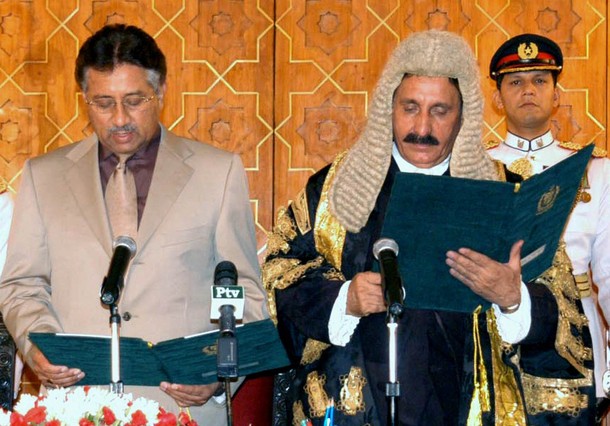
Former Pakistani premier Yousuf Raza Gilani has demanded that Pakistani judges who endorsed the October 1999 coup, led by former army chief Pervez Musharraf, should also be charged with treason. Gilani, a senior leader of the Pakistan People's Party, made the demand after Prime Minister on Monday announced that his government would put Musharraf on trial for high treason for violating the Constitution twice. In May 2000, a 12-judge bench of the Supreme Court had unanimously validated the October 1999 coup and granted Musharraf executive and legislative authority for three years. Supreme Court Chief Justice Iftikhar Chaudhry was one of the members of this bench.
Without naming any member of the current judiciary, Gilani said, "those who had validated the coup of Musharraf should also be tried for violating Article 6 of the Constitution." Article 6 covers high treason. Gilani dared to raise an issue that is hardly spoken about by other Pakistani politicians. Last year, a bench led by Chief Justice Chaudhry had disqualified Gilani as premier after he refused to reopen graft cases against his boss, President Asif Ali Zardari. "The PML-N today has announced it will proceed against Musharraf under Article 6 of the Constitution for imposing emergency in November 2007. Why should he not be tried for his coup in 1999 along with those who had endorsed it?" asked Gilani. Musharraf has been detained at his farmhouse at Chak Shahzad in Islamabad. The villa has been declared a sub-jail and he is facing charges for imposing emergency in 2007, the assassination of Benazir Bhutto in 2007 and the killing of Baloch leader Akbar Bugti in a 2006 military operation. The former premier further said, "the Constitution does not allow any degree of transgression, whatsoever, in the domain of one institution by other institution or institutions. The authors of the Constitution were aware of the ramifications, therefore they underscored the importance of the observance of the trichotomy of power in absolute terms." Gilani said Parliament is supreme because it reflects the will of the people and is a symbol of their empowerment, and "it is the mother of all institutions and repository of all powers". He said successive dictators and their cohorts had played havoc with the collective destiny of the country during the past 60 years. "The country cannot afford any more adventurism or fiddling with democracy," he said.

Iran and Israel are similar, after all

http://www.haaretz.com/
Iran and Israel are more similar than either of their regimes would be willing to admit. They are similar historically, similar in their tension between religious extremism and freedom, similar in their dramatic struggles between the public’s desire for change and the opposition of calcified elements of the regime. Those who seek to belittle what happened in the Iranian election are trying to hide the sun with their hands. Whatever happens in the future, the fact that a sweeping majority voted for change, and that the regime didn’t play games with the results, is significant. Those who try to claim there’s a formal, deterministic answer to the question of who makes the decisions don’t know what they’re talking about. In the Shas party, Rabbi Ovadia Yosef is formally the one who decides, but in reality, party chairman Aryeh Deri has often been the decision maker. In Israel, the cabinet and the prime and defense ministers are formally the ones who decide whether to go to war, but in reality, when all the heads of the security services are opposed − for instance, to attacking Iran − this matters. In Iran, too, despite the formal structure, outgoing President Mahmoud Ahmadinejad carried weight, and he and his messianic cult even came close to taking over the entire government. It’s true that Hasan Rowhani’s election as his successor raises the chances of Iran going nuclear, but it delays the process and creates a good chance of a moderating change in the regime. And we mustn’t get confused: The danger lies in the combination of messianic extremism and nuclear arms. An Islamic state that contains extremist elements, proliferates nuclear know-how and has dozens of nuclear bombs isn’t a future catastrophe, but something that already exists. It’s called Pakistan. And Israel didn’t attack it. In Israel, too, the public is undergoing a deep process of change. Large-scale public protests dismantled the rightist-religious majority in the last election, despite the divisions among the non-right. And the process didn’t stop there. It’s not by chance that polls show a consistent and growing majority for the non-right among the public. True, in the meantime, we are being ruled by the most extremist government ever. The statement that another nation − millions of human beings − is nothing but a piece of shrapnel in our behind was not accidental. It’s in line with the search for an “ant exterminator” to take on the port unions and with the brave new world that was created when a majority of first-graders defined as Jewish are studying in segregated religious or Haredi ‏(ultra-Orthodox‏) schools, in which they are taught that “you are called man, and the other nations of the world aren’t called man.” Yet this government − which is enacting racist laws, promoting a scandalous segregation of women and even threatening to take over the army and the universities, and thence the work places, all while winking at a “process” that contains no peace − is not a divine decree. Once again, it depends on three people: Hatnuah party chairwoman Tzipi Livni, Yesh Atid chairman Yair Lapid and Labor Party chairwoman Shelly Yacimovich. And especially on the two woman leaders. If former Prime Minister Yitzhak Rabin’s party would just stop acting like a cult and act like an alternative instead, the government would change just as the public has. Labor must reserve places on its slate for Livni and three other Hatnuah MKs ‏(Amir Peretz, Meir Sheetrit and Amram Mitzna‏), as well as Kadima chairman Shaul Mofaz, and stop this farce that is enabling a government of Prime Minister Benjamin Netanyahu and Habayit Hayehudi chairman Naftali Bennett. Without Livni’s gang, Netanyahu has no real government. He has 62 seats with Lapid or 61 with the Haredi parties, but neither is enough to govern. Not when he’ll be dependent, on one hand, on the democratic MK Reuven Rivlin ‏(Likud‏), and on the other on extremists like MK Moshe Feiglin ‏(Likud‏) or MK Orit Strock ‏(Habayit Hayehudi‏), who obeys Rabbi Dov Lior. Rowhani’s rise to power in Iran gives Israel another year in which to put in place a new government that satisfies the public’s desire for change. Those naive types who delude themselves that, 18 years after he orchestrated protests where demonstrators chanted “With blood and fire, we’ll expel Rabin,” the milk of peace will flow from the he-goat Netanyahu, of all people, aren’t living on this planet. Netanyahu hasn’t given up on attacking Iran; on the contrary. If to accomplish that he has to pretend to conduct a diplomatic process, he may do so, but the idea that he will withdraw Israel to the 1967 lines, leave 140,000 settlers outside Israel’s borders and divide Jerusalem doesn’t even reach the level of a delusion. The four men now finishing their post-service cooling-off periods − former Israel Defense Forces Chief of Staff Gabi Ashkenazi, former Mossad chief Meir Dagan, former Shin Bet security service chief Yuval Diskin and former head of Military Intelligence Asher Yadlin − will be legally eligible to enter politics in another half a year, and Lapid cannot survive without his base on the non-right. The public is waiting for unification and change. The government of the piece of shrapnel in the behind can go home.

The Importance of President Obama's Africa Trip

http://www.usnews.com/
Late this week President Obama embarks on his first official trip solely to Africa. He and his family, along with an entourage of White House staff, at least one Cabinet member, and dozens of security personnel will travel to Senegal, South Africa and Tanzania, returning in time for July 4 festivities in the United States. While the trip will be educational for the President's two daughters, there is a great deal of business to be done by the administration and the president himself. Among the themes for this trip is the need to increase U.S. investment in and trade with Africa. The president has chosen Tanzania as the site for his principal address on this theme. While it would seem that South Africa, with its well-developed infrastructure and economy, as well as being the African base for hundreds of U.S. companies, would be the natural base for this address, Tanzania has been chosen for several reasons, not the least of which is to strengthen regional cooperation and development in Africa. The East Africa Community is the most developed regional economic community, and the one that the U.S. deems has the best chance for early success. The concept of economic integration is one that has been given considerable support verbally throughout Africa, but in reality regional integration has moved very slowly. Business wants economic integration in order to increase market size and justify investments in the region. Consumers want it in order to have access to greater product line and lower costs and local producers want it in order to get products to market easily, more efficiently and to also reach wider markets. Successful integration means road systems that match across borders, rail systems that do not stop at national boundaries and that glide upon the same rail gauges everywhere. Regional integration also means uniform customs duties and a single point of collection. As it now stands, trucks can wait for days at borders waiting to pay customs, and then be stopped throughout the next country to pay several fares, only to begin the process all over again at the next border. All this and more is needed if U.S. companies are to more easily invest in Africa. The U.S. government has moved to support regionalization, and believes that our focus should be on East Africa, because it is the smallest of the economic community units in Africa, yet as a well-developed economic base, particularly in Kenya, and the nearly all the members of the East African Community – Kenya, Tanzania, Rwanda, Burundi and Uganda – have more open societies than many nations in Africa. There are still problems of governance, but the economic base is strong and each has had elections generally deemed fair, albeit to various degrees of imperfection. The current problem between Kenya's president and the United States was part of the reason that Obama's business address and perhaps his articulation of a new economic policy towards Africa will occur in Tanzania rather than Kenya. But it is not the only reason. The U.S. is investing heavily in Tanzania as a democratic model, as well as a major player in Africa's food security. It is also a country where the development of the power supply is led by U.S. companies, especially by Symbion Power and General Electric. Obama will tour the power plant jointly developed by the two companies as part of his emphasis on the need for power generation throughout Africa. Currently, not a single African country is meeting its power needs and until power is readily accessible to all, development and investment will be challenging. In Tanzania, the president will have a closed meeting with about 25 carefully selected American and African CEOs. Following this meeting he is expected to deliver a major address on U.S. business in Africa to a larger group of East African business leaders, including a sizable contingent from Kenya, as well as the other East African Community countries. The president's words will set the tone for our future with the East Africa Community. It will be the most significant statement to Africa made by a U.S. President in East Africa. We can hope that it will form a solid foundation for our future with the region.

Clinton Blames China on Snowden Flight

Hillary Rodham Clinton said Monday that China damaged its relationship with the U.S. by allowing National Security Agency leaker Edward Snowden to flee from Hong Kong, despite a U.S. request to arrest him for extradition. "That kind of action is not only detrimental to the U.S.-China relationship but it sets a bad precedent that could unravel the intricate international agreements about how countries respect the laws — and particularly the extradition treaties," the former secretary of state and possible 2016 presidential contender told an audience in Los Angeles. Clinton's remarks echoed criticism from White House officials that Hong Kong's refusal to detain Snowden had "unquestionably" hurt relations between the two countries. Hong Kong has a high degree of autonomy from the rest of China, although experts believe Beijing probably orchestrated Snowden's exit in an effort to remove an irritant in relations with the U.S. Clinton said the former CIA employee engaged in "outrageous behavior" by releasing sensitive documents that he contends show privacy violations by an authoritarian government. Snowden is now in Russia, and the White House wants him sent to the U.S. to face espionage charges. Clinton's remarks on Snowden came during a 90-minute appearance sponsored by the American Jewish University. She talked at length about the U.S. relationship with China, which she said shows the complexity of a rising world power dealing with an existing one. Clinton has not said whether she will seek the White House again, and she gently sidestepped a moderator's question about a possible 2016 candidacy. If she entered the contest, she would become the Democratic Party's leading contender to succeed President Barack Obama. Since leaving the State Department in February, Clinton has been taking steps that could enhance a possible presidential bid, including public speaking and launching a new early childhood initiative. Just last week, Clinton told a women's conference in Canada that she hoped the U.S. would elect a woman to the White House because it would send "exactly the right historical signal."

H.R.C.P.’s Fact-Finding Mission to Balochistan

The Baloch Hal
The Human Rights Commission of Pakistan (H.R.C.P.), a widely credible independent group, has sent a fact-finding mission to Balochistan in order to probe the attack on Ziarat Residency and the bomb blast on a university bus that killed 25 people, mostly female students and nurses. Leading human rights activist and former president of the Supreme Court Bar Association, Asma Jhangir, is heading the team that has arrived in Quetta. The delegation met with Chief Minister Balochistan, Dr. Malik Baloch, visited the Sardar Bhaduar Khan Women’s University and the Bolan Medical College. On the first day of the mission, Ms. Jhangir, in her usual rebellious style, lambasted the Pakistani military for its ‘unchanged policy’ toward Balochistan. She said her team had not arrived in Balochistan to humiliate anyone in the government but to sincerely dig out the facts that caused so many people’s lives. According to her, the situation in Balochistan will significantly improve if the military reviews its current approach and strategy toward the troubled province. Since the inception of the Balochistan conflict in its current phase in 2004, the H.R.C.P. has played commendably proactive role in creating awareness in the rest of Pakistan about the situation in Balochistan. The group has regularly published reports about the conflict and raised voice in support of citizens who have been subjected to unlawful arrests, disappearance, torture and murder allegedly by the state authorities. The H.R.C.P. has remained very instrumental in exposing the Pakistani security establishing and adding pressure to end illegal practices. That said, it is unclear what the H.R.C.P. actually intends to find out in its current mission since the perpetrators of both the attacks public accepted responsibility for the assaults they carried out. The Baloch Liberation Army (B.L.A.), a separatist nationalist group, said it had carried out the attack on the Ziarat Residency while the Lashkar-e-Jhangvi claimed responsibility for the the attacks on the student bus and the Bolan Medical College. Both of these organizations have been operating for a long time and they have also repeatedly asserted the motivation and intentions behind their operations. Since everything is already too obvious, we have to wait and see what new facts the H.R.C.P. will divulge in its report. The new government’s response to such a big tragedy has not been satisfactory. Mahmood Khan Achakzai, the chairman of the Pakhtunkhawa Milli Awami Party strongly criticized the security establishment in his speech on the floor of the National Assembly while interior minister Chaudhary Nisar Ali Khan has also complained about lack of coordination among intelligence agencies and law enforcement forces. Mere complaints from leaders within the government are neither sufficient nor acceptable. If one is a part of the government then one has to move forward to correct the mess instead of whining about it. Those in the government should stop fooling the people with fiery statements that make front page headlines and take ownership of the issues. This is precisely why the people outvoted the Pakistan People’s Party and brought other parties into power on May 11. Just like president Asif Ali Zardari, Prime Minister Nawaz Sharif did not bother to visit Balochistan after the loss of so many innocent lives. The prime minister’s indifference indicates that Balochistan is not on the top of the new government’s priority nor does the prime minister take the issue of precious human lives very seriously. Instead of coming up with the same old recommendations once again, the H.R.C.P. should remind us about the implications of the government’s failure to implement the past suggestions it had made and how much distress is caused by the delay the government observes while resolving the Balochistan issue.

Gilgit-Baltistan : Saudi-backed Deobandi militants kill 9 Russian and Chinese tourists and their Shia guide in Chilas

In the wee hours of 22 June 2013, a repetition of the three acts of Shia killings in the Gilgit-Baltistan province last year was staged. In three separate incidents last year (2012), the Al Qaeda affiliated Laskar-e-Jhangvi (LeJ) Deobandi Wahhabi terrorists wearing army uniform stopped buses bound for Gilgit and Skardu, identified the Shia Muslims through their identity cards and the manner of reciting certain prayers, and shot all of them—over one hundred of them—leaving non-Shias unharmed (read the report here:http://dawn.com/news/1020142/gunmen-kill-10-foreign-tourists-in-nanga-parbat). But in the early hours of 22 June 2013, the LeJ Deobandi terrorists added a new dimension to the ongoing Shia genocide in Pakistan. Wearing army uniforms, the LeJ terrorists (which openly operate in Pakistan with their new name Ahle Sunnat Wal Jamaat ASWJ) sneaked into a hotel near the remote base camp of the Nanga Parbat, known as the Killer Mountain, taking everyone hostage. This happened in Diamer Chilas area of Gilgit Baltistan. There were six tourists from Russia and Ukraine and three from China. With them there was a Pakistani Shia. The very first thing the Deobandi terrorists, according to the journalist Rana Jawad from Islamabad, did was to identify the sect of the Pakistanis working in the hotel. Finding that there was only one Shia along with non-Muslim foreigners, they immediately went into action shooting all of them in the head. After shooting the tourists and the one Shia, the terrorists took their money and passports and left. This is today’s Pakistan ruled by Saudi-backed Wahhabi leader Nawaz Sharif who has refused to take any action against the Taliban (and their Punjabi incarnation, the LeJ). He wants to have a dialogue with them even though they have not only refused to respond positively to the offer, they have recently escalated their campaign against the Shias and the Ahmadis. But it not just the Sharif government which rules the central government as well as the Punjab, Pakistan’s largest provincial. The Khyber Pakhtoonkhawa (KP) government led by Imran Khan’s Pakistan Tehrik-e-Insaf (PTI) is also head over heal in love with sitting one-on-one with the Taliban. Only two days ago, on Friday, 20 June 2013, the LeJ Deobandi terrorists staged a suicide bombing in a Shia mosque in Peshawar killing sixteen worshippers and injuring scores. The provincial government (led by Imran Khan’s PTI) reacted characteristically: the information minister of the government said, “It was just a bomb blast and not the end of the world!” No official investigation was launched into the suicide bombing incident. Since Nawaz Sharif’s Pakistan Muslim League (PML-N) and the Imran Khan’s PTI have taken over, there has been a sudden surge of bloody attackers on the Shias and other non-Wahhabi non-Deobandi Pakistanis. Only two weeks before, the LeJ staged a suicide bombing in the bus carrying female students in Quetta. Twenty-two students died, which included both Sunni and Shia. When the dead and the injured were taken to the hospital near the site of the bombing, terrorists invaded it and shouted the following instruction: “All the Sunnis should leave. We will kill the Shias!” After ten hours of gunfire exchange of the police, the terrorists were killed. Again, no official investigation was instituted. Nawaz Sharif has condemned the shooting of the foreign tourists. Interestingly, he did not include a reference to the Pakistani Shia killed nor he cared to mention the identity of ASWJ-LeJ Deobandi terrorists. In a day or two this will be forgotten despite an ‘investigation’ which will be carried out by way of a show-off to satisfy the foreign governments. When the governments of the PML-N and the PTI believe that the Taliban and their various incarnations are good people who have turned bad only because of the American intervention in Afghanistan, terrorism will continue to grow. The Shias and other non-Deobandi-Wahhabi communities will continue to be killed and all those who happened to be close to them, like the innocent tourists, will be vulnerable. Gunmen have killed 10 people, including nine foreign tourists after storming a hotel in Pakistan-administered Kashmir. Initial reports say five are from Ukraine, one from Russia and three from China. A Pakistani is also said to have been shot. The attack happened near the base camp of Nanga Parbat, the world’s ninth highest mountain, in Gilgit-Baltistan.

Kyoto Protocol comes into force in Afghanistan

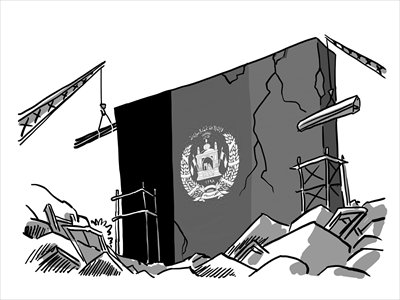
Afghanistan joined the Kyoto Protocol in April. This came into force this week. The country is one of the most vulnerable to climate change worldwide. The smog over the Afghan capital Kabul is visible kilometers away. There is a thick layer of dust on buildings and cars. People cannot breathe easily and often use scarves or masks to prevent the fine dust from getting in.
There are few green spaces in Kabul and there is no sophisticated sewage system. Instead most household waste flows in open drains alongside roads. Afghanistan's National Environmental Protection Agency (NEPA) says some 3,000 inhabitants die annually from respiratory diseases. The average particulate matter (PM) count is 190 - much higher than in the Chinese capital Beijing where it is 121 on average according to the World Health Organization.
For a green future
By joining the Kyoto Protocol, the "country has come one step further in the fight against climate change," said Ghulam Hassan Amiry, the head of the climate change department at NEPA. He added that although Afghanistan had observed the protocol unofficially before and had been represented at international climate conferences, by signing it officially, "we can benefit from financial support." Christoph Bals from the environment NGO Germanwatch agreed: "The main factors driving Afghanistan to sign the Kyoto Protocol are certainly the fight against the environmental damage caused by climate change and the support it receives in so doing. He pointed out that Afghanistan's joining would not have any worldwide impact but the move showed the government was on the right track. “It also shows how vulnerable Afghanistan is because of the consequences of climate change and that people are now beginning to reflect upon it." The United Nations Environment Program (UNEP) says that since 1989 over 6.7 million Afghans have been affected by disasters and extreme weather events such as drought, earthquakes, epidemic diseases, sandstorms and harsh winters. The fact that the glaciers of the Himalayas are melting is also creating great problems such as extreme drought. Up to 80 percent of Afghans depend directly on natural resources for income and sustenance. Agriculture provides livelihoods for over 60 percent of the population. Almost four decades of war have only exacerbated the damage caused by climate change. Ghulam Hassan Amiry says there is a great deal to be done especially as environmental protection only really became an issue a few years ago: "We don't have a sewage system and no recycling. Our natural water resources are almost depleted. Afghanistan does not have the means to solve these problems and yet they are extreme hindrances to the country's development."
First step towards a national plan
Air pollution is particularly high in Afghanistan's big cities. Elsewhere it is actually quite low because there has not been much industrialization. According to the World Bank, Afghanistan has one of the world's lowest carbon emissions rate per person, at 0.2 tonnes per capita only. However, the impact of climate change is very tangible in the South Asian country, says Ghulam Hassam Amiry. In the past 10 years, the average temperature has risen by 0.13 degrees. Classed as a developing country, Afghanistan does not have to adopt any binding emission targets. However, it does have to draw up a plan to reduce greenhouse gases, by developing a low carbon energy and transport system. The UN provides support for the development of solar, wind and other renewable energy sources. A new environment institute in Kabul is set to raise awareness about these issues and teach people how to find solutions. "We need the people's cooperation to protect the environment," says Amiry. "First, we have to create a culture of environment protection in the Afghan society." Afghanistan also suffers the effects of high carbon emissions from neighboring Iran and Pakistan which have both signed the Kyoto protocol. Noorullah Kaleem from the ministry of foreign affairs, says that banned fuels and gases often end up in Afghanistan because the borders are so porous. "We've had many discussions with our neighbors and these will continue but so far the delegation has not had any results."

Taliban attacks Kabul pres palace,

Pakistan's Tourism Industry Reels After Shootings

Pakistan's already embattled tourism industry is struggling to deal with worried customers and cancellations after Islamic militants attacked foreign climbers preparing to summit one of the world's tallest mountains, killing 11 people. For years, intrepid climbers and mountaineers, lured by a collection of awe-inspiring peaks, were some of the only international tourists willing to come to Pakistan. The region has also attracted Pakistanis looking for a respite from the summer heat in the southern part of the country. Now hotel owners, tour operators and tourism officials worry that may be in danger after the vicious attack by militants Saturday on the climbing group at the base camp of Nanga Parbat, the second highest peak in Pakistan and the ninth highest in the world. "The impact is huge," said Ghulam Nabi Raikoti, one of two brothers who run Raikot Serai, a resort in an area of northern Pakistan called Fairy Meadows. From the hotel's cottages and tents, visitors can look up at the face of Nanga Parbat, which has been nicknamed the "killer mountain" for the number of people who've died trying to climb its 8,126-meter (26,660-foot) peak. Raikoti said a tour group of 50 Pakistani students already cancelled a stay at the resort. Pakistan has been beset by militancy for years, but this attack will likely be especially disruptive to tourism because it struck foreign tourists in what is usually one of the most peaceful regions of the country. The attack also demonstrated a high degree of planning. Just getting to the base camp takes roughly two days of hiking. The militants, disguised in paramilitary uniforms, first abducted two local Pakistanis to take them to the remote camp in Gilgit-Baltistan. Late Saturday night, a group of about 15 gunmen attacked the camp, beat the mountaineers and took away mobile and satellite phones and money. Some climbers and guides were able to run away, but those that weren't were shot dead. By the end, 10 foreign tourists and a Pakistani cook employed by a tour company were killed. A faction of the Pakistani Taliban has claimed responsibility for the shootings. The remaining mountaineers who were at camps higher up on Nanga Parbat when the shooting happened have been evacuated to allow the authorities to freely comb the area for the suspects, said the president of the Alpine Club of Pakistan, Manzoor Hussain. "In that area it is difficult for someone to hide," said Hussain, who added that there will be no more expeditions to Nanga Parbat this summer. The Pakistani military evacuated 34 tourists Monday on a C-130 aircraft that flew them to Islamabad, said Muhammed Ajmal Bhatti, deputy commissioner of Diamer District near where the shootings happened; about a dozen left on Sunday. They were also evacuating the porters, guides and other Pakistanis from the area. Meanwhile, those associated with the tour industry, including tour operators affected by the tragedy, faced worried customers. Mohammed Ali, owner of Karakoram Magic Mountain, with which the slain cook was working, said a trekking tour expected later this summer was already in doubt. "I don't know if they will come or not. Last night they sent emails to me, and they want to know more information about this incident," he said. Several thousand foreign tourists a year come to the northern region known as Gilgit-Baltistan during the warmer summer months. Trekkers come for longer hikes that don't require technical skill or equipment. Climbers generally tackle the more serious peaks that require technical skills and a good deal of experience. Anyone planning to climb a peak 6,500 meters or higher or those climbing in sensitive areas, needs a climbing permit from the government of Pakistan, said Abu Zafar Sadiq, secretary of the Alpine Club of Pakistan. Thousands of families in Gilgit-Baltistan depend on the seasonal tourist trade. Families often work for three to four months in the summer and then live off that income for the rest of the year. At one point in the 1990s, about 120 to 150 climbing expeditions received permits each summer to climb in the northern region, but that number plummeted to about 20 or 30 after the Sept. 11, 2011 attacks in the United States, said Tayyab Mir, manager for publicity and promotion at the Pakistan Tourism Development. In the ensuing years, a series of terrorist attacks, military offensives, and natural disasters has largely kept tourists away. But in recent years, officials said they had started to see a slight uptick in tourism. So far, 50 groups had applied for climbing permits in 2013, said Sadiq. Now even that subtle gain seems to be in danger. A fresh threat from the militant group that claimed responsibility for the shooting is likely to even further worry prospective tourists. In a phone call to The Associated Press, a spokesman for Junudul Hafsa, a faction of the Pakistani Taliban, said they will continue attacks against foreign tourists, especially those from Europe and the U.S., until drone attacks in the tribal regions are stopped. "These attacks will become more aggressive and frequent," said the spokesman who identified himself as Abdullah Ghazi.

Pakistan: Nanga Parbat,Once-vibrant mountaineering industry staggers from killing of 10 climbers

Pakistan's once thriving mountaineering industry is reeling from the killing by militants of 10 foreign climbers, a massacre likely to drive away all but the hardiest adventurers from some of the world's tallest and most pristine peaks. A tour company present during the attack said gunmen dressed as police ordered tourists out of tents at the 4,200-meter (13,860-foot) base camp of Nanga Parbat, the country's second highest peak, late on Saturday night, then shot them and a Pakistani guide. The attack on the last peak over 8,000 meters (26,400 feet) in the western Himalayas has been claimed by both the Pakistani Taliban and a smaller radical group. The foreign victims included two citizens from China, one from Lithuania, one from Nepal, two from Slovakia, three Ukrainians, and one person with joint US-Chinese citizenship. Manzoor Hussain, president of the Alpine Club of Pakistan, said at least 40 foreigners including citizens from Serbia, Italy, Ireland, Denmark and the United States, among several other nationalities, were evacuated from a higher camp. A group of Romanians is believed to be scaling the mountain from another side. Some other groups booked for climbs this summer have already cancelled, one company said. Hussain said the attack was a “fatal blow” for his efforts to attract more climbers to the Hindu Khush, Karakoram and western Himalayan ranges, home to many unexplored summits. “We are still in shock, we've had to apologise to so many mountaineers across the world,” said Hussain, who described the attack as appalling and said he was devastated. Geographically, Pakistan is a climbers paradise. It rivals Nepal for the number of peaks over 7,000 meters and is home to the world's second tallest mountain, K2, and three more that are among the world's 14 summits higher than 8,000 meters. In more peaceful times, northern Pakistan's unspoilt beauty would be a major tourist draw, bringing sorely needed dollars to a nation that suffers repeated balance of payments crises. Mountaineers, many from China, Russia and Eastern Europe, are among the last foreigners who regularly visit Pakistan for leisure. Tourism has been devastated since 2007 by militant attacks and fighting between the Taliban and the army in once popular tribal valleys such as Swat in the northwest. The number of expeditions had also dwindled, but before the attack some 50 groups were expected this year in the remote Gilgit-Baltistan region, a stop over on the historic Silk Road. That has changed following Sunday's massacre, which sparked protests on Monday in Chilas, the closest town to the base camp, which depends on climbing for income in the summer. “I haven't slept since yesterday, it's a very sad situation,” said Ghulam Muhammed, whose company Blue Sky Treks and Tours guided five of the climbers killed at the base camp. Blue Sky is based in the town of Skardu, which is heavily reliant on the income brought by outsiders. “I am very worried, now business is finished, today two or three have cancelled, it is difficult now,” said Muhammed, who was in the capital Islamabad to speak to embassies and family members of the victims. “In Gilgit-Baltistan, a lot of the economy is from tourism - the money goes to transporters, hotels, markets, porters guides and cooks.”
HIPPY TRAIL
In reality, the tourist industry last thrived in the 1970s, when the “hippy trail” brought Western travellers through the apricot and walnut orchards of the Swat Valley and Kashmir on their way to India and Nepal. Years of war in Afghanistan helped end the overland route to Asia, and Pakistan's tourism never really recovered. While the attack on foreign climbers was a first, it did not come entirely out of the blue. Gilgit-Baltistan's Shia population has suffered a number of sectarian killings by radical Sunni groups over the past year, including one that claimed responsibility for killing the climbers. “We have been warning the government,” Hussain said. “Security was beefed up, and there were checks on the road, but we wanted security parties for the mountaineers as well.”

PTI MNA : '' Damning remarks ''

DAILY TIMES
In a particularly embarrassing moment for the second largest opposition party in the country, the Pakistan Tehreek-e-Insaaf (PTI) will have to bear the repercussions of the remarks made by PTI MNA Mujahid Ali, who demanded on the floor of the National Assembly in his maiden speech the ‘honourable’ release of murderer Mumtaz Qadri. Mumtaz Qadri is in jail, awaiting his appeal verdict against his death sentence for the cold-blooded murder of then governor Punjab Salmaan Taseer on January 4, 2011. That any sane person, let alone a member of the National Assembly, would harbour and make vocal such a dastardly demand is beyond belief. Mumtaz Qadri has been sentenced to death by the Anti-Terrorism Court (ATC) and his appeal is lying before the Islamabad High Court (IHC). It is extremely disturbing to see that there are members of the National Assembly who belong to the same mind frame as the lawyers who literally showered Qadri with rose petals. No doubt, Mr Mujahid’s sentiments have left the PTI leadership reeling and finding it difficult to recover from such an embarrassing gaffe. In an effort at damage control, the PTI leadership, including its chairman Imran Khan, has reprimanded the MNA for his thoughtless statement and said that no one can make such ‘damaging’ statements on the floor of the house. The leadership has also stated that it sides with the courts on this matter. However, what the PTI failed to mention was its complete and utter condemnation of the despicable remarks. Why did the party not take stern action after its General Secretary Dr Arif Alvi got up belatedly in the house to lamely argue that the demand was the ‘personal’ view of the MNA and not the party’s policy? If the party sides with the law then it should also side with common sense and humanity where a murderer is punished and his crime is not glorified. The IHC, in its own right, needs to stop the delays in finalisation of the verdict of the appeal, which should be nothing less than what the ATC has deemed fit for Qadri, a self-confessed cowardly murderer who violated not only the law of the land and humanity, he betrayed his trust as a guardian of the late Governor. He murdered the Governor in cold blood by emptying his magazine into his back and must be punished. The PTI leadership and its members would do well to remember that sympathy for such criminals would not sit well with the majority of levelheaded Pakistanis who really do hope for a ‘new’ Pakistan.

PTI ‘avoids’ resolution against terror attacks

Pakistan Tehreek-e-Insaf-led coalition government in Khyber Pakhtunkhwa came under criticism from opposition MPA Nighat Orakzai for being silent over terror acts rocking the province and Gilgit-Baltistan, where 10 foreign mountaineers were killed on Sunday. During the sessions on Sunday and Monday, the House did not pass any joint resolution condemning the suicide attack on an imambargah and the killing of foreign mountaineers in Gilgit-Baltistan. “This government stays silent to escape the terrorists’ wrath,” Orakzai told Daily Times after recording her displeasure on the floor of the House over the KP coalition government’s silence over the attacks in the province and elsewhere in the country. She said the previous assembly developed consensus when any incident of terrorism took place in any part of the country. “But this coalition government is so afraid of terrorists that it avoids even naming them,” the KP MPA said. “The opposition’s role is to point out an issue and the government’s job is to make a move. We played our part, but the government preferred staying silent because it does not want to annoy the terrorists,” Nighat claimed.

Pakistan: Nanga Parbats: Tourists under attack: WHY THIS?

If the country's name stood already trashed internationally for the stalking terrorism mowing down the people freely like flies in every nook and cranny of the land, the Saturday's horrific lethal terrorist strike on foreign tourists at Nanga Parbat base has reduced it just into dust. In every world street, the country's image lies in tatters. Yet the hierarchs seem still stuck up with their self-imbibed assumptions having not the remotest bearing with hard realities. Even as the thugs claim responsibility for every blood-soaked terrorist assault in these times too, it is not loathing but indulgence with which the hierarchs view them. Indeed, it is the state security apparatus at which they look with suspicion, censure and disparagement. And no doubt they leave about it that in the dock they hold the security apparatus, not the terrorist axis, for the stomach-wrenching bloodshed being inflicted on this hapless nation so callously in suicide bombings, bomb blasts and terrorist attacks. And, stunningly, with no reasonable ground on their back they feel cocksure they can woo over the compulsive merchants of death and destruction to sanity. Indeed in a damning manifest of their intellectual shallowness and superficiality, they have unthinkingly taken to the jingle that no problem has a military solution and all are amenable only to political solution. But where in the world monstrosities like terrorism have been tackled only by political means? Hasn't it been prostrated with a combination of military and political methods? And hadn't political part become effective only when the security action became decisively powerful and strong? Aren't these verifiable facts widely known worldwide? Then, why are our hierarchs playing so purblind? Why are they still averse to come to terms with this hard reality and think of a grand national counter-terrorism strategy to come to grips with terrorists both militarily and politically? Why indeed are they playing ducks and drakes with something posing existential threat to the nation? Instead of going for something serious, they are amazingly hinting at convening an all-parties conference on terrorism. What a prank? What spectacular would this circus show produce this time round when in the past it just came a cropper always? When indeed was it that our political parties were packed up with Aristotles, Socrates and Platos? When was it that these were thronged with great thinkers of tremendous vision, having no time at all for trite clichés and populist slogans and all the thirst for creative thoughts, profound ideas and innovative solutions? When indeed was it that this circus show produced something so splendid that the street flung into a binge of dance and song and the thinking class was dazed by its brilliance and sheen? What good really could you expect from this politicos' jamboree when the political parties and even religious groups are generally believed to be part of the problem, not the solution, at least in the Karachi port city that has become veritably a live killing field where no less than a score of people are done in daily in targeted shootings, gun battles, bomb blasts and terrorist attacks? Hasn't the honourable Supreme Court said it in so many words not long ago? And what dispassionate proposal could you honestly expect from the rightist parties and conservative groups whose own religiosity lags not a tad behind the militants' among the swarming terrorist mob, who ostensibly pose to be religiously-motivated? How many terrible Nanga Parbats have to happen to shake out the incumbent hierarchs from their pet assumptions and tell them tellingly that it is not a political circus show but a counterterrorism strategy that needs to be hammered out quickly and put in place for a sustained, vigorous and result-oriented implementation? The hierarchs must keep one thing in mind. If the terrorist keep prowling all over the land bloodily, which idiot in the world would even think of putting money in projects and factories in this country? And if presently foreign principals of enterprises here call up their Pakistani executives or other interested parties to Dubai for business talks, now that the TTP has announced floating of a special killer squad to murder foreigners, won't those foreign entrepreneurs henceforth stop meeting even those Pakistanis fearing that they may be disguised terrorists? The prime minister should hence waste no time in convening a top-level inter-provincial security conference to hammer out a comprehensive, multidimensional national counter-terrorism strategy and put it under execution at once. The multifaceted terrorism monstrosity's viciousness has gone too far to hurt the country and the nation incurably. Apart from federal interior, defence and finance ministers, foreign affairs advisor, all the three services chiefs, and federal intelligence agencies' head, he must invite all the chief ministers, AJK prime minister, GB chief minister and KP governor, along with their security and intelligence chiefs to work out this strategy.

Taliban attack Afghan presidential palace

http://www.reuters.com/
Taliban gunmen attacked Afghanistan's presidential palace and surrounding buildings, including the CIA's Afghan headquarters, early on Tuesday, with explosions and gunfire shaking the city center. A Reuters reporter at the palace said the attack began soon after 6.30 a.m. (0200 GMT), when at least one man opened fire with an automatic rifle at a gate to the palace in the central Shash Darak district. Karzai's whereabouts were not immediately known, though he was due to attend a press event at the palace after 9 a.m. (0430 GMT). Reporters had been gathering at the palace when the attack began and dived for cover as government forces returned fire. Heavy explosions resounded and the gunfire intensified. Schoolchildren walking to classes nearby were also caught in the exchanges. The Taliban claimed responsibility the attack in a text message to Kabul reporters from spokesman Zabihullah Mujahid. "Today at 6.30 a.m. a number of suicide bombers attacked the presidential palace, defense ministry and the Ariana Hotel," Mujahid said. The Ariana Hotel is known to house the headquarters of the U.S. Central Intelligence Agency (CIA) in Afghanistan. A thick plume of smoke was seen rising from the building. An Afghan official told Reuters the attackers had made their way into a nearby building from which they were firing. Shash Darak includes the most important buildings in Kabul, including the palace, the headquarters of NATO-led forces in Afghanistan, the Afghan Defense Ministry and the CIA's Afghan station.

Monday, June 24, 2013

Istanbul crowd marches to denounce release of police officer suspected of killing protester

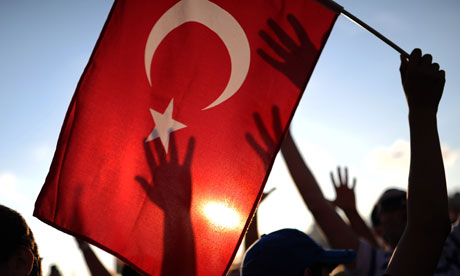
Hundreds gathered tonight on Istanbul's Asian shores to protest the court ruling to release a police officer suspected of shooting a demonstrator in the early days of the Gezi Park unrest. Having been on life support for a number of days, Ethem Sarısülük, a 26-year-old blue collar worker, passed away last week. Participants at a discussion forum in Kadıköy's Yoğurtçu Park, a gathering that has repeatedly been held since the police closed access to Gezi Park, agreed to march in order to show their indignation at the court's ruling. The crowd walked holding banners in support of Sarısülük and condemning police's violence. Hours earlier, the prosecutor in charge of the investigation into Sarısülük's killing ruled that the shooting was "within the limits of self-defense."

White House: Snowden still in Russia

The White House says they believe NSA leaker Edward Snowden is in Russia amid an international manhunt that has taken authorities and journalists around the globe this weekend. “We have known where he is and believe we know where he is now,” White House press secretary Jay Carney said during a Monday afternoon briefing. “It is our assumption that he is in Russia.” “I’m not going to get into specifics, but it is our understanding that he is still in Russia,” Carney added later in the briefing. "We have asked the Russians to look at all the options and expel Snowden to the US,” he said. Snowden, a 30-year-old American man, fled the US last month to meet with reporters with The Guardian in Honk Kong. There he supplied journalists with National Security Agency documents exposing vast surveillance efforts operated by the United States government. On late Friday, Snowden was reported to be in Moscow, Russia, possibly en route to a final destination in Latin America or elsewhere. An indictment against him was unsealed in the US earlier that day. Representatives with WikiLeaks said early Monday that Snowden submitted applications for asylum with Ecuador, Iceland and perhaps other locales. Carney, however, said the White House has been in discussions with “the diplomatic and law enforcement channels in countries where Mr. Snowden might transit.” Later in the day, President Barack Obama said the US is following all appropriate legal channels in an attempt to extradite Snowden back to America, and was working with other countries to ensure the rule of law is observed. “We are aware of where Mr. Snowden is,” WikiLeaks editor Julian Assange said in a conference call shortly before the White House briefing. “He is in a safe place and his spirits are high. Due to the bellicose threats coming from the US administration we cannot go into further detail at this time.” “Unfortunately we cannot reveal what country he is in at this time,” Assange added. Snowden was originally rumored to be heading to Cuba on Monday on the way to Ecuador, but his whereabouts remain publically unknown. “We believe we know where he is and we’re having appropriate conversations about that,” Carney told reporters. “If his passion here is for press freedom and freedom of the Internet and the like, than he has chosen unlikely protectors,” he said. Carney went on to condemn authorities in Honk Kong and mainland China and said the decision to allow Snowden to escape amid an US-authored extradition order “was a deliberate choice by the government to release a fugitive despite a valid arrest warrant.” “We are just not buying that this was a technical decision by a Honk Kong immigration official," Carney continued, adding that the action will have a “negative impact on US/China relations.” According to Assange, President Barack Obama’s actions so far, however, have hindered the reputation of the US. “The US government is taking on a generation — a young generation of people who find the mass violation of the right of privacy and open process unacceptable,” said Assange. “By taking on a generation, the Obama administration can only lose. Pursuing Edward Snowden and pursuing Bradley Manning is not the way to fix the weaknesses of laws and process in the United States. The only ways to fix these are to fix the policies. And to stop spying on the world [and] to eradicate secret law.” “The charging of Edward Snowden is not a matter of justice. It is an attempt to intimidate any country that might be considering standing up for its rights with regards to the truth,” Assange added. An indictment against Snowden was unsealed on Friday revealing charges of espionage and other counts more than two weeks after The Guardian first began leaking classified documents attributed to him.

Afghanistan presidential palace attacked in Kabul

Militants have attacked security forces near the presidential palace in the centre of the Afghan capital, Kabul. A BBC correspondent says the assailants are embroiled in clashes with President Hamid Karzai's bodyguards, as well as US personnel from the nearby CIA station. There have been a series of loud explosions, sending debris flying. The attack comes only days after Mr Karzai raised objections about US-backed peace talks with the Taliban. He said the High Peace Council, the government body set up to lead peace efforts, would not take part unless the process was "Afghan-led".

Kerry assures India and its neighbors that U.S. will not abandon Afghanistan

By Karen DeYoung and Ernesto Londoño
U.S. Secretary of State John F. Kerry assured India and other concerned partners in this volatile region Monday that the United States plans to continue supporting the Afghan military and to keep American forces in Afghanistan after the scheduled 2014 combat withdrawal, “under any circumstances.” India is particularly worried that the U.S. withdrawal will leave an ongoing war in Afghanistan between Taliban forces backed by Pakistan and other forces that have sought aid from India and Central Asian countries to combat any Taliban attempt to regain power. India also has questioned U.S. plans to conduct peace negotiations with the Taliban in a new political office for the insurgents established last week in Doha, the capital of the Persian Gulf nation of Qatar. An inaugural session of those talks was put on hold last week after Afghan President Hamid Karzai objected to the Taliban labeling the office an outpost of “the Islamic Emirate of Afghanistan,” the name under which the Taliban ruled until they were ousted by U.S. and Afghan forces in 2001. James Dobbins, the U.S. special representative for Afghanistan and Pakistan, who was scheduled to head the U.S. delegation for the talks, traveled to Kabul on Monday for damage control with Karzai and other Afghan officials. Dobbins described a meeting with Karzai as “quite positive” and said the two countries were now waiting to see “whether the Taliban want to talk.” The envoy said a “combination” of misunderstandings led to the display of a Taliban flag and an Islamic Emirate plaque on the wall of the Doha office, in violation of conditions the Afghan government had set for the talks. Dobbins said the insurgents wanted to “score a propaganda advance and they seem to have overplayed their hand.” Through Qatari intermediaries, the United States insisted that the flag and plaque be taken down. Although they were removed from sight from outside the walled Doha residence where the office is located, the Taliban said in a statement Monday that it had acted with the acquiescence of the Qatar government in displaying the trappings of a virtual embassy and did not offer to desist. Dobbins did not say when the aborted talks might be rescheduled. After the initially scheduled meeting was canceled last Tuesday, U.S. officials offered to hold it Sunday. But the Taliban indicated through intermediaries that they needed approval from the insurgent political leadership in Quetta, Pakistan, and had not yet received it. U.S. officials said they were still open to a meeting, but would not wait forever. At a news conference here Monday with Indian Foreign Minister Salman Khurshid, Kerry appeared to misstate U.S. requirements for negotiations, saying they would not be held until the Taliban met three conditions: a break in ties with al-Qaeda; an end to violence in Afghanistan; and fealty to the Afghan constitution, including respect of the rights of minorities and women. “Thus far, those conditions have not yet been met, so there is no negotiation at this point,” Kerry said. “If the conditions are met, then there is a negotiation that will take place not with the United States, but with the High Peace Council of Afghanistan.” While U.S. policy has long set the three conditions as necessary outcomes for successful negotiations, the Obama administration said last week that its two preconditions for beginning talks — Taliban statements eschewing international terrorism and recognizing Afghan democracy — had both been met. At the same time, the United States said it was ready to begin talks with the Taliban and then turn them over to the Afghan government. An administration official said U.S. policy on both the preconditions and the necessary outcomes of negotiations had not changed. Any final agreement with the Taliban, Kerry said later in the news conference, “will be decided by the Afghan people through this negotiation, or it will decided at the ballot box in 2014 without the Taliban. . . . The United States will continue, as President Obama has made clear, to support the Afghan government, to support the Afghan military, to continue to equip and train it well beyond 2014, and to continue to have a level of a force on the ground that will continue to conduct antiterrorism, counterterrorism activity.” In response to last Tuesday’s Taliban office dispute, Karzai also suspended U.S.-Afghan negotiations over the size and mission of the post-2014 force, although U.S. officials said they expected those discussions to resume. Kerry said that India has an important role to play in encouraging Karzai to prepare for presidential elections, scheduled for April 2014, and ensure they are “accessible, accountable, transparent, free and fair.” He also said Dobbins would visit India on Wednesday. During a two-day trip here, Kerry and Khurshid praised cooperation and growing economic ties between the United States and India. They said they made progress in resolving outstanding trade and investment matters. On one prickly issue, Khurshid said they “reaffirmed their commitment to full and timely implementation of the civil nuclear deal,” including the proposed sale of Westinghouse power reactors to India. He said he expected the Westinghouse agreement, which has been held up over Indian liability law, to be completed by September. The two men said they had also discussed Iran, with which India has close diplomatic and commercial ties. “We completely understand the relationship that India has,” Kerry said. “We are appreciative that India has worked hard to reduce its dependency on Iranian oil, and that has been an important step, and India has been very cooperative in communicating to Iran and in standing up publicly and holding them accountable for nonproliferation requirements.” India, Kerry said, could “help urge the new Iranian leadership, as well as the old leadership and the Supreme Leader, to take advantage of this moment,” and to “urge the Iranians . . . not to miscalculate about American and international commitment” to preventing Iran from developing nuclear weapons. Khurshid, who visited Iran in early May, before the presidential election of Hassan Rouhani this month, said he had shared his assessment with Kerry.

Ukraine condemns attack on climbers in Pakistan

The Express Tribune
Ukraine on Monday condemned the shooting of three Ukrainian climbers by militant gunmen in Pakistan and demanded compensation for the victims’ families. Attackers stormed a base camp at the foot of Pakistan’s second-highest peak Nanga Parbat late Saturday, shooting dead 10 foreign trekkers, including three Ukrainians and a Pakistani guide at point-blank range. Ukrainian Foreign Ministry spokesperson Yevgen Perebiynis at a news conference condemned the “terrorist attack” and said the government had sent a note to Pakistan’s acting representative in Ukraine calling for compensation and punishment of the guilty. “We categorically demand compensation from the Pakistan side,” he said, calling the attack “murder carried out with particular cruelty.” Pakistan’s umbrella Taliban movement claimed responsibility, saying it had set up a new faction, Junood ul-Hifsa, to kill foreigners to avenge US drone strikes on Taliban and Al-Qaeda operatives. The three Ukrainians, identified as Igor Svergun, Dmitry Konyaev and Badavi Kashayev, were travelling in a group of six from the climbing club in the eastern city of Kharkiv, the president of the region’s mountaineering and rock-climbing federation, Gennady Kopeika, told AFP. It was the worst attack on foreigners for a decade in Pakistan and an unprecedented attack on tourists visiting the north, which until Saturday’s shootings was considered immune from militancy plaguing other areas.

BBC journalist received 'threatening' tweets from Turkish mayor

The BBC has expressed concern after one of its journalists was targeted in a "threatening" Twitter campaign by a senior Turkish politician over her coverage of protests in the country. The BBC Turkey reporter Selin Girit was accused of "treachery" and acting as a foreign agent in a series of tweets by Ibrahim Melih Gökçek, the longstanding mayor of Ankara, on Sunday. The corporation said the 24-hour Twitter campaign was prompted by its coverage of the uprising against the Turkish prime minister, Recep Tayyip Erdoğan. Peter Horrocks, BBC global news director, said he was "very concerned" by the Turkish authorities' attempts "to discredit the BBC and intimidate its journalists". In a statement on Monday, Horrocks said: "A large number of threatening messages have been sent to one of our reporters, who was named and attacked on social media by the mayor of Ankara for her coverage of the current protests. "The BBC and all its journalists are committed to providing impartial and independent journalism. It is unacceptable for our journalists to be directly targeted in this way. There are established procedures for making comments and complaints about BBC output and we call on the Turkish authorities to use these proper channels." Gökçek is a member of Erdoğan's ruling Justice and Development party (AKP), which has become the focus of protests in and around Istanbul since 28 May. In a stream of tweets targeting the BBC reporter, he asked: "Who is @selingirit? BBC's reporter in Turkey. Led by England, they are trying collapse our economy via agents hired, both nationally and internationally. They are dreaming for Turkey to be the 'Sick man of Europe' once again. Here is a concrete proof." He asked his nearly 700,000 followers to "show their democratic reaction" to Girit and attempted to popularise the Turkish hashtag "#INGILTEREADINAAJANLIKYAPMASELINGIRIT", roughly translated as: "Don't be a spy in the name of England Selin Girit." The campaign against Girit drew condemnation from the International Federation of Journalists, whose president, Jim Boumelha, urged Turkish authorities to "stop targeting and intimidating journalists and allow them to report protests without fear and censorship." The Turkish branch of the BBC's National Union of Journalists (NUJ) chapel also issued its public support for Girit. Michelle Stanistreet, NUJ general secretary said: "We want to send a strong message to Turkish authorities – it is simply not acceptable to target journalists in your turbulent times. "We condemn the attempts to intimidate journalists and the threats must stop immediately. Those who are responsible for the attacks need to back off. The freedom of the press is essential for all Turkish citizens and the rest of the Turkish people around the world – we need journalism in the public interest and we want to know about Turkey."

Bangladesh: WAR CRIMES TRIAL : Terrorists of “Al-Badr leaders” indicted

WAR CRIMES TRIAL Mueen, Ashraf indicted
A Dhaka tribunal on Monday framed 11 charges against “Al-Badr leaders” Chowdhury Mueen-Uddin and Ashrafuzzaman Khan in absentia for their alleged involvement in crimes against humanity committed during the country’s Liberation War in 1971. The charges include abduction and murder of intellectuals of the country at the fag end of the Liberation War. The International Crimes Tribunal-2 also set July 15 for opening statement in the case and examination of prosecution witnessess. The three-member tribunal led by Justice Obaidul Hassan asked the state appointed defence counsels to submit a list of defence witness and other documents if they have any by the date.

John Kerry admonishes China, Russia on Edward Snowden

Washington would not look favorably if it turns out that China and Russia purposely chose to ignore American desires to apprehend National Security Agency leaker Edward Snowden on three felony counts, U.S. Secretary of State John F. Kerry said on a three-day visit to India.
Terming Snowden an indicted felon, Kerry said all appropriate countries have been notified of his status. “It would be very disappointing if he was willfully allowed to board an airplane” from Hong Kong to Moscow, Kerry said at a news conference with Indian Foreign Minister Salman Khurshid, adding that he “would be deeply troubled” if Russia and China knew of Snowden’s plans, “and there would be, without any question, some effect and impact on the relationship and consequences.” “I’d urge them to live within the law,” Kerry added. “It’s in the interest of everyone.” Snowden, 30, an American citizen who has embarrassed the Obama administration by exposing the breadth of U.S. surveillance programs, has eluded U.S. efforts to arrest him. Considered a traitor by some and a folk hero by others, Snowden has kept a step ahead of U.S. authorities who have charged him with violating the Espionage Act and stealing government property. The latest speculation is that the former Booz Allen Hamilton contractor is headed for Ecuador by way of Cuba and Venezuela, although he appeared to have missed a flight to Havana that he had been expected to take. Kerry took a swipe at the civil liberties of countries Snowden has chosen to work with in eluding the U.S. "I wonder if Snowden chose Russia or China for assistance because they are such bastions of Internet freedom," he said.

Tourists Ask Russia to Evacuate Them from Pakistan

Hours after a deadly militant attack, a group of mountain climbers in Pakistan has requested Russia to evacuate them, Russian Mountaineering Federation executive director Alexei Ovchinnikov told R-Sport on Sunday. According to media reports, at least a dozen Islamic militants dressed in police uniforms shot nine tourists and a local guide early on Sunday after rousing them from their sleep in a hotel at the foot of the world’s ninth-highest mountain, Nanga Parbat, in northern Pakistan. "We have already contacted the Russian emergencies ministry [with the request]. In addition, our Ukrainian, Georgian and Lithuanian colleagues are set to ask the Russian Foreign Ministry and [its head Sergei] Lavrov to evacuate survivors and dead bodies by plane next week,” Ovchinnikov said. BBC said five Ukrainians, three Chinese and a Lithuanian national were killed, but Lithuanian diplomats did not confirm the report, saying the information is currently being verified. According to the data obtained by the Russian Mountaineering Federation, no Russians were among the victims. “A Lithuanian national, Ukrainians and people whose nationality is yet unclear were killed in the attack. Possibly, two Georgians also were there, but their fate is unknown. We were unable to contact the tent camp where the shooting took place,” Ovchinnikov said. He said that initial reports that a Russian national was killed were not confirmed by Russian mountaineer teams in the area. “We contacted our teams via a satellite phone. So far, they say that all Russians there were unharmed. They are yet to be evacuated from a camp near the site of the attack, and from a gorge nearby,” the official said. He also said that the number of Russians in the area is yet to be established. According to Ovchinnikov, three groups of Russian mountain climbers have flown to Pakistan recently: one is currently guarded by the Pakistani servicemen, the second has no armed guards and the third has just arrived at Islamabad and is now safe. "We are now trying to determine the exact number of Russians, there might be a dozen of them but no exact figures are available… Unfortunately, there are also people in the area who are just travelling, not climbing mountains. So now we are trying to find out if there are Russians among them,” he said.

CCTV VIDEO:- '' PML-N MPA slaps bus hostess ''

She should be slapped by the same road hostess publically, infront of the punjab assembly to give message to all other MPAs and make it sure that all others remain in their okaat. She should also be sentenced for atleast a year along with 10 years ban to hold any public office. Rights of the people of pakistan should be protected.

Manal al-Sharif: A Saudi woman who dared to drive

Pakistan: Christians in Rahim Yarkhan under threat of life by Muslim extremists

The Voice team requests you to pray for the Christian brothers and sisters residing in Nasrat Colony, Bheel Nagar, Rahim YarKhan about 650 kms away from Lahore. The Voice got a call from the source that in Nasrat colony there are about 2,000 Christian families are residing and the whole Christian colony is surrounded by Muslims there. Sipa-e-sahaba a radical Islamic organization attacked the colony and threatened the Christians that they will burn down the whole colony within two days. The reason is that, a Christian family residing there named Sadiq Masih's family had a dispute with a Muslim family named Mohammad Javed Sanjhu. the Muslims created the dispute on 21st June at about 6:00 pm in the evening saying that Sadiq Masih's nine years old son-in-law is sexually harassing the Muslim women of Javed's family. javed along with about 20 Muslim fellows of Sipa-e sahaba and entered the house of Sadiq Maish, they raised slogans and started firing at the house due to which the neighbors gathered around the house of Sadiq Masih and called the police. the attackers left the house after that and the Christians of the colony gathered and went to the police station to file a complaint against the Muslim group. When they returned home they heard the announcements on the loudspeakers of the Mosques that were inviting all sipa-e-sahaba group to attack the Christian Colony. Meanwhile, the Muslim group started gathering the Christian colony the Christians called the police but nobody came, than the Christians of the colony started protest against the Police and the Muslim group. After the protest started police went there and dispersed the Muslim crowd. The Voice came to know about this incidence and immediately contacted the DPO (District Police officer), DSP, (Deputy Superintendent of Police) and SHO (Station house officer) named Malik Ashraf, of the police station C-Division RahimYar khan to take the immediate and safe measures. At about 12:00 am in the night SHO told the Voice team that he have deputed two police wagons and is arranging for more Squad that will be arranged by 2:00 am. The Voice team is ready to take all the precautionary measures to save our Christian Brothers and sisters in Christ and are contacting all of our friends and contacts in order to avoid a terrible terrorist attack on a Christian Colony. The Christians are still sitting there outside their houses and trying to protect their houses. The Voice team is with them. Please pray for all our brothers and sisters in Christ and for the Voice team so that God may help us all in this dreadful situation and save us all.

Pakistan: ''Blood-soaked reality: Killing of foreigners''

EVENTUALLY, the illogic of conspiracy will have to give way to reality. Waliur Rehman, a TTP leader mind-bogglingly referred to by Imran Khan as ‘pro-peace’, was killed by an American drone, so now the TTP has killed nine foreigners in remote Gilgit-Baltistan in revenge. And instead of the focus being on how to prevent Pakistan from slipping further towards international isolation and internal instability, the question that will likely be asked most frequently, in the media, by the political class, by large chunks of civil society, is what can be done to stop drones strikes. The problem with the drone debate is not that it is unimportant but that it tends to obscure a more fundamental and important question: what to do about the TTP? And that more important and fundamental question is itself wrapped up in another set of distractions, namely whether or not to negotiate over what is not negotiable. Unhappily, the newly elected government appears to already be falling into the trap of rhetoric as a substitute for action. Interior Minister Nisar Ali Khan has set an admirable new tone by speaking plainly and bluntly about all that ails Pakistan on the security front. That is good. But all the straight talk in the world will not substitute for a meaningful policy against militancy — and the necessary corollary of wresting national security policy from the army leadership. It is here that the PML-N already seems to be falling into the old trap of inaction through summits and all-party conferences and the like. Already, Prime Minister Nawaz Sharif appears aloof and disconnected, allowing his ministers to speak for his government instead of leading from the front himself. For the army’s part, a pattern now seems obvious: everything but North Waziristan can be tackled. The reasons for that can only be guessed at, but could it have something to do with the impending transition in Afghanistan, after which the much-loved Haqqani network may be encouraged to move its operations to the other side of the Durand line and then the TTP will be taken on? If Pakistan’s internal security is in fact linked to an external agenda, then perhaps the TTP is only a symptom of the disease. Bringing about change, particularly in powerful, entrenched institutions, is always a difficult undertaking. But if the Pakistani state doesn’t change its approach, the TTP will change Pakistan for all of us.

Balochistan : TWO WARS

The Baloch Hal
By Sajjad Hussain Changezi
Troubled Balochistan, in its unending series of sufferings, went through two most highlighted and yet insufficiently identified incidents of violence just a few days back. On the night between June 14 and 15 2013, Muhammad Ali Jinnah’s historical residence in Ziarat was burnt down by the separatist outfit, the Baloch Liberation Army (BLA). The following day Quetta witnessed students of Sardar Bahadur Khan Women University blown up by the first female suicide bomber in the history of Balochistan. This attack was followed by two more suicide attacks inside Bolan Medical Complex where the injured were being treated. The events that unfolded on June 15 were claimed by the sectarian outfit, Lashkar-e Jhangvi (LeJ). Balochistan is at war on two fronts – the militant nationalist insurgency led by the BLA to separate Balochistan from Pakistan and the sectarian ‘jihad’ launched by the LeJ with the mission to wipe off Shias (predominantly Hazaras) from Balochistan (and ultimately Pakistan). While Balochistan remains lost in the myths of national security, sovereignty and integrity, the two wars continue to be confused when we must be able to distinguish between them. Why is there a need to distinguish between the LeJ and the BLA? Don’t both deny the writ of the state and the constitution in practice? Shouldn’t all militant organisations be treated absolutely the same way? Any serious student of conflict resolution will warn against ignoring the dynamics of a certain conflict and imposing a single ideal solution to resolve any and all conflicts. The BLA and the LeJ have much less in common than was repeatedly claimed by former interior minister Rehman Malik. The two militant organisations draw inspiration from different ideological sources, the tactics of their insurgencies are different, the targets to hit and the goals to achieve are different and, most importantly, their capacity to cause havoc are different. What are partially overlapping are the time and area of their actions. They are also similar to the extent that they use the Baloch youth as foot soldiers and at times government officials as their targets. Baloch insurgent groups are an expression of anger and desperation from those who politically identify themselves as Baloch and who are afraid of being absorbed by the giant demographic and political structure of the rest of Pakistan. The separatist groups vow to ‘rescue’ the Baloch (and break up Pakistan) in the face of decades of marginalisation, neglect and exploitation by the centre. On the other hand, the Lashkar-e-Jhangvi, unprovoked in the context of Balochistan, has taken up the voluntary task to eliminate the Shia community and declare Pakistan a Sunni state. Taking pride in its socio-political secular history, the BLA condemns the jihadists’ agenda and disassociate itself with the Baloch separatist movement of Jundullah that is at war with neighbouring Iran. Tactically speaking, the BLA and its fellow insurgent groups have never deployed suicide bombers and their modes of attacks often include rockets, cycle bombs, domestic IEDs and hand grenades. The LeJ, like its fellow Tehreek-e-Taliban Pakistan (TTP) has, however, demonstrated its capacity to attack via target killings, IEDs, suicide bombings, liquid bombs, and heavy vehicles laden with explosives. These attacks have killed at least 1200 members of the Hazara Shia community alone, apart from scores of policemen, judges, lawyers and non-Shia, non-Hazara citizens. On the contrary, Baloch insurgent groups mostly target the infrastructure of mega projects, representatives and symbols of the state and its institutions, as clearly demonstrated by their attack in Ziarat. It seems the two organisations have different strengths. While the Baloch insurgency has a deep-rooted political base due to the decades of negligence and exploitation increasingly admitted by Pakistani intellectuals as well, the LeJ has its militancy and potential for violence as its peculiarity. It is therefore a rational recommendation that if we are to win Balochistan back, we need to tackle the Baloch issue on political grounds and the LeJ’s sectarian agenda with strategic might. Challenging this notion of delicately applying two different strategies to the two different conflicts and their stakeholders, there is a strong voice advocating ‘absolutely zero tolerance towards any form of aggression that amounts to terrorism’. This approach recommends painting both militant organisations with the same brush. Instead, what happens is different treatment meted out to the two. Baloch insurgents and activists – perceived as Enemy No. 1 – are abducted, tortured, killed and dumped, or made to disappear. On the other hand, the LeJ and its mother organisation, the Sipah-e-Sahaba Pakistan (SSP) currently known as Ahle Sunnat Wal Jamaat (ASWJ), have held mass rallies in the biggest cities right under the eye of security agencies. Hate literature by sectarian groups goes unchecked whereas Baloch websites, even moderate ones like The Baloch Hal, stay banned. If Pakistan continues this way, we are doomed to lose both battles, for we are offering space to the LeJ by making obvious and silent ‘deals’ with them, and by crushing the Baloch nationalist movement with brute force, we are deepening their sense of deprivation, desperation and anger. Of the two organisations, the one that needs to be tackled using physical might is permitted socio-political space while the one that deserves political understanding is being dealt with using uncompromised force. As wrong policies continue to be implemented, it’s the non-combatant citizens of Balochistan that pay the heaviest price.

Fake degree: Police arrest former PML-N MNA

Police arrested former parliamentarian Syed Salman Mohsin Gilani after a court in Lahore sentenced him for contesting 2008 elections on a fake degree, Express News reported on Monday. Gilani belongs to Pakistan Muslim League – Nawaz (PML-N) The court awarded him a one-year-long jail term and ordered him to pay a fine worth Rs30,000. In August 2012, a case was registered against Gilani for contesting elections on a fake degree after the Election Commission sent his documents for verification and found them to be bogus. On April 19, 2013, the Lahore High Court granted protective bail to Gilani till April 26. Gilani contested the general election in 2008 from the NA-165 constituency of Pakpattan.

Afghan prospects strong for post-US era

The US-led coalition forces have announced their planned withdrawal from Afghanistan in 2014. To meet the deadline, many members have already started extracting their soldiers and equipment from Afghanistan. A number of initiatives have already been undertaken as part of the transition in Afghanistan.
The Afghan National Army is taking the lead in securing Afghanistan. The coalition forces are switching to a support role by providing training, equipment and financial support. And the Afghan National Police forces are getting more professional and responsible for security in Afghan cities. In addition to transition in security issues, Afghans are taking on more responsibilities in leading development activities. The Afghan government is assuming more ownership in public service delivery and the private sector is doing most of the things international contractors used to do. When the Soviet Union left, the Afghan government was weak and limited to big cities, and an ideology-driven insurgency was much stronger in the country side. Besides, unemployment was high, the economy was in a critical situation, and the central government had uneasy relations with its neighbors, like Pakistan. The present Afghan government also grapples with similar issues. However, the situation is far less threatening than it used to be in the 1990s. Unlike in the 1990s, Afghanistan is now constitutionally an "Islamic Republic" forestalling any organized ideological confrontations. The present Afghan government and society enjoy better international relations and support than in the 1990s. Most Western countries have established strategic partnerships with the Afghan government, outlining their commitment to supporting Afghanistan well beyond 2014. In addition to the strategic partnership documents, Afghanistan and the US are negotiating a compact that spells out the responsibilities of the residual US military presence in Afghanistan. Other than a few public schools and universities in 2001, Afghanistan had no private schools or investment in education. But today, Afghanistan has many private schools that complement the public education system. Private investment in the health sector has also helped in the boom of private health facilities across the country. Some, such as the DK German Medical Diagnostic Center in Kabul, are explicitly foreign-owned, providing top quality services in Kabul. Developments in infrastructure construction, information technology, media and communication, banking, aviation, mining, trade and financial services have been unprecedented. Ordinary Afghans have mixed feelings about Afghanistan's future. Most recognize the mentioned developments, while they also understand that a lot more need to be done to keep the momentum going. A taxi driver in Kabul told me that "The situation in Kabul has changed drastically. In the past, one could not go safely from east to west and paved roads did not exist. There wasn't enough food, and having a car was a luxury. But today that has changed. Ordinary people can travel freely in Kabul and many provinces of the country. More Afghans have got involved in successful private businesses." There is a consensus both among Afghans and the international community that nobody wants a return to the 1990s. A huge amount of blood and treasure, both by outsiders and Afghans, have been spent in bringing Afghanistan to where it is now. Many factors will have a profound impact on future stability: the conduct and perception of the upcoming presidential elections in 2014 and the parliamentary elections in 2015, improvements in Afghanistan's relations with its immediate neighbors, international attention and support for the young democracy, investment and diversity in the Afghan economy, and more continuous investment in competent and motivated young Afghan men and women. If Afghans can stay united, they will have the hope of continuing their achievements and forging a better life post-2014.

UN chief "appalled" by attack on foreign tourists in Pakistan

UN Secretary-General Ban Ki-moon on Sunday urged the government of Pakistan to take immediate measures on the perpetrators of the violent attack that led to 11 deaths, saying he was "appalled" by the killing. Ban was appalled by the reported killing on Sunday of a group of foreign climbers in the area of Gilgit-Baltistan in northern Pakistan and extended his condolences, said a statement issued by his spokesperson. "While reiterating the support of the United Nations to the government of Pakistan in the face of terrorism and extremism, he urges it to take immediate measures to bring the perpetrators to justice and to ensure security," the statement said. Unidentified gunmen opened fire at tourists in a hotel near the base camp of Nanga Parbat, a mountain in Pakistan's northern area that is popular among adventurous travelers. The attack killed 11 people, among whom 10 were foreigners. The incident occurred near the border between China and Pakistani Kashmir. The identities of four foreign tourists have been determined. They were two Chinese nationals, one Chinese American and one Nepalese. Later on Sunday, the Pakistani Taliban claimed it had carried out the attack to avenge the death of their deputy leader in a U.S. drone strike in May. In his statement, the UN chief expressed his deep concern over the mounting terrorist attacks and bombings in Pakistan, which in the past several weeks alone have claimed the lives of dozens of civilians. The country has witnessed a series of violence over the past few weeks. A female bomber attacked a bus of a women's university in the southwestern city of Quetta on June 15th, killing 14 students. Just two days later, at least 28 people died in attacks in the same city.

PAKISTAN: '''Tourists’ killing'''

In an incident that appears to be unique in the history of Pakistan, nine foreign tourists and their Pakistani guide have been murdered in an attack that by mid-afternoon on Sunday was being claimed by the Tehreek-e-Taliban Pakistan. There have been rare instances of foreign tourists being attacked or robbed, and two or three reported murders over decades, but never a mass slaying such as this. The area the trekkers were killed is extremely remote, about 18 hours’ walk from the road. One Chinese man is reported to have survived but this is unconfirmed as yet. Their killers, according to the TTP, were the Junud-e-Hafsa faction and were acting in revenge for the killing of TTP chief Waliur Rehman Mehsud and as a protest against American drone attacks. Ehsanullah Ehsan speaking for the TTP said that ‘This will tell the international community about our feelings and sentiments against the killing of our fighters’. Such are the bald facts, and more details will eventually emerge. Reaction has been swift; Interior Minister Chaudhry Nisar Ali Khan immediately suspended the IG Police and the chief secretary of Gilgit-Baltistan. The National Assembly passed a unanimous resolution on Sunday afternoon condemning the attacks. Suspensions and condemnations aside, this incident is going to echo around the world. It is said that the tourism industry in Gilgit-Baltistan was in ‘recovery mode’ and that, while not exactly booming, there was a sharp rise in domestic tourism and foreign tourists were also beginning to reappear. Pakistan has the potential – and the infrastructure – to be a world-class destination for adventure tourism, but the attack in Bunar Nullah is going to seriously knock back the much-needed recovery. Reports from local people say that there were no threats against tourists and security for tourists was either very light or wholly absent. This has changed in the blink of an eye as the TTP has brought foreign tourists into its sights, and foreign missions are going to be reviewing the travel advisories for their nationals. The interior minister is reported to have told the Chinese ambassador that Pakistan, rather than the Chinese people, were the target of the attack – which was designed to give the impression that Pakistan was an ‘insecure country’. On the evidence of the past fortnight with mass slaughters countrywide this is a difficult perception to gainsay. Whoever did the killing will have been local to the area, familiar with the mountains and moving around in them. Sealing roads or putting extra guards on tracks and trails will be meaningless as they can be easily circumvented. The jobs of hundreds of people in the tourist industry are now on the line and the image of Pakistan worldwide has just taken another kick in the face. The message from the TTP: all foreigners anywhere in Pakistan are considered targets.

President Zardari slams tourists’ killing

DAWN.COM
President Asif Ali Zardari on Sunday condemned the terrorist attack on a group of foreign tourists in Gilgit-Baltistan and directed the authorities concerned to present a report to him on the incident. Expressing shock and sorrow over the incident, the president said such acts of barbarity would not be tolerated and asked the authorities concerned to take stern action against perpetrators of the heinous crime. He expressed sympathy with the bereaved families and said the government and people of Pakistan shared their grief and sorrow at this hour of distress. He held out an assurance that every action would be taken to arrest culprits involved in the heinous act and bring them to justice

Bushra, Pakistan Actress, Suffers Burns After Acid Attack In Her Home After Refusing To Marry Producer

A young Pakistani actress has suffered burn injuries in an acid attack in northwest Pakistan, her relatives and police say.The 18-year-old, known as Bushra and popular in the northwest for her film, television and theater appearances, was attacked on Saturday while asleep at her home in the town of Nowshera, 148km northwest of Islamabad.
“A man climbed the wall of our house in the early hours, threw acid on my sister and fled,” Bushra’s brother Pervez Khan told AFP news agency on Saturday. A local police official, Sultan Khan, also confirmed the incident. Bushra was immediately taken to Lady Reading Hospital in Peshawar where Dr Suhail Ahmad said she had suffered 33 percent burn injuries, on her face and shoulder, but was in a stable condition. Pervez Khan has lodged a complaint against a local TV drama producer, Shaukat Khan, over the incident, saying that he was unhappy over Bushra’s refusal to marry him. Acid attacks are common in Pakistan with scores of such assaults taking place each year.

Gilgit–Baltistan: Chief Minister G-B applauds performance of sacked officials

Chief Minister Gilgit–Baltistan Mehdi Shah on Sunday applauded the performance of Chief Secretary G-B and regional police chief hours after Interior Minister Chaudhry Nisar Ali Khan suspended them for failing to provide security to the foreign tourists in Nanga Parbat. “Removing both the officials before launching an inquiry in to the tourists’ incident is not in the interest of G-B,” said a press note issued by the chief minister’s office quoting him. Shah was addressing a cabinet meeting held in Gilgit soon after the Nanga Parbat incident rocked the country. In his address to the National Assembly, the interior minister announced that Chief Secretary Munir Ahmed Badeni and IGP Usman Zakrya have been suspended in the wake of the attack that had left nine foreign tourists dead at Nanga Parbat base camp. In G-B, Pakistan Peoples Party (PPP) is the ruling party of the coalition government, with Mehdi Shah as its chief minister and Pir Karam Ali Shah as governor. “If terrorism could be overcome by such acts, the officials in Balochistan and Khyber–Pakhtunkhwa should have been removed,” he added. Shah appealed to Prime Minister Nawaz Sharif to reinstate the officials in the interest of G-B.