 Prospects of agreement between Moscow and Washington on how to end the war in Syria looked as remote as ever on Monday after a chilly bilateral meeting between Barack Obama and Vladimir Putin ended with a stiff exchange of diplomatic pleasantries.

 Prospects of agreement between Moscow and Washington on how to end the war in Syria looked as remote as ever on Monday after a chilly bilateral meeting between Barack Obama and Vladimir Putin ended with a stiff exchange of diplomatic pleasantries.
http://www.theaustralian.com.au/

 Turkish police have arrested 500 people during anti-government protests in the capital city of Ankara and Istanbul, amid calls for a nationwide strike, Press TV reports.
The arrests were made on Sunday as part of a crackdown on protests that have gripped the country for some three weeks.
Meanwhile, two of Turkey’s main trade unions have called a one-day nationwide strike in protest against police violence against anti-government demonstrators.
Union confederations DISK and KESK have stated that they will go on strike on Monday in protest at a police raid on a protest camp in Istanbul’s iconic Gezi Park.
The unions represent hundreds of thousands of workers and the stoppage is likely to affect schools, hospitals and public offices across the country.
Three other groups representing doctors, engineers and dentists said they will also join the action.
On Sunday, Turkish police once again fired tear gas canisters and used pepper spray and water cannons to disperse crowds of protesters trying to converge on Taksim Square.
On the same day, Turkish Prime Minister Recep Tayyip Erdogan said it was his “duty” to order the police to evict protesters staying at the park.
On June 15, police attacked anti-government protesters at Taksim, shortly after Erdogan ordered the demonstrators to evacuate the area.
The unrest in Turkey erupted after police broke up a sit-in staged at Taksim Square on May 31 to protest against a government plan for the redevelopment of Gezi Park.
The Turkish prime minister has faced international condemnation for his handling of the unrest. Turkish police have also been strongly criticized for using excessive force against the peaceful protests.
Five people, including a police officer, have reportedly died in the clashes and more than 5,000 protesters and 600 police officers have been wounded.
 AS Lashkar-i-Jhangvi, that claimed responsibility for the horrific violence in Quetta on Saturay, strikes again and again in Balochistan, there may be a temptation to regard it as an out-of-control problem in an out-of-control backwater. But LJ is part of a continuum of militancy and extremism that has a long history and an ever more threatening future — a threat to all of Pakistan, not just particular regions. The history of LJ itself underlines the complexity of the threat from militancy today: what began as an anti-Shia agenda and targeted killings has morphed into an expansive list of targets, some seemingly picked at random and without much concern about whether women or children are direct victims. There is the LJ in Balochistan, which is alleged to have developed links with the Baloch separatists. There is the LJ in the tribal areas, which has long-standing ties to Al Qaeda and now the TTP. There is the LJ in Punjab, which continues to grow and develop its network inside the umbrella Punjabi Taliban. Taken together, they pose a formidable threat across the country, not just Balochistan. And LJ is only one aspect of a multi-dimensional and multi-faceted militancy threat.
The pervasiveness of the threat does not, however, mean that a modular, regional approach to countering it cannot be implemented. In Balochistan, LJ’s rise is intrinsically linked to a security policy that is controlled and directed by the army-led security establishment. The space for non-state actors’ singular obsession with crushing the Baloch insurgency through violence meant that other non-state actors were able to take advantage of the state’s focus elsewhere. Even worse, there are allegations that the obsession with crushing the Baloch insurgency also led to encouraging pro-state Baloch militants who have their own agendas, including developing ties with LJ. The Baloch separatists remain a problem — the shocking destruction in Ziarat on Saturday is evidence enough — but state policy is an even bigger one. Where a political problem — the Baloch insurgency — is being dealt with by brute force, the problem that does require an iron fist — LJ — is being left largely unaddressed. Both policies, extreme action against Baloch separatists and extreme inaction against LJ, must change and for that a reckoning with army-led security policy is needed first.
Beyond Balochistan and LJ, the bigger picture is almost as bleak. The transition to democracy may appear on track but the politicians have so far made no effort to reach for the holy grail: national security and foreign policy. The euphemistically termed non-state actors cannot and must not be elements of this country’s national security and foreign policy because they are the single greatest threat to Pakistan’s security and relations with the world. Will the army listen?
reuters.comGerman Chancellor Angela Merkel said on Monday she was shocked at Turkey's tough response to anti-government protests but she stopped short of demanding that the European Union call off accession talks with the candidate country. "I'm appalled, like many others," Merkel said of Turkey's handling of two weeks of unrest that began over a redevelopment project in an Istanbul park but has grown into broader protest against Prime Minister Tayyip Erdogan's government. "I would like to see those who have criticism, who have a different opinion and a different idea of society, having some space in a Turkey that moves into the 21st century," Merkel told German broadcaster RTL. Asked whether Ankara's response to the protests was in line with the way an EU accession candidate should act, Merkel said: "What's happening in Turkey at the moment is not in line with our idea of the freedom to demonstrate or freedom of speech. "They are terrible images. ... I can only hope that the problems will be solved peacefully," she said in the German TV interview, which was due to be aired later on Monday. EU politicians are divided on whether interrupting accession talks would help or hamper Turkey's democratization process. EU officials say Germany is reluctant to open a new area of negotiation with Turkey this month. Berlin denies any direct link with the latest events but the foreign ministry says talks that began in 2005 were going to be a "very, very long process". Merkel has backed Turkish accession talks while at the same time expressing skepticism about its future EU membership. Speaking just before departing for a Group of Eight summit in Northern Ireland, Merkel reiterated her position that Germany would not arm rebels fighting Syrian President Bashar al-Assad. The G8 summit was set for a clash between U.S. President Barack Obama, who is now ready to send weapons to Syrian rebels, and Russia's Vladimir Putin, who backs the Syrian government. "We do not supply weapons ourselves. We do not contribute to that. That's against our rules," Merkel said. "Russia must play a role in the process. Otherwise there will be no peace."
nationalpost.com
BY-Robert FulfordMany of the brave Turks who have defied tear gas and water canons during the last two weeks have told reporters they are afraid that Turkey is being gradually turned into an Islamic Republic. In many cases they are Muslims (like nearly all Turks) but they also believe in secular government, the Turkish way of life since the 1920s. They think that Recep Tayyip Erdogan, the defiant and peevish prime minister, wants to reverse Turkish history. Apparently he’s attempting, in his sly way, to undo Kemalism, named after Mustafa Kemal Ataturk, who led Turkey into modernity. Kemalism separated religion from politics. That constitutional change wasn’t challenged until recent times. But in 2007 about 300,000 secularist Turks were concerned enough to demonstrate in the capital, Ankara, against Erdogan’s re-election. With banners showing Ataturk’s image, they argued that Erdogan and his Justice and Development Party (AKP) had an Islamic agenda. “Turkey is secular and will remain secular forever,” they shouted. Five years later, there are signs that they were right to be worried. So the demonstrations that began on May 31 over the destruction of Gezi Park have turned into a furious national debate about how Turkey is governed.Legislation adopted last month by parliament bans the sale of alcohol between 10 p.m. and 6 a.m. and forbids all liquor advertising. Erdogan claims he wants only to protect “new generations from such un-Islamic habits.” He’s said he hopes to see a “pious generation.” He told an AKP meeting that the state hasn’t outlawed alcohol. “People can still buy alcohol and drink it in the privacy of their own homes.” Public spaces, on the other hand, are under government jurisdiction. His government has announced that a new bridge over the Bosphorus will be named after Sultan Selim I, the 16th-century Ottoman potentate who ordered the massacre of 40,000 Alevi Muslims, who were (and in some cases still are) considered heretics in Turkey by the majority Sunnis. Selim was said to believe that “the killing of one Alevite had as much otherworldly reward as killing 70 Christians.” Government apologists have said no harm was meant but it would be hard to see honouring Sultan Selim I as the action of a secular state. Last month a young couple kissing in a metro station in Ankara found themselves instructed, through the public address system, ‘to act in accordance with moral rules’ “We were born and raised on the land that is the legacy of the Ottoman Empire,” Erdogan said in a taped interview. “They are our ancestors. It is out of the question that we might deny that presence. It’s very natural for us to use what was beautiful about the Ottoman Empire.” Erdogan’s ministers also show great affection for the past. His foreign minister, Ahmet Davutoglu looks forward to a “great restoration” that will embrace “the ancient values we have lost.” He wants to save the Turks from the “new identities that were thrust upon us in the modern era” — the period in the 20th century when clothing was Westernized, secular schools were introduced and women were encouraged to pursue careers. Many of the protesters are young and middle class; they take secularism for granted and deeply resent any quasi-official interference with their lives. Last month a young couple kissing in a metro station in Ankara found themselves instructed, through the public address system, “to act in accordance with moral rules.” Of course there are no moral rules covering kissing; just Islamic practice that keeps males and females at a distance in public.A day later a crowd of 100, assembled by social media, began a mass kissing on the same site. Some held signs that said “Free kisses.” About 20 traditionalists staged a counter-protest, chanting “Allahu Akbar!” Police separated the opposing groups. Erdogan has been elected prime minister three times in a row, his opinion polls are better than most successful politicians and Turkey’s economic record is, by international standards, enviable. But his tone, and his management of every issue that arises, suggest that he would really like to be a dictator. Dictators can use an official religion to maintain power, just as religious leaders can use the state to force their rules on the population. Iran is the most obvious case today but history provides scores of others. Possibly that’s Erdogan’s plan. The events of the last 15 days demonstrate that a change so fundamental could only be accomplished by ripping the social fabric of the whole country. At age 59, however, Erdogan can imagine exercising power for 15 years. Perhaps he hopes to win a place in history as the anti-Ataturk.
USA TODAY

 Political prisoners have gone on a hunger strike in Saudi Arabia to protest against their imprisonment without charge or trial, and the horrible jail conditions, Press TV reports.
Activists say more than 70 inmates have stopped eating in a bid to draw international attention to the inhuman prison conditions in Saudi Arabia.
They hope that their protest would prompt an immediate action to stop the gross violation of human rights in Saudi jails.
Saudi activists say there are more than 40,000 political prisoners, mostly prisoners of conscience, in jails across the kingdom.
According to the activists, most of the detained political prisoners are being held by the government without trial or legitimate charges.
Some of the detainees are reported to have been held without trial for more than 16 years. Attempting to incite the public against the ruling regime and the allegiance to foreign entities are usually the ready-made charges against political dissidents in Saudi Arabia.
Families and relatives of political prisoners have held several public gatherings in major cities, including Riyadh, Mecca, Medina and Buraidah. However, their protests have failed to bear any results.
Since February 2011, protesters have held demonstrations on an almost regular basis in Saudi Arabia, mainly in the Qatif region and the town of Awamiyah in Eastern Province, primarily calling for the release of all political prisoners, freedom of expression and assembly, and an end to widespread discrimination.
However, the demonstrations turned into protests against the repressive Al Saud regime, especially after November 2011, when Saudi security forces killed five protesters and injured many others in the province.
According to Human Rights Watch, the Saudi regime “routinely represses expression critical of the government.”

Education: a provincial expenditure priorityEducation in Pakistan has never received the funding that has been suggested by a host of international agencies including the United Nations that has recommended to developing countries to invest at least 2 percent of its Gross Domestic Product on education. The rationale behind this recommendation with specific reference to Pakistan is threefold. First, research shows that education discourages fundamentalism and it has been argued that an educated citizenry will stifle the Taliban recruitment drive; second education also reduces the cost on healthcare by nations as an educated citizenry is not only fully cognizant of the importance of preventive vaccination including polio immunisation but also through better hygiene water and airborne diseases are better avoided; and finally education would allow far more skilled labour than otherwise possible. Thus education cannot only be an engine to improve living standard of the people but also increase output of value-added products whose manufacture requires higher skill sets than available otherwise. Education is now a provincial subject post-18th Constitutional Amendment and there is a contention that the provinces do not have the resources or indeed the capacity to take on this challenge. In this context it is relevant to note that the National Finance Commission award did lead to a significant increase in the total resources of the provinces, which were unfortunately not disbursed to the education sector as it merited. At present there are 25 million Pakistani children who are out of school. Pakistan had agreed to universal primary enrolment with 77 percent achieved by 2010 and 88 percent by 2015 under the Millennium Development Goals - targets which have not been met. While an ambitious national education policy was released in 2009 yet, not surprisingly, it failed to achieve its targets because not enough funds were earmarked for this sector. At present as per the Economic Survey 2011-12 Pakistan's literacy rate, defined narrowly as the ability to sign one's name, was 58 percent in 2010-11 with Punjab achieving 60 percent literacy, Sindh 59 percent, Khyber Pakhtunkhwa 50 percent and Balochistan 41 percent. Within this context the divide between rural and urban areas was wide in all the provinces: Punjab urban literacy rate was 76 percent against rural 53 percent, Sindh's urban rate was 75 percent to rural 42 percent, KPK's rural literacy rate was 63 percent to urban 48 percent and Balochistan's rural rate was 35 percent to urban literacy of 61 percent. There are concerns that this data may have been manipulated and the real rate may be minus 5 percent at least. Be that as it may, there is an emergent need for all provinces to focus on improving education, which would not be possible until and unless adequate funds are earmarked for education. One can only hope that the provincial budgets due to be announced this month would take the government's commitment to achieving MDG targets into account. There is no doubt that Pakistan is currently facing serious issues with respect to macroeconomic performance. Thus it maybe difficult to prioritise education at present when loadshedding is around 12 hours per day in major cities and law and order situation compromising not only the country's productive capacity but announcement of protests/days of mourning are impacting on the school days attended. Given this disturbing state of affairs it is critical for political parties to desist from calling for a day of mourning where all activity including schools are to be shut. Protests and anger must be registered with the relevant authorities and in the event that a political party wishes to lodge a protest it must use the parliament as the right forum instead of the streets.
The Baloch Hal
BY MALIK SIRAJ AKBARThe city of Quetta observed a day of mourning on Sunday against the killing of more than 24 people in Saturday’s coordinated attacks on a university bus and the Bolan Medical College Hospital. When a political party within the ruling coalition, such as the Pashtunkhawa Milli Awami Party, calls for a strike, it implicitly shows the government’s helplessness to grapple with hard challenges. The government observes a strike not necessarily because it sympathizes with the victims but the greater goal is always to hide official security failures and mitigate public anger. It becomes even harder to fight an enemy (such as the Lashkar-e-Jhangvi also known as the LeJ that carried out the attacks on Saturday) when there is broad consensus among the Pakistanis that “a good Muslim cannot commit such crimes.” As long as the absurd narrative of Muslims never indulging in violence continues, it is impossible for the government to take ownership of the war against religious violence. This narrative has not emerged overnight but it is the culmination of the Pakistani state’s longstanding support for religious groups over many decades. In order to normalize the society, the State should stop patronizing religion, whether its peaceful or violent versions, at all levels. Religion should strictly remain a private matter of all citizens. We need more civic education that teaches our children to love the humanity and believe in remarkable values like human rights, tolerance and equality. As stated in our previous editorial, the LeJ has confirmed that Saturday’s terrorist attack was carried out by a female suicide bomber named Aisha (also spelled as Ayesha) Siddiqa. This seems to be a fictional, rather than an authentic, name connected to Prophet Mohammad’s wife Aisha, the daughter of Caliph Abu Bakar. Aisha’s life story is the center of controversy between the Shia and the Sunni scholars. This is not a coincidence that the LeJ spokesman calls himself as Abu Bakar and identifies the suicide bomber as Aisha Siddiqa. Saturday’s carnage is a continuation of the Shia, Hazara genocide in Pakistan that has entered its ugliest phase because it now also engulfs women. One doctor-eyewitness at the Bolan Medical College told the B.B.C. Urdu that the attackers had shouted and demanded that Sunnis should leave the hospital compound so that they were not targeted and it was easier for the assailants to kill the Shias. The LeJ spokesman also warned the fledgling Balochistan government to ‘learn a lesson’ from the Awami National Party (A.N.P.) government in the Khyber Pakhtunkhawa Province as it was utterly devastated and ousted by the Pakistani Taliban. The LeJ says it has a clear message for the Balochistan government: Don’t interrupt. Don’t disrupt. Don’t work as a wall (against terrorist attacks). Right-wing Punjabi media commentators such as Saleem Bukhari of the Waqat TV have taken Quetta tragedy as an opportunity to call upon the army to initiate fresh military operations in Balochistan. Before encouraging new military strikes in the volatile province, we have to make three fundamental distinctions. A lot of Pakistani officials and political analysts are confusing the Baloch Liberation Army (B.L.A.) with the Lashkar-e-Jhangvi. Instead of coming hard on the LeJ, there is more emphasis on targeting the B.L.A which accepted responsibility for the attack on the Ziarat Residency. The government and the media should know it is not the time for propaganda and playing dirty politics. We have lost innocent precious human lives of our young educated women. The B.L.A. is a left-wing nationalist group that calls for a separate state for the Baloch people. The B.L.A. also views radical Islam as a threat used by Pakistan to counter and weaken the Baloch nationalism. On the other hand, the LeJ believes it is on a religious mission to make Pakistan a true Islamic state as, ironically, promised in the country’s Constitution. Islamabad and the LeJ are on the same page when it comes to the territorial integrity and the Islamization of Pakistan. The only point of difference is LeJ’s rejection of Shias as Muslims. There is always a possibility for encouraging the B.L.A. to disarm if Pakistan improves its human rights record in Balochistan, releases hundreds of missing persons, halt all military operations and treats the Baloch population respectfully. On the other hand, disarming the LeJ is a harder goal since it requires Pakistan to undertake drastic constitutional and ideological reforms that end official patronage to Islam as the state religion. Second, military operations do not help in eradicating nationalistic or sectarian violence. Deployment of the army further aggravates the situation. Instead of permanently relying on the army and the Frontier Corps (F.C.), the government should overhaul the performance of the police department and civilian intelligence organizations such as the Intelligence Bureau (I.B.). At this point, our police and criminal justice system are both dysfunctional. Neither the police are capable of busting the criminal gangs nor are they competent to properly investigate the suspected criminals. As a result, we do not know what actually happens to the suspects once they are arrested and kept in police custody. Most of them are released based on a lack of evidence which is primarily because of a weak intelligence and evidence gathering system. While our intelligence machinery is exhausted with following and harassing political opponents, investigations lack modern techniques and solely depend on torturous methods. There are no military solutions to issues that can be fixed with a properly trained and equipped police force. Thirdly, non of the major sectarian and even peaceful religious groups is headquartered in Balochistan. The sectarian organizations are based in South Punjab, led by Punjabi clerics and their Jihadi literature, which includes books, magazines and CDs, is also entirely produced from outside Balochistan. So, there is little work that can be done inside Balochistan to counter the sectarian mindset. Balochistan is only a battleground for the sectarian groups where outsiders come (or are sent) to carry out terrorist attacks in the name of religion with the help of a local cadre. Until the government dismantles the sectarian networks located in the Punjab, it is unlikely to witness a breakthrough in the fight against religious fanaticism. For Islamabad, it is a catch-22 situation. Whether it will tolerate sectarian groups that regularly kill innocent citizens in the name of religion or negotiate with secular Baloch nationalists that question the integrity of the Pakistani state. Since all Baloch nationalists do not support Pakistan’s disintegration, Islamabad should earnestly consider the second option by supporting and strengthening Chief Minister Dr. Malik Baloch to prevail over the armed groups through good governance. Outside Balochistan, the State should embark upon a process of eliminating the epicenter of Jihadist mindset while the civilian government in Balochistan should be assisted and encouraged to improve governance and impart secular education.
The Express TribuneEven as the country was reeling from the attack on the Ziarat residency, which was claimed by the Balochistan Liberation Army, as many as 28 people were massacred in Quetta on June 15, in the first major attack since the new government came into office. Fourteen girls were killed when a female suicide bomber detonated a bomb in the parking lot of Sardar Bahadur Khan university — the only women’s university in the province — and as the 19 injured were being transferred to the Bolan Medical College teaching hospital for treatment, militants laid siege to the hospital for up to four hours, carrying out other attacks till police commandos stormed the building and freed the hostages. The attacks were claimed by the sectarian terrorist organisation, the Lashkar-e-Jhangvi. The blatant targeting of the heritage of the country and a symbol of its early days and the rampage that followed serve as a blatant reminder to the incoming government of the extent of the challenge the terrorists pose and the terrible threat to the ideology and the people of this country they are. Condemnations have, of course, since followed the attacks, with the Senate and the National Assembly passing a resolution condemning it. We have in the past, of course, seen a similar sequence of events. But one hopes that this time round, with a new government in place, we will see some change in the way matters are handled. We need to see a complete elimination of terrorism from the country for there to be any respite for its citizens. Till then, we are all vulnerable, and as the events of June 15 have shown us, nothing and no one is safe. There appears to be absolutely no room for apologists or those having a soft stance on militancy of any sort. How the government deals with the aftermath of these attacks may well be seen as a precursor of things to follow, and to keep the confidence the electorate have invested in it and follow through on its responsibilities, the government should act to ensure that such attacks are brought an end to with their perpetrators duly punished under the law. It is condemnable that the perpetrators brazenly own the attacks and yet they and their leaders roam free.
 Pakistan Muslim League-N MPA Nighat Sheikh allegedly slapped a bus hostess for not serving her with water swiftly, a private TV channel reported on Sunday.Later, she allegedly forced the police to register a case against the girl for “giving her death threats”.
According to reports, the MPA, travelling by a private bus from Islamabad to Lahore, asked bus hostess Iqra Nawaz to bring her water. She complied, but the MPA was furious over the delay and slapped her.
Passengers intervened and demanded legal action against the MPA. On this, the driver took the bus to a local police station. But the lawmaker managed to lodge a complaint against the girl, accusing her of making death threats.
The bus hostess was later arrested by the police. Police say the case was registered against the hostess on the order of DPO. However, later Punjab Chief Minister Shahbaz Sharif took notice of the TV report. The police also released the girl for lack of sufficient evidence. The CM also sought a report from the police concerned.
DAILY TIMESCriticising the federal budget for 2013-14, opposition senators on Sunday said the government had failed to present any proper policy on handling terrorism, which had badly affected Khyber Pakhtunkhwa, Balochistan and Karachi. Both the treasury and opposition senators condemned Saturday’s incidents in which students and a hospital were targeted. They said that the attack on Quaid-e-Azam Residency in Ziarat was a great national loss and no leniency should be shown to militants involved in such heinous activities. In this regard, the senators passed a unanimous resolution against the attack on Bolan Medical Complex that resulted in the killing of female students, nurses and others. The resolution was moved by Pakistan Muslim League-Nawaz (PML-N) lawmaker Senator Nuzhat Sadiq and was adopted by the House unanimously. “We condemn the terrorist attacks and express sympathy with the bereaved families, and pray for [eternal peace of] the departure sole,” she said, adding that the entire nation, especially women, stood by the bereaved families. PPP Senator Raza Rabbani claimed that the acts were a conspiracy to fail the new democratic set-up, and demanded that the interior minister brief the House on the incidents. Senators from FATA regretted that a meagre allocation was made in the budget for the development of the Federal Administered Tribal Areas, where local were suffering greatly due to the ongoing war on terror. Senator Abbas Khan Afridi said that Rs 18 billion allocated for the region in the budget was not sufficient for the rehabilitation of the affected areas. He said that the people of FATA were still being compelled to migrate from their areas due to the ongoing war on terror. He said that locals had been made internally displaced persons (IDPs), and that their rehabilitation required huge funding. “FATA is the focal point during elections in the US and Pakistan, but when the time of allocation comes, it is usually neglected,” he regretted. He demanded that the government should provide $1 billion, which it had received from the US under the head of coalition support fund (CSF), and that the money should be spent on the development of FATA. Another FATA senator, Hidayatullah, said that militants had destroyed all educational institutions in the area, and the people were now compelled to live in camps. He regretted that the government had also announced to withdraw incentives given to the areas, which would add to the miseries of the masses. The government should set up special industrial zones in FATA and earmark an additional amount of Rs 8 billion for rebuilding school buildings in the areas, he said. Saeedul Hasan said that no relief had been given to the poor in the budget, and that increasing the GST would overburden the middle and poor classes. He said that the previous government had also proposed to increase the GST, but the decision was taken back on the demand of then opposition, the PML-N. He said that the people of FATA had rendered supreme sacrifices and it would be totally unjustified to withdraw relief given to them. In the same breath, he lauded the government for making hefty allocations for development projects and said that it would help create economic stability in the country. PPP legislator Farhatullah Babar claimed that there was no relief for the poor in the budget, and it was merely a conventional statement. “It is the prime responsibility of the political leadership to take steps and devise framework that generated more and more revenue,” he said. He praised the government for its resolve to end circular debt within 60 days and the allocation of Rs 225 billion to cope with the energy crisis. However, he said that the circular debt would emerge again, as there was a need for structural changes in the system. He also lauded the government for abolishing secret and discretionary funds of the PM, ministers and state ministers, but said that it would affect the credibility of several organisations. The PML-N’s Senator Rafiq Rajwana said the government had presented the budget in difficult conditions, as the coffers were empty. He said the Supreme Court had to take suo motu actions because of the wrong decisions of the previous government, which created a difficult financial situation for the poor. The PPP’s Senator Saeed Ghani said the budget was not pro-people, as there was no mention of farmers and labourers in the budget. Ghani said it was strange that in the budget speech of the finance minister, there was no mention of any increase in the salaries of eight million employees who are bread earners of their families. He expressed disappointment that no measures had been taken in the budget to increase direct taxes or widen the tax net. Senator Muhammad Hamza said that around 60 percent of the population depended on agriculture, and ignoring the important sector was detrimental to the economy. He termed the country’s tax system “far from ideal” and said that with the imposition of tax on agriculture, millions of people could be brought into the tax net.
Editorial: Daily TimesTwo violent incidents in Balochistan on Saturday have left people numb with shock. First, Baloch insurgents attacked and destroyed the Ziarat Residency during the night, a building with much history and sentiment attached to it as the place where Quaid-e-Azam Mohammad Ali Jinnah spent the last days of his life. One security person was killed. Second, the morning bombing of a bus of the Sardar Bahadur Khan Women’s University in Quetta killed 12 students, followed by an armed attack on the Bolan Medical College’s teaching hospital, where 22 injured students had been taken for treatment. This attack and exchange of firing between the attackers and the security forces lasted five hours before the terrorists were finally overcome. In the process, four attackers were killed and one captured alive. Four nurses, the Quetta DCO and four security personnel were killed in this battle. The Balochistan Liberation Army (BLA) has claimed responsibility for the Ziarat attack, while the Quetta carnage has been claimed by the Lashkar-e-Jhangvi (LeJ). Condemnation of both attacks has flown thick and fast from the top leadership of the country and the ruling PML-N, as well as leaders of other political parties. The Senate passed a unanimous resolution condemning the attacks, particularly the one on the Ziarat Residency. Prime Minister Nawaz Sharif spoke to Balochistan Chief Minister Dr Malik Baloch, urging patience, while Interior Minister Chaudhry Nisar Ali said there would be no dialogue unless the militants accepted the writ of the government. There has been a tendency in the media coverage of the incidents to lump them in the same basket. This is a mistake. The LeJ is a sectarian outfit, not so long ago responsible for the bombings in Quetta that killed hundreds of Hazara Shias. Its terrorist inclinations are once again on display in its targeting innocent girl students. Its almost simultaneous attack on the hospital shows its merciless and ugly visage. The Ziarat attack on the other hand, grief over a symbol of the Quaid and Pakistani heritage notwithstanding, was a message being delivered by the BLA that it not only did not recognize Pakistani national monuments, it was also a rejection of the hopes residing in nationalists from the province being handed power in the shape of the Dr Malik-led coalition government in Quetta. Soon after taking office, Dr Malik had stated he would try for a dialogue with the insurgents. There were even reports in the media that he had contacted self-exiled Baloch insurgent leaders abroad for the purpose. The hope that Dr Malik’s induction would somehow lead to a softening of the insurgents’ hardline rejection of the Pakistani state on the basis of their historical and ongoing resentments must now be treated as wishful thinking. Unfortunately, the chances of Dr Malik being able to persuade the insurgents to join talks were negated by a continuation of the ‘kill and dump’ policy before, during, and after the elections. The two sets of policies, political reconciliation through a moderate Baloch nationalist-led government in Quetta, and the continuing repression at the hands of the security services, particularly the hated Frontier Corps (FC) and its mercenary death squads, clearly are so contradictory as to lend credence to the insurgents’ argument that the new government in Quetta is only the soft face of the same repressive order. As far as the LeJ is concerned, its evil will not yield to reason. Such fanatics and enemies of humanity need to be dealt with with an iron hand. There is just no other alternative. As to the Baloch nationalist insurgents, the contradictions in the state’s policies, ranging from continuing repression to raising hopes of political reconciliation in the teeth of the former, seems a project inevitably doomed to failure. Balochistan’s nationalist insurgency remains a political issue, lending weight to the argument that a dialogue to resolve the long standing problems of the province is at least a theoretical possibility. However, for that to have a snowball’s chance in hell, the other side of the policy coin, repressive and murderous measures, will have to be abandoned first. Since there is no sign of that happening anytime soon, it seems the largest, least populated and least developed province of the country is likely to face even more violence and bloodshed. This can only add to the mountain of problems the government of Prime Minister Nawaz Sharif already faces.
 Britain intercepted phone calls and monitored computers used by officials taking part in two high-level international finance meetings in London in 2009, a British newspaper said on Sunday.
The Guardian said some delegates from countries in the Group of 20 - which comprises top economies around the world - used Internet cafes that had been set up by British intelligence agencies to read their emails.
The report was published hours before leaders of the Group of Eight countries - all of which are in the G20 - start a two-day summit in Northern Ireland.
The Guardian said it had seen classified documents that detailed secret monitoring by British intelligence of officials at a G20 leaders summit and a finance ministers' meeting in 2009 and suggested it had been sanctioned at a senior level by the government of former prime minister Gordon Brown.
 Russian President Vladimir Putin warned the West on Sunday against arming Syrian rebels "who kill their enemies and eat their organs," referencing a widely circulated video that purports to show a rebel fighter eating the heart of a dead soldier.
Putin's comments signaled a clear disapproval of a U.S. plan to increase military support to Syrian rebels, and his warning came just one day before he was to meet with U.S. President Barack Obama for talks at the Group of Eight summit in Northern Ireland where Syria is expected to top the agenda.
"I believe you will not deny that one should hardly back those who kill their enemies and eat their organs. ... Do you want to support these people? Do you want to supply arms to these people?" Putin asked, speaking to reporters in London after meeting with British Prime Minister David Cameron.The video referenced by Putin first surfaced online in May and generated outrage. The video, which was posted by a group loyal to President Bashar al-Assad, also raised questions abut the credibility of the rebels despite widespread condemnation of the act by the opposition.
Putin said those actions do not represent the "humanitarian and cultural values" of Europe or Russia."If we speak calmly, in a businesslike fashion, let me draw your attention to the fact that Russia supplies arms to the legitimate government of Syria in full compliance with the norms of international law," he said. "We are not breaching any rules and norms. Let me emphasize that: we are not breaching any rules and norms, and we call on all our partners to act in the same fashion."
Russia has been at odds with the United States, the UK and others over how to bring an end to the bloodshed in the civil war that has raged in Syria for more than two years, a conflict that the United Nations estimates has left more than 92,000 people dead and millions displaced.
Russia and Syria have an alliance dating back to the Cold War, and Moscow has been one of the leading weapons suppliers for al-Assad's government.
Obama is expected during his meeting with Putin to make his case for increasing support to the rebels. Obama's administration announced the move last week after it said Syria crossed a "red line" with the use of chemical weapons, including sarin gas, against the opposition.
Obama has not detailed the increased military support, but Washington officials told CNN that the plan includes providing small arms, ammunition and possibly anti-tank weapons to the rebels.
World leaders have put enormous pressure on al-Assad to end the war and step down, and U.N. Security Council efforts to take action have been repeatedly blocked by Russia and China.
Cameron, meanwhile, told reporters that Britain had not decided whether to provide weapons to rebels but was providing technical assistance and training alongside the United States, France and its other allies.
"I'm in no doubt that responsibility lies with President Assad. It is the onslaught that he is inflicted on his own people which is the primary cause of the suffering, the humanitarian catastrophe and the deaths we have seen," he said.
Putin told reporters that he hoped the G8 summit would provide an avenue that would allow him to help broker a peace deal to end the Syrian conflict. He said he believed both sides were responsible for the bloodshed.Cameron acknowledged that he and Putin have deep differences on the issue of Syria but said they agree that it will take political and diplomatic efforts to help end the carnage.
Putin did not address Russian concerns that the United States may attempt to enforce a no-fly zone over Syria, using F-16 fighter jets and Patriot missiles based in Jordan.
On Saturday, Russian Foreign Minister Sergey Lavrov warned the United States against taking such action, saying it would be a violation of international law, according to Russian state broadcaster Russia Today.
Russian television reported that Lavrov's comments followed speculation in the media that a no-fly zone could be imposed through the deployment of the missile systems and fighter jets sent by the United States to global military drills in Jordan.
Those reports followed news that the United States had approved a Jordanian request to keep the fighter jets and missiles in the country after the conclusion of a joint military exercise.
U.S. State Department spokeswoman Jen Psaki has dismissed media accounts that Obama has decided on establishing a no-fly zone. Those reports are incorrect, she told reporters on Friday.
U.S. Deputy National Security Adviser Ben Rhodes also addressed the matter Friday when he was asked how difficult it would be to establish a no-fly zone.
"In Syria, when you have the situation where regime forces are intermingled with opposition forces, they're fighting in some instances block by block in cities. That's not a problem you can solve from the air," he said.
Syrian rebels have pleaded for anti-tank and anti-aircraft weapons, saying they are outgunned by al-Assad's miltary.
In recent weeks, the rebels have suffered a series of devastating setbacks, including the loss of the stronghold of Qusayr near the Syria-Lebanon border, that coincide with the arrival of Hezbollah fighters who have been reinforcing government troops.
In recent days, al-Assad's military and the Hezbollah fighters, backed by Lebanon and Iran, have been battling rebels for control of Aleppo, Syria's largest city.
 Sporadic clashes between police and protesters flared up in Istanbul overnight after a weekend in which Prime Minister Tayyip Erdogan sought to steal back the agenda, rallying his supporters and expelling demonstrators from an Istanbul park.
Two union federations called a nationwide strike for Monday over the forced eviction of protesters from Gezi Park, a leafy corner of Istanbul's central Taksim Square and the focus of two weeks of fierce anti-government demonstrations that have spread to other big cities.
Labour groups representing doctors, engineers and dentists said they too would take part.
Hundreds of thousands of Erdogan supporters gathered to hear the prime minister speak at an Istanbul parade ground on Sunday as riot police fired teargas a few kilometres away in the city center to disperse protesters.
A defiant Erdogan told a sea of flag-waving supporters that two weeks of unrest had been manipulated by "terrorists" and dismissed suggestions that he was behaving like a dictator, a constant refrain from those who have taken to the streets.
"They say 'you are too tough', they say 'dictator'. What kind of a dictator is this who met the Gezi Park occupiers and honest environmentalists? Is there such a dictator?" Erdogan said to roars of approval from the crowd.
He dismissed the demonstrations as "nothing more than the minority's attempt to dominate the majority ... We could not have allowed this and we will not allow it."
SKIRMISHES DOWN SIDE STREETS
Riot police backed by a helicopter, some in plain clothes and carrying batons, fired teargas and chased gangs of rock-throwing youths into side streets around Taksim late on Sunday, trying to prevent them from regrouping.
There were also disturbances in other parts of the city that had so far largely been spared the violence, including around the Galata bridge, which crosses to the historic Sultanahmet district, and the upmarket Nisantasi neighbourhood.
A small-scale environmental protest quickly spread into a much larger movement involving people from all walks of life who dislike what they say is Erdogan's domineering leadership style and his government's unnecessary meddling in people's lives.
The clashes pose no immediate threat to Erdogan's leadership, but they have tarnished Turkey's image as an oasis of stability on the fringes of the volatile Middle East, and presented him with the greatest challenge of his 10-year rule.
The blunt-talking prime minister has long been Turkey's most popular politician, overseeing a decade of unprecedented prosperity, and his AK Party has won an increasing share of the vote in three successive election victories.
Erdogan, who also addressed supporters of his ruling AK Party in Ankara on Saturday, said the rallies were to kick off campaigning for local elections next year and not related to the unrest, but they were widely seen as a show of strength.
The crowds who packed Istanbul's Kazlicesme festival ground, many of whom walked for kilometres, turned out to support a leader who they feel has been under siege.
"We are the silent majority, not the riff-raff who are trying to frighten us," said Ruveyda Alkan, 32, her head covered in a black veil and waving a red Turkish flag.
The two weeks of unrest have left four people dead and about 5,000 injured, according to the Turkish Medical Association.
EDITORIAL: The Baloch HalIn one of the ugliest terrorist attacks in Balochistan’s history, Sunni militant group, the Lashkar-e-Jhangvi, killed at least 24 people, mostly female university students in coordinated attacks in the provincial capital Quetta on Saturday. In the first assault, a bus carrying the students of the women-only Sardar Bahadur Khan Women’s University was blown up which was subsequently followed by a second explosion at the Bolan Medical College (B.M.C.) where doctors and paramedics were busy in rescue and relief operation. The attackers even did not spare the hospital management as they besieged the B.M.C., opened indiscriminate fire for several hours, killing at least four nurses and the Deputy Commissioner of Quetta District. At the time of writing this editorial, it is still too early to fully measure the magnitude of human and material loss caused by Saturday’s attack. The unprecedented attack on female students immediately became a global headline while the United Nations Secretary General Ban Ki-moon called upon Islamabad to do all possible to bring the perpetrators to justice. Mr. Ki-moon has rightly feared that such attacks could further disrupt and discourage women’s education in Pakistan’s least educated province of Balochistan. The LeJ, which is a terrorist organization based in Pakistan’s South Punjab, says it carried out the assault in order to avenge the killing of six of its members by the security forces on June 9 in Quetta. The government should have taken all precautionary measures as Abu Bakar Siddiq, a spokesman for the underground LeJ, implicitly threatened that his organization would “teach the government [officials] such a lesson that their coming generations would not forget.” The spokesman had also said, “our [newspaper] statements should not taken as mere warnings. We practically do whatever we threaten to do.” Unfortunately, there was a great communication gap between the LeJ, the government and the general public. The Balochistan High Court is strictly against the publication of any news material from the LeJ because the court believes the publication of LeJ statements amounts to glorifying violence, providing the terrorists a platform to propagate their mission and also scare the public. Hence, the Balochistan government has registered cases under the Terrorism Act against a number of Quetta-based Urdu newspapers that published the LeJ statements on the recommendation of the B.H.C. So, such official restrictions and pressure on the media have in fact kept the government and the masses in alarming oblivion about the policies and intentions of terrorist groups. What the government should have read from LeJ’s last policy statement was the description of several “women who were ready to sacrifice their lives in order to revive the memories of Hazrat Samia, the first female martyr of Islam.” It means the LeJ has already started recruiting women to carry out attacks on girls who attend school and work at different offices. Based on the LeJ’s own claims and warnings, it is not absolutely irrelevant to presume that some indoctrinated female students within the university could have collaborated in fixing the bomb in the bus. What is laudable from the government’s side is the candid admission by Interior Minister Chaudhary Nisar Ali Khan that no “foreign hand” was involved in the attack. He said those who carried out this barbaric act of terror seemed to be homegrown terrorists and the government was investigating the matter. Unlike his controversial predecessor, Rehman Malik, the new interior minister is at least not shying away from acknowledging that fact that sectarian violence is a domestic product of the Pakistani state’s flawed policies and no other foreign country can be blamed for this. So, a critical question for investigators of Saturday’s attacks is to find out how much support the LeJ enjoys among the women folk and how serious the claim is that many women are ‘ready to sacrifice themselves’ for the glory of Islam. If LeJ actually has female recruits then we should, unfortunately, expect more Saturday-like tragedies at least expected places, including commercial centers where women go shopping. Repeated recovery of dead bodies of Baloch political activists, the destruction of the Quaid-e-Azam Residency in Ziarat and Saturday’s coordinated attacks have absolutely shaken the confidence of Balochistan’s new coalition government. There are already signs of discontent among the coalition partners over the dramatic surge in violence. They have started blaming each other for not being able to properly manage the situation in the province. For instance, federal minister for information Pervaiz Rasheed of the Pakistan Muslim League (P.M.L-Nawaz) reminded that his party had given “nationalists a chance to lessen the anger of the youth. But even after this they continue this politics of gun.” It is absurd to believe that Chief Minister Dr. Malik Baloch has got magical powers to end sectarian and nationalistic violence overnight. While the C.M. endeavors to reach out to the Baloch insurgents, the people of Balochistan from all ethnic and sectarian communities have a clear message for Islamabad and the Punjab: We have paid a very heavy price for Islamabad’s romance with Islamic terrorist organizations. One terrorist group (read LeJ) based in the Punjab province routinely attacks our places of worship, students, universities and even hospitals in the name of Islam and then enjoys absolute impunity. The people of Balochistan are jaded with and outraged at Pakistan’s disastrous love affair with radical Islamist groups. The attack on our female students is the most shocking assault we have ever witnessed. What worse can happen in Balochistan in the name of religion? Nearly 14 young innocent girls were instantly killed in the explosion and the perpetrators brazenly yet confidently accepted responsibility for the attack because they were certain about the Pakistani state’s inability of unwillingness to punish them or dismantle their networks located in the Punjab province. Balochistan bleeds almost every single day because of Pakistan’s fanatical romance with Islamic terrorist groups such as the LeJ. No matter what ‘national interests” of Pakistan are attached to the promotion of radical Islam, Balochistan should categorically refuse to be used as a ground for such a self-defeating scheme in the name of religion. Today, the Balochs have stood up against Islamabad, tomorrow it could be the Hazaras and the Pashtuns as well because the State’s continued ties with radical groups have disfigured our secular lifestyle. The religious madness is increasing day by day whereas the people of Balochistan are rapidly running out of patience with Pakistan’s blackmail in the name of religion. Our citizens, no matter what religion, sect and ethnic group they come from, deserve the protection, not the terror, of the central government. And the government should do whatever it takes to ensure that it remains committed to every citizens’ fundamental rights, including the most important right to life.
The Express TribuneA day after Pakistan suffered a loss against India, former Pakistani cricketer Aamir Sohail claimed that World Cup-winning former captain, Imran Khan is responsible for the current abysmal state of the sport in the country, Times of India reported. “I want to say clearly here and for once we must face the truth that Imran is responsible for the state of affairs in our cricket,” Sohail said. Sohail was addressing Pakistan’s latest defeat to India in a Champions Trophy match on a news channel, with fellow guests Zaheer Abbas and Younus Khan. “Imran damaged Pakistan cricket by encouraging our bowlers to tamper with the ball. This has led to a culture where we can’t produce good new ball bowlers or quality openers,” Sohail added.

 The police’s brutal operation against the Gezi Park protesters is a crime against humanity, the main opposition party’s leader has said, accusing Prime Minister Recep Tayyip Erdoğan of intending “to kill Turkey”.
Kemal Kılıçdaroğlu, head of the Republican People’s Party (CHP) called on all civil servants not to obey Erdoğan’s unlawful orders.
“Prime Minister Recep Tayyip Erdoğan is intending to kill Turkey because of his dictator mentality and personal ambition. Enforcing the orders of a prime minister who would not hesitate to drag these people into war, constitute a crime according to international norms,” Kılıçdaroğlu said in a written statement he made at 11 p.m.
The police’s operation is the reflection of inhuman and systematic torture on the streets, Kılıçdaroğlu said, adding that Saturday’s move by the police was not only a crime of democracy but a crime against humanity. “Those who committed this crime will never be forgiven by the people, the history and humanity’s conscience,” he said, and urged civil servants to be aware that they would be counted as Erdoğan’s partners in crime and would one day be taken before the court.
“I call my people: The most important power you have in this resistance is your rightness and peacefulness. You are right and strong. You should know that the world’s common humanity conscience is proud of you.”
Police had intervened in the Taksim Square earlier today, entering Gezi Park for the first time after two weeks.
http://indiatoday.intoday.in/
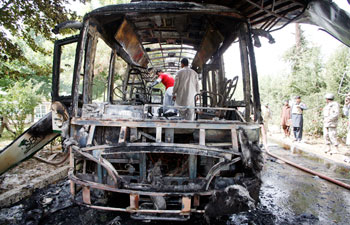 The death toll in the devastating attacks on a women's university bus and a hospital in the Pakistani city of Quetta rose to 25 on Sunday even as reports emerged of the involvement of a woman suicide bomber in one of the incidents.
The banned Lashkar-e-Jhangvi claimed responsibility for Saturday's attacks, saying they were carried out in retaliation for a raid against the group by security forces.
Fourteen students of the Sardar Bahadur Khan Women's University and four nurses of the Bolan Medical Complex were among the dead.
The attack on the women's university bus was carried out by a woman suicide bomber, Express News channel quoted security sources as saying.
About 40 students and teachers were in the bus, waiting to go home after classes.
Twenty-two women were injured by the powerful blast.
Reports said the bus was assigned for students from a nearby neighbourhood dominated by the Shia Hazara community, which has been the target of several attacks by the LeJ.
When the victims of the attack were taken to the nearby Bolan Medical Complex, the hospital was stormed by a group of heavily armed militants.
One militant blew himself up near an operation theatre while the others fired indiscriminately and took people hostage.
The militants targeted the hospital as several senior police and civil officials, including the police chief and Chief Secretary of Balochistan, were leaving the building after enquiring about the victims of the first attack.
Deputy Commissioner Abdul Mansoor Kakar, Shabbir Magsi, the medico-legal officer of the hospital, four nurses and as many Frontier Corps personnel were killed in the second attack.
Four militants were either killed or blew themselves up while one was captured by security forces, who also freed 35 hostages.
Chief Secretary Babar Yaqoob Fateh Muhammad confirmed 25 people had died and about 50 were injured in both attacks.
 On Saturday, Turkish riot police stormed Taksim Square and the adjoining Gezi Park, firing tear gas and water cannon after Turkish Prime Minister Recep Tayyip Erdogan warned that security forces would clear the area.
Panicked protesters fled to the side streets but pledged to return.
The prime minister lashed out at what he called the "plot'' behind the biggest street protests in his 10 years in power. He has called for a pro-government rally in Istanbul later Sunday.
The protests began over the prime minister's plan to turn the park into a mall. They have evolved into anti-government demonstrations that have spread across the country.
Thousands in Ankara and Izmir also protested against the Erdogan's ruling AK Party on Saturday.
On Friday, the prime minister told protesters he would put redevelopment plans for the park on hold until a court rules on them, and hold a referendum if the court rules in the government's favor.
 Two volunteers who were assisting in a polio immunization campaign were shot to death on Sunday in the northeastern district of Swabi, the police said.
The incident occurred in the northeast fringes of the district in the hilly Pebani village, when the two volunteers, one a local schoolteacher were killed by two gunmen, the district police officer, Dr. Mian Saeed said.
“The gunmen were on foot. They shot dead the two workers from close range and escaped”, he said. “Four suspects have been rounded up for questioning.”
This is the second attack on polio workers in the district. A police constable accompanying the polio team was killed in January. Polio teams have come under attacks from militants, who believe that polio vaccination goes against Islamic law.
But the attacks escalated after it was revealed that the Central Intelligence Agency had used fake teams to collect blood samples from a compound in the northern district of Abbottabad, inhibited by Al Qaeda leader Osama bin Laden.
The government decided to provide police escort to polio teams after growing number of attacks but there is no evidence if the security measure has worked. Increasingly, health workers are refusing to take police escort, fearing the police presence could expose them further to threats.
“We asked the health workers to take police escort but they refused,” “, Dr. Saeed said.. “Since they were locals, probably they were confident that they could carry out their task without police escort.”
“We are considering to ask health workers to carry weapons with them. We can issue them weapon permits”, he said.
The district head of the immunization program said he was not aware of the police had provided security escort to the teams. " I don’t know if there was police escort but I do think it would be impossible to carry out vaccination in such circumstances”, said Dr. Muhammad Yaqub, head of the district immunization program..
Deutsche WelleA group behind assaults on Shiites in Pakistan has claimed responsibility for tandem attacks on a university bus and a hospital that killed at least 24. The Sunni extremist outfit Lashkar-e-Jhangvi announced on Sunday that it had sent a female suicide bomber to strike the bus in Quetta, capital of the restive Balochistan province, killing 14 students from a women's university near a Shiite neighborhood on Saturday. About 90 minutes later, a follow-up attack on the hospital treating survivors left at least 11 dead and led to a prolonged gun battle between security forces and militants occupying part of the building. "The suicide attack on the bus was carried out by one of our sisters," said Abubakar Siddiq, a spokesman for Lashkar-e-Jhangvi. "She boarded the student bus and blew herself up. Then we carried out a second suicide attack at the hospital and our fighters killed several people. We did this because security forces killed our fighters and their wives in Kharotabad."Troops fought gunmen who seized parts of the Bolan Medical Complex in Quetta after the initial explosion. The standoff lasted for several hours and ended when security forces stormed the building, freeing 35 people who had been taken hostage, Interior Minister Chaudhry Nisar told reporters on Saturday. Quetta's head of police operations, Fayaz Sumbal, said those killed in the hospital explosion included a senior government official who had arrived to assess the situation. Attack on historic building Earlier on Saturday, suspected separatists killed a policeman and gutted a historic summer retreat once used by Pakistan's founder, Muhammad Ali Jinnah, in a hill town in the province. Saturday's attacks were the heaviest since bombings in Quetta at the start of the year claimed almost 200 lives and came only a week after Prime Minister Nawaz Sharif took office. Baluchistan is a vast province bordering Iran and Afghanistan and home to large deposits of copper and gold.
 Weeping relatives gathered Sunday to identify the charred remains of loved ones killed in a double attack in Pakistan's troubled southwest claimed by a banned Sunni militant group.
At least 25 people were killed on Saturday when militants blew up a bus carrying female students in Quetta, capital of restive Baluchistan province, and then stormed a hospital where survivors had been taken for treatment.
The extremist sectarian outfit Lashkar-e-Jhangvi (LeJ), responsible for a string of outrages against Pakistan's Shiite Muslim minority, said it was behind both attacks.
An LeJ spokesman said a female suicide bomber struck the bus -- a rare tactic in Pakistan -- before gunmen attacked the hospital, claiming the strikes were revenge for an operation by security forces earlier this month.
Militants occupied parts of the Bolan Medical Complex in a standoff that lasted several hours and ended when security forces stormed the building, freeing 35 hostages.
Authorities shut down the hospital on Sunday, moving patients to another facility, as investigators combed the grisly aftermath of the violence.
"All patients were shifted from here overnight. Inside I have seen blood and small pieces of human flesh," a security official at the locked gates told AFP.
The intensity of the blast and subsequent fire reduced the student bus to a blackened skeleton, and outside the mortuary of the Provincial Sandeman Hospital on Sunday, weeping relatives gathered to identify bodies amid a strong stench of burnt human flesh.
The state of the bodies added confusion to the relatives' burden of grief as some were given contradictory information about their loved ones.
Mohammad Hamza, 19, said that on Saturday he had been given the body of his student sister, only to be told a mistake had been made.
"I came here after someone had given us the information that we had taken the wrong body and my sister's body was still here at hospital, but it is not true," Hamza told AFP. It appeared the body he was given on Saturday was indeed his sister.
Mohammad Yasir, deputy registrar of Sardar Bahadur Khan Women's University, said DNA testing may be needed to identify many body parts.
LeJ spokesman Abubakar Siddiq called newspaper offices in Quetta late Saturday to claim the killings.
"The suicide attack on the bus was carried out by one of our sisters. She boarded the student bus and blew herself up," Siddiq said.
"Then we carried out a second suicide attack at the hospital and our fighters killed several people. We did this because security forces killed our fighters and their wives in Kharotabad."
Pakistani security forces on June 6 killed at least three militants and two women during a raid at a house in the Kharotabad neighbourhood of Quetta. Officials said they belonged to Tehreek-e-Taliban Pakistan, with whom LeJ has links.
The attacks came hours after a national monument linked to Pakistan's founding father Muhammad Ali Jinnah was destroyed by separatist militants in Ziarat town, 80 kilometres (50 miles) southeast of Quetta.
Quetta is a flashpoint for sectarian violence between majority Sunni Muslims and minority Shiites, who account for 20 percent of Pakistan's 180 million population, and the city saw the country's two bloodiest attacks so far this year.
A giant bomb planted in a water tanker being towed by a tractor killed 90 Shiite Hazaras in February, while another suicide bombing at a snooker club in January killed 92 others. Both were claimed by LeJ.
There was fury in the Pakistani press on Sunday, both at the perpetrators and the security forces for failing to prevent the third major atrocity in Quetta in six months.
Dawn, the country's leading English-language newspaper, said the state's shortcomings had been shown once again.
"That the state has again failed both at the level of intelligence-gathering and preventing a terrorist attack from succeeding is also obvious," it said in an editorial.
"Unhappily, the more obvious these truths, the less likely it seems that anything will be done to address them."
Sardar Bahadur Khan Women's University is located close to a Shiite Hazara neighbourhood in Quetta, and many Hazaras are students.
Baluchistan, which borders Iran and Afghanistan, is rife with Islamist militancy and a regional insurgency waged by separatists demanding political autonomy and a greater share of profits from the region's natural resources.


