Protest leaders canceled plans Wednesday to meet with Turkish Prime Minister Recep Tayyip Erdogan, saying the previous night's violence in Istanbul's Taksim Square and Gezi Park showed talks would be fruitless. Riot police used massive amounts of tear gas, water cannons and stun guns to break up protesters' large-scale demonstration Tuesday night. Erdogan was going ahead with meeting some "popularists," including figures from the protests in Gezi Park, the country's semiofficial Anadolu Agency reported. But protest leader Eyup Muhcu said those attending the meeting are friendly with Erdogan's government. Wednesday began quietly, with rain blanketing the ruins of days of rowdy protests.Protesters have faced off with police on the streets of Istanbul for two weeks. What began in late May as a demonstration focused on the environment -- opposition to a plan to build a mall in Gezi Park -- has evolved into a crusade against Erdogan that's spread around the country.Protesters and 'troublemakers' Not all organizers were invited to the talks to begin with, Muhcu said. Erdogan's government discerns between ecologists who started the protests in an attempt to save the park from bulldozers and Marxist extremists, who have lobbed rocks and Molotov cocktails at police, said Ibrahim Kalin, the prime minister's chief adviser, referring to the latter as "troublemakers." "Anywhere in the world, they will not be considered peaceful protesters," Kalin told CNN's Christiane Amanpour on Tuesday. He said some were associated with a group that carried out an attack on the U.S. Embassy in Ankara in February. The police reaction has been no different from that of security forces' methods against similar groups at Occupy Wall Street protests in the United States, he said. "The police obviously have the mandate to establish public order," Kalin said, just like they do in Spain, Sweden and Britain. Protests from urban professionals A heavy hand and rhetoric from Erdogan have left little room for dissent and have long been a thorn in the side of many secular Turks, who voted against the government. These are the protesters, many of them urban professionals, who have crowded into the park and called for an end to Erdogan's 10 years at the government's helm.They say they have had little place at the table in the government, which is supported mainly by rural, religious conservatives. Human rights record Experts and human rights groups agree with this large group of Turks that Erdogan's democratically elected government lags when it comes to human rights and freedom of expression by opponents. "Prosecutors and courts continued to use terrorism laws to prosecute and prolong incarceration of thousands of Kurdish political activists, human rights defenders, students, journalists and trade unionists," Human Rights Watch wrote in a 2013 report on Turkey. Turkish journalists are afraid to write anything critical of the government, and media companies are slapped with huge tax fines for covering uncomfortable topics. According to the Committee to Protect Journalists, Turkish authorities have targeted journalists with detention for covering the protests. Erdogan's dilemma is in how he handles those who did not elect him, said CNN's Fareed Zakaria. "He has come to believe that he speaks for all of Turkey." Why Taksim Square matters to Turks Those who are against him are handled in "too authoritarian" a manner, Zakaria said Tuesday on "Piers Morgan Live." The prime minister has said he will not back down. "They say the prime minister is harsh," Erdogan said Tuesday, referring to his detractors. "I'm sorry," he told a gathering of his own party. "The prime minister is not going to change." Erdogan is tightening his grip on power, adding authority to the office of the presidency, which he hopes to hold in coming years. Former U.S. intelligence chief John Negroponte said he believes the protests could have something to do with Erdogan's ambitions. There may be "forces joining in here, whose aim it is to prevent him from achieving his ambition of becoming the next president of the country," he told Morgan.
Wednesday, June 12, 2013
Protest leaders bail out of talks with Turkish PM after clashes

Saudi forces nab nearly 150 government protesters

U.K: ''Riot police storm Soho G8 protest squat''
 Riot police have forced their way into a building in Soho, central London, as protests were staged against the G8 summit.

Militants massacre 60 Shia Muslims in eastern Syria
 As many as 60 Shia Muslim residents of a Syrian village in east of the country have been massacred by foreign-sponsored militants.
On Tuesday, the militants attacked the village of Hatlah in eastern Deir Ezzor province and took control of it and killed 60 Shia residents, AFP reported.
Nearly a dozen militants were also killed as a group of local residents took up arms to defend their village.
The insurgent attack and the subsequent violence forced the residents of the village to flee their homes.
The Syria crisis began in March 2011, and many people, including large numbers of government forces, have been killed.
Damascus says the chaos is being orchestrated from outside the country, and there are reports that a very large number of the militants are foreign nationals.
The Syrian government says the West and its regional allies, such as Qatar, Saudi Arabia, and Turkey, are supporting the militants.
Turkey: aftermath of clashes in Istanbul's Taksim Square – video
Taksim Square in Istanbul falls quiet on Wednesday after a night of violence between police and anti-government protesters. Police intensified their efforts to clear the central square after 10 days of demonstrations against the prime minister, Recep Tayyip Erdoğan. Erdoğan has called for an end to the protests, which began against plans to build on a central park
White House says concerned about events in Turkey

Young generation takes bullet of Syria conflict

د ننګرهار په اچین ولسوالۍ کې د طالبانو ضد پاڅون
http://www.mashaalradio.com/جلال اباد - د افغانستان ننګرهاراچين ولسوالۍ عبدالخېلو سيمه کې په زرګونو تنو شينوارو د وسله والو طالبانو خلاف ولسي پاڅون وکړ او خپله سيمه يې له وسله والو څخه پاکه کړه. د تيرې شبنې په ورځ د ننګرهار ولايت د اچين ولسوالۍ عبدالخېلو سيمه کې هم په زرګونو تنو ولسي وګړو د وسله والو طالبانو پر ضد پاڅون وکړ چې دخلکو په وينا خپله سيمه يې له وسله والو طالبانو څخه پاکه کړې ده. قومي مشر ملک بهاندر مشال راډيو ته وويل چې ولس په سيمه کې د نا امنيو څخه تنګ شوي و نو ځکه يې ولسي پاڅون وکړ: (( زموږ د عبدالخېلو قوم چې شمېر يې شاه و خوا ۱۰ یا ۱۲ زره تنو ته رسېږي، په دې کې ځينې خلک سره لتاړ شوي دي، نو موږ په خپل قوم کې بې امنيتي نه غواړو، خپل قوم کې ګډوډي نه غواړو، خپل قوم کې زور زياتی، ظلم نه غواړو.)) د اچين ولسوالۍ د انکشافي شورا مشر ملک شيرخان وويل: له دې وروسته به هيچاته اجازه ورنه کړي چې په سيمه کې نا امني جوړه کړي: ((ګډوډي ډېره زياته موږ ټول عبدالخېل د خپلې درې امنيت په شريکه نيسو. بس نور په دې کې بيا بې عزتۍ ته ځان نه پرېږدو. او خاص د وطن د حفاظت له پاره دغه کار موږ شروع کړی دی.)) د افغانستان په ختيځ کې د لومړي لمبر سرحدي لوا سرپرست قوماندان محمد ايوب حسين خيل د وسله والو طالبانو په وړاندې ولسي پاڅون ته په ښه نظر ګوري او وايي: (( د هغه چا په مقابل کې چې هغوی زموږ د ولسونو ژوند نا ارامه کوي، نه غواړي چې زموږ زموږ بچي په ارامه فضا کې تعليم او تعلوم ته ادامه ورکړي، او د هغوی په مقابل کې څوک قيام کوي، موږ ورته هرکلی وايو. او دا د هر افغان وجيبه ده چې داسې خلک چې هغوی اختطاف کوي، هغوی تروريستي اعمال کوي، او زموږ د ولسونو آرامه ژوند نا ارامه کوي، بايد ټول ولس موږ سره همکاري وکړي او پاڅېږي، دا خلک له خپلې ساحې نه وباسي.)) د چارو څارونکي سحرګل اميرزي د وسله والو طالبانو په وړاندې ولسي پاڅون د وخت ضرورت وباله. ((د تاريخ په اوږدو کې چې کله هم ولسونه له دولت سره يو ځای شوي، ښه حکومتداري رامنځته شوې، باثباته ژوند رامنځته شوی دی، دغسې پاڅونونه زيات ګټور دي، که ټولې ولسوالۍ په يوه وخت راپورته شي او د وسله والو په خلاف پاڅون وکړي، امنيت راتلای شي.)) په ننګرهار کې اچين يوه سرحدي ولسوالي ده چې خلک يې له تعليمه لرې پاتې شوي او په قومي شخړو اخته دي چې له امله يې په سيمه کې وسله وال طالبان پيدا شوي ول خو اوس د سيمې اوسيدونکي وايي چې سيمه يې له وسله والو طالبانو څخه پاکه کړې ده.
Motorcycle bomb kills 2, wounds 15 in Afghanistan

3 more kids succumb to measles; Punjab death toll 157
 Three more children died of measles in Lahore on Tuesday, taking the overall death toll in Punjab to 157.
Two children died at Mayo Hospital while the third child succumbed to the disease in Jinnah Hospital.
On the other hand, the Lahore High Court (LHC) has warned that it would initiate action against Chief Minister and Health Minister of Punjab if more children died due to the measles.
Justice Khalid Mahmood said that children are dying on daily basis, but the Health Department is engaged in formalities. He said the court should now be told how many children were saved by the Health Department.
The judge remarked that it is now time for the new government to stop distributing sweets and start work practically.
India among world’s most violent places: Study
http://timesofindia.indiatimes.com/The recent Maoist violence in Bastar, which left 28 people dead, is no aberration. The Global Peace Index (GPI) 2013, which was released on Tuesday, has ranked India among the 25 least peaceful nations to live in. The country was placed 141 among 162 nations, having lost more than two lives a day — or a staggering 799 persons — to internal conflicts in 2012. Giving India company at the bottom of the heap are countries like Pakistan, Iraq, South Sudan and Afghanistan, which are traditionally perceived to be more violence-ridden. Iceland emerged as 2012's most peaceful country in the index and the Central African Republic the least. Ironically, India has improved on its 2011 rank by three notches. India's poor ranking in 2012 was attributed to the high number of internal and external conflicts, ease of access to small and medium weapons and the political terror scale, as in the case of conflict-ridden Kashmir, said the report's author Steve Killelea, of the Institute for Economics and Peace, a global think tank which works on the relationship between economics, business and peace. Killelea observed more populous countries were less peaceful and it was possible that conflicts in large countries like India were more difficult to manage. On the positive side, India has reduced its number of deaths from internal conflicts as well as improved the perception of criminality among its citizens, which explains the bettering of its overall rank. "For the first time since 1994, the total number of fatalities linked to conflict within India dropped below four figures, with a notable decline in deaths related to Islamist terrorism, insurgency in J&K and fatalities associated with Maoist insurgency across the Red Belt," stated the report. However, it also refers to border skirmishes between India and its neighbours requiring a large military force and increased defence expenditure, which drags India's overall score down.The world itself has grown less peaceful, with a 5% decline in scores over the last six years. It was found that more countries deteriorated in peace (110) in 2012 as compared to those which grew more peaceful (48) since 2008. "The findings of this year's index support the prevailing trend of the last six years, namely: a continuing shift away from nations taking up arms against one another and towards more organised internal conflicts. A key factor associated with this is that the peace gap between countries under authoritarian regimes and the rest of the world is becoming larger," said Killelea. This is illustrated by the civil war in Syria — which saw the greatest drop in its peacefulness among the nations analyzed — as well as the climate of political instability in the Middle East.
Pakistan: Power riots erupt in Punjab towns: Police storm houses to arrest protesters
DAWN.COMA large number of people from villages around Khurrianwala town vented their anger against power outages on Tuesday and attacked a grid station and offices of the Faisalabad Electric Supply Company (Fesco). They blocked traffic on the Sheikhupura-Faisalabad road for about 10 hours and pelted police and vehicles with stones, causing injuries to four constables. Police chased the protesters, entered a number of houses by scaling the walls or breaking open the gates and thrashed anyone they found there. Policemen are reported to have abused and dragged women when they objected to their conduct. A number of women and children who had not joined the protests were also mistreated. More than 10 people were arrested from the houses. The industrial city of Faisalabad saw a number of violent protests over outages during the PPP government. At that time, Punjab Chief Minister Shahbaz Sharif had backed their protests, but asked them not to damage public property. PML-N chief Nawaz Sharif had also supported the agitation by industrial workers. Protests were also reported on Tuesday from Dera Ghazi Khan, Sheikhupura and Bahawalpur, but they were largely peaceful. Hundreds of people started gathering in the morning and blocked the Khurrianwala Road. They raised slogans against Fesco and an independent power producer supplying electricity to their villages. The protesters attacked the Fesco sub-divisional office in Bundala, ransacked the building and put it on fire. Police did not intervene because of having been outnumbered by the protesters. They also attacked a grid station near Ada Johal and tried to enter it, but were stopped by police. A mill where police had been deployed also came under attack. Two ambulances remained stuck in the traffic for some time but were later allowed by agitators to proceed. Police used batons and teargas to disperse the protesters but they refused to leave till restoration of power supply. Police chased the protesters in streets and bazaar and also entered some houses to arrest them. The protesters also hurled stones at Faisalabad DCO Najam Shah and CPO Raja Riffat Mukhtar when they tried to negotiate with them. They said both the officers were unable to resolve the issue, adding that the district coordination officer had assured their delegation a couple of days ago that the problem would be solved, but nothing had been done so far. Similar protests had been held on June 3 when demonstrators blocked the Khurrianwala Road for over five hours, damaged some vehicles and pelted police and some buildings with stones. They raised slogans against 10 hours of loadshedding schedule planned by Fesco. Police fired into the air to disperse the protesters and pursued them to the Ada Johal area. The road was later cleared. Our Sheikhupura correspondent adds: A large number of factory workers and residents of Ferozewattwan and adjoining localities gathered on the Faisalabad Road and blocked traffic for about three hours in protest against 20 hours of power outages. KASUR: A demonstration was held by people of Basti Kambovan against up to 20 hours of loadshedding.
Pakistan: Banning the internet?
Editorial: DAILY TIMESIt has been almost 10 months since the previous PPP government banned popular video sharing website YouTube. The reason it was banned was because a blasphemous low-budget movie was uploaded on the site, sending Muslims in Pakistan on a violent protest spree. The government’s response was to bury its head in the sand instead of proactively solving the matter. It closed down the website, which is used the world over for educational, information and entertainment purposes. Now, the new government is rumoured to be contemplating going one step further. The PML-N’s minister for information technology and telecommunications, Anusha Rahman, has said that the government would work to place mega filters on the internet to sieve out all blasphemous and pornographic content (which is also banned) and if Google did not offer its full support in filtering the blasphemous content from YouTube, not only would the indefinite ban stay but Google could face a ban also. One cannot fathom where these ‘bright’ ideas come from. Google is literally the most visited and comprehensive search engine online and its many affiliated websites and e-mail sharing sites are the backbone of correspondence and communications. To even mention a ban on it hints at a major lack of comprehension on how to exist with the world in the 21st century. The Chief Justice of Pakistan (CJP) iftikhar Mohammad Chaudhry has meanwhile taken suo motu notice of the ‘blasphemous’ content on the internet and has directed the Pakistan Telecommunications Authority (PTA) to submit a report within a week. Is the PTA really expected to scour the entire infinity of the internet and earmark every single link, site and video that may be deemed blasphemous? One would hate to think there is some sort of collective vendetta to isolate the citizens of Pakistan from freedom of information and speech, from exercising their right to access the entire, modern world at their fingertips. Why is it impossible for our representatives to approach this issue maturely and sanely? First and foremost, we citizens should be trusted enough to be able to freely choose what we wish to access or see. If that is ‘blasphemous’ for the authorities to consider then they should look at the matter in a way that does not amount to blanket bans. Other Muslim countries have signed agreements with Google to have blasphemous content removed from YouTube in their countries, so why does Pakistan not do this? Google has agreed to such an arrangement but our governments have been too lazy to move ahead on this proposal. We citizens are in the process being denied, and threatened with more denial, of freedom of information and hence knowledge and enlightenment. All such ideas should be relegated to the dustbin.
Pakistan: Targeted attack against Ahamdis leave one dead, two injured in Karachi
Ahmadiyya Times
 A man belonging to Ahmadiyya community was shot dead and his son and a companion were wounded in a targeted attack in Soldier Bazaar locality.
Police said the victims were identified as Hamid Sami, 45, his eighteen-year-old son, Osama and a companion, Salman Zaman, 48. The victims were shot multiple times and were taken to Jinnah Postgraduate Medical Centre where doctors pronounced Sami as dead.
Police said Sami and his companion, Zaman, used to work at a private engineering firm near Tibbat Centre on M.A. Jinnah Road as account consultants and the incident took place when they were returning to their homes in a car in Gulshan-e-Iqbal area.
They changed their way to home as protest was ongoing at M.A. Jinnah road and turned their car towards narrow streets of Soldier Bazaar, where armed men targeted them.
Senior official Masood Ahmad of Ahmadiyya community strongly condemned the incident and demanded arrest of culprits, adding that it seemed the terrorists had now started killings their community members. He urged the government and law enforcers to take strict action to avoid such incidents in future. No case was registered till filling of this report.
Protest against load-shedding in Peshawar, Swat

 The people held protest demonstrations against the hours' long power outages in Peshawar and Swat districts and demanded of the government to adopt measure to overcome unannounced load-shedding.
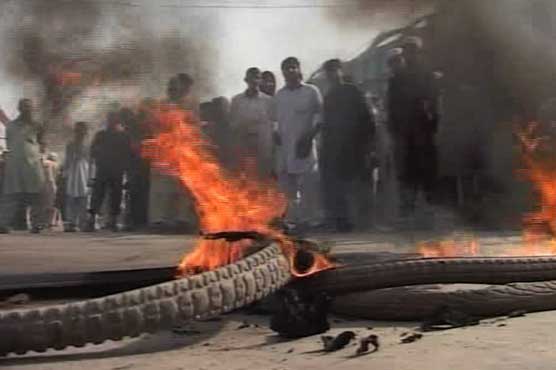
In Peshawar's Badabair area, the residents staged protest demonstration and burnt tyres against the hours' long continued load shedding.
The enraged protestors also blocked Peshawar-Kohat road for traffic for sometime in the morning.
The protesters, who were holding banners and placards inscribed with slogans against WAPDA and PESCO, also set tyres on fire.
The speakers said that long hours load shedding has affected industries and business activities and disturbed daily routine life. Later, the protestors peacefully dispersed.
Meanwhile, the residents of Tehsil Matta in Swat also staged protest demonstration against power outages and blocked Mingora Road for traffic, which created problems for school children and government employees in reaching their respective destinations.
They said that power outages had led to serious shortage of water in different localities and people were faced with many problems as they had to fetch water from far-off tube wells.
They argued it was the responsibility of Government and Wapda to provide uninterrupted power supply to consumers as people of Tehsil Matta were regularly paying their electricity bills.
They chanted slogans against Wapda and PESCO and burnt tyres. Later, they peaceful dispersed.
Zardari's anti-Taliban legacy has no heirs
 Pakistani President Asif Ali Zardari, widower of the slain former Prime Minister Benazir Bhutto, has never hesitated to call the Islamist extremists his enemies. In fact, he says they are his "personal enemies," as the Taliban allegedly assassinated his wife Bhutto in December 2007 during a public rally in the northeastern city of Rawalpindi.
After his Pakistan People's Party (PPP) came into power in 2008, President Zardari allied himself with other liberal movements such as the nationalist Awami National Party (ANP) in the restive northwestern Khyber Pakhtunkhwa province bordering Afghanistan, and the Muttahida Qaumi Movement (MQM) in the southern Sindh province. The alliance was mainly forged to defeat the Taliban.However, all three parties paid the heaviest price for their opposition to the Taliban. Their leaders and workers were killed by the extremists with impunity. Their collaboration with the US in an unpopular "war on terror" in Pakistan also cost them this year's May 11 parliamentary elections. The Pakistani people rejected them and elected instead conservative parties like Prime Minister Nawaz Sharif's Muslim League in Islamabad and cricketer-turned-politician Imran Khan's Pakistan Tehreek-e-Insaf (PTI) or the Movement for Justice party in Khyber Pakhtunkhwa. The anti-Taliban ANP was wiped out of the province.
The last speech
In his last speech to the joint session of the parliament's lower house (National Assembly) and the upper house (Senate) before the end of his presidency, Zardari made it clear that he was not ready to change his stance on extremism or compromise with the Taliban. Zardari's speech came just hours after Islamist militants targeted NATO supply trucks in a northwestern tribal area near the Afghan border, killing at least six people. "The nation is united against militancy. We need strong leadership to overcome the threat," he said to newly-elected parliamentarians. "We are ready to make peace with those willing to give up violence. But we should also be ready to use force against those who challenge the writ of the state." Zardari also said that the fact that the Pakistani people turned out in a large number to vote in the past national elections, despite the threats of violence, was proof that Pakistanis believed in democracy. But will Prime Minister Sharif pay heed to Zardari's advice? Will he go against the Taliban and other extremist groups in Pakistan or make peace with them? Will Imran Khan, whose party governs the strategically important Khyber Pakhtunkhwa province in the war against the Taliban, reconsider his policies vis-à-vis the Taliban and terrorism? The answer is a definite 'No'. Both these leaders have avowed that they would make truce with the Islamists and won't follow the Zardari legacy. Stronger Taliban Peshawar-based development worker and political activist Maqsood Ahmad Jan believes that Sharif's and Khan's insistence on peace talks with the Taliban are emboldening the extremists in Pakistan. "The new rulers have turned a blind eye to Taliban atrocities. Some parties say that the Taliban are like their children. The result is that the radicals are getting bolder and that kidnappings for ransom are on the rise," Jan told DW. He lamented that Sharif's Muslim League and Khan's PTI offered no words of sympathy to people targeted by the Islamist militants on a regular basis. Jan is of the view that not only the Taliban will get stronger under new rulers, the Sharif government will not be able to deal with various crises that Pakistan is facing, mainly the energy crisis. He thinks this will frustrate the Pakistani people who will probably look towards the PPP and the ANP again in future. "Sharif and Khan have no idea how to deal with the Taliban. The Khyber Pakhtunkhwa chief minister recently said he did not know who was behind the terrorist attacks." 'Unpopular war' But experts say that despite the fact that most Pakistanis are against Islamist extremists and prefer liberal and center-right parties over hardline Islamic ones, they want their government to review its support to the US in the protracted war against the Taliban. They want peace and do not care whether it comes at the cost of giving concessions to the militants.According to DW's Peshawar correspondent Faridullah Khan, Khyber Pakhtunkhwa has been one of the worst hit by the "war on terror" and many people there are against US drone strikes in the semi-governed northwestern tribal areas. In his opinion, many people held the ANP and PPP responsible for this situation. It was something that right-wing groups are benefiting from, he said. Political experts like Malik Siraj Akbar, who is based in the US, are critical of Pakistan's response to the Taliban and the menace of terrorism. Akbar told DW in an interview that the main reason why liberal Pakistani parties faced a dilemma was that Pakistan had not officially "owned" the so-called war on terror. "Pakistan is not ideologically convinced that it is its war." For this reason, counter-terrorism experts in in the country say Zardari and other liberals have not been able to get the masses behind them in the fight against terror. Another dilemma The ANP, like the PPP and the MQM, face another ideological dilemma. Not only the Pakistani state, but now also the US, wants to talk to the Taliban and make its peace with the militants. "So what is the future of the parties like the ANP and the PPP who have been supporting the onslaught on the Islamists?" asked Dr. Riaz Ahmed, a political activist in Karachi, who described why he believed the attacks on anti-Taliban leaders had increased. "Politicians who want an offensive against the extremists are now a hindrance in the negotiations with the Taliban. They are being removed from the scene," Ahmed told DW. Islamic parties have always been demanding that the government makes peace with the radicals. Muhammad Shah Afridi, a former conservative member of parliament from Khyber Agency, one of the semi-governed tribal agencies bordering Afghanistan, told DW that if the US and NATO could negotiate with the Taliban then Pakistan should do the same. "War is not the solution to this conflict. We will have to talk (to the Taliban)," Afridi said. Zardari had also welcomed the US initiative of "peace talks" with the Taliban. But experts believe it is not enough to convince the Taliban that he and his party are "friends." There are many in the ranks of the PPP and other liberal Pakistani parties who still oppose the Taliban and do not want to change their own ideological course. But experts are not sure how long they will be able to carry on with this legacy.
What Turkey needs is a coup
nationalpost.com
BY: Emmett Robinson, National Post
 What started out as a minor spark of protest over the proposed construction of a shopping mall in Istanbul has burst into flames of nationwide unrest in Turkey, and the fuel available to feed the fire has been building up, depending on how one measures it, for 10 years, or maybe closer to 100. What Turkey needs now is what it has always needed, and has always had, in the past — a powerful check on the forces of reactionary Islam.
Modern Turkey arose from the ashes of the Ottoman Empire following the First World War. In its wake came a dynamic, visionary leader: Mustafa Kemal, later given the honorific title Atatürk, or “Father of the Turks.” By emphasizing the national identity of the Turkic people who populated the heartland of the former Islamic empire, Atatürk was able to unify the region, originally divided into post-war Allied occupation zones, to form the Turkish nation state.
National identity wasn’t the only principal upon which Atatürk built the new country. To him, the war had made the stifling, sclerotic nature of Ottoman society glaringly obvious. What Turkey needed, Atatürk concluded, was a completely remade, Westernized society. This meant developing an open society. Most importantly, it meant discarding the Islamic state and instituting liberal democratic reforms. The path to success for Turkey, Atatürk concluded, forked toward the liberal West rather than the Islamic East. Thus, under Atatürk, Turkey scrapped the Arabic alphabet in favour of the Latin. It abolished what remained of sharia law, adopted a legal code modeled after Switzerland’s and famously banned the fez in favour of Western-style headgear. Opposition parties were eventually allowed to form (though the earliest attempts were quashed). The franchise, and the right to be elected to parliament, was extended to women in the mid-1930s.After his death in 1938, Atatürk’s successors took up the cause of continued liberalization. Perhaps the greatest achievement of these Kemalists (as Atatürk’s ideological followers were known) occurred in 1950. That year, the Kemalist party was thoroughly trounced at the polls and peacefully ceded power to the opposition Democrats. Turkey became the first true democracy in the modern Muslim world.
Yet reform in Turkey has never come easily. Since the country’s founding, the Kemalists and their successors have faced staunch opposition from the forces of reactionary Islam. On several occasions after free elections were first instituted, the Turkish military, closely aligned with the reforming Kemalists since the days of Atatürk himself, has had to intervene directly in government affairs in order to keep democracy from destroying democracy — to stave off, “one man, one vote, one time.”
Following the election of 1950, for example, the Democrats ruled Turkey for 10 years. Over that decade, the party and its leader, Adnan Menderes, became increasingly anti-liberal and pro-Islam. Menderes arrested the opposition party leader, instituted extensive censorship of the press and, in an at first seemingly minor decision that ultimately highlighted the Democrats’ shift away from both Turkish national identity and secularism, reverted broadcasts of the call to prayer announced from the nation’s mosques back to Arabic from Turkish. Fearing a reversion to reactionary Islamic government, the military intervened in 1960.Elections were held quickly thereafter in 1961. In a testament to the free nature of those elections, the new reactionary-friendly Justice Party (which replaced the banned Democrats) lost to the Kemalists by only 2% of the vote. Similar coups designed to quell the anti-liberal machinations of Islamist-leaning administrations also occurred in 1971 and 1980. The 1980 coup notably resulted in a new constitution, approved by referendum, which forbade “even partially basing the fundamental, social, economic, political and legal order of the state on religious tenets.”
The new constitution also revamped the country’s National Security Council, the seats of which were to be divided equally between members of the prime minister’s civilian government and military leaders. The reworked NSC was designed to give the military a permanent, formal avenue by which it could express its concerns to the elected government. The hope was that the NSC would allow the military to check the excesses of Islamic reactionaries in the government while avoiding direct intervention. The system worked well for 20 years. There were no more coups, yet the military was able to keep those prime ministers with Islamic-reactionary tendencies honest.
In Turkey, military intervention, or at least the threat thereof, has historically been a vital bulwark against encroaching reactionary Islam
But the equilibrium was disturbed in the early 2000s. In 2003, current Prime Minister Recep Tayyip Erdogan assumed office. Erdogan’s Justice and Development Party (AKP) is the direct descendant of the Islamic reactionary Democratic and Justice Parties. The military was initially able to keep Erdogan’s reactionary tendencies in check, but this success was relatively short lived. Around the time of Erdogan’s succession, negotiations concerning Turkish membership in the EU ramped up. As a condition of those talks, the undoubtedly well-meaning bigwigs in Brussels demanded more extensive subordination of the Turkish military to civilian authorities. The AKP-controlled parliament happily complied, weakening the role of the NSC and changing its membership to majority-civilian. In 2009, parliament also passed a law giving civilian courts jurisdiction to punish military personnel charged with threatening national security (read: intervening to temper the excesses of reactionary officials). Other similar changes, often put forth for the ostensible purpose of advancing Turkey’s prospects of EU membership, have also reduced the military’s influence.
All these steps would be commendable, even crucial, in most liberal democracies. But in Turkey, the liberal-democratic consensus is not a broad as it is in Canada, the U.S. or Western Europe. While military coups are (usually rightly) seen as anathema to liberal democracy, in Turkey, military intervention, or at least the threat thereof, has historically been a vital bulwark against encroaching reactionary Islam. The military’s decline in influence over the past decade has given these reactionary forces a freer hand. Thus, the recently enacted restrictions on alcohol, the crackdown on public kissing in Ankara and other limitations on personal freedom. While the curbs on liberty have thus far been fairly modest, the fear is that the slow, unmistakable, march away from societal openness will continue.
Turkey needs what every liberal society needs: A democratic government bounded by institutions strong enough to check that government’s encroachments on liberty. In the past, the Turkish military was such an institution, albeit an imperfect one. The presently weakened state of the military has emboldened Erdogan and company. He must be brought to heel. Let’s hope what we are witnessing now in Turkey is, in part, a revival of the Kemalist spirit. If military coups in Turkey are indeed obsolete, let’s hope that the present protests prove to be an ideological coup of sorts — a coup instituted by a minority passionately committed to personal liberty.
Tuesday, June 11, 2013
TURKEY: This is not the way to end Gezi Park protests, warns BDP's Önder
 Sırrı Süreyya Önder, a critical figure in the Gezi Park protests who has been present from the beginning of the demonstrations, has slammed June 11's ferocious police assault on Taksim, notably criticizing Istanbul Gov. Hüseyin Avni Mutlu for insulting him.
“This is not the way to end even a fight in the neighborhood. These are the mayors of wartime. No peace can come out of these,” Önder, who is also a deputy of the Peace and Democracy Party (BDP), said June 11.
In the meantime, Selahattin Demirtaş, the co-chair of the BDP, urged the government to take a more positive stance toward the protests and to try to understand the youth.
Önder, who used his own body to prevent earth movers from destroying trees in the early protests in late May, also said the children of at least four deputies from the ruling Justice and Development Party (AKP) had also joined the protests.
Önder criticized the government’s approach in handling the protests. “This is not the language of negotiation. When there is no consciousness of democracy in it, this issue cannot be settled with romantic tweets,” he said, referring to Mutlu’s recent tweets on the beauty of Gezi Park and how he wishes he was there, too.
According to Önder, the protests were seen as positive in the first three days, only to be denigrated later on. Önder noted that in the early days of the protests, when he spoken to Mutlu, he had insulted him.
“They are saying ‘they were right in the first three days.’ I called the governor in those three days, he insulted me. The governor asked ‘do you have any suggestions for a group of 3-5 rampants.’ I objected to that language, and he replied saying ‘will you be happy if I say a hundred thousand people.’ Do not be fooled by his romantic tweets. This is that kind of a governor. These are the governors of wartime,” Önder said.
While affirming that protests should not be attributed to one group, but people from all sorts of backgrounds and opinions were supporting them, he declared that children of some AKP deputies were also present during the protests. “I am announcing it to you. Do not ask for names, I cannot give any, but in the protests, children of at least four AKP deputies were with us.”
Önder also suggested that the controversial name of the third bridge, Yavuz Sultan Selim, is a pretext to divert attention from the spoiling of nature in the area.
Demirtaş was also hard on the government in his party’s parliamentary group meeting on June 11, emphasizing that Prime Minister Recep Tayyip Erdoğan was taking the protests personally.
“They are acting as if he is the temple of democracy, every slogan chanted at him is an insult to democracy,” Demirtaş said.
POLICE BRUTALITY VIDEO: TURKEY: Wheelchair user targeted by water cannon in Istanbul
A wheechair-user waving a flag was among those directly targeted by water cannon bursts by Turkish riot police in Taksim Square. The police have reacted fiercely to thousands of protesters, who tried to push them out of the landmark Istanbul protest site.
A protester confined to a wheelchair was amid a group of protesters apparently moving away from riot police vehicles, when he was hit by a huge burst of water from a police water canon, footage by ITV has shown.
Police use tear gas and enter Taksim Square for second time in day
Riot police once again used tear gas and water cannon at around 8:20 p.m against protesters that had gathered in Istanbul’s Taksim Square.  Dozens of riot police were seen surrounding all the roads leading to the square. Some injuries were reported by private broadcaster CNNTürk as ambulances were dispatched to the site.
The governor of Istanbul said via Twitter a few minutes after intervention that “marginal groups” had attacked the police who were stationed in front of the Atatürk Cultural Center, by the Taksim Square.
“I plead with citizens at the site to separate themselves from this marginal group and abandon the square. It is important that our demand is carried out for everyone’s security,” Hüseyin Avni Mutlu wrote, calling on citizens “not to worry”.
Television footage showed a few protesters near the AKM building throwing fireworks at police officers.
A van parked to boost cell phone reception was burning dangerously in the middle of the square.
 Another two fires have also been set in the square, one in front of the Atatürk Cultural Center and the other at the edge of the construction zone for the ongoing controversial pedestrianization project.
Call for rally
Crowds started to fill the square following a call from the Taksim Solidarity Platform for a rally that started at 7 p.m. following an all-day police intervention in central Istanbul.
The platform, an initiative organized to prevent a development project in Istanbul’s Taksim Gezi Park, called on everyone to support the ongoing protest at Gezi Park after the police entered the square at 7:30 a.m.
The platform voiced its concerns over the police intervention at Taksim and Gezi Park today, saying that none of the protesters demands had been realized by now, in a statement posted on its Facebook page.
The protesters discussed their concerns of police crackdown, while the police had assured them that no intervention was planned unless the protesters tried to hang banners on the Atatürk statue and the AKM cultural center, or throw stones at police officials.
Turkey: Twitter versus Prime Minister Erdoğone
by VERDA ÖZERTwitter has come up as the hero out of the massive Taksim protests in Turkey over the last 12 days. The extensive use of social media during the riots is unprecedented. The recent report of the New York University’s Social Media and Political Participation showed that the hashtag #direngezipark had been used in more than 1.8 million tweets just between June 2 to June 3. In comparison, during the entire Egyptian revolution the most popular hashtag #jan25 was used in less than one million tweets. It was not only the Turkish people who used Twitter remarkably. Right after his meeting with Prime Minister Recep Tayyip Erdoğan, Stefan Füle, European Commissioner for Enlargement, “tweeted” that he was disappointed with Erdoğan’s refusal to enter a dialogue with the protestors. The U.S. Embassy in Ankara also released a “Twitter declaration” denying Erdoğan’s recent statement that 17 people had been killed during the Occupy Wall Street protests. That both the EU and U.S. officials responded to Erdoğan via Twitter could be read as a message in itself since Erdoğan described the micro-blogging site as a “troublemaker” upon its mass use during the protests. This statement only reflects the power struggle between the nation state and the individual. Social media has shifted the power balance between these two powers and provided the citizen with an extraordinary power over the state. Conventional media had become the fourth power in addition to the legislative, judicial, and executive branches of governance, and was supposed to balance the state’s power. Yet, eventually it became incorporated into the system. At that moment, the Internet came to the rescue of the individual who needs a tool to challenge the state. As Howard Rheingold, an American author, put very well: Every desktop, hence every individual has become a potential broadcasting station and a place of assembly. Now the Internet and global public opinion are defined as the fifth power. How a nation-state will relate itself to the fifth power will define its status in the 21st century. A state which aims to become a regional or global power cannot achieve its goal by excommunicating the social media which holds the strongest global leverage. This would substantially diminish its connection and communication with the world, therefore its sphere of influence. Furthermore, censoring the internet and interfering with the information flow have become the new form of censorship, in other words, the biggest violation of the right of expression. According to sociologist Zygmunt Bauman, modern communities are becoming “liquid” since old solid structures are being replaced by more fluid objects and spaces. Increasingly mobile and evasive forms of power have emerged out of the state’s control. States need to adjust themselves to this “liquid modernity” and become flexible and transparent by bending their borders and embracing the realities of this new era. Otherwise they might be washed away into the background with this wave of “liquidity.”
Istanbul warzone: Thousands of protesters try to reclaim Taksim Square
 Riot police have fired volleys of tear gas as thousands of protesters are trying to reclaim Taksim after being forced out in fierce clashes with law enforcement. Thick smoke is blanketing the square.
Pakistan: ''Police, protesters clash during Faisalabad loadshedding protests''
 Frustrated with the unannounced loadshedding in the city, residents are protesting in several areas.
Protestors caused damage to the FESCO office and additional police was deployed to the area to control the situation. Police used shelling to disperse the protestors who retaliated by pelting stones.
Protestors claim that they have to endure 14-16 hours of loadshedding on a daily basis.
Protestors have also burnt tyres and blocked several roads of Faisalabad and police have used baton charging to disperse them.
After a grid station was attacked, police entered several residences and assaulted individuals.
Suicide blast in Kabul kills 14 at Supreme Court
Kabul police say a suicide car bomber that struck outside the Supreme Court in the Afghan capital has killed at least 14 people and wounded 30.
Police spokesman Hashmat Stanikzai says Tuesday's attack was carried out by a bomber in an SUV. He says the attacker specifically targeted buses with court employees as they were leaving after the day's work.
The courthouse is on a main road in central Kabul near the U.S. Embassy.
It was the second attack in Kabul in as many days.
Growing number of young adults eschewing religion
 University of Northern Iowa senior Stef McGraw is a "none."
If asked her religious affiliation, that's her short answer.
McGraw is an atheist, and as president of UNI Freethinkers and Inquirers, she has seen a growth in the number of members in the secular organization, as well as an increase in positive feedback from the UNI community.
"Just in general, we're finding students who are willing to say, 'Yeah I'm an atheist, I support what you're doing' and I think that's really great," McGraw said.
In 2012, a Pew Research Center study showed that a third of adults under age 30 are religiously unaffiliated and that the number of American adults identifying as spiritual, agnostic, atheist or unaffiliated rose about 5 percent in the last five years.
Father Ken Glaser from St. Stephen the Witness Catholic Student Center and Rabbi Stanley Rosenbaum from Sons of Jacob Synagogue said young adults are not identifying with the church because of a growing individualistic viewpoint.
"We're so centered on doing what's best for me that we kind of lose track of the common good and what's best for society, for a community in general," Glaser said. "They're searching for happiness, and our society said it is found in money."
Glaser said that while he has not seen a decrease in UNI students attending service at St. Stephen's, he has counterparts who are struggling to keep their young adults in the church.
"Our young people feel a disconnect. The Bible was written 2,000 years ago, that's ancient history. So how can something 2,000 years ago relate to me or pertain to me? As an institutional church how do we reach out?" Glaser said.
While he's unsure whether the number of Jewish young adults in the Cedar Valley has shifted, Rosenbaum said there are fewer Jewish young adults staying in the Cedar Valley once they go off to college, and that plays a role in the rise of religiously unaffiliated young adults.
"With how it's going, you planted seeds, you talk about values and you hope they set in, and once they get out and graduate college, most of them go to the big cities and they don't stick around here," Rosenbaum said.
Abdullah Al-Asmari, former president of the UNI Muslim Students Association, said his organization had a slow increase in members from 2011-2013, and has concerns about the rise in secularism.
"If you don't have religion, it could make problems in societies, because we see good Christians here do great things, the good Jewish, the good Muslims. But if you don't have religion (it's), 'I can do whatever I want to do,'" he said. Still, it's important to show respect to everyone, even if there are disagreements, he added.
From the moment she stepped on campus, Danielle Brunson, a UNI junior, knew she wanted to participate in Christian organizations. She was able to find a couple that met her needs, including UNI Navigators, an interdenominational Christian organization.
Since high school, Brunson has seen friends stray away from the church because they struggle to identify with church leadership or maybe had an initial bad experience at a church.
"It's something that the people within religious communities are aware of. They know it's happening, they're not pretending it's not happening," Brunson said. "Don't let that one bad experience in one community affect how you perceive all other churches. Be willing to try a few other churches out."
Growing up, McGraw said she identified as a Unitarian Universalist but knew that she didn't believe in God. In high school, she identified as an atheist and became active in the secular community once she started at UNI in 2009.
McGraw believes young adults are leaving organized religion because of disagreements over lesbian, gay, bisexual and transgender rights, women's reproductive rights and a more vocal secular community.
"Some people grow up and don't realize it's an option to not believe in a god at all," McGraw said. "We're kind of getting rid of that taboo of being a non-believer."
British report reveals Israel’s arms exports to Pakistan
Report by British government agency reveals that Egypt, Algeria, Pakistan, Morocco and UAE were among clients of Israeli defense industries.Israel has exported security equipment over the past five years to Pakistan and four Arab countries, according to a British government report. The report, which deals with British government permits for arms and security equipment exports, says that in addition to Pakistan, Israel has exported such equipment to Egypt, Algeria, the United Arab Emirates and Morocco.
Turkey protests: Riot police storm Taksim Square
 Turkish riot police have moved into Istanbul's Taksim Square, which has been occupied by anti-government protesters for close to two weeks.
 Officers fired tear gas and rubber bullets, leading many protesters to flee the square into adjoining Gezi Park, where many have been camping.
Some activists responded by hurling fireworks, fire bombs and stones at police.
The unrest began after a police crackdown on a protest over Gezi Park.
The protests then widened, with demonstrators accusing Mr Erdogan's government of becoming increasingly authoritarian and trying to impose conservative Islamic values on a secular state.
The move into the square by police comes after Prime Minister Recep Tayyip Erdogan agreed to meet the protest organisers on Wednesday.
 Backed by armoured vehicles, officers wearing helmets and carrying shields gathered around the square early on Tuesday before moving past barricades erected by protesters.
They removed protesters' banners which had been hung from a building overlooking the square.
Istanbul Governor Huseyin Avni Mutlu said the police had no intention of breaking up the protest in Gezi Park.
 "Our aim is to remove the signs and pictures on Ataturk statue and the Ataturk Cultural Centre. We have no other aim," he wrote on Twitter. "Gezi Park and Taksim will not be touched."
A similar message was broadcast by police via loudspeaker, but protesters in the square said they did not believe this.
The BBC's Mark Lowen, who is in the square, says this was a deliberate show of force that may jeopardise Wednesday's talks.
Pakistan: Shortfall rises to 5600 MW, citizens protest
 Shortfall of electricity has risen to 5600 MW due to which irritated people are bound to come to streets as a protest against the government which has won the general elections by dint of hyperbolic statements regarding overcoming energy crisis.
According to sources, duration of loadshedding in different cities is increasing with the passage of time. Citizens of rural areas are facing outages for 20 hours while urban areas are also in grip of loadshedding for more than 16 hours.
In the suburb of Peshawar, citizens of Budhber stopped road for general traffic and rose voice against the government.
In the same way, angry citizens in different areas of Swat also protested against loadshedding and called in time action for provision of electricity.
Moreover, citizens in different citizens including Sheikhupura, Faisalabad and Sukkur also took out rallies and shouted slogans against the government which has made their lives full of sufferings.
It is worth mentioning that energy crisis has become a challenging issue for the country.
The PPP-led government had to lose general election due to this issue. And now it has become a challenge for the newly elected government.
No Women Ministry in KP under PTI govt
 The Pakistan Tehrik-e-Insaaf (PTI) government in Khyber Pakhtunkhawa is mulling over a controversial plan to merge the Social Welfare and Women Development Ministry with the Zakat and Ushr Ministry, with the slot likely to be given to its coalition partner Jamaat-i-Islami, an official source told Dawn.com.
The official announcement is still anticipated in this regard. Given that the party is already facing internal wrangling over the distribution of ministries among its MPAs and a tussle with Jamaat-i-Islami over the issue of Education Ministry, the said move is bound to earn criticism.
However, sources said that PTI is under severe pressure from civil society as well as party leaders to retain the women’s ministry.
Talking to Dawn.com, PTI’s provincial general secretary and MPA Shaukat Yousafzai said: “No there is no plan to merge the two ministries. The ministers and the portfolios are yet to be decided but we don’t have any such plans.”
About the intra-party rifts over distribution of ministries, Shaukat said, all the issues would be resolved by Monday, adding: “We would have a cabinet working soon.”
Civil Society Cries Foul
Meanwhile, the civil society and women rights bodies in KP have termed the re-merger of the Social Welfare and Women Development Ministry with Zakat and Ushr as an injustice to the already deprived womenfolk of the province.
Resident Director of the Aurat Foundation KP, Shabeena Ayaz reacting to reports said: “It will be really bad ... women affairs should not be treated as a miniature subject... we even want it separated from social welfare, as there should be a full-fledged women ministry instead of treating women's welfare as a side affair.”
She remarked that women in KP were already faced with a host of problems and social injustices and that this decision if implemented, would further multiply their miseries.
“I would just suggest, it would be a big injustice with young women voters who had opted to vote for change, there should not only be a separate ministry but it must be headed by a woman minister as well.”
The former ANP-PPP coalition government in KP had bifurcated the Ministry of Social Welfare, Women Development and Special Education from Zakat and Ushr Ministry keeping in view the special circumstances wherein women welfare being given special priority.
Though being a single department, Zakat and Ushr was looked after by Zarshid Khan while the Social Welfare and Women Ministry was headed by Sitara Ayaz.
The Pakistan Tehrik-i-Insaaf did emerge as the largest single party in KP. Hoewever since its intra-party elections, from the nomination of women legislators for reserved seats and even for the slot of Chief Minister and Speaker, there has been infighting among party MPAs, which has been viewed as an immature move on the part of legislators.
The dust has not yet settled, and still Chief Minister Pervaiz Khattak is shuttling between Peshawar and Lahore to finalise ministers in consultation with PTI Chairman Imran Khan.
‘Separate Ministry Must’
Requesting anonymity, a female MPA of PTI said that women in the party would raise their voice against any such decision which may undermine women's empowerment.
“We can’t compromise on women's rights as we had been taught by party discipline and our chief Imran Khan to strive for the rights of the deprived, women in KP need more support instead of such injustices, we won’t support it,” she remarked.
Pakistan Peoples Party Parliamentarians, MPA Nighat Orakzai says she and her party had been fighting in the KP assembly for women's rights on the floor of the house, any decision which would deprive women of their rights need to be countered.
She remarked that they had voted for the chief minister, despite not being allies but now there would be zero tolerance from her party on any such movie.
“We don’t feel it would be a wise move if the women ministry is again remerged with Zakat and Ushr,we need real empowerment which can be attained once we have a separate women ministry headed by us women,” she said.
An official of the Social Welfare Department told that though there were separate ministries for Women Welfare and Zakat and Ushr in the last government but its one department and headed by one administrative secretary so the only reason, they might be considering it one as that the PTI’s government in KP wanted to cut down the ministries from 25 to 15.
Another official source disclosed that the KP government would have an advisor on women affairs instead of a Women Minister which is also viewed discriminatory by the civil society.
Hijacking Women’s Rights
Another reason for civil society concerns about the merger of Women Ministry with Zakat and Ushar is that the Jamaat-i-Islami would be the in-charge of women affairs. The JI had a number of reservations on recent legislation regarding women affairs in KP.
The KP chief of Shirkat Gah, another civil society organisation, involved in women related legislation and their welfare, Saira Bano says bringing two entirely different nature of ministries together would put women related issues on the back burner.
“Our concern is, it would be a big disaster and the legislation done for women empowerment in the past few years would be doomed, women affairs have to be treated not merely as a charity but it must be a priority issue for us,” she added.
“Women status in KP is a focus area for the world because of the peculiar environment and militancy, and if we are not having a separate ministry for Women Welfare, we would be again heading for trouble as many of those who had opposed women voting during 2013 elections would again be making decisions on their fate,” she remarked.
The former chairperson of the Provincial Commission on Status of Women, Zubaida Khatoon remarks administratively, the decision might benefit the government financially but there should be a separate ministry which is direly needed.
“There had been a lot of good work done for women empowerment but still, a lot has to be done as we have not achieved the goal of real women empowerment,” she said, adding “I would strongly a separate women ministry but only if its headed by a women minister, especially after the 18th amendment, much has to be done in the province to emancipate the women who are suffering.”
A dictionary of Pashto idioms
 The Pakhto Adabi Board recently accomplished the commendable task of compiling a prototype of a dictionary of Pashto phrases and idioms. Titled Sailab, it contains phrases and idioms starting with the first four letters of the Pashto script.
Earlier, the board had put together a dictionary of Pashto words, titled Daryab. The Pashto language is rich in proverbs, idioms and riddles and classical poets have made effective use of it in their poetry which is why even today Pakhtuns fondly remember and repeat old couplets and proverbs.
Major George Waters Gilbertson was the first Orientalist scholar to compile Pashto phrases and idioms in The Pakkhto Idiom: A Dictionary in 1932. But this work was fragmentary and unscientific. While Pakhtun linguists’ efforts in this regard are worthy of appreciation, a comprehensive and scientific dictionary of phrases and idioms in the Pashto language is still the need of the hour.
The brainchild of Sahibzada Imtiaz, the former chief secretary of Khyber Pakhtunkhwa, work on the prototype dictionary project of Pashto phrases and idioms is being carried out by noted scholar Professor Dawar Khan Daud on the pattern of Daryab. It is being supervised by Azam Khan, the chairman of the Pakhto Adabi Board. So far, only the first volume has been published which contains Pashto phrases and idioms starting with the first four letters of the Pashto script.
Work on 16 other letters has also been completed but is awaiting a green signal from the linguists and research scholars who are reviewing it. It will then be compiled into a full-length dictionary.
Suggestions by Afghan Pakhtun scholars and those in Balochistan and Fata will also be accommodated to ensure the dictionary’s validity and authenticity and so that Pakhtun readers belonging to any Pakhtun tribe may benefit from this comprehensive dictionary.
This maiden volume contains more than 2,000 Pashto phrases and idioms. Different sources including classical Pashto poetry and English, Urdu and Persian dictionaries with complete etymology have been used.
Monday, June 10, 2013
Taliban beheads two boys in southern Afghanistan
Saudi Arabia jailed tweeter for 6 months
Reports say Saudi Arabia jailed prominent political commentator and novelist Turki al-Hamad for six months over posting messages on Twitter that were deemed to be insulting to the Wahhabi government.
Hamad’s arrest in December 2012 followed a tip by Saudi religious organizations. The arrest warrant was signed by Saudi Interior Minister Prince Mohammad bin Nayef bin Abdel Aziz.
On June 5, attorney Walid Abulkhair said his client, Hamad, “returned home this morning.”
The Saudi writer “has not been put on trial, and has not faced any charges,” Abulkhair stated.
Some 500 supporters of Hamad, including Saudi intellectuals, had signed a petition in January, calling on Saudi Arabia’s Crown Prince Salman bin Abdul Aziz to order the release of the prominent author.
Hamad’s messages on Twitter had been critical of radical Wahhabi clerics in Saudi Arabia, whom he claimed were misinterpreting and twisting the “message of love” by Prophet Muhammad (PBUH).
The Saudi writer also characterized the emergence of Wahhabism as “a neo-Nazism on the rise in the Arab world.”
Last year, Saudi officials also arrested young blogger Hamza Kashgari over ‘blasphemy’ charges.
Kuwaiti teacher given 11-year sentence for Twitter criticism of government
A teacher in Kuwait has been given an 11-year sentence for offensive tweeting against the country’s monarch, calling for his ouster. This comes amid increasing tightening of internet freedom laws across the Gulf region.
Huda al Ajmi, 37, faces three separate charges, which together amount to the longest sentence for a crime of such a nature in Kuwait, according to the country’s political opposition groups.
The charge for insulting the Emir, Sheikh Sabah al-Sabah, whom the constitution describes as ‘immune and inviolable’, alone, carries one year. The other terms were both five years, given for encouraging a rebellion against the regime and for breaking the law on public discussions.
Huda al Ajmi will be able to appeal her three sentences.
This type of government crackdown on online activity has been on the rise in Kuwait, despite the country priding itself on being generally more liberal state than its neighbors.
Although managing to land an appeal, last year, a former MP had been served a five-year sentence for insulting the Emir, when he gave a speech saying the ruler would not succeed in “taking Kuwait into the abyss of autocracy.”As for the Gulf Arab region as a whole, it has also been seen as collectively acting to limit internet freedoms. The measures a lot of them have taken include restricting content on social media sites, making “offending” posts punishable by extensive jail sentences.
Aside from Kuwait: Saudi Arabia, Qatar, Bahrain and the United Arab Emirates have all tightened controls on Internet freedoms recently, targeting social media and phone applications alike in their effort to stifle freedom of speech.
Across the Gulf, dozens of journalists and social media users have been arrested since the beginning of the year for being in violation of the uncompromising national laws. Kuwait has arrested at least six since the beginning of 2013.
However, women serving time for such crimes are not a common sight in the Gulf state. Two female activists have recently narrowly escaped jail by having their sentences suspended.
Of all the Arab states in the region, Kuwait has suffered the least amount of anti-government violence and uprisings, but the number of people speaking out over Facebook or Twitter and being arrested for it is no lower than elsewhere.
The most recent political unrest in the country has erupted in December 2012, after the Emir had introduced a controversial change to electoral law, and was widely blamed by opposition groups for attempting to deny them a majority.
Kuwait has been a member of the International Covenant on Civil and Political Rights (ICCPR) since 1996, which protects the right to freedom of expression, including peaceful criticism of public officials.
Newly crowned Miss Iowa hopes to advocate for people with disabilities
http://news.yahoo.com/
 Nicole Kelly, the newly crowned Miss Iowa, plans to use her title to help advocate for people with disabilities, reports the DesMoines Register.
Kelly, 23, was born without her left forearm, according to her biography at MissIowa.com (note: site has been intermittently down). Photos can be viewed at the Miss Iowa Facebook page.
After winning the title, Kelly spoke with CBS-4 News. "It was shocking and overwhelming—just like that your life changes," she said.
"As I grew up I learned to counterbalance the initial stares I received from people with an outgoing personality that would not give into 'no,'" Kelly wrote on the pageant site. "This means that I tried everything. From baseball, to dance, to diving—there's nothing I would not try. I found my passion within a world where I was giving people permission to stare: the stage."
According to Kelly's biography, she's currently studying directing and theater management at the University of Nebraska at Lincoln. She hopes to work on Broadway.
"If you would have told me a year ago that 'pageant queen' was in my future I would have laughed," she wrote. "Giving voice to a platform is a great honor and I am excited to continue my adventure of speaking out and touching lives."
Kelly will compete in the Miss America pageant on Sept. 15 in Atlantic City, N.J.
Turkey's opposition party leader accused the PM of escalating tensions and dragging the country 'into the fire'
 Turkey's opposition party leader accused the prime minister of escalating tensions and dragging the country "into the fire" as enduring anti-government protests that have led to three deaths continued on Monday.
Prime Minister Recep Tayyip Erdogan headed a Cabinet meeting to discuss the protests, the first serious challenge to his 10-year rule.
On Sunday he had made a series of fiery speeches in three cities, saying the government's patience is running thin, demanding an end to the protests and threatening to hold those who do not respect his government to account.
Erdogan has also called major pro-government rallies in Ankara and Istanbul next weekend, apparently aiming to intimidate the protesters by showing that he, too, can get large numbers of his supporters out on the street.
Hurriyet newspaper on Monday quoted Kemal Kilicdaroglu, the head of the opposition Republican People's Party, as calling on Erdogan to reduce tensions.
PRESIDENT ZARDARI: ''Hard decisions needed to address challenges''
Radio PakistanPresident Asif Ali Zardari has said that there is need to take hard decisions without delay to address challenges facing the country.
 He was addressing the joint session of the Parliament to mark beginning of the first parliamentary year in Islamabad on Monday afternoon.
The President said we must learn truth about past mistakes in order not to repeat them and this calls for a Truth and Reconciliation Commission. He said the country cannot afford confrontation and needs reconciliation to resolve the problems.
The President congratulated once again the new elected Prime Minister Muhammad Nawaz Sharif‚ the Speaker and the members of the National Assembly and hoped that they will rise to the expectations of the people.
He also congratulated people of Pakistan for their participation in the elections and said they demonstrated courage in defying threats by the enemies of democracy.
The President said there is no place for dictators in today's Pakistan which has been demonstrated by the smooth transfer of power.
He commended all political parties and their leaders for accepting the poll results despite reservations.
The President said together we have fulfilled our promise of smooth transition of power from one democracy to another democracy. This democratic‚ peaceful transition marks the success of a prolonged struggle.
He said it is a matter of great satisfaction and pride that Parliament purged the Constitution of undemocratic articles. It brought about the first major constitutional reform in more than three decades. In the past‚ amendments in constitution were made to promote the personal interests of dictators but the latest ones are meant to strengthen democracy and empower the people.
He said the outgoing Parliament made the Constitution truly democratic‚ restored provincial rights‚ abolished the Concurrent Legislative List and transferred all subjects to the provinces‚ banished Article 58(2)/B and strengthened Council of Common Interests. Oil‚ gas and natural resources within a province now belong jointly to the province and the Federal Government.
The President pointed out that suspension and abrogation of the Constitution is an act of high treason and no court shall validate it.
He said let us renew our commitment to the principles of democracy and the rule of law and supremacy of the Constitution.
President Zardari said each pillar of the state must operate within its constitutional limits and no organ of the state should trespass into the domain of others.
He said the democratic forces should join hands to face daunting challenges. There are economic hardships‚ power shortages‚ rising militancy and extremism and we have to find solutions to these problems. Work on Bhasha Dam and Thar Coal needs to be stepped up to produce more electricity.
The President said we are faced with a huge task but hopefully the new Government will overcome the challenges.
He said peace and reconciliation in Balochistan must receive high priority; the issues of missing persons be addressed on priority and the cycle of poverty must be broken.
He said women and minorities are the most vulnerable groups and efforts to protect and empower them need to be kept up. There is also a need to further strengthen interfaith harmony and prevent misuse of blasphemy law for settling personal and political scores.
The President called for a mechanism to ensure transparent accountability of all.
He said militancy‚ extremism and terrorism pose great threat to national security. We are ready to make peace with those willing to give up violence but we should also be ready to use force against those who challenge the writ of the state. He said the Government will not allow the use of our soil for terrorist activities against any other country. We will also not allow anyone to violate Pakistan's sovereignty.
The President called for measures for the welfare of overseas Pakistanis and taking forward the process of devolution to local bodies.
President Zardari said Pakistan seeks a conducive and stable regional environment. Relationship with China remains the cornerstone of our foreign policy and we are eager to further consolidate ties of Central Asian Republics and Turkey.
He said Pakistan looks forward to peace and stability in Afghanistan.
He said Pakistan wants to improve relations with India‚ through a peaceful settlement of water issues‚ and seeks a peaceful resolution of the Jammu and Kashmir issue in accordance with the wishes of Kashmiri people. He said we believe in dialogue to resolve issues.
The President said drone attacks are a serious violation of our sovereignty and international law. They are also counterproductive and unacceptable.
Later‚ the joint session of the parliament was prorogued.
Pakistan: No load-shedding for President, PM, judges and generals
DAWN.COM
 In a startling disclosure before a Senate committee, the chief executive of Islamabad Electricity Supply Company on Monday said there was no load-shedding at the Presidency, Prime Minister House, Supreme Court, GHQ, headquarters of ISI, National Accountability Bureau and National Database and Registration Authority and the Judges Colony. The disclosure comes at a time when the country is facing worst load-shedding ranging from 12-20 hours a day.
Islamabad Electric Supply Company (IESCO) chief Yousuf Awan who was summoned by the Senate Standing Committee on Power to describe the reasons for load-shedding spilled the beans when the committee’s chairman, Senator Zahid Khan, asked him to name government offices which were exempt from load-shedding.
As temperatures across the country continue to rise over 40 degrees, the disclosure by the IESCO chief had drawn severe criticism from the Senate committee.
“I am utterly disgusted that a common man is facing up to 21 hours of load-shedding while the president, prime minister, generals and judges were facing no load-shedding even though they can afford to keep generators,” Khan said in his remarks.
Khan added that exemption should only be afforded to hospitals and centres managing healthcare.
He threatened to resign in case the practice was not interrupted and government offices and residences were not treated as the rest of the country.
The committee chairman directed the officials to bring an end to the discrimination within 24 hours and report back to the committee on their progress.
The committee also summoned the minister and secretary for water and power to explain why government offices and residences of government functionaries were not undergoing load-shedding as the rest of the country.
Meanwhile, protests against excessive load-shedding in Faisalabad and Khanewal continued.
The country is facing a shortfall of over 4,500 megawatts of power resulting in unprecedented load-shedding. Since taking over, Prime Minister Nawaz Sharif has vowed to address the concerns on power crisis and has dubbed the issue as one to be dealt with as a matter of priority. The first cabinet meeting of the new government is also taking place to take stock of the energy crisis.
Pakistan: Embracing Musharraf’s Cronies
Until he joined the Pakistan Muslim League (P.M.L-Nawaz) on April 12th,2013, Jan Mohammad Jamali, who was elected as the new Speaker of the Balochistan Assembly on June 4, remained an ardent supporter of former military dictator General Pervez Muhsharraf. As a leader of the pro-Musharraf Pakistan Muslim League (P.M.L-Quaid-e-Azam), Mr. Jamali served as the Deputy Chairman of Pakistan’s Senate for as many as six years (2006-2012).
Like his predecessor, Aslam Bhootani, Mr. Jamali was also elected unopposed as the B.A. Speaker. Mir Abdul Qadus Bizenjo of the Pakistan Muslim League (P.M.L-Q), who embarrassingly secured only 500 votes to become a member of the provincial assembly during the general elections, was elected as the Deputy Speaker.
The appointment of two former supporters of General Musharraf as the Speaker and the Deputy Speaker of the Balochistan Assembly is absolutely surprising and disappointing. The Pakistan Muslim League Nawaz, the Pakhtunkhawa Milli Awami Party (Pk.M.A.P.)and the National Party had agreed to in principle to exclude all supporters of General Musharraf, such as the P.M.L-Q, the Jamiat Ulema-e-Islam and the Balochistan National Party (B.N.P-Awami) from the upcoming government. They said all three parties would be consulted before including a new party in the provincial coalition government. No one knows for sure how an M.P.A. from the P.M.L-Q was appointed as the Deputy Speaker of the provincial assembly. Who benefits from such a decision is also hard to speculate. Also, spending two months as P.M.L-N leader does not wash away Mr. Jamali’s sins as a supporter of General Musharraf, who is largely disliked in Balochistan for the deadly military operation he unleashed in Balochistan during his dictatorial regime.
Mr. Jamali is a former Balochistan chief minister who is known as a man with little respect for women’s rights. In 2010, when the whole country was shocked over news reports about the alleged burial of five women in the name of honor in Balochistan’s Naseerabad district, Mr. Jamali, along with Senator Israrullah Zehri, stood as a defender of “our cultural practices”.
Appointing such men on top government positions is a setback for women’s rights in a province like Balochistan where women’s rights urgently need to be advocated and encouraged.
Last month, there was substantial debate over the future chief minister of the province and all parties agreed upon Dr. Malik Baloch’s name after holding extensive discussions. The coalition parties did not debate at all the positions of the Speaker and the Deputy Speaker. They were voted very hastily under a shadowy arrangement. No body knows who nominated them and how they were elected so quickly.
Among the coalition partners, only the Pk.M.A.P. has cautiously objected to the appointment of a P.M.L-Q leader as the Deputy Speaker. It should have also objected to Mr. Jamali’s appointment because of his past affiliation with a party that supported Musharraf.
It is disturbing to see how Prime Minister Nawaz Sharif has been accepting Musharraf’s cronies in his party and also offering them key positions in Balochistan. Besides Mr. Jamali and Mr. Bizenjo, the new Deputy Speaker, another key leader of the Musharraf era, Asim Kurd Gillo, the province’s former finance minister from the P.M.L-Q and Lashkari Raisani of the Pakistan People’s Party have all been accommodated in the P.M.L-N. These are all the tested bad eggs of Balochistan’s politics. Taking them on board and offering key positions will not help the P.M.L-N. improve its image but these corrupt politicians will take the P.M.L-N rule as an opportunity to renew their careers.
The new government in Balochistan is about to kick off its journey. But, the appointment of two Musharraf supporters as the Speaker and the Deputy Speaker is not a very positive omen. The people of Balochistan have a right to object to these appointments and ask Mr. Sharif and the coalition partners about the motivation behind these flawed decisions.
Subscribe to:
Posts (Atom)