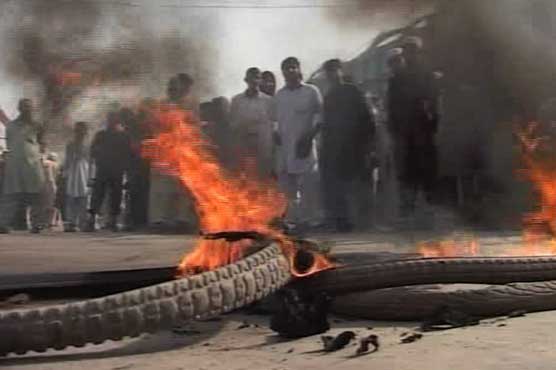
In his last speech to the joint session of the parliament's lower house (National Assembly) and the upper house (Senate) before the end of his presidency, Zardari made it clear that he was not ready to change his stance on extremism or compromise with the Taliban. Zardari's speech came just hours after Islamist militants targeted NATO supply trucks in a northwestern tribal area near the Afghan border, killing at least six people. "The nation is united against militancy. We need strong leadership to overcome the threat," he said to newly-elected parliamentarians. "We are ready to make peace with those willing to give up violence. But we should also be ready to use force against those who challenge the writ of the state." Zardari also said that the fact that the Pakistani people turned out in a large number to vote in the past national elections, despite the threats of violence, was proof that Pakistanis believed in democracy. But will Prime Minister Sharif pay heed to Zardari's advice? Will he go against the Taliban and other extremist groups in Pakistan or make peace with them? Will Imran Khan, whose party governs the strategically important Khyber Pakhtunkhwa province in the war against the Taliban, reconsider his policies vis-à-vis the Taliban and terrorism? The answer is a definite 'No'. Both these leaders have avowed that they would make truce with the Islamists and won't follow the Zardari legacy. Stronger Taliban Peshawar-based development worker and political activist Maqsood Ahmad Jan believes that Sharif's and Khan's insistence on peace talks with the Taliban are emboldening the extremists in Pakistan. "The new rulers have turned a blind eye to Taliban atrocities. Some parties say that the Taliban are like their children. The result is that the radicals are getting bolder and that kidnappings for ransom are on the rise," Jan told DW. He lamented that Sharif's Muslim League and Khan's PTI offered no words of sympathy to people targeted by the Islamist militants on a regular basis. Jan is of the view that not only the Taliban will get stronger under new rulers, the Sharif government will not be able to deal with various crises that Pakistan is facing, mainly the energy crisis. He thinks this will frustrate the Pakistani people who will probably look towards the PPP and the ANP again in future. "Sharif and Khan have no idea how to deal with the Taliban. The Khyber Pakhtunkhwa chief minister recently said he did not know who was behind the terrorist attacks." 'Unpopular war' But experts say that despite the fact that most Pakistanis are against Islamist extremists and prefer liberal and center-right parties over hardline Islamic ones, they want their government to review its support to the US in the protracted war against the Taliban. They want peace and do not care whether it comes at the cost of giving concessions to the militants.According to DW's Peshawar correspondent Faridullah Khan, Khyber Pakhtunkhwa has been one of the worst hit by the "war on terror" and many people there are against US drone strikes in the semi-governed northwestern tribal areas. In his opinion, many people held the ANP and PPP responsible for this situation. It was something that right-wing groups are benefiting from, he said. Political experts like Malik Siraj Akbar, who is based in the US, are critical of Pakistan's response to the Taliban and the menace of terrorism. Akbar told DW in an interview that the main reason why liberal Pakistani parties faced a dilemma was that Pakistan had not officially "owned" the so-called war on terror. "Pakistan is not ideologically convinced that it is its war." For this reason, counter-terrorism experts in in the country say Zardari and other liberals have not been able to get the masses behind them in the fight against terror. Another dilemma The ANP, like the PPP and the MQM, face another ideological dilemma. Not only the Pakistani state, but now also the US, wants to talk to the Taliban and make its peace with the militants. "So what is the future of the parties like the ANP and the PPP who have been supporting the onslaught on the Islamists?" asked Dr. Riaz Ahmed, a political activist in Karachi, who described why he believed the attacks on anti-Taliban leaders had increased. "Politicians who want an offensive against the extremists are now a hindrance in the negotiations with the Taliban. They are being removed from the scene," Ahmed told DW. Islamic parties have always been demanding that the government makes peace with the radicals. Muhammad Shah Afridi, a former conservative member of parliament from Khyber Agency, one of the semi-governed tribal agencies bordering Afghanistan, told DW that if the US and NATO could negotiate with the Taliban then Pakistan should do the same. "War is not the solution to this conflict. We will have to talk (to the Taliban)," Afridi said. Zardari had also welcomed the US initiative of "peace talks" with the Taliban. But experts believe it is not enough to convince the Taliban that he and his party are "friends." There are many in the ranks of the PPP and other liberal Pakistani parties who still oppose the Taliban and do not want to change their own ideological course. But experts are not sure how long they will be able to carry on with this legacy.
M WAQAR..... "A man's ethical behavior should be based effectually on sympathy, education, and social ties; no religious basis is necessary.Man would indeed be in a poor way if he had to be restrained by fear of punishment and hope of reward after death." --Albert Einstein !!! NEWS,ARTICLES,EDITORIALS,MUSIC... Ze chi pe mayeen yum da agha pukhtunistan de.....(Liberal,Progressive,Secular World.)''Secularism is not against religion; it is the message of humanity.'' تل ده وی پثتونستآن
Wednesday, June 12, 2013
Zardari's anti-Taliban legacy has no heirs
What Turkey needs is a coup
nationalpost.com
BY: Emmett Robinson, National Post
Tuesday, June 11, 2013
TURKEY: This is not the way to end Gezi Park protests, warns BDP's Önder
POLICE BRUTALITY VIDEO: TURKEY: Wheelchair user targeted by water cannon in Istanbul
A wheechair-user waving a flag was among those directly targeted by water cannon bursts by Turkish riot police in Taksim Square. The police have reacted fiercely to thousands of protesters, who tried to push them out of the landmark Istanbul protest site.
A protester confined to a wheelchair was amid a group of protesters apparently moving away from riot police vehicles, when he was hit by a huge burst of water from a police water canon, footage by ITV has shown.
Police use tear gas and enter Taksim Square for second time in day
Turkey: Twitter versus Prime Minister Erdoğone
by VERDA ÖZERTwitter has come up as the hero out of the massive Taksim protests in Turkey over the last 12 days. The extensive use of social media during the riots is unprecedented. The recent report of the New York University’s Social Media and Political Participation showed that the hashtag #direngezipark had been used in more than 1.8 million tweets just between June 2 to June 3. In comparison, during the entire Egyptian revolution the most popular hashtag #jan25 was used in less than one million tweets. It was not only the Turkish people who used Twitter remarkably. Right after his meeting with Prime Minister Recep Tayyip Erdoğan, Stefan Füle, European Commissioner for Enlargement, “tweeted” that he was disappointed with Erdoğan’s refusal to enter a dialogue with the protestors. The U.S. Embassy in Ankara also released a “Twitter declaration” denying Erdoğan’s recent statement that 17 people had been killed during the Occupy Wall Street protests. That both the EU and U.S. officials responded to Erdoğan via Twitter could be read as a message in itself since Erdoğan described the micro-blogging site as a “troublemaker” upon its mass use during the protests. This statement only reflects the power struggle between the nation state and the individual. Social media has shifted the power balance between these two powers and provided the citizen with an extraordinary power over the state. Conventional media had become the fourth power in addition to the legislative, judicial, and executive branches of governance, and was supposed to balance the state’s power. Yet, eventually it became incorporated into the system. At that moment, the Internet came to the rescue of the individual who needs a tool to challenge the state. As Howard Rheingold, an American author, put very well: Every desktop, hence every individual has become a potential broadcasting station and a place of assembly. Now the Internet and global public opinion are defined as the fifth power. How a nation-state will relate itself to the fifth power will define its status in the 21st century. A state which aims to become a regional or global power cannot achieve its goal by excommunicating the social media which holds the strongest global leverage. This would substantially diminish its connection and communication with the world, therefore its sphere of influence. Furthermore, censoring the internet and interfering with the information flow have become the new form of censorship, in other words, the biggest violation of the right of expression. According to sociologist Zygmunt Bauman, modern communities are becoming “liquid” since old solid structures are being replaced by more fluid objects and spaces. Increasingly mobile and evasive forms of power have emerged out of the state’s control. States need to adjust themselves to this “liquid modernity” and become flexible and transparent by bending their borders and embracing the realities of this new era. Otherwise they might be washed away into the background with this wave of “liquidity.”
Istanbul warzone: Thousands of protesters try to reclaim Taksim Square
Pakistan: ''Police, protesters clash during Faisalabad loadshedding protests''
Suicide blast in Kabul kills 14 at Supreme Court
Growing number of young adults eschewing religion
British report reveals Israel’s arms exports to Pakistan
Report by British government agency reveals that Egypt, Algeria, Pakistan, Morocco and UAE were among clients of Israeli defense industries.Israel has exported security equipment over the past five years to Pakistan and four Arab countries, according to a British government report. The report, which deals with British government permits for arms and security equipment exports, says that in addition to Pakistan, Israel has exported such equipment to Egypt, Algeria, the United Arab Emirates and Morocco.
Turkey protests: Riot police storm Taksim Square
Pakistan: Shortfall rises to 5600 MW, citizens protest
No Women Ministry in KP under PTI govt
A dictionary of Pashto idioms
Monday, June 10, 2013
Taliban beheads two boys in southern Afghanistan
Saudi Arabia jailed tweeter for 6 months
Reports say Saudi Arabia jailed prominent political commentator and novelist Turki al-Hamad for six months over posting messages on Twitter that were deemed to be insulting to the Wahhabi government.
Hamad’s arrest in December 2012 followed a tip by Saudi religious organizations. The arrest warrant was signed by Saudi Interior Minister Prince Mohammad bin Nayef bin Abdel Aziz.
On June 5, attorney Walid Abulkhair said his client, Hamad, “returned home this morning.”
The Saudi writer “has not been put on trial, and has not faced any charges,” Abulkhair stated.
Some 500 supporters of Hamad, including Saudi intellectuals, had signed a petition in January, calling on Saudi Arabia’s Crown Prince Salman bin Abdul Aziz to order the release of the prominent author.
Hamad’s messages on Twitter had been critical of radical Wahhabi clerics in Saudi Arabia, whom he claimed were misinterpreting and twisting the “message of love” by Prophet Muhammad (PBUH).
The Saudi writer also characterized the emergence of Wahhabism as “a neo-Nazism on the rise in the Arab world.”
Last year, Saudi officials also arrested young blogger Hamza Kashgari over ‘blasphemy’ charges.
Kuwaiti teacher given 11-year sentence for Twitter criticism of government
Newly crowned Miss Iowa hopes to advocate for people with disabilities
http://news.yahoo.com/
Turkey's opposition party leader accused the PM of escalating tensions and dragging the country 'into the fire'
Turkey's opposition party leader accused the prime minister of escalating tensions and dragging the country "into the fire" as enduring anti-government protests that have led to three deaths continued on Monday.
Prime Minister Recep Tayyip Erdogan headed a Cabinet meeting to discuss the protests, the first serious challenge to his 10-year rule.
On Sunday he had made a series of fiery speeches in three cities, saying the government's patience is running thin, demanding an end to the protests and threatening to hold those who do not respect his government to account.
Erdogan has also called major pro-government rallies in Ankara and Istanbul next weekend, apparently aiming to intimidate the protesters by showing that he, too, can get large numbers of his supporters out on the street.
Hurriyet newspaper on Monday quoted Kemal Kilicdaroglu, the head of the opposition Republican People's Party, as calling on Erdogan to reduce tensions.
PRESIDENT ZARDARI: ''Hard decisions needed to address challenges''
Radio PakistanPresident Asif Ali Zardari has said that there is need to take hard decisions without delay to address challenges facing the country.
Pakistan: No load-shedding for President, PM, judges and generals
DAWN.COM
Pakistan: Embracing Musharraf’s Cronies
Until he joined the Pakistan Muslim League (P.M.L-Nawaz) on April 12th,2013, Jan Mohammad Jamali, who was elected as the new Speaker of the Balochistan Assembly on June 4, remained an ardent supporter of former military dictator General Pervez Muhsharraf. As a leader of the pro-Musharraf Pakistan Muslim League (P.M.L-Quaid-e-Azam), Mr. Jamali served as the Deputy Chairman of Pakistan’s Senate for as many as six years (2006-2012).
Like his predecessor, Aslam Bhootani, Mr. Jamali was also elected unopposed as the B.A. Speaker. Mir Abdul Qadus Bizenjo of the Pakistan Muslim League (P.M.L-Q), who embarrassingly secured only 500 votes to become a member of the provincial assembly during the general elections, was elected as the Deputy Speaker.
The appointment of two former supporters of General Musharraf as the Speaker and the Deputy Speaker of the Balochistan Assembly is absolutely surprising and disappointing. The Pakistan Muslim League Nawaz, the Pakhtunkhawa Milli Awami Party (Pk.M.A.P.)and the National Party had agreed to in principle to exclude all supporters of General Musharraf, such as the P.M.L-Q, the Jamiat Ulema-e-Islam and the Balochistan National Party (B.N.P-Awami) from the upcoming government. They said all three parties would be consulted before including a new party in the provincial coalition government. No one knows for sure how an M.P.A. from the P.M.L-Q was appointed as the Deputy Speaker of the provincial assembly. Who benefits from such a decision is also hard to speculate. Also, spending two months as P.M.L-N leader does not wash away Mr. Jamali’s sins as a supporter of General Musharraf, who is largely disliked in Balochistan for the deadly military operation he unleashed in Balochistan during his dictatorial regime.
Mr. Jamali is a former Balochistan chief minister who is known as a man with little respect for women’s rights. In 2010, when the whole country was shocked over news reports about the alleged burial of five women in the name of honor in Balochistan’s Naseerabad district, Mr. Jamali, along with Senator Israrullah Zehri, stood as a defender of “our cultural practices”.
Appointing such men on top government positions is a setback for women’s rights in a province like Balochistan where women’s rights urgently need to be advocated and encouraged.
Last month, there was substantial debate over the future chief minister of the province and all parties agreed upon Dr. Malik Baloch’s name after holding extensive discussions. The coalition parties did not debate at all the positions of the Speaker and the Deputy Speaker. They were voted very hastily under a shadowy arrangement. No body knows who nominated them and how they were elected so quickly.
Among the coalition partners, only the Pk.M.A.P. has cautiously objected to the appointment of a P.M.L-Q leader as the Deputy Speaker. It should have also objected to Mr. Jamali’s appointment because of his past affiliation with a party that supported Musharraf.
It is disturbing to see how Prime Minister Nawaz Sharif has been accepting Musharraf’s cronies in his party and also offering them key positions in Balochistan. Besides Mr. Jamali and Mr. Bizenjo, the new Deputy Speaker, another key leader of the Musharraf era, Asim Kurd Gillo, the province’s former finance minister from the P.M.L-Q and Lashkari Raisani of the Pakistan People’s Party have all been accommodated in the P.M.L-N. These are all the tested bad eggs of Balochistan’s politics. Taking them on board and offering key positions will not help the P.M.L-N. improve its image but these corrupt politicians will take the P.M.L-N rule as an opportunity to renew their careers.
The new government in Balochistan is about to kick off its journey. But, the appointment of two Musharraf supporters as the Speaker and the Deputy Speaker is not a very positive omen. The people of Balochistan have a right to object to these appointments and ask Mr. Sharif and the coalition partners about the motivation behind these flawed decisions.
Cyber crimes confrontation at Obama Xi summit
http://www.telegraph.co.uk/
President Barack Obama confronted his Chinese counterpart Xi Jinping over "cyber espionage" but the two men agreed on the need to rein in North Korea's nuclear ambitions at a summit in the California desert.The leaders of the world's two largest economies held eight hours of talks over two days, including 50 minutes of what aides called "one on one time" as they went for a walk together in the lush grounds of Sunnylands, the ranch where the meeting was held.
Sex education – a need to be open
Nationwide Gezi Park protests in Turkey see police intervention overnight
Pr
Protesters supporting the ongoing Gezi Park demonstrations were subjected to police attacks overnight in various cities, with tension especially rising in Adana and Ankara.
Ankara crowds again suffered a harsh police barrage, with officers using TOMA water cannon and tear gas to disperse protesters that had gathered at the city’s Kızılay Square. Demonstrators had to flee to side streets as police forces attempted to empty the square.
Police also moved on the capital’s Kuğulu Park in the early hours of today to dismantle tents that had been erected in solidarity with the action continuing in Taksim Gezi Park. Despite initial opposition, subsequent reports said the officers had succeeded in taking down the tents in the park. Protesters in Adana also faced police attacks when they attempted to march toward Akkapı district in order to join another demonstrating group that had been subjected to violent behavior from a group of Justice and Development Party (AKP) supporters the night before.
Police denied permission to the group to march and called on the protesters to disperse. When the group refused, police intervened with TOMAs and tear gas, following protesters down to the end of Çakmak Street to completely disband the crowd.
Protests in Edirne and İzmir also gathered thousands in support of the Gezi Park demonstrations, with over 2,000 protesters marching in Edirne and 10,000 in İzmir. There was brief tension in İzmir stemming from opposing groups, but the problem was quickly resolved.
Pakistan: Blasphemy accused denied bail in Ahmadi literature case
Ahmadiyya Times
Google may be blocked in Pakistan over objectionable material in YouTube
All seven militants dead at end of Kabul airport attack
Karzai’s cheekiness
Pakistan: PTI’s mandate was stolen in polls
Pakistan:Joint session of parliament: President set to make record 6th address
The Express TribunePresident Asif Ali Zardari is set to make history by addressing the joint session of Parliament for a record sixth time today (Monday). But while he may have done so on five prior occasions, it will be his first address to Parliament without his Pakistan Peoples Party in power. On the upside for President Zardari, however, he will not have to contend with a hostile opposition – at least in the National Assembly. The Pakistan Muslim League-Nawaz, the main opposition party during the previous government’s tenure, routed the PPP in all but Sindh in the May 11 elections and has now come to power. In a reversal of fortunes, PPP now finds itself confined to the opposition benches in the lower house of Parliament. Today’s session will also mark two other firsts. Not only will it be the first formal session of the newly-elected National Assembly, it will be the first joint session of Parliament after the smooth transfer of power between two elected governments. In his address, President Zardari will give credit to his party for ensuring the democratic process flourished despite facing several challenges, said a senior official quoting a portion of the President’s speech. The President will also praise his off-and-on political rival Prime Minister Nawaz Sharif for backing the democratic government and showing maturity, he added. According to sources, the speech has been written by senior presidential officials and vetted by presidential spokesperson Senator Farhatullah Babar. Talking to The Express Tribune, Babar said no input was taken from any other office, such as the Prime Minister’s Secretariat, while writing the speech. He did not, however, share the contents of the speech. “I should really not talk about contents of speech at this time. Yes, it [the speech] is historic in more ways than one,” he maintained. Meanwhile, Pakistan Muslim League-Nawaz Senator Mushahidullah Khan praised the previous PPP government for putting the democratic process on the right footing. “It has been a reciprocal relationship between PPPP and PML-N for years [to strengthen democracy],” Khan said, adding “It’s a historic day for Parliament,” he added. According to constitutional provisions, the President has to address a joint session of Parliament at the beginning of the first session of the National Assembly after a general election or at the start of every parliamentary year. Article 56(3) of the Constitution states: “At the commencement of the first session of the National Assembly after each general election and at the commencement of the first session of each year, the President shall address both Houses assembled together and inform the Majlis-e-Shoora (Parliament) of the causes of its summons.” Monday will also remain a busy day for Prime Minister Nawaz Sharif. He will chair his first cabinet meeting, discussing issues relating to drone strikes, energy and the budget for the new fiscal year. He will also chair the meeting of the National Economic Council before attending the session.
Pakistan: Bars to oppose any job extension to CJP
DAILY TIMESThe superior bars have decided to resist any move to give job extension to Chief Justice of Pakistan Iftikhar Muhammad Chaudhry after his retirement. According to the sources, Independent Group of lawyers, which is ruling the Supreme Court Bar Association and Pakistan Bar Council for the last three years has decided to oppose any move, including constitutional amendment, to give two-year job extension to Chief Justice of Pakistan Iftikhar Muhammad Chaudhry after his retirement. The sources told Daily Times that an important meeting of the Independent Group was held at Lahore on Saturday. It has been learnt that incumbent PBC Vice Chairman Syed Qalb-e- Hassan, former vice chairman Akhtar Hussain, incumbent SCBA President Mian Israrul Haq, former SCBA presidents Asma Jahangir, Yasin Azad, Lahore High Court Bar Association President Abid Saqi and other representatives of the four provincial bars attended the meeting. The sources said that the outcome of that meeting is likely to be made public through a press release today (Monday). They said that it had been decided during the meeting that the superior bars would take a “principled stand” by opposing any move to give job extensions to the heads of institutions like judiciary and army. Meanwhile, two participants of the June 8 meeting confirmed that superior bars would oppose any constitutional amendment on this matter. It is worth mentioning that a couple of petitions have been filed in the Supreme Court this year, seeking directions for two years extension in the service of CJP Iftikhar Muhammad Chaudhry after his retirement. Though the SC Registrar’s Office has already returned one petition on this issue last week but lawyers have decided to preempt any future move in this regard. It is worth mentioning that PML-N Information Secretary Mushahidullah has already said that his party would seriously consider extension in service of CJP Iftikhar Muhammad Chaudhry after his retirement.
Takfiri militants in Syria endanger regional peace: Iraqi PM
Insurgents battle Afghan forces near Kabul airport
Associated PressAt least five heavily armed insurgents were engaged in an hours-long gunbattle with security forces near Afghanistan's main airport Monday after they apparently tried to attack NATO's airport headquarters with rocket-propelled grenades, assault rifles and at least one large bomb, the army and police said. The airport was closed to all civilian air traffic because of the attack, an airport official said. It was unclear if the attack had damaged facilities inside the airport itself. "Their target is unclear because they are at a distance from the airport. We have lots of installations in that area," Interior Ministry spokesman Sediq Sediqi said. "They seem to be trying to hit anything they can." He said three insurgents had been killed so far and at least three others were believed to be in a four- to five-story building that was under construction. There were no casualties among police or civilians, he added. Taliban spokesman Zabiullah Mujahid claimed responsibility for the attack, saying the insurgents were targeting NATO. It was the latest in a series of attacks against the capital since the start of the year. Taliban insurgents have launched intense attacks across the country as Afghan forces take over most security responsibility ahead of most foreign troops' withdrawal next year, more than a decade after the American-led invasion to oust the Taliban regime for sheltering al-Qaida's leadership after the Islamic extremist group launched the Sept. 11, 2001, terrorist attacks in the United States. The last major attack occurred on May 24, when six suicide bombers attacked a guest house belonging to the United Nations-affiliated International Organization for Migration, killing three people — including a police officer, a guard and a civilian. On May 16, a suicide bomber had rammed a car into a NATO convoy killing 15 people, including two American soldiers and four civilian contractors. Kabul police said in an announcement that attackers wearing suicide vests had occupied one or two buildings under construction on the west side of the airport and were firing at the military facility, which was quite a distance away. But it was uncertain if they actually managed to hit anything inside the airport. A statement said there was at least one large explosion at around 4:30 a.m. and a gunbattle began with security forces. "It first started with a big explosion which we think was a suicide attack. After that a gunbattle started," said Kabul police spokesman Hashmat Stanikzai. He added that at least five insurgents then occupied two buildings, located in a single compound, and started firing rocket-propelled grenades and automatic weapons. "Sometimes they are shooting from one building, sometimes from other. It is a residential area and the compound has been surrounded by Afghan security forces. The security forces surrounded the buildings and are being careful because it is a residential area," he added. Afghan army Gen. Murad Ali Murad said police and military forces were exchanging gunfire with insurgents. "Outside the airport, in the civilian area, there is a tall building under construction and they are shooting at the military side from there," he said. The U.S.-led NATO coalition's Joint Command headquarters at the airport runs the day-to-day operations of the nearly 12-year-old war against insurgents. The airport's military side is also used for NATO transport and other aircraft. "It started just after dawn prayers and I counted about a dozen explosions, mostly RPG fire, coming from the airport," said Emayatullah, who lives next to the airport. Like many Afghans he uses only one name. The International Assistance Force's Joint Command said it was aware of reports of an attack but had no further details.
Islamists said to execute 15-year-old Syrian boy for heresy
Subscribe to:
Posts (Atom)