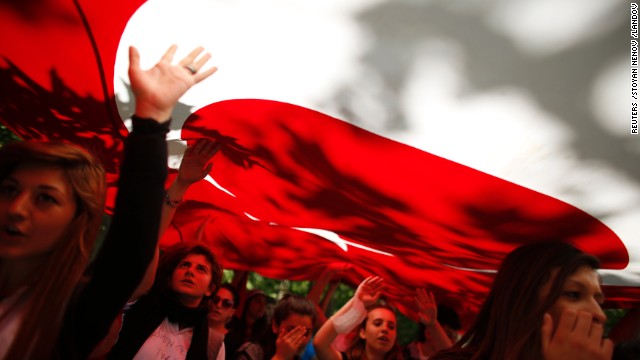
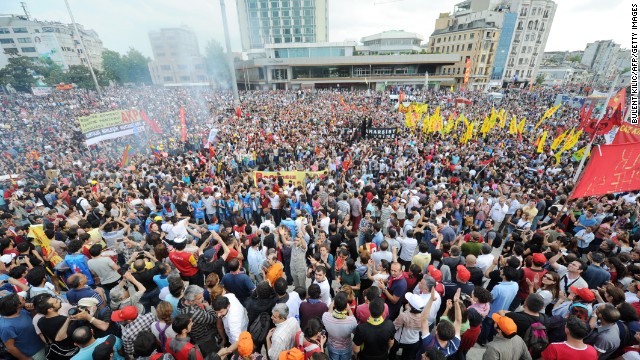
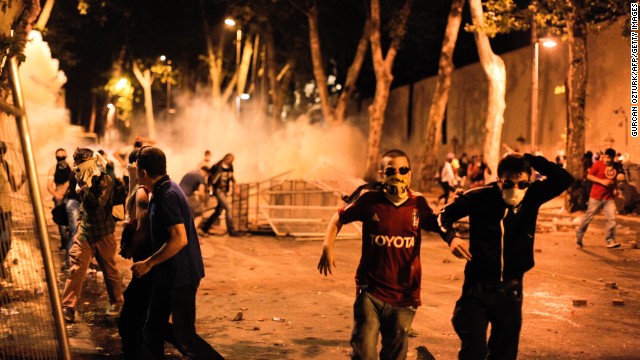
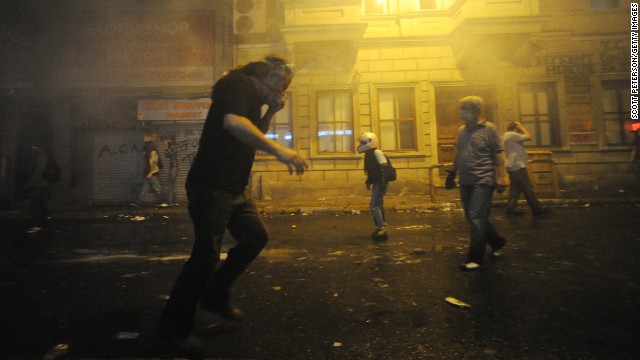
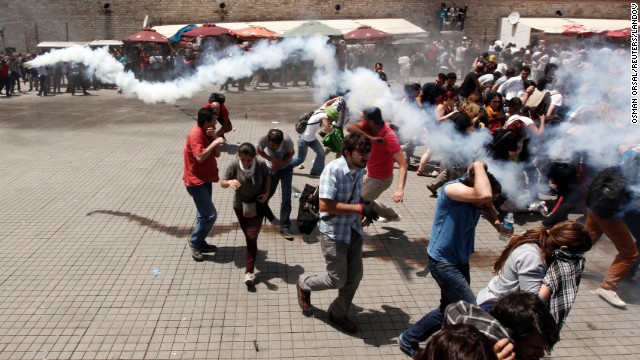
When only pro-Erdogan demonstrations are given official backing and dissenters are greeted by tear gas – then there's no meaning to the right to protest in Turkey.
M WAQAR..... "A man's ethical behavior should be based effectually on sympathy, education, and social ties; no religious basis is necessary.Man would indeed be in a poor way if he had to be restrained by fear of punishment and hope of reward after death." --Albert Einstein !!! NEWS,ARTICLES,EDITORIALS,MUSIC... Ze chi pe mayeen yum da agha pukhtunistan de.....(Liberal,Progressive,Secular World.)''Secularism is not against religion; it is the message of humanity.'' تل ده وی پثتونستآن
Wednesday, June 5, 2013
Erdogan's aim: Suffocating the right to protest in Turkey
Turkey protesters demand dismissal of police chiefs
Activists in Turkey have demanded the sacking of police chiefs in Istanbul, Ankara and other cities over their forces' violent responses to protests.
They also rejected an apology by Deputy PM Bulent Arinc, saying his remarks "were reminiscent of a civil war".
http://news.bbcimg.co.uk/media/images/67990000/jpg/_67990776_169925171.jpg
A group calling itself the Taksim Solidarity Platform (TSP) said it had handed a list of demands to Mr Arinc.
The crackdown on protests over the redevelopment of a park in Istanbul last week triggered nationwide unrest.
Overnight, police in Istanbul again fired tear gas, water cannon and smoke grenades at protesters.
The demands presented by the Taksim Solidarity Platform on Wednesday included a ban on the use of tear gas, the release of detained protesters, and the scrapping of the plans for the redevelopment of Gezi Park, which is part of Istanbul's Taksim Square.
"The steps the government takes will shape the events," the TSP said after their meeting with Mr Arinc on Wednesday.
On Tuesday, the deputy prime minister apologised to demonstrators who had been injured.
He said the original protests had been "just and legitimate" and that the "excessive use of force" by police had been wrong.
Officials have confirmed that two people have been killed in the unrest.
One man died after being shot by an unidentified gunman in the southern city of Antakya. Another died after being hit by a car that ploughed into a crowd in Istanbul.
Turkish media criticized for ignoring protests and police brutality
Who will stand for Ahmadis in Pakistan?
Daily Times
Husain NadimThe use of anti-Ahmadi rhetoric by political parties raises a serious question: Is there anyone who will ever stand up for their rights? “It’s almost laughable. You first forcefully declare us a minority, then you promise to protect minority rights, and when you fail, you conveniently say sorry,” an Ahmadi that I interviewed recently for my elections research laughed at the contradiction and hopelessness in Pakistan. Behind his laugh, I could sense the pain and fear that has engulfed the minorities, especially the Ahmadis, in Pakistan. While the cities and media is buzzing with the slogans of ‘Roshan’ (bright) and ‘Naya’ (new) Pakistan, Ahmadis have been ambushed by political parties in their struggle for electoral seats. Politicians have gone the distance to prove themselves good Muslims, the criterion of which in Pakistan is to believe in One God and the Prophet (PBUH), and to also consider Ahmadis as ‘kafir’ (infidel). Political compulsion it might be for most of them, but for Ahmadis it is a sad reality check of the diminishing space to breathe in society. “How will these politicians take a stand for anything when they can’t take a principled stand for the weak in society,” an Ahmadi showed his distaste for the recent fiasco between the Pakistan Tehreek-e-Insaaf (PTI) and Jamiat-e-Ulema-i-Islam-Fazl (JUI-F) on the Ahmadi issue that got viral on the social media. Ahmadis are scared that using their sect as a political tool for votes will lead the youth and the nation into hyper-radicalisation, and Ahmadis will become the natural target of frustration. “You know that the German Jews couldn’t have predicted the coming of the Holocaust. It began with years of systematic social isolation, hatred, and conspiracies against them, and then Hitler came, and we saw what happened. I see Pakistan heading towards that for us.” As unbelievable as this statement from one of the Ahmadis who participated in WWII on the side of the Allies appears, in the past few months, while the nation had been busy with elections, Ahmadis are being silently targeted, not only by religious extremists, but by government itself in all the major cities, especially in Lahore under the interim setup of Chief Minister Najam Sethi. However, none of the atrocities are being reported as ‘breaking news’ on the mainstream media outlets. “In the past two weeks our mosques have been raided by the police, our publication shops turned into a mess, and we have been barred and threatened by the police not to have any of our literature at our home, nor have any religious meetings in our centres.” An Ahmadi in a position of authority who requested anonymity explained in frustration: “They have even told us that they have the list of all addresses of Ahmadis, and they will raid houses to confiscate any literature,” which gave a glimpse of the Nazi-era style of discrimination against the Jews. “We are being systematically forced to leave this country, this land. More than Ahmadi, I’m a Punjabi and my family has lived on this land for centuries, and today I don’t have an option but to leave.” Tears rolled out of this old man, whose father was a wealthy businessman at the time of partition and sold all his possessions to give funds to the Pakistan Muslim League. Today, he is being forced out of the land of his forefathers. The discrimination does not stop here, as another tragic event took place a week before the elections in Gulshan-e-Ravi, Lahore, where the police raided an Ahmadi centre and arrested the people who were offering their prayers. On top of charging them under the Hudood law of ‘imitating Muslim practices’, the men arrested were also accused of conspiring against the state and for terrorism. The arrested persons included an 83-year-old man, and a few minors. During the court proceedings, the High Court dismissed the case, calling it a politically motivated attempt by people in the area, but in a matter of hours, after severe pressure from right wingers, the judge refused to give bail to the detainees. According to the lawyer who is defending the Ahmadis, “No judge is willing to take a stand for Ahmadis against these right wing mullahs,” who threaten the judges and get their way. One is forced to ask this simple question: on whose authority is all this being done, and why is the government so hopeless against these right wingers? Is it also equally involved? I asked an Ahmadi for his opinion on this question to which he responded, “We are political suicide for any politician in Pakistan. Even a dictator like Musharraf who genuinely felt the pain for us, and during whose tenure, in spite of whatever was happening in Pakistan, minorities were protected and discriminated against less, could not reverse the constitutional discrimination against us. He had to bow down to the religious fanatics at last, the same way Zulfiqar Ali Bhutto gave in back in the 1970s.” When it comes to Ahmadis it is not just the illiterate class that hates and discriminates the community, even the educated and the affluent have little sympathy. While these elections might prove to be a positive tide for Pakistan, the use of anti-Ahmadi rhetoric by political parties raises a serious question, and a concern for millions of Ahmadis who live in Pakistan. Is there anyone who will ever stand up for their rights?
Pakistan: Minority rights: No minor issues
The Express TribuneMembers of minority communities have pledged to pile up pressure on the upcoming government to promote religious freedom from the very onset. As the last few years saw risks to minorities reaching alarming proportions, it seems the minorities mean business when it comes to making sure their interests are guarded. Minorities’ representatives, both in the parliament and the provincial assemblies, want fresh legislation on religious freedom to protect the rights of an estimated nine million non-Muslims living in Pakistan. “We want to get the necessary bills passed from the Parliament soon,” said MNA Aasiya Nasir who is a Christian MNA from the platform of Jamiat Ulema-e-Islam-F. Minorities want to stay away from the sensitive issues but will continue to struggle for their basic rights, she added. An important proposed bill seeking increase in minorities’ quota in assemblies has already been passed by the previous federal cabinet. An important proposed bill seeking registration of Hindus, the largest minority in Pakistan, is pending with the standing committee concerned since 2011. The Council for Islamic Ideology (CII) should also pass its recommendations pertaining to the laws which may assure a better and safer life for vulnerable minorities, he added. At present, some 38 non-Muslims are representing minorities in the Parliament as well as in the provincial assemblies. Ten members are elected on NA reserved seats in the lower house of the Parliament and four are already representing the minorities in the Senate. Nine members are representing minorities in Sind Assembly, eight in Punjab Assembly and three each in Balochistan and Khyber-Pakhtunkhwa Assemblies. Only one MPA, Dr Mahesh Malani, won direct elections from PS-61, Tharparkar, Sindh. “Legislation on three major issues – forced marriages, forced conversion of religion and registration of Hindus marriages must be done in first Parliamentary year,” said Malani. Last year, minorities’ representatives succeeded in getting a bill passed from the federal cabinet which principally approved an increase in seats reserved for non-Muslims in the legislatures in proportion to their population. The proposed bill, however, could not be tabled to the parliament due to some unknown reasons. “We will table this bill to the National Assembly this year,” said MNA Dr Ramesh Kumar who admitted differences among minorities. “While it is true minorities are divided in Pakistan, we want protection of mosques, churches, gurdwaras and temples,” he added. MPA Ramesh Singh Arora, addressing the specific issues of Sikh community, said there is a sense of insecurity among Sikhs in Khyber-Pakhtunkhwa (KP) due to the law and order situation. “Protection of Sikhs’ places of worship must be given priority under the new legislation,” Arora told The Express Tribune. Some 100 plus gurdwaras until now have been closed due to negligence of the ‘Auqaf’ Department in Punjab and KP, Arora, who is the first MPA in Punjab since separation of Pakistan, said. “I’ll urge the government to operationalise these worship places again.” MPA Arif Masi, talking about issues related to the Christian community, the second largest minority in Pakistan, said he also recalled several blasphemy cases registered against Christian community. “Representatives of minorities irrespective of their beliefs should stand united to address the issues they are facing,” he concluded.
Balochistan : Farewell Candid Governor
Editorial: The Baloch HalIf Balochistan’s outgoing governor, Nawab Zulfiqar Ali Magsi, is given an option to choose between his two terms as the province’s chief minister and the stint as the governor to determine his legacy, he should definitely opt for the latter. As the governor of Balochistan during extremely troubled times, Mr. Magsi earned enough respect for his mature political approach, candor and a policy of non-interference in the affairs of the provincial government. Despite enjoying symbolic powers, he repeatedly reminded the Balochistan government, the Center and the Army that their policies and strategies in Balochistan were flawed and immediately needed complete review. After the incoming Prime Minister Nawaz Sharif of the Pakistan Muslim League (P.M.L-N) agreed to appoint a new governor in Balochistan who would belong to the Pashtunkhaw Milli Awami Party, Governor Magsi has submitted his resignation to President Asif Ali Zardari. Governor Magsi, who is known as an introvert, had resigned from his job even a few years ago but President Zardari had insisted that he should continue on the job. Ironically, Mr. Magsi had been appointed by former president General Pervez Musharraf as the representative of the federation in Quetta. There is certainly no hope for another extension of Mr. Magsi and now he has to go home. Mr. Magsi worked with two of Balochistan’s most incompetent and unpopular chief ministers, Jam Mohammad Yousaf (Pakistan Muslim League Quaid-e-Azam) and Nawab Mohammad Aslam Raisani (Pakistan People’s Party). Yet, he tried his best to offer free advice to the two heads of the government. The past few years have seen deadly military operations, human rights abuses and sectarian killings in Balochistan but Governor Magsi surely cannot be blamed for these developments because the governor is not the chief executive of the province. In January this year, (former) Prime Minister Raja Pervez Ashraf imposed the governor’s rule in Balochistan owing to the increasing attacks on Shia, Hazara population. During these two months, Mr. Magsi served as the province’s chief executive and he did a relatively good job in containing sectarian violence. He did not ask for more power or an extension in the governor’s rule which was very helpful in restoring civilian rule in the province. We know mere statements and talks do not make a good politician but if there is one thing for which Mr. Magsi will be remembered is his straightforwardness. He often publicly admitted that the Balochistan government comprised of corrupt and incompetent people. He admitted government’s failures. He was vocal in blaming the Pakistani military for carrying out a kill and dump policy in the province. In his views, the way forward to change the state of affairs in Balochistan was the participation of “good people” in politics so that “corrupt people like us’ are thrown out of the political system. No politician gives such blunt advice! Besides his political career, Mr. Magsi is also a powerful tribal chief of his Magsi Baloch tribe. We do not know for sure what he intends to do after leaving the Governor’s House. However, one does wish that men of his stature should not confine their intelligence, enormous political and administrative experience and vast wealth to only whining about the that-is-the-way-it-is type of system in Balochistan. He should play his role in changing the system at least at the societal level. In order to improve the living conditions of the people of Balochistan in general and the Magsi tribesmen in particular, Mr. Magsi should help in opening up the society in Balochistan. He can do so by establishing health and education centers in his native district and Quetta. Unfortunately, Balochistan does not have a tradition where retiring politicians spend their wealth on establishing centers of higher education. Someone has to take that big initiative for a brighter future of our coming generations. During his stint, Mr. Magsi left a clear guidelines for his successor: Governors should limit themselves to their constitutional authority and refrain from picking up fights with the chief minister. They should, at the same time, continue to provide necessary advice to the head of the provincial government. We sincerely hope that Balochistan’s next Baloch chief minister and Pashtun governor will set a remarkable precedence of cordial relations, mutual respect and limitless cooperation in the greater interest of the people of Balochistan. Lastly, it is actually for the people of Balochistan to decide whether or not they will ever miss Governor Magsi. We look at him as a good governor who worked with two horrible chief ministers. During his term, Mr. Magsi kept the Governor’s House apolitical yet opened his doors for all.
Pakistan seeks India's help in battle with polio
dawn.comIn a story printed in The Hindu, the head of Pakistan’s polio programme said that the country is taking assistance from India in its battle against the crippling disease. India has been polio free for two years, “but what hinders Pakistan in containing the dreaded virus is insurgency, violence and illiteracy,” said Aziz Memon, Pakistan National Polio Plus Committee Chairman in an interview on a visit to India Pakistan’s polio campaign suffered a major setback earlier this when a volunteer in the vaccination campaign was killed and her colleague wounded in a militant attack near Peshawar. The attack came soon after nation-wide polio campaign started on May 28. Given India’s success in eradicating polio, Mr. Memon said Pakistan is looking to use a similar approach in reaching out to its population. “We are taking lessons from India. Our teams visited Bihar and Uttar Pradesh to see the way they vaccinated children,” he said. Uttar Pradesh and Bihar were once breeding grounds for the debilitating disease. After 741 polio cases surfaced in 2009, India started using bivalent vaccines (targeting Polio 1 and Polio 3 viruses) in its national vaccination programme from January 2010. This showed dramatic effects and India moved out of WHO’s list of endemic countries in 2011. “We picked many tips (from our visit). We learned how to involve hundreds of volunteers (involved in the campaign), how to handle the resource centre and how to immunise children at the transit check posts”, he said. India being polio free for the past two years, Pakistan, Afghanistan and Nigeria are now the only three countries in the world where the highly infectious, crippling disease still remains endemic. Mr. Memon said that while Pakistan has been successful in vaccinating children, some areas remain out of reach for polio workers because of the threat of violence and various other factors. “The situation of our polio programme is good. One of the main reserves of polio is the Gadap Town slum area in Karachi. Now, it is very much in control there,” Mr. Memon said. Gadap Town , the largest slum of Karachi, which has concentration of migrant Pashtun speaking population of Khyber Pakhhtunkhwa has high incidents of polio, increasing the risk of the virus spreading. Mr. Memon said that the issue of insurgency and violence in certain areas was a “major setback” to the programme. “The area around Peshawar is another focus ... Insurgency and law and order are the problems there,” Mr. Memon said. Recently the Pakistani authorities suspended the four-day polio vaccination programme after an attack on a polio worker on May 28. Mr. Memon said that the tribal region of the northwest was problematic area with the Taliban’s rejection of the oral vaccination programme. While the Taliban in Afghanistan recently announced its support for polio vaccination, the Tehreek-e-Taliban Pakistan (TTP) continue to oppose it. “In Pakistan, Taliban leaders change every 30 miles. They are against polio vaccination,” he added. The TTP has banned polio vaccination alleging that the vaccination programme is a cover for espionage. “Working in that area (the northwest) is not so easy. There are many issues. Children are trapped there, though we have vaccinated some children with the army’s help,” Mr. Memon said. According to media reports, two children have been diagnosed with polio in the last 36 months in the North Waziristan area of the Federally Administered Tribal Agencies (FATA). During the last polio vaccination campaign in Pakistan, some 1.83 million children missed polio drops across the country owing to various reasons, including security threats according to data collected by the World Hearth Organisation (WHO). About 763,714 children were missed in Khyber Pakhtunkhawa alone, 621,724 in other areas of FATA, including 260,000 from North and South Waziristan, and 396,925 in Balochistan. So for this, eight cases of polio have been recorded in Pakistan.
Saudi Arabia funding fuels jihadist terror
The Vancouver Sun
BY JONATHAN MANTHORPEThe ultimate responsibility for recent atrocities like the Boston Marathon bombing and the butchering last week of an off-duty British soldier is very clear. It belongs to Saudi Arabia. Over more than two decades, Saudi Arabia has lavished around $100 billion or more on the worldwide promotion of the violent, intolerant and crudely puritanical Wahhabist sect of Islam that the ruling royal family espouses. The links of the Boston bombers and the London butchers to organizations following the Saudi royal family’s religious line are clear. One of the two London butchers, Nigerian-born Michael Adebolajo, was radicalized by the cleric Abu Hamza al-Masri, who headed the outlawed terrorist group Al-Muhajiroun. The group follows Wahhabist teachings and advocates unifying all Muslims, forcibly if necessary, under a single fundamentalist theocratic government. Similarly, the Boston bombers, Tamerlan and Dzokhar Tsarnaev, hailed from Russia’s southern predominantly Muslim province of Chechnya. Starting in the late 1980s, Saudi Arabia began dispatching Wahhabist clerics and radical preachers to Chechnya. The spread of Wahhabism sparked not only a separatist war against the Russians, but also a good deal of violence among Muslims. Wahhabism is now institutionalized in Chechnya and is particularly attractive to young men. There are similar strands leading back to Wahhabist indoctrination in the histories of very many of the known Muslim terrorists of the last 20 years. The founder of the sect, Muhammad ibn abd al-Wahhab, was an eighteenth century Muslim zealot allied to the Al-Saud clan who promoted an extreme version of Salafism. Salaf is the Arab word meaning pious ancestor and refers to those who attempt to emulate the pure Islamic life of the Prophet Muhammad and his generation of followers. But Wahhab and his modern disciples take this notion to extremes. The list of people whom Wahhabists should consider their enemies includes not only Christians, Jews, Hindus and atheists, but also Shiite, Sufi and Sunni Muslims. And yet no western politicians seem prepared to accept the obvious. The chances of disaffected young men being drawn into the evil web of Wahhabist murderous extremism would be significantly decreased if the Saudi funding was blocked. The Saudis began exporting Wahhabism in the early 1970s when the country’s oil wealth began growing at an ever-increasing rate. The amount the Saudi royal family, both by government donations and the generosity of individual princes, now lavishes on Wahhabist schools, colleges, mosques, Islamic centres and the missionary work of fundamentalist imams around the world is extraordinary. In 2003, a United States Senate committee on terrorism heard testimony that in the previous 20 years Saudi Arabia had spent $87 billion on promoting Wahhabism worldwide. This included financing 210 Islamic centres, 1,500 mosques, 202 colleges and 2,000 madrassas (religious schools). Various estimates put the amount the Saudi government spends on these missionary institutions as up to $3 billion a year. This money smothers the voices of moderate Muslims and the poison flows into every Muslim community worldwide. Key figures in the September 2001 attacks on the United States were radicalized at mosques in Germany. Britain is now reckoned by some to be the worst breeding ground anywhere for violent Muslim fundamentalists Indian newspapers recently reported Saudi Arabia has a massive $35 billion program to build mosques and religious schools across South Asia, where there are major Muslim communities in India, Pakistan, Bangladesh, and the divided territory of Jammu and Kashmir. Indian police and Central Intelligence officers were quoted as saying their information came from American intelligence agencies. There are unconfirmed reports that Saudi Arabia and members of the royal family have donated millions of dollars to fund mosques and Islamic centres in Toronto, Ottawa, Calgary and Quebec. The money, and the emphasis on Wahhabist teaching that comes with it, has caused sharp divisions among Canadian Muslims. Over the years, there have been repeated complaints to Saudi Arabia about its funding of radical indoctrination. But while there has been some toning down of the most inflammatory language in the Wahhabist texts the Saudi’s disperse, the overall message of the propaganda program has changed little. Where the Saudi government has retreated under pressure from Washington is in the direct funding of terrorist organizations. It is widely believed by western intelligence agencies that in the 1980s and 90s, the Saudi government had a deal with Wahhabist terrorist groups like al-Qaida that their fundraising would not be hindered so long as they only operated in foreign countries. However, after the terrorist attack on a residential compound for foreigners in Riyadh in May, 2003, the Saudi government began a crackdown on terrorism. But even though the Saudi government ended official support for groups like al-Qaida, the Taliban and the Pakistani militant group Lashkar-e-Taiba, private donations from Saudi Arabia still find their way to these and similar groups. But when all is said and done, curbing direct payments to terrorist groups is a small matter when so many billions of dollars continue to be directed at creating terrorists.
Tuesday, June 4, 2013
ElBaradei calls on Morsy to apologize to Ethiopia
http://www.egyptindependent.com/Mohamed ElBaradei, National Salvation Front Coordinator, called on President Mohamed Morsy to apologise to Ethiopia and Sudan for “the irresponsible utterances” made during the national dialogue session held on Monday to discuss the Ethiopian Renaissance Dam crisis. On his Twitter account, ElBaradei –also the President of the Dostour Party– demanded that Morsy offer similar apologies to both countries in the name of Egyptians. The live broadcast of the national dialogue on Monday sparked criticism by participants in the dialogue, including Ayman Nour –president of Ghad al-Thawra party. He called for holding responsible those who decided to broadcast on air what was supposed to be a closed dialogue session. Pakinam al-Sharqawy, assistant presidential adviser for political affairs, extended her apologies for "any unintended embarrassment caused to any of the political leaders who attended the national dialogue session to discuss the report submitted by the tripartite committee on the Ethiopian Renaissance Dam." On her Facebook page, Sharqawy said the decision for the live broadcast of the dialogue session was taken just before the session, due to the significance of the Nile water dossier. The most controversial contribution during the session was made by Ayman Nour, who suggested that Egypt disseminate rumors that it is seeking advanced aircrafts. He said this is an intelligence technique of intimidation. “It might not be realistic, but it will bring results on the diplomatic path”, he said. Nour, however, stated he believes diplomatic efforts will not yield great outcomes: “Ethiopians have taken the decision, and it is highly difficult for them to backtrack”. Chairman of the moderate Islamist Wasat Party, Abul Ela Mady, suggested sending army destroyers to the Bab al-Mandab strait and spreading rumors that Egypt is about to strike the dam.
Biden: US concerned about Turkey protests
http://www.timesofisrael.com/
Speaking at the American-Turkish Council’s annual conference, vice president says country mustn’t choose between democracy and economic progressVice President Joe Biden said Tuesday that only Turks can solve the problem of anti-government protests sowing unrest in Turkey. But he added that the U.S. is concerned and isn’t indifferent to the outcome. Thousands have joined rallies voicing discontent with Prime Minister Recep Tayyip Erdogan’s 10-year rule. The protests spread after police cracked down on a peaceful sit-in over an Istanbul park’s demolition.Biden said the U.S. supports freedom of assembly, a free press and nonviolence by government and demonstrators. He said Turkey mustn’t choose between democracy and economic progress. Biden said the U.S. and Turkey sometimes disagree on tactics but share common goals, like a two-state solution for Israel and the Palestinians, a non-nuclear Iran and a nonsectarian Syria. Biden spoke at the American-Turkish Council’s annual conference. One of Turkey’s deputy prime ministers also attended. En route to the OAS General Assembly in Guatemala, Secretary of State John Kerry spoke with Turkish Foreign Minister Ahmet Davutoglu, a State Department official said. The foreign minister provided Kerry with the Turkish government’s perspective on the recent protests in Turkish cities and Kerry welcomed the update on efforts to calm the situation, the official said. The official was not authorized to speak publicly about the conversation and requested anonymity.
Turkish police detain 25 over posting on Twitter
Police inTurkey have arrested at least 25 people in the western city of Izmir for posting material on the social networking website, Twitter, as anti-government protests enter the sixth day across the country.
Turkey imported 628 tons of teargas and pepper spray in 12 years – report
Turkey: Use of tear gas against peaceful protesters a 'violation of human rights': Amnesty
Pandemic : Measles claims 79 lives in Peshawar in last five months
The Express TribuneThe Khyber-Pakhtunkhwa health department does not seem to be taking adequate measures to control the recent outbreak of measles in the province. In fact, the department does not even have a record of deaths which resulted from the disease. By local estimates, measles killed 79 children in the last five months in Peshawar alone. In stark contrast, the department claims only seven such deaths occurred in K-P. Pointing fingers at parents, the department says they do not get their children vaccinated despite vaccines being available free of cost in hospitals. Parents, on the other hand, say a door to door campaign should be conducted for children who missed routine vaccinations. According to data available with the K-P health department, a total 4,414 cases of measles were reported in K-P in the last five months along with seven deaths. These included three children in Upper Dir and two each in Karak and Nowshera. The highest number of measles cases was reported in Peshawar — 2,343. Data obtained from three major hospitals in Peshawar showed the Lady Reading Hospital registered 878 cases with 58 deaths, Hayatabad Medical Complex received 318 cases with 15 deaths and Khyber Teaching Hospital (KTH) registered 171 cases and six deaths. Out of the 171 cases KTH received, 69 children were found to be unvaccinated. A female doctor working in KTH Children’s Ward B also contracted measles while treating patients. This shows a large number of patients are visiting hospitals and the outbreak is reaching epidemic levels in the district. “A door-to-door vaccination campaign for measles needs to be carried out just like it is done for polio,” Assistant Professor Dr Irshad Ahmad told The Express Tribune. “People hardly bring children to hospitals for inoculation and they have only become aware of the problem after dozens of children became infected in the province.” Ahmad added many parents also did not get their children vaccinated because healthcare centres were located far from their homes. Despite these concerns, the government still has not started a mass vaccination campaign against the curable disease. The provincial health department’s Expanded Programme on Immunisation (EPI) gives the impression it is only focusing on eradicating polio while other diseases are ignored. Many donors, including the WHO and UNICEF, have poured money into a provincial government which continues to rely on the centre to begin a mass vaccination campaign, even asking the federal government for Rs430 million for the purpose. This amount is yet to be issued. “We may begin a campaign in the province in September or October. Residents of specific villages will be assembled at a certain place and vaccinated. A door to door campaign is not possible right now,” said a high-ranking EPI official requesting anonymity. Measles is a highly infectious disease caused by nose and throat secretions of an infected person. The germs can also be found in airborne droplets when an infected person coughs or sneezes. The first sign of the disease is a high fever which begins approximately 10-12 days after exposure and lasts seven days. During this period, the patient may develop a runny nose, a cough, red and watery eyes, and small white spots on the inside of cheeks. Measles is prevented with two vaccination doses. The first is administered when the child is nine months old and second when 15 months old. Almost all non-immune children contract measles if exposed to the infection.
Turkey's protests explained
Pakistan: Talented brothers build hydel power plant on stream
Turkey protests: Union to start two-day strike
US officials voice worry about violence in Turkey, urge restraint by officials and protesters
Associated PressThe Obama administration voiced concern Monday over Turkey’s crackdown on protesters and urged authorities to exercise restraint and all sides to refrain from violence. The White House said the United States believes the vast majority of those protesting have been peaceful, law-abiding citizens. Presidential spokesman Jay Carney called them ordinary citizens exercising their rights to free expression. But Carney also said that all democracies have to work through issues, adding that Washington is concerned about Turkey’s response to protesters but expects the U.S. ally to work through the issue while respecting its citizens’ rights. Police in Turkey have used tear gas for a fourth day to disperse demonstrations that grew out of a sit-in to prevent the uprooting of trees at Istanbul’s main square. Carney said the U.S. has concerns about excessive use of force and he called for the events to be investigated. Secretary of State John Kerry, who has traveled to Turkey three times since becoming America’s top diplomat, said the U.S. is following the situation closely and is troubled by reports of excessive force by the police. He also said Washington is “deeply concerned” by the large number of people who have been injured. Kerry also said the U.S. ambassador to Turkey had conveyed those messages directly to Turkish officials. “The United States supports full freedom of expression and assembly, including the right of people to peaceful protest, because that is fundamental to any democracy,” Kerry told reporters at the State Department. He maintained that his comments were not intended as interference in Turkey’s internal affairs, but rather an honest expression of the importance the United States places on such values in all countries. “We are concerned by the reports of excessive use of force by police,” he said at a joint news conference with the visiting foreign minister of Poland. “We obviously hope there will be a full investigation of those incidents and full restraint from the police force with respect to those incidents. We urge all people involved ... to avoid any provocations or violence.” Earlier, Turkey’s president defended the right of citizens to protest, in contrast to the dismissive stance of the prime minister. The demonstrations have spiraled into Turkey’s biggest anti-government disturbances in years, challenging Prime Minister Recep Tayyip Erdogan’s power. The protests are seen as a sign of frustration with Erdogan, who has appeared to be increasingly authoritarian and is accused of meddling in all aspects of life. On Monday, there was scattered violence in areas close to Erdogan’s offices in Istanbul and Ankara. The Dogan news agency said police fired tear gas at the group in an area close to Erdogan’s Istanbul office. The protesters responded by hurling stones. The agency said as many as 500 people were detained overnight after police clashed with more militant protesters and then moved in to break up thousands of people demonstrating peacefully. Turkey’s Fox television reported 300 others detained in a similar crackdown in Izmir, Turkey’s third-largest city.
Monday, June 3, 2013
Turkey: Woman in red becomes leitmotif for Istanbul's female protesters
Turkey: Young boy lost eye due to plastic bullet in Istanbul
TURKEY: Second fatality, thousands injured as police try to curb Turkey protests
World celebrities join in against police violence in Turkey
Iconic actress Tilda Swinton also joined in, with a photo of the actress making the viral rounds, showing Swinton holding a sign that reads, “Dear citizens of the world, right now, police is violently attacking citizens that are protesting the government in Istanbul.”World-known celebrities all voiced concern and opposition to the ongoing police violence in Turkey with the likes of Madonna and Tilda Swinton showing support for the protesters. A long list of celebrity supporters took it to Twitter over the past few days in response to the ongoing social media campaigns aiming to draw global attention to the events of Gezi Park protests. Soon after the events erupted, Madonna shared a picture on her personal Instagram account, with the caption, “Stop the Violence in Turkey! Start a Revolution of LOVE! Tolerance=Human Dignity and Respect!” U.S. actor Mark Ruffalo was one of the first famous supporters of the movement, retweeting information from Turkish protesters and international organizations, including Occupy movements around the world that have been focused on the ongoing clashes in Turkey. “Be safe and strong! Something tremendous is happening in Turkey,” was the latest show of support from the American actor. Iconic actress Tilda Swinton also joined in, with a photo of the actress making the viral rounds, showing Swinton holding a sign that reads, “Dear citizens of the world, right now, police is violently attacking citizens that are protesting the government in Istanbul.” British comedian Russel Brand also took it to Twitter to speak on the issue, with his final tweet reading, “Our leaders are trusted servants, not our masters.” American actor Joseph Gordon-Lewitt chipped in with a series of tweets from media links and personal retweets, where American film-producer, director and screenwriter Judd Apatow joined in with a emotional, “I am with you. I am a quarter Turkish.” Legendary Roger Waters released a moving statement on June 2 on his official Facebook page, stating, “There is nothing more important than what you are doing today,” written all in capitals. “We are not physically with you in the water cannon’s fire, in the tear gas clouds, but we are with you in spirit. We applaud your stand for we know it is not easy,” Waters said, sending his “love, tears and huge respect” to the Turkish protesters. American actor Rainn Wilson also showed support for the crowds by directing his followers to a social media page that hosts hundreds of photos from the ongoing protests. Musician Moby also tweeted, “I really hope that Erdoğan and the AKP are paying attention. Turkey is a democracy, not a theocracy.”
Afghan’s Expectations Shouldn’t Be Victimized of Conspiracies
http://www.bakhtarnews.com.af/President of Islamic Republic of Afghanistan, Hamid Karzai in a telephonic conversation with the US state secretary, John Kerry said his country would never allow the nation’s peace hope to be victimized by the aliens’ vicious plots, his office said. He said he would never let the aliens to direct his country to the federalism once again and warned those behind such a conspiracy to face his nation’s harsh reaction if attempted to weaken the country. The president said he would accept any risk to prevent his country from being led towards federalism. He said the Afghans were fully interested of peace restoration in the country, where they want to put an end of war forever.
Anti-blasphemy law creates a tinderbox in Pakistan
Deadly Blast Outside School In East Afghanistan
http://www.rferl.org/suicide bomber on a motorbike has killed at least nine students and a police officer outside a boys' school in eastern Afghanistan. The attack took place in Paktia Province on June 3. Officials said the attack was targeting a passing U.S. military convoy but it was unclear if there were any American casualties. According to authorities, the bomber detonated his explosives at midday outside a market just as the local school had let students out for lunch. More than a dozen students were also reported injured. It was not immediately clear how old the students were. There has been no immediate confirmation of the incident from the NATO-led International Security Assistance Force in Afghanistan.
Musharraf may leave Pakistan to visit ailing mother in Dubai: Report
indiatimes.comFormer President Pervez Musharraf, currently detained over several high profile cases, may leave Pakistan a day ahead of Nawaz Sharif's election as the premier to visit his ailing mother in Dubai, according to a media report on Monday. Musharraf could leave for Dubai tomorrow in the evening to see his 95-year-old mother, who has been admitted to hospital after developing a "serious health problem", The News daily quoted its sources as saying The sources were quoted as saying that an application for bail would be taken up by courts today and Musharraf would ask the court to allow him to travel to Dubai immediately to visit his mother. Musharraf's request for bail in a case over the killing of Baloch nationalist leader Akbar Bugti in a 2006 military operation would be taken up by another court on Thursday, a day after Sharif assumes the office of Prime Minister. Musharraf would not be required to appear personally for the plea in court for grant of bail, the report said. However, the report quoted sources in the Interior Ministry and the office of the Director General for Immigration and Passports as saying that there was no truth in reports about Musharraf being allowed to travel abroad unless the apex court issues an order for the same. The speculation in this regard is baseless, the sources said. The former military ruler was arrested shortly after he returned to Pakistan from self-exile in March to contest the May 11 general elections. A court subsequently barred Musharraf from contesting polls for the rest of his life. In view of threats to his life, Musharraf is being held at his farmhouse on the outskirts of Islamabad, which has been declared a "sub-jail". Musharraf's name was also included on the Exit Control List on April 7 to prevent him from travelling out of Pakistan. A circular was issued to authorities at all exit points, including airports, not to let the former President leave the country.
Protests in Turkey: Will Taksim Become Erdogan’s Tahrir Square?
Subscribe to:
Posts (Atom)