M WAQAR.....
"A man's ethical behavior should be based effectually on sympathy, education, and social ties; no religious basis is necessary.Man would indeed be in a poor way if he had to be restrained by fear of punishment and hope of reward after death."
--Albert Einstein !!!
NEWS,ARTICLES,EDITORIALS,MUSIC... Ze chi pe mayeen yum da agha pukhtunistan de.....(Liberal,Progressive,Secular World.)''Secularism is not against religion; it is the message of humanity.''
تل ده وی پثتونستآن
President Asif Ali Zardari on Sunday said that being a President of the country he was glad to see the smooth transition of power, adding that not only Nawaz Sharif but other political parties also supported them for the sake of democracy.
Talking to a panel of journalists, President Zardari said that he has no right to participate in presidential elections for the next tenure. He said that if Pakistan Peoples' Party (PPP) asked him to lead the party, he would do so, or else he would work as a party worker.
Replying to a question, Mr. Zardari said that National Reconciliation Ordinance (NRO) and Swiss cases were the charges for what he had been sent to jail for eight years. He added that, in his opinion, these cases were controversial as they carried no substance.
Speaking on Balochistan issues, the president claimed that the previous government did so many things for Balcohistan but the Baloch people did not do anything for themselves.
To another question, Mr. Zardari replied that there is a need to identify whether or not Taliban have political mindset, as extremists do not negotiate.
He further said that the PPP-led government had not signed any agreement with US government over drone attacks, however, he added that he did not know if Musharraf had made any such agreement or not.
Apple Inc goes to trial Monday over allegations by federal and state authorities that it conspired with publishers to raise the price of e-books.
The trial pits the maker of the popular iPad and iPhone against the U.S. Justice Department in a case that tests how Internet retailers interact with content providers.
"This case will effectively set the rules for Internet commerce," said David Balto, a former policy director for the U.S. Federal Trade Commission.
The Justice Department filed its case against Apple and five of the six largest U.S. book publishers in April 2012. The lawsuit accused them of conspiring to increase e-book prices and break Amazon.com Inc's hold on pricing.
Apple is going to trial alone after the five publishers agreed to eliminate prohibitions on wholesale discounts and to pay a collective $164 million to benefit consumers.
The five publishers were Pearson Plc's Penguin Group, News Corp's HarperCollins Publishers Inc, CBS Corp's Simon & Schuster Inc, Hachette Book Group Inc and MacMillan.
The U.S. government is not seeking damages but instead an order blocking Apple from engaging in similar conduct. However, if Apple is found liable, it could still face damages in a separate trial by the state attorneys general and consumers pursuing class actions.
'DIRECT EVIDENCE'
Based on a comment by the presiding judge at the final hearing before the trial, Apple may face an uphill battle.
"I believe that the government will be able to show at trial direct evidence that Apple knowingly participated in and facilitated a conspiracy to raise prices of e-books," U.S. District Judge Denise Cote, who is hearing the case without a jury, said on May 23.
While those comments suggested Apple might be smart to seek a settlement, Chief Executive Tim Cook said in an interview Tuesday with All Things Digital that Apple was "not going to sign something that says we did something we didn't do."
Apple may be calculating that future damages claims by states and class actions make it worth going to trial, said John Lopatka, a law professor at Pennsylvania State University.
"Apple might think, 'We may lose at the trial level, but we may well convince an appellate court the trial judge mischarachertized the evidence," Lopatka said.
'MARKET IN TURMOIL'
Neither side disputes that in 2009 publishers were concerned about low prices for e-books resulting from the dominance of Amazon.com, which launched its Kindle e-reader in 2007.
As it prepared to launch its iPad and was looking into opening an electronic bookstore, Apple has said it was entering a "market in turmoil," with growing tension between the publishers and Amazon.
Amazon, which declined comment, was selling 90 percent of all e-books in 2009. It was buying books wholesale and at times selling them at a loss, pricing them at $9.99, with the goal of promoting its Kindle.
The Justice Department contends that Apple's entry into the market provided publishers with a means to get together to increase prices.
At the suggestion of Hachette and HarperCollins, the government says Apple began considering an agency model in which publishers set the price and Apple took a fixed percentage.
Former Apple CEO Steve Jobs, who died in 2011, told his biographer that, "we told the publishers, 'We'll go to the agency model, where you set the price, and we get our 30 percent, and yes, the customer pays a little more, but that's what you want anyway.'"
The Justice Department said Apple provided assurances to publishers their rivals would join.
Apple says that it was unaware of efforts by the publishers to conspire before it entered the marketplace, and said when it did, it act independently.
It also contends that in the wake of its introduction of the iBookstore, prices have fallen rather than risen from $7.97 on average to $7.34.
A delegation of Turkmen officials led by Deputy Chairman of the Cabinet of Ministers and Foreign Minister Rashid Meredov recently met with the Afghan president Hamid Karzai in capital Kabul and delivered an invitation to take part in the official ceremony of laying the Turkmen section of the Turkmenistan-Afghanistan-Tajikistan railway.
President Hamid Karzai in return conveyed sincere appreciation to the Turkmen President Gurbanguly Berdimuhamedov for Turkmenistan’s continued assistance and support in the socio-economic revival of its neighbor.
Karzai quoted by Trend News Agency said, “Afghanistan very much appreciates this fraternal assistance and support.”
Afghanistan signed a memorandum of Understanding with Turkmenistan and Tajikistan on the construction of railway line during a summit in Ashgabat in March.
Ashgabat and Kabul earlier signed an intergovernmental framework agreement on the construction of the 85-kilometer railway line Atamyrat-Ymamnazar (Turkmenistan) and the 38-kilometer line between Akina and Andhoi (Afghanistan).
The Turkmen ministry of railway transport will construct the Atamyrat-Ymamnazar railway in Lebap region.
In the meantime officials from Afghanistan and Turkmenistan recently met in Ashgabat to discuss the proposed construction of railway line on Imamnazar-Akina inside the Afghan soil by Turkmenistan.
The Indian government plans negotiations with steel and mining firms on reaching a deal with Afghanistan to develop four iron ore blocks and set up a steel plant in central Bamyan province, a report said on Friday.
Ninety percent of the agreement had been finalised, the Times of India quoted unnamed sources as saying. The Afghan Iron and Steel Consortium (AIFSCO) sought soft financing from New Delhi, it added.
The government in Delhi prepares to meet shortly representatives of a Steel Authority of India (SAIL)-led consortium to clinch the contract for developing the iron ore blocks and setting up a steel plant in Hajigak.
Negotiators told the newspaper: "The first phase, which will involve prospecting and exploration, is likely to take about 18 months and will involve an investment of around $75-$80 million."
In the second phase, the consortium will build Afghanistan's first steel plant -- a project that has a gestation period of about a decade.
Afghanistan is believed to have enormous mineral resources worth trillion dollars, with India seeking to gain access to the largely untapped sector.
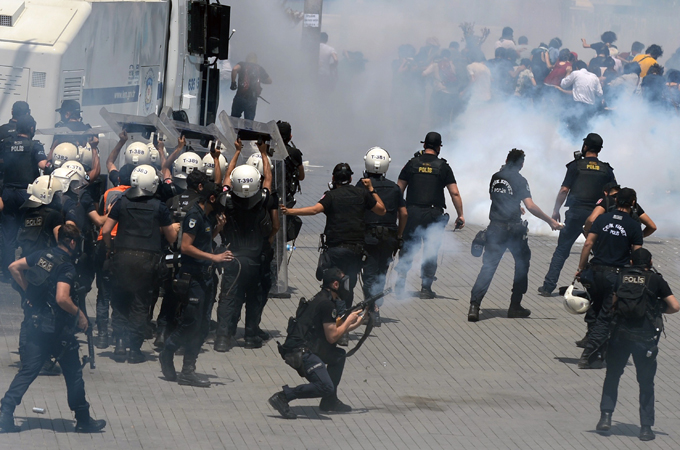
Hundreds of protesters have reoccupied a central square in Istanbul following two days of violent demonstrations that saw almost 1,000 people arrested.
The situation is generally calm and city workers are clearing up after the protests in Istanbul and Ankara.
Officials say 26 police and 53 civilians were hurt, one seriously.
Protests began over the redeveloping of a park near Istanbul's Taksim Square but broadened into anti-government action after a tough police response.
The protests represent the most sustained anti-government unrest for a number of years.
The BBC's James Reynolds in Istanbul says a lot of people are fed up with the government, which they believe wants to take away some of their personal freedoms.
'Lesson learnt'
There had been some isolated clashes around the streets of Istanbul in the early hours of Sunday.
But the atmosphere at dawn was calmer and largely peaceful, with demonstrators milling about between burnt-out cars and gathering around fires.
Our correspondent says that steady rainfall has dampened protests, and many of the demonstrators went home to get some rest.
However, he says this has been a largely afternoon and evening protest, and that clashes could resume later in the day.
There have been calls on social media for renewed protests.
Hundreds of people waving flags later returned to the square, some chanting "Government, Resign!"
One protester, Akin, told Reuters: "We will stay until the end. We are not leaving. The only answer now is for this government to fall. We are tired of this oppressive government constantly putting pressure on us."
Prime Minister Recep Tayyip Erdogan admitted on Saturday that "there have been some mistakes, extremism in police response", but also accused his opponents of using the anger over the Gezi Park issue to stoke up tensions.
Istanbul mayor Kadir Topbas tried to ease the tension, telling a local television station that "we have learnt our lesson".
He regretted "not informing the people enough" about the Gezi Park redevelopment.
Shop owners and city workers have begun to try to clean up, removing graffiti from walls and windows.
Interior Minister Muammer Guler said 90 demonstrations had taken place in 48 cities after the protests spiralled.
He said some of those arrested had since been released but others would be put on trial.
Mr Guler said one of the injured civilians was being treated in an intensive care unit at an Istanbul hospital.
Amnesty International claimed two people had been killed and more than 1,000 injured, though there was no confirmation of those figures.
Amnesty's Europe director John Dalhuisen said: "The excessively heavy-handed response to the entirely peaceful protests in Taksim has been truly disgraceful."
The US also expressed concern over Turkey's handling of the protests.
Recep Tayyip Erdogan has been in power since 2002, and is expected to run for the presidency in 2014.
Some in Turkey have complained that his government is becoming increasingly authoritarian.
His ruling AK Party has its roots in political Islam, but he says he is committed to Turkey's state secularism.
A United Nations report, “The State of the World’s Children,” underscores the moral bankruptcy of Senate Republicans who blocked ratification of a treaty to help disabled people around the world. There is scant data on how many children have such disabilities or how their lives are affected. One outdated estimate is that some 93 million children, one in 20 of those 14 or younger, live with a moderate or severe disability of some kind. The issue is how they might be helped to overcome their disabilities and become productive members of their societies.
A United Nations convention would ban discrimination against persons with disabilities and accord them the same rights as those without disabilities. It has been ratified by 127 countries and the European Union. President Obama has signed it, but, in December, the Senate, though supporting the convention by a hefty 61 to 38, fell five votes short of the two-thirds majority needed for ratification.
This was mostly because Senate Republicans caved in to far-right ideologues who contended, erroneously, that the convention would infringe on American sovereignty, usher in socialism, and allow United Nations bureaucrats to prohibit home-schooling or wrench disabled children from their parents’ arms.
The new United Nations report finds that children with disabilities are the least likely to receive health care or go to school and are among the most vulnerable to violence, abuse and neglect, especially if they are hidden away in institutions because of social stigma or parental inability to raise them.
The disabled children and their communities would benefit if the children were accommodated in schools, workplaces, vocational training, transportation and local rehabilitation programs — and if all countries ratified the convention and a related convention on the rights of children.
Hundreds of people, including activists from the Occupy Wall Street movement, have staged a demonstration in New York City to voice their support for anti-government rallies in the Turkish city of Istanbul.
The protesters gathered in Zuccotti Park - the birthplace of the Occupy Wall Street movement in Lower Manhattan - on Saturday, and marched nearly 5 kilometers (3 miles) to the Turkish consulate.
Some of the demonstrators carried signs reading “Istanbul is not alone,” while others waved the Turkish national flag.
The Occupy Wall Street movement announced in a statement that the event was held with the goal to direct public attention to Istanbul’s Gezi Park protests, and the subsequent violent crackdown on the protests by Turkey's ruling AK Party, led by Prime Minister Recep Tayyip Erdogan.
Similar demonstrations are scheduled to be held in several major US cities, including Austin, Boston and Chicago.
Rallies showing solidarity with Turkish protesters have taken a worldwide scope, and scores of people in Belgium, Britain, Cyprus and Norway have protested against Turkish police brutality and heavy-handed measures against the demonstrators in Istanbul.
Egyptian protesters also plan to stage a rally outside the Turkish embassy in Cairo on Sunday evening in support of the protesters in Istanbul.
On Saturday night, about 5,000 protesters surrounded Erdogan's office in Istanbul’s Besiktas municipality, located on the European shore of the strait of Bosphorus, and threw stones at the office, injuring at least seven policemen.
Special police forces used tear gas and water cannons to disperse the demonstrators.
Earlier in the day, 100,000 demonstrators gathered in Taksim Square, demanding that Erdogan step down and calling the government “fascist.”
The anti-government unrest began after police broke up a sit-in staged in Taksim Square on May 31 to protest against the demolition of Gezi Park.
The protesters say the park, which is a traditional gathering point for rallies and demonstrations as well as a popular tourist destination, is the city's last green public space.
Amnesty International has censured the Turkish police for the tactics they have used to control the protests.
Outspoken American linguist and political philosopher Noam Chomsky has condemned the brutal police crackdown on protesters denouncing the demolition of Taksim Gezi Park, saying it recalled "the most shameful moments of Turkish history."
"I would like to join Amnesty International and others who defend basic human rights in condemning the brutal measures of the state authorities in response to the peaceful protests in Taksim in Central Istanbul," Chomsky said in a written statement June 1.
"The reports of the past few days are reminiscent of some of the most shameful moments of Turkish history, which, it seemed, had been relegated to the past during the progress of the past years that has been welcomed and praised by all of us who wish the best for Turkey and its people," he added.
The Istanbul Metropolitan Municipality had planned to replace the little green patch surrounded by multi-storey hotels with a reproduction of the Artillery Barracks ("Topçu Kışlası") that used to occupy the sight. According to the project revealed by Turkish Prime Minister Recep Tayyip Erdoğan, the barracks would be converted into a shopping mall and could also serve as a residence with social facilities.
However, the plans stirred huge debate among Istanbul locals, who objected to the conversion of one of the last green areas at the heart of the city into yet another shopping mall.
With foreign reserves diminishing fast, Pakistan is on the brink of an economic crisis that may force its new government to ask for an unpopular bailout from the International Monetary Fund requiring a sweeping overhaul of the country's economy.
The troubles could inject a new element of instability into the nuclear-armed nation of 180 million people that Washington is relying on to combat Islamic militants at home and to help negotiate an end to the war in neighboring Afghanistan.
Pakistan's foreign currency reserves stood at just $6.4 billion as of May 17, down from more than $14 billion two years ago. That is only enough to cover about 1.5 months' worth of imports while the IMF considers adequate foreign reserves for any country enough to cover three months of imports.
Bottoming out could bring painful consequences: A run on the banks by panicked citizens anxious to convert savings into dollars amid fears of a devaluation, a withdrawal from the stock market, a collapse of economic activity and higher unemployment.
The presumptive head of the new government, former Prime Minister Nawaz Sharif, has made fixing the economy his main priority. But even though a crisis may be only six to nine months away, his incoming government appears hesitant about taking IMF money. They know it will come with conditions attached that would likely stir discontent on the streets, such as raising energy prices and broadening tax collection significantly.
"If we manage for six months, then of course we don't have to go" to the IMF, said Sartaj Aziz, a key economic adviser to the government about to take power. He told The Associated Press that in his view, the country might not need a bailout if it moves quickly enough to boost growth and gets help from key allies such as Saudi Arabia, which would come with fewer strings attached.
Stepping up growth, however, is a daunting challenge in a country plagued by severe electricity shortages and a bloody Taliban insurgency, both of which have hampered economic expansion and foreign investment.
Most experts see another IMF bailout as inevitable and are urging the government to immediately seek at least $5 billion. They worry that any delay in asking for IMF help could spark a crisis of confidence that would snowball.
"The writing is on the wall that Pakistan is going to the IMF. The only thing left is to give a date," said Ashfaque Hasan Khan, head of the business school at the National University of Sciences and Technology in the Pakistani capital, Islamabad.
Khan said the official reserve figure understates the problem because the central bank has also borrowed more than $2.3 billion from commercial banks in the forward swap market to prevent the rupee from depreciating. That means the actual reserve figure is closer to $4 billion, he said.
Adding to those woes, Pakistan has very large debt payments coming due over the next year that will further drain reserves. Most notably, it owes the IMF about $2.5 billion by the end of this calendar year.
There have already been worrying signs in Islamabad, where commercial banks have begun telling customers trying to withdraw dollars that they are not available, or that they need to make a special request. Foreign exchange companies in the capital have also reported a shortage of dollars. Pakistan's two largest cities, Lahore and Karachi, show no sign of similar problems. Khan, however, said that was only a matter of time.
Foreign investment, dampened by both political and economic instability, is only expected to be about 0.5 percent of GDP this fiscal year, while the average emerging market country runs at about 3 to 4 percent, according to the IMF.
Still Aziz, the adviser, said he is hopeful the incoming government can take emergency steps to grow the economy that will help Pakistan avoid going for an IMF bailout, or at least make the loan conditions less painful. He said the government will likely ask Saudi Arabia, a major oil supplier, to defer payments on oil imports.
And he predicted the IMF would impose tough conditions if Pakistan does request a new loan now.
"Not only would we find it difficult to fulfill them, but they would stifle our revival agenda," he said of the expected conditions. "The important thing, therefore, is to try to revive investment and growth."
Since 1988, Pakistan has signed onto eight IMF programs that demanded structural changes in the economy. But it has never managed to resolve its chronic problems.
Sakib Sherani, head of Macro Economic Insights Ltd. in Islamabad, said the government will make a mistake if it delays a request for a new IMF bailout.
"There are structural issues here. No amount of Chinese money or Saudi money can get us out of this," he said.
If Pakistan does have to turn to the IMF, it will bring its own set of challenges.
For one, the country has a patchy track record in upholding promised reforms that secured past IMF loans, including an $11 billion program granted amid the last foreign reserves crisis in 2008. The former government abandoned that program in 2011 because it refused to carry out the strict financial reforms required by the IMF. But it still owes the lending agency nearly $5 billion from that old loan.
The new government will have to convince the IMF with quick actions that this time around will be different. The IMF will want to see far-reaching reforms fast-tracked to reduce the chance of another reversal part way through a multi-year program.
And the lending agency is expected to demand vast improvements in a woeful tax system that collects very little money. Taxes currently bring in only about 10 percent of gross domestic product, one of the lowest effective rates in the world.
The IMF is also likely to press for major changes in the energy sector such as raising prices and phasing out costly subsidies that disproportionately benefit the wealthy, who use far more energy than the poor. The government spends about $1 billion in foreign currency each month to import oil to run its power plants — a costly way to generate electricity and another drain on foreign reserves. Building new hydroelectric plans or converting to less expensive natural gas production would be very expensive and take years.
The IMF is also expected to demand some kind of plan to curb losses from state-owned enterprises that amount to billions of dollars a year.
Pakistan's budget deficit — the difference between what it spends and takes in — is expected to be at least 7 percent of GDP this year. The IMF does not consider that sustainable and would likely press for a scaling back to about 3-4 percent of GDP.
The economy is expected to grow around 3.5 percent for the fiscal year ending June 30, and though that figure may look good in comparison to Europe or America, it is less than half the rate needed to supply jobs to the growing population. And it is also low by historical standards. Aziz said growth from 1960-2010 averaged about 5.5 percent annually but in the last five years, it slowed to 3 percent.
Despite the enormous challenges, there are some in Pakistan who remain sanguine that an IMF bailout will come through no matter what because the U.S. — the largest shareholder in the organization — considers Pakistan too strategic to fail.
"By now, just about everybody knows that it's U.S. strategic interests that dictate the disbursement of this money and not really any progress or timeline on reforms," said Khurram Husain, a business columnist for a Pakistan's English newspaper.
The Foreign Office is advising Britons to avoid anti-government demonstrations in Turkey.
A factual update on its website reads: "Demonstrations are taking place in Istanbul and in other cities across Turkey, including Ankara.
"Police are using tear gas and water cannons in response. We advise British nationals to avoid all demonstrations".
Noted linguist, activist says police actions recall 'most shameful moments of Turkish history'; two killed, 1000 injured in protests, Amnesty reports
Outspoken American linguist and political philosopher Noam Chomsky has condemned the police crackdown on protesters denouncing the demolition of Taksim Gezi Park, saying it recalled "the most shameful moments of Turkish history," according to the Turkish Huriyet newspaper.
"I would like to join Amnesty International and others who defend basic human rights in condemning the brutal measures of the state authorities in response to the peaceful protests in Taksim in Central Istanbul," Chomsky said in a written statement June 1."The reports of the past few days are reminiscent of some of the most shameful moments of Turkish history, which, it seemed, had been relegated to the past during the progress of the past years that has been welcomed and praised by all of us who wish the best for Turkey and its people," he added.Protests in Istanbul's Taksim Gezi Park started on Monday. Initially over authorities' plan to redevelop the park into a shopping mall, the demonstrations rapidly gained momentum and became a mass protest against Erdogan and his AKP party's Islamist policies.
Over the weekend the protests spread across the country, and thousands took to the streets and clashed with policemen, who used tear gas and water hoses in attempt to disperse the crowds.
According to Amnesty, two protestors died and at least 1,000 were injured in protests' focal point in Istanbul's Taksim.Chomsky was recently involved in the pressures that led to noted physicist Stephen Hawking to pull out of the President's Conference in Jerusalem.
The British Guardian newspaper reported last month that Chomsky was one of 20 academics from prominent universities who approached Hawking and convinced him to cancel his arrival in Israel, scheduled for June.
It started as a rather modest protest by some 50 people a few days ago against the government decision to convert the “Gezi” (promenade) Park, the little and only remaining green spot in the famous Taksim district in the heart of Istanbul, into Artillery Barracks that had been there in Ottoman times. There are rumors that the new barracks might include a shopping mall, stemming from a speech from Prime Minister Tayyip Erdoğan himself. So, some 50 of the activists resident in the area, mostly artists, architects and writers began carrying out a peaceful demonstration until the police tried to disperse them by force and pepper gas; perhaps some of you have already seen the “Sprayed women in red” photo by a Reuters photographer.
That night the number of protesters increased by 10 as the municipality brought a small excavator to remove three trees from the park “in order to expand the road” passing next to Gezi Park in the framework of the ongoing urban transformation plan to make Taksim a pedestrian-only zone. The first opposition politician to come to the stage was Sırrı Süreyya Önder of the Peace and Democracy Party (BDP), which is focused on the Kurdish problem. Önder is among the deputies carrying out talks with the outlawed Kurdistan Workers’ Party (PKK) leader in İmralı prison in the framework of Erdoğan’s initiative to find a political solution to the Kurdish problem. But Taksim was his electoral district, and after mingling with the protestors, he stood before the excavator, reminding many of Wang Weiling standing before the tanks in Beijing’s Tiananmen Square, or Boris Yeltsin climbing on to a tank to stop it in Moscow’s Red Square.
That was the turning point of the events. The protestors grew in numbers and started to pitch tents in Gezi in order to stay there day and night, and that night, actually in the early hours of the next day, the Istanbul police started its tent raids, again with pepper gas and water cannon as well. Erdoğan said during the ground-breaking ceremony of the third Bosphorus bridge that no matter what the protestors said, the ruling Justice and Development Party (AK Parti) was determined to carry out its projects, since it has the voter support behind. The Istanbul deputies of the main opposition Republican People’s Party (CHP) joined the protestors as their number grew. The CHP decided to post a deputy round-the-clock to stay with them in shifts. You see here the picture of Sezgin Tanrıkulu, a Kurdish-origin deputy of the CHP (making an interesting couple with the Turkish-origin BDP deputy Önder) arguing with a police chief after being gassed and sprayed himself.
It would be a big surprise and perhaps a first of its kind if Erdoğan, with his natural determination, were to bow to the protesters’ will and revise the project to keep the area as a park, as urbanization experts suggest as well. But his determination and the disproportionate toughness of the police has managed to turn a pacifist and modest protest into a public protest movement. And the protestors did neither favor Tiananmen, nor Red Square as an example for their act as it is about to complete its first week now. They like to be likened to the Occupy Wall Street protestors – that is why they like to be called “Occupy Taksim” now. Will their fate be the same as OWS? Maybe so...
But this is another picture of the contradiction of Turkish democracy as it is now; suppressing peaceful environmentalist protests by force while trying to bring in a mighty presidential system with less checks and balances on one hand while trying to find a peaceful way to end the bloodiest problem in Turkey on the other.
To cut the story short, the Taksim wave of protests has turned into the first public defeat of the almighty image of Prime Minister Tayyip Erdoğan, and by Turkish people themselves.
It was around lunch time June 1 when Erdoğan reiterated his hard-line position regarding the demonstrators protesting his decision to turn the only remaining green spot in Istanbul's iconic Taksim Square into a reconstructed historical building with a shopping mall.
He asked the demonstrators to abandon their efforts to try to get into Taksim Square, which was encircled by police squads, with the faint promise of an investigation into the excessive use of tear gas, stressing that there was no way the demonstrators could succeed. The crowds have grown to literally hundreds of thousands from a lonely 50 four days ago, thanks to the brutal methods that the Turkish police used in order to disperse them, particularly the serial use of tear gas and water cannons. The protests have not only spread to the European and Asian sides of Istanbul (Taksim being on the European side), but also to different cities across Turkey: the capital Ankara, İzmir, Eskişehir, and a dozen others.
Then, two unusually smart political moves took place. The first was the cancellation of a major demonstration by the main opposition Republican People's Party (CHP), which had been planned for June 1 in their Istanbul stronghold Kadıköy on the Asian side against the government policies. The CHP leader, Kemel Kılıçdaroğlu, asked all his supporters to cross the Bosphorus and rally to Taksim in support of protesters there. Many thought that this move might be counterproductive, as Erdoğan had preemptively accused Kılıçdaroğlu of trying to use the protests politically. So, tens and thousands of CHP members started to pour towards Taksim, despite the police barricades reinforced by gas and water squads.
The second move came from President Abdullah Gül, who on his return from Turkmenistan made at least three phone calls, to the Istanbul governor, the interior minister, and Erdoğan himself, asking them to try not to further antagonize the demonstrators. Right after those calls, at around 4 p.m, the police started to withdraw from Taksim. Around five hours after Erdoğan's address, hundreds and thousands of protesters started to march to Taksim Square in a mood of victory, chanting slogans calling on him to resign.
In return, Kılıçdaroğlu did not show up in Taksim, and no CHP flags and banners were there either. A CHP spokesman said he did not want to come in order to avoid being accused of political opportunism - that was a smart move indeed.
To call this a "Turkish Spring" would be over-dramatizing it. It could be, if there were opposition forces in Turkey that could move in to stop the one man show of a mighty power holder. But it can easily be said that the Taksim brinkmanship marked a turning point in the almighty image of Erdoğan.
The Syrian army has seized two cylinders of the nerve agent sarin during an operation in the city of Hama.
Syrian media say the operation was carried out against a militant hideout in the city’s al-Faraieh neighborhood on Saturday.
Sarin is a colorless, odorless liquid gas which causes respiratory arrest and death. The poisonous agent has been classified as a weapon of mass destruction in UN Resolution 687.
The foreign-backed militants in Syria have repeatedly threatened to use such weapons.
A video released last December showed them testing chemical agents on lab rabbits and threatening to kill pro-government Syrians.
On May 5, the UN Independent Commission of Inquiry on Syria said it found testimony from victims and medical staff that showed foreign-backed militants had used the nerve agent in Syria.
On March 19, over two dozen people were killed and many others injured when militants fired missiles containing a chemical substance into a village near the northwestern city of Aleppo, according to a report by Syria’s official news agency SANA.
On May 30, Turkish media reported that the country’s security forces had confiscated two kilograms of sarin after raiding the homes of militants from the terrorist group al-Nusra Front.
The incident took place in Turkey’s southern city of Adana, located some 150 kilometers (93 miles) from the border with Syria.
The Syrian government says Ankara has been playing a key role in fueling the unrest in Syria by financing, training, and arming the militants since the turmoil erupted in March 2011.
Protesters lit fires and scuffled with police in parts of Istanbul and Ankara early on Sunday, but the streets were generally quieter after two days of Turkey's fiercest anti-government demonstrations for years.
Hundreds of protesters set fires in the Tunali district of the capital Ankara, while riot police fired tear gas and pepper spray to hold back groups of stone-throwing youths near Prime Minister Tayyip Erdogan's office in Istanbul.
Istanbul's central Taksim Square, where the protests have been focused, was quieter after riot police pulled back their armored trucks late on Saturday.
Demonstrators lit bonfires among overturned vehicles, broken glass and rocks and played cat-and-mouse on side streets with riot police, who fired occasional volleys of tear gas.
The unrest was triggered by protests against government plans to build a replica Ottoman-era barracks to house shops or apartments in Taksim, long a venue for political protest. But it has widened into a broader show of defiance against Erdogan and his Islamist-rooted Justice and Development Party (AKP).
Interior Minister Muammer Guler said on Saturday that 939 people had been arrested in more than 90 separate demonstrations around the country. More than 1,000 people have been injured in Istanbul and several hundred more in Ankara, according to medics.
The ferocity of the police response has shocked Turks, as well as tourists caught up in the unrest in one of the world's most visited destinations. It has drawn rebukes from the United States, European Union and international rights groups.
Helicopters have fired tear gas canisters into residential neighborhoods and police have used tear gas to try to smoke people out of buildings. Footage on YouTube showed one protester being hit by an armored police truck as it charged a barricade.
"All dictators use the same methods, oppressing their people," said Mehmet Haspinar, a 60-year-old retired government employee sheltering in a building entrance way as riot police fired pepper spray in an Ankara back street.
EUROPE'S FASTEST-GROWING ECONOMY
Erdogan has overseen a transformation in Turkey during his decade in power, turning its once crisis-prone economy into the fastest-growing in Europe.
He remains by far the country's most popular politician, but critics point to what they see as his authoritarianism and religiously conservative meddling in private lives in the secular republic. Some accuse him of behaving like a modern-day sultan.
Tighter restrictions on alcohol sales and warnings against public displays of affection in recent weeks have provoked protests. Concern that government policy is allowing Turkey to be dragged into the conflict in neighboring Syria by the West has also led to peaceful demonstrations.
"It's about democracy, and it's going to get bigger," said one demonstrator in a side street off Taksim Square, trying to rinse tear gas from his eyes.
Erdogan has called for an immediate end to the protests and has said his government will investigate claims that the police have used excessive force. But he remained defiant.
"If this is about holding meetings, if this is a social movement, where they gather 20, I will get up and gather 200,000 people. Where they gather 100,000, I will bring together one million from my party," he said in a televised speech.
He said the redevelopment of a park in Taksim was being used as an excuse for the unrest and warned the main opposition Republican People's Party (CHP) against stoking tensions.
In spite of Erdogan's focus on the CHP, the protests have involved a broad spectrum of people opposed to the prime minister and do not appear to have been organized by a single political party.
After the police withdrew from Taksim Square, supporters of Turkey's pro-Kurdish BDP party danced a Kurdish dance in celebration just yards from nationalists waving Turkish flags. They jointly chanted "shoulder to shoulder against fascism".
A group of soccer fans from fierce rival Istanbul clubs Fenerbache, Besiktas and Galatasaray joined the chant.
Protesters voiced anger at the limited coverage of the demonstrations by Turkish television stations, with many seeing government intimidation as to blame. Scores of journalists have been imprisoned during Erdogan's decade in power.
"Government crony media for sale" was written in graffiti over one television broadcast van abandoned in Taksim Square.
Unofficial results after re-polling in NA-229 Tharparkar-I and NA-230 Tharparkar-II show that the Pakistan People’s Party (PPP) candidates are all geared up for victory.
NA-229 candidate Faqir Sher Muhammad Bilani secured 86,592 after re-polling, whereas his People’s Muslim League (PML) opponent Arbab Khan Sahib Togachi received 84,922 votes.
NA-230 polls saw PPP candidate Pir Noor Muhammad Shah Jilani winning against his Pakistan Tehreek-e-Insaf (PTI) opponent Shah Mehmood Qureshi.
Jilani secured 59,528 votes, whereas Qureshi managed to bag 58,298 votes.
Re-polling was held at four polling stations of NA-229 and 43 polling stations of NA-230 and its corresponding provincial assembly constituencies PS-62 and PS-63.
All eyes were on NA-229 Tharparkar-I as it is the stronghold of the Arbabs who have never lost this constituency in any election.
The ECP had announced the re-election as the administration had failed to conduct the election on May 11 at 47 polling stations, most were either set on fire or ransacked by miscreants belonging to rival political parties.
Re-polling was conducted by the ECP at polling stations of National Assembly and provincial assembly seats in Tharparkar and Kashmore, under the supervision of the army, Rangers and police. - See more at: http://www.pakistantoday.com.pk/2013/06/01/news/national/ppp-wins-na-229-na-230-re-polling/#sthash.9xJDKJ3y.dpuf
Following the abolition of the polio monitoring and coordination cell, the future of the annual aid of $130 million drawn from the Bill Gates Foundation has become increasingly uncertain.
The World Health Organisation (WHO) wrote a letter to the caretaker government a couple of days back and asked it to restore the monitoring cell, established by the Pakistan Peoples Party-led government in 2011.
Pakistan was set a target of eradicating polio by 2012, but in some cases, polio is being reported from three countries, including Pakistan, as mentioned in the letter. The letter revealed that Pakistan never stopped polio virus transmission and has been a source for the international spread of the virus to other countries in Asia and Africa. Therefore, a national emergency plan should be shaped and steps should be taken to eradicate the polio virus on an emergency basis.
According to the letter, Pakistan developed a National Emergency Action Plan (NEAP) which successfully reduced polio by 71 per cent from 2011 to 2012. This year, the country has reported nine cases, compared to the 22 detected last year, the letter added.
The polio drive would be adversely affected since the government of Pakistan has shut down the monitoring cell. The letter stated that WHO and Unicef would continue helping the authorities to eradicate the polio virus from the country.
The special envoy of Bill Gates Foundation, Dr Waqar Ajmal, got in touch with the government and has underscored the need for the restoration of the polio monitoring cell. Dr Ajmal voiced fears that the country might not receive the annual aid that originates from the Bill Gates Foundation.
He expressed his concern over the government’s decision to shut down the polio monitoring cell and requested President Aisf Ali Zardari to restore the cell immediately.
Sindh Chief Minister (CM) Syed Qaim Ali Shah along with the provincial cabinet called on President Asif Ali Zardari in Bilwal House, here on Saturday.
According to details, CM Sindh Syed Qaim Ali Shah, Speaker Sindh Assembly Siraj Durrani, Nisar Khoro, Sharjeel Memon, Ali Nawaz Mehar, Manzoor Wassan and other PPP leaders met President Zardari.
The President congratulated the chief minister, Speaker Sindh Assembly and the provincial cabinet.
Qaim Ali Shah briefed President Zardari about the law and order and political situation of the province.
On the other hand, President Zardari telephoned CM Khyber Pakhtunkhwa (KP) Pervez Khattak and felicitated him for being elected as leader of the house.
The President spokesman said that the President Zardari ensured his full cooperation to Khattak.
PPP central leader Syed Khurshid Shah has said that his party will not tolerate at all if the PML-N government takes revenge in the guise of accountability.
“If the PML-N government holds us accountable, we will support it wholeheartedly, and if it takes revenge in the guise of accountability, we will not tolerate it at all,” he said this while talking to a private TV channel and journalists outside the Parliament House on Saturday.
He said that his party would support the good deeds of the new government and discourage all wrongdoings. “Full opportunity will be provided to the government to work, and no hindrances will be created in its way,” he added.
On drone strikes, he said that the country should go for a dialogue with the US to stop predator attacks.
“The PPP government always pursued the policy of reconciliation and we will now introduce the policy of reconciliation while sitting in opposition benches,” he said.
“I will try my best that we take along the Pakistan Tehreek-e-Insaf leadership by taking them into confidence,” he remarked.
Meanwhile, PPP chief Makhdoom Amin Fahim said that peaceful transition of power would strengthen democracy in the country.
The tradition of power transition should continue, he told the media after attending the first session the new National Assembly.
Turkish pianist Fazil Say received a suspended 10-month jail term on Monday for mocking Islam on Twitter. Secular Turks have become increasingly concerned over what they see as the creeping Islamization of society.
"Honestly, we were not expecting this ruling, and all I can say is, both legally and for the country, it's a sad decision," Say's lawyer Meltem Akyol told Reuters.
The blasphemy charges were brought against Say in June last year. In their suit, prosecutors cited several sarcastic messages about believers and Islamic concepts of Heaven. The musician, who has served as a cultural ambassador to the European Union, denied the accusations.
RT’s Maria Finoshina reported from Turkey how residents are concerned by the growing dominance of Islamic values: Censorship is imposed on TV shows, museums are turned into mosques, and attempts are even being made to introduce Ottoman-style uniforms for flight attendants.
Turkish women fear their rights are being infringed even though they are seemingly free to wear and do what they want.
“The reformed education system is split into three parts of four years each, the result - thousands of girls leave school before the end, encouraging young marriages. The state promotes having at least five kids. Only three out of ten women today go to work. It’s far from a democratic model of society,” says Şenal Sarihan, the head of the group Women of the Republic.
The Turkish opposition speaks of a dangerous tendency: nine decades after Turkey broke with the Islamic rule of the Ottoman Empire in favor of an anti-clerical, pro-Western vision, the ideas and values that were rejected appear to some to be making a comeback.
“We are very concerned because Turkey is a secular democracy. But Islam has become the only reference. It says what to do, what to wear, what to eat, what not to eat,” Faruk Logoglu, CHP party vice-chairman said.
Turkey under Erdogan has made impressive progress. Its economy is booming and its role in the region and internationally, is increasing. Now, the secular part of the Turkish society is worried all of that could be harmed by Turkey getting ultra-religious and going the Ottoman empire way.
A projectionist lies asleep in the sweltering Pakistani heat, his face covered by a cloth. A colleague rewinds a reel manually while on screen, through the hashish smoke, a woman bounces on a bed singing "hello, hello, hello" into a cellphone.
To this, her would-be lover, who is in another room and is old and apparently drunk, sings "hello, hello, hello" back to her while splashing his head and shoulders with aftershave.
Then the two of them, both fully clothed, sing it again.
Welcome to the strangely innocent and overwhelmingly seedy world of Pashto cinema, or Pollywood, which once made its home in Pakistan's wild frontier town of Peshawar, but is now confined to a handful of theatres that haven't been attacked by Islamists.
The Taliban banned cinema and music during their five-year rule in neighboring Afghanistan, deeming them un-Islamic, and insisted that women wear all-enveloping burqas.
The Pakistani Taliban are just as strict and in Pashto cinema, where there is no sex or even kissing and only a bit of midriff on show, all their rules are broken. Several cinemas have been attacked, three of them either bombed or burnt to the ground. Bombs have also gone off outside the cinemas.
But even some of those who hate the Taliban are scornful and the industry has been fading over the decades as India's higher-quality Bollywood movies have flourished.
"It's been known for families (in the largely ethnic Pashtun northwestern province of Khyber Pakhtunkhwa) to kill a daughter who becomes a singer in the movies," one resident of Peshawar said. "People love the songs, but not the singers."
The films, now mostly made in Lahore, capital of Punjab province, are crudely made stories with love, valour and Pashtun identity at their core. They feature middle-aged, heavily armed heroes with long moustaches wooing much younger women who, when not bouncing fully dressed on beds, sing a lot in the hills of northwest Pakistan.
Some say the vulgarity has been introduced by Punjabi film makers desperate to fill cinemas. And some theatres slip in blue movies between shows.
The macho interest of Pashto films is addressed with guns, swords, knives and bloodshed. In the posters advertising the films, the wild-eyed men are often pictured smoking three cigarettes at once, with one behind the ear for good measure.
FIRE EXTINGUISHERS AT THE READY
Peshawar's Arshad Cinema, complete with private boxes, is grim and dark, with dirty stone steps, crumbling walls and bare wires hanging from the ceilings. Opposite is a brand new medical centre, eight storeys high and built on the site of another Pashto cinema which was destroyed.
The projectors are decades old and noisy. At the foot of one was a can of oil and three fire extinguishers near at hand. The picture itself was out of focus and the soundtrack painfully distorted.
"People like Pashto films because they are based on stories about society," Arshad manager Khalid Khan said.
"But when there are stories in the media saying there are four or five suicide bombers in Peshawar, no one comes to the cinema. And we are suffering losses."
But another reason for the losses is the repetitive story lines and vulgarity, though by western standards, the films are too soft and restrained to be considered pornography.
"The films we used to watch in cinemas were based on stories and real issues," said Safdar Khan, 70. "But going to the cinema is considered a shame or bad thing today due to the obscenity."
Scriptwriter Nazir Bhati believes Pashto movies are on their way out because they are so monotonous.
"I gave up my job when a producer asked me to include vulgar bits," he told a newspaper.
Peshawar is the capital of Khyber Pakhtunkhwa, formerly Northwest Frontier Province. Once a majestic walled city, a centre of culture, trade, architecture and education, Peshawar is now hectic, congested and plagued by violence.
It has witnessed dozens of bomb attacks in recent years, either launched by the Pakistani Taliban seeking to bring down the government or the result of sectarian violence.
But it remains a centre of Pashtun culture which celebrates the reputation of fearless warriors, the heroes of the films, even if overweight and apparently the wrong side of 60.
The men in the pitch-black auditorium lounge around in their seats, smoking cigarettes and more powerful substances and cheering the good bits. But for an outsider, it's difficult to tell which bits are good.
"The projectors are old," Arshad manager Khan said. "And there is so much smoke. So the quality is bad."
Syria gleefully turned the tables on Turkish Prime Minister Tayyip Erdogan on Saturday over his response to anti-government demonstrations, calling on him to halt the violent repression of peaceful protests or resign.Syrian state television broadcast hours of live footage from Istanbul, where thousands of protesters clashed for a second day with riot police who fired teargas and water cannons.
The unrest was triggered by government plans for a building complex in Istanbul s Taksim Square, long a venue for political protest, but widened into a show of defiance against Erdogan and his Islamist-rooted Justice and Development Party (AKP).
"The demands of the Turkish people don t deserve all this violence," Syrian television quoted Information Minister Omran Zoabi as saying. "If Erdogan is unable to pursue non-violent means, he should resign."
"Erdogan s repression of peaceful protest ... shows how detached he is from reality."
The Turkish police's crackdown targeting the demonstrators protesting the demolition of Taksim Gezi Park continued on June 1, as clashes broke out in Istanbul's symbolic Istiklal Avenue and the Beşiktaş district on the European side of the city.
Security forces used tear gas and water cannons this morning to quell protesters who had gathered on İstiklal Avenue, as well as its sidestreets. When the police fired the water and gas, protesters tried to escape from the narrow streets leading to the Cihangir neighborhood.
Between 4,000 and 5,000 protesters gathered again after the police's first intervention. However police fired once again, entering the pedestrian street with a water cannon riot vehicle. Some protesters made barricades with trees and bins about 100 meters from Saint Anthony's Church, near Galatasaray Square. Around an hour later the police destroyed the barricade and protesters escaped into sidestreets.
Despite the repeated police interventions, the numbers gathered at the protests only increased. Protesters chanted slogans against the ruling Justice and Development Party (AKP) and Prime Minister Recep Tayyip Erdoğan, calling on the government to resign.Most shops did not open after the violence of the previous day, and one of the busiest streets of Istanbul looked completely paralyzed on a Saturday.
Crowds also crossed the Bosphorus Bridge to the European side in the early morning hours of June 1, seeking to reach Taksim Square. However, their route was blocked by police who again fired tear gas and water cannon near the Beşiktaş district.
The heart of Istanbul's entertainment area had turned into a battlefield during the late hours of May 31, as security forces staged a merciless crackdown on peaceful protesters who were gathered to denounce the brutal dawn raid against demonstrators occupying Gezi Park. Major connections leading to Taksim - Sıraselviler, Tarlabaşı, Harbiye and Beşiktaş - as well as İstiklal Avenue were all blocked by the riot police, who fired tear gas without making any distinction between protesters and locals. Two choppers were also circling the skies in the area, while ambulances continuously brought new patients to the hospitals. Dozens of protestors were reported injured by witnesses. Several hotels around the Taksim area provided support to the injured or those who suffered respiratory problems due to tear gas.
The number of protesters in Istanbul taken into custody has grown to 138 on June 1, police have said.
Some residents in the area banged pots and pans from their homes to protest the government over the crackdown and express support for the protesters in the streets.
Meanwhile İbrahim Kalın, the adviser to Prime Minister Recep Tayyip Erdoğan, said in his twitter account today that İstanbul Mayor Kadir Topbaş and representatives from Taksim Gazi Park Platform and the Chamber of Architects would meet today and discuss a joint-solution.
Main opposition Republican People's Party (CHP) leader Kemal Kılıçdaroğlu said Turkey does not want to experience the Germany of 40's in 2013, while responding to journalists in Ankara, before moving to Istanbul for a scheduled public meeting in Istanbul's Kadıköy today.
The CHP's Istanbul meeting will start at 4 p.m. Today and is expected to net a large crowd upon the party's call last week.
The protesters, who started their mobilization to raise awareness on the demolition of one of the city's last remaining green areas, started chanting for the resignation of the Turkish Prime Minister Recep Tayyip Erdoğan following the police's relentless tear gas campaign.
Twelve protesters were injured during the morning raid, according to the Istanbul's Governor's Office. However, witnesses’ accounts put the number much higher.
After an intensified security plan has been chalked out for protection of teams, the authorities on Friday decided to resume the anti-polio campaign in Peshawar and other parts of Khyber Pakhtunkhwa on June 10.
The security plan was finalised at a high-level meeting of the security and Health Department officials with Peshawar Commissioner Sahibzada Mohammad Anis in the chair. At least 700,000 children under five years of age will be administered drops by the volunteers of 2000 teams that will be properly guarded by the police. Sahibzada Mohammad Anis said the volunteers would be provided adequate security during the campaign.
The anti-polio vaccination campaign was suspended on May 28 after a female volunteer Sharafata, 18, was killed and another volunteer, Sumbul, 20, was wounded when armed men attacked the team in Kaga Wala village on the outskirts of Peshawar. Sumbul is still being treated at the Lady Reading Hospital since she suffered two bullet wounds on her upper body.
The women were not being guarded by the police as promised by the government after a number of attacks on anti-polio vaccination teams during the last couple of months. The local police said the volunteers in the area had refused police security, saying it can cause more threat to the teams.
After the attack, the police launched a search operation in the area, during which 14 suspects were rounded up. A police sub-inspector Salim Khan suffered heart attack during the search operation and died.
These volunteers are hardly paid Rs500 per day for putting their lives in danger to fight the menace of polio all over the country. The anti-polio campaign had to be suspended on a number of occasions in the past due to the attacks in Peshawar, Karachi, Charsadda, Nowshera, Mardan and other parts of the country. Only male volunteers are carrying out the anti-polio vaccination campaign in many tribal areas due to the threats.
In December, at least eight anti-polio volunteers were killed and a few wounded in coordinated attacks on two consecutive days in Karachi, Peshawar, Nowshera and Charsadda, after which the authorities had to suspend the drive all over the country.
The killing spree started from Karachi on December 17, 2012 when five volunteers were killed while another woman was shot dead and her co-worker wounded in Peshawar. This was followed by killing of two more volunteers in attacks in Peshawar, Charsadda and Nowshera the very next day as authorities had decided to continue the campaign. The killings on the second consecutive day, however, led to suspension of the drive to avoid more casualties.
A proper security was ordered for the polio teams all over the country and it was decided to carry out the campaigns without much publicity. However, the killings of the volunteers as well as the cops guarding the teams continued. A cop was shot dead and another wounded in Mardan while another policeman was killed in Swabi while guarding the polio vaccinators in their respective areas in the past months.
Even at the best of times, this orphan goes largely ignored and forgotten. And it is hardly surprising if the state-run schooling is not even distantly in view on any radar at this point in time when the polity across the spectrum is so obsessively preoccupied with the election aftermath. But the worry is that there is no sign if the poor thing state-run schooling will come to the focus when the nation is through with the pleasures and pangs of the poll and the governments settle down on their thrones.
No doubt, this time round various political parties and groups had spoken of education a bit more elaborately in their manifestoes. But that talk was mostly on trite, familiar lines. State-run schooling, as such, hardly received any much mention from any of them. And this is quite disturbing, to say the least. For, nobody can dispute that state-run schooling makes up the key part of the country's educational pyramid. It indisputably stands unrivalled as far as its reach goes. It is the country's biggest and largest network for the schooling of the nation's children, and arguably the only opening available to the rural folks in our sprawling countryside to send their offspring for mainstream education.
Appallingly, despite its position of primacy in the country's educational dispensation, the system has been let to rot over the years nonchalantly. So much so, a huge mess of it has become visibly, screaming for urgent remedial measures to come alive. Yet, if in spite of that, the rotting system has failed to draw the attention of the power contenders in the poll, what hope could be entertained if the incoming rulers would set about revamping this schooling system that alone caters to the education need of the huge populace of poor children even in urban areas, let alone the desolate poverty-ridden countryside?
But this is not acceptable any more. The system must improve at any rate. The children of the poor have every right to education, and the state is bound by the constitution and the law to give them this right. They must have every opportunity to develop their potential and their inherent talents, with which they are endowed no lesser than their rich peers. This opportunity has not been afforded them in the past. No sincere or worthwhile government effort has ever been made over the past decades to resurrect the collapsing state-schooling system. That has to change now.
Over the time, much pedantic talk has come forth from the thinking class. Quite often have the citizens been bombarded with statistics like rates of enrolments and dropouts, and percentages of male and female enrolments and dropouts, and what not. The din of demagoguery and populism have been no lesser deafening. No dearth either has been in pious vows and tall promises. But one thing has been constant all along: the state-run schooling has just been hurtling down unchecked.
And that downward slide still continues, with no evident worry in the quarters that should be deeply concerned. None of the power contenders had spoken of the rotten state-run schooling all through the hustings. And as yet, none of the incoming rulers has spoken of it. This is quite unsettling. So long as the state-run schooling stays a mess, the whole of talk like Education for All and constitutional right of every child to education would remain sheer bunkum and the accomplishment of these objectives just a pipedream.
Hence, the incoming rulers, even those who were saddled in power previously, must, for a change, focus first on salvaging the crumbling state-run schooling from the morass it is stuck in so ruinously and putting it on the right track. A hugely painstaking job it certainly would be, for the system having long fallen into wholesale decay and annihilation. But the effort would be worth it, and a big nation-building enterprise too. No exaggeration would it be to say that revamping of this devastated system would indeed be a step towards national enlightenment. Would any of the incomers take this plunge? Better keep the fingers crossed. At times even unimagined happening do occur, though. So you never know, even though the past has not been so eventful on this score.
Pakistan Peoples Party Parliamentarians’ (PPPP) candidate Sardar Muqeem Khoso, who earlier lost the PS-14 seat from Jacobabad, emerged victorious after recounting at polling station no.38 on Saturday.
According to the May 11 election results, Pakistan Muslim League – Nawaz’s (PML-N) candidate Aslam Abro had earlier won the seat. Khoso, who was not satisfied with the results, moved the Sindh High Court which ordered recounting at polling station no.38 set up at Government Primary School Hawaldar Brohi.
The recounting was done under the supervision of the District Returning Officer (DRO), District and Sessions Judge Jacobabad Amjad Hussain Bohio and Returning Officer Ramesh Lal.
Khoso was declared the winner after the recounting with 15,838 votes, while Abro lost with a close margin securing 15,776 votes.
Republican People’s Party (CHP) leader Kemal Kılıçdaroğlu called on Prime Minister Recep Tayyip Erdoğan to take responsibility for instructing the withdrawal of the police from Istanbul’s Taksim area where clashes with peaceful demonstrators protesting against the demolition of Gezi Park continued late May 31.
“Don’t confront police with the people. Withdraw immediately the police from Taksim Gezi [Park] area. People are defending their city. That’s why they are resisting,” Kılıçdaroğlu said, noting that an administrative court had suspended the Artillery Barracks projects planned to replace the park.
“Show that you are the prime minister and make a public statement that you will respect the court’s ruling. This is your duty,” Kılıçdaroğlu said.
Erdoğan had previously stated that the decision on the construction of the Artillery Barracks was already taken, adding that it would not change no matter what the protesters did.
Police Attack Protesters in Istanbul’s Taksim Square
ISTANBUL — Police officers attacked a group of peaceful demonstrators on Friday in Istanbul’s Taksim Square with water cannons and tear gas, sending scores of people, protesters and tourists alike, scurrying into shops and luxury hotels and turning the center of this city into a battle zone at the height of tourist season.
The police action was the latest violent crackdown by the government against a growing protest movement challenging plans to replace a park in Taksim Square, Istanbul’s equivalent of Cairo’s Tahrir Square, with a replica Ottoman-era army barracks that would house a shopping mall.
But while the removal of the park, which is filled with sycamore trees and is the last significant green space in the center of Istanbul, set off the protests at the beginning of the week, the gatherings have broadened into a wider expression of anger against the heavy-handed tactics and urban development plans of the government and its leader, Prime Minister Recep Tayyip Erdogan. His party, now in power a decade, is increasingly viewed by many Turks as becoming authoritarian.
Mr. Erdogan still has great support among Turkey’s religious masses, but secular critics cite his government’s sweeping prosecution and intimidation of journalists as evidence of its intolerance of dissent.
Much of the anger also centers on the struggle over Istanbul’s public spaces. Mr. Erdogan’s government has preceded with disputed urban development plans with little public input, while his police forces have increasingly used tear gas against peaceful protesters, resulting in scores of injuries, including the hospitalization on Friday of a Kurdish lawmaker, who had become a vocal participant in the protests, after he was hit by a tear gas canister.
The protest movement comes amid continued public anger at Turkey’s policy of supporting the rebels in Syria, which many Turks feel has led to a violent spillover inside Turkey, including recent car bombings in the southern city of Reyhanli, which killed dozens of people. The rising public disenchantment represents a significant political challenge to Mr. Erdogan, who is planning to run for the presidency next year and has been trying to alter the Constitution to create a more powerful presidential system.
In the early afternoon Friday, as protesters gathered and began shouting antigovernment chants, police officers in riot gear began surrounding the group, positioning vehicles that resembled tanks at the edge of the square around the protesters, who were mostly sitting.
“Taksim is ours, we are not giving it to the A.K.P.!” they chanted, referring to Mr. Erdogan’s Islamist-rooted Justice and Development Party, known as A.K.P.
As they chanted, police officers casually put on their gas masks and the operators of the tanklike vehicles aimed their big guns, which fire a mixture of water and tear gas, at the group. Then chaos erupted. Protesters and onlookers, some of them tourists, ran down side streets where shopkeepers offered sliced lemons to soothe the burning sensation of the gas, and pharmacists doled out ointments for skin burns.
“The pigs, the pigs,” said Esra Yurtnac, who was crying as she sought refuge in a bakery after being gassed. “All they know is how to use gas.”
She added, “They think they can silence us with force, but they won’t.”
Hours after the clashes with protesters, an Istanbul court on Friday ruled in favor of a petition by a local advocacy group and halted the project until parties submitted their legal arguments to court, the semiofficial Anatolian News Agency reported. The interior minister also pledged on Friday that claims of excessive force would be investigated.
The chaos followed a dawn raid on an Occupy Wall Street-style encampment in Gezi Park, near Taksim, in which the police also used tear gas to drive away protesters and later barricaded the park. In an earlier raid on the camp, on Thursday, the police set fire to some tents. The brief occupation of the park, which began after bulldozers had started to take down trees, had taken on a festival-like atmosphere, with yoga, barbecues and musical performances, while the gathered changed, “Taksim is ours! Istanbul is ours!”
The people adorned the camp with banners expressing the rising anger at the reshaping of Istanbul’s urban spaces by the government. One read, “Don’t touch our neighborhood, our squares, our trees, our water, our soil, our homes, our villages, our cities and our parks.”
Another referred to Mr. Erdogan and the growing number of shopping malls being built around the city. “Let all shopping malls crumble and let Tayyip get crushed by their rubble,” the banner read.
In building new mosques and emphasizing Turkey’s Islamic past over its Byzantine and Roman legacies, Mr. Erdogan has been referred to as a latter-day Ottoman sultan, with little regard for seeking public input on the projects. On Wednesday, the government held a groundbreaking ceremony for a third bridge over the Bosporus that is being named for an Ottoman sultan.
“It’s all about superiority, and ruling over the people like sultans,” said one of the protesters, Seckin Barbaros, 26, a former journalist who is now unemployed. “When were we asked what we wanted? We have three times the amount of mosques as we do schools. Yet they are building new mosques. There are eight shopping malls in the vicinity of Taksim, yet they want to build another.”
In a speech earlier in the week, Mr. Erdogan dismissed the protesters and said the destruction of park would go ahead, “no matter what they do.”
The anger in the streets is also a rebuke to the economic policies of the government, which have relied heavily on construction and new housing in Istanbul to power economic growth. Turkey has had a resilient economy that emerged relatively unscathed from the global financial crisis, eclipsing the performance of Europe and many other nations. But some analysts worry the government’s focus on construction projects could lead to a bubble much like the one in the United States that led to the economic collapse of 2008.
Ms. Barbaros said, “What about the day when all these shopping malls will be empty like in Greece and then they will wish they never constructed them.”
She added: “Where are the opera houses? The theaters? The culture and youth centers? What about those? They only choose what will bring them the most profit without considering what we need.”
Another demonstrator, Seyfettin Sabaz, who is training to be a dentist, said: “Many of the Turkish public think that we are here as environmentalists to save our sycamore trees. But that’s not it. We are here to stand up against those that are trying to make a profit from our land.”
Around Taksim Square, the site of several other tear gas attacks on protesters this year, including one on May Day demonstrators, the chaos is taking on a sense of the familiar to shopkeepers who are becoming accustomed to offering shelter and aid to tear gas victims.
“I own a decorations shop, but for the past year it has felt like I run a shelter for gas raid victims,” said Ali Yildrim, who has lived in Istanbul for 35 years. “Soon I’ll be keeping lemons and medicine behind my counter.”
Indian film director Amjad Khan confirmed that 16-year-old Fatima Sheikh, from Dhaka, will play the central part in the film
A Bangladeshi student with no acting experience is to play the role of Pakistani schoolgirl Malala Yousufzai in a forthcoming movie about the work of the teenage activist who was shot and almost killed by the Taliban.
Indian film director Amjad Khan confirmed that 16-year-old Fatima Sheikh, from Dhaka, will play the central part in the film, for which shooting is expected to start in the middle of July. Mr Khan said that for security reasons, no photographs showing Ms Sheikh’s face or other details about her would be released until shooting was well underway.
“She is a student. She looks like Malala,” the Kolkata-based director told The Independent. “But there are security issues.”
Indian media has been buzzing with speculation about who might play the role of 15-year-old Malala since Mr Khan announced his plans to make the film late last year. He said he had been inspired by her struggle for the right of girls in Pakistan’s Swat Valley to be educated, a story that had received international attention after she was shot while on her way home from school last autumn.
The English-language film is to be called Gul Makai, the pseudonym used by Malala when she wrote a blog for the BBC Urdu service website in 2009 when the Swat valley was seized by Taliban gunmen. The militants issued strict edicts obliging people to follow Sharia law and burned down girls’ schools. They were eventually driven out by the Pakistani army but the security situation remains uncertain.
Malala, who also appeared in a subsequent documentary about her work as campaigner, was shot in the neck after her school bus was intercepted by a Taliban gunman last October. They said they had intentionally targeted her because of her work and because of her alleged links to the West.
The shooting of the 15-year-old triggered outrage across Pakistan and around the world. After emergency treatment in Pakistan she was transferred to Britain where she has undergone reconstructive surgery and received rehabilitation. She was nominated for the Nobel Peace Prize.
Mr Khan said he had located Ms Sheikh through a friend in Bangladesh and that he had gone to Dhaka to carry out a screen-test. Her parents have insisted that her identity not be revealed until the second half of filming.
“Filming will take place in London, Pakistan, Iran and India,” said Mr Khan.
The selection of Ms Sheikh to play the role of Malala was first reported by the Times of India which used an image of the Bangladeshi student wearing a niqab, or veil, with just a narrow slit for her eyes.
This is not the first time Mr Khan has selected a controversial subject for a film. Last year he reportedly received threats after completing work on Le Gaya Saddam, which looked at the issue of divorce in Muslim cultures.
Malala, who was treated at the Queen Elizabeth Hospital Birmingham, is due to publish an account of her life later this year. It is to be called I am Malala. The book’s publication is to be accompanied by two interviews broadcast in the UK and US.
There was no immediate reaction from Malala or her family about the film
Far from showing any retreat, the measles menace is looking almost unstoppable. It took the lives of nine more children on Monday, amid the Lahore High Court looking quite perturbed at the continued loss of life. What is to be done? A report in this paper points towards the usual procrastination in procurement and availability of vaccine as well as the shoddy conditions in the hospitals including medical staff that is incapable of stemming the disease. Broadly speaking, slackness is rather ingrained in our attitude or rather it is a way of life; we wake up when the disaster has already struck or sometimes when a suo moto notice is taken. Response towards measles is a case in point and a pathetic one. Reportedly many of the hospitals lack the vaccine, the delay in getting them has led to deaths.It appears, the authorities that ought to have arranged for the drugs and vaccines are literally hibernating. During the LHC proceedings, they were found shifting blame, which has been going on for quite some time now. In every hearing, accusations and excuses are flung as the judges watch and think to fight the scourge. Who is really in charge here? The Punjab Health Department that earned the ire of the court is headed by a bunch of officials who perhaps do not know what to do? Three more cases of children dying were also reported from Faisalabad; a total of 100 patients have died all over Punjab so far.
The epidemic is spreading like a wildfire. The Lahore High Court’s statement that the meagre measures taken by the Punjab health officials are the cause of the deaths is a damning indictment of the department. Now if heads have to roll, they must; this is necessary to get things moving in the right direction to bring in those who can save lives. The vaccines have to be procured and not only that regular surveillance of public hospitals need to be carried out where reports indicate unscrupulous staff stooping so low as to steal the medicine.
IN death, Waliur Rehman has caused almost as much controversy as he did when he was alive. The TTP second-in-command appears to have been taken out by an American drone strike, triggering consternation in public and more considered cost-benefit analyses in private. For all the cries about yet another violation of Pakistan’s sovereignty, however, one fundamental point must not be overlooked: it appears that the US knew how and where to find the militant, whereas the Pakistani security and intelligence apparatus did not.
Waliur Rehman had in the past been cast as a ‘moderate’ Taliban, someone the state here could do business with, but the truth was that he was a moderate only in that he was determined to attack inside Afghanistan too — meaning his attention was split between Pakistan and Afghanistan, unlike, say, Hakeemullah Mehsud who is known to focus most of his attention on attacks inside Pakistan. So here was a highly dangerous, highly motivated and highly effective militant leader in the form of Waliur Rehman and the Pakistani state appears to have had little clue of his whereabouts, appearing to believe that he would likely be hiding out on the border between North and South Waziristan. This is where the role of the security establishment should be questioned.
The drone argument also has the unhappy effect of deflecting attention to a far more serious issue: what the Pakistani state intends to do about North Waziristan, now the last redoubt of militants in which they can operate and plan largely unmolested. The incoming civilian leadership has talked up talks again while the military leadership has tried to indirectly warn about the futility of negotiations — but then the army high command has not shown any decisiveness when it comes to North Waziristan for years now either. Now, with the Taliban once again ‘suspending’ their offer of talks in the wake of Waliur Rehman’s killing, there is one of two ways to proceed: flounder in the face of a continuing threat or take strength from the decisiveness showed by the electorate in rejecting the Taliban path. For all the reasons for inaction, to avoid a
military operation in North Waziristan, to further delay establishing the state’s writ there, there is a simple truth: the TTP and Pakistan as imagined by its people, and endorsed in the recent elections, are incompatible. How to take on the TTP militants in North Waziristan is an important question but it is secondary to the need to take them on now not later.
The Sindh Assembly elected PPP-Parliamentarians candidate Syed Qaim Ali Shah as chief minister of the province for the third time on Thursday.
Qaim secured 86 votes, whereas MQM candidate for the slot, Syed Sardar Ahmed, got 48 votes and came in second in the contest, while the PML-F candidate, Imtiaz Sheikh, secured 18 votes. Later, speaking in the House Qaim thanked everyone for expressing confidence in him. He said that law and order in the province would be his top priority. He said that a 10-party alliance fought against the PPPP but people in Sindh again expressed confidence in the party. The chief minister said that his government would come up to the expectations of the people.
Qaim was sworn in as the chief minister at a ceremony held at the Governor’s House. Sindh Governor Dr Ishratul Ebad Khan administered him oath. Qaim said that his government would try to deliver more than it did in its previous tenure. His election was held through open division of members. Some seven ministers also took oath along with the chief minister. They are Nisar Ahmed Khuhro, Mir Hazar Khan Bijarani, Makhdoom Jamiluz Zaman, Manzoor Wasan, Sharjeel Inam Memon, Raja Khan Maher and Dr Sikanadar Mandhro. Syed Murad Ali Shah has been taken as adviser.
Also, the Sindh Assembly elected PPPP leader Agha Siraj Durrani as speaker, and Shehla Raza as deputy speaker of the House. Durrani secured 87 votes and Shehla 86 during separate elections at the Sindh Assembly hall. Muttahida Qaumi Movement (MQM) leader Khuwaja Izharul Hassan and Heer Sohu got second positions by securing 48 votes each in the polls for speaker and deputy speaker, respectively.
Pakistan Muslim League-Nawaz’s (PML-N) Irfaullah Marwat and PML-F’s Nusrat Saher Abbasi got 18 votes each in the election for the two slots, respectively. Former speaker Nisar Ahmed Khuhro conducted the polls to select the new speaker, while the newly elected speaker, Agha Siraj Durrani supervised the deputy speaker’s election. After being elected as the speaker, Durrani said that former speaker Khuhro had performed well in the office, and he will also utilise his abilities to run the assembly affairs in a good manner. He said that he will try to run the House in a balanced way. He appealed both the treasury and opposition to extend their cooperation in this respect.
Former speaker Khuhro, who is also an expected parliamentary leader of the PPPP, assured the new speaker of his full support. MQM’s leader Syed Sardar Ahmed also assured the speaker of his party’s cooperation. He hoped that Durrani will perform well in office, and said that office of the speaker was very much important as founder of the country; Quaid-e-Azam Muhammad Ali Jinnah had also assumed the seat, while remaining in office as the governor general. PPPP leader Manzoor Wasan hoped that the new speaker whose father too had held the same office will perform better than Khuhro. Another senior leader of the PPP, Hazar Khan Bijrani said that assuming office as the speaker is an honour for Durrani.
 President Asif Ali Zardari on Sunday said that being a President of the country he was glad to see the smooth transition of power, adding that not only Nawaz Sharif but other political parties also supported them for the sake of democracy.
 Talking to a panel of journalists, President Zardari said that he has no right to participate in presidential elections for the next tenure. He said that if Pakistan Peoples' Party (PPP) asked him to lead the party, he would do so, or else he would work as a party worker.
Replying to a question, Mr. Zardari said that National Reconciliation Ordinance (NRO) and Swiss cases were the charges for what he had been sent to jail for eight years. He added that, in his opinion, these cases were controversial as they carried no substance.
Speaking on Balochistan issues, the president claimed that the previous government did so many things for Balcohistan but the Baloch people did not do anything for themselves.
To another question, Mr. Zardari replied that there is a need to identify whether or not Taliban have political mindset, as extremists do not negotiate.
He further said that the PPP-led government had not signed any agreement with US government over drone attacks, however, he added that he did not know if Musharraf had made any such agreement or not.
Talking to a panel of journalists, President Zardari said that he has no right to participate in presidential elections for the next tenure. He said that if Pakistan Peoples' Party (PPP) asked him to lead the party, he would do so, or else he would work as a party worker.
Replying to a question, Mr. Zardari said that National Reconciliation Ordinance (NRO) and Swiss cases were the charges for what he had been sent to jail for eight years. He added that, in his opinion, these cases were controversial as they carried no substance.
Speaking on Balochistan issues, the president claimed that the previous government did so many things for Balcohistan but the Baloch people did not do anything for themselves.
To another question, Mr. Zardari replied that there is a need to identify whether or not Taliban have political mindset, as extremists do not negotiate.
He further said that the PPP-led government had not signed any agreement with US government over drone attacks, however, he added that he did not know if Musharraf had made any such agreement or not.