Tuesday, May 7, 2013

Pakistan: Political violence claims 2,670 lives: Report

The Express Tribune
The data suggests that some 2,674 people lost their lives in 1,108 incidents of violence across the country
Pakistan witnessed an average of 600 monthly casualties as a result of political violence from January to April this year, a research study has found. The data suggests that some 2,674 people lost their lives in 1,108 incidents of violence across the country. Violent clashes also left 2,386 people injured in the four months under review. According to Pakistan Conflict Tracker’s quadrilateral report compiled by the Centre for Research and Security Studies (CRSS), the first four months of the year witnessed an unprecedented surge in political violence. Accompanied by an unusual escalation in attacks on political parties’ offices and their candidates in the month of April, the ethno-political violence in Karachi, religio-political terrorism in the Federally Administered Tribal Areas (Fata) and Khyber-Pakhtunkhwa (KP), and nationalist-separatist violence in Balochistan continued to surge. The data indicates that Sindh witnessed major loss of life during the last four months. After Sindh, KP turned out to be the second major hub of violence with the death toll of 418. Balochistan came in a close third with almost 403 people dead during the four months. Meanwhile, violence across Fata subsided significantly during the period in question. A closer look into the casualty figures underlines that civilians bore the greatest brunt of violent acts with 1,542 fatalities. Moreover, militants fighting against the state constitute the second largest group of casualties, with the toll pegged at 856, according to the data. Clashes with militants, target-killings or ambushes of military convoys also left 276 security forces personnel dead, mostly recorded in the insurgency-infested areas of Fata, Karachi and Balochistan. Furthermore, during the four-month review, as many as 12 Central Intelligence Agency-operated drone strikes were reported in different areas of North Waziristan Agency, leaving about 71 suspected militants dead. Between March 2012 and February 2013, 51 drone attacks had killed over 351 suspected militants. Meanwhile, continuing their sabotage campaign against state infrastructure, militants blew up 39 state-run and private schools in different parts of Fata, Balochistan and KP during the course of four months. Major causes of violence On the whole, target shooting topped as the major cause of deaths. Some 45 percent of all the violent incidents were of target killing in nature. Karachi suffered the greatest loss of life as a result of target killing. The deadly wave claimed over 701 lives in Sindh. Meanwhile, bomb blasts were the second major cause of deaths with 405 persons perishing, including 343 civilians, 7 militants and 55 security forces personnel across the country. The third major cause of fatalities were military operations. In total, 356 persons including 339 militants and 11 security operatives perished in these forms of attacks. Meanwhile, from January to April 2013, 241 dead bodies were recovered from different parts of Pakistan. Most of them were found in Karachi, Peshawar, Fata and Balochistan. Likewise, 25 suicide attacks left 168 civilians dead. Moreover, the sporadic waves of sectarian and religio-political violence continued to pile misery on the country, with Shia Muslims based in Quetta and Karachi becoming frequent targets of sectarian terrorism. Shias belonging to the Hazara community in Quetta continue to live under the deadly spate of violence unleashed by Lashkar-e-Jhangivi this year. A precise look into the trends of violence across the country highlights the fact that the law and order situation across Pakistan continues to deteriorate.

ANP expresses reservations over election security

ANP said that it was not provided a level playing field for election campaigns.
Awami National Party (ANP) in a letter sent to the Election Commission of Pakistan (ECP) expressed reservations over not being provided equal opportunity for its election campaign. ANP also stated that 25 attacks were carried out during March 30 to May 4, resulting in the death of 50 party workers and over 100 suffered injuries. It further said that four attacks were made on April 28 and three each on April 29 and May 1.

Bilawal Bhutto : '' Zia’s legacy still lives ''

PAKISTAN PEOPLES PARTY – PPP
Military dictator Ziaul Haq’s legacy still casts a shadow on the country’s politics, but his influence must be weeded out completely, said Pakistan Peoples Party (PPP) Patron-in-Chief Bilawal Bhutto Zardari in a video message. The young party leader said that conspiracies were afoot by some elements to convert Pakistan into a “country like Zia’s”, but the PPP leadership and its supporters would not let these “nefarious designs” succeed. Bilawal appealed to people living in Pakistan and the workers of his party to foil the conspiracies by voting for his party candidates. “Sometimes, these elements, working in the guise of political forces, emerge as terrorists and kill our leaders.” “But we will save this country and oppose Zia’s remnants,” he said, assuring people that the PPP candidates will fulfill the voters’ demands. The PPP leader added that he wanted to see a Pakistan, which was free from hunger and where everyone enjoyed equal opportunity without any discrimination. “PPP is the only party, which can promote democratic values, while extremists are trying to push this country into darkness,” he added. Moreover, in different video messages directed at each district, Bilawal appealed for votes. While talking to The Express Tribune, PPP sources said that Bilawal would continue campaigning for the party and may cast his vote in either Larkana or Benazirabad. “Bilawal frequently travels to Dubai, but may surprise us by casting his vote in Pakistan,” revealed a senior PPP leader, while adding that Bilawal’s activities were kept a secret owing to security concerns.

AFPAK: ''Durand Line is a settled issue''

Reacting sharply to Afghan President Hamid Karzai's statement that Kabul will never recognise the Durand Line - the 2,640 kilometers long porous border between the two countries, Pakistan on Monday declared that Durand Line was a settled issue and opening debate on the matter was a distraction from the more pressing issues requiring mutual co-operation. "Durand Line is a settled issue. Opening discussions on this issue is a distraction from the more pressing issues requiring the priority attention and co-operation of Pakistan and Afghanistan," said Foreign Office spokesman Aizaz Ahmad Chaudhry while reacting to President Karzai's Saturday press conference in which he also called on the Taliban to "turn their weapons" against those who "plot" against Afghanistan. To the portion to Karzai's statement in which he urged the militants to "stand with" Muhammad Qasim, an Afghan border policeman reportedly killed in a clash between Afghan and Pakistan troops on the border earlier this week and to turn their guns against those who are hostile against Afghanistan, the spokesman said that the continuing fight against terrorism and extremism warrants Pakistan, Afghanistan, and all other stakeholders to work together in a spirit of co-operation and harmony. Aizaz Ahmad Chaudhry recalled that President Karzai had in the past asked Pakistan to use its influence on the Taliban to enter into dialogue for reconciliation process. Pakistan had responded positively to that call, he said, adding that Pakistan will continue its support for the Afghan reconciliation process, rather than focus on the negatives. Referring to President Karzai's remark that he visited Pakistan 19 times, the spokesperson said that Pakistan's leadership has also travelled to Afghanistan several times to help build trust and strengthen bilateral relations. "Pakistan remains fully committed to assist in all sincerity to peace and sustainable economic development in Afghanistan, which we believe is in the vital interest of Pakistan and our region," he added. About President Karzai's remarks regarding Pakistani posts on the border, the spokesperson recalled that Pakistani post in Gursal had come under attack from Afghan forces and there had been several threatening and provocative statements made by Afghan leadership in this regard. He reiterated that the posts on Pakistan-Afghanistan border were serving a useful and mutually beneficial purpose of better border management, which is crucial for interdicting cross border undesirable activity. He reaffirmed the need to use bilateral channels including military to military contacts to resolve the issues relating to posts. In several high level interactions in recent past, the spokesman recalled that the leadership of the two countries is agreed on the imperatives of a mechanism for an effective border management for the mutual benefit of the two countries. The Foreign Office response came in the wake of the second clash between Afghan and Pakistani troops in less than a week on the border in Nangarhar province on Monday morning, which is the latest indication of a sharp deterioration in relations between the two neighbours. Reports claimed that three Afghan soldiers were injured as a result of the exchange of fire. Meanwhile, according to a statement available at the official website of Afghan Ministry of Foreign Affairs, the Afghan Director-General of the First Political Department of the Ministry of Foreign Affairs Azizuddin Ahmadzada met with the Pakistani Charge d'Affaires in Kabul Shah Nazar Afridi on Monday at the Foreign Ministry. Ahmadzada lodged the Afghan government's strong protest with Afridi about the unprovoked attack by Pakistani forces, who used both heavy and light weapons, against Afghan forces near the Durand Line in Goshta district, Nangarhar province this morning. The statement added that the Pakistani attack, which occurred at 8:20 am. Monday morning, did not result in any casualties to Afghan forces. "Ahmadzada clarified to Afridi that in case of Pakistani forces' continued refusal to remove all Pakistani installations at Goshta and other areas and any further unprovoked attacks by Pakistani forces, Pakistan will bear responsibility for any consequences," the statement added.

Pakistan election violence forces candidates behind high walls

Mian Hussain is fighting for his political life from a deserted party headquarters, where two telephones sit silently beside him and the footsteps of a tea boy echo down the corridor. One of Pakistan's most high-profile anti-Taliban politicians, Hussain hasn't been to a single public event since campaigning for the May 11 election kicked off. A fiery orator who once electrified big rallies, he now makes short speeches by telephone to small huddles of supporters meeting in secret. For the spokesman of the Awami National Party (ANP), it's just too dangerous to go out. Since April, the Pakistani Taliban have killed more than 70 people in attacks targeting three major political parties, preventing many of their most prominent candidates from openly campaigning. Hussain worries the Taliban want to rig the elections in favor of parties that will take a softer line with their determination to stamp a radical brand of Islam on the country. He says that is why the Taliban are targeting the ruling coalition that backed military operations against them - Hussain's ANP, the Pakistan People's Party (PPP) and the Muttahida Quami Movement (MQM), whose offices have been repeatedly bombed. The ANP has borne the brunt of the attacks because it is staunchly opposed to the Taliban. As a nationalist party, it competes with the militants for the support of ethnic minority Pashtun people along the Afghan-Pakistan border. The PPP and the MQM see themselves as liberal parties, long opposed to the influence of conservative religious forces and Islamist militancy. The Taliban say they are targeting "secular" parties and that elections only "serve the interests of infidels and enemies of Islam". However, they have not attacked right-wing religious parties that have joined the election race, or former cricketer Imran Khan's party, which advocates shooting down U.S. drones and withdrawing the Pakistani military from insurgency-infested Pashtun areas along the Afghan border. A blast at a rally organized by the Jamiat Ulema-e-Islam religious party on Monday killed 15 people though it was not clear who was responsible. Nor have the Taliban attacked the main opposition party led by former Prime Minister Nawaz Sharif, which has courted support from groups accused of supporting sectarian attacks across the country. "It's pre-poll rigging," Hussain says bitterly. The Taliban killed his only son three years ago, just before his wedding. The next day, militants attacked Hussain's home, killing seven. "They will either have to elect the terrorists or elect those who oppose the terrorists," he said, the studious face of his dead son staring up from campaign posters on a nearby table. SECURITY OR THE ECONOMY? But many voters do not see the contest simply as one that pits pro- and anti-Taliban parties against each other. Insecurity worries them, but so does the sluggish economy, endemic corruption and power shortages that have cost millions of jobs over the five years of the last government. Many say it is that legacy, and not the Taliban threat, that makes them inclined to vote for a new guard in Islamabad. The main opposition party is led by two-times prime minister Sharif. It is widely seen as the front-runner for Saturday's polls, portrays itself as business-friendly and has promised to fix the country's serious economic woes. His party denies that it is soft on the Taliban or militancy but says a new approach is needed, including an overhaul of the country's anti-terrorism courts. The PPP and its coalition partners are the first civilian government to complete a full five-year term in a country whose history has been punctuated by military takeovers. Despite power shortages, tax shortfalls and corruption, they blame the shortcomings of their administration squarely on the Taliban. "Terrorism is the biggest problem, it took up so much of our resources," said Zahir Shah, a former health minister and candidate for the PPP in the northwestern provincial capital of Peshawar. "We have done reforms and we will do more." Shah said the Taliban threat meant he has only held small meetings in walled compounds. His sister and party activists are also holding clandestine gatherings. At one recent meeting, 40 women and children garlanded them with marigolds on a rooftop. "Long live Zahir Shah!" they cheered. Two armed police stood guard in the alley below, so narrow that politicians' convoys could barely squeeze past each other without falling into the open drains running with blood from nearby butcher shops. Shah said voters would elect him despite the campaigning restrictions because his party had defied the Taliban and helped the poor get free healthcare. Some of the poor he is counting on for votes are doubtful. A dialysis centre Reuters visited near Peshawar provides quality treatment for free. But at the state-run Khyber Teaching Hospital, grimy walls are crumbling, a mangy cat lurked in the trauma ward and a doctor said the hospital was dangerously short of basic intravenous equipment. This is where the injured and dying were brought after one of Peshawar's recent string of bomb blasts. "No one is secure. There is bloodshed everywhere. The government should do something," said Fazle Hayat, dabbing at an eye injured in the attack. He said he had not decided if he would vote. A short drive away, the remnants of another bombing are displayed in a glass case at Bilour House. They are the shoes and spectacles that Bashir Bilour, an ANP stalwart, was wearing when a Taliban bomb killed him in December. Another Taliban bomber targeted his brother and his son in April. They survived, but 18 others died. Some other parties did not even offer condolences, Bilour said angrily, because they were afraid of offending the Taliban. "The Taliban are targeting us because they want an administration that is soft on terrorism," he said. But parties afraid of offending the Taliban should watch out, he said. "They are targeting us today but they will be targeting them tomorrow."

Pakistan Elections 2013: Predictive Results

http://criticalppp.com/archives/262143
– by Abdul Nishapuri
Pakistan’s general election on 11 May 2013 will mark the first time a democratically elected government in the country has been succeeded by another. Since independence from Britain in 1947, civilian rule has been repeatedly overturned by military coups, the last led by General Pervez Musharraf who held power from 1999 until 2008, when democracy was restored. The election is also remarkable for its relative unpredictability following a significant constitutional devolution of central government power in 2010 under the presidency of Asif Ali Zardari (of Pakistan Peoples Party PPP), and the linked development of a more open, freer public discourse. Demographic pressures, economic and security worries, the advent of social media and numerous new challenges to the hegemony of the established parties have added to the uncertainty. Generally the elections is being seen as a tough contest between allegedly pro-Taliban parties and anti-Taliban parties. Pakistan’s population totals roughly 190 million, of whom an estimated two-thirds are under 30. About 92 million of the total are adults aged 18 or over, and of them, 84.4 million are registered voters. The issues that may shape the outcome are more clear-cut. Islamist right-wing opposition parties in particular PML-N (led by Nawaz Sharif), PTI (led by cricket turned politician Imran Khan), JUI-F (led by Maulana Fazlur-Rehman Deobandi) are known for their sympathetic and apologist stance towards Taliban and pro-Al Qaeda Deobandi-Wahhabi militants. In contrast, Pakistan Peoples Party and its secular allies Awami National Party and Muhajir Qaumi Movement have taken a clear stance against Takfiri terrorists and their sponsors. Five terrorist attacks by Takfiri Deobandi militants of Taliban and Lashkar-e-Jhangvvi (akas Ahle Sunnat Wal Jamaat Deobandi or Sipah-e-Sahaba) since 11 April have killed 24 people, including lethal bomb explosions at election rallies of secular parties (ANP, MQM, PPP) in Peshawar, Khuzdar, Karachi, Kohat and other areas. Pakistan’s economy has been battered by three years of successive floods from 2010 to 2012 that damaged the country’s agricultural heartlands. Power cuts are endemic, with some rural areas receiving only four hours of electricity a day. Clean water and food, adequate education and healthcare remain beyond the reach of many Pakistanis. Crime and unemployment are big issues in the cities. However, PPP government has been able to offer some relief through the Benazir Income Support Programme (BISP) and other social welfare and uplift projects. Pakistan’s elections largely follow the Westminster first-past-the post system, although 70 seats are reserved for women and minorities and allocated by PR. Candidates on 11 May will seek seats in the lower chamber of the national assembly and in the four provincial assemblies – Punjab, Sindh, Baluchistan and Khyber Pakhtunkhwa (formerly North-West Frontier Province). A total of 172 out of 272 directly elected seats is required for a governing majority in the national assembly, although no single party is expected to achieve that. At present a caretaker government is in place. An independent election commission has been created to oversee the polls, and outside organisations such as the EU have agreed to send observers. Most commentators expect the election to produce another coalition government after a possibly prolonged period of wrangling. Based on careful analysis of various opinion surveys as well as historical patterns of voters choice, the following is a summary of predictive results of general elections in Pakistan on 11 May 2013. According to estimates, no single party will be able to gain simple majority in the National Assembly of 272 seats. However, as in most previous elections in Pakistan, Pakistan People Party (PPP) of slain Prime Minister Benazir Bhutto will emerge as single largest party (80 seats) followed by right-wing PML-N (70 seats), PML-Q (22), MQM (20), ANP (18), PTI (15), JUI-F (5) and PML-F (4). Other smaller parties and independent candidates are expected to win 38 seats. There is a plus minus variance of 10 per cent anticipated in this estimate.
The following is a tabular and schematic presentation of the expected results.
In summary, PPP will be the single largest party and the Islamist PML-N will be second. PTI will be a tiny player with only 15 seats in the parliament. The end result will be a coalition government led by PPP in coalition with other secular parties including ANP, MQM and other smaller parties. For contextual understanding, here is an overview of results of 2008 general elections:

Pakistan's Minorities Have No Faith in Democracy

In majority Muslim Pakistan, religious minorities say democracy is killing them. Intolerance has been on the rise for the past five years under Pakistan's democratically elected government because of the growing violence of Islamic radicals, who are then courted by political parties, say many in the country's communities of Shiite Muslims, Christians, Hindus and other minorities. On Saturday, the country will elect a new parliament, marking the first time one elected government is replaced by another in the history of Pakistan, which over its 66-year existence has repeatedly seen military rule. But minorities are not celebrating. Some of the fiercest Islamic extremists are candidates in the vote, and minorities say even the mainstream political parties pander to radicals to get votes, often campaigning side-by-side with well-known militants. More than a dozen representatives of Pakistan's minorities interviewed by The Associated Press expressed fears the vote will only hand more influence to extremists. Since the 2008 elections, under the outgoing government led by the left-leaning Pakistan People's Party, sectarian attacks have been relentless and minorities have found themselves increasingly targeted by radical Islamic militants. Minorities have little faith the new election will change that. "We are always opposed to martial law (but) during all the military regimes, the law and order was better and there was good security for minorities," said Amar Lal, a lawyer and human rights activist for Pakistan's Hindu community. About 96 percent of Pakistan's population of 180 million is Muslim. Most are Sunni, but according to the CIA Factbook about 10 to 15 percent are members of the Shiite sect. The remaining 4 percent are adherents to other religions such as Christians, Hindus and Ahmedis — a sect reviled by mainstream Muslims as heretics because they believe a prophet came after Muhammad, defying a basic tenet of Islam that Muhammad was the last prophet. Sunni radicals view Shiite Muslims as apostates. The U.S. Commission on International Religious Freedom in a report last month berated the Pakistani government for its poor record of protecting both its minorities and its majority Sunni Muslims and recommended that Pakistan be put on a list of worst offenders, which could jeopardize billions of dollars in U.S. assistance. "The government of Pakistan continues to engage in and tolerate systematic, ongoing and egregious violations of freedom of religion or belief," the report said. "Sectarian and religiously motivated violence is chronic, especially against Shiite Muslims, and the government has failed to protect members of religious minority communities, as well as the majority faith." Lal said that in the past three years, 11,000 Hindus living in Pakistan's southwestern Baluchistan province have migrated to India because they were worried about security and frustrated by kidnappings and forced conversions of young Hindu girls to Islam. Pakistan's Hindu minority complains that scores of Hindu girls have been kidnapped, forced to marry their abductor and convert to Islam. "In Pakistan's southern Sindh province, from every Hindu house, one member of the family has left either for Karachi or for a foreign land," said Lal, who was once a special adviser to Benazir Bhutto, the leader of the Pakistan People's Party until her assassination in December 2007."We have lost our hope from the democratic forces because they do everything for money" and nothing for minorities, he said. Pakistan's Christian communities have complaints as well. In March, a mob of young Muslims stormed and set fire to nearly 150 homes and shops in the Joseph Christian Colony, a Christian enclave on the outskirts of Lahore, the capital of Punjab, Pakistan's most populous province, where 60 percent of Pakistanis live and where militant Islamic groups have their headquarters. The mob gathered after one resident was accused of blasphemy, but local people say it was a tiff over money. Most residents fled for their lives, returning the next morning and eventually rebuilding their homes. On April 30, some radicals attacked 25-year-old resident Babar Ilyas. His injured arm and leg wrapped in bandages, Ilyas told the AP that he was beaten by radicals who warned Christians to leave the area and drop charges against at least two people arrested in connection with the earlier attack. "We do not have any hope in elections," said Salim Gabriel, a self-declared social worker for Christians and colony resident. "Dictatorship is better for minorities." Gabriel accused political parties of aligning with radical Islamic groups to get votes, campaigning with well-known militants which he says emboldens radicals among Pakistan's Sunni majority to carry out attacks against minorities with impunity. Minority religious groups fear extremists will piggyback on the backs of mainstream political parties to a position of political power. They most often point to Nawaz Sharif, the head of the Pakistan Muslim League. In an interview with the AP, Sharif's spokesman Siddiq-ul-Farooqi flatly rejected any links to extremist groups. "We are a moderate party and have no relationship with extremists," Farooqi said. Members of the party, however, have been seen on the campaign trail with members of extremist parties like the Ahle Sunat Wal Jamaat, a new name for the outlawed Sunni militant group Sipah-e-Sahabah Pakistan, or SSP. Minority leaders and election monitoring groups say Sharif's party is withdrawing candidates in certain electoral constituencies to give radical religious candidates an unchallenged run for election. Farooqi denied any accommodation with extremist groups. But Pakistani politics is rarely straightforward. Sharif's party has fielded several Shiite candidates, even as it rubbed shoulders with militant Islamists who publicly call Shiites apostates deserving of death. Most of the deadly attacks targeting Shiites in Pakistan have been carried out by a group affiliated with the SSP. Yet the renamed SSP is fighting elections as part of a coalition of six radical religious parties. Maulana Ahmed Ludhianvi, the leader of the SSP and a candidate, said the coalition has 300 candidates running for election. His party placards often hurl abuses at Shiites, calling them kafirs, or non-believers. The non-believer epitaph is also widely used in reference to Ahmedis, who consider themselves Muslims but have been explicitly declared non-Muslims in Pakistan's constitution. As well as violent attacks on its members, Ahmedi leaders told the AP they have been singled out with a separate electoral roll that identifies them as Ahmedis. The separate list also gives their addresses, making them easy targets. Security was tightened after a brutal attack in 2010 when militants simultaneously hit two Ahmedi mosques in Lahore killing more than 100 people and wounding scores more. Ahmedis rarely vote in elections because to do so they have to declare they are non-Muslims, says Shahid Ataullah, a spokesman for the Ahmedi community in Lahore. So virulent is the abhorrence of Ahmedis by Pakistan's religious right-wing parties that many candidates in Saturday's elections have found it necessary to openly declare their view that Ahmedis are non-Muslims. The country's controversial blasphemy laws are often used to jail Ahmedis for crimes as simple as saying Assalam-o-Allaikum, a traditional greeting among Muslims and often used by non-Muslims living in predominately Muslim countries. It means "May the peace of God be upon you."

Pakistan: More pre-poll violence claims 16 lives

With less than a week left before general elections on May 11, the electoral process remained under attack with candidates and offices of several political parties attacked and schools to be used as polling stations blown up in violence reported from across the country on Monday.
JUI-F MEETING BOMBED
At least 15 persons were killed and more than 70 others were injured in a deadly bombing at an election rally of a Jamiat Ulema-e-Islam-Fazl (JUI-F) candidate at Saiwaak village in Kurram Agency. The JUI-F candidate and former leader of tribal parliamentarians group, Muneer Orakzai remained safe. Orakzai is contesting from NA-38 constituency of Kurram Agency. A few minutes after the conclusion of the rally, a huge explosion occurred as Orakzai and other JUI-F leaders were exiting the stage. Soon after the explosion, tribesmen started rescue activities and shifted the injured to a hospital in Parachanar. They said that the explosion was so severe that eight people were killed on the spot and over 50 others were critically injured. An official later confirmed death of at least 15 people and said 45 injured had been admitted to local hospitals. About the nature of the explosion, the official said that terrorists had planted the explosives near the stage. He said it was an improvised explosive device (IED). No one has claimed responsibility for the attack. However, officials believe that Taliban terrorists were involved in the attack.
NP CANDIDATE ESCAPES GRENADE ATTACK
Unidentified men hurled hand grenades at the convoy of National Party (NP) candidate Dr Abdul Malik Baloch who is contesting for provincial assembly seat PB-48. Sources said a passerby was injured when Dr Malik’s security guard fired shots at the fleeing attackers who managed to escape from the scene. The candidate, however, remained unhurt in the blast.
PPP CANDIDATE ATTACKED
A bomb blast targeting an election office of the Pakistan People’s Party (PPP) in Charsadda’s Shabqadar Mirzai area injured a man. The party’s office was completely destroyed in the attack.
POLLING STATIONS BLOWN UP ACROSS BALOCHISTAN
Four buildings, including three polling stations and a health unit, were blown up by unidentified militants across the province .According to details, two girls’ primary schools, which were made polling stations and a dispensary were attacked with bombs and rockets at Nehr Goth in district Barkhan of Balochistan late Sunday night. However, no loss of life was reported. The building was partially damaged, Levies sources said. In another incident, a school was blown up by a bomb in Mastung area of Balochistan.
TERROR BID FOILED
Security forces foiled a terror bid when two suspected terrorists were arrested and a large quantity of explosives was seized from their custody in Quetta. According to details, after receiving an anonymous tip-off, the security forces raided the Kuchlak area of the city. Two suspects were arrested during the raid and over 100 kilogrammes of explosives, detonators, and remote controls were seized from their custody. The arrested suspects were moved to an unknown location by security forces for interrogation. - See more at: http://www.pakistantoday.com.pk/2013/05/06/news/national/more-pre-poll-violence-claims-16-lives/#sthash.4QnCNPr9.dpuf

IMF: (Pakistan) inevitable crutch

According to a Business Recorder exclusive, the next government would be under considerable pressure to request another International Monetary Fund (IMF) package by November this year as the balance of payment (BoP) position would have deteriorated to dangerous levels by that time premised on several repayments to the IMF scheduled from May onwards. The repayment schedule is as follows: in May 382.34 million dollars, in June 175.5 million dollars, and 1.1 billion dollars during July-November of the current calendar year defined as fiscal year 2013-14. The assessment sourced to the Ministry of Finance that the need go to the IMF would arise in November is no doubt based on certain historically prevalent conditions in Pakistan: the sustained failure to undertake three major fiscal consolidation measures. First, the government needs to reform the tax structure through a constitutional amendment with the specific objective of developing a tax system which is equitable, fair and non-anomalous. This must include compelling the rich landlords sitting in the country's national and provincial assemblies to pay a tax on their farm income commensurate to other income groups including the salaried class, and eliminating exemptions granted to some influential groups. Responsibility of sales tax collection also needs to be given to the provinces for both goods and services while shifting income tax collection on all kinds of income (including on agriculture sector) to the centre. The collection of certain taxes also needs to be in the domain of the local government for improvement in collection such as: a fixed tax on retail and doing away with professional tax. Pakistan needs a total reconstruct and depoliticization of the revenue collection mechanism and reassignment in responsibility. Second, all untargeted subsidies need to be eliminated. Why should the supply of electricity or fuel for its production be subsidised to all and sundry? Direct delivery of targeted cash handouts to the needy through the BISP is now possible. In addition, the federal government has also historically been engaged in extending subsidy towards commodity operations. Even the provincial purchase of wheat is guaranteed by the Federal government against credit provided by banks. What has been particularly galling for economists is the decision by the PPP-appointed economic team to show subsidies to the power sector as a separate one-off. Further, the federal government twice (and likely do it once again) has converted bank loans into bonds and this appears as a debt owed to banks. How can a one-off loan every year be not accounted for in fiscal deficit at all? This accounting gimmickry must stop as it disables any economic team from formulating a realistic budget and making informed macroeconomic forecasts. Thirdly, the budget also faces annual haemorrhaging from state-owned entities and huge bailout packages each year has implied good money being pumped after bad. What will possibly happen if the Fund logically demands a reduction in subsidies and a cap on direct budgetary support from SBP, as per SBP's own Act, or via SBP's open market operations (OMOs)? A definite rise in interest rates is an almost certainty. The Fund would also like a targeted build-up of forex reserves so that Pakistan can pay back the loan provided by the Fund. Would the Fund not vigorously advocate depreciation of PKR? The answer will be in the affirmative. The thinking in the Fund may have changed and may not be as typical as seen in the past. But its stand on domestic taxation (without a raise in rates) through improvement in tax-to-GDP ratio is not likely to change. Similarly, its insistence to introduce target subsidies by doing away with across-the-board subsidies that are unsustainable would definitely raise alarm among many powerful segments of society such as agriculturists who could encounter a rise in urea prices as well as water rates. Phasing out subsidies might lower the pain if done on an extended time base. One more conditionality the Fund is likely to impose would be strengthening of regulatory bodies. Depoliticizing the regulatory process is painful but can be transitory or ephemeral if regulators comprise high quality professionals and are allowed to stop the government siphoning off funds in the name of fiscal needs. This would require politicians to take a back seat. The transformation for the better may not come in months but in years. There is no doubt that the elected government would procure the new IMF package with the primary objective of facilitating repayments to the 2008 SBA but the fact remains that until and unless we proactively undertake fiscal consolidation, Pakistan would remain in the economic morass it faces today though it may periodically hold its head above water in years when farm output has been good, for which weather plays a role, and our major export items - consumables mainly - command high international prices. Reliance on these external factors must stop and in-house reforms need to be implemented with or without a Fund programme. Taking loans and investing in growth-oriented projects does help but loans for meeting current and non-development expenditure badly shrink growth space. This is absolutely unacceptable.

Pakistan: Sectarian terrorists allowed to run in the elections

EDITORIAL : Daily Times
It is difficult to decipher the tilt the county would take once the elections are over. Not only are these the bloodiest elections in the history of Pakistan, they are the most notorious as well due to a large number of extremists contesting. These are not ordinary extremists. Their criminal history is tainted with creating chaos and killing people on sectarian lines. Maulana Ahmed Ludhianvi, the chief of one-time Sipah-e-Sahaba Pakistan (SSP) stands out in the list of 70 contestants running in the elections from banned religious organisations. Ludhianvi lost in 2008, but that did not mean he lost the muscle to dominate his native town, Jhang. The city is infamous for sectarian extremism, being the hometown of Maulana Azam Tariq, the slain head of SSP, a party now reinvented as the Ahle Sunnat Wal Jamaat. Lashkar-e-Jhangvi (LeJ), contrary to past perceptions, appears to be part of SSP. LeJ has been actively involved in exterminating Shias in Pakistan and its leader Malik Ishaq feels no hesitation in talking about his hatred and faulty perception of Shias. He considers them out of the fold of Islam and finds himself obligated to finish them off. LeJ has been openly accepting responsibility for killing Shias, especially from the Hazara community. The power enjoyed by Ludhianvi on the other hand can be gauged from the fact that not only he has been allowed to run for the elections in spite of several FIRs filed against him, no law enforcers could arrest him in the past until the uproar from the aggrieved Shias and the media shook them up to the reality. The question is, why has he been allowed to run in the elections? How did he manage to avoid the filter of Articles 62 and 63 of the constitution that so many others fell foul of? Considering that exercise was a memory test on Quranic verses and rituals, the filter failed for people like Ludhianvi. In one of his interviews, he said that he would openly attack Shias in parliament once he gets there. To him, Ahmadis and Shias both belong to the same status, i.e. outside the pale of Islam, and therefore liable to be killed. Given the boldness he is exuding, very little reason is left not to believe that there are elements in Pakistan’s power circles that have the desire to turn this country into a theocratic state. On the one hand the secular/liberal parties are cornered and on the other sectarian terrorists like Ludhianvi are being facilitated. Civil society is conspicuous by its absence in not challenging in court such rogues trying to get into parliament. This situation cannot be taken lying down. This country, according to its founder Mr Jinnah, was never meant to accommodate people who want to kill people on the basis of their faith.

Monday, May 6, 2013

How credible can violence-ridden Pakistani elections be?

Violence against liberal parties has put a question mark on the credibility of Pakistani elections. The liberal PPP, the ANP, and the MQM are unable to campaign due to the consistent Taliban attacks. "We have to fight the mindset that is hampering the nation's progress. We have to defeat the ones who whip women, bomb mosques and deprive girls like Malala Yousufzai of education," Bilawal Bhutto-Zardari, head of Pakistan's largest political party, the Pakistan Peoples' Party (PPP), recently told his party's supporters in a video message. Bhutto-Zardari is unable to come to Pakistan and campaign for the upcoming parliamentary elections due to security risks. The PPP, the Awami National Party (ANP) and the Muttahida Qaumi Movement (MQM) ruled the country for the last five tumultuous years. But in the run-up to the May 11 parliamentary elections, the parties have not been able to hold public rallies due to attacks on their leaders and officials by the banned Tehrik-e-Taliban Pakistan (TTP).The Taliban have been waging a bloody insurgency in Pakistan for many years to enforce the Islamic law in the country. They also demand that the government sever ties with the United States, which they blame for illegally occupying Afghanistan. After a failed deal with the Taliban in 2009, the former ruling coalition launched several military operations against the Taliban in the country's northwestern areas, which border Afghanistan. But the operations were not enough to defeat the Taliban or reduce the violence.
Violence
Due to the inability to hold public rallies, the PPP, the ANP and the MQM have been forced to campaign for elections through advertisements, social media messages and TV talk shows, questioning the credibility of elections. The ANP says the Islamist militants have killed more than 700 of its workers and leaders. But it says it won't resort to violence in response. “Non-violence is our weapon against terrorism," said ANP secretary-general Ehsan Wyne. "If the Taliban accept the Pakistani government's writ and the country's constitution, and also endorse democracy as a valid system, we are ready to talk to them.” The Taliban have rejected these conditions. The MQM, which enjoys support in the southwestern Sindh province, particularly in Pakistan's financial hub Karachi, has had to shut its election camps following attacks by the Taliban. The MQM claims that the terrorists have killed 25 of their activists and an election candidate in the last few days.
Soft on the Taliban
By comparison, center-right parties such as former Prime Minister Nawaz Sharif's Pakistan Muslim League (PML-N) and Imran Khan's Pakistan Tehrik-e-Insaf (PTI) have been spared by the Taliban. The two parties want to engage with the Taliban unconditionally. “The policies that have embroiled us in terrorism should be changed. And, of course, dialogue is necessary to understand each other's stance and remove misconceptions about each other,” said right-wing Jamaat-e-Islami's official Farid Paracha. Former cricket star-turned-politician Imran Khan also wants Pakistan to change its strategy toward the Taliban. “How long is the army going to bomb its own people and how long will this go on?" Khan questioned. "The hope for Pakistan lies in a genuinely democratic and sovereign government, which can talk to the Taliban.” Political analyst Hasan Askari Rizvi believes the PML-N and the PTI condemn terrorism but don't say anything against the militant organizations. “They don't want to lose their right-wing vote by doing so,” Rizvi told DW.
Winners may not be choosers
Pakistan's political parties are clearly divided on the issue of terrorism, which the international observers believe is a worrying sign. “The different approaches that parties take have an impact on elections and also on the election campaign," said Michael Gahler, head of the European Union Election Observation Mission. "Terrorism, too, is an issue which will have an impact on elections and, therefore, it will be considered when we publish our preliminary report.” Rizvi, however, said the winners of the elections may not be choosers in their approach to violence. “Even if a party which is soft on the Taliban comes to power, it will not be able to wrap up the military operations against the militants altogether. Whoever comes to power, the military operation and talks would go together,” Rizvi said.

Four Saudi nationals arrested following Tanzania Church blast

Four Saudi nationals and two others have been arrested following a bomb attack at a church in Tanzania’s northern city of Arusha that killed two people and injured 44 others.

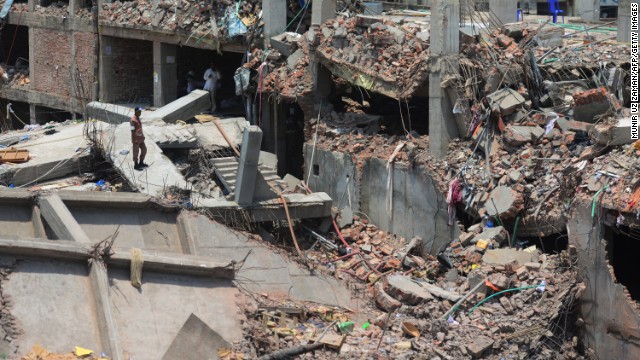
Death toll in Bangladesh building collapse rises above 650

Workers at the site of the multi-story building collapse near the Bangladeshi capital on Monday kept up their grim task of removing severely decomposed bodies from the rubble as the death toll climbed above 650. The building, which housed five factories full of garment workers, caved in on April 24, trapping hundreds of people in a tangled heap of concrete slabs and twisted metal in Savar, a suburb of the capital, Dhaka. Rescue workers managed to save more than 2,400 people from the mountain of debris during days of dangerous, painstaking work in high temperatures. But they gave up hope of finding any more survivors a week ago and are now using heavy machinery to pick apart the ruins and uncover the bodies buried inside. The number of people confirmed dead has now reached 657, said Col. Sheikh Zaman, a military official overseeing the recovery operation in Savar.
Missing loved ones
Amid the stench of death that permeates the surrounding streets, a large number of people continue to wait near the site of the collapse for news of missing relatives. Their gathering point is a school playing field where bodies retrieved from the ruins are taken for initial identification attempts. The task of identifying is made all the more difficult by the decomposed state of many of the bodies. If authorities cannot identify them through ID they might be carrying or other means, the bodies are taken to a morgue in Dhaka. Some of the people camped out in the area have also been holding up trucks transporting rubble removed from the disaster to check if they're mistakenly carrying the remains of people, recovery operation officials have said. Zaman said authorities still don't know exactly how many bodies remain encased in the wreckage because the factory owners still haven't provided a full account of how many people inside when the building gave way. The recovery effort is expected to continue for several more days. The owners of the building and the factories are under police investigation over accusations they ordered workers to enter the premises on the day of the collapse despite cracks appearing in the structure the day before. Heavy machinery blamed Preliminary results of a government inquiry into the building collapse found that "heavy machinery and high-capacity generators" were "largely responsible," the state-run Bangladesh Sangbad Sangstha News Agency reported last week. "During the inquiry, we have found that use of substandard materials during the construction also contributed to the building collapse," the leader of the inquiry, Main Uddin Khandaker, told BSS. Bangladesh's $20 billion garment industry accounts for 77% of the country's exports. Among those caught up in the finger-pointing after the building collapse disaster are Western retailers and clothing brands that Bangladeshi suppliers say put heavy pressure on prices, resulting in bad pay and conditions for workers. On Saturday representatives of Bangladesh's government, industry and workers issued a joint statement laying out an "action plan" to improve worker safety in the wake of the disaster. The European Union has said it is considering trade action against Bangladesh if it doesn't take clear steps to improve the safety conditions of its millions of garment workers.

Bangladesh's Fascist Islamist: '''Hefajat’s barbarity''

THE wanton violence and destruction perpetrated by Hefajat-e-Islam on Sunday and Monday defies logic and description. We wonder what measure of madness can overcome a group of people who, in the name of ventilating their demands, can go berserk and indulge in senseless destruction of public and private property. They behaved as if they were in an enemy territory. We condemn this in the strongest possible terms. Nearly a hundred government and private vehicles were put on fire, and hundreds of shops in an around the Shapla Chattar area suffered the same fate at their hands. Whose property were they burning? Whose livelihood were they destroying? By creating mayhem, by destroying public and private assets, by turning a part of the capital into a battle-zone, Hefajat has blatantly violated its democratic right, and for which, we feel, it owes an apology to the nation. We respect Hefajat’s right to hold its own views on different socio-political-religious issues, with which we of course do not agree, but that does not give it the right to resort to setting public and private property on fire or to resort to criminal activities as a means to have their demands met by the government. No political party or socio-political group has the right to hold the people to ransom to coerce an elected government to meet its demand. We have seen their demands ventilated on 5 April of this year and we see no reason why that programme should have been replicated a month later, and that too topped up in violence. If it is the 13 point demands that Hefajat wants the government to implement than the PM has articulated the government’s point of view in this regard. And if there are any disagreements on that, the only civilised norm would have been to engage the government without threatening to bring it down or giving ultimatums for dire consequences. We are constrained to say that instead of showing respect to Islam and upholding its image, which the group claims is its intention, its gratuitous exploitation of the religion has not only denigrated it but have also cast the group as one that adheres to violence rather than peace which is the they very fundamental of Islam.

Peshawar High Court makes history

The Express Tribune
There have been division benches with both male and female judges. However, forming a division bench comprised of only women judges allows the Peshawar High Court (PHC) to leap ahead of other courts in the country. May 2 was a historic day when such a bench heard cases related to 73 petitions. This was not only warmly welcomed by lawyers and litigants who all stood up in honor of Justice Irshad Qaisar and Justice Musarrat Hilali – the moment was also described as ‘history in the making’. Lawyers think the female bench will convey a softer image of Pakistan to other countries, proving Pakistani women do not fall short by any standards. Women from Pakistan can not only fly jets, treat patients and report stories. They can also give verdicts in court cases. “Yes, keeping in view the law and order, it (female bench) could be something exclusive. But let me tell you one thing, us Pashtuns have always honored females,” PHC Bar Association President Ishtiaq Ibrahim told The Express Tribune. According to Ibrahim, social norms in Khyber- Pakhtunkhwa (K-P) are based on strict cultural values which do restrict women. “But that does not mean we have restricted our females to their homes only.” “There are Pashtun teachers, doctors, sportswomen, journalists, lawyers and even law officers representing the provincial government. This conveys to the world how liberal our society is,” stated Ibrahim. He said the image portraying Pashtuns the world over goes completely against actual facts and the division bench exclusively comprising women judges proves this. “This has never happened in the history of the country’s judiciary – there has been no other occasion of a division bench comprising two female judges exclusively, something which was witnessed last week,” said Barrister Bacha. The barrister was among the lawyers who stood up to honour the bench. He urged women in Pakistan be provided equal opportunities. “I tell you, they (Pakistani women) are no less than men and are women of the modern world. I witnessed this when [the female division bench] was giving verdicts at the PHC,” Bacha said emphatically. “The women of K-P are not necessarily confined to the four walls of their homes; they share the burden of their men.”

In Pakistan's Baluchistan, Nationalist Parties Return to Contest Vote

Authorities in Pakistan’s insurgency-wracked Baluchistan province have put in place extremely tight security measures to ensure May 11 national elections are held peacefully. Separatist groups have threatened to disrupt the polls. But the participation of Baluch nationalist parties has led to hopes the vote could bring much needed political stability to the mineral and energy-rich province. Militants in Pakistan's volatile Baluchistan province have already attacked election-related events. The violence has led to a more subdued campaign season in most of the region. Residents and independent observers expect an all time low turnout. But authorities are confident that deployment of around 70,000 security forces across the province will ensure the safety of voters and prevent a disruption of the May 11 vote. "We are providing security to all polling stations and to the people, and it is the resolve of the provincial government to conduct just, free, fair and transparent elections," explains Provincial Home Secretary Akbar Hussain Durrani, who is supervising the security arrangements. Baluchistan is Pakistan’s biggest, but least populous, province. Despite being the richest of all four provinces in natural resources, its estimated 12 million people are the poorest in the country. While the rest of Pakistan is benefiting from Baluchistan's mineral and energy wealth, a World Bank report says the southwestern province has the worst economic growth record, the weakest infrastructure and the lowest national socio-economic indicators. Residents have long complained of being neglected by both the provincial and central governments. The resentment has helped fuel the low-level Baluch insurgency that has long battled the Pakistani state for political autonomy. "Baluchistan is a typical question of a mismanaged province by our own politicians, by our own administrations," said Wazir Ahmed Jogazai, a senior Baluch politician and a former deputy speaker of the national legislature. The people in Baluchistan are also opposed to the heavy presence of military forces in their province. Some accuse the Pakistani security forces of using brutal methods to suppress demands for greater political and economic autonomy. The law and order situation worsened after the Pakistani army's 2006 killing of senior Baluch politician Nawab Akbar Bugti. His death is said to have broadened support for the Baluch fighters seeking independence from Pakistan. The killing also prompted moderate nationalist parties to boycott Pakistan's 2008 national elections. End to violence But after five years on the political sidelines, the parties contesting this year's vote, promise to bring an end to the violence through the ballot. "Good luck for Pakistani democracy that major nationalist parties of Baluchistan," Zafarullah Khan, the executive director of the non-governmental Center for Civic Education Pakistan, said, "they are contesting elections, they are showing a lot of courage to give electoral process of Pakistan a chance to solve the Baluch question. But their challenge is that certain Baluch separatist, those who don’t find their future in the electrical process, they are posing a lot of challenges for them and restricting their campaign.” Former army general Talat Masood also agrees that participation of Baluch nationalist parties could go a long way in addressing the problems of their province. “If they can get back into the political fold I think that will be extremely helpful because that will sooth the passions and will bring them into the political process rather than they remain alienated," he said. But nationalist leaders such as Jahanzaib Jamaldini have long accused the military establishment of manipulating election results in favor of politicians they have created to counter nationalist forces. He warns that if those policies are not abandoned the insurgent violence will increase. “So, what we want is a free and transparent elections, mandate should be respected, trust deficit should be defused then there could be a way out to settle the problems [of Baluchistan]," he said. Worsening the so-called "trust deficit" between the Pakistani government and the people in Baluchistan are the hundreds of people alleged to have been disappeared in the last several years. Baluch activist groups blame the army for disappearances and targeted killings. Pakistani authorities reject the allegations and instead blame separatist groups.

Rehman Malik presents evidence against Sharif brothers

Pakistan Peoples Party (PPP) leader, Rehman Malik on Monday presented what he said was evidence of money laundering against the Sharif brothers and alleged that the money earned through it was transferred to Saudi Arabia, Geo News reported. While addressing a press conference here today, Rehman Malik told the media that he is presenting his complaints and evidence before the Supreme Court and Election Commission of Pakistan. He also claimed to quit his political career if failed to prove the allegations. Rehman Malik said the Sharif brothers transferred the cash outside Pakistan and was deposited in an account titled as ‘Qazi’. In 1998, the amount was transferred to Hudaibiya accounts. The PPP leader further said that more names will be revealed in money laundering case and complained that immediate actions had been initiated against PPP. He said that Ishaq Dar has already admitted that Shahbaz Sharif asked to convert dollars into local currency.

Sarabjit murder: Revenge is not the answer now

His tragic life and gruesome end have evoked such charged emotions and so much anger against both the Indian government, which has seemed helpless and soft, and a Pakistani government that did nothing to save Sarabjit's life. In this atmosphere there have been calls for extreme measures. The evidence of this is the brutal assault on a Pakistani prisoner in Jammu's Kot Balwal jail who, like Sarabjit, has also been put on a ventilator. While it may be very difficult to be rational in these trying circumstances, it is important that India does not lose the moral high ground it occupies now after the death of Sarabjit. There will be calls for lowering diplomatic engagement and banning people from the country, like musicians and cricketers among others. But New Delhi must be pragmatic. While making efforts, more consistent and strenuous than the ones made for Sarabjit, to secure the release of the nearly 220 Indian prisoners in Pakistan, the government must not give in to the jingoism from some quarters that want to teach Pakistan a lesson by shunning its people. There are extremists on all sides, but unless we continue with what is often termed engagement using soft power, a bad situation will only get worse. Most Indians have been revolted by the politics preached by outfits like the Shiv Sena, which have targeted cultural and sports personalities from across the border. But, India ought not to descend to such pettiness. We cannot expect reciprocity for our every move from Pakistan. It is a deeply troubled and isolated state. It is in the grips of fundamentalism and what even its own leaders now concede to be non-state actors. Cutting off cultural and other people-to-people contacts is not going to result in any tangible benefit. This is not to suggest that the government does not keep up pressure on Pakistan to mend its ways and to abandon its policy of trying to bring India to its knees through the export of jihadis. This is a policy, as we have seen, which has cost Pakistan dearly with terror attacks in the country becoming an almost daily occurrence. The killing of the Pakistani prosecutor in the 26/11 case and the Benazir Bhutto murder case just after the Sarabjit murder shows the extent of chaos and violence in the country. It is not that there has not been condemnation in Pakistan over the death of Sarabjit. We have to equally condemn the attack on the Pakistani prisoner in Jammu. The government has to make every effort to see that Pakistani prisoners are not targeted in Indian jails. This tragic event underscores all the more the need to engage, at least in the areas of least contention, with a fractious neighbour one cannot wish away.

Attack on PPP office injures one

A bomb blast targeting an election office of Pakistan People’s Party (PPP) on Monday in Charsadda’s Shabqadar Mirzai area left one injured. According to details, a man was injured in a blast and the party’s office was completely destroyed. The police cordoned off the area and started an investigation. Three parties — PPP, Muttahida Qaumi Movement (MQM) and Awami National Party (ANP) – have vowed to fight terror and have braved attacks on them by the banned Tehrik-i-Taliban Pakistan (TTP) in their campaign to contest the coming elections. - See more at: http://www.pakistantoday.com.pk/2013/05/06/news/national/attack-on-ppp-office-injures-one/#sthash.GqX7p9nw.dpuf

LeJ terror suspect contesting on PML-N ticket

A Lashkar-e-Jhangvi-linked alleged terror suspect who has already spent five years in jail on murder charges and had known links with a slain al-Qaeda linchpin Amjad Hussain Farooqi is running for a National Assembly seat from Gujrat on a PML-N ticket. Chaudhry Abid Raza Gujjar had been handed down death sentence under section 302 and section 7 of the Anti Terrorism Act 1997 for the murder of six people during a failed assassination attempt on the former Nazim of Gujrat, Ghulam Sarwar Bhooch, in 1998. His nomination papers for the upcoming elections were rejected by Returning Officer Malik Ali Zulqarnain Awan on April 6, 2013 after an independent candidate, Raja Haq Nawaz, took up his conviction on the murder charge as well as his alleged connections with some banned sectarian outfits, including the Lashkar-e-Jhangvi (LeJ) and Sipah-e-Sahaba Pakistan (SSP). Abid was also listed under Section 11 (E) of the 4th Schedule of Anti-Terrorism Act 1997 for his alleged involvement in terrorism-related activities. But strangely enough, he was cleared by an election tribunal of the Lahore High Court on April 18, 2013 to contest the general elections. The PML-N leadership’s decision to award the party ticket for NA-107 to Abid Raza of Kotla Arab Ali Khan Group instead of the party’s district president Malik Hanif Awan has surprised many because Awan and his nephew Jamil Awan had won that seat twice in 2008 general elections and in 2012 by-elections, respectively. According to Awan, the party leadership told him that Hamza Shahbaz had made a commitment to award the PML-N ticket to Abid Raza at the time of the December 2008 by-elections to appease the Kotlas who had also been vying for a PML-N ticket for the by-election. But some PML-N rebels allege that the leadership of a banned sectarian group, which is well-known for its proximity with the PML-N, in Punjab had persuaded the Sharifs to award the ticket to Abid Raza. Nevertheless, the PML-N’s decision to award the party ticket to Abid Raza from NA-107 is equally alarming for the law enforcement agencies which had arrested him many times for interrogation since his 2003 release from Gujranwala Central Jail. It was during his detention in Gujranwala jail on murder charges that Abid had developed close ties with LeJ’s Malik Mohammad Ishaq and Ghulam Rasool Shah who were languishing in the same jail for the May 1997 murder of the SSP Gujranwala Ashraf Marth. While Abid’s appeal against the death sentence was being heard by the Lahore High Court, his family managed to strike a deal with Ghulam Sarwar Bhooch. After an ‘out of court settlement’ between the two groups and the withdrawal of the murder case, Abid Raza was set free on July 3, 2003 from Gujranwala jail. However, he was taken into custody by the intelligence agencies a few months later in connection with the December 2003 twin assassination attempts on Pervez Musharraf by two suicide bombers in Rawalpindi. According to well-informed sources in the law enforcement agencies, Abid Raza was arrested in the wake of intelligence reports that the most wanted al-Qaeda linchpin in Pakistan Amjad Hussain Farooqi had been using the huge haveli/dera of Abid [spanning over more than six kanals] located in the Kotla town (also called Kotla Arab Ali Khan) of the Kotli district of Azad Jammu & Kashmir as his base camp to mastermind and plan the Rawalpindi suicide attacks on Musharraf. The former ameer of the al-Qaeda-sponsored Brigade 313, Commander Ilyas Kashmiri who was killed in a US drone attack on June 4, 2011 in South Waziristan, also belonged to Kotli. Kashmiri was arrested in December 2003 following two failed assassination attempts on Musharraf in Rawalpindi. In 2008, five years after he was named in the bids on Musharraf’s life, Kashmiri was accused of plotting to assassinate General Ashfaq Kayani in Rawalpindi. Ilyas Kashmiri was considered close to Amjad Hussain Farooqi. On September 26, 2004, ten months after Musharraf put the state agencies on his track with Rs20 million on his head, Amjad Farooqi was killed in a shootout in Nawab Shah. In an interview with a private TV channel on June 4, 2004, Musharraf had named Amjad Farooqi, the man who had also masterminded the kidnapping and murder of Wall Street Journal reporter Daniel Pearl with the help of Sheikh Ahmed Omar Saeed, as the chief plotter of the two failed assassination attempts against him. Amjad Farooqi was killed 50 days after the August 7, 2004 arrest and extradition of the fugitive ameer of the Harkat ul-Jehad al-Islami (HUJI) chief Qari Saifullah Akhtar from Dubai and the ensuing information he had provided to his interrogators. Subsequent investigations revealed that Qari Saifullah, during his stay in the UAE, had actually been tasked by Abu Faraj Al Libbi, the then chief operational commander of al-Qaeda in Pakistan, to carry out the twin suicide attacks on Musharraf. In turn, Qari Saifullah had engaged Amjad Farooqi to plan the attack by hiring two suicide bombers - Khaliq Ahmed and Jameel Suddhan. According to sources in the law enforcement agencies, after being arrested soon after the Musharraf attacks, Abid Raza was taken to Rawalpindi and was interrogated by a Joint Interrogation Team (JIT) composed of officials from numerous agencies and led by the then Corps Commander of Rawalpindi and the current Army Chief General Ashfaq Kayani. Abid reportedly conceded to his interrogators that Amjad Hussain Farooqi had been staying at his dera/haveli but he claimed that he never knew that he was an al-Qaeda linked terrorist who was planning to target Musharraf. Abid reportedly maintained that Amjad Farooqi actually came to him with the reference of some of his former inmates from Gujranwala Central Jail (most probably Malik Ishaq and Ghulam Rasool) and that he had nothing to do whatever Farooqi had been planning. Abid Raza was interrogated by the agencies for almost eight months and eventually set free on the intervention of the Chaudhrys of Gujrat who were very close to Musharraf at that time. The Chaudhrys were approached by Chaudhry Naeem Raza, a member of Punjab Assembly on a PML-Q ticket and an advisor to the then Punjab Chief Minister Pervaiz Elahi (between 2002 and 2007). Naeem Raza is the elder brother of Abid Raza who had to quit as advisor after the arrest of his brother for his alleged involvement in the assassination attempts on Musharraf. However, despite being released, Abid Raza was placed on the 4th schedule of Section of the Anti-Terrorism Act 1997, under which persons charged with terrorist activities, after being released, are kept under vigilance by the law enforcement agencies. Approached by this correspondent, Naeem Raza confirmed that he had made frantic efforts for the release of his younger brother who was picked up by the ISI for sheltering Amjad Farooqi. “But I never knew that I was paving the way for the release of an al-Qaeda-linked terrorist. I actually came to know of this fact after his release when all kinds of sectarian elements and jihadis started flooding his dera at Kotla Arab Ali Khan. To tell the truth, Abid Raza had once introduced me to Amjad Hussain Farooqi with another name, saying that he was his Ustad. I never knew he was an al-Qaeda operative and was planning to attack Musharraf. After the Rawalpindi attacks on Musharraf, the ISI not only picked up Abid Raza but they also interrogated me as a suspect, only because of my brother’s jihadi links. Brigadier Ejaz Awan of the ISI had shown me a picture and asked if I knew that person. I immediately recognized him and told the Brigadier that he was introduced to me by Abid as his Ustad who was staying at his dera along with several others. But I was literally shattered to know that he was Amjad Farooqi. Frankly speaking, Abid Raza publicly claims to be a key leader of the Punjabi Taliban who had secured the PML-N ticket by assuring the Sharifs that the Taliban won’t target them in their election campaign”, said Naeem Raza who is contesting the coming election on a provincial assembly seat (PP-115) as a PML-Q candidate from Kharian. When approached Abid Raza strongly refuted that he has any terrorist links as being alleged by his “political opponents”. Asked if he was arrested in connection with the Musharraf attacks following his release from Gujranwala jail in a murder case, masterminded by Amjad Farooqi who used to hide at his dera in the Kotli area, Abid Raza said: “You must know that those arrested in connection with the Musharraf attacks were never released. I was seized by the agencies because of the maneouvering of my political opponents. I was taken to Rawalpindi but was finally released because the agencies had nothing against me. My opponents even allege that I was taken to the Guantanamo Bay after being arrested from Afghanistan which is absolutely baseless. That Abid Raza was someone else from Karachi, having the same name”. To another question, Abid refuted having any link either with al-Qaeda, Amjad Farooqi, Lashkar-e-Jhangvi or the Sipah-e-Sahaba. But he conceded that he was a diehard Sunni Deobandi, adding that being a Deobandi was not a crime. About the murder case, Abid Raza said he was sentenced to death but was released after spending five years in jail because of an out of court settlement with the rival party as per the Islamic Shariah. As the PML-N spokesman Senator Pervaiz Rasheed was approached by this correspondent and asked as to why an alleged terror suspect was awarded a party ticket by his leadership, he said: “All the allegations (against Abid Raza) had been proved wrong in the court of law and he was released honourably. He was in fact victimised by his influential political rivals of the area who monopolised politics (at that time). Abid Raza had challenged his rivals and fought against them bravely in the court of law to clear his name. His innocence was even acknowledged by the Election Commission of Pakistan which accepted his nomination papers and declared him a bona fide candidate for parliamentary elections”.

Extremists Pursue Mainstream in Pakistan Election

By DECLAN WALSH
Pakistan — Dust swirled as the jeep, heralded by a convoy of motorcycle riders and guarded by gunmen in paramilitary-style uniforms, pulled up outside the towering tomb of an ancient Muslim saint. Out stepped Maulana Abdul Khaliq Rehmani, a burly cleric with a notorious, banned Sunni Muslim group. Thanks to a deft name change by his group, he was now a candidate in Pakistan’s general election, scheduled for Saturday. Supporters mobbed Mr. Rehmani as he pushed into a small mosque in a rural district of Punjab Province, where a crowd had gathered in a courtyard. The warm-up speaker played on some typical populist tropes. “Islamabad is a colony of America,” he shouted. “Thousands of their agents are in the capital, and they are destabilizing Pakistan.” But Mr. Rehmani preferred to paint his campaign as a rural class struggle. “Feudalism has paralyzed Pakistan,” he said, his voice rising as the audience — farmers with weather-beaten faces, many fresh from toiling in the fields — listened raptly. “By the will of God, every poor person in this district will vote for us!” As election fever grips Pakistan this week, Sunni extremist groups are making a bold venture into the democratic process, offering a political face to a movement that, at its militant end, has carried out attacks on minority Shiites that have resulted in hundreds of deaths this year. Mr. Rehmani’s group, Ahle Sunnat Wal Jamaat, is fielding 130 candidates across Pakistan in this election. Few are expected to win seats in the Parliament, which is dominated by more moderate parties. But experts say they are flexing their political muscle at the very time when Pakistan urgently needs to push back against extremism. Relentless Taliban attacks on secular parties in recent weeks have tilted the field in favor of conservative parties, while the election authorities have been ambiguous. Some candidates were disqualified for having forged their university degrees, or for having an anti-Pakistani “ideology.” But candidates with nakedly sectarian groups have been allowed to participate freely. “These elections are critical,” said Ayesha Siddiqa, a defense analyst and the author of several reports on militancy in southern Punjab. “General Musharraf and his military started accommodating these groups. Now we see them trying to enter the political mainstream.” Mr. Rehmani was speaking at a rally in Khanewal, a district of lush fields and poor farmers between the city of Multan and the Indus River. His group, once known as Sipah-e-Sahaba Pakistan, is the country’s main anti-Shiite group and was banned as a terrorist organization by Pervez Musharraf, then the president, in 2002. Sipah is widely viewed as the ideological center of sectarian thinking in Pakistan; its most notorious offshoot is Lashkar-e-Jhangvi, the militant group responsible for much of the sectarian bloodshed this year: roadside executions, drive-by shootings and two major suicide attacks in the western city of Quetta that killed almost 200 people earlier this year. But relatively little sectarian violence touches Sipah’s political heartland in southern Punjab, where such groups drive deep roots in conservative rural communities by exploiting religious sentiment, profound social inequality and — in some cases — the support of mainstream politicians eager to capture their votes. In Khanewal, for instance, Mr. Rehmani is estimated to control 12,000 to 20,000 votes, not enough to win a seat, but sufficient to swing the vote in the event of a tight race. At the last election in 2008, his group supported Raza Hayat Hiraj, a candidate for General Musharraf’s party who went on to win the seat in Parliament. This time, however, the group has fielded its own candidate, Mr. Rehmani. Mr. Hiraj has been rejected by that group, and finds himself under political attack locally. He has also had a change of heart about Sipah. “They are very strong fanatics,” he said in an interview, saying that the group had a “different mind-set” when he supported them — under pressure from his own party. “I was told to go into an alliance with them,” he said. “These people don’t even consider Shiites to be like human beings. Their first philosophy is to kill a Shiite.” A similar dynamic exists in other pockets of Punjab where extremists enjoy a foothold: politicians, even those who profess not to share the extremists’ values, are happy to embrace their votes. All parties, including the Pakistan Muslim League-N, which is tipped to do well in this election, have been guilty. The phenomenon helps explain how sectarian groups can carve out the space to operate, said Ms. Siddiqa, the analyst. “There is an argument that if you engage these groups politically, they might turn into Pakistan’s version of Sinn Fein or Hezbollah,” she said, referring to the political wings of militant movements in Ireland and Lebanon. “That is a very dangerous proposition.” Other factors play a part, too. Although sectarianism has been a problem in Pakistan since the country’s birth in 1947, it turned militant in the 1980s when the military dictator, Gen. Muhammad Zia ul-Haq, promoted Sunni extremist groups to counter Iranian influence after the 1979 revolution in that country, which created a Shiite theocracy. Sectarian recruiters found rich terrain in the fields of Punjab, where poor Sunni farmers felt exploited by wealthy Shiite landowners who lorded over their tenants in a modern-day feudalism. Some of the same factors are still at play today. “These people are slaves to the feudal lords,” Mr. Rehmani said after the rally, sitting on a rope bed in a field outside the mosque. Indeed, one of his opponents is a Shiite landlord: Fakhar Imam, a member of a large and politically influential family. Mr. Imam is a former speaker of Parliament while his wife, Abida Hussain, is a former ambassador to the United States. In 1991, his brother was shot and wounded in a sectarian attack. In an interview after a rally in Kabirwala, the main town of Khanewal District, Mr. Imam played down the importance of sectarianism as a political factor. “People are more concerned with gas, jobs and electricity,” he said, speaking by torchlight after the city power went off. Still, there is little doubt that sectarian politics are the seedbed of more violent actions. Militants from Kabirwala took part in a high-profile attack on the Sri Lankan cricket team in Lahore in 2009 that killed eight people. And the founder of Sipah-e-Sahaba, Maulana Haq Nawaz Jhangvi, was educated in a madrasa just a few hundred yards from Mr. Imam’s rally. The head of the madrasa, Maulana Irshad Ahmed, bristled at any suggestion that the institution had a connection with terrorism. Instead he offered juice and samosas to a visiting Shiite journalist, and offered a tour of the complex, which belongs to the conservative Deobandi sect and houses 2,000 students. In the corridors of a new, three-story building, filled with dormitory rooms that doubled as classrooms, bearded teenagers crowded around teachers, listening to religious instruction. A similar-size mosque was under construction next door; Mr. Ahmed said he hoped the complex would soon have 4,000 students. After the rally in Khalid Walid village, Mr. Rehmani rose to leave, trailed by his armed guards. He apologized: he was rushing to another campaign rally. As his convoy disappeared into the dusk, it passed under the village’s dominant feature: the red-brick tomb of Hazrat Khalid Walid, a 13th century saint from the moderate Sufi strain of Islam, who was famed for his sense of tolerance.

Clash resumes in contested Afghan, Pakistan border area

A new bout of fighting erupted on Monday in a border area between Afghanistan and Pakistan, the latest indication of a sharp deterioration in relations between the important U.S. allies. Pakistan is seen as vital in bringing stability to Afghanistan as most Western forces prepare to withdraw by the end of next year. The United States and other powers involved in Afghanistan have been trying to promote cooperation between the Asian neighbors, who have a history of mistrust. Afghan officials said the clash on Monday erupted after Pakistani troops tried to repair a gate on the border, in the Afghan district of Goshta, where last week an Afghan border policeman was killed in an exchange of fire. It is unclear if there were any casualties on Monday. "This morning's clash began after the Pakistani side continued to repair the gate, which was damaged in the previous fighting," said Ahmad Zia Abdulzai, a spokesman for the governor of Nangarhar province. Afghanistan says the gate at Pakistan's Gursal military post encroaches on its territory. The Nangarhar governor has spoken several times to Pakistani consular officials to tell them not to repair the gate, Abdulzai said. Pakistani military spokesmen were not immediately available for comment. Afghanistan and Pakistan have had testy relations since Pakistan was formed in 1947, at the end of British colonial rule over India. Afghanistan has never officially accepted the border between them. Pakistan helped the Taliban take power in Afghanistan in the 1990s. Many Afghan leaders say Pakistan is still helping the militants, seeing them as a tool to counter the influence of its old rival, India, in Afghanistan. Pakistan denies helping the Taliban and says it wants peace and stability in its western neighbor. But in an indication of how bad ties have become, Afghan President Hamid Karzai, without naming Pakistan, last week called on the Taliban to fight Afghanistan's neighbor, where, he said, plots were made against Afghanistan. Earlier last week, troops from the two sides exchanged fire for about five hours. Karzai has ordered officials to take "immediate action" to remove the gate and other Pakistani military installations near the Durand Line, the 1893 British-mandated border. Afghanistan maintains that activity by either side along the Durand Line must be approved by both countries.

8 Pakistani soldiers and police killed in violence

Military operations and insurgent attacks in lawless districts of Pakistan left eight members of the security forces and around 30 militants and criminal suspects dead on Sunday, officials said. Two soldiers and 16 militants were killed in clashes in the Tirah Valley area of the Khyber tribal region in the northwest, the military said in a statement. Another three soldiers were wounded in the remote mountainous district near the Afghan border. The army launched an offensive last month into the valley targeting the Pakistani Taliban and an allied group, Lashkar-e-Islam. The military statement said the latest fighting forced the militants to flee from two of their hideouts, leaving behind a huge cache of arms and ammunition. In the North Waziristan tribal region, another northwestern district bordering Afghanistan, a roadside bomb attack on a convoy killed two soldiers and wounded three, said two Pakistani intelligence officials. They spoke on condition of anonymity because they were not authorized to talk to the media. The tribal region is home to both Pakistani and Afghan militant groups, including al-Qaida-linked organizations with significant numbers of foreign fighters. The military conducts sweeps against the insurgents, inflicting losses but not preventing them from striking back with roadside bombs and ambushes targeting soldiers, government-allied militias, anti-militant politicians, and others. Also Sunday, two members of the paramilitary Frontier Corps were killed in clashes in the Bolan district of the southwestern province of Baluchistan, said government official Waheed Shah. He said the fight also killed 13 "criminals" suspected in kidnappings and robberies. In the province's Sibbi district, a convoy of an independent candidate running in Pakistan's May 11 parliamentary elections was attacked by two gunmen who killed two of his police guards, said police official Owais Ahmad. He said candidate Sardar Sarfraz Domeki's other guards fired back, killing one of the attackers and wounding the other. He said the police were questioning the wounded attacker. The southwestern province has seen for years a low-level insurgency by nationalist groups who want a greater share of regional resources of oil and gas. Lawlessness in the region has also allowed sectarian groups and criminal gangs to operate.

Pakistan: A most violent election

A Muttahida Qaumi Movement (MQM) unit office near the party’s headquarters Nine Zero was hit by two blasts in sequence, killing three people and injuring 35, including children. The two bombs exploded within 20 minutes of each other, a tactic the terrorists have been resorting to for some time. According to the government’s bomb experts, the second bomb was deliberately exploded with some delay to target rescuers and the public that usually rush to the site of explosions. Both bombs were reportedly detonated by remote control. The attack, the ninth in a series of attacks against electioneering mainly by the MQM and Awami National Party (ANP) in Karachi, came just one day after ANP National Assembly candidate Sadiq Zaman Khattak and his four-year-old son were gunned down by the Tehreek-e-Taliban Pakistan (TTP) in Karachi. Meanwhile, elsewhere in the country, a Jamaat-i-Islami (JI) candidate was targeted in Lower Orakzai Agency, but fortunately escaped, while an attack on a JI office in Peshawar injured two people. In the same city, a Pakistan Tehreek-e-Insaaf office was bombed, fortunately without loss of life as the office was empty at the time. This election is turning out to be one of the bloodiest in our history. Since January till the end of April this year, 2,674 people have been killed, according to a report by a think tank. Admittedly, the toll includes militants targeted by the security forces and drone strikes, as well as personnel of the security forces engaged in operations against the terrorists, and also casualties on both sides in the nationalist insurgency in Balochistan. However the bulk of the dead are citizens and political leaders and workers of the three secular-leaning mainstream parties, the PPP, MQM and ANP. The toll now includes the JI and PTI after the incidents referred to above. This is an intriguing development since it was widely considered that these parties were respectively pro-Taliban and harbouring a soft corner for the militants. If their ideological ‘friends’ are now turning on them, it merely reflects their naiveté in believing they would be spared the unwanted attentions of the terrorists or that the fanatics could be persuaded to cease terrorist actions and be peacefully integrated into the mainstream. For these parties and the widely acknowledged front runner in this election, Nawaz Sharif and the PML-N, this reality is, or will, bite sooner or later, much to their chagrin. Surprisingly, while former ANP information minister in the previous Khyber Pakhtunkhwa government has rounded on the caretaker government and the Election Commission of Pakistan for their failure to provide security to his party and the other two parties hitherto being exclusively targeted by the terrorists, the caretaker federal cabinet, if Information Minister Arif Nizami is to be believed, seems to be living in cuckoo land. According to Mr Nizami, the cabinet believes law and order and security are satisfactory or at least improving. This sanguine head-in-the-sand attitude contrasts sharply with the everyday lived experience of most citizens and the political parties. The caretaker government needs a reality check, followed by some evidence it takes its responsibilities vis-à-vis security for the elections more seriously than has been in evidence so far. We have the strange conjuncture of arguably one of the bloodiest and most violent elections in our history and a seemingly toothless caretaker government attempting to paper over its manifest failure to discharge its primary duty — the holding of free, fair, transparent elections in an enabling secure environment where parties and voters are not cowed into submission, either during campaigning or on polling day. With five days to go for the exercise of the electorate’s right to freely express its will, the prospects for the situation on May 11 are grim and frightening.

Pakistan: Is this only Punjab’s election?

Daily Times
By— Farooq Sumar
It so happens that other than Punjab all other provinces are affected by the TTP threat. Is this a coincidence or do we smell a rat?
Punjab’s role since the inception of Pakistan has been controversial, to say the least. Its dominance of the federal government, its share of economic development, with over 70 percent of the bureaucracy and over 90 percent of the armed forces from Punjab were a bone of contention for the 54 percent East Pakistanis and the other three provinces. That served as a major reason for the creation of secessionist forces in East Pakistan. After the breakup, Punjab has become the majority province with around 62 percent of the population, but it continues to grab a disproportionate share in government jobs and its hold on the armed forces continues as before. No real efforts have been made to remove disparities; the recent doling out of a few pennies is not the solution, as technical knowhow and infrastructural support needed to be provided to the deprived and backward provinces to close the gap. This failure has led to higher unemployment and illiteracy in Sindh, Khyber Pakhtunkhwa (KP) and Balochistan as compared to Punjab, factors that encourage violence. Ziaul Haq’s administration deliberately disrupted Karachi and Sindh in the 1980s, but in the next 25 years no government has had the will to eliminate the criminal political parties and the mafia. As a matter of fact, all federal governments have provided legitimacy to these criminal groups. As a result, Karachi has suffered from violence and oppression of the worst kind almost continuously in these two decades and more. KP has been sacrificed twice in 30 years to serve the US’s interests and those of our local resident dictators, Zia from 1981 to 1988, Pervez Musharraf from 2001 to 2008. KP is a full blown war zone, the stench of death is all around and fear is writ large on people’s faces. The Baloch people have only seen the military bomb, strafe, kill and imprison their people in four major operations since independence and the fifth operation is ongoing. Hundreds of Baloch go missing and their mutilated bodies are found later. What have successive federal governments done to put a stop to this madness? Why has the powerful Punjab not used its clout to restore sanity and instead played a major role in perpetrating the subjugation of the Baloch? The deterioration in the three smaller provinces has been either ignored or precipitated by the policies of the overwhelmingly Punjab-dominated establishment and ruling cliques. The KP’s destruction since the 1980s was considered as dispensable, the Baloch were always considered traitors and, therefore, needed to be occupied. The destruction of Karachi led to the relocation of industry in Punjab and drying up of future investments; the loss of its economic dominance had its advantages for others. The establishment and the ruling cliques thought that as long as Punjab, the largest province, remained stable and intact, the federation was safe. What a dim view! Unless all the parts are safe, the federation cannot be secure. I cannot forget a statement once made by the urbane Syeda Abida Hussain on the floor of the National Assembly: “Mr Speaker, Sir, Punjab is not just a province, it is 62 percent of Pakistan!” Well, as long as Punjab does not learn to start behaving as a province and stop bullying the rest, the federation cannot progress. This attitude must change if we want to see this remaining part of Pakistan survive as one and it must start now by taking tough and decisive measures to thwart the Taliban’s and other criminals’ efforts to derail the elections in the three smaller provinces. As far as Punjab is concerned, there too are extremists of Zia and Hamid Gul’s creation — the Lashkar-e-Taiba, Sipah-e-Sahaba, Lashkar-e-Jhangvi, to name a few. Since the Sharifs are the political creation of Zia and were nurtured by Gul and the ISI up to sometime in the 1990s at least, their connections with the extremists have been rather cordial. Therefore, according to media reports there are electoral alliances and seat adjustments with the Ahle Sunnat Wal Jamaat, the successor of the banned Sipah-e-Sahaba. During its five-year rule in Punjab, the PML-N has provided safe haven to these extremist groups. So the Jhangvis have been free to create mayhem in Balochistan and other provinces and kill as many Shias as they please and come back to rest and recuperate in southern Punjab. I suppose the deal must be that they are not to take any such actions in Punjab. Therefore, the PML-N government in Punjab has been exporting terrorism to other provinces by providing protection to terrorists in return for peace in Punjab. Politics is dirty one knows but such opportunism cannot be condoned. The Tehreek-e-Taliban Pakistan’s (TTP’s) announcement to target the PPP, ANP and MQM is a severe blow to the democratic aspirations of the people. The ANP and MQM are largely in KP and Sindh respectively, while the PPP is a national party. The impact of the TTP threat is actually being felt in KP, Karachi particularly, and Balochistan. It so happens that other than Punjab, all other provinces are affected by the TTP threat. Is this a coincidence or do we smell a rat? Why, for instance, are the PPP candidates not under attack in Punjab? Bombings are taking place every day in Karachi. There is hardly any election activity in this city of almost 20,000,000. Similar is the situation in KP. Public meetings and corner meetings are an essential part of the electioneering process. Without hearing the various candidates, how can you exercise your freedom to vote? With the situation worsening daily, imagine the chaos on polling day. The much touted police and Rangers have been ineffective and, regretfully, will remain so. Surprisingly, the other major players like the PML-N, PTI, JUI-F and JI are either silent or have made muted responses. There is no outright condemnation of the Taliban; there is no expression of sympathy or condolence. When even one party’s right to participate is threatened, the whole election process is compromised. The election cannot remain free and fair and its legitimacy can be challenged if the voting is insignificant. If the PML-N and PTI feel that only Punjab is important, they are mistaken; this is a general election and not just Punjab’s election. Responsibility and maturity requires a national approach to this problem, not a petty view that the opponents have to deal with it. Not only the parties but also the TV talk shows give one this clear impression as most are concentrating on Punjab. Sorely missing is expert analysis and legal views on this issue. What we are facing is a real threat of a major disruption in Karachi, Hyderabad, Sukkur and probably Larkana, KP and Balochistan. The belated decision to deploy 70,000 troops in aid of the federal government, taken as I write, is welcome. However, if this Quick Deployment Force (QDF) remains under the control of provincial caretakers the impact will be watered down, as it is a well known fact that some are quite partisan. Therefore, some modus operandi needs to be found whereby a call for help by a candidate or returning officer/polling station in-charge is monitored either by the ECP or the QDF directly also. This would ensure that the QDF’s response is directed in good time to where it is needed. Besides responding to calls, the sensitive areas should also be patrolled by army troops as a preventive measure. This operation needs to be managed well as its failure can cause irreparable damage. This election is important to us not only for a change in government but also to prove our ability to hold a reasonably fair and free election and continue the process in future. If it fails, God forbid, who knows what doctrines will be brought into play in the ensuing chaos.