Sunday, April 28, 2013

We will continue efforts to bring back Sarabjit: Khurshid

http://www.thehindu.com/
Despite the limitations of a caretaker government in Pakistan, India will continue to make efforts to bring back death row prisoner Sarabjit Singh, who is in a coma after being assaulted by fellow inmates in a Lahore prison. But for the moment, the matter is out of the purview of politicians and in the domain of doctors and Islamabad has promised the best possible treatment to him, said External Affairs Minister Salman Khurshid, who is here to put India-Moscow ties on a firmer footing. “We haven’t been successful in persuading Pakistan to send back Sarabjit. He is in the Intensive Care Unit and our diplomats have had some access to him. We have also been successful in persuading Pakistan to issue visas to his family to visit him in the Lahore hospital. We are still very concerned about his medical condition and are hoping for the best. It is important that he recovers before we decide anything else,” Mr. Khurshid told journalists accompanying him on his visit to Kazakhstan and Russia. Asked why New Delhi appeared not to have pushed for his release vigorously, he pointed out that many efforts were kept outside the media’s purview. But this was not a unilateral matter and New Delhi was not sure if the caretaker government in Pakistan would have the authority to take a decision of this nature. “His situation is still critical. He has suffered injuries to the head, abdomen and other parts of his body. They are giving him the best possible treatment. As for bringing him back, this is a bilateral matter and there has to be a convergence of views. For the present, we are hoping that he is given the best possible attention,” he said while acknowledging that his case had become the focal point of national attention. The Minister declined to speculate whether the brutal assault on Sarabjit, who has been on death row for years, was the handiwork of the Lashkar-e-Taiba or the Inter Services Intelligence as is being alleged by a section of Indian media.

Sarabjit Singh in deep coma, Pak expedites visas for family

http://timesofindia.indiatimes.com/
Indian death row prisoner Sarabjit Singh on Saturday slipped into a deep coma, strapped to a ventilator in a Lahore hospital where he was admitted a day earlier after a near fatal attack by fellow inmates. As doctors battled to revive him, Pakistani authorities granted visas to his family in hours, triggering speculation that they too feared the worst for this latest victim of hostile bilateral ties. The 49-year-old Punjab resident, who has languished in Pakistan jail since he was caught as a trespasser and convicted as a terrorist and a spy two decades ago, was bashed up with bricks and blunt objects, leaving him bleeding from the head. Pakistani officials, who have consistently ignored his pleas for greater security in the face of abuses getting shriller following Kasab's and Afzal Guru's hangings, now embarrassed by his condition, allowed India consular access and slapped attempt to murder charges on the assailants. "We have received a call from vice-chairman of National Commission for Scheduled Castes, Raj Kumar, informing us that the high commission has given visas to all of us for travelling to Pakistan. Besides, one of our family members has got permission to stay with Sarabjit in hospital," Dalbir Kaur, sister of Sarabjit, told TOI on Saturday. The family members had approached Raj Kumar for help after they were told of Sarabjit's condition in Lahore's Jinnah hospital. He had flown to Delhi on Saturday afternoon with the passports of the family members and rushed to the Pakistan high commission. The family's fears escalated on Saturday after neither jail authorities nor doctors gave any medical updates on Sarabjit's condition. Doctors have refused to speak to the media since Friday when Sarabjit was admitted to the hospital after the attack which Prime Minister Manmohan Singh on Saturday described as a "sad incident". Agencies quoted a statement of Pak foreign office spokesperson as saying, "As a result of scuffle between prisoners at Kot Lakhpat jail, Indian prisoner Sarabjit Singh suffered head injuries which rendered him unconscious. Doctors and medical staff at the hospital are working round-the-clock to revive the prisoner who remains unconscious and on a ventilator." It said hospital's medical staff had updated the two Indian high commission officials, who were allowed to visit Sarabjit on Friday, about his condition. Police have registered a case of attempted murder against two prisoners - Amer Aftab and Mudassar -- after a complaint from jail officials though six inmates are said to have attacked Sarabjit. Dalbir Kaur, along with Sarabjit's wife Sukhpreet Kaur and daughters Swapandeep and Poonam, are to leave for Lahore through Wagah border on Sunday. Dalbir said she would stay with his brother in the hospital. Sarabjit's family members had met him in jail in April 2008 and last in June 2011. Sarabjit had written to family about threat in jail Poonam said three weeks ago they had received a letter from Sarabjit in which he had apprehended an attack from fellow inmates who wanted to take revenge for the hanging of Ajmal Kasab and Afzal Guru. "We had told about the threat to everyone in the government. I wish they had listened to our pleas," she said. Desperate to leave for Pakistan, Sukhpreet Kaur said, "I want to look after my husband, I hope he recognizes me". Sukhpreet said she had bought food and clothes for her husband. Daughter Swapandeep had also purchased several things for her father but left them in Jalandhar while leaving for Amritsar in a hurry. Meanwhile, shops in Sarabjit's native village Bhikhiwind remained closed in protest against the attack. In Amritsar, prayers were held for the well-being of Sarabjit and the students held a candlelight vigil for his speedy recovery. Sarabjit was convicted for alleged involvement in a string of bomb attacks in Punjab province in 1990. His family claims he is a victim of mistaken identity and had inadvertently strayed across the border. Political plot behind assault: Pak human rights activist Ansar Burney, Pakistan's human rights activist and one of Sarabjit Singh's counsels, on Saturday saw a conspiracy behind the attack on the Indian death row prisoner. Burney didn't rule out a "political plot" behind the near fatal attack on Sarabjit as Pakistan goes to polls in two weeks. "There appears to be a deep-rooted conspiracy to attack Sarabjit ahead of polls which should be investigated," he said. Talking to TOI over phone from Karachi, Burney said, "I see some foul play in it. Pakistan government was not releasing Sarabjit and it couldn't hang him due to international pressure. So an attack on him could serve the purpose to gain support from fundamental elements during polls." He said since Friday he had been getting threats from various Taliban groups and fundamentalists, who are inimical to peace with India, forcing him to postpone his visit to Lahore to meet the Indian prisoner. "But I have sent Ansar Burney Trust volunteers to provide all help to Sarabjit Singh," he said. Burney said the Trust had moved a fresh mercy petition before the Pakistan president to commute the death sentence , its 14th petition for Sarabjit. Another human rights activist and advocate from UK Jas Uppal echoed Burney's views. "Pakistan authorities most likely encouraged the attack on Sarabjit as they knew that it could help them during elections," he told TOI over phone from London. Jas had launched a worldwide 'Save Sarabjit' campaign. She said it was difficult to understand how the attackers got bricks and sharp objects in prison and that there was no security around or intervention by the prison wardens. Jas said she had been informed by the Red Cross in Pakistan that they had been refused permission to meet him. "If this is indeed the case, then the Pakistani authorities are in breach of international law," she said. Deepak Kumar, son of Indian prisoner Chamel Singh who was killed in a similar assault by fellow inmates in the same prison on January 15, said, "Who can feel the pain more? I lost my father recently in a similar attack." Talking to TOI from Jammu, he said, "I think now they hate Indians after the hanging of Ajmal Kasab and wanted to take revenge on hapless Indian prisoners." He said attack on Sarabjit reminded him of the torture meted out to his father. "My father was also admitted in the same Jinnah Hospital in Lahore after he was brutally assaulted and he died in the same hospital," he said. Chamel Singh, a resident of Jammu, was arrested in 2010 at Sialkot and was awarded five years' imprisonment for spying. He was brought to Kot Lakhpat jail in June 2012.

Karachi struck by renewed bomb attacks

Deutsche Welle
Blasts have struck Pakistan's southern port city of Karachi, the fourth series of attacks in the city in five days. The bombs targeted two political parties and a Shiite religious gathering, killing several people. The first bomb exploded outside the office of the Muttahida Quami Movement (MQM) on Saturday in the Qasba Colony of Orangi Town, a district in the northwestern part of Karachi, according to the Pakistani news website Dawn.Although the MQM office was closed at the time, at least one person was killed and 24 were others were wounded in the blast, local police official Zahid Hussain told the AFP news agency. Hussain said that a hand grenade was then thrown at a Shiite mosque in Orangi Town, injuring 10 people. The third bomb attack targeted a campaign meeting of the Pakistan Peoples' Party (PPP) in Lyari neighborhood, killing at least two people and wounding 15 others, according to police official Muhammad Azim. That bomb had been planted on a motor bike. Bloody week in Karachi Nobody has claimed responsibility for Saturday's attacks. They came one day after the Pakistani Taliban targeted a rally of the Awami National Party (ANP) in Karachi with a car bomb attack, killing at least nine people. On Thursday, a bomb blast struck an MQM election office in Karachi's Nusart Bhutto Colony, leaving at least five people dead and 10 others wounded. On Tuesday, a bomb blast in the district of North Nazimabad killed five people and left 15 wounded. As Pakistan prepares for national elections on May 11, the Pakistani Taliban has said it would target liberal and secular parties, singling out the ANP, MQM and PPP. The threats and attacks have made it difficult for these parties to campaign, which could cast doubt on the legitimacy of the election. May's polls will mark the first time in Pakistani history that a civilian government has successfully completed a full term in office and then handed over power through an election.

Pakistan: State repression against protesting Unilever workers

On the morning of Monday, 22 April, police attacked the protest camp of Unilever workers outside the factory gate in Rahim Yar Khan. Nine were arrested and tortured. They had been protesting for their reinstatement for the last nine days, a struggle that has been ongoing for the past few years.More than 1600 workers had been working in Unilever Rahim Yar on contract basis for the last few years. These workers were working on very low wages in horrible conditions without any transport facilities, residence, over time, bonus or gratuity allowances. In order to organize and fight for their rights they registered a trade union, the Inqilabi Workers’ Union, in 2010. When they approached management through their union and put forward their demands, they were insulted and the management started victimizing them. They were told that they were not employees of Unilever and that the contractor and the company were not bound to fulfil their demands. After that, the behaviour of management towards contract workers got even worse and they were even denied safety shoes and uniforms, and substandard meals were served to them separately from the permanent workers. In order to make their voice heard, the contract workers organized a sit in at the factory gate on October 26, 2011. In response management fired 767 contract workers, but was forced to reinstate 455 of them as the protests and agitation by the workers grew. The remaining 307 workers have not been reinstated to this date.

Pakistan: Wave of pre-poll attacks continues

Daily Times
At least six people were killed and dozens others injured in explosions on Saturday, as terrorists continue to target political parties across the country in a bid to delay general election. In the latest incident, an explosion near a corner meeting of the Pakistan People’s Party (PPP) in the Lyari area of Karachi killed at least four people, including a minor girl, and injured more than 17 others, including women and children. The injured were shifted to Civil Hospital for medical assistance. PPP candidate Adnan Baloch was also injured in the attack. Earlier, a bomb planted near the office of Muttahida Qaumi Movement (MQM) in Qasba Colony killed two people and wounded 25 others, police official Zahid Hussain told AFP. He said the MQM office was the target but it was not open at the time of blast, adding that a hand grenade was also hurled near an imambargah in Liaqatabad, which killed one and injured 10 others. Emergency had been imposed in Abbasi Shaheed Hospital, where some of the victims were in serious condition. The MQM has announced a day of mourning across the province. Earlier, a bomb blast destroyed an election office in the tribal region near the Afghan border, officials said. No deaths were reported following the explosion, which took place late on Friday in Miranshah, the main town of North Waziristan. The attack came hours after a car bomb exploded outside the election office of a candidate for the Pashtun-dominated Awami National Party (ANP) in Karachi, killing 11 people and wounding 45 others. “A time device, which was planted near the office of Aqal Khan, an independent candidate contesting the May 11 polls, went off but did not cause any loss of life because it was late in the night,” a local security official told AFP. The blast, however, destroyed Khan’s election office and a few nearby shops. Another official, who confirmed the bombing, said nobody has so far claimed responsibility for the incident. Over in Matiari area of Sindh, unidentified miscreants set ablaze the residence of an independent candidate in PS-44 constituency. Nargis told a private TV channel that her opponents were scared of her popularity and set fire to her home. In Sibi, at least four people were injured when suspected militants lobbed a hand grenade at an election office of Jamaat-e-Islami (JI), police said. A police official, who requested not to be named since he was not authorised to speak to the media, said that two militants riding on a motorcycle lobbed a hand grenade on the office situation on Jinnah Road. He said four persons were injured in the attack, adding that the blast also damaged the election office of JI candidate for PB-21, Mumtaz Nazar Abro. The Taliban have directly threatened three main parties in the outgoing government, the Pakistan People’s Party (PPP), the ANP and the Muttahida Qaumi Movement (MQM), which are often described as secular. As a result of the threats, there have been few large-scale political rallies leading to a lacklustre campaign for the elections. Amnesty International has also called on Pakistan to investigate the recent wave of attacks and ensure adequate protection for election candidates.

President Obama jokes about radical 2nd term changes

Associated Press
President Barack Obama joked Saturday about his plans for a radical second-term evolution from a "strapping young Muslim Socialist" to retiree golfer, all with a new hairstyle like first lady Michelle's. Obama used this year's annual White House Correspondents' Association dinner to poke fun at himself and some of his political adversaries, asking if it was still possible to be brought down a peg after 4½ years as commander-in-chief. Entering to the rap track "All I Do Is Win" by DJ Khaled, Obama joked about how re-election would allow him to unleash a radical agenda. But then he showed a picture of himself golfing on a mock magazine cover of "Senior Leisure." "I'm not the strapping young Muslim Socialist that I used to be," the president remarked, and then recounted his recent 2-for-22 basketball shooting performance at the White House Easter Egg hunt. But Obama's most dramatic shift for the next four years appeared to be aesthetic. He presented a montage of shots featuring him with bangs similar to those sometimes sported by his wife. Obama closed by noting the nation's recent tragedies in Massachusetts and Texas, praising Americans of all stripes from first responders to local journalists for serving the public good. Saturday night's banquet not far from the White House attracted the usual assortment of stars from Hollywood and beyond. Actors Kevin Spacey, Julia Louis-Dreyfus and Claire Danes, who play government characters on series, were among the attendees, as was Korean entertainer Psy. Several Cabinet members, governors and members of Congress were present. And despite coming at a somber time, nearly two weeks after the deadly Boston Marathon bombing and 10 days after a devastating fertilizer plant explosion in West, Texas, the president and political allies and rivals alike took the opportunity to enjoy some humor. Late-night talk-show host Conan O'Brien headlined the event. Some of Obama's jokes came at his Republican rivals' expense. He asked that the GOP's minority outreach begin with him as a "trial run" and said he'd take his recent charm offensive with Republicans on the road, including to a book-burning event with Rep. Michele Bachmann. Casino magnate Sheldon Adelson would have had better success getting Obama out of office if he simply offered the president $100 million to drop out of last year's race, Obama quipped. And on the 2016 election, the president noted in self-referential irony that potential Republican candidate Sen. Marco Rubio wasn't qualified because he hasn't even served a full term in the Senate. Obama served less than four years of his six-year Senate term before he was elected president in 2008. The gala also was an opportunity for six journalists, including Associated Press White House Correspondent Julie Pace, to be honored for their coverage of the presidency and national issues. The New Yorker's Ryan Lizza won the Aldo Beckman Award, which recognizes excellence in the coverage of the presidency. Pace won the Merriman Smith Award for a print journalist for coverage on deadline. ABC's Terry Moran was the winner of the broadcast Merriman Smith Award for deadline reporting. Reporters Jim Morris, Chris Hamby and Ronnie Greene of the Center for Public Integrity won the Edgar A. Poe Award for coverage of issues of national significance.

Saturday, April 27, 2013

One killed in blast near PPP meeting in Karachi

A blast in the Kumharwada area of Lyari in Karachi killed one person and left at least 12 people wounded, Express News reported. The explosion was reported to have occurred near a Pakistan Peoples Party (PPP) corner meeting. The injured included three women and three children. PPP PS-111 candidate Adnan Baloch was also injured in the blast. The wounded were being shifted to Civil Hospital. Rangers and Police secured the area immediately after the blast. This is the third blast of the day, after twin blasts in the Orangi Town area of Karachi killed at least two people and left 27 wounded earlier on Saturday evening. This is the fifth such incident of the week in Karachi. One blast targeted the Awami National Party (ANP), while the other two targeted Muttahida Qaumi Movement’s (MQM) election offices. The Taliban have directly threatened the three main parties in the outgoing government, the PPP, the ANP and the MQM, which are often described as secular.

Pakistan: Baton-wielding Shariah unacceptable

Muttahida Qaumi Movement (MQM) Chief Altaf Hussain Saturday said blood of innocent people was being shed, because the Taliban want to keep the participants away from the public rallies held under the banner of Awami National Party (ANP), Pakistan People’s Party (PPP) and MQM. “Baton-wielding Shariah is unacceptable to us. We want enlightened and educated Pakistan,” the MQM supremo Altaf Hussain said while addressing a public meeting via telephone here as part of the party's campaign for May 11 polls. Expressing shock over killings of people in the recent bomb blasts, Altaf Hussain sent out condolences to the bereaved family members. He said he believes in Shah Abdul Latif Bhitai’s slogan which says: “Islam preaches no use of force”. Altaf Hussain dubbed the attacks on MQM offices as a conspiracy to keep the liberal political parties out of the electoral process. “The political activities are continuing only in the Punjab and ‘God willing’ they carry on like this,” he observed. He underscored the need to find the other end of the terrorists and expressed regret that some political parties do not even denounce the bomb blasts. The MQM chief reiterated that his party will form a government in Sindh following the next general elections, promising that the status of Municipal High School Nawabshah will be upgraded to a college.

Bangladesh: Streamline the building sector

THE PM last evening ordered the arrest of the owner of Rana Plaza and four other owners of garment factories who forced workers to work even after the discovery of cracks in the building. We thank her for it and point out that if this action was taken earlier at least Friday’s outburst of the workers — we can in no way be sympathetic to the lawlessness — may have been averted. Lack of immediate action created suspicions in their mind that owners, as in some previous cases, would get away. The very fact that the order for Rana’s arrest needed to come from the level of the PM, which should have been done at a lower level, speaks volumes for the autonomy of action enjoyed by our law enforcing agencies. Also we must point out that the crime of the building owner and those of the factory owners cannot be judged to be the same. The PM should also immediately set up a high level judicial commission to investigate all big buildings in areas like Savar, Gazipur, Ashulia, Tongi and low lying areas where likelihood of faulty constructions is the highest. This is most urgent in view of her own comment that 90 per cent buildings in those areas may have faulty construction. The anger of the garment workers has accumulated over the several instances when similar garment factory collapse did not lead to either punishment or adequate compensation for the victims. The real issue here is the collapse of governance in the housing sector. Rules are flouted literally at all levels. As is clear from the case of Rana Plaza construction starting from land acquisition, soil testing, to earth filling and making all sorts of construction, no legal guidelines were followed. The owner of the building itself, which was on one of the main traffic arteries of the city, had no permission to construct anything leave alone a nine story shopping cum factory complex. How could the owner do it, why Rajuk never intervened for so long, and how such an illegal building was allowed to operate for long, which has now cost us so many lives? The question is will we learn from all this and put an end to such “death traps”?

Bangladesh’s economic outlook darkens after factory collapse

By Amy Kazmin
NEW DELHI — Even before Bangladesh’s Rana Plaza building collapsed this week, killing at least 300 garment workers, the country’s $19 billion clothing-export industry was feeling the pressure of a worsening confrontation between Prime Minister Sheikh Hasina and her political enemies. Since the beginning of February, Bangladesh has been virtually shut down for 33 days by strikes, protests and political violence pitting secular supporters of Hasina’s Awami League against its bitter rivals from the Bangladesh Nationalist Party (BNP) and the Islamist Jamaat-e-Islami party. While garment factories supplying Western brands try to operate normally despite the disruptions, the shutdown of transportation, including roads and ports, and government offices, including customs offices, has prevented the import of raw materials and timely shipment of finished goods. Western buyers’ patience had already begun to fray. On Monday, the Bangladesh Garment Manufacturers and Exporters Association held a news conference to complain that it had lost $3 billion in new orders and seen $500 million in existing orders redirected to neighboring India since January because of the unrest. Many garment manufacturers believe that the Rana Plaza tragedy, coupled with the threat of more disruptive political turmoil ahead, will prompt retailers such as Wal-Mart gradually to shift production away from Bangladesh, the second-largest garment exporter in the world after China. “The situation is becoming grave,” said Rubana Haq, managing director of the Mohammadi Group, a large manufacturer that supplies retailers such as H&M, Zara, Wal-Mart and Esprit. “We will start feeling the pressure from the buyers now.” Western retailers cannot abandon Bangladesh overnight, given its capacity, with more than 3.6 million workers. But Haq says she expects local garment exports to contract by at least 10 percent this year, and possibly more in the long term, as capacities grow elsewhere. “We will suffer from a serious image deficit,” she says. The numerous delayed deliveries stemming from the political turmoil have also given buyers an excuse to slash payments to manufacturers by 5 to 25 percent. “Buyers’ maximum tolerance is a two-week delay,” Haq said. “After that, they are canceling orders or imposing discounts.” The Rana Plaza tragedy comes less than five months after at least 110 people were killed in a fire at Tazreen Fashions, a factory supplying Wal-Mart, albeit without its knowledge. The two disasters have raised serious questions about the standards and management practices of Bangladesh’s garment industry. This week, thousands of angry garment workers have taken to the streets to protest poor industry conditions and to demand the arrests of the Rana Plaza owner and the owners of the factories inside. Ominously, the political violence hampering the industry even before the disasters is unlikely to abate any time soon. Bangladesh, which gained independence from Pakistan after a brutal war in 1971, remains divided between secular ethnic nationalists and Orthodox Muslims, who would have preferred to remain with Pakistan. Those simmering tensions have been reignited by a war crimes tribunal that Hasina’s government has established to try those accused of atrocities during the liberation war, mainly leaders of Jamaat-e-Islami. When the first conviction was issued in February, supporters of Hasina’s Awami League took to the streets to demand the death penalty. However, Jamaat leaders, and their ally the BNP, argue that the tribunal is overtly partisan and that Hasina is using it to destroy rivals ahead of parliamentary elections. Rival political groups have held dueling protests about the convictions and subsequent sentencing. Activists from Jamaat’s youth wing have also been accused of vandalizing train tracks, causing derailments and attacking police officers. The political violence has claimed at least 100 lives, and verdicts by the tribunal are expected in May and June, raising the prospect of further unrest. Meanwhile, a new Islamic organization, Hefajat-e-Islam, or protector of Islam, mobilized about 100,000 people for a demonstration in central Dhaka this month demanding mandatory Islamic education and a ban on women mixing freely with men — an agenda that critics say would amount to a “Talibanization” of Bangladesh. The group has set a deadline of early May for its demands to be fulfilled, threatening more protests if they are not. Ifty Islam, the managing partner of the Dhaka-based boutique consultancy Asian Tigers Capital Partners, says the country appears to be descending into chaos, which could prompt a state of emergency or a military intervention. “The deterioration of law and order is occurring at an increasingly rapid and alarming pace, with concurrent massive economic dislocations,” he wrote in a recent report. “A worrying new element in the political maelstrom is the nascent emergency of Islamic nationalism.” All this forms a gloomy backdrop for Bangladesh’s garment industry as it struggles to retain the confidence of its image-sensitive customers after two high-profile disasters. “We will probably see a phase of violence until December,” Haq said. “I’m not very optimistic.”

8 arrested after deadly Bangladesh building collapse

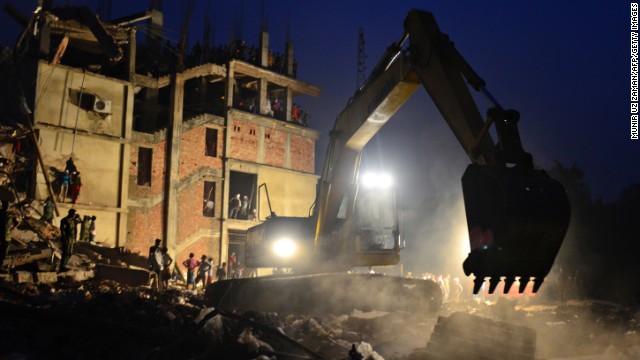
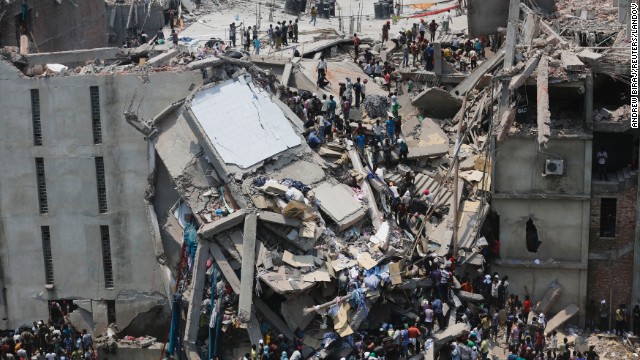
Bangladeshi authorities arrested eight people, including two factory owners, after 334 people died in a building collapse near the capital this week. Many others were trapped under concrete rubble. Several relatives of the owners and two engineers also were arrested, the state-run news agency Bangladesh Sangbad Sangstha reported. Police identified the owners as Mahmudur Rahman Tapash and Bazlul Samad Adnan. Prime Minister Sheikh Hasina on Friday had ordered police to arrest the owners of the building and the garment factories in it so that they can "face legal actions," her spokesman said. Most of the victims appear to have been garment factory workers. "It is not an accident, it is a killing incident," Information Minister Hasanul Haq Inu told reporters. "All, including owners and administrative officials concerned, must be put on the dock for the killing of people." Amid the arrests, the death toll mounted as families of the missing hoped for a miracle. Rescuers pulled out a woman who had given birth in the mangled mess of the crumbled eight-story building, Sangbad Sangstha reported. It was unclear Saturday how the mother and the baby were doing a day after they were rescued. But most reports coming from the fallen structure near the capital, Dhaka, were of woe. Officials coordinating the operation have said the rescue efforts would end Saturday morning and heavy equipment will retrieve the remaining bodies and cart away the rubble. The announcement ignited protests Friday from crowds near the rescue site, many of them relatives showing pictures of the missing to whomever would pay attention. Police used tear gas to disperse them, the news agency said. Protests continued Saturday as large crowds took to the streets in four districts in Dhaka. At a nearby medical college hospital, "thousands of survivors have been treated," said Sajjad Hussein, a spokesman for an anti-corruption agency. "The crisis for blood is acute and the hospital authority is urging people to donate blood for the victims. There is also a shortage of medicine. The local military hospital is also treating patients." Looking for loved ones The picture of despair was clear Friday at a nearby local school, where bodies were being kept. Hundreds amassed, many of them relatives desperately searching for loved ones. "People with photos of their relatives, mostly workers of the apparel factories, are asking the officials there for help. Whenever an ambulance is arriving at the spot, everyone is rushing towards (it) hoping to find at least the body of their near and dear ones," Hussein said. Nineteen people had been rescued alive, Dhaka District Police Chief Habibur Rahman said Saturday morning. In all, more than 2,300 people had been rescued, police said. But it may take some time until the full extent of the destruction will be known. Late Friday, relatives reported 595 people still missing, police said. The collapse occurred Wednesday morning, a day after cracks appeared in the structure. It has stirred outrage in Bangladesh over lax safety standards in the country's key industry. The cracks led the bank to order its employees not to report for work Wednesday, and the shops in the mall were closed because of a strike. But garment factory workers were told to report to work despite their concerns that the building's structure was not sound The Bangladesh Garment Manufacturers and Exporters Association announced Friday that all garment factories would be shut over the weekend "for treatment of victims of the Savar building collapse and completion of the rescue operation successfully."

President Obama's WEEKLY ADDRESS: Time to Replace the Sequester with a Balanced Approach to Deficit Reduction

Imran hits hard on Nawaz, says jackals can't be leaders

Pakistan Tehreek-e-Insaf (PTI) chief Imran Khan has once again challenged Pakistan Muslim League President Nawaz Sharif to debate and asked him (Nawaz) not to be scared too much, Geo News reported. Speaking to party election campaign rally here at Hockey Ground on Saturday, Khan hit hard on Nawaz Sharif and said ‘jackals can not be leaders’. Criticizing policies of Sharif brothers, Imran Khan said they did nothing in five terms what they could do so at sixth time. He said Mian Sahab and his younger brother were asking masses for vote on the basis of experience, adding with this experience they had only raised number of factories. PTI chief said provinces can generate electricity as per the constitution and asked Mian Sahab why he could not do so.

NATO Commander: ‘Cautious Optimism’ Ahead of Afghanistan Withdrawal

The top NATO military commander says, with all the challenges still facing Afghanistan, he is only “cautiously optimistic” that the Afghan government and security forces will be able to maintain security and prevent the country from again becoming a safe haven for terrorists after most foreign forces withdraw at the end of next year. U.S. Navy Admiral James Stavridis spoke about the situation in an interview. It’s been nearly four years since Stavridis took over at U.S. European Command, and a few days later as commander of NATO operations worldwide. Since then, he has made numerous visits to Afghanistan to provide strategic guidance to troops and commanders from dozens of countries, and to monitor progress. But four years later - and after more than 11 years of Western military involvement, thousands of casualties and billions of dollars spent - he can muster only ‘cautious’ optimism that in the end the Afghanistan effort will succeed. “I think we've gone, over the four years that I've been in command, that I can speak to personally, from a period of time in which I had doubts about our ability to succeed to today, [when] I think we will succeed. And I remain cautiously optimistic that we will,” said Stavridis. That optimism is based in large part on what the admiral sees as significant improvements in the Afghan security forces, which showed him some of what they can do during a visit two years ago. More broadly, he said Afghanistan’s civilian society also is changing for the better. Meanwhile, Taliban attacks continue in several parts of the country. But the admiral said that when foreign troops, except for trainers and counter-terrorism experts, leave at the end of next year, the Taliban’s ability to convince Afghans to help them will be severely reduced. “The Taliban narrative throughout this period, throughout this decade, has been 'we're fighting the foreigners.' And that was their rallying call. Well, guess what. At the end of 2014 they're not fighting the foreigners, they're fighting Afghans - their own brothers, and by the way their sisters, in the Afghan armed forces. So their narrative breaks at the end of 2014,” he said. It could still all go wrong, but Afghanistan researcher Matthew Willis, at London’s Royal United Services Institute, has a view similar to the admiral’s. “I think they will hold it together. A lot of people are concerned that, following 2014, Afghanistan will revert to a 1990s sort of situation, which ultimately was civil war. But there is no reason that history should repeat itself,” said Willis. After years of war and dashed hopes, however, no one is expressing confidence, only hope and caution. And as he prepares to retire after 37 years in the U.S. Navy, Admiral Stavridis shares one lesson he has learned, partly from the Afghanistan war. “In the end, in this 21st century, we won't deliver security from the barrel of a gun. We won't deliver security from the barrel of a gun,” he said. The admiral said security and freedom will be gained through international cooperation and a communications strategy to explain and promote democratic values, with only sparing use of the military to which he devoted his career.

Seeking asylum in Afghanistan

http://www.dw.de/
The plight of Afghan refugees is known, but less familiar are the dissidents and victims of civil war who have sought refuge in Afghanistan although the war-torn country has no asylum law as yet. Amir Hamza Halimov fled to Kabul in the early 1990s. He was one of tens of thousands of Tajiks who crossed the border to Afghanistan when Emomali Rahmon became president and civil war broke out in Tajikistan. Most returned after the end of the war but Halimov, a dissident who feared repercussions because of his anti-regime activity if he returned, stayed in Afghanistan. He and his two sons live in a guesthouse provided by the Afghan Ministry of Refugees and Repatriations. The ministry has provided accommodation to about 150 asylum seekers from Iran, Tajikistan, Pakistan, Bangladesh and Iraq. Although there is no asylum law, it acts according to the tradition of nanawatai that allows a beleaguered person, even an enemy, to enter the house of any other person and make a request of him which cannot be refused, even at the cost of the host's own life or fortune. There are also countless numbers of separatists from Indian-administered Kashmir who have taken refuge in Afghanistan as well as Muslims from China's Xinjiang province. Confused status Until now, Halimov's food and living expenses had been covered by the ministry but he says this support stopped three months ago. Now he has to buy food on credit. He cannot work because his status is unclear. He has spent six years going from one authority to the next to clear his case but in vain. He is still not officially recognized as an asylum seeker nor does he have Afghan nationality. The Afghan president has the right to grant Afghan nationality if he wants to. Earlier this month, four Iranians who fled their country after taking part in post-election protests in 2009 were granted Afghan nationality by President Hamid Karzai.The government is currently drafting asylum and nationality legislation. Finally Afghanistan will be "a country that can provide refuge in the classical sense" says Karl Kopp from German rights organization Pro Asyl. People persecuted for political reasons or fleeing civil war will be able to apply for asylum. The country can be a "corridor of protection" in a region where there is no traditional system of protection. However, Kopp points out that the main problem is still how to create stable, secure conditions in the devastated country.

How Sarabjit Singh Was Attacked in Lahore Jail

http://www.indiatimes.com/
The main suspect in the brutal attack yesterday on Indian prisoner Sarabjit Singh had quarrelled with him a few days ago but Pakistani authorities at Kot Lakhpat Jail did not take notice of the incident, official sources said. Death row prisoner Amer Aftab tried to attack Sarabjit a few days ago and abused him, the sources told PTI. The reason for the altercation could not immediately be ascertained. Aftab, who was being held in a barrack near Sarabjit's barrack in one of the most secure sections of Kot Lakhpat Jail, was among six prisoners who attacked the Indian national at about 4.30 pm. The prisoners gathered near Sarabjit's barrack after evading guards, a jail official said on condition of anonymity. The prisoners overpowered two jail wardens and Aftab snatched the key of Sarabjit's cell and opened the door. Sarabjit was hit on the head with bricks and his face, neck and stomach were cut with blades and sharp pieces of a ghee tin. "When the staff found Singh, he was unconscious and bleeding profusely. The staff removed his clothes which were covered with blood. They put on the shirt and pants of a jail warden and took him to Jinnah Hospital," the jail official said. Earlier, unnamed officials of Kot Lakhpat Jail were quoted by Pakistani TV news channels as saying that only two prisoners Amer Aftab and Mudassar were involved in the attack. The officials were also quoted as saying that Sarabjit was attacked when he and other prisoners were brought out of their cells for an hour-long break. However, the sources rejected these claims and said Sarabjit was assaulted by at least six prisoners within his barrack. Aftab, who was sentenced to death for murdering a mayor's brother, and Mudassar were locked up after the attack and interrogated, sources said. Malik Mubashir, Deputy Superintendent of Prisons in Punjab province, was appointed to head the inquiry into the attack. Mubashir would probe all aspects of the incident and ascertain whether some jail officials may have been involved or linked to the attack on Sarabjit. He will also ascertain whether the attackers were motivated by "religious elements", the sources said. Sarabjit was admitted to the state-run Jinnah Hospital with a severe head injury this evening and his condition was described as critical. Authorities had tightened Sarabjit's security after the recent execution in India of Afzal Guru, who was convicted for his involvement in the 2001 terror attack on the Indian parliament. In January, another Indian prisoner in Kot Lakhpat Jail, Chambail Singh, died after allegedly being assaulted by prison staff. Though he died in mysterious circumstances, Singh's autopsy was performed almost two months after his death. Sarabjit was convicted for alleged involvement in a string of bomb attacks in Punjab province that killed 14 people in 1990. His mercy petitions were rejected by the courts and former President Pervez Musharraf. The outgoing Pakistan People's Party-led government put off Sarabjit's execution for an indefinite period in 2008. Sarabjit's family says he is the victim of mistaken identity and had inadvertently strayed across the border in an inebriated state. Sarabjit Singh Still in Coma Lahore: Sarabjit Singh, an Indian man who is on death row in Pakistan, continues to be in critical condition in a hospital in Lahore where he was admitted yesterday after he was brutally attacked by a group of prisoners at a jail. Sources say he is in "deep coma" and doctors will not be able to perform any surgery on him till his condition stabilises. He is believed to have suffered extensive internal bleeding caused by a severe head injury. Sarabjit, 49, is on ventilator in the Intensive Care Unit of the state-run Jinnah Hospital in Lahore. Yesterday, he was brutally assaulted within his barrack at the Kot Lakhpat Jail in Lahore. Sources say at least six prisoners hit him with bricks, blade and sharp pieces of a ghee tin. Pakistani TV news channels quoted their sources as saying that next 24 hours would be crucial for Sarabjit. "Doctors attending to Sarabjit Singh have informed Indian officials that he is in coma on ventilator and receiving intravenous drip," External Affairs Ministry spokesman Syed Akbaruddin said. Even as Sarabjit was in coma, doctors carried out X-rays, MRI, CT scans on him. They are now waiting for his condition to stabilise before conducting further tests, Mr Akbaruddin added. He also informed that Indian High Commission officials are in regular contact with the Medical Board of Jinnah Hospital. Sources quoted doctors at Jinnah Hospital as saying that Sarabjit's condition was measured as 5 on the Glasgow Coma Scale (GCS), which indicates the level of damage or injury to a person's central nervous system. The GCS comprises tests of eye, verbal and motor responses. The three separate values and their sum are considered in deciding a person's status. The lowest possible GCS score is 3 while the highest is 15. Two Indian High Commission officials got consular access to Sarabjit Singh in the ICU of Jinnah Hospital this morning and spent some time with him there. Some news channels reported that a team of Indian doctors might visit Lahore to assist in Sarabjit's treatment though this could not be independently confirmed.

Sarabjit Singh: Punjab CM Najam Sethi’s Deobandi friends attack Indian prisoner Sarabjit Singh in Lahore jail

Indian national Sarabjit Singh, currently on death row in Lahore’s Kot Lakhpat jail, was seriously injured on the head after being attacked by six prisoners (Deobandi militants of banned sectarian outfit Sipah Sahaba ASWJ) and rushed to a hospital, where his condition was described as “critical”. Sarabjit was admitted to the intensive care unit of the state-run Jinnah Hospital this evening, Indian and Pakistani officials said. The attack occurred when Singh and other prisoners were brought out of their cells for an hour-long break. The six prisoners (Deobandi militants) assaulted Sarabjit with blunt objects and he sustained a severe head injury. Jails in Pakistan are practically ruled by Deobandi militants of banned Jihadist-sectarian terrorist outfit Sipah Sahaba (operating as Ahle Sunnat Wal Jamaat and Lashkar-e-Jhangvvi) which is alleged to have tacit support of the ISI. In the past Deobandi militants in Pakistani jails have killed a number of Shia prisoners, e.g., Basharat Hussain Zaidi in Karachi, Qalandar Bakhsh in Sukkur; a number of blasphemy accused Christians and Ahmadis too have been attacked in jails by Deobandi militants. The attack took place in Pakistan’s Punjab province which is currently ruled by senior journalist (caretaker) Chief Minister Najam Sethi who is known to have close links with Pakistan’s military establishment. In recent past, Njam Sethi has been seen promoting and humanizing Deobandi terrorist clerics including Ahmed Ludhianvi of Sipah Sahaba (ASWJ) who was promoted in his TV talkshow (Aapas ki baat) and magazine The Friday Times (edited by his employee Raza Rumi). Ever since Sethi took over as caretaker Chief Minister a few weeks ago, Sipah Sahaba (ASWJ) has been given full freedom to contest elections in various constituencies in the Punjab (Jhang and other areas) and there is a surge in attacks on Christians, Ahmadis and Shias. The main suspect in the brutal attack yesterday on Indian prisoner Sarabjit Singh had attacked him a few days ago but Pakistani authorities at Kot Lakhpat Jail did not take notice of the incident, official sources said. Death row prisoner Amer Aftab Deobandi tried to attack Sarabjit a few days ago and abused him, the sources told PTI. Aftab, who was being held in a barrack near Sarabjit’s barrack in one of the most secure sections of Kot Lakhpat Jail, was among six prisoners who attacked the Indian national at about 4.30 pm. It was well-planned systematic attack, and Deobandi prisoners were well coordinated while the police stood by. The prisoners gathered near Sarabjit’s barrack after evading guards, a jail official said on condition of anonymity. The Deobandi prisoners allegedly “overpowered” two jail wardens and Aftab snatched the key of Sarabjit’s cell and opened the door. Sarabjit was hit on the head with bricks and his face, neck and stomach were cut with blades and sharp pieces of a ghee tin. “When the staff found Singh, he was unconscious and bleeding profusely. The staff removed his clothes which were covered with blood. They put on the shirt and pants of a jail warden and took him to Jinnah Hospital,” the jail official said. Earlier, unnamed officials of Kot Lakhpat Jail were quoted by Pakistani TV news channels as saying that only two prisoners Amer Aftab Deobandi and Mudassar Deobandi were involved in the attack. The officials were also quoted as saying that Sarabjit was attacked when he and other prisoners were brought out of their cells for an hour-long break. However, the sources rejected these claims and said Sarabjit was assaulted by at least six prisoners within his barrack. Malik Mubashir, Deputy Superintendent of Prisons in Punjab province, was appointed to head the inquiry into the attack. Mubashir would probe all aspects of the incident and ascertain whether some jail officials may have been involved or linked to the attack on Sarabjit. He will also ascertain whether the attackers were motivated by “religious elements” (ie Deobandi militants of Sipah Sahaba ASWJ), the sources said. Sarabjit was admitted to the state-run Jinnah Hospital with a severe head injury this evening and his condition was described as critical. In January, another Indian prisoner in Kot Lakhpat Jail, Chambail Singh, died after allegedly being assaulted by prison staff in Pakistan. Though he died in mysterious circumstances, Singh’s autopsy was performed almost two months after his death. Sarabjit was convicted for alleged involvement in a string of bomb attacks in Punjab province that killed 14 people in 1990. His mercy petitions were rejected by the courts and former President Pervez Musharraf. The outgoing Pakistan People’s Party-led government put off Sarabjit’s execution for an indefinite period in 2008. However, Pakistan’s military establishment, ISI in particular and its Deobandi Jihadist proxies of Sipah Sahaba wanted to expedite Sarabjit’s execution. Sarabjit’s family says he is the victim of mistaken identity and had inadvertently strayed across the border in an inebriated state. Owais Sheikh, Sarabjit’s lawyer said, “Yes, this is very much disturbing. This is not something that we can ignore. Naturally, this will have very very serious consequences. “Sarabjit told me and a CID (Crime Investigation Department) official after the execution of Afzal Guru that a prisoner in Kot Lakhpat Jail had issued death threats. I brought this to the knowledge of prison authorities and the Punjab Home Department but they did not beef up his security,” Awais Sheikh said. “Whatever has happened, our jail authorities are responsible for that. Hope god saves Sarabjit Singh. He has been seriously hurt,” he said. Leading Human Rights activist Ansar Burney said, “I am going to file another mercy petition to Pakistan President to immediately release him and send him to India”. “There were serious threats to Sarabjit. After Chamel Singh’s death, I alerted authorities that he may be in danger,” Burney said. “This was a murderous attack and the outcome of a conspiracy. How can a death row prisoner, who is held in strict security, be attacked?” he questioned. The Kot Lakhpat jail currently has some 17,000 prisoners though its official capacity is only 4,000. There have been instances in the past of prisoners being attacked and even killed within the prison. Sarabjit Singh Still in Coma Lahore: Sarabjit Singh continues to be in critical condition in a hospital in Lahore where he was admitted yesterday after he was brutally attacked by a group of prisoners at a jail. Sources say he is in “deep coma” and doctors will not be able to perform any surgery on him till his condition stabilises. He is believed to have suffered extensive internal bleeding caused by a severe head injury. Sarabjit, 49, is on ventilator in the Intensive Care Unit of the state-run Jinnah Hospital in Lahore. Yesterday, he was brutally assaulted within his barrack at the Kot Lakhpat Jail in Lahore. Sources say at least six prisoners hit him with bricks, blade and sharp pieces of a ghee tin. Pakistani TV news channels quoted their sources as saying that next 24 hours would be crucial for Sarabjit. “Doctors attending to Sarabjit Singh have informed Indian officials that he is in coma on ventilator and receiving intravenous drip,” External Affairs Ministry spokesman Syed Akbaruddin said. Even as Sarabjit was in coma, doctors carried out X-rays, MRI, CT scans on him. They are now waiting for his condition to stabilise before conducting further tests, Mr Akbaruddin added. He also informed that Indian High Commission officials are in regular contact with the Medical Board of Jinnah Hospital. Sources quoted doctors at Jinnah Hospital as saying that Sarabjit’s condition was measured as 5 on the Glasgow Coma Scale (GCS), which indicates the level of damage or injury to a person’s central nervous system. The GCS comprises tests of eye, verbal and motor responses. The three separate values and their sum are considered in deciding a person’s status. The lowest possible GCS score is 3 while the highest is 15. Two Indian High Commission officials got consular access to Sarabjit Singh in the ICU of Jinnah Hospital this morning and spent some time with him there. Some news channels reported that a team of Indian doctors might visit Lahore to assist in Sarabjit’s treatment though this could not be independently confirmed.

Pakistan: More Christian parties join campaign to Boycott Elections

(PCP) Dr. Nazir S Bhatti, President of Pakistan Christian Congress PCC have welcomed three more Christian political parties on joining campaign of “Christian to Boycott Election 2013” without assurances to repeal blasphemy law and allocation of Dual Voting Rights to Christians and other religious minorities to elect their representation in parliament instead of Selection under imposed Joint Electorate system. Military Dictator Pervez Musharraf imposed Joint Electorate for minorities in 2002, which bared religious minorities to elect their representatives in parliament on reserved seats and empowered Muslim political parties to select minorities’ leaders on these seats. Nazir Bhatti commented on claims of Pakistan Muslim League (Q) President Ch. Shujat Hussain in a election rally in Gujrat that PML (Q) awarded “Dual Vote” to minorities said “The PML (Q) which was ally party of Pervez Musharraf after national general of 2013, gave right to elect their representatives in local government but in National Assembly of Pakistan and Provincial Assemblies religious minorities were denied their right to elect their MNA and MPA with their votes and substandard Selection system was practiced” PCC Chief said that Pakistan is first state on globe where democracy have different definition as 272 seats of National Assembly of Pakistan are elected by franchise vote while 60 reserved seats for women and 10 reserved seats for religious minorities are being filled under undemocratic and unconstitutional system of selection. The Muslim political parties as PPP, PML (N), PML (Q), PML (F), PTI, MQM, ANP, JI, JUI and others have nothing for religious minorities in their election 2013, manifestos. These Muslim parties are enjoying vote bank of minorities but select Christian, Hindu, Sikhs, Ahmadiyyia and Parsi on reserved seats of their choice or after taking bribes. “Christians and other religious parties have nothing for their social and economic uplift in these elections being held under Selection system instead of Elections on their reserved seats and their decision to participate in such elections and their decision to Boycott is just” added Nazir Bhatti Nazir Bhatti said that Christian supporting Nawaz Sharif, Imran Khan and Syed Munawar Hassan are playing with fate of Christians in Pakistan as violence rose against Christian on pretext to blasphemy laws while PPP, MQM, ANP and PML (Q) government failed to protect life and property of Christians in Punjab province of Pakistan. Nazir Bhatti said that now 8 leading Christian political parties have joined “Boycott” campaign and more will join before Election Day and May 11, 2013, will be observed as “Black Day”

Teachers refuse to discharge election duties in Balochistan

Teachers in several districts of Balochistan have refused to carry out their duties during elections due to terrorism threats from the Taliban, Geo News reported Saturday. While confirming the stance, sources of Government Teachers Association told that the decision was taken after Taliban issued threats to carry out terrorism acts in different districts of Balochistan during the upcoming polls. The districts where the teachers have refused to discharge their duties include Turbat, Khuzdar, Kallat, Chaghi, Kharan, Gwadar, Panjgur, Mastung and others. The instructors are of the view that they have concerns regarding their duties during general elections on May 11. Therefore, the caretaker chief minister, chief secretary and Election Commission have been informed in writing about their stance.

Pakistan: The widening threat to 2013 election

The forces opposed to democracy in Pakistan are on the rampage, living up to their promise to foil the nation's will to have election on May 11. As the D-day nears, the incidence of violence is notching up and is inexorably spreading far and wide. Tuesday was one such day which presented the grim picture of the wreckage the anti-polls forces can cause, as there were no less than four bomb blasts in Quetta (and it seems there is no end in sight as yet because Wednesday morning there was the fifth bomb) and one in Karachi - of course in addition to many more isolated incidents of violence in other places. A blast near an ANP meeting in Site-Orangi Town rattled the entire Karachi yesterday evening. According to initial reports, this terrorist attack claimed at least 11 lives and caused injuries to scores of people. That the militants' bete noire Pervez Musharraf miraculously escaped a murderous attack in Islamabad some kind of divine power seems to be still weighing in with democratic forces, otherwise it was said to be a touch-and-go situation. Imagine how devastatingly it would have foreshadowed the possibility of on-time election. Sometime back, the prevailing prognosis was that incidence of violence being confined to Khyber-Pakhtunkhwa and violence in Quetta was sectarian in nature and Karachi was recovering given the law enforcing agencies' clean-up operations. But that's no longer the case as there are now more bomb blasts, and almost all aimed at disrupting the electoral process. Apparently, the caretaker governments are even more ineffective than their predecessors which were then accused of being soft over violence in line with their political scheming. That is no more the case, and the situation is getting desperate by the day. The violence being employed as a political tool by the anti-democratic forces is condemnable, but understandable given that these forces have always been opposed to democratic system for Pakistan. But what is extremely disturbing and no less intriguing is the indication that the targets of almost all recent bomb attacks are three political parties. While PPP and MQM are centre-left and ANP appears to be a shadow of a secular (leftist) outfit. Whether they have earned the terrorists' ire for their whatever credentials, or if they are paying for anti-militancy stance when in power, there is no clear answer to it. Isn't it diabolic that the ANP cannot come out in the open in its so-called home province fearing violence, but others are free to address huge rallies in there? This is absolutely unacceptable that the shadow of violence should so comprehensively overpower the PPP that its chairman has to launch the party's election campaign via a video. No less disturbing is the fact that as the trio has come under the terrorists' intense fire, others practically enjoy immunity courtesy the terrorists' perceived 'soft corner' for them. No doubt for the ANP, PPP and the MQM this is no more a level-playing field - something the Election Commission of Pakistan has to bother about in order to ensure the election on May 11 is fair, free and transparent. The MQM leadership has decided to shut its election offices for the time being and called for a province-wide lockdown that's perhaps the only way it could lodge its protest. Should the party fail to receive adequate assurances of protection against violence one would imagine it could go for the next step: boycott of the election on May 11. Such a decision will please the forces that are hell-bent to sabotage the electoral exercise like nothing else. We hope and expect it will not go for that drastic step, insisting that boycott of the upcoming election has a make-or-break significance, unlike the previous and others in the field would remain indifferent to it at their own peril. Isn't it small-mindedness, if not short-sightedness, on the part of the parties who enjoy immunity not to share concerns of the parties that are now under attack? They feel safe and free to hold big rallies the comfort is quite delusional given that that forces which are now attacking ANP, PPP and MQM are not for democracy in Pakistan. That they are being spared of violence it is certainly a tactical move on the part of these forces; their endgame strategy is aimed at depriving Pakistan of democracy. Before it is too late all the political stakeholders need to sit together and hammer out a consensual approach and put up a united front against the agents of violence, keeping in mind that the caretakers and the ECP, separately or together, haven't the wherewithal with them to give adequate protective coverage to the contenders in the election. The political leaderships should realise that it's democracy in Pakistan that is at stake; a battle lost here would be the war lost to the enemies of democracy.

Pakistan: Seeking an end to terrorists funding

Notwithstanding the deaths and injuries the terrorists' caused on Friday, the scorecard of terrorists' strikes in Pakistan reads: two explosions took place one each in Hangu and Kohat's Dhoda area; a cracker bomb was thrown at an Awami National Party (ANP) National Assembly candidate in Landhi; and a convoy of Jamiat Ulema-i-Islam-Fazl (JUI-F) in Mach faced gunfire from the militants. In Islamabad, an advisory issued by the Intelligence agencies claims that the Tahrik-e-Taliban Pakistan has reportedly made a comprehensive plan to kidnap former President Pervez Musharraf for which it has constituted different teams. This is not the first time that the intelligence agencies through its mouth-piece the interior ministry have made revelations, predicting more bomb blasts and suicide attacks in various parts of the country. Some of these predictions, during the period of the previous regime even came true, giving the former interior minister Rehman Malik a chance to brag. But practically, the non-stop chatter of Rehman Malik miserably failed to counter or to foil the attacks he had predicted. Thus the militants gained a significant strength in the previous regime, leaving him with the title of 'motor-mouth'. He is gone. Hopefully he will never come back but the spirit of modus lingers on in the ministry. The ministry still believes in telling the people about the information it gathers. It is not the ministry's job to tell people about terrorists' plan; rather, its prime duty is to protect the people from the destruction the terrorists wreak. Mere vague predictions of the coming evil without any effective plan to make them not come true, create panic and better when avoided. The repeated failure of the government agencies in performing their duties has rendered the entire country vulnerable to the terrorists. Numerically terrorists' ratio to the Pakistan military might is insignificant but the militants' tactical planning, conviction and courage to execute what they believe in is arguably far more superior. The militants, on both sides of the Durand Line, strike at will the Pak security forces' check posts, kidnap the personnel there with the dreaded outcome of finding the slaughtered bodies of the abducted personnel on the roadsides. All these incidents are not mere acts of terrorism rather it is a proxy war that the Blackwater agents and their cronies have unleashed on Pakistan. Islamabad should take up the matter with the USA leadership in categorical terms to seek an end to the foreign support and funding to the terrorist outfits, failing which Pakistan cannot win against militancy, otherwise, Islamabad would need to revisit its policy on the war on terror. In fact, Pakistan must withdraw its support and cooperation to the foreign forces in Afghanistan till they stop backing the militants operating in Pakistan. Our forces have been stretched to the limit; yet, they are putting up a brave fight. The patience of the people, however, is running short, and the time is not far when the people of Pakistan first will throw out the American stooges sitting in the corridors of power and then stand up against meddling of the foreign forces in the country. The masses have already turned back on all the coalition partners-ANP, PPP and the MQM--who had served Americans' interests in the region without caring much about the loss of human life and material that Pakistan suffered during last five years or so. The verdict of the people is already in the form of 'writing on the wall. Read it, come May 11.

Elahi questions Sharifs' failure to implement manifesto

The Frontier Post
PML-Q leader Chaudhry Pervaiz Elahi on Friday questioned Sharif brothers’ failure to implement its manifesto during five years of rule in Punjab. “Why did Sharif brothers not implement their manifesto. Shahbaz Sharif makes allegations to cover his poor performance,” he said while addressing a public meeting here. “Sharif wasted Rs70 billion in jangla bus service. There is no medicine in hospitals.” He said that Shahbaz Sharif remained chief minister of Punjab thrice. The PML-Q leader said that his party’s performance was before people.

Pakistan: Political parties being attacked

Daily Times
Spreading terror all around, the militants have stayed true to their promise of interrupting these elections by targeting the parties whose ideologies they find go against their hardline views. In the latest incident, an election office of the MQM was bombed in the North Nazimabad area of Karachi on Thursday, killing six people and injuring many more. On Tuesday, another office of the MQM was bombed in Karachi in an attack that killed four people. The Tehreek-e-Taliban Pakistan (TTP) has taken responsibility for the attacks and has vowed to continue attacking the campaign trail of the political parties they have threatened and blacklisted: the MQM, PPP and ANP. The ANP has already suffered many casualties with some of their most prominent leaders being killed by militant bomb attacks. It must be stressed that only those parties are suffering that have been put on the TTP hit list. This will inevitably skew electioneering. These political parties’ chances in the upcoming elections are being weakened because they are not being allowed to gather and organise their supporters. They are not being allowed to appeal to the public and every time they venture out of their fortresses, they are easy targets for the militants who leave no opportunity to make a hit. Parties with a right-wing or centre-right agenda and a soft spot for the Taliban and their types have been left out of the crosshairs and are free to conduct their campaigns vigorously during this crucial time in the run up to the landmark elections. One cannot help but wonder what the caretaker government is up to. Is it sleeping? It was very clear the moment the assemblies were dissolved and the caretaker set up put in place that this was no ordinary interim period. These pre-election weeks are dangerous days with some mainstream political players being forced to stay behind in the race out of security concerns. The TTP had made its course of action clear but where was the course of action of the caretaker government? Why has no high profile meeting and attempt at ensuring a safe environment for those contesting the elections been made? It is unimaginable that the interim government has not chalked out a clear and concise plan with the security and law enforcement agencies to streamline the election process. We have leaders and workers of key political parties being repeatedly massacred and there is no support from the system. These are hardly fair elections. The caretaker Interior Minister Habib Malik Khan needs to wake up and smell the carnage. He needs to identify that all is not well with these elections and that the militants are up in arms against the state and the democratic process. He is the ‘acting’ interior minister and he needs to ‘act’ the part. Does he not know or care that if the militants are allowed to run free like this, causing havoc and destruction, there is no guarantee for the safety of the citizens who are expected to turn out in droves on election day? Why is no one thinking about the fact that the militants are just waiting for a chance to inflict the maximum amount of damage to the state, democratic politics and citizens? It is time the interim set up started doing its job. That is, after all, the only way to ensure the historic democratic transition Pakistan is experiencing.

ANP observes day of mourning against Karachi blast

The Awami National Party (ANP) today observes a day of mourning against the deadly attack near its office that killed at least nine people and injured over 50 in Orangi Town area of Mominabad, Geo News reported. ANP Sindh chapter leader Shahid Syed appealed to people of Karachi to mark the day of mourn peacefully keeping their businesses open and transport on the roads. Condemning what he said a cowardly assault, he said that such attacks could not restrain ANP from its struggle. He also advised party workers to avoid provocations and donate blood to the injured. A bomb went off near an ANP office when party candidate Bashir Jan was about to address a public gathering.

Friday, April 26, 2013

Bilawal Bhutto to bring big change while leading PPP

http://www.brecorder.com/
Central leader of PPP and sister of President Asif Ali Zardari, Faryal Talpur has said that election campaign of the party was gaining momentum and people were responding enthusiastically. In a TV interview on Friday, Faryal Talpur said that delay in election campaign of the PPP was due to scrutiny of the candidates for national and provincial assemblies elections. She expressed the confidence that the people of Pakistan were with the PPP and vote for it in the elections. In reply to a question, the PPP leader said that Bilawal Bhutto Zardari would contest elections from NA-207 Larkana after two years. She said Bilawal’s future was tied with the youth of PPP and Pakistan. She was confident that future of Bilawal was bright and there would be a major change when he would himself lead the party. She said in the coming days, PPP would hold major public meetings while corner meetings were going on and attended by large number of people.

Blast near ANP office in Karachi kills three

At least three people were killed and more than 30 injured in an explosion near an Awami National Party (ANP) office in the Mominabad area, Orangi Town of Karachi on Friday, reported Express News. The explosion, targeting a corner meeting of the party, was heard in several areas of the city including North Nazimabad, Gurumandir and Soldier Bazaar. DIG West Zafar Bukhari said that the blast targeted ANP candidate Bashir Jan, but he remained safe in the incident. An emergency was declared in the Abbasi Shaheed hospital, and the police cordoned off the site of the blast. The caretaker chief minister of Sindh condemned the attack and ordered the IG Sindh to submit a report of the incident. On Thursday, a blast had targeted Muttahida Qaumi Movement’s election office in the North Nazimabad area of the city, claiming five lives. The party had called for a day of mourning across the city on Friday (today). The Taliban have directly threatened the three main parties in the outgoing government, the Pakistan Peoples Party, the Awami National Party and the MQM, which are often described as secular. ANP, one of the largest political forces in Khyber-Pakhtunkhwa, is being targeted with increased frequency. The party has come under attack in K-P at least seven times over the past few weeks.

Afghans Wary of Pakistan’s Role in Brussels Peace Talks

In Afghan society today there is a palpable sense of frustration about the state of the country and Pakistan’s role. In particular, Afghans resent their neighbor’s build up at the Durand Line, the border that Afghanistan has never accepted. Kabul claims Pakistan’s construction of checkpoints at the edge of the Goshta District of eastern Nangarhar Province are an incursion into its territory. However, Afghans are more upset over what they claim to be Islamabad’s obstructive role in the peace process. The prevailing view in Afghanistan is that Pakistan is playing a destabilizing role in the country. According to this view, the peace process with the Taliban has failed to make headway as a result. During a recent debate in Afghanistan’s senate, Deputy Foreign Minister Jawed Ludin came down heavily on Islamabad, saying that Pakistan represents the greatest threat to security in Afghanistan, and has sent conflicting messages during its talks with the government of Afghanistan. Cynicism prevails in Kabul over the Brussels talk that the U.S. has organized in the hope of reconciling differences between Afghanistan and Pakistan. On Wednesday, U.S. Secretary of State John Kerry hosted a meeting that brought Afghan President Hamid Karzai together with Pakistan army chief general Ashfaq Kayani and senior Foreign Ministry official Jalil Jilani, with the ultimate aim of bringing the Taliban to the negotiating table. Afghan foreign ministry spokesman Janan Mosazai was quoted by the Guardian as saying, "Unfortunately Pakistan today is changing the goalposts on its support for the peace process once again. Pakistan somehow decided now to put down certain preconditions for its support for the peace process which are completely unacceptable to Afghanistan and to any other independent country." According to the article, the establishment in Islamabad wants Kabul to sever ties with India, send its army officers to Pakistan for training and sign a strategic partnership deal. Some have claimed that the goal is to give Taliban members based in Pakistan a greater say in the peace talks. Abdul Hakim Mujahid, a member of Afghanistan's High Peace Council, denounces the idea. The Council was set up three years ago to initiate the peace process with insurgent groups. Mujahid, who was the former Taliban government’s ambassador to the UN, told The Diplomat, “There is no doubt that the Taliban movement in Afghanistan has its own agenda with the national interest in mind. Taliban (members) in Pakistan have their own agenda in their own country. So they are totally different. We are working for peace and reconciliation – not with the Taliban movement in Pakistan but with the Taliban movement in Afghanistan.” He added, however, that he “hopes Pakistan will remain faithful to its promise of supporting the peace process.” But Afghans are leery of trusting their neighbor. “Tell me when Pakistan has thought about Afghanistan’s welfare,” Fathullah Naimzai, an educator in Kabul, told The Diplomat. “They have always thrived on destabilizing us and Pakistan’s intention is quite suspect. Had Pakistan not interfered in our country’s affairs we could have been really a peaceful country.” Reports in Afghan newspapers also reflect the collective sense of helplessness surrounding efforts to engage Pakistan in Brussels. According to a report in Daily Outlook Afghanistan, the current atmosphere and accusations are not conducive to a positive outcome in Brussels. When the High Peace Council came into existence there was a modicum of hope that the peace process would gain traction and help to stabilize Afghanistan following the withdrawal of foreign troops. In light of recent events, however, this hope looks increasingly forlorn.

LOHAR Shobaz Shareef Funny Video


Shobaz Shareef Funny Video by shoaibmirzaa

India: Pornography and rape

Daily Times
The rape debate in India just started sizzling. Former adult film actress Sunny Leone, who is of Indo-Canadian origin, has been dragged into the rape fiasco that is being heavily debated in the Indian media especially after the string of brutal rapes taking place all over the country, particularly in New Delhi. The actress has left her blue-movie past and has entered the Bollywood mainstream. The porn star is being linked to the rape wave because of her history in the adult film industry especially after the anti-porn campaigners in India — as in many places the world over — started blaming porn films and clips as being behind the startling frequency of rape in the country. The vicious attack on a five-year-old girl by five drunken men, who, apparently, were aroused by adult movie clips on their mobile phones just before the rape, has strengthened this argument and it is Sunny Leone who has been caught in the crosshairs. Efforts are also being made to ban pornography in India. Whilst no one is advocating pornography, it feels as if campaigners in India are barking up the wrong tree. There have definitely been studies that link pornography with violent sexual crime but, the world over, adult movies do exist and rape also exists but nothing except for the crime is dealt with and punished. The trouble with India is that rape is an epidemic and Indians are misdirecting the blame. It is the attitude Indian men have about women that is the problem. It is the fact that anything as trivial as what a woman wears seems to trigger the primal male instinct, which results in the most atrocious of crimes. The fact that Delhi is known as the rape capital of the world seems to point to something more embedded within the Indian psyche than anywhere else in the world. Banning pornography and targeting an actress, who is a woman herself, seems to be lifting the responsibility off the shoulders off the man, who is the perpetrator of the rape. The oppressive and patriarchal view that Indian men have of women needs to change otherwise the news headlines never will.

Violent clashes erupt over Bangladesh building collapse

Police in Bangladesh fired tear gas and rubber bullets at protesters during a mass rally by garment workers outside of the capital Dhaka on Friday, two days after a building collapse killed more than 300 people and left scores more unaccounted for.angladeshi police fired tear gas and rubber bullets at demonstrators on Friday as they attacked factories and smashed vehicles near the capital Dhaka, two days after a building collapse killed more than 300 of their colleagues. Police opened fire with rubber bullets after protesters, some of whom were armed with bamboo sticks, blockaded roads and forced factories at Gazipur, just outside Dhaka, to close for the day. "The situation is very volatile. Hundreds of thousands of workers have joined the protests. We fired rubber bullets and tear gas to disperse them," M. Asaduzzaman, an officer in the police control room, told the AFP news agency. FRANCE 24’s correspondent in Bangladesh, David Bergman, said attempts to reach the scene of the disaster were blocked by “protestors concerned about the collapse of the building and the decisions by the manager and the owner of the building to allow the workers in.” “Clearly there’s an enormous amount of anger among the garment workers,” Bergman said.Mustafizur Rahman, the deputy police chief of Gazipur, said workers had attacked factories, smashed vehicles, burnt tyres on the roads and tried to torch roadside shops on the sidelines of the rally. "They are demanding the arrest and execution of the owners of the factories and the collapsed building at Savar," he told AFP. Meanwhile, the search for survivors from Bangladesh's worst-ever industrial accident stretched into its third day, with the death toll passing 300 after an eight-storey building housing five factories collapsed on Wednesday morning in Savar, a town near Dhaka. Rescuers expect that the number of those killed will continue to rise. Almost miraculously, 113 people have been rescued alive since late Thursday, all of whom were found in the same room of the collapsed Rana Plaza building. But there are fears that hundreds more may still be trapped under the rubble, with scores still unaccounted for. It is the latest disaster to befall the garment industry in Bangladesh after a fire at a factory making clothing for Walmart and other Western labels in November. Survivors have said the building developed cracks on Tuesday evening, triggering an evacuation of the roughly 3,000 garment workers employed there, but that they had been ordered back to production lines. Local television channel Somoy said the protests by workers also spread to several districts in the capital including at Mirpur, home to dozens of garment factories.

Benazir Bhutto still leading her party in election

By Richard Leiby
Benazir Bhutto,
The most popular politician in Pakistan's largest party won’t be staging any rallies or participating in debates as May’s historic national election nears. The reason: She's dead. Yet Benazir Bhutto, assassinated more than five years ago, is still the standard bearer of the Pakistan People's Party. In its TV commercials and banners, she has been pushed to the forefront of the party’s uphill campaign to return to power in Parliament after a widely criticized five-year term. Hers is the face of the party on its official manifesto. She looms over smaller photos of her widower, President Asif Ali Zardari, and their son Bilawal Bhutto-Zardari, who lead the party but are rarely seen in public. The PPP’s campaign in the run-up to May 11 vote has been proscribed by security concerns. The Pakistani Taliban, which asserted responsibility for Benazir Bhutto’s murder, has warned the secular party that its candidates and rallies will be attacked. In recent weeks the militants have killed several leaders and workers in the parties that formed the PPP government’s ruling coalition. That may be part of the reason Benazir Bhutto, who served twice as prime minister and was Pakistan’s only woman premier, has become a constant presence in race. But her embattled party really has no other option but to stress its lineage, analysts say. The newly ended government was marred by an economic meltdown and persistent corruption cases against top officials. Even though the party and its coalition partners made history as the first civilian government in Pakistan’s 65-year history to complete a full term — and thereby shepherd in a democratic transition of power — that hasn’t lowered the price of wheat or gasoline, given people jobs or diminished poverty. Zardari polls miserably. The former prime minister, Yousaf Raza Gilani, was drummed from office by Pakistan’s Supreme Court last year for refusing to submit to its orders to reopen a money laundering case against Zardari. And the public blames Gilani’s successor, Raja Pervez Ashraf, a former energy minister, for crippling electrical and natural gas shortages. Bilawal Bhutto-Zardari, 24, is too young to contest for a seat in the May 11 election — the minimum age in Pakistan is 25. In a video released Tuesday, the party heir reassured voters that he “wanted to launch the election campaign in the streets of my country alongside my workers,” but said it was too dangerous. “Once again the enemies of peace and prosperity are standing in front of us,” Bilawal Bhutto-Zardari said. So the party is left with only ghosts to burnish its image. In campaign ads and on placards, Benazir Bhutto is always clad in a fashionable headscarf — in some photos merely casting a serene gaze, in others raising an arm forcefully, as if at an eternal rally. The latter image has been paired with one of her son giving a victory sign. In placards hung around the capital, Islamabad, touting one of the party’s National Assembly candidates, Benazir Bhutto takes the top position — usually reserved for living prime minister candidates in other parties’ signs. The PPP’s signage and literature also rarely fail to invoke the memory of her father, Zulfiqar Ali Bhutto, who founded the party and later served as Pakistan’s premier and president. Both of them are bestowed the title “shaheed,” or martyr, whenever mentioned in party speeches and materials. Zulfiqar Bhutto was deposed in a 1979 military coup and later hanged. Today his stolid visage is also an election-season staple, as the party makes a direct photographic appeal to his legacy as a socialist reformer. “You would hear people say, ‘I will vote for his grave, even, because of what he did for me,’” said Usman Khalid, a former Pakistan army brigadier general who resigned to protest Zulfiqar Bhutto’s execution. The 78-year-old Khalid runs a one-man Pakistani political party — based in the U.K. and on paper only — and comments on events. He said he knew both Zulifqar and Benazir Bhutto and understands the point of the current ads. “She has got a cult status and the Bhutto name has got a cult status,” he said. “Martyrdom and martyrs matter.” As the old PPP slogan goes: “Bhutto is still alive today and Bhutto will still be alive tomorrow.”

Pakistan to seal Afghan border May 11 for election

Associated Press
Pakistani officials say they'll seal their border with Afghanistan and restrict the movement of Afghan refugees on May 11 during parliamentary elections. Officials at the Interior Ministry and the election commission said Friday the measure is aimed at preventing terrorist attacks during the vote. Officials did not say how they would restrict the movement of hundreds of thousands of people spread out across the country or close the porous border. Pakistan announced similar measures in the past but failed to take action. The officials spoke on condition of anonymity because they were not authorized to brief reporters. About 1.6 million registered Afghan refugees and 1 million other Afghans live in Pakistan. They are a legacy of their home country's repeated conflicts. Pakistanis often accuse them of importing terrorism and crime.

Pakistan : Elections scenario

Daily Times
The coming elections present a scenario familiar in some respects but unrecognisable in others. The string of blasts in Quetta, Karachi, Peshawar and DI Khan bear the imprimatur of the Taliban that have vowed to disrupt, if not stop, these elections. One can therefore only sympathise with and admire the courage of those who have put life and limb on the line to carry through the democratic process. Three parties in particular, the PPP, the MQM and ANP, have been singled out by the terrorists as targets because of their secular leanings. The rest may be cocooned in silence, but post-elections they may not be able to remain as sanguine that they are safe, since the Taliban have made no secret of their antipathy for democracy. The winners in particular may well prove to be at risk across the board in the future. Given the rash of violence, voices are being heard asking for the postponement of the elections. These have been categorically countered by President Zardari and Chief Election Commissioner Justice (retd) Fakhruddin G Ebraheem with the vow that the polls will not be delayed even one day. Overseas Pakistanis will not be able to vote in this election given the inability of the Election Commission of Pakistan (ECP) and the caretaker government to put the arrangements for their voting in place in time. However, given the Supreme Court’s interest (and ire at the prolonged delay of two years in the matter before it), there is every likelihood that this will come to pass long before the next elections. The final tally of candidates for 1,170 seats for the National and four provincial Assemblies makes impressive reading, despite the controversial process of scrutiny of nomination papers that brought the strange behaviour and approach of the returning officers into the limelight. According to the ECP, for the National Assembly’s (NA’s) 272 general seats, 4,671 candidates are in the field. For the 60 reserved seats for women in the NA, 258 candidates are in the running. For the reserved seats for minorities in the NA, 71 candidates are vying for 10 seats. For the 577 general seats in the four provincial Assemblies, 10,958 candidates are in the running, with 559 for 128 women’s reserved seats and 175 for 23 reserved seats for minorities. In any electoral contest, let alone one in a country beset with myriads of problems compounded by violence, this would be an impressive tally, testifying to the strength of commitment of the political class to the democratic process. However, despite the impressive numbers of candidates and the by now universally acknowledged critical importance of this democratic transition for the first time in the country’s history, there is a dark side too. First and foremost, it has to be admitted that barring a few new faces, the same cast of characters is likely to return to the Assemblies. As a class, the politicians have not exactly come out smelling of roses over the last five years. The former incumbents in particular are facing the chickens coming home to roost of five years of largely ineffectual government whose bad odour is made worse by allegations and charges (unproved so far in any court of law, it must be pointed out) of unbridled corruption and mismanagement. The PPP and its ally ANP stand squarely in the dock on this count, with the president being forced to approach the ECP regarding the campaign of ‘vilification’ being carried out against the person of the president, particularly by the PPP’s main rival, the PML-N. The president feels constrained to reply to these allegations after the Lahore High Court case in which he pledged to distance himself from partisan politics, but the fact that until recently he was the Co-Chairperson of the PPP has left him open to being dragged into the electoral fray without the right of public reply. The received wisdom at the moment amongst analysts is that the PML-N is on the rise, the PPP weighed down by the incumbency factor as much as internal problems of leadership and the threat from the terrorists, the PTI, despite its vigorous campaigning, albeit a credible challenger by now, still has a mountain to climb before it can displace the two main parties. The MQM and ANP, despite relatively stable constituencies in their areas of influence, are directly in the line of fire of the terrorists and having to tailor their campaigns accordingly. Whichever way the chips fall on May 11, the sceptics hold to the pessimistic view that the problems confronting the masses, whether unemployment, inflation, energy or sundry others are unlikely to yield to betterment no matter who wins. This mood of pessimism amongst the masses may dampen enthusiasm for the polls and affect turnout, but the historic juncture this election represents nevertheless is undeniable.

Pakistan: TTP leaflets: A wake up call

The outlawed Tehrik-i-Taliban Pakistan (TTP) has distributed pamphlets in Buner, Peshawar as well as in different parts of Karachi warning citizens not to participate in upcoming elections. They have done it before and are doing it again yet are not visible to any of the official security agencies put in place all over the country. Notwithstanding the panic such rebellious and threatening material creates, the worrisome aspect is that Taliban come to the public places to distribute leaflets without any fear of being noticed or challenged. Yes! The TTP men are daring volunteers, having no fears of any security force but the failure, negligence or inefficiency of the security agencies to give a matching response to the outlawed Tehrik-i-Taliban Pakistan is a major source of anxiety and concern for the masses that are exposed to these threats. It is a rude shock that the local administration and the security officials have been caught unaware of any such incidents. Taliban's earlier threats have scared the Pakistan people's Party, Awami National Party and the MQM. All three political parties have curtailed their political activities in public in their respective areas to save lives of its leadsers. Having achieved the desired impact-the TTP leaflets, distributed in various areas of Karachi, Peshawar and Buner--are throwing warnings to the people against attending political rallies and casting their votes at polling stations else wise they would themselves be responsible for their own lives. Calling democracy Un-Islamic, the TTP has vowed to continue its fight against secular forces. Hardly there is anything new in the pamphlets to surprise the people. But the TTP penetration in Peshawar's Badaber, Mattni and Adizai areas and in Shalbandi area of Buner to distribute the leaflets confirms the fact the TTP network is operative in the cities unchecked and can strike ahead of the general elections, foxing the government's high security alters. The TTP's ploy will shake the people's confidence in the Government's security agencies and in their anti-terrorism measures. The TTP, so far, has succeeded to out-maneuver the security mechanism raised by the Election Commission. Yet the people of Pakistan have to wither the violence whether it comes from the TTP or from any other quarter for the sake of the country. Salvation of the Country and the nation lies in bringing in the next elected government through polls not in accepting the rhetoric of the terrorists using the name of religion. The entire nation has to stand by the armed forces to counter the terrorists' threats, out-rightly rejecting self-proclaimed righteousness by any group or individual. Yet the TTP threats should not be taken lightly. The TTP leaflets are nothing to be afraid of but certainly are another wake-up call for the entire Pakistan. The security agencies must earnestly stand up to the challenge thrown at them for saving the lives of the people and the sovereignty of Pakistan. The Election Commission must hold solemn discussions to put up foolproof arrangements to see through the process of the electing new government.

FIA joint investigation team to interrogate Pervez Musharraf

The Anti-Terrorism Court on Friday gave the FIA physical remand of former president General (retd) Pervez Musharraf in the Benazir Bhutto murder case. Geo News reported. The retired General who is already serving a two-week house arrest, set to expire on May 4 for sacking judges when he imposed emergency rule in November 2007, was presented before the ATC on Friday morning where he was served the fresh remand order which he will serve concurrently.
Joint Investigation team to Interrogate
The Federal Investigation Agency (FIA) says a joint investigation team will interrogate General (retired) Pervez Musharraf regarding why Benazir Bhutto’s post mortem was stopped, whether the retired General threatened Bhutto in 2008 over the phone, and on whose authorization did the Interior Ministry conducted the press conference after Bhutto’s death. Mark Siegel agrees to testify The FIA has also contacted American journalist Mark Siegel, an important witness whom the FIA has requested to appear before a trial court to record his testimony. Sources add, that Siegel has agreed to the FIA’s request.
In Court today
Pervez Musharraf appeared before the ATC in Rawalpindi for his remand hearing under tight security. He is accused of conspiracy to murder former prime minister Benazir Bhutto, who died in December 2007. "We requested a three-day remand of retired general Pervez Musharraf and judge Chaudhry Habib-ur Rehman gave a three-day remand and adjourned the case until Monday," prosecutor Chaudhry Azhar told. The formal application seeking physical remand of Musharraf had been submitted before the ATC on Thursday. The ATC had also allowed the FIA to include Pervez Musharraf in the investigation of Benazir Bhutto murder case. Prosecutor Chaudhry Zulfiqar represented FIA and presented his arguments while Afshan Adil Advocate represented Pervez Musharraf. After listening to the arguments, the court had allowed FIA to formally arrest Musharraf and include him in the investigation. Musharraf is accused of involvement in a conspiracy to murder Benazir Bhutto, who died in a gun and suicide attack in December 2007. It is one of the three cases he is fighting in the courts since returning home last month after four years in self-imposed exile.