http://www.rferl.org/A senior Afghan military official says Pakistan has promised to remove controversial installations along the disputed border line between the two countries. Afzal Aman, the Afghan National Army's chief of military operations, said Pakistan would remove the structures on April 16. Aman told RFE/RL that the agreement was reached during a meeting with his Pakistani counterpart in Islamabad on April 15. One day earlier, Afghan President Hamid Karzai had reportedly instructed his top security officials to take "immediate action" regarding the removal of a border gate and checkpoint recently installed by Pakistan along the British-drawn Durand Line.An Afghan Defense Ministry spokesman had suggested that "all options" were open in Kabul to ensure the installations were removed. Pakistan and the United States view the Durand Line, created in the 19th century, as an international border. Kabul, however, has consistently refused to recognize the Durand Line, a boundary that cuts through the ethnic Pashtun heartland.
Tuesday, April 16, 2013
Pakistan To Remove Border Installations After Afghan Objections
Ghulam Bilour wounded, 9 others killed as ANP rally is targeted Peshawar

Awami National Party leader Ghulam Ahmed Bilour was injured while 9 party supporters were killed in a blast targeting an election rally in the Yakatoot area of Peshawar. According to initial information, Bilour and his nephew Haroon Bilour, the son of the late Bashir Bilour, were leaving the rally venue when a bomb struck near Haroon's vehicle, injuring his uncle Ghulam Bilour. Haroon Bilour escaped the attack. At least 9 supporters of the party are reported dead while 40 others are being treated at the Lady Reading Hospital. - See more at: http://www.pakistantoday.com.pk/2013/04/16/news/national/ghulam-bilour-wounded-others-killed-as-anp-rally-is-targeted-peshawar/#sthash.0BBlG23T.dpuf
Blast near ANP meeting in Peshawar kills 8, injures 45
 At least eight people were killed and 45 were injured in a blast in Peshawar near a Awami National Party (ANP) meeting on Tuesday.
The bomb blast took place in Yakatoot just after the arrival of senior Awami National Party leader Ghulam Ahmed Bilour.
Initial reports suggest that it was a suicide attack targeting ANP leader Ghulam Bilour’s car. The car caught fire after the blast in which the driver burnt to death, while Bilour reportedly sustained injuries.
SHO Kotwali Abid Khan was also killed in the blast.
The injured, including Express News correspondent Ehtisham Khan, were shifted to Lady Reading Hospital.
Nearby shops were also damaged in the blast.
A rescue operation is underway at the site.
At least eight people were killed and 45 were injured in a blast in Peshawar near a Awami National Party (ANP) meeting on Tuesday.
The bomb blast took place in Yakatoot just after the arrival of senior Awami National Party leader Ghulam Ahmed Bilour.
Initial reports suggest that it was a suicide attack targeting ANP leader Ghulam Bilour’s car. The car caught fire after the blast in which the driver burnt to death, while Bilour reportedly sustained injuries.
SHO Kotwali Abid Khan was also killed in the blast.
The injured, including Express News correspondent Ehtisham Khan, were shifted to Lady Reading Hospital.
Nearby shops were also damaged in the blast.
A rescue operation is underway at the site.
Earthquake kills at least 21 in Pakistan
 According to US Geological Survey, a 7.9 magnitude earthquake struck Iran on Tuesday, killing at least 45 people while tremors of the quake were felt in several other countries including Pakistan killing at least 21 people in Mashkeel area of Balochistan.
The epicenter of the quake was area near Pak-Iran-Afghan border at a depth of 73 miles.
According to Director General Met Arif Mahmood, a 7.9-magnitude quake was recorded while its depth was 76 kilometre.
People came out of houses and offices due to the tremors.
The earthquake damaged a part of a six-storey building at Tariq Road in Karachi while windowpanes of several other buildings were also damaged.
Tremors were also felt in other cities of the country, including Lahore, Multan, Quetta and parts of Sindh.
Strong tremors of quake were also felt in North West areas of India and several other countries including UAE, Saudi Arabia, and Qatar.
According to US Geological Survey, a 7.9 magnitude earthquake struck Iran on Tuesday, killing at least 45 people while tremors of the quake were felt in several other countries including Pakistan killing at least 21 people in Mashkeel area of Balochistan.
The epicenter of the quake was area near Pak-Iran-Afghan border at a depth of 73 miles.
According to Director General Met Arif Mahmood, a 7.9-magnitude quake was recorded while its depth was 76 kilometre.
People came out of houses and offices due to the tremors.
The earthquake damaged a part of a six-storey building at Tariq Road in Karachi while windowpanes of several other buildings were also damaged.
Tremors were also felt in other cities of the country, including Lahore, Multan, Quetta and parts of Sindh.
Strong tremors of quake were also felt in North West areas of India and several other countries including UAE, Saudi Arabia, and Qatar.
Pakistan: ''' Approaching IMF ''
 The fear that Islamabad will eventually approach the International Monetary Fund for yet another bail-out package have finally come true because Pakistan has decided to again approach the world body as the only option to replenish its dwindling foreign exchange reserves and widening budget deficit. A six-member delegation, including the State Bank of Pakistan governor and chairman of the Federal Board of Revenue, will enter into technical talks with the International Monetary Fund for a $5-7.5 billion package. The delegation will, between April 17 and 22, also negotiate with the United States treasury department for the next tranche of Coalition Support Fund. Pakistan has estimated the CSF at $ 2.52 billion and Washington has accounted this to be $1.5 billion. With the US authorities showing willingness to disburse fresh CSF to Pakistan, an agreement between the two figures seems on the card during the Pakistan delegation visit to Washington. The talks will be held on the sidelines of annual spring meeting of the World Bank and IMF. The three-day meeting is scheduled to begin on April 19.
A critical picture of Pakistan's economy was portrayed by the State Bank of Pakistan which reported last week that the country's foreign exchange reserves are rapidly falling and budget deficit gap is also widening. The central bank said that foreign exchange reserves had declined from $8.7bn, at the end of January, to $6.7bn on April 5, mainly due to debt repayments. The balance of payment position continues to be driven by low financial inflows and high debt repayments as net capital inflow of $34m in first eight months were not sufficient to finance external current account deficit of $700m. It said the current account deficit was expected to widen in the remaining two months and the net capital and financial flows were not likely to increase considerably. This pressure on the national economy was hard to be eased out unless fresh income flows were generated. The caretaker government, realizing the economic situation, reluctantly decided to go for another IMF bailout out package, the third since 2007-08, because no other option was apparently available.
What is, however, feared at this stage is that the IMF would impose stricter conditions for the next package than before as the world body has been showing its displeasure on Pakistani authorities failing, owing to political reasons, in enforcing a general sales tax, withdrawal of subsidies in the power and agricultural sectors, structural reforms to put the macroeconomic framework in order over the next few years and many more. As beggars are no choosers, Islamabad might this time assure the IMF to meet its condition in the absence of another alternate. Nevertheless, if GST is placed in action, Pakistan may achieve the long standing objective of documentation of the national economy that would ultimately bring the affluent trading community and the country's elite into the tax net.
Pakistan has since repaid a total $8.3 billion of the remaining IMF loan and is required to pay another $840 million during the current fiscal year. The remaining amount of $5.3bn would have to be repaid over the next two years. The IMF is least satisfied with Pakistan's ability to retire its debt and this may serve as instrumental for the country getting another bailout package. Another factor favouring Pakistan is the increase of remittances from Pakistanis abroad which have been growing since 2006 and have touched a figure of approximately $20 billion. Promising trend has also been witnessed in the country's exports mainly due to the major contribution by the textile sector that swelled by a robust 36 per cent in the first 10 months of the current fiscal. Except for these areas none other external inflows showed up in the federal budget for 2012-13. This poses a serious challenge to the economy.
The main area of shortfalls remains the failure of the Federal Board of Revenue in meeting targets. The FBR is, however, unlikely to achieve the annual revenue collection target of Rs 2.3 trillion revenue collection as is manifest from a robust shortfall that stood at of more than Rs 60 billion in first four months of the year 2012-13. This area has been a permanent worry for the country's economic managers because the FBR is infested with rampant corruption and bureaucratic lethargy. Exactly this is the area of concern for the IMF which wants the country's elite to be taxed. The world body is all likely to enter into a new arrangement with Islamabad but effective measures to boost the tax recovery regime have to be taken but, for all practical purposes, tax collection is a victim of political expediency.
The fear that Islamabad will eventually approach the International Monetary Fund for yet another bail-out package have finally come true because Pakistan has decided to again approach the world body as the only option to replenish its dwindling foreign exchange reserves and widening budget deficit. A six-member delegation, including the State Bank of Pakistan governor and chairman of the Federal Board of Revenue, will enter into technical talks with the International Monetary Fund for a $5-7.5 billion package. The delegation will, between April 17 and 22, also negotiate with the United States treasury department for the next tranche of Coalition Support Fund. Pakistan has estimated the CSF at $ 2.52 billion and Washington has accounted this to be $1.5 billion. With the US authorities showing willingness to disburse fresh CSF to Pakistan, an agreement between the two figures seems on the card during the Pakistan delegation visit to Washington. The talks will be held on the sidelines of annual spring meeting of the World Bank and IMF. The three-day meeting is scheduled to begin on April 19.
A critical picture of Pakistan's economy was portrayed by the State Bank of Pakistan which reported last week that the country's foreign exchange reserves are rapidly falling and budget deficit gap is also widening. The central bank said that foreign exchange reserves had declined from $8.7bn, at the end of January, to $6.7bn on April 5, mainly due to debt repayments. The balance of payment position continues to be driven by low financial inflows and high debt repayments as net capital inflow of $34m in first eight months were not sufficient to finance external current account deficit of $700m. It said the current account deficit was expected to widen in the remaining two months and the net capital and financial flows were not likely to increase considerably. This pressure on the national economy was hard to be eased out unless fresh income flows were generated. The caretaker government, realizing the economic situation, reluctantly decided to go for another IMF bailout out package, the third since 2007-08, because no other option was apparently available.
What is, however, feared at this stage is that the IMF would impose stricter conditions for the next package than before as the world body has been showing its displeasure on Pakistani authorities failing, owing to political reasons, in enforcing a general sales tax, withdrawal of subsidies in the power and agricultural sectors, structural reforms to put the macroeconomic framework in order over the next few years and many more. As beggars are no choosers, Islamabad might this time assure the IMF to meet its condition in the absence of another alternate. Nevertheless, if GST is placed in action, Pakistan may achieve the long standing objective of documentation of the national economy that would ultimately bring the affluent trading community and the country's elite into the tax net.
Pakistan has since repaid a total $8.3 billion of the remaining IMF loan and is required to pay another $840 million during the current fiscal year. The remaining amount of $5.3bn would have to be repaid over the next two years. The IMF is least satisfied with Pakistan's ability to retire its debt and this may serve as instrumental for the country getting another bailout package. Another factor favouring Pakistan is the increase of remittances from Pakistanis abroad which have been growing since 2006 and have touched a figure of approximately $20 billion. Promising trend has also been witnessed in the country's exports mainly due to the major contribution by the textile sector that swelled by a robust 36 per cent in the first 10 months of the current fiscal. Except for these areas none other external inflows showed up in the federal budget for 2012-13. This poses a serious challenge to the economy.
The main area of shortfalls remains the failure of the Federal Board of Revenue in meeting targets. The FBR is, however, unlikely to achieve the annual revenue collection target of Rs 2.3 trillion revenue collection as is manifest from a robust shortfall that stood at of more than Rs 60 billion in first four months of the year 2012-13. This area has been a permanent worry for the country's economic managers because the FBR is infested with rampant corruption and bureaucratic lethargy. Exactly this is the area of concern for the IMF which wants the country's elite to be taxed. The world body is all likely to enter into a new arrangement with Islamabad but effective measures to boost the tax recovery regime have to be taken but, for all practical purposes, tax collection is a victim of political expediency.
ZARDARI URGES TRIBAL PEOPLE TO ACTIVELY TAKE PART IN POLLS
 President Asif Ali Zardari has urged people of tribal areas to enthusiastically participate in the general elections and elect representatives who can bring about a positive change in their lives.Addressing a grand jirga of elders from the Federally Administered Tribal Areas (Fata) at the President House here on Monday, he said the country was undergoing a democratic transition for the first time in its history.He said security concerns and the fragile law and order situation should not obstruct the electoral process. He said he himself had suffered and rendered sacrifices in the war against militancy and mentioned the assassination of Benazir Bhutto.President Zardari said a nation itself should change its circumstances and should not expect anyone else to do it for them.“You have skilled manpower, highly qualified engineers, doctors and other professionals who can play an active role in bringing about a socio-economic change in their respective areas.”The president said that after an initial resistance in some parts of Fata, the Benazir Income Support Programme had now started receiving attention. A number of features might be added to the programme which could cater to health, education and stipends for tribal people through its social safety net, he added.The president said the PPP-led government from day one had been doing a lot to develop the area and bring it on a par with other parts of the country.He said the appointment of the KP governor from Fata was a step in the right direction and it would go a long way in bringing the area to the national mainstream and acknowledge it as an important part of the country and to recognise sacrifices of its people.The president called the valiant and courageous people of Fata “defenders of the frontiers”. He acknowledged their sacrifices and struggle along with the armed forces to make Pakistan a safe place to live.He said the PPP-led government had taken a number of measures over the past five years for uplift of tribal people and had opened for the first time an opportunity for reforms in Fata which had been denied for over a century.Besides getting a new judicial system, he said people of tribal areas had been allowed for the first time to freely participate in political activities.Mr Zardari said the new judicial system in Fata ensured due process and right to appeal and bail. It was, he added, a leap forward for the people of Fata towards freedom, liberty, human rights and political participation.He said that those considering reforms in Fata as too little too late should realise that the door had finally opened and all should work together to open up further the window of opportunity.But he stressed that the drive for change in Fata must come from within because it could not be imposed from outside. He said changes and reforms must respect tribal customs and traditions without which any reforms would fail.The president stressed the need for devising a monitoring mechanism to oversee implementation of reforms on the ground. He said it was important that reforms were fully implemented, and it must be ensured that people actually benefited from them.He assured that along with the Gomal Zam project, Bara dam would also be constructed to meet water and energy needs of the area.He stressed the need for stepping up efforts for setting up the Fata Information Technology University and Fata Medical College.He mentioned a new model for development wherein tribal people would be partners in projects and industries that would be set up under the concept of Reconstruction Opportunity Zones (ROZs) in tribal areas.Mr Zardari said the problems being faced by internally displaced persons in Fata would be seriously addressed.He assured construction of schools, colleges and academic institutions in the tribal areas. He said efforts were being made for enhanced access of Pakistani goods to international market which would promote industrial development and create jobs for the youth.Senate Chairman Nayyar Hussain Bokhari, Khyber Pakhtunkhawa Governor Shaukatullah, federal ministers, elders from different agencies of Fata, ACS Fata Dr Tashfeen Khan and senior officials of the Fata secretariat attended the jirga.
Musharraf barred from Pakistan elections
 Former Pakistani military ruler Pervez Musharraf, who returned to his homeland from exile just weeks ago pledging to become its next prime minister, was barred from the race Tuesday by election judges.
An appellate panel in Peshawar disqualified Musharraf from running for a parliamentary seat in a northwestern district where he had earlier been approved and stood a chance of winning. Musharraf, who ruled Pakistan for nine years but left in 2008 under threat of certain impeachment, also has been barred from running for three other parliamentary seats in other districts.
Musharraf’s campaign blamed the disqualifications on biased electoral officials, noting that they are drawn from the judiciary, which in 2007 launched a movement to unseat Musharraf.
“We were anticipating this from the very beginning,” said Aasia Ishaq, spokeswoman for Musharraf’s campaign.
Ishaq said Musharraf’s party would appeal the election panel’s ruling to the Supreme Court and continue with its plans to field candidates. The party, she said, has already picked 125 candidates to run for seats in the historic May 11 election, which would bring the first transition of elected governments in Pakistan’s history.
The chances of Musharraf resuming his campaign seem as slim as his prospects for victory. He has found little public support since his return last month from Dubai— his home in exile along with London— although some Pakistanis say they believe he managed the economy better and made the country more secure.
But the retired general is widely criticized for his autocratic efforts to stay in office — including suspending the constitution and sacking the Supreme Court. Today the court is headed by the same chief justice that Musharraf fired and is hearing a case by lawyers who want Musharraf tried for treason.
Musharraf can seek a stay of the election judges’ ruling, but the process would probably drag on beyond the election, said lawyer and constitutional expert S.M. Zafar. “Legally, he can go to higher courts, but practically, he seems to be out of the race and he holds no chance to contest the polls,” Zafar said.
On Monday, Musharraf unveiled the platform of his party, the All Pakistan Muslim League, and reiterated why he had returned to the country at the risk of jail and death at the hands of militants who have say they have created a special squad to kill him.
“The only thing in my heart was to save Pakistan,” he told reporters. “And now [that] I am here I have the same commitment, that I will save Pakistan.”
Former Pakistani military ruler Pervez Musharraf, who returned to his homeland from exile just weeks ago pledging to become its next prime minister, was barred from the race Tuesday by election judges.
An appellate panel in Peshawar disqualified Musharraf from running for a parliamentary seat in a northwestern district where he had earlier been approved and stood a chance of winning. Musharraf, who ruled Pakistan for nine years but left in 2008 under threat of certain impeachment, also has been barred from running for three other parliamentary seats in other districts.
Musharraf’s campaign blamed the disqualifications on biased electoral officials, noting that they are drawn from the judiciary, which in 2007 launched a movement to unseat Musharraf.
“We were anticipating this from the very beginning,” said Aasia Ishaq, spokeswoman for Musharraf’s campaign.
Ishaq said Musharraf’s party would appeal the election panel’s ruling to the Supreme Court and continue with its plans to field candidates. The party, she said, has already picked 125 candidates to run for seats in the historic May 11 election, which would bring the first transition of elected governments in Pakistan’s history.
The chances of Musharraf resuming his campaign seem as slim as his prospects for victory. He has found little public support since his return last month from Dubai— his home in exile along with London— although some Pakistanis say they believe he managed the economy better and made the country more secure.
But the retired general is widely criticized for his autocratic efforts to stay in office — including suspending the constitution and sacking the Supreme Court. Today the court is headed by the same chief justice that Musharraf fired and is hearing a case by lawyers who want Musharraf tried for treason.
Musharraf can seek a stay of the election judges’ ruling, but the process would probably drag on beyond the election, said lawyer and constitutional expert S.M. Zafar. “Legally, he can go to higher courts, but practically, he seems to be out of the race and he holds no chance to contest the polls,” Zafar said.
On Monday, Musharraf unveiled the platform of his party, the All Pakistan Muslim League, and reiterated why he had returned to the country at the risk of jail and death at the hands of militants who have say they have created a special squad to kill him.
“The only thing in my heart was to save Pakistan,” he told reporters. “And now [that] I am here I have the same commitment, that I will save Pakistan.”
Obama Vows Justice for Those Responsible for Boston Attacks
VOA.COMPresident Barack Obama has vowed to bring to justice to whoever was responsible for the explosions in Boston Monday that killed at least two people and wounded many others. President Obama says he has directed the full resources of the federal government to help state and local authorities protect Americans, as an investigation continues into the Boston explosions. "We still do not know who did this or why, and people should not jump to conclusions before we have all the facts," said Obama. "But make no mistake, we will get to the bottom of this and we will find who did this and we will find out why they did this. Any responsible individuals, any responsible groups will feel the full weight of justice." Obama did not specifically describe the explosions in Boston as a terrorist attack. But a White House official said "any event with multiple explosive devices, as this appears to be, is clearly an act of terror, and will be approached as an act of terror. The official said a thorough investigation will have to determine whether the Boston attack was planned and carried out by a terrorist group, foreign or domestic. Obama said he has spoken with U.S. congressional leaders. On Capitol Hill, House Speaker John Boehner led the chamber in observing a moment of silence. The president was notified of the explosions minutes after they occurred and briefed by his new Homeland Security adviser Lisa Monaco and other members of the White House senior staff. Obama telephoned Boston Mayor Tom Menino and Massachusetts Governor Deval Patrick to offer support. The president also received a briefing from Federal Bureau of Investigation Director Robert Mueller and Department of Homeland Security Secretary Janet Napolitano. In addition to the two explosions near the Boston Marathon finish line, Boston Police Commissioner Ed Davis also reported an incendiary device and fire at the John Fitzgerald Kennedy Library. Davis said it was not certain it was related to the earlier blasts near the Boston Marathon finishing line, but officials were working on the assumption that it was. President Obama paid tribute to the people of Boston, saying he is confident they will support each other in this difficult time. "Boston is a tough and resilient town," he said. "So are its people. I am supremely confident that Bostonians will pull together, take care of each other and move forward as one proud city, and as they do, the American people will be with them every single step of the way." In Washington, police cordoned off Pennsylvania Avenue in front of the White House for precautionary reasons. In New York, a Police Department spokesman said the city increased security in the city's subway system, and around major landmarks in Manhattan, including near prominent hotels.
Terror at Boston Marathon: 3 dead, 144 wounded
 It was a gruesome end to what should have been a celebration of triumph.
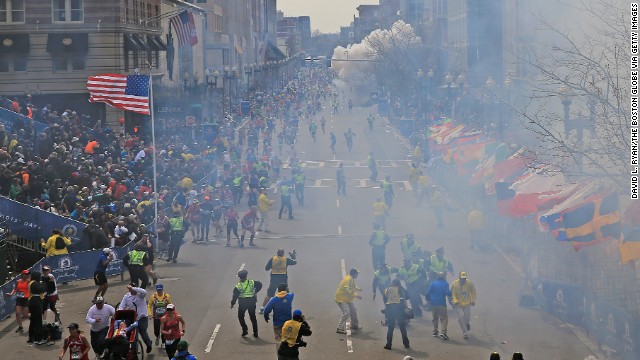 One man's legs were instantly blown off, yet he kept trying to stand up.
Exhausted marathoners had to muscle the energy to flee the bloody scene.
And more than 140 people remain hospitalized, some in critical condition.
As authorities try to figure out who triggered the deadly bombings Monday at the Boston Marathon, which killed an 8-year-old boy and two others, many are at a loss to explain why anyone would target the annual event that celebrates thousands of runners from around the world.Both blasts happened in quick succession, near the row of international flags that led up to the finish line. The impact was so powerful, it whipped the limp flags straight out as if they were caught in a hurricane.
It also knocked 78-year-old runner Bill Iffrig to the ground."I was just approaching the last straightaway to the finish line, and I had a good day and was feeling really good, and I got down to within about 15 feet of the finishing apron and just tremendous explosion, sounded like a bomb went off right next to me," Iffrig said.
"The shock waves just hit my whole body and my legs just started jittering around. I knew I was going down," he said.
Iffrig was not seriously injured. But trails of blood, severed arms and legs and other body parts littered the scene nearby.
At least 144 people were hospitalized, with at least 17 in critical condition and 25 in serious condition, officials said. At least eight of the patients are children.
A terrorism expert briefed on the investigation said doctors are "pulling ball bearings out of people in the emergency room," suggesting the bombs were designed to propel shrapnel.
But Dr. Ron Walls of Brigham and Women's Hospital, which received 31 patients, said the debris found in some patients' wounds did not appear to be from ball bearings.
"Everything we saw was sort of ordinary ambient material that could have been propelled by the blast but was not added to the device," Walls said. "It was not the kind of things that would be added to a device to make it more injurious than it otherwise would be."At Massachusetts General Hospital, several patients suffered from injuries to lower limbs that will require "serial operations" in the coming days, trauma surgeon Peter Fagenholz said Monday night.
He said the most serious wounds "have been combined, complex lower injuries that involve blood vessels, bone and tissue."
Numerous patients had to have limbs amputated, Fagenholz said.
"Just like" going back to Iraq
Nurses Stephen Segatore and Jim Asaiante were stationed near the finish line, expecting to treat the usual ailments from runners -- cramps and dehydration.
Suddenly, they found themselves in a battlefield, with blood and debris everywhere.
"For me, it was just like going back to being in Iraq in 2006-2007," said Asaiante, an Army captain who served an 18-month tour.
"I heard the first IED, and I know there's never one. The bad guys always set up two or three" improvised explosive devices, he said.
From celebration to carnage
The plumes of smoke and images of bloodied victims running down streets also triggered haunting memories of the terrorist attacks of 9/11.
Tami Hughes had just crossed the finish line and was looking for her husband when she heard a deafening explosion.
"I didn't know if it was a small aircraft going into the building," Hughes said. "I turned around and immediately saw the whitish-brownish smoke billowing up four or five stories and I couldn't believe that, you know, could it be a bomb?
"And I stared at it and about five or seven seconds later, when the second one went off, I knew immediately that it was something coordinated or organized, because I had been ... down in the financial center, 9/11. So you immediately go back to those moments where OK, where is the third one going to be?"
The hunt for clues
Investigators don't know who was behind the attack, or whether it was spawned domestically or from afar. But federal authorities are classifying it as an act of terrorism.
A federal law enforcement official said both bombs were small, and initial tests showed no C-4 or other high-grade explosive material, suggesting that the packages used in the attack were crude explosive devices.
The explosions went off near the finish line at about 4 hours and 9 minutes into the race, within a 10-minute window of the average finish time for the marathon.
But the fact that the blasts took place near the end of the race "seems to indicate this was not geared toward maximum damage," said a former federal law enforcement official who now works in the intelligence community.
"It may speak volumes about the (level of) planning that went into this," the source said. "It raises questions ... why didn't the bombs go off when the crowd was packed in like sardines when the winners were crossing the finish line? It could mean the people behind it couldn't get access to the area when they originally intended."
Officials have no suspect in custody, but many people are being questioned, Boston Police Commissioner Ed Davis said.
Investigators warned police to be on the lookout for a "darker-skinned or black male" with a possible foreign accent in connection with the attack, according to a law enforcement advisory obtained by CNN. The man was seen with a black backpack and sweatshirt and was trying to get into a restricted area about five minutes before the first explosion, the lookout notice states.
Davis said authorities found at least one other explosive device that they were dismantling.
But Rep. Bill Keating, D-Massachusetts, said two undetonated devices were found.
One was discovered at a hotel on Boylston Street near the bomb site, and another was found at an undisclosed location, said Keating, a member of the House Homeland Security Committee. He called the bombing a "sophisticated, coordinated, planned attack."
The unexploded devices could provide a treasure trove of information such as fingerprints and indications of the bomb maker's design, said the former federal law enforcement official.
Late Monday night, authorities said they were still getting reports about suspicious packages, but some may be abandoned belongings left by fleeing spectators.
Davis said while no new devices had been found so far, he is "not prepared to say we're at ease at this point in time."
One man's legs were instantly blown off, yet he kept trying to stand up.
Exhausted marathoners had to muscle the energy to flee the bloody scene.
And more than 140 people remain hospitalized, some in critical condition.
As authorities try to figure out who triggered the deadly bombings Monday at the Boston Marathon, which killed an 8-year-old boy and two others, many are at a loss to explain why anyone would target the annual event that celebrates thousands of runners from around the world.Both blasts happened in quick succession, near the row of international flags that led up to the finish line. The impact was so powerful, it whipped the limp flags straight out as if they were caught in a hurricane.
It also knocked 78-year-old runner Bill Iffrig to the ground."I was just approaching the last straightaway to the finish line, and I had a good day and was feeling really good, and I got down to within about 15 feet of the finishing apron and just tremendous explosion, sounded like a bomb went off right next to me," Iffrig said.
"The shock waves just hit my whole body and my legs just started jittering around. I knew I was going down," he said.
Iffrig was not seriously injured. But trails of blood, severed arms and legs and other body parts littered the scene nearby.
At least 144 people were hospitalized, with at least 17 in critical condition and 25 in serious condition, officials said. At least eight of the patients are children.
A terrorism expert briefed on the investigation said doctors are "pulling ball bearings out of people in the emergency room," suggesting the bombs were designed to propel shrapnel.
But Dr. Ron Walls of Brigham and Women's Hospital, which received 31 patients, said the debris found in some patients' wounds did not appear to be from ball bearings.
"Everything we saw was sort of ordinary ambient material that could have been propelled by the blast but was not added to the device," Walls said. "It was not the kind of things that would be added to a device to make it more injurious than it otherwise would be."At Massachusetts General Hospital, several patients suffered from injuries to lower limbs that will require "serial operations" in the coming days, trauma surgeon Peter Fagenholz said Monday night.
He said the most serious wounds "have been combined, complex lower injuries that involve blood vessels, bone and tissue."
Numerous patients had to have limbs amputated, Fagenholz said.
"Just like" going back to Iraq
Nurses Stephen Segatore and Jim Asaiante were stationed near the finish line, expecting to treat the usual ailments from runners -- cramps and dehydration.
Suddenly, they found themselves in a battlefield, with blood and debris everywhere.
"For me, it was just like going back to being in Iraq in 2006-2007," said Asaiante, an Army captain who served an 18-month tour.
"I heard the first IED, and I know there's never one. The bad guys always set up two or three" improvised explosive devices, he said.
From celebration to carnage
The plumes of smoke and images of bloodied victims running down streets also triggered haunting memories of the terrorist attacks of 9/11.
Tami Hughes had just crossed the finish line and was looking for her husband when she heard a deafening explosion.
"I didn't know if it was a small aircraft going into the building," Hughes said. "I turned around and immediately saw the whitish-brownish smoke billowing up four or five stories and I couldn't believe that, you know, could it be a bomb?
"And I stared at it and about five or seven seconds later, when the second one went off, I knew immediately that it was something coordinated or organized, because I had been ... down in the financial center, 9/11. So you immediately go back to those moments where OK, where is the third one going to be?"
The hunt for clues
Investigators don't know who was behind the attack, or whether it was spawned domestically or from afar. But federal authorities are classifying it as an act of terrorism.
A federal law enforcement official said both bombs were small, and initial tests showed no C-4 or other high-grade explosive material, suggesting that the packages used in the attack were crude explosive devices.
The explosions went off near the finish line at about 4 hours and 9 minutes into the race, within a 10-minute window of the average finish time for the marathon.
But the fact that the blasts took place near the end of the race "seems to indicate this was not geared toward maximum damage," said a former federal law enforcement official who now works in the intelligence community.
"It may speak volumes about the (level of) planning that went into this," the source said. "It raises questions ... why didn't the bombs go off when the crowd was packed in like sardines when the winners were crossing the finish line? It could mean the people behind it couldn't get access to the area when they originally intended."
Officials have no suspect in custody, but many people are being questioned, Boston Police Commissioner Ed Davis said.
Investigators warned police to be on the lookout for a "darker-skinned or black male" with a possible foreign accent in connection with the attack, according to a law enforcement advisory obtained by CNN. The man was seen with a black backpack and sweatshirt and was trying to get into a restricted area about five minutes before the first explosion, the lookout notice states.
Davis said authorities found at least one other explosive device that they were dismantling.
But Rep. Bill Keating, D-Massachusetts, said two undetonated devices were found.
One was discovered at a hotel on Boylston Street near the bomb site, and another was found at an undisclosed location, said Keating, a member of the House Homeland Security Committee. He called the bombing a "sophisticated, coordinated, planned attack."
The unexploded devices could provide a treasure trove of information such as fingerprints and indications of the bomb maker's design, said the former federal law enforcement official.
Late Monday night, authorities said they were still getting reports about suspicious packages, but some may be abandoned belongings left by fleeing spectators.
Davis said while no new devices had been found so far, he is "not prepared to say we're at ease at this point in time."
Monday, April 15, 2013
In Afghan peace, the Pakistan factor
The HinduIn Pakistan these days, a strange kind of schizophrenia is afoot, as the excitement over completing five, fulsome years of democratic rule competes with a growing tension with Afghanistan. Over the past couple of weeks, Pakistani officials and Afghan leaders have accused each other of fomenting terrorism, disturbingly raising the pitch and dropping all pretence of good neighbourly relations. According to the Afghans, the Pakistani military in late March indulged in unprovoked shelling and illegal construction along the Durand Line in the eastern Nangarhar province of Afghanistan — which Pakistan denies — which has so angered Kabul that it has cancelled its offer to train some of its military personnel in Pakistan. War of words An accompanying war of words has since claimed the air between the two neighbours. An unnamed Pakistani official told Reuters that the “biggest impediment to the (Afghan) peace process is Karzai. In trying to look like a saviour, he is taking Afghanistan straight to hell.” The Afghan Foreign Ministry made its anger known through a statement. “This demonstrates the interfering but delusional tendency of some in Pakistan who choose to ignore Afghanistan’s sovereignty...and continue to want to...re-exert control in Afghanistan through armed proxies,” it said. About the same time, Pakistan’s intelligence agency, the Inter-Services Intelligence (ISI), told its Supreme Court that the Afghan government was providing “strong support” to several anti-Pakistan terrorist groups, including the Tehreek-i-Taliban Pakistan. Clearly, as the clock moves inexorably towards the drawdown by the U.S. and international troops in April 2014, exactly a year from now, questions about the kind of role Pakistan can — and should play — in the region, lie at the heart of the escalating tension between the Afghan and Pakistan leadership. The Afghans argue that the Pakistanis have done little since the 9/11 incidents to eliminate terrorist havens and safe spaces inside their country, which the Taliban brazenly uses as sanctuary to mount attacks inside Afghanistan and then return home to Pakistan. But Pakistan continues to demand a position of primacy in the Pakistan-Afghan relationship, citing its front line state status as well as deep ethnic, civilisational and religious links between Pashtuns on both sides of the Durand Line. For years after September 11, as Afghanistan and the international community sought to rebuild that country, Afghanistan’s leaders held their tongue about what they really felt the Pakistani “deep state” was up to. Karzai, in fact, even moved out his former outspoken intelligence chief Amrullah Saleh because he realised that Saleh had gone too far in his public criticism about the Pakistani army and ISI using the Haqqani network of terrorists and other Taliban to foment trouble in Afghanistan. And that his comments were beginning to impact the relationship between Kabul’s chief sponsor, the U.S., and Pakistan. But Pakistan refused to back off. So when Karzai’s new intelligence chief Asadullah Khalid barely survived a suicide attempt in early December, a furious Karzai announced that “this man, who came in the name of a guest, came from Pakistan.” What really infuriates the Afghans is that Pakistan continues to treat their country as a weak-willed state with a ragtag security and police force that is totally corrupted from within. Even if serious trouble breaks out between the various Afghan ethnic groups after the Americans leave, a Karzai adviser said on the condition of anonymity, it will be a totally different situation from the time the Soviets left in 1989. “Afghanistan is a new country today, but the only one who doesn’t seem to have recognised it is Pakistan,” he said. “When the Taliban took over in the mid-1990s, the Pakistanis were only one in three countries in the world who supported them. They believe that when the Americans leave in 2014, they will return to being the most influential in Afghanistan through their control of the Taliban and the Haqqani network. The reality is totally different,” he added. Karzai’s supporters say he remains deeply upset by Pakistan’s refusal, in the decade since September 11, to act against hardline Afghan Taliban leaders living in Pakistan, in Quetta or Miramshah or elsewhere. Instead, the Pakistanis instigated the Americans to open direct talks with the Taliban, while the Americans, never very fond of Karzai, kept telling him to settle with Pakistan. Both initiatives sought to undermine him, Karzai felt. The last straw came in February during the London peace talks when the Pakistani side pushed Karzai to sign a Strategic Partnership Agreement, on the lines that Kabul had signed with Delhi in 2011. The document, in fact, had been given to the Afghan Foreign Minister, Zalmai Rassoul, during a visit to Islamabad in November 2012 by his charming counterpart, Hina Rabbani Khar, throwing the suave Afghan off-balance. It had not been on the agenda of their talks, but Rassoul took the paper back home with him. For constructive role It turned out that the Pakistanis wanted a special relationship to be institutionalised with Afghanistan, code language for prioritising Pakistan in its affairs. They demanded the sidelining of India (“not even a Muslim country,” the Pakistani Ambassador to Afghanistan, Mohammed Sadiq, had dismissively told former Taliban leader, Musa Hotak, during Ramzan celebrations last year) and discussed the offer to train some Afghan army personnel in Pakistan. Both sides promised to get their clerics to hold a conference in which suicide bombings would be condemned as un-Islamic. Within weeks, a top Pakistani cleric was justifying the actions of the suicide bomber and refusing to attend such a conference. “We want Pakistan to play a similar constructive role and secure the hearts and minds of the Afghan people, just as India has done. We don’t want a relationship that breeds violence and hatred. Afghanistan will protect its partnership with India at any cost,” Shaida Abdali, Afghanistan’s Ambassador to India, told this reporter. “As for Pakistan’s remarks that President Karzai has become an obstacle to a peace settlement...Yes, he is an obstacle to a foreign-owned and foreign-led peace settlement, not to an Afghan-owned and Afghan-led one,” Abdali added. An Afghan-watcher in Islamabad pointed out that Zardari is fully aware that his own “establishment” continues to use terrorists to promote its interests in Afghanistan, but cannot do much about it. He agreed that Zardari’s influence, even at the end of five years in power, hardly extended to security and the foreign policy towards India, leave alone Afghanistan. Meanwhile, as U.S. troops begin to draw down from Afghanistan, all eyes are focused on what the region will do to keep a civil warlike situation at bay. Karzai is said to be extremely keen that India supply military equipment to Afghanistan as well as substantially increase the numbers of security forces being trained by New Delhi, in line with the SPA signed with Kabul in 2011. But the truth is that India remains extremely hesitant. Some talk has also begun of a realignment of forces between Russia, Iran and India to both train and fund the equipping of the nascent Afghan security forces. The Americans have begun secret parleys with Iran in the hope that it will support the new Afghanistan’s interests. Moscow remains deeply worried. Only the Chinese still want to deal on their own. “We will not allow anyone to undermine the Afghan state, not the Taliban, the Pakistanis, the Americans or anyone other foreigner. In fact, we have decided to talk to the Taliban, in Bagram prison or outside, those who are willing to join the political process...There are many, including those in the Quetta shura willing to reconcile. We are tired of war. And we are determined to create a new country,” Abdali said.
Karzai Orders Removal Of Pakistani Border Gate
http://www.rferl.org/Afghan Defense Ministry spokesman Zahir Azimi has accused Pakistan of violating “international norms” by installing a border gate and checkpoint along a disputed border line between the two countries. Azimi told reporters on April 15 that Kabul will consider "all options" to remove the installations. In a national security council meeting on April 15, Karzai instructed his ministries of Defense, Interior, and Foreign Affairs to take "immediate action" to see the removal of the installations along the British-drawn Durand Line. Karzai also sought clarification from the U.S.-led coalition in Afghanistan on whether it assisted Pakistan in the building of the installations. Afghan Defense Ministry spokesman General Zahir Azimi said of the new border gate that it was erected without coordination with Kabul. "Establishing a gate or any other construction must be in conformity of both sides," Azimi said. "Without conformity, establishing a gate on the Durand Line and inside Afghanistan is against all international norms and it's against all the roles and relations of both sides." He added: "We have all options at hand to remove this [Durand Line] gate and protect Afghanistan's sovereignty." Pakistan views the Durand Line -- established by British India and the Kingdom of Afghanistan in 1893 -- as an international border. Kabul, however, has consistently refused to recognize the Durand Line, a boundary that cuts through the ethnic Pashtun heartland. The United States also considers the Durand Line the modern-day border between Afghanistan and Pakistan. The arrival of the British in northern India in the 19th century posed a major challenge to the Afghan and Turkic powers that had dominated the subcontinent for centuries. After losing a major war to the Afghans in 1842, the British eventually captured parts of Afghanistan and formally annexed them through an arbitrary treaty in 1879. Their forces occupied Kabul at the time. The contentious 1893 treaty between Afghan King Amir Abdur Rahman and Mortimer Durand, the foreign secretary of British India, formalized the areas under the control of the two governments.
Polio vaccination campaign restarts in Balochistan
The three-day anti-polio vaccination campaign resumed across Balochistan on Monday amidst tight security.
The campaign had been suspended due to a poor law and order situation across the province.
During the polio immunisation drive held between April 15 to April 17, health workers and volunteers would administer polio vaccine drops to children under five in 30 districts of Balochistan.
Talking to repoters, Dr Anwar said that at least 1.5 million children would be vaccinated against the crippling disease of poliomyelitis during the campaign.
He said that vaccine had already been provided to the concerned authorities in 30 districts of the province.
Pakistan: PM directs for addressing security concerns of Asfandyar Wali Khan
Radio PakistanPrime Minister Mir Hazar Khan Khoso has directed Interior Minister and Khyber Pakhtunkhwa government to address security concerns of ANP Chief Asfandyar Wali Khan. He gave these directives on media reports that ANP Chief has approached the Election Commission for beefing up his security. The Prime Minister said that the caretaker government will provide adequate security to political parties enabling the contesting candidates to participate in general elections. He said that the government is constantly monitoring the situation and is in touch with the relevant authorities to ensure peace in the run up to the general elections.
Losing Pakistan: An Insider's Look at How the US Deals With Its Ally
TIME.COMOne evening in June 2009, Richard Holbrooke paid a visit to Pakistan’s President Asif Ali Zardari at the presidential palace in Islamabad. It was one of his first visits to the region as the Obama Administration’s special representative to Afghanistan and Pakistan. In that role, Holbrooke — who died in December 2010 — wanted to broaden and deepen engagement with the country many had come to see as the most dangerous place in the world. And Zardari had his own ideas about how Washington could help. “Pakistan is like AIG,” Zardari told Holbrooke, comparing his country to the U.S. insurance giant that was bailed out in 2008. “Too big to fail.” Washington, Zardari keenly recalled, had given AIG “$100 billion. You should give Pakistan the same,” Zardari said. Holbrooke smiled throughout the meeting.Sitting with Holbrooke was Vali Nasr, then his senior adviser. Nasr recalls the episode in his new book, The Dispensable Nation: American Foreign Policy in Retreat, a searing critique of how the Obama Administration has been too timid to transform American foreign policy. Holbrooke, writes Nasr, was troubled by Zardari’s display of dependence on the U.S. and the sense of entitlement that went with it. “Holbrooke didn’t like the image of Pakistan holding a gun to its own head as it shook down America for aid,” writes Nasr, now dean of the Paul H. Nitze School of Advanced International Studies at Johns Hopkins University. Holbrooke did agree, however, with Zardari that Pakistan was important and the U.S. had a long-term interest in its stability. For the next year and a half, Holbrooke and his team pursued a policy of diplomatic engagement with Pakistan. It went beyond the traditional approach narrowly based on security concerns. The idea was to try and address Pakistan’s strategic calculus — an ambitious target that may have underestimated how far Pakistan was willing to go without changing its ways. “What Holbrooke wanted,” Nasr tells TIME in an interview, “was to engage big and try and change the course of this country and its relationship with Washington once and for all.” But from the very start, President Barack Obama and the White House never really bought into the idea. “The White House tolerated Holbrooke’s approach for a while,” Nasr writes in the book, “but in the end decided that a policy of coercion and confrontation would better achieve our goals in Pakistan.” Washington was less interested in working with Pakistan, Nasr says, than pressuring it into compliance. That strategy, he says, has failed. And now, he warns, the U.S. risks pivoting away from the region at the cost of abandoning vital interests that remain there. “When you look at Pakistan today,” says Nasr, “it is nuclear-armed, in near conflict with India, has a dangerous civil war with its own extremists, is now subject to one of the most brutal terrorism campaigns against its population, that is now coming apart along sectarian lines.” If the U.S. does not maintain influence in Pakistan, he says, it won’t be able to have a positive impact on the direction of the country. “Looking at it from an American perspective,” Nasr says, “we’re just going to be basically saying, ‘We’re going to sit on the sideline and look at this roller coaster go off this rail.’”Holbrooke’s approach was ambitious. A strategic dialogue was established between the two countries. Nonmilitary aid was tripled. Washington began to reach out to civilian centers in Pakistan for the first time. “There was a discussion on energy and electricity and water and women,” says Nasr. “These were ways of laying out for Pakistan a longer road map with the U.S., and alternately trying to put on the table for Pakistan interests that would gradually wean it away from its strategic outlook and bring it in a new direction.” There would be no quick fix. It was a longer strategy aimed at slowly undoing decades of alienation and mistrust. In the first two years, Nasr insists that there were rewards. The U.S. got more intelligence cooperation, he details in the book. “More agents, more listening posts, and even visas for the deep-cover CIA operatives who found [Osama] bin Laden.” Long-strained relations between Islamabad and Kabul improved enough for it to help U.S. counterinsurgency efforts in Afghanistan. The Pakistanis also finally moved against the Pakistani Taliban in the Swat Valley and South Waziristan, in military offensives that helped the war across the border. “The Pakistanis didn’t cooperate 100%,” says Nasr. “But they did cooperate 50%.” But the Obama Administration didn’t have the patience to stick with it. As Nasr acknowledges, there was a rival school of thought that said, “It was too difficult, too time-consuming and wouldn’t work anyway.” When Holbrooke died, their view won out. Nasr resigned from the State Department soon after. In 2011, three major incidents brought the relationship crashing to its lowest-point ever: a CIA contractor, Raymond Davis, allegedly killed two people in Lahore; U.S. Navy Seals carried out a raid to get Osama bin Laden without informing the Pakistanis; and toward the end of the year, 26 Pakistani troops were killed in a cross-border incident. The security relationship, Nasr says, worked better when there were other efforts alongside it. “The Pakistanis said, ‘O.K., you have security interests. We have economic interests and we have civilian interests,’” recalls Nasr. “We always got much further with the Pakistanis in those first two years when the conversation was not just about drones and terrorists, but it was also about energy and water.” The CIA and the Pentagon saw the benefits of the cooperation, Nasr notes in his book. But at the same time, he writes, they applied constant pressure that “threatened to break up the relationship.” At one point, Holbrooke turned to him, shaking his head, and said: “Watch them [the CIA] ruin this relationship. And when it is ruined, they are going to say, ‘We told you, You can’t work with Pakistan!’ We never learn.”
Sunday, April 14, 2013
New tribunal formed to hear appeals against Sharifs
The Election Commission of Pakistan has changed the tribunal for hearing the appeals against Nawaz Sharif, president of his own faction of Pakistan Muslim League (PML-N), and his brother Shahbaz Sharif.
According to a notification on Sunday, the appeals filed against them have been transferred to the new tribunal, comprising of Justice Nasir Saeed Shaikh and Justice Shahid Wahid.
Four appeals were filed against acceptance of nomination papers of Nawaz from NA-120 Lahore. Similarly, 4 appeals were filed against acceptance of candidature of Shahbaz from PP-161.
Earlier‚ the election tribunal of Lahore had declined to hear the appeals against both PML-N leaders on personal grounds.
Saturday, April 13, 2013
Protests held in Bahrain ahead of Formula One
ALJAZEERAThousands of Bahrainis have demonstrated near the capital, Manama, urging democratic reforms, part of a series of protests planned by the political opposition ahead of next week's Formula One Grand Prix. Under the banner "Democracy is our right," the crowds marched in the Shia area of Aali south of the capital, waving Bahraini flags and chanting anti-monarchy slogans on Friday. Police stayed away from Friday's demonstration as protesters denounced king Hamad bin Issa al-Khalifa and Prime Minister Sheikh Khalifa bin Salman al-Khalifa, his uncle. "You have no legitimacy," they chanted. Bahrain's mainly-Shia opposition bloc, Al-Wefaq, organised the protest as part of demonstrations due to take place from April 12-22 to coincide with the April 19-22 Grand Prix. Sheikh Ali Salman, head of the Al-Wefaq who was at the protest, said the action was intended to support "demands for democratic transition". "We do not want to hold up the race, but we are trying to benefit from the increased media presence," he said. Salman called on his supporters to attend a demonstration planned for April 19, as the event kicks off on the Sakhir circuit south of the capital. A second opposition group, the February 14 Movement, organised another protest on Thursday night in the village of Khamis that was broken up by police. Thursday night's demonstration came as a report by Human Rights Watch said that police have been rounding up pro-democracy activists in bid to head off protests. 'Your race is a crime' "Your race is a crime," the protesters chanted, referring to motor racing bosses who have insisted on keeping the Bahrain Grand Prix on the Formula One calendar, witnesses said. "Down with Hamad," they shouted in reference to the king, who heads a Sunni minority regime in the Shia-majority island state. "The people want the fall of the regime," the demonstrators chanted, echoing the rallying cry of the Arab Spring revolts in 2011. Clashes erupted when anti-riot police intervened to disperse the crowd and demonstrators responded with Molotov cocktails, witnesses said. Bahrain, where the US Navy's Fifth Fleet is based, was rocked by month-long pro-democracy protests led by the kingdom's Shia majority in early 2011 that were crushed with the help of Saudi-led GCC troops. Human rights groups say a total of 80 people have been killed since February 2011. Last year's Formula One event went ahead against an ugly backdrop as police responded to protesters who were throwing petrol bombs by using tear gas, sound bombs and birdshot. Meanwhile, former world champion Damon Hill has called on International Motoring Federation (FIA) president Jean Todt to take an ethical stance on the controversial event. "I think Jean's approach is say nothing because otherwise you are being political," said Hill, who won the world title in 1996. "I think that is a mistake because actually he is being political because he's being used, or the sport is perceived as being used, by its engagement in the economy and the reputation of the country."
U.S. says agrees with China on peaceful North Korea solution
Reuters
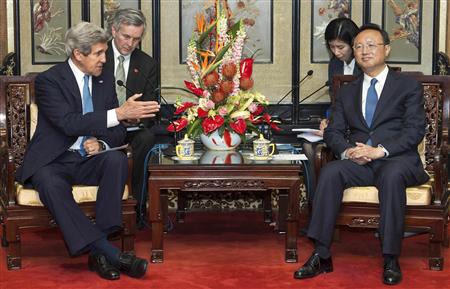 The United States said on Saturday that China had agreed to help rid North Korea of its nuclear capability by peaceful means, but Beijing made no specific commitment in public to pressure its long-time ally to change its ways.
U.S. Secretary of State John Kerry met China's top leaders in a bid to persuade them to push reclusive North Korea, whose main diplomatic supporter is Beijing, to scale back its belligerence and, eventually, return to nuclear talks.
Visiting Beijing for the first time as secretary of state, Kerry has made no secret of his desire to see China take a more active stance towards North Korea, which in recent weeks has threatened nuclear war against the United States and South Korea.
Kerry and China's top diplomat, State Councillor Yang Jiechi, said both countries supported the goal of denuclearizing the Korean peninsula.
"We are able, the United States and China, to underscore our joint commitment to the denuclearization of the Korean peninsula in a peaceful manner," Kerry told reporters, sitting next to Yang at a state guesthouse in western Beijing.
But North Korea has repeatedly said it will not abandon nuclear weapons which it described on Friday as its "treasured" guarantor of security.
Yang said China's stance on maintaining peace and stability on the peninsula was clear and consistent, repeating phrasing used by the Foreign Ministry since the crisis began.
"We maintain that the issue should be handled and resolved peacefully through dialogue and consultation. To properly address the Korea nuclear issue serves the common interests of all parties. It is also the shared responsibility of all parties," he said, speaking through an interpreter.
"China will work with other relevant parties, including the United States, to play a constructive role in promoting the six-party talks and balanced implementation of the goals set out in the September 19 joint statement of 2005."
The United States and its allies believe the North violated the 2005 aid-for-denuclearization deal by conducting a nuclear test in 2006 and pursuing a uranium enrichment program that would give it a second path to a nuclear weapon in addition to its plutonium-based program.
Six-party aid-for-disarmament talks, involving the two Koreas, the United States, Japan, Russia and host China, collapsed in 2008 when the North walked away from the deal.
Kerry declined to comment on what specifically China may do to push for a peaceful solution on North Korea, saying only that they had discussed all possibilities.
At a news conference in Seoul on Friday and in a U.S.-South Korean joint statement issued on Saturday, Kerry signaled the U.S. preference for diplomacy, but stressed North Korea must take "meaningful" steps on denuclearization.
"We don't want to get into a threat for threat or ... some kind of confrontational language here. There's been enough of that," Kerry said in Beijing.
If North Korea got rid of its nuclear capabilities, then the United States would have no reason to maintain recently deployed defensive capabilities - such as a missile defense system sent to Guam - he said.
"Now, obviously, if the threat disappears, i.e. North Korea denuclearizes, the same imperative does not exist at that point in time for us to have to have that kind of robust, forward leaning posture of defense."
The Pentagon has in recent weeks responded to the North Korean threats by announcing plans to position two Aegis guided-missile destroyers in the western Pacific and a Terminal High Altitude Area Defense (THAAD) missile defense system to Guam.
'CONSTRUCTIVE' TALKS
As the North's main trading partner, financial backer and the closest thing it has to a diplomatic ally, China had a unique ability to use its leverage against the impoverished, isolated state, Kerry said in Seoul before leaving for Beijing.
China, which sided with North Korea in the 1950-53 civil war against the U.S.-backed South, has always been reluctant to apply pressure on Pyongyang, fearing instability if the North were to implode and send floods of refugees into China.
It has also looked askance at U.S. military drills in South Korea.
China's Xinhua news agency said in a commentary that Washington had itself been "fanning the flames" on the Korean peninsula with its shows of force.
"It keeps sending more fighters, bombers and missile-defense ships to the waters of East Asia and carrying out massive military drills with Asian allies in a dramatic display of preemptive power," it said.
Chinese state television quoted Premier Li Keqiang as telling Kerry that rising tensions on the Korean peninsula were in nobody's interests, in apparent reference to both Washington and Pyongyang to dial down the war of words.
"All sides must bear responsibility for maintaining regional peace and stability and be responsible for the consequences," the television report paraphrased Li as saying.
"Disturbances and provocation on the peninsula and regionally will harm the interests of all sides, which is like lifting a rock only to drop it on one's feet."
Still, U.S. officials believe China's rhetoric on North Korea has begun to shift, pointing to a recent speech by China's Xi in which - without referring explicitly to Pyongyang - he said no country "should be allowed to throw a region and even the whole world into chaos for selfish gain".
Kerry's Asia trip, which includes a stop in Tokyo on Sunday before flying home on Monday, takes place after weeks of shrill North Korean threats of war since the imposition of new U.N. sanctions in response to its third nuclear test in February.
North Korean television made no mention of Kerry's visit and devoted most of its reports to preparations for celebrations on Monday marking the birth date of state founder Kim Il-Sung.
But Rodong Sinmun, the ruling Workers' Party's newspaper, issued a fresh denunciation of joint U.S.-South Korean military exercises, saying: "If the enemies dare provoke (North Korea) while going reckless, it will immediately blow them up with an annihilating strike with the use of powerful nuclear means."
South Korea's Yonhap news agency, quoting a government source, said North Korea had not moved any of its mobile missile launchers for the past two days after media reports that as many as five missiles had been moved into place on the country's east coast. It said this suggested no launches were imminent.
The United States said on Saturday that China had agreed to help rid North Korea of its nuclear capability by peaceful means, but Beijing made no specific commitment in public to pressure its long-time ally to change its ways.
U.S. Secretary of State John Kerry met China's top leaders in a bid to persuade them to push reclusive North Korea, whose main diplomatic supporter is Beijing, to scale back its belligerence and, eventually, return to nuclear talks.
Visiting Beijing for the first time as secretary of state, Kerry has made no secret of his desire to see China take a more active stance towards North Korea, which in recent weeks has threatened nuclear war against the United States and South Korea.
Kerry and China's top diplomat, State Councillor Yang Jiechi, said both countries supported the goal of denuclearizing the Korean peninsula.
"We are able, the United States and China, to underscore our joint commitment to the denuclearization of the Korean peninsula in a peaceful manner," Kerry told reporters, sitting next to Yang at a state guesthouse in western Beijing.
But North Korea has repeatedly said it will not abandon nuclear weapons which it described on Friday as its "treasured" guarantor of security.
Yang said China's stance on maintaining peace and stability on the peninsula was clear and consistent, repeating phrasing used by the Foreign Ministry since the crisis began.
"We maintain that the issue should be handled and resolved peacefully through dialogue and consultation. To properly address the Korea nuclear issue serves the common interests of all parties. It is also the shared responsibility of all parties," he said, speaking through an interpreter.
"China will work with other relevant parties, including the United States, to play a constructive role in promoting the six-party talks and balanced implementation of the goals set out in the September 19 joint statement of 2005."
The United States and its allies believe the North violated the 2005 aid-for-denuclearization deal by conducting a nuclear test in 2006 and pursuing a uranium enrichment program that would give it a second path to a nuclear weapon in addition to its plutonium-based program.
Six-party aid-for-disarmament talks, involving the two Koreas, the United States, Japan, Russia and host China, collapsed in 2008 when the North walked away from the deal.
Kerry declined to comment on what specifically China may do to push for a peaceful solution on North Korea, saying only that they had discussed all possibilities.
At a news conference in Seoul on Friday and in a U.S.-South Korean joint statement issued on Saturday, Kerry signaled the U.S. preference for diplomacy, but stressed North Korea must take "meaningful" steps on denuclearization.
"We don't want to get into a threat for threat or ... some kind of confrontational language here. There's been enough of that," Kerry said in Beijing.
If North Korea got rid of its nuclear capabilities, then the United States would have no reason to maintain recently deployed defensive capabilities - such as a missile defense system sent to Guam - he said.
"Now, obviously, if the threat disappears, i.e. North Korea denuclearizes, the same imperative does not exist at that point in time for us to have to have that kind of robust, forward leaning posture of defense."
The Pentagon has in recent weeks responded to the North Korean threats by announcing plans to position two Aegis guided-missile destroyers in the western Pacific and a Terminal High Altitude Area Defense (THAAD) missile defense system to Guam.
'CONSTRUCTIVE' TALKS
As the North's main trading partner, financial backer and the closest thing it has to a diplomatic ally, China had a unique ability to use its leverage against the impoverished, isolated state, Kerry said in Seoul before leaving for Beijing.
China, which sided with North Korea in the 1950-53 civil war against the U.S.-backed South, has always been reluctant to apply pressure on Pyongyang, fearing instability if the North were to implode and send floods of refugees into China.
It has also looked askance at U.S. military drills in South Korea.
China's Xinhua news agency said in a commentary that Washington had itself been "fanning the flames" on the Korean peninsula with its shows of force.
"It keeps sending more fighters, bombers and missile-defense ships to the waters of East Asia and carrying out massive military drills with Asian allies in a dramatic display of preemptive power," it said.
Chinese state television quoted Premier Li Keqiang as telling Kerry that rising tensions on the Korean peninsula were in nobody's interests, in apparent reference to both Washington and Pyongyang to dial down the war of words.
"All sides must bear responsibility for maintaining regional peace and stability and be responsible for the consequences," the television report paraphrased Li as saying.
"Disturbances and provocation on the peninsula and regionally will harm the interests of all sides, which is like lifting a rock only to drop it on one's feet."
Still, U.S. officials believe China's rhetoric on North Korea has begun to shift, pointing to a recent speech by China's Xi in which - without referring explicitly to Pyongyang - he said no country "should be allowed to throw a region and even the whole world into chaos for selfish gain".
Kerry's Asia trip, which includes a stop in Tokyo on Sunday before flying home on Monday, takes place after weeks of shrill North Korean threats of war since the imposition of new U.N. sanctions in response to its third nuclear test in February.
North Korean television made no mention of Kerry's visit and devoted most of its reports to preparations for celebrations on Monday marking the birth date of state founder Kim Il-Sung.
But Rodong Sinmun, the ruling Workers' Party's newspaper, issued a fresh denunciation of joint U.S.-South Korean military exercises, saying: "If the enemies dare provoke (North Korea) while going reckless, it will immediately blow them up with an annihilating strike with the use of powerful nuclear means."
South Korea's Yonhap news agency, quoting a government source, said North Korea had not moved any of its mobile missile launchers for the past two days after media reports that as many as five missiles had been moved into place on the country's east coast. It said this suggested no launches were imminent.
The Ghosts of Afghanistan’s Past
 By WILLIAM DALRYMPLE
 ON March 10, Afghanistan’s president, Hamid Karzai, shocked Western leaders by declaring that recent attacks proved that the Taliban “are at the service of America.” The implication was clear: terrorists were colluding with the United States to sow chaos before America’s planned withdrawal in 2014. American and European leaders, mindful of the blood and treasure they’ve expended to defend Mr. Karzai’s government, were baffled and offended.
But to students of Afghan history, Mr. Karzai’s motivation for publicly spurning foreign powers was quite obvious. A Taliban news release on March 18, which received little notice in the Western press, declared: “Everyone knows how Karzai was brought to Kabul and how he was seated on the defenseless throne of Shah Shuja,” referring to the exiled Afghan ruler restored to the throne by the British in 1839. “So it is not astonishing that the American soldiers are making fun of him and slapping him on the face because it is the philosophy of invaders that they scorn their stooge at the end ... and in this way punish him for his slavery!”
The Taliban inadvertently put their finger on a key factor in understanding Mr. Karzai’s psychology. After all, as an elder of the Popalzai tribe, Mr. Karzai is the direct tribal descendant of Shah Shuja ul-Mulk, Britain’s handpicked ruler during the first Western attempt at regime change in Afghanistan in the mid-19th century.
And although few in the West are aware of it, as the United States prepares to withdraw from Afghanistan, history is repeating itself. We may have forgotten the details of the colonial history that did so much to mold Afghans’ hatred of foreign rule, but the Afghans have not.
Today, Shah Shuja is widely reviled in Afghanistan as a puppet of the West. The man who defeated the British in 1842, Wazir Akbar Khan, and his father, Dost Mohammed, are widely regarded as national heroes. Mr. Karzai has lived with that knowledge all his life, making him a difficult ally — always keen to stress the differences between himself and his backers, making him appear to be continually biting the hand that feeds him.
In 2001, top Taliban officials asked their young fighters, “Do you want to be remembered as a son of Shah Shuja or as a son of Dost Mohammed?” As he rose to power, the Taliban leader Mullah Omar deliberately modeled himself on Dost Mohammed, and, as he did, removed the Holy Cloak of the Prophet Muhammad from its shrine in Kandahar and wrapped himself in it to declare jihad, a deliberate historical re-enactment, the resonance of which all Afghans immediately understood.
The parallels between the current war and that of the 1840s are striking. The same tribal rivalries exist and the same battles are being fought in the same places under the guise of new flags, new ideologies and new political puppeteers. The same cities are being garrisoned by foreign troops speaking the same languages, and they are being attacked from the same hills and high passes.
Not only was Shah Shuja from the same Popalzai sub-tribe as Mr. Karzai, his principal opponents were Ghilzais, who today make up the bulk of the Taliban’s foot soldiers. Mullah Omar is a Ghilzai, as was Mohammad Shah Khan, the resistance fighter who supervised the slaughter of the British Army in 1841.
The same moral issues that are chewed over in editorial columns today were discussed in the correspondence of British officials during the First Afghan War. Should foreign troops try to “promote the interests of humanity” and champion social reform by banning traditions like the stoning of adulterous women? Should they try to reform blasphemy laws and introduce Western political ideas? Or should they just concentrate on ruling the country without rocking the boat?
As the great British spymaster Sir Claude Wade warned on the eve of the 1839 invasion, “There is nothing more to be dreaded or guarded against, I think, than the overweening confidence with which we are too often accustomed to regard the excellence of our own institutions, and the anxiety that we display to introduce them in new and untried soils.” In this early critique of democracy promotion, he concluded, “Such interference will always lead to acrimonious disputes, if not to a violent reaction.”
Just as Britain’s inability to cope with the Afghan uprising of 1841-2 stemmed from leadership failures and the breakdown of ties between the British envoy and Shah Shuja, the strained and uneasy relationship of NATO leaders with Mr. Karzai has been a crucial factor in America’s failures in the latest imbroglio.
Afghanistan is so poor that the occupation can’t be financed through natural resource wealth or taxation. Today, America is spending more than a $100 billion a year in Afghanistan: it costs more to keep Marine battalions in two districts of Helmand than America is providing to the entire nation of Egypt in military and development assistance. And then, as now, the decision to withdraw troops has turned on factors with little relevance to Afghanistan, namely the state of the occupier’s troubled economy and the vagaries of politics back home.
History never repeats itself exactly, and there are some important differences between what is taking place in Afghanistan today and what took place during the 1840s. There is no unifying figure at the center of the resistance, recognized by all Afghans as a symbol of legitimacy and justice: Mullah Omar is no Dost Mohammed or Wazir Akbar Khan, and the tribes have not united behind a single leader as they did in the 1840s.
Moreover, the goals of the conservative, defensive tribal uprising that brought colonial rule to an end were very different from those of today’s Taliban, who wish to reimpose an imported Wahhabi ideology on Afghanistan’s diverse religious cultures. And most important, Mr. Karzai has tried to establish a broad-based, democratic government, which, for all its many flaws and prodigious corruption, is still much more representative and popular than the regime of Shah Shuja ever was.
Mr. Karzai is keen to learn the lessons of his forebears’ failures. When my book came out in India in January, he got hold of a copy and read it. “Our so-called current allies behave to us just as the British did to Shah Shuja,” he told me. “They have squandered the opportunity given to them by the Afghan people.”
Mr. Karzai believes that Shah Shuja didn’t stress his independence enough, and he made clear that in his own last year in office he is going to act in such a way that he will never be remembered as anyone’s puppet.
William Dalrymple is the author, most recently, of “Return of a King: The Battle for Afghanistan, 1839-42.”
ON March 10, Afghanistan’s president, Hamid Karzai, shocked Western leaders by declaring that recent attacks proved that the Taliban “are at the service of America.” The implication was clear: terrorists were colluding with the United States to sow chaos before America’s planned withdrawal in 2014. American and European leaders, mindful of the blood and treasure they’ve expended to defend Mr. Karzai’s government, were baffled and offended.
But to students of Afghan history, Mr. Karzai’s motivation for publicly spurning foreign powers was quite obvious. A Taliban news release on March 18, which received little notice in the Western press, declared: “Everyone knows how Karzai was brought to Kabul and how he was seated on the defenseless throne of Shah Shuja,” referring to the exiled Afghan ruler restored to the throne by the British in 1839. “So it is not astonishing that the American soldiers are making fun of him and slapping him on the face because it is the philosophy of invaders that they scorn their stooge at the end ... and in this way punish him for his slavery!”
The Taliban inadvertently put their finger on a key factor in understanding Mr. Karzai’s psychology. After all, as an elder of the Popalzai tribe, Mr. Karzai is the direct tribal descendant of Shah Shuja ul-Mulk, Britain’s handpicked ruler during the first Western attempt at regime change in Afghanistan in the mid-19th century.
And although few in the West are aware of it, as the United States prepares to withdraw from Afghanistan, history is repeating itself. We may have forgotten the details of the colonial history that did so much to mold Afghans’ hatred of foreign rule, but the Afghans have not.
Today, Shah Shuja is widely reviled in Afghanistan as a puppet of the West. The man who defeated the British in 1842, Wazir Akbar Khan, and his father, Dost Mohammed, are widely regarded as national heroes. Mr. Karzai has lived with that knowledge all his life, making him a difficult ally — always keen to stress the differences between himself and his backers, making him appear to be continually biting the hand that feeds him.
In 2001, top Taliban officials asked their young fighters, “Do you want to be remembered as a son of Shah Shuja or as a son of Dost Mohammed?” As he rose to power, the Taliban leader Mullah Omar deliberately modeled himself on Dost Mohammed, and, as he did, removed the Holy Cloak of the Prophet Muhammad from its shrine in Kandahar and wrapped himself in it to declare jihad, a deliberate historical re-enactment, the resonance of which all Afghans immediately understood.
The parallels between the current war and that of the 1840s are striking. The same tribal rivalries exist and the same battles are being fought in the same places under the guise of new flags, new ideologies and new political puppeteers. The same cities are being garrisoned by foreign troops speaking the same languages, and they are being attacked from the same hills and high passes.
Not only was Shah Shuja from the same Popalzai sub-tribe as Mr. Karzai, his principal opponents were Ghilzais, who today make up the bulk of the Taliban’s foot soldiers. Mullah Omar is a Ghilzai, as was Mohammad Shah Khan, the resistance fighter who supervised the slaughter of the British Army in 1841.
The same moral issues that are chewed over in editorial columns today were discussed in the correspondence of British officials during the First Afghan War. Should foreign troops try to “promote the interests of humanity” and champion social reform by banning traditions like the stoning of adulterous women? Should they try to reform blasphemy laws and introduce Western political ideas? Or should they just concentrate on ruling the country without rocking the boat?
As the great British spymaster Sir Claude Wade warned on the eve of the 1839 invasion, “There is nothing more to be dreaded or guarded against, I think, than the overweening confidence with which we are too often accustomed to regard the excellence of our own institutions, and the anxiety that we display to introduce them in new and untried soils.” In this early critique of democracy promotion, he concluded, “Such interference will always lead to acrimonious disputes, if not to a violent reaction.”
Just as Britain’s inability to cope with the Afghan uprising of 1841-2 stemmed from leadership failures and the breakdown of ties between the British envoy and Shah Shuja, the strained and uneasy relationship of NATO leaders with Mr. Karzai has been a crucial factor in America’s failures in the latest imbroglio.
Afghanistan is so poor that the occupation can’t be financed through natural resource wealth or taxation. Today, America is spending more than a $100 billion a year in Afghanistan: it costs more to keep Marine battalions in two districts of Helmand than America is providing to the entire nation of Egypt in military and development assistance. And then, as now, the decision to withdraw troops has turned on factors with little relevance to Afghanistan, namely the state of the occupier’s troubled economy and the vagaries of politics back home.
History never repeats itself exactly, and there are some important differences between what is taking place in Afghanistan today and what took place during the 1840s. There is no unifying figure at the center of the resistance, recognized by all Afghans as a symbol of legitimacy and justice: Mullah Omar is no Dost Mohammed or Wazir Akbar Khan, and the tribes have not united behind a single leader as they did in the 1840s.
Moreover, the goals of the conservative, defensive tribal uprising that brought colonial rule to an end were very different from those of today’s Taliban, who wish to reimpose an imported Wahhabi ideology on Afghanistan’s diverse religious cultures. And most important, Mr. Karzai has tried to establish a broad-based, democratic government, which, for all its many flaws and prodigious corruption, is still much more representative and popular than the regime of Shah Shuja ever was.
Mr. Karzai is keen to learn the lessons of his forebears’ failures. When my book came out in India in January, he got hold of a copy and read it. “Our so-called current allies behave to us just as the British did to Shah Shuja,” he told me. “They have squandered the opportunity given to them by the Afghan people.”
Mr. Karzai believes that Shah Shuja didn’t stress his independence enough, and he made clear that in his own last year in office he is going to act in such a way that he will never be remembered as anyone’s puppet.
William Dalrymple is the author, most recently, of “Return of a King: The Battle for Afghanistan, 1839-42.”
American Think-tank Report Suggests a “Permanent U.N. Observation Mission” in Balochistan
The Baloch HalA report on Balochistan published and issued on Thursday by a leading American think-tank has recommended the formation of a permanent United Nations observation mission in Balochistan “to monitor the human rights situation” in the province. The report Balochistan: The State Versus the Nation has been written by Dr. Frederic Grare, Director and Senior Associate of the South Asia Program at the Carnegie Endowment for International Peace. Dr. Grare, a French scholar, had previously written the widely quoted Pakistan: the Resurgence of Baluch nationalism.The report says the setting up of a permanent U.N. observation mission would create greater transparency, promote accountability, and build confidence should the security establishment decide to change its policies in the province. On their part, the Baloch nationalists, the report has suggested, “should participate in provincial elections in May. Only their participation in Balochistan’s administration can confer sufficient legitimacy on the provincial government. A legitimate and credible Baloch government can reestablish local control over the province, help reduce violence, and advocate for Balochistan on the federal level.” The report has asked the Pakistani security establishment should “show greater respect for human rights in Balochistan by disbanding death squads, stopping extrajudicial executions, and ending forced disappearances. Serious negotiations and political solutions are impossible as long as these violations persist.”
US May Unwittingly Fund Terrorism in Afghanistan: Report
 The U.S. government may accidentally be funneling millions of dollars to the very terrorists and insurgents it's fighting in Afghanistan through sloppy contracting regulations, according to a new government report.
The report, called "Contracting With the Enemy" and published Thursday by the Special Inspector General for Afghanistan Reconstruction (SIGAR), examined the system designed to make sure that the U.S. reconstruction is not providing business for any individuals or groups associated with terrorist or insurgent organizations.
SIGAR said that due to "several weaknesses" in the long and complicated process, "millions of contracting dollars could be diverted to forces seeking to harm U.S. military and civilian personnel in Afghanistan and derail the multi-billion dollar reconstruction effort."The report centered on what's known as Section 841, part of the 2012 National Defense Authorization Act that describes how the U.S. government is supposed to identify individuals or companies with suspected ties to insurgents, confirm that information, pass it along to the head of the contracting activity, then to the primary contractor and finally to the targeted subcontractors whose business deals would then be voided or restricted based on guidance from higher up.
SIGAR said Section 841 was part of a "variety of efforts" undertaken by the government to keep American contracting money out of terrorists' hands in the wake of incidents like the $2.16 billion Host Nation Trucking contract. In that instance, SIGAR said, the U.S. government paid several companies to ship more than 70 percent of food and materiel to American troops in Afghanistan, only to realize that some of those funds were "widely believed to have been funneled to insurgents."Section 841 is still full of holes, SIGAR said, from the military not telling the head of contracting activity about potentially shady actors to the head of the contracting activity not telling their prime contractors.
The SIGAR report also notes that Section 841 only applies to contracts worth more than $100,000, even though it said approximately 80 percent of contracts awarded in Afghanistan are worth less than that.
SIGAR made seven recommendations to rectify the reporting loopholes, most to "improve visibility over active contracts" and one to ditch the $100,000 threshold on Section 841. The SIGAR report said the military in general agreed with those recommendations but plans to issue a formal response to the new report later.
The U.S. government may accidentally be funneling millions of dollars to the very terrorists and insurgents it's fighting in Afghanistan through sloppy contracting regulations, according to a new government report.
The report, called "Contracting With the Enemy" and published Thursday by the Special Inspector General for Afghanistan Reconstruction (SIGAR), examined the system designed to make sure that the U.S. reconstruction is not providing business for any individuals or groups associated with terrorist or insurgent organizations.
SIGAR said that due to "several weaknesses" in the long and complicated process, "millions of contracting dollars could be diverted to forces seeking to harm U.S. military and civilian personnel in Afghanistan and derail the multi-billion dollar reconstruction effort."The report centered on what's known as Section 841, part of the 2012 National Defense Authorization Act that describes how the U.S. government is supposed to identify individuals or companies with suspected ties to insurgents, confirm that information, pass it along to the head of the contracting activity, then to the primary contractor and finally to the targeted subcontractors whose business deals would then be voided or restricted based on guidance from higher up.
SIGAR said Section 841 was part of a "variety of efforts" undertaken by the government to keep American contracting money out of terrorists' hands in the wake of incidents like the $2.16 billion Host Nation Trucking contract. In that instance, SIGAR said, the U.S. government paid several companies to ship more than 70 percent of food and materiel to American troops in Afghanistan, only to realize that some of those funds were "widely believed to have been funneled to insurgents."Section 841 is still full of holes, SIGAR said, from the military not telling the head of contracting activity about potentially shady actors to the head of the contracting activity not telling their prime contractors.
The SIGAR report also notes that Section 841 only applies to contracts worth more than $100,000, even though it said approximately 80 percent of contracts awarded in Afghanistan are worth less than that.
SIGAR made seven recommendations to rectify the reporting loopholes, most to "improve visibility over active contracts" and one to ditch the $100,000 threshold on Section 841. The SIGAR report said the military in general agreed with those recommendations but plans to issue a formal response to the new report later.
Blast in Peshawar market kills eight
 At least eight people were killed when an explosion ripped through a passenger coach in a busy marketplace on the outskirts of Peshawar, the capital of Khyber Pakhtunkhwa province.
According to initial reports by the police, the blast hit a passenger coach parked in the crowded Matni Bazar area.
Hospital officials confirmed that at least eight bodies have been brought to the Lady Reading Hospital.
The nature of the blast could not be ascertained at the time of filing this report.
At least eight people were killed when an explosion ripped through a passenger coach in a busy marketplace on the outskirts of Peshawar, the capital of Khyber Pakhtunkhwa province.
According to initial reports by the police, the blast hit a passenger coach parked in the crowded Matni Bazar area.
Hospital officials confirmed that at least eight bodies have been brought to the Lady Reading Hospital.
The nature of the blast could not be ascertained at the time of filing this report.
ECP directs withdrawal of Sharif brothers’ ‘extraordinary’ security
The Express TribuneElection authorities have asked the interim Punjab government to withdraw the ‘extraordinary’ security provided to Pakistan Muslim League-Nawaz chief and his brother Shahbaz Sharif, and provide them instead with the level of security they were entitled to as former prime minister and chief minister respectively. According to sources in the Election Commission of Pakistan, a letter in this regard was being sent to the provincial government following complaints that the PML-N leadership enjoyed an unprecedented protocol and had around 760 security personnel from various law enforcement agencies deputed for their security. “Some political parties had objected to the official protocol and security being provided to them (the Sharif brothers). They are entitled to (a certain level of) security as former prime minister and chief minister, like many other leaders of this country,” an ECP official told The Express Tribune. Security agencies, in their intelligence reports, had cautioned that many key political leaders in the country may be targeted by terrorists in an attempt to sabotage the elections.
ATC summons Musharraf on April 23 in Benazir murder case
 During Saturday’s proceedings of the Benazir Bhutto murder case, the Rawalpindi Anti Terrorism Court judge summoned all accused, including former military ruler Pervez Musharraf, for its upcoming hearing.
The case was heard by ATC judge Chaudhry Habibur Rehman.
Although, Musharraf has already been summoned in the case twice, he still failed to appear for today’s hearing after which the judge issued summons for him and the other accused.
The hearing of the case was subsequently adjourned to April 23.
The ATC had indicted Musharraf in the case in February 2011, and in August the same year he was declared a proclaimed offender and his property was attached because of his absence.
Benazir Bhutto was assassinated in a gun-and-bomb attack outside Rawalpindi’s Liaquat Bagh on December 27, 2007. She was killed after addressing an election campaign rally in the city.
During Saturday’s proceedings of the Benazir Bhutto murder case, the Rawalpindi Anti Terrorism Court judge summoned all accused, including former military ruler Pervez Musharraf, for its upcoming hearing.
The case was heard by ATC judge Chaudhry Habibur Rehman.
Although, Musharraf has already been summoned in the case twice, he still failed to appear for today’s hearing after which the judge issued summons for him and the other accused.
The hearing of the case was subsequently adjourned to April 23.
The ATC had indicted Musharraf in the case in February 2011, and in August the same year he was declared a proclaimed offender and his property was attached because of his absence.
Benazir Bhutto was assassinated in a gun-and-bomb attack outside Rawalpindi’s Liaquat Bagh on December 27, 2007. She was killed after addressing an election campaign rally in the city.
Everyone fights for a chair
 A two-member bench of Supreme Court of Pakistan has removed the Chairman of Securities and Exchange Commission of Pakistan Muhammad Ali Ghulam Muhammad as his appointment is not found in accordance with the SECP Act 1997. A day earlier, SECP came out with a wishy-washy press release defending the Chairman instead of categorically naming the brokers as well as the media-house pressurising SECP to back off from investigating wrongdoings - which is the prime responsibility of the apex regulator. Both SECP and SBP are empowered by law with intrusive powers to insulate the savings of citizens against manipulation.
Therefore, nobody and we mean nobody should be able to prevent a regulator from doing its job. If regulatory bodies who perform a quasi-judicial function succumb to this kind of pressure, then the next causality will be the courts. Societies can survive dictatorship but not injustice.
Government has three main functions namely (i) Policymaking; (ii) Regulatory function to monitor the markets; and (iii) providing essential services which the private sector cannot. Since Pakistan has a dearth of capital, the government has also invested in capital intensive businesses and since 1971 has also taken over other business (where private sector can do a better job). Ministries being the repository of policymaking - present laws to the Parliament for implementation of these policies. Regulatory bodies make regulations under these laws and maintain an arms length relationship with both the government as well as with regulated stakeholders to create an even playing field. Regulators can only exercise this role effectively if they are provided with full financial and operational autonomy. PSE's are governed through their Board of Directors with ownership representation of line ministries. Rules to do so are framed by the Government under the laws promulgated by the Parliament.
Pakistan needs to have a proper search committee to pre-select head and members of Regulatory Bodies, Chairman and Chief Executives as well as outside directors on PSE's Board of Directors. This committee needs to interview and short-list candidates to the Government. So far we seem to make appointments on fancy and whim of the president or prime minister or a minister. They may choose the best person for the job but this could be subjected to objections; increasingly highlighted in media as well as challenged in courts.
Merely saying that this is done as per past practice. Prime Minister can appoint heads of Regulatory Bodies as well as Chairman and Chief Executives in PSE's is no more enough. Even civil servants need to go through a transparent process based upon their qualification and experience in a competing fashion to obtain better results. The Executive branch of the government does feel overwhelmed at the intrusive role being played by the courts. The courts can and do differ time to time as they interpret the constitution, laws, regulations and rules. The final word is of the Supreme Court. Accusing the highest court of some kind of discrimination may sound valid to some. However, there is very little option but to accept the verdict for sake of harmony in the society. Trichotomy of powers are provided in the constitution. What they are - only the Supreme Court can interpret. It does not matter if someone feels peeved or hurt. One just has to lump it and accept it gracefully and pray to Allah for mercy. If a proper laid down process is not usually followed - blaming the courts or an overactive media will no more suffice. We need to conceptualize the selection process with clarity from a panel otherwise the game of musical chairs which we are now witnessing would continue. We know some people feel that the courts are biased and are only doing all this to PPP appointees and the game of musical chairs would end if a PML (N)-led government is in place. We hope this is not true and courts will maintain their posture but with a sense of balance.
A two-member bench of Supreme Court of Pakistan has removed the Chairman of Securities and Exchange Commission of Pakistan Muhammad Ali Ghulam Muhammad as his appointment is not found in accordance with the SECP Act 1997. A day earlier, SECP came out with a wishy-washy press release defending the Chairman instead of categorically naming the brokers as well as the media-house pressurising SECP to back off from investigating wrongdoings - which is the prime responsibility of the apex regulator. Both SECP and SBP are empowered by law with intrusive powers to insulate the savings of citizens against manipulation.
Therefore, nobody and we mean nobody should be able to prevent a regulator from doing its job. If regulatory bodies who perform a quasi-judicial function succumb to this kind of pressure, then the next causality will be the courts. Societies can survive dictatorship but not injustice.
Government has three main functions namely (i) Policymaking; (ii) Regulatory function to monitor the markets; and (iii) providing essential services which the private sector cannot. Since Pakistan has a dearth of capital, the government has also invested in capital intensive businesses and since 1971 has also taken over other business (where private sector can do a better job). Ministries being the repository of policymaking - present laws to the Parliament for implementation of these policies. Regulatory bodies make regulations under these laws and maintain an arms length relationship with both the government as well as with regulated stakeholders to create an even playing field. Regulators can only exercise this role effectively if they are provided with full financial and operational autonomy. PSE's are governed through their Board of Directors with ownership representation of line ministries. Rules to do so are framed by the Government under the laws promulgated by the Parliament.
Pakistan needs to have a proper search committee to pre-select head and members of Regulatory Bodies, Chairman and Chief Executives as well as outside directors on PSE's Board of Directors. This committee needs to interview and short-list candidates to the Government. So far we seem to make appointments on fancy and whim of the president or prime minister or a minister. They may choose the best person for the job but this could be subjected to objections; increasingly highlighted in media as well as challenged in courts.
Merely saying that this is done as per past practice. Prime Minister can appoint heads of Regulatory Bodies as well as Chairman and Chief Executives in PSE's is no more enough. Even civil servants need to go through a transparent process based upon their qualification and experience in a competing fashion to obtain better results. The Executive branch of the government does feel overwhelmed at the intrusive role being played by the courts. The courts can and do differ time to time as they interpret the constitution, laws, regulations and rules. The final word is of the Supreme Court. Accusing the highest court of some kind of discrimination may sound valid to some. However, there is very little option but to accept the verdict for sake of harmony in the society. Trichotomy of powers are provided in the constitution. What they are - only the Supreme Court can interpret. It does not matter if someone feels peeved or hurt. One just has to lump it and accept it gracefully and pray to Allah for mercy. If a proper laid down process is not usually followed - blaming the courts or an overactive media will no more suffice. We need to conceptualize the selection process with clarity from a panel otherwise the game of musical chairs which we are now witnessing would continue. We know some people feel that the courts are biased and are only doing all this to PPP appointees and the game of musical chairs would end if a PML (N)-led government is in place. We hope this is not true and courts will maintain their posture but with a sense of balance.
Peshawar: Blast near Budh Bair police station
THE FRONTIER POSTA blast occurred near Budh Bair police station in Peshawar Saturday morning and several persons have been injured, FP News desk reported. According to police, a blast targeted the police station in Budh Bair area of Peshawar that has injured many people. Police and rescue teams are on their way to while further details are yet to be ascertained.
Friday, April 12, 2013
Article 6 for Pervez Musharraf and co conspirator PCO judges
http://criticalppp.com/The apex court of Pakistan is ceased with the matter of the emergency declared by the then “dictator” Gen. Parvez Musharraf (Retd.). The Chief Judge has withdrawn himself from the bench which is hearing a petition seeking action against the ex-General on the charges of abrogation of The Constitution. From the initial hearings of the case it appears that the matter of abrogation of constitution will be confined to Nov 3 2007 only. It will be a mock trial if it remains as such, because we have seen at least three occasions when similar type of treatment was meted out to our constitution. First it was Gen. Zia Retd. who imposed Martial Law setting the constitution in abeyance on 5th of July 1977. He had to show the door to the incumbent Chief Judge so that he could get verdict in his favour when Ms Nusrat Bhutto challenge the imposition of martial law. The newly appointed judge obliged by validating his actions under the doctrine of Necessity. During the same period of martial rule Zia promulgated another PCO in 1981. Some more judges were shown the door. Ironically his hand-picked parliament gave indemnity to his actions in 1985. After the death of Zia a new era of people’s representatives which is the essence of our constitution started but could not survive for more than a decade. On October 12 1999 Parvez Musharraf took the reign of the country in his hands dismissing the Government and declared himself Chief executive. As far as CUSTODIAN OF THE CONSTITUTION (as is nowadays being preached ) is concerned the performance was similar with 1977 era. The Supreme Court of Pakistan lived up to its reputation and validated the General’s actions but this time the parliament had been intact but was suspended. The parliament could have been approached for validation but it was not done. The same military/ court nexus played its role and finally the parliament was also axed. This time the Supreme Judges allowed the dictator to amend the constitution at his will despite the fact that it was never requested. The General was allowed to rule autocratically for three years. In 2002 elections were held and the parliament validated the dictator’s action in 17th amendment. The 17th amendment is by and large considered to be a replica of the 8th amendment, but there is a basic difference between 8th and the 17th amendment. Besides reviving the sweeping powers of the President like those of 8th amendment, this time another institution got the sweeping powers. It was none other than Our Own Independent Judiciary. The chief judge succeeded in inserting a new definition of consultation whereby the president of Pakistan was bound to accept the choice of The Chief Justice in appointment of Supreme Court and The High Court Judges (Article 260, Chapter Interpretation).This seems to be continuation of Military and Courts connivance against the political forces who seek their power from the masses rather that from selective appointments. The main argument against implementation of article 6 from the past (from 1999 or before) is that the actions taken after October 12 1999 and before passing of 17th amendment were validated in the 17th amendment itself. This argument is illogical because implementation of article 6 never ceases to effect. The moment abrogation or conspiracy to abrogate the constitution is done the persons doing so can be dragged under article 6. More so, at the time of coup the parliament had not been dismissed. The Supreme Court Judges ceased with the petitions against Oct. 12 action could send the matter to the parliament but they did not do so. The notorious law of necessity which had always been used in such cases was invoked and the fate of democracy was sealed. The Supreme Court Judges allowed Parvez Musharraf to rule for three years and awarded him powers to amend the Constitution at his will. The validity from the next parliament which is much talked about in favour of judges came in 2003 as fait accompli, because the damage done could not be repaired. In contrast to October 1999, in Nov. 1999 perpetrator of the emergency approached the parliament and a resolution was passed in favour of the steps taken by The Chief of Army Staff. The Supreme Court Judges who took oath on or after Nov 3 validated his actions in the same coin as was done in 2000. The above picture clearly shows that the 1999 action and its subsequent validation from the then Supreme Court require a High Treason case more than that of 2007. All persons involved in desecration of constitution on both occasions must be taken to task and punished. As for 1977 Gen. Zia has perished but a symbolic punishment like seating his statue in the gas chamber may suffice to check further such actions.
Pakistan: Youth rally marking 82 years of Bhagat Singh hanging by British Imperialism
http://www.marxist.com/
 There are many forgotten heroes of the Liberation movement against the British Raj in the Subcontinent. Bhagat Singh and his comrades were some of those who stood against imperialism on a programme of Socialist Revolution. On 23rd March 1931, Bhagat Singh along with his comrades Raj Guru and Sukh Dev were hanged by British Imperialism at the Central Jail in Lahore.The Right-wing in South Asia continuously defames the struggle of Bhagat Singh by calling it merely nationalist struggle and recently the right wing of Pakistan launched a furious battle against the ideas of Bhagat singh and his legacy. Bhagat Singh stood for a Socialist Revolution in the Subcontinent.In order to pay tribute to Bhagat Singh for his revolutionary struggle and raise awareness about his struggle among the new generation, the Progressive Youth Alliance organized a rally in Daska city on the 82 anniversary of Singhs death.
A large number of youth activists from PSF, BNT, PYO and students from different schools and colleges participated. The rally started from Rest House Chowk and ended at Fawara Chowk. During the rally, participants chanted radical slogans against so-called independence and for a socialist revolution. People of the city also supported the slogans and showed their sympathy for the rally. At the end, the rally turned into a public meeting.Comrade Sajjad, organizer PYA Gujranwala Division, criticised the so-called independence and vowed to continue the fight against Capitalism.
Comrade Umar Shahid from the PTUDC said that we salute the struggle of comrade Bhagat but we don’t support his idea of individual terrorism.Individual terrorism is not the way to the revolution but only the working class is capable of bringing socialism. Other speakers included Shehzad Ahmed, President of PYO Daska, Nasir Butt, President of PTUDC Sialkot, Comrade Kashif Ali from the Christian School in Daska, Comrade Ahsan from BNT Sialkot and Shah Nawaz Goraya, President of the People’s Lawyers Forum in Daska.
In the end all the participants pledged to continue the struggle to fulfil the Bhagat Singh’s dream of a Socialist Revolution in the Subcontinent.
There are many forgotten heroes of the Liberation movement against the British Raj in the Subcontinent. Bhagat Singh and his comrades were some of those who stood against imperialism on a programme of Socialist Revolution. On 23rd March 1931, Bhagat Singh along with his comrades Raj Guru and Sukh Dev were hanged by British Imperialism at the Central Jail in Lahore.The Right-wing in South Asia continuously defames the struggle of Bhagat Singh by calling it merely nationalist struggle and recently the right wing of Pakistan launched a furious battle against the ideas of Bhagat singh and his legacy. Bhagat Singh stood for a Socialist Revolution in the Subcontinent.In order to pay tribute to Bhagat Singh for his revolutionary struggle and raise awareness about his struggle among the new generation, the Progressive Youth Alliance organized a rally in Daska city on the 82 anniversary of Singhs death.
A large number of youth activists from PSF, BNT, PYO and students from different schools and colleges participated. The rally started from Rest House Chowk and ended at Fawara Chowk. During the rally, participants chanted radical slogans against so-called independence and for a socialist revolution. People of the city also supported the slogans and showed their sympathy for the rally. At the end, the rally turned into a public meeting.Comrade Sajjad, organizer PYA Gujranwala Division, criticised the so-called independence and vowed to continue the fight against Capitalism.
Comrade Umar Shahid from the PTUDC said that we salute the struggle of comrade Bhagat but we don’t support his idea of individual terrorism.Individual terrorism is not the way to the revolution but only the working class is capable of bringing socialism. Other speakers included Shehzad Ahmed, President of PYO Daska, Nasir Butt, President of PTUDC Sialkot, Comrade Kashif Ali from the Christian School in Daska, Comrade Ahsan from BNT Sialkot and Shah Nawaz Goraya, President of the People’s Lawyers Forum in Daska.
In the end all the participants pledged to continue the struggle to fulfil the Bhagat Singh’s dream of a Socialist Revolution in the Subcontinent.
Major terrorism bid foiled n Peshawar
Pakistan TodayPolice foiled a major terrorism bid by defusing five kilogrammes of explosives on Dawora Road in Peshawar on Friday. Officials said the bomb was planted outside the house of Assistant Sub-inspector Muhammad Nawaz, adding that he was the prime target. After being informed by the locals, the police and the bomb disposal squad rushed to the site and successfully defused the explosives. They also began investigations. Militants have intensified their activities in the surroundings of Peshawar lately. Late on Thursday night, Awami National Party leader and candidate for NA-4 Arbab Ayub Jan was also targeted. However, he escaped unharmed. Two days ago, a local hospital was targeted in Mattni while on April 2, Shiekh Mohammadi grid station was attacked in which five people were killed. - See more at: http://www.pakistantoday.com.pk/2013/04/12/news/national/major-terrorism-bid-foiled-n-peshawar/#sthash.iYlmm9uT.dpuf
Asghar Khan case verdict not implemented?
 The Supreme Court of Pakistan sent home packing the first prime minster of the Pakistan People's Party-led government, Syed Yousuf Raza Gilani, when he did not show inclination to write to the Switzerland authorities on Swiss bank accounts contending that the president enjoyed constitutional immunity. Subsequently, he was disqualified for taking part in elections. The second prime minister, Prime Minister Raja Pervez Ashraf, narrowly escaped such a snub by the apex court when he agreed to write the letter.
The letter was consequently written. The insistence of the SC to get its verdict implemented portrays a history of the superior judiciary going to any extent in getting its decisions being acted upon. However, it sound rather odd that the SC has never laid such an emphasis in getting many of its other decisions implemented. The verdict on Air Marshal Asghar Khan's petition is one of them. The SC issued a short order in the case on October 16 last year after a lapse of 16 years and the detailed judgment came about a month later. Asghar Khan filed the petition in 1990 when Justice Syed Nasim Hasan Shah was the Chief Justice of Pakistan. But he did not take it up for political reasons and personal political whims.
The SC agreed with the petition's contention, that the former Chief of Army Staff Gen Mirza Aslam Baig and former ISI chief Lt Gen Asad Durrani had doled out a hefty amount of Rs140 million to help anti-Benazir Bhutto leaders to form Islamic Democratic Alliance months before October 1990 elections to prevent Ms Bhutto from regaining power. The money was withdrawn from the Mehran Bank and its chief executive Yonus Habib stated as such in the SC. Gen Aslam Baig and Durrani also confirmed the accusation in their affidavits. However, the SC ruled that the Pakistan Army as an institution was not involved in the biggest political scandal of the history. The former military officers also set up an election cell to monitor elections and make sure that their scheme worked.
The SC, in its verdict, confirmed that money had changed hands for the specific purpose of manipulating the election process and to bring about a result that suited those in authority and it did not matter that the popular will was sabotaged in the process.
The politicians and journalists who were accused of receiving the said money were big in the country's politics and journalism. The money they received were big amounts. They included Jamaat-i-Islam, and leaders of MQM chief Altaf Husain, JI-patronized journalist Altaf Hussain Qureshi, Maulana Salahuddin and Mustafa Sadiq also received big money. PML-N chief Nawaz Sharif was accused of receiving of Rs3.5 million, former KP chief minister Mir Afzal Rs10 million, interim prime minister Ghulam Mustafa Jatoi and interim chief minister of Sindh Jam Sadiq Ali Rs5 million, former prime minister Muhammad Khan Junejo Rs2.5 million, Abdul Hafeez Pirzada Rs3 million, Muzaffar Hussain Shah Rs3 million (twice),Yousaf Haroon Rs5 million, Syeda Abida Hussain Rs1miliion and Pir Sibghatullah of Pagara, Malik Ghulam Mustafa Khar and former caretaker prime minister Malik Meraj Khalid Rs2 million each.
No doubt the scandal falls within the definition of political corruption and the SC ruled it as such, it sounds strange that it has not been invoked during the process of the scrutiny of candidates in the forthcoming parliamentary election.
Now that the returning officers have rejected the nominations of around 4,000 candidates for the National Assembly alone, the verdict in Asghar Khan case, also known as the Mehran Bank Scandal, has not even been considered as a yardstick for examination of nominations although the two military officers hatched plots like the Memogate scandal in a concerted effort and as such practically vilified their august institution.
Nor the SC order for initiating criminal proceedings against the two by the National Accountability Bureau was implemented. It sounds rather strange that the PPP government itself, the main victim of the stinking plot, failed to initiate such proceedings against all the actors of this huge national disgrace. Ironically, Mirza Aslam Baig's political outfit -Qaumi Qiadat Party - continues to be an organization which is registered with the Election Commission of Pakistan.
Had the SC desired a strict implementation of its verdict, the MQM, the Jamaat-i-Islami and PML-N chief Nawaz Sharif would have been thrown out of the coming elections race. What is apparent is that the superior judiciary and the ECP want "clean" candidates for the May 11 polls. Will this objective be achieved if the politicians involved in receiving illegal money from agencies remain in the run? The answer is a big no.
The Supreme Court of Pakistan sent home packing the first prime minster of the Pakistan People's Party-led government, Syed Yousuf Raza Gilani, when he did not show inclination to write to the Switzerland authorities on Swiss bank accounts contending that the president enjoyed constitutional immunity. Subsequently, he was disqualified for taking part in elections. The second prime minister, Prime Minister Raja Pervez Ashraf, narrowly escaped such a snub by the apex court when he agreed to write the letter.
The letter was consequently written. The insistence of the SC to get its verdict implemented portrays a history of the superior judiciary going to any extent in getting its decisions being acted upon. However, it sound rather odd that the SC has never laid such an emphasis in getting many of its other decisions implemented. The verdict on Air Marshal Asghar Khan's petition is one of them. The SC issued a short order in the case on October 16 last year after a lapse of 16 years and the detailed judgment came about a month later. Asghar Khan filed the petition in 1990 when Justice Syed Nasim Hasan Shah was the Chief Justice of Pakistan. But he did not take it up for political reasons and personal political whims.
The SC agreed with the petition's contention, that the former Chief of Army Staff Gen Mirza Aslam Baig and former ISI chief Lt Gen Asad Durrani had doled out a hefty amount of Rs140 million to help anti-Benazir Bhutto leaders to form Islamic Democratic Alliance months before October 1990 elections to prevent Ms Bhutto from regaining power. The money was withdrawn from the Mehran Bank and its chief executive Yonus Habib stated as such in the SC. Gen Aslam Baig and Durrani also confirmed the accusation in their affidavits. However, the SC ruled that the Pakistan Army as an institution was not involved in the biggest political scandal of the history. The former military officers also set up an election cell to monitor elections and make sure that their scheme worked.
The SC, in its verdict, confirmed that money had changed hands for the specific purpose of manipulating the election process and to bring about a result that suited those in authority and it did not matter that the popular will was sabotaged in the process.
The politicians and journalists who were accused of receiving the said money were big in the country's politics and journalism. The money they received were big amounts. They included Jamaat-i-Islam, and leaders of MQM chief Altaf Husain, JI-patronized journalist Altaf Hussain Qureshi, Maulana Salahuddin and Mustafa Sadiq also received big money. PML-N chief Nawaz Sharif was accused of receiving of Rs3.5 million, former KP chief minister Mir Afzal Rs10 million, interim prime minister Ghulam Mustafa Jatoi and interim chief minister of Sindh Jam Sadiq Ali Rs5 million, former prime minister Muhammad Khan Junejo Rs2.5 million, Abdul Hafeez Pirzada Rs3 million, Muzaffar Hussain Shah Rs3 million (twice),Yousaf Haroon Rs5 million, Syeda Abida Hussain Rs1miliion and Pir Sibghatullah of Pagara, Malik Ghulam Mustafa Khar and former caretaker prime minister Malik Meraj Khalid Rs2 million each.
No doubt the scandal falls within the definition of political corruption and the SC ruled it as such, it sounds strange that it has not been invoked during the process of the scrutiny of candidates in the forthcoming parliamentary election.
Now that the returning officers have rejected the nominations of around 4,000 candidates for the National Assembly alone, the verdict in Asghar Khan case, also known as the Mehran Bank Scandal, has not even been considered as a yardstick for examination of nominations although the two military officers hatched plots like the Memogate scandal in a concerted effort and as such practically vilified their august institution.
Nor the SC order for initiating criminal proceedings against the two by the National Accountability Bureau was implemented. It sounds rather strange that the PPP government itself, the main victim of the stinking plot, failed to initiate such proceedings against all the actors of this huge national disgrace. Ironically, Mirza Aslam Baig's political outfit -Qaumi Qiadat Party - continues to be an organization which is registered with the Election Commission of Pakistan.
Had the SC desired a strict implementation of its verdict, the MQM, the Jamaat-i-Islami and PML-N chief Nawaz Sharif would have been thrown out of the coming elections race. What is apparent is that the superior judiciary and the ECP want "clean" candidates for the May 11 polls. Will this objective be achieved if the politicians involved in receiving illegal money from agencies remain in the run? The answer is a big no.
Thursday, April 11, 2013
The worst to come in Tirah war
THE FRONTIER POSTAfter the Tora Bora debacle, the Pakistan Army purged Tirah Valley of Al-Qaeda insurgents in 2002. For reasons best known to top brass, the Pakistan Army vacated the area, leaving the control of the Valley to local armed groups of Lashkar-i-Islam, Ansarul Islam and Tawheedul Islam. The turf war amongst local gangs of extremists continued that has ultimately encouraged Taliban and foreign forces to make allies to wrest the control of the area. Today, with the connivance of splinter groups, Taliban hold a complete sway over the Tirah Valley, once in control of Pakistan Army. Hundreds of Taliban have positioned themselves at all important strategic points, and are offering a strong resistance, inflicting heavy loss to the Pakistan Army, though the ISRP claims to have killed 110 militants. Yet the Valley has not been cleared of the militants. Pro-Pakistan Ansarul Islam (AI) militants have been beaten out. In fact, reliance on the AI militants is proving costly for Pakistan and its Army. The war is far from being over. Lashkar-i-Islam (LI), well entrenched in Sipah, Akkakhel and Malikdin Khel areas of Tirah, is facing a ground offensive from the Bazaar-Zakhekhel side down to the Bara valley and Sheen Qamar to reach out LI hideouts. The airforce fighter jets are impounding the area under the control of the TTP sans a significance success. The loss of men and material in the fierce fighting is significantly high. The continued black-out in the local media has deprived the army of the much-needed nation's support in the hot pursuit against the deadly terrorists. Those who report on the sad events risk their lives. Fears of the wrath of the terrorists loom large over their heads. No Army has won a war without the support of its masses. The Pakistan Army must revisit its policy of ignoring local media. The nation deserves to know nothing but the truth. On the other hand, Lashkar-i-Islam and Tehrik-i-Taliban that combine together form a force to reckon with, have agreed to accept Mangel Bagh, having strong local support and know-how of the world's difficult terrains, as the Supreme Commander to coordinate on all matters of their importance on Tirah and Khyber Agency. Meaning thereby, the worst of the intensified war is yet to come. Pakistan Army is doing the best it can do but the civil administration lags far behind especially when it comes to the disaster management and in hammering out a political solution of the situation. The fact, the Pakistan government never withered the international pressure in the war on terror. It just succumbed to the Americans in the Afghan situation. Spineless Pakistan accepted American demands like divine orders without safeguarding its own interest. Pakistan released all Afghan Taliban to kick-start the Afghan peace process, but the repatriation of the TTP danger men like Faqir Mohammad and Fuzullah has been denied. Pakistan is paying a price on the account of its bad diplomacy on the Afghan issue. If at all, Islamabad wants to flush out terrorism, it must revisit its internal and external policies. First, it should set up an Anti-terrorism National Counter to educate the masses about true face of the terrorists and their sponsors. Secondly, ISPR must coordinate more with local media corp. Third; Pakistan should also form a high-powered peace mission to strive for the restoration of the peace in the region. Use of the military might, alone, cannot win back the lost grounds. The last but not the least, the corrupt political agents and their Khasadars and the some personnel of the Frontier Corps are stabbing the Army in the back, leaking the secrets of the Pakistan Army's movement to the terrorists hence the success of the Army had remained limited. Pakistan Army needs to be careful in making some policy decisions. At the same time, efforts should be made to reach out the residents confined in the war zone. There is a hue and cry over the bad management of the internally displaced people from war-hit areas but irony is those are still there in the war zone and had been completely neglected to face starvation under the mercy of killers. The performance of the power-hungry previous government was the worst but the caretakers, too, are yet to show any political will to help the people in need. Pakistan has been offering all-out cooperation to its American-led allies in Afghanistan at the cost of sovereignty but Islamabad must not forget what it achieved in the war against the Soviet invasion. The same so-called allies abandoned Pakistan once their interests were served. The same is being repeated now. Pakistan must revisit its offerings in the greater interests of the nation. Needless to remind here that too much reliance on the foreign masters can serve the individuals' interests not of the Pakistan.
11th April‚ Ahmed Rushdi’s Death Anniversary
Radio PakistanPopular singer Ahmed Rushdi's death anniversary is being observed on 11th April by thousands of his fans across the country. Syed Ahmed Rushdi was born on 24th April‚ 1934‚ in a well respected Hyderabad Deccan family. Singing was strictly disallowed in his household‚ but Rushdi was crazy about music and wanted to sing all sorts of songs. In this context‚ he met many talented seniors‚ and took admission in a small music school by another name. In 1954‚ he came to Karachi with his family‚ and gave an audition at Radio Pakistan. He first sang Himayat Ali Shaer's poem‚ soon followed another hit‚ Bandar Road se Kemari‚ which was a mega-hit of the times. Rushdi sang his first number for the film Karnama (1956) and sang over 800 songs in films till 1983. Since 1976‚ Ahmed Rushdi was a heart patient and his doctors advised him to abstain from singing but Rushdi refused by saying that music was his life. When he had a second heart attack in 1981‚ he was composing a musical album. On the night of April 11‚ 1983‚ he had a third heart attack. He was immediately taken to the hospital but pronounced dead by the doctors. He was 48. In recognition of Rushdi's services‚ he has been decorated with a Pride of Performance posthumously.
Wednesday, April 10, 2013
Fatal Attack On Pakistan Polio Team
http://www.rferl.org/One policeman has been shot dead and another wounded as they escorted a team conducting a polio vaccination campaign in northwestern Pakistan. Police officials said two men riding a motorbike opened fire on the two policemen on April 10 as the vaccination team visited the Parhoti neighborhood of the town of Mardan in Khyber Pakhtunkhwa Province. The police were reportedly standing outside a home as the female polio workers were inside giving polio drops to children. No one immediately claimed responsibility for the attack. In December, gunmen killed at least nine polio workers in separate attacks in different parts of Pakistan. Some Pakistani militants oppose the polio vaccination campaign, accusing health workers of acting as spies for the United States and claiming the vaccine is intended to make Muslim children sterile.
Pakistan: Long hot summers
 It seems that acute energy shortages have become the fate of the nation and the country is rapidly slipping into the dark ages. Urban centres have endured a loadshedding of 18 hours per day and rural areas virtually remained without electricity after a series of crises hit the power sector over the past two days, with generation declining to below 7,000MW against a demand of 13,000MW. However, the ground reality was even worse than what the supply and demand data suggest.
On paper, the demand and supply gap was 60 percent, but consumers in areas covered by the government utilities were getting only 20 percent of the required supply due to various reasons. For example, out of 7,000MW, about 700MW goes to the KESC, reducing the national supply by 10 percent to other areas. Supply also dropped to 4500MW after 25 percent of the electricity was lost by way of line losses, theft and transmission inefficiency. Exemptions given to hospitals, the VVIPs including Prime Minister's House and Presidency took away another 1500MW, leaving the net available electricity to the rest of the consumers at 3,000MW only. This was not all. Act of sabotage, disruption in oil supplies and lower water releases from Tarbela and Mangla were also sometime taking their toll. According to an official, "the power sector is on a clinical support system and another contingency can lead to total collapse."
The most disturbing aspect is that while the country is facing a crisis situation, authorities seem to be least bothered by this critical condition. The previous government almost did nothing to improve the situation while the caretaker set-up apparently believes that administrative reshuffles are enough to take care of the power sector problems. The generation side is almost forgotten by all. The power sector at present appears to be in double-jeopardy. On the one hand, generation is dropping because of oil, gas and water shortages and other inefficiencies while terrorist attacks like the latest one near Peshawar are demoralising the staff and reducing its efficiency. This is in addition to power theft, line losses, etc. Iran-Pakistan gas pipeline project which could be a ray of hope is still at an initial stage and embroiled in so many controversies that one could be almost sure of a more deepening crisis. Obviously, there seems to be no relief on the horizon, irrespective of the government likely to assume power after the elections. However, a beginning could be made by the new government by declaring a kind of state of emergency and devoting almost all the development resources towards the energy sector. Programmes like road building, and laptop distribution have to be abandoned in favour of electricity generation. Electricity theft has to be removed on a war-footing and transmission lines have to be guarded at all cost. If we begin to take such steps now, their impact would only be visible after a time lag of few years. Renewed efforts for hydro energy are also a must and foreign sources of funding have to be found for the purpose. If all these measures are not taken on a war-footing, the future of the country is indeed very bleak and the wrath of the people would be very severe. The incoming government would do a great service to the country if it realises the gravity of the situation and concentrates its energies and resources to tackle the electricity crisis immediately after assuming power. We believe that if electricity is made available adequately and law and order situation is improved, most of the problems of the economy would automatically be solved. These two problems have sapped the energies of the people completely and made them so despondent that they have lost confidence in the future of the country.
It seems that acute energy shortages have become the fate of the nation and the country is rapidly slipping into the dark ages. Urban centres have endured a loadshedding of 18 hours per day and rural areas virtually remained without electricity after a series of crises hit the power sector over the past two days, with generation declining to below 7,000MW against a demand of 13,000MW. However, the ground reality was even worse than what the supply and demand data suggest.
On paper, the demand and supply gap was 60 percent, but consumers in areas covered by the government utilities were getting only 20 percent of the required supply due to various reasons. For example, out of 7,000MW, about 700MW goes to the KESC, reducing the national supply by 10 percent to other areas. Supply also dropped to 4500MW after 25 percent of the electricity was lost by way of line losses, theft and transmission inefficiency. Exemptions given to hospitals, the VVIPs including Prime Minister's House and Presidency took away another 1500MW, leaving the net available electricity to the rest of the consumers at 3,000MW only. This was not all. Act of sabotage, disruption in oil supplies and lower water releases from Tarbela and Mangla were also sometime taking their toll. According to an official, "the power sector is on a clinical support system and another contingency can lead to total collapse."
The most disturbing aspect is that while the country is facing a crisis situation, authorities seem to be least bothered by this critical condition. The previous government almost did nothing to improve the situation while the caretaker set-up apparently believes that administrative reshuffles are enough to take care of the power sector problems. The generation side is almost forgotten by all. The power sector at present appears to be in double-jeopardy. On the one hand, generation is dropping because of oil, gas and water shortages and other inefficiencies while terrorist attacks like the latest one near Peshawar are demoralising the staff and reducing its efficiency. This is in addition to power theft, line losses, etc. Iran-Pakistan gas pipeline project which could be a ray of hope is still at an initial stage and embroiled in so many controversies that one could be almost sure of a more deepening crisis. Obviously, there seems to be no relief on the horizon, irrespective of the government likely to assume power after the elections. However, a beginning could be made by the new government by declaring a kind of state of emergency and devoting almost all the development resources towards the energy sector. Programmes like road building, and laptop distribution have to be abandoned in favour of electricity generation. Electricity theft has to be removed on a war-footing and transmission lines have to be guarded at all cost. If we begin to take such steps now, their impact would only be visible after a time lag of few years. Renewed efforts for hydro energy are also a must and foreign sources of funding have to be found for the purpose. If all these measures are not taken on a war-footing, the future of the country is indeed very bleak and the wrath of the people would be very severe. The incoming government would do a great service to the country if it realises the gravity of the situation and concentrates its energies and resources to tackle the electricity crisis immediately after assuming power. We believe that if electricity is made available adequately and law and order situation is improved, most of the problems of the economy would automatically be solved. These two problems have sapped the energies of the people completely and made them so despondent that they have lost confidence in the future of the country.
President Zardari directs for ensuring transparency in elections
Radio PakistanPresident Asif Ali Zardari has expressed the hope that provincial governments will rise to the expectations of the people in regard to approaching elections. He was talking to Punjab Governor Makhdoom Ahmad Mehmood and Caretaker Chief Minister Najam Sethi in Lahore on Wednesday. The president directed to take every step to ensure free‚ fair and transparent general election in the province. The governor and chief minister apprised the president about the measures being taken to ensure holding of free‚ fair and transparent elections in the province. He was also briefed on law and order situation and overall situation in Punjab.
Subscribe to:
Posts (Atom)