Saturday, March 30, 2013

How Egypt's radical rulers crush the lives and hopes of women

Women stood shoulder to shoulder with men in Tahrir Square in 2011. Now they are back on the streets, opposing a new constitution that sweeps away their rights and opens the way for girls of 13 to be married. And in Cairo's slums, life grows harder as the gulf between the sexes widens
BY :Tracy McVeigh
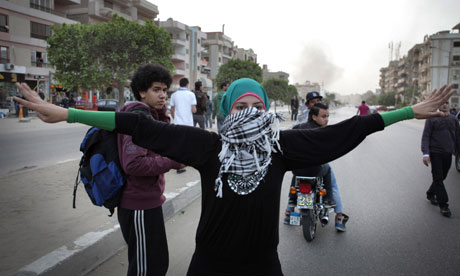
The ambush came from the left, from a side street which led up the hill to Mokattam mosque. A rush of hundreds of men running down on the march of anti-government protesters, bringing a sudden clatter of rocks landing all around, the crack of shots fired and the whizz of tear gas canisters. Sticks, stones and metal bars flew through the smoke in both directions and screaming women and men ran back the way they came. Dozens of manned police vans remained parked a kilometre away. The only sirens came from ambulances that drove through the crowds and past burning vehicles to take some 40 injured people to hospital. One angry woman with a bleeding mouth and eyes streaming from the tear gas pulled off her headscarf and stood yelling at the other side, the supporters of the ruling Muslim Brotherhood: "You are not Islam! You are not Egypt! Where is my freedom?" So go most Fridays in Cairo over the past few weeks as liberal Egyptians have shown their virulent opposition to the president, Mohamed Morsi, as he has awarded himself new powers and pushed through a deeply contentious new constitution. Several buildings of the Muslim Brotherhood, the group behind Morsi, have been burned. In post-Arab spring Egypt the revolution continues. But it's women of all classes who have found themselves most alienated – written out of the jostling for power and subjected to a skyrocketing number of sex assaults, rapes and harassment. Women who stood shoulder to shoulder with men during the 2011 Tahrir Square protests that brought down Hosni Mubarak found their position in society undermined almost immediately. The parliamentary quota for women was removed without debate and a promised female vice-president failed to materialise, amid what political commentator Moushira Khattab called "a radical anti-feminist sentiment". Morsi threatened but stopped short of decriminalising Egypt's practice of female genital mutilation, carried out on almost three-quarters of Egyptian girls, making it clear he would not tackle an issue he called "a family matter". The new constitution has swept away recognition of women's rights and left the door open to the legalisation of perhaps Egypt's most crippling social issue – underage marriage. Draft legislation that would allow the legal age of marriage to be lowered from 18 to 13 has been drawn up while clerics within the Muslim Brotherhood have indicated that marriage at the age of nine for girls is acceptable. "They see women as, number one, objects of sex and, number two, to clean their floors. This is what the Egyptian 'brotherhood' is all about," said Fatma, 24, an engineering graduate marching with her friends, some in burqas, some in headscarves. The women keep close together, arms linked and eyes alert for the men flying down the side of the demonstration on motorcycles grabbing and screaming at females. "They want to marry us at nine years old. Are these really the kind of men we want to run our country? Paedophiles?" Political progress has been slow, with parliamentary elections scheduled for April now postponed with no new date. Frustrations have built. "They are like a pack of dogs, tearing out the weakest first, raping and harassing the women and the girls, getting rid of them, and then fighting among themselves to be pack leader," said Aya Kadry, 62. Around Cairo hundreds of tower blocks are being built, extending the Arab world's largest city leg by leg into the desert. This is where the vast majority of Egypt's women are already living the constrained lives that the educated and middle-classes fear will be imposed by a radical government. Child marriage is common, the norm among the poor. Doctors are bribed to sign documents asserting a 14-year-old is 18 but most people don't have the money so marriages go ahead without registration. Underage girls then have children who, essentially illegal, cannot have their births registered. Without papers those children cannot attend school, encasing a whole new generation in poverty. In the poor district of Ezbet Khairallah 10 women are sitting around a metal cash box, holding the weekly meeting of their savings and loans group. Set up by the charity Plan Egypt, it encourages women to squirrel away a few coins when they can and to discuss problems. "We do not really have time to talk to our neighbours, there is a great burden of things to do in the home and for some of us our husbands do not like us to go out of doors, although we have convinced them we should meet for this social fund because it will help all the family," said Seham Ahmed, 38, who is taking the opportunity to show the group how to make a basic liquid soap. "I was married at 14," she said, thumping a stick round a battered bucket and most of the women around her nod. "Pulled out of school one day and married that night. I hope my daughters can wait a little while but it's quite difficult for girls who are not married at an early age to find a good man later and there is a lot of pressure. And fathers want girls gone because it is one mouth less to feed." Asmaa Mohamed Fawzy is 21. She was engaged but her family allowed her to break it off when her best friend died in childbirth aged 16. "I liked having the ring but I was only 15 and didn't know any better. When Aya died it was a miserable tragedy and I'm very lucky that my mum agreed with me I should not get married. I get teased and bullied. They shout I am not pretty enough, why am I the ugly one, but I do not want to die or to have children who cannot go to school. It is probably too late for me now and I'm sad I won't have children." Her mother, Naghzaky Abdalla, 47, also endures being shunned by her neighbours. "When her friend died I too made up my mind. We only have one so we can afford to protect her. A neighbour had died at 15 of bleeding: the doctors wouldn't treat her because she was married illegally and they don't want to get involved. The girls' bodies are not ready for childbirth and they are not ready for sexual relations which makes their husbands impatient with them. "Three girls in our street stay indoors now for ever because their husbands divorced them. If they cannot prove they were married and they are not virgins then they cannot get married again so they are shunned. Many are divorced because of course these girls are too young to understand what marriage means, she is still a child. In our community, though, a girl should be married before she is 16, maximum." Mrs Gihan, 45, a community activist with strong views, is fervently for the lowering the age of marriage to 13 in law. "We must do this," she said. "Because all the unregistered children who cannot go to school need to be helped. These girls are denied healthcare, their children are denied a future. They have already decreased the legal age of work from 14 to 12 and I think this age too should be lowered. When Mubarak listened to international pressure and raised the age to 18 it changed nothing here. If you decree a legal age then you simply criminalise and marginalise. Men leave their wives before they turn 18 and their children are seen as being born into prostitution. We will raise awareness and stop child marriage this way." The stench of human waste coming from the river in another poor Cairo district, Manial Sheiha, is overpowering. The streets of packed earth are quiet with only children to be seen. Nawal Rashid opens her door but remains on one side of the deep concrete threshold that she cannot cross – or allow visitors to cross – without her 70-year-old husband's permission. He is at work. Her three-year-old son plays behind her and she insists she married at 18 – which makes her 21 now – but her neighbours all say she was 14. "I accepted the older man to help my family as there were four other children and my parents are very poor. I am quite content and happy to have sacrificed myself for my family." Next door is Etab, 19. She has two children and has returned to stay with her despairing mother Nearnat, 42, her ageing father and her three siblings. "We thought by marrying her we would get her a better life," said Nearnat. "Now she is divorced because he was a bad man. She refuses to get married again because then her ex-husband would take the children and now her younger sister is begging me not to go ahead with her marriage. I regret that my daughter was married young because now if she leaves the house her reputation will be ruined. The community all tease me." Outside in the street a group of young men explain why they want to marry young brides. "Children need to have their rights but also you want to marry a girl who is much younger so she will stay young and beautiful when you are old. Also you can control her better and make sure she is not one of these girls who goes around wanting to be harassed," said Abdel Rahman, 17. His friend Youssef, 20, agrees. "There are many girls who just want to be harassed, walking around in the streets with their eyes uncovered." Their views are not a surprise to Mona Hussein Wasef, 26, who works for Plan Egypt in Cairo. "For 18 days we were in Tahrir Square, side by side, men and women, educated and uneducated, rich and poor. Never have I felt so much solidarity. I was Egypt, we were all Egypt, fighting for freedom, shoulder to shoulder," she said. She is too fearful to attend any political demonstrations these days. "Now we have never been so far apart, men and women. In such a short time, such a gulf. Now we are fighting just for the right to walk down the street without being assaulted. It is so hard, so shocking. To see the rights we had being ripped away and lost in the power struggle. To see us go backwards." I WAS SOLD TO A SAUDI MAN – MY FUTURE IS RUINED Rasmia Ahmed Emam was 17 when she was married to a 50-year-old stranger. "My family is a big one so I had to sacrifice to support them. My dad went to a marriage broker to find a rich husband for me and she told us she had a Saudi man. He came and seemed to like me and gave my parents the money to build a roof on our house." But the desperation of poor families combined with the acceptance of child marriage has created opportunities for unscrupulous marriage brokers trading young girls to sex tourists. Rasmia thought she was getting married but in fact she was kept in a hotel room for two weeks before "her husband" went home. "I felt insulted, scared. I had a nervous breakdown. My father went to the broker but we had no proof of the marriage. She offered to marry me again. I refused. All my neighbours knew I was a prostitute, all my friends abandoned me. My future is destroyed. Now three girls in my street have been Saudi wives. All men are liars." The phenomenon is becoming increasingly common in Cairo, says Mohammad Gazer, who has set up a charity, ACT, to warn families. "The taxi drivers bring men from the airport to the brokers. These girls are being traded and trafficked and dumped back home, their lives ruined. "It is becoming clearer and clearer to Saudi men and other tourists that Egypt is the place for child marriage, for ignoring girls' and women's rights. It has got worse since the revolution and keeps getting worse every day."

Mainstreaming Balochistan

The election this time in the troubled province of Balochistan will be especially significant. It may represent the last chance to draw its people back into the mainstream, and persuade them that political solutions to their problems – rather than just militant ones – are still possible; that it is not too late for them. In this context, the decision of Akhtar Mengal’s Balochistan National Party to take part in the polls is of course extremely significant. It represents some hope for the future and may build confidence in Baloch people that it is worth remaining a part of the political process rather than shying away from it entirely. Since his return to the country, Mengal has been playing an active role, meeting leaders of various parties, as well as the caretaker chief minister of Balochistan Nawab Ghous Bakhsh Barozai, who has warmly welcomed his decision to take part in the polls. The significance being given to involving Baloch parties in the process is illustrated by the chief election commissioner’s trip to Quetta to meet the heads of key parties and reassure them that any concerns they have would be addressed. The National Party (NP), Balochistan National Party (BNP), Pakhtunkhwa Milli Awami Party (PkMAP), Balochistan National Party-Awami, Pakistan Muslim League-N (PML-N), Pakistan Muslim League-Q (PML-Q), Jamiat Ulema-e-Islam-Fazl (JUI-F), JUI-N, Hazara Democratic Party (HDP) and Jamaat-e-Islami (JI) all took part in the discussion with Justice (r) Fakhruddin G Ebrahim, again signalling a welcome sense of unity. These parties will now need to cooperate with the ECP and local authorities to ensure elections can go ahead peacefully in the province. There have been fears expressed over whether polling is possible in Balochistan at all given the degree of violence there. This remains a very valid concern. It was also raised by the CEC in his meeting with the CM, who assured him that troops would be deployed to ensure balloting could go ahead without violence. We must hope these measures succeed. The dangers in Balochistan are many. But with the major parties now on board, we can only hope that they too will do their best to work for peace and persuade people how necessary it is to ensure it is maintained at all costs. In many ways the 2013 polls and the results they produce will be essential to Balochistan’s future. How the next provincial government handles matters could determine many things. It is, therefore, essential that the process go ahead as smoothly as possible, with maximum participation by political parties and people of the troubled province. The efforts being made for this should then be welcomed. We hope and pray they succeed.

Amidst the blue waters of Israel

Aggressive talk from North Korea concerns U.S. leaders

By Ernesto Londoño and Karen DeYoung
The latest round of threats exchanged by North Korea and the United States is dragging on longer and taking on a more virulent tone than in the past, provoking deep concerns among American officials and their allies. Following blustery warnings by Kim Jong Un, North Korea’s 30-year-old leader, and videos depicting North Korean attacks on the United States, the Obama administration took the unprecedented step this week of sending two stealth bombers to South Korea as part of an ongoing military training exercise. But despite the escalating tensions, U.S. officials said they have focused more closely on what North Korea is doing than on what it is saying. “Putting on a show is not the same as taking action,” said a senior administration official, who spoke on the condition of anonymity to discuss the volatile situation. “Describing the situation as akin to war is not to be remotely confused with wanting a war, let alone going to war.” The senior official and others said that U.S. military commanders are closely watching the situation, which has escalated since North Korea conducted a nuclear weapons test in December. In addition, officials cited new levels of cooperation and mutual confidence between the United States and allies in South Korea and Japan. While a direct attack on U.S. forces on the mainland or in the Pacific seems unlikely, nongovernment analysts said the rising tensions increase the risk of some form of limited armed conflict. North Korea recently cut off its military phone line with the South, which is used to coordinate logistics along the demilitarized border buffer. In a new escalation of rhetoric early Saturday, North Korea’s official KCNA news agency reported that the country was entering a “state of war” with South Korea and that “all issues raised between the North and the South will be handled accordingly.” Some experts noted that South Korea also has adopted a more aggressive rhetorical posture. Senior officials quoted anonymously in the media have suggested that plans have been drawn up for “surgical strikes” against North Korea. “The level and scope of the rhetoric [in North Korea] is stronger than in the past,” said Scott A. Snyder, a Korea expert at the Council on Foreign Relations. “This time we’ve seen a higher level of threat, delivered at a higher level.” He added, “There’s room for miscalculation right now.” Earlier this month, the Pentagon announced it was significantly bolstering America’s missile defense capabilities on the West Coast. Secretary of Defense Chuck Hagel said Thursday that the United States has no option but to take Pyongyang’s threats seriously. But the decision to include B-2 bombers flown from Missouri in the military exercise with South Korea was made some time ago, the senior official said, adding that U.S. “strategic air assets” would be a part of the annual exercise “from this point forward.” “It’s not something that just came up last week” in response to Kim’s verbal and video threats, the official said. “But it is certainly the case that following North Korea’s decision in December to conduct a nuclear test . . . both the United States and our allies recognized the need to ensure that there were consequences and that our deterrence was visible.” Christopher R. Hill, a former U.S. diplomat who served as ambassador in Seoul in 2004 and later led a negotiating team that sought to eliminate the North Korean nuclear threat, said the current standoff appears “more serious” than past ones. It also comes as the North appears to be attempting to bolster Kim’s military credentials. The doughy, boyish-looking Kim has been an enigma since he took the helm of the country in December 2011 after his father’s death. The country’s leaders have taken great pains in recent months to bill the world’s youngest head of state as a capable commander in chief, granting him additional titles and medals. “The explanation could be that this is linked to trying to give this third-generation camp a little more of a profile,” Hill said. “I don’t think he has really connected with the North Korean people. They could be looking to show he’s a tough guy.” The senior official agreed that Kim’s style is sharply different from his father’s, “including putting himself out in front of the cameras. He’s got a sort of assertive, outgoing and more egocentric character. His father was very reclusive and preferred to shove other people out into the limelight.” But “fundamentally, the patter is eerily the same,” the official said. “It’s a very familiar North Korean playbook that some of us who have worked on North Korea have seen repeatedly. Right around now, during the winter training cycle, the leadership injects a huge dose of urgency. . . to mobilize the population. It’s invariably a counterpoint to the U.S.-South Korean exercises.” Behind the sudden decision to strengthen mainland American defenses against North Korean missiles is a fear that Pyongyang’s biggest benefactor, China, may no longer be able to act as a guarantor of baseline stability on the Korean Peninsula. In the past month, North Korea has ignored Chinese warnings by threatening a nuclear strike on the United States and renouncing the 60-year armistice with South Korea. The rhetorical escalation followed advances in missile technology and a nuclear weapons test that China had opposed. North Korea also appears to be paying less heed to the possibility of South Korean or U.S. retaliation for any provocation. Top military officials said North Korea probably can’t make good on its most extreme threats but suggested that the old rubric of deterrence might be crumbling. Deterrence involves both prevention and punishment, Adm. James Winnefeld, vice chairman of the Joint Chiefs of Staff, said when the Pentagon announced the new missile defense plans. “We believe that this young lad ought to be deterred,” Winnefeld said, referring to Kim. “And if he’s not, we’ll be ready.”

ولسمشر حامد کرزي قطر ته سفر وکړ

http://www.mashaalradio.org
ولسمشرکرزی د یوه لوړ رتبه پلاوي په مشرۍ د شنبې په ورځ د قطر پایتخت دوحې ته روان شو. د افغان چارواکو په باور د دوه اړخیزو اړیکو پراختیا، پانګه اچوونه او سوداګري او په قطر کې وسله والو طالبانو ته د دفتر د پرانستلو په اړه خبرې دوحې ته د ولسمشر کرزي د سفر اصلي اجنډا جوړوي. د ولسمشر کرزي د ویاند مرستیال "فایق واحدي" د شنبې په ورځ قطرته د جمهور رییس کرزي له روانیدو وروسته مشال راډیو ته وویل چې؛ ښاغلی کرزی به د قطر له امیر او نورو قطري چارواکو سره پر بیلا بیلو سیاسي، اقتصادي او داسې نورو مسایلو خبرې وکړي. ښاغلي واحدي څرګنده کړه چې، په افغانستان کې د سولې روانې هلې ځلې او په دوحې کې وسله والو طالبانو ته د دفتر پرانستل له قطري چارواکو سره د ولسمشر کرزي د خبرو اصلي ټکي دي: ټاکل شوې ده، د دې سفر په ترڅ کې د سولې پروسې پر بیلا بیلو اړخونو خبرې وشي؛ په دې ترڅ کې به د وسله والو مخالفانو لپاره په دوحې کې د دفتر د پرانستلو په هکله هم له قطري چارواکو سره خبرې وشي. موږ هیله من یو چې، د دواړو خواوو ترمنځ د علاقې وړ مسایلو په هکله ښه پرمختګونه ولرو." ولسمشرکرزی دوحې ته د قطر د امیر په بلنه دا دوه ورځنی سفر ته ترسره کوي. په دې سفر کې له ولسمشر سره د بهرنیو چارو وزیر ډاکټر زلمی رسول، د ملي امنیت سلاکار ډاکټر رنګین دادفر سپنتا، د سولې د عالي شورا رییس او د دارالانشا رییس یې صلاح الدین رباني او انجنیر محمد معصوم ستانکزی ملګري دي. افغان حکومت هڅه کوي چې، د سولې د خبرو آترو لپاره په قطرکې د طالبانو لپاره دفتر پرانستل شي. ولسمشرکرزي تل ټینګار کړی چې، د سولې هرډول خبرې اترې باید د سولې له عالي شورا سره د افغانستان په مشرۍ او مالکیت ترسره شي. خو یوشمېر سیاسي څیړونکي وایي چې؛ ګمان نه کیږي ولسمشر کرزی قطرته له دې سفرڅخه هغه څه ترلاسه کړي چې دی یې غواړي. د سیاسي چارو څیړونکي وحید مژده آزادي راډیو ته وویل چې؛ وسله وال طالبان به هیڅکله په قطر کې له افغان حکومت سره خبرو آترو ته غاړه کې نږدي: "که د ولسمشر کرزي هدف دا وي چې، په قطر کې طالبانو ته کوم دفتر پرانستل شي او هغوی باید افغان حکومت او د سولې له عالي شورا سره خبرې وکړي، طالبان هیڅکله دا خبره نه مني. زما په باور که چیرې دا سفر د همدې هدف لپاره وي؛ نو بې نتیجې به پای ته ورسیږي. د طالبانو غوښتنه دا ده چې بهرنیان باید له افغانستان څخه د خپلو سرتیرو د وتلو نیټه اعلان کړي او په بشپړ ډول له دې هیواد څخه ولاړشي." وسله والو طالبانو تردې وړاندې په وار وار ویلي چې؛ له افغان حکومت سره د سولې خبرې اترې نه کوي، دوی وایي چې، سولې ته به هغه وخت تیار شي چې؛ بهرني ځواکونه یومخ له افغانستان څخه ووځي. وسله والو طالبانو دا شرایط په داسې حال کې وړاندې کړي چې د افغانستان او متحده ایالاتو ترمنځ ستراتیژیکې اړیکې ټینګې شوي او د دواړو هیوادونو ترمنځ د امنیتي سند په اړه هم خبرې اترې روانې دي. افغان حکومت تردې وړاندې تل ټینګار کړی چې؛ پاکستان کولای شي، طالبان له افغان حکومت سره خبرو اترو ته را مات کړي، خو په عین حال کې دا یې هم ویلي چې، اسلام آباد تراوسه په دې برخه کې هیڅ ډول عملي او صادقانه اقدامات نه دي کړي. افغان چارواکو په خپلو تازه څرګندونوکې ویلي چې؛ له دې وروسته د پاکستان له همکارۍ پرته د سولې هڅې پرمخ بیایي. څیړونکي وایي چې، قطرته د ولسمشرکرزي سفر هم همدا څرګندوي چې؛ ښایي افغانستان د اسلام آباد له همکاریو نا هیلې شوی وي او اوس په دې هڅه کې دی چې د قطر په څیر له نورو هیوادونو څخه په دې برخه کې مرسته او همکاري وغواړي.

US commandos hand over troubled area to Afghans

U.S. special operations forces handed over their base in a strategic district of eastern Afghanistan to local Afghan special forces on Saturday, senior U.S. commanders said. The withdrawal satisfies a demand by Afghan President Hamid Karzai that U.S. forces leave the area after allegations that the Americans' Afghan counterparts committed human rights abuses there on U.S. orders. The transfer of authority ends a particularly rocky episode in the strained relations between the U.S. and Karzai. He had insisted that U.S. forces leave Nirkh district in Wardak province over the alleged torture, kidnapping and summary execution of militant suspects there — charges U.S. officials firmly denied. The incident shows the larger struggle of Karzai's government to assert its authority over security matters, even as its green security forces try to assume control of much of the country from coalition forces on a rushed timeline, ahead of the scheduled withdrawal of most of coalition forces by December 2014. "As we pledged, our forces have transitioned Nirkh district to Afghan national security forces and they have now assumed full responsibility for security in this key district," Gen. Joseph Dunford, the top commander of U.S. and NATO forces in Afghanistan, said in a statement released Saturday. "The rest of Wardak will continue to transition over time as Afghan forces continue to grow in capability and capacity," he added. Maj. Gen. Tony Thomas, the top U.S. special operations commander in Afghanistan, told The Associated Press in an interview that the transition of authority took place Saturday. "What it means is we brought in an Afghan special forces team to take the place of ours," Thomas said. Attaullah Khogyani, spokesman for the governor of Wardak province outside Kabul, confirmed that U.S. special operations forces withdrew and were replaced by a joint Afghan security forces team. Karzai had originally demanded the U.S. special operations forces pull out from the entire province, a gateway and staging area for Taliban and other militants for attacks on the capital Kabul. But he scaled down his demands to just the single district after negotiations with Dunford and other U.S. officials. "President Karzai was specific, it's only for Nirkh, that was a provocative point," Thomas said. "American special operations forces are integral in the defense of Wardak from now until the foreseeable future." U.S. commandos will also continue to visit the Afghan team in Nirkh. "We're going to support them from a distance," Thomas said. "The reality is there was such a groundswell of support (from locals) in Wardak after the initial allegations that we're keeping several teams down there to work with the Afghan security forces for the future, with an idea that we'll transition over time." The American special operations troops are paired with and live alongside locally recruited and trained teams known as Afghan local police. Thomas said most of the local police will be paired with Afghan security forces by the end of the summer, with the Americans making occasional visits as they will do in Nirkh, to assess whether they need logistic or other support. One Wardak government official expressed relief that the agreement crafted with Karzai did not mean the complete pullout of U.S. forces from the province, saying that local officials were worried their new forces would not yet be able to keep hardcore insurgents out of the area. The official spoke on condition of anonymity because his comments run counter to public statements made by Karzai that the Afghan security forces are ready for complete independence in Wardak. Meanwhile, Taliban militants attacked a police convoy Saturday morning in Ghazni province in eastern Afghanistan, kicking off a fierce gunbattle, according to deputy provincial police chief Col. Mohammad Hussain. The police requested a coalition air strike, which hit the militants' position and killed 15 fighters but also wounded nine civilians including a woman and child, Hussain said. He did not report any police casualties.

President Obama's Weekly Address

Armed men attack Karachi school

Pakistan: Human Development Report 2013

United Nations Development Programme launched by country director Marc-Andre Franche in Islamabad highlighted four major global trends. First, developing economies particularly India, China and Brazil have transformed themselves as emerging economies that accounts for their growing geopolitical influence; and, the South, as opposed to the North is driving global economic growth. The report forecasts that by 2020 China, India and Brazil's combined output in 1990 purchasing power parity dollars will surpass United States, Germany, the United Kingdom, France Italy and Canada's combined output. In this context the current membership of international bodies including the United Nations Security Council and the citizenship of heads of multilaterals like the World Bank and the Asian Development Bank, etc, need a revisit. Secondly the dynamism of the emerging economies is fuelled by trade and foreign direct investment and technology partnerships within the South or, in other words, the South is no longer clamouring for technology transfer as a condition to achieve development with a doubling of its share of world merchandise trade - from 25 percent to 47 percent. Thirdly the middle class in the South is growing rapidly and there are demands for greater consumer items which would expand the fiscal space and enable the state to invest more on education. And finally a negative namely that income inequality remains an issue and cancels some of the progress achieved in curbing health and education inequality. There is no doubt that Pakistan, firmly in the South, remains on the outside of these major developments other than in witnessing rising poverty levels in recent years. The reasons for this are varied including the failure to support economic policies that would have transformed the country from a developing to an emerging economy. Our politicians are at present in the election mode and their manifestoes focused on eliminating corruption as a major strategy to plug leakages which, so is the argument, would improve governance across several critical sectors particularly the energy sector as well as reduce the burgeoning budget deficits; however ignored is the need to implement reforms on an urgent basis if we are to transform ourselves into an emerging economy. It is critical for Pakistan to note that the three emerging economies are no longer eligible for concessional credit from international donors - credit whose amount for each country is linked to performance. Pakistan has been subjected to decreasing amounts of concessional credit due to poor performance especially with respect to governance. And growth in trade of the emerging economies is not through getting a special status that is allowed only to the Heavily Indebted Poor Countries but through transforming their industrial sectors and thereby enabling them to effectively compete globally. In Pakistan the mantra of 'we want trade and not aid' remains with a focus on getting special exemptions from tariffs which are extended at a price which in recent years has implied remaining engaged in the war on terror with its consequent human as well as financial costs. Pakistan needs to undertake massive reforms in the tax structure and ensure that taxes are not only equitable (with all paying the same tax on their incomes irrespective of the source of their income), fair (ending the issuance of statutory regulatory orders which have been and continue to be abused) and non-anomalous (with no special tax privileges extended to any entity whatever its credentials). There is also a need to encourage market based policies that would allow some of our industrial units to die while others that are more competitive would not only be able to effectively capture the domestic market but also compete internationally. But before such policy changes are identified and implemented there is a need to implement power sector reforms, end untargeted subsidies, withdraw patronage towards all those state and private entities that do not clear their monthly bills, meticulously adhere to public procurement rules and regulations and last but not least begin civil service reforms that would take away the incentive to bow to political pressure or indeed to accept bribes. The scale of reforms required is massive and the sooner they start the quicker will the country be able to approach the label of an emerging economy.

Balochistan candidates, voters receiving serious threats from BLA

http://www.brecorder.com
The banned Baloch Liberation Army (BLA) is out to sabotage the forthcoming general elections and in this regard it has accelerated the practice of sending threatening letters to candidates and offices of political parties. Besides that, reports emerging from Balochistan revealed that the candidates and voters were also receiving threats of being target-killed. Despite assurances from the Chief Election Commissioner (CEC) Justice (R) Fakhruddin G Ebrahim, the political parties in Balochistan have demanded deployment of security forces one month prior to the Election Day. Eight Baloch majority districts in Balochistan have been declared extremely sensitive for the forthcoming general elections. However, activities of the banned outfits are also continuing in other parts of Balochistan. Areas from Mastung to Gawadar including Khuzdar, Awaran, Kalat, Turbat, Chagai and Kharan are among the areas which have been declared most sensitive. National Party leader Mir Hasil Khan Bazinjo has confirmed that the BLA has not only sent threatening letters to the residences of the contesting candidates, but also sent threatening pamphlets to mosques. They have threatened to target the candidates and voters taking part in the elections. He has demanded of the CEC to deploy security forces one month earlier to the election day in Balochistan.

Pak-Afghan must not derail

Once a contractor for the US Central Intelligence Agency (CIA)--now a princely President of Afghanistan-- Hamid Karzai continuously vomits out venom against Pakistan-a country he often described as ‘inseparable twin brother’. His actual authority outside Kabul is said to be so limited that he is often derided as the ‘Mayor of Kabul’. Amidst growing frustration and discontent over failing to reforms outside of the region under the influence of various local leaders around Kabul, President Karzai and his administration, in a bid to salvage their tarnished image, unleashed a Pakistan-bashing campaign. In fact, he had sown seeds of hatred against Pakistan amongst the Afghan people. Karzai’ journey to Kabul Palace from the US hotel studded and punctuated with betrayals starting from the killing of the friends and foes alike in the Palace. Having been surrounded by accusations of nepotism, widespread corruption, electoral fraud, and the alleged involvement of his late half brother Ahmed Wali Karzai in the drug trade, President Karzai, in fact, is fast losing his hold on Afghan affairs, particularly his role in the US-led peace process initiated to establish a durable peace in the country before the pullout of the US and NATO troops by the 2014-end. The entire world including the UN believes and sees regional power Pakistan as critical to stabilizing Afghanistan. The Karzai Administration, once heavily dependent on Pakistan, has initiated a blame-game against Islamabad. The fact of the matter is; the Karzai-led Administration has not been cooperating with Pakistan in repatriating the members of the TTP given safe havens in Afghanistan-an act that has created multiple problems for Pakistan. The Foreign Office on Thursday expressed concern over continued presence of safe havens of Tehrik-e-Taliban Pakistan (TTP) in Kunar and Nooristan areas of Afghanistan from where these elements are carrying out undesirable activities against Pakistan. Yet Pakistan, in the larger interest of regional peace, has extended its support to the Afghan peace process; releasing all high profile Afghan Taliban-a gesture never been reciprocated by the Karzai Administration resulting thereby Pakistan is continuously facing massive loss of men and material. To be exact, over 49000 people have lost their lives in terrorist attacks. The causalities in Pakistan have out-numbered the loss of life in the Afghan war on terror. Notwithstanding, the loss Pakistan has to withstand in the war against Soviet Union in Afghanistan. In return, President Karzai, having attained a lifestyle of Mughal King, is sending a rude shock from across the Durand Line over Pakistan’s ‘complacency’ in the nascent Afghan peace process and is ready to work without Islamabad’s help on reconciliation. Kabul’s Deputy Foreign Minister goes on to say ‘We here in Kabul are in a bit of a state of shock at once again being confronted by the depth of Pakistan’s complacency, we are just very disappointed.’ Even the Kabul government has cancelled visit of its army officers to Pakistan. The fallout in Pakistan-Afghanistan relations is ill-affordable for the durable peace in the region. Beyond any doubt, the stability in Afghanistan is interlinked with the peace in Pakistan thus two states must not forget-the solution to Afghan instability needs a joint effort to wipe out terrorists operating on the both sides of the border. None of the two can capitalize on instability in either side. President Karzai, however, must understand that leaders of Afghan Taliban if at all are reluctant to talk to the government it is just because he has been installed by the foreign forces to serve their interests rather than serving the people of Afghanistan. Secondly, Taliban are aware that the peace process is aimed at giving a new lease of life to corrupt presidency. Taliban are sovereign sons of the Afghan soil do understand the ground realities, hardly need any foreign dictation, thus their continued reluctance to stay away from the government has nothing to do with Pakistan. President Karzai, having enjoyed his two terms in heavily guarded office, is no more acceptable. Thus instead pouring out venom against Pakistan, President Karzai should concentrate on the political affairs of his country the way he wants. Better if he understands the strategic importance of Pakistan thus should pursue the follow-up of the London talks. Best way to remove the concerns of the two countries is to communicate through every possible channel rather than slamming the door on each other.

The Return of the General: Why is Musharraf Running for Office in Pakistan?

Pakistan’s former military ruler Pervez Musharraf had a rough day in court on Friday, having a shoe hurled at him as he was forced to appear in two murder cases to plead for bail. He secured bail, but was barred from leaving the country. The ignominy added to the retired general’s troubles since he arrived back in Pakistan last week, ending four years in exile in Dubai and London, to make another bid for power at the elections in May. Ahead of his return, the Pakistani Taliban threatened to send a death squad to kill him. Once he landed at Karachi airport, fewer than two thousand people were there to greet him in what was billed his great homecoming. Musharraf heralded his day in court with a tweet, with a blurred picture of him hastening past the phone camera. The pensioned dictator has memorably claimed in interviews that his social media following demonstrates his popularity in Pakistan. His Facebook page has 825,000 likes. “Leaving to appear in court today,” he said, in the first time a former dictator has live-tweeted an audience with a judge. The Twitter account shows the former commando in action, training at the gym (“Feel very energized”), tasting Pakistani food (“The best cuisine in the world”), posing with a dwindled crowd of fans, and showing off his farouche-looking armed bodyguard (“Taliban threat? NOT ON MY WATCH!!!”). As a barrel-chested Musharraf strode into court, with flashing cameras retreating in front of him, a shoe zipped over their heads. The assailant was a lawyer, a familiar type of opponent. In 2007, during his last year in power, Musharraf sacked Pakistan’s Chief Justice Iftikhar Chaudhry twice, sparking a lawyer-led movement that ultimately saw him resign as President of Pakistan the following year. Like most shoe hurlers, the lawyer, Tajamal Lodhi, was a terrible shot and missed his target by some distance. Local news channels gleefully played the footage several times. They, too, have a gripe with Musharraf: he shut down a number of independent news channels when he imposed a state of emergency in 2007.Lodhi, the lawyer, was released without charge. Musharraf, however, didn’t get off as easily. He managed to secure bail in the three cases he’s charged with involvement in: the assassination of Benazir Bhutto, the death of Baloch leader Akbar Bugti, and a case about his sacking of several judges in 2007. Musharraf’s troubled history with Pakistan’s judiciary made this a delicate moment. It was also the first time that a former Pakistani military ruler was appearing in court. In his tweets, Musharraf struck a deferential tone, referring to the judges as “honorable”. But the Sindh High Court also ruled that Musharraf would not be allowed to leave the country without their permission, placing his name on an “exit control list.” Over the next month, as campaigning for Pakistan’s general election in May gets underway, Musharraf will be forced to appear at courts in different parts of the country to extend his bail. It is unlikely, however, that he will end up convicted of his involvement in either the Bhutto or Bugti assassinations. He is widely accused of failing to give Bhutto adequate security, including in a high-profile U.N. inquiry. In Bugti’s case, Musharraf notoriously remarked on television that he would “hit him from where he wouldn’t see it coming.” But the courts would need more evidence to establish culpability. ” “You would have to demonstrate liability in very direct terms,” says Feisal Naqvi, a leading Pakistani lawyer. “It would be very hard to prove this in court.” Musharraf still manages to attract considerable attention in Pakistan. Many news channels broadcast his press conference live from the luxury hotel in Karachi where he is ensconced. The familiar bluff rhetoric was on display, with Musharraf controversially saying that Kargil – a military adventure he led as army chief in 1999 – was a success. But few believe that he will make a political impact. “Despite a very poor performance by the democratic government, people are not going to choose a former military ruler,” says retired Lieut. Gen. Talat Masood, who was once close to Musharraf.After having ruled Pakistan for nine years, it is difficult to establish why Musharraf wants be involved in politics again. Some ascribe the decision to his vanity. “He’s fantasizing,” says Masood, the retired general. “He has highly-exaggerated ideas about himself. He’s out of touch with reality. He certainly has a grand vision, but it’s about himself rather than the country.” The forthcoming elections have drawn a strange cast of characters, all vying for political power. At one point, AQ Khan, the notorious nuclear proliferator who has also established a political party, was thinking about fighting elections but dropped out yesterday. His election symbol was going to be a missile. Beyond the trouble with the courts, Musharraf will also have a hard time campaigning. “This is why he won’t make an impact,” says Imran Khan, the former cricket legend turned politician who was imprisoned by Musharraf briefly in 2007. “We’ve not invented any way to deal with the suicide bomber. The only way to avoid one is to stay at home.” It’s a big risk to take for what looks to be a very small reward. Musharraf insists that he will hit the campaign trail, and is tipped to possibly win a couple parliamentary seats, one in Karachi and one in Chitral. And if current opinion polls hold through the election, Musharraf would be reduced to sitting as a lonely member in a parliament headed by Nawaz Sharif, the former Prime Minister he ousted in the 1999 coup that brought him to power.

In Pakistan Underworld, a Cop Is Said to Be a King

A corrupt, low-level cop with a healthy dose of street smarts rises to control hundreds of illegal gambling dens in Pakistan's largest city. By doling out millions of dollars in illicit proceeds, he protects his empire and becomes one of the most powerful people in Karachi. The allegations against Mohammed Waseem Ahmed — or Waseem "Beater" as he is more commonly known — emerged recently from surprise testimony by a top police commander before a crusading anti-crime Supreme Court judge. The story has given a rare and colorful glimpse into the vast underworld in Karachi, a chaotic metropolis of 18 million people on Pakistan's southern coast. The sprawling city has become notorious for violence, from gangland-style killings and kidnappings to militant bombings and sectarian slayings. Further worrying authorities have been signs that the Pakistani Taliban are using the chaos to gain a greater foothold in the city. For months, the Supreme Court's Chief Justice Iftikhar Chaudhry has been leading special hearings on Karachi's crime, berating the city's top police officers for failing to act. This past week, he demanded they move in to clean up so-called "no-go" areas — entire neighborhoods where police fear to tread — according to local press reports. Further fueling the problem is rampant police corruption, undermining efforts to combat the city's violent gangs and extremists. Among the public, the police nationwide are seen as the country's most crooked public sector organization, a high bar given claims of pervasive corruption throughout the government. The allegations surrounding Ahmed further fuel questions about the overlap between Karachi's underworld and its police forces. After the testimony to the Supreme Court earlier this year, police officials in Karachi provided The Associated Press with additional details over his reported rise. The AP made repeated attempts to contact Ahmed, who has been removed from the force and fled to Dubai, but was not successful. Ahmed came from a poor family in Karachi's old city and joined the police force in the 1990s. He soon started working as a "beater," a low-level thug who works for more senior cops to collect a cut from illegal activities in their area, such as gambling, prostitution and drug dealing, said half a dozen police officers who knew him personally at the time. They all spoke on condition of anonymity for fear of retribution. Ahmed, who sports a bushy black mustache and usually dresses in a simple, white shalwar kameez, earned a reputation for carrying out his illicit work efficiently, said two police officers who have known him ever since he joined the force. That reputation helped him forge relationships with more senior figures, and eventually he was collecting money for some of the top police officers and civilian security officials in Karachi, they said. The heavyset 40-year-old also attracted the attention of a local boss who controlled the largest concentration of illegal gambling dens in Karachi, located in the city's rough and tumble Ghas Mandi area, where Ahmed worked, said the policemen and a local journalist. The two teamed up to expand their gambling empire to other parts of Karachi and surrounding Sindh province.Gambling was not always illegal in Pakistan, a nation of 180 million people that gained independence from Britain in 1947 as a sanctuary for Muslims who did not believe they could thrive as part of what is now India, a majority Hindu state. Despite the religious undertones of Pakistan's founding, the country's major cities, such as Karachi and Lahore, were relatively liberal places in the first few decades after independence. Alcohol flowed freely in nightclubs filled with dancing girls. But in 1977, Prime Minister Zulfikar Ali Bhutto banned gambling and alcohol for Muslims in an attempt to appease Islamic hard-liners. Drinking and gambling, which are forbidden in Islam, didn't stop, but much of it was driven underground. The gambling dens in Ghas Mandi are hidden behind nondescript facades down dark alleyways with tangled electrical wires hanging overhead in one of the oldest and densest populated parts of Karachi. In one den, a dozen men dressed in shalwar kameez sat in a semicircle on the floor playing a local card game, mang patta, beneath bare bulbs hanging from the ceiling. The men sipped tea and tossed 100 rupee ($1) poker chips at the dealer. In an adjacent room, a handful of men played chakka, a game that involved guessing the numbers that would appear when the dealer rolled three dice out of what looked like an old leather Yahtzee cup. Rupee notes were placed on a table as bets and held in place by a large metal washer. Everyone stopped their games when the Muslim call to prayer came over a loudspeaker from a nearby mosque — and they promptly resumed the dice and cards once the prayer ended. Ahmed earned tens of thousands of dollars each day from hundreds of such gambling dens, said the policemen and journalist who knew him. He also collected extortion money from drug dealers and brothels and smuggled diesel fuel into Karachi from neighboring Iran, where it is much cheaper, they said. He distributed cash to senior officials, and the pay-outs made him one of the most powerful people in Karachi's police force, said his acquaintances. He won significant influence over who was posted to senior positions, thus providing him with protection, they said. Known as a man of few words who rarely loses his cool, Ahmed also handed out money to Karachi's powerful criminal gangs and traveled with roughly a dozen armed guards as an insurance policy. He was sailing smoothly through the underworld until one of the Supreme Court sessions in January. A petitioner outlined to the court allegations of Ahmed's illicit activities and his power in the police force. Chief Justice Chaudhry then asked senior police officers and civilian officials who were present about the allegations. They all expressed ignorance. But Deputy Inspector General Bashir Memon spoke up and backed the petitioner's claims. "I said yes, Waseem 'Beater' is present among the ranks of the Karachi police. He controls the gambling business in Karachi," Memon told The Associated Press. "I also confirmed that he is involved in the transfer and posting of junior and senior police officers." Another senior police officer in Sindh province, Sanaullah Abbasi, also testified that he knew Ahmed and that he controlled gambling dens in Karachi. Chaudhry lambasted the senior officials for not going after Ahmed and asked Memon whether he was concerned about contradicting his colleagues. "I replied, 'I only told you the truth,'" Memon told the AP.As a sign of Ahmed's power, Memon said he was told the same day he would be transferred out of Karachi, but the Supreme Court canceled the transfer order. Ahmed was dismissed from the police force after the Supreme Court hearing, according to two senior police officers, and government records indicate he flew to Dubai and has not returned. Hassan Abbas, an expert on the Pakistani police at the New York-based Asia Society, said Ahmed's case provides a stark illustration of the level of corruption in the Karachi police force, which he described as the worst in any of Pakistan's major cities. Criminal cases are currently pending against 400 police officers serving in Karachi, said Abbas. Civilian officials, who also benefit from corruption, have shown no willingness to reform the system, making the force relatively ineffective in cracking down on criminal gangs and Islamist militants in the city, said Abbas. "The chaos in Karachi provides criminal gangs with the cover they need to operate," said Abbas. "Corruption provides an incentive to continue that chaos."

Friday, March 29, 2013

Billy Joel - We Didn't Start The Fire

Abrar ul Haq - - Billo on GT Road

Pyongyang Declares ‘State of War’ with South Korea - Agency

North Korea has declared that it entered a “state of war” with South Korea, saying that all issues between the neighboring countries will be handled in accordance with a wartime protocol, Reuters reported on Saturday citing North's official KCNA news agency. “From this time on, the North-South relations will be entering the state of war and all issues raised between the North and the South will be handled accordingly,” the agency said citing a statement carried by KCNA. AFP reported on Saturday citing the same statement on KCNA that “The long-standing situation of the Korean peninsula being neither at peace nor at war is finally over.” North and South Korea remain technically at war, since no peace treaty was signed following the Korean War in 1953. The Demilitarized Zone between the countries is the most heavily armed border in the world. On March 11, South Korea and the United States began annual large-scale military exercises, codenamed Key Resolve. The drills involve 10,000 South Korean and 3,500 US troops. Prior to the exercises, Pyongyang threatened the United States with a preemptive nuclear strike amid warnings that it plans to terminate the Korean War Armistice Agreement. It warned of retaliatory countermeasures if the United States and South Korea went ahead with the drills. The United States on Thursday dispatched two nuclear-capable B-2 stealth bombers on an “extended deterrence” practice run over South Korea. US officials said the exercise should serve “to demonstrate very clearly the resolve of the United States to deter against aggression on the Korean Peninsula.” North Korea responded on Friday by placing its strategic rocket forces on standby to strike US and South Korean targets.

Putin Signs Decree to Reinstate Hero of Labor Award

Russian President Vladimir Putin issued a decree on Friday night ordering to reinstate a Soviet-era award and call it Hero of Labor of the Russian Federation. “To establish the title of the Hero of Labor of the Russian Federation for awarding it citizens of Russia for outstanding labor achievements on behalf of the country and people, connected with attainments of exceptional results in the state, public and economic activities, aimed at providing wealth and prosperity of Russia,” the decree said. Earlier on Friday, Putin said at a meeting with staffers of the All-Russia People’s Front, who successfully campaigned for his re-election for a third term, that the award of the ‘Hero of Socialist Labor’ in the Soviet Union “was justified.” The award, established under the rule of Josef Stalin, was widely used to praise civilian workers for their labor achievements and to boost output. The initiative to resurrect the title was voiced during a previous meeting of the People's Front with Putin in December.

Pakistan: The military versus the TTP

Daily Times
The tribal areas of Pakistan are a war zone since many years and there does not seem to be any let-up in the relentless spree of killings. Amongst different militias formed under one pretext or the other (such as aiding the war in Afghanistan) the battle is waged for domination of turf or the suppression of an opposing force. Drones are employed by the US to eradicate militancy in the area, and collateral damage is used as one of the justifications by local people to unleash terror on other areas of Pakistan, resulting in almost 49,000 security personnel and civilian deaths since 2008. As the ‘insurgency’ takes on more vehemence, the military steps in, and then a new round of battle comes into play. As the military, aided by one group or the other takes on the enemy — the Tehrik-e-Taliban Pakistan (TTP) — the operation becomes controversial to some, as has been brought to light by the submission of the latest report of the intelligence agencies in the Supreme Court. The report highlights the role of the TTP and the ‘recent nexus of Tehreek-e-Taliban Swat (TTS) with the Afghanistan government’, which would be conducive to the acceleration of terror activities in Mohmand and Bajaur Agencies, Dir, Swat and Chitral. The report was called for in the hearing of a petition by a Jamaat-e-Islami leader against Action (in Aid of Civil Power) Regulation, 2011. The petion is being heard by a three-member bench headed by Chief Justice Iftikhar Mohammad Chaudhry. That the TTP has reared its ugly head to perpetuate non-stop violence in FATA, especially in the Tirah valley lately, Quetta, Karachi, Peshawar and in different parts of Pakistan, is a sign that it is working in collusion with other likeminded groups like the Lashkar-e-Jhangvi (LeJ). It does not require any rocket science to gather this, and the section of the security agencies' report about this merely highlights what is common knowledge by now. The report’s shifting of blame onto the Afghan government for being in cahoots with the TTP to wreak havoc in Pakistan as a retaliatory measure against the agencies’ ‘tacit’ assistance to the Taliban in Afghanistan does not hold any weight as there is nothing to substantiate that claim keeping in view Pakistan’s own proxies in action in the area. One being the infamous Maulana ‘FM Radio’ Fazlullah, who after being chased out of Swat by the military found safe haven in the eastern provinces of Afghanistan bordering FATA, enabling him to indulge in his anti-Pakistan activities by spreading a message of violence to establish the writ of his own version of Islam. Both Pakistan and Afghanistan have to be careful not to fall into the trap laid by the militants to bring them into conflict along their porous border by sowing confusion about who is attacking who. The more likely scanario than the one the security agencies have sketched is that Maulana Fazlullah and his ilk are being facilitated across the border not by the Afghan government, which hardly has a presence in that area, but by our own proxies, the Haqqani network, which controls those border Afgan provinces. All the jihadi proxies spawned by our security establishment have by now united in a war against both neighbouring states. The logic of the situation dictates close cooperation between Kabul and Islamabad if the common threat from terrorism is to be overcome.

NAWAZ SHARIF *EXPOSED* Noora's Security BRUTALLY Beating Youth

Pakistan: List of 54 fake degree holders submitted to ECP

In a communiqué addressed to the Election Commission of Pakistan (ECP), the Higher Education Commission (HEC) has submitted the names of 54 former members of parliament and provincial assemblies with fake degrees, DawnNews reported late on Friday night. According to the HEC letter sent to the election commission, Akhunzada Chataan, Samina Khawar Hayat, Ghulam Dastagir and Wasim Afzal Gondal have all been proven to have fake degrees. Nasir Ali Shah, Mir Badshah Qaisarani, Seemal Kamran and Shumaila Rana also have fake degrees while the degrees of Israrullah Zehri and Umar Gorgage are not recognised. The HEC also submitted the names of 180 members who have not submitted their Matric and/or Intermediate certificates to the ECP. These politicians include Khurshid Shah, Chaudhary Nisar, Bushra Gauhar and Faisal Saleh Hayat. Afrasiyab Khattak, Javed Hashmi, Samsam Bukhari have also not submitted in their certificates. Meanwhile the names of Imtiaz Safdar Warraich and Qasim Zia have been categorised as among those with non-verifiable degrees.

Russia Calls On U.S., North Korea To Step Back From The Brink

Russia is urging the U.S. and North Korea to end an escalating cycle of dangerous provocations after Pyongyang put its missile forces on high alert and American stealth bombers flew practice bomb runs over the Korean Peninsula. Foreign Minister Sergei Lavrov, speaking Friday in Moscow, said the tit-for-tat moves were becoming a "vicious cycle" that could "simply get out of control," Reuters reports. Lavrov, apparently referring to U.S. actions, said Russia is concerned that in addition to U.N. Security Council sanctions aimed at Pyongyang's nuclear program, "unilateral action is being taken around North Korea that is increasing military activity." The Russian foreign minister's remarks follow a ratcheting up of rhetoric and Cold War-style moves as North Korea eyes joint U.S.-South Korea military exercises with suspicion. As we reported earlier, the U.S. command in South Korea made a rare announcement Thursday that a pair of B-2 stealth bombers, capable of carrying nuclear weapons, had flown an "extended deterrence mission" from a base in Missouri to a range in South Korea. Normally, such missions are not made public. In response, North Korean leader Kim Jong Un ordered his medium- and long-range missile forces to be on standby for a possible attack on Hawaii, Guam and South Korea, according to KCNA, the official North Korean news agency. KCNA said Kim had "judged the time has come to settle accounts with the U.S. imperialists in view of the prevailing situation." Secretary of Defense Chuck Hagel said Thursday that "these provocations by the North are taken by us very seriously, and we'll respond to that." "The North Koreans have to understand that what they're doing is very dangerous," Hagel said. "I don't think we're doing anything extraordinary or provocative or out of the ... orbit of what nations do to protect their own interests." As NPR's Tom Gjelten reports, Seoul has become more resolute in its desire to respond to North Korean threats since Pyongyang's forces shelled a South Korean military base in 2010. Last week, the U.S. and South Korean militaries also signed a "counter provocation" plan spelling out how a combined U.S.-South Korean response to any such future incident might play out. As a result, Pyongyang might think twice about any action that could draw a joint response, Gjelten says. On Friday, KCNA reports that Kim is leading the nation's defense in the face of "the grave situation where the U.S. anti-DPRK [North Korea] hostile acts have reached the brink of a nuclear war." Exactly what North Korea's missile capabilities are has been the subject of intense speculation among Western observers in recent months. Its KN-08 medium-range missile is both mobile and is believed to have a range that would allow it to hit Japan. In December, Pyongyang launched its first satellite into orbit, demonstrating at least a rudimentary long-range missile capability that would potentially put Guam and Hawaii within range. But the accuracy and reliability of those rockets, as well as how many Pyongyang might possess, is still a question mark. But for now, North Korea's bellicose language continues. As NK News reports, the photograph at the top of this post shows a chart in the background marked "U.S. mainland strike plan", with missile trajectories that look to terminate in Hawaii; Washington, D.C.; Austin, Texas; and Los Angeles.

White House warns North Korea on isolationist actions

President Obama Speaks on Infrastructure and the Economy

Wahhabi clerics deceive majority of Sunnis, prop up Al Saud regime: Al-Isa

An analyst says the Sunni majority of Saudi Arabia has been deceived by a Wahhabi monarchy that rules by fueling sectarian divisions. He also added that Wahhabi clerics are doing their best to prevent the final collapse of the House of Saud. the Sunni majority of Saudi Arabia have been deceived by the regime’s false support when in reality they support dictatorship and Wahhabism. In the background of this a Saudi prosecutor has urged the death penalty be applied to Shia cleric and activist Nimr al-Nimr who was kidnapped and arrested by Saudi security forces, which triggered deadly protests in the region of the eastern province where a popular uprising against the brutality of the Saudi regime has been boiling over for the past two years. Press TV has conducted an interview with Zayd Al-Isa, Middel East expert, London to further discuss the issue. What follows is an approximate transcription of the interview.
Press TV:
The death penalty to critic and prominent cleric. What do you think about the charges brought against him and how would this decision be viewed in the eyes of the international community?
Press TV:
These charges are absolutely baseless and totally groundless. They are totally unfounded and I can just say they are a travesty of justice and makes a mockery of what is called the legal system in Saudi Arabia, which is actually non-existent. And that is according to reputable international agencies like Human Rights Watch and Amnesty International. The evidence is always fabricated and it is extracted using the worst types of torture. Those who are accused, particularly the Imam, have been denied any access to a lawyer or indeed to any legal representation; they have been denied any access to his family - they haven’t been able to establish his whereabouts since he was kidnapped by the so-called security services. And he has simply called for basic human rights. He has called for an end to the violence and discrimination and the unbearable abuse and widespread persecution of the Shias in Saudi Arabia and the Eastern province, which happens to be the wealthiest and oil-rich part of Saudi Arabia. Those people in this area have been subjected to intolerable discrimination and they have been treated like second class citizens. There is widespread unemployment, widespread persecution of those people. He called on his people to stand up to the Saudi regime and defy the Saudi regime. We must remember that there has been a popular uprising raging in the eastern province and this has spread from Bahrain where the Saudi regime has occupied and invaded that country to quell the protests and placate the demands of the overwhelming majority of Bahrainis who are demanding, again, basic human rights and political reform. And we have to remind ourselves that these protests are peaceful protests. The protesters in both the eastern province and also in Bahrain, they are peaceful protests demanding human rights, demanding political reform. And we have to say that the United States, which is the staunchest and the closest ally of Saudi Arabia and has been propping up the Saudi regime in the face of internal and popular uprising, which have bled Saudi Arabia.
Press TV:
Touching on what you’ve just said, how significant are the protests and demonstrations taking place at the doorstep of the House of Saud?
Al-Isa:
I have to say that the protests have been successful in actually moving from Bahrain into the eastern province, which has been swept by protests for two years now - ongoing protests for the last two years. But what is more significant is that this popular uprising has surmounted the impregnable Saudi regime’s defense, which has been sectarian divisions by actually moving to the heartlands to the areas where the Saudis have their diehard supporters and that is to the Sunni areas of Saudi Arabia. We must also remind ourselves that the Saudi regime is dependent on the Wahabi Salafist establishment, which props up the regime, which gives them religious legitimacy and religious justification whereas the overwhelming majority of Saudis are Sunnis. And those people have been deceived for a long time by the Saudi regime’s claims that it is the guardian and the defender of Sunnis. Whereas in reality the popular uprising around the Arab world in Egypt, in Yemen, shows that the Saudis regime is supportive of dictatorship; supportive of tyrants against the world of Sunni Muslims who are the dominant forces in those regions. So we’ve seen that the Saudi regime has gone out of its way to spearhead and to be at the forefront of opposing popular uprisings around the Arab and Muslim world.

China will not be passive in sea disputes

Chinese naval fleets recently conducted patrols on the South China Sea, reaching as far as Zengmu Reef, the southernmost part of Chinese territory. In an oath-taking ceremony on board Tuesday, the troops and officials vowed to safeguard China's sovereignty. Earlier this month, a Chinese vessel fired two warning signal shells into the sky to prevent illegal fishing operations by Vietnamese fishermen. Both showed China's firm determination to insist upon its stance amid the South China Sea disputes. Washington expressed its concerns in both cases, reinforcing its attitude that the US can interfere in the South China Sea issue any time. Despite the fact that John Kerry, the new US secretary of state, has stepped into office and some side effects brought by his predecessor's aggressive approach are in decline, the US stance on the South China Sea will not fundamentally change. Behind China's frictions with the Philippines and Vietnam is actually the rivalry between Beijing and Washington over the South China Sea. After Hillary Clinton's four-year intervention into the South China Sea issue with her "smart power" diplomacy, and Manila and Hanoi's frictions with Beijing, all kinds of risks within the South China Sea issue have become evident. All parties involved now have a clearer understanding of each other's national strength and determination. China, through powerful countermeasures against Manila and Hanoi's provocations, has changed its passive status. Beijing had been worried that frictions on the South China Sea would cause deterioration in its surrounding environment and thus undermine its period of strategic opportunities. Now most of its concerns have been dispelled. Crises like the Huangyan Island standoff have made one thing explicit - those were, after all, conflicts between countries whose strength were unequally matched. Manila and Hanoi would not have any chance of victory if the South China Sea issue escalated into a confrontation of national strength. China has no plan to wage a war and recover all the islands illegally occupied by the Philippines and Vietnam. However, China has become more resolute in terms of strikes against the two's provocations. China's growing leverage over the South China Sea issue stems from stable domestic development. Meanwhile, Manila and Hanoi are witnessing a reduced ability to provoke Beijing over those disputes. Washington is also seeing an increasing number of restraints in its South China Sea policy. The Philippines and Vietnam would face more troubles if they choose to seek fierce confrontation with China. China should focus on peaceful development. But meanwhile, it is not afraid of adopting resolute measures to protect core national interests. China should avoid external misjudgments toward it, which is pivotal to the nation's long-term strategic environment.

Opinion: It's high time to stop hijacking Tibetans

For the 14th Dalai Lama and his followers, the most unwise and inhumane attempt to coerce the Chinese government into compromise is to hijack their fellow Tibetans. The conspiracy was declared on Wednesday by a representative of the Dalai Lama, after months of apathy toward a spate of self-immolations that has killed or injured dozens of Tibetans over the past two years. As Lobsang Nyandak, the Dalai Lama's representative to the Americas, put it, self-immolations were aimed at coercing the Chinese leaders to engage "His Holiness's representatives in a very positive manner." He did not clarify what the "positive manner" should be, or what results were expected. His speech, delivered to "Tibet independence" advocates in Washington on Wednesday, was full of cliches and jargon, blaming the Chinese government for "repression" in Tibet and calling for international attention to be lavished on the Tibet issue, just as the Dalai Lama has done on every possible occasion. As if to instigate more suicides, Lobsang Nyandak said the "overwhelming majority of the Tibetan people both inside and outside Tibet have so much great admiration, respect for those self-immolators." We cannot tell how a man outside China and Tibet was able to judge the Tibetans' attitude with such certainty, but his words provide yet more evidence that the self-immolators were hijacked by an allegedly "great undertaking," and fairytale promises about an "independent land" of their own. Our sympathy goes to those innocent Tibetans who were used as cats' paws and died in extreme agony, completely ignorant of the dirty deals and cruel fight for power that set them alight. The Dalai Lama and his follower who allegedly sought "freedom and happiness" inside Tibet have never dropped their "independence" claim and have made every attempt to separate the Tibet Autonomous Region and other Tibetan communities from China. With such motives in mind, they have never hesitated to sacrifice their fellow Tibetans' interest and even their lives. More than 100 Tibetans have been incited to set themselves on fire since 2009. But the Dalai Lama and his followers have turned a cold shoulder to the deaths and injuries. On one occasion last year, the Dalai Lama gave an abrupt "No answer" to a journalist's question on whether Tibetan monks should stop self-immolations. Instead of denouncing and calling for an end to the suicidal acts that deviate from the tenets of Buddhism, the Dalai Lama has repeatedly praised the "courage" of the self-immolators. His acts are not surprising. Under the Dalai Lama's rule in old Tibet, the lives of ordinary Tibetans were considered to be of little or no value. The monk has allegedly been fighting for the rights and interests of Tibetans since he fled China in 1959. Such claims, however, are merely meant to appease devout Tibetan Buddhists who still have faith in him, and to persuade his Western patrons to continue to support his "Tibet independence" movement, which aims to eventually separate Tibet from China. The monk and his followers in exile, mainly former aristocrats, are still dreaming of restoring old Tibet's social and political system, a dark Medieval society characterized by theocracy. Old Tibet was a paradise for the ruling class, but a hell for ordinary Tibetans. Their separatist claims are apparently against the trend of history and against the Tibetan people's will. Thursday marks the 54th anniversary of the emancipation of Tibetan serfs. It is also the fifth "Serfs Emancipation Day," an occasion celebrated across the plateau region. March 28 was designated in 2009 as the day to commemorate the 1959 democratic reform in Tibet, which ended feudalism and freed about 1 million Tibetan serfs, accounting for more than 90 percent of the region's population. Many of the former serfs are still alive today. Nyima is one of them. At 73, she is in decent health except for constant pain in her legs. The problem, she says, is a result of rheumatism inflicted when she was forced to work long hours for the serf owners in bitter cold and without adequate food. For many ordinary Tibetans like Nyima, nightmares of their childhood still cling to them today. It's high time for the Dalai Lama and his followers to stop hijacking the Tibetans, as their separatist claims are against the wishes of these people.

The Total Iraq and Afghanistan Pricetag: Over $4 Trillion

http://www.usnews.com
By DANIELLE KURTZLEBEN
The wars are over, but the spending is just beginning, says a new study
The U.S. wars in Iraq and Afghanistan have been declared officially over, but America has barely begun to pay the bill, says a new study. That could make defending the nation and paying the government's bills even tougher to do in the future.The Iraq and Afghanistan wars will together cost $4 to $6 trillion, according a new study from Harvard University's Kennedy School. A large share of those bills has yet to be paid: the study finds that the U.S. has spent around $2 trillion thus far on the two controversial wars, and that growing commitments to spending on military personnel and veterans will drive much of the spending in the decades to come. The study notes that the Veterans' Affairs budget has tripled since the start of the wars. "Assuming this pattern continues, there will be a much smaller amount of an already-shrinking defense budget available for core military functions," writes Linda Bilmes, senior lecturer in public policy at Harvard and the study's author. Bilmes has been studying the costs of the two wars for years, and she says that the estimates of the total cost continue to climb as the cost of continuing care for veterans mounts. "What has happened is the number of injuries and the number of claims and the complexity of claims...in these conflicts has been much higher than in previous wars," she says. She notes that after Vietnam, veterans averaged around two and a half to three conditions per claim, whereas veterans now have over eight conditions per claim.Of the nearly 1.6 million troops that have been discharged from the wars, over half have received Veterans' Affairs medical treatment and will also receive benefits for the rest of their lives. Those costs will stack up as more troops are discharged and need benefits. The study finds that providing medical and disability benefits to vets will eventually cost over $836 billion. This long tail of spending follows a well-established historical trend, writes Bilmes: disability spending on World War I veterans hit its peak in 1969, and spending on World War II veterans was at its highest in the late 1980s. There are other factors at play here, however: the military must also spend on replacing worn-out equipment and on interest on the cost of the wars. In addition, Congress ramped up spending on personnel and veterans during the wars, increasing pay for troops to counteract difficulties in recruitment and expanding the military's TRICARE healthcare system. Bilmes believes that spiraling costs may have the potential to change spending on veterans from a "sacred cow" to an area with real potential for deficit reduction."If you look at some of the costs that are baked into the system as a result of the wars—military pay raises, military health benefits, expanding the TRICARE system—it's more expensive to have personnel in the Defense Department," which could pressure lawmakers to target that area for cuts in the future. There has already been a glimpse of that in the willingness of some on Capitol Hill to accept the forced cuts of sequestration, which did not exempt the military. While this study puts the total cost of the wars at $4 trillion to $6 trillion, assessments of the wars' costs do differ from source to source. While the Harvard study puts the cost of the two wars thus far at around $2 trillion, the Congressional Budget Office as of October 2012 said that only $1.4 trillion had been appropriated, though they do not account for some areas, like Social Security Disability Insurance, Bilmes points out. In addition, while she estimates the total cost of the two wars at $4 to $6 trillion, the Costs of War project at Brown University estimates it at around $4 trillion.

Nebraska kebab-maker now top U.S. adviser in Afghanistan

By Kevin Sieff
The man who once owned the only Afghan restaurant in Omaha is known for a different distinction here: He’s one of the longest-serving Americans at NATO’s military headquarters and the only person to have advised the last seven U.S. commanders. Gen. John R. Allen called Abdullah Amini “my mentor.” To Gen. David H. Petraeus, he was “my wise counsel.” Gen. Stanley A. McChrystal wrote to him, “Your friendship means more to me than I’ll ever be able to explain.” Over nearly a decade in Afghanistan, Amini has become a key player in the American mission, helping top generals navigate a culture in which misunderstandings and perceived insensitivity can have deadly consequences. But his ascent to the halls of power was much different from theirs. And now, as the U.S. military prepares to withdraw, he faces his greatest test as a cultural conduit: watching as the troops of his adopted United States leave the nation of his birth to an uncertain fate. The men he advised went to prestigious military academies and earned recognition by leading thousands of soldiers and Marines. Amini fought his first battles with a Kalashnikov and no uniform, as a 21-year-old in the mountains of his native southwestern Afghanistan during the Soviet occupation. At times, Amini’s dual identity has put him in a difficult spot — when relatives complained about the behavior of U.S. troops, or when he had to face a roomful of Afghans who were livid that American soldiers had burned Korans. Amini is outspoken about the successes of the United States’ longest war: the millions of children in school, the growth of Afghan security forces. But he frets about the dozens of siblings and other relatives he will leave behind when he, too, departs in 2014. “We must be hopeful. We must win. We don’t have any other option,” he said. “But when I think as a non-member of the coalition, as a regular Afghan, really I’m worried.”
An emissary and a critic
When Amini returned to Afghanistan in early 2002, he saw the U.S. intervention as the best chance for the country to move beyond decades of war. But he had never met an American soldier or Marine. A decade later, he has served for nearly the duration of the war, alongside some of the conflict’s most prominent American figures. He has been an interpreter in significant meetings, an emissary when things go wrong and a critic when U.S. generals make poor decisions. “The first thing I did when I arrived in Kabul is go to Abdullah’s office,” said Marc Chretien, the political adviser to Allen, whose Afghan tour ended in February. That office is many miles and decades removed from Amini’s roots in remote Farah province. War cut short his studies, but as a young mujaheddin fighter he always remembered one image from a geography textbook: the soaring skyline of New York City. In 1988, he arrived in the United States as a refugee with $7 in his pocket. In the months that followed, he was rejected from every job he applied for in Omaha, where he had relatives. But by 2001, he had accomplished most of his goals. He was a U.S. citizen. His three American-born children spoke perfect English. He owned a restaurant where business soared — even Nebraska’s governor was a customer. But the news from Afghanistan in the 1990s had haunted him. Twenty of his relatives were killed during the civil war. The Taliban rose to power, demolishing the values of the country he remembered. He was thriving in the United States while his native country was being destroyed. He feared he would never return. On Sept. 11, 2001, the distance between Afghanistan and Nebraska was suddenly shortened. His native country was back in the headlines, but for an unimaginable reason. He worried, with a restaurant named Afghani Kebab, that he would be a target. “I thought someone might show up with a gun and shoot me,” he said. Instead, he got a flurry of phone calls expressing support. He was shocked when business quintupled on Sept. 12. Then there were more phone calls from American officials and contractors. The United States was going to war in Afghanistan, they said. Would Amini be interested in working with U.S. troops on the ground? Amini had grown embittered toward U.S. foreign policy when the country turned its back on Afghanistan after the Soviet withdrawal in 1989. But a return to his home country would mean a chance to rebuild the battered cities he had once fought to defend. The night he closed his kebab restaurant in 2002, a local television news crew interviewed Amini, wearing his usual black bow tie and white button-down shirt, surrounded by dozens of his customers. “Everyone else from around the world wants to help this poor country,” he said, tearing up. “Why not me?”
‘Everything was in ruins’
In 2002, Amini arrived in Kandahar, a longtime Taliban stronghold, to work as a cultural adviser and interpreter. He couldn’t believe what had become of the country. “Everything was in ruins,” he said. Amini watched as U.S. officials made gains and errors — building schools and encouraging civil society while also awarding positions in the new government to corrupt Afghans. It sometimes felt like cultural awareness was being sacrificed for political expediency. “If this is not right for this mission, I will fight you all the way to the White House,” he recalled telling his bosses. His willingness to speak up earned him respect. By 2005, he had nearly unlimited access to top officials. When Hillary Rodham Clinton came to the country as secretary of state, Amini was her intermediary with a group of Afghan women. He took Vice President Biden to meet soldiers in eastern Afghanistan. He went with then-Defense Secretary Robert M. Gates to volatile Wardak province. But Amini’s brothers and sisters were ordinary Afghans living in a remote province in one of the world’s poorest countries. Sometimes they called him to complain about the actions of U.S. troops. “My children almost died today,” his sister told him one day in 2009. A NATO convoy had held up traffic for more than seven hours. Cars with no air conditioning and no access to water were stuck on the road in scorching heat. Amini told McChrystal, then the top U.S. commander in Afghanistan, the story. “We are losing the support of the public,” Amini recalled saying. “We are losing hearts and minds.” Within days, McChrystal issued a directive that would prevent those protracted bottlenecks. He would later write in his memoir, “My Share of the Task,” that he relied on Amini’s “ability to parse interactions I had with Afghans for revealing cues I overlooked.” Amini reviewed the speeches of U.S. commanders, crossing out lines that might be perceived as culturally insensitive. In some cases, Amini was blunt: “Sir, I will not translate that,” he would say. Amini grew to admire his bosses, men who he says understood the importance of personal relationships in Afghanistan. When each new general arrived — as Gen. Joseph F. Dunford Jr. did in February — Amini would dole out the same advice:“Through friendship, an Afghan will sacrifice his life for you. Through bad relations, he will turn into your enemy.” Amini was always there when the relationship between his two countries had to be patched. When violent protests broke out after U.S. troops burned hundreds of Korans at a base last year, Allen dispatched Amini to speak with Afghans on the general’s behalf. When photos of soldiers urinating on dead insurgents surfaced and civilian casualties threatened U.S. relations with President Hamid Karzai, Amini conveyed apologetic messages to Afghan leaders. Still, he and other cultural advisers wonder how those incidents could happen after 11 years of U.S. troops working with Afghans. And they have wondered what the dwindling appetite for an American presence in Afghanistan will bring. Amini has decided to remain in Kabul until at least 2014, when the majority of U.S. troops are due to withdraw. He has always encouraged American generals to exercise patience with their Afghan counterparts. Now he is trying to accept his own advice, staying as anxiety here grows. The men he works alongside have encouraged him to be optimistic as his long tour nears its conclusion, knowing well that Amini’s ties to Afghanistan are unlike theirs, that the lives of his relatives hinge on the war’s outcome. “I look forward to when you can simply drive across this country to visit your family,” Dunford wrote to him recently. “We’ll get there.” Amini read the e-mail out loud at his desk. Then the phone rang. It was Karzai’s palace on the line. There were problems to resolve between Amini's two countries, and as it often does, reconciliation began with a call to his office.

Fatalism has a major bearing on Pakistan road deaths

Road safety measures in Pakistan need to address the cultural belief that death will inevitably come when it comes
The roads of Pakistan are among the most dangerous in the world. Every year, hundreds if not thousands die. Few families have not been touched in some way by road deaths, accidents or injuries. As a police officer with the national highways and motorways police, I am constantly exposed to the inevitable crashes that follow widespread unsafe road use. There are multiple reasons behind Pakistan's poor road safety record, not least the infrastructure, and old and badly maintained public transport fleets. But here dangerous and risky driving is the rule rather than the exception, and is the major cause of many of the multiple deaths that occur on roads throughout the country. Much research has been done into how to make roads across the developing world safer. Yet after studying international "best practice" approaches to improving safety from developed countries, I am not convinced that standard approaches provide the solution to Pakistan's deadly highways. To truly understand the driving culture in Pakistan, we must look to fate for the answers. Take these words from a 46-year-old taxi driver talking about a bus crash where children who were sitting on the roof died when it went under a bridge: "The children who died in that crash would have died for some other reason anyway, because death was their fate and that was their day. Death was fated for these children who were sitting on the top of bus. This was inevitable, and the driver's mistake just becomes the source of that crash. The sitting of the children on the top of the bus also became a source of death. If they had not had to face death, they would not have sat there. It was also the driver's destiny that it was in his fate to face difficulties of life in this way." I interviewed many Pakistanis about this while researching the relationship between fatalistic and cultural beliefs and risky road use. Like the taxi driver, most believed that a person's time of death is fixed and cannot be avoided. The overriding belief is that there is no point taking steps to avoid death because it will come at the appointed time, no matter what you do. My research was conducted in three Pakistani cities. In addition to professional drivers, I interviewed police officers, policymakers and religious leaders. All of these groups expressed strong fatalistic beliefs, regardless of education and role. It became clear that, across the board, fatalism about death extends to fatalism about risky driving. For example, one police officer said: "If a disaster has to come in your life, you cannot escape, no matter what you do – even if a driver follows safety measures." This reasoning came up time and time again throughout the research, and was considered a simple matter of fact backed up by experiences on the roads. Interviewees could cite many personal experiences of risky driving that had no consequences, and other experiences of people being injured or killed while doing the "right" thing. For them, this confirmed the operation of fate. This has important implications for efforts to promote messages about safe driving. In Pakistan, messages about the relationship between crash risk and speeding – or not wearing a helmet, or any other risky behaviour – lack popular credibility. Crucially, they also lack credibility among the very people responsible for making and enforcing laws and policies. So what does this mean for the promotion of road safety and safe driving measures? Fatalism is found in all cultures in some form or another, and is a powerful force because it severs the link between actions and consequences. For a country like Pakistan, fatalism is so ingrained in everyday thinking and mindsets that it is certainly a major contributing factor to the high numbers of people that die on the roads every year. The great challenge for all of us in trying to make Pakistan's roads safer is how to get people to change their behaviour. I wish I had the answer, but in my experience the only way for campaigners and public officials to effectively promote road safety is for them to emphasise the idea of probabilities. It's a subtle shift, but we need to move rhetoric from a position of certainty – for example, "Speeding kills" – to one emphasising probabilities of injury or death. Speeding does not inevitably lead to a crash, but it does increase the likelihood that a crash will occur and that the injuries will be severe. We need to make this directly relevant to people's lives – how likely it is that adults will be widowed or lose children – and push the idea that safe driving means you can do something about this. It is vital for the authorities to make it clear that people who have been driving dangerously will suffer the consequences and be held accountable for their actions. It could be the only way of making sure that people's lives are not left to fate.

Malala: 15-year-old seals deal to publish memoir

Malala Yousafzai, the Pakistani schoolgirl shot in the head at point-blank range by Taliban for advocating girls' education, has become a millionaire by signing a deal for around USD 3 million to publish her memoir. "The life story of a 15-year Pakistani girl who was shot by the Taliban will be published later this year, in a deal reported to be worth around 2 million pounds (USD 3 million)," the UK-based Guardian newspaper reported. The book, titled "I am Malala", will be published by Weidenfeld & Nicholson in the UK and Commonwealth and by Little, Brown in the rest of the world, the paper said, adding that a spokeswoman for the publisher could not confirm reports about the value of the publishing deal."I want to tell my story, but it will also be the story of 61 million children who can't get education," Malala said. "I want it to be part of the campaign to give every boy and girl the right to go to school. It is their basic right." She said: "I hope this book will reach people around the world, so they realise how difficult it is for some children to get access to education." Malala escaped death by inches when she was shot on a school bus in north-western Pakistan on October 9, 2012 as the bullet entered just above her left eye and ran along her jaw, grazing past her brain. The Taliban had said they targeted Malala because she promoted girls' education and "Western thinking". Surgeons in Pakistan removed the bullet before she was air-lifted to the UK for life-saving treatment at Queen Elizabeth Hospital in Birmingham. Last month Malala was discharged from the hospital after she had an operation to rebuild her skull and restore hearing. She has now returned to school and joined the girls in Year 9. Malala's family are currently living in the West Midlands. Her father has been appointed education attache at the Consulate of Pakistan for the next three years. She began writing a blog on the BBC Urdu service under a pseudonym about life in the Swat Valley in 2009. She was shot after her real identity became known. Since the shooting, Malala has been awarded several peace prizes and is the youngest person to be nominated for the Nobel Peace Prize.

Pakistan: Default-degree dilemmas

Alarming, though not so surprising, information that has come to public knowledge about the default the hundreds of the outgoing people’s representatives have committed in clearing their dues for the use of electricity and telephone facilities would have remained hidden had the Election Commission of Pakistan (ECP) not made their candidature for the general elections contingent upon their clearance. It is most unfortunate that the list also includes the names of former Prime Minister Raja Pervaiz Ashraf, several of his cabinet colleagues, some party heads and top ranking leaders of political parties. The total amount of default runs into tens of millions of rupees that they have to clear by April 4, just a day before the scrutiny of nomination papers is due to be completed. No further comments are, perhaps, called for to describe the pathetic situation of the polity – the disregard of law and sheer bad governance by these democratically elected lawmakers – after the Chief Election Commissioner (CEC), Justice (r) Fakhruddin G. Ebrahim, has politely but so succinctly remarked, “I really wonder if they deserve to be part of the Parliament with this kind of conduct.”The question of the disqualification of fake degree holders, the grant of voting rights to the expatriates and several other election-related matters are also heating up in the current state of election frenzy and form part of the everyday fare of the media. The Supreme Court has reportedly issued guidelines about some of these issues for the benefit of the ECP. It has, for example, asked the ECP to dispose of the cases of fake degree holders by April 4. Obviously, the question of fake degrees is no longer relevant for the coming elections because of the change in law, but those who have cheated the ECP in the past when graduation was a prerequisite to contesting the polls must be taken to task. To recall, when the issue of the fake degrees of parliamentarians came to light and they began to be unseated, almost all political parties found that they were losing electable members and, thus, rushed into passing legislation to remove the condition of graduation in the future.Similarly, in the case of expatriates, Chief Justice Iftikhar Chaudhry directed that the government can issue an ordinance to sort out the hitches in letting them exercise their right to vote. He was perturbed at the ECP’s plea that in case the matter of their voting was now decided it might jeopardise the electoral prospects and maintained that the court orders to that effect were passed as far back as 2011. The ECP could get help from other official agencies, Foreign Office, Nadra, etc.No doubt, the task appears to be stupendous, made more daunting by the outgoing political setup that cared little for judicial verdicts. Nevertheless, the whole nation expects that the combined efforts of the ECP, the judiciary and the guarantors of security like the police and the army that would be providing 50,000 of its men to keep peace during the polls would bear fruit. And free and fair general elections carrying the stamp of articles 62 and 63 are held.

Imported Turkish shows raise ire in Pakistan

Shoe Thrown At Musharraf As Bail Extended

http://www.rferl.org
A lawyer threw a shoe at former Pakistani President Pervez Musharraf as he headed to a Karachi courtroom to extend his bail on charges of conspiracy to murder and illegally removing judges. The shoe didn’t hit Musharraf, who was surrounded by bodyguards, journalists, and supporters. Musharraf was granted a 15-day bail extension in a case involving the removal of several judges in 2007, including the Supreme Court's chief justice. He was granted a 21-day extension in two cases related to the 2007 assassination of former Premier Benazir Bhutto and the 2006 killing of Baluch nationalist leader Akbar Bugti. Musharraf took power in a bloodless military coup in 1999 and remained in office until 2008. He returned from four years of self-imposed exile on March 24 in order to attempt a political comeback.

Pakistani female activists “brutally raped” in Benghazi

Libya’s deputy prime minister says pro-government militiamen are suspected of having raped three British female activists of Pakistani origin in the eastern city of Benghazi, the Associated Press reported Friday. According to the report, Libya’s deupty PM Awsad al-Barassi said the women were part of an overland aid convoy bound for Gaza. They were traveling with two male companions when they were kidnapped Tuesday on their way to the Benghazi airport after deciding return to Britain. According to another report by news agency AFP, two British women of Pakistani origin were accompanied by their father. The women “were brutally raped in front of their father,” Awadh al-Barassi said on his Facebook page, condemning the “horrible act,” reported AFP. Al-Barassi told Libya al-Hurra TV late Thursday that he has met with the women and they are in “very bad shape.” Barassi also said the family was “in a very bad psychological state.” Pakistani Foreign Ministry spokesman Aizaz Ahmad Chaudhry condemned the incident and said Islamabad is in contact with Libyan authorities. Britain’s Foreign Office said it is aware of an incident involving British nationals who were part of an aid convoy. It did not elaborate. The women, accompanied by their father on the convoy organised by Turkish NGO IHH, had been destined for the Palestinian coastal enclave blockaded by Israel when it was blocked from leaving Libya and entering Egypt. The three decided to return to Benghazi accompanied by two more Britons, with the aim of getting a flight home. But when they arrived in Libya’s second city they were abducted by five unidentified men. A Western diplomatic source speaking on condition of anonymity confirmed the group had been abducted, but was unable to say the women had been sexually assaulted, pending medical reports. The diplomatic source also said there had been arrests in the case, without specifying how many.

10 killed, 14 injured in Peshawar suicide blast

THE FRONTIER POST
A suicide bomber on Friday targeted a senior Frontier Constabulary (FC) commander near a security check post in Saddar Cantt area of Peshawar, killing at least ten people and wounding 14 others, officials said. According to Geo News correspondent, a suicide bomber blasted himself near an FC convoy when it stopped at a security check post at Fakhar-e-Alam Road in Saddar area. A security official said Abdul Majeed Marwat, commander of the paramilitary Frontier Constabulary for Khyber Pakhtunkhwa province, survived the attack and was taken to a military hospital with "only scratches". "It was a suicide attack, the target was the FC commander," police official Arshad Khan told. Witnesses said the suicide bomber was on foot and blew himself up when the convoy of the FC chief stopped at a military check post in the busy cantonment area of Peshawar. "We have received six dead bodies, including two women. Eleven people were also injured," sources from Lady Reading Hospital told. Shah said the injured included three paramilitary personnel. A pair of legs, presumed to be that of the bomber, was seen at the site. There was no immediate claim of responsibility of the attack. Rescue efforts are still underway while police have cordoned off the area. The bomb disposal squad told that approximately 10 kilograms of explosives were used in the blast.

240,000 Pakistani children miss anti-polio drive

A top UNICEF official says as many as 240,000 children have missed U.N.-backed vaccinations against polio because of security concerns in Pakistan's tribal regions bordering Afghanistan. Dr. Nima Saeed Abid, acting UNICEF chief for the polio eradication program in Pakistan, says health workers have not been able to immunize children in the North and South Waziristan regions — Taliban strongholds — since July 2012. Pakistan is one of the few remaining countries, along with Afghanistan and Nigeria, where polio is rampant. Up to 58 cases were reported in Pakistan in 2012, down from 198 in 2011. Abid said Friday that 15 health workers have been killed in the anti-polio campaign in Pakistan since July 2012. Pakistani militant groups oppose the vaccinations and accuse the workers of spying for Washington.