http://sana.sySyria's Permanent Representative at the UN Dr. Bashar al-Jaafari affirmed that the crises which emerged in the Arab world caused the collapse of the defense lines on which the Arab and Islamic nations have been built for decades and centuries, which warrants a reform of religious, political, economic and social mentalities. In an interview with al-Mayadin TV on Friday, al-Jaafari said that Arabs are divided inside the international organization like their countries, and that when he talks to them bilaterally, many Arab ambassadors apologize for the policies of their countries and governments and say that what is happening to Syria is a big mistake and a great shame on the so-called Arab League and some Arab capitals which are directly involved in conspiring against the Syrian people and state and the future of Arabs in general. He said that western and Arab sides are very frustrated due to the failure of their various diabolical efforts which took various forms since the beginning of the crisis with the goal of breaking Syria's will, defame Syrian diplomacy, weaken political will, and depict Syria as being helpless to respond to the crisis. Al-Jaafari said that interference attempts came through various gates, including the issues of the displaced, humanitarian passages, no-fly zones, the so-called "friends of Syria" conferences, forming representatives bodies and councils abroad, and convening 19 Arab ministerial conferences, all of which were dedicated to discussing the crisis and undermining the Syrian position and show it as helpless to move and react, thereby toppling the standing, resilience and strength of the Syrian argument which says that there is an internal crisis and just demands, but there are also other facets which are foreign interference, terrorism in all its forms, and summoning military intervention by the Arab League against Syria which is a founding member in a member that contradicts the League's charter, the Arab mutual defense treaty, and Arab countries' obligations. Syria's Permanent Representatives that conspiracies at the Security Council were foiled by the strength of the Syrian argument, the positions of friends, the solidity of the solidarity among Syrians, the political direction of the leadership, and the clarification of the image of what is happening in Syria and its regional and international dimensions. He pointed out that the role of the chairmanship of the Security Council is very important in directing its methods, mechanisms and results in dealing with any given crisis, adding that Russia's current chairmanship of the Council played a positive role in issuing a press statement denouncing the assassination of scholar Dr. Mohammad Saeed Ramadan al-Bouti and calling it a terrorist act. Al-Jaafari noted that the Security Council tried to issue seven press statements denouncing terrorist acts in Syria before, but these statements were thwarted by western countries in the Council. He said that since the crisis began, Syria directed 391 letters to the UN Secretary-General and Security Council members, 154 of them on combating terrorism and informing the members of the terrorist acts taking place in Syria, in addition to dozens of letters which prove by name, date of birth, nationality and location that hundreds of foreign terrorists – whether from Jabhet al-Nusra or from other groups – were killed in Syria after crossing into it from neighboring countries, particularly Turkey. Al-Jaafari affirmed that western countries are distributing roles among themselves inside the Security Council in a manner that suits their policies which support armed terrorist activities inside Syria. He said that the public opinion are aware that Russia and China used veto right three times, but it doesn't know that these friendly countries also presented several draft resolutions that were thwarted by western objection and therefore were never issues, adding that it could be said that western countries used veto five times in an unannounced and unofficial manner in the Security Council against draft resolutions prepared by friendly delegations seeking to help resolve the crisis in Syria politically according to the UN charter, away from military intervention and repeating the Libyan and Iraqi experiences, and away from exhausting the UN charter and international law principles. Al-Jaafari stressed that the Arab League has become divided and is controlled by the Arab Gulf, petro-dollars, and Takfiri, Wahabi, Jihadist Islamist fundamentalism, adding that the League tried to make the Security Council hostile against Syria and hid the Arab observer mission's report from it, and when the League failed it transitioned to supporting terrorism and arming terrorist groups in Syria, forging an alliance with the Turkish government to open its borders to all terrorists. He pointed out that the armed terrorism targeting the Syrian people and its infrastructure does so with money from the Arab Gulf, support from Turkish and western intelligence agency, and the complicity of some Arab regimes controlled by the fundamentalist tide. Al-Jaafari said that terrorist groups cannot manufacture chemical weapons without supervision from scientifically-advanced intelligence agencies which possess the necessary technology for manufacturing weapons of mass destruction, noting that western countries and their subordinate Arab countries were the first to raise this issue with the aim of covering up the arming of terrorism and finding a new excuse to interfere, The Permanent Representative pointed out that the Syrian mission at the UN is facing a many-faceted siege, such as closing its bank account in New York, prohibiting any account for it in Wall Street, in addition to pestering and constraints that are dealt with diplomatically through the relevant UN and US authorities.
Friday, March 22, 2013
Arab League Has Become Divided and Controlled by Arab Gulf's Petro-Dollars and Islamist Fundamentalism
Jalozai camp attack
EDITORIAL : Daily TimesA timer-detonated car bomb carrying up to 35 kilograms of explosives and mortar bombs went off in the largest Internally Displaced Persons (IDPs) camp in the country at Jalozai, killing at least 15 people, including three women and two children, when the IDPs were lined up to receive rations and register new arrivals. Forty one persons were wounded, of whom four are reportedly in critical condition. The force of the blast can be estimated from the two-foot crater carved out by the bomb and the fact that the engine of the Suzuki vehicle used was flung 50 feet away. Clearly, the bombers’ intent was to inflict maximum casualties on the defenceless IDPs. Tens of thousands of IDPs reside in Jalozai, having fled from Akakhel, Bara and the Khyber Agency. The last in particular has been the scene lately of intense fighting between the military on an offensive to clear out the Tirah valley of the Tehreek-e-Taliban Pakistan (TTP) and its ally the Lashkar-e-Islam (LeI), which are also being confronted by the pro-government Ansar-ul-Islam (AuI) militia. The strategic significance of the Tirah valley, a redoubt of many rebel movements in the past, lies in the fact that it is less a valley and more a warren of ravines and caves that offer cover and a base to the TTP and its affiliates. It is also important as a conduit linking Khyber Agency to the neighbouring Orakzai Agency and Afghanistan. The Tirah valley provides access to the settled areas beyond FATA and even threatens Peshawar. It should not come as a surprise therefore that the TTP and the LeI are fiercely contesting the military and AuI’s efforts to clear the area of terrorists. The military’s strategy appears to be based on an ‘encircle and destroy’ strategy, which has the advantage over previous efforts of attempting to cut off the escape routes of the terrorists so they cannot slip through the net, a tactic they have employed in the past and which the forbidding terrain facilitates. While there has been no claim of responsibility so far, the TTP has denied it is involved. Police authorities suspect the LeI may be behind the carnage of innocents. Official reports say the authorities in the camp have been receiving threats for quite some time against the registration of new IDPs in the camp, more and more people being forced to flee their hearths and homes because of the fighting in their area. Four suspects are said to be under interrogation. The TTP and allies have attempted to take pressure of late against them in the Tirah valley by carrying out attacks in Peshawar and the settled areas. This is the pattern of the attacks on Bashir Bilour (in which he was killed), Ameer Haider Hoti (which he survived), the Khyber Agency Political Agent’s office, and last but not least, the Judicial Complex in Peshawar. While the military’s campaign is intended first and foremost to cleanse the strategically important area of the malign presence of the terrorists, it is also aimed at securing Peshawar and the settled areas environs in the light of the upcoming elections. Fears are being expressed across the board that the terrorists have launched a concerted campaign of bloody violence in order to sabotage the elections, with the TTP openly threatening people who may be inclined to attend the rallies of the mainstream parties opposed to the terrorists, such as the PPP, ANP, MQM, etc. The real test, and victory over the dark forces represented by the terrorists lies in ensuring the elections go through, ensuring to the extent possible that violence, if not eliminated, is kept to the minimum possible.
US and UK public reject stronger military support for Syrian rebels

Bilateral poll shows support for current 'non-lethal' assistance but widespread opposition to prospect of supplying armsAmericans and Britons are deeply sceptical about the idea of arming Syria's rebels and the possibility of sending western troops into the country, according to a bilateral poll. Despite the escalating civil war, growing casualty figures and a rising tide of refugees flooding out of Syria, there is little appetite for more robust action than the current approach of providing "non-lethal support" to the rebels, the YouGov poll found. There have been increasing demands on Capitol Hill to arm the opponents of the Assad regime or intervene more directly, and this week Barack Obama toughened his own rhetoric amid contested claims about Damascus using chemical weapons. But the new binational survey – produced for YouGov-Cambridge, the polling company's academic thinktank – finds US voters opposed to the idea of supplying munitions by a 29-point margin: 45% against to 16% in favour. Identical questions were posed in Britain, where David Cameron has, with the French president, François Hollande, recently tried and failed to persuade the EU to lift its arms embargo. But the British public emerges as even more strongly against: 57% oppose arming the rebels and 16% are in favour. In both the UK and the US, opposition to arming the rebels is marked on the right as well as the left of the political spectrum: 52% of American Republicans and 63% of British Conservatives are against supplying arms. Any thought of sending western troops into Syria would also be badly received – especially in the UK. By a 32-point margin (55%-23%) Britons reject the idea of sending in UK and allied troops to protect civilians. The anti-intervention lead rises to 59 points (68%-9%) if the aim were "overthrowing President Bashar al-Assad". In the US too, proposals to put boots on the ground would run up against public opinion. Americans lean 33%-27% against sending in troops "to protect civilians", and are more decisively against directly enforcing regime change, splitting 42%-16% against. Although more Republicans (22%) than Democrats (14%) would be prepared to support the latter, the partisan difference are not as great might have expected given the continuing divisions over the war to topple Saddam Hussein.
Living conditions for Afghan refugees in Iran are decreasing
 The situation for Afghan refugees in Iran is worsening, due to international sanctions and donor reluctance. Danish Refugee Council remains committed to support the refugees. Iran is hosting one of the largest refugee populations in the world, with nearly 900.000 registered Afghan refugees.
It is becoming more and more difficult to obtain donor funding for operations in Iran at a time when poverty among Afghan refugees is on the rise. This is due to the international sanctions against Iran and other crises.
“DRC Iran remains nevertheless committed to continue to support Afghan refugees in Iran and provide relief aid to the most vulnerable refugee households. Hopefully by building their capacities and resilience while in exile, one day they will be able to return and contribute to the reconstruction and development of their homeland,” says DRC head of desk for Afghanistan Rikke Johannessen.
While Afghan refugees have enjoyed a wide range of government services, decent livelihood opportunities and relatively good living conditions in Iran over the last decades, the current economic situation in Iran is putting pressure on the refugee community. The cost of living has increased due to inflation and government subsidies, and services are being phased-out while job opportunities have significantly reduced.
“The living standards of Afghan refugees have deteriorated significantly, hitting the poorest and most vulnerable households the hardest. The average Afghan refugee needs to live of 1,66 USD per day, which is below the poverty line of 2 USD per day in a middle-income country such as Iran,” says Rikke Johannessen.
While nearly a million Afghan refugees have been assisted with voluntary repatriation from Iran during the last decade, major challenges remain for Afghans intending to return. Lack of economic opportunities, harsh living conditions and security are among the reasons why Afghans in Iran are reluctant to return. The poor economic prospects are also affecting the additional population of unregistered Afghan refugees residing in Iran, estimated to be around 1.000.000 people.
DRC’s program is designed to promote livelihoods through literacy, English and computer courses, technical vocational training, business skills training and start-up grants; delivery of food assistance to extremely vulnerable households and capacity-building for local authorities and civil society to improve service-delivery and policy-development for Afghan refugees. DRC has been working closely with the Government of Iran and the Office of the High Commissioner for Refugees to support Afghan refugees while in Iran and prepare Afghans for voluntary return.
DRC is participating in a conference in Tehran to promote durable solutions for Afghan refugees during April 6-7 2013.
The situation for Afghan refugees in Iran is worsening, due to international sanctions and donor reluctance. Danish Refugee Council remains committed to support the refugees. Iran is hosting one of the largest refugee populations in the world, with nearly 900.000 registered Afghan refugees.
It is becoming more and more difficult to obtain donor funding for operations in Iran at a time when poverty among Afghan refugees is on the rise. This is due to the international sanctions against Iran and other crises.
“DRC Iran remains nevertheless committed to continue to support Afghan refugees in Iran and provide relief aid to the most vulnerable refugee households. Hopefully by building their capacities and resilience while in exile, one day they will be able to return and contribute to the reconstruction and development of their homeland,” says DRC head of desk for Afghanistan Rikke Johannessen.
While Afghan refugees have enjoyed a wide range of government services, decent livelihood opportunities and relatively good living conditions in Iran over the last decades, the current economic situation in Iran is putting pressure on the refugee community. The cost of living has increased due to inflation and government subsidies, and services are being phased-out while job opportunities have significantly reduced.
“The living standards of Afghan refugees have deteriorated significantly, hitting the poorest and most vulnerable households the hardest. The average Afghan refugee needs to live of 1,66 USD per day, which is below the poverty line of 2 USD per day in a middle-income country such as Iran,” says Rikke Johannessen.
While nearly a million Afghan refugees have been assisted with voluntary repatriation from Iran during the last decade, major challenges remain for Afghans intending to return. Lack of economic opportunities, harsh living conditions and security are among the reasons why Afghans in Iran are reluctant to return. The poor economic prospects are also affecting the additional population of unregistered Afghan refugees residing in Iran, estimated to be around 1.000.000 people.
DRC’s program is designed to promote livelihoods through literacy, English and computer courses, technical vocational training, business skills training and start-up grants; delivery of food assistance to extremely vulnerable households and capacity-building for local authorities and civil society to improve service-delivery and policy-development for Afghan refugees. DRC has been working closely with the Government of Iran and the Office of the High Commissioner for Refugees to support Afghan refugees while in Iran and prepare Afghans for voluntary return.
DRC is participating in a conference in Tehran to promote durable solutions for Afghan refugees during April 6-7 2013.
Thousands of Bahrainis rally to demand reforms, resignation of PM
Thousands of Bahrainis have rallied near the capital, Manama, to demand reforms and resignation of Prime Minister Prince Khalifa bin Salman, while voicing support for political prisoners.
Thousands of demonstrators on Friday took to the streets in the village of Bilad al-Qadeem, southwest of the capital, shouting slogans against the premier and other Al Khalifa regime officials.
"Khalifa! Step down," chanted protesters, referring to the King’s uncle who has held the premier's office since 1971 and is widely unpopular in the island nation.
"Bahrain is in need of a large political plan...that takes the country into a new stage based on the rule of the people, not the rule of one family," opposition groups said in a statement following the protest.
The Persian Gulf kingdom was rocked by a popular uprising in mid-February 2011, when the people -- inspired by the popular revolutions that toppled the dictators of Tunisia and Egypt -- have embarked on massive street protests on an almost daily basis.
The Bahraini government promptly launched a brutal crackdown on the peaceful demonstrations and called in troops from Saudi Arabia and other neighboring Arab states to help Manama quash the popular movement.
Scores of people have been killed in the crackdown, while the security forces have arrested hundreds, among them doctors and nurses accused of treating injured revolutionaries.
A report published by the Bahrain Independent Commission of Inquiry in November 2011 found that the Al Khalifa regime had used excessive force in the crackdown and accused Manama of torturing political activists, politicians, and protesters.
Shalom, Mr. President: Obama Tries to Charm Israelis With Hebrew
 By JODI RUDOREN
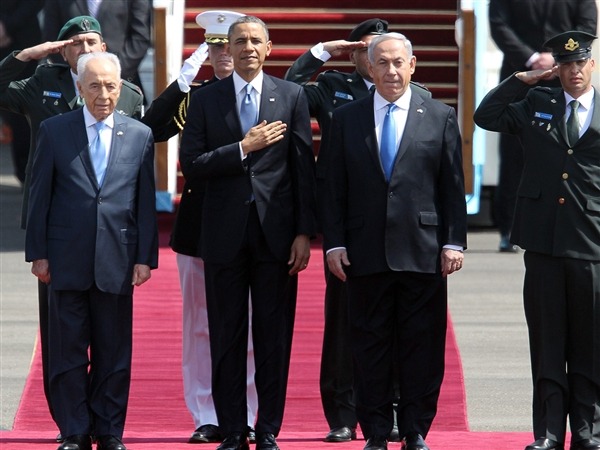 As one Israeli columnist put it, he had them at “Shalom.”
That was the first word President Obama uttered in public when he landed in Israel Wednesday afternoon, and again when he took the stage at a convention center here Thursday. But unlike other foreign leaders, Mr. Obama went far beyond the simple greeting — which translates as “peace” but also is used for “hello” and “goodbye” — to sprinkle Hebrew throughout his remarks, an effective if gimmicky element of his all-out effort to connect with the Israeli public.
It worked on the headline writers. On Friday morning, three Israeli newspapers blared Mr. Obama’s declaration “Atem lo levad” — You are not alone — across their front pages. The simple phrase, which sparked one of the strongest of multiple ovations punctuating his 50-minute speech Thursday afternoon, may be one of the lasting memories of the three-day visit, seared in public consciousness like President Clinton’s poignant “Shalom, chaver” — Goodbye, friend — at the 1995 funeral of Yitzhak Rabin, the prime minister assassinated by a Jewish extremist.
As one Israeli columnist put it, he had them at “Shalom.”
That was the first word President Obama uttered in public when he landed in Israel Wednesday afternoon, and again when he took the stage at a convention center here Thursday. But unlike other foreign leaders, Mr. Obama went far beyond the simple greeting — which translates as “peace” but also is used for “hello” and “goodbye” — to sprinkle Hebrew throughout his remarks, an effective if gimmicky element of his all-out effort to connect with the Israeli public.
It worked on the headline writers. On Friday morning, three Israeli newspapers blared Mr. Obama’s declaration “Atem lo levad” — You are not alone — across their front pages. The simple phrase, which sparked one of the strongest of multiple ovations punctuating his 50-minute speech Thursday afternoon, may be one of the lasting memories of the three-day visit, seared in public consciousness like President Clinton’s poignant “Shalom, chaver” — Goodbye, friend — at the 1995 funeral of Yitzhak Rabin, the prime minister assassinated by a Jewish extremist. But that was not all. Mr. Obama also spoke Thursday about “tikkun olam,” repairing the world, and while viewing the Dead Sea Scrolls that morning, he asked whether Hebrew had evolved much over the centuries (no, he was told). At the Yad Vashem Holocaust memorial Friday, he used the Hebrew word for the horrific tragedy, “Shoah.”
On Wednesday, he said, “Tov lehiot shuv ba’aretz” — it’s good to be back in the land. He also underlined his statement “Our alliance is eternal; it is forever,” with “lanetzach,” for eternity, particularly risky because its last letter, chet, is tough for English speakers to get right.
If his accent was not perfect, it was perfectly acceptable.
But that was not all. Mr. Obama also spoke Thursday about “tikkun olam,” repairing the world, and while viewing the Dead Sea Scrolls that morning, he asked whether Hebrew had evolved much over the centuries (no, he was told). At the Yad Vashem Holocaust memorial Friday, he used the Hebrew word for the horrific tragedy, “Shoah.”
On Wednesday, he said, “Tov lehiot shuv ba’aretz” — it’s good to be back in the land. He also underlined his statement “Our alliance is eternal; it is forever,” with “lanetzach,” for eternity, particularly risky because its last letter, chet, is tough for English speakers to get right.
If his accent was not perfect, it was perfectly acceptable.
 “He did his homework,” said Gabriel Weimann, a communications professor at the University of Haifa who specializes in politics. “I’m quite sure that he exercised well, and he exercised with someone who knows how to pronounce it, not with some Hebrew 101 teacher.”
That someone was Daniel B. Shapiro, Mr. Obama’s ambassador to Israel, who often impresses audiences here by delivering full speeches in Hebrew. (At last year’s conference of the American Israel Public Affairs Committee, Prime Minister Benjamin Netanyahu lauded Mr. Shapiro’s fluency, saying, “Your Hebrew is improving, though it is not on par with Michael Oren’s,” a gentle jab at Israel’s New Jersey-born ambassador to Washington.)
“Wherever he goes, he tries to find the opportunity to communicate with people in their native language because he really understands the power of language,” Mr. Shapiro said of the president. “It’s important to find the right words, the words that really convey a message, pack a certain kind of power, resonate and have certain associations with them.”
It is also important to find words that are easy to pronounce. Some with too many syllables were rejected. One longer phrase with a word containing that tough “chet” in the middle was cut.
When the president declared “Atem lo levad” during Thursday’s speech, Mr. Shapiro’s wife, Julie Fisher, whose Hebrew is not as solid, excitedly posted it to her Facebook page from the convention hall, only to be quickly called out for a misspelling. (She used two “vavs” instead of a “vet.”)
Of course, leaders have long used foreign languages to make an impression. President John F. Kennedy’s “Ich bin ein Berliner” may be the most famous, but Tony Blair, the former prime minister of Britain, gave an entire speech in French to the National Assembly in Paris in 1998.
Mr. Obama also started his news conference with President Mahmoud Abbas of the Palestinian Authority on Thursday with the Arabic greeting “marhaba.” And in his 2009 speech at Cairo University, he quieted the audience by saying, “Shukran, thank you very much.”
Mr. Weimann said Israelis were moved not just by the use of Hebrew but by Mr. Obama’s extensive quoting of revered Israeli and Jewish sources: the Talmud; the Passover Haggadah; the founding prime minister, David Ben-Gurion; the novelist David Grossman; even the television satire “Eretz Nehederet” (Wonderful Country).
“'I’m using your language’ means that I’m trying to get close to you,” Mr. Weimann said. “It’s not just the text and not just the pronunciation, it’s the variety of sources. Every public appearance there was at least one sentence.”
As he snaked his way through a farewell gauntlet at the airport Friday afternoon, Mr. Obama offered a “todah” — thank you — to an Israeli official who helped plan the trip. To Mr. Shapiro’s oldest daughter, Liat, who recently celebrated her bat mitzvah, he said, “mazel tov.”
“He did his homework,” said Gabriel Weimann, a communications professor at the University of Haifa who specializes in politics. “I’m quite sure that he exercised well, and he exercised with someone who knows how to pronounce it, not with some Hebrew 101 teacher.”
That someone was Daniel B. Shapiro, Mr. Obama’s ambassador to Israel, who often impresses audiences here by delivering full speeches in Hebrew. (At last year’s conference of the American Israel Public Affairs Committee, Prime Minister Benjamin Netanyahu lauded Mr. Shapiro’s fluency, saying, “Your Hebrew is improving, though it is not on par with Michael Oren’s,” a gentle jab at Israel’s New Jersey-born ambassador to Washington.)
“Wherever he goes, he tries to find the opportunity to communicate with people in their native language because he really understands the power of language,” Mr. Shapiro said of the president. “It’s important to find the right words, the words that really convey a message, pack a certain kind of power, resonate and have certain associations with them.”
It is also important to find words that are easy to pronounce. Some with too many syllables were rejected. One longer phrase with a word containing that tough “chet” in the middle was cut.
When the president declared “Atem lo levad” during Thursday’s speech, Mr. Shapiro’s wife, Julie Fisher, whose Hebrew is not as solid, excitedly posted it to her Facebook page from the convention hall, only to be quickly called out for a misspelling. (She used two “vavs” instead of a “vet.”)
Of course, leaders have long used foreign languages to make an impression. President John F. Kennedy’s “Ich bin ein Berliner” may be the most famous, but Tony Blair, the former prime minister of Britain, gave an entire speech in French to the National Assembly in Paris in 1998.
Mr. Obama also started his news conference with President Mahmoud Abbas of the Palestinian Authority on Thursday with the Arabic greeting “marhaba.” And in his 2009 speech at Cairo University, he quieted the audience by saying, “Shukran, thank you very much.”
Mr. Weimann said Israelis were moved not just by the use of Hebrew but by Mr. Obama’s extensive quoting of revered Israeli and Jewish sources: the Talmud; the Passover Haggadah; the founding prime minister, David Ben-Gurion; the novelist David Grossman; even the television satire “Eretz Nehederet” (Wonderful Country).
“'I’m using your language’ means that I’m trying to get close to you,” Mr. Weimann said. “It’s not just the text and not just the pronunciation, it’s the variety of sources. Every public appearance there was at least one sentence.”
As he snaked his way through a farewell gauntlet at the airport Friday afternoon, Mr. Obama offered a “todah” — thank you — to an Israeli official who helped plan the trip. To Mr. Shapiro’s oldest daughter, Liat, who recently celebrated her bat mitzvah, he said, “mazel tov.”
Analysis: Obama scores unexpected successes on Middle East trip
 U.S. President Barack Obama flew out of Israel in a duststorm on Friday, leaving behind a trail of symbolic gestures and fine oratory that should help preserve the status quo at a time of regional upheaval.
In an unexpected diplomatic flourish, he also facilitated a surprise telephone call between the prime ministers of Israel and Turkey, putting two U.S. allies firmly on track to revive a once close relationship that had become badly frayed.
Obama set such low expectations for the three-day trip that he can easily proclaim it is mission accomplished, having wooed skeptical Israelis, eased their fears over Iran and shown Palestinians that he had not forgotten their aspirations.
True, many Palestinians remained disillusioned, feeling that Obama had buckled to Israeli pressure and backtracked from his previous demands for a halt to Jewish settlement building in the occupied West Bank on land they want for a future state.
But after a bruising first term of failed Middle East diplomacy, Obama's prime concern seems to be that the situation does not get any worse, while keeping alive slender hopes that a comprehensive Israeli-Palestinian peace deal is still possible.
"This visit marks a resumption of American attention to the conflict, which is very important after two years of utter absence from the scene," said Ghassan al-Khatib, an academic and a former Palestinian government spokesman.
"It probably won't lead to any new negotiations, which in any case would be meaningless given the huge gulf between the two sides. But it might bring some accountability to the Israelis."
Israeli Prime Minister Benjamin Netanyahu appeared highly satisfied by the public show of joviality displayed by Obama during their meetings, dispelling the frosty scowls and sniping that marked encounters over the previous four years.
"The atmosphere was much better than in all their meetings before," said a senior Israeli official. "He gave the impression that he really wanted to start afresh," he said of Obama.
IRAN CONNECTIONS
Obama has already spent more time talking to Netanyahu than to any other world leader, according to the White House, and the pair put several more hours on the clock through this week.
Iran topped their initial agenda, aides said, with Obama seeking to build mutual trust and convince Israel that he was serious when he said he would not let Iran get nuclear weapons.
As a joint news conference on Wednesday, Netanyahu repeated that Israel had a right to defend its own national interests, but added that he was "absolutely convinced" Obama meant what he said - a strong statement seen as significant by some analysts.
"Now I think there is almost complete understanding between Israel and the United States on the Iranian issue," said Amotz Asa-El, fellow at the Shalom Hartman Institute in Jerusalem.
"Specifically, they are waiting to see if the June election in Iran ignites some kind of social upheaval, a prospect that both Washington and Jerusalem obviously prefer," he added, referring to a mid-year presidential poll.
Israel and Western powers believe Iran is looking to prepare a nuclear arsenal - something Tehran denies, while defending its right to enrich uranium for civil uses. Netanyahu has set a "red line" across Iran's progress on enrichment, which he has said could be crossed in the spring or summer - hinting at unilateral military action unless the Islamic republic backs down.
Giora Eiland, a retired general and former Israeli national security adviser, said the prospect of such an attack was receding: "I think that the option still exists," he said, "But that every day that passes lowers its chances of success."
Reflecting Israel's isolation in a largely hostile region, Obama engineered a call between Netanyahu and his Turkish counterpart on Friday, enabling the two U.S. allies to overcome a diplomatic crisis sparked by the deaths of nine Turks in 2010 during an Israeli commando raid off the Gaza Strip.
The move to normalize relations with a NATO member state that was one of its few Muslim friends in the region could help coordination to contain spillover from the Syrian civil war.
"Given what we see in the Middle East, we see a situation in which our relations with Turkey can be very, very important for the future, regarding what happens with Syria, but not just what happens with Syria," said a source in Netanyahu's office.
PALESTINIAN STALEMATE
Yet if the tensions with Turkey unexpectedly eased, Obama's visit did little to raise hopes that the decades-old Israeli-Palestinian conflict was any nearer resolution.
Going over the heads of Israeli leaders, who have questioned whether they have a viable negotiating partner on the other side of the separation barrier that twists through the West Bank, Obama appealed directly to ordinary citizens to push for change.
In a powerful speech to appreciative students, the U.S. president warned on Thursday that the Jewish state risked growing international isolation without a peace accord.
However, he did not bring any proposals on how to resume negotiations, which broke down in 2010, and he backed away from a previous demand for Israel to end settlement building, simply calling the construction an impediment to peace.
He promised that his new secretary of state, John Kerry, would dedicate much time and energy to the problem, but many Israelis saw his comments as a sign Washington would distance itself from a diplomatic quagmire familiar to his predecessors.
"The era when the USA pushed Israel and the Palestinians into a political process is gone," said Gidi Grinstein, president of the Reut Institute, a Tel Aviv-based think tank.
"In the absence of American vision and strategy, considering Obama's priorities and with the present positions of Israel and the Palestinians, the USA is basically saying: 'You call us. We won't call you'," he added.
Although Palestinian President Mahmoud Abbas welcomed Obama's speech, some of his political allies were more damning.
"Obama's visit provides no clear way forward for a serious solution to the conflict," said Wasel Abu Yousef of the Palestine Liberation Organisation. "It seems the U.S. is not interested in solving the conflict, but rather managing it."
U.S. President Barack Obama flew out of Israel in a duststorm on Friday, leaving behind a trail of symbolic gestures and fine oratory that should help preserve the status quo at a time of regional upheaval.
In an unexpected diplomatic flourish, he also facilitated a surprise telephone call between the prime ministers of Israel and Turkey, putting two U.S. allies firmly on track to revive a once close relationship that had become badly frayed.
Obama set such low expectations for the three-day trip that he can easily proclaim it is mission accomplished, having wooed skeptical Israelis, eased their fears over Iran and shown Palestinians that he had not forgotten their aspirations.
True, many Palestinians remained disillusioned, feeling that Obama had buckled to Israeli pressure and backtracked from his previous demands for a halt to Jewish settlement building in the occupied West Bank on land they want for a future state.
But after a bruising first term of failed Middle East diplomacy, Obama's prime concern seems to be that the situation does not get any worse, while keeping alive slender hopes that a comprehensive Israeli-Palestinian peace deal is still possible.
"This visit marks a resumption of American attention to the conflict, which is very important after two years of utter absence from the scene," said Ghassan al-Khatib, an academic and a former Palestinian government spokesman.
"It probably won't lead to any new negotiations, which in any case would be meaningless given the huge gulf between the two sides. But it might bring some accountability to the Israelis."
Israeli Prime Minister Benjamin Netanyahu appeared highly satisfied by the public show of joviality displayed by Obama during their meetings, dispelling the frosty scowls and sniping that marked encounters over the previous four years.
"The atmosphere was much better than in all their meetings before," said a senior Israeli official. "He gave the impression that he really wanted to start afresh," he said of Obama.
IRAN CONNECTIONS
Obama has already spent more time talking to Netanyahu than to any other world leader, according to the White House, and the pair put several more hours on the clock through this week.
Iran topped their initial agenda, aides said, with Obama seeking to build mutual trust and convince Israel that he was serious when he said he would not let Iran get nuclear weapons.
As a joint news conference on Wednesday, Netanyahu repeated that Israel had a right to defend its own national interests, but added that he was "absolutely convinced" Obama meant what he said - a strong statement seen as significant by some analysts.
"Now I think there is almost complete understanding between Israel and the United States on the Iranian issue," said Amotz Asa-El, fellow at the Shalom Hartman Institute in Jerusalem.
"Specifically, they are waiting to see if the June election in Iran ignites some kind of social upheaval, a prospect that both Washington and Jerusalem obviously prefer," he added, referring to a mid-year presidential poll.
Israel and Western powers believe Iran is looking to prepare a nuclear arsenal - something Tehran denies, while defending its right to enrich uranium for civil uses. Netanyahu has set a "red line" across Iran's progress on enrichment, which he has said could be crossed in the spring or summer - hinting at unilateral military action unless the Islamic republic backs down.
Giora Eiland, a retired general and former Israeli national security adviser, said the prospect of such an attack was receding: "I think that the option still exists," he said, "But that every day that passes lowers its chances of success."
Reflecting Israel's isolation in a largely hostile region, Obama engineered a call between Netanyahu and his Turkish counterpart on Friday, enabling the two U.S. allies to overcome a diplomatic crisis sparked by the deaths of nine Turks in 2010 during an Israeli commando raid off the Gaza Strip.
The move to normalize relations with a NATO member state that was one of its few Muslim friends in the region could help coordination to contain spillover from the Syrian civil war.
"Given what we see in the Middle East, we see a situation in which our relations with Turkey can be very, very important for the future, regarding what happens with Syria, but not just what happens with Syria," said a source in Netanyahu's office.
PALESTINIAN STALEMATE
Yet if the tensions with Turkey unexpectedly eased, Obama's visit did little to raise hopes that the decades-old Israeli-Palestinian conflict was any nearer resolution.
Going over the heads of Israeli leaders, who have questioned whether they have a viable negotiating partner on the other side of the separation barrier that twists through the West Bank, Obama appealed directly to ordinary citizens to push for change.
In a powerful speech to appreciative students, the U.S. president warned on Thursday that the Jewish state risked growing international isolation without a peace accord.
However, he did not bring any proposals on how to resume negotiations, which broke down in 2010, and he backed away from a previous demand for Israel to end settlement building, simply calling the construction an impediment to peace.
He promised that his new secretary of state, John Kerry, would dedicate much time and energy to the problem, but many Israelis saw his comments as a sign Washington would distance itself from a diplomatic quagmire familiar to his predecessors.
"The era when the USA pushed Israel and the Palestinians into a political process is gone," said Gidi Grinstein, president of the Reut Institute, a Tel Aviv-based think tank.
"In the absence of American vision and strategy, considering Obama's priorities and with the present positions of Israel and the Palestinians, the USA is basically saying: 'You call us. We won't call you'," he added.
Although Palestinian President Mahmoud Abbas welcomed Obama's speech, some of his political allies were more damning.
"Obama's visit provides no clear way forward for a serious solution to the conflict," said Wasel Abu Yousef of the Palestine Liberation Organisation. "It seems the U.S. is not interested in solving the conflict, but rather managing it."
Historic visit comes to close, Obama departs Israel

Ceremony nixed due to sandstorm; president visits Yad Vashem, says due to Israel's existence, Holocaust will never happen again.With the red carpet rolled out behind him, US President Barack Obama boarded Air Force One and departed Israel, as his three-day visit to Israel and the West Bank came to a close.
 Prior to his flight, Obama held a final lunch meeting with Prime Minister Binyamin Netanyahu and President Shimon Peres in a trailer set up on the tarmac at Ben Gurion Airport.
The last stop on Obama's tour of Israel and the West Bank was the Church of the Nativity in Bethlehem, where Christians believe Jesus was born. Obama's visit to the site is seen as a message of solidarity to dwindling Christian communities in a turbulent region.
Due to strong winds and sand storms Obama changed his plans to fly to Bethlehem in a helicopter, opting instead to travel in a convoy of cars. Highway 1 between Jerusalem was blocked between the hours of 13:30 and 16:00. Additionally, Obama's official farewell ceremony from Israel's Ben Gurion airport was cancelled due to a sand storm that has enveloped central Israel. Instead, there will be a small ceremony which will take place on the tarmac.
Earlier Friday, while visiting Yad Vashem Holocaust memorial Obama said the state of Israel does not exist because of the Holocaust, but because of its strong existence the Holocaust will never happen again.
The statement marked a significant corrective to his speech in Cairo in 2009, where he appeared to argue that the legitimacy of the Jewish state stemmed from the Holocaust.
Wearing a kippa, Obama rekindled an eternal flame next to a stone slab above ashes recovered from extermination camps after World War Two. "We have a choice to acquiesce to evil or make real our solemn vow - never again," Obama said.
Obama made clear he recognized that Jewish roots to the Holy Land were centuries-old. "Here on your ancient land, let it be said for all the world to hear, the state of Israel does not exist because of the Holocaust, but with the survival of a strong Jewish state of Israel, such a Holocaust will never happen again," he said.
The president said that one could visit the memorial 1,000 times, "and each time one's heart would break."
However, he said that at Yad Vashem, along with seeing man's capacity for evil and how evil can triumph when people remain passive, one also sees man's capacity for good. "We learn here that people have a choice to succumb to evil or to act against it."
"Our sons and daughters are not born to hate, lets fill their hearts with understanding and compassion," he continued. He referred to the light "shining on the Jerusalem hills," that visitors see after passing through the darkness of Yad Vashem, saying "here we hope."
Following the US president's speech Tel Aviv Chief Rabbi and chairman of the Yad Vashem Council Yisrael Meir Lau also spoke.
"Yesterday promised us we are not alone, but do not be too late," he said. "Help us have days of light after the dark tunnel."
Obama began the third and final day of his first presidential trip to Israel with visits to the graves of Theodor Herzl and Yitzhak Rabin, accompanied by Prime Minister Binyamin Netanyahu and President Shimon Peres.
Obama laid a wreath and stone at the graves of the founder of Zionism, and the slain prime minister, who has become a symbol for the peace process, before touring Yad Vashem in Jerusalem. At Rabin's grave, Obama paid his respects to family members of the late prime minister, including daughter Dalia Rabin and his granddaughter Noa Rotman.
"Sometimes it is harder to embark on peace than to embark on war," Rabin's daughter, Dalia, quoted Obama as telling the family at the grave site.He then visited Yad Vashem, adding layers of symbolic gestures to a trip short of real substance, but laden with presidential appeals for both Israelis and Palestinians to resume long-stalled peace talks.
"Nothing could be more powerful," Obama said in Yad Vashem's Hall of Names, a memorial to the six million Jews killed by the Nazis in World War Two.
He held a final meeting with Netanyahu, who he previously met with for some three-hours on Wednesday.
From Israel, the US president will travel to Amman, where he will meet with Jordanian King Abdullah II. Obama's talks with Abdullah are expected to focus on the civil war in neighboring Syria and the prospects for Israeli-Palestinian peace diplomacy.
The president's visit to the desert kingdom is aimed at reassuring Abdullah of Washington's support at a time when it is flooded with refugees from the violence in Syria, and battling economic difficulties and tensions from the "Arab Spring" upheaval in the region, aides say.
Obama and Abdullah will consult extensively on the spillover of the Syrian conflict to Jordan, where an influx of more than 350,000 refugees has further strained the resources of a country that has almost no oil. Washington has provided some aid to alleviate the humanitarian situation.
Obama backs the Syrian opposition's effort to oust Syrian President Bashar Assad, but has limited its support to non-lethal aid to anti-government rebels despite growing calls from European and Arab allies to take a stronger tack.
The king has taken a mostly cautious line on Syria, calling for Assad to go, but advocating a "political solution" and not arming the Syrian leader's foes. Jordanian authorities worry that any emergence of Islamist rule in a post-Assad Syria could embolden Islamists who are the main opposition group in Jordan.
Also on the agenda will be the Israeli-Palestinian conflict.
Prior to his flight, Obama held a final lunch meeting with Prime Minister Binyamin Netanyahu and President Shimon Peres in a trailer set up on the tarmac at Ben Gurion Airport.
The last stop on Obama's tour of Israel and the West Bank was the Church of the Nativity in Bethlehem, where Christians believe Jesus was born. Obama's visit to the site is seen as a message of solidarity to dwindling Christian communities in a turbulent region.
Due to strong winds and sand storms Obama changed his plans to fly to Bethlehem in a helicopter, opting instead to travel in a convoy of cars. Highway 1 between Jerusalem was blocked between the hours of 13:30 and 16:00. Additionally, Obama's official farewell ceremony from Israel's Ben Gurion airport was cancelled due to a sand storm that has enveloped central Israel. Instead, there will be a small ceremony which will take place on the tarmac.
Earlier Friday, while visiting Yad Vashem Holocaust memorial Obama said the state of Israel does not exist because of the Holocaust, but because of its strong existence the Holocaust will never happen again.
The statement marked a significant corrective to his speech in Cairo in 2009, where he appeared to argue that the legitimacy of the Jewish state stemmed from the Holocaust.
Wearing a kippa, Obama rekindled an eternal flame next to a stone slab above ashes recovered from extermination camps after World War Two. "We have a choice to acquiesce to evil or make real our solemn vow - never again," Obama said.
Obama made clear he recognized that Jewish roots to the Holy Land were centuries-old. "Here on your ancient land, let it be said for all the world to hear, the state of Israel does not exist because of the Holocaust, but with the survival of a strong Jewish state of Israel, such a Holocaust will never happen again," he said.
The president said that one could visit the memorial 1,000 times, "and each time one's heart would break."
However, he said that at Yad Vashem, along with seeing man's capacity for evil and how evil can triumph when people remain passive, one also sees man's capacity for good. "We learn here that people have a choice to succumb to evil or to act against it."
"Our sons and daughters are not born to hate, lets fill their hearts with understanding and compassion," he continued. He referred to the light "shining on the Jerusalem hills," that visitors see after passing through the darkness of Yad Vashem, saying "here we hope."
Following the US president's speech Tel Aviv Chief Rabbi and chairman of the Yad Vashem Council Yisrael Meir Lau also spoke.
"Yesterday promised us we are not alone, but do not be too late," he said. "Help us have days of light after the dark tunnel."
Obama began the third and final day of his first presidential trip to Israel with visits to the graves of Theodor Herzl and Yitzhak Rabin, accompanied by Prime Minister Binyamin Netanyahu and President Shimon Peres.
Obama laid a wreath and stone at the graves of the founder of Zionism, and the slain prime minister, who has become a symbol for the peace process, before touring Yad Vashem in Jerusalem. At Rabin's grave, Obama paid his respects to family members of the late prime minister, including daughter Dalia Rabin and his granddaughter Noa Rotman.
"Sometimes it is harder to embark on peace than to embark on war," Rabin's daughter, Dalia, quoted Obama as telling the family at the grave site.He then visited Yad Vashem, adding layers of symbolic gestures to a trip short of real substance, but laden with presidential appeals for both Israelis and Palestinians to resume long-stalled peace talks.
"Nothing could be more powerful," Obama said in Yad Vashem's Hall of Names, a memorial to the six million Jews killed by the Nazis in World War Two.
He held a final meeting with Netanyahu, who he previously met with for some three-hours on Wednesday.
From Israel, the US president will travel to Amman, where he will meet with Jordanian King Abdullah II. Obama's talks with Abdullah are expected to focus on the civil war in neighboring Syria and the prospects for Israeli-Palestinian peace diplomacy.
The president's visit to the desert kingdom is aimed at reassuring Abdullah of Washington's support at a time when it is flooded with refugees from the violence in Syria, and battling economic difficulties and tensions from the "Arab Spring" upheaval in the region, aides say.
Obama and Abdullah will consult extensively on the spillover of the Syrian conflict to Jordan, where an influx of more than 350,000 refugees has further strained the resources of a country that has almost no oil. Washington has provided some aid to alleviate the humanitarian situation.
Obama backs the Syrian opposition's effort to oust Syrian President Bashar Assad, but has limited its support to non-lethal aid to anti-government rebels despite growing calls from European and Arab allies to take a stronger tack.
The king has taken a mostly cautious line on Syria, calling for Assad to go, but advocating a "political solution" and not arming the Syrian leader's foes. Jordanian authorities worry that any emergence of Islamist rule in a post-Assad Syria could embolden Islamists who are the main opposition group in Jordan.
Also on the agenda will be the Israeli-Palestinian conflict.
Obama’s Israel visit wins over Jews at home
http://www.timesofisrael.com/
 President Barack Obama’s much-lauded speech Thursday before a crowd of young Israelis earned widespread praise across the American Jewish ideological spectrum.
The speech dealt with the broad sweep of issues on the US-Israel agenda, giving a wide range of American Jewish groups something to cheer about.Obama’s criticism of both past Palestinian rejectionism and of their resort to terror earned him high praise from the Anti-Defamation League, among others.
The influential group praised the president for recognizing “the risks Israel has taken for peace, steps often not met with reciprocity from the Palestinians.”
That was the only mention of the Palestinians in the group’s Thursday statement, which went on to thank Obama for emphasizing “the millennia-old connection the Jewish people have to the land of Israel” and “the grave security challenges facing Israel, including terror threats from Hamas, and the dangers posed by a nuclear-armed Iran.”
In a brief statement Friday, AIPAC “saluted” Obama for the security agreements announced on the trip and his call on the Palestinians to drop preconditions to peace talks.
That tone was echoed in a statement by Jewish Federations of North America board chair Michael Siegal, who praised Obama Friday for having “underscored America’s unshakable bond with the Jewish State at a critical time and expressed a profound understanding of the challenges Israel faces.”
More conservative groups were also broadly supportive of the speech.
The Orthodox Union’s Nathan Diament, head of the organization’s public advocacy arm, told the Times of Israel Friday that the group was “very pleased with [Obama's] explicit embrace and acknowledgement of thousands of years of history of the Jewish people in the land of Israel. We’re very appreciative of the support, the clear and strong policy, toward Iran obtaining nuclear weapons and the security of Israel.”
When it came to Obama’s call for establishing a Palestinian state in the West Bank, Diament was noncommittal. “The president laid out his view,” he said, but added: “What was important was that [Obama] made it very clear that whatever the details, whatever is going to be decided regarding borders and everything, it’s ultimately going to have to be decided by the parties in negotiations. It can’t be imposed from the outside.”
For their part, left-wing groups seemed thrilled by the speech, which they said forcefully laid out the case for peace.
J Street’s Jeremy Ben-Ami praised Obama for “making the two-state solution a top priority for his administration.”
In a conversation with the Times of Israel Thursday, he pointed to the moment in the speech when Obama told Israelis, “the only way for Israel to endure and thrive as a Jewish and democratic state is through the realization of an independent and viable Palestine.”
“What I saw as the point of the speech was [Obama's] laying out clearly and starkly the crossroads Israel is at,” Ben-Ami said. Obama spoke of US-Israeli friendship, of Jewish ties to the land of Israel, and then explained to Israelis “that all of that is at risk, the entirety of Israel is at risk, without peace,” Ben-Ami said.
In an email to J Street supporters, Ben-Ami wrote that the speech represented “our moment — our time to lead! Never has anyone expressed with greater clarity and with greater conviction everything that our movement fights for and holds dear.”
The left-leaning Israel Policy Forum, in an email that quoted the same line from Obama’s speech, said simply, “We could not agree more.”
One US Jewish official who asked not to be named offered a reason for the widespread praise the speech garnered.
While Obama emphatically and passionately called for peace talks, he separated the issue of peace from the issue of security, the official said. “Security is something Israel needs fundamentally, and Obama has secured it for them regardless of peace. All the tangible things that were announced were on Iran and security. He could have announced new talks. He could have announced that [Secretary of State John] Kerry would host a meeting of the sides. There was nothing like that. No deadlines, nothing.”
So while Obama issued perhaps the most impassioned call for peace yet in the Israeli-Palestinian conflict, “his position is that ultimately the two sides have to figure it out themselves.”
President Barack Obama’s much-lauded speech Thursday before a crowd of young Israelis earned widespread praise across the American Jewish ideological spectrum.
The speech dealt with the broad sweep of issues on the US-Israel agenda, giving a wide range of American Jewish groups something to cheer about.Obama’s criticism of both past Palestinian rejectionism and of their resort to terror earned him high praise from the Anti-Defamation League, among others.
The influential group praised the president for recognizing “the risks Israel has taken for peace, steps often not met with reciprocity from the Palestinians.”
That was the only mention of the Palestinians in the group’s Thursday statement, which went on to thank Obama for emphasizing “the millennia-old connection the Jewish people have to the land of Israel” and “the grave security challenges facing Israel, including terror threats from Hamas, and the dangers posed by a nuclear-armed Iran.”
In a brief statement Friday, AIPAC “saluted” Obama for the security agreements announced on the trip and his call on the Palestinians to drop preconditions to peace talks.
That tone was echoed in a statement by Jewish Federations of North America board chair Michael Siegal, who praised Obama Friday for having “underscored America’s unshakable bond with the Jewish State at a critical time and expressed a profound understanding of the challenges Israel faces.”
More conservative groups were also broadly supportive of the speech.
The Orthodox Union’s Nathan Diament, head of the organization’s public advocacy arm, told the Times of Israel Friday that the group was “very pleased with [Obama's] explicit embrace and acknowledgement of thousands of years of history of the Jewish people in the land of Israel. We’re very appreciative of the support, the clear and strong policy, toward Iran obtaining nuclear weapons and the security of Israel.”
When it came to Obama’s call for establishing a Palestinian state in the West Bank, Diament was noncommittal. “The president laid out his view,” he said, but added: “What was important was that [Obama] made it very clear that whatever the details, whatever is going to be decided regarding borders and everything, it’s ultimately going to have to be decided by the parties in negotiations. It can’t be imposed from the outside.”
For their part, left-wing groups seemed thrilled by the speech, which they said forcefully laid out the case for peace.
J Street’s Jeremy Ben-Ami praised Obama for “making the two-state solution a top priority for his administration.”
In a conversation with the Times of Israel Thursday, he pointed to the moment in the speech when Obama told Israelis, “the only way for Israel to endure and thrive as a Jewish and democratic state is through the realization of an independent and viable Palestine.”
“What I saw as the point of the speech was [Obama's] laying out clearly and starkly the crossroads Israel is at,” Ben-Ami said. Obama spoke of US-Israeli friendship, of Jewish ties to the land of Israel, and then explained to Israelis “that all of that is at risk, the entirety of Israel is at risk, without peace,” Ben-Ami said.
In an email to J Street supporters, Ben-Ami wrote that the speech represented “our moment — our time to lead! Never has anyone expressed with greater clarity and with greater conviction everything that our movement fights for and holds dear.”
The left-leaning Israel Policy Forum, in an email that quoted the same line from Obama’s speech, said simply, “We could not agree more.”
One US Jewish official who asked not to be named offered a reason for the widespread praise the speech garnered.
While Obama emphatically and passionately called for peace talks, he separated the issue of peace from the issue of security, the official said. “Security is something Israel needs fundamentally, and Obama has secured it for them regardless of peace. All the tangible things that were announced were on Iran and security. He could have announced new talks. He could have announced that [Secretary of State John] Kerry would host a meeting of the sides. There was nothing like that. No deadlines, nothing.”
So while Obama issued perhaps the most impassioned call for peace yet in the Israeli-Palestinian conflict, “his position is that ultimately the two sides have to figure it out themselves.”
Fear and loathing in Pakistan as polls loom

bY: AMANDA HODGEA PAKISTANI journalist's first-hand account this week of being caught in the latest terror attack summed up the twin furies vexing voters of this nation as it prepares for "historic" May elections. Trapped within a Peshawar court compound on Monday as two suicide bombers stalked the grounds, the Express Tribune reporter had a clear view of the carnage in which four people were killed and 49 injured. It might have been a routine story in this violence-racked country had he not concluded by cheekily thanking the outgoing government for the prolonged blackouts that had been such a feature of its five-year term but, in this instance, kept the television off at home and his mother mercifully ignorant of her son's predicament. Gallows humour is the order of the day in Pakistan as the country faces elections amid a worsening security crisis and spiralling attacks on religious minorities.A week ago today, the Pakistan People's Party-led administration officially dissolved the national parliament, making history in the process by becoming the first democratically elected government to serve its full term in office. If all goes to plan the nation's voters will notch up their own milestone in May by participating in the first transition from one elected government to another. Pakistan's power elite has hailed the occasion as a watershed for its troubled democracy, routinely interrupted by the ambitions of military men since the country was founded 66 years ago - even as dark mutterings persist of a military deferment of the polls. The military says it too supports the democratic process, - a position some cynics suggest indicates just what a parlous mess the country is in. Among those who would rule this nuclear-armed South Asian nation, there is wide support for the imminent elections, though the Taliban and allied militants have made their opposition clear. Yet enthusiasm for Pakistani democracy seems conspicuously lacking among the general population. More than 25,000 people flocked last Sunday to Rawalpindi's Liaquat Bagh - the scene of former prime minister Benazir Bhutto's 2007 assassination - to hear Pakistani-Canadian cleric Tahir-ul-Qadri eviscerate all sides of politics for greed and rampant theft. The moderate Islamic cleric gave a fire-and-brimstone political sermon, exhorting supporters to boycott elections, punctuating his message with regular blasts of a theme song whose lyrics appeared to consist of one word: revolution. Qadri has been largely written off by the political establishment since he brought the capital to a standstill in January to demand political reform, including a ban on politicians with criminal records and loan defaults, and that elections be deferred while a technocrat-heavy caretaker government swept the system clean of corruption. There were predictions his 40,000-strong Islamabad rally outside parliament would result in a "Pakistani Spring", along the lines of the uprisings that have unseated some Arab governments. It was not to be. While the government made some concessions, Qadri failed to persuade former cricketer Imran Khan, another anti-corruption advocate and "change" candidate, to join his rally, and the Supreme Court disallowed his challenge to the election commission. Yet his message - that Pakistan's democracy is a sham, its politicians robber barons, and that the country needs a revolution - is taking root among citizens exhausted by terrorism, poor governance and economic near-collapse. "They say I am trying to derail democracy," Qadri told a rapt audience from behind bullet-proof glass as he reeled through a list of price rises and poor governance. "What democracy are they talking about? The greatest gift this democracy gave us in the last five years is 12 people killed every day in this country. Did God make Pakistan for this purpose? We will all be responsible for this if we keep supporting the system." There was no opposition in the audience that day. "We need peaceful revolution," Irshad Iqbal tells Inquirer after driving more than four hours from Lahore with her adult son to attend the rally. "In this country a few families have all the wealth and power but we want the resources to go to the people. The election commission has no power, the judiciary is not independent, there's no equality." Frahat Dilbat, who came with her three daughters, says: "We need the system to change, not just the faces." Pakistani political columnist Ayaz Amir also has been spruiking for change, using his Islamabad Diary in an English-language newspaper to rail eloquently against the political status quo. He has even suggested Spanish dictator General Franco would have been a better alternative to Pakistan's two likeliest political options - a government led by Bhutto's widower and PPP leader Asif Ali Zardari, or by Nawaz Sharif, a two-time former prime minister and leader of the Pakistan Muslim League (N). "On military coat-tails the one entered politics almost 30 years ago (Sharif) and the other (Zardari) was Mr Ten Per Cent before most youngsters of today were born," Amir wrote of the two leaders recently. "Anything would be better than this farce. For the hundredth time let me press into service that Maoist call to arms: "There is great disorder under the heavens and the situation is excellent." Yet Amir is himself a PML (N) MP for Punjab's Chakwal district and plans to run again if the party will overlook his sniping and grant him a nomination ticket. He tells Inquirer, at his electorate office between Islamabad and Lahore, his constituents will vote for the candidate "who is most likely to win and so can help if they have trouble at a police station or at the local revenue office". "There's no ideological wave," he says, adding voters have been "spoiled" into expecting favours from their local politicians. "Both parties are depressing choices so it really amounts to which is the less depressing," he adds. On that, Amir and his constituents can agree. In the main bazaar of Chakwal - heartland for this election's fancied PML (N) - the consensus is "a pox on both houses" for power cuts, price hikes and job shortages. "We say we're hungry, we have no water or electricity. They say democracy is there. We need democracy, but God save us from this type of democracy," says shopkeeper Munawar Hussain. At a nearby tobacco stall, Mohammad Bashir declares Pakistan was most ably governed under its three military regimes. "Definitely democracy should be strengthened but we need leaders, not these dacoits (criminals) who are filling their pockets," he says. Like so many in Pakistan, Bashir believes another military coup could occur if security continues to deteriorate, making elections too dangerous a proposition. A night earlier at a private gathering of powerbrokers in upscale Islamabad, an influential bureaucrat even predicted a "colonels' coup" would cut through the country's corrupt political ranks. Yet the military has demonstrated a distinct reluctance to seize the reins since its last foray into government under Pervez Musharraf, who was unseated in 2008 by President Zardari amid a show of voter sympathy that many have since come to regret. Already overstretched by tensions on its eastern border with India and ongoing operations against Taliban militants in its tribal lands, the "establishment" - as Pakistan's military and security forces are known - has neither the appetite nor the resources for a takeover. That leaves many wondering why Musharraf, in self-imposed exile over charges relating to Bhutto's assassination, would want to return to contest elections - as he claims he will this weekend. Despite rumours to the contrary, the military has denied the retired general has asked for, or will receive, protection. Chief military spokesman General Asim Saleem Bajwa also dismisses speculation of military intervention in the democratic process, beyond the army's commitment to provide election security. "All these speculations (of a military coup) have been thrown up in the past five years but all of them have died with the passage of time because there was nothing in them," he tells Inquirer at military headquarters in Rawalpindi. "The military is already working out a plan to provide security for elections so it doesn't make any sense to say it will use escalating insecurity as an excuse to defer elections." Escalating violence will be a significant election challenge across Pakistan for voters as well as candidates. The PPP's deputy secretary of information and the Prime Minister's human rights adviser Mustafa Nawaz Khokhar says he has ordered four flak jackets for his campaign and now drives in an armoured vehicle. "In the last five years we have lost Benazir Bhutto, (Punjab governor) Salman Taseer and (minorities minister) Shahbaz Bhatti (to assassination). We hear from intelligence sources there are terror attacks being planned through the campaign," he says. "Of course that's going to create a climate of fear which will affect voter turnout. Candidates' security will also be a major issue." Everyone concedes it's an enormous task. "Security for upcoming elections will be a challenging task," Bajwa says. "We will just have to look at ways to muster strength."
Afghanistan sign up to Pakistan support
 Afghanistan have received a boost after a two-year Memorandum of Understanding (MoU) was signed between the Afghanistan Cricket Board (ACB) and Pakistan Cricket Board (PCB) for the development of Afghanistan cricket ahead of the 2015 World Cup.
The PCB will provide technical and professional support, including game-education programmes, coaching courses, skill and performance analysis, and basic umpiring and curator courses. High performance camps for emerging players will also be organised. The PCB-regulated National Cricket Academy (NCA) will help in improving technical, tactical, mental and physical skills, and will host lectures on doping, anti-corruption and various codes of conduct. The finance for the project will be decided later, with the NCA-related activities likely to be subsidised.
The Sharjah Cricket Stadium has served as Afghanistan's base since 2010, after they were forced to shift out of their country due to lack of infrastructure. But Pakistan's cricketing history, expertise and the opportunities for exposure to regular competitive cricket will polish their cricketers more than in the UAE, and this has brought ACB to accept Pakistan's helping hand.
"The PCB has always supported and helped the ACB with regards to cricket development there since the 1990s," PCB chief operating officer, Subhan Ahmad, said. "With the PCB's continued support, Afghanistan has the potential to go places. This would be good not just in terms of spreading the game in Afghanistan but promoting peace and harmony there by bringing the people closer."
Afghanistan became a member of the ICC in 2001 and qualified for World Cricket League (WCL) Division One in 2009 to attain one-day international status. They recently made their third trip to Pakistan in the last two years, having lost a one-day series 3-0 to a second-string Pakistan side in May 2011. They followed this up by participating in a domestic Twenty20 competition in Karachi.
Noor Muhammad, ACB CEO, acknowledged PCB's support. "The MoU that we have just signed shall take Afghanistan's cricket development on a fast track," he said. "Our cricketers, coaches and umpires shall be able to make use of PCB's excellent facilities and various education programmes. Our boys will get the opportunity to hone their skills in high-calibre competitions.
"I am indeed obliged to the PCB for this kind and voluminous support," Noor said. "Actually it is Pakistan's support that has seen Afghanistan cricket make rapid strides among affiliate nations, taking it to the verge of an enhanced status to associate member."
Afghanistan have received a boost after a two-year Memorandum of Understanding (MoU) was signed between the Afghanistan Cricket Board (ACB) and Pakistan Cricket Board (PCB) for the development of Afghanistan cricket ahead of the 2015 World Cup.
The PCB will provide technical and professional support, including game-education programmes, coaching courses, skill and performance analysis, and basic umpiring and curator courses. High performance camps for emerging players will also be organised. The PCB-regulated National Cricket Academy (NCA) will help in improving technical, tactical, mental and physical skills, and will host lectures on doping, anti-corruption and various codes of conduct. The finance for the project will be decided later, with the NCA-related activities likely to be subsidised.
The Sharjah Cricket Stadium has served as Afghanistan's base since 2010, after they were forced to shift out of their country due to lack of infrastructure. But Pakistan's cricketing history, expertise and the opportunities for exposure to regular competitive cricket will polish their cricketers more than in the UAE, and this has brought ACB to accept Pakistan's helping hand.
"The PCB has always supported and helped the ACB with regards to cricket development there since the 1990s," PCB chief operating officer, Subhan Ahmad, said. "With the PCB's continued support, Afghanistan has the potential to go places. This would be good not just in terms of spreading the game in Afghanistan but promoting peace and harmony there by bringing the people closer."
Afghanistan became a member of the ICC in 2001 and qualified for World Cricket League (WCL) Division One in 2009 to attain one-day international status. They recently made their third trip to Pakistan in the last two years, having lost a one-day series 3-0 to a second-string Pakistan side in May 2011. They followed this up by participating in a domestic Twenty20 competition in Karachi.
Noor Muhammad, ACB CEO, acknowledged PCB's support. "The MoU that we have just signed shall take Afghanistan's cricket development on a fast track," he said. "Our cricketers, coaches and umpires shall be able to make use of PCB's excellent facilities and various education programmes. Our boys will get the opportunity to hone their skills in high-calibre competitions.
"I am indeed obliged to the PCB for this kind and voluminous support," Noor said. "Actually it is Pakistan's support that has seen Afghanistan cricket make rapid strides among affiliate nations, taking it to the verge of an enhanced status to associate member."
Roadside bomb kills 9 people in southwest Pakistan
 A bomb hidden in a rickshaw exploded outside a bus terminal near a busy bazar in southwestern Pakistan on Friday, killing at least nine people and wounding 40, officials said.
The explosion came hours after a U.S. drone targeted a vehicle in northwestern Pakistan near the Afghan border, killing three suspected militants, two intelligence officials said.
The rickshaw bomb struck in the town of Jafarabad, about 300 kilometers (180 miles) east of Quetta, the capital of Baluchistan province. It also destroyed several shops, said senior government official Syed Zafar Bukhari.
Bukhari said the motive for the attack was not clear. He said the victims were taken to a hospital, where some of the injured were listed in critical condition.
"I can only confirm that the bomb killed nine people," Bukhari told The Associated Press by phone. "It would be premature to say who orchestrated the attack."
Although no group claimed responsibility, suspicion fell on Bluch nationalists who have waged a decades-long insurgency against the government in Baluchistan for greater autonomy and a larger share of the province's natural resources. The province is also home to many radical Islamist militants.
In the drone strike, a pair of missiles fired from the unmanned aircraft hit a vehicle in a bazar near the Datta Khel village of North Waziristan tribal region at about midnight Thursday, the two intelligence officials said.
The suspects were traveling from the border town of Shawal to Datta Khel, a stronghold of local Taliban commander Hafiz Gul Bahadur, the officials added, speaking on condition of anonymity because they were not authorized to talk to the media. They said the nationalities and identities of the slain men were not immediately known. Pakistani government and army spokesmen could not be reached for comment.
Drone strikes often cause tension between Washington and Islamabad. They are extremely unpopular in this Islamic nation, where many people believe the drone attacks mostly kill civilians, an allegation disputed by U.S. officials.
The CIA drone strikes have killed scores of suspected al-Qaida and Taliban men in Pakistan's tribal region over the past few years. The secret nature of the program makes it difficult to determine how many civilians are being killed.
A bomb hidden in a rickshaw exploded outside a bus terminal near a busy bazar in southwestern Pakistan on Friday, killing at least nine people and wounding 40, officials said.
The explosion came hours after a U.S. drone targeted a vehicle in northwestern Pakistan near the Afghan border, killing three suspected militants, two intelligence officials said.
The rickshaw bomb struck in the town of Jafarabad, about 300 kilometers (180 miles) east of Quetta, the capital of Baluchistan province. It also destroyed several shops, said senior government official Syed Zafar Bukhari.
Bukhari said the motive for the attack was not clear. He said the victims were taken to a hospital, where some of the injured were listed in critical condition.
"I can only confirm that the bomb killed nine people," Bukhari told The Associated Press by phone. "It would be premature to say who orchestrated the attack."
Although no group claimed responsibility, suspicion fell on Bluch nationalists who have waged a decades-long insurgency against the government in Baluchistan for greater autonomy and a larger share of the province's natural resources. The province is also home to many radical Islamist militants.
In the drone strike, a pair of missiles fired from the unmanned aircraft hit a vehicle in a bazar near the Datta Khel village of North Waziristan tribal region at about midnight Thursday, the two intelligence officials said.
The suspects were traveling from the border town of Shawal to Datta Khel, a stronghold of local Taliban commander Hafiz Gul Bahadur, the officials added, speaking on condition of anonymity because they were not authorized to talk to the media. They said the nationalities and identities of the slain men were not immediately known. Pakistani government and army spokesmen could not be reached for comment.
Drone strikes often cause tension between Washington and Islamabad. They are extremely unpopular in this Islamic nation, where many people believe the drone attacks mostly kill civilians, an allegation disputed by U.S. officials.
The CIA drone strikes have killed scores of suspected al-Qaida and Taliban men in Pakistan's tribal region over the past few years. The secret nature of the program makes it difficult to determine how many civilians are being killed.
4 militants killed in US drone strike in northwest Pakistan
http://www.thehindu.com/Four militants were killed when a US drone targeted a vehicle in the lawless north Waziristan tribal region of Pakistan on Friday. State-run Radio Pakistan reported four persons were killed in the attack by the CIA-operated spy plane in Dattakhel area of North Waziristan Agency. Officials were quoted by TV news channels as saying that the drone fired two missiles at a vehicle, a short distance from Miranshah, the main town in the region. North Waziristan is a safe haven for Taliban and al-Qaida elements. The attack was carried out at around midnight. Officials said four drones had been seen flying over the area. The vehicle was destroyed when two missiles hit it. A UN envoy last week said US drone attacks violated Pakistan's sovereignty. Islamabad has described the missile strikes as counter-productive and called on the US to stop them.
Working With Sharks: A Pakistani Activist’s Successful Battle Against Sexual Harassment
The Baloch Hal
By Malik Siraj Akbar
 Working with Sharks, a compelling account of a leading Pakistani gender activist, Dr. Fouzia Saeed, against sexual harassment at the workplace, was released in the United States on March 8 on the occasion of the International Women’s Day. When a slightly different version of the book was published in Pakistan in 2012, it opened up a serious nationwide public debate about sexual harassment against women at workstations.
Prior to the publication of the book, Dr. Saeed drafted two bills against sexual harassment in 2008, which got into the legislative process and — through her intensive lobbying — the Parliament in Pakistan unanimously passed both the laws making sexual harassment a crime and mandating every formal sector to institute an anti-sexual harassment policy. The prime minister of Pakistan declared December 22, the day this case was filed, the national day of working women. The new laws invariably gave the Pakistani women a sense of legal protection.
While issues of female education, honor killing and acid attacks on women have recently found some space in the mainstream national debate in Pakistan and international attention, sexual harassment, on the other hand, still stigmatizes the victims. Very few courageous women, such as Dr. Saeed herself, have appeared in public to fight against this practice. Her book has inspired and encouraged young working women in Pakistan to break their silence against sexual assaults from their bosses and staffers. Very few books change an entire pattern of collective behavior and Working with Sharks is indeed one such book in Pakistan that has reshaped a society’s behavior and response toward issues that people seldom talk about in the public domain because of the fear of being scandalized or otherwise blamed for inviting trouble.
Dr. Saeed, who is currently a visiting fellow at the National Endowment for Democracy (N.E.D.) in Washington D.C., has worked for more than three decades for women’s rights in her native Pakistan. In 2001, Dr. Saeed stunned the Pakistani society with her revealing book Taboo: The Hidden Culture of a Red Light Area, the first research-based account of Pakistani female sex workers and their secretive troubled world. Taboo initially was received with discomfort by the social conservatives in Pakistan but it ultimately encouraged the society to have a frank discussion about the rights of those who have been pushed into the sex industry and face social and economic discrimination.
Working with Sharks is a firsthand story of the author and how she experienced sexual harassment at the prestigious place of the United Nations Development Program (U.N.D.P.) in Pakistan. The story brings to light not just the courage the author exhibited by standing up against a senior manager’s behavior, but also the torture she went through to counter harassment and cover ups by the international senior management in the organization’s Pakistan office for almost two years.
When Dr. Saeed, the author, bravely stood up against the intimidating behavior of her manager, 10 other women also showed courage and came forward to speak up against similar harassment they had also faced in the organization. These women’s struggle turned more difficult after the United Nations, according to the author, came down to protect the manager accused of sexual harassment against the female workers who had lodged complaints against his objectionable behavior. In the face of all odds, these women persisted and pushed their case to a higher level where ultimately a senior bench was designated with senior U.N. officials from organizations outside the U.N.D.P. to provide justice to the fighting women.
In Pakistan, before the launch of this book, the author organized a silent auction for the first 10 copies of the initial edition. People from different countries bid on her book. The highest bid for the first copy, Rs 125,000, was offered from a group of women working in the U.N. to show support with the author and other women who stood against sexual harassment. Those who won the Rs 125,000 bid asked the author to send their copy to the secretary general of the United Nations.
The author regrets that the U.N. secretary general never acknowledged receiving the book which focuses on such a negative practice inside the U.N. system and elsewhere.
Working with Sharks is a depressing reminder of the fact that sexual harassment does not only take place in developing societies or among less educated, trained staff members. This is a universal challenge that simultaneously requires Dr. Saeed’s courage to agitate against and strict laws that protect women in the workplace.
The U.S. edition of Working with Sharks is not a typical story of gender discrimination against one woman in a conservative third world country. It is indeed a different book that talks about courageous women’s continued struggle, unflinching determination and ultimate success in hard countries like Pakistan. The book illustrates how women take their battles in adverse circumstances and still succeed through organized efforts. Most recent books on Pakistan have focused on depressing topics like terrorism and extremism in the nuclear-armed Muslim nation but Working with Sharks portrays a different Pakistan where women have sustained their rights movement and also written some remarkable success stories.
Working with Sharks, a compelling account of a leading Pakistani gender activist, Dr. Fouzia Saeed, against sexual harassment at the workplace, was released in the United States on March 8 on the occasion of the International Women’s Day. When a slightly different version of the book was published in Pakistan in 2012, it opened up a serious nationwide public debate about sexual harassment against women at workstations.
Prior to the publication of the book, Dr. Saeed drafted two bills against sexual harassment in 2008, which got into the legislative process and — through her intensive lobbying — the Parliament in Pakistan unanimously passed both the laws making sexual harassment a crime and mandating every formal sector to institute an anti-sexual harassment policy. The prime minister of Pakistan declared December 22, the day this case was filed, the national day of working women. The new laws invariably gave the Pakistani women a sense of legal protection.
While issues of female education, honor killing and acid attacks on women have recently found some space in the mainstream national debate in Pakistan and international attention, sexual harassment, on the other hand, still stigmatizes the victims. Very few courageous women, such as Dr. Saeed herself, have appeared in public to fight against this practice. Her book has inspired and encouraged young working women in Pakistan to break their silence against sexual assaults from their bosses and staffers. Very few books change an entire pattern of collective behavior and Working with Sharks is indeed one such book in Pakistan that has reshaped a society’s behavior and response toward issues that people seldom talk about in the public domain because of the fear of being scandalized or otherwise blamed for inviting trouble.
Dr. Saeed, who is currently a visiting fellow at the National Endowment for Democracy (N.E.D.) in Washington D.C., has worked for more than three decades for women’s rights in her native Pakistan. In 2001, Dr. Saeed stunned the Pakistani society with her revealing book Taboo: The Hidden Culture of a Red Light Area, the first research-based account of Pakistani female sex workers and their secretive troubled world. Taboo initially was received with discomfort by the social conservatives in Pakistan but it ultimately encouraged the society to have a frank discussion about the rights of those who have been pushed into the sex industry and face social and economic discrimination.
Working with Sharks is a firsthand story of the author and how she experienced sexual harassment at the prestigious place of the United Nations Development Program (U.N.D.P.) in Pakistan. The story brings to light not just the courage the author exhibited by standing up against a senior manager’s behavior, but also the torture she went through to counter harassment and cover ups by the international senior management in the organization’s Pakistan office for almost two years.
When Dr. Saeed, the author, bravely stood up against the intimidating behavior of her manager, 10 other women also showed courage and came forward to speak up against similar harassment they had also faced in the organization. These women’s struggle turned more difficult after the United Nations, according to the author, came down to protect the manager accused of sexual harassment against the female workers who had lodged complaints against his objectionable behavior. In the face of all odds, these women persisted and pushed their case to a higher level where ultimately a senior bench was designated with senior U.N. officials from organizations outside the U.N.D.P. to provide justice to the fighting women.
In Pakistan, before the launch of this book, the author organized a silent auction for the first 10 copies of the initial edition. People from different countries bid on her book. The highest bid for the first copy, Rs 125,000, was offered from a group of women working in the U.N. to show support with the author and other women who stood against sexual harassment. Those who won the Rs 125,000 bid asked the author to send their copy to the secretary general of the United Nations.
The author regrets that the U.N. secretary general never acknowledged receiving the book which focuses on such a negative practice inside the U.N. system and elsewhere.
Working with Sharks is a depressing reminder of the fact that sexual harassment does not only take place in developing societies or among less educated, trained staff members. This is a universal challenge that simultaneously requires Dr. Saeed’s courage to agitate against and strict laws that protect women in the workplace.
The U.S. edition of Working with Sharks is not a typical story of gender discrimination against one woman in a conservative third world country. It is indeed a different book that talks about courageous women’s continued struggle, unflinching determination and ultimate success in hard countries like Pakistan. The book illustrates how women take their battles in adverse circumstances and still succeed through organized efforts. Most recent books on Pakistan have focused on depressing topics like terrorism and extremism in the nuclear-armed Muslim nation but Working with Sharks portrays a different Pakistan where women have sustained their rights movement and also written some remarkable success stories.
Cheques given to Joseph Colony victims bounce
The cheques distributed among victims of the Joseph Colony attack by the Punjab government bounced, according to a news report published by Express News on Thursday.
Punjab Chief Minister Shahbaz Sharif had announced Rs 0.5 million in compensation for each of those affected in the mob attack. However, the 265 cheques distributed by the government have bounced.
According to reports, the finance ministry had issued the amount promised. When the cheques bounced, the victims started protesting.
On March 9, an over 3,000-strong mob had set ablaze more than 150 houses of Christians in the Joseph Colony over alleged blasphemous remarks against Prophet Muhammad (pbuh) by Sawan Masih, a 28-year-old Christian sanitation worker.
UNHCR "unilaterally postpones" facilitation to Tirah IDPs
http://tribune.com.pk/The United Nations High Commissioner for Refugees has “unilaterally postponed” facilitating the mass evacuation of internally displaced persons (IDPs) coming from the remote Tirah Valley of Khyber Agency due to the intense fighting of Tehreek-e-Taliban Pakistan and Ansarul Islam, an official statement from the Fata Disaster Management Authority (FDMA) said on Friday. Director FATA Disaster Management Authority Arshad Khan told media persons that the UNHCR had promised to provide assistance to the IDPs of Tirah on March 18. But three days later they changed their decision. “Registration is the most important part in the whole process because without it humanitarian aid for the displaced cannot be provided.” Khan added that the FDMA has been pleading their case with the UNHCR but there was no official communication so far which provided them with a reason for UNHCR’s “backing off from their commitment.” The FDMA official said that as many as 4,290 families had fled the area due to clashes between the two militant groups and that the organisation was helping them in its limited resources. The spokesperson for the UNHCR told The Express Tribune that they had suspended their operations in the Jalozai IDP camp only because of the situation. On Thursday, at least 17 people, including women and children, were killed when a car bomb tore through the Jalozai refugee camp in Nowshera district as scores of people queued for rations. More than 28 others were also wounded in the blast. However, the spokesperson said they would analyse and comment on the FDMA statement later. After two months of clashes between the Tehreek-e-Taliban Pakistan (TTP), Ansarul Islam (AI), Lashkar-e-Islam (LI) and the pro-government Kamar Khel militia, Tirah Valley finally fell into the hands of TTP and LI on March 19, forcing thousands of residents to flee. Geographically, the TTP now controls over 90% of the valley, including key routes leading towards the Orakzai and Kurram agencies – routes which were earlier cleared using surgical operations.
Punjab Elite Police: Counter-terrorism force or politician protector?
 The Punjab government was dissolved on Wednesday, but the Sharif family continues to enjoy security provided by the province’s Elite Police, an institution meant to counter terrorism.
But it’s not just the Sharifs – members of the Punjab Elite Police Force are also working as security guards for politicians of both Pakistan Muslim League-Quaid (PML-Q) and Pakistan Peoples party (PPP).
Official data available to Dawn.com claims that out of the 963 elite police commandoes in Lahore, around 70 per cent have been deployed with VIPs to provide them security cover.
Of the remaining 333 elite commandoes who are not assigned to protect VIPs, most are on permanent leave or enrolled in training courses. This leaves a grand total of around 100 to protect the citizens of Lahore from terrorism.
On top of the force’s priority list is Nawaz Sharif, chief of Pakistan Muslim League-Nawaz (PML-N). The party head has around 100 commandoes and five special security vehicles at his disposal, around the clock.
According to a high-ranking police official, Nawaz is not entitled to this much security after the dissolution of the Punjab government. Technically, he should only have access to two security vehicles and a maximum of 12 police security personnel in the name of security.
Shahbaz, meanwhile, has 95 elite police commandoes and a number of elite police vehicles at his disposal, even after the completion of his provincial government’s five year tenure. The Punjab chief minister’s first wife, Nusrat Shahbaz, has 11 elite security personnel assigned to her along with one car for their transportation. His second wife, Tehmina Durrani, has access to 18 elite cops along with a vehicle – and another 18 cops for her house situated in Gulberg.
Punjab’s former chief minister, Dost Muhammad Khosa also continues to enjoy the security of six elite police personnel, while father, the former senior adviser to the Punjab chief ministers, has nine security personnel members assigned to him.
Interestingly, the former Punjab government has also provided elite force security cover to former Lahore High Court (LHC) chief justice, Khawaja Muhammad Sharif.
Former Prime Minister Yousaf Raza Gilani and family still have 21 elite security guards and two vehicles around the clock at their disposal, while former Punjab governor Salmaan Taseer’s family has one elite vehicle and 13 security personnel – although this number was the result of an increase following the kidnapping of Salmaan’s son, Shahbaz Taseer.
Similarly, Pakistan Muslim League-Quaid (PML-Q) chief Chaudhry Shujaat Hussain, along with Deputy Prime Minister Chaudhry Pervaiz Elahi and his son, former MPA Moonis Elahi, have security cover from the elite force.
Significantly, the data provided to Dawn.com outlined the details of the elite force’s personnel alone – however, the politicians have also been provided security by other law enforcement agencies. Many who are assigned elite commandoes without vehicles have access to other police vehicles for their transportation.
The head of the Lahore Operations wing, Rai Tahir, said a list is being made of deployed elite commandoes and other cops and that they will soon withdraw security from all those who are not entitled to it. However, those who have serious threats will remain entitled to security cover, the DIG concluded.
Former Punjab Law Minister Rana Sanaullah said that Shahbaz is still the chief minister since an interim set up has not come into place yet. He claimed that present and former chief ministers and prime ministers are entitled to this level of security.
Responding to a query on the security provided to the Sharif family, Sanaullah said that the Chaudhry brothers themselves (like the Sharifs) are entitled to this security as the former chief minister and prime minister. He added that after Taseer was kidnapped, authorities have taken more preventive measures to prevent such incidents, which is why its up to their discretion to whom they provide security.
“Elite police is also a part of the security (apparatus) and they have been deployed with those who have terrorism threats,” the former law minister concluded.
The Punjab government was dissolved on Wednesday, but the Sharif family continues to enjoy security provided by the province’s Elite Police, an institution meant to counter terrorism.
But it’s not just the Sharifs – members of the Punjab Elite Police Force are also working as security guards for politicians of both Pakistan Muslim League-Quaid (PML-Q) and Pakistan Peoples party (PPP).
Official data available to Dawn.com claims that out of the 963 elite police commandoes in Lahore, around 70 per cent have been deployed with VIPs to provide them security cover.
Of the remaining 333 elite commandoes who are not assigned to protect VIPs, most are on permanent leave or enrolled in training courses. This leaves a grand total of around 100 to protect the citizens of Lahore from terrorism.
On top of the force’s priority list is Nawaz Sharif, chief of Pakistan Muslim League-Nawaz (PML-N). The party head has around 100 commandoes and five special security vehicles at his disposal, around the clock.
According to a high-ranking police official, Nawaz is not entitled to this much security after the dissolution of the Punjab government. Technically, he should only have access to two security vehicles and a maximum of 12 police security personnel in the name of security.
Shahbaz, meanwhile, has 95 elite police commandoes and a number of elite police vehicles at his disposal, even after the completion of his provincial government’s five year tenure. The Punjab chief minister’s first wife, Nusrat Shahbaz, has 11 elite security personnel assigned to her along with one car for their transportation. His second wife, Tehmina Durrani, has access to 18 elite cops along with a vehicle – and another 18 cops for her house situated in Gulberg.
Punjab’s former chief minister, Dost Muhammad Khosa also continues to enjoy the security of six elite police personnel, while father, the former senior adviser to the Punjab chief ministers, has nine security personnel members assigned to him.
Interestingly, the former Punjab government has also provided elite force security cover to former Lahore High Court (LHC) chief justice, Khawaja Muhammad Sharif.
Former Prime Minister Yousaf Raza Gilani and family still have 21 elite security guards and two vehicles around the clock at their disposal, while former Punjab governor Salmaan Taseer’s family has one elite vehicle and 13 security personnel – although this number was the result of an increase following the kidnapping of Salmaan’s son, Shahbaz Taseer.
Similarly, Pakistan Muslim League-Quaid (PML-Q) chief Chaudhry Shujaat Hussain, along with Deputy Prime Minister Chaudhry Pervaiz Elahi and his son, former MPA Moonis Elahi, have security cover from the elite force.
Significantly, the data provided to Dawn.com outlined the details of the elite force’s personnel alone – however, the politicians have also been provided security by other law enforcement agencies. Many who are assigned elite commandoes without vehicles have access to other police vehicles for their transportation.
The head of the Lahore Operations wing, Rai Tahir, said a list is being made of deployed elite commandoes and other cops and that they will soon withdraw security from all those who are not entitled to it. However, those who have serious threats will remain entitled to security cover, the DIG concluded.
Former Punjab Law Minister Rana Sanaullah said that Shahbaz is still the chief minister since an interim set up has not come into place yet. He claimed that present and former chief ministers and prime ministers are entitled to this level of security.
Responding to a query on the security provided to the Sharif family, Sanaullah said that the Chaudhry brothers themselves (like the Sharifs) are entitled to this security as the former chief minister and prime minister. He added that after Taseer was kidnapped, authorities have taken more preventive measures to prevent such incidents, which is why its up to their discretion to whom they provide security.
“Elite police is also a part of the security (apparatus) and they have been deployed with those who have terrorism threats,” the former law minister concluded.
Chaudhry Nisar sabotage mandate of the parliamentary body
 Former Minister for Information and Broadcasting Qamar Zaman Kaira Friday said that former opposition leader Chaudhry Nisar Ali Khan's statements has sabotaged the constitutionally mandate of the Parliamentary Committee formed to appoint caretaker prime minister.
Talking to media outside Parliament House, Kaira expressed anger over PML-N leader Chaudhry Nisar Ali Khan's statements to the media in which he hinted that the issue of selecting the caretaker PM would go to the Election Commission of Pakistan.
He said that Ch. Nisar Ali Khan's statement created confusion for the appointment of interim premier and it is not good for the nascent democracy.
He said that if the parliamentary committee could not evolve consensus then the matter would constitutionally be referred to Election Commission of Pakistan according to Article 224A sub clause (3).
He said that the PPP would explain its stance if the matter referred to ECP.
Kaira said that Pakistan Muslim League Nawaz (PML-N) deliberately nominated its own party stalwarts to maneuver the decisions of the parliamentary committee and it would be equal to undermining the supremacy of the parliament.
He said that coalition government authorize its members with full mandate to decide the interim chief executive, while half mandated PML-N members of the committee were legging behind to evolve any consensus.
He said that PML-N blamed Pakistan People's Party for not consultation over interim set up in the Sindh province but by nominated its own members, PML-N stalwarts have undermine the mandate of other opposition parties.
Kaira said that PPP also discussed names of I. A Rehman, Dr. Abdul Hayee Baloch and Syed Babar Ali for the caretaker prime minister but PML-N adopted policy of denial.
He said that it was a matter of satisfaction that the democratically elected assembly completed its five years tenure and made political, economic, financial and constitutional reforms to strengthen the democratic process in the country.
However, Khawaja Saad Rafique of PML-N said that parliamentary committee has discussed the matter with sincerity and political maturity.
He said that the constitutional procedures are being adopted first time in the history of country and the parliament has constituted these procedures which comprised of three stages.
He reiterated his resolve that the committee would evolve consensus on the appointment of caretaker prime minister.
Khawaja Saad Rafique denounced the notion of not showing PML- N's flexibility to appoint caretaker prime minister.
Former Minister for Information and Broadcasting Qamar Zaman Kaira Friday said that former opposition leader Chaudhry Nisar Ali Khan's statements has sabotaged the constitutionally mandate of the Parliamentary Committee formed to appoint caretaker prime minister.
Talking to media outside Parliament House, Kaira expressed anger over PML-N leader Chaudhry Nisar Ali Khan's statements to the media in which he hinted that the issue of selecting the caretaker PM would go to the Election Commission of Pakistan.
He said that Ch. Nisar Ali Khan's statement created confusion for the appointment of interim premier and it is not good for the nascent democracy.
He said that if the parliamentary committee could not evolve consensus then the matter would constitutionally be referred to Election Commission of Pakistan according to Article 224A sub clause (3).
He said that the PPP would explain its stance if the matter referred to ECP.
Kaira said that Pakistan Muslim League Nawaz (PML-N) deliberately nominated its own party stalwarts to maneuver the decisions of the parliamentary committee and it would be equal to undermining the supremacy of the parliament.
He said that coalition government authorize its members with full mandate to decide the interim chief executive, while half mandated PML-N members of the committee were legging behind to evolve any consensus.
He said that PML-N blamed Pakistan People's Party for not consultation over interim set up in the Sindh province but by nominated its own members, PML-N stalwarts have undermine the mandate of other opposition parties.
Kaira said that PPP also discussed names of I. A Rehman, Dr. Abdul Hayee Baloch and Syed Babar Ali for the caretaker prime minister but PML-N adopted policy of denial.
He said that it was a matter of satisfaction that the democratically elected assembly completed its five years tenure and made political, economic, financial and constitutional reforms to strengthen the democratic process in the country.
However, Khawaja Saad Rafique of PML-N said that parliamentary committee has discussed the matter with sincerity and political maturity.
He said that the constitutional procedures are being adopted first time in the history of country and the parliament has constituted these procedures which comprised of three stages.
He reiterated his resolve that the committee would evolve consensus on the appointment of caretaker prime minister.
Khawaja Saad Rafique denounced the notion of not showing PML- N's flexibility to appoint caretaker prime minister.
Pakistan : Power sector restructuring
 As periods of power load-shedding lengthens, suspending supplies for up to 12 hours a day in major cities even before summer has set in, the government reached the conclusion that the power sector cannot be refurbished without changing the basic structure of the Water and Power Development Authority.
Although late by at least five years, the first step after the departure of the federal cabinet was to partially revert to the old system of a central command to take over WAPDA’s 16 corporate power companies strengthening the chairperson’s authority. There are 10 companies in distribution and three in generation and transmission of electricity. WAPDA was split by Nawaz Sharif government under a World Bank ‘corporate plan’ in 1998. The first step towards “unbundling” the utility was taken in 2005. The plan was opposed tooth and nail by the opposition wondering how an organization which was steeped in the evil of corruption and inefficiency could adopt a corporate culture. The fear that WAPDA’s division would lead to a huge energy crisis proved genuine because the amount of the circular debt alone rose to a whooping Rs136 billion besides a staggering mark-up of Rs15 billion early in January 2013. In a way, the pre-1990 has been restored and this step in the right direction will go a long way in mitigating the country’s energy crisis.
As things stand now, not only the ‘corporate plan’ seems scrapped but WAPDA’s privatization as well, the ultimate goal of the plan, has suffered apparently an irretrievable setback. This must make its employees happy as they have long been demanding the roll back of the corporate-ization process. WAPDA itself never made its peace with this move and having resisted the reforms all along, has maintained a steady drumbeat of opposition to the ominous unbundling programme.
What lies ahead is the remedy and that in the shortest possible period because power load-shedding has already has heavy impact on the national life. According to conservative estimate, a day without electricity eats up on an average about one billion rupees of the national economy. The shortest possible way out, without a penny being spent, is to bring down the system and line losses substantially.
This loss leads to the wastage of power up to a huge 35 per cent while the overall shortfall is one-third of power generated. What the authority will need to do is to give tasks to its transmission and supply companies to gear up their efforts to minimize losses.
The task may seem easy but given the fact that corruption has permeated in supply companies in addition to power thefts and a host of other irregularities, it may become an intricate assignment in the end. But it must be kept in mind, and matching steps taken, that this is the only short-term solution available.
As periods of power load-shedding lengthens, suspending supplies for up to 12 hours a day in major cities even before summer has set in, the government reached the conclusion that the power sector cannot be refurbished without changing the basic structure of the Water and Power Development Authority.
Although late by at least five years, the first step after the departure of the federal cabinet was to partially revert to the old system of a central command to take over WAPDA’s 16 corporate power companies strengthening the chairperson’s authority. There are 10 companies in distribution and three in generation and transmission of electricity. WAPDA was split by Nawaz Sharif government under a World Bank ‘corporate plan’ in 1998. The first step towards “unbundling” the utility was taken in 2005. The plan was opposed tooth and nail by the opposition wondering how an organization which was steeped in the evil of corruption and inefficiency could adopt a corporate culture. The fear that WAPDA’s division would lead to a huge energy crisis proved genuine because the amount of the circular debt alone rose to a whooping Rs136 billion besides a staggering mark-up of Rs15 billion early in January 2013. In a way, the pre-1990 has been restored and this step in the right direction will go a long way in mitigating the country’s energy crisis.
As things stand now, not only the ‘corporate plan’ seems scrapped but WAPDA’s privatization as well, the ultimate goal of the plan, has suffered apparently an irretrievable setback. This must make its employees happy as they have long been demanding the roll back of the corporate-ization process. WAPDA itself never made its peace with this move and having resisted the reforms all along, has maintained a steady drumbeat of opposition to the ominous unbundling programme.
What lies ahead is the remedy and that in the shortest possible period because power load-shedding has already has heavy impact on the national life. According to conservative estimate, a day without electricity eats up on an average about one billion rupees of the national economy. The shortest possible way out, without a penny being spent, is to bring down the system and line losses substantially.
This loss leads to the wastage of power up to a huge 35 per cent while the overall shortfall is one-third of power generated. What the authority will need to do is to give tasks to its transmission and supply companies to gear up their efforts to minimize losses.
The task may seem easy but given the fact that corruption has permeated in supply companies in addition to power thefts and a host of other irregularities, it may become an intricate assignment in the end. But it must be kept in mind, and matching steps taken, that this is the only short-term solution available.
Excessive tea consumption causes unusual bone disease
A 47-year-old Michigan woman developed a bone disease rarely seen in the US after she drank a pitcher of tea made from at least 100 tea bags daily, for 17 years, researchers report published in the New England Journal of Medicine.
The Detroit woman visited the doctor after experiencing pain in her lower back, arms, legs and hips for five years.
X-rays revealed areas of very dense bone on the spinal vertebrae and calcifications of ligaments in her arm, said study researcher Dr Sudhaker D. Rao, a physician at Henry Ford Hospital who specializes in endocrinology and bone and mineral metabolism.
The researchers suspected the woman had skeletal fluorosis, a bone disease caused by consuming too much fluoride (a mineral found in tea as well as drinking water).
According to research report the patient's blood levels of fluoride were four times higher than what would be considered normal, the researchers said.
Thursday, March 21, 2013
Interpol rejects Pakistan call to arrest Musharraf
http://timesofindia.indiatimes.comTerming it as "politically motivated", the Interpol has rejected Pakistan's request to issue a Red Corner Notice against former military ruler Pervez Musharraf in connection with Benazir Bhutto's assassination case, days ahead of his homcoming from self-exile. Musharraf has cleared the final hurdle to his plans to return to Pakistan as he no longer faces the possibility of arrest at the hands of Interpol, The Express Tribune quoted its sources as saying. The 69-year-old ex-president, who went into self-exile in early 2009, has said he intends to return to Pakistan on March 24 to lead his party All Pakistan Muslim League in upcoming polls. He has been shuttling between London and Dubai after he went out of Pakistan in exile. Islamabad's request to issue a Red Corner Notice for Musharraf was rejected by the Interpol headquarters in a reply sent to Pakistani authorities, who had sought an arrest warrant for him as a suspect in Bhutto's assassination. The agency said the case filed against Musharraf in Pakistan through Interpol channels constitutes a matter of a predominantly "political character". This is the second time a request from the Federal Investigation Agency has been rejected by Interpol. Last year, Interpol rejected the request due to insufficient proof by Pakistani authorities.
Jalozai Camp blast: Another social worker falls to terrorism
The Express TribuneNamesakes Perween Rahman and Humaira Parveen shared a similar purpose and unfortunately, the same fate. While Orangi Pilot Project Director Perween Rahman was shot dead in a targeted attack in Karachi last week, Humaira Parveen, a social worker from Peshawar, died in a car-bomb explosion in Jalozai Camp, which claimed at least 17 lives and injured another 28 on Thursday. Humaira, a health worker, would educate people on hygiene matters. Both women, determined to change society, eventually died while doing what they believed in. Colleagues said in her death the local aid organisation BEST NGO has lost a guide. “We considered her a sister to all staff members because she was older than all of us,” said an employee, requesting anonymity. “We consulted her when any of us had a problem in the office or in the field. She was our guide when we needed her most and would tell us we need to use our education and skills to bring betterment in society.” Humaira, 32, belonged to Tehkal village and had joined the NGO, around six months ago, as a hygiene promoter. Her job was to encourage internally displaced persons (IDPs) in Jalozai Camp to adopt habits that would keep them safe from waterborne diseases. Five women of the organisation were injured in the blast. While Humaira died at the Lady Reading Hospital, the others are said to be in stable condition. “We will always miss her leadership skills and commitment to bring change,” said BEST NGO Managing Director Hamesh Khan. “It will be a long time before someone can take her place.” Speaking about whether the NGO will continue its work, Khan said it depends on the directives of the Provincial Disaster Management Authority whether social work will be suspended. He added Huamira was paid a monthly salary for the project and the organisation cannot provide financial aid for her children. The provincial government should announce monetary compensation for her family, stated Khan. In a statement issued by the Khyber-Pakhtunkhwa Civil Society Network, Coordinator Idrees Kamal said: “We strongly condemn the bomb blast in Jalozai Camp and demand security provisions for aid workers. We pay tribute to NGO workers who, despite threats, have continued their struggle to help the needy.”
Malala : Back to school
EDITORIAL : Daily TimesFor child activist Malala Yousafzai, Wednesday was a big day. After fighting a long, hard battle of recovery, the 15-year-old has attended school for the first time since the tragic shooting that left her critically wounded last year. Joining a school in Birmingham, UK, little Malala is back on her feet and a sure symbol for other girl children the world over that if a cause is worth being threatened and hurt for, then it is a cause worth pursuing. What bigger cause than to promote education in Pakistan, a country rife with war — a war that is being waged on the nation’s daughters who want nothing more than to go to school so that they make better lives for themselves? It is here that Malala Yousafzai was shot in the head by militants in Swat for the crime of going to school and speaking out for girls’ education in the country. Her shooting jolted the nation out of its stupor and brought to light the real barbarity of the Taliban; anyone who can hurt a child is no less than a monster. Malala was flown to the UK for her recovery and, after months spent on a hospital bed, she has recuperated and has once again stepped foot in a school — her dream is coming true. However, Pakistan is full of Malalas: brave young girls defying the Taliban to receive an education. They have been issued threats and their schools have been blown to smithereens in the northern areas. How will they go to school? Where is their shot at a better life? The Taliban have left them with hardly any option other than to stay at home or study underground. Now that we will be seeing the arrival of an interim government until May, one wonders how the temporary set-up will look at this unaddressed issue. Chances are it will not, and the issue of female education will remain in the air for a while even with the post-elections government. However, there will be continuity in the security establishment and it is hoped that the security forces will be able to deal with this issue by preventing more schools from being blown up and more school girls from being shot. Any hiatus given to the Taliban to regroup and strengthen themselves will only allow them to expand their havoc and cause further mayhem. Malala did not take a bullet for that.
Interview:Abduction Of Two Czech Women In Pakistan
 Two young Czech women were abducted in Pakistan's restive Balochistan Province on March 13. The 24-year-old women, identified only as Hana and Antonie, had been traveling from Iran on a passenger bus.
Khudainoor Nasar of RFE/RL's Radio Mashaal spoke to Manoo Khan, the bus driver, in Quetta on March 15.
RFE/RL: Can you describe what happened?
Manoo Khan: We started to travel from the [Iranian] border at around 3:30 p.m. and reached [the spot of the abduction] around 5:25 p.m. They [the kidnappers] waved at the bus from around 500 meters away [and ordered it] to stop.
Two of them came from the right and five others from the left side. The five [who approached from the left] were wearing uniforms and the two [on the right side] were in plainclothes. One of them was holding a wireless set. I thought they were security men who were checking the bus.
Then two of them came inside the bus and took the AK-47 away from the guard [a man guarding the women] and had them all [the guard and the two Czech women] get off the bus.
RFE/RL: How did they identify the Czech women at first sight?
Manoo Khan: They [the women] were sitting in the front seat and [the kidnappers] spoke to them in English. Then the conductor removed their luggage. I asked if they had some more things with them. And the women said, "Yes." Then they went back into the bus and took their remaining luggage.
RFE/RL: What was the women's reaction?
Manoo Khan: [They said] "No, no, no." Then the women took their luggage and the kidnappers took their shoes and pushed one of the women. She was very upset. Then they were forced to sit in a pickup truck.
I asked the kidnappers again to make sure they didn't have any more luggage because I am just a poor driver and would not be able to pay for it if they claimed it later. Then the girls said in English that they didn't have any more luggage. All this happened in four to five minutes.
RFE/RL: What did the kidnappers look like? Who did they represent?
Manoo Khan: What I can say? They came in uniforms. I can't say if they were Frontier Constabulary, intelligence, or private people. God knows. One of them was holding a wireless set and they had [Toyota] Land Cruisers.
RFE/RL: And then they were forced into those cars?
Manoo Khan: Yes, the women were made to sit in the back seats and five people sat on either side of them.
RFE/RL: And what was the exact area where they stopped the bus?
Manoo Khan: We are exactly 20 or 20 1/2 kilometers from the Naw Kundi area on the Taftan side. This is a sandy area and when the wind blows it closes the road.
Two young Czech women were abducted in Pakistan's restive Balochistan Province on March 13. The 24-year-old women, identified only as Hana and Antonie, had been traveling from Iran on a passenger bus.
Khudainoor Nasar of RFE/RL's Radio Mashaal spoke to Manoo Khan, the bus driver, in Quetta on March 15.
RFE/RL: Can you describe what happened?
Manoo Khan: We started to travel from the [Iranian] border at around 3:30 p.m. and reached [the spot of the abduction] around 5:25 p.m. They [the kidnappers] waved at the bus from around 500 meters away [and ordered it] to stop.
Two of them came from the right and five others from the left side. The five [who approached from the left] were wearing uniforms and the two [on the right side] were in plainclothes. One of them was holding a wireless set. I thought they were security men who were checking the bus.
Then two of them came inside the bus and took the AK-47 away from the guard [a man guarding the women] and had them all [the guard and the two Czech women] get off the bus.
RFE/RL: How did they identify the Czech women at first sight?
Manoo Khan: They [the women] were sitting in the front seat and [the kidnappers] spoke to them in English. Then the conductor removed their luggage. I asked if they had some more things with them. And the women said, "Yes." Then they went back into the bus and took their remaining luggage.
RFE/RL: What was the women's reaction?
Manoo Khan: [They said] "No, no, no." Then the women took their luggage and the kidnappers took their shoes and pushed one of the women. She was very upset. Then they were forced to sit in a pickup truck.
I asked the kidnappers again to make sure they didn't have any more luggage because I am just a poor driver and would not be able to pay for it if they claimed it later. Then the girls said in English that they didn't have any more luggage. All this happened in four to five minutes.
RFE/RL: What did the kidnappers look like? Who did they represent?
Manoo Khan: What I can say? They came in uniforms. I can't say if they were Frontier Constabulary, intelligence, or private people. God knows. One of them was holding a wireless set and they had [Toyota] Land Cruisers.
RFE/RL: And then they were forced into those cars?
Manoo Khan: Yes, the women were made to sit in the back seats and five people sat on either side of them.
RFE/RL: And what was the exact area where they stopped the bus?
Manoo Khan: We are exactly 20 or 20 1/2 kilometers from the Naw Kundi area on the Taftan side. This is a sandy area and when the wind blows it closes the road.
Pakistan:Energy crisis: solutions
The five years of the PPP-led coalition government are marked by severe criticism due to its failure to resolve the energy crisis during its tenure.
There is a general agreement that the crisis was inherited by the elected government with the Musharraf-appointed caretakers engaged in three disastrous policies: (i) extending crippling subsidies to ensure that the rise in the international oil price was not passed on to the consumers with its consequent negative impact on the budget deficit and the country's financial resources; (ii) supporting inefficiently-run distribution companies by paying hundreds of billions of rupees to eliminate the inter-tariff differential though analysts are agreed that a political government cannot afford to provide electricity at different rates at different locations; and (iii) not implementing identified reforms inclusive of eliminating the inter-circular debt, reducing transmission losses as well as bringing the tariff to the level of full cost recovery.
The five years of PPP rule indicate a focus on increasing tariffs as the main means to deal with the crisis while the other reforms remained unimplemented in spite of the government's commitment to the International Monetary Fund (IMF) to implement them within a two-year period. In effect, the Water and Power Ministry increased tariffs by 100 percent in five years and the duration of loadshedding doubled - from four hours in urban and 8 hours in rural in 2008 to 8 hours in urban areas and 16 hours in rural areas. Thus data suggests that the government efforts towards demand as well as supply management remained ineffective. In this context, it is also relevant to note that the federal government actively promoted a policy of expanding the energy network with a major energy shortfall resulting in compounding the demand-supply gap.
In addition, due to failure to implement tax reforms that would have rendered the tax structure equitable and less anomalous; the government also relied on taxing the fuel and energy sector to generate funding for its ever increasing expenditure given that this was a relatively easier way to collect revenue. Thus the fuel and power sector were not only inefficiently run with large-scale leakages from the system but also were a key source of revenue for the government that simply raised tariffs without any focus on increasing the performance of the sector. This disastrous policy led to the government's failure to meet the energy demand of the economy's largest export earner - the textile sector. In short, the government, by relying on the energy sector as a major source of revenue, was unable to generate revenue from higher economic activity which is the major revenue source in other countries.
President Asif Ali Zardari has stated that the onus for the electricity crisis rests with the provinces given that Article 157 (2) (c and d) of 18th Constitutional Amendment empowers a province to "construct power houses and grid stations and lay transmission lines for use within the provinces and determine the tariff for distribution of electricity within the province". The provincial response has been that it lacks resources to engage in constructing large dams but this explanation does not absolve them from their own failing to use indigenous resources like Thar coal to generate electricity. Punjab has consistently maintained that any attempt to establish power houses have been stonewalled by the federal law ministry and refers to Nandipur and Chichon ki Malian with a combined capacity of 900 MW as examples. The question, however, is if the provinces can determine their own distribution tariffs then why does the federal government feel the need to release over 400 billion rupees per annum for inter-disco tariff differential? In short, there are many issues that need to be worked out in terms of federal and provincial roles in the energy sector notwithstanding the 18th Amendment.
The power sector as it stands today is inefficiently run with no effort being made to ensure that the obsolete plants are being run at operational capacity. Rehabilitation projects are under way and the USAID has brought a few plants to their full operational capacity but a lot more needs to be done. A short-term policy focus therefore must be on eliminating inter-circular debt which would necessitate disconnection of electricity to all those who fail to clear their bills, and cutting the unpaid dues of government entities at source to ensure bill payment, and finally to repair transmission lines and obsolete plants to ensure that the system is at operational capacity.
However, there is also a need to begin implementing new energy projects. Pakistan today has a gas deficit of around 3 mmcf and neither the Iran-Pakistan gas pipeline which is expected to generate around 0.75 mmcf nor Turkmenistan-Afghanistan-Pakistan-India pipeline with 1.5 mmcf can hope to meet our energy requirements. Pakistan needs to develop Thar coal fields as well as explore for new gas fields and begin construction of run of the water dams and large dams. Finances to undertake these mega projects remain a challenge; however, we must reprioritise expenditure, implement reforms and last but not least, support inter-provincial as well as federal harmony to resolve the crisis once and for all.
Pakistani Refugee Camp Hit by Deadly Car Bomb
Pakistan: ''Political hiccups notwithstanding''
The Frontier PostFinally, President Asif Ali Zardari has on Wednesday announced that the general elections to the National Assembly will be held on May 11. The President signed the summary sent by the Prime Minister to this effect immediately it was received in the Presidency, putting an end to political uncertainty prevailing upon the federal capital. Amidst the eye-souring violence and lingering threats of heart-breaking terrorist strikes especially in Karachi, Quetta and KPK, the announcement of the election date and subsequent announcement of the election schedule will induce new impetus to the electioneering in the country. According to the ECP spokesman, the submission of nomination papers will begin on March 25 which will be completed on 30th. Scrutiny of papers shall start from 31st and will continue for 7 days. Candidates may withdraw their nomination papers by April 18 while the final list of the contesting candidates will be published the following day. Earlier on Tuesday, the Election Commission allotted 'lion' as the election symbol to the PML-N, however, allotment of election symbol to the PPP of the President Asif Ali Zardari was deferred owing to a controversy that surfaced when an estranged party leader Naheed Khan, who served as political secretary to slain PPP leader Benazir Bhutto until her assassination in 2007, claimed that she should be allotted the symbol as she is real leader of the PPP. The decision is pending with the ECP. Otherwise, it was smooth sailing; the Jamiat Ulema-e-Islam was allotted the symbol of 'book' while Awami National Party was given 'lantern', MQM got the symbol of 'kite' and the fast emerging popular party of cricketer-turned politician, Imran Khan had been allotted 'bat'. On the other hand, on the first day the meeting of the eight-member parliamentary committee formed to break political impasse on the appointment of caretaker prime minister was too adjourned without any success-giving rise to the Opposition's accusation that the rulers are bent on give-and-take rather than paving way for impartial caretaker setup. Blame for the delay does not lie squarely on the rulers; the Opposition as well cannot be absolved of the responsibility. The Opposition too seems to take the issue to the Election Commission of Pakistan for its own 'reasons.' Whatever! The Constitutional mechanism on this matter is going to take its course-- it is just a matter of time; the deadlock over the appointment of the caretaker PM is notwithstanding. Another good omen is; the dissolution of the Punjab Assembly has completed the first phase of the political process, withering another hiccup in holding fresh elections on the same date. Indeed, the stage is all set for the elections which will be monitored by a large number of international and local observers who had already approached the Election Commission of Pakistan which issued a Code of Conduct for the observers, prohibiting any interference in the election process. The history, witnessed never before, is in the making; notwithstanding the political hiccups or differences erupting amongst the political forces out there in the election field. The nation too must grab the opportunity with both hands to elect their true representatives.
President Zardari stresses need for strengthening regional security
Radio PakistanPresident Asif Ali Zardari has stressed the need for strengthening security and counter-terrorism cooperation in the region. Addressing 4th Nowruz conference in Ashgabat on Thursday‚ he said all regional countries will have to unite and make collective efforts to bring peace to the region. The president said Pakistan firmly believes that peace and stability are vital for economic progress and development of the region. Pakistan is working to further improve its relations and expand cooperation with the regional countries. He said the region has vast natural resources and Pakistan can provide a corridor as transit for their export to the other countries. The main objective of the ECO to which Pakistan and Central Asian Republics are members‚ is to build infrastructure and connectivity projects in the region. He said Pakistan is willing to facilitate transportation of LNG from Central Asia to South East Asia and other world markets. The latest and modern seaport of Pakistan at Gwadar is the shortest route for Central Asian States to the Arabian Sea. It also offers excellent port facilities for export of LNG and other products. President Zardari said Pakistan is also ready to provide safe transit of piped gas to other neighboring countries. We are keen to implement the projects of energy connectivity like Turkmenistan-Afghanistan-Pakistan-India and Iran-Pakistan gas pipelines. President Asif Ali Zardari and his Iranian counterpart Dr Mahmood Ahmadinejad had a meeting at Ashgabat. They exchanged views on strengthening of bilateral relations especially in economic field.
Subscribe to:
Posts (Atom)