http://criticalppp.comAn enraged mob comprising hundreds of Takfiri Deobandi militants of Sipah-e-Sahaba (ASWJ-LeJ) torched dozens of houses located in a Christian-dominated neighbourhood of Lahore on Saturday, 9 March 2013. The ASWJ-LeJ mob was led by local leaders of PML-N, the party currently ruling the Punjab province under CM Shahbaz Sharif. Media is obfuscating by describing PML-ASWJ terrorists as “angry mob”. Shame! The violent Sunni Deobandi mob attacked the houses in Joseph Colony in Badami Bagh police precincts in the provincial capital following allegations of blasphemy against a Christian man. The man was booked under Section 295-C of the Pakistan Penal Code (PPC). It appeared that the man had been falsely accused of blasphemy but the police was forced to register a case to placate the ASWJ and PMLN leaders, a local police official said. The violent mob gathered around Joseph Colony on Noor Road, led by Shafiq Ahmed Deobandi, who was in search of the accused Savan, alias Bubby. The mob attacked Savan’s house, partially burnt it and pelted it with stones. Other houses in the locality – home to about 150 Christian families – were also attacked. Many residents, including women and children, hastily fled to save themselves. Savan could not be found. However, his father was caught and badly beaten. The vehicle of a pastor, who reached the area to inquire about the incident, was also damaged. The episode began at 1 pm in the afternoon and did not conclude till the evening. The police placated the mob by registering an FIR under section 295-C of the Pakistan Penal Code (death sentence) against Savan and ensuring that he would be given into their custody to decide his fate. They also took Chaman Masih into custody. Speaking to a private television channel, Punjab Law Minister Rana Sanaullah said the accused man was in police custody. Rana Sanullah Deobandi is known to be a key sponsor of ASWJ Takfiri Deobandis in Punjab on behalf of PMLN’s Chief Minister Shahbaz Sharif. He has himself led a number of anti-Shia rallies in Punjab along with ASWJ head Ahmed Ludhianvi Deobandi. Lahore Police silently kept watching while ASWJ militants led by PMLN leaders attacked and burnt Christian houses.Shedding crocodile tears, Rana Sanaullah Deobandi of PMLN said all those involved in the arson would be arrested, adding that his government would try to rehabilitate the affected Christian families. Apparently the situation went out of control when people reached the spot after offering prayers under Qari Saifullah Deobandi. Countless people had joined the mob, chanting slogans and throwing stones at the houses. Qari Saifullah Deobandi said that if they find Savan, they must cut him into pieces. Human Liberation Commission of Pakistan Chairman Aslam Parvaiz Sahotra visited the site and told The Express Tribune that the police registered the FIR after bowing to the pressure of the mob. However, the police did not care to save houses and properties of Christians men, women and children. Attacks on Christians are not uncommon in Punjab. In the past PMLN and ASWJ thugs attacked and burnt dozens of houses of Christian community in Gojra, Shanti Nagar, Faisalabad and other areas. We demand Shahbaz Sharif to be hanged along with Malik Ishaq and Akram Lahori Group of Fake Liberals. Killers of Christians in Shanti Nagar, Ahmadis in Lahore and Shias in Rawalpindin, Chakwal and Khanpur still roam free in Punjab province. Recently, anti-Shia threats are being distributed to Shia Muslims houses in Lahore: http://shar.es/enu4nShahbaz Sharif and his Fake Liberals are hiding the fact those attacking Christians in Lahore are PMLN & ASWJ Takfiri Deobandi goons. Taliban, terrorists, extremists, LeJ are vague terms used by ISI, right-wing & Fake Liberals. The ASWJ killers are right in front of us. Our question to CM Shehbaz: How many ASWJ terrorists were arrested for Christian massacre in Gojra? Ahmadi massacre in Lahore? #ShiaGenocide in Khanpur, Chakwal and Rawalpindi? Shame on pro-establishment Fake Liberals who routinely flatter Shahbaz Sharif but remain silent on attacks on Christians by PMLN-ASWJ goons We condemn @CMShehbaz & PMLN-sponsored Sipah Sahaba ASWJ terrorists on their role in torching of a Christian church in Lahore Pakistan Haider @syedmhaider Burning down of Christians’ homes is a conspiracy to discredit Punjab Govt. It’s nothing to do with PMLN’s alliance with known terrorists. Punjabi Baba @5abiBaba سپاہ صحابہ طالبان شریف لیگ کے نام ” لوگ ٹوٹ جاتے ہیں ایک گھر بنانے میں / تم ترس نہیں کھاتے بستیاں جلانے میں ” Nishapuri FC @NishapuriFC Rana Sanaullah and Malik Ishaq are nothing but the true ugly face of Shahbaz Sharif and his flatterers Karachi_Post @Karachi_Post Do we need any more prove that Punjab is the hub of Saudi Funded Deobandi extremism & terrorism in #Pakistan In the meanwhile, Akram Lahori’s NGO-Liberal niece and other Fake Liberals and paid consultants continue to flatter CM Shehbaz. A comment on Raza Rumi’s Qaseeda-e-Khadim-e-Aala – by Ali Arqam http://shar.es/en7Bz
Saturday, March 9, 2013
We condemn attack on Christian community in Lahore by PMLN-backed ASWJ militants
Lahore’s Christians target of latest episode of hate – by AZ
 The show goes on as the zealots put up a great performance in Lahore today.
Hope you enjoy watching, even if you can’t be a part of the cast.
An entire neighbourhood of Christians in the mega polis of Lahore was set alight today because a raging mob suspected one individual of some act of blasphemy.
That this incident was orchestrated not by terrorists but by ordinary folks shows why the terrorism finds it so easy to hold hostage a nation where extremism roams freely in the streets. The details of the incident of the blasphemy are not yet known, but in Pakistan those are not relevant as it is not important to establish a crime to burn down an entire Christian neighbourhood – mere accusations suffice.
How do we deal with a society where the blame for genesis of many such attacks can no more be placed squarely at the doorstep of the perceived radicals? What it means is that even violence is no longer a criterion to define who is a fanatic and who is not. There is never a stain on the hands of the perpetrators who kill with wanton and gleefully burn down poor people’s only shelters with their entire life’s belongings. As the minorities and the Shias remain precariously perched on the holiest lance of extremism, it seems clear that no such incident of brutality can decisively jolt the collective conscience of Pakistan. It is as if the society does not really mind seeing the dust turned into ashes.
Crucifix upon crucifix in the Cavalry and Karbala of Pakistan, daggers soaked in blood for the Glory of the Lord. The enemies of life roam the streets as ruthless demons cast from the rocks of certitude.
So, as I wonder where the sun has gone, the show goes on in the night of Pakistan without much tangible hope of morning. Every such episode stirs up a frightful lament for people like us and then we realize that there is nothing in our grasp except making laments night and day. There are no arrows of hope in our quivers to shoot – nothing except laments till we too are taken.
My beloved Faiz once cried out in desperation:
“ This trembling light, this night-bitten Dawn
This is not the Dawn we waited for so long”
My dear Faiz, you were delivered from your misery too soon. In this complete darkness of night, we yearn for the Dawn you so despised. Yes, we yearn for the morning you saw as ‘night-bitten’. Yes, we in the bosom of heavy gloom envy you for having lived in that leprous daybreak – that you described as marked and wounded because the night had nibbled on it. You were laying an ambush for the moon so that you could enjoy a crisp and bright morning and, now see, how we ache for the moon in our dark night. Faiz you were lucky to part singing the hope of a world worth dreaming but no use for us entangling our existence in the mesh of your dreams. For us there is no balsam of life today, only the business of death remains, which our killers can settle when they wish. Faiz, people who are too busy digging up mass graves, are past even caring about their shrouds.
So where do we go from here in a country wallowing in violence and hate in the ocean of religion? A country where the obsession with the history and the hereafter to the absolute oblivion of the present continues to deepen the reach of bias and sectarianism. Where amazingly trivial details of faith are governed by our desire to enhance piety and where our cultural, philosophical, and religious systems are all aimed at promising deliverance in the hereafter, even though by killing or volunteering for suicide bombing. I think, while a war against terrorism can still be won, a victory in the struggle against extremism is where the hope for Pakistan begins. But my life is likely reduced to lamenting as I do not bet on it happening in my lifetime. Any takers?
Muslim mob set on fire 200 homes of Christian in Lahore
 Pakistan Christian Post PCP reported that Christian and Muslim youth in Snooker game had harsh words with each other on which Muslim boys accused one Christian youth Sawan Masih that he defiled names of Prophet Mohammad during argument.
The dispute among Christian-Muslim youth was settled by some elders but one Muslim boy approached area mosque and informed of blasphemious comments of Christian boy.
The announcements were made from mosques on loudspeaker, on which more than two thousand Muslims gathered around Joseph Colony and threatened Christians to leave their homes unless every one will be burn to death in homes.
After threats from Muslim mob, hundreds of Christian families fled on evening of March 8, 2013, from Joseph Colony.
The Muslim mob attacked many Christian elders, women and children and tortured them on not leaving area.
Meanwhile, Badami Bagh Police approached on scene and arrested Sawan Masih under 295 C PPC of blasphemy law.
Today, more than three thousand Muslim extremists attacked Joseph Colony and took out motorcycles and other furniture of homes of Christians and torched it. The Muslim mob after setting on fire belongings in homes also started burning homes with chemicals which they brought with them. More than 200 homes of Christians were burnt down while police stood silent and not tried to stop mob.
Lahore is capital city of Punjab province and Headquaters of Rangers, Headquarters of Police, but non was sent to stop violence against Christians when Chief Minister of Punjab have secretariat here.
Punjab is safe heaven of banned terrorist orgnization which are protected by ruling Pakistan Muslim League Nawaz Group PML (N) and vote bank of it.
The Police officer who was responsible for not protecting Christians of Gojra Town of Punjab where Muslim mob set on fire more than 60 homes and burnt alive 7 Christian children, women and elders was transfered to Lahore instead of any punishment by Chief Minister of Punjab.
The Muslim mob attack on village Korian and in Kasur occured during this ruling PML (N) in Punjab.
Christians are second biggest population of Punjab after Muslims with estimated numbers of 18 millions.
Dr. Nazir S Bhatti, President of Pakistan Christian Congress PCC have strongly condemned attack on Christian properties in Joseph Colony Lahore and demanded arrest of culprits.
"The Punjab government is failed to provide security of life and property to 18 million Christians of Punjab and time has come that Christian might take right actions" said Nazir Bhatti
Muslim fascists in Pakistan torches Christian homes
http://www.usatoday.com
Mob in Pakistan torches Christian homes
 Hundreds of people in the eastern Pakistani city of Lahore attacked a Christian neighborhood Saturday and set fire to homes after hearing accusations that a Christian man had committed blasphemy against Islam's prophet, said a police officer.
Blasphemy is a serious crime in Pakistan that can carry the death penalty but sometimes outraged residents exact their own retribution for perceived insults of Islam's Prophet Mohammed. Pakistan is overwhelmingly Sunni Muslim and people of other faiths, including the nation's small Christian community, are often viewed with suspicion.
The incident started Friday when a young Muslim man accused a Christian man of committing blasphemy by making offensive comments about the prophet, according to Multan Khan, a senior police officer in Lahore.
A large crowd from a nearby mosque went to the Christian man's home on Friday night, and Khan said police took him into custody to try to pacify the crowd. Fearing for their safety, hundreds of Christian families fled the area overnight.
Khan said the mob returned on Saturday and began ransacking Christian homes and setting them ablaze. He said no one in the Christian community was hurt, but several policemen were injured when they were hit with stones as they tried to keep the crowd from storming the area.
The scene was chaotic. An Associated Press photographer on the scene said roughly 50 homes and a small church were set on fire. One man was seen carrying a dog and some puppies from a burning house. Refrigerators, washing and sewing machines, cooking pots, beds and other household goods were ripped from homes, smashed and torched in the streets.
One Christian couple from the neighborhood said they went to their Muslim neighbors' house on Friday night after people came looking for the Christian man accused of blasphemy. Ishaq Masih said the Muslim neighbors sheltered the couple for the night and then gave them money to leave the area in the morning.
Such accusations of blasphemy in Pakistan can prompt huge crowds to take the law into their own hands. Once an accusation is made it's extremely difficult to get it reversed, partly because law enforcement officials do not want to be seen as being soft on blasphemers.
Also on Saturday, four people were killed and 25 were wounded when a bomb exploded inside a mosque of the Sunni Barelvi sect in the northwestern city of Peshawar. The bomb was planted in a bookshelf inside the mosque and was detonated by remote control when noon prayers started, said senior police officer Imtiaz Khan.
Peshawar, the capital of Khyber Pakhtoonkhwa province, has been the site of several terrorist attacks in recent months. The city is surrounded by lawless tribal regions where al-Qaeda and Pakistani Taliban have hideouts.
The Pakistani military has carried out several operations in the area, but intermittent terrorist attacks continue.
Six worshipers die in Peshawar blast; 28 injured
FRONTIER POSTAt least six worshipers were killed while 28 others were injured when a powerful explosion occurred inside a mosque here on Saturday. According to the police, the blast took place inside Bilawal Mosque near Shaheen Bazaar during the mid-day prayers. According to the Bomb Disposal Squad (BDS), three to four kilogram explosives were used in the blast which was planted inside the mosque. As per details, the people were busy to offer Zohar prayer when a powerful explosion occurred inside the mosque. As a result, six persons were killed while 28 others were injured while two injured were stated in critical condition. After the incident, police and rescue teams reached on the spot while the injured were shifted to Lady Reading Hospital here. The law enforcement agencies cordoned off the area while further investigations into the incident have been started. Condemning the terrorist attack, Khyber Pakhtunkhwa Chief Minister Amir Haider Hoti has ordered best available treatment facilities to the injured persons.
Friday, March 8, 2013
Russia won't pressure Assad
 Russian Foreign Minister Sergei Lavrov says there is "absolutely" no chance of Moscow telling Syrian President Bashar al-Assad to stand down.
He told the BBC that Russia was not in the "regime-change game".
The main opposition group, the Syrian National Coalition, has long insisted that President Assad must go before any talks take place.
Mr Lavrov is due to visit London next week for talks with UK Foreign Secretary William Hague.
Both countries say the Syrian crisis will top the agenda. Russia has traditionally been a close ally of the Syrian government and is the country's biggest arms supplier.
But while there is agreement that a negotiated settlement is the best way forward, Mr Lavrov told the BBC there was no question of Russia asking President Assad to stand aside.
"I can only say it is not for us to decide who should lead Syria. It is for the Syrians to decide," he said.
Asked if there was any chance of Russia urging President Assad to stand aside, he said: "Absolutely not. You know that we are not in the regime-change game. We are against interference in domestic conflicts."
Mr Lavrov added that this was a point of principle and that, in any case, President Assad has no intention of resigning.
Asked if there was any common ground between Britain and Russia on Syria, Mr Lavrov said: "I don't think we are far apart as far as the eventual goal is concerned. We both want Syria to be united, to be democratic. We both want the Syrian people to choose freely the way they would like to run their country.
"That has been the Russian position... since the crisis started."Mr Lavrov said he welcomed some of the "constructive elements" in the recent position of the Syrian National Coalition.
"The leader of the coalition has been speaking about his interest in dialogue," Mr Lavrov said.
"The government reiterated its readiness to do the same including with those who are fighting on the ground. I believe we must encourage this trend on both sides."
He said he would be discussing such developments in detail with William Hague.
"Unless we all act in sync, telling the parties we don't want any military solution, that we don't want any further loss of Syrian lives, that we want them to start negotiating in earnest... this crisis will continue and more blood will be shed," he said.
The UN estimates that about 70,000 people have died since the uprising against President Assad began nearly two years ago.
The UN also says about one million Syrians have now fled abroad, and some 2.5 million have been forced from their homes inside the country.
On Thursday the medical charity Medecins Sans Frontieres said Syria's healthcare system had been wrecked by the conflict.
PKK, al-Qaeda control Syria-Turkey border: Al-Assad
 Nearly 75 percent of the Syria-Turkey border is controlled by al-Qaeda, while the rest is controlled by the outlawed Kurdistan Workers’ Party (PKK), Syrian President Bashar al-Assad told a delegation from Turkey’s main opposition Republican People’s Party (CHP) on March 7, daily Cumhuriyet has reported.
The three-member group, which consisted of deputy leader Şafak Pavey and two lawmakers from the neighboring Hatay province, Hasan Akgöl and Mevlut Dudu, was in Syria following an invitation from al-Assad.
 “Almost 75 percent of the Syrian border with Turkey is under the control of al-Qeada while 25 percent of controlled by the PKK,” al-Assad told the group, according to the report. “We were not involved in the attack at the Cilvegözü border, because we are not present on that border. Al-Qeada has total control of it,” he added.
A car explosion killed 13 people at the Cilvegözü border gate last month.
The Syrian president also said that the Syrian crisis had become a “reason for existence” for Prime Minister Recep Tayyip Erdoğan and Qatari Emir Hamad bin Khalifa al-Thani. “This crisis has an ideological dimension too. If Syria wins, they will lose. They want to make political Islam dominant in Syria, but we want to protect secularism,” al-Assad reportedly said.
The embattled leader also admitted that he is unable to control the entire country due to what he described as “terrorist incidents.” “I’m focused on the big cities. There is no problem in the western part of the country, but we encounter difficulties on the Turkish and Jordan borders,” the daily quoted him as saying.
Al-Assad also touched on the establishment of a possible Kurdish state in the region. “The chance of Kurds establishing a state has increased. Kurds in Syria and Iraq come together. The establishment of a Kurdish state is just a matter of time,” he said.
Pakistan: Immediate action against terrorists ordered
The Frontier PostThe government has decided to launch rigorous targeted operation against criminals and terrorists in the port city of Karachi, which will directly be monitored by Sindh Governor Dr Ishratul Ebad Khan and Chief Minister Sindh Syed Qaim Ali Shah. It was decided on Friday in a high level meeting chaired by President Asif Ali Zardari at the Chief Minister's House, Karachi. The President, who according to well-placed sources was communicated the reservations of Corps Commander by Chief of Army Staff Ashfaq Parvez Kiyani on Thursday, showed his extreme resentment over the Karachi law and order situation. The President also showed his annoyance over the performance of police officials and warned that the police officials not ready to deliver should be sent home packing. Sources said that when the top two of the Sindh province apprised the President of reports, he interrupted and said "don't show me the reports, tell me when will be peace returned to the city of Karachi". During the meeting, the President directed to immediately start targeted and indiscriminate operation against terrorists, extortionists, target killers and kidnappers. The operations must be launched in all parts of the city without any discrimination, Zardari instructed the Sindh government. The law enforcement agencies would be provided modern communication devises, armored vehicles, modern weapons and complete intelligence information. The President also directed aerial surveillance of the operations through helicopters which he said must not affect the common man. President Asif Ali Zardari expressed the resolve of his government that elections in the country would be held on time and said that militants, extremists and the sectarian elements would not be allowed to subvert the electoral process by creating a law and order situation. The President urged the provincial government and relevant agencies for taking stern actions to ensure the safety and protection of lives and property of the citizens, which he said was the prime responsibility and also the priority of the government. The meeting was attended among others by Governor Sindh Dr Ishratul Ibad Khan, Chief Minister Sindh Syed Qaim Ali Shah, provincial ministers Pir Mazhar-ul-Haq, Muhammad Ayaz Soomro, Agha Siraj Khan Durrani, Syed Murad Ali Shah, Sharjeel Memon, Chief Secretary Sindh Raja Muhammad Abbas, heads of law enforcement agencies and other high officials. The President while expressing his sympathies with the bereaved families of Abbas Town blast, directed for extending full support and assistance in rehabilitation to the victims of the blasts and providing best medical treatment on government expenses to all those inured in the Sunday bombing. The President during the meeting urged all political forces and stakeholders to come forward, work hand in hand with the law enforcing agencies in the metropolis and play their active role to restore peace and stability in the city. The President assured the Sindh government that the federal government would provide all possible help and assistance to the victims of bomb blasts. Later, the President during his separate meeting with Deputy Speaker Sindh Assembly Ms Shehla Raza condoled the death of her brother-in-law Akhtar Zaidi and her other relatives who lost their lives in the recent bomb blast in Karachi. Meanwhile, rejecting the Sindh government's report on Abbas Town blast, the Supreme Court on Friday directed Interior and Defence Ministries to ensure the submission of the reports on Sunday bombing by Inter Service Intelligence (ISI) and Military Intelligence (MI) within three days. The court also showed extreme resentment over the non-submission of reports of both intelligence agencies as well as Chief Secretary Sindh. The five-member larger bench of the apex court, headed by Chief Justice Iftikhar Muhammad Chaudhry, in its written order, instructed the Sindh government to set up 15 to 20 Anti Terrorism Courts (ATC) in Karachi for the speedy trails of terrorism suspects. The court lamented the state of three existing ATCs in Karachi which were in mutilated condition while the suspects were kept in a cage meant for keeping animals which was highly disgraceful and against the dignity of humanity. "No one has ever visited to see the condition of these courts which violate the fundamental rights of the accused ensured by the Constitution of Pakistan", observed the Chief Justice during the proceedings before issuing the written order. Showing its displeasure over the services rendered by the Law Enforcement Agencies (LEAs) operating in the city, the Chief Justice Iftikhar Muhammad Chaudhry said the Sindh IGP and the DG Rangers were solely responsible for the Abbas Town tragedy. At outset of the hearing, the Intelligence Bureau (IB) and the Special Branch submitted their reports on the incident which the apex court had summoned on Wednesday. During the prolonged hearing on Friday, the court reserved nearly two hours to discuss the IB reports in its chamber and only Chief Secretary Raja Abbas, Additional Home Secretary Sindh Waseem Ahmed, Acting IG Ghulam Shabeer Shaikh, former IGP Fayyaz Ahmed Leghari, DG Rangers Rizwan Akhter, Joint Director IB Ghulam Nabi Memon and Attorney General Sindh Abdul Fateh Malik were present in the closed room session. Although, the details of closed proceedings were not made public in "the national interests" due to its sensitivity, the apex bench while studying the submitted reports by the IB and the Special Branch earlier observed that despite such clear-cut information, no action was taken by the law enforcement agencies concerned which demonstrated their ineptness and criminal negligence. The joint director of the IB told the court that information pertaining to possible threats of blast was shared with the IG and the Rangers DG. To which Justice Amir Hani Muslim said, "What step was taken in the light of this information?" Counsel for the Sindh government, Anwar Mansoor Khan claimed that over 130 terror attacks had been thwarted. Justice Hani said there were contradictions in the reports submitted by the Sindh government and the Sindh IG. He questioned why scanners had not been installed on entry and exit points of Karachi. The court observed that everything was possible in this modern computerized world but the will of the government and rulers was lacking. The Chief Justice asked why the victims had not been compensated yet. The Commissioner Karachi, Hashim Raza Zaidi informed the court that the cheques were ready for distribution among the victims while the four persons were missing and the remaining were either minors or had issues with their name. He assured the court that the cheques would be distributed before evening while the issue of the remaining would be sorted out soon with the committee formed by the Sindh government. The court in its written order said that the Commissioner Karachi informed the court the cheques for the affectees of Sunday blast were ready and would be distributed during the course of proceedings. In prima facie it seemed to be on account of the non-cooperation and lack of concerted efforts that failed the positive materialization of such information, said the Chief Justice. The court inquired from the Additional IG Legal Ali Sher Jakhrani about the formation of investigation committee of Abbas Town blast, to which he replied that a committee had been formed and was to be headed by the Acting IG Ghulam Shabeer Shaikh. The court directed the Sindh Police to form another committee comprising competent, efficient and honest police official of not below DIG rank as it would not be possible for Shaikh to head the committee after getting the charge of the Sindh Police. The bench asked the Sindh Police to submit a comprehensive report by investigative committee on next hearing. The Chief Justice made it clear that no official working after reappointment or having got extension should be made member of the committee. The court directed the Sindh Police to lodge the FIR of 14 being killed on last Thursday and adding that in future instead of the lower level officers the SSP and DIG concerned would be held responsible if crime happened in his area. Besides giving the compensation money of Rs 1.5 million for dead and Rs 1 million for injured and reconstruction of the flats by the Sindh government, the court directed the provincial government to provide allowance to the people whose houses and shops were destroyed in the blast. 'The allowance shall be provided till the flats are constructed and they return to their routine life', the court ordered. During the proceeding, the court was informed that over 3100 police personnel were performing their duties in the city out of which 8000 were deputed for the security and protection of VIPs. The court was informed that Owais Muzaffar Tappi, who was the step-brother of President Zardari but holding no public office was provided 8 police mobiles and 50 police personnel for his security. The court inquired as what was the threat perception behind designating such huge force being run with the taxpayers' money. Ali Sher Jhakrani admitted that the said number of police was reserved for the man known as Muzaffar Tappi but he didn't know as who had directed and notified the deployment. The court asked the police official to submit details on the next hearing. The Chief Justice told that the expenses on Tappi security should be taken from the person who had directed such deployment. Justice Jawwad S. Khawaja said every man of Karachi had a threat to his life and adding that a place inhibited by thousands of people and being on hit-list of terrorists was given just one mobile of Rangers while a single man was enjoying the security of 50 police personnel. The august court also expressed its anger over the performance of the Sindh Prosecution Department and said that the department, established with the money being taken on loan for which the people were still paying installments, had zero performance. The court also lamented the Sindh government for the reappointment of retired officials and unlawful extensions, which the bench observed was resulted in the worst performance of the Sindh Police. "The people who have never in life worn the police uniform are appointed as DIG in the Sindh Police" told Justice Khawaja, asking if such appointments were not political. The apex court grilled the Commissioner Karachi, Hashim Raza Zaidi and on one time the bench had to remind him that he also enjoyed the powers to control law and order as under the 1979 Local Body Ordinance, the commissioners were considered as the godfathers of their respective divisions. Justice Khilji Arif Hussain asked the AG Sindh that if the children of influential man like him felt insecure, how the elections could be held in Karachi. During the hearing, the Attorney General Sindh admitted before the court that majority of the orders of the court in Karachi law and order suo moto case were not implemented by the Sindh government. TV program, "Capital Talk" hosted by Hamid Mir was also played inside the court room and watched by the members of the bench as well as those present in the room. The Chief Justice while directing to make a DVD of the program as part of the case record said it was sufficient to see the miseries of the people of the area.
Global leaders, celebrities honor Chavez at funeral
 From Iranian President Mahmoud Ahmadinejad to Oscar-winner Sean Penn, an eclectic mix of mourners bid farewell on Friday to Venezuela's Hugo Chavez at a state funeral for the charismatic but divisive leader who changed the face of South American politics.
Chavez died this week at age 58 after a two-year battle with cancer, devastating millions of mostly poor supporters who hailed him for plowing Venezuela's vast oil wealth into social projects, but giving hope to foes who decried him as a dictator.
A frequent visitor to Caracas and fellow "anti-imperialist," Ahmadinejad received a standing ovation as he took his place in a guard of honor by Chavez's coffin, then broke protocol to touch the casket and clench his fist in a revolutionary salute.
"Commander, here you are undefeated, pure, living for all time," Chavez's preferred successor, Nicolas Maduro, said over the casket, his voice cracking with emotion.
"Your soul and spirit are so powerful that your body could not hold them, and now they are traveling this universe, growing with blessings and love."
The mourners chanted: "Chavez lives! The fight continues!"
Maduro, who will run in an election to succeed Chavez in the next few weeks, was sworn in as acting president later on Friday as residents in a some well-off Caracas neighborhoods banged pots and pans in protest.
Earlier at the funeral, he laid a replica of the sword of 19th century independence leader Simon Bolivar on top of the coffin, which was draped in the country's red, yellow and blue flag.
A singer in a cowboy hat serenaded mourners with folk music from Chavez's birthplace in Venezuela's "llanos" plains.
The late president's body is to be embalmed and shown "for eternity," similar to the way Communist leaders Lenin, Stalin and Mao were treated after their deaths.
His remains will lie in state for an extra seven days to accommodate the millions of Venezuelans who still want to pay their last respects to a man who will be remembered as one of the world's most colorful and controversial populist leaders.
Huge crowds of "Chavistas" gathered from before dawn for the ceremony at a military academy where his body lay in state. Many were dressed in the red of the ruling Socialist Party, carrying his picture and waving Venezuelan flags.
'SO MUCH PAIN'
"There are no words for so much pain," said 30-year-old Kimberly Garcia, sobbing uncontrollably. "Comandante, you are our sky, our sun, our life. Thanks to you, we have a homeland."
Some admirers waited for more than 26 hours to view Chavez's coffin. More than 2 million people have filed past the casket since Wednesday, many in tears, some saluting, others crossing themselves.
In Caracas were most of Chavez's highest-profile Latin American friends and allies, such as Ecuadorean President Rafael Correa and Brazil's former leader, Luiz Inacio Lula da Silva.
Underscoring Chavez's talent for uniting a mix of unlikely allies, the center-right presidents of Chile and Colombia attended, as well as Western idealists like actor Penn and U.S. civil rights leader Rev. Jesse Jackson, who read a prayer.
As the funeral took place, indigenous priests in Bolivia, a close leftist ally, made offerings to "mother earth" in Chavez's honor.
"He was invincible. He left victorious and no one can take that away. It is fixed in history," Cuban President Raul Castro said, referring to Chavez's four presidential election wins, among a string of other ballot victories in his 14-year rule.
Chavez was a close ally of the Castro brothers, who have ruled Cuba since a 1959 revolution. He regarded Fidel Castro as a mentor and father figure, and his government's oil and investments have helped keep the island nation's economy afloat.
Renowned conductor Gustavo Dudamel, who leads Venezuela's Simon Bolivar Symphony Orchestra and the Los Angeles Philharmonic, led musicians at the funeral playing classical numbers and the national anthem.
Ahmadinejad and Belarusian President Alexander Lukashenko were among the more controversial figures present. Ahmadinejad caused a storm back home for saying Chavez would be resurrected alongside Jesus Christ and a "hidden" imam who Shi'ite Muslims believe will rise up to bring world peace.
The United States did not send senior officials to honor Chavez, who famously derided George W. Bush as "the devil" and championed international pariahs like Ahmadinejad, Libya's late Muammar Gaddafi and Syrian President Bashar al-Assad.
But former U.S. Representative William Delahunt and U.S. Representative Gregory Meeks attended the funeral, amid speculation of a possible post-Chavez rapprochement between ideological foes.
ELECTION LOOMS
A government source said Chavez slipped into a coma on Monday before dying the following day of respiratory failure. The cancer had spread to his lungs, the source added.
Chavez never said what type of cancer he was suffering from, and for privacy, he chose to be mainly treated in Cuba.
His death paves the way for a new election in the OPEC nation that boasts the world's largest oil reserves. But it is unclear when the vote will be held.
At the gates of the academy, activists handed out photos of Chavez along with printed quotes of his call for supporters to vote for Maduro should anything happen to him.
The constitution stipulates that an election must be called within 30 days, but politicians say the electoral authorities may not be ready and there has been talk of a possible delay.
Foreign Minister Elias Jaua said the election date may be announced in the coming hours.
Maduro, 50, a former bus driver who was Chavez's foreign minister and then his vice president, looks certain to face opposition leader Henrique Capriles, 40, the centrist governor of Miranda state who lost to Chavez in October's election.
The Supreme Court ruled on Friday that Maduro would not have to step down to campaign. Capriles called the decision a "constitutional fraud," throwing down a gauntlet as both sides geared up for a bruising campaign.
"Today, on a day of mourning ... the Supreme Court issued a political sentence, a fraud," Capriles told a news conference. "We are not prepared to tolerate abuses of power. ... No one elected Nicolas president."
Opposition sources say the 30 or so political groups that make up the Democratic Unity coalition have again agreed to back Capriles, whose 44 percent share of the vote in the last election in October was the best performance by any candidate against Chavez.
Contrasting with the outpouring of grief at the funeral, senior opposition figure Leopoldo Lopez cautioned that the post-Chavez era would not automatically bring a brighter future.
"The uncertainty goes on, as does the gross meddling by Cuba and the flagrant violation of the constitution," he said. "Our people continue to be overwhelmed by insecurity, inflation and food shortages."
Two recent opinion polls gave Maduro a strong lead over Capriles, and Western investors and foreign diplomats are factoring in a probable win for Maduro and a continuation of "Chavista" policies, at least in the short term.
The latest survey, by respected local pollster Datanalisis, gave Maduro 46.4 percent versus 34.3 percent for Capriles. It was carried out in mid-February, before Chavez's death.
Nicolás Maduro sworn in as acting president of Venezuela
http://www.eluniversal.comNicolás Maduro was sworn in on Friday, shortly before 8 pm, as acting president of the Bolivarian Republic of Venezuela. The ceremony was led by Speaker of the National Assembly Diosdado Cabello. Maduro said he would lead the administration based on the principles established by late President Hugo Chávez. Maduro received the presidential sash and the Simón Bolívar necklace from Cabello.
Egypt women wage war against 'sexual terrorism'
http://timesofindia.indiatimes.comFaced with a spike in sexual violence against female protesters, Egyptian women are overcoming stigma and recounting painful testimonies to force silent authorities and a reticent society to confront "sexual terrorism." The victims of the attacks have been talking openly about their ordeals, insisting they will not be intimidated by a campaign they believe is aimed at shunning them from public life. "We are not victims, we are revolutionaries. What happened to us has made us stronger and we will continue" to take to the streets, said activist Aida al-Kashef. Harassment of women is by no means new on Egypt's streets, where they were often the target of verbal abuse and sometimes groping. But since the revolution that toppled long-time president Hosni Mubarak in 2011, the problem has snowballed, with women now being regularly attacked by mobs of men in and around Tahrir Square. The attackers have stripped women of their clothes with knives, sexually assaulted them and penetrated them with their fingers. Yasmine al-Baramawy, who was assaulted in November, highlighted the degree of violence when during a talk show she held up the ripped trousers she wore the day she was attacked. "They gathered around me and started ripping my clothes off with knives," Baramawy told AFP. She was then dragged several hundred metres (yards), while being touched and groped, until residents of neighbouring area saved her from the crowd. "I didn't feel sad or feel that my pride had been damaged. I felt angry, and I want justice," Baramawy said. Outraged Egyptians came together to form groups such as Operation Anti Sexual Harassment and Tahrir Bodyguard that bring together volunteers to intervene to stop the attacks in Tahrir Square where police are largely absent. The groups also offer medical and psychological support to the victims. On January 25, as thousands of Egyptians marked the second anniversary of their uprising, at least 19 women were assaulted, according to Operation Anti Sexual Harassment. Some argue the attacks are politically motivated. "These attacks aim to exclude women from public life and punish them for participating in political activism and demonstrations. They are also an attempt to ruin the image of Tahrir Square and demonstrators in general," said the group. "This phenomenon requires urgent attention and treatment, and is linked to the broader social problem of endemic and daily sexual harassment and assault of women," it said. "We do not want to use the term 'harassment.' What is happening today is sexual terrorism," said Inas Mekkawy, a women's rights activist with the group Baheya. A large part of the problem lies in the indifference of the authorities and society's scorn. "They ask the victim: 'What were you doing in Tahrir? How were you dressed? What time did you go?" Soraya Bahgat of Tahrir Bodyguard told AFP. Another member of the group, Ahmed Shokri, who intervened in "six or seven" of such attacks, recounts one of the incidents. "Some people had belts in their hand, others had knives. You don't know who is doing what. We try to form a cordon around the women and try to pull them (to safety) into the entrance of a building or a shop," he told AFP. "The problem is that there are people who say they are coming to help, but we don't know if it's true. "That day, five men told me: 'I'm the brother of the girl.' I believed the first one, but then there was a second then a third then a fourth. I understood then that these people know what they're doing," Shokri said. To the fury of many activists, members of Egypt's upper house -- the Islamist-dominated Shura Council -- recently heaped blame on the victims because they "know they are going somewhere where there are thugs," according to local press reports. One senator even called for the segregation of men and women during demonstrations, while another said the tents used for the sit-ins in Tahrir Square had become a place of prostitution. Abu Islam, a controversial Islamic preacher who owns a satellite television channel described the women as "naked, non-veiled", and said they go to Tahrir "to get raped." The National Council for Women said it had been tasked by the prime minister with drafting a comprehensive law against all forms of violence against women. But activists say they are sceptical about the impact of such a law in the absence of a real will to apply it.
Malala: 'the daughter of the whole world,'
 Ziuaddin Yousafzai spent much of his life believing that girls should get an education. He always made sure his daughter Malala understood that.
Months after Taliban militants gravely wounded the 15-year-old with a bullet to the head for being vocal about that belief, he thinks more people around the world and in his home country agree with him.
Last October, the teenager was riding home in a school van in the Swat Valley, a Taliban stronghold in Pakistan, when masked men stopped the vehicle. They demanded that the other girls identify Malala.
The trained their guns on their target and fired. Then they shot another girl, wounding her.
Malala was treated by Pakistani doctors in the initial days after the shooting. The prognosis was dire. As international outrage grew, Pakistanis took to the streets. Shooting a little girl? The Taliban had gone too far this time. The government had better do something. Around the world, more people began learning about how the Taliban, years earlier, had ordered that all girls leave school.
Malala "is the daughter of the whole world," her father told CNN on Friday. "The world owns her."
She has become an icon of education, a symbol of girls' rights. "She has made a difference," said.Malala is getting stronger by the day, and "recovering very well, very fast," he added.
The teen was discharged from a hospital in Birmingham, England, in February and is receiving rehabilitative care.A team of international doctors who took over Malala's care from Pakistani providers certainly did amazing work in saving her life. They addressed her brain swelling. Her skull had fractured in tiny pieces from the gunshot at close range. She has endured numerous surgeries.
But apart from top-notch medicine, sheer force of will that has aided in Malala's recovery. Her attitude has won over people worldwide.
In February she was walking, and talking -- and saying she was going to get back to her advocacy for girls' education.
"God has given me this new life," she said at the time, in her first on-camera interview. "I want to serve the people. I want every girl, every child, to be educated."
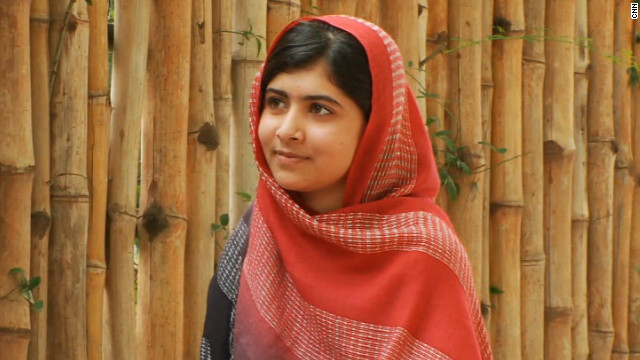 Ziauddin Yousafzai was an educator for many years and first inspired his daughter to take a stand.
But how likely will Malala's work and physical sacrifice actually lead to greater access to quality education for girls in Pakistan?
It's unlikely for her own safety that Malala will ever be able to return there, and unlikely for her father as well, say observers who know Pakistan well.CNN put that question to Ziauddin. Pakistan's government has appointed him education attaché in the Pakistani Consulate in the United Kingdom.
Ziauddin responded to the question by first pointing out that before his daughter was attacked, regular Pakistanis would call and tell him that they'd seen Malala speaking out on television and, inspired, enrolled their daughters in school.
She'd received a huge amount of global attention, especially from western media, after writing a blog for the Guardian when she was 11. She described her fear that the Taliban would keep her from learning.
After Malala was shot, stirring international condemnation, Ziauddin was heartened.
"When this tragic incident happened, small kids, they had posters, banners [with Malala's face and message] and they [related to and knew about] Malala," Ziauddin said. "I think it was a big change."
There have been developments in Pakistan, but it's difficult to call them victories.
A university in Pakistan changed its name to include Malala, but then students protested out of fear that Malala's name would draw unwanted and potentially dangerous attention.
Malala asked them to remove it.
In March, two of Malala's friends were honored -- but those honors would not have been granted had they not been on that bus with Malala. In an interview with CNN, one girl, Shazia Ramzan, said "God forbid something like that would happen again." She said she cannot go to visit her uncles or aunts like I used to."
But both girls said they want to be doctors and are going to continue their studies.
Time magazine selected her to be runner-up in this year's Person of the Year.
This year, Pakistan will observe Malala's 16th birthday as "Malala Day."
Former British Prime Minister Gordon Brown joined Ziauddin in the interview. Brown, now the United Nations special envoy on global education, has been pushing Pakistani authorities to follow through in meaningful, practical ways that will improve girls' access to quality education.
Brown in his own words about girls' education in Pakistan
"I was there in Pakistan at the time [of Malala's shooting]," Brown said. "I think 2 million people have signed a petition calling for universal free education."
Brown met with Pakistan's President Asif Ali Zardari, who had visited Malala in the hospital in the U.K. and vowed to stand up for girls' education and fight extremism.
Beyond Pakistan, Brown said there seems to be a new passion internationally for ensuring girls' rights.
Opinion: Girls' courage, Taliban cowardice
Girls and women are saying, Brown believes, that they are not "prepared to take this anymore."
Brown noted the cultural complacency toward rape of women in India that was brought to light when a woman was gang-raped in New Delhi in December. She died of wounds from the attack. Demonstrators in Nepal are protesting the severely limited rights of women there, Brown said, and Bangladeshi girls have formed safe zones in which children will never be forced to marry adults, a common practice.But inside Pakistan and other parts of the world, change comes slow.
"We thought we would have a 'Malala moment' but that never happened," said Pir Zubair Shah, a fellow at the Council on Foreign Relations. He was a reporter for the New York Times in Pakistan, working in the Waziristan tribal area along the border with Afghanistan. Ziauddin hosted Shah when he wrote about Malala.
"No one has said, 'Let's slash the defense budget and allocate it to education,'" Shah said. "No one has been arrested in the attack on Malala. You have the girls' school who didn't want Malala's name."
He said he doesn't believe there's an heir-apparent for Malala in Pakistan and that safety concerns would make it impossible for her or her father to return.
"You need someone on the ground to lead social change," he said. "It's not the job of Brown or people sitting outside. You have to be there among the people. And right now there is no political leadership who can do that."
The military has failed to chase after militants, the journalist said.
And then there's the complex issue of Pakistan's relationship with the Taliban, he noted.
"The government had a chance, an opportunity [in the days after Malala's shooting]," he said. "I don't want to be pessimistic, but I'm afraid that chance is probably gone."
John Kerry: Malala's vital lesson for US foreign policy
 One of my first meetings as Secretary of State was with a group of courageous women from Burma. Two were former political prisoners, and although they had all endured incredible hardship in their lives, each of them was committed to moving forward — providing education and training for girls, finding jobs for the unemployed and advocating greater women’s participation in civil society. I have no doubt that they will continue to be powerful agents of change, bringing progress to their communities and their country in the years to come.
 Opportunities to engage with such remarkable and inspirational individuals reinforce why it is so vital that the United States continues to work with governments, organisations and individuals around the world to protect and advance the rights of women and girls. After all, just like in our own countries, the most pressing economic, social and political problems cannot be solved without the full participation of women.
According to the World Economic Forum, countries where men and women are closer to enjoying equal rights are far more economically competitive than those where the gender gap has left women and girls with limited or no access to medical care, education, elected office, and the marketplace.
Similarly, the UN Food and Agriculture Organization estimates that if women farmers had the same access to seeds, fertilizer, and technology as men, it would reduce the number of undernourished people in the world by 100 million.
Yet in too many societies and too many homes, women and girls are still undervalued, denied opportunities and forced to marry as children. Too many lives have been lost or altered for ever by gender-based violence. As the father of two daughters, I cannot imagine the pain suffered by the parents of the young woman known as “Nirbhaya”, the 23-year-old medical student murdered on a New Delhi bus simply for being a woman, or the anguish felt by the parents of Malala Yousafzai, the Pakistani girl shot by extremists as she too rode on a bus, simply for wanting to go to school.
The outstanding treatment and care Malala has received at the Queen Elizabeth Hospital in Birmingham is a powerful symbol that people across the world stand united against those who want to silence women and girls through intimidation and violence.
I am inspired by Malala’s undaunted commitment to her cause, by Nirbhaya’s determination, while dying, to bring her assailants to justice, and by their fathers’ courage in speaking out on behalf of their daughters and women everywhere.
No country can get ahead if it leaves half of its people behind. So it is in the interests of boys and men to do everything in their power to unleash the potential of girls and women and to champion their rights, because without their contribution we are all the poorer. This is why the United States believes gender equality is critical to our shared goals of prosperity, stability, and peace, and why investing in women and girls worldwide is critical to advancing US foreign policy.
We are investing in the training and mentoring of women entrepreneurs so they cannot only lift up their own families, but also help their countries’ economies grow. We are investing in girls’ education so they can escape forced early marriage, break the cycle of poverty and develop into community leaders and engaged citizens. Increasing girls’ and women’s education and their access to resources also improves the health and education of the next generation.
We are working with partners around the world to boost maternal health, strengthen female farmers, and prevent and address gender-based violence because all societies benefit when women are healthy, safe, and can contribute their labour, leadership and creativity to the global economy. US diplomats are working to integrate women fully into peace negotiations and security efforts because bringing women’s experiences and insights to the table can help prevent future conflict.
My predecessor, Hillary Clinton, elevated the empowerment of women and girls as a foreign policy issue, and I’m determined to keep it a cornerstone of US foreign policy during my time in office. The truth is that when women thrive, we all thrive, and our global commitment to that cause will not diminish.
Today, International Women’s Day, is a day of celebration. It is also a day when each of us must recommit to ending the inequality that prevents progress in every corner of the globe. We can and we must commit to this so that each of our daughters can ride a bus without fear, all of our sisters can fulfill their tremendous potential, and we can tap the talents of every single woman and girl.
Unemployment at 4-Year-Low as U.S. Hiring Gains Steam
 By NELSON D. SCHWARTZ
Bolstered by a healthier private sector, the United States economy gained 236,000 jobs in February, well above what had been expected, while the unemployment rate fell to 7.7 percent, its lowest level since December 2008.
The gains were broad-based, the Labor Department said Friday, with sectors ranging from manufacturing to business services turning in healthy results. Construction was especially strong, adding 48,000 jobs, a sign that the recovery in the housing market is beginning to translate into new jobs.
Public-sector employment continued to shrink, however, as the number of government employees nationwide fell by 10,000.
While many economists were encouraged by the report, some noted that the size of the labor force contracted by 130,000. Some of that was because of retirements, but some was also a result of discouraged workers giving up the search for jobs.
As a result, the labor participation rate sank to 63.5 percent, a low for the current economic cycle.
At the current rate of job creation, unemployment could actually crack the 7 percent level by the end of the year. However, economists expect the budget cuts now under way in Washington to contribute significant headwinds in the months ahead. The so-called sequester went into effect March 1.
“We think we’ll see some slowdown in April and May because of the sequester,” said Michelle Meyer, senior United States economist at Bank of America Merrill Lynch. “We’re going to see federal job cuts and the spring is going to be a soft patch for the labor market.”
She estimated that the unemployment rate would stabilize at about 7.5 percent later this year.
The unemployment fell from 7.9 percent in January. Economists had been expecting the economy to add 165,000 jobs in February, with no movement in the rate.
After peaking at 10 percent in October 2009, the unemployment rate fell steadily for three years but has been stuck at just below 8 percent since last September.
The pace of hiring in February represented an acceleration from the previous four months, when the economy added jobs at a monthly rate of 190,000.
The budget cuts in Washington are expected to reduce federal unemployment benefits by about 10 percent. State benefits, which cover the first 26 weeks of unemployment in most states, will not be affected by the federal budget squeeze.
Dan Haney has worked occasionally since he was laid off from his job as a customer service representative two years ago, but lately the hunt for work has proved fruitless, and he is concerned about what would happen if his unemployment benefits were reduced.
“At this point, I have to take what comes down the pike,” said Mr. Haney, who is 54 and lives in Philadelphia. “I’m on the computer every day looking for jobs.”
A high school graduate, Mr. Haney has some computer training but lacks a college degree, which has made finding a job all the more difficult.
“Some of these entry-level jobs say college is preferred,” Mr. Haney said. “Why do you need a college degree to answer a phone?”
West training Syrian rebels in Jordan
 Western training of Syrian rebels is under way in Jordan in an effort to strengthen secular elements in the opposition as a bulwark against Islamic extremism, and to begin building security forces to maintain order in the event of Bashar al-Assad's fall.
Jordanian security sources say the training effort is led by the US, but involves British and French instructors.
The UK Ministry of Defence denied any British soldiers were providing direct military training to the rebels, though a small number of personnel, including special forces teams, have been in the country training the Jordanian military.
But the Guardian has been told that UK intelligence teams are giving the rebels logistical and other advice in some form.
British officials have made it clear that they believe new EU rules have now given the UK the green light to start providing military training for rebel fighters with the aim of containing the spread of chaos and extremism in areas outside the Syrian regime's control.
According to European and Jordanian sources the western training in Jordan has been going on since last year and is focused on senior Syrian army officers who defected.
"As is normal, before any major decision is taken on this issue, the preparations are made so that when that decision is taken, everything is in place for it to go smoothly. That is what these groups [special forces] do. They go in in advance," a European diplomat said.
A Jordanian source familiar with the training operations said: "It's the Americans, Brits and French with some of the Syrian generals who defected. But we're not talking about a huge operation."
He added that there had so far been no "green light" for the rebel forces being trained to be sent into Syria. But they would be deployed if there were signs of a complete collapse of public services in the southern Syrian city of Daraa, which could trigger a million more Syrians seeking refuge in Jordan, which is reeling under the strain of accommodating the 320,000 who have already sought shelter there.
The aim of sending western-trained rebels over the border would be to create a safe area for refugees on the Syrian side of the border, to prevent chaos and to provide a counterweight to al-Qaida-linked extremists who have become a powerful force in the north.
British officials say new European guidelines on the Syrian arms embargo, formally adopted by the EU at the beginning of March, allow military training as long as the ultimate aim of that training is "the protection of civilians".
Paris takes an identical view of the EU rules.
Officials in Brussels say the language of the guidelines is less than clear-cut. "It's deliberately hazy," said one. "When it comes to technical assistance, what it means in practice depends on who you ask. The Brits and the French, for example, are much more forward-leaning than others. The principle is that the assistance should be for the protection of civilians, but as we saw in Libya, that can be interpreted in different ways."
British officials argue that training of Syrian forces to fill the security vacuum as the Assad regime collapses would be help safeguard civilian lives.
William Hague, the foreign minister, outlined the goals of such training on Wednesday.
"Such technical assistance can include assistance, advice and training on how to maintain security in areas no longer controlled by the regime, on co-ordination between civilian and military councils, on how to protect civilians and minimise the risks to them, and how to maintain security during a transition," he told parliament. "We will now provide such assistance, advice and training."
A Foreign Office spokesman said: "It's not the sort of thing we are going into too much detail on right now. We are big on the transition picture, because at some point Assad is going to fall, and the opposition are going to need help to provide governance in areas they control, and that of course includes security. But security doesn't just mean fighting, it also means basic law and order, and policing."
The Pentagon said last October that a small group of US special forces and military planners had been to Jordan during the summer to help the country prepare for the possibility of Syrian use of chemical weapons and train selected rebel fighters.
That planning cell, which was housed at the King Abdullah II Special Operations Training Centre in the north of the capital, Amman, has since been expanded to co-ordinate a more ambitious training programme. But Jordanian sources said the actual training was being carried out at more remote sites, with recent US reports saying it was being led by the CIA.
For the first two years of the Syrian civil war, Jordan has sought to stay out of the fray, fearing a backlash from Damascus and an influx of extremists that would destabilise the precariously balanced kingdom.
"What has happened of late is that there has been a tactical shift," said Julien Barnes-Dacey, a Middle East expert at the European Council on Foreign Relations thinktank. "Islamist forces have been gaining steam in the north and Jordan is keen to avoid that in the south. Having been very hands-off, they now see that they have to do something in the south."
He added: "There is a feeling that Jordan simply can't handle a huge new influx of refugees so the idea would be to create a safe zone inside Syria. For them it's a no-win scenario. Everything they had been seeking to avoid has come to pass."
For western and Saudi backers of the opposition, Jordan has become a preferable option through which to channel aid than Turkey. Ankara has been criticised for allowing extremist groups, such as the al-Nusra Front, become dominant on the northern front while it focused on what it sees as the growing threat of Kurdish secessionism.
"The Americans now trust us more than the Turks, because with the Turks everything is about gaining leverage for action against the Kurds," said a Jordanian source familiar with official thinking in Amman.
The US has announced an extra $60m (£40.2m) in direct aid to the rebels, including military rations and medical kits. Asked on Tuesday whether assistance included military training, the US state department spokesman Pat Ventrell replied: "I really don't have anything for you on that. Our policy has been non-lethal assistance."
Earlier this week, the US secretary of state, John Kerry, said Washington was now confident that arms supplies to the rebels would not be diverted to extremists. "There is a very clear ability now in the Syrian opposition to make certain that what goes to the moderate, legitimate opposition is, in fact, getting to them, and the indication is that they are increasing their pressure as a result of that," he said.
Syrian rebels have said that in the past few months there had been a relaxation of the previously strict US rules on what kinds of weapons were allowed across the border, and that portable anti-aircraft missiles had been released from Turkish warehouses where they had been impounded.
Matt Schroeder, who tracks the spread of such weapons for the Federation of American Scientists, said the recent appearance of modern, sophisticated anti-aircraft missiles in the hands of such fragmented rebel groups was deeply troubling in view of their capacity to bring down civilian airlines.
"This is a step above anything we've seen before in the hands of non-state actors," he said. "This is a new and unfortunate chapter in recent manpad [man-portable air-defence] proliferation."
'Indian-origin jihadis' fighting in Syria against Assad regime
http://timesofindia.indiatimes.comIndian-origin jihadi fighters have been found fighting along with the rebels in the raging civil war in Syria. "This is one of the reasons why we think India should play a more pro-active role, because this expanding conflict will not leave anyone untouched," said Bouthaini Shabaan, political adviser to Syrian President Bashar-al-Assad, in a conversation with TOI. She quoted UN envoy Lakhdar Brahimi as saying that there were almost 38 nationalities of fighters in war-torn Syria. Shabaan is in India as a special envoy of Assad, to convey a message from him to PM Manmohan Singh. Syria wants India to take a lead role at the forthcoming BRICS summit, and "support" Russia and China in their stand on the conflict. Both P-5 countries have vetoed UN Security Council resolutions against Syrian regime. Shabaan met foreign minister Salman Khurshid and national security adviser (NSA) Shivshankar Menon. MEA spokesperson said, "India reiterated deep concern on the security situation in Syria and the continued escalation in violence. We also expressed our concern about the plight of the people of Syria arising out of intense fighting and conflict. India urged the need for peaceful resolution of the crisis with participation of all parties taking into account the legitimate aspirations of all Syrians for which the Geneva Communique which includes the 6-Point Plan of Kofi Annan provides a good basis." Many of the Indian fighters found in Syria are coming in from the UK, she said. Shabaan said the western narrative on the Syrian conflict was incorrect, and the war within Syria was actually being fuelled by Turkey and Qatar, with some help from Saudi Arabia. "Turkey wants to spread the Muslim Brotherhood all over the region," she alleged. The US, she argued, wanted to break up the region by fomenting conflicts along sectarian and ethnic lines, which could destabilize West Asia for long time to come. "We don't want this to become a sectarian conflict," she added. She said she had told foreign minister Salman Khurshid that India should be wary of countries funding mosques here since Damascus was living with the consequences of such action.
In Pakistan, students hungry to learn Chinese
 When Misbah Rashid taught Chinese 30 years ago, few signed up. Today his department has more than 200 Pakistani students, increasingly attracted by the prospect of an affordable education and a job.
For decades, a foreign education was the preserve of the richest who could afford the stratospheric expense of sending their progeny to Oxford or Harvard to mingle with an international Westernised elite.
But Rashid's pupils are mostly middle class. Ambitious and academic, they lack the means to afford an American or British education and so they sign up for Mandarin Chinese at the National University of Modern Languages in Islamabad.Some of them hope to get a job with a Chinese company in Pakistan. Others will go on to further studies in China, which offers around 500 scholarships a year and cheaper fees.
A course in China costs a few thousand dollars a year, compared with the tens of thousands of dollars US and British universities charge. What is more, some Pakistanis say their great northeastern neighbour makes them feel more welcome.
"Nowadays as Pakistanis, you may not be as welcome in all other countries as we were a few years ago," says 18-year-old Ali Rafi, who applied to study economics at Shangdon University after visiting last summer.
"But when we went to China, there was one major difference in that we felt at home, the people relations were really, really good. We were always welcomed, honoured and everyone was really pleased when they learnt we were Pakistani."
He studies at City School, one of the private schools in Islamabad that has started to offer Chinese lessons to children as young as 12, who sing in Mandarin under the watchful eye of their teacher, Zhang Haiwei.
If everything goes well, the classes will be rolled out across the school's other 200 branches in Pakistan. And other private schools are doing the same.
Pakistanis complain about the difficulty of getting visas and of the suspicion their nationality can arouse among those who associate Pakistan with Osama bin Laden, Al-Qaeda and the Taliban, particularly in Britain and the United States.
The British government says that overall, 20 percent fewer student visas were issued in 2012, compared to the previous year.
The US mission in Pakistan says it supports the world's largest US government-funded exchange programme, sending over 1,000 Pakistanis on fully funded educational programmes to the United States every year. The independent Institute of International Education says 5,045 students from Pakistan studied in the United States in 2010-11, but that the number has declined steadily since 2001-02, the academic year of the 9/11 attacks.
There is also considerable resentment of US policy, including the "covert" use of armed drones to carry out attacks in Pakistan on militants.
Whereas Chinese investment, China's reluctance to admonish Pakistan in public, its rivalry with India and status as an emerging global superpower give it considerable goodwill.
-- China's growing presence in Pakistan --
The job market is another consideration.
Pakistan's main trading partner is still the European Union, but trade with China reached $12 billion last year, up 18 percent from the previous year.
China is also Pakistan's main arms supplier. Beijing built two nuclear power plants in Pakistan and is contracted to construct two more reactors. There are an estimated 10,000 Chinese living in Pakistan.
Last month, it also took control of Pakistan's strategic port of Gwadar, which through an expanded Karakoram Highway could connect China to the Arabian Sea and Strait of Hormuz, a gateway for a third of the world's traded oil.
Mushtak Ahmed, 19, has enrolled under Rashid precisely because of the Chinese influx into Pakistan's northern province of Gilgit-Baltistan, where China is widening the highway to its border.
"Lots of Chinese people are coming to our area and they just speak Chinese and we cannot understand it... so there is a need for translators," he said.
According to Pakistan's embassy in Beijing, around 8,000 Pakistani students are already studying in China and thousands more are preparing to join them.
Former ambassador to Beijing and Washington Riaz Khokar said wealthy Pakistanis tend not to return after studying in the West, but China offers a technical education that will benefit the Pakistani economy.
"The Chinese economic presence in Pakistan is growing so why should there be Chinese managers or Chinese at various levels? The idea was (that) we should train."
China has accused the separatist East Turkestan Islamic Movement, which wants an independent homeland in the western Muslim-majority region of Xinjiang, of training "terrorists" in Pakistan, although experts question how much of a threat they are.
But the relationship has few of the tensions that Pakistan suffers with the United States, which repeatedly presses Pakistan to do more to clamp down on militants who launch attacks on American and Afghan forces in Afghanistan.
"I have dealt with their intelligence, I have dealt with their army, I have dealt with everybody at the highest level. They have never told us 'do this or we will kick you as the US does," said Khokar.
But if political relations are cosy, then Haiwei says ordinary Chinese professionals are more circumspect.
"In Pakistan we have more than 6,000 Chinese students. However, we have maybe about 50 teachers. We don't have enough teachers. Some people found it dangerous so they don't want to work here," he said.
Zardari: Allot apartments to Abbas Town victims
The Express TribunePresident Asif Ali Zardari instructed the Chief Minister Sindh Qaim Ali Shah to take immediate steps to rehabilitate the victims of Abbas Town blasts and provide them with apartments, Express News reported. Zardari held a meeting with the Chief Minister, provincial ministers, and the chief secretary of Sindh at the Chief Minister House in Karachi on Friday and asked them to start relief efforts right away. Regarding the allotment of apartments, the Sindh government was instructed that the relatives of the deceased should be preferred over other affectees. On March 7, Sindh Chief Minister Syed Qaim Ali Shah rejected the notion that government officials and police were busy at a dinner rather than tending to victims of the twin bombings in Abbas Town. Twin blasts shook Shia-dominated Abbas Town, Karachi, on March 3, which left at least 50 dead and over 140 injured.
Hagel makes first Afghan trip as defense chief
 Chuck Hagel arrived in Afghanistan on Friday for his first trip abroad as defense secretary, seeking to make his own assessment about America's longest war as it enters its final stretch.
Hagel said he would meet commanders and hold talks with Afghan President Hamid Karzai, whose recent orders to curtail military activity underscore an often tense relationship with the 66,000 American forces there.
"I need to better understand what's going on," Hagel told reporters as he flew to Kabul on the unannounced visit, adding his goal was to "make my own assessment and listen to our commanders".
Hagel said it was his first trip to Afghanistan since a mid-2008 visit with then-Senator Barack Obama during Obama's campaign for the presidency. Obama, a Democrat, forged a close bond with Hagel, a Republican, and remarked later that summer that the two agreed on almost "every item" of foreign policy.
That included the Iraq war. Hagel was an early Republican critic of the Iraq war, angering party allies in the Senate. They fiercely opposed his nomination to become Obama's defense chief but lacked the votes to stop it.
Hagel was confirmed on February 26 and was sworn into office the next day.
Hagel's advice may help shape some of Obama's most lasting decisions in Afghanistan, notably how large a residual mission to keep there once NATO wraps up its combat mission at the end of next year and the vast majority of foreign forces go home.
On Tuesday, the outgoing head of the U.S. military's Central Command, General James Mattis, disclosed that he recommended keeping 13,600 American troops in Afghanistan - above the range of troop levels officials have said were being considered by the White House and discussed by NATO defense chiefs last month.
"I think it is important, General Mattis - all of our commanders - have an opportunity for their input. The president wants that, needs that, welcomes that," Hagel said, without disclosing his own thinking. He added Obama had not made a final decision.
Obama last month announced the withdrawal of 34,000 American troops - about half the total - by early next year. Officials also have outlined the expected pace of the withdrawal through next April.
Hagel, a decorated Vietnam veteran with shrapnel wounds in his chest, played down links between Vietnam and the grinding, counter-insurgency battle in Afghanistan. Despite 11 years of fighting and significant gains in Afghanistan, the Taliban remains resilient and enjoys safe havens across the border in Pakistan.
"As to the parallels to Vietnam, there are always parallels to any war," Hagel said.
Talking in broad terms about the end of the U.S. combat mission, Hagel remarked at one point to reporters: "It was never the intention of the United States to stay in Afghanistan indefinitely."
He added that did not mean the residual U.S. force after 2014, whatever size that would be, wasn't also significant - pointing to lasting U.S. military contingents in Europe, South Korea and Japan. But the role of the U.S. mission would change as Afghans take charge of their security.
"If you look at the role that we've had for the past 12 years as the lead combatant in Afghanistan, that's a totally different role than what we're transitioning into," Hagel said.
Asked about how the war would end, Hagel said: "I think we are transitioning in a way that give the Afghan people a very hopeful future."
Hagel's visit to Kabul comes after Karzai has taken steps to limit U.S. military activities. On February 13, a NATO air strike requested by Afghan forces killed 10 people - including five children and four women - in the eastern province of Kunar, prompting Karzai to ban his troops from requesting foreign air strikes.
Two weeks later he halted all special forces operations in the central province of Wardak after a series of allegations involving U.S. special forces soldiers and Afghan men said to be working with them.
Asked whether limits on U.S. operations would be discussed with Karzai, Hagel said: "I look forward to talking with the president about many issues. And that, certainly, I'm sure will be one of them."
Pakistan: Towards general election
We Well respected non-governmental organisation Pildat and Gallup jointly undertook a survey to forecast the political weather in Pakistan and determine the voting patterns in 300 villages and 200 urban locations with a sample size of 10,000 - well above the normal sample of 3000 or so. The exercise grouped 272 constituencies, carved on the basis of historical voting patterns for the past 20 years, into 11 electoral territories: 3 in Punjab, 2 in Sindh, 4 in Khyber Pakhtunkhwa and 2 in Balochistan.
Each of the 11 territories exhibited some uniformity, especially in terms of key contesting parties; however, each territory had internal similarity though dissimilar from others. The highest scorer was the PML (N) with a consolidated average national score of 37 percent, followed by 16 percent scored by the PPP as well as the PTI. However, the survey does acknowledge that national popularity polls are not a good indicator of which party would win the majority seats in parliament.
To better assess the voting patterns in Pakistan the survey identified and developed three drivers of possible change in conventional electoral patterns: (i) popularity-electability gap defined as the difference between the popularity of the leader and that of the party; (ii) alliance potential index measured by the voters first and second choice in the elections; and (iii) acceptability gap or the measure of a voter's hostility to a particular party with a positive value given to that party where the voter favours a party more than expresses hostility against it.
The scores of all major political parties based on these three drivers of change conclusively indicate that the perception that a large enough coalition would automatically form the next government is no longer applicable. Those political pundits who had regarded Nawaz Sharif's refusal to form coalitions with other parties as a clear indication of his inability to form the next government based on the findings of earlier surveys would now have to revisit their evaluation.
The survey noted the results of the November 2012 survey conducted by the US-based International Republican Institute and the February 2013 poll conducted by Gallup provided a consolidated score: PML (N) scored 32 percent in IRI, 41 percent in Gallup and 36.5 percent in consolidated with PTI in second place at 18, 14 and 16 percent and PPP at third place at 14, 17 and 15.5 percent respectively. PML (Q) had the appallingly low score of 2, 4 and consolidated 3 percent.
In Punjab the scores were as follows: PML (N) scored 49 percent in IRI, 59 percent in Gallup and 54 percent consolidated, followed by PTI which scored 19, 14 and 16.5 percent, while PPP scored 8, 10 and 9 percent respectively. The PPP's position in Punjab is worse if one looks at the voting intention score based on the three drivers of change in North, West and South Punjab with 4, 10 and 18 percent with PML-N's comparable score at 63, 69 and 43 percent. But clearly the lead of PML (N) in South Punjab is less than in other regions and part of the reason may be the PPP's election manifesto to carve South Punjab as another province. PTI scored the second highest in North Punjab with 15 percent but came third in West and South Punjab with 9 and 16 percent scores.
In Sindh, PPP was clearly in the lead and scored 32 percent in IRI, 37 percent in Gallup and 34.5 percent consolidated, followed by MQM 16, 19, and 17.5 percent with PTI in third place scoring 9, 7 and 8 percent and PML (N) 8, 6 and 7 percent consolidated respectively.
In Karachi, Sindh, the voting intention score is interesting with MQM, as expected, clearly in the lead at 45 percent followed by PTI at 11 percent, PPP at 10 percent and all others at a whopping 3.4 percent. There is therefore room for alliance which may tilt the balance in favour of one party.
The voting patterns in the rest of Sindh are also interesting with PPP a clear winner with 51 percent followed by PML (N) and MQM at 5 percent each but with others scoring a whopping 39 percent in Sindh there is ample room for an alliance that can provide a serious opposition to erstwhile coalition partners PPP and MQM.
Khyber Pakhtunkhwa's scores gave a majority to PTI with 32 percent score by IRI, 28 percent by Gallup and 30 percent consolidated followed by PML (N) with 12, 34 and 23 percent, JUI (F) 6, 10 and 8 percent consolidated, and ANP with 3, 11 and 7 percent respectively. In terms of voting patterns, PML (N) has emerged as a clear winner with 34, 36 and 43 percent vote in KPK South, Valley and Hazara with PTI in second place scoring 33, 28 and 34 percent.
In Balochistan as per Gallup regional parties were the highest scorers at 36 percent followed by PPP's 18 percent IRI score, 17 Gallup score and 17.5 consolidated score, PML (N) 13, 12 and 12.5 percent consolidated, and PTI 8, 3 and 5.5 percent respectively. Gallup polls alone show JUI/MMA's 18 percent score with ANP at 13 percent.
The situation in Balochistan has changed with 5 members of provincial and national assemblies as well as another 17 PPP members having joined PML (N). The change in party by individuals or groups indicate that the survey results may well change even before they are announced and the current set of statistics is not a reflection of the final election results.
The PTI, no doubt, would dismiss these results by pointing out that it was engaged in intraparty elections for an extended period and now that they are complete and the party structure in place it would once again focus on the forthcoming elections. The start of their campaign for the elections would be 23rd March, they argue, and the gauge should be the jalsa at Lahore on that historical date.
In short and as acknowledged by Pildat/Gallup the voting patterns would change and continue to change till the last minute as and when the parameters change. The focus of the PPP and PML (N) leadership based on the numbers changing party loyalties appears to be on luring the electables to their side. The question remains whether the electorate would surprise the parties' leadership as well as the surveys to elect on the basis of past performance and future expectations.
 Well respected non-governmental organisation Pildat and Gallup jointly undertook a survey to forecast the political weather in Pakistan and determine the voting patterns in 300 villages and 200 urban locations with a sample size of 10,000 - well above the normal sample of 3000 or so. The exercise grouped 272 constituencies, carved on the basis of historical voting patterns for the past 20 years, into 11 electoral territories: 3 in Punjab, 2 in Sindh, 4 in Khyber Pakhtunkhwa and 2 in Balochistan.
Each of the 11 territories exhibited some uniformity, especially in terms of key contesting parties; however, each territory had internal similarity though dissimilar from others. The highest scorer was the PML (N) with a consolidated average national score of 37 percent, followed by 16 percent scored by the PPP as well as the PTI. However, the survey does acknowledge that national popularity polls are not a good indicator of which party would win the majority seats in parliament.
To better assess the voting patterns in Pakistan the survey identified and developed three drivers of possible change in conventional electoral patterns: (i) popularity-electability gap defined as the difference between the popularity of the leader and that of the party; (ii) alliance potential index measured by the voters first and second choice in the elections; and (iii) acceptability gap or the measure of a voter's hostility to a particular party with a positive value given to that party where the voter favours a party more than expresses hostility against it.
The scores of all major political parties based on these three drivers of change conclusively indicate that the perception that a large enough coalition would automatically form the next government is no longer applicable. Those political pundits who had regarded Nawaz Sharif's refusal to form coalitions with other parties as a clear indication of his inability to form the next government based on the findings of earlier surveys would now have to revisit their evaluation.
The survey noted the results of the November 2012 survey conducted by the US-based International Republican Institute and the February 2013 poll conducted by Gallup provided a consolidated score: PML (N) scored 32 percent in IRI, 41 percent in Gallup and 36.5 percent in consolidated with PTI in second place at 18, 14 and 16 percent and PPP at third place at 14, 17 and 15.5 percent respectively. PML (Q) had the appallingly low score of 2, 4 and consolidated 3 percent.
In Punjab the scores were as follows: PML (N) scored 49 percent in IRI, 59 percent in Gallup and 54 percent consolidated, followed by PTI which scored 19, 14 and 16.5 percent, while PPP scored 8, 10 and 9 percent respectively. The PPP's position in Punjab is worse if one looks at the voting intention score based on the three drivers of change in North, West and South Punjab with 4, 10 and 18 percent with PML-N's comparable score at 63, 69 and 43 percent. But clearly the lead of PML (N) in South Punjab is less than in other regions and part of the reason may be the PPP's election manifesto to carve South Punjab as another province. PTI scored the second highest in North Punjab with 15 percent but came third in West and South Punjab with 9 and 16 percent scores.
In Sindh, PPP was clearly in the lead and scored 32 percent in IRI, 37 percent in Gallup and 34.5 percent consolidated, followed by MQM 16, 19, and 17.5 percent with PTI in third place scoring 9, 7 and 8 percent and PML (N) 8, 6 and 7 percent consolidated respectively.
In Karachi, Sindh, the voting intention score is interesting with MQM, as expected, clearly in the lead at 45 percent followed by PTI at 11 percent, PPP at 10 percent and all others at a whopping 3.4 percent. There is therefore room for alliance which may tilt the balance in favour of one party.
The voting patterns in the rest of Sindh are also interesting with PPP a clear winner with 51 percent followed by PML (N) and MQM at 5 percent each but with others scoring a whopping 39 percent in Sindh there is ample room for an alliance that can provide a serious opposition to erstwhile coalition partners PPP and MQM.
Khyber Pakhtunkhwa's scores gave a majority to PTI with 32 percent score by IRI, 28 percent by Gallup and 30 percent consolidated followed by PML (N) with 12, 34 and 23 percent, JUI (F) 6, 10 and 8 percent consolidated, and ANP with 3, 11 and 7 percent respectively. In terms of voting patterns, PML (N) has emerged as a clear winner with 34, 36 and 43 percent vote in KPK South, Valley and Hazara with PTI in second place scoring 33, 28 and 34 percent.
In Balochistan as per Gallup regional parties were the highest scorers at 36 percent followed by PPP's 18 percent IRI score, 17 Gallup score and 17.5 consolidated score, PML (N) 13, 12 and 12.5 percent consolidated, and PTI 8, 3 and 5.5 percent respectively. Gallup polls alone show JUI/MMA's 18 percent score with ANP at 13 percent.
The situation in Balochistan has changed with 5 members of provincial and national assemblies as well as another 17 PPP members having joined PML (N). The change in party by individuals or groups indicate that the survey results may well change even before they are announced and the current set of statistics is not a reflection of the final election results.
The PTI, no doubt, would dismiss these results by pointing out that it was engaged in intraparty elections for an extended period and now that they are complete and the party structure in place it would once again focus on the forthcoming elections. The start of their campaign for the elections would be 23rd March, they argue, and the gauge should be the jalsa at Lahore on that historical date.
In short and as acknowledged by Pildat/Gallup the voting patterns would change and continue to change till the last minute as and when the parameters change. The focus of the PPP and PML (N) leadership based on the numbers changing party loyalties appears to be on luring the electables to their side. The question remains whether the electorate would surprise the parties' leadership as well as the surveys to elect on the basis of past performance and future expectations.
Pakistan: International Women’s Day
Daily TimesInternational Women’s Day (IWD) is being celebrated all over the world today as an ode to the mammoth strides women have taken in every sphere of life, be it in the workplace, the cultural space or even the home. It is an appreciation of the role played by women in shaping society as we know it. Historically, IWD is being commemorated since 1908. It started as a socialist political event, marking women’s relatively freer access to the industrialised world, and then spreading across the world as a day celebrating female suffrage. It is now a day of appreciation, devotion and love for what is, essentially, one half of the world’s population. Throughout the world, on March 8, celebrations are held, women are given glowing tributes and a general air of female empowerment dominates. And in Pakistan? We still seem to be stuck in the dark ages as far as our treatment of women is concerned. Pakistan is still fighting the demons of suppression and patriarchy with women as the frontline victims in this war. Cases of domestic violence have surged, militancy in the tribal regions is seeing girls’ schools bombed to smithereens and rising conservatism is the reason more women are seeing the four walls instead of the open world. Honour killings, rape, harassment and other social evils are also on the rise. At the same time, we are seeing more women venture out of their homes in the hopes of becoming economic agents to cope with rising inflation. However, they are still surrounded by a male dominated culture that views them as the ‘honour’ and ‘shame’ of men. This government did try to pass a few bills and legislation to see women gain a better footing in society and the workplace, such as the Bill Against Sexual Harassment in the Workplace, and it tried to get a bill against domestic violence passed but that is still pending. However, all these efforts are far from enough. We need to see many more positive steps taken to bring women true emancipation, more equality, freedom from orthodox tradition and cultural stagnation, and we need to see an end to violence, gender discrimination, persecution, rape and stigma. It is hoped that the post-election government will step up to the monumental task of introducing the right kind of attitude towards women and will help them achieve all they are meant to and be celebrated for.
President Zardari reiterates elections will be held on time
Radio PakistanPresident Asif Ali Zardari has reiterated that elections will be held on time and no one will be allowed to subvert the electoral process by creating law and order situation. He was chairing a meeting in Karachi today to review the law and order situation in Sindh particularly Karachi in the wake of recent bomb blasts in the metropolis. The President urged the provincial government and relevant agencies for taking stern actions to ensure the safety and protection of life and property of the citizens‚ which is the prime responsibility and also the priority of the government. Spokesperson to the President Farhatullah Babar said that the President at the outset of the meeting condemned the barbaric incident of carnage at Abbas Town‚ Karachi and offered fateha for the departed souls. The President expressed sympathies with the bereaved families and directed for extending full support and assistance in rehabilitation to the victims of the blasts and providing best medical treatment on government expenses to all those affected by the bomb blasts. During the meeting‚ the President called upon all political forces and stakeholders to come forward‚ work hand in hand with the law enforcing agencies in Karachi and play their active role to restore peace and stability and bringing the criminals to books. President Zardari said that government accords top priority to safeguarding the life and property of citizens and that they could never be left at the mercy of a handful of vicious elements. He reiterated that the criminals involved in violent activities would be traced and brought to justice. He assured that the federal government would provide all possible help and assistance to the victims of bomb blasts at Abbas Town‚ Karachi. Earlier Governor Sindh and Chief Minster Sindh briefed the meeting on latest situation in Sindh particularly Karachi and the various steps afoot to maintain law and order in Karachi. Later‚ the President during his separate meeting with Deputy Speaker Sindh Assembly‚ Shehla Raza‚ condoled the death of her brother in law‚ Akhtar Zaidi and her other relatives who lost their lives in the recent bomb blast in Karachi.
Some 30 presidents attend Chávez's state funeral
 Spanish Crown Prince Felipe and the presidents of Colombia, Juan Manuel Santos; Ecuador, Rafael Correa; Cuba, Raúl Castro, Brazil, Dilma Rousseff; Haiti, Michel Martelly; Peru, Ollanta Humala; Bolivia, Evo Morales; Uruguay, José Mujica; Chile, Sebastián Piñera; Mexico, Enrique Peña Nieto and Equatorial Guinea, Teodoro Obiang are already in Caracas,Some 30 heads of state and government from around the world are attending the state funeral of Venezuelan President Hugo Chávez on Friday in Caracas, after which Vice-President Nicolás Maduro will be sworn in as acting president of the country at an extraordinary meeting of the National Assembly.
Chávez's funeral will begin at 11 am at the Military Academy of Venezuela in Caracas, where his remains have been in state since Wednesday and will stay for additional seven days.
Spanish Crown Prince Felipe and the presidents of Colombia, Juan Manuel Santos; Ecuador, Rafael Correa; Cuba, Raúl Castro, Brazil, Dilma Rousseff; Haiti, Michel Martelly; Peru, Ollanta Humala; Bolivia, Evo Morales; Uruguay, José Mujica; Chile, Sebastián Piñera; Mexico, Enrique Peña Nieto and Equatorial Guinea, Teodoro Obiang are already in Caracas
Venezuela's government announced on Thursday that Chávez's body would be embalmed for "eternal" display in a glass case.
This International Women's Day, Remember: Saudi Women Still Can't Drive
 Was it really five years ago that some brave Saudi women dared to drive their own cars to protest the blanket denial of basic human rights to women in the Kingdom? Not much has changed since, despite a few cosmetic measures. Women are still minors for life, under the legal control of father, husband, uncle or even son. Shocking abuses of power are routine. Theocracy still reigns. And women are still banned from getting behind the wheel.
Here's a dispatch from Wajeha al-Huwaider, one of the organizers of the driving protest:
Five Years Since I Drove My Car on Women’s Day
We were five women who launched a campaign for women’s driving in KSA. We were able to collect around 3,000 signatures for a petition which was sent to King Abdullah Bin Abulaziz. Around 80 percent of those who signed the petition were women.
On Women’s Day, March 8, 2008, I drove my car and made a video clip to support the driving campaign which was released on YouTube. That video clip ensured that the driving campaign became known around the world. I thought at the time that it would be a matter of a few months before the KSA authorities let women drive cars. Five years later, there are no indications that this right will be granted to women. So, the fact is women might have to wait for years to gain the right to drive cars. Moreover, the situation is getting worse for women now. The Saudi authorities have limited the number of countries whose citizens can work as private drivers for Saudi families. This has raised the cost of hiring drivers.
Women suffer every day in order to get basic things done, like going to work or buying groceries. Also, many can’t work because they can’t find a driver at an affordable price.
Under these circumstances, we are demanding a transportation allowance from the Saudi government until they provide reliable public transportation in every Saudi city. The Saudi government has plenty of money and they can easily afford it. The government is preventing women from driving, so they should pay us so that we can survive.
Thursday, March 7, 2013
Chavez body to be put on permanent display
Nicolas Maduro, Venezuela's acting president, says Hugo Chavez's embalmed body will be permanently displayed in a glass casket so that "his people will always have him." Tens of thousands have already filed past his glass-topped casket at a military academy following a seven-hour procession on Tuesday which took his body from the hospital where he died. Al Jazeera’s Lucia Newman is in Caracas near where Chavez's body is being displayed.
Subscribe to:
Posts (Atom)