M WAQAR..... "A man's ethical behavior should be based effectually on sympathy, education, and social ties; no religious basis is necessary.Man would indeed be in a poor way if he had to be restrained by fear of punishment and hope of reward after death." --Albert Einstein !!! NEWS,ARTICLES,EDITORIALS,MUSIC... Ze chi pe mayeen yum da agha pukhtunistan de.....(Liberal,Progressive,Secular World.)''Secularism is not against religion; it is the message of humanity.'' تل ده وی پثتونستآن
Wednesday, February 20, 2013
Peaceful Afghanistan suits Pakistan
Afghanistan’s Fawzia Koofi will stand in presidential elections
http://www.thestar.com
Popular female MP has launched a campaign website ahead of 2014 elections with a platform supporting women's rights and opposing corruption.There are two Afghanistans, old and new. The old Afghanistan was the front line of the war on terror, manned by thousands of western soldiers fighting to prop up the government in Kabul and bankrolled by billions of dollars in aid money. But the war’s battlefields have shifted elsewhere. The new Afghanistan faces an unknown future. Fed up with a decade of military misadventures, NATO and the Pentagon are planning a fast exit as Taliban insurgents step up their attacks. Aid money is drying up, and Afghans with connections or cash are leaving for Dubai. But there is a flash in the dark, a sign that the Afghanistan project perhaps wasn’t a failure. Popular MP Fawzia Koofi has declared her intention to run for president. She has launched a campaign website ahead of next year’s elections with the slogan “the voice of hope for the future of Afghanistan” and a platform of supporting women’s rights and opposing corruption. The educational opportunities available to young women over the past decade of western intervention have brought social change, Koofi, 38, told American political satirist Jon Stewart on his television show last week. “With all the changes that have happened I give myself all the eligibility to run for president,” she said confidently, to rapturous applause. Koofi is feted in the West. She is invited to speak at august think-tanks such as Chatham House in London, was a guest of the first lady at George W. Bush’s state of the union address in 2006, and was selected as a young global leader at the World Economic Forum in 2009. But her life story is quintessentially Afghan. Born in a village in northern Badakhshan province, she was left to die in a field because her mother, with seven other mouths to feed, could not look after her, Koofi writes in her new book The FavoredDaughter. But her mother took pity and saved her. Like the majority of her compatriots, Koofi has suffered appalling hardship at the hands of all players in the country’s conflicted past, which contributes to her mass appeal. The mujahideen killed her father, an MP for 25 years, before the 1979 Soviet invasion. Her husband died in 2003 of tuberculosis he had contracted in a Taliban prison, leaving her to look after their two daughters. Koofi studied in Pakistan and after the American invasion in 2001 got a job with UNICEF in Kabul. She launched her political career in the capital but returned north to campaign for a seat in the 2005 parliamentary elections in the villages where her mother and siblings once ran for their lives along the riverbanks from mujahideen gunmen. To women she had an immediate appeal. Her male constituents remembered that her politician father built an important road across a treacherous mountain pass, she wrote. Koofi won by a landslide in both the 2005 and 2010 elections. Afghanistan has its own ancient democratic traditions, not a House of Commons but local jirgas where community leaders are selected by consensus, she wrote in her book. “America has supported democracy but in no way forced it upon us,” she wrote. In her memoir she included earnest letters to her daughters about the importance of her duties as an MP, even on mornings when long lines of people waited at her front door looking for help. “This is a lesson I want you to learn,” she wrote. “Never turn anyone away from your door because you never know when you need to throw yourself at the mercy of another.” Since she became a national figure, Koofi has survived several assassination attempts, including a 30-minute assault on her armed convoy while she cowered in the back of her car. She travels with eight bodyguards. Is Afghanistan ready for a female president? “She may lose at elections but she will win the fight for Afghan women and the fight for democracy, and I think that is a much bigger cause than winning an election,” said Barry Salaam, a political analyst in Kabul. “We have got to support her as best as we can because her fight is not just for herself but for our entire country.” The Atlantic magazine, which named her as one of 2012’s Brave Thinkers, put it another way: “In Afghanistan, the only noble causes left are the lost ones.”
History Shows You Invade Afghanistan At Your Peril
Eliminate LeJ or we will, Malik tells Punjab govt
Pakistan: Another massacre, another mass burial
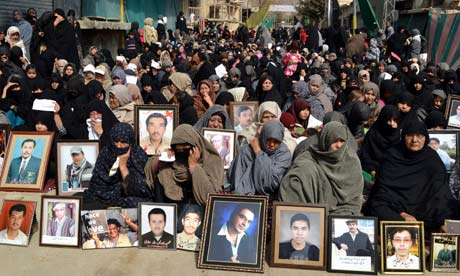
The Express TribuneAmid scuffles and protests, and tears and sobs, the Shia Hazara community buried the victims of Saturday’s blast in the Hazara Town graveyard on Wednesday. While the official death toll is 89, the Shia representative organisation Majlis-e-Wahdatul Muslimeen (MWM) said 114 bodies were buried on Wednesday. The mass burial brought to an end a three-day sit-in protest by relatives and members of the Hazara community after they accepted a government request to call off the nationwide protests. Families and community members had refused to bury the victims of Saturday’s bomb attack in Hazara Town – which came just over a month after twin blasts killed over 100 people, mostly Hazaras – until Pakistan Army took control of the provincial capital. Prime Minister Raja Pervaiz Ashraf constituted on Tuesday a special committee – headed by Information Minister Qamar Zaman Kaira – to hold talks with the protesting community. MWM General Secretary Allama Amin Shaheedi along with the victims’ relatives announced at a news conference late Tuesday night that they would bury the bodies on Wednesday at 9am. But for many of the mourners, the deal was insufficient. On Wednesday, some angry relatives and community members, crying and screaming, initially refused to bury the dead. Mourners threw stones at some media persons and the car of Quetta’s Deputy Commissioner Abdul Saboor Khan Kakar as burials got under way, prompting security forces and then protesters to fire gunshots into the air. Five people, including four security men, sustained injuries in the melee. A large number of paramilitary Fortier Corps and police personnel rushed to the spot and managed to bring the situation under control. The angry mob finally dispersed and as the bodies were buried in a row of graves, hundreds of volunteers formed a human chain in a symbol of solidarity and protection. Mourners told AFP they thought nothing would change. “We are in severe shock, we want the government to take visible steps,” said college student Kazim Ali, mourning a relative. “The army is our last hope. We want a comprehensive military operation.” Ali Raza, 35, asked how up to 1,000kg of explosives were smuggled into Hazara Town. “Why are they killing us? What is our crime?” Raza said. “How did terrorists transport such a huge amount of explosives here? The government will have to take some serious steps.” Soldiers from the paramilitary Frontier Corps and police were deployed in all markets and on roads in Quetta city as the burials took place, while troops searched every vehicle heading towards the Hazara Town area. Case registered against trouble-makers Quetta police chief Mir Zubair told reporters that a case had been registered against the men involved in firing and pelting stones at the police in the graveyard. Around five security forces, including the three policemen and two Balochistan Levies personnel, sustained injuries. The windows of the deputy commissioner’s car were smashed after it was hit by a bullet, eye witnesses said. The MWM central vice president said they had convinced to relatives of victims to end their protest and bury their dead; yet, some elements wanted to disrupt the peaceful burial. Speaking at a news conference on Wednesday, he called on the government to change newly appoint police chief Mushtaq Sukera.
Baluchistan: '‘Situation is not so bad’'
the frontier post
The federal government on Tuesday refused to accept the demand of Shia leadership and Hazara community for army deployment in Quetta on a flimsy, heartless and cruel logic that the Law Minister Farooq H. Naek offered to the press after a meeting between President Asif Zardari and Army Chief General Ashfaq Pervez Kayani that ‘the situation is not so bad that army should be deployed in the city.’ None can believe his ears and eyes that what Naek was talking about yet the wounded souls of the bereaved families of Quetta blast victims must have digested the cold-hearted, the unsympathetic and the insensitive rhetoric of law expert of the federal government with heavy hearts. If the repeated scenes of hundred bodies kept on the roads with thousands of mourners sitting besides them in rain under the dark chilly sky, books, bags and shoes strewed all over in pools of blood and human organs smashed on the walls around the blast sites do not win sympathetic consideration of the powers-that-be living in calm, comfortable and cozy residences and offices then what else do they want to see to move there the best foot forward to revert the situation prevailing across the country. Today they think it is not enough or it does not warrant the extreme steps like calling in Army revoking Article 245 of the Constitution. On the mass mourning, the gentleman is saying “all is well”. The mourners across the country will bear it the way they bore the loss of their dear ones. For sure, the approach has exposed the mindset of the rulers and particularly their love for the people and rule. Soon after the deadly blast in Quetta, surprisingly the FC received a sudden tip-off about a Lashkar-i-Jhangvi hideout in the suburbs of Quetta and carried out an operation in which four terrorists were killed and seven, including a high value target, were arrested, and media was told some of them were from other provinces. Alas! Once again the people are left to sulking and believe the right or fake claims of otherwise callous, incompetent security agencies acting in haste yet the delayed action against terrorists leaves a question on lack of will of the political leadership to resolve the issue.
Interior Minister Rehman Malik responsible of the security of the country landed in Quetta on Tuesday three days after another mass massacre of Hazaras with a measure that the localities in Quetta having population of ethnic Hazara Shia community will have to be declared as red zone in order to maintain security of the community. The man-who-knows-all-but-do-nothing Rehman Malik reveals there that four months earlier he knew that three banned organizations, Tehrik-e-Taliban Pakistan, Lashkar-i-Jhangvi and Al-Qaeda, had set up their triangular syndicate and would unleash new wave of bomb blasts to hit their targets. If he does not lie then he must also disclose the name of the leadership that stopped him from taking concert security measures to avoid the repeated genocides taking place in Quetta and Karachi or anywhere else. Unstoppable Malik must tell the nation why not he pounced at the killers at once what he was waiting for, and most importantly why do the states raise herds of security agencies if they cannot be unleashed on the anti-state elements when and where the need arises. Are they here to protect their incompetent but talkative rulers? Today the rulers are well-protected but tomorrow there will be a different ball-game. Apparently, the government’s unwillingness to army deployment lies in the fear of losing more space to the army on national security, which is already dominated by the armed forces. But the point to ponder is if the government is adamant to safeguard itself with such cosmetic measures or believes it can use the deteriorated law and order created by the so-called banned outfit to prolong its rule, the political leadership is grossly mistaken –such strategies have not worked in the past and will not work in future. It must take much-needed bold and harsh decisions to deal with the situation. Pakistan Army, showing a remarkable patience and commitment to their professional duties, has nicely cleaned up Swat and today, its brave and sustained efforts are bearing fruit in the FATA areas where the foreign militants have already vacated their strongholds and the rest are on the run. The case of local militants is no different. The government should impose confidence in the forces endorsing their policy of non-interference in the political affairs of the country. Repeated genocides and thereafter calls for army help from masses echoing across the country can provide enough justification to derail the hard-earned system in the government. The history is there to learn a lesson or two.
Pakistan risks sanctions over Iran gas deal
DAWN.COMPakistan risks imposition of stringent US and UN sanctions if proposed Iran-Pakistan pipeline deal goes through, Wall Street Journal says in a report. “Washington has made it clear that it will impose economic sanctions on Islamabad if it begins to buy gas from Iran. Besides, the UN mandated sanctions on any trade with the oil-rich country,” the newspaper said. In a written reply to The Wall Street Journal, the US embassy in Islamabad reiterated the US position and said: “Our policy on Iran is well known. We have made it clear to all of our interlocutors around the world that it is in their interests to avoid activities that may be prohibited by United Nations sanctions or sanctionable under US law.” Prime Minister Raja Pervez Ashraf said on Tuesday that the pipeline would be a “big leap forward” in resolving country’s crippling power crisis. The WSJ says: “While the pipeline could bring relief to energy-starved Pakistan, analysts say that the deal reveals more about the geopolitical dynamics between the US, Pakistan and Iran than about the government’s commitment to address the energy
Gwardar Port warrants devotion
EDITORIAL: THE FRONTIER POSTPakistan on Monday formally awarded to China a multi-billion dollars contract for the operation of the Gwadar Port and the building of infrastructure around it. Thus the state-owned China Overseas Port Holding Company took control of the strategic port in signing ceremony held in Aewan-i-Sadr, Islamabad. Under the contract, the port will remain the property of Pakistan but will be operated by the state-run Chinese company. Earlier, the contract was given to the Port of Singapore Authority that abandoned the project on the plea that Pakistan failed to meet obligations under the 40-year port-handling agreement signed in Feb 2007. The PSA, which was to spend $525 million on the project in five years, made no investment because of non-fulfillment of its demands for allotment of land worth Rs15 billion. Sadly enough, lethargy of the rulers to do what they promised in the contract signed with the PSA has wasted yet another five years of the nation desperately waiting new vistas of progress in Pakistan particularly poverty-ridden Balochistan. The decision to hand over the Gwadar Port to China, in fact, rectifies the wrongdoing of the Pakistan Government when it preferred the PSA over the Chinese interest. China is a time-tested friend more importantly a next door neighbour and a natural regional ally of Pakistan having keen interest to build short and cheep routes to meet its energy and maritime needs. But the port fell to the PSA perhaps the then rulers succumbed under the USA pressure hence committed one of the many follies the nation has witnessed. The latest decision of the Government to transfer the concession agreement from the Port of Singapore Authority to the Chinese company may change the destiny of the people of Balochistan even it may give a potential naval base that ultimately will make Pakistan’s defense impregnable. That may well be the reason that India and the USA are apprehensive over the transfer of the control and management of the deep-sea port to China, which had interests in ports encircling India. Regardless of the concerns and interests that the international forces have, the transfer and subsequently the development of the Gwadar Port will bring tangible benefits to Pakistan and China and contribute to peace‚ stability and development of the region, forming a part of greater framework of economic cooperation between the two states. To make the dream come true, Pakistani leadership needs to show greater maturity, dedication, honesty and commitment to the development in Balochistan particularly, that earlier was missing. The governments in Balochistan and the federal capital Islamabad now must show some urgency to allot much-needed land for the Gwadar Port and build the roads that Pakistan has to build under the agreement. Otherwise, even the Chinese take-over may meet the fate that the PSA met due to the inability of Pakistan. During era of Ms Benazir Bhutto, a Fish Harbour cum Mini Port was built at Gwadar that ultimately became the stepping stone for the Gwadar deep seaport. In 1993, Pakistan started feasibility studies for the development of a major deepwater seaport at Gwadar. The port project commenced on 22 March 2002 with the first phase completed in December 2005. Unfortunately, even today the provision of clean drinking water is non-existent there. Similarly, the construction of the port that spurred other major infrastructure projects that include Makran Coastal Highway, Ormara-Pasni-Gwadar road leading up to the Iranian border, Gwadar-Quetta-Chaman road and a link road to the town of Khuzdar in eastern Balochistan etc but the lackluster interest of the political leadership in the development of the Balochistan has kept the province backward or underdeveloped hence is more prone to extremism for which the nation is paying a huge price. China has paid about 75 per cent of the initial $250m used to build the port, thus soon it will take over the Gwadar Port but the question remains whether Pakistan lives up its commitment in raising infrastructure connecting the Gwadar Port with the rest of the country. Mere signing of the MoUs with China or anybody else is just neither enough nor is going to serve the interests of Pakistan and its people. For sure, the strategic importance of the Gwadar Port holds the key to bringing together Central Asian countries and China, integrating the economies of the countries in the region, Pakistan can benefit from China’s takeover of Gwadar, if it really stresses on the development of the connecting roads and expands Karakoram Highway that still needs to be finished. The Gwadar Port development deserves special attention to serve the interest of the country first.
Lashkar-e-Jhangvi's headquarters are in Punjab
http://www.thefrontierpost.comInterior Minister Rehman Malik told the media outside the Senate on Wednesday that he has written to the Punjab government to take action against the banned militant outfit Lashkar-e-Jhangvi.Malik added that action against the banned outfit will also be taken in Karachi and Balochistan. This followed a similar though slightly different line of what Malik said during the senate session which discussed law and order situation in the country. According to sources, Malik told the senate that the responsibility of the federal government is to provide information about possible terrorist attacks to local law enforcement but it was up to the provinces to take action on that intelligence. He pointed towards Punjab, who Malik said had taken benefit of information provided and averted a number of terrorist attacks. The interior minister insisted that security agencies have carried out successful operations to curb terrorist activities in the country, with 31 people belonging to various banned outfits having been arrested so far. Malik has said some elements are trying to destabilise Pakistan by promoting sectarianism. Taking part in the debate Mian Raza Rabbani said the country is at a cross roads and it was time to take difficult decisions to save Pakistan. He said that internal situation of the country is very critical and only political stakeholders can resolve it. Rabbani explained that the Quetta incident happened at a time when Gwadar Port’s operation was being handed over to Chinese authorities which reflects that some powers do not want a progressive Pakistan. The senator also opposed implementation of governor rule under article 245 of the Constitution and said whenever this article was talked about‚ Pakistan faced martial law. Abdul Nabi Bangash said that it is the need of hour to speak truth‚ no matter how bitter it is. Senator Abdul Haseeb Khan lamented that the role of parliamentarians is confined to discussions in the Senate and the National Assembly sessions and there is an impression that they cannot do anything to improve the law and order situation outside of it.Zahid Khan stressed the need to collectively draw framework to combat terrorism.
Tuesday, February 19, 2013
Pakistan: ''The military has the answer''
EDITORIAL :DAILY TIMES
Documents show Britain sold arms to Sri Lanka while expressing shock over human rights violations
timesofindiaWhile David Cameron faces awkward questions in India over bribe-tained British-built helicopters, the prime minister is in a fresh storm over another set of defence deals involving Lanka's war on Tamils. Government records, revealed by activists in London, show that UK has been supplying weapons - both small and large, worth "millions of pounds" to the Sri Lankan government even though Britain's foreign office (FO) has in the recent past expressed concern over human rights violations by the island nation. Britain's foreign office calls Sri Lanka "a country of concern" with questionable human rights records. However the UK based NGO Campaign Against Arms Trade (CAAT) has sent documents to TOI showing that between July and September 2012, Cameron's government approved export licences on military items to Sri Lanka worth over £3 million. Nearly £2m of the sales were in the category "ML1" label denoting small arms. In total, the UK government approved the sale of 600 assault rifles, 650 rifles, 100 pistols and 50 combat shotguns. The sale also included £330,000-worth of ammunition and £655,000 in body armour. A consignment of arms worth £1.16 million (pistols, assault rifles and combat shot guns) was sent to Sri Lanka on August 21, 2012, body armour and rifles worth £ 505,000 sent on August 22, direct viewing imaging equipments and small arms worth £699,000 on July 19 and ammunition for small arms worth £578,000 on August 6. A consignment of assault rifles and body armour was sent from UK to Sri Lanka on September 20 worth £50,000 while on August 24, another consignment worth £60,000 which included military assault rifles was shipped to Sri Lanka. Kaye Stearman from the CAAT told TOI, "There were no licence refusals in these months, despite concerns being raised about human rights in Sri Lanka. The total amount is a large increase, given that from the beginning of 2008 until June 2012 the value of export licences to Sri Lanka amount to £12 million. A note in the government data says that some of these weapons were to be used in anti-piracy operations." "We're told that the arms industry is essential for jobs and the economy. In the UK, the government uses grossly inflated and out of date jobs figures. We're told that we need to export arms for our national security. Yet the UK sold weapons to Argentina weeks before the Falklands War. It sold arms to Saddam Hussein months before the First Gulf War. It actively courted Gaddafi weeks before going to war with him last year," the group said.
Why do Islamists hate Valentine’s Day?
From Egypt with LoveBy Nervana Mahmoud
“Valentine’s Day represents for the Christians, a celebration of adultery and prostitution, and those who go out on this day are prostitutes.” That is how Abu Islam, a radical Egyptian preacher has described Valentine’s Day. He took the hatred that many radicals share for this day to brand it with a new label and link it to Christianity, a faith that Muslims acknowledge and respect.
It is easy to dismiss Abu Islam as a marginal extremist whom none should take seriously, but I think we should take a look closer at his case as it is a perfect example of the flaws and the dangers of literal Islamism.
I still remember the remarks made by the Egyptian thinker, Mustafa Mahmoud, about love and Islam. He noticed that love was only mentioned once in the Quran as part of the story of Joseph and the Pharaoh’s wife, who tried to seduce him. Within that context, love had a negative connotation; it reflected lust, unlawful passion and adultery.
Mahmoud compared that story with the Quranic description of marriage, particularly verse 21 from Al-Rom Soura, as a relationship that is based on “mawada and rahma”. Though rahma can be easily translated as “compassion”, many wrongly translate mawada as “love”. Well, simply put, it isn’t. The best way to describe mawada is “a semi-platonic subtler form of love that is more controlled and less passionate”.
Mahmoud was not alone in his analysis of the holy book of Islam. Many literalistic scholars have gone even further to advocate that love is not what Muslims should aspire to achieve within marriage but that “mawada” is the desired goal. They based their conclusion on the maqasid (goals) of Shari’a.
In Pakistan, there's no answer to terror
Kamila Shamsie
Pakistan's government and military alike are silent on who is promoting the murder of Shias in BaluchistanOn Monday, in Karachi, I stayed at home while protesters took to the streets in an attempt to rouse Pakistan into action against the continuing extermination of Shia Muslims. On Saturday in Quetta a bomb had exploded in a busy market, killing 84 people; two days later, amid sit-ins and protests in different parts of the country in response to the attack, a Shia doctor and his school-age son were shot and killed in Lahore.
President Obama lashes out against Republicans over refusal to raise taxes
http://www.nydailynews.comObama is pushing Republicans to avoid the so-called sequester by accepting a combination of targeted spending cuts and increased tax revenue. But the GOP says further tax hikes are not an option. Staking out his ground ahead of a fiscal deadline, President Barack Obama lashed out against Republicans, saying they are unwilling to raise taxes to reduce deficits and warning that the jobs of essential government workers, from teachers to emergency responders, are on the line. Obama spoke as a March 1 deadline for automatic across-the-board spending cuts approached and with Republicans and Democrats in an apparent stalemate over how to avoid them. Obama cautioned that if the $85 billion in immediate cuts — known as the sequester — occur, the full range of government would feel the effects. Among those he listed: furloughed FBI agents, reductions in spending for communities to pay police and fire personnel and teachers, and decreased ability to respond to threats around the world. He said the consequences would be felt across the economy. "People will lose their jobs," he said. "The unemployment rate might tick up again." "So far at least, the ideas that the Republicans have proposed ask nothing of the wealthiest Americans or the biggest corporations," Obama said. "So the burden is all on the first responders, or seniors or middle class families." House Republicans have proposed an alternative to the immediate cuts, targeting some spending and extending some of the reductions over a longer period of time. They also have said they are willing to undertake changes in the tax code and eliminate loopholes and tax subsidies. But they have said they would overhaul the tax system to reduce rates, not to raise revenue. Obama's remarks came a day after he returned to Washington from a three-day golfing weekend in Florida. Congress is not in session this week, meaning no votes will occur before next week and complicating the ability to negotiate any short-term resolution. Obama said the anticipated cuts were already having an effect, noting that the Navy had already delayed the deployment of a carrier to the Persian Gulf. "Changes like this — not well thought through, not phased in properly — changes like this effect our ability to respond to threats in unstable parts of the world," he said. Obama wants to offset the immediate spending cuts, known as a sequestration in budget language, through a combination of targeted spending cuts and increased tax revenue. The White House is backing a proposal unveiled last week by Senate Democrats that is in line with the president's principles. But that plan has met an icy reception among Republicans, who oppose raising taxes to offset the cuts. GOP leaders say the president got the tax increases he wanted at the beginning of the year when Congress agreed to raise taxes on family income above $450,000 a year. Obama called on congressional Republicans to compromise and accept the Senate Democrats' proposal. The Democrats propose to generate revenue by plugging some tax loopholes. Those include tax breaks for the oil and natural gas industry and businesses that have sent jobs overseas, and by taxing millionaires at a rate of at least 30 percent.
President Obama – a leader for our times
The era of presidents that Ed Rogers admires is over. And many of us are relieved that we will never again have a president who only has his visor set on making the rich richer in the hopes that some of the good fortune will trickle down to the rest of the population. In effect, the 1 percent are giving the rest of us their goodwill and not much of the fortune. President Obama has a rich legacy of accomplishments: Do they really need to be repeated, Ed? He brought the country back from the worst economic crisis since the Depression – a crisis created by President George W. Bush. He ended the misguided war in Iraq and has now pledged to do the same in Afghanistan. He has set the bar high on resurrecting important issues such as domestic manufacturing, principally by saving GM and Chrysler. And he has reinvigorated the domestic energy industry. Indeed, domestic oil production has increased, as has the investment in alternative fuels. He fundamentally reformed the banking system with new legislation and regulations to ensure against reckless behavior and abuse of consumer rights. He has made my life and the life of millions of other gay and lesbian Americans better by calling for an end to discrimination in all its forms. And perhaps his largest domestic achievement to date is that he, unlike the many who have tried before him, presided over a health care reform process that will now bring insurance to the 40 million people who were left out of the equation heretofore – people who work hard and pay their bills and their taxes but couldn’t afford insurance or didn’t have access to a large enough group. It is a large legacy. One to make any president proud. But I think that this president’s legacy will be more important than any single piece of domestic legislation. Obama has presided over a shift in politics – a shift in our country. It is a movement more toward economic justice and equality for all. And he has transformed the nation’s thinking on this, not by taking from the top but by empowering the middle. By making investments in education and infrastructure and energy and human rights, the president has chosen our next path as a nation. And it drives folks in the white, privileged GOP crazy. We will see a fundamental change over the next 50 years as our electorate becomes dominated by minorities and women. That shift alone will control the debate of the government’s role in our lives. That is so scary to Ed and his friends that they have to demonize President Obama to try to hold it off, but it is coming.By Hilary Rosen
Tiger Woods: Golfing with President Obama was 'pretty cool'
http://thehill.comTiger Woods said Tuesday that his weekend golf outing with President Obama was "pretty cool" and that he and the president teamed up for a win against a pairing of U.S. Trade Representative Ron Kirk and Houston Astros owner Jim Crane. "He's just a wonderful person to be around. And we won," Woods said at a press conference ahead of the Match Play Championship, according to Sports Illustrated. Woods also joked that Obama is "an avid golfer, and so am I."The comments by the 14-time major tournament champion were the first window into the Presidents' Day weekend golf trip in Florida. Reporters were not allowed on to the golf course during the game, drawing complaints from the White House press corps. "Speaking on behalf of the White House Correspondents' Association, I can say a broad cross section of our members from print, radio, online and TV have today expressed extreme frustration to me about having absolutely no access to the president of the United States this entire weekend," White House Correspondents Association president and Fox News reporter Ed Henry said in a statement. "There is a very simple but important principle we will continue to fight for today and in the days ahead: transparency." Press secretary Jay Carney said Tuesday that he was "completely sympathetic" to complaints from reporters, having covered the White House himself for Time magazine. "I would note that, you know, and this is important to note given some of the coverage of this issue, that when it comes to solo news conferences, where the president of the United States stands up, and for 40 minutes, 50 minutes, or an hour, takes your questions, allowing reporters to go deep on issues, President Obama has given 35 of those. President Bush, his immediate predecessor gave 19," Carney said. "When it comes to interviews, the president's given 591 interviews since he took office. So, I think, that it is clear that we are making an effort to provide access, to make sure that the president is being questioned by reporters and anchors and others. And we'll continue to do that." Asked specifically about complaints lodged over his game with Woods this weekend, Carney argued the press office had provided enough access. "I mean, the president had some downtime, he was playing golf," Carney said. "You know, I understand that there was a desire to have access or a photograph of that, but the president was having [a vacation]."
Women journalists make a mark
http://www.thehindu.comAgainst all odds, feisty women journalists continue to be undeterred by threats of persecution Women journalists routinely face harassment and threats, including death threats while covering conflict zones everywhere, including in Afghanistan and Pakistan. Yet these feisty women continue to swim against the tide and create space for themselves in journalism. Farida Nekzad, 40, is a role model for many girls keen on pursuing journalism in Afghanistan today. She has faced threats of kidnapping, acid attacks and even an attempt to blow up her apartment ever since she set up her own news agency eight years ago in Kabul. Despite the fact that the Taliban routinely bombards her with threatening e-mails and phone calls warning her of horrendous consequences if she continues her work, Nekzad remains undeterred. In a country where women’s voices often go unheard, Waqt (which means time in the native Dari dialect), is one amongst the handful of women-dominated media outlets making its presence felt. Recalling the initial days of her difficult journey, Nekzad says, “It wasn’t easy. When the Taliban took over, my parents took refuge in Pakistan and I had to withdraw my name from Kabul University where I was studying journalism. I taught in private Pakistani schools, supervised basic education programmes for Afghan refugees and helped out with Afghan cultural groups in Peshawar. But I wanted to be a journalist. So I went to India and continued my education at the Indian Institute of Mass Communication in New Delhi. Later, I began to write as a freelancer for both Afghan and Pakistani publications.” When Nekzad returned to her country in late 2001, she was devastated with the destruction she saw everywhere. In 2004, her Kabul-based Pajhwok Afghan News first started publishing work in Dari, Pashto and English. “We were always stirring the political class with the kind of stories we carried, especially those concerning Afghan warlords and provincial power brokers. Features that commented on new restrictions being imposed on women and the resurgence of violence against women too created quite a furor. I remember one controversial story we published about a warlord exchanging his dog for a young girl, which raised a big hue and cry. Our reporters including me were many times asked to ‘beg for an apology’ or be killed.” Nekzad describes working as a journalist in her country as “walking on a sword”. According to the Committee to Protect Journalists, since late 2001, 19 journalists have been killed in Afghanistan — 18 while covering war. In Pakistan, 34 have lost their lives, seven while covering war. A report of the South Asia Media Monitor reveals that in 2012, 13 journalists lost their lives in Pakistan and two in Afghanistan. After the collapse of the Taliban regime in late 2001, a large number of women journalists joined media outlets in the war-torn region even though it is still difficult for them to operate owing to deeply entrenched cultural and religious barriers. “We journalists often faced intimidation from militants, government-backed warlords, drug-smugglers and government officials who interfere with our coverage and dictate terms and conditions of our work...Being a woman one becomes very vulnerable as no steps have been taken for the safety and security of women journalists,” says Hela Haya, a journalist with a local radio station in Kandahar. The Pakistan Association of Television Journalists (ATJ) has only 50 women among its 700 members. Defying this statistic, women are now visible in the Pakistani media as anchors and talk show hosts on dozens of private radio and television channels, thanks to the burgeoning electronic media industry. There are approximately 3,200 journalists in Pakistan — 2,842 men and 362 women, making it a ratio of 5:1. Similarly, Afghanistan’s Independent Journalists Association (AIJA) reports that there are around 25 to 30 per cent women journalists and media workers among the 10,000-odd media persons working there. While the media is a growing industry in both countries, issues like sexual harassment and unequal pay packets are a matter of grave concern, even as the battle against severely limiting cultural norms and perceptions continues. Says Shamim Bano, a senior political reporter with The News, a English daily published from Karachi, “Most of the time Pakistani women journalists are not assigned any important beats like politics, economics, courts or even sports. We simply have to fight harder.” Young Pakistani journalists, Sabba, from Friday Times Weekly and Shumaisa Rehman from News One, are mentally prepared to accept the challenges that come with their profession. They state in unison, “We know that the odds are against us, but we have to fight to initiate a change.”
Nawaz Sharif’s meeting with Deobandi leader of banned terrorist group Siph-e-Sahaba
Militancy and Radicalism in Punjab
by Dr. Ayesha Siddiqa
Gen. John Allen, Recent Top Commander In Afghanistan, Is Retiring
Pakistan Hands Management Of Strategic Port To China
http://www.rferl.orgPakistan has awarded a contract to a Chinese company for the operations of its strategic Gwadar port. The signing ceremony was witnessed by Pakistani President Asif Ali Zardari and Chinese Ambassador Liu Jian on February 18. Zardari said Gwadar will soon be a "hub of trade and commerce in the region." He said that China, which imports much of its oil from the Persian Gulf, could use the facility to provide supplies to the western Chinese provinces of Xinjiang and Tibet, which are closer to Gwadar than to any port in China. The port, completed in 2006 with the financial assistance of China, was initially operated by a Singaporean company. No reason was given for the cancelation of that contract. The move could cause concern in India, which is wary of China's growing strategic clout.
ISAF spokesman: 'We respect Karzai's decisions'
http://www.dw.deAfghanistan's security forces are scheduled to take the lead in the fight to combat in the spring. Despite all the difficulties, ISAF spokesman Günter Katz tells DW the country is on the right track. DW: Brigadier General, at a meeting with his army, Afghan President Hamid Karzai instructed his security forces that, in future, even in an emergency, they should not use NATO air support. Is this a sign of distrust of NATO and ISAF? Günter Katz: Firstly, Mr Karzai is the president of a sovereign state who gives instructions to his own security forces. I think that is a quite normal thing. With this step he is trying to take greater consideration of deaths and injuries among the civilian population. This is also clearly in ISAF's interest. In that respect, our interests are the same. The commander of ISAF has made clear that we will act according to the president's wish and, in any case, continue to support the Afghan security forces. Afghanistan itself has only a very weak functioning air force. Does that mean that the Afghan army must now fight against the Taliban and other rebels without air support? The Afghan security forces would have to do that in the future, anyway, without the support of NATO or, more specifically, ISAF. As I have said, we will adhere to the president's wish. The Afghans have a basic competence as far as the air force is concerned. They also have a very well-trained artillery which can play a supporting role, meaning there are other options. The details of how we will implement the whole thing with our Afghan partners, and how we will proceed in the future, will be discussed in the coming days. The Afghans have always said that their air force is very weak. In this case, NATO must not only provide training but also equip them with the necessary weaponry. To what extent is that actually happening? We do that already and we are on the right track. Of course, we cannot forget that it is much more difficult to establish an air force in comparison with an army. We are dealing with a country here in which 75 percent of the population is illiterate. We need an air force in which everyone can read and write and in which the pilots and technicians know English, because the documentation is only available in English. Then we are faced with the challenge of training pilots, and also technicians. All of that takes a very long time. We anticipate that it will take until 2016 before the air force is fully operational. We will continue our efforts and we are already seeing the first successes: Afghan crews are now manning helicopters - the Afghans already have a small capacity for air transport so we are already heading in the right direction. We just have to accept that it takes longer with air force than with other forces. US President Barack Obama last week announced that 34,000 troops will be pulled out of Afghanistan by the end of the year. His Afghan counterpart Karzai has decreed, in future, his forces should not call upon NATO air support. Experts say that such messages only go to strengthen the rebels. How great is the danger that Afghanistan will slide into another civil war in 2014? We cannot forget that what President Obama said had already been decided in the 2010 NATO summit as far as deadlines and strategy are concerned. The US can certainly withdraw 34,000 soldiers within the coming year. We know that the Afghan forces will, in principle, take the lead in the fight from spring onwards. The results that we see there are such that we can look forward to the future with satisfaction. Afghanistan will not slide into a civil war as it did after the fall of the Najibullah regime. We have 50 countries that, most recently at the NATO Summit in Chicago have said that they will remain involved in the country even beyond 2014. At the Afghanistan Conference in Tokyo in summer last year, we received clear commitments as far as funding is concerned. We are able to say that the international community will not leave the country on its own but will instead stand side by side with Afghanistan when it comes to ensuring a better, more secure future. Brigadier General Günter Katz is the spokesman of the NATO-led International Security Assistance Force (ISAF) in Kabul.
QUETTA: No army, no retreat
Pakistan Announces Security Operation After Recent Bombing
Pakistan's President, PM and Army chief hold meeting at Presidency
Pakistan Reaches Out to Iran on Energy, Security
Afghan forces arrest Pakistan Taliban commander
Subscribe to:
Posts (Atom)