Wednesday, January 16, 2013

Pakistan’s Newest Martyrs: Why Anti-Shi‘ite Violence May Be the Country’s Biggest Problem

TIME.COM
For days, they refused to bury their dead. On a main road in the southwestern Pakistani city of Quetta, hundreds of mourners from the local Hazara community, adherents of Shi‘ite Islam, watched over the nearly 90 coffins in below freezing temperatures. The victims of an increasingly bloody wave of terror were no longer willing to inter the corpses of their loved ones for the world to forget about them. Among the dead was Irfan Ali, a brave and much liked young activist who had to abandon his education because of the appalling security situation in the province of Baluchistan, where Quetta is the capital, yet devoted much of his time telling the world about the suffering of his people. Last Thursday, Ali felt he had cheated death the first time. He tweeted that he had narrowly escaped a bombing in Quetta. When he went to tend to the victims, a second deadlier blast struck the billiards hall in Quetta, raising the death toll to nearly 100. It was the greatest single tragedy to visit the community. The tragedy jolted many Pakistanis, bringing tens of thousands around the country out onto the cold streets. Protests and candlelight vigils sprouted in many cities. Ali, the slain activist, was a familiar face at such protests. In recent photographs, he was seen holding up the image of a Pashtun politician, who was assassinated by the Taliban last month. This time, many protesters held aloft portraits of Ali’s smiling face, some adorned with words from his Twitter bio: “I am born to fight for human rights and peace. My religion is respect and love all the religions.” The protests were eventually heard. Some of the largest crowds had gathered in Karachi, outside the private residence of President Asif Ali Zardari. On Monday, the government dispatched Prime Minister Raja Pervez Ashraf to Quetta to meet with the victims. Chief Minister of Baluchistan Nawab Aslam Raisani, a figure of clownish incompetence with a taste for the good life, was told there was no job waiting for him when he returned from his latest foreign jaunt. The provincial government was sacked, having forfeited its mandate. And a form of emergency rule imposed under the province’s more stolid governor. It was enough to persuade the families of the Hazara victims to bury their dead, but more will need to be done to stop others from being sent to an early grave. Last year, over 400 Shi‘ites were killed across Pakistan, double the number killed in 2011. A significant minority in majority Sunni Pakistan, Shi‘ites comprise roughly a quarter of the country’s population. At least a quarter of the recent death toll belongs to the Hazara community in Baluchistan, who migrated there over a century ago from neighboring Afghanistan. Seeking safety, many have been making journeys onward. Last Thursday’s attacks, though deadlier than previous ones, were depressingly familiar. In recent years, Shi‘ite pilgrims from the Hazara community have been hauled off buses bound for pilgrimages in Iran to be lined up and summarily shot. In other parts of the country, as far apart as Karachi in the south, Lahore to the east, the northern hills of Gilgit, Parachinar near the Afghan border, and Dera Ismail Khan in the northwest, Shi‘ite worshippers have seen their processions routinely attacked. On each of these occasions, Shi‘ite worshippers had gathered in the streets, as they have done for centuries, to mourn the memories of their ancient martyrs. They left having to mourn the loss of new ones. The seventh century massacre of their most revered saint, Imam Hussein, and his followers, becomes not just a retelling of the foundation of their faith. It is relived as a parable for the present, the story of a vulnerable minority brutally slaughtered for its beliefs. The responsibility for these attacks has often been claimed by Lashkar-e-Jhangvi (LeJ), probably the most dangerous group operating in Pakistan today, and its militant allies. LeJ began life as an even more vicious offshoot of the banned anti-Shi‘ite organization, the Sipah-e-Sahaba Pakistan (SSP). A decade ago, the group found common doctrinal ground with newcomers from al-Qaeda and proffered its deep and pervasive network. Al-Qaeda maintained operational control, LeJ supplied the foot soldiers. The lethal combine has been blamed for attacks such as the 2008 bombing of the Islamabad Marriott and the 2009 Lahore attack on the visiting Sri Lankan cricket team. The failure to stop these militants is the collective failure of Pakistan’s power elites: the politicians, the army and the judiciary. Less than 24 hours after the Quetta attacks, Malik Ishaq, a notorious LeJ leader, was in Karachi inciting further anti-Shi‘ite hatred. “I don’t have fun making speeches,” the self-confessed killer of Shi’ites told his supporters. “You know what I have fun doing.” Ishaq was shockingly released from prison in 2011 after the courts said they didn’t have enough evidence to convict him. As is often the case, witnesses are not protected and are either eliminated or reduced to a terrified silence. The prosecution and the police fail to marshal the evidence necessary to support a conviction. There are also questions that analysts raise about Islamabad’s intelligence agencies’ links to sectarian groups like the LeJ and its parent organization, the SSP. Ishaq has barely been prevented from roaming around freely. He was briefly taken into custody once only to be released again. He and his cohorts are also the beneficiaries of sordid deals with Pakistan’s power elites. When the army’s headquarters were under siege in 2009, Ishaq was reportedly flown from prison to help negotiate a stand-down. The Punjab government, lead by the opposition Pakistan Muslim League-N, has courted votes alongside leaders of the anti-Shi‘ite SSP. The failure of Pakistani authorities to protect the Shi‘ite population and act against their killers is eroding faith in the state and its institutions. Their failures amount, as Human Rights Watch has said, to complicity. It also raises troubling questions about Pakistan’s identity. In 1947, after the partition of the subcontinent, Pakistan was founded ostensibly as a state for the region’s Muslims — and the minorities that live there. The founder, Muhammad Ali Jinnah, was himself a secular man of a Shi‘ite background. Over the decades, various minorities have found themselves under siege. Prejudiced laws against the Ahmadi Muslim sect have seen the group’s leadership take exile as its followers have either abandoned the country, fall foul of its blasphemy laws or lose the loved ones in terrorist attacks by the same groups that have targeted the Shi‘ites. The beleaguered Christian community fares no better, similarly trapped between militant violence and laws that make them vulnerable to persecution. The old Parsi community has dwindled sharply, with an estimated three times as many living in Toronto as do in Karachi. For the Shi‘ites, it was supposed to be different. They have long lived peacefully alongside the majority Sufi-inspired Sunni community, marching together at the same annual Muharram processions. There were always levels of prejudice, with bigots comparing Shi‘ites to “cockroaches” and hard-line Deobandis — adherents of a puritanical South Asian strain of Sunni Islam — declaring them heretical. But the Pakistani mainstream never considered them a separate minority. In public, for example, Shi‘ite politicians are not identified by sect. If, however, Shi‘ites are not going to feel safe in Pakistan, it will have grave consequences not just for the country but also the wider region. Pakistan’s Shi‘ite population is second only to neighboring Iran, where Shi‘ites are the majority and Shi‘ite Islam is embedded in the heart of the country’s politics. In the long term, it could be the most destabilizing of all of Pakistan’s problems — with the violence not restricted to a remote borderland, but tearing into the country’s very fabric.

Internal Forces Besiege Pakistan Ahead of Voting

By DECLAN WALSH
Barely a year after fears of a possible military coup plunged Pakistani politics into chaos, the country is in crisis again — this time besieged on multiple fronts by forces that threaten the civilian government just a few months ahead of elections. An enigmatic preacher is camped before the gates of Parliament with thousands of followers, demanding the government’s immediate ouster. The top court on Tuesday suddenly ordered the arrest of the prime minister. Violence is surging, with militants stepping up deadly attacks against both government forces and religious minorities. And relations with India have dipped, after ill-tempered border skirmishes in which soldiers on both sides were killed. As it is all unfolding, the country’s powerful military command, long at odds with the government of President Asif Ali Zardari, is in sphinx mode. The army chief, Gen. Ashfaq Parvez Kayani, and his commanders have maintained a cool distance from the unfolding political chaos, their silence stoking speculation about whether the military’s days of political intervention are really, as it claims, over. “It’s the silence of the legions that is unnerving,” said Ayaz Amir, an opposition member of Parliament. More than anything else, there is a sense that gears are again shifting in Pakistan, in a direction few dare to predict — bad news for Mr. Zardari’s government, of course, but also potentially for American interests, which see stability in Pakistan as crucial to a smooth withdrawal in Afghanistan next year, as well as a guarantor of the security of the country’s nuclear arsenal. “There’s a sense that things are snowballing — hard to predict in any way,” said Cyril Almeida, a senior writer at Dawn newspaper. The chief catalyst of this jolting change comes in the form of a 61-year-old preacher, Muhammad Tahir-ul Qadri, who catapulted himself into the political limelight less than a month ago, and now finds himself issuing ultimatums to Mr. Zardari from inside a bulletproof container within view of the soaring presidential residence. A giant rally in Lahore last month signaled the start of Mr. Qadri’s assault on Pakistan’s political classes, which he derides as incompetent and irredeemably corrupt — a resonant message in a country of high unemployment and crippling electricity shortages. He drove home his message with an intensive television advertising campaign, paid for with generous amounts of money, the origins of which he has not fully explained. On Monday evening, he stepped up the attack, leading tens of thousands of followers into the heart of Islamabad, where he renewed demands that Mr. Zardari resign immediately. The crowd fell short of the promised “million-man march,” but was enough to spook the government: by Tuesday morning, he had pushed forward to a square in front of the Parliament. “There is no Parliament; there is a group of looters, thieves and dacoits” — bandits — he said in a thundering voice, pointing to the building behind him. “Our lawmakers are the lawbreakers.” The dramatic climax of that speech, however, came not from the preacher himself, but from the marble-walled Supreme Court about 200 yards up the street. As Mr. Qadri spoke, news broke that Chief Justice Iftikhar Muhammad Chaudhry had issued an order for the arrest of the prime minister, Raja Pervez Ashraf. The report visibly thrilled the crowd, prompting loud cheers and a sense that the promised “revolution” was going their way. It was a typical surprise maneuver from Chief Justice Chaudhry, a mercurial judge with a stubborn streak who, over the past year, has carved out an influential space through aggressive judicial action. A bruising court battle with Mr. Zardari claimed the career of the previous prime minister, Yousaf Raza Gilani, who was forced to resign in June; the chief justice has also called senior generals to account for human rights abuses and election-rigging efforts stretching back two decades. The move against Mr. Ashraf was not entirely unexpected; a corruption case against him, related to his three-year stint as minister for water and power, has been pending for more than a year. But its timing was striking. Speculation that the judge and the preacher acted in concert, perhaps with the backing of powerful generals, has electrified the political firmament. Mr. Qadri, in his speech, impatiently dismissed such a notion: his support came from God, the Prophet Muhammad and the 180 million people of Pakistan, he said. And in the nearby garrison city of Rawalpindi, the generals, led by General Kayani, watched and waited. Rumors that they are manipulating events from behind the scene are unproved. But, equally, they have done nothing to help the Zardari government. While Pakistani military rulers once purged their disdain for civilian rule through bloodless coups, the latest breed of generals has chafed under new constraints — the military’s damaged popularity after the humiliating American commando raid in May 2011 that killed Osama bin Laden, sharp scrutiny from an emboldened media, and judicial challenges from Chief Justice Chaudhry’s court. General Kayani, in particular, has stressed that the military’s role in politics is over. But senior generals continue to wield heavy influence behind the scenes — foreign policy is effectively the army’s domain — and contempt for Mr. Zardari’s governance is palpable in military circles. But the opposition challenger Nawaz Sharif, who was himself deposed as prime minister by Gen. Pervez Musharraf in 1999, is not much more appealing to the generals. And so there is continuing uncertainty about the military’s commitment to allowing elections to take place within the next four months, as scheduled. The drawing rooms of the political elite have been humming with speculation of a “soft coup” — the imposition of a technocratic government, backed by the generals — for several years. But for now, the army seems content simply to watch as Mr. Qadri takes his “people’s revolution” to the streets of Islamabad, where he has promised an uprising along the lines of the Egyptian revolt in Tahrir Square. “The government is twisting in the wind, and they are just watching it happen,” said Mr. Amir, the opposition politician. The difference with Egypt, of course, is that Pakistan has no dictator to overthrow. And while Mr. Zardari’s government has faced criticism as having governed poorly in many respects, it has made considerable strides in anchoring the country’s democratic structures. Through a series of constitutional amendments, all of them approved by the opposition, Mr. Zardari has gradually devolved power to the provinces, reduced his presidential powers and made the electoral process more transparent. Now, advisers say, he is intent on completing the government’s term in March — the first time in Pakistan’s history that a civilian government would have seen out its five-year term. But first that government must make it through the coming days. The law minister, Farooq Naek, said Tuesday that he would challenge the arrest order against Mr. Ashraf in court on Thursday. But the most potent test could come from Mr. Qadri, whose supporters were bedding down in neat rows of tents in Islamabad on Tuesday night, waiting for the next speech from their leader on Wednesday morning. Having shut down the center of Islamabad, and dominated the news cycle, Mr. Qadri is unlikely to surrender the limelight easily. His well-organized supporters insist they will not budge until their demands are met, and are encouraging other Pakistanis to join them. If that happens, the government may have little option but to break up the protest by force. And it would be at that point that the army, sitting quietly on the fence, would be most likely to step in.

Tuesday, January 15, 2013

Pakistan: Events of yesterday

The country is thrust into deeper uncertainty. Tuesday, January 15, was a day of high drama and an interesting, if not intriguing, coincidence in Islamabad. Only on the night before Dr Tahirul Qadri had arrived in the heart of the Capital at the head of a massive rally seeking instant dissolution of parliament, to be followed by drastic electoral reforms. His rally was not in millions that he had promised yet it was big enough and apparently charged enough, to jolt the residents of the city out of their usual nonchalance about national politics. But what really made the day singularly different from any before were the proceedings in the Supreme Court. During the course of hearing of a petition about electoral reforms Chief Justice Iftikhar Mohammad Chaudhry made an observation that the general election should be held on time - to be interpreted by some as an indirect warning to Dr Qadri not to fiddle with the electoral process and election schedule as mandated by the constitution. We don't know whether or not Dr Qadri felt the heat of the CJP's observation. But the apex court's order in another case thereafter for the arrest of Prime Minister Raja Pervez Ashraf along with other co-accused sat so well with Dr Qadri and his fellow-marchers that it sent the entire rally into a trance. As soon as Qadri heard the Supreme Court order he ended his speech, announcing that 'half of my mission has been accomplished, the rest would be over by tomorrow'. Undoubtedly, to those who keep finding some kind of a 'conspiracy' behind Dr Tahirul Qadri's out-of-season march on the Capital to create chaotic conditions justifying intervention by those who open their innings uttering words 'my dear countrymen'. They also cite Dr Qadri's comment of the night before when he prefixed the present governments and their chief executives as also the president of the country with the word 'former'. Was he in know of the 'conspiracy' to wrap up the present democratic dispensation. And if he was, was he also a partner in it, there were some conjectures? But seen independently and objectively, there is just no connection between these two narratives, except that they happen to have come in train. These situations - Dr Qadri's march on Islamabad, Supreme Court's observation on his call for new Election Commission of Pakistan and the same court's order to arrest the prime minister and others for their alleged involvement in the Rental Power Plants scam - could be defused before they came to the cusp. Dr Qadri's march should not have been entertained by the authorities. If the Punjab government and its federal counterpart and their intelligence agencies had failed to figure out the purpose of Dr Qadri's long march especially as he had left no one in doubt he is out to disrupt the ongoing election preparations the Capital's administration miserably failed to handle it. From the word go it was on the defensive, retreating before the marchers till they reached the D Chowk. Here is a man who wants to impose his will by force and thus derail the electoral process so painstakingly stitched up and the governments allow him to do so by holding that it is every Pakistani's right to hold demonstration at the D Chowk in front of the parliament. It was a big mistake; he should have seen the difference between a lawful demonstration and the one being held in violation of the Constitution. By conceding him the facility of reaching the parliament without much of hindrance the authorities tend to convey that whosoever can manage a crowd of some thousand protestors in front of the parliament has the right to subvert the will of other 179.9 million Pakistanis. As to Dr Qadri's take on the poor quality of political leadership one has no beef; yes it lacks all that is expected of it and it's not there. But it is not for Dr Qadri to decide who should be elected, let the people make their choice through a fair, free and transparent election. That Imran Khan's PTI has a strong feeling that it is being overshadowed by Qadri's game is a strong reality that has translated into former cricket captain's 7-point agenda. Addressing a press conference, he demanded, among other things, President Zardari's immediate resignation. There are few takers for an imminent change in the leader of the house and jurists maintain that the government can employ delaying tactics that may well lead to the natural demise of the present parliament on 16 March 2013. Many argue that under the NAB Ordinance, arrests can only be made if investigation is complete and the person has been found guilty. The NAB investigators have not finished their job as yet. The court has ordered them to finish it in 24 hours and then proceed "without hesitation." The ball is in NAB's court. They were so far avoiding it. Now they will either say the PM has not been found guilty or, if found guilty, order his arrest. In the meantime, the President has called a meeting of its coalition partners in Karachi and it seems unlikely that even the PML (N) would support a change in the status quo, however superficial, at this late stage, a scant 55 days prior to the scheduled dissolution of the federal and provincial parliaments. Greater the crisis, more the need for dialogue. The situation underscores the need for reflecting deeply and mulling over the events of yesterday in particular.

Another premier gone?

WHEN RAJA Pervez Ashraf was elected as Pakistan’s prime minister following Yousaf Raza Gilani’s ouster, his tainted reputation preceded him in the media and political circles. Notoriously referred to as ‘Raja Rental’ for allegedly accepting kickbacks for rental power projects (RPPs) as the water and power minister, Ashraf’s ascent to the position of chief executive was widely criticised. There were apprehensions that he, too, will refuse to follow the Supreme Court’s order to write the Swiss letter regarding President Zardari’s graft cases and also pave way for his own political demise. However, it’s not the Swiss letter than has taken Ashraf down; it’s his alleged involvement in the corruption pertaining to the RPP contracts. The Supreme Court on Tuesday ordered for the arrest of 16 people, including the premier, involved in the RPP cases. The SC’s ruling comes as yet another blow to the PPP-led government, which has teetered on the verge of collapse several times during its tenure. While it has faced several challenges related to governance, perhaps the greatest hurdles it has found in its path have been at the behest of Pakistan’s activist judiciary. The PPP lost its premier, Yousaf Raza Gillani, to the Swiss letter case and its US ambassador Hussain Haqqani to the Memogate case. And now it appears that its second chief executive is also on his way out. Sceptics, however, are questioning the timing of this ruling, which came while Tahirul Qadri’s long march was in full swing in Islamabad. In fact, when Qadri announced this development during his speech, his supporters, who had earlier clashed with the police on Tuesday, celebrated by chanting “long live the Supreme Court”. Many suspect that the SC, which has been accused of being in cahoots with the military, strategically timed the ruling to coincide with the march. The armed forces have been rumoured to support Qadri, who had been vociferously pressing for the dismissal of the incumbent federal and provincial governments. Hours after his deadline for the government’s ouster expired, the judicial verdict corroborated allegations that the “invisible hand” of the military is possibly propping up the Sufi cleric’s campaign. So, how will the government now manage this new crisis? Chances are that the resilient PPP will prepare to elect another premier, just two months in advance of the parliamentary elections. But irrespective of the government’s next move, it is very important that the latter is given a chance to complete its tenure for the sake of democracy.

Pakistan: Jaws of conspiracy snapping shut?

EDITORIAL : DAILY TIMES
Tuesday’s events have destabilised the political system and the country as a whole. First came Maulana Tahirul Qadri’s ultimatum of Monday night that the governments should dissolve the Assemblies and go home. He gave a deadline of 11:00 am Tuesday to carry out his ‘directive’. As it turned out, the logic of ground realities ensured that 11:00 am came and went and nothing stirred except the agitated supporters of Qadri in the rally in Islamabad. Qadri’s address to the rally was interrupted by another bombshell. The Supreme Court (SC) ordered the arrest of Prime Minister (PM) Raja Pervez Ashraf and others in the Rental Power Producers (RPP) case. The order is questionable on a number of grounds. First and foremost, the order was passed on the basis of a preliminary investigation report presented by NAB before the SC, which carried a rider that the recommendations of the report were subject to legal advice, which the court did not wait for. Nor did the bench headed by Chief Justice Iftikhar Mohammad Chaudhry wait for the lawyers of the government and NAB, who were not able to appear on the day, to present their side of the story. The order therefore is flawed on the benchmark of an incomplete investigation, arrest orders without any conviction by a court of law, arbitrary, and ex parte. Although the order evoked immense joy amongst the rally participants and Qadri went so far as to say that half the work was done, the other half would follow the next day, it also aroused a great deal of anxiety, not only amongst the supporters of the government, but across the political spectrum. Criticism of the court’s order followed, with great suspicion being voiced about the legality of the order as well as its timing. The SC has unfortunately, through this step, opened itself up to a new controversy, which cannot be good for the standing of the judiciary. Whether the order was passed coincidentally at the exact moment Qadri and his followers were hurling all kinds of demands and threats against the political system on Constitution Avenue in Islamabad or, as some critics have said, was playing to the gallery by the SC, we leave to the imagination of the reader. In the RPP hearing in question, the NAB chairman was castigated and issued a contempt notice on the grounds that NAB had misused the name of the SC to dismiss two NAB investigators in charge of the case. Further, the NAB chairman was made responsible for putting the name of the PM and others named to be arrested on the Exit Control List and told he would be held responsible if any of these people left the country. This development produced its toll. The Karachi stock market crashed by 525 points. The SC’s order for arresting the PM provoked angry, sometimes violent protests in interior Sindh, including exchange of firing in Hyderabad between protestors and shopkeepers, blocking of the National Highway, large parts of Karachi shut down, and the country braced with bated breath and in shock for further trouble. Imran Khan joined the MQM’s chorus in support of Qadri’s agenda, with the rider that the PTI would prefer change through the ballot box, whereas Qadri claimed that his 40,000 supporters at the Islamabad rally were sufficient to prove that the government had lost its mandate and should immediately go. Not only the conspiracy minded, even ordinary citizens are forced to speculate that this series of developments coming thick and fast on each other’s heels could not be a coincidence, and that suspicion centres on a deep rooted conspiracy to abort the upcoming elections that are to be held under the constitution in the light of the 18th Amendment, which enjoins the treasury and opposition to come to a consensus on a Chief Election Commissioner and a caretaker setup that would be non-partisan and conduct free, fair and transparent elections. The historic nature of the moment is not lost on those with a sense of history. It may not be an accident therefore that these ‘concerted’ moves appear just as the country is poised to stabilise the polity through an agreed procedure and move on to a relatively consolidated democratic system. The actors up front are obvious: Qadri, MQM (half in half out), Imran Khan (in but with a difference), and sundry others who either do not have a stake in the present dispensation or want a shortcut to power. What is not obvious are the possible hidden hands orchestrating these moves and playing the situation like piano keys. This discordant melody can and will be exposed only in the fullness of time. Meanwhile, the advice to all citizens is: fasten your seat belts.

Pakistan: Crash of stocks

THE FRONTIER POST
The country’s stock market crashed on Tuesday after the Supreme Court ordered the arrest of Prime Minister Raja Pervez Ashraf in the famous rental power plants case that surfaced corruption of billions of rupees at a time when the PM was the minister in-charge of water and power sector. The decision came in a petition by PML-Q lawmaker Faisal Saleh Hayat who alleged wide ranging corruption against Raja Pervez Ashraf. The Supreme Court, on March 30, directed NAB to proceed against ministers of water and power from 2006 The NAB, on April 20, submitted before the SC that it issued arrest warrants for 16 accused including the chief executive of the country. The prime minister is accused of taking kickbacks in rental power projects and is also accused of buying property abroad from money earned through corrupt means. As for Pakistani stocks, the Karachi Stock Exchange 100 shares index fell by 570 points in floor trading in the day soon after the SC decision. This is the same KSE that touched thee 100 Index hovering around the unprecedented level of 16,250 points only a week or fortnight before. Was it mere coincidence or a well thought out plan, the fact remains that the verdict was proclaimed when the Tehrik-i-Minhajul Quran chief Allama Dr Tahirul Qadri was just concluding his address in Islamabad after the huge long march originating from Lahore. Soon after, the KSE dropped by around 3.5 per cent to 16,084 points down by 525.29 points from the Monday’s close. Rupee also lost its value in parity with dollar to sell at more than Rs99 for the first time in the country’s history – a historic low. This low, causing from both the loss of stocks and the currency is a natural outcome of an economy is also a dismal record of the tenure of the Pakistan People’s Party-led government which failed in reforming the national economy. Even remittances of $48bn by overseas Pakistanis during this period have not boosted the rupee or lend strength to the stock market. The external sector is also under a similar pressure as the balance of payments position continues to deteriorate on the heels of rising current account gap and heavy debt payments in addition to foreign exchange reserves falling to a little above than $13 billion. The government’s failure in augmenting the recovery of federal revenue is a further addition to the list of failures in meeting different economic targets. The whole scene portrays a grim economic picture because the government more or less wasted the IMF standby arrangement of $13.1 billion to reform the economy by introducing reforms to bring down inflation, repairing macroeconomic regime by withdrawing subsidies and bringing other reforms.

Khomeini’s Granddaughter On Iran’s ‘Critical Situation,’ Sanctions, Facebook

http://www.rferl.org
According to Zahra Eshraghi, whose grandfather, Ayatollah Ruhollah Khomeini, founded the Islamic republic, Iran "is on the edge of the precipice.” Eshraghi -- who is married to Mohammad Reza Khatami, the brother of former reformist President Mohammad Khatami -- recently gave an interview to the Iranian website Anarpress and said, “Everyone knows that the country is facing a critical situation.” She said politicians should find a solution quickly to the crisis the country is facing, though it may be too late. “Maybe they thought we could act independently and that we don’t need the world,” she said. “We should be up front. As much as [the West is] likely to need us, we need them." The 49-year-old mother of two also talked about the negative impact sanctions are having on the Islamic republic. “For example, Tehran’s air pollution,” she said, “for which the sanctions -- and the bad gasoline that is being used – are to blame. This pollution should be considered a silent death, meaning that we in Tehran are breathing poison every day.” Eshraghi said the country is in a “red” – or high -- alert situation. Cars and traffic are the main contributors to Tehran's critical level of air pollution and Western sanctions on fuel imports have forced the country to rely on locally produced gasoline, which is said to be more polluting. Asked whether she feels hopeful about Iran’s future, she answered that only reforms can save the country from the crisis it is facing. “If these people remain with the same thinking, nothing will change because this way of thinking does not want Iran to progress and bring peace and calm,” she said. “The only way for them is to accept reforms.”Eshraghi, an active Facebook user with a large following, also said she has heard that the social-networking site will soon be unblocked by the regime. “Only now [authorities] have understood that [such a] platform cannot be harmful,” she said, adding that she has learned much from her interactions with young Iranians on Facebook. The social-networking site is a good tool for gauging public sentiment, she said. “From the number of likes and comments I get on pictures I post, I can understand whether that individual is, at the time, popular or not," she said. "For example, I posted pictures of Hassan Khomeini (Khomeini's prominent grandson) and [Mohammad Khatami]. I’ve told them many times that their pictures received few likes, and it shows that their popularity has decreased.” Elsewhere in the interview, Eshraghi, who under Khatami headed the youth department of the Interior Ministry, criticized President Mahmud Ahmadinejad for preventing the work of nongovernmental organizations, which had flourished under his predecessor. She said she and many other people in the NGO field were forced to stop their activities after Ahmadinejad came to power. Eshraghi also said that because of the vetting of election candidates by the powerful Guardians Council, reformists cannot introduce any strong candidates. "[Reformists] cannot present anyone because there is a filter called the Guardians Council," she said. Asked about pressure by the regime on former President Akbar Hashemi Rafsanjani, she said Khomeini once referred to him as “a pillar” of the 1979 revolution. “I’ve heard [Khomeini] tell [Supreme Leader Ayatollah Ali Khamenei], “When you and [Rafsanjani] work hand in hand together, the revolution will be. And when you separate from each other, the revolution will disintegrate.” Rafsanjani, whose influence has significantly diminished in recent years, has come under criticism for refusing to speak out against the opposition Green Movement. Rafsanjani's daughter, Fazezeh, is currently in jail and his son, Mehdi Hashemi, is free on bail.

Pakistan: Military, Supreme Court working together against govt

Fawad Chaudhry – aide to Prime Minister Raja Pervaiz Ashraf – said on Tuesday there was “no doubt” the country’s powerful military and Supreme Court were working together to topple the government. Chaudhry was speaking to Reuters after the Supreme Court ordered the arrest of Ashraf in the Rental Power Plants case. PM Ashraf – popularly known as Raja Rental – was accused of receiving kickbacks in the rental power projects and of buying property in London from the money earned through corruption in various scams. The Express Tribune approached political parties for their comments on this recent development. Awami National Party “It’s an order from the highest court and will be obeyed but our [government’s] legal advisors are trying to find if Ashraf enjoys immunity in this case,” ANP Senator Haji Muhammad Adeel told The Express Tribune. Expressing doubts over the timing of the court order and Tahirul Qadri’s long march, Adeel said he fails to understand why SC decided to issue the verdict now when the country is experiencing political turbulence. Pakistan Peoples Party While speaking to Express News, PPP leader Aitzaz Ahsan said Ashraf will remain the prime minster even if he is imprisoned. “Ashraf will be the premier until a no-trust motion is moved against him,” he said. Muttahida Qaumi Movement MQM leader Wasay Jalil said it is premature to comment on the issue as they don’t have details apart from what has been broadcast. Jalil also said they have not received any formal invite for the allies meeting scheduled to be held in Karachi today.

Pakistan: Countering Militancy in PATA

INTERNATIONAL CRISIS GROUP
International Crisis Group’s latest report, assesses the impact of the military-led response to extremist violence on PATA’s security, society and economy. More than three years after military operations sought to oust Islamist extremists, the region remains extremely volatile. The military’s continued control over the governance and administration of the region and the state’s failure to equip the Khyber Pakhtunkhwa (KPK) police with the tools they need to tackle extremist violence lies at the heart of security and governance challenges. “While the militants continue to present the main physical threat, the military’s poorly conceived counter-insurgency strategies and failure to restore responsive and accountable civilian administration are proving counter-productive”, says Samina Ahmed, Crisis Group’s South Asia Project Director. “Neither the federal nor the provincial government is fully addressing the security concerns of residents”. Although some serious efforts have been made to enhance police capacity, they remain largely insufficient, and the KPK force is still not properly trained or equipped and lacks accountability. The larger challenge remains the reform of the region’s complex legal framework, which makes upholding the rule of law a daunting task. While formally subject to Pakistan’s basic criminal and civil law and falling under the provincial KPK legislature, PATA is governed by various parallel legal systems that have isolated it from the rest of the province. Instead of reforming a legal system that undermines constitutional rights and the rule of law, the military has been vested with virtually unchecked powers of arrest and detention. Pressing humanitarian needs remain unmet because of continued instability and short-sighted military-dictated policies that include travel restrictions on foreigners and stringent requirements for domestic and international non-governmental organisations. Islamabad and Peshawar should end PATA’s isolation and fully integrate it into KPK, removing the region’s legislative and constitutional ambiguities and revoking all laws that undermine constitutionally guaranteed fundamental rights. The military’s control over the security agenda, governance and security must be replaced by accountable, responsive civilian institutions. A deteriorating justice system needs to be strengthened and the police force given the lead in enforcing the law and bringing extremists to justice. “The state must restore the trust of PATA residents by convincing them of its sincerity, effectiveness and accountability”, says Paul Quinn-Judge, Crisis Group’s Asia Program Director. “Helping them to rebuild their lives and livelihoods, free of the fear of militancy, would go a long way toward inoculating them against extremism and should be at the heart of counter-terrorism strategy”.

Indian Army: Three ceasefire violations reported after yesterday's flag meeting with Pakistan

The Northern Army Commander, Lieutenant General KT Parnaik, has said there have been three incidents of ceasefire violations since the flag meeting between India and Pakistan yesterday afternoon. "Two of them were reported from the Mendhar region. Firing was reported even at the time of Army Chief's address," Lt Gen Parnaik said. "We have not responded to these because they were not effective but we are watching them," he told NDTV, adding Pakistan had planted mines in Indian territory. "During the ceasefire violations, they would fire on the pickets and taking advantage of the night, some terrorists have probably come in and they have planted some mines. These were discovered and we have uncovered these mines, they are Pakistani mines. We had shown these to the Pakistani Brigadier who had come (for the flag meeting)," said Lt Gen Parnaik. At a 35-minute flag meeting between the two side in Chakan-da-bagh in the Poonch sector yesterday, India lodged a strong protest against ceasefire violations by Pakistan along the Line of Control (LoC) and also expressed concern at the barbaric way Pakistani troops treated the bodies of Indian soldiers killed after an ambush last week. (Read) Lt Gen Parnaik said, "At the end of the meeting, they remained arrogant and adamant. They were not ready to admit anything. Their body language was that of reluctance." He denied Pakistan's claims that Indian troops had crossed over to their side of the Line of Control on January 6. India maintains its troops had opened fire following a Pakistani mortar attack. Two days later Pakistani troops violated ceasefire and mutilated the bodies of two jawans - Lance Naiks Hemraj Singh and Sudhakar Singh; Hemraj's body was decapitated and the head is missing.Army Chief General Bikram Singh has said the beheading is "unacceptable" and "unpardonable". "They (Pakistan) have planted lies to justify what they have done. India reserves its right to retaliate at the time and place of its choice. We won't remain passive when attacked. Today, he asserted that the Indian Army is prepared to face "all challenges to national security and foil the designs of the enemy." Addressing the 65th Army Day parade in New Delhi, General Singh praised the conduct of the Indian soldiers on the border. "Our soldiers are doing their duty following the rules of engagement to the highest standards, he said. (Watch) After the killing of the two Indian soldiers, the BJP sharply criticised the government's policy on Pakistan. Yesterday, at one of the martyr, Lans Naik Hemraj's village, Leader of the Opposition Sushma Swaraj said, "The incident that has happened, we should take revenge... If we don't get this (Hemraj's) head, we should get ten of theirs (Pakistan army's)," Ms Swaraj said. (Read) But this morning the BJP's response was more muted. It assured the government of its support while calling for tough measures on Pakistan. (Read) That came after Prime Minister Manmohan Singh phoned Sushma Swaraj and Arun Jaitley last evening and discussed the issue. That was followed by the National Security Advisor Shiv Shankar Menon briefing this morning on the situation at the Line of Control (LoC).

Monday, January 14, 2013

Pakistan is losing its Shias

Daily Times
Amir Husain
There is most definitely a programme of ethnic and religious cleansing underway in Pakistan, where Shias are being identified and murdered in large numbers All political and social issues ultimately find settlement not on paper, via signed agreements or in international fora housed in fancy buildings, but in the minds and hearts of people. Lasting solutions and sustainable arrangements usually come about only when the people involved have decided to adopt a mutually tolerant line of thinking. This is why long running conflicts can be so hard to address, as they involve inspiring change at the most basic human level: a change of hearts and minds. In Pakistan, we have seen how irreconcilable the situation can become when hearts and minds are turned away from the mainstream due to sustained policies of callous indifference and unfairness. Sub-populations at the receiving end are given to believe over time that they are ‘the other’, the ones who are different and perhaps even the enemy. They become divested from the status quo, their thought turns and their actions then unfold within the context of a negative, hopeless worldview. A round of action and counter-action only reinforces the roles of both the oppressor and the oppressed in the eyes of the world. This is what happened in the pre-1971 Pakistan. A chain of events led to the slaughter of large numbers of east and west Pakistanis and to the eventual formation of Bangladesh. The situation today, we are told, is quite different. We are told that things are more in control, that insurgencies and genocides may be happening but they do not involve large numbers. We are led to believe that because the areas where these things occur are contiguous to the rest of the country, they can be managed more effectively, unlike East Pakistan. That may be, but there is most definitely a programme of ethnic and religious cleansing underway in Pakistan, where Shias are being identified and murdered in large numbers. This one-sided slaughter has been going on since the time of the Wahabi-inspired General Ziaul Haq, who, to please his Takfiri Middle Eastern backers, allowed foreign terrorists and their madrassah ‘factories’ to be imported en masse into the country. This ethnic cleansing has reached fever pitch now. The Hazara community is being wiped out and they have nowhere to turn. As we speak, they are seeking protection from the army chief himself, who has failed to respond to the demands of the community even though the coffins of dead Shias lay across the cold streets of Quetta for three days running. Many apologists would ask, but what can the army do? Why does the Balochistan government not do something? What a pathetic and sorry question that would be. Balochistan’s security has been managed by the army for a long time. The paramilitary and Frontier Corps, which are large forces, come under the de facto command of the military and are handled by deputed Pakistan army officers. The entire intelligence network in the province is controlled by the military. There is no police presence in Balochistan to speak of that can take on and cleanse Middle East-funded Takfiri terror organisations, or segments of the rabidly anti-Shia Punjabi Taliban, which once (or possibly even now?) enjoyed the backing of segments of the intelligence community. If the army can ensure the security of housing colonies owned by generals, can it also not be expected to protect a community that is being wiped out in a province it all but controls? The murders and killings of Hazaras are not the only act of violence against Shias. Prominent Shia leaders are identified all over the country and murdered while the Parachinar area has seen terrible conflict involving the Toori tribe. Shia areas in the north were cut off from Pakistan for more than a year, and it was only possible for Shia Pakistanis to access their own country by first entering Afghanistan to go around the blockade imposed against them by terrorists. This happened right under the nose of their own armed forces. So today if the Shia of Pakistan ask is this our army, are these our generals, would they be unjustified? They are essentially placing their hope in General Kayani and asking him to provide an indication that this hope is not misplaced. Can Shias think of Pakistan as home? Will the only institution that can guarantee the security of Pakistan do anything to make them feel safe within the borders of the country? The Shia coffins lying in the streets of Quetta patiently await the GHQ’s answer. This is a far more pressing question to address than the one tiny Indian bunker that has appeared on the LoC. That is a triviality in comparison. Perhaps the great generals of Rawalpindi will deem it worth their while to give an answer before hearts and minds are turned unalterably, once more.

No country for Pakistani Shiites

Shiite Muslims buried the victims of Quetta attacks after Pakistan's prime minister imposed governor's rule in Balochistan. But activists say the government is still refusing to act against perpetrators of the attacks. On Monday (14.01.2012), Pakistani Prime Minister Raja Pervez Ashraf announced that the government of the southwestern Balochistan province had been dismissed and the province's chief minister, Nawab Aslam Raisani, had been sacked. The decision came in response to an attack on Thursday in Quetta, the capital of Balochistan, against the ethnic Hazara community belonging to the minority Shiite denomination of Islam. The twin bomb blasts killed at least 86 people, mostly the Shiites. The provincial government was widely criticized for failing to counter terrorism in the province, which has seen a pro-independence movement for the past nine years. "After complete consultation, we have invoked Article 234 of the constitution in the province," Prime Minister Ashraf said in a televised news conference in Quetta in the early morning hours Monday. Ashraf said the province's governor would now be put in charge. Ashraf, however, did not say anything about the operation against the militant Sunni group Lashkar-e-Jhangvi, which claimed responsibility of the Quetta attacks.Of late, Pakistan's Sunni militant extremists with links to al Qaeda have intensified their attacks on minority Shiites, whom they do not recognize as Muslims. The Hazara Shiites of Quetta had earlier refused to bury the dead until the provincial government was dismissed and the military took over the security of the city. Hundreds of people in Quetta - including men, women and children - spent four nights camped in freezing cold to protest against what they called the government's failure, or the lack of will, to protect Hazara Shiites. They also demanded that the government must act against militant groups in the province, which in the past had also targeted Shiites. The Quetta killings sparked protests in various parts of Pakistan. Civil society activists, political workers and common people staged sit-in demonstrations in many Pakistani cities to show solidarity with the Hazara Shiites. 'Sectarian cleansing' 2012 was one of the deadliest years for Pakistan's Shiites. Human rights groups say that more than 300 Shiites were killed in Pakistan last year in sectarian conflict. One of the attacks on an imambargah, a Shiite place of worship, in the garrison city of Rawalpindi near the Pakistani capital, Islamabad, killed at least 23 people and wounded 62 in November. On February 17, a suicide bomber killed 31 Shiites in the restive northwestern Kurram region, one of the seven semi-governed tribal agencies bordering Afghanistan. Pakistani experts say that although the lives of Shiite Muslims are under threat all over Pakistan, those living in Balochistan and the northwestern Gilgit-Baltistan region face a systematic onslaught by the Taliban and other militant groups. Some experts have gone so far as to call it a "sectarian cleansing" of Shiites.In August last year, several gunmen, who were in the guise of Pakistani security officials, stopped a bus traveling from Rawalpindi to the northwestern Gilgit region and dragged the passengers off the bus. The gunmen asked the passengers to show their identity cards to ensure they belonged to the minority Shiite community, after which they brutally killed 22 of them at point blank range. The Taliban claimed responsibility of the attack. Pakistani human rights groups accuse the country's security agencies of backing Sunni militants and failing to protect the minority groups of the country. No action against terrorists Bostan Hazara, leader of the secular Hazara Democratic Party, told DW that his party had agreed to call off protests and bury the victims after the prime minister sacked the provincial government. However, he said that if the government did not act against the terrorists, the Hazara Shiites would resume protests. The Shiite and civil society activists have welcomed the imposition of the governor's rule in the province, but experts warn that sacking the elected civilian government in the province and calling in the army to control security matters can prove to be a double-edged sword for the insurgency-marred province."The imposition of governor rule is extremely disappointing and despicable,” said Malik Siraj Akbar, editor of the radical "Baloch Hal" magazine. “The way a democratic government - although corrupt and incompetent - has been dismissed clearly shows that Islamabad treats Balochistan as a colony where it does not respect the public mandate." Akbar believes the governor's rule in the province will not solve any problems until the government goes after the militants. But Sikandar Hayat Janjua, member of the socialist Awami Workers Party, told DW in an interview from Karachi that it would be foolish to expect that the government would launch an operation against the Sunni militants. "Lashkar-e-Jhangvi is a militant wing of the [Inter-Services Intelligence], and no organization would like to act against its own wing," Janjua said. Akbar, who lives in exile in the US, is critical of Pakistan's central government's overall treatment of the Balochistan province. He opposes the government's decision to give policing powers to paramilitary forces in the wake of the governor's rule in the area. "National and international human rights groups have blamed the military's Frontier Corps (FC) for carrying out widespread human rights abuses in the province. It is believed to be involved in enforced disappearances, torture, and murder of Baloch political workers. The FC is a part of the problem and not the solution," Akbar commented. Failure of the state Pakistani analysts say that the Quetta killings and the imposition of the governor's rule in Pakistan's volatile province have again exposed the risks the Pakistani state has been confronting for many years. If the government is seen as losing further control, it may risk disintegration.Ali Chishti, a security and political analyst in Karachi, argues that the Pakistani state has failed to protect not just the Shiites but most of its citizens. "Pakistan is headed in a completely wrong direction and faces an existential threat due to its policies,” Chishti said. Many Pakistani analysts trace the origins of sectarian violence in Pakistan to the Afghan War of the 1980s. They say that Pakistan's former military dictator Muhammad Zia-ul-Haq made it a state policy to fund and arm extremist Wahhabi groups in the 1980s, using these organizations against the Shiites to kill Iran's support in Pakistan and to increase its influence in Afghanistan. London-based Pakistani journalist and scholar Amin Mughal said that the policy of supporting groups like the Taliban had backfired and that the Pakistani state was no longer in a position to control the situation. "It is a logical consequence of state policies which are based on religion," Mughal told DW, adding that the only way out of the crisis was for "true secular parties" to come to power and change the course of state affairs.

Karzai: Afghanistan will be 'more secure' following US troop withdrawal

A decision on immunity for U.S. troops staying in Afghanistan after the 2014 planned withdrawal will be made by the end of the year, Afghan President Hamid Karzai said on Monday. "The issue of immunity is under discussion (and) it is going to take eight to nine months before we reach agreement," Karzai told a news conference in the capital, Kabul, after returning from meetings with U.S. President Barack Obama in Washington. The Afghan government rejected an initial U.S. proposal regarding the question of immunity and a second round of negotiations will take place this year in Kabul, he said. Those negotiations could involve Afghanistan's Loya Jirga, a "grand assembly" of political and community leaders convened for issues of national importance, he added. When asked if security would deteriorate in Afghanistan after the withdrawal of the NATO-led force, Karzai replied: "By no means... Afghanistan will be more secure and a better place." The Obama administration has been considering a residual force of between 3,000 and 9,000 troops in Afghanistan to conduct counterterrorism operations while providing training and assistance for Afghan forces. But the administration said last week it did not rule out a complete withdrawal after 2014. The United States is insisting on immunity from prosecution for any U.S. troops that remain.

China ready for worst-case Diaoyu scenario

According to Japanese media, Japan's Self-Defense Forces have scrambled fighter jets against China's military aircraft, including fighter jets, which flew to the Diaoyu Islands. It was the first time that military aircraft from both China and Japan confronted each other over the Diaoyu Islands. All of East Asia is now facing intense uncertainty. Thanks to Japan's arrogance toward China, the Diaoyu Islands dispute has come to this point. Japanese politicians, including Tokyo governor Shintaro Ishihara and former prime minister Yoshihiko Noda, are to blame. China and Japan may stand at a turning point that leads to confrontation. The resentment toward each other has come to the highest level since World War II. The Sino-Japanese relationship is looking dim. Japan has mistakenly estimated China's strategic stance toward constant external provocations. A year ago, Japanese politicians wouldn't have thought that China would send fighter jets. Some Japanese believed China had to be restrained at any costs to ensure a peaceful period of strategic opportunities. But the fighter jets yesterday proved them wrong. How far the Diaoyu crisis goes depends on whether Japan is just putting on a show by intercepting China's military aircraft or it really wants to confront China. If it chooses the latter, then it is choosing a military clash. Chinese society is tired of simple verbal protests toward Japan. The Chinese people hope the country will carry out actions against Japan's provocations. China's sending fighter jets to the islands reflects Chinese public opinion. A military clash is more likely. We shouldn't have the illusion that Japan will be deterred by our firm stance. We need to prepare for the worst. China and Japan are likely to become long-term rivals or even enemies. Japan has become the vanguard of the US' strategy which aims to contain China. Chinese society should reach consensus on a number of issues. First, China should firmly respond to any Japanese provocation. It won't be the initiator of the war, but it shouldn't be hesitant to take military revenge. Meanwhile, it will not take the lead in escalating the war, nor will it be afraid of any escalation. Last, but not least, China's strategic aim is to make Japan accept China's current position on the Diaoyu Islands, rather than extend the crisis to disputes over historical issues. China should have the courage to face military confrontations with any rival when provoked. At the same time, we should remain cool-headed. China and Japan have been cooperating in trade and other economic fields. We should try not to let political confrontations affect business. This will minimize China's losses, which conforms to China's overall interest and would help the nation gain support from the public in any confrontation. The Diaoyu crisis is a test of China's unity in the Internet era. China's strength has enabled it to take countermeasures against Japan and face any uncertainty. This requires society to remain united.

The People’s Love for Chávez Continues

Playing with fire: Pakistan must crack down on terrorism for its own sake

indiatimes.com The recent border skirmishes and cross-LoC exchange of fire between Indian and Pakistani troops have posed yet another challenge to the bilateral engagement process between the two countries. This comes at a time when the two-way dialogue - suspended in the wake of the 26/11 terror attack on Mumbai - was showing signs of recovery. The recently inked liberalised visa regime and gains made in bilateral trade exemplify this point. Having said that, renewed border tensions show that elements inimical to the peace process continue to operate with impunity to the detriment of both countries. It's no secret that Pakistan's intelligence agency, the ISI, remains a state within a state and continues to patronise known anti-India terrorists such as Lashkar-e-Taiba chief Hafiz Saeed. Despite New Delhi handing over several dossiers to Islamabad on Saeed's involvement in the 26/11 attack, the latter remains a free Pakistani citizen. That Saeed has recently warned that things could turn ugly in Kashmir highlights the immunity he enjoys as a key collaborator of anti-India sections of Pakistan's security establishment. Tellingly, Saeed's warning comes at a crucial juncture for Pakistan and the larger subcontinent. With the clock ticking on the withdrawal of US troops from Afghanistan in 2014, Islamabad has an important choice to make. It can either go back to its tactic of treating Afghanistan as affording strategic depth against India and continue using terrorism as an instrument of state policy. Or it could genuinely crack down on all terrorist groups operating from its soil. Pertinently, Islamabad's policy of running with the hare and hunting with the hounds has only brought the scourge of terrorism on its own citizens. As highlighted by last week's string of bombings across that country that left at least 140 dead, Pakistan itself is in a state of crisis. For durable peace to prevail in the region, it's imperative that Pakistani society wages a war against extremism that is eating away at the innards of the Pakistani state. For this the political class in Pakistan must unite against all jihadi groups threatening to turn that country into an Islamic caliphate. With general elections in Pakistan just around the corner, Pakistani political parties would do well to shun their Machiavellian intrigues of the past and present a modern vision of Pakistan, strengthening democratic institutions there. This would not only unleash the tremendous potential in Pakistani people but also have a transformational impact on South Asia as a whole.

Sunday, January 13, 2013

Why Hazara?

After over 48 hours since it started, the sit-in on Quetta’s Alamdar Road staged by hundreds of members from the Hazara Shia community continues on Sunday. The demonstrators, while refusing to bury their loved ones, began the protests shortly after a series of blasts rocked Quetta on Jan 10, 2012, killing over 100 people, mostly from the Hazara community. In a conversation with Dawn.com on the current situation in Balochistan’s capital, chairman of the Hazara Democratic Party (HDP), Abdul Khaliq Hazara, who is currently observing a three-day-long hunger strike in Quetta to draw attention to the Hazaras’ plight, said that the government and law enforcement agencies’ failure to stop the ‘genocide’ of the community amounted to complicity. A similar stance was also previously highlighted in a recent HRW report on Balochistan. The HDP chief described the government’s performance as indicative of the fact that there were black sheep within the government and the security personnel who supported those responsible for the targeted killings of members of the Hazara community. He claimed that there had been neither any arrests nor other developments in any of the cases involving the victimisation of the Hazara community. Hazara said in his view the authorities’ negligence and incompetence amounted to complicity. The HDP chief moreover told Dawn.com that the laws were being applied only to persecute the poor and helpless and not to bring to account those behind the kidnappings for ransom and robberies rampant in Quetta. He further alleged that such incidents could only occur at the behest of those who wielded power and influence. In response to a question over his thoughts on a possible solution to the problem, the HDP chief said: “Those in charge of affairs — under whose watch the situation has deteriorated to the current level — need to be replaced immediately. Moreover, only a military-supervised targeted operation along the same lines as the Lal Masjid, Swat and Karachi operations could help eliminate the handful of individuals responsible for such incidents. Why should Quetta be an exception?” “Quetta was a metropolitan city consisting of multicultural and religiously-tolerant citizens,” reminisced the HDP chairman. “It is not as vast in terms of area as other major cities but some elements are trying to destabilise the situation and push the people into a state of anarchy and civil war.” He said he feared that the Hazara community, which has “always held a non-violent approach” within constitutional perimeters, was being pushed into violence through the Talibanisation of its lands and the involvement of other extremist elements. When questioned whether he thought the protests and sit-ins staged in Quetta could be a risk to the Hazara community, he said: “We have no other choice but to resort to these methods. The risk exists in our daily lives. At least, this way our plight is being highlighted and some awareness is being created.” Speaking on the reaction and show of support by the civil society over the Quetta bombings, he said it was due to the awareness that had been created on the recent events that people who were educated and from the middle class were choosing to involve themselves in the cause. He said the awareness of the plight of the Hazara community in Quetta did not come easily nor overnight. Hazara also referred to the protests being held by members of the community in 36 major cities of the world. Earlier in Dec 2012, a conference held in Gothenburg, Sweden had adopted a resolution asking the Swedish government and European Union to put pressure on the Pakistani government to protect ethnic and religious minority communities. Also, the British House of Commons had, on Nov 19, hosted a similar conference which was attended by 20 MPs. Before the HDP chairman could be questioned on the suspected motives behind the attacks against the Hazara community, Abdul Khaliq Hazara said: “We are peace-loving people, why would anyone want to target our hapless community”.

President Zardari signs summary of Governor's rule imposition in Balochistan

Governor’s rule has been imposed in Balochistan province as President Asif Ali Zardari signed the summary here in the wee hours of Monday, Geo News reported. Earlier, Prime Minister Raja Pervaiz Ashraf announced that invoking article 234 of the constitution, Governor’s rule in Balochistan has been imposed effective from Monday. Talking to protestors of the Hazara sit-in, PM Ashraf expressed hope that as an executive of the province, Governor Zulfiqar Ali Magsi would take all necessary steps to hold those behind the Quetta bombings accountable. He also said that FC has been given all powers of police in the province. The prime minister asked protestors to inform Governor Balochistan and FC Commander about their problems, adding that action would be taken immediately. He assured the protestors that federal government would fully cooperate with the governor. False FIR registered against Shia people would also be withdrawn, the prime minister said. Replying a query regarding deployment of army in the province, Ashraf said that army could be called in anytime for civilian administration’s help.

Pakistan sacks provincial government after attack

Associated Press
Pakistani leaders dismissed the government of southwest Baluchistan province early Monday in response to the demands of protesters angry about an attack on minority Shiite Muslims there that killed 86 people. In another part of the country, a roadside bomb killed 14 Pakistani soldiers. Over the past three days, thousands of Shiites have blocked a main road in the Baluchistan capital of Quetta with dozens of coffins of relatives killed in the twin bombing of a billiards hall in the city Thursday. They demanded the provincial government be dismissed and that the army take over responsibility for the city. Last year was the deadliest ever for Shiites in Pakistan, with over 400 dead in targeted killings. Violence has been especially intense in Baluchistan, home of the largest number of Shiites in the country. Pakistani Prime Minister Raja Pervaiz Ashraf said in a televised address shortly early Monday that the governor has been made head of Baluchistan province, replacing the chief minister. Also, paramilitary forces will receive police powers and launch an operation against militants behind the billiards hall attack. The prime minister flew to Quetta on Sunday after other efforts to pacify the protesters failed. Human rights organizations have accused the Pakistani government of not doing enough to protect Shiites targeted by radical Sunni Muslims who believe they are heretics. The billiards hall attack was carried out by Lashkar-e-Jhangvi, a sectarian militant group allied with al-Qaida and the Pakistani Taliban. Taliban militants and their allies have also been waging a bloody insurgency against the Pakistani government over the past several years. A roadside bomb hit a Pakistani army convoy Sunday in a mountainous militant stronghold in the northwest, killing 14 soldiers, one of the deadliest attacks against the army in that sector, intelligence officials said. The North Waziristan tribal area is a major trouble spot that the military has been reluctant to tackle. The remote region is home to Pakistani Taliban and al-Qaida militants at war with the government. It is also used as a sanctuary by other militants who have focused their attacks in neighboring Afghanistan. The attack Sunday occurred near Dosalli village in North Waziristan, said Pakistani intelligence officials. The blast destroyed two vehicles and damaged a third, they said. The 14 dead and 20 wounded were brought to a military hospital in the nearby town of Miran Shah, the officials said. Pakistani military officials confirmed the bombing but said four soldiers were killed and 11 others wounded. The discrepancy could not immediately be reconciled. Then officials spoke on condition of anonymity because they were not authorized to talk to reporters. The Pakistani military is worried that if it targets its enemies in North Waziristan, that could trigger a backlash whereby other militants in the area turn against Pakistan. The most powerful group in the area, the Afghan Haqqani network, is also believed to be seen by the army as a potential ally in Afghanistan after foreign forces withdraw, making a military offensive even more complicated. North Waziristan has been a sore point in relations between Pakistan and the United States. Washington has repeatedly pushed Islamabad to launch an operation in the area, especially against the Haqqani network, considered one of the most dangerous groups fighting in Afghanistan. But Pakistan has refused. North Waziristan has also become an increasing problem for Pakistan. It is the only part of the tribal region where the army has not conducted an offensive, and many Pakistani Taliban militants have fled there to escape army operations. The Taliban and their allies have staged hundreds of attacks across Pakistan that have killed thousands of people. Also Sunday, a Pakistani cleric and thousands of his supporters left the eastern city of Lahore on a "long march" to demand sweeping election reforms before national elections expected this spring. Police officer Suhail Sukhera estimated the crowd to be at least 15,000. They left for Islamabad in hundreds of buses, cars and trucks. Some waved flags and pictures of the 61-year-old Sunni Muslim cleric, while others shouted, "Revolution is our goal, brave and religious leader Qadri." Critics of Qadri, who returned last month after years in Canada, are worried he is bent on derailing elections, possibly at the behest of the country's powerful military — allegations the cleric has denied. Qadri has a large following that extends outside Pakistan and has a reputation for speaking out against terrorism and promoting his message through hundreds of books, an online television channel and videos. Now, Qadri's focus is on Pakistan's election laws. He is suggesting vaguely worded changes, such as making sure candidates are honest as well as ending exploitation and income disparities so that poor people are free to vote for whomever they want. His plan to hold a massive rally in Islamabad on Monday has alarmed many members of Pakistan's political system. The government has deployed a large number of police throughout the capital and set up shipping containers to block protesters from reaching sensitive areas. Qadri accused the provincial government of Punjab, where Lahore is the capital, of harassing his supporters Sunday to make it difficult for them to participate in the march. "These negative tactics will not work, and God willing the march will reach Islamabad with a sea of people," Qadri told reporters. ___

Powell defends Clinton on Benghazi

http://news.yahoo.com
Former Secretary of State Gen. Colin Powell defended current Secretary of State Hillary Clinton's handling of the attack on the U.S. Consulate in Benghazi, Libya, saying it could've happened under anyone's watch.
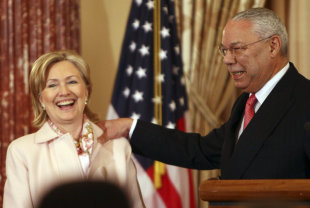
"I think she's had a distinguished record," Powell said in an interview on NBC's "Meet The Press" broadcast Sunday. "And I don't think that this one incident--which is one of these things that those of us in government have been through many, many times where suddenly an action happens late at night ... I don't think it's a blot on her record." "You're surprised," Powell said of the Sept. 11, 2o12, attack that killed four Americans, including U.S. Ambassador Chris Stevens. "Somebody gets killed, something gets blown up. And then the after-action reports start and everybody wants to know who was at fault. Who was responsible? 'Why didn't you keep this from happening?' Well, you can't keep everything from happening. Benghazi was a very, very difficult one and a difficult situation, and maybe they shouldn't have been there in the first place." Earlier, Powell was asked for his assessment on Chuck Hagel, President Barack Obama's nominee for defense secretary. "This is a guy who knows veterans, knows the troops," Powell said. "And when people say, 'Well, that doesn't necessarily make him a good candidate for secretary of defense,' I'll tell you who thinks that makes him a good candidate for secretary of defense: The men and women in the armed forces of the United States and their parents, who know that this is a guy who will be very careful about putting their lives at risk, 'cause he put his life at risk." Powell continued: "He knows what war is, and he will fight a war if it's necessary. But he's a guy who will do it with great deliberation and care. … He is a fellow he speaks his mind. He sometimes gets in trouble with those who thinks he should not speak his mind, but he says what he believes and he sticks with it." The retired general said Hagel--who was criticized for past comments about Israel--"will be on Israel's side."Powell, who served as secretary of state during President George W. Bush's first term, also gave a frank assessment of the GOP. "I think the Republican Party right now is having an identity problem, and I'm still a Republican," Powell said. "But in recent years, there's been a significant shift to the right, and we have seen what that shift has produced: two losing presidential campaigns. I think what the Republican Party needs to do now is take a very hard look at itself and understand that the country has changed. The country is changing demographically. And if the Republican Party does not change along with that demographic, they're going to be in trouble. "There's also a dark vein of intolerance in some parts of the party," he added. "Everybody wants to talk about, 'Who's going to be the candidate?' You've got to think first about, 'What's the party actually going to represent?' If it's just going to represent the far right wing of the political spectrum, I think the party is in difficulty."

Governor's rule in Balochistan on the cards

FRONTIER POST
Prime Minister Raja Pervaiz Ashraf has principally decided to dismiss the Balochistan government and clamp governor’s rule in the province. The prime minister Sunday evening visited Quetta and held a meeting with the Governor Balochistan Nawab Zualfiqar Magsi. It has been learnt that PM has taken this decision after consultations with the legal experts. It must be recalled that many political leaders, including Imran Khan, had demanded of the government to dismiss the government of Balochistan. MQM Chief Altaf Hussain also telephoned the PM and urged him to impose governor’s rule in the province. Raja Pervaiz Ashraf has been consulting various political leaders in the regard, including PML-Q leader Ch Shujjat, who has Sunday evening suggested that Balochistan should be handed over to army. CM Balochistan Aslam Raisani is presently abroad of on a tour. The demand for dismissal of Balochistan government gained momentum after the sit-in by the families of the people killed in the Quetta blasts, who refused to bury the dead till the acceptance of their demands.

India: Police arrest six in new case of gang-rape on bus

Six men have been arrested over the rape of a woman who was travelling by bus in the northern Indian state of Punjab, police said on Sunday. The attack comes just weeks after the death of a gang-rape victim sparked nationwide protests. Six men have been arrested over the rape of a passenger on a coach in India, police said Sunday, weeks after the gang-rape and murder of a student on a bus in New Delhi sparked nationwide protests. The victim had boarded the service to her in-laws' home in the northern state of Punjab when she was abducted Friday and driven to a district bordering the Sikh holy city of Amritsar, local police officer Raj Jeet Singh said. Five men joined the driver and conductor, who had taken her by motorbike to an unknown address, and took turns to rape the victim before dropping her off near her in-laws' village on Saturday morning, he said. "Six men have been arrested on allegations of having raped a 29-year-old woman... after forcibly taking her to an unknown location on the night of January 11," the policeman told AFP, adding that a seventh suspect was being hunted. "The lady, after being kidnapped, was raped brutally throughout the night by the seven accused," he said. "After raping the victim throughout the night, one of the accused dropped her near her in-laws' house the next morning where she narrated the whole incident to her two sisters-in-law." He said the extent of her injuries had yet to be established. The attack is disturbingly similar to the December 16 gang-rape and murder of a 23-year-old student in Delhi, where five men are on trial in a case that has fuelled anger across India over the treatment of women.
SLOWLY LIFTING THE TABOO OF RAPE IN INDIA
Partap Singh Bajwa, a local Congress Party politician, blamed the police for not enforcing stringent checks on buses operating in the state. "It all happened due to laxity of police as they never bother to check out the buses moving on national highways during night time," Bajwa told AFP. Protesters across India have called for the police to be more vigilant and sensitive to the growing incidence of sexual assault against women, after details emerged of the New Delhi attack. Police and prosecutors have outlined how the alleged rapists picked up the student and her male companion in a school bus which they had taken for a joyride after drinking heavily. The bus would have had to cross numerous police checkpoints at that time of night but at no stage was the vehicle pulled over by officers. After getting into an argument with the woman's male companion, the group allegedly beat him up and raped the victim in the back of the bus while driving around Delhi for some 45 minutes. They also sexually assaulted the woman with a rusting metal bar, leaving her with severe intestinal injuries, before hurling her out of the vehicle. She died in a Singapore hospital 13 days after the attack.

Is Afghanistan ready for a complete pullout?

For the first time, Washington has publicly announced the possibility that no US soldiers will remain in Afghanistan past 2014. German experts are skeptical that Afghan security will be able to cope without their help. "We wouldn’t rule out any option," US deputy national security advisor Ben Rhodes said on Tuesday, January 8, referring to a complete withdrawal of all American troops from Afghanistan by the end of 2014. The statement, the first high-level public acknowledgement that the US is considering a complete pullout, comes at a time when Afghan President Hamid Karzai is in Washington for talks on the future of Afghanistan. International ISAF troops are set to pull out of Afghanistan in 2014. Since July 2011, Afghan security officials have already begun taking responsibility for their country’s security. According to current plans, a small number of international soldiers will remain in the country. They are supposed to help train and advise local police and security officials and support the country’s civilian reconstruction. The US administration, which has the largest troop contingent on the ground, is mulling over its options. There is talk of some 3,000 to 9,000 US soldiers staying on in Afghanistan - compared to the 15,000 soldiers top US commander, General John Allen, had asked for. There are currently some 66,000 US soldiers in Afghanistan.Working with "the wrong Afghans" Joachim Spross, who heads the German-Afghan Friendship Society, told DW that the security situation gave rise to concern - as did the most recent debate on a complete withdrawal. "I just don’t understand, considering that the US and Afghanistan agreed on a contract last year," Spross said. According to the agreement, the US would maintain one or two military bases. "I am convinced it would be unwise to withdraw all soldiers." Spross added that "mistakes" had been made in the selection of local security personnel. For a long time, Spross said, foreign troops had been working with "the wrong Afghans" and had been unable to recruit and promote untainted civilians to top positions. Rainer Stinner, foreign policy spokesman for the ruling FDP party, is convinced that, despite the unstable political situation, Afghanistan has achieved a lot. He points to more roads and improved access to education and health care. But Stinner, too, said a complete withdrawal was unthinkable. "Within NATO, we talked about the fact that we have certain responsibilities towards this country. That is why I am convinced that some US troops will remain in Afghanistan post-2014," Stinner told DW. He added that the most recent debate was not to be taken seriously and that, given the huge material and human "investments," it would be wrong to pull out completely. Just political wrangling? Frithjof Schmidt, Afghanistanexpert for the Green Party, isn’t convinced that the White House really wants to withdraw all its troops. He said the most recent comments made by the US were a reaction to ongoing criticism by the Afghan government. He pointed to accusations of US unilateral military and deployment plans which Afghan officials say undermine their sovereignty. "I think it’s just a lot of noise to strengthen the American’s hand when it comes to negotiating the conditions for US support for Afghan security officials," he said. However, Schmidt thinks that US considerations coincide with the strategic shift agreed upon by the international community in 2010, namely away from a military to a political solution, which includes negotiations with insurgent groups. "First they increased the number of troops to show that they were serious about keeping up the pressure for negotiations. Now we’ve entered the final phase, in which the US government is conducting a conceptual discussion, to what extent they want to actively engage following the ISAF mission," Schmidt told DW. With President Obama’s re-election, the discussion has now entered into its decisive phase, he added.
Lacking logistical capabilities
Schmidt is convinced that the bad security situation in Afghanistan proves the strategic change was the right decision. "It’s high time for a new impulse in the political negotiations with the insurgents." He said it was crucial that training and advisory missions be strictly separated from the fight against insurgents and that combat troops be completely withdrawn. Should, against all expectations, Americans completely withdraw their troops next year, the German government would have to revise its plans of maintaining only a reduced number of German soldiers in Afghanistan, Stinner, spokesman for the FDP, said. "In order to ensure a safe environment in Afghanistan, we need capacities that only the Americans have had so far, for example in logistics." Should the unlikely scenario of a complete withdrawal actually become a reality, Stinner added, "this would have a direct impact on our deployment in Afghanistan."

Massacre of Shias in Quetta provides damning indictment of authorities: HRW

The Express Tribune
The government’s persistent failure to protect the minority Shia community from sectarian attacks by Sunni militant groups, is reprehensible and amounts to complicity in the barbaric slaughter of Pakistani citizens, Human Rights Watch said Thursday. “The government should immediately hold accountable those responsible for ordering and participating in deadly attacks targeting the Shia across Pakistan and particularly the Hazara Shia in Quetta, the capital of Balochistan province.” On January 10, at least 4 bomb attacks took place in Quetta killing over 90 and injuring well over 150 people. Those killed included at least 8 police personnel and one journalist. “2012 was the bloodiest year for Pakistan’s Shia community in living memory and if this latest attack is any indication, 2013 has started on an even more dismal note,” said Ali Dayan Hasan, Pakistan director at Human Rights Watch. “As Shia community members continue to be slaughtered in cold blood, the callousness and indifference of authorities offers a damning indictment of the state, its military and security agencies.” In 2012, well over 400 members of the Shia population were killed in targeted attacks. Over 120 of these were killed in Balochistan province, the vast majority from the Hazara Shia community. Similar attacks targeting the Shia population have taken place repeatedly over the last year in Balochistan, Karachi, predominantly Shia populated areas of Gilgit Baltistan in the northern areas, and in Pakistan’s tribal areas, Human Rights Watch said. “Pakistan’s tolerance for religious extremists is not just destroying lives and alienating entire communities, it is destroying Pakistani society across the board,” said Hasan. “Sectarian violence won’t end until those responsible are brought to trial and justice.” Human Rights Watch urged the federal government and relevant provincial governments to make all possible efforts to promptly apprehend and prosecute those responsible for recent attacks and other crimes targeting the Shia population.

Calls for Governor’s rule in Balochistan grow

Calls for imposition of Governor’s rule in Balochistan and handing over the control of Quetta City to the military are growing as talks between the Hazara community leaders and government officials on Saturday failed to quell a protest that brought thousands onto cold, wet streets for a second night to watch over the bodies of over 100 people killed in one of country’s worst sectarian attacks. Talking to reporters after talks with MQM leaders in Karachi on Saturday, Hazara tribe chief Sardar Saadat Ali demanded immediate handing over of Quetta to the Army and if need arises Governor’s rule should be imposed. MQM chief Altaf Hussain also called for dissolution of the Balochistan Assembly and Cabinet. The City’s control should be given to the military and the Chief Justice of Pakistan should take notice of the genocide of members of Hazara community. Speaking in Lahore, PTI Chairman Imran Khan demanded immediate resignation from federal and Balochistan governments over their failure to control the law and order situation, besides imposing Governor’s rule in the volatile province. Imran said he had directed party leaders and workers in Balochistan to take part in the sit-in of the Quetta Solidarity Council, while he would also reach there to express solidarity with the Hazaras. Advisor to Prime Minister on Human Rights Nawaz Khokhar, PAC Chairman Nadeem Afzal Chan and PML-F have also demanded slapping Governor’s rule in Balochistan. Meanwhile, despite freezing cold weather, hundreds of Hazara Shias continued their sit-in on the second day at Quetta’s Alamdar Road that was the scene of the suicide attacks. The protesters including women and children are keeping more than 60 coffins carrying the victims’ bodies there and say they would not burry them until the army takes control of the provincial capital and governor rule is imposed in the restive province. Federal Minister Khurshid Shah, Balochistan Governor Nawab Zulfiqar Magsi and other government officials visited protestors and held talks with Hazaras representative Qaumi Yakjehti Council (QYC) but they could not achieve anything despite assurances of the federal minister that he would soon convey their massage to the PM. The QYC warned that it would expand its protest to the cantonment area and Balochistan High Court if their demands would not be fulfilled. “We will not end our protest until we get an assurance that the Pakistan army will take over security and administrative control in Quetta,” a QYC leader said. After talks with Hazaras, Khurshid Shah told the media that the president and PM were in contact with Governor Magsi. About governor rule, he said the assembly could not be dissolved without CM’s advice. When pointed out that CM did not turn up to meet the victim families, the governor said he would not have been there had Mr Raisani been in Quetta. “There are many secrets in this answer for journalists,” he added. Also on Saturday, more than 500 supporters of the Hazara Democratic Party gathered outside the IGP office as its leader Abdul Khaliq went on a three-day hunger strike against lack of security. In Islamabad, Prime Minister Raja Pervaiz Ashraf has ordered the Frontier Crops (FC) to help maintain security in Balochistan and instructed Chief Minister Aslam Raisani to immediately return to country as Hazara families have refused to bury their dead after twin bombings in Quetta, vowing to continue their sit-in protest until the army takes over control. Interior Minister Rahman Malik called on the prime minister at the PM House on Saturday and apprised him about the latest situation in Quetta in the backdrop of the deadly blasts. The PM ordered immediate dispatch of Pakistan Air Force’s C-130 plane to shift the injured of the blasts to Karachi for better medical treatment. He also announced one million rupees for the family of each dead and one hundred thousand rupees for every injured. The PM, on the request of Balochistan government, ordered the FC to extend assistance to the civil administration in the maintenance of law and order. The FC has been given full police powers for the purpose and reinforcement of its contingents has been ordered. The PM also asked Governor Balochistan and provincial chief secretary to keep him updated, besides directed Federal Information Minister Qamar Zaman Kaira to go to Quetta for monitoring the situation.

Quetta’s dead remain unburied: Nationwide protest over carnage

As the devastated Shia protesters in Quetta continued their vigil over the unburied bodies of their loves ones, their grief was felt across the country as members of the Shia and Hazara communities and civil society came out on the streets of various cities of Pakistan on Saturday. From Karachi to Islamabad, Shia parties such as Majlis-i-Wahdatul Muslimeen (MWM) and the Imamia Students Organisation (ISO) as well as civil society activists gathered to protest the three blasts in Quetta on Thursday which claimed over a hundred lives – most of them of Shia and Hazaras. On Friday, distraught relatives of the victims had begun a protest in Quetta. Accompanied by coffins holding the bodies of those killed on Thursday, they said they would not move or bury their loved ones till the army took control of Quetta. By Saturday, a stunned nation appeared to have rallied around in support of the protesters by holding protests. In Islamabad, a protest organised by Shia groups blocked a main road for several hours. Although the protesters dispersed late in the night, they promised to return for a peaceful demonstration on Sunday morning. Activists of the Shia Ulema Council, Majlis-i-Wahdatul Muslimeen and Imamia Students Organisation also took out rallies in major cities of Punjab and held a demonstration outside the Governor’s house in Lahore which continued till late into the night. Sindh also witnessed similar protests as did Peshawar. As this wave of protests hit the headlines by Saturday afternoon, the apathetic political leadership began to wake up. Till then they continued to be preoccupied with shenanigans such as the march of Maulana Tahirul Qadri; this is lent credence by the fact that the only PPP leader who visited Quetta on Saturday to talk to protesters was Khursheed Shah. His efforts at placating the protesters proved ineffective. The only other politician who appeared at the scene was Balochistan Governor Zulfiqar Magsi, who did little beyond expressing his lack of powers and firing a few verbal rounds at the provincial government and Mr Shah. The prime minister woke up late in the evening – metaphorically – to call the governor; grant police powers to the Frontier Corps (FC) in Balochistan, and order an ever missing Chief Minister Aslam Raisani to immediately return to the country from Dubai. According to his spokesman, the provincial head was getting his throat treated. There were reports that the prime minister may meet some Hazara leaders on Sunday. Other parties followed suit. Phone calls were made as the prime minister called his ministers and other leaders and Altaf Hussain, the Muttahida chief, called government officials from London. The MQM held a press conference in Karachi where a distraught Hazara leader addressed the media. He could only lament that no one from the government had turned up to share the grief of the victims. The MQM leaders promised their support for the victims. However, in Rawalpindi, where the military’s headquarters are located, there was silence. There was no word from the military that has been called upon to take over Quetta and which has been critised by many in the past 48 hours. An ISPR official said the army can be called in by the civil administration and the provincial government.