Thursday, December 6, 2012

Morsi offers few concessions amid unrest

Activists denounce Egyptian president's call for dialogue as he refuses to delay constitutional referendum.
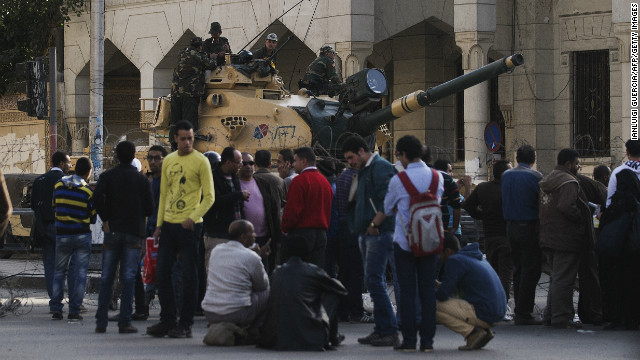
Egyptian President Mohamed Morsi has addressed the nation amid ongoing unrest, and while he called for dialogue and offered sympathy for the deaths of the protesters, he offered few concessions and dismissed his political opposition. His speech on Thursday night prompted immediate angry reactions from protesters in Cairo's Tahrir Square and elsewhere, who yelled "leave!" and chanted other anti-Morsi slogans. Morsi proposed a meeting on Saturday with political leaders, "revolutionary youth" and legal figures to discuss the way forward, but a leading activist group rejected the offer, and fresh demonstrations were called for Friday. The "April 6" movement, which played a prominent role in igniting the revolt against former President Hosni Mubarak said on its Facebook page that Friday's protests would deliver a "red card" to Morsi. The unrest began after Morsi issued a decree on November 22 granting him wide-ranging powers which are not subject to judicial review. Protests reached a peak on Wednesday, when seven died and more than 770 were injured during hours of clashes outside the presidential palace. Supporters of the president attacked a group of opposition protesters staging a peaceful sit-in, using firebombs, clubs and guns, according to witnesses. In his speech, Morsi called the violence "regrettable," and blamed it on "infiltrators" funded by unnamed third parties. "Such painful events happened because of political differences that should be resolved through dialogue," he said. "I call for a full, productive dialogue with all figures and heads of parties, revolutionary youth and senior legal figures to meet this Saturday". 'People can have their say' Earlier in the day, the Cairo headquarters of the Muslim Brotherhood, the group that propelled Morsi to victory in a June election, was set ablaze. Other offices of its political party were attacked. But the president offered only a few half-measures and no meaningful concessions to an increasingly angry opposition. Opposition leaders have called on Morsi to delay a constitutional referendum planned for December 15, and to revoke his decree. Morsi did say he "would not insist" on keeping the most controversial provision, article 6, which shields his decisions from review. Morsi also invited the opposition to what he called a "comprehensive and productive dialogue" on Saturday. But he said the referendum would proceed as planned, so that "people can have their say." "Let them vote yes or no," said Morsi. The president said he will supervise the formation of a new constituent assembly if the draft is rejected. Critics say the 100-member panel that drafted the document was dominated by Islamists and unrepresentative of Egyptian society. Nearly two dozen members, including liberals and representatives of the Coptic Church, have resigned over the last few weeks. Despite the opposition, though, the draft is widely expected to be approved. It has the support of the Muslim Brotherhood, by far the best-organised political force in Egypt, and several other Islamist factions as well. Morsi was the Brotherhood's presidential candidate, and a former head of the movement's Freedom and Justice Party. 'They took advantage' Leading opposition figures, including Mohamed ElBaradei, Hamdeen Sabbahi and Amr Moussa, blamed Morsi for the deaths, which many witnesses said began after protesters loyal to the president charged the opposition. Morsi insisted that the violence was caused by a minority of protesters who received "black money" and weapons from unnamed parties. "They took advantage of the situation," he said, without elaborating. Senior officials from the Brotherhood have spent the last two weeks insisting that members of Mubarak's regime are trying to overthrow Morsi - though none have been able to describe any specific plots. The unrest has turned into the worst political crisis of Morsi's five-month-old tenure. Protesters have camped out for days outside his palace, and in Cairo's Tahrir Square. Seven of Morsi's senior advisers have resigned in the past two weeks, including four since Wednesday's violence.

Balochistan declares ‘polio emergency’ in two districts

The Express Tribune
The Balochistan government has decided to declare a “polio emergency” in Qilla Abdullah and Pishin districts following the outbreak of a thus far unknown strain of poliovirus. Ten cases of the “Sabin-like type 2 poliovirus” were reported in the two Pakhtun-majority districts over the past three weeks prompting the federal government to ask the provincial administration to launch an inoculation drive within 30 days. Chairing a high-level meeting in Quetta on Tuesday, Chief Minister Nawab Aslam Raisani ordered an inquiry into the outbreak of the new strain of poliovirus in the province. The meeting decided that a three-day inoculation drive will be carried out in the affected districts on Dec 10 and 24 and January 2. “Eradication of polio from the country is a challenge for the government,” Raisani told the meeting. He called upon lawmakers from the two districts to monitor the fresh vaccination campaign in their respective constituencies. A visibly irate chief minister rejected a briefing on the polio situation and said “it’s time for practical steps and not briefings”. It is a matter of grave concern that fresh polio cases are surfacing in Balochistan, he added. “If a single child is affected by polio, I feel the pain and consider myself responsible for it.” The chief minister said if a government department failed to fulfill its responsibility, it would be held accountable. “Our [government’s] job is to provide policy and resources, and it’s for the concerned departments to implement these policies,” he said and warned that stern action would be taken against the negligent officials. The chief minister said that he must be briefed on the vaccination campaign on a daily basis.

India's Ocean: Is the Indian Navy About to Start Mixing it Up With China on the High Seas?

Is the Indian Navy about to start mixing it up with China on the high seas? For years, as the Chinese have modernized their naval fleet, Indian strategists have worried about what that might mean for India's political and economic interests. A recent book by C. Raja Mohan, one of India's most influential strategic thinkers, explores the prospect of Sino-Indian competition spilling from the Himalayas to the Indian and Pacific Oceans, risking a struggle for maritime influence in the region among the United States, China, and India.So it was all the more interesting, when, at a press conference Monday, India's top admiral appeared to suggest that his navy would defend Indo-Vietnamese oil exploration efforts in the South China Sea against Chinese aggression. An Indian state-owned oil company, ONGC Videsh, has been involved in deepwater explorations with Vietnam in the South China Sea since 2006, despite Chinese claims of sovereignty over that area. But the reality of Admiral D.K. Joshi's statement was far less sensational. Rather than signalling a deployment, he merely reinforced the longstanding Indian position that China's naval modernization concerned India, and that like other maritime powers, India was preparing for worst-case scenarios. It wasn't even a signal to clear the decks, let alone a shot across the bow. Nonetheless, India is far more likely to become a regular naval presence in the Pacific than many previously imagined, due to its rapidly expanding economy, improving military technologies, and growing energy interests. The Indian Navy has historically been the smallest and most poorly-resourced of India's three military services, in keeping with the country's security preoccupations at home and its unresolved land border disputes with Pakistan and China. It has just 60,000 active personnel and a $7 billion annual budget, roughly a quarter of the strength and resources of China's People's Liberation Army Navy. Its long-range capabilities come from a single aircraft carrier, a second-hand amphibious transport dock, 14 German- or Russian-designed diesel-powered submarines, and about 20 destroyers and frigates. But power is relative, and this seemingly small flotilla today constitutes the largest naval presence in the Indian Ocean after the U.S. Navy. Beyond the United States and China, only Japan, South Korea, and perhaps Taiwan boast even comparable capacities for the region, although their navies are more narrowly focused. But India's navy dwarfs those of other countries embroiled in territorial disputes with Beijing in the South China Sea. The two strongest rival claimants to China, Vietnam and the Philippines, boast just three active frigates between them. The temporary presence of even a small Indian squadron in the Pacific could make a meaningful difference to the region's balance of power. India's growing interests, resources, and technological capabilities will likely lead it to increased naval activity east of the Strait of Malacca, the critical junction of the Pacific and Indian Oceans through which 40 percent of the world's trade and most of East Asia's oil imports flow. India is conducting sea trials of an indigenously-designed nuclear-powered submarine, which will significantly increase its navy's operational range. In the next two years, India will induct a second aircraft carrier and modern French submarines into active service, to upgrade its aging fleet. The navy's share of the defense budget has steadily grown from less than 15 percent of India's annual military expenditure in 2000 to 19 percent in 2012, outpacing India's overall defense spending. And the 2009 agreement to purchase P-8 aircraft from the United States, capable of interdicting ships and tracking submarines, signals India's technological ambitions in the high seas. Perhaps more importantly, India is able to work with other regional navies. Beginning with basic exercises in the early 2000s, the Indian Navy's collaboration with the U.S. Pacific Command has evolved into complex war games. In 2004, India tested its ability to respond to regional crises in coordination with the United States, Japan, and Australia by performing humanitarian relief operations in Southeast Asia following the devastating Indian Ocean tsunami. And the Malabar series of naval exercises between India and the United States, which have also involved Japan, Australia, and Singapore, has strengthened the Indian Navy's ability to work closely with partners far from its shores. Contrast this to China: Beyond dustups with Southeast Asian countries, and with Japan over disputed islands -- which only generate further suspicion of Chinese military intentions -- Beijing is also quick to break off military ties, like it did after Washington sold weapons to Taiwan in 2010. None of this means that India is looking to pick a fight with China in the South China Sea, particularly as India has no territorial stakes there. Other facets of the Sino-Indian relationship -- the fragile boundary talks over disputed Himalayan territory and bilateral trade of more than $70 billion and growing -- are of far greater importance to New Delhi. At the same time, renouncing claims to its assets in Vietnam in response to perceived Chinese pressure could embarrass the Indian government, both domestically and internationally. When confronted with pressure from Beijing -- as during the Dalai Lama's 2009 visit to the disputed border town of Tawang or periods when China has refused to issue visas in some Indian passports -- New Delhi's response has generally been to stick to its guns. India evidently needs to do a better job of managing its message. Its National Security Advisor Shivshankar Menon, who was in Beijing for border negotiations when Joshi made his statement, countered that the Indian media had "manufactured" the story. For its part, China needs to appreciate that its aggressive pursuit of maritime territory compels India to cooperate more closely with Vietnam and the Philippines. Beijing's issuing of passports this November featuring a map showing the fullest extent of its territorial claims was a remarkably clumsy gesture, provoking simultaneous outrage in India, Vietnam, the Philippines, and Taiwan. China may have only itself to blame if these states find greater common cause with one another, and with other regional maritime powers. India's steadily growing naval capabilities and its deepening commercial engagements in the Pacific Rim means that it now has the ability to provide security in the region to ensure open and secure sea lines of communication. For many countries invested in the region -- not least the United States -- that is welcome. For China too, this presents another opportunity for improving cooperation with New Delhi, but that would require it to accept India's ability to play the role of a Pacific power.

Afghan woman challenges convention through rap

Afghanistan - Stage performances by women are definitely not appreciated in Afghanistan where the group Human Rights Watch said last week that advances for women are at risk as the draw-down of international troops continues. Here is the story of one young woman who supports her family by challenging social convention at great personal risk: By day, in her family's modest mud home, Sosan Firooz is a typical young Afghan woman. But by night, this 23-year-old is busy making history. She's Afghanistan's first female rapper, performing in front of men, in western clothes, and without a headscarf. In this conservative country, it's not just unusual -- it's revolutionary. Asked if she thinks she's a rebel, Sosan said: "Everyone wants to be unique, to do something no one else has done before." Her songs are not about broken hearts or flashy cars. Instead, she sings about the painful years her family spent in Iran as refugees when her father fled war-torn Afghanistan in 1990. "'They called us dogs, they turned Afghans into addicts and terrorists,'" Sosan sings into the microphone. And she also sings about the problems in her own country: "'We want to end cruelty against women and children'." "Yes of course it's difficult," she told me about her life in Afghanistan. "But it's easier than being a refugee." Eleven years after the fall of the Taliban, some women still wear burquas. Some are sent to prison or stoned to death for adultery. Even singing on stage isn't completely safe. Music producer Fared Rastagar recorded Sosan's song. "Some female singers have stopped singing because of threats from the Taliban. Some have left the country," he told me. Sosan's song has been played on YouTube more than 75,000 times. She's won praise, but she's also been warned to stop with threatening text messages--and recently, an anonymous phone call to her mother. "They toldf her 'If your daughter appears on TV again, we will cut off your head,'" said Sosan. So why does she do it? "How long should we keep this silence?" asked Sosan."There's a need for people to rise up. And others should follow." Despite so many risks, Sosan is working on a new song, about what it's like to be a young woman in her Afghanistan.

EXCLUSIVE: US, NATO behind 'insecurity' in Afghanistan, Karzai says

Visit NBCNews.com for breaking news, world news, and news about the economy

Visit NBCNews.com for breaking news, world news, and news about the economy

Turkish poverty rate continues downward trend, TurkStat reports

The number of Turkish citizens living on less than $2.15 a day fell in 2011 to record low levels, a study by the Turkish Statistics Institute (TurkStat) announced on Friday. The poverty numbers for 2011 show a dramatic improvement over a decade ago, with the number of individuals living on less than $2.15 a day at 3.04 percent in 2002, and those living on less than $4.30 a day at a staggering 30.3 percent. According to this, based on the $2.15-a-day poverty line of current purchasing power (CPP) rates, the percentage of extremely impoverished in 2010 was 0.21, while it was 0.14 percent in 2011. The number of citizens living on less than $4.30 a day fell from 3.66 percent in 2010 to 2.79 percent last year. The TurkStat report also reveals the continued persistence of a gap between rural and urban incomes, with the percentage of urban residents living on less than $4.30 a day in 2011 at 0.94 versus 6.83 percent in rural areas. In 2002, 4 percent were below that line in urban areas, while 38.82 percent were in rural areas. In 2011, the proportion of residents living below the $2.15 line was 0.02 percent in urban areas, whereas in rural areas it was 0.94 percent. In 2002, those numbers were 2.37 percent and 24.62 percent, respectively. Extreme wealth disparity remains an enduring feature of the Turkish economic landscape despite improvements in income earning at the lower end of the scale. In 2008, a study found the gap between the rich and poor in Turkey to be the highest among countries of the Organization for Economic Cooperation and Development (OECD). There also exists a stark disparity between the economic situation of the country's east and west, with the residents of the country's Aegean and Marmara regions enjoying more than double the average annual income of the country's central and eastern provinces.

Zardari to visit Malala at Birmingham hospital

The Express Tribune
President Asif Ali Zardari
will visit the United Kingdom on Saturday to meet 14-year-old peace activist
Malala Yousafzai, who is being treated at Birmingham’s Queen Elizabeth Hospital, sources told The Express Tribune. Foreign office officials, terming the visit as an unprecedented gesture by President Zardari, because the president did not have any diplomatic engagements in the UK other than meeting Malala. President Zardari who is accompanied by Foreign Minister Hina Rabbani Khar will meet Malala following a visit to Iran, a source privy to the president’s travel itinerary said. Malala, who was shot while riding a school bus on October 9 in the Swat Valley, became the symbol of resistance against the Taliban, advocating access to education for girls in an area that has been one of the Taliban’s main strongholds in the country. Over the past months, the teenage activist has received messages of support from across the globe with some suggesting a Nobel Peace Prize for her. However, back at home certain right-wing elements accused her of being part of the US conspiracy to push Pakistan for a fresh military offensive in the tribal areas. In a special message, President Zardari said Malala stands tall as a symbol of girls’ education and of defiance against those who wish to impose their obscurantist agenda behind the facade of religion. To reinforce the idea that Malala represents the government of Pakistan, a special initiative has been launched to give free education to the children.
SAMAA TV
President Asif Ali Zardari called on the Executive Director of Queen Elizabeth Hospital in Birmingham to know wellbeing of Malala Yousaf Zai, SAMAA reports. According to the Spokesman of the Presidency, Dr. Kevin Balgar, the Executive Director of Queen Elizabeth Hospital, updated President Zardari about Malala’s health and facilities being rendered to her at the hospital. Malala Yousaf Zai’s health is promising and she is recovering gradually, Dr Kevin informed President Zardari while saying that Malala will take some time to recover fully.

Morsy miscalculating Egyptians' rage

By Nancy Okail
This week, in a scene not witnessed during the 30-year rule of Hosni Mubarak, the Egyptian presidential palace was encircled with barbed wire as thousands of protesters opposing President Mohamed Morsy besieged it from all sides. The visual is shocking, considering that a few short months ago, Morsy stood without a shield to give a speech to thousands in Tahrir Square. Most experts would agree that Mubarak did not start out as the dictator he ultimately became. Indeed, the oppression, torture and crackdown on opposition his regime was known for grew gradually over the years before reaching the height of brutality in his last term.It also took at least 10 years of determined commitment by activists and opposition to make change. The opposition grew from a few people beaten by police while peacefully protesting on the stairs of the Supreme Court to more organized groups such as Kefaya and April 6, to the massive citizens uprising of January 25, 2011. But in just a few months, Morsy already has deployed all the ingredients of authoritarianism: intimidating media outlets, defaming opposition and casting doubt on their patriotism and intentions and using violence and detention against protesters. On November 22, Morsy finally crowned these atrocities with a constitutional declaration granting him complete power over the executive, legislative and judiciary authorities, with no accountability. When the act was denounced at home and abroad, Morsy claimed that these are temporary measures were required to protect the revolution and help the transition to democracy. What has followed have been the opposite of democratic.Morsy quickly announced that there would be a December 15 referendum to vote on the new draft constitution that was rushed through by the Islamist-dominated constituent assembly. The majority of liberal and secular voices had already boycotted the committee over a lack of transparency in the drafting process. Despite protests, strikes and a declaration by federal judges that they will not monitor what they consider to be an illegitimate referendum, Morsy shows no sign of reversing course -- ignoring opposition in the fashion of Mubarak. But Mubarak was not democratically elected. Then why is Morsy moving so frantically to consolidate his power without even attempting to disguise it behind a democratic facade? The answer is, Morsy is not stupid. He is aware that he only won by a 1.7% margin. A substantial number of his voters favored him only to avoid another era of military rule at the hands of his opponent, Mubarak's ex-prime minister, Ahmed Shafik. In fact, the non-Islamist opposition arguably represents the majority, but only failed to mobilize for the election because it was deeply fragmented and disorganized. But Morsy's coup has done what some thought impossible: unite the liberal/moderate opposition. Outside observers applauded Morsy's early decisions -- such as dismissing the heads of the Supreme Council of the Armed Forces, releasing military prisoners and banning pornographic websites -- as surprising and bold. However, these decisions were either populist or designed to appease his constituency of Islamists. Morsy avoided making any painful, but essential, decisions, such as lifting subsidies, increasing prices of utilities and dealing with unemployment. But Morsy has made three major miscalculations. First, he made appeasing his own constituency a bigger priority than winning over the opposition. This helped them to unify against him. Second, he assumed that he would be immune from international criticism after his celebrated success in brokering a cease-fire between Hamas and Israeli earlier last months. Finally, and perhaps most importantly, he underestimated the Egyptian people. The massive protests on Tuesday, which included people of all ages, incomes and walks of life, showed that the Egyptian people no longer would accept dictatorship in any form.The opposition has shaken Morsy's misconceptions: The protests have been unified and included all political forces. Meanwhile the international community is not so naive and realizes that the opposition is not simply a minority group that wants to restore the old regime, a scenario the Brotherhood spokesmen publicly propagate. All is not lost for Morsy if he is willing to change course. If he were to withdraw the declaration, call for a national dialogue and provide an opportunity for an inclusive space to redraft the current document of the constitution, there is hope for getting Egypt back on track in its transition. At a minimum, he should extend the time frame for the referendum to open the door for a real national debate. This would not only spare the divided nation from descending into violent chaos but would also save Morsy and his party. It is already evident that situation is only escalating, with more violent clashes Wednesday between supporters and opponents of Morsy in front of the presidential palace. There is no guarantee that even this will regain stability or restore Morsy's legitimacy, but what is certain is that the longer he delays his response to the angry masses, the more irreversible the situation will be. The political dynamics in Egypt have drastically changed since the revolution. Foreign governments, particularly the U.S., should factor this into its approach to engaging with Egypt. This does not mean siding with one regime or playing one group against the other, but rather siding with the principles of freedom and democracy against oppression and authoritarian rule. The Egyptians are still waiting for the Obama administration to match its fine words with actions.

Japanese wrestlers thrill Khyber-Pakhtunkhwa crowd with slams and clotheslines

The people of Peshawar were treated with well-deserved respite from their daily toil as Japanese wrestlers slammed each others opponents onto the canvas of the wrestling ring set up at Qayum Sports Complex.
“Such exchange programmes need to continue in the future to strengthen the relations of the two countries. I will tell my countrymen that Pakistan is a safe country for sports,” Inoki told The Express Tribune during the curtain raiser of the championship event which begins on Thursday (today). Inoki and his team of wrestlers have been invited to convey a message of peace, which has remained elusive in the face of an ongoing militant insurgency in Khyber-Pakhtunkhwa. In addition to the wrestling matches, traditional Khattak, Chitrali, Mehsud and Batani dances were performed along with paragliding feats. Traditional games including Peto Garam and Guli Danda were also part of the attractions. A wrestler even joined the Khattak dance team during their performance, which reflected K-P’s rich cultural diversity. Provincial Sports Minister Syed Aqil Shah reciprocated the gesture by dancing along too. “It is an honour for the province to host international players. This shows people love peace and condemn terrorism,” said Information Minister Mian Iftikhar Hussain, who was the chief guest at the event. “We will continue our struggle to provide a peaceful environment for local and foreigners wanting to come here. And sport is one of the ways to achieve our goal for a better future.” Around 62 players along with officials from India, Bangladesh, Sri Lanka and Afghanistan will participate in the two-day Bacha Khan International Wrestling Championship on Thursday. Inoki told the crowd this is his fourth visit to Pakistan and that he will always remember the warm welcome and hospitality extended to him, especially from the people of K-P. Inoki first visited Pakistan in 1976 to compete with Pakistani wrestlers Muhammad Ali and Akram Pehlwan. He gained widespread recognition after injuring Ali’s hand during a match. His subsequent visits were in 1979 and 1984.

Austrian bus driver driver returns bagful of euros

A Vienna bus driver who found a bag with 390,000 euros ($509,700) in cash
inside handed the money over to police, who tracked down the elderly woman who had inexplicably left her fortune behind. The driver, identified by the Vienna transport authority only as Wolfgang R, was inspecting his vehicle at the end of the line when he found the bag in a seat behind the driver's. "At first I thought it was shopping or medicine," the Krone newspaper quoted him as saying. However, when he opened the bag he found a collection of 500-euro notes staring back at him. Police in the Austrian capital used a bank deposit slip inside the bag to trace the owner. There was no word on whether the woman had given the honest driver a reward.

'Revolution in Egypt hijacked

Lebanese 'Karachi Affair' Suspect Probed over Libya Cash

Ziad Takieddine,
a Franco-Lebanese businessman who has been charged with corruption in the "Karachi" kickbacks affair is also being investigated for suspected money laundering after being detained with 1.5 million euros in cash, it emerged Thursday. Judicial sources said Takieddine, who is allegedly embroiled in a string of illegal political financing scandals in France, had been caught with the money on a private flight out of Libya in March 2011, prior to the overthrow of Libya's then President Moammar Gadhafi. The case has been put in the hands of examining magistrates Renaud Van Ruymbeke and Roger Le Loire, the judges who are in charge of the Karachi investigation. That case centers on allegations that a 2002 bombing in Karachi was carried out by Pakistani agents in revenge for the non-payment of bribes promised in relation to a 1994 sale of a French submarine. The bombing killed 14 people, including 11 French naval engineers. It is alleged that some of the cash involved was channeled back to former prime minister Edouard Balladur's campaign to be the French right's candidate in the 1995 presidential election. Takieddine has been charged as acting as an intermediary. The Karachi affair has also embroiled former president Nicolas Sarkozy, who was Balladur's campaign spokesman and budget minister at the time. Media reports have claimed Sarkozy authorized the creation of a shell company used to channel kickbacks. He has been questioned by the judges but not charged with anything. Two of his former aides have been charged. Sarkozy has also been accused, by the media, of accepting cash from Gadhafi for his own 2007 presidential election campaign. No investigation has been opened into those claims and Sarkozy is pursuing a defamation suit against online news website Mediapart over its reporting.

Lessons for China in chaotic Egyptian upheaval

As Cairo falls into violent street battles and bloodshed has been triggered by a controversial draft constitution, observers around the world are expressing concerns for the nascent democracy in a post-revolution Egypt. Mohamed Morsi, the country's first democratically elected president, is being blamed by some Egyptians for overriding law with Islamic doctrines and making a grab for power. This mirrors an important difficulty in Egypt's democratic experiment which has long been anticipated. While the Egyptian revolution was taking place, there were already doubts whether reconciliation between secular and religious forces would be achieved even if democracy was implanted on the surface. We still remember the V sign for victory, brandished by Egyptians in Tahrir Square as they celebrated their victorious uprising. Two years later, the mentality behind launching a revolution via street clashes hasn't disappeared. The roots for a calm, free dialogue between various forces cannot be fostered overnight. Democracy's benefits are embodied in the pragmatic interests it can bring and its capability to boost social tolerance and progress. Egypt has been trapped in factional political confrontation and street clashes which bring increasing division and unrest. Nobody knows how long it would take before Western democratic success could be reproduced in Egyptian soil. While supporters of and protestors against Morsi thronged into the street, throwing Molotov cocktails, rocks and iron bars at each other, a scuffle for power was still going on between old forces of the nation. This is a familiar pattern that has already taken place in other Middle Eastern countries like Iraq and Libya. Egypt once hoped to be a successful example produced by the Arab Spring. Now the nation is swallowing the bitter pill of abrupt change, which took place before pillars for democracy and rational social governance had been prepared. Egypt is going to experience painful development in its society, economy and culture, and in this process democracy alone can't succeed. The current turbulence in Egypt is necessary for a country in transition, but Egyptians aren't prepared for that. They don't have the necessary patience, and want to see immediate benefits brought about by the revolution. The social progress China made through reform is much more tangible than what revolutions have brought to many other countries, while China has paid the lowest price. This is what we should be proud of and cherish. The upheaval in Egypt is a free lesson for China.

Syrian troops regain control of two hotspots in capital

The Syrian army has regained control of the Damascus' suburbs of Daraya and Akraba after days of intense fighting with armed militias, a pro-government paper said Thursday. Quoting what it called as "a well-informed source," al-Watan daily said the losses among the armed militias are high but their number is very high also, and fully purging the areas will take some time. In Daraya, a sprawling western suburb that stretches on swathes of residential areas and orchards, the Syrian army regained full control of the area on Wednesday but is still purging some parts of it, the paper said, estimating that around 120 armed men are still hiding in buildings in Daraya and the army is tracking them down. The Akraba suburb, near the road to the international airport, the army also wrested back control over the area, the paper said, citing an official source as denying media reports that the armed rebels took control of a military airport in the area. The troops also continued operations in towns close to the international airport of Damascus, such as in Bait Sahem, Diabieh, and Hajjira, according to al-Watan, which also reported army operations in other restive suburbs of Damascus, including Douma and Arbeen. In the northern city of Aleppo, government soldiers repelled armed groups' attack on the central prison in the restive city on Wednesday. Meanwhile, another pro-government news network, Ajel, said the governor of the central province of Homs, Ghassan Abdul-Al, has survived an assassination attempt overnight in his house in Homs. The report, however, gave no further details.

The Middle East in turmoil

By Jennifer Rubin
In Egypt, President Mohamed Morsi’s constitutional overreach now has the country on the brink of another revolt, one that might topple the Islamist government. The New York Times reports: “Resignations rocked the government of President Mohamed Morsi on Thursday as tanks from the special presidential guard took up positions around his palace and the state television headquarters after a night of street fighting between his Islamist supporters and their secular opponents that left at least 6 dead and 450 wounded.” Whether Morsi is toppled, crushes the opposition or is chastened matters greatly to the future of Egypt and to the U.S. relationship with Egypt. It is not clear what we can do to aid secular leaders, and in fact by embracing Morsi in such an unqualified fashioned we are now in a poor position to help them. That said, the U.S. should be very clear that use of force against the Egyptian people will have serious consequences for our relationship and for our aid and that the foundation for continued, robust U.S.-Egyptian cooperation is an Egyptian government that respects human rights, including those of religious minorities. Unfortunately, this administration has been exceedingly poor in articulating American values and trying to influence events in positive ways. I asked a conservative scholar who has been critical of the administration what we can do to encourage the forces of secularization. He cracked, “If we can, rest assured we won’t.” That unfortunately sums up the lackluster diplomacy that passes for “smart” foreign policy under President Obama. Meanwhile, consternation is growing over the prospect that Syria is preparing use of chemical weapons. The Associated Press reports, “Diplomatic efforts to end Syria’s civil war moved forward Thursday with Secretary of State Hillary Rodham Clinton joining Russia’s foreign minister and the U.N. peace envoy to the Arab country for extraordinary three-way talks that suggested Washington and Moscow might finally unite behind a strategy as the Assad regime weakens.” It may be that the prospect of chemical weapons can jolt Russia and others into stronger action, the absence of which has served as an excuse for the administration to do nothing. While the fear of chemical weapons may actually induce action against Assad (the silver lining to be sure in the storm clouds), most Middle East observers in the U.S. generally believe that Bashar al-Assad would be terribly foolish to use such weapons, not least because he knows full well that it may be the only provocation that might get the U.S. off the sidelines. Nevertheless, the possession of weapons of mass destruction by Iran-allied despots raises the possibility that terrorist groups such as Hezbollah might gain access to such weapons. Former ambassador to the United Nations John Bolton tells me, “The fact that the administration is only now worried about the chemical weaponns shows yet again how they have misunderstood Syria. Use in Syria would be bad, but a potentially far graver risk is that terrorists get their hands on the stockpiles and remove them from Syria for use elsewhere. That’s why we should consider destroying or securing the chemical weapons and agents.” The troublesome situation highlight several concerns. First, the U.S. government is entirely reactive to events, and slow to respond. Lacking an overarching approach to the region, we are forever back on our heels. Friends and adversaries see this as well. Second, imagine how much more hair-raising this would all be if Iran had nuclear weapons, with the potential that radical Islamists in the region would gain access to fissile material? The notion that we can “contain” a nuclear-armed Iran is ludicrous; we cannot contain a chemical-armed Syria nor move Islamists governments in ways that promote peace and stability. And finally, who thinks UN Ambassador Susan Rice would be up to handling some (any?) of this? Her lack of credibility and stature would only further diminish our influence.

President Obama meets with NJ Gov. Christie on Sandy recovery effort

President Obama met with Gov. Chris Christie on Thursday morning to discuss recovery efforts from Hurricane Sandy that ravaged New Jersey and other parts of the East Coast. White House press secretary Jay Carney said Obama — who has been in touch with Christie regularly since the storm made landfall in October — has been "very focused" on assisting New Jersey and New York in recovery efforts. Asked about continued aid to the states, Carney said, "That request is still being worked on and still being developed."Carney said Obama is "incredibly concerned" about those who are still suffering in the storm's wake and said he has been "aggressive" to cut through red tape and act swiftly. "I would point you to the substantial and fast effort that the president oversaw," Carney said when pressed about why some in the affected states are still without power. Still, Carney acknowledged, "There's enormous suffering that continues." The White House is formally expected to ask Congress to pass a huge Sandy supplemental spending bill in the lame-duck session. Christie has asked for $37 billion in damage assistance. New York has sought $42 billion. Reports indicate the White House is considering only a $50 billion request total. The bill will be an uphill battle coming in the middle of "fiscal cliff" talks, lawmakers and administration officials say. House Republicans have not said whether they will require new disaster funding to be offset by spending cuts. The White House wants no offsets. Carney said Christie also met with White House Chief of Staff Jack Lew, Acting Director of the Office of Management and Budget Jeff Zients and Deputy Chief of Staff for Operations Alyssa Mastromonaco to discuss storm recovery efforts. Christie visited Capitol Hill as well, conferring with New Jersey Democratic Sens. Frank Lautenberg and Robert Menendez in the early afternoon, and he was slated to meet with the Senate Appropriations Committee and Speaker John Boehner (R-Ohio). Obama and Christie last met days after the storm and the New Jersey governor praised the president for his help in recovery efforts. Christie was criticized by Republicans for his glowing reviews on the president's assistance days before the presidential election.

Samuel Adams founder: How I crafted a career of beer

Putin, Medvedev fall in Forbes’ list

http://themoscownews.com
Russian President Vladimir Putin has slid one position in the Forbes’ most powerful people list and came third, after US President Barack Obama and German Chancellor Angela Merkel.
Dmitry Medvedev, who vacated the presidential office for his long-time mentor earlier this year, has also lost two positions and ended up 61st this year. Two other Russians in the magazine’s rating were mogul Alisher Usmanov, the country’s richest person, according to Forbes, and world’s 67th most influential, and Alexei Miller, CEO of the world’s biggest gas producer, who made his debut in the list on the 70th position. One in 100 million In 2012, Forbes added one extra position to its personalized rating of world powerhouses, since the population of the planet exceeded the mark of 7 billion in March. To choose one in 100 million, Forbes editors assessed them according to four criteria. The number of people over whom candidates had power and financial resources they control were taken into account as well as in which spheres they are powerful in and how often they use their power. “Russian autocrat Vladimir Putin (#3) scored points because he so frequently shows his strength — like when he jails protestors,” Forbes wrote. Journalists also added that any list of this kind was subjective. “We don’t pretend ours is definitive,” they wrote.

Obama resolute in showdown with GOP over 'fiscal cliff'

The White House holds firm as Republicans are forced into the awkward position of threatening a tax increase for all to preserve lower taxes for the wealthy.
President Obama brushed off the latest Republican gambit to gain leverage in averting the so-called fiscal cliff, bluntly telling business chief executives in a speech Wednesday, "I'm not going to play that game." That flash of swagger reflects growing White House confidence about its position in the year-end showdown over scheduled spending cuts and tax increases. With less than a month to act and the wind of an electoral victory at their back, White House officials think they are boxing in Republicans. The White House credits its strategy crafted from painful lessons of past go-rounds with the Republican-led House. Rather than engaging intensely with the GOP leadership in high-profile meetings, Obama has sought to isolate Republicans and pump up the pressure from all sides. He has picked a red line and is sticking to it. And now he's waiting. "The only time these guys have ever moved on something is when they have felt the outside pressure," said an Obama advisor who requested anonymity to discuss strategy. Both sides say they are working to defuse the scheme of tax increases and budget cuts they enacted to force themselves to reach a larger deficit reduction deal. Experts say that if nothing is done, the double blow could send the economy back into recession. For now, though, the president has reason to be resolute, even as Republicans call on him to counter their latest offer. Treasury Secretary Timothy F. Geithner underscored that position Wednesday in an interview on CNBC. The administration is "absolutely" ready to go over the "fiscal cliff" if Republicans refuse to raise tax rates on the wealthy, he said. "There's no prospect in an agreement that doesn't involve those rates going up on the top 2% of the wealthiest Americans," he said. Public polling shows a majority of Americans not only support the president's push to allow tax rates to rise on top earners but are prepared to hold the GOP responsible if negotiations fail. A new poll from the Washington Post and Pew Research Center found that 53% of Americans said Republicans should be blamed if there is no deal, compared with 27% who would blame the president. Obama's stance has bred discord and frustration among Republicans on Capitol Hill who find themselves in the politically awkward position of threatening a tax increase for all to preserve lower taxes for the wealthy. Tension bubbled up this week as Republicans floated a new strategy that would involve reviving a threat to let the U.S. default on its debt payments. Under that scenario, Republicans would agree to raise taxes on the wealthiest 2% of taxpayers, as the president has demanded, but would defer talks about a larger deficit reduction package until the new year, when Obama would need their votes to avoid a federal default on the debt. Republicans could then demand concessions on the federal budget in return for voting to raise the nation's debt limit. "The debt ceiling is hanging out there, and the debt ceiling is the next point of leverage," said Rep. Steve King, a conservative Republican from Iowa. "The president does not fear the fiscal cliff. He's concerned about who's going to get the blame. But he doesn't fear the cliff." A spokesman for House Speaker John A. Boehner (R-Ohio) also suggested that Republicans would try to extract spending cuts in return for a debt limit increase. "We agree there is no reason for drama surrounding a debt limit increase. All that is required is the president getting serious about spending cuts," said Boehner spokesman Brendan Buck. In his CNBC interview, Geithner said the administration would insist that any agreement include an increase in the debt ceiling. Obama and Boehner spoke on the phone Wednesday. Neither side disclosed details of the call. Obama's strategy involves risks. His repeated attempts to bludgeon Republicans on taxes while offering no new concessions has engendered little goodwill, and he will need some Republican votes soon. And his declaration that he won't play chicken with the vote to raise the debt ceiling? Though that is the tough talk that some Democrats have craved, it has little practical meaning. Unless Republicans agree to his request to largely cede authority to raise the limit, he will need Congress to do it. For Obama, the lesson on how to gain and use leverage began with the summer of 2011, when a marathon of high-level bargaining sessions with Republicans failed to produce a grand bargain on the federal budget. After that, Obama set out to negotiate on the campaign trail, announcing his terms publicly as he rallied people behind them. The Obama team added social media campaigns and testimonials from middle-class Americans, and managed to pass an extension of the payroll tax break in February. That's when aides came to believe the president could shift the dynamic in talks with Capitol Hill. Early signs are that the formula may be working again. The latest Twitter campaign has elicited more than 100,000 emails from people explaining how the middle-class tax increase would affect them. And Obama's outreach to interested parties is showing progress. Business leaders are worrying openly about the uncertainty around the fiscal cliff and debt ceiling. At the Business Roundtable on Wednesday, Boeing's chief executive introduced Obama by suggesting that business leaders could "serve a useful purpose in the dialogue." To be sure, there's grousing about Obama's negotiating posture. Sen. Mitch McConnell (R-Ky.), the chamber's Republican leader, has complained that Obama is campaigning rather than working out the issues with his negotiating partners. But the strategy is worth the aggravation, administration officials think. The president isn't avoiding private negotiations, but doesn't plan to start them until there is some movement. "Once Republicans acknowledge that rates are going up for top earners," White House Press Secretary Jay Carney said, "we believe that an agreement is very achievable."

Zardari signs presidential reference in judges appointment case

http://www.thenewstribe.com
Pakistan’s President Asif Ali Zardari on Thursday signed a presidential reference seeking guideline from the Supreme Court of Pakistan over the procedure of the appointment of the judges.
According to Law Minister Farooq H. Naek, the president asked for the advice from the apex court under the Article 186 of the constitution. The reference would be filed tomorrow in Supreme Court of Pakistan. The law minister said that the reference contained 13 questions related to the appointment of judges in the superior judiciary with specific reference to the Islamabad High Court. The reference asked for guidance over the role of judicial commission, parliamentary committee and the seniority of the judges, he said. It is to be mentioned here that a four-member bench of the Supreme Court headed by Justice Khilji Arif granted a time of two weeks on November 23, 2012 as sought by Attorney General Irfan Qadir to file a presidential reference in the apex court. The time granted by the apex court will expire on December 7, 2012. The Judicial Commission nominated appointment/extension of two additional judges of the High Court Justice Shaukat Aziz Siddiqui and Justice Noor ul Haq N Qureshi and the nomination was approved by the Parliamentary Committee (PC) under Article 175A inserted in the Constitution under the 18th and 19th Amendments. The term of both as additional judges was expired on November 20 as the notification was not issued due to some questions raised on the process of recommendations by the Commission with an observation to reconsider the nominations because the commission which had finalized the names had not been constituted properly. On the hearing of the case, AG Irfan Qadir informed the court that the Law Minister instructed him that a presidential reference would be filed to get SC advice regarding appointment of Justice Shaukat Aziz Siddiqui and Justice Noorul Haq Qureshi besides the non-confirmation of Justice Azim Afridi as IHC judge.

Benazir Bhutto murder report on 27th

The federal government wants to make public the investigation, finalized by the Joint Investigation Team (JIT) in the Benazir murder case on her fifth death anniversary to be observed on December 27.Special Judge ATC Rawalpindi Ch Habib-ur-Rehman Wednesday disposed of an FIA application seeking permission to make public the probe findings. During the proceedings, the judge observed that the government did not need any court permission for this. However, the court directed the prosecution to take all actions in accordance with the law.According to political pundits, the PPP government’s idea of making public the probe findings could be an attempt to cover its failure in nabbing the killers of Benazir. and a tactic to avoid a series of public queries its candidates might face during electioneering.It is pertinent to mention here that Benazir was killed in a gun-and-bomb attack outside Liaquat Bagh soon after she culminated her address to a mammoth public rally on December 27, 2007.

Protesters leave Egypt's presidential palace as tension remains palpable

http://english.ahram.org.eg
Supporters of Egyptian President Mohamed Morsi withdrew from areas around the presidential palace in Cairo on Thursday after Egypt's presidential guard ordered protesters to leave the area by 3pm Cairo local time following violent clashes on Wednesday. Opposition protesters, who have been demonstrating against President Mohamed Morsi and the Muslim Brotherhood for the last week, had left the scene earlier, but are expected to return to the area later today. Anti-Morsi protesters – including members of the Dostour Party, the revolutionary Maspero Youth Union and the Popular Alliance Party – are planning to head towards the presidential palace in three marches. One will set out from Cairo's Abbasiya cathedral, a second from Al-Nour Mosque in Abbasiya, and a third from Raba Al-Adawia Mosque located in the capital's Nasr City district. It is not clear, however, when the three marches will arrive. Their final destination is not clear as well, but they are expected to settle near the presidential palace. Bloody clashes that saw at least six people killed and 600 injured broke out on Wednesday after Morsi supporters forcibly dispersed a sit-in staged by anti-Morsi protesters since Tuesday. Protesters have been calling for the annulment of the president's recent constitutional declaration and a draft constitution that will be put before a popular referendum next week. Opposition demonstrators believe the constitutional declaration has given Morsi unfettered powers and put him beyond any legal accountability. They also argue that the draft constitution, written by Egypt's Islamist-led Constituent Assembly, would "Islamise" the country and have an adverse effect on civil freedoms. Clashes on Thursday lasted for hours between opposition protesters and Morsi supporters, the latter of whom argue that the president – via his constitutional declaration – is seeking to realise a longstanding revolutionary demand by bringing former regime figures to justice. They also support the draft constitution and want to see it passed. The presidential guard has yet to announce when the newly imposed curfew will be lifted.

Pakistan Reels With Violence Against Shiites

By DECLAN WALSH
Calligraphers linger at the gates of an ancient graveyard in this brooding city in western Pakistan, charged with a macabre and increasingly in-demand task: inscribing the tombstones of the latest victims of the sectarian death squads that openly roam these streets. For at least a year now, Sunni extremist gunmen have been methodically attacking members of the Hazara community, a Persian-speaking Shiite minority that emigrated here from Afghanistan more than a century ago. The killers strike with chilling abandon, apparently fearless of the law: shop owners are gunned down at their counters, students as they play cricket, pilgrims dragged from buses and executed on the roadside. The latest victim, a mechanic named Hussain Ali, was killed Wednesday, shot inside his workshop. He joined the list of more than 100 Hazaras who have been killed this year, many in broad daylight. As often as not, the gunmen do not even bother to cover their faces. The bloodshed is part of a wider surge in sectarian violence across Pakistan in which at least 375 Shiites have died this year — the worst toll since the 1990s, human rights workers say. But as their graveyard fills, Hazaras say the mystery lies not in the identity of their attackers, who are well known, but in a simpler question: why the Pakistani state cannot — or will not — protect them. “After every killing, there are no arrests,” said Muzaffar Ali Changezi, a retired Hazara engineer. “So if the government is not supporting these killers, it must be at least protecting them. That’s the only way to explain how they operate so openly.” The government, already battling Taliban insurgents, insists it is taking the threat seriously. During the recent Mourning of Muhurram, when Shiites parade through the streets over 10 days, the Interior Ministry imposed stringent security measures such as blocking cellphone signals for up to 12 hours — to try to prevent remote bomb detonations — and banning doubled-up motorcycle riding. Even so, Sunni bombers struck at least five times, killing at least 50 Shiites and wounding several hundred. The Pakistani Taliban claimed responsibility for the biggest attacks, highlighting an emerging link between that group and traditional sectarian militants that has worried many. Yet the unchecked killings have also raised wider questions about Pakistani society: about the spread of a cancerous sectarian ideology in a public that even just a decade ago seemed more tolerant, and about what might be spurring the growing audacity of the killers, some of whom are believed to have links to the country’s security services. The murders in Quetta, for instance, involve remarkably little mystery. By wide consensus, the gunmen are based in Mastung, a dusty agricultural village 18 miles to the south that is the bustling local hub of Lashkar-e-Jhangvi, the country’s most notorious sectarian militant group. Like so many Pakistani groups that combine guns with zealotry, Lashkar-e-Jhangvi thrives in a wink-and-nod netherworld: it is officially banned, but its leader, Malik Ishaq, was released from jail last year amid showers of rose petals thrown by supporters. Now Mr. Malik lives openly in southern Punjab Province, protected by armed men who loiter outside his door, allowing him to deliver hate-laced statements to visitors. Shiites are “the greatest infidels on earth,” he told a Reuters reporter last month. In Quetta, his followers are similarly unfettered. In targeting the Hazara — who, with their distinctive Central Asian features, are easy to pick out — Lashkar-e-Jhangvi militants block busy highways as they search vehicles for Hazaras and daub walls with hate slogans. “The face is the target,” said Major Nadir Ali, a senior Hazara leader and retired army officer. “They see the face, then they shoot.” In the worst killing this year, militants dragged 26 Hazara men from a bus headed for a religious pilgrimage site in Iran, and executed them in front of their wives. The episode occurred near Mastung. There is a growing sense of siege in the Hazara community here. Shards of glass are still lodged in the head of Waqar Husain, an engineering student who survived a bomb attack on a crowded university bus last June. Four students died in the attack, and four lost their sight. “It changed my view of life in Quetta,” he said. Now largely confined to home, Mr. Hussain is still not safe. Threats come via Facebook and Twitter, he said, through taunting messages about the “Shia kaffir” — infidels. The campaign of fear has forced the Hazara to retreat into ethnic enclaves on the edge of the city. Businesses have moved from the city center to Alamgir Road, a Hazara quarter where discreetly armed men stand watch on street corners. Even the ambulance drivers are armed. One driver cocked his pistol before leading the way to the site of a recent attack. Across the street, the flag of a banned Sunni group fluttered from a shop with graffiti that read: “There is one treatment for Shiites — it is called jihad.” The rattle of attacks is just one of several conflicts plaguing Quetta, a once quiet provincial capital now riven by a range of ethnic fissures and violent intrigues, lending it an air of power-keg tension. Most famously, the city is, or was, home to the “Quetta Shura,” the secretive Afghan Taliban leadership council. But for the Pakistan Army, the main enemy are ethnic Baluch separatists, who killed three soldiers in a bomb attack in central Quetta on Nov. 21. Foreigners are no longer safe, either treated as Western spies by suspicious officials or abducted as part of a soaring trade in kidnapping. Last April the decapitated body of Khalil Dale, a British Red Cross doctor, was found near Quetta, three months after suspected militants abducted him for ransom. With such a dizzy array of threats, it is perhaps unsurprising that the security forces have failed to stem sectarian violence. But many analysts see a more disturbing cause: a fatal ambivalence inside the police and military toward jihadi groups. While the military ostensibly severed its relationship with Islamist groups like Lashkar-e-Jhangvi after 2001, some activists suspect that, at a local level, ties linger. “The authorities are turning a blind eye,” said Ali Dayan Hasan of Human Rights Watch. “The most charitable explanation is that they are incompetent. The alternative is that the military enjoys an informal alliance with Sunni extremists.” A senior official with the Frontier Corps, the paramilitary force in charge of securing Quetta, denied accusations of collusion. The situation is “challenging,” he admitted, speaking on the condition of anonymity. “But there is no problem with the Hazara. We pursue all criminals, irrespective of sect, caste or religion.” Regional politics also plays a role. Iran and Saudi Arabia financed rival Shiite and Sunni militant groups in the 1990s, as part of a proxy war for influence. Experts say that, while the Iranian financing has slowed dramatically, private Saudi funds continue to pour in. In a State Department cable dated December 2009 and published by WikiLeaks, Secretary of State Hilary Rodham Clinton noted that “donors in Saudi Arabia constitute the most significant source of funding to Sunni terrorist groups worldwide.” The sense of siege has turned to flight for many younger Hazaras, who are leaving their homes in Quetta for Australia, 6,000 miles distant and the largest center of the Hazara diaspora. It is an expensive, dangerous journey: after paying up to $15,000 per head to people smugglers, many are forced to brave perilous journeys in rickety boats across the Indian Ocean. Too often, the boats sink en route, taking hundreds of lives. Muhammad Hussain, a 39-year-old teacher, said two of his brothers had left for Australia in the past four years — one had almost certainly drowned, he believed; the other, who left four months ago, had still not sent news. “We just don’t know what happened,” he said, twisting his fingers anxiously as he spoke.

Bombing wounds Afghan intelligence chief

Associated Press
Afghanistan's intelligence chief was wounded Thursday in an assassination attempt in the capital, Kabul, Afghan officials said. A senior government official said Asadullah Khalid suffered injuries on the lower part of his body when a bomb exploded at the intelligence chief's guest house as he was receiving a visitor. The house is used for private meetings that Khalid doesn't want to hold at the official compound of the National Directorate of Intelligence, the official said. He official would not provide more details beyond saying the bombing was an attempt on Khalid's life. Khalid was rushed to a medical facility run by the intelligence service, the government official said. An Afghan police official also confirmed that Khalid was injured in a blast. Both officials spoke on condition of anonymity because they were not authorized to disclose the information. Khalid, a former minister of tribal and border affairs and ex-governor of two provinces, was appointed head of the service in September. There was no immediate claim of responsibility for the attack.

Mehsuds continue to flee S Waziristan

Mehsud tribe continues to vacate Shakai and Wana, two major towns of South Waziristan following a threat from Wazir tribe after a suicide attack on Maulvi Nazir on Nov 29 that he survived, Geo News reported Thursday. According to reports, at least 1,000 Mehsud tribesmen in Wana have left the area within two days following the warning while at least 700 families were still living in the area. Mehsud tribe is facing difficulties in migration due to travel fares and hurdles in different places. A tribal Jirga also attended by Nazir announced to evacuate the IDPs, who left their areas in the wake of military operation, and warned action against them if they didn’t leave by December 5. The Jirga members said that Tehreek-e-Taliban militants took shelter in their area in the disguise of Mehsud IDPs and targeted people and peace Laskhar. According to the reports, the IDPs have moved to Dera Ismail Khan and Tank while 700 families are still stranded in South Waziristan.

Exploration in Khyber Pakhtunkhwa, Balochistan: oil, gas firms highlight security challenges

Represent-atives of companies involved in exploration and production of oil and gas on Wednesday expressed serious concerns over the increasing insecurity in operational areas. Speaking at the Annual Technical Conference 2012 here, they said that although Khyber Pakhtunkhwa (KPK) and Balochistan had huge oil and gas potential, but there were serious security challenges. The event was arranged by the media partner of ATC Icarus Inc, the only international PR Company currently operating in Pakistan. Highlighting their firms' corporate social responsibility activities, the representatives said that although their firms allocated significant amounts in this regard, these funds seemed insufficient, disappointing local people. They urged the government to allocate more funds for remote rural areas in these provinces, focusing on education, sanitation, health, drinking water and basic infrastructure, besides creating easy access for investors. They said that their companies were unable to move heavy machinery necessary for drilling activities. Chairman of the ATC Moin Raza Khan said: "This year's annual technical conference has been the most successful and very high quality technical papers were presented. Very learned panellists discussed how to accelerate the E&P activities in Khyber Pakhtunkhwa and Balochistan. The two provinces cover more than half the area of the country and have huge mineral potential. Unfortunately, only small portions of these provinces have been explored." Vice-President of ENI Dr Jonathan Craig MD MOL Erno Liptak, MD PPL Asim Murtaza Khan, MD OGDCL Masood Siddiqui and CMO Icarus Tooba Raza also spoke on the occasion. Senator Afrasayab Khattak stated: "There has also been unprecedented rapport between government and industry evident in the mutual understanding and co-operation demonstrated recently during policy making. The continuation of this dialogue and spirit can help cement a relationship that will only be beneficial to both key stakeholders." The ATC conference also highlighted major incentive provided in Petroleum Policy 2012. Dr Asim Hussain congratulated Moin Raza Khan, Ali Murtaza Abbas and Abdul Qayyum for their dedication to the ATC 2012 Ali Murtaza Abbas, the spokesperson for the ATC and the Principle Adviser of MOL oil and gas, stated: "According to our data, around 3,800 line kilometers of 2D seismic surveys and about 3,400 square kilometers of 3D surveys were carried out by E&P companies during the past fiscal year. Further, 57 wells were drilled and 10 discoveries made, of which seven are on Extended Well Testing and the remaining in the appraisal stage."

US drone kills at least 3 militants in Pakistan

http://www.hindustantimes.com
A US drone fired two missiles at a compound in Pakistan's northwestern tribal district early Thursday, killing at least three militants, local security officials said. The missiles hit a house in Mubarak Shahi village, in Mir Ali, 20 kilometres (12 miles) east of Miranshah, the main town in the North Waziristan tribal district, which is a stronghold of Taliban and Al-Qaeda-linked militants."Militants were using this house as a compound. At least three militants were killed in this drone strike," a security official based in the northwestern city of Peshawar told AFP. Another security official in Miranshah confirmed the attack and said four militants were killed. The covert US attacks are unpopular in Pakistan, where the government criticises them as a violation of sovereignty but American officials believe they are a vital weapon against Islamist militants.

Terror attacks at high levels in Iraq, Pakistan and Afghanistan: study

http://worldtribunepakistan.com
The number of terrorist attacks worldwide has sky-rocketed over the past decade, with a third of all incidents taking place in Iraq and Afghanistan, according to a new study published Wednesday. Violence carried out by a “non-state actor” rose from less than a thousand incidents in 2002 to 4,564 attacks in 2011, according to the Global Terrorism Index, produced by the Australia-based Institute for Economics and Peace. The other countries most affected were Pakistan, India, Thailand, the Philippines and Russia, the study said. The number of victims claimed by the violence peaked in 2007 with 10,000 people killed, while 7,500 died in 2011. “The current global trend of terrorism can best be described as plateauing rather than decreasing” since 2002, the report said. In 2011, Iraq remained the country with the highest number of deaths from terrorist attacks, with 1,798 killed in 1,228 incidents, half of which took place in Baghdad. US troops pulled out of Iraq at the end of 2011. About 1,468 people were killed last year in attacks in Pakistan and 1,293 in Afghanistan, where the bulk of a Nato-led force is due to withdraw by the end of 2014. During the ten-year period assessed by the study, the most lethal assaults occurred in 2004. In that year, a March 21 attack in Nepal by Maoist rebels left 518 dead and 216 wounded. In Madrid, 191 were killed and 1,800 injured in March 11 commuter train bombings. And in the Russian town of Beslan, more than 300 people were killed and 700 wounded, mostly children, after militants took hostages at a secondary school on September 1. The study, which documented 104,000 incidents since 2002, found that terrorist attacks tended to target private citizens, government offices and police. Military installations and troops only accounted for four percent of terrorist targets, it said.-uns

Pakistan Violence against minorities: ‘Religious harmony must be taught in schools’

The Express Tribune
Pakistanis need to stop targeting their countrymen belonging to religious minorities whenever there is a perceived crime against Islam or Muslims elsewhere in the world, said speakers at a seminar at the Human Rights Commission of Pakistan on Wednesday. Members of minority faiths feel increasingly insecure in Pakistan, particularly when someone makes blasphemous caricatures or movies in the West, said the speakers. Reacting to insults to Islam by resorting to lawlessness and destroying the properties of Pakistanis, both Muslim and non-Muslim, made no sense, they said. The seminar, titled Interfaith and Intra-faith Harmony, was organised by the Working Women’s Development Foundation (WWDF) with the support of the Christian Study Centre. “We need to … stop making the lives of minorities miserable. The basic agent of change in this regard could be schools, where the curriculum should stop teaching hate against different religions,” said human rights activist Tariq Awan. He suggested that the school curriculum include more about non-Muslims who had played a positive role in the creation of Pakistan, such as SP Singha, the speaker of the Punjab Assembly in 1947. Singha supported the Quaid-i-Azam and cast the deciding vote in the assembly on the question of whether Punjab should become part of Pakistan, he said. “Punjab was given to Pakistan … and this couldn’t have happed without Mr Singha’s support,” said Tanveer Haider, another human rights activist speaking at the seminar. Bishop Samuel Lal said religious leaders of all faiths had a duty to promote interfaith harmony. He said all religions preached love for humanity and this common ground should be highlighted by religious scholars. WWDF President Shumaila Firdous spoke about her organisation’s work for women domestic workers. She said such workers weren’t even considered as working women in Pakistan, but they made up a large chunk of the informal economy. She said that these women could play a vita role in promoting interfaith harmony. “Quite often, domestic women workers working at one place together develop differences of opinion on religion. Often Christian women don’t like to eat with Muslims and vice-versa. If they are told that all religions preach love for humanity, they can take the message home and spread it broadly. That’s what we are trying to do by the platform of our organisation,” she said. 16 Days of Activism Also on Tuesday, the Mumkin Alliance, a grouping of civil society organisations, organised a panel discussion and theatre performance at the Forman Christian College as part of an international campaign to highlight violence against women. The participants included 230 students. Speaking on the occasion, Neelam Hussain from Simorgh said that the women’s rights movement in Pakistan began during the dictatorship of Gen Ziaul Haq from the platform of the Women’s Action Forum. She said violence in the name of religion still affected a lot of women. Suneha Theater presented a play to highlight various types of discrimination and violence against women in Pakistani society and the importance of resistance against violence at all levels. 16 Days of Activism against Gender Violence is an international campaign starting on November 25, the International Day Against Violence against Women, and ending on December 10, International Human Rights Day.

Shahbaz(lohar) Sharif's Ujala scheme darkens Punjab’s energy production prospects

The Punjab government’s new plan of attracting voters by distributing solar lamps is a waste of precious funds since the provincial government has not initiated any significant projects for power generation, sources told Pakistan Today on Wednesday. The Chief Minister’s Ujaala Programme will cost around Rs 3.5 billion and aims at distributing solar lamps to matriculation students who are enrolled in a government school and have secured more than 55 percent marks in grade 9. However, sources on good authority revealed that various proposals such as distributing electric fans and water coolers came up during deliberations, while solar lamps were preferred to enable students to study during severe power outages. “Basically, the project focuses on low-income households, especially those in the rural Punjab which experiences up to 18 hours of load shedding,” a senior official seeking anonymity told Pakistan Today. The official further revealed that the government had planned to distribute 200,000 solar-powered lamps, each costing a little less than Rs 12,000. Critics of the project, however, maintained that the Punjab government was trying to woo the voters through such short term projects that would prove to be very heavy on the national exchequer. “The government has allocated Rs 12 billion for power generation in this budget but no project has been initiated so far, while the government is again spending one-third of that amount on distributing solar lamps which is no solution to load shedding at all,” a senior official said, asking not to be named. The federal government had transferred the powers to generate electricity to the provinces after the 18th Amendment and the Punjab government had been facing a lot of criticism over its failure to generate electricity and for blaming the federal government. Talking to Pakistan Today, Energy Department Secretary Jehanzaib Khan said that the project had been initiated for the young students in the government set-up and had nothing to do with elections or voters. Answering a question, he said the government had completed the feasibility study of coal-based power generation projects and it would start off soon, while the chief minister had recently inaugurated a 4MW power generation project. He said that the provincial government was trying to find a long term solution to the load shedding issue.

Sindh Assembly passes resolution against Kalabagh Dam

Member of Sindh Assembly from Pakistan People’s Party Imran Zafar Laghari presented the resolution during the session.
MPA from Muttahida Qaumi Movement, Khalid Ahmed said that the proposal for Kala Bagh Dam was presented for the first time in 1960 and was immediately rejected. An alternative plan for the country should be worked out in place of Kala Bagh Dam, he maintained. Speaker Nisar Khoro chaired the session of Sindh Assembly, and expressed anger over the rowdy behaviour of the MPAs while the resolution was being presented. PPP’s Sikander Mandro said that some powers want to make Kala Bagh Dam a bone of contention among the four provinces, which can result in chaos. Imran Zafar Laghari said that the big provinces should not make such decisions that might lead to dismemberment of the country. Talking to media men before the session of Sindh Assembly, Manzoor Wassan said that when the province of Punjab raises the issue of Kala Bagh Dam, it hurts him. He noted that three provinces have already approved the resolution against Kala Bagh Dam and Punjab should act like ‘elder brother’ in the real sense. About the decision of the Supreme Court regarding verification of voters, Manzoor Wassan stated that he respects the court’s ruling in this regard.

Education fund to be set up in Malala’s name

An education fund will be announced in the name of Malala Yousafzai during World Human Rights Day on December 10. The creation of the $10 million fund will be announced by President Asif Ali Zardari during the World Human Rights Day event in Paris. The event will also be attended by former British Prime Minister and UNESCO representative Gordon Brown.

President Zardari calls for political consensus on economic policies

Radio Pakistan
President Zardari has said there should be at least consensus for the next 10 years to realize the objective of economic development.
President Asif Ali Zardari has called for political consensus on economic policies and their continuity to ensure sustainable development of the country. He was addressing members of the Overseas Investors' Chamber of Commerce and Industries in Islamabad this afternoon. The President asked the business community to highlight sector-specific problems and their solutions and make the Government and politicians to forge consensus on them. He said there should be at least consensus for the next ten years to realize the objective of economic development and prosperity. President Zardari also asked businessmen to organize an All Parties Conference on economic issues and he would himself attend such a moot. The President said that when the present government took the reins of power in 2008‚ the economic condition of the country was deplorable. He said that stock business had greatly plummeted while foreign exchange reserves had fallen to the level of just four billion dollars. Besides‚ terrorism had greatly affected the law and order situation in the country. He said that the government took a number of steps to improve the country's economic condition and increase resources of the provinces. He said that although resources of the provinces have now increased but they are yet to shoulder their responsibilities in economic development. The President said Pakistan has the potential to grow and develop and we have to tap this potential before asking our friends to help the country. He‚ however‚ pointed out that the international community ought to help Pakistan as it is fighting a war that was left behind in Afghanistan by the world community. He pointed out that grant of GSP plus to Pakistan by the European Union is an important step but the country needs more cooperation from the international community to overcome its economic challenges. The President said the strength of a country lies in human resource and economic capability and examples of Singapore and many other Asian countries are before us. He said the job of the Government is not to do business. It is for the Government to create the enabling environment and it is for businessmen to do business. Earlier‚ in his speech‚ President of the Chamber Asif Jooma said the member companies of the Chamber re- invested one billion dollar out of their profit last year in Pakistan which reflects their confidence in the policies of the Government and strength of the country. He‚ however‚ called for forging consensus on policies‚ their continuity‚ reduction of taxes and overcoming the challenge of law and order to promote business and industry. He pointed out that the documented sector is overburdened by taxes which should be lowered. He also proposed establishment of a composite Ministry of Energy so that Petroleum and Water and Power sectors may work in unison. Mr. Jooma said the members of Overseas Chamber of Commerce and Industries were ready to play their role to expedite the economic development of the country.

Egypt deploys tanks outside Morsi palace

At least six people have been killed and more than 700 injured in clashes outside the presidential palace in Cairo.