Tuesday, November 13, 2012

Peshawar under siege

Another corpse with its hands and head cut off was found in Daudzai near Peshawar on November 10, marking Peshawar as the country’s third city under siege after Karachi and Quetta. In addition to the extermination of people openly opposed to the Taliban, the terrorists have steadily target-killed important police officers. Peshawar is especially targeted as the frontline city that the Taliban would like to control: Khyber-Pakhtunkhwa jail officials have been slaughtered in Lahore while under training. The truth is unsavoury. All three provinces are under attack, only Punjab is less of a victim. If Karachi and Quetta are practically helpless in the face of the growing strength of the terrorists, Lahore, too, is being eaten away at the peripheries since the kidnapping of Governor Salmaan Taseer’s son. The army men killed in Gujrat, some month ago, are no longer a mystery as agents of the Taliban involved in their killing have been captured. Lahore’s kidnappings are said to be connected to the fundraising activities of the Taliban-al Qaeda combine located in North Waziristan. In Quetta’s case, the Supreme Court has held that the government of Balochistan lost its legal right to govern the province. We could be nearing the point where the governments in Sindh and Khyber-Pakhtunkhwa may have to be similarly declared. Khyber-Pakhtunkhwa has lost more territory to the terrorists than other provinces. Kohat, Hangu and Bannu are virtually in the hands of the Taliban who mete out punishments to people there without hindrance, while civil servants stand aside and look to saving their own lives. Kohat, at least, is a strategic city housing an important base of the Pakistan Air Force. People are gradually learning to accept the writ of the Taliban active in the Orakzai-Mohmand tribal agencies. Swat, which once lived under this writ, learned the hard way that living under the Taliban is simply not possible without being coerced beyond endurance. Unfortunately, despite the presence of the army in the region, Swat is again under assault of the warlord who earlier fled to Afghanistan and is now sending his men to kill schoolgirls in the valley. Karachi has seen its good police and FC officials systematically eliminated by the terrorists. Although often confused with common killers, the Taliban have, nevertheless, increased their presence in the city and announced that they will take on the MQM, which wins majority seats in Karachi in the national elections. We might be looking at a war in the coming months as the 2013 election is around the corner. With three provinces under siege and the fourth endangered, what chances do we have of sustaining democracy in a country where the writ of the state does not run in over half the territory and the ‘safe’ parts are also vulnerable to kidnappings and bank robberies? Democracies, they say, do not fight external wars but are tough in internal wars. While our national strategy is more or less decided on the external conflict brewing in Afghanistan, there seems to be no consensus on how to tackle the war against terrorism inside the country. The tendency is to connect this internal war to Afghanistan where we often officially suspect the US and India to plan Pakistan’s undoing through the Taliban. Sadly, an entire community of madrassa, religious parties and non-state actors are supportive of the somewhat weak strategy of blaming terrorism on America and India and recommend an external war, while punishing those who are ‘agents of America’ inside Pakistan and do not agree to fighting this external war. Afflicted with internal conflict, Pakistan is focusing excessively on a possible external war in Afghanistan. The institutions of the state that underpin the country’s democratic system are not in agreement about what is to be done. Furthermore, there is conflict over what Pakistan’s national interest is. The growing outreach of the Taliban has brought the national economy down to its knees. The latest outrage in Peshawar is a reminder that the situation is worsening by the day.

Karachi: Violent upsurge

Karachi has followed a distinct pattern through the year: steady rounds of death, followed by periods during which the daily toll suddenly soars, marking a peak on the graph. We have seen many such peaks, with nearly 2,000 people killed so far in our largest city during 2012. Who knows what the number will be by the time we reach the new year. The situation certainly doesn’t seem to be heading in a better direction any time soon. In the latest spate of apparently targeted killings of mostly sectarian nature, scores of people have been killed within three days Who knows how long this senseless violence will continue, or what more we will have to bear in the coming days. These murders, eerily following a similar pattern, have gone on for too long. We know they are linked to the sectarian strains, together with ethnic and criminal tensions, that run through the city. The political nature of this violence only serves to further complicate matters. This is also one reason why law-enforcement agencies have remained so utterly unable to tackle the situation. Worse still, as has happened repeatedly in the past, there is every danger the situation could worsen. Karachi just needs a single tossed match to ignite a huge blaze of violence. The question is if there is still time to prevent this from happening. Somehow this violence has to be stopped before more lives are lost and more destruction wreaked on a city that today struggles to survive.

USAID to finance new Hazara varsity dept building

The groundbreaking ceremony for the building of the education faculty at Hazara University was held on Monday. The project will be completed with the $1.5 million financial assistance of the United States Agency for International Development (USAID). Hazara University is the first among the seven countrywide universities, where USAID will provide $15 million for raising buildings for education faculty over the next two years to offer the associate degree in education programme. Hazara University vice chancellor Sakhawat Shah performed the groundbreaking in absence of Governor Masood Kausar, who failed to show up for being ill. State Minister for Technical and Professional Education Sardar Shahjehan Yousaf, Senior Education Adviser to USAID Tariq Khan and others spoke on the occasion. Speaking on the occasion, the vice chancellor said the USAID project would improve quality of education and strengthen academic and research work in Khyber Pakhtunkhwa. He said new teaching programme would not only build the capacity of teachers but would also motivate students to mobilise their full intellectual potential in the learning process. On the occasion, minister Shahjehan Yousaf emphasised the importance of female education and regretted that the rate of female literacy in Khyber Pakhtunkhwa and Balochistan was poor compared with that of Punjab. He appreciated United States Agency for International Development for beginning a programme for increasing the training capability and classroom performance of teachers through degree programmes. He said under the programme, teachers would be exposed to modern techniques of effective learning based on social values and psychological temperament of students in order to involve them with entire interest in the classroom teaching. Tariq Khan of USAID told participants that the building of new faculty of education would go a long way in improvement of quality of education in Khyber Pakhtunkhwa. He said during the next two years, USAID would provide $15 million for the construction of seven education faculty buildings across the country for offering the associate degree in education. Mr Khan said United States Agency for International Development in collaboration with the Pakistani government was striving for the improvement of education throughout the country. Later, the vice chancellor distributed medals, certificates and laptops to 49 female education graduates.

Pakistan’s economy is near to collapse

By:Syed Sadaqat Hussain
How long Pakistan’s economy will survive if the present situation of the Karachi city continued for few more years. Once again before starting the Muharram, Karachi is under the siege of fresh wave of ethnic and political violence and sadly saying that 28 killed in last 36 hours only, whilst the city where police and para military forces are forced to maintain law and order situation since a long time. Every time government vows to restore order in the southern port city of Karachi and would not tolerate a repeat of the disorder whist the situation is that they are totally fail to establish peace in the city having all machinery and funds to stop killing of innocent people in the city. The fresh situation is that there are so many groups in the battlefield such as political parties, different ethnical groups, religious factors, Talban are fighting each other and in the meantime they are fighting with police, and paramilitary forces as well. The targeted killing escalating its way and the situation in this context could not seen normal since a long time. It is really a mockery that how a government or state and its economy can bear such a huge loss of lives and trade where the Karachi is a pragmatic commercial hub of the country. It is the known fact that Karachi generates over 60 per cent of the total revenue of the country and provides fuel to its economy and also providing shelter and employment continuously to every walk of the people to its citizen but what the city is receiving back is: law and order situation, targeted killing, Bhatta, Politically captured areas and No Go Areas etc. etc. On the other hand, the government is not serious to establish peace in the city, which is a general opinion of every citizen of Karachi. The last week of this month was terrible in Karachi; the loss of lives continued through targeted killing and unavailability of CNG. Some analysts say that the potential reflects a civil war. In fact, the city is under civil war-like situation—there is no day gone without killing 7 or 10 persons. Whilst, the causes of clashes are purely existence of illegal weapons and the city has a long history of sectarian and ethnic strife. Now the political parties and their workers are very active for political control of the city. There are so many places in the city, which are No Go Areas. Business Community urged many a times to Army for taking over the control of the city. The City —vibrant few decades back—is now showing picture of a dead city. Business, educational, cultural activities are totally affected by daily killing. Unhealthy slogans, red, green, white, flags on every residential project can be seen showing control of the area from the political parties. Paramilitary troops have already been deployed in several areas of Karachi and now become a question mark. Even there is no rescue to protect life, property and work. In addition, Karachi plays a key role in the Afghan war, supplies for American and NATO forces are shipped to the city for trucking across the country and into neighboring Afghanistan. Karachi residents say that the government has failed in its responsibility to maintain law and order. Interior Minister Rehman Malik has often rushed here to mediate, but peace has never lasted. The Muttahida Qaumi Movement, or M.Q.M., which controls the city government, is a secular group that draws support from Urdu-speaking people whose ancestors migrated from India after partition in 1947. The Awami National Party, or ANP, has an Islamic Pashtun base that has been growing because of migration from the north, where the army has opened a series of campaigns against the Pakistani Taliban. Similarly, Jamat-e-Islami, and Ahl-e-Sunnat Waljamaat also have a larger exposure and influence among the citizen. The only solution to establish peace in the city is to deweaponize Karachi. Until and unless city would not clean up from weapon, political culprits and their dacoit workers, the peace will not be lasted here. We would like to see about the action by the provincial government of Sindh should be taken to ensure the economic hub of the country remains the safe, vibrant destination for locals, and visitors as it was always been in the few decades back. The prime responsibility of the government is to ensure public safety very seriously and employ a comprehensive approach to ensure the continued safety of the local and visitors to the city. We have increased spending on local law enforcement and dispatched additional forces to the city but the results are zero. Government should simultaneously take decisive action against the lawbreakers. This includes modernizing the city police, seeking more federal assistance to fight against all mafia and passing a new law to strengthen the penal code. A comprehensive and continued strategy would be developed to deweaponize the city. Most affected areas to be controlled by the Military. No Go Areas and politically held areas should be cleared with the help of Army. City’s exit points are watched carefully. Patrolling of army and construction of bunkers are necessary to better safeguard of the people. These measures would be very helpful if the authorities sincerely adopt the strategy.

Three rockets hit Afghan capital-police

http://www.brecorder.com
A rocket landed near the Afghan intelligence agency in Kabul and two others struck near the airport highway and a private television station, security officials said. The rocket attacks were a reminder of Afghanistan's security challenges as most NATO combat troops prepare to withdraw at the end of 2014. Kabul Police Chief Ayoub Salangi said insurgents positioned the rockets on the eastern outskirts of Kabul. He said three civilians were wounded and one was in critical condition. Militants have in the past launched several high-profile attacks in Kabul.

Afghanistan’s reconciliation process

At this critical juncture when the US-led ISAF forces are planning to pull out of Afghanistan by 2014, bringing peace to the war-weary country has become more critical than ever. The Taliban insurgency is still very much a fact of life, threatening continuing conflict in post-withdrawal Afghanistan. A delegation of Afghanistan’s High Peace Council (AHPC) is in Pakistan to present a road map suggesting how Pakistan could help Afghanistan return to peace. Both countries have more than once agreed on a common strategy for ending the Afghan war through negotiations with the militants. Now that they are again sitting together to seek a solution through a mutually defined path, this is an encouraging development that howsoever late, if pursued with good and clean intentions, could yield positive results for both Afghanistan and Pakistan. Afghanistan’s economy is predicted to flounder once the international support dwindles after 2014. Any downturn in the already precariously placed economy could plunge the country into deeper chaos, including an all out civil war. This development could affect Pakistan as well because of the spillover effect. The AHPC, led by Chairman Salahuddin Rabbani, son of the slain former head of the AHPC Professor Rabbani, has been invited to Pakistan by Foreign Minister Hina Rabbani Khar to deliberate on the options for pushing the reconciliation process forward in Afghanistan. Pakistan is accused of having close links with the Taliban, especially their allied Haqqani network that has been instrumental in reversing the efforts of the international forces to stabilise Afghanistan. The safe haven of the Haqqanis in North Waziristan has been the catalyst for drone strikes in the area. In spite of the intelligence available on the presence of the Haqqanis in Pakistan and the latter’s support to the Taliban generally, the policy of denial adopted by Islamabad to delink itself from the two factions increasingly looks like it will end up harming Pakistan more than perhaps even Afghanistan. For example, Pakistan’s denial of the existence of a Quetta Shura, and therefore its inability to meet the request of the AHPC delegation for access to it and Mulla Omar would reduce the ‘show’ of adherence to reconciliation in Afghanistan to a farce. Further, Pakistan could end up with international sanctions being extended against it since the Haqqani network has now been declared a terrorist organisation by both the US and the UN. Collusion with, or support to the outfit now invites the possibility of international sanctions as a terrorist-harbouring state. The repatriation to Afghanistan of Mullah Abdul Ghani Baradar, the Taliban’s former second-in-command, in detention in Pakistan, has also been requested by the AHPC since his presence in Afghanistan is seen an effective conduit for negotiations with the Taliban leaders. If, instead of blatant denials and prevarication, both these requests are met, this could constitute a giant step forward towards kick-starting a peace process in Afghanistan. After the US’s halting, now on, now off efforts to reach out to the Taliban floundered, not the least because of Washington’s foot dragging over the release of Taliban prisoners from Guantanamo Bay, it became obvious that a unilateral US channel for negotiations would not be allowed to succeed by the ISI either, the latter fearing being left out in the cold in any eventual settlement. Pakistan’s involvement therefore is once again centre-stage in the attempts to normalise the situation in Afghanistan. The Taliban’s past reservations about talking to the ‘puppet’ Karzai government may yield to the new ground realities post-withdrawal. Kabul has been open to the setting up of a truly representative government that includes the Taliban, provided they lay down their arms and accept the post-2001 system in place. This is unlikely to come about with clearly demarcated phases of disarmament and political participation. More likely, and basing oneself on peace processes in other conflict situations, it will be a mixed bag of advances and retreats, with many a blip along the way. The only guarantee that the peace and reconciliation process might finally succeed is if both sides are sincere, open, and committed to the historic compromises that may be required. Also they must be prepared to persist in the face of any sabotage attempts by spoilers. Pakistan has to make a choice whether to become part of the solution by facilitating the negotiating process or remain part of the problem by persisting with support to Afghan jihadi extremists, at peril to Afghanistan, Pakistan itself, as well as the region and the larger world.

Pakistan vows to do all for Afghan peace

Daily Times
Prime Minister Raja Pervez Ashraf on Monday said the government of Pakistan would do all that it takes for a peaceful Afghanistan. He stated this while talking to Salahuddain Rabbani, chairman of the Afghan Peace Council, along with members of his delegation, who called on him at the Prime Minister’s House and discussed with him matters of bilateral interests. Raja said there is consensus in Pakistan that both Afghanistan and Pakistan should work together for peace in the region. He expressed the hope the delegation during its visit would hold discussions with Pakistani officials, which will pave the way for closer relations between the two countries. Rabbani said the people of Afghanistan were grateful to the people of Pakistan for the assistance extended to them during their struggle against the Soviet Union. Dilating on the incidents of cross-border shelling, both the leaders agreed there should be increased coordination between the two countries to stop such incidents in future. Raja said both countries had to work together and leave a legacy for coming generations, which is peaceful. Meanwhile, analysts warned that without Taliban involvement little would come of the negotiations. Support from Pakistan is seen as crucial to peace in Afghanistan beyond 2014. Afghan-Pakistani talks were derailed more than a year ago amid a welter of accusations when Rabbani’s father, Burhanuddin, then head of the peace council, was assassinated by a suicide bomber in Kabul. This week’s talks come as efforts to end the Taliban insurgency in Afghanistan gain a new urgency as the withdrawal of US-led NATO combat troops looms ever closer. But analyst Rahimullah Yusufzai warned no progress of any substance would be made this week, beyond Rabbani getting to meet the Pakistani side for the first time. “The problem is that the Afghan government has not been in contact with (the) Taliban. Even Rabbani has not been able to get in touch with the Taliban since he became chairman of the council,” Yusufzai told AFP. Yusufzai said while Pakistan has some influence over the Taliban it was unrealistic to think Islamabad could convince the terrorists to return to the negotiating table. Analyst Hasan Askari said while Kabul and Washington might be keen for some kind of accommodation with parts of the Taliban, the group had little incentive to talk, knowing NATO will leave in two years. “They are waiting for withdrawal of international troops and are confident that they can make life for (the) Kabul government miserable,” he told AFP.

Decision on Afghanistan Deployment Nearing, Panetta Says

White House and Pentagon officials hope to determine within weeks the number of American troops that will remain for the long term in Afghanistan after the bulk of United States forces come home in 2014, Defense Secretary Leon E. Panetta said Monday. That number will in turn determine the pace of the reduction over the next two years of the 68,000 American military personnel currently in Afghanistan. Administration officials have never publicly discussed what number might remain, although in Iraq, American commanders originally wanted as many as 20,000 troops to stay behind, but a deal with the Iraqi government collapsed and all United States forces came home late last year. Mr. Panetta said that Gen. John Allen, the top American and NATO commander in Afghanistan, was overseeing the process. “General Allen has worked on several options that we are now reviewing and working with the White House on,” Mr. Panetta said. “And my hope is that we will be able to complete this process in the next few weeks.” The number, Mr. Panetta said, will be based on how many forces are needed for counterterrorism — that is, in commando raids like the one that killed Osama bin Laden — as well as for training and providing air transport and other support to the Afghan security forces. In the past year, as a record number of American troops have been killed in attacks by their Afghan partners, there has been a growing sense among some in the administration that American troops should come home sooner rather than later. At the same time there is a concern that a faster withdrawal pace will signal defeat. Mr. Panetta made his remarks to reporters on his plane on the way to Australia, the first stop on a weeklong trip aimed at strengthening American military relationships in the Pacific and Asia. Mr. Panetta, along with Secretary of State Hillary Rodham Clinton, is to attend a United States-Australian security and diplomatic meeting in Perth on Tuesday and Wednesday. Mr. Panetta is then to travel to Thailand and a summit of Southeast Asian nations in Cambodia before stops in both countries by President Obama and Mrs. Clinton. One of Mr. Panetta’s main messages to nations in the region is that the administration’s “pivot” to Asia is real and bolstered by a commitment to military spending in the region. But defense officials say that what they prefer to call the “rebalancing” to Asia would be undermined by deep cuts to the Pentagon budget should Congress not reach a fiscal deal by the end of the year. George E. Little, the Pentagon press secretary, said that such a failure “at least temporarily could put our rebalance off balance.” In other comments on his plane, Mr. Panetta said the Pentagon was not able to counter the attack on the American diplomatic compound in Benghazi on Sept. 11 as fast as it could have because defense officials were notified after the attack was under way. “For us to be able to move quickly, we have to have some advance notice that something is going to happen,” Mr. Panetta said, “and in this case, we didn’t have that.” But no American forces were deployed close enough to Benghazi to get there in time, and Mr. Panetta reiterated that a review of security at American diplomatic posts was under way. He also said that David H. Petraeus “took the right steps” in resigning as director of the Central Intelligence Agency, a job that Mr. Panetta held in the first two and a half years of Mr. Obama’s presidency. “It was a very sad situation to have a distinguished career like that end in this manner,” Mr. Panetta said, referring to Mr. Petraeus’s decision to step down because of an extramarital affair. Mr. Panetta said he did not know how long he would remain as defense secretary. “It’s no secret that at some point I’d like to get back to California,” he said. “It’s my home.” Asked if he planned to stay for all of Mr. Obama’s second term, Mr. Panetta replied, “Who the hell knows?”

Monday, November 12, 2012

U.S: Petitions to secede are filed for 23 states since election

http://www.washingtontimes.com
It’s traditional for Americans to threaten to move to France or Canada when their candidate loses, but this year some disappointed voters are implementing a different plan. In the wake of the Nov. 6 election, petitions seeking to secede from the union have been filed on behalf of 23 states on the White House website, https://petitions.whitehouse.gov/petitions. Most of the petitions contain the same wording and ask to withdraw “peacefully” from the United States in order to form independent governments. Critics describe the effort as a bit of an overreaction. “Anyone who wants their state to secede from the union is someone whose brain has already seceded from their body,” said John Andrews, director of the conservative Centennial Institute at Colorado Christian University. Still, the White House may have to take the requests seriously. According to the website, any petition receiving 25,000 online “signatures” on the “We the People” page within 30 days of posting will receive a review by the appropriate executive department and a response from a White House staffer. As of Monday, the Texas petition had already exceeded the 25,000-signature threshold, and the Louisiana petition was fast approaching the cutoff with more than 18,000 signatures. Most of the petitions were posted online Nov. 10, which means they have until Dec. 10 to qualify for a response. It’s impossible to tell from the website who is behind the drive, given that those signing the petition only use their first names, last-name initials, and city and state of residence. The website does show that most petitions include the John Hancocks of signers from other states. Steve Eichler, CEO of TeaParty.org, said his organization isn’t involved with the petition drive, but added that he wouldn’t be surprised if tea party advocates were at the root of it. “We have not put out anything seceding from the United States, but the feedback we’re getting shows that people believe that their elected state leaders are more in tune with their needs than those of the federal government,” said Mr. Eichler. He added that support for secession has cropped up in comments on the organization’s blogs. “People are feeling disenfranchised, they’re feeling a loss of voice, and they just don’t know what else to do,” he said. Many of the petitions make their argument by quoting extensively from the Declaration of Independence, although some also add that the federal government has grown too large. “The U.S. continues to suffer economic difficulties stemming from the federal government’s neglect to reform domestic and foreign spending,” says the Texas petition, which had more than 34,000 signatures as of Monday evening. The Oregon petition argues that the federal government is guilty of an “abuse of power” by forcing “unconstitutional laws over [its] own citizens.” Seth Masket, political science professor at the University of Denver, said the petitions may be a good way to blow off steam, but that they carry no legal weight. “It’s hard to see this as anything other than sour grapes,” said Mr. Masket in an email. “These petitions have no legal power and no president would ever agree to them. It’s a way to register dissent with the way the majority of the country voted last week, but it’s little beyond that.” Then again, said Mr. Eichler, the petitions could be the start of something big, such as the first call for a constitutional convention.“I’m glad people can vent their frustrations, but what if it’s more than that?” he said. “What can we do to stop this encroachment into states’ rights? What are the tools? Well, there aren’t too many of them, but one of them is a constitutional convention.” Petitions have been filed on behalf of the following states: Alabama, Arizona, Arkansas, Colorado, Florida, Georgia, Indiana, Kentucky, Louisiana, Minnesota, Mississippi, Missouri, Montana, New Jersey, New York, North Carolina, North Dakota, Oklahoma, Oregon, Pennsylvania, South Carolina, Tennessee and Texas.

Obama seeks support for fiscal cliff negotiations

David Petraeus, Paula Broadwell Affair

Shia mourners, rally participants clash near Karachi Super Highway

The Express Tribune
Shia mourners clashed with participants of the Labaik Ya Rasool Allah rally on Shahrah-e-Pakistan near Super Highway in Karachi on Monday. The rally was entering Karachi from Hyderabad through the highway and reached Ancholi where Shia mourners were carrying the coffin of Mukhtar Ahmed – killed in targeted killing on Sunday – to a graveyard. The groups exchanged fire with each other, leaving three people injured. An angry mob destroyed a camp at Water Pump chowrangi, near Ancholi, set up to welcome the rally participants. Two funeral buses were also set on fire after the incident. Police and Rangers arrived at the spot after the incident to take control. Continual violence in the city has claimed five more lives on Monday, while police have managed to arrest eight suspects and a heavy amount of arms and ammunition. A doctor working at the Lyari hospital, identified as Dr Nisar, was shot dead in Lee Market. Earlier during the day, a firing incident in the Memon Goth area of Malir left two people injured, who later succumbed to their injuries. Unidentified men opened fire on and killed 40-year-old Maulana Muhammad Haroon near Taqwa Mosque in the Sultanabad area of Manghopir. Haroon was the imam of the mosque. Meanwhile, a young man’s body was recovered from the Iqbal Market vicinity of Orangi Town. The hands and feet had been tied and police said the deceased was tortured before being killed. The body could not be identified. In Jamshed Town, police conducted a targeted operation and arrested eight suspects, while a heavy amount of ammunition was recovered from the Patel Para and Baloch Para areas of the city. Violence in the city has taken 10 lives within the last 24 hours and around 100 in the last week. Earlier, Inspector General (IG) Sindh Fayyaz Leghari had reportedly issued show cause notices to Deputy Inspector General(s) of three zones of Karachi due to their failure to maintain peace in their areas.

SC decision exposed Nawaz Sharif, others

http://pakobserver.net
Federal Minister for Political Affairs Senator Moula Bux Chandio has said that the decision of the Supreme Court on Asghar Khan’s petition has exposed the politicians including Mian Muhammad Nawaz Sharif and now the PML (N) Chief should apologise the nation for his undemocratic act. Speaking as chief guest at six days long training programme of SAFMA and later talking to media persons here at the Press Club on Saturday, he said that the decision of the Supreme Court has proved that formation of the IJI in 1990 was aimed at depriving Pakistan People’s Party of serving the masses who always gave heavy mandate to it. The PML (N) leaders were not realizing the fact at first, however after media pressure, Mian Muhammad Nawaz Sharif has accepted the decision, but whenever the present PPP government start action in respect of the decision of the Supreme Court, baseless propaganda will be started against the government, the minister said and added that the Supreme Court has authorized the FIA to carry out investigation against those who receiving money in 1990. The decision of the Supreme Court has proved the claim of Shaheed Mohtarma Benazir Bhutto what she said that the elections results were stolen. Senator Moula Bux Chandio alleged that NRO was promulgated because of Mian Muhammad Nawaz Sharif who signed an agreement and escaped from the country. The scenario of the country could be different if Mian Muhammad Nawaz Sharif had faced the situation by staying in the country, the minister. Federal Minister for Political Affairs Maula Bux Chandio said on Saturday that Pakistan Peoples Party (PPP) always protected women rights during its tenure and the same would continue in future. Talking to APP, he said that it is simply unimaginable for any country to grow without vibrant and equal participation of women in its economic, social and political life. To a question, he said without attending to 49 percent of Pakistan’s potential, the dream of self-sufficiency will remain only a dream. He said in line with the vision of Shaheed Benazir Bhutto, the present PPP government has made strides in the realm of women’s social, political and economic empowerment. He said in order to provide the working women with an enabling environment, a separate law against harassment at workplace has been passed, 10 percent quota has also been fixed for women in all federal jobs. Chandio reviews Muharram security plan: Federal Minister for Political Affairs Senator Moula Bux Chandio has directed the officers of divisional and district administration of Hyderabad to ensure comprehensive contingency plan to ensure law and order and to pre-empt any untoward incident during Muharram-ul-Harram. Presiding over a meeting with the officials of the divisional and district administration here on Saturday, he maintained that protection of the life of law abiding people is the top priority of the government and no negligence in this regard will be tolerated. He emphasized the need for preparation of effective security plan. The security should be beefed up during Muharram so that the people could carry out their religious activities without any fear, he added. The minister also underlined the need of establishing first aid camps along the route of mourning procession so that the mourners could get first aid without delay and at the nearest.

Is one in eight Australians really poor?

By Charlotte Pritchard
A recent study says that one in eight Australians are living in poverty. This seems quite high for a developed country, so what's behind it?
"In this study we used a relative poverty definition," says report author Bruce Bradbury from the University of New South Wales. "The basic idea of a relative poverty line is that you set a poverty line at some fraction of the middle living standard or the median income in that community. We have chosen 50% so people whose income, after adjusting for their family's size, is below half the middle income of the country in the same year are defined as being poor."
So in this case, poverty is measured by looking at incomes relative to the rest of Australian society as a whole. It's a country-specific measure. This is not unusual. In developed industrial countries it is very common to measure poverty relatively."Rich countries can afford to have higher standards," says Bruce Bradbury. "It is entirely appropriate that people thinking about policies in those rich countries think about the standards that those rich countries can afford." But some argue that this is not actually a measure of poverty but more an indication of inequality. Because this measure relates to how the average person in a country is doing, it shifts. For example, after the financial crash in Ireland in 2008, the number of people in poverty fell because the median - or middle - income of the whole society had decreased.Bradbury says that the relative poverty measure is closely related to inequality, but it's not quite the same."You can think of it as being quite close to a measure of inequality which only looked at the bottom half of the distribution," he says. "The level of incomes that people in the top of the distribution have has no influence… But it is a measure of how far away the bottom is from the middle." Australia is indeed a rich country but the people living in poverty there are by no means as poor as many people living a much less wealthy country - Ethiopia, for example. "If one is seeking to compare living standards of people in [developing] countries with those in the richer nations, one would not use the relative poverty line," says Bradbury. But how would you do it? "There is no single way to look at poverty either nationally or globally," says Bill Orme, from the UN Human Development Programme. "The consensus of the experts is that it is most useful to look at different range of assessments and a combination of factors." In order to make international comparisons, you need to measure poverty in absolute terms - and the most common measure of absolute poverty is living on, or on less than, $1.25 a day. Orme says this absolute poverty measure is the best for international comparisons, "because it's a constant across countries, it's useful because you can look at that measurement regardless of what country you're in". By this standard, according to the UN, there are 1.3 billion people worldwide living in poverty. "We can say with confidence that, whereas as recently as 1980 more than half of the world fell into that category, today it is less than 25%. And it's probably getting closer to 20% which is a huge amount of progress across countries," says Orme. But what if you're living on twice that amount, are you doing OK? Well, maybe not. And is it right to measure money rather than focus on how poor people live their lives? Some critics have suggested the way the World Bank calculates its figures obscures many of the issues that impact on the global poor, such as asset prices and land.All these measures rely on people's income, but in large parts of the world, people are outside of the traditional cash economy. Therefore, since 2010, the UN Human Development Report has used what it calls a multi-dimensional poverty measure. This looks at poverty not simply in terms of income but using other indicators such as: nutrition child mortality education access to drinking water and sanitation "There are a number of places in the world where people are above that $1.25 minimum," says Orme. "But still by these other measurements are objectively poor. For example in South Asia there are many more people who are in the multi-dimensional poor category than are in the income poor category."

Pakistani Army rejects probing former Generals: Report

The Pakistan Army's legal branch has concluded that there is no scope for the military to try former army chief General Mirza Aslam Beg and former ISI chief Lieutenant General Mohammad Asad Durrani for paying millions of rupees to politicians to rig the 1990 general election, a media report said on Monday. In a preliminary report presented to army chief General Ashfaq Parvez Kayani, the legal branch concluded that the two retired generals could not be tried under the Army Act following the Supreme Court's order holding them responsible for the rigging of the polls. Mr Kayani has asked the Judge Advocate General's branch in the general headquarters to further study the case and to engage top lawyers to assess if the Army Act applies to the kind of acts that General Beg and Lieutenant General Durrani were involved in, The News quoted its sources as saying. Following top-level discussions between the civil and military leadership over the possibility of initiating criminal proceedings against General Beg and Lt Gen Durrani, the General Headquarters has started studying aspects of the Army Act to decide if the two generals would be tried by the military or the civilian government, the report said. However, the Pakistan People's Party-led government has not yet formally referred the matter to the army. The daily quoted its sources as saying that the civilian government might "find much in the prevailing statutes to deal with these cases without referring it to the army". Pakistan's Supreme Court held General Beg and Durrani responsible for rigging the 1990 polls in an order issued in response to a petition filed by former air force chief Asghar Khan.

Pakistani lawyers go from heroes to ‘gangsters’

The young police inspector came to court to present evidence in a beating case. He left with his head and lip bloodied and his uniform torn — assaulted, he said, by a gang of black-suited assailants. The notorious lawyers of Lahore had struck again, police and witnesses said. It was chalked up as yet another episode of violence by lawyers that has become common here in this seat of justice in eastern Pakistan, where cases from throughout Punjab province are heard. In a nation where the rule of law is already fragile on many levels, police officials, judges, litigants and witnesses say they have become increasingly fearful of marauding lawyers in their trademark black pants, coats and ties. “If police officers don’t submit to their pressure, they abuse and beat them,” said Sadaqat Ullah, the 28-year-old police investigator who alleged that a group of lawyers pummeled him in late September because he refused to share a confidential hospital report with an attorney in the original assault case. “They behave like gangsters.” Lawyers at the site that day say that only harsh words were exchanged; the provincial bar council is investigating. But at least 15 episodes of “hooliganism” and “high-handedness,” as the media and victims describe them, by lawyers have been reported this year, undermining the heroic reputation they gained from their role in a constitutional standoff that began five years ago. In a country where militants rule large swaths of territory, corruption is endemic and people are “disappeared” by security agencies, the “black coats” emerged as defenders of the rule of law after then-President Pervez Musharraf suspended the constitution, arrested political foes and fired judges. The world beheld incongruous images of men in suits braving police lines and tear gas in the capital, Islamabad, to demand the reinstatement of the chief justice of the Supreme Court, Iftikhar Mohammed Chaudhry. Lahore was the epicenter of the 2007-09 “Black Revolution,” as it is known. In one raid on the High Court Bar Association, police arrested more than 800 lawyers involved in the movement for judicial independence. In the end, Musharraf lost power and Chaudhry went on to become a controversial one-man powerhouse who regularly calls to account top elected leaders and army generals for alleged abuses of power. But since those heady days, critics say, lawyers’ arrogance and aggressiveness have wiped out any goodwill they had generated. “Storm troopers,” Ayaz Amir, a politician and commentator, called them in a June column. “Time was when lawyers did most of their arguing with their tongues. Now they seem to do a better job with their fists.” “It’s true. We should mend our behavior,” Zulfiqar Ali, president of the Lahore Bar Association, said sheepishly in an interview. He attributed the violence to a lack of emphasis on ethics and courtroom conduct in law schools. He said the association, which has about 20,000 members, has initiated weekly lectures aimed at improving decorum and overall competence. “We should train them,” said Ali, who has practiced for 24 years. “They are our younger brothers and sisters.” Judges, in particular, say lawyers have become drunk on power, unafraid to curse judicial officers, drag them from their courtrooms and padlock the doors. “Judges are terrified against this mob,” said Ahmed Saeed, a judge who beaned a lawyer with a paperweight last year in his Lahore courtroom, infuriated by what he called the attorney’s abusive language. Saeed has since been reassigned. Another judge, who spoke on the condition of anonymity, said he no longer wanted to live in fear of the black coats in Lahore and welcomed reassignment to a district more than 150 miles away. Courthouse violence appears infrequent elsewhere, but in Lahore, on a single day in May, three courtroom brawls were reported in the media. They included the pummeling of police inspector Zohaib Awan, 32, who said he had come to court to testify in a property dispute involving a lawyer. “I think even the government and the higher-ups are afraid of lawyers,” Awan said. “No politician or bureaucracy or judiciary is able to stop this hooliganism.” Many lawyers in Pakistan scrabble and toil for cases but earn little: $150 a month is the average in Lahore, a metropolis of more than 10 million. (The average monthly income in Pakistan is variously estimated at $60 to $100.) Lawyers here gather in “offices” next to the courthouse that consist of an open-air warren of rickety chairs, battered desks and crumbling piles of manila- jacketed case files. In courtrooms, lawyers crowd insistently in front of the bench as opposed to sitting quietly at their places until the judge instructs them to appear. Throughout Pakistan, neither the police, nor the lawyers, nor the courts — particularly the lower courts — are held in high regard. Police officers are poorly paid and augment their income by demanding payoffs to investigate crimes. The justice system is an ineffectual morass in which cases often wind on interminably with delay after delay. People complain of judges having their hands out, too. But lawyers seem to be accorded a special measure of scorn: Many banks refuse to give them loans, and landlords won’t rent them property, fearful that the pettifoggers will find loopholes to worm out of making payments. (Journalists also are on the bankers’ blacklist because media companies are notorious for not paying their salaries for months.) Because nearly 4,000 police officers attend the court proceedings in Lahore every day, some clashes are to be expected, said Sheik Muhammad Aamer, a law librarian. “Frictions start at the police stations and lead to shouting matches, and in court those frictions continue,” he said. “There is fault on both sides.” Ahmed Nawaz, a deputy police superintendent in Lahore, said it was rare three or four years ago to arrest lawyers for violence against witnesses, police or judges. “Now they obstruct justice by all means,” he said. “It’s unfortunate. It was once a noble profession.” Loutish lawyers do face disciplinary proceedings: In July, the Punjab Bar Council stripped seven of them of their licenses. The offense: They ransacked the offices of the council, in a fracas that began over a lawyer who allegedly slapped a female colleague. Ali, the Lahore bar president, said lawyers — whatever their faults — continue to protect Pakistan’s nascent democracy. He accused the media of overemphasizing and sensationalizing incidents of violence involving lawyers. “We’ve had only one episode of an advocate throwing his shoes at the judge,” he noted with some pride. “His license was revoked.”

SC adjourns Zulfikar Ali Bhutto reference hearing indefinitely

Supreme Court (SC), resuming the hearing of Zulfikar Ali Bhutto presidential reference after a span of nearly a year, adjourned indefinitely the hearing owing to absence of Aitzaz Ahsan, the counsel of prosecution. According to a private TV channel, a nine-strong larger bench headed by Chief Justice of Pakistan (CJP) Iftikhar Muhammed Chaudhry heard the case. The court was told that Ahsan in currently in Karachi to attend the funeral prayers of former federal minister Iqbal Haider. The court maintained that it received a letter from President Asif Ali Zardari to the effect of Ahsan being appointed a counsel in the ZAB reference; however, he himself should appear before the court and pledge consent to be a counsel. Barrister Gohar told the court that Aitzaz also will give his consent to be a counsel in written form. The court adjourned the hearing for an indefinite period over the absence of Aitzaz Ahsan. The CJ earlier constituted a nine-member bench to resume the proceedings of the presidential reference after over 10 months. It should be mentioned here that President Zardari, in April 2011, appealed to the apex court, through a presidential reference under Article 186 of the Constitution, seeking the court’s opinion on revisiting Bhutto’s murder trial, as well as seeking a revision of the death sentence awarded to Zulfikar Ali Bhutto, the former prime minister and Pakistan Peoples’ Party founder. The court cut short the hearing in January this year, after it suspended the practicing licence of Senator Babar Awan, the government’s former counsel in the case over his criticism of the court’s order in the memo case, allegedly in a contemptuous manner. President Zardari has now appointed Barrister Aitzaz Ahsan as his new counsel in this case. The court had also appointed 10 amicus curiae on April 21. Some prominent lawyers, including SM Zafar and Aitzaz, were also among the 10 names, while some later disassociated themselves from the list.

Memo case: SC summons interior secretary today

A nine-judge larger bench headed by Chief Justice Iftikhar Chaudhry resumed the hearing into memogate case on Monday. The bench ordered the interior secretary to appear in person today. During the course of proceedings, Chief Justice Iftikhar Chaudhry remarked that Husain Haqqani should have kept his promise as he was not granted exemption from appearing before the court. Replying to this, Husain Haqqani’s lawyer Asma Jahangir apprised the bench that the matter of Hussain Haqqani’s exemption from hearing is subjudiced. Asma further said that Mansoor Ejaz was allowed to record his statements through video conference while his client wasn’t provided with this facility. On which, the chief justice said that her client, himself promised to appear within 4 days if court ordered. Asma Jahangir said his client was facing security threats on which the chief justice replied that the government will provide full proof security to Hussain Haqqani. The chief justice questioned the attorney general if he could provide full proof security to Haqqani. The attorney general Irfan Qadir replied that he cannot gurranttee security in his current position. It is pertinent to mention that the memo controversy emerged when US based businessman Mansoor Ijaz wrote an article in the ‘Financial Times’ revealing about the memo written to Admiral Mike Mullen on behalf of the Pakistani government in order to seek help from the Obama administration in the wake of the Osama bin Laden raid to avert a military takeover of the civilian government in Pakistan. Several petitions were filed in the Supreme Court, pleading to investigate the matter. Consequently, a larger bench comprising nine judges and headed by Chief Justice Iftikhar Chaudhry was formed by the SC to hear the petitions. A judicial commission was also formed to probe the matter that declared the memo a reality and hold then US ambassador Husain Haqqani responsible to draft the memo. His counsel in the case, Asma Jahangir has also filed the petition against the report.

Pakistani icons

After late Arfa Karim, the Pakistani computer prodigy, Malala Yousafzai has become the second icon to appear on the world stage restoring the good name of the motherland. Their contribution to their respective fields has been second to none. Malala stood against tyranny and terrorism steadfastly. In recognition of her sacrifice and demonstration of courage, all members of the United Nations are celebrating Nov 10 as Global Day of Action for Malala Yousafzai. The Secretary General of the world body, Ban Ki-moon in a video message said that Malala is a metaphor for every girl’s right to education. He urged the people across the world to join forces to put education first for girls and boys throughout the globe. The Special Envoy of the UN Secretary General, Gordon Brown, who is in Pakistan currently, has handed a petition to President Asif Ali Zardari bearing more than a million signatures calling for a Nobel peace prize for Malala.Arfa and Malala have helped Pakistan improve its image across the world by simply making their unique contribution. In essence, it has roused the people from their deep slumber of bigotry and intolerance. Pakistan should step forward to do whatever can be done for promoting education.

Malala day

As the world observed Saturday (November 10) as the Malala Day, the UNESCO\'s Education for All Global Monitoring Report has ranked Pakistan among 10 rock bottom countries, the world over, in girls\' education. According to this alarming report, 62 per cent of girls in Pakistan, between the ages of seven and 15, have never seen the inside of a school. This situation my defuse the impact of the struggle of Malala Yousufzai, the 15-year old girl from Swat who almost lost her life in standing opposition to the Taliban ideology against women\'s education. The Taliban, in the process of promoting their concept of how Pakistan should be, particularly targeted women\'s schools and their professional and vocation training centers across Khyber Pakhtunkhwa and tribal areas. By marking Nov 10 as Malala Day, the United Nations took a positive step to win a global solidarity for the girl who stood up against monsters when the forces of despondency want Pakistani society never to reach a progressive and enlightened mannerism. The UN decision has let the world, especially Pakistan, know that Malala\'s efforts have not been in vain and that her spirit and cause should be championed by the world at large. Former British Prime Minister Gordon Brown, who is also the UN ambassador for global education and was in Pakistan on the Malala Day, presented to Pakistan\'s government a petition signed by one million people to show their support for Malala Yousafzai. Simultaneously, rights campaigners in the UK are pushing to have Malala nominated for the Nobel Peace Prize and so far about, 100,000 people have signed the petition and the momentum is only picking up. Therefore, this is not just support; it is across-the-board solidarity for Malala who has become a universal symbol of resistance against Taliban ideology. Mr Gordon Brown also informed the Pakistani government that a Malala Foundation has been set up to honour the young girl and to campaign for the 32 million girls around the world who are deprived of education and whom Malala wanted to do get educated before she was cruelly shot in the head after the Pakistani Taliban showed the whole world just how brutal they could be by shooting a teen aged girl for the crime of wanting to obtain education. Malala\'s clarion call has also shaken the world at large as President Hamid Karzai of Afghanistan said while commencing a four-day of visit of Indian on Saturday that his country would hunt for Taliban for the attack. In addition to all these heart-warming accolades the world rejoiced to celebrate this young warrior but schoolgirls in Malala\'s hometown of Mingora were unable to pay tribute in public because of fears of the Taliban retaliation. This fear confined Malala\'s class fellows toonly hold a candlelight vigil and prayed for her safety. The two young girls, Kainaat Riaz and Shazia Ramzan, who were injured during the attempted murder of Malala Yousafzai still look over their shoulder in fear as they do not feel safe. They may be haunted by the memory of the shooting but they have not backed down from wanting an education and risking their lives to get it. No matter where in the world, Malala has been honoured and prayed for on November 10 by everyone who has a heart. If there is one thing sure to make the militants see red, it must be the fact that they have made a hero out of their innocent target. The fact that Malala is now in the spotlight must be used to further the cause of girls education. All provincial governments must wake up from their slumber and actually see how young girls are being denied their fundamental right to education. It is paramount that these governments join hands with all those nations that support Malala\'s cause by concentrating on the education of this country\'s youth. Seizing upon a World Bank assistance, President Zaradari announced the other day that a cash stipend will be provided to three million families to ensure their children are educated. One hopes to see this fervour remain after the Malala affair tones down. The Taliban are counting on us forgetting this young angel soon but Pakistan must not let the spirit died down. Let Taliban be defeated on this front.

Khyber Pakhtunkhwa schools shut as teachers unavailable

“I haven’t seen a single child go to this educational institution for the last four years,” says a resident of the Ghari Mosam Khan pointing to the government girls’ primary school on the outskirts of the provincial capital. According to Hameed Khan, who runs a shop near the school, he remembers well that a couple of years ago, girls used to go through the lush green fields every morning to reach the primary school. However, the school located some three kilometres from Peshawar on the bank of the Bara River has been closed for four years. And the closure came after the lone teacher of the school was transferred. Since there was no teacher, the students stopped coming to the school. Some took admission in another primary school located at a distance of around one kilometre, while the rest abandoned education after their parents told them to stay home. The school wore a deserted look when this correspondent visited it of late. The doors of its two classrooms were taken away by the people, while electricity and other facilities, too, were missing. While the international community has been pushing the Pakistani government for encouraging girls to get education since little female education activist Malala Yousafzai of Swat was shot by the Taliban, closure of schools due to unavailability of teachers and pathetic conditions at the functional ones point to another serious educational issue in Khyber Pakhtunkhwa. Ironically, the elementary and secondary education department has no data of schools closed due to unavailability of teachers and other reasons. It is enough to show the department’s indifference to the issue. The number of closed schools in Khyber Pakhtunkhwa as shown in the ‘Education Management Information System’ report issued in the last four years are not more than 450 though E&SE Minister Sardar Hussain Babak has time and again claimed that more than 900 schools in the province have been reopened in two years. In 2010, the education department introduced rationalisation policy for transferring teachers from schools in city areas to those closed due to unavailability of teachers. According to officials, schools in city areas are overstaffed as teachers wants to stay there to get additional allowance not given to those appointed to rural area educational institutions. They also said thousands of schools in the province, mostly primary ones, lacked basic facilities causing high dropout rate. According to officials, the overall dropout rate calculated for preparatory-5th class in government primary schools over six years is 45 per cent (39 per cent among boys and 53 per cent among girls). Likewise, the dropout rate calculated for class six-10 over five years is 45 per cent (46 per cent among boys and 43 per cent among girls). They said around 10,518 schools had been without electric supply, 5,482 without boundary walls, 7,432 without drinking water and 4,458 without toilets. Officials said currently, 3.73 million children were out of schools in Khyber Pakhtunkhwa due to inaccessibility to schools, missing facilities inside schools and poverty. And of them, 1.809 million are aged between five and 10 years and 1.924 million between 11 and 15 years. In this light, it is stated that the government could increase access of children, especially girls, to education in the province by setting up more schools, providing basic facilities to the existing ones and observe merit while transferring teachers.

The killing fields of Karachi

Daily Times
The fears that the approach of Muharram may trigger sectarian killings have come true with a vengeance in Karachi, and peripherally in Quetta so far. In Karachi on Saturday, 20 people were killed, including six students of a Deobandi madrassa. These killings came after the authorities had imposed a ban on pillion riding, which does not seem to have deterred all kinds of gunmen on motorcycles from going about their deadly business. As though Saturday’s Karachi toll were not enough, Sunday saw a clash between two groups in Sohrab Goth, which soon reduced the area to a battlefield, with police and rangers attempting to restore calm at the time of writing these lines. While the killings in Karachi can be traced to a range of reasons and perpetrators, including tit-for-tat sectarian killings, targeted political assassinations and plain criminal gangs fighting each other, the Hazara community in Quetta continues to be targeted with impunity almost every other day. In neither city can the efforts of the law enforcing agencies be seen to be having much effect. The troubles in Karachi are of course of longer standing, but Quetta has now joined the killing fields of Karachi as a slaughterhouse frequented by sectarian killers. The Saturday events ironically took place when the prime minister and key members of the federal cabinet were in the Sindh capital, an occasion where the expectation of enhanced security and control was viciously shredded by the fanatics. Terrorism, sectarian conflict, crime and violence have become a way of life in the country, particularly in the big cities. The writ of the state is thereby exposed in all its weakness and ineffectuality. Arguably, these are the fruits of past (and continuing) flirtation with jihadi extremism for foreign policy goals, a venture that has not only affected Pakistan by the blowback from terrorist groups that have fallen out with the state and are challenging it to come to power and impose their narrow brand of religion, but also given space and deadly effectiveness to sectarian groups aligned with the Wahabi/Salafi school of thought. Crime, and violent crime in particular, is owed to the precarious state of the economy, with unemployment and inflation soaring and weapons being easily and relatively cheaply available. If the pattern of sectarian murders in Karachi are any guide, the motorcycle riding killers have graduated from the spread of the Kalashnikov culture in our past because of our interference in Afghanistan to now the automatic pistol, or TT culture. This is the weapon of choice for these latter day assassins because it is easily concealable and deadly at close range. In contrast, the police and law enforcing agencies are fighting violent groups and crime with one hand tied behind their backs because the killers and criminals enjoy the political protection and patronage of the parties in power in the province. Even if an accused is presented before the courts, the inadequacies of our prosecution regime, legal lacunae that fail to address the crisis emanating from terrorists and fanatics running loose, witnesses and judges’ intimidation, all combine to make the chances of conviction slim. The courts blame the police’s inefficient prosecution, the police blame the politicians, the latter blame each other, and so on, the bloody merry-go-round continues. Hopes that better sense would eventually prevail and the coalition partners in the Sindh government would come together in their own interests to tackle these problems and arrive at a modus vivendi to return the city of lights to its former glory have all been belied. If the Supreme Court (controversially, it must be admitted) has declared that the provincial government in Balochistan has lost its right to rule since it is unable to protect the lives of citizens, some may be tempted to draw a parallel with the situation in Karachi in particular and Sindh in general, which is now witnessing the conflict spilling over to the interior and cities within it such as Hyderabad. It is not enough for the government/s to keep reminding us that elections are around the corner. In and of themselves, the elections will not change the situation a jot. Only the authorities, armed with the requisite political will, can make a difference. Having said that, optimism withers.

Pakistan conveys deep concern to Afghanistan over unprovoked border shelling

Radio Pakistan
Foreign Secretary Jalil Abbas Jilani has conveyed deep concern of Pakistan to the Afghan Ambassador today over the unprovoked border shelling by the Afghan forces last evening killing four civilians. Condemning the attacks‚ the Foreign Secretary said such attacks would only vitiate the conducive environment that Pakistan is trying to create for promotion of peace and stability in the region. He also strongly urged the Afghan government to take appropriate measures to prevent recurrence of cross the border attacks in future. Military sources said the Afghan National Army troops carried out firing from post KK top and fired three 122 mm mortar rounds yesterday which hit a civilian vehicle. As a result four persons including two children were killed.

Peshawar police constantly losing officers

The Peshawar police have suffered the most in terms of losing senior officers in militant attacks during the last six years. This has made posting in the city the most dangerous job for policemen. Not a single police officer of the rank of deputy inspector general (DIG) has been killed in any part of the country except Peshawar where an officer of the rank of inspector general, two DIGs, three superintendents of police (SPs) and a number of DSPs and station house officers (SHOs) have been killed since the last quarter of 2006. A number of other officers sustained different kind of wounds in attacks in Peshawar during this period. The city has lost two SPs during the last less than one month. The number of SPs killed in the city during the last eight months remains three with two SPs killed in suicide bombings and another beheaded after an attack in Matani. The latest killing was that of SP Investigation Hilal Haider in a suicide attack in Qissa Khwani on Wednesday. Six other people were killed along with him when a suicide bomber hit his vehicle near the Khan Raziq Police Station. Earlier, SP Rural Khurshid Khan was beheaded by militants in an attack on a security post in Matani last month. Five other cops were also killed in the attack. The first SP killed during the current year was Kalam Khan. Serving as SP of the Peshawar Rural circle, Kalam Khan was killed in a suicide attack in Pishtakhara in March. Claiming responsibility for the killing of Hilal Haider, the Tehrik-e-Taliban Pakistan (TTP) said that the two SPs (Rural) in Peshawar, Kalam Khan and Khurshid Khan, were killed for leading operations against them. The commandant of the Frontier Constabulary, an officer equal to the rank of inspector general of police, Safwat Ghayur, is so far the senior-most cop killed in attacks during the last few years. He was killed in a suicide attack soon after he came out of his office in Peshawar Cantonment and stopped at a traffic signal in August 2010. Safwat Ghayur, one of the most decorated and committed policemen had led several operations in Peshawar, Nowshera, Charsadda and Darra Adamkhel while heading the FC and earlier the Peshawar Police as capital city police officer. Another capital city police officer, Malik Mohammad Saad, was killed along with a number of cops and other people in a suicide attack near the Qasim Ali Khan Masjid in Dhaki Dalgaran in January 2007. Safwat Ghayur and Malik Saad are regarded as two of the best officers Pakistan Police has ever had. Their absence is still being felt all over Pakistan, especially Khyber Pakhtunkhwa. The first senior officer killed in Peshawar was DIG Bannu, Abid Ali, in November 2006. He was killed along with his driver by armed criminals when he was on way from Bannu to Peshawar. Among the junior officers killed in militant attacks during the last six years were DSP Khan Raziq, killed along with Malik Saad. Another DSP, Gulfat Hussain was killed in another suicide attack in a rally in Qissa Khwani in April 2010. DSP Saddar Abdul Rashid was killed along with other cops in a suicide attack in January 2011. Besides, a number of SHOs have also been killed in suicide attacks, roadside bombings, ambushes and encounters with militants and criminals since 2006.

Sunday, November 11, 2012

Abraham Lincoln's Words of Wisdom

http://www.huffingtonpost.com
Inside the temple that pays homage to Abraham Lincoln -- in addition to the larger-than-life image of the man -- are complete texts of his most famous speeches. I suppose he's the only American politician deserving of a memorial large enough, and whose greatest orations were short enough for this to be possible. Lincoln's image is flanked by the Gettysburg Address and his second inaugural address. Both acknowledge the sacrifices of the U.S. military. One refers to the necessity of caring for families bereft by war. The Lincoln Memorial faces the dome of the Capitol across the expanse of the National Mall, which is replete with symbols of historical sacrifices of those in military service. Every name on the Vietnam War Memorial recalls a veterans' sacrifice and a family's grief. Every gold star at the World War II Memorial represents a hundred of the same. Tucked away in the less imposing D.C. War Memorial are names of district citizens lost in World War I. Among the monuments to freedom that populate the mall are reminders of the price paid to secure it, not just for our own country, but for others as well. At the Korean War Memorial, an inscription says: "Our nation honors her sons and daughters who answered the call to defend a country they never knew and a people they never met." The wide front steps of the Lincoln Memorial provide a wide view of the mall and are usually buzzing with sightseers. Few take the time for a quiet walk around the back of the structure to look across the Potomac River toward Arlington House. The former home of Robert E. Lee is situated on the crest of a hill, the highest point of what is now Arlington National Cemetery. Laid to rest there are many who paid the price for our nation, for the decisions made by every president since Lincoln. Some paid by giving their lives for their country. Others paid by living lives of service to their country. Last week we reelected our president. Some Americans danced in the streets at midnight. Others cried into their coffee the next morning. On election night, I followed the news and commentary on social media. Opinions were thrown around carelessly. Frustrations vented bluntly. Victory celebrated exultantly. Freedom of expression is a privilege Americans love to exercise, and so we should. We heard plenty of expression in the long run up to this election. Words count, but actions count more, and now it's time for action. Time for leaders to make tough choices and tougher compromises. Time for citizens to accept hard truths. As Americans cling to our rights we also must realize our responsibilities. Pundits shake somber heads over our polarized country. They say we're divided. We're also balanced. If one side can't overrule the other, then both sides have to work together. This is the stuff kindergarteners know, but Congress seems to forget. On Veterans Day we honor those who serve America and the president without regard to politics. Our nation's leadership should care for veterans on the same equal footing. This means supporting them and their families, of course, but more importantly, it means crossing party lines to do what's best for the nation our veterans offer their lives to preserve. Try whining to Mr. Lincoln about the ideological war between red and blue states. He might point out that the war between the Blue and the Gray involved real bullets and real blood, as well as a moral chasm. Lincoln's words on healing for this nation are carved in stone. On election night, a young Army wife posted them on Facebook. They are as applicable in the electronic age as they were at the presidential inauguration of 1865: With malice toward none; with charity for all; with firmness in the right, as God gives us to see the right, let us strive on to finish the work we are in; to bind up the nation's wounds; to care for him who shall have borne the battle, and for his widow, and his orphan -- to do all which may achieve and cherish a just, and a lasting peace, among ourselves, and with all nations.

What Obama should do now: Fix immigration

By Rep. Luis V. Gutierrez
Congratulations, Mr. President. Your victory is a victory for fairness for all Americans. It is also a victory for Latinos, and one that Latinos can take a large measure of credit for making happen. They gave you 71 percent of their votes. As I traveled the country campaigning for you, especially in Latino communities in Florida, Colorado and Nevada, it was clear that Latino voters believe that you will fight for them in your second term. As I talked with Latinos, one policy was mentioned again and again: your decision to provide relief from deportation for some young immigrants. Your courageous leadership on behalf of “dreamers” touched our community and was essential to inspiring an unprecedented level of support for a Democratic candidate for president. I was there in Chicago for your victory speech; you listed “fixing our immigration system” as one of the challenges you will address in the next term. Now, together, we can validate Latino voters’ trust by making comprehensive immigration reform a top priority. I respectfully suggest that we act on reform not just if we can deal with five or six other important matters first, or if the politics look practical and manageable. Comprehensive immigration reform should be a priority because it is our nation’s urgent civil rights struggle of the moment. The policy is straightforward. Create legal immigration channels that are wide and efficient enough that people choose to go through our system, not around it. We should have an orderly system in which families can stick together, people have rights, rules are enforced and employers don’t cheat to undercut their competition. We must address reality. More than 10 million people live here without documentation. Most have been here more than 10 years, some more than 25. Most make invaluable contributions to our economy and our nation. They aren’t going anywhere. Let’s get them in the system, on the books, paying even more taxes and living with their families without fear. I even have a suggestion for how to start. Call some Republicans — Lindsey Graham, Marco Rubio, senator-elect Jeff Flake. Invite them to join the process. The Republican Party realized Tuesday night that Mitt Romney’s decision to wake up every morning and do something to offend America’s fastest-growing population was probably a bad idea. Promoting self-deportation? Check. Vowing to veto relief for young immigrants? Check. Cozying up to Arizona Gov. Jan Brewer and America’s anti-immigrant fringe? Check. Today more than ever, you will find reasonable Republicans who want to be with you searching for an immigration solution, instead of standing alone, blaming immigrants for all their problems. You know you have support for comprehensive immigration reform from Democrats. I support you. Sens. Bob Menendez and Dick Durbin are committed to leading on this issue. We are ready to work with you and Republicans to make progress. We should treat this issue as a top priority and meet right away. Is Camp David available? How many people does it sleep? Mr. President, Latinos believe in you. As you know, they were tremendously frustrated by the record pace of deportations in your first term, but on Tuesday they set aside those concerns and embraced your promise of progress during a second term. I’m eager to stand with you. Let’s put a bipartisan group together to fight for civil rights for immigrants and restore America’s great immigration tradition.

President Obama's job approval rating reaches 53%

http://www.examiner.com
Rasmussen Reports’ daily presidential tracking poll for Sunday, Nov. 11, 2012, indicates that 53 percent approve of President Obama’s job performance – at least somewhat approve. Forty-five percent disapprove – at least somewhat disapprove. This is Obama's highest job approval rating since July of 2009.
This tops the poll conducted two and three days ago for President Barack Obama’s approval rating. Last week, following Tuesday’s national presidential election, Obama received his best Approval Index rating in almost two years as he reached an approval rating of 52 percent. Today, he reached 53 percent. The Daily Presidential Tracking Poll is updated every morning by Rasmussen Reports. Forty-eight percent of the voters polled believe Obama is a good or excellent leader while 38 percent believe he is a poor leader. A news poll indicates that 68 percent of voters believe global warming is a concern, but they are split on whether believing global warming is caused by man’s actions on earth. The country is headed in the right direction, according to 43% of the voters polled by Rasmussen. This score shows the greatest optimism since President Barack Obama has taken office in 2008. In terms of the presidential election campaign, voters felt the presidential campaign cycle of 2012 was quite negative.

Video: President Obama Lays Wreath at Arlington National Cemetery

Obama honors sacrifice made by nation's veterans

http://www.usatoday.com
President Obama paid tribute at a Veterans Day ceremony at Arlington Memorial Cemetery to "the heroes over the generations who have served this country of ours with distinction.
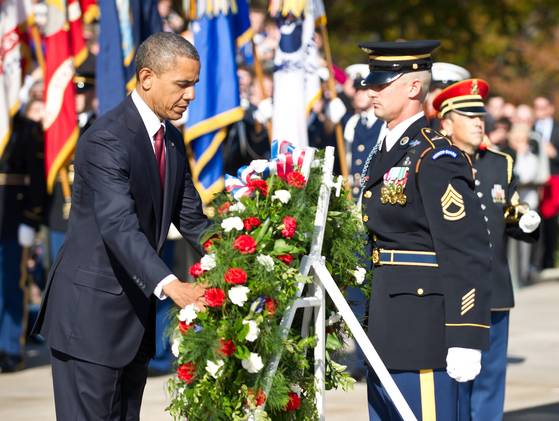
He said the wreath he laid earlier at Tomb of the Unknowns was intended to "remember every service member who has ever worn our nation's uniform." In a speech at the Memorial Amphitheater, he said America will never forget the sacrifice made by its veterans and their families. "No ceremony or parade, no hug or handshake is enough to truly honor that service," the president said, adding that the country must commit every day "to serving you as well as you've served us." He spoke of the Sept. 11 generation, "who stepped forward when the Towers fell, and in the years since have stepped into history, writing one of the greatest chapters in military service our country has ever known. You've toppled a dictator and battled an insurgency in Iraq. You pushed back the Taliban and decimated al-Qaida in Afghanistan. You delivered justice to Osama bin-Laden."Obama also said this was the first Veterans Day in a decade with no American troops fighting and dying in Iraq, and that a decade of war in Afghanistan is coming to a close. Over the next few years, he said, more than 1 million service members will make the transition to civilian life. "As they come home, it falls to us, their fellow citizens, to be there for them and their families, not just now but always." Later, the president and his wife, first lady Michelle Obama, and Vice President Biden and his wife, Jill, greeted families in the cemetery's Section 60, home to graves of service members killed in Afghanistan and Iraq.

Turkish Weapons, Funded by Saudi Arabia and Qatar, Are Being Smuggled to Syria

Abu Abdo, weapons smuggler who channels weapons and money from Turkey to Syria, said that the government of Development and Justice Party (AKP) is playing the major role in facilitating weapons smuggling and opening the borders for terrorists to cross to Syria. AFP quoted Abu Abdo as saying that "If Turkey tightens the security on the Syrian-Turkish borders, then the 'repels' will lose in ten days." Abu Abdo added that he has information that confirms that Turkish weapons have been purchased by Saudi and Qatari money as to be smuggled to Syria. Abu Abdo confessed to smuggling communication devices, vests, weapons and munitions to the so-called 'free army', adding that lots of goods, including food, medicine and other basic materials, are being brought to Syria from abroad because of the international sanctions imposed on the county.

Iran: Silence is not the answer

http://www.iranfocus.com
The humanitarian crisis in Iran has taken a turn for the worse, beginning a dark chapter in the country's bleak history of violating human rights. Iran has the world’s highest execution rate per capita, and is the only country in the world which continues to execute minors. In the face of international isolation and domestic unrest, the Iranian regime has begun a bloody crackdown targeting dissidents with the aim of terrorizing the population into submission. This campaign of terror includes public hangings designed as a warning to any who dare defy the regime, with as many as five individuals hanged in the streets in truly horrific spectacle. Since January, at least 386 people have been executed in Iran, second only to China in total executions. Yet many acknowledge that these numbers are only a portion of the true death toll, as the regime actively censors information and does not report many of its crimes. One shocking example of barbarity involved Iranian blogger and activist Sattar Beheshti, who was arrested for his online activism and outspoken criticism of the regime. Beheshti died while under severe torture during his interrogation proceedings. His death highlights the regimes fear of criticism and dissent, and their crackdown on freedom of information. Iran has a history of targeting journalists and bloggers, and has been known to enact severe forms of torture and cruelty in prisons. Presently, Iran’s campaign of terror has reached a fever pitch. From November 7th to the 8th, Iran executed 23 individuals in just two days. Since October 22nd the regime has undertaken 6 mass hangings with nearly 40 individuals executed. The increased rate of execution is reportedly motivated in part by a desire to expedite the cases of over 1000 prisoners on death row in Gohardasht prison alone. Will the international community standby and remain silent in the wake of such crimes? As the regime faces increased isolation will the West extend a hand to its leaders, or its citizens who withstand death and torture in their struggle for freedom? In view of the worsening human rights situation in Iran, as underlined in the latest report by the United Nations and Special Rapporteur on the situation of human rights in Iran, Ahmed Shaheed, the United Nations Security Council must address this matter and take binding measures with teeth to make clear to Tehran's rulers that such behavior will not be tolerated. At a time where the regime will stop at nothing to maintain its iron grip on power, the international community must stand with the people of Iran.

Ethiopia woman tells of sex slavery in Saudi Arabia

http://www.awrambatimes.com
An Ethiopia woman revealed that she was the victim of sex slavery after she attempted to find work as a domestic worker in Saudi Arabia. For H, who asked that her identity remain anonymous, her ordeal began after she took a boat to Yemen, where after two months she was able to cross into Saudi Arabia and was hired by what she told Bikyamasr.com was a “nice couple” for a “decent salary.”But that is when her horrific experience began. She continues to look down at her hands, ever moving, as she retells what she was forced to endure at the hands of her Saudi bosses. “I don’t think the wife knew anything that was going on,” she is quick to point out. “But if she did hear my screams and did nothing, I hope she doesn’t sleep well.” After three weeks of relative calm, H was finding life in southern Saudi Arabia comfortable and she was hoping that much of her first paycheck would be sent back to her family in Addis Ababa. Instead, no money came. “When the fourth week came around, I was excited because I was being treated well and was doing my job I thought very good,” she continued. But the day she asked when she would receive money, the husband, who she described as a construction manager, began grabbing her and forced her to the wall. She said she was screaming, but knew that nobody would come to her aid because the wife was out shopping and the two children were at school. “He ripped my dress off and forced himself onto me. He raped me. This was just the beginning,” she said, tears beginning to form in her eyes. “He would find me almost daily and rape me. He would force me to work naked in his office if nobody was home. He would tie me up and repeatedly force himself onto me over and over for hours if the wife was out of the house. I can’t imagine that I experienced this,” she added. After four months of constant rape and sexual violence, H was able to escape late in the night after she found her door was unusually unlocked. She met up with three other Ethiopians and they fled back across the border into Yemen, where they were flown out of the country this fall as part of the International Organization for Migration (IOM) flights. Her story is not unusual, she says, revealing that at least three other Ethiopian women were raped while working in Saudi Arabia. “I would never wish any woman to work in Saudi Arabia, the stories I hear are horrific and I know how we are treated. We are slaves to whatever they want,” she added. Tens of thousands of Ethiopian migrants and refugees have entered Yemen since the end of July, according to a new report published by the Danish Refugee Council (DRC). The report said that some 51,000 Ethiopians have illegally crossed into Yemen after the short boat trip. H is just one of the many Ethiopian women who attempted to have a better life outside their native country.

Saudi Grand Mufti issues edict against contact with foreign media

The Grand Mufti of Saudi Arabia on Friday issued a religious edict prohibiting contact with foreign media, in order to protect the Kingdom's security and religion. Sheikh Abdul Aziz Al-Asheikh decreed that contacting foreign media outlets was "not permissible and is considered betrayal and assistance to the enemies of Islam" and amounted to “treason and major crime" Al Arabiya reported. The Grand Mufti went on to say that foreign media seeks to “spread chaos and strife in Muslim lands" and contact with them is a threat to Saudi security and religion. As the highest religious authority in the Kingdom, the Grand Mufti's words carry great weight in a country already deemed one of the most censored in the world. Following the wake of pro-democracy protests across North Africa and the Middle East, censorship in Saudi Arabia was tightened. According to CPJ "No foreign or local journalists are granted access to the Eastern Province, where protesters have been calling for political reforms and greater rights for the Shiite minority since February 2011." Additionally "international news outlets operating inside its borders limit their reporting in order to maintain accreditation." As censorship was tightened HRW reported "The Ministry of Culture and Information heavily censored print and broadcast media. Internet critics crossing vague 'red lines' faced arrest." Amongst the new laws was one which prohibited anything which could damage the reputation of the Grand Mufti. Over the course of the year Sheikh Abdul Aziz Al-Asheikh has issued a number of restrictive edicts in the name of Islam. In March Israel National News reported he declared it was “necessary to destroy all the churches of the region." In September Digital Journal reported the Grand Mufti "called upon governments and international bodies to criminalize insults against prophets." Read more: http://www.digitaljournal.com/article/336614#ixzz2BvPTzrlB

Saudi Opposition Figure Complains about Corruption in Riyadh's Judiciary

farsnews.com
Corruption and bribery have deep roots in the Saudi judicial system, Fuad Ibrahim, an opposition figure, complained, adding that the country's judiciary issues verdicts in favor of Saudi princes in return for huge sums of money. "Saudi Arabia's judicial system is corrupt and totally dependant on the ruling dynasty. In many cases, it is bribed with millions of dollars to issue verdicts in favor of princes," Ibrahim said on Sunday. He also referred to numerous cases of corruption in other Saudi governmental bodies and ministries, and said the interior ministry of the country distorts intelligence information and proofs and uses fake reports to cover up its crimes against the people. Saudi Arabia has arrested a large number of opposition figures since the start of popular protests in the country in February 2011 and it resorts to any means, including poisoning their food, to put the prisoners under pressure. Some international bodies including Amnesty International have frequently raised concerns about the situation of prisoners and condition of human rights in Saudi Arabia. In the most recent case, the International Amnesty has called on Riyadh to avoid using excessive force against protesters and respect people's rights of peaceful assembly. Amnesty International also called on Saudi authorities to investigate the killings of protesters in the Kingdom. "Despite promising to investigate deaths of people at the hands of the security forces, there has been no indication this ever happened," said Philip Luther, Amnesty International's director for the Middle-East and North Africa. "The authorities must end their silence and announce both the details and the outcome of any investigations and state whether any official suspected of unlawful killing has been brought to justice. "They must also ensure that those people marching today are allowed to exercise their right to peaceful assembly and are not met with excessive force." Saudi Arabia is witnessing daily popular protests to mark the deaths of at least 14 people in connection with protests in the country since last year. Reports vary as to how those killed in connection with the protests lost their lives. Eyewitnesses have said that some of those who died were either not taking part in demonstrations or, if they were, posed little or no risk to the security forces. All demonstrations are banned in Saudi Arabia, but they have been taking place in Saudi Arabia's predominantly Shiite Muslim Eastern Province since February 2011 to protest the arrest, imprisonment and harassment of members of the Shiite community for holding collective prayer meetings, celebrating Shiite religious festivals and for breaching restrictions on building Shiite mosques and religious schools. The demonstrations in the Eastern Province have been inspired in part by protests that swept the Middle-East and North Africa region in 2011. The Saudi authorities have responded with repressive measures against those suspected of taking part in or supporting protests or of expressing views critical of the state. Protesters have been held without charge and incommunicado for days or weeks at a time, and in some cases reportedly subjected to torture and other ill-treatment while in detention.