Friday, November 9, 2012

Pakistan's minority Hindus feel under attack

Associated Press
They came after dusk and chanted into the night sky "Kill the Hindus, kill the children of the Hindus," as they smashed religious icons, ripped golden bangles off women's arms and flashed pistols. It wasn't the first time that the Hindu temple on the outskirts of Pakistan's largest city was attacked, and residents here fear it will not be the last. "People don't consider us as equal citizens. They beat us whenever they want," said Mol Chand, one of the teenage boys gathered at the temple. "We have no place to worship now." It was the second time the Sri Krishna Ram temple has been attacked, and this time the mob didn't even bother to disguise their faces. The small temple, surrounded by a stone wall, is a tiny religious outpost in a dusty, hardscrabble neighborhood so far on the outskirts of the city that a sign on the main road wishes people leaving Karachi a good journey. Local Muslim residents blamed people from a nearby ethnic Pashtun village for the attack, which took place in late September on the Day of Love for the Prophet, a national holiday declared by the government in response to an anti-Islam film made in the U.S. No one was seriously injured in the attack. It was the latest in a rising tide of violence and discrimination against Hindus in this 95 percent Muslim country, where Islamic extremism is growing. Pakistan's Hindu community says it faces forced conversions of Hindu girls to Islam, a lack of legal recognition for their marriages, discrimination in services and physical abuse when they venture into the streets. The story of the Hindu population in Pakistan is one of long decline. During partition in 1947, the violent separation of Pakistan and India into separate countries, hundreds of thousands of Hindus opted to migrate to India where Hinduism is the dominant religion. Those that remained and their descendants now make up a tiny fraction of Pakistan's estimated 190 million citizens, and are mostly concentrated in Sindh province in the southern part of the country. Signs of their former stature abound in Karachi, the capital of Sindh. At the 150-year-old Swami Narayan Temple along one of the city's main roads, thousands of Hindus gather during the year to celebrate major religious holidays. Hindus at the 200-year-old Laxmi Narain Temple scatter the ashes of their cremated loved ones in the waters of an inlet from the Arabian Ocean. But there are also signs of how far the community has fallen. Residents in a city hungry for land have begun to build over Hindu cemeteries, the community's leaders say. Hindus helped build Karachi's port decades ago, but none work there now. Estimates of the size of the Hindu population in Pakistan are all over the map — from 2.5 million or 10 million in Sindh province alone to 7 million across the country — a reflection of the fact that the country hasn't had a census since 1998. It isn't just Hindus who are facing problems. Other minorities like Christians, the mystical Muslim branch of Sufis and the Ahmadi sect have found themselves under attack in Pakistan, where the rise of Muslim fundamentalists has sometimes unleashed a violent opposition against those who don't follow their strict religious tenets. The discrimination has prompted some Hindus to leave for India, activists warn, though the extent is not known. Around 3,000 Hindus left this year, part of a migration that began four years ago, sparked by discrimination and a general rise in crime in Sindh, said DM Maharaj, who heads an organization to help Hindus called Pakistan Hindu Sabha. He said he recently talked to a group of Hindus preparing to move to India from rural Sindh, complaining that they can't eat in Muslim restaurants or that Muslim officials turned them down for farming loans. Even during recent floods, they said Muslims did not want them staying in the same refugee camps. Other Hindu figures such as provincial assembly member Pitamber Sewami deny there's a migration at all, in a reflection of how sensitive the issue is. Earlier this year, there were a string of reports in Pakistani media about Hindus leaving the country, sparking a flurry of promises by Pakistani officials to investigate. In India, a Home office official said the Indian government noticed an upward trend of people coming from Pakistan but called reports of Pakistanis fleeing to India "exaggerated." He said he does not have exact figures on how many Pakistani Hindus have stayed in India after entering the country on tourist visas. The official spoke on condition of anonymity due to the sensitivity of the topic. There's more of a consensus of the seriousness of the problem of forced conversion of Hindus. Zohra Yusuf, the president of the Human Rights Commission of Pakistan says the pattern goes like this: A Hindu girl goes missing and then resurfaces days or weeks later married to a Muslim boy. During court hearings to determine whether the conversion was voluntary, students from nearby Islamic schools called madrassas often flood the room, trying to intimidate the judges by chanting demands that the conversion be confirmed. Maharaj says he's tried to intervene in roughly 100 cases of forced conversions but has only succeeded in returning a girl safely back to her family once. If a girl decides to renounce Islam and return to Hinduism, she could be signing a death warrant for herself and her family even if her conversion was forced. The Hindu community has also been hurt by a lack of unity within its ranks. Hindu society within Pakistan and elsewhere has historically been divided by caste, a system of social stratification in which the lower castes are often seen as inferior. Members of the lower castes in Pakistan say it wasn't until two girls from a high-caste family were forcibly converted this year that high-caste Hindus took the issue seriously, although it's been happening for years. "We always fight our war ourselves," said Bholoo Devjee, a Hindu activist from Karachi, speaking about the lower castes. In recent months the government has begun to take the concerns of the Hindu community more seriously. In Sindh province, legislators proposed a law to prevent forced conversions in part by implementing a waiting period before a marriage between a Hindu and a Muslim can go forward, and there's discussion about proposing such a law on the national level as well. In the case of the Sri Krishna Ram temple, law enforcement authorities opened a blasphemy case against the people who rampaged through the building. But residents here are skeptical that these developments signify any long-term improvement in their plight. Weeks after the incident no arrests have been made, and the Hindus complain that no high-ranking Hindu officials have come to visit them or help them get compensation. Sunda Maharaj, the spiritual leader at the temple, which was first attacked in January 2011, said he and the other residents do not want to move to India. "We are Pakistani," he said. But he would like more help from the government, specifically a checkpoint to stop people from getting close to the temple and money for the Hindus to buy weapons. "Next time anyone comes we can kill them or die defending our temple," he said.

Malala status updates Friday 9 November 2012

Malala’s condition today was described as comfortable and stable. She continues to make progress with her treatment at the Queen Elizabeth Hospital Birmingham. Birmingham Council House will be open from 10:00 until 14:00 on Saturday 10 November to allow people to leave messages for Malala on what has been designated Malala Day. Anyone wishing to sign the book should go to: Birmingham Council House Victoria Square Birmingham B1 1BB

Malala Yousafzai: Call for Nobel Peace Prize award

There are calls for Malala Yousafzai, the Pakistani schoolgirl who survived a gun attack by the Taliban, to be awarded the Nobel Peace Prize. Tens of thousands of people across the world have signed online petitions saying she deserves to be recognised. Malala was shot after she campaigned for girls' education in Pakistan. After the attack she was flown to a hospital in Birmingham for treatment and doctors there say she stands every chance of making a good recovery. Thanks Malala's father says the teenager wants to thank well-wishers for the thousands of goodwill messages from around the world. Mr Yousafzai said: "She wants me to tell everyone how grateful she is and is amazed that men, women and children from across the world are interested in her well-being." Events are expected to take place around the world on Saturday to mark one month since Malala was shot. Nobel Peace Prize The Nobel Peace Prize is given every year to a person who's judged to have made the biggest contribution to promoting peace. Past winners include American president Barack Obama, former head of the United Nations Kofi Annan, and the former president of South Africa Nelson Mandela.

Malala grateful for global support

Malala, the teenager being treated in Britain for gunshot wounds inflicted by the Taliban in Pakistan, on Friday thanked her global supporters, one month on from the brutal attack. "She wants me to tell everyone how grateful she is and is amazed that men, women and children from across the world are interested in her well-being," said her father Ziauddin Yousafzai, on behalf of the 15-year-old. "We deeply feel the heart-touching good wishes of the people across the world of all caste, colour and creed," he said in a statement issued by the Queen Elizabeth Hospital in Birmingham, where Malala is being treated. Her father added: "I am awfully thankful to all the peace-loving well-wishers who strongly condemn the assassination attempt on Malala, who pray for her health and support the grand cause of peace, education, freedom of thought and freedom of expression." The hospital on Friday published photos of Malala sitting and reading a book, while others showed her poring over get-well cards. Armed men in Mingora, the main town in the Swat valley (northwest Pakistan), shot Malala in the head and shoulder on October 9 after stopping the school bus on which she was travelling. The attack was claimed by the insurgent Taliban Movement of Pakistan (TTP), allied to Al-Qaeda. They claimed to have targeted Malala because of her "pioneering role" in calling for girls' education, and because of her general criticism of the Taliban. The teenager was transferred on October 15 to the central England hospital, which specializes in the treating British soldiers wounded in Afghanistan.

November 10 to be celebrated as Malala Day: UN

United Nations Secretary General Ban Ki-Moon has announced that November 10, 2012, will be celebrated as Malala Day the world over, as it marks the 30-day anniversary of the Taliban attack on the 15-year-old education campaigner from Pakistan. The Express Tribune quoted Ki-Moon, as saying that Malala is an inspiration for girls education the world over. On Friday, the UN special envoy for global education will visit Pakistan and present President Asif Ali Zardari with a petition signed by over one million people asking that he make girls education a reality in Pakistan. Ki-Moon hoped that observing Malala day will build on the momentum of UN’s Education First initiative and show that education is a right of everyone, and not a privilege for a few. The Tehrik-i-Taliban Pakistan (TTP) had shot Malala in the head and neck while she was returning home from on October 9. She was attacked for speaking up against the Taliban and advocating girls’ education. She is now recuperating at a hospital in Birmngham, UK, and is said to be making good progress.

Classmate Injured in Attack Offers Prayers for Malala

A classmate of Malala Yousafzai, who was also injured in the attack on the girls' rights activist, says she's still afraid to leave her house, prays for Malala to come home, and thought her arm "had been blown off" during the attack. Kainat Riaz, 15, spoke to ABC News from her home in the Swat valley, an area of northern Pakistan that was home to a Taliban insurgency four years ago. Riaz was riding in the same school bus as Yousafzai and others nearly a month ago, when a lone gunmen boarded and demanded to see Malala. "We were coming back from school," the young girl says. "I was discussing my paper with a friend and suddenly found a man on the ledge of the van." "When he fired, Malala immediately fell," she recalls. "She was hit in the head and lost a lot of blood. We thought she wouldn't survive… We just looked at Malala and cried. "Then he fired at Shazia (another classmate) and then I got hit. I thought my hand had been blown off. It got numb. When I came home, I found out what happened and then went to the hospital." To speak with Riaz, ABC News travelled through a series of narrow streets and alleys in Mingora, the capital of Swat district, until reaching her home, a small two-bedroom bungalow which is now permanently guarded by two full-time, armed policemen. Her female relatives sat in another room while Riaz, wearing glasses, a headscarf, and a traditional Pakistani shalwar khameez, spoke openly about the night of the attack – and beyond.In a possible indication of the security threats that still surround her, an armed police guard remained at her side during the entire interview. While other media reports have suggested Riaz returned to her school to resume her studies, she emphatically told ABC that is not the case. She says she only returned once to the school for a "change of scenery." The situation, she says, still isn't safe, though she hopes it will soon change. "God willing I will definitely go back to school," she says, offering a hint of the resilience that has made the girls national heroes in Pakistan. The attack hit a raw nerve in Pakistan, drawing widespread condemnation from all sectors of Pakistani society, including a rare public statement and visit to the hospital by Pakistan's reclusive army chief, General Ashfaq Pervez Kayani. Ordinary Pakistani citizens began holding demonstrations, while "We are all Malala" became a rallying cry in a country where millions of young girls are still denied access to an education. Before the attack, Yousafzai had become an icon of hope. When the Taliban swept through the Swat valley beginning in 2008, she write a diary for BBC's Pashto service under a pseudonym, chronicling her desire to stay in school even after the Taliban had demanded all girls' schools be closed. Even after the Taliban, who demolished several girls' schools and flogged women in public, were eventually routed by the Pakistani military, Yousafzai continued to speak out. At just 11 years old, she would often appear on Pakistani media outlets, encouraging other young girls to pursue an education. Through it all, she and her family continued to defy death threats from the Taliban. In the end, by being attacked, Yousafzai and her classmates have done something no other leader – whether civilian or military – has been able to do: They've united the overwhelming majority of the country against the Taliban's extremism.A lot of people have learned that girls' education is very important," Riaz says of the incident's aftermath and the outpouring of media coverage. "Malala almost sacrificed her life for it. Many girls who weren't studying are studying now." The case has even drawn high-profile international support from unlikely quarters. Hollywood actress Angelina Jolie, who serves as a goodwill ambassador to the UN, wrote an oped declaring "We are Malala," and pop superstar Madonna recently dedicated a concert to the young girl.Gordon Brown, the UN Special Envoy for Education, has taken up Yousafzai's cause, starting a global movement pushing for girls to have free and unfettered access to education. A petition he initiated reportedly has more than a million signatures. He plans to visit Pakistan on Saturday – which he's dubbed world "Malala" day to present the petition to Pakistan's President, Asif Ali Zardari, in person. All of this – the outpouring of support, the media coverage, the potential to change millions of lives – doesn't phase Riaz, who speaks in a confident tone. Though her wounds haven't fully healed – she still has fevers and migraines at night – her thoughts remain focused on one thing. Her friend Malala. "There is no one like Malala," she says, flashing the tiniest hint of a smile. "She was a different kind of girl." It seems, the world would agree.

Taking Bold Steps to Turn Malala's Vision Into Action

A vast outpouring of global support for Malala Yousafzai will happen on Saturday when the world comes together to back her cause for a girl's right to go to school. From the rickshaw on the streets of Islamabad with a poster featuring Malala's face simply stating, "Peace and Education," to a message from the United Nations Secretary-General and petitions of over one million names being submitted in nearly 100 countries on every continent, the world is coming together with the people of Pakistan with one simple message: Every girl and boy should go to school. School children, teachers and parents are going global with this message, holding vigils and rallies, handing in petitions, and holding governments accountable for the right to education. Media companies, newspaper and radio stations are broadcasting the message. From the likes of Justin Bieber, Angelina Jolie and David Beckham to Lewis Hamilton, Usher and Heidi Klum, celebrities have also joined in speaking out for Malala, including tweeting, Facebook posts, blogs and wearing "I am Malala" t-shirts and headbands. Over the next several days, I will visit Pakistan to commemorate Malala Day on November 10th, one month following the tragic shooting of a young girl simply for wanting to go to school. I will meet with President Zardari and Ministers in the Pakistani government and visit schools during my stay to meet those very children whose families struggle each day to make sure they have the opportunity to go to school and learn. During my stay, I will hand over petitions signed by over one-million people from across the globe to the president. At the same time, news is pouring into my office from civil society groups on every continent saying that they too will commemorate Malala Day and turn in petitions in the capitals of their countries. I encourage everyone to do something on this day to show their support for Malala by delivering the petition, holding vigils and events, wearing T-shirts and spreading the word on social media. As the UN Special Envoy for Global Education, I will ask President Zardari to work with the international community, including the United Nations agencies, the Global Partnership for Education, World Bank, donor countries, NGOs and civil society -- alongside Pakistani citizens, teachers, parents, foundations and children, to achieve what Pakistan itself has declared to be its aim: universal education. I will ask him to take measures aimed at fast-tracking and accelerating progress to overcome the bottlenecks keeping millions of girls and boys out of school. Through an accelerated process to achieve the Millennium Development Goal for education and ensure all children, particularly girls, have quality schooling, Pakistan will take a bold step in providing opportunity and peace for its future generations. Making a quality education a reality for every child requires us to tackle difficult challenges head on as there are formidable barriers to overcome. But the good news is that there is no technological or scientific barrier to universal education. All we need is a collective determination to achieve our aim. The best news of all is that Malala is recovering -- and her recovery will continue to motivate millions to join the fight for the right of every girl and boy to go to school free of fear.

Thousands call for Nobel peace prize for Malala Yousafzai

Politicians urged to back nomination of 15-year-old girl shot by Taliban while campaigning for girls' education in Pakistan
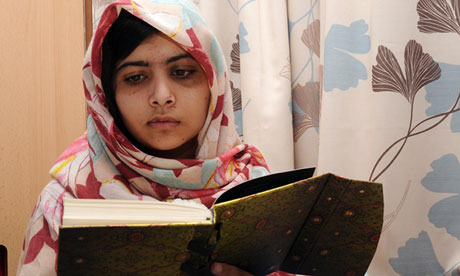
Thousands of people have called for a Nobel peace prize for Malala Yousafzai, the 15-year-old who was shot by the Taliban while campaigning for girls' education in Pakistan. Malala has the support of more than 60,000 people backing a petition to nominate her for the prestigious award. The call came ahead of Saturday's global day of action marking one month since Malala was shot in the head by the Taliban. In the UK, Shahida Choudhary is campaigning for the prime minister and prominent politicians to write to the Nobel committee to recommend Malala. Choudhary said: "Malala doesn't just represent one young woman, she speaks out for all those who are denied an education purely on the basis of their gender. "There are girls like Malala in the UK and across the world. I was one of them. "I started this petition because a Nobel peace prize for Malala will send a clear message that the world is watching and will support those who stand up for the right of girls to get an education." Choudhary was taken out of school in the UK aged 16 and forced into a marriage in Pakistan. She escaped back to the UK, returned to education aged 28, and runs a network in Birmingham to support women in similar situations. Malala, was attacked last month with two other girls while travelling home from school in the Swat Valley. The gunman who boarded the van in which she was travelling asked for her by name before firing three shots at her. In early 2009, Malala wrote an anonymous blog about life under the Taliban, who had banned all girls in her area from attending school. The global petition to have Malala nominated, on Change.org, was started in Canada by Tarek Fatah, a writer and broadcaster. Malala's nomination has won the backing of Canada's four largest political parties and has been supported in other countries including France and Spain. Nobel committee rules states that members of national assemblies and governments are able to make nominations for the prize. Nominations close in February.

Thursday, November 8, 2012

Malala Yousufzai status updates

Thursday 8 November 2012
Malala continues to make satisfactory progress at the Queen Elizabeth Hospital Birmingham. The medical team supervising her care described her condition as comfortable and stable.

Taliban epicenters are in Punjab

The KP governor has demanded that the Punjab government should take action against Taliban. Talking to media in Peshawar on Thursday, Barrister Masood Kausar said the Punjab government neither denied its contacts with the extremists nor did disclaimed the reports regarding its adjustment, adding the provincial government should take action against the terrorists wherever they are. He demanded the Punjab government should bear down on them. Kausar asserted that the statements by Chief of the Army Staff (COAS) General Ashfaq Parvez Kayani and Chief Justice of Pakistan (CJP) Iftikhar Muhammed Chaudhry are not sign of a confrontation. Punjabi Taliban, he noted, are a reality; had it not been so, people would have coined the terms of Balochi and Sindhi Taliban as well. Masood Kausar maintained that role of Pakistan Army has remained very significant for the democracy in the country.

'We will not abandon Afghanistan'...Rasmussen

NATO will end its combat mission by the end of 2014 as planned, NATO Secretary General Anders Fogh Rasmussen told DW. International forces will, however, continue to offer support. You will serve as NATO secretary general until summer 2014. A couple of months later, the last NATO combat soldier will leave Afghanistan. Are you confident that both NATO's mission and your personal mission can be accomplished by then? Yes, I am confident that Afghan security forces will be able to take full responsibility for the security all over Afghanistan by the end of 2014 as we have planned. Some 50 NATO troops have been killed already this year by members of the Afghanistan army or police, and the number of these so-called insider attacks continues to grow. I wonder if NATO can stick to its timetable for the pullout? Obviously these insider attacks are a matter of great concern because they threaten to undermine trust and confidence between foreign troops and Afghan security forces. But these enemy tactics will not succeed. No one can drive a wedge between us and our Afghan partners and this is the reason why we have taken a number of measures to prevent such insider attacks - including strengthened recruitment procedures, strengthened counter-intelligence measures and other steps, and we will not hesitate to take further steps if needed. So these insider attacks will not derail our strategy. We will stick to our strategy, to our timetable. And by the end of 2014 we will complete our current ISAF mission. Many experts warned that the Taliban and warlords are just biding their time until NATO combat troops have left. Was it the right decision to set a fixed date for the end of ISAF's mission? Yes, it was the right decision to outline a roadmap for handing over more and more responsibility to the Afghans. Firstly, because we are not in Afghanistan as an occupation force. The ultimate goal must be to hand over full responsibility to the Afghans themselves. We can't stay in Afghanistan forever. That's my first point. Secondly, I also think it's important to have certain deadlines because deadlines serve the purpose to push forward the process. The Afghans know that they have to be ready at certain dates, so the roadmap and the deadlines serve as a driving force and we have actually seen a lot of progress thanks to that roadmap. But many NGOs portray Afghanistan as a country doomed to slip into another civil war and they warn of a collapse of the Kabul central government. Regarding these worst-case scenarios, what can, what will NATO do after 2014?First and foremost, I would like to stress that I don't share these doom and gloom perspectives. I fully realize that we still have a lot to do and there are still challenges. But overall, we have seen progress. Security-wise, we have seen a decline in the number of enemy attacks. When it comes to development, we have seen progress: a relatively high economic growth; an improved educational system - eight million children go to school out of which more than one third are girls; a better health situation - child mortality has gone down, life expectancy has gone up. So, we have seen a lot of progress. We will not abandon Afghanistan. We will complete our current combat mission by the end of 2014, but we will stay with the NATO-led training mission after 2014 so we will continue to assist the Afghan security forces to make sure they maintain their capability to take full responsibility for security all over Afghanistan. Let's take a look at this new NATO mission to Afghanistan - ETAM. Will it only be training and assistance or might there also be combat troops required? It will not be a combat mission. There will be a clear difference between the current ISAF combat mission and the new training mission. So we will focus on training, assistance, giving advice to the Afghan security forces. They will do the fighting. We will help them with training, assistance, and giving advice. But having said that, of course, we need to make sure that our trainers and instructors can operate in a secure environment so we need to protect them effectively. What that will take has not been decided yet. We are in the early stages of the planning process. But it will definitely not be a combat mission. These early stages of the planning - does it also involve the question of whether the new mission needs a UN mandate? No, we are not there yet. But do you want a UN mandate? A UN mandate would be excellent but, according to international law, it would be sufficient to have an invitation from the Afghan government. If we, on top of that, could have a UN mandate, as we do today, it would be excellent. The Afghan government is unwilling to grant NATO military personnel immunity from prosecution by Afghan courts after 2014 but NATO can't risk demanding this immunity for their soldiers. Could this row endanger the new mission as a whole? Well, these legal aspects must be addressed. We have actually not made any decision in that respect yet. There will be talks between us and the Afghans. And we have to solve these legal aspects because otherwise I foresee problems as regards the deployment of trainers and instructors in Afghanistan. Briefly looking at geopolitics, the US is leaning more and more towards the Pacific region. Does this weaken NATO? No, not at all. On the contrary, I think it is also in Europe's interest that the United States focus on the Asia-Pacific region, taking into account the rise of emerging powers like, for instance, China. It's important of course that it does not take place at the expense of the traditional transatlantic relationship, and we have seen that the Americans are committed to European security. One example is missile defense. The Americans provide a major input into the NATO missile defense system. European allies provide input as well so it's a joint effort. It's an example that the United States continues to be committed to European security and the transatlantic relationship. So I do believe that this re-balancing of the US defense and security policy will not take place at the expense of the transatlantic relationship.

Pakistan: Family Forced To Marry Off 6-Year-Old Girl To Settle Feud

http://www.rferl.org
The parents of a 6-year-old girl in Pakistan's Swat Valley say tribal authorities are forcing them to marry off their daughter to resolve a family feud. A jirga tribal assembly in the village of Ashari ruled that the girl, Bibi Roza, should be married to a member of a rival family in order to resolve a dispute between the two clans. The parents have appealed to a Swat court to have the ruling overturned, and local police now say they will attempt to block the wedding, which is scheduled for November 11. Swara, the practice of exchanging women and girls to settle personal feuds, is common in Swat and other parts of Pakistan's Khyber Pakhtunkhwa Province. But exchanges involving girls as young as 6 are considered extremely rare.

Pak-US relations strong despite ups and downs

US Ambassador to Pakistan Richard G Olson said on Wednesday that Pak-US relationship was strong despite the ups and downs over the years. In an informal conversation with participants at the residence of the Deputy Chief of Mission for the US presidential election results watch, the new Ambassador said he looked forward to stronger ties between the two countries. Olson said, regardless of election results, US policy would continue to emphasise the importance of a close relationship with Pakistan. He said his country wanted a strong relationship with Pakistan, one that stood on the basis of mutual respect and interests. The ambassador acknowledged Pakistan’s key role in the war against terror and recognised that it had paid a very high price for its involvement. He said Pakistan also had an important role to play in Afghanistan and appreciated Pakistan’s efforts in this regard. He further said the two countries were friends and that his department was looking forward for constructive cooperation between them in the war against terror. Olson described the tight race for the white house as a triumph of democracy. The ambassador labelled the upcoming general elections as Pakistan’s internal matter. However, he added that he looked forward to witnessing the transition from one democratic government to another and termed this as an important milestone in Pakistan’s history. He said he wished to meet as many Pakistanis as possible during his stay so as to better understand the people and improve people to people contacts between the two nations.

Balochistan wastes Rs50 billion

The bureaucratic inefficiency and corruption in a backward province like Balochistan, which is facing an insurgency like situation, where the people are poorest of the poor and where the most fundamental needs of life like drinking water are not available, must be regarded as a criminal act of the worst order. Absence of socio-economic development in this province has always been attributed to the federal government. However, all members of a sub-committee of the Senate Standing Committee on Finance, Planning and Economic Affairs must have received a shock of their life when the Planning Commission apprised them that none of the 32 federal-funded development projects worth Rs60 billion initiated in Balochistan over the past 10 years could be completed so far despite disbursement of over Rs50 billion, 80 per cent of the allocated funds. The Pat Feeder Water Sector Project, strengthening of Kirthar Canal’s embankments and development of check dams to prevent flooding by hill torrents of Marri-Bugti area, commencement of academic activity at a technical college in Gwadar, fencing of the Gwadar airport and water management scheme for Quetta are some of the projects. Pat Feeder and Kirthar Canal schemes were initiated 15 years ago and they are deplorably nowhere near completion. Similarly, the college in Gwadar was completed by the federal government a couple of years ago but the provincial authorities did not develop access roads and related facilities, nor appointed teachers, and the building was now decaying. The report proved to be too obnoxiously revealing to make senators from Balochistan remark that the provincial bureaucracy and leadership had played a role in forcing people to take up guns and move to mountains. Senator Sardar Fateh Mohammad Hosni chaired the session. The delay in execution of the vital projects is so inordinate as to give the smell of corruption. For example, even the acquisition of land for Mirani Dam has not so far been completed. This goes without saying that the project’s cost has gone up manifold. The question of paying compensation to landlords also seems a tricky business because some people were demanding Rs700,000 in compensation for a tree and there are 17,000 trees on ground; the provincial government appears ready to pay Rs60,000 for a tree that I too exorbitant a rate. The provincial government needs to get the details of all the projects probed and must request the federation to involve the National Accountability Bureau in the matter. Even of no corruption has taken place and the delay owes to the inefficiency of the bureaucracy, officers responsible must be proceeded against under the efficiency rules and punished accordingly. The absence of the chief secretary and his nominee, the additional chief secretary, must also be taken seriously.

Peshawar: Education key to fight militancy

Chief Minister Ameer Haider Hoti on Wednesday said that education was the only weapon to combat terrorism and militancy in the province. “We are ready to face any challenge and difficulties but will ensure a bright future for our next generation by spreading education,” he told a public meeting after laying the foundation- stone of new building of Abdul Wali Khan University Mardan (AWKUM). AWKUM Vice-Chancellor Dr Ihsan Ali also addressed the meeting. Member National Assembly Himayatullah Mayar, Member Provincial Assembly Ghani Dad Khan, Awami National Party (ANP) district President Farooq Akram Khan, Commissioner Mohammad Adil Khan and elites of the city were also present. Chief Minister Hoti said that AWKUM had achieved great success in a very short period. He said that AWKUM was his dream and it has now started a successful journey. “I am laying the foundation-stone of 18 buildings on the same time and day on the land purchased for AWKUM,” he told the gathering. He said Mardan was ignored in terms of development during the last 60 years, but the ANP-led government established university, medical college, ring road, children hospital and other mega projects in the district. The chief minister appreciated the efforts of AWKUM vice-chancellor and his team saying they had succeeded in achieving the desired goals. He said he would talk to governor to extend the tenure of Dr Ihsan Ali as VC AWKUM because of his meritorious services towards education. He said the provincial government was facing challenges of terrorism, energy crisis, unemployment, which would be addressed through result-oriented policies. To address the energy crises in the province, he said the government has prepared a plan for executing several hydro-power projects. He said work on five hydro-power projects had already been started and would be completed in five years. The chief minister said the government had also established Khyber Pakhtunkhwa Oil and Gas Company which would start work shortly. “We are launching Rs1 billion project, “Naway Sahar Laptop Scheme” through which laptops would be given to talented students,” he said. Dr Ihsan Ali lauded the efforts of the chief minister and his team for establishing an institution like AWKUM in Mardan. He said that work was continuing on the new building of AWKUM and in the first phase its boundary wall of more than seven kilometres was completed.

Indian delegation in Pakistan left unprotected for a short while; probe ordered

timesofindia
Punjab deputy chief minister Sukhbir Singh Badal and his 45-member delegation were left unprotected for a short while when their Pakistani police guards left their duty and went off to have dinner at a club here. The incident occurred on Wednesday night at the Royal Country Palm Club, where Pakistani businessmen had hosted a dinner for the Indian visitors. Punjab Police chief Haji Habibur Rehman took serious note of the "security lapse" and ordered an inquiry into the incident, officials said.Superintendent of police (Security) Shomail Akram, however, contended the incident was not a security lapse. "The policemen performing duty with the Indian delegation were hungry and they had to eat at the function. They were present on the premises while having dinner and therefore there is no question of a security lapse," he argued. The Punjab Police chief's office said the inquiry would establish whether there was a security lapse. The Indian delegation on Wednesday visited Lahore Fort and Badshahi Mosque. They also went to the Food Street near the Mughal-era mosque. Badal attended a Youth Festival along with Punjab chief minister Shahbaz Sharif. Leaders of the Pakistan People's Party, which is in power at the centre, hosted a luncheon for the delegation.

Suicide attack on base in Pakistan's biggest city kills one

A suicide bomber killed at least one person when he rammed his vehicle into the gates of a military base in Pakistan's largest city on Thursday, police said, the latest in a series of audacious attacks on security forces. Thirteen people were wounded in the explosion but the attacker was unable to penetrate into the headquarters of the Rangers paramilitary base in the port city of Karachi. "It is a heavy blast near the Rangers office, with some casualties," said senior police official Javed Odho. He told Pakistani television the bomber had used more than 100 kg of explosives in the attack. Karachi is Pakistan's financial hub and is home to 18 million people. The bombing is the latest in a series of attacks on military bases in Pakistan, including a 16-hour assault on Pakistan's navy base in Karachi in 2011 that killed at least 10 people and an attack on the army headquarters in Rawalpindi in 2009. Some of the assaults have prompted speculation the attackers had sympathizers inside the military who gave them information about the bases. Nuclear-armed Pakistan, an uneasy U.S. ally, is fighting its own homegrown Taliban as well as other insurgents who cross its porous border with neighboring Afghanistan. Karachi is home to a number of sectarian groups and fighters allied to the Taliban insurgency and is also faced with an epidemic of violent crime.

President Barack Obama’s ground game delivers in Florida

The final tally for Florida won’t be clear until at least Wednesday, but President Barack Obama’s ground game and organization was strong. That’s the biggest take-away from President Barack Obama’s strong showing Tuesday in Florida, a state with such high unemployment and home-foreclosure rates that it was primed for a Republican win. But, with thousands of votes still out Tuesday night, Obama appeared close to winning the nation’s largest battleground state, thanks to a mammoth grass-roots campaign. It may have killed Mitt Romney’s chance of unseating the incumbent. Obama led Romney 50-49 percent in Florida, according to Edison Research’s exit poll that exactly mirrored the results of the actual vote as of Tuesday night. With voters casting ballots well into the night, the final tally for Florida won’t be clear until at least Wednesday afternoon, when Miami-Dade County plans to announce its final results. More than 18,000 absentee ballots turned in Tuesday have yet to be counted. The race could be close enough to trigger a recount — unless it is waived by Romney, who lost the overall election to the president. Obama’s strength: liberal Southeast Florida, where early vote returns showed the president nursing a double-digit lead. Romney did well in conservative North Florida. For the first time ever, a Democratic presidential candidate won absentee ballots — typically a Republican strength — in Miami-Dade County, with Obama eking out a 382-vote margin. That was a leading indicator of Obama’s strong grassroots campaign, which involved 200,000 unpaid volunteers who helped register 320,000 new voters this year. Obama won big with the fastest-growing segment of the electorate: Hispanic voters, who voted for the Democrat, 60-39 percent, the exit poll showed. That’s better than Obama did in 2008. Obama’s Hispanic-vote margin came despite a massive Hispanic-outreach effort by Romney, who struggled at times in the general election because of the hardline immigration policies he espoused during the Republican primary. Obama won big in Osceola and Orange counties, home to a burgeoning Democratic-leaning Puerto Rican population that’s starting to counterbalance Cuban-American Republicans in Southeast Florida. Obama’s Hispanic outreach effort was so robust that he planted a field office — one of more than 100 in Florida — in the once-Republican stronghold of Little Havana. “I have faith. I have faith in him,” independent voter Sandy Basham, 39, said Election Day when she cast her ballot. “He just needs more time.” Obama carried independents, 50-48 percent, the exit poll showed. Independents are the key to winning Florida, a nearly deadlocked state. Obama won outsized black-voter support, but lost non-Hispanic whites by double digits. Heading into Election Day, Democrats had cast 167,000 more early votes statewide than Republicans. But the Romney campaign denied it had much significance. They pointed out that Obama was doing worse than he did in 2008, when he won Florida by less than 3 percentage points. But Obama 2012 wasn’t running against Obama 2008. He ran against Romney 2012. And it looks like the president won that contest. The final results are still in doubt and the margin will be close either way. Late Tuesday, the margin was so close that the winner could be decided by Libertarian Party candidate Gary Johnson, who had more than 41,000 votes. Romney’s strength: The economy — the top issue for more than 60 percent of the Florida electorate, according to exit polling. Of these economy-first voters, Romney beats Obama by 6 percentage points. By 51-46 percent, voters believed that Romney would be better than Obama in handling the economy. Voters also believed Romney was slightly more likely than Obama to share their values, be a strong leader or have a better vision for the future. Romney also persuaded some voters that, like Obama four years ago, he is the candidate who can bring about change. “We need a better change,” said Samantha Gentile, a 20-year-old independent who voted Tuesday at St. Gregory’s Church in Boca Raton. “We need an economic change,” Gentile said. “We need jobs.” Florida voters didn’t completely blame Obama for the nation’s economic woes; 51 percent said it was President George W. Bush’s fault and 42 percent said Obama. Gentile’s remarks stood out, in part, because of the T-shirt she wore that openly advertised her support of gay marriage, which Romney opposes. Gentile said she also favors abortion rights, while Romney is opposed. The exit polls indicated that Gentile was in the minority for those in her age group. Obama carried young voters, while he lost older voters to Romney, the exit polls showed. Voters thought Obama was better than Romney by 50-46 percent, when it came to managing Medicare. Also, the poll showed, 57 percent of Florida voters believed that taxes need to be increased on the wealthy —a position that blunted Romney’s attack against Obama as a tax raiser. Obama fared well on an all-important question for Florida voters: Are you better off now than four years ago? Only 34 percent said no, and more than 83 percent of them were Romney voters. Both sides slung considerable mud at each other. In all, including the U.S. Senate race, about $180 million in ads were spent in Florida. Many of them were negative. Obama spent a huge sum attacking Romney in the summer to drag down the Republican’s poll numbers. Romney surged briefly after an October debate that Obama lost. It could take days for the final results of the election to be clear. In Miami-Dade, voters remained in line in some precincts until well past midnight. The close race could easily trigger a recount under Florida law, which automatically kicks in when any race is decided by a margin of one-half of one percent or less. If 9 million people vote in Florida — a plausible figure, given reports of heavy turnout around the state — that means there could be a recount if the presidential vote is decided by 45,000 votes or less. In a recount, all ballots are submitted again into the tabulating machines to recount the votes. If the recount yields a margin of one-quarter of one percent or less, the local canvassing boards must then perform a manual recount to examine so-called “undervotes” and “overvotes” — ballots that recorded no vote for president, or multiple votes for president. Any recount must be completed within nine days from the day it is ordered by the Secretary of State. However, state law also says any recounts must be completed within 12 days of Election Day. But, just as in the 2000 recount, there are tensions between the state and federal law: Elections officials still must collect absentee ballots cast overseas for some 10 days after Election Day. So overseas ballots could trickle in through Nov. 16, with a recount deadline of Nov. 18. In 2008, more than 97,000 absentee ballots were cast by overseas Florida voters. For those who have blotted it from their memories: The 2000 contest between George W. Bush and Al Gore was decided by just 537 votes in Florida. Read more here: http://www.miamiherald.com/2012/11/06/v-print/3085117/exit-polls-florida-too-close-to.html#storylink=cpy

Wednesday, November 7, 2012

President Obama Looks to the Future

Taliban in Karachi

In its interim order on the Karachi law and order situation, the Supreme Court directed the Sindh government to take immediate action against all armed groups, including the Taliban, and to take seriously the issue of the Taliban presence in the city. The advice about 'seriousness' is particularly important given that the two alliance partners in the provincial government, the MQM and the ANP, have been at loggerheads over the issue, with the former insisting the Taliban were active in Karachi and the latter reacting angrily, refuting the assertion as an indirect attack on its fellow Pashtuns. The nation's commercial capital, Karachi has attracted a large number of people from all over the country. Hence, even though the Taliban's home base is Khyber Pakhtunkhwa and parts of Punjab, it is hardly surprising if some of them have found their way into Karachi - needless to say, not all Pashtuns or Punjabis sympathise with them. Also inviting for the Taliban has been the environment created by turf battles among Sindh government's coalition partners: the PPP, MQM, and ANP. These insurgents are known to have had a nexus with al Qaeda. How these links worked has come to light several times with the arrest of al Qaeda leaders and operatives who took refuge in Karachi. In May of last year, for instance, the security agencies announced nabbing a senior al Qaeda operative, Mohammad Ali Qasim Yaqub, a.k.a. Abu Abu Shohaib al Makki, from the city. In June this year, Karachi police said they had arrested seven suspects belonging to an al Qaeda affiliate, and recovered seven explosives-laden jackets, rockets and detonators from them. These people obviously had local connections. Instead of squabbling, all political players need to rise above ethnic/political affiliations to face the common enemy. More importantly, the government has to act decisively. In its last year's verdict on the Karachi situation, the Supreme Court had noted that all members of the ruling coalition were responsible for endless violence and lawlessness, and made several recommendations to restore normality to the city. Due to reasons of political expedience, the government paid little heed to those recommendations, prompting the court to revisit the same issue this year. Meanwhile, the conditions have worsened, becoming ideal for the insurgents and all sorts of criminal elements to operate in. Interior Minister Rehman Malik has promised compliance with the court order this time, saying that Karachi has turned into a Taliban stronghold, and that the government would act in accordance with the SC interim order and go after the Taliban. He also claimed that some Taliban-specific measures had already been initiated. Any such measure in isolation from the other factors causing relentless violence in Karachi will be unhelpful.

Pakistan: Now another institutional clash?

www.dailytimes.com
Speeches the other day by COAS General Ashfaq Pervez Kayani and Chief Justice of Pakistan (CJP) Iftikhar Mohammad Chaudhry had much in common and much to commend them. However, they did also contain some things implicitly that have aroused concern. On the face of it, the COAS in his speech to officers at GHQ seemed to be responding to recent criticism of some retired Generals charged with interfering in the political process (the Asghar Khan case, in which a former COAS and former head of the ISI have been squarely put in the dock), and corruption (in the NLC and now Fauji Fertilizers cases). The COAS’ take on this was that individuals’ mistakes in the past should be left to the judicial (due) process and guilt or innocence should not be presumed before that. Additionally, and perhaps more ominously, the COAS hinted at judicial berating and a media trial of the institution itself, which the COAS believes was undermining the public’s confidence in the military, creating rifts amongst the high command (perhaps mere speculation) and between the high command and the rank and file of the military. Obviously, any such development that impacts on the internal cohesiveness and discipline of the military is bound to arouse the concern of the top commanders. At the hands of the judiciary too, apart from the Asghar Khan case, the missing persons and law and order cases in Balochistan have seen the judiciary criticising the policies and actions of the military and its intelligence arms in unprecedented fashion. It has been a rough two years for the hitherto unassailable and immune reputation of the armed forces, starting with the Abbottabad raid and winding its way through other embarrassing revelations and open criticism. This has naturally rattled an institution and its top command, accustomed as they are to a culture of unquestioning impunity inherited from our past of being a security state. The CJP hit the nail on the head when he said in his speech to civil servants that national security is no longer measured in terms of military hardware, but rather whether a state is answering to the needs of its citizens. Were that not the case, a superpower such as the Soviet Union would not have been banished into oblivion. But where there is room for concern is the reiteration by the CJP of the “ultimate jurisdiction” of the Supreme Court (SC) in matters constitutional and legal. The letter of the law certainly conforms to the CJP’s formulation. However, in its zeal to correct “past wrongs” and set ‘everything’ right, the SC stands accused of intervening in matters beyond its turf. This activism, arguably unfettered by the time honoured juridical principle of restraint, has caused the court to become increasingly controversial, having brought it into conflict incrementally with the executive, parliament, and now potentially the military. Rights and wrongs embedded in the system inherited from a chequered past cannot be transformed to the ideal overnight with the wave of a magical judicial wand. Without in any way disrespecting the good intentions of the court, it must be reiterated, as we have consistently done in this space, that the respect and dignity of the judicial institution is too precious to allow even the shadow of doubt or accusation to fall upon it. In this regard, where there is much to commend in the SC’s judgements over the past almost three years, there are also rising concerns about conflict and clashes between state institutions, which is neither the intent of the court, nor welcome, yet seem to be the inevitable and logical outcome of the court’s well intentioned but arguably overzealous interventions in matters of great and even small import. It is not without interest to examine the process of evolution of the democratic system in the last five years. State institutions seem to be jockeying for turf and space, a process known to have been part of the evolution of mature democracies. President Zardari the other day characterised this process as the “dying kicks of the old order”, implying the certainties of the past on which state institutions may have rested so far, were yielding to new realities in which each institution had to re-examine its powers, boundaries and limitations. It is no surprise therefore that every time a powerful head of one or the other state institution speaks publicly, the common point of reference tends to be a recognition of, and respect for, the legitimate purview of each institution, and appeals for restraint as far as straying into the turf of other institutions is concerned. May this democratic evolution finally arrive at an agreed delineation of these matters that proves mutually acceptable to all institutions. There lies hope and confidence of a better future.

Zardari warmly congratulates Obama on his re-election

President Asif Ali Zardari
has warmly felicitated President Barack Obama on his re-election as the President of the United States of Ameirca. In a message to President Obama, President Zardari described his election to a second term as a clear reaffirmation of the American people of their confidence in his leadership and a powerful endorsement of Mr Obama’s vision for his country. The President expressed the hope that relationship between Pakistan and the US would continue to prosper during President Obama’s new term in office. He stated that he was confident that the leadership of the two countries would be able to further deepen and broaden bilateral relations on the basis of mutual respect and mutual interests. The President said that he looked forward to working closely with President Obama towards the shared objectives of peace, security, stability and prosperity in the region.

Pakistan: Terrorists creating panic

Reacting over the suicide blast that killed as many as six people, including a senior police officer in Peshawar on Wednesday morning, Senior Minister Khyber Pakhtunkhwa Bashir Ahmed Bilour said that terrorist were creating panic ahead of Muharram, Geo News reported. Speaking to media, Bilour said that the terrorists wanted to cause terror among people days before Muharram but “entire nation is united”. “We are not scared of suicide blasts,” he added. The minister said that a meeting had been convened on November, 11 to chalk out a security plan in connection with Muharram.

Peshawar suicide blast kills top Pakistan police officer

A suicide bomber in north-western Pakistan has killed a senior police officer and at least four other people in the city of Peshawar, officials say. They say that the bomber, who was on foot, targeted the car of Assistant Superintendent of Police Hilal Haider in a congested part of the city. Pakistani newspapers said that police bodyguards were among the dead. Peshawar is near Pakistan's tribal belt on the Afghan border - a stronghold of Taliban and al-Qaeda militants. Violence from the tribal regions has in recent years spilled over into the city. There were at least three bombings in Peshawar in September. Militants have in recent months specifically targeted senior police officials in and near the city. A senior bomb disposal officer was among those killed in September. 'Deafening blast' Police say that at least 30 people, including passers-by, were injured in the latest incident. A Pakistani Taliban spokesman told the AP news agency that the group carried out the latest attack. "We killed him today in Peshawar because he was behind the arrest of some of our fighters," spokesman Ehsanullah Ehsan said from an undisclosed location. The Pakistani Taliban have been fighting a bloody insurgency for several years against the Pakistani army as part of their campaign to enforce their austere version of Islamic law in the country and in protest against the government's alliance with the US. Witness Amin Khan told the AFP news agency that the bomber struck when he was in a rickshaw, going to the local market. "Suddenly a deafening blast shook the area. My rickshaw was overturned. When I came out I saw smoke and dust had covered the blast site," he said. Other witnesses described blood and body parts on the street. The attack came as US President Barack Obama was re-elected - Washington is the main focus of the anger of militants in Pakistan. During his first term as president, Mr Obama increased the number of drone strikes in north-west Pakistan against militants who he argues are planning attacks against America and its Nato allies in Afghanistan. Militant attacks, drone strikes and army offensives have killed thousands of people in north-west Pakistan in recent years.

US confirms Malala attack mastermind hiding in Afghanistan

The Taliban leader who sparked international outrage by ordering the attack on a Pakistani schoolgirl last month has escaped retribution by hiding in a section of eastern Afghanistan where U.S. forces are already spread thin and focused on other targets, according to U.S. officials. U.S. military and intelligence officials said that Mullah Fazlullah, the mastermind of the attack on 15-year-old Malala Yousafzai, operates out a region adjoining Pakistan where several hundred U.S. troops are stationed. But they said finding Fazlullah is not a priority because he is not affiliated with al-Qaeda or with insurgents targeting U.S. and Afghan interests. “Our guys just aren’t tracking him,” a senior Special Operations official said. “He is viewed as an ‘other-side-of-the-border’ problem.” When asked if Fazlullah was a priority, a senior intelligence official responded, “Not with so many other potential targets” in Afghanistan. Fazlullah’s relative safety reflects a larger trend in the difficult terrain along both sides of the Afghan-Pakistan border. Plenty of attention has been focused on militants attacking U.S. and Afghan troops from havens inside Pakistan. But officials said extremists from Pakistan also have managed to evade the Pakistani army and CIA drones by finding sanctuary in remote parts of Afghanistan. “The FATA is difficult [for insurgents] because there are drone strikes,” said a congressional staffer, using the acronym for semi-autonomous Federally Administered Tribal Areas on the Pakistan side of the border. “It’s easier to be in eastern Afghanistan where there’s no real presence” of U.S. troops. All three people spoke on condition they not be named because they were not authorized to speak for attribution. Tom Collins, a spokesman for the International Security Assistance Force in Kabul, said: “ISAF is maintaining steady pressure on insurgents throughout Afghanistan. Mullah Fazlullah, like many insurgents who are transitory, remains a person of interest. If we receive actionable intelligence that he is in Afghanistan, we will attempt to take him off the battlefield.” Collecting accurate intelligence is the most difficult step in locating and attacking enemy forces. In Konar and Nuristan, the two provinces where Fazlullah is believed to be hiding, the problem is tougher because ISAF advisers believe the Afghan army is allowing the Pakistani Taliban to operate in retribution for Pakistan not doing enough to stop cross-border rocket attacks and armed infiltrators using Pakistan as a haven. Not all Pakistani militants escape attack inside Afghanistan. On Aug. 25, one of the group’s senior leaders was killed in a NATO air strike. ISAF said the leader, Mullah Dadullah, was helping fighters who had attacked Afghan and coalition forces and had close ties with al-Qaeda. Fazlullah, on the other hand, remains focused on Pakistan and he is not believed to have ties to al-Qaeda or attacks on coalition or Afghan forces. The Pakistan government has criticized both the United States and Afghanistan for not trying harder to capture or kill Pakistani Taliban in Afghanistan. Washington, for its part, has long accused Pakistan of refusing to take on the Haqqani network, which uses northwestern Pakistan as its base for attacks against coalition forces in Afghanistan. More aggressively targeting the Pakistan Taliban would divert military resources, particularly drones and other surveillance capacity, to the region at a time when personnel and assets are being reduced in anticipation of the end of combat operations in 2014. But some experts say that reducing the threat to Pakistan’s stability from its homegrown extremists should be a vital goal. “I think it is in the U.S. interest to go after the threats to Pakistan because our policy and long-term interests are to have a stable Pakistan,” said Wendy Chamberlin, a former U.S. ambassador to Pakistan and now president of the Middle East Institute, a Washington think tank. The senior intelligence official said U.S. offers of additional training and intelligence support have been turned down by Islamabad, where suspicions of U.S. motives run deep. “We could share more,” the senior intelligence official said. “They actually aren’t opening up as much as we would like them to.” The existence of a haven for Pakistani militants inside Afghanistan feeds the distrust that has developed between the United States and Pakistan since the U.S. invasion of Afghanistan in 2001, said Moeed Yusuf, who heads the Pakistan program at the United States Institute of Peace. “Both sides have really been caught up for a long time in the blame game,” he said. The number of insurgents taking refuge in the border region has increased in recent years, particularly on the Afghan side, according to the congressional staffer, who follows the region closely. Besides small numbers of al-Qaeda fighters, the militant population includes the Islamic Movement of Uzbekistan, Afghan and Pakistani Taliban and a growing number of Punjabi extremists involved in the Kashmir border conflict with India, according to U.S. officials and outside experts. “It’s a jihadi soup,” said the congressional staffer. Fazlullah, also known as Mullah Radio because he uses a mobile clandestine radio transmitter to broadcast didactic speeches denouncing girls’ education, music and all things Western, sought safety in Afghanistan sometime in 2009. He fled Paksitan after leading a gruesome campaign in Swat Valley, seeking to impose his extreme interpretation of Sharia law through beheadings, floggings, bombing girls’ schools and killing hundreds of civilians, Pakistani police and soldiers. A U.S. defense official familiar with the tribal structure of the region said Fazlullah has found sanctuary in Konar and Nuristan through personal ties with tribal leaders. His fighters have launched numerous attacks across the border that U.S. defense officials say are intended to raise Fazlullah’s profile and make the Pakistani army look weak. In June, about 100 of Fazlullah’s fighters crossed the border into Pakistan and beheaded 17 soldiers. A year earlier, they had captured 16 Pakistani policemen and executed them by firing squad. But it was the attempt to assassinate 15-year-old Malala Yousafzai on Oct. 9 that pushed Fazlullah into the international limelight. Since she was 11, Malala had been an outspoken champion of the right of girls to attend school. Last month, she was on her school van when gunmen boarded the bus and shot her twice at close range. Two classmates were also wounded. All three survived and Malala is recuperating in Britain. The Pakistani Taliban claimed responsibility for the attack and U.S. intelligence officials say evidence points to Fazlullah as the person who ordered it. The shooting galvanized Pakistan and many other Muslim countries. Muslim clerics in Pakistan denounced the violence and thousands protested in Pakistan. Perhaps feeling pressure from a worldwide condemnation, the Pakistani Taliban released a seven-page justification for the shooting. But condemnation from Washington has been purposefully muted. Although Secretary of State Hillary Rodham Clinton criticized the attackers, others have not done so for fear of a backlash from Pakistan, where conspiracies about U.S. involvement in the country are rife and anti-American sentiment high. Pakistani authorities have arrested at least 30 people for questioning, but say they have not yet found the shooters or their leader, Fazlullah.

Malala Yousufzai status updates 07 November 2012

The nursing staff caring for Malala at the Queen Elizabeth Hospital Birmingham said she remained in a stable and comfortable condition today.

Barack Obama's victory: A big night for Democrats and liberals

http://www.washingtonpost.com
To appreciate the magnitude of the victory Barack Obama and Democrats won tonight, think back to what the political landscape looked like in the spring. The Supreme Court appeared ready to strike down Obamacare, the President’s signature domestic achievement. The recovery was stalling; Republicans were preparing to unleash $1 billion in super PAC ads; Obama’s reelection seemed perilous; and Dem control of the Senate was in doubt. It looked perfectly possible that the congressional GOP’s strategy of obstruction at every turn could be rewarded by voters, possibly with a return of one party rule to the GOP. The Obama experiment appeared headed for failure, and the prospects for the future of progressive reform were teetering on the brink. Instead, Obamacare survived. Obama has been reelected with a resounding victory in the electoral college (the popular vote is outstanding). Democrats have routed Republicans in the Senate races. A progressive champion has been sent to the Upper Chamber in the person of Elizabeth Warren. The first openly gay Senator — Tammy Baldwin, another solid liberal — joins her. The Dem majority will be more progressive and energetic. In Maryland, gay marriage has been ratified by popular vote for the first time. The story of this election will be all about demographics. As Chuck Todd noted earlier today, the fact that it remained unexpectedly close in GOP-leaning southern states shows that the GOP is not keeping pace with the changing face of America. Meanwhile, Obama’s support proved unexpectedly strong among workers in the industrial midwest, thanks partly to his willingness to pursue aggressive government action to save a major American industry. Obama’s team made the right bet on the true nature of the American electorate. Rather than reverting to the older, whiter, more male version Republicans had hoped for, it continues to be defined by what Ron Brownstein has called the “coalition of the ascendant” — minorities, young voters, and college educated whites, particularly women. Obamacare will survive. It will continue to be implemented, and provided that it works, it will grow in popularity as its benefits kick in. The health law will slowly get woven into the fabric of American life, just as the major progressive reforms of the 20th Century did over time. The economy is likely to continue to recover. If Mitt Romney had won, he and his ideas (tax cuts, deregulation, unshackling the free market) might have been associated with the recovery, leaving Keynesianism and stimulus spending thoroughly discredited. Instead, Obama and Democrats will hopefully gain more credit for the ongoing recovery, and perhaps the idea that government can act to fix the economy will get rehabilitated. Warren’s victory is important here, too: The most vocal advocate of progressive taxation in the country was sent to the Senate, at a time when the argument over whether to raise taxes on the rich to help fix our fiscal problems is about to climax. The GOP held the House, and the road ahead remains very difficult. A lot will turn on how Republicans handle this defeat and how they interpret it. GOP operative Steve Schmidt said on MSNBC today that this will require “soul searching” by the party. But there will be tremendous pressure on GOP leaders from the GOP base and conservative opinionmakers — angry about tonight’s results — to continue to obstruct Obama at every turn. However, the President will have leverage. He will be able to point to the fact that Republicans lost resoundingly after adopting a four-year strategy of scorched earth obstructionism to argue that it’s time the GOP sees the writing on the wall and cooperates with Democrats to move the country forward.

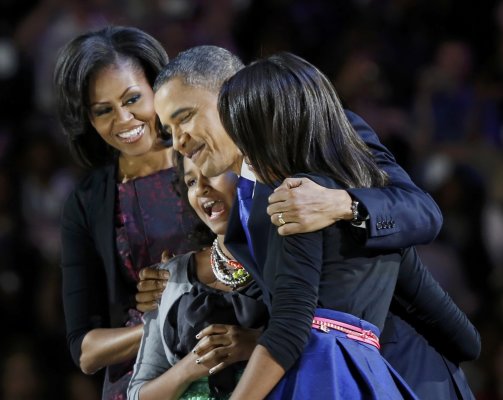
President Obama’s full victory speech

President Barack Obama delivered remarks in Chicago after winning the 2012 presidential election.
Election 2012: Mitt Romney Concedes

Obama wins 2nd term

President Barack Obama rode a wave of broad support from moderates, women and minorities to win re-election Tuesday by defeating Republican challenger Mitt Romney in Democratic strongholds and key battleground states. According to CNN projections, Obama surpassed the decisive 270-vote threshold in the Electoral College with victory in Ohio. That and a later projected victory in another swing state -- Virginia -- gave him 303 electoral votes to 206 for Romney, according to the CNN call based on unofficial returns. Joyful supporters danced and cheered at Obama's victory party in Chicago, and the president thanked them for ensuring the nation will continue to move forward while warning the battle for change they seek will continue to be difficult. "Tonight, in this election, you, the American people, reminded us that while our road has been hard, while our journey has been long, we have picked ourselves up, we have fought our way back, and we know in our hearts that for the United States of America, the best is yet to come," Obama said to prolonged cheers. He emphasized his main campaign theme of fighting for equal opportunity for all, saying the political arguments that come with democracy in America were a necessary part of the process."We will disagree, sometimes fiercely," Obama said, noting that "progress will come in fits and starts" and the victory Tuesday night "won't end all the gridlock." Foreshadowing hard decisions ahead, the president said blind optimism and wishful idealism "can't substitute for the need to make difficult compromises to move forward." When he finished, the first family and Vice President Joe Biden and his family joined him onstage in a celebration of waves, hugs amid a blizzard of confetti. In Boston, Romney supporters hugged and wept in a somber vigil while waiting for their candidate to concede.In a brief speech he delivered alone, Romney congratulated and said his prayers would be with the president at such a challenging time for the country. "At a time like this we can't risk partisan bickering and political posturing," Romney said, later adding that he wished he had "fulfilled your wishes to lead this great country in a different direction." Romney's wife, Ann, and most of his family, as well as running mate Rep. Paul Ryan and his family then came on the stage for a few minutes in what was a subdued farewell.Obama withstood a late push by Romney in Pennsylvania and won battleground states of Ohio, Virginia, Wisconsin, New Hampshire, Iowa, Nevada and Colorado, according to CNN projections. One other battleground, Florida, remained too close to call early on Wednesday. He also easily won traditional Democratic strongholds of California, New York and other populous states such as Michigan, the state where Romney was born and his father served as governor. Exit polls showed Obama received strong support, as expected, from women voters as well as overwhelming support from African Americans and strong backing from Hispanic voters, similar to the coalition that carried him to victory four years earlier to make him the nation's first African American president. Meanwhile, CNN projected that Democrats will retain their majority in the Senate, ensuring another divided Congress after Republicans earlier were projected to hold their majority in the U.S. House.The result showed Republicans need to recalibrate their approach to broaden their appeal to a nation of changing demographics, analysts said. Exit polls indicated that white voters made up 72% of the electorate, with African Americans, Latinos and other minorities comprising a growing share. "It's not about geography anymore with the Republican Party," said Margaret Hoover, a Republican strategist and CNN contributor. "It's about demographics, and we've got to start thinking about growing the party." David Gergen, CNN's senior political analyst, said the Grand Old Party must move its foundation back toward the political center from the increasingly right-wing positions pushed by tea party conservatives. "It seems to me that the lesson has to be clear to Republicans that they have to adjust," Gergen said. "They've gotten too far out." Race was dead even in final polls Obama and Romney ran dead even in final polls that hinted at a result rivaling some of the closest presidential elections in history, reflecting the deep political chasm in the country. A heavy turnout was reported in much of the nation, and both campaigns expressed confidence that they would prevail in what was expected to be a long night awaiting results from the eight states still up for grabs that will determine the victor.As predicted, the election was decided in the battleground states, and as the returns emerged, it became clear that Romney was failing to win them. Overall, Obama led by more than one million votes in the popular tally. The president won his home state of Illinois as well as Romney' s home state of Massachusetts -- where the Republican previously served as governor. He also won Romney's birth state of Michigan, along with Colorado, Nevada, California, Ohio, Wisconsin, Iowa, Oregon, Washington, New Mexico, New Hampshire, Pennsylvania, Minnesota, New Jersey, New York, Vermont, Connecticut, Delaware, Maryland, Maine, Rhode Island, Hawaii and the District of Columbia, according to the CNN projections. Romney won North Carolina, Idaho, Montana, Arizona, Kansas, Louisiana, Nebraska, North Dakota, South Dakota, Texas, Wyoming, Mississippi, Alabama, Tennessee, Arkansas, Kentucky, Indiana, West Virginia, South Carolina, Oklahoma, Utah, Missouri and Georgia, CNN projects. According to early exit polls, 60% of voters said the economy was the most important issue, 59% thought abortion should be legal and 50% wanted Obama's health care reform law repealed while 43% wanted it to remain in place or be expanded. The breakdown of voters, according to the early exit polls, was 73% white, 13% African American, 10% Latino and 3% Asian. Pre-election polls showed Romney holding an advantage among white men while Obama had the edge with white women, and Obama receiving overwhelming support among minorities. With the victory, Obama will face the challenge of leading a country facing chronic federal deficits and debt as well as sluggish economic growth in the wake of a devastating recession and financial industry collapse that confronted Obama when he took office in January 2009. Around the country, voters formed long lines at polling places after record numbers participated in early balloting, indicating a strong turnout. Sporadic reports of irregularities included malfunctioning voting machines and other problems, including electoral hardships for some struggling to recover from the devastation of Superstorm Sandy in states in the country's northeast. A judge in Philadelphia, a heavily Democratic city, ordered election officials to cover a mural of Obama at one school used as a polling location after Republicans complained the painting violated election laws. Elsewhere in the city, GOP poll monitors were being escorted into precincts by sheriff's deputies after some observers had been denied access earlier in the day, said Tasha Jamerson, a spokeswoman for the district attorney's office. In New Jersey, which permitted electronic balloting in the aftermath of last week's storm, the state chapter of the American Civil Liberties Union headed to court on Tuesday on behalf of voters who said their requests for an electronic ballot weren't being acknowledged. Candidates usually take Election Day off, but both sides continued to make public appearances even as voting was under way. Obama visited a local Democratic election center in the Chicago area, while Vice President Joe Biden made "an unannounced but long-scheduled" stop in the key battleground state of Ohio. Romney and his running mate, Rep. Paul Ryan, also arrived separately in Ohio, with Romney's campaign plane and Air Force Two, which carries the vice president, crossing paths at Cleveland's airport. Earlier Tuesday, Romney cast his ballot outside of Boston on Tuesday, while Obama previously became the first sitting president to vote early when he did so in Chicago last month. New pressure for deficit deal With the election over, the White House and Congress will face fresh pressure to legislate a comprehensive deficit reduction deal that has been stymied so far by intransigence on the issue of tax reform, with Republicans refusing to consider any kind of tax increase while Obama and Democrats insist on at least the wealthy paying a higher income tax rate. Despite the building drama toward Election Day in the campaign expected to cost $2.6 billion, much of the outcome already was known.Only a handful of states were considered up for grabs and both candidates and their campaigns concluded an exhausting final sprint through them over the weekend and on Monday. The barnstorming amounted to a montage of Americana electioneering, with Obama and Romney shouting themselves hoarse before boisterous crowds, joined by top surrogates and star power such as Bruce Springsteen singing for Obama and Kid Rock for Romney. In their final speeches, the candidates and their running mates blended inspirational visions for a better future with well-honed attacks in hopes of ensuring their committed supporters actually cast ballots while trying to coax votes from anyone still undecided. Obama briefly waxed nostalgic at his first event on Monday in Madison, Wisconsin, referring to Springsteen when he said: "I get to fly around with him on the last day that I will ever campaign, so that's not a bad way to end things." He cited accomplishments of his first term, including ending the war in Iraq, winding down the war in Afghanistan, passing health insurance and Wall Street reforms, and ending the "Don't Ask, Don't Tell" policy that banned openly gay and lesbian personnel from the military. Emotion overtook the president at the end of the day. His eyes welled with tears as he thanked the people "who've given so much to this campaign over the years," during a stop in Des Moines, Iowa -- a place where his first campaign gained an early foothold in his first run for the White House. Republicans pick up key seat in governors' races For his part, Romney called Obama's record one of underachievement and failure, telling a cheering Virginia crowd at his second stop of the day that "almost every measure he took hurt the economy, hurt fellow Americans." At an earlier event in Florida, Romney asked if people wanted four more years like the last four, raising the specter of continuing gridlock in Washington and adding that "unless we change course, we may be looking at another recession." He had promised to repeal the health care and Wall Street reforms of the Obama presidency and to "limit government rather than limiting the dreams" of Americans. As the challenger, Romney sought to frame the election as a referendum on Obama's presidency and to capitalize on his own background as multimillionaire businessman by depicting himself as better able to handle economic issues identified by voters as their biggest concern. His campaign stump speech hammered Obama over high unemployment and what he called excessive taxes and regulations that Romney said stifled faster growth. Obama and his team attacked Romney's politics and his background as a venture capitalist, saying he would back policies favoring the wealthy over the middle class and exacerbate the already widening income and opportunity disparity in the country. The president wanted the race to come down to competing visions for the future and his oft-repeated goal of restoring the promise of the American dream of equal opportunity for all. In particular, Obama repeatedly noted he backed a taxpayer bailout that helped restore General Motors and Chrysler while Romney opposed it. The issue resonated in auto industry states like Michigan and Ohio, which was considered the most significant of the battlegrounds in the final days of the race. Opinion: Obama will get little time to celebrate Campaign chess match Aside from the policy differences, the election amounted to a campaign chess match targeting specific states and demographic groups as part of plan to create a path to electoral success. Polling portrayed a race that hinged on the social and democratic divides in American society, with Obama supported most strongly by women, minorities and young respondents, while Romney did better among wealthy and middle class white men, from senior citizens down to 30-year-olds. In response, Obama emphasized the anti-choice positions of Romney and conservatives on abortion, their stance against gay rights and their opposition to providing a path to legal status for undocumented immigrants. Re-election offered Obama, 51, the chance to secure a two-term legacy and seek further reforms he promised in his historic campaign of 2008 but was unable to deliver in the first four years. In particular, he has made comprehensive immigration reform a top target, as well as a deficit reduction plan that ends tax breaks for income over $250,000. However, the wave of optimism that carried to him to victory four years ago seemed muted during the campaign this time, with former supporters angered by the failure to achieve the kind of change in Washington they believed Obama had promised but failed to deliver. For Romney, a multimillionaire businessman who sought to become the nation's first Mormon president, the election concluded a six-year quest for the White House. Romney also failed in his first bid for the Republican nomination in 2008, then spent the next two years preparing for a second run that began in 2011 with a grueling primary campaign featuring a record 20 debates. Romney, 65, shifted to the right for the primary race to overcome a broad field. Romney declared himself "severely" conservative and adopted stances against abortion, gay marriage and a path to legal residency for undocumented immigrants while also opposing higher tax rates as part of a deficit reduction plan. His support remained steady -- though well below a majority -- throughout the primary campaign while opponents dropped out one by one until Romney emerged as the winner and claimed the nomination at the GOP convention in late August. However, his campaign endured a tough September, due in part to some unforced errors. A secretly recorded video from a May fundraiser became public, showing Romney referring to 47% of the country as dependent on government handouts and therefore unreachable to him as a candidate. When U.S. diplomatic compounds came under attack on September 11, including an assault that killed the U.S. ambassador and three other Americans in Benghazi, Libya, Romney quickly issued a statement that was criticized for mistaken information and seeking to politicize a sensitive national security issue. Then, in the first presidential debate on October 3, Romney began an energetic shift back to the political center and scored a clear victory over Obama by presenting himself as more moderate than the right-wing zealot portrayed by the president. Obama's lackluster showing in the first debate contributed to an overwhelming consensus among analysts and poll results that Romney carried the night, and he began rising in the polls to erase what had been a consistent Obama lead since the conventions a month earlier. Stronger performances by Obama in the second and third debates began to slow Romney's momentum, though the Romney team claimed a surge put states like Michigan and Pennsylvania back in play. They were previously thought safe for the president. With polls tightening in the final weeks, Romney or his surrogates heightened their attacks on key issues, including a campaign ad that implied the auto bailout led to shifting the production of iconic Chrysler Jeeps to China. The automaker joined the Obama campaign in complaining that the ad was misleading, and the president said it was intended to scare workers for political gain. 21 moments that defined the campaign and America Superstorm Sandy However, the biggest impact on the end of the campaign was Superstorm Sandy, which blasted the East Coast from Maryland to Connecticut just over a week before Election Day. Obama and Romney canceled campaign events, and the president shifted to full emergency response mode as the storm and its devastation dominated the national focus for much of the final full week of campaigning. On the ground, record numbers of voters cast early ballots as both sides boasted of ramped-up organizations to identify and contact supporters. Overall, the total cost of the election for president and Congress could top a record-breaking $6 billion, according to the nonpartisan Center for Responsive Politics. The figure covers spending from January 2011 through whatever totals emerge after Tuesday's election. Outside groups accounted for the biggest boost in spending, with independent organizations dropping more than $970 million. The increase was largely related to the 2010 U.S. Supreme Court ruling that paved the way for super PACs to raise and spend unlimited amounts of money as long as they did not coordinate with the campaigns.